
Miss Hardbroom: A holiday?
Miss Cackle: More than that. Tomorrow, we will forget that we were here together. An afternoon that never happened!
Continuity has always been a bugaboo for writers, the requisite for things to make sense and follow some form of narrative logic thus limiting the possibilities of what can be done later. A requirement that provides scribes with all manner of headaches, hairsplitting, and plothole-induced dementia. Nevertheless, many series go out of their way to pay careful attention to every little detail that goes on in their worlds. The Universe Bible is king; nothing can happen that doesn't fit the existing history. Other shows are less exacting, and an occasional continuity error will be glossed over for the sake of the current episode's plot.
Then there are these.
Not only is there no established continuity, but the show is free to completely wreck the continuity and be assured of a full reboot by the start of the next episode. Burned a hole in your favorite outfit? Don't worry, it'll be better next episode. Burned down your house? No worries, it will be back next time. Turned into a frog, died, destroyed the universe? No problem! If one episode ever continues from the last, it's only because it's part of a storyline too long for just one episode — don't expect any apparent changes from the previous episode to be recognized outside that specific storyline.
The expectation of a new episode reboot is so strong that, in extreme cases, simply having continuity can count as a subversive gag (for example, the letters CHA appearing on the Moon in episodes of The Tick or The Simpsons' forked tongues) or simply the creators getting a kick out of teasing the viewers that have been around long enough (assuming they can remember at least as well as the writers, which they often can).
Generally constrained to American animated shows, or to shows with that style of "cartoony" humor. Often employs Ping Pong Naïveté to allow the humour to work. Often gives the feeling of an Unreliable Narrator (even if there isn't one to begin with).
The greatest benefit of this trope is that it allows a show to be syndicated out of order, and the lack of continuity means that unfamiliar viewers can watch each episode without feeling confused or "out of the loop". This is why continuity-heavy shows, regardless of popularity, tend to see minimal airtime outside of episode premieres.
This doesn't mean everything is always reset, however. The events that setup the premise of the work will always remain, while things like a new character having a proper introduction or a dead character staying dead will occasionally be respected as well, and a Clip Show Episode may avert this by showing scenes from multiple past episodes as events that happened and the characters remember, although that continuity may only apply for this particular episode.
One of the meta-causes of Alternate Universe.
Related to Status Quo Is God (where the status quo is restored no matter what happens), except it is (or can be) more deliberate/explicit, and it doesn't require any narrative explanation. See also: No Ontological Inertia. Also related are Broad Strokes (where a sequel or reboot implies at least some of the older installments to still be canon, albeit with some discrepancies in regards to how the events occurred in the present continuity), Snap Back (where a single episode ends in a way that is inexplicably undone by the next episode), Multiple-Choice Past (where a character has more than one telling of their origin story, all of them having discrepancies big enough that it's impossible to reconcile them into a single backstory) and Universal-Adaptor Cast (where the same characters take on different roles in different stories). Not to be confused with Fanon Discontinuity (when fans disregard the events of installments they dislike) or Canon Discontinuity (where an installment is confirmed to be non-canon).
Examples:
- M&M's: The M & Ms characters are often eaten, but continue to appear in more advertisements.
- Happy Heroes: Rarely, but there's two major moments of this too.
- Season 8 episode 34 having some of the discontinuities (and a few of them were obvious) which would be rather unwieldy to list here, but a few might be intentional (probably on the writers' parts).
- Season 14 episode 45, after Happy S. and other four Supermens plus Nuclear S. were turned evil by the Power of Dark, then then brief clips of season 14 episode 44 where Happy S. and others fight the possessed Nuclear S. (the Dark Demon) flashes, and rewinded to before Nuclear S. absorbs the Power of Dark.
- Pleasant Goat and Big Big Wolf:
- Mainly for classic episodes, as some later seasons have more continuity. Wolffy might be in a dire situation at the end of an episode, but he's always healthy and back home at his castle by the start of the next episode. It makes sense, though; Wolffy does always say he'll be back.
- Regarding The Athletic Carousel episode 56, in which Wilie ates the Small Pill that Paddi forget about while being captured bt Wolffy and Wolnie and turns small, thus helping the goats to escape with big Paddi. Wilie returns to his normal size after this episode somehow.
By Creator:
- Leiji Matsumoto's works are known for this. Many of the shows based on his manga and stories, such as Galaxy Express 999, Space Battleship Yamato/Star Blazers and the various Captain Harlock shows, share characters but present vastly different backstories and do not attempt to reconcile the character's actions between the shows. This is not quite an intentional case of negative continuity, but rather gaps caused by each show being produced by a different creative team.
By Work:
- All through The Adventures of Mini-Goddess, especially with regard to Gan-chan. Lampshaded in the finale.
- Nicely subverted in Crayon Shin-chan. A Snap Back is expected when Shin accidentally blows up the family's house at the end of one episode, but the event is actually followed by an arc in which the family lives in a cramped studio apartment while the house is rebuilt.
- In Doraemon, most stories are about Nobita receiving a device from the future from Doraemon that does something no modern appliance can, and circumstances ensure Nobita will suffer for it, whether it be losing all of his hair, leaking embarrassing videos of himself to his friends, getting hit by a car, drowning in his own bathtub, stranding himself in another dimension, and so forth. By the next story, he and anyone else he drags down with him are perfectly fine, and Doraemon is ready to give Nobita another device that will inevitably get Nobita into more trouble.
- In Excel♡Saga, negative continuity is personified by a being known as The Great Will of the Macrocosm, who resets things at least Once per Episode. Though this is also subverted insofar as the Will is not always available, while Episodes 22-25 also have dramatic elements and more or less logical continuity for significant events. Throughout the series, there is also a slight bit of continuity in with all the general weirdness. Then the next episode, aptly titled "Going Too Far" jumps right back to this.
- The anime Galaxy Angel is made of this. The only times an episode counts is when they're introducing a new regular cast member, such as Milfeulle, Chitose, Normad and the Twin Star Force.
- Higurashi: When They Cry presents itself to be a case of this. The main characters kill each other and then the next arc opens and everything's fine. It turns out to be something very different going on.
- Umineko: When They Cry takes this and goes to its logical conclusion — nothing that happens on Rokkenjima actually matters. All that is intended is to convey a series of scenarios slowly revealing clues to the player so that they might solve the ultimate not a mystery.
- In Lupin III, only the essential elements of the story are ever kept... It's part of the reason why the series has worked for so long. The only lasting changes ever made to the story (the additions of Jigen and Goemon to the cast) occurred very early on in the franchise's history, during the original manga. Since then, the cast of characters has not moved forward an inch in over forty years.
- Green vs. Red is either toying with us, or explaining why there's no continuity of events.
- Eventually averted with Lupin III: Part 5, the first episode of which explicitly acknowledges the events of the fourth series and The Castle of Cagliostro. Later episodes feature either Continuity Nods to or cameos from the "Green Jacket" and "Red Jacket" series as well as The Fuma Conspiracy and The Woman Called Fujiko Mine, to say nothing of frequent throwback episodes that play homage to "Green Jacket", "Red Jacket", and "Pink Jacket". The appearance of Diana from The Pursuit of Harimao's Treasure (alongside a returning Rebecca Rossellini from Part IV) in the final episode additionally indicates that at least one of the Lupin III Yearly Specials is in-continuity for the events of Part 5. Considering Multiple-Choice Past is also in play for the Lupin gang across the myriad of works put out over the years, try wrapping your heads around that.
- Naruto: In Waterfall's first appearance in a dedicated OVA the village could house maybe twenty families and was ruled by a spineless coward. In its second almost appearance, it was noted for constantly launching border raids on other villages, disguised as war games. In its third appearance, there was a bunker with enough shinobi present to populate the village. Databooks reveals that they were the only village outside the five great villages to have their own jinchuuriki.
- Ouran High School Host Club states in its first chapter to ignore any graduations that should be upcoming, quickly establishing that its continuity will not be very reliable. That said, the plot does follow rather normally.
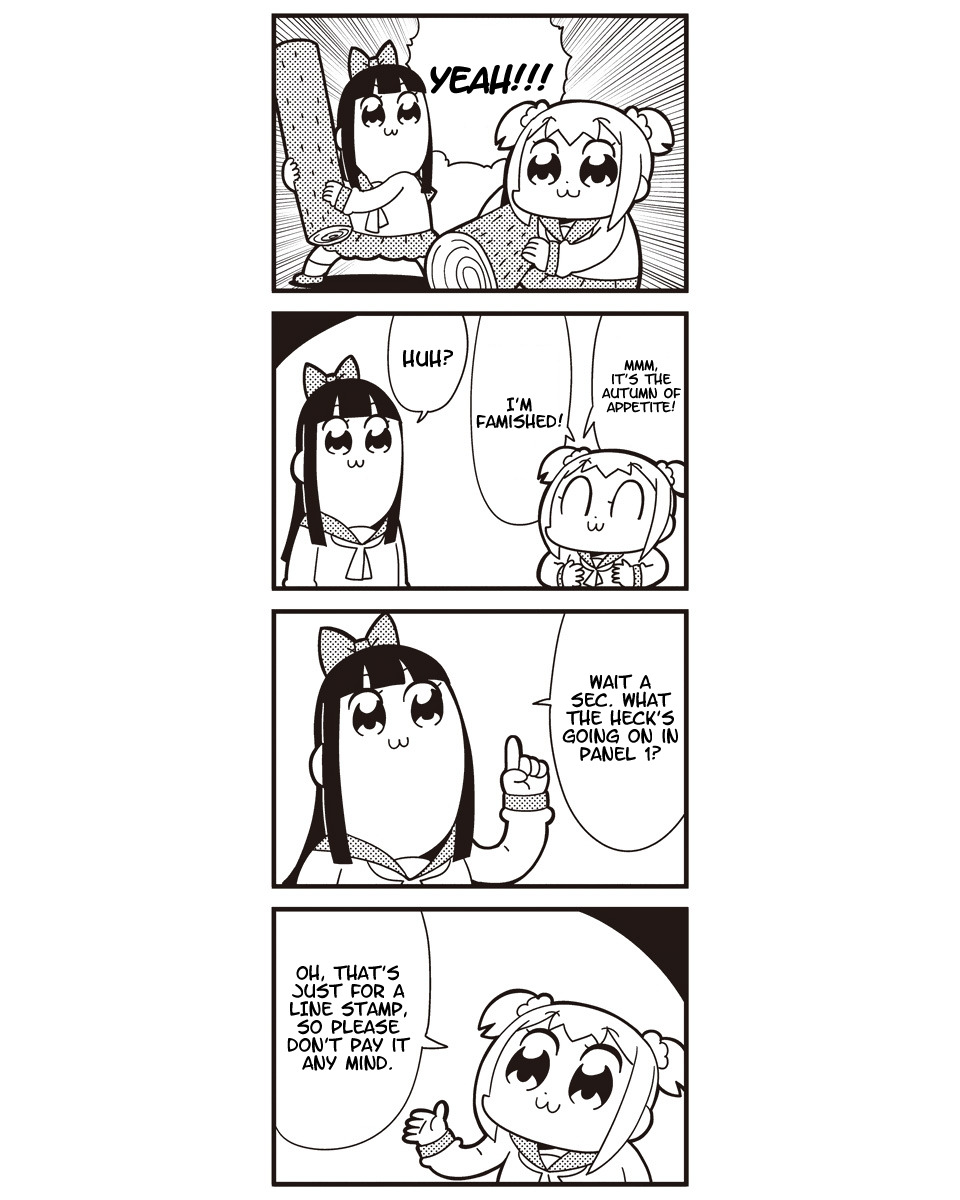
- Pop Team Epic: Being a Surreal Humor Gag Series, attempting to formulate any sort of continuity between strips is nigh impossible. Most notably it managed to invoke this trope within a single comic,
 ◊ where the first two panels are explicitly not related to each other at all.
- The anime follows suit, until the The Omniscient Council of Vagueness from the first episode's intro appears in the last episode and are implied to be a Big Bad for the show.
- Likewise with Ranma ½. Within individual arcs, a Game-Breaking Injury would be a serious matter, the Tendo home would be all but demolished and the characters would have to repair it, someone would get in deep financial trouble and stay that way through the end of the plot, or someone would land in the hospital with a full-body cast. All this damage will be undone by the next arc with nary a word from anyone. The only permanent change was the destruction of the Saotome home (to force the family, Nodoka included, back into the Tendo household). This was lampshaded once in the early anime when Genma tended to Ranma's neck injury and said it would take a week (the time between episodes) to heal.
- Samurai Champloo had negative continuity in two episodes just before the end of the series. The first one, titled "Cosmic Collisions", introduces the characters to a group of dead people who are always searching for a buried treasure that never existed in the first place. The episode ends and everyone is killed by a meteor that destroys the surrounding area. The next episode, "Baseball Blues", shows the characters competing in a game of baseball against an American team and everyone on the team is severely injured or killed in the end (it's never satisfactorily explained if they actually were killed or not), while the finale shows everyone in perfect health and in exactly the place where they had been headed for the entire series.
- Sayonara, Zetsubou-Sensei does not pretend to have anything resembling a continuity; the characters have had to repeat their second year several times yet none of them shows any signs of aging. The school is frequently destroyed and Nozomu Itoshiki, The Protagonist, has been killed several times. None of this is ever referenced again once the manga chapter or anime episode in which it happens is over until the last few chapters at the very end of the series, which reveals Kafuka's jarring yet impressive secret. It's been consistently and sufficiently foreshadowed throughout both the manga AND the anime, but it's so out of left field that there's virtually no way to predict what exactly it is until it's explicitly revealed.
- Sgt. Frog doesn't give much attention to continuity unless it's introducing a new character. However, it does cycle through seasons normally, often changing seasons once per volume, but the characters are never shown graduating or aging at all.
- Space☆Dandy: No change seems to stick from one episode to another. Over the first four episodes, we have had a Series Fauxnale in the pilot (yes, the pilot) by invoking Dropped a Bridge on Him on the main team of heroes, another episode with said team forgetting about saving one of their own from the Monster of the Week, and yet another episode with the universe turning into zombies (which is later referenced in an episode of the second season). And yet somehow everything returns back to normal come the next episode.
- You think they possibly can't top this but then you have the ending of the seventh episode where Dandy has flung far to the distant future in a far end of the universe and having ascended to a higher plane of existence. "THE END" pops up. Credits roll.
- The second season finale plays with the series' disregard with continuity. The reason that Dr. Gel or rather, Bea went after Dandy is because he has a rare element called Pionium that can transcend through different universes.
- The Urotsukidouji series. The original, Legend of the Overfiend, ended with the world being destroyed. The sequel, Legend of the Demon Womb began with the world good as new. The pattern was well and truly set.
- Urusei Yatsura: Plotlines inevitably led down to anarchy, chaos, and lynch mobs running around by the end of each episode, but all injured characters and buildings would have undergone Snap Back by the next episode. A prime example is the Moroboshi family's house. During the course of the series, it has been flooded, collapsed, burned down and blown to pieces (and the abuse the interior has taken). Yet the next episode shows it standing proudly(?) with nary a tatami or zabuton askew... and Mr. Moroboshi still on the hook for the mortgage.
- The manga/OVA What's Michael? (perhaps best described as "if Garfield was a Quirky Work") uses this to the fullest. Where Michael is, when Michael is, and even whether Michael is a normal cat or a Funny Animal is never consistent between two separate chapters. The only constant is that if animals can talk in this chapter, Michael is The Voiceless.
- Winter Days' segments don't have any continuity between each other, focusing instead on providing visual spectacle.
- The classic Archie Comics volumes consist of numerous anthologies and gags, most of them written and drawn by different teams who probably have little to do with one another. New neighbors, transfer students, and teachers are introduced in one strip and then disappear forever. Characters develop superpowers, meet celebrities and/or otherwise make headlines, only for their exploits to disappear in a vacuum and never be mentioned in any other strips.
- Iznogoud:
- In his many failed attempts to become Caliph instead of the Caliph, Iznogoud has been petrified, turned into a dog, lost in a labyrinth, sent back in time, sold as a slave, put in orbit around the Earth, and worse. Nevertheless, everything is always back to normal for the next episode a few panels later.
- In a notable exception, the album Les Retours d'Iznogoud (Iznogoud's Returns) tries to explain how things returned to normal after some of the vizir's most infamous adventures. It does not always work, as many of those returns end with Iznogoud in an equally uncomfortable situation. That just raises further questions!
- The concept of "Hypertime" — outlined by Mark Waid and Grant Morrison as a way to remove the possibility of continuity errors in DC Comics while freeing writers from the need to remain consistent with the works of previous writers — could be described as "negative continuity through total continuity." The main points were (1) every story ever written did happen and is Canon, even the stuff that contradicts the other stuff, however (2) every story takes place in its own discrete world, and (3) the writer of any given story gets to decide which previously-written stories did and didn't happen in the "world" his or her story is taking place in, and therefore can just toss out anything they don't like and Hand Wave discrepancies with earlier stories by saying "that never happened in my world." While the idea has its proponents, most tend to feel it causes more problems than it solves, not the least of which is the fact that the only people comfortable with its "anything goes" approach to continuity are the people who never minded continuity errors to begin with. It's now implied that Hypertime has ceased to exist because in the future (a relative concept since he's already a time traveler), a more competent version of Booster Gold will deliberately eliminate it.
- Mike W Barr declared a similar concept years before Hypertime in a letters page in Batman and the Outsiders. In response to a letter noting a certain story in which it was established that Metamorpho knew Batman's secret identity, Barr simply declared that the earlier story did not exist. He asserted his right as a creator to be free of any bonds of previous continuity solely at his own discretion. The howls of outrage from strict continutists echoed through the letters page for months if not years.
- Less obvious but almost as intrusive as Hypertime is DC's "Ten Year Rule" (closer to twelve years since the One Year Later issues), which in the late '90s-early '00s unambiguously stated that no matter when you're reading a given comic, Batman and Superman started their careers 10 years ago, and they were the first significant superheroes to debut since the Justice Society disbanded in the 50s. Other heroes began their careers within the following year and the Justice League was formed roughly at the beginning of the next year. Between this and the fact that some stories weren't retconned out of existence by the Crisis on Infinite Earths (predominantly because none of the characters affected by the Crisis had a full, unambiguous reboot — they just kept on going as they were but some miniseries — "Superman: The Man of Steel" and "Batman: Year One" — re-wrote the Back Story as needed) has made a mess of the continuity, requiring multiple mini-Crisis Crossovers to shear off the dead weight.
- Marvel has a similar rule to the above, but they don't play quite so hard and fast by it; their flagship characters have aged about 15-20 years since their respective debuts in the 1960s. (But they do adhere to the rule in some capacity, which is why it's not currently, say, 1979 in the Marvel universe right now.)
- Despite Don Rosa's attempts to create a duck "continuity", the vast majority of writers gleefully ignore it at their leisure, but just as is the case with The Simpsons there are occasional continuity nods. Several stories have ended up with Scrooge ruined, for instance. Still, 99% of all duck stories use negative continuity, making it possible for Donald Duck and Huey, Dewey and Louie to be surprised at seeing, for instance, dragons, even though they've seen much stranger things at least a hundred times.
- There are maybe three or four Carl Barks Duck stories which explicitly reference earlier stories (one early issue has Huey, Dewey and Louie capturing a wanted criminal, and in the next issue they talk about what to do with the reward money they got), but other than that, Barks only used broad strokes when it came to continuity. Sometimes a character could have a Compressed Vice or a particular habit or superstition that was only mentioned in one story, and Donald is shown working tons of different jobs which never last to the next issue, no matter how good he is at them.
- In the Anthology Comic The Beano Lord Snooty one of the older strips in the comic first appearing in the first issue is a victim of this. Originally the character was an upper class child who liked to run off and play with working class kids, then the kids appeared to live with him with no reference to the past, After disappearing from the comic for about a decade Lord Snooty then appears in a Beano retirement home (he is still a child physically though) at one point in 2001, he briefly appears again in a longer Kev F Sutherland strip as normal and then by Lord Snooty the Third it is implied he is dead and Lord Snooty the Third's grandfather. Whilst characters which are still children e.g. Dennis the Menace interacted with him whilst they were both still children and some of these characters also interacted with Lord Snooty the Third whilst they were both children as well.
- Monica's Gang lives on this, in all these decades of comics, events of stories contradicting later stories, the rules of the universe keep changing, the fourth wall keeps getting harder and softer, members of family of the characters being introduced to never again appear, the designs of the locations being extremely inconsistent, re-used plots note , and of course the Comic-Book Time where the characters stay the same age for decades so some stories revolving around stuff from the past when they clearly lived through that time period but later comics say they didn't, and also the vague connection with the teen manga, this is not all bad since with so many years of comics trying to be consistent would be very hard.
- A very confusing element of this is Blu's stories where he is portrayed as a comic book star living in a World of Funny Animals but appearing alongside other characters that are more like aware of their existence as comic book characters but they aren't acting their stories.
- However, there are many examples over the years of comics that indeed have continuity between them.
- Superlópez: A couple of examples in the early stories. Most spectacularly, the one which ends with the Monster of the Week devouring the sun.
- The underground comic Wonder Wart-Hog had a blatantly inconsistent continuity, with one of the more notable discrepancies being the comics' indecisiveness on whether Wonder Wart-Hog was Philbert Desanix's alter ego or was actually a separate being who hid inside Desanix's body until it was time to take action against the threats he faced.
- Beetle Bailey:
- Only a few major events covered by story arcs have continued to be canon — mainly that Beetle enlisted in the army from college, and his and Sarge's vacations have been spent with Beetle's parents. Other than that, things (up to and including aliens landing on Earth) will be ignored in the next strip, and character concepts have changed to the point of Retcon.
- A 2014 comic has Beetle state that it feels like yesterday since he joined the army; another character adds that "It was yesterday," which caused internet blogger Josh Frulinger — a.k.a. The Comics Curmudgeon — to joke that Camp Swampy is trapped in a "Groundhog Day" Loop.
- Nero: Since author Marc Sleen worked single-handedly and for a newspaper, he had to whip out two panels of comic strips every day. He worked quickly, but didn't care much about continuity mistakes, which are plentiful in his work. His fans never cared about that, though.
- Pearls Before Swine does this intentionally. It's even lampshaded by the characters, e.g., "I had to kick the whale off the team because technically, he's dead." (That whale had died in the strip two years earlier.) And then the strip continues as if nothing happened. Creator Stephan Pastis calls this "plotline flexibility".
- While being officially Outside Continuity mostly means that This Time Round isn't directly affected by Doctor Who canon, it's also offically got no real canon of its own. Yes, concepts build up, like the whole "To Die For" mythos, but if a writer wants to completely ignore it all there's nothing stopping them, although it's good manners to have a character lampshade it.
- Downplayed in the Mad Max universe, most noticeably when trying to reconcile the original trilogy and Mad Max: Fury Road with the established continuity. There are a few consistent elements across all the films (Max is/was a cop, oil wars led to nuclear wars led to the apocalypse, some props like Max's jacket and the Pursuit Special, Max's injuries carry over between each film) and the first three films in the series had a mostly logical and coherent timeline, but after Fury Road, continuity was thrown out the window. George Miller has said he doesn't think of the Mad Max movies as a single story, but rather as a series of legends about a mythological figure named Max; and much like real myths and legends, there's often contradiction and inconsistency.
- If you're a love interest in a James Bond movie odds are good you won't even get a mention in the next film. This has been averted by only four women (two of whom fell victim to the Cartwright Curse): Sylvia Trench appeared in both Dr. No and From Russia with Love; Tracy Bond appeared in On Her Majesty's Secret Service and was mentioned in both For Your Eyes Only and Licence to Kill, among possibly others; Vesper Lynd appeared in Casino Royale (2006) and was mentioned frequently in Quantum of Solace and No Time to Die, and Madeleine Swann, who appeared in Spectre and No Time to Die.
- Seltzer and Friedberg movies usually have a character get brutally injured in some way, only for them to be perfectly fine later on.
- The Godzilla films. While there's a loose continuity running through the 1955-1975 sequels (with 1968's Destroy All Monsters taking place at the end of the storyline and the following year's All Monsters Attack taking place this side of the fourth wall from the other films), and the 1984-1995 series having a very tight and deliberate continuity, the 1999-2004 films are mostly self-contained. Many of the later movies are presented as sequels to the original 1954 Gojira, as if the events of the movie are only the second time Godzilla has attacked, sometimes even changing events from the original to suit the story. However, you can occasionally catch references to monsters that only appeared in movies that pre-dated the one you're watching by two or three reboots. It's difficult to tell what is supposed to be canon, and what is just meant as subtle Easter eggs for Toho fans. For example, the dead body of Kamoebas washes ashore in Godzilla: Tokyo S.O.S., and Gezora shows up in a video montage in Godzilla: Final Wars... both monsters are from Space Amoeba (another Toho movie), which otherwise has no connection with any other Godzilla movie.
- John Lovitz' character in Loaded Weapon 1 is killed several times and always returns. His explanation? He thought it was a sequel.
- The Halloween franchise has multiple continuities, all but one only sharing the original 1978 film in common. The second movie is an Immediate Sequel, even being set on the same night. Then number three tries to bring the franchise back to its original concept as an Anthology Series, but fails. Four through six return to the original continuity of one and two. Then H20 and Resurrection ignore the 4/5/6 continuity and continue from 2 again. Then Rob Zombie does a total reboot, remaking the first two movies. Then in 2018 a new Halloween trilogy begins which ignores everything except the very first film from 1978, including 2.
- The Highlander franchise has a staggering amount of discontinuity within a single series; the original film, its direct sequel set in a post-environmental-catastrophe future, a TV series that ignores the sequel and retcons the ending of the first film, a third film that ignores both the sequel and the TV series, and two film followups to the series which ignore the third film, an animated series set in a post-apocalyptic future completely different from the one in the second film and which ignores everything except the first movie (and most of that as well), and an anime film which reboots the story and is set in a third post-apocalyptic future. A planned Hollywood remake of the future is apparently stuck in Development Hell.
- The X-Men Film Series had gotten this way due to X-Men Origins: Wolverine and X-Men: First Class, both of which were prequels to the first three films and played fast and loose with the timeline. So a new timeline was introduced. Wolverine has been officially thrown out of continuity.
- Conversely, Deadpool makes no attempt whatsoever to tie the various installments of the X-Men film series, even resorting to completely changing character motivations and origin stories to benefit the Rule of Cool theme. Wade Wilson is aware of his original-timeline counterpart (Weapon XI) from X-Men Origins: Wolverine, and drops in on him in the middle of Deadpool 2s mid-credits scene to shoot him down while making fun of all the continuity problems in the franchise. Colossus has inexplicably gone from a lean American-born man in the original trilogy to a buff Russian with a heavy accent. Deadpool mocks the tendency of the X-Men themselves to never be around when he visits Xavier's mansion — and he just misses running into the X-Men: Apocalypse-era team (which have somehow been transplanted from the 80's to the current day) hanging out in one of the room. He even gets a time-travel device in the sequel that allows him to not only Retcon events in said film (saving Peter's life), but allows him to go into the real world and stop Ryan Reynolds from taking on the title role in Green Lantern (2011).
- Special mention should be given to Peter Greenaway, the art house director who has gone on record that, not only does he not care about continuity but outright defies it in order to get the right visuals. Take The Cook, the Thief, His Wife and Her Lover for instance; the characters change wardrobes as they walk from one room to the next in order to match the colors and decor of their surroundings.
- The Three Stooges, like other comedy shorts and animated series at the time, had no continuity whatsoever.
- General rule of thumb when exploring the Texas Chainsaw Massacre franchise: by and large, they each only accept the original 1974 film as Broad Strokes canon, and ignore everything else. Texas Chainsaw 3D was most explicit in disclaiming the other sequels, billing itself as a direct follow-up to the original film. The 2003 remake and its prequel exist in their own separate continuity.
- The Frankenstein movies made by Hammer Studios lack any sort of overarching continuity despite Peter Cushing portraying Victor Frankenstein in all but one of them.
- The second film, The Revenge of Frankenstein, is a direct continuation of the first film, The Curse of Frankenstein. So far so good? The third film, The Evil of Frankenstein, is a Broad Strokes reboot, with Cushing portraying a very different version of Frankenstein whose behavior and backstory differ substantially from what was shown in Curse and Revenge.
- The fourth film, Frankenstein Created Woman, is completely self-contained, featuring yet another version of Frankenstein whose experiments are far more sophisticated than the others.
- The fifth film, Frankenstein Must Be Destroyed, hints that it may take place in the same continuity as the first two films, but if so then his experiments have gotten cruder rather than more advanced, so it's questionable. Frankenstein seemingly dies in a fire in this one.
- The sixth film, The Horror of Frankenstein, is a self-contained remake/parody of Curse, with Ralph Bates portraying a younger, sexier version of Cushing's Frankenstein.
- The seventh film, Frankenstein and the Monster from Hell, possibly follows Destroyed, as Frankenstein has burns on his hands, but again it's unclear.
- The very long running Spanish Hombre Lobo ("werewolf" or "wolf man") series has no continuity across its eleven films. Paul Naschy stars in every one of them as a werewolf named Waldemar Daninsky, and...that's it. How Daninsky became a werewolf, what time period he was born in (ranging from the 16th century to the 20th), what he looks like in his wolf form, what his occupation is, what it takes to kill him, and whether or not he even can be killed all differ dramatically from movie to movie.
- Continuity in The Pink Panther series is very loose to say the least, particularly when it comes to Chief Inspector Dreyfus. In perhaps the most extreme example, one film has him escaping from a mental hospital and (quite publicly) attempting to destroy the world before being hit by a death ray and literally disintegrating on screen. In the next film he’s back as Chief Inspector with no explanation.
- The Otakon LARP resets their history every year so that new players don't have to learn the full 20+ years of events that have already happened.
- Arthur C. Clarke's Odyssey novels are notable for each book taking place in a slightly separate universe than the one before it.
- Similarly, Clarke seemed to also regard the three Rama Cycle books co-written with Gentry Lee as being set in a somewhat different universe to his original Rendezvous with Rama. This may be less to do with continuity concerns and more to do with the fact that Lee wrote the bulk of these stories in a very different style and tone to Clarke's writing.
- In the stories about Jerry Cornelius and his friends by Michael Moorcock and others, continuity naturally fails between the various twentieth century time streams, and often within some of them in what is, after all, a multiverse.
- H. P. Lovecraft was known to disregard continuity whenever it suited him (mostly on the account of not seeing the point in continuity in the first place). The name "Old Ones" referred to both gods like Cthulhu and Yog-Sothoth but also strange alien races like the one in The Shadow Out of Time. Likewise, he has claimed that the "nightmare plateau of Leng" is in Asia, Antarctica and an otherworldly dreamland in various stories. One's sanity is a tenuous thing, after all...
- Robert Rankin's Brentford trilo— er, octalogy keeps the Reset Button firmly held down at all times — Brentford itself has been repeatedly destroyed/heavily damaged and on occasion, had the Great Pyramid of Giza teleported directly on top of it, world changing events are promptly ignored in later books, secondary characters disappear without a trace and almost the entire main cast was wiped out in book 3.
- The stories in The Many Loves of Dobie Gillis by Max Shulman contradict each other in many ways, as the author's note points out.
- Robert E. Howard's original Conan the Barbarian tales arguably fall into this. While later authors/editors attempted to hack together loose and hotly debatable timelines out of REH's originals in order to forcibly weld them into a background for their own stories, the stories were not written in any kind of biographical order — the first written takes place when Conan is already an aging king, the second gives no timeframe but is commonly assumed to represent his earlier years. Howard himself said simply that he wrote the stories as they occurred to him, and they occurred to him in much the same way a boastful warrior telling campfire tales might recount things in whichever order they come to mind, with any errors in continuity, contradictions, or inconsistencies being the result of Unreliable Narrator. In truth, there are really very few clues as to when in Conan's life many of them take place, except that some of them clearly take place after others (i.e. when he's king, after being named Amra the pirate, etc.).
Creators:
- Conan O'Brien plays with this trope a lot:
- On Late Night with Conan O'Brien, he had a recurring character named Artie Kendall, who introduces himself and explains his backstory to Conan on every appearance, and Conan shows no sign of having seen him before. This is particularly unusual given that Artie is a singing ghost.
- While Conan was hosting The Tonight Show, there was a recurring character named Cody Devereaux, to capitalize on the "brooding, emotional vampire" craze. In every appearance, Cody would get sad, run outside, and spontaneously combust in the sunlight. There would even be a graphic with his year of birth and year of death. Whenever he would appear again, Cody would be fine.
Series:
- Charmed (1998) had a huge, huge problem with keeping anything resembling continuity, whether it concerned elements of the setting (rules by which powers work changing arbitrarily), past events, characterisation, or even props.
- The rules according to which various entities are or are not frozen by Piper's power.
- The way various spells and the Book of Shadows itself work falls into this. Sometimes the same spell is cast in two different episodes, but works differently each time; different, never-before-seen spells may be cast for almost the same result, instead of referring to the previously tested ones; "power of three spells" becoming an established, separate category of spells even though the power of three itself only began with the protagonists; "power of three spells" sometimes need to be said by all three sisters together, sometimes just one, sometimes with holding hands, sometimes just standing there; and the Book of Shadows — said to be "the real source of power" — goes from a list of spells and recipes to a supernatural bestiary.
- The timeline of the sisters regaining their powers relative to Grams' death tends to fluctuate.
- The timeline of the characters' births and other backstory elements are wildly inconsistent. The Halliwell family tree indicates that Grams gave birth to Patty when she was thirteen. However, we're also shown that Grams was a hippie at Witchstock in 1967, yet a stately grandmother with an adult daughter in 1975. The sisters' ages when their mother died also varies from one episode to another.
- Various props don't always line up accurately, such as Prue saying that a page in the Book of Shadows is written by their mother since the handwriting matches the inscription on the back of the Spirit Board... which it clearly doesn't. Another example is the athame from "Bad Warlocks Turn Good"; it vanishes when the warlocks do, yet Prue claims she kept it in "They're Everywhere".
- Various characters, especially the Charmed Ones' friends, have a tendency to appear for single episodes and are never heard of before or since.
- On Cheers, there is an in-universe lampshading when Norm was watching Casper the Friendly Ghost and noticed that every episode ends with Casper being surrounded by friends, but the next episode begins with Casper once again having no friends.
Norm: What's happening between episodes that we're not seeing?
- Doctor Who:
- Davros, creator of the Daleks, had been reduced to a head encased in the Dalek Emperor casing in "Remembrance of the Daleks", his last appearance in the classic series. When he debuted in the new series in "The Stolen Earth", he's back to having a torso and arms, although with a prosthetic hand after losing the other one in "Revelation of the Daleks". Admittedly, in the Whoniverse, vast amounts of Time Travel make reality rather... flexible... to say nothing of the Time War that took place between the classic and new series.
- "Orphan 55": Graham and Yaz (and the audience) need the Doctor to translate a sign written in Cyrillic characters. This is in line with "The Curse of Fenric" (in which Ace couldn't understand written or spoken Russian) and "A Good Man Goes to War" (in which River says the TARDIS translation circuits need time to work on written text). However, it contradicts other episodes in which the TARDIS has translated writing instantly and worked fine with Russian.
- Father Ted allows Father Stone to stay with him forever after his brush with death. He is never seen again.
- Frasier has a few of these.
- Frasier's background was changed between Cheers and his own series — he went from being an only child whose late father had been a research scientist and who reconciled with his wife at the end of Cheers, to being divorced, having a brother, and a father who was a retired working-class cop and very much alive. This one was explained away in “The Show Where Sam Shows Up” as Frasier having had a fight with Martin just before telling the gang at Cheers about his family.
- He also has a lot of one-off family members who are seen or mentioned in individual stories but are then never seen or mentioned again. Most obviously, Martin explicitly states that he never had a brother in the first season, but we meet Martin's brother Walt in a season five episode.
- Somewhat subverted with Frasier's son Frederick, who was born during Cheers. He is regularly mentioned and appears in nine episodes over the course of Frasier.
- The early '90s Chris Elliott comedy vehicle Get a Life featured the main character getting killed at the end of several episodes, only to return in the next episode with no explanation or reference to his previous death.
- Glee falls here with regularity, particularly in tribute and holiday episodes.
- The Goodies were arrested repeatedly, caused massive amounts of damage, had at least 2 separate sets of children and, on one occasion, the world was destroyed. Then they're back to normal again next time. There were a few instances where, despite their massive amounts of damage, they got a letter from the victim saying that their intent had been well-meaning and they wouldn't press charges. So occasionally, there were attempts at explaining why they got to run rampant.
- Louis C.K. said of his show Louie: "Every episode has its own goal, and if it messes up the goal of another episode, [...] I just don't care." This is reflected in such matters as his character's mother being played by two different actors with two completely contradictory personalities in two episodes.
- It's Always Sunny in Philadelphia is a somewhat funny example where the show's continuity is actually fairly strong, but the characters don't really treat it that way. This owes to the fact that Frank's Arbitrarily Large Bank Account is enough to bail them out of any permanent consequences, so they tend to treat instances of threatening people's lives, losing massive amounts of money, or committing crimes as water under the bridge. It's very common for characters outside the gang to acknowledge the results of their actions, only for the gang to immediately brush it off.
- Married... with Children: The Bundy family routinely caused great destruction, wound up in jail, or accumulated massive debts in their adventures, but everything was back to normal at the start of the next episode. One of the few times the show had continuity from episode to episode was during the Story Arc where the Bundys visited England; however, this is subverted at the last minute by having the story end with Al locked up in the Tower of London, sentenced to subsist on bread and water, seemingly for life (which is actually taken as a happy ending by Al, since it gets him away from his horrible family). Next episode, everything is back to normal. Rule of Funny, folks.
- M*A*S*H often has single-episode gags (e.g. Hot Lips giving herself a home permanent and Hawkeye shaving off half of BJ's mustache) that get reset the next episode, but the writers never can seem to agree on what has or hasn't happened in previous seasons. For example, Hawkeye obtains a tape recorder in Season 3, yet he covets Charles's tape recorder in later seasons. Another example is that phosphorous burns are shown and discussed early in the series, but the Season 10 episode "Pressure Points" treats white phosphorous rounds as something they hadn't seen in wounded soldiers before.
- The Mighty Boosh is hardly the type of show you'd expect to find continuity in anyway but it has a surprising combination of both Reset Button and Snap Back plots. One episode has a main character die only to have him rescued from hell by another, upon returning he's asked "I thought you were dead" only to respond with something to the effect of "Yeah, I'm back now," which is treated very nonchalantly. In other examples, Bollo the gorilla dies on one episodes ending only to appear again later. One egregious example involves them employing a Snap Back on Backstory— Howard reveals that he doesn't play instruments because he signed his soul over to the Spirit of Jazz to become a musical genius, and now every time he picks up an instrument, the Spirit of Jazz controls him. This isn't remedied in any way at the end of the episode - but the very next episode open with Howard playing a guitar with no ill effects or explanation.
- When the Spirit of Jazz reappears in a later episode, he has a name, a backstory and is now a germ that's been trapped in an old jazz record for decades.
- Once Upon a Time has developed this in every season post season 2.
- The Dark Curse is stated to capture everyone in the realm of Enchanted Forest. In Season 4, despite being within the same realm, Arendelle and Agrabah are seen as untouched by the curse.
- We also learn that "nothing can escape the Dark Curse" in the first episode. And then a later episode says that Hook escaped the second curse by "outrunning" it. Which goes against the very plot of the show, that no one could escape it.
- It's stated that once a person dies, you can't bring them back from the dead. Except Maleficent and Jafar (in the spinoff show) were revived from death itself. While Maleficent's resurrection is given some (faulty) logic, Jafar dies and simply wakes up. No explanation.
- Regina enchants Hook's hook to steal Cora's heart with a wave of her hand. According to season 5, it was a potion that Hook kept which give him this ability. The audience saw the event of Regina enchanting the hook, and no potion was ever involved.
- We learn in Season 1 that there was only one magic bean left. However we later learn that are millions if not billions still held by the Giants. And then, once all those are destroyed, and the last few beans used, apparently Ruby still manages to still have one... somehow. It's never explained at all, despite it being made very clear there were no more magic beans.
- It's stated a few times magic cannot be used to kill people in the spinoff Wonderland show. We then constantly see Jafar use magic to kill several people, and that particular rule is never mentioned again.
- Also, the genie's rules on magic change from the first season of Once to the first episode of the spinoff show. Given that the rules are automatically known to Genies when they are transformed, and apparently something they spout involuntarily, it seems odd they aren't consistent.
- The Saturday Night Live recurring skit character MacGruber always gets blown up by a bomb along with his partners at the end of every skit, but is somehow still living (and still trusted by the others to defuse the next bomb in time even though he has yet to actually succeed at this task) for the next skit. Subverted in that his first love interest, Casey, is killed off in one sketch and stays dead (due to Maya Rudolph leaving the show). The Movie, however, plays this trope straight when it retcons her manner of death.
- Saved by the Bell rarely had any continuity from one episode to the next.
- One Christmas Episode had Zack and his mother invite a homeless family to live with them, only for them to disappear once the episode ended.
- The kids' parents, in their few appearances. Usually, they would be played by a different actor/actress each time, they would be divorced or not divorced, had different occupations, and would even have different names.
- The "Tori season". Essentially, the show filmed its final season, including the graduation. The network wanted more episodes, but two of the three female leads wouldn't return. A new slate of episodes were filmed with a new female character, and these episodes were aired alternately with the original final season episodes. Therefore, they had Kelly and Jessie episodes interspersed with Tori episodes, with Zack as love interest for both Kelly and Tori, and with neither set of episodes referencing each other.
- Scrubs kept good continuity in the main story, but the flashbacks were free game. JD and Turk met for the first time in so many different ways. (Usually when one opened the door to their dorm room, but which one it was and what the other was doing would change.) Since all flashbacks and daydreams were happening in JD's head, it makes sense that they would continue to change.
- Season 2 of Seinfeld ended with Amicable Exes Jerry and Elaine, after a failed attempt at a Friends with Benefits relationship, becoming a couple again, Elaine having realized that going back to being Just Friends isn't possible for her after the fallthrough of their "deal." This was a response to network pressure to get the two back together as well as a suitable finale if the show didn't get a third-season pickup. It did, though, and the events of the episode were never referenced again. Not only do we never get an explanation as to how Jerry and Elaine were able to salvage their friendship from (presumably) yet another breakup, but the rest of the series continues to treat their romantic relationship as one that took place entirely before the events of the series.
- The Young Ones often destroyed their house, each other, and the Fourth Wall all in a single go. All are back by the next episode (fragile as ever).
- Milton Jones in The Very World of Milton Jones has a different backstory every episode, usually involving completely different parents, jobs, love interests and hobbies. This is just to set up a Hurricane of Puns.
- A common device in radio comedy, where the audience would often consist of whoever happened to be near a radio set at the time. For instance, The Goon Show would often have major characters blown up, bankrupted, thrown into prison, killed by wet elephants, or otherwise removed from the story before bringing them back the following week. There was at least one character (Bluebottle) whose schtick was getting killed in every episode. Bluebottle is also a case of far shorter-term negative continuity: "You've deaded me, you swine!"
- Old Harry's Game is full of negative continuity.
- The Professor's character is originally called Professor Richard Whittingham, but in later series he becomes Professor Richard Hope.
- Satan states that there is no such place as Purgatory (it's an invention by religious people who "didn't fancy their chances", but later Scumspawn celebrates some good news by going to tell "the demons in Purgatory".
- Satan also states that he's never possessed any human, even though he's previously claimed to have possessed (among others) Eric Cantona, and later possesses a self-absorbed model so she can humiliate herself on live TV.
- Season 3 ends with an appearance by the Archangel Graham, who is annoyed that his name was recorded as "Gabriel." Season 7 features a completely different Gabriel.
- Old Master Q and it's various strips have zero continuity between each other. Characters can die, get stranded in space, lost in a volcano, frozen alive in the North Pole, or otherwise be stuck in a hopeless situation and the next strip continues as if nothing happened.
- On r/DanganRoleplay, participants play out their own Danganronpa Class Trials in which a mix of characters from the games participate in Class Trials try to figure out who among them committed a murder. The Class Trials are typically treated as taking place in their own strange continuity where the events of the games have already taken place, with characters who should be dead being able to allude to their canonical deaths throughout the games.
- Meta Example: Almost every Game Over is subject to this, whether it be from losing all your health or because of something that would prevent the rest of the storyline from happening. Even if your character is permanently deleted as a consequence, you can just say "welp, I'll try harder next time" and restart the game. Or after you've completed the game, you can play it again and make different choices throughout the story.
- Except for a few games that go out of their way to hardcode your one true ending into the computer/account.
- Early Super Robot Wars games in the "Classic" timeline were notorious for this, especially when events that happened in one game would repeat in the exact same manner from the last game and no one noticed or commented on it. By Super Robot Wars Alpha, when the writing got markedly better, this trope ceased to be prevalent.
- Honorable mention: Each route in the games to Tsukihime and Fate/stay night have Multiple Endings, although each ultimately has a "True" ending and a "Good" (or "Normal") ending, which are not the same. Tsukihime Kagetsu Tohya exists mostly in a dream and doesn't follow on any particular ending, and Fate/hollow ataraxia is in a time-loop and the same applies. Melty Blood takes place after an Alternate Universe that was supposedly an unreleased route of Tsukihime. Some endings are "more canon" than others, but it's still nigh-impossible to reconcile them all. Especially since Kagetsu Tohya's dreamworld incorporates elements of all the endings.
- The Galaxy Angel gameverse also had a sequel series, Galaxy Angel II, where elements from all the endings occurred (most obvious in Lily's character chapter, where her form of initiating Kazuya into the Rune Angel-tai includes re-enacting scenes from every Moon Angel's story).
- The first three Crash Bandicoot games have continuity: It starts with Cortex making Crash, then he gets defeated on his blimp, finds the Crystal and sets the plot of Crash 2 into motion, where at the end his space station gets destroyed. The opening of Crash 3 then shows this released Uka Uka, and by the end N. Tropy, Uka Uka, and Neo Cortex are all trapped in time. After that, it sort of deteriorates with different developers messing around with the franchise, earning it an eventual Continuity Reboot in the form of 2020's Crash Bandicoot 4: It's About Time, which is marketed as a direct sequel to Warped (which released 22 years prior). On the other hand, Crash 4 features The Multiverse as a plot point, with the developers noting that the post-Naughty Dog games (The Wrath of Cortex, Twinsanity, etc.) still exist in some form or another.*
- Ganbare Goemon 2 ended with the revelation that Ebisumaru was actually a woman trapped in a man's body, a curse that was undone by the end of said game. This was undone in future installments as if Ebisumaru was always a man. This may have been done to prevent him from becoming a possible love interest of Goemon's, since Omitsu and Yae were established as major characters in subsequent games.
- Mega Man Battle Network:
- There is an overarching storyline across all six games with consistent characters and villains. However, negative continuity is rampant in the area designs: the internet and some recurring real world places (like Sci Lab in 1, 3 and 5; Netopia Castle in 2 and 4) are redesigned in every single game, and there is an almost completely different set of locations to visit in each game. ACDC Town and its houses had all the same design in the first three games, but were heavily redesigned after the graphical revamp of the fourth game. The only place that never got a redesign was the school in ACDC, which never appeared outside of cutscenes in the final three games.
- There's also some negative continuity with the characters too. Lan's father Yuichiro works for Sci Lab in every odd-numbered game, but otherwise: It's played straight in 2, where he's working at the Official Center (an "internet police" organization); justified in 4, where he's recruited by NAXA (a play on NASA and JAXA) due to a global emergency; and in 6 he's transferred to a different city to oversee the upcoming Expo. Also, in the third game, Lan's best friend Dex moves to Netopia (another country) in the third game (and returns immediately "as a visit"), but in the following games he is back in ACDC.
- Super Mario Bros.:
- This is the case with the series in general; Shigeru Miyamoto said that there wasn't a continuity simply because it'd limit the development of future Mario games (hence the Reset Button occurring at the end of every single Mario game when the world is saved).
- While Princess Peach's castle looks more or less the same every time it appears, its surrounding area and sometimes even the interior changes with each appearance, as does the layout of the kingdom surrounding it. In contrast, Bowser's own castle remains inconsistent in terms of design, though the Mario & Luigi and New Super Mario Bros. games have their own standardized designs for the outside view of the castle. The latter may be justified that his castle is shown getting destroyed in almost every game it appears in.
- Like many examples here, there are some times where the Mario games have some continuity:
- Super Mario Land 2: 6 Golden Coins: The game's manual states that the game takes place after the events of Super Mario Land with Wario taking over Mario Land while Mario was in Sarasaland, and Wario Land: Super Mario Land 3 takes place after that game, with Wario deciding to go on an adventure to get money to buy a castle of his own after Mario took his castle back from him, and Wario Land II seems to take place after that, the game starts inside what seems to be the same castle Wario earned in the ending of the previous game.
- Super Mario World: The game's manual states that the game takes place after the events of Super Mario Bros. 3.
- Super Mario World 2: Yoshi's Island tells the story about the birth of Mario and Luigi and stays as the series origin. Yoshi's New Island for the 3DS, starts right where that game ended, revealing that the stork delivered Mario and Luigi to the wrong house, and the game ends with them getting delivered to the right house this time.
- Super Mario Sunshine is the introduction of Bowser Jr., since Peach doesn't recognize him. The game's prologue also has an easy-to-miss detail during FLUDD's analysis on Mario showing his previous fights against Bowser, confirming that the game takes place after those fights' associated games.
- The Mario RPGs have more continuity, events from the past games are occasionally referenced, and don't have Miyamoto's input anyway. In the Mario & Luigi series for example, Fawful is Arc Villain's minion in the first game, a miserable beggar hiding beneath Peach's castle in the second, and a newly-reformed main antagonist in the third.
- Most of the inconsistencies are between the various sub-series (Mario shrinks when hit in the 2D platformers but loses health normally in the 3D ones and the RPGs), but often the subseries aren't even consistent with themselves:
- The area surrounding Peach's Castle in Mario & Luigi: Bowser's Inside Story looks almost nothing like it does in Mario & Luigi: Partners in Time. Kylie Koopa from the latter game is a denizen of the past but appears in the present in Mario & Luigi: Dream Team and doesn't appear to have aged a day.
- Mario in Paper Mario: The Thousand-Year Door and Super Mario Galaxy could breathe in outer space and move in 3D normally, but in Super Paper Mario he needs a space helmet and a special ability, respectively.
- Ironically, one of the few true consistencies is that games like Hotel Mario are Canon Discontinuity even by the standards of the series; none of the games ever reference it, and Nintendo goes out of their way to avoid talking about it, even in retrospectives of the franchise's history.
- The Donkey Kong series shares a universe with the Mario series, and has elements of negative continuity, like the island where the Kong family lives changing its design across the games. However, the games have elements of continuity, like the SNES trilogy games sharing references, especially in the GBA remakes where more plot is featured in the main game. Donkey Kong Country: Tropical Freeze features many continuity nods to Donkey Kong Country Returns and some to the SNES Trilogy. Also, Wrinkly Kong dies sometime between DKC3 and DK64 and stays dead.
- In Drawn to Life: The Next Chapter for the DS, Galileo is nowhere to be found for some reason. It's not even said where he went to. There's also the ending, since it seals off hopes of a canon sequel, but they made one anyways.
- Averted in Ever17. Although the constantly restarting storyline simply does not add up at all, like anything that doesn't add up in the story, it eventually somehow does get explained.
- ZUN has been quoted as saying that this applies to the Touhou games. It certainly was true for the five games on the PC-98. The series kind of remained like this immediately after the move to Windows with the sixth game completely ignoring everything before it, but the next few games at least mention the events of the previous Windows games. Then ZUN started writing Universe Compendiums around the time of the ninth game's release, and the series has had fairly strong continuity ever since. Strangely, this has led to the PC-98 games becoming the de facto explanation for things such as how Reimu met Marisa and Yuuka, making them sort of Broad Strokes canon as well.
- The Mortal Kombat series has some outside of the main canon. You can kill any character and they can still come back in the ending or next game. Averted and played with in Mortal Kombat 9: apparently everything up to Armageddon happened and Raiden tried to reverse it all with time travel (actually sending a vision to his younger, possibly alternate reality self), resulting in a very different series of events. Averted in that each character apparently still has their own side stories, which do not run canonically with the main story.
- Stargunner has two separate backstories, and 3D Realms waffles between both by publishing the manual, which has one of the two backstories, on their website, and then putting the other backstory on the game page and coding it into the game itself.
- Summertime Saga: Not much, but characters can sometimes act out of character in other storylines that negates their own established Character Development. Since the static background locations are also independent of the main storyline, they can also display this. For instance, Mayor Rump still inexplicably shows up to church on Sunday even after he's been removed from office and sent to prison for conspiracy to murder.
- Space Tree used this a lot; in one early episode, a character is killed and replaced with an evil robot (but is mysteriously better in the next), while in another, the universe is destroyed.
- TOMICA Thomas & Friends: The Fat Controller is brutally murdered by Thomas in short 5, only for him to reappear alive and well a few shorts later. Knapford Station has also been destroyed twice only to be completely rebuilt in the next episode.
- Happy Tree Friends always results in most, if not all of the characters featured in each episode dying a horrible death of some kind. Many episodes also involve various kinds of property damage, up to and including the town being destroyed multiple times, and the planet having burst into flames on at least one occasion. Despite this, all characters are alive and well the very next episode, with their respective homes the same as ever.
- Oddly enough, there's still the rare, but occasional Continuity Nod. The joint TV episodes "Double Whammy" and "Autopsy Turvy" featured Flippy being cured of his PTSD, which actually seemed to stick for a while until "On My Mind". An episode aired between those two, "Without a Hitch", showed Flaky being afraid to get near him and having visions of him killing her, seemingly implying that she's somehow aware of how she has been killed before.
- The Vietnamese web animation Wolfoo also has some discontinuities (and a few of them were obvious) in a few videos too, which would be rather unwieldy to list here.
- Homestar Runner's Teen Girl Squad has at least one of the girls die in almost every episode, but come back in the next.
- Pico and friends from Newgrounds have flashes and games resetting continuity despite the fact that Pico and friends die in most flashes. Justified in that most Pico flashes nowadays are done by all sorts of Newgrounders.
- Retarded Animal Babies, also hosted on Newgrounds, takes full advantage of this trope to kill/maim the main cast (especially Bunny) each episode, only to have them back by the next. In one later episode, the universe was destroyed by one of the cast when he tried to destroy a black hole. Surprisingly, the series actually reveals why it has this (aside from Rule of Funny): in one timeline the cast grew up; while they ultimately became successful adults (somehow) they also became smart enough to realize that their world sucks. Cat, who became a Mad Scientist, then invented a Physical Law Usurper, which gave them all the chance to go to a place outside of normal space and time, where they could remain blissfully ignorant forever. As a side character in a later episode notes, "they exist in a continuity proof bubble, like a bunch of Kennys from South Park!"
Cat: We can go back Donkey! We can go to a place where we will be young and retarded forever! We will never grow old. We will never get smart. We will never realize what a horrible place this world truly is.
- Then, Bunny attempted to destroy the universe. While he succeeded...
- The Demented Cartoon Movie is 30 minutes of this. Examples include the Earth in the cartoon actually blew up several times in the course of the story (Lampshaded by the characters that were watching the events on TV), the fact that "Super Blah" had his head blown off twice, etc.
- The continuity of Queer Duck is anything but consistent. For instance, the episodes "B.S. I Love You" and "Ku Klux Klan & Ollie" end with Queer Duck respectively serving a 75-year prison sentence and going to Heaven after getting shot and killed. Queer Duck: The Movie also contradicts some details that were established in the original web series, most notably having Queer Duck reveal in a musical number that he came out to his parents on his bar mitzvah, which is contradictory to the fact that the web series' first episode was about the full-grown Queer Duck deciding to reveal his sexuality to his parents.
- Very little of AstroLOLogy is consistent between shorts. A character can be living in an apartment in one short and a house in another, and whoever they're dating also varies, with the most frequent pairings being Leo + Cancer, Taurus + Pisces, and Scorpio + Virgo. They'll even be married to another character in one short and then either single or dating again later. Sometimes, they'll be monsters for one short, usually during the Halloween Episodes, and then back to normal by their next appearance.
- In Flying Man and Friends, continuity reboots are handled by Reverse Continuity Rabbit. In his first appearance, the rabbit restores the landscape in the aftermath of an atomic blast that nearly caused the suicide of one character.
- Penny Arcade rarely keeps continuity for more than one three-panel strip at a time; in news posts there is a Running Gag about the struggle against "dreaded continuity". Despite this, there are continuity nods, such as a watch that passes to the victor when one character kills the other.
- PvP once parodied this when character Cole needed a trip to the dentist. He cheerfully told the dentist to go ahead and do whatever he needed and forget the anesthesia, because Cole would be all better in the next strip anyway. The dentist then informed him that PvP isn't that kind of comic. Cole spent the next few strips at home, recovering and in a great deal of pain.
- The Non-Adventures of Wonderella frequently has the characters get mutated, zombified, killed, or otherwise just given seemingly-permanent changes that get disregarded by the next strip. Plus all the times that the city got destroyed, everybody in it changed into sharks, etc.
- It is actually stated at one point that the universe "reboots" whenever a Time Paradox occurs, resetting the continuity. This is a fairly common event in the comic, usually caused by Wonderella herself.
- It is actually stated at one point
- Casey and Andy, a comic about two mad scientists and their neighbors, routinely kills off the two eponymous stars, only to have them get right back up and continue on. In one strip in particular, the Big Bad of the day (it's always a girl scout) kills one by disintegrating his body below the neck, and, two panels later, he gets back up, only to have the girl ask how he did that? "Did what?" It might be "explained" by Andy being in a relationship with Satan, who returns them to life, but Word of God has it that this is not the case, and both Casey and Andy have died a few times before that relationship has started.
- Casey and Andy messes around with this trope to the point of Mind Screw. Through more than 400 strips, Casey stays dictator of France without us noticing!
- Casey and Andy messes around with this trope to the point of Mind Screw. Through more than 400 strips, Casey stays dictator
- Le avventure del grande Darth Vader has several episodes acknowledging the continuity of other episodes, but often has characters being decapitated by the protagonist, only to return as if nothing happened when their presence makes for a funny situation again. However, the two things are not mutually exclusive: an episode has a character acknowledging another character's death and return, only to have the "resurrected" character reply: "Yeah, I remember I was dead too, but our audience won't care about this."
- VG Cats. Leo has been aborted from time and recovered, only to head back in time and cut off both his past self's arms. He got better from that, too.
- In Bob the Angry Flower, Bob has repeatedly raised vast evil armies and reduced the earth to ashes, or fed every living thing into the mouths of gibbering Lovecraftian horrors, complaining all the while how people just don't have his vision. It never sticks.
- Insecticomics has this in spades. A "catastrophic event of order" that would cause most universes to stagnate because of lack of entropy, only succeeded in giving the comic an official backstory, and not a particularly good one at that. There are only a few subversions, such as Thrust's gender and the breakup of the Brigade.
- Nobody Scores! uses this trope emphatically. Most episodes culminate in a disaster from which no kind of narrative could recover without the hard reset.
- Speak With Monsters is technically a case of Deep-Immersion Gaming, but both gamers are roleplayers and neither are often shown, so their out-of-game personalities and thought processes don't often impact the comic. Since they recycle the same characters over and over, from the reader's usual perspective the same characters are dying over and over.
- In El Goonish Shive, some of the EGS:NP storylines. Like this one.
- Chopping Block doesn't even keep the main character's personality constant from strip to strip—the only things that never change are that he wears a hockey mask and, for one reason or another, kills people.
- [NAME REMOVED]: Every single strip is an entirely new story. There is no correlation between them aside from the variation ideas, and their scenarios never have any explanation to them.
- Zorc of Yugioh The Abridged Series has "DESTROYED THE WORLD!" (canned laughter) at least a dozen times, according to Bakura.
- Four Blokes Without Telly: used in Episode 7, when Matias dies but reappears just like nothing the next Episode.
- The Spoony Experiment: "There is no continuity, there is only Insano." Spoony is determined to introduce a new possible origin story for Dr. Insano in nearly every episode he appears in. Is he a version of Spoony from another universe? Did Spoony get a doctorate and travel back in time to give his past self all the science he could ever need? Is he the Mr. Hyde to Spoony's Dr. Jekyll? Or is he one of the Schlumper brothers? All we know for sure is that the guy loves him some SCIENCE! Actually justified in To Boldly Flee, where it is revealed that any continuity errors are the result of a literal Plot Hole in space. By the end of the film, the universe becomes part of the Plot Hole.
- Hardly Working (except Jake and Amir) with the worst example being Die Hardly Working — people die and come back to life in the episode.
- The two ongoing series on RedLetterMedia, the Plinkett Reviews and Half in the Bag, both adhere to this. In the case of HITB, though, this is subverted by reality: the living room set is gradually destroyed by the ongoing antics of the characters, and the beer bottles consumed in previous episodes are left to accumulate, to the point where it's difficult to move around without running into them.
- The Third Rate Gamer has a couple of examples.
- Played for Laughs and lampshaded in the Chip 'n Dale: Rescue Rangers "review":
Third Rate Gamer: Cool Spot!? What are you doing here?
Billy: Hey, I thought you killed him in your Cool Spot review.
Third Rate Gamer: Who's gonna notice? - Played For Laughs again with Wilson, parodying a name change The Irate Gamer did to an already existing character (that he had appear on his show, no less).
Third Rate Gamer: Wilson?! What are you doing here?!
"Wilkins": It's "Wilkins", dipshit. Haven't you ever seen my show? - Lampshaded in his Super Mario Bros./Super Mario Bros. 2 dual review. The Third Rate Gamer tells Offensive Stereotype to leave in the second timeline, while allowing him to stay in the first timeline. The latter then inexplicably appears in the second timeline to save TRG from the bomb, causing Billy to call him out on it.
Billy: He left in this timeline! It's the other timeline where he stays so he can save your life before your house explodes!
Third Rate Gamer: This video's confusing! I should've been paying more attention.
- Played for Laughs and lampshaded in the Chip 'n Dale: Rescue Rangers "review":
- Googlebrains: Even though Fluxburgh is completely blown up in the first installment of Disgust Destroys Fluxburgh, the second one has Fluxburgh intact.
- Intended in the Foil, Arms and Hog sketch Ceoil agus Ól 2, with reference to a Ferrari, but Foil and Arms’ roles were accidentaly switched.
- Continuity in Western Animation is a relatively recent thing. When animation first developed, cartoonists spent far more time experimenting with the possibilities of the craft instead of telling actual narratives. And following this early experimentation and entering The Golden Age of Animation, telling funny stories trumped keeping any continuity between, say, Popeye or Tom and Jerry shorts: the Universal-Adaptor Cast trope was at its height during this era, with characters living in the modern day in one short and running around in the 24-and-one-half century in the next. Even as more serialized storytelling became more common following the Turn of the Millennium, an overwhelming majority of non-action Western animation still makes heavy use of at least Snap Back and Status Quo Is God. As such, most entries in this section are shows where the lack of continuity is a major source of humor or the series' identity.
- Nearly all of the Felix the Cat cartoons and comics have no continuity at all — for starters, Felix committed suicide in his first film, Feline Follies, but is back no worse for wear in future films. The Joe Oriolo era of the series is the sole exception, varying between having some very light continuity going on in them to having no continuity at all, due to some of its episodes having story elements that completely contradict each other. This is carried over to The Twisted Tales of Felix the Cat.
- Kaeloo: Several charactersnote have been decapitated, blown up, launched into orbit, driven to madness, turned into zombies, trapped in alternate dimensions or different time periods... The world even blew up once! Yet everything is always back to normal in the next episode.
- Yogi Bear is something of a transitional phase between theatrical animation and TV animation. The earliest Yogi cartoons don't always depict him living in Jellystone Park, don't always have Boo Boo as his sidekick, and whenever Ranger Smith did show up, he wouldn't look the same from cartoon to cartoon.
- Aqua Teen Hunger Force. This trope allows them to get away with, say, Frylock refusing to move back even after the others beg him to in the episode "The". There's also Shake and Carl getting repeatedly killed/mutilated/mauled. Occasional callbacks are made just for laughs, and recurring character M.C. Pee Pants' whole gag is that he doesn't benefit from a Snap Back and everything that happens to him sticks.
- The best example of this would be the season 2 finale, "The Last One." The episode involves all of the Villains of the Week that the Aqua Teens had faced banding together to form a Legion of Doom. This is despite the fact that some of said villains were violently killed by the end of whatever episode they debuted in.
- There are at least two episodes that end by skipping ahead many years and showing that the unusual circumstances of the episode have persisted (even though these circumstances are never seen in another episode). In "The Clowning", we see 67 years into the future where Carl remains a frozen clown and Meatwad remains a (non-frozen) clown. In "Multiple Meat", Meatwad is still cut into a few dozen pieces, and we see the pieces finally finish singing "3 Million Bottles of Beer on the Wall" 27 years after they started.
- Season 5 toyed with the idea of continuity in the form of a three-episode mini-arc dealing with the Aqua Teens' landlord Markula, but threw it out after that.
- "PDA" has a Snap Back occur during the episode, when Frylock is horrifically mangled by a giant monster, only to suddenly return to normal after he moves off-screen.
- Squidbillies is created by the same folks who made ATHF, so the relentless Snap Back is to be expected. However, someone could get torn apart, and be back in full health two scenes later. There was even a point where Early shot Rusty point blank in the face with a shotgun and about 10 seconds later the skin on Rusty's face magically comes back intact off screen.
- American Dad! has the episodes "Hot Water", (an episode done In-Universe by Cee-Lo Green, on what you should take into consideration when buying a tub...) "Tear Jerker" and "For Black Eyes Only" as officially non-canon. Though originally "Hot Water" was going to be the series finale before they got picked up for another season, so yeah...
- South Park: Kenny's repeated deaths, for starters. Oddly, the characters are somewhat aware that Kenny's died a lot. This is occasionally lampshaded. The kids' ages are also an example of this; they did at one point go from third to fourth grade, but they've been in fourth grade for close to a decade, despite going on summer break several times. Also, the 14th season episode "You have Zero Friends" revealed that the kids were born in 2001, meaning they were (retroactively) not alive for the first five seasons of the series.
- During the Coon episodes, it is eventually stated why Kenny is always alive later.
- Some faux-clip shows have the characters remembering past episodes completely wrong (such as everyone getting ice cream at the end.)
- The boys' given ages constantly vacillated between 8 and 9 after they entered fourth grade. Later episodes have them said to be 10, although this too can depend on how Parker and Stone feel when writing a script.
- In the Season 16 episode "I Should Never Have Gone Ziplining," the boys are portrayed in live action by actors in their mid-20's, which could be seen as Lampshade Hanging given that's how old they would have been if they had aged in real time.
- In "The Return of Chef", Chef dies, and is brought back to life as Darth Chef by the end of the episode, a detail ignored in "Stunning and Brave", where he is still considered to be dead, and also, when he comes back as a zombie in South Park: The Stick of Truth.
- This can even apply to celebrates who have appeared on the show, in a way that could have one wonder if they were under the same effects of coming back from the dead as Kenny. To whit, Bill Gates plays an important role in the Black Friday Trilogy despite being shot dead in the 1999 movie; George Lucas and Steven Spielberg are seen raping their own works in The China Probrem despite being brutally killed by their own director's cut of Raiders of the Lost Ark back in Free Hat; and at the end of the Season 14 episode "The Tale of Scrotie McBoogerballs", the Kardashian sisters and their step-father, Bruce Jenner, are all brutally murdered; come the Season 17 episode "The Hobbit", where Kim Kardashian is alive once again and engaged to Kanye West, with no mention of what happened in Season 14 whatsoever. It happens again In Season 19, where Bruce Jenner, now Caitlyn Jenner, becomes a supporting character and Mr. Garrison's running mate in his candidacy for President. All this doesn't even factor in some of the political figures that appear on the show...
- In Imaginationland, Stan, Kyle and Cartman are vaporized by a nuclear explosion and are imagined back into existence by Butters, meaning that they are technically imaginary clones from that point on and the originals are dead. This is never brought up again.
- Beginning with Season 18, each season would follow a continuous plotline with most episodes having references to the previous ones.
- Dexter's Laboratory: Shorts often ended with inescapable doom, or other seemingly-permanent bad things (like the destruction of Dexter's lab on several occasions, the cast getting turned into animals or each other, or the whole planet getting destroyed by a huge meteor shower in "Let's Save the World, You Jerk!").
- Duckman:
- Lampshaded when the character Ajax was beat up and placed in traction. He mentioned that he would be in perfect shape tomorrow due to non-FDA approved drugs.
- The amount of grievous bodily harm that Duckman puts his secretaries Fluffy and Uranus through, only for them to be back to normal by the following episode; this was lampshaded by Uranus in the first episode, when s/he comments that being stuffed makes them "very resilient."
- The Grim Adventures of Billy & Mandy frequently ends with deaths/mutations/evils run amok that don't carry over to the next episode. The fan webcomic Grim Tales from Down Below explains this as a case of Death Takes a Holiday — Billy and Mandy's life timers ran out long ago, but Grim can't bring himself to reap them out of growing affinity... well, can't bring himself to reap Mandy, anyway. Billy's timer is simply so warped that he can't make heads or tails of it whether he wanted to kill him or not.
- Jimmy Two-Shoes. Episodes have ended with Lucius falling into a Bottomless Pit or going insane, Miseryville being completely destroyed, characters still having to solve the episode's conflict, and so on, only for the next episode to have everything as normal. Even the geography of Miseryville is in a constant flux! There is some continuity here and there, like Beezy hooking up with Saffi, but it's really only ever brought up when convenient or funny.
- Invader Zim:
- The world has been dragged trillions of miles off course and major characters have been turned into bologna or had their organs replaced with household objects, and yet virtually every episode starts as though nothing unusual has happened. Again, there are occasional callbacks.
Dib: I helped you when we were turning into bologna.
Zim: YOU'RE MAKING THAT UP! - This naturally continues in the continuation comics, with several issues ending with events that should by all rights end the series altogether, only for things to renew with the next issue. This gets lampshaded in Issue 3, which ends with the Star Donkey kicking the Earth into the sun... and then a "Next Time On" panel wherein Dib reminds Zim of the events of the issue, only for him to deny remembering it.
- The world has been dragged trillions of miles off course and major characters have been turned into bologna or had their organs replaced with household objects, and yet virtually every episode starts as though nothing unusual has happened. Again, there are occasional callbacks.
- The Angry Beavers: A lot of the episodes end with Norbert and Daggett in a seemingly inescapable situation, or, on at least two occasions, accidentally destroying Earth. One episode had them eat a magic nut which regressed them into little kids, which later on they started devolving backwards through history, becoming (among many more things) knights, cavebeavers, then protozoa.
- Sealab 2021: The Running Gag of Sealab blowing up repeatedly. Lampshade Hanging occurs in the third episode, "Radio Free Sealab," when Marco tells Captain Murphy, "Once again, your stupidity has killed us!" before the explosion. The show also plays with this trope— some episodes reference past shows with perhaps only some characters actually remembering the event. For example, when Quinn mentions he was a robot (as revealed in an earlier season) and everyone seems surprised, Quinn explains he had told them previously. note
- The Simpsons has an interesting trend in having mostly negative continuity with the occasional Continuity Nod. Characters will often comment on a previous episode's events, such as Homer's Mr. Plow job when he took off Flanders's roof to use as a snow plow, or Mr. Burns and Krusty the Clown not recognizing Homer and Bart, even if someone points out all the major things they've done to them. It doesn't usually affect the plot for that episode other than a joke.
- The Simpsons have made something of an art of using a Continuity Nod to lampshade the lack of continuity.
Mr. Burns: I'm sure your replacement will be able to handle everything. Who is he, anyway?
Smithers: Uh, Homer Simpson, sir — one of your organ banks from sector 7-G. All the recent events of your life have revolved around him in some way.
Mr. Burns: Simpson, eh? - A similar conversation in "Last Exit to Springfield":
Mr. Burns: Simpson, eh? New man?
Smithers: Actually, sir, he thwarted your campaign for governor, you ran over his son, he saved the plant from meltdown, his wife painted you in the nude...
Mr. Burns: Eh... Doesn't ring a bell. - And another...
Bart: I'm Bart Simpson. I saved you from jail. I reunited you with your estranged father. I saved your career, man! Remember your comeback special?
Krusty: Yeah, well, what have you done for me lately?
Bart: I got you that danish.
Krusty: And I'll never forget it! - Another extensive nod occurs during the season 13 episode "Poppa's Got a Brand New Badge" where Homer recites a list of all the jobs he's had.
Homer: I've had a lot of jobs in my life: boxer, mascot, astronaut, baby proofer, imitation Krusty, truck driver, hippie, plow driver, food critic, conceptual artist, grease salesman, carny, mayor, grifter, body guard for the mayor, country western manager, garbage commissioner, mountain climber, farmer, inventor, Smithers, Poochie, celebrity assistant, power plant worker, fortune cookie writer, beer baron, Kwik-E-Mart jerk, homophobe, and missionary, but protecting people, that gives me the best feeling of all.
- Midway through Season 5's "Homer Loves Flanders", Lisa observes that, on account of Homer now being friends with Ned Flanders, something odd seems to happen to their family every week, but soon enough something happens which returns everything to normal. At the end of the episode, the main plot has not been resolved, and Homer and Flanders are still friends, causing Lisa to fear that perhaps this means it's the end of their adventures. We then flash forward to the following week's airtime ("Thursday, 8 PM") when a completely different plot is set in motion. We then see that off-camera, the events of the previous week's adventures have returned to normal and Homer hates Flanders once again with no explanation given. Lisa and Bart both sigh in relief.
- Many Treehouse of Horror episodes have various characters die.note The Halloween specials are officially non-canon, so it makes sense, though most deaths outside of that remain that way. Oddly, a clip from the first Halloween special was seen in one of the clip show episodes.
- The Simpsons also suffers from "continuity bubbles," where some things happen in specific years throughout the show's run while others have sliding dates in relation to the present. For example, Homer and Marge "always" graduated in 1974, even though in 2017, this would mean Marge would have had to give birth to Maggie in her early 60's; also, one episode is about Marge and Homer in college in the 90's, despite the fact that the show started in 1989 and both Homer and Marge were married and settled down with kids when it started.
- Homer was an infant during Woodstocknote and a teenager during the first moon landing.note
- In "Homer the Great", Homer's birthmark is a plot point, but it does not appear in any other episode where he is visibly naked.
- In "Much Apu About Nothing", a flashback nine years into the past has Apu as a tech school graduate, while his future wife Manjula is still a young child. In "The Two Mrs. Nahasapeemapetilons", a flashback showing how Apu and Manjula's arranged marriage came to be depicts them both as children barely at eye-level with the table their parents are sitting at.
- In "Lisa the Skeptic" everyone makes a big deal about finding the skeleton of an angel. In all other episodes, supernatural beings appear briefly as gags and everyone just ignores them.
- The sailboat painting on the wall in the Simpson living room has had a different explanation behind it every time it comes up. In one episode Marge reads the label and learns that it portrays a scene from Moby-Dick. In another, Marge claims to have painted it herself. Yet another episode reveals that Marge has multiple copies of it after it gets destroyed. In another, the painting being destroyed is treated as a great loss and Marge has to replace it with a different painting.
- The Simpsons have made something of an art of using a Continuity Nod to lampshade the lack of continuity.
- Æon Flux makes a point out of not having continuity.
- In the short episodes for Liquid Television, Aeon dies every single time.
- Aeon doesn't die as often in the long episodes (she only dies in two of them, with a third that leaves her in an And I Must Scream situation that retains some possibility of rescue), but the authors seem to have excised almost every example of continuity. Each episode takes place in a vacuum: events, characters, and settings used in one episode will never be seen or referenced again. The exceptions are the main characters, Aeon and Trevor, the countries they live in, and a single reference to an event from a previous episode in "Chronophasia".
- One could write a book about all the internal contradictions in Drawn Together, starting with the fact that every major character has died multiple times (starting with Toot decapitating herself via guillotine AND being eaten by Ling-Ling in the first episode), only to be alive and well at the beginning of the next episode.
- The episode "Dirty Pranking Number 2" ends with "robo-insectibots with hats" killing not just the whole cast, but presumably all other intelligent life on Earth as well and colonizing the planet for themselves. Of course human civilization is back to normal by the beginning of the next episode.
- And there was that time when the Earth was taken over by Nazis riding on dinosaurs.
- Xandir, being a video game character, has extra lives... in some episodes (most notably "Gay Bash"). In others (like "Clum Babies"), he stays dead when killed, at least until the beginning of the next episode.
- When the show begins, Xandir doesn't realize he's gay. But in a season 2 episode, he says he has traveled back in time from "the gay future".
- Clara's singing attracts woodland creatures on the episode "Requiem for a Reality Show" but not when she sings in any other episodes.
- In the episode "Clara's Dirty Little Secret", there is a flashback of Wooldoor attempting to convert Clara to Christianity. In other episodes, Clara is the Christian fundamentalist of the group, and Wooldoor is Jewish.
- "Sockbat" is sometimes a species or ethnic group (example: the episode "The One Wherein There Is a Big Twist- Part 2") and sometimes just a part of Wooldoor's name.
- Wooldoor's "clum babies" have the power to cure Alzheimer's (and other diseases and injuries), a fact that is conveniently forgotten about by the episode "Alzheimer's That Ends Well" (and every other episode in which the characters suffer diseases or injuries)
- Toot is a "sex symbol" from the 1920s who is also somehow 22 years old in 2004.
- Foxxy Love is 23 years old in 2004 but had a successful music career as an adult in the 1980s, and has grandchildren.
- The episode "Captain Hero's Marriage Pact" establishes that Captain Hero and Unusually Flexible Girl had frequent sex in college, but in another episode, Captain Hero has a checklist of life goals in which having sex hasn't yet been crossed off.
- Tim Tommerson is Captain Hero's alter-ego in one episode and a completely separate character in another.
- Captain Hero was illiterate at the beginning of "Charlotte's Web of Lies" despite reading and writing in previous episodes and even keeping a diary in "Clara's Dirty Little Secret".
- The show's pilot episode takes place in 2004 and the episode "Lost in Parking Space" takes place in 2007, but the characters' stated ages do not change, except for Ling-Ling, who celebrates his third birthday in "Nipple Ring-Ring Goes to Foster Care"... which takes place after "Trapped in Parking Space", which would make him not born yet in the pilot episode.
- The whole "Drawn Together Babies" episode is incompatible with what the other episodes have established about the characters' pasts, most notably showing the cast to be raised together since infancy (when the show's first episode had them meeting each other for the first time) and Wooldoor Sockbat originally being a human infant named Walter Saggett before circumstances transformed him into the bizarre creature he is today (which is contrary to the rest of the series making it clear that he was always that way and that Sockbats were their own species).
- Futurama, at initial glance, appears to utilize this much like The Simpsons, but plays with it in that broadly speaking the events of every episode are canon, with a timeline that changes according to production order almost exactly 1000 years in the future (Fry is thawed out in the beginning of the year 3000, the movie continuation takes place in 3007). The series as a whole has a continuity, an explicitly stated timeline, a canon, and a hidden Myth Arc that involves Nibbler and is hinted at from the first episode. It is still affected by negative continuity, though, in how specific details are subject to change from episode to episode.
- Lampshaded when Fry declares that the most important thing in sitcoms is that "At the end of the episode, everything always goes right back to normal"... as the camera pulls out on the burning ruins of New New York, which is back to normal by the next episode.
- In "A Farewell to Arms", there is a Continuity Nod to the Native Martians abandoning their homeworld in "Where the Buggalo Roam" and the planet Mars is turned desolate from a cataclysm and thrown to a new orbit between the Earth and the Sun. Nine episodes later in "Viva Mars Vegas", Mars not only still exists, habitable and in its normal place, the Natives still live there.
- The running gag of Bender claiming to be 30% or 40% of some material, which adds up to well over 100%. Then again, would you take anything Bender says at face-value?
- Megas XLR: Not only does Coop destroy the garage (and often house) where he lives every time he takes Megas out, but he often destroys New Jersey. It's always fine the next episode. Lampshaded vaguely in an episode where Coop needs money and says: "I don't have any cash; my mom took away my allowance for wrecking the house again," and again in an episode where Coop destroys the city (again!).
- In Courage the Cowardly Dog, many episodes have Eustace being turned to stone, eaten by a dragon, stuck in space, etc., or Courage turning into a helicopter, or Muriel becoming a puppet, but everything goes back to normal by the next episode. Also, villains would come back and not be remembered (Except possibly by Courage, given how he freaks out when he sees Katz and Le Quack in their penultimate appearances on the show). One exception is the character Le Quack, where it is actually explained how he comes back and why no one recognizes him. Another exception is the "Chicken From Outer Space" from the What A Cartoon! Show pilot. When he reappears again in the series proper, he still looks like a roasted chicken without a head. When he tries to remind Courage of the events of the pilot, Courage just has a look of confusion on his face. This would even be taken one step further when the Chicken's three-headed son made an appearance even later to get revenge. These episodes still played the trope straight regarding Eustace, who was disintegrated in the Chicken's first appearance and decapitated in the second.
- In Tom Goes to the Mayor, not only has there been Tom meeting the mayor seemingly for the first time in every episode but the episode "Spray a Carpet or Rug" actually ended with Tom's suicide and subsequent descent into Hell while "Bass Fest" ended with the death of seemingly everyone but Tom. In both cases the next episode begins with everything back to normal. This has been somewhat explained by the creators: Tom is stuck in a kind of Hell, and every new episode he goes to the mayor with an idea, something absolutely terrible happens to him, and everything snaps back and he gets to be tormented again.
- Family Guy: Very often, and frequently lampshaded, the only things that it could not reverse are when certain characters get Killed Off for Real.
- For example, one episode portrays Brian as having been with the Griffin family since he was a puppy; another portrays him as having joined them after being homeless and already grown-up as a dog. Both of these were meant to be taken seriously.
- In the Rush Limbaugh episode, Chris remarks that Rush Limbaugh didn't actually exist and was a persona created by Fred Savage. When Lois questions him on it, he mentions that Lois herself had reported all of this when she was a FOX news anchor. Lois retorts that everything on FOX news is a lie, and true statements on FOX news retroactively become lies.
- "Secondhand Spoke" has Peter try smoking, turning his face shriveled and gray. He gives up by the end of the episode and laments that he's ready for everything to go back to normal, only to be told that the effects of smoking will last for a long time. He asks for the Establishing Shot to be played again since that "always seems to fix things", but the camera zooms back in and Peter's face is still shrivelled. By next episode though he really is fine.
Peter: Fuck.
- In later seasons, characters are dying only to be fine in the next episode or in some cases the very next scene.
- In "The Simpsons Guy" no one recognizes the Simpsons even though they had many brief cameos in previous episodes.
- In "Blue Harvest", a generic Rebel pilot says "Red Six standing by!" during the "All wings, report in!" scene...only for Porkins, the real Red Six from A New Hope, to show up a couple minutes later.
- In "Hefty Shades of Grey", Peter's hair turns white and it's specifically said by Dr. Hartman to be permanent, but by the next episode ("Trump Guy") it's back to normal with no explanation given.
- Meg has prepared to go or has gone to college several times but (as of season 20) is still both eighteen and in high school.
- The Powerpuff Girls (1998):
- Frequently, it had Townsville getting physically smashed or going up in flames. It was always perfectly fine by the next episode (even though the episodes are probably very close together, since the characters never move on from kindergarten). Lampshaded (sensing a theme?) when Townsville was undergoing renovation/reconstruction, presumably from all the fights the PPG have had there.
- "Slumbering With The Enemy" ends with Mojo Jojo successfully getting the girls rid of their powers. By the time of the next episode, they're shown back with them. One can assume that the girls losing their powers from exposure to Antidote X wasn't permanent after all, but this isn't directly stated.
- The Land Before Time series is positively egregious in this regard, constantly resetting character traits and ignoring all the times when they finally got to paradise.
- Beavis and Butt-Head frequently had the title characters get severely injured or their house trashed (if not completely destroyed), but everything was always fine by the next episode. Also, Mr. Van Driessen (Beavis and Butthead's teacher) survived much more painful injuries than the duo, considering he fell in a chasm during a field trip and was knocked out by government agents in Beavis and Butt-Head Do America. Even better, he got killed in his first appearance, before he was even introduced as a teacher.
- An in-joke in the first Un-Canceled season has Beavis and Butt-Head discussing that they used to have a friend named Daria who ended up moving away. Obviously this was an explicit reference to Daria, who indeed moved away and became the subject of her own TV series. The thing is, Daria actually had some plot progression and the show even ended with Daria and her friends splitting up and going off to college. Meanwhile, Beavis and Butt-Head have been in the same grade with the same teacher and classmates for well over 15 years at this point.
- Camp Lazlo's continuity can't make up its mind. Although a fair amount of things do stay with the continuity, some cases go beyond Status Quo Is God. Camp Kidney built five years ago one episode? Next episode, it's decades old. How old the camp is, how long the characters have known each other and more change from episode to episode, yet things like Edward owning a doll and Lazlo renaming the newspaper remained until the show ended. Edward being able to drive the cabins like cars was even promoted from a one-time gag to a plot element in the next season, and in the episode where the gag originated Samson sees Edward's back and comments "I see you've still got that rash", referring to a mystery rash that most of the campers came down with and showed to Samson and Raj in response to them being disgusted with their own bodies being pruned up.
- Very few things that happened in episodes of The Ren & Stimpy Show carried on into later episodes (they lived in a different place every episode), but one of the things that did get carried from episode to episode was Stimpy's first material possession (a litter box)... until it was destroyed.
- Kim Possible had mostly a negative continuity. Such as the destroyed Supervillain Lairs were always rebuilt, among others. The reason was admittedly that the creators didn't care much about continuity. This was however changed during the Post-Script Season.
- Monkey Dust. Taken to extremes. One sketch features a character that commits suicide each week. Another features a character who, every week, is released from prison after being locked up for 25 years for a crime he didn't commit.
- SpongeBob SquarePants generally runs on this. Seems to be a lot less prevalent in the newer seasons, but definitely true of the first few, at least.
- The show can't seem to make up its mind whether the Krabby Patty secret formula actually exists or if it's really all about how they're made. The SpongeBob Movie: Sponge on the Run seems to confirm the latter which directly contradicts the events of the first movie. Other episodes in the series also allude to the cook's skill being what actually matters, in particular "Neptune's Spatula" which is an episode from season one, so it's nothing new.
- Hi Hi Puffy AmiYumi, given that the premise seemed to be to just put the characters in antic-inducing situations for 7 minutes, and then start anew in the next short. It does become a bit of a headscratcher when skills the two have acquired simply vanish, and little bits are blatantly reversed— such as Yumi's fear of squirrels in Season 1 paired with her love and devotion to squirrels in Season 2. Also Kaz's love of watching professional paint drying, contrasted with his later attitude of what a waste of time it is.
- Justified in Code Lyoko: Thanks to the "Return to the Past" function of the supercomputer, any injuries or problems the kids face can be easily resolved and the status quo left unchanged; the only exception is any deaths that occurred would not be undone (whether anyone actually died in some of the more dangerous situations, such as loss of gravity causing everyone to start floating into space, is up to speculation). After the Strictly Formula first season, the series decreased the use of the RTTP power by having the characters discover that constantly doing it just makes XANA stronger, leading to a shift to stronger continuity in later seasons as they began to not use it altogether. But even ignoring the literal reset button, that first season still had a bit of unexplained negative continuity, such as certain characters never being mentioned again.
- Count Duckula. Nearly every episode ends like this, with the castle destroyed, or having train tracks running through it, or having the characters stuck without the castle in another country and having to hitch-hike home. One episode had them complaining about this, and how it takes FOREVER to get back home.
- The Penguins of Madagascar does this quite a bit. On the other hand, it also often takes throwaway gags in previous episodes and turns them into running gags (or devotes whole episodes to them!).
- In The Fairly OddParents! it happens a lot:
- "The Switch Glitch" establishes that fairy godparents can't leave the godchild they're assigned to unless the godchild says "I'm happy and I don't need my godparents anymore", which is contradicted by Fairy Idol showing that fairy godparents can quit anytime they want.
- The character Juandissimo, who is the fairy godparent of one of Timmy's enemies, Remy Buxaplenty, is often shown living alone in Fairy World, then is shown living with Remy again. In the episode "Fairy Idol" (season 5) he even competes to become a fairy godparent, but in season 7 it's confirmed that he's still Remy's godparent.
- In one episode, Mr. Crocker does not recognize Poof, who he had a bond with in "Bad Heir Day" (this happened after that episode).
- "Presto Change-O" ends with Crocker in Doidle's body being dragged away to get "fixed", which ignores that Doidle already got neutered in "Dog's Day Afternoon".
- School's Out! The Musical has the plot hinge on the fact that Flappy Bob, the founder of Flappy Bob's Learn-A-Torium, made the Learn-A-Torium because the Pixies raised him for 37 years after he was separated from his parents during infancy. This goes against the episode "Baby Face" having a Learn-A-Torium resident nicknamed Pops, who is said to have been trying to escape from the Learn-A-Torium for 60 years.
- Timmy's Potty Emergency in "Truth or Cosmoquences" is compounded by the revelation that Fairy World lacks doors (preventing him from just entering a bathroom) because fairies are able to magically poof anywhere they need to be. This is contradicted by the fact that doors are clearly shown to exist in Fairy World in both episodes prior to and following "Truth or Cosmoquences".
- "Fairly Odd Baby" makes it clear that Cosmo and Wanda's son Poof is the first fairy baby to be born in thousands of years due to a ban being placed on fairy procreation after Cosmo was born, with the subsequent episodes "Poof's Playdate" (where Timmy invites over Jorgen Von Strangle, the Tooth Fairy, Cupid and Juandissimo to de-age them into infants and provide Poof with other babies to interact with) and "Anti-Poof" (where Poof's Anti-Fairy counterpart Foop is born) calling attention to the fact that Poof is the only fairy baby who presently exists. This is contradictory to the earlier episode "Timmy TV" showing a fairy family with two children watching the sitcom starring Timmy Turner.
- "Certifiable Super Sitter" is one of the most flagrant instances of canon being inconsistent, as Cosmo, Wanda, Poof and Foop are seen by Vicky and Timmy's parents without consequence in spite of it being established constantly that fairies aren't supposed to be seen by any humans besides their godchildren. Vicky also acts as if she hasn't met Mr. Turner before even though he had regularly hired Vicky to babysit his son Timmy since the show's very beginning and doing so is why Timmy has fairy godparents in the first place.
- CatDog, being a borderline Sadist Show, likes putting its protagonists through terrible tribulations; for example, at least two episodes end with the duo's house burned down or collapsing into the underground, and it's good as new come next episode.
- Regular Show usually plays this trope straight:
- Benson fires Muscle Man and Hi-Five Ghost at the beginning of "Don", for telling a "my mom" joke, though by the next episode, they're back working at the park
- Rigby is allergic to eggs, as "Eggscellent" reveals. In "Picking Up Margaret, Rigby comments on how good the eggs Margaret cooked are, and in "One Pull Up", he's seen drinking a glass of raw eggs as part of his training montage. In "1000th Chopper Flight Party" Rigby swallows an entire plate of deviled eggs with no apparent ill effects.
- Their annual Halloween episodes, "Terror Tales of the Park" (think this show's version of The Simpsons' famous Treehouse of Horror), also play it straight. However the third iteration of "Terror Tales" both averted and played this trope straight. The ending where the main characters get eaten by the possessed house is not addressed at all by the next episode. However, for the next few episodes leading to the Thanksgiving special, Thomas losing a bet on Halloween is followed up on (in which he's forced to wear his "a slice of pizza" costume until Thanksgiving evening).
- Skips uses a computer to look up the PlayCo Armboy in "Over the Top", but in "Skips vs Technology" he doesn't even know what an icon is.
- Invoked for Sonic Boom, as the creators have confirmed this is in effect, as the show is a comedy and they want to avoid limiting themselves in terms of plotlines. The only thing really canon to the show is that the two preceding games, Rise of Lyric and Shattered Crystal, happened beforehand.
- However, the show does contain a few minor points of continuity. Most notably, in the episode "Cowbot", Eggman mentions Dave the Intern from the previous episode "Double Doomsday", who later becomes a recurring character. He is one of several villains to do so after their introductory episode, others being the Lightning Bolt Society (including pre-established individuals like Dave the Intern and Willy Walrus), T.W. Barker and Charlie.
- "Eggman Unplugged" borders on Continuity Cavalcade, with appearances by the Lightning Bolt Society and several robots such as Cowbot, who had hitherto only appeared in one episode.
- In "Just a Guy", the members of the Lightning Bolt Society explicitly reference the events of "Eggman Unplugged".
- The season 2 finale of The Amazing World of Gumball addresses the Negative Continuity hitherto present throughout in the show. "The Finale" focuses on the consequences of previous episodes coming back to haunt the main characters. It's the first episode to directly reference other episodesnote , with flashbacks, Call Backs and Continuity Nods galore. It even ends by invoking Negative Continuity. With Elmore in chaos, the angry townsfolk prepare to end the Wattersons. Gumball cries: "The only thing that could save us is reality being completely reset by some kind of magic device!". The credits then roll and by the season 3 opener, everything is fine with no reference to those events being made. As of its third season, the show regularly dabbles with continuity, with one episode, "The Shell", providing the first major change to the status quonote and "The Burden" (partly) and "The Bros" acting as follow-ups to it. Despite this, each episode remains largely standalone.
- Confusingly, despite the end of "The Finale" invoking Negative Continuity, other events of the episode have since been referenced to in season 3. Primarily, "The Name" shows that Gumball still has memories of some of the things that happened in "The Finale" even though reality reset itself.
- The Loud House:
- Aside from the occasional Continuity Nod, the show mostly follows this trope. No matter what happens to the family or their house (or car), all is back to normal in the next episode. Notable examples include Vanzilla being destroyed in "The Sweet Spot" or the Loud kids selling all the furniture in "Come Sale Away". The only exceptions are usually the events of the full-length episodes, with "11 Louds a Leaping'" showing the faces of the Loud parents Rita and Lynn Sr. and continuing to show them afterwards, and "The Loudest Mission: Relative Chaos" with Bobby and Ronnie Anne, Lori's boyfriend and Lincoln's secret girlfriend, moving away to live with relatives a state over, though still trying to maintain a long-distance relationship.
- There have been at least three episodes that take place on April Fools Day, but none of the characters have aged.
- Slightly averted as of Season 5, where the characters have aged by one year, Lincoln now goes to middle school, Lily now speaks in full sentences, is potty trained, and starts attending preschool, and Lori leaves the family to go to college and Leni takes her place as the oldest sibling.
- Tinga Tinga Tales is probably by far one of the worst offenders of this trope. Every episode portrays the animal of whom the episode is A Day in the Limelight to be the last to have their problems fixed. For example, tick bird is not friends with hippo in her own episode, despite already being friends with her back when hippo had fur.
- Happens too many times to count in Les Shadoks. Lampshaded in the last episode of Season 3: the Shadoks and Gibis don't care about the fact that it's the end of the story and that they're going to die because by that point, they've all died so many times that they're sure they will recover from that one too.
- Canadian cartoon The Bagel and Becky Show (about a cat-and-dog brother and sister) runs mostly on this trope. However, certain things seem to be referenced via a Continuity Nod — Old Man Jenkinsbot gets a new personality every time he's rebooted.
- Phineas and Ferb uses Continuity Nods often (enough to warrant its own page), but they're rarely anything more than quick jokes before the status quo is restored.
- Candace takes note of this in "Agent Doof", after her mother and several other main characters get zapped with the Baby-Inator in the final minutes. She then addresses the audience and says, "This better wear off before the next episode."
- Then invoked by way of a MST3K Mantra in the Opening Narration of Phineas and Ferb: Star Wars, which sees the show's characters inexplicably transplanted into the events of A New Hope.
Narrator: None of this is canon, so just relax.
- Jellystone!: In almost every episode, Jellystone gets destroyed in some way, but goes back to normal by the next. This is Lampshaded in A Town Video: Welcome to Jellystone as Mayor Huckleberry says in his speech about Jellystone "It's a town that gets blown up week after week, that gets rebuilt by the effort of our tireless citizens..."
- Fanboy and Chum Chum frequently has episodes end with outcomes that are ignored by the next episode, such as "I, Fanbot" ending with Fanboy's brain stuck in a toaster, "Fangboy" ending with Fanboy and Chum Chum becoming vampires and "Fanboyfriend" ending with Chum Chum and Lupe gaining super powers that they never have for the rest of the series.
- Rolling with the Ronks! occasionally shows continuity discrepancies, most notably with the numbering of Flash's personal logs being inconsistent and "The Flying Dodo" showing that the Ronks play a game called dodo ball in spite of the earlier episode "Game On" establishing that sports were a concept unknown to the Ronks as well as ending with Mama prohibiting sports.
- Robotomy: Exaggerated; there is very loose continuity even just from scene to scene. Characters will be obliterated beyond recognition and be perfectly fine in the very next scene with no explanation. One episode ended with the school blasted into a smoking crater, only to be perfectly fine again the next episode. Another episode ends with Thrasher's nana turning into a nuke that blows up the entire planet (the fifth time the planet's blown up just this month); the populace relocates to a new planet, only to be completely slaughtered by the planet's natives. The subsequent episode makes no mention of this.
