
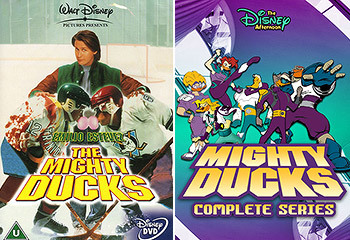

This occurs when a derivative work (an adaptation, a remake, or a reimagining) is so different from the work it took its name from that the only thing actually tying it to the original work is the title, a few character names and, if lucky, the broad premise. It would stand perfectly as an original work if references to the source were removed.
This can happen when the work was originally intended as something completely different, but, being slightly similar to an existing franchise, it is changed to fit in that franchise, or it can be straight-up title hijack.
One reason this happens is the fact that established properties and "name awareness" makes things much easier to get greenlit than original properties. In some cases producers purchase franchise rights for the name alone, and slap it on their own original product as a way of getting it pushed through the studio system. Video Game and Cult Classic franchises are especially prone to being used this way by third parties with no other interest in the franchise, as they are often relatively cheap to buy or license for this purpose. In some cases, this is even done for the purposes of hanging onto the trademark. If the project began life as an original work and was altered in the process to be part of an established work, that makes it a Dolled-Up Installment. The inverse of this would be Divorced Installment.
Many a Cash-Cow Franchise has descended to this at least once. It may be considered the Oddball in the Series.
The response often involves They Changed It, Now It Sucks!, but an In Name Only work may well be decent, or even good (if not better), as long as it's assessed on its own merits rather than being measured by how faithful it is to the original work; in effect, the work in question is a Contested Alternate Continuity or Adaptation.
If the work in question is not an attempted adaptation of another work, but merely sports a misleading name, that's a Non-Indicative Name. If the name used to be relevant but less or even not later, it is Artifact Title. If an adaptation continues after the original source material runs out, that's Adaptation Expansion. If multiple works share the same name but are unrelated, you have Similarly Named Works.
A good way to tell if an example is really this trope or just a bad adaptation: if one were to change the title to something else, would anyone understand that the work is supposed to be an adaptation? If the answer is "no", then the adaptation is this trope.note See also Old Guard Versus New Blood. A Transplanted Character Fic may often feel like this.
Contrast Serial Numbers Filed Off, Spiritual Successor,note Exactly What It Says on the Tin, Expy, Remake.
Example subpages:
Other examples:
- The manga Blue Dragon Ral Grad has nothing in common with the Blue Dragon video game or anime series, except for the presence of Living Shadow Bond Creatures which themselves are very different in nature between sources.
- Dancougar Nova doesn't have a whole lot in common with the original Dancougar, instead resembling Gravion, another Masami Obari mecha anime.
- The anime adaptation of Eat-Man has very little to do with the original story other than Bolt Crank being the main character.
- Final Fantasy: Unlimited has virtually nothing to do with its namesake series aside from the presence of Chocobos, Moogles, and a character named Cid.
- Gaiking: Legend of Daiku Maryu is a completely new story from Gaiking, but reuses the mecha design of the Robeast Daiku Maryu, and the Humongous Mecha Gaiking, as well as a couple of character names.
- This was the point of Galaxy Angel, which turned a Space Opera into a Gag Series when the first game was delayed. See Writer Revolt.
- Subverted in Ga-Rei -Zero-. The first episode introduces an entirely new crew of badass main characters, completely different from the ones in the manga. The episode ends with Yomi appearing and taking them all out. Turns out the anime is related to the manga in that it centers around Yomi's Start of Darkness.
- Gatchaman Crowds has most superficial elements of Science Ninja Team Gatchaman stripped away in favor of thematic and series mythology-related similarities. Thus many old fans regard it as this.
- Getter Robo:
- The anime Getter Robo Go and the manga have essentially nothing in common, barring that they feature the same mech with a three-person piloting team, and a number of characters sharing the same names. The manga is a direct sequel to the original Getter Robo, while the anime is self-contained, and many aspects notable to the manga, such as the fast-paced action, Cosmic Horror Story themes, and incredibly dark tone, are absent; the anime is almost entirely a typical Super Robot series. A large number of other characters, including the entire returning Getter Robo cast, are absent. It's also an odd one out in terms of Getter Robo in general, with aspects like the Getter Rays and the typical cast being absent.
- In Shin Getter Robo Armageddon, this is done with Go. The manga version is the protagonist of Getter Robo Go, and is shown as a blunt, Hot-Blooded, battle-ready type who hails from a common background and is mostly the Audience Surrogate. In Armageddon, he's a more secondary character, his personality is far more stoic, calm, and mysterious, and he has the most unusual background of the crew, being an Artificial Human with supernatural powers created to control the Shin Dragon. The only thing they share is their appearance, their first name, and the fact that they're both Getter pilots. This seems to have been done to differentiate him from Ryoma, who has a bit of a lock on the "gruff, hot-tempered hero" archetype in the franchise.
- Despite its name, Go Nagai's manga and anime and novel series God Mazinger has nothing to do with Mazinger Z. The characters, the setting and the plot are completely unrelated, and the Humongous Mecha hardly looks like Mazinger. Apparently the similar title is because it was intended to be a Mazinger Z sequel, but that concept was scrapped, and Great Mazinger and UFO Robo Grendizer were created instead.
- The Hayao Miyazaki film How Do You Live bears the same name as the famous 1937 novel but bares a completely original story. Instead the book it's named after exists In-Universe while the story is more of a fantastical autobiography of sorts based on Miyazaki's childhood and how the book (which was a gift from his mother) shaped him a lot as a person growing up. This is likely why it was re-titled The Boy and the Heron for international audiences.
- Idolmaster: Xenoglossia retains some of the characters' personalities from the original video game, but changes... well, everything else.
- Despite sharing part of the title, In the Heart of Kunoichi Tsubaki has nothing to do with the 18+ Steam game also bearing the Kunoichi Tsubaki name.
- In-Universe example in Kochikame: when a popular manga gets an anime adaptation, Ryotsu manages to change the adaption in such a way that the result is nothing more than an extended commercial.
- Magi: Labyrinth of Magic is very, very loosely based on The Arabian Nights, but don't expect it to go further than some names and a vaguely Arabian/Persian aesthetic.
- The main character, Aladdin, does have a genie for a while (in a flute, not a lamp or ring), but instead of a random kinda-jerky street kid is an All-Loving Hero Child Mage. He's also kind of a pervert, though, which actually does fit the original legend.
- His best friend Alibaba is a prince desperate to liberate his home country. Instead of stealing from a group of forty thieves, he leads a group of thieves (who are Just Like Robin Hood, but Deconstructed) for a while. He has a (foster-)brother named Cassim who's a villain, as in the legend, but there aren't many similarities past that, the original Cassim being just greedy with Cassim in the anime being a revolutionary firebrand.
- Scheherazade is the biggest example of this—instead of Plucky Girl telling stories in the Framing Device, she's a mysterious Court Mage of a Roman-esque empire who spearheads a war against a neighboring country.
- Sinbad, interestingly, is more or less an aversion—the basic idea of "poor guys gains his fortune as an adventurous sailor" remains the same, though the adventures are different and his role in the main series is set after they're complete.
- Masou Kishin Cybuster is this to Super Robot Wars Gaiden. Some familiar names are part of this series. And a few familiar robots... and that's about as far as it goes. Three of the four heralds of the elemental lords don't even get a counterpart in the anime.
- Osamu Tezuka's manga Metropolis is "suggested" by Fritz Lang's Metropolis, in that Tezuka was inspired to write the manga by a single still image he saw from the film: that of a female robot being born. The two works have a few basic similarities, but they're coincidences—Tezuka hadn't seen the film, and didn't even know what it was about, when he wrote the manga.
- A 2001 anime film, also titled Metropolis, is another, quite interesting case. It claims to be based on Tezuka's manga—even billing itself Osamu Tezuka's Metropolis—but is in fact an odd mishmash of that manga, several other Tezuka mangas, and the Fritz Lang movie. The film mostly does its own thing, merely borrowing a lot of elements from those works, making this an In Name Only adaptation of an In Name Only adaptation!
- The Millionaire Detective - Balance: UNLIMITED is inspired by an obscure novel by the same name. However, aside from having the same title character and general premise (and having a character named Suzue, although the characters' relationship has been completely changed), the Anime is a completely original story.
- In-Universe, Mobile Suit Crossbone Gundam has a moment where one transfer student talks about the Space Pirates supposedly having a Gundam and another student remarks "These days, the media calls anything with two eyes and antennae a Gundam". A margin note from artist Yuichi Hasegawa reveals that Yoshiyuki Tomino (the creator of the Gundam franchise) specifically asked him to include this line.
- This is also something of a joke on how frequently Gundam gets reboots of this variety. Some stories do take place in the original universe or carry through the original themes and worldbuilding elements, but others have nothing in common aside from having robots that are named Gundams and designed somewhat after the ones in the original series. Mobile Fighter G Gundam is one of the more obvious examples, outright jumping from Real Robot Genre to Super Robot Genre.
- The Mysterious Cities of Gold was theoretically adapted from a novel (The King's Fifth, by Scott O'Dell) but has almost nothing in common with it. There are characters named Zia, Esteban, and Mendoza, and they are looking for the Cities of Gold; that is more or less where the similarities end. In the book, Esteban is a teenage mapmaker, Zia is a tough tomboy who volunteers to help the Spanish expedition, Mendoza is not a nice person, there are no medallions or hidden temples or puzzles or mysterious Olmecs at all, and so on.
- The television spinoff of Ninja Scroll: Ninja Scroll: The Series.
- The anime adaption of Toshio Maeda's Nightmare Campus has almost nothing to do with the story of the manga, with the only similarities being that they both share characters called Masao, Esedess, Abe and Yuko.
- Osomatsu-kun is about the misadventures of six rowdy brothers and their wacky cast of cohorts in Akatsuka Ward. Osomatsu-san more or less follows that description, but changes the brothers to jobless manchildren, rids them of their sense of camaraderie and gives them all completely different personalities and looks (which was their primary joke back in the day), demoted all of the side characters (especially the former Breakout Characters Iyami and Chibita) and exaggerates their personalities, and changes the style of humor. The only way you can tell it's a sequel is when they mention it or when they do a plot from the old series.
- The manga adaptation of Princess Tutu has little to do with the show—the names of Ahiru's friends were changed, Ahiru isn't a duck, Mytho isn't really a prince, Drosselmeyer never appears, and the only animal is Professor Cat, for some unexplained reason. The most unrecognizable is Edel, who goes from being a quiet, mysterious woman in doll-like clothing and a huge updo to an energetic mentor who wears slinky dresses and her hair down—oh, and just happens to be the Big Bad of the manga. The consensus among fans range from "It's sort of funny I guess..." to pretending it doesn't exist at all.
- Despite the title and what the credits claim, Romeo × Juliet has nothing to do with Shakespeare's Romeo and Juliet aside from character names (but not their personalities) and really serves as a composite of plots and characters from several of his plays. The English version made use of some Shakespearean dialogue.
- The first Sonic the Hedgehog manga is about a 10-year old hedgehog named Nicky living in a World of Funny Animals. Nicky has a cool alter ego called Sonic. The manga is loose with being an adaptation—featuring almost nothing but Canon Foreigners (though Amy and Charmy were later given the Canon Immigrant treatment) and only having loose connections to the first few game's Excuse Plots.
- Tales from Earthsea is a mish-mash of plots from two different Earthsea books(Tehanu and The Farthest Shore) and borrowed the title Tales From Earthsea from an unrelated short story collection. LeGuin was NOT amused, meanwhile but she was still (slightly) more amused by the anime movie than by the maligned Sci Fi Channel miniseries, specifically noting it was "more dissatisfying than outright bad".
- Tama and Friends: Search for it! The Magic Puni-Puni Stone is technically this to the original Tama & Friends series. Not only did the series have a total genre shift, and a real villain was introduced into the series, but the characters now live in a fantasy world and are more like petting zoo people compared to the original series where they're largely normal animals. Needless to say, this turned out to be a Franchise Killer that put the franchise on ice for a decade before any revival attempts were made. It's also one of the factors that contributed to Group TAC's demise.
- Tenchi Muyo!:
- Tenchi Muyo: War on Geminar has extremely loose connections to the Tenchi franchise. The main character, Masaki Kenshi, is Tenchi's younger half-brother, but that's the closest it gets, other than Kenshi occasionally making vague references to his older sisters (i.e, the girls in Tenchi's harem). In fact, the series' title in Japan is not Tenchi Muyo, its Isekai no Seikishi Monogatari (Literally meaning: Sage Machine Master Story in the Different World), and was created by Masaki Kajishima as a very loose spinoff to his Tenchi Muyo franchise. Funimation changed the title for marketing purposes and to better establish it as a part of the ''Tenchi series''.
- Tenchi Muyo! GXP is primarily centered on Tenchi's Kouhai school friend, Yamada Seina, and his cast of characters. However, it's Zig-Zagged because there are several episodes in which characters from the original Ryo-Ohki series make guest appearances, including one in which Tenchi himself appears. This is in contrast to Geminar as stated above, where the most you get is a vague mention.
- Tenchi Forever bore little resemblance to the light novel that inspired it. It also takes place in the same universe as Tenchi Universe instead of the original OVAs.
- Sasami: Magical Girls Club has almost nothing to do with the Magical Girl Pretty Sammy or Magical Project S series that inspired it, except for a magical girl named Sasami, and appearances of a couple Tenchi characters in drastically different roles.
- Voltron fans back in the day felt this way when the Lion series ended and they first saw Vehicle Voltron.note The reason for this is because it is actually a Dolled-Up Installment of a completely unrelated anime series.
- Hades Project Zeorymer — originally a hentai manga. The title mech and the name of a female character are the only thing the manga and anime share.
- Brigadoon: Marin and Melan: Is inspired by the Brigadoon play, but the only thing they have in common is a Vanishing Village. It's in Japan instead of Scotland, the protagonist is a teenage school, girl instead of male hunters, there's robots, etc.
- Snow White with the Red Hair has very little to do with "Snow White"—the title alone tells you that Shirayuki doesn't match the physical description, and she's not a princess by birth, though she still winds up with a prince. There are no dwarves or Wicked Witch stepmother. There is a poisoned apple, but it's sent from an Abhorrent Admirer and it's the prince who eats it; Shirayuki saves him, but through her skills as an herbalist, not any sort of magic.
- The Pleasant Goat and Big Big Wolf season Mr.Wolffy, Mr.Right! has an entirely different story and setting and the characters look a lot different compared to the other seasons. Because of this, it doesn't really have a lot to do with the original Pleasant Goat.
- Some of the characters in Ame-Comi Girls (a DC comics Elseworld series derived from a statue line featuring DC female characters, and gender-flipped versions of male characters, redesigned in an anime-influenced style). For instance, Jade goes from being the daughter of the Golden Age Green Lantern to a blind Chinese teenager. She ends up being chosen as the new Green Lantern of Earth, rather than being born with her powers like the original Jade.
- The second Bloodstrike team is made up of longtime team leader Cabbot Stone, and Legacy Characters to his original teammates. The legacies have very little in common with the originals in terms of powers, personalities, and costumes, but share their codenames. For instance, whereas the original Tag was a woman with the ability to freeze enemies in place, the new Tag is a woman with super speed. In-universe there's no explanation for this, but writer Tim Seeley went on record as saying that it just didn't feel right to have Bloodstrike without Deadlock, Shogun, Fourplay, and Tag, even if they were new characters.
- The Challengers of the Unknown keep being reinvented. In the 1991 miniseries by Jeph Loeb and Tim Sale Prof was dead, Rocky was an alcoholic, Ace was Doctor Strange and Red was Rambo. The 1996 series by Steven Grant introduced an entirely new team, as did the 2004 miniseries by Howard Chaykin. And in the New 52, Dan DiDio creates a group of nine characters with the names of the original and 1996 Challengers, but none of the personalities.
- Michael Fleisher's run on Harlem Heroes was focused on a gang of convicts caught up in a conspiracy to assassinate the President, rather than the sport of Aeroball from the original strip. In fact, the only reason that the name came up in story was due to the games being played in prison and the skill of the protagonists at Aeroball.
- There's an Animesque Brazilian spin off◊ of Little Lulu where the characters in question are teens. The plot is basically a generic teen Slice of Life (with some drama here and there) with characters whose only similarities with the original are their names. And the original cartoons produced by Famous Studios in the 1940s bore almost no resemblance to the comics, keeping only the title character Lulu (though some of her friends did appear in a few shorts, very few though).
- Novas Aventuras De Megaman was a Brazilian comic attempting to place the characters in an After the End scenario where Dr. Wily managed to Take Over the World. Beyond the general appearance of the characters, though, there wasn't much left tying it to the video games. Radically altered backstories, personality changes and Roll's increased importance are the most obvious changes compared to the games.
- Incredibly, it could have been even worse. One of the original writers, José Roberto Pereira, had big plans for his original character Princess. Said plans included having her kill off every other character in the cast so the comic could focus on her. Once the higher-ups learned of this, José got fired and Princess was unceremoniously booted.
- Scott Ciencin's comic book adaptations of Silent Hill. Just about the only things preserved is the name of the town, a cult, and a list of monsters, something that's pretty jarring as they were designed to be symbolically attached to very particular characters of their specific stories, but are presented here without context. The behavior of said villainous cult and monsters are entirely unlike what's presented in the games, and the depiction of the town itself from the games as a dark, knowing force that attracts and inflicts trauma instead gets a proxy in the form of an evil girl in a white dress with bratty snark and a filthy pottymouth.
- Many of the characters in the Marvel Noir series of Elseworlds are notably different from their mainstream continuity counterparts:
- Of particular note is Dr. Otto Octavius, one of the primary antagonists of Spider-Man Noir: Eyes Without a Face. Noir's version of the character is a sickly, emaciated, wheelchair-bound neurologist. He's a white South African, a Nazi sympathizer, and heir to a large fortune. His actions are motivated by racism. The only thing he has in common with mainline Dr. Octopus is the use of mechanical arms, in this case surgical aids attached to his chair.
- In X-Men Noir, there aren't even mutants. Instead, Professor Xavier has a theory that The Unfettered are the next stage of human evolution, leading to an entire team of non-powered Sociopaths that share names and a couple of character traits with the mutant heroes.
- This trope is a deliberate unifying premise in DC's "Tangent Comics" line and the "Just Imagine Stan Lee" series. Unlike Elseworlds, which is a re-imagining of a DC character that usually retains most of the core elements, Tangent and Just Imagine attach the existing names to completely different characters with different powers, costumes, origins, appearances, and personalities — the latter having been co-designed by Stan Lee. Usually, the only common element is that they're metahumans in a modern setting. For instance, The Atom's standard take is that he's a scientist who uses dwarf star matter to shrink down to microscopic size, with the most famous holders of the name being named Ryan Choi and Ray Palmer, and a relative lesser light among the DCU's heroes. Meanwhile, the Tangent version of the Atom is named Adam Thompson, and is more of a Superman Substitute, with density-manipulation powers that he uses to become a Flying Brick and a reputation for being one of his world's A-listers.
- Stan Lee's versions, however, are a bit closer to their traditional counterparts than the Tangent ones: Superman is still a Human Alien, Batman is still a Badass Normal, Wonder Woman still has a connection to mythology (although Inca Mythology instead of Greek), Flash is still a speedster and Catwoman still has kleptomaniac tendencies.
- In the foreword to the Wonder Woman Trade Paperback "Gods and Mortals", George Perez mentions that there were several proposals for the Post-Crisis reboot of Wonder Woman, some of which had nothing in common with the original but the name. See also the "white-suited Badass Normal kung-fu superspy" era from the early-to-mid 70s, which has its fans but has hardly anything to do with any other version of the character.
- Back in the early 2000s, Marvel decided to radically revamp two titles — X-Force and Thunderbolts. X-Force went from the exploits of a mutant paramilitary team to the exploits of a completely different mutant celebrity superhero team obsessed with fame. The title was well-received critically, partially because it inverted the whole "hated and feared" aspect of mutant culture — after 14 issues it was relaunched as X-Statix. Thunderbolts, on the other hand, went from the tales of a team of former supervillains seeking redemption to following an underground fight ring centered around C-list villains. This change was much less well-received.
- DC Comics created several characters during the Golden Age, but by the end of WWII the interest in superheroes died down, and most titles (except Superman and Batman) were closed or moved to other genres. The Silver Age began with the relaunch of The Flash: besides the name, the speed, and a few costume elements, Barry Allen had nothing in common with Jay Garrick, and his first appearance established that Jay Garrick was a fictional character in-universe. The same thing was done with Green Lantern, Hawkman, and others. But the prize goes to The Atom, who went from a rough-and-tumble boxer who was kinda short to a physicist who could shrink to subatomic size.
- Though in this case, things were retconned twice. The first time, it was revealed that the Golden Age characters lived on Earth-2, while the Silver Age characters lived on Earth-1.
- The second time it was retconned to fit into the new continuity created by Crisis on Infinite Earths. Alan Scott, for instance, was revealed to have received his power from the Starheart, an artifact created by the Guardians of the Universe (i.e., the same guys who made the Green Lantern rings), and Jay Garrick and Barry Allen were later revealed to both have received their power from the "speed force".
- Hawkman is a particularly odd example. In the Golden Age, he was an archaeologist who discovered that he was the reincarnation of an ancient Egyptian prince. In the Silver Age, he was an alien cop who came to Earth pursuing a fugitive from his own culture and decided to hang around. However, while the two have very different origins, they're also weirdly and inexplicably similar—their appearances are the same, they have nearly identical costumes, equipment, and powers, they both have a sidekick named Hawkgirl, and even their civilian names are practically homophones of each other (Carter Hall versus Katar Hol). Much of the notorious Continuity Snarl surrounding him is because of post-Crisis writers trying to somehow combine the two.
- Since DC's business theory (such as it is) is about hanging onto trademarks as long as possible, they have a long history of reusing names in some odd fashion or another. Such as the 1940s superhero Johnny Thunder, the 1950s cowboy Johnny Thunder, and the 1980s noir detective Jonni Thunder. Or all those unrelated characters named Starman. This often leads to the point where a story tries to reconcile these different incarnations somehow.
- This got something of a nod in Watchmen, where the original Nite Owl, Hollis Mason, a two-fisted Badass Normal whose name basically just referred to the fact that he fought crime at night, passed the name onto Dan Dreiberg, a Gadgeteer Genius with a very heavy owl theme. Dan picked up the name because he idolized Mason as a kid, and asked permission beforehand. (Specifically, it's a nod to Steve Ditko's very heavy revamp of the Blue Beetle.)
- When Vertigo Comics publish a series that shares a name with a DC Comics property, that, and a few loose concepts, will be all it shares (with a few exceptions, such as Animal Man, Swamp Thing, and Doom Patrol). The most extreme example (if you don't count The Sandman (1989), which did at least feature the original character in two brief cameos) was Beware The Creeper! which was about a 1920s Parisian surrealist who wore a costume vaguely similar to Jack Ryder's.
- Runaways (2015):
- The series being released during the Secret Wars (2015) storyline, while ostensibly inspired by the Cult Classic Runaways series, features only one member of the original cast, and has a very different plot.
- Most of the Secret Wars storylines go in a vastly different direction from the original storylines they're named after, while still sharing some connection with the original stories. Take Planet Hulk for example: the original storyline is about the Hulk being launched into space and landing on a war-torn planet, while the Secret Wars tie in is about Steve Rogers and Devil Dinosaur traveling through a Hulk-populated wasteland.
- The All-New, All-Different Marvel relaunch of The Illuminati. Previously the Illuminati was a team of heroes who tried to police and protect the world in secret, and they eventually had a villainous counterpart in Norman Osborn's Cabal. The ANADM series focuses on a group of villains brought together by the Hood to protect villains from heroes.
- In the New 52 version of Teen Titans, this was a criticism of Bart Allen/Kid Flash. The original was Barry Allen's Fun Personified Grandkid from the Future; at first the new Bart seemed to fit in personality, but he had Identity Amnesia and had apparently never worked with The Flash before. As time goes on, we learn that his real name is Barr Tor (Bart Allen being an alias) and that while he is from the future, he is unrelated to Barry Allen and does not use the Speed Force. Also, he started a galactic war and is wanted for war crimes, which rapidly takes a Darker and Edgier toll on his personality. Like the example below, DC later brought back the original Bart Allen as a separate character stating he'd been trapped in the Speed Force since the beginning of the New 52.
- The same is true for Wally West. He was still Iris West's nephew, but he now had a Race Lift and an Age Lift; the latter was a problem, because it meant that he had no connection to his former friends like Dick Grayson, who were still portrayed as adults post-reboot. He was also a hoodlum with a more sullen personality. Eventually DC Rebirth brought the original Wally back and Ret Conned the new version into his same-named cousin (though a later retcon undid the "cousin" aspect and confirmed the newer Wally was literally meant to replace the original).
- X-Men: Phoenix – Legacy of Fire is a X-Men series that doesn't really share many things in common with X-Men and its themes: firstly, the characters are demihumans from another dimension instead of mutants; secondly, while many names and terms are familiar they aren't necessarily the same (the main protagonist Jena Pyre is intended to be Jean Grey with Madelyne being her older sister instead of her clone and the comic's setting is named Limbo after Belasco's domain in the mainstream continuity) and lastly, despite the team's name in the title, they aren't actually featured in the comic and has absolutely no relation with X-Men from the Marvel Mangaverse, which is the same continuity that Legacy of Fire belongs to.
- One of the more controversial aspects of IDW's 2005 Transformers series was their tendency to completely reinvent popular characters. Characters like Arcee, Elita 1, Spike Witwicky, and Star Saber, who were all originally kind and heroic, are made antagonistic and violent and have almost nothing in common with other incarnations of themselves. Inversely, Cyclonus, who's a villainous Decepticon in most media, is turned into an unaligned anti-hero with no relationship to the Decepticons. Likewise, Galvatron, who is often Megatron upgraded by Unicron, is a completely separate character (a Mythology Gag to his toy, which also claimed he was his own 'bot to avoid spoiling the film).
- The Beast Wars Sourcebook was fairly infamous for doing this: despite being intended as a reference book, several characters (especially Japanese ones) had their personalities rewritten on purpose, sometimes to hook up better with the established universe, sometimes adding implications that were never there in their original appearances, and sometimes just writing them as the exact opposite of what they used to be. One of the more notorious is Mantis, who, in his original appearances, was a territorial and irritable loner who'd attack his own allies if they tried getting close to him—in the sourcebook, he's described as friendly, even-tempered, and approachable.
- Tom Scioli deliberately invoked this for Transformers vs. G.I. Joe. Rather than make a straight adaptation/crossover, he chose to mostly ignore the official lore and make stuff up based on the toys themselves, crafting the feeling of a kid playing with action figures and making up stories as they go along. Thus you get stuff like Destro being an immortal cyborg rather than an arms dealer or Ultra Magnus as The Grim Reaper rather than a no-nonsense commander. That said, there's also a lot of Mythology Gags that confirm that Scioli is very familiar with both. This is taken even further with a special that was apparently meant to be a comic adaptation of a nonexistent film that adapted the original story, where the process has essentially turned it into an in-name-only adaptation of an in-name-only adaptation.
- Captain Marvel: Marvel's many versions of the character often don't have a lot to do with each other; some share a vague connection to the Kree or Mar-Vell, but Monica Rambeau in particular had basically nothing to do with any of it, especially at her debut. This is largely due to the original owner of the name in the Marvel Universe being pretty permanently dead, but also Marvel wanting to retain the trademark (if only to keep DC from snapping it up), and therefore the name got passed around a lot. Carol Danvers seems to have finally locked down the mantle, though, and is sort of a Legacy Character to Mar-Vell, so it looks like things have worked out.
- Towards the end of Heroes Reborn, a group named the Hulkbusters formed — though instead of the armed forces group meant to fight the Hulk, this version was a trio of gamma mutants consisting of the Hulk himself, She-Hulk, and Doc Samson.
- Billy Majestic's Humpty Dumpty has very little to do with the original nursery rhyme. Instead of being about a sentient egg falling from a wall and irreparably breaking into pieces, the story is about an egg-shaped Half-Human Hybrid conceived from a redneck raping an alien woman who proceeds to try and kill his father and uncle to avenge the aliens the rednecks killed.
- This was explicitly called out in 52, where a new version of Infinity, Inc. debuts. A lot of them have the same names (Skyman, Jade, Fury, Nuklon), but that's where the similarities end; most of them have very different powers and outfits, and no connection to the originals. As it turns out, this is because they're sponsored by Luthor, who bought the rights to the name and trademarked a bunch of other codenames for the sake of name recognition (and also to dare the JSA to try starting something). This ends up being particularly aggravating to Obsidian, who was Jade's twin brother and is very annoyed to see his dead sister's name borrowed like that.
- The only thing the Ultimate X Men version of John Wraith has in common with his main counterpart is the name and a connection to the Weapon X program. Everything else about the man is different, though as the original Wraith was a black mutant who was one of the program's victims and the Ultimate version is a white human in charge of Weapon X.
- In the Amalgam Universe, there's a team called X-Patrol, which, in theory, is X-Force merged with Doom Patrol. In practice, important members of both teams were Adapted Out, while characters who aren't related to the teams were added to the mix. The only character who really is a pure result of [one X-Force's member + one Doom Patrol's member] is the team's leader Niles Cable, who's Cable (from X-Force) merged with Niles Caulder (from Doom Patrol). Elasti-Girl, being a merge of her DC's namesake with Domino, would also qualify... if she hadn't Janet van Dyne added to the combination, to the point of being her civilian name.
- For the Doom Patrol's part: Important members like Robotman, Negative Man and Mento were Adapted Out, while DC characters who aren't members of the Patrol (Starfire, Dial H for Hero, Ferro Lad) were taken into the amalgamated group.
- For the X-Force part: Paige Guhtrie and Hank McCoy were never part of the team. Neither was the Wasp, who isn't even a mutant, in first place.
- Heroes Reborn (2021) has nothing to do with the original Heroes Reborn. The original spun out of Onslaught and put The Avengers and Fantastic Four in a pocket universe (and the hands of Rob Liefeld and Jim Lee) for about a year real time. The 2021 event spins off from The Avengers (Jason Aaron) and involves Mephisto's version of the Squadron Supreme and alterations to reality in the main Marvel Universe. Likewise, this also applies to the one-shot ending the 2021 event, Heroes Return, whereas the original Heroes Return was about the Avengers and Fantastic Four returning to their home universe (and specifically in the article's case, the Avengers reforming).
- Demon Days, an Elseworld story by Japanese illustrator Peach Momoko, uses a lot of characters inspired by characters in the Marvel universe — Sai is a version of Psylocke, JuJu is a version of Jubilee, Hulkmaru is an Oni-version of the Hulk. But that's pretty much where the similarities end — for example, Logan is there, but he's Sai's dog and Venom is a giant snake demon.
- While the Batman comic did turn the Condiment King from Batman: The Animated Series into a Canon Immigrant, all he really had in common is the gimmick. The original character was named Buddy Standler, whereas the comic one was named Mitchell Mayo. And that's not the only difference: Standler was stocky and Mayo thin, Standler was an adult and Mayo started off a teenager, Standler was a comedian and Mayo worked in fast food, Standler wore mostly blue and white, while Mayo was Red and Black and Evil All Over; and most importantly, Standler was a one-shot character who was Brainwashed and Crazy into a Harmless Villain by the Joker in one of his more Evil Is Petty moods, while Mayo is willingly a villain who eventually became a Not-So-Harmless Villain.

- Always Visible: The only characters from the film who retained their names - namely Delia, Jerome and Jo - were completely redesigned.
- Bart the General has very few characters from The Simpsonsnote and is generally nothing like the show. This becomes more noticeable in Episodes 2 and 3, which show that the world of Springfield — er, Duckberg — is completely different and filled with bizarre side-characters. The plot is instead something about Toadfish and Stonefish coming in to Springfield to "take over," Dr. House falling out of a living airplane, and some... cult-thing ran by a purple jaguar killing people over a video tape Bart/Berton made of Marge in the shower. It could very well involve completely original characters and still make the same amount of sense it does. Which is to say, very little.
- Calvin & Hobbes: The Series gradually devolves into what may as well be an original story with some characters who coincidentally share their names with characters from Calvin and Hobbes.
- Civil Wars, Whistleblower Tactics, Schematic Drafting, And The Finer Points Of Sith Adoption: The Essential How-To Guide For The Engineering Jedi is theoretically a Star Wars fanfic taking place some time before the events of A New Hope. In practice, basically no characters or organizations that have any screentime (barring Palpatine) have more than passing resemblance to their characters. The original series is a Space Opera about the conflict between the evil Empire and the heroic Rebel Alliance. This fanfic series is more of a family oriented military slice-of-life story.
- Luke, rather than a somewhat whiny Naïve Newcomer Ace Pilot, is instead a Gadgeteer Genius on par with Tony Stark while also being an extremely charismatic public speaker and a total ball of sunshine that basically everyone adores. He's also apparently talented at basically everything from surgery to tracking to molecular engineering, and can consciously use the Force despite no training.
- Darth Vader in canon The Heavy who is quick to execute any underlings who fail him and is perfectly willing to murder his own son if he refuses to join him. Here, he acts like a doting mother towards Luke, whom he has no idea is related to him, to the extent of singing lullabies to him when the young man is injured. While in canon, Vader ruthlessly killed Admiral Ozzel for bungling an attack on the rebels and nearly murdered Admiral Motti for insulting him, this Vader doesn't do more than glare at Piett for openly defying him at every turn.
- The canon Empire were for all intents and purposes space nazis and usually the only "good" ones were lower level members of the military who often defected. In this series, almost all seem to be genuinely nice people who emphasize tolerance towards others with the one notable exception being Admiral Piett.
- The works of Hans Von Hozel often do this almost literally, since some only reference the title of the work they are based on.
- His Gravitation and The Day After Tomorrow fics are particularly blatant examples.
- His Rush Hour fic is actually about the board game of the same name.
- Also, his Across the Universe (2007) fics are essentially about wars between the Beatles (who can only say "Liverpol") and ABBA.
- The only thing tying mauroz's Friendship Is Magic series with the show it is based on is the name of the comic series and characters, bringing it closer to a Magical Girl manga.
- Friendship Is Magical Girls is an In Name Only version of mauroz's comic. Despite sharing a similar premise (Magical Girls) and a similar name, it is entirely different. When confronted about it, the author claims that he wanted "to do something a bit different than Mauroz's magical girl comic strip".
- Also, while we're in the topic of this, do not confuse Equestria Girls with EQUESTRIA GIRLS (yes, it is in all caps). The two very clearly do not have anything to do with each other, apart from the characters.
- Homestuck high bears very little resemblance to the original Homestuck, with the only thing even remotely related to the alleged source material being the character names and the title of the fic itself, and after the first chapter has nothing to do with high school.
- "New Universe Three: The Friendship Virus" by Chatoyance manages to simultaneously be a My Little Pony: Friendship Is Magic fanfiction and a Conversion Bureau story in name only.
- Ponies are not present except for a few offhand mentions of the show itself.
- The eponymous bureaus of The Conversion Bureau are not present and there is no human-to-pony transformation. Instead, the bureau is a bioterrorist group inspired by MLP:FiM to engineer and release a Synthetic Plague that feminizes men.
- On a broader note, The Chatoverse shares little more than superficial trappings of My Little Pony: Friendship Is Magic.
- About everything written by Peter Chimaera falls into this category. Off course, this is to be expected, as Chimeara is known for his intentional poor grasp of the source material he writes about. Highlights include:
- His trilogy of Digimon fanfics. None of the characters and concepts of the real Digimon franchise appear or are mentioned in these stories. In fact, the only thing related to Digimon is the name, but even that is improperly used, as Peter Chimaera uses it for a single character, rather than a collective term for multiple species of digital beings, as it is in the real franchise.
- His Cowboy Bebop fanfic really takes this trope literally. In an authors note, Chimaera tells the reader that someone requested him to write a Cowboy Bebop fanfic. But because he never watched the anime, he instead decided to write about Bebop from Teenage Mutant Ninja Turtles taking on the role of a cowboy, making this a literal Cowboy Bebop fanfic.
- Pretty much the only things related to Sonic the Hedgehog that Crossover Sonic 3D RPG, a Roblox game, has are the Funny Animal characters, rings, Chaos/Fake/Sol Emeralds, and certain character animations. The game revolves around The Corruption, a smog which infects people with purple fungi and turns them aggressive, and the Hero who saved the uninfected.
- The much-loved Thirty Hs bears no resemblance to Harry Potter aside from a few character names, and even those are often altered.
- Basically every single character in Hogwarts School of Prayer and Miracles, but the Dursleys and Voldemort are some of the most glaringly obvious examples. (The Dursleys are a nice, loving family, Petunia is a career-woman, and Voldemort is an internet-troll mocking atheist stereotypes by deliberately posting exaggerated versions of them on his Reddit-account.)
- ''The Last Brony: Kingdom Hearts With a Black Sora'' is almost nothing like Kingdom Hearts. Black Sora and Black Riku have the same names as their original counterparts, but they are otherwise completely different characters. The Heartless and Keyblade do make an appearance, but they have very little effect on the plot. And the "similarities" end there.
- Callisto Hime 's two Zelda/Fire Emblem crossovers, Time Cannot Erase and Among the Ashes, are this in regards to the Fire Emblem saga, as her portrayal of the characters and nations are completely off. This is mostly due to the fact that at the time of the writing her knowledge of Fire Emblem was limited only to the info in Super Smash Bros..
- Contract Labor: Keitaro Urashima has his canon counterpart's looks and Childhood Marriage Promise; everything else is completely different, especially his personality. The story itself has only minor bits of canon's Rom Com Harem Anime roots, instead being Darker and Edgier with more focus on the younger girls being buillied and Keitaro frequently using his family's connections to get things done. Even the Childhood Marriage Promise and Keitaro's desire to enroll at Tokyo University are at best rarely mentioned, instead of being the main focus.
- Part of the reason Fifty Shades of Grey was able to pass itself off as an original story was that its original form as Twilight fanfic was pretty deep into this territory. On top of being a Transplanted Character Fic, the Edward and Bella in Master of the Universe don't have much in common with Meyer's Edward and Bella; it's very hard to imagine the Edward Cullen who stayed a virgin for over a century and stridently opposed sex before marriage being into BDSM.
- Parodied in Gritty Reboots. Its If You Give A Mouse A Cookie trailer has the bare minimum to do with the original picture book. It's a gritty horror movie where the mouse is a murderer.
- Citadel of the Heart:
- Usually, the Series Fic has this stick with primarily the characterization of canon characters, or the few canon characters with so little characterization that an O.C. Stand-in is used instead.
- In terms of actual fics which are more or less this on a broader scale, ''Sword Art Online: Special Edition'' is this to Sword Art Online due to the larger emphasis on the real world, some of the noteworthy villains from the canon being either downplayed with almost none of them reprising their Big Bad roles, and the biggest example being the mixture of A.I.s which can materialize into the real world via Hard Light akin to Digimon or the presence of Physical Gods who pose an Outside-Context Problem altogether. Oh, and the Shared Universe aspect going on between it and ''Reflection Code'', a fic based on Code Lyoko.
- My Immortal is allegedly a Harry Potter fanfic; however, it can be hard to tell at times. The focus is mostly on an original character, and there are some others like her. All of the Harry Potter characters featured are rather unlike their canon selves, and some gain new names immediately after being introduced. The characters do go to Hogwarts, but it's a dozen chapters before anyone casts a spell. The setting itself has some differences as well - most blatantly, the wizarding world interacts with the muggle world oddly frequently (for instance, the protagonists are huge fans of My Chemical Romance despite the fact that they're wizards and it's a muggle band, and several such muggle bands manage to perform in places they normally would be unaware of).
- The Lorax's fandom was pretty infamous for this at its height, as the majority of its content was Transplanted Character Fic starring the Once-ler and nobody else. This led to a vast proliferation of alternate-universe versions of the character, most of whom proceeded to interact exclusively with either characters from other properties or other alternate-universe versions of the character rather than the film's actual cast. When the fandom went on the wane, many blogs featuring alt-Once-lers rebranded themselves as blogs featuring original characters—and this really didn't take much work, as usually the only things those characters had in common with the original was being a skinny pale guy with a mildly dorky personality.
- At the peak of Undertale's popularity, it was notorious for featuring the "Once-ler problem" almost to the letter with Sans; most of them, no matter how ambitious the basic concept and no matter the effects it could have on rest of the game's cast, only explored things from Sans's (and occasionally Papyrus's) point of view, resulting in a huge number of alternate-universe Sanses that mostly interacted with characters from other IPs—and just like the Once-ler, there were entire AUs dedicated to all of these Sanses meeting and hanging out with each other, making the connections to Undertale even more tenuous. Unlike with the Once-ler, almost all of these AU counterparts were still recognizably Sans at the end of the day, so when things started cooling off in the fandom, they were mostly abandoned instead of being retooled into original characters.
- The Nutdealer Expanded Universe is a more literal example than usual — the series's entire premise is crackfics based on anagrams of Undertale and Deltarune's titles, and no actual elements from the source games appeared until the ninth entry, "Elated Run". "Unrelated" lampshades this with one of its tags being "this is getting so far from the source material omg".
- Jeffrey Keith Wong’s Massive Multiplayer Crossover Just Won't Die involves Ranma Saotome having a personal vendetta against Genom due to the death of his family from boomers. However, while Ranma has his canon counterpart's looks and past, his personality resembles a good counterpart of Happosai, and his fighting style is something more out of Dragon Ball Z then the original series.
- The 1997 animated film Anastasia was supposedly "based on" the play by Marcel Maurette. Don Bluth turned it into a musical with Rasputin as an undead sorcerer with a talking bat sidekick, among other changes (the play had already been faithfully adapted to a 1956 film starring Yul Brynner and Ingrid Bergman).
- The animated adaptation of Captain Sabertooth and the Magic Diamond has only some of the bare bones of the plot. Justified since the original play, the songs aside, was pretty unimaginative to begin with.
- Chip 'n Dale: Rescue Rangers (2022) doesn't have anything in common with the original cartoon series. The film is used as more of an outlet to tell a self-aware story satirizing reboots and the animation industry, with Chip and Dale being Animated Actors who had the series serve as the height of their careers.
- Lampshaded in Walt Disney's original Fantasia in the Nutcracker Suite segment. The narrator says "You won't see any nutcracker on the screen. There's nothing left of him but the title."
- Final Fantasy: The Spirits Within is a noted example. Direct sequels notwithstanding, the Final Fantasy games all take place in different settings, but at least have some shared elements: fantasy worlds (with steampunk and bits and pieces of sci-fi increasingly mixed in for later games), heavy use of magic, swordplay, revolutionaries, tyrannical political institutions, series mainstay creatures like Chocobos, etc. Unlike the high fantasy settings of the games, the film was set in a distantly futuristic Earth, one that had essentially none of these mainstay elements.
- Hercules takes place in ancient Greece, and the main character is the son of Zeus and has Super-Strength. After that point, similarities start getting thin on the ground. The setting is a Purely Aesthetic Era, and the plot is more a blend of Superman: The Movie and Rocky than any myth featuring Hercules. Hercules is significantly altered from a man of divine lineage empowered by the milk of Hera to a full-blooded god whose power was mostly drained by the minions of Hades, and he goes through heavy Adaptational Heroism. Meanwhile, the main antagonist of the story is changed from Hera to Hades, who was a minor and relatively friendly character in the original story. Many other ideas, such as Philoctedes or the film's portrayal of Megaera beyond her name and status as a love interest, are entirely invented. There are shout-outs to the original myths in there, like visual nods to the Twelve Labors and the climax being loosely similar to the Gigantomachy, but it's very much its own beast.
- The DreamWorks adaptation of How to Train Your Dragon. While some character names are the same, the plot and setting is otherwise completely different. (An article linked to on The Other Wiki said the new directors found the original story too "sweet and whimsical")
- Though the Disney version of The Hunchback of Notre Dame is often accused of Disneyfication, it has absolutely nothing on the Golden Films version released the same year. It takes place in Notre Dame Cathedral, the plot involves a hunchback named Quasimodo falling in love with a Romani woman, the antagonist's name includes "Claude", and there's a character named Pierre. Everything else is different. For some idea, the Esmerelda character is named Melody and has the ability to bring musical instruments to life (said talking instruments serve as the film's main comic relief and are arguably the focal characters), Quasimodo is not deformed but rather a handsome man whose hunchback arose from difficult work and is corrected with better posture, and the film's antagonist is Jean-Claude and is essentially an Expy of Gaston with the twist of being Quasimodo's half-brother. The film ends with Quasimodo and Melody getting together and living happily ever after—the original has a complete Downer Ending, and even the Disney film famously ends with Did Not Get the Girl.
- Disney's The Jungle Book bears little resemblance to Kipling's original except for a few character names and the basic premise of a boy Raised by Wolves:
- It turned Kaa into a literal Smug Snake, Baloo into a hedonist, and Bagheera into something of a godfather.
- Mowgli is changed from a Noble Savage to a Bratty Half-Pint.
- At one point in the Kipling stories, Kaa the python hypnotizes a troupe of monkeys into becoming his helpless (ahem) dinner guests; later on, Mowgli singes Shere Khan's fur with a burning branch, and when that fails to get rid of him, Mowgli and the wolves stampede a herd of water-buffalo over him. As if that wasn't enough, in the story "Red Dog", Mowgli causes the marauding dogs of the title to be attacked by millions of angry bees; those who survive this by jumping into the river are attacked by Mowgli with a knife, and any that are left must then face Mowgli and his enraged wolf pack. Incidentally, Mowgli does most of this while he's naked. It should come as no surprise that none of this (save the part where Mowgli fights Shere Khan with a burning branch) makes it into the Disney version.
- Hathi is a bumbling but benevolent Modern Major General, rather than the heavily scarred, human-hating Shell-Shocked Veteran from the stories.
- Shere Khan is a suave and dangerous badass, rather than the crippled but occasionally dangerous shadow of a once great predator from the book.
- King Louie is a Canon Foreigner; the monkeys in the book, called Bandar-log, have no leader. note The vultures aren't present in the book either; the most prominent bird character is Chil the Kite.
- The pronunciation of Mowgli's name is entirely wrong — the first syllable is supposed to rhyme with "cow," as Kipling himself suggested, rather than with "crow," as Disney's version does.
- Justice League: Gods and Monsters, much like the Tangent Comics and Just Imagine continuities, takes place in a version of the DC Universe where familiar names are used, but the characters in question don't really have much in common with their namesakes. The most blatant example is this continuity's Wonder Woman, who is Bekka of New Genesis rather than Diana of Themyscira.
- The King and I incorporates many of the original songs and characters from the Rodgers and Hammerstein play of the same name that it was based on, but in trying to be kid-friendly introduced many plot elements, comic relief, and supporting characters that made it jarringly dissimilar from the play. There's now a villainous subplot by Kralahome to take over the Kingdom of Siam, evil wizardry, a generic teenage romance, and annoyingly cute animal sidekicks. Fans of the play and moviegoers alike did not take kindly to this version and the estates of Rodgers and Hammerstein pulled all support for anymore animated films based on the duo's works.
- Shrek:
- The first movie does keep the essentials of the original William Steig book (a fairytale satire about a disgusting ogre who befriends a donkey, fights a dragon, and marries an ugly princess) but otherwise has a very different story.
- While it's more of a spinoff of the Shrek series, Puss in Boots (2011) has very little to do with the original fairy tale. The only thing the two have in common is that there is a talking cat that wears boots.
- Sinbad: Legend of the Seven Seas has not much to do with the Sinbad the Sailor mythos aside from the titular character's name. Instead of the traditional Arabian Nights setting, the title character is a Greek adventurer/sailor.
- The Disney Fairies Tinker Bell movies were extremely different from the books in that they got rid of most of the book characters altogether and completely changed the personalities of all those who were left (including the titular character). Examples include Clarion, who stopped going by a nickname and used her full name and title instead, and who stayed out of the majority of the action, unlike the books. Vidia became a main character and her major Jerkass moments were excluded, making her a much sweeter person. It also got rid of the plot of the books in favor of more family-friendly stories and gave Tinker Bell a much nicer personality, removing her snark, and a twin sister.
- Aside from the names, Big Hero 6 has very little in common with the comics it's inspired by, including Race Lifting the entire team and moving the setting from Japan to San Fransokyo, an Alternate History version of San Francisco.
- Spider-Man: Spider-Verse: Outside the concept of having multiple Spider-Heroes from across the multiverse meet, none of the Spider-Verse films have anything to do with the plot of the 2014 Spider-Verse storyline from the comics, where hundreds of Spiders must come together to defeat Morlun and his family, or any of its sequels, which revolve around maintaining and protecting the Web of Life and Destiny. In fact, the first installment (Into the Spider-Verse) has far more in common with the plot of the 2012 Spider-Men storyline, as both have Peter Parker enter Miles' dimension and serve as a mentor for the novice superhero.
- Chickenhare and the Hamster of Darkness has nothing to do with the Chickenhare graphic novels, aside from the fact that the main character is a half chicken/half hare Funny Animal and his turtle friend is named Abe. There's also a female character named Meg, but instead of being a half demon, she appears as a skunk. Instead of following the original source, it's a family film about an Indiana Jones-esque hero who looks for a treasure with his friends, hoping to earn some respect from the people who bully him. Not to mention that the main character looks like Judy Hopps's lost mutant brother, which suggests that the filmmakers are milking the furry wave ignited by Disney.
- The 1966 Gene Deitch adaptation of The Hobbit, even when one accounts for being only twelve minutes long, is, charitably, loose. The broad strokes of the plot are there, as are a handful of setpieces, and the main character is still a hobbit named Bilbo trying to defeat a dragon, but everything else is changed so heavily as to be near-unrecognizable. The non-Thorin dwarves, the elves of Rivendell and Mirkwood, the Great Goblin, the wargs, the eagles, Beorn, the spiders, the Laketowners, Bard, the Battle of Five Armies, and Bolg are all absent entirely. Random character names are changed or mispronounced (Smaug is now Slag, Thorin is Torin, the trolls are "groans"), and an entire new character is added in the form of Princess Mika, who serves as a Designated Love Interest for Bilbo. And what scenes do carry over are heavily altered, including the addition of a prophecy, the "groans" turning into trees instead of stone, the riddle-game being cut out, and a sequence of Bilbo defeating "Slag" by shooting him with a giant crossbow with an arrowhead made of the Arkenstone. All in all, there's maybe 10% of the book in there—which isn't surprising, being an Ashcan Copy and all.
- Lightyear: Lightyear shares nothing with either Toy Story or Buzz Lightyear of Star Command besides Buzz's and Zurg's names and the movie taking place in space. The film's marketing attempted to tie the movie to the Toy Story universe by saying the movie was a Show Within a Show from the 90s that inspired the show Andy watched as a child that in turn inspired the Buzz Lightyear toyline, but the movie has little to do with any of the few details that were given about the Buzz Lightyear franchise in Toy Story universe (that is, an Affectionate Parody of space operas like Star Trek and Star Wars).
- The author of the Alatriste novels, Arturo Pérez-Reverte, related in an interview his encounter with two screenwriters who wanted to "adapt" his character for the movie screen. Their proposal was to toss both plot and historical reality aside and make instead a drama about the relationship between Alatriste and the Queen of Spain (a person he never interacts with in the books), who would be revealed to have grown up in poverty with Alatriste before making it big and becoming queen.
- For various reasons, the Doctor Who story The Massacre had to be heavily rewritten by script editor Donald Tosh from John Lucarotti's original scripts, so much so that Lucarotti actually asked to have his name taken off the screened episodes. When he came to write the novelisation, Lucarotti took the opportunity to tell the story he'd wanted to tell in the first place, rather than the one that was aired. It has only a passing resemblance to the TV story.
- Edgedancer (a novella of The Stormlight Archive): An in-universe variety with the various member states of the Azish Empire. Technically, the Prime Aqasix is the ruler of all nine states. In practice they only really have control over Azir, and the various other member states only honor their rule with some traditional practices and vaguely following their lead on international issues.
- Dacre Stoker's book Dracula the Un-Dead (2009) is a case of the trope being applied to the concept of the book being an "authorised" sequel, as Dracula has been in the public domain for more than a century in both the US and its country of origin. As such, anyone can create their own take on Dracula's story, including the creation of sequels. There also some who believe that, given how much the book changed from the original novel, that the book itself also qualifies for the trope in general.
- In 1924, the StratemeyerSyndicate issued a Bobbsey Twins children's novel, The Bobbsey Twins and Baby May, in which the two sets of twins searched for the mother of a foundling child. By 1968, when Stratemeyer had begun a complete reissue of the series, with mostly slight-to-moderate rewrites for a more modern audience, the original story was no longer even remotely credible, and so an entirely new book was written, The Bobbsey Twins Adventures with Baby May, in which the title character was a baseball-playing baby elephant.
- Alice Deejay's "The Lonely One (Airscape remix)" is related to the original song in name only, other than the fact that the latter was also co-produced by Svenson & Gielen, the duo behind Airscape. The Goetz & Marc A. remix likewise uses no recognizable assets of the original apart from a vocal snippet.
- The 2008 reformation of Captain Jack bears no resemblance musically to their predecessors. (Francisco Gutierrez, the original face of the band, passed away in 2005)
- Aphex Twin has said that some of his "remixes" for other acts were done without even listening to the originals, let alone using any part of them. He's probably not the only remixer who's done this, but most wouldn't admit to it. If you enjoy Aphex's work then it probably isn't going to make much difference to you whether he uses any of the originals or not.
- DJ Tandu's original solo production of Ayla's "Ayla" sounds practically nothing like the much better known arrangement with DJ Taucher, which has been the basis for nearly all remixes since, including Tandu's own remix.
- The Beach Boys is technically this trope. While the band still tours to this day, the original Beach Boys technically dissolved with the death of lead guitarist Carl Wilson and the departure of Brian Wilson and Al Jardine in 1998. Mike Love, Bruce Johnston, and David Marks would attempt to continue touring as "America's Band" but, following several cancelled bookings, acquired the rights to tour under the Beach Boys name. David Marks would leave in 1999, leaving Mike Love and Bruce Johnston as the only original members, with the former being the only founding member left in the band.
- Black Sabbath has Seventh Star, which was meant to be a Tony Iommi solo album. Due to Executive Meddling, it was released as a Black Sabbath album.
- Inverted with Heaven & Hell's The Devil You Know. Since Ozzy had already re-united with Black Sabbath at the time, Dio formed a new band with the same line-up as his time with Black Sabbath. This ended up as Heaven & Hell's only album, since Dio passed away a year later.
- Bring Me the Horizon is an interesting example. The lineup has been largely the same, but their first album Count Your Blessings is a deathcore album that sounds nothing like their material after shifting to metalcore. They became one of the most respected metalcore acts, so what's their next natural step? Abandon it completely for a nu metal-influenced electronic rock sound fit for mainstream rock radio. If you showed someone who never heard their music without any context, would they ever guess that the same band that made this would be the same band that made this, who in turn would make this? Didn't think so.
- Cygnus X's remix of The Art of Trance - Madagascar, which is the basis for most subsequent remixes, uses almost no material from the original version.
- Dir en grey is a particularly interesting case; while the band's lineup hasn't changed since its inception, every other album sounds like it's been done by a different band. Yep, the same guys who wrote the Visual Kei Cult Classic GAUZE are the exact same guys who wrote the Technical Death Metal album DUM SPIRO SPERO.
- That's not all. They've rearranged many of their older songs in their new style; while some are simply rerecorded with minimal alteration, much of the older material have been entirely rewritten.
- The Meat Puppets' Golden Lies was originally intended to be an entirely new Curt Kirkwood project called Royal Neanderthal Orchestra, hence his being the only original member of the band involved. As with the Red House Painters example, this is because he couldn't get the label to put the album out without the Meat Puppets name attached to it. Golden Lies was at least in a similar style to what the Meat Puppets had been doing in the mid-90s, albeit with a somewhat heavier sound and the curious addition of some Rap Rock influences. This lineup of the band also put out a Live Album that was a mix of Golden Lies material and older Meat Puppets songs.
- Los Angeles art punk group Monitor's 1980 self-titled album includes one song entirely performed by Meat Puppets; Monitor wrote the song "Hair" themselves, but when it came to recording, they had trouble keeping up the breakneck tempo the song required, so they invited the Meat Puppets to the studio and had them play it instead. "Hair" has subsequently appeared as a bonus track on a reissue of the first Meat Puppets album.
- The group Gregorian is closest to its namesake in that it's a choral group. Their music involves harmony and full instrumentation, neither of which are involved in true Gregorian chanting.
- Guns N' Roses: They have been since 1985, two months after LA Guns and Hollywood Rose merged, when Axl Rose fired all the former LA Guns members (making the name of the band confusing) and replaced them with Slash, Duff McKagan, and Steven Adler.
- Outside of the similar title and chorus, "Washingtons By Your Side" from The Hamilton Mixtape has no relation to Hamilton's "Washington On Your Side," since it is centered around the lack of respect people give Wiz Khalifa because of his success instead of the Democratic-Republicans' anger at Alexander Hamilton.
- The reformation of Hole... with only Courtney Love as an original member. Her former partner was highly critical.
- A rare case of a singer In Name Only-ing his own song. Ike Reilly's "Duty Free" was covered by Cracker. Reilly then re-wrote the song, keeping only the opening line and part of the chorus the same for his album "Salesmen and Racists."
- Insane Poetry was once a group consisting of three rappers and a DJ. One of the rappers, Cyco, continues to release music under the name Insane Poetry even though the group has disbanded.
- KISS has Carnival of Souls: The Final Sessions, which was a basically a Soundgarden album with Gene Simmons and Paul Stanley on vocals, instead of Chris Cornell, bearing little resemblance to the glam-flavored hard rock of their other albums.
- Magic Affair's take on "Bohemian Rhapsody", made for the Queen Dance Traxx Tribute Album, is essentially an instrumental piece, with a sample of Freddie Mercury singing the original song's first line being played several times at one point. You might also recognize a hook as part of the original song's background music. Well, that's pretty much it. And since we're at it, Magic Affair normally does eurodance and does employ vocalists.
- Perhaps the main criticism of Megadeth's Risk is that it didn't sound like a Megadeth album, being entirely devoid of the Thrash Metal of their previous releases, leaning more towards a mixture of Hard Rock and Alternative Metal (even Youthanasia and Cryptic Writings, which hinted at the direction they would take with Risk, had at least a couple thrash metal tracks). Due to this criticism, Megadeth quickly re-introduced thrash metal into their sound.
- The main version of Mr. Freeman's "I Feel So Good" is him singing a reggae pop song or something along those lines, while the Seven Gemini Remix is him rapping over an urban beat. They don't appear to have anything in common except for prominently including the phrase "I feel so good".
- Remember New Order's "Confusion"? No? Remember that dance track from the vampire night club in Blade (1998)? Yes, the latter is somehow a remix of the former.
- Queen + Paul Rodgers on The Cosmos Rocks. Might as well have been called 'Paul Rodgers, and two ex-members of Queen were at the studio that day'.
- According to John Frusciante, Red Hot Chili Peppers' By the Way was meant to be this. Aside from two of the singles, the album is almost entirely devoid of the Funk Rock the Chili Peppers were known for. Instead, it was more focused on Psychedelic Pop Rock. Their next album, Stadium Arcadium, re-introduced the Funk elements that were largely absent on By the Way, though, not quite to pre-Californication levels.
- Red House Painters' fifth album, Songs For A Blue Guitar was originally supposed to be a solo Mark Kozelek effort, but when 4AD dropped Kozelek and his project and he got picked up by Island Records, he was pressured into renaming it to a Red House Painters effort. What listeners were treated to was something so vastly removed from the nightmarish, stark textures of the first 4 albums that the album was only lukewarmly received at first. Many were a little jarred to hear Mark suddenly singing slightly more upbeat, borderline Southern Rock songs with some minor folk influences. The album has warmed up in overall opinion, though.
- This is Steve Nalepa's "Monday". And this is The Glitch Mob's remix of it. Other than the riff at the beginning, the two have very little in common.
- The 90's incarnation of Ultravox. Four years after the band's 1988 split, keyboardist/violinist Billie Currie decided to reform the group with a totally new five-piece lineup, with himself as the only remaining member from the previous one. The band put out two poorly-received pop-rock albums, far removed from the Post-Punk and New Wave Music Ultravox had become famous for, before dissolving again in 1996.
- The English versions of t.A.T.u.'s Russian songs (sometimes).
- Underworld's "Born Slippy" and "Born Slippy.NUXX" are two completely different songs. The latter became much more popular, due to being featured in the film Trainspotting.
- Most Velvet Underground fans consider Squeeze to be this, especially since none of the original members - especially core songwriter Lou Reed - play on it.
- All remixes of The Vengaboys - Kiss (When The Sun Don't Shine), the best known of which is the Airscape remix.
- The "Inferno Mix" of Xorcist's "Scorched Blood" sounds nothing like the original.
- Yes had a particularly bizarre example, where after a complicated series of membership changes, there existed a band named Yes consisting of original members Chris Squire and Tony Kaye, along with Alan White, drummer since 1973. Their sound was sleek '80s radio-friendly pop-rock. Meanwhile, the band Anderson Bruford Wakeman Howe, made up entirely of ex-Yes members, essentially was classic 1970s Yes in everything ''but'' name. Their tour was called "An Evening of Yes Music Plus," but they couldn't call themselves Yes, despite being closer to the band's prog roots and original sound than the official Yes.
- Any instrumental mix of a song which remains credited to the original singer, even when that person had no artistic input beyond their singing in the first place (which, of course, no longer appears!) Examples might include this vocal-less mix of Kylie Minogue's early hit "I Should Be So Lucky" (back when she was still a puppet of the Stock Aitken Waterman "hit factory"); she neither wrote, nor apparently appears on this mix of the song, but it's still credited to her.
This goes as far back as the 50s. Calypso singers would normally be backed by a jazz orchestra, and backing tracks would be recorded in advance. Sometimes, the singer would not get round to voicing a track in time for its inclusion on an album or single, so the song would be released as an instrumental. If it was filler on an album it would be credited to the singer, if it was a single track, the orchestra would normally be credited on their own. Lord Melody was infamous for this because he often missed deadlines by being in other countries recording for other record labels.
Ska, rocksteady and reggae artists of the 60s and 70s also did this sort of thing, leading to at least one mistake on a Bob Marley And The Wailers box set "Man To Man" where the song Mellow Skank, an instrumental track by The Hippy Boys(a group that featured several members of The Wailers backing band but none of the singer-songwriters) was included. The song was actually an instrumental of a song called Talk Of The Town by Glen Adams. - Since the 1980s (if not earlier), there have been numerous cases of musical groups legally (and sometimes illegally) using the name of a well-known rock and roll or pop group, even though the group in question has no original members. This has been a sore spot for years with original group members, especially those who wish to continue performing under their original name, only to find "imposter" groups holding the name rights. (Note: naming groups impacted by this would violate the "No Real Life Examples" rule on this page, so please do not add names here).
- In Brainbug's "Nightmare (Sinister Strings Mix)", the only vestige left of the forgotten original mix is the Dream Melody from the breakdown. The rest of the original was a piano trance tune in the style of Robert Miles.
- Both Throwing Muses and Belly have a song called "Angel", both written by Tanya Donelly. Besides that and the title, there's no connection between them.
- More's "Around the World (Superclub Mix)" is all but completely different from the original mix, the only remnant being a highly distorted clip of the chorus.
- Mario Piu & More: "All I Need (Mas Mix)" rearranges the tune into a trance instrumental that sounds nothing like the original.
- The Megamind remix of Mauro Picotto's "Komodo" is essentially a stand-alone original track. At least the Picotto remix left in the "Wait, please" vocal from the original.
- DJ Icey's remix of Music Instructor's "Super Sonic" more or less completely recreates the track from the ground up.
- The Headstrong remix of Two Little Boys' "Stylophonia" has no recognizable trace of the original song remaining; even Rolf Harris's voice clips that it was originally built on are absent.
- The Nightcrawlers' "Push The Feeling On (The Dub Of Doom)", remixed by Marc Kinchen, is a completely new track built around a vocal hook assembled from chopped & screwed snippets of the original lyrics.
- Following the breakup of their original lineup, the producers of 2 Unlimited attempted to revive the formerly stadium house/techno act as a bubblegum dance-pop girl group, in accordance with late '90s trends. Not surprisingly, this incarnation only recorded one album, II, before themselves dissolving.
- The James Holden remix of Watergate's "Heart of Asia", originally a trance rendition of Ryuichi Sakamoto's theme tune from Merry Christmas, Mr. Lawrence, turns it into a nearly unrecognizable progressive house track, with the One-Woman Wail (which wasn't present in the film score) being the only remnant of the main mix.
- Aside from the name and a few small sprites on the playfield, Bally's Space Invaders pinball machine had no relationship to the arcade game it was named after. The art design made it look more like an Alien pinball than anything else.
- A version of the Sierra computer pinball game 3-D Ultra Pinball Thrill Ride was released for the Game Boy Color. Aside from the name and general premise, it has almost nothing in common with the original.
- From 1976 to 1978, Bally released home versionsnote of several of their arcade pins: Captain Fantastic And The Brown Dirt Cowboy, Fireball, and Evel Knievel. Since the home versions reused the same playfield layout and components, they ended up having completely different playfields, rules, and artwork from their original namesakes.
- Similarly, starting in 2012, Stern Pinball released lower-priced home versions of their games under the moniker of "The Pin". Transformers: The Pin came out in 2012 as an Amazon exclusive, while The Avengers: The Pin was released in 2013. As both games shared the same cabinet and layout, removed the originals' dot-matrix display, animations, and sound effects, and are limited to two players, they ended up being In Name Only versions of their originals.
- The Atari 2600 version of David's Midnight Magic bears almost no resemblance to the original Apple ][ game, aside from being a Digital Pinball Table using predominantly black and dark red colors. This was mainly due to limitations of the Atari 2600 itself, which couldn't produce asymmetrical playfields, so they had to create a new field entirely.
- Despite sharing the same name and many game rules, the Nintendo Entertainment System version of Roller Ball is significantly different from the MSX version, with a completely different playfield, a new bonus screen, and a gratuitous New York skyscraper setting.
- Some Professional Wrestling fans refer to WWE's ECW revival as ECW In Name Only, due to the fact that it seems completely opposite from the old ECW in terms of atmosphere, storyline tone, wrestling style, and talent level; WWECW is another popular name for it. Others don't even give it that level of respect. True, it did start out very much like the original ECW - just to get the old fans to tune in - but soon enough CM Punk took over the program and there was much more emphasis on actual wrestling ability than the Garbage Wrestling of the glory days. It's doubtful that much of that stuff would have got past the censors anyway, especially since WWE was trying to cultivate a family-friendly image at the time. Still, the likes of Hardcore Holly and Kelly Kelly did their best.
- The sad thing about "WWECW" is that in a vacuum it was regarded as a pretty good wrestling show, with lots of young talent that just couldn't find a spot on the already overcrowded Raw and Smackdown rosters and (mostly) straightforward sensible booking. But it still wasn't really ECW or even close to it. Had they called it something, hell anything else it would be looked at a lot more fondly.
- The purpose of The BBC Radio 4 series The Rivals is to showcase 19th century detectives who aren't Sherlock Holmes. However, most of them take great liberties with setting, characterisation, and so on, although they generally keep the character names, who did it and the gimmick they used (while often completely reinventing the motive). Some of them even change the detective's idiosyncrasies, such as making Arthur Morrison's Martin Hewitt a "society detective" who has a friendly rivalry with a French master criminal who doesn't appear in the original story (or any Martin Hewitt stories) at all.
- The 1940s radio series, The Weird Circle specialized in Book-To-Radio adaptations that had nothing in common with the source material other than the titles.
- As the old VFL expanded to become the Australian Football League, most of the Melbourne-based teams lost their links to the suburbs (U.S. = neighborhoods) whose names they bear. Collingwood, Hawthorn, and St Kilda no longer have any connection to their original home suburbs, and the other local grounds are only used for training and social purposes. Also, the Brisbane Bears were originally based 70 miles from Brisbane, and their mascot was a koala (Koalas are not bears). They have since moved to actually play in Brisbane, and merged with Fitzroy to be known as the Lions.
- Averted in the case of the Cleveland Browns. In 1996 the original team moved to Baltimore and became the Ravens. The NFL established a new Cleveland Browns expansion team in 1999, but in the league's eyes the new Browns are a continuation of the original and the Baltimore Ravens are a separate franchise.
- Similar situations exist in other leagues. The NBA has the Charlotte Hornets and its de facto successor, the New Orleans Pelicans, and the MLS has the San Jose Earthquakes and its own de facto successor, Houston Dynamo.
- Played straight in some cases like in the NHL, the current Winnipeg Jets is officially NOT the original Winnipeg Jets reborn - the Phoenix/Arizona Coyotes did not relinquish its original Winnipeg Jets history to the new Jets, only its name and colors.
- And in the NBA, there were two separate versions of the Baltimore Bullets - one of them is the only dead NBA team to win an NBA Championship, the other is the current Washington Wizards.
- 2022 saw the inaugural season of the USFL, an American spring football league.note Outside of owning the name and associated trademarks the current USFL has no connection to the USFL that flamed out in the mid-80s.
- Rifts Manhunter started life as a property completely unrelated to the Rifts Role-Playing Game. Then Myrmidon Press got permission to use the Palladium Rules system for their title, and decided to tack on the Rifts name. The only thing that connects the game to Rifts is that magic and technology exist side-by-side, and sparse, obviously shoehorned in mentions of rifts in time and space appearing later in the setting.
- La Gioconda is allegedly based on Angelo, tyran de Padoue by Victor Hugo; they are every bit as different as chalk and cheese (e.g., Hugo's play is set in Padua (Padoue in French) whereas La gioconda takes place in Venice).
- The 1919 Broadway musical Irene was revived in 1973 with a completely different book and most of the score replaced by miscellaneous song hits from the period.
- Skyscraper (1965) was originally supposed to be a musicalization of Dream Girl. It ended up sticking the original play's main character, Georgina Allerton, into an unrelated plot about a contractor planning to buy an old brownstone and demolish it to build a skyscraper.
- The only things the Annie musical and the comic strip it was based on has in common is the title character, Oliver Warbucks and Sandy. Writer Thomas Meehan initially did some research on the character by re-reading all of the comic strips available at the time, but since he couldn't find anything worth adapting, he instead invented a wholly different continuity with a different cast of supporting characters, and moved the setting to Depression-era New York.
- The Musical Bring It On has basically no relation to any movie of that name, one of which it supposed to be an adaption of, except that they're all about a cheerleader.
- Invoked in Dresden Codak "Dark Science" arc: Ronnie Awning made adaptations of famous works without reading them. Which allowed his sponsor to use the authors turning in their graves for energy generation.
- Megamanspritecomic has hardly anything to do with the Mega Man canon, featuring its own characterization and story.
- Platypus Comix's longest-running series, Scrambled Eggs, received inspiration from a juvenile fiction novel titled Hello, My Name is Scrambled Eggs, but Peter Paltridge says the only similarities the current comic and the novel have include some characters' names and the use of "No kidding!" as a catchphrase.
- Parodied with The Way of the Metagamer 2: In Name Only — a Fictional Document sequel to The Way of the Metagamer, starring The Detective and The Watson.
- Cracked.com has nothing in common with the (defunct) MAD-inspired magazine except the name and comedy theme.
- There is a Flash Gordon comics series available for the iPhone, and probably other portables. Flash is a former CIA operative, and Dale a current one; they know each other from the Agency, and Dr. Zarkov is a close friend of Flash. He's also considered a terrorist, and believed to be creating WMDs.
- Played for Laughs in the Awesome Series parody of Knuckles Chaotix; Egoraptor hadn’t played the game, nor did he know a lot about the franchise, so rather than trying for a serious parody, he just took the basic mechanics and made shit up. Hence why it includes things like Espio being a psychopath with roidrage and a plot that amounts to “the Chaotix stand around and talk about drugs for five minutes”. Given the series’s usual brand of Surreal Humor, it fits perfectly.
- The only thing Carmilla the Series has in common with the Carmilla book is that its two main characters are a human named Laura and a vampire named Carmilla who have a Les Yay-filled relationship. Everything else, from the characterizations to the plot to the setting, is so radically different that the web series is basically its own original work.
- Dr. Jekyll and Mr. Hyde: The Game - The Movie markets itself as a faithful adaptation of the Robert Louis Stevenson novel, it has about as much in-common with the book as the game did (which the film is an actual adaptation of).
- Bennett the Sage in his review of Ninja Cadets has referred to the Naruto series, among other types of series and movies where the ninja character is the protagonist, as Ninja’s in Name Only (Nino) as he believes they don’t fit the standard character type of ninja’s especially if they’re aligned Lawful, i.e: they don’t set up traps or ambushes against opponents, fight dirty, etc.
