
And they kept listening..."
When two or more shows share the same pool of writers (or when a freelance scriptwriter is a particular combination of industrious and lazy), it's not unknown for tight deadlines to be handled by the expedient of taking a script already used by one show and "translating" it to another show. Characters are mapped onto their closest equivalents, and situations are revised slightly to fit the new program, but the same plot is used unchanged.
When properly and skillfully done, the result can be an episode that looks and feels "original". However, haste and carelessness can (and have) resulted in shows that not only have a "cookie cutter" feel, but that actually draw the viewer's mind to the similarity between the original and the retread.
Recycled scripts are also a common side-effect of writers' strikes, particularly among Westerns made in the 1950s and 1960s. The practice actually dates back as far as the early days of radio.
American networks have attempted to bring the ''Telenovela'' genre, very popular in Mexico, Central America and South America, to their market by purchasing the rights and scripts to older telenovelas, to very mixed to little success in the Americanization of them.
When a show has run for a very long time, they might find themselves inadvertently recycling their own scripts. This is often the result of changes in the writing staff, where the new writers can't possibly be expected to remember the plots of all 500 previous episodes. Particularly common in shows where every episode ends on An Aesop, since there are only so many important moral messages the audience will understand. This is particularly grating in a Very Special Episode.
A show targeted at a Fleeting Demographic or one that is a sufficiently Long Runner may well unabashedly recycle its own scripts every few years.
Fans of canceled series are sometimes irked by the refusal of writers to reveal what they had planned if the series had continued. Frequently, the reason is this trope. If a writer has a real humdinger of a story or a great idea for a plot twist and hasn't pulled it out of their bag of writing tricks before the series was canceled, the writer is not going to spoil it just to appease the fans. Instead, they will hold onto it for the next job and get paid for it.
Related to, but not to be confused with Strictly Formula, where each individual episode plot seems the same, with minor variations. See also Fleeting Demographic Rule, Recycled Premise, and Same Story, Different Names. Compare Yo Yo Plot Point, where a particular arc or plot point repeats itself, and The Remake, which is a movie that explicitly recycles the script of an older movie. Also compare with the similar Whole-Plot Reference; the difference between the two tropes is that this one indicates a direct link (such as the same writer, production company or series reusing an idea) between the original and the copy.
Examples
- In spite of never using the same actors (or even narrator) twice for them, adverts for the respiratory aid Symbicort always use the same exact script framed around a grandfather telling his grandkid(s) the story of The Three Little Pigs (with one kid comparing the wolf's huffing and puffing to blow the pigs' houses down to the grandpa's breathing issues) for every new ad they create.
- After the Wilkins Coffee advertising campaign ended, the characters of Wilkins and Wontkins were used for other brands, such as Nash's Coffee, Kraml Dairy, Taystee Bread, and Faygo. Many of the gags seen in the Wilkins commercials were also used in commercials for these brands.
- Two Korean commercials for Durex condoms have an identical setup: a montage of somebody sitting in various places around their house and ripping off pieces of duct tape, then answering the door to their partner who's picking up a bunch of dropped Durex condoms, before the camera pans over to reveal the first person was taping a bunch of condoms around their house. They also have the same two actors playing boyfriend and girfriend. The only differences are that the roles in both commercials are swapped (in one the girlfriend does the taping, in the other it's the boyfriend) and there are some minor changes to the locations of the montage.
- An Amazon Alexa commercial that saw a father use the device to help his daughter with her history homework was adapted for many international markets, with some commercials over dubbing the father and daughter or replacing them altogether (one version had the daughter replaced by a son).
- One advertisement for washing powder had an angry boy complaining that his brother had borrowed his favourite shirt and got it dirty, only being placated when the washing powder was able to remove the stains. It was promptly followed by a remake, with almost unchanged dialogue, in which the two children are sisters rather than brothers.
- The Dangers in My Heart: 3 bonus chapters set on Valentine's Day were later adapted into the main series as chapters 72 and 73, in addition to chapter 74.
- Doraemon have a couple Big Damn Movies which have repeated ideas:
- Doraemon: Nobita and the Haunts of Evil and Doraemon: Nobita in the Wan-Nyan Spacetime Odyssey both have Nobita becoming an owner to a new pet puppy, only to find out there's more to his new pet than meets the eye. The gang then takes on the main villain, which turns out to be an anthropomorphic animal and a Fat Bastard (respectively a Bully Bulldog and a Fat Cat), with a Chekhov's Gun resolving the plot (Doraemon's Anticipating Promise Machine and Nobita's Kendama Toy). Both movies also have an emotional But Now I Must Go ending with Nobita and friends bidding the new puppy (which turns out to be sentient and anthropomorphic in both cases) farewell.
- Doraemon: Nobita and the Animal Planet and Doraemon: Nobita and the Winged Braves tells the same Green Aesop-themed story, with the gang visiting a world of sentient, anthropomorphic animal / bird-people, disguising themselves with Doraemon's gadgets (respectively the Animal Headgear and Bird Caps) only to reveal themselves to their animal friends that they're humans.
- Doraemon: Nobita's Great Adventure in the South Seas and Doraemon: Nobita's Treasure Island both begins with Nobita reading about Treasure Island and daydreams about becoming a pirate, before dragging Doraemon and friends to an adventure on the seas. And then they get caught in a time warp leading to The Golden Age of Piracy.
- Doraemon: Nobita and the Castle of the Undersea Devil have a bunch of plot-threads reused in Doraemon: Nobita's Great Battle of the Mermaid King. Besides the setting, the heroes have to contend with underwater monsters (a Giant Squid in the former, a kaiju-sized Moray Eel in the latter) before finding an underwater kingdom (Mu, Aquadia) which displays Fantastic Racism towards the gang. The villain(s) are undersea warlords who employs fleets of fish-shaped war machines, and both movies have characters (Gian and Suneo in Castle, Shizuka in Mermaid) suffering from Almost Out of Oxygen.
- Doraemon: Nobita and The Space Heroes borrows the script from Doraemon: Nobita's Little Space War. The gang tries making their own movie using Doraemon's gadgets before unexpectedly running into an alien fugitive, whom they befriend before helping the alien save his own planet. Both movies are Breather Episodes following a darker story, too.
- Samurai Champloo had an episode in which a sympathetic thief befriends a main character, then is killed trying to steal for a sick relative, that closely followed the plot of an earlier Cowboy Bebop episode. The main difference is that the Cowboy Bebop episode had a Bittersweet Ending where the thief manages to get his sister what she needed, the Samurai Champloo one has a full Downer Ending where he dies without any implication that his mother could afford the medicine or even continue her regular life.
- Pokémon: The Series:
- The anime tends to recycle scripts quite often in Pokémon the Series: Diamond and Pearl, usually Kanto and Johto plots.
- Notably, Jessie's Dustox's release, Pikachu getting beaten by a Raichu and Ash asking if it wanted to evolve, and Dawn's Swinub refusing to listen to her after evolving to Piloswine, then almost immediately evolving again and continuing to disobey her, just like Charmander did.
- Dawn's first episode has been rehashed two or three times at this point. All with Ariados as antagonists who trap Piplup in a web.
- In Pokémon the Series: Black & White, Axew has been kidnapped or lost no less than 5 times.
- One notable example used once every series until and including "Pokémon the Series: Black & White" is an episode where the majority of the cast and/or their Pokémon get paralyzed with Stun Spore, and the unaffected cast must search for the only plant that can cure the ailment. This usually also leads to the focus Pokémon of that episode (always a Water-type) either joining the cast or learning a new skill and overcoming its own problem.
- The movies are very fond of recycling plots, frequently owing to the need to advertise new Mythicals. Particular favorites include "Ash and friends encounter a Mythical and have to escort it somewhere while working with a film-only character and being pursued by a villain who wants the Mythical" and "Ash and friends go to some new location which is under attack by a Legendary or Mythical who turns out to be Not Evil, Just Misunderstood." There's also a strong tendency to feature an initial climax where the conflict with the Legendary is resolved, followed by a secondary climax where some other disaster occurs that has to be resolved by the Legendary (often involving a Heroic Sacrifice). Ash undergoing a Disney Death and his Pokemon sobbing over him has been reused in at least three different films.
- Despite being a different individual from the original Mewtwo, the Mewtwo from Genesect and the Legend Awakened, across the movie and its prologue special, undergoes a Character Arc identical to the original: after being created by a group of humans, they destroy the laboratory where they were made and escape, they come across two different underground lakes where Pokémon live, their creators attempt to recapture them to no success, they come to terms with their place in the world, and they fly off to two different human cities.
- One Sinnoh episode has James pretending to be Jessie and entering a contest because Jessie was too sick to do so. Years later, a Kalos episode has Serena pretending to be Ash and battling with a trainer because Ash is too sick to do so.
- The anime tends to recycle scripts quite often in Pokémon the Series: Diamond and Pearl, usually Kanto and Johto plots.
- Naruto:
- Naruto had the Land of Vegetables filler arc that was a rehash of the main plot of the first movie, Naruto the Movie: Ninja Clash in the Land of Snow: Naruto's team needs to escort a noblewoman in hiding that is cold and distant because of a past tragedy, and is in disguise because of attempts on her life, but becomes a Defrosting Ice Queen through her experience with Naruto and by the end is prepared to fulfill their duty happily.
- It's also somewhat common in the early movies and filler for a seemingly ordinary mission to end up becoming a lot more dangerous than the ninjas hired thought, just like the Land of Waves mission started out as a C-rank escort mission, but became equivalent to an A-ranked one by the time Zabuza arrived. The aforementioned Land of Vegetables arc is one such example.
- Also, the "Curry of Life" filler arc features a villain who was a former member of the Seven Ninja Swordsmen of the Mist who is partnered with a young boy that was ostracized for his bloodline limits (Raiga and Ranmaru)—which is largely a retread of the villains of the Land of Waves arc (Zabuza and Haku). Though unlike most examples, the similarity is actually pointed out in the episode. And makes Naruto far more determined to Save the Villain.
- Kimimaro and Haku have almost the exact same backstories of ostracized and orphaned bloodline limit carriers found by deserter ninja, to whom they consider themselves merely tools. Both even hail from the same village. Possibly lampshaded in the anime which has Kimimaro briefly stumbling upon Zabuza and Haku and the latter commenting that Kimimaro reminds him of himself.
- Bleach's Soul Society arc had Ichigo fighting through impossibly difficult enemies to save his friend, using an ability that he had previously gained to win his battles. The Hueco Mundo arc? Well, it has Ichigo fighting through impossibly difficult enemies to save his friend, using an ability that he had previously gained to win his battles.
- The mandatory uniform for said captured friend is a white dress, no less. The new enemies are introduced through a Red Oni, Blue Oni pair, one of whom is rowdy and the other emotionless, that beat up Ichigo, giving him the need to train. And of course the badguys were just being used by Aizen all along, the point driven home by him suddenly deciding to stab a girl.
- In the Bount filler arc, the heroes fight Jin Kariya, a white haired villain who wants to take over the Soul Society because he and his Bounts were exiled long ago. In Memories of Nobody, the heroes fight Ganryu, a white haired villain who wants to take over the Soul Society because he and his Dark Ones were exiled long ago. As if to accent the similarities, the same voice actor plays both Jin and Ganryu in English.
- The Bount arc also wholesale recycles a number of scenes from Soul Society, including "Uryu overloads his powers and loses them while protecting an emotionless black-haired female enemy" and "Ichigo fights a tough opponent and nearly gets taken over by his inner Hollow but rips the mask off before he can make a killing stroke."
- Fade to Black intentionally recycles old plots to play with the characters' memories. On the other hand the villains have Aaroniero Arruruerie and Kaien's recycled background, complete with Rukia guilt, but are not supposed to remind anybody.
- In the original Speed Racer manga, two issues include identical scenes in which Racer X tries to scare Speed away from a race. They're actual reprints, panel-for-panel, word-for-word, except for the name of the race.
- Happens several times throughout every Doraemon series. Stories that showcased items such as Memory Bread, the Sky Horse note , and the Puppet Master's Camera have been re-used at least once.
- Ojamajo Doremi:
- In both its first and second seasons, there was an episode where Doremi's Fairy Companion, Dodo, runs off due to the former's carelessness; the first time is when she makes Dodo cry after calling her out on incompetence while the second is when Dod runs off in a huff after being called out on...incompetence.
- The girls having to go through exams throughout the seasons counts as well; in S1, Doremi, Hazuki, Aiko, and Onpu go through the apprentice exams, which continues for the rest of the series. Then in Sharp, they have to help Hana pass her baby exams while Pop has to go through several of the same exams her sister and friends went through. In Motto, they, along with newcomer Momoko, have to pass a series of exams given by the Witch Senate. Finally, Hana has to go through the same exams her "mothers" went through in order to become a full-fledged Witch again.
- One Piece: Subtly parodied in a filler arc. An early filler has the crew meet a little girl being pursued by corrupt forces and trying to find a legendary land. The villain was a wimp who couldn't challenge the Straw Hats directly and instead relied on tricks and traps. The earlier arc dragged out over eight episodes. In the more recent arc, with notable resolve not to go through this again, Luffy and friends just decided to smash everything in sight. This resolved it in two episodes.
- Dragon Ball:
- Dragon Ball: Curse of the Blood Rubies adapts the first Dragon Ball hunt, with the original character King Gurumes substituting Emperor Pilaf from the original series as the ultimate antagonist.
- Dragon Ball: Sleeping Princess in Devil's Castle starts off with a sub-plot involving Goku and Krillin being sent to find the titular Princess (eventually revealed to be a precious diamond) for Master Roshi, just like when they were sent to find a cute girl for Roshi in the manga.
- Mystical Adventure combines the Red Ribbon Army and 22nd World Tournament arcs and puts them in an entirely different context.
- A more literal example: when Funimation re-dubbed the first 13 episodes of the original Dragon Ball, the scripts from the (Funimation produced) 1995 Ocean/BLT dub were reused with minimal changes. Mostly the revision of dialogue that that was tied to the various edits in that version.
- The various Dragon Ball Z Non-Serial Movies tend to recycle elements from the at-the-time current story arcs: the villains are Expies of other villains (Turles for Vegeta, Lord Slug and Garlic Jr for King Piccolo, Cooler for Frieza, Super Android 13 for the Androids and Cell, Janemba for Buu) or they repeat important plot points (Goku and Piccolo team up in Dragon Ball Z: Dead Zone, Gohan goes Super Saiyan 2 in Dragon Ball Z: Bojack Unbound, Goku and Vegeta fusing in Dragon Ball Z: Fusion Reborn, etc). Every film between Dragon Ball Z: The World's Strongest and Dragon Ball Z: Super Android 13! follows a similar plot structure as well.
- Team Four Star even referenced this when they adapted the movies for Dragon Ball Z Abridged: In Lord Slug Abridged, being compared to King Piccolo is Slug's Berserk Button (but the similarities are so obvious that even Goku, who admits that he's "not the brightest knife in the crayon box", can see them). Cooler also hates being compared to Frieza, but it's covered in more depth since he views his little brother as an overly pampered brat and developed a major inferiority complex over it.
- In the original manga and anime, the fight with the Ginyu Force recycles many aspects of the Saiyan Saga, and seems to be at least partially responsible for solidifying "wait for Goku" in the minds of the audience. Gohan, Krillin, and a gruff villain-turned-ally defeat a small green enemy and then face a hulking bruiser. Said bruiser proceeds to easily dominate them. Goku arrives on the scene after having gone through a great deal of training, gives healing senzu beans to his friends, and easily defeats the bruiser, before engaging the leader. He reveals the kaioken and overpowers the leader, who then reveals a new power and largely takes Goku out of the fight, before being defeated by the teamwork and trickery of the other heroes, though Goku is incapacitated and needs time to recover.
- Dragon Ball GT:
- The story of Zoonama, a minor villain from episodes 7 and 8, is very similar to Oolong's origin story from the original Dragon Ball.
- The lead up to Baby is somewhat similar to the 1993 video game, Dragon Ball: Plan to Eradicate the Saiyans, about an evil alien scientist with a vendetta against the Saiyans for killing the Tuffles who created a fearsome monster to destroy the remaining Saiyans. In addition, Baby taking over the Earth by possessing all of Goku's friends and turning them against him is somewhat similar to the setup of the Garlic Jr. story arc.
- Mobile Suit Gundam SEED Destiny copied plot lines from the last Gundam show, Mobile Suit Gundam SEED: Shinn and Stellar's encounter in a cave (in Destiny) being similar to Athrun and Cagalli's (in Seed), while the final battles in both shows are nearly identical, with the only difference being that in Destiny, the Three Ships Alliance's victory was a Curb-Stomp Battle (and in the TV version, a Flawless Victory). The whole final fight gets lampshaded as the Kira Yamato is told that he is fighting the villain from the previous TV series. Shinn Asuka also revives events from the first series in the fourth compilation film. One of the characters' most frequented questions is "Why is this happening again?"
- Pretty Cure All Stars New Stage 3 is essentially the same plot as its first film, namely that a kid (Ayumi in the first film, the fairy Yumeta in the third) is having a crisis (Ayumi's shyness and Yumeta being an all-around failure and crybaby), which is solved by another party (the villain Fusion and Yumeta's mother, Mamuu) deciding to take things into their own hands by causing chaos, catching the attention of the Pretty Cure. However, what makes New Stage 3 actually work is the bigger focus on the girls and not trying to shill the Original Character too much.
- Mobile Suit Gundam 0080: War in the Pocket introduced two Star-Crossed Lovers, Bernard "Bernie" Wiseman and Christina "Chris" Mackenzie. The problem is that Bernie is a Zeon commando and Chris is an Earth Federation officer and they're both oblivious that they're on each opposing side. In the end, Chris unknowingly killed Bernie who was piloting a Zaku with the Gundam Alex. Adding insult to injury, in their final farewells to Al (Bernie via recorded video), both Bernie and Chris ask him to say hi to the other for them. Al's the only one that knows the truth of the situation. Two Sunrise shows, Outlaw Star and Tiger & Bunny, had one episode with the similar premise: one of the main characters fell in love with a mysterious girl who reciprocates but turns out to be the enemy and the girl doesn't know that the guy is the opponent. Unlike Gundam 0080, the result is gender-flipped: the guy unknowingly kills the girl that he loved and after that, waits for her not knowing that she will never come back to see him. Though in Tiger & Bunny's case, the girl in question is an android who is programmed to eliminate superheroes. She didn't attack the guy at first because he's in his civilian identity.
- The 102nd episode of PriPara has the same plot as the 31st episode of Yo Kai Watch, as well as the U.S. Acres short "Little Red Riding Egg". In all three episodes, the characters take part in the filming of a movie and play roles they do not think suit them, causing things to go wrong with the production.
- Yu-Gi-Oh!:
- "Villains attempt to steal the souls of hundreds or thousands of people, typically as a ritual to unlock some kind of greater power or Sealed Evil in a Can, picking off the supporting cast one by one before the main character defeats the villain and everyone is restored to life" is a plot point that recurs many times, starting with the Doma arc of the original series and continuing with the Supreme King and Darkness arcs of GX, the Dark Signers arc of 5D's, the Barian Emperor Onslaught arc of ZEXAL, and the entire run of ARC-V.
- The "Ceremonial Duel" plot (at the end of the series, after the Big Bad has been defeated, the protagonist faces a character who's not evil, but whose defeat is intended to be important for Character Development) has also recurred in every series to date, though the circumstances vary heavily.
- Shin Yoshida is infamous for this; the basic plot of the Doma Arc (evil cult leader brainwashes duelists with the darkness in their heart) gets reused for season 2 of GXnote , the Dark Signers arc of 5D's, and ZEXAL IInote , and even the Knights of Hanoi have shades of this. He also tends to write about the darkness in the hearts of humanity *extremely* often.
- The Phantom Lord arc of Fairy Tail featured the then-current antagonist guild attempting to use a lacrima-powered Wave-Motion Gun to destroy Fairy Tail. This was recycled in the Oracion Seis arc, where the villain attempted to use a similar weapon to destroy the Cait Shelter guild hall. The major difference being its placement in the story: In the former, the cannon was deployed and rather easily stopped before the Quirky Miniboss Squad stepped up, while in the latter, the cannon was the final weapon of the Arc Villain after the Quirky Miniboss Squad had all been beaten and he had to be stopped directly in order to disable the weapon.
- Golgo 13 and Lone Wolf and Cub each have an episode which is a direct transplant of the other except for the setting. In Golgo 13 chapter 11, 'Where the Stagecoaches Run', and Lone Wolf and Cub chapter 8, 'Wings to the Bird, Fangs to the Beast':
- The series protagonist, an elite assassin, arrives at a settlement which appears to be abandoned and destroyed.
- The assassin sees a civilian stagger out from cover only to be immediately murdered by bandits.
- The bandits take the assassin hostage and take him to their leader, who vaguely recalls the assassin from some prior encounter but can't remember enough to figure out who he is.
- The assassin is led to a building with surviving locals and is forced to remain there.
- The next day, the bandits decide to move on, and they gather up all the civilians to threaten them into keeping silent.
- The assassins decide to kill at least one of the civilians.
- Something reminds the bandit leader where he met the assassin before, and the leader is horrified to remember the assassin's true identity. (In the Golgo 13 story, the bandits shoot a guy thirteen times, which makes the bandit leader think of Golgo 13. In the Lone Wolf and Cub story, a priest chants a mantra which sounds similar to Lone Wolf's former title as the shogun's executioner).
- The bandit leader demands his followers spare the assassin, but the followers try to kill him anyway, resulting in the assassin killing them all.
- The bandit leader begs for mercy and says he won't reveal the assassin's identity, but the assassin kills him and goes on his way.
- These chapters aren't the only ones from those series that copied each other. Golgo 13 chapter 13, 'Melancholy Summer,' copies key elements of Lone Wolf and Cub chapter 6, 'Waiting for the Rain', which features Lone Wolf being hired to track down a spy who seduced a woman and used her as cover to escape. In that chapter, Lone Wolf realizes that the spy hung around the woman for an unusually long time and thus likely fell in love with her and will return; even though his client believes this to be absurd, Lone Wolf waits near the woman until the spy returns and then kills him. 'Melancholy Summer' has Golgo do the same. Additionally, the Lone Wolf and Cub story 'Wife of the Heart' features a woman who turned to prostitution to support her crippled lover and thus becomes despised by the women of the town, who won't even sell her goods in the market; this element is also used in the Golgo 13 story 'Melancholy Summer.'
- The 100 Girlfriends Who Really, Really, Really, Really, Really Love You repeats certain plotline, but keeps it fresh due to the introduction of new girlfriends since the previous itteration. Durring the third itteration of the Baby Morph Episode, they don't even bother with an excuse and spend all of one page establishing that they're repeating the plot again, before just going straight to transforming all the girlfriends who weren't involved the previous two times.
Chiyo: Nobody's even going to ask why? We're just doing this?Kishika: Such a flippant manga, this is.
- Lamput: In the Season 1 episode "Wig", Lamput masquerades as long hair on Slim Doc's head, leading to Fat Doc thinking Slim is a woman and immediately developing a crush on him. The Season 3 episode also called "Wig" has the same premise, except it's fleshed out to work as a longer episode compared to the 15-second-long Season 1 "Wig", giving Fat Doc much more time to actually interact and do stuff with his newfound love. It also changes the ending; Fat Doc never discovers he's been in love with Slim Doc the whole time in the Season 3 episode.
- Monty Python: The "Book Shop" sketch from Monty Python's Contractual Obligation Album was originally written for the At Last the 1948 Show, with John Cleese and Marty Feldman. On the album Graham Chapman plays the part of Marty. The "Four Yorkshiremen" sketch was also originally from At Last the 1948 Show and has been performed by the Pythons live during their stageshows.
- Was common practice at DC Comics in the 1950's-1960's (though almost exclusively in Superman titles edited by Mort Weisinger) because the audience was mostly children, and turned over fast. Two characters in the Legion of Super-Heroes, Mon-El and Star Boy, first appeared in rewritten stories of this sort. See Fleeting Demographic Rule.
- Green Arrow started off his existence as a Batman expy and in addition to giving GA an array of "Arrow" gadgets similar to Batman's (Arrowcave, Arrowplane, etc.) some Batman scripts were recycled.
- Red Meat re-used the exact same script a few times, with only the graphics slightly changed.
- When José Carioca's Brazilian comic series started getting popular, writers found themselves running out of ideas (it was a bi-weekly comic at the time). The solution was to recycle Donald Duck/Mickey Mouse cartoons and replace the main characters with José. Since they made sure to only use English stories that weren't localized yet, it sort of worked, at least if you ignore José acting out of character or interacting with characters he doesn't normally interact with (such as Goofy).
- Archie Comics:
- Archie Comics does this to a huge degree, which makes sense given its seventy-year run with multiple comics. And all the Digests that come out monthly, featuring anthologies of older stories. Running gags & themes abound, often creating the exact same stories and situations. Among the more notable examples, however, comes from the modern "New Look" stories—titles, concepts, character names and slices of dialogue are completely taken from the "Archie Novels" series from the early 90s. Betty & Ronnie's fight over "Nick St. Claire", Archie moving away, Moose & Midge's breakup, etc., are all direct copies of prior work.
- It's also not uncommon to find stories that, due to Values Dissonance, have had text bubbles, individual panels, or sometimes even entire pages edited to change outdated morals into something acceptable by today's standards. They tend to REALLY stand out due to the sudden shift in art style and different font.
- Not many people realize the acclaimed, highly publicized "Archie genderswap" issue had been done nearly fifty years earlier. The plot was even the same: The girls and boys get into an argument over which gender has it worse and get genderswapped.
- Archie's Sonic the Hedgehog (Archie Comics) fell into this pit a few times as well, recycling the same premise of an old and unused character group put Out of Focus coming under attack by a faction of the Dark Egg Legion and Sonic showing up with one of the main characters to fight them off. What's worse, this plot was once recycled three times in a row.
- Disney Comics did it: A 2000-era Disney magazine reused a serial story
 from the late fifties. It involved Mickey impersonating an Identical Stranger king... which itself was probably an homage to The Prisoner of Zenda.
- A Christmas Special for the Italian comic Lupo Alberto blatantly recycled the main plot from Futurama's episode "The Sting", replacing the planet of giant bees with a frozen lake.
- Marvel's Tales to Astonish was a huge offender prior to 1961, when it was an anthology series. The writers apparently had a stock set of plots that were recycled, not every few years, but every few issues, right down to the twist endings.
- In the late 50's and early 60's, Carl Barks recycled a couple of his own scripts from the late 40's with various changes, like making a Donald Duck story into a Scrooge McDuck one, figuring that no one would remember the old, long out of print comics. When older fans noticed it, Barks expressed shame in letters and interviews, feeling like he had been caught doing something wrong, although the fans simply thought it was a fun piece of trivia and liked both the new and old stories.
- Super Cat was a recurring feature in a few mid-1950s comic book anthologies. While he did have a few original adventures, four Super Cat stories were recycled from the mid-1940s comic Cosmo Cat. It was an incredibly lazy job, too; all they did was recolor the old art, slightly change the logo on Cosmo's chest, and crudely change all instances of "Cosmo" to "Super". And even then, one of them failed to change most of "Cosmo"s, so the hero's name kept shifting back and forth throughout.
- Marvel retold the origin of The Rawhide Kid multiple times over the years, usually with almost identical scripts, but different art, as shown here.
- A script from a Winker Watson strip in The Dandy Annual 2009 was recycled for The Bash Street Kids, a strip in The Beano (Issue 3610). Even though the scripts were from separate comics and for separate strips. The two comics are from the same publisher though.
- This was common to all DC Thompson and IPC imprint childrens' comics: the Fleeting Demographic thing helped too, in that whole strips and series would reappear, unchanged and unaltered, at approximately ten year intervals. Boarding School saga The Four Maries reincarnated in print as late as the early The '80s, with the four heroines still in outmoded The '50s school uniforms and hairstyles, walking down streets with parked cars which by then were thirty years past their time, talking in 1950's argot and betraying attitudes and social mores which by then were totally alien to the target audience of pre-teen girls in 1980's Britain.
- In the early sixties there were plans for a Superboy Live-Action TV series. The show never made it past the pilot, but scripts were written for the show and were later used in the Superboy comic book series.
- The first Batman story "The Case of the Chemical Syndicate" is a recycling of the plot of The Shadow story "Partners in Peril".
- One of Superman's alternate timeline stories that was part of the Armageddon 2001 crossover is a more tragic version of the Superman IV: The Quest for Peace storyline, with Superman using force instead of diplomacy and the goodwill of the nations to eradicate nuclear weapons, and replacing Nuclear Man with the Justice League of America, adding a bit of the Batman: The Dark Knight Returns finale of Superman dueling with an armored Batman as part of its ending.
- Mortadelo y Filemón: Post Seasonal Rot, several albums have been accused of this. For example, "El tirano" being a remake from "Objetivo: Eliminar al rana", "La MIER" from "Cacao espacial"...
- The central concept in Grant Morrison's original series The Filth—a super-secret spy organization trying to convince a hapless everyman that he's really their top operative with implanted fake memories—was based on a rejected idea that Morrison proposed for a Nick Fury series, which would have revealed that S.H.I.E.L.D. kept Fury active into the present day by implanting his memories and personality into hapless test subjects.
- The Hack/Slash arc "Super Sidekick Sleepover Slaughter" was recycled by the comic's writer Tim Seeley from a rejected pitch for a Slasher Movie parody miniseries featuring Marvel Universe teen heroes. The Marvel characters were replaced by Public Domain Character superheroes from Golden Age comics.
- DC creative has been, in various ways, trying to undo Crisis on Infinite Earths for decades. The first major attempt was The Kingdom, which introduced the concept of Hypertime, the first attempt at the "All stories are canon somewhere" approach. Hypertime, however, was only a minor concept and not a company-wide event, which meant the few writers that understood it could use it while everyone else ignored its existence. When Hypertime failed to catch on, the next attempt came during 52, which established only 52 alternate universes rather than the "infinite" which had existed before. Convergence once again establishes a truly "infinite" multiverse where every story that's ever been published happened on some Earth, somewhere. However, when that didn't take, a similar plot point recurred in Dark Nights: Death Metal, Doomsday Clock, and Dark Crisis. It's become a joke in the fanbase that the multiverse being restored is one of those things that just happens nowadays.
- One common criticism of the X-Men books under All-New, All-Different Marvel is that it's a much more poorly-executed rehash of the Decimation era, with mutants once again facing extinction.
- Civil War II is, blow-by-blow, the very same thing as the original Civil War with the situation, the heroes involved and the characters killed changed around.
- Warren Ellis worked on a mature readers Satana series for the Marvel MAX imprint. Two issues were almost completed before the project was cancelled, with the first fully illustrated and lettered. The first arc was rewritten for a different protagonist and became Strange Kiss, the Avatar Press limited series that launched Gravel. The unfinished Satana work was eventually printed as a bonus feature in Marvel's Hellstorm omnibus, revealing scenes and dialogue that were directly reused with very few changes.
- Wonder Woman:
- So Wonder Woman meets an Amazon from a hidden battle loving civilization in Africa and that Amazon makes an oath to try and lead her people to a future of peace, are we talking about Nubia of the Floating Isle in the 1970s or Akila of Bana-Mighdall in the 1990s.
- Artemis' introduction in Wonder Woman: The Contest is a rehash of an older story from the 70's. In that tale Diana was briefly replaced as Wonder Woman by an abrasive redheaded Amazon named Orana. Orana was Killed Off for Real the very next issue, allowing Diana to reclaim her costume and identity, so Artemis got a much better deal than her prototype.
- A self centered ambitious female villain kills and manipulates others to find Themyscira in order to get her daughter back. Are we talking about Circe in Wonder Woman (1987) or Veronica Cale in Wonder Woman (Rebirth).
- Diana has been tied to a buoy with her own unbreakable lasso by a villain who intended to then use the opportunity to blow her up but doesn't manage it before her escape in issues #5, #68 and #146.
- A number of Post-Crisis Superman stories, especially early on, were explicitly written as "the new version of this much-loved Earth One story that got unhappened in the Crisis". For instance Bizarro's introduction (which ends with Bizarro sacrificing himself to cure a blind girl, just like Bizarro Superboy did in 1958), Lori Lemaris's introduction (which was told as a flashback to Clark's college years, and included many of the plot beats from "The Girl in Superman's Past"), and the Superman Special, which managed to riff on the entire Kryptonite Nevermore saga in just 64 pages.
- DC Future State's entire existence is chalked up to this. Originally, after the Dark Nights: Death Metal event, DC were going to massively overhaul their continuity so that they had something of a singular timeline where characters began their superheroing about the time they began publication. This Generation Five initiative would have seen a new wave of legacy heroes taking centre stage in the present day, such as Damian Wayne as Ra's al Ghul, Jon Kent as Superman and Luke Fox as Batman. However, internal dislike of the initiative and mismanagement behind the scenes resulted in its head, Dan Didio, being fired from DC. Instead, DC would plan a new initiative, DC Infinite Frontier, which would take a lax approach to previous continuity and feature a more optimistic tone. Generation Five was reworked into the 2-month Future State event as a result, with some of its concepts also being integrated into Infinite Frontier, such as Jon Kent becoming Superman and a black Batman (though this was at some point changed to Jace Fox).
- One arc of Modesty Blaise had her being captured and placed in the bottom of a large hole with a bucket stuck on her head, as entertainment for two elderly murderers. The same plot was reused in an arc of Agent Corrigan.
- The Comics Curmudgeon:
- The Curmudgeon has noticed recycling in comic strips, most blatantly in Blondie and Family Circus, which exactly duplicated the layouts of the original strips.
- Josh also commented on what appeared to be not so much deliberate recycling in Ziggy, but rather the writer apparently forgetting he had used the joke in the first place and using it again years later.
- The Curmudgeon has noticed recycling in comic strips, most blatantly in Blondie
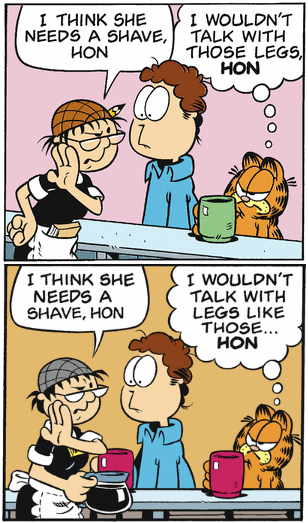
- Garfield has recycled gags many times in the strip's 30+ year history.
- Most of the strips from the first few months were recycled from Jim Davis' precedessor strip Jon, which ran in the Pendleton, Indiana Times from 1976 to 1978. This includes the very first Garfield gag from June 19, 1978, where Garfield and Jon address the reader.
- Including at least three instances where the same gag was used twice only one year apart. One is at the top of the page; another was a gag where Garfield is in such a hurry to get to a cup of hot chocolate that he stands on Odie. The third one was Jon giving Garfield a new cat food that was rich in fiber, only for Garfield to pull a sweater out of his dish.
- Even Garfield and Friends wasn't safe. Throughout the show, there were Quickies, which were generally old Garfield and U.S. Acres strips adapted into animation. In Season 2, a Quickie based on this strip was made. In Season 6, the exact same strip was made into a Quickie again. To its credit, however, it is a bit more faithful to the original source material (Jon doesn't say the word "nice", and Garfield actually claws Jon's pant legs).
- One gag was used to show that Odie can sometimes get the drop on Garfield. In the fists instance, Odie is siting at the bottom of Jon's recliner, when Garfiled jumps on the backrest, sending Odie flying, and brags about how smart he is to come up with that gag, only for Odie to punch back in the footrest, and sending Garfield flying. Years later, Garfield jumps on the back rest again, and flings Odie with the footrest. As Garfield uses the backrest to nap, he's suddenly awoken by Odie who uses the recliner lever to catapult Garfield away.
- Pluggers, being entirely driven by reader submissions, tends to have this an awful lot. Sometimes invoked when an old gag is recycled entirely and called a "classic". Naturally, this has not gone unnoticed by the aforementioned Comics Curmudgeon.
- Berke Breathed tended to reuse gags in his various comic strips. Of note: the "burger without a bun" gag, which was used in Bloom County's first comic. It came from Berke's previous comic The Academia Waltz, and was later reused AGAIN in Bloom County itself.
- Beetle Bailey, which by now has a run of about half as many strips as there are atoms in the known universe, must have recycled hundreds of its jokes, almost certainly sometimes more than once. Since there are so many strips in existence, it's just conceivable Mort Walker just can't remember which ideas he has already used. But don't bet on it.
- He seems very deliberate about reusing the gag where the officers are afraid to point out an obvious spelling mistake in the General's written instruction, and instead do exactly what the instruction says, even though it makes no sense (tacks instead of tanks, buns instead of guns, gag masks instead of gas masks, etc.)
- The comic strip Mulch once redid a week-long arc word-for-word after a change in artists. It hadn't even been a year since the previous arc ran.
- Buckles always reuses its punchlines. Really.
- Hägar the Horrible tends to be guilty of this. In general there are maybe seven or so basic setups (Hägar getting nagged on by his wife, Hägar and Lucky Eddie stuck on a deserted island, vikings attacking some noble's castle, Hägar returning from Paris...) that are repeated over and over again.
- Baby Blues occasionally does this. For example, the joke with the false weight on Wanda's driver's license was used three times.
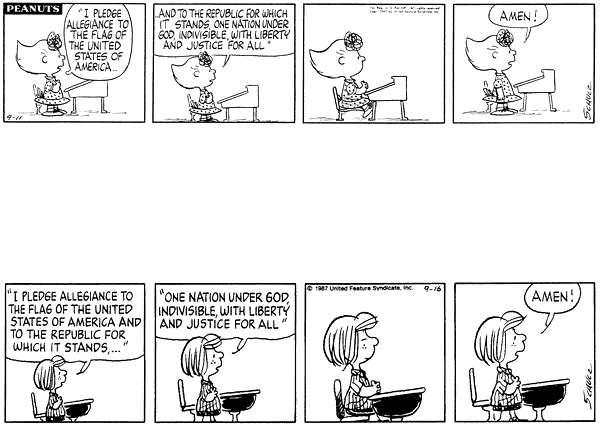
- Peanuts did this several times, as listed on this page. The most egregious example is this◊ as it's the same exactly word for word, albeit using different characters.
- Dilbert: Cleanup on aisle three.
- FoxTrot:
- A 1998 strip has Roger complaining about how the paperboy is always throwing the morning newspaper in a puddle or in the bushes, to which Andy responds by saying that Roger should stop tipping him with a nickel every month. A later strip from 2000 has Roger complaining about how the paperboy keeps throwing the newspaper in a puddle and declares, "Starting today, no more 5-cent monthly tip for that young man!"
- A strip from 2000 has Paige channel-surfing very slowly, to the point that Peter grabs the remote and start channel-surfing very quickly, saying "This is how to do it." This same gag was used in a 2005 strip, except with Jason in place of Paige.
- A pair of strips had the exact same idea about Peter telling one of his parents saying that he doesn't want to rake the leaves until they have all fallen, so it's more efficient. The parent says they're all bare, and Peter says that there is still a few leaves on one of them, which he turned out to have attached with adhesive so they would never fall, and so he would never have to rake the leaves. The only differences are that he was talking to Roger in one and Andy in the other, he used duct tape in the Andy one and super glue in the Roger one, and in the Roger one, Peter's comment was changed from a nervous "Heh heh..." to "Jason, you were supposed to hide the ladder!".
- A weekday strip where Paige runs frantically to her classes because she was constantly late, only to go to P.E. on time, was later recycled as a Sunday strip. The only difference between the two is that the Sunday version had Nicole telling Paige that it's very ironic.
- Off the Mark is drawn by Mark Parisi, who also works for Topps' Wacky Packages. If Topps rejects one of his concepts he repurposes it for his comic strip, occasionally explaining why it didn't make the cut.
- An accidental example where Pearls Before Swine did a storyline where Rat asked congress to give bailout to newspaper comics. Right after Stephan Pastis drew this, Darrin Bell's Candorville did a similar storyline. Pastis ended up telling Bell that he did a similar story to be published later, and that he drew it before he saw the other strips. Bell responded by having Rat appear in his strip the same day the story in Pearls began.
- During the final years of the TV Comics Doctor Who comic strip, a number of previously published stories featuring the Third (and in one case the Second) Doctor were reprinted, using the original art with the Fourth Doctor's head pasted in. This was spoofed in a comic poking fun at the show's history in the 500th issue of Doctor Who Magazine, which alleged that Pink Panther comics were repurposed as Fourth Doctor stories in the same manner.
- The earliest Mickey Mouse strips, particularly those written by Walt Disney himself, tended to reuse gags seen in his animated shorts. The opening to the first Mickey story, "Lost on a Desert Island", was based from the short Plane Crazy.
- For Better or for Worse used the same gag 3 times about a young child character being told not to get their clothes dirty when they play, then deciding to play naked, their clothes piled behind them. Once with a young Elizabeth in 1986, then with Meredith in 2005, then with Meredith and Robin towards the end of the strip's run.
- The End of Ends is a Betrayal Fic in which Beast Boy is "betrayed" by Terra and the rest of the team, the former for breaking up with him in "Things Change" and the latter for supposedly not caring about him. This leads to Beast Boy lashing out at them and eventually becoming a supervillain named Count Logan, who wants to end the universe because everyone else is happy while he's miserable. One of the author's later stories, Friendship is Failure #10, is the same plot revamped to be a crossover with My Little Pony: Friendship Is Magic.
- In Half-Life: Full Life Consequences, John Freeman receives a call from his brother to help him kill aliens and monsters, and goes out to do so on his motorcycle, killing "zombie goasts", and eventually defeating the last boss, only to see Gordon Freeman killed before his eyes. In What Has Tobe Done, John Freeman sets out on his faster motorcycle, kills more zombie goasts and kills the boss that killed Gordon Freeman, only for Gordon Freeman to rise as a headcrab-infected zombie goast.
- In The Prayer Warriors, "Battle with the Witches" involves Michael infiltrating Hogwarts in an attempt to learn about its connection to the British government and any planned attacks on Christians, as well as killing Dumbledore and converting anyone he can. In "The Titans Strike Back", Hogwarts reopens, and several characters come Back from the Dead, but Michael decides to focus more on converting them this time.
- Also, "The Evil Gods Part 2" rips off of "The Evil Gods Part 1" to some extent. Both involve the Percy Jackson cast fighting against evil gods (the Greek gods in Part 1, the Roman gods in Part 2), while trying to find the traitor in their ranks.
- In Christian Humber Reloaded, Vash meets a little girl and her father early on, who end up getting killed by raiders, whom he slaughters in revenge. He later meets another little girl, Soku, along with her father, but the interesting twist is that he kills them all after learning that Soku reported him to the police.
- A Lois & Clark fanfic, "Great Shades of Elvis" was lifted from an episode of The Adventures of Superman, "Great Ceasar's Ghost". In the original, Perry White is testifying against a mobster, who hires an con artist to dress as the ghost of Julius Ceasar to convince Perry (whose familiar catchphrase in the series is "Great Ceasar's Ghost!") that he has gone insane and thus discredit him as a witness. In the fanfic, the suspect whom Perry is testifying against rigs a holographic projector to produce images of an Elvis Presley impersonator (after Perry's in-show catchphrase of "Great Shades of Elvis") to bring Perry's sanity into question and again discredit his testimony.
- In Origins, a Mass Effect/Star Wars/Borderlands/Halo Massive Multiplayer Crossover, Yoda's Holocron Force ghost Lampshades this when the Trans-Galactic Republic starts growing a Clone Army to take on the Flood. Beyond that, smuggler Scarlett DeWinter seems to realize that an endless cycle of coups is normal for her galaxy, muttering about a "foolish hope that someone will not repeat the same mistake that has been made thousands of times."
- Saki: After Story is this to The Day Everything Changed, since they're by the same author. In both of them, Girl A and B are in love, and when Girl B upstages Girl Cnote , Girl C beats her up in revenge. Girl A then intervenes to save Girl B, thus leading to them getting into a relationship. While Konata is able to defeat Sakura, Nodoka is unable to save Saki from Teru.
- In Paper RWBY: The Thousand Year Door Little Mac is able to beat Rawk Hawk meaning that Mario and the gang have to beat Rawk Hawk before facing Little Mac and then Macho Grubba. In Sora's Adventure in Rogueport Remake, Tifa Lockhart is able to beat Rawk Hawk meaning that Mario and the gang have to beat Rawk Hawk before facing Tifa and then Macho Grubba. As it turns out Nan forgot about Little Mac becoming champion after pummeling Rawk Hawk and thought he had come up with a brand new plot point only to look into it thanks to a guest review and saw he had already done the plot!
- Digimon fans who saw Summer Wars will probably wonder why they're watching a re-hash of the second Digimon movie: Our War Games. The answer: both were written by the same director.
- Sing 2 is largely a rehash of its predecessor. Even the individual character arcs are mostly the same: Buster gets into trouble through his chronic lying and resorts to downright illegal measures to put on the show after trying to recruit a retired star to save it, Rosita has to deal with a crisis of confidence, Johnny learns a new skill while standing up to an authority figure, Meena has to get over her shyness, a selfish jerk (Mike/Porsha) ruins the show and almost gets people killed but comes back for the finale, etc.
By Creator:
- Ever thrifty, Roger Corman managed to film what was essentially the same script three times: When making Beast from Haunted Cave, he simply had writer Charles B. Griffith rewrite his own script for the heist thriler Naked Paradise and add a monster. He then had Griffith rewrite that script into a comedy, which he filmed as Creature from the Haunted Sea.
- Roger Corman's The Little Shop of Horrors is essentially Corman's A Bucket of Blood for botanists instead of artists. It's also a case of Recycled Score; Corman commissioned the score for both movies, and a later movie, The Wasp Woman, from the same guy. The composer, in the finest traditions of simply not caring, just handed over the score he wrote for A Bucket of Blood every time.
- The John Wayne movies Rio Bravo, El Dorado, and Rio Lobo were the exact same story, just with a different supporting cast.
By Work:
- The 1974 film adaptation of the Agatha Christie mystery novel And Then There Were None recycled the entire script, wholesale, from an earlier 1965 film version, only changing the location from a snow mountain chalet in the Alps to a lavish hotel in the middle of the desert on the outskirts of Iran; both films were produced by the same man, Harry Allan Towers.
- Many parts of the Are You Being Served? film were taken from the TV series:
- The opening scene where Mr. Harman accidentally hoovers up Miss Brahms' knickers and tells her that he doubts it's the first time she's lost her knickers in the tube comes from the Series 3 episode "Cold Store", albeit between Mr. Mash and Daphne the cleaning lady. Mrs. Slocombe's later line about a "jacksie full of vaccine" also comes from "Cold Store".
- The concept of Mr. Humphries and Mr. Lucas trying to serve a Middle Eastern customer is lifted from the Series 4 episode "Fire Practice".
- The joke about Mrs. Slocombe being flung on her back during the war comes directly from the Series 1 episode "Camping In".
- The entire love letter subplot is taken from "Dear Sexy Knickers...", the first non-pilot episode of the series.
- John Carpenter has admitted that Assault on Precinct 13 (1976) is a city-slum version of Rio Bravo. He wanted to make a Western, but couldn't do it within his budget.
- The introduction of Batman & Robin is nearly identical to Batman Forever's opening:
"THE SCRIPT In attempting to capture some semblance of story, Joel Schumacher, along with screenwriter Akiva Goldsman, first used the basic outline of BATMAN FOREVER. If one were to sit down, and view both films simultaneously on two separate monitors, the comparisons between the two would seem right—time-wise. Examine, for instance, the first act. Freeze has taken guards in the museum. Two Face has taken guards in the bank. Batman is trapped in a vault being lifted, inexplicably, by a helicopter. Batman is trapped, inexplicably, in a rocket headed for unknown space. Through over-the-top theatrics, Batman is able to save the day. That sentence is applicable for either film." Greg Bray, Remembering Batman and Robin, Batman on Film
- It doesn't just apply to the opening sequences; Batman & Robin also uses key plot points from Forever refitted for different characters and pairings. Edward Nygma and Pamela Isley both go From Nobody to Nightmare due to being transformed by their own research breakthroughs, murder their bosses, have a grudge against Bruce Wayne, team up with another villain (Two-Face/Mr. Freeze) who has the means to physically fight the heroes and set things up for their own plans, and are in effect the characters who have the most impact on all the others by tying together otherwise disparate plot threads. The heroes also have to make a raid on a villain's base of operations in both films' climaxes.
- Chow Yun-fat starred in two different Heroic Bloodshed films, A Better Tomorrow 2 and Tragic Hero, released back-to-back (both in 1987!) and both films seemed to be made off the same script. They're sequels ("Tragic" is one to Rich and Famous) set in another country (New York in A Better Tomorrow II, Malaysia in Tragic Hero), Chow's character is a retired gangster trying to go straight, triad leaders getting usurped by the Big Bad, both movie having a restaurant explosion via Time Bomb trying to intimidate Chow's protagonist, an ally giving up his life for the rest of the good guys to uncover the main villain's hideout, and a final explosive-loaded shootout in the Big Bad's mansion with grenades, bombs and explosives being thrown everywhere.
- The Fast and the Furious (2001) was basically a clone of Point Break, only swapping out surfing for illegal street racing, and having the lead criminal/friend survive at the end. Tropes Are Not Bad, as it wound up spawning an entire franchise.
- Eli Roth's 2002 film Cabin Fever was remade with the new director utilizing the exact same script.
- Carnosaur 2 is Aliens, but with raptors instead of xenomorphs, a T-Rex instead of the queen alien, and a uranium mine instead of a space colony.
- The writer of The Curious Case of Benjamin Button also adapted Forrest Gump. Comparisons have been made.
- Escape from L.A. is an act-for-act rehash of the first film, Escape from New York.
- Several years after a major world event (a global war concludes / an earthquake decimates Los Angeles), the government walls off the part of the country hit the hardest and turns it into a prison where offenders and undesirable elements of society are sent for the rest of their lives.
- The plot is motivated by a government official in a position of power (the President in 1997, The Fundamentalist President's daughter in 2013) being involved in a hijacking on Air Force One/Three. They use an Escape Pod to launch themselves into the prison while carrying a briefcase with a MacGuffin (a cassette holding the secret to nuclear fusion/the arming device for a global superweapon).
- Snake Plissken is arrested for past crimes and offered a choice between entering the isolated prison to rescue the VIP, or facing execution.
- Snake accepts the job and is given an Exact Time to Failure in the form of an injection that will kill him if he doesn't complete his mission in time. He is also presented with his gear by the government officials and is presented with a wristwatch that can track his location and display how much time he has left to complete his mission.
- Snake is provided a high-tech, stealth way to enter the prison, complete with fancy 3D rendered entry. He manages to avoid some major obstacles along the way.
- Snake finds that the VIP's tracking device has been compromised and he must seek help to find the VIP.
- Snake sits on a chair to take a break and think about what to do next, only for someone to catch his attention.
- Snake encounters a sympathetic female character who's down on her luck and wants Snake to protect her and help her escape the prison. She is killed soon after their meeting in a pointless death to show how bleak the world within the prison is.
- Snake learns that the person who can help him is A) Someone he knew from his criminal days who B) screwed him over, and who C) insists on going by a different name or identity.
- Snake is captured by the Big Bad while attempting to rescue the VIP and is forced to engage in a Blood Sport game for his life.
- Snake wins the game against all odds, and manages to escape with his posse. In the process, most of his posse (with the exception of the VIP) is killed, while the villain is surprisingly shot down by a previously-meek character.
- Snake is pardoned for his crimes, but decides to double-cross the Big Bad at the last moment via a Stolen MacGuffin Reveal. The President and his forces are left unsure of what to next as Snake walks off into an uncertain future...
- Much of what made Ghostbusters II unpopular on release was that it was, for the most part, just the original Ghostbusters again. Both stories involve an ancient entity who possesses someone close to Dana Barret so that they can use her to free themselves, the Ghostbusters butting heads with the mayor and a sleazy official who hates them, and the climax has them facing off against the entity in a big gothic building, along with a giant symbol coming to life and rampaging across New York. What made it particularly evident was that a lot of plot points from the first film had to be reset to make the sequel work: ghosts are claimed to be hoaxes, despite them having spent half the last film on the warpath, to justify the Ghostbusters being on hard times and having to win the public over again, and Dana breaks up with Venkman just so she can fall in love with him again.
- Heisei Rider vs. Showa Rider: Kamen Rider Taisen feat. Super Sentai is easily a rehash of Kamen Rider × Super Sentai: Super Hero Taisen, though focusing more on the Kamen Riders than both hero franchises. Then, they change it up and reveal that the Superdickery actually hid actual feelings of "You Suck".
- Hostel Part II: The sequel to the first film largely rehashed numerous plot points and had the same exact pacing, in spite of going into a different direction and being a lot more gory and shocking. Both films start with 3 characters being lured to a luxurious vacation to the titular place in Slovakia by someone who works for the orginization. Then it takes until halfway until the first onscreen scene of torture is shown, following the main protagonist being confused about their friends disappearing and eventually being kidnapped themselves by someone they trusted. The last half hour details the tortures and killings that occur with the main protagonist narrowly escaping and getting revenge on someone who was responsible for their friends' demise.
- James Bond:
- The '60s film Thunderball was recycled into 1983's Never Say Never Again with only a few minor tweaks to reflect the passing of time. The plot, names of several major characters, and the actor playing Bond (Sean Connery) were otherwise unchanged. This was the result of a lawsuit by a writer who had contributed ideas to the original Thunderball (which started as a script before becoming a novel), who was trying to leverage this into permission to make his own Bond movies; the verdict was essentially that he could make as many remakes of Thunderball as he liked.
- Die Another Day, as the 20th installment and 40th anniversary of the film series, contains references to all the previous Bond films. In particular, the primary weapon of the villain (an orbiting satellite using smuggled diamonds that shot down nuclear missiles) is from Diamonds Are Forever. Die Another Day also takes plenty of elements from the Moonraker novel, which never really got an adaptation of its own, as the film only used the title and the villain's name.
- The Spy Who Loved Me and Tomorrow Never Dies both have Bond pairing up with a foreign female agent to prevent the villain from starting a war between two nuclear-armed nations, not unlike You Only Live Twice. The idea of a world-destroying villain in favor of supporting living in anywhere but on land itself is later recycled on Moonraker, which is later recycled on NightFire. Nightfire's script is recycled from a movie script recycled from a movie script recycled from a movie script.
- A View to a Kill is Goldfinger, except with horse racing instead of canasta and golf, Silicon Valley instead of Fort Knox, and a KGB operative gone rogue instead of an officially-sanctioned Red Chinese plot.
- Jonah Hex (2010): The film's plot, "During the Reconstruction, an evil ex-Confederate bent on destroying the Union creates a super-weapon, leading President Grant to send the only man who can stop him." And in this version we dont even get the damn giant mechanical spider.
- The Ju On (aka The Grudge) series is a special case. The first, no-budget, shot-on-video film had over 30 minutes of its footage recycled into the second video film to make a 76-minute Ju-On 2 that was only half new material. After that, the various bigger-budget theatrical versions, in Japan and the US, were also partially original works and partially remakes of segments from the video films and/or earlier theatrical entries (though at least in these cases they were actually re-shot). This finally ended in 2009 with the American straight-to-video The Grudge 3 and the Japanese double-bill Ju-On: White Ghost and Ju-On: Black Ghost, all of which were entirely original.
- Critic MaryAnn Johanson is among those who have pointed out that Jurassic World: Fallen Kingdom, the fifth Jurassic Park film, is this to the second film, The Lost World: Jurassic Park: Good guy(s) from the first film find themselves trying, alongside new goodies, to protect the now-wild dinosaurs from humans who capture and intend to exploit them and who also have a connection to park founder John Hammond. She even jokes in a footnote "One suspects 'Fallen Kingdom' came about as a subtitle for the film by running 'Lost World' through a thesaurus." The main differences are that, where most of Lost World takes place on Isla Sorna with a climax set in San Diego, Fallen Kingdom sees Isla Nublar destroyed at the end of the first act and the remainder takes place on an estate in Northern California, the goodies initially think the baddies are on their side in Fallen Kingdom, and the endings are pretty much total opposites — in the older film, the dinos peacefully remain on Isla Sorna, in the newer, they're now on the loose in the U.S. Not helping matters is the fact that the protagonist of Lost World, Dr. Ian Malcolm, appears in the bookends of Fallen Kingdom after sitting out the two films in-between.
- The 2019 live-action film adaptation of Kim Possible has a very similar plot to the previous Kim Possible film, 2005's Kim Possible Movie: So the Drama. Both revolve around Kim befriending a new character who turns out to be a robot created by Drakken. The difference is their genders, that Athena is on platonic terms with Kim instead of romantic terms, and that Athena betrays Drakken because she's genuinely Kim's friend.
- Meet the Parents had a guy planning to propose to his girlfriend, but then has to meet her parents. He spray paints a cat, takes a lie detector test, and accidentally ruins their dinner with her grandmother's remains. The Sequel, Meet the Fockers, had the same guy planning to marry his girlfriend, but she has to meet HIS parents. His dog gets dyed blue, he is given a truth serum, and accidentally ruins dinner with his foreskin.
- Anybody who tells you that Never Back Down isn't a script recycle of Step Up 2: The Streets, replacing dancing with mixed martial arts, is a liar. It's a beat-for-beat remake of the original The Karate Kid, to boot. Both feature a new kid in town who gets his butt kicked at a party by a blond bully, trains under a foreign-born mentor with a tragic backstory, hooks up with the bully's ex-girlfriend, and ultimately wins the bully's respect by kicking his butt at a tournament.
- On the Buses films:
- In On the Buses, Olive is briefly employed as the canteen's cook, a plot point that had been used two years prior in the Series 1 episode, "The Canteen". The gag about Olive melting a hole in the bottom of the saucepan comes directly from that episode too.
- Mutiny on the Buses:
- The concept of Blakey introducing a radio control system was taken from the Series 3 episode "Radio Control".
- Olive getting jealous over another woman getting too friendly with Arthur was previously done in the Series 4 episode "The Other Woman".
- Phantom of the Paradise has so many striking similarities with The Rocky Horror Picture Show (even though it could have only been inspired by the stage version of Rocky - RHPS was still filming when Phantom hit theaters) that some fans consider it part of the same series. Likewise, Rocky's bastard-sequel Shock Treatment (which also starred Jessica Harper) has a number of striking similarities to Phantom; possibly a case of Richard O'Brien subtly reclaiming his own work.
- The Davy Jones plot in Pirates of the Caribbean: Dead Man's Chest has more than a few similarities to the Barbossa plot in the first movie. Both of them involve a battle against a tyrannical pirate captain from Jack Sparrow's past who rules over a crew of undead pirates who were rendered immortal by an ancient curse, with both sides squabbling over the supernatural treasure that can finally lift the curse, and one of the main trio ending up as a captive on his ship. That might have been why the filmmakers added Cutler Beckett and the extended Pelegostos Tribe section; if the movie had been only the battle against Davy Jones, the similarities would have been even more distracting. On Stranger Tides and Dead Men Tell No Tales would continue to feature tyrannical pirates from Jack's past that have undead pirates by their side (with Jack now working with Barbossa making it more apparent), but otherwise do not follow the exact same plot as the previous films.
- Pitch Perfect 2 ended up rehashing much of the original Pitch Perfect, but to a more extreme degree: a national competition became international, a "friendly" competition between fellow students became a high-stakes competition held by a wealthy sponsor, Beca's job went from the campus radio station to an actual music label, and so on.
- Somewhat subverted while also played straight with Pitch Perfect 3. We still have a "friendly" rivalry between different groups, the Bellas still get to travel, Beca's working as a producer now, the group learns to let go and move on, etc. Then things go completely off the rails when Amy's dad kidnaps the Bellas. All culminating in a very cheesy and over the top action sequence.
- Power Rangers (2017) begins with three high school kids from different social groups in detention, who end up finding ancient colored stones belonging to a former Ranger and being granted powers by them. The former ranger becomes their mentor. This is essentially how Power Rangers: Dino Thunder started.
- Two films written and produced by John Hughes and directed by Howard Deutch in the late '80s, Pretty in Pink and Some Kind of Wonderful, have essentially the same plot but with most of the genders reversed. A poor teenager (Andie/Keith) has an unrequited crush on a rich classmate (Blaine/Amanda), unaware that her/his quirky platonic best friend (Duckie/Watts) is deeply in love with her/him and facing retribution from said rich kid's evil friend/boyfriend (Steff/Hardy). The difference is that, because the test audience didn't like the ending, in Pretty in Pink Andie ended up with Blaine; Hughes wrote Some Kind of Wonderful because he was upset at the Executive Meddling.
- Scooby-Doo: Monsters Unleashed did a very obvious lift of the Buffy the Vampire Slayer Season 2 episode "Halloween", including the main plot about monster costumes becoming real monsters, and the character development subplot of the character played by Sarah Michelle Gellar giving her nerdy best friend a makeover in hopes of attracting the guy she's crushing on, and instead attracting the character played by Seth Green. The difference here being, the guy, the nerdy best friend wants to attract is played by Seth Green and instead of attracting someone else, she ends up making things awkward for him due to him liking her just the way she is.
- Star Trek
- Star Trek: The Motion Picture was based of a script from Star Trek: The Original Series called "The Changeling".
- Likewise, while it did have some original elements as well, there's one chunk of Star Trek Into Darkness that's very clearly pulled straight from Star Trek II: The Wrath of Khan, right down to nearly identical dialogue in one of the key scenes except with Kirk and Spock's positions reversed.
- Star Wars:
- The Force Awakens echoes A New Hope quite strongly to the point that George Lucas complained that Disney made it too retro, as he had at least tried something different with the prequels.
- Rogue One was based on an episode of the cancelled live-action TV series Star Wars: Underworld.
- The Force Awakens echoes A New Hope quite strongly to the point that George Lucas complained that
- Wild Wild West has itself been accused of ripping off Batman: The Animated Series' "Showdown".
- The Twilight Samurai and The Hidden Blade are both about a poor, extremely humble samurai who just wants to live a simple life. At the same time as he falls in love, he gets dragged into the violent world of politics against his will due to a rare technique of swordsmanship he possesses. Ultimately he uses his technique to escape from his predicament and gets married. Both films are written and directed by Yoji Yamada.
- Writer/director Kurt Wimmer admitted to rehashing many of the same concepts in Ultraviolet (2006) from his previous film Equilibrium. Both are about a superhuman killing machine in a future dystopia who goes against a quasi-religious, fascist government that is built around fighting something (emotion/virus) that the hero possesses. The hero fights other superhuman enforcers in a number of Curb-Stomp Battles to reach the #2 man, who turns out to A: have the same prohibited thing as the hero, B: be the real leader of the government, and C: be the toughest opponent of all.
- Honey, We Shrunk Ourselves recycles the scenario not of the original film, but of the 1990 Alvin and the Chipmunks parody of the original film, "Funny, We Shrunk the Adults." Both invert the original scenario and have the kids' parents (or in the case of the Chipmunks parody, their father and nanny) be shrunk, while the kids party, thinking they're home alone.
- Though the plots are consistently different, The Naked Gun and its sequels merrily recycle gags and scenes from Police Squad!.
- Dad's Army (1971) copies the plots of some episodes from the series, such as "The Man and the Hour" (the formation of the platoon), "The Armoured Might of Lance Corporal Jones" (Lance Corporal Jones' van being turned into an armoured car and converted to gas), and "Battle School" (the platoon getting lost on the way to a training base, causing them to miss dinner and breakfast).
- Doctor... Series:
- Doctor at Sea: Wendy's advances on an uncomfortable Dr. Sparrow are taken from the previous film, with Wendy in place of Milly.
- The Radio Times Guide to Films complains that Doctor in Trouble feels as if it was made up with leftover material from Doctor at Sea, while the original VHS outright called it a blend of At Sea and Doctor in Love.
- Twice Round the Daffodils ends with the patients leaving Lenton Sanatorium in a minibus and giving Nurse Catty a goodbye present, practically the same ending as Carry On, Sergeant (also written by Norman Hudis), only that was with National Service recruits, a barracks, a lorry, and a Sergeant.
- Douglas Adams' novel Dirk Gently's Holistic Detective Agency reused several key concepts from "Shada", a story he had written for Doctor Who but which had been unfinished due to strike action (and elements of "City of Death", which was broadcast). Another Adams novel, Life, the Universe, and Everything, began its life as a Doctor Who screenplay called The Krikketmen. It shows, as the Gotta Catch 'Em All plot is a very different sort of animal from its predecessors.
- Agatha Christie:
- Christie has been known to reuse the plot of her short stories in order to expand them into full-length novels, with the short story acting as something of a "test run". The Poirot short story Yellow Iris became the Colonel Race novel Sparkling Cyanide; the Poirot novellas Murder in the Mews, The Incredible Theft and Dead Man's Mirror (which were published together) were based on the Poirot short stories "The Market Basing Mystery", "The Submarine Plans" and "The Second Gong", respectively; the Poirot novel The Mystery of the Blue Train uses the same device as the Poirot short story "The Plymouth Express"; and two Poirot stories, "Problem at Pollensa Bay" and "The Regatta Mystery", were later rewritten to be about Mr Parker Pyne. Note that Poirot, Race and Pyne all exist in the same universe.
- The Mysterious Affair at Styles, Lord Edgware Dies, The Hollow and Towards Zero all share, to an extent, the same solution to the murder mystery: In each novel, the murder case seem really straightforward, with only one plausible suspect that has a bunch of evidence against them. However, they are revealed to have a solid alibi during the time of the murder, and are cleared of the charges. In all cases, the initial prime suspect was actually the murderer after all, having deliberately planted evidence against himself that can be easily proven false. Death on the Nile also employed this plot device, but with an extra twist.
- Death on the Nile and Evil Under the Sun both have very similar solutions, with only the details and Exotic Backdrop Setting changed: A murderous couple pretend to hate each other so that the man can seduce and kill a wealthy woman, who turns out to have been a gullible and lovestruck Unwitting Pawn instead of The Vamp they first appeared to be. They both also involve the couple creating alibis for themselves by staging a scene in front of witnesses immediately before the murder (a fake discovery of the body in Evil, and a fake leg injury in Nile). The main twist had previously been used in the short stories "Triangle at Rhodes" and "The Bloodstained Pavement" as well.
- The Man in the Brown Suit is a spy thriller about a woman who goes off to an exotic location (South Africa) and finds herself enmeshed in a criminal conspiracy. They Came to Baghdad is a spy thriller about a woman who goes off to an exotic location (Iraq) and finds herself enmeshed in a criminal conspiracy. Each novel has a scene where a badly wounded man stumbles into the woman's room and asks her to hide him. The main difference is that in The Man in the Brown Suit, the man lives and becomes the heroine's Love Interest. In They Came to Baghdad the wounded man promptly dies in the heroine's bed and she meets the Love Interest later.
- The plot of "The Kidnapped Prime Minister" (1924) was reused in "The Girdle of Hippolyta" (1939), with the victim changed from a male politician to a young schoolgirl and a corresponding change of motive.
- The central plot device of the Harley Quin short story "The Sign in the Sky" (1925) is also the key device in the Hercule Poirot novel Taken at the Flood (1948).
- The plot of the Miss Marple short story "The Blue Geranium" (1929), part of The Thirteen Problems, was reused in the Hercule Poirot short story "The Lernaean Hydra" (1939).
- The premise of the very first Miss Marple story "The Tuesday Night Club" — a man seduces the maid into committing murder for him — was expanded on to create the full-length Miss Marple novel A Pocket Full of Rye.
- "The Mystery of the Baghdad Chest" (1932) was expanded to create "The Mystery of the Spanish Chest" (1960).
- The plot of the Miss Marple novel The Moving Finger (1942) was reused in the Hercule Poirot novel The Clocks (1963) by replacing the letter with a telephone call and changing the victim from a maid to an office worker. The anonymous letter plot was replaced with a mystery / espionage plot for The Clocks.
- In Cards on the Table, Ariadne Oliver is asked if she has ever reused a plot, and Poirot instantly mentions "The Lotus Murder" and "The Clue of the Candle-Wax" - which from the descriptions are her versions of Murder on the Links and "The Adventure of the Submarine Plans"/"The Incredible Theft".
- Ben Safford Mysteries: Both Murder: Sunny Side Up and Murder Out of Commission have many distinct elements and characters, but in both books two scientists get murdered by a peer who once studied under one of them to prevent them from revealing a dangerous flaw in his new invention. The denouements of both books also have the protagonists dismiss the industrialists the scientists were working for as serious suspects due to feeling the stakes weren't high enough for them.
- When Robert E. Howard's By This Axe I Rule!, a short story featuring his barbarian king Kull of Atlantis, was rejected by Weird Tales, he changed its setting and replaced Kull with a new protagonist he had been toying with — Conan of Cimmeria — and it became "The Phoenix on the Sword", the first of nearly two dozen stories starring the character.
- In an interesting reversal, the script for a third Conan film — Conan The Conqueror — was offered to Kevin Sorbo. Sorbo balked at the role, hoping to avoid the inevitable comparisons to Arnold Schwarzenegger, so the script was modified to be about King Kull instead, giving us Kull the Conqueror. (No, we can't give it back. Should've kept the receipt.)
- The novel The Hour of the Dragon is very similar to the earlier short story "The Scarlet Citadel". In both, a conspiration led by an evil sorcerer captures Conan and causes Aquilonian noblemen to usurp the throne of Aquilonia and plunge the kingdom into chaos. Conan makes his way out of the sorcerer's dungeon and eventually rallies his men to defeat the bad guys. This is quiete notable as "the Sarlet Citadel" and The Hour of the Dragon are two of the only three Howard stories where Conan is king.
- John Putnam Thatcher: While the overall stories and characters are fairly distinct, Ashes to Ashes and Brewing Up a Storm have eerily similar reveals about the victim, motive, and killer. In both books, an idealistic activist leader discovers that a supposed ally is cynically manipulating the group in exchange for money to finance that person's political ambitions. In both books, the victim is killed in a fit of pain and anger after privately confronting the killer.
- Chris Van Allsburg recycled his book Jumanji, about a magic safari-themed board game that draws the players into its world, into Zathura, which is about a magic sci-fi-themed board game that draws the players into its world. Jumanji was later adapted into a movie; several years later, so was Zathura, and many of the changes to the plot of Jumanji were also put into Zathura (for instance, both films introduced a character who had been trapped in the game world since childhood, since he started a game and didn't finish it).
- Ken Follett:
- The Pillars of the Earth and World Without End both take place in the same fictional priory in medieval England, in the 12th and 14th centuries respectively. They are both about a genius architect whose building project and love life are constantly threatened by conservative townsfolk, the church, politics, and petty rivalries. In both, the female lead and the architect's lover is a strangely liberated woman who is awfully assertive and independent for the middle ages. Both feature as an antagonist an evil rapist knight. Both turn on a closely guarded secret about the royal family (the sinking of the "White Ship" and death of Henry the Young King in the first, the murder of Edward II in the second). Both have the female lead traveling to the site of a great battle (Lincoln in the first, Crecy in the 2nd) to ask a boon of the king; both have the evil knight fighting in that battle.
- The Eye of the Needle and The Key to Rebecca both feature elite German spies who have information that could turn the war in the favour of the Axis. Both are are handy with hidden blades.
- Some of the Goosebumps books in general, but especially some of the sequels, such as most of the Night of the Living Dummy books.
- Some of the stories written for The Berenstain Bears Scouts series were simply extended versions of the episodes from the 1980s cartoon series.
- Some Jeeves and Wooster stories, about a thick-headed young English gentleman and his ingenious valet, were adapted from P. G. Wodehouse's earlier Reggie Pepper series, about a thick-headed young English gentleman and... no one in particular.
- In Le Morte d'Arthur, we get the tale of Sir Beaumains in Book VII, in which a lowly servant becomes a knight and is given an insulting nickname by Sir Kay, he goes on a quest with a damsel who mocks and degrades him endlessly, ends up proving his worth and changing the damsel's view of him, and his true identity is revealed to be Sir Gareth. In Book IX, we get the tale of Sir La Cote Male Taile, in which a lowly servant becomes a knight and is given an insulting nickname by Sir Kay, he goes on a quest with a damsel who mocks and degrades him endlessly, ends up proving his worth and changing the damsel's view of him, and his true identity is revealed to be Sir Breunor. Yeeeeeah, Deja Vu anyone?
- Malory was compiling all the Arthurian romances he knew into one volume. It's entirely possible he included the same one twice with the names changed.
- Actually, there is no known source for the Tale of Sir Gareth; although it draws on several Anglo-Saxon poems and the "Fair Unknown" genre that the La Cote clearly comes from, it has long been deemed too original to be a derivation. It is considered by most Arthurian scholars to be the only tale in the Morte to be created by Malory. La Cote Male Taile, on the other hand, came directly to Malory from the Prose Tristram, written in the 1200s.
- Malory was compiling all the Arthurian romances he knew into one volume. It's entirely possible he included the same one twice with the names changed.
- Donald Sobol's Two-Minute Mysteries includes a story of a man who tries to impress his date with a fake engraved saber his great-grandfather supposedly received, marked as an award for valor at the first battle of Bull Run. The challenge is to figure out why the sword is obviously fake. Either it's obvious because it wasn't called the first battle of Bull Run until after there was a second battle of Bull Run... or it's obvious because Sobol used the same mystery in his Encyclopedia Brown series.
- The majority of the Two-Minute Mysteries are just Encyclopedia Brown stories condensed to one page and with the crime in question upgraded from petty theft to first-degree murder.
- One Russian newspaper in Israel used to print a long series of stories by Paul Amnuel called Berkovich's Investigations ("Расследования Берковича"). A major portion of them was Cultural translations of the Mysteries.
- The majority of the Two-Minute Mysteries are just Encyclopedia Brown stories condensed to one page and with the crime in question upgraded from petty theft to first-degree murder.
- A monstrous race is threatening Lancre. They have mind-control powers that seemingly surpass Granny Weatherwax's headology, just as she's starting to worry that she's getting too old for this. Nanny and Magrat have to fight on without her. And then it turns out she had a plan all the time. Lords and Ladies or Carpe Jugulum?
- Terry Pratchett's 1991 short story "FTB" (also known as "The Megabyte Drive To Believe In Santa Claus") is Hex's subplot from Hogfather, relocated to Roundworld.
- A number of elements from Carpe Jugulum relating to recent events in Granny Weatherwax's life earlier appeared in the short story 'The Sea and Little Fishes'. The whole "Granny goes up and sulks in the gnarly ground" scene was written for 'TSALF', but cut because it slowed the story down; the original version appears in the back of the collection A Blink of the Screen.
- The Long Earth was adapted from an earlier short story, 'The High Meggas.'
- The Roald Dahl adult short story "The Champion of the World" is about two men who come up with the idea of poaching pheasants by dosing raisins with sleeping pills and scattering them though the wood. There's something familiar about both title and plot...
- The conclusion to the Pip and Flinx tales, in which some last-minute brilliance by Flinx allows him to track down a Lost Technology universe-warping superweapon and thus, save the galaxy from being devoured by the Great Evil, is a Recycled Script of The End Of The Matter, in which he did the exact same thing to save two solar systems from a black hole: the threat's just been scaled up by several orders of magnitude.
- Both Icerigger and For Love Of Mother-Not feature outnumbered heroes using the same gimmick to destroy an overwhelming enemy force: creating a smell that attracts an unstoppable herd of giant-sized alien herbivores to trample the enemy en masse.
- Dan Brown's Digital Fortress mentions a subplot explaining the etymology of the word "Sincere" as derived from "sine cera" which literally means "without wax" in Latin. In Digital Fortress he credits this to Spanish instead. It's explained that ancient sculptors would cover flaws in their work with wax, therefor a piece finished "without wax" would be considered honest and without flaw. Interestingly enough, Dan Brown revisits this exact same subplot when he explains "without wax" in his other book The Lost Symbol. This time crediting the etymology to Latin.note
- Michael Connelly novels featuring detective Harry Bosch:
- Lost Light ends with a violent confrontation between the bad guys and Harry Bosch at Bosch's house. The Crossing, published over a decade later, ends with a violent confrontation between Bosch and the bad guy at Bosch's house. Then Dark Sacred Night has the bad guys lying in wait at Bosch's house, although this time they just kidnap him. (And just for fun, Angels Flight has Bosch coming home and finding that his friend has been murdered and left at Bosch's house.)
- In The Concrete Blonde Bosch finds out that his partner, Jerry Edgar, is leaking information from the investigation to a defense lawyer. He originally swears to wreck Edgar's career, but relents and lets him off the hook. In later novel The Drop, Bosch finds out that his partner, David Chu, is leaking information from the investigation to a reporter. He originally swears to wreck Chu's career, but relents and lets him off the hook.
- The Closers involves a relative of the victim deliberately getting himself arrested so he can kill the bad guy. The Drop involves a victim deliberately getting himself arrested so he can kill the bad guy. The difference is that the avenger in The Closers is successful, while in The Drop Bosch saves the bad guy's life Just in Time.
- The 1940 Horatio Hornblower short story "Hornblower and the Hand of Destiny" reads like a prototype for Forester's later novel Lieutenant Hornblower. Junior lieutenant Hornblower is menaced by a tyrannical captain, there's a mutiny, and then the ship engages in a victorious action on a Spanish target that distracts from the toxic atmosphere, after which the captain is permanently disabled by someone he'd victimized and Hornblower is promoted. In the story, Captain Courtenay is crippled by the seaman Fletcher during the attack; Hornblower sees it happen but declines to intervene or make it known, and he ends up as first lieutenant of the ship. The novel greatly expands on the abuses a captain could inflict unchecked. Captain Sawyer is incapacitated after a fall which shatters what sanity he had left, but it's made a mystery—he could have been pushed by a midshipman he'd singled out for abuse, by Hornblower himself, or he could simply have tripped. Hornblower claims not to have witnessed it, but that it's most likely the last one. The ship goes on to destroy a Spanish fort, and Sawyer is killed when their prisoners mutiny. Hornblower ends with a promotion to commander (though only temporarily, thanks to the Peace of Amiens).
- Animorphs—the first "Megamorphs" and #39, The Hidden both involve the Yeerks having a way to sense when the heroes morph, leading to an extended chase. Cinnamon Bunzuh! even suggests that the buffalo is the latter book's rough counterpart to amnesiac!Rachel.
- The fourth "Megamorphs" book has the same premise as an original plot from the TV series—a Sufficiently Advanced Alien offers Jake the chance to rewrite history so that he and his friends never met Elfangor. The odd thing is, K. A. Applegate claims to have never watched past the first two episodes, so she may have come up with the idea independently. Interestingly, the story goes in opposite directions: Tobias still becomes an Animorph in the show, while the others are infested and the Yeerks win; in the book, Tobias is infested while they still save the world.
- Two '80s Sesame Street picture books have the exact same plot with different characters: 1982's Nobody Cares About Me! and 1989's It's No Fun to be Sick! In both books, one Muppet character (Ernie in the first book, Herry Monster's sister Flossie in the second) gets sick, and another Muppet (Big Bird/Herry) gets jealous of all the pampering they're receiving and wants to be sick too. But then he does get sick too and learns that it's no fun.
- Tom Sharpe recycles a plot device from Indecent Exposure(1971) for Wilt (1976). A man arrested by incompetent and largely useless police investigators and subjected to low-level torture, who is innocent of a crime, realises the only way forward is to create a confession which is good enough to fool the police - who are willing to accept a confesssion and aren't prepared to look too closely at it - whilst being, at the same time, so wildly preposterous that any rational court would throw it out. Both confessions involve a food factory dealing with meat produce, which neatly explains the lack of corpse. The strategy is vindicated for Henry Wilt: but unfortunately for Bishop Hazelstone, he is living in South Africa in The Apartheid Era. In his case, a sane and rational court is not a possibility.
- Meg Langslow Mysteries: At least three books,"Stork Raving Mad", "Owl be Home for Christmas" and "The Twelve Jays of Christmas" feature a murderer who is the seemingly pitiable, deferential, and bullied assistant or colleague of a Jerkass academic or artist. In each book, the murderer is being blackmailed by their boss and ultimately kills them.
- A major criticism of Brian Katcher's young adult novel Almost Perfect was that it was in many ways a rehash of Katcher's earlier novel Playing With Matches, just swapping in a transgender character in place of the pyromaniac character from the original, which leads to a few Unfortunate Implications since in reality those are two very different conditions. (Another criticism, incidentally, is that the plot in Almost Perfect doesn't always fit the character as established very well, which may also trace back to this trope).
- Karel Čapek did this with his play R.U.R. and the novel War with the Newts. The major difference was that in the one case, the Robot Rebellion involved actual robots (well, sort of...) and in the other case, involved a strange race of sentient newts that were enslaved/treated like robots. Because of the different media, though, both works stand pretty well on their own (though R.U.R. is far more famous, if only because it originated the term "robot").
- Vivian Vande Velde's Dragon Bait and Companions of the Night tell virtually the same story: a teenage female protagonist with a Missing Mom suffers a false accusation due to coincidental circumstances, and subsequently both her and her father's lives are endangered. Enter a Tall, Dark, and Snarky Really 700 Years Old supernatural male lead who offers to guide the heroine in her quest for vindication. Despite the man's general dangerousness and untrustworthiness, the heroine accepts because she has no one else to turn to, and she quickly finds herself growing attached to him as he leads her around. This culminates in the capture of both the male lead and the heroine by the main villain. The villain is killed in such a way that the heroine is not (fully) responsible. The heroine then saves the male lead from his one weakness - daylight - and the books end on an ambiguously positive note. The difference? The male lead in Dragon's Bait is a dragon; in Companions of the Night, he's a much more marketable vampire.
- Diary of a Wimpy Kid: The first eight books take a lot of small jokes from Kinney's college comic Igdoof. For example, almost all of the comics Greg draws (Creighton the Cretin, Rory Screws Up, Ugly Eugene, The Boy Who Thought He Was a Dog, The Amazing Fart Police, his Chimps essay) are taken directly from Igdoof (complete with remastered illustrations). The jokes in the Do-It-Yourself Book in particular are 80% Igdoof material, redrawn with Greg and Rowley and removing some of the more inappropriate bits.
- When J. R. R. Tolkien was writing early versions of what would become The Silmarillion, he wrote a story about how a Silmaril, a magic gemstone that bore an inner glow like the light of a star, became the masterpiece of the dwarves after their treasure, the Nauglamir, was reclaimed from the hoard of a dragon—but their coveting of it resulted in them antagonizing a group of elves who faced them in battle with tragic consequences. When he wrote The Hobbit, he incorporated a lot of this plot into the story of the Arkenstone, which was also a glowing gemstone that became the centerpiece of a tragic conflict between elves and dwarves when it was reclaimed from a dragon. The similarities between the Arkenstone and the Silmarils are so heavy that a lot of fans have claimed they're the same thing, despite this being canonically iffy at best.
- Sherlock Holmes has two very similar stories in the form of The Adventure of the Red-Headed League and The Adventure of the Three Garridebs. Both involve an innocent man being duped by a complex scheme involving a fictitious eccentric American millionaire to get him away from his property for an extended period of time so the crook can access something hidden next door: a bank in the former, a counterfeit money printer in the latter.
- The 2001 picture book Walter the Farting Dog by William Kotzwinkle and Glenn Murray has more-or-less the same plot as the 1994 picture book Dog Breath by Dav Pilkey. In both books, an average suburban family with two kids owns a dog with a horrible smell. All attempted cures fail, and though the family loves the dog, they sadly resolve to give it away. But then one night, two burglars break into the house, only for the dog's stench to stop them in their tracks and get them caught. The dog is hailed as a hero and the family decides to keep it after all. The only real difference is which end of the dog the smell comes from.
- One strip of the Pleasant Goat and Big Big Wolf manhua has Weslie and Wolffy look fierce at first only to end up playing Rock–Paper–Scissors. This is the exact same joke as the Episode Title Card of episode 60.
- A related phenomenon in musicals is the recycling of lyrics:
- "I Remember It Well" originally appeared in the Broadway musical Love Life, but remained extremely obscure until its lyric was recycled (with some revisions) for the movie Gigi, set to completely different music.
- "Put Me To The Test" was a Cut Song from the movie A Damsel In Distress, used as dance music only. Its lyric was salvaged and put to use in the movie Cover Girl.
- This applies to music as well. In musical theatre, recycled songs are known as "Trunk Songs" - songs that were written for one show, cut, and subsequently lay at the bottom of the composer's trunk until he was in Boston with a new show that desperately needed a new song in seconds flat, at which point he pulled the song out of the trunk (the lyrics often being replaced entirely). It's a testament to the craft of the songwriters how seamlessly some of these songs fit into their new context. A few examples:
- The music for both "One Hand, One Heart" and "Somewhere" were originally composed by Leonard Bernstein for Candide and subsequently dropped. When West Side Story required new material but Bernstein was too busy working on Candide, he handed these songs over to lyricist Stephen Sondheim.
- Jules Styne's music for one particular song had been used in - and discarded from - several shows, before it wound up permanently in Gypsy as "You'll Never Get Away From Me".
- Stephen Schwartz has stated that his music for the "Goldfarb Variations" in The Magic Show was culled from a much earlier show he wrote while still a student. The dramatic moment called for a four-part fugue - quite a technical challenge to compose - and, since Schwartz had already composed one, he decided to put it to good use.
- A related example: many of the songs cut from Stephen Sondheim's Follies were re-used by choreographer Michael Bennett as material for the show's lengthy overture. The two songs featured most prominently are "All Things Bright And Beautiful" and "That Old Piano Roll".
- Andrew Lloyd Webber does this frequently, sometimes to the point of ridiculousness. "Music of the Night" started life as "Married Man", "I Don't Know How To Love Him" was originally published under the title of "Kansas Morning", and a song called "The Heart is Slow to Learn" was written for a proposed sequel to Phantom, used as "Our Kind of Love" in The Beautiful Game, then pulled back out of that musical to serve its original purpose as the title song for Love Never Dies.
- Opera has some more blatant examples: Rossini in particular was nefarious for his extensive borrowing from his previous operas. At the time, there was greater freedom to do so, as long as the two works premiered in different towns.
- One of the especially blatant examples is Luigi Illica with his librettos for Andrea Chénier and Tosca (the latter in collaboration with Giuseppe Giacosa). In the late 18th century, the heroine is in love with a revolutionary artist, a high-ranked official secretly obsesses over the heroine, orders the artist’s arrest and presents the girl with Scarpia Ultimatum. What happens afterwards is the part where the two plots differ, but the girl and the artist end up dead anyway by the end of both.
- The Sera Myu used the plot of Galaxia resurrecting Queen Beryl quite a few times. Sometimes she was with the Shitenou, sometimes not. Once she was resurrected with the Amazon Trio instead. Also, many plots were pulled from the Anime or Manga, but this is to be expected.
- The song "Climbing Over Rocky Mountains" from Gilbert and Sullivan's Thespis was brazenly recycled, tune and words, in The Pirates of Penzance. Thanks to this, it is now one of only two pieces of music from Thespis's score that have survived.
- About half the songs (maybe more) of songwriter and composer Jim Steinman (famous for his collaborations with Meat Loaf) were written for, or later used in, various musical theater projects he'd either written or was on board for as part the creative team. These include: Neverland (produced at his college, which eventually led to Meat Loaf's "Bat Out Of Hell" album), Wuthering Heights (produced for MTV), an aborted Batman stage musical, Tanz Der Vampire and Whistle Down The Wind.
- Specifically from Tanz der Vampire: "Totale Fnsternis" (Total Eclipse) is a remake of his smash hit Bonnie Tyler ballad "Total Eclipse of the Heart" with mostly changed lyrics (and, in the American version of the show, the audience reacted to it as a parody of the famous song - entirely unintentional). "Die Unstillbare Gier" (The Insatiable Greed) re-used the melody of his lesser hit Meat Loaf ballad "Objects in the Rear View Mirror May Appear Closer Than They Are" with completely new lyrics. And "Gott Ist Tot" (God Is Dead) and "Einladung Zum Ball" (Invitation to the Ball) both use parts of the more obscure "Original Sin" originally recorded by Pandora's Box and covered by Meat Loaf in 1995.
- This happens plenty of times between different books and testaments of The Bible. For instance, the birth of Isaac in the Book of Genesis and the birth of John the Baptist in Luke have the same broad strokes: God (or one of his messengers) announces to an aging couple that they are going to be blessed with a son, the couple is skeptical because of their advanced age, God chastises them for their disbelief, and the son is born right on schedule. Some Bible stories (especially in the Gospels, which all chronicle Jesus' life through a slightly different narrative lens) are told multiple times with only superficial changes, and there are significant similarities to be found between the lives of several major biblical figures (Moses, Joseph, David, Jesus) if you're looking for them. It is important to note, however that this was most likely intentional for cohesion and drawing parallels between events in the Old Testament leading up to the life and death of Jesus.
- A number of stories in Genesis (most famously the one about the Great Flood) are believed by some to have been adapted from even older Mesopotamian myths.
- This is pretty standard practice in world mythology, given how much time the different pantheons and legends have had to evolve, swap elements with one another, and be taken up by entirely new cultures and religions. For a clear example of what this process looks like, just take a look at all the many, many direct parallels between the mythologies of ancient Greece and Rome.
- Professional Wrestling manager/promoter Jim Cornette, out of character, has put out a "rule" that angles or gimmicks can be recycled after about seven years, due to the shifting fanbase. In fact it's the Former Trope Namer for Fleeting Demographic Rule.
- In Australia in the 1970s, there was a "war" between the Faces the People's Army (Mark Lewin, Spiros Arion, Mario Milano, Sheik Wadi Ayoub, King Curtis Iaukea) and the Heels Big Bad John's Army (Big Bad John, Abdullah the Butcher, Hiro Tojo,note Mr. Fuji, Dick "The Bulldog" Brower and Waldo Von Erich). The feud was later recycled in Vancouver, with some changes. Mark Lewin, Spiros Arion and Mario Milano were all still members of the People's Army, with new members Angelo Mosca and Lord Athol Layton. Big Bad John's Army included, along with BBJ himself, Abdullah, Waldo and Brower again, the Tojo Brothers [Hito and Hiro],note Tiger Jeet Singh, Don Fargo, Brute Bernard and King Curtis Iaukea. Then there was the case of Killer Karl Kox, who spent time on both sides.
- In 1995, Mitsuhiro Matsunaga had in two of the same types of matches he had in W*ING three years earlier against two of the same opponents he face in them. A Fire Death match against Mr. Pogo and a Spike Nail Death Match against Leatherface. The difference this time was that they were under the FMW banner.
- TNA has done this with Mr. Anderson and Bully Ray in recent years. First, a frustrated Anderson would join the heel stable of the year, with Bully either being the field general or the outright leader. It would start off great until Anderson eventually hits a couple snags, at which point Bully would begin to question and antagonize him. Inevitably the tension would lead to Bully getting the group to betray and forcibly kick out Anderson. Finally, after a short time away, Anderson would return primed for vengeance, getting through everyone he has to in order to beat Bully down. Specifically, the two stables were Immortal in 2011 and the Aces And Eights in 2013—and with the latter, Anderson's victory over Bully would even force the club to disband.
- WCW recycled the Magnum T.A. vs. Nikita Koloff Best of 7 series for the NWA United States Heavyweight Title with Booker T and Chris Benoit for the WCW World Television Championship in 1998 (the twist being that instead of the title going to the winner of the series, this time the title was on the line in each match; considering that it ended 4-3 on Booker's favor, this meant that both him and Benoit became multiple-time champions through the course of it). WWE then recycled that, with the same two guys, for the WWE United States Heavyweight Title on WWE SmackDown in 2005.
- On the May 14, 1999 ECW Hardcore TV, there was a segment with Dawn Marie and Cyrus, where Dawn talked about Tommy Dreamer constantly trying to piledrive her in order to expose her butt. Dawn said that she was so confident that Dreamer wouldn't be able to get his hands on her the following night at the ECW Hardcore Heaven 99 PPV that she wouldn't wear panties at the PPV. Cyrus didn't believe her, so Dawn pulled down her panties and placed them on Cyrus' shoulder.note Commentator Jerry "The King" Lawler had set up a "King Cam" backstage at Divas Undressed to capture Diva nudity on camera. After the first round, "Tiny Teddy," there was a scene of Dawn, with her back to the camera, taking off her robe so she was only wearing a thong. Then Rico walked into the room and stood between Dawn and the camera. Dawn took off her thong and placed it on Rico's shoulder. The difference is that in ECW she was otherwise fully dressed, whereas at Divas Undressed she was naked.
- The segment with Hulk Hogan in the Dungeon of Doom from WCW Clash of the Champions 31, August 6, 1995, featured The Giant ripping Hogan's cross off his neck, just like André the Giant had done as part of his Face–Heel Turn during "Piper's Pit" on the February 7 (taped January 26), 1987 WWF Superstars.
- The WWE creative staff recycled elements of the abandoned Hade Vansen's stable for The Wyatt Family.
- Between the Lions has two different episodes that revolve around Leona being upset by a book's Downer Ending, "A King and His Hawk" and "You Can't Catch Me". The two episodes go in different directions afterwards, though: in "A King and His Hawk," Leona learns that sad stories are valuable because they can teach good lessons, while "You Can't Catch Me" is more of a Death Is a Sad Thing episode where Leona learns that saying goodbye, even to fictional characters, is a part of life. Several of the series' later episodes also reuse storybooks from earlier episodes.
- Donkey Hodie:
- The episode "Hidden Orchestra" is similar to the Sesame Street episode "Elmo and the Bookaneers", in which a character discovers that somebody is part of a secret club and has to pass a series of challenges in order to become a member of said club.
- The episode "The Golden Crunchdoodles" is similar to the Garfield and Friends segment "Over The Rainbow". Both have a character searching for something considered legendary (cereal in the former and a pot of gold in the latter) at the end of a rainbow and having to compete in a game show to earn what they desire, but fail to get said item in the end.
- "Bye Bye Book" and "Panda's Special Something" both revolve around a character struggling to part with something special to them.
- "Donkey's Bad Day" and "Donkey and Panda Cheer Up" both revolve around a main character having to cheer up after bad things happen to them.
- The Puzzle Place:
- Two different episodes have a plot where one of the boys makes a mistake and the other kids tease him for it with a rude nickname, but in the end realize it was wrong and apologize. In Butterfingers, the kids call Ben "Butterfingers" after he drops the baton in a relay race, while in Just Kidding, they call Skye "Mr. Forgetful" after he forgets to bring the bat for a baseball game. To be fair, Just Kidding explicitly references Butterfingers, complete with a flashback.
- In Mad Music Magic, Sizzle and Nuzzle's B-plot has Sizzle go to a birthday party and Nuzzle try to do all the things she normally does in her absence. In The Ballad of Davy Cricket, Nuzzle goes to get groomed and Sizzle tries to do all the things he normally does.
- Sesame Street
- The series had two different episodes where every instance of a certain letter vanished from the street. In Episode 3907, all the letter T's run away from the Street until the gang are able to entice them back. A year later in 2001, Episode 3972 had Mumford make all the letter S's vanish from the street.
- The plot of episode 2094 is nearly identical to that of Episode 0546; in both episodes, Bad Barney dares someone (Telly, Big Bird) into stealing a zucchini from Mr. Macintosh's stand. The character steals the zucchini and feels bad about it, so Barney threatens to tell the adults unless the character does as he says. Eventually, the character decides that he doesn't want to be Barney's slave for the rest of his life and confesses what he did to the adults. The endings are different, though. Big Bird has to help Mr. Macintosh with his deliveries to make up for the stolen zucchini, while Telly is told by his mother that he's not allowed to play outside for the rest of the day.
- Dimension X: Four episodes (26, 33, 34, and 42) used the recording of previous episodes ("No Contact", "The Green Hills of Earth", "Mars Is Heaven!", and "Universe") and simply changed the narration describing what next week's episode would be before airing.
- The later series of The Hitchhiker's Guide to the Galaxy (1978) were essentially adaptations from the last three books with a few alterations, rather than naturally following on from the second series (Secondary Phase). In the books, Arthur Dent and Ford Prefect end up on prehistoric Earth after the whole ruler-of-the-universe bit, but in the radio series they had already been rescued beforehand; therefore, the whole Secondary Phase was retconned into being merely Zaphod Beeblebrox's delusional fantasies so Arthur and Ford can stay stuck on Earth. Whether Douglas Adams would have done it this way had he still been alive enough to be involved is uncertain, but director/co-producer Dirk Maggs claims he'd promised Adams to stay faithful to the plot of the book at least for the Tertiary Phase.
- The Jack Benny Program
- The show reused many scripts, mainly from 1953-1955. This was due to the television show becoming a higher priority than radio. Many shows that weren't strictly a reused script still reused routines from earlier shows, Dennis Day's songs, and the Sportsmen's commercials. Even the TV show often reused old scripts from the radio series. The Christmas shopping episodes, in particular, go clear back to 1939 in a recognizable form.
- In his posthumous autobiography, Jack Benny discussed the use of one recycled script (first aired in 1941 and re-aired in 1948 to show how the character of Rochester Van Jones (Eddie Anderson, the first African American to be a regular member of nationally broadcasted radio show) had become wildly popular and beloved by the American public. The script in question was from when Rochester was still a new character and included a scene where he carried a razor blade (a very stereotypical characterization of African Americans at the time). In 1941, the scene went unremarked on by the audience. In 1948, Jack Benny was on the receiving end of numerous angry letters that felt that it was out of character for Rochester to ever be associated with such an ugly stereotype, and especially for Benny, who at this point, had defended Anderson in numerous racist incidents. Other stereotypes (Rochester's drinking, laziness, and gambling) were by this point associated with Rochester because he was Rochester, not because he was a black man.
- Scattered through the first few seasons of John Finnemore's Souvenir Programme (2011-date) are sketches based on ones that originally appeared in the 2008 one-off show John Finnemore, Apparently (part of the Poorly Disguised Pilot series Happy Mondays).
- The Lights Out episodes "Chicken Heart" (best known today from a famous Bill Cosby routine) and Oxychloride X are the same story about a science experiment Gone Horribly Wrong, only one has a blob of mutant chicken cells that won't stop growing and the other has a powerful new corrosive chemical that won't stop dissolving things.
- Many scripts from an early radio version of The Lone Ranger were used and then sent to Canada and adapted into Dale Of The Mounted scripts. This also lampshades just how bad a role Jay Silverheels had in Tonto: When the scripts were adapted, the part of Tonto was replaced by a dog.
- The Men from the Ministry:
- During the later years of original fifteen-year run, several episodes where recycled from early ones, with just names/places/assignments changed. Examples include "Oil Well that Ends Well" and "All that Glitters" (a oil/gold deposit is "found" from Hyde Park) as well as "How Now Brown Cow?" and "Ballet Nuisance" (a cow/pig is mistaken for an important foreign person).
- During the Finnish run: the episode "The Ship That Wagged Its Tail" was accidentally translated twice, in 1980 and 1997, and the mistake was noticed only after the latter's broadcast.
- Five different episodes of Quiet, Please, including three of the last five, were old scripts that were re-broadcast nearly word-for-word.
- X Minus One:
- The first fifteen episodes were all scripts taken from Dimension X, and nearly a dozen other episodes besides them were also from the earlier series; "Shanghaied", "The Castaways", "First Contact", "Requiem", "Hello, Tomorrow", "The Outer Limit", "The Vital Factor", "Nightfall", "To the Future", "Marionettes, Inc.", and "A Logic Named Joe".
- Four scripts were copied from Tales Of Tomorrow, all of which were adaptations from Galaxy; "The Old Die Rich", "The Stars Are The Styx", "The Moon Is Green", and "The Girls from Earth".
- Cirque du Soleil:
- The company does this occasionally by moving an established act (and often its performers) from one show to another, with costuming, staging, and music revised to fit its new home. It happened most often in The '90s, when the company was much smaller, but still turns up today. The most extreme case was with the 1992 Japan-only tour Fascination, which mostly consisted of acts from the Le Cirque Réinventé and Nouvelle Experience tours that didn't visit that country. The visuals and theme duplicated those of Reinvente.
- Crystal, the arena tour that debuted in 2017, has a very similar premise to 1996's Quidam: An imaginative adolescent girl feeling alienated from/neglected by her family and community goes Down the Rabbit Hole via a magical guide to come to a better understanding of herself and her world and subsequently reconnecting with others. Said understanding is significantly different between the shows, though: Where Quidam has the heroine realize that everyone experiences faceless isolation from others sometimes, the title character in Crystal learns both to embrace her individuality and to channel the daydreaming and creativity that was distracting her at school and home into a focused hobby (specifically writing). Also, Crystal has a Lighter and Softer tone and is On Ice.
- BioWare:
- Neverwinter Nights, Knights of the Old Republic, and Jade Empire all feature sidequests where you end up arguing your position before a panel of five judges against an insulting opponent. The connection is more explicit between NWN and KotOR: both sidequests feature a murder trial, the player character as the defense lawyer, and a defendant who did actually commit the crime (although in one case, the defendant was not responsible for his actions). Mass Effect 2 also has this, though there are only four judges and the outcome hinges on a single decision, with an unlockable third option.
- KotOR 1 and Mass Effect share similar plotlines in general: travel to about four planets/systems to retrieve information about the enigmatic MacGuffin, with a ship as your "base", while trying to make sense of your vague dreams and visions. You gather all but one of your squad on the starting planet and the central quest hub; the last is retrieved on one of the planets with information. Near the end, there's a shocking revelation that completely changes your perspective on the plot, followed by a visit to the lost world of the Precursors right before the final confrontation. Neverwinter Nights share some similarities as well, as the first three chapters all involve starting in a "hub" town and then going to four different places in any order to get an enigmatic MacGuffin from each, before finishing with a dramatic reveal and a final dungeon, wash, rinse, repeat (Chapter 3's final dramatic dungeon is Chapter 4, technically speaking).
- The player character canonically starts as an already experienced hero who loses all their stuff when the game begins. The first chapter is set inside an evil sorcerer's lair filled with deathtraps. An entire chapter is set inside Underdark, with quests consisting in cleaning Mind Flayers' and Beholders's dungeons, while Drows are the main antagonists, and during this chapter, the party's home is inside a Drow city. A part of the game's story is about fighting a clan of vampires. There's only a single mono-class Rogue among the party members, and he is forced to leave the party for plot-related reasons. Late in the storyline, a friendly female NPC reveals she was in love with the Big Bad. Are we talking about Baldur's Gate II: Shadow of Amn or Neverwinter Nights: Hordes of the Underdark?
- Endless Nightmare does this with the second game, Endless Nightmare: Hospital and fourth, Endless Nightmare:Prison. The hero of both games lose their families prior to the start (James' wife and daughter eliminated by a Serial Killer, Scott lost his wife and son to the COVID-19) before they wake up in a hospital / prison, and it turns out the building is abandoned and full of zombies. Both games have the protagonist finding syringes in the medical bay as a backup, which they can inject themselves for an adrenaline boost (healing themselves in the process). Even the basic enemies are the same, like the bag-head zombie patients / prisoners and weeping undead nurses / wardens. Both games also ends on a haunting note suggesting that the whole thing was All Just a Dream seen Through the Eyes of Madness from a grieving protagonist losing his grip on sanity.
- Knights of the Old Republic II: The Sith Lords features more or less the same setup as Black Isle/Obsidian's earlier Planescape: Torment: a Humanoid Abomination (that's you) tries to become normal again (the Nameless One wants his mortality back, the Exile her connection to the Force) and their suffering draws a number of other characters with serious issues to them. Obsidian revisited this premise again in Neverwinter Nights 2: Mask of the Betrayer.
- Star Control 3 is a capital offender in this area; roughly 40% of the dialogue is ripped directly from the preceding game. The new lines are... lacking, to say the least.
- For all the talk of Warcraft in Space!, Warcraft III has the same basic plot as Starcraft, with a hero of the first campaign becoming the Villain Protagonist of the second, followed by the various good guys including the Fallen Hero's ex-love interest uniting to stop them by teaming up in the final campaign, but ultimately failing to redeem them and not stopping them for good. There are several similar missions, and the Zerg and Undead even play extremely similarly in style, complete with backstories involving godlike precursors unleashing them.
- Even the expansion for Warcraft III, The Frozen Throne, has blatant parallels to the progression of Starcraft's expansion Brood War. You start off playing the last faction played in the vanilla games; protoss in Starcraft, night elves in Warcraft III, both of whom happen to be Ancient Precursors that played pivotal roles defeating the big bad at the end of the vanilla campaign. The second chapter in both has you returning to the human-centric faction, but focusing on a different sub-sect of them; the UED for Starcraft's Terrans, and the blood elves for Warcraft's Alliance note . Finally, the third chapter of both has you return to the villainous factions - the Zerg in Starcraft, and the Scourge in Warcraft III - focusing on their subsequent fallen heroes from the vanilla game. Both notably achieve great victories that dramatically shift the status quo for both franchises' future games.
- However, Warcraft III does partially subvert this in that it has a forth faction that doesn't parallel neatly to any the Starcraft factions; the Orcish Horde. Their campaign sits between the Scourge and night elf campaigns in the vanilla game, with a narrative that doesn't cleanly map to any parts of Starcraft's story note . In The Frozen Throne, the orc campaign is completely separate from the three main chapters, and even plays differently, being more akin to a traditional RPG than an RTS.
- The Fallen Heroes from both series' - Sarah Kerrigan for Starcraft and Prince Arthas Menethil for Warcraft - more or less play the same role in their games, both being The Dragon for their faction's leader before becoming the Dragon Ascendant in the expansion. However, The Frozen Throne also introduces another major player who draws fairly blatant parallels to Kerrigan: Sylvanas Windrunner, an elven ranger general killed and risen into undead servitude. While in the vanilla game she was a minor antagonist who's fate was mostly a B-plot, come The Frozen Throne and she's made into a full-fledged hero unit who ends up freeing herself from the Scourge and leading her own faction. Essentially, Arthas and Sylvanas end up being blatant parallels to Sylvanas, but in two different ways; Arthas being the Dragon Ascendant who becomes one of the most powerful villains in the world, Sylvanas breaking free of her corrupting influences' control and forging her own path (though events in World of Warcraft over the past few expansions seem to be pointing Sylvanas to fulfilling the Dragon Ascendant role after all).
- Even the expansion for Warcraft III, The Frozen Throne, has blatant parallels to the progression of Starcraft's expansion Brood War. You start off playing the last faction played in the vanilla games; protoss in Starcraft, night elves in Warcraft III, both of whom happen to be Ancient Precursors that played pivotal roles defeating the big bad at the end of the vanilla campaign. The second chapter in both has you returning to the human-centric faction, but focusing on a different sub-sect of them; the UED for Starcraft's Terrans, and the blood elves for Warcraft's Alliance note . Finally, the third chapter of both has you return to the villainous factions - the Zerg in Starcraft, and the Scourge in Warcraft III - focusing on their subsequent fallen heroes from the vanilla game. Both notably achieve great victories that dramatically shift the status quo for both franchises' future games.
- World of Warcraft: The Alliance and Horde are conducting a joint assault against a villainous mutual enemy. They are led by the previous expansion's human faction leader. The battle seems to be going well, but suddenly the Horde betray the Alliance, causing massive casualties and the death of the human faction leader. Later it is revealed that there were extenuating circumstances and the Horde wasn't really at fault, but this is not clearly communicated to the Alliance, and another Alliance King who has previously suffered great loss at the Horde's hands sees the attack as proof they are irredeemable and declares open war. Now, what is the event being described here: Wrath of the Lich King's Wrathgate, or Legion's Broken Shore?
- Many people felt the war campaign in Battle for Azeroth drew far too many parallels to what happened in Mists of Pandaria. A controversial and ruthless Horde warchief who was installed in the previous expansion kicks of the current one by assaulting and destroying a major Alliance city. Throughout the expansion, that warchief makes increasingly more questionable actions to achieve victory for the war effort, eventually driving the rest of the Horde away from them and forcing them to team up with the Alliance. Both even end with dramatic battles at the gates of Orgrimmar; the only difference is in Mists of Pandaria that this was an entire raid where you actually bust through the gates and storm the city itself, while in Battle for Azeroth the conflict is over before it can start thanks to a Cutscene Boss that exposes the warchief's true villainy (Horde soldiers you can hear speaking before the cutscene occurs even lampshade how they've already laid siege to their own city before). To top it off, the villain ends up escaping and setting the stage for the next expansion, being in league with that expansion's villains.
- Metal Gear Solid lifted several set-pieces and some plot points from both of its MSX2 predecessors, Metal Gear and Metal Gear 2: Solid Snake, especially from the latter. Some of the events in Metal Gear Solid that were borrowed from previous games include:
- A puzzle which involves deactivating an electrified floor by destroying its power supply using guided missiles (previously featured in MG1).
- A boss fight with a mercenary using a rapid-fire weapon who is vulnerable to guided missiles (Machine Gun Kid in MG1, Vulcan Raven in MGS1).
- A ninja-like character who turns out to be one of Snake's fallen allies from the previous installment who has been converted to a cyborg (Black Ninja/Kyle Schneider in MG2, the Cyborg Ninja/Gray Fox in MGS1).
- An anonymous informant who warns Snake of incoming traps (Snake's Fan in MG2, Deepthroat in MGS1). One of the more notable examples, as both characters turn out to be Gray Fox.
- One of Snake's contacts turns out to be the enemy commander, who at the end is giving advice and otherwise working to sabotage Snake's mission (Big Boss in MG1, Master Miller/Liquid Snake in MGS1).
- The first hostage Snake must rescue has a transmitter which pinpoints his location on Snake's radar (Dr. Marv in MG2, Donald Anderson in MGS1). Both turn out to be enemy spies in disguises (Black Ninja in MG2, Decoy Octopus in MGS1).
- Snake must follow a female accomplice to the women's restroom in order to meet up with her (Gustava Heffner in MG2, Meryl Silverburgh in MGS1).
- Snake is attacked while riding an elevator by a four man group of Elite Mooks (The Four Horsemen in MG2, the four stealth-camouflaged soldiers in MGS1).
- Snake ends up challenging Metal Gear's pilot to a fistfight (Gray Fox in MG2, Liquid Snake in MGS1).
- Both MG2 and MGS1 feature, respectively, a pluzzle with a key that changes shape at different temperatures, which requires backtracking to activate.
- Both MG2 and MGS1 have a setpiece where an alarm is activated at the bottom of a long stairwell, leading to Snake having to shoot his way through hordes of guards while climbing the stairs.
- Actually invoked in Metal Gear Solid 2: Sons of Liberty. According to some characters, one of the objectives of the whole thing was to see if going through what Snake did in Metal Gear Solid would create another super-soldier; and as a result, there are many elements that subtly echo the first game, such as the fight with Fatman among the crates, similar to Vulcan Raven; having to backtrack to the beginning, similar to the rifle; a fight where trying to go through the middle of the room will kill them, with both Vamp and Ocelot; even a cyborg ninja just to have one. After Raiden has to use a sniper rifle to rescue Emma and then gets captured by the enemy, the game even drops any hints of subtlety and plops him into a reused MGS1 environment.
- The first three Uncharted games share plot elements: Evil and/or Jerkass Brits, a vehicle chase in a jeep with a rear-mounted machine gun/grenade launcher, a Public Domain Artifact that mutates its victims (and makes them incredibly annoying to fight, although the third game uses it only as part of a Meta Twist), a brief Genre Shift to Survival Horror, and a good guy getting shot only to later be revealed as surviving. Meanwhile, the first two games share even more plot points, in addition to the above: a traitor who didn't actually betray you, a Big Bad with a less-than-reliable Dragon, a forced team up with a rival against previously-mentioned mutants while you wait for your allies to rescue you, the Big Bad getting exposed to the artifact, bad guys dying Karmic Deaths as a result of the artifact, a bad guy subverting Heel–Face Turn right before death, and Those Wacky Nazis.
- It must have been made in large part as an homage, since the game Titan Quest has innumerable similarities to Diablo II –- taking it much further than even most Diablo clones do. Consider the following...
- The first world of each game: In Diablo II, is mostly grasslands ending in a dungeon crawl, in Titan Quest, it is the grasslands of Greece ending in a dungeon crawl.
- The second worlds: in Diablo II, you are off to the desert where amongst other things, you fight through a valley with several large tombs only one of which contains the boss. In Titan Quest, you are off to the deserts of Egypt where at one point you find yourself in a valley with several tombs only one of which contains the boss.
- The third worlds: In Diablo II, you go to a world of mainly forests. One quest has you searching for a jade idol. In Titan Quest, you go to China and mostly fight through forests (and heavily forested mountains). One quest involves finding a jade idol.
- In Fire Emblem: Three Houses, the Silver Snow route is essentially a copy of Verdant Wind with less content. Zig-zagged in that Silver Snow was the first storyline written for the game, but the others were much more fleshed out over the course of the game's development with Snow being relegated to a hidden fourth route as a consequence.
- Final Fantasy IV: The After Years could very well be called The Recycled Years instead, as a lot of plot points and scenes of the original are repeated, often with little to no variation, to the point where Edge takes a massive gamble based purely on how the script is basically the same as the original and has it pay off. Considering you face nearly every boss from the original - plus bosses from other Final Fantasy games - too, it could be considered the most environmentally-friendly game ever.
- Interlude, a midquel added to the Complete Collection, takes the cake by recycling again the Doom Wall and Mom Bomb bosses, though on the latter they slightly innovated by having you face Dad Bomb instead. The random encounters even drop the same weapons, despite some of them being for party members you don't even use in the section.
- Around 90% of the original game's soundtrack was recycled as well.
- This image◊ pokes fun at the similarities between the plots of Final Fantasy VI and Final Fantasy VII.
- TRON 2.0 came out in 2003, was given virtually no publicity by Disney, and quickly vanished into Canon Discontinuity once TRON: Legacy came out. However, there are enough plot elements (protagonist is the son of the human protagonists, gets zapped to cyberspace when searching for his dad, gets drafted to the games and rescued by a mystery woman, goes to a bar to get what looks like the way out only to fall into an ambush...) matching up. Add in other elements like Abraxas, the living virus in TRON: Evolution, having a very similar appearance and MO as Thorne in 2.0 and being set up as the Big Bad, only to be revealed as mere patsy, though Abraxas had a much more tragic backstory than Thorne. It makes one wonder if the writers had the game in mind.
- The Smurfs Travel the World, a European-only release game of The Smurfs, is basically a condensed version of the Season 9 episodes from the cartoon show, only without the time travel.
- The Pokédex entries in later Pokémon games tend to be copied from earlier games (for instance, any Pokémon not present in the Unova Dex in Gen V gets their entry from Platinum repeated). This is very noticeable with Omega Ruby/Alpha Sapphire, since the Hoenn Dex entries are the longest in the series, making the foreigners' entries look comparatively underdetailed. Of course, since there are over 721 Pokémon as of Gen VI, this is understandable.
- Starcraft II Heart Of The Swarm seems to borrow more than a few things from Jedi Knight II: Jedi Outcast. The ending comes from Return of the Jedi.
- Metroid: Other M rehashes several plot points from Metroid Fusion: in both games, Samus investigates a massacre in a space station divided into sectors based on habitats from a planet, takes orders from a computer in Fusion and Adam Malkovitch in Other M (they're actually the same person), reminisces about her past through inner monologues and discovers near the end a secret lab designed to re-create the Metroids for the Galactic Federation. Both games end with Samus escaping the autodestruction of the station. Other M does have several side plots that are not present in Fusion, but then again, they usually don't end up going anywhere.
- Bayonetta 2 reuses many of the same general plot elements and general cinematography from the first game, but manages to combine them in a different way. Given the Time Travel themes present in both, it works surprisingly well.
- The plot of Injustice: Gods Among Us is effectively the Justice League episode "A Better World" with a healthy scoop of "Brave New Metropolis" from Superman: The Animated Series and a pinch of Justice League: Crisis on Two Earths, set off by a mixture of The Killing Joke, The Dark Knight, and Kingdom Come. To go into more depth:
- The Killing Joke: The Joker sets out to drive one of Batman's allies to despair by targeting their family. Only this time, he succeeds.
- The Dark Knight: The Joker murders the lover of Batman's best friend and then gives said friend a Breaking Speech that drives him to corruption.
- Kingdom Come: The Joker causes the deaths of several people Superman loves, including Lois Lane, and Superman himself loses touch with humanity. The Joker's actions also lead to his own death.
- "Brave New Metropolis": Superman's descent into darkness starts with Lois Lane's death, and he is aided by Lex Luthor, who later attempts to kill Superman with Kryptonite.
- "A Better World": Superman's first victim is the villain who killed his close friend and taunted him about how his "no killing policy" would mean they'd get away with it. The rest of the Justice League follow Superman into becoming Fallen Heroes and Batman is the most reluctant to go with the whole Knight Templar thing, with him helping the alternate universe heroes to take them down. Superman also plans an invasion of the heroic universe to enforce his own ideals.
- Crisis on Two Earths: A heroic Lex Luthor reaches out to the heroes of another universe to defeat a league of their evil counterparts. The heroes are also aided by that universe's Slade Wilson.
- Silent Hill and Silent Hill 3 reuse the same plot, but manage to keep a few things different. In the first game, a cult is using a girl to have her birth their god, one of the members of the cult wants out (and is killed off later on), the leader of the cult is killed by the god they were trying to bring out, and a cop helps you out. In the third game, it's the same thing, but the twist is the main character you're playing as is the same girl abused from the first game, only reincarnated and with a different identity. Her father, who was the protagonist from the first game, is killed off halfway through the game. She also has the cult's god inside her.
- Rainbow Six did this twice.
- The plot to Rainbow Six 3 bears a notable similarity to that of the first game and the novel: several terrorist attacks Rainbow foils turn out to be bankrolled by a hidden villain who turns out to be a friendly face, one of the missions involves stealthily wiretapping the home of a political figure to be sure they aren't corrupt, neo-Nazis in several missions, and the climax of both involving plots to release a deadly virus at a famous national event that will spread that virus all over the globe. The only major differences are in the main bad guys and their motivations, with the first being Well-Intentioned Extremists trying to save the environment by killing off the rest of humanity before they can destroy it and the second simply being a dying old man acting on six decades of simmering hatred.
- The Vegas duology's plot is also pretty similar to that of the Black Thorn expansion for the second game, with the Big Bad of Black Thorn being an ex-SAS operator who failed to get into Rainbow masterminding several terrorist plots to prove how good he is, while the Big Bad of the Vegas games is your Butt-Monkey teammate Gabriel selling out the rest of the team to terrorists to get back at them over his several failures. Considering the obscurity of Black Thorn, however, it might not have been intentional.
- Death end re;Quest 2 is best described as Dolls Fall with a few names swapped around, a few roles consolidated, and a setting that fits within the world of the first game. It's especially blatant since Dolls Fall is a pure horror story centered around an Orphanage of Fear while the first Death end re;Quest is a virtual-reality Trapped in Another World plot, necessitating a tonal shift and numerous Hand Waves to explain away the gameplay mechanics that were created to work with the first game's MMO theme.
- Shantae: Half-Genie Hero is the Oddball in the Series in that it's a platformer in a franchise of mostly Metroidvanias, but in terms of plot, it's more or less a reimagining of the first game: Shantae fends off Risky Boots attacking Scuttle Town, then she travels around Sequin Land collecting Plot Coupons from bosses, but it turns out Risky was waiting for her to get all of them so the former could take them in one fell swoop, leading to Shantae entering Risky's Eternal Engine hideout to confront her and her new Doomsday Device created using the items she stole.

- Ace Attorney:
- Each of the cases in Phoenix Wright: Ace Attorney – Spirit of Justice takes elements from at least one case from either Phoenix Wright: Ace Attorney and/or Justice For All. As an example: "The Foreign Turnabout" is "The First Turnabout" without romantic overtones.note
- The series is very fond of the scenario where someone has to be proven innocent in the final case after believing themselves to have commited Accidental Murder in their childhood. Counting the spinoffs, this has happened five times — Edgeworth and Ema in the first gamenote , Athena in Dual Destinies, John Marsh (the only one who is still a child) in Gyakuten Kenji 2 and Espella in Professor Layton vs. Phoenix Wright: Ace Attorney. Each character is proven innocent when it turns out that the real killer has been setting them up as their Fall Guy.
- The first part of "The Grand Turnabout", Gyakuten Kenji 2's last case, has many similarities to "Farewell, My Turnabout", Justice for All's last case: a kidnapping happens, and the victim will be released only if a guilty person is declared not guilty, but the location the victim is being held is discovered thanks to a distinctive sound coincidentally being heard on a call from the kidnapper just before they hang up.
- The demo case for Danganronpa V3: Killing Harmony is a blow-for-blow reenactment of the first case of Danganronpa: Trigger Happy Havoc, down to the victim. It's even noted that this is the second time Yasuhiro has been killed in the demo case. The demo's ending reveals the whole thing was staged and Monokuma, Makoto, Hajime, and even Yasuhiro himself were all in on it.
- Cocomelon remade some of their videos starring JJ with the Cody character and his family. Examples include their version of the Finger Family song, "Bad Dreams" and "First Day Of School".
- The GoAnimate "X Gets Grounded" videos have such a high level of this within them (likely due to the website's users simply wanting to make their own version of another person's grounded video while neglecting to put their own spin on it) that there's a whole page dedicated to these frequently repeated plot-lines.
- Homestar Runner: The early cartoon "A Jumping Jack Contest" is basically a remake of The Homestar Runner Enters the Strongest Man in the World Contest, except with doing jumping jacks instead of holding up grapes, and Pom Pom is the one who throws the match to uncover Strong Bad's cheating instead of Homestar
- Times Like This took a strip from 2008... and recycled it (in honor of Earth Day) in 2010. The setup and punchline were the same; only the webcomics referenced, and some of the dialogue, were different.
- Square Root of Minus Garfield loves to point out this trope.
- The dialogue in Jerkcity is made up of chat logs. Some strips use slightly modified versions of dialogue already published in earlier strips.
- Saturday Morning Breakfast Cereal
- The comic did the same joke about a kid tricking Jesus into drinking his own blood about a year apart, right down to the same votey. Zack pointed it out himself in the commentary for the day after.
- Another one was "augmented reality goggles that allow me to see a realistic simulation of your naked breasts" and then basically the same thing again, only with "celebrity nipples," down to the subsequent claim by the goggle wearer that telling them not to do that infringes on their rights.
- While Basic Instructions did admit to revisiting old subjects to provide a fresh take, as well as rerunning old strips as needed, Scott was very adamant about not flat-out reusing a script. The one time he nearly did, as described in the commentary, was what convinced him it was time to hang up the comic.
- L's Empire had two arcs in a row that followed the exact same overall plot (something that was repeatedly lampshaded). It's later revealed that one of the Author Avatars (specifically the one responsible for writing the arc) had been replaced by a shapeshifter taking part in a Rage Against the Author plot. The repetitiveness was both an attempt to destroy the comic by driving away the readers and to make easier to predict the endgame for their plan.
- Power Up Comics used the same joke of Dorkwinkle being shot in the face for something Shadow doesn't agree with, whether it's Burger King over Mcdonald's, Nintendo over XBOX, etc.
- Enforced in Chris Ray Gun's video on Biden winning the 2020 election - Chris recycled the script from his video when Trump won, to demonstrate how he was not siding with either candidate.
Chris: Donald J. Trump/Joe Biden, is the president of the United States. I am - I am genuinely in a state of disbelief. "Now hold on there Chris! Why're ya smilin'? I thought you didn't like Trump/Biden [...] you should be freaking out and Literally Shaking/MAGA Marching!"
- UrinatingTree had planned in 2018 a video mocking the Washington Capitals' inevitable playoff collapse... and then they were Stanley Cup champions, making him only release the "Steamed Caps" (parodying the memetic "Steamed Hams") script on Reddit. Well, in 2020 he actually went with the idea.
- Sometimes this is done very deliberately in political campaigns. Case in point: here's a 2012 campaign ad. Look familiar? That's probably because it's a Take That! mocking a certain 2008 campaign ad from the other team.
- Multiple news channels in the United States have shown recycled scripts. To include some examples:
- A video hosted by Conan O'Brien shows multiple newcasters saying the same words to promote the holidays' consumerism, "It's okay, you can admit it if you've bought an item or two or ten for yourself".
Conan O'Brien: Scary. I find it frightening.
- He actually has an entire segment called "Newscasters Agree" made entirely of this trope. The "It's okay, you can admit it" version is still notable in being the longest of all of these.note
- Another video shows multiple local news stations owned by Sinclair Broadcast Group saying the following phrase in unison. Not surprisingly, this inspired multiple conspiracy theories.
"The sharing of biased and false news has become all too common on social media. Unfortunately, some members of the media use their platforms to push their own personal bias. This is extremely dangerous to our democracy.". - A video hosted
