
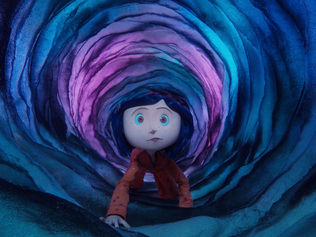
So you've got yourself a little story about a more than ordinary young girl (though male examples do exist) who's not fully satisfied with the status quo. Perhaps she yearns for a place where the Grass is Greener, her parents dote on her every whim, or she's a princess. She either visits or finds herself trapped in some sort of Alternate Universe (potentially a Dark World) where bizarre creatures and The Fair Folk are common inhabitants. The heroine will often encounter various parallels between this strange place and her former reality. She may face any number of Threshold Guardians and undergo trials through which she learns a lesson about herself or her place in the world. There will be enough strange goings on to make you wonder if the creators were on something, so expect Nightmare Fuel from even the more lighthearted variants. By the time she makes it home, many viewers will wonder if it was All Just a Dream.
Crawling through tunnels, descending underground, and getting stuck in confined spaces are all unusually common (though not required) in these works. This theme first appears as a physical passage between the mundane and the fantastic, a gateway which can not be crossed from elsewhere on the real world side. The symbolism involved is typically suggestive of the birth canal (i.e. the "womb of the earth" metaphor). Several of the genre's defining works then continue to put their protagonists back underground on the fantasy side.
This has been evolving through various adaptations of the story: Alice goes literally down a rabbit hole (and finds herself stuck in odd places), while Chihiro and Coraline both cross over through comparable tunnels. Kagome tumbles down a dirty old well. Sarah gets trapped in an oubliette which is but a part of the long confined path that is the Labyrinth itself, and then you have David Bowie crooning about the Underground. Ofelia experiences this phenomenon the most; she meets the Faun at the bottom of a pit at the end of (another) labyrinth, crawls through the mud under a tree, and encounters the Pale Man beneath a bedroom floor. In one very distinct version, Dorothy doesn't go through a hole — she's dropped into Oz by a tornado (which one could view as a free-standing hole due to its "hollow" structure).
Christopher Booker categorizes this plot structure under Voyage and Return, which he identifies as being most suited to children's stories (not that it can't be used for adult ones as well). The hero (usually) won't bring anything back from the world of journey other than personal growth. Another distinction is that the world doesn't conform to Real World logic. In fact, because the hero can't trust logic as a guide, she has to use intuition, a good heart, and an ability to acquire allies (though she may be unsure who to trust).
Shamanic journeys (in both ancient and modern forms) both use and represent this trope, and are arguably the "original" source.
Even when the work is critically acclaimed, at least one reviewer is still likely to accuse the creators of "lazy and haphazard" storytelling for trying to create a world where anything can happen.
Also a specific variant of The Hero's Journey. Contrast Up the Real Rabbit Hole. Compare with Trapped in Another World and Rescued from the Underworld. Not to be confused with Entry Point, which is also referred by rabbit hole.
Adaptations of Alice in Wonderland will tend to be examples by default. See Alice Allusion for works referencing the name Alice in an Alice in Wonderland context.
Examples
- Alice in Sexland goes the same route but is downright Hentai.
- Digimon Adventure, though that case is more Down The Random Tsunami/Waterfall. Digimon Tamers offers a more literal example halfway through the season.
- Fushigi Yuugi arguably falls under this category, when Miaka gets trapped in a story book. It's much like Inuyasha in the sense that she seems to be trapped in the feudal era of the book.
- Gaiking: Legend of Daiku Maryu sends a Robeast containing an entire La Résistance down the rabbit hole.
- Harukanaru Toki no Naka de -- Hachiyou Shou starts off a bit like Inuyasha, with the main character carried through an old well by the Dragon-God into a world that looks like a version of ancient Kyoto with the addition of random monsters, The Four Gods and various forms of magic.
- Inuyasha has elements of this, crossed with Time Travel. The third episode is even titled "Down the Rabbit Hole and Back Again."
- Miyuki-chan in Wonderland IS Alice with even more sexual symbolism.
- In My Neighbor Totoro, Mei first meets Totoro after following a small white rabbit-like creature through a tunnel.
- Ouran High School Host Club has an episode that parodies Alice in Wonderland.
- The Pikachu's Rescue Adventure short preceding Pokémon 2000 involves the Pokemon falling down a hole after Togepi. The American soundtrack even includes a song titled "Wonderland" just to make sure you get the reference.
- From Spirited Away, Chihiro crosses over through comparable tunnels.
- The original Tenchi Muyo! series begins with Tenchi's misadventure breaking into the cave near his grandfather's shrine, passing through tunnels to encounter the legendary demon sealed within (Ryoko). Although he runs away, it doesn't really help.
- Disney Kingdoms: Figment has the young Dreamfinder and Figment falling into the imaginary realm through an unstable dimensional portal created by his Mesmonic Convertor device.
- Franco-Belgian Comic Philémon does this frequently since each entrance to Le Monde des Lettres can only be used once.
- In Amazing Fantasy, both Clash and Boomerang want to escape to Peter's universe due to their dissatisfaction with their own, but not before shattering the status quo first as members of the Enforcers.
- This is the title of Chapter 81 of My Family and Other Equestrians. In it, Blade Star visits Discord's home turf, complete with Blade Star seeing a Rule 63 version of himself.
- Alice by Jan Švankmajer is a most deranged and incomprehensible adaptation with its stop-motion animation and mostly silent script.
- The plot framework of Cirque du Soleil: Worlds Away, when a young woman (and a male circus performer she falls in Love at First Sight with) are sucked into the Cirqish world.
- The Company of Wolves is about a girl's dream, with lots of fairytale references, as well as sexual symbolism.
- Forbidden Zone parodies this, with the "rabbit hole" being a giant mouth and its associated digestive tract, which later "deposits" you in the sixth dimension.
- It doesn't happen in the book, but James and the Giant Peach has the boy crawling into the center of the peach through a hole that he ate, where the film detours from live-action into the stop-motion animated portions of the film.
- In Kingsman: The Secret Service, when Eggsy is chosen, he and Hart travel down a long elevator to the secret base. Suffice to say, everything's changed forever.
Eggsy: How deep does this fucking thing go?
- Labyrinth: Sarah gets trapped in an oubliette which is but a part of the long confined path that is the Labyrinth itself, and then you have David Bowie crooning about the "Underground"...
- The Matrix: Neo is told by Morpheus that taking the red pill to delve into the truth about what Matrix is can be likened to goind down through the rabbit hole and entering Wonderland, but also warns him that there's no turning back afterwards.
- MirrorMask: Word of God is that the Henson company asked Neil Gaiman for a movie that was "whatever genre Labyrinth is". The same applies with Helena as with Anna in Paperhouse. Helena is in essence, the creator of her world. Compare with Jareth's god-like qualities in Labyrinth. Also note that both Helena and Jareth juggle, thus inverting the power dynamic. Helena is also a classic Circus Brat, which makes this a brilliant mix of tropes, especially when compared with the already established Circus of Fear trope, which brings the wonderland to you.
- Pan's Labyrinth: Ofelia experiences this phenomenon the most; she meets the Faun at the bottom of a pit at the end of (another) labyrinth, crawls through the mud under a tree, and encounters the Pale Man beneath a bedroom floor. Notable for inverting the origin of the heroine and where she's trying to return to. Also notable for not making "Real Life" so mundane. The main character's troubles don't just start as soon as she makes a naive mistake. Ordinary humans are not so innocent, and [[Dystopia real life]] is often more evil than fantasy. A successful mix of genres, if you will. Or a subversion of a trope.
- Paperhouse
 : "Anna is becoming lost in the loneliness of her own world when she discovers she can visit another, a house she has drawn herself and occupied by a young disabled boy. But as she discovers more of the links between her fantasy world and the mundane present, she is drawn only deeper into a dream turning into a nightmare. "
- Includes the drawing element, also found in MirrorMask. The girl draws, and thus creates, the world herself, thus implying that she can affect the world around her.
- Although we don't follow her there, Carol Anne's sojourn on the Other Side in Poltergeist may qualify, particularly as she doesn't seem to remember much of what happened to her. Plus, the way her closet tried to drag her back again matches the "rabbit hole" imagery ... if it's a carnivorous rabbit with an extradimensional esophagus, that is.
- Lampshaded in Terry Gilliam's Tideland, when Jeliza Rose literally falls down a rabbit-hole. Nevertheless, the movie may be seen as a dark deconstruction of this plot — the fantastic world Jeliza Rose delves into is actually only the product of her own imagination, combined with the madness of the grown-ups around her.
- Trainspotting: Renton climbs inside the filthiest toilet of Edinburgh and swims under water. (Though this is all a drug hallucination)
- Both TRON films have this. Both involve a laser that zaps Kevin Flynn (original) and his son Sam (Legacy) into the "electronic world".
- The Wizard of Oz: In one very distinct version, Dorothy doesn't go through a hole — she's dropped into Oz by a tornado (which one could view as a free-standing hole due to its "hollow" structure). Kansas is the normal world, Oz is the place where strange and amazing things happen, and a tornado is the connection. Anyone who pays attention to the Deliberately Monochrome section as well as the Technicolor will likely notice And You Were There.
- In the movie version of the all-black adaptation The Wiz, Oz is a fantasticized version of New York City. Dorothy and her friends venture through a Sinister Subway on their way to the Emerald City, and must descend through a manhole to journey to Evillene's sweatshop.
- The World of Kanako: The whole movie is about Akikazu entering a world of violence, despair and manipulation. The farther he gets, the more he learns the dark secrets of his daughter and his own problematic personality shines through. Kanako even carries a copy of Alice in Wonderland with her.
- 1Q84: After getting stuck in a traffic jam, Aomame exits the cab she was in and descends the nearby emergency stairway in order to make it to her "appointment" on time. The staircase deposits her into the world of 1Q84, a world with two moons, a religious organization called Sakigake, and the otherworldly beings they venerate, the Little People. At the end of the novel, Aomame and Tengo get out of the world of 1Q84 by going up that same stairway.
- Alice in Wonderland. Trope Namer and best known example. Alice goes literally Down the Rabbit Hole (and finds herself stuck in odd places).
- In Patrick Senecal's macabre retelling of Alice in Wonderland, Aliss, the subway is used to get to a parallel neighborhood called Daresbury. The subway can freely be used by anyone, not just the protagonist, to travel back and forth between Daresbury and the real world — except when the subway employees are on strike.
- The Book of Lost Things.
- Charlie and the Chocolate Factory has five children (three male, two female), most of whom with their parents in tow, undertaking a journey into The Wonderland that is the Wonka Factory, which is mostly an Elaborate Underground Base with many twisting corridors, and at least one long, dark, intimidating tunnel that they travel through by boat. Four of the children are pampered brats who just want more than they already have, and prove themselves unfit to progress further when they disobey their guide, give into their selfish vices, and are subjected to a variety of absurd disasters — notably, Augustus Gloop is sucked into a pipe and briefly stuck in it, and Veruca Salt and her parents are tossed down a garbage chute by nut-sorting squirrels. They are returned to the real world sadder, wiser, and (in Violet's case) Not Quite Back to Normal. Charlie Bucket, on the other hand, is a good, poverty-stricken child who needs a change of life — and is rewarded for his virtue by becoming the heir to the place. In the sequel, he and Mr. Wonka effect a Rescue from the Underworld by travelling far beneath the Earth. Also, in the 2013 stage musical adaptation, Mike Teavee's mother Doris — a Stepford Smiler Housewife who has affected her mannerisms in a desperate attempt to cope with her Enfant Terrible son — is, for much of the tour, a frightened Only Sane Person who just wants to come out of this place in one piece, but eventually finds herself affected by the Infectious Enthusiasm of Willy Wonka and the Oompa-Loompas and leaves the factory a much happier person than she was when she went in, thanks in part to her son getting...reduced to a manageable state.
- The Chronicles of Narnia has elements of this. Apt since each book has at least one girl hero. The Lion, the Witch, and the Wardrobe has plenty in common with regard to Lucy, up until the other children become involved on the other side.
- In The Silver Chair Jill is very much afraid of crawling down the narrow corridors leading to Underworld, just like Eustace has acrophobia.
- Coraline crosses over through comparable tunnels.
- Dark Cities Underground not only uses this trope in an In-Verse children's book series, but it brings the author's son (on whom said series was based) back to the mythic land which he'd visited as a boy, then forgotten about. It also deconstructs this trope, claiming all such stories are based, consciously or otherwise, on the legend of Isis retrieving Osiris from the Underworld.
- In Polikarpus & King's Down Town, 12-year-old Cary gets lost on the subway and finds himself in a fairy-tale version of New York City, populated by things and people the march of history has left behind.
- Flatland: A Romance of Many Dimensions, by Edwin Abbott Abbott, is about a two dimensional character who goes to many different dimensions. The main character is clueless, of course.
- The Spin-Offspring sequel, Flatterland: Like Flatland Only More So, by Ian Stewart, is even closer to the trope, since its protagonist is A. Square's independently-minded granddaughter, Victoria Line. (A. Square himself, of course, is given the first name of Albert.)
- The Forbidden Game trilogy by L. J. Smith features a girl, who, with a group of friends, gets sucked into the shadow world. Features a Persephone-like love story.
- In Half World by Hiromi Goto, Melanie goes through a freeway tunnel into a strange other world.
- In Laura and the Silver Wolf, the heroine can enter Ice-Land through the white wall near her bed. Or any other completely white wall.
- Magic Kingdom for Sale — SOLD!, by Terry Brooks, takes a tongue-in-cheek approach to this trope. The protagonist learns about a magic kingdom via a real estate ad. Rather than a rabbit hole, the protagonist has to wander headlong into a train tunnel to get there.
- The book Marco's Millions plays this trope straight by having two kids discover a gate to another world in their basement. Then, in typically William Sleator style, everything starts going down Creepy Crawly Lane. Both literally and figuratively.
- Be warned that within lie singularities, sacrificial swings, and cardboard boxes.
- The Neverending Story is a rare variation centered on a male protagonist (or rather, two male protagonists, since the main hero takes half the book to muster enough courage to even leap down the rabbit hole) — a lonely kid, who has troubles at home and at school, seeks to escape reality in fantasy, has his wish granted, and returns after having learned his lesson, stronger and better adjusted than before.
- In Neil Gaiman's Neverwhere, the main character becomes invisible to those around him, and has to travel around in London Below to find a way home. If there's a definitive Urban Fantasy Spear Counterpart to Down the Rabbit Hole, Neverwhere is it.
- Played with in "No Need for a Core?". One of the dungeon cores adores cute creatures such as rabbits, so rabbits (and cuteness in general) are a common theme in the dungeon, which is technically a hole in the ground. So any delvers are going down the rabbit hole, metaphorically at least.
- The Nutcracker and the Mouse King is the true Trope Maker, predating Alice by 50 years. This involves Marie helping the Nutcracker to stop the Mouse King and goes to the Land of Dolls. While Marie does return home at the end of the book, it's stated that she will eventually return to be the Nutcracker's queen.
- In The Phantom of the Opera, Christine goes underground with the Phantom. Includes masquerades, mirrors, and masks. Christine literally interprets her descent to the Opera's cellars as transition to a mystical underworld and describes the Phantom in terms reminiscent of The Fair Folk. In the book the Opera's cellars actually have other inhabitants almost as peculiar as the Phantom himself, almost composing a miniature world in themselves, though it's more mundane than it seems to her.
- Milo in Norman Juster's The Phantom Tollbooth certainly undergoes this, for a male character.
- Un Lun Dun by China Miéville. Notable in that there seem to be many different ways to get to and from there (turning a handle, climbing a bookcase, crossing a bridge), and that due to it being fairly easy as long as you know roughly what to do, problems from one world can cross to the other if the wrong people are involved. Needless to say, in the story, they are.
- The Wonderful Wizard of Oz, although Oz is fairly consistently stated to actually be in some remote region of Earth rather than Another Dimension.
- There are heavy allusions to Alice in Wonderland in the CSI: NY episode entitled "Down The Rabbit Hole," which involves going into the world of Second Life. There's even a white rabbit showing up as a guide when Mac enters the game to search for the killer/avatar-stealer. The rabbit actually does go down a hole, too.
- A male version in Farscape, whose protagonist John Crichton is an astronaut from contemporary Earth whose ship falls through a wormhole into a distant part of the universe where he ends up on a ship ("a living ship!") full of strange alien lifeforms (as is pointed out in every Title Sequence). There's the occasional Alice Allusion just to drive the trope home, such as the episode "Through the Looking Glass".
- The Incredible Hulk (1977) has an episode entitled "Alice in Disco Land." A little girl named Alice from David's past is now a young woman with drug issues. In one of her spaced out moments, she keeps asking, "Where's the white rabbit?" David is shown in flashback reading Alice in Wonderland to her.
- The Sid and Marty Krofft series Lidsville involves the main character Mark (played by Butch Patrick of The Munsters fame) falling down a giant magician's top hat (which is only seen during the Expository Theme Tune).
- The Twilight Zone (1959): In "The Bewitchin' Pool," Sport and Jeb Sharewood are able to enter Aunt T's realm through a portal in their swimming pool which can't be seen by their parents Gil and Gloria. In the past, other children have been able to travel there through chimneys or by going through doors.
- The Twilight Zone (1985): In "The World Next Door", Barney Schlessinger finds a doorway to an Alternate Universe with an early 20th Century level of technology. In this universe, he is an extremely wealthy and world-famous inventor whose creations can be found in every home. The alternate Barney uses the same doorway to travel to our universe, which he likes because of the peace and quiet that it affords him. The two Barneys switch places as each is envious of the other's life.
- Fiona Apple's song "Sleep to Dream" subverts this trope.
- The Bastille song "Doom Days" features the line "We're gonna rabbit hole down". This is a metaphor for the partying lifestyle the singer falls into to distract him from the problems in the world.
- "White Rabbit" (which isn't a cover of the Jefferson Airplane song) by Egypt Central also starts off with references to Alice in Wonderland, including "falling down the hole". In this case, it's a subversion, as it's revealed partway through the song to be a metaphor for being manipulated into obedience by the "white rabbit".
- The Rock Opera The Lamb Lies Down on Broadway by Genesis begins with the protagonist, Rael, being chased by a "wall of death" that drops into Times Square. As the wall passes over him, he blacks out, and later re-awakens in a surreal world beneath New York City.
- "White Rabbit" by Jefferson Airplane has Alice in Wonderland inspired lyrics.
- Gwen Stefani's song and music video of "What You Waiting For?" uses this trope.
- Oomph!!'s music video for "Labyrinth" mostly references the usual Alice in Wonderland tropes but throws in a wardrobe, a labyrinth, and extra underground descent for good measure.
- "Rabbot Ho", the track that opens Drunk by Thundercat'', uses the idea of going down the rabbit hole as a metaphor for alleviating boredom by getting completely drunk.
- Persephone's abduction myth.
- Heroine is a Tabletop RPG designed to facilitate this kind of storytelling. The very first paragraph explicitly lists Labyrinth, The Wizard of Oz, Alice, and Chronicles of Narnia as its inspirations.
- Princess: The Hopeful invokes this trope with the Girl Underground condition. Upon experiencing emotional pain a Princess may find herself trapped in a magical Dream Land until she experiences catharsis or personal growth.
- The Nutcracker:
- Clara's journey isn't scary once the Mouse King is dispatched; none of the places she goes are confined or underground and she has no tasks to complete. The majority of the ballet is actually the denouement of the original book.
- In the non-traditional, Maurice Sendak-designed version from The '80s, after the gigantic Mouse King is killed Clara and her Nutcracker pass through a cave of sorts formed by his now-empty coat. By the time they emerge, Clara (played a preteen thus far) has aged to adulthood and the Nutcracker has taken on the form of a handsome human.
- Deconstructed in Politically Correct Bedtime Stories, where a character says she thinks the cliché of a young girl going on a journey in a surreal world where she's acted upon but rarely gets a chance to act on the setting is overplayed, and she refuses the call to adventure and goes home "In the name of Alice, Dorothy, Wendy and all the others".
- Cirque du Soleil's Quidam has adolescent heroine Zoe, her parents, and two bizarre companions transported to a sometimes-melancholy Magical Land via a hat dropped off for her by the mysterious, literally faceless (it has no head) title character, where she learns that the loneliness and alienation she feels in the real world is in fact something everyone feels at one time or another. Characters pop up from trap doors in the stage from time to time; Zoe herself does so as the closing scene begins.
- Alice in the Country of Hearts has the White Rabbit Peter kidnapping Alice and forcibly throwing her through the rabbit hole. She ends up stuck in Wonderland.
- Athena has this more or less as an Excuse Plot. The Japanese arcade flyer advertised the game as being about "Athena's Wonder Land," and the intro to the Arcade Game even shows her falling down some sort of hole.
- Like its predecessor, Chapter 1 of Deltarune revolves around Kris and Susie winding up in an alternate realm called the Dark World after falling down an abyss in their school's closet, trying to both seal a rogue Dark Fountain there and find their way out.
- The Legend of Zelda: Majora's Mask: Link goes looking for his Fairy Companion, who left at the end of the previous game, so he goes searching in The Lost Woods. His horse gets stolen, he gets turned into a plant, and then he gets stuck in a "Groundhog Day" Loop while he tries to stop the moon from falling.
- The Longest Journey explicitly references Alice at many occasions. April Ryan is an art student struggling with art block, when she is drawn into an epic plot to save not just her world, but also a parallel universe of magic and wonder. While there is no actual tunnels involved, her Shifts (portals that connect the two worlds) look a lot like that from the inside. Ultimately, however, the game proves to be a subversion, rather than return from her journey strengthened and more adjusted, April becomes a bitter cynic who has lost any purpose in her life. The sequels, Dreamfall Chapters in particular, do hint, however, that her journey is actually far from over... and that it actually began long before she opened her first Shift in TLJ.
- Kirby Super Star features the sub-game "The Great Cave Offensive", in which Kirby falls down a hole while hiking and ends up in a vast subterranean world full of treasure. The plot of the sub-game revolves around Kirby trying to find his way out while collecting as much treasure as he can along the way, going through a variety of eclectic underground biomes in the process.
- Modern Warfare: The penultimate mission of the campaign of MW3 borrows its name from this trope. In the mission, Yuri, Price and Team Metal are tasked with retrieving the Russian President and his daughter from a diamond mine in Siberia. Price, Yuri, and the President evac safely, while Delta stay behind to cover them, except for Frost, who is inexplicably absent.
- Like the Tron films above, TRON 2.0 does the same with the protagonists getting forcibly uploaded. But also given a Deconstruction as the antagonists found the rabbit hole before the protagonists and are using it to wreak havoc in the electronic "wonderland"
- Undertale centers around a human child falling down a hole atop Mt. Ebott, ending up in an underground world populated by monsters who were banished there after a war against the human race. The child then spends the duration of the game trying to find their way out, and while doing so can either befriend or kill the monsters there.
- An inverted example in Hero Oh Hero: Tobi enters a mysterious temple while chasing the artifact thief, which transports her into the real world as a Refugee From RPG Mechanics 'Verse.
- In Holiday Wars, the lead character Tegan Cassidy gets sucked into a world where the Holidays are personified as characters and are at war with each other. She first learns out about this other world in this strip.
- Nadia from Kukuburi is a bit older than your average Alice, but still loves the opportunity to get away from her boring life. Until He interferes...
- Namesake.
- Snarlbear: Daisy reaches the Rainbow Dimension through a strangely colorful alley.
- In The Wormworld Saga, the portal to another world is not so much a tunnel as a picture frame. Jonas still crawls through it though. Also, when he first finds the portal it's covered with a blanket which forms folds that Jonas has to spread open when he peeks through it.
- Cheshire Crossing. Alice Liddell, after years of being sent to insane asylums because of her delusion, ends up at a new place, run by Nobel Prize winner Sir Ernest Rutherford, who has figured out that she isn't crazy. She meets two other girls: Dorothy Gale and Wendy Darling, who also have been assumed to be insane. Their nanny is a woman named Mary Poppins who turns out to be a really powerful witch. Hilarity Ensues.
- Ever After High is connected to Wonderland, by the Well of Wonders. Briar Beauty uses it to get rid of the real Storybook of Legends.
- This site is all about this trope. It calls it "Girls Underground". Also features a number of examples.
- Mirror World starts with a teenager named Vita accidentally falling into another dimension populated by strange humanoid monsters who are constantly at odds with each other. The rest of the story is about her coping with her new surroundings, all while trying to figure out how or if she should escape to her home world, and attempting to stop a war from starting.
- In Jamie and the Magic Torch, a young child named Jamie waits until he is tucked up in bed with the lights out, then uses his eponymous enchanted flashlight to open a wormhole in the floor. This grants him access to Cuckoo Land, a world full of nonsensical people and situations and where his companion, a dog named "Wordsworth", can talk.
- Kidd Video involves a (live action) rock band who is forcibly transported to the "Flip Side" (a 2D animated world) through a mirror in a warehouse where the band was rehearsing, thanks to the Big Bad Master Blaster. Each episode focused mainly on the group trying to get back to their world, with their Fairy Companion Glitter helping along the way, but like many shows made at the time (early-mid 1980s), there was no proper resolution to the story.
- Over the Garden Wall is about two brothers (and their pet frog) stuck in a Fantasy Americana setting called the Unknown, inhabited by Talking Animals, witches and a demon who wants to turn them into trees and burn them in his lantern. Along the way, the older brother, teenage Wirt, gains the self-confidence to take responsibility for both his younger brother and his own life. Unlike many examples, this one starts In Medias Res, and we only belatedly discover how the pair got into the Unknown: they're having a Near-Death Experience while drowning, with Fanon painting the Unknown as some sort of Purgatory.
