note
One guess, guess who...
Who never, ever starts an argument? (Woman: "Hmm?")
Who never shows a bit of temperament?
Who's never wrong, but always right? (Donald: "Yeah?")
Who'd never dream of starting a fight? (Donald: "That's so!")
Who gets stuck with all the bad luck?
No one ("QUAAAAAAACK!!") — but Donald Duck!" (Donald: "Yeah!")
The Breakout Character of the Classic Disney Shorts, Donald Fauntleroy Duck is one of history's most famous cartoon characters.
Donald first appeared in the Silly Symphonies short The Wise Little Hen in 1934, where he played one of the lazy animals in the Fable, refusing to help the Hen plant her corn and was thus denied a reward at the end. His distinct voice, given to him by Clarence "Ducky" Nash, singled him out for stardom. He quickly became a bit player in several other shorts before finally landing a role alongside Mickey Mouse and Goofy in 1935's Mickey's Service Station.
From there, Donald took off, gaining his own supporting cast in the process. In 1937's Don Donald, he got a girlfriend, Donna (who was replaced by Daisy Duck in 1940's Mr. Duck Steps Out). In 1938, his "darling nephews" Huey, Dewey & Louie came for a visit (officially in 1938's Donald's Nephews, but the story had been told in the comics a few months earlier). The nephews' mother, Donald's twin sister Della note , was never seen or heard from again, note and Donald became their permanent foster parent. The next year, Donald's Cousin Gus introduced his cousin Gus Goose.
Donald was nearly the complete opposite of Mickey. Unlike The Everyman, he was brash, quick-tempered and loaded with faults. Because of this, audiences loved him and responded to him very positively.
In 1939, he got his own Newspaper Comic and in the 1940s, Carl Barks began making an entire comic universe based around him. Barks' role was eventually inherited by Don Rosa and the stories by these two creators are the only ones that are officially considered within the Disney comics universe.
World War II was especially good to Donald. A series of Wartime Cartoons showed him enlisting in the army and he won his only Academy Award for Der Fuehrer's Face in 1943. It was also during the 1940s that he was featured in four entries in the Disney Animated Canon: Saludos Amigos, The Three Caballeros, Fun and Fancy Free and Melody Time.
After theatrical shorts fell out of favor, his appearances slowed down, but he was never quite out. He appeared in DuckTales as a supporting character and starred in Quack Pack. He also appeared with Daffy Duck in Who Framed Roger Rabbit, starred in the "Pomp and Circumstance" segment of Fantasia 2000, reappeared with the gang in Mickey, Donald, Goofy: The Three Musketeers and in 2004, he got a star on the Hollywood Walk of Fame. He also came back in Mickey MouseWorks / House of Mouse and Mickey Mouse Clubhouse, as well as the new series of Mickey Mouse shorts, Mickey and the Roadster Racers / Mickey Mouse Mixed-Up Adventures, the DuckTales revival (as a regular this time), and Mickey Mouse Funhouse. He appeared as a court mage and recurring party member in the Kingdom Hearts series of video games, to say nothing of the few games he got to himself such as the fondly remembered Quackshot. He is the protagonist of Legend of the Three Caballeros.
And naturally, there are the comics. Donald Duck has a specific universe associated with him and Uncle Scrooge: the Disney Ducks Comic Universe. In some countries, Donald has also developed a super-hero alterego, Paperinik (called Duck Avenger in the USA). These comics often show just how much of a hero that "loser duck" can be. Tropes specific to the comic go on that page.
He has the fewest official voice actors of Disney's Sensational Six; he was originally voiced by Clarence "Ducky" Nash. After Nash's death in 1985, animator Tony Anselmo has been the official voice of Donald in all Disney productions, except for Mickey and the Roadster Racers / Mickey Mouse Mixed-Up Adventures, in which Daniel Ross voices Donald due to Anselmo being too busy with other projects.
1930s
1934
- The Wise Little Hen, released on 9 June 1934 – in a Silly Symphony cartoon; Donald's grand debut.
- Orphans Benefit, released on 11 August 1934 – in a Mickey Mouse Cartoon for the first time, also remade and released on 22 August 1941. It would also debut a staple of Donald's character, his Hair-Trigger Temper.
- The Dognapper, released on 17 November 1934 – in a Mickey Mouse cartoon
1935
- The Band Concert, released on 23 February 1935 – in a Mickey Mouse cartoon, where Donald's eyes would be colored light blue for the first time.
- Mickey's Service Station, released on 16 March 1935 – in a Mickey Mouse cartoon, acting with Mickey and Goofy as a trio for the first time.
- Mickey's Fire Brigade, released on 3 August 1935 – in a Mickey Mouse cartoon
- On Ice, released on 28 September 1935 – in a Mickey Mouse cartoon
- Cock o' the Walk: November 30, 1935, Ben Sharpsteen: In a Silly Symphony short. Makes a very easy to miss cameo in the opening, playing a drum.
1936
- Mickey's Polo Team, released on 4 January 1936 – in a Mickey Mouse cartoon
- Orphans' Picnic, released on 15 February 1936 – in a Mickey Mouse cartoon
- Mickey's Grand Opera, released on 7 March 1936 – in a Mickey Mouse cartoon for the last time in his original design.
- Moving Day, released on 20 June 1936 – in a Mickey Mouse cartoon, marking the debut of his modernized design.
- Alpine Climbers, released on 25 July 1936 – in a Mickey Mouse cartoon
- Mickey's Circus, released on 1 August 1936 – in a Mickey Mouse cartoon
- Donald And Pluto, released on 12 September 1936 – in a Mickey Mouse cartoon, though Mickey doesn't actually appear at all in it. It could be considered a Poorly Disguised Pilot for Donald's own series of shorts.
1937
- Don Donald, released on 9 January 1937 – first Donald & Daisy Duck cartoon; this one features Daisy's predecessor, Donna Duck
- Magician Mickey, released on 6 February 1937 – in a Mickey Mouse cartoon
- Moose Hunters, released on 20 February 1937 – in a Mickey Mouse cartoon
- Mickey's Amateurs, released on 17 April 1937 – in a Mickey Mouse cartoon
- Modern Inventions, released on 29 May 1937 – the last Disney cartoon released through United Artists
- Hawaiian Holiday, released on 24 September 1937 – in a Mickey Mouse cartoon
- Clock Cleaners, released on 15 October 1937 – in a Mickey Mouse cartoon
- Donald's Ostrich, released on 10 December 1937
- Lonesome Ghosts, released on 24 December 1937 – in a Mickey Mouse cartoon
1938
- Self Control, released on 11 February 1938
- Boat Builders, released on 25 February 1938 – in a Mickey Mouse cartoon
- Donald's Better Self, released on 11 March 1938
- Donald's Nephews, released on 15 April 1938
- Mickey's Trailer, released on 6 May 1938 – in a Mickey Mouse cartoon
- Polar Trappers, released on 17 June 1938 – in a Donald & Goofy cartoon
- Good Scouts, released on 8 July 1938
- The Fox Hunt, released on 9 July 1938 – in a Donald & Goofy cartoon—Name's the same as an earlier Disney short.
- The Whalers, released on 19 August 1938 – in a Mickey Mouse cartoon
- Donald's Golf Game, released on 4 November 1938
- Mother Goose Goes Hollywood, released on 23 December 1938 – cameo, in a Silly Symphony cartoon
1939
- The Standard Parade, released in 30 September 1939 – cameo, in a Mickey Mouse cartoon
- Donald's Lucky Day, released on 13 January 1939
- The Hockey Champ, released on 28 April 1939
- Donald's Cousin Gus, released on 19 May 1939
- Beach Picnic, released on 9 June 1939 – in a Donald and Pluto cartoon
- Sea Scouts, released on 30 June 1939
- Donald's Penguin, released on 11 August 1939
- The Autograph Hound, released on 1 September 1939
- Officer Duck, released on 10 October 1939
1940s
1940
- The Riveter, released on 15 March 1940
- Donald's Dog Laundry, released on 5 April 1940 – in a Donald and Pluto cartoon
- Tugboat Mickey, released on 26 April 1940 – in a Mickey Mouse cartoon
- Billposters, released on 17 May 1940 – in a Donald & Goofy cartoon
- Mr. Duck Steps Out, released on 7 June 1940 - First cartoon with the actual Daisy Duck character
- Put-Put Troubles, released on 19 July 1940 – in a Donald and Pluto cartoon
- Donald's Vacation, released on 9 August 1940
- The Volunteer Worker, released on 1 September 1940
- Window Cleaners, released on 20 September 1940 – in a Donald and Pluto cartoon, first cartoon with Spike the Bee
- Fire Chief, released on 13 December 1940
1941
- Timber, released on 10 January 1941
- Golden Eggs, released on 7 March 1941
- A Good Time for a Dime, released on 9 May 1941
- The Nifty Nineties, released on 20 June 1941 – cameo, in a Mickey Mouse cartoon
- Early to Bed, released 11 July 1941
- Truant Officer Donald, released on 1 August 1941
- Orphan's Benefit, released on 22 August 1941 – in a Mickey Mouse Cartoon, remake of version released on 11 August 1934
- Old Mac Donald Duck, released on 12 September 1941
- Donald's Camera, released on 24 October 1941
- Chef Donald, released on 5 December 1941
1942
- Donald's Decision, released on 11 January 1942
- All Together, released on 13 January 1942 – in a WWII cartoon
- The Village Smithy, released on 16 January 1942
- The New Spirit, released on 23 January 1942
- Mickey's Birthday Party, released on 7 February 1942 – in a Mickey Mouse cartoon
- Symphony Hour, released on 20 March 1942 – in a Mickey Mouse cartoon
- Donalds Snow Fight, released on 10 April 1942
- Donald Gets Drafted, released on 1 May 1942
- Donald's Garden, released on 12 June 1942
- Donald's Gold Mine, released on 24 July 1942
- The Vanishing Private, released on 25 September 1942
- Sky Trooper, released on 6 November 1942
- Bellboy Donald, released on 18 December 1942
1943
- Der Fuehrer's Face AKA Donald Duck In Nutzi Land released on 1 January 1943.
- The Spirit of '43, released on 7 January 1943, first appearance of the prototype for what would later become Scrooge McDuck;note ; one of the very few Disney cartoons in the Public Domain.
- Donald's Tire Trouble, released on 29 January 1943
- Lake Titicaca, released on 6 February 1943 segment of Saludos Amigos
- Aquarela do Brasil, released on 6 February 1943 segment of Saludos Amigos
- The Flying Jalopy, released on 12 March 1943
- Fall Out Fall In, released on 23 April 1943
- The Old Army Game, released on 5 November 1943
- Home Defense, released on 26 November 1943
1944
- Trombone Trouble, released on 18 February 1944
- Donald Duck and the Gorilla, released on 31 March 1944
- Contrary Condor, released on 21 April 1944
- Commando Duck, released on 2 June 1944
- The Plastics Inventor, released on 1 September 1944
- Donald's Off Day, released on 8 December 1944
1945
- The Clock Watcher, released on 26 January 1945
- The Three Caballeros, released on 3 February 1945 – in a Donald Duck, Jose Carioca & Panchito Pistoles movie; this entire Donald Duck production is one of the Disney Animated Canon movies.
- The Eyes Have It, released on 30 March 1945 – in a Donald and Pluto cartoon
- Donald's Crime, released on 29 June 1945
- Duck Pimples, released on 10 August 1945
- No Sail with Goofy, released on 7 September 1945 – in a Donald & Goofy cartoon
- Cured Duck, released on 26 October 1945
- Old Sequoia, released on 21 December 1945
1946
- Donald's Double Trouble, released on 28 June 1946
- Wet Paint, released on 9 August 1946
- Dumb Bell of the Yukon, released on 30 August 1946
- Lighthouse Keeping, released on 20 September 1946
- Frank Duck Brings 'Em Back Alive, released on 1 November 1946 – in a Donald & Goofy cartoon
1947
- Straight Shooters, released on 18 April 1947 - First Donald Duck cartoon to feature the iconic theme song at the top of this page
- Sleepy Time Donald, released on 9 May 1947
- Clown of the Jungle, released on 20 June 1947
- Donald's Dilemma, released on 11 July 1947 - Daisy is actually the protagonist, with Donald being her "dilemma".
- Crazy with the Heat with Goofy, released on 1 August 1947 – in a Donald & Goofy cartoon
- Bootle Beetle, released on 22 August 1947
- Wide Open Spaces, released on 12 September 1947
- Mickey and the Beanstalk, released on 27 September 1947 – the second half segment of Fun and Fancy Free
- Chip an' Dale, released on 28 November 1947
1948
- Drip Dippy Donald, released on 5 March 1948
- Blame It On The Samba, released on 1 April 1948 segment of Melody Time
- Daddy Duck, released on 16 April 1948
- Donald's Dream Voice, released on 21 May 1948
- The Trial of Donald Duck, released on 30 July 1948
- Inferior Decorator, released on 27 August 1948
- Soup's On, released on 15 October 1948
- Three for Breakfast, released on 5 November 1948
- Tea for Two Hundred, released on 24 December 1948
1949
- Donalds Happy Birthday, released on 11 February 1949
- Sea Salts, released on 8 April 1949
- Winter Storage, released on 3 June 1949
- Honey Harvester, released on 5 August 1949
- All in a Nutshell, released on 2 September 1949
- The Greener Yard, released on 14 October 1949
- Slide, Donald, Slide, released on 25 November 1949
- Toy Tinkers, released on 16 December 1949
1950s
1950
- Lion Around, released on 20 January 1950
- Crazy Over Daisy, released on 24 March 1950
- Trailer Horn, released on 28 April 1950
- Hook, Lion & Sinker, released on 1 September 1950
- Bee At The Beach, released on 13 October 1950
- Out on a Limb, released on 15 December 1950
1951
- Dude Duck, released on 2 March 1951
- Corn Chips, released on 23 March 1951
- Test Pilot Donald, released on 8 June 1951
- Lucky Number, released on 20 July 1951
- Out of Scale, released on 2 November 1951
- Bee On Guard, released on 14 December 1951
1952
- Donald Applecore, released on 18 January 1952
- Let's Stick Together, released on 25 April 1952
- Uncle Donald's Ants, released on 18 July 1952
- Trick or Treat, released on 10 October 1952
- Pluto's Christmas Tree, released on 21 November 1952 (cameo) – in a Mickey Mouse cartoon
1953
- Don's Fountain of Youth, released on 30 May 1953
- The New Neighbor, released on 1 August 1953
- Rugged Bear, released on 23 October 1953
- Working for Peanuts, released on 11 November 1953
- Canvas Back Duck, released on 25 December 1953
1954
- Spare The Rod, released on 15 January 1954
- Donald's Diary, released on 5 March 1954
- Dragon Around, released on 16 July 1954
- Grin & Bear It, released on 13 August 1954
- The Flying Squirrel, released on 12 November 1954
- Grand Canyonscope, released on 23 December 1954 – the first Disney cartoon released through the newly-formed Buena Vista Distribution
1955
- No Hunting, released on 14 January 1955
- Lake Titicaca, released on 18 February 1955 (Stock Footage taken from The Three Caballeros)
- Bearly Asleep, released on 19 August 1955
- Beezy Bear, released on 2 September 1955
- Up a Tree, released on 23 September 1955
1956
- Chips Ahoy, released on 24 February 1956 – the last Disney cartoon released through RKO
- How to Have an Accident in the Home, released on 8 July 1956
1957
- Cosmic Capers, released in 1957 (educational, cameo)
- Duck for Hire, composite film shown on Wonderful World of Color 23 October 1957
1959
- Donald in Mathmagic Land, released on 26 June 1959 (educational)
- How to Have an Accident at Work, released on 2 September 1959
1960s
1961
- Donald & The Wheel, released on 21 June 1961 (educational)
- The Litterbug, released on 21 June 1961 – the last regular Donald Duck cartoon
1965
- Steel & America, 1965 (commercial)
- Donald's Fire Survival Plan, 1965 (educational)
1968
- Planificacion Familiar, 1968 (educational, "Family Planning", produced for the U.S. Population Council and distributed by Asociación Chilena de Protección de la Familia, an affiliate of Planned Parenthood)
1980s
- Mickey's Christmas Carol, released on 16 December 1983 and re-issued in 24 December 1987 – in a Mickey Mouse cartoon or movie from Donald Duck Classics after 1985 Walt Disney Pictures logo ends
- Down And Out With Donald Duck, TV special released on March 22, 1987.
1990s
- The Prince and the Pauper, released on 16 November 1990 – in a Mickey Mouse cartoon
- Stuck On Christmas, a segment of Mickey's Once Upon a Christmas released direct-to-video on 7 December 1999
2000s
2000
- Noah's Ark, the segment of Fantasia 2000 released on 1 January 2000
2001
- Donald's Goofy World, released on 5 February 2001 – in a Donald and Goofy cartoon released on TV and not in theaters
Video Games:
- Quackshot
- The Lucky Dime Caper
- Deep Duck Trouble
- Donald in Maui Mallard
- Donald Duck No Mahou No Boushi
- Donald Duck: Goin' Qu@ckers
- World of Illusion
- Disney's Magical Quest 3
- Kingdom Hearts
- Kinect: Disneyland Adventures
- Disney Infinity
- Disney Magical World
- Disney Magic Kingdoms
- Disney Heroes: Battle Mode
- Disney Sorcerer's Arena
- Disney Mirrorverse
- Disney Dreamlight Valley
- Disney Speedstorm
Western Animation - Series:
- DuckTales
- Quack Pack
- Mickey Mouse Works
- Mickey Mouse Clubhouse
- Mickey Mouse
- The Wonderful World of Mickey Mouse
- Mickey and the Roadster Racers
- Mickey Mouse: Mixed-Up Adventures
- Legend of the Three Caballeros
- Mickey Mouse Funhouse
Tropes associated with this character include:
- Adaptational Badass:
- The Kingdom Hearts series of games paints Donald as a Black Mage and prominent ally to Sora. Exaggerated in Kingdom Hearts III where he casts Zetta Flare, the most powerful spell in the Final Fantasy series, albeit fainting right afterward.
- There’s also whenever he’s Paperinik in the comics, where he’s shown to be a competent and powerful crime fighter.
- Adaptational Jerkass: Donald was even more angry and trigger happy than usual in Mickey Mouse (2013). Although it's Played With in the later shorts Depending on the Writer.
- Adaptational Nice Guy: While he still has a temper, in DuckTales (2017) , he's more openly caring due to his devotion to his family.
- Age-Inappropriate Dress: If his middle name, Fauntleroy, is any indication, he's not dressed like a naval officer, he's dressed like a turn of the century child.
- Alliterative Name: Subverted as soon as you discover Don's middle name, Fauntleroy.
- All Just a Dream: Der Fuehrer's Face features Donald working in a Nazi bomb factory, but is ultimately revealed to be a nightmare, which Donald is very relieved to discover.
- And I Must Scream: The end of "Donald's Snow Fight", where Donald is frozen alive.
- Angrish: Very fluent speaker, when Donald is enraged he'll be reduced to nothing but furious quacks in the place of actual words.
- Angry Fist-Shake: When getting angry, he typically starts jumping in the spot while shaking both of his fists and quacking in anger.
- Animal Species Accent: He has a unique voice verging on The Unintelligible which sounds like duck quacks. The formal name for it is "buccal speech", an alaryngeal form of vocalization which uses the inner cheek to produce sound rather than the larynx; Clarence Nash discovered the technique while trying to imitate his pet goat.
- Animal Stereotypes: Donald is a textbook example of the idea of ducks being dim-witted, strong-willed and temperamental, and is likely one of the Trope Codifiers.
- Anti-Hero: Though he's on the side of good, he can act temperamental, antagonistic, and selfish and is not above pulling devious tactics to come out on top.
- Attention Whore: He believes he deserves the spotlight more than Mickey and tried numerous attempts to do so.
- Art Evolution: He emerged with his trademark sailor suit and feather/beak colors already, but he was much closer in look to a real duck, with his plumper body and longer neck. From 1936 onwards, he was redesigned to have more depth, a rounder shape and to be overall cuter and more appealing. An easy way to confirm this is to compare Don's appearance in The Orphan's Benefit with the short's remake 7 years later.
- Auto-Incorrect: In "Computer.don", Donald orders a modern computer with voice recognition software. When he says his name, the computer addresses him as "Dewald", due to Donald's status as The Unintelligible.
- Ax-Crazy: In an infamous scene in Mickey And The Beanstalk he goes crazy with starvation and tries to kill his own cow with an axe so he, Mickey and Goofy can eat. And when he fails to do so he even tries to eat it alive, starting to bite its tail.
- Badass Adorable: Yes, Donald is a cute looking duck. but don't make him angry, or else he will beat the crap outta you.
- Badly Battered Babysitter: Whenever he has to babysit Shelby the Turtle or his nephews. Or any creature at all, for that matter.
- Baseball Episode: Slide, Donald, Slide has a variation, in which Donald tries to listen to the World Series on the radio and pretends to play baseball along with it, in spite of constant interruptions from Spike the Bee, who would much rather listen to classical music on the radio.
- Bears Are Bad News: Done in Good Scouts, Donald's Vacation and Dumbbell of the Yukon. Subverted with Donald's encounters with Humphrey the Bear, which is more of an example, at least as far as the short in question is concerned, of Beary Funny.
- Big Eater: Donald's cousin Gus Goose, who almost immediately begins to eat him out of house and home when he's sent to visit Donald; in fact, he sets his clock by mealtimes (dinner, tea, supper, lunch).
- Big Red Devil: There have been many times when he's angry that he's resembled a devil. The cartoons "Rocket Ruckus"
 , "Trombone Trouble", and "Soup's On" are just a few. He's also usually dressed as a red devil in Halloween-related works and merchandise.
 - Big "SHUT UP!": Donald gives one to an Interactive Narrator in both Saludos Amigos and in the "Mickey and the Beanstalk" scene of Fun and Fancy Free.
- In Saludos Amigos, this happens as Donald tries to cross a rickety, falling-apart suspension bridge on a llama high up in the air while the narrator provides the play-by-play on how not to behave on the bridge:Narrator: The traveler should be cautioned against any reckless behavior at this high altitude. Overexertion is dangerous. And above all, one should never lose one's temper.
Donald: [struggling] Shut up, you big windbag! - In "Mickey and the Beanstalk", Donald is, to put it mildly, not in the best of moods when his hunger causes him to have a nervous breakdown while the narrator comments on this:Narrator: But Donald doesn't whimper. Donald doesn't give up--
Donald: SHUT UP!! I CAN'T STAND IT! (grabs everything, including plates and tries to shove them down his mouth) - Also, in "Clock Cleaners", Donald gives a Big "SHUT UP!" to an uncooperative mainspring that somehow talks back at him.Donald: Aw, shut up!
Mainspring: You shut up!
- In Saludos Amigos, this happens as Donald tries to cross a rickety, falling-apart suspension bridge on a llama high up in the air while the narrator provides the play-by-play on how not to behave on the bridge:
- Bird-Poop Gag: Implied in "Rear Admiral Donald", when a seagull looks at Donald's hat and Donald moves away.
- Bizarre and Improbable Golf Game:
- The title couldn't be any more misleading, but it's the premise for Donald's Golf Game, where Don's nephews start playing tricks on their uncle to entertain themselves, completely ruining the day for him. All in the name of comedy!
- More golf games appear in other comics and newspaper strips, and a House of Mouse short has Chip and Dale screwing the duck's fun by putting metal on his ball, keeping him from hitting it with a magnet's help. Naturally, once he finally completes the course, he gets a trophy for the worst score ever.
- Blatant Lies: The theme song for the cartoons. Except for the last part.
- Blinding Flash: In "Grand Canyonscope", Donald asks the ranger to photograph him atop his burro. The flash blinds the burro, leaving him stumbling along the steep Grand Canyon trail.
- Blue Is Heroic: He wears a blue sailor suit and while he's not always heroic, he is at best a Jerk with a Heart of Gold.
- Boisterous Bruiser: Donald can have shades of this, if the situation arises.
- Born Unlucky: Like his theme song says, who gets stuck with all the bad luck? No one but Donald Duck.
- Bowdlerize: The Ink and Paint Club TV airing of "Spare the Rod" was heavily edited down to half of its original length, due to the inclusion of pygmy cannibals as the antagonists. The TV edit of the cartoon is borderline incomprehensible thanks to these edits.
- Breakout Character: As mentioned in the book Mickey and the Gang: Classic Stories in Verse, Walt intentionally planned Donald to be his next star character, even having press kits ready by the day "The Wise Little Hen" was released.
- Break the Haughty: When he's being a selfish jerkass, he often receives a Humiliation Conga.
- Brooding Boy, Gentle Girl: The Brooding Boy to Daisy's Gentle Girl. Donald is usually hot-tempered, grumpy, and aggressive while Daisy is sweet, calm and cheery.
- Canon Discontinuity: Implied with "Donald's Diary," which bears little continuity with the rest of the Donald Duck cartoons, as Huey, Dewey, and Louie appeared as Daisy's younger brothers instead of Donald's nephews. Even so, this is the only time we see Daisy's parents.
- Carnivore Confusion: Chef Donald opens with Donald using rubber cement to insert a recipe into his scrapbook. But the recipe turns out to be for "roast duck", much to his annoyance.
- Cartoony Eyes: Blue sclerae in The Band concert and onwards, white ones in the comics and The Wise Little Hen.
- Character Catchphrase: Quite a few:
- "Oh yeah?",
- "Oh boy, oh boy, oh boy!"
- "Aw, phooey!"
- "Nothin' to it!"
- "What's the big idea?!"
- "So!!"
- "Hiya toots"
- "That's the last straw!"
- "Come down and fight!"
- "Ya big palooka!"
- See this Oh My Disney article for even more duck phrases.
- Character Celebrity Endorsement:
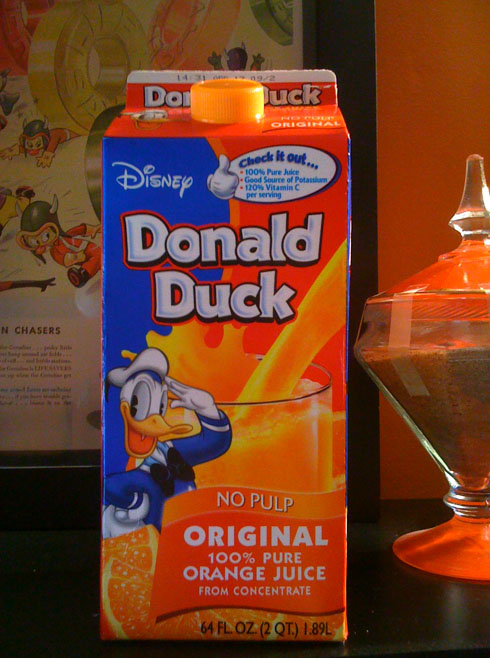
- Donald never drank orange juice in the cartoons, not even once, but that doesn't stop him from lending his name and image to Florida Natural Growers' orange juice◊ since 1940. In the 1970s, there was produced a whole film about the production of Donald Duck orange juice, which can be found on YouTube: part one and part two.
- To a lesser extent, Donald Duck is also licensed for the University of Oregon football team's ("the Ducks") merchandise.
- Donald never drank orange juice in the cartoons, not even once, but that doesn't stop him from lending his name and image to Florida Natural Growers' orange juice
- Chaste Toons:
- Other Disney characters may have nieces and nephews, but only Donald is the legal guardian of his.
- Donald had a son in "How to Have An Accident at Work" and in Mickey Mouse Clubhouse named Donald Jr.
- The Chew Toy: Donald in most of the cartoons he was in.
- Clothing Switch: "The Clock Watcher" 1945. As Donald is trying to pull out the Jack-in-the-box out of the floor, the box comes out and pulls Donald in the box with him trapped inside the box and Donald struggles to get out. When he finally bounced out of the box. Donald's clothes switch when he is wearing the Jack-in-the-box clown's costume with his nightcap and accordion with neck ruffle collar as a shirt while the Jack-in-the-box is wearing Donald's blue shirt and hat.
- Clueless Chick-Magnet: In one cartoon, "Double Date Don", Daisy's neighbor Clara Clucknote falls in love with him, with him mostly trying to fend her off and finish building Daisy a brick wall. This seems to happen in a few other cartoons and comics as well. And poor Donald never knows what to do with all the attention. Parodied by a Disney Trading Pin saying "Chicks Dig Me!" while he's surrounded by actual baby chicks!
- Coincidental Broadcast: Several times in "Donald Duck and the Gorilla".
- Color Blind Confusion: In Donald Gets Drafted, during his physical exams, Donald correctly identifies a red card, but when shown a green card (The physician even asks "What color is this green card", and Donald begins to spell out the word "GREEN" on the card), he answers "Blue", to which the physician says, "Eh, close enough."
- The Comically Serious: Donald tends to take everything seriously and have a straight face most of the time and also gets tormented and is comedic from time to time.
- Community-Threatening Construction: On the short "Dragon Around", Chip 'n Dale defend their home from a "dragon" that turns out to be Donald in a steam shovel, who has to uproot their tree to clear the way for a highway.
- Couch Gag: Early on, Don would open every episode of The Mickey Mouse Club by striking a gong with humorous consequences. Matt Groening has revealed that Donald's gong gag having different outcomes in each episode actually inspired the Trope Namer.
- Courtroom Episode: The Trial of Donald Duck, he’s brought to court as he refused to pay for the food he brought himself. Admittedly, he was already in hot water not noticing the $5 cover charge card on his table after flaunting the nickel he carried with him, but still...
- Covered in Kisses: The ending to Mr. Duck Steps Out adds a nice visual gag to the trope; one of Daisy's lipsticky kisses has landed right in the middle of Donald's eyelids. He blinks. Cue illusion of lips smacking!
- Crouching Moron, Hidden Badass: Donald has taken on Mooks and monster many times his own size, strength, and ability. It's usually thanks to Donald going into Unstoppable Rage that he manages it.
- His incarnation in DuckTales (2017) is this especially. Despite being Born Unlucky, Webby unironically says that "Donald Duck is one of the greatest adventurers in the entire world". Donald's managed to beat up a shadow wearing Gizmoduck's armor, a demigod with Super-Strength, and a mad Moon general trying to destroy the Earth, all with his bare hands.
- Cub Cues Protective Parent: In the case of Don's Fountain of Youth, it's an egg that cues one; namely, an alligator egg Don stole to fool the boys into thinking he'd regressed back to egg state.
- Cue O'Clock: The title character of "Donald's Cousin Gus" has a watch that tells mealtimes.
- Dangerously Close Shave: Donald almost gets one from an automated barber's chair in Modern Inventions.
- Deadpan Snarker: Usually reaches this point after various freakouts from whatever issue he was previously having.
- Decomposite Character: Since DuckTales had Donald Duck Demoted to Extra and sent to the navy so to give more screen-time to the relatively underexposed Uncle Scrooge. Donald did appear a few times in the original cartoon, but never in a big role and he didn't have much of his original personality and characteristics. Nevertheless, aspects of his traditional role in the comics were distributed to other characters, who eventually evolved aspects of their own personality.
- Launchpad McQuack ends up being The Ditz and punching bag accompanying Scrooge and the nephews on the adventures, sometimes complicating their adventures by being incompetent, impulsive and short-sighted.
- Fenton Quackshell is more or less just like Donald. Poor white-collar scrapper, a suitor to Gandra Dee (a Daisy Expy), butting heads with Scrooge while also being irreplaceable to him, and finally a civilian alter-ego to the Superhero Gizmoduck (much like Donald and Paperinik).
- The Spin-Off series has Darkwing Duck whose civilian alter-ego Drake Mallard is caretaker to a highly active and energetic young charge like Donald. Darkwing Duck also has Donald's distinct hot-head Small Name, Big Ego personality from the comics and likewise resembles Paperinik.
- Demoted to Extra: In DuckTales, he only appears in a handful of episodes. Averted in the 2017 reboot where he's now part of the main cast.
- Depending on the Writer: Different stories depict Donald as lazy or overzealous, as stupid or hyper-competent, as boorish or aspiring to be cultured, as an unrepentant jerk or a flawed but good guy... There's really only two constants: he's always got an explosive temper, and he's always unlucky.
- The Determinator: No matter how tough things may get for Donald, he has a relentless attitude that keeps him going. Lampshaded by Louie in the DuckTales (2017) episode, "The House of the Lucky Gander".
- Deconstructed in some shorts, such as "Trick or Treat". Donald may refuse to give up, but considering that he is up against an actual witch, who is able to control his body, he really ought to admit he's bitten off more than he can chew. It gets him put through the ringer, and even at the end, barely conscious, he's proclaiming "I won't do it!" before being mercifully knocked out by Witch Hazel's broom.
- Deuteragonist: Whenever he would team up with Mickey.
- Didn't Think This Through: Whenever he's enraged, he loses all sense of common sense and logic leading to his downfalls.
- Disguised in Drag:
- In Donald's Dream Voice, he briefly disguises himself as a girl in order to get back a voice-changing pill from an antisocial man (who, ironically, becomes quite friendly when he sees the disguised Donald).
- In Mickey's Big Break, he gets Dragged into Drag by Mickey as they disguise themselves as their own girlfriends in order to take a replacement photo after accidentally breaking the old one.
- There's also Golden Eggs, where he intends to collect some eggs from his farm but an imposing rooster won't let him get close, so he dresses up as a chick (literally) to do the job. With predictable results. Keep in mind that the disguise consisted of nothing more than a sack of flour, a feather duster, and a glove that wouldn't stay on his head for very long.
- One of the triplets does this in "Lucky Number".
- Disproportionate Retribution: Donald is often both the initiator and the victim to this trope, he and his foes often switching from playing mild pranks to trying to kill each other! A huge driving force in many of his shorts' Escalating Wars is that neither side knows where "an eye for an eye" ends. For example, Donald often plays a prank on, or otherwise annoys, some small woodland creature, which then retaliates in kind and sends Don into a rage, leading to an Escalating War. Usually results in nothing more than total humiliation for Donald, but major collateral damage is not unheard of. (One cartoon ends with Donald's house being blown to bits, while another has him blown straight down to China.)
- Ditzy Genius: Donald's often shown to be pretty smart and clever when he actually puts his mind to things. However, this is often counteracted by bad luck, as well as carelessness and/or temper. Whenever he's written as a Jerk with a Heart of Jerk, he's also petty, lazy, and completely lacking in common sense. Much like his Jerk with a Heart of Gold tendencies, this is another trait that's more commonly seen in modern productions that portray him in a flattering light.
- Don't Make Me Take My Belt Off!:
- An usual, effective resource that Donald uses to punish his nephews with when they’re too bratty to endure. However, very rarely is the bottom reddening directly shown; it’s mostly implied, with him frenetically chasing the trio while holding a tree’s branch. (He couldn’t use a belt for obvious reasons.)
- He is shown spanking the snot out of Junior in Bellboy Donald (complete with an Evil Laugh and sharp teeth in his beak), though considering what the little brat put him through, it's still rather amusing to watch.
- Downer Ending: A lot of his shorts, one in particular being "Donald's Dream Voice".
- Dreadful Musician: He has a terrible singing voice, due to his duck voice.
- Dripping Disturbance: The main plot line of Drip Dippy Donald, which takes this trope up to eleven, as the dripping just won't stop no matter what Donald does.
- Early-Installment Weirdness:
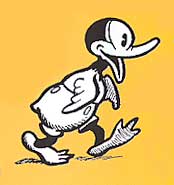
- Donald's very first appearance, preceding even "Wise Little Hen", was in a 1931 Mickey Mouse story book The Adventures of Mickey Mouse. His original design◊ looks nothing like we remember him as.
- "The Wise Little Hen" portrays him as a Civilized Animal instead of a Funny Animal.
- Donald's very first appearance, preceding even "Wise Little Hen", was in a 1931 Mickey Mouse story book The Adventures of Mickey Mouse. His original design
- Edutainment Show: Donald In Mathmagic Land, still to this day a staple of math classes everywhere.
- Electrified Bathtub: How to Have an Accident in the Home.
- Embarrassing Middle Name: Fauntleroy (for his sailor suit, after the Little Lord Fauntleroy series of children's books). It was first revealed on his draft notice in Donald Gets Drafted.
- Enmity with an Object: Similarly to Goofy, Donald troubles himself with inanimate things a lot, often because he tends to mishandle them due to his roughness, other times the object he's messing with is vaguely sentient and mocks him while being uncooperative, like the mainspring from Clock Cleaners or the steam engine piston in Tugboat Mickey.
- Ensemble Dark Horse: Believe it or not, this was invoked; the book "Mickey and the Gang" by historian David Gerstein reveals that Walt Disney already thought Donald would be his next star, organizing press kits to theaters that were showing Don's debut, The Wise Little Hen.
- Escaped Animal Rampage: The cartoon "Donald Duck and the Gorilla" has a Killer Gorilla escaping from the local zoo and encountering Donald.
- Escalating War: Used frequently in later shorts, usually against Chip and Dale.
- Evil Uncle: Sometimes towards his nephews. If not "evil" he's surely an insensitive bully.
- Exactly What It Says on the Tin: His shorts have been particularly guilty about this. Donald in charge of a lighthouse? Lighthouse Keeping. The duck's nephews come for a visit? Donald's Nephews. Donald loses his memory, becomes a singer and forgets about Daisy, who is stuck with the dilemma of her boyfriend abandoning her forever and being completely happy about it? Daisy's Dill...Wait, no, that one's actually called Donald's Dilemma. What do you know!
- Face Death with Dignity: In Commando Duck, Donald gets pursued by a wave of rocks and water after his rubber raft fills up with water and then explodes. He reaches the end of a tree branch sticking out over a cliff and finds that he has been trapped by the surge coming his way. He cowers briefly, then stands stoically with his hand in salute, preparing to perish. This is averted, of course; he is thrown clear in the nick of time.
- Fantastic Plastic: Parodied in "The Plastics Inventor", released in 1944, just as plastics were becoming mainstream. Following the instructions from a radio show, Donald makes a plastic airplane by melting down random junk and pouring it into a mold, then baking it. The finished plane flies like a dream, but there's one drawback: it's not waterproof. As soon as Donald flies into a downpour, the fuselage starts melting away.
- Feather Fingers: While his original design in The Wise Little Hen played this straight, his current design instead has actual human-like, feather covered, hands.
- Filching Food for Fun: Donald Duck's 1950 short "Lion Around" involves Donald's nephews Huey, Dewey and Louie disguising themselves as a mountain lion in order to scare Donald and steal a pie off his windowsill. Things get complicated when a real mountain lion shows up.
- Flower-Pot Drop: In the cartoon "Donald's Dilemma", a flowerpot falling on Don's head gives him Identity Amnesia, making him think he's a great singer. Daisy brings him back to normal by dropping another pot on his head.
- Foil: Donald was created to portray some of the more negative character traits that Mickey couldn't, since the latter had become a role model for children and had to stick to a mild-mannered, easygoing persona.
- Foul Waterfowl: Especially in the classic cartoons, he is characterized as temperamental and jerkish towards others he interacts with.
- Fountain of Youth: "Don's Fountain of Youth": Donald finds the spring that was mistaken for the Fountain of Youth, so he decides to play a little trick on his nephews, who'd rather read comic books than enjoy their vacation.
- Four-Fingered Hands: Like most cartoon characters of the era. Anatomically correct though, since ducks are birds and birds have only three fingers/toes in real life.
- Furry Confusion: Hilariously brought up in Fantasia 2000, where Donald notices a couple of non-anthropomorphized ducks passing by and realizes that evolution may have done him special favors. His face says it all.
- Glass Cannon:
- Literally part of Donald's character in many of the Classic Disney Shorts - he enjoys imposing on others as The Berserker would, but when met with adversity he goes down fast. In other words, he can dish it out, but can't take it.
- Sometimes subverted. In many cartoons, he can take as good a punishment as he gives, especially in cartoons with Chip and Dale, Shelby, his nephews, or Pete where's he's often put in dangerous situations from which he sometimes escapes or lasts until the end. This makes him more of a Lightning Bruiser since he's been put through more punishment than probably another other original Disney character except for maybe Pete, but can also dish out more punishment than anyone else as seen by "Tapped Out" where he almost effortlessly beats the crap of the world wrestling champion, Pete.
- Good Is Not Nice: Despite his good intentions, he is usually grumpy and irritable most of the time.
- Gosh Dang It to Heck!: In GOLDARN spades. It often sounds like he's swearing for real because of his voice, anyway.
- Green-Eyed Monster: Donald gets like this in Donald's Double Trouble, when he tries to get a more civilized duplicate of himself to help win Daisy back for him, only to see the twin actually fall for her himself.
- Ground by Gears: This almost happens to Donald in How to Have an Accident at Work when he accidentally starts the machine he is eating lunch on and the napkin tied around his neck is snagged in the gears. In freeing himself, he completely derails western civilization.
- Groupie Brigade: Donald acquires one after being hit on the head by a flowerpot and becoming a famous crooner in Donald's Dilemma.
- Hair-Trigger Temper: Put very lightly, the Duck really doesn't enjoy the Universe screwing him over.
- Half-Dressed Cartoon Animal: Donald Duck is known for wearing a blue shirt and blue hat. But he doesn't wear pants or shoes in most of the cartoon episodes. This is played with in the Mickey Mouse (2013) episode, "No Service", where he has to borrow Mickey's pants and shoes to comply with the Dress Code at Goofy's Snack Shack.
- Halloween Episode: "Trick or Treat... Trick or Treat... Trick or Treat for Halloween..." (Yeah, that song is quite catchy.)
- Have a Gay Old Time:
- We’re three caballeros, three gay caballeros, they say we are birds of a feather!
- In Grin and Bear It, Donald arrives at Brownstone National Park, and is told "not to molest the bears". The connotation given to that verb in modern times makes Don's reaction hysterical.
- The Heart: For all of his faults, Donald serves as this towards the Duck family.
- In "The Duck Who Never Was" by Don Rosa, it's shown that everyone (aside from Gladstone Gander) would be a miserable mess without him, with Duckberg decaying from injustice and poverty.
- Same for DuckTales (2017). Donald was the one to ultimately convince his nephews to forgive Scrooge after their conflict, as well as leading the fight in their darkest hours. He even talked down Mrs. Beakley in season 3 when her paranoia was terrorizing the children.
- Henpecked Husband: Donald has a nightmare about becoming one in "Donald's Diary."
- Hero Antagonist: He can be this in some cartoons, especially with Huey, Dewey and Louie or Chip and Dale.
- Heroic BSoD:
- In Donald's Happy Birthday, when Donald finds out about the gift cigars which he forced his nephews to smoke, he shrinks! Nice Job Breaking Your Nephews, Donald.
- A more serious variant in Mickey's Once Upon a Christmas, after the nephews decide to "liven up" Christmas with a rather cruel prank, the resulting mess completely destroys the celebrations, not to mention a lot of Donald's house. Expecting another temper tantrum from their uncle, they decide to make a run for it before noticing Donald...slumped over, very still and speechless, depressed at ruining his family's Christmas. It is this huge change in demeanor that leads the boys to realize that they took their antics too far this time.
- High-Pressure Emotion: He has such a bad temper that, in some shorts, his head is literally smoking with anger.
- Honking Arriving Car: Played With in the 1937 short Don Donald. Donald Duck arrives at Donna's casa on his pet burro, and he gets her attention by pulling its tail to make it "honk." A little later, after having a rough ride on the stubborn beast, she hears what sounds like the donkey's braying outside and comes out to give Donald what for, only to find that he actually traded it in for a shiny new runabout and was merely honking the horn.
- Honor Before Reason:
- Again, as part of his trademark temper, Donald often exhibits signs of this by standing up to his principles even when common sense states that doing so would be the stupidest thing imaginable. Notable cases include "The Flying Squirrel" where he wastes a large supply of snacks at his vendor stand while simply trying to recover one measly peanut that the titular character of the short steals and "Trick or Treat" where after being called a pushover by Witch Hazel vehemently refuses to let his nephews have any of the Halloween goodies he's been saving rather than be thought as such, even after Hazel casts a spell on him that puts him through numerous pratfalls.
- Likely exhibiting the fact that they're related, Huey, Dewey, and Louie can occasionally exhibit signs of this as well. In "Soup's On", rather than just do the easy thing and wash up before dinner, they try to trick him into thinking they did it, which leads to him punishing them. When Donald starts to feel guilty for sending them to bed without supper after hearing their (fake) crying, he decides to let up... only for them to prank him with a mouse trap and then eventually fake his death and convince him he's now an angel all so they can get their turkey dinner. This is in spite of the fact, mind you, that he'd already had a change of heart prior to said prank. Needless to say, it does not end well.
- Humanlike Hand Anatomy: Donald and the other Ducks have designs that avert Feather Fingers, instead giving them fully anthropomorphized arms and hands.
- Iconic Outfit: His sailor's outfit is immediately to be recognized.
- Inconvenient Itch: In the Wartime Cartoon "Donald Gets Drafted", Donald is instructed by Sergeant Pete to stand still. Unfortunately, he's standing on an anthill.
- Ineffectual Sympathetic Villain: He sometimes takes this role in the shorts with Chip and Dale.
- Irony: Despite his famous sailor outfit, Donald was almost always depicted as being in the Army during the wartime cartoons, to the point that he actually considered a member of the US Army until his 50th birthday in 1984, when he retired.
- It's All About Me: He tried to change the Mickey Mouse Works logo into Starring Donald Duck and in it's spin-off House of Mouse, he tried to change the logo into House of Duck.
- It's a Wonderful Failure: Donald was treated to a rare non-video-game example of this trope in the 1990 storybook Donald's Dream, in which he has a nightmare where he is shown the consequences of not doing the chores he has promised to do for his friends.
- Jerkass Has a Point: For all his faults, Donald is actually right about a good number of things.
- His Dude, Where's My Respect? argument certainly isn't without merit. He takes care of three rambunctious children on his own, he looks out for his family and friends when the chips are down, and he's a capable jack of all trades. Yet, everyone tends to treat him as a lazy good-for-nothing or a complete joke.
- Similarly, since he is more popular than Mickey for a great number of Disney fans, Donald's belief that he should be the center of attention isn't completely unjustified.
- While not exactly a careful duck, Donald's unluckiness is still a significant factor for mishaps; others rarely expressing sympathy for the latter. It's honestly impressive that Donald manages to be so chipper when unangered, instead of being a nervous wreck from all the suffering received over the years.
- Many stories portray Donald as wrong for getting angry at someone or something. The thing is though, his anger is actually pretty understandable on several occasions, especially when Donald initially tries to be reasonable. It also doesn't help that Donald's criticizers usually ignore his problems entirely.
- Jerk with a Heart of Gold: For the "Jerk" part, he's hot-tempered, rude, aggressive, and loves imposing on people for his amusement. The "Heart of Gold" part shows up far more often in the comics, modern cartoons and other spin-offs than in the classic cartoons, but... for all his faults, Donald does have a heart and will usually do the right thing in the end.
- Jeweler's Eye Loupe: In some old cartoons, Daisy Duck would be the one to use the loupe to check jewelry (like an engagement ring from Donald), for instance Donald's Diary (at 4:38 on the video).
- Karmic Butt-Monkey: The eponymous Donald Duck. There is a very good reason his theme song says, "Who gets stuck with all the bad luck? No one but Donald Duck." A lot of his problems are self-inflicted due to his bad temper and the fact that he imposes on other people for his own sick kicks. The "Butt-Monkey" part is lampshaded in his theme song.Who gets stuck with all the bad luck?
''No one—but Donald Duck!' - Kick the Dog: Sometimes he has a very cruel sense of humor and likes to mess with smaller animals or his own nephews, which leads to his undoing by the end of the short.
- Killer Gorilla: Donald gets in a fight with one in "Donald Duck and the Gorilla". You can probably guess how that turns out for him.
- Killer Outfit: In "How to Have an Accident at Work", Donald gets dragged through an industrial hole punch by his tie and suffers Amusing Injuries that would have been fatal had he not been an animated character.
- The Lancer: In ensemble stories with the rest of the classic cast, he typically fills the role of Mickey's Lancer because of their highly contrasted personalities.
- Large Ham: Usually during his temper tantrums. Gets Lampshaded and Played for Laughs in one episode of House of Mouse.
- Laser-Guided Karma: He always gets repercussions for his mean actions, such as for abusing his nephews, or picking on Chip and Dale or anyone else. It actually dips into
 Karmic Overkill sometimes.
 - Leitmotif: "The Sailor's Hornpipe", particularly moreso in his early days.
- Lighter and Softer: Modern interpretations of Donald tend to paint the Duck in a much more flattering light than the old shorts, making it clear that, in spite of all of his faults, he is a good person, establishing him as a Jerk with a Heart of Gold.
- Lower-Deck Episode:
- An old beetle's narration of the encounters he’s had with the Duck gets the focus in "Bootle Beetle", "Sea Salts" and "The Greener Yard", the last one downplaying Donald's presence to an extended cameo.
- It also happened with an elderly bee playing the narrator in "Let's Stick Together".
- Made Out to Be a Jerkass: Even when he's the one being tormented, we're supposed to root for the other guy. He can also be criticized simply for wanting to have some time alone in peace.
- Misleading Package Size: There's a cartoon in which he's a gift wrapper in a department store. He puts a small ring inside a large box, then tries to put a football in the box meant for the ring. He has to deflate the ball in order to fit it in.
- Mistaken for an Imposter:
- One cartoon, "Donald Duck and the Gorilla", has Donald's nephews pretend to be an escaped killer ape to scare Donald. He catches them, and when the actual killer ape shows, he slaps it around a few times before realizing what it is and running for his life.
- Also, in another cartoon, "Lion Around", two of Donald's nephews dress up in a lion costume to scare Donald while the third nephew goes for a yummy pie. However, one slip-up has Donald discover who the "lion" really is and shoos the nephews out of the house. Then a real mountain lion shows up and goes to Donald's house in an attempt to eat him and the pie. However, Donald thinks the actual lion is just his nephews in costume and tries shooing it away, but the lion persists and enters his house. At once Donald becomes infuriated and even attempts to rip off the lion's head, but then one of his nephews knocks on the window and tries convincing Donald that the lion is real by showing him the costume, which the nephews had taken off. It takes Donald a few seconds to realize that the "lion costume" he attempted to "take off" is actually a real lion, whom he had just ticked off! Oh, Crap!!
- In "Donald's Rocket Ruckus", Donald sees what he thinks is Huey, Dewey, and Louie disguised as a tall woman in order to trick him into letting them on the titular amusement park ride. He tears the dress off only to find that the tall and lumbering woman actually is a tall and lumbering woman and is now naked, getting a punch from the embarrassed woman for all his troubles.
- Modesty Towel: It happens, logic be damned.
- Mouth Full of Smokes: In the cartoon short "Donald's Happy Birthday", when Donald finds his nephews with a box full of cigars, he forces them to smoke them all, even going so far as to shove a bunch of lit cigars in their mouths to smoke all at once, only to find out that the box of cigars was their present for him. He gets so flustered and embarrassed that he shrinks down to the size of a mouse and disappears into a hole in the nephews' tree house.
- My God, What Have I Done?: How many of Donald's cartoons end when he realizes the wrong that he had done in his fit of temper.
- The Napoleon: "Hot-blooded" and "short" are probably two of the most apt adjectives to describe Donald.
- New Job as the Plot Demands: Some episodes has Donald working in various occupations, most of which backfires on him due to his own sheer incompetence.
- Never My Fault: Zigzagged overall, depending on the incarnation. Donald, though quite unlucky, has more than a few times tried to shoot blame for his misgivings onto someone else. This became the pivot for "How To Have An Accident In The Home", to the point that Fate itself takes on a sapient personification just to point out how nearly everything Donald goes through is not his doing but caused by Donald's own stupidity.
- Never Wake Up a Sleepwalker: In one cartoon, Daisy has to race ahead of a sleepwalking Donald to move obstacles out of his way. Considering he's doing gravity-defying tricks such as climbing up walls, it's quite a feat.
- Noisy Duck: He could be considered the Trope Codifier along with Daffy. He is similar to Daffy Duck as well, being an angry noisy duck quacking incessantly when people get too close.
- Non-Dubbed Grunts:
- The majority of Donald’s dubs around the globe preserve Clarence Nash’ original laughs, unintelligible tantrums, and so on.
- Saludos Amigos took it one step further; both Donald and Joe Carioca's entire dialogue in the segment "Aquarela Do Brasil" were left intact for the Latin American release. As if Donald's voice wasn't difficult enough to understand already...
- Non-Standard Character Design: Owning to his debut being a standalone Silly Symphony, Donald and the rest of the duck characters are fairly distinct compared to the rest of the classic cast. Mickey, Goofy, Pete and the others all have designs that grew from their Inkblot Cartoon Style and the fact that they're anthropomorphic animals rarely if ever comes up. Donald, on the other hand, started with a more "theatrical" design that was simplified to fit and his status as an anthropomorphic duck is emphasized by his voice and mannerisms, like how he waddles when he walks, for example.) Donald and most of his kin not wearing pants also makes them stand out.
- Now I Lay Me Down to Sleep: In Sea Scouts, A Good Time For a Dime, Lion Around and the Prince and the Pauper adaptation.
- Odd Friendship: Despite the fact that Donald can be cynical and temperamental, with Mickey Mouse anything but, 9 times out of 10, Donald will be the character singled out as Mickey's best friend.
- Official Couple: With Daisy Duck.
- "Oh, Crap!" Smile: He sports one when he realizes he was lawnmowning a high voltage wire in "Out on a Limb", even chuckling nervously, before he gets electrocuted in one of the most hilarious ways possible.
- Out-of-Character Moment: Donald is far more lustful in The Three Caballeros than he is anywhere else.
- Out of Focus: Not to the extent of Pluto, but in the newest Mickey Mouse (2013) series, Donald has thus far made only 13 appearances (15 if you include cameos).
- Pain to the Ass: Donald sometimes suffers this, like in "Window Cleaners" where Spike stings him there in retribution for trying to drown him in a tulip.
- Papa Wolf: Can pull it out when Huey, Dewey and Louie are threatened. In DuckTales (2017) especially, with Neighbor Jones, Donald's anger management therapist, says that Donald's learned to channel his anger in such a way that his kids being threatened is one of the best ways to make Donald release all of his pent-up rage.
- The Prankster: He loves to prank his nephews and anyone else but his karma comes to bite him in the ass in the end.
- Pint-Sized Powerhouse: Many times, his strength isn't just due to his Unstoppable Rage, but also sheer determination. In the Quack Pack episode "Ducks By Nature", the camping leader is jealous of Donald and calls him "city wimp" but Donald carries BOTH their camping equipment (which includes a CANOE!) and then the camp leader challenges Donald to a race to climb up a cliff. Then, he cheats by secretly tying Donald to a tree with an EXTRA-STRONG Bungie cord. Donald struggles for a bit before his determination makes him so strong that he not only uproots said tree but literally SENDS IT INTO ORBIT and gets him to the cliff top faster than the camp leader! In "Bird Brained Donald", he lifts a metal rail in from its post in cement to use as a ladder! And he beats BOTH Mickey and Goofy in a pseudo tug-of-war in "Answering Service". And these are just a FEW examples!
- Polka-Dot Paint: In "The Vanishing Private", Donald paints a field cannon with red, green and yellow stripes, and black polka dots. All at once, with a single brush and bucket.
- Poor Communication Kills: In two shorts, "Donald's Happy Birthday" and "Lucky Number," the nephews attempt to do something nice for Donald and give him a nice surprise; by buying him a birthday present in the former and trying to pick up the car he unknowingly won in the latter. Sadly, both times due to the nephews being too secretive and Donald's own stubborn and mistrustful nature cause things to backfire horribly, and Donald doesn't learn the truth until it's too late.
- Poorly Disguised Pilot:
- "The Wise Little Hen" notwithstanding, a year prior to Donald getting his own individual shorts, the Mickey Mouse cartoon, "Donald and Pluto", was centered entirely around Donald and Pluto, with no appearance whatsoever by Mickey.
- A few months later, supposedly, the same thing happened with the duck's next appearance in "Don Donald", the debut appearance of Daisy, which was also released as a Mickey cartoon, but again with no appearance at all by Mickey.
- Public Domain Animation: The short "The Spirit of '43". However, you won't find it in any compilations—in fact, Disney halted the release of a public domain DVD with Donald displayed on the cover, pointing out that while the cartoon is Public Domain, Donald Duck isn't.
- Quacking Up: Donald Duck is an anthropomorphic duck and one of the most iconic cartoon characters. Notorious for his speech pattern and short temper, he's also strong-willed and unafraid to use violence to overcome his problems.
- Raincoat of Horror: In the short Duck Pimples, Donald is greeted at his door by an intimidating-looking figure wearing a raincoat. It turns out to be a jolly character looking to sell him magazines.
- Rain Dance: In the cartoon Grand Canyonscope, Donald fools around with a genuine raindancing costume and manages to summon a Personal Rain Cloud before the ranger catches him and confiscates the costume.
- Real Vehicle Reveal: In the cartoon The Autograph Hound, Donald appears to be in a limo with Greta Garbo. He is actually sitting on the fender on the other side.
- Red Oni, Blue Oni: The red to Mickey Mouse's blue. Whenever he's paired with Goofy, Goofy takes Mickey's place as the blue oni. Ironic since Donald wears a blue sailor suit, while Mickey wears red shorts.
- Rod-and-Reel Repurposed: In cartoon "Donald's Happy Birthday", Donald takes his nephews' piggy bank away from them, so they use a fishing rod try to fish it out of his hands while he's napping.
- Sarcastic Well Wishing: Grand Canyonscope ends with Donald, Ranger Woodlore and a mountain lion all having destroyed and filled in the Grand Canyon, leading to a stern reprimand from Woodlore to Donald and the lion that begins in this way:Woodlore: Well, I hope you're satisfied. You two have in a matter of minutes messed up what had took Mother Nature millions of years to create. The national park rule book states, and I quote: "When a natural object is marred or defaced, it must be restored to its original state." [holds up some shovels] So... [tosses them the shovels] START DIGGING!
- Semiaquatic Species Sailor: Donald Duck may be the Trope Maker, being a duck and a sailor.
- Shameful Shrinking:
- In "Truant Officer Donald", he's a truancy officer, out to catch Huey, Dewey, and Louie skipping school. When he finally captures them, it turns out school was out for summer. Donald shrinks in shame as a result.
- In "Donald's Happy Birthday", Donald catches his nephews with cigars and makes them smoke the whole box as punishment. When he realizes the cigars were his birthday present, he shrinks down until he falls through a knothole on the floor.
- Shock and Awe: Donald gets lightning powers from Zeus himself to pester Pete in response to bad Trombone playing in Trombone Trouble.
- Shout-Out: When Donald gets hung up like a marionette from his overly-sticky attempted waffle batter in Chef Donald, the music plays to the tune of "I've Got No Strings" from Pinocchio.
- Signature Headgear: Donald's "classic" outfit just isn't complete without his iconic sailor hat. It started off as white, then became blue to better match his shirt. And woe betide anyone to harms that hat.
- Signed with a Kiss: In The Autograph Hound, Donald meets Shirley Temple and asks for her autograph. After she does, she dots the I by kissing it.
- Small Name, Big Ego: He thinks he's better than his rivals, but he's often at the receiving end and usually lets it go into his head.
- Smooch of Victory:
- At the end of Maui Mallard, a SNES/Genesis/PC videogame. As a reward for saving her island, an Amazon duck pleases Don with the best kiss he's received on his entire existence, then teleports both of them to some unknown destination...Considering she promised to take him "on an adventure he'd never forget" and that the wedding march starts playing as they disappear...OH, LUCKY DUCK!
- In a more traditional, approved-for-kids instance, Daisy gives him one (on the cheek, mind you, after risking his life to save her from an evil magician with a wicked mind, come on now) - at the end of the videogame, Goin' Quackers.
- Sore Loser: One of Donald's key traits, aside from the temper, of course, is that he can dish it out, but absolutely cannot take it.
- Special Edition Title:
- "Trick or Treat". Donald's face is painted on a fence at night, instead of the usual head shot on the starburst frame. The credits are featured on a house surrounded by dead trees’ shadows, which serves this Halloween short better than the ordinary red burlap design. Finally, the camera pans around before revealing the title, which is neatly painted on a broken window in a seemingly abandoned house.
- The rarely seen original opening for "Rugged Bear" depicts Don's headshot as a portrait over a fireplace mantle, which pans down to the dark fireplace opening with the title and artist credits. After that, the camera pans down to a shot of a bear-skin rug with the cartoon's title. The reissue title shows only the artist credits in the fireplace and the title over the bear-skin rug; the shot of Donald's head and the title are both shown on generic title cards.
- Species Surname:
- Donald's a duck with the last name "Duck"
- Curiously, a gag in House of Mouse revealed that Donald is seemingly part-goose, even more goose than duck, so his name ought to be Donald Goose. He’s terrified about people finding out, for it would ruin his career. This was likely something made out of thin air to give Don a secret in an episode where everyone had an embarrassing one, rather than a notion to be taken seriously. It was never been brought up before, nor has it been mentioned ever again. (There are geese in his family, though)
- Sudden Eye Color: Donald's eyes are shown to be blue whenever an Eye Take is emphasizing his irises.
- Speech Impediment: Donald's distinctive, quacking voice is sometimes treated as a speech impediment in-universe, especially when it's unique to him instead of something shared by other ducks.
- Staircase Tumble: Falling down the stairs is one of the kinds of accidents Donald demonstrates in "How to Have an Accident in the Home", and in fact J.J. Fate comes up with names for several different ways of doing it.
- Straight Man: He'll fall into this role if he's paired up with certain characters, such as Goofy, Scrooge, or Sora. He'll also trade the Straight Man role with Mickey if Mickey's eccentricities are being played up.
- Super-Speed: Downplayed, but it's not unusual to see Donald running like heck with Wheel o' Feet and all if his life depends on it. In games featuring Donald, both Western and Japanese, it is also curiously common to either have a powerup that makes Donald run around very fast or to incorporate speed in some quirky way on his normal moveset. In Maui Mallard, for instance, ninja Donald had a dash move with Wheel o' Feet. And in Mahou no Boushi, Donald could run over walls.
- Superstition Episode: Whether Donald is actually unlucky or brings it all on himself varies Depending on the Writer; The cartoon "Donald's Lucky Day". Donald is a courier delivering a package on Friday 13, and a radio broadcast on the subject puts him on edge. First he narrowly avoids going under a ladder, which leads him to crash into a mirror. Then he finds a black cat trying to cross his path, and spends most of the cartoon trying to elude it. And for added suspense, the package is a Time Bomb.
- Synchronized Swarming: In the cartoon "Inferior Decorator", Donald gets into a feud with a bee. Toward the end of the cartoon, it cuts part of the wallpaper out on the ceiling exposing Donalds rear end, calls on all its friends, which swarm out of the hive and form a question mark, as if to say "Yeah, what do you want?" Then Spike the Bee has them invited into Donalds house through the keyhole and the bees sting his butt one by one, however this is implied but not shown.
- Tame His Anger: In "Cured Duck", after Daisy scolds Donald for yet another of his self-induced destructive mishaps, Donald orders a "temper machine" designed to teach him to keep his cool. It actually seems to work; then Donald sees Daisy's outrageous hat and goes into hysterics over it, whereupon Daisy throws a frenzy that puts the Don's to shame.
- Team Rocket Wins: Donald normally loses when confronted with Chip 'n' Dale. In the short "Working for Peanuts", Donald manages to repeatedly thwart them, with the aid of Dolores the Elephant. They still end up getting what they wanted, though for once not at Donald's expense but by successfully faking a place for themselves in the zoo as rare albino chipmunks. Later, Donald and Dolores get back at the chipmunks for their trouble-making in "This is Your Life, Donald Duck".
- "Test Your Strength" Game: In "Canvas Back Duck", Donald tries his hand at a high striker, but he slips and falls headfirst on the machine, with the mallet hitting him immediately afterwards. This makes it strike the bell, and Don wins a prize.
- Theme Tune:
- Originally, Donald’s cartoons were accompanied by diverse instrumental themes, each suiting the short featured, such as the Mexican melody in Don Donald. They would also play prominently within the short itself. This practice was later abandoned; the first two tunes that stuck can be heard here and here. Finally, in the second half of the forties, the theme we’re most familiar with appeared, an inversion of the Bragging Theme Tune, since most of the qualities it attributes to Donald are the complete opposite of his behavior in the cartoons.
- A Title Theme Tune, combined with elements from a Thematic Theme Tune, was used as the intro to the old show Donald Duck Presents. A song with a very strong 80’s scent, take a listen here.
- Originally, Donald’s cartoons were accompanied by diverse instrumental themes, each suiting the short featured, such as the Mexican melody in Don Donald
- This Loser Is You: Donald is incredibly unlucky and has very little patience for anything. The adult audience of the shorts can easily relate to him.
- Threatening Shark: Donald has encountered sharks in at least three shorts: "Sea Scouts", "No Sail" and "Bee at the Beach".
- Through a Face Full of Fur: When Donald loses his temper, he will often turn scarlet — either in the face, or on occasion all over his body.
- Throw the Dog a Bone: Despite his iconic bad luck, every now and then Donald did come out clean or get the last laugh by the end of the short.
- Token Evil Teammate: While not evil, he's often the most antagonistic, selfish, and ill-tempered out of the rest of the cast.
- Took a Level in Kindness: He and his nephews act much nicer to each other in DuckTales (1987), with Donald also being more reasonable overall. This has carried on in other works, such as the reboot.
- Took a Level in Jerkass: He became more rude and insensitive in Mickey Mouse (2013), and sometimes shifted into a Jerk with a Heart of Jerk.
- Toothy Bird:
- Donald has been known to call pearly whites into existence, mainly to express anger. Or when he has a particularly mischievous smile.
- Donald's Double Trouble's 5th minute takes the anger part of this to dangerous heights.
- Truth in Television: In "Donald and the Gorilla," the announcer proclaims that you can establish dominance over an animal by giving it a challenging gaze. As shown, this would be a horrible idea when dealing with an already-agitated gorilla.
- Tuft of Head Fur: Donald's usually drawn with two little tufts of feathers on his head, one on the front and one on the back, giving him a ruffled look.
- Two Decades Behind: In the House of Mouse short computer.don, Donald is depicted as being pathetically behind the times (having a rotary phone and an old fashioned ice box that Goofy stops by to refill), and is repeatedly labeled a dweeb because of it.
- Unbuilt Trope: Huey, Dewey and Louie are, perhaps, the most famous case of a cartoon character having nephews instead of children. However, unusually for this trope, which is usually used to give the protagonist children to interact with without tying them down to parenthood, Donald Duck is explicitly the legal guardian of the triplets, and has been since the 1940s.
- The Unintelligible:
- Donald's voice can be so hard to understand that it has caused at least two misunderstandings in the form of people accusing him of screaming "Fuck you!" in Clock Cleaners and calling Daffy Duck the n-word in Who Framed Roger Rabbit (he actually says "Sez you!" and "You doggone stubborn little...", respectively). This does not apply to him in the comics, though for obvious reasons, though once in a while a story may allude to his odd voice.
- His characteristic unintelligible ranting aside, Disney does go to great lengths to make sure Donald's voice is understandable as it can be, especially in modern productions that emphasize dialogue, unlike the shorts which tended towards minimal dialogue. Word choice helps, as certain words just sound better in that voice than others, particularly multi-syllabic ones, while soft monosyllabic words become mushy and impossible to say. note
- The 2017 reboot of DuckTales even makes this a plot point. In the Season 1 finale, no one's able to understand Donald's plan to fight the Big Bad, so he's temporarily given a Barksian modulator from Gyro Gearloose, giving him Don Cheadle's baritone. It doesn't last, but several characters note that being able to understand his dialogue makes him seem far more capable than before.
- Unstoppable Rage:
- Varies. Donald's strength seems to be directly proportional to the person (or thing) he is trying to fight. He regularly beats the crap out of his ex-con neighbour, who's twice his height and three times his width, yet once got knocked out cold by a sleepy Volcanovian.
- He's lifted up and thrown a wardrobe and uprooted a telephone pole in Cured Duck, he punches out a huge shark in Sea Scouts, head-butted a large mountain goat in Alpine Climbers, and nearly demolishes an amusement park's Tunnel of Love in Donald's Double Trouble when he sees his doppelganger kissing Daisy in there. His strength seems to increase even when he's determined as well. In the House of Mouse episode Clarabelle's Christmas List, Donald effortlessly reeled in Monstro thinking it was the Naughty or Nice list. And in Answering Service, he rips a keypad off the wall and beats BOTH Mickey and Goofy together in a pseudo tug-of-war. He's also performed amazing feats of strength in the comics including: breaking free of strong ropes, pulling in a TRACTOR, among others. And in the Mickey Mouse (2013) short "Tapped Out", Donald completely demolishes Pete, who is a Gorgeous George-type wrestler, when the latter accidentally ruins the duck's nachos, which he does not want others to so much as touch (he had already snapped at Mickey for his unintentionally doing so twice). Basically, don't mess with this duck if he's determined or angry, just like his uncle Scrooge McDuck.
- Unsympathetic Comedy Protagonist: When he's being an asshole to anyone, expect karma to hit him in the end.
- Vague Age: His typical portrayal is that of a young adult (Information found in various comics suggest he is, in fact, in his late twenties) But in earlier shorts, he often comes across as a child, "Donald's Better Self" explicitly portrays him as a schoolboy, yet the very next short introduces his nephews.
- Averted in DuckTales (2017), where he's officially 36 as per
 Word of God.
- Averted in DuckTales (2017), where he's officially 36 as per
- Vandalism Backfire: In "Lucky Number", Donald wins a new car in a radio raffle drawing, but due to an error in announcing the winning number, he had thrown his ticket away thinking it was a loser. His nephews hear the correction, realize he's won, and cash the ticket in secret to surprise him. When they show up with the new car, Donald thinks it's a prank and unknowingly destroys his own winnings in a rage.
- Villain Protagonist: In "Dumb Bell of the Yukon" if we don't count the times he antagonizes his nephews.
- Vocal Evolution: Donald's speech impediment, even voiced by Clarence Nash, gets more comprehensible over time.
- Wardrobe Malfunction: In "The Clock Watcher" 1945 cartoon short. When the speaker horn sends in a pile of toys down the sliding table. They rush by so fast it literally blows Donald's Shirt right off and he falls on the floor. Realizing he's undressed he quickly rushes over and grabs his shirt and hat and quickly puts it right back on him.
- What Measure Is a Non-Cute?: Seemed to play into Donald's victory streak according to his enemies. Regardless of who started the war per se, when placed against cute smaller animals or troublemakers, Donald usually didn't stand a chance. When placed against repulsive antagonists like Pete however, Donald was often allowed to win for once.
- With Friends Like These...: At times, Donald's family and friends can be pretty mean towards him. Believe it or not, even Mickey, Minnie, and Goofy have moments like this, such as in a few episodes of House of Mouse.
- Yank the Dog's Chain: Some of Donald's shorts end this way. In "Crazy Over Daisy", it seems Donald has finally won over Chip and Dale and prepares to kiss Daisy when he finally arrives at his house. Daisy, upon seeing that Donald is using Chip and Dale to power his bike, slaps him and calls him out for it.
- Would Hit a Girl: Chef Donald has Donald angry at the radio host Mother Mallard because his recipe didn't come out right, and ends with Donald running to the station and (since we don’t see what actually goes down) seemingly pummeling her.