
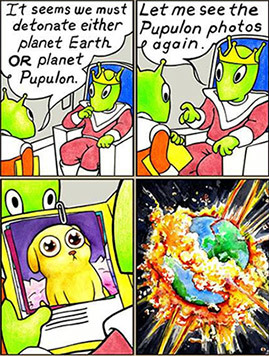
Humans, being as prejudiced as we are, tend to only like certain animals. Oh, how our dog smiles and plays! Oh, how our cat rolls on the rug asking for a tummy rub! Oh, how the hamster stuffs his chubby little cheeks! Oh, how pretty the Mute Swan is as he glides across the pond! Oh, how the Coelacanth... is a boring old fish.
You may have noticed that only cute, cuddly, and cool animals are good guys while unpopular or unattractive animals are brought in to be the Designated Villains. This usually plays into the "Carnivores are Mean" subtrope of Carnivore Confusion. Wolves were cast as baddies for centuries. Owls and hawks and corvids basically exist to drop down on our cuter protagonists from above. Wasps and termites are mini villains. Rats and Weasels are the go-to pocket-sized villains. Octopuses and squid are more or less discount Krakens. Friendly sharks pretty much exist only as a subversion. Don't even ask about snakesnote .
The heroes, on the other hand, will be cute or cool animals like doggies and kitties and bunnies and duckies and turtles and froggies and ladybugs and bees and ants and monkeys and friendly playful dolphins and Reticulated Chipmunks and...
You see where we're going with this right?
Wolves and Foxes, and Lions and other big cats can be heroes as well because their babies are cute and thus remind people of puppies and kittens, and the adults look badass. All butterflies are marked "Cute", even those you won't like to see in your garden. Spiders and bats are marked "Mean" even though they usually don't bother humans at all and even devour lots of annoying and dangerous insects. And if you'll encounter an Antlion in the role of horrible predator, its adult form is not likely to appear in next scenes (it looks like a cute, pretty dragonfly). For any animals not in this short list, it's usually divided into one of these.
- Ugly - Predatory - Scavenging - Parasitic - Mean
- Cute - Fluffy - Herbivorous - Pacifistic - Nice
- Cool - Brave - Predatory - Badass - Heroic
Some fiction goes even further, casting only cute, cuddly, and cool animals — ugly and unpopular animals tend to be non anthropomorphic, villainous, or outright absent.
It should be noted that which animals get to be considered cute/cool or the opposite tends to vary by culture. For example, foxes are generally cute or roguish in America, mean in some parts of Europe and Magnificent Bastard types in others, magical tricksters in Japan, and Ax-Crazy evil in Korea. Cats are generally seen as bad and mean in the West (kittens being the obvious exception), but in other parts of the world such as Japan and the Middle East, cats are generally playful and cute animals, even if they are strays. Rats are portrayed as vermin in the western world, but are revered in India and are the first of twelve animals that represent the years on the Chinese Zodiac. Pigs are often outrightly dirty and greedy in western culture as well as in Middle East, but tend to get more consideration in China, where they are part of the aforementioned Zodiac as well. Dogs, while seen as cute, heroic and lovable in the West (certain breeds notwithstanding), are reviled in the Middle East as filthy scavengers.
Another factor may be the animal's size and/or place in human society. For example, both Mice and Rats can be cute, but they can get a bad rap because they're commonly household pests. Even then, the tiny Mice are likely to be portrayed more positively than the larger Rats. Consequently; if a cat is chasing a mouse, the cat is often portrayed as the villain, but a cat chasing a rat is usually the hero.
Whatever the case may be, if you happen to think any of the animals in the "Designated Villains" list are cute and/or cool, you are a weirdo in the eyes of the mainstream.
It is worth noting that there are some exceptions to this rule, because perceived slyness and/or cunning are often important determining factors along with cuteness. Rats and weasels, for example, are almost always portrayed as mean and/or evil, even though they are small and fuzzy. However, mice, who appear nice or mostly harmless quite a bit, are commonly thought to be unable to think their way out of a wet paper bag. For this reason, though cats are indisputably adorable, they are often seen as mean or a villain's pet in Western media.
This trope is pervasive enough that simply associating a human character with a certain animal or, in fantasy and science fiction, giving him the features of an animal can immediately peg them as good or bad. In extreme cases, this can start to look like the animal equivalent of Fantastic Racism.
This trope is Truth in Television and a major problem in wildlife preservation, with animals that appeal to humans termed charismatic megafauna, like the panda for example. It doesn't matter if, like the aforementioned Coelacanth, you've survived damn near everything else the world can throw at you; if you aren't generally thought of as cute by most people, you're in serious trouble. Few people really care about ugly or unpopular animals, regardless of their ecological importance.
The Coelacanth example can also lead us towards the subtrope Prehistoric Monster, about the whole extinct animal ensemble, which often receives in media the same treatment as modern-day "non-cutes" or even worse.
The Uncanny Valley is somewhat related, as it was born from the scientific study of this trope. It is a supertrope of No Cartoon Fish. It often cross-pollinates with Beauty Equals Goodness, Animal Stereotypes, Carnivore Confusion, and What Measure Is a Non-Human?. See also Ugly Cute, Bat Out of Hell, Bug War, Ominous Owl, Reptiles Are Abhorrent, You Dirty Rat!, and Always Chaotic Evil. Contrast Dark Is Not Evil, Light Is Not Good, and Grotesque Cute. Also contrast Fluffy Tamer and Friend to Bugs for people with unconventional opinions on what animals qualify as cute or lovable. This trope is pervasive enough that the Killer Rabbit and some of the Bad Kitties exist to subvert it. Time period and location seem to affect public opinion of mustelids, as shown by the contrasting tropes Weasel Mascot and Wicked Weasel.
One way to subvert audience expectations with this trope is to turn the moralities of the characters on their head, but not the characteristics of the animals themselves. For example, use animals normally seen as unpopular (such as horseshoe crabs), and retain their "undesirable" qualities while showing that they're good at heart. Conversely, use popular animals (like dogs) to display pleasurable features, while hiding their malevolent nature.
Can overlap with Black Comedy Pet Death if "non-cutes" are killed for laughs. Related to Mammal Monsters Are More Heroic.
Examples:
- In what was probably a deliberate Viral Marketing campaign, Ford "accidentally" leaked two SportKa ads onto the Internet. One depicted a pigeon getting smacked by the car's hood before taking a crap on it, and the other depicted a cat getting decapitated by the car's sun roof. While both sparked complaints, the cat one was the worst-received, though it might mostly be the level of violence that caused it.
- Applied uncomfortably in Bubblegum Crisis. In the first episode the Knight Sabers are sent after a man and a small girl. They go to some lengths trying to rescue the kid, but it turns out she and the man were both Boomers, and she was taken out by a Kill Sat. The Knight Sabers promptly tell the company not to make Boomers that look like kids.
- Pretty Cure:
- The standard Monster of the Week in the series is a random object turned into a rampaging beast but there's also cases of animals and even people getting possessed. In those rare instances, the heroines use a special attack that purify the monster without harming the victim. The catch is this only happens if the possessed animal is of the cute sort, like the Mama Bear from Futari wa Pretty Cure or Inori's Big Friendly Dog Lucky from Fresh Pretty Cure!. But if they're ugly animals like insects or fishes, they simply get blasted at pointblank with whatever this season's Finishing Move is, regardless of the chances of that being fatal or not. Heck, this sometimes doesn't apply to humans as well: Vice-principal Kometsuki from Futari was transformed into a Zakenna in Episode 7 and still got Marble Screw'd. But again, it wasn't completely undeserved.
- Fresh Pretty Cure! officially adopted this trope when Eas/Setsuna had her Heel–Face Turn. Both of her forms were equally good looking; instead of being killed off like most other female Pretty Cure villains, she's spared and converted to the side of good as Cure Passion.
- It's doubtful anyone would care for the eponymous cyborgs in Gunslinger Girl if they wouldn't look like cute, little girls, since they are cold-blooded killing machines.
- This is the point; the manga especially challenges viewers by making the characters sympathetic and cute, but then you have to contrast this with the fact that they are living weapons. The dichotomy even begins to take its toll on their handlers after a while.
- A cyborg is a living creature with some mechanical parts, so they would look human regardless. Also, potentially dangerous things can still be cute. The fact that they could be really destructive doesn't mean it contradicts.
- Watch the summons fighting in Naruto. Notice how animals like dogs and toads usually get beat up or, worst-case scenario, stabbed. Now notice how things like spiders, bees and centipedes get crushed, mutilated, or turned to pulp. If you consider that they all have at least some sapience since they can form contracts, then the Jiraya/Pain fight where the former snaps all the joints of the latter's giant crab is downright cringe-worthy.
- This is actually not true for all summons. One of Tsunade's most prominent is a giant acid-spitting slug that splits off and forms smaller slugs Asteroids Monster style yet is apparently one of the quietest and most docile summons compared to Jiraiya's toad, Gamabunta, and Orochimaru's snake, Manda. In addition Anko, who was one of Orochimaru's test subjects, can also summon snakes which she used to help the protagonists a few times, and Temari once summoned a giant scythe carrying weasel to defeat one of Orochimaru's minions.
- It's not necessarily about protagonist vs. antagonist. Aside from Katsuyu, invertebrate summons are treated like expendable Mooks that can (and do) get graphically slaughtered on-screen. And the snakes definitely get injured a lot more severely than the mammals and cute toads.
- Subverted in Paranoia Agent, where the cute cartoon dog Maromi turns out to be the villain of sorts, if he can be called that, precisely because he is cute, and people love him, causing their collective stress to turn into a blob monster that destroys Tokyo once he disappears.
- Pokémon: The Series:
- The anime more or less follows through with the games' philosophy...until you go back to the first season or so and notice that Ash had cute little Pikachu, Butterfree, Squirtle, Bulbasaur, and Charmander - and that the Team Rocket trio had a floating naval mine gas cloud, and a giant purple rattlesnake. Later on though, Ash got a Muk (essentially a live pile of sludge) and Charmander gradually changed into the big, scary — but badass — Charizard. Additionally, Team Rocket started a sort of running gag where they acquire increasingly cute Pokémon in the newer seasons. It's also revealed that Ekans and Koffing aren't really evil (although it's stated that no species of Pokémon is inherently evil). In "Island of the Giant Pokémon" they are revealed to be Punch Clock Villains and bear no anger or malice towards Pikachu. The first Pokémon Ash captures is a Caterpie. It does evolve soon, but in the meantime Misty gets to scream about it because she's afraid of bugs and thinks it's gross. Also, Ash later gets an adorable Gligar which evolves into Gliscor — which is a huge, demonic-looking, flying scorpion thing with fangs and batlike ears. It's affectionate and a little slow in the head. But then there's also the uncomfortable realization that Ash's team hardly ever get to evolve. Unless their adult form looks cool.
- Ash's rival Paul has some pretty scary Pokémon on his team, all of them evolved. He eventually released the only one that didn't belong that he kept for a good amount of time...Ash ended up capturing it minutes later.
- The summer camp arc of the anime had a Dusknoir that tried to warn people about the evil ghost girl that was really trying to harm them, and getting beaten up for its trouble. It still chose to help, even putting itself at risk and clearing its name. You just want to take it with you and give it snacks.
- In Pokémon: The Rise of Darkrai, Darkrai is blamed for destruction in the city, whereas it was Palkia that caused it and Darkrai tried to protect the town and the garden in which he lived. He goes as far as to sacrifice himself to prevent the effects of one of Palkia's Spacial Rends and Dialga's Roar of Time colliding. He gets better in the end.
- Played with in Porco Rosso where the main hero is a Pig Man. He is nonetheless rather popular with the ladies.
- Subverted in Puella Magi Madoka Magica — you're in the minority if you think the Weasel Mascot isn't suspicious by episode 2, and all bets are off in episodes 6 and 8.
- Monster Musume has a few chapters that deal with this, especially in the case of Rachnera, who was treated with false niceties due to her drider-esque appearance and very few locations cater to non-humanoid liminals though the latter is treated as government oversight.
- In Dragon Ball Super, the remaining fighters in the Tournament of Power bear witness to the Kamikaze Fireballs' transformations and many of them are left bewildered by their looks as while Sanka Ku/Kakunsa and Su Roas/Rozie still retain decent looks, it's Brianne de Chateau/Ribrianne that has this reaction the most as her transformed state makes her very chubby and fat, so much so that Vegeta actually dodges an easy hit because he's so repulsed by it.
- Played with in-universe during the Japan Animator Expo short "20 min. Walk from Nishi-Ogikubo Station". Our heroine wakes up to find she's been miniaturized, and her boyfriend is suddenly trying to kill her. It turns out she's been turned into a cockroach (and thus we've had our sympathies with one the whole time) — but while she and the audience sees herself as a regular, albeit naked human, all he sees is the scuttling roach form.
- Big Finish Doctor Who: Horrifyingly invoked in "Zagreus", where Rassilon prevented the evolution of future lifeforms that aren't the basic "two arms, two legs, one head" form, justifying it with this trope.
- Explicitly invoked in Hack/Slash: Trailers #2, when Cassie and Vlad are overwhelmed by Hobs, furry little Gremlins-like Explosive Breeders who multiply when wet and have a "violent allergy" to candy. When Chris reveals what they are and how to stop them from multiplying, they attack, and Cassie's unwilling to just take them out with her baseball bat because "We don't kill cute." So Chris tells her about their "allergy", which it turns out results in the creatures turning red and scaly, instantly eliminating Cassie's reluctance to slaughter them.
- In the first issue of the Milligan-Allred run on X-Force, the team loses Sluk, a mutant whose power is apparently having a mass of tentacles instead of a face. Leader Zeitgeist admits that he's not too broken up over the loss, as Sluk was tactically less useful than the others and his hideous visage was just slightly beyond what the public was willing to accept from a "heroic" mutant. He was only really marketable towards little kids.
- Tharg's Future Shocks: In the future humans hunt down alien reptiles that look like bowls of mucus. One guy eats as many of their eggs as possible to wipe out those ugly aliens. It turns out that they have a very interesting method of reproduction when he starts to melt.
- The father of Joker's Daughter abandoned (or possibly killed, though she is an Unreliable Narrator) a dog she picked up because it was an "ugly" Bulldog-looking dog.
- In Discworld, the fic Nature Studies deals with the Animal Management Unit at the Guild of Assassins, where an animal (or plant) species has to be seriously non-cute just to be considered for selection. The Assassins prize animals for other reasons than cute; they have to be professionally interesting. Although Johanna and the girl students consider cute is a bonus. There are some definitely non-cute animals hiding in post boxes in Ankh-Morpork as a result of the Post Office mis-applying its enthusiasm... (see Making Money)
- This is one of the main contentions about The Conversion Bureau and its fans. Readers who would stand against the Mind Rape, xenocide and assimilation of humanity, if the perpetrators were orcs or lizards or beastmen or other stereotypically ugly sorts, instead support it because cute ponies are the ones doing the "conversion".
- In My Little Animaniacs, Dot holds this philosophy. The fact that everything in Equestria is cuter than her really takes a toll on her self-esteem.
- The Descent of Magic:
Many pure-blood families would find it easier to benefit beautiful magical creatures like phoenixes or unicorns than to treat their house-elves better.
- WALL•E: The most sympathetic robots like WALL-E, EVE, and MO, have endearing features such as large eyes and hands. The villainous robots, such as AUTO and GO-4, are red-eyed cyclopes with no hands or visible expressions. That said, some of the minor heroic robots have unorthodox designs; some are merely vacuums on wheels, and the intimidating WALL-As, enormous WALL-Es with four Glowing Eyes of Doom, turn out to be nice guys. Also, WALL-E's pet on Earth is an affectionate cockroach, not exactly a bug people tend to think of as cute and cuddly.
- Lampshaded in Ratatouille. Remy's major struggle is the fact that humans think rats are gross; the movie shows them as just mischievous. A bonus short on the DVD cheekily acknowledges the relationship between humans and rats throughout history. Although they do have a history of carrying fleas that spread disease, rats in and of themselves are actually pretty fastidious. Also mentioned in the DVD bonus short is the fact that the brown rats drove the Bubonic-Plague-carrying-flea-carrying black rats out and away from humans wherever they spread.
- Leave it to Shark Tale to get really confusing about this. To the fish population of the Reef, Lenny the Shark is scary as a shark, but cuddly and safe when he disguises himself as a dolphin, which eat fish too, but are cute (This led to a few reviewers reading a stronger metaphor into it). Funny thing, is, the movie actually uses this, when Oscar tries to subvert I Have Your Wife by having Lenny fake eating his girlfriend. The "attack" appears to be just as quick and almost as savage as...well, a shark attack. The whole thing with dolphins is particularly disturbing considering certain aspects of real dolphin behavior.
- Finding Nemo: The good guys are colorful tropical fish. They're threatened by ugly, drably-colored predators with sharp teeth who don't talk. And then there's the sharks, who try to go vegan, but old habits die hard. Interestingly, they do reference the hypocrisy of humans who think dolphins are cuter than sharks.
- Done both straight and subverted in A Bug's Life. On the one hand, the heroes are ants and a circus troupe which includes a ladybug and a chubby caterpillar, while the main villain is an ugly, voracious locust. On the other hand, the circus bugs include in their ranks a praying mantis and a black widow spider; while both are considered cool-looking by some, neither are most people's idea of cute. The remaining grasshoppers are only Punch Clock Villains. But the biggest subversion of all is that the one creature the others fear the most is...a Goldfinch. Which from their perspective is the equivalent of the T. Rex in Jurassic Park. The sight of Hopper meeting his demise at the beaks of her fluffy little chicks gives new meaning to the phrase Grotesque Cute.
- The title character in Shrek exploits this, acting as disgusting and standoffish as humans expect a big, ugly Ogre should. In truth, Shrek has a good heart, and this behavior is really because he just wants to be left alone. He explains that he'd be much happier if the stereotype didn't exist in the first place. The trope is then further played with by Fiona, who is the conventional vision of beauty...but in her "cursed" ogress form Shrek finds her beautiful, and she's happy to stay that way because he loves her and thinks she's beautiful no matter how she looks. (And she is still pretty cute after her transformation.)
- The heroes of Disney's Lady and the Tramp are cute, sassy dogs. While the Siamese Cats Are Mean, the only definitely evil character in the movie is a large, vicious black rat with mad, solid yellow eyes and nasty-looking claws that menaces the baby.
- In The Little Mermaid, dolphins, crabs, seahorses, and various tropical fish are portrayed as cute and therefore good. In contrast, the shark is just an angry set of scary teeth and the Moray Eels are the aquatic equivalent of evil, sweet-talking snakes. Played with in the the prequel; The Dragon to the Big Bad is a manatee of all things. Said manatee, however, is completely harmless and looks adorable just like what's expected from a sea cow.
- Quest for Camelot rather anviliciously illustrates the difference between good and evil creatures. Devon and Cornwall, a two-headed dragon duo who serve as comic relief, are drawn to look rather silly and harmless. A little comic relief chicken-thing is also silly-looking. A loyal falcon named Ayden has a round, sweet face, big soft eyes and cute fluttery movements. In contrast, the "evil" dragons are sharp-toothed, have squinty eyes, and look altogether more feral and the griffon henchman has another set of scary squinty eyes, a long crooked beak, bat ears, and a small head compared to his thick-maned neck — and the voice of Bronson Pinchot (we're not sure what to make of that last thing). The gryphon, though, at least was meant to be cuter than his original design, which was deemed "too frightening for little girls". He's also Affably Evil at most.
- Another obscure animated feature that gets Anvilicious about this is The Adventures of the American Rabbit. Predictably, the hero and most of his buddies are cute rabbits. Other good guys include cuddly little bear cubs, pudgy little farm animals like sheep and piggies, big snuggly Toblerone-ish moose and gorillas, and Squee-worthy ducklings and penguins. The bad guys are a biker gang made up of jackals and they are led by a big, scary condor. The uncomfortable part comes when the eponymous hero insists that "there are sure to be nice jackals out there", which seems to be an anti-stereotyping aesop. Too bad it's Broken — we never ever meet any nice jackals. Every single jackal that we see in the movie is part of the biker gang.
- Played depressingly straight in The Legend of the Titanic. The mice, dogs, birds, dolphins, and whales are all good guys, while the sharks are villains in league with the human villains and the mean cats are pets of the Wicked Stepmother. Tentacles the octopus is given a giant baby head with a dog's nose to show that he's a good guy.
- Up:
- The one initially heroic dog is golden retriever Dug, in stark contrast to the dobermans, bulldogs, and rottweilers, who are all evil. However, it is ultimately subverted when Dug defeats the alpha male doberman and the rest immediately follow his lead. Only Alpha really comes off as evil; most of the other dogs are Punch Clock Villains who live for praise, treats, and the occasional game of fetch (presumably) from the Big Bad.
- More directly addressed in the short preceding Up, "Partly Cloudy", where a stork in charge of delivering sharks, alligators, porcupines, rams, and electric eels is getting tired of never getting any puppies or kitties. The main reason is that puppies and kitties don't hurt as much.
- This arguably has to be the reason why Lucifer the cat from Cinderella is considered one of the villains, despite that all he really tries to do throughout the film is eat the mice, which is what cats do in real life. Unlike Lucifer, the mice have human attributes with which to endear themselves to the audience.
- The Princess and the Frog subverts this with Louis, who's an alligator, but is perhaps the friendliest and most likable member of the cast. Mama Odie's pet snake, JuJu, is also pretty friendly and likable.
- A plot point in Penguins of Madagascar, as Dave the Octopus became a villain because people didn't think he was cute and seeks revenge against penguins simply for being cute and stealing all his attention, and later decides to get revenge against all cute animals. Just to make him even uglier, he's designed with crooked teeth and stray hairs on his "head", despite being a cephalopod, which have neither teeth, nor hair.
- The Good Dinosaur: When Spot rips the head off of a giant, photorealistic beetle while it's still alive, it's Played for Laughs. When Thunderclap swallows a cuddly-looking, fox-like mammal while it's still alive, it marks him as being an Ax-Crazy villain.
- Cursed (2005): After Jimmy and Ellie explain that they only ran Becky off the road because they hit an animal, she concernedly asks if it was a dog.
- This is apparently the Aesop we are supposed to get out of watching The Garbage Pail Kids Movie. Unfortunately, watching the movie kind of makes you want to punch the next non-cute you see right in the face. The eponymous Garbage Pail Kids are complete jerks. One pisses himself frequently for comedic effect, another is an anthropomorphic alligator (presumably a carnivore too), and another is riddled with infectious disease and projectile pukes. To make it even worse, they seem to simply do whatever they want with no regard for others, are generally quite insulting and violent (two of them start a bar fight) and their only skill is making clothes...for some reason. The Old Mentor character likens them to the horrors unleashed by Pandora's Box and they're close to personifications of the Seven Deadly Sins. And the whole thing kind of reaches an extreme Broken Aesop when one realizes that the heroes just want to put them back into a tiny garbage pail...but are willing to break them out of prison and give them pep talks about how being ugly as sin and violent to boot is a-ok.
- Welcome to Joe's Apartment, where this trope is played with and tossed on its ear...with cute, dancing, singing cockroaches. Twilight of the Cockroaches does the same, albeit with an added World War II allegory.
- This is heavily implied to be the key reason why the MNU is able to get away with what they do to the aliens in District 9.
- Toho manages to subvert this with the film Godzilla vs. Destoroyah. Godzilla himself can rarely be considered "cute", but what he goes through in the movie turns him into a major Woobie (Most notably, there's the moment when he sees his own son being brutally murdered by Destoroyah. Made worse by the fact that Godzilla himself is dying and that Destoroyah decides to torment the mourning kaiju by curling his tail around his throat and dragging him around...and it doesn't hurt that the film itself is a major Tear Jerker.
- The original 1954 film Gojira also manages to subvert this. Godzilla appears terrifying and spends the film destroying Tokyo and killing thousands (if not millions) of people. However, he's also portrayed as a Non-Malicious Monster and Tragic Villain who is shown to be just as much a victim of the atomic bomb as the Japanese were.
- Subverted in the 1999 film Gamera 3: Awakening of Irys. In the film, Gamera has become rather fearsome-looking and has lost most (if not all) of his empathy towards humans to the point where he obsessively attacks the Gyaos (and kills them) without any regard to whether or not innocent people get hurt...and the JSDF decide that Gamera may be too big of a threat to keep alive. Likewise, a Heartwarming Orphan named Ayana finds an oddly adorable creature that she names "Irys" (after her late cat) and adopts it as her new "pet" stating that "both their families were killed by Gamera" (Ayana's family was killed by a Gyaos in a flashback to the first movie in the Heisei Trilogy). Turns out Irys is pure evil and is trying to manipulate Ayana's emotions so that it can merge with her and become powerful enough to kill Gamera and allow the Gyaos to wipe out all of humanity. Unlike its "weirdly adorable" baby form, Irys's adult-form can best be described as an Eldritch Abomination.
- One might say there's a slight nod in The Dark Crystal with the Skeksis who have condoric features and are quite ugly compared to their counterparts. Especially compared to the cute creatures that raised Kira. Y'know, the ones that look like those cute little troll dolls with the funny hair...minus the funny hair.
- Lampshaded in Denis Leary's No Cure For Cancer.
"And this pretty much sums up the animal right's movement, 'Don't eat the tuna fish!' 'Why not?' 'Because dolphins are getting caught in the nets!' 'What about the tuna fish?' 'Well fuck them, they taste good.' But that's the thing, isn't it? We only want to save the cute animals. 'Who are you?' 'I'm an otter, I swim around and do cute little human things with my hands.' 'You're free to go.' 'And who are you?' 'I'm a cow.' 'You're a hamburger, get on the fucking truck.'"
- Discussed in the opening scene of Inglourious Basterds by Hans Landa. He asks a French farmer who is hiding a Jewish family he is after why he hates rats. The farmer replies that rats spread diseases. Landa points out that squirrels are just as likely to carry a disease. He then adds that apart from their tails, rats and squirrels even look similar, but the farmer probably doesn't hate them. He is basically talking about the irrational nature of hatred, which becomes especially poignant since Nazi propaganda frequently compared Jews to rats.
- In Stuart Little 2, Stuart befriends a little bird who is menaced by a falcon. This would just be another case of Carnivores Are Mean, but Stuart's friend is an adorable female songbird and the falcon is depicted as a vicious, mad-eyed, scheming mob boss.
- Done cleverly in Captain Marvel (2019): even a viewer who knows nothing about the villainous role the Skrulls have played in the comics for years would naturally assume that the scary-looking, Orc-like, shapeshifting aliens who dress in black are the bad guys, which makes it a genuine shock to learn that it's actually the Kree.
- Ant-Man has Hope expressing unease upon finding out that the test animal (which survives, but was facing the likelihood of exploding) will be a lamb instead of a rodent, something Cross brushes off.
- Vamps: Goody and Stacy don't have the heart to feed on domesticated animals, not even pigeons they bought at a pet store for the specific purpose of feeding on.
- 65: Most of the animals seem to be intentionally designed to be as nasty and vicious-looking as possible, with gaunt, emaciated frames, misaligned snaggletoothed jaws, uniformly black or dark grey hides, naked scaly skin for animals we know were actually heavily feathered, random spines and spikes jutting from their bodies, all carnivorous, frequently slobbering, and being ridiculously savage and bloodthirsty, routinely prioritizing killing the protagonists own their own survival. This makes it less likely for the audience to feel bad when Mills slaughters them by the dozens despite not actually being villainous.
- Both played straight and subverted with a number of creatures in Tamora Pierce's Tortall Universe, particularly in the Immortals series.
- Subverted in Birdwing, where we find a wise, solemn, gentle and polite snake king (admittedly, he only makes one appearance before being brutally murdered, but still, he was there). Most of the swans, who the main character had up to that point associated with beauty and grace, are shallow bullies, though there are exceptions.
- Redwall has a heavy-handed combo of this trope and Carnivores Are Mean.
- At first glance, it appears as though all the heroes are herbivores and the villains are carnivores — but then you notice badgers and otters in the cast of heroes and figure out that, as usual, the heroes are all cute, cool, and popular animals and the villains are all unpopular and ugly animals (and still, no herbivores). The series goes on to get downright confusing on this point. You'd expect the owl to be a straight-up, bloodthirsty villain but...
- The badger is somewhat subverted when you imagine graphically what one of them does to their enemy.
- Subverted again in The Bellmaker which contained a searat who eventually reformed and remained friends with the Redwallers. He didn't live there, though...
- Then it looks like the good guys are animals that aren't minded around farms in England, and the bad guys are the creatures considered to be "vermin" (which they're actually referred to as in the Redwall series, just to drive the point home.) But then you remember the badgers and rabbits in the good guy's ranks. And technically mice and squirrels come under the heading of "vermin" in Real Life.
- It's confusing from the get-go. Stoats are part of Cluny's evil horde in the first novel. They look like this.
- And then there's the cats. Cats are generally accepted as "cute" in fiction, and they're about the only neutral species in the entire series, though the feline Big Bad of High Rhulain had severe facial disfigurement.
- The psychotic barbarian Wolverine cannibal. Here, "cannibal" is used to refer to eating other Talking Animals. Wolverines actually are as violent as that in real life, though not with any more genuine malicious intent than your average animal, but they look like teddy bears with fluffy tails.
- Reptiles, Amphibians, and (in the first two books) foxes are even worse than the Vermin. While foxes were shown to be disloyal to either side and played hem both up, cold-blooded animals, especially snakes, are portrayed as sapient monsters.
- There was a ferret Mook (or two, or three...) being maimed, killed, and possibly eaten by a Mute Swan somewhere in "Mossflower" (come to think of it, that darn bird spent a good portion of the book terrorizing the Goldfish Poop Gang, and gave the foxes Fortunata and Bane a run for their money.) And then there was that crazy, vermin-eating stork in "Martin the Warrior". He had a knack for crying out "I am the laaaawwwwww..." as he descended upon his prey. Needless to say, Martin and his cohorts were pretty darn worried that they could end up on his menu themselves while he was escorting them across his territory.
- In Animal Farm, the good guys are cuddly horses and dogs and the like, while the poor old downtrodden proletariat are fluffy, easily led sheep, dull-witted horses, and quirky chickens. Tellingly, the puppies become vicious, unhuggable Rottweiler types as they become more indoctrinated to Napoleon the pig's side. And Moses the raven is ambiguous. As far as the pigs, even the implicitly cute little Snowball was not as okay as he seemed; during the turning point of the novel (when the pigs claimed the apples and milk for themselves), even Snowball's own greed was apparent, as this was one of the few issues that both he and Napoleon could agree upon. The book itself says that the pigs were chosen as the leaders because they're the smartest animals on the farm, which is Truth in Television. Symbolically, they were also most likely chosen for their association with greed.
- Lampshaded and deconstructed multiple times in the Founding of the Commonwealth series: the first aliens humanity encounters are the insectoid Thranx, which they are extremely wary of, but turn out to be friendly and have very similar ideologies (to the point where even the anti-unification terrorists on both sides end up working together). The second species that they encounter are the Pitar who are very human-like in appearance, but who are really Absolute Xenophobes who only tolerate humanity to steal the women for Uterine Replicators to save their plummeting birthrate.
- Played straight with the reptilian Aan who are the main Greater Scope Villains of the Pip and Flinx subseries.
- Inevitable Dinotopia Animal Trope Entry: Be assured that James Guerney mostly picks his main cast of animal characters based on how much fun they are to paint. Which means that animals most people wouldn't usually consider cute, like Budge the Estemmenosuchus, get to be the good guys. (For those not in the know, Este... uh, Budge's species looks like this◊.)
- In Yvain, an Arthurian chivalric romance, the hero comes upon a fight between a dragon and a lion. He chooses to step in and help the lion, specifically because, "...a venomous and wicked creature deserves only harm: the dragon was venomous and fire leapt from its mouth because it was so full of wickedness." Nice and subtle that.
- Conversely, in the Dragonriders of Pern novels, people admire both dragons and fire lizards so much that animals which normally benefit from the "cute" image, such as dogs and horses, are seldom treated as anything more than organic tools. Even animal-loving Piemur calls his runnerbeast (= horse) "Stupid" and remarks on how ugly it is, presumably because it's neither as smart nor as glamorous as a dragon.
- Runnerbeasts are not necessarily horses, they merely serve the same purpose for that world and have only the most basic physical resemblance. Additionally the dragons resemble equines...and watch-whers, a close cousin of dragons and fire lizards, are considered the ugliest things in existence. But dolphins, normally considered "cute", are regarded as ugly, vicious predators for much of Pern's history.
- An issue of Ranger Rick, which is published by the National Wildlife Federation, had a short story that pointed this trope out rather directly. The animals of Deep Green Wood propose holding a support group for all severely endangered animals. Everyone is all for it, except for Boomer Badger, who was extremely unsympathetic to the plights of the less cute and cuddly animals like the Komodo Dragon. That night, Boomer has a nightmare in which badgers had been put on the world's cut list and would go extinct unless Boomer alone could plead their case, and he realized his hypocrisy.
"I matter because I'm here!"
- There was also a Ranger Rick book entitled The Unhuggables, and it was all about the animals unfairly affected by this trope, so good on National Wildlife Federation.
- Garry Kilworth's Welkin Weasels series subverts this quite frequently. The heroes are weasels, the stoats are mostly antivillains, the black rats are Always Chaotic Evil, and the Norway rats are good. Hedgehogs are nice, but moles aren't. The first book has an evil sheep and an evil fox (both of which are traditionally nice animals), and the second one has an evil zombie badger. Windjammer Run also contains the line "You could not find a more honourable bird than a raven or a more treacherous creature than a dove."
- This and several other Animal Tropes were well-addressed in the Discworld novel, The Amazing Maurice and His Educated Rodents. In it, a few animals have gained human-like intelligence thanks to magic — and the key there is human-like. The "Educated Rodents" were always clever and cunning; intelligent the way rats already are. However, gaining the ability to understand human language caused them to gradually think more and more like humans, worrying about the future, fretting about money. And, because they darn well know about this trope, angsting about what humans would do to them if they knew. After heroically saving a small town from a truly nasty creature, the rats effectively out themselves to the humans. The humans and rats negotiate with each other and the town becomes a well-loved tourist destination, where people go and learn just how nice rats really are.
"Had it been made for humans? The shop had been made for humans, true, but surely even humans wouldn't make a book about Ratty Rupert the Rat, who wore a hat, and poison rats under the floorboards at the same time. Would they? How mad would anything have to be to think like that?"
- Quoth the Raven is also aware of this trope, claiming he would receive better treatment if he were cute like a robin. Robins don't typically manage to work their love of eating eyeballs into every conversation.
- Also in Lords and Ladies, both Magrat and Nanny Ogg muse about how if cats looked like frogs, people would more easily realise that Cats Are Mean, comparing it to the glamour cast by the elves.
- Interestingly addressed in the Silverwing trilogy of children's books. The main characters are all bats, traditionally a creature humanity considers menacing. The divide between "good" and "evil" bats is at least somewhat racial — the villains are carnivorous False Vampire Bats, while the "good" bats are smaller, more conventionally cute ones. However, the villains are primarily marked not by their frightening appearances, but by their predatory habits and worship of an evil deity. The Big Fat Traitor is the vampire bat, by the way, it's straightened like an arrow in the cartoon.
- The Caldecott medalist picture book Stellaluna is about a sympathetic and cute bat. For good measure, it's a female bat.
- In the first Destroyermen book, the readers are introduced to two intelligent races on a parallel Earth. One is an intelligent lemur race that is so cute that several of the human characters want to sleep with them. The other is an Always Chaotic Evil race that evolved from raptors, and engage in genocidal wars, violent slaughter, and collect the skulls of their enemies. The lemurs are, obviously, the more heroic ones.
- In Dean Koontz's novels, anyone who owns, likes, or is liked by a golden retriever is invariably a good guy, while anyone or anything who endangers or otherwise moves against one is the purest of ultimate evil.
- For that matter, in his somewhat obscure children's book Oddkins: A Fable for all Ages, the heroes are stuffed animals and the villains are Uncanny Valley dolls.
- Subverted in Animorphs — the Hork-Bajir are enormous lizard people with natural blades on their limbs, and act as shock troops for the invading Yeerk army. When the lead characters are told that they "are to be pitied" upon first seeing with them, this advice is met with puzzlement and immediately dismissed. However, it soon becomes apparent that the Hork-Bajir are naturally gentle, nonviolent herbivores; they use their blades only for stripping off the tree bark they eat.note The main cast are surprised at this revelation, and Tobias is ashamed at the more vicious and destructive nature of humans. After the main cast assists in freeing some Hork-Bajir from Yeerk control and setting up a free settlement, they help (usually in non-combat ways) to fight the invaders.
- Generally played straight with the Yeerks.
- Lampshaded by Visser One: "Snails, slugs, leeches...the comparisons are never endearing."
- Even then, the Yeerk Empire might be evil, but the average yeerk is not necessarily so.
- Played straight with the Taxxons, mostly. The insatiable hunger doesn't help them any...
- Subverted later on in the series though, when it's revealed that the Taxxons are intelligent beings that made a deal with the Yeerks in the hopes that the Yeerks would be able to control their hunger.
- Subverted with the Andalites as well. They are a race typically described as deer-like centaurs that have great respect for nature and honor. And they are so xenophobic and intolerant of the handicapped, it would make many types of Elves say Screw You, Elves!.
- Goes without saying that this is a series where The Empire is a representative Democracy that hides their head of state in part to prevent a Cult of Personality and the Designated Hero race seems to be governed by the Military Hierarchy. As a whole, Animorphs relished in subverting Always Chaotic Evil... but they also through out Always Lawful Good.
- Generally played straight with the Yeerks.
- Avoided in the Xanth book Castle Roogna, where Dor's friend for much of the book is a Giant Spider named Jumper. There's also a friendly, spider-like monster in Golem in the Gears, and other various nonthreatening oddities throughout the series.
- Subverted in Guardians of Ga'Hoole, where Owls are the main characters and snakes are helpful and kind. Unless said snake's name is Gragg of Slonk.
- George Carlin brings this up in his book Brain Droppings. "If lobsters looked like puppies, nobody would dip them in boiling water. But instead they look like science-fiction monsters, so it's okay."
- R.A. Salvatore in the short story "Dark Mirrors" acknowledged an element of the Drizzt Do'Urden series's popularity, exploring the different reactions humans have to different Always Chaotic Evil races. See, dark elves are exotic and beautiful (and powerful), and goblins are...not. A given member of either race may happen to be a decent individual, but they are received in different ways. Drizzt experiences considerable mistrust, but is given the chance to prove himself; Nojheim, on the other hand, is enslaved and then eventually put down.
- Subverted in numerous works of Robin McKinley, notably the book Rose Daughter, in which spiders, bats, toads, and hedgehogs play positive roles in the plot.
- There's an in-story instance of this in The Thief Lord, and applied to humans, strangely. Esther dotes over Bo only because he's a cute, innocent-looking little boy and refuses to take Prosper into her home because he "doesn't look like a teddy bear anymore".
- Subverted by Frankenstein. The creature is instantly hated by everyone who sees him because he is so monstrously ugly. In reality, he's just looking for love and companionship, but the injustice of his treatment eventually turns him as evil as people think he is.
- In Jack Campbell's The Lost Fleet novel Invincible,
- The bear-cows look very much like teddy bears, which causes officers to comment on the coincidence in view of their brutal and instant attacks, which show no regard even for their own species.
- The spider-wolves, however, look very much like things out of nightmares — even Eldritch Abominations — which gives officers qualms even after they become the first race humanity can actually establish friendly relations with, and they fight together against the bear cows. This is all the more ironic in that they clearly share human aesthetics in several ways: their ships are marvels of elegance, their ship formations are beautiful mathematical patterns, and their multi-color clothing never clashes in human eyes.
- Played straight by most of the elves in Nine Goblins, which is why Sings-to-Trees is left alone to take care of all the creatures that are not (currently) meeting the elves' haughty standards.
- Inverted in Harry Harrison and Jack C. Haldeman II's Bill, The Galactic Hero; On the Planet of Zombie Vampires, parodying the Alien franchise. The marines find it impossible to kill the creatures wrapped around their comrades' heads because they're just too cute - sort of a cross between a teddy bear and a duckling; not quite a Killer Rabbit, because it's quite obviously dangerous, but its looks interfere with trying to get rid of it.
- The poem Maggots plays with this, as the titular maggots are described as maggots would be (squirmy, smelly, nauseating) but, somehow, the subject manages to consider them as endearing (if a little gross) and dubs them "pets", instead of doing what people would normally do when they see maggots.
- In Worm, Bitch's power is to turn dogs into huge, bony monster dogs, but don't you dare hurt one when she's around. Before long, Taylor becomes so used to them that she forgets they are scary to normal people and heroes. She completely recognizes that the bugs she controls are also disturbing to people, and uses them to that effect, but she reaches the point where she has no problem using them as masks and to help her get ready in the morning.
- The protagonist of Pinduli is a young hyena who gets bullied by other animals for being "ugly". The other animals themselves were bullied by others, and thus they turned into bullies as well. The end aesop is to not bully and to love yourself.
- Hank spells this trope out to a grieving Junior the Buzzardnote in Hank the Cowdog after Junior's dad Wallace collides with Slim's truck.
"The cold hard facts of the matter are that if your old man was a cat, a dog, a rabbit, a deer, a duck, or almost anything but a buzzard, somebody would come along this road, see him out there in the snow, take him home, and nurse him back to health."
- Some humans are cuter than others, as noted in Vietnam: An Epic Tragedy by Max Hastings. From the chapter about the end of the Saigon regime:
Meanwhile, flights were organised by crassly sentimental foreign philanthropists to evacuate Saigon orphanages. No sane person could suppose that the victorious Communists would murder pretty children. Instead, pot bellied ARVN officers, unlovely bureaucrats and policemen faced mortal peril; they, however, were bereft of foreign friends.
- In The Jungle Book, the story, "Rikki-Tikki-Tavi" has a mongoose, a seemingly weasel-like creature most famous as a predator of snakes, as the hero. The imagery of a cute furry fellow facing off against murderous snakes is such a sharp contrast that it is irresistible to think of it as a heroic battle against the personification of evil.
- Diary of a Wimpy Kid: The Deep End: Not much to Greg. He shamelessly admits that if he were Noah, he would've left off the creepy and dangerous animals like scorpions in favor of cute ones.
- I've Been Killing Slimes for 300 Years and Maxed Out My Level: Exaggerated. Eno and the witches are dead-set on capturing a mandragora and grinding it up for medicine, never mind that it's an intelligent Plant Person, but they give up the moment they see that the mandragora is a Cute Monster Girl.
- Averted in the Lensman series, in which three of human Lensman Kim Kinnison's most stalwart companions are a many-limbed flying lizard with eyes on stalks, a tentacle monster, and an extradimensional Eldritch Abomination; while one of the most repugnant and unpleasant beings he's ever had to deal with is physically indistinguishable from human.

- Spoofed in The Addams Family: As the family has a bizarre behavior liking everything that most normal people would dislike and vice versa, what they find cute is the exact opposite; octopus, piranhas, spiders, snakes, carnivorous plants, etc. They also have a pet lion although lions are generally included in the “cute” category so the joke is that is an adult lion that can kill you (but as the rest of the family, is harmless).
- Spoo, from Babylon 5, is a small wormlike critter that happens to be a delicacy (aged and chilled to the Centauri, fresh to the Narn, though whether it's a matter of taste or a Take That! to their former oppressors is up to the viewer), but is considered one of the ugliest creatures in known space. Even the Interstellar Animal Rights Protection League's official policy towards the treatment and well being of spoo is simply "Kill 'em."
- Black Mirror: Played with using Roachbusters and Terror on Rannoch-3, two games mentioned on the Tuckersoft website introduced with Bandersnatch. In Roachbusters, you're in charge of killing cartoon cockroaches and collecting stars, which normally would constitute this trope. But compared to its sequel Terror on Rannoch-3, which is described as Darker and Edgier and whose cover shows a glamourized "roach" (a bug-eyed vampiresque humanoid) screaming in fear, the gung-ho attitude to killing the comparatively cuter cockroaches makes this an inversion.note
- In an episode of Dharma & Greg, Abby and Larry were going to protest some sort of land development which would drive out an endangered species of bee. Larry refused to attend when he discovered the development wouldn't threaten anything more impressive.
- Doctor Who:
- Periodically subverted when the Doctor compliments the appearance of various alien creatures that most viewers would react to with this trope. It underlines that no matter how much humans LOOK Time Lord, the Doctor isn't human.
- Discussed Trope in Travelogue Show Long Way Round: As Ewan McGregor and his cohost Charley Boorman are being driven through the wilds of far eastern Siberia, their Russian drivers spot a bear by the side of the road. The drivers promptly leap out of the trucks, shoot and kill the bear, and skin it. Ewan is horrified. Charley isn't exactly thrilled, but he points out that Ewan has no problem eating meat from a cow, and for Ewan to eat a steak a cow must suffer and die. All Ewan can answer with is "But it's a cow."
- An episode of Lost in Space called "The Golden Man" dealt with this. Penny, who is a Friend to All Living Things, meets a hideous frog alien, while Dr. Smith meets a handsome humanoid alien that is solid gold. The two aliens are at war with each other. The one that turns out to actually be the good guy is, surprisingly, the frog alien. The true form of the titular “Golden Man”, however, is even uglier than the frog alien.
- The idea is lampshaded by Col. Potter in an episode of M*A*S*H. He gets very upset about the fact the locals have to eat horses.
"Where do people get off eating horses? You ever get a good look at a cow or a pig? They're ugly. We're doing them a favor eating them, saves them looking at their own reflection in the trough every morning. But a horse, that's a noble animal."
- Uncomfortably applied in Star Trek, where you'd think they'd know better. Some episodes subvert this, however.
- Star Trek: Enterprise:
- They introduce the Xindi, a planet made up of five different races: a humanoid race (who looked very human), a sloth-like race (who looked mostly human), a dolphin-like race, an insect-like race, and a lizard-like race. And all but the last two pull a Heel–Face Turn.
- Especially bad in the episode "Hatchery". The ship discovers a heavily damaged and abandoned Insectoid ship. In the most hardened part of the ship is their hatchery with ~30 soon to be hatching insectoid offspring. Archer is shown to be caring for their fate and trying to save their hatchery from failing. He gives a story about his great grandfather having to deal with a school during the war and saving the children inside the school at great personal cost. Everyone else on the ship looks at the Captain like he's nuts. In the end it turns out his paternal feelings were only due to his being infected by an enzyme the eggs gave off.
- Subverted in the Star Trek: Voyager episode "Nemesis" where Chakotay is caught in a war between human-looking aliens and Predator Pastiche aliens. The human ones have a poetic type of speech, fight for their families and home, and are True Companions, and the Predator ones commit rape, genocide, and desecrate the dead For the Evulz. It's later revealed that he's in a simulation being brainwashed by human-looking aliens, and nothing he's experienced is real. He's ultimately rescued by the Predator-looking ones, who deny the crimes they are accused and accuse the human-looking ones of the same atrocities.
- Star Trek: The Original Series:
- This was the lesson in the episode "Devil in the Dark": Miners are being attacked by a hideous "monster" that looks like a big, rocky blob and secretes acid. They want to kill the creature, but Kirk realizes she's just protecting her eggs, and refuses to let them.
- In "The Trouble with Tribbles", whose title creatures do nothing except eat food, reproduce — and look cute. Near the end of the episode, Kirk is horrified at the possibility that Scotty beamed them out into space.
- Averted in "Arena", where Kirk spares the repulsive-looking Gorn, despite its brutal attack on a Federation outpost, after realizing that the Gorn was merely giving in to base instincts after what it perceived as an attack on its people, no different from Kirk's own rash initial reaction to finding out about the massacre.
- Star Trek: Enterprise:
- Ranch owner John Dutton uses this to shut up an animal-rights protestor who was haranguing him for their supposed mistreatment of cattle in Yellowstone. He points out that in order to grow whatever trendy grains she eats, every creature living on, in, and under that field had to be killed off first, including countless insects, snakes, frogs, ground squirrels and voles, ending with this Armor-Piercing Question:
"How cute does an animal have to be before you care whether it dies to feed you?"
- Parodied on Yes, Minister. People were protesting the clearing of a copse of trees, because it was home to a family of badgers. Sir Humphrey tricked them into thinking that the badgers had left, and the only animals that would be displaced would be a colony of rats, and the protests ceased.
- The protagonist of "Something In The Way" by Nirvana keeps random animals as pets but states "it's okay to eat fish 'cause they don't have any feelings".
- Ray Troll laments this trope in "Charismatic Megafauna".
Charismatic megafauna you get all of the love
Leaving nothing for the ugly ones when push it comes to shove
Those squishy slimy little squirmy things don't get no chainsaw sculptures
You'll never see a macrame of a lowly turkey vulture
- While Islam generally doesn't discriminate any animal, several animals are generally categorized using this trope in a way, which contemporary Muslim-majority societies still use in present day; for example, cats are considered ritually clean and playful animals, while dogs and pigs are considered ritually unclean and should be avoided at many circumstances.
- Welcome to Night Vale actually deconstructs this pretty brutally. The station's (and Cecil's) pet cat Khoshekh is consistently praised by Cecil as being cute and sweetly tempered. Note, the first time we hear what Khoshekh sounds like (his "I'm hungry" meow), it's something like the basilisk from Harry Potter overlayed with a growling lion, and most headcannons depict the cat as purple, sometimes unnaturally thin or mangy, rarely with superfluous eyes, and almost always with poisonous ridges protruding from its spine and bigger fangs than a house cat should have. Also he floats, and somehow gives birth to a litter of kittens. In episode 43, Cecil finds a little creature in the studio that looks like a Tribble, only with visible eyes and little nubs that approximate legs. Cecil has a standard reaction to the creature. The wham happens when the creature bites Cecil's leg, follows the injured radio host to the bathroom (where Khoshekh is stuck floating next to the sink) and then viciously mauls Khoshekh in front of Cecil. The Tribble-creature turns out to be a synthetic organism invented by Strex Corp. and given to Cecil "as a birthday present, because he loves animals so much", as explained to Cecil by one of their representatives minutes after he's just watched his "birthday present" almost murder his precious cat. It's also not Cecil's birthday...
- Metaphorically touched in Dinosaurs: Robbie wonders why they eat clearly sentient small mammals and his family can't really understand him (as reptiles they don’t feel any empathy toward small mammals, though they do treat Neanderthals as we treat endangered species/house pets), causing him to become "herbivore" (Dinosaur version of Vegan) much to his family’s dismay. So basically they see mammals as we see reptiles. Very clever indeed.
- Sesame Street intentionally subverts the trope, featuring friendly introductions to "scary" animals to assure the kids that they're not actually mean. In addition, their cast contains a number of "monsters" raging from the adorable (Elmo, Grover), to the imposing-but-actually-softies (Frazzle, Herry), to The-Closest-Thing-To-An-Angry-Homeless-Guy-You're-Going-To-See-On-A-PBS-Kids-Show (Oscar), to genuinely monstrous (Yip-Yip aliens, Beautful Day Monster, Yorick, Early Count, early Snuffalumpagus, Frackles).
- The Doomy Adventures of Irken Doominess: Subvert this with Melissa's pet Boa Constrictor, Cupcake. This may sound like a misleading name but as Melissa claims, Cupcake will never eat anything bipedal and is actually a very nice snake.
- Exalted subverts this with the various varieties of Beastmen. Most of them tend to be violent barbarians who run around pillaging, raping, and occasionally eating the humans they come across. Most notable in this category are the Wolfmen of the North and Raksi's baby-eating Apemen. However, the Hawkmen and Snakemen of Halta and the Sharkmen and Squidmen of Luthe are perfectly civilized people. Granted, however, that the little sharkgirl in the comic preceding the Luthe chapter of Compass of Terrestrial Directions: West was quite adorable.
- Dungeons & Dragons does this quite a bit.
- Werewolves and wererats are Always Chaotic Evil and Always Lawful Evil respectively while werebears are Always Lawful Good and werecats are always neutral.
- Then there are anthropomorphic Hyenas, also known as gnolls, which are...well...they have a penchant for enslaving other humanoids, and that's when they're not eating them (and they have a knack for eating their slaves sooner or later.) Gnolls just do it because they're sadistic - the Monster Manual outright states that "they enjoy intelligent prey because they scream more."
- Depending on the source, gnolls themselves subvert this trope. They're never described as 'good' but they can certainly have more noble aspects to them. The origin story is that Yeenoghu, their demon god fed a pack of demons to mortal hyenas and so gnolls have the two sides to them...demon and hyena. Monsters and Hunters.
- Blink Dogs are good monsters with a built in ability like the blink spell, while their evil counterparts (displacer beasts) resemble emaciated, tentacled panthers. There's even a race of always neutral good celestials that are essentially anthropomorphic animals. There are lion people, wolf people, horse people, bird people, mouse people, and bear people among the celestials. There's also an anthromorphic dog type of celestials, the Hound Archons, who are Always Lawful Good. Most insect monsters favor evil over good — the exception being Formians, who are always lawful neutral (though in AD&D2 Planescape, before they replaced now-corrupted Modrons, were lawful neutral/good) instead and Thri-Kreen, if they aren't removed again) There are a few exceptions. Naga (snakelike creatures) has good, neutral and evil variants, and lizardfolk are generally viewed as neutral, if usually primitive and hostile to PCs.
- Lizardfolk are a little like the gnolls in terms of being vicious and sometimes predatory, but lizardfolk only do it if they need to survive - survival is their top priority, actually, and they don't have any other agendas (well, in most cases. Some lizardfolk can be downright vile.)
- Dragonborn (a PCs Lizard Folk) are Always Lawful Good Proud Warrior Race Guys and are the meanest looking of the PC races.
- As for the eponymous dragons, it's an interesting variation. The metallics are always good, and tend to look noble and/or wise. The chromatics are always evil and tend to look fierce and, subjectively ugly.
- in 4th Edition this overlaps with Designated Hero, since metallic dragons are described as equally brutal, greedy, self-centered, dictatorial and arrogant as chromatic dragons, and about the Tiamat-Bahamut conflict they are even more cruel and racist than the chromatic ones. yes, a chromatic dragon would kill a metallic one at sight, but metallic dragons enjoy not just killing chromatic ones(even wyrmlings aren't spared!), but mafia-style intimidating and forcing them into betraying their own kin too. why they are described as 'good'? because they're slightly more benevolent to humanoids.
- 3+ ed. includes it in the game mechanics. See monster types: "Magical beasts usually have supernatural or extraordinary abilities, but sometimes are merely bizarre in appearance or habits." while "An aberration has a bizarre anatomy, strange abilities, an alien mindset, or any combination of the three." If the two looks synonymous, well...and both see in the darkness. What's the difference? Rule of thumb: if it's "cute", it's a Magical Beast, if not, it's an Aberration.
- Lords of Madness, later in the line, took some steps towards codifying what qualifies as an "aberration", specifically qualifying them as having unnatural origins rather than merely exotic characteristics. Several prominent aberration species received expanded explanation that qualified their otherworldly, alien, or unnatural makeup. Another defining distinction is their lack of an ecosystem role (providing Chuuls' lack of natural predators as one example).
- Some would argue that a lot of the characters from Changeling: The Lost could qualify, doubly so from the Beast and Elemental seeming.
- Specifically as it applies to insects, this was in full force in earlier editions of Nobilis with the Locust Court — a realm under the ultimate control of Lord Entropy and filled with flesh-eating locusts...only to be completely reversed in 3e. It turns out the author just made up the previous version of the Locust Court and it's actually the domain of Surolam, where creatures can gain respite from the harsh consequences of knowledge of miracles. It's called the Locust Court because it is constantly filled with insects, the only non-miraculous beings who can remember their time spent within.
- The elves of Lorwyn in Magic: The Gathering revere beauty, to the degree of hunting and killing boggarts for no better reason than that they think boggarts are ugly.
- Discussed in Pugmire’s spinoff rodent-centered book Squeaks in the Deep. Rats have a more cynical attitude compared to the more skittish mice, but the reasoning why is explained by the distinction between how mice and rats are treated by other species, mentioning their appearances as a possible factor.
"It’s not that rats are cruel or greedy; others simply trust them less and treat them more harshly than mice, likely for the simple reason that mice seem harmless and sweet by comparison. A mouse’s chubby cheeks and round eyes bring to mind a kitten or baby bird, while rats appear sinuous and elongated, like the ferrets of the badger tribes who occasionally clash with pioneers and trailblazers out in the wild."
- The World Wildlife Fund happily avoids this with their symbolic gift adoption program. For fifty dollars, your giftee gets an adorable stuffed animal, and the real animal gets some much-needed help. Available adoptees include the expected lions and elephants and monkeys...and giant salamanders, vampire bats, Tasmanian devils, baboons, hyenas, sharks, stingrays, and so on. (About the only thing sorely missing is the aforementioned Coelacanth.)
- The Komodo Dragon is called Bali.
- The "original nine" contained, besides obvious choices as bears, if not downright ugly, certainly not traditionally cute animals such as a moose, pig, and the amazingly odd choice of platypus.
- Wild Republic. They have plushies of all sorts of animals ranging from adorable monkeys to tarantulas to great white sharks.
- There is a picture-assisted tutorial on the Internet (in Japanese, sadly) for making a giant isopod plushie.
- The Rahi Makuta Teridax brainwashed are all menacing monsters. On the other hand the friendly Pewku and Spinax are Ugly Cute.
- There's a company that makes plushie cuddly viruses and bacteria, including such charmers as the common cold, the Black Death, and syphilis. Ah yes, there it is. One shivers to think of toddlers sleeping with these.
- A lot of the good guys in the classic Teenage Mutant Ninja Turtles line subvert this, like Wyrm and Muckman, who were good guys (Although Wyrm was less so in his original comic incarnation), and Mutagen Man who was a Punch-Clock Villain. There was also this one human-mosquito hybrid who was a good guy. The Turtles' mentor, Master Splinter, is even a giant bipedal rat (although whether or not he was a rat to begin with depends on the adaptation in question).
- So did Beast Wars. See Western Animation below.
- Subverted with Squishables. While they do make adorably rotund plushies of your typical kitties and puppies, they also make plushies of sharks, alligators, bats, snails, octopuses, robots, and the devil. Yes, they made Lucifer adorable. Also, jumping spiders.
- Squishables even released a limited-edition (only a couple thousand were made total) Axolotl mini-squishy. Granted, Axolotls are rather Ugly Cute in real life.
- They've also made adorable plushies of inanimate objects. What? A cup of Earl Grey tea isn't cu-Aww, look at its adorable little mustache!
- Currently, Squishables is holding a contest for people to select which fan-made designs they want to see turned into Squishies. While the typical cute puppies, kitties, otters, etc. have been featured, there have also been submissions for grasshoppers, warthogs, piranhas, praying mantis, sea cucumbers, and even an Archaeopteryx. Unfortunately, the trope is played straight in that most of the winners have been cutsey-looking animals rather than some of the more creative designs, though.
- EXTRAPOWER: Giant Fist: Any animal defeated in combat merely shake their head in confusion and run away rather than get killed, as they're merely under the rampage effect of an ancient bracelet. This mercy is extended to apes, gazelles, monkeys, hyenas, mice and elephants, and even less fluffy creatures like snakes, fish and crocodile. But not insects or arachnids. Wasps, spiders, scorpions? Crushed under hand or foot.
- Most of the nonhuman races of Final Fantasy Tactics Advance and Final Fantasy XII (both are set in Ivalice) are animal-like, and the game uses, averts, and subverts this trope. The crustacean Urutan-Yensa and the goblin-like Baknamy are all hideous and, probably not coincidentally, Always Chaotic Evil. The Moogles, who resemble a living teddy bear more than anything else, are all on the side of right. The boarish seeqs while technically not monsters are a slightly more sociable version of Zelda's moblins. Seeq are borderline Always Chaotic Evil. Almost all of them (even the NPCs) are portrayed as stupid, morally degenerate, greedy and cruel. They are also a common enemy.
- There is one exception each between the Urutan-Yensa and the Bakanamy, one Urutan-Yensa posts a bill (though this doesn't count as an official mark because there was no pub or clan hall to place it in the area the Urutan-Yensa live in) for a Yensa eating Adamantitan. Doing this quest will get you an item that severely weakens the main boss of that area, but the Yensa that posted the bill is executed because their queen doesn't like interacting with outsiders. Within a tough optional area of the game you could find a Bakanamy selling items (he also sold things unattainable anywhere else, including the game's replacement spell for Ultima called Scaythe).
- Final Fantasy Tactics Advance has Bangaa and Final Fantasy Tactics A2 adds the Seeq. Both perfectly valid, playable races. The little personality your Bangaa shows seem to be those of a Proud Warrior Race. NPC Bangaa, likewise, include degenerate bandits, honorable duelists, duty-driven templars (not the Knight variety), jailers...and a mailman. Seeq are still greedy and selfish, but not always excessively so—one is even Da Editor.
- Final Fantasy IX has both fuzzy doll-like black mages, and the rat-like Burmecians and Cleyrans plus a plethora of bit player species whom you don't interact with much.
- The Koopa Troopas of the Mario games have become increasingly more anthropomorphized as the series has gone on. They started out as slightly cartoony four-legged turtles that you couldn't care less about killing off. As the series has gone on, their appearance has changed. They were given the ability to walk on two legs in Super Mario World, and one was made a playable character in Super Mario Kart (though he was bumped off by then newcomer Wario until the more recent entries in the series). The current character design for Koopa Troopa (and its winged brethren, Paratroopa) is now on a level of cuteness rivaling Yoshi. Nintendo has noted this, and Troopas hardly ever appear as enemies anymore, and when they do they're either in short supply (like in Super Mario 64 or Super Mario Galaxy) or they're usually given some sort of accessory that lowers their cuteness factor, such as the spiked armband and pointy sunglasses wearing variants of the Paper Mario series (there all Koopas with sunglasses are evil and those without are friendly NPCs. At a certain point in Chapter 3 a normal Koopa gets brainwashed by the villains and suddenly wears sunglasses). They also make frequent appearances in spinoff games either as playable characters or harmless NPCs. Now contrast this with the Goombas, who've hardly had any major design changes, usually require accessories to make them cuter in the few games where they exist as an ally, have only been in the RPGs and Mario Baseball games as playable characters, and are the most common enemy type even in the latest games.
- Both played with and subverted in World of Warcraft. On the one hand, the more humanoid, pleasant-looking races form the Alliance, who are usually framed as the more protagonistic faction. But on the other hand, the fierce, alien and sometimes downright ugly races of the Horde are playable characters and are also sometimes portrayed in a positive light, just as the Alliance races can be malicious. (Particularly humans.)
- The Tauren are a very good example; aligned with the Horde faction, they can be easily described as 800 pound bipedal cows. Naturally, they gain a health boost as a racial ability, being extremely tall and muscular. And they are, surprisingly, extremely peaceful most of the time.
- Berserker from Fate/stay night is reminiscent of Goliath from the Gargoyles. If you can get past his lead-grey complexion, odd elbow protrusions, mismatched set of blood red and glowing gold eyes, and frighteningly huge size, he's really handsome. Indeed, he's the demigod Herakles from Greek myth, who was quite popular with the ladies and the guys. But he's not as pretty as the other manly warrior of the game, and except for a brief time in one scenario, he's always under a mental compulsion that reduces him to a constantly growling and bellowing monster. A pity, considering who they got to voice him in The Anime of the Game. Then again, he does have those moments with Ilya...
- Drone Tactics plays into this. Although both the player and enemy units are giant robotic bugs, the good guys get "cute" bugs like stag beetles, fireflies, and snails, while the bad guys get "creepier" ones like ants, mosquitoes, and water bugs.
- Somewhat subverted in Conker's Bad Fur Day. You just can't take the cuteness out of a teddy bear, no matter how fascist and cybered-up you make them.
- Animal Crossing is a particularly egregious example of this. It has lots of cute fluffy animals, and their character type seems to be determined by just how cute the animal in question is (i.e. the kitten animal is a cute girly airhead type while the rockhopper penguin is a grumpy little fellow). Meanwhile, the Coelacanth only makes a cameo appearance as the most expensive fish you can fish up, and insects are only present to either be caught and added to your collection, or to be a nuisance.
- Of all the marine life that appear, only octopi (which tend to be seen as cute in media) get the villager treatment. No Cartoon Fish is in full effect for the rest, used only for catching and eating.
- Played with concerning Blathers. He'll enthusiastically tell you about anything you give him, no matter how non-cute we consider it, but he's terrified of insects. He gives butterflies a pass, though, due to how cute he finds their bellies.
- While the villagers themselves don't invoke this trope on each other, the players (especially the villager trading circuit) frequently indulge in it. "Cuter" animals like bunnies, dogs, and cats are highly desired for towns, while the "non-cute" species like frogs, gators and gorillas rank lower. Though even that is variable; if the villager is more on the Gonkish side, no matter how pleasant they are, then the player's perfectly free to bully and report them until they feel like moving out and bringing in a villager that matches the town's aesthetic. Even if they have the same personality, a Lazy villager like Beau (an orange deer with sleepy eyes) would generally be seen as endearingly lazy compared to, say, Prince (a frog with wide eyes, a 5-o'-clock shadow, and cream lips), who is generally treated as a Lazy Bum.
- In the Sonic the Hedgehog series, there are good (or at least mercenary) uncute animals to play as, such as a hawk, a crocodile, and a bat. The non-anthro characters are a different story...
- Parodied in Overlord II, the reason your minions hate the cute baby seals is because they eat those "Poor Fishies", they think wolves are cute puppies, you fight man-eating pandas, and a group of hippy Elves are trying to stop you from doing all this, even saying "You're just mad because your minions aren't cute!"
- The minions are Ugly Cute.
Gnarl: This is why nature doesn't work by survival of the fluffiest, sire. They're just too stupid! - For Muppy of Mana Khemia: Alchemists of Al-Revis, apparently anyone who he/she/it comes into contact with (barring Nikki) couldn't see past his cute, Pokemon-like appearance to realize that he's actually a selfish jerk bent on taking over the world.
- Hello Kitty Online is weird about this. Being based on Sanrio characters, absolutely everything is cute, but the friendly NPCs include some stuff that would be considered decidedly "non-cute" without the Sanrio treatment — the preview Flash game, Island of Fun includes a friendly tyrannosaur, octopus, and fish-man.
- The Mascots of Tokimeki Memorial 1 (the Koala) and 2 (Kero the frog and Gray the alien). Aside from Kero, which arguably goes more on the cute side, it's hard to tell if they're cute or ugly/evil-looking. To push it further, in the case of the Koala who's proved as a mean-spirited fellow, at least two characters hates its guts (Yuina and Naomi), but it's loved by Miharu (who even puts her hair in koala-ears shape) and Megumi. And as far as Kero goes, the twin sisters Shirayuki have radically different opinions about him: sweet ingenue Miho loves him, while playful and mischievous Maho loathes it.
- The Xbox game Raze's Hell features an Evil Army composed of cute and cuddly creatures on a genocidal rampage to destroy all "Ugly" creatures.
- Castlevania: Lords of Shadow has evil wolf-like creatures and mean giant spiders trying to kill you, much like a Tolkienian universe.
- Subverted in Vindictus. The prologue tutorial has you fighting a realistic-looking giant spider boss. However, once it dies, you find out that NPC Tieve, the town's oracle, can actually talk to the spider; and she reacts about as the same as a girl her age would react to losing a beloved cat or dog. The spider itself was formerly a friendly guardian of the town, and the giant spiders have been allies of the humans up to that point. Heavily implied that it was only attacking because it was under the control of an enemy wizard.
- A later quest has you hunting for a giant spider egg for Tieve, that she can hatch and raise as a pet.
- Great Grey Wolf Sif from Dark Souls is one of the only bosses in the series where the majority of players have would rather not have to kill him, because, well... Look at the big puppy! Isn't he cute?
- Mass Effect: Compare the treatment of aliens with humanoid proportions and expressive faces (asari, turians, drell, etc.) to those that are less relatable to humans (volus, hanar, elcor, geth, etc.). The former get a lot more respect, from humans, each other, and the narrative.
Turian C-Sec Officer: That hanar refuses to listen to reason! Why can't it act in an orderly and lawful manner?
Renegade!Shepard: Because it's a BIG, STUPID JELLYFISH! - Played with in Monster Hunter. However indiscriminately the player acts, the deer-like Kelbi and the cat-like Felynes and Melynxes, as well as the little tiki-like Shakalakas, can't be killed. They'll be stunned, and then they'll leave. Despite having entries in Monster guides, Felynes are even friendly NPCs and seem to be on the same social standing as humans. The ones you meet out in the wild don't even bother you until you attack them. The Shakalakas and Melynxes attack on site, but the third generation has two friendly Shakalakas that join you and act as your party on single or two-player hunts.
- In Pokémon Diamond and Pearl, an NPC is upset his Gyarados (an angry Chinese dragon) and Steelix (a giant snake made of metal) aren't considered cute enough to enter a park.
- And then, in Pokémon Sun and Moon, the new Pokemon Mimikyu deliberately invokes this. It's a Ghost-type so horrible-looking that merely looking at it can kill someone, but it wants to be one of the cute ones, so it hides itself in a crudely-made Pikachu costume in hopes of becoming as popular and beloved as Pikachu. Even its cry is a ghostly approximation of "Pikachu!" (The thing is — to some degree, it worked, both in-universe and out)
- This trope is referenced in The Sims 3: University Life. Sims may get a wish to subject an insect to a radiation experiment; its description says that nobody likes seeing cute and cuddly animals be experimented upon, but creepy-crawlies are another story.
- In Borderlands: The Pre-Sequel!, a member of an Animal Wrongs Group hires you to protect a local animal species that has a cutesy nickname... right up until she sees that they actually look hideous, then she immediately becomes disgusted and demands that you gun down the lot of them.
- In the creator commentary for Tomb Raider: Anniversary, it is noted that there was an attempt to "make the animals much more vicious this time around, so you didn't feel so bad about killing them" compared to how the ones in Tomb Raider I "weren't very mean looking, which made killing them even, even worse" (with the game's original creator downright calling the ursine enemy "teddy bear").
- Lucas the Spider: Despite being a spider, Lucas is rather adorable (and realistic) than most portrayals, especially with his Puppy-Dog Eyes, voice, and general childlike, demeanor, averting the Spiders Are Scary trope.
- Played for Laughs in Sonic Shorts Volume 7. Amy and (a tied-up) Sonic aren't considered a cute enough couple to get into Twinkle Park free, but what is considered a cute couple... is Big and Gamma.
- Story From North America: Averted in the first video. The son is initially terrified of the spider, but the father teaches the son to respect the spider, as it's still part of nature.
- Dean & Nala + Vinny: Nala the cat is no longer a kitten, but more than once she takes advantage of the Cute Kitten card. As a roach, Vinny gets a very different reception.
Vinny: Everywhere I go, it's "EW! A cockroach!" You're the lucky one. Everybody goes, "Awwww—a cat!"
- The Perry Bible Fellowship:
- Lampshaded and parodied in "Scorpy the Forest Friend". Scorpy, a Funny Animal scorpion, is drawn just as cuddly as the other forest animals, but is also the only animal to retain their real life counterpart's deadliness, much to the poor guy's dismay.
- Played straight in "Executive Decision", where the leader of a race of aliens has to choose which planet between Earth and Planet Pupulon should be destroyed. After looking at photos of Pupulon, revealing their dominant lifeforms are Precious Puppies, Earth is immediately shown to have been blown up.
- Lampshaded and parodied in "Scorpy the Forest Friend".
- Skin Horse manages to make cobras cute, here.
- In Freefall it was called "survival of the cutest" (continued in the next strip).
- Later examined alongside What Measure Is a Non-Human? in this strip.
Intern: Would I be doing this if the A.I. that came to us looked like a deranged washing machine instead of a puppy dog with big amber eyes and a waggley tail? - Later examined alongside What Measure Is a Non-Human? in this strip
- In Alien Dice the main dice are cute cuddly talking animals. However enemy dice which Lexx kills/almost kills show up they tend to be big scary mute reptilian creatures. Remember that the dice are all considerably smarter than normal animals, and that they have no more choice about fighting than the main character.
- Turns out it's a subversion: dice, like Pokemon, get uglier and nastier-looking as they evolve. Lexx tends to get pitted against the toughest dice in the game, but his own dice are starting to look pretty hardened as well. (Granted, the dice we've seen in cute forms are the ones who've stayed nice as they've evolved, but that can just as easily be credited to the fact that Lexx is much less abusive than most masters.)
- Subverted in Schlock Mercenary where the bad guys are the cute furry ones, and you should be cheering for the pile of crap.
- Subverted in Ursula Vernon's Digger. The Woobie of the strip is a giant hulking hyena that, after trying to eat the heroine, invites her home and offers her tea. Plus the skin lizards and the trolls, who look like big fat frog/goats.
- Digger almost epitomizes the subversion of this trope. Although wombats can be said to be cute, the title character proves herself to be not only cantankerous and sarcastic, but also a decent fighter. Rats are not only useful creatures, but intelligent and cultured (critiquing bad poets by nibbling their books). Although the aforementioned hyenas initially try to kill the protagonist, they're eventually shown to be a fairly typical primitive, somewhat insular, tribal people; and eventually end up adopting her into their tribe. Various breeds of moles are used by wombats as domestic animals. There's even a race of oracular slugs. In fact, the only creatures to show any definite leanings toward evil are humans and gods.
- Subverted in Sluggy Freelance with the psychopathic Bun-Bun, but played straight with Kiki.
- Played straight two different ways as well as inverted with Aylee.
- The mere existence of Lycosa challenges this trope - it's about spiders. So far it's been proving successful, to the point that some arachnophobes enjoy it. The author of the comic also went to the trouble of preparing a guide on spiders, including anatomy and behaviour; that's probably a factor.
- This is generally the rule for chimeras in El Goonish Shive—the nicest is part squirrel, the nastiest is a monster of uncertain origins, and the rest are somewhere in between. The bat, at least, is interestingly justified: he's evil (or at least destructive) because he's aware of his ugliness and redirects his self-hatred at the world around him. He manages a Heel–Face Turn after turning fully human.
- Saturday Morning Breakfast Cereal: Inverted in one comic. A debate on which animals are harmed more by plant cultivation leads a vegetarian to determine what kind of animal meat eaters could ethically eat based on fat richness and relative stupidity of the animal. He is horrified to find the animals on his chart that meet that criteria increase in cuteness the better suited they are, with three being pandas, baby walruses, and koalas.
- This comic from Bogleech demonstrates human concern for marine life affected by oil spills. Most of the panels show various odd-looking, but endearing deep-sea creatures living their lives before oil starts to seep into the panels. When the ocean is finally completely tainted by the oil, the news report at the end only focuses on the dolphins affected.
- Lampshaded in Academia when Stephen wants to run some tests (actually pretty painless ones) on his roommate's pet octopus. When he runs the idea by his professor, he's told "Ethics won't care. They don't bother with anything that isn't a mammal."
- Bruno the Bandit:
- A researcher claims that baby seals deliberately evolved until they were too cute to kill.
- Several draconic human rights activists refer to Bruno's wife and mother as "the human equivalent of baby seals."
- A researcher claims that baby seals deliberately evolved until they were too cute to kill
- Averted in Liz Climo's comics where everything in the animal kingdom is portrayed as cute and lovable.
- One part this trope, two parts Humans Are Cthulhu in this comic.
- Go to a Furry or Otherkin forum, and ask how many of them consider themselves, totems, or personal character to be a rabbit, lion, turtle, dog, fox, or the like (better yet, just head on over to this OTHER other Wiki's article). Now, ask how many choose a trout, mole rat, a tapeworm, or such instead. Compare the results.
- This is pretty common with ancient totem animals, as well.
- Some furry fans have taken to designing very unusual anthropomorphs based solely on their rarity in the fandom, especially if the species in question is considered 'gross' or otherwise repulsive. A number of furries have latched on to the banana slug as an example of a neglected species, with depictions of anthropomorphic banana slugs ranging from comically Zoidberg-esque to eerily probable.
- The artist Scythemantis (Jonathan Wojcik) of bogleech.com subverts this trope in everything he does. It's kind of his thing.
- DeviantArt:
- Ursula Vernon again, with "Cuddlemaggot" and "Precious Maggots" — specifically to elaborate crossing cute - non cute line as a concept.
- Skulldog's Ugly Crew (some of the animals very definitely qualify as Ugly Cute, like the Shoebill).
- Ursula Vernon again, with "Cuddlemaggot
- Article from Cracked: "Extinction Is Only For Ugly Animals"
- Played very weirdly on Tumblr. Many different animal species are praised, but Alligator Gars seem universally considered "gross". Even tapeworms are apparently "cuter" than Gars.
- SCP Foundation: SCP-1550 ("Dr. Wondertainment's Custom-Pets™"). Despite their hideous appearance, they're quite harmless, hence their "Safe" classification.
- Endangered Ugly Things discusses this trope.
- Inverted horribly in Hamster's Paradise with the Harmsters: a species of adorable, bipedal hamster-descendants resembling long-tailed, chubby-faced Ewoks. They are also a murderous, warmongering Always Chaotic Evil race that revels in bloodshed and actively delights in the suffering of others, to the point that some later species essentially become fluffy rodent Nazis. This trope is flipped on its head with the Splintsters: an Ugly Cute race of trunked, kangaroo-elephant-like sapients who were primitive and peaceful, but were cruelly exterminated by the Harmsters.
- The Key of Awesome. Lauren Francesca's Space Girl is presented with a Sadistic Choice by the evil Dr Brain. He's genetically engineered a fluffy animal designed to appeal to Space Girl's Cuteness Proximity, and wired it into the controls of his doomsday weapon. Will Space Girl sacrifice the cute creature to save an entire planet of hideous green farting aliens? To Be Continued...
- Kim Possible features a naked mole rat named Rufus as the Team Pet. We ought to be celebrating this one as an aversion, and we definitely would. The thing is, Rufus is drawn in an overly cute and cuddly Disney manner rather than anything resembling a real Naked Mole Rat. Additionally, Rufus started out as a pretty ugly Naked Mole Rat baby. This would make one guess that it was Ron's wonderful friendship with him that turned him cute...Or his Bueno Nacho Junk-Food diet.
- Kaeloo: Kaeloo's main Berserk Button is somebody stepping on a flower, even by accident, but the episode Let's Play Game Over shows that she has no problem stomping on a flower herself, on purpose, if it isn't cute.
- On King of the Hill, Bobby's environmentalist teacher Mr. McKay campaigns for the preservation of "Itchy Algae"; when Hank argues that its extinction would be a good thing, McKay decries letting a species' habitat be destroyed "just because it isn't cuddly or good for anything." Great message, generally, but anyone with a poison ivy/oak allergy would disagree with the Hippie Teacher sentiment.
- Transformers has played around with this in their animal-like characters:
- Generation 1 had the Dinobots and Insecticons. The Dinobots were rather brutish and anti-authoritarian, but generally good; after all they're Transforming Robot Dinosaurs! The Insecticons, however, were more devious and evil than Megatron and Starscream combined.
- In Beast Wars, the majority of the Maximals were mammals or birds, or fusions of the two. Dinobot and Blackarachnia subvert this as they were incoming Heel Face Turns. The toyline did this a lot as well, though again, subverted from time to time with the inclusion of Cybershark (a hammerhead) and Claw Jaw (a squid) for the Maximals.
- Transformers: Animated returns both the Dinobots, who are (mostly) happy to just be left alone, as well as Blackarachnia, who is a pretty cruel little spider (though she at least get the benefit of a sad Backstory).
- While the stars of Brandy & Mr. Whiskers are a dog and a rabbit respectively, their friends include such unlikely animals as a boa constrictor and a walking stick insect. The sole recurring antagonist is a gecko, usually considered a cute animal of late.
- My Little Pony, surprisingly enough, played with this trope quite a bit:
- The first episode featured a frightening gargoyle-like guy who turned out to be an unwilling slave to the Big Bad and was in actuality a genuinely nice person.
- In The Movie, the Grundles are ugly little trolls whose appearance is initially frightening to our heroes, but they are kindly and helpful and are really just upset about the fate of their Doomed Hometown.
- The TV series gives us the episode "Fugitive Flowers". In it, Hippie-Chick Pony Posey is (way too) easily convinced by a group of cute little talking flowers that the giant, scary crab monsters following them are evil. Then the talking flowers soon reveal their terrifying true forms and wreak havoc on the Ponyland ecosystem - they're gigantic, invasive weeds that happen to look pretty. The crab monsters were actually Proud Warrior Race Guys hoping to stop them.
- Also, the Ponies being so quick to distrust the crab monsters is a little more explainable when one remembers that A: they introduce themselves by ripping apart everything in sight (making for a bad first impression) and B: they won't stop and explain themselves, and C: they call themselves "Crabnasties". That's not exactly the sort of name to inspire confidence in their fundamental benevolence.
- My Little Pony: Friendship Is Magic:
- The episode "Swarm of the Century" has Fluttershy finding an adorable bug in the forest and taking it home. The other ponies coo over its cuteness (minus Pinkie Pie, who seems to know what it is, but fails to share her apparent knowledge with anyone), despite the fact that it has suddenly become three bugs. All too soon, the ponies realize that these bugs not only multiply rapidly, but also eat everything in sight and create mayhem and destruction wherever they go. By episode's end, they are over their initial enamor.
- This trope is frequently subverted with Fluttershy, who is truly a Friend to All Living Things. She has absolutely no problem with any animal, including mythical creatures like a Manticore (except adult dragons, which she was terrified of, but she got over that), as well as normal animals not usually considered cute, such as vultures, snakes and bats. While she's usually accompanied by a rabbit named Angel, he's generally a Silent Snarker at his best.
- As the series has gone on it has begun to subvert this frequently. Originally the cute ponies were the good ones and the villains were sinister in appearance like Nightmare Moon and Discord. Now we have cute ponies as villains like the Flim-Flam Brothers and Doctor Caballeron, and both Nightmare Moon and Discord have since become good guys with the latter keeping his sinister appearance. Starlight Glimmer, The Season 5 Premiere villain, despite being an otherwise normal unicorn with one nasty spell in her arsenal is debatably the scariest villain the series has produced yet.
- Inverted in "Bats!", where Applejack and Fluttershy argue over the fate of some vampire fruit bats that are a threat to Sweet Apple Acres. During their song cue when Applejack is singing they look like the post-transformation mogwais from Gremlins and when Fluttershy describes them they look quite fluffy and cute, showing that Applejack sees them as monstrous because of the threat they pose while Fluttershy sees them as cute because she sympathizes with them.
- Similarly, an episode of ThunderCats features a cop and a criminal: a sinister, brutal-looking alien and a shiny gold, fragile-looking robot in white robes, respectively. It wasn't even a reptilian alien — as would be frequently used for this trope or an attempt to play with it — but something even "creepier" by most standards; a hairy scorpion-man, complete with pincers, a tail and chelicerae! "Cute" sidekick Snarf actually failed to appreciate the lesson in the end.
- Bucky O'Hare and the Toad Wars! was all over this trope like butter on toast.
- The show concerns an interplanetary war between the Toads and various mammalian species. Now, it's not like this isn't typical for this trope, but consider this: it isn't just that "Toads are ugly so it's okay to antagonize them". The Toads' planet had been taken over by an evil computer which militarized their society and brainwashed the Toads into conquering other worlds. So now the other animals are fighting what are armies of brainwashed minions.
- Additionally, in an early episode, Al Negator tries to get a job on Bucky's ship, the Righteous Indignation. As he's a shifty-looking reptile, the crew is generally suspicious. But Captain Bucky O'Hare hires him anyway. The only one who distrusts him is Deadeye Duck, the ship's gunner. It looks as though the episode is aiming for a subversion of this trope, and Deadeye is being set up as the complainer. But then Al betrays the crew and steals classified information.
- My Gym Partner's a Monkey plays with this trope endlessly. The staff includes a warthog, a chameleon, a goldfish, a baboon, a pixie frog and an elephant, all of whom have personalities that vary wildly with their appearances; the snake is friendly, helpful and a member of the main cast (one notable episode had him apparently fighting with a mongoose, only to be revealed that they were just playing tag); the (spider) monkey is the resident Jerk with a Heart of Gold; and the human, instead of being a bastard, is just trying to survive amongst the insanity. The shark, however, is the school bully, but like most fictional bullies, he's a coward who hides his insecurities behind violence.
- Inverted in Dexter's Laboratory in one episode where Dexter and Dee Dee joined manly and cute clubs respectively. Due to accidentally mixing up the instructions for initiation, Dexter enters the club full of action-ready guys dressed in a tutu and carrying a tin of cookies. Dee Dee enters the cute pony club dressed in combat fatigues. The dangerous looking men immediately recognized the swapped instructions as a common mistake and shared a laugh at the whole affair in a friendly manner with Dexter. Meanwhile, the cute ponies are ready to drop Dee Dee into a boiling cauldron for not being cute enough!
- Figures heavily in Gargoyles, where the eponymous species was nearly hunted to extinction because of their monstrous appearance. Most of the gargoyle-friendly humans don't mind and, indeed, some fans of the show find them rather cute. Goliath — if you can get past the wings, fangs, horns, and talons — could be seen as downright handsome. (And let's face it, any character with Keith David's voice is going to have less trouble with the ladies than he might otherwise.)
- Humorously subverted in one episode, where Elisa (the lead human) is turned into a gargoyle herself. Goliath admits that he never realized she was so beautiful, and it is implied that gargoyles find humans just as physically unattractive as humans find gargoyles.
- In the same episode, Elisa was just short of being all over Goliath in the few moments when they were both humans. Although they were already close friends beforehand, it seems that seeing each other as the same species kick-started it into an attraction.
- As well, the later seasons/comic series makes it pretty explicit that it's something both sides can get over. In the show, from their globe-wandering on, the two of them display as much sexual frustration about their relationship hurdles as you could get away with in a Disney show. The comic rather implies that the frustration part may be a thing of the past, as Elisa dons a dress that could only be called "boobtastic" (though not really Stripperiffic) in preparation for a night out with Goliath that she muses should be "quite the hot time". In the Halloween episode she was dressed as Belle.
- Because of his pterosaur-like features (his clawed wings and, more obviously, his humongous beak), Brooklyn is sometimes treated as the ugliest in the show, especially by humans who get outright scared. Being horned and red doesn't help.
- Then we have Demona, who evokes some outright Satanic imagery (her name is Demona, for one), and yet is drawn in such a way as to evoke every fanservice trope imaginable from Stripperiffic and Bare Midriffs Are Feminine, to Leg Focus and so on. Evil is sexy even if you're a giant lizard-bat-thing.
- Humorously subverted in one episode, where Elisa (the lead human) is turned into a gargoyle herself. Goliath admits that he never realized she was so beautiful, and it is implied that gargoyles find humans just as physically unattractive as humans find gargoyles.
- An exception appears in Dr. Seuss' Horton Hears a Who!, where the villainess is a kangaroo. She does, however, employ a terrifying psychotic vulture, as well as a gang of apes who constantly look like they're rarin' and ready to ruin someone's day.
- Captain Planet and the Planeteers has an example of this in its pilot episode. When Gaia sends the rings to the five kids, each of them gets a short scene illustrating their affinity with their element. Ma-Ti's Heart is demonstrated by him saving a trapped monkey from... being eaten by some sort of large wild cat, sending the message that carnivores don't count as Gaia's creatures. A bit of a Broken Aesop when watched with an adult view of ecology. It goes beyond that; while the show is meant to teach kids about respecting animals, how do we instantly know Hoggish Greedly and Verminous Skumm are bad? Because they look like a pig and a rat, respectively.
- Futurama:
- Into the Wild Green Yonder zigzagged this one. Early in the episode, the Wongs' urban developments threaten to eliminate a species of leech. Leela rescues one, which immediately starts attacking her and trying to drain her blood. She fights it off, nearly kills it, then resuscitates it before the cycle repeats itself. Eventually she ends up caging it, the apparent lesson being that just because an endangered species is ugly and hostile doesn't mean it should be exterminated. Then, mere minutes before the ending it turns out that this species of leech is the most recent manifestation of an Always Chaotic Evil race bent on exterminating other species.
- She does this in several other episodes, like the time she rescued Nibbler from an imploding planet and allowed him to eat all the other rescued animals with no repercussion, all because he was adorable.
- She hated Mr. Peppy, Fry's bone vampire, even though he was actually pretty nice.
- At least there was something apologetic in the fact that her will requests that her body be fed to the Cyclophage - a giant beast that only eats cyclopes.
- Toad Patrol. They may not have been furry, but the creators of this show did everything they could to make the toads on this show look as cute as possible, but the snakes are still evil.
- Growing Up Creepie is the subversion of this trope personified. She's a pint-size Perky Goth raised by bugs, and nearly every episode involves her helping out some kind of "creepy-crawly" creature. There's one called Scorpophobia, where a horror movie about scorpions opens in Creepie's town and is invaded by scorpions that scare all the human moviegoers out; Creepie finds out not only that they're just there to see the movie (since "Scorpions haven't had a starring role in a movie for years") but that the queen scorpion in the movie itself turns out to be a good guy.
- One Disney Fairies short subverts this. One of the pixies is skating around with the fireflies and other cute bugs and cutely-animated fish flying and leaping about, while a frog eats a nearby swarm of flies. At the end, it accidentally draws her attention, and she orders it to spit the flies out.
- South Park:
- "Fun with Veal" revolves around the boys getting into a standoff with the FBI to stop a bunch of calves from being slaughtered. While the episode still mocks vegetarians —not eating meat causes Stan to start turning into a literal vagina— it surprisingly never calls attention to the fact that they're only going to such lengths to save the calves because they're considered cuter than adult cattle (which none of them particularly care about).
- The episode "Whale Whores" concerns Stan's attempts to stop the Japanese from killing dolphins and whales. In typical South Park fashion, it is revealed the Japanese believe those species are responsible for the atomic bombing. After Stan makes them think chickens and cows are the real culprits, the Japanese go after them. Everyone watches approvingly.
Randy: Now the Japanese are normal, like us.
- The Animals of Farthing Wood subverts this for its first two seasons with non-cute animals as heroes (Weasel, Toad) and a semi-realistic art style that neutralised the animals' features- although arguably if you were a bad animal not part of the band of Farthing Wood friends, you were a bloodthirsty predator that didn't talk. Similarly, it was a-okay for the owls and foxes to eat mice, rats, etc- as long as they were non-talking, non-Farthing wood mice. Then in the third season...whoa. A bunch of rats were introduced to the story, and since they were all evil, they all had over the top, cartoony evil features (Claws! Fangs! Glowing pink eyes!) that didn't fit at all with the rest of the animation. Even then it is played with since one of said cartoonish rats defects to the hero side.
- Parodied in an episode of The Tick. Some aliens come to the Tick for help; initially dressed as Roswell Grays, so that he'd get the idea. Once he's come to terms with what's going on, they drop the disguises, and the Tick comments that they're not the best-looking guys in the universe.
What Ambassador: Well Tick, I'd like to tell you that we're actually considered quite beautiful on our home planet, but...
What Crewman: [shaking head] Whaaaa-at.
What Ambassador: We're dogs. - In Ruby-Spears Superman, the Kryptonian known as Superman falls into something similar to the ThunderCats example above in this second episode. He had to determine who an alien criminal was between two choices — a beautiful lady humanoid and an ugly whale man. Whale Man turned out to be a space-cop, and the lady humanoid was the crook. Fortunately she soon transformed into a giant Kaiju monster, which everyone felt made beating her up much easier.
- Deconstructed in The Dreamstone. While the allegiances are kept the same, the slovenly human-like Urpneys are Punch Clock Villain Protagonists while the cutesy bunny-like Noops are Hero Antagonists. Zordrak on the other hand, is as hideous and as evil as they come. Still played straight to a erroneous degree in the sense that the Land of Dream was still conveyed as a saccharine borderline embodiment of good, despite often being far more vindictive and self righteous than the uglier but pragmatic Urpneys (who were almost always Harmless Villains Just Following Orders) and often taking their retaliations far beyond self defense for the sake of sadistic fun. The narrative still vigorously conveys the heroes as righteous and properly provoked and the Urpneys deserving whatever they dish them, with all of a couple of instances the Noops were even vaguely depicted as taking things too far.
- Zigzagged in Yin Yang Yo!: the main characters are two cute bunny rabbits while their master is a panda. Their friends include a dog, a chicken, an aardvark, and some sort of monster. The villains are also a mixed batch: one of their main enemies is a cockroach who is deemed ugly and a giant bat; then, there's enemies like Yuck who looks like Yin and Yang but only with more dingy fur and sharp teeth (they even call him cute in the first episode he's in), the Chung Pow Kittens who are a group of adorable cats, and Fastidious who is a small hamster with a British acccent.
- In Stripperella, the title character regularly mentions animal rights and refuses to harm them, but does not hesitate to stomp on a giant crab and freeze another (implied to be the mother) into little ice cubes.
- Inverted in The Fairly OddParents! where the adorable "prize inside" stuffed-teddy-bear-looking aliens are evil conquerors who use their cuteness to catch their victims off guard.
- Spliced: While none of the animals are really ugly, how good or bad an animal is has little to do with the cuteness of the animals it's made up of. Joe is a mix of rhino and stork, Entreee is a mix of cow, pig, chicken and shrimp. The only legitimately evil mutant we've seen is a hybrid of dolphin and monkey, both typically considered cute animals. In fact, the one animal that all the others fear most is a rabbit(-shark-chainsaw, but until it eats you it just looks like a regular rabbit.)
- Piper: The super-cute sandpiper appears to be sentient. The little crabs that guide the sandpiper back into the water appear to be sentient—one crab raps the sandpiper on the beak to get its attention. The clams, that the sandpiper is eating? Not so much.
- All the nice marine animals in Saban's Adventures of the Little Mermaid are cute creatures like a seahorse and otters and all the evil animals (servants of the witch Hedwig) are non-cute looking animals like sharks, barracudas an octopus and a manta ray.
- Zig-Zagging Trope in Ovide and the Gang. The good guys are two platypuses, a lizard, a toucan, a kangaroo, three koalas, and a sloth. Meanwhile, the main villain is a python, though his sidekick is also a toucan and isn't really evil. There's also a woodworm which causes trouble for the good guys, but is not counted as a villain and more of an annoying pest. Minor antagonists included a fox, an octopus, an anaconda, and a hippo, all of whom pulled a Heel–Face Turn. Averted in one episode which had a cobra who was a good guy.
- Alice from Summer Camp Island has this viewpoint. She only likes cute things and, being a witch, enjoys turning things cute (whether they want to be or not).
- The tragic fate of the Chinese Paddlefish, declared extinct in 2020. A large, hideous-looking sturgeon relative, it gradually dwindled under the radar and was largely ignored by the public notice, with dam-building on its spawning grounds being the final nail in its coffin. As it wasn't as adorable as pandas, or as cool and awesome as sharks, few paid it any mind or gave it any media attention to save it, until it was already too late.
- There is a massive ongoing debate in Canada—and internationally, given the EU ban on seal products—right now over the baby harp seal hunt. Many people have pointed out the apparent hypocrisy in caring about the systematic killing of adorable fuzzy seals, as opposed to something not particularly cute such as cattle.
- In the late 1980s, when this issue first flared up in a major way, it was more the "club something adorable to death" issue people had a problem with, and may still be a prime motivator today.
- Even today, the image used by anti-hunt advocates is almost always that of a whitecoat, a newborn seal with a cute white coat. People don't tend to root for the Hooded Seal, also hunted (and, unlike the harp seal, actually endangered) because it looks like a Cthuloid abomination.
- Sharks on the other hand are killed in cruel ways comparable to seals, having their fins cut off and the rest of the animal thrown, alive, back into the water to either bleed to death or be attacked by other marine animals. As the general public see sharks as big scary killersnote , very few people outside of shark experts actually care. Fortunately, awareness on the plight of sharks is steadily growing: many nature documentaries are starting to highlight their importance in the ecosystem and play them off as cool and fascinating rather than vicious man-eaters, and the overfishing of sharks and shark finning is gaining widespread opposition. It's also noteworthy that the directors and producers of Jaws have expressed regret at contributing to the bad public image of sharks that played a part in their overhunting.
- The orca is a rare example of a species that has successfully shed its "non-cute" status and is now beloved in pop-culture. Once maligned as killers not only of whales but also of humans (despite there being not a single verified account of a fatal attack by a wild orca), it received a major public image makeover starting in the 1980s, largely thanks to the celebrity status of captive specimens in parks and movies like Free Willy.
- This trope became incredibly obvious during a commercial break on the Discovery Channel: A commercial was aired from the Humane Society about animal abuse, which among understandable footage of maimed dogs and cats had a shot of a seal being clubbed while the narrator explained how horrible it is to harm or even kill a living animal. Immediately afterward was a commercial for Deadliest Catch, a show about the unsympathetic systematic slaughter of millions of crabs that are killed in much less humane ways than the seals.
- As the examples above have shown, sea life in general suffers from this fairly regularly, despite having many fans and activist supporting them. This is not so much due to animosity, but because it is essentially a whole other world outside the Animal Kingdom we have on land. Most of it isn't known or understood by outsiders of Marine Biology, which is why the general layman view of sea life ranges from cool, to exotic, to downright creepy. While it's not so bad to the point of being treated as a pest like insects and other invertebrates on land, this is why you can find much apathy from goverments, institutions and even everyday folk about the abuse and mass slaughter of fish and other sea life. It’s telling that whales and other sea mammals are the main exception—they remind us of ourselves in a way that, say, fish don’t, so they elicit far more sympathy.
- German "science" TV show Galileo did a shocking documentary about tigers in a Korean zoo being raised under horrible conditions like too small cages, a true scandal. Then the next day they showed people eating (and chewing) living frogs and skinning a snake while it was still alive, that fell under their cool section.
- Some Spanish people point this out, wondering why bullfighting is legal but dog fighting is not.
- In North America, there is widespread opposition to the slaughter of horses and their use as meat. They seem to have no such qualms about, say, cattle.
- Prevalent in the Anglosphere and Western world in general. Horses were eaten in Pagan rituals, and the church discourage this. In the 19th century there was an attempt to use old work horses as cheap food for the poor, but it never really caught on. Combine this with horses being very valuable for much of their history, and the fact that people work closely with them makes killing them, and eating them a bigger deal than cows.
- In the west horses tend to be companion or work animals and in the case of the former there is an implicit bargain that if an animal has a trust relationship with a human, that animal should not be eaten. When a horse is engaged as a work animal the simple truth is that after years of hard work they simply would not taste very good. Beef Cattle and other livestock are raised as food from birth and therefore humans rarely form bonds with them.
- To simplify the above, eating a horse is like betraying one of humanity's best friends for many centuries. Many people think cows are cute, but they are merely considered food rather than friends by society, having been bred just to be eaten. Even though we have used cattle as work animals just as much as horses, we called them oxen.
- A considerable amount of effort and money goes into protecting the American Mustang, an introduced species descended from escaped horses brought to North America by the Spanish. The amount of effort and money going into protecting the Mustang is significantly greater than goes into protecting many genuine indigenous endangered species. Fossil records however have shown that horses (albeit a different species from the domestic horse) did exist in North America before they befell the same fate shared by many of North America's megafauna. So it is thought that their presence is actually restoring a bit of the environment that was once lost. The same cannot be said for the Australian Brumby (Horses were never native to Australia).
- The tendency for westerners to get squicked out at the prospect of eating "cute" animals like dogs, cats and horses has not been lost on animal rights activists. They argue that it's hypocritical for people to feel this way while thinking it's OK to eat cows, pigs and chickens.
- The listing of animals under the United States' Endangered Species Act is a good example of this: "The employees in the Office of Endangered Species proceeded by listing the species that they liked best despite the prescription against ranking in the Act. A survey of their preferences demonstrated that they ranked mammals and birds above fish, amphibians, and reptiles, and these preferences reflect the rankings of which species are actually listed. The few listed arachnids suggests they have relatively few to champion their case for candidacy."
- Sometimes wildlife conservation works this way; for example tigers are good poster animals, because when tiger habitats are preserved, rare snakes, spiders, and insects living in the same area are preserved as well, and people like animals such as tigers, polar bears, whales, etc. The panda is currently the most famous conservation icon due to its cuteness.
- In Conservation Biology, this trope is called a "Flagship species" or an "Umbrella species".
- In Italy there was a scandal where the presenter of a cooking show, Giuseppe "Beppe" Bigazzi, gave a recipe in which the main ingredient was cat meat. After a media kerfuffle and public outrage, Bigazzi was fired, eliciting some people to ask why it was okay to eat chicken, rabbit, and beef, but off-limits to eat cats. (Bigazzi claimed he had been joking about how fond he was of cat meat, but went on to say that poor people did have to resort to eating their pet cats during food shortages in World War II.)
- What is the difference between a rat and a hamster? Little, actually, but the rat needs a new PR manager.
- Actually, they are very different - rats are both far more intelligent and far more social animals than hamsters, resulting in their ability to actually bond with human owners and see humans as playmates much like kittens do. Most domestic rats rarely bite unless severely frightened (the main exceptions are some pink-eyed rats who can't see well and are easily startled). Hamsters, on the other hand, rarely see humans as more than lumps to climb on and to bite any time they happen to get in the way. But because hamsters have rounder faces and fluffier fur (and no long, naked, semi-prehensile tail), they are the more popular pet.
- Same-sex hamsters will almost always fight each other to the death if confined together, even if they're littermates. Rats enjoy other rats' company, so don't do this if they're properly introduced to one another. But hamsters are still more popular.
- Similarly, the same logic would apply to things conventionally seen as pests, as, a lot of people will be quick to want to consider a hamster cute, while they'll be looking to be rid of rats and mice, much to the chagrin of anyone who owns either one of the latter.
- In a subversion, a 2019 story of a fat rat caught in a manhole cover in Germany went viral, with people identifying and sympathizing with the critter.
For Mr Sehr, however, there was no charge for the finder of this animal in distress - but he did receive a hand-drawn picture of the rat, surrounded by hearts, from the little girl who first found the distressed and squeaking creature.
- Some of what plays into this is marketing. Years ago, scientists found out that hamsters weren't really good for experiments but things really take off in the 1940s, when some guy named Albert Marsh won one in a bet and came up with the idea to breed, sell, and write ads for them (See here◊). Rats (and mice) didn't really get that sort of marketing, not in the US anyway.
- There has apparently been talk about banning goldfish as pets in San Francisco due to them often being bred in unethical conditions or something along those lines. Whether you agree with the ban or not, many people's reactions have been telling of this trope. The worst comments claimed that they can't even feel pain, which has been scientifically proven wrong (and if it wasn't, why not give them the benefit of the doubt and assume they can?). Goldfish are generally often treated badly, for example kept in far too small bowls, again probably due to this trope. It's hard to make people understand that not only do they in fact have memories longer than 3 seconds (as busted by the MythBusters among others), they are actually rather smart and can learn tricks and even recognize humans by voice.
- Another fish example are the species of tuna, many of which are being overfished into extinction. Meanwhile, what the general public worries about is that dolphins might be harmed as a side effect of tuna fishing.
- Of course, another reason for this is that dolphins have higher intelligence than tuna, are near-sapient enough to be regarded almost as "persons", and breed a lot more slowly, so aren't as able to replace their losses.
- In America, opossums tend to get this treatment. Due to their vague resemblance to that abhorred rodent and disturbing dentition, they often get treated with much less respect and mercy than other native wildlife. Some people immediately conclude that an opossum is rabid because it's ugly, even though their low body temperature makes them unlikely to catch the virus. An opossum living outside your house is usually harmless and sometimes even useful, as they eat many small pests. Admittedly they are rather dirty (and smelly) animals, but rarely carry any contagious diseases, to the point that wild opossum roadkills are usually safe to eat and there's a whole cuisine in the Deep South around them. They have very little chance of hurting you; their best defense is to hiss and play dead. But they're uglier than raccoons and skunks, so they must be evil!
- At one point, PETA campaigned to rename fish to "sea-kittens", the idea being if people compared fish to kittens, they would stop eating the former. This was eventually dropped. Part of why this didn't work is that catfish are both caught and farmed for food. In some places, catfish are a delicacy while in other places they are a dietary staple. A "sea-kitten" could refer to a juvenile catfish that will be lunch when it grows up.
- And it's also a case of Failed Linguistics Forever, as that's not how language works.
- Only cute reptiles like leopard geckos, bearded dragons, ball pythons and corn snakes are popular in the pet trade. Then again, they're also the hardiest, least costly and most laid-back in terms of temperament, and certainly a lot safer than venomous or predatory reptiles, so it's justified.
- Tegus, particularly, seem to be actively working, as a species, towards defying Reptiles Are Abhorrent; videos of them being quite affectionate and tame with their owners are commonplace.
- Monitor lizards as well (tegus are not monitor lizards). Even Komodo dragons in zoos have been known to get used to their keepers, and while most people who keep monitor lizards are more likely to think they're cool than cute, there are cute ones like ridge-tailed monitors, or "ackies" (Varanus acanthurus). The trouble is that even though they can be like scaly dogs under the right circumstances, if something goes wrong with a monitor lizard, Reptiles really are Abhorrent. Research before you get one, kids.
- Frilled lizards are a subversion. They're supposed to look intimidating due to the cowl around their necks. Most people, however, find them charmingly awkward and cute. This is probably due to the fact that their defense mechanism is basically the lizard equivalent of a small child trying to pass off an inflatable sword as a weapon and when that doesn't work it typically runs away in the most hilariously adorable manner possible.
- Fully-domesticated pet animals (i.e. cats and dogs, rather than captive-bred-but-essentially-wild ones like reptiles and birds) exhibit neoteny, which is when they keep juvenile traits into adulthood. This is probably an effect of us looking after them - but it serves to make us want to look after them more, because babies are helpless and adorable. Similarly, domestication seems to select for more expressive, human-like faces - hence the eyebrow-like markings on many breeds of dogs. When it comes to our pets, we select for cute.
- Arthropods such as tarantulas and scorpions make for very inexpensive, low-maintenance pets that come in a wide variety of colors and are basically harmless (much less harmful than dogs or cats). This doesn't stop many people from thinking it's acceptable conversation to tell owners how gruesomely they want to kill their pets.
- An exception is starting to be made for jumping spiders, which do appear conventionally "cute" because they are fuzzy and have giant eyes. It probably helps that no species of jumping spider has venom anywhere near harmful to humans and the vast majority are simply too small to even bite humans.
- There have been incidents of certain individuals sharing videos online of themselves, or others, torturing insects (such as by gradually ripping off their legs). In some cases, people responding negatively to this were characterized as somehow perverse or deranged for being disturbed by it.
- It probably also depends on the insect species in question. If YouTube video comment sections are anything to go by, people are indeed likely to react negatively to the mistreatment of insects... if the insect being mistreated is, say, a butterfly, a ladybug, a honeybee, or a firefly. Probably not coincidentally, these are also the insects that people tend to describe as 'cute'.
- Inverted with the subject of feathered dinosaurs; some of the less pleasant paleonuts tend to devolve into cries of "science ruined dinosaurs!" when the topic is brought up and act as though being covered in fluffy feathers would somehow make Tyrannosaurus rex a complete wuss, despite it still having teeth like steak-knives, a biteforce stronger than any land animal in history, a tendency to eat triceratopses by ripping their heads off and possibly cannibalizing each other.note It's probably cold comfort that in 2020 it was discovered T. rex was not feathered after all, due to its size and gigantothermy making such insulation unlikely, though it was the exception rather than the rule and most large predatory theropods, including other tyrannosaur species like Yutyrannus, indeed sported feathers.
- In many a fandom, some fans tend to choose who their favorite character(s) are based on their physical appearance. This becomes a bit disturbing when you realize that the villain or rival of the series is adored by more people than they should. This becomes worse when we look at the less attractive protagonist characters, who are hated simply because they aren't cute. Simply put, to some fans, whether the character is good or evil is less important than how attractive they are. It's especially jarring when the character(s) being bashed are actually Ugly Cute.
- Pigeons are often stereotyped as dirty, mindless city slickers despite being intelligent and affectionate. This is especially jarring because white doves are considered pure and good almost universally, despite the two birds being the same species, with little difference between the two.
- Invasive Species:
- A lot a nature conservation efforts tend to focus on deer, especially if there is an anti-hunting spin involved. While in someplace this is justified as there are threatened species of deer, in most instances trying to conserve deer populations is actually harmful to the environment. In many places the deer's natural predators have been eliminated, allowing them to breed until they have no food left and they starve.
- It can be really hard to mobilize a movement to combat an invasive species if that species happens to be cute (invasive deer species being a good example). It can be done though, as Australia's war against rabbits proves.
- This can be inverted if the invasive species started off as a pet or is thought of as one. One inversion is the green iguanas in Florida and many of the comments called for catch and relocate or catch and rehoming them, instead of culling. The case with the feral cats in the Australian Outback plays this straight but for those who don't live in Australia.
- The Ugly Animal Preservation Society averts this by fighting for the protection of endangered non-cute species. Their mascot is a blobfish.
- Hyenas have a very bad reputation in reality. It goes so far that even in fiction they are often portrayed as bad guys. They are perceived by most people as rather ugly, although there are more and more people who like themnote . They are also generally considered stupid because they are so scruffy and awkward, but in fact they are very intelligent animals. Hyenas are rarely kept in zoos because they are mostly unpopular with the guests, and are perceived as stupid, cruel, ugly and uninteresting.
- In addition, they are considered the rivals of lions, and lions are among the most popular animals in the world. Actually, however, it is lions who steal prey more often from hyenas (and other predators), and not vice versa. Lions are also much more brutal than hyenas, and even harass or kill their food competitors.
- Kevin Richardson, also known as "Lion Whisperer", regularly releases videos on YouTube, showing him with hyenas, hoping that public opinion will change about themnote .
- This trope is unintentionally invoked any time a little kid is murdered and the media says something like "It's a shame such a beautiful little girl was murdered." So girls who are ugly deserve to be murdered then?
- Chimpanzees and gorillas get a similar treatment in popular culture, with the smaller, cuter chimps portrayed as funny and mischievous and the bigger, gruff-looking gorilla often played as brutal savages. Even though in real life, gorillas are peaceful vegetarians that only fight if provoked, while chimpanzees are highly aggressive, engage in bloody gang wars between troops, and are even predators that kill and eat young primates, such as colobus monkeys, baboons and even newborn baby chimps.
- As some pet owners and ASPCA workers can attest to, this trope can apply to animal cruelty laws, as, in some states, animal cruelty laws ONLY apply to animals that're considered "animals" under the law, which, unfortunately, doesn't apply to animals that can be considered pests (like rats or mice) or fish.
- Wolves are a peculiar example. Not only are they mammals but they're also the direct ancestor of man’s best friend, so not only are they warm and fuzzy but they're also highly intelligent, expressive, social, and even playful, all attributes that make domestic dogs so appealing to us humans (as well as commonalities). However, while dogs were subservient to and used their canine skills to serve us, wolves are wild animals and used their canine skills to serve themselves, and for thousands of years, they were man’s main competitor in Europe, where they would attack livestock and sometimes humans themselves. Keep in mind, other human populations had to contend with much larger and more dangerous predators (like big cats or crocodiles) for just as long, if not longer, but since a lot of classic folklore and literature came first and foremost from Europe, the wolf was framed as a horrible villain while many “exotic” predators were seen in a less negative light, mainly since they weren’t present to directly inconvenience Europeans, and lions, in particular, gained a very positive image as the King of Beasts even though they’ve been man's main predator for nearly two million years, and man-eaters are still a problem in present-day Africa. Overall, the wolf’s bad rap mainly boils down to being in the wrong place at the wrong time.

