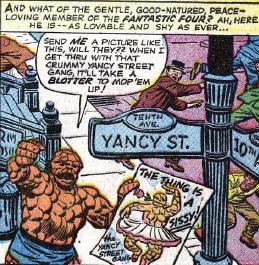
"You just show that your first-person narrator was actually in an insane asylum and then OH MY GOD, did it actually happen? Who can say? Here, I can say. It didn't happen because your narrator was just no good. Listen. Never lend an unreliable narrator money."
In most narratives, there's an element of trust that the person telling you the story is telling the truth, at least as far as they know it. This trope occurs when that convention is discarded. The narrator's facts contradict each other. If you ask them to go back a bit and retell it, the events come out a little differently. It can be like dealing with a used-car salesman — there's a real story in there somewhere, but you're left to piece it together through all the lies, half-truths, and mistruths.
Reasons for the unreliability vary. Sometimes the narrator is a guilty party and is trying to mislead the audience as well as the other characters. If the narrator is insane, it's Through the Eyes of Madness. If the narrator has honestly misunderstood what's going on due to naivety or inexperience, it's Innocent Inaccurate.
As an author, this is a difficult trick to pull off. It is a lot easier to tell a straight story than it is to deliberately mislead the audience, never mind that it violates the traditional assumption that Viewers Are Morons.
One common technique is to use a Framing Device, so that the narrator is presented as a character in the frame story, to emphasize that he is not actually the author. Another, even trickier method, is the Literary Agent Hypothesis, where the narrator is supposedly relating things that happened in Real Life. Multiple unreliable narrators results in Rashomon-Style. If it's a visual medium and the picture contradicts the narration, it's an Unreliable Voiceover. This can also be used as a trick in commercials, to evade claims of false advertising by having an unreliable character do the talking.
Unreliable Expositor is a variant with less than credible exposition from specific characters, as opposed to narrators of the whole story. Contrast Maybe Magic, Maybe Mundane where the evidence is reliable but insufficient, and Infallible Narrator, when the narration is far more accurate than the character giving it ought to be capable of.
This can also be a source of humour for the work, too.
A specific sub-trope of this is Written by the Winners - the Unreliable Narrator is the one in power.
Note that this is specifically for narrators within the work. When it's the author that's lying, that's Lying Creator. When the author simply can't make up his mind, that's Flip Flop of God.
Note: as this is often a particularly subversive Reveal, REALLY BIG spoilers ahead, especially in the Literature section. See also Rashomon-Style, The Mouth Of Madness and Unreliable Voiceover.
Examples:
open/close all folders
Anime and Manga
Being the Animated Adaptation of the light novels, Kyon from the Haruhi Suzumiya anime certainly qualifies. At the end of each episode, in the original 2006 summer broadcast, Haruhi always indicates the number of the next episode by its chronological order, while Kyon corrects her every time with the episode number based on the broadcast order (and for the one episode where the numbers actually match up, he then corrects himself and apologizes). Both are replaced with Nagato delivering a deadpan tie-in to the next episode, in both the DVD release and expanded 2009 broadcast.
There is also his stupefying habit of mixing narration with dialogue in language and terms that no high-schooler uses; and tendency not to tell the readers what he has figured out previously until the reveal.
In Ghost in the Shell: Stand Alone Complex, the episode Poker Face entirely takes place in a small shack at the side of some large event, where Cold Sniper Saito and some other police officers play poker during their break. When the other players ask him how he got so good at bluffing, he tells them the story how he met the Major while he was a mercenary sniper who killed most of her patrol during a UN mission in Mexico. Since both the plot and the story within the story are all about bluffing, it's entirely unclear if anything was true at all, and there are lots of small details that are inconsistent with information from other episodes.
Genma Saotome from Ranma ½. Any time he tells a story you just know that isn't how it really happened. This goes double for Happōsai. And Cologne. And the principal. And Sōun (ESPECIALLY Sōun). Heck, point to just about any important adult in Ranma ½, and it'd be easier to list the things they claimed that weren't total BS.
Jack Rakan of Mahou Sensei Negima! is kind of like this whenever he relates any sort of Back Story, tending to massively exaggerate his own importance. That said, what he says is usually accurate... he just leaves out enormous chunks of the story because they don't involve him.
In Love Hina, Kitsune starts explaining Naru's past, and says that Naru and Seta were in a Teacher/Student Romance at the time. She then immediately states "If that had happened, it would have been interesting."
The narrator in the Japanese dub of Axis Powers Hetalia is extremely reliable. She gives all of the facts straight without cease. The English narrator, however, does not. While she still gives correct facts and has serious moments, most of the time, she is very snarky, sarcastic and witty.
Narrator: Polish horses never charged German tanks at the battle of - right, anime fans. Germany invaded Poland in '39 - right, American fans. Poland is a country, in Europe!
In the Death Note anime, Mikami himself, rather than an omniscient narrator, narrates his flashbacks. He thus has an unfavorable view of his mother's advice to stop fighting against the bullies, whereas the manga's narrator noted that she was motivated by genuine concern for his welfare that was largely lost on him.
According to Word Of God nearly every installment in the Macross franchise is in fact an in-universe dramatization of the events depicted made several years after the fact. While the Broad Strokes of what happened is usually correct certain elements are tweaked somewhat due to Rule Of Cool, Rule of Drama, or just the contemporary poltical climate.
In early episodes of Slayers, Lina's narration of the previous episode's events tends to paint herself in the best light possible, to the point of, say... practically ignoring destroying almost a whole village. Lina is no more reliable as the narrator of the novels.
Ii-chan of Zaregoto forgets important details, frequently. He even neglects to tell the readers how he disguised the second murder in The Kubishime Romanticist as a suicide.
The protagonist to the manga Kami no Kodomo; a sociopathic serial killer who depicts himself as a messiah-like figure.
In Naruto, whenever Tobi tells a story, trust that half of it is a lie, or all of it is a lie. Such as him being Uchiha Madara or not being responsible for the Kyuubi Attack.
Comic Books
In addition to all the below examples, it should be noted that Comics are the easiest medium to accomplish this in, since you can have the narration saying one thing above the panel and the panel show what's really happening, whereas in Film, Western Animation, and Live TV you might have the narrator's speech conflict with the scene, nessessiting a more "flashback" style to show this. It is very common to have a narrator say one thing and the below panel completely contradict it.
It should be obvious at the beginning of Earth X that Uatu the Watcher is an unreliable narrator: he's an alien from a culture that has very different values from humanity's. It should be further obvious when Uatu does things like object to World War II on the grounds that "humanity was not yet ready for a master race". But most readers were used to Uatu's style of narration and problematic "neutral" moral stance from What If?, so Uatu manages to carry on the illusion that he's a friend of humanity for several more issues.
Rorschach in Watchmen is a good example of this, especially when he talks about himself. The artwork actually uses an unreliable framing device (one of many the work contains) to show "Rorschach" in the first person and Walter Kovacs in the 3rd person (walking around in the background of the same chapter), leading to The Reveal. This both misdirects the audience as to who Rorschach is behind the mask, and contributes to the sense of Rorschach's disconnection from "the man in the mirror", so to speak.
Ed Brubaker's Books of Doom miniseries tells the origin story of classic Marvel Comics supervillain Doctor Doom, seemingly narrated by Doom himself. However, at the story's end, it is revealed that the narrator is actually one of the Doom's Doombots, telling the story that Doom has programmed into it, leaving to question how much of it was true.
The Strontium Dog revival used this as a retcon: the authors claimed that the classic series was folklore, and the new series was closer to the 'truth'.
Lost in Space was similarly retconned in a '90s comic book. The goofy aliens from the TV show were said to be Penny's interpretations. For example, one that was depicted as a giant carrot was "really" a tentacledEldritch Abomination.
Word Of God states that Delios of 300 is an Unreliable Narrator; all of the supposed inconsistencies with actual history are actually bare-faced lies, with Delios stretching the truth about who did what and how many there were. This naturally justifies the comic's explicit use of Rule Of Cool and Refuge in Audacity.
Calvin And Hobbes. Calvin's six year-old imagination has the tendency to run away with him, resulting in spectacular fantasy sequences featuring characters like Spaceman Spiff, Stupendous Man, and Tracer Bullet. Then, of course, there's Hobbes himself, Calvin's stuffed tiger to whom he attaches a personality. Hobbes is even drawn differently when other characters are in the panel, to reflect how they see him as just a toy. Word Of God is deliberately mum on whether or not Hobbes is just a stuffed toy, or really somehow alive. And then there's the storyline where Hobbes ties Calvin to a chair and Calvin's dad finds him and can't for his life figure out how the heck Calvin has managed this...
Recent issues of The Boys have been about the backgrounds of other members of the eponymous group beyond Wee Hughie. Mother's Milk was relatively straight forward. Frenchie's was... not. This is partially justified by Frenchie being craaaaaaaazy.
The Scott Pilgrim series. It's revealed in the final book of the series, Scott Pilgrim's Finest Hour that Scott's memories of his past experiences with his ex-girlfriends were altered by Gideon Graves, meaning some of the events shown in the previous books may/may not be entirely false
John Constantine from Hellblazer tends to get unreliable, especially if he's depressed or drunk. If there was a scene where he actually didn't see it (but we readers do), he will tend to second guess everything and can only imagine what could have happened. Although not an accurate description, John's gory imagination makes up one hell of a comic panel.
Done in Steelgrip Starkey And The All-Purpose Power Tool via thought balloons and dialog from Flynn "Flyin'" Ryan . Although he's secretly the tool's inventor and the mastermind behind Mr. Pilgrim, his thoughts often read like he's unaware of the big picture. Done particularly egregiously when he and a cohort are making plans, and he still refers to Mr. Pilgrim in the third person.
Iron Man: I shtood my ground, but it wash too late! The Shweathogs got him...
Captain America: "Sweathogs"? I thought Pez Dispensers were chasing you!
Iron Man: Thash the weird part...
Vincent Santini, the narrator from Brooklyn Dreams, tells us in the first page he can't remember much from his past, so he'll tell us the best he can. The whole story is him telling us about his life the way he wants to remember it. He even says "I'll weave you some lies about my life, and who knows they might be true."
This is one of the rules governing the stories in Mouse Guard: Legends of the Guard.
June states that the stories can be neither "complete truths", nor "complete falsehoods." Exactly how much of any given story is true or false is left as an exercise to the reader, and they vary from the relatively plausible (a story of brief and unlikely companionship between mouse and bat), to the truly outlandish. (A mouse king who rode into battle upon a weasel, a Guardmouse who saved a town from a flash flood and drought by swallowing the flood waters than spitting them back out to serve as a reservoir.)
Amusingly, one of the most plausible stories — a play on "Androcles and the Lion" in which an African mouse manages to befriend a lion that's impressed with its bravery and resourcefulness (pulling the thorn out of the lion's paw is in there, but is outright established to be a secondary factor at best) — is discarded out of hand because the North American mice of the series have never seen or heard of lions or hyenas before, as well as the fact that it's told by a known lunatic who claims to have heard it from a beetle, which aren't talking animals in Mouse Guard.
Iron Man villain the Mandarin. A recent Annual had him telling his life story to a film maker, with the captions showing his way of the events, and the panels showing the complete opposite.
"Banjo Lessons": A man narrates, in increasingly detailed flashbacks, the circumstances that led him to have a psychotic break and murder his friends. He claims it's due to his suppressed rage over an incident where they killed and ate a dog while on their hunting trip, but a court sees through him and realizes the truth - "Banjo" the dog was actually their (black, while the men were white) hunting guide.
"Me An' Ol' Rex": A mentally disabled hick boy is beaten by his abusive father, but finds solace in "Rex", his dinosaur friend. Rex eventually grows bigger and begins eating people who the boy feeds to him. The boy eventually commits suicide because he knows he'll be blamed for the people's disappearance. We then discover that "Rex" is not a dinosaur, but his father, who was driven to cannibalism when locked in the shed for the boy's own protection. The dinosaur story was his delusion or lie.
Fan Works
Elspeth of Luminosity narrates the second book, and whenever under Allirea's power sees her as "not important". This leads to glossing over some important dialogue, with a little Unspoken Plan Guarantee.
The museum curator from The Courier Who Had Cheated Death averts this trope. On one hand, every detail from the story he told was true. On the other hand, he was the murderous psychopath from the story, and the 'display dummy' he mentions offhandedly is implied to be another of his victims.
Hunting The Unicorn makes liberal use of this—though there isn't any intentional misleading, there are two instances that make use of this for huge impact: "The Hunters" reveals that Blaine isn't a virgin, and it's elaborated very painfully in the following chapter. "The Butterfly" is where David tells a counselor that Blaine has a stalker and has no idea of it.
In the Pokémon fanfic Revenge of the Narrator, the replacement Narrator tells the reader halfway through that everything the original Narrator had said was a lie.
Pipeline is primarily told through third-person limited, using Kevin's thoughts and perceptions of things to tell the story. Kevin's kind of a... self-informed guy, so this has interesting results. He's got the best of intentions, really, but his perceptions of the way Ben is acting towards him are much harsher than Ben means them to, and his irrational dislike of Dexter makes the boy genius out to be the bad guy sometimes when they really have similar values and goals.
In the Batman fanfic A Piece Of Glass, the story is sandwiched together from the POV of the Joker, his Original Character accomplice, Breech Loader, and Batman himself. The Joker sees his demented social experiments as perfectly acceptable. Breech repeatedly insists that morals and sanity are moot points, being a matter of perspective. Neither is sane, but Through the Eyes of Madness both are convinced they are right. Interestingly, through Batman's POV, he's Not So Different...
Similarly, Dogbertcarroll's stories on Fanfiction dot net include one where Xander Harris has a cosmic event happen and gets dropped into the Justice league, literally during a meeting. He describes Batman as being possibly the most sociologically driven man in the DC Universe but also deadly necessary. Of course, this is Xander's viewpoint, and the man has been somewhat unreliable narrating himself, as anyone who's ever watched/critiqued "The Zeppo" can tell you.
All over the place in The New Retcons since for most of the story it's written in the style of the characters writing letters. Including an insane Elly. In the comments for one of the letters, the authors and fans discussed this trope with regard to Liz, and whether she was one about the going after.
Possibly Dominic in Pink Personal Hell And Altering Fate. Early in the story, he tells the reader how bad he has it, such as how his group doesn't bother to communicate with him and dumps half the project on him. However, when he arrives to give a presentation with Gummy attached to his finger (It Makes Sense in Context) they actually laugh with him. Granted, later on, the mirror shows moments he'd rather not see...
One thing that also makes a bit of sense with the story's main twist is Pink Personal Hell is revealed to be In Medias Res to Altering Fate - it can be read in a way that Dominic is remembering his so-called "Pink Personal Hell" during the events of the "Altering Fate" narrative from his perspective - which still plays true to this trope as Dominic glosses over a lot of events.
The Kid Stays In the Picture. Robert Evans acknowledges that the documentary is colored by his point of view of the events in the film, with a title card stating:
"There are three sides to every story: my side, your side and the truth. And no one is lying. Memories shared serve each one differently."
The movie Sucker Punch embodies this trope, since almost all of the movie takes place just as the protagonist is having a lobotomy. Made all the more weird because we're not quite sure who the narrator is.
Detour. It's implied that the main character Al Roberts is coloring events to make himself look sympathetic, and to make Vera seem more like a vicious Femme Fatale.
American Psycho. Patrick Bateman even lampshades: "Here is an idea of a Patrick Bateman, some kind of abstraction, but there's no real me, only an entity, something illusory."
Mad Detective. Bun claims that he can visualize people's inner personalities but it's never clear whether it's an example of his madness or a legit supernatural power.
Snake Eyes features several flashbacks narrated by several characters in an attempt to reconstruct a crime, and every flashback replays through a continuous, first-person point of view shot. One such flashback is completely untrue, as it is narrated by the (unbeknownst) criminal.
Implied in Bunny and the Bull. Stephen, the main character, is retelling the story of a road trip from his perspective- vital pieces of information are left out or glossed over, not to mention the fact that he sees hallucinations in his house but doesn't realise they are not real until the end of the movie, so by consequence, neither does the audience
The Usual Suspects. Agent Kujan spends the course of the movie listening to Verbal tell his story, then rejects portions of it as lies. The problem, of course, is that he rejects the WRONG portions.
The premise of Rashomon is that the story is told from four different points of view, all of which disagree, and all of which are unreliable, due to each character having a reputation to protect. The ending at least gives us the truth about what happened to the dagger, but with a very different motive than what the viewer might have assumed.
The Cabinet of Dr. Caligari reveals in the end that the man who has been telling the story is in fact an inmate of an insane asylum, and the entire movie never happened; he just made it up based on the people around him.
Fight Club has the unnamed narrator who turns out to have a Split Personality disorder and is also Tyler Durden.
Nearly every joke in Mating Habits of the Earthbound Human relies on the alien narrator misinterpreting human behavior.
In Blade of Vengeance, the narrator is the female love interest. Her narratives are usually really weird. At the end of the movie, she's seen smoking opium, which explaining a lot.
An early example of this occurred in Alfred Hitchcock's Stage Fright, which opens with a flashback narrated by one of the characters who is lying to another character to obtain their help.
The plot of Hero consists of the same story being retold three times with major differences: Nameless' BS story he told so that he could get an audience with the Emperor and have a shot at assassinating him, the Emperor finally calling Nameless on his BS and telling what he thinks really happened, and Nameless finally admitting what REALLY happened just before he tries to kill the Emperor.
In the Korean horror/suspense film A Tale of Two Sisters, this trope only becomes apparent at the end. It starts out fairly normal, with two sisters returning home to their father and stepmother. It starts to get confusing, with the unexplained appearance of some wraith-like girl under the sink, various objects and people disappearing and reappearing without explanation, and all sorts of contradictory information. Eventually the stepmother murders one of the girls, only it's revealed immediately after that it never happened. It turns out one of the girls was pretending to be both herself, her stepmother, and her sister. The sister who was supposedly murdered had died a long time ago in an accident, and the stepmother was simply the nurse taking care of the two when said accident happened, which the girl blames for her sister's death. Are youconfused yet?
Big Fish has an unusual take on the Unreliable Narrator, in that the flashback stories are assumed to be pure fiction for most of the movie and the twist is that the father may actually be more reliable than was thought. The appearance of the twins, Giant, and Ringmaster at the father's funeral clearly leaves the son reeling as he reassesses his father's stories for where exactly they diverged from the truth. The reality is only slightly skewed from his stories, i.e., the Siamese twins are actually just regular twins from Siam, the giant is a 7'6" man, and so on.
Aqua Teen Hunger ForceColon Movie Film for Theaters: After the opening movie theater parody, the story supposedly begins millions of years ago, in 1492, at 3pm, in Egypt. Then a modern airplane flies by. It turns out this is a story Master Shake is telling Meatwad, and to make it worse, Meatwad is in the story. In fact, pretty much every character in this film is an Unreliable Narrator.
The Fall plays some fun games with this trope. It is a film of two levels, stories within stories - a girl in a hospital listens to stories told by a bedridden man, and we see her visualisations of the stories he tells. Trouble is, they don't share identical internal dictionaries. One great example is that he talks about an Indian and his squaw, but the girl, who was friends with a Sikh, imagines a bearded subcontinental man in a turban. The Fall also features a classic example of In-UniverseCreator Breakdown.
Memento. Lenny may be trying to report accurately, but his grasp on the real past is, to put it mildly, highly questionable.
Played straight, for laughs, and for drama in Forrest Gump. The naive Forrest incorrectly describes events he witnesses through his life. Notable examples: He believes that Charlie was someone specific that the Army was looking for, as opposed to the code name for the Vietcong, and Apple computers was a fruit company, even though he made a fortune by investing in them on Lieutenant Dan's advice.
Joker in The Dark Knight provides differing accounts for how exactly he got his scars, leaving you wishing he'd have more chances to terrorize victims with more colorful variations.
The film Secret Window, Secret Garden, (based on Stephen King's novella, which is narrated in third person) the narrator is stalked by a psychopath who accuses him of plagiarizing his book, and who attempts to frame him for several heinous crimes. In the climax, it is revealed that the narrator has been driven to madness over his guilt for plagiarizing a classmate in college, and is unconsciously committing the acts for which he thinks he's being framed. The stalker does not exist outside his own mind (although the novella hedges a bit on this point).
Bubba Ho Tep. The stories Elvis and JFK share about themselves and how they ended up in a Texas nursing home are VERY speculative and unreliable.
Jack Crabb (Dustin Hoffman), in Little Big Man, is quite likely one of these. In the original novel by Thomas Berger, the historian who transcribes Crabb's narrative expresses the opinion that most of his supposed exploits are pure malarkey. There are hints, however, that the historian may himself be something of an unreliable narrator.
While it didn't have an unreliable narrator itself, the 2007 Beowulf implied that the original poem was a false account of the events as told by Beowulf himself.
Likewise, his account of why he lost a swimming race is stated to be at the very least exaggerated, when his friend mutters that last time he heard the story, there were less sea monsters in it.
The events of The New Guy seem to strain the limits of Willing Suspension of Disbelief. At various points throughout the movie (eg: immediately after the scene with Danielle trying on swimsuits), however, the audience is reminded that we're seeing the story through the eyes of an arguably-insane convict.
In High Tension (originally Haute Tension), a French psychological thriller, Marie, a resourceful young woman is trying to save her best friend, Alexia, from an insane serial killer who murdered Alexia's family before kidnapping her. The twist: Marie is the serial killer. The Killer is an alternate personality that Marie created in order to live out a disturbing fantasy: Alexia will fall in love with her savior and stay with Marie FOREVER.
The main story of Road Trip is told through the eyes of Barry, a campus tour guide who's not playing with a full deck. As such, the story has some highly improbable elements. Lampshaded when he is telling the part involving the girls' locker room.
In Swimming Pool the novelist protagonist spends most of the movie dealing with her publisher's daughter's bad habits including murder but, at the end, we learn that the publisher's daughter is a completely different girl, leaving us wondering who the girl was, and if she existed at all.
I Love You Phillip Morris: Steven, the voice over, is always hiding information and lying about information in the voice over.
In the musical film, Grease, Danny and Sandy sing about how they met each other during the summer holidays to their friends, unaware that they are both going to the same school. Sandy sings about how Danny was such a sweet guy and describes their romantic evening, whereas Danny shows off about making out with Sandy and saying that she was "good, if you know what I mean."
In Election, the narrator describes how a character ruined his friend's life and then states that he doesn't blame the character and that his friend had to bear the responsibility for his own actions. Nevertheless we see that he strongly dislikes the character and this informs the behaviour that sets the whole plot in motion.
In Maybe Baby, Lucy writes in her dairy "I remained very cool". Cut to the scene, where she's babbling away about a sequel and making a complete idiot of herself.
Clue uses this to make the various Multiple Endings equally plausible, as the butler doing the majority of the exposition is variously an FBI agent conducting a sting and/or Mr. Boddy himself.
Played for laughs in Rango. The owls at the beginning say that the main character is going to die. At the end, he survives the movie and then the owls claim they were telling the truth, he will die...eventually.
Eternal Sunshine of the Spotless Mind: Joel. A great portion of the film is told through Joel's memories of events he experienced with Clementine, but the unreliability of those memories is shown on at least two occasions. When Joel first arrives home the night of the erasure, his neighbor chats with him about Valentine's Day. This is then the first substantial memory about Clementine that gets erased. But while this event took place just a short while (maybe an hour at most) before the erasure, it is shown that Joel is already incorrectly remembering what his neighbor said to him. Other less obvious hints abound (e.g., Joel remembering childhood events while being adult in appearance). Taking the imperfection of human memory alongside whether Joel considered a given memory as enjoyable or upsetting, the audience ought to wonder if what they're viewing is what actually happened, or if Joel's memories are distorted, exaggerated, or embellished because of the passing of time and because of his emotional state at the time of the event.
Inverted in Braveheart where according to the film, historical inaccuracies can be explained by history itself being the unreliable narrator (having being written by the winners)
In the song "I Remember It Well" from Gigi, Maurice Chevalier's character claimed to remember a past meeting with Gigi's grandmother perfectly, only to be contradicted by her in every detail.
A probable example occurs with A Christmas Story, which is told as a likely 40-something-year-old man recalling events from when he was 9 or so. This explains such improbable details like the massive snow mountain present in the department store that would be impossible to store the other 10-11 months out of the year and the fact that their hillbilly neighbors apparently had hundreds of bloodhounds.
Spirit Stallion Of The Cimarron goes on great lengths to show that Humans Are Bastards, that horses are enslaved by us, and that they should be free. Humans in the parts where the protagonist is broken in and forced to pull a train down hill are depicted in a negative manner while the parts where he's with humans that let him mostly do whatever he wants are portrayed positively. This movie is told from the point-of-view of a wild stallion who has had no contact with humans in his life, suddenly becoming captured by them.
Flourish stars Jennifer Morrison as Gabrielle Winters, a tutor who is brought in for questioning in the death of her sixteen-year-old student, Lucy. She tells the entire story to the police officer questioning her, and when she finishes, the police officer asks her how she could have spoken about events she wasn't present for. It's then revealed that Gabrielle is actually in a mental hospital, and the police officer is a psychiatrist. Prior to the story, Gabrielle was in a car accident that caused her brain trauma; as a result, she has frequent memory lapses and unconsciously fills them in with fictional details (sharp viewers will notice that one of the suspects in Gabrielle's story is played by the same actor as the man questioning her). Gabrielle overhears the psychiatrist talking with someone else and comes to the realization that she has made up nearly everything she said. However, the psychiatrist also notes that Gabrielle did correctly guess a lot of the details, leaving it up in the air how much of her story was actually true.
North seems to know that other parents use him as a reference as how their kids should act to be a perfect child. It also doesn't help that most of the movie about his exports is all a dream. And despite stating he is intelligent, everyone aside from the middle class white American family are a bunch of jerks and racial stereotypes.
Fear Island is told through flashbacks during a police interview with the sole survivor of a teenage slaughter. It's not until the survivor's parents show up that : the police realize the narrator was lying about which person she is and that she was actually the murderer all along .
The main issue in Eve's Bayou hinges on the fact that two characters have very different memories of an event and another character reacts to the probably false version with fatal consequences. Cisely admits near the end of the movie that she isn't sure what happened, long after she tells Eve that their father molested her. Eve then tries to kill her father, only finding out much later that he may not have done what he was accused of.
Jack Harper from Oblivion 2013 has no memory from before he began his current job - his Opening Narration is entirely based on what Sally tells him (and Sally herself is an Unreliable Expositor). Even better, for the whole first act of the movie, Jack, Vicka and Sally are the only characters with lines.
Literature
Most of the characters in Animorphs, especially early on, aren't capable of recognizing their own character flaws, and their narration is reflective of this. Furthermore, sometimes the kids just straight-up lie about things - see Literary Agent Hypothesis. For instance, in The David trilogy, Jake says it's been a couple months since Elfangor's crash. Dialogue, however, hints that the story arc takes place much later, and it's confirmed late in the series that the David trilogy takes place maybe two years after the crash.
If one is familiar with the events of I'm Alan Partridge (and to a lesser extent the other Alanified series), the hideous unreliability of Alan as narrator in his predictably self-serving autobiography I, Partridge: We Need to Talk About Alan is glaringly and hilariously obvious. Instances of Alan's cowardice, selfishness, incompetence, unpopularity, borderline sociopathy and general loathsome inadequacy as a human being are turned by Alan into tales of towering heroism. Alan's in "reality" humiliating encounter with Tony Hayers in the BBC restaurant is somehow turned into a moral victory for Alan, and his encounter with stalker Jed Maxwell becomes a surreal, OTT Bond-esque fight scene with a well-muscled Alan beating Jed to a squealing pulp (instead of, as "actually" happened, Alan being physically humiliated, somehow sweet-talking his way outside and then fleeing in terror).
In a children's book re-imagining of the Three Little Pigs, the Wolf details how every instance was a mistake or misunderstanding. Still, the pictures with the text — and the Wolf's shifty tone — can lead even a small child to doubt the veracity of his claims that he is the victim. Specifically, there's the fact that he just "had" to eat the pigs when unfortunate (and completely not his fault) events killed them because "why waste them?" Granted, the Wolf is telling his side of the story. It is possible that the more traditional story was the lie. Add this to the fact the Wolf is portrayed in as The Woobie and the Pigs... are well... pretty much what you expect from pigs. Granted this is coming from the guy who was in a 2nd grade class that held a mock court for the Wolf and we gave him a "Not Guilty" verdict.
The Name of the Wind by Patrick Rothfuss is written largely as a flashback told in the first-person perspective by the main character, Kvothe, and there are hints that it's not wholly reliable. One of Kvothe's companions remarks that a certain woman who shows up frequently in the story (and is the object of Kvothe's affection) wasn't as beautiful as described, among others. He actually says a character won't shows up, but uses Exact Words to lie.
Agatha Christie:
"And Then There Were None": at one point, the actual murderer, Judge Wargrave, is described as being surprised when the person who wrote the letter inviting them to Indian Island isn't at the island to greet them — and the narrator's little peek into the character's thoughts reveals (or seems to reveal) that the character's surprise is genuine.
"Endless Night" - Michael talks about meeting the love of his life, a rich heiress, marrying her, fighting with her best friend, building their dream house, only for her to die mysteriously... and then you find out that all of that was a lie, because he's the murderer and his true love is the best friend, who he's known since before the story.
There is a pileup of these in the original Frankenstein. The book is structured as an Epistolary Novel, in which the explorer Robert Walton writes to his sister. Then, he finds a certain Victor Frankenstein, who tells the story of how he created a monster and how it ruined his life. At one point during Victor's narration, the monster runs away to eventually come back and tell Victor the story of how he lived while he was away. During the monster's narrative, he overhears a character he has been stalking while said character is explaining how he eloped with his beloved. So the reader is following a plot where someone is telling to someone else that someone told them that someone said... you get it, right?
Notwithstanding, the major reason why these narrators are unreliable is lack of information, rather than any willingness to misguide the reader.
Although Victor's narrative is definitely biased against the monster.
The monster is suddenly a gentle philosopher supergenius polygot when he tells his own story, though in everyone else's bits we see him do basically nothing but wander around, break stuff, and get things by threat of violence, and he shows little capacity for, say, reading Frank's notes and replicating the experiment rather than threatening to murder everyone the guy's ever met if he doesn't make a female himself.
In The Exorcist by William Blatty, a young girl seems possessed by a presence who claims to be the Devil himself. Various developments point more toward a demon called Pazzuzu, but the main and central premise of the novel is that we NEVER fully get proof that there is ANY foreign entity sharing the mind of the young girl. It could all be explained away as (admittedly paranormal) activity originating ONLY from the girl's mind. This horrible doubt is perhaps the central theme of this very powerful and disturbing story - that the hellish narrator inside Reagan... is only Reagan herself. From there, we are forced to ask (along with the main character) do demons really exist? Hell? God?
Fight Club has the unnamed narrator who turns out to have a Split Personality disorder and is also Tyler Durden. He doesn't realize he's unreliable until two thirds of the way through the book - and when he finds out and tries to convince everybody else, no one believes him.
In The Moth Diaries, the entire story revolves around the unnamed narrator not being reliable. You get to work it out for yourself, because you don't actually find out whether Ernessa is a vampire or not. There are also some very interesting deaths in the plot, and it's fun to work out whether they happened and how much of it was psychosis.
In Illuminatus!, the narrator's identity is kept secret throughout most of the series as it meanders back and forth through time, through the viewpoints of various characters, some of whom do not actually exist, and through a web of hallucination, myth, and deception.
R.A. Wilson's novel The Masks of Illuminati gives a human narrator, Sir John Babcock, who is fairly reliable, albeit emotionally loaded when it comes to his own experiences, but he keeps narrating events that he didn't personally witness without a hint of suspicion or doubt despite of how incredible they are. Most of them aren't even remotely true.
Chaucer used this technique in The Canterbury Tales (the "Merchant's Tale", and, to a subtler extent, the General Prologue).
Too Many Magicians does this brilliantly. When a major character is examining a crime scene in the very first scene in the story and notes that a trace wasn't left of the killer, the author doesn't mention that the novel is opening just a few seconds after the character committed the crime.
The children's book The Stinky Cheese Man and Other Fairly Stupid Tales combines an Unreliable Narrator with No Fourth Wall: First, Jack the Narrator spoils the ending of "Little Red Running Shorts", prompting the characters from that story to quit in disgust. Then, Jack's narration of his own story, "Jack's Bean Problem" is immediately interrupted by the premature arrival of the Giant. When the Giant threatens to eat Jack if he can't tell a better story, Jack launches into a recursive story in which the Giant threatens to eat him if he can't tell a better story, so Jack launches into a recursive story in which the Giant threatens to eat him if he can't tell a better story. The giant also says that even if Jack tells a better story, he'll still eat him anyway (ho, ho, ho), leading to the looping story.
This is the main trope of the Baron Munchausen stories, both in the original 18th century novel or in any of the various later pastiches. The Terry Gilliam film The Adventures of Baron Munchausen has the final twist that some of the outlandish things he claims are, apparently, true - or at the very least, the Turkish army did lift the siege of Vienna for some unknown reason connected to the Baron, which is good enough for the crowds who had been listening to him.
Edgar Allan Poe practically invented this trope, at least in western literature:
In "The Cask of Amontillado", the narrator claims that he is getting revenge on his nemesis Fortunato for a monstrous insult. However, Fortunato seems to trust the narrator and thinks that they're friends. The narrator never specifies exactly what Fortunato did to him, leaving the question of Fortunato's exact fault (or even the existence thereof) open.
"The Tell-Tale Heart", which has the narrator, who claims at the very beginning that he is not mad, murdering a man and putting him under the floorboards but giving himself away because he imagines his victim's heart is still beating. This story is often used to introduce students to the concept of unreliable narrators in general.
"Ligeia," in which the narrator admits that he is under the influence of "an immoderate dose of opium," leaving the reader to wonder if the events of the story are really happening or if they're simply being hallucinated by the narrator.
The eponymous narrator of "William Wilson" has been oft suggested by literary critics to be insane, or at least suffering from multiple personality disorder and severe schizophrenia.
Daniel Defoe's fictional memoir Moll Flanders is an early case of a narrator who is unreliable on more than one plane. Superficially, Moll puts herself in the best possible light no matter what, either by glossing over the enormousness of her crimes or by blaming the victims, but her story is also logically inconsistent and ahistorical. She leaves her purportedly well-loved children in Colchester in the 1640s - in other words, in a war zone - to traipse off to America on a whim. Her "older brother", with whom she inadvertently commits incest and has a child, must be younger than her if her mother's story is true. Despite living in London in the 1660s, she does not recall the Plague, the Dutch invasion, or the Great Fire.
Fanny Hill also features an unreliable narrator. Fanny's description of prostitution is wildly unrealistic even for the 18th century. Some also see her Convenient Miscarriage as a lie told to cover a Convenient Abortion, as Fanny had been recently deserted by her patron and was broke, owed an astronomical sum to her landlady (an abortionist), and had no way to earn money outside of prostitution - impossible while pregnant in the 1740s. Keep in mind, though, that Cleland wrote Fanny Hill so he could pay his way out of debtor's prison, and he may have written the story based on unrealistic and melodramatic "life stories" told to him by the prostitutes he met in prison which he wasn't experienced enough to see through. In other words, Fanny may have been unreliable despite the writer's intentions, not because of them.
spoiler"This is a true story. I was there. When I wasn't, and when I didn't know exactly what was going on — inside Gurgeh's mind, for example — I admit that I have not hesitated to make it up. But it's still a true story. Would I lie to you?
John Dies at the End is mostly narrated by one protagonist, David, and the majority of the book involves David recounting unlikely supernatural adventures to a reporter. A small part of the book (involving important events that the narrator didn't witness firsthand) is instead told by David's best friend, John, and this portion has a suspiciously high occurrence of backflips, as well as a chase scene that John resolves by "stealing a nearby horse". As David points out early on, "If you know John, you'll take the details for what they're worth. Please also remember that, where John claims to have 'gotten up at three-thirty' to perform this investigation, it was far more likely he was still up and somewhat drunk from the night before." David himself even admits that his version of events is only "mostly true." And let's not forget, The title is a bald-faced lie.
I did it according to this equation:
l = E x ∞
Which can be translated as "One small lie saves an infinite amount of explanation." I use it all the time. I've used it on you already.
An Instance Of The Fingerpost has several narrators, all of whom are various varieties of Unreliable Narrator. One is insane, one is a xenophobe who imputes his own nasty motives on to others, one is relatively accurate except where his own identity is concerned, and one is actually a nice guy, but whose perceptions are shaped by the prejudices of the time.
Agota Kristof's first Trilogy (The Notebook, The Proof, and The Third Lie) rides this trope like a pogo stick on your spine. It is really an artform the way each of the twins can lie. Even in the first book where they set in conditions that would make it impossible for them to be untruthful about anything they write in the notebook, they still manage to dupe everyone around them - and the reader - more times than could ever be counted. By the end of the third book, it ultimately becomes impossible to tell what about what actually happened due to the web of lies that both Lucas and Claus managed to weave.
Daniel Handler's The Basic Eight is told as the recovered journal of Flannery Culp, a girl in jail for the murder of a classmate... as being edited by the same girl for publication. This, coupled with the "poor me" attitude she expresses in the intro, forces the reader to be constantly second-guessing her, noting things that she may be altering to make herself look better. At one point, she believes the killer to be a third party... who turns out to be her imaginary friend. This also means that another character has been present for nearly the entire book, but Flan never saw her.
Vladimir Nabokov's Lolita has a similar structure: the story is told by Humbert Humbert from prison, and, addressed to the "ladies and gentlemen of the jury", is intended to act as part of his defense.
Another one of Nabokov's novels, Pale Fire, deals with an unreliable narrator in Charles Kinbote. But in Kinbote's case, he is not only narrating multiple stories, he is also interpreting (and misinterpreting) the poem of fellow university professor John Shade. But the above is only true if you assume that John Shade is a real person and that he wrote the poem in the novel. Or if you assume that Kinbote is who he says/thinks he is. You might want to also double-check who has claimed to write what part of the novel. It's safe to say that Nabokov loved this trope.
In The Bartimaeus Trilogy by Jonathan Stroud, much of the eponymous djinni's dry wit is based on his (probably intentionally) transparent attempts to cast himself in a favorable light in the chapters he narrates. This includes frequent (and often ironic) references to his own legendary power and cunning, and constant name-dropping of his past masters (Ptolemy, notably, but also Solomon, Tycho Brahe, Nefertiti, Gilgamesh, etc. etc.) This is all the more obvious since the chapters narrated by Bartimaeus are alternated with chapters of third person narrative focused on the POVs of the other two protagonists, Nathaniel and Kitty, often covering the same events from their perspectives.
Especially noticeable on the occasion in the first book in which the events are being told from Bartimaeus's perspective, and he calmly tells Nathaniel to "Just watch and listen." The narrative immediately switches to Nathaniel's (third person) perspective, in which he says "Just shut up and watch!"
Bartimaeus: Faquarl wasn't a sly old equivocator like Tchue; he prided himself on blunt speaking. Mind you, he did have a weakness for boasting. If you believed all his stories, you'd have thought him responsible for most of the world's major landmarks as well as being adviser and confidant to all the notable magicians. This, as I once remarked to Solomon, was quite a ridiculous claim.
Several times, Greg seems to be treated as a Butt Monkey in Diary of a Wimpy Kid. However; numerous times, he's actually being a bit of a Jerk Ass himself. This is one of the examples in which the Unreliable Narrator is actually played for laughs.
The Twist Ending of Life of Pi plays with this trope: At the end of the novel, the narrator offers an alternate (and far more disturbing) version of the events thus far, and tells the audience to choose which story they want to believe.
House of Leaves: Some confusion comes from multiple literary agents, but when you have at least one instance of one of the literary agents messing around with what another literary agent tells you, it goes beyond confusing. One of the narrators, in fact, admits to making up the events of one chapter entirely, and then laughs at you for believing him.
Reams of paper have been written on the narrative technique used in The Brothers Karamazov, which ostensibly makes the narrator out to be a resident of the town, even placing him physically at certain events. It's clear, however, that he knows more than an observer could possibly know, and there are disturbing stretches of the narrative in which the narrator is completely absent, dissolved into the perspective of the characters. This becomes a problem when one character starts speaking with things that probably aren't there, and the critical reader will start to wonder about other times this character supposedly heard things. The real kicker though? The points at which the narrator's reliability are questioned are pivotal moments in the book, moments that affect your understanding of everything that has happened up till then.
Similarly in Demons, though in that novel, the narrator is more explicitly party to its events. He has a name (Anton Lavrentievich G-----v, and he is explicitly addressed by a few characters throughout the text), describes himself as a good friend of Stepan Trofimovich Verkhonvensky (one of the central characters), and acknowledges that he used the spectacular events that ensue as the basis for this, his "first novel." Nevertheless, lots of things are described for which he could not possibly have been present (which he handwaves as having been fictionalized from the characters' accounts, related to him later), and especially the unspoken thoughts and inner motivations of several characters strain the bounds of the Willing Suspension of Disbelief.
Oswald Bastable, or at least E. Nesbit's version of him.
One Flew Over the Cuckoo's Nest. The story is told by Chief Bromden, who is schizophrenic. While the story is supposed to be true, he adds in plenty of insane, paranoid delusions. On the other hand, any student of American History with an understanding of the issues involved in the history of the Plains Indian tribes can see just how accurate the alleged delusions of Chief Bromden are.
But it's the truth even if it didn't happen.
The author, Ken Kesey, played with this idea further in his second novel, Sometimes a Great Notion, which is narrated at various points by at least a half-dozen different people. Each different person sheds new light on (or changes the facts in) previously shared events in a way which reflects their own views and interests, shifting the reader's sympathies in various conflicts several times.
Henry James's novella The Turn of the Screw: Are the ghosts real or simply the narrator's imagination?
Robert Pirsig's novel Zen And The Art Of Motorcycle Maintenance deals, partly, with the unnamed narrator's attempt to stave off the re-emergence of his former "insane" personality, nicknamed "Phaedrus," and thereby protect his young son from sinking into madness himself. However, in the end, he realizes that "Phaedrus" is in fact the saner and more authentic personality, whereas his "normal" self is a facade which has in fact caused his son's mental problems. When he embraces and integrates his Phaedrus-self, father and son are healed and reconciled.
In The Eyes Of My Princess by Carlos Cuauhtemoc Sanchez, you are led to believe that the book is a about a love story that ended in the death of the protagonist's girlfriend. But then, almost at the end, you find out that nothing that happen after a specific event was real. The protagonist wrote fake entries into his diary, because he was disappointed about his crush's real personality.
Gene Wolfe is the undisputed master of this trope. If one of his novels is narrated in the first person it is guaranteed to contain incomplete, inaccurate or just missing information that the reader will have to figure out in order to make sense of the story.
In Book Of The Short Sun, there's one point where the narrator throws himself on the mercy of the reader for having lied to them, then proceeds to retell a completely different version of the events of the previous chapter. Just in case you hadn't figured out yet what was going on.
Some more examples, his Soldier Of The Mist gives us Latro, a Roman mercenary who receives a head injury that completely destroys his short term memory beyond a 10-12 hour window. So the book consists of his adventures where he is constantly re-introducing himself to certain characters, some of whom try to take advantage of his disability. On the flip side, Latro can see and interact with the spirit world, so he often runs into gods and mythical creatures. The polar opposite is Severian, from the Book of the New Sun. He claims to have perfect recollection his entire life. Careful reading will lead the reader to conclude he either does not, or he is purposely trying to mislead the reader, but keeps contradicting himself.
Severian is perhaps the least reliable narrator ever; unreliable because (by his own claim) he is unsure whether he was merely a man doing a necessary job well or a violent sadist, whether he was a rapist or a genuine lover (he should know this by the end, because he has a copy of her personality, memories and thoughts in his head for most of the book) and/or whether he was, basically, the second coming of Jesus or not. The unintentional time-travel incest and meeting between three and five other versions of himself can't help.
The Fifth Head of Cerberus uses this in several forms. The narrator in the eponymous first story spends quite some time in a fugue state resulting in ever-longer growing memory gaps, some of them several months long. The second story is narrated by John Marsch, a character in the first and third stories, who claims to have heard the story from another character (V. R. T.) who might have very good reasons to lie to him. The third story is from John Marschs diary and ties in with the other two stories, but has some inconsistencies that cast serious doubts on the reliability of Marsch as a narrator. A recurring theme in all three stories is the nature of identity (both cultural and personal), and the narrative inconsistencies play a big role in figuring out the overarching mystery.
"Seven American Days" may be the height of this trope in Wolfe's oeuvre. First, the author of the travelogue that makes up the story states at one point that he altered the text for fear of it being read by the American secret police. Second, the author placed some hallucinogen into a candy egg, then mixed up the eggs so he wouldn't know which one was the real one. Then he ate a single egg every night. That means that at least one of his nights of experiences could have been a hallucination. And one of the eggs got stolen, so it was also possible the none of the nights were a hallucination. Finally, at the end of the story, the author of the travelogue's mother, who had been the one reading it (along with his fiancee), calls into question the veracity of the handwriting. So it's possible the entire thing is a forgery, or at the very least important parts.
Likewise, the works of Jim Thompson. A Hell of a Woman is a prime example, wherein the main character's personality splits halfway through the tale and begins telling the story in parallel paths, one an idealistic version of what happened and the other, presumably, the real story.
In Ciaphas Cain novels, set in the Warhammer40k universe, the story is told from the point of view of Ciaphas Cain - and annotated by the Inquisitor, Amberley Vail, who constantly reminds the reader in her footnotes that Ciaphas is an habitual liar, and there are too many holes that can't be backed up by other sources for this story to be taken at face value. There's also some unreliability in the way Cain downplays all of his acts of heroism, saying that they were all just to protect his own skin or his reputation, but Amberly steps in every once in a while to point out that Cain gives himself far too little credit. Sandy Mitchellhas stated that he doesn't know if Cain is the kind-heartedDirty Coward with (very) enlightened self-interest he claims to be, or a genuine hero with an inferiority complex.
An interesting case where this is a minor plot point is the fact that Cain is predominantly concerned with things that happened directly to him. This results in Inquisitor/Editor-In-Chief Amberly Vail having to consult other people's memoirs to fill in Plot Holes, and, as she notes, they tend to have their own problems too. For instance, Jenit Sulla was serving in the the Valhallan 597th (the unit Cain was most often attached to) and is the best secondary record of his actions, but writes in bombastic Purple Prose and portrays Cain as the mighty world-bestriding hero everyone believes him to be, and a book named Purge the Unclean! provides a good overview on the setting and wider conflict in For The Emperor, but the author blames absolutely everything on a conspiracy of rogue traders. And for extra fun, the character editing the books has a tendency to cut out the bits that don't make her, the editor, look good. Which includes (probably) sleeping with the self-confessed coward.
The Dune Encyclopedia about the Dune series is a big example of this. It is framed as an Encyclopedia within the Dune universe, purportedly 5,000 years after the events of the first novel and after the historical record has been greatly altered or lost. Several of the entries either contradict or give a different perspective on the events of the novels. It is up to the reader to determine what account, if any, "really" happened. Particularly interesting is the brief chronological timeline linking "our" time to the setting in Dune. The fictional authors of the Encyclopedia have an idea of what happened in their "distant past" ... but it's heavily filtered through the experience of thousands of years of living in a feudal system of government. World War 2, for example, is referred to as a "commercial dispute between House Washington and House Tokyo" within a British Empire that supposedly ruled almost the entire world.
In Wuthering Heights, there are two main narrators. Mr Lockwood who is telling us the story, and Ellen Dean who is telling him about Heathcliff. Lockwood is shown very early on to be unreliable as he describes Heathcliff as a "capital fellow", only to later learn that that is really not the case. Ellen 'Nelly' Dean herself is full of biased opinions, and is very judgemental of most of the other characters. Since pretty much every revelation in the book is made whilst Nelly is telling Lockwood the history of the Heights, it is a possibility that she just made the whole thing up. She is also unreliable as a character, as she happily spills all of the people who confided in her's personal details and secrets to a complete stranger with little hesitation.
Matthew Kneale's English Passengers is told from the perspective of at least a dozen different narrators. All of their accounts are of varying degrees of reliability, and many are clearly carefully editing or embellishing their stories to make themselves look better or to support their own prejudices.
Elizabeth Peters uses a mild version of this in the Amelia Peabody novels as a form of wry humor. The books are primarily in the first person, and purport to be journal entries. Mild comic irony is created through what the narrator leaves out, misinterprets, plays down, or is clearly deluding herself on.
Atonement: the story seems to end beautifully with the wronged protagonists united idyllically. It is then revealed that the story read so far is written by another character, Briony, who changes the ending to try and atone for wrong she wrecked on the protagonists who really die lonely and apart.
Brilliantly done in Dead Romance, by Lawrence Miles. The Narrator freely admits she has a serious drug problem, and even hangs a lampshade when she takes a time out from describing an alien invasion to muse on the possibility that she's on the worst acid trip of her life.
"Maybe this whole book's just a list of the states of mind I was in when I wrote it, like a catalogue of all the things I've been putting into my system. Paranoia for cocaine. Multicoloured planets for acid. I'll be relaxed again soon, so you'll think I'm writing it on dope."
Where the narrator Mackenzie isn't lying to the audience — just frequently clueless or in deep denial. It's written so that the audience almost always knows what's going on even if she doesn't, which is sometimes subtle (the slow build-up to the revelation about Steff) and other times obvious (her overwrought Foe Yay-based crush on the Alpha Bitch, Sooni).
Additionally, the MUnivers's history is also handled this way; so far, we've heard multiple accounts of the creation of the world, all of which contradict each other. But the kicker is that the gods exist, and semi-regularly involve themselves in worldly affairs, meaning that the gods themselves are Unreliable Narrators.
Done excellently in Jeff Vandermeer's Ambergris books. Shriek: An Afterword features two conflicting viewpoint characters, while City Of Saints And Madmen features stories set in Ambergris, stories written by various Ambergris residents, a story about an Alternate Universe Jeff Vandermeer who gets sucked into Ambergris and goes crazy (or believes he is an author in an alternate universe resembling our own, or just decided to fuck with our heads) and stories penned in the name of various Ambergris residents but actually written by said alternate-universe Author Surrogate. And a couple of pamphlets.
And adding to the confusion, the pamphlet King Squid and the ''Hoegbotton Guide to the Early History of Ambergris" actually were written by real Ambergrisians-Frederick Madnok and Duncan Shriek, to be exact. So whose copy was used?
It's also done to a far lesser extent in the sequel Shriek: An Afterword, which is written by Duncan's sister Janice. She holds that she is offering a balanced yet opinionated account of her brother's life. Duncan takes issue with the first claim, and frequently disagrees with her over the course of the book.
The third book, Finch, averts this. Probably. It's narrated by the main character, John Finch, but there's nothing in the text to indicate that his narration is unreliable. However, Finch goes through so many mind screws, including a couple of literal mushroom sambas and several instances of severe torture, that it's hard to tell whether his own perception is truly intact.
The unreliable first-person narrator of Elizabeth Bear's Blood and Iron is so unreliable that, for the first third or so of the book, she narrates everything in third person, including scenes in which she herself is present. (It works, but this is definitely the Don't Try This At Home school of writing.)
Diana Wynne Jones's The Dalemark Quartet has an unreliable glossary on the history of Dalemark at the back of each book. Much of what it says is straightforward and fills in background to the story, but frequently it puts a slant on historical events which the reader can deduce to be wrong or at least incomplete.
If you're reading an Alistair MacLean novel written in the first person, you're dealing with this trope.
There is a consistency to some of the facts in Only Revolutions. That is, certain events don't change between the two viewpoints the book is narrated from. However, for the vast majority of details, like names and places, those shift even in the same story. Is the Italian cook's name Viatitonacci or Viazazonacci or Viapiponacci? Is he even Italian? I don't know!
Starship Troopers: There are places where Rico is likely describing something that happened to him in the third-person. The biggest one involves the death of the Lieutenant in his beloved Rascak's Roughnecks MI unit, where he describes the Lieutenant saving two privates before being killed. It's hinted that one of them was probably Rico.
Nicely done in an understated way in Dorothy L. Sayers' The Documents in the Case. A series of letters written by each of the main characters to various other people are collected. Each person describes incidents from their point of view, each person showing themselves as paragons of virtue surrounded by fallible fools.
In Dean Koontz's Odd Thomas, Odd specifically says that he was asked to be an unreliable narrator, citing Christie's The Murder of Roger Ackroyd, but indicating he doesn't really want to do that. In the end, though, Odd says that he really has been misrepresenting things; whenever he said he and his girlfriend Stormy were destined for each other, he was speaking as his past self; by the end of the book Stormy is dead and they obviously are not living happily ever after. He handwaves the whole sequence at the end by saying that both his parents are insane, and he expects madness runs in his family.
James Clemens' The Banned And The Banished discusses this trope - the narrator admits that he has told many fake versions of that story, but cannot die until he tells the truth. According to the last book, his many previous versions included but were not limited to giving the main character Incorruptible Pure Pureness, making her actions For the Evulz, and making her an Idiot Hero. The final version is a flawed ordinary person who happens to be The Chosen One.
Holden from The Catcher in the Rye is a good example. The novel is about his downward spiral into emotional trauma, but he doesn't tell the reader this and lies about how he was feeling by making excuses of "just didn't feel like it," or the like.
There is also the fact that most of the things he says shouldn't always be taken seriously, like people like Chapman have. One minute he's putting down the movie business and then the next he's recommending one of his favorites. Usually the people he calls "phonies" sometimes do the same things he does.
"I'm the most terrific liar you ever saw in your life. It's awful. If I'm on my way to the store to buy a magazine, even, and somebody asks me where I'm going, I'm liable to say I'm going to the opera. It's terrible."
At one point in The Things They Carried, the narrator retells a story told to him by the squad's medic, Rat Kiley, prefacing it with the admission that though Kiley's stories always have a basis in truth, they are often greatly exaggerated, stating that "If Rat told you he slept with two women on a particular night, you can be safe in assuming one and a half." At another point, the narrator goes on a long rant about how a war stories' veracity has no relation to whether or not it actually occurred, and goes on to tell a "true" war story that he made up on the spot. He then states that the mark of a "true" war story is that the reader does not care if it is true.
On another occasion, he recounts a story about another of the soldiers in his unit, which he later admits was actually him.
Well, it is postmodern...
Also found in Going After Cacciato by the same author. About halfway through the book, you realize that Paul Berlin is probably still in the observation tower, and the whole story is just a daydream to excuse himself of complicity in the death of Cacciato, who (it appears) the squad killed to hush him up. But again, it's postmodern, so the question is: does any of this matter?
Spider by Patrick McGrath, is narrated by the main character, who is insane. At the end of the book it turns out practically everything he recollected to the reader was heavily warped by his perception. McGrath specializes in this trope. Asylum is another excellent example.
In three books of The Dresden Files so far, Harry's narration is made unreliable by various magical influences. The first is in Dead Beat, when Lasciel's shadow in Dead Beat appears to him repeatedly in the form of "Sheila," a bookstore employee who doesn't actually exist. The second is in Small Favor, in which Mab takes his blasting rod (his weapon of choice in the series up to that point) and places a mental block which prevents him from even thinking about it or fire magic. The third instance is revealed in Ghost Story: in the previous novel, after deciding to become the Winter Knight, Harry set up his own assassination and then had Molly wipe his memory of doing so in order to keep Mab from becoming aware of it.
Robert Irwin's brilliant Satan Wants Me is built around this trope. The narrator, Peter, is a young sociology student who likes sex, drugs and rock'n'roll, studies children's behavior in a school playground, and is attempting to be accepted into a magical lodge. Part of the requirements made of him in Black Book Lodge is to keep a diary for magical purposes, writing down everything that happened during the day. Satan Wants Me is, essentially, this diary - until in the middle of the book we find out that this young sociologist's real object of study are the occultists themselves, and after his cover is blown he keeps on writing the diary just because and because his hand makes him write sometimes.
Robert Bloch's classic short story "Yours Truly Jack the Ripper" is a great example. Set in the modern day, the first-person narrator relates an incident in which a friend of his becomes convinced that Jack the Ripper killed all those women as part of an occult ceremony to attain immortality. He assists his friend in his investigations and helps him track suspects but the big twist is that the narrator himself is Jack the Ripper, and while his friend's theory was correct, he had the wrong suspect. This is revealed in the final line of the story when the narrator, holding a knife, says, "Just call me... Jack!" Bloch never cheats - you can re-read the story knowing the ending, and it remains internally consistent, although it changes from an odd little comedy to a chilling thriller.
Don Quixote is one Unreliable Narrator telling a story received from another Unreliable Narrator to the point that you simply can't know if any of the story really ever happened or is all just fantasy. It gets even funnier when you take into account the non-canon "sequel" that was written by a different author before Cervantes finished the second part.
Played completely straight and even lampshaded: In the very first paragraph, Don Quixote's literary portrait has the narrator NOT telling us the name of Don Quixote's town, and the narrator admits he doesn't know very well if his name was Quixada, Quesada or Quexana. For the people of the seventeen century, this was an infringement of a very well known rule of the literary portrait, and so they immediately had the real impression that the author was a liar. Also, the original author (Cide Hamete Benengeli) and the Translator (an anonymous moor) comment the text when the plot is being implausible, and the second author (Cervantes), constantly remind us that this is a true history. All these tricks show that Cervantes clearly want the reader realizes that this tale cannot be true.
Done very well in The Family of Pascual Duarte, from Spanish author Camilo José Cela. Basically it tells the story of an unnamed editor(1) who finds and corrects the "memoirs" that he found in an old church, adressed to a bishop (2), who made a lot of censorship and correction on them beforehand, by Pascual Duarte (3), who admits that he mixed a lot of facts when writting them, along with the more stealthy: a) non linear narration of the events, b) subjectivization and constant disgression to gain the favor of the reader and c) manipulation of the contents because of real life problems (lack of paper, tripped and mixed the pages, etc.). The purpose of the "memoirs"? to gain clerical pardon, staving off his imminent execution. That's right, guys. An editor who edits an editor who edits the edited version of Pascual's life. It is subtly implied by the end of the book that the real life author in fact "edited" the story himself, making him another step in the long line of editors the book will have (publisher's editors, academic editors, "reader editor", etc.). This, by context, was a sort of Take That to Franquism, along with a few subtle political/social references/criticism (which make a big part of the novel objective).
Wilkie Collins, the narrator of Dan Simmons' Drood, happens to be addicted to laudanum. Not to mention that Charles Dickens mesmerizes him a few pages in and never gets around to unmesmerizing him. Oops!
H. P. Lovecraft's stories are usually narrated from a first-person point of view by said stories' main characters. The unreliability of the narrators may range from becoming increasingly maddened as the narration progresses to seemingly sane persons questioning their own sanity and the quality of their recollections as they recall a horrific experience they lived through. Lovecraft also had a penchant for having some of his stories' narrators narrating from mental asylums. In The Temple, the narrator is a German submarine commander in World War I, who steadfastly refuses to believe in anything supernatural, and instead he's sure that he went insane and became an Unreliable Narrator. Lovecraft loved (no pun intended) to play the Refuge In Insanity card when his characters faced an Eldritch Abomination or related supernatural phenomenon. One could say that a lot of his stories can be a form of this Aesop: "If you ever see the Truth, run. For it has many tentacles."
Corwin, the narrator of The Chronicles of Amber, for almost the entire series is telling the story to Merlin, giving Corwin numerous reasons to distort, add, or omit events. Added to this, Corwin is suffering from amnesia at the beginning of the story.
Played with quite a bit in Patrick O'Brien's Aubrey Maturin series.
Early on the aphorism "Today's wardroom joint is tomorrow's messdeck stew" is introduced. Meaning that anything officers discuss today will be hazily retold by the crew tomorrow.
Usually O'Brien gives both reliable and unreliable versions of events to contrast them, but occasionally only the crew's version will be told. Leaving the reader guessing as to what actually happened.
Ernesto Sabato's On Heroes And Tombs has a self-containing chapter, Report on the blind. It's about a man who believes the world is being controlled by a cabal of blind people and tries to locate their secret lair under the streets of Buenos Aires. Due to the fantastical nature of his story, in contrast with the realism of the rest of the book, it's impossible to know what was true and what was just a paranoid delusion.
Dom Casmurro, from Machado de Assis, a most famous realist Brazilian writer, has an interesting case. For a long time it was considered that the protagonist, who's the narrator, was simply and clearly cheated on by his wife, and that he himself as a character was completely just in his actions. Only long after his death it has become common knowledge (among professional critics at least) that the fact is, not only is Dr. Bento, the protagonist, in possession of a failing memory (he commits many continuity errors, AND lets it slip a few times as he complains about his memory), but is also a lawyer (no further explanation needed, really... but) and he's paranoid. Those all add up for a really unreliable narrator who struggles to remember simple facts, sees things that aren't really there AND wants the reader's approval.
It is also noteworthy to mention that pretty much every single first-person narrator from Machado de Assis is unreliable, with a single extraordinary exception. Really extraordinary. In The Posthumous Memoirs of Bras Cubas the narrator is somewhat a lot more reliable than any other for a simple fact: He's dead. As such, he doesn't care about his life anymore and doesn't knowingly deceives the reader. However, as he narrates, he sometimes stumbles at points where he had lied to himself, and even in death he keeps the rationale of life about his personal thoughts, like his rationalization as to why he didn't go through with his relationship with Eugenia (she was poor and he was not, he convinced himself it was because she had a lame leg) and how he regretted paying a few silver coins to a black man who saved his life (because he didn't like parting with money, but he convinced himself it was because the man didn't want any reward).
Apparently Douglas Adams retconned the divergences between the book, radio show, TV show, stage play, etc. of The Hitchhiker's Guide to the Galaxy by explaining that the source of the accounts was Zaphod Beeblebrox, about as unreliable as a narrator can get, who never remembered the story the same way twice.
One section of the radio series, involving Zaphod's incredible escape from a particularly nasty fate, is explicitly based on Zaphod's own account. It begins:
Many stories are told of Zaphod Beeblebrox's journey to the Frogstar. Ten percent of them are ninety-five percent true, fourteen percent of them are sixty-five percent true, thirty-five percent of them are only five percent true, and all the rest of them are told by Zaphod Beeblebrox.
Approximately half of the first series of the radio drama was negated when Trillian dismissed the storyarc as one of Zaphod's psychotic episodes.
The beginning of The Lace Reader indicates that the main character is not a reliable narrator.
(Opening lines.) "My name is Towner Whitney. Well, that's not exactly true. My first name is Sophya. I lie a lot. Never believe me."
And the book gets less reliable from there. In the end, it is revealed that her twin sister Lyndley's suicide, which drove her motivations throughout the book, never happened; her real sister's name was Lindsey, and she died before she was born. Mae did not give her up to Emma, Mae never was her real mother in the first place, Emma was. Cal's abuse of Lyndley was actually directed at Towner. Besides these revelations, it's nearly impossible to tell what else the narrator might have lied about.
Nick Carraway: most events that he describes you can accept are true, but there's one point where he claims to have said something to Gatsby that it's possible he merely wishes he'd said. It also seems possible that he's intentionally omitted some pieces of information about Gatsby due to his desire to see and portray Gatsby as in a favourable light.
The scene when Nick gets drunk and starts losing time. It starts with "keep your hands off the lever" and somehow jumps to "[Mr. Mc Kee] was sitting up between the sheets, clad in his underwear". The reader is left to wonder if Nick is gay or bisexual, but Nick never mentions it (he probably doesn't know what happened either).
One of the first things he says is how nonjudgmental he is. Followed by about 200 pages in which he leaves pretty much no other character unjudged. Cleverly mocked in Hark! A Vagranthere (7th strip down).
In fact, Nick explicitly states that the reason he doesn't judge people is essentially because it's not their fault that they're morally inferior to him.
Marcel Proust's Remembrance of Things Past / In Search of Lost Time consists of thousands upon thousands of pages of this trope. "Marcel" never explicitly acknowledges that he is unreliable, but constantly undermines his own recollections such that it's impossible to trust anything he says 100%. Of course, the entire series is an exploration of the nature and limits of memory, so yeah.
In 1984 a secret book of the Fraternity gives some knowledge of that world. Here's a problem: the book was written by O'Brien, a member of the Inner Party. So it's not a "leaked truth", it's allowed "truth".
Compounding this, orthodox Party members are supposed to be able to genuinely believe the Party Line, no matter how often it changes ("doublethink"). O'Brien says he (co-)wrote The Book, but did he really? Everything we hear from O'Brien is suspect, and we have no idea how reliable The Book is. We can be sure about very little in Oceania.
The young woman who narrates Sabina Murray's A Carnivore's Inquiry finds that her travels are accompanied by multiple murders, usually involving some sort of horrific mutilation. The end of the novel strongly implies that the book's real title should have been A Cannibal's Inquiry.
Melanie Rawn uses this one to interesting effect in her Mageborn trilogy. While not apparent on a casual reading it's pretty clear that Collan's background doesn't quite add up. The only certain thing is that Gorynel Desse had something to do with it.
Actually it's easier to count the things Gorynel Desse hasn't been running from behind the scenes, wily Chessmaster that he is.
The teen series DRAMA! provides a subtle example. The narrator, Bryan, never outright lies to the audience, but he clearly interprets events based on his own preconceptions. For example, he goes out of his way to tell the readers what a jerk Eric Whitman is. Over the course of the series, it becomes obvious that Eric is actually an incredibly nice guy, almost to the point of being a Canon Sue. What's interesting is that this highlights Bryan's emotional growth. By the end of the series, he admits that he was being unfair.
P. G. Wodehouse once collected story ideas and kept getting ones that were simply too absurd to be used. Then he had the brilliant idea of putting them all in the mouth of Mr. Mulliner, a fisherman spinning yarns at his local pub, who wouldn't be believed anyway.
In Megan Whalen Turner's The Thief, the narrator, Gen, tells the story in such a way that the reader assumes he is an ignorant, dirt-poor, none-too-bright street thief being forced to help the other characters steal a precious artifact. Only at the end does it become clear that though Gen has never actually lied in his telling of the story, certain omissions and misdirections have allowed him to obscure the fact that he is a queen's cousin, a hereditary master thief, and the [[Chessmaster highly intelligent orchestrator of everything that has occurred in the story thus far.]]
This continues in the sequels, as characters interpret Gen's actions without knowing what is really going on is his head. This leads to some very interesting bits of confusion, though Attolia can be forgiven for not realizing that the man she mutilated is still completely in love with her.
The Hobbit has a somewhat odd example of this. In the first edition, Gollum bets his Ring in the riddle game with Bilbo. After J. R. R. Tolkien decided to set it in Middle-earth and write The Lord of the Rings as a sequel, this didn't fit with the concept of the Ring. So for the second edition of The Hobbit, he RetConed the riddle game part of the story was changed to the "true" version of events. His explanation for the first edition? Bilbo was lying to legitimize his ownership of the Ring! He even obliquely apologizes for that in The Fellowship of the Ring, at the Council of Elrond.
One of the central conceits of Isaac Asimov's "Azazel" short stories is that they're being told to an Author Avatar of Asimov by an Unreliable Narrator who may or may not just be making them up entirely.
Nick Cave's And The Ass Saw the Angel starts out as a peculiar Magic Realist work, but as we go on, the narrator has occasional complete blackouts, leading us to wonder how many of the supposedly Magic Realist events were in his mind. To reinforce the theme of subjectivity, the entire narrative is written in Funetik Aksent.
Justine Larbalestier's Liar. It's so bad that she actually lies about lying. First she mentions her brother Jordan often, then she says she made him up, then she mentions that he did exist but he died.
To the point where she says she's not even sure what really happened at the end.
The Amnesia Clinic runs on this. Thematically, it's all about storytelling and liars, and for certain sequences it's unclear what versions of what we're told are true. For example, first we read about Anti's seduction by a quirky Manic Pixie Dream Girl marine biologist who renamed herself Sally Lightfoot after a bad divorce and lost her ring finger to a snapping turtle. The second time the story's told, it's recounted by Anti as all being one big lie fabricated to make his best friend Fabian jealous; the woman he named Sally Lightfoot was cold and distant, the two weren't even friends, and she had her ring finger cut off with a kitchen knife by her abusive husband. The rest, including the seduction, was a lie Anti told to make Fabian jealous, and to make reality a little less boring.
Vlad Taltos is an honest narrator, but in Dzur it turns out that some of his memories have been altered by the Demon Goddess Verra, putting his recollections into question. Sometimes he also just misunderstands things, such as calling the Countess of Whitecrest a Lyorn, when she's really a Tiassa who dresses in Lyorn colors.
Orca applies the trope to Kiera. The story is told from her perspective, and it's in this story that we learn that she's actually an alternate identity for Sethra, the Enchantress of Dzur Mountain. Until another character figures it out, Kiera's narration does not overtly betray her secret.
Paarfi of Roundwood, the narrator of Khavraan Romances, is a historical novelist who is dramatizing real events within his world. Brust has stated that Paarfi gets plenty of details wrong and sometimes just makes things up. Certain characters behave very differently within Paarfi's stories than how they behave in Vlad's recollections.
One notable contrast of unreliable narrators is the conflict between Aerich and a lowly Teckla, which is given dramatically different tellings by Paarfi and the Teckla himself in different books. According to the Teckla, it was an epic duel, while according to Paarfi, the Teckla scampers off after little more than a lordly glare from Aerich.
Sarah Caudwell's (very funny) four legal mysteries are narrated by Hilary Tamar (of unknown gender). While the stories can be considered 'accurate' the narrator's roles and motivations are always given a very shiny gloss (I just happened to need a book in that room, and I just happened to need one that was low down behind the sofa. Oh no, now they've entered the room and started talking about the mystery without realising that I'm here).
Time Enough For Love is a (sort of) autobiography of immortal(?) Lazarus Long. Long himself states in the book that some of the details may or may not be true. A later book, To Sail Beyond the Sunset, has the lead character state out right that Lazarus had lied all through the book.
At one point in TEFL, Long offers to tell the true story of what happened to the Jockaira from Methuselahs Children; another character declines to hear it, asserting that the story is already in the Howard Families archives "in four conflicting versions."
Heinlein could be said to be the Unreliable Narrator of his own life: for decades fans accepted, without question, his assertion that "Life-Line" was the first work of fiction he'd written (it wasn't) and that he'd written it for a contest (he hadn't).
This is thoroughly and effectively explored in James Hogg's The Private Memoirs and Confessions of a Justified Sinner. The memoir is framed as a Fictional Document. The Sinner himself is a religious fanatic who portrays himself as a righteous Calvinist martyr and the people he's killed as horrible, horrible people. He's seemingly helped by the Devil himself, but then again, he might just be insane. The editor who researches the events in the Sinner's journal exposes many falsehoods and contradictions, but he himself isn't completely reliable either - because of his strictly rationalist outlook, he cannot reconcile the seemingly supernatural events described and tries to explain them away, even though some things don't quite make sense as a result.
The Repairer of Reputations, a part of the The King in Yellow features this, when it is discovered that narrator died in an asylum the previous day, large portions of plot become extremely questionable.
James Tiptree, Jr.'s The Women Men Don't See is narrated by a super-manly shadowy ex-spy Mighty Whitey who thinks he knows what kind of story he's in—after the plane crashes, he's going to assume leadership and save the female passengers in the plane crash with the help of the obedient Maya pilot. He's utterly, utterly wrong, and you have to read around the edges of his ego and his narration to figure out what's actually going on. (A good critical essay describing the technique is over here.)
Tom Wingfield from The Glass Menagerie. He seems reliable until he abandons Amanda and Laura. That, combined with his final speech, demonstrate that he has strong motives to justify his actions and put himself in a positive light. In fact, we only see the ending of the play from Tom's perspective - and even though it is somewhat sad, it's suspiciously redemptive for everyone. Also, if Tom was in the right, why is his conscience plagued by memories of Laura?
A short story, "The Yellow Wallpaper" by Charlotte Perkins Gilman features a narrator who is unreliable on all levels. Is she driven to insanity? Is she already insane from the beginning? Is the house actually haunted? Is she actually dead? If she isn't insane upon her arrival, at what point in the story does she turn insane? Are the peripheral characters of the story real, figments of her imagination entirely, ghosts, or real but turned into different characters via her delusion? Are any of her observations trustworthy, such as the description of her room and reasons why there are bars on the windows and hooks and rings in the walls? There is evidence to support any of the possible theories, and, since the narrator actually is insane by the end of the story, absolutely none of the questions are answered.
"You don't know about me without you have read a book by the name of The Adventures of Tom Sawyer; but that ain't no matter. That book was made by Mr. Mark Twain, and he told the truth, mainly. There was things which he stretched, but mainly he told the truth. That is nothing. I never seen anybody but lied one time or another, without it was Aunt Polly, or the widow, or maybe Mary. Aunt Polly — Tom's Aunt Polly, she is — and Mary, and the Widow Douglas is all told about in that book, which is mostly a true book, with some stretchers, as I said before."
Kafka. Due to his famous style, he's able to directly contradict himself within the same sentence, AND make it so subtle that a casual or superficial reader will scarcely notice. The Metamorphosis and The Judgment stand out in this respect.
Most of the POV characters in A Song of Ice and Fire are reliable, if biased, narrators, but there's one interesting instance of true unreliability: Sansa's frequent "recollections" of Sandor Clegane kissing her during the Battle of the Blackwater. Which would be understandable, if in fact he had. During the actual scene, "for a moment she thought he meant to kiss her," but he does not; by the next book she's making occasional references to the kiss occurring, and by the fourth, she can recall how the kiss felt. Word Of God confirms that it's all in her head. This is typically seen as a hint that she's subconsciously falling for the Hound.
Sansa's misremembering what happened with Sandor is an indication that she's been so emotionally traumatized by the abuse heaped on her that she clings to the memory of someone who she saw as a protector in King's Landing, even though the kiss never happened and in fact he almost raped her.
It's also worth comparing different POVs of the same character: compare Catelyn's chapter with Jaime in A Clash of Kings, where he comes off as an obnoxious, egotistical jerkass, and Jaime's own first chapter in A Storm of Swords where he becomes bitter, biting, and well-aware of his own limits. Jon Snow has a similar disconnect; in his own chapters he reads like The Fettered, but from Samwell's POV he's an exhausted Anti-Hero. And then there's Stannis (whose head we've not got in as of yet), who from Catelyn's POV is a dour jerk, from Davos' POV is a Well-Intentioned Extremist, and from Jon's POV is To Be Lawful or Good. When we see Littlefinger from Catelyn's perspective, we feel bad for him, in Ned's, he seems like a Smug Snake, and Tyrion consideres him a formidable foe, but it's not until Sansa meets him that it's clear how utterly slimy he is, and in another POV (theon) are the depth's of depravivty or rather it's victim. It should be interesting to see how other characters view Daenerys when they finally cross paths with her...
I, Lucifer can likely claim having one of if not the most unreliable narrator a person could hope to find in Lucifer himself. Well, The Bible was admittedly one-sided.
Pretty much anything by Christopher Priest. The Affirmation is pretty notorious for this: the narrator did not spend weeks cleaning up and repainting the summer house he was staying at, he never actually wrote his memoirs, and it is never clear if he was from London and invented Jethra or vice-versa. Same goes for The Prestige, where one of the character's memoirs is actually written by a set of twins. Even The Inverted World plays with the trope, though there it's more because the narrator doesn't understand the nature of his own world.
The Caitlin Kiernan novel The Red Tree takes this trope Up to Eleven with not just one but at least three and at some points five levels of unreliable narration. First, there is the main character Sarah: the story is told in the form of her journal, and she's clearly losing it (a note at the beginning mentions she killed herself after the events in the story). Then there is the unknown person who collected Sarah's journal and mailed it to her editor. Finally, there is the editor herself, who is distinctly coy in her note about any details that might confirm or deny Sarah's story. If that weren't enough, there are long sections of the book where Sarah is supposedly quoting from a manuscript she found. The author of this manuscript is also of questionable sanity, and there are several places where he is quoting from sources of questionable veracity. Not only is it impossible to tell if anything in this book actually happened outside anyone's imagination, it isn't even possible to tell whose imagination it might have been. It works, though.
In the fourth book of Gulliver's Travels our protagonist tells us how wonderful and enlightened the horse creatures he met are, but reveals a number of facts about them with unfortunate implications. They are dispassionate and clinical, showing little affection towards their children (who are passed off to others who cannot conceive if this is more efficient), are repulsed by the concept of creativity (they believe words are only for conveying information) and have total disgust for the primitive, bestial Yahoos with which they share their land, and routinely discuss the possibility of exterminating them. They cast out Gulliver for his resemblence to the Yahoos but he remains totally in awe of them, cannot stand to even look at his family for the same reason and spends his time talking to horses. His total misanthropy at the end suggests he may not be a reliable commentator.
It's explained that it's not that they don't feel any love for their children - they just love everyone as much as they love their own children, so someone down the street is as dear to them as their new-born foal.
Here the moral could be the need to strike a balance between excessive detachment (represented the horse-people) and primal emotions (represented by the Yahoos).
Gulliver does something similar in book 2, where Gulliver's attitudes are used to satirise those prevalent in Swift's England.
Ikkun from Nisioisin's Kubishime Romanticist never outright lied to the reader, but frequently left out important details, such as the reason he was feeling sick upon seeing Mikoko's body. It was because he had eaten the evidence that would incriminate her as the murderer, and only because he had been the one to drive her to suicide in the first place.
The beginning of Number 9 Dream features the narrator recounting a bunch of crazy action-movie adventures that turn out not to have happened. Once you get to the meat of the story this habit seems to stop, but given the narrator's established tendency to mix fact with fantasy and the many things he accomplishes over the course of the book, from the plausible-yet-mildly-improbable (finding his Disappeared Dad by complete coincidence, patching things up with his estranged mother, dating a beautiful musical prodigy (despite being kind of a loser himself)) to the cinematically unlikely (surviving being thrown into the middle of a conflict between two Yakuza factions, being instrumental in exposing a huge organization of organ thieves using a document given to him by a mysterious private detective he met only once and a program given to him by a friend who happens to be a master hacker who's just been scouted by the American government after hacking into their most secret files), the reader is left wondering whether any of it actually happened.
Kyon from the Haruhi Suzumiya series is a possible example here. Despite the title, he's the main character. He's also the narrator, and it seems at times he confuses the two. Dialogue made by himself the Narrator will be responded to by other characters as if he the Character said it; while he the Narrator will point out details that he the Character is either ignoring or supposedly isn't aware of. It's to little wonder that this has made a few people paranoid about him.
Timothy Kensington from the vastly underrated book, "SCIENCE!" a.k.a. "True Science," may very well be the epitome of this trope. He skews every event to try to fit his point of view- which is that Stratton's theories about altering reality are pure craziness. Seriously, he remembers everyone wrong in order to convince everyone that his friend's theories about remembering everything wrong are insane. Yet, here he is, narrating this book, expecting you all to believe him unquestioningly.
Artemis Fowl was narrated by a faery psychologist at least a decade after the events occurred, the account rummaged together through the accounts of many involved. The end of the book itself states that at least 6% was 'unavoidable extrapolation', though it was likely a much higher percentage, seeing as many of the people involved in the storyline die in the following books. The narrator himself, Dr. Jerbal Argon, is a minor character in the book (as well as the later novels), though there is a good chance that he simply added himself in for the popularity that would ensue.
The Time Traveller in The Time Machine by H. G. Wells forms various hypotheses about the nature of the Eloi as the story progresses. Also, due to the novel's Framing Device, the narrator's spellings of the few samples of Eloi language that readers get are likely poor reflections of the actual phonology, as neither the Time Traveller nor the outer story's narrator is a linguist by profession.
Lampshaded twice in Harry Potter And The Philosophers Stone (Harry Potter has the hero as third-person narrator, except in first chapter in some books): in Gringotts, the narration tells the path in full of stalactites and stalagmites, then Harry confesses he can't tell the difference between them. Later: "Perhaps it was Harry's imagination, after all he'd heard about Slytherin, but he thought they looked like an unpleasant lot."
And in the whole saga, were the Slytherin really mostly bad guys, or do they look like it because Harry is an Unreliable Narrator? The debate is far from over.
Throughout the series, Harry's narration describes Pansy Parkinson, the Alpha Bitch, as ugly. When Pansy is quoted in one of Rita Skeeter's articles, Rita calls her "pretty and vivacious". It's possible Rita was lying as she is prone to do, but it's also possible that Harry sees Pansy as ugly because he hates her. Or perhaps it's both and actually Pansy is just average-looking.
Also, Draco Malfoy seems to have a fling with Pansy (during their school years at least). With his typical arrogance, would he go for, and want to be seen with, an ugly girl? Or even a plain one?
Theodor Storm's novella Der Schimmelreiter (the rider on a white horse) puts the main story into question by the expedient of a triple framing story: 1. Storm begins by saying he is writing down from memory a story that he read in a magazine when he was young (but his memory already is so bad that he isn't sure in which magazine). 2. The narrator in the magazine tells of how he came to an in on the North Sea coast where he heard of the ghostly Schimmelreiter, and when he enquires further, 3. the local schoolmaster tells him the story of Hauke Haien, a young man who invented a more modern type of dyke who died in a storm flood and who according to popular belief became a ghost haunting that stretch of the west coast of Schleswig-Holstein. The schoolmaster tells it rationally, as a psychological drama, with no supernatural elements, but he also says that his (superstitious) housekeeper would tell the story very differently.
The French Sci Fi novel Malevil is presented as the memoirs of Emmanuel Comte followingWorld War III. He doesn't have perfect memory of all events and so his friend Thomas provides correcting notes after certain chapters. In one circumstance, Thomas corrects what would be a glaring Plot Hole to anybody in-universe reading the memoir: Emmanuel doesn't mention a single word about the solution to their Polyamory situation. However, Thomas isn't necessarily more reliable, as some of his notes are less correcting of mistakes and omissions and more arguing of opinions. At one point, Thomas decides he needs to debate Emmanuel's assessment of the only woman in their group and contradict his praise of her intelligence and beauty.
American Psycho. Patrick Bateman, the narrator, is clearly insane and has bizarre hallucinations (i.e., a Cheerio interviewed on a talk show, being stalked by a park bench) which he believes to be true. It's also ambiguous whether he committed the brutal (and, occasionally, preposterous) murders that he describes in graphic detail.
Lunar Park. The narrator is a writer named after the author of the novel: Bret Easton Ellis who is an unreliable narrator, because he describes things the other characters don't see or feel. The main character is abusing drugs; some of the hallucinations might be to some extent related to that. Also, there is a intertextual reference: Ellis' character has apparently also written a novel titled American Psycho and he says: "Patrick Bateman is an unreliable narrator."
Joanne Harris' psychological thriller blueeyedboy is told through blog postings from the eponymous character (a self-proclaimed murderer) and his online acquaintance "Albertine," both of whom take sizable liberties with the truth and blur the line between fiction and reality constantly.
In Merlin Darkling Child Of Virgin And Devil, one chapter involves Merlin facilitating Arthur and Morgana's relationship. The next chapter has him explain that it never happened, he just induced a hallucination in Arthur (and himself, hence the Exact Words "If this is a dream, lord, it is one I share with you") ... and then immediately reveals that this is what he thought happened, but Morgana had other ideas. There are a few other moments when Merlin hides what's going on, thinks he knows what is going on but doesn't or — as above — both simultaneously. He has, after all, gone mad and is telling this story to a pig.
The same author's Falstaff uses this to play with William Shakespeare's Anachronism Stew; the editor of Sir John Fastolfe's memoirs believes they cannot possibly be true because (for example) the drink "sack" was unknown in Fastolfe's time (and therefore, from the editor's perspective, doesn't exist). However, when he reaches the point of denying Fastolfe himself exists, despite being the man's stepson, it becomes open as to which of them is the less reliable.
Zoe Heller's What Was She Thinking? (filmed as Notes on a Scandal): Barbara purports to be a cool, unbiased narrator of her friend Sheba's disastrous affair with a fifteen-year-old boy. In fact, she's a Psycho LesbianStalker with a Crush who's blatantly using the upheaval in Sheba's life to isolate and control her.
In C. S. Lewis's Till We Have Faces, at the start of the second part Orual reveals that the first half of the book was not an accurate version of what happened, but she does not have the time to revise the whole book, so she merely continues forward, explaining how she learned she was wrong.
The protagonist of The Curious Case of the Dog in the Night-time is autistic, and while he has perfect recall and so relates everything word for word, facial expressions are naturally absent and therefore many things that may seem confusing or abrupt are simply the way they look from his eyes.
In the danger.com series, one book, Bad Intent, features mild-mannered Brian Rittenhouse, the POV character who's on his school's student council. About a third of the way through the book, it actually names this trope as the POV character reveals that he is, in fact, also an online alter ego named "Lobo" and explicitly instructs the reader to look up the concept of the unreliable narrator.
In The Longing of Shiina RyoWord Of God and the sections narrated by other characters indicated that Shin-tsu may be this. Or maybe they're the unreliable ones.
The Amelia Peabody series by Elizabeth Peters provides a fantastic example; the narrator's depth stems from her unreliability as a narrator, which can be due to either omission or equivocation. She reports her perceptions, but despite her vaunted skills in understanding people, she routinely misses the actual meaning of events; for example, when people speaking with her begin coughing, she totally misses their disguised laughter and offers them cough drops. She also is often oblivious to her own viewpoints and prejudices, and even when she is aware of them, pride stops her from relating them to the reader. Victorian sensibilities also prevent her from discussing delicate subjects.
We Need to Talk About Kevin leaves open the possibility that Eva, the title character's mother and narrator, may have been exaggerating her son's malignancy to absolve her of any responsibility. Several times she assumes he's responsible for an incident with no evidence to support this, and on at least one of these occasions she's actually proved wrong. The end of the story further adds to the unreliability, in that the entire Framing Device was a lie — the book is written as a series of letters from Eva to her husband Franklin, who was actually one of the victims of Kevin's rampage but who most readers will assume is still alive because of the story's presentation.
Richard Powell's Pioneer Go Home! and Don Quixote, U.S.A. are both told by utterly naive narrators (from stupidity due to excessive inbreeding in the first case and a privileged-but-sheltered upbringing in the second) who credit nearly everybody they meet with the best of intentions and, largely due to this, misinterpret several key events.
Russell H. Greenan's The Secret Life of Algernon Pendleton is told by a man who got a brain concussion during WWII and earnestly believes that objects can have souls. Considering that his best friend is a china pitcher named Eulalia, large portions of his narrative can be regarded as doubtful at best.
Count and Countess. As an Epistolary Novel, it technically has two narrators, but it's usually a good rule of thumb that Vlad will be lying or exaggerating while Elizabeth tells the honest truth without much emotional embellishment.
Both in and out of universe in The Thirteenth Tale. Vida has a reputation for lying to people about her life story, so much so that Margaret refuses to work on this project without independently verifiable sources. Also, certain details of Vida's story raise questions for the reader.
In Sharon Creech's The Wanderer Sophie, a 13 years old girl, is sailing in a small boat across the Atlantic, with her two cousins (both also 13) and three uncles. The story is given to us as her and Cody's (one of the cousins) diaries. At first Sophie's diary seems consistent and convincing. However, when comparing it with Cody's diary, we quickly notice that Sophie blacks out any notions that she is actually adopted. Even when somebody in her vicinity uses the word "orphan", she changes it to something else, or else outright skips it in the diary. Also she slightly changes all Bompie's stories so that he has to struggle in the water, like she did once.
Word Of God says that in the Warrior Cats novel The Last Hope, Dovewing hallucinated Firestar walking away from Tigerstar, and that he actually died from wounds received fight with him. Then again, Word Of God from another of the authors states that Firestar died from the smoke of a nearby tree that was struck by lightning, so this may actually be a case of unreliable God.
In Christopher Brookmyre's A Snowball In Hell, any section narrated by Simon Darcourt is unreliable due to the fact that he spends the majority of his time lying to or misleading the audience, especially about his motives and, importantly, his cancer, or lack thereof
Also by Brookmyre, Attack of the Unsinkable Rubber Ducks features the unreliable duo of Jack Parlabane and Michael Loftus, both of whom conceal the fact that they are not in fact dead. A third-person narrator also gets in on the act by misleading the reader as to the true identity of the person who sabotaged Michael's flat.
In Gilligan's Wake (by Tom Carson), all the narrators have a trace of this, but the Professor takes the cake. For one thing, he commits serial rape but his narcissism convinces him that this an act of generosity to his inferiors (who are, naturally, grateful). For another thing, he ends the story believing that he, like every other American, is a kaiju: it is strongly implied that he is really completely out of touch with reality, and living on the street. He is so confused and forgetful at this point that it retroactively turns the detailed, if slanted, nature of the preceding narrative into a very odd mixture of Unreliable Narrator and implausibly Infallible Narrator.
"We [Borges and a fellow writer] became lengthily engaged in a vast polemic concerning the composition of a novel in the first person, whose narrator would omit or disfigure the facts and indulge in various contradictions which would permit a few readers - very few readers - to perceive an atrocious or banal reality"
The YA superhero novel Charlotte Powers is presented as the eponymous character's journal. Although afflicted with an 'honesty curse' that means she can't tell a direct lie, Charlotte often focuses on the wrong thing, goes off on a tangent, or simply omits information. The fact that she's under psychic influence for much of the story doesn't help.
Ishmael from Moby-Dick is often suggested to be one, mostly due to the famous opening line "Call me Ishmael", which has been the subject of considerable analysis. The thinking generally goes like this: Saying "Call me Ishmael" instead of "My name is Ishmael" may imply that Ishmael isn't his true name, and if he didn't tell the truth about his name, then you can't be certain he told the truth about anything else after that.
The first half of Elizabeth Wein's World War II novel Code Name Verity is told entirely through the written confession of an Allied agent to her Nazi captors. Unsurprisingly, she's not giving them (or us) the full story...
The short story "Sarah Cole: A Type of Love Story" by Russell Banks is built on this trope. The narrator Ron repeatedly insists that he was an extremely handsome, modest, and nice guy and that Sarah Cole was an extremely ugly woman he dated out of pity/niceness, but it doesn't take much reading between the lines to see that Ron is not nearly as nice a guy he tries to pass himself off as and that he constantly refers to himself in the third person because he's secretly ashamed of how poorly he treated Sarah. He even seems to realize it at the end when his narration breaks down and he suddenly begins describing Sarah as a gorgeous goddess who he stupidly and cruelly hurt, implying that not only does he know deep down that he didn't deserve her instead of the other way around but also that he might have described her as much worse-looking than she actually was to justify his treatment of her.
In C. S. Lewis's The Great Divorce, the damned will do this about their lives if they can. When talking with the Bright Ones, they get (gently) called on this, but on the bus, the Tousle-Headed Poet presents his life as Never My Fault, even though it is clear he is a lazy, untalente moocher, and on their arrival, a grumbling woman blames her death on everyone around her at the time, someone should have managed to save her, although it was certain she was gravely ill — she complains of the surgery, but during World War II, when this is set, operations were a matter of last resort.
Robert Charles Wilson's ''Julian Comstock: A Story of 22nd-Century America'' has a lot of fun with this trope, with the narrator simply not noticing important things about his friends, not being able to tell reality from propaganda, and often being manipulated and played, without even realising it.
Flowers for Algernon has the mentally challenged narrator Charlie Gordon, whose disability means he often doesn't completely grasp the situations he encounters. For example, the "friends" he hangs out with repeatedly humiliate Charlie without his batting an eye.
In John C. Wright's The Hermetic Millennia, large chunks of the book are people's first person accounts of their own history. Even those who do not actually lie do have their own axes to grind.
British statesman Lord Chesterfield points out a problem with telling about Real Life events in Letters To His Son: "A man who has been concerned in a transaction will not write it fairly; and a man who has not, cannot." (letter 37)
In The Remains Of The Day, Stevens's repression of his emotions in all situations results in many moments where even as it's incredibly obvious what he must be feeling, he refuses to acknowledge having any feelings at all — his father's death, for instance.
Phil's first-person narration in Snyper isn't technically unreliable but is full of subjective filtering and misinterpretation of the facts he's presenting, such as assuming Ashley is just a Dumb Blonde secretary even though other characters frequently say otherwise.
Hagar Shipley (formally Currie) from Margaret Laurence's "A Stone Angel" fits the bill in that she is a very proud, cynical woman. It can be very difficult to discern whether she is exaggerating about somebody or if the negative attributes she applies to someone is all in her head.
Lottie is a girl Hagar grows up with, and often Hagar will dismiss her as a nobody. She also assumes that when Lottie makes a comment about her, it is meant in a derogatory manner.
Hagar describes her husband as a low-class slob who is lazy and not worth her respect; insight into Bram's character, however, can reveal that Hagar drove him to drink.
The Dick Van Dyke Show opened with the end of a particularly nasty marital argument. When Mary complains to her friend, she was being a pleasant wife and her husband was in an inexplicably nasty mood. When he complains to his coworkers, he came home to find her unusually lazy and nagging. The audience then gets to hear from the goldfish what actually happened: they'd both had bad days, and took it out on each other.
In an episode of Space Cases, when Catalina is asked to describe what happened with the Ion Storm, Harlan acts completely and utterly worthless and it's actually her who saves the day. When this flashback finishes, everyone says "...wait that's not what happened" and they ask for Harlan's version, which is...more or less the same thing but with Harlan presented as the hero and Catalina being useless and her obsession with Suzee being exaggerated.
An episode of Perfect Strangers have Larry, Balki, and their neighbor give differing stories to the police about an incident. Each version has the teller as the hero.
An episode of Happy Days had Fonzie, Chachi, Roger, & Potsie all giving differing versions of the same chain of events leading to Fonzie getting shot in the butt.
All in the Family had a Rashomon episode where an incident was seen from the points of view of all four principals - Edith's version was the objective, accurate one, of course.
Most of the Supernatural episode "Tall Tales" is a Rashomon episode, with Sam and Dean telling their own version of the previous events to their Mentor Bobby - and often end up arguing over who's telling the story and the exact details of what occurred. It is eventuality revealed that a Trickster (a minor god of chaos) has been messing with their relationship in order to distract them from the case at hand, so most of the narrative consists of whichever brother is speaking portraying himself as a suave, dedicated professional searching earnestly for the truth, while painting the other in decidedly uncomplimentary colors. In Sam's narration, Dean appears as a slutty, gluttonous pig with no standards, while Dean portrays Sam as a prissy, super-sensitive do-gooder with Camp Gay mannerisms. They end up working together to defeat the Trickster and sincerely apologizing for their behavior after closing the case.
In the fourth-season episode "The Novocaine Mutiny", Frank and Hawkeye give wildly differing accounts of the same event.
The series finale segment in which Hawkeye - via flashback - describes the bus ride with the chicken to Sidney, is a powerful example; made powerful due to the frighteningly awesome reveal later on.
The Farscape episode "The Ugly Truth" has four of the characters being successively interrogated about the destruction of an alien spacecraft by angry compatriots of the aliens who assume that any difference in the stories must be deliberate lies. While we can see that the characters are consciously or subconsciously framing events to make themselves look better, the central character Crichton finally delivers a Kirk Summation about how memory is fallible and no one person's description of something will ever be totally accurate. Notably, the aliens claim that this cannot be, as they always remember things in the same way.
Leverage has "The Rashomon Job", in which each of the characters recounts how it was they who stole the golden dagger. In the end, Nate reveals the single true story and reveals who really stole the dagger. One running gag is everybody messing up Sophie's British accent. By Parker, she sounds like a dwarf from The Lord of the Rings.
The narrator (Joey "Ice Cream") puts himself into the story in places where he couldn't have been, gets dates wrong by a year or so, and just has the general demeanor of not being a guy whose facts are ready to bank. On the flip side, the story he tells does not make him seem like a Marty Stu. He gets shut down by the ladies. He never plays a pivotal role in the events of the story. This leads us to believe we can accept at least some of what he is saying. Joey generally gives the sense of wishing he had brothers like the Donnellys, and that's why he inserts himself into the story, in a hopeful-sad attempt to feel like part of them while he's really an outsider. Sometimes it seems like he may have been there, and usually it seems like it was probably another Donnelly or sometimes Jenny who was really there.
How I Met Your Mother started off occasionally playing with this, but has used the device increasingly often as it progressed. Unusually, it is not because Future Ted is lying per se (at least, not often - there are some instances of outright lies), but because of ordinary memory lapses (having a character named Blah Blah because he can't recall her name), subjective interpretation of ordinary events (showing Robin's forty-something date as elderly), or sanitizing the story for his children (using "I'm getting too old for this stuff" instead of "shit".). The few times he tells us things that seem to defy reality (such as Lily and Marshall escaping their own party by jumping out the window, or having high school athletes and a Teen Wolf on a kindergarten basketball team), he Hand Waves it by saying that's all he heard about it. In short, if there is a way to exploit the potential of an Unreliable Narrator for comedic purposes, it's been done on How I Met Your Mother at some point.
Episode "The Rough Patch": Since they began happily dating, Barney and Robin have let themselves go a little; however, in Ted's mind, they look like absolute hell, and Barney in particular is now comically overweight. He even admits that he's unreliable on this point, but they stay that way for most of the episode anyway.
Episode "Zoo or False" includes two more examples. The question of whether or not Marshall was mugged by a monkey goes unanswered, and the last two minutes of the show, where the monkey carries a little doll woman to the top of Ted's scale model of the empire state building while paper airplanes are thrown at him are left similarly ambiguous.
Ted: Barney, enough with the lies. You can't just tack on a new ending because you're unsatisfied with how a story wraps up.
Barney: Oh really? Well, mark my words, Mosby, 'cause someday you'll be telling this story, and you'll see it my way.
Particularly great, since the setup for the awesome end has been laced throughout the episode—so if Future Ted is making this up he's likely made up a fair chunk of the episode.
This also happens to Ted when he goes to see a movie and finds out that the story is based on how Stella left him right before their wedding. It portrays him as a Jerkass and makes him the villain. Is he being slandered or does did he actually edit the events in his memory to make him look like the hero?
Or maybe he sees the movie as being far worse and "Jed Mosely" as way more of an asshole than in reality, because he's too close to the events to see the movie objectively and is oversensitive about every bad trait Jed Mosely displays. The movie's financially successful, no one else seems to notice how utterly stupid and poorly-written the movie is, even people who are supposedly down-to-earth like Lily and Robin, so it's probably just a typical shallow romcom with a Disposable Fiancé.
Speaking of Present!Ted's Jerkass behavior, Ted comes off as a Nice Guy, but continually done some pretty selfish things. Is he worse than he appears? On the other hand, Future!Ted tends to insult his past self fairly often. He seems to recognize his behavior as wrong and learned to grow up. Or has he?
Subverted in episode 5.5, "Duel Citizenship:" Future Ted says, "And then it happened... Marshall and Lily morphed into one big married blob." This is shown literally happening, indicating Ted's narration is being exaggerated for comic effect. Then Present Ted blinks and says, "Whoa...I gotta dial back on the Tantrum." This refers to a highly caffeinated beverage he'd been consuming, implying that he was hallucinating.
Telling Bashir how it was a fellow Obsidian Order agent named Elim who screwed up Garak's life. When Bashir finds Garak's mentor (and father) Enabran Tain, he asks about this. Tain just laughs and reveals that Elim is Garak's first name. In a way, Garak was saying that his predicament is his own fault.
Episode "The Wire": Garak, because as a former secret agent of the Cardassian Obsidian Order he liked obfuscating his own past and never told a truth if a lie would suffice.
Bashir: Out of all the stories you told me, which ones were true and which ones weren't?
Dexter often mentioned his lack of any emotions in his narration, which is increasingly obviously untrue, especially in season two. He's not lying to the audience so much as he simply doesn't understand a lot of human nature.
In one segment of Mad TV, Aries Spears tells a story as a photomontage of the events he's detailing accompanies. We start with Aries hanging out on the roof, where he goes to chill out in his downtime, and noting that this would be a great place to launch a glider. After this point, the wholesome and educational narrative he details begins to subtly (and, very very shortly, not so subtly) diverge from the things we're seeing, and ends with Aries high as a kite on glue fumes, under the impression that one of the other actors, aware of what has happened and concerned for Aries' safety, is some kind of demon out to kill him.
The Dharma orientation films of LOST are narrated by Francois Chau's variably named character. The Swan film is located "behind The Turn of the Screw" on the bookshelf, tipping the audience in advance that perhaps "Marvin Candle" is not to be trusted.
Hard to prove, but Kevin of The Wonder Years may fall under this. He is recalling events to him long past, and while the broad details are likely accurate, consider that the older brother and some of the pre-Women's Lib neighborhood girls get away with a lot of hitting. Also, when unfairness, especially parental, hits Kevin, it seems to focus on him exclusively, making you wonder if his older self is letting the filters of nostalgia and occasional bitterness influence his re-telling. The premiere episode has Kevin recalling that he was a 'pretty fair athlete' while showing a perfectly thrown football pass bounce off his chest.
Malcolm in the Middle plays with the more humorous variant. For one example, Malcolm says the house next-door never seemed to have a permanent resident and they never figured out why. Cue montage of the boys playing all sorts of pranks on the previous residents, then cut to Malcolm saying "I don't know - I think it might be haunted."
In the Doctor Who episode "The Trial of a Time Lord", the Valeyard has tampered with the evidence in the Matrix, especially in Mindwarp, to make the Doctor's conviction certain.
In the more recent Doctor Who story, "The Unicorn And The Wasp", Agatha Christie questions the attendees at an outdoor party regarding a recent murder. As the suspects each give their story, we see the events that they describe, but as they really happened. Example, one young man claimed to be wandering alone, but in the flashback scene it's shown that he was flirting with another man. His father lies not only about what he was doing but also what he was reminiscing about at the time, leading to a flashback-within-a-flashback.
The episode "Love & Monsters" is framed as a story being told to the camera by Elton Pope. It's explicitly shown that his memory of how the band sounded, and how they actually sounded are rather different, which calls into question a lot of his interpretation of events.
BBC sitcom Coupling had numerous examples of unreliable narrators, notably pretty much anything said by either Jeff or Jane. But the greatest example of was in the third season episode "Remember This", where Patrick and Sally's individual recollections of how they met match in many, but not all details, to great comedic effect. In particular, the print of Munch's The Scream that the exceedingly drunk Sally remembers is revealed to be a mirror in Patrick's memories.
The X-Files. In "The Unnatural" an alcoholic ex-cop tells Mulder how he encountered an alien posing as a famous Negro baseball player in 1947 Roswell; a story that even Mulder finds hard to believe. When Mulder tries fitting these facts into what he knows about the Government Conspiracy, the cop basically tells him to just shut up and enjoy the tale.
The X-Files used this trope very frequently, especially in the more comedic episodes, like "Jose Chung's 'From Outer Space'" and "Bad Blood." In "Jose Chung's 'From Outer Space'", one alien is named "Lord Kinbote" after Charles Kinbote, the unreliable narrator in Nabokov's "Pale Fire."
In Dollhouse, Bennett's memory of how her arm was crippled shows Caroline abandoning her to save herself. Caroline's own memory is later seen, and shows her trying to dislodge the rubble pinning Bennett, then explaining that as an employee Bennett can pretend she wasn't involved, and pinning her ID badge to her to make this more obvious before leaving. Which seems very thorough. The apparent implication is that Bennett's memory is incomplete, though depending on how you view Caroline, one might consider both of them to fall under this.
The Janitor from Scrubs is a pathological liar. He tells the most bizarre tales about his past and doesn't even keep track of what is true in them, if any at all. Or maybe he does but just wants to screw with you.
(as Janitor finishes a story)
J.D.: Is any of that true?
Janitor: Somebody would have to read it back to me.
The only thing we know about him for sure is that he had a bit part in The Fugitive.
Played for laughs on Red Dwarf. In the episode "Blue", the crew travel through an artificial reality version of Rimmer's journal, in which he depicts himself as a brave, handsome leader and the other crew members as reliant on him for various things which, in reality, they're better at than Rimmer.
Completely subverted in Arrested Development. The narrator is actually the most reliable 'character', pointing out all of the various lies and misconceptions put forth by other characters, and even going so far as to offer extra background information on many occasions. (With the possible exception of the On The Next segments, but many of those end up being true anyway.)
Lucille: So what if I'm a bad mother? It's not like children come with a manual!
Narrator: [On a screen showing Google search] In fact, Lucille was not aware that there are thousands of books on child-rearing.
GOB: Believe me, we didn't do any sleeping. I had sex last night.
Narrator: But he really didn't.
GOB: Yes, I did.
Not always. The narrator makes mistakes. Like everyone else, the narrator forgets about Ann sometimes. In Amigos
Narrator: At no point were Maeby and Michael talking about the same person and there were only four people in their group
(there were actually five people in their group)
Occasionally used in The Middle, but to a pretty mild degree. On more than one occasion, a scene will go surprisingly well, considering things rarely if ever go well for the characters. Frankie will then voice over "OK, that's not really what happened." and show the much worse thing that actually happened.
On NCIS Tony tends to embellish his stories. In a sad example he has been embellishing a story about a school prank for so long that he started to believe that his version of events was exactly what happened. When he starts feeling guilty and goes to apologize to the now grown up victim of the prank, the guy is baffled by Tony's apology. Tony was actually the victim of the cruel prank and he the other guy was the bully. Tony realized that over the years he managed to flip the story in his head and made himself into the villain.
Alan Bennet's Talking Heads series of monologues is built on this trope. Each narrator tries to tell their story to their own advantage, but we can see through their facade to see the real story. For example, 'Her Big Chance' features Julie Walters as a woman who thinks she's a highly professional actress but we get enough hints to see that she is anything but (for example whenever she says a line, the director tells her it might be silent). She also appears to have no idea that she's acting in a soft-core porn movie for the German market.
The Farscape episode "Scratch 'n Sniff" features Crichton relaying the events of why he had to leave a planet to Pilot. At several points, Pilot refuses to believe Crichton (even at one point suggesting that if Jool had lost as much fluid from her body as Crichton said, she'd be dead) and in the end it was left ambiguous how much of the story, if any, was true.
The first episode of the fourth series of Misfits has a framing device of Rudy explaining the most recent strange occurrences at the community center to newcomers Finn and Jess. Each time they catch him in a lie, he backpedals and alters the story he's telling to avoid the relevant lie, admitting to cutting off Michael's hand with a hacksaw and conspiring with Seth to lock Curtis in the freezer and Lampshading his unreliability as a narrator. Once he's run out of story to tell them, Rudy admits that he is only telling the story to stall while the drugs he has given them take effect, thus ending the framing device.
In the Stargate Universe episode "Twin Destinies", both Telford and Present Rush suspect the reliability of Future Rush's claims that he tried to save the rest of the crew after the accident. The later episode "Epilogue" reveals that at the very least he was lying about which crewmembers stayed behind with him.
Music
In mothy's Moonlit bear, Eve Moonlit, the character Vocaloid Hatsune Miku plays in the song, talked about how she found two apples deep in the wood and got chased by a bear. As it turned out, the apples are two infants and the bear their mother, whom Eve ended up killing.
Most of the Barenaked Ladies song "The Old Apartment" is meant to imply that the narrator has broken into his ex-girlfriend's apartment in a fit of creepy stalkerishness. Toward the end of the song, he reveals that he and the girlfriend are still together, and have just moved to a nicer house; he's broken into their old place in a fit of creepy nostalgia.
The protagonist of King Diamond's concept album The Graveyard claims that he was thrown into a mental hospital because he threatened to expose a politician as a child molester. Since the entire album is from his point of view, and he's an insane killer, it's not clear if he's telling the truth or just crazy.
The refrain of Gaelic Storm's "Johnny Tarr" goes: "Even if you saw it yourself you wouldn't believe it/But I wouldn't trust a person like me if I were you/Sure I wasn't there - I swear I have an alibi/I heard it from a man who knows a fella who swears it's true". The story told in the song is borderline fantasy, wherein the title character dies of thirst in the middle of a drinking contest.
They Might Be Giants do this so much they considered calling one of their albums Unreliable Narrator. To cite one example, "Purple Toupee" is built around the narrator's horribly mangled memories of newsworthy events of the 60s ("I remember the book depository where they crowned the king of Cuba"..."Martin X was mad when they outlawed bell bottoms").
Denton, TX based Slobberbone's "Billy Pritchard" features a father telling his daughter how he doesn't approve of her relationship with a boy in her town, and implies that he killed her brother. Near the end of the song, we learn that the father shot his own son in the back of the head after mistaking him for Billy, and that most of what he had said was a lie.
Eminem played with this for the majority of his career. His 'Slim Shady' character was an obvious parody of the excesses of the gangsta rapper archetype, but a lot of the devices Eminem used with Slim Shady were kept on even after he abandoned the character. How much of Eminem's rapping reflected his own attitudes is a very debatable question.
In Joanna Newsom's song "Colleen", the story is told by a young mermaid or sea nymph who lost her memory and was subsequently adopted by humans. It's implied that by the end of the song, she's still unaware that she's not human, although it's obvious from the lyrics.
I'll tell it as I best know how, and that's the way it was told to me: I must have once been a thief or a whore, then surely was thrown overboard, where, they say, I came this way from the deep blue sea...
Ludo's song "Lake Pontchartrain" is told from the perspective of a young man who supposedly witnessed his friends' watery, supernatural deaths. But at the last verse he adds; "That's how it happened/Why would I lie?/There were no bodies/I got none to hide", implying that he's being tried for killing them.
Gorillaz bassist Murdoc is notorious for this. He may be the only speaking witness to Noodle's disappearance and apparent death, but he changes the story every time he tells it. Sort of justified in that he claims to be withholding information in hopes of a movie deal. Of course, Murdoc's been known for exaggerating stories and flat out lying on important topics, so it's possible that he's just making things up as he goes.
In Napoleon XIV's "They're Coming to take me away HAHA," the main character went mad because his wife divorced him (or his dog ran away, depends on the interpretation). In another song in the series sung from the point of view of the wife\dog, it shows he wasn't really all there beforehand.
The Nick Cave song "The Curse of Millhaven" from the album Murder Ballads introduces us to Lottie, a young girl who recounts the nasty murders that have been plaguing her small town. By the end of the song, it's revealed that Lottie herself is the curse of Millhaven and has been committing all the killings.
The Silverstein song "A Great Fire" and what follows throughout the album "A Shipwreck in The Sand". The first song talks about how the protagonist/hero saves his wife and daughter from their house that's burning down.though there are some things in the song to hint at something not quite right with how the husband wife treat each other;this was my home/this was my life/it's not always just about you. it doesn't become apparent till a later song what happened to cause the fire. in "I Am The Arsonist" he set the house on fire himself, because in the second song "Vices" he found out his wife was cheating on him, which lead to drinking, trying to hide he knew and knew how disappointed in him his wife was. it culminates in a song just before the last 2, "A Hero Loses Everyday", in which he states; The Protagonist became/The villian they disdain/In every way and ends on a realization that they could never have truly loved each other in the first place, because they were broken people.
In the Mercedes Lackey / Frank Hayes song The Leslac Version, Leslac the bard tries to tell the story of wandering heroes Tarma and Kethry liberating Viden town, but Tarma keeps interrupting with snarky corrections. In his version they deliberately sought out the tyrant to bring him down; in her version he died accidentally in a drunken bar fight. He plays up their nobility, she plays it down, but the truth is probably closer to Tarma's version:
Leslac: They searched through all the town to find and bring him to defeat.
Tarma: Like hell what we were searching for was wine and bread and meat!
Leslac: They found him in the tavern and they challenged him to fight.
Tarma: We found him holding up the bar drunk as a pig that night!
Lackey went on to write a short story about the events surrounding this song. Tarma's version has a few minor inaccuracies, but Leslac's version is complete nonsense. The amusing thing is that Leslac was present for the events of the song, but ultimately decided that he couldn't write a song about how a belligerent drunk (Who coincidentally happened to be the unpopular local lord) picked a fight with a couple travelers for no intelligent reason, got hit with a broomstick, and accidentally broke his skull against the fireplace and died. So he wrote a song about how the story should have gone. In fact, the author invented Leslac to handwave away mistakes she wrote in some of the Tarma and Kethry stories due to the fact that she wrote some of the songs about them before the stories behind the songs, and forgot a few details. All mistakes in the songs are Leslac's either because he didn't do the research, or changed the story to be more dramatic.
Bee Gees: "And somehow in this madness believe she was mine -but...I'm a liar"
Newspaper Comics
Some members of the For Better or for WorseHatedom point out that a lot of events are communicated to the readers by having one character tell another, such that we get this information second or even third hand. This treatment is notably applied to Anthony's ex-wife, Therese - the audience sees very little of her, and almost everything we know about her is communicated by other characters when she's not present. As a result some question just how accurate the portrayal of Therese as an evil harpy really is.
Elly is inclined to think of herself as a kind, reasonable, generous mother, and will paint herself as such in any retelling of events which involved her. Occasions when Elly has been any of those things, as a mother, as a wife, or just as a person in general, are few and far between.
Radio
Big Finish Doctor Who audio And The Pirates'' is told by Evelyn and the Doctor. Evelyn gets many of the facts wrong and is caught making up names on the spot, such as "John Johnson" and "Tom Thompson". She even initially says the Doctor died mere minutes after saying he'll be around to tell more of the story. Parts are told out of order, and all the sailors have the same voice because she can't impersonate them well. The Doctor's version of events is much more accurate but suspiciously full of characters complementing his unorthodox wardrobe.
The Companion Chronicles audio The Memory Cheats is told first person by Zoe to a Company psychologist, as they try to unlock her memories of traveling the Doctor (wiped by the Time Lords at the end of "The War Games"). At the end, she reveals she made it all up based on information the psychologist gave her, the one time she did meet the Doctor, and her dreams. But she can't explain why there's a photo of her from 1919. Not only are we left not knowing how much of the story is true, so is Zoe herself.
Used to a lesser extent in the previous story in the arc, "Echoes of Grey." The parts that Zoe narrates are accurate. The parts narrated by Ali are lies; she was never there.
Dickensian parody Bleak Expectations uses this in the framing story for laughs:
"We swore we would escape the school, or die in the attempt."
"And what happened?"
"We died in the attempt."
"Oh, how awful!"
"Of course not, you blundering idiot! How would I be talking to you now?"
Tabletop Games
Nearly all of the background material for Warhammer 40000 is told from possibly inaccurate histories and skewed propoganda pieces, making the exact nature of the setting dubious at best.
While all of the material is written from the perspective of some particular group, which naturally wants to make itself the most sympathetic, the Imperium takes a 1984 approach to the way it handles information.
This trope (along with Future Imperfect) was specifically invoked when the Horus Heresy novels were first released. When fans pointed out that events in the novels contradicted what was in the 40k backstory, GW outright said "the backstory is history filtered through ten thousand years. The novels are what really happened."
Invoked again with the Tau, who were initially introduced as an Always Lawful Good faction after part of the player base complained that there was too much GRIMDARK in the setting. After another section of the player base complained that the Tau were ruining the GRIMDARK, information popped up about forced sterilizations, concentration camps, and various other traditionally evil acts on the part of the Tau. The kicker? In-Universe, all of said information comes from the Imperium's propaganda machine, putting the right to Alternate Character Interpretation squarely in the players' laps.
Much like the above Warhammer example, all of the material on BattleTech is written from an in-universe perspective, always of some particular person or organization. This goes for everything, even the technical readouts on new 'Mechs and such. ComStar was the original viewpoint group, but it has since branched out to every faction. Some of the earlier books had significant errors (people doing things before their stated date of birth, using 'Mechs that hadn't been invented yet, etc), and the in-universe perspective allowed them to chalk it up to different perspectives. It also allowed them to Retcon things that they didn't want.
Traveller Sourcebooks are kind of this way too, though far more reliable as it is a more mundane setting. There is enough leeway for a good gamemaster to go every which way.
Notably used as a justification for adventure hooks in Unknown Armies, in the form of rumours that may or may not be true as the GM decides. One example: "Bigfoot has a social security number".
Almost all source materials for games set in Greg Stafford's "Glorantha" (RuneQuest, Hero Quest, Dragon Pass, Nomad Gods) along with books (King of Sartar) are written in the style of Unreliable Narrators with no one absolute truth.
Large parts of Shadowrun supplements were written as posts on an online message board, and the authors were ever eager to point out that anything could be wrong, exaggerated, or invented.
All of the world background in White Wolf's Old World of Darkness is presented in this way. Each book. This is most notable in the splatbooks: each faction tells a different version of history in which their own faction is somehow older, smarter, and generally more awesome than all the others. Each game line had its own creation myths filtered through the interpretations and prejudices of whatever faction is the focus of the book you're reading and most are mutually exclusive.
The largest one: Demon: The Fallen. We never get the other viewpoint, and the viewpoint we do get is filtered through several millennia of resentment.
Many 2nd edition Dungeons & Dragons sourcebooks, and most notably the Planescape ones, are assigned specific narrators. (This also includes the Ravenloft Van Richten's Guides and a bunch of others.) Planescape had more unreliable narrators than others, considering the fact that at least one of them was certifiably insane by human standards...
An especially interesting example of this was the Netheril: Empire of Magic sourcebook that described said lost civilization in the Forgotten Realms. Except one particular archwizard of immense power was never mentioned in the entire book, despite being a prominent figure. That is, until you start to try to figure out who the narrator was...
Indie storytelling game The Adventures of Baron Munchausen makes every player into an unreliable narrator, and has specific mechanics governing how players can challenge the veracity of each others' tales.
The Deadlands source books are divided into two to three sections. The Posse Territory sections are for general use, and give about as much information as the world at large knows. No Man's Land is for information only certain people would know, like the existence of Harrowed or how Huckster magic works. Both of these sections are filled with untruths, ranging from simple misinformation to Blatant Lies. The Marshall's Only sections have the lowdown on how things really work. Part of the setting's mystique is having the inner workings of the Reckoning remain a mystery to the players.
The first and early second edition sourcebooks of the Legend of the Five Rings RPG were all written from the subjective in-universe point of view of the clan or faction that was the primary focus of the book. This was done both for flavor and to give the GM the freedom to decide what was true and what wasn't in his campaign. This approach was eventually abandoned during the second edition because Wizards of the Coastthought it was too confusing for d20 players.
Video Games
Dragon Age II has an unreliable narrator in the form of Varric. On several occasions his interrogator points out his lies and he retells a section of the story. It doesn't help that in the game he tells Hawke that he is a compulsive liar. In fact, the game allows you to play through his exaggerations: for example, in the prologue, Hawke and his/her sibling are fighting a group of darkspawn, and are able to one-shot Hurlocks left and right, even curb-stomp an Ogre, before he's called out on it and the player replays that section at level one. The second time, the gang is raiding a mansion, and Varric bursts in through the front door and is able to mow down all the guards Scarface-style with his Automatic Crossbow.
In addition, in Varric's prologue, Bethany seems to have gotten some upgrades...
World of Warcraft creators tend to cite unreliable historians — making it slightly easier to explain away various retcons — to the point "canon" is usually refered to as "lore".
Humorously demonstrated in the Badlands zone post-cataclysm where the player meets a trio of characters who each tell a story of their encounter with Deathwing as he carved the gigantic gouge across the landscape. Each tale is filled with ridiculous exaggerations and Blatant Lies, the other characters constantly calling out the tall tales and even invading upon the third one' story, interrupting his "epic confrontation" to keep on perpetuating their own bragging. And it's absolutely hilarious.
Properly applied, Unreliable Narrator can be used as an in game explanation of why the character dies and is resurrected by whatever means. Even if there isn't a narrator explicitly stated, the player can assume a reset after a character's demise was the narrator of the tale suddenly remembering that wasn't how it went.
Which is exactly how it happened in Prince Of Persia The Sands Of Time, in universe, since the Prince is the one telling his story, yet somehow fails to remember HE DIDN'T DIE until he actually says that he did.
As Yahtzeeput it: "And then I wall-jumped at the wrong time and fell down a chasm and died. Oh, sorry, I'm thinking of something else. What really happened was... I wall-jumped at the wrong time... and fell down... no, wait, hang on. In actuality I wall-jumped at the right time, then accidentally pressed circle instead of X and fell to my death - I'm not boring you, am I?"
Could be justified as the Prince may have gone through all these deaths and add in all the micro time traveling... he's probably just not exactly sure what actually took place. So he may unintentionally be unreliable.
Also used this way in Monkey Island 2: LeChuck's Revenge. Guybrush spends most of the game narrating his story to Elaine, and if you fail to escape from the torture chamber in time and are killed then she points out that this is impossible since you are talking to her.
In Photopia, the narrator of the fantasy segments turns out to be a babysitter who is telling the story to a little girl with her as the protagonist.
More than one puzzle in the aforementioned Hitchhiker game relies on the player working out that some of the room descriptions are lies. The game eventually gives in and admits the truth if you look at it hard enough.
Make It Good relies heavily on this. The player plays as a hardboiled detective, send to investigate a murder scene, but various little clues eventually reveal the PC was directly involved in the murder, and the goal changes from identifying the murderer to subtly meddling with the evidence and getting the blame off yourself.
The Interactive Fiction game Fail-safe's main gimmick is that you are giving the regular Interactive Fiction commands via a communication device to someone on a falling-apart spaceship. At the end of the game, he asks for the code to a laser in order to help prevent the ship from crashing. It turns out, however, that he was lying to you about him being a survivor of the attack and that he is really an enemy alien who boarded, and you handing him the laser codes has enabled him to attack and help his fleet. On the player's second playthrough (or the first if he or she catches on to the twist beforehand), you can instead give him the code to target the enemy ships and thus ruin his plan.
Cloud Strife from Final Fantasy VII seemed to have several retellings on a key event in the past before the game makes you play through his subconscious to figure out what the hell really happened.
Cloud's narration of the events is completely accurate, in terms of events that took place. The only really unreliable aspect is that he told the story as though he was Zack.
Final Fantasy X has a particularly interesting example of this trope. Much of the game is told as a flashback by the main character. While not necessarily deceptive, he also does not reveal a number of key points. This parallels his process of discovery; the player isn't told anything explicitly until the point in the story where the narrator himself first learned them.
In the video game Pirates Of The Caribbean The Legend Of Jack Sparrow, most of the game is Jack recounting his adventures. Being Jack Sparrow, he exaggerates things quite a bit, which is sometimes lampshaded by having other characters point out factual inaccuracies in his stories. This allows the game to include giant spiders, frozen vikings, and a very different version of the events of the first movie.
Viewtiful Joe features a narrator attempting to make Joe's actions look heroic. The truth is Joe is having a blast being a superhero, completely forgets about his captured girlfriend, and more or less arrives where she is accidentally.
The main character of Metal Gear Solid 2 Sons Of Liberty is a rookie soldier who trained extensively in VR and has never been in actual combat before. Only he isn't a rookie. He was a child soldier and highly prolific killer who served under Solidus Snake and has since spent his life acting as though it never happened and carefully suppressing memories of what he went through.
The World Ends With You has Hanekoma writing about the Fallen Angel throughout his secret reports—seriously, why would anyone teach Minamimoto the Dangerous Forbidden Technique?! Well, of course Mr. H was the Fallen Angel all along.
In Hitman: Blood Money, the game takes place in flashbacks being told in an interview by former FBI director "Jack" Alexander Leland Cayne, who's account contains multiple inconsitencies with what actually happens in the game. It turns out that Cayne founded "The Franchise" and was behind the "The Agencies" destruction and part of a plot to assassinate the President so that he couldn't forward his pro-cloning policy, allowing for Alpha Zerox continued monopoly on cloning. At the end of the game, Diana revives 47 in the funeral house and 47 kills everyone on the premises, including Cayne and the reporter performing the interview.
It's employed in other ways during the series as well. Several missions in the original Hitman: Codename 47 were remade for the third game, Hitman: Contracts, but in the latter instances the level architecture is different, some events play out differently from the originals, and all of them take place at night in dismal weather. The disparity is explained by the Framing Device of 47 having been shot and going through a near-death experience in which he recalls past missions; it's never made explicit whether the original version of the missions is unreliable, or the remade versions.
Every character in Twisted Metal: Black narrates their tale during the three cutscenes (opening, mid-game flashback, and ending). However, at least two of them find that the truth is far from what they thought... and neither get a happy ending.
The Silent Hill series has two unreliable narrators: James in the second and Alex in the fifth.
Possibly Shattered Memories: It is likely that the entire game involving Harry Mason takes place in Cheryl's head and it has even been suggested that the therapy sessions are also viewed in a biased manner, explaining Kauffman's poor attitude.
Captain Qwark in the Ratchet & Clank series built his career by telling bogus stories about his heroics that were either actually done by someone else or never actually happened. This is actually a major point in the Secret Agent Clank spinoff, where there are entire gameplay parts based on Qwark's ridiculous narrations. Amusingly, one of Qwark's apparent fabrications are "robotic pirate ghosts"... until Tools of Destruction revealed the existence of robot Space Pirates and Quest for Booty featured undead Robot Space Pirates, thus making his story seem much more plausible...
Haldos in Nexus War follows this trope closely, although despite plenty of Kick the Dog behavior on his part and the fact that he openly admits to learning what he knows directly from the Big Bad, there's nothing to actually disprove his claims.
Lampshaded in Penny Arcade Adventures where the narrator right at the start sets doubt in the player's mind as to his identity and motivation. "Please, do not dwell on my... mysterious identity. You're dwelling on it, aren't you?"
In Tales Of Legendia, whenever the player sees Stella during a flashback from Senel's perspective, she seems to be a Purity Sue. However, Stella appears a lot less than...idealized whenever the flashbacks are from Shirley's perspective.
Braid...that is, if you're somehow able to figure out what the heck it's supposed to "really" be about.
In Knights of the Old Republic, given that she gives you a lot of exposition, from background of the Mandalorian Wars to the whys of the Jedi Civil War to the reason the Exile was... exiled by the Jedi Council, Kreia fits this description.
Making Kreia possibly unique as a party member in RPG history — she is always lying about something.
This trope is an excellent summary of Touhou. Each of the various routes in the games (depicting different characters or even the same character experiencing similar, slightly altered events) are all canon simultaneously. The universe compendiums are written by a reporter who hasn't even heard of journalistic integrity, a racist historian relying almost entirely on conjecture and second-hand reports with a massive dislike of the local youkai populace and who readily accepts bribes to smear and stroke egos, and a hyperactive thief obsessed with explosions. Even ZUN himself is prone to blatant contradictions, messing with the fans and outright lying. Inevitably, the Fanon is truly massive.
In a rare case of the games' Encyclopedia Exposita being this, the entries for the Pokédex are sometimes speculated by fans to have been written by the 11-year-old protagonists, and thus are likely to contain wild exaggerations about the Pokémon they describe. This would explain the games' use of Sci-Fi Writers Have No Sense of Scale, but then the Fridge Logic hits and you realize that this means that The Professor's life's work will be utterly ruined.
Portal and Portal 2 make use of this trope all over the friggin' place, largely because the characters who act as narrators during the games are (a) insane, (b) blatant liars, (c) self-aggrandizing glory-seekers, (d) complete morons, or any combination of the above. Even the out-of-game promotional material surrounding Aperture Science, the company responsible for all of the insanity, is filled with apparent inaccuracies and material that's directly contradicted by revelations within Portal 2.
The Resident Evil Chronicles games depict the events of previous games through records and word-of-mouth. This results in some things that happened either glossed over or misinterpreted.
Mass Effect 3 does this big time concerning the quarians' retelling of the morning war. While they admitted that they had previously instigated the war, they left out the fact that they killed the quarians who tried to make peace with the geth. It wasn't until the quarians who tried to defend them were killed that the geth finally fought back.
The Stinger at the end reveals that likely the entire series is actually being related by an old man to his young grandson. When his grandson asks if it all really happened, he replies that it's mostly all true, but concedes that some of the details have been unfortunately lost to the passage of time.
The series as a whole does this with the Codex, which, similarly to the W40k rulebooks mentioned above, is written from an in-universe perspective (that of the Systems Alliance, specifically). It's usually accurate, but, for instance, the Mass Effect 2 codex considers Sovereign a geth dreadnought rather than a Reaper, and the Reapers themselves myths. Having lived through the first game, Shepard knows neither of these are true.
The near-entirety of Cry Of Fear centers around and takes place within Simon's book as a personification of himself, making you wonder what inspired the events inside or otherwise aside from the obvious causes, like his insanity and being able to walk in it. Whatever caused them is (likely intentionally) left open to interpretation by those who play.
Rucks in Bastion doesn't lie, but his recounting of the game's backstory comes off as selective and self-justifying, including some whitewashing of aspects of Caelondia's history and culture.
There is a very, very subtle hint that this is how the story of Final Fantasy Tactics is unfolded. When Ramza meets Orlan Durai for the first time, the latter is shown capable of seriously overpowered magick ("Galaxy Stop!") while fighting the thieves that caught him spying in their guild; but Ramza and co must save him anyway as he's outnumbered. Such magicks are the domain of inhumanly powerful wizards, but Orlan is just a spy; in fact, later he can't use the same magick to stop Delita from (not-)executing him. Thus, a more likely explanation is that it's the narrator, Alazlam Durai, who exaggerates the power of his ancestor.
In Spec Ops The Line, some cutscenes Fade to White instead of Fading to Black. Those are the scenes in which the protagonist, Cpt. Martin Walker, is in some way deceiving himself, via hallucinations, delusions or other doubtful perception - and since he's the Player Character, that means he's lying to the player, too. This leads up to a pretty massive reveal at the end of the game.
The Elder Scrolls positively adores this trope. There is a damn lot of information and World Building about Tamriel—its history, culture, mythology, legendry, so on and so forth, and very little of it is direct Word Of God. Instead, information about the world is provided by characters, who have their own biases, blind spots, and limited knowledge pools, and by in-game books—thousands of them—ranging from reports to history books to collections of folklore to epic poetry to scientific findings and more. They're all written by characters in the game world, and thus are subject to the same biases as the characters proper. In short, the amount of reliable narrators in this series is dwarfed by the number of unreliable ones.
Visual Novels
Taichi in Cross Channel to some extent is an unreliable narrator. The first version of events about something he says or illustrates is rarely entirely correct and leaves out a great deal of necessary context. For example, he initially portrays his earlier relationship with Touko as a mixture of an experiment and mere seduction, but later it turns out he really was trying to have a relationship, but she turned out to be incredibly clingy and obsessed with him nearly to the point of being a yandere.
Shikanosuke in Kira Kira is sufficiently kuudere that he won't admit what he's feeling, even to the reader. Despite him being the narrator it can fall to other characters to explain his emotions.
The early parts of A Profile do not have entirely accurate narration because it is all from the point of view of Masayuki, who insists on seeing the best in situations and people, even if they're terrible. After some of his backstory is revealed, the point is largely dropped.
Very well done in the Higurashi No Naku Koro Ni manga-only arc Onisarashi-hen. In the final chapter, it's revealed that the point-of-view character is responsible for every murder in the story.
Also, Onikakushi-hen, although we only find out in later chapter. Rena and Mion were completely innocent, and Keiichi was hallucinating the Creepy Monotone, Hellish Pupils, and murder attempts.
Tatarigoroshi-hen plays with this, too. Keiichi kills Teppei Houjou in order to protect Satoko. But then his friends tell him he was at the festival at the time, and Satoko insists that her uncle abused her later that night. But wait! Teppei's missing and his body isn't where Keiichi buried it. Subverted by the fact that Keiichi did kill Teppei. Mion just had the body moved and everyone's giving Keiichi a cover story. As for Satoko? Well... Who says the POV character has to be the only crazy character?
The narrator in Umineko No Naku Koro Ni (or the camera, in the anime) is pretty much the queen of this trope. Pretty much anything the main character doesn't see with his own eyes is highly suspect, at best. Halfway in, and it's still unclear if the series is a genuine mystery or merely a massive Mind Screw, since Beatrice is narrating most of the third-person sections and writing the TIPS. This may only apply to what's happening on the game board, since message bottles were found which depicted the events on the island of the first two episodes, but apparently didn't mention the metaworld segments.
At the end of EP 8, we learn that the whole series (except possibly the first two episodes) might consist ofstories that Battler wrote/collaborated on to help him regain his memories of that fateful weekend. Before that, however, Umineko was a Mind Screw of epic proportions, largely because it had dueling unreliable narrators.
Webcomics
Homestuck has a subversion. After the reader goes to Doc Scratch for some god moding help, he gives out a huge amount of exposition and his self-serving memory prompts Andrew Hussie, the creator of the comic, to break through the "fifth wall" and beat him up.
In a story arc in early Order of the Stick, Durkon is lost in a dungeon with a female dwarf named Hilgya, and he's starting to fall for her. She tells him the story of how she came to be with the Linear Guild, where she's married against her will to a cruel husband who refuses to understand her needs, so she runs away to make her own life. The panels below her narration show that the "cruel husband" was in fact an extremely pleasant guy who was thrilled to be so lucky as to be married to a dwarf like Hilgya, and whose only need out of the relationship appeared to be meeting hers. In fact, in one panel he asks if she'd like a footrub, to which Hilgya responded, "You're crushing my spirit!" It doesn't matter which story Durkon believes, though-he's shocked either way, and commands her to return to her husband, telling her that doing your duty is everything that it means to be a dwarf, even or especially if it makes you miserable.
The Nightmare Fuel-ish animated short arc "Twist, Twist, Twist" in Jack. "I'm in hell because I love my wife... imagine that."
A Sluggy Freelance strip features Gwynn showing Torg one of Oasis's knives as evidence that Riff and Zoë are dead; after speaking with a psychiatrist, he realizes that it wasn't a knife, but the necklace that had bonded to Zoë.
Later, we believe we are seeing Torg relating his experiences in the Digbot city to Sasha, when in fact we are seeing Torg telling Kiki a largely embellished story about relating the experiences in the Digbot city to Sasha—a recursive flashback, as it were. While it definitely seemed weird, there was nothing to indicate that what we were seeing was false until Torg got killed by a porcupine on a boomerang—and then resurrected by said porcupine, who is also a necromancer.
An earlier example of things being "not quite what they seem" is the Oceans Unmoving arc. When we'd last left Bun-Bun, he had just been thrown out of the time stream, so it's not unreasonable to believe that the recently-deposed "Eater of Holidays" is Captain Bun-Bun. Actually, the traitorous first mate Blacksoul is the Bun-Bun we're familiar with, and the captain we've been following is a younger version that had yet to meet Torg and the others.
The story about Riff sawing Gwen in half with dimensional portals, just a tall tale Torg had spun alt-Agent Rammer.
A few of the Christmas stories, including a "Gift of the Maji" variation in which Torg and Riff sold their shoulders to science to pay for each other's coat/flannel...but they didn't appear shoulderless to the old man Torg told the story in a bar.
Torg's story to the storyteller in the original Stormbreaker saga. He gives an account that's at least partially the story of Army of Darkness including telling the storyteller he had a chainsaw for a hand. This calls into question the rest of the story, some of which is obviously proven true but the rest, we're never certain how much is real and how much is Torg 'embellishing'.
Many of the stories Torg tells Zoe about his garden also qualify.
Has anyone noticed that five of the six examples listed here are narrated by Torg?
MegaTokyo has a consistent running theme of different perceptions of reality and what events fit into which character's reality, creating what is, in effect, an entire cast of unreliable narrators -what is perfectly obvious and logical for one character is dismissed out of hand as impossible by another, if it gets noticed at all.
Of course, considering how often it comesup, even so far as to be lampshaded by both characters and the author, this is probably more of an Unreliable Author.
Also, since all of the examples above are about Pirovision being unable to see Largoland, it's worth pointing out that it works both ways.
Additionally, nature and circumstances of Piro and Miho's "relationship" differ greatly depending on who's telling the story.
In Collar 6, Butterfly and Trina give mutually exclusive versions of how Butterfly got information on Michelle's techniques from Trina, and Word Of God has confirmed that this was intentional. Its unusual, in that both of them presented versions that made themselves look worse Butterfly claiming she tortured Trina, and Trina claiming she gave up the information freely.
What the Fu is narrated by the main character, who sometimes pads out the blind spots with imaginary scenes, which employ even broader stereotypes than the comic generally does.
None of the Scandinavian countries are telling the whole unvarnished truth about Norway's butter crisis.
Sunstone is narrated by Lisa writing about the events some five years in the future; but Lisa is writing for retail, meaning some of the events are embellished. We know this due to the framing device showing Lisa's wife calling bullshit on certain events.
Web Original
Oktober, a collection of journal entries from each of the main characters. Now, obviously, journal entries aren't going to be entirely accurate, so sometimes minor discrepancies appear. Other times though...
The SCP Foundation website is made up largely of documents. Given the nature of the Foundation, much of it is deliberate misinformation. Also, there tends to be a lot of stuff with black marker over it and a large amount of [DATA EXPUNGED].
There was one instance however in which all of the blacked out sections and [DATA EXPUNGED] were removed, allowing the article to be read in its entirety. Let's just say that there is a very, very good reason for those edits.
A notable example in that the recent video of Tribe Twelve 'The Envelope', there is a piece of paper torn in half that says "unrel/ narra/". Noah may not be telling us everything...
Paranoia Fuel especially comes into play with Dare 2 Die where Ulryc wasn't even narrating for most of the time.
Arron of Strange Aeons could possibly be this as well. Very suspicious that he claimed to not be able to see the clips randomly in his videos.
The girls of One Hundred Yard Stare manage to subvert this trope and being worse by it. They tell the story as it happened from their point of view. Why they made the series is the true reveal. They are spreading the infection in the hope to divert the monsters attention, how do you feel being Slender bait?
The Jobe stories of the Whateley Universe. Jobe Wilkins narrates his own stories, explaining how as a handsome, dynamic, brilliant, but misunderstood bio-deviser, he has to put up with all kinds of grief from everyone else. Even within his own stories he seems to be an Unreliable Narrator. Everyone else in all other Whateley stories sees Jobe as an egocentric, inconsiderate, unattractive Heroic Comedic Sociopath who might be a little short on the 'heroic' part. Still, Jobe doesn't seem to lie about events, just put his own personal spin on interpreting them.
Anything Phase says about the Goodkinds. Canon (particularly "Ayla and the Late Trevor James Goodkind") has proven that there's a lot Ayla doesn't know about his family, but he keeps insisting that the Goodkinds are almost totally morally blameless, ignoring canon events because he doesn't want to apply them to his family.
Surprisingly enough, used in Survival of the Fittest. In the profile for v4 killer Clio Gabriella, it explains several parts of her personality, yet her actions in the game contradict this. Reason? Clio spent nearly all of her teenage life lying to her parents, her therapist, and nearly everyone she knew so that she could put on a demeanor of a normal, well-adjusted teenage girl, when secretly she was a basket case very close to breaking point.
The "Lost Soul" stories from the Global Guardians PBEM Universe are told from the singularly self-serving point of view of an immortal Erzebet Bathory, who is trying to win redemption for herself.
Strong Bad in Homestar Runner is often a pathalogical liar. Sometimes narrating events that just happened as a complete fabrication. Probably most blatantly with how he narrates to us that he successfully popped Pom Pom with a pin. Seen here.
Misadventures of Norma is a metafiction that story discusses it, with the characters snarking at the Lemony Narrator because they refuse to describe an entire days' worth of travel, resulting in a literal Plot Hole.
About half of season 3 of Red vs. Blue is about the time traveling adventures of Church as he repeatedly is thrown back in time by a bomb, teleports to Blood Gulch with the help of a friendly AI, and tries to avert his death, Tex's death, the bomb going off, and any number of other past problems. It's all to no avail, however, as he fails to achieve anything. Turns out Church was an unwitting Unreliable Narrator... he was never being thrown back in time, it was all a torture scenario run by the AI, who was himself an unreliable narrator, lying to Church (and the dirty shisnos in the audience) about everything from the timeline to his own origins.
Seasons 9 and 10 have proved that Church fits this trope in-universe: If he tells you about something that happened to him or about someone he used to know, chances are good his memories are inaccurate at best.
Western Animation
A truly bizarre example in The Emperor's New Groove: at one point, the Emperor Kuzco breaks the fourth wall to argue with the narrator's version of events. The twist being that Kuzco is the narrator.
Two Looney Tunes cartoons, The Trial of Mr. Wolf and Turn Tale Wolf, have the Big Bad Wolf tell alternate versions of Little Red Riding Hood and The Three Little Pigs, respectively, with him as the victim. (At the end of the first one, when it's clear that no-one believes him, he says that if he's lying, he hopes he's run over by a street car, at which point that's exactly what happens. Then he gets up and says, "Okay, maybe I did exaggerate a bit...")
A modern short featuring Daffy as "Superior Duck" had him getting frustrated with Thurl Ravenscroft's apparent inability to announce him as being faster than a bullet and more powerful than a locomotive.
One episode of Batman The Animated Series focuses on 3 kids talking about different stories of who Batman is. Each one referencing a different Comic Book style for Batman.
The first story in Batman Gotham Knight, "Have I Got a Story", also does this. Where each kid describes Batman differently from a different point in a single chase (in reverse order). The first describes a Shadow demon, second strikes a similar figure as Manbat, third is a robot. When Batman shows up he is, of course, human.
Both of those episodes are derived from a comics story, Batman # 250's "The Batman Nobody Knows."
The episode "P.O.V." is a Rashomon-Style. The three versions are told by Harvey Bullock, who knows what really happened but is portraying himself as the competent hero and Batman as the one who screwed up; Officer Wilkes, who is genuine in his belief but makes Batman come off as a supernatural creature; and Officer Montoya, who tells the truth.
In the second Teenage Mutant Ninja Turtles series, teasers and recaps are narrated by a character who plays a prominent role within the episode. In the episode "Rogue in the House, part 2", said duty falls upon Zog, a brain-damaged Triceraton which the turtles—taking advantage of the fact that Zog believes them to be Triceratons—recruited in the previous episode. Despite accurate visuals, Zog's narration states what he wrongly believes is actually happening—that the turtles are a Triceraton sabotage unit, the Foot are Federation.
A very literal example of this (which occurs due to the Rule of Funny) happens in one episode of The Powerpuff Girls, where Mojo Jojo attacks, ties up, and gags the narrator and takes over the job so that the events of the story turn out in his favor. The Girls eventually realize what is happening, ignore his narrations, and beat the crud out of him. At the end of the story, they rescue the real narrator.
Subverted in Hoodwinked: Everyone sees the events differently, a la Rashomon. No one is actually lying, they just have limited perspectives. This means that when two characters' stories overlap, you will notice many subtle and/or very obvious differences - lighting, dialogue, positions of objects, and characters' actions. Red's encounter with the Wolf has the most noticeable differences in both of their stories.
An odd subversion occurs in the Disney version of The Hunchback of Notre Dame. Clopin, a clown who appears onscreen and speaks directly to the viewer, is our narrator. At first he seems to be totally detached from the story, merely recounting the tale as it unfolds and ignoring the fourth wall. Then during the festival sequence, Clopin shows up as a character in the narrative, MCing the Festival of Fools and remaining strictly within the fourth wall. Even more oddly, he's gone from wishing the best for Quasimodo in song to making a mockery of him by crowning him the ugliest person at the festival. Later in the film, Clopin appears again, this time as a murderous, seemingly insane criminal who stages a Joker Jury trial and tries to hang Quasimodo. Again, he stays within the fourth wall throughout this sequence. Finally, at the end of the movie, he's a narrator again, and finishes off the movie with a nice little song about how we should all see the good inside of people and Quasimodo is a great guy... this after Clopin tried to murder him earlier in the movie. So, is Clopin an actor playing contradictory roles within the story? Is he meant to represent multiple people? And considering that he tried to murder the protagonist yet ends the film by literally singing his praises, can we trust anything he's told us?
Perhaps Clopin was NEVER aware of the fourth wall. The Court of Miracles sequence has him acting more than a bit unhinged, up to and including talking to himself. Maybe his "narration" is just more of his mad ramblings and he's actually talking to thin air?
It is seen at the beginning that he is performing a puppet show to little children during his narration... A likely explanation would be that his prologue/epilogue appearances occur after the events of the story, when he has "seen the light" concerning the innocence of Quasimodo, making the bulk of the movie Clopin's flashback based upon hearsay. This could even be used to justify the vast differences between the movie and the original book... something like "Hey kids, here's this funny guy's musical interpretation of this big thing that happened that one time with that one guy!" Also, his seemingly inconsistent character is justified by the fact that on the surface world of Paris he is a jovial, colorful entertainer trying to make money and impress the townsfolk, but in the court of miracles (the secret Gypsy underworld) he is a brutal leader of a minority living in constant fear of persecution.
The Narrator in the Earthworm Jim animated series not only often has no idea what's actually happening, he's also, at least once, bullied into reading a scene transition to the benefit of one of the villains. "Hey, Narrator guy. Read this or I'll disperse your molecules." "Oh. Erm... later, Psy-Crow and Professor Monkey-For-A-Head have defeated the evil Queen." <Scene transition to this having already happened>.
Anytime that South Park's Eric Cartman tells a story, you can bet that he is lying, either intentionally, or because he's just that deluded.
The episode "Fishsticks" had Kanye West being offended by a joke that Jimmy made up, and Cartman claim he had co-created the joke. We soon see he actually believes this when he recounts the opening scene with Jimmy being more enthusiastic about seeing him and Cartman coming up with the joke all by himself. Cartman then explains the lesson is that Jimmy is such a narcissist that he rewrites his memory to include himself in a bigger role (Or something like that).
In the third version of the memory, Cartman is interrupted when writing the joke (himself, of course) by someone claiming that the "Jew robots" are invading the town. Cartman turns into the Human Torch and proceeds to melt the "Jew-bots" before finishing the joke. When the flashback ends, Cartman nods that this is exactly what happened.
In one episode of The Grim Adventures Of Billy And Mandy Grim deliberately tells Billy and Irwin distorted versions of classic American stories claiming that he was there.
In The Simpsons, Homer Simpson is this in-universe. In one episode, he wanted to buy a bottle of expensive hair-regrowth formula. After the pharmacist tells him the price, Homer realizes he can't afford it, he breaks down crying and says, "Forget you, pal. Thanks for nothing," as he leaves. This is changed in his story to his friends to an angry, "Forget you, pal! Thanks for nuthin'!" as he "stormed" out.
A straighter example from another episode involves Pinkie trying to figure out who took a bite of a cake she was delivering to a dessert contest. She blames the three competing chefs on board by inventing wild explanations as to how each one did it, accusing a griffin of being a Dastardly Whiplash-esque villain, a donkey of being a ninja, and a unicorn of being aJames Bondexpy. It turns out that Pinkie's friends just got hungry and snuck a bite while she wasn't looking.
In Iron Man: Armored Adventures, Pepper claims to have found information on AIM by clinging to the ceiling listening onto her father talking the the FBI. She later breaks down and admits her father just forgot to log off his computer.
American Dad put an interesting spin on this in "The American Dad After School Special". For the first half of the episode, Stan is shown becoming dangerously obese, apparently thanks to his family sabotaging his diet. Just before the ad break, we see that Stan is in fact dangerously underweight and the family's "sabotage" is their desperate attempts to help him. Since Stan is the viewpoint character...
In King of the Hill, certain parts of Cotton's recountings of his past are rather questionable. It's implied that he and his friends have shared war stories for so long that he cannot remember which ones he was actually involved in.
Not to mention, the firehouse episode plays this for laughs; showing everyone's recounts of the events, Flanderizing everyone and in Boomhauer's case, everyone talks like him bit he speaks normally.
Mysterious Mysteries Host: What does that have to do with anything?!
Gir/Stacy: Me and the squirrel are friends.
In fact, the whole episode was an example. The episode involves Zim, Gir, Dib, and Gaz all giving their accounts of the alien video Dib takes and each one is obviously biased. As noted above Gir's is absoulute nonsense, Zim's makes him and Gir out to be sympathetic children and Dib as an Ogre-style bully, Dib's show him as a powerful and confident hero while showing Gaz as the stereotypical damsel in distress, and Gaz's shows Zim and Dib as stupid to the point of mental retardation. All parties are obviously lying to some degree and what's worse is that from the actual video the you can easily tell what really happened.
Thundercats: Jaga's Opening Monologue is shot through with half truths, neglecting to mention that Third Earth's "peace and prosperity" belongs solely to Thundera's upperclass Cats, or that the ruler's "just heart" does not extend to other species.
I Am Weasel once did a strange origin story for both I.M Weasel and I.R. Baboon (Baboon is a no-talent comedian and Weasel is a country singer who often comes to Baboon's rescue). It had an unidentified narrator with a somewhat deep Southern accent. At the end of the story, his voice drastically changes and he's revealed to be Jolly Roger, who of course made it all up.
Rocket Power has Ray and Tito frequently tell stories of their escapades in the 60s, but a few episodes make it pretty obvious that they're exaggerating it for the sake of getting a point across.
Even the kids are aware of this; as when Tito mentions that he stepped on a piece of lava so hot he lost the hopscotch competition, they look at him skeptically. Tito quickly dodges further questions by saying he has to go do some dishes.
In the Motorcity episode "Threat Level: Texas!", while being interrogated by Tooley, Texas tells him about the events of several previous episodes, only in which he is the hero of the story rather than Mike Chilton, to the point where the rest of the main cast is incredibly out of character and very goofy, constantly praising him.
Real Life
Schliemann, archaeologist. Yes, he did achieve quite a lot. Digging up Troy for example (destroying quite a bit of it in the process). His part of the story always leaves out those inconvenient little things like, you know, bribery, black market, some illegal things, nothing big, really. And backstabbing his benefactor Frank Calvert (by not crediting him and basically taking away his land) who just happened to lack funds enough to do the research himself? Wherever did you get that idea?
The Autobiography of Benvenuto Cellini. There's no doubt that Cellini was a great artist, but he was also an incredible egotist, judging by all the self-congratulation, exaggeration and distortion in his autobiography. That does make it an entertaining read, of course.
And in the same vein, the autobiographies of Giocomo Casanova - some tend to enjoy the book more if they treat it as fiction.
The reasoning behind the actions of Mehmet Ali Ağca, who shot Pope John Paul II in an extremely convoluted and complex assassination plot, remains a mystery in no small part due to Ağca's repeated inconsistent testimonies about who was behind the whole thing. He has claimed the involvement of everyone from the Bulgarian secret police to the CIA to Ayatollah Khomeini to another Catholic archbishop. Talk about unreliable...
Most small children tend to be this when telling you a story or their side of the events of something.
This can be particularly damaging if a child is used as a witness in a trial. Their testimonies can sometimes be so ridiculously inaccurate, that many feel courts shouldn't bother asking for them.
Most prosecutors and defense attourneys try to avoid using children these days for good reason. Not only because a child's testimony can be considered of debatable merit, but because prosecutors and defense attourneys have been disbarred for misconduct due to coaching them to give specific answers. That is also not mentioning the stress it puts on a kid, who may also be reluctant to answer questions that can put a person in jail, or face the prospect of confronting the defendant in specific cases such as child abuse.
A great real-life example is one Charlie Smith, who in the early 1970s became a media celebrity after making the extraordinary claim of having been born in Liberia in 1842, making him the oldest man on record. He thrived on the lineup of reporters and interviewers who visited him at his Florida nursing home, relating colorful tales of his being tricked into coming to America as a slave, escaping, fighting for the Union in the Civil War, then heading out West where, among other exploits, he rode with Jesse James. His yarns were swallowed up because he was a likeable old coot, a magnificent Deadpan Snarker, and, well, he looked like he could be pushing 130. NASA gave him a VIP seat to watch the launch of Apollo 17, and his life story was dramatized in an episode of the PBS television series "Visions" titled "Charlie Smith and the Fritter Tree." He died in 1979 at the alleged age of 137, and his obituary made national news. Thereafter, however, more level-headed research established his actual birth year as either 1874 or 1879, making him, at best, 105 upon his demise.
Everyone is an unreliable narrator to some extent. We self-edit our memories of events, usually to cast ourselves in a better light or look less guilty, we mix up events, we forget things, or we even plain just start makes things up. This even happens whether we intend to or not. For example, Ulric Neisser did an experiment on the day after the Challenger Disaster, where he had all of his students fill out a detailed questionnaire of what they were doing when they first heard about the accident; then, 2 years later, he had the same students try to remember the events and rewrite the same questionnaire. The result was that only 10% of the subjects remembered most of the major details correctly (25% of the subjects got every scrap of detail wrong, and everyone made minor errors). The same experiment is repeated after 9/11, to the same results. This is because of the supercomputer-melting mountains of data and stimuli that the brain processes each day, only a small amount is coded down as long-term memory by neural connections, we mostly resort to doing subconscious educated guesses and general filling-in-the-blanks to string together a coherent narrative.
This is also why eyewitness testimony is considered the most untrustworthy piece of evidence in court.
If you're studying Logic or Psych, you may run across such maxims as "memory is constructive" and "memory is selective"; in other words, we make up our memories afterwards (or as we go along), and then only remember the parts and pieces that we want to (or "can").
It has also been found that the memories tend to be altered slightly each time they are recollected simply due to the processes involved in recollection. This is beyond memory being "selective" or "constructive", it's more just normal wear and tear.
It can also work the other way where people with small egos will downplay their accomplishments or believe they were being cruel. Remembering their childhood can make them think they were a horrible brat when their parents remember them being well behaved. They could have a partner who calls them loving and perfect, whereas they believe they are neglectful and insulting. There have been cases of depression caused by this self-induced guilt because the person suffering from it honestly believes they are a horrible person.
Older Than Feudalism: The Ancient Greek historial Herodotus, famously. So much so that he is called both the Father of History and the Father of Lies.
Xenophon.
Julius Caesar.
Really, any and all historians are subject to this. No matter how unbiased they try to be, there's always some level of it present.
It should also be noted that Herodotus still managed to get something that would have been considered factually accurate for the standards of his time. One of the reasons he was called the Father of Lies was due to the fact that what he wrote often painted the Greeks in a less than glowing light. Some of his accounts would be later Vindicated by History as true, if inaccurate in the details, such as a type of hairy ant which the locals would harvest gold dust from. Considering the distance the tale travelled and how travellers like to exaggerate things, hearing what is actually a burrowing marmot in a desert region where the locals actually harvest gold dust from their pelts, it is understandable.
Also Marmot sounds similar to the Greek Word for ant, making this more understandable.
Before it was deleted, Troper Tales was this in spades, which is, in fact, why it was deleted.
The Autobiography of Theodore Roosevelt. He had a tendency, both in person, in his diary and his autobiography, to ignore events that he didn't remember fondly, ending up with a seemingly overly rosy life of manly exploits and little unfortune, if he said so himself. His first wife, who died young, on Valentine's Day, days after the birth of their only daughter, is never mentioned at all, and his parents, mentioned as being just about the greatest persons who ever lived, just disappear. He goes places and does things for seemingly no reason, as the context was too bitter and he abandons it with little to no explanation, for the same reason.
Supposedly, the literary character Baron Münchhausen, who was a figure in many outlandish stories, was based on his real-life counterpart, Hieronymus Carl Friedrich von Münchhausen, who often told tall tales.
Everyone. Since it has now been empirically proven that different people can, do, and did read the exact same article and come up with very different conclusions based on personal bias: "The Vorlons always say there are three sides to an argument; your side, their side, and the truth!"—John Sheridan, excerpted from the Into The Fire episode of Babylon 5. Also, Beauty is in the eye of the beholder.