
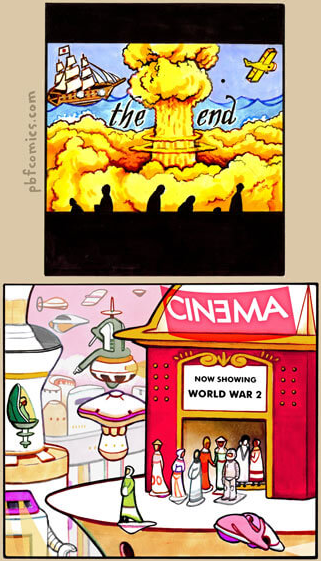
Image used with permission.
People in the future tend to misunderstand past culture in funny ways. The further one goes into the future, the more distorted history seems to become. Apparently, history is the one field of study that gets worse rather than better in the distant future.
It's understandable if the fall of civilization has destroyed all the data, or an oppressive regime is deliberately suppressing the inconvenient truths about them. But sometimes, the records decay and the facts get lost, even when no malice is intended at all.
As time goes on, language shifts and evolves, while the historical data might not. In three hundred years, how many people will know what a cotton gin was for? How many people will actually be able to identify one? How many people will think it's booze made from distilled cotton? How many people already do?
This is commonly seen in a Distant Sequel to another work, especially if takes place several lifetimes or more after its prequel. If the first story's characters and events haven't been forgotten about entirely, the people of the current setting will often remember them in ways that the audience, who will have it them fresher in mind, will realize are wildly inaccurate and often quite Entertainingly Wrong.
This is a little strange when it appears in societies that use Time Travel, since they could always just go back and check. This also reacts in odd ways with very Long-Lived or immortal characters, since they can continue to serve as original witnesses of the past for very long periods of time. This can coexist with such characters, however, since one or a few people likely won't be able to control an entire culture's shifting views — and that is, of course, assuming that they're unbiased and accurate sources themselves, or that they even want the true past to be known. This is occasionally inverted by a Fan of the Past, unless their conclusions are Entertainingly Wrong.
Compare From Cataclysm to Myth and Lost Common Knowledge. Often occurs in concert with Days of Future Past. See also Earth That Was and All Hail the Great God Mickey! When done well, it tends to be a form of Entertainingly Wrong. When present-day writers get the past wrong, it's Anachronism Stew or Popular History for more recent history; similarly, when past writers predicted the then-future/now-past badly, that's Zeerust. Related to Famed In-Story and Shrouded in Myth.
Named for an episode of Star Trek: The Next Generation, which is not an example of this trope.
Examples:
- A 1980s Pepsi commercial featured a far-future archaeology class visiting a recently-excavated 20th century house. The professor humorously misidentifies the purpose of several objects in the house, but when one of the Pepsi-drinking students presents him with a Coke bottle and asks what it is, the baffled professor responds "I have no idea!". The commercial can be seen here.

- Inverted in the Cowboy Bebop episode "Speak Like a Child". Jet and Spike consult an antique electronics dealer to identify a strange item called a "Betamax videocassette". This Fan of the Past is overcome with excitement and proceeds to bore the two hardened bounty hunters to distraction with every arcane detail of the 1980s video format wars.
- Cross Ange: Ange, Tusk, and Vivian explore the ruins of post apocalypse Earth and find a hotel that somehow still has electricity and running water. They can't read the Japanese signs, so after trying out the luxuries within, they assume the building is a castle.
- Dragon Ball GT: The epilogue is set a hundred years after Goku and his friends have all long since passed away. Vegeta's own descendant Vegeta Jr. has no idea what a Super Saiyan is and just thinks it's cool that he and Goku Jr. can turn blond.
- In Dragon Ball GT: A Hero's Legacy, the Dragon Balls have been gone for a hundred years and Goku Jr. only heard stories of them from his grandmother Pan. He ends up misinterpreting how they work, thinking you only need one to make a wish instead of all seven. When the original Goku shows up, he explains how they work and expresses surprise that Pan did not explain them more thoroughly.
- Eureka Seven has a similar situation to the Gurren Lagann example. Humans have been living on the surface for so long, that everyone has forgotten that they're actually living on an artificial surface created by Scub Coral, and the real planet Earth is actually miles below them.
- Gundam:
- ∀ Gundam takes place so far into the future (by thousands of years) that the "Black History" which covers both our own time and the events of several Gundam shows is initially known through ancient folk tales and archeological digs. In fact, the titular Gundam is known at first as the "White Doll", given that the Earth's regressed to the point of forgetting about the existence of mobile suits. This distorted version of the past is further justified through the Moonlight Butterfly erasing civilization at the end of the Black History.
- Also present in the Universal Century timeline to some extent, with stuff from the 20th Century like Hitler and motorcycles being mentioned in passing as "from the Middle Ages".
- Tengen Toppa Gurren Lagann is set so far After the End that Kamina is considered crazy by his entire underground village for believing that humans once lived on the surface of the Earth. At the beginning of the series, some villagers are skeptical that a surface actually exists.
- Astro City: One arc deals with the hero Jack-in-the-Box meeting two Bad Future Anti-Hero Substitute versions of himself, one of whom, the Jackson, basically worships him like a god due to having been raised in a cult. Though he's deeply familiar with all of Jack-in-the-Box's adventures, he's interpreted the guy as a cruel Knight Templar who showed no mercy to criminals rather than a goodnatured Spider-Man Send-Up who defeated his villains nonlethally through goofy clown-themed methods. In particular, he believes that "Of course you realize, This Means War!" was a declaration of vengeance... which leaves the actual Jack-in-the-Box aghast, as he tries to explain it was a Bugs Bunny quote.
- Beast Wars: Uprising concludes by showing a history report written by a guy named Hatchet, thousands of years later, on what happened, suggesting things were Written by the Victors in some fashion. Hatchet's main objective when writing is to depict the protagonist, Lio Convoy, as a manipulative and violent revolutionary who was responsible for just about everything bad that happened in the war, apparently in contrast to the common narrative that he was an Ideal Hero who saved the planet. (Neither of these are true; Lio did cause or allow some morally ambiguous things, but he was generally a good guy who was entirely right to rebel.) There are also lots of smaller errors — most clearly, the "G" in "G-virus" is claimed to have stood for "Genesis", when it actually stood for "Galvatron".
- DC One Million:
- Hitman reveals that, by the One Million timeline, Tommy Monaghan is remembered as a hero of the streets battling against Judge Dredd-esque cops and a monstrous creature called "The Bat", and in love with "the beautiful Natalie". It's implied that at some stage, somebody wrote an at-best fanciful story about "Hit-Man", likely hundreds of years after he died, and it's only decayed since then. Monaghan is initially just incredulous that he's remembered at all, as he was mostly an unimportant contract killer who shot mobsters for money... though he doesn't take long to start giggling at the fact that, among other things, "Natalie" was actually Natt.
- The One Million version of Batman decides to introduce himself to Nightwing by attacking him for no apparent reason. When Nightwing asks why, Batman explains that based on his studies of 20th-century crimefighting, it was a standard ritual greeting for masked lawmen to battle each other upon their first meeting as a way to test their skills. He's just trying to follow the local customs.
- The Flash: Iris Allen had been born in the 30th century, growing up in the 20th and later returning. When she made a return to Wally West's life, she explains that she stayed away because she was worried her knowledge of the future would affect things. But Iris changes her mind when a former girlfriend of Wally's, who (according to Iris' notes) was supposed to live a long life, is murdered. It makes Iris realize you can't count on historical records from over a thousand years to be perfectly accurate and thus her "knowledge" may not be so certain.
- The Incredible Hulk: The Incredible Hulk: Future Imperfect has some hints at this. Not as much as you would expect and mostly throwaway lines at a marker square.
- De Kiekeboes: In the album De Wereld Volgens Kiekeboe (translation: "The World According To Kiekeboe") Kiekeboe travels to the far future, when mankind has destroyed most of its civilization during a world war. They rebuilt everything afterwards and discovered the entire collection of Kiekeboes albums (except for the one they are currently appearing in). They enjoyed the books so much that they built their entire civilization according to the universe in Kiekeboe's stories. Naturally they do get a lot of things about our century wrong, because the albums are the only artefacts they can base their knowledge on.
- Legends of the Dead Earth: The concept behind many of the 1996 annuals.
- Whether recounting stories of 20th century superheroes, or trying to follow in their footsteps, the people of the distant future get a lot of things wrong. The Catwoman annual has Selina and Bruce as an Outlaw Couple, the Superboy one is set on a world where the legend of Superman has been merged with Aztec mythology, and the Aquaman one has two storytellers (implied to be the last survivors of Atlantis) come to blows over whether Arthur was a hero or a villain.
- In the Supergirl Annual #1 story "The Legend Lives On", S'age gives her rendition of the Supergirl legend. Superman and Supergirl were metas from Krypton who gained their powers from exposure to Kryptonite radiation. Supergirl was the last being to leave Krypton after many failed attempts to save the planet. She and Superman then journeyed to Earth, where they fell in love, got married, and had a son, Superboy. Supergirl gained the ability to shapeshift from Kryptonite radiation and used it to transform into her secret identity of Lo Slane. S'age claims that Supergirl could still be alive as she was a self-regenerating protoplasmic lifeform who was active from the First Heroic Age to the time of the Legion of Titanic Superheroes. She also believes that Supergirl once went crazy and tried to destroy the world, an event called the Crisis.
- In the Supergirl Annual #1 story "Shootout at Ice Flats", Sheriff Eileen P. Garrett's mother tells her that the "S" badge, an ancient relic from Old Earth, belonged to Sardine Girl, who was created from super scientific mud. In her showdown with the Nerf outlaw Curly, Eileen uses what she believes is an ancient Earth weapon against her: a Staple-O-Matic. It doesn't prove very effective. Other humans are seen holding a razor and a hairdryer, which they seemingly believe are also weapons.
- In Detective Comics Annual #9, Dealy claims that Batman fought Three-Face, the Jokester, Bane-A-Gator, Firecat and the Buzzard and that he had a friend named Alfred Gordon.
- This is played with in the Guy Gardner: Warrior Annual #2 story "The Legend Lives On!". The historical records on the asteroid museum Warriors celebrating the life of Guy Gardner claim that he fought injustice from the day that he was born (punching the doctor who slapped him), had a normal and happy upbringing, was always at the top of his class in high school, was a great athlete, served as the leader of the Justice League and was always faithful to his lady love, the goddess Ice. The museum does acknowledge that some archival sources suggest that Guy came from a dysfunctional family and that he was a high school dropout, a mediocre sportsman and an "obnoxious, womanizing hothead" who turned on the Green Lantern Corps. However, the tour guide Lumita claims that all of these stories are either inaccurate or were deliberately created to sully Guy's reputation. It turns out that Guy is still alive and well, Lumita is his daughter and he created Warriors to promote himself and his legacy.
- Legion of Super-Heroes: Members of the legion transported a thousand years into the past to 1990s America, mistake a fairly average wall for the Great Wall of China. A lampshading from the Post-Zero Hour: Crisis in Time! Legion of Super-Heroes. A museum curator in the 30th century tells visitors: "-and of all the surviving structures of the second millennium, we know the most about the Alamo. For example, it was here that Panamanian strongman George Washington wrote his classic poem, 'The Raven'-".
- Second Coming: It is revealed that Jesus's message from the events of the New Testament has become nearly unrecognizable due to the two-thousand years of hearsay and political tampering, barely recognizing it when he finds a copy of it.
- Spider-Man: The Amazing Spider-Man (1963) #439 features future archaeologists having discovered one of Spidey's webshooters in an old building, and intertwined with the "current" timeline. How they perceive Spider-Man ranges from the generous to the outlandish to just plain inaccurate. For example, they thought the wall-crawler was often praised (cut to a cop "today" telling him to "SCRAM!") and that his wife was the envy of her friends (cut to MJ, alone, weeping with worry). What's more, there are some nods to a certain pointy-eared hero.
- The Spirit: An Alan Moore story done for The Spirit: The New Adventures sees the immortal Denny Colt taking a tour of ruined Central City conducted by a guide majoring in necropology (a form of archaeology concerning “dead cities” abandoned long ago due to climate disaster). The Spirit is now believed to be a god of this old civilization, the Holy Spirit, his blue suit, hat, and mask representing the Virgin Mary’s garb. Several women associated with the Spirit — Ellen Dolan, P’Gell, and Plaster of Paris — are conflated into Plaster of P’Gell, sometimes called P’Gellen (and at times further confused with “Ellen of Troy”). Oh and based on studying our “billboards” it’s been concluded that one of our chief gods was Cokaco, who eventually slew his brothers and rivals Pepsico and Texaco.
- Transmetropolitan: The series takes place in a future where no one even knows for sure what year it is.
- When Spider tells a presidential candidate who just quoted Tennyson's Ulysses that it was Bobby Kennedy's favorite poem, his campaign manager says, "I'm sorry, who?"
- "Who was Hitler?" "Rock star. He was in Led Zeppelin. Fucked goats and wrote the old National Anthem. Blew up Auckland in The Blitz."
- X-Men: When Bishop first traveled to the current time, he didn't believe the X-Men were who they said, because their exploits had become so legendary by his time that they were basically viewed as gods.
- DC Comics' Silver Age often had glimpses into a far off future where a character took up a Heroic Legacy and often had the same name as the hero they were emulating. Centuries of linguistic drift has dropped syllables from full names, combining them into a single word, leading to Bruce Wayne becoming Brane, Billy Batson becoming Bilbat also known as the hero Capmarv etc. For the latter, this even affected his powers, as he only says "Shaz!" to transform, missing out on the courage imparted by Achilles and the flight granted by Mercury.
- Calvin & Hobbes: The Series has resident Deadpan Snarker Andy being asked for his opinion on a television show he hasn't actually watched. His response is a parody of this trope:
"...Imagine... It is four hundred sixty-eight thousand years in the future, and humanity has left the Earth. It's a derelict planet, abandoned and quiet. Only the artifacts of a long-ago civilization remain. But suddenly, an archaeological ship from a far away empire pierces the atmosphere and lands! Among the ruins of massive cities, they search for clues of this once-great culture and people! And they find it! A sublime, beautiful TV recording: Dance War: Bruno vs. Carrie Ann!"
- Eugenesis: The Distant Finale is set some millennia after the end of Transformers: Generation One, and we get a glimpse of how history is slowly being rewritten to the state it will be in by the time of Beast Wars. People have the basic idea of what the Autobot-Decepticon war was like, but have a lot of details wrong thanks to Star Saber’s corrupt government rewriting history books. Most bots from that period are either dead by now or have been replaced with clones called neogens that have fake memories based on Star Saber's fabricated histories. This is also used to foreshadow that the nameless protagonist (actually Tarantulas when he was young) is unknowingly a neogen; he claims to have been present for the events of the main story, but he "remembers" the falsified version being fed to the public and doesn't know of people he logically should, like Kup.
- FURTHERFELL: Sins of the Father takes place millennia after Asgore's war on humanity wiped out everyone in the area, with a new group of monsters later getting trapped in the Underground they left behind and trying to infer what their predecessors were up to. One of Spuds the Scarecrow's theories on the purpose of the Ruins is that they were used in some religious function (though he brings up their actual purpose of being a settlement as a possibility), and the equivalent of Snowdin is called "Grillby's" because the restaurant of the same name was the last remaining building from the old town.
- A Game of Cat and Cat:
- The Messian Church in an alternate post-apocalyptic timeline misunderstood how communion worked and thought that all forms of alcohol and bread count as the blood and flesh of Jesus. Including beer and crackers.
- The "legendary feats" of King Aquila were actually the plots of LARP events.
- Last Rights has Captain Kanril Eleya mistakenly say in her Opening Monologue that the United States fought the Russians in World War II rather than the Germans. The author's notes confirmed this was intentional. Note that Eleya is a Bajoran, not a human.
- The Lion, The Witch, and The Fairy's Tail follows the Fairy Tail wizards being involved in the plot of The Chronicles of Narnia, starting with Natsu, Gray, Lucy, and Erza as the protagonists of The Lion, the Witch, and the Wardrobe. In the sequels Return to Narnia and All Aboard the Dawn Treader, it is shown that 1300 years have altered the Narnian's recollection of the wizards. For one example, Lucy's epithet "the Radiant" was thought to mean how beautiful she was rather than her ability to summon Celestial Spirits based on the stars of her world. Likewise, Narnian history recorded Natsu and Lucy as having been married during their rule, while at the most the two had Ship Tease and weren't in any romantic relationship at the time.
- Reimagined Enterprise: A few minor examples mentioned in passing, though stemming from ignorance of the historical record rather than there not actually being one. For example, at one point Captain Bowman of the Dauntless (a parody of Jonathan Archer from the canon show) mixes up Buzz Aldrin with Buzz Lightyear.
- Sharing the Night:
- In Chapter 9, Luna tells Twilight of an old story she knew in her childhood, which was old even then, about a pair of twin goddesses who shepherded dreams and presided over the moon, whose dark side was known as the nightmare moon and viewed as an ill omen, and eventually killed each other. She does not view this as anything other than a fairytale, but used it as inspiration for her villainous persona. It is eventually revealed that in the ancient past, long before Luna and Celestia's time, there were two moons, the white dreaming moon and the black nightmare moon, each with its associated alicorn; the alicorn of the nightmare moon was forced to smash the two orbs together and destroy them both when the dreaming moon threatened to fall to earth, at the cost of her and her sister's lives. Eventually, long after the fall and slow reconstruction of civilization, these events came to be remembered as nothing more than a vague fairytale bereft of names or historic meaning.
- In Chapter 10, the ancient dragon Emberstoke describes the end of the old world as an apocalyptic, years-long rain of fire and rock as the previous incarnation of the alicorn of the stars died, sending her charges falling from the heavens and causing the world to die with her. It is later revealed that there were neither stars or an alicorn thereof in those days; the rain of fire he describes was actually the result of the two moons that existed back them colliding and falling as rains of meteors, while the stars were formed from the debris that remained in the sky. As Emberstoke was only a hatchling back then — he specifically describes this as his earliest memory — his account was marred by an incomplete recollection that he had subconsciously filled in using his knowledge of what became the new order of things.
- Warhammer 40,000:
- In one /TG/ fanfic, Bjorn the Fell-Handed gets dredged up to tell stories (again) and immediately begins disabusing the modern Space Wolves of some notions (ex, Leman Russ' heroics took second place to him being a Jerkass and nobody was nearly as wolf-obsessed as they are now).
- "Feral World Religion" involves a primitive world that had long ago been taught the legend of the Emperor, and seen the whole thing mutate heavily over the years. Many of the names are wrong, and several of them have been altered greatly (for example, Sanguinius is now a beautiful female angel, Guilliman is reinterpreted as the fishlike Gill-Man, and Horus is a very evil horse). There's also some cases where the biases of the people who taught them the legend, the Salamanders, shine through; for instance, the controversial regulations of the Codex Astartes was reinterpreted as the Coat of Stars, a mysterious artifact that "the Gill-Man" used to try to castrate his brothers. That said, their interpretation of Leman Russ as a shirtless barbarian bedding women and smashing his enemies with a flagon of ale was pronounced more or less completely accurate.
- Nobledark Imperium: The Tindalosi, a poorly-understood species of time-traveling predators, are named such due to reasons long lost to the Imperium beyond a single written account from the 23rd Millennium, which compares them to creatures from "an ancient Terran story".
- In one
- The Writing on the Wall: Played for Drama. Daring Do and an archeology crew come across what they believe to be a foreboding tomb with ancient writing that Daring immediately dismisses as your standard curse warning people to stay away from the treasure within. As more and more members of the team fall increasingly ill, the writing is finally translated, revealing that the "tomb" is an old human nuclear waste dump and that everyone in the camp will soon die of radiation poisoning due to unsealing it.
- My Little Pony: A New Generation: The movie takes place so long after the events of Friendship is Magic that nobody remembers what the world was like then, sectarian divisions among the three tribes have muddled and corrupt what accounts remain, and even the few ponies who research ancient Equestria lack important information and get some things wrong.
- Back to the Future Part II: An '80s-themed diner confuses a lot of '80s pop culture, such as mixing up Max Headroom and Ronald Reagan.
- Battlefield Earth: Fast food and automobiles are the stuff of legends, and mannequins are people punished for offending the gods. The Psychlos are shown at one point examining old Earth photos of people driving with their dogs, leading them to believe that the dogs were the superior species since they had the humans chauffeuring them around. They also note that dogs, while much more cooperative than "man-animals", which the Psychlos interpret to mean higher intelligence (after all, dogs recognize who their betters are), are almost useless for manual labor (further proof that dogs were the masters of "man-animals", who did all the work).
- Demolition Man: For the most part, the younger Disneyfied generation of the 21st century has no knowledge of toilet paper or real music, having been replaced by the three seashells and advertisement jingles respectively. Fan of the Past Lenina Huxley gets phrases horribly wrong and has to be corrected regularly by Fish out of Temporal Water John Spartan.
- Enemy Mine, where the human jokingly quotes Mickey Mouse and the Drak never understands that he isn't really a human philosopher. In the movie, at least, this leads to a half-heartwarming, half-hilarious scene where the human, in an argument, exclaims, "Well maybe you forgot about what you said about Mickey Mouse!" and the Drak apologizes.
- Idiocracy: The Time Masheen. "1939, when Charlie Chaplin and his evil Nazi regime enslaved Europe and tried to take over the world." With dinosaurs. "And then the U.N. (pronounced "uhn", not "yew-en") un-nazi'd the world forever." (Cue dinosaur with swastika and dinosaur with UN logo fighting.)
- Logan: Long after many of the X-Men died, Laura shows Wolverine some comic books based on the X-Men's adventures which she and her friends follow almost religiously. Wolverine gets upset at how inaccurate the comics are, including depicting the X-Men in colorful spandex instead of their practical leather suits, and rants about how he and his old friends have been turned into "a big fucking lie".
- Mad Max: Beyond Thunderdome: The half-feral children have pieced together their own religion and historical accounts from fading memories of the parents who left them behind and stray bric-a-brac of civilization. ("Remember this?" "Mrs. Walker!")
- Sleeper: Future scientists question Woody Allen's character about a number of things from the '70s, and discuss their theories concerning those objects with him. Their ideas are almost entirely nonsense. Unfortunately, Woody's explanations don't help matters.
- Star Trek: First Contact unusually does this to events that are in the past from the perspective of the crew, but our future (the 2060s). This crosses over with Shrouded in Myth, as it turns out that the much-idolized architect of warp drive, Zefram Cochrane, built the drive purely to make money, rather than out of some higher dreams or ideals (though of course, given the post-apocalyptic Crapsack World he lived in, he could be forgiven — and Cochrane himself had more trouble accepting the dissonance between who he really was and how the future would remember him, than did Enterprise's crew). Of course, he eventually became one of the key figures in humanity's getting itself back together, presumably influenced by the effects of first contact.
- Water World: Unknown centuries after the end of civilization, a yo-yo, exercise machine, and flute are mistaken for garrote wire, a torture device, and spy listener.
- Aeon 14 is set (mostly) in the 90th century, and some 20th-21st century pop culture is still familiar but not always remembered correctly (exacerbated by a series of apocalyptic interstellar wars in the 7th millennium that caused a lot of knowledge to be lost). In The Scipio Alliance, an exclusive resort is patterned after the wreck of the Olympic (which Angela says is supposed to be the Titanic, and sank in the 20th century rather than the 19th as the advertisers say), while Tanis gets costumed for a masquerade ball as "Shannon" from "Meteoroid" (i.e. Samus from Metroid).
- Ali Dubyiah and the Forty Thieves is a "historical fable" from perhaps a thousand years in the future, describing a certain early 21st-century American president and how his actions led to the fall of his empire and ultimately The End of the World as We Know It. Major players are referred to with garbled names such as "Dick Chaingang", "Condi Pasta", and "Osama bin Hiden".
- Alien Landscapes, a collection of art based on various SF stories, has as its premise that all said stories take place in the same universe. It contains a "future newspaper", one of whose articles describes a museum in a manner lampshading this trope. "A boot from... the planet Poland (location no longer known)", a primitive tracked vehicle called a "voleswakan", and "stylized phalluses... called Bishopricks... used in early risque versions of... chess" are listed among the exhibits.
- All Yesterdays, in its satire of how amateur paleontologists and paleoartists tend to turn every animal into a Prehistoric Monster, decides to take the same mindset and apply it to the skeletons of living animals. Every single one has no body fat, being tight muscles over bones and often so thin you can count their ribs, none of them have fur, feathers, or any organs that wouldn't be preserved in skeletons, and every interpretation of their lifestyle makes them out to be brutal predators. Cats hunted humans with their deadly switchblade claws, swans used their pointed arms to impale prey, baboons had grooves in their teeth to inject venom...
- Harry Turtledove combined this trope with Crippling Overspecialization in "The Barbecue, the Movie, & Other Unfortunately Not So Relevant Material". In this short story, a time traveling historian from thousands of years in the future is intimately familiar with the life and times of Genghis Khan, but when he is accidentally transported to the twentieth century, he mistakes the cars outside for cows.
- In Battlefield Earth the story of Earth's invasion and occupation by the Psychlos is remembered as a religious purge of the planet by "the gods". Their legends speak of a deadly cloud that swept over the land (the initial barrage of poison gas) and then a wave of monsters and demons that hounded and pursued the survivors from the cloud (the arrival of the Psychlos themselves, who exterminated whatever humans they could find). This was all done by the gods in order to remove the sinful and impure from the planet, and their ancestors survived because they honored the gods and were righteous (they lived in the shadow of a massive military complex that served as a government retreat and survival bunker, surrounded by last-ditch nuclear explosives whose radiation kept the Psychlos away). When Jonnie Goodboy Tyler, the protagonist, encounters other isolated people, they each have their own legend of what happened. The Scots, who have managed to retain a semi-accurate history because their territory received less attention from the Psychlos, remember America as a distant village that some other Scots went to and settled a long time ago.
- Will Self's The Book of Dave, in which the diary of a bitter current-day London cab driver becomes the holy book of a religion 500 years in the future. As he was divorced, the "Mummies" and "Daddies" live in separate housing, and their children switch between them.
- In Book of the New Sun the protagonist carries around a book of the ancient legends of Urth. One of them is a mashup of the story of Romulus with the story of Mowgli (because they were both raised by wolves) and another has the story of Theseus and the Minotaur mixed up with the real-life Battle of Hampton Roads (where one of the ships was called the Monitor).
- Aldous Huxley's Brave New World sees Henry Ford as the most important human being who ever lived and assume the entire modern world started with his birth. They also conflate him with Sigmund Freud.
- In The Brightonomicon, set in 1960's Brighton, England, both author and characters lampshade this, and reference things that did not exist in the real world, saying that these things do exist, as they will be written down by the main character after the end of the adventure, but that it will be the readers' faulty memories making them think such things weren't invented until later. This extends so far as to include a restaurant opening night that included as patrons Robert Johnson, Jimi Hendrix, and Kurt Cobain. Several other musicians were there, all linked by a single theme.
- Stephen Vincent Benet's short story By the Waters of Babylon supposes that not only has the United States of America ceased to exist as we remember it (apparently, it was destroyed in a great war), but the descendants of modern-day Americans have returned to living in tribes, hunting wild game with bows and arrows and forsaking Christianity for polytheism (believing, for example, that their ancient ancestors were actually gods). The protagonist finds a ruined statue at one point and notes that it depicts a man with long hair like a woman — in other words, George Washington. However, the protagonist can only call Washington "Ashing", as only that much of the inscription on the statue is left intact. He assumes that "Ashing" is a god, and offers a brief prayer to him out of respect.
- A Canticle for Leibowitz has a fair number of these, such as the shopping list treated as a holy relic,note the difficulties a novice monk has in figuring out what "Fallout Survival Shelter" means, the barbarian nomads who swallow electrical resistors to commune with spirits, and the Renaissance scholar who reads R.U.R. and takes it a little too much to heart...
- A mild example in Captain French, or the Quest for Paradise, which takes place 20,000 years in the future, after humanity has settled thousands of worlds. In a setting without FTL Travel or a Subspace Ansible, each world is, pretty much, on its own, with only an occasional space trader arriving to deliver outdated news and exchange goods. Many planets retain reliable records, but some records of the past, especially of Old Earth, are not exactly precise. For example, the names of some famous authors ended up getting mangled (e.g. Anne McCaffrey is called "Annette McCloskey", while Charles Perrault is known as "Chaurl Perry"). Additionally, a number of Disney characters and stories are now considered to be fairy tales in their own right, and some stories somehow ended up merged together, such as the story of King Kong and Conan the Barbarian, who slew him. There's also the slightly disturbing merging of a Real Life crime and a children's story called Jack the Giant Ripper. On one planet, a virus in the data banks has resulted in historical data becoming corrupted and making the locals think that the automotive industry began during the time of ancient Babylon. Since they habitually name their kids after ancient kings and other great figures, this has resulted in names like Sedan Peugeot Hammurabi. The protagonist is the only one who finds that funny.
- The Citizen Series: Real-life Earth is referred to airily as the "Third Civilization", and much knowledge has been lost. The first book has a character erroneously attribute the Molotov Cocktail's name to an Earth king, rather than being named after the Soviet foreign minister Vyacheslav Molotov by Finnish soldiers.
- The City Without Memory takes place upon a planet which suffered a collective memory wipe a couple of centuries ago. As a result: 1) The people there are mixing up words — some nobles call themselves "Moles" thinking it means "Wolves", and the king calls himself "Radiculitis" thinking it's "Elephant". 2) Said king uses an ancient dentist's chair for a throne, and his bodyguards use chamber pots for helms. 3) Forgetfulness is a religion. 4) It's forbidden to actually try reading — sages are "deciphering" old inscriptions, and must be memory wiped every few months because they constantly begin to actually see the true patterns. 5) A small society of outlaws exists who actually try to reconstruct the past — and while they are quite accurate, it takes a traveler from another planet to explain to them what a watering can head is for.
- Invoked in Steven Brust's Cowboy Feng's Space Bar And Grill, in which the titular restaurant and its proprietor are sent back from the distant future to investigate who keeps nuking humanity. As its builders knew they didn't have either the time or the historical references to get it all right, they deliberately decorate it in the style of this trope (e.g. a sepia photo of Comanches with machine guns battling knights in armor) so that any actual incongruities will pass for more of the same kitsch.
- In The Crown Jewels by Walter Jon Williams, Drake Majistral watches a movie in which the two main characters are Jesse James and Elvis Presley.
Majistral liked Westerns better than other forms of genre entertainment. He wondered why Shakespeare hadn't written any.
- In Michael Moorcock's Dancers At The End Of Time this trope is rife. Although, they are at the end of time, so perhaps a little memory slippage and creative license is allowed. Also the character from the 20th Century is from the very beginning of it, essentially a Victorian. No wonder they don't recognise anything from the 20th century.
- In the Delirium Series, most of history is twisted to teach people the dystopia's guiding belief: that love is a disease. For example, Romeo and Juliet is said to be a cautionary tale about the effects of the disease of love, and stories from The Bible are reinterpreted to be about the evils of love.
- In The Demolished Man, advertising jingles are called "pepsis", but no one remembers why. Also, because psychic detectives have apparently made murder and war a thing of the past, most people have no idea what a "gun" is, and one can only be purchased as an obscure curiosity in an antique store.
- The Doctor Who Eighth Doctor Adventures novel EarthWorld features this heavily. Fitz is quizzed on 20th-century history by someone in the far future, featuring questions such as, "Which English politician was well-known for his seaside boxing matches?" and decides to set the record straight:
'You just don't know what you're talking about! I don't know if you’re really thick or trying to catch me out or something, but you're talking serious bollocks. Winston Churchill was the British Prime Minister during most of the war, and when he said "we shall fight on the beaches" he was talking about how if the Nazis invaded we'd never surrender, not running on about a scrap over the buckets and spades. I lived through that, you know, and it wasn't very nice [...] That man—' he pointed at another of the many Elvis posters — 'had blue suede shoes, not green rubber wellies or whatever stupid thing you’ve got him down for. And he was a singer — a fantastic one — not a teddy bear or a hotelkeeper or a hound dog. And I don't know who killed Roger Ackroyd [...] because it wasn't real: it was a book [...] And I don’t know what weird version of twentieth-century England you're talking about, but I reckon it's some stupid fake you’ve come up with after getting a few details off the back of cigarette cards and chocolate-bar wrappers and scraps from a local library, and then filling in the gaps to suit yourself.'
- In the Doctor Who New Adventures books, Ace (the companion from the eighties) steals Bernice's (archaeologist from the future, specializing in the late 20th century) notebook and spends the day laughing herself silly.
- In the Doctor Who New Series Adventures novel The Coming of the Terraphiles by Michael Moorcock, the Terraphiles are Old Earth enthusiasts who base their understanding of Old Earth entirely on a selection of 1930s British "Boy's Own" adventure novels. Their Renaissance Festival is based around a game called Whackit, which combines cricket with archery (one of the books was The Adventures of Robin Hood).
- A timeline of the history of the galaxy presented in The Dune Encyclopedia, a companion text to the book series by Frank Herbert, provides a distorted description of Earth history as seen from the perspective of that era. The Galactic Empire is described as being founded by Alexander the Great (as the "First Empire"), with its capital (the "Imperial Seat") moving throughout the ages to Rome, Byzantium, Madrid, London, and Washington. Nations are reimagined as Galactic Empire-style noble Houses — e.g. House Washington (USA), House Windsor (Britain), House Zedong (China), House Ghandi (India), etc..
- "House Washington" is described as being the first to use "atomics" (i.e. nuclear weapons), an invention of the "raw mentat" Einstein, in an "intra-provincial" war with "House Nippon" for control of trans-Pacific trade routes. Hitler, a "Pretender" to the Imperial Throne, in this history was overthrown during the previous decade.
- Stilgar in Dune Messiah did not understand why Genghis Khan or Hitler were considered so historically significant, having killed "only" four and six million people, respectively (by comparison, Paul Muad'dib's jihad has slaughtered at least sixty-one billion in only twelve years).
- Which is weird, considering how many characters in the series have access to the memories of their ancestors and predecessors (in Duniverse terms, "Other Memory"). The Bene Gesserit, who form the vast majority of those with access to Other Memory, consider written history to be fallible and little better than fiction (see Written by the Winners). Why bother studying it or recording it, when the Reverend Mothers can remember it as though it happened to them? As Emperor Leto II writes in his journals after discussing an ancestor's conquests in ancient Israel and Babylon:
LETO II: Does anyone remember these names and places now? I have given you enough clues: Try to name the planet.
- "House of Steel", which was eventually defeated when the House of Washington managed to outproduce it industrially. Sounds like an odd name for the USSR, until you realize that "Man of Steel" was the translation of the name for its most infamous ruler, Josef Vissarionovich Djugashvili. You may know him better as Josef Stalin.
- It's even justified as to how such an advanced society could be so ignorant about its past: the earliest historical event that is recorded in great detail is the Butlerian Jihad, where humanity revolted against and banned the use of "Thinking Machines". Given how many records even today are electronically stored, it's not unthinkable that a massive amount of historical records were lost when computer technology was purged from society.
- House Atreides takes its name from supposedly being descended from Atreus, father of Agamemnon and Menelaus of Greek myth. Needless to say, they were not actually real people, featured only in The Trojan War.
- The planet Ix is the 9th planet in the Alkulurops system. Over the millennia, people forgot that IX (9 in Roman numerals) referred to a number and started treating it like the name of the planet.
- The Eschaton Series: In Iron Sunrise Rachel Mansour reflects on the 20th century: "a time populated by women in bonnets and ballooning skirts, men in backward baseball caps and plus-fours, zeppelins and jumbos circling overhead".
- In Eternity Road by Jack McDevitt, a future civilization studies the religious monuments of the past. Highways. They must have been of great spiritual significance, because the ancestors built them everywhere. They even call our civilization the "Roadmakers".
- Evolution:
- In the first part of "Raft Continent", Echan and Rocha sail to Australia on a primitive outrigger and are briefly startled by a giant snake. A thousand years later, their descendants tell tales of how they flew across the sea on a boat lined with gull feathers and battled giant serpents and other such monsters.
- During the first five thousand years of the human colonization of Australia, they have killed off all the continent's megafauna, such as giant kangaroos, which survive only as cave paintings. They are dismissed as childish doodling by people who have already forgotten what has been lost.
- Freezeframes by Katharine Kerr opens in 20 Minutes into the Future London, where One Canada Square, Canary Wharf has become a youth centre. It's known as "Major's Last Erection", but the narrator tells us that nobody remembers who the major was.
- Alfred Bester's The Flowered Thundermug is a story about a future where the entire world was rebuilt from the only area left intact after a nuclear war — Hollywood.
- Isaac Asimov:
- Foundation Series: The Empire's inhabitants don't even know what planet humans evolved on. Not only that, but there are those who scoff at the idea of humanity having come from a single planet at all, convergent evolution being the preferred model of Imperial philosophers. Amusingly, one of the few scholars who does believe in Earth That Was, and has pieced together clues about the planet from fragments of myth and legend, includes brontosauruses and orcs on a reconstructed list of its dangerous wildlife.
- The Stars, Like Dust:
- The original discovery that it is impossible to travel faster than the speed a light is accredited to "one of the ancients, the traditional Einstein, perhaps, except that so many things are credited to him".
- Biron and Gillbret discuss the etymology of the Horsehead Nebula (through which they are traveling at the time). Gillbret confidently asserts that the name comes from a man named Horace Hedd, who was the first person to explore the nebula; the name "Horsehead" Nebula is thus presumably an example of folk etymology. Biron, who has recently visited Earth, notes that Earthmen explain the name as the nebula resumbling the head of a certain Earth animal, a "horse". As Biron points out, the name could only have arisen on a planet that looks at the Nebula from the correct angle, and that perhaps there never was any such person as "Horace Hedd".
- Gathering Blue: Crossing over with Shrouded in Myth, the Christian cross is known as "the Worship Object". Because of the Ruin, all knowledge has been lost about it to the community, but the citizens, knowing that it was important in the past, worship it out of sheer respect.
- In Charles Stross' Glasshouse the setting and catalyst for the plot is an experimental society based on the era before the Acceleration the knowledge of which is lost, having been stored on fragile and/or incompatible media. The idea being to use what is known to make a convincing simulation and study the interactions of its residents to fill in the rest. Naturally, there are obvious (to us today) inconsistencies.
- Rail Station Attendant short story from Harda Horda anthology is set in a near-future, where various animals went extinct. As a result, young people confuse many species, including tuna with dolphin, and attribute both human-like intelligence. So when Michiko, the elderly main character, once blundered that she would love to eat tuna again, the reaction was as if she was suggesting cannibalism.
- Arthur C. Clarke:
- The short story History Lesson shows the world in a post-nuclear future where Venusian reptiles only find one last relic of human evolution. They discover how to use it and we as readers realize it's a piece of film. The Venusians are amazed by what they see appearing on the screen, nothing but a violent successions of events that they can't make heads or tails of: "... for no one now would ever read the lost language of Earth. Millions of times in the ages to come those last few words would flash across the screen, and none could ever guess their meaning: A Walt Disney Production."
- The Distant Epilogue of The Fountains of Paradise, set fifteen centuries after the main story, describes the sometimes fuzzy division between historical truth and fiction:
There seemed to be a continuous spectrum between absolute fantasy and hard historical facts, with every possible graduation in between. At the one end were such figures as Columbus and Leonardo and Einstein and Lenin and Newton and Washington, whose very voices and images had often been preserved. At the other extreme were Zeus and Alice and King Kong and Gulliver and Siegfried and Merlin, who could not possibly have existed in the real world. But what was one to make of Robin Hood or Tarzan or Christ or Sherlock Holmes or Odysseus or Frankenstein? Allowing for a certain amount of exaggeration, they might well have been actual historic personages.
- In Michael Moorcock's The History of the Runestaff novels, "Granbretan's" leading playwright has chronicled memories of World War II in his works "Chirshil and Adulf" and "King Staleen" ("King and court alike corrupt...") Later, we are told that the gods of the Dark Empire of Granbretan include the quartet of Jhone, Jhorg, Phowl and Rungah, and the great "Aral-Vilsn" and his sons Skveeze and Blansacredid, "the ancient words for doom and chaos". Possibly these are Anvilicious politico-economic sniping.
- A somewhat milder version is used in Honor Harrington, where different planets retained different things in the transition from Earth to the "present" of the books. For example, Honor, while on Grayson, spots a large group of men walking through a park with wooden clubs and immediately assumes they are an angry mob (there has been much political and social tension of late, and an outbreak of mob violence is unpleasantly likely). She is about to call in her police forces when Andrew LaFollet points out they are just playing baseball, and those are just bats, not clubs. She has never heard of baseball, and asks if it is at all like golf, which Andrew has never heard of, and they spend a few minutes going back and forth, each comparing one sport to a different sport that the other has never heard of. In another book, William Alexander is visiting Grayson and remarks on how novel Iced Tea is, and how he is looking forward to introducing it at his next dinner party back on Manticore, while his older brother (Hamish Alexander) is impressed with the buttery-goodness of waffles, which he thinks compare quite favorably with the pancakes of Manticore. However, there is some information that has been lost to both cultures, as it seems that nobody can figure out just what a "movie" is, even though they know for a fact that at least one copy of Seven Samurai was brought on the original colony ship to Grayson. A humorous example comes from people who grew up on a space station and among other things believe that the people of old Earth used to believe in the Dollar, a boogieman responsible for... a lot of problems that money has caused, but interpreted as daemonic possession rather than just the problems of capitalism. In another short story (also by Eric Flint), a Havenite secret agent is apparently unaware of what a dollar is... despite their country being at war with Manticore, whose currency is the Manticoran Dollar.
- The Hyperion Cantos does this very subtly. The Leader of the Earth Hegemony frequently steals her best lines from speeches made by Winston Churchill, and this is lampshaded more than once. However, the one time Hitler is mentioned, the listener doesn't recognize the name, and he's then described as "An Earth-politician who sold a lot of books no one actually read."
- Mark Twain uses this trope in The Innocents Abroad, where he speculates what will become of Ulysses S. Grant "in the Encyclopedia for A. D. 5868, possibly":
"URIAH S. (or Z.) GRAUNT—popular poet of ancient times in the Aztec provinces of the United States of British America. Some authors say flourished about A. D. 742; but the learned Ah-ah Foo-foo states that he was a contemporary of Scharkspyre, the English poet, and flourished about A. D. 1328, some three centuries after the Trojan war instead of before it. He wrote 'Rock me to Sleep, Mother.'"
- Cordwainer Smith's Instrumentality stories often contain throwaway references to knowledge that filtered down imperfectly from our times. The Instrumentality is headquartered, for instance, in a Terran city called Meeya Meefla — so called because nobody can remember what the original pronunciation of 'MIAMI FLA.' was.
- Similar to the page quote, in the Island in the Sea of Time trilogy by S. M. Stirling, an academically-trained character shocks the others by informing them that within fifty or a hundred years, no-one will believe that the island really came back through time, no matter how well records are preserved: everyone will be scrambling to figure out theories that "prove" 20th century Nantucket developed by itself in the Bronze Age.
- In Kris Longknife: Defiant, Tom Lien starts playing "March of Cambreadth" by Heather Alexander over speakers as part of the communications encryption. The song came out in 1997 in real life but some of the characters think it has to be a lot older than that since it mentions horse cavalry, swords, shields, and axes.
- In Stanisław Lem's The Magellanic Cloud, a historian is laughing at a mural that depicts people dressed in 18th-century fashions riding in a streetcar. When asked to explain why he's laughing, he explained that there are at least a hundred years separating tricorn hats and streetcar. The others merely shrug and say a hundred years isn't that big a deal. For reference, the events are taking place in the 30th century, so to them it's all ancient history.
- Older Than Radio- Edgar Allan Poe is sometimes credited as the first modern, sci-fi use of this trope, in the short story "Mellonta Tauta", presented as a journal from the year 2848. The journal's writer details her conversations with a historian and her world's concept of ancient history, based on wildly inaccurate and overly literal interpretations of present day records: among other things, they think silk was made from earthworms that ate mulberries, that a Turkish philosopher named Aries Tottle invented science, and that America was founded by warring tribes of cannibals.
- Mirabile is set on a colony world that has societies, such as the Australian Guild and the Texan Guild, which seek to resurrect and preserve the language and traditions of an Earth cultural group. They're working from written and filmed records rather than actual members of the group in question, so the results tend to be The Theme Park Version at best. The chapter "Getting the Bugs Out" has a subplot involving a guild that's come across the expression "bats in the belfry" and got the impression that this is a necessary element of the Gothic-style cathedral they're building.
- Mortal Engines: An early scene in the first book mentions an exhibit in London's museum featuring plastic statues of Mickey and Pluto, "animal-headed gods of lost America" (the movie replaces them with Minions). Also several other examples, such as theories that those ancient heaps of rubbish they sometimes dig up were actually places where people would sacrifice valuables — as who would throw away such fantastically thin metal sheets of tinfoil? At the end of the series, a flash-forward reveals that in the far future, people don't believe that the central premise of the setting (mobile cities "eating" one another) ever happened and treat it as a story for children.
- The prequel series Fever Crumb uses this trope as well. It seems to be an even bigger problem in Fever's time — while chronologically closer to our "present," Fever's society is less advanced than what develops by the time of Mortal Engines, and has a less rational and more mythologized understanding of history. One notable example is a play Fever helps put on that dramatizes the tale of mythical hero Niall Strong-Arm, who, at the behest of Mad King Elvis, steals Apollo's fiery chariot and uses it to woo Diana, Princess of the Moon. Fever herself, having a scientific mind-set, of course realises that the whole story must be mere fairy-tale, with no possible connection to any real history at all...
- The Mote in God's Eye is set in the 31st century. While professional historians still have some understanding of Earth's past, most people see historical figures like Julius Caesar, Napoleon, Thomas Jefferson, and Lenin as legendary heroes, all of whom lived at about the same time (i.e. during the "pre-Atomic age"). It's noted that the captain of a starship called the Lenin has no idea what Communism was actually about, despite being an aficionado of Russian culture.
- Motel of the Mysteries, by David Macaulay, is the story of a group of far-future quasi-Victorian archaeologists who uncover the buried remains of a 20th-Century American motel under a hundred feet of civilization's accumulated trash and decide that it's a sacred burial site. In a parody of contemporary archeological discoveries, the toilet and the television are considered to be the holiest of artifacts, given their apparent place of honor.
- Nineteen Eighty-Four by George Orwell: Played for Drama, where historical records are actually altered by the ministry of truth to make the Party look good. They say they invented the airplane, for one thing. The protagonist still remembers the time when they only claimed to have invented the helicopter... and predicts they'll soon be saying they invented the steam engine. They also say that Droit du Seigneur was practiced by Industrial Age capitalists.
- The Obsidian Trilogy by Mercedes Lackey: The sequel series has folk tales about the characters in the first trilogy that are so blatantly inaccurate (or in some cases, just plain made up) that one has to wonder if the historians of Kellen's time period even tried to write down what was going on. Made more blatant than usual, despite the centuries long time skip between the trilogies, by the fact that due to the longevity of elves, several of the people in those stories were still alive (and for some reason had made no attempt to correct the histories).
- Orphans of the Sky: The Crew's feudal society has lost almost all knowledge of their advanced ancestors, and remembers what it does know in very flawed and peculiar ways. The Jordan Foundation, which built the ship, is remembered as Jordan, the god who made the world and people. The Ship's Metalsmith Roy Huff, who led the mutiny that resulted in the collapse of the Ship's original order, is remembered as a cursed first sinner against divine order by the Crew and as a secondary deity by the Muties, both of whom know him only as Huff. Physics textbooks are believed to be philosophic texts that use abstract terms to talk about ethical or religious concepts (the law of gravity, for instance, is considered to be a poetic metaphor for romantic love), while descriptions of the universe outside the Ship, which is now considered to be the whole world, are believed to have been a sort of shared worldbuilding tradition among idle philosophers. Among the Muties, Joe-Jim the two-headed intellectual has developed a much more coherent understanding of reality from endless debates with himself after reading stolen books, but also has no concept of fiction and thus treats novels the same way as he does physics textbooks and, when discussing the stars, speculates that they might be "maybe thousands of miles" distant and that they might be even as big as the Ship.
- The Outrider series by Richard Harding: Someone sees a large sign near the ruins of Las Vegas advertising KINO CRAPS SLOTS and assumes it's a public insult directed at a guy named Kino.
- The Pendragon Adventure: Third Earth (Earth in the early 51st Century AD) inverts this. As one character put it, they "know everything about everyone and everything they ever did."
- In Peter Ackroyd's The Plato Papers, set in the far future, the eponymous character is a Socratic orator as well as a student and teacher of history. He specializes in studying our own age, which he loves to expound on. Most of the works of the great author Charles Dickens have been lost, except one: the novel The Origin of Species brilliantly satirizes the attitudes of the time while pretending to talk about natural phenomena. Most of what they know about the past land of "America" comes from a volume Tales and Histories retrieved from a casket labeled "E. A. Poe. American. 1809-1849". They believe that the inscription stands for "Eminent American Poet", indicating that "Poet" was a title given to historians as well as the writers of verse. It was a gloomy age — corroborated by other information that people of our time were obsessed with "webs" and "nets". They also uncovered an (ancient to them, far future to us) statue of a goddess inscribed with a map of the London Underground, from a time when the city of London was worshiped as a deity (none of this gives away any plot, by the way). The book works the other way around, as well, showing how different our conception of "reality" is from what is known in this far future time.
- The Power: Five thousand years after the Cataclysm which ended civilization (one just like ours, aside from the Power existing) the majority are skeptical that patriarchies ever existed, ignoring and reinterpreting archeological or other evidence which shows it did. They also don't know what the "bitten fruit" symbol means (Apple's logo) that is found on some ancient artifacts, used as a base (old iPods repurposed).
- In Prelude to Space, people are said to have been sending ships to a certain part of the Moon "Since Jules Verne's time," implying that people mistook From the Earth to the Moon as a historical account, and the ending where the capsule ends up in orbit was lost.
- In Psychohistorical Crisis, the inhabitants of the Galactic Empire thousands of years in the future have a legend stating that slavery ended on Earth when the slave Lincoln went up to Mount Sinai to receive the Magna Carta from God. They also believe the Empire invented the metric system and had to force it on Earth. Oddly, they know a considerable amount about Sumerian culture because the stone tablets they wrote on have lasted much longer than the books and discs that we recorded our information on.
- In Rangers At Roads End, it is known that in the past, people were more diverse and there were, for example, blondes and redheads and a greater variation of skintones. However, this knowledge is controlled by the religious authorities, and they don't make it widely known as they would then have to admit that the depictions in the temple (that show the Elder-Ones with green or blue skin and the like) are wrong.
- Deliberately invoked in Michael Resnick's future history novels where characters in (chronologically) later novels often display mistaken/imperfect/misbegotten ideas about "historical" events that took place in earlier books.
- In H. Beam Piper and John J. McGuire's story "The Return", scouts seeking out groups of survivors a few centuries after The End of the World as We Know It find a settlement of people who revere "The Slain and Risen One". They naturally assume that the account is a distorted version of the Biblical account of Jesus; in fact, the honorific refers to Sherlock Holmes.
- Return from the Stars has the protagonist attend a theatre play 127 years in future, set in what is roughly present day. He comments that they got the customs and clothing of that period wrong. Note that, due to a huge overhaul in human psychology (a forceful treatment that removes all aggressive impulses instilled in every man's early childhood), the "old times" but a hundred years ago are even more incomprehensible for the future Earth-folk than Medieval times are for us.
- Riddley Walker: In the post-apocalyptic world of the story, all that remains of history is a confused mish-mash of (not very much) actual history, symbolicaly interpreted scientific theory, and the legend of St Eustace. One of the characters tries to interpret a surviving text, but is mostly wrong...
- In the first of Diane Duane's Rihannsu series, Lt. Athende is asked how a music appreciation seminar is going: "Classical period still, sir. Beethoven, Stravinsky, Vaughan Williams, Barber, Lennon, Devo. Head hurts."
- Sarum: A medieval scholar teaches his student that England had two great kings in centuries past. One was King Arthur, and the other was Old King Cole. Could be Truth in Television, depending on how feeble the state of knowledge actually was at the time. There is a theory that the nursery rhyme "Old King Cole" does commemorate a real king, probably a Celtic leader called Coel, sometimes identified as Emperor Constantine the Great's father-in-law. So it's not quite as mad as it sounds...
- In The Saxon Stories, Uhtred is frequently confused by Roman remains, and in particular their statuary and mosaics. He comes to the conclusion that, in Roman times, they had giant cockleshells and fish people.
The floor of the hall was one of the intricate Roman tiled floors, this one depicting warriors hailing a chieftain who stood in a chariot being pulled by two swans and a fish. Maybe life was different in those days.
- Shades of Grey: The future people have forgotten a great deal about the past, and for the most part lack the curiosity to wonder about the things they don't know or question their own often mistaken assumptions. Among other things, the origins of most of the relics found in the Outland are lost — several hardy machines are mistaken for unusual animal species — as are most details of Previous life and society. Certain notable Previous are remembered in a distorted manner, such as M'Donna and Chuck Naurice, while the difference between fiction and non-fiction accounts has gotten blurred — the Chromatacians are fairly confident that Oz wasn't a real place, but it took them some time to work that out. Most notably, Albert Munsell, an art teacher from the late 1800s and the inventor of the Munsell color system, is remembered as a messianic figure who supposedly laid down the rules that Chromatacian society slavishly follows (which themselves resemble a boarding school rulebook more than anything else).
- The Sirens of Titan features a man who claims to have the ability to see the future. Someone writes an article where he claims to have met this man and was told that in the year 10 million, all historical events from the year 0 A.D. to 1 million A.D. will be forgotten. Instead, history textbooks would read: Following the death of Jesus Christ, there was a period of readjustment that lasted for approximately one million years. The actual person in question is amused by the fabrication.
- Soul Rider: There are several examples of this. In one case, the secret holy name of Firbasforten passed on by the Holy Mother Church is actually the colony's original designation, "Forward Fire Base Fourteen". This also tends to happen a lot in World's religious practices; the original tradition of looking up at the sky to pray (in part because Muslims among the original colonists couldn't agree on which direction Mecca would be) eventually evolved into the Mother Church's believers praying to the brightest non-solar object in that sky as their Goddess. The object is actually a nearby gas giant.
- The Stainless Steel Rat: The long-lost ancestral home of humanity is referred to as "Earth, or maybe Dirt". They're not all that convinced about the claim, either.
- StarCraft: In the tie-in novel to the canceled game Starcraft: Ghost, Nova is noted to have learned that it was the Germans who performed the Kamikaze attacks back in WWII. Justified in that she lives on a Lost Colony and the ships that brought them there had faulty data banks. Furthermore, the colonists also took King Kong (1933) too literally, leading to the belief that giant apes exist on Earth.
- Starship Troopers:
- Played with as a joke when the main character, a Filipino, asks a comrade whether he's ever heard of Ramon Magsaysay. The other guy quips that his history lessons listed Simon Bolivar as having built the Pyramids, licked the Armada, and making the first trip to the Moon.
- There's also a joke in the Mobile Infantry where a Trooper visits Napoleon's tomb and asks the guard who that is. The guard tells the trooper that Napoleon is the greatest soldier who ever lived, prompting the trooper to ask him where his drops were. The protagonist notes that the story is almost certainly false; rather it illustrates how the Mobile Infantry consider themselves humanity's finest fighting force.
- Played with as a joke when the main character, a Filipino, asks a comrade whether he's ever heard of Ramon Magsaysay
- The Sword Of The Spirits trilogy by John Christopher is apparently set in a medieval society that's arisen after a nuclear war has caused machine technology to be banned. It's later revealed that the disaster was caused by an increase of radiation from a Solar Flare Disaster; the descendents only assumed this as the surviving literature all spoke of fear of nuclear armageddon.
- In The Tenth Planet, set 5,000 years in the future, one character recites "The legend of the Jesus Freak", a garbled and mish-mashed version of Christian beliefs, which includes, among other things, "the Jesus Freak" (which is a reclaimed perjorative for an annoyingly devout christian) resurrecting by giving himself a brain transplant.
- Timeline: Averted, as the resident Medievalist does get some things wrong when they travel back in time, but is right on nearly everything else and is virtually able to pass as a local.
- Time Machine Series: An ancient version in The Mystery of Atlantis — it turns out that the tale of Atlantis is the warped account of the cataclysmic volcano eruption on Crete.
- Time to Orbit: Unknown::
- The "Doom runs on everything" meme is remembered as a sacred ritual of technology consecration, and it is believed that pre-Neocambrian people (i.e. us) believed that something only became a computer once it had run Doom for the first time.
- The original Dawn of the Dead has become lost media in this setting, but an in-universe remake has been made based on other media's references to it. A plot point in this version involves the use of technology that hadn't yet existed in our time.
- Time Will Run Back: In the global Communist dictatorship of Wonworld (sic), ritualized denunciations of "capitalism" continue, but the records of the past have been so thoroughly censored that nobody remembers just what capitalism actually was or how it worked. Here it is deliberate policy by the dictatorship, which has expurgated even the works of Marx and Lenin as insurance that nobody will be able to use them to reconstruct capitalism. So when the hero hits on the great insight — private ownership of the means of production — he has no idea that this is the dread capitalism.
- Void Dogs has its share of Future Imperfect gags, such as the claim that The Adventures Of Tom Sawyer "was first told by an Irishman, as called himself MacTwain."
- Warhammer 40,000:
- Horus Heresy: The novels contain a lot of this:
- In Prospero Burns, the protagonist notes that this is happening at an alarming rate all over the young Imperium, due to the cataclysmic event of Old Night and the increasing dominance of monolithic bureaucracy. The organization he set up is intended to counter this very trope. It isn't working too well; another character mentions that it must be working because they have managed to recover copies of all three of Shackspire's plays.
- A character reminisces his family's home in Merica, atop a cliff that had the carved faces of ancient kings chiseled into it.
- In a meta sense, this was invoked by Games Workshop when fans complained that the novels didn't match what earlier fluff said happened. GW pointed out that all literature and fluff in 40k is written from an In-Universe perspective and has therefore been filtered through ten thousand years of history. Officially the HH novels are what actually happened.
- A set of toys with the letters CCCP is found in one novel. CCCP stands for "Союз Советских Социалистических Республик", which in English is Soyuz Sovetskikh Sotsialisticheskikh Respublik — Union of Soviet Socialist Republics. It is a testament to how much humanity has lost in the setting that the discovery of the last earthly remnants of a thuggish dictatorship actually feels like a bittersweet triumph to the reader, and the reader still feels sadness that even this fragment of our own age will not be truly known to the characters that perceive it.
- One novel shows that the story of Goldilocks and the Three Bears has been conflated with the "Goldilocks Zone", resulting in characters discussing the ancient Terran astronomer and philosopher Gul Du Lac and her "Triple Ursine Theory".
- Unremembered Empire: "Shackspire" is again mispronounced, this time as "Shakespire", and Hamlet gets translated as Amulet.
- Gaunt's Ghosts: Done In-Universe in Blood Pact. The historians at Balhaut think that Gaunt died liberating it.
"As with Slaydo, the places where the heroes fell. Captain Menhort of the Kolstec "Hammers", Gaunt of the Hyrlkans and, of course, Alltenis."
"What?" asked Gaunt.
"Did you say Gaunt?" asked Jaume.
"Gaunt, the Commissar of the Hyrlkans," said the docent. "He died taking down the Tower."
Gaunt looked back at his companions.
" Honestly, I didn't," he whispered.- Later...
"No one remembers anything properly. Everything gets twisted and forgotten."
- Later...
- Horus Heresy: The novels contain a lot of this:
- The Weans has future anthropologists give the eponymous name to the (now lost) American civilization, because all their most important artefacts are stamped with the word "US". Accounts of the Nacirema tribe are in a similar vein.
- The Wheel of Time: The series' present time has apparently muddled up what little they remember of past ages. In one book Thom talks with Elayne about this trope, providing in story examples of likely false history and states that for all they know he could be remembered as The Chosen One instead of Rand, and be a fireball-throwing wizard. His last name is Merrilin. This is a large-ish theme and plot point: since time is cyclical, the events of the novels are both our far future (several references to the age before the Age of Legends appear to be garbled versions of 20th century events such as the Cold War and the moon landing) and distant past, being the basis of several of our oldest stories (mostly Arthurian legends and Norse mythology).
- Wing Commander: A few references indicate that the Kilrathi take certain movie stars to have been the people they portrayed in their films (if memory serves, they think John Wayne was actually a cowboy) although there is some confusion about why the "historical evidence" (movies) is so self-contradictory. Additionally, they think Bugs Bunny is some kind of important figure, and sometimes insult him in an attempt to taunt human pilots, much to the amusement of the humans. Possibly a Historical In-Joke about World War II, where much of the English-language propaganda radio targeting American servicemen was considered so ham-handedly bad as to be legitimately funny listening.
- In Wool humanity has been living in underground silos and information about the past has been suppressed for so long that most people's only knowledge of the surface comes from a screen on the top level showing the lifeless hills, polluted sky and a crumbling city in the distance 24/7, and the colourful picture books they read as children. It's such a stark difference that many believe the children's books are exaggerated or made up. When the main characters eventually get their hands on photos and encyclopaedias, they struggle to comprehend that the picture books were actually real.
- Vladimir Odoyevsky's The Year 4338: Petersburg Letters is probably the Ur-Example: in the 44th century, researchers are struggling to figure out anything about the long-distant 19th century due to a lack of surviving sources. For a start, they think that "Germans", "Teutons" and "Allemanns" were all different groups of people, and that the "head clerk" was a position of high respect, above even the commanding officer and head of city authorities. When they find out that he was paid 500 roubles, they decide that it means the more powerful were unusually generous and motivated by poetry, so they took lower wages than the less powerful.
- Zigzagged Trope in Xeelee Vengeance, in which Harry Poole's explanation for an ancient statue that was discovered recently is that it represents one of the pilots of flying machines in the 20th century war period, with the trefoil base symbolising a propellor. If, as implied, it's the Battle of Britain Memorial, then he's entirely correct, but everyone else thinks this is pure speculation and it could be anything.
- In Agents of S.H.I.E.L.D., the surviving humans in a Bad Future where Glenn Talbot has turned Earth into an asteroid field have lost most of humanity's historical records because they were either lost to the cataclysm or destroyed by the Kree to prevent them from remembering what happened to Earth. Among other dramatically wrong pieces of knowledge, including a belief among anyone relatively savvy in history that Daisy Johnson destroyed the world, they think sharknadoes were an actual weather phenomenon.
- The Babylon 5 episode "The Deconstruction of Falling Stars" illustrates the far-reaching consequences of the Interstellar Alliance's actions.
- One hundred years in the future, there's a revisionist movement to clear President Clark's name, and Sheridan's actions are severely downplayed at best. Fortunately, Delenn's still alive to smack some sense into everyone.
- Another four hundred years later, the local Earth government has created computer simulations of several main characters in order to justify seceding from the Interstellar Alliance, and annexing nearby colonies. It doesn't go to plan.
- A thousand years after the main story, the Earth has spent five hundred years recovering from its attempts in the previous segment, and is slowly doing so, with disguised help. This segment is specifically inspired by the above-mentioned A Canticle for Leibowitz.
- Inverted at the end of the episode, where it turns out that people a million years in the future have a solid grasp of what's come before, and the above instances of history being remembered wrongly are merely being cataloged.
- Blake's 7. In "Bounty", a Fan of the Past thinks that Earth's 20th Century was a more civilized age and proudly shows off his 'authentic residence' of that era (actually a 19th Century folly).
- A standing joke in Buck Rogers in the 25th Century, in which a bemused Buck was constantly having to explain to eminent archeologists that a recently unearthed 20th century hair dryer isn't a prototype hand laser, or some such.
- Brave New World: Most New Londoners no longer remember why anyone was monogamous, nor about most specifics of past people's customs. Thus, you have a man in dress resembling the Pope presiding over the mock wedding at the Savage Lands resort/theme park, among other examples (with the ceremonial words garbled). Only a few, like Mond, know more about the old times.
- In Come Back Mrs. Noah, even though it's only 20 Minutes into the Future, Ringo Starr is misidentified as the inventor of the telephone.
- The Australian sketch comedy series The Comedy Company featured a parody of David Attenborough who used this trope (played for humour of course) when examining modern society.
- CP & Qwikstitch was a British kids show from 1985 about two robots from planet Junkus Minor, where all the broken machines from the galaxy ended up. Much of the humor of the series was them misinterpreting the use for the broken devices they found.
- Two Clip Show episodes of Dinosaurs are framed by a modern-day paleontologist explaining nature documentary-style what various items they dug up were for back in the Triassic period, followed by clips showing what was really happening.
- A few examples in Doctor Who:
- This is what first draws Barbara's attention to "An Unearthly Child", Susan, in the first episode: the fact that she keeps disagreeing with her version of history while messing up contemporary facts. At one point we see her looking through a history textbook and exclaiming: "But that's all wrong!" Amusingly, her firm assertion that British currency hasn't gone decimal yet actually did indeed come to pass less than a decade later.
- In "The Mysterious Planet", the Three Books of Knowledge are The Water-Babies, Moby-Dick, and a UK public information volume about geese.
- In "The End of the World", Lady Cassandra confuses a dragon and an ostrich and misidentifies a jukebox as an iPod. She has an excuse, though... "The End of the World" is set in the year five billion. It seems at first to make her look like an idiot, though depending on how well history has been maintained, she might've done well to hit the right century. In addition, Britney Spears' "Toxic" is referred to as a "traditional ballad", and Soft Cell's cover of "Tainted Love" is identified on its record as the original version.
- There's another one in "Voyage of the Damned", where the tourist guide Mr. Copper explains Christmas to the guests. In the country of UK, ruled over by King Wenceslas, there's a savage and violent holiday devoted to the great god Santa, a fearsome creature with terrible claws. (And his wife Mary.) And every Christmas Eve, the people of UK go to war with the people of Turkey, and then eat the Turkey people for Christmas dinner. Later in the episode, it's revealed that his first-class degree in Earthonomics was actually from the alien equivalent of a diploma mill. The interstellar cruise ship they're travelling on is named (like all ships on that run) for an historical Earth vessel, but everyone on board has forgotten why the Titanic was historically significant until the Doctor reminds them.
- "The Doctor's Daughter": The human/Hath creation myth is a highly garbled account of their arrival on Messaline. It likely has to do with the countless generations of clones that have participated in the war, even if the terraforming ship only landed there the previous week.
- In "Silence in the Library", the Doctor sarcastically invokes this when he realises just what sort of expedition he's dealing with.
The Doctor: Oh, you're not, are you? Tell me you're not archaeologists?
River: Got a problem with archaeologists?
The Doctor: I'm a time traveller, I point and laugh at archaeologists! - According to "The Time of Angels", the Doctor likes to visit museums to keep score with their historians, and he is shown doing so by looking at museum displays and saying, "Wrong... wrong... wrong... one of mine... wrong..."
- "The Tsuranga Conundrum": In the 67th century, for some reason, "Avocado Pear" has gone down in history as the name of one of Earth's greatest heroes. In Gifftan records, anyways.
- The Flash (2014): Barry's Kid from the Future Nora visits and makes a bunch of inaccurate assumptions like thinking speedsters are Immune to Mind Control. When Barry corrects her, Nora complains the Flash Museum got a lot of things wrong.
- The Goodies. In "2001 And A Bit", the sons of the Goodies assume the Lords Cricket Ground was used for sun worship. While searching through the ruins they throw away some old urn full of ashes and use a cricket box for a hat.
- Kenan & Kel: Justified in "Futurama" since a thousand years has passed, Kenan and Kel won't know what most of the past technology is. Because of this, Kel caused the spare reverse valve to be destroyed by a microwave oven. Kenan thinks wall clocks were invented to teach kids how to count to 12, they mistake a flip cell phone for a musical instrument, and are surprised at seeing a TV without a 3D option.
- In The Orville episode "Lasting Impressions", the crew recovers a time capsule from 2015 (400 years ago for the crew), including a young woman's iPhone. The researcher analyzing the contents makes some hilariously incorrect conclusions about some of her text messages. For bonus points, he's played by the Star Trek: Voyager alum Tim Russ, so picture this spoken in Tuvok's voice.
Dr. Sherman: Look at this. She's clearly asking her friend where to find the nearest repair service for her device, but instead of writing "Wireless Telecommunications Facility", she just wrote WTF.
- In an episode of Phil of the Future, Phil's parents (from the 22nd century) attempt to drive a present-day car and are pulled over by a cop for speeding. They originally thought the flashing police lights were just an accessory that he was showing off and when they finally stopped, the cop asked Phil's dad: "Have you been drinking?" Phil's Dad cheerfully answers "yes" though he was referring to his soda. Really, about half of the jokes in the early part of the series was about how clueless the family is about the present, such as mentioning things that hadn't been invented yet, or trying to prove to Phil's teacher he is normal by having a dinner straight out the fifties.
- Planet of the Apes had the apes occasionally misinterpret human relics they found. The second episode "The Gladiators" had Prefect Farlow conclude that their (ape) ancestors must have been excellent metal-workers but while their work was very advanced, the use to which they put the metal was primitive. He then presented a golf club to Galen which he described as, "beautiful workmanship, but so inefficient for combat."
- Red Dwarf:
- Holly identifies Plato as the inventor of the plate, while Rimmer thinks that Columbo discovered America and calls Marilyn Monroe "Mary Magdalene". However, this might be because Holly's computer-senile and Rimmer is an idiot, rather than because it's the future. Holly also loves practical jokes.
- There is a cat race that evolved from Lister's pet cat over some 3 million years. They based their culture and religious beliefs on such oddities as Lister's laundry list (which they believed to be a star map). Also, based on Lister's plan to go to Fiji, they look forward to when Cloister the Stupid will return and bring them all to the promised land, Fuschal.
- In one episode, Lister confuses René Descartes with Popeye and manages to confuse Kryten as well. This is definitely a case of stupidity, though, as Rimmer knows the difference between the two.
- In the episode "Tikka To Ride", they find themselves in Dallas in 1963. Lister asks if this is the place where "that American king was assassinated — what was his name?" Rimmer: "JFK." Lister: "No, it was John something — not Jeff Kay!"
- In a 1970s Saturday Night Live sketch spoofing Star Trek, the Starship Enterprise is chased down by a car containing executives coming to cancel the show. Spock, played by Chevy Chase, runs a search on the license plate and finds out the car was owned by a corporation known as "NBC":
Spock: The computer isn't sure, but it thinks this "NBC" used to manufacture cookies.note
- The Shannara Chronicles: Most of the history of the Age of Man has been lost in the last 3,000 years, but even those who do remember have some things mixed up, like thinking Star Trek: The Motion Picture was history and Humans used to travel through the stars.
- In an episode of Sliders, the gang lands on an Earth that has undergone "some kind of time warp" (they don't explain it any better than that) and find 1920s-style archeologists excavating modern-day sites. One of them finds an ordinary beer mug and believes it to be a ceremonial chalice, another is mystified at the sight of a parking meter. Strangely, when the archeologist guesses that the site dates back to the Renaissance, one character probes him if he means the 1600s. The archeologist confirms this. This somehow means that modern-day culture took place at the same time as the cultural revival on our world. Also, Rembrandt is treated as a religious figure by the locals, who have preserved his memorabilia and built a shrine in his name.
- In an episode of Smallville, they get a visit from the Legion of Super-Heroes. Despite being major fans of Superman and most info about Superman being public knowledge in their time, they get confused that Clark Kent doesn't meet most of their expectations. They thought he was already using the costume and Superman name, knew how to fly, and was willing to kill. Also, while they know about Clark's important friends like Lana Lang, Pete Ross, and Lois Lane, they've somehow never heard of Chloe Sullivan, even though she's his sidekick. This is probably a reference to how Sullivan is a Canon Foreigner.
- In Space: Above and Beyond, a group of recruits on a training expedition on Mars are repairing a communications array when they happen to check out the "sounds of Earth" message included for the benefit of any aliens finding an off-planet installation. Among the snippets is the song "Blitzkrieg Bop", by the Ramones. One of the recruits mentions that he's heard this one in his history studies, identifying it as being a song by "The Pink Floyd".
- The possible tendency toward assuming something is religious in nature is referenced and lampshaded in the Stargate SG-1 episode "Cor-ai". Upon finding a village that is empty, with food still hot on the cooker, archaeologist Daniel Jackson mentions he thinks they might have left for a religious ceremony. Jack O'Neill goes, "Why is it always about religion with you? Maybe they just went to a swap meet" note
- Star Trek television shows have this:
- Star Trek: The Next Generation episode: In "The Big Goodbye," which introduces the Holodeck, even the ship's resident Red Shirt Historian is shown to be fairly clueless about how a 1930s era American city works. Picard, has a hard time describing automobiles and even city blocks when recounting his experiences on the holodeck to his crew. This is a bit of Early-Installment Weirdness, as Picard is later shown to be a genius archeologist and history buff.
- In the Star Trek: Deep Space Nine episode "Take Me Out To The Holosuite", Sisko has the senior staff play baseball on the holosuite. O'Brien decides to get into the spirit of things and researches the concept, only to find a traditional snack that had since passed into antiquity: chewing gum. Of course, he flavored it with Scotch. Thus successfully combining two classic baseball traditions: chewing gum, and getting blitzed out of your head either during the game, or immediately after your team wins or loses.
- Star Trek: Voyager:
- In the two-part episode "Future's End", Voyager gets sent back in time to Los Angeles, 1996. An astronomer (a fresh-off-SNL Sarah Silverman, oddly enough) picks up the ship on her instruments and sends a greeting to the aliens she assumes are on board. Tom Paris, who treats twentieth-century culture as a hobby, is sent to smooth the situation over. He gets some things right, but never the details. Eventually Rain tells him, "You're always not quite getting things just quite right. It's as if you don't belong to this time period."
- In "Living Witness", a copy of the Doctor is activated in the (even more) distant future by an alien society that had a conflict with Voyager as it passed nearby ages earlier. In a mix of this trope and Politically Correct History, the aliens interpreted fragmented records of the time so as to vilify Voyager's crew (the Doctor is an emotionless android, Seven forms her own mini-Borg collective, and Captain Janeway wears black gloves), imagining them as a band of bloodthirsty pirates and describing Voyager as a heavily-armed warship — because this let them interpret their own history more favourably. It is up to the Doctor to dig up historical evidence and clear the names of his long-dead crew-mates. It is later revealed that most of the episode is itself a historical record. After a second war, the members of the now combined civilization mention how The Doctor eventually set out for Earth on his own, since he wanted to see if his friends ever made it back. They did.
- In "11:59", Janeway speaks with pride on her ancestor, Shannon O'Donnell, a star astronaut and one of the first Mars colonists who single-handily pushed through a massive tower project against huge opposition. But, going over Earth records, Janeway discovers that over the centuries, Shannon's "exploits" have been overblown: She was never an astronaut, she only consulted on the tower and there was no mass opposition to it. Janeway lampshades how records can be skewered to Chakotay.
Janeway: The holographic engineer is having problems with her program. Neelix, the Cardassian cook, is low on supplies. Seven of Twelve is regenerating and Captain Chakotay is doing just fine. - Star Trek: Enterprise features the NX-01, the first Starfleet vessel to bear the name Enterprise, which NO ONE remembers in the future. (Technically, it was before the founding of the Federation.) This was Retconned in the Enterprise finale, which established that the NX-01 is in a museum, and Riker and Troi have both seen it.
- There's a That Mitchell and Webb Look sketch about an After the End quiz show devoted to trying to interpret the few remaining shreds of human culture. Questions include "What was water?" and "What is the name of this pre-event leader?" while displaying a picture of comedian Eric Morecambe. Prizes include 'fuel' and a traffic cone, named as 'we don't know, but they're everywhere'. Strangely, it is mentioned twice that "the Event" happened only about two and a half years prior. Of course it's also mentioned that many people were blinded by the event, everyone takes regular medications, and sex is now very difficult because of all the vomiting. The Event messed people up in a lot of different ways.
- Red Panda Adventures:
- Tom Tomorrow, Man of the Future, is a time traveler from so far in the future that the secret lair of Depression-era superhero the Red Panda was dug up by archaeologists decades before his own birth. He's come to the 1930s to help in the coming battle with a great darkness. However, as he explains to the Flying Squirrel, his era's information on the era is as Shrouded in Myth as the present day's information regarding the Middle Ages, so he has nothing specific about the coming darkness, i.e. World War II, and the whole reason he's there at all is because he was convinced that one of the figures in the "ancient legends" was, in fact, himself.
- In "The Chimes at Midnight", a pair of time travelers from far in the future in order to kill a superhero, the Black Eagle, before he gains his powers. The episode ends with the reveal that their information on the Black Eagle was incomplete. Specifically, he already had his powers well beforehand so their assassination could never have succeeded. This isn't entirely their fault; the records were there, but they were inaccurate because this very encounter made the Black Eagle realize he would need to lie about his origins, and the book written from that was the reference the time traveling assassins were using.
- John Finnemore's Souvenir Programme: One episode has a guided tour of a reconstruction of a Tesco Metro, with a rebuilt self-service till that talks in a mixture of Ye Olde Butcherede Englishe, Totally Radical, and CB slang. The guide also says the store employed small children as "shelf monkeys", and compliments a time traveller from 1908 for his authentic 21st century costume.
- X Minus One: In one episode, two hunters, upon finding an alien, mention "Edison's automobile" and "Ford's electric lightbulb". To be fair, they're both blind drunk.
- BattleTech:
- Due to a major loss of information and technology in general over the centuries, many people see the era of the Star League as a golden age of humanity, whereas in reality it was (for the Periphery, at least) a time of bloody crackdowns on colony rebellions and bossing around of smaller states. The five Successor States actually did have it pretty good during the Star League. Strangely, everyone has unusually good understanding of pre-spaceflight Terran history, to the point where the press of a Successor State with no ties to the United States chooses to compare a military commander to Stonewall Jackson instead of a more recent general.
- The Clans are even worse than the Inner Sphere in this regard, believing themselves to be the "true" inheritors of the Star League due to being descended from the portion of the Star League Defense Force that chose to deserted in the wake of the Ameris Civil War and fled into the Deep Periphery, followed by Nicholas Kerensky forming the Clans to be as far from Star League values as was possible.
- Cyberpunk 203X takes places after a worldwide data crash in which historical documents were fragmented or plain lost, letting younger people to believe "Richard Nixon, instead of resigning over Watergate, committed suicide on camera and that memes such as the moon landing being hoaxed become prevalent", among other things.
- Diana: Warrior Princess and Elvis: The Legendary Tours. Each game is supposedly an RPG based on a popular adventure drama set in the 20th Century, which had all the historical accuracy that Xena: Warrior Princess and Hercules: The Legendary Journeys display towards Greek antiquity, while the RPG has about the same relation to the modern reality that Dungeons & Dragons has to medieval Europe.
- ''Mutant: Year Zero': Failing a Comprehend role on any Artifact, location or note can often lead to PC's characters greatly misinterpreting what an object is or for what purpose it holds.
- Paranoia, which takes place After the End in a dystopian domed city ruled by a paranoid supercomputer, features a secret society called "the Romantics", whose view of human history is a mish-mash of mixed-up bits from actual history and pop culture (for example, they believe that Gandalf built Stonehenge). Also, the Communist secret society, who, through their mishmashed view of history, are convinced that Communism consists of Yakov Smirnoff jokes, bad Russian accents, pictures of Groucho Marx, and the music of John Lennon. The GM notes reveal that with some rare exceptions, the Communists are just a collection of guys who figured "If the Computer hates Communism so much, it must be good!" and then tried to branch out their knowledge from there. In the adventure Alice Through the Mirrorshades, the characters are sent through time into the era that the Romantics dream about. It happens to be the world of Cyberpunk 2020.
- Warhammer 40,000: Some in the Imperium know about the "Old Age of Earth", but their information is sketchy. Cities such as Atlantys and Nova Yourk are cited as being the most legendary and ancient cities of Old Earth. Nations known as Jermani, Merica, Britania and Bania are said by scholars to have prospered and wilted during this time, while some tech-priests believe that ancient humans had to contend with orcs and brontosaurs and used enormous insects called onagers as beasts of burden. Given that they have only very general records of the founding of the Imperium in the 31st millennium, it's fairly impressive that they even know Earth is the original human homeworld. Virtually everything between those tidbits and the rise of the Imperium is entirely lost.
- Someone did forget that Holy Terra is the original human homeworld: the Horus Heresy novels show Horus conquering for the Imperium a world whose emperor claimed his homeworld was the actual Earth and tried to force him to submit. Horus slew him personally.
- They do retain some basic information concerning one of the ends of the world — The "Yndonesic Bloc" was a major player in one of the wars, that warriors clad in "thunder armor" were involved, and a few other details.
- Presumably this wasn't a huge issue, since the Emperor could have easily corrected the errors, having been personally involved in many important historical events. Sadly, he isn't currently able to fix any historical errors at the moment...
- In-universe, Bjorn is a living version of this trope for the Space Wolves and the Imperium as a whole. As one of the oldest living member of the Imperium (implied to be THE oldest) due to being a dreadnought and having walked alongside his Primarch Leman Russ and the Emperor when he was still of flesh and blood, Bjorn is revered by the Chapter for being the last link to the past they have and is often awaken on special days to recount the events of his youth. Unfortunately it's been roughly 10,000 years since he was entombed in a Dreadnought, his memory is heavily muddled and often gives a romanticized version of whatever story he was telling (although he still remembers that the Emperor emphatically did not want to be worshiped).
- The Dark Age of Technology is something of a misnomer — it was actually a Golden Age for humanity, with science allowing much safer Warp travel and living conditions than the modern Imperium. But since the "god" part of God-Emperor wasn't there yet, the Ecclesiarchy makes sure everyone knows it was a horrible, soulless time. The Mechanicus hold similar views, as the artificial intelligences used by humanity at the time are considered by the Machine Cult to be abominations — for good reason, admittedly.
- One of the Forge World Horus Heresy volumes, in a section written from an in-universe perspective, lists tigers alongside vampires and trolls as a historical myth that might have been inspired by demons.
- Warhammer Fantasy: The Old Ones were highly advanced Ancient Astronauts who wielded extremely advanced magic, technology and Magitek, enough so as to terraform and reshape the world and create entire species. A few of the most ancient Lizardmen are old enough to personally remember their creators, but millennia of their absence and imperfect interpretations of their remaining orders have led to the Old Ones being misinterpreted and worshipped as gods by the newer generations.
- 1776: John Adams complains of this:
Adams: It doesn't matter. I won't be in the history books anyway, only you. Franklin did this and Franklin did that and Franklin did some other damn thing. Franklin smote the ground and out sprang George Washington, fully grown and on his horse. Franklin then electrified him with his miraculous lightning rod and the three of them — Franklin, Washington, and the horse — conducted the entire revolution by themselves.
Franklin: I like it.- Adams' dialogue is only slightly paraphrased from something he wrote in a letter in real life.
- The play Mr Burns: A Post-Electric Play is a story set After the End where a group of survivors try re-creating episodes of The Simpsons, "Cape Feare" in particular. In time, live theatrical recreations of the Simpsons becomes a cultural currency and 75 years after the play's start, Cape Feare has become a Creation Myth of the future society with Sideshow Bob and Mr. Burns becoming a Composite Character and devil figure and Springfield having been a paradisical place from before the fall of civilization.
- Happens twice in the Cedric sections in Crimson Echoes. When Marle meets Cedric for the first time, he's just a weak, scrappy leader, compared to the powerful founder of Guardia that she learned about in history class. Subverted in that the timeline she finds him in has been corrupted by the reinsertion of the Reptites, so he's trying to defend the dying human race opposed to conquering the known world. After the Reptite timeline is destroyed, and the original history restored, her second time meeting him, she isn't too pleased to learn he's actually a bloodthirsty conqueror, instead of the hero history claimed he was, or that his feud with Porre was because Porre and his clan thought he was taking things too far.
- The post-apocalyptic North America presented in After the End: A Post-Apocalyptic America is very weird. The Americanists literally worship the Founding Fathers as Physical Gods, taking the monuments to George Washington and Abraham Lincoln as temples and shrines and the Declaration of Independence and the Constitution as holy scripture. The Consumerists worship "the Almighty Dollar" and believe the world ended because people didn't worship money enough. The Tribe of the Mouse who control most of Florida worship Mickey Mouse, while the Occultists of New England have taken the Cthulhu Mythos for holy scripture and the followers of El Santo missed the whole "Kayfabe" thing and beat each other in the ring for real. Several American football teams like the Chicago Cubs and the Philadelphia Eagles are regarded as mighty warriors who once travelled America celebrated for their physical and combat prowess and now live on as warrior mercenary companies. The British have gone back to their roots as well, red jackets and all, and Americans may once again have to take up arms against them.
- Many concepts from the pre-apocalypse world are heavily misinterpreted by the wastelanders in the Caravaneer games.
- The Church of the Man of Zinc is a religion based on a Superman Substitute, in which the comic books were mistaken for religious texts, there's a Saint Lois, and America is believed to be heaven. Also, characters who follow the religion uses words like "Krypt" or "Luthor" as curses.
- The Narizians worship Chunk Nariz, and consider the "Chunk Narris facts" book as religious text. Their religious rituals involve mimicking Chunk's fighting moves.
- Sometimes real life name brands might turn up as randomly generated names.
- The Time-Traveler from The Cave comes from this sort of future, according to her special stage. In her time, keys (or "smurgs") are theorized to be either religious artifacts or tools for boys to comb their hair with, dinosaurs apparently died just over 10,000 years ago and (much like the Amazon forest-dwelling penguins) had to keep moving to live, buckets (or "rangfusts") are either hats or part of a children's game involving throwing it onto each others' head, and toothbrushes and toasters were powered by the internal combustion engine (or "dynohypernator").
- The Civilopedia in Civilization: Beyond Earth is written from an in-universe perspective as a historical analysis after the events of the game. Combined with the Great Mistake and the whole leaving Earth thing, information about Old Earth is sketchy... at best. Much of it is pure speculation. For example, the discovery of seismic weaponry is attributed to "St. Tesla of Serbia", and the five mythical creatures of Earth are listed as the dragon, the unicorn, the griffin, the chimera and... the llama.
- Dragon Age: Inquisition reveals that what little the Dalish know of Elven history is... off. For instance, the vallaslin they wear on their faces to honor their gods? They're glorified slave brands elven nobility placed on their slaves to honor their gods. It's also revealed that Tevinter did not bring down the Elven Empire. The elves destroyed themselves in a civil war. Tevinter just scavenged the remains.
- Fallout:
- In the first game, there's a "City of Lost Angels".
- Fallout 3:
- At one point, you meet a caretaker of an American history museum in Rivet City who has made quite a few mistakes (for one, he thought the Declaration of Independence was flown to Britain on a plane), even with the history that occurred before the game's timeline diverged from real history. This is justified in-universe by the nuclear war, the best sources of info in the Capital Wasteland being hoarded by Super Mutants or the Brotherhood, and other groups like the Slavers actively attempting to destroy historical artifacts for their own ends.
- Goalie Ledoux will, if given a chance, describe ice-hockey as being rumbles between armed raider-like "ice gangs".
- The city of Megaton hosts the Children of Atom, a Cargo Cult worshipping radiation as personified in the god Atom, who creates infinite new universes through glorious Division. Unfortunately they think they're doing others a favor by sharing Atom's holy Glow through irradiated drinking water, and by later games have become aggressively militant.
- Fallout: New Vegas:
- In Freeside, you'll come across an Elvis-themed gang called the Kings. The Kings actually have absolutely no idea who Elvis really is: when they first discovered a school for Elvis impersonators filled with holotapes, jackets, and a seemingly unlimited supply of hair gel, they concluded that the building was a temple of worship dedicated to some sort of a mystical god (of coolness) and decided to keep his memory alive. In fact, they don't even know Elvis' name since the non-destroyed material they found referred to him only as "the King". But they took to his "teachings" of every man being free and independent to live his life as he wishes, and figure that since there was an entire school dedicated to being more like him before the War, he must have been someone highly respected and worthy of emulating. They're not exactly wrong, as such...
- There's a sidequest where you have to collect fifty bottlecaps with stars on them, rumored by several people around the wasteland to unlock some sort of great treasure. Said "treasure" turns out to be a cheap deputy's badge from an old pre-war promotion. The real treasure is a unique, powerful laser pistol that you can find on a previous winner's body, and thousands of bottle caps that would have been useless before the war.
- In Honest Hearts, the Sorrows tribe worship the "Father in the Caves", a survivalist who aided their tribe by giving their ancestors supplies and books, but never met them in person, always hiding and watching them from afar until his death. When Daniel and Joshua Graham come around and begin preaching Mormonism, the Sorrows misinterpret their teachings to think that the survivalist is God / Joseph, and that his wife and child are Mary and Jesus.
- Ulysses from Lonesome Road is one of the only people alive who actually has some working knowledge of history, which is one reason he doesn't approve of the various factions. Either they are re-using symbols without being aware of the real meaning behind them, or they seek to turn back time and bring back the old world, which Ulysses believes isn't a feasible idea. (Ironically, he doesn't know as much as he thinks he does, and frequently does much the same thing.)
- A minor example in Old World Blues, when the Big Mountain Research and Development Center, often abbreviated as the Big MT, became known as the Big Empty because someone misread "MT".
- This is generally subverted in civilized areas like the New California Republic, and even places like the Mojave Wasteland. Thanks to the presence of intact archives in places like the Vaults, attempts to recover pre-War artifacts, and extraordinarily long-lived individuals like ghouls or Mr. House, there's some general understanding of what the Old World was like and the period leading up to the Great War.
- Caesar's Legion toys with this. Their ruler, Caesar, was a student of history, and therefore knew what he was doing when he designed the Legion's setup. There are even references to obscure things like the frumentarii or the actual pronunciation of Caesar. On the other hand, he has no problem with lying about history if it'll get him what he wants — the Legion believes that Caesar is a son of the god Mars, who caused the apocalypse as a punishment to humanity — and the Legion's actual operating procedures are less like the Roman Empire and more like the Zulu.
- Fallout 4:
- Moe Cronin, the owner of the baseball store in Diamond City, believes that baseball was a Blood Sport in which players would beat each other to death with "swatters", catch bullets with their gloves, keep a tally of kills on their baseball cards, and autograph balls to give to their victims' next of kin. Being a Fish out of Temporal Water, the Sole Survivor is given the option of correcting him and explaining the rules — sounding very irritated about the whole mess. Moe decides he likes his version better.
- "The Treasures of Jamaica Plain" have stirred the imaginations of the people of the Commonwealth, in part because the location containing the treasures is very heavily guarded with automated security, while the town itself is infested with feral ghouls, resulting in the Total Party Kill of at least one adventuring party. As it turns out, the whole thing is just one big Time Capsule containing mementos from the area, which was being publicly exhibited the week before the War. Curie and Paladin Danse are the only companions that see value in the artifacts and the insight into prewar culture they can provide; most other companions will be disappointed, while Preston Garvey and MacCready will just laugh. On the plus side, you can get some decent caps for the 2076 World Series bat from Moe Cronin.
- Some Raiders have set up a base of operations next to Walden Pond, and consider Henry David Thoreau to be the trope maker for Crazy-Prepared — hence the expression, "being thorough".
- The Far Harbor DLC has one right in the name. The town is more properly Bar Harbor, Maine, but the signs marking it have been damaged in the two hundred years since the apocalypse, so...
- Also in the Far Harbor DLC, Sister Gwyneth is a heretic who left the local Children of Atom after uncovering a pre-War science textbook and learning the Awful Truth about her religion. Not that her old faith was based on a misunderstanding of phsyics, mind you, but that atoms are actually very small, with a vast emptiness between them, leading Gwyneth to decide that "nothing" really matters and becoming a Straw Nihilist.
- Subverted with the Commonwealth Minutemen, who show a pretty good grasp on the American Revolution they theme themselves after.
- Horizon series:
- Horizon Zero Dawn: Comes up often, with the inhabitants of post-apocalypse Earth having all sorts of misunderstandings about what the Old World was like. Both the Nora and Carja religions are based around misinterpretations of Old World artifacts (the Carja holy book is heavily implied to be an astronomy textbook), you meet a scholar who speculates coffee mugs were ceremonial containers used in complex shaving rituals, a tribal uses the piping in a hydroelectric dam as a sort of giant instrument, a different scholar gives some hilariously off-base theories about what extinct Old World animals were like (he speculates whitetail deer were predators based off their antlers), and the Big Bad — an aggressive A.I. — exploits the fact that nobody knows what A.I.s are to pose as a vengeful warrior god in the Carja religion and build up a Cult to carry out its bidding. This is also subverted at one point when Aloy sees a holographic globe and Sylens remarks that she probably believed the Earth is flat, causing her to defensively snap that she and her tribe know the Earth is round based off the angles of shadows (one of the ways some ancient cultures determined the Earth was round).
- Horizon Forbidden West:
- The Tenakth revere "the Ten," supposedly ten great warriors of the ancient world who fought machines. They learned all their history and military terminology from failing holograms in an old museum, and even they know they didn't get everything exactly right. When Aloy resets the system, it turns out that they got the details right but missed the context. "Joint Task-Force 10" was an elite unit of private military contractors funded by a Corrupt Corporate Executive. They fought against drones during the Hot Zone Crisis that had been sent by the government to evacuate civilians. The Hot Zone Crisis was the result of continuing climate degradation rendering parts of southern California and western Nevada so dry and hot that the amount of water required to be shipped in could not be diverted from elsewhere in the US. The Ten were mercenaries sent to keep people from evacuating from a region no longer suitable for human life so that they could keep local business interests viable..
- The Quen have access to far more information than any other tribe, due to their use of Focus devices to access ancient data. Unfortunately, this makes their mistakes far more noticeable. In particular, their Focuses are older models than Aloy's, so their operating systems can't access anything made past the 2050's or so, missing twenty years of very important context. First of all, they are under the impression that it was Ted Faro who fixed the world after the Faro Plague destroyed it and that Elisabet Sobeck simply "helped" him as his assistant, unaware that Faro was the one responsible for its collapse while Sobeck was the one responsible for Zero Dawn. Faro was hailed as "the man who saved the world" due to his work during the environmental crisis, and Elisabet worked for him, but she quit and founded her own company when he pivoted to military machines.
- In one Infinite Space cutscene, Gen shares "iced tea" with Yuri, saying he got the recipe from a fragment of a very old book. The drink is steaming hot and bitter. Gen admits the recipe might be missing a step when Yuri asks about this.
- Job Simulator takes place in a distant future in which Job Stealing Robots have made human workers obsolete, and one of the past-times available to humans is experiencing virtual recreations of "jobs". These recreations of such jobs as office worker, gourmet chef, convenience store clerk, and automobile mechanic are not very accurate, and are mostly an excuse to have you mess around with random objects in each scenario.
- The Legend of Zelda:
- The Legend of Zelda: The Wind Waker takes place hundreds of years After the End of a prosperous "ancient kingdom" (that is, the Hyrule seen in The Legend of Zelda: Ocarina of Time) and as such many of the details of the ancient world have been muddled. For instance, there's legend of treasures at the bottom of the sea called the "Triumph Forks." They turn out to be pieces of the Triforce.
- The Opening Narration of The Wind Waker recounts the legend of the Hero of Time defeating Ganon, and is rife with this. For one, the name of the peaceful and prosperous "ancient kingdom" has been lost to time, it's "Hyrule", of course, and the Hero of Time was an adult when he defeated Ganon (17 years old), not a young boy as the story claims.
- The Legend of Zelda: Skyward Sword has the Goron archeologist Gorko speaking of ancient legends of a sky-bound people who live on an island with streets of gold and water that grants youth. Obviously, being a resident, Link knows it's pretty mundane other than the floating land.
- The series overall in regards to the legend of the Master Sword. In The Legend of Zelda: Twilight Princess, it's said to have been forged by sages in the distant past, while The Legend of Zelda: A Link to the Past claims the people of Hyrule did it themselves (though there could be overlap, obviously). The Legend of Zelda: Skyward Sword, again, settles the matter: Link did it himself, with the help of the sword's spirit, Fi.
- By the time of The Legend of Zelda: Breath of the Wild, Ganondorf and Ganon have become seen as separate entities, and Ganondorf himself is effectively forgotten and recorded only as "an evil man" that Zora sage Ruto helped the hero fight against. Meanwhile, the Gerudo think that the Calamity Ganon disguised itself as one of them instead of their King, Ganondorf, becoming Ganon.
- Despite surviving a fourth world war, the humans from Machines: Wired For War are... absent, considering the machines started terraforming over a thousand years ago and they haven't been heard of since they could all be dead.
- In Mass Effect 3, it's revealed that many quarians actually fought to protect the geth from being exterminated during the Morning War, but were violently cut down by the quarian military. Tali is rather disturbed to discover that her people have revised their own history to strengthen their hatred of the geth and rationalise their attempted genocide.
- Many theories about the Protheans (including Liara's) are shown to be wrong in Mass Effect 3, with the awakening of Javik showing the Protheans to have been Social Darwinist Space Romans. This trope can actually be discussed shortly before Javik's awakening; upon finding the stasis pod, Liara gushes about how the Protheans spread throughout the galaxy and uplifted countless species, intending them to be part of a magnificent galactic community. Shepard has the option to say that her reading sounds far too good to be true, to which Liara will acknowledge that they must have had a formidable military, but basically brushes it off. Her eventual lashing out at Javik after is in no small part because of her dismay at what the Protheans she had spent her life studying and idolising really were, ignited by the discovery that they had extensively manipulated asari prehistory worsening her general Heroic BSoD caused by the Fall of Thessia.
- The Leviathan DLC's revelations about the origins of the Reapers does this to much of accepted galactic history. Admiral Hackett outright states that the discovery has pretty much rewritten the history books overnight.
- Anna in Metro: Last Light mentions this trope, saying that the next generation of humans living in the post-apocalyptic metro tunnels probably won't know how to operate pre-war trains, while the generations after that will think that trains were built by the gods.
- Comes up a lot in Mutant Year Zero: Road to Eden. It's been some centuries since the collapse of human civilization, with all the loss of knowledge and overall degradation that implies. Party Banter frequently takes the form of your characters wondering about what the old world was like, or what purpose the various ancient places and objects they're seeing served; a pizzeria is speculated to have been an ambrosia dispensary, a road tunnel is assumed to be a tomb, and various stat-boosting clothes you get (such as American football uniforms) are thought to be ancient weapons and armor meant for combat.
- An archaeologist in a sidequest in Naev thinks that a skateboard you bring him is a religious artifact.
- Pretty much the Central Theme of NieR: Automata. The two warring types of robot (Androids and Machines) on post-apocalyptic Earth both have only a basic understanding of what human civilization was actually like before the apocalypse that forced humanity to leave (supposedly), and their attempts to learn more about humans and potentially become human themselves drive the plot. Amongst other things, we see some Machines reenacting Romeo and Juliet from what little information they have recovered about it (their version ends with Romeo and Juliet fighting to the death in gladiatorial combat) and an Android named Adam who's interpretation of The Bible must be heard to be believed (he thinks fruit magically enhanced the intelligence of humans based on a hyper-literal reading of the Adam and Eve story). Their understanding of human biology is almost as messy as their views of pop culture; they comprehend the concepts of sexual reproduction and pregnancy on paper, but in practice human sexual and gender norms are nonexistent in their society simply because nobody has any frame of reference for their existence. They intellectually understand that humans had romantic relationships, that those relationships could result in offspring, and that humans had multiple genders, but concepts like only being attracted to a single gender just don't occur them and some robots seem to think that biological sex was purely aesthetic for humans (you see Machines who identify as male or female, but are only distinguishable by the fact that the former wear tuxedos and the latter wear bows).
- Pentiment: A mostly-destroyed statue of Mars has been reinterpreted by the locals as one of St. Moritz. Similarly, the eponymous pentiment is the icon of Mary holding a labyrinth in the local church, which has been painted over an older image of Diana.
- In Pokémon Sword and Shield, the four Fossil Pokémon, Dracozolt, Arctozolt, Dracovish, and Arctovish, are clearly artificial life-forms created from badly mashing together a random top half and bottom half (Arctovish even has its head on upside-down). However, their Pokédex entries treats them as naturally looking like that in life, suggesting they died out because their body forms were so inefficient.
- Inverted in Shin Megami Tensei IV: the hero and his friends are from the medieval kingdom of Mikado. When they arrive in modern-day Tokyo, they're confounded by all of the modern-day items they come across, and the descriptions of them in the item menu are Entertainingly Wrong. For example, they think a computer mouse is some kind of medicine box.
- The Space Bar takes place on an alien planet far in the future. One of its areas is a historical museum in the form of a Wild West bar, with Entertainingly Wrong descriptions for everything. (Did you know, for instance, that diving helmets were used by cowboys to help defend against Indians and Nazis?) The main character even lampshades it at one point, snarkily noting he thinks the bar's creators did about fifteen minutes of research.
- Spaceout Combreak Vadermand: The concept behind the game: A group of archaeologists in the distant future attempt to create a "scientifically-accurate reconstruction of one of the very first forms of electronic entertainment." They mistake fragmented records describing three separate games (Space Invaders, Breakout, and Missile Command) for descriptions of one game. Spaceout Combreak is the result of their efforts. It's surprisingly playable.
- As the Literature section mentioned, this trope pops up occasionally in the background material for StarCraft. Other than the examples with World War II and King Kong (1933), this trope is also the reason why the Terran Confederacy used the "Rebel Flag" as their symbol.
- Superhero League of Hoboken is set an unspecified length of time after "The Great Collapse", and thus things have gotten... strange. For one, George Washington and Johnny Appleseed have gotten conflated, and there's a cult based on Wheel of Fortune.
- The Talos Principle: The inhabitants of Gehenna spend a lot of their time trying to understand how humans thought in the previous era. Though they are able to recreate a lot of human culture, they are limited partly by the restricted library they can access, and also by the fact that as AIs, they lack insight into fundamental human biological processes.
- X: Beyond the Frontier:
- Due to the fact that their progenitors erased all mention of Earth from their histories, the Argon believed Earth a myth whose only propagators were the wacky but harmless Goner fringe sect. They believed this right up to the part where a Terran test pilot named Kyle Brennan got himself marooned in the X-Universe due to the experimental jumpdrive on his ship going haywire.
- Downplayed in the novelization, Farnham's Legend. Elena Kho finds a guitar in a Teladi antiques shop. The owner thinks the instrument is just a piece of visual art; Elena proves him wrong.
- A Beginner's Guide to the End of the Universe: Hundreds or thousands of years in the future, the entire first part of the adventure has become The Time of Myths. Mary and Ryan are the revered founders of the human race, while the Everyman is remembered as a cruel and fickle god who was tricked into heading to the Dark Star by them and was never seen again.
- Dresden Codak:
- The time travelers in these two strips stand out like sore thumbs due to clumsily mashing together decades of popular culture in their disguises.
"If the future did a documentary of the last fifty years, this is how badly their reenactors would dress."- Inverted in other strips, with the Historical Preenactment Society. Yes, they recreate (if that's the right word) historical events that haven't happened yet, such as robot uprisings. How their accuracy compares to that of more mundane historical reenactment societies is left as an exercise for the reader.
- The time travelers in these
- This Freefall comic takes the idea to its logical extreme with Florence freaking out at the sight of a sparkly Hitler doll.
- Homestuck: Kanaya, after accessing the playthrough for Sburb that Rose planted in the Outer Ring, concludes that a) the session Rose was a part of took place in the very distant past (when, by the timeless nature of the Outer Ring where all universes are "placed", no universe's timeline truly takes place before or after any other's; if anything, the troll universe precedes that of the humans, as the troll session created the human universe.) and b) Rose was herself a troll, and must logically have guarded a Matriorb to spawn a new Mother Grub to propagate her species. This can be considered an inversion, as the trolls' universe and game session, as stated, "happened" millions of years before Rose wrote her walkthrough.
- According to Light Roast Comics, people in the year 3020 will think that the Food Pyramid was an actual pyramid.
- In My Name Is Might Have Been, most of the Future Imperfect is about classic rock. There is a debate about whether Mick Jagger was a man or a woman, for one.
- This The Perry Bible Fellowship shows how the future might interpret World War II in true Hollywood fashion, although it is perhaps a little exaggerated.
- qxlkbh: 67: future ancient literature features an archeologist from the future who struggles to understand Ctrl+Alt+Del, Rick Astley and qxlkbh itself.
- Schlock Mercenary is set in the far future, and many things are grossly misunderstood (though Gav, a frozen refugee from the 21st century helps). The correct information does exist, and historians mostly get things right, but "common knowledge" is all mixed up with pop culture and legend. One character quotes Shakespeare as "a lie will cross the galaxy while the truth looks for the airlock."
Gav: I'm pretty sure that wasn't Shakespeare.
Ennesby: The reference I used has a 600-year-old auth-stamp on it.
Gav: And my thousand-year-old, cryo-restored brain says Shakespeare didn't know about airlocks.- Another time one of the infosec guys thinks Shakespeare and Tolkien fought together at Waterloo, only to be corrected by the lit major chef.
- Another time
- Stand Still, Stay Silent: Sigrun thinks plastic books existed back in the Old World. Emil's knowledge on the matter is only slightly better.
- Starslip Crisis features a 35th-century holodrama called The Concrete Universe, a CSI-esque Police Procedural set in 2002. Nearly every detail is anachronistic, with the main characters traveling around in covered wagons and using fingerprint rays and scimitars.
- xkcd gives us the blagofaire, the future's Renaissance Faire, as well as the look at possible troubles with Queen's English during play re-enactments. Forsooth!
- Associated Space has the following exchange as two characters are debating strategy before an upcoming space battle:
Fatebane: Fixed fortifications are a monument to the stupidity of man. Admiral Patton punched right through the Western Wall and sank the Japanese fleet. And that was in the days of triremes? oar-powered ships that couldn't fire back as well as coastal fortresses.
Nazar: And how many ships did he lose in that battle?
Fatebane: It's the principle that matters! If she could do it, so can we! - Babe Ruth: Man-Tank Gladiator is built on this trope.
- Beatles 3000 by Scott Gairdner is built around this: It attributes many non-Beatles songs to them, such as "Jimmy Crack Corn", "Don't Stop Believing", and "Battle Hymn of the Republic". It says they invented the concept of a song less than 3 hours long, and Scottie Pippen was the fourth Beatle instead of Ringo. Their best album is Sgt. Pet Sounds and the Spiders from Aja, they invented the "thumbs up" gesture and Mickey Mouse, and were the stars of I Love Lucy.
- Bosun's Journal: The bird herders, a culture of Lilliputians who live in the ruins of an avian research lab and domesticate songbirds as mounts, revere three large taxidermied birds — a swan, an eagle, and a condor — as gods. They seem to retain a bit of distorted knowledge about these, as they for instance worship the condor as a god of death.
- Was the legendary hero Chuck Norris a real person, whose actual actions became exaggerated and mixed up with tall tales over time? See the debate here.
- Cracked: The article 25 Common Items that Will Baffle Future Archeologists And its kinda-sequel, 23 Modern Images as Misunderstood by Future Archeologists. One such contest had a "fertility goddess" statue with exaggerated sexual characteristics, more identifiable as Dragon's Crown's Sorceress.
- Starting with John Conway's All Yesterdays, many paleoartists on DeviantArt started to draw today's animals like future's (non-human) paleontologists would imagine them. See for example a Hippopotamus or an Orca.
- In Dragon Ball Z Abridged, Trunks gets a quite incomplete picture of his parents' youth before going back in time, to the point where he doesn't even know his father used to be a villain. It's Bulma's fault, though; she didn't want to tell him his dad was a murderous douchebag. He also doesn't know what country music or a fax machine is.
- This is the premise for most of the humor in Earthling Cinema, where Garryx Wurmuloid analyzes a piece of ancient Earthling cinema.
- In Pay Me, Bug!, most of the people who were born and raised on Earth like to claim that it's the original homeworld of humanity, but nobody else takes them seriously.
- This is a major theme of Piecing Together the Ashes: Reconstructing the Old World Order. Many elements of popular culture are misunderstood or combined, historical characters are conflated, and overall the future humans don't quite have a good grasp on the past.
- The Tales From the SMP episode "The Lost City of Mizu" takes place one hundred years after the events of the Dream SMP, where a group of fishermen stumble upon the titular underwater city, which is supposedly dedicated to preserving the legacies of the characters of the Dream SMP. Unfortunately for them, the characterization of each person is distorted heavily, to the point that most of the "facts" shown there are direct opposites of the characters in reality, some of the characters are heavily flanderized with their Hidden Depths ignored, and some characters like Wilbur are lost to time altogether. There are even implications that canonical LGBTQ+ relationships have been straightwashed over time. This may be partially justified by Ranbob, the keeper of the city, having memory problems like his supposed ancestor, Ranboo.
- We Are Our Adventuring Avatars: The historical museum within Shift City. It's an old skyscraper that was converted into a museum of the World of Yesteryear sort of exhibition about what Humanity was like before everything got Pokerized...except their idea of what Humans are like is...not so accurate. In fact, the museum's depiction of the Apollo 11 lunar landing has what looks like a space laser shoot out between a bunch of Clefables and Jigglypuff, humans in spacesuits...and the Flying Spaghetti Monster.
- Shows up a few times in Adventure Time, which takes place in a world created by the aftermath of "the Mushroom War". For example, "Five More Short Graybles" has Finn and Jake mistake an old book of nursery rhymes for a Tome of Eldritch Lore. This extends to the series finale, where the Framing Device is a thousand years after the events of the episode, another apocalypse has occurred in the intervening time, and some of the characters that are still alive are unable to remember details like Finn's name when recounting the Great Gum War.
- An episode of The Batman features future archaeologists excavating the Batcave. They find a picture of a young Bruce Wayne with his parents, and logically, but incorrectly, conclude that Thomas Wayne was Batman, and that young Bruce was "The Red Robin". They also conclude that Oracle's wheelchair (interestingly, Barbara Gordon's transformation from Batgirl to Oracle didn't occur in The Batman's continuity) belonged to Alfred. An interesting look at how perfectly reasonable assumptions on the part of archaeologists can be way off base.
- An episode of Duck Dodgers revives Dave Mustaine, as Dodgers feels the best way to counter a Martian easy listening jazz weapon is with The Power of Rock. Problem is, Mustaine doesn't remember anything. Dodgers and his Eager Space Cadet seek a documentary on him, and it says Dave was genetically engineered in a lab and raised by a wolverine.
- Futurama has an extreme version of this — human civilization in the 3000's has an absolutely abysmal knowledge of history. Funnily, they tend to be pretty good at history when dealing with anything past the year 2000 (given the number of gags about mysterious events in the interim millennium), but anything before that is usually incomprehensible.
- In "The Series Has Landed", they mistake Ralph Kramden of The Honeymooners for a space pioneer because of his (misquoted) catchphrase "Bang! Zoom! Straight to the moon!", and think that whalers were the first people to land on the Moon.
- The Past-o-Rama theme park (supposedly based on the year 2000) in "The Lesser of Two Evils" is probably the best example: in a commercial, cowboys with surfer accents and hover-mopeds hunt mammoths with harpoons, and Albert Einstein and Hammurabi (who ruled Babylonia c. 2000 BCE) are seen disco dancing in a hot air balloon, and Hammurabi uses the catch phrase "Dy-no-mite!" from Good Times. In one exhibit, Gerald Ford is credited with inventing the automocar, which is built by primitive robots (who dress and behave like human cavemen) and runs by burning fossil fuels (as in actual dinosaur bones rather than petroleum biproducts). An ad in the re-created subway seems to assume that "Spanglish" was an actual language.
- "Roswell That Ends Well": After the Planet Express crew is accidentally thrown into the past, The Professor orders from a 1947 diner "a croque monsieur, the paella, two mutton pills, and a stein of mead!" That same episode has Leela note that they should try to talk like Fry, since he was from around this time period. That fifty-plus year difference still made her incomprehensible. Their attempt to pass as people of 1946 also has Leela dressing with a poodle skirt and beehive hairdo, while Farnsworth wears a bright orange zoot suit, fedora, and pocketwatch.
- Love, Death & Robots: In "Three Robots", most of the humor comes from the robots' misunderstandings of humanity and its practices and their being Right for the Wrong Reasons, from thinking cats are exploding superweapons (from the game Exploding Kittens), to figuring out exactly what the kind of people who play videogames are like.
- Phineas and Ferb: One month after the end of Doof-2's rule over the second dimension's Tri-State Area, the kids find a stash of sporting goods and, not knowing how they used to be played with in the past, come up with a new game that uses all of them.
- Star Trek: Lower Decks: In "Temporal Edict", in the Distant Epilogue, the episode's events are recalled in a very distorted manner where Boimler, the prissy and by-the-book ensign, is remembered as a chronically tardy and corner-cutting figure due to the Boimler Effect, a rule named after him that allows crew members to set their own schedules, having overshadowed all other parts of his life.
- Star Trek: Prodigy: "All the World's a Stage" has the crew visit a world that has modeled their society after the crew of Kirk's Enterprise, passed down by many generations of oral tradition, leading to many details getting mangled. However, the Protostar has no record of the Enterprise having visited the planet. They discover that the shuttle Galileo crash-landed on the planet, and Ensign Garrovick died after trying to help the locals, who were being sickened by the shuttle's damaged engines which were leaking plasma into the environment (with the locals naming the sickness "The Gallows" after Galileo).
- Steven Universe: Younger Gems on Homeworld don’t have a great understanding of history, especially regarding the rebellion on Earth, thanks to the Diamond Authority rewriting things they don’t approve of and Gems that were alive for it not being allowed to know much themselves. Peridot is surprised to learn that Earth is inhabited by anything, let alone that the Crystal Gems still exist, having been told they were all destroyed. The Off-Colors at one point argue about Rose Quartz, with some of them describing her as a murderous monster and others thinking she didn’t even exist to begin with.
- Transformers: The Maximals and Predacons in Beast Wars have a sort of mythical misconception about the Great War, especially how it got started. Partly justified in that the Maximal government has done a thorough cover-up and control of all info relating to Earth, where the bulk of the Great War was fought (for some odd reason)... but then Fridge Logic smacks you in the face with the fact that several of the original Transformers (including the rebuilt Ravage) are still around and would know a great deal about what really happened. This is especially weird since transwarp technology means that anybody with a transwarp-capable ship can jump back in time to see how things were.
- The Zeta Project: Nearly every episode in the first season has a brief segment at the end where Zeta and Ro look at an object from the past and come up with assumptions on what they were for that are way off. On one such occasion, Ro jumps to the conclusion that a diaper pin was used to actually pin the diaper to the baby rather than to keep the diaper together so it didn't fall off. Zeta replies to Ro's conclusion by reminding her that the past was a very barbaric time.
- Most of what historians have discovered about past centuries has been revised when new facts were discovered.
- Before the emergence of paleontology in the 19th century, the dinosaur fossils that people occasionally discovered when digging were mistaken for the remains of animals that didn't make it onto Noah's Ark before The Great Flood. (Even today, some young-earth creationists insist that humans and dinosaurs coexisted before the Flood, and that this was when the dinosaurs went extinct.) In China, meanwhile, they thought they were digging up the bones of dragons.
- Even once the true nature of fossils was recognized, scientific assumptions about them could still be rather wide of the mark. Paleontologists of the early 19th century thought that the dinosaur genus Iguanodon was built like a reptilian rhinoceros, complete with a horn on its nose. Once more complete remains were uncovered it was realized that it had a considerably lighter build, could likely switch between moving on two legs and four (previously it had been assumed to be entirely quadrupedal), and the "horn" was actually a misplaced thumb claw.
- Many older visual representations of Ancient Greece or Rome show statues, temples, and buildings that are completely white, just like the ruins of these temples look today. Actually: back then many structures were painted in bright colors.
- Historical Beauty Update: Many famous people in history have been portrayed according to the beauty ideals and standards of later centuries. Thus nowadays when we think of Jesus Christ we imagine him as a white skinned, brown- or black-bearded man which would be very odd in the Middle East in the days of the Roman Empire. Cleopatra VII is typically imagined to be a thin, slender 20th century style fashion model, while many rich people were actually quite plump or even obese back in the day. And, of course, all these people had perfect teeth, beautiful haircuts, no warts or other beauty spots and all look as if they take a bath every day.
- Historical Relationship Overhaul: Has frequently occured when historical people who were not straight or cisgender are presented as having been so, or have their relationships or identity erased in later accounts. Can occur in a less-problematic form when current sexuality and gender categories are retrospectively applied to people who did not think of themselves that way. For example: In Ancient Greece, the Sacred Band of Thebes was formed of same-sex couples. But simultaneously, homosexuality and heterosexuality were not recognized as social identities.
- Our idea of The Dark Ages is also colored by 19th century ideas that this time period was savage, primitive and filthy, compared to the more civilized Greek and Roman era before it and the Renaissance and Enlightenment that came after it. Modern research has proven that the Middle Ages weren't always that backward.
- Before the age of photography almost every visual representation was made years later, since it was impossible to capture something on the moment it happened. This allowed artists to fantasize their own ideas of how a certain person or historical event looked. Even paintings made by eyewitnesses or while the subject was present to pose are dubious, since artists were forced to idealize or romanticize everything according to their patrons' wishes (when they didn't outright depict historical figures with the faces of the patron). It's a good rule of thumb that, the less idealized a portrait looks, the more likely it is accurate.
- Very old paintings like those of Hieronymus Bosch, for instance, mystify people of our day, because many scenes appear to be surreal antics. A lot of stuff, however, is actually biblical symbolism or puns on old sayings that are now mostly forgotten.
- Medieval European art was often made by people who either didn't know or didn't care that earlier times in history looked very different, so they would create things like biblical battle scenes in which the ancient Hebrews and their foes are armored like medieval knights, or include Gothic churches and cathedrals in scenes that take place before that style of architecture or even Christianity itself was invented.
- This is not necessarily due to ignorance. Even if the artist knew how ancient architecture and clothing looked like, the purpose of such paintings was to tell a story. The peasant looking at the wall of a church should recognize that this is a shepherd, that is a soldier, this is a poor guy and that is a nobleman, instead of wondering what those strange people in those funny clothes are.
- That was the concept of the Swiss exposition "futur antérieur", with how archaeologists of the Fifth Millennium might interpret 21st century society based what few archaeological remains would be conserved. The expo proceeded to lampshade the guesswork and conflation which sometimes occur in the historical reconstruction, as well as our tendency to link every little artifact with religion. Highlights include conflating the victory pose of sportsmen and that of a crucified Jesus; garden dwarves interpreted as statues of important leaders or priests (pottery conserves too) and motherboards reconstructed as 3D city maps.
- For decades, Billy the Kid was believed to be left-handed because the only known photograph of him was reversed. This was corrected when experts more closely examined the rifle that he was holding in the photograph.
- The Bible, of all things, underwent this sort of thing in 17th century Japan. With Christianity outlawed and European missionaries expelled or worse, the few thousand Japanese Christians (or Kakure Kirishitans, "Hidden Christians") left had to worship in secret. Problem: there wasn't a Japanese translation of the Bible. So they wrote their own, with half-forgotten Catholic doctrine and already badly-translated, misremembered stories that had been passed down: hence in "Beginning of Heaven and Earth", "Deusu" creates "Adan" and "Ewo" in a Japanese Garden of Eden. The "Biruzen Maruya" is impregnated when Deusu, in the form of a butterfly, flies into her mouth. Pontius Pilate is distilled into Ponsha and Piroto. Jisusu proclaims: "The person who eats his rice with soup every morning is the one who will betray me." Maruya's friend composes a prayer at the River Abe (Ah-beh) — "Maruya, full of grace, to you I bow." Consequently, the prayer becomes known as the "Abe Maruya."
- Relatedly, in the 19th Century, when trade opened up with the United States, a Japanese author produced a book called "Osanaetoki Bankokubanashi" (basically, "A Children's Illustrated Book of Countries") which contained a highly-mythologized history of the United States written for the benefit of Japanese children. In it, George Washington fights a tiger with his bare hands and defends his wife "Carol" from the British. They meet John Adams, who battles a giant serpent with his sword. Adams and Ben Franklin fight the British navy by holding cannons with their bare hands, until Adams' mother is swallowed by the returning serpent, so he seeks a mountain spirit who summons a giant eagle to aid him. The complete book can be found here and historian Nick Kapur lays out the details.
- Relatedly, in the 19th Century, when trade opened up with the United States, a Japanese author produced a book called "Osanaetoki Bankokubanashi" (basically, "A Children's Illustrated Book of Countries") which contained a highly-mythologized history of the United States written for the benefit of Japanese children. In it, George Washington fights a tiger with his bare hands and defends his wife "Carol" from the British. They meet John Adams, who battles a giant serpent with his sword. Adams and Ben Franklin fight the British navy by holding cannons with their bare hands, until Adams' mother is swallowed by the returning serpent, so he seeks a mountain spirit who summons a giant eagle to aid him. The complete book can be found here
- A less extreme present-day example: there's a nontrivial number of people (outside the fandom's Kayfabe, that is) who think Sherlock Holmes was a real person, presumably because the series has just the right combination of age, popularity, lack of Speculative Fiction elements, and Direct Line to the Author to encourage such things. People even still write to 221B Baker Street, his address in the novels (which didn't even exist when they were written), asking for Holmes's help. Since the 1930s, the Abbey National Building Society and then the Sherlock Holmes Museum have answered these letters, as they occupy the address.
- Modern depictions of prehistoric people painting invariably show them doing it deep in a cave. They likely painted on any surface available, especially outside where the light's better. However, paintings deep in caves were more likely to survive to the present day (and now there is concern that they are decaying due to visits from tourists whose breath introduces more moisture, causing the countries which have these sites to limit them).
- Most of what we believe about The Wild West is greatly exaggerated. Cowboys rarely fought Native Americans (many cowboys were Native American, at least partially). Being a cowboy was not a lifestyle or an identity, it was a job. A dangerous, lonely job that paid poorly- most cowboys struggled to save enough money that they could buy a store or small ranch for themselves before they sustained an injury that left them crippled and unable to work. Most settlers' wagon trains weren't attacked (and circling the wagons created an almost unbeatable defense); similarly, most settlements didn't fight with the Native Americans very much. Desperadoes robbing banks were very rare, and most of those who did (the James gang, for example) were die-hard Confederate guerrillas who shifted to personal profit after the Civil War, rather than simply run of the mill criminals (who usually aimed at easier targets, as they lacked the skill of the former guerrillas). The image of dozens of wandering gunmen plying their deadly trade is a near complete fabrication from dime novels sold on the East Coast to promote the frontier. Most towns actually had strict gun control, something which is almost never shown in media (Unforgiven being a major exception, in which it's actually a plot point).
- After Puyi (the last Emperor of China)'s capture at the conclusion of the Second World War, instead of being executed, Mao Zedong decided to rehabilitate him with a combination of Marxist indoctrination and touring the sites of Imperial Japan's atrocities. He was released in 1959, and in his spare time, he would go to his former palace, acting as a de facto historian. In one tour, he chuckled when he saw the tour guide refer to his chamber pot as a sacred relic.
- Averting this with nuclear waste is a pretty consistent talking point among nuclear energy experts, as there's every possibility that the drift of language and knowledge or some kind of societal reset could make knowledge of what nuclear fallout is fade from history. This might lead to dump sites' warnings being treated with all the gravity of portents of disaster on the walls of an ancient tomb by societies that come after modern mankind.
