
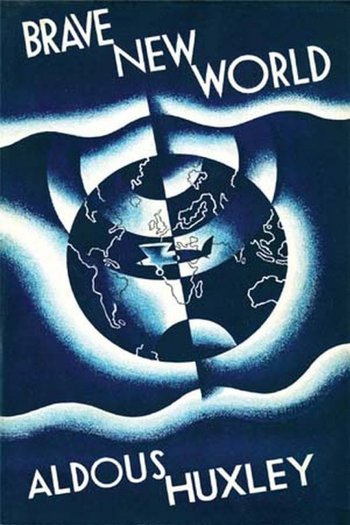
"I don't know what you mean. I am free. Free to have the most wonderful time. Everybody's happy nowadays."
A 1932 dystopian novel written by Aldous Huxley. Quite possibly the only serious Western Dystopia involving too much happiness... as provided by the totalitarian state.
In the future, most of humanity and the environment people live in has been tailored to make everyone happy. There are five castes of people (Alphas through Epsilons), divided further into sub-castes ranging from the leader Alpha Pluses down through the barely-human grunt Epsilon-Minus Semi-Morons. Everyone is grown in jars and their general roles in society planned before "birth". The population is pacified with virtual reality, needlessly complex sports, crowd activities, and the pleasure drug Soma. Human needs are satisfied—by biological engineering when necessary; orgies are the norm; and anything that might possibly cause dissatisfaction is simply left out of society.
The cost of continuing to breed people smart enough to keep society running is the risk of emotional instability in those people. Genius creates the risk of madness—yes, in this society, unhappiness qualifies as madness. We have a Type Alpha who is not as tall and strong and beautiful as most, looking more like a Type Gamma; there are continual jokes about his jar getting spiked with alcohol. He fantasizes about being unhappy. And we have a Type Alpha who's in a critical position in society: he writes advertising jingles. Unfortunately, he suddenly wants to create True Art, and True Art Is Angsty. (No, he doesn't actually create True Art. Wanting to is bad enough.)
The only exception to all of this are the "Savage Reservations", barbaric and primal communities where people still live with nature and its cruelties and limitations, where people are born naturally and know the full range of emotions. After growing up on a New Mexico reservation, one of the novel's protagonists leaves for the wider world (along with bringing some Shakepeare with him), where he quickly becomes a celebrity but at the cost of his own sanity as his ideals and emotions clash horribly with those of the rest of society.
This novel is famous for quite a few things. For one, the biological techniques described in the book (such as cloning) would turn out to be remarkably similar to those used in the modern day, despite this novel being written in the 1920s, decades before real science would ever reach this stage. It helps that Huxley was a member of one of Britain's most important and productive scientific families (his elder brother Julian was a leading evolutionary biologist and his grandfather Thomas was Darwin's Bulldog, the man who argued Darwin's idea in public for him).
It's also a true example of Crapsaccharine World and Crapsack Only by Comparison, and one of the few true examples of a fully developed, internally consistent, Blue-and-Orange Morality. The Brave New World is a fully-functioning society where everyone is happy, youthful, healthy and productive, but it is presented as a dystopia because this comes at the cost of creativity, free will and progression. The Reservation is a free community of emotion, but it is also a dirty, disease-ridden tribal wasteland where the weak are ostracized and pain equals redemption. Aldous Huxley would later go on to express regret at not including a third option that would have been a happy medium of the two. (He does, in his later book Island, but not for the Savage.)
Huxley has often been accused (including by George Orwell and Kurt Vonnegut) of plagiarizing We in writing Brave New World. Despite the numerous similarities between the two books, Huxley always denied this, so compare and contrast the two.
Also, this book is frequently compared to Nineteen Eighty-Four — even by Huxley himself — as a way of showing the perspectives of the dystopia-esque society. Note that Nineteen Eighty-Four shows that what we fear controls us, whereas Brave New World shows that what we love controls us.note
Also compare Fahrenheit 451, a later work with similar themes of an oppressive, pleasure-driven society, vacuous entertainment, suppression of emotions and the elimination of the past (i.e. books).
Also compare Equilibrium, which also uses many of the same themes of emotion control oppression by a World State that decides how people should feel.
And before you ask, the Iron Maiden song of the same name was inspired by the book. Not to be confused with the second expansion of the fifth installment of Civilization.
The book is now in the public domain, and can be found here.
A television adaptation has been released on NBC's streaming service Peacock on July 15, 2020. It has been adapted twice previously as made-for-TV movies in 1980 and 1998 (the latter notably starring Leonard Nimoy as Mustapha Mond).
This novel provides examples of:
- Abortion Fallout Drama: Inverted. Linda is ostracized because she didn't abort. This is a society where babies are grown in People Jars, motherhood is seen as obscenity, and abortion centers are luxury spas. Linda is so humiliated at the idea of being a mother (she would have aborted had she not gotten trapped in the Savage Reservation) that as soon as she got back to society she took soma until it killed her.
- All Issues Are Political Issues: Bernard does this a lot. Justified, since the Brave New World is a totalitarian society, every facet of society and people's lives are manipulated by the state, making Bernard right in thinking this way.
- Alliterative Name: Mustapha Mond.
- All of the Other Reindeer: John the Savage is kept from volunteering for sacrifice on the reservation because he is white. He is then treated as an outsider and gawked at in London. And Bernard, as he is treated like a leper for being prudish about the free sex culture in the Brave New World.
- Alternative Calendar: The story starts in 632 AF ("After Ford"), or AD 2540. Year 0 AF was 1908, the year the Model T came out.
- America Takes Over the World: The World State is an exaggerated version of how conservative Europeans of the 1930s viewed America—awash in eugenics, New Deal-like state planning, mass consumerism, libertinism, atheism and mental hygiene, etc.—which has conquered all the world and imposed its values on everyone else. Everyone speaks English, with the French and German languages specifically mentioned as extinct.
- Anti-Escapism Aesop: Soma is presented as a perfect, non-addictive drug that everyone consumes daily for a delightful euphoric "holiday" with no unpleasant side-effects that might decrease productivity. Although later it's implied that might have a hand with why no one can make it past sixty, since those that are too old or depressed would just put themselves on permanent holiday until they die.
- Anti-Villain:
- Despite being one of the ten World Controllers, Mustapha Mond comes off as sympathetic (in both senses - he has sympathy for others, and the reader may tend to like him), because he secretly enjoys much of the old 'smutty' material such as Shakespeare and regrets the sacrifice of things such as truth and freedom. He believes, in his own full capacity, that the sacrifices are worth it.
- As pointed out by Mark Rosenfelder: "Mond underestimates human potential, but his values are not evil, as Big Brother’s are. He doesn’t want to stamp on the face of humanity forever; he wants peace, prosperity, and happiness."
- At one point when ordering the exile of Bernard and Helmholtz to an island, he comments that he's happy that the world has so many islands to send dissidents to, as the alternative would have to be their execution. He offers exiles, such as Helmholtz, their choice of places to be sent to; Helmholtz chooses an island with a bad climate, such as the Falklands, on the grounds that it would stimulate his creativity.
- Arc Words: "O brave new world, that has such people in it...", and "I'm glad I'm not a [different caste]."
- Artistic License – Biology: Groups of identical cloned people, regardless of how many there are in the group, are always called "twins". Justified, since for instance calling a group of 10,000 "decimilliuplets" would be rather clumsy to say the least.
- Bedtime Brainwashing: This effect uses the proper scientific term, "hypnopaedia." A combination of Pleasant, Troubling and Command (especially Troubling and Command) is used to condition children according to their place in the caste system. Bernard, who happens to be an expert in the subject, takes a sour sort of pleasure in pointing out whenever someone repeats an aphorism they learned through hypnopaedic induction — complete with listing off the ages at which they must have heard it.
- Beethoven Was an Alien Spy: Having invented the production lines that produce everything (people included), Henry Ford is retconned by society into a literal Christ-like figure. (And combined with Sigmund Freud.) Played with in that these people were not in and of themselves different or leading some secret life, but were retconned into this by the regime, who needed people to inspire the masses (think the Kim dynasty in North Korea).
- Believing Their Own Lies: Unlike some characters who actually have backgrounds in the methods of control the book has, Lenina merely woke up in the middle of a hypnopaedia session and realized what was going on. One night wasn't enough and the conditioning still works, but they have constant doubts about it and whether or not they're doing the right thing throughout the book despite being one of the more frequent parroters of the hypnopaedic thoughts. It is entirely possible the main reason she got hurt at the end of the book was an attempt to confess to John the difference between her wanting to get with him (read: have sex) vs. wanting to be with him (read: actual strains of love).
- Benevolent Dictator: The World State is an all-powerful government devoted heavily to Bread and Circuses. Mustapha Mond, one of the central figures of the regime, is extremely patient toward his opponents, hears out John the Savage's arguments, and allows dissidents to be sent into cushy exiles rather than being jailed or murdered.
- Blithe Spirit: Subverted with John the Savage, who gets pitted against a Crapsaccharine World, fails miserably at changing anything, and isn't particularly blithe, either.
- Blue-and-Orange Morality: The new world, according to the Savage (and many readers) — the entire notion of parentage is regarded as obscene, sex is as quick and impersonal as a handshake, nobody misses people when they die, and Romeo and Juliet would be considered a comedy. Described In-Universe as an example: when the Savage gets into a discussion with Mond, Mond explains that the reason this world feels so wrong to the Savage is that he is still using the old system of good and evil, as opposed to the modern system of happiness and unhappiness. One of the very few cases in which this trope is done well.
- Bread and Circuses: The ultimate example. Even though society has made it impossible for anybody to live anything but a crude shell of a meaningless life, nobody would rebel because it wouldn’t be worth giving up all their conveniences.
- The Beautiful Elite: In the upper castes, everyone is genetically engineerednote to look beautiful, and they show no signs of aging.
- But We Used a Condom!: Linda became pregnant in spite of her contraceptives. It happens often enough that there's an Abortion Centre.
- Cataclysm Backstory: The Nine Years War, which broke out in AF 141 (2049 AD), and the the great Economic Collapse. The few details given include the use of anthrax bombs and the destruction of many historical monuments. The two events eventually gave rise to the World State.
- The Chains of Commanding: Mustapha Mond doesn't really like his job as World Controller all that much, but someone has to do it.
- Character Filibuster: One chapter near the end of the book consists of a big debate between John Savage and Mustapha Mond on The Evils of Free Will.
- Color-Coded Castes:
- The book has caste uniforms. Alphas wear grey, Betas wear mulberry, Gammas wear green, Deltas wear khaki, and Epsilons wear black.
- In the 1980 film, Alphas wear white, Betas wear orange, Gammas wear a slightly darker brown, Deltas wear blue, and Epsilons wear dark gray.
- In the 1998 film, Alphas wear black, betas wear blue.
- Conditioned to Accept Horror: Most people have no idea just how vapid and insignificant their lives are. The ones who do know this are so difficult to integrate that they're shipped off to isolated islands just so they don't have to think about it so much or risk spoiling everyone else's mindless fun.
- The Constant: An old, dirty and barely preserved book of Shakespeare, kept in the savage reservation, checked by the only savage that, as the son of a civilized woman, has learned how to read.
- Crapsack World: The reservation is a dump with excessive violence and drugs with more ravaging effects than Soma.
- Crapsaccharine World: Your options are either a utopia that encourages neglect of individuality, or an exile in a squalid low-technology reservation or a remote island. An attempt to make a society where everyone is treated equally and everything is provided by robots collapsed into civil war within a few years. Everyone on that island was an Alpha, even though jobs done by other castes in the rest of society still needed to be done; predictably, all the islanders considered themselves above such tasks, they didn't get done, and things snowballed.
- Crapsack Only by Comparison: Native Americans view the "utopian" world of London as immoral, unnatural, and pointless, while Lenina sees John the Savage's home on the savage reservation as backwards, uncivilized, and barbaric. Both assessments are completely correct.
- Creative Sterility: Art without content or substance is what Helmholtz makes, and it's ultimately why he doesn't like the system. Mond also reveals scientific research and development has been purposefully halted for years; the authorities gave him a job as one of the world leaders to cheer him up.
- Culture Police: Turned completely on their head considering the usual portrayal, but no less stringent about enforcing their particular stripe of morality.
- Decoy Protagonist: Bernard Marx. Literature teachers often use him to introduce the concept to students.
- Deconstruction: Of the Enlightenment Utopia, and particularly Plato's The Republic. More specifically, the Theme Park Version of Utopia, "where everyone's happy".
- Designer Babies: Alphas, Betas, Gammas, Deltas, and Epsilons. In short, pretty much 95% of society with the lower orders even being an inversion.
- Deliberate Values Dissonance: Love between the sexes has been reduced to just sex, and sex is as casual as a handshake. Children having sex with each other is considered adorably precocious, while the word "Mother" is obscene. Accordingly, when John tries to reintroduce Romeo and Juliet, everyone thinks it's funny that a boy would agonize so much over "having" a girl.
- Didn't Think This Through:
- Mond not sending John to an island, as he requests, because he wants to see if John can survive in this utopia as an anomaly who belongs nowhere. It eventually leads to John's suicide.
- John violently spurned Lenina for wanting to have sex with him without earning it; he said he wanted to win her over fairly, so their relationship would mean something. So what does she do? Seeks him out in exile with a bunch of other pleasure seekers after John has chosen self-exile. John has a whip, and a tendency to beat up anyone encroaching on his penance. He not only whips her into a quivering blob, but starts a riot among the others.
- Dirty Coward: Bernard, Henry. The whole society was made so you can simply take a pill the moment trouble arises, which aren't the kind of conditions that make brave people, but those two stick out.
- Disproportionate Retribution:
- Bernard ruins the DHC's career because he wanted to transfer him.
- "Transfer" to Iceland amounts to permanent exile without chance for appeal for the heinous crime of being a bit anti-social. Although as Mond explains this is actually a good thing for Bernard since he really can't fit in the dystopia and the alternative would be killing him.
- Does This Remind You of Anything?: Too many to count. That said, most of the parallels between the novel and real life
 already existed in Huxley’s time.
 - Domed Hometown: Most of civilization lives in closed-off areas, while living "outside" is considered roughing it in the extreme.
- Double Standard: It is clear that, in the novel, sexism is still alive and well. Although the nature of the indiscretions have changed, the exposure of a man's indiscretions merely make him a laughingstock, while his female partner, being exposed, is shunned. In addition, the "dirty words" that describe a woman are much more taboo than those that describe a man, to the extent that a government employee censors them when writing official documents. There is also a conspicuous lack of references to Alpha females throughout the book (particularly glaring when the DHC addresses a group of Alphas at the beginning, who are all boys), to the point one may wonder if Beta is the highest caste a woman can belong to. Contraception also seems to be primarily the responsibility of the fertile women, with no mention of men taking any precautions like condoms.
- John is piously disgusted by the casual sex the citizens indulge in, and is outright violent towards Lenina for propositioning him but it doesn't take much for him to indulge in the orgy at the end. Despite his idolisation of Romeo and Juliet, he's a misogynist at best.
- Downer Ending: John tries to get away from civilization, but fails and ultimately kills himself because of it.
- The 1980 UK TV movie adaptation makes this worse by having John commit suicide because he thinks Lenina died, when really she was knocked out by clouds of soma used to placate the crowd, Lenina being sent to reconditioning therapy because the Gamma officers heard her muttering words like "love" and "marriage", and Mustapha Mond telling his female assistant to destroy all evidence of the social experiment he was conducting about whether or not someone like John can live in their society.
- The 1998 American movie version is a bit Lighter and Softer: John does die, but not by hanging himself. Instead, John ends up falling off a cliff to his death due to the paparazzi hounding him following his meltdown at the soma dispensary. After Bernard gets the DHC's position following the latter's ousting over being a father, he discovers Lenina is pregnant and decides to leave society and live with her on a free island so they can be a family. And viewers discover that John's influence has inspired a boy to stick cotton in his ears so he won't be brainwashed by the nightly hypnotherapy.
- Dramatic Irony: The narration reveals early on that Lenina is naturally inclined toward monogamy, but is peer-pressured into casual dating by society. The men she falls for also tend to be unconventional thinkers and social outcasts, and she commits a minor taboo by dating "undesirable" men instead of the kind of vapid, popular men society thinks she ought to go for. However, not realizing this, the outcasts she does fall for (Bernard, John) assume she's just as vapid as the rest of society.
- Driven to Suicide: John is at the end when he is unable to escape or resist society.
- Dystopia Is Hard: But necessary for the greater good, according to Mustapha Mond.
- Dystopian Edict: Averted by the World State, who do not pass any singular edict or unpleasant law in order to forge their dystopia but instead are conditioned culturally to not like doing anything alone, being incapable of a long term relationship, consuming a drug called Soma when you are not happy, and any number of things in order for you to be "happy" and not disturb the social order; if you don't follow even one of this rules of behavior they banish you to a island far away so you won't disturb the social order, but it is stated at one point this is not as a punishment as it may look as there they're able to coexist with persons who share similar beliefs and live their own way. After all, "Everyone belongs to Everyone Else".
- Eternal English: John has no difficulty comprehending Shakespeare, who by then is more than 900 years old.
- Everybody Has Lots of Sex: Enforced by the society. Children play erotic games, adults have many partners, and abstaining is viewed as morally wrong.
- Inverted in the Savage Reservation, where people are supposed to be monogamous; at one point, several village women whip Linda for seducing all their husbands.
- Evil Is Easy: Sure, they could create a world where the human spirit still exists and culture and learning are respected, but it’s just so much easier to indoctrinate the masses into enjoying The Theme Park Version of happiness and prosperity, rather than the real thing.
- Evil Luddite: Downplayed but as Mustapha said the World government stopped doing real science and invention for years. They arbitrarily assumed this scientific level is optimal and everything else will ruin their society so any attempt at real science will lead either to exile or bribery so they stop.
- The Evils of Free Will: Mustapha tells about an experiment with an all-Alpha population. It soon devolved into a civil war and resulted in the citizens requesting that the government take back control.
- False Dichotomy: Mustapha Mond's experiment in equality fails to be an argument against free will because the experiment seems to have been engineered to fail. The people involved in the experiment were Alphas. They not only had a high intelligence that made them efficient at intellectual work, they were conditioned all their prior life to be happy only with specific jobs. This ensured civil war, because they were literally brainwashed into being incapable of accepting the menial jobs they were shown. Yet no character points this out. If the experiment involved members of all castes, except without the caste system being enforced (allowing castes to interbreed, and take different jobs if they wanted to), or the citizens selected for the experiment were adults who were spared conditioning as children, the experiment could probably have succeeded. The "brilliant minds" who became disillusioned with society and were banished to the world's many islands to do as they please (alluded to at the book's end and explored in Huxley's Island) certainly created what could very well be a viable alternative to "civilization" (with its brainwashing and enforced caste system) and "savage" (poverty- and conflict-ridden) reservations. Thus the presented trilemma between pointless hedonism, civil war, and low-technology reservations is a false one.
- Fantastic Caste System: Different classes of people are produced through embryonic manipulation (specifically oxygen starvation and alcohol poisoning of Delta and Epsilon caste embryos to physically and mentally retard their growth) and the slaves of the lowest class are created to be practically simian (and everyone is psychologically conditioned to accept this ranking, as applied to self and others, as obviously and unquestionably justified).
- Fantastic Drug: Soma is a harmless, non-addictive, pleasantly euphoric and hallucinogenic drug that everyone takes. It appears to cause no long- or short-term impairments, and you can't overdose on it.note
- Fantastic Underclass: The lowest on the Fantastic Caste System are the Epsilon class: the absolute nadir of the working class, they are regarded with contempt if noticed at all by their superiors, are given only the simplest of duties, and have actually been engineered to be stupider and shorter than everyone else by inducing Fetal Alcohol Syndrome during their gestation.
- Fictional Religion: Fordism, in which Henry Ford is worshiped as a god.
- For Happiness: In a deconstructed way. It's easier to drug and condition people into thinking they are happy than giving them a choice about what makes them happy. Bernard's boss even points out that Alphas have non-damaged brains and therefore are smart enough to realize how childish their pleasures are, meaning they have to put more effort into being childish, and tries sending Bernard away for not doing it.
- Free-Love Future: Played with and deconstructed simultaneously. Everyone is encouraged from earliest childhood to have sex with as many people as possible, and never to form strong attachments to any of them. Chastity is the deadest of virtues. But it's not really "free love", because being promiscuous is mandatory. Sexual norms are just as strict as they were in Victorian times, they just go in the opposite direction. John confuses Lenina by not jumping her bones at the first opportunity; because of this, she ends up longing for him, and comes the closest she will ever come to actually feeling love in her life.
- Friendly Enemy: Mustapha Mond toward the central malcontents.
- Future Imperfect: Invoked by the government. No history is taught and texts from before a certain date are strictly forbidden; the few references to the past that come up would appear to our minds to have gone through centuries of misinterpretation. For example, Henry Ford has been conflated with Sigmund Freud, but only in psychological contexts.
- Future Music: Seems to come in two flavors: completely synthetic, composed and played by a computer with no human intervention; and live performances by enormous groups of identical musicians. (It's not directly stated, but there might be overlap between the two: the live groups are playing the compositions of the computers.)
- Future Slang:
- "Ford" has basically replaced "God" and "Lord" in all contexts, resulting in titles like "his Fordship" and exclamations like "For the love of Ford!" The reason is because he created the assembly line, the absolute base of the civilization.
- "Pneumatic." This actually was a slang term back in the 1920s, but it's become so obscure that it sounds like Future Slang. (You may know the rough millennial equivalent of The New '10s however: "thicc".)
- An interesting subversion: in colloquial Finnish, "pneumatics" and "hydraulics" are euphemisms for sex.
- Genius Breeding Act: Embryos are created in labs, and people are born into different classes: Alpha, Beta, Gamma, Delta, and Epsilon. These groups are engineered to have different intelligence levels both through genetic selection and differences in their artificial fetal environment; for example, an Alpha is made from Alpha gametes and incubated in an optimal fetal environment, while Deltas and Epsilons not only have inferior genes but are also exposed to alcohol in vitro.
- Getting Smilies Painted on Your Soul: One of the major themes of the book is whether keeping everyone passive and happy is worth eliminating any deeper emotions which could cause conflict.
- Good Girls Avoid Abortion: Inverted. Linda is a social outcast for having a baby in a world where in-vitro fertilization is universal, motherhood is an archaic obscenity, and Abortion Centres are luxury facilities. Linda herself is so humiliated at the idea of being a mother (by the time she realized she was pregnant, she was trapped in the Savage Reservation and couldn't abort) that as soon as she got back to society she took soma until it killed her.
- Government Drug Enforcement: Soma and Malthusian Belts.
- Grand Inquisitor Scene: John and Mustapha Mond debating the World State. John argues for a world in which meaningful art, passion, family, and God have a place again, but Mond shoots down everything John brings up. He agrees with him that the old world had more meaning to it, but that it had to be sacrificed for stability.
- Greek Letter Ranks: One of the Trope Codifiers. People are genetically engineerednote and designed to fit into castes ranging from Alpha (the best and brightest) to Epsilon (simple-minded workers for the simplest jobs).
- Happiness in Slavery: Pretty much all of society is conditioned to like exactly where they are. Those at the top enjoy their intelligence, those at the bottom enjoy not having complicated responsibilities, and those in the middle think they have just enough intelligence without having too many responsibilities. The Alphas are perfectly aware of the fact that they're happy with their position because they were conditioned to be, but see nothing wrong with it.
- Happiness Is Mandatory: From the in vitro conception to death people are engineered to be constantly happy with what they have and what they do. The secret is in purposefully giving mental retardation to fetuses and drugs.
- Hate Sink: The Director of Hatcheries and Conditioning (DHC), who is Bernard’s and Lenina’s boss. He does nothing but shill how wonderful the book’s civilization is, but unlike Mustapha Mond, has nothing to back it up and has never entertained an original thought in his life. But then he tries to get Bernard reassigned to Iceland for the “crime” of not liking golf, and it is revealed that he is the Savage’s father, but didn’t give one whit about Linda’s disappearance and presumed death. It is made very clear that all of his actions are deserving of the highest praise In-Universe, demonstrating its dystopian nature.
- Heterosexual Life-Partners:
- Bernard and Helmholtz.
- Bernard seems to see John and Helmholtz as this later on.
- Hidden Depths: Lenina is naturally inclined towards monogamy despite polyamory being enforced by society, tends to feel attracted to unconventional thinkers and social outcasts despite being her society's ideal woman (outwardly vapid), is fascinated by the prospect of seeing the reservation instead of being too repulsed to go like most of her peers (betraying at least some intellectual curiosity). She's also one of the few characters who woke from their sleep-induced conditioning as a child, but due to bad luck the she was instead frightened by the ghostly whispers in the night that only the pleasant dreams of socially-imposed platitudes provided, so the real reason she resists breaking out of the happiness machine is not lack of intellectual ability like Bernard or John suspect, but deep-seated, conditioned (unintentionally) childhood trauma.
- Honor Before Reason: John. By the end, he nearly found a third option of a quiet and happy life in seclusion but his commitment to being unhappy meant he couldn't accept it (then the crowds came to gawp at him and everything got worse).
- Hypocrite: Bernard towards women. He can't stand that most pretty girls don't want to have him because he's unattractive, yet he can't stand having unattractive women. He scowls and seethes over how "Alpha" men view women like Lenina as meat, assuring himself that he appreciates her personality; yet the only reason he likes her is because of her physical beauty and not her mind (such as it is). Finally, while he raged against the objectification of women by society's mandated casual dating culture when he himself couldn't score a date, the second he becomes popular due to knowing John the Savage he wastes no time banging as many hot chicks as possible (having, at this point, forgotten all about Lenina).
- Ignore the Fanservice: John in regards to Lenina. Not that he doesn't want her but he actually wants to court her first.
- I Can Change My Beloved: Bernard and Lenina's relationship contains heavy undertones of this on both sides, and Lenina also later gets into a bit of this with John. In ends horribly for all involved parties in both cases.
- I Have Many Names: Ford is stated to go by "Freud" in psychological contexts, as if the name were a godly epithet.
- I Just Want to Be Normal: Bernard Marx and Linda both realize they don't fit into society, and are ashamed of it.
- I Just Want to Have Friends: Bernard. A darker take on this trope than usual—when he does luck his way into popularity, he has no problem abusing it and doesn't mind that it's shallow. At the end, Mond implies that Bernard will make friends...in exile with all the other malcontents.
- Illegal Religion: Fordism has taken the place of old beliefs such as Christianity, Totetemism, and Ancestor Worship, though they're still practiced in the Reservations. Subverted in that they're not really illegal per se, it's just that your average resident of the World State has no need or care for them. Mustapha Mond even admits he believes there is a God, it's just that he's chosen not to make Himself known
- Inherent in the System: The brainwashed existence and/or the menial labor.
- Info Dump: The reader follows a group of new students through a tour of the Hatchery & Conditioning Center to learn how this society functions.
- Intellectually Supported Tyranny: A rare example of this character as the Evil Overlord himself, in Mustapha Mond. Also unique though is that he comes across as more complex/likely to be right than other examples. Mond is one the few who realized how oppressive the system is since he is smart enough to see the science they practice is repeating what was already known to avoid upsetting the statu quo with new breakthroughs. The difference between him and the protagonists is that the World controllers had an opening. When Mond realized it, he took their offer. He argues their system really does produce the most happiness, in spite of it being less meaningful than life before, and John never actually refutes this.
- In with the In Crowd: Bernard after he brings "the Savage" to London.
- Ironic Echo: "Oh brave new world, that has such people in it."
- Irony: John could have accepted he was happy while working in his garden away from main civilization and found happiness in his toil. Instead, he decides to punish himself. His self-inflicted whipping punishment makes a noise loud enough for a few locals to investigate, which starts the downward turn at the end of the book. Whereas if he'd stayed low and quiet, he may have avoided that fate altogether.
- Large and in Charge: The lower classes are shorter than the Alphas and Betas. Bernard subverts this due to being the shortest Alpha, so short that he can look at an Epsilon in the eyes. There are frequent jokes that he got some alcohol put in his gestation bottle.
- Leaning on the Fourth Wall: John grew up reading Shakespeare's works, and he's often prone to reading from them while in the "happy society". Since the book's title comes from The Tempest, a Shakespeare work...Miranda: O wonder!
How many goodly creatures are there here!
How beauteous mankind is! O brave new world
That has such people in't! - Literary Allusion Title: The title comes from a line in The Tempest.
- Live-Action Adaptation: The little known miniseries.
- Loners Are Freaks: The 1980 film has a solidarity patrol - because lonely people are more likely to be unhappy.
- Love at First Sight: John for Lenina. Must come from reading so much Shakespeare. Deconstructed when he gets to know the real girl herself, not the idealized version he created in his head.
- Loving a Shadow: John, who knows romance mostly through Shakespeare and the Reservation, desperately wants to see Lenina as innocent and unavailable, rather than a typical member of her society.
- Lust Object: Lenina to every man she meets, naturally. Played with in that while Bernard and John assure themselves that their feelings toward her are not base, but emotional and transcendental, it quickly becomes clear that they're only drawn to her because of her good looks, and pour all their ideals of what a woman should be into her, and become frustrated when she fails to play along. They want to see her pure and chaste so they can enjoy sex with her later, damnit! (It's no fun banging her if she's loose, casual, and enjoys sex as much as them!)
- Luxury Prison Suite: Mustapha Mond points out that exile to an island actually means getting sent to the only places in this world where you can find real people instead of the puppet-folk of regular society.
- Machine Worship: The future society worships Henry Ford. They even set the calendar by him. Played with inasmuch as "Ford" is a conflation: they simply lump together all those whose inventions and discoveries make their way of life possible. Ford's mechanization and automation policies, Freud's theories of childhood development, etc.
- Madonna-Whore Complex: John towards Lenina, big time. He tries and tries to hold her above the standards of the society, but when confronted with damning evidence that no, she really is ultimately a lot like everybody else, he lashes out angrily and cuts off all contact with her, and ultimately beats her in a violent rage when she tries to visit him at the lighthouse at the end of the book.
- Meaningful Name:
- Most characters have names that refer to famous political and cultural figures, like Bernard Marx, Mustapha Mond, Lenina Crowne, Benito Hoover, Darwin Bonaparte and so on.
- Also, "Linda" means beautiful.
- Memetic Mutation: Invoked as a form of mind control. Pithy little catchphrases (that often rhyme for added catchiness) are spread and invoked as thought-terminating clichés to stop any potential dissent in its tracks.
- Murder-Suicide: Implied at the end when John whips Lenina, possibly to death, before hanging himself. Again, might come from reading too much Shakespeare.
- My Girl Is a Slut:
- Ingrained into society that this is normal, expected, and desirable.
- Henry's attitude towards Lenina, typical of the Alpha caste; when he thinks she already has a date with someone else, for example, he's always excited to know with whom. Fanny actually criticizes Lenina for not being slutty enough.
- My Girl Is Not a Slut: Bernard and John, on the other hand, don't like that. John takes it really poorly when she tries having sex right away.
- My God, What Have I Done?: John, after participating in a soma-fueled orgy, and possibly even whipping Lenina to death in the process, retreats to his secluded cottage and hangs himself.
- Nice Job Breaking It, Hero: John's life is utterly ruined by Bernard bringing him to the "civilized world".
- Nice Job Fixing It, Villain: The DHC waxes lyrical in front of Bernard about his misadventure on the Savage Reservation years prior. Annoyed at himself for doing this, he then threatens Bernard with a transfer to Iceland. Unfortunately, Bernard now has the information and motivation to put two and two together and figure out that John is the DHC's son when he arrives on the Reservation, allowing him to not just avoid the transfer, but to ruin the DHC's career at the same time.
- Noble Savage: The trope given form as John the Savage. Subverted by the other members of the Reservation, whose standard of living and way of life are intended to be just as troubling to the audience as the World State.
- Older Than They Look: Everyone stays young (physically, mentally, etc.) until their deaths.
- One Drink Will Kill the Baby: Lower-caste fetuses are deliberately poisoned with alcohol (and deprived of oxygen) to make them stupid and weak. Notably, this was before alcohol was proven to actually be a poison to fetuses or nursing infants. It had been theorized though, and apparently Huxley ran with that.
- One-Steve Limit: Inverted, as there are only a limited number of names for everyone on the planet. Lenina and her best friend share a surname and this is not considered unusual or significant.
- One World Order: After numerous devastating wars the remaining government allied each other to do one true order and never go through pain ever again.
- Only Six Faces: The Delta and Epsilon classes consist of group of thousands of identical "twins" grown from a single egg. They average about 70 twins per egg. Most evident in the scene near the end of the book, where The Savage comes up against the menial staff of the Park Lane Hospital coming off their shift; hundreds of people but only two faces, one male and the other female.
- Our Clones Are Different: Although never called 'clones' in the book, almost all individuals in this universe are one of many 'identical twins', who are reared and conditioned into their assigned ranks. Huxley goes a great deal into the process of producing the 'twins'. An egg is taken from a woman and artificially fertilised in a pot. Gamma, Delta, and Epsilon embryos (the lower ranks) go through the 'Borkanovsky method', involving an electric shock causing the fertilised egg to split up to 96 times. Epsilons, who are the lowest ranking caste, are even subject to a low-oxygen environment to keep their intelligence low. Alpha and Beta ranks, who are high-ranking and are therefore allowed intelligence, do not go through this process, however they too result from a pot birth. It is an extreme social violation for a child to be born naturally, and the word 'mother' is an obscenity.
- Peerless Love Interest: Lenina for John.
- Penal Colony: Any dissidents are sent to various islands (they aren't imprisoned on them though, just exiled).
- Pet the Dog: The World State does its best to ensure that even the troublemakers are happy, "exiling" them to the islands where they can be real people in the company of other real people.
- Plot Hole: Lenina is a Beta, and in one scene she even looks down on a group of Gammas while thinking how glad she is not to be one of them. But in every scene in which her clothing is described, she wears green, a color that is assigned to Gammas (it's even referred to as "gamma green"). Betas wear violet.
- Pragmatic Villainy: Free thinkers are just asked to leave the society and go to an island where they can be themselves. Mond admits it's simply because there is plenty of free space so no point executing malcontents.
- Punch-Clock Villain: Mustafa Mond actually really likes Shakespeare, pure science and religion, but he has to refuse all of these, because his job to provide happiness for the people demands this.
- Raised by Natives: John was raised on a reservation as the whore's son.
- Really Gets Around: Almost everyone (since this is the norm), although Lenina is an interesting case. Even though she's quite promiscuous by real-life standards, in-universe she's seen as being as conservative as society will allow. Early in the novel a friend of hers chastises her for going back to the same man too frequently, and John's unavailability causes her to obsess over him.
- Reasonable Authority Figure: If only all totalitarian dictators followed Mustapha Mond's example and simply sent malcontents to islands of "normal" civilizations instead of to Room 101...
- Reassigned to Antarctica: Well, to Iceland, actually. However Bernard takes revenge on his boss before that happens.
- Refuge in Audacity: Literally applied in-universe as The Theme Park Version. Island societies have been set up for the people who were deemed as unusual and irresponsible while in this new world. If it comes to the point where a person has to be deported, they have the option to pick which island they want to go to.
- Repressive, but Efficient: Played with. Any free thought is severely frowned upon, and even the most dull and unimaginative person from our time would hate living there, but everyone has a high standard of living, the citizens are insanely happy, and there's no crime. Occasionally someone's conditioning will fail and they'll be a free thinker and unhappy with their lot, but those people aren't punished, imprisoned, or executed, just given the choice between joining the ruling class or going into voluntary exile in an island community of like-minded people, which is relatively humane by dystopian standards. The society is juxtaposed with that of the "savages," who are people who live in a tribal society, and have standards of living that are terrible in comparison, but they are still, for lack of a better word, human.
- Robotic Assembly Lines: The book opens with a description of the cloning assembly line.
- Romanticism Versus Enlightenment: The Savage versus the technocratic World State.
- Sarcastic Title: Everything the new world does is to avoid getting hurt, John even called them out that instead of dealing with hardships they simply gave up by drugging themselves with Soma.
- Science Is Bad: Well, a threat to social stability if not kept in check. Pure science, at least.
- Screw the Rules, I Make Them!: Blatantly invoked by Mustapha Mond when he points out that reading Othello is illegal, but since he makes it illegal, he can still read it if he wants (not that anyone except him and John want to read it anyway).
- Self-Punishment Over Failure: John punishes himself in isolation (and with whips) for falling into the temptation of sex before eventually hanging himself.
- Send in the Clones: Humanity is mass produced in batches of "identical twins" on the order of hundreds at a time.
- Servant Race: The Gammas, Deltas, and Epsilons.
- Sex Is Evil, and I Am Horny: John's fundamental conflict. His traditional values on things such as love and sex clash horribly with those of civilized society, and when he finally gives in to his impulses, he becomes so guilt-ridden afterwards that he hangs himself..
- Unfortunately for John, culture shock makes it worse much earlier than that. Even when given a place to call his own and on the verge of happiness working on his own, he gets interrupted by the thought of Lenina making passes at him. Since all he's seen of the "brave new world" is sexual depravity and wanting to avoid that as much as possible, he resorts to absolution through pain rather than accepting even the slightest impulse.
- Sex Is Good: Deconstructed — Everyone is having sex on a regular basis and conditions to see it as a good thing, and that if you're happy then surely you're willing to share what you have. This also means that no one is taught about healthy boundaries or consent. John makes it clear that, while he would like a relationship with Lenina, he doesn't want it freely but would rather earn her love fairly. She doesn't listen, which leads to him violently spurning her. It also means that no one in this society respects personal space or your wishes. When John tries to live on his own, interested journalists try to interview him and get chased off his land. They don't get the memo that John wants to be alone, and a whole group of people come to witness John with his whip, including Lenina. He turns his whip on her, which starts a riot in turn because the people don't understand the difference between pain and punishment and want to be involved.
- Sexophone: The briefly mentioned sexophones are either renamed saxophones or some odd new instrument. Sex is so blasé in this civilization that a deliberate rename wouldn't be out of the question.
- Shout-Out: Many of the sexual mores described in the book, such as the undesirability of bonding too closely with one sexual partner and the sexual initiation of minors, resemble those of the 19th century Oneida Community.
- Shout-Out to Shakespeare: The title comes from The Tempest, and since one of John's first books was an anthology from the Bard, he's prone to quoting him.Miranda: O wonder! How many goodly creatures are there here! How beauteous mankind is! O brave new world! That has such people in it!
- Speaks in Shout-Outs: One of John's first books was an anthology from William Shakespeare, he's prone to quoting him.
- Spiritual Antithesis: Huxley would later go on to write Island, a book in which many of the same techniques imposed as control measures in Brave New World's World State can be genuinely beneficial to a society that allows them as options but doesn't force them upon its members arbitrarily.
- Stepford Smiler: Bernard must become one in order to conceal his rebellious, unorthodox thoughts.
- Stupid Future People: Downplayed. While the masses (Gammas, Deltas, and Epsilons) are deliberately made stupid, Alphas and Betas are quite intelligent. However, the intelligent elite are just as shallow and superficial in their philosophical worldview as the stupid people.
- Take a Third Option: Bernard and Helmholtz chose this when presented with the "Stability or Freedom" question. The concept itself is not explored in depth until Huxley's later work, Island. Mustapha Mond tells them that he was also faced with this choice, but took a third offer to become a Controller. He regards this as the harder path than going to an island, but more worthwhile. A foreword written by Huxley in 1946 suggests that, given the chance to go back, he might have given John a third option in the end.
- Take That!: It's probably not meant as a compliment that George Bernard Shaw is one of the few writers whose work has never been censored by the World State.
- Talking the Monster to Death: The book's climax consists of a dialogue between John the Savage and Mustapha Mond.
- Theme Naming: All the characters except John the Savage are named after renowned capitalists, communists, industrialists, psychologists, philosophers or scientists. John's behavior indicates he's probably named after the concept of the Noble Savage.
- Title Drop: The verse that the book's title comes from is said by John repeatedly.
- The Film of the Book: In 1980 (with Kristoffer Tabori and Julie Cobb), in 1998 (with Peter Gallagher, Rya Kihlstedt, Tim Guinee and Leonard Nimoy as Mustapha), and there's another one in the works.
- Totalitarian Utilitarian: The story takes place in a society where For Happiness have become such a great cultural obsession that it has become oppressive.
- Troubling Unchildlike Behavior: Children still going through their conditioning are allowed age-appropriate sex-play with other children.
- Twisted Eucharist: The Solidarity Services are the Fordist equivalent of the Eucharist. The twelve participants pass around a cup of strawberry ice-cream soma and drink to the Greater Being that will subsume them all. The participants are each seated in a circle between two members of the opposite sex, and are expected to pair up in the culminating "orgy-porgy."
- Uterine Replicator: This is how everybody in the World State now gets gestated (they're also clones).
- Utopia Justifies the Means: Mustapha Mond's defense of the new world and its ruthless suppression of intellect, creativity and freedom. He genuinely believes the happiness and comfort the world's gained is more than worth it, and makes a scarily strong argument against freedom of choice.
- Variant Chess: All the sports available are more complex versions of current ones, like Riemann Tennis or Magnetic Golf—the additional equipment increases consumption.
- Villains Never Lie: The protagonists all take Mustapha Mond's story about the Alpha society of Cyprus failing at face value, even though Mond is probably the most Unreliable Narrator imaginable for dictating why a free society of equals can't work.
- The War to End All Wars: The Nine Years War, which happened roughly 500 years before the start of the novel.
- Well-Intentioned Extremist: Mustapha Mond recognizes that individuality, creativity, and self-awareness are lofty and noble things. He also believes that sacrificing them in the name of stability, order, and banal happiness is necessary to stop human civilization from destroying itself.
- We Will Have Euthanasia in the Future: Downplayed: the government doesn't actually euthanize anyone — people are simply biologically programmed to die at age 60. Since everyone is discouraged from making permanent bonds with one another, there's no sense of loss on either side.
- We Will Have Perfect Health in the Future: The trick is, while everyone is healthy and youthful, their bodies can survive this treatment to no longer than around the age of sixty. Savages grow old, but they can also luck out to have much longer lifespan.
- We Will Use Manual Labor in the Future: The lower (read: intentionally retarded) castes. Justified; they've got the technology to make a great deal of that work obsolete and in fact tried just that, only to find out that it made people unhappier. It's better to give the Epsilons somewhere to go and something to do for 8 hours, so labor-saving technology was intentionally dialed back to create more make-work. As for why they didn't just stop breeding/manufacturing the lower castes and let a society of free, intelligent humans operate the labor-saving devices themselves: they tried that too, and the island they tried it on collapsed into civil war within a couple of years; it turns out that the higher castes need someone to boss over and will not do anything that they feel is beneath them.
- What Is This Thing You Call "Love"?: Wanting to be with one person? Caring if your partner is with someone else? Minding when someone dies?! What hilarious concepts! Well, assuming you're not a Native American on the reservation.
