
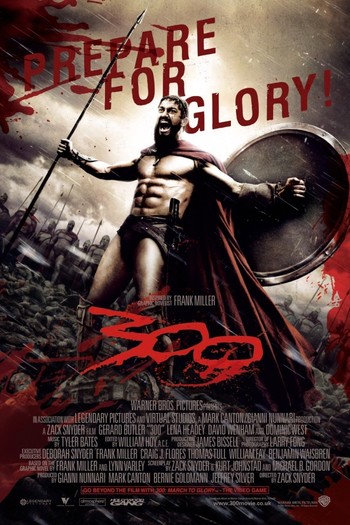
300 is a historical Battle Epic film directed by Zack Snyder and based on the 1998 comic miniseries of the same name by Frank Miller and Lynn Varley. The film premiered at an Austin marathon in late 2006 before receiving a wider release in early 2007.
In spite of its heavy fantasy influence, the film's story is based on real events: the Battle of Thermopylae in 480 BC during the Second Greco-Persian War, as described by ancient Greek historian Herodotus. Miller was introduced to the Thermopylae story through a 1962 Sword and Sandal film called The 300 Spartans, which influenced him deeply as a child. The comic and film are extreme examples of being Very Loosely Based on a True Story, as artistic license is liberally employed (more so in the film than in the comic).
A young, one-eyed Spartan soldier relates to a group of fellow soldiers how recent events came to pass. King Leonidas of Sparta (Gerard Butler) refuses to bow to the God King Xerxes' demands for Sparta to submit to the vast power of the Persian Empire. Leonidas' visit to the deformed, elderly Ephors and their Oracular Urchin/Sex Slave brings worse news: Sparta cannot wage war against the armies of Persia on the eve of the sacred Carneia festival.
After much deliberation, Leonidas decides to defy the oracles' prophecies... sort of.
He gathers 300 of Sparta's finest soldiers (referring to them as his "personal bodyguard") and marches them to the Hot Gates, a narrow pass between the ocean and mountains. By rebuilding an ancient wall to bottleneck the vast Persian army, the superior fighting ability of the Spartans would conceivably make up for the small size of their army and give them a fighting chance at holding back the Persian Empire until Sparta's army can launch a full assault.
700 or so other Greeks turn up as Leonidas and the 300 make their way to the Hot Gates, and when the Persian Empire brings its forces down upon them, the battle goes exactly according to Leonidas' plan. The fighting skill and perfect defensive position of the Spartans prove to be too much for even the monstrous Persian army to handle. The kill count becomes obscenely lopsided in favor of the Spartans, and the only real problems arise when their information gets sold to Xerxes.
The film version of 300 is greatly characterized by Snyder's Signature Style, its comic book roots and the story itself being presented as a morale-boosting story told by Dilios. While accurate in some historical aspects (mostly quotes), it is presented first and foremost as a visual Greek epic tale of glory, death, and how battling half-naked is strategically superior. Trying to justify or explain it is as futile as explaining why John Matrix should face a court-martial for property damage. Think of this as Sin City (also by Frank Miller) with gold and red instead of white and black... and with far fewer prostitutes.
A prequel/midquel/sequel film, 300: Rise of an Empire, was released in March 2014, and Miller made a sequel comic called Xerxes: The Fall of the House of Darius and the Rise of Alexander in 2018. Snyder has come forth in 2020 saying he's helped writing a third film, but Warner Bros. haven't picked it up.
"These! Are! TROPES!"
- Absurdly Sharp Blade: Both sides hack a lot of limbs and heads off quite cleanly like a hot knife through butter, despite having only bronze weapons.
- Acoustic License: At the end of the film, the narrator is revealed to be talking to an army of over thirty thousand men. Somehow, the guys way in the back who are probably half a mile away, hear him perfectly fine.
- Action Film, Quiet Drama Scene: The scene where Dilios returns to Sparta as the Sole Survivor of the 300 and gives Gorgo Leonidas' necklace is a short, somber scene that has no dialogue, but the two practically have an entire conversation.
- Actually Pretty Funny: During one of the arrow bombardments where the Spartans are under their shields, Astinos quickly remembers Stelios's "fight in the shade" Badass Boast towards the second Persian Emissary, and then starts laughing hysterically. Cue every Spartan laughing save for the Captain upon realising the punchline.
- Adaptational Badass: Invoked slightly. The original comic was still filled with badasses but the movie version went straight into pure fantasy with monsters and combat feats that defy the laws of physics. The movie was more of a comic book than the comic book.
- Adaptation Expansion: The entire Gorgo subplot was created for the movie as were a few fight scenes depicting more fantastic elements (the orc-like monster, the giant rhino, the grenadiers, the uber-Immortal and the executioner, etc.) Also, the Captain's son is a side character in the movie but only had a brief mention in the comic.
- Adaptational Villainy: The comic features a scene depicting Ephialtes post-betrayal in a somewhat sympathetic light: he reacts in horror as the Immortals ambush and mercilessly slaughter the Thespians who stayed behind with the Spartans, when he had only instructed the Immortals to intimidate them with their spears. The scene was cut out of the movie, making his plea to Leonidas to surrender come across as being much less sympathetic.
- Adapted Out: The comic book's narration states the Spartans and the Arcadians are joined by several other Greek tribes until reaching explicitly 7000 soldiers or so, just like they were in real life. The scene in which Ephialtes guides the Immortals also show some Thespians that are quickly massacred. The film doesn't mention or show any of this, the only extra reinforcements being a Phocian contingent that is virtually The Ghost (Astinos and Stelios make a joke about Thespians at one point, though.)
- Age Lift: In the graphic novel, boy Leonidas kills the wolf more than forty years prior to Thermopylae, implying that Leonidas is somewhere around his fifties (Leonidas is indeed thought to have been born somewhere during the 540s-530s BC, making him around 60 by the time he died). In the film, the wolf incident is instead stated to have happened more than thirty years before the events of the film, making Leonidas ten years younger than his comic and real-life counterpart. (Interestingly, Gerard Butler was 36-37 at the making of the film, making him substantially younger than Leonidas both in the film and the comic.)
- Aggressive Negotiations: The "This is Sparta!!!" scene amounts to the leader of Sparta punt kicking a messenger to death after negotiations failed.
- Almost Dead Guy: The kid that delivers a few lines and then dies in the hero's arms.
- Alternate DVD Commentary: If you love 300 and think it's awesome, you should check out the RiffTrax. If you hate 300 with the passion of a thousand nations of the Persian Empire, you should definitely check out the Rifftrax.
- Amazon Brigade: Gorgo's attitude and actions suggest that Leonidas wasn't kidding when he said he could march Sparta's women to Thermopylae instead of its men. Spartan women enjoyed more political power than in other Greek city-states, since their husbands were so often off at war.
- Armor Is Useless: The Persian troops wear light armor that serves them well where they come from, but is utterly useless against a phalanx formation of heavy bronze shields and spears, although here is 300 half naked men with shields and mostly swords and some spears. Eventually we do see Xerxes' elite guard, The Immortals, wearing Metal chestpieces; but on several occasions swords and spears pierce through them easily, as if they weren't wearing armor at all.
- Arson, Murder, and Jaywalking: In exchange for his loyalty, Ephialtes asks Xerxes for wealth, women ... and a uniform. Xerxes apparently smirks at this.
- Artistic License: As Frank Miller put it, he doesn't let the facts get in the way of a good story. Neither does Dilios, who is clearly embellishing the tale more with each retelling (although the sequel film reveals there are a lot of crazy things he is definitely not making up).
- Artistic License – History: So much that it comes with its own article.
- Ascended Extra: Queen Gorgo, a very minor character in the comics with not so much screen-time, is the Deuteragonist of the movie.
- "Ass" in Ambassador: Every messenger that Xerxes sends succeeds only in making the Greeks more pissed off, and each one dies a horrible death at the hands of the Spartans.
- Leonidas deliberately invokes this in his 'negotiation' with Xerxes, knowing that Xerxes killing him will rouse all of Sparta to war.
- Atop a Mountain of Corpses: Leonidas creates a massive wall to block the Persians with the dead acting as the bricks... and the mortar... and the fill.
- Attack! Attack... Retreat! Retreat!: "Those in the rear cry, 'Forward!' Those in front cry, 'baaaaack!'"
- Autobots, Rock Out!: Several times during battle sequences, especially during the second day, The Soundtrack breaks out into electric guitar and other modern heavy metal arrangements; usually when the Spartans are doing especially well.
- Author Tract: Critics have argued a lot about
 whether or not the film is an allegorical author tract, whose tract it is, and who represents what.
 - Awesome, but Impractical: The war rhino is certainly quite impressive, but it gets killed by a well thrown spear before it even has a chance to reach the Spartan front line. Furthermore the war elephants, which the Spartans manage to push off the cliff. note
- Axe-Crazy:
- Every other Greek believes the Spartans to be this. They aren't wrong…
- The Uber-Immortal is a literal example, as he wields an axe.
- Back-to-Back Badasses: Stelios and Astinos.
- Badass Army:
- The Spartans, who are portrayed as suicidally infatuated with carnage and glory.
- Subverted by the Immortals, who were never defeated in Xerxes' army of a thousand nations, but become an army of mooks when they meet the Spartans.
- Badass Boast: There is a reason the term "laconic wit" was named for the Spartans. They had a deep cultural love for pithy, badass statements. And the movie is chock-full of them.
- As recorded/invented by Plutarch: Leonidas' laconic reply, "Come and get them!" when the Persians demand that the Spartans surrender their weapons. The original Greek, "Molōn labe", is the motto of the Greek I Army Corps, as well as the United States Special Operations Command Central.
- Another example, taken straight from Herodotus, is when the Spartans are warned that the Persian army is so great, its arrows will blot out the Sun. A Spartan soldier casually replies, "Then we will fight in the shade."
- Gorgo's reply to the messenger's query of why she dared to speak in the presence of men "Because only Spartan women give birth to real men" was something she said, although historically she said it to a visiting Athenean lady, not a Persian messenger.
- Leonidas alludes to his historical response during the conversation with the Persian Messenger. In reality, his actual response to the Persian's demands for "Earth and Water", was to politely inform them that they could "dig it out for themselves!" Then he threw them down the well!
- Leonidas asks the Arcadian soldiers what their professions are, then turns to his own men.Leonidas: SPARTANS! What is your profession?

Spartans: [raise their spears] ARROOH! ARROOH! ARROOH!
Leonidas: You see, old friend? I've brought more soldiers than you did. - On the first day of battle, after fighting off the first wave of enemies: "TODAY, NO SPARTAN DIES!" They succeed that day.Leonidas: This is where we hold them! This is where we fight! THIS IS WHERE THEY DIE!
- As recorded/invented by Plutarch: Leonidas' laconic reply,
- Badass Cape: The Spartans all wear capes and little else, and they are a force to be reckoned with.
- Bald of Evil: Xerxes is notably bald and portrayed as quite evil.
- Beauty Equals Goodness: The Ephors are grotesque, lecherous and corrupt. Many of the villainous Persians are freakish and inhuman. Ephialtes betrays his fellow Spartans when they do not accept him for his deformity.

- Big Bad: Xerxes, the ruler of the Persian empire that wants to subjugate Sparta and the other Greek city-states.
- Big Good: Leonidas, as the leader of the Spartans, is the highest ranking single character (as opposed to the Athenians in general).
- Bittersweet Ending: Leonidas and his 300 (save for Dillios) are dead. But their Heroic Sacrifice inspires all Greece to unite against the Persian invaders.
- Black Dude Dies First: Messenger from Xerxes in the beginning of the movie.
- Black Vikings: The Persian emissary and a couple officers in their army are black. This is technically possible given that the Persian empire reached Egypt, where black tribes from Nubia, Kush and Ethiopia were employed at the fringes (and according to Herodotus, there were Ethiopian footsoldiers in Xerxes' army), but it would be highly unlikely than any of those occupied such high places in the Achaemenid military staff. This becomes flat-out impossible later, when Xerxes reveals he also has some tribes from the Darkest Africa in his army, despite his empire never reaching those places.
- Blade Below the Shoulder: The Persian executioner has blades replacing his arms.
- Blatant Lies: "I thought to take a short stroll. These three hundred soldiers are my personal bodyguard." The counselors clearly know he is lying, but can't do anything about it.
- Blocking Stops All Damage: The film takes this to parodic levels. Anything behind the shields is basically invulnerable.
- Blood for Mortar: Invoked; a Persian emissary sees that the Spartans have stacked up the bodies of the Persian soldiers, and they tell him their blood served as mortar.
- Blood from the Mouth: Captain Artemis is spitting blood immediately after being speared during the Final Battle.
- Blood Knight: The Spartans are history's definitive example of this. Throughout the film, we get to see that the rest of the Greek forces are somewhat terrified that the Spartans are enjoying themselves too much.
- Bloodless Carnage: Despite the visceral nature of the film, whenever a sword slashes an enemy blood goes everywhere but never hits the ground. It just disperses and never leaves a stain.
- Bolivian Army Ending: The movie ends in the same manner as the comic book on which it was based, showing the Greek army charging towards an inconclusive battle at Platea. Historically, the battle was a Greek victory, and this outcome is heavily implied by the narrator.
- Boring, but Practical: The Spartans, and the Greeks in general, don't have particularly exotic weapons: they're heavy infantry armed with spears and large iron shields (and short swords for close-up work). But they've been intensively trained to use these weapons very effectively, and particularly as a group in the phalanx formation. In contrast, when simple numbers fail the Persians, they use all sorts of exotic trick units from across their empire - they're flashy and intended to make an enemy panic, but as long as the Spartans keep their cool they find impractical flaws that are easy to exploit: war elephants are clumsy in tight quarters and slip off the cliff, smaller rhinos can be taken down with a headshot if you face them head on, and their "magics" (early fireworks used as frag grenades) don't do enough damage and are difficult to use in close quarters without hitting the wielder.
- Bottomless Pit: Where the Spartans threw the Persian messenger who demanded their surrender. It's supposed to be a well, and the scene based on the historical account of the Spartans telling the emissary to dig out their tribute of earth and water themselves.
- Bowdlerise: Male genitalia appeared in the graphic novel, while all male characters wear at least their codpieces in the film.
- Casual Danger Dialogue: Astinos and Stelios, while covering from a hail of arrows.*Astinos laughs*
Stelios: "What the hell are you laughing at?"
Astinos: "Well, you had to say it!"
Stelios: "What?"
Astinos: "Fight in the shade!"
* Several Spartans join Stelios and Astinos in laughter while arrows continue to fall* - Chroma Key: All but one shot were done in a Montreal soundstage in front of a blue screen.
- Conservation of Ninjutsu: 300 vs 1,000,000. There were a few thousand Arcadians but they get three seconds of screentime.
- Crucified Hero Shot: Leonidas assumes this pose as he faces a torrential downpour of arrows that kill him, and we eventually see his corpse in this pose.
- Cultural Posturing: Leonidas and Xerxes exchange proud statements about their cultures during their first meeting.
- Darkest Africa: Some misplaced Sub-Saharan tribes appear as fighters in the Persian army, handling a war rhino that actually sees more action than them. This is possibly a historical reference to Carthage, a city-state that did trade with sub-Saharan Africa, as it is speculated it was in an alliance with the Persian empire against Greece at the time (the Persians were fighting the Greeks in the latter's homeland while the Carthaginians were facing them in their colonies in Sicily).
- Deadpan Snarker: Leonidas when he's not in large ham mood. An example would be, in response to Xerxes saying the two could share their culture if allied, "We've been sharing our culture with you all morning."
- Decapitation Presentation: As noted in the page quote, the Persian messenger tries to intimidate Leonidas with a sackful of the severed heads of those who refused his offer.
- Defiant Stone Throw: Leonidas' final attack is a purely symbolic gesture.
- Defiant to the End: The Spartans. Lampshaded by Xerxes when he first meets Leonidas.Xerxes: "Yours is a fascinating tribe. Even now you are defiant, at the face of annihilation, and at the presence of a god".
- Deliberate Values Dissonance: The Spartans are portrayed overall as good guys, but the story still contains reminders of their bloodlust. It opens with one of them lovingly describing mass ritual infanticide (which actually happened, by the way).
- Den of Iniquity: Xerxes' royal pavilion, filled with drugged courtiers, freaks and all forms of sex. Xerxes throws such a swingin' party that even Baphomet shows up.
- Department of Redundancy Department: "Only the hard and strong may call themselves Spartans. Only the hard… only the strong…"
- Determinator: The Spartans could count as a reconstructed example of this. They likely knew they couldn't defeat all the Persians. But in the end and historically, the victories they got inspired the other Greek states to unite against the Persians.
- Deus ex Machina: Subverted. The Spartans celebrate when a storm hits the Persian ships only for the rest of the fleet to arrive the next morningnote .
- Died in Your Arms Tonight: The little boy who survived his village getting sacked by the Persian Immortals survived long enough to die in Leonidas' arms. The pose of the dead child in his arms doubles as a Pietà Plagiarism.
- Dies Wide Open: When Leonidas is killed his eyes are still open.
- Disney Villain Death:
- The Persian messenger ends up being kicked into the well, along with his bodyguards, shortly after the infamous dialogue between him and Leonidas.
- "Then let's give them something to drink. To the cliffs!"
- Doomed Moral Victor: The Spartans fight to defend their homes, knowing full well that they can't possibly win and are just biding time so that everyone else can get their act together enough to form a real defense against Xerxes.
- Dream-Crushing Handicap: Sorry Ephialtes, but you're too deformed to join the 300 Spartans.
- Dual Wielding: The Immortals, whose main weapons are a pair of katana-like swords.
- Dying Moment of Awesome: The 300-man troop making a Last Stand against the Persians, while Leonidas hurls a spear at Xerxes, cutting his cheek open, basically telling him "'God-King' my ass!", before standing alone and single-handedly facing an onslaught of arrows.
- Elite Mooks: The Immortals. They don't fare much better than regular mooks, but they are the first ones to kill Spartans.
- Easy Logistics: Each of 300 Spartans only bring cape, loincloth, spear, shield and some helm in them. There's no mention of incoming and delivering foods, tents or blankets to them. Yet, they fight for more than a week with high spirits.
- The Empire: The Persians.
- Equal-Opportunity Evil: The legions of Xerxes are from all over the world (including Africa and Japan, apparently), and he even hires hunchbacks, which is Truth in Television, as the Persians had territory in the Middle East, parts of India (or at least Pakistan), and also ruled Egypt. The Greeks, however, were all… Greek.
- Everyone Calls Him "Barkeep": Captain Artemis is only referred to as "Captain".
- Evil Cannot Comprehend Good: Mixed with Culture Clash. Xerxes offers great wealth and power to Leonidas if he submits to him, adding that "your victory will be complete". Ephialtes chimes in begging Leonidas to surrender so that his men will live. However, the Spartans have no regard for finery, nor are they expecting to actually win: By Sparta Law, they all choose death in battle rather than surrender.
- Evil Cripple: Ephialtes, the deformed, treacherous hunchback. While the deformities themselves were added by the adaptation, he's also portrayed more sympathetically than the classical myths show him as. He's depicted as a Spartan outcast who was only saved from being killed in his infancy by his compassionate parents. When he tries to offer his services to King Leonidas he is shot downnote , leading to a switch to the Persian camp that reads less like a Face–Heel Turn and more like a moment of Then Let Me Be Evil. In the sequel, he is deeply remorseful for his betrayal.
- Evil Is Bigger: Emperor Xerxes is a nine feet tall androgynous God-King, towering over both his opponent King Leonidas and his own men.
- Evil Laugh: The Persian emissary who bribed Theron and the Ephors to betray Sparta in exchange for Persian riches laughs diabolically.
- Evil Overlord: Persian King Xerxes is portrayed as this, becoming the evil God-Emperor of an invading empire trying to bring the "freedom-loving Greeks" to bow down to him. The Immortals are outright stated to have served the "dark will" of Persian Kings for centuries. He rules his subjects through the lash and his divine power, and the fact that half of his warriors are monsters and dark sorcerors leaves no doubt about how evil his empire is.
- Evil Plan: The battle at Thermoplyae is triggered by Xerxes' desire to take over Greece.
- Evil Sounds Deep: They really lower Rodrigo Santoro's voice for Xerxes.
- Evil Wears Black: The Persian warrior elite known as the Immortals wear all-black uniforms with creepy silver masks. They're the most dangerous of all of Xerxes's warriors and are soon revealed to literally be monsters.
- Exact Words: The Persian emissary demands that Sparta give the traditional tokens of submission: Earth and Water. Leonidas complies by kicking the emissary down a well. In fact, his historical response before doing so was that they could "dig it out for themselves!"
- Leonidas tells Xerxes that before the battle is over, the world will know that even a God-king can bleed. During their Last Stand, Leonidas makes good on that promise.
- Eyepatch of Power: Dilios after losing his eye in the fighting.
- Eye Scream:
- Leonidas stabs the uber-Immortal in the eye with a spearhead.
- Dilios loses an eye during the fighting at the Hot Gates. He quips that it won't hinder him because "the gods saw fit to grace me with a spare."
- Face–Heel Turn: Ephialtes wanted to join the Spartans but was turned down so he joined Xerxes instead.
- Faceless Goons: The Immortals all wear face-concealing silver masks. It turns out that what's underneath is actually much worse, since they're revealed as humanoid monsters with filed-down teeth when one gets his mask blown off by a Spartan.
- Fanservice: An army of muscle-bound men wearing little more than leather straps and loincloths, their bodies lathered with blood and sweat and grime after a long day of slaughtering their enemies, the gratuitous slow-mo that accentuates every hard line of their abs, biceps, and thighs… yeah.
- A Father to His Men: Leonidas as this exchange proves:Xerxes: It isn't wise to stand against me, Leonidas. Imagine what horrible fate awaits my enemies when I would gladly kill any of my own men for victory.
King Leonidas: And I would die for any one of mine. - Faux Affably Evil: Xerxes fancies himself as "kind", but it only takes a little prodding for him to drop the act and reveal the bloodthirsty egomaniac within.
- Final Speech: Given by Dilios just before the end of the movie, after which the combined Greek army rushes off to battle.
- First Injury Reaction: In the climax, Leonidas hurls a spear at Xerxes, giving him a slash on his cheek this way. Xerxes' reaction is one of shocked incredulousness, as very apparently, he bought into his God-King shtick so deeply he didn't even see getting hurt as possible at all, let alone likely.
- Foreign Money Is Proof of Guilt: The fact that Theron had Persian coins on him when he died served to convince the assembly that he was a traitor.
- To clarify, Sparta used iron as currency while Persia (and everyone else) used gold and silver. Persian currency would be useless to Theron unless Persia conquered Sparta.
- Foreshadowing: The last task of Leonidas' agoge when he's a teen, which pits him against a huge wolf, which he traps and kills in a narrow cliff pass. It foreshadows the 300 Spartan warriors doing the same to Xerxes' gigantic army at the Thermopylae.
- Friend or Foe?: The Uber-Immortal doesn't have trouble with throwing around his Persian handlers when he is liberated from his chains. In fact, his companions look more worried about him than the Spartans do.
- Genius Bruiser: Leonidas shows himself to be a shrewd tactician and leader in addition to being a badass front-line fighter. He also displays full proficiency in Laconic wit.
- Genre Blindness: Astinos should have been well-trained enough to know that hearing anyone crying out his name in terror would mean he was in imminent danger and take action accordingly. He loses his head for it.
- Giant Mook: At least two of them are fought in battle. The Persians also use elephants. 300 being what it is, they get pushed into the sea and are never seen again.
- Gigantic Moon: The moon is extremely huge in the scene where we first see the Oracle's Temple◊. Some say it's a visual metaphor, others say it just looks cool.
- Glowing Eyes of Doom:
- In the scene where the (black) emissary of Xerxes bribes the priests of the oracle; the emissary fades to a silhouette with only his eyes remaining, glowing white.
- Also, the eyes of the wolf Leonidas slays for his initiation.
- A God Am I: Xerxes fancies himself a god. The Spartans think this is hilarious.
- God-Emperor: Xerxes, reflecting a mistaken belief on the Greeks' part that ancient Persians supposedly had and explaining why the "making him bleed" bit was so dramatic. The real life Persians were mostly Zoroastrian and thus monotheistic, believing in the divinity of a single deity, Ahura Mazda, and not that of their king.
- Gorn: A good example of this would be the end of the first wave, a slow-motion shot of one of the Spartans going through and slashing up several charging Persian soldiers.
- Groin Attack: Gorgo stabs the corrupt senator in the nuts.
- Gruesome Goat: One of the characters Ephialtes sees in Xerxes' harem is an anthropomorphic black goat playing a Kamancheh.
- Have I Mentioned I Am a Dwarf Today?: It is very important that there is no doubt they are Spartans.
- Heal It With Fire: One of the soldiers uses a heated spearhead to cauterize the wound of a fellow soldier on the second night.
- He Didn't Make It: Extreme case. Few of the Greeks survived. Reinforced with the fact that Dilios was the sole Spartan to return, making him the deliverer of the bad news.
- Hero Killer: Even though they are driven back (during their first encounter), once the Immortals show up, the Spartans start to die.
- The Hero Dies: Leonidas and all 300 Spartans, with the sole exception of Dilios, die in battle.
- Heroic Sacrifice: The eponymous three hundred Spartans are doing this; they're under no illusion that they can actually win.
- Historical Beauty Update: Inverted. We don't know exactly what the real Ephialtes of Trachis looked like, but he almost certainly wasn't the deformed wretch he is in this movie.
- Historical Hero Upgrade: The Spartans are shown as a free society of great warriors. In reality, Sparta had a rigid cast system where the majority of people were slaves, who were subjected to a The Purge-like culling twice a year to keep them in submission.
- Historical Ugliness Update: Both the film and the comic book it was based on portray Ephialtes, who would betray the Spartans to Xerxes and the Persians, as physically deformed. Greek historian Herodotus only states that Ephialtes wanted a great reward from the Persians for betraying Greece, and makes no mention of deformities.
- Historical Villain Upgrade: The Persians were not this villainous in real life.
- Hoist by His Own Petard: The Uber Immortal gets his head cut off by his own sword.
- Hollywood Costuming: The Spartans are dressed in loincloths save for their helmets and shields. This was based on the Greek fondness for athletic male figures in artwork, which fitted in well with Frank Miller's superhero comic background.
- Home Guard: The Arcadians are presented as such, having various professions and taking up arms when needed, in contrast to the Spartans, who take soldiering as their profession.
- Honour Before Reason: As Leonidas would put it:Leonidas: "No retreat, no surrender…" That is Spartan Law. And by Spartan Law, we will stand and fight! …and die…
- Hope Spot: Leonidas's plan to concentrate the Spartan heavy infantry at a natural choke point works so well that they slaughter wave after wave of Persians, and they even manage to push back the much-hyped Persian Elite Mooks (the Immortals) with minimal losses. Leonidas knows and accepts that he has come here to die, and knows that they have not just a small chance, but zero chance of holding off the vast Persian army forever. But after managing to beat back the Immortals, even though he didn't say anything, Dilios observed that he could see a glint of hope in Leonidas's eyes - desperate, mad hope - but Leonidas spent all night visibly struggling to will it away, tormented with what he intellectually knew to be false hope.
- Hufflepuff House: The Arcadians who come help the Spartans.Dilios: Brave amateurs. They do their part.
- Hypocrite: Leonidas criticizes Athenians as "boy-lovers." Spartans were even more committed to pederasty, the relationship between adult men and adolescent boys, than the other Greek city-states. This was intentional.
- Hypocritical Humor: When Xerxes wants to negotiate:Leonidas: [talking with his mouth full] Besides, there is no reason we cannot be civil, is there?
Artemis: [finishing off a wounded Persian] None, sire.

- I Like Those Odds: At the end, just before the Battle of Plataea, Dilios points out that though the Persians number 120,000, they are scared out of their minds. "The enemy outnumbers us a paltry three-to-one, good odds for any Greek!"
- Insistent Terminology: Leonidas is always referred to as being at the front regardless of his actual position, and always having 300 Spartans at his back even after some have been killed or left.
- Instant Oracle: Just Add Water!: A meta-example. The oracle's surreal dancing was achieved by filming the actress underwater.
- Ironic Echo: "This will not be over quickly. You will not enjoy this."
- Is That the Best You Can Do?: Stelios shouts the trope name ad verbatim at the first wave of Persian footmen as they hopelessly try to break the Spartan phalanx.
- I Surrender, Suckers: At the end Leonidas does a Pose of Supplication, duping King Xerxes into thinking that he was surrendering, while in actuality Leonidas only gathered his strength before the final battle.
- It's All About Me: Ephialtes gives up The Greeks' position to Xerxes because Leonidas would not let him join them in battle. Forgetting for a moment Leonidas denied him for practical considerations only, (Ephialtes is severely physiologically deformed, and even then the king still suggested ways he could make himself useful) he essentially sells out all three-hundred men over this one 'slight.'
- It's What I Do: Leonidas explains to the Arcadians that despite having a numerically smaller force, he brought more soldiers then they did.
- Karma Houdini: We never see the Ephors punished for selling out their country. It might be presumed that, once corruption in the Senate was discovered, it could be traced back to them.
- Karmic Death: Queen Gorgo was awesome enough to shank Theron (by surprise) with a borrowed sword some time after he requires a sex-bribe from her, complete with the Ironic Echo mentioned above.
- Kneel Before Zod: Xerxes demands that Leonidas kneel to him as part of his sign of submission. Leonidas replies that he's killed so many of Xerxes' soldiers that his knee is locked up.
- Large and in Charge: Xerxes is the biggest Persian and the emperor.
- Large Ham: 300 of them. The largest by far is, of course, Leonidas. Most Persians envoys also qualify, and Xerxes is of the cold variant.
- Last Stand: For the 300 Spartans in this film and real life.
- Leave No Survivors: The Spartans make sure to finish off any live Persia soldier in their path.Captain: No prisoners!
Leonidas: No mercy! - Lecherous Licking: A deformed priest voluptuously licks the young female oracle's neck and face before receiving her message about the fall of Sparta.
- Like Reality, Unless Noted: Averted, which many of the people criticizing the film were not aware of.
- Loincloth: This+Badass Cape=Spartan casual wear.
- Loophole Abuse: Leonidas legally cannot send his army to fight the Persians. So, he decides to just take a walk. To the Hot Gates. With 300 bodyguards.
- Low Fantasy: Extremely low. There is zero magic, and the only "fantasy" elements in the film are the immortals (who are orc-like creatures, and even then there isn't really anything magic about them), an executioner character (who is also orc-like) and a half-man half-goat like creature briefly seen in the part where Ephialtes meets Xerxes.
- Luckily, My Shield Will Protect Me: According to Leonidas, it will also protect the soldier to my left. This is historically accurate, considering all the Spartans were trained as heavy-infantry hoplites who were specifically designed with the intention of being deployed in phalanx formations.
- Made of Iron:
- The Spartans don't need armor because their abs are harder.
- The Giant Mook that Leonidas fights during the Immortals' assault takes this to an even crazier level, casually removing a spartan sword stabbed all the way through the muscles of his upper arm and continuing without any real sign of discomfort or impaired ability.
- Made of Plasticine: The Persians go down easily.
- Major Injury Underreaction: "It's just an eye. The gods saw fit to grace me with a spare."
- Minor Injury Overreaction: Xerxes takes a minor graze on the cheek from Leonidas's spear, and nearly faints from the sight of his own blood on his hand. Having been raised a God-King, he honestly believes himself above such mortal concerns, which is why Leonidas' throw counts as a victory, even if he failed to kill the Persian King.
- McNinja: The Immortals look like ninjas with their black face masks and vaguely Japanese swords.
- Mistaken for Quake: The approach of the Persian army makes the earth tremble, and [captain guy] thinks for a moment an earthquake is happening.
- Monstrous Humanoid: A number of the Persians. The Immortals are visualized as some undefined race of humanoid monsters with killer teeth. The Persian executioner is an obese, terribly deformed bald man with blades for arms.
- Mooks: Every Persian soldier exists in this film to be killed by a Spartan.
- Mr. Fanservice:
- The Spartans. There's a reason why this movie is considered gay porn.
- There's a particular shot with Leonidas naked from behind, which means you can see his (very muscular) butt.
- Ms. Fanservice: Most of Lena Headey's and The Oracle's attire reveal more skin than clothe it.
- Mutual Kill: At the end, Captain Artemis is speared by Persian footsoldiers. He grabs the shafts, brings them closer to him, and plunges his sword into each spearman.
- Narrator All Along: Dilios, in his role of retelling the story as a morale-boosting tale.
- Never My Fault: Ephialtes blames Leonidas for crushing his dreams of being a Spartan, despite the fact that Leonidas very patiently, and very kindly, explains to him that the reason that he won't let Ephialtes fight is because he can't hold his shield up, which will create a weak spot in the phalanx.
- Never Was This Universe: While Dilios' tale could be counted as pure exaggeration for the sake of drama, the last shot shows that Spartans do dress like that for battle and fight as he described it, instead of the barely straining explanations more serious historical experts keep giving about how the movie should really be done.
- No Indoor Voice: Gerard Butler screams about half his lines in the film. In the comic, Leonidas' dialogue is not drawn as yelling quite so often.
- Not Even Human: Used in one of the scenes where the Spartans are fighting the Immortals. A Spartan rips off an Immortal's mask to reveal that they're not human.
- No OSHA Compliance: The missing safety railing around Sparta's well is asking for trouble.
- Off with His Head!: Astinos and the Uber-Immortal are both beheaded.
- One-Liner: Plenty. Stelios's "Then we shall fight in the shade," Leonidas's "This is SPARTA!", "Tonight we dine in Hell!", and "Come and get them!" The narrator Dilios receives a slightly more subtle joke: When asked about his one eye, he replies, "It's only an eye. The gods saw fit to grace me with a spare." Probably the most obvious one is Leonidas's comment that "There's no reason we can't be civilized" as his men butcher their wounded enemies. Spartans were expected to be able to express themselves in a concise, forceful and witty manner, which is where we get "Laconic humour."
- One-Man Army: What every Spartan is trained to be. Every drop of Spartan blood costs the Persians at least one man.
- One Sided Battle: Three hundred Spartans and 700 Thespians versus several hundred thousand Persians. The Persians are overwhelmed in battle until the climax.
- One-Way Trip: Neither Leonidas nor his men are under any delusion of returning alive to Sparta.
- Only Sane Man: Daxos the Arcadian is unnerved by the Spartans' axe craziness.
- Onrushing Army: Both the Spartans as well as the Persian forces like to charge into battle this way.
- Outscare the Enemy: A major theme.Leonidas: You have many slaves, Xerxes, but few warriors. It won't be long before they fear my spears more than your whips.
- Dilios summation of one part of the battle;
Dilios: Those behind cry "Forward"! Those in front cry "BACK!" - Opening Monologue: Dilios describing The Spartan Way.
- Patriotic Fervor: Dilios' purpose in telling the story.
- Papa Wolf: The Captain completely loses it when his son is killed.
- Praetorian Guard: The Immortals are the personal guard of Xerxes.
- Pre-Asskicking One-Liner: Leonidas and his captain share one before they finish off the first wave of enemies.Artemis: They look thirsty!
Leonidas: Well let's give them something to drink! TO THE CLIFFS! - Proud Warrior Race: Why are 300 Spartans more of a threat than ten thousand troops from other Greek cities? Because the other troops are bakers, potters, bankers, and other civilian professionals who've been conscripted into militia duty.
- Punctuated! For! Emphasis!: Three words: "This! IS! SPARTA!". Also the former Trope Namer.
- Gerard Butler really went the Large Ham route with the role. The comic◊ did not have the emphasis, so this was something Butler added himself. He does the same for "Tonight! We dine! In hell!"
- Gerard Butler really went the Large Ham route with the role. The comic
- Pull Yourself Down the Spear: The Captain is impaled by a Persian spearman and a couple of sword-wielding Immortals, but he hacks at the Immortals then pulls himself up the spear to finish off its (at this point terrified) wielder.
- Pyrrhic Victory: The Persians win in the technical sense but the tide has turned by the next battle.
- The Quisling: Ephialtes turns the tide of the battle in the Persians' favour by revealing a mountain pass that will allow them to outflank the Greek forces. The Persians also bribe the Spartan priests and a member of their senate to facilitate the Persian conquest.
- Rage Helm: The Immortals wear them.
- Rated M for Manly: A bunch of well-muscled bearded men in hardly more than their underwear tear through an invading army like it's nothing.
- Reality Is Unrealistic: While exaggerated to the point of absurdity, a surprising amount has at least a seed of truth in it:
- While their garb fell more towards Rainbow Pimp Gear and Bling of War than toward ninja-like garb, and the facemask they wore (which not all accounts mention) is described as more akin to a bandana or ski mask, the Immortalsnote were in fact the backbone of the Persian infantry. According to several accounts, when one of this unit's 10,000 soldiers was injured, killed, or fell ill he was immediately replaced. It should be obvious why 10,000 disciplined soldiers with deep reserves equipped with light armor and skilled in close combat specializing in mass formation assaults was one of the most feared military units in the ancient world.
- While not used during the invasion of Greece, the Persian army did utilize elephants in combat, always accompanied by handlers from their region of origin experienced in training them. Alexander the Great's historians make many mentions of their use as mobile siege towers, and he considered the best method of handling them to be essentially the manner depicted in the film- exploiting elephants' tendency to panic in battle to scare them off cliffs or through the ranks of soldiers behind them.
- At various times many historical armies also attempted to field other creatures, like rhinos, with about as much success as depicted in the film.
- The "sorcerers" wielding grenades actually reflect a real weapon of war in use at the time. While true "Greek Fire" and explosives would not be introduced until the middle ages, accounts of clay "grenades" filled with burning substances like oil, tar, and sulfur date back as far as records of Assyrian sieges in the 9th century BC.
- While their garb fell more towards Rainbow Pimp Gear and Bling of War than toward ninja-like garb, and the facemask they wore (which not all accounts mention) is described as more akin to a bandana or ski mask, the Immortals
- A Real Man Is a Killer: If you're not killing someone, then you fail Sparta forever. This was basically Truth in Television in Spartan culture, although it's exaggerated here. (Of course, we're not sure how accurate the historical accounts are, either.)
- Red Hot Masculinity: The Spartan Army wears red capes. They are also passionate, proud, muscular, and vicious fighters.
- Refuge in Audacity: Leonidas' plan to use Loophole Abuse to get around the fact he legally can't go to war. He's simply going for a walk, perhaps to the Hot Gates, whilst accompanied by 300 "bodyguards". …what's illegal about that?!
- Rhino Rampage: A charging armored rhinoceros is a war beast in the Persian army, trampling and goring everything in its path until it is killed by a single Spartan spear.
- Roaring Rampage of Revenge: Artemis' response to his son's death provides the greatest example.
- Rousing Speech: Dilios gives a magnificent one to the combined Greek army at Platea just before the credits roll.
- Rule of Cool: The producer of the film is on record as saying, "I don't want anything in this film that isn't COOL."

- Sandal Punk: The Persian army includes wizards armed with grenades and elite Ninja warriors.
- Sarcastic Clapping: After Queen Gorgo finishes her speech before the Spartan council, the corrupt Theron mockingly applauds her before he tries to discredit her to his colleagues with claims of adultery.
- Savage Wolves: Young Leonidas kills a monster of a wolf in the opening flashback. In accordance with the narrator's exaggerations, the creature looks more like a shaggy black tiger than an actual wolf.
- Say My Name: Artemis does this, immediately followed by a Big "NO!" just before Astinos is beheaded.
- Scarpia Ultimatum: Theron's offer to Queen Gorgo goes like this: "Have sex with me and I will help you convince the senate to send reinforcements to your husband."
- Scary Black Man: Xerxes is portrayed in this fashion, with Brazillian actor Rodrigo Santoro's skin having been darkened for the role.
- Screw This, I'm Outta Here: Unlike the Spartans, most of the other Greek forces decide to withdraw when they discover they've been outflanked by the Persians, who have found the hidden goat-path and are moving to surround them.
- Sexposition:
- In the beginning of the film, there's an exposition where a nude young woman is basically molested by some of the ugliest creatures you've ever seen.
- Then, the above scene is reversed when The Mole goes to Xerxes and is tempted by Xerxes unleashing hordes of sex slaves to pleasure him, despite his deformed appearance.
- Sexual Karma: Leonidas and Gorgo passionately make love before Leonidas goes off to war. This is perfectly contrasted with Theron practically raping Gorgo as part of a bribe to maintain his support of Leonidas's mission.
- The Shadow Knows: In the destroyed village, when the young boy approaches Leonidas to tell him about the Persian attackers, his shadow's shape is that of a Persian Immortal.
- Shed Armor, Gain Speed: At the climax, Leonidas takes off his helmet and drops his shield to give himself the mobility needed for his final Defiant Stone Throw.
- Shoot the Messenger: Almost a Running Gag; Persian messengers have a low life expectancy.
- Shout-Out:
- The movie actually uses many accurate quotes from the battle, which were recorded by Ancient Greek historians. Sometimes it shifts around the context in which the quotes are given slightly, but otherwise they're arguably one of the most accurate things about the film.
- When the Persians demanded the Spartans lay down their weapons, the real Leonidas did defiantly respond, "Come and take them!" ("Molon labe" in Greek, though the film translates it as "Come and get them!").
- In the film, a Persian emissary warns that their army is so vast that their arrows will blot out the sun, to which a Spartan soldier glibly responds that they will therefore "fight in the shade". This exchange really happened, though the film invented the part about the Spartan soldier cutting the envoy's arm off.
- The quote the Dilios gives at the end as the camera shows the dead bodies of Leonidas and his men on the battlefield is the actual epitaph that was written on the memorial the Greeks built there after the war ended (wording varies a bit by translation).
- The real-life Spartans actually did throw Persian envoys into a well when they asked for earth and water as a symbol of Sparta's submission, noting that there was plenty down the well (though the movie loosely adapts the sequence of events around it).
- The wedge formation the Spartans use at one point is from the earlier 300 Spartans movie which inspired Frank Miller.
- "Those behind cry Forward! Those in front cry Back!" is very similar to a line of the famous poem Horatius at the Bridge, which described a similar You Shall Not Pass! event in Roman history.
- At the end, Captain Artemis is run through with a spear, but he drags himself along its length to kill the soldier who did it. As this doesn't appear in the comic, Snyder said this was a homage to King Arthur fighting Mordred in Excalibur, one of his favorite films.
- The movie actually uses many accurate quotes from the battle, which were recorded by Ancient Greek historians. Sometimes it shifts around the context in which the quotes are given slightly, but otherwise they're arguably one of the most accurate things about the film.
- Shut Up, Hannibal!: When the first messenger claims it's madness to oppose Xerxes, Leonidas responds with "This! IS! SPARTA!" before kicking him down a well.
- Sliding Scale of Idealism Versus Cynicism: Goodies on the Idealist side, baddies on the Cynical side (specially Theron) but they are NOT! Pacifist! Idealists!
- Smug Snake: Theron is so sure he has Gorgo and the senate under control. The look on his face when Gorgo shanks him is priceless.
- The Persian ambassador, for a man who is supposed to be a diplomat, (and so, you know, diplomatic) clearly does not know how to read the atmosphere, or when to just stop running his mouth...
- Sole Survivor: Dilios for the 300, whom Leonidas sends away before the final stand against the Persians both because he is sincerely injured and because he is a great orator and storyteller.
- Sorting Algorithm of Evil: Noted by Dilios as a valid tactic. He chastises Xerxes for sending his best men in while the Spartans are still fresh.
- The Spartan Way: Showcased in the beginning with Leonidas's upbringing: brutal sparring, surviving in the wild, killing a wolf with a sharp stick, etc.
- The Japanese dub during the famous This is Sparta! line says this line literally, courtesy of his voice actor.
- Stay in the Kitchen: The Persian Ambassador hits Gorgo with this, which pisses Leonidas off right away. This is Truth in Television, given the relative standards of the time and locale, Sparta was practically a feminist enclave.
- Stripperiffic: All the Greeks wear little. Xerxes, too.
- Stealth Insult: Leonidas' statement to Ephialtes after the latter's betrayal, "May you live forever," doesn't sound like an insult at first. It could be taken to mean that Ephialtes will never get the glory of an honourable death in battle. It could also mean that Ephialtes will "live forever" by always being remembered as a traitor. In fact, to this day in modern-day Greece, calling someone an Ephialtes is akin to calling them a "Benedict Arnold" or a "Quisling", and is also a euphemism for nightmare.
- Sword Fight: Leonidas vs Uber-Immortal.
- Thanatos Gambit: Leonidas' plan is to force Sparta into war using his death.
- A Thicket of Spears: The film at some points shows the classic Greek phalanx enacted by the Spartan hoplites, and King Leonidas explains to Ephialtes how important the mutual support each hoplite provides to the next man in the formation is to its success. However, later in the film, the Battle of Thermopylae devolves into a more Hollywood-friendly melee of individual fighters.
- Truth in Television: Unlike most civilizations of the era, Sparta was a place where women were more or less treated as equals by the men.
- Two-Faced: One of the concubines in Xerxes' harem has massive scarring on only one half of her face. She actually looks normal until she turns her head to look at the traitor Ephialtes.
- Underestimating Badassery: Xerxes' massive ego causes him to learn this the hard way, realising far too late, that despite their reputation as savages, the Spartans are clearly stronger and far more intelligent than they let on. The fact that a token force of 300 individuals somehow are managing to hold out for over 3 days against an overwhelming force of tens of thousands of men… yeah. Made worse that he still doesn't realise that Leonidas' plan is clearly for the Spartans to go out performing a Last Stand, which will rally the rest of Greece into a furious horde against the Persian army.
- Unflinching Faith in the Brakes: A Spartan performs this maneuver with a charging rhinoceros he's just brought down with a spear—he does have to step to the side just a bit, as the animal's body slides a bit before it actually comes to a complete stop.
- Un-person: Xerxes threatens to do this to all of Sparta if Leonidas doesn't bow down to the King of Kings.
- Unreliable Narrator: The whole movie is Dilios telling a campfire story to boost morale, and as Frank Miller said, he doesn't let the facts get in the way of a good story. More specifically, he even narrates parts he wasn't even present for (the ending of the battle, for instance). In each campfire scene he's in a different location as well, implying he's been embellishing it more with every retelling.
- Unstoppable Rage: The Captain flies into one of these after his son is killed.
- Vapor Wear: The oracle wears a very thin garment.
- Villainous Breakdown: Xerxes. In a most epic manner when Leonidas makes him bleed.
- Villainous Valor: The Persian herald who confronts the fully-armed Spartans at the pass and finds them building a wall mortared with the desecrated bodies of his countrymen fearlessly attacks the Greeks with nothing but a whip and, upon being literally disarmed still keeps his dignity while shouting about the prowess of the Persian army.
- Walking Shirtless Scene: Shirts are apparently outlawed for Spartan men. The film actually tones this down from the comic, where Spartans can be seen casually chilling out in the buff. Which is accurate to real life.
- War Elephants: Used by the Persians, until they die of cliff.
- War Is Glorious: For the Spartans, it can't be otherwise.
- Weather of War: The Spartans catch an early break when some of Xerxes's ships are taken out by a massive thunderstorm.
- We Can Rule Together: Xerxes tries to tempt Leonidas multiple times with making him Warlord of all Greece answerable only to the God-King himself if Leonidas and his army join the Persian ranks.
- We Have Reserves: The general mood among the Persians is that due to the sheer size of their army they can afford to sacrifice plenty of their troops to beat the Spartans, sending in wave after wave that all end in utter defeat. Xerxes declares that he would gladly kill off his own men for victory; Leonidas counters that he would die for his own.
- Where Do You Think You Are?: Leonidas gently reminds the Persian messenger that things work a little differently in these parts.
- World of Ham: Everyone is extremely larger than life, between Leonidas' tendency to shout and Xerxes' claims of godhood.
- You Have Failed Me: Xerxes orders a demonic executioner with saw blades for arms to decapitate one of his generals for failing to defeat the Spartans with a unit using primitive grenades.
- You Have No Chance to Survive:Herald: By noon this day, you will be dead men.
The thousand nations of the Persian Empire descend upon you! Our arrows… will blot out the sun!
Stelios: Then we will fight in the shade. - You Shall Not Pass!: The purpose of the battle was the prevent the Persian army from reaching the rest of Greece through the narrow pass, at least long enough for them to mount a proper defense.
