

When works are interpreted as being allegories for political issues (most often ones of war) at the time of the writing, with no prompting from the author. Sometimes, this is applied as retcon, with works written decades before the event being interpreted as allegories for it. (This may be a result of Older Than They Think.) Such interpretations may be instances of History Repeats, Hilarious in Hindsight, and Harsher in Hindsight.
Even still many people think that somehow everything has to be inspired by what is most recent and that the author is targeting Small Reference Pools — and furthermore that the writer wrote the work shortly before publication, when in fact it normally takes a year to get from completed manuscript to on the shelves even if the writer had no difficulty selling it, and the work may have taken years to write.
Even the most innocent or neutral subject matter can take on political (or sociopolitical) connotations due to the associations people tend to make in the wider scheme of things. The following are seemingly apolitical topics that may be interpreted as political due to the "culture wars" of recent decades.
- Anything involving queer sexuality/identity, and whether it's depicted positively or negatively note
- Anything involving the evolution of life on Earth (or on other worlds, for that matter), and whether that's meant to be taken seriously
- Anything involving abortion, and whether or not it's considered murder if someone terminates a pregnancy
- Anything about killing animals, and whether that's okay
- Any depiction of a culture that's more than a little different from the culture producing the work, and whether that culture is "superior" or "inferior"
- Any out-of-universe Race Lift, at least if one of the two races is the majority race within the culture that produced the work
- Any out-of-universe Gender Flip, and whether it was done as a statement for one side of the gender argument or the other.
Also note that only rarely is this analysis laudatory. Nine times out of ten, the critic is repulsed by the supposed moral/philosophical/social/whatever point a work is making and uses their argument to condemn the author. This can even result in a sort of premortem Death of the Author if the critic claims that everything in the work arises from subconscious attitudes the author may or may not have (a possible side effect of the ''auteur'' theory). The argument might even be applied to an entire society of a particular time and place, with the implication that because the audience enjoyed something as entertainment, they must have applied its values to their daily lives as well.
Relatedly, many critics hold a belief that every work is political, regardless of what the author intended; for instance, critics may feel that an author has particular moral or social obligations to challenge the "status quo" (or whatever the critic believes is the status quo). A related school of thought holds that, since the author is someone with opinions who exists in a political context, those opinions and context must necessarily shape their work in various ways with varying degrees of subtlety and self-awareness. An attempt to be apolitical is a kind of political statement unto itself (specifically, of supporting the status quo) and that’s if one is lucky. If one is unlucky, this belief will be used to claim that apolitical works are, by definition, not True Art. We used to have a trope for this (“True Art Sticks It to the Man”), but it was sent to the Permanent Red Link Club because it necessarily broke the Rule of Cautious Editing Judgment.
May overlap with Wild Mass Guessing or Applicability. Compare to Dystopian literature, Writer on Board, Author Tract, and Author Filibuster, for cases where the author makes no secret about the political intent. Contrast with Propaganda Piece. See also Faux Symbolism and What Do You Mean, It's Not Didactic? When characters are asking each other "What do you mean, it's not political?", that's All Issues Are Political Issues.
Examples:
- The Japanese McDonald's made an anime ad showing a family happily eating McDonald's together. Many people jumped to the conclusion that it was encouraging people to have children and start families in order to raise Japan's declining birth rate, a cause that the late Prime Minister Shinzo Abe strongly advocated for.
- Twix's famous "Left Twix vs. Right Twix" ad campaign is frequently interpreted as being a satire of political polarization in America (the left and the right), especially the divide between left-wing Democrats and right-wing Republicans, by saying that they're not so different from each other, as the whole joke of the campaign is that Left Twix and Right Twix are exactly the same and the rivalry between them started from an incredibly petty feud that their founders had hundreds of years ago. The fact that the ad campaign began airing during the 2012 presidential election added to the interpretations. However, it seems just to be a quirky ad campaign that was made without any intended political commentary.
- Upon its release in the U.S., the Studio Ghibli film Arrietty was accused as a pro-"Occupy Wall Street" propaganda film out to demonize the 1% and pushing environmental agendas along with The Lorax (2012).
- Shortly after its release, many began suspecting that Code Geass's Britannian Empire and its resource-grubbing expansionism were meant to be a thinly-veiled potshot at America and The War on Terror, to the point where some began calling for a boycott of the show's eventual US release. In an interview near the end of the first season, director/co-creator Goro Taniguchi stated that this is not the case, insisting that the whole reason he made the show was to tell an entertaining story and not to make any kind of political message. That the main character is Britannian himself probably helped reduce any backlash.
- Ghost in the Shell: Stand Alone Complex gives the Villain Ball to the United States of America in the 2nd season... or more specifically, the American Empire, one of the three divided American countries who places a high priority on military industrialism and right-wing conservatism. The anime doesn't clearly state that the United States of America is a different country from the American Empire, which may lead viewers into thinking that the United States in general is the villain. The truth is that Shirow Masamune divided the United States into 3 different countries (The United States of America, The Ameri-Soviet Union, and Imperial Americana) as part of the continuity that Appleseed and Ghost in the Shell both take place in back when he wrote both series in the mid-'80s and early '90s. There were no intentional implications, but it still makes the whole thing Harsher in Hindsight when compared to some of George W. Bush's foreign policies during his administration.
- The villains in the two series are, respectively, a corrupt politician trying to make a profit in the healthcare industry and a right-wing agent trying to instigate a war for personal gain, while the two main Anti-Villain-turned-Anti-Heroes are an anarchist hacker and a socialist revolutionary. It's not particularly hard to see the show's political slant.
- The American Empire in the series has a defense treaty with Japan which means Japan "technically" cannot have an army, just like present-day America and Japan. In the series, the American Empire is also portrayed as an openly imperialist power, invading countries like Mexico. Since many leftists (e.g. Che Guevara, Malcolm X) regard America as an evil imperialist empire and considering how the series gives the socialist revolutionary and anarchist hacker quite the sympathetic portrayal...
- Liar Game: In-Universe example; the Liar Game itself. The 'original' Liar Game was an unfinished trilogy about a random bunch of prisoners forced to play games against one another, gambling their prison sentences and their lives. The author was trying to explain the nature of the authoritarian country he lived in and how to overcome it, but the author was quietly assassinated before he could publish the last book. In his honor and to restore the message, a friend of the author commissioned a movie based on the trilogy, but then he was assassinated, and the director was bribed to forget the whole thing. Decades later, the director decided to re-create the Liar Game as an Enforced Method Acting documentary. Which is then censored off []-tube. The final work was produced decades after its source material was widely forgotten, is widely divorced from the source content, and no longer points at whatever country the book trilogy was meant to criticize in the first place, yet the government(s?) involved are still so thoroughly paranoid that they'll continue to throw censorship, bribes, and assassinations at it. An example of an in-universe work that was washed of its direct politicization was then used out-of-universe to criticize general tyrannies' inability to let old wounds go.
- Comparisons between the Ishvalans from Fullmetal Alchemist and The War on Terror are a dime a dozen, though Word of God is that they're based on the indigenous Ainu people of Japan, not Muslims. The 2003 anime, thanks to its director having an obsession with being topical, makes the parallels with the Ishvalans and the people of Lior with Muslims far more overt, especially since the people of Lior are Race Lifted from being light-skinned people living in a mountainous Amestrian town to a different, darker-skinned ethnic group who live in a desert town.
- Majin Tantei Nougami Neuro: Twice over the HAL arc, the danger of untrained civilians possessing firearms is brought up.
- The first time is actually a plot point. The Hayasaka brothers, a pair of yakuzas that were antagonists early in the manga, contact Goda to talk about something that might aid him in the investigation. Using a spice shop as a front, they're running a smuggling operation and one of the "goods" they delivered were crates full of handguns and other fire guns. What compelled them to act was that the cargo was delivered to what seemed to be ordinary college students. If they were your average criminal gun-and-runners, it wouldn't have been any issue, but civilians are a completely different thing. They flat-out stated that if that amount of guns were to land in the hands of normal people, it would be "the end of civilization as [they] know it."
- Later, the police force is distraught over all the armed population brainwashed by HAL to act as his army. The Chief in particular is seething over the fact that the police is having to be heavily armed to fight the masses, claiming that if this continues, they are going to end like those countries where cops armed with assault rifles are a common sight, illustrated by what seems to be American cops in full military gear apprehending robbers in New York.
- Mark Millar continues to insist that any political allegory in Civil War (2006), a plot in which superheroes who didn't want to register with the government were rounded up and shipped off to what's come to be called "Space Guantanamo" by both fans and the Editor-in-Chief of Marvel Comics, was completely accidental.
- X-Men: Mutants are a class of people who are oppressed for being born different and struggle to fit into mainstream society, often by hiding what they are. For decades, many readers took this as a metaphor for various minority populations, particularly the LGBT community. While mutants are certainly ripe with applicability, Stan Lee admitted that he invented the concept of mutants simply as a short-cut so that he didn't need to think up dozens of origin stories for each hero. It was only by the time of Chris Claremont's issues that the comic started to lean in on the metaphorical possibilities.
- Smurf versus Smurf, where the Smurf village is divided into a mutually hostile Northern and Southern part because of language differences, gets a whole new perspective when you remember that it is originally a Belgian comic book. For the record, the northeastern part of Belgium (Flanders) is Dutch, and the southwestern part (Wallonia) is French. But this seems pretty superfluous when one realizes that the original Belgian name for "The Smurfs" (Les Schtroumpfs) combines both Latin and Germanic linguistic elements.
- The superhero Black Panther was created by Stan Lee and Jack Kirby in 1966, almost at the same time of the creation of the Black Panthers party. But Lee and Kirby were first. Marvel even attempted for a short time to rename the character to "Black Leopard", to avoid the misunderstanding, but returned soon to the original: they created it first, why should they give it up?
- The Avengers had a Bat Family Crossover named Operation: Galactic Storm. The only similarity with the Gulf War ("Operation Desert Storm") is the name, and that's it: the actual plot has no relation at all.
- Iznogoud: Despite physical and psychological similarities, Iznogoud was not inspired by French president Nicolas Sarkozy.note (He did, however, meet Jacques Chirac at one point.) Which in no way prevented photoshops of Sarkozy dressed as Iznogoud from appearing on the Internet shortly after his election, mostly with captions on the subject of "Well, he finally succeeded." There was also a Google bombing mixing Sarkozy and Iznogoud. Moreover, an Iznogoud book written after Tabary's death in 2011 made extensive use of the similarity, and Sarkozy also won the 1999 Iznogoud Award, which is presented to the person who made the year's most high-profile failure.
- Tintin: Entire analyses and debates have been held to determine whether the comic strip is right-wing or left-wing. The accusations for its right-wing position are the use of national and racial stereotypes and Hergé's own associations with far-right people like Léon Degrelle (leader of the Nazi collaborating Belgian party Rex during World War Two) and working for Le Soir during World War II, a newspaper that was owned by the Nazis. On the other hand, Tintin has travelled the world and met people of various races and nationalities. Some of them bad, some of them good. There's no overt political undertone in the series and Borduria is portrayed as a cross between a Nazi and Communist state. Hergé himself always said: "The left claim I'm right wing, the right claim I'm left wing."
- Asterix: Asterix has also been interpreted by xenophobes and racists as propaganda for an all-white, all-French, rural, traditionalist France that keeps foreign invaders out of the country. This claim is not in line with the creators. The series' writer René Goscinny was Jewish and survived World War Two — he knows firsthand what it feels like to be persecuted.
- The abstract '60s Hungarian short The Kidnapping of the Sun and the Moon received accusations that it was anti-Chinese when screened at the International Short Film Festival Oberhausen, with certain viewers thinking the evil dragon that eats the Sun and Moon represented China. In reality, it's about "good vs evil" in general, and the dragon bears no resemblance to a traditional eastern dragon.
- It's been suggested that the giant red chain-snake shackling and torturing the Mare in the '80s Hungarian Son of the White Horse represented the country's communist control. There's some merit to this: the Mare does symbolize Hungarians and their ancestors, the scene was added to the story by the filmmakers, the director has been outspoken of his right-wing leanings and his distaste for the communist era, and the movie is chock full of symbolism both obscure and obvious, but the creators have not commented on the scene in question. The film was made under heavy scrutiny by censors, making it unlikely that any obvious political agenda would have slipped in.
- Evangelion 303: A seriously misguided reader accused Grummancat of blaming all USA gaffes and mistakes on an evil secret organization. Grummancat retorted that his story never implied such nonsense.
- The Parselmouth of Gryffindor is a light-hearted, generally friendly Harry Potter epic. The 2018 United States of America being the 2018 United States of America, at least one reviewer took it for granted that the story's comically-incompetent Minister Fudge was a parody of Donald Trump — though no such parallels were intended.
- I Will Survive: Borba created the comic to show how a potential break-up between a One True Pairing like Judy Hopps and Nick Wilde would play out. However, since he chose an unwanted pregnancy as the impetus for said break-up, this has led to several readers (pro-life and pro-choice alike) debating over the controversial topic of abortion, even though the comic itself tries its best not to take a stance on it.
- Some people argued
 that The Incredibles was pro-Objectivist propaganda, although the theory has since lost popularity and the creator has stated himself that he never intended such a message.note
- From A Bug's Life, Hopper's speech about "keeping those ants in line" has been interpreted as a metaphor for everything from the distribution of wealth to the alleged "New World Order."
- Ratatouille has a scene where Remy's dad tells him how they have to hate and fear humans because humans will never stop trying to kill them, and there's nothing that can be done about it, so stop hoping for peace and just fight the war, or sentiments to that effect. While it's written well enough that you could put his words in the mouth of any leader in the midst of a bitter and apparently endless conflict, it's almost impossible to watch the scene without thinking "terrorists". It doesn't help at all that Remy has a mild Shut Up, Hannibal! moment.
Remy's father: This is the way things are. You can't change nature.
Remy: Change is nature, Dad. The part that we can influence. And it all starts when we decide...
Remy's father: Where are you going?
Remy: With luck... forward. - The Lion King (1994) includes a scene modeled on Triumph of the Will where Scar and his hyena henchmen are equated with Nazis. This didn't go over well with some German critics, with Die Zeit actually accusing the film of endorsing fascism (which is completely missing the point, since Scar and his hyenas are the villains, so them being compared to Those Wacky Nazis is clearly not a pro-fascism statement).
- Others argue that it supports a fascist/social darwinist ideology because the story upholds a world in which every animal has a "proper place" in the hierarchy of society, which is biologically determined by their species.
- Some viewers see an allegory to the European refugee crisis in The Angry Birds Movie. It has references to Amnesty International and the "Coexist" logo, the 3 main birds are the colours of the German flag (and in at least one scene even in the same order), the pigs have beards that look strangely Arabian (especially odd considering none of the pigs in the original game have beards), there's a bald eagle that looks similar to a certain presidential candidate, a mime bird shows up (reminiscent of the Paris attacks) and various other such details.
- Star Wars features a complex example. Word of God says the plot to the series was thought up in the 1970s and based on contemporary events, but many suspect George Lucas' storywriting to be somewhat of an Indy Ploy, the prequels' storyline not crystalizing until later. Furthermore, there is Anakin's "If you are not with me, then you're my enemy" quote, which is an Older Than They Think quote, one from The Bible.
- The process by which Darth Sidious takes control of the Galactic Republic in the Star Wars prequel trilogy has been interpreted by some as a metaphor for the perceived centralization of power in the Bush administration — a claim George Lucas denies, and which is pretty blatantly not the case, seeing as the principal details of the story were sketched out in the mid-'70s, and summarized in the foreword to the novelization of A New Hope.
- Another way to read it is as a deliberate parallel to the Nazi party: everything from Palpatine being chancellor before assuming absolute power, to the name "stormtroopers" (the meaning of Sturmabteilung, Hitler's SA). Given Imperial Officers were wearing copies of actual Nazi uniforms, it was probably intentional. Interestingly, this same idea could have been played with a different historical parallel: Augustus replacing a corrupt Roman Senate with himself, as (arguably) the right thing to do, at least in the short run.
- George Lucas has gone on in interviews to point out that much of the reason that the prequels, first thought up in the 1970s, seem so contemporary is that the contemporary political situation itself happens to uncannily mirror the 1970s. In both cases, there's an unpopular overseas conflict going on that has America being accused of empire-building by the rest of the world, while the Republican president's being criticized for overstepping his authority and trying to consolidate power away from the legislature with the rationale that desperate times call for desperate measures. It's not so much that the prequels were written about Bush, it's that they were written during the Nixon and Vietnam days — and then The War on Terror came along and recreated that situation just a few years after The Phantom Menace was released. Sort of a Life Imitates Art Imitating Earlier Real Life.
- And both situations mirror the founding of The Roman Empire, and other historical situations too numerous to mention. Real Life is using a Recycled Script.
George Santayana: Those who cannot remember the past are condemned to repeat it.
- Not just The Roman Empire and Augustus, but also Napoléon Bonaparte, who, like Palpatine, openly abolished the republic and made it an empire in name as well as fact with himself as emperor. Napoleon was inspired by Imperial Rome (with Eagles carried by his troops), while Hitler had them later as well.
- It doesn't help that Revenge of the Sith starts to drift into Creator's Culture Carryover territory toward the end when Yoda and Obi-Wan Kenobi speak of "a special session of Congress." In-universe, the legislature is usually called the "Galactic Senate", "senate" being a more-or-less universal term while "congress" (especially with a capital letter — again going back to Ancient Rome) is more an Americanism.
- The animated spin-off series Star Wars: The Clone Wars had more political themes, such as war-profiteering senators like Halle Burtoninote and an entire episode centered on a vote to deregulate the banks to fund the war effort.
- Invasion of the Body Snatchers (1956) is a famous example. Produced at the height of the 1950s anti-Communist paranoia, the movie has often been taken as an allegory for that, although nobody's clear about whether pod people represent Communists, or whether they represent McCarthyists who attack those who are different. The lead actor has stated on the DVD that the movie wasn't intended to be any kind of political commentary (since Senator McCarthy and his followers had already been discredited in the eyes of most Americans by the time filming began, it's unlikely that the allegory was anything but subconscious). Don Siegel, the film's director, was no liberal either.
- 300. Complicated again, as the (accurate to the comics) movie adaptation was made during The War on Terror, which Frank Miller supports, but the original comic was written a decade earlier. Notably, though, people who take this tack disagree on whether the Spartans are meant to represent the US and the Persians Islamic terrorism, or the other way around. It could be seen as brave Western freedom-lovers fighting Middle Eastern attackers or as a vast and diverse empire underestimating a zealous local population and getting its butt kicked. At a March 2007 press conference, director Zack Snyder found himself nonplussed when asked by a reporter whether King Leonidas was meant to be George W. Bush or Osama bin Laden. Original author Frank Miller claims that his comic to a large degree was inspired by the 1962 film The 300 Spartans, which is often considered to be a metaphor for the Cold War. Whether such a message was intended or not is far from clear.
- The Dark Knight Trilogy:
- Some interpret the sonar cell phone subplot in The Dark Knight as an allegory for modern-day safety measures by the former Bush administration.
- While not as overt as TDK's themes of eavesdropping and extraordinary rendition, the speech in Batman Begins about how Gotham is beyond saving seems to be a metaphor for similar attitudes towards the Middle East. It doesn't exactly help that the character is, at that point, referred to as "Ra's al Ghul" (meaning "head of the demon" in Arabic — and the original character is vaguely Middle Eastern) and talking about a city that is presumably located in the Western world. Talk about turning the tables.
"Gotham's time has come. Like Constantinople, or Rome before it, the city has become a breeding ground for suffering and injustice. It is beyond saving and must be allowed to die."
- The Dark Knight Rises got this in the week prior to its opening, where Rush Limbaugh claimed that the name of the villain, Bane, is a thinly veiled jab at Presidential nominee Mitt Romney's former company Bain Capital, which had been in the news for the past few weeks. This is a pretty obvious fact-check failure, as Bane has been around as a character for at least two decades. Bain Capital had only been in the news for a few weeks, and Bane was revealed to be the villain of the movie almost two years prior when Mitt Romney himself wasn't even a likely presidential candidate. Furthermore, Chuck Dixon and Graham Nolan, Bane's creators back in the 1990s, are both Republicans (which is pretty obvious from the subtext of many of the former’s stories). Dixon wrote an op-ed on a conservative website on their behalf where he announced that they hadn't intended Bane to be any sort of political commentary; their only goal in creating Bane was to sell comic books and make money. He also wrote about how it’s one of the few adaptations of the character that both of them like.
- The plot points about Bane pitting Gotham's lower classes against the well-off and those in power has been interpreted as being in reference to the Occupy Wall Street movement, though whether the film is meant to be either for or against OWS or free-market capitalism differs wildly depending on who you ask.
- Batman Returns (1992) was another Batman film that ran afoul of controversy, though it was presented to the public as just an escapist fantasy.
- The plot features a recall election in Gotham City as a major plot point and released close to election season in America, so many critics and pundits couldn't help seeing the movie as a commentary on all that. Director Tim Burton admitted in an interview that the Penguin was supposed to be an amalgamation of all the current political candidates.
- It also began shooting just a few months after the Persian Gulf War ended, making a climactic plot to destroy the city with remote-controlled missiles and the line "The liberation of Gotham has begun!" (a play on a Pentagon official's remark that "The liberation of Kuwait has begun" as Operation Desert Storm was launched) sound quite suspicious indeed.
- Then there is the Penguin's declaration of "Burn, baby - burn!" which was a quote popularly attributed to rioting blacks in 1965 Los Angeles. The film premiered a month after the Rodney King riots in Los Angeles.
- Accusations surfaced that the Penguin's hooked nose was meant to make him look Jewish, purportedly turning him into a Jewish caricature.
- Anthony Lane at the New Yorker has a strange talent for looking at action movies and seeing endorsements for fascism. Take a look at his reviews for Speed Racer and Watchmen.
- Pauline Kael called Straw Dogs "the first American film that is a fascist work of art". Interestingly, it wasn't really a negative review; Kael just really likes to throw around the word "fascism" a lot.
- With Drag Me to Hell being centered around a loan officer being condemned to hell for foreclosing an old woman's home, many have interpreted it as a reaction to the 2007 - 2009 financial crisis. However, director Sam Raimi stated that the story was written years beforehand, and that he didn't pay too much attention to the crisis when making it.
- Though considered a classic today, Dirty Harry also earned the fascist epithet from Kael and other contemporary critics. Though director Don Siegel (a liberal) and Clint Eastwood (a libertarian) both denied any intended political message, it's often read as an endorsement of police brutality despite showing Harry being nearly as violent and unhinged as Scorpio. It seems likely that the sequel, Magnum Force, was conceived to address these criticisms, since its villains are vigilante cops who take Harry's hard-edged methods of law enforcement to destructive extremes, and are in no way portrayed as heroic.
- Some have referred to Ghostbusters (1984) as "the most libertarian Hollywood blockbuster of all time", because of how every government official is either too abrasive and/or ineffectual to save the day. It could be argued, though, that this slant approaches People Sit on Chairs territory since any action film featuring vigilante heroes is naturally going to portray the Establishment as incompetent and/or corrupt (and since the protagonists are running a business in New York, an overly-pushy regulative authority is the most logical choice for a human antagonist).
- Ghostbusters (2016) was treated as this due to the fact that the cast was given a Gender Flip. The situation got worse when men's rights activists and some uncharitable fans of the franchise complained about it online. In liberal social media circles, voicing dislike for the film, even if it wasn't because of the Gender Flip for the cast, was seen as you admitting to being sexist and misogynistic. It got to the point where admitting to being a Ghostbusters fan (or a fan of anything in the franchise, for example The Real Ghostbusters) was considered a political act in and of itself. After the film was released, however, the whole controversy vanished from the public sphere and has since become a footnote in the franchise's history.
- Some critics have claimed that Showa Godzilla movies are Japanese nationalist propaganda revolving around WWII, though Ishiro Honda's pet themes were anti-nationalism and unification of enemies against greater threats. Other critics have claimed that the nuclear explosion that created Godzilla was a metaphor for the atomic bombings of Hiroshima and Nagasaki, with the monster representing America. Godzilla was changed into a good guy in later films after relations between the two nations had markedly improved.
- Godzilla (2014):
- The Examiner wrote a piece speculating that the reason Godzilla seems fatter in this movie is for him to be a critique of the excesses of American greed and consumerism.
- Whereas in Japan, the monster was criticized for having been slimmed down for American audiences.
- William Tsutsui, author of ''Godzilla on My Mind'', suggests this film as being the turning of Godzilla into an American icon with the cheering he gets along with the MUTO love scene and violence being more overt than the Japanese films.
- The Examiner wrote a piece
- Jupiter Ascending: A powerful political/capitalist entity holds countless lives as chattel so as to provide society with an essential resource. Attempts to synthesize this resource and forgo the expenditure of lives have failed for some vague reason. Are we talking about Recode, the Green Rocks used to extend lifespan and engineer Splices, or petroleum, which powers every element of the world from personal vehicles to ocean and air transport, both of which require ruling producing territories without regard for the people who live there?
- Clips from Spaceballs posted on YouTube tend to invite comments declaring that President Skroob is obviously Bush. They don't let the fact that the film was released thirteen years before Bush (and one year before his old man) was elected get in the way. Anyway, it's obvious based on his appearance that Skroob is based at least in part on Adolf Hitler (and, of course, on Emperor Palpatine, the Big Bad of Star Wars, which Spaceballs spoofs).
- Pirates of the Caribbean: At World's End had shades of this, with the suspending of liberties and trials for suspected pirates by a corrupt government intent on wiping out a bunch of terrorizing marauders. Never mind that the suspension of civil liberties, especially in colonies and particularly for pirates, was a historical occurrence far predating any modern political situation. The screenwriters claimed to have taken the proclamation read in the film's opening from a real British colonial document circa 1800 but admitted that it was hard for viewers not to draw contemporary parallels.
- Some have interpreted Inglourious Basterds as an anti-American attack on torture and interrogation methods. Others consider it to be promoting war crimes. The film is morally ambiguous enough that it's hard to agree whether the Basterds were supposed to be heroes or not.
- The Lord of the Rings: The Two Towers
- Around the time of its release, there was an online petition parodying this phenomenon by arguing against it on the basis that it was an insensitive name in the wake of the 9/11 tragedy (whereas the title was thought up in the 1940s before the World Trade Center even existed). Astoundingly, it drummed up some serious support from people who didn't check their facts.
- Some critics claimed it was a pro-Iraq War/Bush-supported propaganda piece. This is a little odd since the original source was written by a British author several decades ago and the movie was directed, written, and co-financed by a New Zealander. Oh, and the films were shot back-to-back and were going into production by the time Bush came into office.
- One of the reasons reviewer Armond White is a controversial figure (besides being a contrarian) is because he always does a sociopolitical analysis of a film while doing his review.
- Andrew O'Hehir's review of Secretariat was based around the premise that a feel-good Disney movie about a legendary racehorse was actually a "Tea Party-flavored, Christian-friendly yarn" which he even likened to Leni Riefenstahl's propaganda films. After massive backlash led by the unquestionably liberal Roger Ebert, O'Hehir backtracked and claimed that the review was tongue-in-cheek and deliberately over-the-top.
- Monsters has a bunch of aliens from Mexico trying to get into America and succeeding despite a gigantic wall and security to keep them out. The aliens are stereotyped as villains in propaganda. Gareth Edwards denied that the aliens were metaphors for Mexican immigration to the U.S., but that hasn't stopped people from drawing the comparison. The fact that Mexican immigrants making the border crossing are characters within the story and there really is a wall being built on the Mexican-American border does not help.
- Night of the Living Dead (1968) was filmed right around the time of the Civil Rights Movement, about the breakdown of societal norms, where the Only Sane Man is an intelligent and pragmatic black man, who outlives his companions only to be killed by the police. However, George A. Romero maintained that it was pure coincidence and Duane Jones had simply given the best audition.
- Magda Goebbels stalked out of the premiere of Die Reise nach Tilsit. It was about a foreign woman seducing the husband of a virtuous German wife under her eyes — while Joseph Goebbels carried on with the Czech actress Lida Baarova (the German wife won in the end, in both cases; Hitler sent the actress back to her native country and told Goebbels there would be no divorce).
- Battle: Los Angeles has a scene that could be seen as commentary on "enhanced interrogation" techniques in the war on terror: The soldiers have captured a wounded alien soldier, and they cut it apart (while still living), trying to find the vital organs so they can know where to aim to kill aliens. There is no dialogue condemning or justifying this act (although the information they find does put them on even footing in the battle).
- Some even call The Muppets political. Many people on more conservative news shows were upset that the movie's villain was a CEO who wanted to drill for oil, saying that the Muppets were promoting class warfare for children. They didn't do their research, since it later becomes clear that Tex Richman is evil not because he is a CEO, rich, or wants oil, but because he is unable to laugh and laughter, aka the third greatest gift ever, is necessary for happiness. In a possible Author's Saving Throw, Disney made the villain of the next Muppet movie a Russian war criminal, which Fox News could conceivably interpret as a Take That! against communism (even though Constantine Frog is not a communist).
- The Chinese historical/fantasy movie Hero (2002) was regarded as highly controversial particularly in America because of the conclusion of the main character accepting that a brutal dictatorship is the only thing that can stop the centuries of civil war. While in China, the film was likely interpreted as having a generic "sacrifice for the greater good" message, in large parts of the west (and Taiwan), it was seen as overt Chinese political propaganda to legitimize the government in defiance of its messy history of imperialism and human rights abuses.
- Planet of the Apes:
- Ever since Planet of the Apes (1968) hit theaters in 1968, people of all political tendencies have interpreted the franchise as a metaphor for black people rising and taking over white people. The movies' antinuclear, pacifist message is far more evident.
- It's probably more deliberate in the sequels. For one, director J. Lee Thompson admitted to modeling the ape rebellion in Conquest of the Planet of the Apes after footage of the Watts Riot. A black character makes this explicit when begging the apes, as a descendant of slaves, to be merciful with humans.
- With lines like Ceaser's "Where there is fire, there is smoke. And in that smoke, from this day forward, my people will crouch and conspire and plot and plan for the inevitable day of Man's downfall - the day when he finally and self-destructively turns his weapons against his own kind. The day of the writing in the sky, when your cities lie buried under radioactive rubble! When the sea is a dead sea, and the land is a wasteland out of which I will lead my people from their captivity! And we will build our own cities in which there will be no place for humans except to serve our ends! And we shall found our own armies, our own religion, our own dynasty! And that day is upon you... now!" how can it be anything but?
- Critics and viewers interpret Patton as everything from a straightforward, patriotic war movie to a satiric condemnation of militarism. Critics regularly made comparisons to the then-ongoing Vietnam War, analogies reinforced by Richard Nixon's alleged obsession with the movie. Since the filmmakers wanted a warts-and-all biopic of George Patton, whose historical reputation remains controversial, some of this was likely by design.
- Iron Man: With Tony taking the fight to Middle-Eastern terrorists in the first film and refusing to hand his property over to the government in the second, there are some who see him as the ultimate conservative/Republican/Libertarian/Objectivist superhero. Which actually makes sense, considering that Stan Lee has talked about how he enjoyed the idea of creating a character like Tony Stark in the middle of The '60s, saying that he wanted to create "the quintessential capitalist," explore Cold War themes, and that "I think I gave myself a dare. It was the height of the Cold War. The readers, the young readers, if there was one thing they hated, it was war, it was the military.... So I got a hero who represented that to the hundredth degree. He was a weapons manufacturer, he was providing weapons for the Army, he was rich, he was an industrialist.... I thought it would be fun to take the kind of character that nobody would like, none of our readers would like, and shove him down their throats and make them like him.... And he became very popular."
- The plot of Captain America: The Winter Soldier involves S.H.I.E.L.D. creating a trio of computer-controlled Helicarriers in order to more efficiently protect and police the world, only for them to end up hijacked by HYDRA and turned against a civilian population. Many critics read this as commentary on the controversial use of drone technology in The War on Terror, even though the directors have denied this.
- Predator has been noted as an allegory for the Vietnam War — an unseen enemy who is well versed in camouflage, defeating a "superior" American force. (The Predator's technological advantage notwithstanding.) However, since the Predator is an alien from outer space, the argument can easily be flipped: a foreign invader, believing itself superior, comes to our planet and persecutes Earthlings, only to be slain by one of those "inferior" humans who relies on his innate cleverness.
- British horror flick The Rezort involves wealthy Westerners going on a safari to hunt zombies for fun. The twist comes when it's learned the titular resort is kept going by infecting Ambiguously Brown refugees and using them as targets for the tourists. Considering the ongoing refugee crisis in Europe, it could be argued the film draws a parallel with its discussion of exploitation and dehumanization.
- Riverworld: In the films Matt Ellman is tortured with a simulation similar to waterboarding.
- Richie Rich: While the film is mostly light-hearted, at multiple times it takes swipes at cutthroat yuppie capitalism and makes a strong defense of employer-guaranteed employment. The former, embodied by Reginald Van Dough, is not just bad for the working man, but detrimental to the bottom line in the long run. The latter, embodied by Richie and his father, not only helps the working man but is more sustainable for the bottom line.
- RRR: While the film has a very overt nationalist message, it's been linked with a growing right-wing movement within India that might not have been specifically intended.
- Sorry to Bother You was assumed by some to be a critique of American politics under Trump, however according to the writer and director Boots Riley, the screenplay was written in 2012 and it was intended to be a general criticism of capitalism not targeted at any particular president.
- In the chapter "Sort-Of Famous" in John Waters' Autobiography Shock Value: A Tasteful Book About Bad Taste, claimed that he got this very reaction from the audience at a Berlin Film Festival.
- Tommy Boy: This is supposedly a silly buddy comedy starring Chris Farley and David Spade...that explores the severe issues of deindustrialization and corporate downsizing.
- House of Whipcord is an exploitation film from 1974 about a disgraced ex-prison warden who kidnaps young women she feels have committed moral crimes and incarcerates them in her own prison. The film came out at the time Mary Whitehouse was spearheading her 'Clean Up TV' campaign (and the protagonist is imprisoned for having been photographed topless in public) and right-wing Christian attitudes were on the rise in the UK at the time. Word of God is that he was actually inspired by a prison governess from Victorian times - who was dismissed for being too cruel to the prisoners. The similarities between Mary Whitehouse and Margaret Wakehurst are purely coincidental; as Margaret was the real warden's name. Pete Walker stressed that Mary Whitehouse was more of a "kindly librarian" sort than the religious zealot Margaret is, so if there are resemblances, they're purely subconscious.
- Too Many Cooks: Bill isn’t affected (at least no to the same extent than the others) to Intronitis and kills every actor who’s affected. This can be interpreted as a criticism of healthy carriers who claim their superiority on infected people and that nobody should find a cure for their disease by arguing that the latter’s decay and death is only due to natural selection.
- Richard Jewell: While those involved with the film insisted it was apolitical, Clint Eastwood, known for his conservative views, promoted the film as the tragic tale of an innocent man mercilessly hounded by an unfair press and FBI, something that Donald Trump often painted himself as. Adding to the fire was the Historical Villain Upgrade for journalist Kathy Scruggs, whose depiction was denounced by her real-life colleagues as slanderous, and the fact that the real bomber was a far-right terrorist who also attacked lesbian bars and abortion clinics, yet received only a passing mention near the end. It might be a little more ambiguous, though, since Eastwood refused to support Trump in 2020.
- Sound of Freedom, a film about child trafficking, has gotten this reputation in large part due to star Jim Caviezel and the film's real-life subject Tim Ballard espousing QAnon conspiracy theories, especially those about liberal "elites" being child-eating cannibals. The unease from liberals that resulted led to right-wing circles hyping it as "the movie liberals don't want you to see." All this despite the director insisting that the movie wasn't meant to be partisan in any way.
- "Little Jack Horner" is a Nursery Rhyme about a hungry boy that dips his finger in some pie. Since the 1700s, it's been interpreted as being political. It's been seen as being about opportunism, being antiauthoritarian, being anticlerical, etc.
- Juan Bobo is a Puerto Rican folklore character. He's a foolish boy who always gets into trouble. Juan Bobo is sometimes seen as a symbol of resistance to the colonial oppression Puerto Ricans have endured.
- The Chinese legend on which the Moon Festival is based. Everyone agrees there were ten suns; the archer Hou-Yi shot down nine of them to stop the Earth from burning up, the Celestial Emperor gave him a pill of immortality as a reward, and his wife stole it and fled to the moon. The politics is in the motivation: she was a selfish woman who wanted to live forever (if everybody knew their place Hou-Yi would have made this a better world); she sacrificed herself because she knew Hou-Yi would become an immortal tyrant (yay for the common people and insurrection).
- A Brother's Price: As the book inverts most gender-related tropes, many readers initially expect it to have political meaning, despite the typical romance novel cover. It is really just a romance, or maybe an adventure, which leads to confusion and, in some cases, frustration.
- J. R. R. Tolkien's The Lord of the Rings has often been in various and conflicting ways by different people, often seeing it as a direct allegory of something. Tolkien himself denied it was an allegory of anything, but that due to its archetypal quality it had lots of "applicability".
- Some have interpreted The Lord of the Rings as an allegory for World War II, despite Tolkien's explicit denial that he was into allegory, stated dislike of the concept, irritation at speculation over the one Ring's "symbolism" and the fact the storyline was conceived, in part, from World War I. Tolkien even went so far as to outline what his allegory of World War II would actually look like: a dystopia where the Ring wasn't destroyed but instead used against Sauron, who also wouldn't have been destroyed but enslaved, while in the confusion and treacheries of the time Saruman would discover how to forge his own Ring, and all sides would hate, enslave, and eventually exterminate hobbits.
- There were also accusations of the reverse. The Shire was likened to an idealized Germany, and the rampant racism-every good race is pretty, tall and blonde, has "Aryan" aesthetics... Notwithstanding that most of the characters are not blonde or tall, Tolkien hated how the Nazis use of Germanic and Norse legends put them in a bad light, and it is on record that he berated a German editor who asked him if he was "Aryan."
- The Scouring of the Shire, with its rather un-Middle-Earth-like lists of rules and complaints about rationing has been interpreted as a Take That! to the post-war Labour government of 1945, another thing Tolkien himself explicitly denied in his foreword to the Second Edition.
- According to Joe Haldeman The Forever War is only "about Vietnam" in the sense that that was the war that he had fought in; the points he was trying to make were equally applicable to any war.
- This review interprets the penultimate book in A Series of Unfortunate Events as a pro-terrorist, anti-American allegory for 9/11.
- A few people (well, at least two) have asserted that Ender of Ender's Game is actually Tiny Naked Hitler.
- There are many, many theories on how The Wonderful Wizard of Oz is meant to represent politics at the time. As usual, Wikipedia goes into a lot of detail. When asked, Baum said that his Land of Oz books were intended for children. The trope Dystopian Oz tales inspiration from these theories.
- Richard Adams has always claimed that Watership Down is simply a children's book. However, many fans disagree with him and see the book as a rabbit version of Animal Farm with the allegory taking aim at fascism and appeasement. Others see it as an attempt to fashion an English version of The Aeneid.
- The Wicked Years (the book series, not the musical adaptation) has been seen by critics as a metaphor not only for Nazism/Fascism but also for Nixonian politics. Then again, it may have been intentional...
- Harry Potter
- Many people see Dumbledore and Fudge as allegories for Winston Churchill and Neville Chamberlain respectively. It helps that Word of God says that the parallels between the Death Eaters and the Nazis were intentional.
- Some have claimed that Umbridge is Margaret Thatcher. The similarity boils down to "both are right-wing female politicians I don't like". Some have also compared Umbridge to Sarah Palin (who was largely unknown even to most Americans at the time the book was written) based on the same logic. Apparently being female (and conservative) is the all-important qualifier for declaring that a disliked politician "is" Umbridge (there are no comparisons to Angela Merkel yet, though).
- Discworld gets a bit of this from time to time. For example: The claims that Jingo or Monstrous Regiment are directly about the Iraq war (even though Jingo was written years before it), while Small Gods has been described as a critique of Christianity by some people and a defense thereof by others.
- The children's book The Rainbow Fish is about sharing, but many pundits accused it of being socialist propaganda written to turn children against traditional American values.
- Apparently the author of Enchantress from the Stars, Sylvia Louise Engdahl, got enough questions about this that she answered on her website's FAQ. Many people were under the impression that The Federation's relationship with the Younglings (a primitive planet with medieval technology) was an allegory for how 19th-century European scientists viewed other races as primitive animals.
- Vladimir Nabokov insisted that his dystopian novel Bend Sinister was not meant to satirize the Soviet Union (or any other totalitarian regime), even though it features a country called Padukgrad and a dictator called Paduk.
- The Power of Five: The Old Ones vote Republican. No, really.
- To elaborate, in the third book, "Nightrise", The villainous Old Ones are supported by a sinister corporation called Nightrise. During an election, they work to sabotage the candidate John Trelawney, and even set up an assassination plot. Although no parties are actually named, Trelawney's opposition to Nightrise's corruption and his anxiety over guns make it likely that he is a Democrat, making Nightrise's preferred candidate Charlie Baker a Republican. Nightrise rig the election so Baker wins.
- The first Chivalric Romance was written by French authors about Charlemagne and his knights. However, even in France, King Arthur and his knights took over as a favored theme. Many nobles and kings were related to one or the other figure in the Matter of France, and others claimed to be (even the fictitious ones). Arthur was safer. (Political use of him did occur, but was obviously derived from the romances, making their political implications less.)
- An in-universe example in It by Stephen King: when Bill Denbrough is in college in the early 1970s, he takes a writing class with a left-leaning professor who only likes stories that make a political point. For this reason, he dislikes most of Bill's apolitical sci-fi and horror stories. The only story he gives a good grade to is one about an alien conflict that he interprets as having an anti-war message.
- Wings of Fire is a fantasy series written for children. But the second arc is about Dragon Hitler convincing his impoverished brethren to wage war on a tundra-dwelling species comprised primarily of soldiers with aristocratic heritage, so one may be reminded of Nazi Germany fighting the USSR.
- Hoot is a young adult novel focusing on a boy who befriends another boy who is sabotaging the construction of a pancake restaurant to save some burrowing owls on the property. So naturally it was accused of portraying radical environmentalists and hardline animal rights activists sympathetically.
- Agents of S.H.I.E.L.D.:
- The first episode has a stirring speech from Mike Peterson that could be read as commentary on race relations in America, as well as the specific institutional discrimination faced by many African-Americans. The role was allegedly written as race-neutral, with Nicholas Brendon from Buffy the Vampire Slayer (who is very white) being one of the contenders at one point.
- The Framework reality in the final third of Season 4 has so many references to 2017 American politics they cannot be called parallels:
- The HYDRA-controlled government use more drones to surveil its citizens.
- At one point, in response to how HYDRA is normalized in the Framework reality, Simmons tells a kid that all HYDRA are Nazis "and don't you ever let anyone forget it." This has been said almost word for word regarding the alt-right movement in real life.
- It's also been interpreted as metacommentary on Marvel Comics' ongoing Secret Empire storyline, which has been extremely controversial for having Captain America join forces with HYDRA (Captain America was conceived as an anti-fascist hero by two Jewish comic book creators), and Magneto not raising an objection (Magneto himself is Jewish, has a backstory deeply tied to his being a holocaust survivor, and a historical violent antipathy, attempting to kill the Red Skull on several occasions), with the justification from comics writer Nick Spencer for this being that HYDRA aren't really Nazis. Agents of S.H.I.E.L.D. obviously disagrees.
- It is hinted in one of the X-Men books that Magneto's promised someone that he won't interfere in HYDRA's America. Exactly why is unclear, but at the very least, he isn't working for them.
- Framework!Fitz says HYDRA will "make our society great again."
- If that wasn't hit hard enough, Framework!Fitz says of Skye "Nevertheless, she persisted," which a couple months earlier had become a Memetic Mutation against sexism and the Republican government specifically. note
- Simmons calling out HYDRA's history books' "complete disregard for historic and scientific facts" is another Take That! against the Donald Trump administration, often called out for precisely that.
- The Americans: A show that glamorizes Ronald Reagan and the Cold War with Big Bad Dirty Communists all over the place, on Fox? It's almost too easy...
- Babylon had as one of its central plot threads the shooting of an unarmed black teenager by police officers. Rather awkwardly, shortly after the series started broadcasting in Britain (and shortly before its American broadcast), this suddenly became a very, very, hot-button issue.
- Babylon 5
- The show has been decried as leftist propaganda specifically made to decry the George W. Bush administration. This would be a difficult feat, since B5 ended two years before Bush was elected President. Oops.
- JMS has written several episodes where he purposefully did not take a stand in the issue presented but rather presented both sides and let the viewers draw their own conclusions. This hasn't stopped many people from claiming that such episodes are clearly (for/against) (their views/views opposing their own). One example of an inversion of this trope is the episode Confessions and Lamentations, which is about a fresh outbreak of an alien disease that was believed to be spread through immoral behavior. A lot of people claimed this episode was meant as an allegory for AIDS, missing the fact that it's a closer parallel to the Black Death (which is even discussed in the episode itself). JMS has gone on record as stating that the point of the episode was to say that politicizing a disease is never a good idea. He did, however, explicitly compare the Clark administration to George W. Bush in one of the DVD commentaries.
J. Michael Straczynski: A lot of our episodes are constructed to work as mirrors; you see what you put into it. "Believers" has been interpreted as pro-religion, anti-religion, and religion-neutral... "Quality" has been interpreted, as you note, as pro-capital punishment, and anti-capital punishment. We do, as you say, much prefer to leave the decision of what things mean to the viewer to hash out. A good story should provoke discussion, debate, argument... and the occasional bar fight.
- Battlestar Galactica (1978) had some great Writer on Board moments of lambasting Cold War era fans of detente, portraying anyone who'd rather try to make friends with the Cylons as a naive patsy for not realizing just how Always Chaotic Evil the Cylons were. The pilot movie, in turn, turned out oddly prophetic about events following the 9/11 attack.
- Battlestar Galactica (2003) takes this to new, but inverted, levels. The occupation of New Caprica, for example, was explicitly written to echo the American occupation of Iraq. The writers have said they purposefully wrote close to the deadlines to get their commentary closer to current affairs.
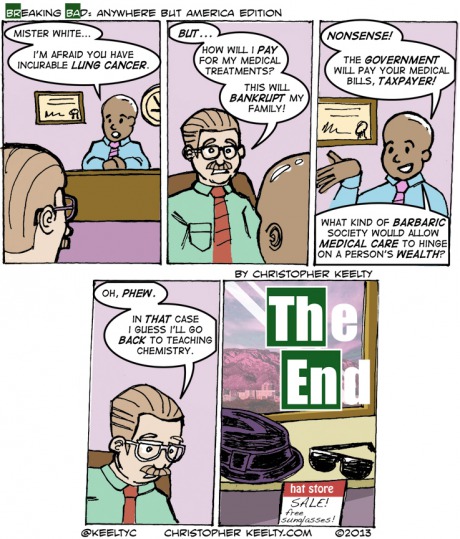
- While Word of God has stated that Breaking Bad is a story of how "Mr. Chips became Scarface", the original driving force behind Walt's meth manufacturing, to help pay for his medical bills, has prompted pro-single payer health care advocates in the US to use the show to highlight the issue of health care costs in the United States,◊ as well as the War on Drugs. Even the creator has claimed that the show could not be set anywhere else but the United States.
- Doctor Who:
- At the end of "The War Games", the Time Lords ask the Doctor to choose his own face from a bunch of drawings projected on a screen. One (the one dismissed by the Doctor as 'too old') appears to be Karl Marx. Draw your own conclusions.
- The general line in fan analysis is that "The Web Planet" is a Red Scare allegory because it's about the Zarbi workers rising up against their Menoptera masters. But it's a really big reach — there's no absolutely no indication the Zarbi are any more intelligent than farm animals, and even though the monster in the story has the power to control gold it doesn't work in any way analogous to any kind of economic system, which seems like it'd be a no-brainer for an anti-communism story. Maybe it's just a Planetary Romance Xenofiction runaround with pretty butterfly people fighting the ant people?
- It's well known "The Sun Makers" is about the evils of taxation and written by a Thatcher supporter, but, since the actual story presents the issue more as "untouchable mega-corporations and corrupt bankers have bought out the government and are draining money out of the poorest to boost their own profits while keeping the population constantly afraid via media to distract them", modern critics tend to read it as a satire on the evils of privatization, or Occupy-style anti-capitalist. Privatization was just around the corner in 1977, and the Occupy movement was 35 years away. Is it more likely that Robert Holmes was secretly hard-left and able to see the future, or that he was ramping up the setting's systemic injustice to the point he accidentally broke his own right-wing aesop?
- In the Eighties, script editor Eric Saward purposefully tried to avoid political subtext as much as possible for a variety of reasons (lack of desire to offend, lack of desire to make allegorical stories about the real world in favor of interacting with the series' own history as a work of fiction, and several other reasons). This caused some Broken Aesop moments, like when the series bought back the highly political Silurians in an apolitical action story where nothing indicates either side is anything more than just a nasty lizard creature — and of course the politics ended up in there anyway. This restriction ended when producer John Nathan-Turner stopped caring, freeing the next script editor Andrew Cartmel to make clearly and transparently political stories about BBC politics ("The Greatest Show in the Galaxy"), Margaret Thatcher ("The Happiness Patrol") and lesbianism ("Survival").
- When the show came back in 2005 with the main writer being out of the closet gay, many people accused the show of trying to push the gay agenda. Especially when Captain Jack Harkness arrived.
- Mark Gatiss is often criticized for reactionary racist/sexist/warmongering Aesops in his Who stories, but his real-world political leanings are known as left-wing. A lot of it may be down to bad luck — "The Unquiet Dead" (often read as an allegory for how war refugees should be treated with suspicion and can never assimilate into society) happened to come out at a time when asylum seekers were featured heavily in the news. "Cold War" accidentally portrays mutually assured destruction as good, which might have gone unnoticed had the episode not synced up with the death of Margaret Thatcher. "The Crimson Horror" has Diana Rigg playing the episode's Ms. Fanservice star, who (just before it aired) went in the papers saying uninformed things about feminists.
- This concept is made fun of in "Blink":
Sally: How can you know what I'm gonna say?
The Doctor: Look to your left.
[Sally looks to her left, and sees Larry transcribing everything she says]
Larry: What does he mean by "look to your left"? I've written tons about that on the forums. I think it's a political statement.
Sally: He means you. - "Turn Left", an episode about Donna indirectly causing a racist, fascist government to take over Britain by turning right at a junction.
- The Daily Mirror published an article claiming that in "The Beast Below", the Doctor's line "And once every five years, everyone chooses to forget what they've learned. Democracy in action." should be read as a call to the public to re-elect Gordon Brown's Labour government. If so, it didn't work.
- The central dilemma in "Kill the Moon" was accused of being "an allegory for the abortion debate" by some North American viewers. Notably, viewers in Europe didn't notice such an angle to the problem and were baffled by the fixation of a part of the American viewership on this accusation. While debates about the morality of abortion occur on both sides of the Atlantic, the American ones generally tend to be more heated and divided, which might have contributed to such a reading of a narrative element in the episode.
- Some people have interpreted "Extremis" and "The Pyramid at the End of the World" as a reaction against the election of Donald Trump as US President and the UK's decision to leave the European Union. The view is slightly helped by the writer of the latter also writing "The Zygon Invasion" and "The Zygon Inversion", which is clearly an allegory for the political climate at the time regarding refugees and terrorists.
- Both American political parties, Democrat and Republican, see The Alliance in Firefly as the other and the Browncoats as themselves. Word of God says that was an accident. The only overtly and intentional political messaging in the whole show is feminist undertones that are a cornerstone of Joss Whedon's work.
- Luke Cage (2016): Some aspects of the show, such as Luke's choice in attire and the obvious Trump references in season two, are very much political. Others, however, aren't, such as with Luke's Implacable Man moment in Crispus Attucks in season 1. In an interview, showrunner Cheo Hodari Coker acknowledged that politics can certainly be read into the Crispus Attucks attack, and would be extremely relevant, but the scene drew primarily from The Terminator.
Cheo Hodari Coker: Luke, being bulletproof and walking through Crispus Attucks was really more influenced by Arnold Schwarzenegger's invading the police station in Terminator. And we shot it that way. But when you see the images of a bulletproof black man in a hoodie walking forward... it just has like the symbolic meaning that I don't think we even anticipated.
- Roseanne: The 2018 revival is being treated as this due to Roseanne (the star and her character) being a supporter of Donald Trump and clashing with her liberal daughter and granddaughter. The situation got worse when Trump gave Roseanne Barr a congratulatory phone call and proclaimed to his base that the show "belongs to us", as well as evidence of Barr promoting anti-liberal conspiracy theories and satirical photos of her dressed up as Adolf Hitler resurfaced. In social media circles, the show is being called a mainstream bullhorn for the Trump movement, and it's gotten to the point where just watching it (or not) is being considered a political act in and of itself.
- This Slate article, which explains that Jerry Seinfeld and his comedy routine represent conformity and lack of identity in a totalitarian government. Um... right.
- A book claimed that Stargate SG-1 was white supremacist propaganda.
- This claim may be inspired by the fact that the only religion of old (and by extension its "gods", i.e. the aliens standing in as these gods, or who inspired it) that is portrayed as good is Norse Mythology. These "gods" are a race of Sufficiently Advanced Grey Aliens called Asgard, who regularly help Earth (and the teams of the Stargate Command in particular, who earned their trust), while otherwise posing as benevolent gods to less advanced societies in the few times they show up on their planets. Basically any other religion that shows up is staffed by Goa'uld, who are always evil and incredibly selfish (there is one exception in Lord Yu, who never claimed to be a God, and who was the first Chinese Emperor).
- There is also an exception for the Abrahamic religions. Christianity gets directly mentioned exactly once in the series, and then in a (more or less) positive light. The True Companions travel to a world where the people were culled from Middle Ages England. Daniel posits a theory (which turns out to be wrong) that the Goa'uld who controls this world may be posing as the God of the Abrahamic faiths. Teal'c dismisses this idea, stating that he's read The Bible and finds it impossible to imagine that any Goa'uld could be as benevolent as the deity from that book. Meanwhile, the other two, Islam and Judaism, are never addressed at all. There is however a Goa'uld who poses as Satan and turned a planet/moon into hell just because he could.
- Others interpreted it as the final victory of science over religion, fought by heroic atheists and liberated ex-faithful against an amalgamation of the leaders of the world's faiths.
- The third season of Star Trek: Enterprise drew heavily on current events. Earth is savagely attacked, apparently out of nowhere, and the NX-01 (bringing along a cohort of Space Marines) heads into a treacherous region of space to find the culprits. Many fans were afraid this storyline would be untrue to Trek's philosophy, but they needn't have worried: the aliens aren't all bad (though there are a few problems - like that the most humanoid ones get a Heel–Face Turn but the reptilian Xindi stay evil (although you wouldn't say no to the head reptile, either) and the insectoids
stay evilget cold feet while in transit to Earth and are blown up by the reptilians for their troubles), Archer's new hard-edged attitude isn't always endorsed, and there's enough ambiguity all round to keep it from being Strawman Political in either direction.- Prior to that, a couple of first-season episodes — "Fortunate Son" and especially "Detained" — examined elements of the war on terror. But contrary to a common assumption, the decision to name the first season's bad guys "Suliban" happened long before 9/11. They were named after the Taliban, but only because Rick Berman thought that name had the exotic sound he wanted; no one was expecting it to become a household name.
- The children's television show Teletubbies was accused of promoting the homosexual agenda to children. It was also (more than once) accused of promoting communism, conformity, lack of critical thinking, and a "the state takes care of everything" mentality (or a "everything should be free" mentality).
- A rather odd example is That's My Bush!. Despite being created by Trey Parker and Matt Stone and featuring the former President's administration and family as characters, it wasn't intended as political satire, but rather a parody of cookie-cutter '80s sitcoms. (Parker and Stone admitted that, just in case things had gone the other way, they also had a pitch for a sitcom about Al Gore, and said they would have used more or less the same jokes no matter who'd actually won.)
- Some have criticized the Ultra Series for supposedly having nationalistic anti-foreign sentiments, seeing the Japanese defense teams defending against various alien threats as paralleling Japan pushing away foreigners and foreign influence. Many point to the second episode of the original Ultraman as an example, where the Baltan aliens were fleeing refugees after they blew up their own planet.note This is ignoring the many times that aliens were shown sympathetically (even as tragic victims of allegorical racismnote ) and the main heroes, the Ultramen, are well... aliens.
- The Visitors in V (2009) have been interpreted as symbolizing Barack Obama. This isn't helped by the fact that the show's plot (the alien Visitors, who receive the devotion of the people, are secretly plotting to destroy the world) bears a lot of similarities to various right-wing fears about Obama — compare the Visitors' alien nature to the "birther" conspiracy. Doesn't really help when the aliens provide "Universal Healthcare", and call it spreading hope... The writers have denied this, and claimed that the show is more about post-9/11 America than the current President.
- Westworld: Because of the show's themes where the host characters, particularly the female leads, are being abused and mistreated only to fight back against their oppressors, many viewers noticed that the show is very relevant to the #MeToo movement, particularly with Season 2 as acknowledged by Evan Rachel Wood. She, together with the showrunners, admitted the parallels are coincidentally similar since the show aired a year before the #MeToo movement. Jon Nolan said that they wanted the show to be "timeless" and looking at the show as a metaphor for how humans mistreated each other can be applied to any moment in history.
- Radiohead maintain that their 2003 album Hail to the Thief was not named for the 2000 election chant. Although it is supposed to be about the rise of the scary right-wing.
- The Wikipedia article on Yatta! used to include this:
"The sketch appears to be at least partly ironic commentary on attempts by the Japanese government and others to maintain optimism in the face of Japan's severe economic troubles, depicting men impoverished to the degree of having no clothing but the figurative fig leaf (though in this case the leaves are attached to the men's briefs) yet maintaining an irrational, irrepressible belief in their own potential for success."
- The Rush song entitled "The Trees" has lyrics about maples who feel they don't get enough sunlight and oaks who can't fathom the maples' circumstances. Oddly enough, according to lyricist Neil Peart, the song is about trees. Really. He was watching an old cartoon about anthropomorphic trees one night and decided to write a song about it.
- "Dancing in the Street" by Martha and the Vandellas was taken as an allegory for the civil rights movement, which was in full swing at the time of the song's release. Martha Reeves denied any political meaning to the song, but it was popular enough at rallies that it became controversial anyway.
- "Helicopter" by Bloc Party (which features such lyrics as "Stop being so American" and "Just like his dad") is frequently misinterpreted as being about George W. Bush. Vocalist Kele Okereke has gone on record as saying he actually wrote it about himself.
- David Gilmour: "Blue Light", a song about a generic Femme Fatale, was thought by many to be about Margaret Thatcher (blue being the color of Thatcher's Conservative Party).
- Viking metal bands are sometimes accused of promoting fascism, Nazism, or white supremacism, largely because they make use of the same Norse and Germanic imagery which the Nazi party drew on. A majority of the bands are emphatic that this is not the case. It doesn't help that a few are promoting fascism, Nazism, etc.
- Manowar was accused of supporting Nazism because the song "Blood Of Kings" has the line "back to the glory of Germany," intended as a Shout-Out to their large German fanbase.
- Rammstein is occasionally accused of promoting fascism largely because their lyrics are angry and in German...Just like Hitler! To refute such allegations, they wrote "Links 2-3-4", "Links" being the German for "left". The song declares that politically, the band are to the left, one repeated line being roughly "my heart beats to the left". Just to troll, though, they made the song sound like a military march, and "Links 2-3-4" is an actual German marching cadence, so the album containing the song was referred to by a reviewer as "Music to Invade Poland to."
- The liner notes to Steely Dan's "Kings" invoke this trope for an aversion/subversion (depending), with a disclaimer stating (more or less) that "this song is in no way political." Sure, given that this song's chorus is "We've seen the last/Of Good King Richard...Raise up the glass/To Good King John", and that Walter Becker and Donald Fagen were very embittered '60s liberals writing in 1972...
- Russel Morris' Mind Screw "The Real Thing" was interpreted by many as a commentary on The Vietnam War ("Is there a meaning here? Is there a meaning there? Does it really mean a thing?"). Word of God was that was actually bemused speculation about Coca-Cola's slogan.
- The Doors' 1968 song "The Unknown Soldier" is usually taken to be a denunciation of the Vietnam War, which was at its height at the time. This is plausible, especially when Morrison describes the soldier's wife learning of her husband's death on the TV news (Vietnam being the first major war to receive extensive televised news coverage), but the lyrics are worded in such a way that, the television reference notwithstanding, the song could be applied to any war between World War I and today. And the Doors tended to remain silent on political matters, anyway.
- In order to counter the misconception that rock music and conservatism are wholly incompatible, the magazine National Review offered a list of "Greatest Conservative Rock Songs." Problem is, close examination will reveal that only about 40 percent of the songs are truly conservative; the rest are either libertarian or are just "old-fashioned" in a way that really isn't political at all. (For example, one song is considered "conservative" because it contains a Latin prayer.) Plenty of songs were included because they were at least partially anti-communist (did you ever hear of a popular song that was pro-communist?), as if conservatives have ever had a monopoly on anti-communism (and anyway, one of these songs is only "anti-communist" because it depicts the color red negatively!).
- "Disarm" by The Smashing Pumpkins has been interpreted as being about the abortion debate because of the out-of-context lyrics "what I choose is my choice", "the killer in me is the killer in you" and "cut that little child" (although if those lines were all meant to be about abortion, they'd be pretty self-contradictory). Lyricist Billy Corgan has said it's an autobiographical song about his relationship with his parents growing up.
- Genesis' manager, listened to their song "Mama" and confused the theme as pertaining to abortion. Phil Collins clarified to him that it was about a 'young teenager that's got a mother fixation with a prostitute'.
- Swedish Power Metal band Sabaton has been accused of glorifying war and even Nazism with their Horrible History Metal songs about World War II. This once included complaints from a Russian local politician that ended in the cancellation of a concert. The band members, who think of themselves as storytellers, openly refer to such accusations as "bullshit" and wonder why nobody accuses Quentin Tarantino of promoting Nazism for portraying Wehrmacht personnel sympathetically in Inglourious Basterds. note In the songs themselves, the actual Nazis are Always Chaotic Evil and the Wehrmacht only unambiguously the good guys on occasions where they defy or outright fight Nazi orders ("No Bullets Fly"note , "Hearts of Iron"note , and "The Last Battle"note ), and the band stopped playing "The Final Solution" in concerts for several years after getting freaked out by the audience enjoying a song condemning The Holocaust.
- Green Day's "Wake Me Up When September Ends" is usually interpreted to be about 9/11, but it's actually a tribute to Billie Joe Armstrong's late father. The confusion is fairly understandable, given how American Idiot does contain a lot of themes regarding a Post-9/11 America, and the music video displayed a couple torn apart by the Iraq war. Arguably, American Idiot in itself is an example of this — The Title Track and "Holiday" are the only overtly political songs on the album, and the rest is a Rock Opera criticizing the punk movement.
- The spanish song "La Cucaracha" acquired a lot of variations over the course of history, especially during the Mexican Revolution period. To the point where even one of the more common variations can refer to president Huerta's addiction.
- The Queen song "I Want It All" is about ambition (the title deriving from writer Brian May's wife's favorite sayings), not a gay anthem or anti-Apartheid as some have interpreted it.
- Billie Eilish has said that she is uncomfortable with certain fans who praise her specifically for not having a sexualised image in contrast to many other female pop singers (she usually wears baggy clothing that doesn't show much skin, and many of her videos and publicity shots are creepy verging at times on outright Body Horror). She says that it's purely her expressing herself, she doesn't see it as making any wider point about gender politics, and she really doesn't want to be used as a contrast to shame female celebrities who do have a sexier image.
- Voltaire's song "God Thinks" is often misinterpreted as being anti-religion, when it is actually against people who use God and/or religion to spread their own agendas.
Voltaire: People do misinterpret that song sometimes, they think it's anti-God or anti-religion.... I'm just anti-hypocrisy.
- Wolfgang Amadeus Mozart
- The cry "Viva la libertà!" in the first act finale of Don Giovanni, where Mozart takes a single line from Lorenzo Da Ponte's text and has all the characters repeat it over and over, is read by some as Mozart's support for the French Revolution.
- The depiction of the corrupt and foolish Count in Figaro is sometimes seen as a statement by Mozart against aristocratic rule, even though Mozart didn't write words, Mozart wrote music. Lorenzo da Ponte wrote the libretto, based on Beaumarchais' "Le Marriage de Figaro."
- The Magic Flute however, is generally considered Masonic propaganda and a critique of Austria under the repressively Catholic monarchy of Maria Theresa.
- Giuseppe Verdi's Nabucco, with the famous Chorus of Hebrew Slaves (the Jews held captive in Babylon crying for the loss of their homeland), was written at a time where the movement to unify Italy was gaining momentum. The chorus became an unofficial anthem of the movement.
- Verdi's later operas Don Carlos and Aida both have fanatical priests with political power as the main antagonists.
- Hamilton has been interpreted by some fans and critics as (among other things) a tribute to President Barack Obama, who was nearing the end of his tenure in office when it premiered on Broadway. The play emphasizes many features of Alexander Hamilton's life and career that could also easily apply to Obama—also a politician who came from humble beginnings, grew up on an island without his father in his life, attended Columbia University, went into politics after moving to the big city, developed a reputation as an intellectual, and ultimately staked his legacy on an ambitious government program that required significant political compromises to pass through Congress. While Lin-Manuel Miranda is a notable supporter of Obama, he has never explicitly stated that this was intentional.
- Some who had played Ace Combat 5: The Unsung War addressed the anti-war posturing as commentary on George W. Bush and the war in Iraq. The plot itself is actually based on the Cold War where insiders on both sides are instigating the war with the real message being that the characters are against war, but are willing to fight the ones who live on War for Fun and Profit.
- Advance Wars throws up some interesting ones by having the various nations and COs represent different countries, with many of the parallels focusing on World War II. It can get confusing, though: it's generally agreed that Green Earth represents Germany, but their COs represent all of Western Europe: Eagle is World War II Germany (superior air force and Lightning Strike being the English translation of "Blitzkrieg"), Drake is probably Britain (naval superiority and various parallels with Sir Francis Drake fighting off the Spanish Armada), Jess is probably Napoleonic France (superior land forces and resupply powers: compare Napoleon's "An army marches on its stomach" quote) and Javier is probably Spain (because he talks and acts rather like Don Quixote). Olaf is obviously General Winter as well as a Communist defector, Grit the very embodiment of Soviet artillery doctrine, and Colin and Sasha, amusingly, are either kulaks or the NEP. Kanbei embodies samurai honour, Sonja an amusing inversion of actual Japanese military security (which leaked like a sieve), Sensei the IJA's own special forces, and Grimm's focus on all-out offensive reflects the closing days of Japanese desperation in both Ichi-Go and kamikaze.
- Assassin's Creed: Unity: It is really, really, hard for a game about the French Revolution to escape this. Especially for a Franchise that has formerly prized itself for historical research and an even-handed look at the American Revolution.
- The reaction and charges of "propaganda" and the great number of errors in representation have brought a great deal of criticism as well. Jean-Clement Martin, the historian who has served as a consultant for the game, and a respected member of the Society of Robespierre Studies, while noting that the script had a "royalist" bias feels that the game should be enjoyed as "fantasy" and perhaps if it stokes interest, it could lead players to read history books.
- The author/historian David Andress who wrote "The Terror" also discussed the historical depiction and he noted that the game was largely counter-revolutionary. More generally, while admiring the largely accurate (if streamlined) reproduction of Paris, he dismisses its portrayal as largely cliche and noted that the Templar conspiracy theory instigating the Revolution was a famous right-wing myth that refuses to give credit to the popular movement and pay real attention to its Gray-and-Grey Morality.
- Batman: Arkham City has at least one essay devoted to it being an allegory for the dehumanization of criminals: Social Satire Essay
- When BioShock Infinite was first announced, people immediately thought the xenophobic and imperialistic Founders were an allusion to the Tea Party, which Ken Levine denied. And given the events that have happened in the US since then, you can bet that when the game actually released, the Vox Populi was immediately dubbed an allusion to Occupy Wall Street despite the group not even existing when the game started being developed. Ken Levine actually took inspiration for the Vox from the West German Red Army Faction, among other historical groups, though he did go to an Occupy Wall Street rally to do research for the Vox. Of course, Levine also denied that BioShock was a criticism of Objectivism, so he may just be a master of accidentally making scathing attacks on political ideologies.
- Detroit: Become Human: The game is clearly an allegory for civil rights and slavery with androids taking the place of blacks and other minorities, but David Cage has denied this.
- Deus Ex: Human Revolution: The entire augmentation debate is just like the abortion debate. Clinics built for augmentations being protested and firebombed by detractors, supporters declaring that it is their body and they will do with it what they like, and people against it using religious statements to oppose it. In one protest, you can see signs that say, "I regret my augmentation" much like "I regret my abortion" signs. And much how in real life how people on the fence about abortion will say "I don't mind it in cases of rape, health issues, or incest," one can hear characters say "I don't mind it in the cases of amputees." The Humanity Front and Purity First has many real-world analogies, with a legitimate political group sharing goals and views with a terrorist organisation, such as Sinn Féin and the IRA or Animal Rights groups and the ALF. Conspiracy-wise, Sarif Industries is under fire for trying to end Neuropozyne dependency, and in Real Life, there are proposals to develop embryo transfer to the point that abortion would not be lethal to the fetus - these cannot get off the ground due to anti-technologists protesting stem cell research... and stem cell researchers would probably rather not have the supply of aborted fetuses for stem cells cut off. The anti-aug crowd want augs eliminated, and Versalife is making a killing on Neuropozyne.
- On top of that, the augmentation debate has a case of Enemy Mine, where those that object to it based on religious grounds are paired with those that object to it on economic grounds. The former see it as an affront to God by interfering with His design, while the latter see it as causing the gap between wealthy and poor to become even wider, as those that have augments will get preferential treatment because they're physically more capable.
- One fan's essay on Deus Ex: Human Revolution's Social Satire covers some of the issues nicely.
- He also wrote a sequel on the DLC. The Missing Link Social Satire.
- He also wrote a sequel on the DLC. The Missing Link Social Satire.
- Deus Ex: Mankind Divided takes it in the opposite direction, where those with augmentations are treated as second-class citizens after "The Incident", which was straight-up called "mechanical apartheid" in promotional materials. The phrase "Aug Lives Matter" (a reference to the "Black Lives Matter" movement) also appears in the game, which the game's PR department claimed was an "unfortunate coincidence." There's also a dialogue exchange with a policewoman who regrets her profession chosen due to the political climate, saying "If I could do it again, I'd have been a fireman. No one looks into a fire and thinks, 'Shit, does this one really deserve it?'"
- Freshly-Picked Tingle's Rosy Rupeeland has been interpreted as having an anti-capitalist message. Throughout the game, Tingle's progress, friendships, and even life are completely dependant on rupees. The goal of the game is to collect enough rupees to ascend to a materialistic utopia, which turns out to be a lie that Uncle Rupee only made up so that Tingle would continue to give him money. By the end, Uncle Rupee has enough money to ascend into a godlike state and turn everyone into his slaves. He can only be defeated by Tingle blasting him to death with rupees, which destroy him and causes rupees to rain down from the sky across the town.
- The Game Overthinker / Movie Bob satirized The "political analysis of video games... Twice.
- Gears of War: It turns out in the third game that Imulsion, human society's main fuel source, was responsible for the entire conflict because it turned the locust into the lambent, who forced the surviving locust to seek refuge on the surface, leading to the war with the humans. Even before any of that had come to light, humans had been engaged in unending wars over emulsion resources. Let me say that again. A rare and valuable fuel source (oil) is responsible for centuries of non-stop war, the destruction of society, and turning everyone into mindless zombies.
- Groove Coaster has the song "No more labor", the lyrics of which involve a hypothetical scenario where someone becomes king of the world and builds a machine to do all the world's labor, thus eliminating the need for people to suffer through work ("The concept of working / is the cause of suffering"). Given that the song and the game it was made for are of Japanese origin, one can't help but wonder if the song was written in response to Japan's infamous over-work culturenote .
- Halo has been compared to The War on Terror. The UNSC (Mostly played by Americans) vs. the genocidal, insane, religious Covenant. Bungie's religious references don't help. However, Bungie has denied this, and it is helped by the fact that they have a well-known plan to take over the world.
- And the fact that Halo's main Myth Arc was plotted in the mid-nineties, several years before the events of 9/11 kicked-off the War On Terror. The first game in the series happened to be released shortly thereafter, but over four years of work had gone into it by that point, with trailers and interviews already establishing to the public the work's setup.
- Others believe it's actually an allegory for The Crusades.
- After the end of Apartheid in South Africa, the new multi-racial government set up the Truth and Reconciliation Commission to investigate human rights abuses under the old regime. In Halo: Combat Evolved, the multi-racial Covenant have a ship called the Truth And Reconciliation. Draw your own conclusions.
- Some believe that the Jak and Daxter series was allegorical for the usage of child soldiers in African nations. A carefree youth is captured and mentally abused until his mind becomes violent enough to attack anyone a voice in command tells him to. Then someone hands him a gun for the first time in his life and he's a natural with it.
- Furthermore, Jak II: Renegade was claimed by some to be a thinly veiled protest against the 2003 invasion of Iraq and the Bush administration (as supposedly represented by the MetalHead War and Baron Praxis respectively), particularly accusations that there were wars that were fought solely for political and/or economic gain by governments that had illegitimately gained power.note However, there is no proof that Naughty Dog had any sort of political agenda when they made the game and, for that matter, had been in development well before the controversies regarding the Iraq War began.
- Lethal Company tasks you with collecting scrap in unsafe working conditions, and slaps you with increasingly high profit quotas. If you fail to meet quota, you're fired (jettisoned into space) and just generally seen as expendable. These elements are in place to put forth the game's Black Comedy, but it was also released around the same time that many corporate game development studios were exercising a series of mass layoffs. It certainly doesn't help that many of them were also being exposed for unfair treatment in the workplace, and that the game was released in the middle of the then-ongoing Hollywood strikes.
- The setting of LISA: The Painful and its followup Joyful is one where all women have been wiped out from a mysterious white flash and the remaining men have thrown the world into a violent wasteland. This has been interpreted as either a feminist or anti-feminist message, but Word of God is that it's simply how the setting is, and he did not intend to make any sort of statement on sexes with it.
- One could make a pretty sound argument that many of the issues in the Mass Effect universe are based on current geopolitical issues. Just a few examples:
- Upon being discovered by the rest of the galaxy the Krogan were ruthlessly exploited by races far more technologically developed than they were, and once they were no longer needed and became a problem, the development of their civilization was neutered both physically and societally to the point of being almost totally untenable. The historically minded will note the similarities to the European colonization of Africa and the post-decolonization issues that continue to be a problem today.
- The story of the Quarians losing their homeworld and much of their population in a extremely violent cataclysm, and then using these past hardships (that no Quarians alive at the time of the game were alive for) to justify reclaiming their homeworld from its new inhabitants parallels the creation of Israel, Zionism and the current issues those caused.
- Note that the Quarians may also represent organizations such as Hamas, depending on how sympathetic the player considers either group to be.
- The Quarians' decision to shut down the Geth (a series of robots they created) once they began to approach artificial intelligence plays very well into the abortion debate.
- American audience members in particular will notice the similarities between the Alliance's reaction to the Geth and the American government's reaction post-9/11. In the second game especially, this actually approaches the point of parody at some points and the game takes numerous digs at it, from the laughably inept and pointless citadel security to thinly veiled codex entries.
Codex on spying on Geth space: Theoretically, the geth could be preparing a devastating attack against which the Council could be defenseless, or the geth could have died out so that the defense budget against them could be gaining the Alliance nothing but economic ruination.
- In Mass Effect 2, Legion's loyalty quest can be an allegory for dealing with religious fundamentalism. Legion reveals that the Geth from the first game were heretics who worship the Reapers. Shepard is then given the choice of either exterminating or reprogram the remnant heretics. Neither solution is ideal as can be the exterminating can be compared to genocide while reprogramming is comparable to brainwashing or forced conversion.
- Interestingly, this is despite the fact that Cerberus, with its methods of funding itself, political activities, cell-based command structure, and the types of violence it engages in, is actually a very accurate depiction of how modern transnational terrorist groups, including Al Qaeda, operatenote . Cerberus is also portrayed as the only group with the ability to actually do anything about the problem of the Collectors. What this means is probably best left to the player to determine.
- Oddworld: Abe's Oddysee and its sequel Abe's Exoddus show us how putting capitalism and profits over morality and humility destroys society. The Mudokons have been compared to communism (they live with each other and share the same possessions) and the Glukkons are obviously a play on gluttons as they are money hungry and have no problems torturing and even trying to kill and sell the Mudokons as food, all for profit's sake.
- Pikmin has been interpreted as an allegory to socialism.
- Some have interpreted Pizza Tower as somewhat of a commentary on shady business practices of large corporations when dealing with smaller competitors. Pizzaface has a massive corporate empire in the tower, spanning from various restaurants (Golf, Fastfood Saloon, Don't Make A Sound), production centers (Fun Farm, Peppibot Factory), and even a tropical vacation resort (the third hub). He threatens to shoot Peppino's Pizza with a giant laser, mirroring how larger businesses will throw money around, rather than using the actual quality of their product, to remove small businesses. And the real final boss Pizzahead seems to perfectly mirror Mascots from large chains like Ronald McDonald, a happy-go-lucky face hiding a darker corporate side. Peppino by contrast, while down on his luck, and not perfect, is genuinely passionate about his job. This passion allows him to defeat Pizzahead despite everything he throws at him, showing the true triumph of the small businessman.
- Pokémon Legends: Arceus: With the future of Hisui and the effects of the actual Japanese colonization of Hokkaido in mind, it's actually very easy to read an anti-colonial subtext in the game. Hisui is presented as a harsh yet beautiful land with an indigenous populationnote with a close connection to nature and the Noble Pokémon, which themselves are the direct descendants of the Pokémon companions of a legendary hero who managed to meet Arceus itself. By the time of the Sinnoh games however, the vast Hisuian wilderness has been largely tamed and developed, and most poignant of all, the regional variants and evolutions that the Noble Pokémon belonged to, as well as the Noble Pokémon themselves, are nowhere to be seen and possibly extinct. This can easily be read as commentary about how the colonization and development of Hisui into Sinnoh led to the extinction of multiple Pokémon species and severed the region of its living connections to the great myths of old. However, this is likely unintentional, given how little focus is given to the long-term effects of colonization and the game's neutrality towards its ethics.
- Rage 2, in its pre-release period, spawned a minor meme over an interview between gaming website TheSixthAxis and id Software's Tim Willits, where TSA noted some physical similarity between the in-game character Klegg Clayton and Donald Trump, and then outright ignored Willits several times when he insisted the character was not directly based on Trump and they were not trying to be political with the game.
- Red Faction: Guerrilla: Wide-Open Sandbox game that uses its plot as an excuse for the player to be able to engage in guilt-free destruction akin to the Saints Row series by the same developer? Or the most brutal indictment of the Iraq war in gaming history where you're essentially playing as the insurgents?
- The "Octarian vs. Inkling" war that forms part of the backstory in Splatoon has been compared to imperialism and other political issues. It doesn't help that one of the Sunken Scrolls in the first game shows Octarians in more traditional Japanese attire than the Inklings.
- Spider-Man (PS4) possesses themes of Terrorism enacted in New York, poverty, safety over liberty, the rich and powerful bullying the lower classes with violence and legal loopholes, all lampshaded by a loud, Alex Jones-ish JJJ. What Do You Mean, It's Not for Kids?
- It especially does not help that Norman Osborn is portrayed as the rich owner of a New York-based monopoly dealing in one shady, arguably illegal act after another that goes on to become an influential faux-populist political figure that uses his political power for profit and to reign in an Authoritarian grip on the people there. When did this game come out, again?
- On Spidey's social media feed, Fisk's lawyer will use the term "Fake News" (in all caps no less) to try and discredit the patently obvious. In this case, that the guys attacking cops from Fisk's tower while wearing Fisk-branded uniforms are, in fact, working for Wilson Fisk.
- David Obademi, a minor character in the Silver Lining DLC seems to be Insomniac's take on the USA's then-current immigration debate. He's a member of a minority group whose motives and loyalties are not immediately clear, and as it turns out he's in the country illegally. However, he is a perfectly good fellow who acts shady because he knows he would get in trouble if anyone found out about his status. In the end, he is an altruistic fellow in a bad situation, and Spidey manages to find him a job in the US.
- Super Mario Bros.:
- A significant part of Waluigi's role as an Ensemble Dark Horse is based around Franck Ribery's tongue-in-cheek blog post "I, We, Waluigi: a Post-Modern Analysis of Waluigi", a parody of the Freudo-Marxist critical analysis associated with writers like Slavoj Žižek, which argues that Waluigi's role as an Evil Counterpart of a Palette Swap makes him "a man seen only in mirror images" with no identity outside of references to what is around him, and that "in a world where our identities are shaped by our warped relationships to brands and commerce we are all Waluigi". While nobody takes this as anything other than a joke, it nevertheless led to Waluigi developing a semi-earnest, semi-ironic fandom amongst internet philosophers and art dorks who hold up Waluigi as an icon of the Baudrillardian hollowness of late capitalism.
- Wario's money-grubbing behaviour, habit of running his video game company without paying his workers, and his generally chaotic and freedom-loving personality has led to many (earnest) debates over whether he is a libertarian, to the point where several gaming forums decided to ban any discussion of the topic. After Twitter shitposter dril described a Wario thread as 'the greatest thread in the history of forums', these discussions have gone mostly extinct, as anyone attempting to have them will get mocked. The mention of Wario's libertarianism in the Waluigi critical analysis above is used as an intentional reference to this tweet.
- Some - including Yuji Naka - have suggested, as part of the Fandom Rivalry between Super Mario and Sonic the Hedgehog - that Sonic is a better person because he fights for freedom out of the good of his own heart, while Mario fights for "coins and women". A related argument suggests that Mario, as a plumber fighting to protect a member of the monarchy, that he is an anti-worker class traitor. This reading is a bit of a stretch considering both franchises are basically fairy tales.
- A significant part of Waluigi's role as an Ensemble Dark Horse is based around Franck Ribery's tongue-in-cheek blog post
- This game reviewer takes an Everyone Is Satan in Hell approach to gaming. One particularly hilarious review is of Tetris, claiming it to be communist propaganda. When he reads about a study showing playing puzzle games like Tetris is good for the brain, he decries them as "Darwinist", "militant atheists", and admonishes the head of the study for not using scripture in the treatment of PTSD.
- Someone ran with the theory that Tetris was about life in the USSR and made a song called "A Complete History of the Soviet Union as Told by a Humble Worker, Arranged to the Melody of Tetris", which is Exactly What It Says on the Tin, but actually includes Tetris references.
- Someone ran with the theory that Tetris was about life in the USSR and made a song called "A Complete History of the Soviet Union as Told by a Humble Worker, Arranged to the Melody of Tetris"
- Watch Dogs: Legion takes place in a United Kingdom that's turned into a surveillance state policed by brutal mercenaries and armed drones, with nationalism and terrorism being two of the factors responsible for its woes. The resulting economic downturn has caused a popular rebellion to begin rising up in order to return the country back to the good old days. The game was only officially announced on June 10 but already people are making comparisons to the game's setting being what will become of the country if Brexit is allowed to go through, and if its advocates are able to seize power. It even has its own page.
- Bethesda's tweet about the then-upcoming Wolfenstein II: The New Colossus earned a lot of backlash from right-wing groups, due to its phrasing. Special ire was drawn from the phrase "Make America Nazi Free Again," a play on Donald Trump's "Make America Great Again" slogan. Unsurprisingly, the media made a point about how it showed the political atmosphere of the time. Bethesda themselves, for what it's worth, said they weren't trying to be political, but just promote their game about killing Nazis. That didn't stop people on the Steam forums from declaring the game some sort of propaganda - exactly which kind of propaganda, they don't seem to agree on.
- Xenoblade Chronicles 3: Some fans have taken the explanation of childbirth and the value of family in Chapter 5 to be indicative of a pro-life stance. However, the context of the story paints a different picture, in that it's meant to display how humans normally function as opposed to the artificial aging process of Keves and Agnus since this repeated cycle and the usage of Child Soldiers in a Forever War makes the concept of family and childbirth foreign to them. Adding to this is that the game's messaging is opposed to many conservative viewpoints in general that are associated with pro-life arguments, such as the entire concept of the story being anti-war and opposing those who want things to remain unchanged.
- RWBY: The Fantastic Racism towards Faunus veers into the degree of Does This Remind You of Anything? for much of the fandom. Several of the major Faunus characters are POC-coded (Blake and Sun having Asian-inspired designs and Ilia being Ambiguously Brown), which adds to this. Some fans also take Weiss' Volume 1 distrust of Faunus this way as Weiss has a German name.
- This article states that Hazbin Hotel (an animated show pilot for adults that deals with how Charlie, the princess of Hell, tries to redeem the souls of the damned) is a criticism, although involuntary, of classical liberals and how they do not understand the working class who they pretend to help.
- Domain Tnemrot. The entire story is about rich people forcing the poor into slavery, and the main character goes on rants about how the rich should be using their money to help the poor rather than spend it on frivolous entertainment. On the page this rant appears, though, the author insists that this is in no way a political comic and it's all just a part of the setting, while the main character's views are just a product of the environment he's grown up in.
- Erfworld has also been subject to this, with multiple fans trying to claim that Stanley the Tool is Erfworld's take on George W. Bush. It's true that Erfworld is based on layer upon layer of puns and references, but claims like these just get annoying (especially in the face of more obvious puns and references concerning Stanley). And then Ansom was killed and turned into an undead to serve as Stanley's chief warlord. Have fun figuring out how that fits into either theory.
- One Homestuck fan went out on a limb and speculated that Eridan's character arc is an allegorical critique of Barack Obama's presidency. Memorably, it stipulated that Vriska Serket was actually a metaphor for Vriska Serket.
- It's (Not) Your Fault: The story has some pretty strong anti-abortion overtones, especially near the end where, despite Sam raping Lincoln, the two somehow manage to work it out as they keep the baby (Lina) and raise her before getting married. Whether this was intentional on the author's part has yet to be confirmed.
- The Order of the Stick:
- Redcloak summons a fiendish mammoth as a mount. Following the strip's usual way of portraying fiendish creatures, it was red. Eventually the author had to specify that no, it was not supposed to be any kind of reference to the Republican party.
- With a higher potential of controversy was the duel between Miko and Redcloak at the watch tower — right before the 2006 U.S. Congress elections. On one side, you had a blue-themed character that tried to do good in the world, but for misguided reasons. On the other side, you had a red-themed character that is doing evil deeds but has a decent reason for doing them. The blue-themed character won the fight (after the electoral results of Democrat victory).note
- There was a particular guy in the comments section of Terra's early pages that saw leftist political metaphors all over the place in the comic. (For reference, the comic is about guerrillas fighting to put an end to a corrupt Forever War between two superpowers.) Author Holly Laing's response was surprised confusion.
- Terinu can be easily interpreted as an anti-colonialist story, given that Peta Hewett hails from Down Under and has stated that the Varn genuinely believed that they were bringing "Civilization" to the Earth when they invaded in the backstory. Never mind the Ferin being viewed by every antagonist as a resource to be harvested and not a free-thinking race in their own right.
- Despite being a very bad translation of Revenge of the Sith, Backstroke of the West managed to be even more critical of the George W. Bush administration than the original material completely by accident:
- Allah Gold openly advocates "less freedom with more wars", which could be taken as commentaries on the Patriot Act and the invasions of Afghanistan and Iraq. Elsewhere, references to the Republic and its supporters are transformed into mentions of Republicans. Also, the main villain now has an American accent rather than a British one.
- Also, Speaker D's political enemies trying to discredit him by prying into his sex life may bring Bill Clinton's sex scandal to mind.
- In a silly inversion, one would think a Chinese bootleg sub with, ahem, a few liberties taken in translation would be an intentional anti-American screed especially given the bad guys being re-translated into "the West," but that's just because xisi, the Chinese character for "west," is as close as the language ever gets to "Sith," full of sounds the language just doesn't have. It makes one wonder, though... It's taken further in The Counterattack Collection, where the United States is suggested to be on the side of the Empire, to the point of having its own Star Destroyer!
Vanquish Is: We must ruin the West!
- We would only stretch on the surface with these lines of Book of Mario: Thousands of Doorsnote who seem to come from the imaginations of illiterates from the whole political spectrum:
- Many characters change gender depending on the sentence and nobody seems to be bothered by this.
- Honesty Professor Caesar Reality's description of enemies as "objects that society has thrown away" may be a Marxist pamphlet about how society treats people as intellectuals or criminals depending on their social and cultural level before their race, especially if you consider he's a Goomba working with the heroes.
- Goombell can show you the war in HD, lampshading how Mario's Blood Knight tendencies matter more than saving the world, and makes racist comments despite the fact she's a Goomba fighting alongside Mario.
- Carbon's obsession with being hard and his desire to end all fathers can be interpreted as an internal conflict between injunctions to become a real man and other injunctions to give up this spirit by destroying patriarchy.
- 1-TEC 20 abusing his position as the Princess of Peaches' captor to make sexual advances to her may be a reminder of how powerful people abuse their status to profit off women who want to start in life. She accuses him of being "a cop who takes care of bastards" because of it, reminding why these scandals take time to be revealed.
- The "Unemployed Graduate" item who lives in a small block in Rogue Harbor Sanitary seems to criticize United States' college system which forces to take ridiculously high mortgages for no guaranteed results.
- Don Piano is an Affably Evil mafia boss who loves grandchildren, but also a Mood-Swinger who's the leader of The European Union, despite the fact he only leads a small organization in a crappy port town. This one is on the verge between a souverainst pamphlet and conspiracy theory.
- The fact that Flavio Candy's Rich Boredom leads him to go on a crusade to bomb the United States has nothing to envy to conspiracy theorists neither, especially when he describes his enthusiasm as... ahem, "full of terrorism".
- Some people have stated that the Socialist Block in the Chaos Timeline reminds them of the European Union. It controls Western Europe, its capital is Brussels, and its currency the Euro Pound. The author had intended no such thing.
- Mark Does Stuff is half boyish Keet excitement and half assumption that absolutely every narrative conflict is about "privilege" vs. "oppression".
- Conservapedia gets into this quite often, especially with their "Greatest Conservative..." lists of things from popular culture. Some of them make sense, while others are so absurd it's just about impossible to interpret their inclusion as anything other than satirical humor. To give just one example: their affirmation that Ferris Bueller's Day Off is an anti-socialist movie, based on a mostly forgettable line by the protagonist about how he doesn't care about studying socialists in history class, rings hollow because it's pretty clear that Ferris Bueller doesn't care about any political system and has no grasp of political science anyway (such as when he says that socialists could be "fascist anarchists" for all he cares).
- Chuck from SF Debris has called the show a "political Rorschach test" thanks to him consistently getting mail from people of all political leanings accusing him of making propaganda for the other side, usually about the same episodes.
- Parodied in this satirical article named "My Little Pony: Friendship Is Marxism?". It is about an in-story author named Cliven Irving who makes ridiculous claims that the TV show My Little Pony: Friendship Is Magic is a tool by the "Six Pointer Commission", which is not at all an antisemitic slur, to promote "Cultural Marxism" and LGBT activism.
- Cracked explores this as it applies to vampire and zombie stories in the US. Books/games/movies/etc. about vampires become more prevalent when a Democrat is President, and zombies become more popular when a Republican holds office.
- In a similar vein to Slate and Salon as detailed in the Live-Action TV folder, geek culture website Polygon likes to find every excuse it can to say that something is "problematic" given the current political climate. The more popular or anticipated something is, the harder they'll go at trying to tear it down, to the point it's almost become a running joke amongst the wider internet. Penny Arcade summed it up here.
- An essay by C.T. Phipps discusses the phenomenon and how it gets ridiculous with genre fiction.
- Most of The Onion definitely is political, but one element of it that gets this a lot is their "Kelly" single-panel political cartoons. The artist's "Kelly" persona is definitely intended to be a right-wing Grumpy Old Man, but the true target of the cartoons is not any specific political ideology, but poor-quality political cartooning in general: obtrusive, ugly labelling that is either unnecessary because the metaphor is so obvious, or too necessary because the metaphor is too strained or obscure; cliched imagery as a substitute for an actual argument (the Statue of Liberty weeping in sadness or joy, The Grim Reaper labelled with anything negatively depicted in the cartoon); caricatures of real people that look creepily Off-Model instead of amusing; attempted allusions to popular culture that are badly chosen, misinformed, dated, or just wildly ignorant; and ridiculously excessive attacks on anything that happened to irritate the cartoonist that day.
- Townsends is a YouTube channel that revolves around 18th century American living, with an emphases of cooking. A video shot at Mount Vernon is about orange fool, a custard dessert enjoyed by the Washingtons. Once the video was posted, the comments section was flooded with comments from people who saw "orange fool" as a Take That! against Donald Trump. The clearly upset host of the channel had to release a follow-up video to strenuously deny that the subject had anything to do with Trump or that the channel was in any way political.
- In the LP of Mario or Luigi Superstar Saga by medibot and MyNameIsKaz, Kaz's offhand comment on how much money Prince Peasley must spend on the flashing light and sparkles that appear when he gestures leads to discussions on how the Bean-Bean Kingdom courts are obviously despotic and tyrannical, and that they are embroiled deep in violations of Bean People rights and conspiracies involving the secret mining and production of a fuel reserve to secure their position of power amongst their neighbour states. It has to be heard to be believed.
- The Smurfs (1981):
- The Smurfs have been interpreted as a metaphor for Communism, with some claiming that their name is an acronym for "Socialist Men Under Red Father".
- They have also been interpreted as a metaphor for the KKK, probably by Americans who have only seen the animated series, and were unaware that it was based on comics by a Belgian author, Peyo.
- In Israel where the series was hugely popular, there is a persistent claim that Gargamel is an antisemitic Caricature and that the smurfs on the other hand represent blue-blooded purity. (Not helped by Smurfette making an Heel–Face Turn by getting blond hair and a smaller nose.)
- Adventures of the Gummi Bears:
- It's about the evil Igthorn (who wears blue) trying to shut down an illegal brewery hidden in the forest. Igthorn's mooks are shown as dumb and ineffectual. The liquor Gummi Bears drink makes them crazily jump around. And they are friends to children, seeming like anarchistic, anti-government, and pro-alcohol/drugs propaganda.
- The Gummie Bears are the remnants of a Vestigial Empire in a medieval setting, reminiscent of the roman empire and the small groups of monks and intellectuals keeping the knowledge alive. With his conflict against a feodal king and use of their ancient technology and knowledge, Duke Igthorn can be seen as an up-and-coming machiavellian renaissance lord.
- In the commentary for Dog Days, Bill Plympton tells of how the French view his Dog Trilogy as a metaphor for George Bush, even though that wasn't his intent, nor does he even like to make political cartoons.
- PAW Patrol has been labeled a vehicle for propaganda of right-wing ideas from virtually every spectrum, from libertarian, neoliberal, and even fascist.
- My Little Pony: Friendship Is Magic:
- Kathleen Richter of Ms. Magazine caused quite a stir when she accused My Little Pony: Friendship Is Magic of promoting an anti-feminist, anti-intellectual, homophobic, white-power viewpoint, largely due to a complete lack of fact-checking (it's not clear in the article that she watched past the opening credits). The ensuing backlash quickly prompted Ms. Magazine to follow her article with a rebuttal by the show's creator, Lauren Faust.
- More commonly, sometimes trolling, sometimes not, Equestria gets analysed as a fascist dystopia under a Crapsaccharine World. Fans of this theory produce works with Trollestia at one time saving her 'people' from a rampaging monster, and the next she's positively dickish to her flock, such as Rarity's wings burning away in Sonic Rainboom being a direct result of her jealousy and powers. This interpretation even shows up in games.
- The episode "The Cutie Map", in which the villain rules over a dystopian village of brainwashed ponies stripped of their individuality in the name of "equality", was welcomed enthusiastically by some right-wing and conservative viewers who interpreted it as a criticism of political correctness. To the point where a certain far-right author, partly for trolling purposes, encouraged his blog's readers to vote the episode into that year's Hugo Award as part of a campaign against the (alleged) left-wing bias of the awards.
- Kathleen Richter of Ms. Magazine caused quite a stir
- The Young Justice fandom on Tumblr has compared the revelation that M'gann is a white Martian by Psimon is comparable to forcing a transgender person out of the closet.
- The Legend of Korra:
- There's at least a few fans that compare the Equalists' uprising to the Taiping Rebellion.
- Perhaps in smaller circles, but not unheard of, are the comparisons to the Occupy movement. A lot of the Equalist rhetoric has a similar ring, in any case (though there's really only so many ways one can preach that type of egalitarianism, and Occupy was hardly the first such movement).
- Overall, the goals of Amon (equality), Unalaq and Vaatu (tradition and bringing back the spirits), Zaheer (freedom) and Kuvira (order) are straight up allegories for the real world ideologies of communism, fundamentalism, anarchy (Zaheer himself stated to be one) and fascism. The fact that the show takes place in a 1920s-style world where these four ideologies began to hold ground reinforces this notion. Furthermore, these villains are all known for their moral ambiguity and cases of The Extremist Was Right, lampshading the moral complications of the ideologies themselves.
- There's at least a few fans that compare the Equalists' uprising to the Taiping Rebellion
- The Simpsons episode "Two Bad Neighbors" was merely inspired by Bush's public condemnations of the show during his time in office and wasn't meant to be a political attack on him. However, since George H. W. Bush and Barbara criticized The Simpsons during its early years for contributing to the alleged downfall of society, a lot of viewers have stated that this episode had political undertones.
- The Ready Jet Go! episodes "Lone Star" and "Galileo, Galileo!" may seem like liberal propaganda to some people, although clearly that wasn't the intent of the writers. This is a preschool show after all. In both of the episodes, Jet and Sean portray a scientist who had new ideas that he wanted to share with the world (Lone Star and Galileo Galilei), but they get rejected by society (The citizens of Boxwood Territory and the Catholic Churchnote ) because of it. In both of the episodes, the characters sing the exact same song about how you shouldn't be afraid of new ideas and how "old ideas ought to go so new ones can replace 'em".
- In 2001, the Daily Mail ran an article about how Binka is socialist propaganda because the titular cat has three owners (so he can have three meals a day). This was seen as prompting the concept of common ownership.
- Similar to Friendship Is Magic, a massive variety of reviewers have labeled Thomas & Friends as having authoritarian or even fascist undertones. That being said, there have been defenders of the series who have called these accusations rubbish. Ultimately, it chalks down to a strange combination of Values Dissonance and Values Resonance, the former due to the age of the books on which the original series was based, and the latter because many of its morals still hold up even today.
- On a smaller scale, when the episode "Trouble in the Shed" was originally broadcast in 1984, the UK was going through industrial unrest during the Thatcher government. Thus, despite the original story having been written more than thirty years prior, and being set even earlier, it may well have come across to some of the episode's first viewers as a bit of political satire on contemporary issues.
- The Powerpuff Girls (1998): While "See Me, Feel Me, Gnomey" was written as nothing more than a pastiche of Rock Operas like Tommy and Jesus Christ Superstar, many audiences interpreted the plot as an anti-Communist allegory thanks to the Gnome's red garb and his idea of a utopia revolving around making him the authoritarian leader of Townsville. The pro-Red Scare interpretation became so popular that fans assumed that it was what led the episode to be banned.
