
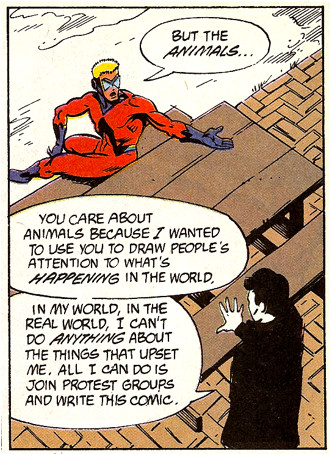
Obvious authorial intrusion. When the characters start behaving like idiots or acting against their established characterization because the writer damn well needs them to tell the story in a particular way, often to make a point. Who cares if the characters become less believable as a result?
May also occur when a character is accused of being used just to show a particular point of view, and not because they actually have it. The technical literary term for a character designed to express the author's preferred opinions (often the Only Sane Man) is the raisonneur—here at TV Tropes the preferred term is Author Avatar.
At best, the only difference is a rather heavy-handed Aesop. At worst, the narrative is put aside so that an Author Filibuster can be conducted. When you agree with what the author has to say, but feel that their method of conveyance is detrimental to the work, it becomes a case of Don't Shoot the Message. Creator Breakdown occurs when personal issues within the writer's life drive the authorial intrusion. Paradoxically, this can both result from and result in a Writer Revolt.
A minor subtrope of this is "Actor On Board", a related phenomenon in which an actor in a work has, for example, the script of a program changed to suit his beliefs (e.g. Munch's issues with child abuse).
Author Appeal is a specific form of this. Author Tract is when the main purpose of the work is to push the author's opinions. Translation with an Agenda is what happens when a translator imposes this trope on somebody else's story. See also Creator Breakdown, and Idiot Plot. Compare Out-of-Character Moment. If a fan does this to facilitate a romantic pairing, Ron the Death Eater, and Die for Our Ship may ensue. When multiple writers on board become embroiled in conflict and take it to the work itself, this becomes Armed with Canon.
Examples:
- The original English language manga Dramacon has an OEL manga artist pause to commiserate about people who think OEL works aren't "really" manga. She's immediately set upon by a representative of the opposing view: he's ten, dressed as Naruto, only able to talk by shouting... oh, yeah, and racist.
- Director Hideaki Anno, who had gone through a serious bout of depression pre-production, was famously accused of this practice in regards to the later opaque parts of Neon Genesis Evangelion.
By Author:
- Alan Moore has admitted that his series Promethea was a mouthpiece for his views on magic.
- Chuck Dixon, a political conservative, made Robin's love interest Spoiler pregnant for no other reason than to give himself a soapbox for his pro-life views. Ironically, he claims DC fired him because he loudly objected to Judd Winick doing pretty much the same thing (except with AIDS instead of teen pregnancy) during the latter's run on Green Arrow.
- He's also frequently had Batman become a massive dick to his allies so that they can call him out on his BS, for reasons that aren't quite understood. It's somewhat strange as he can write a decent Batman, but just as often makes Batman turn into an unrepentant jerkass so that he can have other characters hate him.
- Dennis Hopeless has openly admitted that the decision to have Spider-Woman become pregnant came about after his own wife became pregnant.
- After 9/11, Frank Miller proposed a Batman story called Holy Terror Batman!, in which the Dark Knight hunts down terrorists. DC refused to let him use Batman for the project, which was released as Holy Terror with original characters instead.
- Frank really likes two things: Angry, over-the-top sociopathic antiheroes for protagonists, and prostitutes. Male characters tend to have any antiheroic tendencies ramped up, and women are frequently retconned into being prostitutes, strippers, or otherwise heavily sexualized depictions (also often with a helping of sociopathy too). Batman and Catwoman are the most notable examples of that as, in his writing, Batman is a bullying jerk who regularly insults anyone with superpowers because they have the power to take over the world but don't while spouting homophobic language, while Catwoman's vague backstory was established as her being a former hooker who, inspired by Batman, adopts a costume to become a masked thief.
- Frank also has gone on record that he really wanted to do this to Captain America. After 9/11, he apparently told Marvel they were lucky to have a character like Cap who they could use for stories about The War on Terror and has made it clear he wants to write the character. Given how he handled Holy Terror, it's a really good thing Marvel knew better.
- Garth Ennis:
- He hates superheroes, and with the exception of Superman, Daredevil, and Spider-Man, usually writes them as complete morons. Thor: Vikings is his best example.
- He uses the Punisher to speak out against US military actions, not a trait of his before.
- He's also vocally atheist, and many of his stories feature mocking depictions of God.
- The "Emerald Isle" arc in Judge Dredd, The Authority: Kev and the "Kitchen Irish" arc in The Punisher MAX are his way of delivering his opinion of the IRA (hint: he doesn't like them).
- A popular guess among readers is that his views on religion and hero-figures were shaped by his living through the Irish religious wars.
- In an issue of Fury, Ennis has two military commanders inspecting a battlefield. One of them makes an awkward segue into a lengthy rant about the Vietnam War, where he essentially gives the reader Ennis' manifesto on the subject. What's especially absurd is that his companion, a decorated general with enough military prowess to have conquered an entire country, simply responds in disbelief, as if he'd never heard of the Vietnam War.
- Even when he wrote for 2000 AD, this was pretty clear, particularly in some of his Judge Dredd stories, most notably The Muzak Killer which showcases a rant against pop music.
- Jason Aaron's Marvel work that involves Cyclops to some extent usually involves at some point or another either Cyclops doing something he views as wrong and being called out on it (usually by Wolverine), or having someone call him out on something he did previously, usually something he did while under Aaron's pen (both Schism and Avengers Vs X-Men being keen examples of such). Cyclops will either give weak defenses for this or he will be cut off by some big speech about why he's a horrible person and why they're much better than him, with him not responding and the scene ending there. In his contributions to Battle of the Atom, he even has Cyclops' time-lost teen self remind him and the viewer he's still against his recent behaviour and will stop it (despite the fact that he's since learnt that what he thought about him was wrong) and had Kitty criticize Illyana (who's currently siding with Cyclops), despite both characters actually expressing appreciation for his attempts at helping them and having the two leave Wolverine's side to join him in Bendis' parts. In general, if Aaron is writing something X-Men related and Cyclops pops up, he'll be a pathetic jerk who exists to be hated and blamed, and it doesn't matter if the other character ends up coming off as childish, immature, idiotic, hypocritical, or just down-right asinine. Other writers follow suit in order to keep continuity, but they at least give Cyke credence and have him point out what an ass they're being about it.
- If there's anything to go by, though, is that Aaron REALLY doesn't like kids and teenaged superheroes fighting supervillains, as the bulk of the Schism conflict and Wolverine's main reason for being pissed at Cyclops is Cyke's willingness to take teenagers out into the field. Never mind that Cyclops has been an X-Man since he was 17, and even then he didn't do his first mission until he was 21 so not even a kid, or that the X-Men have done this regularly since their inception, or that Wolverine himself is well known for taking young teenage girls as his sidekicks. Because of the absurdity of this, other writers using his side of the X-Men ignore this and have teenaged X-Men fight in missions regardless, but Wolverine repeatedly makes a big deal about it, even making a point to jab at Cyke for how 'green' his new team were, even though he wasn't taking them out on a mission at the time, and that they were all college-aged young adults.
- Jeph Loeb appears to have, or at least had at some point, an ax to grind against organized religion. In the famous "Emperor Joker" storyline, there's an early scene making fun of a monastery, and The Joker later spouts some atheistic viewpoint towards the end (although granted, this is probably in character for the Joker). Then in the "Return to Krypton" story, the entire point was Jor-El and an army of scientists fighting against the priestly clan of Krypton. To make the point more glaringly Anvilicious, at the beginning when a time-traveling Jor-El shows up to meet present-day Superman, Superman exclaims "Great Rao!" (Rao is the Kryptonian sun god), and Jor-El moans "No, not Rao!!!"
- Jim Starlin does not like religion, and he writes about it often in his comics. He also has very strong opinions on how some things in comics should be and doesn't mind using the power of Retcon to have things his way—the biggest example is his take on the Anti-Life Equation, which is nothing like Jack Kirby's. He also once used Galactus, Marvel's planet-devouring star god, as a metaphor for U.S. foreign policy.
- Starlin also did not like Robin, and did everything he could to make the Robin at the time (Jason Todd) unlikable.
- J.M. DeMatteis is a strict pacifist writing in an industry that's basically defined by people punching each other. Inevitably, this results in a certain tension when he writes superhero stories (or his one issue of Star Wars (Marvel 1977).) Either you have a pacifist writer telling stories about violence solving problems, or characters embracing pacifist ideals despite long histories of solving problems with violence.
- J. Michael Straczynski's Superman: Grounded storyline features Kal-El taking walking across America to "reconnect" with ordinary people while lecturing them at length along the way. The "walkabout" theme is a deeply personal one for Straczynski, based on a turning point in his own life, and has turned up in his work before (with Dr. Franklin on Babylon 5). Those with a suspicious mind might also think Superman's expressed views are mostly the writer's own.
- He was also on board for much of Rising Stars, the latter half of which was often devoted to JMS lecturing through the Poet.
- The latter third of that run was essentially an extended Take That! to rightwing politics, to such an extent that it derailed the existing plot.
- He was also on board for much of Rising Stars, the latter half of which was often devoted to JMS lecturing through the Poet.
- Judd Winick's work for DC Comics, particularly his Very Special Issues, have been accused of this.
- Green Lantern #154, in which we learn the very important lesson that Beating People Up For Being Gay Is Wrong after Green Lantern Kyle Rayner's personal assistant Terry Berg is beaten up by a group of random thugs while leaving a club with his boyfriend. Despite having lost his first girlfriend to super-villain violence in the incident which defined the Stuffed into the Fridge trope and seeing numerous other violations of basic human decency on a daily basis, THIS particularly display of man's inhumanity to man is so bad that it inspires Kyle Rayner to abandon the Earth in favor of wandering outer space and helping random non-human species.
- Green Arrow #44, in which we learn that Oliver Queen's adopted daughter Mia is a recovering meth addict and HIV-positive. Despite having been portrayed by Winick as an unrepentant womanizer and having been so during a time when knowing such things would be vital, Oliver is completely ignorant as to what HIV is and how it is contracted, prompting a text-book recital on how HIV is contracted and treated.
- Outsiders #17-19 (a.k.a Most Wanted), in which the Outsiders approach real-life hero and Very Special Guest Star John Walsh for help in tracking down the leader of a child slavery ring. It doesn't speak well of the team that when their leader, a Batman-trained detective (i.e. Nightwing), is unable to find any leads that his next plan of attack is "Let's get that guy on TV to help us!" This arc had Executive Meddling written all over it.
- Green Arrow #61, in which newly elected Mayor Oliver Queen sums up his plan for rebuilding Star City with two words: gay marriage. In exchange for living in the city for two weeks, gay couples can have a free wedding on the steps of city hall - the hope being that all of these couples will stay and settle in the city, bringing money which will go into the local economy. Sadly, the plan is a bit of a non-starter seeing on how it is dependent on finding gay people who are so desperate to be legally married they will willingly move to a city that is currently divided by a massive wall built to separate the poor side of town from the rich side of town in the wake of a super-villain attack. Ollie does privately admit, however, that the main purpose of the announcement is as a headline grabber, designed to keep media attention on Star City and its problems, and that he doesn't expect it to do much else.
- The last six issues of Kyle Baker's Plastic Man run, not coincidentally written after Baker was told the book would be cancelled, are an extended satire on everything Baker disliked about mid-'00s DC Universe comics, and specifically Identity Crisis (2004) and related plot arcs: Darker and Edgier plots full of gratuitous character death, Black-and-Gray Morality, and overt sexual violence; traditionally lighter characters getting killed off, corrupted or traumatized; overlong, sprawling Crisis Crossovers; Stripperiffic costumes on female characters and generally excessive fanservice; and overblown writing and general pretensions on the creators' part that they were making superhero comics Serious Adult Drama. While many critics agreed with the views expressed, there was a general feeling that the satire was too heavy-handed and took up too much of the comic.
- Simon Furman has always had problems accepting the idea of Transformers being a gendered species, always having headcanoned them as an asexual genderless species who only use gendered pronouns for dealing with species with genders. This means he will write them as such unless mandated otherwise. While he's good about not letting it affect his stories, it means he stumbles when it's time to female Cybertronians to show up and he feels the need to justify it. The worst moment of this being Arcee's introduction into The Transformers (IDW) which came off as unintentionally offensive to trans people and got him in hot water with fellow author Mairghread Scott, though the two eventually worked it out.
By Title:
- A somewhat humorous example: Animal Man. Grant Morrison used it to constantly pitch for animal rights, particularly stating that Humans Are the Real Monsters and eating animals is wrong. Part of the plot was also the fact that the main character was slowly realizing he was in a comic book. In the last issue of Morrison's run, Animal Man and Morrison talk face to face, and Animal Man points out that animal rights are all well and good - but sometimes they verged on eco-terrorism. And that sharing minds with animals shouldn't automatically make you a vegetarian since half of the time you're going to be sharing minds with a carnivore. And all of this felt like Character Derailment. Morrison admits they has some good points but wonders if the next writer will take that too far and have Animal Man run down a zebra and eat it alive. As both a Continuity Nod and a Take That!, the next writer had him do just that in the very next issue.
- The Batman mythos character Anarky exists to be a vehicle for his creator Alan Grant's political views. This is why Anarky's ideology abruptly shifted from libertarian socialist to Neo-Tech between appearances (matching Grant's own conversion) and why few other writers use him (one of the exceptions being Kevin Dooley, who himself used Anarky as a mouthpiece for his views on gun control.) In particular, Grant's 1997 Anarky miniseries is essentially a four-issue-long Author Filibuster, delivered via Anarky's Inner Monologue, long philosophical debates with Batman, Darkseid, and Etrigan, and occasional pauses in the action to allow Anarky to break the fourth wall to lecture the reader directly on his alternative view of human history and development. Ironically, one of the few times Anarky has ever appeared in an adaptation (in Batman: Arkham Origins), he was revealed to be a clueless teenager trying desperately to act grown up by spouting talking points with no understanding of what they mean, possibly hinting at how other writers feel about him.
- Civil War (2006) has been accused of this, with people saying Mark Millar made just about everyone in the Marvel Universe into idiots just so he could pit them against each other. The fact that some writers seemed to agree with this only compounds the problem.
- DC Comics writer Keith Giffen is unabashed about his hatred of Legion of Super-Heroes character Karate Kid and his "super karate", and has stated outright that any time he ends up writing the Legion comic, Karate Kid will die. Once downplayed when Giffen did write Karate Kid's death in one run of the Legion comic, he gave the character a respectful send-off via Heroic Sacrifice, rather than simply dropping a bridge on him.
- A few reviewers have accused Giffen of trying to co-opt Midnighter, one of the only openly gay superheroes, after reading their run wherein Midnighter disbands the team, leaves his husband, Apollo, and moves to a tiny apple-pie town where he lives with a young woman named Mindy. The Reset Button was pounded so hard after that it nearly cracked.
- A bizarre and infamous example of this trope appears in the Doom Comic when Doom Guy suddenly rambles about the dangers of nuclear power and the need to preserve the ecosystem for the children of mankind, in the middle of shooting demons and zombies left and right. Probably Played for Laughs, though, but who knows...
- The first issue of Earth-Prime is ostensibly a Batwoman story, but heavily features Lena Luthor, a character from Supergirl who has never met either the original Batwoman or the current one, and who keeps making comments implying that she and Kara Danvers are a couple. Incidentally, the issue was co-written by Natalie Abrams, a former Supergirl writer who also ships Kara and Lena.
- In "The Money Pit", Donald Duck gets the genius idea to start asking to collect his 30 cents an hour from Uncle Scrooge's Money Bin, for him to resell the rare coins to coin collectors. Scrooge figures out the scheme, giving Don Rosa a chance to rant about "Investment Collectors" amongst comic book fans.
Donald: Those coins aren't doing you any good, and some coin collector will appreciate them.
Scrooge: That is precisely where you are wrong, nephew! Coin collectors make me sick! They collect their coins because other people put a value on them. They look their old coins up in price guides that tell them the fool things are worth more than face value. But why?! They don't enjoy their coins. They don't dive in them like porpoises or burrow through them like gophers, or toss 'em up and let them hit them on the head. No, they put their coins in plastic sleeves, and are even afraid to touch them for fear they'll be worth less to somebody else! They spend their lives building a meaningless collection that they only plan to someday sell... to a buyer who only plans to resell it! It's all so silly!
Donald: And I suppose your three-cube coin collection is sane?
Scrooge: The difference is that I value each and every coin as a personal memento. Nephew, I have learned to treasure that which has value to me, not to someone else. That's what life is all about! - Guardians of the Galaxy: Roger Stern openly said in an interview that the reason he killed Starhawk and Aleta's kids when he took over the title from Mike Gallagher is he simply felt they didn't fit the characters (and with a note that if someone wished, there was a way to undo their deaths. In the five decades since, no-one actually has.)
- Jamie Delano's run on Hellblazer is quite blatant about its left-wing politics, with subtle nods like demons celebrating Margaret Thatcher's election (since it will result in more miserable people looking to sell their souls), tracts against nuclear power, and active promotion of "free love" hippie lifestyles, to the point that the Final Boss of the run, a giant dragon god, is defeated by Constantine and his two love interests having a threesome under the right mystical circumstances. Delano's run on Animal Man also features the titular hero and his daughter founding a hippie commune.
- In the early 2000s a new storytelling rule was made at Marvel Comics: heroic characters could not be shown smoking. The head editor at the time, Joe Quesada, lost his father to cancer brought on by smoking. Even Wolverine, whose love of cigars had in the past been used to deliver an anti-smoking message to those who don't share his immunity to their effects, is no longer allowed to smoke.
- The various writers of My Little Pony: Friendship Is Magic (IDW) were obviously very thirsty for the idea of a reformed King Sombra ever since his introduction in the Reflections arc, as they outright reference it every chance they get. It actually bordered on Writer Revolt, as they at first wrote a follow-up to Sombra's FIENDship issue that ended with a rather abrupt Heel–Face Turn for Sombra that turned him into a Suspiciously Similar Substitute to their version, complete with a reference
 to their version of the character. When the show instead had him come back, evil as ever, and capped it off with Sombra being killed off for real in the Season 8 finale, the comics responded with an entire issue about Spike being the author of the comics... that quite literally ends with Andy Price and Katy Cook's OCs declaring it would have been better if Sombra was redeemed while taunting a Straw Man of fans of MLP.
- My Little Pony: Friends Forever: Friends Forever Issue #14 was written for the sole purpose of pushing the author's views on racism, specifically the ending of Dragon Quest which the author thought had Unfortunate Implications. Unfortunately the fan consensus is that it did an incredibly poor job of it by being far too preachy, being riddled with Unfortunate Implications, having little to no actual plot, an outright lying covernote , putting no focus on Princess Luna and Spike's friendship, having Luna only be present for about two pages, and having Spike's role delegated to "listening to Anvilicious Author Tracts from a bunch of Canon Foreigners who never appear in the entire franchise again".
- Sonic the Hedgehog (Archie Comics): During the latter half of Ken Penders' period as head writer, many of the stories either revolved around his own anti-gun views or would come to a screeching halt for a few panels for an Author Filibuster about the same. An example of the former was an entire story devoted to showing how the great Overlander vs. Mobian war began: two children - one Overlander, the other Mobian - meet between the two kingdoms to play, one of them brings a gun one day and accidentally shoots the other while they're horsing around, war engulfs both races, After School Special credits roll. An example of the latter has one of the less scrupulous members of the Freedom Fighters (Fiona, who goes on to betray the team and join the bad guys in a later issue) ask why they don't just use guns to solve their current dilemma and is given a verbal bitch-slap by Rotor Walrus about how they have never used guns and never will use guns. This sudden Mood Whiplash is made even more jarring by the fact that Bunnie Rabbot, a character that had worn six-shooters holstered in a bullet belt up until the issue in question, can be seen in the background, without the pistols but still wearing the belt. Further, not but twenty or thirty issues previous, Rotor had developed a huge bazooka-like laser cannon that purportedly operated much like a hand-held Wave-Motion Gun and which Rotor actually fired directly at Dr. Robotnik at one point.
- Spider-Man: The series has many mostly in the form of Shipping Wars as each writer tries to pitch their own ship:
- Stan "The Man" Lee himself, particularly during his run. It's a somewhat well-known fact that, originally, Mary Jane Watson was introduced as merely a foil for Gwen Stacy. However, Mary Jane was infamous for stealing every scene she entered, largely overshadowing Gwen's softer personality. Stan made numerous attempts to downplay MJ's character, mainly by simply excluding her from the story, but he once gave MJ a ridiculous haircut that even the characters hated. In a featurette on the Spider-Man 2 DVD, Stan admits that despite his efforts, he just couldn't make Gwen as interesting as MJ and he knew it.
- John Romita is on record saying that he did all he could to make Gwen as interesting as MJ but to no avail. MJ was an immediate hit — readers started writing letters asking for her to be made Peter Parker's girlfriend on the strength of the iconic panel that first showed her face as well as her long-introduction and the fact that Aunt May, Peter's mother in essence, was a Shipper on Deck and saw MJ as "the one" for Peter. Lee's and Romita's best efforts to make Gwen prettier and feistier were not enough especially since a lot of these fans didn't forget that when artist and co-plotter Steve Ditko was around, Gwen Stacy was a narcissistic arrogant Alpha Bitch who found Peter attractive but was otherwise too proud to act on it and basically played mean pranks and social bullying to "express her affection" and they saw Lee and Romita's rewrites to make Gwen stick for the transparent Character Shilling they were.
- Dan Slott notes this about the famous Revision of Parallel Lives, the story which revealed that Mary Jane knew Peter's secret identity from all the way back to Amazing Fantasy #15, arguing that it made a "lie of all the stories that came before" and that it made MJ into someone who fell in love with Peter because he was Spider-Man and not for just being plain old Peter. Slott said that he disagreed with that change but since it is canon he has to go by it, even if the author Gerry Conway building on work done by Roger Stern and Tom Defalco saw it the other way. Slott referred to this in ASM# 652, where Peter and MJ share a moment talking about Peter's current relationship with Carlie Cooper and why he won't tell her his secret. Peter reveals that he wants to make sure that she falls in love because he's just plain ol' Peter, and not because he's Spider-Man as he feels that MJ did with him. As others point out, given Spider-Man's Hero with Bad Publicity status and the fact that both of Peter's first girlfriends (Betty Brant and Gwen Stacy) uncritically accepted Jameson's views which Mary Jane never did, this amounts to misreading the entire context and shoehorning a sexist Silver Age Lois/Superman dynamic on a setup that specifically deconstructed it, and given that Peter is canonically someone who grew up handsome (as repeatedly told in stories in the Ditko era, and shown when Romita made him good looking) and notably rejected Sally Green's advances in college after she praised his brains by insisting that he doesn't want girls to like him just because he's "an egghead" rather than the other qualities in himself he valued. He hasn't been "plain ol' Peter" since he got bitten by a spider and the character who preferred Spider-Man to Peter isn't Mary Jane (as she says in Slott's story Peter and Spidey are one and the same) but the Black Cat.
- Co-creator Steve Ditko a few years after he finished Spider-Man became known as an Objectivist, and his abrupt departure is often seen as a result of a political disagreement between him and Lee. Much of which is conjecture and unverifiable because Ditko was a famous Reclusive Artist who refused to discuss Spider-Man in detail after he quit. After Ditko left, Lee who was himself quite apolitical at the time but tended to go with general social trends once they became mainstream, in later years would use Spider-Man to put out Very Special Episode most notably the "drug trilogy" and where Ditko in The '60s made fun of college protestors as Bourgeois Bohemian, Lee trying to tap into the college crowd he had come to know on the campus lecture circuit showed them more sympathetically.
- Rick Remender has been accused of doing this in his Uncanny Avengers. Remender is outspoken in his belief that the mutant-rights movement within the stories is a poor metaphor for real-world civil rights, because, unlike real minorities, many mutants are legitimately dangerous, and several characters within the story express the view that the mutant rights movement is completely different from, say, the African-American or gay rights movements. Particularly controversial has been his handling of Rogue and to a lesser extent Wolverine and Sunfire, who hold the view (shared with the majority of writers and fans) that the parallels do work, and who are portrayed as unreasonable for it.
- Johnny Hart became a born-again Christian later in his life, and afterwards B.C. became notorious for its occasional pro-Christian sermonizing, including one infamous Easter strip showing a menorah transforming into a cross (Word of God was that this was merely his way of expressing a new religion coming into its own). What made the whole situation rather bizarre was that the strip is ostensibly set in the Stone Age, as the title B.C. would indicate. One fan theory tried to account for this by speculating that it really takes place After the End. After Hart's death his daughter and grandson took over the strip. They dropped the preachiness and returned to secular gags.
- For Better or for Worse: Johnson's anti-feminism drips from this strip.
- One example: Anthony convinces Therese to have a baby, even promising to take care of it. However, when Therese wants to go back to her high-paying job, Anthony admits he doesn't want to care for their kid; he expected "maternal instincts" to kick in. Anthony's later Wangsting over Liz causes Therese to seek a divorce. The other characters view her as a harpy for wanting a good job rather than staying home and popping out kids.
- She also clearly portrayed female characters (and it was never male ones) who had sex outside marriage as inherently very bad, with doing so irrevocably staining them. Granted, in the main case the character is a teenage girl, but that just makes it worse as her narrative blames the character rather than most likely a victim of statutory rape (it's not entirely clear what age she or the boys she'd had sex with were). This would be a dark subject of course, but the strip had never shied away from that.
- Funky Winkerbean usually dips only occasionally into Tom Batiuk's views. However, in mid-September of 2009, he suddenly ran a plot line in which a group of angry parents protests a production of Wit, a play about "cancer" and "death". As Batiuk's own dip into these two topics was a source of mockery and harsh criticism (mainly due to his lack of skill in shifting a gag-per-day strip into heavy drama), it was pretty obvious that he still had a chip on his shoulder.
- Towards the end of its run, Li'l Abner became dominated by Al Capp's potshots at contemporary celebrities, which alienated many of his Baby Boomer fans and, in the long run, contributed to his once-popular strip fading into obscurity. (Interestingly, although he expressed them less and in a more subtle way during the '50s, Capp's politics were much more liberal then, leading some to theorize that he was simply a contrarian against prevailing social attitudes.)
- Chatoyance uses her Conversion Bureau fics to espouse her views.
- Redskin122004, author of The Conversion Bureau: The Other Side of the Spectrum, has also written Deconstructions for the "Fall of Equestria" universe (wherein the ponies are forced into sexual slavery by the patriarchal caribou). He has stated an explicit hatred for the universe to rival his distaste for The Conversion Bureau that stems from his own hatred of what goes on in real life.
- Cori Falls. Trying to find a fic where she doesn't preach the glories of paganism and the evils of "mainstream" popular kids is like finding a needle in a haystack.
- "A Crushed Empire" is a long-gone Warhammer 40,000 fanfic where the Emperor is evil, all non-humans are trying to be friendly and everyone converts to Christianity. The sequel is just as bad, as the races well known for their Fantastic Racism and Omnicidal Maniac tendencies are being nice to each other, and the Marty Stu Dark Angel-wannabe somehow banished the Chaos Gods. The cause of all this? The Bible.
- Very common in Harry Potter fanfics:
- In the infamous My Immortal, everyone turns into a goffik Stanist who swears a lot and sticks their middle finger up at preps. They also develop an unhealthy preoccupation with slitting their wrists. However, due to its status as a (possible) Troll Fic, this ridiculousness is likely quite intentional.
- While labeled as Hetalia: Axis Powers fanfics of all things, the stories Israel's workout and The Two Americas are really very extreme Conservative and racially insensitive propaganda at that. The first depicts the Anthropomorphic Personification of Palestine as an Ax-Crazy thug and ends with the protagonist, Israel, ranting about how Palestinians are Always Chaotic Evil. The Second depicts a Barack Obama as a Straw Liberal that antagonizes the "real" conservative America.
- Ralph Hayes, Jr., alias RealityCheck, does this in some of his My Little Pony: Friendship Is Magic fanfics. Bullying is a sore subject for him and what he believes to be the series' poor handling of the issue is brought up in Parting Words and The Great Alicorn Hunt, while Nightmare Night and Nyx has a scene where Rainbow Dash's date goes into an Author Filibuster that berates her for treating "being feminine like it was some sort of disease" (a behavior she has unwittingly passed on to Scootaloo), due to the author's belief that pop culture is hostile to traditional feminine behavior.
- In the fic Metropolis, the heroine has narrowly avoided being raped and delivers a Shut Up, Hannibal! speech to the perpetrator. The speech is about how she doesn't need him, she can protect herself...and he referred to a friend of hers by the wrong pronouns.
- Any Quentin Tarantino film usually has a scene that is obviously a theory or pet peeve of Tarantino's shoved into the mouth of one of the characters. Sometimes even by playing the character himself. Most memorably: Reservoir Dogs features his character rambling about the true meaning of Madonna's "Like a Virgin", and Pulp Fiction features his character going on a rant about his hatred of cheap coffee. Possibly the weirdest is Kill Bill coming to a dead stop so Bill (who has shown zero interest in comic books up to this point) can rant about what Superman actually means.
- Annie Hall parodies it, by having Alvy Singer write his failing relationship into a play he's working on. In real life, Singer and his girlfriend break up, but in the play, he delivers a poorly-written speech about how their relationship was far too superb to end in a hell-hole like Los Angeles. Singer lampshades it by turning to the screen and saying, "What do you want, it was my first play."
- Cannibal! The Musical has a subplot about the main character's love for his faithless horse called Liane that was written by Trey Parker as a dig at his ex Liane who he walked in on having sex with someone else. Ironically, his ex provided some of the choreography for the film.
Packer: How does it feel to be riding my horse?
Frenchy: Everyone in this town's ridden your horse. - In Clerks II, the "Star Wars versus The Lord of the Rings" argument is obviously Kevin Smith's personal opinions on the subject. In fact, Randall's monologue in the film was an almost verbatim repetition of a speech that Smith had given previously when a Q&A attendee asked him about the trilogy.
- The In Name Only adaptation of Fast Food Nation is basically a two-hour rant by director Richard Linklater on why people shouldn't eat meat. Bizarrely enough, the author of the book (who isn't a vegetarian) was one of the film's producers.
- The Fugitive had a case of a costume designer trying to put her beliefs on screen. Actress Jane Lynch of Glee had one scene in the film as a doctor friend of Richard Kimble. She writes in her memoirs that the costume designer insisted that her lab coat have buttons that were for "pro choice" and other issues.
- Hidden Agenda is pretty obviously a Take That! against the government of Margaret Thatcher, going much further than most. The plot involves a conspiracy where she, with the aid of factions within big business and the military, used black propaganda to discredit Conservative Party leader Edward Heath so she could replace him in 1975. After this she was successfully elected Prime Minister, taking hard-line measures to fight their foes: the labor unions and IRA.
- Inside Man has a Big-Lipped Alligator Moment featuring a little boy playing an ultra-violent, black ghetto-themed handheld video game that commands the player to "kill that nigga," this in a heist movie that is not at all about the black ghetto, or new media, or even race. What do you think the odds of seeing this would have been if Spike Lee had not been the director?
- The biggest failing of Lady in the Water was that it was just two hours of M. Night Shyamalan rubbing his self-indulgence in our faces. The movie is pretty much centered around inspiring a writer (not surprisingly, played by Shyamalan himself) into writing a book that will change the world for the better at the cost of being martyred in a Heroic Sacrifice. He also includes a Take That! against the film critics who gave his earlier movies negative reviews by putting in a film critic character who is an arrogant, unlikeable man who dies a horrible death... and was one of the most popular characters among viewers.
- The Last Jedi - the eighth episode of the Star Wars saga was directed by Rian Johnson and deconstructs and criticizes a number of long-standing Star Wars tropes. Johnson uses a burnt out and depressed Luke Skywalker to discuss his thoughts on the negative aspects of the Jedi Order, the nuances of the Force, and the fan's mythologizing of Luke. Additionally, he uses the hopeful, but bitter Rose Tico to espouse his personal politics such as condemning slavery, war profiteering, and a giving speech about how the military-industrial complex gets richer from the suffering of others and how they will always support those who will benefit the most.
- Love Stinks does this within the plot itself. When Seth gets sued by his ex-girlfriend for "palimony," he expresses his feelings about it through his job as a sitcom writer. This ultimately leads to the actors eventually throwing down the latest script in disgust to chew Seth out for derailing the show because of his personal issues.
"Let's review the script for our next episode: Ronnie bashes Lonnie's head in with a frying pan!"
- The Naked Gun 2 ½: the Green Aesop is laid on pretty thick when the villains outline their devious plan. Ironically, David Zucker would become a hard-line conservative and write a whole movie on the opposite side of the political spectrum.
- In Francis Ford Coppola's original mid-1960's screenplay for Patton, General Patton's contemporary General Omar Bradley was merely a supporting character; while Patton and Bradley knew and respected each other in Real Life, they were not close by any means. When the film was finally made several years later and Bradley was added as a technical consultant to assist with Edmund North's rewrite, Bradley was suddenly the second-leading character to Patton, they were portrayed as lifelong best friends, and Bradley was often shown as the more reasonable of the two.
- Revolver (2005) seemed set to be the next awesome Guy Ritchie crime film, but what had appeared at first to be a rather promising plot eventually turned out to be a Mind Screwy delivery system for the Kabbalistic beliefs Ritchie picked up during his marriage to Madonna.
- Akira Kurosawa makes use of this trope in Seven Samurai; Kikuchiyo, a farmer's son, not a samurai, dissuades the other samurai from blaming the villagers for killing and stealing from samurai in the past; after all, it was samurai rule that had forced them to live that way. This is widely seen as Kurosawa apologizing; he came from a family with samurai ancestors.
- In Star Trek IV: The Voyage Home, Leonard Nimoy preaches his pro-environmental views and gives a nonsensical justification for it. Yet by not putting those views front and center, and keeping the movie strong on character and humor (also thanks to the screenplay by four skilled writers), the trope is barely noticeable when watching. It helps that he avoids demonizing the opposition with strawmen or a cackling, anti-environmental villain. In fact, except for the probe that starts it all (which can hardly be considered malevolent), this is the one of the relatively rare Star Trek stories that can be considered to have No Antagonist.
- Superman IV: The Quest for Peace, wherein Christopher Reeve was given creative control of the story, is a thinly-veiled veneer for his anti-nuclear, anti-corporate media philosophies. In one particularly jarring scene from the movie, Superman saves the passengers aboard a runaway subway car, then gives a speech to a crowd of pedestrians about the benefits of mass transit. Amusingly, Reeve himself later admitted the final product of the film was terrible but reminded people it had a So Bad, It's Good quality.
- Ever wonder why none of the characters in Thank You for Smoking are ever seen smoking, even though that's what the entire movie is about? That was an idea enforced by the director, Jason Reitman, and the intrusion shows. Granted, he did this in order to subvert Do Not Do This Cool Thing, but not having a single visible smoker in a film that is almost completely about smoking steers the film straight into... a few other tropes.
By Author:
- Aldous Huxley set a new standard for this, as well as acting as an inspiration for later writers such as Rand, Heinlein, and Card. Almost all of his post Brave New World novels feature an author stand-in who lectures the reader about the Way Things Should Be (e.g. Propter in After Many A Summer). This reached its ultimate point of absurdity in Island, which is essentially a several-hundred-page lecture on the perfect society bookended by a couple of chapters of narrative.
- Andrew Vachss is unabashed about his condemnation of government and society's failures in his Burke books. These comments are usually delivered through said first-person protagonist, who has a Dark and Troubled Past involving precisely that.
- After his own conversion to Spiritualism, Sir Arthur Conan Doyle wrote a novel titled The Land of Mist to explain and justify his beliefs, including having his ultra-rationalist hero Professor Challenger become convinced of the rightness of Spiritualism and convert. Conan Doyle makes a point of Challenger having a believable motive for his abrupt philosophical U-turn, namely the death of his beloved wife.
- Thriller author Brad Thor does this on occasion, but Hidden Order is one of his most blatant examples of this. It begins with special operations expert Scott Harvath suddenly taking on the role of a freelance investigator looking into a series of serial murders, and breaks down into a scree against the Federal Reserve, who to no one's surprise, turn out to be the Big Bad of the story, eventually getting to the point where the narrative gets shoved aside for a character to become a mouthpiece for Thor's views on the Reserve for a chapter and a half.
- Charles Dickens frequently used his novels as pulpits for his social commentary. He was famously critical of poverty and child labor owing to his own childhood experience working in a factory to help pay his family's debts. This is most overt in The Old Curiosity Shop and Oliver Twist.
- Charles Stross seems to have a lot of anger against superhero fans in The Annihilation Score.
- Daniel Silva's books have a lot of this trope. His most famous series is about a Mossad assassin named Gabriel Allon. Silva would spend pages to justify right-of-center Israeli policies while glossing over or justifying any questionable actions by Israel. For example, in "Prince of Fire", several chapters justify Israel's policy of expelling Arab residents during the country's early history. Another thing he likes to go on about is how Europe is basically a giant antisemitic cesspool that harbors Islamic terrorism and how Europe is unjust to push for peace that would be "unfavorable" to Israel. Basically, he tends to portray any country/politicians that are not entirely pro-Israel as antisemitic, which is, of course, a giant fallacy. Silva is a convert to Judaism himself and clearly identifies strongly with Israel due to this.
- There's also his dislike for Pope Benedict. He created a fictional Pope who espouses more liberal/inclusive views, not to mention being rather better at apologizing for antisemitism than Benedict has been (this would probably go with the Europe = antisemitic cesspool mentioned above). In the afterword to the book in which that character is introduced, Silva talks about how disappointed he was in the real-life Pope and uses his fictional Pope from that point onward in the series.
- Diane Carey's Dreadnought! Star Trek book is, at times, a thinly-veiled Libertarian propaganda piece; government intervention is portrayed as uniformly bad, be it an admiral trying to use a new Federation starship as the flagship of his private army to cement control over the Galaxy, or socialism as described derogatorily by her human POV character, Cadet Piper and Piper's Vulcan sidekick, Sarda.
- All of her Star Trek novels carried some form of this - major characters tended to develop a deep fascination with things of a nautical nature (one of Carey's loves), among other things.
- She also had a well-documented dislike of Star Trek: The Next Generation (no doubt because it was TNG that made it quite clear the Federation is socialist), which was made apparent when she actually was contracted for novels for the series, often finding ways to justify writing around the characters/setting (re: Ancient Blood, separating Worf from the rest of the crew with a B-plot of Picard and Alexander experiencing a Revolutionary War period holo-program, and Ship of the Line, separating Picard from the crew and putting a captain pulled forward from the 23rd century in command of the Enterprise, complete with his own crew taking positions on the ship).
- She was also contracted to write episode novelizations. Her last one (and last Star Trek novel to date), for the pilot episode of Star Trek: Enterprise, was actually brought to the attention to Rick Berman and Brannon Braga, the showrunners, who felt that it was openly critical of the script, declaring it to be 'reeking of hatred' for the show.
- Similarly, thriller writer Dick Francis had a thing about sado-masochism: if a character in any of his books is any sort of kinky they are bound to be among the bad guys. This gets so predictable that when one hero has a suspicious character followed and finds that all he's hiding is that he visits a spanking prostitute, genre-savvy readers are ready for it when he turns out to be part of the evil conspiracy after all.
- Frank Herbert clearly had serious issues with homosexuality; Big Bad Baron Harkonnen in Dune is a Depraved Homosexual who even lusts after his own nephew, and even his henchman Piter is briefly said to have a vaguely feminine personality. Then The Dosadi Experiment features the omniscient narrator discussing how gay people make ideal suicide bombers, an aside that comes right the hell out of nowhere and never even has any impact on the plot.
- George MacDonald: The Princess and the Goblin is a classic piece of Victorian children's literature. The lesser-known sequel, The Princess and Curdie is a bizarre, Anviliciously heavy-handed cross between The Pilgrim's Progress and The Revelation of St. John that is likely to give a child unfortunate enough to read it nightmares for years to come.
- His non-fantasy novels are even more excessive, often stopping right in the middle of the action to deliver religious sermons (sometimes from the characters, sometimes from the author himself) that can go on for pages in unedited editions. However, as C. S. Lewis observed, it's actually alright if we consider that "the author, though a poor novelist, was a supreme preacher."
- Early installments in George MacDonald Fraser's Flashman series depict the protagonist as a lecherous, lying coward who somehow comes out on top, accompanied by a jaundiced view of British imperialism. In later books, however, Fraser makes Flashman more sympathetic (or at least less craven), play up the Empire's righteousness and takes potshots at liberals, "political correctness" or modern society in general. See for instance Flashman and the Redskins, with its long prologue of Flashman calling out a liberal whining about mistreatment of the Sioux Indians. Most egregious is the final book, Flashman on the March, which celebrates the British invasion of Abyssinia as an example of a moral foreign intervention in contrast with, say, the Iraq War.
- Though most people who knew Flashman as his readers know him would listen to his moral advice...and then immediately take the opposite position. Even when he's at his most sympathetic, it's still a consider-the-source issue.
- This regrettably carries over into Fraser's other works. His memoirs Quartered Safe Out Here and The Light's on At Signpost are loaded with take thats directed towards modern, multicultural Britain. Even his last novel The Reavers, set in medieval Scotland, evinces a similar attitude. Fraser became an arch-Tory later in life and increasingly let it bleed into his writing.
- Harlan Ellison's hatred of computers crops up quite a bit in his later work.
- I Have No Mouth, and I Must Scream is about as blatant as it gets, too. Ironically, it would go on to be adapted into a computer game which Ellison himself collaborated on.
- Since 2001 or so, if the particular Alternate History setting allows for it, Harry Turtledove will include some kind of analogy to Islamic fundamentalist terrorism. No problem on the surface, as analogies are standard stock-in-trade for alternate history stories. The problem came when, in a timeline where the South won the American Civil War, he chose Mormons for this role. Many fans believe that he's crossed the line from "Broken Aesop regarding repression of religious expression leading to violence" into outright bigotry. In the same work, he also turns Canadians into Irish nationalist terrorist bombers, blacks into Communists and Mexicans into Nazi satellite state collaborators.
- The Man with the Iron Heart takes this to extremes about his feelings on the Iraq War. Reinhard Heydrich lives to run a partisan campaign. Body bags are showing up as everyday Germans become radicalized and engage in terrorist acts. It's subtle as a brick when you have mothers of dead soldiers acting just like a certain famous protester and it leads up to the Republicans winning control of Congress and getting us out from the Democrats' war — after which the Nazis are poised to take over again.
- John Ringo- Let's list them because it's in all his books:
- Council Wars includes things like cheerleading for the American 2nd Amendment, dislike of welfare, and other political views that at least make sense given the context in which they come up in the story and are worked in logically. Stopping dead to explain why believing in human-caused climate change is stupid, going on at length about the sexual kinks of Herzer, and a completely nonsensical explanation of American "strategy" in the "War on Terror"? Not so subtle.
- In the third book of the Legacy of the Aldenata series, When The Devil Dances, a very large artillery piece happens to have been named and decorated after Bun-Bun, from Sluggy Freelance. One of the crew members suggested it and talked the commander into it, after introducing him to the comic. They don't have time to consult anyone to see if they'll have to take it off before the fecal matter hits the fannote . Later on in the book, one character refers to "Bun-Bun", and the complete stranger he's talking to knows what he means. He happens to not only read the comic but is a "big fan".
- The Prince Roger series' primary overarching antagonists are a bunch of radical "environmentalists" employing Green Peace marines. Also the environmentalists don't shower or use deodorant.
- Troy Rising the protagonist got to be wealthier than the rest of the planet through hard work. Also we're treated to his views on taxation, unemployment and welfare. At one point an alien takes time to complain directly about "liberals".
- J. R. R. Tolkien makes a number of pointed comments through his Legendarium. Tropes Are Not Bad.
- His Green Aesops, celebrating the countryside and agriculture and deriding mechanization without care for the natural world, is particularly prominent in The Lord of the Rings with the tree-shepherding Ents: "I am on nobody's side because nobody is on my side." Saruman's crimes include the ruin of the park in Isengard and the wanton destruction of the ancient trees in Fangorn Forest as much as his assault on Rohan.
- War Is Hell. The Dead Marshes are based directly on his memories of flooded battlefields in World War I and he was still working on the books when World War II broke out and his son went to fight. When there's a direct comparison between Rohan and Gondor (made, admittedly, by a Gondorian), Rohan is shown as less wise because they embrace the Proud Warrior Race Guy ethos, glorying in battle for its own sake, whereas Gondor only slid into that due to necessity and it's not good for their culture. Beregond also laments that Faramir should be more admired but because he's scholarly and only kills at absolute need, people think that Boromir (who was more like the men of Rohan) was better. Also, The Prophecy concerning Aragorn's return is about his Healing Hands rather than his prowess in war.
- The other issue with the Rohan/Gondor theme is that the Rohirrim are early Anglo-Saxons with horses, closer to the native culture than the culture after Christianity (Tolkien thought the conversion was an improvement). Part of his wise Numenorean/barbarian Proud Warrior Race Guy Rohirrim dichotomy is exactly that: he viewed the native Germanic culture as barbaric, and that culture is one of the best real-life examples of Proud Warrior Race Guy.
- There is also a pointed dig on both themes in The Hobbit in Goblin-Town: "It is not unlikely that [goblins] have invented some of the machines that have since troubled the world, especially the ingenious devices for killing large numbers of people at once [...] but in those days and those wild arts they had not advanced (as it is called) so far."
- His beliefs regarding Catholicism also drip heavily into his work, through its cosmogony. In particular, the Valar are effectively a way to integrate polytheism into Middle-Earth, while also showing monotheism as "correct." His later writings on the Elves essentially show them as Catholic on a biological level; for one, non-marital intercourse is somewhere between disgusting and physically impossible for them. The Oath of Feanor (the primary plot driver for The Silmarillion) is derided not simply because of its murder-happy consequences, but because Feanor and his sons blasphemously swore it to God.
- Karen Traviss when she writes Star Wars. Her writing on the Jedi tends to be, well, less than favourable, compared to the rest of the franchise. Which is nothing compared to her obsession with Mandalorians:
- That being said, during her later books before her contract with Lucasfilm was cancelled due to retcons, Traviss did make an attempt to show the inherent hypocrisy of her character's actions. It didn't stop them from being the primary focus of the novels, but she was aware of this trope being in effect and was striving towards fixing things. And before anyone says that her stories are no longer canon, the Expanded Universe had the situation covered before her contract had even finished.
- Not to mention what happens in Allies and Vortex: Mandalorians murdering a Padawan, and massacring slaves, respectively. Ouch.
- The Gears of War novel Aspho Fields that she wrote pretty much beats the reader about the head with the idea that "weapons developers = war criminals." Traviss' Mandalorian "super tribal warrior" fixation carries over into the novel as well, with its hyper-competent, misunderstood, absolutely perfect Pesanga warriors, who are pretty much Mandalorians with machetes.
- Bonus points? This a setting where these so-called "war criminals" are the only reason the human race is still alive.
- Her Halo: Glasslands, The Thursday War, and Mortal Dictata novels provide a very alternate perspective on everything we know about Dr. Catherine Halsey and has most of the characters (including characters who were on her side in all previous Halo media) treat her like the worst human being who ever lived. Even Halsey herself starts to think this way at times. As far as the author is concerned, stealing children from their parents is the worst atrocity anyone can commit. Even if you happen to save your civilization (and every sentient being in the galaxy) by doing it.
- Not to mention that Dr. Halsey's inquisitors are none other than the Office of Naval Intelligence, the very same people who recruited her and approved of everything she did, including the "kidnapping young children to be turned into indoctrinated supersoldiers" part, all to crush what at the time were only human rebellions. Traviss also tries to paint the Director of ONI as a hero, despite the fact that she has done even worse things than Halsey, like approve of the SPARTAN-IIIs, which were recruited en mass from war orphans and made into expendable commandos by their early teens.
- This got to the point where Halo's main writers had to give official explanations in later media like Halo 4's prologue for why ONI decided to condemn Halsey in the first place. As it turns out, ONI's problems with Halsey have nothing to do with morality; they just want a convenient scapegoat for the sins of the SPARTAN-II program, as well as to make the SPARTAN-IV Program look better in comparison.
- A more general trend in Karen Traviss's work is a Colonel Kilgore-level obsession with warfare, militarism, and military figures. The Proud Warrior Race Guy is held as the ideal, and anyone who is not as much of a violent he-man is deemed inferior by the narrative.
- That being said, during her later books before her contract with Lucasfilm was cancelled due to retcons, Traviss did make an attempt to show the inherent hypocrisy of her character's actions. It didn't stop them from being the primary focus of the novels, but she was aware of this trope being in effect and was striving towards fixing things. And before anyone says that her stories are no longer canon, the Expanded Universe had the situation covered before her contract had even finished.
- The early works of lesbian author Katherine V. Forrest fall victim to some clumsy all-men-are-evil soapboxing. Daughters of a Coral Dawn is the most extreme, having men (who are suffering from one giant inferiority complex) outlawing some Applied Phlebotinum that renders them redundant in the act of procreation. It Runs on Nonsensoleum (and the precise nature of the phlebotinum is never explained). Fortunately, Forrest appeared to have toned it down by the time she started on the Kate Delafield books.
- Kurt Vonnegut does this sometimes, in addition to actually appearing As Himself to do this to characters in real time. Lampshaded in that he often mocks himself for doing so.
- The characters in L. Neil Smith's alt-history novels (The Probability Broach, The Gallatin Divergence, etc.) are all mouthpieces for the author's brand of libertarianism. Plus, they get to shoot anyone who disagrees. Way cool.
- Michael Crichton tended to do this a lot, albeit that he was somewhat more subtle about it as the characters whom he boarded were created more or less for the purpose of espousing a philosophy central to their characters. He also did it a lot because his modus operandi was to take a source of public fear/apprehension/paranoia and then base a novel around it. Fear of computers/robots: Westworld. Fear of genetic manipulation: Jurassic Park. Fear of the Japanese: Rising Sun. Fear of sex discrimination: Disclosure. Fear of the media and flying: Airframe. And so on.
- At the end of his career, State of Fear is an anti-climate change screed about environmentalists planning mass murder to cause a climate change panic and receive funding, and when he got called out on his blatant misuse and misrepresentation of science, he turned one of his critics into a child molester with a small penis in Next.
- This trope is Older Than Steam: Molière's plays often were whole essays against the hypocrisy and vulgarity that ran rampant throughout French society, as well as tirades against doctors (medicine was horrible back then, and many physicians were VERY ignorant), pseudo-intellectuals, and self-appointed Moral Guardians. (Tartuffe, one of his most well-known plays, was censored for years because of this.) Characters like Philinte (The Misanthrope) and Cléante (Tartuffe) serve as Author Avatars for the playwright.
- Orson Scott Card does seem to have a habit of doing this.
- In Empire, characters will pause during the action to explain exactly why any disrespect for the military whatsoever is unpatriotic and therefore evil. Not to mention the fact that, despite apparently being a warning against partisanship, the Big Bads are still liberals.
- In one very uncharacteristically blatant and unmistakable example, several characters near the beginning of Ender in Exile espouse the view that monogamy is the only and best successful means of human society, using the exact same phrasing consistently enough to put conservative pundits' talking points to shame. Thankfully, he drops this act soon enough to make the book as a whole still enjoyable.
- Likewise Ender's Shadow series has some moments during the arc of Bean's Character Development. In Shadow Puppets in particular, the adamantly childfree Beannote turns around on the idea of reproducing very suddenly after getting lectured by a Straight Gay man who married a woman simply so he could have kids, because a heterosexual marriage with children is the only way to be truly happy, and all other reasons a person might not want that are just lies they tell themselves.
- Tides of War, a novel for World of Warcraft, was apparently upset about how fans reacted to the Alliance faction firebombing Taurajo, a hunter's camp composed of Tauren (minotaur people). As a result, the book takes time out of the narrative to have Baine Bloodhoof, the leader of the tauren, complain about how the Alliance firebombing Taurajo was entirely justified, claim everyone whom died there was a military target, and subsequently exile any of his tauren subjects that were upset about it. Not only is it illogical for any leader to react like this to their own people being upset about their families being killed by the enemy in a war, there was no way for Baine to know the information he quoted as they were only revealed to the Alliance Player Character in a private conversation with the General whom firebombed Taurajo.
- In just about anything by Robert A. Heinlein, sympathetic characters are constantly giving lectures which essentially push the author's views. Obviously, whether this is a good or bad trope depends on how you feel about the specific concept being espoused. Unrestricted all-American capitalism, the charm of cats, the poor knowing their place, the evils of religious dogma, incest, free love, the superiority of the "down home" values prevalent in the US in the first half of the 20th Century, chivalry and politeness, how wonderful babies are, the need to encourage scientific education - all of these things are constant preoccupations of characters in his work. No comment will be made as to whether any of these individual tropes are good or bad, but that they are most definitely constant preoccupations of the characters very much illustrates the trope.
- Stieg Larsson was obviously not a fan of guns. In a chapter of The Girl Who Played With Fire, told from a veteran policeman's perspective, he criticizes hollow-point ammunition. The character calls it "hunting ammunition" and says that it is "unclear" why law enforcement uses it. A real police officer would be well aware of the reasons, such as reducing the chances of the bullet passing through a target and hitting bystanders, or the fact that shooting someone constitutes "deadly force" and is thus done with the intent of killing the target (hence why it's the last resort for police officers), even if he didn't agree with them. Shortly thereafter, another policeman calls a Colt handgun a "cowboy pistol" and says they should be banned outright because apparently, some guns are somehow "more" bad than others.
- Victor Hugo does this all the time. He has a tendency for: "Okay, now let's stop the story and have a "short" explanation about something that has nothing to do with the plot!" Meanwhile, his characters are usually in big trouble. In Hugo's defense... he was paid by the word.
By Title:
- The Animorphs book The Experiment was ghost-written and a heavy-handed anti-meat screed, so much that the primary author and series creator K. A. Applegate stepped in to rewrite the final chapter so that the Animorphs are happily chowing down on hamburgers (except Cassie, for whom vegetarianism is in-character). Though Applegate herself doesn't have much room to throw stones, as The Secret is just as much of an excuse to rant about the logging industry.
- Artemis Fowl: The Time Paradox by Eoin Colfer. The entire book is about rescuing a lemur from being killed by the Extinctionists. Artemis' having sent this lemur to its death is continually treated as a horrendous act, even though he did it in an attempt to save his father. There is virtually no disagreement on this point. Holly is horrified (as are the other fantasy creatures present), Artemis is filled with remorse, and even Artemis' younger self feels a twinge of guilt that apparently never bothered him during any of his other countless criminal escapades. The sheer magnitude of the overreactions of the characters when they learn that Artemis sent the lemur to die makes this an Author on Board.
- The series, in general, is fairly loaded to the gills with Green Aesops, with heaping helpings of Humans Are Bastards for good measure. Even amoral characters like Mulch Diggums expressing disgust at how humans are destroying the Earth.
- British author Simon Scarrow's novel Blackout is set in Berlin in 1939. One of the characters, who secretly opposes the Nazi regime, thinks about how "the party leapt on a slender majority vote and declared it the inviolable will of the people that could never be undone". This line is as much about the result of the 2016 referendum on the UK's membership of the European Union (Scarrow is an outspoken opponent of Brexit) as it is about Reichstag elections of the 1930s.
- Anthony Burgess' A Clockwork Orange is generally believed to suffer from Writer On Board in its last chapter, where the villain protagonist suddenly gets bored with evil and desires to start a family. Burgess' inspiration for the story was his wife's rape at the hands of World War II deserters, so the desire for an uplifting end is understandable. However, until 1986, the book's American editions left out the offending chapter. Adaptations, including the film version and the 1990 play written for the Royal Shakespeare Company, also leave it out.
- The Count of Monte Cristo: All of the good characters are or were supporters of Napoleon, and nearly all of the bad ones are royalists. Alexandre Dumas' father was a famous general in Napoleon's army.
- While Year of the Griffin from Dark Lord of Derkholm is normally a Fantastic Comedy about the trials and tribulations of Wizarding University students, it takes one moment in a chapter to get Aesoptinial about sexism and women's education. Thankfully, rather than disrupt an existing character, it creates a new one—a horrifying misogynist gangster—to serve as its designated vice-target. Since the author has autobiographically noted that she was seen as a weird girl in her childhood for wanting to be smart and intellectual, it's somewhat understandable why she would feel strongly about this.
- Stephen King's The Dark Tower series has a particularly uncomfortable section where he inserts his own real-life incident of being hit by a reckless driver into the plot. Not only does he use the actual real name of the person who hit him, but he also spends a considerable amount of time demonstrating and discussing that the driver was an absolute inbred moron that had no business driving on the road. This is especially awkward considering that the driver had died the year after the accident, which was before this section was written. Supposedly, King had expressed sorrow at the man's death, so it's unknown why he was determined to demean him in his later book.
- The Da Vinci Code has been criticized for having a protagonist with no personality, who simply serves as a mouthpiece for Dan Brown's theories. And it's not just the protagonist, either. Brown repeatedly pauses the plot for Author Filibusters that would give Ayn Rand a run for her money, if not in length or research, then certainly in obviousness.
- It is helped at least somewhat by the fact that the Big Bad Conspiracy Theorist is the main proponent and spokesman of the "secret history", which the protagonist disagrees with over major details. In fact, the filibusters primarily focus on religious ideas and symbols rather than practical facts, often going out of their way to defend the same conservative Christian beliefs they would appear to be criticizing. The Ancient Conspiracy ends up being a subversion, and the ending is ultimately ambiguous as to whether the theory is true or not. It's simply another belief system with its own interpretation of Christ.
- It doesn't stick out as painfully as most other examples, but you can easily use the collective Discworld novels by Terry Pratchett to teach a child about the basic values and ethics of secular humanism. It's more obvious in the more serious novels like Small Gods, Hogfather or the later Watch novels, but subtly permeates the entire setting and standard narrative. Note for example how the only people ever truly condemned and removed from society for the greater good are obvious sociopaths — other types of antagonists get some chance of redemption and are depicted as just misguided or scared or stupid, but not outright evil. And the gods are there to be mocked, not venerated; or in the case of truly benevolent higher powers (like Death), they don't care what people believe. And basic human (dwarvish/trollish/undead/etc.) kindness and decency always, always wins the day in the end. All this is no real surprise, considering that Sir Terry was an outspoken member of the British Humanist Association.
- The only way for a religious figure to be depicted positively is for him to rebel against his religion and tell his god, in effect, "Fine, we'll worship you but we don't want you to do or say anything ever again" or accept that Granny Weatherwax is right and the best use for his holy book is as firelighters. Similarly, when Cohen meets The Lady in The Last Hero he gets to give her, personally, a "The Reason You Suck" Speech that renders her dumb (although, ironically, it was Cohen's poorly-thought-out revenge plot that stood to doom the entire Disc right down to the Turtle itself).
- This also goes double for Good Omens, even if that's obviously not secular humanism.
- There's also a strangely subverted example involving gun control. At first glance Men at Arms appears to be an unusually heavy-handed diatribe against gun ownership, to the extent that the Big Bad is in fact the gun itself. However, later books have a considerably softer outlook on the issue; Sam Vimes in Night Watch even espouses a version of the pro-gun proverb, "If guns are outlawed, then only outlaws will have guns." (Although not about actual guns, the only one in the books continuing to be the one in Men at Arms. In The Fifth Elephant, Vimes isn't even happy about the existence of springgonnes, which are basically just stripped-down crossbows, claiming "That's not a weapon! It's for killing people!")
- Dante has a couple of characters in The Divine Comedy who suddenly have really strong opinions on the Ghibellines and Guelphs only because he wants to express his own views. This makes sense for a couple of his contemporary Italians, but when the Emperor Justinian starts having strong takes on Florentine politics, you know it's really Dante doing the talking.
- John Green has admitted Van Houten's pro-Death of the Author views in The Fault in Our Stars are essentially his own (though he hopes he's less of a Jerkass about it).
- In an apologetic example of this trope, Glen Cook's Gilded Latten Bones from Garrett, P.I. contains a scene where playwright Jon Salvation admits it was unkind of him to snub Crash, a young fan of his work and explains what it's like for a writer to keep hearing the same questions over and over. Salvation eventually makes amends by inviting her to attend one of his play rehearsals. Been getting a bit tetchy at conventions and book-signings, Glen?
- In the His Dark Materials series, after bubbling under the surface for the first two-thirds of the trilogy, the final volume explodes into a massive Take That! against Christianity. Philip Pullman's admitted intention with his series was to set up an atheist response to the fantasy novels of Christian writer/philosopher C. S. Lewis.
- Honor Harrington makes it abundantly clear what David Weber thinks about any number of issues. At the start of the series, Haven is the antagonist, and explicitly a welfare system is taken to absurd extremes. The need to provide for masses on the dole makes them turn conquistador. One character later internally ponders at length how Haven's education system turns out poorly trained soldiers because it focuses on "validating" the students rather than really teaching them. The evils of socialism and flat taxes are also discussed. Nearly all star nations have capital punishment, the bad guys included, and it's always done by hanging. Abortion is also considered unethical, though it's obsolete now as babies can be "tubed". Both Conservatives and Liberals are initially not portrayed well (some good examples come about later), with the protagonists being centrist. This makes sense as the series also pushes what are usually more left-wing views, like sexual liberation and women's rights.
- Left Behind:
- While the entire franchise is a massive Author Tract, the Writer On Board aspect comes into play when a previously independent, scientifically minded character is suddenly touched by God, converts, and from that moment on reminds us repeatedly how happy they are now that they got rid of their delusions and bloated self-importance brought on by education (self-importance through Holier Than Thou is fine).
- Another example is how the authors keep trying to cram anti-abortion plot points into a story that starts with the Rapture, an event where every child and fetus on earth magically vanished. Not only are the pro-choice arguments often ridiculous caricatures, but they make even less sense in the context of the story.
- Every parent on Earth lost their young children, but Planned Parenthood grief counselors can't find any job except wait for new pregnancies to abort.
- Neither can the gynecologists, despite the billions of formerly pregnant women who'd need examinations and would want to know if they even can get pregnant again.
- And the government wants to promote abortion as population control, despite an entire generation having been wiped out overnight.
- In the Maximum Ride series, the fourth book - The Final Warning abruptly switches to a clumsy Aesop about Global Warming, completely ignoring whatever semblance of a plot and characterization the previous books had. Among other things, the Big Bad is defeated by a random hurricane, which is explicitly linked to Global Warming.
- Klaus Mann does this in his novel Mephisto. There is a middle part where the narrative is abandoned for a heated anti-fascist rant and then the novel resumes without breaking stride.
- The Neanderthal Parallax descends into this, what with the Neanderthals' perfect society that is wholly devoid of crime. Not like us nasty humans, eh? Of course, it's based on sex segregation, plus eugenics -- sterilizing not only violent criminals but their near relatives, and, in the past, those with low intelligence...
- The Sharpe series by Bernard Cornwell gives us the impression that Mr. Cornwell really, really dislikes aristocrats, particularly when they hold military rank.
- This is very obvious in his other books, usually aimed at the Church (though generally just its leaders. Various characters, particularly Uhtred get on quite well with the quirkier/better priests/devout Christians, e.g. Fathers Pyrlig, Beocca, Willibald, and Cuthbert, Galahad and Bishop Bedwin.) with it being presented as an often corrupt institution.
- Cornwell was raised in a very strict Christian sect called the Peculiar People, who are, well, peculiar. He says his portrayal of religion (individual parish priests=good, hierarchies=bad) is intended to reflect both the historical realities (there were and are good bishops and bad bishops, but the bad ones are more fun to read about) and his views on religion in general: he recognizes the comfort value, communal benefits, encouragement of virtue, etc. but also dislikes the way in which organized religion can become corrupt and self-defeating.
- This is very obvious in his other books, usually aimed at the Church (though generally just its leaders. Various characters, particularly Uhtred get on quite well with the quirkier/better priests/devout Christians, e.g. Fathers Pyrlig, Beocca, Willibald, and Cuthbert, Galahad and Bishop Bedwin.) with it being presented as an often corrupt institution.
- The Sword of Truth series by Terry Goodkind begins as a typical sword and sorcery series, but becomes increasingly a vessel for the author to express his Objectivist beliefs. For example, the central struggle in Faith of the Fallen is between free-market capitalism and socialism. The main character Richard delivers a number of Author Tracts in which he states Goodkind's Objectivist opinions, which often contradict views the character expressed earlier in the series—or even the story's reality itself, such as claiming that belief in the afterlife is unfounded, when Richard has been there and back himself. The afterlife thing is particularly noteworthy, since Goodkind's attempt to justify it is more baffling than any Retcon could be. It is revealed in a later book that since the world was devoid of magic for a time the afterlife, magical in nature, has ceased to exist. So now belief in the afterlife is unfounded, even though it could be proven to exist before. This overwhelming change in the world and its profound impact on the human condition is mentioned exactly once, and after that, all the characters behave as if they had always lived in a world where there was no life after death. This is not so coincidentally in line with an Objectivist view, which disbelieves in any afterlife.
- It's absent in the film, but if you read the novel The Treasure of the Sierra Madre by B. Traven, it seems rather clear that Traven really didn't like the Catholic Church.
- Stephenie Meyer's The Twilight Saga is rife with allegories to Mormon beliefs despite none of the characters being obvious practitioners. It is one of the reasons why, despite using plenty of romance novel tropes and author-constructs, and having main characters who are teenagers (or are at least in the bodies of teenagers), the main couple don't even think of sex before marriage — despite there being no reason why they would not, given that they have no particular objections to said activity or religious restrictions to follow.
- Spider Robinson's Very Bad Deaths occasionally lapses into sermons about why marijuana is great and conservatives are evil. Fortunately, it doesn't dominate the book.
- However, at one point the Big Bad has a conversation with the narrator, whom the villain intends to torture to death for fun. They both agree that as evil as the Big Bad is, at least he's not as utterly loathsome and without any redeeming moral qualities as the worst human in recorded history, Vice President Dick Cheney.
- William S. Lind, author of Victoria: A Novel of 4th Generation War lampoons much of modern society, in a mean-spirited way. Many characters agree that things went wrong for civilization around the early 1960s, some say the 30s and by the end, the heroes have agreed to restrict their nonmilitary technology to that level. So Victoria flourishes while more advanced US successor states fail.
By Actor:
- Aaron Sorkin doesn't shy away from letting his views come through loud and clear.
- He often used Studio 60 on the Sunset Strip as a soapbox to air his thinly disguised personal grievances, particularly to vicariously lecture his ex-girlfriend.
- The West Wing: He references a disagreement with the website Television Without Pity.
- The Newsroom is largely a vehicle for Sorkin to comment on politics of the moment, with his ire generally focused on Tea Party Republicans.
- Roberto Gómez Bolaños aka Chespirito was a very complex man. On one hand, he was very socially conservative and a vocal opponent of abortion and gay marriage (though he was OK with gay civil unions) but much more progressive on economic issues and social reform, probably because he was a devoted Catholic.note His views went into his shows in many ways:
- Several episodes of El Chapulín Colorado, Los Caquitos and at least one in El Chavo del ocho deal with rehabilitation of criminals. Chespirito strongly believed that criminals should be rehabilitated by society and treated in a humane way and ex-convicts should be given second chances. He also was a strong opponent of the death penalty (and his characters too, of course).
- Several episodes of El Chavo del ocho deal with discrimination against poor people, the need for solidarity in society, the unfairness of class differences and how people might accuse easily an orphan like Chavo of being a robber than they’ll do to other people of a better social status.
- As a pacifist he hated violent sports, particularly boxing. El Chavo del ocho gets Anvilicious sometimes with his treatment of boxing as the worst thing in the world.
Prof. Jirafales (to Dón Ramon after he tries to teach El Chavo boxing): If I see El Chavo del Ocho wearing boxing gloves [again], I, am going, to break everything that you call a face!
- In several episodes one character would say: “No one, no one has the right to take another human being’s life” (if this is an anti-abortion or anti-death penalty or both statement is up to the viewer).
- Donald P. Bellisario served with Lee Harvey Oswald in the Marines and the episode of Quantum Leap that was about the JFK assassination was his rebuttal to the various theories about it, including the film JFK, as he does believe that Oswald was capable of committing the act on his own. The episode reproduces a conversation he really had then with Oswald, in fact.
- In an example of Actor on Board, Lisa Whelchel cited her own evangelical Christian beliefs and had herself completely written out of a The Facts of Life script in which her character Blair loses her virginity outside of marriage. The episode was re-written to make Natalie (Mindy Cohn) the character who loses her virginity.
By Title:
- Battlestar Galactica (2003) did this at least twice, with one episode in which Laura Roslin was forced to weigh the consequences of protecting a woman's right to an abortion with the need to protect the small amount of human life that was left, and again with another episode where Tyrol was used to champion the greatness of organized labor (he later became a union leader). In the Battlestar Galactica podcast, Ronald D. Moore admitted that he was engaging in this trope with these two episodes, but that he basically didn't care.
- All three of the Blake's 7 episodes written by Ben Steed trample characterisation for the sake of sexism. In "The Harvest of Kairos" Supreme Commander Servalan goes meekly along with the manly Jarvik (rather than killing him, which was statistically more likely). "Moloch" had women as helpless victims; Servalan is briefly added to their number, and she doesn't do much more than look outraged. "Power" featured a war of the sexes and an uncharacteristic sermon from Avon — usually an equal-opportunity misanthrope — about how he, as a man, would always be stronger than a woman.
- Most episodes of Boston Legal involve at least one case where the Crane, Poole & Schmidt firm takes on The Government / MegaCorp over a Ripped from the Headlines controversial scandal or policy. Guess who always wins?
- Buffy the Vampire Slayer:
- Marti Noxon herself generally had a men are bad vibe to her episodes as early as Season 3 when she made her debut as a writer. Prominent examples are the episodes "Beauty and the Beasts", "Consequences", and "Wild At Heart". A lot of her episodes tended to feature males as villains or be the bad character in a relationship. It gets so extreme that Willow's reaction to Oz's cheating comes off as not quite as sympathetic as intended considering what Willow was doing with Xander the season before.
Willow: And you know, what happened with Xander, it doesn't compare. Not with what you and I had. Not with whatever you've been doing with her.
- Not to mention the tendency of anything remotely resembling a Christian (with the exception of Riley — whose religion is given in a throwaway line, holy water and crosses — which are never explicitly stated to be Christian) in the series to be either a Knight Templar, Sinister Minister, or some other form of evil, reflecting a prejudice that Joss Whedon is at least honest enough to admit to; he joked in one interview that he was doing it to undo the work of 7th Heaven.
- When Marti Noxon became showrunner in season six, it was around the same time Buffy and Spike began their dysfunctional relationship, and suddenly Buffy became a hyper sexual sex goddess that could go for hours and was heavily into BDSM. Given her past episodes, it seemed to come across that she was writing Buffy and Spike as a reflection of a past relationship, using the characters as substitutes for herself and her ex.
- According to James Marsters, the bathroom scene in Seeing Red was based on a real life incident involving a female writer: “In the case of that scene, one of the female writers, in college, had been broken up with by her boyfriend, and decided that if she went over to his place, and if they made love one more time, everything would be fine. And so she tried to do that, and really kind of jumped the guy, and he had to push her off and say “No, you have to leave now.”” It's never been officially confirmed but most fans assume the female writer in question was the self-same Marti Noxon.
- Marti Noxon herself generally had a men are bad vibe to her episodes as early as Season 3 when she made her debut as a writer. Prominent examples are the episodes "Beauty and the Beasts", "Consequences", and "Wild At Heart". A lot of her episodes tended to feature males as villains or be the bad character in a relationship. It gets so extreme that Willow's reaction to Oz's cheating comes off as not quite as sympathetic as intended considering what Willow was doing with Xander the season before.
- All the characters of Criminal Minds go out of their way to express the fact that homeless people, prostitutes and other kinds of transients and vagrants are still people worth helping and protecting just like those who do have their lives in order.
- Why would the producers of Dallas make an entire season All Just a Dream just to bring back one character? Answer: They didn't. Executive producer Leonard Katzman wanted that entire season retconned out of existence because he's misogynistic and hated that the women on the show had been made into much stronger characters during his absence from production. Bringing back Bobby Ewing was just a bonus.
- Doctor Who:
- There's two stories by vegetarian writers which promote vegetarianism - "The Green Death", which takes a less judgemental Veganopia approach (being about a group of scientists trying to develop a perfect fungus-based meat substitute, similar to then-new Quorn); and the more Anvilicious "The Two Doctors", written by Robert Holmes, which compares meat-eating to cannibalism and has the Doctor explicitly convert to vegetarianism at one point. "Carnival of Monsters", also Holmes, contains the Doctor ranting at the villains and audience about the evils of keeping animals in zoos.
- Season 12-14 has a lot of anti-religious and pro-rationality themes, especially in Season 14 where every villain was a cultist or a Dark Messiah. Tom Baker, who'd been a monk as a young man (in an environment that had left him with a certain amount of psychological damage) before losing his faith, enjoyed the opportunity to work out his religious issues.
- Robert Holmes' "The Deadly Assassin" contains some pretty vicious commentary on the British political system, the British public school system and the Catholic Church. There's also an unflattering reference to Harold Wilson's resignation honours list and the Doctor espousing anti-politics views.
- Holmes' "The Sunmakers", which has the Doctor make all kinds of sizzling one-liners about the evils of taxation and has an evil taxman as the villain, was inspired by his own tax problems (as he was both a writer and a script editor on Doctor Who, he had to pay double the amount of tax on a single income).
- Russell T Davies was all about this trope, particularly in the Ninth Doctor's run, where most episodes had a criticism of some sort. The man himself has acknowledged putting his beliefs on religion into his work, pointing to its banning in "The End of the World" as an example. The Slitheen two-parter is one long Take That! against the then-current Iraq War.
- Sylvester McCoy is quite open about how he and script editor Andrew Cartmel used Doctor Who to protest against Margaret Thatcher's government.
Sylvester McCoy: At the time Doctor Who used satire to put political messages out there in the way they used to do in places like Czechoslovakia. Our feeling was that Margaret Thatcher was far more terrifying than any monster the Doctor had encountered.- When writing "The Tenth Planet", Kit Pedler (himself a doctor) wrote the Cybermen based on his views on what scientific medicine like pacemakers and artificial limbs would eventually do to a person. However, this is what makes the Cybermen (in particular that story's incarnation of them) so appealing/terrifying to many viewers.
- The Thirteenth Doctor tends to have episodes which focus more on modern social critiques rather than actual sci-fi adventure, with the two most prominent examples being "Rosa" and "Demons of the Punjab". "Rosa" was co-written by Malorie Blackman, who is known to base her stories around the subject of racism. "Demons of the Punjab" was written by Vinay Patel, who has done work criticizing honor killings.
- Much of Series Two of Extras is Ricky Gervais and Stephen Merchant giving their thoughts on show business and celebrity. Andy is regularly faced with a dilemma between seeking riches and fame or artistic honesty, and he ends up having not much of either by shooting for riches and fame. It ends with an Author Tract by Andy against modern society's obsession with celebrity.
- Friends: The reason why the story with Phoebe and the stray cat exists is that Marta Kauffman (one of the show's key writers) lost her own mother just before work on Season Four began. Normally such a plot would have been rejected, but because of the circumstances surrounding Kauffman and her mother's then-recent death, the plot was allowed to slip past the writers' room.
- Parodied in Garth Marenghis Darkplace, in which the Show Within a Show is frequently derailed by the arrogant head writer’s nonsensical and bigoted Author Tracts. Amongst other things, he grinds the plot to a halt to moralize about buying name brand batteries and devotes the plot of an entire episode to a bizarre racist screed against Scottish people.
- When Glee did a brief story arc in the third season where Beiste was being abused by her new husband Cooter, it was quite clear that the whole thing was orchestrated by NeNe Leakes, the actress playing Roz since domestic violence is her pet cause. Besides the fact that Beiste's Aesop of "Big burly people have feelings too" had been run into the ground in the second season, the storyline resulted in out-of-character moments for almost everyone involved, from Cooter—previously portrayed as a nice guy—suddenly becoming a wife-beater offscreennote , to the girls of New Directions acting completely nonchalant towards Beiste's plight and claiming that their own boyfriends would never hit them (even though two of the girls in the group were dating each other), necessitating Roz to set them straight.
- The Highway to Heaven episode "A Child of God" features the story of a young professional woman who has just been diagnosed with terminal cancer and attempts to reconcile with her estranged father, a minister, who is still angry because she had an affair with a married man 7-8 years prior, had a daughter from the affair, and never repented of it. The woman's affair is treated sympathetically by Jonathan, who emphasizes that there was no sin at all on the woman's part (even though she ostensibly slept with a man against the wishes of said man's wife). In the end, the woman's father has a change of heart and admits that he was in the wrong, delivering an Anvilicious Aesop about how being kind to others is more important than an explicit belief in God. Given that this episode was written and directed by Michael Landon, it's hard to imagine that his rather sympathetic portrayal of adultery was not influenced by Landon's own recent life experiences, which included having an extramarital affair with a woman he met on the Little House on the Prairie set, then later divorcing his second wife so that he could marry her as his third.
- One episode of Judge John Deed featured a No Celebrities Were Harmed version of Andrew Wakefield as a heroic campaigner against dangerous vaccines being pushed by sinister government and pharmaceutical figures. When a letter to the Radio Times complained about this slanted treatment of the subject, the showrunner responded with vague remarks about "Big Pharma" that bordered on conspiracy theory. The episode was subsequently found to breach impartiality guidelines and the BBC undertook not to repeat it or release it on DVD.
- Pretty much the last three years of Law & Order. In particular, Jack McCoy's vendetta-like attacks on defendants who use religion as a defense. It is stopped just short of being completely anvilicious by being well within his character and having him regularly being called out on it.
- Highlighted in the extreme in Law & Order: Trial By Jury were Dick Wolf's negative views toward defense attorneys who were at times portrayed as more immoral than their clients (who were all inevitably guilty). But the polarity of the integrity of the DA's office vs. the sliminess of defense attorneys can often be seen in all of the Law & Order series.
- Curiously subverted in Law & Order: Special Victims Unit where Elliot Stabler enjoys his rants about how violating his morals is evil and horrible.
- In an instance that might be called "Actor On Board", Law & Order: Special Victims Unit has Detective Sergeant John Munch, whose utter devotion to the civil liberties of every human being stops rather abruptly at the right to end one's own life. This character is played by an actor (Richard Belzer) whose own father committed suicide, as did Munch's in-universe, thus explaining this inconsistent stance. Munch in one episode attempts to explain his feelings because of this to the assisted suicide advocate (Marlee Matlin) they've arrested, convincing her not to kill herself on a hunger strike.
- One particularly blatant example: Stabler and Benson are investigating an attempted castration when they discover the victim made parts for military drone planes, and speculate that the controversy surrounding said planes could be a motive. Said possibility is ruled out in the very next scene, but not before Benson tells the guy's wife point-blank, "Your husband kills people for a living!" This angle is then never mentioned again.
- In The Mothership's original cast seasons (before the network-mandated cast overhaul and before the show settled into its standard Body of the Week format), any crimes with a sexual angle (that weren't rape) were treated with visible disgust by both the senior detective (Phil Ceretta or Paul Greevy in those seasons). Ben Stone would tend to be more professional about things - unless the porn industry was involved somehow, then the moral gloves came off. The biggest example of the latter may be "Aria" (Season 2, Ep. 3), where Stone prosecuted a Stage Mom for the suicide of her daughter: she killed herself rather than perform a hardcore sex scene, and Stone charged her with having driven her to it via pressure to perform. The porn pros were all portrayed as sleazy borderline criminals or victimized women with various substance abuse problems.
- Alan Alda began writing episodes for the later seasons of M*A*S*H and the show tended to become his personal soapbox when those episodes were aired.
- "Peace on Us" — Hawkeye steals a jeep and runs off to interrupt the peace talks. At no time in the episode does Colonel Potter get upset with Hawkeye for going AWOL and pulling such a stupid stunt. Instead, the unit throws a party. Even worse, the General that Hawkeye confronts at the peace talks seems to be on his side as well, letting him off with a slap on the wrist and a hinted agreement at what Pierce had done.
- "Images" — Getting tattoos is stupid and regrettable, not to mention unhealthy. Hawkeye doesn't like tattoos and BJ, Charles, and Potter all agree with him. Slightly moderated in that the tattooed character who inspires Radar to get one is not portrayed in a negative manner, and it is argued (correctly) that a tattoo should only be created in a sterile environment, something far from guaranteed in the back room at Rosie's Bar.
- NUMB3RS suffered from this with the eco-storyline and the minority-treatment arc at the end of last season. Nothing like a good Green Aesop to pull the handbrake on a perfectly decent whodunit.
- In fairness to the writers, this was during a period where just about all Prime Time tv shows had some awkward and obvious addition of greenness to it; being uber earth-friendly was like the chickenpox for all the major networks, with many of the networks forcing the green line on the people who made their shows.
- Also in line with the trope, at many various points the main characters talk about what they're doing to be eco-friendly, up to and including building a windmill in the backyard for power and including a filter-collector for rainwater.
- Many people believe the famous/infamous Power Rangers episode "Forever Red" was essentially used by Promoted Fanboy Amit Bhuamik to force his fanfic hoax "Scorpion Rain" into canon with the series. Although actually, Bhuamik only provided the voice of Tommy in the fanfic, which was actually created by Derik Smith. Still, Bhuamik admitted that he considered the fanfic "completely in canon" when writing Forever Red, taking advantage of what was originally supposed to be a sequel to Countdown to Destruction (but got changed due to Executive Meddling from Jonathan Tzachor and Koichi Sakamoto) to put his old friend's fan works into continuity.
- Jackie Marchand did the same thing with Thrax.
- Robin Hood: Pacifists Dominic Minghella and Foz Allan's created whole plotlines about Robin's anti-killing mantra. Fine for modern-day folk at home, but in a ruthless, medieval setting it produces an Idiot Hero who prefers endless slaughter to killing the one man responsible for it. The most glaring example is early in Season 1 when Robin's reluctance to just shoot the Sheriff (who is about ten feet away from him) causes the death of one of his own men.
- The fourth episode of the first season of Stargate SG-1, "Emancipation", was centered on Samantha Carter becoming a Blithe Spirit on a planet where women were oppressed in every way possible. The feminist message was conveyed with all the subtlety of a naquadah explosion. This episode was noteworthy for being written by the same writer as the fourth episode of the first season of Star Trek: The Next Generation, "Code of Honor" which incorporated many similar plot points. The events from it were never mentioned again.
- Star Trek:
- Gene Roddenberry expressly made The Federation an aspirational utopia. Some of its characteristics include secularism, multiculturalism, and a Post-Scarcity Economy.
- Most episodes penned by the Berman/Braga team, as they have the opinion that the future is going to be a bad place, taking the franchise away from Gene Roddenberry's vision of hope and optimism. Many of their episodes are rather dark, depressing, and pessimistic. Their episodes introduced corruption and hypocrisy into the Federation and questioned whether it really deserved its characterization as a moral good.
- Jeri Taylor is often accused of this since she often wrote episodes with Janeway being a bland powerhouse and how everyone on the ship loved her. In a Taylor-made episode in which Janeway apparently (but not really, of course) died, the crew had a memorial service in which every cast member made a speech about how awesome Janeway was. This scene was twice as long as Spock's funeral in Wrath of Khan.
- The protagonist of Strong Medicine, Dr. Lu Delgado, is just a mouthpiece for the Lifetime Channel's ridiculously black-and-white view of the interactions between "the evil" men and "the defenseless" women.
- The Supergirl episode "Blind Spots" was created because writer/actress Azie Tesfai was fed up with being relegated to playing the token supportive black girlfriend who's constantly Trapped by Mountain Lions, and thus has Kelly stop the rest of the team and demand that they actually help her with the metaphorical mountain lions before they go back to dealing with the A-plot. If one reads between the lines, it's also an episode-long vent about how much it sucks being a black actress whose career exists at the mercy of a whole lot of white people.
- Torchwood's writing staff comes off as aggressively atheist. Jack refers to religion as superstition and rants about how primitive cultures cling to anything that denies the randomness of existence. It's repeatedly stated that there is no afterlife, and anyone with a belief in some form of deity is shot down as naive or just wrong. There's also the fact that Everyone Is Bi. The series was created by Russell T Davies, who also wrote Queer as Folk (UK), and is openly gay along with being atheist.
- In series one, a number of the people the team resurrected had memories of darkness and a hungry thing which turned out to be quite literal, real, and verifiable (and, at one point, summoned into the living world). This wasn't a minor plot point, either; it was the first series arc, making every character around before series 2 that says something like "this life is all there is" something of a Flat-Earth Atheist. Admittedly the Torchwood afterlife is apparently extremely boring, but nonetheless.
- The earlier seasons of Weeds would toss in several ostentatious diatribes against George W. Bush, none of which had any bearing whatsoever on the plot. Not just a few little Take Thats here and there; the writers would practically pull the handbrake on the story just so they could whine at-length through a character's mouth about how much they hated him. The best (worst?) example being the kid winning a debate competition by using Bush's name as his sole argument against the Electoral College; his teammates, his opponents, the judges, and the entire audience all cheer him on in agreement.
- Jim Cornette, when given creative control and sometimes even when he's not. Two of his more standout victims are Jillian Hall (who received a change in gimmick purely because she got breast implants after he told her not to) and Boogeyman (who Jim refused to portray as the actual Boogeyman against WWE's wishes) while he ran OVW. However the angles may have suffered from these abrupt changes, Jillian and Boogeyman were still booked strongly during OVW when it came to winning matches and beating people up, which is more than can be said of their WWE runs, where they were reduced to jobbers before long.
- Dino Attack RPG skews the portrayal of Agents, Power Miners, and Plastic Serpent to be cast in a negative light because the writers don't like them and want to preach about how much they don't like them, even though they are all fighting for the same cause as the heroes.
- In We Are Our Avatars, there were several moments of this trope in action. One infamous example included "The Rant", where Andros (yes, that one) tried to destroy the Touhoumons and stated how they were evil. All because his player didn't even like them at first. And coupled with Creator Breakdown, she gave the Grayson family a chance to voice her negative opinions.
- Midna used his characters to voice opinions about Mana, among others.
- The Writer is also a bit vocal at times. For instance, there was the Writer arc, where several members were chosen to be killed and their wishes reversed because they represented something that the character—and Lemurian himself—didn't even like. And then there was the "Two Sentences" incident in the Incarnates arc...
- This sometimes happens with Daionusthe23rd.
- In the Video Game Edition Series, some roleplayers obviously don't like the other guys, and as such make it their objective to beat up constantly on the other characters using their own. But since almost everything in the RP is Played for Laughs, and the sense of True Companions is so thick you couldn't cut it without a Giga Drill Breaker, people usually get over it.
- SteakHeart, being the Yuri Fan he is, usually takes it upon himself to increase lesbian factor amongst various characters. The others either Love It or Hate It, but it's still Played for Laughs and Sexiness.
- Aydin Marcos of Darwin's Soldiers shares the same values as his devoutly Catholic creator, Noname.
- White Wolf was absolutely notorious for their tendency to shoehorn their political and social views into games. From Werewolf: The Apocalypse and its raging environmentalism and anti-capitalism, to Aberrant and its constant Gay Aesops, you can bet that if White Wolf had an opinion about something they'd shove it into their books. When Paradox Interactive revived White Wolf after buying it from CCP, they tried to emulate their predecessors, which blew up in their face horribly; they included the ongoing persecution of gay people in Chechnya in a Vampire: The Masquerade 5th Edition splatbook as an evil vampire conspiracy, sparking a massive controversy that led to Paradox sacking most of White Wolf's staff and turning what was left into an IP-holding company that can't produce anything in-house.
- Lunars: Fangs At The Gate, unlike previous editions of the splatbook, had a sidebar paragraph where the authors point out that they haven't used the word "barbarian" anywhere in the book and congratulate themselves for it. The gameplay details that readers paid for are put on hold.
- Marat/Sade: In-Universe. The Marquis de Sade is the writer of the play-within-a-play being performed by his fellow inmates of Charenton and is a character within the play, as well.
- The writers of Dragon Age had an obvious bone to pick with the Planet of Hats trope. They could have gone with the typical BioWare tradition of setting up the kind of conversation that allows a peripheral topic to come up naturally; instead, they did this:
Warden: Tell me about the qunari.
Sten: No.
Warden: Well, that wasn't what I expected to hear.
Sten: Get used to disappointment. People are not simple. They cannot be defined for easy reference in the manner of: 'the elves are a lithe, pointy-eared people who excel at poverty.'- Dragon Age: Inquisition counters this with Iron Bull, who's much more forthcoming. He's also a member of a social caste rather than Sten's military, which may account for the difference. Of course, how much you want to trust a guy whose name translates as "liar" is up to you...
- Fallout: New Vegas has Ulysses, the game's Kreia, as he too is written by Chris Avellone. Throughout the game and 3 out of 4 DLCs, Ulysses is talked about being the biggest badass that has ever lived but when you face him in Lonesome Road he dumps the Courier with Avellone's opinions on the seriesnote before you fight him. When/if you fight him he is the hardest boss in the entire game.
- Knights of the Old Republic II: The Sith Lords might better be called Kreia Is Right: The Game. It essentially takes a sledgehammer to the good/evil divide of the Force seen in basically every other piece of Star Wars media. Audience reactions varied. Subverted, possibly intentionally, by the fact that you absolutely cannot actually follow her advice or philosophy in the game; the good/evil divide is enforced by the game mechanics. Also by the fact that she's proven to be a Consummate Liar and Unreliable Expositor by the events of the game.
- In Max Payne 2: The Fall of Max Payne, Payne can eavesdrop on two cops who mock the idea that video games cause violence.
- A monologue in Puyo Puyo!! 20th Anniversary, that has Maguro going on a long, unprompted rant about how he feels that Tabletop RPG sourcebook-scalpers are robbing him of his chance to pass his childhood hobby on to younger children makes a lot more sense once you read tweets of the game's scenario writer stating that she is a passionate Dungeons & Dragons player. Crosses over into Self-Deprecation, since Risukuma, who the rant is directed at, is absolutely terrified by how serious his underclassman is taking the issue and wishes out loud to never relive the experience once Maguro is out of earshot.
- Halfway through Tears to Tiara 2, Aemilia and Hamil has a short discussion on the social causes of the decline of The Empire that doesn't fit the themes, adds nothing to the plot, and is never mentioned again.
- Fate/stay night's protagonist has no interest in any religion and never attended a sermon in his life, yet cannot go near a church without describing how judgmental and inhuman it feels.
- Red vs. Blue, in its fifteenth and sixteenth seasons, introduced new head writer Joe Nicolosi. Unlike the personality-driven comedy of seasons past, Nicolosi's primary outlets of humor involve pop culture references, and constant dialogue centered around movie tropes and cliches — regardless of whether or not said jokes fit with the characters who say them, which is especially prominent once Author Avatar Jax leaves the main cast. Season 17, conversely, which was penned by Joe's co-writer Jason Weight and the main writer of The Chorus Trilogy, Miles Luna, all but removed the referential humor in favor of returning to character dynamics and loads of Continuity Porn.
- Usually lampshaded in El Goonish Shive when Dan wants to make a point, such as "Val Kilmer is not an excuse for spoilers." Done more subtly with some points, like the EGS:NP arc about "real fans".
- The "Patriarchy" arc of Sinfest is a hefty, hefty example of this, with characters being drastically altered to make the arc work out in a "feminists are good, nearly all men are useless misogynists and there are no male allies in this world" way. Some of the biggest examples of this alteration are Slick and Squig. A lot of anti-transgender writing followed.
- The Angry Video Game Nerd constantly references his (as in James') childhood in many of his videos. For one example, his childhood hatred of Ghostbusters for the NES not only resulted in a longer-than-usual episode, but it also resulted in the very next episode being another review of the same game.
- One of the most common criticisms from Overlord DVD in his reviews is when the creators of a work prioritize a particular message or set of values over actually telling a good story, especially when an existing franchise historically known for good storytelling is altered to preach the message or values. Contrariwise, when a work surprises him with the quality of its storytelling and the lack of any agenda behind it, e.g. The Mandalorian, Ghostbusters: Afterlife, or Werewolf by Night (2022), he makes it a point to praise it.
- BIONICLE 3: Web of Shadows deliberately jerked protagonist Toa Vakama out of character for the entire movie, because the writers thought that him becoming a traitor would be more dramatic than, you know, someone to whom it might have made sense to play that role. So they derailed him to be more reckless, foolish (the exact opposite of how what he was like in the previous movie) and dangerously misguided (... again), and the other characters consequently acted meaner toward him. Also, this fit in well with their plans to make the movie one giant Star Wars-Homage. Greg Farshtey, Bionicle's main writer, detests this story to this day.
- It'd be easier to count the times that Bojack Horseman doesn't use a Compressed Vice to say exactly what the writers' opinions are on the subject ("Thoughts and Prayers" actually having a character outright say that that gun violence is the literal direct result of violent movies), especially when it comes to feminism, which is rarely challenged if even questioned (if it is, it's usually by a Straw Character and thrown away). The show has actually been accused of its seemingly careless use of other, more controversial topics as a springboard for a feminist agenda, such as an episode where whales in captivity are used as metaphors for how sexist and dehumanizing strip clubs are.
- In Ralph Bakshi films, the mafia are almost always portrayed as outright scoundrels with no redeeming qualities. Bakshi grew up in the kind of gritty, low-income neighborhoods that the mob controlled and hated The Godfather for seemingly glorifying them. Ironically the film's producer, Albert S. Ruddy, would later work with Ralph on his third film, Coonskin.
- Family Guy, especially post-revival, is infamous for this. Brian is frequently a mouthpiece for the writers' liberal political views, and other characters occasionally fill the role as well. Characters with dissenting views — conservative Christians, pro-lifers, Republicans, Southerners, people who practice abstinence, radical feminists, etc. — are frequently portrayed as being dumber than dirt.
- Though in the episode "FOX-y Lady", Brian's flaws are pointed out perfectly. Lois was ordered by her new employers at Fox News to expose Michael Moore's (theorized) homosexuality. When it is discovered Rush Limbaugh is (possibly) his lover, the exposé is cut. Brian is repulsed by Fox News avoiding the truth to protect a fellow conservative, but urges Lois to do the story anyways to nail Limbaugh. Lois asks why this is any different than Fox trying to discredit Moore. Brian stammeringly claims it is OK because he is admitting his hypocrisy. At the end of the episode, it transpires that former child star Fred Savage invented both Limbaugh and Moore out of whole cloth (which, of course, is totally untrue in real life), and then the Family Guy team made "Excellence in Broadcasting" and got Limbaugh a guest spot as himself on the episode. As well as playing a giant version of himself in the Return of the Jedi parody "It's a Trap" taking the place of the Rancor. In Real Life, Rush Limbaugh and Seth MacFarlane were good friends, despite their opposing political views, and Limbaugh considered the show's satirical Strawman Political version of himself to be Actually Pretty Funny.
- Then "Jerome is the Brand New Black" came around, where near the end Quagmire verbally rips Brian a new one, and is basically dead on. Although he actually was a really good father, until his son's biological mother came to take him back. And occasionally Brian is also depicted as a great writer, and wasn't originally an atheist. In addition, he comments on Brian always trying to hook up with Peter's wife (which is inappropriate) but leaves out the fact that Quagmire (particularly in earlier seasons) was constantly trying to hook up with Lois in far more egregious ways than Brian ever has.
- Exaggerated in "Tea Peter", which paints the Tea Party as stupid, insane anarchists who would destroy the country if they had their way; somewhat ironically, the episode's writer is a loud-and-proud supporter of the Occupy movement.
- In "Meet the Quagmires", Peter accidentally creates an alternate timeline where Al Gore won the 2000 US Presidential election instead of George W. Bush. This alternate timeline is presented as a utopia where all the Democratic Party's desired (but highly controversial) policies such as universal healthcare and strict gun control are implemented. Climate change is solved and Al Gore also personally killed Osama Bin Laden. In addition, many of America's most prominent Republican supporters die in a very violent and humiliating accident.
- Just like The Simpsons, Futurama can engage in this at times; one of the most blatant examples is "Decision 3012", which is about a Presidential candidate (who's Barack Obama in all but name and ethnicity) who is portrayed as a messianic genius who could save the universe if only the drunken idiots of America and Fox News (which is somehow still around 1000 years in the future) would stop obsessing over minor things like his "foreign-sounding" middle name and just let him do his job. Unsurprisingly, it's near unanimously considered the series' worst episode.
- Hey Arnold!: "Eugene, Eugene!" demonstrated this and Adaptation Decay with a Show Within a Show, by having a guy who's just been spurned by his girlfriend direct a production of a musical, and completely changing its ending to reflect his own life.
- The My Little Pony: Friendship Is Magic episode "Fame and Misfortune" is seen as mostly a retort against criticisms of the show by the Peripheral Demographic. It's really telling that even people who like this episode tend to only defend the potshots it takes at fans and you would honestly be hard-pressed to find people actually praising or even commenting on the near non-existent plot itself. In this case, the writer on board isn't the actual writer; M.A. Larson, who wrote the episode, has gone on record saying the executives ordered him to write the episode, and he has disowned the episode due to them not allowing him to make the episode less mean-spirited.
- Lisa Simpson has frequently been used as a mouthpiece on The Simpsons, though she is occasionally acknowledged as being annoying to those around her. Some episodes have very overt liberal themes, such as "Bart-Mangled Banner," a straw man caricature of America's political culture during the George W. Bush years, and "Politically Inept, with Homer Simpson," a similar denunciation of the Tea Party.
- South Park has, in later seasons, become nothing but a vehicle for Trey and Matt to dispense whatever magical wisdom they feel obliged to share with us.
- This goes beyond politics. For example, there have been two episodes that express their disapproval of George Lucas and Steven Spielberg.
- Also Cartman's promiscuous mother is named Liane after an ex girlfriend of Trey's who he walked in on having sex with another man (and in Cannibal! The Musical Packer's faithless horse who gets ridden by the entire town is called Liane).
- Even more blatant in the whole arc of the 20th season, where Trey and Matt heavily relied on the presidential elections, to the point of being forced to re-write at least one episode from scratch after the IRL elections results showed up.
- Transformers: Beast Machines. The author outright admitted that he deliberately ignored aspects of the prequel series Beast Wars because he wanted to "tell his own story", as opposed to, for instance, an actual Beast Wars story. The result wasn't pretty; near-universal Character Derailment is just the start of the problems. For the most part, he acted as if this were a completely new series, and not a sequel to another.
- Though it's undoubtedly a fact that Bob Skir derailed almost all of the Beast Wars characters, the matter cannot be entirely blamed on him alone. On his website, Skir admitted that Hasbro specifically hired him because he had no prior experience with Transformers and they even ordered him not to watch Beast Wars. Bob Skir receives the most flack for Beast Machines because out of all the writers and producers on the show, he was the one who made himself the most accessible to the fans (which resulted in him having to cancel a Botcon appearance due to death threats). Others such as Marty Isenberg and many other writers on the show received no such backlash from the fandom, even though they played an equal part in making Beast Machines what it is.
- A light example in the Wander over Yonder episode "The Cartoon". Hater tries his hand at animation and fumes, "Animation is hard work! People who do this for a living deserve more respect and credit!" It's done rather tongue-in-cheek, as he's really hamming it up while looking directly at the audience.
