


Any work where the Homages and Shout-Outs are too numerous to count. Basically, if there are enough references to make a Shout-Out sub-page, the work is overdosed.
Often these are fan works or comedies (goes triple if the series is a Long Runner), since it would be distracting to have so many of these in more serious works, save for comic relief moments.
But even in the appropriate works, how well this is done depends on most of the references being done well. If a work overestimates the audience's knowledge this might overlap to Viewers Are Geniuses. This sometimes works: those who are familiar with the references will enjoy it. The references can even turn into multiple Genius Bonuses. And those who are unfamiliar with it might be encouraged to look up more information about the reference in order to understand it. That way they feel challenged and rewarded for their effort and grow along with the creator. But in instances where too much stuff just flies over the audience's heads the general public could feel alienated and lose interest.
If a work mostly consists of stuff referencing other stuff the dangerous border to blatant Plagiarism and/or sheer uninspiredness might be crossed. The audience might even feel as if it's just watching/listening/reading a scene by scene rehash of other, more original works.
A Super-Trope to Speaks in Shout-Outs, which is where a single character within a work has this as a characteristic.
Compare Cast of Expies, Trope Overdosed, Pastiche, Fountain of Memes, Continuity Cavalcade. This can easily turn the work into an Unintentional Period Piece if most of the references are to contemporary, ephemeral topics.
Examples:
- The ad for Pepsi Minis
 .note
.note
- A Dualvertisement for Pepsi and Regal Cinemas that plays in Regal theaters has everybody speaking exclusively in quotes from various movies, with the tagline "Great movie quotes live here."
- A list of Shout Outs in The 100 Girlfriends Who Really, Really, Really, Really, Really Love You can be found here.
- Anime-Gataris: Being a show about an anime club, anime references were bound to be plenty.
- Aoi House: The comic parodies or references dozens of anime and manga, and in the later chapters even Cthulhu shows up.
- Bleach: While the actual series keeps musical references to a minimum, every chapter title since the series began is either the title of a song, the name of a band, or a line of lyrics, usually slightly modified. Bear in mind that as a Long Runner, Bleach is well over 500 chapters long, meaning it has at least that many musical references.
- Bobobo-bo Bo-bobo has so many Japanese pop-cultural references that trying to find and explain every single one will make your head spin. A large portion of the instantly recognizable ones are references and spoofs of either Kinnikuman or Dragon Ball.
- Studio Gainax's Daicon III & IV opening animations are loaded with references to different media, both Western and Japanese.
- III references Atragon, Daimajin, Gamera, Godzilla, Space Runaway Ideon, Starship Troopers, Star Trek, Star Wars, Ultraman, and The War of the Worlds.
- IV references Alien, Arcadia of My Youth, The Chronicles of Narnia, Conan the Barbarian, The First Men in the Moon, Gundam, Kagaku Sentai Dynaman, The Lord of the Rings, Macross, Space Battleship Yamato, Star Trek, Star Wars, and Thunderbirds.
- Digimon Fusion, to the point it needs a separate page for its examples.
- Anything with a name in Eureka Seven is a reference to something, usually music-related (with American cinema being the next most frequent source). This includes episode titles, which, except for one, are all song titles...
- Excel♡Saga: Each episode in the anime makes tons of references in their effort to parody whatever genre they are mocking.
- Genshiken: Not surprisingly, given the focus on otaku, they're quite fond of dropping quotes or references to various series in a heartbeat. The ability to do this is even prized - Sasahara quotes Amuro's response to the original Bright Slap after Kasukabe nearly knocks the wind out of him in the first chapter, and the rest of Genshiken applauds that he had the presence of mind to do it despite the pain. The appearance of Sue, who Speaks in Shout-Outs, later in the manga only puts this in overdrive.
- Gintama makes references constantly, and has devoted entire chapters and even story arcs to them at times. Here are some examples.
- Green vs. Red was made to celebrate Lupin III's 40th anniversary, and it shows: there are countless references to other films, episodes and everything related to the character, including the original manga and even a nod to Taito who made the very first Lupin video game in 1980.
- GTO: The Early Years and its sequel Great Teacher Onizuka show just how much Tooru Fujisawa loves shout-outs.
- While it's always been a tradition for some Humongous Mecha designs in Gundam shows to riff on ones from previous series, Gundam SEED Destiny cranks it to the max. The best example is probably the colossal Destroy Gundam, a Psyco Gundam knockoff that turns into a Big Zam.
- Not to be outdone, Mobile Suit Gundam AGE is also this, with multitudes of ShoutOuts to previous animated series inside, and sometimes outside, of the franchise.
- AGE even gets a bit Meta with its references, as mobile suits will often have specs borrowed directly from their closest Universal Century counterpart. For example, the Gundam AGE-1 has the same height and weight figures as the original Gundam, the AGE-2 is comparable to the Zeta Gundam, etc.
- Mobile Suit Gundam Unicorn episode 4 had an enormous variety of older mobile suits fighting alongside modern designs. Lampshaded by a Londo Bell soldier, who calls the battlefield a "walking war museum".
- Not to be outdone, Mobile Suit Gundam AGE is also this, with multitudes of ShoutOuts to previous animated series inside, and sometimes outside, of the franchise.
- The first season of the Hayate the Combat Butler anime. The manga too, but not as much. The second season still has tons of references, albeit a bit more subtle about it.
- Heybot! is filled with so many references that some of them are obscure even for the modern Japanese viewing audience.
- Being a series about a woman married to an otaku, I Can't Understand What My Husband Is Saying references all the things you'd expect: Manga, Anime, Video Games, and Internet Memes.
- JoJo's Bizarre Adventure:
- Hirohiko Araki's love of American and British rock music makes the series packed with references to band, album, and song names, to the point that translation attempts are blocked by trademark issues. His favorite bands can be identified by the prevalence to their works in the story, including The Beatles, Pink Floyd, Led Zeppelin, AC/DC, Queen, Prince, and Yes (whose song "Roundabout" was chosen for the anime edition's first ending theme). Although this was originally limited to character names in the first three parts of the story, Part 4 sees them used as the names for the characters' supernatural powers known as Stands. From Part 5 and onwards, Araki has expanded music namesakes to all English-language music up to the time it was written. Part 8, for instance has one Stand named after Nat King Cole and another named after a Lady Gaga song.note
- Araki's love for Italy is shown in Part 5, which is set in Italy, and features characters named after food names in Italian.
- Part 6 shows off Araki's love for fashion designers, where everyone but Jolyne is named after a fashion label.
- And then there's the Part 6 Stand Bohemian Rhapsody, which enables its user Ungalo to bring to life fictional characters from any story, be it a cartoon, a comic book, or even artwork. If they encounter someone who liked or even vaguely remembers the story, the victim is then forced to live through the story and are killed as a result. Even Mickey Mouse is hinted at being brought to life by Bohemian Rhapsody. The only apparent weakness is if someone has no emotional attachment to any work of fiction. Like, say, Weather Report.
- From Part 7 onward, both the Stands and their users have names that reference Western music. Often - for the minor villains, at least - the names are linked; for instance, the early Part 7 antagonist Pork Pie Hat Kid has a Stand named Wired.
- Kirby: Right Back at Ya!: There are whole episode references to movies like The Blair Witch Project, Mothra, Jurassic Park, The Birds, and Frankenstein. Furthermore, in episode 71, most of the main cast go on a boat trip and get swallowed by a whale. There's even an episode where Mabel gathers a cult following and parts the sea. A more complete list of Shout-Outs can be seen here.
- Little Witch Academia (2013) and Little Witch Academia (2017) toss in references to everything under the sun at one point or another.
- Lucky Star: Being that the series revolves around an otaku, there's a lot of pop culture references to be expected, referencing everything from old commercials to an anime by the same studio. Many of these references are exclusive to the anime adaptation.
- Lyrical Nanoha to several series under the Humongous Mecha genre such as Super Robot Wars, Gundam, and GaoGaiGar, as well as a few others outside of that genre such as Ace Combat and Kamen Rider.
- My Hero Academia: Horikoshi is a big movie buff who enjoys Western super heroes and science fiction, as a result, his manga is laden with shout outs to these movies he likes, as well as some video games. One that has become basically a Running Gag is the fact that several places in the manga are named after planets and areas of Star Wars.
- During the School Festival Arc, Class 1-B puts on an "original" play called Romeo and Juliet and the Prisoner of Azkaban: The Return of the King which is exactly what you expect from the title (plus a bit of the aformentioned Star Wars).
- Negima! Magister Negi Magi is stuffed with tons of references ranging from other anime and manga series, western culture (like Kentucky Fried Chicken), and especially video games such as Touhou Project and Final Fantasy. It also frequently references Ken Akamatsu's previous works like Love Hina and A.I. Love You to the point where his series are accepted to all be part of The 'Verse. At one point late in the series, there's even a reference to a famous doujinshi line based on Negima.
- Nyaruko: Crawling with Love! has, besides its Cthulhu Mythology Gags, lots and lots and lots of references; the most-used gags relate to Kamen Rider, Gundam and JoJo's Bizarre Adventure, but they also shout out to Strawberry Marshmallow, Neon Genesis Evangelion, Monster Hunter, Men in Black, Back to the Future, Macross, obscure JRPGs, Japanese ads...let's just say that turning this show into a Drinking Game would be very ill-advised. This even works internally, with the alien characters being devotees of Earth's popular culture and referencing their favorite shows and games in everyday conversation, such as Nyarko performing Kamen Rider poses apropos of nothing.
- There are so many that a blog was created for the sole purpose of listing them all!
- The Chinese translation of the novels actually includes an appendix at the end of each volume detailing all the references made. Each one is at least several pages long.
- There are so many that a blog
- One Piece: Pretty much every second or third character in the series is clearly inspired by another work, whether it be their namesake, design, or even role in the plot. This also extends to islands being very multi-cultural in inspiration. Like Dressrosa being based off of Spain and Rome, Wano Country being based off of Ancient Japan, and Shandia being based on the Aztec Empire.
- Pani Poni Dash! literally has well over 500 over the course of a 26 episode series and 1 OVA.
- Panty & Stocking with Garterbelt combines this with Cultural Cross-Reference.
- In one episode from Pokémon the Series: Sun & Moon, Jessie tries to show off how she's a multi-talented actress and the audience is treated to a shot of her in many different outfits, all of which are from characters her voice actress has voiced. (Of course, the connection is lost in the West, but it's still a shout-out.)
- Princess Tutu makes Whole Episode References to tons of ballets, plus some other operas, fairy tales, and classical music. Genius Bonus abounds.
- Sayonara, Zetsubou-Sensei, aside from its reference to several other shows, has countless split-second shout-outs written on the classroom's blackboards which change every other second.
- Sgt. Frog is littered with this (such the main character being obssessed with Gundam models). The Funimation dub cranks up the references more with references to several celebrities and other films and tv shows.
- Space☆Dandy has its own Shout-Out page, with each episode having its own list. Most of the references caught are for other anime series set in space, though there is the odd reference to American pop culture too.
- The World God Only Knows makes references to as many characters, mangas, movies, and videogames as it can. Especially videogames.
- Agent 327: Many references, shout-outs and name drops, mostly to Dutch culture and society. Especially in later albums the author went berserk with this.
- Asterix references a lot of history, culture and other stuff from the Ancient Roman Empire. This includes untranslated Latin phrases as well! Apart from that several references to later time periods can be found as well. Some of them only comprehensible to a French audience, others too old to be recognized by modern audiences, like winks to Corsican singer Tino Rossi, the 1930s movie "Marius" and politicians of the 1970s.
- The Spanish parody comic Cabezones basically work like this: make a spoof of a single film and then fill it with as many reference jokes as possible to anything else, even if it doesn't make sense at all. Sometimes it works, other times it borders on Shallow Parody.
- De Cape et de Crocs is the French equivalent of The League of Extraordinary Gentlemen in terms of number of Shout Outs per panel, starting with the title.
- De Kiekeboes: Also contains several references, most of them to artists and comedians the author enjoys.
- Kill Shakespeare is set in a world where every story Shakespeare wrote is real and the characters from multiple plays are around at the same time and interacting with each other. (For example, Hamlet's attempt at avenging his father is going on at the same time that Juliet and Othello are leading peasant rebellions against Richard III and Macbeth), while shaking their heads at the antics of their follower Falstaff.) As you can imagine, there are a lot of both obvious and subtle references to Shakespeare.
- The League of Extraordinary Gentlemen. Especially in the latest graphic novels. Seriously, you will be surprised how many British '60s sitcom characters can appear in a number of pages. It wasn't until the third series that there was an original speaking character not absconded from an earlier work (even background characters running from a battle were Fagin, Dodger, and company), and that original character was Campion Bond of her majesty's secret service.
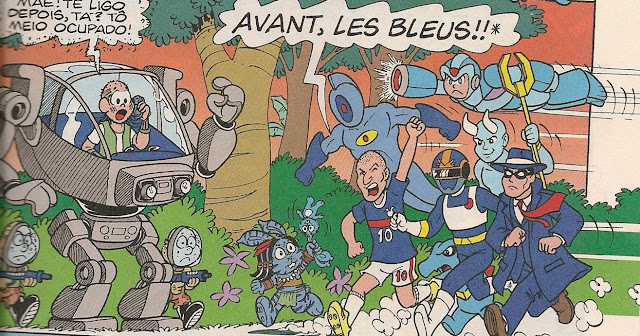
- As you can see in the picture above, the Monica's Gang comic can get so blatant and ridiculous in it's shout outs, it can be called Refuge in Audacity (and that Avatar parody manages to put more blue characters - which include a real person, Zinedine Zidane, decked in France colorsnote — in another panel◊). This also applies to other Brazilian comics, such as Holy Avenger.
- A Running Gag on a satirical Tumblr about Monica's Gang is saying "Mauricio's lawyers, get ready…" every time the comic uses No Celebrities Were Harmed. (the caption of the page image was "that panel alone is probably worth two billion in lawsuits, dammit!")
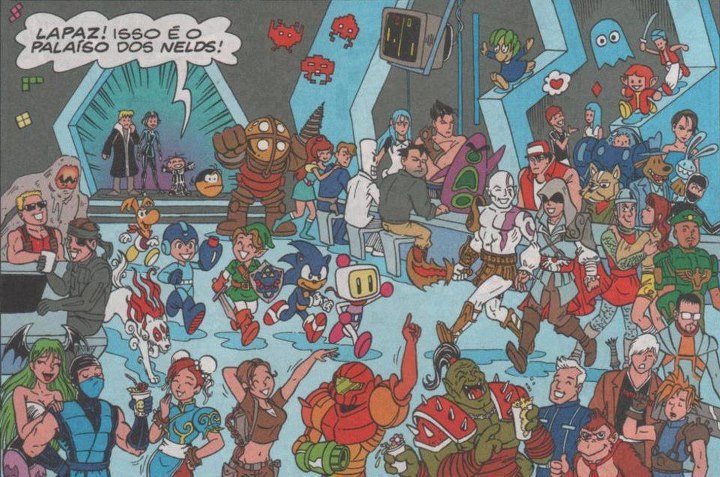
- This◊, taken from their TRON: Legacy parody — the series has an Universal-Adaptor Cast and writers who love a Whole-Plot Reference - even lampshades that "This place is a newd pawadise!"
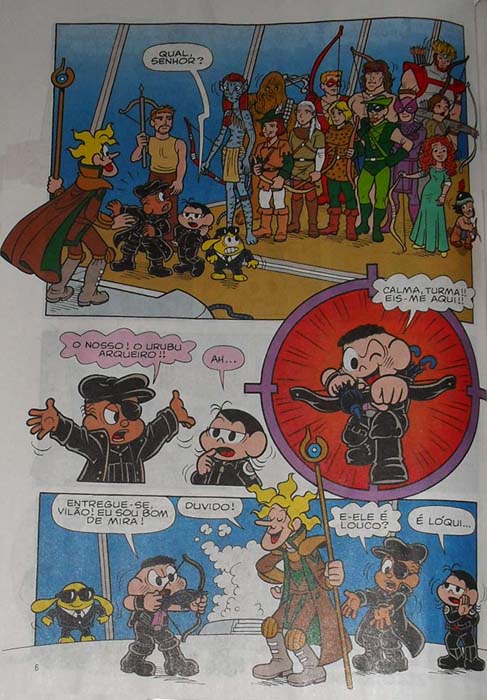
- Also this ensemble of archers◊ from their Avengers parody. Notably, classic Hawkeye is in the crowd (they actually wanted their Hawkeye, who was being played by Smudge).
- My Little Pony: Friendship Is Magic (IDW): Any story drawn by Andy Price usually includes overwhelming amounts of pop-culture references in the background.
- Phonogram contains so many allusions to real bands and songs that each serialised issue contains a glossary explaining them all.
- The Sandman is an unusual serious example; it probably manages to stay serious because its Homages and Shout Outs are usually to myths or the classics instead of pop culture.
- Scott Pilgrim, particularly in relation to video games and music.
- Alan Moore's Top 10, which came out at the same time as the early installments of LoEG. Practically every background character, business name, vehicle or grafitto is a shout out to someone or something.
- Urbanus: Several references to other comics, TV shows, films and Dutch and Flemish pop culture stuff.
- Watchmen has a whole load, especially musical references, but also to works of literature and to modern (1980s) pop-culture.
- The September 16, 2001 Baby Blues shows Zoe and Hammie going through their VHS collection deciding what to watch. Not only are popular Disney films like The Lion King (1994) and Toy Story mentioned, but also more obscure animated movies like Cats Don't Dance, which pretty much never gets referenced in media.
- The author of Bloom County wrote that:
Bloom County was awash with pop culture references and celebrity mockery... largely because those beguiling assets were virtually absent from the comedic media at the time. But just look at us now. No, it's not my &@%# fault.
- Nero: Since this was a newspaper comic it contains thousands of references to stuff that was current when the comics were published in the papers. Famous politicians and media celebrities from the second half of the 20th century will have a cameo or have jokes based on them. The author also threw in several references to his personal life, including colleagues and exotic animals he encountered during his safaris. Unfortunately this is also the reason why reprints have included some necessary background explanations to put stuff into context.
- Any Abridged Series. Especially the one that started them all.
- Special mention goes to Naruto: The Abridged Comedy Fandub Spoof Series Show, which, as a Deconstructive Parody of The Abridged Series genre, makes practically everything into a reference of some kind.
- Nullmetal Alchemist is also worth mentioning in that it parodies the very idea of having references. Ed specializes in Contextually Insensitive Magic, and frequently deliberately cuts from the show to an out-of-context clip of another video to distract and/or annoy his enemies.
Rose: I don't understand, how did you defeat him using karaoke?
Ed: The guy had a rational hatred for references; a vocal cover was too much for his elitist brain to handle. - Sonic the Other Movie and Xonic S are obviously loaded with Sonic references, but the series also go the extra mile by making just as many obscure references to things well outside the purview of the fandom.
- This is actually a plot point in Sword Art Online Abridged. Guild leader Heathcliff loves to make movie references, which for the most part go over the heads of the other players since they're too young to have seen stuff like Dr. Strangelove. Kirito, being the only one who gets them, eventually realizes Akihiko Kayaba also likes to make some of the same movie references, allowing him to work out that Kayaba and Heathcliff are one and the same.
- A Very Potter Musical. Of course there's references to the books, but between that you've got things like Zac Efron. Furthermore, entire parts of the dialog are just homages to Avatar: The Last Airbender.
- Accident: Month One has references by the gallon load to The Fairly OddParents!, Night M Shyamalan, The Twilight Saga, Mystery Diagnosis, Avatar: The Last Airbender, Silver Age Comics, and a lot more. All Played for Laughs, while there are a few that are more on the lines of a Take That!.
- This is part of Nimbus Llewelyn's Signature Style, to the point where both The Wizard in the Shadows and Child of the Storm have their own Shout-Out pages. Since he a) also had a classical education, b), is also an Insufferable Genius, he's not shy of throwing in historical, political, and occasionally theological references, either. This partly due to the latter being a Massive Multiplayer Crossover, partly due to the Lemony Narrator, and most of the cast being pop-cultured badasses, including acknowledged author favourite, Harry Dresden a.k.a. the First-Person Smartass, and the presence of Doctor Strange, who's not quite an Author Avatar, but close enough that he's prone to Leaning on the Fourth Wall.
- Code Prime, full-stop. While Code Geass does get some of its works referenced, the longer history of the Transformers franchise means a lot of slews from all parts of its own works. The range of the works referenced go from the popular ones such as the Aligned Continuity to even the infamous Kiss Players and its Diaclone origins. Some of them are either intentional or unintentional though.
- The Conversion Bureau: The Other Side of the Spectrum has reached this territory, partly due to its side-stories. Just take a look at the shoutout page...4
- The Dangerverse, a series of very AU Harry Potter fics, has arguably reached this point.
- In keeping with its source material, Decks Fall Everyone Dies has a lot of references.
- One of the common criticisms of Double Rainboom is that it eschewed it's initial Original Flavor premise in favor of lots of fandom and animation Shout Outs.
- Erika the Radical contains an overwhelming amount of film, anime, video game references and recent memes in which most of the side humor is derived from. The author is also evidently a avid subscriber of r/prequelmemes.
- The Star Wars/Mass Effect crossover Fractured (SovereignGFC) has a ton of shout-outs and some Partial-Plot References to boot. It and its sequel, Origins, both have shout-outs to canon material that wasn't even released at the time of writing (Fractured) or is nonexistent in its fanon (Origins), mainly Mass Effect 3.
- Garfield in: "Along Came a Splut", despite its short length, is loaded with crossovers and pop culture references, enough to get its own page for them!
- The Gunslinger Hero: Flintlock: This work contains a wide variety and high number of references to several other franchises, among the list being Star Wars and Destiny.
- A dark humor Harry Potter fanfiction by Virginia Riddle-Malfoy on fanfiction.net Ginevra In Darkness uses a lot of characters from other series - particularly the renamed Integra from Hellsing and has cameos of other characters such as Sherlock Holmes and John Watson from the BBC Sherlock, Sarah Williams from Labyrinth, Adam Young from Good Omens, Darian Shields from Sailor Moon, Daria. Also uses quotes from Buffy, Batman, and Theatre.A Very Potter Musical. She manages to keep to the plot, but seems to amuse herself by seeing how much she can slip past the readers without getting caught. [1]
- Another fanfiction by the same author Harry Potter and the Turn of the Tides uses the Halloween hijinx trope and crosses over for a single chapter Harry Potter, Sailor Moon, Megas XLR, Buffy the Vampire Slayer, Star Wars, Indiana Jones, James Bond, Ranma, The Lord of the Rings, and Monty Python and the Holy Grail. The fic unfortunately was done by the author in high school, and she rightly abandoned it as the tropes written about became far too overdone and dull. Still worth a plug for excellent characterization. [2]
- Another fanfiction by the same author Harry Potter and the Turn of the Tides uses the Halloween hijinx trope and crosses over for a single chapter Harry Potter, Sailor Moon, Megas XLR, Buffy the Vampire Slayer, Star Wars, Indiana Jones, James Bond, Ranma, The Lord of the Rings, and Monty Python and the Holy Grail. The fic unfortunately was done by the author in high school, and she rightly abandoned it as the tropes written about became far too overdone and dull. Still worth a plug for excellent characterization. [2]
- You should just see how Luna Lovegood is treated in Harry Potter fanfiction. If she's not running her mouth off or a Seer she's referencing pop culture that won't be relevant for around a decade or so.
- Listing the references in Harry Potter and the Methods of Rationality has taken up quite a bit of space on its page. By the same author, The Finale of the Ultimate Meta Mega Crossover manages to reference practically everything in the TV Tropes Wiki.
- Harry Potter and the Society of Orpheus and Bacchus is rife with references to (Muggle, obviously) culture. It contributes to the story's lighthearted, campy feel (Draco Malfoy reading Ernest Hemingway? Who would ever guess, due to him seeing muggles as always inferior?)
- The Iron Horse: Everything's Better With Robots! is a My Little Pony: Friendship Is Magic story with loads of references to science fiction, particularly works involving robots.
- It's a Small World, After All, a Hetalia fanfic, has tons of references, ranging from Yu-Gi-Oh! The Abridged Series to 300.
- Kyon: Big Damn Hero, being advertised as a Haruhi Suzumiya/TV Tropes crossover (whatever that means), has a lot of references to other works and tropes, with many not being Lampshade Hanging.
- Here's a fun Drinking Game: Take a shot every time you spot an allusion or reference in My Little Mission: Sneaking is Magic to something from the Metal Gear Solid series. You'll be hammered by the fifth chapter. The author manages to pack dozens upon dozens of references to the series into the fic, often going out of their way to do so.
- Neon Genesis Evangelion fan fiction tends to include many references.
- The I don't want to forget was expressly stated by the author to be an homage to the extensive content about the relationship between Shinji and Asuka, presented in canon and in fan works, that were created in those 25 years of existence of the Evangelion franchise. The author notes lists more than a hundred shout-outs to those works, all of them hidden as easter eggs presented in the text.
- The perfect example of this is a picture known as "The Picture Of Everything" created by Howard Hallis.
- Pokémon Crossing has shout-outs in every chapter, ranging from both the source materials to other media, mostly to JoJo's Bizarre Adventure. The main story's subtitle is a reference to the famous jazz song.
- Pokémon Mystery Dungeon: What Came After has not only a plethora of nods to other media (both other series and that which the story is based on), but an entire chapter re-enacting Willy Wonka & the Chocolate Factory.
- Professor Riddle's Chronicles has a shout-out practically in every passage. To anything, from Harry Potter canon to Soviet political jokes to The Wonderful Wizard of Oz.
- A conservative estimate of Battle Royale fanfiction 72 Hours' reference count would be 500. This is not an exaggeration, considering that each of the eponymous hours has its own chapter, and it's roughly equivalent to a 1300 page book in length. It is, however, testament to the obsession with shoutouts held by the author.
- Sonic Generations: Friendship Is Timeless includes plenty of Shout Outs to mostly the Sonic the Hedgehog cartoons and comic books, but also to the My Little Pony: Friendship Is Magic comic books and fan works (including the infamous Cupcakes). Take a look at this page and see for yourself.
- Sonic World Adventure Rush is considered by some to be a bit too overdosed in its fan service. And it's still going!
- Sonic X: Dark Chaos could probably rival a Quentin Tarantino movie with the sheer number of shout outs (both blatant and obscure) to other media, especially video games and movies. Hilariously, one of them is an extended reference to Quentin Tarantino's Pulp Fiction.
- Steven Universe: Alternate Future and all associated stories are filled with this, given that Word of God states this is because he grew up watching shows like The Simpsons that also thrived on these.
- In The Story to End All Stories, there are numerous name-drops, in-jokes and references to all kinds of media, some more subtle than others.
- Things I Am Not Allowed to Do at the PPC: Since the Protectors of the Plot Continuum are a group that writes Recursive Fanfiction about most forms of media in existence, their equivalent of Skippy's List is likewise packed full of pop-culture references.
- Those Lacking Spines has references ranging from Harry Potter to the llama song to Foster's Home for Imaginary Friends to Celine Dion to Katamari Damacy.
- We Are All Pokémon Trainers has so many references that it has its own Shout-Out subpage, and has pages on its wiki dedicated to listing every reference made.
- The Apprentice, the Student, and the Charlatan and The Archmage's Last Bow have their own page with several but not all of their references chronicled. The author is self-aware, as in the original sequel, Discord broke the fourth wall to complain about using references to write the author out of a hole. These references can range from works such as famous poems, the works of ancient philosophers, or even well-known chess matches to VeggieTales and prequel memes.
- Allsworthy from the seventh Halloween Unspectacular is a living version of this, naming his plans after various pieces of pop culture and spouting off quotes with practically every other sentence. Stan and Ford end up calling him out on it.
- Abridged series Xonic S provides a constant barrage of references to the Sonic the Hedgehog franchise, among many other things.
- The Bolt Chronicles: The series as a whole has lots of art and culture references, Easter Eggs, Tuckerizations, and Parody Names, ranging from the obvious to the obscure — enough to warrant its own Shout-Out page here. Several individual stories have better than a dozen such occurrences.
- Tarkin's Fist: In addition to numerous references to the wider Star Wars Expanded Universe (both Legends and Canon) the story contains multiple references to Earth's popular culture and music.
- Aladdin, the film with Robin Williams as Genie makes this especially the case. Many of his scenes and lines were done on the fly, and when he's in full flow it becomes a 'how many references can you spot' game. In the space of just over a minute, for example, he becomes a Scotsman, a dog, a Germanic bodybuilder, a cube, a ventriloquist (and his dummy), several clones of himself, Ed Sullivan, a cash register, three Mexican dwarves, and Groucho Marx.
- Chicken Little is overstuffed with references, including a few seconds of The Lion King in the opening segment alone.
- Monsters vs. Aliens is a family-friendly pastiche of dozens of monster movies.
- The American version of The Magic Roundabout (2005), renamed "Doogal" has dozens of pop culture references that jarringly don't flow with the story.
- Shrek, not counting the Fairy Tales which are actually part of that universe. Compared to the first movie it's mostly the sequels that pour over with all kinds of pop culture references.
- Rango: Has its own Shout-Out page.
- Turning Red: Has its own Shout-Out page.
- To celebrate the franchise's 40th anniversary, Die Another Day referenced every single James Bond film before it. Skyfall would do the same thing for the franchise's 50th anniversary.
- Most films directed by Joe Dante, including Gremlins, Looney Tunes: Back in Action, The Howling (1981), and Piranha. Harlan Ellison, writing about Gremlins, mentioned that the picture was crammed with references to dozens of other films from which he doubtless meant as homages but which came off as distracting and intrusive.
- Any Quentin Tarantino film. Cracked calls him less of a director and more of a movie DJ, treating shots, characters, and plots like music samples. Pulp Fiction, his first truly mainstream film, is often considered to have been the launching point for the Gen-X "sampling" trend in popular culture that continues to this day, although earlier precedents existed.
- Rise of the Planet of the Apes was this way, due to a desire for Shout Outs to the original film.
- Scott Pilgrim vs. The World, much like the comic upon which it's based, revels thoroughly in this trope.
- Both Scream (1996) and Behind the Mask: The Rise of Leslie Vernon are deconstructions of the slasher Sub-Genre of horror that make numerous references to other horror movies.
- Seltzer and Friedberg do this a lot in their films. The "_____ Movie" parody series in particular (Epic Movie, Date Movie, Disaster Movie...), are almost nothing but pop culture references and shout outs. They do at least manage to integrate the references into the movie's action, however, if only for a cheap slapstick gag.
- The Seven Year Itch was an early example of this. Howdy Doody, Captain Video, From Here to Eternity, Riot in Cell Block 11...and, if it hadn't been cut from the film, a spot-on parody of 1930s gangster movies.
- Ted 2 references 42nd Street, Alien vs. Predator, Anchors Aweigh, and many more films.
- Woody Allen: His films have many references that only intellectuals will recognize like shout-outs to philosophy, art, literature and arthouse films.
- Deadpool and Deadpool 2 are loaded with shout-outs, most from Wade, including multiple references to the other X-Men films, Marvel Cinematic Universe and DC Extended Universe. In the sequel Deadpool drops a particularly blatant and out-of-place reference to Pinkie Pie of My Little Pony, and winks at the audience.
- The science fiction novel Escapist Dream is about a virtual reality world where geeks can role-play and live the life of a real comic book, film, video game, anime, TV, literature (and everything else that is geek-related) character. What made this book special is how its pop culture references are more modern than its contemporaries (it literally referenced PewDiePie at one point). It gained popularity for its pop culture references so much, that literary critic Dustin Kidd actually described it as "The Great Gatsby of pop culture fiction."
- The sequel Otaku Girl cranks up the level of overdose by adding references to internet memes. Like seriously, where else do you get to read about geeks fighting against Ultra-Instinct Shaggy and Big Chungus.
- The sequel Otaku Girl cranks up the level of overdose by adding references to internet memes. Like seriously, where else do you get to read about geeks fighting against Ultra-Instinct Shaggy
- 1001 Movies You Must See Before You Die contains a list of 1001 movies the author considers must-see movies, with each entry accompanied by a short essay explaining why. The essays, written by over 50 different film critics, often make heavy use of references and parallels to other films, directors, scriptwriters, et cetera to make their point.
- Among Others by Jo Walton is full of references to the science fiction and fantasy of the 1970s and 1980s.
- The Chronicles of the Imaginarium Geographica is a Massive Multiplayer Crossover about a Magical Land said to have inspired almost all of fiction in some way or another, with J. R. R. Tolkien, C. S. Lewis and Charles Williams as the main characters. So naturally the books have references coming out of their figurative ears.
- Discworld: The fandom collected a list of Shout-Outs into The Annotated Pratchett File. The APF annotations list appears to have been discontinued after about two-thirds of the books; the torch has been carried on by the Terry Pratchett Wiki, which faithfully annotates the later books as well as adding extra detail to the earlier ones.
- The Divine Comedy: Dante's visit to Hell, Purgatory and Heaven is peppered with countless references to historical, cultural, religious, political and scientific people from both his time and earlier centuries.
- The Dresden Files, since everyone is Genre Savvy and the narrator is a Pop-Cultured Badass.
- Bret Easton Ellis likes to do this with his characters to highlight how shallow they are. Many pages in Glamorama are just long lists of Victor and his friends name dropping celebrities, and in American Psycho, Patrick has to describe in excruciating detail what everyone is wearing.
- The works of Philip José Farmer are sometimes Reference Overdosed, particularly those set in the Wold Newton universe. A single work may be a Homage to one writer while encoding allusions to the work of many, many others. For example, no name is innocent until all anagrams, obscure linguistic derivations and so forth have been exhausted.
- InCryptid is full of shout-outs, which is to be expected given that Seanan McGuire is One of Us. About half of them come from Antimony. Even the short stories set in the 30s manage to sneak in a few contemporary ones.
- Many of ML Lanzillotta's books count. If I Go It Will Be Double is a prime example. There's even a robot called the nonHAL-asimov-42 (his friends call him Robby).
- Nicola Jonesy, writer of LoLo Apollo: I'm Afraid of Americans, is a child of the internet of the early 2000s and 2010s, and it shows in the book. There are various references to things like Homestar Runner and Homestuck, various works that gained a massive following like Steven Universe and Undertale, the various memes that spawned during those two periods, political figures and events, and Professional Wrestling. And this is without listing every reference that appears in the book.
- Magic Ex Libris is about people who can pull items out of books. This, combined with a Geek protagonist, leads to references being tossed around like candy. To help some bewildered readers, there's a list of referenced books in the back.
- Kazuma Kamachi's Magistellus Bad Trip is filled with references to other works by the same author. The main heroine's name, Tselika, has previously been used for two other demons (in The Zashiki Warashi of Intellectual Village and The Weakness of Beatrice the Level Cap Holy Swordswoman). The corporation names are all references as well: Fiamma Securities, Megalodiver Shipping, Toy Dream etc.).
- The Night Mayor is set in a virtual reality realm based on Film Noir movies, and is packed with references to classic and not-so-classic movies of the late 1930s through early 1950s (including all the obvious candidates as well as some less obvious ones like The Wizard of Oz).
- A Night in the Lonesome October abounds with references, being a wide-ranging gothic horror pastiche with references to other genres. It contains many Homages and Shout Outs beyond its crossover characters.
- Ready Player One has this as part of its plot, but mostly narrows it to 1980s video games and pop culture in an effort to solve the puzzle left behind by a rich eccentric as part of his will. The movie is even worse, adding in characters from later periods, such as the T. rex from Jurassic Park and the Spartans from Halo.
- A Series of Unfortunate Events: If you made a list of every time Snicket makes a Shout-Out to literature and history in one of the later books (especially through Sunny's dialogue), it would be as long as the book itself.
- The Shadow Realm series by Lucas Thorn embodies this trope particularly well. Almost every chapter in the book ends in a one-liner, many of which reference outside material, as well as references being made in countless other ways, including the numerous references found in the names of Nysta's knife collection. These references range from simple to complex and comedic to serious, with no rhyme or reason present beyond author preference. A deep sea undead monster might be referred to as a draug after the Scandinavian monster, or two characters might act out the entire conclusion to The Good, the Bad and the Ugly.
- Small World is full of references to the Grail legend. Many of them are very subtle indeed. They are mainly drawn from Jessie Weston's book From Ritual to Romance, which also influences T. S. Eliot in The Waste Land. At time it comes close to recursive referencing.
- The Supervillainy Saga by C.T. Phipps is a nonstop barrage of Star Wars, The Lord of the Rings, and other pop culture references from its supervillain protagonist Gary Karkofsky a.k.a. Merciless: The Supervillainy Without Mercy. Ironically, he makes no superhero references because comic books aren't a big thing in his world. It's a common thing with the author as his The Bright Falls Mysteries and Straight Outta Fangton books have similar treatment of supernatural-themed pop culture.
- The amount of Science Fiction and Extreme Metal references in Ari Bach's novel Valhalla is incalculable. Nearly every character name is taken from a metal band. Nearly every piece of hardware is named for the author of the sci-fi novel or show it was invented in. References even include old sitcoms, obscure occult literature and more.
- The author of the Warhammer novels collectively known as "The Vampire Wars" acknowledges his books contain at least a hundred references to classic vampire stories like Dracula. One of his fans sent him a list of references in his novels, but the author didn't have the heart to say he'd missed about another fifty.
- Warhammer 40,000: The Ciaphas Cain books are absolutely loaded with references to both science fiction and turn-of-the-century juvenile adventures.
- T. S. Eliot's works, especially The Waste Land. The poem is full of references to popular songs, classical literature, operas and ancient religious scriptures, and quotes them in their native language.
- The first page of Where's Waldo? The Wonder Book. It puts all the other examples to shame.
- Zadie Smith's White Teeth contains tons of references to various minutiae from literature, history, science, and pop culture (both British and American). Some of them serve no purpose, such as a Long List of all of Millat Iqbal's favorite books, records and tapes, and movies on videocassette.
- Community. Abed is stated to be incapable of communicating through any other medium than movies.
- Doctor Who has been running since 1963, so it's accumulated a lot over that time. Also, its hero is a quasi-immortal time traveller, which gives them a pretty large reference pool. Some of the older episodes reference things like Beatles lyrics, while New-Who has referenced things like Star Trek, Ghostbusters, Harry Potter, Teletubbies, The Lion King and way, way more.
- We don't even try to list the shout outs in Farscape. Crichton is a fountain of late-20th-centrury cultural references, which only makes him a Cloud Cuckoolander in the eyes of all the aliens around him.
- Gilmore Girls is famous for its abundance of references. Each DVD even has a little booklet explaining the more obscure ones.
- Kaizoku Sentai Gokaiger is this towards the Super Sentai series.
- Leverage is so reference overdosed that its shout outs had to be moved to their own page.
- The Middleman, usually with a different theme each episode (one episode is full of Dune references, another Back to the Future references, another Ghostbusters references, and so on...)
- Monty Python's Flying Circus: many encyclopedic references to historical and cultural figures, exotic animals and places. Most of these jokes could make sense to intellectuals, but then there are also many references to British culture, especially politicians, TV hosts, soccer players, cricketers and programs that were famous during the late 1960s and early 1970s. They are usually completely incomprehensible and obscure to international audiences and even to the English, especially while Time Marches On.
- Mystery Science Theater 3000. Being a show built around providing audio commentary to Cult Classic genre movies, it couldn't help being stuffed full of references, but some them were so obscure only the members of the show's own cast understood them.
- NCIS: Tony, an avid movie buff, makes references to films at least Once per Episode, and McGee is a gamer, among other justifications for this.
- Psych CONSTANTLY references obscure 80s and 90s pop culture.
- You could argue that it's justified on this show, since so many cult figures from those decades show up as guest stars - but then that would just bring up the Celebrity Paradox.
- The high school reunion episode, "Murder ... Anyone ... Anyone ... Bueller?", has tons of references to 80s pop culture (including the title), which is quite puzzling, considering Shawn and Gus would have gone to high school in the 90s.
- This is lampshaded at one point; Shawn says he deliberately chooses to make an overabundance of references from that era, making it an Invoked Trope.
- "This Episode Sucks" references a bunch of vampire-themed works and featured Casting Gags: Kristy Swanson of the original Buffy the Vampire Slayer film and Corey Feldman from The Lost Boys appear.
- "Mr. Yin Presents ..." has many references to Alfred Hitchcock films, including the episode's title (for a complete list go here). It featured a Theme Serial Killer who modeled his murders after Hitchcock's films such as Psycho and Marnie, had a few Homage Shots, and even used some of the original props from the films. There's also a reference to Hitchcock's creator cameos, with a look-alike appearing in the background of one scene.
- Red Dwarf often makes reference to films such as Casablanca, Gone with the Wind, and Blade Runner. For instance, the episode Back To Earth is considered by most to only be enjoyable if you know the Blade Runner references, to most other fans it is a horrible episode.
- Schitt's Creek was created and is written by pop culture fan and former MTV VJ Daniel Levy who weaves his love of music, fashion and popular culture into his writing in every episode.
- Spaced. There's even a bonus subtitle track on the DVD that notes all the references.
- Spitting Image: Where to start? Several references to 1980s and 1990s society in general, yet also to everything that was in the media in the week of broadcast. From news reports over TV commercials. If you wanted to understand every reference you really had to read, listen and watch to every report. And most of it references British culture in particular. This also explains why the show was so difficult to export to other countries. The stuff dated rapidly and a lot of it was incomprehensible to foreign viewers. When broadcasted on Dutch TV the translators even added some extra subtitles on top of the screen to give some explanations about certain politicians or TV stars that only the English would immediately recognize.
- The Tau'ri (Earth-born humans) in the Stargate-verse have Genre Savvy as their Hat. They're well aware that their daily lives resemble science fiction and are all too happy to show it.
- Supernatural, particularly when it comes to music. Every episode from the first 5 seasons is named after a classic rock song, while the newer episodes reference other.
- Most shout-outs come Pop-Cultured Badass/Movie Buff Dean, who does this more than Once per Episode.
- There's also Charlie who references tons of works associated with nerd culture in the episodes she appears in (and so do the titles).
- We Didn't Start the Fire by Billy Joel is a list of cultural icons and events, mostly in chronological order.
- Black Country, New Road certainly count, as Isaac Wood's lyrics constantly shout out other artists, songs, and other forms of media.
- Destroyer. Dan Bejar's main band has its own wiki and drinking game.
- Frank Zappa: His music was deeply personal and references several aspects of the society of his time, including music, commercials, politics, TV and even inside jokes in his own band and anecdotes from his own life. Zappa once claimed that he doubted if his lyrics could make sense to anyone but himself.
- Half Man Half Biscuit. Their website has a section dedicated to explaining some of the references.
- John Cena and Tha Trademarc do a lot of this on You Can't See Me; ironically, most of the references are not to Professional Wrestling. This was spoofed in their video for "Bad, Bad Man", which had as its plot a homicidal maniac kidnapping midgets dressed as Madonna, Michael Jackson, and certain other 1980s cult figures - not to mention that said homicidal maniac was played by Gary Coleman. And Cena, Trademarc, and Bumpy Knuckles dress up like (respectively) Hannibal Smith, Murdock, and Mr. T from The A-Team!
- No More Kings. When describing them most places refer to them and funk/pop mixed with 80s references. Though there are more references, the 80s are just the most prominent.
- R.E.M.'s music would frequently make references to ancient mythology in order to conceal the true meanings of the songs (namely Michael Stipe's bisexuality or political events). This had the side effect of making people think he spoke gibberish. To clarify, the first time he admitted to writing a song with straightforward lyrics was in 1992 when the band recorded "Everybody Hurts" - 12 years after they started.
- Sage Francis, a rapper from Providence, RI, makes tons of references to "classic" hip hop songs. He'll often re-use classic lines, substituting a word here or there or reversing the word order as a kind of wordplay homage; he'll also re-use the cadence of certain iconic lines in a subtle nod.
- The entirety of Ultimate Showdown of Ultimate Destiny is Shout-Out after Shout-Out from beginning to end.
- The Wu-Tang Clan: cursory examination of the first two tracks on Enter the Wu-Tang/36 Chambers turns up, in addition to the samples and references to old Kung-fu movies for which they're famous, overt references to Steven Seagal and his film Out for Justice, Voltron, and The Warriors.
- Also, Ghostface Killah had a song from the 1996 album Iron Man (which was when he started using the alias Tony Stark) entitled "Daytona 500" (named mostly for its fast pace) which used clips from the original Speed Racer to make one of the first Anime Music Videos which is still considered a favorite by many.
- The song itself contained samples from Bob James' "Nautilus" and "Crab Apple" by Idris Muhammad while the chorus from "Turn The Beat Around" by Vicki Sue Robinson sped up and reworded for the hook. And even featured two samples from previous Wu singles, "Mystery of Chessboxin" and Raekwon's "Incarcerated Scarfaces" which also had an obvious Shout-Out in title as well as the lyrics.
- The mileage varies, but this opened the AMV flood gates, being one of the first AMV's showed on TV and predating YouTube and self-made AMV's.
- Also, Ghostface Killah had a song from the 1996 album Iron Man (which was when he started using the alias Tony Stark) entitled "Daytona 500" (named mostly for its fast pace) which used clips from the original Speed Racer to make one of the first Anime Music Videos which is still considered a favorite by many.
- P.D.Q. Bach has plenty of moments, but the pieces on the albums which are really overdosed tend to be the one Peter Schickele published under his own name. These are usually a type of medley called a quodlibet, and it's rare for them to quote a single piece at a timenote , except as a setup to lampshade the juxtaposition of, for instance, "Camptown Races" against "Ode to Joy".
- The Stupendium's song based on Kingdom Hearts III, "A Little Heart", references a Disney song in nearly every line.
- The Animated Music Video for CRUISR's "All Over" constantly shifts between literally dozens of famous fictional couples, usually but not always romantic, from Vincent and Mia to Belle and the Beast to Harry and Sally to Brody and the shark.
- The lyrics to Sabaton's song "Metal Crue" are mostly the names of metal bands. And they have another song, "Metal Machine", where the lyrics are mainly the titles of other metal songs.
- Jinx's "Cartoons and Vodka".
- Capes on the Couch: Every episode features numerous shout-outs to anything from Broadway to schlocky horror films to 80s cartoons, and even TV Tropes itself. The show notes for each episode contain links to explain stuff that Anthony & Doc reference for listeners who don't get it.
- Radiodrome: Countless references to exploitation movies and other films, even mentioning old TV series in the process.
- The First Podcast: Contains thousands of references to various shows, video games, bands, other podcasts, and content creators, some of which are listed here.
- CHIKARA has titled events after Talking Heads albums, Ben Folds Five songs, Joni Mitchell lyrics (Through Savage Progress Cuts the Jungle Line), Batman episodes, phrases from Watchmen, James Bond movies, episodes of Arrested Development, episodes of Lost, books from R. L. Stine's Goosebumps series, and the list just goes on and on from there.
- Any Dennis Miller rant.
- Survival of the Fittest: Due to being a collaborative work between the board's members, it qualifies. While there have been Shout Outs to previous versions and the original canon, a few others are to... less expected works, such as a character suddenly talking like Kefka, and a few characters being an Expy of characters from other works. Honestly, if one were to list every single reference in SOTF, it would take a while. It has been a minor issue on the board, however, in how many Shout Outs are okay.
- GET THAT PIZZA!: The tropers will frequently use weapons or items from various works of fiction, or enlist various fictional characters to help them get the pizza.
- Dungeons: The Dragoning, which mashes together the rules of several pen-and-paper systems, uses the setting of others, and gives shout-outs to everything else.
- Shadowrun is full of these, particularly where harlequin is involved. In one book in particular he refers to the Dead Kennedys and Cypress Hill and quotes a line from a Florence + the Machine song. All this in the year 2074, by the way.
- Warhammer and Warhammer 40,000 are packed with shout-outs, and it's not just the historical or literary origins of practically every faction and variant army (especially Space Marines and Imperial Guard). The flavor quotes, maps and locations, character names, most of the fiction, and the universe backstories are plundered from all over, ranging from the Bible to minor quotes from travel writers.
- Interstitial: Our Hearts Intertwined has this as it's core mission statement. Every playbook is clearly inspired by major character tropes from media, and nearly all their moves are named after lines or concepts from other works - usually Kingdom Hearts, but plenty from others.
- The Musical of Musicals: The Musical!, as its title implies, is stuffed with Shout Outs to famous and not-so-famous musicals by famous authors.
- Eric Overmyer's On the Verge. Between the shout-outs and uncommon vocabulary, it's a dramaturg's delight. Or nightmare!
- The Colonel's Patter Song from Patience, "If you want a receipt for that popular mystery," "probably requires more annotation than any other in the entire Gilbert and Sullivan repertoire," according to The Annotated Gilbert and Sullivan by Ian Bradley.
- [title of show] is full of references to other musicals, which is lampshaded in the show.
- Any given Tom Stoppard play, dipping into Genius Bonus levels.
- Hamilton references everything from Aladdin to Macbeth to Ten Crack Commandments to My Brother, My Brother and Me. And then you start realizing that lines like "I'm just sayin', if you really loved me, you would share him", "Will you relish being a poor man's wife?", and "Hamilton's a host unto himself" are paraphrasing the character's real-life letters, and you just give up because the only possible way you could know all this is to go full "The Inner Light" on Lin-Manuel Miranda.
- In Twisted: The Untold Story of a Royal Vizier the Genie has barely a single word of dialogue that isn't a quote from a movie. Most characters somehow find this funny, but Jafar points out he has no idea what these apparent references are about and demands the Genie talk to him like a normal person, without success.
Jafar: Are you referencing something, are you trying to make me laugh, like some kind of work of fiction that I'm unaware of? I was not charmed by the song that you sang when you came out of the lamp, and I am not charmed by your crazy bullshit now. I need you to either back me the fuck up, or shut the fuck up. Got it?Genie: You had me at hello.
- The Great Movie Ride at Disney's Hollywood Studios is loaded with references and homages to other movies, most of which weren't even made by Disney. Though it's justified in that it's a ride about the greatest moments in film history.
- Due to Wacky Packages and its nature of being a parody line, combined with its long life, is loaded with parodies of a variety of things. From parodies of household products to toylines to media franchises, there are a variety of things referenced.
- Abobo's Big Adventure has far too many references to list them all here. Being a Bloody Hilarious love letter to the 8-bit days, the bulk of them are Shout Outs to classic NES games, but there's also a couple references to SNES-era games, as well as movies and advertising slogans of the time.
- The Ace Attorney series is filled to the brim with Shout Outs, ranging from television to Internet memes.
- AdVenture Capitalist references various media and properties, like Adventure Time, Animaniacs, Anti-Idle: The Game, and many many more. There are far too many references to list here in full without considerably lengthening this page.
- The Adventures of Massmouth series is filled to the brim with references; entire lines are quoted verbatim, names of locations and characters in pop culture feature heavily, not to mention that all the enemies are basically ripped from other games and given different names. For example, the Worm's employees have names like Freeman and Spock, the Worm himself is represented by the Pit Worm from Half-Life: Opposing Force, the Massmouth 2 intro has the characters act out the Zero Wing intro, etc.
- Aqua Rhapsody, The developer notes that a lot of small things are "shoutouts" to video game, anime, etc. These are as obscure as the level transitions that fade out in a similar manner to Space Harrier.
- Absolutely everything by Artix Entertainment Games. AdventureQuest, Dragonfable, MechQuest... everything.
- The PlayStation 5 pack-in title Astro's Playroom has countless nods to PlayStation history, from the collectible artifacts being highly detailed models of previous PlayStation hardware to the easter eggs found in the levels themselves of bots acting out scenarios from both first-party PlayStation titles and third-party titles that have a significant history with the brand. Even lesser-known titles like Gravity Rush, Jumping Flash!, Puppeteer (2013), and even Legacy of Kain are acknowledged. The game's final boss even references an old PS1 tech demo featuring a detailed (for the time) model of a t-rex.
- Asura's Wrath has tons of visual Shout-Out's to a lot of anime as well as other video games. See them here.
- Baseball Stars Professional has a greatly amusing amount of disregard for copyright, as evidenced by the members of the Fabulous Superstars: Rocky, Rambo, Batman, Bond, Tarzan, Ripley, Shane, Dragon, Indy, Madmax, Spock, Freddy, Vader, Jason, Axel, and Godzilla.
- The Battle Cats is loaded with references, to Batman, to Clint Eastwood, to J. K. Rowling and the books Pride and Prejudice and Les Misérables. And that's not even getting to the more obscure references.
- Billy vs. SNAKEMAN Nearly every NPC is at least one Captain Ersatz, the pre-Cerebus Syndrome plot is mostly Whole Plot References strung together, and countless incidental references are found everywhere you look.
- The Borderlands series. There's a whole page to gather all the shout outs for the series, here:
- The first game, Borderlands, has this page.
- Borderlands 2 has this page.
- Borderlands: The Pre-Sequel! has this page.
- Borderlands 3 has this page.
- Bubsy:
- Claws Encounters of the Furred Kind references Close Encounters of the Third Kind, Forbidden Planet, A Bridge Too Far, The Good, the Bad and the Ugly, A Fistful of Dollars, Dances with Wolves, "Rock Around the Clock", "Eye of the Tiger", Lethal Weapon, and A Farewell to Arms.
- Bubsy II references Star Wars, Police Academy, Richard III, Apocalypse Now, Richard the Lionhearted, Mighty Morphin' Power Rangers, The Lion, the Witch, and the Wardrobe, Big Trouble in Little China, 2 Live Crew, and Mars Needs Women.
- Fractured Furry Tales references Fractured Fairy Tales.
- Bubsy 3D references Forbidden Planet, Wooly Bully by Sam the Sham and the Pharaohs, Das Boot, Crimson Tide, Mortal Kombat, Days of Thunder, The Amityville Horror, Bright Lights, Big City, and Escape from L.A..
- Bungo to Alchemist: It's a game where famous late-modern writers and poets are playable characters, so naturally literary references abound.
- Civilization: Look at 5's achievements and see how many Shout Outs you can find.
- Despite the limited content, the browser game Cookie Clicker has a surprising number of references and Shout Outs to various works, including Back to the Future, 2001: A Space Odyssey, Batman, and The Legend of Zelda
- Disgaea increases the number of Shout Outs with every game. As of the fourth installment, nearly every spell, special attack and item description is some sort of reference to anything from H. P. Lovecraft to Tengen Toppa Gurren Lagann to Penny Arcade. Anime Tenchou is even a summon... No, not a Lawyer-Friendly Cameo of Anime Tenchou — the actual one.
- Dragon Quest Heroes: Rocket Slime has loads of references to other Square Enix games.
- The Duke Nukem series went this way starting from Duke Nukem 3D.
- Dungeons of Dredmor is so brimming with Shout Outs, from the item descriptions to the monster taunts to the achievement names, that it has its own Shout Out page.
- Every single thing in Eat Lead: The Return of Matt Hazard is a reference to another video game or video game tropes in general.
- Election Year Knockout: If you know the Real Life versions of each character, you will notice just how many references there are to various aspects of them. Just one example is how Ted Bruz uses attacks from the Zodiac signs, which is a reference to the internet conspiracy/meme that Ted Cruz is the Zodiac Killer.
- Enter the Gungeon references and draws inspiration from pretty much every single work under the sun. The list ranges from wielding a Quad-barrel rocket launcher to the flavor text on the nanomachines being "son," to boss fights against giant gun-toting Beholders and Mind Flayers.
- Epic Battle Fantasy is packed with tons of Shout Outs to anime, manga, and other games.
- Epic Mickey has loads of Mythology Gags on the various Disney products. One area has old NES and SNES cartridges of Disney Licensed Games strewn about.
- Indie game Evoland makes a lot of references, mostly owing to the fact it's both an homage and Affectionate Parody of the Action-Adventure and RPG genres. In particular there are many references to Nintendo (most obvious being The Legend of Zelda), and the Final Fantasy series (most of which towards the seventh entry, due to it being the one most people are familiar with). There's a bit of a Broken Base on if the reference overdosing was such a good thing, though, as one half of the people who played the game find the spoofing and references charming, while others feel the spoofing is too shallow and/or too frequent and gets in the way.
- Fallout: New Vegas has its fair share of references in the base game, however the Old World Blues DLC takes the cake. Even the plot if it is a gigantic cross reference between 50s B sci-fi B movies, The Wizard of Oz, and cut content from previous Fallout games. Many of the names of people and places are also various references and it gets much more aggressive if you have the Wild Wasteland trait, to the point that the DLC on its own could almost have its own shout-outs page.
- Far Cry 3: Blood Dragon, given it is a parody of various movies and videogames from the '80s.
- Flight Rising is filled with Shout Outs to the point where about a third of the item descriptions are references to something or other—Sailor Moon, Super Mario Bros., Doctor Who, The Hitchhiker's Guide to the Galaxy Trilogy, Jurassic Park,
- It's not uncommon for a Friday Night Funkin' Game Mod to feature an entire background full of Crossover Cameos from other mods, given how many there are.
- The Gex series which are about the title character Trapped in TV Land who's already a couch potato. He's voiced by comedian Dana Gould, who is himself a huge fan of pop culture. Many of Gex's wisecracks were based on his own standup.
- Daisuke Ishiwatari, the creator of Guilty Gear, is a Heavy Metal and Rock fan and the series in turn has lots of Heavy Metal and Rock references (and even influences) to count. Ranging from Metallica, Iron Maiden, The Black Crowes, Black Sabbath, Megadeth, Led Zeppelin, AC/DC, Queen, Prince, Helloween just to name a few out of the many many bands. And when it's not, it's very likely to be a reference to something from both Western and Eastern pop cultures alike.
- The Henry Stickmin Series has a HUGE chunk of references, enough for it to even have its own page
- Highborn is an iOS game that includes references to anything from The Wizard of Oz and Mountain Dew to James Brown and My Little Pony: Friendship Is Magic. There are even missions with Whole Plot References to Star Wars and Portal.
Floyd: I'd like to make a Jimmy Hoffa joke, but I think most of the people playing this game are kids who are getting tired of running to Google every other line to figure out what we're talking about.
- The web-based MMORPG Kingdom of Loathing is simply brimming with references to other works, particularly They Might Be Giants songs and music in general. This is one of its main draws.
- Kuukiyomi is famously known for referencing lots of animes, games, quiz shows, fairytales, music and Western works in some game levels/situations throughout the series (both original and remade versions). These are: Gundam, Power Rangers, Super Mario Bros., Puyo Puyo, Tetris, Sazae-san, YMCA, Choo Choo Train by the Japanese boyband EXILE, Trans-America Ultra Quiz, Mario Kart, The Tortoise and the Hare, Isaac Newton, Knyacki, Working Cats work safety mascot, Quiz Hexagon II, Pokémon, Aesop's Honest Axe story, Space Invaders, The Spider's Thread short story, The Adventures of Pinocchio, Snow White, Godzilla, Japanese theatre contest show series Masquerade, the Ultra Series, Brain Age, Issun Boshi, Urashima Taro, Grave of the Fireflies, Saturday Night Fever, Dragon Quest, My Neighbor Totoro, Rhythm Heaven, Tokimeki Memorial, Castle in the Sky, Michael Jackson, Star Wars, The Matrix, Terminator and Queen. A number of references are in form of Captain Ersatzes, lawyer-friendly cameos, bland name products and fractured fairy tales.
- Mobile Phone Game Leaping Legend references Super Mario Bros, The Legend Of Zelda, Skyrim and Star Fox. The announcer Speaks in Shout-Outs.
- The Legend of Zelda: Skyward Sword does this to the Logical Extreme: as a Prequel, everything is a direct reference to some other game in the series. You have to be a Zelda fan to fully appreciate the game.
- LEGO Universe seems to love referencing Internet memes.
- The Marathon trilogy contains references to everything from mathematics and quantum physics to Shakespeare to ancient mythology to H. P. Lovecraft to Beavis and Butt-Head. So many, that research has been going at this fansite for nearly two decades decoding every bit of them in every possible place in the game, and even the code.
- Meat Boy games. From chapter intros to level titles.
- Monster Prom: The game is laden with pop culture references and loves to use them as jokes.
- Entirely too many Mount & Blade achievements are references to Monty Python and the Holy Grail.
- Mutant Football League:
- The game features an absolutely staggering number of Player Mooks whose names reference everything from films and TV to sex jokes to NFL trivia, and that's not even getting into the tremendous amount of references that come from of the very mouthy commentators. For some reason there's a particular affinity for classic rock; there's even an entire team of players based on rock musicians, primarily from the 80s.
- For more specific football references, there are numerous Star Players who are parodies of modern NFL athletes (Slay Wrathspew = Clay Matthews, Bomb Shady = Tom Brady), and almost all the teams are based on the NFL's present lineup, some far more oblique than others (Killadelphia Evils = Philadelphia Eagles, Midway Mutants = Chicago Bears).
- NetHack is quite possibly the most reference overdosed game to ever be created. It boasts hundreds of literary quotes regarding topics as mundane as doorways and a wide reference pool that encompasses a large variety of topics: ancient mythology, fantasy, geek culture, mathematics, physics and other games.
- No More Heroes and the sequel No More Heroes 2: Desperate Struggle, Travis Strikes Again: No More Heroes and No More Heroes III. The first game alone has copious references to works like Star Wars, Kill Bill, Miyuki, fellow Suda 51 game Killer7, Planet Terror, Devil May Cry, and El Topo, only to name a few.
- PAYDAY 2 has dozens of references. Most of them are to the kinds of heist movies that inspired the game, but there's also plenty of references to non-heist movies, TV shows, and video game culture.
- Persona 5 lets you watch Captain Ersatz versions several dozen tv shows and movies, the main characters all use historical and literary characters as a Guardian Entity, the story and characters reference numerous Picaresque works, and the enemies are made up of several hundred mythological, historical and fictional figures. And that's not even half of the references.
- Randal's Monday: The game is absolutely filled with references to films and video games, and the occasional book (such as The Lord of the Rings or the Discworld series). How they work varies a lot: sometimes they're subtle enough to work, sometimes they're so obvious that they seem shoehorned. And then, a few puzzles require you to be familiar with the work in question unless you want to spend a long time having random guesses at dialogue options, such as Hal's Star Wars test or the rap battle against the Jay cosplayer.
- One of the appeals of Red Alert 3: Paradox other than, you know, combat and a 1969 world are the impossible amounts of Shout Outs.
- Check out the trophies/achievements of Resident Evil Resistance.
- Retro City Rampage features tons of Shout Outs to not just old-school games, but movies and TV shows as well. The introductory mission of story mode features references to Batman, Ducktales, Teenage Mutant Ninja Turtles, The A-Team, and Bill and Ted's Excellent Adventure in rapid succession.
- The Revenge of Shinobi has a lot of pop culture characters as bosses. In the re-release, some of them had to be censored or changed. Here's a dialogue in a YouTube comment section:
sandwichoftruthiness: So you're a ninja and so far you've fought Rambo clones, Terminator-Hulk, Spider-Man, Batman and Godzilla. Did Sega's CEO just write some fan-fiction and tell them to make it into a game?
slowbeef: Does the "Tropes vs. Ninjas" title make sense now? - At least half the new content in Rockman 4 Minus ∞ are Shout Outs.
- RuneScape, being a long-running MMORPG, has them everywhere from Whole-Plot Reference to small texts when examining things.
- The Saints Row games have references and homages coming out of its ass. Assassin's Creed, Buffy, Call of Duty, Ducky, Evangelion, Fear and Loathing in Las Vegas, Golgo 13, Happy Days, Inuyasha, Jaws, Battlestar Galactica…
- Tons in the Sam & Max: Freelance Police games, ranging from Super Mario Bros. to Planet of the Apes to The Beatles to the Cthulhu Mythos...
- Saturday Morning RPG, as the title implies, is a love letter to Saturday morning cartoons, but there are countless references and nods to films, serials, video games, toys, comics, foods and novelty items from the 80s (and a few to the 90s and the present day). The developers are kids of the 80s and 90s and basically put in the game whatever element of pop culture they could remember from their youth.
- Scott Pilgrim vs. The World: The Game is practically built on this trope.
- The Simpsons Hit & Run is loaded with references both to the show (beyond the usual stuff in a Licensed Game) and other works.
- Part of the fun in Skullgirls is trying to find references within the game. Sources can range from ancient historical figures to 1960s television to modern-day memes.
- Peacock in particular makes up so many of the Shout Outs that she could be considered to qualify in her own right.
Peacock: *pulls out a gun* GARBAGE DAY!
- Stellaris is loaded with shout-outs to science fiction works and tropes, both classic and modern. This is in addition to the fact that the highly customization empire creator will allow you to roleplay any fictional star empire to your heart's content.
- Super Daryl Deluxe is full of references to historical figures, high school literature, comics, anime, videogames, and more. And much of it is integrated smoothly enough into the experience that you would literally miss it if you blinked (e.g. Daryl will be wielding a Buster Sword for a few frames).
- Later updates of Team Fortress 2 add more and more references, be they from the items (Doctor Whoa, Magical Mercenary) or from the achievementsnote (Balls-E, Robbin' Hood)note
- Them's Fightin' Herds: Nearly half of all the alternate fighter palettes, bot names, and Pixel Lobby cosmetics are a shoutout to something already existing.
- Touhou Project. Even the attack names can be references to Japanese mythology, and obscure ones at that. One game had a plot that referenced three separate Japanese myths...and UFOs. It also had references to older games in the series and Space Invaders.
- Twisted Wonderland: Disney Animated Canon References: The Game.
- The Umineko: When They Cry visual novels are packed to the brim with references- from mystery novels and scientific concepts, to Shout Outs to various anime and video games.
- Spanish Action RPG Un Epic is an ode to geekery, with protagonist Daniel (who is One of Us) spouting dozens of references to sci-fi movies and serials, comic books, fantasy literature and so on. The game itself is the lovechild of pen-and-paper RPGs and the adventure games of the past such as Knightmare II: The Maze of Galious, and of course the shout-outs are abundant.
- Even the translators are at it: for example, the Italian version substitutes in one line a simple "Go, go, go!" with "Row Row Fight the Power!".
- World of Warcraft originally used to have a handful of Shout Outs in the form of traditional Easter Eggs, but since Burning Crusade, every character, quest name, and area is a reference to something, probably blatantly.
- The indie Shoot 'Em Up ZeroRanger has an absolutely staggering amount of references packed into its relatively short run-time, mostly focused on other Shoot Em Ups and various anime.
- Foxy's Family has many references to many shows and franchises.
- Homestar Runner, mainly to '80s and '90s pop culture.
- YouTube Poop is chock full of random references to pop culture.
- Brawl Universe has the characters in many episodes often talking about real life movies they've seen, such as The Dark Knight and X-Men Origins: Wolverine.
- Dan & Dav are a duo of Italian animators who opened a channel where they feature some of their comedic works, particularly mash-ups of various properties and "The year in review"-style videos, recapping most things that happened with abundance of visual references to movies, comics, cartoons, art pieces and more. The most fitting example of this trope is their Pac-Man Fev3r Pac-Demic video, a huge homage to more than 30 years of arcade games with their typical "anything goes" attitude, such as a Wonder Boy stage seguing into the opening from The Simpsons, or Sir Arthur being drawn in the style of Peanuts.
- 21st Century Fox, especially in its early years, packs in references to everything from Spike Jones songs to specific Peanuts strips to obscure philosophers.
- Cat and Girl: Many of the references are to philosophical notions unknown to the average reader, in a particular appeal to the Sesquipedalian Loquaciousness crowd.
- El Goonish Shive: When you have characters that train in Anime Style Martial Arts (no, that's really what the style/school is called), other characters that work at a comic and card store, and you have an entire arc dedicated to a tournament for a Bland-Name Product version of Magic the Gathering... well, suffice to say there's a LOT of pop culture references in EGS.
- Nearly every single thing in Erfworld is some sort of a Shout-Out or horrible pun.
- Exterminatus Now has plenty of Shout-Outs ranging from Top Gear to Monty Python and the Holy Grail, and plenty of Product Placement to boot.
- Freefall: For the most part the numerous references to a wide range of concepts are worked into the storyline of this webcomic longrunner well enough that they're not jarring, though occasional references to 20th/21st century pop culture phenomena roughly five centuries later (as per Word of God on the forums) can sometimes seem a little odd to some readers.
- Homestuck makes quite a few of these. Due to its nature, many of these references are inserted after the fact - for example, Bro's shades and Lord English were only established as references after the fandom noted that they were references.
- Also, it's quite easy to become a walking Reference Overdose just reading Homestuck. It's entirely possible to hold complete conversations consisting only of Homestuck and Sweet Bro and Hella Jeff memes.
- MegaTokyo: The Author Avatar main characters are an anime geek and a nutty video-gaming addict, respectively, so this shouldn't be surprising. Some references are subtle, but many are more blatant things like several pages of Largo and Erika playing "Dead Or Alive Ultimate Fear", or Piro wearing a huge Kyubey mask.
- Narbonic. The Director's Cut makes this a lot more clear, so that the obscure references to Shakespeare and modern comics are revealed.
- Sarah Zero references everything from Metallica to Sarah Palin to Zero Punctuation.
- Second Empire has Shout Outs of everything from Doctor Who comics and Doctor Who TV series, to Star Wars, James Bond, Doom, and all sort of things.
- Square Root of Minus Garfield references over 200 different works so far in its (currently) 5,336-strip run.
- xkcd, having an author with diverse and eclectic knowledge, is naturally chock full of this. Many, but not all, are explained in the Alt Text with each comic.
- The Whateley Universe:
- Especially the story "Tales of the MCO", about the titular Police Procedural which was essentially propaganda for the Mutant Commission Office, the quasi-governmental (and thoroughly corrupt and bigoted) agency which 'protects' baselines from superhumans. In the story, some of the Mutant kids at Superhero School Whateley Academy watch a television show and give it the Mystery Science Theater 3000 treatment.
- Everything about it, since it's a superhero universe which has Marvel and DC as superhero comic publishers within it. People constantly refer to this, talking about a girl who leaps in front of teammates to protect them as having 'superman syndrome' or arguing about what is needed for Marvel to make an Iron Man movie or even talking about why 'real' supers can't swipe copyrighted/trademarked superhero names.
- The Phase novels are chock full of literary references, which even touch the chapter titles and Phase's obscure jokes that no one else gets. Generator is more likely to make references to anime and cartoons.
- Hamster's Paradise is a Speculative Biology worldbuilding project chronicling the evolution of hamsters introduced to an alien planet. Despite the semi-scientific tone of the project, there are plenty of pop-culture references thrown in with the scientific names and creature designs, such as the scabber, a rat-like rodent with a worm-like tail, the dark mauler, a red-and-black sabertooth analogue that unlike its relatives has two sabers instead of one, the mountain ghoat and its main predator the ghoatbuster, and hopping kangaroo analougues called boingos and their smaller wallaby-like relatives the oingos, among other things.
- Chuggaaconroy's Let's Plays are usually chock full of references. The thing is, most of them are unintentional.note One example counts as a mandatory reference: when introducing the Super Fly enemy, he references "Weird Al" Yankovic because "how often do you hear the words Super Fly anymore?"
- The Cinema Snob references tons of obscure exploitation movies, B-grade actors, cult directors, and occasionally more mainstream stuff such as Death Note in every episode. Host Brad Jones mostly does this verbally, by making a quick joke about it, but sometimes he shows a small movie clip or still picture to give the audience a bit more explanation what he is actually talking about. Together with The Nostalgia Critic he may be the most reference overdosed reviewer on Channel Awesome, though with one huge difference. While Doug mostly references mainstream stuff that a general audience may be familiar with Brad's references tend to be so underground that he even throws in little winks to his other video series and friends who appear in these. Usually you can only understand those by checking out all the other stuff he posts on his site!
- Emily Youcis makes abundant references to her favorite media, all of which adds to the element of Deranged Animation. The majority are either references to [adult swim] programming such as Metalocalypse, Xavier: Renegade Angel, and a hardy Take That! to accused ripoff Mr. Pickles, and to classic children's programming, including Pee-wee's Playhouse, The Littles, and The Land Before Time.
- Channel Awesome:
- The Nostalgia Critic also enjoys doing this, sometimes making his shout-outs part of the entire plot of his episode, like his review of "The Shining mini-series", which he filled with shot-by-shot parodies of Kubrick's film version. He also uses actual clips and soundbites from movies and TV series to underline his jokes and ads the references in the end titles of each episode. Whether his references are actually clever or just lazy and redundant Watch It for the Meme moments differs from episode to episode.
- SMPLive: Due to being a Minecraft server — many players have skins of existing fictional characters, many builds are based on other works, and of course, many conversional references will be dropped.
- They Made Me Watch This not only has a lot of references, once scene in the review of Barbie and the Three Musketeers turned into a reference cluster bomb.
- Jim Sterling of the Jimquisition is really irritated whenever companies rely on all their references and memes to sell their games, usually expressing his annoyance with the phrase "Is this memes?"
- The Music Video Show does this at least three times in an episode. Sometimes, the host lampshades that he doesn't know how he knows these references.
- Every work of Seth MacFarlane:
- Family Guy, although it has gotten out of hand for a lot of fans, and nowadays the show frequently includes references that are nothing but padding, without a joke to justify their inclusion. In fact, a stock "gag" post-revival is to just take a scene from a well-known film, recast it with the show's characters, and that's the whole joke. It's gotten to the point where you could type practically any pop-cultural phenomenon into the YouTube search engine and find a Family Guy clip spoofing it. Especially if it's from the 1980s!
- Lampshaded by Lois in the "Star Wars parodies": "He (Seth MacFarlane) watched TV in the '80s. We get it."
- American Dad! tends to throw them in through dialogue or character actions.
- Family Guy, although it has gotten out of hand for a lot of fans, and nowadays the show frequently includes references that are nothing but padding, without a joke to justify their inclusion. In fact, a stock "gag" post-revival is to just take a scene from a well-known film, recast it with the show's characters, and that's the whole joke. It's gotten to the point where you could type practically any pop-cultural phenomenon into the YouTube search engine and find a Family Guy clip spoofing it. Especially if it's from the 1980s!
- Watch an episode of The Amazing World of Gumball and count the ludicrous amount of 70s-80s-90s early 2000s and recently 2010s references shout-outs and homages.
- Just like Phineas and Ferb and Gravity Falls before it, Amphibia is chopped to the brim with different references, such as Video Games and Anime. Just to name a few: JoJo's Bizarre Adventure, Kirby, Super Mario Bros., Super Smash Bros., Gravity Falls, Alien, The Lord of the Rings, the list goes on.
- The short-lived Nicktoon Back at the Barnyard was impressively Reference Overdosed, considering its two-season run. Every episode had quite a few references to SOMETHING. No property was too obscure or unlikely to parody. It went from small and subtle references to The Lone Ranger, Aliens, and My Fair Lady to No Celebrities Were Harmed versions of Geraldo Rivera, Donald "The line of 'Make America great again,' the phrase, that was mine" Trump, and the Beatles. It even had some whole plot references to Classic ''Star Trek'' episode "Amok Time", Caddyshack, and Batman (1989) in there.
- Batman: The Brave and the Bold rarely had a episode where there wasn't some reference to a little-known or forgotten bit of DC Comics lore. It accumulates in the finale, where the episode ends with nearly every character that appeared in the series attending a farewell party in the Bat-Cave after becoming aware of the fourth wall and learning of the show's cancellation.
- Chip 'n Dale: Rescue Rangers manages to fit a lot into only 65 episodes.
- Nothing is off-limits for Codename: Kids Next Door, ranging from popular stuff like Indiana Jones and Mad Max to stuff likely to fly over the heads of even dedicated fans, like GWAR and Fullmetal Alchemist (particularly notable because the show parodied Fullmetal Alchemist ahead of Viz's translation, meaning someone on the writing team was reading the scanlations).
- DuckTales (2017) as a whole is meant to be one giant love-letter to The Disney Afternoon, so expect plenty of references and cameos from those shows, but that’s not all. It continues the trend of Disney cartoons being chock full of references, with this show in particular referencing things like JoJo's Bizarre Adventure, Silence of the Lambs, My Little Pony: Friendship Is Magic, The Powerpuff Girls (1998), Doctor Who, etc.
- Fillmore! is a pretty extreme example of this trope due to how the references are deliberately niche and obscure, even for adults. The episode naming is based on those of The Streets of San Francisco, while the episodes themselves would have references to topics like Seeing-Eye Deer, Aram Saroyan, Duchamp's Fountain, and stat-boosting moves in Pokémon.
- Futurama: Hundreds of pop culture references, just like The Simpsons. However, there's a lot more emphasis on references to science fiction, astronomy, math, physics, quantum physics, space, computer programming, etc.
- Glitch Techs: With its nature as a video game inspired series, Glitch Techs is FILLED with references to all sorts of video games, to the point where a Shout Out page is being prepared for it!
- Gravity Falls, like the Phineas and Ferb example below, has numerous pop cultural shout-outs and references. Most of them will fly over the heads of the target demographic.
- Kim. Freaking. Possible. Her targets include James Bond, Resident Evil, The Lion King, Toy Story, Psycho, Splinter Cell, Buffy, Tomb Raider, and that's just the obvious stuff.
- Many Looney Tunes and Tex Avery MGM Cartoons shorts, but as Time Marches On fewer and fewer people get the references. This is especially caused by references to film actors, radio shows, songs, and commercials that were very popular in the United States during the 1930s, 1940s, and 1950s, but are nowadays completely obscure for modern audiences, left alone audiences outside the USA. There currently exists an entire page dedicated to all the references the series has made over time. There are a LOT of them.
- Megas XLR has an extremely large amount of references to other shows, and not just of the Humongous Mecha genre (Wave-Motion Gun, anyone?).
- My Little Pony: Friendship Is Magic doesn't allow the references to overwhelm the story, but just about every episode includes shout outs and references to topics like Blazing Saddles, Avatar: The Last Airbender, The Benny Hill Show, X-Men, and Nineteen Eighty-Four. See the show's Shout-Outs page and episode guide for a complete list.
- Season 4 and beyond are notably more blatant about references, especially when Discord is involved.
- Nature Cat has a metric ton of references to celebrities, movies, shows, and musicians that would go over the heads of the target audience. Just a few of their references include Firefly, Ferris Bueller's Day Off, Duck Amuck, Michael Bublé, The Beatles, Field of Dreams, Dirty Dancing, Cameron Diaz.
- Phineas and Ferb. Though aren't they a little young to know about all those older references?
- OK K.O.! Let's Be Heroes is proud to be a series produced by Cartoon Network, and has absolutely no qualms with referencing and taking advantage of all that history. The season two episode "Crossover Nexus" is one of the biggest examples of this in the series, with many series that were produced or aired by the network getting at least a passing mention, including obscure ones like The Moxy Show. Even ignoring that, there are the numerous fighting game and anime shout-outs that result from those things being the inspiration for the main characters in the first place.
- ReBoot makes references in every episode ranging from the obvious computer technology to 70s pop music and beyond.
- Recess: 2001: A Space Odyssey, Hey Arnold!, Hogan's Heroes, Rugrats, The Absent-Minded Professor, Dirty Harry, The Wall, Barney & Friends, Maximum Overdrive, Hello Kitty, A Goofy Movie, the list goes on. Some also double as Parental Bonuses.
- Robot Chicken is based on referencing works.
- Teen Titans Go! is loaded with references to DC Comics as well to pop-culture in general. There's even an episode called "Video Game References" that is Exactly What It Says on the Tin.
- The Simpsons: Hundreds of references to politics, films, TV shows, musicians, art, literature, comics, animated cartoons, philosophy, video games, economy, math, geography, history, biology, religion, society in general, commercials, ... A lot of them you can only catch by freeze-framing the background.
- The intro for Treehouse of Horror XXIV, directed by Guillermo del Toro, pays homage to dozens of cinematic and literary horror, sci-fi and fantasy icons, from the obvious to the obscure (as well as Del Toro's own films), in just about 3 minutes.
- Citizen Kane has been referenced and parodied so many times that the showrunners have joked that they could recreate the entire film from them.
- The intro for Treehouse of Horror XXIV
- South Park has tons of these, enough that the Shout Out page had to be split thrice. The "Imaginationland" episodes feature virtually HUNDREDS of fictional characters. Especially in the later seasons virtually every episode is one big shout-out to stuff that was in the news that week/month, with more and more pop culture references to things that are sometimes only well known in the United States themselves and thus lost on other audiences.
- The short-lived Spaceballs series was nothing but Whole Plot References. No original storylines or jokes to be found anywhere. Probably explains why it was short-lived. Yes, the very concept is a Whole-Plot Reference to Star Wars, but you'd think the writers could come up with at least a few new plots and gags in the 15+ years it took to get the cartoon made.
- Tiny Toon Adventures continued the tradition of their instructors.
- Transformers: Animated. Without interfering with the plot or making it so that you can't follow it if you don't know what's being referenced, it manages to fit in a zillion little easter eggs into every episode. Its "Allspark Almanac" guidebook is this taken to its logical extreme. Every single thing references something, no matter how deeply the reference is buried note or how obscure the things being referenced are note Oh, and a second volume is on the way.
- The Venture Bros. started out as a spoof of Jonny Quest. Even after it mostly shed its main influence, the show regularly references Quest and similar Hanna-Barbera cartoons, as well as other 60's media such as spy fiction and the Silver Age of comic books. Even beyond those, the show liberally references music, history, art, literature, politics, pop culture, pulp fiction, film, television, philosophy, religion, etc from across the 20th and 21st centuries.
