
Simply put, this trope is what happens when a Parody (generally a mean-spirited one) is created by people who have an ill-informed and/or superficial impression of their target, resulting in a parody that only satirizes a work's most obvious surface-level aspects—while failing to satirize any of its substance or themes. Sometimes, it can come across as if the satirist just watched the trailer or commercials (or relied entirely on the work's general reputation) and then wrote the parody from that. Close enough, they decide.
The result is generally a parody that only bears a superficial resemblance to the work that is supposedly being parodied. Just grab an Iconic Outfit, a catchphrase (whether or not it's authentic), and an Iconic Item if you're lucky, and you're good to go. Expect the parody to coast on Parody Names, Stock Parodies, and Vulgar Humor. All too often, such a spoof will come across as smug and sneeringly superior in tone, as if simply being aware of the source material and not liking it properly equips one to satirize it.
A general rule of thumb among comedians and humorists is that the best and most cutting satire is written such that even people who find it offensive are willing to acknowledge that a good deal of it is accurate. In the case of Shallow Parody, most would argue that it ultimately says more about the creator's judgments and tastes than the work they are making fun of.
More egregious cases will often ignore elements that justify the more ridiculous aspects of the work or mock the original for things it doesn't even have.
Although they're usually bound to be or cause Fandom Enraging Misconceptions, Tropes Are Tools. Just because a work is a shallow parody of something doesn't mean it isn't funny, or that it's bad. Often times, satirists need a springboard to talk about a wider range of subjects, and using a common recognizable series of images and stories (familiar via Pop-Cultural Osmosis) is a pretty good starting point. It can also be that while it may suffer from being a bad parody of the subject, it succeeds at telling a different type of story. A good number of the greatest Satires of all times would qualify as shallow parody judged against their targets. The merit of a satire ultimately depends on whether what it's parodying or making fun of is picked on in a way that says something more, or if it's just dated topical humor, and likewise a good number of great works of serious art and subjects are parodied and lampooned but still remain popular and enjoyable in their original form. Trying to satirize something out of total hatred or dislike for a target but without trying to address an audience who may or may not know that work is not going to help anyone. It will infuriate people who are familiar with the target and will make the fence-sitting audience think, "since all they're talking about is this other work, maybe I should check that out instead of listening to this person talk over and over about how bad it is."
This is sometimes unavoidable. For example, if you're parodying a film that hasn't come out yet, the trailer may be all you have to go on, although parodying something that hasn't yet branded itself into the public's consciousness would seem a little pointless. Occasionally, the parodists may make good guesses and succeed anyway. Sometimes these parodies can be understood as effective parodies of trailers, of basic premises, or as exaggerations of elements in The Theme Park Version of said subject matter. A Shallow Parody can be funnier, and more universal, than an overdone Affectionate Parody because it demands less familiarity of the target from the audience. It's notable that some of the below examples are intentional shallow parodies and derive humor from getting things wrong.
Related: Narrow Parody where the target is something relatively recent due to the assumption the target audience won't recognize something older even if it's riper for spoofing; Redundant Parody where the parody writers actually do what the piece's real creators would do but think they are writing a clever spoof; and Indecisive Parody for when can't decide if it's a parody of a work or a more comedic version of the genre. Also related to Fountain of Expies. Has been known to overlap with Complaining About Shows You Don't Watch.
Could also be a result of Misaimed Fandom, typically when people completely misinterpret something about a piece of media and then write a shallow parody based on said misinterpretation.
A Sub-Trope of Outside Joke, a kind of humour that relies on the audience's unfamiliarity with the subject. See also Dead Unicorn Trope for a similar concept applied to tropes. Can also overlap with Cowboy BeBop at His Computer if the parodists are really on the ball with this. Many Stock Parodies are shallow parodies.
Compare Common Knowledge, where audiences assume that something is part of a work or genre even though it isn't. Also compare Never Live It Down, since Shallow Parodies often tend to poke fun at one random thing a person/character did that people tend to associate with them due to its infamy or outrageousness.
Contrast Parody Displacement, when the parody is so good that it's funny even without reference to the original work, and may even eclipse the original in popularity.
Also compare and contrast Affectionate Parody, which is when the parody was made by fans of the source material. Also Indecisive Parody, where the work flip flops between being a parody and playing those elements seriously.
Example subpages:
Other examples:
- This
 trailer for a canceled animated movie called Blue Planet begins with a rather shallow parody of Toy Story and A Bug's Life where ersatz versions of Buzz Lightyear and Flik gush about their strong friendship and get stepped on and killed by who is presumably the film's protagonist. The actual Pixar films weren't quite as sappy and actually had their share of dark themes (such as the ants in A Bug's Life being blackmailed into providing food by a bunch of confrontational grasshoppers and Toy Story being particularly notorious for the Nightmare Fuel provided by Sid's toys), making it rather irksome that the trailer would attack them for being seen as cutesy and saccharine.
- Cheat Slayer was canceled after one chapter primarily because none of its parodies were more than surface-level. The concept seems interesting, in the idea of parodying other Isekai characters and turning them into villains for the hero to defeat, and could have been a clever way of deconstructing the trend of Isekai in modern anime, manga, and light novels. However, in the actual series, the characters are simply portrayed as utterly horrible people with little to no resemblance to their original selves outside of name and appearance.
- The main scene that may have killed the series for going too far is the main character's childhood friend being brutally raped and murdered by Louis Crawford (the story's version of Shin Wolford), who is portrayed as a lazy and irresponsible sex maniac obsessed with looking powerful and having a harem for himself... never minding that the character he's based on not only doesn't have a harem (he's been involved with a single love interest since the start of the series) but is outright scared of his own godlike power for fear his desire to help humanity will turn him into a monster who conquers them for their own good.
- Additionally, it broad-brushes the characters as people who couldn't hack it in their original lives and are now living high on "cheat skills", which rings hollow when many of them are based on characters who aren't actually from another worldnote , don't have any particular "cheat skills" or extreme talentnote , or were successful in their original livesnote . For that matter, some of the stories were already parodies or deconstructionsnote or didn't even slightly resemble the generic isekai template of a Stock Light-Novel Hero in a Standard Japanese Fantasy Setting RPG Mechanics 'Versenote . All of this encouraged a general view that the writer had simply picked the series because they were popular.
- Early in No Matter How I Look at It, It's You Guys' Fault I'm Not Popular!, Tomoko, in her desperation for popularity, decides to make herself more interesting by becoming the enigmatic silent type, citing a scene from what is an unnamed but clear parody of Haruhi Suzumiya. In this scene, the Kyon-equivalent is inexplicably fascinated by the Yuki-equivalent giving one-word replies in a flat affect, and becomes increasingly histrionic (which, if we’re fair, is hilarious) while trying to get her to befriend him, so Tomoko assumes it has to work, since the Yuki-equivalent has a boy fawning over her. Because Tomoko is Wrong Genre Savvy, she fails completely because she is now even less noticeable than before. The problem is that the Haruhi series doesn’t have anything like this scene. It is Haruhi, not Yuki, who is Kyon’s classmate, and Haruhi is anything but this character archetype; though she does sulk in silence early on, she introduces herself as a whackjob obsessed with aliens and similar, and is highly eccentric in other ways, so Kyon knows about her and strikes up a few conversations to see if she’s serious. (It’s also strongly hinted that the only reason they have more than one conversation is because Haruhi thinks Kyon is interesting, since she subconsciously knows that he is John Smith.) Kyon only meets Yuki because Haruhi knows her, and even then he ignores her for several weeks, only coming to know her because Yuki talks to him first. Also, Kyon is romantically obsessed with Mikuru, not Yuki or Haruhi.
- One criticism levied at The Red Ranger Becomes an Adventurer in Another World is how it's more of an Affectionate Parody of Shōnen and the Trapped in Another World genre than the Toku parody it aspires to be. Compared to series like Hikonin Sentai Akibaranger, the story doesn't really grapple with typical sentai series tropes like the rampant toy marketing. Red's own personality is very much in-line with a Stock Shōnen Hero and besides his over-the-top posing and sentai weaponry, doesn't represent a typical sentai hero in another setting.
- John Mulaney's routine on Back to the Future is quite shockingly inaccurate, especially since he starts by claiming to have watched the film again just recently. He claims that Marty and Doc both go back to The '50s (only Marty does, and the Doc he hangs out with there is the contemporary version), Marty tries to have sex with his mother (he accidentally takes his father's place in the incident that caused her to fall in love with him, which he's horrified by, and spends the rest of the movie trying to fix, while avoiding her advances like the plague), the movie gives a white person credit for "Johnny B. Goode" (it's a Stable Time Loop with Marty playing the song based on his own memories of it), and the title "makes no sense" as it's about going to the past (it refers to what Marty's trying to do after getting there). About the only thing he gets right is that the movie never explains how the Odd Friendship between Marty and Doc got started. Screenwriter Bob Gale did come up with an explanation, but decided the info-dump wasn't needed in the film; that it took over 20 years for pop culture to notice and comment on it suggests he probably had a point.
- Pop Culture Shock Therapy is a series of panels that features parodies of various medias and characters, but in a very loose way. Most panels show a random character from a kid-friendly media in a not kid-friendly situation. (For example, one strip shows Green Lantern eating mini hot dogs and Hawkgirl making fun of his "tiny wiener".) That's the entire joke.
- Thrud the Barbarian, from early issues of White Dwarf, is a crude parody of the Conan the Barbarian comics, revolving around a hulking immensely strong yet stupid bad-tempered barbarian brute who brutally mangles and kills whatever's in his way as he lumbers around in search of booze, loot and wenches. In essence, Thrud embodies the stereotypical "lazy player" barbarian character, in contrast to the flawed but good-hearted strong and intelligent Conan of the actual comics.
- Naruto: The Abridged Comedy Fandub Spoof Series Show: Little Kuriboh admits that he's not that knowledgeable about Naruto. However, some of the jokes at Naruto the Abridged Series can come off as shallow too, since there's a tendency to exaggerate one-off gags (like the Mermaid Melody fandub gag) like as if it was an Overused Running Gag, or its use of low-brow toilet humor that was non-existent in NTAS (like Naruto farting the alphabet, the Overly Long Gag of Naruto pissing on Inari, or the joke about Naruto having sex with a dead pig).
- Yu-Gi-Oh! The Abridged Series: Coverage of the spinoffs tends to be pretty hit-or-miss. While most of the 5Ds jokes are pretty on point, approximately 94% of GX jokes focus on Jaden being a "wannabe gangsta" - most of his dialogue in the dub, while very much Totally Radical, is more '90s surfer slang than anything. note It's also pretty evident that LK has seen approximately 1/3 of one press release about ZEXAL best seen by the fact that the main joke of Abridged Yuma is an irritating catchphrase... and it's the wrong catchphrase. To this day, the best way to tell if someone who dislikes ZEXAL has actually seen it is to see if they use the words "EXTREME!"
- In The Drawn Together Movie: The Movie!, Toot's subplot in the movie is focused on a parody of ''The Flintstones',' where she ran off and went to Bedrock where Barney Rubble had an affair with her and got her pregnant. In the climax, her baby is revealed to be Bamm Bamm, as she shot him out of her vagina and had him club the Network Head on the head. In the actual show, Bamm Bamm is not Barney and Betty's biological son and was adopted because Betty is infertile.
- Monsters vs. Aliens sets itself up like an Affectionate Parody of 50s monster B-Movies, but aside from the designs of the main characters, the plot itself plays out like a normal modern action-comedy, in the vein of something like The Avengers (2012), with very little resemblance to the stories which it is supposedly parodying aside from brief Shout-Out visuals.
- Voltaire is considered by some to be the greatest satirist of all time. But even then critics and admirers have long pointed out that while Candide is a great work of literature, with deep philosophical themes, while having jokes and black comedy that is still hilarious today, it is pretty shallow when placed against its original target of Gottfried Leibniz whose philosophical idea is simplified and made into a strawman about this being "the best of all possible worlds". Leibniz's career and his contributions to science and philosophy never really recovered after Voltaire's hatchet-job.
- Captain Underpants: The "Extra-Crunchy Book o' Fun" books have their own comic starring a hairy toilet Kaiju named "Hairy Potty". Aside from the name, the comics have nothing to do with Harry Potter and are more parodies of Frankenstein and King Kong, especially the second comic, which introduces the Bride of Hairy Potty and the Son of Hairy Potty. In fairness, the comics are created by George and Harold, for whom calling Harry Potter "Hairy Potty" is the height of wit.
- T. S. Eliot noted that "Most parodies of one's own work strike one as very poor. In fact, one is apt to think one could parody oneself much better." This is in the context of praising an aversion; Henry Reed's "Chard Whitlow", which doesn't settle for making cheap swipes at Eliot's best-known works, but parodies what his poems are actually like.
- The Laundry Files:
- The Jennifer Morgue attempts to parody James Bond. However, its treatment of the subject seems primarily informed by Austin Powers.
- Equoid from the same series includes a letter supposedly written by H. P. Lovecraft, during which he describes a decidedly squicky incident he claims to have lived through, involving an underage girl developing a Vagina Dentata. The narrator adds that you should take that "gynophobe" Lovecraft's claims with a grain of salt. Thing is, Lovecraft never wrote any sexualised horror and is never noted to have had any aversion to women - if anything, Stross seems to have gotten him mixed up with his later imitators. It's an especial shame, because otherwise Stross' impression of Lovecraft (the weird mix of self-deprecation and self-importance, the gloomy certainty that western civilisation was doomed to be overrun by savage foreign hordes, the trademark Purple Prose) is hilariously spot-on.
- Cracked:
- An issue covering Batman (1989) had a Burt Ward-style Robin complaining that not only is he absent from the film, but he's dead in the comics. Never mind that it was Jason Todd who died and Dick Grayson was Nightwing at the time.
- Their parody of Star Trek: Generations had Counsellor Troi as communications officer, which was actually part of Worf's duties. Probably they assumed that, since she's the only female in the crew, her role is the same as Uhura from the original series.
- Most of the parodies found in the magazine in general barely qualified as such, with the only "parody" elements being the character names being replaced with spoof ones.
- MAD:
- MAD parodies used to be written after the film was released and thus published a few months later, in part to keep on top of what movies were well-known enough to warrant them. One late-1970s article had them "selling" prematurely written parodies of movies and TV shows that weren't popular (Gable and Lombard, for instance) at a discount. This lag still applies to TV shows — their parody of 8 Simple Rules was in the October 2003 issue... just in time for John Ritter's sudden death.
- The Watchmen parody claims that "The book is still great" while making fun of many of the things that were directly lifted from the book. This is a recurring trend; MAD will often make fun of a work at the time of its release, then later unfavorably compare newer works to it, but it is rarely this inconsistent.note
- They also did a parody of X2: X-Men United from a draft script of the movie, as it pokes fun at subplots that aren't actually in the film (for example, Jean Grey going blind after her battle with Cyclops). It also erroneously calls the film out on a Plot Hole about Senator Kelly being alive in the sequel when he died in the original — it was explicitly stated in the first film that Mystique had impersonated him, and "Kelly's" eyes turn yellow after his meeting with Stryker in the second.
- Similar to the Jurassic Park example, the parody comic of Star Trek: First Contact is based on the first draft screenplay, which is significantly different from the finished film. In their rush to get a parody out on time, they ended up parodying something that only barely resembles the movie itself.
- Their parody of The Goonies makes fun of the kids for being nothing but stereotypes, claiming that Chunk is a "lying jew" and making fun of Data's stereotypical Asian accent. However, Chunk and Data were written as the stereotypical fat kid and smart kid, Data's actor really did have that accent and Chunk's actor really was Jewish (he only makes two references to it in the movie anyways and they were both improvised by the kid). The character Steph is completely absent from Mad's parody of the film.
- It isn't just movies and TV shows that suffer from this in MAD's pages. In 1978, they decided they'd do "Mad's "Punk Rock Group" Of the Year." It reads as if having read a few newsmagazine articles about The Sex Pistols was enough research for the middle-aged writers, who have their fictional "Johnny Turd and the Commodes" sing songs with lines like:
The world is garbage, and life is full of crap!
The United Nations has got the clap! - In a similar vein to the above example, during the late '80s and early '90s, the magazine had a few "parodies" of rap. A common feature in these "parodies" is that the lyrics have a lot of pauses in them, something which was mostly nonexistent in actual rap music at the time.
- The Mad parody of Avengers: Endgame was published before the film came out, and the writers even admit that they don't have any idea what will actually happen in the film, as the movie's production and pre-release material were famously tight-lipped about revealing anything significant about the plot.
- Master Console, an Italian videogame magazine from the late 2000's, had in each issue a comic panel that spoofed one of the games reviewed in the issue. Most of them were hit and miss, but the most blatantly shallow was the Dragon Ball Z: Budokai Tenkaichi 3 panel, which showed Goku running away from an overweight girl with glasses and wings who wants to kiss him while complaining about how the characters in the Budokai Tenkaichi games become weirder and weirder in each game. Whoever made that comic probably believed that the main selling point of the series is the introduction of a slew of new characters made up for the games in each title, something that never happened in that series. In fact, the distinguishing feature of that series was that it made almost every remotely combative character in the original playable; adding Canon Foreigner fighters would have probably been less of a headache compared to the dozens of one-off characters, mooks, and Super Mode versions of other characters.
- The 1984 Country Music song "Where's The Dress" by Moe Bandy and Joe Stampley, which is supposed to be a "parody" of Culture Club. However, instead of taking shots at, say, their overblown music videos or nonsensical song lyrics, the song is just "HAHA Boy George dresses like a chick! Isn't that HILARIOUS??" for three straight minutes.
- Mitch Benn is a Doctor Who fanboy, so he knows that the companions rarely fit the stereotype of the Generic Companion. But his song "Doctor Who Girl" is based entirely on that stereotype, because a) it's funnier and b) it's what most of the audience will think of. (But, seriously, "keep quiet and never argue"? And the song previously establishes he was a Fourth Doctor kid, so he's talking about Sarah Jane, Leela, and the Romanas?!)
- French-Canadian parodist François Pérusse once did a rap song about Bart Simpson...which is two minutes of jokes about Bart's spiky hair. The song also claims that the rest of his family's hair matches his, and that "family photos end up looking like a bunch of broken bottles". In case you can't tell, he had never watched a single episode of The Simpsons.
- After CM Punk no-showed a CHIKARA event and behaved poorly when asked about it, the promotion attempted a Take That! with the creation of "CP Munk," a chipmunk version of the wrestler. That was the whole joke. At Tag World Grand Prix 2006, they introduced his tag team partner, Colt Cabunny, a rabbit parody of Colt Cabana. They were unmasked to reveal, respectively, Necro Butcher and Joker. Cabunny came back in 2011 as part of Archibald Peck's entourage. Cabana defeated Peck at High Noon on November 3, 2011, after Cabunny fought back against Peck's mistreatment. After the match Cabana accepted Cabunny.
- The 2000s British radio comedy Atomic Tales parodies 1940s and 1950s American radio sci-fi drama. The only problem is that it largely does so based on the popular conception of what such shows were like, rather than what they were actually like. A major feature of the parody is unsubtle, invariably right-wing "moral lessons" at the end, despite the fact that such radio drama rarely has characters deliver political speeches (not least because they are primarily adventure stories largely intended for children and are supposed to be escapist). Another target of the parody is the notion that science is "evil", despite the fact that such shows often celebrate scientific endeavour and achievement in a way, ironically, that makes them look naive by today's standards; the "dire warnings" aspect usually comes about from "mad scientists" who twist science to evil purposes, rather than science being evil itself.
- Lampshaded in one episode of John Finnemore's Souvenir Programme in which a sketch about Wolverine going to the hairdressers is followed first by an apology to listeners who have no idea who Wolverine is, and then an apology to listeners who do know who Wolverine is, since they probably quickly realised John didn't know much about the character and was only interested in his funny hairdo.
- That Mitchell & Webb Sound, the radio predecessor to That Mitchell and Webb Look, has a few notably (and clearly deliberately) shallow parodies:
- A series of skits in the fourth series parodying Pinocchio bear almost no resemblance to the source material, centering mainly around how Pinocchio is an annoying, wide-eyed, overeager goof who keeps getting in Gepetto's way and is oblivious to the fact that his "Papa" absolutely hates him and makes several attempts to send him away or even outright murder him. Which is almost the opposite of the original book, where the problem is that Pinocchio keeps running away from Gepetto, and is a bit of a Jerkass from the start.
- The same series has a number of skits parodying the Stargate-verse, all of which are solely built around the premise of people getting reprimanded for throwing their rubbish into the Stargate, or using it as a supply cabinet, or a toilet, etc.
- Most obvious (and obviously deliberate) of all are the "Lazy Writer" sketches, in which Mitchell and Webb play a pair of writers who can't be bothered to research medicine/sci-fi/spying before writing their drama series, and so get even fairly basic details wrong. (Similar sketches also appear in That Mitchell and Webb Look.)
- Most of the parody sketches from Lo Zoo Di 105 aren't very accurate to whatever they're parodying, usually being based on a simple pun on the title. One of the shallowest is Nympho Woman; it's apparently about a nymphomaniac version of Wonder Woman, but the only things that remotely count as a parody are the title and the theme song, based on the one from the Lynda Carter show. The actual character is less Wonder Woman and more a female version of Batman, as she lives in a manor with a butler and owns a "Slut-mobile"note .
- Shallow parodies are Older Than Feudalism as in the case of Aristophanes.
- His piss-take of Socrates in The Clouds has nothing to do with Socrates' actual views as a philosopher, and treats him as a combination of a pre-Socratic natural philosopher and a Sophist rhetorician. It also includes the common misconception of natural philosophers as atheists (which they weren't always). Unfortunately, the misconceptions voiced by the play were partially responsible for Socrates' execution, and unfortunately for Socrates, it's still a pretty damn funny comedy and excellent satire.
- Aristophanes would sometimes use well-known figures as a representation of ideas or ways of life. For example, in The Frogs the playwrights Aeschylus and Euripides are respectively used as representations of the heroic old Athens during the Persian Wars and the new unpleasant Athens of demagogues, even though Aristophanes was conservative and younger then Euripides, and the latter himself was a literary and theatrical innovator who is today considered the best dramatist of the Ancient World.
- The Drowsy Chaperone purports to be a forgotten Broadway musical from 1928, but bears very little resemblance (especially in its songs) to the musicals of The Roaring '20s it aims to parody. This may have to do with actual musicals of the period being rarely seen on stage generations later except in Adaptation Decayed revival editions. The review at TalkinBroadway.com even points out that complete cast recordings of shows weren't made back then, which means that the musical theater fans the show is meant to appeal to will realize this is shallow almost immediately. (A more accurate Affectionate Parody of these shows is The Boy Friend, which was written in the 1950s.)
- Kevin Smith's short-lived "Inaction Figures" series was, according to him, based on what he saw as a trend in toy culture to not care about a figure's posability, taking the idea to its logical conclusion of a line that consisted of lumps of plastic with no movement or features whatsoever. Many collectors even at the time found this baffling, as trends in the culture were heading in the opposite direction (towards increasing amounts of posability, features, and complexity), with lines that lacked those traits being mostly derided. Furthermore, the whole concept existed already in the form of collectible figurines and statues, which are generally seen as a separate thing.
- An advertisement for the racing game Blur acts as if the Mario Kart games are kiddie games that are about "making friends" rather than competition. Only the complete opposite is true (it's a weapon-based racer, which is competitive by definition), especially in online races with other players. Wi-Fi competitions can be brutal, to the point that it's far more well-known within the gaming sphere as one of the game series that ruins friendships.
- While some of the parodies in Comic Jumper: The Adventures of Captain Smiley can get fairly in-depth, like the racism and Values Dissonance present in the Silver Age and earlier comics, the manga stage, by its own admittance, doesn't go very far beyond your typical All Anime Is Naughty Tentacles/"Japan sure is weird" jokes (with some kawaisa thrown in). Smiley even spends the whole stage dressed as Cloud Strife, who's a video game character and not an anime character.
- Friday Night Funkin': Senpai is meant to be a parody of how male characters in Romance Games tend to come off as dickish to their love interests due to the game mechanics, in addition to broader archetypes found in other romance series. In practice, though, he comes off as the arrogant rival the player bests to affirm their love for their chosen character, and that is indeed the role he plays opposite to Boyfriend in his week.
- The movie Dragon Brain in Grand Theft Auto IV appears to be a parody of High Fantasy films in general, but most of the jokes are about merchandising and CGI, rather than about typical fantasy movie cliches.
- The Show Within a Show Princess Robot Bubblegum has all the usual anime jokes (tentacles, oversexualized schoolgirls, "Look how weird Japan is", etc.).
- Conversely, Kung Fu Rainbow Lazer Megaforce is a shallow amalgamation parody of Western Animation, comprising of Americanized superhero shows, brutal violence, right-leaning media, and Grossout Show.
- Kingdom of Loathing: One of the enemies one may encounter in one of the underwater zones is a malevolent sponge. While SpongeBob SquarePants references were inevitable, most of the jokes encountered in its various battle messages revolve around how SpongeBob lives in a pineapple and how dumb that is and the show's annoying Title Theme Tune, giving the impression that none of the game's writers actually watched the cartoon in question.
- Quite a few of Parroty Interactive's parody "games", if not all of them, revolve around shallow parodies of this nature, including Microshaft Winblows 98, a Microsoft parody created during their anti-trust scandal days, which never seems to go beyond jokes revolving around nerd stereotypes, "Windows crashes a lot" and "Bill Gates is a Corrupt Corporate Executive," when it isn't getting facts about Microsoft outright wrong.
- There's also Pyst, a parody of Myst with a promising premise (what if millions of people went to Myst before the player and left the island a vandalized wreck?) but unfortunately makes only a few token attempts at humor that actually have something to do with the game (mostly just revolving around giving everyone Punny Names) before just devolving into Toilet Humour, unrelated pop-culture references, and silly voices.
- Star Warped presents itself as a pair of superfans' collection of rare Star Wars-related paraphernalia, which ultimately serves as an excuse to lampoon various other media properties and then-contemporary public figures with a thin Star Wars veneer. When it's not doing that, it's mostly just mocking fans of the movies as obsessive, socially maladjusted nerds... which begs the question of who exactly the game was intended for.
- The People for the Ethical Treatment of Animals (PETA)'s online Adobe Flash games:
- Pokémon Black and Blue, a parody of Pokémon Black 2 and White 2. It seems they just barely glanced at the first twenty minutes of the game. While the writers of this game apparently know Ghetsis is the secretly evil ruler of Team Plasma, they praise Plasma anyway and act like Ghetsis isn't indicative of Plasma's true goals, despite the fact that by the start of the game, Team Plasma has split into a legitimate animal-rights group and a terrorist group, with the terrorist half abandoning their former cover story. Take a wild guess which half Ghetsis is leading. The Final Boss is also a corrupt version of Ash Ketchum, even though he's an anime-exclusive character. The game goes out of its way to depict Ash as a Jerkass who has never cared for his Pokémon and forces Pikachu to ride in his Poké Ball, proving they didn't even get past the first fifteen minutes of the first episode of the series.
- There's also their parody of Super Mario 3D Land, Super Tanooki Skin 2D, featuring a skinless tanuki chasing after Mario for stealing his hide to wear as a suit. Never mind that not only do tanuki themselves never actually appear in any Mario games except Super Mario Sunshinenote , which doesn't have the Tanooki Suit, but the suit is gotten from the Super Leaves, while PETA's parody implies that Mario skins actual tanuki to get the Tanooki Suit. In addition, while the tanuki is an actual animal (also known as the Japanese raccoon dog), the suit is modeled after the mythical bake-danuki, which is, you know, mythical.
- Their parody of Meat Boy, Super Tofu Boy. It seems that it was only made as a Take That! towards the titular character for having the word "meat" in his name. Meat Boy isn't made of animal meat — he just has no skin (hence why his girlfriend is a bandage). Team Meat gave PETA a "Take That!" Tit-for-Tat for this parody by adding Tofu Boy in the actual Super Meat Boy game as a Joke Character.
- Thelemite, as a parody of [PROTOTYPE], sort of kind of resembles the original game if you squint, and seems to have been written by someone who heard a summary of the game and once saw a picture of Alex Mercer. For starters, their Mercer stand-in becomes a "mutant ninja" who flies around kicking people complete with Power Glows and Kiai. The sole thing in common with the two characters is that they both kick people, which is roughly the equivalent of a parody of The Incredible Hulk that's utterly convinced the Hulk is a physically-ten-year-old Robot Girl whose primary form of attack is an exploding Rocket Punch.
- Flash-Gitz Animation: In the web-show's spoof of The Lord of the Rings: The Rings of Power replaces "rings" with "pronouns" for no other reason than to do the usual "too many genders" gag. While Rings of Power does have a reputation for being openly progressive, at no point in its run was there ever any acknowledgement of a gender spectrum.
- gen:LOCK: Robo Shogun: the Show Within a Show that Kazu grew up on is presented as a satire of 70's Super Robot anime, and shown to highlight the Values Dissonance between American and Japanese culture. Except for the fact that it's completely inaccurate to what it's supposedly satirising, and potentially racist towards the Japanese in some ways. The titular Robo Shogun's bigoted tendencies of viewing femininity as weakness and executing an old man after he sustains a major wound would have been harshly criticised by shows like Mazinger Z and Getter Robo, and have him rightfully portrayed as a villain. For reference, while Mazinger's protagonist Koji Kabuto did initially hold sexist views, these were portrayed as a character flaw and he eventually grew out of it, and he was nowhere near as bad as Robo-Shogun.
- Homestar Runner:
- Intentionally played by the stock anime parody Stinkoman 20X6. It was created by Strong Bad, whose knowledge on the subject is limited to having seen one of them once in The '80s, back when it was okay to call it Japanimation.
- Another cartoon on the subject of webcomics takes a gentle (lawyer-friendly) jab at Penny Arcade. It starts with Strong Bad and Strong Sad making a cheesy pun, after which their dialogue inexplicably devolving into vague, convoluted Techno Babble, really doesn't resemble anything done by the source material.
- Done on purpose in Roger van der Weide's "New super mario bros switch in 2 minutes", as it has absolutely nothing to do with the actual New Super Mario Bros. U Deluxe and seems to be more a parody to the Bowsette meme instead; getting many aspects of the game wrong, such as featuring Peach's Castle from Super Mario 64, despite Peach's Castle had a redesign in the actual game, as well a Toad House from Super Mario Bros. 3, despite Toad Houses being different in the actual game. According to the description, he was aware that the Bowsette meme was dying at that point, and that he did clickbait on purpose to keep his channel alive.
- The Scientifically Accurate series has quite a lot of shallow parodies, as the creators: a.) seem to not get that there is a reason why fiction isn't always 100% accurate to reality, and b.) are obviously more interested in shock value and Toilet Humor than intelligently deconstructing the series in question. The videos tend to run on the formula of "If things happened in this show as they did in Real Life, it would be a violent and disgusting mess".
- "Scientifically Accurate Thundercats" opens by outright acknowledging that the title characters are aliens (and as such have no business being compared to real life cats). It then describes them as "half-human cats" (despite there being no reference in canon to Thunderians having any relationship to humans or Earth cats) and offers to speculate on what that would be like, then uses that as an excuse to spout random factoids about real life cats.
- "Scientifically Accurate CatDog" portrays the title characters as an ordinary cat and dog grafted together, ignoring the fact that the title characters were born that way and in real life it would be physically impossible for two different species to be born as Conjoined Twins, therefore defeating the purpose of doing a "scientifically accurate" spoof.
- So This Is Basically... frequently makes use of shallow parodies.
- The battles in Pokémon are labeled as "brutal dogfighting". It's very clear though that JelloApocalypse is One of Us and very familiar with the works he's lampooning, and that he's doing it on purpose: he even mocks Pokémon's themes of friendship and how the titular Mons enjoy fighting as if it were just a Hand Wave.
Every once in a while the game takes a break from brutal dogfighting to remind you that Pokémon is about friendship. Oh. This one doesn't have the nature I was looking for. Don't worry! You can be a breeding slave!
- In contrast, the episode on Adventure Time seems both a lot less faithful to the source material and a lot less respectful - the latter is justified by the fact that he clearly doesn't like the show, but it doesn't entirely excuse it for seeming to misunderstand some of the things it mocks (like saying gross-out is a regular thing in Adventure Time despite it being hard to find).
- His Kingdom Hearts video is a more mean-spirited shallow parody. In addition to going on record saying he hates the series, his main complaint is claiming the games are nothing but a button mash fest; which is really only true for the first Kingdom Hearts. While mashing attack will get you through most basic encounters in the main series, trying to do that in boss battles will usually result in a game over. Additionally, several gamesnote have reworked combat systems that actively encourage using spells and other such abilities over just spamming the attack button for every encounter.
- The episode on Fire Emblem jokes about some gameplay or character tropes that only appear in one game as if they're staples of the series, such as tropes that don't exist at all, like having its Evil Sorcerer be a young woman in a Stripperific outfit rather than an old man.
- The battles in Pokémon are labeled as "brutal dogfighting". It's very clear though that JelloApocalypse is One of Us and very familiar with the works he's lampooning, and that he's doing it on purpose: he even mocks Pokémon's themes of friendship and how the titular Mons enjoy fighting as if it were just a Hand Wave.
- In-universe in Bobwhite. Cleo tries to play an ironic ukelele cover version of Lady Gaga's "Born This Way". She gets a few lines in before admitting that she's never actually listened to the song.
- One Eddsworld comic strip stars ersatzes of Ed and Double D, probably to make a joke about two slapstick cartoons with characters named Edd in them. They are introcued as Ed and Eddy and depicted as interchangeable loudmouthed obnoxious pains-in-the-butt - all three Eds of the latter show are distinct characters and their depiction doesn't match any of them (Ed comes close, but he's oblivious rather than delibrately obnoxious).
- Electric Wonderland: Peter Paltridge admits to have written this parody of Mighty Morphin' Power Rangers without watching the show, instead relying on Linkara's History of Power Rangers videos about the series.
- Existential Comics:
- Whenever Nietzsche is involved. Most likely meant to lampoon the fact that most people know him as a font for cool quotes rather than as a philosopher.
- Thomas More's Utopia is also misrepresented in a few ways, not the least of which being that it is not treated as the satirical work that it actually is.
- Homestuck: As the cast of 12 trolls is introduced, they are characterized with a scattershot blast of parodic references to bits of current pop-culture (anime, hipsters, Harry Potter, Twilight-esque vampires, Juggalos, Furries and more.) The shallowness is intentional and makes sense on a meta-level, as the trolls are a cavalcade of Parody Sues. It makes more sense on an in-character level though as the trolls are adolescent kids who are insecure in their identities and who deliberately affect "quirks" to make themselves seem more special and important. Over time, some characters are developed, and characteristics that once seemed like half-assed parody are shown to indicate Hidden Depths. For other characters, it's merely Lampshaded, and the reason their carefully-curated quirks seemed lame-brained is that they really are.
- Lil Formers:
- The comic seems to think that all of the humor in Michael Bay's Transformers comes from endless repetitions of "more than meets the eye". The quotation is only used twice; once by Optimus Prime at the end, and again by Sam near the beginning, and even then he remarks on how lame his use of it was.
- Any time Lil' Formers parodies Transformers that aren't Generation 1. The films, Transformers: Animated, the Unicron Trilogy... Eventually, Shortpacked! did a strip parodying Moylan's tendencies to not research his stuff at all and only mock them because they're "new" and "not G1".
- In a comic about Dragon Ball Z, it declares that the plots go through a cycle of "new, stronger villain shows up, lesser fighters hold him off until Goku arrives, Goku attains new level of power and defeats villain, villain joins Goku after being defeated." While Dragon Ball Z undeniably made a lot of use of every single one of the above, it actually never used them all in the same villain's arc. Vegeta in the Saiyan Saga is the closest, but even then, Goku doesn't reach a new level of power while fighting him, Vegeta himself is ultimately brought down by a team effort, and he spends most of the next arc as a largely independent Wild Card rather than quickly falling into line once the next big villain shows up (in fact, he isn't 100% a good guy until near the end of the series). Other than that, most Dragon Ball villains are defeated by someone besides Goku, lose to something that has nothing to do with anyone revealing a new level of power, simply change sides without being defeated at all, and/or get killed outright with no redemption.
- Invoked in MSF High, in-game. Lily, when asked to cosplay as her boyfriend, instead does a Shallow Parody of RPG heroes, of which her boyfriend, Drake, is a deconstruction/reconstruction.
- This PHD strip was apparently written by someone whose entire understanding of MythBusters comes from the commercials — especially seeing how there's hardly an episode where they don't use a control in their experiments. While they openly admit that most of the science that goes into each episode is left on the cutting room floor due to time constraints, their methodology does not exactly boil down to "blow something up and call it science". This xkcd provides a nice counterpoint.
- Problem Sleuth does it intentionally. It purports to be a Film Noir parody, but has very little in common with the genre except for using lots of black and white, taking place in a "vaguely Prohibition-era" setting, and having three fedora-wearing detectives as the main characters (who don't actually do any crime-solving until right at the very end). They don't even act like film noir characters, except for Problem Sleuth, who is occasionally Wrong Genre Savvy and dreams of solving crimes for "hysterical dames". As mentioned, this is on purpose; Problem Sleuth has nothing to do with any genre, save possibly an extra surreal JRPG.
- The recurring spoofs of Harry Potter in Sluggy Freelance have one or two valid criticisms against stupid things in the series, with the rest of the jokes being about stupid things that are unique to the comic (e.g., the Hogwarts stand-in has "semesters" that last only for a week. Haha, what a dumb school! Except the "real" Hogwarts has normal-length semesters, so... what?).
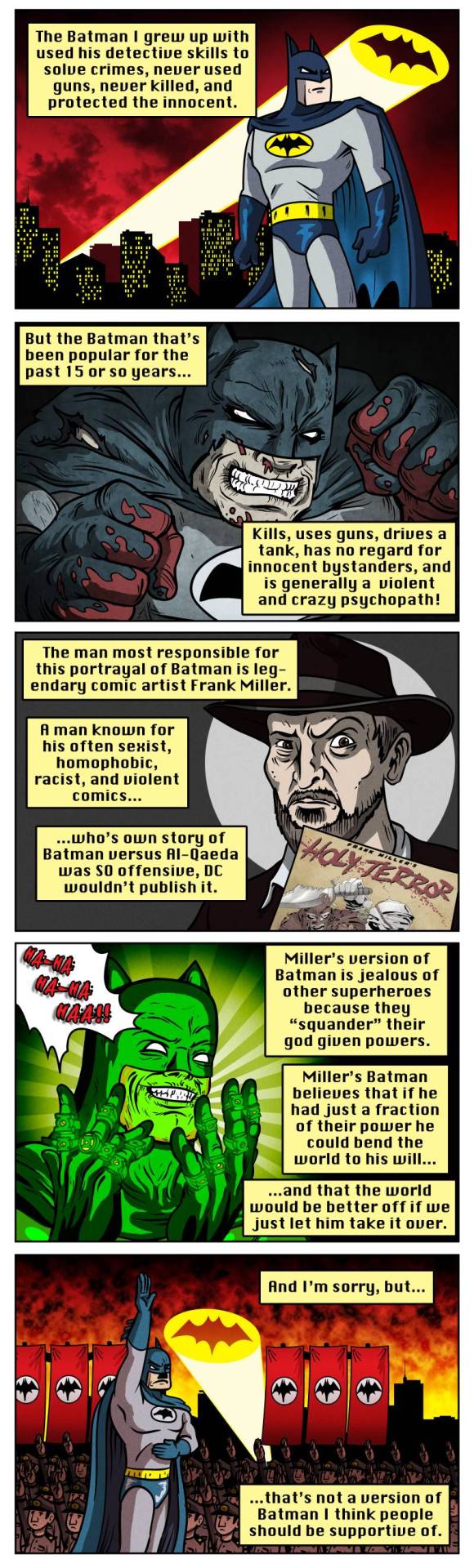
- Andrew Dobson from So... You're a Cartoonist? dislikes Batman, and he did a strip explaining why.◊ He lamented that the Batman he grew up with was a shining example of heroism, but has been tainted by Frank Miller turning him into a fascist figure that plagues the mainstream comics. The problem is that he claims that the Batman who has been popular since the 2000s has killed, with no regards for the innocent, and is generally an insane psychopath, blaming this on Miller's works like The Dark Knight Strikes Again and All-Star Batman & Robin, the Boy Wonder. While Dobson is correct in that the Batman from those stories is a psychopath, he hasn't killed, and these two stories are out-of-continuity with the mainstream titles, and were reviled by both comic critics and Batman fans alike. The comic never mentions The Dark Knight Trilogy, The Batman, or Batman: The Brave and the Bold, which were popular with the mainstream audience and all feature a Batman much more in line with his "ideal" Batman than what the "current" Batman he complains about.
- Unwinder's Tall Comics: The Rant for this page (Archive.org mirror here) discusses shallow parodies. Parker notes that everybody and their mother has parodied Citizen Kane at some point, but the majority seem to only reference the scenes (the bit about the sled, "Rosebud", etc) that have spread via Popcultural Osmosis. Parker deliberately set out to avoid doing that with his parody, so he imagines a Citizen Kane sequel made by a director who's obviously familiar with the original but still manages to completely miss the point. Furthermore, Parker wasn't content to simply make "the Citizen Kane parody for people who actually watched the film"—he references a subplot that was left out of the finished film, making his comic into "the Citizen Kane parody for people who read the screenplay".
- One VG Cats comic features Edward Elric and Harry Potter fighting over ownership of the Philosopher's Stone. Okay, that could be a funny idea... except for some reason Harry speaks in Ye Olde Butchered English, despite living in the 1990s and speaking perfectly ordinary modern British English.
- As an April Fools' Day joke, Maddox of The Best Page in the Universe did a trailer for a fictional film, Vague Genre Movie, mocking shallow parodies such as the ones from Seltzer and Friedberg.
- Cracked:
- "The 7 Least-Faithful Comic Book Movies" talks about Ang Lee's Hulk movie and how it differs from the comics, saying that The Incredible Hulk doesn't delve into psychological themes and that it spends an odd amount of time focusing on Bruce Banner's father. The thing is, though, Bruce Banner's multiple personality disorder and abusive childhood became a huge part of his mythos starting as far back as the '80s with Joe Fixit (and maybe even earlier than that) and continued during the '90s. Assuming this is still canon, then that accounts for over half of The Hulk's canon.
- Discussed in "4 Things People Mistakenly Think Are Automatically Hilarious", specifically in the context of reviews which refer to a movie's characters by their actor's name or one of their more famous roles. When done well, there's a point to be made, such as that the writing isn't good enough for the actor to disappear into their role (noting that e.g. describing a scene from Junior as "Arnold Schwarzenegger giving birth", though incredibly silly, is also an accurate way to describe how most people would view the scene in question rather than just a forced attempt at a joke). Other writers then saw only the most immediately-obvious part of the joke, that being the funny names, and took the wrong lesson home from these sorts of reviews (giving an example of a "funny" review of Twilight which ends up being a straightforward retelling of the plot where the only attempts at humor are an insistence on referring to Edward as "Darkness McEmo" and Jacob as "Abs McGee").
- "The 7 Least-Faithful Comic Book Movies
- The Editing Room is a satirical website consisting of "abridged screenplays", whereby the author takes the mickey out of a film by having its character hang lampshades all over the place and by snarking away at story points. Most are quite clever but after a while, some seem juvenile and shallow. A few times, the writer doesn't even bother to do any research into the background of the movie, or at times doesn't appropriately represent the story. Their script for Green Lantern (2011), for example, makes quite a few quips about how silly the titular character's "weakness" to the color yellow is... even though such thing is never actually established in the movie, it's only part of the comics. And the reason it's not in the movie is the "powerless against yellow" thing was written out when Kyle Rayner became the new focus character circa 1994, exactly because of the goofiness of such a weakness, and it's been like that in practically everything Green Lantern-related since.
- 4chan's "Fourth Wave Feminism" hoax, in which a gang of /b/tards opened fake Twitter accounts and faked images in Photoshop to try and create a social media trend of a warped form of feminism that glorifies thin, sexy bodies via the "bikini bridge" and "free bleeding", thus creating a civil war among feminists. As The Daily Dot puts it, this attempt "was fatally flawed from the very beginning because [/b/] has no grasp of the different waves of feminism." The crux of the problem is that their "challenge" to the third wave was actually just a shallower and dumber version of one of the ways the third was challenging the second.
- A review of Game of Thrones on Slate.com attempts to parody A Song of Ice and Fire... by using a prose style more reminiscent of Jim Theis than George R. R. Martin.
- Something Awful:
- "Truth Media" reviews are an intentional combination of Shallow Parody and Stealth Parody in regards to "leaked scripts" of movies and other "sneak-peek" reviews of popular media. Particularly notable is their Star Wars Episode II "leaked script" review, mostly because everything they predicted wound up being true.
- Truth Media usually tries really hard to get everything wrong so they can post and mock the inevitable replies from Trolls and so-called-experts. The Grand Theft Auto: San Andreas review is quite noticeable for getting the main character's name wrong despite knowing his initials.
- Often you'll see "gun fail" images that depict someone staring down the barrel of a gun◊ and being chastised as an idiot or being compared to Elmer Fudd. The thing is, it's very clear from the context of many of these images that the person is cleaning the gun, and looking through the barrel at a source of light after cleaning it is necessary to check for grime or obstructions. Obviously you only do this after the weapon has been unloaded, cleared, and had either the bolt or the barrel itself removed (if possible), but a mere glance at these images show the person has in fact done all three. It gets particularly funny when whoever posted the image or people in the comments accuse the person in the photo of "knowing nothing about guns" since only someone unfamiliar with guns would look at such an image and believe what these people were doing was stupid, ill-informed, or dangerous.

