
Classics, almost by definition, are works that are considered to be of high quality, are influential on later works, and are widely known. However, one will often find that only scholars and enthusiasts have first-hand knowledge of the material in question, and that the masses know it either only by title or by homages, parodies, direct references and allusions found in more populist works. Essentially, various bits and pieces of high culture are most widely known through their use in pop culture (which also puts them on track to become standard snippets). Ill-informed people might even think these bits and pieces are original to the popular work, And That's Terrible (nine times out of ten).
Stock Shout-Outs such as Pietà Plagiarism exist because of this phenomenon. (Most artists would be copying some other usage than the sculpture.)
Frequently results in Beam Me Up, Scotty!, It Was His Sled, and Covered Up. See also Half-Remembered Homage.
See also these tropes:
- Aluminum Christmas Trees: People think a Real Life thing is fictional.
- Breakaway Pop Hit: A pop cover of a song created for a specific work surpasses the popularity of the original song.
- It Was His Sled: The Twist Ending used to be a surprise, but now everyone knows it.
- Mainstream Obscurity: Can be considered an exaggeration of this trope, where all one knows of the work is via Pop Cultural Osmosis.
- Memetic Mutation: A snippet of the work gets wide exposure through endless online repetition.
- Older Than They Think: The work actually did not come up with the idea/concept.
- Once Original, Now Common: Thinking a work relies on clichés when those weren't clichés when the work was made.
- Parody Displacement: A parody is better remembered than the work it parodies.
- Praising Shows You Don't Watch: All you know about a work is that it's supposed to be good.
- Repurposed Pop Song: A popular song gets used in an advertisement.
- Small Reference Pools: Only making references to very well-known things.
- The Theme Park Version: Taking nothing from the original story or situation but the broad details, which still may be inaccurate.
- Wrongfully Attributed: A work or saying from one person is credited to another.
Compare/Contrast Pop-Cultural Osmosis Failure (when someone doesn't get the reference), Pop-Culture Isolation (in which the reference is well-known in one or a few major areas, but virtually unknown elsewhere).
Examples:
Other examples:
- Several slogans from old radio commercials live on as catchphrases in Looney Tunes cartoons, while virtually nobody remembers their actual origins. Examples are: "Turn off that light!" (referring to an air raid warden during World War II), "Was this trip really necessary?" (referring to a slogan used to encourage people not to take unnecessary trips to free up gas and rubber for the war effort and to free up space on trains to ferry troops to their duty locations.), "B.OOOOOOO!" (referencing a Lifebuoy soap commercial against body odor) and "Aha! Something new has been added!" and "So round, so firm, so fully-packed. So free and easy on the draw" (referencing Lucky Strike cigarettes).
- Alka-Seltzer had middling sales when first introduced, up until the advertisement was made with the now-ubiquitous familiar sound of two tablets put into a glass of water and starting to fizzle while dissolving. This made the product tremendously popular, so much so that consumers forego the fact that only one tablet is needed at a time, and the fact that the company sells the antacid in pouches of two tablets doesn't quite help.
- There are some related to the mediums of manga and anime themselves:
- "Manga" is the Japanese word for comics, and "anime", is the word for animation. The whole spectrum for both forms of media.(!) However, outside of Japan, "manga" and "anime" are the terms referring to Japanese-made works in particular. As such, if a non-Japanese states that they have a preference for said media to a Japanese individual, it's highly likely that the Japanese don't take this as meaning "Japanese media" because of the neutrality of the terms.
- The term "doujinshi" is applied to fan-made works of all kinds, including hentai doujinshi (or H-doujinshi for short). However, a great portion of non-Japanese readers are under the impression that all doujinshi are H-doujinshi, which is not the case at all because the term was introduced abroad referring to the H portion.
- AKIRA: Most anime fans, when speaking about Shotaro Kaneda, are referring to the protagonist of AKIRA, with many unaware that the character was named after the main character of Gigantor.
- Doraemon was subject to this for a long time outside of Asia due to No Export for You. The series was never legally available in any form in English outside of Asia for decades, but many Occidental Otaku were still familiar with the show, its tropes, and its characters due to the sheer number of references to the series in anime that did make it over.
- Azumanga Daioh was huge in its heyday, but due to the sheer amount of Schoolgirl Series it spawned in its wake, has gradually become less well-known in comparison. One long-lasting impact the series did have, however, was coining the phrase "mai waifu" (spoken by Mr. Kimura when discussing his gorgeous wife). The phrase was picked up by fans of the series to describe their own fictional crushes. Eventually shortened to just "waifu" (and expanded to "husbando"), it's become a staple of anime culture to the point that even people unfamiliar with the series are aware of the term.
- Fans of Neon Genesis Evangelion can generally sing along with "Fly Me to the Moon" without knowing the original artist, or even one of the dozens of famous American artists who covered it in the four decades before NGE came out.
- The "Kyubey's Face" shots from Puella Magi Madoka Magica — where all you see are his eyes, with the background being the color of his skin — were actually first used for Kero in Cardcaptor Sakura.
- "Kashikoma!" is a Japanese word that means "I understand!" or "Capisce!" However, most people today associate the phrase with PriPara, due to said word being Laala Manaka's catchphrase.
- Dragon Ball:
- Even the most casual anime fan knows about Dragon Ball...only whenever someone hears the name Son Gokū, very few people are ever going to think about the original Monkey King from Journey to the West over the iconic Saiyan protagonist, since Son Gokū is the Japanese rendering of the Chinese name Sun Wukong. This expands to many other works that involve the usage of Wukong's name in that form of Japanese rendering (also ranging to Japanese dubs of any original Journey to the West-based media), which only shows how a majority of people are rarely associated with the original works and/or drama adaptations. It's to the point that in a nutshell, where people don't realize that Dragon Ball's version of Wukong/Gokū was based on another prior monkey character with the same exact name (孫悟空), and that the name Wukong/Gokū (悟空) is actually a common Buddhist name.
- Dragon Ball itself gets this from Americans and other English speakers. Many people outside of Japan aren't aware that Dragon Ball Z wasn't the first series in the franchise, and this was especially true in its heyday. This is mostly thanks to the widely popular and memetic English dub of Dragon Ball Z from the '90s, which set itself apart from earlier parts of the story. The Japanese and English versions of the show were initially very different, with mixed reception. A common derisive stereotype among fans of the Japanese original is that dub fans only know and love the early, less faithful version of the franchise, when in reality the newer uncut dubs from Funimation are much more popular, and most modern English-language Dragon Ball material is fully uncensored and far more faithful to the Japanese original.
- When most people nowadays hear "Kamehameha", most people will think of the attack from Dragon Ball, and not the Hawaiian king from which it got its name.
- There's a little obscure 1998 anime called Nazca that's far, far more well known as "That anime from the Malcolm in the Middle opening."
- Anpanman:
- To many people outside of Japan, Anpanman will forever be associated with BTS, as they sing a song about the character being a hero.
- "Baikin" is a common Japanese word meaning "germs". But if you look up that word in Japanese, most of the results show Baikinman from this show. It got to the point where the association of the word "baikin" with the character led to him starring in a commercial for a germ-removing air conditioner aired in the early 2000s.
- A lot of people assume Eurobeat music to be made specifically for the Initial D anime adaptation, rather than existing music licensed for use in the anime. It wasn't until Initial D's third season, Initial D Fourth Stagenote , that Eurobeat musicians started to cash in on the series' popularity with songs about the series itself and more songs about cars.
- 19th century British cartoonist John Tenniel had a long career as a cartoonist in Punch!. But today he is only remembered for illustrating Alice's Adventures in Wonderland and Through the Looking Glass.
- Subverted in that some of Tenniel's Punch cartoons — most notably perhaps "Dropping the Pilot
 ", his reaction to the dismissal of Otto von Bismarck as German chancellor — are still very familiar from being reprinted in historical textbooks and referenced by more modern cartoonists. It's just that most people don't realize they were drawn by the same artist as Lewis Carroll's books...
- Subverted in that some of Tenniel's Punch cartoons — most notably perhaps "Dropping the Pilot
- Thanks to many biopics about Leonardo da Vinci, painter Andrea Mantegna is nowadays better known as Da Vinci's mentor than for his work.
- To many art fans, Jean-Paul Marat is remembered more for Jacques-Louis David's striking painting than the actual historical character. The work has done a lot to transform a very radical politician into an innocent victim.
- There was once a supermarket themed art exhibition in France called the "Orrimbe show", that would've likely faded into obscurity if the creators of the exhibition hadn't asked Jean-Michel Jarre to produce music for the event. Jarre ended up creating Musique pour Supermarché, an album that was famously pressed only once and had its master recording destroyed in front of an audience.
- A Night at the Opera has ruined Il Trovatore for many people. Just try to hear the Anvil Chorus without thinking of Chico and Harpo after you've seen it...
"A battleship in Il trovatore?!!
- The "Mah Nà Mah Nà" song does not originate from The Muppet Show, or even Sesame Street, but rather an Italian mondo documentary film set in Sweden.
- Speaking of The Muppets, many 90s kids think the Beach Boys song "Kokomo" was written for the It's Not Easy Being Green VHS or Muppet Beach Party. And then some people thought that the music video itself was only a VHS-exclusive short on several Disney tapes and not a promotion for another video, which also happened with the Parachute Express "Doctor Looney's Remedy" music video on A Goofy Movie.
- Modest Mussorgsky's Night on Bald Mountain has unfortunately become known as either a general theme music for a comic nemesis, the escape from the Witch's castle in The Wizard of Oz, or the near-final segment in Fantasia that scarred generations of children.
- Hey, they stole that for Earthworm Jim!
- The opening was used in the Maxell "Break The Sound Barrier" ad.
- "Countin' the Beat" by the Swingers is known to a generation of Australians as the Kmart theme song.
- Many talk shows cause this, from Rush Limbaugh with "My City Was Gone" by Pretenders, to Rachel Maddow with "Stealing the Stock" from the Ocean's Twelve soundtrack.
- The song called "The Merry Go Round Broke Down" created by Cliff Friend and Dave Franklin is better remembered as the music for the Looney Tunes theme song, Daffy Duck sings a more complete version of the song with different lyrics in "Daffy and Egghead".
- Eddie Cantor's "Merrily We Roll Along" is better remembered as the Merrie Melodies theme.
- To people who grew up in Turn of the Millennium, the song "Funiculi, Funicula" is better known as the tune to the VeggieTales song "Larry's High Silk Hat".
- Or as the memetic pizza "theme" featured in Spider-Man 2 video game.
- Actual pizzerias as well may be associated with this song.
- Japanese children will know the song as "The Ogre's Pants", which is a folk song that is sung to the same tune. The song is well-known in Japan for being the favorite song of Baikinman and Dokin-chan from Anpanman.
- Or as the memetic pizza "theme"
- Some people who have sent e-cards or have given certain American Greetings cards will associate "The Barber of Seville" with The Birthday Sock.
- A version of the song was also performed by Buck in Ice Age: Collision Course.
- This might be happening to Batman, if YouTube comments are to be believed.
Random viewer on the Joker from Batman: The Animated Series: That's not the Joker, he doesn't even have the scars!
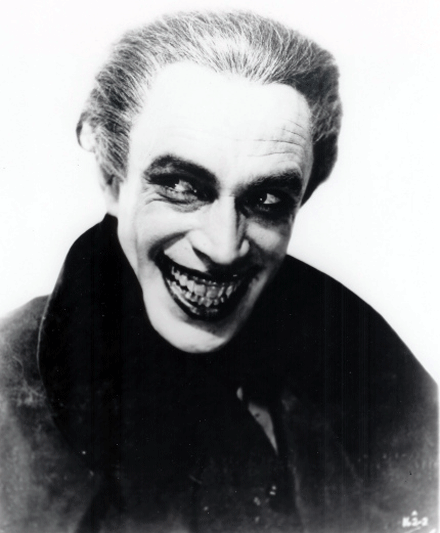
- A lot of people forgot or don't realize that the Joker was based on Conrad Veidt's◊ character in the 1928 movie The Man Who Laughs.
- A lot of people forgot or don't realize that the Joker was based on Conrad Veidt's
- A lot of comic book characters are much better known worldwide from full-length cartoon or movie adaptations than they are from their original source material. In fact: this is literally the case with every one of them: either in Europe (The Smurfs, Asterix, Tintin), the US (every superhero character, save Superman) or Japan (lots of manga comics are much better known as anime cartoons).
- Tintin: If people outside China and Japan have heard about the Japanese-Chinese war of the 1930s it will be mostly through the album The Blue Lotus, where it is a large part of the plot.
- Suske en Wiske's frequent time travels have taught many children in the Benelux of countless historical characters and time periods.
- Nowadays more people will think of Barabas as the professor in Suske en Wiske, rather than the Biblical character.
- There is a Suske en Wiske story called De Texasrakkers ("The Texas Scoundrels"), which was originally a shout-out to the popular 1950s TV western series The Texas Rangers, but this show is nowadays completely forgotten. In fact: mention The Texas Rangers today in Flanders or the Netherlands and everybody assumes you mean De Texasrakkers.
- Nero readers will recognize several Belgian and international politicians between 1947 and 2002 from their cameo appearances in the series.
- In Flanders more people will think of Nero as the titular character of this comic strip than the Roman Emperor Nero.
- Asterix shaped most people's impression of Gaul and the Roman Empire.
- De Kiekeboes: When hearing the word Constantinopel many young readers will rather think of Kiekeboe's son than the former name of Istanbul.
- Lucky Luke features cameo appearances of several Wild West icons, which are only familiar to people outside Europe because of said cameos.
- Donald Duck (& Co.), and The Disneyverse in general, are simply filled with retold classics, movie and music references, and the like, providing lots of kids their first contact with Greek myths, Shakespeare's plays, classical history, etc.
- Calvin and Hobbes: In the 10th Anniversary Collection, Bill Watterson admits that he's "not at all familiar with Film Noir or detective novels", so the stories featuring Calvin's Hard Boiled Detective alter ego Tracer Bullet are "just spoofs on the clichés of the genre."
- New Girl (mortimermcmirestinks): Langston cites the Star Trek: The Next Generation episode "Yesterday's Enterprise" to explain the alternate timeline situation. While Emily gets the reference, Arish doesn't, switching to Back to the Future Part II as another comparison.
- The story of Anastasia Nikolaevna Romanova is most well known in the west by the numerous animated and live adaptations of the story (all of which romanticize the story and the vast majority end with Anastasia alive). This is to the point that it became one of the most famous unsolved mysteries until the discovery of the bodies of the Romanov family. The story goes that Anastasia, through any number of means, escaped the execution of her family due to any number of reasons (hid in a cart, spared by a soldier, saved by a servant, etc). In most of these tales, she lost her memory, and eventually went by the name "Anna Anderson". One day she recovered her memory, went to her surviving grandmother Olga, and would regain her memory. The truth of this story is much more somber, as Anastasia and her entire family were executed in Yekaterinburg on an estimated date of July 16th, 1918. This was the result of a long-running series of political problems plaguing Russia, most of which were blamed on Nikolai Alexandrovich Romanov (Anastasia's Father) and his incompetency as a ruler. The Romanov family couldn't be found because the Bolsheviks hid their body in a makeshift grave that was dug and hastily covered in railroad tracks. Additionally, Anna Anderson is believed to have been a mentally unwell woman who believed she was Anastasia along with, at one point, being claimed to be Tatiana Romanov. DNA testing in the 21st century would further prove, without debate, that Anderson was never Anastasia and had no blood relation to the Romanovs. Furthermore, it is now known her name was not Anna Anderson, but rather Franziska Schanzkowska, and that she was German. Duchess Olga, unlike the stories, never believed that "Anna Anderson" was family. Even more saddening, pieces of the Romanovs' bodies of the would be uncovered in 1991, ending the question of Anastasia's survival once-and-for-all.
- The idea of Rasputin being a villain is born out of a hatred for the actual man: Grigori Rasputin. Rasputin was a Christian Orthodox Faith Healer who was attributed by Nikolai as the reason for his son's (Alexei Romanov) survival. Because of this belief, Rasputin held considerable favor with the Romanov family, and he was able to easily influence Nikolai and Alexei into making decisions he favored. This angered the citizens of Russia who believed him to be a conman, and he was eventually tricked and assassinated by the Bolsheviks. Many adaptations paint him as actively working against the Romanovs despite this being far from the actual truth. Some adaptations, such as the Don Bluth film have him be a mystical sorcerer (which is about as opposite you can get from a Christian Faith Healer.
- Many fairy tales and literary classics are nowadays much better known in animated adaptations by Walt Disney than the original tales. Expect many people to be surprised that certain characters and scenes are not in the original tales or that the stories in general have far Darker and Edgier content. It has gotten to the point that many assume that all these Disney adaptations are in fact fairy tales, while many, like Pinocchio, Alice in Wonderland and Lady and the Tramp, for instance, are not.
- The Three Little Pigs cemented the idea in many people's minds that "The Three Little Pigs" are all individual characters and that none of them get eaten by the Big Bad Wolf. In the original story, they have no individual personalities and the first two are eaten by the wolf. Many people will also automatically start singing "Who's Afraid of the Big Bad Wolf?" whenever the story is mentioned.
- Snow White and the Seven Dwarfs: Since this film came out, many adaptations of Snow White have turned the dwarfs into individual characters and have the prince kiss Snow White back to life. In the original fairy tale, the dwarfs were not individualized and Snow White was saved when the prince accidentally dropped the coffin, causing the apple she ate to fall out of her throat. Another change in the story is that the Evil Stepmother attempted to poison Snow White three times, with her third attempt being the poisoned apple.
- Pinocchio made the role of Jiminy Cricket as Pinocchio's conscience much more central to the story. In the original novel, Jiminy is only a minor character, who gets squashed accidentally by Pinocchio even before he leaves the house. The majority of the book didn't even make the film.
- Bambi: Thanks to this film, many people refer to a baby deer as a "Bambi". The original story is also far more adult.
- Alice in Wonderland: To the general public this is their main impression of the original novel, even though Tweedle-Dee and Tweedle-Dum and the story they tell about the Walrus and Carpenter appear in Alice Through The Looking-Glass.
- Sleeping Beauty: Many people expect the Prince to fight a dragon at the end, which is a scene added by the Disney version, not present in the original.
- The famous ‘Once upon a dream’ tune comes directly from Tchaikovsky’s Sleeping Beauty waltz. Good luck getting through the original song without ‘I know you; I walked with you...’ running through your head at some point.
- The Jungle Book (1967): The general public instantly thinks of this movie whenever The Jungle Book is brought up in conversation. Never mind the fact that this film has barely anything to do with the original story, except for the fact that Mowgli was indeed raised by wolves and that the characters' names are the same. For instance, Rudyard Kipling's novel Baloo is a serious character and Kaa is a friend of Mowgli.
- The Little Mermaid (1989): The original fairy tale has a totally different central theme. The story is very religious, and the mermaid is drawn to the humans because she longs for an immortal soul, something that only humans have. She wants to go to heaven after her death, and not to become the sea foam. Marrying the prince was just the means to get that. Although she died by the end of the story, the ending suggests that she might get what she wanted.
- Aladdin: In the original Arabian Nights, the story takes place in China and the number of wishes isn't restricted to just three.
- Hercules: While lots of people criticize the movie for being not faithful to the original myths, it does reference some of them. The twelve labors are shown during the montage, and the whole premise has some similarities to titanomachy/gigantomachy. The former features Titans, and the latter has Hercules. The battle with Cyclops references both Titanomachy and The Odyssey. That being said, the whole "coming of age" story of the movie has nothing to do with the myths, and most of the characters were changed dramatically. Hades was never an antagonist to Hercules, Hera was never his loving mother (or a mother at all), and Megara was his wife... which he killed along with their children, thanks to Hera messing with his mind. Yeah, greek heroes were not very "heroic" by today's definition.
- Tangled is about the story of Rapunzel, and in most iterations of the story, Rapunzel was not kidnapped by a witch, but rather given to the witch as payment because her father (a peasant man) was stealing her crops to make food for his wife. In exchange, the witch spared him and his wife for his firstborn child. Eventually, Rapunzel was born, and taken to a tower.
- Fantasia:
- There's likely not a soul on Earth who doesn't associate "L'apprenti sorcier" by Paul Dukas with Mickey Mouse.
- Or take "Dance of the Hours" from Ponchielli's ballet La Gioconda. When you hear it, you'll either think of the dancing hippos from Fantasia, or you'll start singing, "Hello Muddah, hello Fadduh, here I am at Camp Granada..." (Allan Sherman's well-known funny song). Or both.
- It was also used as the tune of the Garfield and Friends song "The Garfield Opera".
- There probably aren't that many people who wouldn't think of dinosaurs when listening to ''The Rite of Spring".
- Dumbo: Dumbo's name is a pun on the 19th-century circus elephant Jumbo, something that not many people nowadays remember now.
- Aladdin: Probably not many children nowadays will be aware that when the Genie encourages Aladdin while barking and waving his fist he briefly transforms into Arsenio Hall. Outside of the USA virtually nobody.
- The Lion King (1994): Younger people have the wrong impression that the song "The Lion Sleeps Tonight" originated from this movie. Nope: It is almost half a century older!
- When Moana came out, eagle-eyed viewers liked to point out the "Easter egg" in Lilo & Stitch where David Kawena (the boyfriend of Lilo Pelekai's older sister Nani) is seen wearing Maui's fish hook as a necklace. The internet was quick to point out that this was the equivalent of thinking that every character that wears a cross or crucifix in movies is in reference to The Last Temptation of Christ, never mind the fact that Lilo & Stitch predates Moana by fourteen years.
- Surprisingly averted with the usage of "We Go Together" from Grease in The Secret Life of Pets, with most fans of the film (most of whom are children) claiming they knew what the song being played was as soon as it began in the scene. It helps that Grease is one of the most popular choices for school musicals, that many of the parents of said children grew up watching the 1978 film adaptation of the musical, and that Secret Life of Pets happened to premiere a few months after FOX televised a successful live production of Grease.
- This happened with the classic songs featured in Trolls thanks to its monster popularity. On Google, the Trolls versions of the songs have more results than the original versions. The cover of True Colors that Justin Timberlake and Anna Kendrick recorded for the film's soundtrack also pops up on Youtube as the first result before the original Cyndi Lauper version.
- Many people outside of Japan believe that Hyokkori Hyoutanjima was a Show Within a Show made for the movie Only Yesterday. It was an actual puppet show on NHK in the 1960s when the childhood sequences of said film take place, but most episodes of the show are very hard to find, which could have led to this confusion. And when people don't associate it with this film, they'll associate it with Morning Musume's cover of the theme song.
- "April is the cruellest month" comes from T. S. Eliot, The Waste Land
- Behind Shakespeare and the Bible, Mary Shelley's Frankenstein is probably the biggest sufferer of this trope. The novel draws heavily on contemporary Gothic horror, feminist theories, and Paradise Lost. And yet when most people think of Frankenstein...
- Frankenstein's monster's skin color is referred to as yellow (jaundiced) in the novel.
- Much like Dracula, a lot of this is down to the movie being based on the play. Despite being almost forgotten now, the 1823 play (which changed the monster into a mindless beast and removed all of the Nature Versus Nurture ambiguity in favor of it being an Abomination Against God) was the best-known version of the story for a century.
- The extent to which Moby-Dick is well-understood is emphasized in Star Trek: First Contact when Lily Sloan, despite knowing the basic plot of the book, is stymied when Captain Picard (mis)quotes a central line from the text.
- It's impossible to list all the comic books, novels, fantasy horror movies, roleplaying games, video games, fantasy/Sci-Fi art, and music videos that feature blatant rip-offs, allusions, homages, parodies, or additions to H. P. Lovecraft's Cthulhu Mythos tales.
- Most people nowadays likely associate Arkham Asylum with Batman.
- Problem Sleuth and Homestuck both feature monsters that clearly resemble Lovecraft's elder gods. The author, Andrew Hussie, has outright stated that he's never read a word of Lovecraft, and based his monsters entirely on secondhand references to the Cthulhu mythos.
- You've probably encountered the tropes the Horatio Hornblower series popularized long before you ever heard of the series itself.
- And that obscure little work of fiction got a Shout-Out in the episode "Smile Time" of Angel, with a purple stuffed thing that communicates via a horn on its face named Ratio. Likely, you didn't get the joke.
- And the only reason a lot of people have even heard of Horatio Hornblower in the first place is that Gene Roddenberry repeatedly referenced the books when explaining Star Trek: The Original Series and Captain Kirk in books and articles about the show.
- "Ask not for whom the bell tolls." You've heard that pithy phrase, usually said when someone else is in trouble, but who said it? How about "No man is an island"? Well, they both came from the same paragraph of the same essay, but missing the context.
"No man is an island, entire of itself; every man is a piece of the continent, a part of the main. If a clod be washed away by the sea, Europe is the less, as well as if a promontory were, as well as if a manor of thy friend's or of thine own were: any man's death diminishes me, because I am involved in mankind, and therefore never send to know for whom the bell tolls; it tolls for thee."—Excerpted from Meditation XVII by John Donne (1623 - he was contemplating his own death at the time)
- The Jekyll & Hyde trope is significantly more popular than The Strange Case of Dr. Jekyll and Mr. Hyde, the novel that spawned it. When many people think of Jekyll and Hyde, their notions are colored by the adaptations — including "adaptations" like The Incredible Hulk.
- The Hitchhiker's Guide to the Galaxy — 42 is the Answer to The Ultimate Question of Life, the Universe, and Everything.
- Casabianca: "The boy stood on the burning deck/Whence all but he had fled..."
- This reference has become somewhat coloured by various transformations into a dirty schoolyard-esque song, such as those known by Nanny Ogg in the Discworld novels. All that needs to be known (and is indeed given) is that the opening lines are 'The boy stood on the burning deck/His name was Henry Rollocks' and that it starts out 'harmless enough'.
- Many associate "The game's afoot" with Sherlock Holmes, but it's actually from Henry V.
- Most of Lewis Carroll's songs and rhymes in the Alice in Wonderland books were parodies of once-common Victorian standards which, except for "Twinkle, Twinkle Little Star" and the possible exception of "The Spider and the Fly", are considered obscure trivia by most modern readers.
- Most people know the phrase "water, water everywhere, but not a drop to drink", but hardly anybody knows that it came from Samuel Coleridge's Rime Of The Ancient Mariner or that the original wording was "nor any drop to drink".
- Hans Brinker, or The Silver Skates: Everyone knows the tale of the little boy who prevented a flood by sticking his finger inside a dyke, except that—you know what?—it's a Story Within a Story.
- Used for a joke in the Confederation of Valor series. The Taykan species are Space Elves. Thanks to pop-cultural osmosis from humans, they're well aware of their physical similarity to classical elves and apparently find the comparison amusing: Torin Kerr once met a di'Taykan named Celeborn.
- Of Mice and Men is clearly about a big guy named Lenny and a little guy named George, and absolutely nothing else, if all the references to those characters in various sources is any indication.
- The Satanic Verses: Most people know more about the blasphemy controversy around this novel than that they've actually read it. Including many Muslim fundamentalists who want Salman Rushdie dead.
- The June Rebellion would have been an obscure, long-forgotten historical footnote if not for Les Misérables.
- "Into each life some rain must fall" is from Henry Wadsworth Longfellow's "The Rainy Day".
- Northanger Abbey features several references to real Gothic romance novels that were popular at the time but have all been forgotten, leading many modern readers to assume Jane Austen was making them up.
- Monty Python's Flying Circus has done a similar takeover of John Philip Sousa's march The Liberty Bell.
- The show has also made certain historical and cultural characters more notable among geeks who watch the show, but mostly as part of a surreal sketch that has little to do with who they actually were.
- Alan Whicker is nowadays better known for the Python sketch "Whicker's World" than as an actual TV presenter who had a travel show under that very name.
- To a lot of people, Monty Python "is that guy who made that funny Holy Grail film". That Python is not an actual person, but the collective pseudonym of a team, and that they also made other films AND originated from a long-running TV series, is far less known among the general public. Many of Monty Python's most popular sketches are also far better known outside the context of the original series and often show up in heavily edited form in compilations. As a result, even scenes from films and TV series that only feature two or three of the Python actors have been branded as Python films, despite not having anything to do with them.
- Angelo Bronzino's painting "Venus, Cupid, Folly, and Time" is fairly obscure nowadays, even in art circles, but one specific detail on the painting may ring a bell to Python fans. Cupid's foot has been used in the intro of every episode of "Monty Python's Flying Circus" and is now their official logo.
- Mention the Spanish Inquisition today and some people might start laughing instantly because it reminds them of the Python sketch of the same name. People outside the English-speaking world may also be unaware that the phrase "I didn't expect the Spanish Inquisition" is an actual idiom, expressing someone's irritation over being asked too many questions.
- How many people nowadays are aware that the "Dennis Moore" song is a literal parody of the theme song of the 1950s TV series "The Adventure of Robin Hood"? Both melody and lyrics are very similar ("Robin Hood, Robin Hood / Riding through the glen/ Robin Hood, Robin Hood/ With his band of men").
- Iron Chef fans may not realize the original theme music, and indeed much of the incidental music was from the movie soundtrack for Back Draft.
- Pop culture even has a habit of obscuring itself. Adam Savage of MythBusters is frequently credited for the quote, "I Reject Your Reality and substitute my own!" Actually, the line originated from the 1985 So Bad, It's Good film The Dungeonmaster (Ragewar outside of the US).
- More people know "The Ballad of Brisco County, Jr." from NBC's coverage of the Olympics than from the original show.
- Most people not familiar with Power Rangers will simply refer to characters as "The Red Ranger" and "The Pink Ranger" etc. What they don't realize is that, as of February 2015, there have been no less than 27 different Red Rangers, with many more off-screen, and a few more debatable ones.
- Similar to Power Rangers is the Ultra Series. Many people unfamiliar with the series assume Ultraman to be a long-running show and will refer to all Ultras as "Ultraman" under the assumption that they are all the same character as the original. In reality, Ultraman only ran for 39 episodes from 1966-1967, and the other Ultras are different individuals who star in their own completely separate but related shows, with the first Ultra being just called "Ultraman"note .
- The Twilight Zone (1959) is better known through parodies these days to the point where many people know the endings to famous episodes without ever having seen them. Outside the USA people know it most from being spoofed in The Simpsons.
- The name Heisenberg is today much more associated with Walter White than with German physicist Werner Heisenberg.
- Mention the name Big Brother today and most people will think you're referring to the reality show Big Brother rather than a central character in George Orwell's novel Nineteen Eighty-Four. This is actually rather sad seeing that the novel warns against a society where government surveillance on people is total, while this TV show exploited this concept.
- When people see a collie nowadays many will refer to it as a "Lassie".
- Samson En Gert: In Belgium and the Netherlands most people will not think of the biblical character when hearing the name "Samson", but of a talking bobtail dog.
- FC De Kampioenen: Carmen's dog Nero was originally named after the Belgian comic strip character Nero. Since 2002 the comic strip has been terminated and the albums are no longer available in regular stores, making the original reference more obscure. Most younger people will probably assume it's a reference to the Roman emperor Nero.
- Spitting Image: This show featuring puppet versions of celebrities has also caused some Memetic Mutation. Today many people in the UK remember Ronald Reagan and Margaret Thatcher more as in their grotesque villainous puppet versions than as Real Life people. A good example is Thatcher beating up members of her cabinet in many sketches, which a lot of people almost assume she did.
- Les Guignols de l'Info had similar effects in France, such as how president Jacques Chirac is remembered.
- The Noddy Shop: Many characters on this show spoof popular celebrities, leading some people in the target demographic to believe that they were original ideas. For example, Johnny Crawfish is based on Johnny Carson, and Bonita Flamingo is based on Carmen Miranda.
- Some fans of The Nanny often believe that the character of Lamb Chop was specifically made for one episode of the show, when she actually was a real character who dates back to the 1950s and was popular at the time the series aired, due to the character having her own show at the time.
- Stranger Things and its many references to Dungeons & Dragons. Let's be honest. Does the average viewer of the show know who Demorgorgon is or what mind flayers are? Chances are they know those things better as inhabitants of the Upside-Down than as classic staples of the D&D Monster Manual. Even if they do know the naming origins, they'll think that the D&D versions look like the Stranger Things ones.
- As seen in this video, many children nowadays seem to associate Mister Rogers' Neighborhood with the spin-off Daniel Tiger's Neighborhood, to the point where they will think certain things on the spin-off began there rather than Mister Rogers, like the "Won't You Be My Neighbor?" song, which is used as the first half of the opening for Daniel Tiger.
- The same thing is beginning to happen with Donkey Hodie. For instance, many people tend to believe that Purple Panda is an original character and should have been named Sancho Panda to fit with the Don Quijote pun when he originated on Mister Rogers' Neighborhood, and searching for the Fred Rogers song "I Like To Take My Time" on Google has the Donkey Hodie version recommended as a result before the original.
- A majority of comments on the theme music to The Match Game-Hollywood Squares Hour will talk about winning a car. Since that series only ran for a few months, The Price Is Right used a few of the music cues from the show, including the theme being used in the 90s for the car plug, so more people remember the song from its tenure on The Price Is Right than the actual show it came from.
- "Inai inai baa!" is the Japanese phrase used in what is known to the English-speaking world as "Peek-a-boo". Beginning in 1996, it was hard to not hear that phrase and think of the NHK children's show called Inai Inai Baa!. It doesn't help that the characters sometimes yell "Baa!" to introduce themselves, and that every episode ends with the characters playing peek-a-boo to say goodbye to the viewer.
- Charlie Hebdo was already half a century old and mostly known in France and/or to readers of adult comics. It was only in January 2015 when they suddenly became notorious worldwide. Unfortunately, it had more to do with the deadly terrorist attack on the headquarters of the magazine, which resulted in several deaths. As a result, Charlie Hebdo brings up more associations with Muslim terrorism, religious fanaticism, and the right to freedom of speech than the actual ideology and content of the magazine. Most people have never read an issue and thus have only a vague notion of what the magazine is about.
- The videos here and here feature 158 songs that quote, "You have heard but don't know the name of", because they've been featured in many different media.
- John Philip Sousa's The Liberty Bell March is automatically associated with Monty Python's Flying Circus. No exceptions.
- A large proportion of people hearing In the Hall of the Mountain King by Edvard Grieg, written for a scene in Henrik Ibsen's play Peer Gynt would not know that it wasn't originally:
- The "Alton Towers" theme song.
- Or the in-game music to Manic Miner.
- Or the leitmotif to the syndicated Adventures of Sonic the Hedgehog cartoon (Robotnik's Lair's theme in the series proper).
- Or scene music from a certain Astro Boy episode.
- Or the song that Peter Lorre whistles when he goes hunting little kids in M.
- Or the theme for Orson's brothers in the U.S. Acres segments of Garfield and Friends.
- Worse yet, one dance remix of "In the Hall of the Mountain King" has been miscredited on file-sharing services as a remix of the Inspector Gadget theme, despite there being only a very vague similarity between the two songs.
- Similarly, the first movement of Beethoven's Moonlight Sonata is better known to many 8-bit-era gamers as "the title music to Jet Set Willy".
- Play the Russian folk song "Korobeiniki" to anyone in the world, except Russians, and they are almost certain to identify it as video game music. Specifically, the Tetris theme.
- The song "Anything Goes":
- It does not come from Indiana Jones and the Temple of Doom. It's an authentic show tune of the period, from a Cole Porter musical of the same name, and, by the way, normally sung in English.
- Fallout 3 uses "Anything Goes" (and many others) to establish ITS Alternate History post-apocalyptic setting.
- Likewise, "Puttin' on the Ritz" was originally performed by Harry Richman in a film called... Puttin' on the Ritz (you would think the name was a dead giveaway).
- It did not originate from Young Frankenstein. Similarly, its close musical cousin, concerning the naming history of Istanbul, was not originally by They Might Be Giants.
- Nor was it originally performed by Fred Astaire, he just sang it in Blue Skies. It also wasn't originally performed by Taco, though it's either his '80s hit or the aforementioned Young Frankenstein that most people know the song from today.
- Many people know the "Love Theme" from Pyotr Ilyich Tchaikovsky's Romeo and Juliet Fantasy Overture only from its use to show that someone has fallen in Love at First Sight.
- In innumerable TV shows (South Park, The Fresh Prince of Bel-Air) and movies (Wayne's World, Clueless)
- Oh! You mean the romantic kiss song from the first The Sims game?
- Just try listening to "Hoedown" from Aaron Copland's Rodeo without thinking "Beef: It's What's For Dinner." Or Emerson, Lake & Palmer.
- The BBC's use of Booker T. & The MGs', "Soul Limbo". Also known as the Cricket music.
- Fleetwood Mac's outro to "The Chain", otherwise known as the Formula One Racing music.
- Singin' in the Rain did this to most of the songs in the movie, most notably the title tune which was a standard song to be sung by aspiring actors in film in the 1930s and 1940s.
- Kesha's "Take it Off" is a pop version of "The Streets of Cairo" (usually associated with snake-charming in pop culture).
- Know what the song "Spybreak!" sounds like? What if I told you it's the song that plays during the lobby shootout scene in The Matrix? If you already did, did you even know who the Propellerheads were before you did the research? The movie came out two years after the song.
- The song "Surfin' Bird" by The Trashmen has been greatly popularized through its use in other shows:
- It was played in the Family Guy episode "I Dream of Jesus". Just take a look at this graph.
- Oddly enough, averted in the case of Full Metal Jacket. Despite it being one of the most famous war movies of all time and made by a household name director, very few people associate "Surfin' Bird" with it — or at least, the association got transferred over to Family Guy. In fact, given the plentiful references to the film throughout Family Guy, it's more than likely where Seth McFarlane and co. know of "Surfin' Bird" from.
- That small peak in 2004 coincides with the release of Battlefield Vietnam, which for a fair few gamers might be the thing they associate with the song.
- Pee-wee Herman performed it in Back to the Beach.
- Spanish speaking viewers however may have found out about the song earlier back when it was sometimes played during the credits of Ah, qué Kiko (a spinoff of El Chavo del ocho).
- And the few people who watched CBS's Saturday morning lineup in the 1998–99 season would know it from the show Birdz.
- Exploitation Film fans would associate with an infamous scene of Pink Flamingos.
- The Trashmen's song itself Covered Up "The Bird's the Word" and "Papa-Oom-Mow-Mow," both by the Rivingtons.
- It was played in the Family Guy episode "I Dream of Jesus". Just take a look at this graph
- How many people under 25 or so can hear "The Final Countdown" without thinking of Arrested Development?
- People from the Detroit Area have a different reaction to The Final Countdown, mostly identifying it as "The Pistons Intro Song."
- Saints Row 2 fans will identify it as that awesome 80s song that will never, ever, ever, ever leave their head.
- Also used in How To Kill A Mockingbird.
- Similar to the "Pistons Intro Song" above, The Alan Parsons Project's instrumental tune "Sirius" (aka the song right before "Eye in the Sky") is far more familiar as the intro song for the Chicago Bulls during the Jordan era.
- Utter the line "Right here, right now", and nearly anyone with associate it with Fatboy Slim's song of that name, not the movie (Strange Days) it's sampled from.
- Or the Jesus Jones hit.
- Or this classic from High School Musical 3: Senior Year.
- Or the Jesus Jones hit
- For a certain generation in Britain, the lyrics to O Sole Mio will forever be "Just one Cornetto! Give it to meeeeee!"
- Many Americans are undoubtedly familiar with "Hail, Hail, the Gang's All Here." Considerably fewer might be aware of the fact that the tune is from a Pirates of Penzance ditty called "Come, Friends Who Plow the Sea."
- And that's not even the song's correct name. It's properly titled "With Catlike Tread".
- British radio listeners might know it as Tune to Kenny Everett', tune in to Kenny Everett - a promo jingle for Ken's radio show.
- The "Polovetsian Dances" from Alexander Borodin's opera Prince Igor tend to be more commonly associated with Kismet and a certain Pine-Sol commercial these days.
- The nursery tune "Pop! Goes The Weasel" was originally a piece of dance music that was popular in London dance halls and American stage acts in the 1850s and as a playground singing game for kids dancing in circles. Nowadays, it's irrevocably associated with Jack-in-the-Boxes, to the point where such a toy playing any other tune feels like a Subverted Trope.
- Also sprach Zarathustra. Ever since 2001: A Space Odyssey it's a Standard Snippet for Mundane Made Awesome.
- "Always Look On The Bright Side Of Life" has become such a popular standard that some first-time viewers of Monty Python's Life of Brian will laugh when the characters sing this song because they assume the Pythons are simply covering a well-known song. In reality, it was completely written by Python member Eric Idle.
- In Brazil, "Il Guarany" is forever associated with a statal news radio program that plays on weeknights. Even if the show now uses somewhat laughable "updated versions".
- The phrase "the revolution will not be televised" is infamous everywhere, but how many people know it originated from Gil Scott-Heron's The Revolution Will Not Be Televised?
- The album cover of Unfinished Music No. 1: Two Virgins has become infamous thanks to the image of John Lennon and Yoko Ono posing in the nude. It is also frequently shown in documentaries about Lennon, Yoko Ono, and The Beatles, pops up in lists of controversial album covers, and has been spoofed and parodied countless times. But the younger generations who may recognize the image may not even be aware it's not just a photograph, but an actual album. Needless to say, even those who know this have hardly ever listened to it, left alone more than once.
- Possibly the only thing many people know about "He's So Fine" — the only thing a not insignificant number of people know about The Chiffons period, if they even remember the name of the band — is that a judge ruled George Harrison inadvertently plagiarized it when he wrote "My Sweet Lord." (If "My Sweet Lord" doesn't ring a bell, it's Greg's grace from Meet the Parents)
- Jazz musician Mongo Santamaria is perhaps best known today as the punchline of a throwaway joke involving the character Mongo in Blazing Saddles.
- The melody of Gracie Fields' 1930s song "Sing As We Go" lives on as the Monty Python song "Sit On My Face" from Monty Python's Contractual Obligation Album.
- Julius Fucik's "Entry of the Gladiators" has been used by so many circuses that most listeners have trouble imagining it in its original context of an Ancient Roman arena and will more likely imagine clowns popping up.
- The name "Franz Ferdinand" may remind people more of the band Franz Ferdinand rather than the Austrian archduke Franz Ferdinand who inspired his name.
- Jethro Tull brings up more associations with 1970s Progressive Rock than the 17th century British agriculturist after whom they were named.
- Metal fans will probably associate Ed Gein more with the band than the serial killer.
- Fall Out Boy is more remembered as a pop rock band than the sidekick of Radioactive Man from The Simpsons, which was the source for their name.
- Molly Hatchet may remind more people of a Southern Rock band than the notorious prostitute who murdered her clients.
- Nobody knows US gym teacher Leonard Skinner. But you've probably heard of the band who took their name from him: Lynyrd Skynyrd, as a Take That! for sending them to the principal's office in high school for having "too long hair".
- Toad the Wet Sprocket will not immediately make people think of Monty Python, unless they have heard their record Monty Python's Contractual Obligation Album. Apparently Eric Idle thought the name up because he was sure nobody would ever use it as a band name. When he heard the band's name on his car radio a few years later he was so shocked that he nearly drove off the road.
- How many people know that The Velvet Underground was named after a book of the same name by Michael Leigh about secret sexual subculture?
- Uriah Heep: Many fans of 1970s rock will probably think more of Uriah Heep as a band than the character from David Copperfield.
- Steely Dan will remind people more of a 1970s rock band rather than the dildo in Naked Lunch by William S. Burroughs.
- Not many people who dig Belle and Sebastian know that they were named after Cécile Aubry's TV series/children's novel Belle et Sébastien. The show was very popular on BBC children's TV in the 1960s.
- Probably more people may have heard of the indie band Esben And The Witch rather than the Danish fairy tale of the same name.
- Unless you're a fan of the works of Hermann Hesse the word "Steppenwolf" will make you think of the band Steppenwolf first rather than Hesse's famous novel.
- The band Oryx And Crake will sound original unless you're familiar with Margaret Atwood's novel of the same name.
- The Romany Rye may not bring up associations with George Borrow's novel of the same name.
- Even if you are familiar with Albert Camus, most people wouldn't immediately make the connection between his philosophical novel "The Fall" and the band The Fall.
- Unless you've read To Kill a Mockingbird, the name Boo Radley may not remind you of the character but the band The Boo Radleys.
- Those who paid attention may know that Heaven 17, Campag Velocet and Moloko were all named after words that pop up in A Clockwork Orange.
- Those familiar with William Faulkner may know that As I Lay Dying took its name from the novel "As I Lay Dying". Others... probably not.
- Any fan of avant-garde synthesizer pop will have heard of Art of Noise. But how many are aware their band name is a nod to Luigi Russolo's manifesto "Art of Noises"?
- Belgian indie rock band Creature With The Atom Brain has quite some fans, most of them unaware that the band was named after a song by Roky Erickson who, in turn, was inspired by a 1955 B-movie called Creature with the Atom Brain.
- In Belgium the band Nacht und Nebel will remind people of the band who scored a hit with the song "Beats of Love" in 1984. Not many are aware they were named after a Nazi order, "Nacht und Nebel", which made the secret arrest of political opponents possible.
- Similar to Nacht und Nebel, Joy Division took its name from the prostitution wing in Nazi concentration camps, while New Order were named after a political proposal by Hitler, but not many people nowadays will immediately make the connection.
- Many websites claim that Redfoo's "Juicy Wiggle" was written specifically for Alvin and the Chipmunks: The Road Chip when the song actually came out ten months before that film's release.
- A joke current in the 1930s illustrates how much Older Than They Think this trope is: It defined a "highbrow" as "Someone who can hear the William Tell Overture by Rossini and not think of The Lone Ranger."
- When the trailer for Sonic the Hedgehog (2020) came out, some fans thought that the song it used, "Gangster's Paradise", was a knock-off of "Weird Al" Yankovic's "Amish Paradise" written for the trailer.
- Viewers of the Okinawa affiliate of American Forces Network might remember it from this No Budget recycling PSA.
- How many people would recognize both songs as deriving from "Pastime Paradise", an album track from the double-length Stevie Wonder album, Songs in the Key of Life?!
- Viewers of the Okinawa affiliate of American Forces Network might remember it from this
- Carl Orff's orchestra-and-choir reworking of medieval German folksong Carmina Burana, with its first piece being an ode to the caprice of fortune... or the backing music for the Old Spice aftershave advert with a bloke on a surfboard.
- The Dance of the Sugar Plum Fairy in The Nutcracker... or an absurdist advert for Cadbury's chocolate.
- Dvořák's New World symphony? Or a North of England- themed advert for bread?
- Many people who have heard The Turtles' hit "Happy Together" will inevitably think back to the day something went wrong in the happy-go-lucky world of Nintendo.
- "Are We Downhearted? No!" remains a well-known catchphrase in the UK. Hardly anyone knows the WWI-era song "Are We Downhearted?" which originated it - and wouldn't sing it now even if they did, since it's almost entirely made up of topical references of extremely limited Applicability today.
- "Mmm...whatcha say" has become the Internet theme song for character deaths because of its infamously narmy use in The O.C. and Saturday Night Live's "Dear Sister" parody of the scene. It's a snippet of Imogen Heap's "Hide and Seek" that has surpassed its original title, to the point that Jason Derulo sampled it in a song called "Whatcha Say".
- The song "The Hampsterdance" actually began life as a sped-up sample of the song "Whistle Stop" from Robin Hood, but the remix of the song is more well-known than the original.
- "Life is a Highway" is still a very popular song. But chances are more people are familiar with the Rascal Flatts cover than the original by Tom Cochrane. Especially those from Generation Z or later, thanks to its use in Cars.
- The Bible is the grand-daddy of this trope, with sayings like "there's nothing new under the sun" and references to Pillars of Salt and the like existing in almost every medium, though very few people have actually read the Book in question (people who go to Church will have heard excerpts). Saying religious things in Jacobean English, with lots of "thees" and "thous," comes from the King James Bible.
- Happens to Norse Mythology. No, Loki is not Thor's brother nor is he the ultimate evil (his wickedness depends on where and by whom the myth was recorded) nor is he Woobie, Destroyer of Worlds. Loki is not a "god of fire"; this is a confusion with Logi, a giant who is fire personified (and whose name means 'fire'). Thor is also not stated to be blond; the closest thing to any sort of indicator of appearance is the kenning (nickname) "Red-Thor" which supposedly points to Thor being a ginger.
- Many gods from Greek Mythology are far more famous under their Roman names today. It gets to the point that even in stories specifically set in Ancient Greece the characters will still be addressed under their Roman names because people are more likely to recognize characters like Heracles, Eros, and Poseidon, for instance, as Hercules, Cupid, and Neptune. This isn't helped by the fact that some English translations of The Iliad and The Odyssey will use Roman names instead of their original Greek ones.
- Similarly, hearing the names Mars, Jupiter, Mercury, Saturn, Pluto, Uranus, and Venus will make people wonder whether you are referring to the planets in our solar system.
- The name Pluto may have people think you're referring to Mickey Mouse's dog.
- Hearing the names of the planets can also lead people to think that you're talking about the Sailor Senshi.
- Ajax, the Trojan hero, will bring up associations with a Dutch association football club and/or a cleaning product. Referenced in Deadpool where the Merc with the Mouth mercilessly mocked the villain Ajax for "naming himself after the dish soap" until he discovered the man's real name was Francis.
- Likewise, Nike, the goddess of victory, will bring up associations with a brand of sneakers.
- When seeing a statue of Pan today many Western people may mistake it for depicting Satan. This is because the depiction of Satan as a goat-like creature was actually derived from it.
- Use the word "atlas" and people will think you are talking about a geography book with maps, rather than the Greek half-god who carried the sky — and various works of art have many mistakenly believing that Atlas carried the world (which is, granted, easier to portray in a statue).
- Santa Claus is celebrated across the entire world, but few people are aware that the character is mostly a composite of other holiday characters, such as Sinterklaas and Father Christmas. And even those characters were derived from Norse mythological god Odin, who travelled the sky on his eight-legged horse Sleipnir (a name many may know only from the character in Girl Genius).
- The entire concept of the Riddling Sphinx tends to be a hodgepodge of the Greek and Egyptian sphinxes, which in myth were about as different as night and day with the only similarity being that they were human-faced lions (and even then, Egyptian sphinxes often had a head of a ram). In myth the Greek sphinx was one single monster sent by Hera that would ask a riddle of anyone attempting to enter Thebes, killing them if they failed, and was ultimately bested by Oedipus. The Egyptian sphinx was a myriad of creatures that were seen as deities and protectors and were depicted as male and female. In the media, almost every sphinx will be Egyptian in appearance but behave like a Greek sphinx, and often appear as simply a massive winged lion with no human features whatsoever.
- A majority of Japanese Mythology is used in the Shin Megami Tensei series. For example, Izanagi, the Father of Japan, is traditionally depicted as a generic but powerful Japanese swordsman, or in Persona 4, a powerful, cyborg-like swordsman with Combat Stilettos.
- Tropical cyclones in the Northern Pacific, known as typhoons, are named differently from most other basins; where hurricanes use human names, Pacific typhoons use a variety of names submitted by various local countries in their own language, with Japan being in charge of the system. This can lead to concepts obscure outside of their own country being better known as a cyclone outside of it. In particular, Rammasun, the Thai God of Thunder (Thai: รามสูร) is best known internationally as the most powerful cyclone in history to make landfall in China.
- Or "The Final Countdown" without thinking of Bryan Danielson—er, we mean Daniel Bryan—or Sara Del Rey.
- "Flight of the Valkyries"? Oh, you mean Daniel Bryan's current theme music, right?
- The tropes of Hulk Hogan are familiar to millions (perhaps even billions!) of people who have never watched a single wrestling match - particularly Hogan's ultra-macho manner of speaking and shirt-ripping.
- Many people are not aware that the catchphrase "It couldn't have happened to a nicer guy" was popularized by Buddy Rogers, the original "Nature Boy" before Ric Flair (although Rogers never actually said it that way).
- "Gold Dust" was a soap powder back in the 1930s. Now he's a glamrock-like Superstar who falls down and slaps people, and also has a penchant for inhaling melodramatically. Which is ironic, because Goldust was indeed named after the soap powder (albeit indirectly).
- An example so classic, jokes about it pre-date the concept of this trope: a wit from the 1960s noted this definition of a "longhair" (a person of culture): "he can hear the William Tell Overture and not think of the Lone Ranger." The piece of music referred to is from the Rossini Opera William Tell. The dramatic fanfare and thundering string section from the overture was used as the theme music for The Lone Ranger radio drama and then in movies and on television.
- On the subject of the Lone Ranger and William Tell, this commercial, which references not only The Lone Ranger but another TV ad of the day for Lark Cigarettes.
- To those who were too young for The Lone Ranger but old enough to watch a certain incarnation of The Tex Avery Show, and are sadly unfamiliar with the origin of the piece, the tune could bring to mind a montage of zany animation.
- And are too old for The Tex Avery Show but too young for The Lone Ranger will be thinking of a different montage of zany animation entirely.
- On the subject of the Lone Ranger and William Tell, this commercial
- "The Shadow knows". Yeah, great, what does that mean, exactly? The full line goes "Who knows what evil lurks in the hearts of men? The Shadow knows!". The Shadow is a psychic and fights crime by implanting the suggestion in a person's head that he's invisible, so he can eavesdrop a lot.
- Many US radio shows from the 1930s and 1940s have catch phrases that are nowadays more closely associated with the cartoons of Looney Tunes and Tex Avery. Examples are:
- "It's a possibility!" and "Nobody home, I hope, I hope, I hope", which originated from Al Pearce's radio comedy shows.
- "Train leaving on Track 5 for Anaheim, Azusa and Cuuuu-ca-mon-gaaa!" referred to Mel Blanc's train conductor in "The Jack Benny Show".
- "That ain't the way I heard it!", "T'ain't funny, McGee!", "I love that man!", ""Operator, give me number 320.. ooh, is that you, Myrt? How's every little thing, Myrt? What say, Myrt?" all originated from Fibber McGee and Molly.
- "Ain't I a stinker?" and "I'm only three and a half years old!" came from Abbott and Costello's radio show.
- "Ah, yes! (Insert statement here), isn't it?", "Yehudi?", "Don't work, do they?" and "Greetings, Gate! Lets osculate!" were references to comedian Jerry Colonna, sidekick of Bob Hope on his radio show.
- "Don't you believe it!" was a reference to a 1947 radio show of the same name in which popular urban legends were debunked. Tom saying this in Tom and Jerry has confused quite some viewers in the decades beyond.
- "I dood it!", "He don't know me very well, do he?" and "You bwoke my widdle arm!" s were lifted from the radio character Junior, aka "Mean Widdle Kid", played by Red Skelton.
- "Well now, I wouldn't say THAT!" was a catch phrase in The Great Gildersleeve.
- The line "Henry! HENRY!" and the answer "Coming, mother!" referenced The Aldrich Family.
- "I have a problem, Mr. Anthony!" was lifted from John J. Anthony's daily radio advice program "The Goodwill Hour".
- The speech..."I say", the speech mannerisms of Senator Claghorn on the radio show "The Fred Allen Show" live on today as the voice of Looney Tunes character Foghorn Leghorn..."'Leghorn', that is".
- Do you think "Blood for the Blood God! Skulls for the Skull Throne!" (or any other reference to Khorne, Nurgle, Slaanesh, or Tzeetnch, the Warp, the Immaterium, Chaos Undivided, etc.) is a Warhammer 40,000 reference? Well, now might be the time to let you know that Warhammer 40k is actually a More Popular Spin Off of the older Warhammer (aka, Warhammer Fantasy). Scrolling through This Very Wiki enough will reveal to you how many times a trope is said to have been found in 40k are actually from both 40k and Fantasy. Sometimes you might even hear people refer to "Warhammer" when they really mean "Warhammer 40k". This may be Averted if you are from the U.K. (where Fantasy is more popular than 40k) and/or are a fan of Total War (thanks to Total War: Warhammer).
- Video game players may be surprised to discover many of the concepts and mechanics behind the games were pioneered by tabletop role-playing games, which had a robust community since the Seventies. It was tabletop role-players who lifted their pastimes into the digital medium, rather than the other way 'round.
- Various bits from the works of William Shakespeare have been quoted, parodied, imitated, and plagiarized too many times to count. Particularly notable are cases in which Hamlet's "To be or not to be" soliloquy is confused with the "Alas, poor Yorick" one, leading to an actor reciting the former while holding the prop skull that belongs in the latter. There's a fair amount of Beam Me Up, Scotty! at work, too: "Alas poor Yorick, I knew him" often has a "well" added to the end in pop culture.
- Orsino's opening line of "If music [should] be the food of love, play on," from Twelfth Night is often assumed to be quite romantic and/or demonstrative of a love of art. Very few include the rest of the quote: "Give me excess of it; that surfeiting,/The appetite may sicken, and so die."
- A particularly egregious example is how Juliet's speech "Oh Romeo, Romeo, wherefore art thou Romeo?" usually has a spurious comma added after the "thou", completely changing the meaning. "Wherefore" actually stands in the same relationship to "therefore" as "where" does to "there"; it doesn't mean "where", it means "why". Juliet is not wondering where Romeo is as commonly supposed but is speaking to him and asking the reason for his name. (Sounds weird the first time you hear it, but it becomes clear what she means: "Why did the man I fell in love with have to be Romeo Montague, probably my father's last choice on earth of son-in-law?")
- Romeo And Juliet itself is not a Shakespeare original, but based on an even older Italian novella. Few of Shakespeare's plays (possibly none) had original plots.
- This makes it even funnier to watch the bits in Shakespeare in Love where Will is trying to work out how the story will end.
- 'Now is the winter of our discontent' is often said as a negative rather than a happy occasion it is 'made glorious summer by this sun of York"
- As Richard is the one who says the line, it is rather bitter/sarcastic. The full couplet translates as "things are looking up, I'm going to murder my brother."
- Gilbert And Sullivan's "I am the very model of a modern major general" has been spoofed in so many cartoons, movies, and what have you, that everyone recognizes it, several people don't realize this until it's referenced in Mass Effect 2.
- How many people quote lines from Johann Wolfgang von Goethe's play Faust and especially the following Faust II (Faust, der Tragödie Zweiter Teil) without knowing where it's originally from?
- Similarly, many people have heard this line from Christopher Marlowe's The Tragical History of Doctor Faustus: "Was this the face that launch'd a thousand ships." However, many people today only know it from the Star Trek episode "The Squire of Gothos", some snarky comments about metaphors in Discworld novels, and/or Shakespeare in Love.
- Actor Gustaf Gründgens' famous performances as Mephisto, with sinister stark white make-up, black eye shadow, and sharply upturned eyebrows, have influenced later depictions of the devil in visual media.
- Spring Awakening is only thought by many people to be a musical set in 1890s Germany, unless they actually look into it at all and find the original Frank Wedekind play on which it is based.
- Look up any YouTube video for "Seasons of Love", and you will see an overwhelming number of comments about how people sang it for choir/graduation/etc. and didn't know it was from RENT.
- Some people believe that the Harry Nilsson song "One" originally came from Sesame Street when the song actually came out three years before said show. However, it was referenced on an episode of Late Night With Jimmy Fallon when The Muppets were guest stars.
- The Boys in the Band is a notable gay play from 1968. The play was revived in the UK in 2016, with Mark Gatiss as Harold. While promoting the production on TV, he said that gay men often quote lines from the play without realising it.
- American Founding Father Patrick Henry was actually quoting a play named Cato when he ended his famous speech with "Give me liberty or give me death." The play was tremendously popular at the time and everyone present was familiar with it, basically making this the equivalent of someone in the present ending a big speech with "May the Force be with you."
- Alexander Hamilton was a famous figure in American history, but nowadays, people are more familiar with him via the musical that tells the story of his life.
- The phrase "bụi đời" means vagrants, street children, or simply homeless people/homelessness. Act 2 of Miss Saigon has the song "Bui Doi", which it's used as a specific term for the Amerasian children of Vietnamese mothers and American GI fathers. Thanks to this trope, the term Bui-Doi is now in common use to refer to these children but only in the West. It never had any racial connotations in Vietnamese - the equivalents for what the lyricists meant are con lai ("mixed-race child(ren)"), người lai ("mixed-race adult(s)"), or, specifically, "Mỹ lai" ("American mixed-race").
- Universal's Halloween Horror Nights:
- The many promo images and ads of Bloody Mary in her depiction at the event in 2008 are nowadays typically used as stock images for things discussing the famous urban legend, or for creepy internet stuff in general, without people realizing where all these images actually originated from.
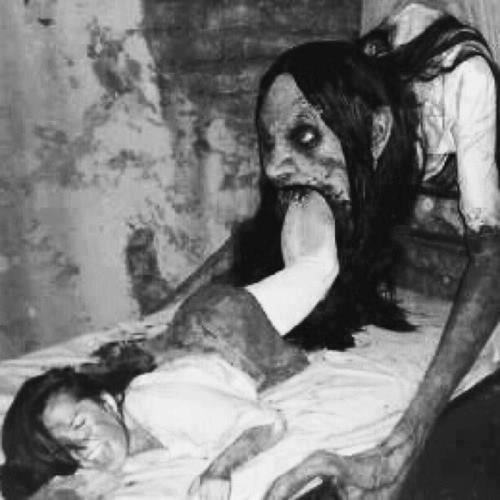
- This particularly nightmarish picture◊ of a girl being eaten by a giant monster is frequently associated with creepypastas and other scary internet material, even being ranked #1 on TheRichest's list of "15 Disturbing Images You Shouldn't See In The Dark". What many people don't know is that the image is actually of a scene in a haunted house that was featured at Hollywood's HHN in 2011. The house was called La Llorona: Villa De Almas Perdidas, and the scene in question is of an over-sized La Llorona eating a girl who's desperately trying to cling on to her bed.
- This has become a huge problem for Roguelikes as a whole. Up until the mid-2000s, "roguelike" had a very specific meaning among those who knew it, referring to a niche group of turn-based, tile-based dungeon-crawling affairs that traced their origins to mainframes in universities and many cases still preserved the original text mode graphics. But then games such as FTL: Faster Than Light, Spelunky, and The Binding of Isaac were compared to them, which snowballed into many, many games that incorporate permanent death and randomly generated levels to be referred to or even refer to themselves as "roguelikes", regardless of their actual gameplay. This has since become the most popular definition, leaving an entire genre without an unambiguous name.
- Though the term 'Roguelite' muddies it up further: Its definition (more-or-less "A roguelike where some manner of progress is retained between runs") encompasses many of the "new roguelikes", but not all of them...
- The famous Freddy's music box theme from Five Nights at Freddy's is actually Les Toreadors, composed by Georges Bizet.
- You've heard the Tetris theme song, right? Well, turns out it's actually a Russian folk song called "Korobeiniki", and is only really associated with Tetris outside of Russia. The association is so strong, that the otherwise public domain song has become a trademark of Tetris within the video game industry.
- Chances are, if you hear the names "Dante and Vergil", you'll be thinking of the two iconic brothers from the Devil May Cry series as opposed to the historical poets Dante Alighieri and Virgil from The Divine Comedy whom the characters are named after.
- Thanks to Final Fantasy VII, "Sephiroth" has become almost universally associated with its Big Bad, with very few knowing that his name originated from "sefirot", the Kabbalist term for the 10 attributes of God.
- World of Warcraft is absolutely the king of this, being both Troperrific and jam-packed with shout outs to damn near everything under the sun. From music/bands, novels, films and TV shows, and other video games, from the popular to the extremely obscure, if you name a piece of media, chances are pretty good that WoW has referenced it. This naturally leads to a great deal of Older Than They Think, particularly for the younger and more... culturally unaware in the fandom. This even applies to the Warcraft franchise itself, since the MMO contains many mythology gags which are shout outs to the older RTS games, and other Blizzard games. Just look at this list for examples. Beyond the references, gameplay elements themselves are victims to this, since WoW is the 800 lb gorilla of the MMO genre. Fandumb often accuses other games of "ripping off" WoW features, when those other games had them first.
- Similarly with Starcraft when Dawn of War came out there were plenty of Starcraft fans accusing it of ripping off Starcraft.
- Interesting example in that Dawn of War's source material is older than Starcraft, but its gameplay mechanic is not, making this Fan Dumb half of the time.
- Similarly with Starcraft when Dawn of War came out there were plenty of Starcraft fans accusing it of ripping off Starcraft.
- The Legend of Zelda: Ocarina of Time: Many people didn't know what an ocarina was before this game was released. They were fairly popular in Japan before the game was released, but in 1998, ocarina makers were suddenly inundated with orders for sweet potato (aka transverse) ocarinas. No, the little four-hole wooden ones wouldn't do. They had to be the 10-hole ceramic kind. And they had to be blue. Many music stores were sold out and couldn't figure out why.
- Humorously, it's not the first Zelda game that uses an ocarina either. Both The Legend of Zelda: A Link to the Past and The Legend of Zelda: Link's Awakening featured the instrument (and even the first game had a recorder which served a similar gameplay purpose), though it was not as central to the plot.
- And it's not even the first Nintendo game to use one. That would be Mother, but that one has an excuse.
- Many Western gamers assume that Guitar Freaks (or any long-running Japanese rhythm game) ripped off Guitar Hero. Guitar Freaks has been around since 1999; Guitar Hero wasn't released until 2005.
- People unfamiliar with the Touhou series will automatically assume that "U.N. Owen was her?" is called "McRolled" all thanks to a viral video much to the annoyance of fans who hate that name.
- Speaking of McRolled: the video itself is also subject to osmosis, as it was originally a Nico Nico Douga remix that was imported to YouTube via the title "Ronald McDonald Insanity". The "McRolled" title was used in an edit of the video to associate it more with hyperlink pranks like Rickrolling. And thanks to the original commercials used in the video never leaving Japan, most just associate them with the remix (and therefore Touhou) anyway.
- Even worse, someone posted a remix of "U.N. Owen Was Her?" as John Stump's "Death Waltz", causing much confusion between both songsnote .
- Hell, even if you know the original title, there's a good chance that you'll associate "U.N. Owen" with Flandre Scarlet more than you will Agatha Christie and the original source of the name.
- Similarly, the song "Bloomin' feeling" from beatmania could more or less be referred to as the "Jack Black Octagon remix" due to a similar video remixing the song with Jack Black's appearance on Sesame Street that went viral.
- Speaking of McRolled: the video itself is also subject to osmosis, as it was originally a Nico Nico Douga remix that was imported to YouTube via the title "Ronald McDonald Insanity". The "McRolled" title was used in an edit of the video to associate it more with hyperlink pranks like Rickrolling. And thanks to the original commercials
- The main character in Pokémon Red and Blue is named Red. But he's often called Ash (Satoshi in Japannote ) by people more familiar with the anime. Similarly, his rival Blue is referred to as Gary (Shigeru in Japannote ).
- It's less incorrect if the person in question is referring to the main character of Yellow, which incorporates many elements from the first season of the anime.
- Also to note, there are several alternative stock names for Red and Blue in the games, that happen to include both Ash and Gary respectively as each game's second option.
- This is pretty common in Super Mario World ROM hacks and Mario fan games in general since some of the more well-known ones use resources from obscure Japanese RPGs people likely haven't heard of (Romancing SaGa, Live A Live and Trials of Mana being some examples; these had only been translated officially in recent years) and as a result some people tend to associate said resources with the fan game/hack rather than the original SNES one. Such as how many people don't know that things like the Mirage Palace and Dark Castle are from Trials of Mana and not Brutal Mario, or that the 7 Koopalings boss is a parody of the final boss in Romancing SaGa 2. This can lead to awkwardness if people assume any resources from these games are plagarised.
- Due to the importance, prevalence, and market dominance of Nintendo and the Super Mario Bros. series of video games during the late 1980s and 1990s, in Latin America, clearing and finishing games were sometimes popularly referred to as "rescuing" in the games, regardless of what was being played. This was because the point and climax of most of the Mario games was, of course, to rescue the Princess. This tendency eventually subsided with time with the advent of other consoles that competed with Nintendo in the mid-late 1990s.
- Not everyone realises that virtually every significant character, all the enemy designs, and much of the character backstories of Ōkami are taken straight from Japanese mythology.
- And a lot of the characters and events from Samurai Warriors and its crossover spinoff Pokémon Conquestnote are if not actually accurate then very representative of events in real-life Sengoku-period Japan.
- Likewise, many people think the opening theme (and all the game's other music for that matter) of Frogger is original and attribute it to the game. Like this remix by OCRemix site founder DJ Pretzel. The opening is actually taken from an old Japanese children's song called Inu no Omawarisan. The acknowledgment on OC Remix was only added in much later.
- This also applies to the copyrighted anime themes that appear in the game as well. They come from Rascal the Raccoon, Heidi, Girl of the Alps, Hana no Ko Lunlun (split into two parts), and Moero Arthur: Hakuba no Oujinote .
- Many people consider the Cheetahmen theme to have come from Syobon Action due to the fact that Action 52 was a rather obscure NES game and Syobon Action featured that song prominently (and thanks to the Internet, it's far more well-known).
- The famous line from the beginning of Castlevania: Symphony of the Night, Dracula's "What is a man? A miserable little pile of secrets!", is actually a quotation from French writer André Malraux. Of course, part of what makes it the Narm Charm everyone loves is how it fits with the rest of the dialogue and how it's done by the So Bad, It's Good dub, regardless of how good the quote actually is.
- The characters in Eternal Fighter Zero are actually lifted from Air, Kanon, One: Kagayaku Kisetsu e, and MOON. (The last of these doesn't even have an anime or TV Tropes page.)
- The definition of insanity as "doing the same thing over and over again and expecting [something different]" is a quote commonly attributed to (but not verified to be said by) Albert Einstein. But these days, the quote is also highly associated with Far Cry 3's Vaas. Even if some people are aware the quote didn't come from him (and Vaas himself said he learned that quote from another guy), he's very likely to pop up in people's minds when it's brought up.
- The enchanting tables in Minecraft use the Standard Galactic Alphabet from Commander Keen. Due to the former being much more well-known, it's more commonly associated with Minecraft.
- Genshin Impact: One of the primary antagonist groups is The Fatui Harbingers, with members named after the stock archetypes from Commedia dell'Arte. Nowadays, googling their individual names will likely link you to their Genshin version before the Commedia version.
- Super Smash Bros.: F-Zero had not received a new game in the almost-20 years between Climax for the GBA and F-Zero 99. As a result, many younger gamers who didn't grow up with the franchise associate the series' rep Captain Falcon with Smash Bros. more than F-Zero. Some even believe he is an original character made specifically for Smash Bros., not realizing he appeared in his own series first.
- End Times, Constantly. Trace, Harry, and Charlie are all seeped in pop-culture knowledge and talk in references, sometimes for humor and other times very much not so.
- "I like the Doc as much as anyone, but the second movie still hasn't come out." "And it won't."
- "We're going to have to be The Avengers."
- The Nostalgia Critic: The line "Why 11? Because I like to go one step beyond." is a Memetic Mutation of a now obscure catch phrase from the TV show "One Step Beyond".
- Brows Held High: Fans of this show will recognize Rimsky-Korsakov's composition "Procession of the Nobles" better as the theme music of every episode.
- The Cinema Snob: For a long while Brad used "Believe It Or Not" by Joey Scarbury as his intro music for every episode. Many people would probably be surprised that this is actually a nod to the 1980s TV series The Greatest American Hero which used it as their theme music first.
- Hardly Working: Amir finds a box of his grandfather's Nazi stuff and believes him to be a fan of Wolfenstein, as he believes Nazis are fictional characters because he cut history class to play the game in school. Hilarity Ensues when he invites a "fan club" to the office.
- One Best of the Worst episode has the group surprise Rich Evans on his birthday with an old childhood photo of him at Showbiz Pizza Place note , standing next to Billy Bob, the chain's mascot, while wearing a shirt that says "Dick The Birthday Boy"◊, as well as a recreation of said shirt. The photo itself has since become a meme well beyond the fanbase of the show, to the point that few people are aware that it's Rich Evans in the photo.
- In a similar vein to "Sally the Camel", many people believe that the nursery rhymes "Johnny Johnny Yes Papa" and "Finger Family" were invented by YouTubers. They were originally traditional Indian and British nursery rhymes, with the latter originally starting as "Tommy Thumb" and appearing on several children's shows like Tweenies.
- Stampylongnose's iconic "Stampy Cat" Minecraft skin is actually a skin of Fidget from Dust: An Elysian Tail, who is additionally supposed to be a Funny Animal hybrid of a bat and a fox. Most players of Minecraft tend to associate the skin more with Stampy rather than Fidget.

- Many famous pieces of classical music have been hijacked by Walt Disney, Looney Tunes and other (usually older) animated sequences, and are many people's only exposure to such works. Many people still have the urge to sing "Kill da Wabbit" along to Richard Wagner's "Ride of the Valkyries", thanks to Elmer Fudd's memorable version in the classic Bugs Bunny short What's Opera, Doc?? And the use of a romanticized version of the Pilgrims' Chorus when Bugs enters on horseback, dressed as Brunnhilde, and fools Elmer/Thor (he used the same entrance, music, and disguise with equal success against Hermann Goerring in a wartime cartoon).
- 30 Rock had an episode where it's revealed Liz's cell phone ringtone is "Ride of the Valkyries", resulting in this exchange:
Phoebe: Oh, you like Wagner.
Liz: No, I like Elmer Fudd. - Warehouse 13, while tracking down an artifact via a psychic link, the character describes hearing "Kill da Wabbit", to the consternation of the classical music fan on the other end.
- Looney Tunes also stole heavily from "The William Tell Overture" by Rossini, to the point where almost every major theme in the piece has been used in some cartoon. For a lot of those, it's via another reference—see below.
- And Rossini suffers again in Rabbit of Seville, this time with the overture for the Barber of Seville.
- How many people can listen to Franz Liszt's Hungarian Rhapsody No. 2 and not be thinking of a cartoon at the same time?
- Dance of the Reed Flutes: Are you thinking of Cadbury's Fruit and Nut or Lemmings?
- Similar to the above with Dance of The Sugar-Plum Fairy for Tetris - although "Korobeiniki" (see further down this page) is even more strongly associated with it.
- Before Fantasia 2000, most people would (and still do) associate "Rhapsody in Blue" as the theme song of United Airlines or the opening scene in Manhattan.
- The Theme from Peter Gunn was composed for the TV series Peter Gunn, in 1958.
- Felix Mendelssohn's "Spring Song" has probably been heard and remembered more from old cartoons than from the concert hall or recordings.
- Likewise, if you've heard of the turn-of-the-century song "Hello, Ma Baby", it was probably from One Froggy Evening, or the parody of that scene in Spaceballs.
- Raymond Scott's "Powerhouse" is inextricably linked to assembly-line montages thanks to Looney Tunes.
- Or the Cartoon Network bumpers from the '90s.
- It's also widely known as the middle section of La Villa Strangiato and the accordion solo of "Rhythm Section Want Ad."
- Can anyone today even hear the English title of Verdi's Coro di zingari — a.k.a. the "Anvil Chorus" — and not think of Tiny Toon Adventures characters dropping anvils on one another? The actual song is about gypsies arising at dawn for their day's work, and looking forward to wine and women later on.
- You know the theme song to the old Road Runner cartoons? That's actually the Dance of the Comedians from Bedrich Smetana's "Bartered Bride". See for yourself.
- How about The Merry Go Round Broke Down for the Looney Tunes theme song?
- The character Foghorn Leghorn was based on the character Beauregard Claghorn, from Fred Allen's Allen's Alley radio program. Today all of his catchphrases will rather make people think of Foghorn rather than this forgotten radio show.
- "Poet and Peasant Overture" is another piece of background music used a lot in Looney Tunes. It was also used in the Animaniacs cartoon "Potty Emergency".
- 30 Rock had an episode where it's revealed Liz's cell phone ringtone is "Ride of the Valkyries", resulting in this exchange:
- "Sing, Sing, Sing", originally by Louis Prima, played most famously by Benny Goodman, is known to a whole generation of eighteen-to-twenty-somethings as "the Chips Ahoy song".
- "Sing, Sing, Sing" seems to be the stock music used to evoke '30s swing jazz.
- Woody Woodpecker's laugh is so universally recognized, that some people even forget where the Annoying Laugh to rule them all came from in the first place.
- Some young adults are reminded of Hey Arnold! when they hear music from Carmen, Pagliacci, or "Ride of the Valkyries" thanks to the episode "What's Opera Arnold"?
- The name of the episode itself is a shout-out to the well-known Bugs Bunny episode What's Opera, Doc?, and it also contains a parody of Elmer's infamous "spear and magic helmet" line.
- Most people across the world will rather recognize John Philip Sousa's "Stars and Stripes Forever" as Popeye's victory music than a classical piece.
- They're even more likely to make that association with the other piece used for that purpose, "Columbia, Gem of the Ocean".
- The animated Saturday morning show The Smurfs (1981) used nothing but clips of classical music for mood and theme setting.
- Futurama has an example in the boy from the pair of Victorian-dressed Street Urchin children who are recurring characters. They are clearly meant to evoke Charles Dickens, as his crutch is identical to that famously used by A Christmas Carol's Tiny Tim, although what the writers seem to have missed was that Tiny Tim was not one of Dickens' urchin characters. Then again, it's Futurama; it was probably on purpose.
- Lampshaded again in Futurama, as the Fungineers who designed the Moon Landing 'historical' recreation with singing whale hunters as astronauts have certainly gotten their historical facts through pop-cultural osmosis.
- Fungineering as a whole seems to be based on a massive foundation of Memetic Mutation.
- Not many fans outside America (or at least some outside Nixon's generation) remember that Spiro Agnew was an actual person, let alone one of Nixon's Vice Presidents.
- Another one from Futurama is simply the theme song. Most people associate it with the series, but it's actually just a slightly tweaked version of part of the Maurice Béjart ballet Mass for Our Time. The original was written back in 1967 by experimental composer Pierre Henry and is entitled "Psyché Rock".
- Lampshaded again in Futurama, as the Fungineers who designed the Moon Landing 'historical' recreation with singing whale hunters as astronauts have certainly gotten their historical facts through pop-cultural osmosis.
- The "Me, Love You Long Time" from the hooker in Full Metal Jacket have been incorrectly credited to both Family Guy and South Park.
- People of a certain age will probably first think of the 2 Live Crew song "Me So Horny".
- Or Sir Mix-A-Lot's "Baby Got Back", which similarly references the line.
- People of a certain age will probably first think of the 2 Live Crew song "Me So Horny".
- Ren & Stimpy's music for that show was made up almost entirely of classical and jazz music.
- Ren & Stimpy closely associate Raymond Scott's "The Toy Trumpet" with the army. The tune has been heard just everywhere, but no one can even place it: [1]
- Other people may associate The Toy Trumpet with Shirley Temple, as she sang it in one of her movies.
- Ren & Stimpy closely associate Raymond Scott's "The Toy Trumpet" with the army. The tune has been heard just everywhere, but no one can even place it: [1]
- Many kids today will hear old Hawaiian standards only to think they first came from SpongeBob SquarePants or Lilo & Stitch.
- Some people think the theme tune to SpongeBob is an original song. That's not the case, as it's originally a sea shanty called "Blow The Man Down", but given new lyrics.
- In the Henry and June segments on KaBlam!, kids might think that the ska background music originated from the show, but they're really just instrumental versions of songs by The Toasters.
- Also, the H&J shorts as well as Action League NOW! used various stock/classical pieces often used in SpongeBob SquarePants, The Mighty B!, The Ren & Stimpy Show, Bill Nye the Science Guy, and Garry's Mod Machinima.
- As the page image shows, Teenage Mutant Ninja Turtles will make sure every teacher talking about the Renaissance will have a joke regarding Leonardo da Vinci, Michelangelo Buonarroti, Donato di Niccolò di Betto Bardi,◊ and Raphael Sanzio◊.;
- Animaniacs tackles this head-on during a segment about Michelangelo.
Narrator (after four masked turtles hop out of a sewer pipe): I'm afraid popular culture has successfully eradicated the actual identities of the true poets of art. In my opinion, it stinks! And now for a brief reality check. Michelangelo Buonarroti was a brilliant artist. Not a turtle.- Epic Rap Battles of History later confronted them in "Artists vs. TMNT".
- Speaking of Animaniacs, Humoresque was a romantic piano piece composed in 1839, but most 90s kids call it the "Slappy Squirrel Theme".
- You would have a shorter list of characters who WEREN'T some example of this trope on Animaniacs than the ones who were. To name a few: Wakko, Runt, the Goodfeathers and The Godpigeon, The Brain, Mr. Director, ...
- Animaniacs tackles this head-on during a segment about Michelangelo
- The slow motion walk in Monsters, Inc. is often misattributed to Armageddon (1998), instead of The Right Stuff.
- Due to the penchant most voice actors had for impersonations, many young viewers were able to recognize the voices of famous actors and celebrities long before they had any idea of who they were.
- Ren & Stimpy were modeled after Peter Lorre and Larry Fine, respectively.
- Jabberjaw speaks like Curly (another of the Three Stooges), but like Rodney Dangerfield, often complains about not getting any respect.
- South Park:
- In one episode, Mr. Garrison is brought before a disciplinary committee for his actions from a previous episode. When they review just what he's done for the 3rd-grade education, one of them notes he hasn't even taught the kids about Samuel Adams, leading a confused Garrison to ask "Well who cares about a guy who makes beer?!", referencing the fact that most people are probably more familiar with the alcohol brand than one of the founding fathers of the country.
- Comedian Rob Schneider is slowly fading into obscurity for younger audiences and is nowadays better remembered as "Rob Sssschneider" (spoken in a dopey voice) in the spoof trailers used in the episode "The Biggest Douche In The Universe".
- The "Gay Fish" song sung by Kanye West is a spoof of his song "Heartless" and is also starting to eclipse the original in the popular consciousness.
- Pitt the Elder and Lord Palmerston? Americans will probably only recognize these two names from a one-off gag in The Simpsons episode Homer at the Bat than as British prime ministers.
- Speaking of The Simpsons, most fans of the show believe that Homer's line when he puts on a pair of lost glasses in the episode "$pringfield", "Sum of the square roots of any two sides of an isosceles triangle is equal to the square root of the remaining side", was originally written for the show, when it actually comes from The Wizard of Oz. It's gotten to the point where 3 of the top 5 results that come up when the quote is typed in on Google are related to The Simpsons, with the top related searches also being related to the line's quotation in the show.
- Here's a more obscure one. Kent Brockman's "insect overlords" line actually comes from a horror movie called "Empire of the Ants", which involves giant ants invading the Earth.
- Some people believe that the "Amendment To Be" segment in "The Day The Violence Died" was a Show Within a Show and not a spoof of Schoolhouse Rock!. This happens the most with people who either live outside of the United States (as Schoolhouse Rock was never exported to places outside of that country) or those who were kids during Schoolhouse Rock's decade-long hiatus.
- Family Guy: Most younger fans of this show are completely unaware of how many scenes in this program are directly lifted from other films, TV shows, animated cartoons, comics, and TV commercials. The most noteworthy of these is the theme song, which begins with Peter and Lois singing in front of a piano and was lifted from the intro of All in the Family.
- Many cartoon characters will imitate Curly Howard's mannerisms ("WOOP! WOOP! WOOP! WOOP!"), notably Homer Simpson and Dr. Zoidberg, but the reference is lost on younger viewers.
- My Little Pony: Friendship Is Magic has reached such Internet popularity over the years that only those who were young in the 1980s may remember the original "G1" incarnation on which it was based, almost three decades earlier.
- The song "Here Comes Peter Cottontail" which is commonly played during the spring and Easter seasons actually came from the lesser known Rankin/Bass holiday special Here Comes Peter Cottontail which shares the name of the song that came before it. However, a number of people would think and even believe that the song is actually about Peter Rabbit from The Tale of Peter Rabbit which doesn't help that Peter Rabbit also has a sister named Cottontail. As a result, some Americans would think that "Peter Cottontail" was Peter Rabbit's full name and the title of the book.
- This also can happen when a stock music track winds up being used in a show, since most of them do not generally get released to the public, causing people to think the song was written for the show. Two examples of this are "Sweet Victory" from SpongeBob SquarePants and "The Night Begins To Shine" from Teen Titans Go!.
- Many fans of Garfield and Friends think that Aloysius Pig was an original character made for the TV show when he was a spoof of comedian Kevin Meaney, who provides his voice, a fact which some didn't know about until he died 22 years after his episodes aired.
- A lot of people believe that Baby Kate's cry in Arthur was made specifically for that show before it appeared in other TV shows, movies and games. It actually is a stock sound effect that first appeared in the TV movie Stolen Babies, which premiered three years before that show.


- Many historical or literary characters live on in many people's minds because of their association with the name of a fictional character, which usually has nothing to do with the real-life counterpart. For examples, see Named After Somebody Famous.
- Certain historical characters have received a Historical Hero Upgrade and/or Historical Villain Downgrade, merely based upon how we, centuries later, look back at their legacy.
- Many founders of religions have been raised to the status of being some kind of inhumanly wise, kind, and perfect demigods.
- Cleopatra VIInote : Many people imagine her as Elizabeth Taylor in Cleopatra (1963) which while unusually accurate to the historical record, was far more glamorous, fitting to 20th-century beauty standards. At the very least she was certainly not the World's Most Beautiful Woman as the film most definitely implies.
- In modern times, the subject of Cleopatra's race is subject of significant debate because it's not quite known how she should be represented in media, mainly due to her being the Queen of the Ptolemaic Kingdom of Egypt, hence, Macedonian Greek in origin. This would make her not nearly as exotic, as 'native' Egyptian or even as an 'African queen' as Hollywood modern tendencies would state.
- Cardinal Richelieu: Thanks to The Three Musketeers we nowadays see him as a scheming villain in the French royal court, which is a very demonized version of the actual man, though again, not by much.
- Giacomo Casanova: All the book, TV series, and novel adaptations have depicted Casanova as some kind of handsome, charming, attractive young sex god. In reality, he wasn't actually that good looking and it's never been said that he was a great lover, just a good seducer. It also ignores many of his other endeavours, as Casanova indeed did more than just skirt chasing during his lifetime.
- Billy the Kid: Many stories will depict him as a vicious Big Bad who murdered countless people in cold blood. The actual Billy the Kid only has four confirmed murders attached to his name, which was still high by Wild West standards since The Wild West was not as bloodthirsty as you would believe.
- Jesse James is remembered because of the folk song which said "He stole from the rich and he gave to the poor" and for various movie adaptations. The real Jesse James was a Confederate guerilla and slaveowner who massacred Union soldiers and once robbed medicine supplies for the poor. He was also a Crossdresser and perhaps a male prostitute.
- Some people who hear the name Jesse James may think that you're referring to Team Rocket.
- Guy Fawkes, the man who wanted to blow up the English Parliament in 1605, has changed into a popular bonfire puppet on Bonfire Night in the UK and into a worldwide symbol of anarchism and rebellion since his depiction in V for Vendetta, even though this comic strip and the film adaptation have nothing whatsoever to do with the real-life Fawkes' ambitions.note
- Gerald Ford: President Ford occasionally fell over during televised broadcasts, yet not as much as popular culture would like you to believe. In fact, during his youth, he was arguably the most athletic President of all time- the Captain for the University of Michigan who had been scouted by NFL teams. One of his football injuries caused his knee to go out unexpectedly. There's a famous film of him descending from Air Force One, stumbling on the steps and muttering "Damn!!" as he knew the cameras were on him. The image of Ford as a clumsy oaf who just bumps into stuff trips over objects, and makes almost his entire environment collapse is more a result of Chevy Chase's depiction of him in Saturday Night Live at the time.
- Michael Jackson: Nine times out of ten, popular culture will depict Jackson as some kind of helium-voiced Manchild with a chimpanzee on his arm, shouting "Shamone!" or "You're ignoràààànt". First of all, his voice was certainly soft, but not as squeaky as many imitators have turned it into (and he was quite capable of affecting a deep and manly voice, as on the title track to Dangerous). His depiction as an infantile and naïve person is also exaggerated. After all, Jackson was an adult and described by many as a clever businessman. The idea that Michael says "shamone" a lot is derived from the Bad era, where he shouted "come on" during "Bad" and "Man in the Mirror" in such a way that many people misheard it as "shamone" and comedians ever since have pronounced it that way. The idea that Jackson says "You're ignorant" is lifted from South Park parodies of the man.
- Napoléon Bonaparte: Thanks to being depicted as a pathetic dwarf in many early 19th-century British newspaper cartoons, Napoleon is often depicted as such in popular culture, although he was actually of slightly above average height, and almost certainly had no complex or envy to conquer because of it. Needless to say, this comes from British propaganda hence you won't hear the tiny inconvenient fact that the British declared war on Napoleon first and broke the Peace of Amiens.
- Maximilien Robespierre is The Dandy who guillotined people and was a total psychopath during the Reign of Terror, thanks to two centuries of consistent demonization. The real guy while seriously flawed was a deeply complex and ambiguous figure and most definitely not a dictator as the common portrayals imply. At the very least, he was definitely The Dandy and a real clotheshorse. While he was personally a man of probity and lived frugally, clothes were his one luxury.
- Elvis Presley: His greasy quiff has been exaggerated as being enormously huge and long in popular culture, mostly thanks to depictions in cartoons, by Elvis imitators and groups like Leningrad Cowboys. When you look at actual photos or archive footage you'll notice that it's actually not that grotesque.
- Rasputin the Mad Monk: Popular culture tends to depict him as an insane villain who plots to overthrow the Czar and/or is some kind of immortal demon. In reality, Rasputin was nothing but a debauched man who had gained the trust of the Czarina, thanks to being able to heal her son, while other doctors couldn't. note He never did anything to overthrow the Czar and why would he? He had tremendous power as her advisor. The idea that he could not be murdered has been based on the anecdote that his assassins had repeatedly tried to kill him, but failed. It's more safe to assume that their failed methods of trying to assassinate him were just the result of incompetence, rather than Rasputin being invincible or something. Or that they largely made up the story for fame and/or to explain why it took them so long.
- Antonio Salieri was an 18th and 19th-century composer who was very famous during his lifetime but faded into obscurity in the decades beyond. In 1984 he suddenly became more famous again, thanks to Amadeus (1984), in which he is incorrectly portrayed as the Arch-Nemesis of Wolfgang Amadeus Mozart. Nevertheless, the film did help renew interest in his work, which — in many cases — was even recorded on albums for the first time!
- Ringo Starr: Many cartoons, like The Beatles, have incorrectly portrayed him as a Too Dumb to Live buffoon. The portrayal lives on to this day.
- T. E. Lawrence owes his universal fame mostly to the film Lawrence of Arabia.
- William Wallace and Robert the Bruce have become more internationally famous since Braveheart (1996), but more as the way they are depicted in this film, which is a very far cry from actual historical events. Many people nowadays imagine Wallace as Mel Gibson's depiction in that film. There was an actual outcry of Americanization when a statue of Wallace resembling Mel Gibson was placed in his native town. It was eventually removed. Similarly, the Scottish government wanted to sue the film makers for depicting their national hero as an unconfident double-crosser of Wallace.
- George Washington and Abraham Lincoln have both been romanticized by American historians in the centuries beyond as some sort of demigods who were always honest and never told a lie. More serious historical research since the late 20th century has finally put a stop to this idea, but the image still lives on in popular culture.
- Francesco Zappa is an obscure and nowadays almost completely forgotten 18th-century composer from Italy. Yet, fans of Frank Zappa will have heard from him as Frank Zappa recorded an album in 1984 called Francesco Zappa. Unfortunately many people, even Zappa fans, incorrectly think that 'Francesco Zappa' is just a pseudonym for Zappa pretending to be a baroque composer, while in reality, the music on that album is all real scores written by this 18th-century composer, who wasn't related to Frank Zappa at all. All Frank Zappa did was score the music on his Synclavier computer, making Francesco Zappa effectively a Cover Album.
- Tutankhamun (AKA King Tut): Most people remember him more for the so-called "curse" rather than his actual reign. Blame all the countless "Mummy" movies for that. Of course, there wasn't really much to remember about his reign except that it ended his father's experiment with monotheism. His fame stems pretty much entirely from the fact that he was the only pharaoh whose tomb was not emptied by grave robbers before it was discovered by archaeologists...
- Spartacus is imagined by many people to look like Kirk Douglas did in the eponymous 1960 movie. Of course, since no images or first-hand accounts of Spartacus's appearance exists, one cannot say for certain that Spartacus didn't look like Kirk Douglas.
- King Canute once ordered the sea to pull back, but then got splashed by the tide still coming in. This is about all present-day people remember about him. They forget that Canute was actually demonstrating to his vainglorious courtiers that no man was more powerful than God (or nature) and that the famous anecdote wasn't just proof of how moronic this king supposedly was for trying to command the tide.
- King John of England and Richard the Lionheart live on today more as characters in the legend of Robin Hood, rather than real-life English kings. More recently, Richard the Lionheart is often portrayed as a homosexual thanks to the speculative portrayal of him in The Lion in Winter although most scholars are skeptical about this portrayal. In fact, it is more likely that Richard and John's middle brother Geoffrey engaged in homosexual behavior, including the affair Richard has in "Lion in Winter" with Philip II of France.
- Richard III is considered the patron saint of the Historical Villain Upgrade, thanks to a century of over-the-top Tudor propaganda and Shakespeare's deliciously villainous portrayal. For centuries the one crime most historians thought Richard did commit was murdering his nephews, but his defenders, known as Ricardians, have recently produced documents that they believe exonerate him. Ricardians have been stanning for him since at least the early 1600s and point out that he was a brave and competent military commander who went down fighting, as king made some wise legal reforms and his nephews' bodies were never found. The fact that he was an inspiration for both Tyrion Lannister and Stannis Baratheon and the extraordinary story of the discovery of his remains hasn't hurt his popularity, but the truth about the man remains elusive.
- Speaking of Richard III, his older brother Edward IV is far more remembered for his decision to marry a commoner and alienating his key allies than the fact that he was a brilliant Warrior King and occasionally astute politician.
- Henry VIII is more remembered today for being a Big Eater and the business with his six wives than for his political deeds.
- Ah, "Bloody Mary". You are referring to the drink right? The nickname of Mary Tudor? Oh...
- Queen Victoria is closely associated with the phrase "We are not amused", something she never wrote down in real life. There are many historical documents where she used the term "We were very amused", though. The "We are not amused" phrase probably originated from all the photographs in which she looks deadly serious while wearing a dark dress.
- Mongol warlord Kublai Khan is more famous nowadays as the subject of a famous poem by Samuel Taylor Coleridge.
- Christopher Columbus is closely associated with the story of how he supposedly made an egg stand upright on a table by cracking its bottom half. Despite this tale still popping up in many child-oriented media, there is no historical evidence Columbus ever did this, nor that he invented this trick. It's more likely that his name was just used to give the story more weight by adding one of the most well-known historical characters to it.
- Walter Raleigh is closely associated with a popular anecdote: he once used his coat to help the English Queen cross a filthy pool. Yet it has been proven that it was completely made up. Still, the association endures.
- If you mention Galileo Galilei, many people may think you're quoting from Queen's song "Bohemian Rhapsody" rather than talking about the 17th-century scientist.
- The Red Baron will bring up associations with Snoopy's imaginary foe rather than the nickname of real-life World War I pilot Manfred von Richthofen.
- Mata Hari has evolved into the archetypical Femme Fatale Spy who was the best in her profession. Of course, that's what all those novels, comics, films, and TV adaptations would want you to believe. In reality, she was a very mediocre spy. German secret intelligence only gave her more importance and notoriety to distract the French military forces who had arrested her.
- Humanitarian activist Oskar Schindler and Nazi commander Amon Goeth owe much of their posthumous fame thanks to Steven Spielberg's film adaptation Schindler's List of Thomas Keneally's novelization "Schindler's Ark". In Real Life, the incidents surrounding their actions were minor but important footnotes in a vast tragedy, and the actions taken by Schindler, while not without merit, were more typical than the film would have you believe.
- Most people know 1920s and 1930s Treasury agent Eliot Ness better thanks to the TV series The Untouchables and film The Untouchables (1987). Or Tupac Shakur's "California Love".
- The international infamy of Bonnie and Clyde owes a lot to the 1967 film Bonnie and Clyde.
- An old lady who is the head of a notorious criminal gang has become a stock character in many comedies, comics and cartoons, including The Goonies, Lucky Luke and DuckTales (1987) and Boney M.'s hit song "Ma Baker". But she was derived from a real-life mother of an actual criminal, Fred Barker, who in reality had little to do with Barker's gang.
- Marilyn Monroe lives on in the imaginations of many as a gentle Dumb Blonde. That this was a result of typecasting and not who she was in real life doesn't dawn on them, nor that she was a very good actress who was admired and respected in France and Germany, and cited as a great comedienne.
- Most people in Europe have based much of their notion about the ancient Gauls on what they've read in Asterix. For instance, mention the word "druid" and everybody will envision Panoramix (Getafix in the English version). The same goes for the idea that all the Gauls had moustaches, wore winged helmets, and had names that ended in "-ix".
- The word "vandal" is used to describe people who deliberately want to destroy things. How many know it originally referred to a Germanic tribe, the Vandals, who founded an empire in North Africa during the "Dark Ages" and were not really more notorious for pillaging than other tribes? The pejorative use of "vandal" and "vandalism" in fact only arose during the French Revolution when a word to castigate the destruction of cultural monuments by revolutionary mobs.
- Similarly, the word Goth now brings to mind the stereotype of a modern subculture of people who wear a lot of black and listen to depressing music, rather than the various Gothic tribes who invaded Europe in the second quarter of the first millennium AD and were the eventual destroyers of the Roman Empire.
- For what it's worth, the word "Gothic" will likely be associated first with horror fiction, rather than actual Medieval buildings that served as a loose visual inspiration for the genre.
- Thanks to numerous pirate stories set in The Golden Age of Piracy, most people see pirates as noble and adventurous rebels who have a lot of fun sailing the oceans, attacking ships, and burying treasures on Deserted Islands. In reality, they were poor sailors who turned to crime, hardly ever attacked ships violently, rarely mounted a great haul, and spent all their loot as quickly as possible.
- Blackbeard, conversely, is widely assumed to have been a blood-crazed butcher who slaughtered people by the shipload, due to a combination of this trope and his own deliberate self-promotion. In actual history, the only people he was ever documented to have killed were aboard the colonial sloops that finally hunted him down.
- To some people, Lady Murasaki is best known as Hannibal Lecter's widowed aunt rather than the world's first novelist.
- Almost everything people think they know about the Three Kingdoms (or Sanguo) era of Ancient China is instead a piece of popular fiction, largely from the Romance of the Three Kingdoms (or Sanguo Yanyi). Owing to a complicated history of post-Three Kingdom dynasties, false "historical" records, and the sheer depth to which the fictionalisation of the era is ingrained in Chinese culture, very little of what is "known" matches up with reality. Zhuge Liang and Guan Yu were terrible generals, Zhang Fei and Zhao Yun were unremarkable warriors, Xiahou Dun was a poor commander but an important administrator, Cao Pi wasn't a tyrant, Cao Rui was a fair and progressive emperor, Sun Shangxiang wasn't named Shangxiang, etc. Important figures such as Lu Fan and Zhong Yao don't even get mentioned, let alone given due credit.
- The name "Elizabeth Bathory" probably brings to mind images of a beautiful vampire-esque woman bathing in the blood of virgins to restore her youth. In real life, no such charge was ever leveled by her contemporaries—some of the allegations were equally lurid, describing marathon torture sessions that flooded the floor with blood and putting the number of her victims at 650, but there's nothing about virgin blood making her younger. Bathory did abuse and murder her servants, and would likely have continued to get away with it had she not made the leap to the daughters of minor gentry, but it was run-of-the-mill sadism enabled by her wealth and power, not attempted blood magic.
- Caligula was certainly a bad ruler—particularly after his near-fatal illness and the death of his favorite sister—but likely did not actually hew as close to the trope named for him as pop cultural perception would suggest. There is evidence that a lot of his crazier stunts were just that. Naming his horse consul, for example, was probably an insult to the Senate, not an actual expectation that his horse would govern (especially as by this point in Roman history, the title of consul was almost purely ceremonial—being suffect consul, which was what the horse got, meant the year would be named after you, and that's about it). Also, there's no actual proof he was sleeping with his sisters. He very obviously, and against etiquette, favored his youngest sister Drusillanote , which probably contributed to the incest accusations, but such talk was also bog-standard Roman political mud-slinging, so it's not exactly reliable. Ancient Roman historians should never be taken 100% at face value about anyone, especially when they get as dramatic as they get about Caligula.
- Andrew Jackson is forever known by the public for his duels and to an infamous extent for the Trail Of Tears, but his other economic and government policies are ignored for not being as shocking.
- Horrible Histories is becoming this for British history to the British youth:
- It's common for younger viewers to associate the actors in Series 1 to 5 with many British historical figures with people thinking of Ben Willbond as Henry VIII, Jim Howick as George IV, Lawry Lewin as Oliver Cromwell, etc.
- Charles II is forever seen as "The Merry Monarch" and "The King Who Brought Back Partying"
- Dick Turpin is forever imagined by young people as Mat Bayton and the song "Dick Turpin"
- Whenever the rhyme "Divorce, Beheaded, Died, Divorce, Beheaded, Survived" is said it is hard to not imagine the entire Horrible Histories song with Ben Willbond as Henry VIII.
- Young people associate Horrible Histories's "Monarch Song" much more than the traditional mnemonic verses of monarchs in England, though "Willie Willie Harry Stee" is much harder to remember than "William William Henry Stephen".
- Certain regions, cities, and towns are only famous to the general public because of their association with a certain novel, film, song, or other work of art or historical event, being the location of a famous landmark, or their association with a famous person. Some people, usually not the inhabitants of the place themselves, may even be amazed that the examples made famous by fiction actually exist.
- Abbey Road, London: Made famous by The Beatles album Abbey Road.
- Aberdeen, Washingon: The hometown of Nirvana's Kurt Cobain and of wrestler Bryan Danielson, a.k.a. Daniel Bryan.
- Agra, India: The Taj Mahal.
- Alabama, USA: The Stephen Foster song "Oh! Susanna" (I've come from Alabama / with a banjo on my knee) or Lynyrd Skynyrd's "Sweet Home Alabama". Country music fans may instead think of the band, and college football fans will think only of the Crimson Tide.
- Albuquerque, New Mexico: The city where Bugs Bunny after a long period of digging tunnels "should have made a left turn." Also, the city where, according to "Weird Al" Yankovic, "the air smells like warm root beer, and the towels are oh-so-FLUFFY!" More recently it's been the setting of Breaking Bad and Better Call Saul.
- Alcatraz, San Francisco, USA: Escape from Alcatraz, Alcatraz, Alcatraz Series, Planet Alcatraz,...
- Alexanderplatz, Berlin: The novel and film Berlin Alexanderplatz.
- Amityville, New York, USA: The horror film The Amityville Horror (1979).
- Antwerp, Belgium: The Japanese know it for A Dog of Flanders, in which Nello and his dog Patrasche visit the Antwerp cathedral.
- Appomattox, Virginia: The Appomattox Court House, where the American Civil War ended.
- Avignon, France: The song "Sur le pont d'Avignon".
- Astoria, Oregon: The Goonies
- Baker Street, London, Great Britain: Supposedly the address of Sherlock Holmes, or the eponymous song by Gerry Rafferty.
- Beersel, Belgium: Has become famous in Flanders and the Netherlands for the Suske en Wiske album De schat van Beersel (The treasure of Beersel).
- Beverly Hills, California: The TV series The Beverly Hillbillies and Beverly Hills, 90210.
- Bikini Atoll, Marshall Islands: Bikini Bottom from SpongeBob SquarePants.
- Blairstown, New Jersey: Friday the 13th (1980)
- Bradford, Doncaster, Holmes Chapel, and Wolverhampton, England; and Mullingar, Ireland: The respective home towns of One Direction members Zayn Malik, Louis Tomlinson, Harry Styles, Liam Payne, and Niall Horan.
- Braunau am Inn, Austria: The birthplace of Adolf Hitler.
- Bremen, Germany: The fairytale The Bremen Town Musicians.
- Brittany, France (French: Bretagne): This region has a strong association with the comic strips Asterix and Bécassine.
- Bruges/Brugge, Belgium: The film In Bruges and the Jacques Brel song Marieke where the girl Marieke is loved between the towers of Bruges (Brugge) and Gand (Gent).
- Burkittsville, Maryland: The Blair Witch Project.
- Calgary, Alberta: Home of the Hart wrestling family.
- Canton, Ohio: The Pro Football Hall of Fame.
- Cape Fear, North Carolina: Cape Fear.
- Cardiff, Wales, United Kingdom: Pops up occasionally in Doctor Who as well as being the main setting for its spinoff series, Torchwood.
- Casablanca, Morocco: Casablanca.
- Chelsea Hotel, New York City, USA: "Chelsea Hotel" by Leonard Cohen from New Skin for the Old Ceremony, "Chelsea Girl" by Nico, "Chelsea Girls" by Andy Warhol.
- Chernobyl (or Chornobyl), Ukraine: The Chernobyl nuclear disaster.note
- Cleveland, Ohio: "Cleveland Rocks", Major League, The Drew Carey Show. Or the stomping ground of LeBron James for most of his NBA career.
- Coconut Grove, Miami, Florida, USA: The song "Coconut Grove" by John Sebastian, later recorded by The Lovin' Spoonful.
- Cocoa Beach, Florida, USA: The town where Jeannie in I Dream of Jeannie lives.
- Columbine, Colorado: The Columbine massacre of April 20, 1999.
- Columbus, Ohio: Ohio State University; Family Ties; the former home of the Main Character in Zombieland.
- Compton, California: The N.W.A album Straight Outta Compton and their 2015 biopic of the same name.
- Cooperstown, New York: The National Baseball Hall of Fame.
- Copacabana, Rio de Janeiro, Brazil: The song Copacabana by Barry Manilow... was actually about the New York City nightclub that took its name from the neighborhood in Rio.
- Corleone, Sicily, Italy: The main family name in The Godfather.
- Cucamonga, California (now known as Rancho Cucamonga): Made famous by Mel Blanc's train conductor in Jack Benny's radio shows. Also, Inherently Funny Word. More recently, Workaholics.
- Dallas, Texas, USA: Dallas.
- Damme, Belgium: The birthplace of Till Eulenspiegel according to Charles De Coster's novel Till Eulenspiegel, or as part of Jean-Claude Van Damme's name.
- Dayton, Ohio: The Wright brothers.
- Deadwood, South Dakota, USA: Deadwood.
- Death Valley, California: The Undertaker
- Den Haag, Nederland: Haagse Harry.
- Dust Bowl (mostly identified with Oklahoma): Woody Guthrie's album Dust Bowl Ballads.
- El Paso, Texas, USA: The song El Paso by Marty Robbins.
- Elm Street, Dallas: The street was made famous by the fact that John F. Kennedy was murdered here, which inspired Wes Craven's A Nightmare on Elm Street.
- Eugene, Oregon: The University of Oregon; where most of Animal House was filmed.
- Exmoor, Great Britain: The legendary Beast of Exmoor supposedly lives there.
- Fargo, North Dakota: The film Fargo (and its subsequent TV spinoff), which, by the way, doesn't even take place in Fargo!
- Ferguson, Missouri: The fatal shooting of African-American teenager Michael Brown by police officer Darren Wilson, and the subsequent nationwide unrest it sparked.
- Frankenstein Castle (Burg Frankenstein), Darmstadt, Germany: Frankenstein
- Folsom, California, USA: The Johnny Cash album At Folsom Prison.
- Forks, Washington: Twilight
- Fucking, Austria: Sharing its name with an English-language curse word. It has become somewhat of an Internet meme, though it actually exists. Or, at least it did until the town changed the spelling of its name to Fugging in 2021.
- Gainesville, Georgia: The hometown of AJ Styles
- Gand/Gent, Belgium: The Jacques Brel song Marieke where the girl Marieke is loved between the towers of Bruges (Brugge) and Gand (Gent).
- Gangnam District, Seoul: The song "Gangnam Style" by PSY.
- Gary, Indiana: The hometown of Michael Jackson and his family.
- Gori, Georgia: The birthplace of Joseph Stalin.
- Gotham, Nottinghamshire, England: Gotham City.
- Grand Coulee Dam, Washington, USA: "Grand Coulee Dam" by Woody Guthrie.
- Green Gables, Cavendish, Prince Edward Island, Canada: Anne of Green Gables.
- Greenwich, Connecticut: The kayfabe hometown of Triple H.note
- Grenoble, France: The kayfabe hometown of André the Giant.note
- Grosse Pointe, Michigan, USA: Grosse Pointe Blank.
- Hameln, Germany: The Pied Piper of Hamelin
- Highclere Castle, Hampshire, England: Downton Abbey.
- Hiroshima and Nagasaki, Japan: The atomic bombings.
- Hodgenville, Kentucky: The town closest to the birthplace of Abraham Lincoln.
- Hope, Arkansas: The birthplace of Bill Clinton.
- Hot Springs, Arkansas: The national park in the center of town. Also where Bill Clinton grew up.
- Houston, Texas, USA: Since Apollo Thirteen, itself based on a real-life incident, it's associated with the phrase: "Houston, we have a problem."
- Hyde Park, New York: The hometown of Franklin D. Roosevelt.
- Ipanema, Rio de Janeiro, Brazil: The song "The Girl From Ipanema".
- Kansas: The Wizard of Oz. Or the band... or the Jayhawks.
- Kenosha, Wisconsin: Birthplace of Orson Welles and the famous "Did you ever hear of the Kenosha Kid?" refrain from Gravity's Rainbow.
- Key Largo, Florida: The film noir classic Key Largo and the 1982 Bertie Higgins One-Hit Wonder.
- Kitty Hawk, North Carolina: The Wright Brothers' first flight.
- Klondike, Yukon, Canada: The town where Scrooge McDuck amassed his first fortune, according to Carl Barks and Don Rosa's Donald Duck comics.
- Kobbegem, Belgium: Where Adhemar in Nero's laboratory is located.
- Köpenick, Germany: "The Captain von Köpenick".
- Kwai River, Cambodia: Made famous by Pierre Boulle's book and the Oscar-winning film adaptation The Bridge on the River Kwai.
- Leicester, U.K. They found a skeleton under a carpark once.
- Leonardo, New Jersey: The View Askewniverse.
- Lima, Ohio: Glee.
- Litchfield, New York: Orange Is the New Black.
- Liverpool, England: The Beatles.
- Llanfairpwllgwyngyllgogerychwyrndrobwllllantysiliogogogoch, Wales: Yes, it is frequently used as an Overly Long Name in comedies, but this location is 100 percent real.
- Loch Ness: According to legend the Monster of Loch Ness has been sighted there for a long time.
- Lowell, Massachusetts: The Fighter.
- Lynwood, California: The "Weird Al" Yankovic album Straight Outta Lynwood.
- Madagascar: The animated film series.
- Marion, Indiana: The birthplace of James Dean.
- Miles City, Montana: Willy Wonka & the Chocolate Factory.
- Milwaukee, Wisconsin: Happy Days.
- Nashville, Tennessee: The country music industry.
- Newport Beach, California: Arrested Development; The O.C.
- Newtown, Connecticut: The Sandy Hook Elementary School shooting of December 14, 2012.
- Nottingham, England: Robin Hood.
- Nürnberg, Germany: Die Meistersinger Von Nurnberg. Or the Nuremberg trials of high-ranking Nazis after WWII, dramatized in Judgment at Nuremberg.
- Odessa, Texas: Setting for the nonfiction book Friday Night Lights and its film adaptation.
- Oklahoma, USA: The play and musical Oklahoma!.
- Olympus, Greece: Mount Olympus where, according to Greek Mythology, the gods live.
- Oxford, England: Oxford University.
- Penny Lane, Liverpool, Great Britain: The Beatles song Penny Lane
- Philadelphia Museum of Art: Rocky.
- Piqua, Ohio: Captain Underpants.
- Pismo Beach, California, USA: The location Bugs Bunny always looks like when digging tunnels.
- Point Pleasant, New Jersey, USA: Point Pleasant.
- Porbandar, India: The birthplace of Mahatma Gandhi.
- Prague, Czech Republic: The Golem.
- Pulaski, Tennessee: The birthplace of the original Ku Klux Klan (KKK).
- Punxsutawney, Pennsylvania: Home of Groundhog Day mascot Punxsutawney Phil; and the film based on the holiday. Also hometown of AEW's Britt Baker.
- Reet, Belgium: Dutch comedian Dolf Brouwers had a Funny Foreigner Belgian character note called Sjef Van Oekel, who was supposedly from Reet.
- Rhode Island: Location of Quahog, the setting of Family Guy.
- Route 66, traveling through several western US states: The song "Route 66" as well as the Cars films.
- Saint Tropez, France: Le Gendarme de Saint-Tropez.
- Salzburg, Austria: The birthplace of Mozart; The Sound of Music.
- San José, California, USA: The song Do You Know The Way To San José?
- Santa Barbara, California: Psych, or the soap opera Santa Barbara.
- Santa Monica, California: Three's Company; Everclear's 1995 hit.
- Scranton, Pennsylvania: The Office (US), and for older folks the song Thirty Thousand Pounds of Bananas by Harry Chapin, which was in turn based on a real event.
- Seaside Heights, New Jersey: Jersey Shore (although the show is a reality series and it's a popular resort town for New Jerseyans).
- Selma, Alabama: The Selma to Montgomery marches.
- Seneca Falls, New York: The women's rights movement; It's a Wonderful Life.
- Seville, Spain: The Barber of Seville.
- Shanksville, Pennsylvania: United Airlines Flight 93.
- Shaolin Temple, China: Known for countless martial arts movies.
- Sherwood Forest, Nottinghamshire, Great Britain: The hiding place of Robin Hood.
- Sing Sing prison, Ossining, New York, USA: This is referenced a lot in comedies and cartoons, usually with a Punny Name variation.
- Silsbee, Texas: Home of Mark Henry.
- Sleepy Hollow, New York, USA: The Legend of Sleepy Hollow
- South Park, Colorado, USA: South Park note
- Any U.S. town named Springfield: The Simpsons
- Springfield, Illinois: The longtime hometown of Abraham Lincoln.
- St. Louis, USA: The jazz standard St. Louis Blues.
- Stevens Point, Wisconsin: Liv and Maddie.
- Stone Mountain, Georgia, USA: The birthplace of the second Ku Klux Klan. Ironically, it now has a majority African-American population.
- Stratford-upon-Avon, England: The birthplace of William Shakespeare.
- Stratford, Canada: The hometown of Justin Bieber... which hosts a major Shakespeare festival that predates Bieber by decades.
- Tampico, Illinois: The birthplace of Ronald Reagan.
- Tipperary, Ireland: The song It's a long way to Tipperary.
- Tollembeek, Belgium: Known in Flanders and the Netherlands from the comic strip Urbanus.
- Topeka, Kansas: Brown v. Board of Education of Topeka; home of the Westboro Baptist Church.
- Tombstone, Arizona, USA: Tombstone.
- Torquay, England: Known as the location of Fawlty Towers.
- Trannsylvania, Romania: The home province of Dracula.
- Trenchtown, Jamaica: Immortalized in Bob Marley's song Trenchtown Rock from Live!.
- Tupelo, Mississippi: The birthplace of Elvis Presley.
- Tunisia: Hot, dry North African country where four of the Star Wars movies were filmed.
- Twin Peaks, San Francisco, California: Two hills in San Francisco, made famous by the series Twin Peaks (which takes place in Washington State).
- Van Cortlandt Park, North Bronx, NYC: This was where the infamous "CAN YOU DIG IT?!" scene in The Warriors was shot.
- Vasquez Rocks in California deserve a mention. Most people have never heard of the place but will recognize it instantly from numerous Westerns and, more notoriously, Captain Kirk's fight with the Gorn.
- Venice Beach, California: Kayfabe hometown of Hulk Hogan.
- Vermont, USA: The jazz standard Moonlight in Vermont and Captain Beefheart's "Moonlight on Vermont" from Trout Mask Replica.
- Verona, Italy: The hometown of Romeo and Juliet.
- Vesoul, France: From the Jacques Brel song "Vesoul".
- Victoria, Texas: The hometown of "Stone Cold" Steve Austin.
- Vienna (Wien), Austria: Geschichte aus der Wienerwald ("Tales from the Vienna Woods") by Johann Strauss.
- West Newbury, Massachusetts: The real hometown of John Cena.
- Winslow, Arizona, USA: The song "Take It Easy" by the Eagles.
- Woodbury, Georgia: The Walking Dead.
- Wyomissing, Pennsylvania: The hometown of Taylor Swift.
- Yuma, Arizona, USA: 3:10 to Yuma (1957) and its 2007 remake.
- An example outside our solar system: There's a star named Bellatrix (which briefly gets mentioned in Planet of the Apes (1968)). Nowadays, when most people hear that name, they think of one specific person named after that star.
- Many people who live outside the United States or Canada assume that Chuck E. Cheese is a fictional stand-in restaurant in media, due to how frequently it's featured in US-produced works.
- In non-English-speaking countries, the word "spam" is almost exclusively known as its modern definition of undesired telecommunication or repetitiveness rather than the luncheon meat product and the Monty Python's Flying Circus sketch the meaning derives from.
