
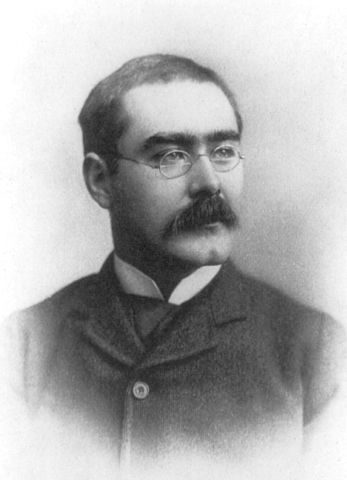
Joseph Rudyard Kipling (30 December 1865 – 18 January 1936) was a Nobel Prize-winning English writer. He was born in Bombay, India during The Raj, and having British India as a place of upbringing inspired much of his work.
Many of Kipling's works, including The Jungle Book, are set in British India, and popularised most of the associated tropes. His other works include some early Science Fiction, while his literary style, particularly indirect exposition, was a significant influence on Campbell, Bertolt Brecht and Robert A. Heinlein. He was a favourite of Henry James, T. S. Eliot, Jorge Luis Borges, Neil Gaiman and others. Even Salman Rushdie while disagreeing entirely with his politics, his viewpoints, and values, agrees that Kipling's work, biased as it is, does capture a sense of an authentic India, which despite his imperial viewpoint, he did get right to an extent.
And what is more, Kipling was an innovator in the short story form and a prolific author of many stories and tales. In Pop-Cultural Osmosis, Kipling is best known as the creator of Mowgli, star of The Jungle Book, popularized and immortalized by its cartoon and live-action adaptations.
Kipling's stories include:
- The Man Who Would be King
- The Jungle Book, introduced Mowgli (and Rikki Tikki Tavi)
- Captains Courageous
- .007
- Stalky & Co.
- Kim, novel capping Kipling's India stories.
- Puck of Pook's Hill and the sequel, Rewards and Fairies.
- The Mother Hive
- "With the Night Mail" and "As Easy as ABC," SF involving Cool Airships run by the Aerial Board of Control.
- The Just So Stories, tales written for his children based on Eastern and African myths and folktales.
Poems include:
- "The White Man's Burden"
- "If—" ("If you can keep your head when all about you / Are losing theirs and blaming it on you" — one of his most famous poems, much quoted. A portion of the poem can be seen by players entering Centre Court at Wimbledon.)
- "My Boy Jack"
- "The Female Of The Species"
- "The Thousandth Man"
- "Recessional"
- "The Three-Decker"
- "Gunga Din" (from The Barrack-Room Ballads)
- "The Ballad of East and West" ("East is East and West is West, and never the twain shall meet...")
- "The Vampire" ("A fool there was, and he made his prayer...")
- "Mandalay" ("On the road to Mandalay / Where the flying fishes play")note
He lost a son in World War I and was responsible for choosing two of the common phrases associated with Remembrance in the UK: "Their Name Liveth For Evermore" and "Known Unto God" (on the graves of Unknown Soldiers). And... referred to it in Double Entendre of all ways:
Although this should not be taken, as it has in recent years that Kipling in any way opposed the war, or that he was anti-war. Kipling supported British entry into World War I, wrote propaganda on its behalf, and after the war fully supported the Treaty of Versailles, and vehemently criticizing the British Parliament for not supporting France's position in more strictly enforcing the conditions of the treaty. Kipling grieved like any father did, but he never regretted Britain's participation in the war, nor did he repudiate its role and function as The Empire. Indeed he felt that the British Empire, in alliance with France and America was more essential than ever with the rise of Bolshevism and Nazism. He believed in conspiracy theory false allegations that the Labour party was a Communist front (it wasn't) but he also opposed Oswald Moseley and Nazism.
Poems from Kipling, sometimes set to music, are popular references in any military fiction or Sci-Fi; the fans of the latter have a tradition of using Kipling's poems as 'Found Filk', especially Leslie Fish and Joe Bethancourt, who released an album (Our Fathers of Old) of Kipling derived or influenced songs.
His relationship with his son Jack and his death during World War I was dramatized into a play and later a TV movie, appropriately titled My Boy Jack staring David Haig as Kipling, Daniel Radcliffe as Jack, Kim Cattrall as Kipling's wife Caroline, and a pre-fame Carey Mulligan as Kipling's daughter Elsie.
Kipling's works with their own trope pages include:
Other works by Kipling provide examples of:
- Adorably Precocious Child:
- Tods in "Tods' Amendment
 ".
". - Muhammad Din in "The Story of Muhammad Din".
- Tods in "Tods' Amendment
- After-Action Healing Drama: "The Married Man" — is more conscientious about saving your life here than the bachelor would be.
- Alternative Character Interpretation: A common trick In-Universe, of Kipling's was to follow up a short story with a poem looking at it from the point of view of a secondary character or villain. The results can be startlingly different — compare 'The Knife and the Naked Chalk' to 'The Song of the Men's Side'.
- A God I Am Not: To his horror, when the main character of 'The Knife and the Naked Chalk' returns to his village after having secured metal knives for his people, he is regarded as an incarnation of the god Tyr. Even his mother briefly sees him as such—until he faints from emotion and she sees that he's truly her human son.
- Appeal to Tradition: The basic message of "The Gods of the Copybook Headings"
- Armies Are Evil: "Tommy" is an Author Tract written to defy this trope, and especially the hypocrisy inherent in how soldiers were treated in peacetime and in wartime.
- Author Tract: "Tommy." Be grateful for the common workers and soldiers that hold the empire together, not least the soldiers who, just before Kipling's time had been looked down upon by middle-class British.For it's Tommy this and Tommy that and "chuck him out, the brute"But it's "savior of his country" when the guns begin to shoot
- Awful Truth: "The Prayer Of Miriam Cohen"
- Badass Creed: For Indian postmen in "The Overland Mail":Is the torrent in spate? He must ford it or swim.
Has the rain wrecked the road? He must climb by the cliff.
Does the tempest cry halt? What are tempests to him?
The service admits not a "but" or an "if."
While the breath's in his mouth, he must bear without fail,
In the Name of the Empress, the Overland Mail.
- Ballad of X: Many, including "The Ballad of Boh Da Thone," "The Ballad of East and West," "The Ballad of Fisher's Boarding-House," "The Ballad of the King's Mercy," and "The Ballad of the King's Jest."
- Bandit Clan: “The Ballad of East and West” deals with the leader of such a clan who steals a British officer's horse. The officer's son rides after him to retrieve it, and after impressing the bandit with his courage and manliness does so.
- "Begone" Bribe: Warned against in "The Dane-Geld"
- Bittersweet Ending: "The Knife and the Naked Chalk" ends with the main character's tribe saved and the wolves driven away by the iron knives the main character sacrificed his eye for. However, he finds that people flee from him as the wolves do—because he has become regarded as an incarnation of the god Tyr by all of them save his mother. He spends the rest of his life forever isolated from the very people he saved, considered no longer of the same world as they. The worst part is, as shown in "Song of the Men's Side", they believe they're exalting him by doing this, even though he would have wanted nothing more than to live among them and take a wife.
- Bold Explorer: His poem "The Explorer" is basically an analysis of this trope.
- Bury Me Not on the Lone Prairie: In "The Mary Gloster", a dying Merchant Prince instructs his son that he wants a Burial at Sea in the Macassar Strait, where his wife died and was committed to the waves years earlier, and warns him that it will have to be done without the support or knowledge of his colleagues, who want to give him a more conventional funeral on dry land.
- Call-Back: In "The Mary Gloster", the dying shipping magnate mentions that his oldest friend is a Scottish engineer named McAndrew who he worked with in the days when he was making his name on the eponymous cargo ship. McAndrew is the protagonist of "McAndrew's Hymn", written and published a few years earlier, which also mentions him having been third engineer on the Mary Gloster.
- Cold Iron: The title of a poem, where "cold iron" is used as a metaphor for strength and the willingness to impose force over others. Note that in the text it is clear that "cold" is a conventional term for "iron."
- Culture Clash: Several of his short stories are jokes about this.
- Death by Childbirth: "The Female of the Species" cites the risk of dying while bearing a child as the reason that women are more dangerous than men. A woman, who risks a painful death every time she gives birth, will not accept the things that might distract a man from putting down a foe.
- Defictionalization: Some of the dialect of the British Army was actually made up by Kipling. Originally it was a device to give the atmosphere of how soldiers talked without using the words soldiers actually used. In World War I a lot of boys entered the army brought up on Kipling and imported the dialect they thought was "soldierly".
- The Everyman: "Tommy" describes soldiers as just ordinary "single men in barricks."
- Forgiveness: Central to the poem "Cold Iron", where the rebellious Baron, after being defeated and captured, is forgiven and redeemed by his King.
- Framing Device: Kipling makes extensive and careful use of framing devices in his short stories and narrative verse, sometimes doubly framing stories (a story within a story within a story).
- Gentlemen Rankers: The poem "Gentlemen-Rankers" (almost certainly the source of the term's widespread recognition) is a lament written from the perspective of a gentleman-ranker in India, detailing his feelings of detachment and despair.
- Heterosexual Life-Partners: The gist of "The Thousandth Man".
- Inadequate Inheritor: In "The Mary Gloster", Sir Anthony Gloster, self-made man, has this opinion of his son.Harrer an' Trinity College! I ought to ha' sent you to sea—
But I stood you an education, an' what have you done for me?
The things I knew was proper you wouldn't thank me to give,
And the things I knew was rotten you said was the way to live. - Insect Gender-Bender: Averted in The Mother Hive, an undisguised Author Tract that grabbed the stock metaphor and ran with it to the very end without derailing by usual general interpretation failures. Workers are always referred in feminine gender, queen does not exactly publishes decrees (and goaded into activity by workers), drones get mentioned at all exclusively in the contexts of mating flights, swarming or development anomalies.
- Loud of War: In "As Easy as ABC" the airships of the Aerial Board of Control use an industrial-strength sound and light show to pacify a Powder Keg Crowd."I hate to interrupt a specialist when he's enjoying himself," said De Forest. "But, as a matter of fact, all Illinois has been asking us to stop for these last fifteen seconds."
"What a pity." Arnott slipped off his mask. "I wanted you to hear us really hum. Our lower C can lift street-paving."
- Merchant Prince: Anthony Gloster in "The Mary Gloster", who worked his way up from humble origins to become a wealthy businessman and a baronet who has "lunched with his Royal 'Ighness".
- Mighty Whitey:
- Sometimes. Mostly they get to meet white guys who aren't.
- The White Seal brings enlightenment back to all those darker-colored seals, and has to knock some sense into their heads besides.
- More Deadly Than the Male:
- In "The Female of the Species", Kipling's thesis was that this stemmed from woman's role in preserving the species:She who faces Death by torture for each life beneath her breast
May not deal in doubt or pity—must not swerve for fact or jest. - In "The Young British Soldier", he had this to say about Afghan women:When you're wounded and left on Afghanistan's plains,
And the women come out to cut up what remains,
Jest roll to your rifle and blow out your brains
An' go to your Gawd like a soldier.
- In "The Female of the Species", Kipling's thesis was that this stemmed from woman's role in preserving the species:
- Narrative Poem: Many, including "The Rhyme of the Three Sealers," "The Ballad of East and West," and "Tomlinson."
- "Not So Different" Remark: Zig-zagged. Sometimes he described Europeans as just another tribe, sometimes as superior. Perhaps the summation was that he in fact thought Europeans were another tribe (and thus shouldn't make too much heavy weather) but that, by chance they happened to be a tribe that had a lot to teach other tribes. Though better off not falling into narcissism out of this.
- Also Kipling was a good character writer and had a great fascination for how other people lived. His characters seem like real people that happen to be following the customs of their respective tribe/caste/whatever and not merely extensions of stereotypes.
- The Roman Centurion's Song is about a Roman Centurion pleading not to be sent home to Rome, as he has lived among the 'primitives' of Britain so long that he has gone native. Kipling was making the obvious comparison of how many British soldiers felt after living in India, and pointing out that once upon a time it was the Britons that were the subject of colonial ambitions by a 'more civilised' power and were viewed as savages by their colonial masters.
- Obstructive Bureaucrat: Kipling poured over these enough of acid to dissolve a battleship or two. From Pagett, M.P. to Mesopotamia and Stellenbosh to The Lesson:We have spent two hundred million pounds to prove the fact once more,That horses are quicker than men afoot, since two and two make four;And horses have four legs, and men have two legs, and two into four goes twice,And nothing over except our lesson—and very cheap at the price.
- Once Done, Never Forgotten: Done in A Code of Morals, a tongue-in-cheek cautionary tale about communications security. A moment of chatter on the heliograph line results in:
- Pragmatic Hero: This or Pragmatic Villainy, depending on how you look at it. His idea of Imperialism was not so much to change local culture but to competently do mundane chores like economic development, policing and so on. Chesterton in Heretics noted that the key to understanding him is to remember that he romanticized discipline and competence.
- Roaring Rampage of Revenge: Invoked in Ballad of East and West when a British subaltern surrounded by Pathans warns the Pathan chieftain that his tribe will be ravaged by the British Army if he is killed.
- In "The Grave of the One Hundred Head", the men of the First Shikari build a tomb for their dead Lieutenant from the skulls of all the men in the village his killer came from.
- In "The Lament of the Border Cattle Thief," the thief is promising one of these.
- Romanticism Versus Enlightenment: Kipling represented both the good and bad parts of the Enlightenment side of the equation. He genuinely believed that Western imperialism was helping to improve the lives of non-Western "savages" by introducing things like modern science, democracy, and secularism. However, he presented this view in a way that today comes across as condescending at best, and downright racist at worst. That's not to say however he did not have a Romantic side: he admired the cultures of India and the soldiers, fishermen and railwaymen and how they lived their simple lives. Kipling seemed fascinated by anybody who lived different from him.
- Sentient Vehicle:
- ".007" is about sentient steam locomotives.
- Each of the thousands of parts of the cargo ship in "The Ship that Found Herself" is a different character.
- Stigmatic Pregnancy Euphemism: "The Gardener" begins with the protagonist going to spend a few months in the South of France to recuperate from lung trouble, and coming back with a baby boy who is introduced to the neighbors as the orphan son of her Black Sheep brother, who went abroad years earlier and was never heard from again.
- Troperiffic: "The Three-Decker" is a defense of the Troperific three-volume novel.
- Unreliable Narrator: "The Gardener" has an omniscient narrator, but when he starts talking about what "every one in the village knew", you have to pay close attention to what he's actually saying.
- Uriah Gambit: "The Story of Uriah" is about trick being pulled on someone in colonial India, who is sent to a dangerous post to die so that his wife can shack up with someone else.Jack Barrett went to Quetta.
He didn't understand
The reason of his transfer
From the pleasant mountain-land.
The season was September,
And it killed him out of hand.
Jack Barrett went to Quetta
And there gave up the ghost,
Attempting two men's duty
In that very healthy post;
And Mrs. Barrett mourned for him
Five lively months at most. - The Vamp: Named by "The Vampire" and popularized by the 1915 silent film A Fool There Was, which quoted liberally from the Kipling poem.
- Widow Mistreatment: The Last Suttee is a poem that recounts how the widowed queen of a Rajput ruler disguises herself as a nautch girl (a dancer who often combined artistic performances with more sexual ones) in order to pass through a line of guards and die upon his pyre.
- Woman Scorned: "The Phantom Rickshaw." The protagonist has an affair with a married woman, then loses interest and dumps her. Then she dies. And then she comes back for him...
- You Are a Credit to Your Race: Sort of. Kipling while regarding Europeans (or at least British) as made to rule, admired colonial soldiers, railway workers, mailmen and other such blue collar people. They were, like ordinary whites in similar jobs, the ones that he believed really kept The Empire together. And most important of all, they were colorful and romantic.
