
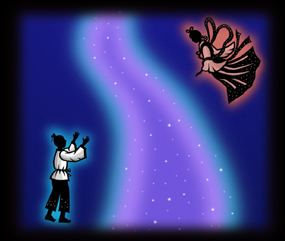
A pair of star cross'd lovers take their life,
Whose misadventur'd piteous overthrows
Doth with their death bury their parents' strife."
Two lovers—often but not always teenagers—doomed to be kept apart no matter how hard they struggle to be together. It may be Fate, or fatally-Feuding Families, or it may be something as mundane as a few hundred miles' separation, but something will always be in their way. Often, the two can only be Together in Death. William Shakespeare's Romeo and Juliet is the most famous example (and the Trope Namer), but the archetype dates at least as far back as Mesopotamian Mythology and Egyptian Mythology, making it Older Than Dirt.
In modern times, the term "star-crossed" is often unknowingly misused to mean lovers who are meant to be together. It means just the opposite — the stars (i.e. destiny or the heavens) have ruled against them, or "crossed" their plan. Compare the word "disaster," which has the etymology "away; without" ("dis") + "star; planet" ("aster"). Then again, if the stars rule that much, they probably decreed the love as well as the impossibility, making the stars capricious and cruel at the very least. It also refers to destiny and the inevitability of the two characters' paths crossing each other. It usually, but not always, refers to unlucky outcomes, since Romeo and Juliet's affair ended tragically. Furthermore, it may connote that the lovers entered into their union without sufficient forethought or preparation, that they did not have adequate knowledge of each other, or that they were not thinking rationally (because they were being controlled by fate).
One common version of this trope, Love Above One's Station (i.e., being in love with someone from a different social class), is at least discredited if not actually dead and buried in contemporary settings, but was very much true in the past, and can still work when applied to historical settings. While it's difficult even today to have a relationship with someone from a very different background, in the old days, it was all but impossible: if you were from the lower class and courted your "better", you'd be treated with the vilest contempt and risk arrest and/or violence (possibly even death); meanwhile, a "better" who reciprocated would be disowned and possibly shut off in a nunnery, a monastery—or even an asylum.
Hence all those tragic servant/slave/peasant loves the lord/lady/king/queen, and their Love Ruins the Realm stories. The accepted practice for someone in love with a royal, at least in contemporary fiction, was to express that love through loyalty and duty rather than presume to have a romantic relationship with them.
Forbidden Love and its sub-tropes are often the reason two lovers are star-crossed. May be used as a Pretext for War. One of the top reasons for a Balcony Wooing Scene. If the relationship is so star-crossed that both lovers aren't even that sure how the other feels about them in return, it might be Mutual Pining. Can result in their Last Moment Together.
Contrast Love Transcends Spacetime and Nobody Thinks It Will Work, where the power of love overcomes.
Example Subpages:
- Anime & Manga
- Comic Books
- Fan Works
- Literature
- Live-Action Films
- Live-Action TV
- Music
- Myths & Religion
- Theatre
- Video Games
- Visual Novels
- Western Animation
Other Examples:
- The Axe advert "Soulmates," a 90-second spot tells the story of a man's ill-fated pursuit of a woman throughout human history. It starts in prehistoric days with a bearded cave man trying to reach a woman who has just noticed him until the ice below splits, and there’s a divide between them. The same man and woman are shown in different time periods and places: Ancient Pompeii; an Arabian palace (probably the Ottoman Empire); a cowboy bar in the American West; foggy 19th century London; a sinking ship note ; an field hospital in World War I; a 1960s anti-war protest. There are either natural disasters or human interventions that prevent him from reaching her, even during the times she is shown noticing him. It isn't until the current day, inside a convenience store at a gas station, that the same man we saw in all of these other time periods takes down an Axe product. He uses some body spray on himself and the long-pursued girl immediately is at his side. They leave together and, as they walk away, a truck crashes into the gas pumps and the station explodes: the intervention of the Axe product prevented another act of fate from keeping them apart.
- Peanuts: Charlie Brown's hopeless infatuation with the Little Red-Haired Girl is tragically doomed to remain star-crossed, as he lacks the nerve to speak to her.
- Batman: Mask of the Phantasm has Bruce Wayne and his one-time fiancee, Andrea Beaumont. After he decides that she's worth giving up his plan of being Batman for, she has to leave Gotham and disappear thanks to the mob. When she resurfaces years later, they're still in love, but she has become the murderer Phantasm, hunting down her father's killers, and is Batman's enemy.
- Kubo's parents in Kubo and the Two Strings. Sariatu first met Hanzo as enemies, with her being sent by her father, the Moon King, to kill him. They fell in Love at First Sight and later had a son but due to Sariatu's family disapproving of their relationship, Hanzo was killed and Sariatu fled with the baby Kubo. Made even more tragic in that Hanzo is actually an amensic Beetle and Monkey is Sariatu in another form and both died not too long after realizing Hanzo's true identity.
- Kovu and Kiara in The Lion King II: Simba's Pride start out this way. They’re the kids of the leaders of the feuding halves of the pride, and Zira tries to use Kovu to kill Simba. He falls in love with Kiara and refuses, but Zira ambushes Simba and Simba exiles Kovu, thinking he was in on it. Kovu and Kiara have to stop the brewing war and reunite the pride so they can be together.
- Mickey, Donald, Goofy: The Three Musketeers has Minnie, the princess, forbidden to date Mickey due to him being a commoner. This only attracts her to him more.
- Pocahontas has the titular heroine and John Smith. She is The Chief's Daughter, while he is part of the settlers invading her land (while she's also been promised in marriage to a warrior in her tribe). The film was explicitly created to be Romeo & Juliet in 17th century Virginia.
- Scooby-Doo and the Alien Invaders has Shaggy and Scooby seemingly meet their soul mates in a hippie photographer and her dog, only to find out that they're actually aliens. And while they do have feelings for Shaggy and Scooby, they feel a long distance relationship of several light-years wouldn't work.
- Toy Story That Time Forgot: Parodied with Trixie the triceratops and newcomer Reptilus Maximus. Reptilus belongs to Bonnie's friend Mason, so the two can only see each other during their owners' playdates. In the film's Stinger, Reptilus makes his way up to Mason's window and stares longingly out into the snow.
Reptilus: Farewell, Trixie of the Bonn-Yee tribe. My heart will burn bright, until the moment of your return...Tuesday, around 3:30.
- Boo-Boo and his alien girlfriend Snulu from Yogi And The Invasion Of The Space Bears, they are forced to separate when Snulu decides to fight in the space war to prevent further invasion.
- A fairy godmother is walking through a park when she sees a work of art called "the Star-Crossed Lovers" consisting of two statues of a young man and a young woman, gazing longingly at each other across a park alley. She waves her magic wand, bringing them to life, and tells them they have until sundown to achieve their hearts' desire. They promptly run off into the bushes and the fairy godmother leaves. As sundown approaches, the godmother returns to the park, goes to the bushes that are still rustling, and sees the lovers, the woman holding down a pigeon, and the man squatting above it with his pants down yelling "PAYBACK!".
- In The Bride of the Water God, the couple Habaek and Nakbin who, according to Su Wang Mo were destined only as passing friends fell deeply in love with each other amidst the deceit and controversy which resulted to Nakbin's death just to protect Habaek. That after her death, both made drastic decisions in order to meet again. With Habaek requiring human girls as sacrifice, and Nakbin escaping the world of the dead by deceiving the god governing it. In the end, their efforts are futile as circumstances always lead to Nakbin choosing death instead of forsaking Habaek along with the fact that he is already connected by the red string to Soah. And even though Habaek admitted that he can never let go of his longing for his first bride, just like the leaves and the flowers of the Spider Lily, the two of them can only long for each other but will never be reunited. Though currently, Nakbin is reincarnated as a human without a memory as conditioned by Hoo-ye to Su Wang Mo.
- This crops up quite often in The Tarot Cafe, seeing as most of Pamela's clients are involved in some sort of Interspecies Romance. How well they work out varies. Some end happily, like the man who pursues a lake spirit, even after he unknowingly hits her three times and thus banishes her from his home. Some end not-so-happily, like the Reincarnation Romance between a vampire and a human, in which the vampire killed the human in the past and then, to keep himself from killing her reincarnated self (who he still loved) committed suicide. Besides the clients, there's also Aaron and Nebiros (separated because of a moment of distrust between the two, though they eventually reconcile) and Pamela and Belus (unable to have a happy ending, because Belus is really the Devil, though they are implied to remain friends. The beginning of the series also has Pamela and Ashes.
- Spike Dudley and Molly Holly's romance in 2001, as their families (the Dudley Boyz and the Holly Cousins) hated each other. The storyline took on new meaning when the WWF vs. the WCW/ECW Alliance feud began, as Paul Heyman kept trying to get Spike to "come home" to the Alliance.
- Rocket Age: In The Downey Creek War adventure Janine Wendt and Maggie McTaggert have an on-off relationship despite their families' active and potentially disastrous feud.
- The Most Popular Girls in School: Platonic(?) example between Trisha Cappelletti and Trisha 2; they developed a friendship despite being in feuding cheer squads.
- RWBY: Jaune Arc and Pyrrha Nikos start as partners and unseparable friends. Pyrrha is quite obviously in love for him, but Jaune's self esteem problems, obliviousness to her feelings, brash decisions and the fact he aimed for another girl for a while are obstacles in the way of them gaining a step forward in their relationship, coupled with Pyrrha's own Cannot Spit It Out tendencies. Pyrrha is finally able to reveal her feelings to Jaune, before going to fight Cinder Fall and be killed in her hands. Jaune takes two whole years to come to terms with the fact that he'll never have a chance to see Pyrrha again and reciprocrate her feelings.
- There she is!!: Doki and Nabi, a rabbit and cat kept apart by an interspecies taboo.
- Kat and Alistair from Gunnerkrigg Court. It was a Foregone Conclusion that Ali would leave at the end of the week, but it's made worse when the details of his departure (and the word of the narrator) ensure that Kat will never see him again.
- Jeanne, one of the Founders of the Court, and an unnamed male elf from Gillite Wood.
- It's unclear just how much attraction there may be between Bob and Voluptua in The Inexplicable Adventures of Bob!. Unfortunately, Voluptua is a disguised giant bug, so nothing can come of it. Bob is going steady with Jean anyway, but the hint of a Love Triangle involving Voluptua still pops up now and again.
- It Hurts!!: Aurora and Pasqualo. Aurora is literally fated to start the apocalypse if she gets too close to Pasqualo, and no amount of universe resetting can change that. Pasqualo eventually gives up his life to ensure Aurora reincarnates in the universe he creates.
- In Tower of God, any Princess of Jahad who ever loved a man. To stop the spread of Jahad's blood, they are forbidden to have relationships or children, a rule that is enforced with the death penalty. This applies especially to the parents of Anaak Jahad, who got assassinated, kicking off her journey to get revenge.
- Mixed Metaphors describes two people who will never be together, because one's a symbol and the other's a metaphor.
- Bottom and Tania of Wormtooth Nation. Fitting, since they are based on Bottom and Titania from A Midsummer Night's Dream.
- This example, between a Hindu boy and a Muslim girl.
- Steven Monjeza and Tiwonge Chimbalanga in Malawi. Their marriage was annulled because Tiwonge is a trans woman, they were jailed, then pardoned, then forced to move back to their respective home towns. Steven eventually married another woman.
- Peter Townsend (no, not that one) and Princess Margaret of Great Britain. Townsend was an Ace Pilot and war hero, having flown Hurricane in the Battle Of Britain, and clearly had deserved the hand of princess and half the domain. Queen Elizabeth said "no" for their marriage; Townsend was a divorcee, and the Abdication still hung over the Royal Family. That broke the hearts of both. Townsend later revealed Margaret was his only true love.
- Jose Rizal and Leonor Rivera who are first cousins. When Rizal traveled overseas to pursue studies, the two kept on sending letters to each other, hiding coded messages since both their parents do not approve of their relationship (partly because Rizal is wanted by the Spanish authorities.) Leonor continued to be faithful to Rizal for six years despite not seeing him (and probably not knowing that Rizal had affair with numerous foreign women.) Rizal tried to marry her many times but their meeting is always prevented by their parents. In the end, Leonor was forced to marry an Englishman. The leading characters who are lovers in Rizal's Noli Me Tangere, Crisostomo Ibarra and Maria Clara, are inspired by the situation between him and Leonor Rivera.
- The aptly nicknamed "Romeo and Juliet of Sarajevo," Bosko Brkic (Serbian, Orthodox Christian) and Admira Ismic (Bosniak, Muslim), who were shot while trying to flee the city together during the infamous Siege of Sarajevo. As they attempted to cross the bridge over the Miljacka River, they were both fatally injured by snipers; Bosko died instantly, Admira crawled to his corpse and died next to him.
- Dorothy Osborne and Sir William Temple faithfully obeyed the Parental Marriage Veto as long as it was in effect, but when their fathers died, and Dorothy suffered smallpox to the ruin of her looks, they were permitted to marry.
- The romance between a Soviet soldier and a German girl. They met at the end of the war when he was sent to interrogate her father, they fell in love and lived together for a while until he was sent back to Russia. (Additionally, party officials told him he could be sent to a gulag if he did not end the relationship.) They managed to meet again 60 years later, now 80 and married to other people, and they decided to move in together, leaving their respective spouses.
- Mark Antony and Cleopatra. Marrying Cleopatra was basically political suicide for Antony as it was seen as him forsaking his Roman roots, not to mention that he was already married. With greater support, Augustus was able to defeat Antony during their civil war and drove the couple to commit suicide.
- Either this or Tragic Bromance took place between Frederick the Great and his best friend/possible lover, Lieutenant Hans Hermann von Katte. They were inseparable despite their eight-year age-gap, to the point that they were rumored to actually be lovers by other Prussian nobles. Then-Rebel Prince Frederick intended to run away from Prussia to Great Britain to get away from his abusive father, King Frederick William I, and Katte decided to help him. After the two were caught and imprisoned, the King was about to execute them both, but ultimately decided to have Katte beheaded while forcing Frederick to watch from a nearby window. Frederick was about to fall into despair and tried to apologize, but Katte calmly smiled and told him "For the sake of such a gentle prince, death is sweet!" before being executed. Frederick was so broken after this that he was unconcious for at least three days and, after waking up, never spoke about Katte again. It's speculated that this ordeal was at least one of the reasons why Frederick never married and sired heirs.
- Hans Christian Andersen and opera singer Jenny Lind are said to have lived after this trope. Andersen developed feelings for her, but was nervous, clumsy and shy, and Jenny Lind was equally shy in private. Andersen wrote a number of letters to her, and their entire correspondence was later published, showing a sweet, caring friendship that never led to anything, because they were apart on journeys. Andersen saw to it that his travels matched hers to the best of his ability, and they had at least one new years eve together, but she married another man and died early. Andersen never forgot her. She always addressed him as her "dear brother", by the way, and Andersen left at least two stories devoted to her: The Nightingale is the most known. It refers to Jenny´s nickname The Swedish Nightingale. Under The Pine Tree tells the story of a Childhood Friend Romance that ends badly for the male protagonist. The girl in the story is named Johanne (which was Jenny´s original name).
- Aisin-Gioro Huisheng was a Chinese noblewoman, daughter of Pujie (the younger brother of Puyi, the Last Emperor of China) and a Japanese woman, Aisin-Gioro Hiro (maiden name, Saga Hiro). In 1943, she was sent to Japan to live with her maternal grandparents and study there. She eventually met fellow student Ōkubo Takemichi, son of a railway executive... but her mother Hiro strongly opposed, as Huisheng was considered as a potential bride for future Emperor Akihito. Ōkubo and Huisheng disappeared on 4 December 1957 and were found dead on Mount Amagi; Huisheng was found wearing a gold ring on her finger, laid with her head cradled in Ōkubo's left arm, while Ōkubo held a pistol in his right hand. Above their heads was a twisted piece of tissue paper containing snips of their hair and fingernails – an element in the ritual of a Japanese love suicide. Huisheng and Ōkubo's ashes were interred together at Ōkubo's father's request; years later, Huisheng's ashes were taken to her family plot in Shimonoseki.
- In the German Empire, the ruling House of Hohenzollern had a rivalry with the House of Hannover ever since Prussia annexed Hannover in 1866. The engagement of Victoria Louise, daughter of Kaiser Wilhelm II, and Ernest Augustus, heir to Hannover, was reported in the press to be a real life Romeo and Juliet, and their courtship was able to smooth things over between the two families. Their wedding was one of the last great social occasions in Europe before the outbreak of World War I.
