

There are many ideas associated with snow: Tranquility, purity, cleanliness, beauty...
So naturally, many people are shown dramatically dying in the snow. It may have something to do with how red blood contrasts so sharply with white snow, especially when gentle snowflakes are falling around a scene of carnage. It may have something to do with the way the snow seems to try washing away the unclean corpses and ruins; with snow's natural ability to dampen sound, making a scene deathly quiet; with how it looks like a beautiful and peaceful way to die, just letting the cold embrace you as you fall asleep; or with how snow melts on living bodies, but coats those that have passed on.
And then there's the symbolism.
As beautiful as snow is, it also signifies winter, associated with the death of the year (in the temperate latitudes at least), the death of crops, an ice age and the death of the sun. Snow also covers the world with a blanket of white, and in Eastern cultures, white is the color of death (as it was until a few hundred years ago in Slavic states as well).
Whatever the reason, using snow is a great way to portray a character on the verge of dying or a place torn by war in a very artful manner.
A sub-trope of Empathic Environment. Compare Scenery Dissonance. For a different interpretation of snow, see Snow Means Love. See White Shirt of Death and Blood-Splattered Wedding Dress for a similar trope, only applied to clothing instead. May or may not be related to Grim Up North, Tragic Ice Character, and Winter of Starvation.
Not to be confused with Snowy Screen of Death.
As this is a Death Trope, unmarked spoilers abound. Beware.
Examples:
- Snowbed
 ◊ by Aron Wiesenfeld.
- The Snowdrift by Victorian sculptor Edward Onslow Ford. A reclinining female nude either asleep or dead in a bank of snow. Because this turned out to be Ford's last work (it was completed posthumously by an anonymous artist) it's often seen as foreshadowing his own early death in 1901 - possibly from suicide, which if it was the case would never have been made public in those days.
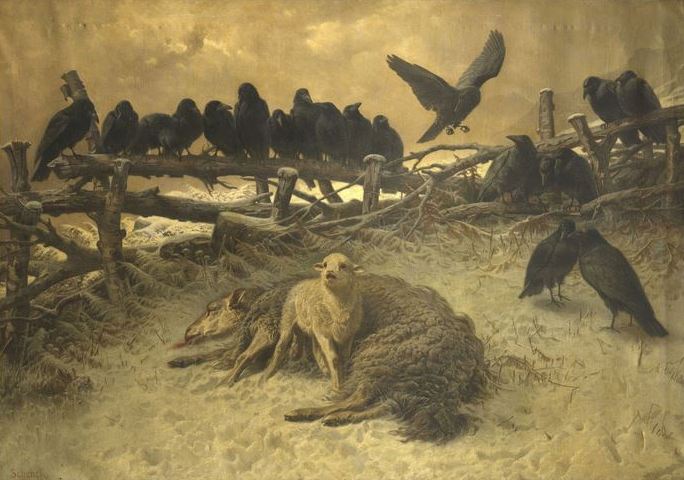
- Anguish by August Friedrich Albrecht Schenck depicts a mother sheep standing over her dead lamb in a field of snow while a murder of crows closes in around her. Schenck also painted a complimentary painting, The Orphan◊, depicting a lamb standing by its dead mother in a snowy field surrounded by crows.

- See the Question in 52. Renee Montoya drags him through the snow trying — and failing — to get him to Nanda Parbat before he dies, leaving a question-mark-shaped trail.
- ElfQuest has a bloody elf-troll battle in the frozen north.
- The most famous example of this trope in Argentina is Hector German Osterheld's magnum opus, El Eternauta. There, the first sign of the alien invasion of the Manos and the Ellos is glowing snow that kills on contact with the skin, forcing the protagonist, his friends and family to don radiation suits in order to survive.
- Sin City: That Yellow Bastard.
- The trope appears in the final chapters of Watchmen, for the big reveal on Laurie's past, and the final fate of one of the main characters.
- Amulet has three instances of this:
- Emily lost her father when their car went over a snowy cliff after an accident.
- Max was about to die near Korthan when he escaped had he not made a deal with the Voice.
- Trellis lost his mother while they were living in the middle of a tundra.
- In Gensokyo 20XX, this trope is fairly prevalent, as some major character deaths occur in the winter:
- In 20XXI, we have Flandre, who dies of hypothermia, after she sets out to find Chen, who had run away, and, later on, we have Eirin who commits suicide in the winter afterwards. It would be worth noting that Reimu was virtually dying of starvation during the winter before Flandre passed away.
- In 20XXIV, we have Sakuya's death of radiation sickness occurring in the nuclear winter and later on we have some of Ran's pups dying, as well as the fact that she also miscarries them. On that note, Ran almost died as a result of pregnancy complications during said nuclear winter.
- Played with to a degree with Ran and Chen during 20XXIV, in that both attempted suicide in the winter at different points but both survived through some intervention, however, though the latter wouldn't have otherwise.
- The Legend of Genji: Avatar Korra's funeral in the prologue is marked with a light snowfall occurring across the globe.
- In the Hetalia: Axis Powers doujinshii "Our house in the big snow field", Ukraine and Belarus's lands are attacked and they have to run away in the middle of the snow. A child!Belarus urges her adult older sister to leave her to die since Death Is Cheap for nations, and Ukraine apologizes as she buries her in the snow and keeps running to reach for Russia. She's ultimately caught and cornered by the enemy... and then the trope is subverted as an already unstable teenage Russia arrives in time to save his sisters's lives, but does so via a bloody Roaring Rampage of Revenge against the enemy. The three young nations ultimately survive, despite all the Break the Cutie.
- "As he wept, my sweet little brother swung his sword. He was just like a winter storm... a winter storm that takes everything".
- In The Night Unfurls, Luu-Luu, who dies as herself, is laid down on the snow-covered ground by Kyril.
- Narrowly subverted in Our Tapes. Mio tries to kill herself on a snowy night but is stopped by her boyfriend. It then goes for a different usage of snow when he proposes to her.
- Implied in The Outside, as, after Rae crashes her mobile home in a tree during a blizzard (why she crashed in the first place), she leaves to head to a town in the distance but she doesn't come back the next day or afterwards. The rest of the story plays with this trope, as Satsuki spends much of the winter critically ill.
- Snow Angel is a What If? Sonic the Hedgehog fic of the "What if Maria and Shadow escaped from ARK?" kind. Maria died on a snowy night just before spring began.
- One of the more famous examples is from Bambi in which the title character cries out for his mother during a heavy snowfall after she is shot dead.
- In Brother Bear, there is snow on the ground when Sitka and Koda's mother meet their ends. More poignant, however, is the scene where Kenai confesses to Koda that it was he who killed the cub's mother, and as he does so, the snowflakes begin falling around them...
- The Hunchback of Notre Dame (Disney)'s prologue takes place on a snowy night when Quasimodo's mother is murdered by Judge Frollo at the doorstep of Notre Dame Cathedral and he is forced to raise the orphaned boy as atonement for his sin.
- Kung Fu Panda 2: It's snowing when Po's mother gives her life for her infant son.
- In Leafie, a Hen into the Wild, it starts snowing when Leafie sacrifices herself so the weasel can feed her young.
- Mulan:
- Used somewhat more literally in when she uses a cannon to start an avalanche and wipe out the Hun army. Mostly.
Mushu: Did you see those Huns?! They popped outta the snow! Like daisies!
- There's snow on the ground of the massacred village. It also starts snowing after Shang creates a memorial for his father.
- Used somewhat more literally in when she uses a cannon to start an avalanche and wipe out the Hun army. Mostly.
- In Superman: Red Son, Svetlana dies in Superman's arms, surrounded by snow.
- The War to End All Wars – The Movie: The entirety of two armies are buried in an avalanche in the "Soldier of Heaven" sequence, triggered by a failed attempt by a soldier to shoot a rabbit for dinner. Only two Italian skiers, one of them Sabaton guitarist Chris Rörland as an Ink-Suit Actor, manage to escape alive as the avalanche destroys every army position in its path.
Authors
- Stephen King has used the trope on occasion. In addition to The Shining as mentioned above (more so in the book than the film), there is a significant scene in IT when Ben is walking home alone on a very cold and snowy day. He meets Pennywise the Clown in his Mummy guise.
- One For The Road takes place during a heavy blizzard. So does Grey Matter. The Maine "norther" weather features heavily as a backdrop. Subverted with Strawberry Spring wherein it's a mid-winter thaw that brings death.
- Takashi Yanase loves this trope and is a common fate for some of his characters. A few notable examples:
- In The Kindly Lion (Yasashii Lion), after Buru-buru and his adopted mother Muku-muku are killed by a group of policeman. It begins snowing and their bodies end up slowly covered by snow.
- In The Rose Flower and Joe (Bara no hana to Joe), Joe the Dog and a rose flower that's implied to be sentient end up dying together by the end of Fall. Joe's body and the rose flower are completely covered in snow by the end of the story. However, we do see Joe as an angel reuniting with the rose flower and gives it a kiss as they head to heaven.
Individual works
- The death of Snowden obviously had quite the impact on the narrator of Catch-22, so much so that the first page of the book asks the question: "Where are the Snowdens of yesteryear?" (a reference to "Ballad of the Ladies of Bygone Times" by Francois Villon). Snowden's last words are, "It's cold." Considering everyone else's name is symbolic, it's fair to see this as an example of this trope.
- In pretty much every adaptation of A Christmas Carol, there is snow in the churchyard when Scrooge discovers his (future) grave.
- The Cold Moons:
- The book starts at the beginning of spring, however it's still so cold that frost and snow linger. By the end of the first chapter, all of the protagonist's sett (including his mate and their newborn cubs) have been killed in badger cullings.
- Winter, or "the cold times" as badgers call it, is a dangerous time for all animals, including humans. While most of the badgers survive the wintery part of the journey, along the way they come across many dead animals (including several birds who froze to death overnight while perched).
- Almost literally in Dark Angel; the story is set in Pennsylvania in winter, so it's frequently snowing. While trudging home in the snow at the beginning of the book, Gillian ends up falling into an icy creek and although she's able to drag herself out before she drowns, the freezing temperatures cause her to die from hypothermia; luckily she gets to come back, which is how she meets Angel, although she's still shaken up and ill afterwards.
- Discworld:
- Hogfather: The dark pagan origins of the Hogfather, the local expy of Santa Claus, explain the choice of colours in his clothing: red and white from blood on the snow, ultimately coming from druidic human sacrifices in midwinter to make the sun come back. But The Little Match Girl version of the trope (above) is deconstructed when Death (who's filling in for the Hogfather) saves the local little match girl, dismissing her death as needlessly cruel, in the midst of his deconstructing a number of Christmas tropes.
- The Last Hero: During the climax, a band of geriatric barbarian heroes die by plunging into snow from a great height while clutching a powerful explosive charge. Or maybe they defy death itself, depending how you look at it. They’ve come to hate those sorts of trope.
- A Dog of Flanders: Nello and Patrasche freeze to death on Christmas Eve.
- James Joyce's "The Dead" (from Dubliners) may end with the definitive example of this trope. As the protagonist slowly drifts to sleep, thinking of the dead man his wife once loved, snow covers his window and his thoughts. The closing line: "His soul swooned slowly as he heard the snow falling faintly through the universe and faintly falling, like the descent of their last end, upon all the living and the dead."
- Goblin Market: Lizzie reminds her sister of Jeanie, who ate the goblin fruit, but sickened and "fell with the first snow" of winter. (Since Laura has already eaten the fruit, this lets readers know just how much time she has left.)
- The Grimrose Girls: The final fight takes place in a snowy landscape in the dead of winter. It ends in the middle of a frozen lake. The main characters all survive, but the villain dies, complete with blood splattering on the white background.
- Harry Potter: Harry visits his parents' graves for the first time in Deathly Hallows, accompanied by Hermione. It so happens that they do this in December and the graveyard is covered in snow. Harry, of course, cries.
- Her Mothers Hope: After Marta's mother finally succumbs to her long-term illness, her emotionally unstable sister, Elise, commits suicide by walking to a nearby meadow and laying down in the snow until she freezes to death
- The Hunger Games: It is mentioned that several tributes froze to death one year because they hadn't been provided with any means of making fires which would have kept them warm.
- The Little Match Girl, which makes dying from cold and starvation lovely, glorious, and filled with so much Glurge.
- In Miss Smilla's Feeling for Snow, Smilla sees Isaiah's body in the snow, and her description of his funeral is punctuated by her observations about the snowfall. Of course, the book takes place in Denmark, it's winter, and the narrator is a bit obsessed with snow in general.
- Madgie, what did you do?:
- This is justified in Nuclear Snow (in which it's mentioned that the snow causes burns and is dangerous to those not immune to its effects) and in Madgie's winter (in which the winds turn the snowflakes into "glass shards" during blizzards, the effects of which kill Madgie).
- In Bloodied Snow Angel, this is something of an odd case, as the winter (or rather the snow) came after someone died in during a war. Similarly, The Winter's Blood Red Sky has a war taking place in the winter.
- Snow Angel has the titular "snow angels"note — one of which is Toki — being mentioned to have died from the effects of their transformation. While we don't know exactly how Madgie died, we do know that it wasn't nice.
- In "It looked like falling snow...", Madgie and Eglantine succumb to radiation sickness during the winter, with the former dying at the beginning of it.
- Broken Wings has Doki dying of terminal illness and kidney failure during a winter. Earlier, she stops at a graveyard; later, Jinx talks about his deceased girlfriend Olga and how to her, the snow seemed to "sparkle".
- In My Ántonia, Mr. Shimerda commits suicide during his first Nebraskan winter.
- Raptor Red and her pack encounter a whip-tailed sauropod on a snowy mountain near the end of the book. It does not end well.
- In Seeker Bears, Kallik had always thought that snow meant plenty of food (especially seals). But then she learns from Toklo that for the other bears, snow means less food.
- In A. E. Housman's A Shropshire Lad, the poem "Bredon Hill" has shades of this: "But when the snows at Christmas On Bredon top were strown, My love rose up so early And stole out unbeknown, And went to church alone."
- A Song of Ice and Fire: "Winter is coming" is the motto of House Stark, ruler of the almost perpetually frozen North. Not only the North is a generally harsh place to live, but there's also the menace of the long-disappeared Others, the living dead. Said Others happen to bring harsh winter for generations and seasons can already last for years in Westeros. Small wonder that when Jon Snow introduces himself to wildling woman Ygritte, she remarks he has an evil name.
- The State Counsellor: The first paragraph describes the icy snowbound Russian steppe the train is going through as "Nothing but snow, nothing but the wild whistling of the wind, the low, murky sky—darkness, cold, and death." Sure enough, Khrapov gets murdered at the end of the first chapter, the Plot-Triggering Death that starts the story.
- Sweet Piglet: After its master dies, it is implied the titular piglet dies at the beginning of winter.
- In "To Build a Fire" by Jack London, the main character gradually falls asleep in the snow after his fire is put out and dies of hypothermia.
- Warrior Cats:
- In Bluestar's Prophecy, one of Bluefur's kits, Mosskit, freezes to death in the snow when Bluefur is taking them to Riverclan to stay with their father, Oakheart.
- In general, "leaf-bare" is the toughest season for all the Clans. Cats, being warm-weather animals, don't do particularly well in snowy forests. In chapters set in winter, food is frequently short (leading to starvation) and many characters die of "green-cough"/pneumonia.
- While My Pretty One Sleeps:
- The novel takes place in late March and early April and it's noted by several characters that it's unusually cold for spring; it's still freezing out and it snows heavily at the start of the story. This becomes a plot point, as Ethel Lambston's body is better preserved than usual due to the cold temperatures, allowing for more evidence to be gathered. Neeve also picks up on the fact that despite the chilly weather, Ethel didn't take any of her winter coats when she supposedly left town, convincing her there's something off about Ethel's disappearance from the start.
- Renata Kearny was murdered on a bleak, snowy afternoon in November of 1971, as she was on her way to pick up her daughter from school. Myles noted that the white of the snow made the blood from her slashed throat stand out even more. Because it was so cold out, there were also few people in Central Park, so there were no witnesses to the crime either.
- "The Witch (1896)": The witch arrives at the home in the winter, with a carpet of snow outside and a sharp wind blowing. In so many words, she argues that she'll perish if she won't be let it. But by saving her, it is possible that the homeowner brought upon their own end.
- Buffy the Vampire Slayer: Inverted when Angel's First Evil-inspired attempt to kill himself is foiled by an inexplicable snowstorm in southern California.
- Cold Case: The climactic death scenes on several episodes. Very tragically, the victims succumbed to hypothermia after having been previously injured and thus passing out in the snow.
- Dinosaurs: The final episode has the dinosaur civilization being wiped out by an ice age, and ends with a shot of snow slowly burying the Sinclairs' home.
- Doctor Who:
- The Cybermen gatecrash a funeral in the snow in "The Next Doctor".
- "The End of Time": After he has seen Rose in a beautiful white snow scene punctuated with multicolored string lights, the Tenth Doctor struggles over to the TARDIS for his regeneration while the Ood begin to sing to him.
- EastEnders naturally combines this with Soapland Christmas on multiple occasions. The most straightforward example was the death of Pauline Fowler on Christmas Day 2006: she walked out into the snow, suffered a fatal brain haemorrhage, and collapsed in the middle of Albert Square.
- Farscape:
- Two episodes occur on an ice planet: during these two episodes, Aeryn drowns when her ejector seat lands in a frozen lake, Diagnosan Tocot is killed by a Scarran operative in the cryogenics facility, two Peackeepers are shot in the frozen corridors... finally, the Scarran agent himself ventures out into a blizzard, only to be shot repeatedly by the resurrected Aeryn and stabbed to death with an icicle.
- Averted in any episodes that take place in Einstein's dimension, which is essentially a large iceberg floating in a sea of wormholes. In the first visit Einstein does warn Crichton that he might be forced to kill him, but most of the carnage of that episode takes place in the thoroughly non-snowy Unrealised Realities Einstein displays.
- Father Ted: Spoofed.. It snows the night before Father Jack's funeral. Ted gives a monologue about how it's snowing all over the island. On all the living, and the dead... Then Father Jack tells him to Shut the feck up.
- Firefly: Tracey's funeral. It's also a meta-example, since it was also the very last scene shot for the entire series.
- Game of Thrones:
- The White Walkers seem to bring the cold with them.
- Jon Snow dies while it was snowing, making his name poignant.
- Summer was killed by White Walkers, who are associated with winter.
- General and I: It starts to snow when Bei Jie (apparently) kills Ping Ting.
- Joan of Arc (the miniseries starring Leelee Sobieski): It begins to snow at Joan's execution. Notable because her burning took place in the middle of May.
- Kamen Rider Kuuga: The brutal, bloody final battle happens on the snowy slopes of Mount Kuro.
- The King Loves: It starts to snow during the attack on San's family and their entourage, when her mother and most of their servants are killed.
- Mahou Sentai Magiranger: After Miyuki Ozu's supposed death, snow fell.
- Moon Lovers: It's snowing when Myung-hee dies.
- Mouse (2021): The first on-screen murders happen while it's snowing heavily.
- In Pagten, the ice witch Iselin, obviously, is associated with snow, and freezes her victims to ice.
- Queer as Folk (US): Brian's dad's funeral.
- The Rise of Phoenixes: It starts to snow just before Zhi Wei's suicide.
- Rubicon: David's funeral in the first episode.
- Smallville: Jonathan Kent's funeral.
- Star Trek: Voyager: In "Timeless", Voyager crash-lands on a frozen planet after dropping out of the quantum slipstream, killing everybody on board, and is found 15 years later buried in a glacier.
- Xena: Warrior Princess and Gabrielle on a snow capped mountain in season 4.
"Was it snowing on Mt. Amaro?"
- Yellowjackets: In the Season 1 finale, Sic Transit Gloria Mundi one of the girls spends the night outside the cabin. The next morning, she is found frozen to death after the first night of snow in the months the survivors have been in the wilderness.
- In the music video for "You're Beautiful" by James Blunt, the singer commits suicide while it's snowing around him.
- It's cold when the narrator of Broken Iris' song "A New Hope" visits his lover's grave.
Gust of freezing cold air whispers to me you're gone
- In the festive Tear Jerker "The Cat Carol", a homeless cat encounters "a poor little mouse" on a snowy Christmas Eve. The two animals take shelter in a hollow which the cat digs in the snow, where they are later found by Santa and his reindeer. By then, however, the cat has frozen to death, though the mouse, kept warm in the cat's fur, has survived.
- "Avalanche" by Cellar Darling.
Cover me with snow
Freeze me to death
Forever I'll lay in the alpine bed
Seasons will change
But I shall remain
Stripped bare of my coat
I will rest in peace - The folk song "Darcy Farrow," most famously covered by John Denver, regarding the young maiden Darcy Farrow and her suitor Vandamere:
... she promised to wed before the snows came that year
But her pony did stumble and she did fall
Her dyin' touched the hearts of us one and all
Young Vandy in his pain put a bullet through his brain
And we buried them together as the snows began to fall - "My Last Breath" by Evanescence
- From the Fleet Foxes song White Winter Hymnal:
...and Michael, you would fall/ and turn the white snow red/ as strawberries in summer...
- "White Mountain" by Genesis, which takes place in a forest in the middle of a snowstorm: "Dawn saw the white mountain tinted with red."
- "A Dark Congregation" by The Hush Sound mentions mourners throwing roses onto a snowy grave.
- In the video for Madonna's "Oh Father", the death of the girl's mother takes place in winter.
- The classic French pop song "Les Neiges du Kilimandjaro": "[The snow] will make you a white blanket/Where you will soon be able to rest" (implying that the "rest" in question is of the eternal kind).
- "End of All Hope" by Nightwish has this line:
Deathbed is slowly covered with snow
- "The Blizzard" as sung by Jim Reeves makes explicit one reason why snow is often a death symbol among those who know it: "There's a blizzard coming on, how I'm wishing I was home, for my pony's lame, and he can hardly stand. Listen to that norther sigh, if we don't get home we'll die. But it's only seven miles to Mary Ann's."
- The official lyric video for Nachts weinen die Soldaten, by Saltatio Mortis, features this from start to finish.
- Roman, the 5th album in Sound Horizon is all about this trope given the main character Hiver died as a stillborn baby in winter.
- Vocaloid: "soundless voice", "proof of life" and "endless wedge" all feature snow in their PVs... because of Rin Kagamine tragically dying. To say this series is sad is a very gross understatement.
- "South Side of the Sky" by Yes, about a party of mountain climbers that freeze to death.
- The video for Beast in Black's "Blind and Frozen" depicts a woman in an Ethereal White Dress moving through a snowy castle, ending on her frozen corpse lying in a bed.
- Sabaton:
- "Talvisota", titled after the Finnish name for the Winter War: fought during one of the 20th century's coldest winters, use of snow camouflage by Finnish ski troops, resulted in defeat of superior numbers of Soviet troops unprepared for winter conditions.
- "Ruina Imperii", covering the Carolean Death March home across the winter of 1709-10 after the death of Carolus Rex at Fredriksten, and the fall of the Swedish Empire.
- "White Death": the Finnish sniper Simo Häyhä in the Winter War.
- Inverted in "Christmas Truce", where snowfall signifies the beginning of Christmas and the (temporary) end of the fighting.
- "Soldier of Heaven" is about the Alpine front in World War I (that is, Italy v. Austria-Hungary), and more specifically about "White Friday", an incident on 13 December 1916 when thousands of soldiers on both sides were killed in avalanches—many of which were deliberately set off by artillery fire.
I won't be coming home
I won't be going anywhere
I will guard this post forever
Here on the alpine slope, where I did my final stand I shall remain
Among the ice and snow that binds me to this mountain
- In Norse Mythology, Ragnarok will be preceded by the the Fimbulvetr, or "terrible winter", a years-long snowfall that will exterminate life on Earth.
- Japanese legend speaks of the Yuki-onna, a female snow spirit that appears during the snow storm and leads travellers astray to die of exposure. Sometimes she might spare them, and once she fell for a young man and married him... but once he discovered her identity, she left in the middle of a snow storm.note It seems she's the Japanese myth version of The Snow Queen.
- The Greeks gave us Persephone, daughter of Demeter (goddess of the harvest), who either was kidnapped by her uncle Hades to be his bride in the Underworld or offered herself to as his bride to escape her mother's smothering and grab power for herself. The rules stated that anyone who ate in the kingdom of death would be trapped there, so even though her mother successfully sued for her return, she had to spend some time there, having eaten some pomegranate seeds (four, five, seven, or eight; it varies), whether tricked by Hades so she'd be forced to stay, or by her own will to prove to her mother that she had chosen Hades' realm. So each year she returns, and each time she does, Nature dies. Thus winter. When she comes back, Nature thrives. Thus spring.
- In most parts of ancient Greece, they considered Persephone to be gone during the hot, droughty summer, returning during the rainy winter.
- An older "Just So" Story much like the Persephone myth existed in the Mesopotamian Mythology. The gist was the same, except instead of a grieving mother, there was a grieving wife. The goddess Inanna, upon escaping from her sister's clutches in the underworld, had to choose someone else in the living world to replace her in the underworld. She chose her husband, Dumuzid, because he did not grieve over her during her absence. She came to regret this, however, and decreed that Dumuzid would be resurrected for half a year, but he must die the other half of the year. Inanna's joy during Dumuzid's visit caused summers, while her grief during his absence caused winters.
- Researchers of Slavic Mythology believe that the winter was together with death and nightmares a domain of the goddess Morana, in a rather clear association of the snowy season with death in the mind of an inhabitant of central-eastern region of Europe. Inversely, coming of spring was (still is) celebrated with drowning an effigy thought to represent her.
- In the myth of Saint Eulalia of Barcelona, when she finally died after all the Cold-Blooded Torture she was subjected to, among other alleged miracles snow fell on her torn and mangled corpse to cover it from her executioners's eyes.
- Aztec Mythology features Itzlacoliuhqui, a god of frost, winter, and death who could cause crop failure during the harvest season, particularly for frost-sensitive maize. The Aztecs believed that the dying-off associated with winter was necessary to make room for new life in the spring, the time of the year that crops were sown. Itzlacoliuhqui's name can alternately be translated as "curved obsidian blade" or "plant-killing frost."
- In a dramatic moment on NoPixel, it starts snowing during Deputy Dias' final radio call at his funeral service.note
- The largely forgotten musical Tenderloin has a song called "Artificial Flowers" about a poor flower girl who freezes to death while trying to sell her artificial flowers to wealthy theatre-goers. The song later achieved a degree of fame when it was recorded by Bobby Darin.
They found little Annie all covered in ice
Still clutchin' her poor frozen shears
Amidst all the blossoms she had fashioned by hand
And watered with all her young tears.
- The final mission in Ace Combat Zero: The Belkan War takes place on New Year's Eve over the Avalon Dam, in the Grim Up North of Belka. A snowstorm kicks up right after your wingmate PJ is suddenly killed by former wingmate turned Final Boss, Pixy. The Final Boss even calls attention to it.
Pixy: Here comes the snow...
- In Batman: Arkham City, it is discussed by The Joker when Batman, infected with the clown's poisoned blood, approaches the Steel Mill for a second time on his search for the cure. In his intercom speech, the Clown Prince of Crime says he's locked the Steel Mill, then says something along the lines of, "I dread having the thought of you lying dead in the sno-ho-ho-ho-ho-hoooooooowwwwwwww. That truly brings a smile to my face!" Given that it's winter in Arkham City, he seems to be making a point about it.
- Blasphemous: The Graveyard of the Peaks is a large, snowy mountain and the first part of the long and arduous pilgrimage partaken by the women who wish to join the Convent of Our Lady of the Charred Visage. Most of them die a terrible death to either hypothermia, starvation or exhaustion and their frozen corpses can be found all over the mountain range.
- Bravely Default: The Gravemark Village located in the snowy continent of Eternia is exactly What It Says On The Tin. What remains of the settlement is a cemetery and a lone hut where a trio of old foggies live. One of them explains that The Great Plague from some years ago killed almost all inhabitants and the village was quarantined by the Crystal Orthodoxy to prevent the malaise from reaching the rest of Eternia. Edea's parents, Braev and Mahzeer, hail from this place. It is theorized by the old man that Braev's support of the Anticrystallism movement is the result of the Orthodoxy sacrificing his hometown to protect the rest of the continent.
- The broken heart of The Snow Queen threatens to turn the world to ice in the third game of the Dark Parables series.
- Fatal Frame III: The Manor of Sleep is perpetually snowy, filled with the deceased spirits of loved ones and hostile ghosts.
- Final Fantasy:
- In Final Fantasy VII, Aerith's human father Professor Gast was killed by his old teammate Hojo and his Shinra forces when he tried to protect his Cetra wife Ifalna and an infant Aerith. This happened in a now-abandoned house located in a permanently snowy village, on the frozen area of the Northern Continent.
- Final Fantasy X: During the last part of Yuna's pilgrimage, the group visits Mt. Gagazet. The snow-covered, towering mountain and home of the Ronso is considered sacred ground and is dotted by several makeshift monuments dedicated to all the summoners whose journeys met an abrupt end in the frozen peaks. The heroes also fight the third incarnation of Seymour Guado after he killed all the Ronsos that attempted to stop him from pursuing Yuna and co.
- In Final Fantasy Tactics, the first big Wham Episode occurs at the snowy Ziekden Fortress. Argath resolves a hostage situation involving Delita's younger sister Tietra by murdering her in cold blood, sending Delita down the path that would lead him to become king of Ivalice and the public hero of the War of the Lions.
- In Final Fantasy VII, Aerith's human father Professor Gast was killed by his old teammate Hojo and his Shinra forces when he tried to protect his Cetra wife Ifalna and an infant Aerith. This happened in a now-abandoned house located in a permanently snowy village
- Fire Emblem:
- This can happen in any game that includes snow-covered stages, if the player loses a character there.
- In Fire Emblem: Genealogy of the Holy War, Erinys's sister Annand is killed during a battle in the snow.
- Since Canas is Doomed by Canon in Fire Emblem: The Blazing Blade, his ending says that he and his wife died trying to protect a village from a snowstorm, so their son Hugh (who appears in Fire Emblem: The Binding Blade) is raised by Canas' mother Niime (ditto).
- In Fire Emblem Echoes: Shadows of Valentia, it snows as Emperor Rudolf is slain by Alm and La Résistance.
- Grand Theft Auto:
- In Grand Theft Auto: San Andreas, when CJ returns to Liberty City later in the game, he shows some Italian mobsters how to have fun in the snow, Grove Street style.
- Grand Theft Auto V visits the snowy state of North Yankton during the Prologue and "Bury the Hatchet". In the former, Michael, Trevor, and Brad gun down a large number of state police after a heist gone wrong and Michael fakes his death, while in the latter, Brad, who was shot and allegedly arrested during the getaway, is revealed to have died from his injury and buried in Michael's place.
- In God of War (PS4), The spell that grants Baldur nigh invulnerability and immortality is broken and Kratos proceeds to kill him permanently when the former attempts to kill Freya. In his last moments, he notes the snow falling on his face, showing relief in being able to physically feel his surroundings again one last time.
- I am Setsuna takes place in an entire world of snow, where the titular Setsuna must travel to the end of the world to sacrifice herself in order to stop an influx of monsters. The themes of the game involve death, sacrifice, and using what time you have to benefit the world.
- In Kessen II, if you beat the final stage of Liu Bei's scenario, Cao Cao is seen dying in the snow, with Diao Chan kneeling beside him. Though, there was never any snow on the battlefield before or after this sequence.
- LISA: The Painful RPG: The Snow Mountain is a region visited later in the game ans is the turf of Buffalo Van Dyke, one of the Warlords of Olathe. As the mountain is climbed, weird stuff can be seen on the snow like faces and arms with the same color. At the top of the mountain, a huge pile of white bodies is found seemingly implying this place is used to dispose of corpses via cremation and that the "snow" falling is in fact the ash of the burning bodies. This is supported by the fact there's a Man on Fire running around this area. Most likely he was victim is a premature cremation.
- In Mass Effect 2 the Normandy SR1 crashes onto the surface of an ice planet; in one of the DLC missions you can revisit the wreckage and walk through a chillingly beautiful snowscape littered with debris from the original Normandy while collecting the dogtags of soldiers lost in the crash and placing a memorial statue to commemorate the ship.
- It's not actually snow, but the way Shepard catches falling particles of the Genophage cure in Mass Effect 3 is clearly meant to evoke this as a memorial to Mordin, Eve, and/or the hopes and dreams of a species, depending on your choices during Priority: Tuchanka.
- One-Man Army Max Payne goes on his killing rampage while snow constantly falls down around him. He briefly goes on another killing spree in the snow during Max Payne 3, and even takes the time to visit his wife and daughter's grave in between the action.
- White Len, the "evil" counterpart to Len in Melty Blood, specifically makes her zone snow with her dream powers.
- Metal Gear:
- Sniper Wolf is fought and killed by Snake in a snowy field in Metal Gear Solid, though the initial fights against Vulcan Raven and Liquid Snake, which also take place out in the snow, subvert this due to them surviving.
- Crying Wolf in Metal Gear Solid 4: Guns of the Patriots is killed on the exact same snow field that Sniper Wolf died on nine years earlier.
- The Graveyard of the Giants from La-Mulana. Whereas its frontside counterpart, the Mausoleum of Giants, gives a romanticized take on the Giant's doomed ply to help Mother to return to the skies, the Graveyard of the Giants shows the ugly truth of what truly happened: after they failed their mission, Mother created a new generation of children who quickly chased the colloosi into the frozen caverns where, overcome by sorrow, they all perished.
- Snow rather literally means death for everyone in Mystery Case Files: Dire Grove, where an ancient curse is going to freeze the entire world if it can't be stopped.
- No More Heroes 2: Desperate Struggle: "For the first time in 120 years, snow had fallen on Santa Destroy." And that night, two things happen: One, Travis fights Skelter Helter to death as soon as the game begins, putting him back to the assassination games against his will. And two, Travis' best friend is killed by a mob hired by the game's villain.
- In Phantasmat: Crucible Peak, the player finds themselves in a resort that was emptied due to an unforseen avalanche. It turns out that Otto, one of the people you meet in the game, caused the avalanche via explosion.
- Rymrgand, God of Entropy in Pillars of Eternity, who is worshiped in the Antarctica-esque White that Wends and feared everywhere else. He is associated with blizzards and winter in addition to entropy, manifests as a giant aurochs surrounded by perpetual freezing winds, and his realm is a wintry plane where souls are ground into soul-stuff and annihilated.
- Professor Layton and the Unwound Future: It begins snowing just after Claire returns to 10 years in the past to die in the lab explosion.
- Relicta: Laia and her team all freeze to death while Angelica is in the Relicta; Angelica finds their frozen bodies.
- Resident Evil Village: This is one of the few twists that the game puts on its vampire lore, which otherwise hews as closely to the Classical Movie Vampire as it can while still technically remaining grounded in science. Lady Dimitrescu's three "daughters" are vulnerable to the cold weather outside the castle, and you make use of this during the boss fights against them, opening the windows to weaken them and leave them vulnerable. Dimitrescu herself isn't vulnerable, though, as there are some differences with her biology compared to her daughters.
- The winter level in Smallworlds. While no actual bodies are found, it's revealed to be a nuclear winter.
- Averted repeatedly in Star Stealing Prince. The entire game takes place on a perpetually snowy island, and the main character nearly dies in the middle of the forest near the start of the game, but ultimately makes it through. Other than that, Snowe's parents are instead killed on a floating island paradise completely void of snow, and the bad ending where a possessed Snowe kills everyone happens on a ship fleeing the island (where, if you wanted to interpret the trope differently, Snowe really did mean death.) Then again, as you start uncovering people's backstories, you start finding out that the island has had a very dark and bloody history, possibly making it an indirect use of this trope.
- Street Fighter:
- Necro and Effie barely avert the trope in Necro's Street Fighter III Third Strike ending. They're on the roof of a running train that travels through a snowy steppe and near a cliff, and they jump off to avert the Illuminati members following them. Effie, however, almost falls into the cliff itself; Necro uses his Rubber Man powers to catch her just in time and, as the two get away safely, this trope goes into Snow Means Love...
- In Street Fighter V, this almost happened to Kolin in the past, according to the Story Mode. During what's all but stated to be the collapse of the Soviet Union, the girl who would grow into Kolin lost absolutely everything: her homeland, her family and her friends. She fell through the Despair Event Horizon and decided to let herself die in a blizzard, and then was saved and taken in by Gill.
- Necro and Effie
- Sunset Over Imdahl takes place over the course of four seasons. Spring and summer are relatively cheerful, fall is when The Plague hits, and winter is when nobody's left to clear the snow out of the streets.
- Tales of Symphonia: Zelos gives a detailed account of his childhood, culminating in him witnessing his mother's murder in the snow.
- This War of Mine: If the player does not build a heater when winter arrives, the survivors will die from the cold.
- Touhou Project: Yuyuko is the Ghost Princess of the Netherworld and has the ability to induce death. Naturally, one of the things associated with her is snow, with her game taking place during a long winter. Even the weather effect assigned to her in Scarlet Weather Rhapsody is snow.
- Red is able to invoke this near the end of Transistor, getting admin privileges to a Weather Control Terminal that allows her to make it snow after the Process have pretty much wiped out all of Cloudbank.
- In the short adventure game Ulitsa Dimitrova, the Idle Animation is first a yawn, followed by a shiver, and falling asleep on the ground, before a localized snowfall starts. That's the only ending.
- Warcraft: The Undead Scourge make their base in the frozen north and are thematically linked to ice and cold, doubling as Evil Is Deathly Cold.
- Ace Attorney:
- Elise Deauxnim, best known as Misty Fey, Mia and Maya's mother, in the fifth case of Phoenix Wright: Ace Attorney – Trials and Tribulations.
- The series has a few cases set in the snowbound winter, and since Phoenix's cases are Always Murder...
- After the final battle results in a fistfight in the artic between Wilhelm and Ludwig, Dies irae ~Interview with Kaziklu Bey~ ends with their love interest Claudia experiencing an out of control Creation Figment that ends up claiming her life in her attempts to stop it. This leaves Wilhelm lying bloodied, bruised and alone in the snow, unable to do anything but bitterly laugh at how this sick joke of a love story turned out.
- In Kana: Little Sister, in one of the many endings that feature her death, Kana tells her brother that she will make it snow when she dies. And of course, the moment it starts to snow she's dead.
- The prologue of Katawa Shoujo initially appears to be Snow Means Love. The main character, Hisao, meets his High School Sweetheart on a snowy day for a confession of love. Unknown to anyone, he has cardiac arrhythmia and the excitement brings on a heart attack. He barely survives, but his old life is over.
- DEATH BATTLE!: The episode "Guts VS Dimitri" takes place in a snowy field surrounded by mountains. Throughout the fight, there are many shots of each fighter's red blood splashing onto the white snow, until Guts eventually runs out of the stuff and dies. The death is also portrayed as more serene than usual for this show, with him dying while still standing up, seemingly frozen in place before the full moon, and Dimitri swears to keep Guts' soul safe from the God Hand.
- In Dear Rabbit, the wolf kills the rabbit in the snow.
- Dinosauria; the second short "Our Frozen Past" takes place in the middle of the arctic winter 69 million years ago, and one of the troodontid chicks is killed an eaten by a Nanuqsaurus.
- RWBY:
- The Kingdom of Atlas is situated on the polar continent of Solitas, and the cold of the snow-covered tundras is explicitly noted to be lethal in a matter of hours to anyone without Aura or heating. This is bad news for the entire city of Mantle when Dr. Watts shuts down the municipal heating grid to further destabilize the kingdom. As the situation rapidly deteriorates into riots and a full-scale Grimm invasion of Mantle, snow starts gently drifting down.
- The fight that costs Clover Ebi his life takes place on a featureless stretch of snowy tundra, with his blood dramatically splattering across the snow after the lethal blow is struck.
- Girl Genius: When Agatha and co. come out the other side of the Queen's Mirror that was under the Red Cathedral they find themselves in winter in the mountains surrounded by deep constant snow. Martellus instantly goes on a murder spree through the fortress they're in and later Higgs and Dupree slaughter a bunch of Martellus' spark hounds in the snow, where there bloody corpses are set upon by crows.
- Homestuck: When the deceased Vriska and alt!John meet for the first time in a dream bubble memory, they are outside John's house in winter with a light snowfall ongoing. In this case, both of them are dead.
- Aversion too; Jade dies well after her land thaws, despite it initially having been covered in the stuff.
- In Megatokyo, snow begins to fall just as Miho prepares to meet her death.
- During Aggie's Near-Death Experience dream in Penny and Aggie, snow falls. This is significant in that we never otherwise see snow in the comic.
- Slightly Damned: Sakido's death occurs during wintertime on the surface.
- On the other hand Rhea, killed during the fall, is resurrected in winter.
- Unsounded: Most snow seen is in flashbacks to the day Duane was killed. There's also a flashforward to a town being destroyed by First Silver where the only people seen lay dead in the snow.
- Green Antarctica: This is the Tsalal attitude, and why they fear the color white. Justified by the long, deadly, and very snowy winter, as well as the massive, uninhabitable glaciers in some antarctic regions.
- Defied in Around the World with Willy Fog. In one episode, Fog and his companions set out to cross the frozen Great Lakes in an ice boat, heavy snow having prevented their train from leaving Chicago. But, when Tico begins to succumb to the freezing weather, Fog says they will have to find shelter as Tico will die if he is out in the cold for much longer. The travellers take refuge in a log cabin, where Fog resolves not to continue his journey until Tico has recovered.
- Avatar: The Last Airbender plays with this - black snowfall, caused by the soot put out by their ships, heralds the arrival of Fire Nation forces at both the North and South Pole when they attack the Water Tribes.
- Played with in the Defenders of the Earth episode "The Return of Doctor Dark". Ming initially exploits this trope by leaving Flash and Mandrake to freeze to death on the planet Frigia, which is so cold that no human can survive there for long, even with protective clothing. However, the trope is defied when the other Defenders and their Psychic Warrior friend, Mara, arrive on Frigia to rescue the two men. Disney Death also comes into play at this point; Flash and Mandrake are both found unconscious and Jedda initially fears the worst until Mara reassures her:
Do not despair, Jedda. I sense they are still alive.
- Horseland: In the "Mosey" episode, Sarah's old cat gets fatally hit by a car and eventually disappears into the oncoming snowstorm so she doesn't see the body. When Sarah couldn't find Mosey in the snowstorm other than his vanishing footprints, she comes to the conclusion he's never coming back and spends most of the winter grieving over his loss, until Will helps her deal with her sadness.
- In the Rankin-Bass Stop Motion special Nestor, the Long-Eared Christmas Donkey, the title character's mother dies after covering him with her body and keeping him warm for all night during a blizzard.
- Ninjago:
- When Zane performs his Heroic Sacrifice in season 3, it spreads ice across the Overlord's forces, shattering them, which then acts as snowfall across Ninjago. It also snows at his funeral, which in this case is treated more peacefully, as his friends seem to feel his presence in it.
- Season 11's Ice Chapter has the ninja going to the Never-Realm, a barren icy region where being without fire means imminent death and the cruel Ice Emperor "executes" his enemies by trapping them in ice (though the ninja can still heartbeats, implying they'll be restored if they can be thawed out).
- Over the Garden Wall: The shift from autumn to winter in the final episodes threatens the lives of the protagonists and indicates that they're running out of time. Subverted in the show's final montage, which depicts the residents of the Unknown settling into their happy endings as the snow falls peacefully around them.
- In the Grand Finale of Star Wars: The Clone Wars, Ahsoka Tano's Star Destroyer crashes on an icy moon after Order 66. Too focused on killing her and Rex, the other clone troopers aboard go down with the ship, which, along with a makeshift cemetary the heroes set up for their comrades, is eventually buried in snow. Darth Vader tours the wreck site years later, and the final shot has his silhouette reflected in a half-buried clone trooper helmet's cracked visor.
- The Battle of the Bulge in World War II.
- White Friday which was one of a series of avalanches to kill both Austrian and Italian soldiers in World War I.
- Captain Scott's ill-fated Antarctic expedition.
- Similarly, the various brave idiots looking for the Northwest Passage, most famously Sir John Franklin.
- Also Ernest Shackleton. Although he subverted it by being badass enough to get himself and all of his crew out alive.
- The Death Zone on Everest, or indeed any mountain of sufficient height. The combination of brutally low temperatures, not enough oxygen in the airnote , and the snow and ice on the ground (or, if things have gone really badly, falling from the skies as well) has cost many lives. On Everest specifically, the bodies of several climbers have served as grim way-markers for several seasons, until they are either buried by the snow, moved by the forces of nature, or, very very rarely, recovered. The most (in)famous of them was probably the Indian policeman Tsewang Paljor,note who died of exposure during the disastrous blizzard of May 1996, and whose body, nicknamed Green Boots due to his neon green mountaineering boots sticking out of snow, served as a grisly wayside beacon until 2014, when it disappeared.note
- The Donner Party must be mentioned because the snow helped cause the death.
- The day following the Halifax Explosion brought a huge blizzard that only helped to add to the the death toll.
- A popular image associated with wars involving Russia, especially invasions of Russia, although averted and subverted more often than many people think.
- Averted when Mongols invaded the Kievan Rus'. The Russians might have lived in cold places, but the Mongols lived in even colder places (Ulaanbaatar, the capital of Mongolia, is still the coldest capital city in the world. Seriously, -25°C (−13°F) is nothing unusual there).
- King Charles XII's invasion during The Great Northern War ended in utter failure, but the great defeat came in the battle of Poltava, in the summer. The famous death march that followed meanwhile went over mountains resulting in this trope.
- During Napoleon's invasion of 1812, the Grande Armée sustained much greater losses on the road to Moscow — partly in battles, but to a much greater degree due to dysentery, typhoid and exhaustion — than on the more iconic Retreat from Moscow. In fact, the retreat mainly happened in the relatively mild fall, with the snow cover not setting almost until the infamous Berezina crossing. Main reason of Bonnie's losses was rather the complete disintegration of the Grande Armée's logistics.
- The biggest and costliest winter battles in World War I occurred in the winter of 1914/15 in territories belonging to Germany (the Winter Battle of Masuren, won by the Germans) and Austria-Hungary (the Winter Battle of the Carpathians, won by the Russians).
- When the Soviet Union invaded Finland in the Winter of 1939/40, their forces sustained heavy losses. On the other hand, during the Russo-Swedish War of 1808, a Russian army succeeded in marching across the frozen Baltic Sea from Finland to Sweden.
- The Battle of Stalingrad started in August, but in movies and on pictures, you will almost always see the last weeks in January and February when snow only added to the bleakness of the whole situation, and things went From Bad to Worse for German 6th Army trapped there.
- Zig-zagged during Siege of Leningrad. While the deaths (mainly from starvation) peaked during winter time, that very same winter caused Lake Ladoga to froze, allowing food and munition supplies to arrive into besieged Leningrad and even allowing some residents to escape (it wasn't named "Road of Life" for nothing). Still, the starvation during the siege was so severe that some peoples actually resorted to cannibalismnote , and extreme temperatures were also suspected to have been an insurmountable obstacle to civilians that were too distant to food distribution, not to mention the "Road of Life" itself was constantly harassed by German's bombardment.
- Siberia is often depicted as the physical embodiment of this trope, and with good reason, as Russian leaders had seen it as a convenient place to dump undesirables since the 1860s.
- In Finland, mentioning a drunken person and snow in the same sentence is almost always interpreted as "froze to death", and it is regularly used as an example when explaining to teens why drinking outside during an arctic winter is a really bad idea.
- There is a proverb in Finland Tulis talvi ja tappais köyhät (Wish winter would come and kill the poor) which is effectively hoping misfortune for someone disadvantaged.
- The Wounded Knee massacre, which happened on a snowy December day in South Dakota.
- December 29, 1890, to be exact. And South Dakota is known for extreme weather, so when it's hot, it's really hot, and when it's cold, it's really cold.
- Heavy snow fell on rescue and relief operations in eastern Japan five days after the March 11, 2011 Tohoku earthquake and tsunami.
- Throughout much of history this trope was subverted in that when it snowed the armies couldn't march so countries at war would call an armistice in winter.
- The more accurate explanation would be that when it snowed, armies couldn't eat. They'd happily march through snow if there were food at the other end.
- "Starlight tours" in Saskatchewan. Sounds poetic. It's not.
- It's not a coincidence that two of the Dump Months, January and February, are in the middle of winter. Winter is where movies go to die at the box office, and one of the reasons why is because, during the winter months, snowstorms can trap moviegoers in their homes throughout much of the northern US and Canada.
- The Battle of Towton was fought during a snowstorm, with both armies wading through knee-deep snow drifts. Some estimates claim 28,000 people died there, at a time when that would account for 1% of England's entire population. It was perhaps one of the nastiest battles ever conducted by British soldiery; even the lower end casualty estimates of 9000 dead are higher than the Battle of Antietam, fought 400 years later with rifles and cannon. Towton, by contrast, was fought face-to-face, with swords and axes and fists.
- The Battle of Eylau in 1807, where the snow was also lethal to Marshal Augereau's VII Corps and both sides lost about 50,000 men altogether. Later on, as he came back on the same battlefield in spring, Captain Marbot found it hard to reconcile the beautiful greenery with his very vivid memories of the carnage, and the knowledge that he would have been one of the corpses buried under a bed of grass and flowers if not for a series of lucky coincidences.
- The BBC Scotland documentary Choosing to die presented by Terry Pratchett ends with a euthanasia in Switzerland and afterwards Terry walks out of the house, and regards the snow. And remarks it is "good snow, fitting for what has just happened."
