the sun will be darkened,
and the moon will not give its light;
the stars will fall from the sky...
The Big Dipper went dark last week. It simply vanished into a field of increasing blackness. And navigators everywhere lost their way.
The news is reporting that there's an increase of suicides among scientists. There are protests going on right now in front of the NASA building in Washington, Jet Propulsion Laboratories, the Kennedy Space Center, and, strangely enough, the Large Hadron Collider. Perhaps they think it has something to do with the stars going out. Who knows. Who cares. At least it's not a Bad Moon Rising, that would ruin the song for all of us.
I think the one I'll miss the most is Cygnus. That's the one my mother always pointed out to me as a child. It went black just before the Big Dipper, though, so the news barely reported it. It's the Cygnus Ater now, the Black Swan.
People are getting worried about when our star is going to go out, plunging us into a neverending night. There are cults springing up everywhere. I saw a guy yesterday who had hastily modified his signboard so it read "The End is Hear." It made me smile, until I heard some people muttering about dark gods and human sacrifices.
The sky is very beautiful tonight, which is something of a paradox. I think I'll watch it from the roof. What's the opposite of stargazing? Darkgazing? Waiting for the light to catch up to us and then fade from existence until there's nothing left but darkness. I think I'll wait for the Black Swan to sweep across the sky, brushing each star with its feathers until it finally reaches us and we can fly across the heavens on its back, our own light lost in the terrible swiftness of its wings.
Sorry. Got a little poetic there. Maybe you'd like to go darkgazing with me some time? It sure beats all those apocalyptic bonfires.
To be more prosaic, this is showing that The End of the World as We Know It is beginning, the stars disappear, blinking out one by one, leaving only empty space.
In a fantasy world, where the stars are usually supernatural objects or beings, this makes sense. In the real world, where the stars are giant balls of fusing hydrogen nuclei at distances of many light-years (meaning that, even if they all went out at once, it would be for years before we saw even one of them vanish; that is unless our sun was one of them, in which case we wouldn’t know about it for around eight minutes, and the sky would gradually empty out over thousands of years as the last light from increasingly distant stars reached Earth), it can be considered scientifically inaccurate, though the simultaneous effect could also be the apocalypse closing in on Earth at near-light-speed. Alternately, the same visual effect could be achieved by enclosing Earth or the Solar System in something that blocks the light from the rest of the universe.
Subtrope of Signs of the End Times. Compare Bad Moon Rising, Alien Sky and Crack in the Sky. In some cases, the "stars" might not actually be stars or other celestial bodies at all, but rather manmade space colonies. Also compare Star Killing, which is about the actual act of destroying a star.
Examples:
- In Darker than Black, following a weird cataclysm, the stars were replaced by fake ones, with an Alien Sky over Earth. The real stars are still there, just obstructed from view; an unusual circumstance can grant a brief glimpse of the true sky... unless that's an illusion as well. The new stars in the fake sky are all linked to contractors, rising, brightening, fading and falling as the contractors are created, use their powers, and die. Also, the moon is gone. Towards the end of the second season, the moon seems to reappear, which, in a strange inversion, is considered the real sign that everything is about to go pear-shaped in an extremely headache-inducing way. Which is reasonable, since it's actually Shion's backup Earth created before he goes into Hell's Gate to meet Yin, and the only reason the world makes it through that is that Hei got there in time. Probably.
- Bokurano: This serves as a coda to the destruction of the entire universe that contains the defeated parallel Earth. Pure Nightmare Fuel.
- Discussed during Dragon Ball Z: Resurrection 'F' by Whis, who talked about having a hard time seeing in the dark after the god of destruction started making stars vanish when he woke up cranky, in reference to said god nearly killing Goku and Vegeta for waking him up three years early.
- In Yu-Gi-Oh!, during the Doma arc, one sign of the Great Leviathan slowly reviving is it causing the stars to go out (this scene was cut from the English dub).
- Remina: The first hint at the true nature of the titular Planet Eater Eldritch Abomination is the observation that its apparent orbit is very strange and any star that it comes close to just disappears before it starts heading towards Earth. The obvious insinuation is that Planet Remina eats stars as well as planets.
- Warlock (1967): Adam Warlock battled a being known as the Star-Thief who stole not just the stars but the light that had already left them (which is how Warlock knew there was an artificial cause.)
- Years later (in a New Defenders story) a second Star-Thief snuffed out several suns; it turned out to be a little alien girl, blinded by an intense light, who now hated the stars, and didn't realize her latent godlike powers were turning her subconscious wishes real.
- In the Ultimate Marvel Universe, this is, according to the Vision, what happens when Galactus comes to eat your planet. An incredible build-up, which fortunately (for the characters, not so much for the audience) doesn't amount to much. Justified in this case, because this version of Galactus is a giant swarm of city-sized robots, so blocks the light from the stars as it approaches a planet.
- Thanos once threatened doing something like this in one of many tirades to his love, Mistress Death. Specifically, he created a space ship using some of the infinity gems that was capable of destroying stars and started cruising around doing just that but didn't get too far.
- In the last issue of Crisis on Infinite Earths, when the Anti-Monitor pulls the last Earth into the anti-matter universe, the entire sky goes black. And then the blackness starts to move and everyone suddenly realizes it's because the entire sky is made up of millions of the Anti-Monitor's shadow monsters. Needless to say, it gets worse before it gets better.
- In this Donald Duck comic
 the stars were disappearing from the sky due to some aliens wiping them out to build an intergalactic highway.
- In Superman: The Earth Stealers, an energy globe closes around the Earth and the moon, blocking the stars with total darkness.
- In Nexus, the first time Horatio, the eponymous Nexus, fights another fusion-kaster, Sutta, the energy they draw causes five stars to go out. There's some Continuity Drift, because later, when Horatio fights other fusion-kasters who were canonically more powerful than Sutta, notably Stan, no such thing happens. Still, it was an important event in the story, because it panicked several major governments, notably that of the Cohesive Web, which sent Ursula to Ylum....
- Ultra Comics #1 ends with constellations going out one-by-one for lack of oxygen, portraying the rupture of the mental bonds between Ultra Comics and each one of his readers while he dies.
- Secret Wars (2015) features an example similar to Doctor Who below: all universes have been destroyed and a single surviving world's only sun is actually Johnny Storm, the Human Torch. Some inhabitants of the Battleworld however, retain some memory of how the world was before and total absence of stars is one of the things that tip them off. Within Battleworld, though, the explanation is that Doom himself plucked them out of the sky to turn them into Mjolnirs for the Thors.
- This happens in The Transformers: Dark Cybertron due to Shockwave collapsing the universe into a single point in order to provide infinite energy for Cybertron. But the Autobots and Decepticons realize that what they're seeing isn't the stars actually going out, it's the light from the stars being blocked out due to the army one billion angry minicons descending on Cybertron.
- Actually begins happening in the final arcs of The Transformers: More than Meets the Eye and The Transformers: Robots in Disguise for two separate reasons unique to each book's storyline.
- Legends of the Dead Earth: In both Batman: Shadow of the Bat Annual #4 and Sovereign Seven Annual #2, the stars have long since gone out as the universe is rapidly approaching its end.
- In the former, the embodiment of all evil, He-Who-Dares, is in the ruins of a castle on an asteroid in orbit of the last star in the entire universe. As Evil prevailed over Good, the universe is undergoing heat death, which will be followed by oblivion. Had Good won, the universe would have "evolved into a living, self-conscious being, capable of bootstrapping itself to a new, undreamed-of state of existence." He-Who-Dares manages to alter the course of history so that the people of Nu-Gotham defeat the Lizard-Men's assault on their city. This sets off a chain reaction which allows Good to emerge victorious and the universe to achieve sentience.
- In the latter, the coffee house Crossroads is located on the last planet orbiting the last star, which goes out. However, the sun rises again the next morning. It is hailed as the first sunrise of the first day of a brand new beginning, indicating the birth of a new universe.
- Wonder Woman (1987): About the time the Shattered God nabs Diana his machinations cause the stars to start disappearing.
- Since “The Big Chill” by Alan Moore is set at the Natural End of Time, it naturally has the stars going out over the eons. By this time, among the last survivors are Superman Substitute Mr. Majestic, another superhero named Aptimaxer, an intelligent form of syphilis named the Simberleen, Jijimotu (a giant tribal god), Lord Math (arithmetics personified), Gemeth (a computer counting down the names of God, in a reference to “The Nine Billion Names of God”) Dantalion (a demon made of many faces), Eucrastia (a female vampire), and Manny Weiss (the legendary Wandering Jew himself).
- King Thor: After Atli decapitates Gorr, the gods celebrate their victory only to notice the stars are disappearing... and Gorr to reveal that he's eating them.
- The Arc Words of the Lucky Star / MadokaMagica Crossover, Stars Above: "All will come to ruin, and the stars above will fall..."
- This happens during The RWBY Loops during the Tale of Two Sisters. It's accompanied by shards of the moon entering the atmosphere. And then, the sky itself seems to vanish...
- The Shape of the Nightmare to Come features a slightly more horrific version: The Ork/Tyranid hybrid species the New Devourer sets of toward the light of the next galaxy over... Which then starts to dim.
- The Stars Are Going Out features a retelling of “The Nine Billion Names of God” by Arthur C. Clarke, but with one of the names being Haruhi Suzumiya.
- Barbie: Star Light Adventure has this as the focus of the plot. One by one the stars are going out, and no one seems to know why. King Constantine assembles a team to try and save the stars, and Barbie gets involved with the plot when she's chosen.
- Obscure Spanish animated film Nocturna uses this to instigate the plot — the young Tim's favorite star has gone out, quickly followed by several others, and he's the only one who seems to have noticed.
- In The Fairly OddParents! Non-Serial Movie "Wishology", the constellations are manned by fairies holding their wands as part of a celestial early warning system, so it's a sign of very bad things to come when the Big Dipper vanishes.
- In the Care Bears movie Share Bear Shines, Princess Starglo is turning off all the stars (including the sun) because there isn't enough wishes or belief to power them.
- In the Pecos Bill segment from Melody Time, Bill uses the stars in the sky for target practice at the conclusion of his song.
While reclinin' on a cloud high over Texas
With his gun, he made the stars evaporate
But then he saw the stars declinin', so he left one brightly shinin'
As the emblem of the lone star, Texas state - Pleasant Goat and Big Big Wolf: Meet the Pegasus: The result of Wolffy using a magic attack that cracks through the galaxy is a bunch of stars falling onto Pegasus City, destroying buildings and forcing the goats to save the pegasi. It's decided that pushing Pegasus City out of the way will alleviate the danger, with the goats and many of the pegasi pitching in.
- In Pandorum, the characters wake up from suspended animation to find their sleeper ship has been drifting through space for an untold number of centuries. The villain takes the protagonists to the bridge and shows them that there are no more stars, reasoning that they have been asleep so long that the ship either drifted beyond the edge of the known universe or that all the stars have burned out. Then a fish swims past, showing they're actually underwater.
- The Cabin in the Woods. Marty steps out for a leak and is surprised he can't see any stars, even though they should be miles from any light pollution source, a possible hint the eponymous cabin is an Eldritch Location. Given what happens at the end of the movie, the apocalyptic version of this trope also applies.
- In Stand and Deliver, Angel morosely points out that all the stars could be gone already and we wouldn't even know it.
"What you're looking at is where they used to be, man. It takes the light a thousand years to reach the Earth. You know, for all we know, they burned out a long time ago, man. God pulled the plug on us and didn't tell nobody."
- The Norwegian christmas classic The Journey to the Yule Star features an example of one star in particular going out, the titular Yule Star, which shines over the kingdom only once a year, on Christmas Eve. After his daughter and wife disappear in one night because the girl went out to find the star herself, the king curses the star, causing it to fade away. Though, according to Santa, the star remains where it has always been, but humans can't perceive it anymore.
King: Accursed star! Leave my kingdom!
- The fourth book in the Star Challenge series, "Exploding Suns", turns about stars in the X-7793A sector fading out. Depending of your choices, you'll find they were eaten by a humongous space worm, their light warped (teleported), or their energy siphoned and used to build an energy body by a Hive Mind. Artistic License – Space and Sci-Fi Writers Have No Sense of Scale are, of course, in full effect.
- In The Atrocity Archive, there's an Alternate Universe where most of the stars are gone because a monster has eaten all the heat from the universe and without the energy to make it expand, the universe has been collapsing in on itself. When the crew enters the universe, the collapse has sped up to be faster than the speed of light and somewhere in the quickly shrinking universe lurks an Ice Giant looking for a way out...
- Stephen Baxter:
- In Last Contact, the stars are going out because the big rip is tearing apart the universe starting with the largest structures.
- Inverted in Sun-Cloud, with stars becoming visible for the first time to the title character at the end of the story.
- Literally inverted in The We Who Sing, which takes place during the very early era of the universe. The story ends with the first stars in the universe forming.
- Inverted in Book of the New Sun, in which stars appear bright even in a day sky as a result of the Sun dying.
- In Chronicles of the Kencyrath, the stars going out will be the sign that the chaotic infection of Perimal Darkling has broken its barriers and is overwhelming yet another world.
- The final volume of The Chronicles of Thomas Covenant, aptly named The Last Dark, has the stars going out when the Worm of the World's End devours the Elohim, immortal beings somehow linked to the stars.
- Cthulhu Armageddon: More like re-arranging, which John admits is even more impossible than it sounds (and it sounds insane) since they shouldn't have their light visible for millennium. It is so blatantly illogically impossible that it is one of the first signs that Earth has been pulled into the Dreamlands by Yog-Sothoth.
- Michael Moorcock's Dancers At The End Of Time trilogy sees the last inhabitants of Earth blithely consuming vast amounts of power to satisfy their passing whims, neither knowing nor caring that each use of that power kills stars from which the energy is sapped. When representatives of one of the few remaining sentient races of the universe arrive to beg them to stop destroying the very universe, the aliens are simply captured and put in a zoo. The climax of the story happens when one of the less solipsistic members of the last humans alive realises their wanton use of the energy of the Universe has hastened entropy, and there is only a week left before The End...
- In "Darkness", humanity tears itself apart in a rage of fear and hunger after some incomprehensible force extinguishes every light in the sky. A Level 5 Planetary Extinction follows.
- At the end of Daystar, all the stars in the galaxy go out at once, right before the world is remade/restored to what it should have been.
- Toward the end of The Demolished Man, the Villain Protagonist thinks he's safe. The police's case against him has fallen apart and he's poised to take control of the Solar System. As he builds up to the climax of his Nothing Can Stop Me Now speech he happens to look at the sky... and the stars have disappeared. It gets worse.
- While it's not the entire sky, the gods of Krynn in Dragonlance normally appear as constellations, which vanish while they are manifest on Krynn.
- Some scenes in Final Days takes place 1x10^14 years in the future. By this point most stars have died or been gobbled up by black holes. One character notes that seeing the black sky can turn religious people into The Fundamentalist, or it makes them lose their faith. Atheists, on the other hand, tend to fall on their knees and pray.
- "First Fire" by Terry Bisson involves a scientist with a device that measures how long a fire has burned continuously, a rich man obsessed with tracking down ancient fires and secretly snuffing them out and relighting them, and the titular First Fire, reputed to be the oldest in the world — and indeed, it scans as older than starlight. Guess what happens next?
- In The Golgotha Series, when the Darkling begins breaking free of its prison, the sun fails to rise and the stars are extinguished.
- In T.A. Barron's The Great Tree Of Avalon series, Avalon has no sun or moon, just stars that grow brighter during the day and dimmer at night. Seventeen years before the series, they turned dark for an entire year, during which it is prophesied that a child who will destroy Avalon will be born. Then, as the series begins, one particular constellation, the Staff of Merlin, is going dark again; later books focus on stopping a certain star in Pegasus from doing the same. It turns out that the stars are actually portals to other worlds, filled with magical fire to keep them safe; the Big Bad is extinguishing the Staff so that his army can break into Avalon, and the Heart of Pegasus to reach Earth.
- In Halo: Silentium, as the Flood approach the Greater Ark far outside the galaxy, so many Star Roads assemble that the Milky Way is barely visible, "as if viewed through a weave of shadowy bars".
- In Humanx Commonwealth, the Great Evil is a galaxy-sized Eldritch Abomination that is on a march toward the Milky Way. Scientists of various species throughout galactic history discovered it by examining the "Great Emptiness", a region of space that seemingly contains no stars, galaxies, or other active matter. So, in this case, they're going out because they're being eaten.
- Inheritance Trilogy: When the Primordial Chaos of the Maelstrom manifests within the universe, it blots out everything in its wake. Everyone can see the stars going out in real time, despite the light-years of distance, because it also absorbs the laws of physics that would have made it impossible.
- Stars dropping from the sky is one part of the mortal Narnia's end in The Last Battle, a Shout-Out to the Norse Ragnarök, as well as the earth sinking into the ocean. Since stars in this 'verse are actually glowing people, this makes the world's final hours a bit more brightly lit and crowded.
- This trope is central to the plot of "The Last Question": the titular last question is whether entropy can be reversed. It takes longer than the lifetime of the universe — that is, long after the stars have gone out — to come up with an answer. Yes, it can. The story ends with the now bodiless and omniscient computer proclaiming "LET THERE BE LIGHT".
- Inverted for the people of Krikkit in Life, the Universe and Everything. Their planet is inside a dust cloud which prevents any stars from being seen in the night sky. When they build their first spacecraft and see a universe full of stars, they are absolutely horrified by the sight and promptly begin making plans to destroy it all.
- In the Lord Darcy story "The Ipswich Phial", a priest describes having witnessed the stars overhead all going out in an instant, only to return a few minutes later. Subverted in that the stars actually still exist: the star-gazing priest has merely been rendered temporarily blind by a top-secret magical effect.
- In The Lord of the Rings, around the time the siege of Minas Tirith begins, Sauron (or the Nazgûl) create a darkness that not only blots out the stars but also makes it hard to tell when morning has arrived. (Until a rooster crows.)
- In S. P. Somtow's Mallworld stories, the inner Solar System has been quarantined by enclosing it in a giant sphere about 20 AU in radius (until such time as we become mature enough to join the Galactic civilisation). Not only does this prevent our travelling much beyond Saturn, it also blocks starlight.
- Inverted in "Nightfall (1941)". When the six suns of Lagash all set (or are eclipsed), which happens every 2,049 years, the population goes utterly insane and destroys civilization. The protagonists speculate that the blackness of night drives the people mad; in fact, they go mad when they look up at the night sky and see the thirty thousand stars around their little solar system (they are near the center of a globular cluster) and realize how much larger the universe is than they ever imagined, and how insignificant they are within it.
- In The Night Land, set millions of years in the future, both the Sun and all the other stars have gone out. (Hence, all the world is a Night Land.) When it was written, the way that stars work was not generally known, and the author implies that they had simply exhausted all of their fuel. Later fan works retcon this and say that the real reason all the stars went out long before they should have is that the evil forces of the Universe — the powers behind the Silence, et cetera — ate them. The only reason that they haven't eaten Earth is that it's the last place with any life, and if they eat it, they won't have anything to do (or anyone to torment) until the Universe ends.
- Night Watch by James Inglis is about an interstellar probe which is still functional when our Galaxy is dying. The story ends with the community of probes launched by various races and drawn together by the fact that very few stars are still shining, setting out on the long voyage to a distant and still-young galaxy as the last star of our galaxy burns out behind them.
- (One of the) Trope Namers comes from Arthur C. Clarke's "The Nine Billion Names of God", wherein a Tibetan monastery buys a computer and hires two technicians to automate their order's mission of calculating and writing down all the names of God. They believe that this is the ultimate purpose of the universe — and thus when it's over, God will simply shut everything down. The technicians don't believe that, and plan to leave on the night the computer will finish, to avoid the rush. Just as they're about to depart, they look up...
"Look," whispered Chuck, and George lifted his eyes to heaven. (There is always a last time for everything.)
Overhead, without any fuss, the stars were going out. - In the prologue to Mark S. Geston's apocalyptic novel Out of the Mouth of the Dragon, an ancient inscription states: "The clockworks of creation have shorn their gears; stars do not appear at their appointed times..." By the end of the book the hero, who may now be the last man on Earth and is apparently only kept alive by his prosthetic implants, witnesses the wind and waves ceasing and the sea apparently turning to glass. Then as he watches the sun slowly dying he wonders whether his implants will ever allow him to die.
- Quarantine (1992): For unknown reasons, an impervious sphere instantaneously appears around the solar system, centered on the sun. On Earth people panic as the stars disappear in a circle of darkness that appears to swallow the night sky as the last of the starlight reaches Earth. Any and all (unmanned) probes sent to the edge of the solar system detect nothing until they reach the edge of the sphere and simply disappear. This happened several decades ago in the backstory of the setting. The cause remains a mystery, but when nothing else happened most people eventually just got on with their lives - because how important were the stars really? The most significant effect is perhaps the creation of a Apocalypse Cult/International Terrorist Organization with a mysterious agenda and a reverence for those born after the stars disappeared ("children of the void" or something like that).
- Robert Reed:
- An Exaltation of Larks shows the heat death of the universe, where the stars have long since burned out, and stellar formation ceased, leaving behind a dark, cold, and empty universe. Time travelers from the end of time have steadily been working their way back to the Big Bang to prevent this gradual death from happening by turning the universe into an effectively Perpetual Motion Machine that expands, contracts, and expands again.
- In Beyond the Veil of Stars, the outside universe abruptly vanishes, to be replaced by a mirror image of Earth, allowing a person in Australia to look up and see Florida's coast, upside down. However, after an initial panic it's realized that the universe outside is still there. A character reveals that this happens on any planet with too much visual processing power being focused outward, essentially breaking the universe, and the mirror image is a bandaid to rectify this.
- In Will Murray's short story "The Sothis Radiant", an astronomer learns that tendrils of energy have been spreading out through the galaxy, causing stars to go nova at an accelerating rate.
- David Langford's The Space Eater has a third of the stars in the sky wiped out by an early experiment with wormholes.
- In Speaker for the Dead, Ender imagines a nightmare scenario whereby every time someone uses interstellar travel, it extinguishes a star. Because the stars are so far away, humanity wouldn't realise what it was doing until it was thousands of years too late and the stars start disappearing from the sky.
- Spin begins with the stars vanishing from the night sky — it isn't immediately apocalyptic, but this is still a harbinger of doom as the reason for this is quickly found to be that the Earth has been stuck in a semi-permeable bubble of slow time, meaning that the sun will die within a generation.
- The Starchild Trilogy: Only a few, and only temporarily, but it includes the Sun. The Starchild uses this to warn Earth that it means business.
- Star Wars Legends:
- This happens in The Courtship of Princess Leia when the Big Bad activates his Nightcloak satellites. They come back on once the Falcon and company blow up enough of the satellites, though.
- In Luke Skywalker and the Shadows of Mindor, part of Cronal's attempt to break Luke's will until he can steal his body is to trap him in dreams of the Dark, Cronal's idea of what the true power of the Force is.
These dreams were glacially slow, actionless, featureless hours of empty staring into empty space, hours becoming years that stretched into numberless millennia, as one by one the stars went out. He could do nothing, for there was nothing to do.
Except watch the stars die.
And in their place was left nothing. Not even absence. Only him. - In the Revenge of the Sith novelization, also by Matt Stover, Anakin remembers a mission where he and Obi-Wan visited a world orbiting a dead star, made of hyper-compacted metals just above absolute zero. Having grown up on a desert world where the twin suns burned him daily, Anakin is astonished to learn that stars can die. Having also heard legends as a child about dragons that live in suns, he begins to personify his fear as a cold dead-star dragon reminding him that "all things die. Even stars burn out..."
- There are two examples of this in Dutch author Tais Teng's works — eerily enough, both of them occur in books meant for children. One book involves the battles of a sacred order against creatures pouring into our world through gateways to a planet wrapped in perpetual darkness; it turns out the gateways simply lead to the future, in which the Earth is wrapped in a cosmic dust cloud. Another book cynically ends with an oblivious child getting its hands on a book that fulfills any wish you write in it, and writing, just for fun, "The Sun goes out."
- In The Time Ships, after leaving a colony of humans in the Palaeocene era and returning to his own time the Time Traveller finds that not only is the Earth abandoned but there are very few stars in the sky. Nebogipfel concludes that the descendants of the people they left behind have spread across the galaxy and built Dyson spheres around the majority of stars.
- In the last episode of The Traveller in Black, one particular district is far more prosperous than by rights it should be... at the cost of unnaturally dark and cold nights.
- Well World: An experimental weapon tears a hole in reality that just keeps widening, erasing everything inside it from reality, leaving it up to the protagonists to find Nathan Brazil so he can reboot the universe. Yes, that sentence makes sense in context.
- Near the end of The World at the End of Time, when Five has decelerated enough its small star cluster it sees this as the Universe has finally fizzled out. Meanwhile Wan-To sees it the slow way, ending being forced to live of proton decay within a stellar corpse in a dark, vast dying Universe.
- In A Wrinkle in Time and most of its sequels, evil entities such as the Black Thing and the Ecthroi have the power to turn the stars dark.
- A driving force behind the Xeelee Sequence. The stars are aging far, far faster than they should, and in 5 million years — rather than 5 billion — almost all the stars in the visible universe will become white dwarfs.
- Young Wizards:
- The Star Snuffer is one of the names of the Lone Power. In the third book he blows up a star just because Kit and Nina happen to be in the vicinity, and later starts snuffing entire galaxies just to put pressure on Dairine during their confrontation.
- At the climax of the first book, he turns off Earth's star, i.e., the Sun. Not only is this very bad for Earth in the mid to long term, but the heroes' spellbook can only be read by moonlight — which is reflected sunlight.
- Part of the backstory in Andromeda. The ultimate Big Bad has been traveling through the universe collapsing all the stars in whole galaxies as part of a plan to destroy the universe. The galaxies the Commonwealth occupied are about all that's left. Almost nobody knew about it because the light from the time of the collapses hasn't reached known space yet.
- Doctor Who:
- "Logopolis": The Master's interference causes a wave of entropy to cause a large portion of the universe to go out, right before the eyes of the TARDIS crew. Including Nyssa's home planet.
- "Utopia": The TARDIS travels 100 trillion years into the future, when all the stars have long ago died of old age and a few planets are maintained in habitable condition by artificial "atmosphere shells".
- "Turn Left": This is how Donna Noble knows it's time for her to go with Rose.note
Wilfred Mott: They're going out. Oh my God, the stars are going out.
- At the end of "The Pandorica Opens", the stars are going out... because they're all exploding, along with the TARDIS. After this, the stars all become retgoned, so there's an actual explanation as to why the starlight immediately vanishes from Earth's skies.
- At the beginning of "The Big Bang", the stars have all gone out... because they never existed, having all collapsed. Earth only has a sun because it's the TARDIS, exploding; this has resulted in an alternative history where stars as an entity are considered a myth.
- "The Name of the Doctor": Stars are blinking out of existence because the Great Intelligence is rewriting the Doctor's history, undoing all the good he's done, and the Doctor has prevented this scenario a few times!
- A comparatively light version occurs at the Restaurant at the End of the Universe in the television version of The Hitchhiker's Guide to the Galaxy (1981).
- How light it is depends on your point of view. The entire universe is coming to an end... for the entertainment of those who traveled in time to visit a restaurant with a view of it.
- In one episode of Lexx, the heroes watch in horror as whole groups of stars disappear from the sky as Mantrid's Horde of Alien Locusts — well, robotic ones — consumes them.
There's patches in the sky...
- In the Supernatural episode "Alpha and Omega", when God is mortally wounded, the sun starts going out.
- The Twilight Zone episode "I Am the Night--Color Me Black" (which, unfortunately, was not about Batman) had the sun failing to rise on the day of the execution of someone who was wrongly convicted. As you find out later in the episode... the sun didn't fail to rise. Everywhere else had sunlight. It was the hatred and bigotry of the townspeople against the falsely convicted man that kept the sunlight away from their town. How does it get worse, you ask? Well... not only do you find out that the sunlight never comes back to that town, but there's a radio broadcast announcing that other towns and cities have started experiencing the same condition of eternal night as well. And after the man was hanged, the town becomes darker...
- Tom Waits's "Earth Died Screaming".
There was thunder, there was lightning
Then the stars went out
And the moon fell from the sky
It rained mackerel, it rained trout - U2's "One Tree Hill" ("I'll see you again when the stars fall from the sky / and the moon has turned red over One Tree Hill") and "The Fly" ("It's no secret that the stars are falling from the sky"); the latter song has been described as "a phone call from Hell".
- Several songs by DragonForce mention this: "The Fire Still Burns" ("And all the stars fall around the world tonight") and "Revolution Deathsquad" ("And the stars fall on the horizon/Onwards and up through the pain"). "Black Winter Night" also has the sun going dark in the sky and the world freezing into "visions of ice".
- The Midnight Juggernauts song "Dystopia" describes the stars falling out of the sky in a beautiful and terrible spectacle: "Any given minute we're witness to planets falling from on high/Sparkle as they're falling through the twilight sky".
- The song "If" by Bread includes these lyrics:
If the world should stop revolving spinning slowly down to die,I'd spend the end with you, and when the world was through,Then one by one the stars would all go out,Then you and I would simply fly away.
- The Genesis song "The Day The Light Went Out" (released as the B-Side to "Many Too Many") is about Exactly What It Says on the Tin. Something arrives here on Earth and puts out the light... and then, it prepares to feed...
When they went to bed that night no one would have believedThat in the morning, light would not be thereThe dark hung heavy on the air like the grip of a jealous manNo place was there known to have been sparedThen panic took control of minds and fear hit everyoneThe day the light went out of the daytime sky.
- The Human League's 1990 song "The Stars Are Going Out" uses imagery related to this trope as a metaphor for the band's own career slump trying to match the runaway success of Dare nearly a decade prior.
- "Sun's Gone Dim" by Johan Johannson is exactly this trope.
- "Stars" by Dubstar: But as the stars are going out / And this stage is full of nothing / And the friends have all but gone / For my life, my God, I'm singing / We'll take our hearts outside / Leave our lives behind / And watch the stars go out...
- The Ataris' "The Night the Lights Went Out in NYC".
- Dave Matthews Band's "When the World Ends", in which everything else disappears too.
- "Stars Gone Out" by Low.
- Snow Patrol's Warmer Climate uses this in the chorus:
The universe just vanished out of sightAnd all the stars collapse behind a pitch black nightAnd I can barely see your face in front of mineBut it is knowing you are there that makes me fine.
- The Lights song "Drive My Soul" begins, "Seems somebody put out the moon..."
- The chorus of "Cosmic Love" by Florence + the Machine: "The stars, the moon, they have all been blown out."
- "Messiah Ward", by Nick Cave and the Bad Seeds:
We could navigate our position by the starsBut they've taken out the starsThe stars have all goneI'm glad you've come along
- "Time Iesum Transeuntum Et Non Riverentum", by Nick Cave and the Bad Seeds:
Now the stars, they are all angled wrong...And the sun and the moon refuse to burn
- Defied in Guillemots' Anti-Love Song (of the "us being together isn't going to drastically change the world, but it'd be kinda nice" variety) "Blue Would Still Be Blue"; "If I had you, all the stars wouldn't fall from the sky/and the moon wouldn't start to cry."
- In the Carpenters' song "Close to You", the reason the stars fall down from the sky is because they long to be close to you.
- Mayhem's "Symbols of Bloodswords" opens with the line "All the stars in the north are dead now" and doesn't get any cheerier from there.
- Daniel Amos's "Sanctuary" (from Vox Humana), which is about having a safe place even in the worst of times, suggests one such worst-case scenario:
- Run The Jewels' "Thieves! (Screamed The Ghost)" uses the imagery to add extra weight to a description of a riot.
Mist hung low like a prayer from a tyrant
Sky became black like the stars aren't aligning
So many years of this violence
Now we're surrounded by the souls of the dead and defiant
Saying, "Look what you've done, you designed it"
When the bough breaks, hear the wraith scream, "RIOT!" - The Horslips, in their retelling of Irish primal legend The Tain, assert that the one thing which will persist past the end of all other things is the Irish tendency to violence and bloodshed.
And when the stars go out,You can hear me shout,Two heads are better than one, a hundred heads are so much better than none!
- [:SITD:]'s "Drowning in the Flame":
When the sun and moon go dark,and when the stars no longer shine,the sky and Earth will shakeMy love will keep you safe.
- This is the subject of “The Stars Have Fallen and Died” by Tearful Moon.
“The sky is naked tonight, because the stars have fallen and died.”
- In the Animated Music Video for Tupper Ware Remix Party's "Starlight Brigade", a sinister black polyhedron absorbs all of the stars in the sky. The protagonist blasts off with the Brigade to fight it and free the stars.
- Norse Mythology: Ragnarok entails the disappearance of sun, moon, and stars, though there are differing views on in which phase of Ragnarok this will take place.
- Poetic Edda: In the last phase of Ragnarok, after the last battle of the Aesir against their enemies has taken place, the stars will vanish from the sky, together with the sun, to be followed by total destruction of the earth in fire and water ("The Seeress's Prophecy").
- Prose Edda: At the end of Fimbulwinter (a winter which lasts three normal years), giant wolves will devour the sun and the moon, and "[t]he stars will disappear from the sky". Afterwards, the wolf Fenrir breaks his chain, and the enemies of the Aesir gather to challenge the Aesir to battle ("Gylfaginning").
- In The Bible, parts of the Apocalypse are described as the stars falling and the moon turning to blood. Additionally the sun is supposed to get dimmer for a time too. All of which makes this at least Older Than Feudalism.
- Occurs near the end of The Adventure Zone: Balance, when the Hunger descends on the planar system.
- In sci-fi megacrossover To The Stars, the Last Prophecy (which in canon was about the sun going out in three thousand years) is updated a bit to affect the entire galaxy: in three thousand yearsnote , the stars will go out, and Dark Matter will consume the galaxy.
- The origin event of Tekumel in the book and game series Empire of the Petal Throne. A superweapon splits the Tekumel system into a parallel universe where nothing else exists.
- In one campaign in the Exalted supplement The Autochthonians, by plugging Autochthon into the well of souls, the stars in the sky goes out. Doing so heralds the end of an age, and what happens afterwards is up to the GM, but it could include Autochthon deciding to conquer Creation.
- This event forms a crucial part of the background to (and provides the name for) the tabletop RPG Fading Suns. It does not mean the night sky is noticeably dimmer, though — it's the change in brightness of stars having inhabited systems (and subsequent climate change on these worlds) that is the problem.
- One adventure arc in the Dungeons & Dragons Spelljammer line ended with the stars of a huge invading empire's capital world raining down from the sky. Not as destructive as in other examples, as the "stars" are giant gemstones embedded in the surrounding crystal sphere, and aside from the unlucky folks who got hit by the meteorite shower, all the planet's downtrodden peasants find themselves suddenly rich.
- There's no mention of it actually happening, but in Warhammer Fantasy source material, a quote from Chaos Champion Egrimm Van Horstmann uses the idea for dramatic effect and symbolising the end times.
The age of mortals is ending. Time drains away and the stars fade from the skies one by one. The bitter spawn of night crawls from the darkness to possess the world for eternity to come.
- Warhammer 40,000 being what it is, the stars going out was actually when things were better. The C'tan were peaceful eldritch abominations happily eating stars without otherwise bothering anyone. The Necrontyr discovered that part of the reason their world had issues was due to a C'tan nibbling on their sun and making it unstable. When they managed to make contact, the C'tan discovered that while stars had plenty of energy to keep them going, living souls tasted much better. Things went rather downhill for the sentient species of the galaxy from there.
- Dark Day in the Palladium game Nightbane. 20 Minutes into the Future on March 6, 2000, the sky went completely black. No sun, no moon, no stars. Twenty-four hours later, the sky returned to normal. Scientists have been at a complete loss to explain the incident, though many (unlikely) theories have been proposed. What actually happened was that powerful magical creatures from a parallel world called the Nightlands created a temporary bridge between their world and ours, in order to gain a foothold. What was seen on Earth was the empty sky of the Nightlands.
- The tabletop game Ten Candles starts with all natural light going out - sun, moon, and stars together. The pattern of rising and falling temperature indicated that the day-night cycle was still going on despite the lack of light, but no one had any idea why. And then They showed up a week later, and it became clear this was the end of the world...
- In Grey Goo (2015), there is an entity we know little about, The Silence/The Silent Ones. The stars are not so much going out as they are being completely devoured by this thing.
- In the backstory of Iron Lung, something caused all the stars to disappear, leaving behind only ghostlight. No one knows why. This also applies to all inhabited planets, leaving behind isolated space stations and uninhabited moons with strange uncharted oceans... made of human blood.
- Kingdom Hearts
- In Kingdom Hearts, Mickey's letter specifically states that, one by one, the stars are going out as worlds fall to darkness and vanish from the skies of other worlds, so he leaves Disney Castle to find out why.
- The player is treated to some dialogue and a boss battle while Sora's world is ripped to pieces by the Heartless, and finally everything fades to black. The next time we see Sora, the scene starts with a star falling out of the sky. It gets the point across pretty well.
- In the intro to Katamari Damacy, the stars don't so much "go out" as "get knocked out by a drunken King Of All Cosmos". You spend the game restoring them one by one. In the sequel, astronomers and astronauts still express anxiety over there being a nice and thick cluster of stars around Earth, while space is nearly empty everywhere else.
- In the Back Story to Ōkami, Amaterasu becomes Sealed Good in a Can, and the twelve constellations of the Chinese Zodiac, gods and children to Amaterasu, all slowly go out in the successive century. She expends a great deal of time and effort throughout the game restoring these (cute and funny) gods in order to regain her full powers. One in particular has a giant catfish eat Rabbit (patron god of the moon) by swallowing the moon's reflection in a lake! Eventually, they are once again snuffed out when Yami, god of darkness and the void, uses the solar eclipse to steal Amaterasu's power. The cutscene showing them all explode into stardust one by one is crushing... as is her triumph once all of Nipon's residents send her enough energy to restore her to full strength, bringing all the constellations back.
- One of the first signs in Outer Wilds that the Sun Station is not the cause of the sun going supernova. If you pay attention throughout the course of a cycle, the stars are slowly exploding into dust one by one, until there's barely any left at all by the time the sun goes supernova. You may be clued into this by speaking to Chert, the astronomer, who progresses from concern, to terror, to numb despair, as they watch more and more of the sky go dark.
- The premise of Sunless Skies is that the stars, which are the gods of the setting, are dying one by one, and the laws of reality are dying with them. By playing 'The Truth' ambition, you get some insight into this situation. Good news: This is perfectly natural, and places whose stars have died are in some cases still inhabitable, including the Reach and Albion. Bad news: This is perfectly natural because the stars are killing each other in a gigantic Space Cold War, and now that you know of said Cold War's existence you are on the Judgements' hit list. The only way out is to run to somewhere starlight cannot reach, or ally yourself with even worse powers and kill a sun. Oh, and humanity didn't kill Albion's Sun, are technically squatters on his corpse with no legal standing to the territory they've 'conquered', and can therefore be evicted by another Judgement.
- In Ar tonelico II: Melody of Metafalica, the stars and moons start disappearing when Infel and Nenesha sing Sublimation.
- In Sonic Battle, Eggman overrides Emerl's current obedience link by demonstrating a massively powerful Wave-Motion Gun that wipes out entire chunks of stars in the sky. It doesn't end well.
- In Starcraft II: Wings of Liberty at the end of Zeratul's vision The dark voice, after consuming all life in the universe then extinguishes all the stars.
- You'd think it would be more efficient to extinguish the stars first, instead of bothering with killing off all that pesky life, which would die anyway without the stars.
- In Paper Mario: The Thousand-Year Door, the stars in the background at the beginning of Chapter 5 go out in an instant while Pa-Patch is on lookout, signalling the arrival of the ghostly Embers.
- In Halo 3, one of the last messages from the Librarian to Didact describes her view from Earth as the Flood Zerg Rushed the last parts of Forerunner-controlled space — so many ships were on the move that the stars were flicking out as they were repeatedly eclipsed.
- Played straight in Dark Horizon, or the Tarr Chronicles, wherein an inky darkness is filling the universe with void, swallowing stars and wiping out most of the known universe. This made for an unusually empty space flight sim; beyond the local star and planets, there's just darkness...
- Star Ocean: Till the End of Time: When Luther enters the Eternal Sphere, all the stars in the sky on every planet in the entire Milky Way Galaxy server disappear for a short time. In-game NPCs call this The Darkest Night.
- The main conflict of Battleborn is that a legion of cosmic horrors called the Varelsi have been going around the universe snuffing out the stars ahead of their natural lifespans. Thanks to the Varelsi, this lead to Solus becoming the last star in the entire universe. In the face of utter annihilation, a ragtag group of badasses decide to stop fighting amongst themselves and each others' factions, and instead band together to form the eponymous Badass Crew known as the Battleborn to stop the Varelsi and save Solus.
- In Pyre, the stars are (possibly) eaten by the souls of vanquished ancient monsters partway through the game. Since the high-stakes ritual tournament that opens the only path out of the Death World where the protagonists are trapped can't happen unless the stars are aligned, this poses a problem.
- In Loop Hero the only warning of the world's imminent destruction was that the stars were disappearing. However only a handful of beings could even remember the stars existed in the first place. Backstory reveals that this region of non-existence has been growing for eons.
- In Freefall, Florence has an idea to disassemble stars, and notes that it could double as a way to detect advanced alien life — if there's a part of the galaxy where a bunch of stars are going out, it's a good sign that there's someone there trying a plan like hers. Winston, for his part, thinks he'd rather take it as a sign to stay away.
- In Schlock Mercenary, the Gatekeepers perform an experiment that obliterates the galaxy, which they don't notice because the sphere of destruction is propagating outward from the galactic core faster than any of their methods of communication.
- Invoked in this strip of xkcd.
The point is that there are too many stars. It's been freaking me out.
- The quote at the bottom of the picture comes from the Alternate Reality Game made by Nine Inch Nails to promte the album Year Zero, specifically Hour of Arrival, where a man is writing a letter to his unborn child and has this trope occur, signaling the The End of the World as We Know It.
- This happens to the Cancer constellation in the short story "Run the Sky".
- Played with in Fine Structure. The stars go out when the solar system is isolated from the rest of the universe to protect against an Eldritch Abomination.
- Played in the 365 Tomorrows' flash fiction story: Watching The Stars.
- Inverted in a chapter of The Journal Entries. Because the ringworld Pendor was initially created in an otherwise empty pocket universe, the historical moment of its transition into "normal" space was the first time in their lives that those of its inhabitants who were born there and were experiencing night at the time saw the stars coming out.
- SCP Foundation:
- The revised SCP-1548 has a barrier created around the Solar System that blocks out the light from the rest of the universe. When a probe breaches that barrier, it's discovered extra-dimensional invaders have extinguished nearly ever star in the universe. The barrier was keeping the invaders out except the probe left a hole.
- SCP-2154 is a telescope that allows observation of celestial bodies in real time, without the delay imposed by the speed of light. 72% of stars visible through mundane telescopes cannot be seen through SCP-2154. It is revealed that there is something out in space blocking some of the stars from view, and it must be massive.
- The revised SCP-1548
- The entire premise of The Sun Vanished is that the Sun and the other stars in the sky have suddenly vanished, causing looting, rioting, and general societal distress that eventually escalates into people going insane and strange lights emerging. It's later implied to be the result of otherworldly creatures doing something to the Sun.
- Discussed in the Midnight Screenings review of the above-mentioned Barbie: Star Light Adventure, where Brad Jones jokes about how this trope should by all rights result in an immediate mass extinction event on a universal scale.
- In the Care Bears (1980s) episode "The Night the Stars Went Out", the stars vanish one by one throughout as musician Maestro Strato Nefarious is stealing them so that he has enough light to read and play his music by. A boy down on Earth going to bed notices blackness slowly sweeping across the sky during the night... until the Care Bears help Strato Nefarious and he agrees to put all the stars back. Aww.
- In Green Lantern: The Animated Series, the Anti-Monitor comes from a universe where there is only one star, orbited by only one planet. The entire universe is nothing, having been absorbed by him to feed his hunger. The only reason that world still exists is because it made a deal with the Anti-Monitor to be spared in exchange for sending him to the Green Lantern universe. After Aya is taken over by its remains, she starts doing the same.
- She-Ra and the Princesses of Power: The stars have been gone from Etheria so long, only Madame Razz comments on it, and most people don't even have a concept of other planets. It's eventually revealed that the entire planet was moved into an otherwise empty dimension called Despondos by Mara, the She-Ra from a thousand years ago in order to prevent anyone from using the weapon build into the planet itself. This leads to a rare inversion; as the portal has its effect in season 3, one of the signs of trouble is the stars coming back. And after Light Hope moves Etheria out of Despondos with the unlocked power of the Heart of Etheria at the end of season 4, they stay back - when they're not obscured by Horde Prime's armada, anyway.
- The hypothetical heat death of the universe. The idea posits that, eventually, the universe will "run down" to a state of no free thermodynamic energy as per the second law of thermodynamics. The universe becomes very, very cold. Close to absolute zero.
- Connected to this hypothesis is the The Degenerate Era of the Universe, which is believed to come about in 10^14 years (Yes, that is 14 zeroes). Currently we are in the Stelliferous Era, the age of stars and galaxies. During the Degenerate Era, star formation ceases and any stellar remnants left are either flung from their galaxies, to burn out completely, or are gobbled up by black holes. Heat Death would come along either in 10^100 (10 duotrigintillion, 10 sexdecilliard, or more famously, a googol) or 10^200 years depending on whether or not protons decay. By this time, even the black holes would have long evaporated, and any electrons and positrons left would have fused and disappeared.
- Connected to this hypothesis is the The Degenerate Era of the Universe
- The Big Rip, a recent hypothesis about how the universe might end, posits that the universe will just keep on accelerating its expansion until it overrides the four fundamental forces of the universe (gravity, electromagnetism, and the strong and weak nuclear forces). Galaxies are torn apart as the stars pull away, then stars and planets explode as their component atoms lose all ability to bond, until finally the subatomic particles themselves are ripped to shreds, leaving only scattered elementary particles in their wake, being flung across a universe increasingly too vast for them to ever meet. But don't worry. According to the authors of the hypothesis, all of that's still 50 billion years away from happening, give or take.
- Even if the Big Rip doesn't happen, it's expected that star formation will someday end. The universe will grow dark. However, this won't happen for trillions of years, as new stars are being made all the time.note The catch is that stars shine by turning hydrogen into other elements, but there is only a finite amount of hydrogen in a given volume of space and no process that replaces the hydrogen. After all star formation stops, it won't be longnote before all the stars in the universe are the long-lived red dwarfs, so dim that none can be seen from Earth with the naked eye. However, the time scales depend on a lot of hard-to-measure variables, so it's impossible to know for certain when it will happen.
- Even when all lights have gone out in the Degenerate Era, it is expected that stellar collisions or even accretion by dead stars of the very little remaining interstellar gas will produce new onesnote , either a Type Ia supernova or a Gamma-ray burst way more impressive than now as there'll be nothing to compare them against. Planets that could manage to form around said stars would have pitch-black skies at nightnote .
- Also, stars that go out may do so in a Gamma Ray Burst, where gamma rays burst out from the poles of the star and just keep going. One such star was thought to be pointed directly at Earth, but a study in 2009 has called this into question.
- The universe is not just expanding, but accelerating. It will, in time, accelerate to faster than the speed of light (it's not that distant objects are actually moving that fast, but that space itself is stretching at that speed), at which point light from those objects will no longer reach us. Assuming anything resembling humanity is around by then, the only stars they will have to look at are those of the local group megagalaxy, and most of those will be dim and red by that pointnote ...
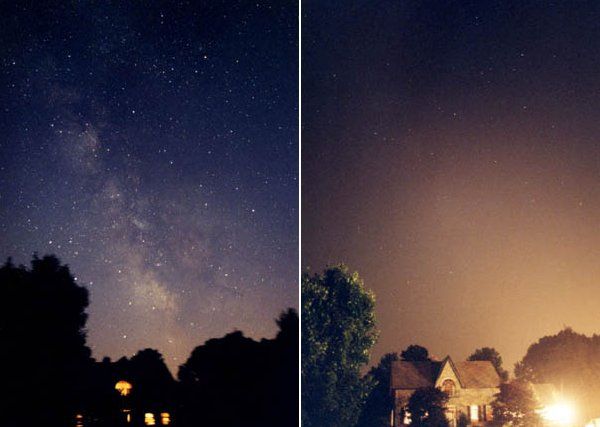
- On the other hand, if you live in a sufficiently light-polluted urban area, you might go most of your life having never seen any significant number of stars. Traveling somewhere with less nighttime illumination (or experiencing a regional blackout) might cause a considerable shock; the difference is quite striking in these pictures of the sky over Toronto◊ with and without the city lights. In this case, the (artificial) lights are going out, while the stars are coming out!
- If you have the open source astronomy program Celestia, you can pretend that the stars are going out by slowly decreasing the auto-magnitude setting. Same for the also open source planetarium program Stellarium, in which you can simulate the effects of light pollution, or others alike to generate star charts where you can choose not to display stars.
- The Great Attractor is a potential explanation for a strange phenomenon that appears to be affecting the speed at which the Milky Way and other galaxies in the Lanikea cluster, our cosmic back garden, are moving through space. Interestingly, this phenomenon could explain discrepancies in the estimated number of galaxies in the cluster compared to the increasing number being identified; the galaxies aren’t going out, but they’re impossible to see with telescopes on the ground since they're behind the Milky Way's arms from Earth's perspective, in a place called the 'Zone of Avoidance' (it obstructs the view of around 20% of the extragalactic sky). A recent survey discovered a whopping 883 galaxies "hiding" out of sight, and considering how many stars galaxies contain, that's a lot of stars we previously didn't know existed, to put it bluntly. Even more exciting is the prospect for exoplanets and life they may hold - with that much stuff hiding just beyond our vision, who’s to say what might be out there, just waiting to be studied?