

So there you are, reading a book or playing a game. Within the media, whatever it may be, is some rather illegal and immoral action. Violence, murder, mayhem, general chaos. It's all very enjoyable and so much fun. Then suddenly something happens to make you question how right you are to enjoy this socially unacceptable behavior. Perhaps the characters start musing about what kind of warped mindset would possibly enjoy this. Or maybe they just outright smash through the fourth wall and tell you exactly what they think of you.
Or alternatively, maybe what you're watching/reading/playing has some kind of political message — perhaps it deals with famine or suffering in impoverished nations, or the rise of fascism, or some other example of how Humans Are Bastards. And then the same thing happens — the characters basically turn around and tell you that this is all your fault: "You Bastard, why the hell are you enjoying this?!"
And you're left to wonder in shame. Or, perhaps, confusion.
This works especially well in video games, in which murder and theft are the generally accepted ways to advance (and video games typically require active user participation), without thought to moral consequences (after all, it's just a video game and none of these things are real, right?). If done well, it can be thought-provoking and unsettling, giving the reader / viewer / player pause to consider the moral implications of what they may have previously considered just a bit of fun. It may prompt them to examine both their motivations in reading this and the motivations of the hero — who, if they engage in numerous acts that would be condemned if done by anyone else, may look less and less heroic.
If done not-so-well, however, it can be quite Narmy and Anvilicious... and also somewhat hypocritical. After all, if the viewer is a bastard for passively enjoying this great evil, then what does that say about the producers, who ultimately are actively churning out and exploiting said evil for profit? What does that say about the creators who claim moral superiority by artificially creating a scenario, then getting offended that player did exactly what was expected, when, really, all the violence, pain, death, and suffering is on the part of the creator? And aren't other games really to blame for drilling the "everything is a target" and "your orders are absolute" messages into players' heads for 30 years? Things can also get murky due to limited agency the user may have over what they can do in gameplay, and the main character themselves in dialogue and cutscenes.
This trope is when the work calls out the audience. See You Monster! for when this line is used on a character within the work itself. For video games, it can overlap with Video Game Cruelty Potential and/or Video Game Cruelty Punishment. See What the Hell, Player? and Blamed for Being Railroaded.
Compare My God, What Have I Done?.
Examples:
- Battle Royale did this in the manga. In the final volume, the main character writes a letter telling the reader that the evil things in the volume exist only because the reader, and those like him, are evil enough to be interested in it.
- Black Lagoon has a subtle one in Episode 3 of the anime. After witnessing Revy in action during a shootout, Rock wonders what on earth she must have gone through to make her as messed up as she is... then realises that he himself must also be pretty messed up to feel awe and admiration at Revy's brutal skills, instead of sheer blind terror. Since the readers were probably admiring her as well at that point...
- Lady Snowblood: There's a bit of exposition on the scientific theories of the late 18th century, where one guy suggests that the Japanese should start having children with Europeans and generally open up to the Western world. The narration goes on to ponder on if this had happened, maybe Japan wouldn't have become the jingoistic nation it was, avoiding its expansionist policies and involvement in World War II... And you, the reader, wouldn't be holding this book right now.
- Mobile Suit Gundam 0080: War in the Pocket is a Deconstruction that seems to question why people love Gundam shows in the first place, when they tend to have such a staunch anti-war message. The final scene uses a group of children as Audience Surrogates, and has them talking about how cool all the recent bloodshed was and how they can't wait for the next war to start, so they can look at all the awesome new mobile suits.
- Re:CREATORS implies it in-universe. The only way to stop the Big Bad Altair/Military Uniform Princess (an evil fictional character who entered the real world) was to give her everything that she wanted; as a popular and charismatic villainous character, the power of fandom made it so that people were never going to accept her being defeated and gave her enough abilities to make her functionally omnipotent, even if the result was going to be the destruction of their real-life world. In our real world, however, it did not really work. The anime also outright shows it when Aliceteria lashes out at her creator for putting her in a Berserk-esque Crapsack World just for the entertainment of an external audience.
- Each YuYu Hakusho episode is followed by one of the main characters telling the audience what will take place next time. Most often it'll be Yusuke or Botan, but Hiei does the preview for the episode depicting his rough past, and invites us to watch if we're feeling sadistic.
- Parodied/subverted in Ricky Gervais' stand-up act Animals, in which at one point he announces that he's going to spend a few moments "talking about the most dangerous animal of them all" with an accusing finger pointed at the audience... before suddenly pointing at a picture of King Kong and yelling "The giant gorilla!" He then incredulously notes that some people say the most dangerous animal in the world is "Man", before pointing at King Kong once again.
- Given that most of his material stems from his extremely fucked-up life, Christopher Titus loves to poke fun at how he could make any of the horrible stuff he's been through funny, i.e. his quintuple-divorcee father bringing him up, his mother killing her second husband after he beat her mercilessly, his abusive girlfriends, his ex-wife who still causes trouble to this day, his professional missteps, etc., never mind how anyone else could laugh at it either.
- When he talked about finding out his first wife was cheating on him with someone twice his age and worth more than him, and the audience didn't audibly groan, he said, "Wow, you buncha whores. Really?"
- Jo Brand had a routine where she would talk about the film Boxing Helena and say "A woman has her arms and legs cut off and put in a box. What if she has her period?" When audiences groaned in disgust at this point she would say "Oh you're fine with a woman being dismembered then, but mention periods..."
- Steve Martin did this in one of his routines.
I guess I'm kinda thinking about my old girlfriend. We were together about three years, and uh... sometimes when I get on stage I think about her, because she'd travel with me, and I'd be performing, and I'd hear her laugh... I guess I kind of miss her. And, uh... she's not living anymore, so... [laughter] You think that's funny?
- Robin Williams had this happen during his 2002 special "Live on Broadway" during a joke about Osama Bin Laden's death:
Robin: "I must talk to Jesus Christ! Where is Jesus Christ?!", and St. Peter goes "Hey, Jesus, did you call a cab? C'mon!" (the audience groans) A-ha! Yes! I heard it! Finally, the P.C.s! (hisses) We've crossed the politically correct line! It was okay to beat the shit out of him, but don't do the ethnic joke! (hisses) How Buddhist of you. Yes...
- Stephen Fry, in the stand-up section of his sketch show with Hugh Laurie, did a scene where he picked out empty seats in the audience, sat in them and told the audience member next to him some tragic fact about, say, cancer, or his mother's death. Inevitably the situation made them struggle not to laugh which he then berated them about, making it even harder for them not to laugh out loud.
- Louis C.K. has a bit "Of course ... but maybe" where he says that "of course" something is bad, "but maybe" it's not entirely bad, starting with fairly mild things. About the time he gets to "of course it's terrible that all these kids have peanut allergies and we should do everything we can to protect them, but maybe..." the audience usually audibly reacts with gasps of horror, whereupon he says "No no no, you were laughing a second ago, you don't get to redeem yourself now, you're just as horrible as I am." Because we know you were wondering: "But maybe if we just ignored the problem for a couple years it would go away." You're welcome.
- Richard Herring pulled this on the audience at a Collings and Herrin recording after baiting them with a Black Comedy Rape:
Richard: I'm gonna bum Andrew Collins onstage. Who'd like to see it?
Audience: (cheering and applauding)
Richard: Wouldn't you be appalled? How would you feel if I actually anally raped Andrew Collins?
- Batman:
- The Joker, of all people, pulls a "You Bastards" on Gotham City (and by extension the reader) by showing up during a game show and threatening Japanese-game-show levels (and beyond) of sadism on the participants. The entire time this is happening, we keep cutting away to the production crew, whose reactions run the gamut between "oh my God, this is horrible" to "keep rolling, the ratings will be awesome." Joker dicks with his terrified victims, but he does little worse than a pie to the face. After he's done he lectures his unseen audience about their expectations — and broadcasts the producer's money-grubbing reaction. He even declares it "the most fun he ever had without killing anyone" because of all the sheer terror he got to laugh at with the contestants thinking they were going to die and screwing people over through his actions.
- The reason the Joker keeps pulling this off is because, while he's undeniably crazy and cruel, he is also a consummate showman and his exploits are just so entertaining that they're hard to resist — especially if there's some way to make a profit from his antics. In another story arc heavy on Refuge in Audacity, the Joker actually succeeds at selling his own life story to a low-budget movie studio in Gotham and has himself cast as the star, even getting up-and-coming young actors to appear in the film alongside him, cast as his victims (who somehow never consider the almost certain possibility that he really will try to kill them). Even worse are the filmmakers themselves, especially when the Joker threatens to bump off members of the crew if he doesn't get his way and the producer counters that there are plenty more lackeys where they came from. When the Joker finally lashes the filmmakers to a Death Trap (that he hopes Batman will inadvertently set off by trying to stop him) for the movie's big climax, the producer's only reaction is to announce that the Joker has gone too far and that the movie will now have to shut down production.
- Joker-fun again in The Devil's Advocate. This one-shot comic depicts the Joker supposedly coating postage stamps with his "Joker venom" because the post office won't put his face on one of their commemorative stamps honoring the greatest comedians of all time (explaining that only dead comedians qualify); as usual, innocent Gothamites lick the stamps and die grinning. But this time the viewer is given a jolt by, for once, being forced to witness the reactions of the loved ones of the people who died... including one sobbing man holding a grinning female corpse. You realize that all the Joker-murders you've spent your whole life laughing at were really not funny at all. In fact, in the story itself, these killings are considered so heinous that the Joker is not automatically returned to Arkham Asylum but deemed fit to stand trial and is found guilty on all counts — and sentenced to die in the electric chair, which would indeed have been his fate if not for Batman's intervention. The Joker is actually innocent of these particular murders.
- The Invisibles: Done in a Whole Issue Flashback that gives A Day in the Limelight to a helmeted Mook who died in the first issue or two, showing a rather sad life that ran down to that conclusion. It's less Anvilicious than it sounds, largely because the series makes a point of showing the Grey-and-Gray Morality behind a seemingly black-and-white conflict.
- An early issue of MAD had a rather vicious parody of Bringing Up Father. The odd-numbered pages are done in the whimsical style of the original strips, while the even-numbered pages are done in a grim and realistic style. The even-numbered pages also feature Jiggs lamenting his lot in life of getting the crap knocked out of him by his abusive Social Climber wife Maggs, all for the amusement of the comic-reading public.
Jiggs: That's right! Have a good laugh while my wife beats me up! Laugh like you have all these years!
- Mark Millar likes this trope almost as much as he hates his readers, whom he's argued use comic-book violence as a substitute for the emptiness and meaninglessness of their lives. Wanted is particularly explicit about this.
- In Animal Man, Grant Morrison essentially apologizes to the eponymous character for kowtowing to the Bastards. Towards whom he gets a few good swipes.
- In Empowered, about once a volume, she will let the reader know how much she hates that someone is enjoying her bondage scenes.
- The Wanderer features a story arc where the hero gets raped by bandits. The rape is presented in such a way to appeal to the target audience, rather than be horrified by it. During the second act, the comic pulls a 180 and the hero's rape is presented as a horrible thing, which would no doubt leave whomever was previously enjoying it feeling more than a little dirty.
- Deadpool:
- Deadpool Kills the Marvel Universe employs this, with uncertain effectiveness. Deadpool, having been tortured to the point of further insanity, directs his fourth wall-breaking gaze on the reader at several points, questioning why their idea of gory good fun would necessitate him brutally murdering other characters whose own characterization would never allow them to fight back enough to hold him off. Even the blurb for the series employs this ("What if he actually pulled it off? Would that be FUN for you?")
- Prior to this in Deadpool #900 Deadpool laments that he'll never be able to die, the one thing he really wants, because he's too popular to kill off. He then sets off on a quest to murder each and every one of his fans.
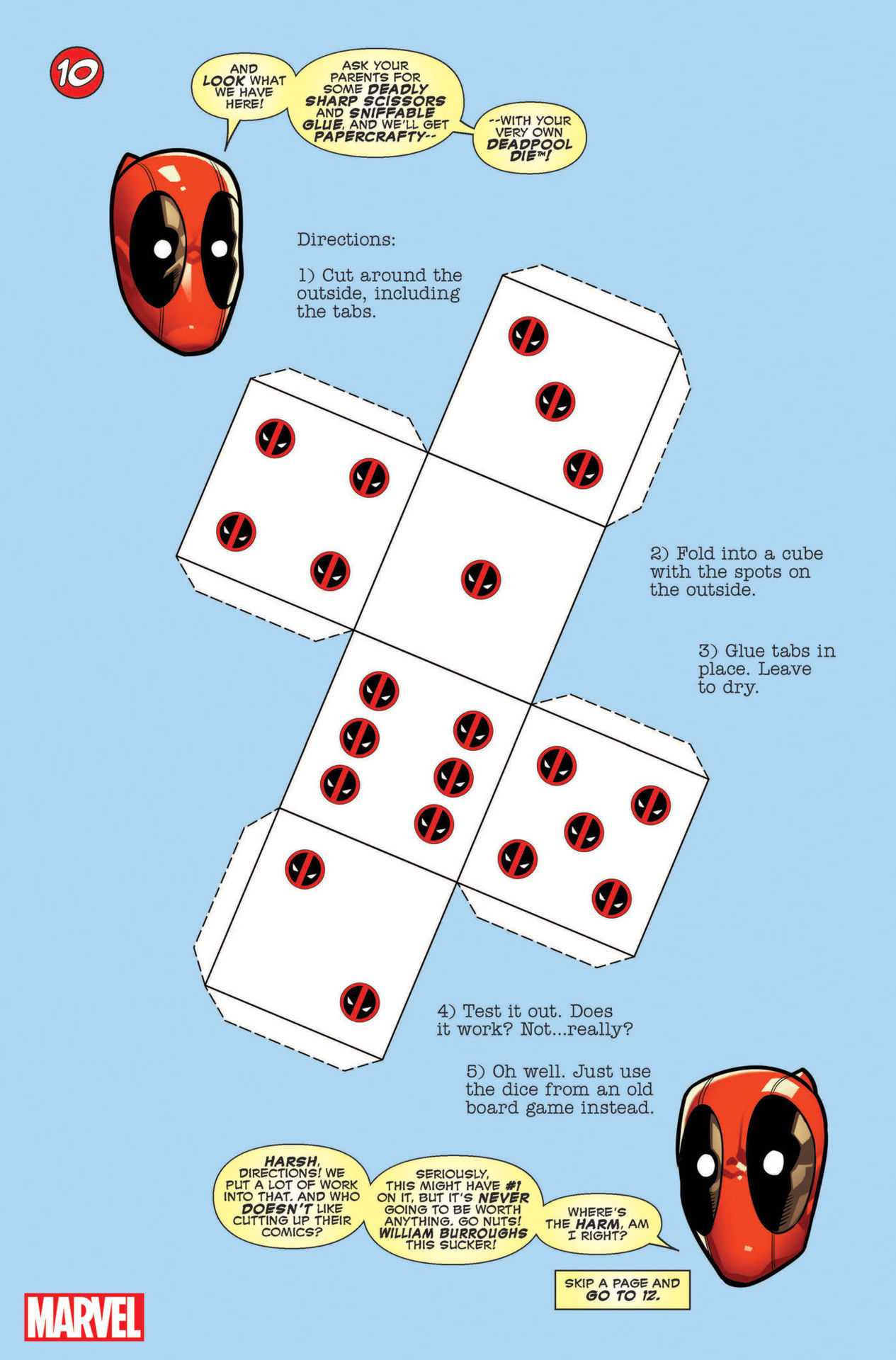
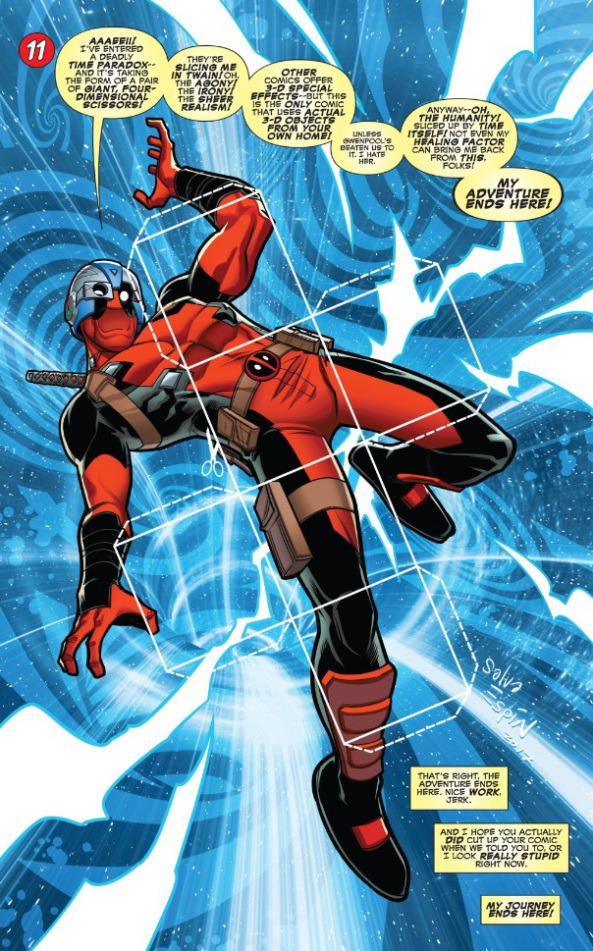
- One issue, styled as a Gamebook, has a page
 ◊ inviting the reader to cut out a papercraft Deadpool die (with Deadpool even saying there's no harm in cutting up your comics). On the other side of said page◊ is Deadpool screaming about how he's being sliced to bits by giant four-dimensional scissors, beyond even his Healing Factor's limits. That's right, if you cut out that die, YOU kill Deadpool.
Caption: That's right, the adventure ends here. Nice work, jerk.
◊ inviting the reader to cut out a papercraft Deadpool die (with Deadpool even saying there's no harm in cutting up your comics). On the other side of said page◊ is Deadpool screaming about how he's being sliced to bits by giant four-dimensional scissors, beyond even his Healing Factor's limits. That's right, if you cut out that die, YOU kill Deadpool.
Caption: That's right, the adventure ends here. Nice work, jerk.
- An issue of Batman, Inc. ended with Catwoman and a young woman named Misaki being wrapped up by an octopus. Earlier in the same issue, Catwoman had been disgusted by a hentai book she'd discovered, and asked what men found so appealing about women being tied up and groped by tentacles.
- Combined with Medium Awareness and Breaking the Fourth Wall at the end of The Simpsons Halloween story "The Immigration of the Body Snatchers." Homer ends up in an insane asylum for trying to warn Springfield about an invasion by "pod people"...but then it turns out that the pod people aren't even the biggest threat, because spies from Venus have infiltrated Earth. And even the Venusians aren't the biggest threat, because the Martians have come to stop them. And even they aren't the biggest threat, because a "robot ghost clone" has time-travelled from the future in order to kill everyone Deader than Dead. Things just get more absurd from that point on, with apes invading Earth, and then cannibals, etc. Then Sideshow Bob informs everyone present that none of the above really matters, because they are all characters in a comic book who exist only in the reader's imagination. The others laugh at him, but then Bob points out that they are surrounded by blank borders and that they can see themselves in many different panels at once - and then directs their attention to "that person out there, reading this garbage." Everyone then panics and screams, begging you not to close the comic because that would make all the characters in it experience Cessation of Existence.
- In the very, very rare "Especial Macabro" (Macabre Special) that Condorito did in 1976, Condorito is an evil monk that challenges readers to read the special, indicating they will become part of his Legion of the Damned. He keeps on taunting the readers, telling them there is still but a bit of light left in their corrupted minds, even challenging them to stop reading.
- The opening text in A-Babies vs. X-Babies mocks the reader for buying a book about small children beating the crap out of one another.
- The final issue of the Garth Ennis/John McCrea run on The Demon ends with Etrigan breaking the fourth wall to thank all the real-world creators who worked on the series, and then sardonically mock the reader for enjoying a comic filled with all sorts of depravity and featuring a Villain Protagonist.
- Enemy Ace, a man who fought as part of the German army in both World Wars, once had an ad calling out the readers for enjoying the character's adventures.
- Horrortale occasionally lets the readers decide what the protagonist Aliza should do. The final comic of the first part has Flowey sarcastically congratulate the audience for their choices resulting in Aliza getting stuck underground with a bunch of weirdos and "a taste for human meat" and asks if that's really the best ending they could achieve.
- The Devils Chair has a weird moment of Breaking the Fourth Wall where the protagonist tells the audience that the movie's just gotten silly and that they're horrible people for enjoying it.
As you can see it all got a bit silly right here. A girl with her puppies out, a demon, old banana over there in his pajamas. Is this what I promised you? Are we prick teasing you enough? Is this what you came here to see, all my brothers? Look at this poorly written, badly acted bullshit! Is there any truth in this b-movie banality? No! No, there is no truth. Believe no one. Believe nothing. You freaks and geeks. You bloodthirsty morons, fuck you! Bring on the red parade. So are there any pulses in the house? You deadbeat, midnight, freak-geek witted torture-porn gore whores! I know what you're looking for, so have it! Take it! and fuck you all very much!
- In Friday the 13th: Part VI, drunken groundskeeper Martin hurries to restore Jason's grave before anyone discovers it was desecrated; he wonders who could possibly want to disturb the grave of someone like Jason Voorhees as he turns to the audience and comments on how, "Some folks have a strange idea of entertainment."
- This is the point of Funny Games. The villains constantly address the audience while torturing their victims, commenting on the audience's role in taking entertainment from their suffering.
- The 2000 Russell Crowe movie Gladiator has the title character pulling this on his In-Universe audience, and perhaps the viewers by extension.
Maximus: Are you not entertained?! ARE YOU NOT ENTERTAINED?! Is this not why you're here?!
- Also discussed by Proximo:
Proximo: Thrust this into another man's flesh, and they will applaud and love you for that. You may even begin to love them for that.
- Also discussed by Proximo:
- The Belgian movie Man Bites Dog is based around this trope. It's a satire of the media's glorification of violence and criminals done as mockumentary about a film maker who follows a Serial Killer around and films his crimes. The killer himself is charming and likable and the violence is played as Black Comedy, but then it throws in a couple of scenes so disturbing that it makes viewers feel queasy for enjoying the rest of it.
- WWE-sponsored Battle Royale ripoff The Condemned (2007) tries to have this as its Aesop with the infamous line, "Those of us who watch... are we the Condemned?" which horribly backfires considering the fact that this was sponsored by WWE, as well as made by the company known for creating one of the most famous gorn franchises. The marketing was made around the concept of watching a movie where prisoners fight to the death.
- Parodied in Wayne's World, in which (during a fourth wall break), Wayne blames the audience for his problems. For once, the "audience" reacts appropriately, with the camera's viewpoint turning away and looking for something else to watch until Wayne apologizes and changes his mind.
- This is one reading of Straw Dogs. Some critics argue that the The So-Called Coward fantasy is deconstructed by the final rampage rather than supported.
- The Last Horror Movie, a British mockumentary which, like Man Bites Dog, follows the day to day life and crimes of a darkly comical, Affably Evil Serial Killer who spends the movie talking to the viewer about his POV. In the end, once he's made the viewer confront the fact that they could've stopped watching at any time, he reveals that he recorded this movie over a tape from a video store. The tape that you have rented. He has followed you home. If you've gotten far enough into the movie to see this, that means he is about to kill you.
- In Crank: High Voltage, Chev Chelios himself ends the movie by flipping off the audience while on fire.
- Subtly done in Psycho. In a movie about a sexually-repressed voyeur, the opening scene is a semi-dressed couple just after having sex. The camera moves into and through the window so we can watch. We are voyeurs, just as the main character is.
- Voyeurism is a huge theme in Rear Window. Jimmy Stewart is a bored invalid who spends his days looking in his neighbors windows with a telescopic camera lens. His friends and girlfriend all express concern about this new hobby. Toward the end of the movie, when the murderer he's been watching finally realizes he's there and looks straight across to meet his eyes, he's also looking straight into the camera, at the audience. Guess what, you're a little sick for watching and enjoying this, too.
- Peeping Tom takes the voyeurism theme and runs with it to a degree even Psycho was unwilling to touch (part of the reason it killed director Michael Powell's career).
- In The Wizard of Gore, during Montag's last onstage speech, he starts talking about bloody violence and how it fascinates us. He then turns to the camera, smiles and says, "You want it." And yes, this is a Gorn movie to a high degree.
- In Blue Velvet, after Jeffrey (and the audience) has covertly watched Frank Booth rape Dorothy, Frank and his mooks make Jeffrey go on a drive with them. Frank then turns to Jeffrey (and the camera) and says, "You're like me."
- In Last Action Hero, the title action hero Jack Slater doesn't particularly like being sucked into a new highly dangerous adventure each time the audience in the real world demands it. When he meets Arnold Schwarzenegger (the actor who plays him in the "in-universe" real world as well as in the real real world) at the premiere of the newest Slater flick, the character accuses his actor of being responsible for his suffering.
- Mocked in Danny Boyle's film adaptation of The Beach. When Richard turns against his friends and retreats to the jungle, he envisions himself as the character in a video game — a vision shown through a first-person POV so that the audience realizes their connection to Richard's violent fantasies — and their own complacency in his dementia.
- Subtly done in Scarface. When you take Tony Montana's words from the scene when he yells at the people in restaurant out of context, they turn into this.
- A less mean version in The Truman Show, with 'audience' characters watching the show-within-the-show clearly also representing the film's viewers, who will be caught up in the events of someone else's life, applaud Truman's decision to leave the invented world he'd lived in, then flip channels to see what else is on.
- Inglourious Basterds does this in a similarly oblique way. At the climax, an audience of German soldiers delight in a propaganda film that consists of Allied troops getting repeatedly killed by a sniper. Throughout the entire film, especially in the very next scene, the real audience is invited to do the same when Germans are slaughtered.
- The Cabin in the Woods: The Ancient Ones are like horror movie viewers. They watch for people to die in horrific, troperiffic ways, and, when their world does not go as they wanted it to, want to make it go away. And it's hard to not see the scientists/puppeteers as a metaphor for Hollywood's current horror output, repeating the same formula ad infinitum to appease its target audience's appetite for sex and gore as religiously as any ancient ritual. And you can see the two main scientists as a metaphor for a writer and a director, forced to keep putting out the same dross and lamenting their inability to try anything creative. 'I'll never see a merman,' indeed.
- This was the intended point of Sucker Punch, criticizing its viewers (and, more broadly, male geek culture in general) for indulging in the fetishization and objectification of women. We, the viewers, see the girls' dances as action-packed war/sci-fi/fantasy spectacles designed to push all of our geek buttons — steampunk, cyberpunk, Humongous Mecha, fire-breathing dragons, an abundance of Japanese-inspired imagery, and of course, scantily-clad action girls at the center of it all... and then we see the men watching the dances within the film, who are portrayed as lecherous slobs and assholes who are then taken advantage of.
- Invoked (subtly) in The House Bunny when the heroine tries to perform a Marilyn Maneuver over a manhole — only to get scalded by the jets of steam. In the next scene, we see her legs heavily bandaged — and the parts that aren't bandaged are covered with nasty second-degree burns. In other words, because you got to see underneath this girl's dress,note she got temporarily disfigured.
- Done very directly in I, Tonya — Tonya discusses the Domestic Abuse she suffered at the hands of her mother and husband, and how her later infamy was like a continuation of this abuse, then looks directly at the camera and says "You. You are all my abusers."
- The Passion of the Christ: The final shot before the Resurrection is Mary's unblinking stare directly into the camera. In traditional Catholic doctrine, Mary was free from sin at the moment of her conception, and thus she alone did not need the redemption offered by her son's death. Her Tranquil Fury towards the sinful audience imparts the film's message; you did this. You killed my son.
- In Heroes Die the main character (a kind of sci-fi gladiator who kills fantasy creatures to entertain the downtrodden masses of Earth) uses this on his audience, who collectively share his body for the duration of his adventures. Due to the character narrating to his own audience, it also ends up directed at the reader by extension.
- Clive Barker's Mister B. Gone starts from the premise that the book itself is possessed by a demon who frequently implores the reader to burn the book and set him free. The eponymous demon goes so far as to repeatedly threaten the reader, bribe them and appeal to their better (and worse) natures as the book goes on.
- Geoffrey Chaucer does it in Troilus and Criseyde, making this trope Older Than Print: the character Pandarus contrives various tricks and deceptions in order to bring the two lovers together, which is what the readers (with whom he's conflated — he sits around reading a romance during one scene) want to see happen.
- The Norman Spinrad novel The Iron Dream is essentially a giant sword and sorcery tale, ostensibly written by sci-fi novelist Adolf Hitler. From the other wiki: "Spinrad seems intent on demonstrating just how close Joseph Campbell's Hero with a Thousand Faces — and much science fiction and fantasy literature — can be to the racist fantasies of Nazi Germany."
- Hook & Jill — a revisionist take on Peter Pan written by Andrea Jones — features a Captain Hook who reveals to story-telling Wendy that she — not Peter — is his true antagonist. Because Hook is a creation of Wendy's imagination, she — and by extension, the meta-audience — is responsible for his mutilation and suffering at the blade of Peter Pan.
- Played for laughs in the Sesame Street children's book The Monster at the End of This Book, in which the entire plot is Grover berating you for continuing to turn pages when the title makes it perfectly clear that there's a monster at the end of the book, and he's terrified of monsters. The monster turns out to be Grover.
- Swordspoint does this, possibly by accident, in that many of the characters spend a significant amount of time pointing out how despicable they are.
- In Terry Pratchett's novel Only You Can Save Mankind, young Johnny Maxwell plays a computer game of the Shoot'em up type. He duly shoots up the alien fleet he sees on screen. Then he gets a new problem. The aliens turn to him and broadcast "We Surrender! Stop shooting at us!" The aliens are bloody annoyed that they only exist to provide vicarious entertainment to adolescent Earthlings...
- In Harry Potter, when telling the story of the rape of Tom Riddle Sr., Dumbledore gives one to Harry, and by extension, the readers, who thought that using a Love Potion was entirely harmless. That said, the non-serious tone of love potions is also present in the early books; it's not until the last couple books that they're treated as akin to date rape drugs.
- The Hunger Games essentially turns you into an audience member, getting you swept away in the cool costumes and the love triangles before all your favorite characters start biting the dust and the ones left alive can never be the same again.
- In a non-fiction example, the historian John Lukacs, in pretty much every one of his books, attributes the rise of Fascism not to the sudden whims of tyrannical dictators, but to the mass sentiments of ordinary people who are disaffected and want political change — and he's pretty clear to the reader that this could easily include them.
- In The Ones Who Walk Away from Omelas, the narrator describes the titular town as a lovely utopia free of strife. They then realize that the reader is likely expecting some kind of catch, since a glut of dystopian fiction and utopia deconstructions have made them suspicious of any utopia seemingly played straight, so they add that the town's prosperity depends on the suffering of one child and basically ask "There. Someone's suffering now. Are you happy?"
- Crossing over a bit with video game examples, the BattleTech short story Almost Sounds Like The Guns Themselves is about one of the nameless, faceless enemy pilots from the computer game's Breather Level Liberate Itrom struggling to make a new life for himself in the aftermath of the game's main campaign despite clearly suffering from serious PTSD. A large chunk of the story is devoted to his flashbacks of said battle, including the rather gruesomely described death of his best friend at the hands of a mercenary heavily implied to be the game's Player Character.
- The Vicar of Dibley provides an example: the end of an episode dealing with the character's attempts to get involved in Live Earth ends with shots of people suffering in famine-torn Africa coupled with shots of the cast glaring righteously into the camera as if to say "This is all your fault! You are to blame for this! Yes, you personally!" The episode itself was essentially a publicity spot for the White Wristband campaign.
- Mocked in "ATTENTION SCUM", where the League Against Tedium tries to poorly tell you off: you are "lottery players", "sub-worms", "poltroons", "absolutely ridiculous", "parodies of each other", you think you are Elvis, while really you are not even a bad Elvis impersonator, your mother was a screaming woman with a fly on her tongue, your father was that fly, your sister is a poodle, and highest ambition is to STAND IN LINE IN THE RAIN.
- The episode "Tsunkatse" of Star Trek: Voyager has the crew enjoying a violent alien sport, then feeling guilty about it when they realize the participants are slaves. Chakotay in particular, was very interested in it. Then again, he boxes, so you can see why. It was the slaves bit that got him up in arms.
- The final episode of the mini-series Britz ends with a suicide bomber's final recorded message, in which she blames the British public (and by extension the viewing public) for their indifference to injustices committed by Israel and the West in the Middle East for resulting terrorist bombings and actions including the bomb she herself set off in London at the end of the series, and that they only have themselves to blame, as their indifference means they are no longer innocent civilians but worthy casualties of war. However, we're not exactly supposed to condone her actions since she is a suicide bomber (although we are meant to sympathize with the experiences she and her fellow Muslims go through, which is partly responsible for leading her to extremist politics in the first place), and there's more than a hint of slightly deluded self-justification on her part involved.
- Done in the House of Cards (UK) trilogy; in the manner of a Shakespearean villain, Francis Urquhart regularly turns to the camera (and through it, the audience) and shares his thoughts and plans with us in a very charming, seductive manner, both implicating the audience as a co-conspirator and charming us on some level into wanting him to succeed.
- The Shield spends seven seasons carefully building your sympathies for a man who is a thief, a thug, a liar, and a cold-blooded murderer. The series finale brutally tears this pretense apart and throws it back in the viewer's face.
- It's fairly rare, but action-oriented TV series do occasionally feature characters expressing remorse or disgust over their actions in a way that makes the viewer feel guilty for enjoying a recent Moment of Awesome. Examples include Robert McCall in The Equalizer breaking down and crying when he tells a lady friend he kills people for a living (this after taking out a gang of violent thugs in a subway station); John Crichton on one of the final episodes of Farscape breaking into tears with Aeryn over how much blood he has on his hands; and in the comedy spy series Chuck, which spends an unexpected number of scenes dealing with the two lead characters' reactions to having to kill people.
- On the slightly less hypocritical side, the first episode of the crime drama Flashpoint spent most of its time dealing with the emotional impact a successful sniper shot has on the shooter—given that one of the driving points of the series as a whole was that a non-violent resolution of the situation was always preferable, driving home the human cost of such a shot, even if fully justified, was probably required.
- In the final season of The Sopranos, Dr. Melfi's own shrink tore into her for enabling Tony to continue his life of crime. A lot of critics read this as a rebuke to the viewer, for enjoying the show even as it becomes painfully clear how irredeemable most characters are.
- Supernatural has repeatedly pulled this off in various episodes such as "The Monster at the End of This Book" and "The French Mistake". Sam and Dean are less than thrilled to learn that the dangerous life they live has been taken into other media for people to enjoy as entertainment. The final Big Bad of the series God Himself, embodies this, in addition to Self-Deprecation through His Author Avatar aspect. He sees the suffering of the Winchesters and those around them as entertainment, due to seeing them not as people, but toys made for His amusement.
- Life's Too Short has one in the first episode. Liam Neeson is testing his comedic skills with Ricky Gervais, who is left cringing as Liam tries to make a joke about AIDS. Stephen Merchant tells Liam that AIDS is not something to laugh at, to which Liam Neeson replies "So how does (Ricky Gervais) get away with it?". Liam Neeson is most likely referencing how Ricky Gervais once used AIDS as a subject in one of his stand-up tours, but the shoe drops when you realise that since Ricky created the series, he's getting away with it again!
- In the Doctor Who story "Carnival of Monsters", Jo is aghast when she learns the Miniscope is an entertainment device, and concludes that anyone out there getting enjoyment from watching her be threatened by monsters must be "evil and horrible". The Doctor is more moderate, suggesting they might just be thoughtless.
- Done by the host of The Late Show with David Letterman. When David is confessing his affairs, people keep on laughing. He asks the public "Why is that funny?"
- The Fall (2013): Paul Spector creates an in-universe example at the end of a film of one of his crimes.
Paul: Why the fuck are you watching this? You sick shit. What the fuck is wrong with you?Stella: Who were you talking to? Yourself? Me? The people who like to read and watch programs about people like you? Who?
- On Shameless (US), the Previously on… is usually introduced with a character berating you for missing an episode, for instance:
Frank: For those of you who were too fucking busy, this is what happened last week on Shameless.
- Seinfeld: "The Finale" received a lot of criticism that it seemed like co-creator/writer Larry David was lecturing the audience that they were wrong to be finding the protagonists funny for nine years, as they were put on trial where every single person they dealt with and/or screwed over returned to remind everyone of their long history of shameful deeds, ending with them being sentenced to prison time.
- The true crime documentary "Don't F**k With Cats" ends on this note. The person responsible for first the animal abuse videos and then more serious crimes was doing them for the attention that people pay to horrible things. And you just watched an entire documentary about him. Isn't that giving him exactly what he wanted?
- Oz: When a Prison Riot breaks out and the prisoners wind up taking hostages, Hill chides the audience for rooting for the prisoners and having forgotten that they're all criminals. This is followed by a scene where Alvarez, who had been depicted as a rather sympathetic character up to this point, beating a captive guard within an inch of his life while his Morality Pet Father Mukada vainly begs him not to.
- Black Mirror frequently takes digs at the selfishness and pettiness of contemporary humans as amplified by technology. It gets even more explicit with several episodes (such as "National Anthem" and "White Bear"), where the viewer ends up enraptured by the spectacle that is being condemned.
- "The Most Unwanted Song" (the result of simply doing what a poll said people hated in music) has a fairly lengthy section where a singer directly blames the listener for different atrocities. ("You. YOU. YOOOOUUUU!")
- First word of "B.Y.O.B" by System of a Down, a protest song about political apathy? One very Cookie Monster-esque YOU.
- Done much earlier (and Played for Laughs) by Anna Russell in "The Rubens Woman": "She is dead, and who killed her? Who killed her? You killed her! You!"
- Who killed the Kennedys? You and me.
- This trope is the cornerstone of Marilyn Manson's career.
- Manic Street Preachers' "Of Walking Abortion": "Who's responsible/You fucking are."
- Doug Anthony All Stars, "You're clapping and cheering for what is essentially a racist joke!"
- Jay-Z uses the majority of "Ignorant Shit" to mock his Unpleasable Fanbase for liking his superficial hits (like "Big Pimpin'" or "Give it to Me"), mostly because he's dismayed that his listeners don't embrace his more thought provoking material. The chorus paints the picture pretty clearly, N-bombs and all:
C'mon, I got that ignorant shit you need
Nigga, fuck, shit, ass, bitch, trick plus weed
I'm only trying to give you what you want
Nigga, fuck, shit, ass, bitch, you like it don't front - Lampshaded by Bob Luman in his 1965 hit "Let's Think About Living" in which he decries the number of popular songs in which the singers apparently get killed (i.e. Marty Robbins' "El Paso") or feeling so depressed they may as well die, to which Luman observes that if this trend continues "I'll be the only one you can buy."
- Carly Simon: "You're so vain, you probably think this song is about you!"
- G.K. Chesterton's poetry 'The Ballad of the Battle of Gibeon' is mostly about the heroic Israelites smiting the villainous heathen who seeks to destroy their innocent allies - effective, epic poetry cheering on righteous war. Up until the final stanza.
This is the story of Gibeon fight—
Where we smote the lords of the Amorite;
Where the banners of princes with slaughter were sodden.
And the beards of seers in the rank grass trodden;
Where the trees were wrecked by the wreck of cars,
And the reek of the red field blotted the stars;
Where the dead heads dropped from the swords that sever,
Because His mercy endureth for ever.
- One of the oldest tricks a Heel has to get Cheap Heat is to tell the audience what bastards they are. When Nigel McGuinness tore both of his biceps and fans were calling for him to drop his ROH belt, he called them all unappreciative of the wrestlers who cripple themselves for their sick sense of entertainment.
- There are times when the heel commentators will attempt to shame the audience by proxy by condemning Vince McMahon - or whichever of his subordinates happens to be in charge at a particular time and place - for putting their employees through sadistic matches just to satisfy the fans. JBL made such an argument when, in late 2006, SmackDown General Manager Theodore Long booked Montel Vontavious Porter in an Inferno Match against Kane, causing MVP to become so horrifically burned that he couldn't compete at the top of his game for several weeks afterward. Of course, nobody listened.
- Chris Jericho spent months playing the You Bastard card, lambasting the audience for cheering Shawn Michaels, who he saw as a hypocrite, a cheat, and a coward.
- CM Punk, as a heel, has also been employing this trope. See, he's Straight Edge and Jeff Hardy (as a face), his rival, was a reformed drug addict, so this naturally led Punk to despise us fans for liking Hardy so much, and very, very... VERY long narc speeches. To those familiar with his pre-WWE, he's done this act as a heel before and is apparently very, very good at it.
- Mick Foley in general has become famous for doing this. Take, for example, his Enemy Mine teamup with Edge against the revived ECW promotion in the spring of 2006. Foley declared that he hated ECW because it had forced him to shed blood for the company. Although he was technically lambasting Paul Heyman and not the fans, it was hard not to feel a little soiled if you were an ECW aficionado. Mick actually suggested the Mankind name expressly so he could ambiguously do You Bastard material, talking about the evil and ugliness of Mankind in a way in which he may be referring to himself, or to all humans in general.
- Vince would give such a speech on the June 3, 2013 episode of RAW, calling the audience out for wanting an injured Triple H to wrestle and put himself at risk, as well as chanting 'one more time' as Ryback put Kofi Kingston through three tables, an act even all the commentators, including JBL, considered going too far. McMahon dressed down the audience in a similar fashion several years earlier. On the October 3, 2005 episode of RAW, "Stone Cold" Steve Austin gave Stone Cold Stunners to all four members of the McMahon family while the crowd ate it up. Vince came out the following week with both guns blazing, telling the audience in no uncertain terms that although he was angry with Austin, he was even angrier at everyone in the stands who was cheering for Austin and egging him on while he delivered these (mostly) unprovoked ambushes and assaults on Vince's family.
- Part of Matt Tremont's Face–Heel Turn in CZW had to you with all you ungrateful marks who forgot about him even though he saved the company. The first person to accuse the fans was Drew Blood though, who taunted them on how he had turned our hero against us.
- Older Than Feudalism: In the New Testament a very nice guy named Jesus with holy, life-saving powers is tortured and executed in the most brutal way possible. And whose fault is it? Not the Roman soldiers... It's all YOUR fault!
- The John Tynes roleplaying metagame Power Kill. It's intended to point out to fantasy Tabletop RPG players that many or most of the actions their characters perform (entering other creature's homes, killing them and taking their belongings) would be considered heinous crimes if they occurred in the real world.
- The Urban Fantasy RPG Unknown Armies, which John Tyne co-created, also features similar applications of this trope. Many times in the corebook and the supplements, there is a subtle (or not so subtle) hint that Game Masters should punish the PCs in some manner for the kind of immoral or bizarre behavior described above, usually in the form of legal consequences or Madness checks (most likely in the Self meter). "You did it" are the Arc Words of the game.
- Violence™: The Roleplaying Game of Egregious and Repulsive Bloodshed by Greg Costikyan, which explicitly states that it was designed to be a D&D-style hack and slay game set in the modern world... and is a jokingly condescending condemnation of how violent the player is.
- Paranoia: Some missions are designed to set this up, where for once the PCs did have the knowledge and skills to do the right thing, but instead chose to screw things up for their own personal gain. In particular, two of the missions in WMD give the PCs the opportunity to be promoted multiple clearance levels while most of the population starves to death or gets memory-wiped every few days.
- In the Dragon Age tabletop RPG adventure pack, Blood in Ferelden, there is an adventure where if the characters slay a monster guardian they learn that if they then take the object of their quest, they doom an intelligent species to extinction. "Should the players complain about this horrible choice," the text reads, "you might remind them that they entered the [monster's] lair with the intention of robbing it, and killed it while it tried to protect its home. Slaying the [monster] wasn't necessary; Dragon Age provides rules for knocking out a creature rather than killing it. The heroes face this horrible choice in part because of their own actions." Given the actual setup, the point is rather anvilicious, but well taken nonetheless.
- Done backhandedly in "Nowadays" from the musical Chicago: the protagonists, having been declared innocent of the murders they committed, give glowing compliments (including floral tributes) to the audience "who made it all possible by believing in our innocence."
- In The Rise and Fall of the City of Mahagonny, Jimmy is about to be executed for having committed the most heinous crime in the world: not having any money to pay his debts. The execution scene is introduced with a caption which asks the audience members who are offended by this turn of events if they would have paid his debts. "Would you? Are you sure?"
- William Shakespeare does this fairly often, with characters like Iago of Othello, who implicate the audience in his evil schemes while constantly winking at them, or the Duke of Measure for Measure who does questionable things to bring the story to a happy, generically-correct conclusion (while advancing his own power).
- In The Guy Who Didn't Like Musicals, the entire plot surrounds a zombie-like infection that makes people burst into spontaneous musical numbers. By the end of the show, the only person not infected is Emma. During the curtain call, while the other actors are taking their bows, Emma is desperately trying to get someone in the audience to help her, but to no avail. This results in her screaming at the audience, "WHY ARE YOU CLAPPING!?!"
- The piece "Offending the Audience" by Nobel-Prize-winning Austrian Author Peter Handke is what it says on the tin, to the extent that anything else that could be counted as a play is absent.
- Jesus Christ Superstar: During the "Trial Before Pilate" sequence, Pilate calls the crowd on this as he orders Jesus flogged.
To keep you vultures happy, I shall flog him!
- The narrator of The Beggar's Opera blames the audience for Macheath being reprieved, because they'd prefer a happy ending to a just one.
- Drood is a Show Within a Show that allows the audience to vote on specific plot points. The (in-universe) actors sometimes break character to criticize the audience's choices. For example, if the audience votes for the siblings Neville and Helena to fall in love at the end of the show, they'll react in horror and call the audience disgusting before their love song. (Their actors will gladly make out anyway, since they're not related in real life.)
- In The Trail to Oregon!!, the Father swallows snake venom and gains awareness of the audience while tripping out. He hears a voice saying the "Watchers" have chosen a family member to die of dysentery, and promptly calls out the audience.
Why do you want to watch us die? Would that entertain you? You sick bastards!
- In a lot of H-Games where your character is not evil from the get go (and is shown to have some shred of human decency or morality), you — the player — are given the option (at least once, and there is always a more moral option as well) at some point to pick an amoral choice and cross the Moral Event Horizon at worst, or just become a total Jerkass at best. The trope comes from the fact the game makes it quite obvious your character is not acting like himself (a subtly implied What the Hell, Player?), and you get a Downer Ending for being a total bastard, especially if a more noble alternative was available. Some H-Games go as far as to invoke this trope by name on your character as you choose the "total asshole" choice.
- Itazura Gokuaku is about a serial train molester and a handful of his victims. The themes of perceiving rape as an act of love and "Not If They Enjoyed It" Rationalization are present, so it's possible for him to form actual intimate relationships with any or all of the girls. To get a good ending, the player must choose for the protagonist to turn himself in and reform. But if you take the provided options to exploit the girl any further, the protagonist will be shoved before an incoming train by a vengeful girl, to reflect on what a prick he is in his final moments before being mangled to death.
- Perhaps more bizarre is Saya no Uta where agreeing to part ways with Saya, the route that causes the least amount of death and insanity, comes across as more of a Bad End.
- ELF Corporation's infamous Shūsaku plays around with this trope, in keeping with the game playing fast and loose with the fourth wall. The game begins with the titular character Addressing the Player, straight up telling them that the goal of his Evil Plan is to infiltrate a women's dormitory for promising, affluent conservatory students, disguised as the building's kindly old caretaker whose identity he has stolen, and use hidden cameras to gather Blackmail material which he will then use to perform Sexual Extortion upon the students, and he wants the player to aid him in this nefarious scheme. The player is then offered several dialogue choices; there is, of course, the one where the player agrees to help him and the story proper starts, but there is also one where the player can straight up tell him that they absolutely refuse to partake in these kinds of morally abhorrent activities and declare that it is their intention to go back to the game store to trade the game in for a "pure love" story. Shūsaku himself is taken aback by this reaction, and starts to increasingly desperately beg the player to assist him, but if the player continues to persist in their refusal, he eventually gives up and calls the player a "hypocrite", upon which the game crashes to desktop.
- 3DO pseudo-porn Visual Novel game Plumbers Don't Wear Ties has a surprising instance of this, where the heroine is pleading for a job. You get the option of turning the situation into a classic "I'd do ANYTHING to get this job!" porn movie scenario, but if you do the decision blows up in your face as the scene quickly turns dark and wrong, the boss turning evil and the heroine turning sad and pitiful. Then the narrator chimes in with "What kind of sick, perverted monster are you!?" and slaps you with a penalty that turns your score negative. Because really, what were you thinking choosing the porn option IN A PORN GAME!? Worse, still, you have to do it to continue with the game.
- Umineko: When They Cry does this in a side story. This is the first time you realise just who the true monster of Umineko: When They Cry is, and it could also be considered a Take That, Audience! with the mixed reactions to Higurashi: When They Cry's uplifting ending.
Bernkastel: "Expanding a happy dream into infinity? Effort that brings success no matter what...? It's so sickeningly sweet that my tongue will fall off. ..... Aah, how revolting. It's the same to you, right? Therefore. I will show you a true, witch-like, granting of a wish. Because you're obviously looking forward to that. [...] These kinds of kakera exist, ......but what do you think? All of you who love this kind of ill-natured story...like this level of pain more, don't you?"
- In Ace Attorney:
- The final case of Phoenix Wright: Ace Attorney: Justice for All. First, Phoenix has to essentially accuse the innocent Adrian Andrews of murdering the victim...and then it gets worse. Phoenix is then forced to make the Sadistic Choice between getting Matt Engarde acquitted, or having Maya's kidnapper, the assassin Shelly de Killer make good on his threat to kill her. It hits hard on both sides of the fourth wall. That's part of the reason why it is such a Moment of Awesome when Phoenix is able to turn de Killer against Engarde.
- As noted on the Fridge Brilliance page for the game, the use of the Jurist System in Apollo Justice: Ace Attorney seems to be a Take That! to the many Japanese citizens who were unhappy with the idea of the system being implemented in the country in real life. The game holds the Jurist System up as the way of progress and just another way to polish and perfect justice. All of the heroic characters laud the system as a great new thing to try. Meanwhile, the one who launches an argument against the effectiveness of the system is a coldblooded killer who was relying on the previous court system to get the defendant he was framing found guilty. And in the end, the Jurist System lets the obviously innocent defendant go free, while making it clear that under the previous system, it would have been impossible to get her a Not Guilty verdict.
- Both of the above games also have bad endings where Matt goes free and Phoenix quits being a lawyer, and one jurist chooses "Guilty" which leads to a hung jury and Vera dying in the hospital, respectively. The HD versions have achievements for achieving these bad endings, named "Justice Ill Served" and "One Jurist's Verdict".
- School Days does this as a deconstruction of hentai games. If you treat any of the girls right you do get a good end and if you mess around with them, you do not go unpunished.
- Since Katawa Shoujo likes to play tropes commonly found in visual novels more realistically, this tends to happen:
- Part of Hanako's fanbase and, on her route, Hisao, are attracted to her because she is The Woobie, even more than the other girls. But in her worst ending, she snaps at Hisao, telling him that she believes he, Lilly and everyone else see her as a "broken" individual and pity her, declaring that she hates him and Lilly. These comments can just as easily apply to some of her fans.
- While Hanako's path was intended from the very beginning to drop this trope on the player (according to Word of God), Rin's can also be interpreted similarly. If you really give it some thought, you will realize very quickly that from the very moment you first meet her, it's incredibly obvious that something is off about Rin's behavior. But she's just so charming, isn't she? Her quirkiness is just so adorable, it's probably just a sign of true intelligence! And then you go, and, as Hisao, push her further and further into insanity despite her constant (in the beginning) objections and the fact that she obviously isn't interested, because she's so smart and cute, right? One of the endings implies that she'll kill herself because of the "lessons" you taught her.
- Danganronpa:
- In Danganronpa: Trigger Happy Havoc, Monokuma calls out just how much people want to see high-school friends slaughter each other en masse.
- In Danganronpa 2: Goodbye Despair, Monokuma again points out that "Nobody wants to see a story where a bunch of students hang around on an island and get along!", and implies that you only started playing because you wanted to see how the massacre went.
- Danganronpa V3: Killing Harmony is a Meta Sequel where the previous games and anime are just that: games and anime. The Danganronpa property is so popular that it got adapted into a reality show where real high schoolers are mindwiped, implanted with the false identities of Danganronpa characters, and thrown into a real killing game; and they all signed up for it willingly, either for fame, money, or simply to live out every Danganronpa fan's fantasy of being a part of that world. The entire second half of the final trial is a massive "You Bastard!" to the fanbase for deriving entertainment from watching teenagers slaughter each other and suffer heartbreak and loss over and over again, or worse, wanting to actually be one of them. Have you ever wondered what you would do if you were in the same situation as the students of any given Danganronpa game? Ever imagined, drawn, or commissioned a drawing of yourself as a Danganronpa character? Wondered what your Ultimate talent would be? Wondered what your execution would be? Wrote a fanfic where you create a whole new bunch of kids and put them through the same paces? The game calls all of it out and then ends with you fighting against the Danganronpa fanbase with the explicit goal of pissing them off with a lame ending so that they lose interest in Danganronpa and stop watching, thus preventing future killing games from happening since the franchise is no longer profitable. Needless to say, this ending is very polarizing amongst the real-life fanbase.
- Nana's Everyday Life: IS THIS COMEDY?
- This Chainsawsuit comic plays it straight for laughs.
- Similarly, after loads of literal metaphors in Terminal Lance, we get our protagonist apparently attempting to shit out a battery, on orders of an NCO. Then...
- Brawl in the Family: No one ever thinks about the minions!
- You don't even need the cast to help you along in Saturday Morning Breakfast Cereal.
- The Order of the Stick:
- Thog's fanbase get a Take That! in one strip. As Roy compiles a list of all the people Thog has slaughtered, Tarquin comments:
Tarquin: It's weird, no matter how many people he kills, the audience still thinks he's lovable.
- Given that Rich Burlew has done everything in his power to make Thog popular, this is very much tongue-in-cheek. It was probably a reference to fan-favorite Belkar too.
- Tarquin may be the first villain in history to actually use this Trope as part of his Evil Plan:
Tarquin: My name will be immortalized forever.
Elan: As a villain!
Tarquin: So what? Audiences always think the villain is cooler than the hero is, anyway.
- Thog's fanbase get a Take That! in one strip
- There's a pregnancy fetish comic, Olympic Dames, that introduced a caricature of a nerd who creeps over the pregnant main characters, shares pictures of them online and is deeply immersed in his fetish's subculture. It culminates in him getting the stuffing pounded out of him by the upright, sensitive Love Interest that he tries to "befriend" because he saw they shared the same fetish — which the LI was trying to hide. It's pretty clear what we're supposed to think. (And yet, the artist does commissions. Disingenuous, much?)
- Nerf NOW!! evidently is in love with this trope. Such as Engineer building one turret just for art and naming it only to have a passing spy casually crush it (this didn't end well). And little Moe Zerglings, either expendable cannon fodder or saved by a Defiler only to be cannibalized. Or the creepiest looking example: did you just hunt little cute fairies, grab and cram them in bottles, Link?
- Head Trip description of Pokémon:
Mal: But anyway... Pokémon is totally like a gladiator battle but with cute little animals. It's messed up, man.
- Exiern has a seer at the top of the world warning Tiffany about creatures called watchers and dreamers. They make people come to life, put them through all sorts of hell for their amusement, and then kill them when they are no longer of use. And all for some inscrutable plan.
- In-setting example: Wonderita of The Non-Adventures of Wonderella discovers she's playing this kind of game when she finds a dead enemy's ID card, goes to its home, and meets its alien widow and child.
- Even Borderlands 2 writer Anthony Burch, whose social views are well-known as extremely left-leaning, ended up writing an article for Destructoid essentially saying that the recent trend of "this violent video game is about how you're a terrible person for playing violent video games" was rapidly becoming Anvilicious as well as more than a little pretentious and silly.
- Survival of the Fittest has this, either in cases where people rant at cameras (and by proxy, the audience) declaring them to be sick bastards for watching/enjoying it. This trope is also something of an in-joke on the boards - it's often said that the members have to be at least a little sadistic. It was even pointed out after one handler mused that the memberbase has to be morbid indeed to casually joke about such subjects as characters suffocating to death. In examples of the former, characters Adam Dodd and Bobby Jacks both actively call out Danya for orchestrating the game.
- There's a bit of subtext of this in the last chapter of Sailor Nothing in regards to what happens to Ami. Specifically, it reads like a case of I Wished You Were Dead applied to the audience.
- Ask That Guy VIOLATES Ma Ti. "Fuck him! And fuck you too, internet! You clicked on this link, you wanted to see this!" And it goes on from there....
- This article gives this trope a whirl.
- The Angry Video Game Nerd's Atari Porn review: "So, you wanna see more?" (Beat) "You sick bastards!"
- Stuart Ashen's review of Vinnie the Vole's Existential Nightmare.
Your actions have damned Vinnie
YOUR FAULT - Towards the end of his review of Chris Brown's "I Can Transform Ya", Todd in the Shadows explains that he doesn't blame him for the terrible song; rather, he blames his audience, because they're the ones who made it popular rather than his "simpering apology songs."
- Atop the Fourth Wall almost pulled this off when Linkara at the end of his Ultimates #5 review blames the audience for reading it in the first place. In the end it turns out that it wasn't Linkara but Mechakara during their first confrontation. The real Linkara was just coming home from his vacation and walks in on him just as Mechakara was a tad close to turning his fans against him.
- The Nostalgia Critic despises his audience for not appreciating him, for wanting him to suffer and constantly requesting the show that gave him one of many reasons to be bullied. As should be obvious, this is just the Critic's issue; Doug loves his fans and needlessly apologizes if there's ever a hiccup in schedule.
- Chester A. Bum reamed out people who found it funny to watch him nearly freeze to death in a night-time snowstorm. The experience also served as a Despair Event Horizon, as he got far less idealistic about everything in following episodes.
- The "One Piece/Child Molester"-clip in AMV Hell 4. It's been almost a full hour full of Black Comedy and Black Comedy Rape, but this one does not have any punchline or subversion at all and is just pure Mood Whiplash.
- In the Far Cry 3 Real Life experience the closest they get to saying you bastard is the quote, "Between you and me, you should be outside playing in the sunshine, rather than watching this bullshit." But let's all be honest here, you feel like a bastard for watching and enjoying it.
- Subtly done in this Downfall parody; you'll feel bad after laughing at Hitler's antic on Jodl, who is left alone by himself to celebrate Christmas after his wife died.
- In Demo Reel Donnie gives a big rant about how unfair his Trauma Conga Line life is and that he has to die to a creator that doesn't care at all. With the commentary confirming that Doug was angry that the Critic was demanded to come back, the creator is obviously meant to be the avatar of the part of fandom that just didn't want to know.
- Zero Punctuation regularly uses this when covering niche games, directly attacking the audience for choosing games like Halo over Braid, No More Heroes or Psychonauts. Especially you, Adrian! And this is his alternate title for Monster Hunter 3 (Tri).
- In Fallout Lore: The Storyteller, the Storyteller at one point calls out Fallout players who play the game as murderous senseless lunatics while showing what the true aftermath and reaction to such a person's actions would be like.
- In the CinemaSins video for X-Men: Apocalypse, when Magneto's wife and young daughter are killed, Chris sins the audience because "These deaths are to get him back into being Magneto, so these deaths are for your entertainment."
- Unraveled:
- In the video on OSHA violations in Super Smash Bros. Ultimate, Brian gives a "shout out" to the fan who suggested this topic, which forced Brian to read hundreds of pages in OSHA regulations. Brian angrily calls the fan a "piece of garbage."
- In the final episode,"Pokémon Edibility," Brian explains how he's only doing this topic because fans demanded it for so long (due to a joke he made about it in the E3 video), and chastises the audience for not understanding how played-out this topic actually is.
- An early Merrie Melodies short, "The Wacky Wabbit", has Bugs Bunny cut down Elmer Fudd's clothing, revealing he was wearing a girdle.note After Bugs throws a lampshade on it with a mocking Wolf Whistle, Elmer turns to the audience and pre-emptively slaps back at any laughter.
Elmer: Don't waugh. I bet pwenty of you men wear one of these.
- ReBoot:
- After being put into a horror game and seeing the Player maniacally blast away enemies:
Enzo: And in the next level, sprites are zombies! They've got flesh on their bones!
Dot: I don't even want to think about that. I mean, what kind of sick creature gets enjoyment out of playing this sort of game?! [both characters glare at the viewer accusingly] - They play this for laughs when they enter a game which is a parody of Pokémon.
- After being put into a horror game and seeing the Player maniacally blast away enemies:
- South Park:
- In the episode "Tonsil Trouble" (the AIDS episode), an HIV-infected Kyle, fed up with Cartman's jokes, launches into an emotional rant: "This isn't funny, AIDS isn't funny, dying isn't funny, so shut the fuck up!" It's a bit of a mindfuck for a viewer who just spent 20 minutes laughing, perhaps somewhat nervously, at AIDS jokes. It counts for Hypocritical Humor on Kyle's part considering he couldn't stop laughing at Cartman for contracting AIDS in the first place (though that was mostly due to him seeing it as payback for what Cartman's done through the years). However, he still has no excuse for laughing at a few of Kenny's deaths.
- Parker and Stone often subvert audience expectations in this manner, and later episodes make it increasingly clear they've seemed to stumble upon Misaimed Fandom with certain arcs and characters. Go ahead and ask your friends what "With Apologies to Jesse Jackson" and "Go God Go" were really about.
- There was also an in-universe example in the episode "Fatbeard" in which Cartman and a few of his friends decided to go to Somalia and become pirates after hearing about the heavily publicized exploits of Somalian pirates. Cartman leads his "crew" to Somalia dressed as a Long John Silver knockoff and spouting all the pirate cliches — but is disappointed to find that the actual Somalian pirates are A Disgrace To Blackbeard (wielding assault rifles instead of swords, and drinking water instead of grog). He forces the Somalians to alter their behavior to fit the pirate stereotype, even making them sing sea chanteys about how much they love being pirates. But one of the Somalians refuses to go along, explaining that he didn't become a pirate because he thought it was fun, but because he was so poor that he felt crime was the only career option open to him. Butters (who is one of Cartman's crew) instantly feels guilty for having interpreted another person's sufferings through the prisms of myth and entertainment.
- When Mr. Garrison (who has become a Trumplica) is elected president, Randy shouts "What have you done!? You maniacs!!" at the screen.
- In the episode "Tonsil Trouble" (the AIDS episode), an HIV-infected Kyle, fed up with Cartman's jokes, launches into an emotional rant:
- In-universe example from My Little Pony: Friendship Is Magic: In the episode "Ponyville Confidential", the Cutie Mark Crusaders become very popular writing a confidential gossip column that reveals secrets about people in town. However, eventually they are outed, and by that point they've embarrassed nearly everyone in town, so the whole town turns on them. In their final column, they apologize for hurting people's feelings, but explain that the only reason they did so in the first place was because people enjoyed reading the gossip so much.
- The Simpsons:
- Bart daydreamed about being an aging rocker introducing his new song "Me Fans Are Stupid Pigs".
- In the "Treehouse of Horror IX" segment "The Terror of Tiny Toon", when Bart and Lisa are accidentally transported into the world of "Itchy and Scratchy", Itchy and Scratchy are horrified by how much they're amused by their gory antics, and team up to kill them.
- An in-universe example happens in the Family Guy episode "The King is Dead". Lois is dumbfounded when Peter's interpretation of The King and I turns out to be a big hit, and she gives the audience a "The Reason You Suck" Speech saying that their approval of such "mind-numbing schlock" is contributing to the fall of American culture.
- There was certainly no love lost between the announcer on Wacky Races and Dick Dastardly.
- Wild Bill Hickok once finished a gunfight (arguably the only real gunfight in The Wild West that came close to a Hollywood Showdown at High Noon) and shouted to the watching townsfolk "ARE YOU SATISFIED?"
So you've read the whole thing, haven't you? By wasting your time reading this page made up of zeros and ones that only matter to evil nerds, instead of donating to charity or reading a book, you have killed THOUSANDS of starving Somali children by reading trivia for fun. I HOPE YOU'RE HAPPY!
