
Because this world is a foul one
With neither charity
Nor peace nor concord,
Because there's nothing to build any trust upon.
A satirical, somewhat minimalist anti-Nazi opera by Bertolt Brecht and Kurt Weill (authors of The Threepenny Opera). Aufstieg und Fall der Stadt Mahagonny (The Rise and Fall of the City of Mahagonny) was first performed in 1930, though a concept version, Mahagonny-Songspiel, had been presented three years earlier.
The play tells the story of the city of Mahagonny, founded by Leocadia Begbick, Fatty the Bookkeeper and Trinity Moses, bandits running away from the law. Because gold is "easier to take from men than from rivers", Mahagonny is a place where men coming from working in the gold mines can have peace and pleasure. The first act deals with the arrival of the prostitutes (including Jenny from Oklahoma), and Jimmy Mahoney (Paul in the first drafts, Jimmy McIntyre in the Los Angeles Opera's latest performance) and his friends: men seeking the heart of a heartless world. In the second act, the characters end up having to deal with the consequences of their decadence.
The concept was meant to parody the "state of freedom" (Heilstaat) that the Nazi party was trying to create when the play was written. In the first act, the characters aim to live a life of uncomplicated luxury within the dictatorship of the three criminal founders (a parody of Hitler's plans for Germany). When this is determined to be too "inhuman", the characters instead decide in the second act to live a life of violence, decadence and greed, taking whatever they can take in life (a commentary on what the Nazi ideology would inevitably become). Predictably, the Nazi party was not amused, shut down the performance in 1933, and Brecht and Weill fled Germany soon after.
Mahagonny is referenced throughout Lars von Trier's Manderlay. It's also one of Danny Elfman's favourite musical scores. With Mahagonny, Brecht and Weill ended up heavily influencing Stephen Sondheim's works, both in style and structure.
Rock fans may know it from the Alabama Song from The Doors' album The Doors, which is lyrically and melodically directly inspired by the work.
The Rise and Fall of the City of Mahagonny contains examples of:
- Accent Upon The Wrong Syllable: the protagonist is called Jimmy Mahonney, pronounced MAH-Honee, so some American versions, to keep it along the music, rename him Jimmy MacIntyre. (The original Irish pronunciation is indeed MAH-honee, even though the usual American one is Ma-HOH-nee)
- Americans Are Cowboys: When this was first produced, a production note specifically insisted "Wildwest- und Cowboy-Romantik" was to be averted.
- Band of Brothels: The prostitutes are one of the factions at the end.
- Boom Town
- Bowdlerise: The "Love" scene, and the recurring chorus that anticipates it.
- Casualty in the Ring: Alaska Wolf Joe.
- Crapsack World
- Death by Gluttony: Jacob dies because eating is what he enjoys the most, so he eats to death.
- Does This Remind You of Anything?: Mahagonny has been compared to the Weimar Republic and the revolt by Jimmy to do whatever you want as the rise of Nazism.
- Doomed Protagonist: Jimmy never had a chance.
- Downer Ending: Mahagonny gets destroyed by the struggle of different factions and the fail of providing desired commodities to all.
- Drunken Song: The one Jimmy sings at the saloon to mourn the death of his friends.
- Expy: Jenny from The Threepenny Opera would even be considered a straight-up transplant of Jenny of Havanna, if the stories took place in the same universe. Both parts were originated by Miss Lotte Lenya.
- Gratuitous English: The Alabama Song and the Benares Song.
- Grief Song: There's pretty much one at the end of each act respectively for a typhoon, the death of Joe and Jacob and the death of Jimmy and Mahagonny.
- Hooker with a Heart of Gold: Jenny from Oklahoma... kind of. She's a nice girl, but in the end, she isn't willing to spend her own money to save Jimmy.Jenny: "The things people expect from us girls these days..."
- Hanging Judge: Trinity Moses appears to be a bit over enthusiastic on condemning people
- Hope Spot: The song The God of Mahagonny.
- Intercourse with You: Essentially every song sung by or related to the chorus of prostitutes.
- Kangaroo Court
- List Song: Jimmy sings what he would rather do than be in Mahagonny (eat his own hat, drive to a farm in Georgia) while his friends try to talk him down singing another list song about all the things he could be doing in Mahagonny.
- Lonely Piano Piece: Jimmy's execution.
- Outlaw Town
- Prospector: Jimmy, Jacob, Billy and Joe.
- Rich Bitch: Leocadia Begbick.
- Seven Deadly Sins: The reason that the characters get killed; Joe by anger, Jacob by gluttony and Jimmy by greed. Lust, avarice and sloth get a song while pride is noticeably absent.
- Suddenly Ethnicity: "I am from Havana. My mother was a white woman." ("Ich bin aus Havana. Meine Mutter war eine Weisse.") The role was originally written without a specific actress in mind, but was given to Miss Lotte Lenya (an Austrian redhead) for the original performance.
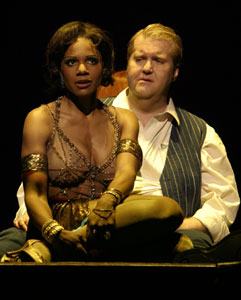
- Nowadays, how surprising this is depends on the casting. It's not much of a shock that Audra McDonald's Jenny (pictured above) presumably had an Afro-Cuban father.
- Screw the Rules, I Have Money!: Toby Higgins.
- Soiled City on a Hill
- Tenor Boy: Jimmy is a tenor, and Fatty seems to be the least evil of the three bad guys.
- Wretched Hive
- Your Days Are Numbered: A 2010 Berlin performance toys with this. In the original play, two characters die from sheer decadence: one by overeating and one by losing a boxing match. In the 2010 performance, the stage directions were projected onto a screen and often ignored or even protested by the characters, following Brecht's philosophy of "Verfremdung". So when Jacob sees that the stage directions say he has to die, he first starts protesting, then laughing, then whimpering, then falls over helplessly and stays there for the rest of the act while other characters are swimming in money around his corpse. He's joined by the boxer character (Joe) soon after. The performance is... unsettling.
- Where the Hell Is Springfield?: It is implied to be set in the U.S., but it's anything but clear which part of the country Mahagonny is located—it's apparently in a good place to catch ships coming south from Alaska, and also fairly close to Pensacola. Brecht has stated that this was on purpose, to make the story universal.
