
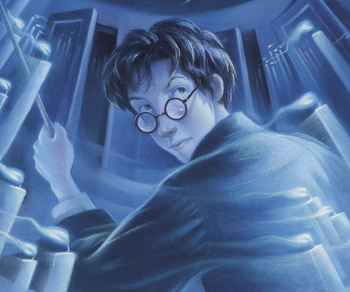
— Rubeus Hagrid, Harry Potter and the Philosopher's Stone
The best-selling book series of all time.note Unless you count the Old and New Testaments of The Bible and their constituent volumes as a "series".This series of seven children's and young adult novels by J.K. Rowling exploded onto the world literary scene in the late 1990s and has become a phenomenon unlike anything seen before in publishing. Blending fantasy with the nearly extinct British Boarding School genre, it made a literary superstar out of its ex-schoolteacher author, and the characters and settings she created have permanently entered popular culture the world over. Needless to say, there is a multimedia franchise revolving around them, consisting of a series of films, video games and various other merchandising tie-ins, but at the heart of it are the books.The basic story is simple: Harry Potter is a seemingly normal schoolboy, living with his resentful, abusive aunt and uncle after being orphaned in his infancy, who on his eleventh birthday discovers he isn't really normal at all. His parents were both powerful wizards, and Harry himself is the renowned defeater of Voldemort, would-be Evil Overlord of the wizarding world. Voldemort had attempted to kill Harry when the latter was only a year old, but for unknown reasons, the curse he cast at the boy afflicted himself instead, killing him... sort of.Harry goes to Hogwarts, the great school of magic, and is happy. There are the normal school troubles — bullies, unpleasant teachers, the three-headed dog guarding a mysterious something — but nothing serious, until he sees a dark shadow creeping through the forest. Investigating, he eventually discovers that Voldemort did not truly die. Though his body was destroyed, his spirit clung to life, seeking ways to return from death and resume his campaign of terror.
Tropes specific to books, other media, and characters in the series:
Abusive Parents: While not his biological parents, the treatment Harry receives from Petunia and Vernon Dursley is nothing shy of abusive.
Academy of Adventure: Given that Hogwarts is not only a school, but where most of the most powerful and influential wizards and the most ancient secrets make their home, this is pretty much to be expected.
Achey Scars: Though the pains go away after Voldemort's death.
Action Girl: Hermione, especially in Prisoner of Azkaban and Deathly Hallows. Tonks, Luna, Ginny and even McGonagall also fall into this trope. For the most part, this is more extreme in the films. Particularly with Hermione—otherwise known as the Pink Granger.
Adoring The Pests: The Weasley family adopts a rat named Scabbers, who they thought was a wild rat at the time. (Turns out it was really a shape-shifted form of Peter Pettigrew.)
Adorkable: Luna, and maybe Neville if you count him as a geek. Ron is sometimes seen as this too.
Aerith and Bob: The "Muggle" first names range from Dudley to Hermione; the wizarding ones, from George to Xenophilius. All in the UK. Same with the wizarding last names, which range from Potter and Black to Slytherin and Dumbledore. The old pureblood families are the ones to have the strangest names usually and they also tend to have themed names. For example, the Black family and their various offshoots named their children after constellations and stars.
After School Cleaning Duty: This is often given as a detention at Hogwarts. There is usually a requirement that the cleaning must be performed without magic.
Agony of the Feet: In all seven books to all three main characters. Shocking.
Allergic To Evil: Harry's scar burns when Voldemort is angry and/or killing someone — or nearby. It'd also count as an Mind Link, except that the two are mortal enemies.
Alliterative Family: Albus, Aberforth, and Ariana Dumbledore. Marvolo, Morfin, and Merope Gaunt. Padma and Parvati Patil.
Alliterative Name: Cho Chang, Colin Creevey, Dudley Dursley, Filius Flitwick, Gregory Goyle, Luna Lovegood, Minerva McGonagall, Pansy Parkinson, Padma Patil, Parvati Patil, Peter Pettigrew, Poppy Pomfrey, Severus Snape, William (Bill) Weasley. And those are just the ones that show up in multiple books; but let us not forget the four founders of Hogwarts: Godric Gryffindor, Helga Hufflepuff, Rowena Ravenclaw and Salazar Slytherin. And there are also the ghosts: Nearly-Headless Nick, The Fat Friar, The Bloody Baron, and Moaning Myrtle.
All of the Other Reindeer: In book 1, Harry is hated near the end for helping his house lose 150 points. In book 2, Harry is hated because his fellow students think he's attacking them. In book 4, Harry is hated because his fellow students think he sneaked his way into the Triwizard Tournament. In book 5, Harry is hated because all the students think he's an attention-seeking brat. In book 7, Harry is labeled "Undesirable No. 1" by the government.
All Witches Have Cats: A cat is one of the animals which wizarding students can bring as a pet to Hogwarts. In this case the cats are merely pets, not familiars. A Witch and teacher, professor McGonagall, can turn into a cat. Both Hermione and Umbridge own cats, the latter of whom doubles as a Crazy Cat Lady. There was also a Crazy Cat Lady who lived near the Dursleys who turned out to be a Squib.
Alternate DVD Commentary: No, this doesn't go on the Film page — Mark Reads Harry Potter, reviewing the books a chapter at a time. It's genuinely hilarious and does very well to remind us all what it was like to read the books for the first time.
Ambiguously Evil: Snape. He's a deeply unpleasant fellow with an extremely transparent bias in favor of the Slytherin house (which is not seen in a positive light—see Ambition Is Evil below.) He also has an intense dislike of Harry Potter (which turns out to be not only for somewhat complicated reasons, but is also tempered with an odd sense of loyalty and protectiveness) This results in Harry and friends swiftly jumping to the conclusion that Snape is one of the bad guys, especially in The Sorceror's Stone, The Chamber of Secrets, The Half-Blood Prince, and The Deathly Hallows (and they don't really trust him in the slightest in Prisoner of Azkaban or The Order of the Phoenix, either.) The Goblet of Fire is the only book in the series that doesn't seem to go out of its way to villify Snape in some fashion, at least in Harry's eyes. It doesn't help that the events of the books have a knack for making you think that Harry's suspicions might be well-founded, at least until The Reveal at the very end. This comes to a head in The Deathly Hallows, in which Snape has pulled an apparent full-blown Face Heel Turn by returning to the service of the Death Eaters. However, in the very end of the book, as he lays dying, he gives Harry his memories, revealing that his murder of Dumbledore was in fact a Mercy Kill, and he's been on Dumbledore's side the entire time.
Ambition Is Evil: The usual trait of those put in Slytherin House. Some fans argue this is less about ambition being bad than about the serious lack of high-profile "good" house members.
And Your Reward Is Clothes: A house elf is freed from its master if it is given an article of clothing, which is actually sort of an inversion; the clothing itself isn't the reward (at least, not the only reward), but rather a symbol of the reward.
Animate Dead: Inferi, first mentioned in Order of the Phoenix.
Animal Motifs: An Animagus's animal form generally fits their personality. J.K. Rowling has also stated that Animagi don't get to choose what animal they turn into.
Anonymous Benefactor: Harry had at least four: Dumbledore gave him the invisibility cloak. Sirius gave him a Firebolt. Barty Crouch was a malicious benefactor who helped Harry by proxy. Snape left the Sword of Gryffindor in the woods for him to find.
Anyone Can Die: Not so much in the earlier books, but after Goblet of Fire, all bets were off. By the time book seven was announced, and Rowling herself stoked the fires by claiming that more people would die, entire websites were devoted to betting on which major characters were going to bite the big one, including the three main characters.
Arbitrary Skepticism: Luna Lovegood is constantly going on about the bizarre magical creatures her father writes about in his magazine. Even in a world where there's magic, dragons and the like, hardly anyone else believes they exist.
Which, in a way, is clever. Even in a world full of fantasy and magic, cryptozoological creatures and conspiracy theorists are still going to spring up, because human imagination is unlimited.
Hermione's response to the legend of the Deathly Hallows is this. In a world where you can't walk an inch without some magical object turning up is it so difficult to believe that there exist three objects which are a little more magical than usual? Hermione is the character who brought TIME TRAVEL into the story, for heaven's sake!
Somewhat justified, because the Deathly Hallows were featured in a story for little children and there was rather scant physical evidence for their existence. It is also postulated that they aren't actual objects stolen from Death himself, but rather inventions of a few particularly talented wizards.
Whilst Hermione's objection may seem silly to us, Genre Savvy as we are, bear in mind that the Deathly Hallows contradict the mechanisms of the Wizarding World as they are commonly understood by its inhabitants. It is a fundamental rule of magic that no magic can raise the dead (to take but one example). Thus, something that allegedly raises the dead is as alien to a wizard as something that could ignore the laws of thermodynamics would be to a Muggle.
Arson, Murder, and Jaywalking: How the House "points" system at Hogwarts works. Later, we discover that this is how the Ministry of Magic treats "crime" in general.
To elaborate, there appears to be only one wizard jail for UK wizards to go to. The very act of just being there is severe psychological torture, as every happy, positive thought you've ever had is forcibly removed from you, leaving you with nothing but the worst memories of your life. You even forget that this might end. Basically, any crime that merits more than a fine warrants Azkaban. And it's even used for preventative detention of suspects.
Artistic License - Biology: Rowling clearly does not have a good grasp of genetics. Here's a few egregious errors.
Word Of God says the magical allele is dominant, pointing out that if a child has at least one magical parent, it is near guaranteed that all their children will be magical as well. Squibs, or Muggle Born of Mages in Trope speak, are exceedingly rare. However, no phenotype, whether dominant or recessive, is virtually guaranteed to be passed down. If the Potter verse ran on realistic genetics, prejudice against muggle borns might be a bit more justified due to the hardships squibs face.
This could indeed still be possible if magical inheritance is a result of epistasis. There could be a separate gene that determines whether or not magic is expressed, with the dominant one being that it is not expressed. This would mean, then, that certain Muggles, such as Hermione's parents, actually do have the gene to pass onto their offspring. If both parents are heterozygous, then it is entirely possible to have a magical child, even if both parents are Muggles. This also explains Squibs, I suppose. If both parents are heterozygous for the "magic" (not the epistatic) gene, then it would be possible to produce a child with no magical ability, a Squib, regardless of whether they have the epistatic gene for magic.
Word Of God also says that Muggle-borns result when the gene "resurfaces" after many generations of muggles. Also impossible if the magic gene is dominant.
Audience Shift: Rowling has said that as Harry and the original audience grew older, the maturity level of the books would "grow" as well, making it so that while the early books are straight children's literature, the later ones fall more into the YA genre. Though it will be tricky for future generations of Potter fans, it makes sense when you realize the series took over a decade to be released in full; the 10-year olds who were reading Harry Potter and the Philosopher's Stone in 1997 would be 20-year olds by the time they were reading Harry Potter and the Deathly Hallows in 2007.
Awesome, but Impractical: Animagus transformation is largely considered more trouble than it’s worth. To begin with, it’s a particularly difficult branch of the already particularly difficult art of Transfiguration, and the consequences of botching the job are said to be disastrous. Even when carried out successfully, one is instantly labelled a criminal unless they give full public disclosure of their skill and animal form to the government to prevent misuse, which rather jives with the fact that stealth and inconspicuousness are the skill’s main use. Even with all this, the form taken by the Animagus is fixed and determined by their personality, so they can easily end up with a useless conspicuous form for all their trouble. Cats, dogs and beetles? Useful and mundane-looking in any backdrop. Huge deer? Not so much.
Awesome Mc Cool Name: A couple stand out, but Kingsley Shacklebolt wins the prize.
Sirius Black.
Bad Powers, Bad People: Double subversion. Parseltongue is usually an ability only found in evil wizards. Harry is good and runs into trouble when people assume he's bad because he possesses it. It turns out in the last book that the reason Harry has it is because it belongs to Voldemort, who gave him the ability when he accidentally turned Harry into a seventh Horcrux. And when Harry loses the fragment of Voldemort's soul residing in his body, he supposedly loses the ability with it.
Perhaps played straight as well with Dumbledore. In the first book, McGonagall suggests that Dumbledore could do everything Voldemort was capable of if he were less noble. (Whether this means that Dumbledore can't do them, or simply wouldn't, is not answered.) For starters, Dumbledore knows Parseltongue; he can't speak it because he wasn't born with it, but he can understand it. Likewise, in the seventh book, Voldemort states that what he will achieve could have been Dumbledore's, implying that he could have been as "great" if he weren't such a sentimental old fool.
To some degree it's debatable how much it's true that only those born with Parseltongue can speak it. Dumbledore is able to understand it without being able to speak it; Ron can speak it (by imitating Harry) without understanding it. If those who aren't born Parselmouths can do each one individually, it's reasonable to assume that someone might eventually figure out how to do both.
Badass Family: The Weasley siblings already include a curse-breaker, a dragon rancher, and a prefect when the books begin, and all of them go on to be successful in various fields. And let it be put on record that the matriarch of this family, Molly, kills Bellatrix, who is the second most powerful Death Eater after Voldemort himself. The fact that they happen to be close friends of Harry Potter (who himself is considered a member of the family, in more ways than one) certainly helps.
Badass Teacher: Moody, McGonagall, Snape, Lupin, and Slughorn.
Barred From The Afterlife: Ghosts are people who either refused or were too scared to accept death and move on. Apparently, there's no take-backs later on if you change your mind.
Batman Gambit: Voldemort's plan in the Half-Blood Prince and Dumbledore's plan revealed near the end of Deathly Hallows.
Battle Couple: Many. Examples include Lupin and Tonks, Harry and Ginny, Ron and Hermione, and Arthur and Molly.
Beam-O-War: Spells have been known to clash and cancel each other out, though there's at least one instance of two characters firing spells at each other where the beams hit each other and ricochet off at angles, each hitting the person standing right next to the intended target.
Because Destiny Says So: Played with. Harry's destiny is self-fulfilling precisely because Voldemort insists on fulfilling it. Dumbledore suggests that not all prophecies must be fulfilled.
Hurting Harry or any of his furry friends will get Hagrid very angry. When Fang got hit by a spell, Hagrid hurls the perpetrator ten feet in the air.
"NOT MY DAUGHTER, YOU BITCH!"
Harry doesn't take kindly to willing parental abandonment, given his experiences as an orphan. Also, if you don't want to end up as a balloon or have your nose broken, don't even think about insulting his dead parents.
Dumbledore will kindly accept horrible slurs against him and remains civil to his enemies even when dueling them, but reacts furiously if any of his students are threatened.
Dobby is fiercely protective over Harry ever since Harry freed him and his trademark is "You shall not harm Harry Potter!" He is so devoted to Harry that he would risk his life (and lose it) for Harry and the others to escape the Malfoy's manor.
"Kreacher will not insult Harry Potter in front of Dobby! No he won't! Or Dobby will shut Kreacher's mouth for him!"
Ron bickers and argues with Hermione in a Belligerent Sexual Tension style but if anyone else goes after her, all bets are off.
Neville flips out when Malfoy says they should send Harry to St. Mungo's as they have special floor for people with brain damage. Considering what happened to Neville's parents, this is understandable. Pretty much any mention of Neville's parents in a negative light will result in a beatdown that even Death Eaters didn't expect.
Harry doesn't take insults to his parents very well. And when Bellatrix killed his godfather/father figure and when someone insulted Professor McGonagall and spit at her, he truly lost it and sent the Cruciatus Curse at said perpetrators.
Harry also doesn't like to be left out of things, going into ALL-CAPS RAGE◊ because he was at Dursleys and Ron and Hermione were at Grimmauld Place.
Big Bad: Voldemort. Harry's nemesis, Dark Lord, leader of the Death Eaters, and the initiator of two Wizarding Wars. Almost everything bad that has happened from the past 50 years to the Wizarding World can be traced back to him.
Big Good: Dumbledore. Neville, McGonagall, and ultimately Harry himself assume this role at Hogwarts after Dumbledore's death.
Bigger Bad: Lord Voldemort, the official Big Bad of Harry Potter, is in this role instead sometimes:
Harry Potter and the Chamber of Secrets. If you consider each Horcrux as a separate person, the main portion of Voldemort's soul (residing in the disembodied Voldemort himself) was a Bigger Bad in this book. Tom Riddle was more a manifestation of Voldemort's will, and in any way acted independent from him (although in his interests).
Harry Potter and the Prisoner of Azkaban. He wasn't directly involved in that book's events but it's believed Sirius Black, the Death Eater who helped Voldemort to kill Harry's parents and later killed Peter Pettigrew and several muggle bystanders, was trying to kill Harry in hopes it'd somehow restore Voldemort. Then it was revealed Peter Pettigrew faked his death and framed Black but it still counts for the trope since Voldemort killing Harry's parents led to Sirius being imprisoned and Peter faking his death.
Harry Potter and the Half-Blood Prince doesn't feature Voldemort at all, and all his actions take place outside the main events of the plot. The Big Bad of the book eventually turns out to be Severus Snape, who kills Dumbledore and set most of the events in motion to further himself in Voldemort's eyes.
Bittersweet Ending: Prisoner of Azkaban. Even though Sirius managed to convince Harry, Ron, Hermione, Dumbledore, and even Snape of his innocence, Wormtail still got away, preventing Sirius's true exoneration before the Ministry and eventually bringing about Voldemort's resurrection a year later.
Deathly Hallows. Even though Voldemort is finally dead, and most of the Death Eaters are killed or captured, Hedwig, Moody, Dobby, Colin, Fred, Lupin, and Tonks all died in the process.
Black and Grey Morality: Played with. The Ministry of Magic is definitely gray, as while they're much better than the Death Eaters, they have more than their share of Quislings, Fantastic Racists, and Obstructive Bureaucrats. Harry and his friends/family are more on the unblemished side, but not entirely.
Harry occasionally slips towards this in battle; when crossed or when his friends are threatened, Harry can become quite pitiless, instinctively resorting to the nastiest/most powerful curses he can think of (save Avada Kedavra). He even casts the Cruciatus Curse at a few points (though he never uses it very effectively; as Bellatrix explains after he tries it on her, in order to cast an Unforgivable Curse successfully, you have to really want to go through with it). Justified, as he is a teenage boy in way over his head.
Black Sheep: Sirius and Andromeda to their respective families.
Percy is the only member of the Weasley family who is not friendly and outgoing.
Blasting It Out Of Their Hands: The Expelliarmus spell, which is intended for exactly this purpose. Amusingly, the spell seems capable of disarming a person of anything, whether it's a weapon or a book.
Blond Guys Are Evil: Played straight with Draco and Lucius Malfoy, Barty Crouch Jr., Dudley Dursley, and Gilderoy Lockhart. Averted with Ernie Macmillan.
Bloodless Carnage: Avada Kedavra's lack of leaving physical injuries on bodies provides a convenient excuse for not describing much blood and gore, so most deaths in the series partially play this straight because they are bloodless and painless. That said, there are spells for dismembering, and they can get bloody indeed.
The Board Game: Yes, and there's even been more than one.
Boarding School of Horrors: At times, Hogwarts can be quite a dangerous place. Made obvious when, on Harry's first day at school, there's an announcement to the student body to please do not enter the third floor corridor unless you want to die horribly.
This is in no small part due to the dangers of practicing magic on its own. Many spells can be very dangerous, especially in the hands of someone who doesn't know what they are doing.
Hogwarts becomes this permanently after Umbridge and later Voldemort take over, Deathly Hallows goes out of its way to explain how horrible it's become by saying the some prefects used to the Crutacius curse on first years (about 11 years old) for refusing to use it themselves in the now-mandatory dark arts class.
Mentioned frequently by Dumbledore, that Tom Riddle / Voldemort never bothered to study those powers he already considered useless, meaning Voldemort's plans could always be defeated by such "trivial" things as Love.
Could also be because he's working with only one-seventh of a soul, which may be why he often seems so much less than human—almost a parody of a human. It wouldn't really be that surprising if there were intelligence-related side effects as well.
He also followed #101, by not delegating away the task of killing "the infant who is destined to overthrow [him]", but trying to kill Harry himself. That workedrather brilliantly.
Book Dumb: Ron and Harry really aren't diligent students, though when they do try they prove to be quite adept. Fred and George are even worse academically, but they're experts in magical joke item inventions, which eventually gets them far in the business world.
Harry's life with the Dursleys. When he was one, having recently lost his parents and beaten Voldemort, Hagrid brings him to Privet Drive riding Sirius' magical motorcycle. When he is about to become seventeen, with the magical protections about to fall, Hagrid is the one that carries Harry out of Privet Drive on the same motorcycle. Hagrid even comments it.
Also, in book one: Ron: "Are you a witch or not?" In book seven: Hermione: "Are you a wizard or not?"
The entire series effectively begins and ends with Voldemort getting the Avada Kedavra curse reflected back at him by Harry.
Boomerang Bigot: Voldemort; one of the goals of the Death Eaters was the elimination of any wizard who wasn't pure-blooded, especially if they were Muggle-born, but Voldemort himself was a half-blood. But then, he is based on Adolf Hitler (see below).
Snape is a double hitter — in his youth, he was highly prejudiced against Muggles and Muggle-borns despite being a half-blood himself and in love with a particular Muggle-born; as an adult teacher, he mocks Hermione for being, as he once put it, "an insufferable know-it-all" — ironic coming from Snape, who is himself an Insufferable Genius.
Brain Bleach: The reason why Rowling has yet to reveal the exact method of creating a Horcrux. It supposedly made one of her editors vomit. (For note, one of the steps is committing murder in order to split your soul to place it in the Horcrux. Murder is one thing, but the entire process is implied to involve crossing the Moral Event Horizon, and it's certainly treated as such in-universe.)
Bribing Your Way to Victory: In-Universe, Harry is constantly praised as the best Seeker in the school, and maybe the best player for several years. However, twice in the series, Harry is gifted broomsticks that are demonstrably faster and more maneuverable than his opponents'.
...Kind of. Harry's initial feat of Seeking that earns him praise is performed on a school broom, which are pretty much universally derided in-universe. He then receives a good broom—but not so good a broom that it would make up for a lack of skill on his part. Then, in second year, he wins against a whole team of players on better brooms than his own, and with a serious disadvantage. (The Bludger is cursed to attack him.) It's only halfway through the third book that he gets a broom that's a whole class above his opponents', and by that point, I think he's pretty well proved himself.
Brick Joke: In what is perhaps the most elusive brick joke in the series, at the start of book 5, Harry and Dudley are attacked by Dementors. After Harry fights them off, he attempts to explain to his aunt and uncle what happened, only to realize it's hopeless since neither of them have any idea what he's talking about. Petunia finally says, "They guard the wizard prison, Azkaban", and Harry asks how she could possibly know that. Petunia responds with "I overheard — that awful boy — telling her about them, years ago." At the time (and even after finishing the series), everyone simply assumed "that awful boy" to be Harry's father, James Potter. However, at the very end of book 7, we find out that it was actually Severus Snape. While watching his memories, Harry witnesses the scene "first hand", but it's played so quickly and amidst so many other things very few people pick up on it.
A lesser one appears in the third film. While riding the Knight Bus, the shruken head warns Harry that "If you order the pea soup, be sure to eat it before it eats you." Later, while talking with Fudge, he offers Harry some pea soup, which Harry adamantly refuses.
Bullying a Dragon: Let's see, there's this giant man standing in front of you. He also possesses Super Strength, jugding by the way he knocked your door down. This is clearly not someone to be messed with, so what do you do? Well, whatever it is, you do NOT threaten your nephew, who up until now has had no idea that he is a wizard, in front of said man, and you do NOT insult a man the giant clearly admires...unless you're Vernon Too Dumb to Live Dursley, of course.
Bury Your Gays: Dumbledore was only outed by Rowling herself, after the 7th book had been released.
Neville "Why's It Always Me?" Longbottom. Peter Pettigrew during his days at Hogwarts, as well.
There is a minor character (Dawlish), who is sort of a background Butt Monkey in that the only time we see him, he gets defeated in one hit, and whenever he is mentioned, he has been cursed or failed in something. This is pretty shocking when you consider he's an Auror, the equivalent of magic police (who above that are also elite dark wizard catchers), and is therefore supposed to be skilled at defensive magic.
Draco Malfoy, Gilderoy Lockhart, Argus Filch, and Dolores Umbridge also fall under this category at times, although they more than deserve it. Quirrell too, until he is revealed to be The Dragon at the end of Book 1.
Also, Hufflepuff House in general.
Ron Weasley, particularly to Slytherins. Harry has also been subjected to this, most notably due to the Rita Skeeter articles.
By the Eyes of the Blind: Thestrals are only visible to people who have witnessed death first-hand.
Not only that, but they have to fully comprehend what they saw — Harry wasn't able to see thestrals when he first came to Hogwarts despite having witnessed the murder of his parents, but he is able to see them when he comes back fifth year after he saw Voldemort kill Cedric Diggory. (It's generally assumed that he couldn't see them at the end of his fourth year because Cedric's death hadn't fully sunk in at that point.)
Cain and Abel: Dudley and Harry, Petunia and Lily, Severus and Lily.
Calling Your Attacks: Played straight at first, but justified in that you have to say the name of the spell in order to cast it. However, it gets subverted when a major portion of the sixth-year curriculum turns out to be learning how to cast spells without calling them, specifically so that you don't alert your enemies as to what you are doing.
Canis Latinicus: Expelliarmus, Wingardium Leviosa, Petrificus Totalus, Riddikulus. There are real Latin spells as well.
Cannot Cross Running Water: Per Word Of God, belief in this principle is why the Dursleys take Harry to a shack in the middle of the sea in their attempt to escape the wizarding world.
Can't Live Without You: Inverted by the prophecy in the fifth book — "Neither can live while the other survives."
Captain Ersatz: While possibly coincidental, the Dementors have a certain resemblance to the Nazgûl of Lord of the Rings. But they're both based on The Grim Reaper. Dementors are also an allegory for clinical depression—they suck the joy out of everything.
Hermione: "I read about it in Hogwarts: A History."
Moody: "Constant vigilance!"
Umbridge: "Hem hem".
Slughorn: "Merlin's beard!"
Voldemort (in the movies): "NYEAAAAAAAA!"
Category Traitor: The Death Eaters consider wizardry to be in the blood. They also feel that all "real" wizards are obliged to be "loyal" to "their own kind", and thus despise all regular humans, fantasy creatures, and above all else the so-called "mud-bloods": Muggle-born wizards (and later, once they resurface and begin openly fighting the Order of the Phoenix, also any and all wizards who don't agree with the Death Eater ideology's arbitrary definition of a "real" wizard). Unsurprisingly, their contempt for pure-blood and half-blood wizards who care for muggles and mudbloods turns out to become a big part of their undoing, as young Snape loses faith in them because of his love for the "mud-blood" witch Lily Evans.
Cerebus Syndrome: Kinda. The darkness of the plot was there from the beginning, but it gets more visible as the story progresses.
Chameleon Camouflage: The Dissillusionment Charm has this effect, and if done well enough can confer actual invisibility. Putting it on a garment is one way to make an Invisibility Cloak, though the charm fades over time.
Chekhov's Armoury: Chekhov's Gun is common in the series, e.g. The Deluminator; fans obsess over details in earlier books, looking for hidden Chekhov's Guns, to the point where J.K. Rowling made a public apology about accidentally giving a minor, unimportant character the same last name as Harry's mum.
Chekhov's Gun: More accurately, Chekhov's Wand. We learn that Harry and Voldemort's wand share a common source for their magical cores; it takes on plot significance from book 4 onward. Also the Vanishing Cabinet, and Godric Gryffindor's Sword. Along with a fair laundry list of other objects. Of the six Horcruxes, we actually see four of them before they are recognized for what they are.
Chekhov's Gunman: Grindelwald, mentioned in the Philosopher's Stone and barely ever brought up again until Deathly Hallows. Same goes for Aberforth Dumbledore, who was first mentioned in Goblet of Fire and first appeared in Order of the Phoenix.
Even better? We didn't know who he was until Deathly Hallows. In both Order of the Phoenix and Half Blood Prince, he is only referred to as "the barman of the Hog's Head," though there are hints to his identity regarding his inappropriate charms on goats...
The name Regulus Black briefly comes up in one of the books, then becomes significantly more important in Deathly Hallows.
Chekhov's Skill: Ron at wizard chess; Harry and his Patronus; Hermione and Ancient Runes (Comes into play in the seventh book, as her copy of Tales of Beedle the Bard was written in runic alphabet); Neville and herbology.
Harry's Quidditch playing. He's good at flying and good at spotting and getting ahold of small golden objects. This comes in handy when he has to catch a flying key in the The Sorcerer's Stone, and when he has to get the dragon's egg in the First Task of the Triwizard Tournament.
Harry's Seeker skills and the generally harmless "Expelliarmus" spell both play key roles in Harry's final defeat of Voldemort.
This is actually mentioned by Ron in the fourth book. He mentions that Harry couldn't help 'playing the hero'.
Chuck Cunningham Syndrome: In the movies, not the books—Percy plays a fairly important role in the first movie, only to drop out of existence thereafter. He appears occasionally in background shots, but any storyline about him is just removed entirely, to the point one might wonder why his parents never talk about that son they once had hanging around their house.
Nearly-Headless Nick doesn't appear after the first two movies either. Whenever he has an important part in later installments, they seem to replace him with Luna.
Cold-Blooded Torture: What happens to many characters at the hands of the Death Eaters (mostly Voldemort and Bellatrix), including Neville's parents.
Also what goes on in Umbridge's detentions.
Colour-Coded for Your Convenience: In the films, the ties and lapels of Hogwarts uniforms are in the colours of the student's house. Red and gold for Gryffindor, Black and Gold for Hufflepuff, blue and silver for Ravenclaw, green and silver for Slytherin.
Coming of Age Story: Harry Potter is as much about growing up as it is about wizards.
Contrived Coincidence: The Marauders present themselves in their map as "Moony, Wormtail, Padfoot, and Prongs", or MWPP. Is it a coincidence that they die in that order, backwards? Prongs (James Potter) dies on October 31st 1981, Padfoot (Sirius Black) dies in the Battle of the Ministry in June 1996 (Harry's fifth year), Wormtail (Peter Pettigrew) gets killed on March 1998 by the silver hand Voldemort gave him back in 1995, and Moony (Remus Lupin) dies in the Battle of Hogwarts on May 2nd 1998.
Harry Potter and the Prisoner of Azkaban kicks off because 1) the Weasleys won a lottery ticket 2) This gets them a large front page picture 3) Ron's pet rat Scabbers was included in said picture and 4) Cornelius Fudge happened to be carrying that exact issue when he visited Sirius Black.
Conveniently Coherent Thoughts: Averted and deconstructed with Legilimency, which reveals thoughts in a disjointed manner and requires much training to sort out which thoughts are important.
Particularly that we repeatedly see Wizards are rendered helpless when they are disarmed, which in later books often leads to their death. For some reason, there seems to be an unwritten rule amongst wizards that you can't carry a spare wand.
Justified in story that wands are implied to be sentient on some level and choose their master. If you have a wand that's not yours you'll only be slightly better off than without one entirely.
Given that most Wizards are capable of Apparanting, posess cars such as the Knight Bus for those who can't, and posess the ability to carry large amounts of objects in a Bag of Holding, it often begs the question why they both with the mess of using Owls to deliver their mail. Theoretically a single wizard could serve as the postman to the entire country.
Corporal Punishment: Not unexpected, given the Boarding School setting. Early on, it's played relatively comically, with Argus Filch constantly bemoaning the fact that he's not allowed to string misbehaving students up by their ankles anymore. It gets rather darker later, with Order of the Phoenix featuring a quill that carves whatever you write into your hand, and God-only-knows-what going on at Hogwarts during Deathly Hallows.
Crapsaccharine World: Once you get past the initial cool factor of the magical world, the Harry Potter universe is not an exceptionally happy one. Fantastic Racism of absurd extremes permeates every level of the wizarding world, and the government seems to be run by evil, scheming, political glory hounds (regardless of their allegiance to "good" or "bad"). The justice system is a Kangaroo Court, the regulations on dangerous magic are feeble at best, the very system of instruction in magic carries a high injury/mortality rate, the schools are run by people who think nothing of manipulating their students for years with the express intention of having them throw their lives away, said schools think nothing of employing borderline sociopaths who a stated dislike of and known enjoyment of torturing children, the entire population as a whole seems to have crippling naiveté about the non-magical world (to the point you wonder how they've kept the masquerade going for so long), and the overall respect for human, sapient non-human, or animal life and sanity is appallingly low. The in-universe explanation is that this was a cultural reaction to Voldemort, and that it supposedly went away once he was defeated. Also, it's heavily implied that there's degradation of the "magical" ecosystem and natives, with species like the dragons and giants dying out and forced on to small reservations.
Crazy-Prepared: Hermione, especially with her bag in Deathly Hallows. Also, Dumbledore, in general.
Crouching Moron, Hidden Badass: Luna "Loony" Lovegood may act like she ain't playing with a full deck, but when it comes down to an actual battle... watch yourself. She participates in several battles, but the only time she gets injured the entire series is when a door gets blown off its hinges into her face and she flies across the room.
And Neville Longbottom, Butt Monkey poster boy in the early years, becomes a seriously competent fighter in his own right from the latter parts of the fifth year and on. In the battle of the Department of Mysteries in Order of the Phoenix, he is the only other student besides Harry who stays fighting right up till the end, whereas everyone else gets incapacitated one way or another during it.
Cultural Posturing: Even the Muggle-born wizards are condescending toward Muggles.
Cultural Translation: Editors at Scholastic Books forced a change from "Philosopher's Stone" — a genuine item of folklore and alchemy — to "Sorcerer's Stone" for the American editions on the grounds that American children would have no idea what a Philosopher's Stone was. Due to the negative reaction, British terms and slang in the later books, such as "jumper", "taking the mickey" and "snogging", were left in.
Rowling published three books mentioned in the series — listed up there with the main series — with profits reverted to charity. One looks like Harry and Ron's book, one seems to be a Hogwarts Library title, and another opens with the disclaimer "translated from the original runes by Hermione Granger."
Bertie Bott's Every Flavor Beans, marketed by Jelly Belly. They've also made Chocolate Frogs, complete with cards, among many other candies.
The Vibrating Broom (the link is perfectly SFW, don't worry), which was so quickly pulled from the shelves.
Dead Guy Junior: Lots of examples from the epilogue, including James Sirius Potter, Lily Luna Potter (even though Luna Lovegood doesn't die), Albus Severus Potter, and according to Word Of God, Fred Weasley II
Deadpan Snarker: Honestly, if you took a shot every time a character made a wry comment, you'd be pretty messed up early on in the series. There are so many examples, it has its own page.
Death Ray: The Avada Kedavra, or the Killing Curse. The reason that Harry is known as "The Boy Who Lived" is because he's the only person in the wizarding world to survive the spell.
Deconstructed Trope: Happens a lot in the series, especially concerning character dynamics. A character is a Butt Monkey? Turns out that they have some pretty depressing baggage and it motivates them to become a total badass later. Another is a Cloudcuckoolander? They are relentlessly teased and bullied over it and have very little friends. Our main man is a Chosen One and Famed in Story? They really hate it. Kid Genius? Is seen as an Insufferable Genius (which they sometimes act as anyway).
Deus ex Machina: In the first book, Harry is saved from Quirell by his mother's own love, which, as Dumbledore explains, prevents cruel and loveless people from being able to harm Harry. This instance is forgivable, however, as Rowling intended this as both a symbol and a moral message. Some people have claimed that there's another one in Deathly Hallows.
Harry pulling the sword out of the Sorting Hat seems like a DEM at first, but then you realize that Harry was asking for help, and Dumbledore stated earlier, just as he was about to leave, that help would come to those who asked for it. It's clear that he was referring to Harry. Dumbledore sent Fawkes with the sword to help Harry.
The Priori incantatem at the end of Book Four seems like one, but it turns out that it was foreshadowed/hinted early in Book One when Ollivander explains how Harry's and Voldemort's wands are connected.
Distant Finale: The last chapter of book seven, better known as the Epilogue, takes place 19 years after the end of the previous chapter.
Ditch The Bodyguards: In several of his books, Harry is being threatened by someone (usually Voldemort), and everybody tries to keep him safe. It never works—somehow, for some reason, he always finds his way to the source of the problem to face it himself.
Divided We Fall: The Half-Blood Prince DVD has a chapter entitled "Free Agents", a clever reference to not only Harry and Ron's Quidditch issues, but their romantic lives, as well.
Domestic Abuser: It's implied in Order of the Phoenix that Snape's father was at the very least verbally abusive to Snape's mother, and that this was a large contributing factor in his anti-Muggle attitudes.
Hermione: If you don't stop, I'm going to... Fred: Put us in detention? George: Make us write lines? Hermione: No, but I will write to your mother. George:You wouldn't...
Door Stopper: All of the books from the fourth onwards; the fifth, weighing in at 766 pages for the Bloomsbury hardback edition, is the winner here.
The original American hardcover edition had it at over 800 pages.
Downer Ending: Goblet of Fire, Order of the Phoenix, and Half-Blood Prince.
Deathly Hallows is no picnic either, even considering the fact that technically, the good guys have finally won a complete victory.
Dr. Genericius: A lot of wizards have names ending in "us" : Albus, Lucius, Regulus, Remus, Rubeus, Severus, Scorpius, Sirius... It seems to be more frequent in the Pure-Blood families, though.
Ron BILIUS Weasley?
The Dreaded: Each side has their own. Voldemort is easily the most feared being on the planet, his power and cruelty are legendary. People are terrified of even speaking his name long after he is thought to be dead. Then, of course, there is Dumbledore, who is the only person Voldemort fears.
Dying Like Animals: Not just the Muggles, but wizards and witches, too. Minister of Magic Cornelius Fudge is one particularly outspoken ostrich in a bowler.
Early-Bird Cameo: Several supporting characters were mentioned in passing long before their importance to the plot was revealed, among them Mrs. Figg, Mundungus Fletcher, the Lovegoods, Grindelwald, Aberforth Dumbledore, and, of course, Sirius Black and his brother, Regulus Arcturus Black.
Several creatures in Order of the Phoenix were mentioned in Fantastic Beasts and Where to Find Them prior to their appearances, and even Thestrals earned a minor, blink-and-you'll-miss-it reference under "Winged Horse".
Embarrassing Password: The Ministry of Magic encourages people to devise security questions with their loved ones. One of the security questions between Mr and Mrs Weasley is:
Mr Weasley: What do you like me to call you when we're alone together?
Mrs Weasley: Mollywobbles.
The password to Dumbledore's office is always a type of candy. At one point in Goblet of Fire, Harry, trying to get inside, lists off every single magical candy he can think of, only to find the correct one is "Cockroach Cluster".
Enforced Cold War: The House rivalries, especially between Gryffindor and Slytherin. According to the history of Hogwarts' founders, it's actually closer to Slytherin versus everyone else; according to Word Of God, it goes down a lot after Voldemort is defeated.
Entertainingly Wrong: In Half-Blood Prince, Dumbledore and Harry both come to the perfectly valid conclusion that Voldemort had tried to get a job at Hogwarts in an attempt to get ahold of an item belong to a Hogwarts Founder for use as a Soul Jar. In Deathly Hallows, Harry realizes they had it backwards, and that Voldemort used the interview to hide one of his Soul Jars in a hidden room on the way to Dumbledore's office. Actually getting the job would've just been a bonus.
Even Bad Men Love Their Mamas: Draco Malfoy's only redeeming quality is his love for his family. While Voldemort is incapable of real love, his mother's sad death is his motivation for some of his crimes.
Narcissa Malfoy's main motivation by the end is making sure her family is safe, to the point where she lies to Voldemort.
Everyone Is Related/Tangled Family Tree: Check out the Black family tree, for starters. The Peverell and Weasley familes are similarly tangled up: the Peverell family contains almost every single wizard, including Voldemort and Harry Potter! Gets to the point where Everyone Is Related both literally and in terms of the trope.
This is implied to be a result of forced intermarrying of pureblood families in order to keep the blood pure. Amongst the many notable muggle discoveries proud purebloods dismiss are the effects of inbreeding. (Even though there are plenty of things, like the health benefits of laughter, that wizards noticed long before Muggles did.)
Step back for a moment and consider this. Draco Malfoy is easily recognised by his curious white blond hair and aristocratic features. When we meet Lucius we see he too has the same hair colour and similar features, not that unusual. However his mother Narcissa has exactly the same unique hair colour and aristocratic features. What are the odds of her and her husband being related?
Harry and Voldemort both had very similar beginnings, and Harry occasionally finds himself sympathetic to Voldemort. Nonetheless, the choices that both of them made sent them in totally different directions. Lampshaded in the film during the disturbing moment when the two of them briefly meld into one image while falling through the air.
Harry also notes parallels with Snape in Deathly Hallows. He refers to himself, Voldemort, and Snape as "the abandoned boys", and notes that they all found a home at Hogwarts. Interestingly, Snape seems to have been set up as the half-way point between Voldemort and Harry.
Bellatrix and Hermione. Hermione is as devoted to Harry as Bellatrix is to Voldemort. Both intelligent and powerful witches, on the opposite side of the good/evil divide; both capable of, and shown willing to go to, extremes for their purposes. (Bellatrix tortured the Longbottoms into insanity to find Voldemort. Hermione comes up with the same method for Harry to communicate with his DA members as Voldemort used with his Death Eaters; she bewitches a DA document so that it will semi-permanently facially disfigure anyone who signs it and later sells them out; she blackmails Rita Skeeter.)
Bellatrix also serves as an Evil Counterpart to Molly Weasley. That was why Rowling said the two fought each other at the end — Bellatrix loved no one (besides her obsession over Voldemort) and Mrs. Weasley was very loving. Love won out. (This was in spite of Bellatrix having all but been set up as Neville Longbottom's Arch-Enemy.)
Voldemort and Dumbledore turn out to have a lot in common.
Umbridge could be considered McGonagall's Evil Counterpart. Both are known for being disciplinarians, but McGonagall is fair and well-meaning, while Umbridge, to say the least, is not. Incidentally, both of them cast a Patronus in the shape of a cat.
While they're on the same side in Order of the Phoenix, Sirius and Snape could be interpreted as this as well. They started out as Gryffindor vs. Slytherin, then they joined opposite sides of the war. Sirius is James's best friend, and Snape had been best friends and had a crush on Lily, and despite the falling out that Snape and Lily had, he and Sirius are incredibly loyal to their said best friends. Heck, both of them even did something really terrible to a close friend of theirs, Sirius's being sending Snape to be torn apart by Remus on the full moon and Snape's being calling Lily a Mudblood. Snape hated his father, and Sirius hated his family.
Harry and Voldemort's respective chosen methods of self-preservation: Voldemort survives through his six Horcruxes, which he created by murdering six people (plus Harry as the seventh Horcrux). Harry survives through his relationships with friends and relatives, six of whom are killed in the act of directly saving his life: James and Lily Potter, Sirius Black, Albus Dumbledore, Peter Pettigrew, and Dobby. Harry and Voldemort act as the seventh Horcrux/relationship for each other: Harry is Voldemort's unknown seventh Horcrux, and Voldemort unknowingly saves Harry's life by creating a blood bond between them during his resurrection in Goblet of Fire; he even "dies" to save Harry's life when he tries to kill Harry in the Forbidden Forest and instead destroys the portion of his soul preserved in Harry.
Harry's wand and Voldemort's wand shared the same core—a phoenix feather, from Fawkes, who only gave two feathers. Then, we have the Elder Wand, which is different entirely. You could write a paper on the connections between Voldemort and Harry, and have it longer than the books themselves.
Ron and Pettigrew. Both are/were close friends to a guy who is/was considered very popular and cool and basically is/was ignored otherwise. Both were hinted to be a little jealous of this. Deathly Hallows implies that Ron, like Pettigrew, has a bit of a lust for power (his interest in the Elder Wand). Unlike Pettigrew, Ron never abandons his friends for power or protection, and even mentions at one point that it's his friendship with Hermione and Harry that means the Death Eaters would never have him. While Wormtail would sell out his friends to curry favor to the next biggest bully for his own ends.
Evil Makes You Monstrous: Tom Riddle (Voldemort) was a handsome student, but by the time he is reborn, he is bald, has pale white skin, bloodshot eyes and slits for nostrils. We see him earlier in a Pensieve memory Dumbledore has of him entering his office to ask to be the Defense of Dark Arts professor after he began dabbling in Dark Arts but before he gained power, and Harry notes that he had already lost his good looks by then and was beginning to resemble the pale, snake-like creature he would fully become later on. Even many years before that when Tom Riddle was still pretty handsome, he was stated to have already begun to look a little pale by the time he took a job in a store to get hold of an ancient artifact.
Evil Sounds Deep: Inverted-Voldemort is described as having a high, cold voice.
Evil Teacher: Averted with Snape but played very straight with Quirrell, Crouch/Moody, Umbridge, and the Carrows.
Exotic Entree: Voldemort dines on unicorn blood (though there is a magical justification for this).
Harry and Dumbledore are expies of Wart and Merlin, respectively, from The Sword In The Stone.
Voldemort has shades of Adolf Hitler and Darth Sidious.
Gilderoy Lockhart is an Expy of someone Rowling knew in real life, who, according to her, was only marginally less narcissistic.
Harry has been thought of one of Jesus Christ while Lily one of the Virgin Mary.
Fainting: Many characters do this, but this unfortunately happens to Harry multiple times in each book, especially in Prisoner of Azkaban (wherein the Dementors inevitably have this effect on him) and Order of the Phoenix.
Fantastic Racism: Most of the villains in the series exhibit this. Reversed with the Dursleys, who despise anything that even hints at the existence of magic.
Fantasy Counterpart Appliance: Mostly averted, because wizards either appropriate Muggle technology or invent something completely strange of their own, but there are a few cases, such as the Floo Network, which is regulated and functions not unlike a mass transit or communication system.
Fantasy Gun Control: Guns exist in the Muggle world, but apparently not even Squibs seem to have them in the Wizarding Community; in an article about Sirius Black, it's mentioned that the Muggles have been warned he's carrying a gun, which is then defined as "a type of metal wand that Muggles use to kill each other."
Fantasy Kitchen Sink: Nearly everything about wizardry from Fantasy novels is revealed to exist — and every mythological creature as well, especially in Fantastic Beasts.
The state one finds themselves in after a horcrux successfully prevents death. Unlike the above, however, this state can be ended, either by true resurrection, or just "letting go".
In the first book, Dumbledore mentions people who, transfixed by the Mirror of Erised, have literally wasted away in front of it.
Fictional Sport: Quidditch, despite fantastic requirements people in real life have tried to replicate it.
Fiery Redhead: The Weasleys. All of them. Also Lily Evans in book five.
First Girl Wins: Ginny Weasley was the first young witch Harry heard at Platform 9 3/4, and Hermione was the first female friend Ron Weasley made. Years later, Harry married Ginny, and Ron married Hermione. In The Film of the Book, Ginny Weasley is the first girl Harry's age we meet in both the first film and the second. She's also almost the first girl we see in the third film — soon after Hermione's entrance, we see Ginny's face in a newspaper clipping.
Team Pet: Hedwig (and to a lesser extent, Pigwidgeon and Crookshanks).
Flanderization: The Hogwarts Houses. Gryffindors are brave and righteous, Ravenclaws are clever and scholarly, Hufflepuffs are fair and sympathetic, and Slytherins are jerkasses. Okay, "ambitious and cunning" is the technical adjective for Slytherin, but let's face it: they're the house of bad guys, and pretty much nothing the books do as the series progresses addresses this issue. Slughorn and Snape are the only decent Slytherins ever named (even then Slughorn's the only actually nice one), and all the major antagonists except for Wormtail are either Slytherins or of unspecified house.
However, after the fall of the Death Eaters, Slytherin House isn't an "evil" house anymore, and they now accept Muggle-borns, but it still has a bad reputation.
Fluffy Tamer: Cedric Diggory may be an example of this. In the maze , he recognized what the blast ended screwts were. This may be from rita skeeter's article, or it might be from taking newt level care of magical creatures, in which case this trope fits.
Fluffy the Terrible: Quite a few monsters, but the most famous is actually named Fluffy. Inverted with Hagrid's cowardly boar hound, Fang, and subverted in the case of his Acromantula, Aragog.
Flying Broomstick: Quite a few, often of plot significance, including the Nimbus and the Firebolt.
Rowling has admitted she wasn't the first to send kids to wizarding school. However, a lot of books have attempted to cash in on the success of Harry Potter, some of which even being obvious ripoffs.
However, an example that was actually a good thing was that the success of Harry Potter sent a few messages to authors and publishers — one, that a book for young-adults can still be enjoyed by an adult Periphery Demographic, and two, that kids actually do have the attention span to read a Door Stopper if they find the story interesting enough. To put it in perspective, books as long as some of the Harry Potter series in the childrens' section was almost completely unheard of. Now? You'll run into at least three.
For the Evulz: This seems to be the motivation behind at least half the things done by members of Slytherin House — especially Malfoy. Seems rather bizarre when you remember that they're supposedly the House for the cunning and ambitious.
Four Temperament Ensemble: The Marauders seem to fit this — James is Choleric, Sirius is Sanguine, Remus is Phlegmatic, and Peter is Melancholic.
Alternatively, James is sanguine, Sirius is choleric, Remus is melancholic, and Peter is leukine.
Full Name Basis: Harry Potter, to a few characters—notably Dobby and Voldemort.
Full Potential Upgrade: Wands are this for wizards. They have to either be precisely matched when purchased or legitimately won from a prior owner for best effect. Wizards who are shown to use hand-me-down wands (Ron and Neville) show a level of improvement when using one purchased just for them.
Functional Magic: JKR says in interviews that she spent time working out the limits of wizard magic, but the novels only touch on these a few times.
Funetik Aksent: Hagrid and the foreign visitors in Goblet of Fire.
Funny Background Event: A common aspect of Rowling's writing in this series—one of her favorite kinds of scenes seems to be one where the characters are having a private conversation, while in the background something amusing is going on at the same time. Most commonly, in the school scenes these often involved Peeves.
G-I
Gang Of Bullies: Dudley's gang as well as Draco, Crabbe, and Goyle.
Giant Squid: There's one in the Hogwarts lake. It's mainly there to add color and is very much a Gentle Giant - when Dennis Creevey falls in the lake, it helps him back in his boat. Lee and the twins are even seen tickling it at one point.
Gigantic Adults Tiny Babies: Dragons start out football-sized at hatching, but most species grow to bus-size or larger.
Good Cannot Comprehend Evil: Dumbledore has shown that he can understand quite bit about Voldemort. However, it turns out that Dumbledore was unable to figure out that Voldemort hid one of his Horcruxes in the Room of Requirement. Why? Because Dumbledore was a model student who never cheated and hence had no need to use the room. Harry, however, was certainly not a model student, he cheated a couple of times, and he used that room, so he could figure it out.
Grade System Snark: The NEWT scores. Among the grades are "T for Troll."
Happily Married: Molly and Arthur Weasley. While they were still alive, Harry's parents Lily and James counted too.
There's even reason to believe that Lucius and Narcissa Malfoy may fit this trope.
Vernon and Petunia as well, whatever else you can say about them.
Mr. and Mrs. Longbottom were likely this until they were driven insane by the Cruciatus Curse
Mr. and Mrs. Granger appear to be this, even though we don't see much of them.
Bill and Fleur. Harry and Ginny and Ron and Hermione end up as happy marriages, too.
Word Of God has that Luna, Neville, George, Percy, and Dudley all were this as well.
Happiness in Slavery: Most house-elves love being servants. There's also the issue (which Hermione never seems to grasp in canon) is that with one exception, "freeing them" — especially from a master who isn't openly abusive — is equivalent to sacking them in disgrace. Of course, there are several instances of House Elves working around orders or finding loopholes to disobey masters that they don't like.
Even the exception to the rule, Dobby, essentially considers freedom the right to decide whose orders he will obey.
Hate Sink: Plenty of characters exist solely to inspire hatred in the reader, starting with the Dursleys and later including Rita Skeeter, Zacharias Smith, Cormac McLaggen, and Cornelius Fudge. But the ultimate example has to be Dolores Umbridge, a secondary villain whose every quality, including her name, is carefully designed to make the reader despise her as much as humanly possible.
Heroes Want Redheads: Ginny and Lily (and also Ron and Bill, if you argue that Heroines—or known beauties, anyway—want them as well).
Word Of God confirmed that she really likes red hair, so she stuck an entire extended family of them into her series and made one her hero's best friend and the other his (eventual) love interest.
Homeschooled Kids: According to Word Of God, this is the easiest way for wizarding families to get their kids through Primary School without exposing the wizarding world to Muggles.
Homoerotic Subtext: Intentionally invoked with Sirius and Lupin, according to Alfonso Cuarón. Apparently, the director thought that Lupin was a "gay junkie".
Hormone-Addled Teenager: Nicely averts this trope until the later books, and then subverts it by making the main characters' teenage relationship tangles A) realistic and B) quite secondary to the actual plot. Done especially well with Hermione. After her brief liaison with Viktor Krum in Goblet of Fire, she decides dating isn't all it's cracked up to be and realizes she's still not old enough for serious romantic entanglements. She's also largely uninterested in clothes and doesn't care that she has frizzy hair, concerning herself with academics rather than vanity.
Hufflepuff House: In addition to having the Trope Namer, the Ravenclaw House served as something of a less triumphant example of the trope, at least until Cho Chang and later Luna Lovegood began taking more active roles in the plot.
Hyperspace Is a Scary Place: A less extreme example with Portkeys, which accompany rather intense and blurry visuals. According to Pottermore, "Portkey-sickness" (hysterics and nausea) was a common start-of-school ailment during Hogwarts's brief flirtation with a Portkey network as subsidized transport to campus.
Apparition certainly counts, as Harry describes it as an extremely unpleasant sensation of being squeezed through a very tight tunnel.
Travelling by Floo powder could also count as a less-extreme example, considering that it involves spinning very fast and you could see any manner of things in one of the fireplaces, or fall out at the wrong grate, as Harry does in Chamber of Secrets.
Hypocrite: Voldemort and Snape are radical believers in pure-blood supremacy, even though they're both half-blood. This is their Freudian Excuse as well, since their Muggle fathers were both Jerkasses.
I Am Big Boned: Madame Maxine uses this excuse not at the prospect of being called fat, but when Hagrid speculates that she is half giant. This trope also applies to the Dursleys blaming Dudley's weight on baby fat. In the Prisoner of Askaban PS2 game, an unnamed girl says this about the Fat Lady
Idiot Hero: Played with. Harry is not stupid per se, but he is lacking in common sense on more than one occasion and often operates on instinct rather than thinking things through. He's often trying to take on wizards far older and far more experienced than him, he pins all of the wrongdoing in the school on Draco Malfoy (or Slytherin in general), and if ever he senses a corrupt and possibly harmful teacher, it's always Snape. It gets to the point where, in Half-Blood Prince, Ron and Hermione start rolling their eyes at Harry whenever he brings up his "Malfoy is a Death Eater"-theory. Of course, this is subverted when he turns out to be correct about both Malfoy (who is a Death Eater) and Snape (sort of). This gets him into trouble in Order of the Phoenix, and Hermione even lampshades this by telling Harry he's got "a saving-people thing" that Voldemort not only can exploit, but has exploited in the past. Namely, kidnapping a mind-raped Ginny and taking her into the Chamber of Secrets because he wanted to meet him.
Just look at every pureblood family tree; Sirius's parents themselves were second cousins, and it is possible that Lucius and Narcissa are related, too, in some way or another.
Also, the Gaunts, heirs of Salazar Slytherin and Voldemort's family, were apelike and extremely stupid and unattractive. According to Rowling, this is due to generations of inbreeding (close inbreeding) to preserve not only their pureblood status but also their Parseltongue abilities. Handsome young Voldemort got all of his looks from his Muggle father.
Dumbledore: [The Gaunts] were known for a violent streak that flourished in the family, due to their habit of marrying their own cousins.
Inferred Holocaust: While we see Muggle-borns arrested and threatened with the Dementors Kiss under the Death Eater-controlled Ministry, how many of them actually have their souls removed is left to our imaginations.
Also, keep in mind that the majority of the 50+ casualties in the Battle of Hogwarts (on the good side) are probably either students or parents.
Info Drop: One of the most famous info drops in recent years would be the dates on James and Lily Potter's grave in Harry Potter and the Deathly Hallows. With this information in hand, it's easy to figure out when the books take place (although it also makes the fourth book's claim of Dudley having a PlayStation highly dubious).
The Harry Potter dates have been known since at least Chamber of Secrets, which celebrates the 500th deathday of N.H. Nick, who died in 1492. Also Rowling already admitted that the Playstation thing was written without verifying when was it launched or anything, not that it matters on the long run.
Inhumanly Beautiful Race: Veelas are beautiful women with long silver-blonde hair, blue eyes, shining skin and perfect teeth. Although they have supernatural powers to seduce men and hypnotize them so it is possible that Harry's description of them is a little exaggerated. They have one downside though: piss them off and they turn into crazy bird monsters that throw fire at you. Also, Fleur Delacour said she was part Veela on part of her Grandmother.
Internalized Categorism: Some of the meanest persons are said to hate themselves because they are squibs — and taking this self-hatred out on young wizards of whom they are jealous. While more ambiguous, it is also possible that Tom Riddle (Voldemort) himself was embarrassed over being a half-blood and that his Fantastic Racism was partly a overcompensation for this. (This example is for the novels only, the movies don't have room for such nuances.)
Invincible Incompetent: Harry may be the highest-functioning version of this possible, given his constant victories despite rarely being noted as exceptionally gifted at any type of magic outside of Defense Against the Dark Arts and flying, and fully half the time defeating the villain either by accident or through the actions of another.
This is his main reason for refusing Hermione’s suggestion to teach Defence Against the Dark arts in Order of the Phoenix, he’s just very aware that he’s lived as long as he did thanks to situational luck, external help or some personal flash of inspiration that he can’t exactly teach others to have.
Ironic Echo: "Sorry professor, I must not tell lies."
Irony: Although everyone agrees that Professor Trelawney has not a whit of divinatory talent (most of the time), it happens that every single prediction she makes eventually comes true. Largely this is because they are extremely vague or already probable (for example, telling Harry, who's been marked as the nemesis of the Dark Lord, that he is in danger), but even so, her ultimate record is astoundingly perfect.
It Amused Me: The only reason Peeves the poltergeist does anything, although his pranks are (generally) more irritating than harmful. Dumbledore and the Bloody Baron are the only people who can control him.
It May Help You on Your Quest: The items from Dumbledore's will: The Deluminator, The Snitch, and the Tales of Beedle the Bard.
It Sucks To Be The Chosen One: For Harry, who doesn't like how the Daily Prophet and the Ministry of Magic insist on calling and treating him as the Chosen One in Half-Blood Prince.
J-L
Jerkass: If you had a penny for every character in this series that is a massive a-hole, you'd have pennies literally coming out of aforementioned a-hole.
Special mentions go to the Dursleys, the Malfoys, Snape, Zacharias Smith, Cormac Mc Claggen, Percy Weasley, Dolores Umbridge, and sadly, James Potter (from what we see in his youth during Snape's flashback).
Join or Die: Standard operating procedure for the Death Eaters.
Just Eat Gilligan: Cracked pointed out that asking the Muggles for help in taking down Voldemort would have solved a lot of problems. Note that at the higher levels of politics, Muggles and Wizards know of each other as vaguely allies, despite the widespread dismissal of Muggles as being weak.
Michael: We can shoot people with a thousand rockets... from space... with iPhones!
Karma Houdini: The Malfoys, who escape death and/or imprisonment due to their one redeeming quality—love and devotion to each other.
According to Word of God, narrowly averted by Umbridge, who ends up with a life sentence in Azkaban.
Kid Detective / Amateur Sleuth: The Power Trio. A big part of the books' structure (and their appeal) is that most of the plots are mysteries that Harry, Ron, and Hermione can solve ("What's hidden beneath the school?", "who is Slytherin's heir?", "who put Harry's name in the Goblet of Fire?", etc.), which is the main reason why three underage wizards can have any impact on the story at all.
Kill It with Fire: One of the few ways to destroy a Horcrux is with the dark magic spell Fiendfyre, a.k.a. cursed fire, but the spell is so dangerous and hard to control that even Hermione says she wouldn't have dared try it. And in Half-Blood Prince, it's demonstrated that the Inferi are, if not destroyed, at least repelled by fire.
Killed Off for Real: *deep breath* Cedric, Sirius, Amelia Bones, Emmeline Vance, Dumbledore, Hedwig, Mad-Eye, Ted Tonks, Wormtail, Dobby, Fred, Lupin, Tonks, Colin, Bellatrix Lestrange, Voldemort, and Snape.
Kudzu Plot: All of the Harry Potter books (except Harry Potter and the Deathly Hallows) end with some answers being revealed, but also leaves the reader asking several questions which will not be revealed until later books. Some questions that are asked in the first book aren't revealed until the last book. Thankfully, they are all resolved in the end.
La Résistance: Dumbledore's Army, Potterwatch, and the Order of the Phoenix.
Living Legend: The Boy Who Lived. You Know Who. Albus Percival Wulfric Brian Dumbledore.
Loads and Loads of Characters: Since it takes place at a boarding school and all. Let's see: The protagonist Power Trio, about a baker's dozen worth of significant classmates, the entire Potter and Weasley families, about a dozen teachers (two of which are hardly ever shown, admittedly), another dozen guys from the Ministry of Magic, and about half a dozen on the antagonist side. And that's just for starters...
Loose Lips: You can trust Rubeus Hagrid with your life, you can even trust him with underage children, but you can't trust him with your secrets, through no malice of his own. Goblet of Fire has Bertha Jorkins, whose only known attribute is this due to her chronic tendency to gossip — to her own cost.
Loves the Sound of Screaming: Filch loves torturing misbehaving children, and misses the old days when he could hang kids from the rafters and hear them scream. A lot of that talk is probably wishful thinking (not that this is a huge improvement); Dumbledore seems to have hired Filch, and Dumbledore most likely did not allow thumb screws, chains, or any of the other implements Filch claims to miss. His paraphernalia could easily be left over from well before his time.
Lucky Seven: Seven books, based on Harry's seven years in school. Having education at Hogwarts last for seven years in the first place (though in this respect Hogwarts simply mirrors the Muggle education system in Britain). Voldemort tries to split himself seven ways using himself + six horcruxes (it's the eighth one that screws him over). This is foreshadowed in The Movie with the rock broken into seven pieces in young Tom's room. In-universe, seven is stated to be a very powerful magical number.
Also the seven Weasley children.
A real life example with the movies. Deathly Hallows Part One (the seventh movie) was generally well received due to being incredibly accurate to the books (while managing to keep a steady pace, no less). Deathly Hallows Part Two on the other hand received tons of criticism prior to release due to the trailer. Fans tend to agree that the Deathly Hallows Part Two (eighth movie) was the least accurate to the books, as there were many creative liberties taken to make it the dramatic conclusion to the story.
Subverted by Voldemort. Despite having a legion of followers who seem utterly loyal, he is betrayed a few times by people who, despite being Slytherins, start to hate him for various reasons. Snape, for example, betrayed him for over a decade; Regulus was willing to die to stop him; and Narcissa lied to him to protect her son. Not the mention that he created his own worst enemy in Harry when he tried to kill him. Voldy clearly missed the part about "avoiding hatred".
Played with by Dumbledore, whose philosophy of love and trust clashes with a number of his actions that are very manipulative indeed. His manipulation often does more harm than good, and Dumbledore acknowledges this, such as at the end of the fifth book.
Made of Indestructium: Implied of the Deathly Hallows. The Invisibility Cloak’s flawless state despite its ancient age is the first clue to its true nature, the same strike that destroyed the Horcrux within the Resurrection Stone did nothing to impede its function as a Hallow and the fact that the Elder Wand survived through the ages despite being constantly in the centre of violent conflicts all point to this.
Any such implications are completely ignored in the films, where Harry effortlessly snaps the Elder Wand in half.
Magic A Is Magic A: Followed fairly closely, mainly with the teleporting power; the reader is repeatedly told that it's impossible to teleport in or out of Hogwarts. In Book 7, we find out why this is perfectly in line with the rules. In Film 6, when Harry reminds him he's about to do something impossible, Dumbledore states "This is one of the benefits of being me."
It's also explained, when they're doing their Apparition test, that the room in which they're practising has temporarily had the blocking field suspended—but they're warned not to try it after the lesson's over.
Magical Camera: Photographs and paintings alike are animate and semisentient, due to some kind of special darkroom process.
Magic Hat: The Room of Requirement turns into whatever people need. For a more literal magic hat, there's the Sorting Hat, but ironically, it seems that only one, specific item can be pulled from it.
That last point isn't entirely correct. We only see one specific item get pulled from it — on two occasions by two people from the same house that's named after the original owner of said item. Dumbledore said that the Sorting Hat can also provide the right person with the right item when the need is more dire.
Magic Map: The Marauder's Map, showing everything and everyone on the Hogwarts grounds.
Magic Missile: Most spells seem to follow this trope.
Magic Versus Science: Electronics don't even work around Hogwarts, wizards are disdainful of Muggle technology, and most Muggles have no idea magic exists. Interestingly, while wizards can do most things much more quickly and efficiently with magic, there are a few cases where the wizard method just sucks compared to the Muggle method—most notably communication, where the wizards have nothing as effective as (albeit then-primitive) cell phones or Internet. They send letters by owl, which is better than the postal service, but nowhere near as good as an email (and subject to getting owlnapped/eaten on the way). The closest thing they have to a phone is sticking your head in a magic fireplace, which is not portable like a cell phone.
Subverted by one Arthur Weasley, who seems to be one of the few (along with Hermione, who was brought up in the Muggle world) who sees the usefulness of taking common Muggle inventions then enhancing them further with magic. Everyone else just thinks he's eccentric.
Much of this is clearly intended to reflect the cultural differences between those who live entirely in Wizarding society and those who mingle in both. For example, by the end of the series Ron, who is now married to Hermione, a Muggle-born, has gotten a driver's license. However, a cultural bias can also develop in young wizards and witches since electronics do not work in Hogwarts, which is where they will spend a large chunk of their childhoods. Thus, even Muggle-borns who grow up in regular society may become distanced from it as they live for years with magic as the only "technology" available to them.
There is also a legitimate question as to what is "magic" and what is "science". In the book Harry Potter and Philosophy, one contributor, Gareth B. Matthews, observes:
Matthews: "The natural assumption is that any subject that can be taught to students in such a way that their competence in this subject can tested by examination is a science."
This is further illustrated by the fact that it is frequently shown that magic, much like science, operates under comprehensible laws and that if performed correctly will produce a predictable result. If performed incorrectly (something often the shown in the series) it will likewise produce the incorrect result. This is most explicitly demonstrated in the subject of Potions, where in Harry Potter and the Philosopher's Stone Professor Snape states it unequivocally:
Snape: "You are here to learn the subtle science and exact art of potion-making. As there is little foolish wand-waving here, many of you will hardly believe this is magic."
Mama Bear: Several, and they seem to be the bane of Voldemort's existence. Twice he's been undone by a mother trying to protect her son. The first, of course, was Lily sacrificing herself for Harry, and the second was Narcissa Malfoy, who lied to him about Harry being dead for the chance to save Draco.
And McGonagall, who really shines near the end of Deathly Hallows.
Actually, the fact that Mama Bears were the bane of Voldemort is actually tragic in a way, since his own mother gave up on him and died, which probably screwed up his life in the manner that led to his genocidal tendencies.
Master-Apprentice Chain: Harry is given special lessons from Lupin, and uses it and more to train the DA.
Meaningful Name: And how. Indeed, certain characters "just happen" to have names that relate to what they are, to the point of providing more astute readers with a possible spoiler.
As an example, if you hated Dolores Umbridge, well, guess what? The author wanted you to feel that way. Dolores comes from Spanish, and it means "pains". Umbridge is pronounced just like the word "umbrage" (ˈʌm.brɪdʒ), and it means "feeling of anger or annoyance caused by something offensive". What an apt name!
Remus Lupin: Romulus and Remus, twins who were raised by wolves; "lupine" = wolf-like. Asking for it.
As is Fenrir Greyback, who's named after a giant wolf of Norse Mythology.
Naturally, Sirius Black can turn into a black dog. His dog form is mistaken for a Grim, one of names for the Black Dog myth, which in some legends aids people (hint) but in many either brings or signals doom (ie. they have a bad reputation). Similarly, "dog days" were named because the appearance of Sirius in Egypt coincided with the flooding of the Nile. Aaand "black dog" also refers to depression. He really didn't have a chance.
Minerva is the Roman equivalent to the Athena, the Greek goddess of wisdom. Minerva McGonagall is pretty smart herself.
The Gaunts were a once powerful magical family, now reduced to squalor, while "gaunt" means lean and haggard.
Salazar Slytherin is associated with snakes, as his last name might suggest. And his first name may be a reference to Antonio Salazar, the Portuguese dictator.
Rowena Ravenclaw, and the house named after her, is associated with intelligence. The raven is one the smartest birds there is.
Luna Lovegood is a quite spacey and moony.
Arguably her last name as well, when you consider how much she values her friends.
"Malfoy" means "bad faith" in French.
"Alastor" roughly means "avenger" in Greek. Alastor Moody seeks and captures criminal wizards.
Xenophilius Lovegood, Luna's father. Lover of Aliens, literally, but the Lovegoods are strange people who love strange things.
Aliens as in unknown things, rather than extraterrestrials, by the way.
The list of meaningful names is almost as long as the list of characters in the series. Ol' J.K., it seems, just couldn't help but throw in the kitchen sink when it came to puns.
Memetic Badass: In-universe example. Rumours about the incredible (and possibly dark) powers that Harry possessed were circulating before he'd even arrived at Hogwarts. And the Power Trio were absolutely on the receiving end of this during Deathly Hallows, when the Wizarding World is hearing stories about three high school students who rescued prisoners from the headquarters of the Ministry of Magic itself, escaped Malfoy Manor (basically Death Eater HQ) from under the nose of Bellatrix Lestrange, broke into Gringotts and escaped by stealing the dragon(!!!), on top of regularly pwning Death Eaters and repeatedly escaping from right under Voldemort's... umm... slits.
Mind Probe: Legilimency is the art of probing into another person's head and reading their thoughts and emotions. It can be used in relatively harmless ways to detect lying and read surface thoughts, but deep searching can completely destroy the target's mind.
The mental link between Harry and Voldemort potentially allows a two-way channel for either one to search the other's mind. However, while Harry can, if willing, look inside Voldemort's mind with relative ease and end up only a few nasty headaches worse for wear, Voldemort can't reach too deeply into Harry's mind without suffering unspeakable pain. Dumbledore theorizes that attempting to touch Harry's soul with Voldemort's already-unstable fragmented one causes the latter to rip itself apart.
Mind Rape: What happens if you are arrested and sent to jail. Or get on the wrong side of a Legilimens.
Misery Builds Character: Implied to be the reason why Harry has more humility than his father had at the same age; growing up with his abusive Aunt and Uncle made him a better person.
According to Word Of God, this trope is why Dumbledore lets Snape get away with being such an asshole to his students. ("Dumbledore believes there are all sorts of lessons in life ... horrible teachers like Snape are one of them!")
Misfit Mobilization Moment: In Harry Potter and the Deathly Hallows, Kreacher leads the house-elves employed at Hogwarts into battle against the Death Eaters.
In Order of the Phoenix, Harry, Ron, and Hermione are already-mobilized misfits, but they're joined by Neville (who Took a Level in Badass); Ginny, who up to that point was nearly an extra and only Ron's little sister; and Luna, Hogwarts's own Cloudcuckoolander.
The whole final battle is this for the good guys: Order of the Phoenix, Dumbledore's Army, teachers and staff of Hogwarts, Grawp-the-giant, thestrals and hippogriffs, centaurs, house-elves, and probably others.
Just think of a good guy who's still alive by this point in the story. Any good guy at all, no matter how obscure. They show up. note Okay, not some other very minor characters who get the shaft.
Mistaken For Granite: The guardian statue at the entrance to Dumbledore's study.
Harry and others are seen using the so-called Unforgivable Curses in the last book. This could be chalked up to being in a war, and using Unforgivable curses against Death Eaters was perfectly legal until in the previous war, when Barty Crouch Sr. published a writ of Outlawry against them. However, the Cruciatus curse (which causes mind-destroying pain) is used, despite it being less practical than either a killing curse or a simple stun.
The way even good wizards like Arthur Weasley regard Muggles. Most wizards and witches (if they aren't Muggleborn) range from outright violence (on the Death Eater end) to a sort of paternalistic condescension (such as Arthur's case). And you can't help but be a little disturbed by the willingness to use things like Memory Charms on them to uphold The Masquerade (especially after seeing what a really strong one did to Lockhart). Not to mention there was a war going on where they were the targets and even the Prime Minister was kept almost entirely in the dark.
Moral Guardians: The seemingly endless parade of whackos who insist that the books entice children into the occult and devil worship.
Moustache de Plume: "J.K. Rowling" is a pseudonym forced upon the author, Joanne Rowling, because her publisher feared that young boys (the target audience) wouldn't read books written by a woman. Rowling didn't even have a middle name by then, so she used her grandmother's name, "Kathleen", in the pseudonym.
Mr Weasley: (to Harry) You've lived among Muggles; can you tell me exactly what is the function of a rubber duck?
Mundane Utility: Several spells like Alohamora, Accio, and Reparo, were initially designed for opening doors sealed by non-magical locks, summoning objects from great distances, and repairing broken objects, like glasses.
Names to Run Away From Really Fast: Voldemort (you know he's bad when most people are afraid to even say his name). Draco and Lucius Malfoy, Dolores Umbridge, all of which are every bit as nasty as their names sound.
Also, Death Eaters, Dementors, and Acromantulas.
Narm: Plenty of it in-universe, since we see practically the whole series through Harry's point of view. It gets lampshaded whenever the Dursleys have an emotional moment, usually coupled with some variant of the phrase "Harry suppressed the urge to laugh."
Narrative Profanity Filter: At length. The books contain a great deal of profanity being uttered, more often than not by Ron, just filtered through a fairly tongue-in-cheek narration. To quote a few:
“The leprechauns had risen into the air again, and this time, they formed a giant hand, which was making a very rude sign indeed at the veela across the field.”
“Ron told Malfoy to do something that Harry knew he would never have dared say in front of Mrs. Weasley.”
“Frustration was running high and there was a certain amount of ill-feeling towards Wilkie Twycross and his three Ds, which had inspired a number of nicknames for him, the politest of which were Dog-breath and Dung-head.”
The effect of multiple magical curses/charms takes Harry about as near death as anyone can go without actually dying. Being the only person to ever survive the Killing Curse twice is actually part of what makes him famous in the wizarding world, causing many to refer to him as "The Boy Who Lived".
Voldemort also had a few, due to having a great magical insurance policy for awhile.
Never a Self-Made Woman: The most prominent examples being Molly Weasley and Lily Evans, but Tonks and Fleur fall into this too later on.
Neurodiversity Is Supernatural: The Dementors are evil creatures connected with depression, and it's implied that they cause it in Muggles, who don't see magical things and attribute it to scientific causes.
Nice Job Breaking It, Herod: Voldemort tried to kill Harry as a baby. Not only did this instantly backfire by effectively killing Voldemort on the spot, it also set Harry's love shield in place and turned Harry into a determined anti-Voldemort champion.
Nice Job Breaking It Minor Character: At one point in Half Blood Prince, we see inside the memories of a Ministry official who was responsible for the arrest of a father and son who abused the daughter of the family, enabling her to go after the Muggle love of her life. All very well, right? Well, there's just one teensy-weensy problem — said daughter happens to go on to become the mother of the most evil and manical wizard this century. The Muggle love interest's name? Tom Riddle Sr.
...Which wouldn't have happened if Tom Riddle Sr. hadn't been such a jerk.
...Though said daughter effectively rapes him for months (by using a love potion on him). Not that Tom Riddle Sr. wasn't a jerk, mind, but he had reason to run.
And in the same book, we learn RAB stole a Plot Coupon and replaced it with a fake and a taunting note, which forces the main characters to find it again later because RAB didn't manage to destroy it. Especially annoying because of the circumstances of pointlessly gaining the fake.
No Eye in Magic: Some of the spells in the series are like this. For example, in Book 1, the main villain put a spell on Harry's broom during a Quidditch game, to make him fall off. Hermione stops the spell by creating a fire, which startles him into breaking eye contact with Harry.
In Chamber of Secrets, the basilisk can kill someone just by looking at them in the eye — fortunately, the only people we see who have encountered it manage to not quite look it in the eye: they see it in a reflection, or through a camera lens, or in a mirror, so it doesn't quite kill them.
There is also Legilimency, the ability to extract emotions and memories from a person's mind, which usually works via eye-to-eye contact. Dumbledore, Snape, and Voldemort are expert Legilimens, and scattered through the series (even before we knew what Legilimency was) we can find instances where Harry felt that they could "read his mind". Almost a "missed" example, but once or twice, Harry does look away from their gaze; initially, the reader would just assume he felt uncomfortable under scrutiny — now we know better.
No More Lies: Eventually, Dumbledore realizes that hiding the truth from Harry will only hurt him in the end and tells him about Voldemort, such as he knows.
No Ontological Inertia: Unless a spell is specified to be permanent, it will expire with the caster's death. (This apparently does not apply to permanent curse-caused physical or mental damage.)
Hogwarts is a rather dangerous place for kids. You would think that the parents would protest more often. But the only protests we ever see are when the Chamber of Secrets is opened and after a Wounded Gazelle Gambit by Malfoy in Prisoner of Azkaban.
In the usual course of things, there is only a little bit of danger (like the third corridor in our Power Trio's first year), but when it gets really bad (like when the Chamber of Secrets opens, or during book 6 when Voldy is back) parents yank their kids out of school. (Ironically, once Voldemort shows up in Hogwarts in person, he waxes philosophical about his love for the place and offers the students a chance to go unharmed.)
The Hogwarts potions class doesn't have fume hoods over the cauldrons, nor does it require that the students wear goggles while brewing.
Lampshaded repeatedly by the Rifftrackers for the movies.
"A safety measure failing? At Hogwarts? Will wonders never cease!" Kevin: So for this test [Goblet of Fire] they drowned four of their students? Mike:(chuckling) No no no. They simply tied them up and tossed them into the water, which breaks no laws I can think of.
The Department of Mysteries.
No Sense of Humor: Percy Weasley "wouldn't recognize a joke if it danced naked in front of him wearing Dobby's tea cozy." He does have a bit of a harshly sarcastic moment in Deathly Hallows, though, which is remarked upon with astonishment by his siblings.
In Chamber of Secrets, Lockhart is very happy when a fight breaks out at a book signing for his latest book.
And then averted in the story when the Daily Prophet, Wizarding England's primary newspaper, does a massive (and successful) smear campaign on Harry and Dumbledore.
Played straight in the fifth book, where the Ministry of Magic's propaganda campaign against Harry's story that Voldemort has returned is reversed when Umbridge bans a copy of The Quibbler that tells Harry's story about his encounter with Voldemort. The issue is then sold out and must be reprinted due to curiosity about why it was banned.
Not Evil, Just Misunderstood: It's very easy to paint Snape as a 'bad guy' due to his personality and the ambiguity of what side he's on, but once you realize what he's been through in life, it's apparent that he isn't an evil character at all. (See Ambiguously Evil above.)
The Not So Harmless Punishment: Detentions at Hogwarts often involve dangerous tasks, such as searching for an injured unicorn (running into whatever hurt it, and possibly needing to deliver a Mercy Kill) in the Forbidden Forest. Then there's the Umbridge/Carrows version of detention, which involves Cold-Blooded Torture.
Sevens: seven years, seven novels, seven subjects (to start with), seven Horcruxes, seven players on a Quidditch team, Harry and Neville being born in the seventh month, seven Weasley children. The dedication for the seventh book is "split seven ways". The films take this further still; the number seven is on Harry's Quidditch robes.
Nine and three-quarters: Kings Cross platform; length of school year in months (Sept 1—late June); Harry's exile from the wizarding world in years (1 Nov 1981—31 July 1991)
Twelves: twelve subjects offered at Hogwarts (Charms, Transfiguration, History of Magic, Defense Against Dark Arts, Herbology, Potions, Astronomy; Care of Magical Creatures, Divination, Muggle Studies, Runes, Arithmancy), twelve-a-side in the Dept. of Mysteries. Twelve uses of dragon blood.
Primes: 17 sickles to the galleon, 29 knuts to the sickle. And of course all the sevens above.
Oddly Common Rarity: Hermione says there were only seven Animagi registered with the Ministry during the entire century, but the trio encounters three unregistered Animagi within two years.
And find out about a fourth, although he's been dead since the first chapter of the series.
Offstage Villainy: We hear Neville's accounts of the abuse the Carrows have been dishing out to students during his seventh year, but never actually see any of it.
Speaking of Sadist Teachers, Dolores Umbridge, arguably the most evil non-Death Eater villain in the series, is seen threatening a few characters with the Cruciatus Curse and the Dementor's Kiss, but whether she ever actually subjects anyone to these things remains unknown.
Older Is Better: The series' best magicks and artifacts can generally be assumed to be ancient.
Only Smart People May Pass: Ravenclaw Tower uses riddles instead of simple passwords before allowing students entry.
And in the first book, the safeguard that Snape creates for the Philosopher's Stone entails solving a logic puzzle.
Operation Jealousy: Hermione attempts to do this in book six by asking Cormac McLaggen to Slughorn’s party to make Ron jealous, only to fail spectacularly as she can’t stand the guy’s presence for more than a minute. Ron’s relationship with Lavender had elements of this as well. Stuck in the crossfire of crappy decisions, Harry spends most of the conflict facepalming at both sides.
Our Liches Are Different: Voldemort is a pretty straightforward example. He split his soul into 7 pieces with successive murders, and stored each one inside a Horcrux. When his Killing Curse backfires and kills him, he remains stuck in the mortal world as "less than a ghost", yet unable to die. Eventually, one of his followers helps him to create a new body (although whatever he then becomes, it is doubtful it can truly be called human), and he gets back in business.
Panacea: The bezoar is an imperfect one. Unicorn blood will fix you at the cost of being cursed. Phoenix tears seem to work on anything with no catch.
Parental Substitute: The Dursleys are a bad version of this, even though they are the only ones who can truly protect Harry from Voldemort, because living with Petunia and Dudley—his only relatives who share his mother's blood—renews Lily's protection spell every year until Harry comes of age. The Weasleys, Sirius, and Lupin do a better job.
Pet Monstrosity: Hagrid kept a pet acromantula as a student, and hasn't really broken out of the habit by the time of the books (and probably never will).
Pinball Protagonist: Somewhat in the earlier books. This has been parodied to no end, with one work replacing Harry with a literal inanimate object.
Some fans actually joke that Hermione should have been the protagonist, since for the first few novels she's the one who does the most stuff.
Plot Armor: The trio has it in spades. The other characters do not, which is driven home quite strongly in the last book.
The Pollyanna: Luna probably suffers more at the hands of her classmates than Harry does, but never complains or shows any signs of self-pity or even annoyance.
The Power of Friendship: emphasized as extremely important throughout the series and one of the most strongly-played examples of this trope.
The Power of Love: alluded to throughout the series. It can protect a loved one from deadly curses and block mental magic.
Plot Coupons: Quite a few, most notably the Horcruxes.
Police Are Useless: The Ministry of Magic proves to be very ineffectual throughout the entire series, and often get in the way of the heroes. This is exemplified best when Voldemort returns and they refuse to acknowledge that he's back, instead choosing to antagonize Harry and Hogwarts. Voldemort even keeps them around because they are more helpful than detrimental to him.
Portal Cut: Apparition done badly results in "splinching." This is where a person attempts to teleport, but leaves a part of themselves behind. Not in a comical bloodless way, but in a "neatly sliced off" kind of way. Wizard healing is such that these kinds of injuries are curable within a day or two, but that leads to splinching being played almost as light comedy — until it happens to one of the main characters.
The Power of Love: This is one of the main themes of the series, even during its Cerebus Syndrome. It is always the driving factor behind Voldemort's defeats and proves to be his Fatal Flaw.
Pragmatic Villain: Slytherins are repeatedly described as being cunning.
An alternate interpretation of the declaration to hand Harry over to Voldemort in the last novel is that they are simply pointing out that there is no sense in everyone dying in order to protect Harry, when he's the only thing that Voldemort actually cares about.
The Slytherins all left before the final battle. However we later find out that a signifcant number of them lead by Slughorn actually did this in order to reach Hogsmeade and raise the alarm, before coming back with reinforcements.
Pre Meeting: In the first five books, Harry always meets (or at least hears about) his new Defense against the Dark Arts teacher before school starts. And he already knew the sixth.
Prophecies Are Always Right: Toyed with and inverted multiple times (see Because Destiny Says So), but ultimately played straight. Although the Divination teacher Professor Trewlawney is usually portrayed as a massive fraud, shockingly, every (actual) prediction she makes throughout the series turns out to be (at least somewhat) correct.
She only made two real predictions, though, which makes it hilarious when even her random mystical BS turns out to be true (like Lavender's rabbit dying, a student leaving her class, or Umbridge being in great danger). She's also always predicting Harry's early demise. Nobody ever believes her. He dies in Book 7 at age 17. He does come back to life, of course.
Prophetic Names: Quite a few of the characters' names reflect some gained personality quirk or their adult job description, but no one ever remarks on this oddity. The allusions range from the blindingly obvious (a werewolf named Remus "lupine" Lupin) to the Genius Bonus worthy (Voldemort's ruthless female fighter and lieutenant is named Bellatrix "the Amazon warrior star" Lestrange).
Raised by Humans: Hagrid tries to raise Norbert(a). It doesn't work.
Randomly Gifted: Being a wizard can run in families, but also manifests to muggles and magicless squibs can be born to wizards.
Really 700 Years Old: Wizards live longer than Muggles. (Although members of the Black family seem to die relatively young.)
It's implied that there are so few pure-blood wizards left that keeping the pure-blood line alive might have required some inbreeding somewhere along the line. That might have shortened the lifespan a bit.
Retcon: There are several details in the earlier books that were conspicuously changed for the later books; presumably, Rowling hadn't thought up certain events that far in advance.
Renowned Selective Mentor: Harry has a much closer relationship with the headmaster, Dumbledore, than is usual for a student, to the point of the Professor being almost a surrogate father. In the sixth book Dumbledore even gives him special lessons.
Reptiles Are Abhorrent: A snake is the motif for Slytherin House, the unpopular, "evil" house at Hogwarts, and for the Death Eaters. In Book 2, Harry fights a giant venomous snake. And Voldemort has obvious reptilian features and a Right Hand Attack Snake named Nagini, who goes out to do his dirty work and is one of his spirit vessels. Speaking Parseltongue is considered a mark of the Dark Arts. The only time snakes were ever portrayed in a truly sympathetic light was the incident with the harassed boa constrictor in Book 1. However, after the fall of the Death Eaters, the snake is no longer an evil motif and plays the same role of symbolism for Slytherin House as the lion, eagle and badger do for the other houses.
The Rival: Harry and Draco, James and Snape. Sirius later takes up James's position after his death.
Room 101: The Dementor's Kiss. In fact just being in close proximity to a Dementor can cause this, though the effect is temporary (and arguably milder) this way.
Harry and Ron never bothering to read Hogwarts: A History and Hermione's indignant responses.
Hermione figuring something out and running off to deal with it without adequately explaining to Harry and Ron what's going on, and Ron's indignant response (usually a Lampshade Hanging).
Hermione running off to the library in general, which gets tons of lampshades and humorous references in the later books even when she's not actually doing it.
The Dursleys humorously coming off worst when interacting with wizards, not that they don't deserve it. Becomes not-so-funny in and after the fifth book, though Dumbledore has a bit of fun with them before getting serious in the sixth.
Harry having incredibly ridiculous dreams, with different aspects of his life zanily mashed together in one absurd package, which he naturally never remembers when he wakes up. Leads to Mood Whiplash in the fifth book when one such dream suddenly segues into a terrifying vision.
Ron unintentionally offending Nearly Headless Nick with some tactless remark during the feast at the beginning of every year. Nick lampshades it in Half Blood Prince.
When the discussion is about Snape, and it involves adults and Harry, expect Harry to call him Snape, and the adult to respond with "Professor Snape."
Tiny Professor Flitwick seems to get knocked down and/or tossed across a classroom by a student's miscast Charm roughly once a book.
S-U
Sadist Teacher: Snape, Umbridge, and the Carrows, in order of severity.
To Rowling's credit, there's hardly any of this in the entire series. There is, however, one rather egregious example...
"We're not going to use magic?" Ron ejaculated loudly.
Another time, Slughorn ejaculated.
School Saved My Life: Hermione pulls one of these in nearly every book. The other characters too, to a lesser extent.
The Scottish Trope: Subverted by Dumbledore and several other heroic characters who very determinedly say "Voldemort" despite the name's emotional baggage — and by Harry, who just doesn't have that baggage. The seventh book simultaneously double subverts, deconstructs, and perhaps reconstructs it, as He Who Must Not Be Named creates an enchantment that allows him to locate anyone who dares say his name.
Also, the Harry Potter Encyclopedia that JKR promised to eventually write is sometimes called "The Scottish Book."
Screw the Rules, I'm Doing What's Right: It's the Harry Potter Drinking Game! Take a drink every time Harry breaks one of the Hogwarts school rules. You'll die of alcohol poisoning three books in!
Hermione at first disapproved of Harry's and Ron's constant rule-breaking, but due to Character Development she became as disregarding to the rules as the boys are.
Fred and George usually break the rules because they just don't care, but one final (and spectacular) example of doing what's right is when they set off the fireworks and leave the school on their broomsticks to oppose the horrible Umbridge. The teachers don't even try to stop them. On the contrary, they encourage it because they all hate that old hag so much. Professor Flitwick even keeps a magical bog the twins conjur in the castle as a roped-off area because it was such a brilliant piece of magic.
See The Invisible: There are several ways in which Invisibility Cloaks can be thwarted. The ability of dementors to sense people is not impaired by invisibility cloaks. Moody's magical eye can see through invisibility cloaks. A person wearing an invisibility cloak still shows up on the Marauder's Map. Animals with acute senses, like cats and snakes, can detect the person under the cloak. There are also some mundane constraints, such as the fact that the wearer remains solid, remains capable of making noise, etc.
Some fans simply didn't want to hear it, but things were still sufficiently fluid up to the end of Book Five to argue the point. Past book six, there was really no excuse. Ironically, the fear that this statement is a lie is used in canon by the Locket Horcrux to try to turn Ron against Harry.
In Book 7, Harry says that he sees Hermione as a sibling, but he doesn't love her in the romantic sense.
Harry Potter received a Shout Out in an episode of Doctor Who, when the Doctor told Martha Jones (in an episode that aired before the release of Deathly Hallows), "Wait 'til you read book 7. Oh, I cried."
Buffy the Vampire Slayer makes several. In season five, the Magic Box has a sign that warns that shoplifters will be transfigured. And in an episode early in season seven, Willow (in magical rehab in England) refers to Giles as being "all Dumbledore" to her.
In the opening minutes of the 2007 St. Trinian's movie, Annabelle calls the titular school "Hogwarts for Pikeys" (a British slur meaning a person who is common, tasteless, flashy, in-bred, thieving, and so on).
In an episode of "Revolution" a publisher is printing copies of "Harry Potter and the Chamber of Secrets".
Significant Anagram: "Tom Marvolo Riddle" <-> "I am Lord Voldemort". Other languages revise the anagram to make sense in their tongues — or change his birth-name.
For example, in French: Tom Elvis Jedusor = Je suis Voldemort. "Jedusor" sounds like jeu de sort, meaning "riddle" "gamble" or "lottery" — and Elvis is not really dead. And in Spanish: Tom Sorvolo Ryddle = Soy Lord Voldemort.
And in German: Tom Vorlost Riddle = Ist Lord Voldemort, which does not mean "I am Lord Voldemort", but "Is Lord Voldemort".
In the Greek translation: Άντον Μόρβολ Χέρτ = 'Άρχων Βόλντεμορτ' (Anton Morvol Hert = Archon Voldemort). 'Anton' doesn't have any particular significance, neither does 'Hert'—it gives the impression that they were just made up out of the spare letters. 'Archon', in case you're wondering, is an archaic word meaning "ruler" or "lord", though the term 'Λόρδος', the more commonly used word for "lord", is used throughout the rest of the translated text. It's noteworthy that they messed up the anagram, even so. The greek alphabet has two forms of O, omikron (o) and omega (ω), and one of the omikrons apparently transforms into an omega during the switch.
In Turkish the translators just added a "d" to Marvolo, turning the name into "Tom Marvoldo Riddle", so that the anagram could simply be "Adım Lord Voldemort", which means "My name is Lord Voldemort" in Turkish. Guess they were kinda lucky.
The Danish translation is one of the few that doesn't keep his first name as Tom, initially translating his name into "Romeo G. Detlev Jr."—"jeg er Voldemort". Later, it's revealed that "G" stands for "Gåde" which means "riddle" so at least they got that part right. They do keep his father's name as Tom, though, and explains that Merope used to call Tom Riddle her "Romeo". Detlev is a non-existing name that is very similar to "Ditlev", a Danish boy's name.
Created a meta-text flurry during the sixth book, when a locket signed by "R.A.B." became important to the plot. One of the first guesses on this mystery character's identity was Sirius Black's brother Regulus. Those who read the books in foreign languages noticed that whatever Sirius's surname was changed to (i.e., that language's word for "black"), R.A.B's last initial had followed suit.
The translators allegedly had to figure this out for themselves.
The Chinese translation made do with a footnote (as always).
Silver Has Mystic Powers: Goblin-wrought silver is nigh-invulnerable, and can absorb the properties of what it pierces in order to make itself stronger. It's unclear how the goblins make it this way, or whether it's truly silver or simply called so because the same colour. There are many other objects in the series which are made of silver (the Pensieve) or have the appearance of silver (unicorn blood).
Single Woman Seeks Good Man: Hermione and Ron most prominently, but it seems to be a trend for non-villainous female characters: Molly Weasley, Ginny Weasley, Cho Chang, and resident babe Fleur Delacour are all very hot for good guys while the "bad boys" seem barely a blip on their radars. Lily Potter is debatable, given that James Potter is remembered as a Loveable Rogue by some people and a complete Jerk Ass by others; but all the characters note that James had to clean himself up considerably before Lily would condescend to so much as look at him.
Sparse List Of Rules: As early as the first book it's mentioned that there are 700 ways to commit a foul in Quidditch (and every single one happened in the 1492 World Cup), but the series only shows a few of them. According to Quidditch Through the Ages, most of the rest are Obvious Rule Patches such as, "It is illegal to attack your opponent with an axe."
The entrance to the headmaster's office is disguised by a gryphon statue, which splits open to allow passages or rotates with the entrant inside—thus making it a griffin door.
A twofer from the previous example, actually—it's a golden griffin: or, in French, a griffin d'or!
Summon To Hand: The spell Accio. Brooms also rise into a wizard's hand when commanded properly.
Superpowerful Genetics: Magical ability seems to be mostly inherited, though there are exceptions in both directions (meaning that, under the laws of Mendelian genetics, it can't be determined by a single gene; Word Of God has also hinted that the gift of magic preserves itself somehow).
Take That: Both Aunt Marge in Book 3 and Dolores Umbridge in Books 5-7 are thinly veiled expies of Margaret Thatcher, whom J.K. Rowling had a dislike for.
Many of the early memories of Voldemort viewed in Book 6 are meant to refute the assertions by some fans that Voldemort is really a woobie with a Freudian Excuse. In fact, he was an irredeemable Creepy Child who made everyone's lives miserable for no reason.
The romance subplot in Book 6 is basically one big Take That at the Harry/Hermione shippers. First J.K. Rowling gets their hopes up by getting Ron and Hermione into an argument and then pairing Ron with Lavender Brown. Then she cruelly dashes their high-raised hopes when Ron dumps Lavender and Harry falls in love with Ginny.
The Muggle Net book Harry Potter Should Have Died pokes fun at the whole shipping issue by entertaining the idea that Hermione decides to leave Ron after he reaches his mid-life crisis and have an affair with Harry.
Teach Me How To Fight: Dumbledore's Army is born when Ron and Hermione ask Harry to teach them how to use advanced defensive magic.
Teen Genius: Hermione and Luna. They have the same level of intelligence, but they think in different ways.
It's implied that all of The Marauders, save for Peter Pettigrew, were brilliant students in their day. Dumbledore, Snape, Voldemort and Grindelwald were all profoundly gifted students in their Hogwarts years as well.
According to Horace Slughorn, Lily Potter (Evans in the day) was very talented, although not as much as James. She was particularly adept at Potions.
Harry is pretty smart, and he's highly competent in every field of magic, but he excels at Defensive magic. According to Word Of God, he's even better at it than Hermione is and he could easily beat her in a duel. Not like they'd want to duel in the first place, anyway.
The first we are introduced to is the Floo network, which connects fireplaces magically.
The second is Portkeys, where a seemingly innocuous object such as an old boot — although it could be anything — teleports anything that is touching it at the right moment. These are usually timed precisely so that a user has to reach it by a certain point, otherwise it teleports without them.
The third is Apparition, which is mentioned by name long before the characters use it themselves — this is where a wizard/witch teleports of their own volition to anywhere they wish. One has to pass an Apparition test at the age of 17, making it a close analogue of driving. There are also many places where one cannot Apparate, including Hogwarts.
There are a small number of other methods; notably, the Vanishing Cabinets, which allow access to Hogwarts by Death Eaters in Book 6. House-elves are also able to Apparate where wizards can't.
The Government can track and limit use of the Floo network; this becomes especially relevant in Deathly Hallows after Voldemort takes control of it.
Apparition can't be used in Hogwarts. It's also dangerous: you might leave body parts at your starting point.
Tell Me About My Father: For both parents. The emphasis starts with Harry's father (except for his eyes; he has his mother's eyes). However we later find that Harry's father was a bit of an idiot as a teenager (though he grew out of it), and the focus turns more and more to his mother. Dumbledore mentions that his true nature is much more like hers, though he's inherited his diehard loyalty to his friends from his father.
Tempting Fate: "If I'd died as many times as she said I would, I'd be a medical miracle." Guess what happens in book seven.
Theme Naming: Not just the characters (most notably, everyone in the Black family is named after a celestial object, with the exception of Narcissa; and even Narcissa's son and grandson are named after constellations); there's also Diagon Alley and Knockturn Alley, which are puns.
Due to his megalomania, Voldemort occasionally refers to himself in the third-person, though this may be done intentionally to scare his victims or to sound condescending to establish authority over them (in the same way that a parent would call themselves "mommy" or "daddy" when talking to a child).
Prisoner of Azkaban began it with Harry learning a complex piece of magic, and then it got momentum in Goblet of Fire when Harry uses his copious free time (and help from Hermione) to pick up a variety of offensive and defensive spells.
They get better, though. After he's sacked as Minister, Fudge reverts to the kindly, feeble old man he used to be, and Percy redeems himself in Book 7.
Tom The Dark Lord: Voldemort is the Trope Namer, whose real name despite being the most evil wizard in centuries is Tom Riddle.
Translation Convention: In-universe example. Parseltongue sounds like any regular language to those with the innate talent to speak it. This becomes an important plot point in the second book, and facilitates Nagini's ambush on Harry in the seventh.
Traumatic Superpower Awakening: Most wizards first show their magic in such circumstances, well before puberty, but don't learn to control it until they get a wand and some training.
Trope 2000: There's a whole series of Nimbus Exty-Thousand broomsticks. Harry himself owns a Nimbus Two Thousand... well, until it gets crushed by an animate tree. Magic is fun.
Just a year after the 2000 was invented, the makers discovered a way to make the broom slightly faster and created a new model called the Nimbus 2001.
The Trope without a Title: Voldemort is known casually as You-Know-Who, formally as He-Who-Must-Not-Be-Named, and by his followers as The Dark Lord.
Harry, occasionally. "The Boy Who Lived, The Chosen One".
Tragic Dropout: Dumbledore was orphaned in his teens, and was forced to give up many of his ambitions in order to become the new patriarch of his family and care for his younger siblings.
Trapped In Villainy: Draco Malfoy who, for the first five books, is just a nuisance for Harry to deal with at school. Once he joins the Death Eaters, however, things change. He's given the job to kill Dumbledore, which seems simple enough in theory. But once Draco realizes that he can't follow through with murder, he remains hesitant throughout the next book, and only stays in Voldemort's service because he's terrified of the man.
Ultimate Job Security: Ignoring the fact that Hogwarts remains in operation despite having a running body count, Argus Filch is an exceedingly bitter man who explicitly enjoys causing students pain because he's jealous that they're learning magic while he's incapable of using it. At no point is the idea of firing him ever entertained.
Unicorns Are Sacred: Killing a unicorn is seen as a particularly heinous thing to do; Firenze refers to it as a "monsterous thing". The only person known to have done it in the series is Voldemort/Quirrel, further emphasising this. Drinking unicorn blood can prolong one's life, but the drinker will be cursed from the moment the blood touches their lips for having slain "something so pure and defenceless".
Unlucky Childhood Friend: Snape was friends with Lily when they were kids, and loved her, but she ended up with James instead.
Unnecessary Roughness: Quidditch. Dear God, Quidditch. It has two lead balls which are magically enchanted to bash people senseless.
Unstoppable Mailman: The owls will find you to deliver a letter, no matter where you are. Even if you don't want the letters. And they know if you've destroyed them without reading them (as the Dursleys are very displeased to find out.)
Unusual Euphemism: Several, most notably the term Mudblood, which, in the wizarding world, is just as bad as saying the n-word in Real Life.
Blood Traitor = a pure-blood wizard who supports Muggles.
Unwitting Pawn: Pretty much the entire wizarding population other than Dumbledore, Snape, and Voldemort.
Snape may be a knowing pawn, but even then, there are things he is kept in the dark about.
Utility Magic: wizards have roughly the same standards of living as muggles did in the 50's (radio but no TV or internet). Except they use magic for everything beyond medieval technology.
Arithmancy. Although, since we never learn anything about arithmancy, it's entirely possible that it could be an accurate use of the "-mancy" suffix (if numbers are being used to divine the future, for example). Traditional divination is treated like the magical equivalent of a psuedoscience in-universe, so arithmancy might be a more 'scientific', if less fun, alternative.
Played straight in the Spanish translation. Occlumency is translated as "Oclumancia", which would implicate some kind of... hidden divination? It should have been Oclumencia instead (the -mens, -mency suffix implying "mind" is correctly used in English and should have been carried on in the translation as -mencia).
What Beautiful Eyes: Other than his lightning-shaped scar, one of Harry's most notable and frequently commented on trait is his green eyes, which he inherited from Lily.
What Do You Mean, It's for Kids?/What Do You Mean, It's Not for Kids?: Seems to fall into both because of author intent. invoked Rowling did indeed conceive the books as a children's series, despite the protestations of many older fans that it's not really for kids. But she admitted that she made the books "grow" with the original fanbase, and the last three or four aren't appropriate for the books' original elementary-school-age audience. Evidenced by the fact that the ratings of the Harry Potter movies seem to be increasing with each sequel.
The seventh movie has some nudity and rather scary nightmare-inducing scenes, like Bellatrix torturing Hermione. It has a PG-13 rating. It even got a "G" rating in the Province of Quebec! (Though this can be explained by the fact Canada usually is more lenient with movie ratings, often lowering them frond what is found in other countries.)
The first novel in particular is very innocent and child friendly in its presentation of the Wizarding World. Most people tend to overlook that Harry is in mortal peril on numerous occasion throughout the tale and there are active attempts on his life, and even begins with the brutal murder of Harry's parents by Voldemort. This is popularly read as a bedtime story. In other words, this series is taking our society back to the good old days, when stories for little kids were dark and gruesome and everyone was perfectly fine with that.
What Happened to the Mouse?: The Hogwarts Song. Remember that one? Word Of God has stated that Dumbledore only asked people to sing when he was in an exceptionally good mood. We miss the second book's feast, and by the time of the third book, Voldemort has attacked twice and there's a mass murderer running around. And given their reaction the first time around, it seems highly unusual that any of the other teachers would start singing.
What the Hell, Hero?: Plenty of Dumbledore's decisions have a helping of this, chronologically starting with his refusal to confront Grindelwald during the pillaging of Europe and ending with the metric ton of secrets kept from Harry, often for no good reason. (Due to esoteric rules of magic, not telling Harry in advance that he would have to die and that he might get better is one of the few justified cases.) He gets called out on this by Snape, by Harry in book five, and post-mortem, by Aberforth and Rita Skeeter.
Dumbledore gets to do a bit of calling out himself with Snape when he realizes that Snape hoped to enact Comforting the Widow with Lily.
The Prime Minister in Half Blood Prince calls out Scrimgeour and Fudge that they neglected to warn the Muggles that Dark Wizards, Dementors and Giants trapsing around the British countryside committing random acts of terrorism and murder. This is despite the Ministry planting Kinsley and various Aurors in his staff to bodyguard him, which meant they could have warned him.
Why Don't Ya Just Shoot Him?: Harry only survives through books 4 on because the revived Voldemort demands a grandiose and wand-induced death. When Voldemort actually does this in Book 7, it doesn't stick. Voldemort actually tries this near the end of Book 5 when he shows up unexpectedly after Harry had thwarted the Death Eaters' plan. Luckily for Harry, Dumbledore intervenes just in time.
Word of Gay: For Dumbledore, and probably one of the more famous examples.
Words Do Not Make The Magic: You have to be a wizard and usually possess a wand to do magic. Even then, it takes skill, correct gestures, and intent (especially for the unforgivable curses) to cast the spells.
Let's see, Snape, McGonagall, Lucius, Phineas, Ron, and the title character himself, are all Deadpan Snarkers. In fact, you can divide the Potterverse up into a series of worlds of snark. In the wider wizarding community, Lucius Malfoy, Sirius Black, Bellatrix Lestrange (when she's not being Ax Crazy), Molly Weasley and Tonks are all snarkers. Even Fudge gets a few chances to indulge his inner snarker. Hogwarts also has its fair share: Snape, McGonagall, and Moody are the snarkers on staff, and then there's also Moaning Myrtle, the portrait of Phineas Nigellus Black and Diary!Riddle. Flashbacks to the previous generation's time in the school show that Lily Evans, Snape, Sirius, James and Lupin were all snarkers. Harry's generation of students also show a tendency towards snark: Slytherin House has Draco Malfoy and Pansy Parkinson, Hufflepuff House has Zacharias Smith and Ravenclaw has Padma Patil (especially at the Yule Ball) and Luna Lovegood on the few occasions that she comes down from whatever cloud she's occupying. Gryffindor, however, takes the biscuit. Here are the Gryffindors whose default reaction is snark:
Harry Potter
Ron Weasley
Hermione Granger
Ginny Weasley
Fred and George Weasley
Seamus Finnegan
Dean Thomas
Romilda Vane
...while others, such as Parvati Patil, will engage in snarking if they're pushed far enough. Even Percy Weasley the perfect Prefect gets a few moments of snark, notably "I hope he's [Ron] not in another girls' bathroom" in Chamber of Secrets and "Did I tell you I'm resigning?" in Deathly Hallows. No wonder so many interactions between our heroes end up degenerating into Snark-to-Snark Combat...
Writers Cannot Do Math: Rowling even said that math was not her strongest suit. Solid gold coins are worth about five British pound in The Nineties
Your Vampires Suck: A mild case of this. The one vampire encountered in the books seemed none too frightening, though Goblet of Fire alludes to the Ministry seeing them as a sufficiently serious problem to be worth employing vampire hunters. J.K. Rowling does poke fun of a vampire who hypnotizes its victims with a boringdoorstopperof a book. It's also mentioned in Philosopher's Stone that Quirrell was supposed to have cracked after meeting real vampires (and a hag) when he decided to get hands-on experience with dark creatures instead of merely reading about them; since his stuttering, scared-of-his-own-shadow persona was an all act and what actually happened was him encountering and being corrupted by Voldemort, this story isn't conclusive, but it does suggest at least some wizards believe vampires to be truly dangerous, or else no one would have accepted this as an explanation for Quirrell's behavior.