

There are some things that everyone knows. Well, sorta. As it turns out, people as a whole know less than they think they do. Casual viewers or readers of a work will often come away with their fair share of mistakes that, over time and through word of mouth, evolve into widespread misconceptions. Such fallacies are often used by actual fans as a yardstick of the difference between themselves and the masses, although fans themselves are not immune to holding these misconceptions (particularly by confusing Fanon and Canon).
All the same, these notions can be so firmly entrenched in the public zeitgeist that they can force their way into adaptations, much to the annoyance of the aforementioned fans.
Named for a Saturday Night Live game show sketch in which the questions were selected by experts reflecting things all high school seniors should know, and the answers were selected from a survey of high school seniors (that is, they were wrong).
Sub-Tropes are:
- Beam Me Up, Scotty!: An 'iconic catchphrase' that no one actually said (though it may be a rewording of existing dialogue, or may have appeared in a sequel or adaptation).
- Cowboy BeBop at His Computer: A third party speaking or writing about the work gets the basic facts wrong.
- Fandom-Enraging Misconception: The fandom will flame you if you say this incorrect thing about the work.
- God Never Said That: The fandom believes something is Word of God when it isn't.
- I Am Not Shazam: The assumption that the title of a work is the main character's name.
- Inconsistent Spelling: A character's name lacks a consistent spelling and is spelled in at least two different ways. Some cases may be the result of not being aware of the official spelling.
- Mandela Effect: When "everyone believes" something is true about the work, to the point of rejecting those who try to correct them.
- Presumed Flop: A successful work is remembered as a failure.
- Title Confusion: Misinterpretations and misunderstandings caused by a work's title.
- Viewer Name Confusion: When the audience gets a character's name wrong.
- Word of Dante: Influential Fanon that is widely mistaken for canon.
May result from or lead to Lost in Imitation, or from any of the subtropes under Time Marches On. May result from Audience-Coloring Adaptation, where people assume the original work is the same as a well-known adaptation of the work. Often a result of Mainstream Obscurity, when a work's existence is known by the general public, but very few people actually know what it's about. When left unchecked, it can lead to Analogy Backfire, Public Medium Ignorance, and Never Live It Down. Compare and contrast fanon and Pop-Culture Urban Legends. See also Reality Is Unrealistic, The Coconut Effect, Dead Unicorn Trope, Everybody Knows That, Misblamed, and Shallow Parody. No relation to Lost Common Knowledge or the GSN Game Show of the same name.
Contrast Truer to the Text, when an adaptation is more faithful to the original material, Shown Their Work, when a creator portrays something accurately, and Aluminum Christmas Trees, when something seemingly fictional actually exists in Real Life.
Examples:
- Anime & Manga
- Comic Books
- Film — Animation
- Film — Live-Action
- Literature
- Live-Action TV
- Multiple Media
- Music
- Myths & Religion
- Video Games
- Western Animation
- Everyone "knows" that Betty Crocker was a real person while Chef Boyardee is a fictional character. But in reality, it's the other way around.note
- The iconic mascot is actually named Smokey Bear, not Smokey the Bear. (Though this one isn't helped by the fact that his official theme song calls him Smokey the Bear)
- Until recently, Kinder Eggs have not been available in the US. The common assertion is that Kinder Eggs are banned due to children choking on the toys because they were too stupid to know there was a plastic egg inside. This is practically impossible since Kinder Eggs have been denied import since before they were created. In fact, the only confirmed cases of a child choking on one was in Great Britain and South America. Kinder Eggs were banned because of the Food, Drug, and Cosmetic Act of 1938 which forbade the inclusion of a non-nutritive element embedded inside the food. Kinder Eggs were not banned; they just didn't meet food standards.
- It is a commonly held belief that American beers have a lower alcohol content, but they are within the ranges of beers across the world. This belief comes from labeling and advertising. Europe displayed their alcohol content using Alcohol By Volume, but the US used Alcohol By Weight. Since alcohol weighs less, it resulted in a lower percentage displayed. After seeing poor sales, US manufactures switched to ABV as well; but the perception continued.
- It is often assumed that this video was an actual television commercial for Windows 1.0. This was actually a Parody Commercial that was seen only by Microsoft employees. This is indicated by the P.O. box number given at the end of the ad (286-DOS), which obviously isn't a valid number.
- Many have come to the conclusion that McDonaldland mascot Birdie the Early Bird is a chicken and have accordingly joked about her apparently endorsing a restaurant that has chicken nuggets as one of its products or the other McDonaldland characters killing her to make McNuggets. None of the ads have ever stated Birdie to be a specific kind of bird (aside from the one-minute version of "The Night Birdie the Early Bird Came to McDonaldland" implying that Early Bird is her species and not just her title), plus Birdie's flight capabilities have consistently been shown to exceed those of a chicken.
- Wilkins Coffee:
- Wilkins is commonly thought to be a prototype for Kermit the Frog, due to him having a similar body structure and voice. Actually, Kermit made his debut two years earlier on Sam and Friends. True, he was quite different at this stage (he was a lizard instead of a frog), but he very much came before Wilkins.
- Everyone "knows" that all the commercials feature Wilkins abusing Wontkins for refusing to drink Wilkins Coffee. These are the ones that get remembered the most, but there are other commercials that don't follow the formula, including ones where Wontkins suffers at the hands of somebody else, ones where Wontkins has a freak accident, ones where Wontkins suffers completely inexplicably, ones where Wilkins suffers along with or even instead of Wontkins, ones where Wontkins gets the better of Wilkins, and even ones where Wontkins doesn't appear at all.
- The Last Supper:
- The Last Supper is commonly referred to as a fresco, which it is not. Leonardo da Vinci experimented with this painting, and instead of painting it on wet plaster as was the convention, he painted The Last Supper on a dry wall with an experimental mix of tempera and paint, differentiating it from ordinary frescos.
- The long-circulated story that the model for Jesus also modeled for Judas decades later is unfounded, as Snopes explains in detail here. For starters, the painting only took three years to finish.
- Eugène Delacroix's painting Liberty Leading the People is often used to illustrate pages or discussions about The French Revolution. In fact, it is about the July Revolution of 1830.
- The identity of the woman depicted in The Mona Lisa is not one of the greatest mysteries in human history, as is often claimed. It's a painting of Lisa del Giocondo, the wife of a Florentine silk merchant; that fact has been pretty well-known for centuries. The Italian (La Gioconda) and French (La Joconde) nicknames for the painting are based on her surname.
- For that matter, the painting isn't of a woman named Mona Lisa. As noted above, her name was Lisa. "Mona," or "monna," is an honorific: a contraction of "madonna," meaning "my lady," similar to "madam" in English.
- Overlapping with Dead Unicorn Trope: many people "know" that there is a portrait of Henry VIII eating a turkey leg, with many cartoons, comics, picture books etc. parodying this portrait. The problem being: no such portrait exists. Most likely, people are really thinking of this portrait, which shows him holding some brown leather gloves, which could be mistaken for a turkey leg at first glance, particularly given his reputation as a Big Eater.
- David: Many people mistakenly think that Michelangelo Buonarroti's sculpture has a fig leaf covering his privates, most likely due to it often being shown that way in cartoons and children's books. And because such a leaf is, in fact, sometimes used in case of some important yet sensitive visitors.
- "The Dream of the Fisherman's Wife" is often cited as one of the earliest cases of tentacle rape in Japanese culture. However, while Naughty Tentacles are indisputably in play, the dialogue captions make it clear that the sex is consensual.
- One of Rembrandt's most iconic paintings is The Night Watch. Except its actual name is Militia Company of District II under the Command of Captain Frans Banninck Cocq. It doesn't even take place at night, either; it was just covered with a dark varnish for a very long time.
- The Crystal Palace Dinosaurs are said to have been sculpted by artist Benjamin Waterhouse Hawkins under the supervision of the time's leading paleontologist Richard Owen, the scientist who coined the word 'dinosaur'. Scientific writer Stephen Jay Gould considered them to be one of the most influential artist-scientist duos in paleoart history. Many books and articles also like to mention the time a New Year's Eve celebration was held inside one of the half-finished dinosaur statues. But post-2010s research indicates that Owen was barely involved with the project beyond lending it his name. In fact Hawkins' team complained about how little guidance Owen had given them. The now legendary celebration was also less whimsical than reported: most of the party took place alongside regular tables, with only a few guests (including Owen) climbing into the dinosaur on occasion to drink or sing. The dinosaur was actually a clay model surrounded by moulding material (a detail most illustrations neglect because they obscure the sculpture's form), not the actual statue that was eventually put on display.
- The iconic painting American Gothic is widely assumed to be a portrait of a farmer and his wife. Actually, the woman standing beside him is meant to be his daughter.
- Most parodies of and references to The Scream (Munch) show the character screaming in agony. However, the man in the painting isn't screaming, but, in fact, being frightened by the eponymous scream, covering his ears to block it, much like Edvard Munch said he felt great anxiety as he heard an agonizing scream echoing from nature. This is clearer in the German title of the painting, called "The Scream of Nature".
- Everybody knows that Francisco Goya's most famous painting is a depiction of a brother of Zeus (or Jupiter) being eaten by their father Cronus (or Saturn). Actually, there's no definitive proof of that: Saturn Devouring His Son is just the most popular name given to one of 14 paintings (nicknamed the Black Paintings) that Goya painted privately toward the end of his life, and never intended for public display. As such, there's no clear indication of what (if anything) Goya intended to title it, and we can only speculate about what its subject was intended to be.
- It is commonly believed that Pleasant Goat and Big Big Wolf was banned following a controversy where a kid imitated the show and injured themselves. While a kid did injure themselves after watching this show, the show was never banned from television and it continued airing, but some episodes did get bowdlerized following the incident.
- It's widely believed that the Chevrolet Nova sold poorly in Latin America because "no va" is Spanish for "does not go". However, this is not true. The Nova actually sold well in Spanish-speaking countries where "nova" means "new". "Nova" also happens to be a popular brand of gasoline in Mexico, proving the name wouldn't be an issue. For comparison, it would be like saying English speakers didn't buy a furniture set called "Notable" because the word can be broken up into "no table".
- Calvin and Hobbes:
- Some people think that every strip has some deeper meaning. While there are indeed plenty of deep, philosophical strips, there are also a lot of strips without deeper meanings, such as the one where Calvin pretends to be an onion for the school play.
- Some people also think the infamous bootleg "Peeing Calvin" decals led to the cancellation of the strip. That isn't true. The comic strip ended in 1995, well before the now-notorious decal got any significance.
- The last strip is not the one where Calvin takes medication and starts seeing Hobbes as just a stuffed animal. That was a fan creation; the actual last strip shows Calvin and Hobbes sledding off into the distance on a snowy day.
- Dick Tracy: People not familiar with the comic tend to think of Flattop as Tracy’s archenemy. In the actual comic, he was permanently killed off at the end of his only story arc, like many of Tracy's other enemies. However, he proved extremely popular with fans, to the point that his death famously prompted public mourning in real life. Because of this, Chester Gould and his successors couldn't resist creating a large family for Flattop, the majority of whom were/are violent criminals who had/have it in for Tracy.
- Garfield:
- A common fan theory is that Garfield hates Mondays because it's when Jon goes to work; he secretly appreciates Jon but is too proud to admit it. One of the strip's most famous Running Gags involves something bad happening to Garfield on Mondays. This was often a Pie in the Face, but ranged from having a piano falling on him to even falling into a sinkhole. We also see Jon on a lot of Monday strips, and the Garfield and Friends episode "Caped Avenger" shows that he works from home as a cartoonist, with clients coming over to his house so he can pitch ideas.
- Nermal often talks about how cute he is, is drawn with eyelashes, is smaller than Garfield, and in animated adaptations, speaks with a feminine voice. While it's easy to assume Nermal is female, he's actually male. Not helping is that he was voiced by Desiree Goyette in Garfield and Friends.
- Heathcliff is commonly seen as a Garfield ripoff, but in reality, the first Heathcliff strip came out three years before the first Garfield strip. Not only that, but the two strips have virtually nothing in common aside from both starring a fat orange cat.
- Little Orphan Annie is sometimes mistakenly thought to have been adapted as a movie in the 1930s starring Shirley Temple as the title character. But while there were two '30s film adaptations of the strip, one in 1932 starring Mitzi Green and one in 1938 starring Ann Gillis, and while Shirley Temple frequently did play orphans onscreen, she never played Annie.
- Love Is...: While the main couple are often thought to be young children, they're actually adults drawn in a Super-Deformed style. Not only was this confirmed by original creator Kim Casali, some strips make it clear they're married with kids.
- Peanuts:
- It's frequently claimed that Charlie Brown never wins. This proved a bone of contention when The Peanuts Movie gave him a happy ending. But in truth, there have been numerous occasions — some surprisingly early on in the strip's run — where Charlie comes out on top in the end.
- Marcie and Peppermint Patty being a couple has been a recurring joke for decades due to Marcie's high respect for Peppermint Patty and Patty's tomboyishness. They've both been shown to have crushes on Charlie, which debunks the concept of them being exclusively lesbian (which is what the idea usually goes with).
- Cupcakes (Sergeant Sprinkles):
- The depiction of Pinkie Pie from My Little Pony: Friendship Is Magic having a violent, stoic alter ego named "Pinkamena Diane Pie" is sometimes believed to come from this fanfic. It was thought to be inspired by her flat-haired, schizoid self from a disturbing scene in "Party of One" where Pinkie has a full conversation about how rude her friends are with various inanimate objects. However, not only was the fic released before "The Cutie Mark Chronicles" (where the name "Pinkamena Diane Pie" is first used, as Pinkie's full name) and "Party of One" premiered, but Pinkie is her curly-maned and cheerful self despite torturing ponies to death, this supposed "Pinkamena" alter ego never appearing. A lot of the unease of the fic comes from the fact that Pinkie, as her normal happy-go-lucky hyperactive self, is either unaware or apathetic to the horrors she's committing; a violent alter ego would defeat the whole point. The blog Ask Pinkamina Diane Pie probably didn't help.
- Cupcakes is very frequently cited as a creepypasta. It was never intended to be one. It's a fanfic, or a Dark Fic more specifically. Creepypastas tend to be presented as something that has happened or could happen in the real world, with "scary lost episode of a kids' show"-type stories having a Framing Device claiming that the episode exists, usually involving the narrator randomly stumbling across a copy. Cupcakes, meanwhile, has no such framing device and never tries to pretend that it's anything other than a non-canon work of fiction.
- In the story, Pinkie wears a dress made of stitched-together cutie marks and wings of many ponies. One famous piece of fanart shows that Luna's cutie mark is among them, leading fans to assume that this fanfic's version of Pinkie managed to murder a Physical Goddess, something which even TV Tropes claimed was part of the story for years. The actual fanfic, however, never specifies whose cutie marks make up the dress, and Luna is never mentioned at all.
- I Will Survive is a Zootopia fan comic in which Judy learns that she's pregnant with Nick's child, leading to a huge argument between them: Judy wants to terminate her pregnancy, while Nick tries to convince her to keep the child. This culminates in Nick deciding to break up with Judy when she refuses to change her mind. The comic earned some infamy for supposedly using Nick and Judy to Anviliciously push a pro-life moral upon readers. The comic doesn't actually take a stance about whether Judy or Nick is right or wrong, and it's more of a character study than an attempt at moralizing. But because the topic of abortion is so controversial, most stories that deal with the issue tend to be heavy-handed one way or the other, leading people to assume that Borba was also trying to preach his opinion on abortion, and it's easy to come to the conclusion that we're meant to sympathize with the pro-life Nick when Judy slaps him (while Nick doesn't use physical violence). The sequels, Born To Be Alive and Never Say Goodbye, try to address this misconception by making Judy more obviously sympathetic.
- The Pokémon fanfic Lucki is famous for having received nothing but mindless praise from its reviewers despite having a god-mode powerhouse as its protagonist, and no one suspecting a thing, cheering her on even as her conduct gets worse and worse, until the final chapter where the world comes to an end as a direct result of her intransigence, at which point the author revealed the main character was a Parody Sue all along and castigated the reviewers for having fallen for it just because she lost a few battles. Except that the part about the story getting mindless praise is only really true after chapter six or so. Before then, a few reviewers pointed out issues they saw and warned the author that Lucki could become a Sue if she were not careful, even if none of the reviews went into detailed constructive criticism up to the author’s ordinary standards. The reason the critical reviews dropped off is that most competent writers aren’t going to sit through six chapters of mediocre writing with a cliché plot, leaving only the inexperienced reviewers left, so only those who kept reading to the end — a minority of the readership — were fooled.
- The infamous Nightmare Face included in the files for MARIO by M A R I O is most commonly known as the "Victim #1 Image" due to a paragraph of text in the hack itself that reads as a coroner's report for a "Victim #1", featuring details that many thought matched up with the image. However, after interest in the story was renewed in 2023 the creator came forward and admitted that the face was never meant to have had any connection to the Victim #1 report, and was just something he added in to be scary.
- Old Man Henderson is known as "the character who won Call of Cthulhu". Except that the group was actually playing Trail of Cthulhu, which is very similar, but still not the same game. In this case, the confusion started at the source, as it was Henderson's own player who first called him that before later being corrected by one of his fellow players, who admitted there is little difference between the two, but still enough that he felt it was worth mentioning.
- The Rugrats Theory isn't nearly as violent or "creepy" as fan-art and derivatives make it seem. It deals with dark themes, such as child loss and drug addiction, but it's mainly about a mentally ill child who has trouble deciphering reality from hallucination. The one violent thing Angelica does is hit Dil, resulting in his Childhood Brain Damage and Cloudcuckoolander personality in All Grown Up!.
- Everybody knows that TIME Magazine's famous "Person of the Year" title is an award intended to honor public figures for their contributions to society, which is why the magazine has gotten considerable backlash for giving it to a few rather controversial public figures over the years. Except it isn't an award at all: it's a statement about which public figure had the most profound impact on the world (for good or for ill) in a given year. Case in point: Adolf Hitler was Person of the Year in 1938, and Josef Stalin was Person of the Year in 1939 and 1942. Time has partially contributed to the misconception themselves, since they've generally avoided giving the title to controversial figures ever since they faced backlash for giving it to Ayatollah Ruhollah Khomeini in 1979; the 2001 title, which went to Rudy Giuliani instead of Osama bin Laden, is one of the more infamous examples of the title straying from its original intended meaning. Their 2006 title of "You" referring to anonymous user-generated internet content, which was criticized as gimmicky, was seen as another example of avoiding backlash, since the contenders in online polls were controversial figures such as Hugo Chávez and Mahmoud Ahmadinejad.
- Malcolm Gladwell’s podcast Revisionist History explores commonly held (and often incorrect) beliefs about real life past events.
- Hulk Hogan
- Hulk Hogan gets a lot of flak for being an Invincible Hero, like André the Giant, during his WWF Title runs. However, he lost several timesnote to put his opponent over as a viable threat for the title. Between 1984 and 1991 the supposedly never-losing Hogan lost 137 times, against over 3 dozen wrestlers.note During his first run, he would usually lose once or twice a month. He actually did even worse during his second run, losing over a third of his matches. The only year in which he regularly wrestlednote and averaged less than one loss per month was 1988 — which he spent the majority of without the belt. The reason for this misconception might be because champions in the mid-'90s did tend to be Invincible Heroes. Contrast Hogan in 1984-87 with Bret Hart's run as the top face a decade later: during that timeframe Hogan lost 55 matches and Hart lost 15. It should however be pointed out that most of Hogan's losses during that time period (especially in the WWF) were by countout, not from being pinned or submitting. Nowadays, countouts are considered a cop-out finish and rarely ever used. And his subsequent run in WCW did have him utilize his "Creative Control" card quite often. RD Reynolds of WrestleCrap has acknowledged Hogan's loss record, but pointed out that there's a difference between losing and putting someone over — when Hogan loses a match, it's usually a case of him inflicting a Curb-Stomp Battle until suddenly being defeated via a dirty trick. This is against the entire point of jobbing since it fails to make the winning wrestler look strong (after all, they were getting thrashed until they suddenly won)note . It may be this factor that gives us the "Hogan never loses" belief.
- Hogan tends to be remembered as much more squeaky-clean (if not boring) than his actions at the time would suggest. For instance, while 1984's Hulk vs. The Iron Sheik is remembered as a cartoonish battle of the All-American Face vs. the Foreign Wrestling Heel, it's Hogan who starts the match with a flurry of cheap shots. He was also fond of back rakes and face stomps, both heel tactics, and wasn't above using "bad powder" and chairshots on opponents when the ref was distracted. This is because Hogan was trained to wrestle as a heel, had been one until his run in the AWA and never bothered to change up his style later. Watch a Hogan match from late 1995, then watch one from shortly after he turned heel a few months later. Outside of Hogan now wearing black trunks instead of yellow it's pretty much the exact same match until the run-in finish.
- Everyone remembers Triple H getting squashed by Ultimate Warrior at WrestleMania XII as punishment for the "curtain call"note , it's even mentioned on a couple pages of this website. Problem is, the "curtain call" happened about six weeks after WrestleMania XII. Triple H got squashed by Warrior because he was deemed the one heel over enough that the fans would want to see him get wiped out in short order but not over enough that the loss would really matter (keep in mind that Triple H had only been in the company for about 4 months), and while he obviously didn't much care for being treated like a job guy he certainly appreciated getting what was the biggest one night payoff of his life up until that point. If he was already in Vince's doghouse someone else would have been collecting that WrestleMania bonus.
- At Over the Edge 1999, no one watching on PPV saw Owen Hart fall to his death. He was being lowered to the ring during a pre-taped interview segment backstage prior to the accident. It's likely that the live crowd did see him fall, but the audience at home were unaware until a very shaken Jim Ross announced it.note
- Several people claim that Shawn Michaels gave up the WWF Title because he "lost his smile". However, they are confusing two very different promos that happened months apart. At Survivor Series '96, Shawn lost the belt to his one-time friend Sycho Sid after Sid attacked Michaels' mentor and manager José Lothario; a week later, HBK gave an interview where the always upbeat former champion said the event caused to be afraid for his mentor's safety and it hurt him more than losing the belt, it made him lose his smile. Two months later, Michaels regained the belt at the Royal Rumble, but suffered a severe knee injury and needed surgery, so he would be out of action for at least six months and maybe permanently. He gave up the title in a Tear Jerker speech where he made a brief reference to the earlier promo.
It also became common knowledge that he only claimed to have lost his smile so he would not have to lose the title to Bret Hart at WrestleMania and did not even need surgery. This is strange for a couple of reasons: First, Michael's surgery was covered on TV — they even showed footage of him getting the operation done — and he walked with a cane on TV for several weeks while he recovered and returned to his old job as a commentator. Secondly, Hart was at the time the most booed face in the company after his 7-month vacation and feud with "Stone Cold" Steve Austin, so it is unlikely that they would give him the belt at the biggest event of the year; also, they did give him a brief reign by winning the Final Four and losing it the next night to Sycho Sid, so they could have easily had Hart as champion at WrestleMania without Michaels, he just was not over enough to justify it. - It's also common knowledge — to the point of being listed on all the corresponding pages at The Other Wiki — that the Acolytes were called Hell's Henchmen when the Jackyl was managing them, then took on the Acolytes name after he left and they became part of the Ministry of Darkness. Except there is no official record of them ever competing in a match under the banner of Hell's Henchmen, and video of old Raw and Heat episodes from that time period proves that the Jackyl was always calling them his Acolytes from the first day he'd associated with them.
- Everyone remembers Scott Hall throwing the WCW World Television Title in the trash, right? It was actually Kevin Nash, though Hall was the one vacating the title.
- Similar to Hulk Hogan, everyone "knows" that Goldberg can't wrestle, can't work any match longer than a few minutes, and has no moves other than "Spear, Jackhammer, pin". In reality, this only applies to his part-time WWE run, in which his first match back was just over a month before his 50th birthday. When active in his prime, Goldberg actually performed a considerable number of different moves over the years, constantly trying out new things that you wouldn't expect like the Dragon Screw Leg Whip, Corkscrew Dropkick, a couple of submission moves like a rolling kneebar and ankle locknote and almost every variety of slam under the sun, as can be seen in his top move compilation video (which compiles 35 recognised moves, plus 3 bonus moves).
- Speaking of both Goldberg and Kevin Nash, it's because of Nash's shoot interviews that a lot of fans believe the angle following the Fingerpoke Of Doom getting killed off was caused by Goldberg putting his arm through a limousine window, when in reality that happened almost a year later, shortly after Sarrcade 1999. Nash has claimed in several shoot interviews that it happened not long after the Fingerpoke, which is where the confusion comes in. Whether Nash is just lying about not wanting to job, simply doesn't remember clearly (he admits to doing a lot of pills and booze while in WCW), or is just trolling the smart fans (or option D: all of the above) is anyone's guess.
- Bring up Dustin Rhodes' short-lived "Seven" gimmick, and everyone will tell you that it was forced on Dustin because WCW wanted to have their own answer to the Undertaker, and Dustin Rhodes canned it after his first appearance because he hated it. While this was believed to be the case for a long time, Dustin has since admitted that he came up with the gimmick himself, and it was inspired by the "Strangers" in the film Dark City. He has also gone on record saying that he actually loved playing Seven, but WCW forced him to scrap it due to concerns that Seven could be interpreted as a child abductor; the infamous promo where Dustin broke character and mocked the gimmick on-camera was actually a Worked Shoot.
- Everybody knows that ECW's infamous "Mass Transit" incident happened because Paul Heyman stupidly allowed a random 17-year-old with no wrestling experience to wrestle New Jack after he lied about his age. Not quite. While it's true that Erich Kulas (better known as "Mass Transit") was seriously injured after lying about his age, it's less well-known that Kulas was already scheduled to wrestle in that night's house show before he convinced Heyman to let him replace Axl Rotten in a tag-team match against New Jack and Mustafa Saed: he was also set to face the dwarf wrestlers Tiny the Terrible and Half Nelson in a two-on-one match—a considerably less dangerous match that required considerably less experience and skill. With that in mind, it's somewhat more understandable that Heyman allowed him to take part in a more high-profile match, although that decision is still generally regarded as extremely irresponsible.
- Everybody knows that Mexican luchadores always hide their faces with colorful masks, but this is absolutely not always the case. Contrary to popular belief: "lucha libre" (literally "free fighting", or "freestyle battle") is just Spanish for "professional wrestling", and "luchador" (literally "fighter") is just the Spanish word for "wrestler"; the ones who wear masks are a specific breed of luchador called "luchadores enmascarados", or "masked wrestlers". Not all luchadores wear masks, and not all masked wrestlers are luchadores. Case in point: while the practice is most commonly associated with Mexican professional wrestling, there are also plenty of masked wrestlers in the United States and Japan (Kane, Excalibur, the Destroyer, El Generico, Fuego del Sol, Jushin Thunder Liger, Bushi, El Desperado, Tiger Mask, and Último Dragón, just to name a few).
- Everyone knows that Kevin Sullivan "booked his own divorce" by setting up an angle in WCW where his wife Nancy aka. Woman was cheating on him with Chris Benoit, which led to Chris and Nancy actually having an affair in real life. According to Kevin Sullivan, he and Nancy were already separated before the angle took place.
- In a similar but much less morbid example it's commonly believed that Kurt Angle's wife Karen left him for Jeff Jarrett, whom she would later marry (and they're still married as of this writing.) Like with Sullivan and Woman Kurt and Karen separated well before Karen and Jeff got together, what got Jarrett in trouble is that he lied to TNA head Dixie Carter about it.note According to Kurt there's never been any real hostility between him and Jeff, and he's accepted his responsibility in torpedoing his marriage with his past drug and alcohol issues.
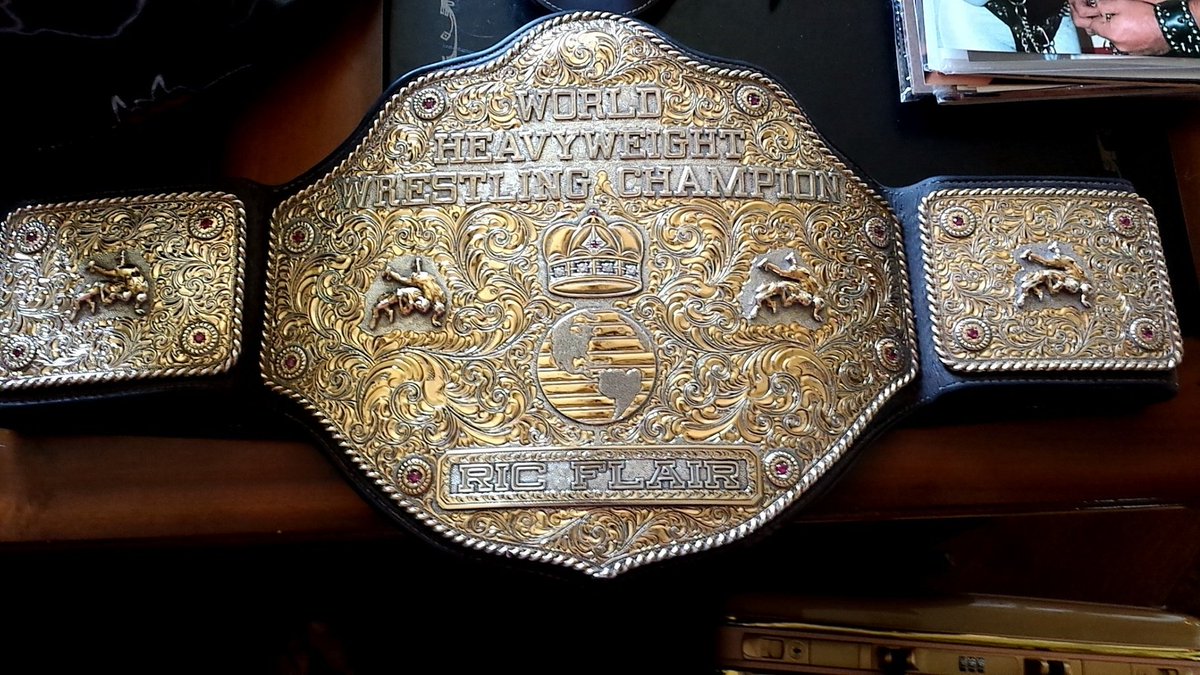
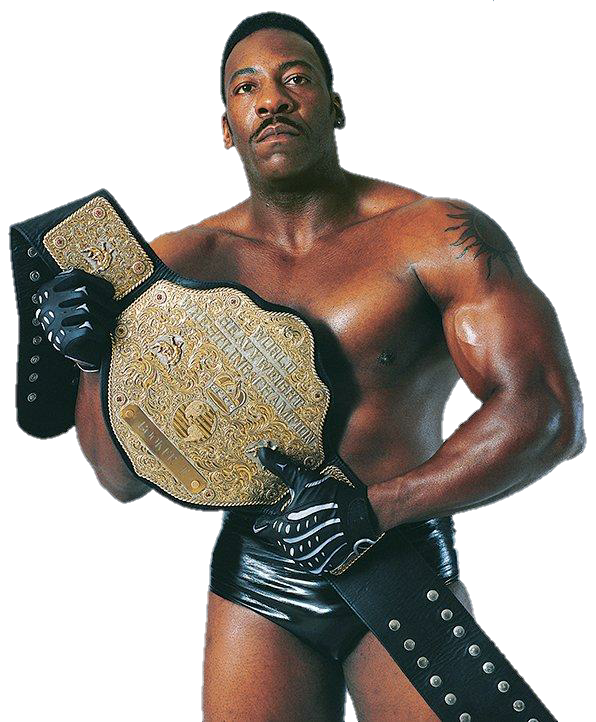
- There's a lot of widely-believed misinformation about the Big Gold Belt, and much of it still persists even after an official biography was published in 2014.
- Many wrestling fans are under the impression that the original Big Gold Belt had a black leather strap and that the plates were completely gold (not helped by the fact that the belt was depicted this way in merchandise). When the belt was first made in late 1985◊, the strap was a Cordovan brown color with light gray stitching and the plates had a sterling silvernote background with the lettering, swirl patterns and relief pieces being gold-plated. While the original brown strap was eventually replaced by a new black strap, it wasn't replaced until 1999. Even most people who know that the strap was originally brown think that it was replaced much earlier. This is likely because the original brown strap became so dirty and discolored by the mid-'90s that it began to look blacknote . As for the plates, not only did they initially look completely gold on TV except in close-up shots, but as time went on, the gold became less shiny and the silver became tarnished, which made it harder to tell that the plates were two-tone even up-close (compare how the plates looked when they were brand new to how they looked just five years later). And towards the end of WCW's existence, the original Big Gold Belt was replaced by a series of cast copiesnote , which were entirely gold-plated, with one of these cast copies carrying over into WWF during The InVasion Angle. The WWE versions of the Big Gold Belt used for their World Heavyweight Championship would also feature all-gold plates on a black leather strap (with a red crocskin backing added in 2011), which probably helps fuel the misconception among younger fans.
- Also, most replicas of the original Big Gold that fans can purchase, including the one for sale on WWE Shop, have gold snaps on the strap. Both the original brown strap◊ and the black strap that replaced it had stainless steel snaps, as did the straps on the cast copies◊ used in late-era WCW and the WWF InVasion. The misconception is probably because the later versions of WWE's World Heavyweight Championship had gold snaps.
- Everyone knows that the original Big Gold Belt was made by Charles Crumrine (even Wikipedia lists him as the maker of the belt). It wasn't. While the plates were indeed manufactured by Crumrine Jewelers, Charles Crumrine himself died on May 22, 1985 while order for the plates was placed on November 20, 1985 (as evidenced by notes from Crumrine in the Big Gold book). The plates were primarily made by Crumrine silversmith Victor Ortiz with some assistance from Charles' daughter Jeanne Lashelle. Some also believe that Crumrine made the strap, which is not the case. Crumrine Jewelers made belt buckles, not belts. The original brown strap was made by Ralph Harris of Harris Leather and Silverworks while the replacement black strap was made by Andre Freitas of AFX Studios (a company who made a lot of costumes and props for WCW, including the all-gold cast copies of the original Big Gold Belt.)
- Today the belt is owned by Conrad Thompson, a wrestling podcaster and Ric Flair's son-in-law.note It's not in Triple H's office (after Flair gave it to him as a gift) as often believednote nor does Scott Steiner have it...anymore.note
- Regarding the infamous dent at the top of the center plate, it's common for fans to claim that it first appeared in 1995 and that either Hulk Hogan or Randy Savage was responsible for it. No one knows exactly how or when the belt became dented, but the Big Gold biography pins the first appearance of the dent to some time in early 1988. While this is difficult to confirm due to the lower video quality back then, the dent can clearly be seen in this clip of Ric Flair's WWF debut on September 9, 1991. This at least proves that the dent existed before Hogan and Savage held the belt.
- Fans often say that the reason why the original belt did not have any wrestling company logos on it was because it would have been too expensive to do sonote . The real reason is because Jim Crockett told Crumrine to not put any NWA logos on it (the original concept art had the NWA letters at the top of the main plate) since he knew that his company was beginning to outgrow the NWA and wanted to ensure that the NWA couldn't claim ownership of the belt when the inevitable split happened. Indeed, when Jim Crockett Promotions became WCW and seceded from the NWA in 1993, WCW and NWA battled for the belt in court with WCW winning full ownership of it and NWA went back to using the "Ten Pounds of Gold" belt that represented the NWA championship before the introduction of the Big Gold.
- Many wrestling fans are under the impression that the original Big Gold Belt had a black leather strap and that the plates were completely gold (not helped by the fact that the belt was depicted this way in merchandise). When the belt was first made in late 1985
- It’s commonly believed that the WWE purchased WCW lock, stock, and barrel on March 26, 2001, except they didn’t. WWE only purchased certain assets of WCW, which included its trademarks and logos (including the World Championship Wrestling/WCW name), several contracts to lower to midcard wrestlers, and its video library. The rest of WCW’s assets, which includes several contracts to the main event wrestlers (Ric Flair, Sting, Goldberg, Kevin Nash, to name a few), as well as the legal matters (including Hulk Hogan’s Bash at the Beach 2000 and Sid Eudy's Sin 2001 lawsuits, and several anti-discrimination lawsuits), was retained by the then-current AOL Time Warner and spun off into a holding company called Universal Wrestling Corporation, which was also the name briefly used by Turner Broadcasting after acquiring Jim Crockett Promotions in 1988. Universal Wrestling Corporation somehow existed until 2017, even though it had no assets and didn't promote a single wrestling show.
- The final episode of WCW Monday Nitro wasn't WCW’s final show; there were two WCW shows that were still broadcast after WWE's purchase of WCW. First, there was the final episode of the syndicated recap show WCW Worldwide that aired a week after Nitro's final episode was broadcast. Finally, there was WCW Classics, which aired on Turner South, a regional entertainment network that was only broadcast in the Southern United States; WWE, whom by that time owned WCW's archives, continued to license the footage to Turner South until the series ended on July 2001.
- It’s also believed that incoming AOL Time Warner executive Jamie Kellner cancelled all WCW shows on Turner’s networks because of his supposed personal dislike for professional wrestling, but this isn’t the case. Both TNT and TBS were undergoing a rebrand that saw the respective networks become more focused on drama and comedy shows, hence their taglines, “TNT: We Know Drama” and “TBS: Very Funny”. Also, the rebrand brought in more advertisers; historically, professional wrestling was perceived by them as low class entertainment.
- Everyone knows that when Sting took on his "Crow" gimmick in late 1996, he never spoke a single word on-camera until the first episode of WCW Thunder in January of 1998, right? Not exactly. While Sting never cut promos or gave any on-camera interviews until this point, he did occasionally talk, albeit in ways that the audience couldn't hear him, such as whispering something in his victims' ear right before performing a Scorpion Death Drop (notably, during Lex Luger's match against the Giant at Starrcade 1996, Sting interrupted the match while both men were down, whispering something to both of them before leaving his baseball bat behind and leaving). The first time Sting spoke again to viewers was actually after beating Hollywood Hulk Hogan at Starrcade 1997. While celebrating with the luchadores, he looks into the camera and says something in Spanish ending in "Mamacita!". The randomness of it, combined with the infamous screwy finish of the match overshadowing what happened after is probably why most fans either don't know about it or don't acknowledge it.
- While on the subject of Sting it's commonly believed that the other Sting, Gordon Sumner, owns the rights to the name "Sting" and the wrestler, Steve Borden, has to pay a small annual fee to Sumner to fulfill the legal obligations of protecting the trademark.note In reality it's actually Borden that owns the name, not Sumner, even though Sumner was calling himself "Sting" long before Borden even got into the wrestling business. This makes sense if you think about it, while the idea of The Police just grabbing some other guy to pay bass and sing and calling him "Sting" and hoping no one noticed would be ridiculous, this kind of thing happens in wrestling all the time, in fact a fake Sting existed in WCW at the same time as the real one.
- Everyone knows that Diamond Dallas Page didn't start wrestling until 1991 when he was 35 years old. Page actually attempted to pursue a wrestling career in his twenties, but quit after only a few matches due to knee problems he'd had from a string of injuries during his youth. After spending several years running a nightclub, followed by a moderately successful career as a wrestling manager and announcer who occasionally wrestled, he decided to become a full-time wrestler.
- It's pretty widely believed that Seth Rollins is Hispanic, mainly because his legal name is Colby Lopez. We say legal name and not birth name because Lopez is his stepfather's name, he married Col... Seth's mother when Seth was very young and adopted him a short time later. For those curious Rollins is actually of Armenian, German, and Irish descent.
- In summer 2018, Tama Tonga and his family have betrayed the Bullet Club to form a group called the Firing Squad. Except, as Tama express here, that's not the point of the story at all.






- Orson Welles' 1938 radio drama adaptation of The War of the Worlds for The Mercury Theatre on the Air didn't accidentally fool the American public into believing that Earth was being invaded by aliens, and it definitely didn't cause mass pandemonium. While the program did present the first two acts of the story as a series of news bulletins interrupting a music performance, Welles explicitly stated at the beginning that it was a work of fiction, and even began by reading the introduction from the novel. A relative tiny handful of listeners (presumably those who tuned in after the introduction) may have been fooled, but most of them probably caught on by the third act—which is a more traditional radio drama with dialogue between characters.
- Harlem Globetrotters
- Despite their world-famous team name, the Globetrotters are not a real competitive basketball team; they are an athletic/comedic theatrical act made up of talented basketball players. All of their "games" are pre-rehearsed spectacles in which they always win (although they have accidentally lost on a handful of occasions).note
- Those who are aware of the exhibition nature of the Globetrotters usually assume that their perennial opponents, the Washington Generals, are part of the same touring "show". Except in reality, the Generals and the Globetrotters remained completely separate businesses for 65 years. The Generals were owned and managed by Red Klotz, who hired his team out to the Globetrotters to lose to them. It was only after Klotz died that the Generals were purchased by the Globetrotters in 2017 and brought under the same umbrella.
- Contrary to popular belief, Oakland Raiders Owner/GM Al Davis was neither a member of "The Foolish Club", the eight original team owners of the American Football League (AFL)note nor was he the Raiders original head coach. Davis did not assume control of the Raiders until 1967. He was an assistant coach under Hall of Fame coach Sid Gillman for the Los Angeles/San Diego Chargers for the AFL's first three seasons (1960-1962), and head coach of the Raiders (hired by actual original Raiders owner F. Wayne Valley) from 1963 to 1965, before handing things over to John Rauch (which is yet another bit of "common knowledge": John Madden was not Davis' immediate successor — he was Davis' defensive line coach and Rauch's defensive coordinator).
- Upon his death in 2014, Buffalo Bills owner Ralph Wilson was not the last member of the Foolish Club. He was the last surviving active member. Barron Hilton, the original Chargers owner, didn't die until 2019. He sold the team to an investment group in 1963, at the request of the other members of the Hilton family. Wilson was the only member of the original 8 to never sell or relocate his teamnote , however.
- The so-called "Tom Brady Rule" (which prohibited a defensive player from hitting quarterbacks below the knee) was wrongly attributed to Tom Brady after his season-ending knee injury during the 2008 NFL season. It's unofficially called the "Carson Palmer Rule"note (which Brady calls his knee injury in a interview with WEEI radio), which was passed back at the start of the 2006 season after Cincinnati Bengals QB Carson Palmer suffered the same injury during the 2005 playoffs against the Pittsburgh Steelers. The actual "Brady Rule" (which was passed back in 2009) was a clarification to the existing "Palmer Rule" by stating the following:
Note 1: A defender cannot initiate a roll or lunge and forcibly hit the passer in the knee area or below, even if he is being contacted by another player.
Note 2: It is not a foul if the defender swipes, wraps, or grabs a passer in the knee area or below in an attempt to tackle him.
—The Tom Brady Rule, Official NFL Playing Rules
- Related to that, the Patriots being able to succeed without Brady in 2008 (and to a lesser extent, the 2016 season) led to the perception that Brady is a "system quarterback", and that literally any QB can succeed with the Patriots, as shown by Brady's backup, Matt Cassel, who hasn't started a game since high school, guided the same 2007 team (who nearly went 19-0) to a 10-5 record (the first game was technically Brady's win) but missed the playoffs after losing tiebreakers to the Dolphins and Ravens; compare that to what happened to the 2011 Colts, who went from 10-6 in 2010 to an absymal 2-14 when Colts QB Peyton Manning sat out for the entire season as he underwent multiple neck surgeries, which were career-threatening at the time. Problem with the "system QB" narrative was that the Pats (and the AFC East) in 2008 played two of the worst divisions ever in NFL history, the AFC West and NFC West, where their respective division winners, the then-San Diego Chargers and Arizona Cardinals, finished 8-8 and 9-7, respectively. Also, the Patriots, despite retaining most of the 2007 players and coaching staff, switched to a more run-heavy offense, and as a result, they ran the ball more compared to the previous season (2,278 yards vs. 1,849 yards in 2007). Finally, the Pats, despite an 11-5 record, only went 2-4 against playoff teams and 3-4 against teams with 9 or more wins.
- The general consensus on the 2007 Spygate scandal is that the New England Patriots were cheaters. In actuality, the Patriots were punished for recording the New York Jets' defensive signals from an illegal location (i.e., the sidelines). Super Bowl-winning coaches Jimmy Johnson, Bill Cowher, Dick Vermeil, and Mike Shanahan admitted to doing the same thing, and stated that the filming of the opponents' signals was common practice back then. Finally, the Patriots were punished after the rule prohibiting the recording of signals from an illegal location was passed at the start of the 2007 season.
- David Tyree's miracle late 4th quarter helmet catch in Super Bowl XLII did not win the game for the New York Football Giants. The winning touchdown was scored later when Eli Manning hit Plexico Burress. The catch did contribute to the win, giving the Giants excellent field position to set up said winning touchdown, but it wasn't the scoring play or even the play that directly set up the scoring play; there were actually several plays in between. And Burress' touchdown, while it ultimately held up as the game-winner, didn't actually completely give the Giants the win, as there was still time left on the clock, requiring the defense to stop Tom Brady from driving for a game-tying field goal. The catch was a huge turning point for the Giants, but that alone didn't win them the game.
- Everyone knows that Pete Carroll's call to pass on the one-yard line (leading to an interception) in the dying moments of Super Bowl XLIX, instead of handing it off to Marshawn Lynch, was the worst call ever. This is mostly based on the immediate reactions of the announcer Cris Collinsworth, who called it the "dumbest". What's forgotten is that after Kearse's circus catch got the Seahawks to the goal line (remember the aforementioned example?), Seattle did in fact hand off to Lynch and the Patriots stopped him. For the next snap, the Patriots were expecting the ball to be given to Lynch and were prepared to respond, so going in a different direction (i.e. to a pass) was the right idea... indeed the Patriots Defensive Coordinator later said that the call was the right one. To wit, Lynch was heavily covered, and his actual record in such situations is fairly poornote . The goal-line interception was the only one that season and it required the defender to read the play and adjust in time. It was a 1-1000 situation.
- On the issue of the Patriots, everyone knows that Tom Brady was an unknown late-round pick, who was put in for the injured starter and won the Super Bowl (and a lot more over the years)? Actually, Brady played for Michigan, one of the top programs in the country, and threw for 4 touchdowns against Alabama in the Orange Bowl. He was well known to college football fans as seen in the original ESPN draft announcement (https://www.youtube.com/watch?v=3Dt7JaSCft0 ). People who had followed Brady gave him a high grade. He fell on Draft Day for a variety of reasons, including having had an unimpressive combine, having to share playing time, and a dearth of open slots for quarterbacks that year.
- The "Miracle at the Meadowlands". Everyone knows the Giants would have won that game if quarterback Joe Pisarcik just took a knee, right? Well, not exactly. The so-called victory formation wasn't added to the rulebook until 1987, nine years after the Miracle at the Meadowlands, and in fact this incident is generally believed to have been a factor in why this concept came to be. There was an unofficial equivalent at the time of having the quarterback take the ball and just fall to the ground and roll, and the Giants had actually done this on two plays earlier (on first down), but because it wasn't an official play option, there were no rules surrounding it, so the Eagles decided to jump on the play anyway in hopes of forcing a fumble; the Giants consequently decided not to have Pisarcik roll again due to the risk of him getting injured, so the run play seemed like a low-risk option that would help to burn the clock and avoid the risk of their quarterback sustaining an injury that would cause him to miss time (and it probably would have worked if they'd executed better). There were several mistakes made in those final seconds that cost the Giants the gamenote but not taking a knee wasn't one of them.
- It is common knowledge that the Immaculate Reception by Franco Harris over the Oakland Raiders in the playoffs was the turning point for the Pittsburgh Steelers franchise as they would go on to win the Super Bowl, their first of four in the 70s. Except that didn't actually happen. The Immaculate Reception happened in the Divisional Round of the 1972 playoffs, and the Steelers would go on to be beaten by the undefeated Miami Dolphins the following week. The next year, the Raiders got their revenge and thumped the Steelers 33-14 in the playoffs. It wasn't until two years after the Immaculate Reception that the Steelers would finally win the Super Bowl and kick off their famous dynasty.
- Everyone knows that Mixed Martial Arts is the combat sport where there are no rules. Except that there are tons of rules. Just as many, if not more, rules than other combat sports like boxing and amateur wrestling. The misconception stems from the early days of the UFC, which had hardly any rules, but it did have a few. In fact, the relative lack of rules was intentional: as early UFC was meant to be a showcase of different fighting styles (Karate vs. Kickboxing vs. Brazilian Jiu-Jitsu vs. Sumo Wrestling, among others), the fewer hard/fast rules there were, the freer the participants were to utilize their techniques in full. However, as the meta-game inside the cage evolved and more and more fighters began to adopt a mix of grappling and striking, it became easier for UFC to institute more uniform rules.
- Mention "the underarm incident" to any cricket fan, and they'll know you're talking about the 1981 ODI where the Australian bowler Trevor Chappell bowled an underarm delivery to deny the New Zealand batsman Brian McKechnie a chance to hit a six and win the game off the last ball. All correct, except for the last bit: New Zealand were actually 6 runs behind Australia and could only aim for a tie by hitting a six. note
- Everyone knows that the Boston Red Sox had the 1986 World Series locked up against the New York Mets when first baseman Bill Buckner let a ground ball bounce between his legs, costing the Red Sox the championship, right? Well...not quite. The Red Sox did come within one strike of winning the Series, and the Mets' winning run of that game did score when the ball went through Buckner's legs, but what everyone forgets is that there was a whole string of Red Sox F-ups in between those things that led to the game being TIED when Buckner made the error. There are a handful of people who could be considered more blameworthy than Buckner for the loss, including Roger Clemens (who, as the starting pitcher, insisted on trying to close out the game despite having a blister on his throwing hand), Calvin Schiraldi (who relieved Clemens and was pitching when the tying runs got on base), catcher Rich Gedman (whose passed ball caused one of the runs to score), and manager John McNamara (who, for sentimental reasons, insisted on having the aging and injured Buckner on the field when the game appeared to be in the bag, rather than the more reliable Dave Stapleton). On top of all of that, pitcher Bob Stanley appeared to be a bit slow getting over to cover first base on the play and there's no way the aging Buckner could've made the forceout unassisted; indeed, the Mets batter who hit that ball, Mookie Wilson, was officially credited with an infield single, with the error being assessed solely because the winning run scored all the way from second base whereas a clean fielding by Buckner would've stopped him at third. The other thing people forget is that the Buckner game was game SIX of the Series, which the Sox had previously led 3 games to 2. Buckner's error didn't cause the Mets to win the championship, merely forced Game 7. In the final game, the Sox jumped out to an early 3-0 lead, but pitcher Bruce Hurst was unable to hold the lead, and the Mets won the Series. The most egregious part is that Boston fans misblamed Buckner for years, to the point where his kids were harassed in school, until he ended up moving his family to Idaho, where nobody cared about baseball or knew who he was, and working as a car salesman.
- Likewise, everyone knows that the Chicago Cubs were one out away from winning the 2003 National League Championship over the Florida Marlins when a Cubs fan named Steve Bartman tried to catch a foul ball that Cubs outfielder Moises Alou could have secured for the series-clenching out, preventing him from making the catch. Not exactly. The ball only would have been only the second out of the eighth inning, meaning that the Cubs would have still needed four more outs to win the game had Alou secured the ball. Immediately after the play, Mark Prior threw a wild pitch that moved the lead runner up to third base and gave up a single to the next batter to cut their lead to two runs. This was followed by a botched double play attempt by shortstop Alex Gonzalez that also could have ended the inning. And Bartman certainly can't be blamed for the Cubs allowing eight runs in the inning and being completely unable to respond in the ninth, nor for their loss in the decisive game seven, extending what was ultimately a 108-year World Series drought. Despite his minimal role in the Cubs misfortunes that year and every subsequent year, Bartman became a scapegoat for the team's failures as fans simply could not comprehend the degree to which the Cubs were being punished by the fates. He was doxxed by vengeful fans, necessitating years of police protection for him and his family and was harassed by entitled fans and the Chicago media for years. Thankfully, when the Cubs finally won the World Series in 2016, the organization gave Bartman a ring as recompense for all the undeserved agony the fanbase put him through.
- Everyone (especially in Buffalo) knows that if the Buffalo Sabres had won the infamous "No Goal" game they would have won the Stanley Cup, right? Nope, they would have just forced game 7. If the goal had been disallowed, Dallas still could have won the game and the Cup by scoring after that. And the call on the ice was correct (and contrary to popular belief was reviewed and upheld), the rule was changed the following season to allow a skate to be in the goal crease at any time so long as the skater isn't interfering with the goaltender.
- Everyone knows the Minnesota Vikings lost the 1998 NFC title game to Atlanta Falcons because Gary Anderson missed a field goal. In reality the Vikings were actually leading 27-20 when he missed. If anything is to blame it should be the Vikings defense for giving up a last-minute drive to a limping Chris Chandler (although they lost 5 starters to injury by that moment) and Denny Green deciding to kneel down and play for overtime despite having one of the greatest offenses in league history.
- Everyone 'knows' the term "soccer" is strictly an American word that was made up by the United States to differentiate the round-ball game from American Football, and that "football" is the true name for the sport. Europeans, particularly Brits, have been known to get outright violent over that word. However, the word "soccer" actually originates in England, not the USA. It is derived from "association football", the sport's full name, which differentiates it from other codes of football such as rugby. It spread across the world until it eventually reached the US, where "soccer" was adopted there. The term has subsequently largely dropped out of use in Britain, especially in England — but this is Newer Than They Think, too: it only fell from favour as recently as the 1990s, and British monthly magazine World Soccer (est. 1960), for instance, is still in print under that title. In other words, any Brits who get angry over the word soccer have nobody to blame but themselves. It's also not uncommon for someone to say that only Americans use the word soccer. Actually, it's also used in Canada, Australia, New Zealand, Ireland, and South Africa, all of which have other codes of football predominating.note
- And to undercut the obvious argument that American Football is misnamed because it isn't primarily played with the feet — well, neither are Rugby Football, Gaelic Football or Australian Rules Football.note The word more likely came about in medieval times to denote any mass team game played on foot, as opposed to on horseback.
- Everyone knows that the 1980 USA Men's Hockey team beat a heavily-favored Soviet juggernaut and won the gold. Not nearly as many remember that the USA-USSR match was their next to last game, and they still had to beat Finland to assure themselves the gold (which they did). At that time the medal round was a round robin, with the gold medal going to the team with the best record in that round. The current elimination/bracket format started in 1992.
- Several in women's artistic gymnastics:
- Olga Korbut was not exceptionally young; at seventeen, she was three years older than Nina Dronova, the alternate on the 1972 Soviet Olympic squad, and eight different teams had at least one 14-year-old in their lineup at that Olympics. The trend toward younger gymnasts had actually begun eight years earlier, when the up-and-coming 15-year-old Larisa Petrik defeated the legendary Larisa Latynina at the 1964 USSR Championships and proved that a young teenager could compete and win against the sport's best. Korbut's uniqueness was due to her incredible acrobatic athleticism, which did popularize the shift from the more elegant, dance-based gymnastics of the era to the emphasis on the acrobatic tricks that the sport has been known for ever since.
- The Korbut Flip and Layout Backwards were not immediately banned, and they were not banned because they were "too dangerous". They were banned in the late 1980s because they disrupted the flow of the routine since they involved standing on the high bar, and the event had evolved toward requiring continuous movement. They were no more dangerous than other uneven bars skills of the time, and Elena Mukhina added a full twist to the Korbut Flip later in the 1970s.
- "Everyone knows" that Nadia Comăneci scored the first Perfect 10 ever in gymnastics at the 1976 Montreal Olympics.... except she didn't. The legendary Vera Čáslavská scored the first perfect 10 in international competition in 1967 at that year's European Championships, a full nine years before Nadia. In 1971, Soviet gymnast Nina Dronova — a child prodigy who puts paid to the myth that Nadia was the first wunderkind of women's gymnastics, which she manifestly was not — also scored a perfect 10 at the USSR Spartakiade. It wasn't even Nadia's first perfect 10; she had achieved that on the balance beam at the European Championships in 1975. What Nadia did do was score the first perfect 10 ever seen in Group-1 competition (the World Championships and the Olympic Games).note
- Nadia did not "burst onto the scene" in Montreal. She had been beating veteran, legendary gymnasts in international competition since she was eleven years old; the Soviets already knew exactly who she was, especially as she had nearly swept the gold medals at the 1975 European Championships — at that time the third-most-prestigious competition in gymnastics, behind only the World Championships and the Olympic Gamesnote .
- It is commonly believed that roll-out skills like the Thomas Salto were banned for women in the 1980s in the immediate aftermath of the accident that paralyzed Soviet world champion Elena Mukhina. In fact, such skills weren't banned until 1993, a full 13 years later; the last female gymnast to perform one in competition was He Xuemei in the 1992 Olympic Games. It took years for the world to discover why Mukhina had suddenly disappeared from the world stage, as the Soviets kept the nature of her injury extremely quiet.
- In the thirty years since the competition happened, the common narrative about the 1996 Olympics has gone from "Kerri Strug absolutely needed to vault in order for the USA to win gold" to "Kerri's vault actually wasn't needed at all". The truth is actually somewhere in the middle; because vault as an event is so short, Kerri's final vault happened before the last two Russian gymnasts had gone on floor exercise, and both were capable of extremely high scores — scores so high that, had they performed to potential, they very well could have beaten the USA. As it happened, they didn't perform to potential, but Team USA had no idea what their scores would be because they hadn't gone yet. Kerri's vault clinched the gold for the Americans; with it, they would win regardless of what the Russian women did.
- The documentary Athlete A has led most casual fans to believe that American gymnast Maggie Nichols was denied a spot on the 2016 Olympic team because she blew the whistle on disgraced former team physician and serial child molester Larry Nassar when her coach overheard her discussing her "treatments" with a fellow gymnast. In reality, Nichols badly injured her knee in the spring of 2016; she hadn't regained her 2015 formnote by the time of Olympic Trials, and was not expected to make the final squad. This theory is actually much more plausible when considering the team alternates, where there is in fact quite a lot in support of the idea that she was unjustly passed over.
- Crossing with Fake Memories, during the 2020 Olympic Games many Brazilians learned that their then-best known gymnast, Daiane dos Santos, had never won an Olympic medal (she was the World Champion on floor exercise in 2003, but in three Olympics, was at most fifth in the floor finals) after Rebeca Andrade became the first Brazilian woman to medal in gymnastics at the Games.
- During the 1974 FIFA World Cup, Brazil were playing a group stage against Zaire (modern day Democratic Republic of the Congo) when a free-kick, awarded to Brazil, was interrupted by Zaire defender Mwepu Ilunga kicking the ball far down the pitch. This was because he was unaware of the rules, wasn't it? No, he was intentionally trying to get himself sent off (the referee gave him a yellow card) as part of a protest against the country's football authorities, who were alleged to be depriving their players their rightful earnings.
- In 1992, Yugoslavia had descended into warfare, which led to the UN passing a resolution that banned Yugoslavia from sporting events, including the UEFA Football Championships. This resulted in the reinstatement of Denmark - who were on holiday. Only they weren't - the CISnote had arranged a friendly against them and were preparing for it when they were reinstated.
- Ross Chastain and his insane wallride pass to win the 2022 Xfinity 500 was the talk of the sports world in late 2022, with clips being circulated all over social media. Thing is though, he didn't win, he finished fourth.note Christopher Bell won, but the extra points Chastain earned with his crazy move was enough to get him into the last round of the NASCAR playoffs (though Joey Logano would win the Cup Series title the next week). Cue the Obvious Rule Patch at season's end to make sure no one tries this again.note
- During the 1936 Summer Olympics, Adolf Hitler did not shake hands with Jesse Owens. This is true - although not for the reason usually stated, which was due to him being non-Aryan (i.e. not blond-haired blue-eyed). In reality, on the first day of competition, Hitler shook hands with only the German athletes. The head of the IOC told him that he could either congratulate everybody or nobody, and he chose the latter. Owens would later admit to being snubbed by somebody: President Franklin D. Roosevelt, who didn't even send Owens a telegram or invite him to the White House.
- Boxing:
- One of the most common complaints about the "Klitschko era" of the heavyweight division is that the two best heavyweights in the world could never fight each other, as they were brothers. This is only half true, because the two brothers being consensus number one and number two was a period that consisted of about two years of a 10-15 year era: late 2008 to mid 2011. Wlad and Vitali had first become champions in 1999 and 2000 respectively, but didn't reign at the same time and were still considered up-and-comers - several heavyweights ranked above them, most notably Lennox Lewis. Vitali became the consensus #1 after he won more fights and Lewis retired in 2004, but Wlad wasn't #2; he was floating around the low-middle of the top ten rankings due to inconsistent performances against fellow top-ranked fighters, winning against Chris Byrd, Monte Barrett, and Jameel McCline but losing to Corrie Sanders and Lamon Brewster. Even had the two not been brothers, it would've been unlikely for Vitali to have faced him at that point their careers. Instead, his big championship fight was against Sanders, the guy that beat the inexerpienced Wlad. Vitali himself would be forced to retire only one year after Lewis due to an injury, and it was only then (after partnering up with legendary trainer Emanuel Steward) that Wlad became the #1 by going on a 10 year winning streak starting with his 2005 win over Samuel Peter (Wlad would first be ranked #1 by both The Ring and BoxRec in 2006, around the time he beat Byrd again and avenged his loss by knocking out Brewster). Vitali made a comeback from late 2008 to mid 2012, becoming a champion again at the same time as Wlad and the consensus #2 in the division - but he turned 40 in 2011 and injuries started to pile up on his frame. Again, even had they not been brothers, it would've been perfectly reasonable for Wlad not to face a guy in his 40s who was one year from retirement and essentially fighting one-handed in his last couple fights due to ligament tears in his shoulder. Vitali had his last fight in 2012, officially announced retirement in 2013 (pursuing a career in politics), and Wlad continued to rule the sport until his own loss to Tyson Fury at the end of 2015.
- Dungeons & Dragons examples:
- The game is heavily steeped in the occult, and the "deeper" you go into the game, the more you are called upon to actually recite occultic prayers, cast real spells and summon real demons with incantations based on actual pagan rituals. None of that is true and is all based on the completely made-up testimony of Patricia Pulling, who blamed the game for her son's suicide and later claimed to be an expert on it while attempting to get the game banned. In fact, D&D as a whole could be considered The Moral Substitute compared to many other RPGs; good and evil are clearly defined, the protagonist classes include paladins and clerics while the antagonists include The Legions of Hell, and Gary Gygax himself was reluctant to include stats for angels (which are always Good) because he thought players might be tempted to kill them otherwise. There is a small kernel of truth to the legend — in the First Edition DMG, there are template summoning circles, some of which look like they may have been cribbed from real-world thaumaturgy, depicted for summoning Aerial Servants in the DM's glosses on adjudicating spells. Gary Gygax most likely intended these as an Obvious Rule Patch to make summoning by his players' characters a bit more onerous, time-consuming and expensive (and to give the Killer Game Master some fun if the character screwed it up).
- Oh, bards. The always underpowered losers, with about as much use as Sir Robin's minstrels and likely to meet the same fate. What kind of idiot wanders into a dungeon to fight monsters with an instrument? The kind of idiot who's going to save the whole party, as it turns out. Over the course of D&D's many editions, bards have been a mid-tier class at worst, and often edge on being one of the best. The original bard was a special super class that could only be entered after a complicated process that would usually make them the strongest character at the table. The 2e bard, the first one to become a regular class, was a more than serviceable caster and thief, and often preferable to the actual thief. The 3.5 bard was the most powerful core class not considered an outright Game-Breaker. The 4e bard was a completely competent Leader with some handy specialized skills. The current 5e bard is often regarded as flat-out the best core class, with the potential to be a Master of All. Though some versions have been poorly designed or Difficult, but Awesome, the class as a whole has never been weak. A mixture of new players failing to understand their mechanics and how they synergize with each other, the longstanding trope of the comic-relief Wandering Minstrel, and the crappiness of Edward in Final Fantasy IV may be to blame for this one.
- Contrary to almost all depictions (and how they're portrayed in every other form of media), elves in D&D are, by the rules as written, a head shorter than humans on average, given the height ranges given. 3.5e rules gave the random height for elves of either gender as a base of 4' 5" plus 2d6 inches, giving a range of 4.5 to 5.5 feet. By comparison, human women started at the same base height and human men at 5' 10" with a modifier of 2d10 inches (a range of 5' 5" to 6' 3" for women, and 6' 8" for men). As of 5e, elves range from "5 to 6 feet tall", while humans are described as "barely 5 feet to well over 6 feet", making elves a little taller, but giving roughly the same range (scrapping the random tables as they were rarely used, and being more inclusive of human short kings and tall queens).
- One related to another common misconception. Among those who know that Tiamat wasn't actually a dragon originally, it's widely believed that this inaccuracy originated with D&D. This is objectively wrong, since Tiamat's been described as a dragon in (non-fiction) literature as early as 1888. D&D did basically make up Tiamat's design from scratch, though.
- In most editions, rolling a natural one (ie. rolling a 1 on a d20, before any modifiers are applied) is only an automatic failure when rolling to hit an enemy. The idea that it's an automatic failure for any roll is a common house rule (and most of the time, it's such a low roll that it fails anyway), but it is not officially a part of the game.
- By a similar count, the Critical Failure (that is to say, rolling so badly on a standard roll that a negative effect occurs) has never been a core rule, flitting somewhere between popular house rule and official-but-not-default variant. By default, regardless of edition, the only thing that happens when a character rolls a 1 on their attack roll is that they miss.
- However the DM can call for a d20 roll after a wild magic sorcerer casts a spell, causing a random effect on a nat 1, however this is not exactly a critical fail.
- Again similarly, a natural 20 is normally only an auto-success, and only on attack rolls and saving throws (and only in some editions for saving throws). It is not an automatic success on a skill check, and it's not a super-duper ultra success. The only exceptions are Death saving throws in Fifth Edition, where natural 20s and natural 1s have explicit special effects (they count as an automatic revive and two failures, respectively), critical hits (which can sometimes happen on slightly lower rolls) and attack rolls with a Vorpal Sword (which either beheads the target or deals a massive amount of extra damage note if the target cannot be beheaded or could survive such a fate - at least in later editions).
- In third edition, there was an obscure race called the "dvati". For some reason, fan art of this race frequently gives them Pointy Ears despite no official description nor illustration giving them such ears.
- A Green Sun Prince in Exalted 2e is not necessarily offered their Deal with the Devil after My Greatest Failure. This is nearly always the case, because it's in the nature of mortals to fail — especially in the sort of circumstances that would attract an Exaltation — but if, somehow, against all odds, they manage to succeed, the Infernal Exaltation doesn't just go away. It would take a very unusual person to accept under those conditions, but the offer is still made. (3e/Essence GSPs have different criteria, being selected from victims of injustice and oppresion, so this doesn't apply for them.)
- Traveller has a reputation for being one of the few tabletop games in which your character can die during character creation, which has players roll to determine what events occurred in their life, good and bad beforehand rather than having the player dictate their past. While this was true when the game first came out, this was quickly made into an optional rule in the 1980's and only recently brought back as of 2018. In any event, this is an exceedingly rare thing to have happen, to the point where in order for your character to die this way, it'd have to be nigh-deliberate, such as having that character refuse to seek medical attention for a grievous injury. Despite this, the game is still mistakenly known for "the one that kills you in character creation" as if it happens all the time, causing some potential players to avoid or demean the game for this reason alone. Part of the confusion is that "you can die in character creation" has remained an optional rule for several editions; even the creators mock it, referring to it as "Iron Man Character Creation".
- Warhammer has quite a few due to confusion with the more popular 40k:
- Chief among them: A persistent idea that the setting is as rabidly xenophobic as that of its sibling franchise. In actuality while Fantastic Racism exists, the "good" races generally get along and it is not that unusual to see persons of different species being close friends (except elves and dwarfs; that is unusual, but it has still happened). Major cities across the world have mixed-species populations living in them, trade between the Order factions thrive, and the great powers cooperate closely in the event of major invasions by the forces of Chaos and other threats. What Fantastic Racism does exist also takes many forms including Condescending Compassion (e.g. default High Elf and Dwarf attitude to humans) or mundane 16th century ignorance (e.g. most humans to the other races). In the Empire, there are even de facto independent nonhuman client states more-or-less integrated with their neighboring entities (including the Grey Dwarfs of the Grey Mountains, the Eonir Elves of Laurelorn Forest, and the Halflings of the Moot — the latter being officially classed as an electoral province with a vote to elect the emperor). This is mirrored in the High Elves' relation to the human state of Marienburg, which they de facto have under a protectorate in exchange for maintaining an elf district within the city and handling most of the High Elves' trade in the area. Even the beastly Lizardmen and Ogres can be found in other species' lands as traders or mercenaries. The 4th edition of Warhammer Fantasy Roleplay in particular goes in-depth on the naturalized Ogre population of the Empire in one of its sourcebooks.
- Orcs in Fantasy do not have psychic powers or the ability to spread their population via spores. That's all 40k. Nor are they anywhere near as large and strong as their 40k counterparts — regular humans can consistently defeat them in melee combat, because they're seemingly only about as strong as a particularly muscular human (barring the Black Orcs and warbosses). For that matter, they actually started out as shorter than humans.
- Everyone knows that Warhammer is a grimdark Crapsack World. Well, it's not really. Outside of the End Times (which is itself an Alternate Timeline from the Storm of Chaos and several video game-exclusive timelines), Warhammer is more accurately classed as High Fantasy (with admittedly plenty of Dark Fantasy elements). Heroes can be flawed, but they're glorious and generally good people, fighting clear evils, almost always succeeding by the end of the book/campaign/game/novel. The living standards of the humans in the world may be bad to us, but they're not dystopic and are really no different than those of Eurasia circa the 16th and 17th centuries (in many cases they're flat-out better; Reikland and the Tilean cities, for example, have borderline early 19th century levels of wealth due to their industrialization). Elves, (some) Lizardmen, and Dwarfs are much richer and have higher living standards than humans thanks to magic and steampunk tech. And most critically: for most people, huge wars are a rarity. Low-level threats constantly stalk the forces of Order but they're consistently handled by the regular forces and militias before they cause too much damage, similar to how low-level warfare was a constant throughout the early modern era but only rarely snowballed into larger conflagrations (it was actually a major complaint of the setting that a few towns or armies could end up destroyed but for decades large-scale setbacks for the good guys never really happened, as they'd immediately change the relatively small and detailed world). The only threats that really rock the boat are the major Skaven, Orc, or Chaos campaigns that, pessimistically, occur about once a century. Even those are typically dealt with quicker and with less bloodshed than real-world tragedies of the 17th century like the Thirty Years' War or the Manchu Conquest.
- Warhammer 40,000:
- Every fan knows that the Squats were driven to extinction by the Tyranids in order to facilitate their removal as a playable faction in the third edition of the game. Not many realize that this has been retconned as of sixth edition and that they've been mentioned in other army books as a thriving race in the galaxy still, just without their own army list (until 2022, that is). On that note, Squats weren't removed as a faction because they were considered "too silly" (Black Comedy has always been a cornerstone of 40K, after all) or because the models weren't selling, but because Games Workshop themselves didn't know what to do with them and there was nothing the Squats could do that wasn't already covered by other factions. Their silliness was stated to be a factor, but less because comedy is bad, and more because the designers felt they came across as a shallow, lame joke rather than a fleshed-out group that could also be funny.
- Malal, the fifth Chaos God, is commonly alluded to in the context of 40K in the fandom. Not only is Malal no longer canon, but he was also never canon to 40K. He briefly did exist in the Warhammer Fantasy setting, but Games Workshop had already lost the rights to use him by the time Chaos was added as a faction in 40K. The closest there is is the Sons of Malice warband, which uses a lot of Malal iconography as a Mythology Gag, but for obvious reasons, Malal himself is never mentioned. For that matter, describing him as "the fifth Chaos God" is not exactly accurate — in terms of when he was first mentioned in publications, he actually predates Slaanesh and Tzeentch.
- When the collapse of the old human empire from the Dark Age of Technology comes up, it's usually described as having been due to the Fall of the Eldar and Slaanesh's birth happening at the same time, which created devastating Warp storms and destroyed all starfaring nations of the time... but this isn't what happened. The Fall of the Eldar happened a long time afterwards, during the 30th Millennium, and the psychic shockwave instead cleared away the Warp storms plaguing the galaxy and allowed the Emperor to launch the Great Crusade. The fall of the human empire occurred sometime around the 23rd to 25th millennia and was a result of stresses such as the sudden development of human psykers and slowly increasing Warp turbulence (the early signs of what would become Slaanesh's birth much later), but the primary cause was a widespread AI rebellion, the Revolt of the Iron Men, which wiped out the majority of humanity's infrastructure, advanced technology, and population.
- The Tau are not Communists — they have a caste system, something which is anathema to the classless nature of Communism. Their ideology has more in common with Utilitarianism than anything else.
- A widely spread meme about how the Dark Angels home "the Rock" was named after a gay nightclub near the GW headquarters. A less common addition being that the Primarch Angron was named after a bouncer at the gay nightclub who was nicknamed "Angry Ron". There was never any such nightclub or bar (gay or not) with the name in the area. The more likely reason for the name was that Nottingham Castle, which is located on a ridge named "Castle Rock", was simply called "The Rock" in local parlance. This seems to be something of a cross-pollination with the very real bit of trivia that the Dark Angels Primarch, Lion El'Johnson, is a barely-modified reference to the gay poet Lionel Johnson, who wrote a poem called "Dark Angel" (the joke being that the Dark Angels are defined by trying to cover up a shameful secret about their chapter).
- Canonically, Leman Russ does not have a beard and Rogal Dorn does not have a mustache. You would never guess that from looking at how fanartists draw them.
- Among those more in tune with the more obscure lore of the franchise, you'll occasionally see mentions of the Little Sisters of Purification, an all-female Space Marine chapter from the 80s. Given the (controversial) canon stance that all Space Marines are male, this is often either brought up as an example of Early-Installment Weirdness or a justification for adding female Marines "back" into the lore. Except the Little Sisters of Purification weren't canon even back then. They weren't even created by Games Workshop. They were created for a scenario published in Challenge, a third-party gaming magazine.
- Abaddon the Despoiler is frequently described as a General Failure who's launched twelve separate invasions of the galaxy that all stalled on the first planet, only becoming more than that due to blatant Retcon in time for the Thirteenth Black Crusade event... except those weren't retcons at all. The earliest Chaos material for the game lays out in detail exactly what Abaddon was trying to do in the first twelve Black Crusades, every one of which was successful at their goals; Games Workshop didn't retcon the info in, they just dusted it off. Decades of Memetic Mutation dumped all of that lore for the sake of "Failbaddon" jokes. Another part of this is that the game's setting has been frozen at the end of the 41st Millennium for a decent chunk of its history; as a result, Abaddon's assault of Cadia, which takes place at the very end of the millennium, ended up looking like he was fruitlessly beating against a planet for years.
- Even though the number "40,000" is in the game's title, the game has long since left the 41st Millennium. The current date for the "present" of the canon is in the early 42nd Millennium. (It's also acknowledged that, given the size of the galaxy and the massive gaps in bookkeeping, nobody's actually sure what year it is.)
- A common assertion by fans of the Imperium seeking to justify its zealous anti-xenos policies, especially amongst the more rabid ones, is that humanity used to have alien allies prior to the Age of Strife, only for them to universally betray humanity once it was weakened. In fact, no such assertions are made in canon (or at least they only come from "modern" Imperials, those who have over 10,000 years of propaganda guiding them) — official histories of the setting in the core rulebooks of each edition talk about betrayal and traitors only when discussing the Horus Heresy, the bloody Chaos-backed Civil War that led to the modern Imperium. Whilst many human worlds were canonically liberated from terrible alien menaces, these are always described as being openly hostile entities — there are actually very, very few references to even attempted diplomacy between humans and aliens prior to the Great Crusade, and in fact the Emperor's forces encountered several human/alien alliances were all races involved were on good terms. And destroyed them out of hand, because the Imperium has always been the Villain Protagonist of the setting. The popularity of the belief stems from a mixture of the Always Chaotic Evil nature of the most recognizable alien factions and the fact it makes so much sense as in-universe propaganda, being literally drawn from the Nazi's "Great Betrayal" rhetoric and thus being a perfect ingredient for the authoritarian dystopia stew that is the Imperium.
- While fandom holds that Inquisitors will cheerfully request Exterminatus (the complete and utter destruction of a planet's life and biosphere, and often infrastructure as well) at the first sign of heresy or lacking faith (e.g. someone coughing in church or saying "Emperor-damnit"), and those kinds of lunatics likely do exist, Exterminatus is a far more complicated process than someone signing off and saying "oh well, plenty more planets". It requires the Inquisitor to make the call that taking the planet back from Chaos/orks/the Tyranids is impossible (not "impossible without the loss of billions of lives and materiel over decades", flat-out impossible), a Space Marine fleet to get to the planet (often an active warzone) via warp travel (and Hyperspace Is a Scary Place), and then launch the barrage from orbit, costing the Imperium a world that is usually an important source of materials/weapons/people. Then the Inquisition still checks if the call was justified. And in some cases (such as virus-bombing a planet attacked by Nurglites) it "just gave them ideas". When Inquisitor Kryptman went on a Salt the Earth strategy involving making multiple planets uninhabitable to slow down the Tyranids, he was openly condemned and stripped of his position for using Exterminatus on planets that were not yet seen as unsalvageable, showing that in lore most Inquisitors view it as a Godzilla Threshold option.
- Warhammer: Age of Sigmar:
- A commonly-repeated statement in the broader Warhammer fan community is that Games Workshop torched Warhammer Fantasy and replaced it with Age of Sigmar because the former's Standard Fantasy Setting made it impossible to defend IP infringement disputes, prompting the company to replace it wholesale with a much more distinctive setting and to rename all of the Standard Fantasy Races with more copyright-friendly spellings (Elf to Aelf, Dwarf to Duardin, Orc to Orruk, etcetera). While copyright considerations most likely played a role in picking new names, this was not the primary reason for the overall transition. It is relevant to note here that Games Workshop has used the Warhammer Fantasy setting more or less continuously even after discontinuing the tabletop game — the video games The End Times: Vermintide and Total War: Warhammer, both set entirely in the older setting, were both released after the shift from Fantasy to Age of Sigmar, and Warhammer Fantasy Roleplay has also see continued publications and support — without any particular change in names or setting, which is not very consistent with the setting itself being the problem. A much more important consideration was that Warhammer Fantasy itself had been having profit issues for long while, and the reboot was intended to introduce a game with an ideally more profitable system.
- A notion spread around the web is that one of the few early pieces of lore features Daemon Prince Be'lakor being lapidated to death by a band of Seraphon Terradon Riders. Such story is actually a fabrication: sources (like for example 1d4Chan, the gaming wiki for 4chan's /tg/ board) state that this story was published on White Dwarf as part of one of their battle reports... except that it's impossible, since when Age of Sigmar was first released the magazine was briefly shifted into a smaller, weekly format which entirely lacked battle reports, and the magazine scan used as proof clearly comes from an earlier issue of the magazine (more precisely, it's the February 2009 issue, which featured a Warhammer Fantasy Lizardmen vs Chaos Daemons battle report where the Daemons player used the Be'lakor model to represent a generic Daemon Prince — which indeed is killed by a pack of Terradon Riders). Later, Be'lakor was revealed to be still alive and thriving in the new setting, getting a new model and an expanded role as Archaon's rival.
- It seems to be believed in many corners of the internet that the only people who survived the End Times to make it to Age of Sigmar's Mortal Realms were gods, Skaven, and Lizardmen. In actuality, multiple sources have specified that a small number of survivors were saved via various means as the old world was ending (this has actually been the case since the very first Stormcast Eternals battletome). They are the ancestors of the people of Azyr. A significant number of undead characters, such as Mannfred, Arkhan and Neferata, were also preserved and resurrected by Nagash.
- BattleTech: The Unseen fiasco created a few of these:
- Everyone knows that FASA lost the copyright suit brought against it by Harmony Gold and as part of the judgement was forced to never use the Unseen artwork again, right? Not quite. The settlement agreement was put under seal, which means that nobody other than the parties who were in that courtroom in Chicago in 1995-96 have any knowledge of who, if anyone, actually won or lost the case (it could conceivably have ended up in a "amicable" (so-to-speak) settlement with no actual "winner" or "loser"). The story that FASA and its successor companies (Wizkids, FanPro, and InMediaRes Productions/Catalyst Game Labs) have always maintained is that the discontinuance of the Unseen artwork was voluntary, a sizable portion of a larger mandate to end the use of all artwork not created in-house. This stemmed from the lawsuit (in the "let's avoid any more headaches" sense) but it was not as far as anyone can tell, dictated by anything in the settlement. In fact, in 2009, they did test the waters in returning the non-Macross art to sourcebooks, before concerns over returning the minis to production gave Topps, the current rightsholder, pause.
- The actual 'Mechs were decanonized because of the mess. No they weren't. The problem was, they were deliberately put Out of Focus in sourcebook material and scenarios to avoid having to depict them in artwork. That, and the fact that no minis could legally be made of them, nor could they be used in official events, led to the misconception that they were retconned out of the game altogether.
- The main bone of contention were the Land-Air 'Mechs, trimodal Transforming Mecha based on the Veritech/Valkyrie fighters. To keep their appearance from being a problem again, they hard-nerfed the class to the point of uselessness to keep it out of sight and therefore out of mind (and litigation), right? Not entirely; more Land-Air 'Mechs were actually added to the game during the Word of Blake Jihad as the Spectral LAM Series and retroactively added the failed Scorpion, Champion, and Shadow Hawk series of LAMs, as well as the one-off Screamer prototype. The real problem was that there simply is no good way to balance a unit that can suddenly triple its movement in a single turn—prior rules made Land-Air 'Mechs very powerful, especially as flankers and raiders. The current ruleset diminished them (particularly by preventing them from using highly desirable weight-saving technologies) but also adds penalties to certain actions such as Airmech combat. The current rights holders (Catalyst Game Labs) decided that trying to balance the rules affecting eight units out of a list of several thousand wasn't worth the effort and have left Land-Air 'Mechs in their current state to work on rules and scenarios with much farther-reaching effects.
- Monopoly is often thought of as a complicated game that takes forever to play, when actually the sheer opposite holds true. Beyond simple math and a basic understanding of risk/reward management, it's actually a fairly simple game to understand and play and is really only more complicated than simple luck based games like Parcheesi. As for its length, it's actually a really quick and dirty game owing to huge Unstable Equilibrium... as long as you actually follow the game rules:
- Any time a player lands on a property, it goes up for auction if he doesn't buy it. Since the auctions are much cheaper than the list price, this forces players to choose between the high risk of blowing all their money on properties or letting their opponents get monopolies which greatly speeds up the game. You also can buy property immediately — "taking a lap" before being allowed to buy isn't actually a rule and it's actually fairly possible to win before completing a lap.
- No, you don't get to take that pile of money if you land on Free Parking. This is actually a Popular Game Variant designed specifically to prevent the game's Unstable Equilibrium and make it fairer for young kids but constantly handing lucky players wads of free cash makes it much harder for them to run out of money and greatly delays the game's win condition.
- You're also supposed to give your assets to whoever you owe money to upon bankruptcy (you don't surrender it to the bank unless the bank is the one who bankrupts you, in which case everything you own gets auctioned off a property at a time) and yes you do earn money while in jail (in fact, in the late game being in jail is beneficial since everyone is potentially landing on your properties and paying you... while you're kicking back paying nothing).
- Memetic Mutation portrays Uno's Reverse Card as an Attack Reflector. The card's actual effect is to reverse the order of turns. Only under house rules does it make other special cards affect the player who played them.
- "Avocado" supposedly derives from the Aztec word for "testicle". Nope. The word āhuacatl always meant "avocado". It was sometimes used informally to mean "testicle" because of the similar shapes of the two items, much as "nuts" and "plums" are used as slang terms for gonads in English. The plant you're looking for whose name derives from "testicle" is the orchid, whose name derives from the Greek (ὄρχις) due to the distinctly testicular shape of its tubers, which generally come in pairs.
- "Kangaroo" deriving from an Aboriginal Australian term meaning "I can't understand you", thanks to Captain James Cook asking a local, in English, what the name of the animal was, and the local basically saying "huh?" in their own language, but the Language Barrier made Cook think that was the name. It's actually well-established that it really comes from gangurru, the word that the Guugu Yimithirr people use for the eastern grey kangaroo. Both the Cook story and the knowledge of the true etymology are quite old; the first debunking of the Cook story was in 1898. A very similar story about the origin of the name of the Yucatán Peninsula and Spanish explorers might be true, but there's still lots of dispute on the matter.
- "Dunning-Kruger effect" is often used as a shorthand on internet arguments for "complete buffoon thinks they're an expert" (and has become a snarl word on the internet), with the infamous graph showing "mount stupid" of someone after learning the very basics going from no confidence to complete confidence instantly followed by a trough and a slow climb to confidence again. In reality, it's more "below average person thinks they're average", which is a very normal human condition. In the commonly used interpretation, you might have person A claiming that lobsters and flounder are in the same family because they're "fish" (used to mean aquatic creatures) and that neither are animals because they will equate animal with non-human mammal loudly arguing with person B, a biologist. A more accurate example would be person A claiming that bats are rodents whereas person B claims they're not, and person C, a biologist explains that bats are not rodents, and person A accepts that they were wrong, knowing they aren't an expert. The actual graphs, far less interesting, were derived from test-takers at Cornell (already cream of the crop, so they'd have a legitimate reason to be a little overconfident) where the bottom quartile of test takers think they had scores around the class average (it doesn't necessarily mean they got 0-25% test scores, just that their scores, which could have even been passing grades, are in the bottom 25% of class results). Meanwhile, the top test-takers see themselves as merely above-average. The above average and average test-takers assessed themselves both at slightly above but near average, having the most accurate self-assessment.
- Annie: Many people know that in Amanda Dehnert's Darker and Edgier production for the Trinity Rep theatre in 2003, Annie woke up at the end and found that her adoption by Daddy Warbucks was All Just a Dream. But most sources claim that she woke up back at Miss Hannigan's orphanage, turning the ending into a total Downer Ending. Actually, she didn't wake up back at the orphanage, but in an abandoned theatre, where she had taken refuge and fallen asleep after running away from the orphanage at the beginning. Then she sang a bittersweet reprise of "Tomorrow" before wandering off with Sandy in search of a new life. It was meant as a realistic "Ray of Hope" Ending, not a downer. Still, the show's original director/lyricist Martin Charnin disapproved and forced the production team to switch back to the original Happily Ever After ending.
- The closing line of Boris Godunov (the original play by Alexander Pushkin, not the opera) is "The People are speechless", and it is constantly quoted to illustrate the passive and meek reaction of crowds to crisis and oppression. However, in its actual context, the line means the exact opposite: the people adamantly refuse to cheer for the new usurper after hearing his associates brutally murder the previous Tsar's wife and teenage son. Pushkin originally ended the play with the people shouting "Glory to Tsar Dmitry!", but he also asked the publisher to do whatever changes necessary to get the play past censorship; that was one of the changes.
- One of the most well-known numbers from Chicago is the "Cell Block Tango" (which everyone knows is called "They Had It Coming"), in which six women on trial for murdering their lovers protest their innocence, even though the audience knows better. Except... only three of them make even a flimsy attempt to claim innocence of the crime. June says her husband "ran into my knife. He ran into my knife ten times", and Velma claims to not remember anything between opening the hotel-room door to see her man and her sister getting busy and "washing the blood off my hands". The sixth, The Hunyak, actually is innocent (Bilingual Bonus reveals the ugly circumstances of her arrest and conviction). The other three freely admit to it, though they also insist that the murders were justified, for whatever reason.
- Despite casual references to him as "the fiddler", Tevye, the milkman and lead character of Fiddler on the Roof, is decidedly not the title character, nor is the title character an actual character. He is a visual representation of what it's like for a people bound by ancient tradition to live in an environment that is hostile to said traditions.
- "Pirate" is never rhymed with "pilot" in The Pirates of Penzance, not even in the song about Ruth's confusion between the two words. Most people will swear up and down otherwise, even insisting they "remember" the two words being rhymed.
- William Shakespeare's plays:
- Romeo and Juliet:
- While the famous line "O Romeo, Romeo! wherefore art thou Romeo?" is usually quoted right, more or less, most people are unaware of the true meaning, often believing that Juliet is asking "Where are you, Romeo?" "Wherefor" does not mean "where", it means "why". Compare "therefore". In other words, Juliet is asking why Romeo must be who he is, a member of the family with which her own family has a long-standing feud.
- And everybody "knows" that Juliet delivers that line from a balcony. Of course she does — it's the famous "balcony scene", isn't it? Well... no. It may typically be staged that way, but what the playscript actually says is that Juliet appears at a window.
Romeo: But soft, what light through yonder window breaks?- What's more, balconies had only recently been invented in Italy (where the story is set, to be fair), and were unknown in England at the time, as well as being considered rather vulgar.
- "Star-crossed lovers" is not a synonym for "happily ever after". It means that they are ill-fated, that destiny is against them. ("Stars" stand in for "fate", and "crossed" in this case is akin to a "double-cross", i.e. a betrayal. If the stars have "crossed" you, then bad things will happen to you.) They die. There's a reason the Star-Crossed Lovers trope means a relationship is doomed to failure.
- The prospect of 13-year-old Juliet getting engaged to Paris is often considered something that's creepy to modern audiences, but normal in Shakespeare's day. Except that while doing so was technically legal in the Elizabethan era, audiences would generally have considered it unacceptable as well; true, people did tend to get married younger in those days, but not that young. By all accounts and indications, Shakespeare intended for his audience to be disturbed at Juliet getting married so young; her father tells Paris to wait a few years before marrying her when the prospect is first brought up, and him later changing his mind and trying to make Juliet go through with it is played in a resoundingly negative light.
- Hamlet:
- The play is known for the much-parodied Signature Scene in which Hamlet contemplatively holds the skull of his dead friend Yorick and delivers the "To be or not to be..." soliloquy. These are actually two separate scenes from different parts of the play. Hamlet delivers a different (and much shorter) monologue while holding the skull, and it's not even a soliloquy like "To be or not to be...", as he's directing it at another character.
- The line "The lady doth protest too much, methinks" doesn't mean she complains in a suspiciously over-the-top manner. It means that she promises more than she can reasonably deliver.
- Many assume that the line, "The first thing we do, let's kill all the lawyers," from Henry VI Part 2 is an Evil Lawyer Joke. A joke, yes, but targeted at the speaker, not lawyers; the line is often spoken way out of context. First of all, the speaker — Dick the Butcher — is a thug and a killer. Second, he was saying this in reply to his friend Jack's scheme to revolt against the King, or rather, his plans should they succeed. (In a more modern setting, the joke may have started by Jack saying, "When I'm the King, there'll be two cars in every garage, and a chicken in every pot" but Dick interrupting and shouting, "AND NO LAWYERS!") In Shakespeare's time, lawyers were regarded as the protectors of truth, and Dick, being the scum he was, wanted to get rid of such people.
- Richard III
- The play's most famous line, "Now is the winter of our discontent", is not delivered during a time of great hardship or suffering. It's actually the opposite: the full line is "Now is the winter of our discontent made glorious summer by this sun of York". Richard says it while celebrating the House of York's victory over the House of Lancaster. The fact that a period of inclement weather and labor unrest in the UK became known as the "Winter of Discontent" has probably contributed to the misconception.
- The way people talk about Richard's Historical Villain Upgrade you'd think he was some sort of paragon of virtue. While a lot of his crimes in the play are pure fiction — such as arranging the death of Clarence — quite a lot of them are historical fact. Not only is Richard still widely considered the prime suspect for killing his nephews, but he also unquestionably usurped them using the flimsy pretext of their illegitimacy.
- The play's most famous line, "Now is the winter of our discontent", is not delivered during a time of great hardship or suffering. It's actually the opposite: the full line is "Now is the winter of our discontent made glorious summer by this sun of York". Richard says it while celebrating the House of York's victory over the House of Lancaster. The fact that a period of inclement weather and labor unrest in the UK
- Twelfth Night — the opening speech by Orsino: "If music be the food of love, play on" is not in praise of music, or of love. It continues "Give me excess of it that, surfeiting,/The appetite may sicken, and so die", meaning that he wishes to bring his love for Olivia to an end, and asks for more music so as to achieve this through an excess of it.
- Shylock in The Merchant of Venice is often considered one of the most famous examples of the Greedy Jew. While he is indeed a villainous Jewish money-lender, and certainly greedy, his primary motivation in the play is not greed but a desire for revenge, to the point where he refuses to spare Antonio's life in exchange for three times the amount Antonio owes him. And while Shylock is probably the best-known character in the play, he is not the titular merchant; the title refers to Antonio.
- Othello: the title character's description of himself as "one that loved not wisely but too well" is often quoted to describe a victim who fell in love with an unworthy person and was ultimately jilted, betrayed or abused. This is almost the opposite of Othello and Desdemona's doomed love, though. In context, Othello means that he loved Desdemona too possessively and jealously, making him believe Iago's lies about her infidelity and driving him to murder her.
- Romeo and Juliet:
- Les Misérables:
- It does not take place during The French Revolution, but the song "Do You Hear the People Sing" is frequently assumed to refer to it. It does, however, take place during a French revolution (one of many) just not The French Revolution. A highly unsuccessful French revolution.
- Jean Valjean was not an innocent man wrongly imprisoned, as a lot of people (including some of those responsible for the show) seem to believe. It was the length of his sentence (five years of hard labor for stealing bread to feed his sister's children) that Valjean felt was unjust, as well as the fact that he was given fourteen more years for repeated escape attempts, and that his ex-convict status made it impossible to find lodging or honest work when he was released.
- For many years, a rumor persisted that Frances Ruffelle, the original London and Broadway Éponine whose performance won the Tony for Best Featured Actress in a Musical, was the first choice to sing the role in the 10th Anniversary Concert in 1995, but that she turned it down and was replaced by Lea Salonga. Fans who preferred Ruffelle's rugged "street rat" voice in the role to Salonga's more conventionally pretty-voiced performance were especially prone to repeating that rumor. But eventually, Ruffelle clarified in an interview that she was never asked to take part in that concert. She did sing in the finale of the 25th Anniversary Concert in 2010, however, and has a minor role in the 2012 film version.
- It does not take place during The French Revolution, but the song "Do You Hear the People Sing" is frequently assumed to refer to it. It does, however, take place during a French revolution (one of many) just not The French Revolution. A highly unsuccessful French revolution.
- The Sound of Music: Even though Maria is a classic example of the Magical Nanny trope, she's technically not the von Trapp children's nanny. She's their governess — in charge of their education, not their physical care. The confusion likely stems from her sharing an actress and a few plot parallels with cinema's most famous nanny, Mary Poppins, plus the fact that nowadays the distinction between nannies and governesses is not as well known since the latter rarely exists anymore.
- The King and I: As with Maria in The Sound of Music, Anna Leonowens is often misremembered as the Siamese royal children's nanny. She's actually their schoolteacher, whom their father the King brings to court to give them a "modern" Western-style education.
- Sweeney Todd: The Demon Barber of Fleet Street: "In the stage musical, Tobias is a mentally disabled adult, but in the movie, he's a child." This is an often repeated statement. The script actually describes him as "adolescent," meaning that in most productions he's probably meant to be in his late teens, and just played by actors in their 20s or early 30s because of theatre's traditional Dawson Casting. Nor does the movie depart from that description, since Ed Sanders was 13 during filming, although he obviously does come across as younger and less mentally disabled than the character usually does onstage.
- Wicked:
- Wicked is commonly described by non-fans as a Wizard of Oz rewrite where Glinda the Good Witch is the villain and the Wicked Witch of the West is good. This is wrong on Glinda's part. She's antagonistic towards Elphaba for part of the story, but not a villain. The two are best friends (with a lot of Homoerotic Subtext added in) who are on opposing sides. Glinda isn't the villain, the Wizard of Oz is.
- Despite common belief, Wicked is not a true Perspective Flip on the classic MGM film, or the original Oz books for that matter. It's an Alternate Continuity with various differences from the originals and with elements taken from both of them.
- Contrary to popular belief, Shiz isn't a Wizarding School; sorcery is just one of several subjects taught there, and not all students learn it.
- Cats:
- It's a misconception that the Jellicle cats are all strays. Many, if not most, have owners. They're just outdoor cats who are out at night.
- The idea that they're meant to be seen as attractive. While some of them are meant to be seen as attractive, others (such as the kittens) are not.
- Gypsy: Rose Hovick is never referred to as "Momma Rose". The professional name she goes by is "Madame Rose" and her daughters just call her "Momma". "Momma Rose" is really just a Fan Nickname.
- RENT:
- Detractors of the show often complain that the main characters are all unemployed hipsters who refuse to "sell out" by getting jobs that would distract from their art. Actually, that's just two of them (Mark and Maureen); Roger is also unemployed, but only because he's recovering from a heroin addiction at the start of the play. The rest of the main characters have jobs.
- RENT is also misremembered as "the show where the writer/composer died of AIDS just before it opened on Broadway." While it's true that Jonathan Larson died the day after the show's final dress rehearsal, he died of an aortic aneurysm, not AIDS. The wrong assumption just spread because of the prominence of AIDS and HIV within the musical itself.
- A Streetcar Named Desire: The script actually leaves up to directorial interpretation whether or not Stanley really raped Blanche; all it says about their final confrontation is that she collapses in the midst of her hysteria and "he picks up her inert figure and carries her to the bed." That can easily be staged as her falling into a catatonic trance and him taking advantage, but it suggests just as validly that he was just cruelly taunting her and puts her to bed to sleep off her drunkenness after she passes out (which sets a very different tone for the following scene of Stella confiding to Eunice that she simply doesn't believe Blanche's dramatic claim and receiving reassurance that she should stick with that thought). Of course, more often than not, the stage direction is completely disregarded and a Moral Event Horizon violent rape is substituted.
- Chess (1984): Everyone knows the producers changed the ending so that The American won the final chess match for the American productions, whereas The Russian won in all the productions shown outside of the United States. Except this isn't true. Originally the final chess match wasn't even against The American, but a completely different character. One of the major changes from the Concept Album was that the final chess match would be a rematch between The Russian and The American. However, the American always won in every production, no matter the country. It wasn't until a further revision almost five years later that The Russian won the match. Also, the productions in which The American wins also make the character much more of a bastard, which means it probably wasn't an attempt to endear the production to American audiences.
- Critics of Grease constantly say that in the end, Sandy's greaser makeover is "to please Danny" or "to make Danny love her." But Danny already already loves Sandy when she's a "good girl," and though he does feign indifference to her for a while to uphold his reputation, he gets over that and wants to go steady with her before her makeover. But then she dumps him because he wants to "go all the way" and she doesn't, which leaves him heartbroken. Her transformation can be read in a number of ways (wanting to fit in with the cool kids, abandoning social norms and finding her true self, etc.). But even if she does do it mainly to get back together with Danny, it's more about abandoning her own reservations than about pleasing him.
- A very common and often-repeated tale is that Betamax was a far superior format to VHS, and was even used in the professional industry well into the 2000's, but lost the format war because VHS had pornography which was allegedly not allowed on Beta due to Sony's stranglehold over the format. None of this is true. The origin of the "pornography" myth is hard to pin down, but rest assured Beta had plenty of porn as Sony had no actual control over what came out on the format (just to name one, the entire Playboy video magazine was available on VHS and Beta). As for its "superiority", Beta had slightly better quality than VHS but only on Beta I mode (1.57 inches per second) and had less recording capacity: this forced Beta to reduce quality to Beta II (0.79 inches per second) to fit two hours onto a tape and compete with VHS SP Mode (1.31 inches per second) and its 2 hours of tape... which overall actually gave it a worse quality. Finally, the "Beta" used in the professional industry was Betacam, an identical-looking but entirely different format (think like a DVD to Beta's CD) which was never released to the public and was only used in the professional industry due to being vastly more expensive than the Beta we got at home.
- Porn also had nothing to do with Blu-Ray stomping all over HD-DVD. That victory can be credited to the Blu-Ray's higher capacity (50gb on dual-layer vs 30gb on a dual-layer HD-DVD) and the PlayStation 3 having Blu-Ray built right in (the Xbox 360 hitched its wagon to HD-DVD... as a $150 add on. You can probably guess how that went). By that point the internet had pretty well killed off the sales of porn on physical media, so nobody would have cared even if Blu-Ray was the only one that allowed kinky stuff.
- A common myth about cryptocurrency is that the process of mining fries graphic cards. This is far from the truth. In reality, most modern GPUs can handle mining so long as they aren't put under constant strain. At worst, it might cause the computer to lock up due to overheating or the process taking up too much RAM, but this is only a temporary problem, and can be alleviated with a hard reset.
- American Girl now has its own page on the many misconceptions. One of the most widespread beliefs—to the point of being cited in news articles and retrospectives from adults reminiscing—is that the line had dolls that could be "designed to look like you" as far back as the 1990s. If a doll was picked by the buyer to resemble the giftee (who likely was a child at the time), it's easy to think this is true. But what the main modern line has always been is a pool of pre-set variants to pick from, most of which resemble young white girls.
- The titular character of Barbie is usually pinned as a teenager by adults, which has caused issues such as when one of the doll-lines was banned for supposedly supporting Teen Pregnancy. Barbie can be a teenager, but since the 1980s, at earliest, she's more frequently been depicted as an adult. Skipper is the default teenager of the family. Additionally, the "pregnant" doll, Midge, was explicitly portrayed as a married adult, with dolls of her husband and toddler son also available.
- My Little Pony:
- My Little Pony Tales is not G2. My Little Pony is a toy-line before anything else, its generations are defined by the toys. G2 started in the late 90s years after Tales, and it had a very noticeable Art Shift from G1 that makes it very distinguishable from other gens. Despite this, newer fans near constantly refer to Tales as G2.
- Seen in many My Little Phony parodies, everyone thinks that My Little Pony features no males. While it is true that most ponies are female, even the original G1 line featured several colts and stallions (such as Lucky and the Big Brother Ponies). Both My Little Pony 'n Friends and My Little Pony Tales even featured songs by the female ponies about male ponies (The Big Brother Ponies and Boys, Boys, Boys, respectively). There's also a few non-pony males such as Spike and the other baby dragons. It's only G3 from the 2000s that featured no male toys (though Spike was The One Guy in the animated adaptation), but by then this misconception was already rampant. G4 strays even further from this by featuring a large cast of males, and G5 has a male pony as one of the main characters, in a first for the series.
- A lot of fans think My Little Pony: Equestria Girls was primarily created to compete with the Monster High Franchise. Actually, according to the documentary The Toys That Made Us, it was the popularity of humanised fanart that made Hasbro interested in the idea.
- To anyone who was a child in The '50s, The '60s, and The '70s, it was self-evident that German soldiers in World War II all wore the classic coal-scuttle helmet and jackboots all the time — why, that's the way they come in the toy soldier sets we collect, look! Miniature portrayals of World War II soldiers by Airfix and others might not have created the stereotype, but they fixed and perpetuated it in a new generation of young minds. note The fact the Germans abandoned the jackboot as it was too expensive to make and consumed too many resources, as well as the fact the helmets were only worn in combat when most of the time soldiers preferred lighter and more comfortable headwear, was lost as, well, everyone knows this is how German soldiers look...)note
- Japanese toy manufacturer Bandai's American subsidiary is commonly known either as Bandai Creation or Bandai Creations, a distinction American Godzilla fans argue about endlessly. In fact, both are wrong: it's Bandai America or simply Bandai USA. Beginning from the early 2000s, many American Godzilla toy packages featured the word "creation" under the regular Bandai logo, denoting that the toys in question were the creations of the Bandai company. This single extra word etched itself so deeply into the minds of American buyers that all American-produced Bandai Godzilla toys are still widely and unquestionably referred to as Bandai Creation(s) products on fan forums, articles, YouTube video reviews, and certain Wikis or toy databases, when no such company ever existed. The facts that the packages have stopped using the "creation" label after a few years, that it was never part of the official logo to begin with, and that no other American Bandai toys even featured the word seems to have gone completely unnoticed.
- Older generations, who used to play with LEGO toys in their youth but aren't too familiar with it anymore, like to complain that back in their day, LEGO was all about expressing your creativity by building whatever you want, while these days all the sets just come with instructions that force the kids to build everything as commanded. Not only have sets with instructions been the norm for most of LEGO's existence as a brand—nobody's ever forcing anyone to build what's on the box. There's nothing about newer sets that's preventing anyone to disregard the instructions. Furthermore, "creative" sets that contain nothing but just generic bricks continue to be sold as well. There was a time at the turn of the century where LEGO released "juniorized" sets which had simplified structures consisting of large, premade pieces that could hardly be used outside of their intended purpose, but those were poorly received and the practice was abandoned (until being brought back later to a limited degree in small 4+ Junior sets).
- Related to BIONICLE:
- Most common of all is calling the characters "Bionicles" and robots. "Bionicle" is just the brand's title that means "Biological Chronicle", and while all the toys do look robotic, tie-in media makes it clear most characters have organic muscle and innards, making them more like cyborgs. The 2006 Piraka toys tried to reflect this with their rubber faces and spines. Oddly even some of the official creators at times confused things: both the Bohrok swarms and Vahki squads were occasionally referred to as bio-mechanical (partially organic) when they were fully robotic, and the 4th film portrayed every character as a metal robot rather than organic creatures wearing armor and technological implants. Some fans theorize the semi-organic biology might have been a retcon, as the earliest media did lean hevily into the characters being robots, giving way to the misconception.
- It's true that "Bionicle saved LEGO", but that's not the whole picture, despite former LEGO CEO Jørgen Vig Knudstorp being quoted as saying such. In 2003, when the company had no licensed properties to rely on (as there were no Star Wars or Harry Potter movies that year), Bionicle was their only line that turned in a profit. However, Star Wars toys, the post-2000 redesign of the LEGO City theme and general behind-the-scenes management shifts were also major factors in stabilizing the company. So Bionicle did keep LEGO afloat in a time of need, and gave them crucial experience in managing an in-house property, tie-in media and strengthening relations with consumers, but it wasn't the only thing that kept them from going bankrupt, unless you're strictly talking about their 2003 profits. For that matter, the sales of Bionicle toys have been on a decline at that time too.
- The infamous "Māori controversy" is a giant ball of misconstrued half-truths. The common version goes: in 2001, LEGO tried to copyright terms from Māori and various Polynesian languages and appropriated their mythology for the Bionicle toy line's entire 9½-year run, leading to a lawsuit that LEGO lost and were forced to remove the franchise's Polynesian-inspired elements. Depending on who told the story, both LEGO and the Māori have been painted as innocent victims, and there have even been accusations of racism. In fact, there was no lawsuit. LEGO settled the matter in a respectful way that was applauded at the time by everyone involved, both LEGO and the Māori came to a peaceful compromise rather than one winning and the other losing, and the whole ordeal was far more meticulous and less severe than people make it out to be.
Much of the Bionicle franchise's very early visual aesthetic and parts of its in-universe lore were inspired by real-life Polynesian cultures, leading to some Māori activists hacking fan websites, harassing fans and threatening to sue LEGO for misappropriating their language. But these were mostly dismissed as Internet aggressors and did not represent the Māori as a whole. LEGO didn't copyright any real-life words either. The legal core of the incident actually centered around the title of a Game Boy Advance game, "Tales of the Tohunga", where Tohunga denoted a culturally and historically sensitive word for the Māori. News outlets falsely claimed the word described the "helpless" tribal villagers of Bionicle lore, but in the actual story they were far from helpless and they performed vital tasks to keep their culture and their island safe. After LEGO met with Māori cultural representatives, the word Tohunga was removed and replaced with the made-up "Matoran", the game's title was changed to "Quest for the Toa", other words were changed as well, and Bionicle lost most of its supposed mysticism and quasi-religious tone. Māori-inspired deities and traditional dance rituals were also written out before they were even properly introduced in the story.
However, most of the Polynesian terminology was actually kept under the approval of the Māori, and two other terms that got removed alongside Tohunga (Goko-Kahu and Kewa) were placed back into Bionicle lore later on without any legal hassle. Furthermore, there were other factors at play than just the Māori: white, Western religious parents had also complained about Bionicle's tone, leading to its mythology and spiritualism getting toned down. This all happened in 2001, mere months after the toy series had launched. The brand adopted a more generic fantasy and sci-fi tone for the rest of its run, and the lingering tribal elements were just artifacts that were almost fully done away with by 2004. But since First Installment Wins, some still think the franchise was fully Polynesian-inspired for its entire 9½-year run, and people still bring up the never-happened lawsuit as proof of LEGO's "comeuppance" for their supposed "racism" against the Māori. Even one of the brand's original creators, Alastair Swinnerton, thought the incident had been blown way out of proportion in retellings. - Other misconceptions have crept into the series too, all based on people's limited perception of its first releases. Bionicle wasn't even the first LEGO action figure line made out of unusual LEGO Technic parts and ball-jointed limbs — Slizer came out two years before. Bionicle did have mask collecting quests, but only at the beginning, and later on most characters only used one mask each. The series' signature setting of a beautiful island with tribal villages was also dropped midway through the line, and it was planned to be abandoned since the start — though the 2015 reboot brought it back in full force.
- Greg Farshtey, known as the franchise's head writer, never held such a position. He was only the "main writer" in the sense that he penned the comics and most of the books, but he did not dictate the story. Bob Thompson was actually the true head writer from 2001 to 2005, but no replacement was elected after he had left. Instead, the full Story Team continued writing the plot as a group effort. Greg did write the online side stories and put huge twists and retcons into the lore by himself, but he was never officially the head writer.
- In fan discussions and databases, Thompson and Farshtey were often quoted saying there were "Seven Books of Bionicle" planned that would have lasted for at least 20 years, each "book" being one multi-year Story Arc, but the series got discontinued after 10 years. On the franchise's actual 20th anniversary, Thompson himself explained this was more of a throwaway idea than a concrete plan. Farshtey often repeated it online, thus fans took it literally. Some major plot points were mapped out years in advance but there were no fixed plans on when to resolve them. There was a large Universe Bible with scores of unused concepts, but the story was mostly made up on the fly or dictated by LEGO and associated media companies, as is the case with any toy brand that has fiction.
- Furby: There was some controversy that the toys could be used for espionage because they can talk; they thought that the talking came from repeating what people say. In reality, all the phrases Furbys say is pre-recorded and they can't record a human's voice. Hilariously, Furbys were banned from NSA property in 1999 due to security concerns. Even more hilariously, the newer Furby Connect actually CAN be used as a spying device since its microphone can be remotely activated via bluetoothnote
- The mysterious Indrid Cold from late 20th century American urban legends is also known as "the Grinning Man", an Ambiguously Human person sporting an inhuman, ear-to-ear grin. He is commonly tied to the legend of The Mothman, mainly because he was included in The Mothman Prophecies (both the book and its very loose film adaptation). Some say he's an otherworldly, godlike entity, an alien badly masquerading as a human, or a Man in Black. Some accounts also claim he lacks a nose, ears or hair. In the original story, Cold (the name Indrid came from a later account) is just a normal-looking guy with telepathic abilities who travels around in a strange flying ship. Woodrow Derenberger, the person who claims to have first met him in West Virginia during November 1966, later said Indrid was an extraterrestrial human. Though Derenberger's accounts were unabashedly bizarre, not once did he claim Indrid Cold looked any different from a regular human. He had slicked-back hair, a dark tan and wore a shiny blue suit under his coat. His most famous trait, the creepy grin, was added to the story by other people. His affiliation with the Mothman meanwhile originated from conspiracy theorists, mainly The Mothman Prophecies author John Keel, reaching for connections between separate weird events that had zilch to do with each other. One of these cases was an alleged New Jersey sighting of a grinning person wearing a metallic green suit in October 1966. The two events were conflated and further embellished, thus the most common version of the Indrid Cold myth became far removed from Derenberger's story.
- The widely-held origin of the term "Flying Saucer" is this. It's commonly believed that the phrase was coined by pilot Kenneth Arnold, who saw a group of UFOs flying near Mount Rainier, in Washington. However, Arnold never actually used the phrase "flying saucer". The objects he described were V-shaped, and he said that they "moved like a saucer would if you skipped it across water" (skeptics believe they were actually a flock of birds). The term "flying saucer" was actually coined by journalists covering the sighting who were under the impression they were actually saucer-shaped, and we've been stuck with it ever since. This has led more than one skeptic to point out that all subsequent sightings of "flying saucers" are therefore in doubt, since they are more or less derived from a journalist's mistake.
- The yeti is almost invariably portrayed as having white fur in Western works, but it's actually supposed to be reddish-brown since it allegedly lives below the tree line.
- Homestar Runner
- It's often assumed that the show takes place in the fictional nation of Strong Badia, but this is inaccurate. The central setting of the series is actually Free Country, USA; while Strong Badia refers to a specific field within its borders that Strong Bad has claimed as his own nation. Many viewers have sent Strong Bad emails demonstrating this confusion and the Strong Bad Email episode "keep cool" has him explain that Strong Badia doesn't extend beyond the vacant lot he rents from Bubs.
- On the Homestar Runner Wiki, it is not uncommon for users to add facts relating to The Brothers Chaps being from Atlanta. This is not 100% correct, in two ways: one, they actually live in the nearby town of Decatur, and two, they were born in Indiana.
- RWBY: Due to the show's name being based on the titular team of female monster-slayers, the show is often thought to portray a World of Action Girls. However, the setting never makes females more badass: the Huntsmen Academies are egalitarian, adult leadership structures are male-dominated, and there are more named male fighters than female. However, the main cast is initially heavily skewed by consisting of the four-girl protagonist team and a deuteragonist team of two girls and two boys. This evens out over time by the loss of one of the deuteragonist girls, and the addition of a Farm Boy, Cool Uncle, male Spirit Advisor and a female former villain.
- College Roomies from Hell!!!'s trio of male protagonists all acquired a mutant ability: Mike's arm was replaced with a super-strong tentacle, Dave got laser vision, and Roger got an eye in his hand (not his were-coyote nature, even though that's often mistakenly cited; he had that already). The confusion arises because this is what Roger uses when they have to fight, alongside the others' abilities, and because the eye in the hand hasn't been mentioned in a long time.
- Homestuck: The trolls' pale romance does not just mean the two people are involved are very close friends, there is also a major element involved of one party pacifying the other. The confusion likely stems from the four types of troll romances being broadly split between positive/negative feelings and romantic/platonic. Pale is positive and platonic, leading to some fans to believe that it is the default for non-romantic relationships or a synonym for close friends.
- Penny and Aggie are not Canadian. In early strips, T and Gisèle put them in a purposefully ambiguous location on the Eastern Seaboard, and due to a previous collaboration by them set in Canada, many assumed this one to be set there as well, some ex-readers or (very) casual readers still so assuming. However, as strip became more plot-driven, T was forced to choose a side of the border, and the setting is now unarguably American even to someone who's only read the comic proper.
- Something*Positive's creator R.K. Milholland gets a lot of complaints grounded in this trope from readers; the most common objection is "Your comic didn't use to be mean," despite the fact that the main character sent a coat hanger to an ex-girlfriend as a baby shower present in the first strip.
- For the The Internet in general, there this often repeated adage that states that if one posts something on it, it remains there forever. That is not true, if a certain post, video, or even website isn't saved or archived in someway before its deleted, it becomes lost and unretrievable. There are many pieces of web media that were once easily accessible that have became completely lost due to the lack of upkeep or archiving.
- Many people assume that CinemaScore is a film rating system ala Metacritic or Rotten Tomatoes, and are often bewildered when a well-received movie receives a bad score (most famously, Hereditary and its D+ score) and vice versa. However, Cinemascore was never intended to be a film rating system, but rather a marketing tool to measure how successfully a movie was able to appeal to its opening day audience.
- Neopets:
- People who haven't been on the site in years tend to say, "I bet my Neopets are dead now". However, Neopets do not die except for plot characters, despite "dying" being their lowest level of hunger.
- Everybody "knows" that the Kadoaties at the Kadoatery whine for blue Draik eggs all the time. What they don't know is that they used to do this, but don't anymore. One myth is that you can win a Kadoatie from the Kadoatery— you can't; the only prizes are trophies and an avatar.
- The idea that Shenkuu is "the Neopian equivalent of Asia" is only partially true— it was based loosely on medieval Asia.
- Some people seem to think that Queen Fyora made the Grey Faerie lose her powers. Actually, the Grey Faerie lost her powers due to the cruelty of a character named Jennumara.
- Some people incorrectly refer to Jhudora or the Darkest Faerie as "the Dark Faerie", Illusen as "the Earth Faerie", Marina or Naia as "the Water Faerie", etc. This is incorrect—- there are six main types of faerie (Earth, Air, Fire, Water, Light, and Dark) in addition to several unique faeries who don't belong to a type, such as Queen Fyora and Taelia. Each main faerie type actually has many individuals who fit under it. In short, Illusen, for instance, is "an Earth Faerie", not "the Earth Faerie".
- "Lupes eat Chias" is only partly true. Lupes used to eat Chias in the ancient times, but it's incredibly rare these days.
- Nobody Here has a reputation among certain circles as being "creepy" or "disturbing", frequently appearing in lists and articles on mysterious websites. While a couple of the pages contain some Nightmare Fuel, the website as a whole is a harmless art project and is much more frequently funny.
- On Reddit:
- Users tend to believe that the guy who allegedly had a sexual relationship with his mother had broken both of his arms, leading to tons of inside jokes about how you should ask your mom for "help" if you break your arm or suffer a similar injury. In reality, he simply said he was incapacitated in a way that made him temporarily unable to use his arms — it remains unknown if his arms were broken, or if it was some other cause, for example paralysis.
- Another famous inside joke is referring to someone as "Kevin" if they admit that they, as children, thought that dogs were always male and cats were always female. This comes from a story about a weird and not-too-bright kid named Kevin who supposedly thought this. However, what Kevin actually thought was that cats and dogs were the same animal, not that cats or dogs were single-gendered. People tend to mix up this story with the aforementioned common childhood belief.
- The man in the Roll Safe image macro is widely thought to be Eddie Murphy. In fact, some meme-making websites even call it the "Eddie Murphy thinking" template. While he does bear a striking resemblance to Murphy, it's actually Kayode Ewumi as his character Reece Simpson in the web series Hood Documentary.
- On Rotten Tomatoes, the percentage score isn't an indicator of how good a movie is, but rather the percentage of critics who liked it. Theoretically, a movie could get a 100% score if all the ratings were 6/10 (which is considered So Okay, It's Average rather than truly good), or 0% if all of the ratings were 5/10.
- Sailor Nothing is a Deconstructive Parody of Magical Girl anime that uses Sailor Moon as its basis, but it's not an outright Sailor Moon fanfic. The website even states that it's in no way related to Sailor Moon. Still, it's repeatedly mistaken for a Sailor Moon fanfic. The fact that one of the characters has the same first name as a major Sailor Moon character doesn't help.
- SCP Foundation:
- The foundation has three main object classes: "Safe", "Euclid", and "Keter". They classify SCPs by how difficult it is to contain them, but many people mistake them as how dangerous they are. Essentially, "Safe" is generally reserved for nonsentient SCPs that you can leave unmonitored without issue, even if they would be incredibly destructive when activated.note Meanwhile, SCPs that are sentient or living will be almost always be at least "Euclid", even if they aren't particularly threatening, as they require regular attention and supervision to contain. The difference between these two categories is based on how much effort is needed to contain them, rather than how dangerous they are.note That said, many entries from the site's early days that would otherwise be classified as "Euclid" are instead "Safe", which may contribute to this misconception. In 2019, some members of the wiki created and introduced an extended (and optional, as many users dislike it) classification systems to remedy this, one of which actually says how dangerous a specific SCP is ("notice", "caution", "warning", "danger", and "critical").
- SCP-999 is typically assumed to have eyes, arms and a mouth due to fan art, but it actually lacks organs and appendages altogether.
- SCP-4335 is often depicted with yellow eyes and a toothy mouth locked into a shit-eating grin. However, the article's actual portrayal of it is completely featureless, considering it's a sentient void. Some fan videos of the creature also show it being able to hold Minecraft weapons, even though 4335 is never demonstrated doing so (and would have no reason to, since it has the Endermen and its tentacles at its disposal for combat.)
- Kain Pathos Crow is sometimes depicted with anthropomorphism, even though he really is just a talking dog to the point that a Mini-Mecha is required for him to do certain human things like having opposible fingers. His mugshot on his personal file might be a source of this confusion, as the dog used for the photo is standing upright and wearing a human-looking suit.
- Piero Scaruffi: Despite the infamously negative opening to his essay and the memes surrounding it, Scaruffi did not hate The Beatles, he just found them overrated. While he very much dislikes their early, teenybopper era and dismisses it as disposable pop, he recognizes their later work as fairly good in their own right, even giving Abbey Road and Sgt. Pepper's Lonely Hearts Club Band good reviews.
- The popular Counter-Strike video DOOR STUCK! in which a player Trolls his teammate by trapping him in a door, is treated by gamers on the casual side of the Casual-Competitive Conflict as an example of how players used to be able to have fun in multiplayer games instead of being forced to treat everything like Tournament Play. Ironically, the video description says this happened in a competitive match, as it says he's "having fun in ESEA", a competitive league which includes Counter-Strike. Furthermore, the video takes place on de_cpl_mill, the "cpl" in which stands for Cyberathlete Professional League, meaning the video would still depend on Counter-Strike having an esports scene to exist in the first place even if they were playing casually.
- The villain of the first Don't Hug Me I'm Scared video is officially named "Sketchbook", not "Notepad". They are also officially of unknown gender, though fans near exclusively consider Sketchbook female.
- There is a rumor going around in certain Hat Films fan circles that Alex "Alsmiffy" Smith is in the Territorial Army (the British equivalent of the National Guard). Not only is Smiffy not in the British Army at all (in reality, all the pics of him in camo gear are from him playing Airsoft), but the Territorial Army does not even exist anymore, having been replaced by the Army Reserves. He addresses it in this video and on Twitter.
- Mega64: It's easy to assume that a group that specializes in video game related skits would have named themselves after the Nintendo 64, but the truth is the name came from how Rocco, as told through a podcast, felt he was being followed by the number 64 as it was his locker number in school and a grade he got on a test. In fact, Rocco made it a screen name weeks before the Nintendo 64 was even announced.
- Schaffrillas Productions: Because his mascot is Tamatoa and his most popular reviews tend to cover animated works, James is often seen as an animation reviewer akin to The Mysterious Mr. Enter and Saberspark. However, this isn't the case, as his channel covers a wide variety of content beyond animated works, such as live-action works, video games, and musicals, amongst other things
- VOMS Project:
- Lots of people tend to assume that VOMS is a company like hololive or Nijisanji, but this is very much not the case. According to Pikamee, the talents sign contracts with GYARI which basically allows them to use his art, models and music as long as they "don't do anything stupid" while they're using them. The members of VOMS are also basically ordinary people who happen to do VTubing as a hobby or secondary source of income, as opposed to the companies mentioned above who treat it much more seriously and often lean towards pre-established internet figures for their talents.
- Pikamee's graduation was not caused by the Hogwarts Legacy controversy, nor was she "bullied into graduating" as many claim. Pikamee and GYARI were in talks about her graduation for a good few months before the controversy occurred, and she would've likely announced her graduation around that time anyway if she hadn't cancelled her Hogwarts Legacy stream and extended her hiatus, as March is the end of Japan's fiscal year. That said, the controversy did rob fans of the extra time they could have spent with her.
- A large number of fans argue that the Yogscast Minecraft Series is the first set of videos that the Yogscast did. While it certainly projected them into the public eye, it is not true. Their first videos were actually World of Warcraft ones, and were enough for them to develop a small but devoted fandom.
