
While some works love Playing with a Trope and others are so lacking in self-awareness that they play everything painfully straight,note there are some gems that take delight in their tropes and then exaggerate them. This is especially common in Reconstructions, where all the narrative conventions that made the genre fun are present in full (and generally goofy) force, or parody works, usually of the affectionate variety, where the whole point is to laugh at as many tropes as humanly possible.
So, the grizzled veteran will jump on a grenade. The Kid Hero will find that last bit of Heroic Willpower to fight off The Virus and vanquish the newly freed Big Bad once and for all. The seven Runes of Borax will be gathered when the planets are aligned to free the Greater-Scope Villain who will inevitably turn on the evil overlord.
In short, works that are deemed Troperiffic apologize for absolutely nothing and just have fun with every convention or tried idea and taking it to places never thought possible. MST3K Mantra will sometimes be a requirement to enjoy the work because, without it, Troperiffic works can come off as confusing. Then again, a good Troperiffic work will be fairly obvious about it in some way.
Note that one person's Troperiffic is another person's Cliché Storm, although most Troperiffic works have a certain level of Lampshade Hanging, sarcasm, or underlying love for the genre the work exists in. That, and Rule of Cool in copious amounts.
Compare Serial Escalation, Exaggerated Trope. A work that is verifiably like this can be said to be Trope Overdosed. See also ReferencedBy.TV Tropes for actual references towards the site. Not to be confused with Stripperiffic.
Examples
- Akame ga Kill! definitely fits here. It embraces every Shōnen trope there is. Wide-Eyed Idealist Chick Magnet protagonist? Check. Tsundere with Girlish Pigtails? Check. Aloof Dark-Haired Girl who's a Master Swordsman? Check. Lovable Sex Maniac who's the protagonist's Bromantic Foil? Check. Busty Cool Big Sis? Check. The combination of Mood Whiplash and the unpredictable nature of its characters' fates are what makes the series stand out.
- Black Lagoon has been described alternately as a love letter to the action movie genre, a Stealth Parody of it, or even both.
- Code Geass is a fifty-episode series about a robot war, a Magical Eye, and a comedic high school played for as much drama as goddamn possible, with an absurdly colorful cast of characters.
- Cowboy Bebop is a Noachian deluge of tropes and clichés from countless genres, from heroic bloodshed to spy films to spaghetti Westerns to blaxploitation to space opera and more. It appropriates them, it subverts them, it plays them straight, it pays loving homage, and all the while it does its own thing.
- "And the work which has become a genre unto itself shall be called: Cowboy Bebop" in retrospect, is basically true.
- There are very, very few tropes that Excel♡Saga doesn't mock, and pretty much none that get played straight, since each episode is an Affectionate Parody of a different movie or television genre.
- GaoGaiGar as well. In fact, GaoGaiGar may beat TTGL in sheer Super Robot Camp.
- Girls und Panzer, a series taking a ridiculous but awesome premise (high school girls fighting with tanks as a sport) and playing it straight, goes to town with every cliche of every genre it mashes up: war, sports, tournaments, cute girls, school comedy, tragic backstories, slapstick comedy. So what was meant to be for a Niche Genre, became one of the biggest Anime Sleeper Hits in recent memory. It was so Troperiffic that is broke the wiki's Characters page. Twice .
- There's a reason the Haruhi Suzumiya series is on the Trope Overdosed list up with the long-running series and major franchises, despite being twenty-eight episodes long, with a few scattered mentions of the unanimated novels.
- Heroman seems to be turning out this way, especially if you know Stan Lee. The story so far is your generic Kid Hero-receives-giant-robot-by-fate storyline. The hero has only one friend, and then there's a cheerleader Love Interest, two Mad Scientists, a Hot Teacher, and The Government who are stereotypically evil and care only about their country's interests. There's more when you throw in a Missing Mom and Disappeared Dad combo, aliens who have no complex motives for world conquest, and the hero's sister who's made her return to his life after some time away.
- Inma Youjo plays a lot of hentai cliches on the 80's and 90's for drama, from tentacle rape to the cyborg girl that falls in love with her creator.
- Kanokon: Sure, other hero/heroine duos get by on The Power of Love, but can they summon several story tall fireballs of love? Didn't think so.
- Kill la Kill: A Hot-Blooded loner who fights against an established rule to avenge her father along with her wacky best friend, and gains a rival who's her complete opposite in every way. And that's just the beginning of the series; as it continues, it pours on even more tropes on top of the ones already established. Considering the works the directors have previously worked on, this was more than likely intentional.
- Kotoura-san may seem like a generic Romantic Comedy from the previews. However, this show has many Hidden Depths, and it's among the wildest Cerebus Rollercoasters known to fiction for playing every trope it can squeeze in for Laughs as much as Drama throughout its twelve episodes. Take the eponymous character, Haruka Kotoura: her profile alone takes up more than half of the show's character page space!
- Macross stands upon three distinct "pillars":
- Transforming Mecha: In addition to the requisite transforming Space Fighters, every entry (with the exception of Macross Zero) also has at least one appearance by the franchise's eponymous super dimensional fortresses, which are transforming Humongous Mecha.
- Awesome Music: In the original Super Dimension Fortress Macross, culture shock from music was what ended the war, but in subsequent series, music has actual powers, with Macross 7 really using The Power of Rock.
- A Love Triangle:
- Super Dimension Fortress Macross: A boy in the military chooses between his superior officer and a waitress-turned-singer he rescued.
- Macross II: A news reporter with a pilot's license attracts both an alien girl he rescued and a tsundere ace pilot.
- Macross Plus: The manager for a virtual idol still has the affections of her two former high school best friends turned ace pilots.
- Macross 7: A half-Zentradi bassist (the daughter of SDF ace pilots Max and Milia) can't choose between her mother's protege and the leader/lead-singer of her band.
- Macross Zero: A crashed pilot attracts a priestess and her hyperactive younger sister.
- Macross Frontier: A kabuki actor turned pilot develops chemistry with both a young aspiring idol singer he rescued and an already famous idol singer.
- Macross Delta: A drifter turned pilot gets into one with his tsundere wingmate (who's a granddaughter of the aforementioned Max and Milia) and an up-and-coming Girl Group Idol Singer (who's also an alien defecting from a hostile world).
- The producers of Magical Girl Lyrical Nanoha are big Super Robot fans, which explains the sheer number of tropes that the franchise has utilized.
- Magic Knight Rayearth is full of RPG tropes and cliches in its first season, including a fantasy land in danger, a captured princess, fetch quests to obtain powerful weapons, and a wise mentor figure, which serve to make the twist ending where they have to kill said princess on her own request hit even harder.
- Mazinger Z and Getter Robo: If there's a Super Robot trope, it's in here. If there's a Real Robot trope, it's probably in here too. And everything associated with Hot Blood is in these series. Also dinosaurs.
- My Monster Secret: An Ordinary High-School Student who Cannot Tell a Lie discovers that his class is full of unusual students — a Friendly Neighborhood Vampire (who he has a crush on), a Lilliputian-type Human Alien in a Mobile-Suit Human, a Lovable Sex Maniac girl who's also a "wolfman", a Intrepid Reporter whose glasses are possessed by a god of fortune, his own Grandkid from the Future, and more — and it's his job to play Secret-Keeper and Cloudcuckoolander's Minder for every single one of them. Hilarity Ensues. This series gets a lot of love because it gleefully skewers the Harem Genre by playing EVERY trope connected to it for laughs but never falls victim to its worst excesses; it also has a strong core of memorable and lovable characters and an overarching plot that switches between laughs, tears, and cheers flawlessly. And it actually busts one of the harem genre's biggest tropes: The main couple gets together before the end of the series!
- Negima! Magister Negi Magi: 31+ characters, each with some character-type of every form (some with many) used throughout Anime and Manga history: The Vampire (in victorian-styled clothes) stands atop a gothically designed building in the moonlight
 ◊, the mercenary gunslinger uses Bizarre and Improbable Ballistics while charging massive bills for her services, The Medic wears a red-rimmed white outfit, the extremely shy librarian has privacy-invading mind-reading powers, and the main heroine has a magic-negating power and wields an Anti-Magic Paper Fan of Doom-turned-BFS, and that's just for starters. All set up in a universe that fully embraces Fantasy Kitchen Sink in a crazy boarding school, it plays every trope it explores well with irony, humour, wit and the occasional lampshade (sometimes to the point where no bulb is left bare). And Video Game references. Lots of Video Game references.
- Outlaw Star is generally regarded as one of the most trope-crammed Space Westerns in fiction. As one reviewer puts it:
"This show gets a free pass for being the most wish-fulfilling sci-fi title ever. Everything you can love about sci-fi is here: space races, space combat, diverse planets, alternate dimensions, weird aliens, hot aliens, aliens of questionable gender, giant robots, bio-androids, human cyborgs, cold-sleep beauties, shape-shifting beastmen, laser-gun fights, sword fights, fistfights, paintball, Mad Scientists, Tao magicians, robotic panthers, kung-fu house cats, and a Hot Springs Episode.
- Ouran High School Host Club lampshades or lampoons all the old classic shojo manga tropes, to hilarious and sometimes sweet effect.
- Pretty Cure is a Cash-Cow Franchise with multiple Alternate Continuities that each star a bunch of Fist-Fighting Magical Girl Warriors with various Elemental Powers, Ridiculously Cute Critters as mascots, and many other Stock Superpowers across the huge lineup of diverse characters over the years. This is especially the case with later iterations since they also play to particular motifs which makes them have more tropes than usual: Flower Motifs in HeartCatch Pretty Cure!, Musical Theme Naming in Suite Pretty Cure ♪, Fairy Tale Motifs in Smile PreCure! and HappinessCharge Pretty Cure! note , Playing Cards in Doki Doki! PreCure who also have the Seven Deadly Sins as villains, and Edible Theme Naming in KiraKira★Pretty Cure à la Mode and Delicious Party♡Pretty Cure.
- Record of Lodoss War is based on a Dungeons & Dragons campaign its creator played. It shows. And yet it's still a classic.
- Red Photon Zillion features a Hot-Blooded Idiot Hero, his cool and rational The Lancer, and a blue-haired Tsundere riding Cool Bikes and employing Phlebotinum-powered guns to defend a space colony from an Alien Invasion from Always Chaotic Evil, Faceless Goons creatures. This series delights in taking plenty tropes that were popular in its time -especially in Tatsunoko and Sci-Fi Anime- and stirring them in a supremely entertaining blend.
- Sailor Moon. The first anime to (successfully) combine the Magic Warrior/Magical Girl Genre with a Sentai or team format. It set the standards for many that came after it and thus has a lot.
- Slayers skewers all of the classic fantasy cliches (with a good healthy dose of pop culture references) for laughs.
- Soul Eater not only overdoes absolutely everything, but every major shonen hero seems to have an Expy in this show. Every possible character type can be found in this World of Badass, and Medium Awareness is possessed by all.
- So far, at least 4 creations from Studio Gainax count as this:
- Cutey Honey takes the campiness of the '70s anime and also packs it with plenty of Mind Screw.
- Panty & Stocking with Garterbelt: What you get when Gainax makes a Magical Girl anime with the weirdness of FLCL, the "Holy Shit!" Quotient of Tengen Toppa Gurren Lagann, and the Crosses the Line Twice of Bayonetta... in the art style of The Powerpuff Girls.
- Tengen Toppa Gurren Lagann definitely counts as this: a Kid Hero, an Idiot Hero, a Small Girl, Big Gun, and a pure hearted lost princess, kick logic and fate to the curb and do the impossible with Humongous Mecha, Drills, In the Name of the Moon speeches, and craploads of Hot Blood. Yours is the drill that will pierce the heavens, indeed!
- The first episode of The Tower of Druaga (which the creators have put up online'') comes out swinging, hitting just about every RPG trope possible (and a few Giant Robot tropes in the process). Subverted in that it's all in the hero's head.
- The Vision of Escaflowne: A Shojo heroine, a shonen hero, giant robots, Cat Girls, an Ordinary High-School Student Trapped in Another World, Love Dodecahedrons, Gender Bender, and more. The show seems to deliberately throw in as many anime-related tropes as possible. What's more, it refuses to limit itself to just Shōnen or Shoujo tropes, so it makes use of both. We have extremely complicated Love Dodecahedrons involving copious amounts of Bishōnen in a war-torn world where Giant Mecha duke it out.
- The World God Only Knows heavily relies on the main character's ability to invariably recognize numerous Dating Sim tropes and Stock Character archetypes, which it plays with in every possible way.

- Happy Heroes has the benefit of being equal parts a sci-fi and comedy series, and thus employing a lot of tropes related to both genres. Besides that, though, it will throw tropes from other genres into the mix sometimes (such as the Supermen entering a fantasy world, complete with a wizard as an Arc Villain, in Season 8). Besides that, it will also get laughs out of viewers by spoofing or lampshading whatever it sees fit, with at least one episode going as far as to lampoon how simplistic the characters' lip movements are.
- Steve Byrne goes over all of the Race Tropes and Acceptable Targets in this routine from his special The Byrne Identity.
- The extremely detailed world of American Flagg! is a 20 Minutes into the Future Cyberpunk Crapsack World full of sex, violence, drugs, and references to just about anything and everything.
- Aquaman: Sword of Atlantis sets up its High Fantasy premise very much like an RPG, with Arthur getting powers he doesn't understand from a mysterious mentor after his 'hometown' was destroyed, but his father may still be alive. He proves himself by fighting some low-level enemies that gains, him an ally, he meets the former ruler of a vast kingdom who asks for his help, challenges a rival early, and nearly has a Hopeless Boss Fight before a Heroic Second Wind. The second half of the series shifted genres to more traditional superhero fare, which had its own set of related tropes, acting like the second half of an RPG that shifts to science fiction.
- Pretty much inevitable in Astro City, given the vast number of characters, events, locations, and throwaway references are used in the series, which is all fodder for deconstruction and reconstruction. The series is extremely casual with troperiffic topics, such as Earth being the only portal between the realms of the warring Frigions and Thermeons, or using a Time Crash Crisis Crossover as a background reference. Check out how extensive the main works page (and its various sub-pages) is.
- Gold Digger takes tropes from a half-dozen genres, superheroes, SF, fantasy, martial arts flicks, Indiana Jones-style adventure movies, and mixes them all together.
- Invincible seems to flip back and forth between this and Subversion of the superhero genre.
- Nextwave. To borrow from Word of God:
It's an absolute distillation of the superhero genre. No plot lines, characters, emotions, nothing whatsoever. It's people posing in the street for no good reason. It is people getting kicked, and then exploding. — Warren Ellis
- PS238 takes every last superhero-related trope in existence (and a few unrelated, just for good measure), deconstructs them, reconstructs them, plays them straight (though rarely) and averts them. Next thing you know, they're dancing on the tables, wearing lampshades and chugging Frothy Mugs of Water. And it does it all while taking place in a public school.
- Spawn uses many tropes from horror fiction, focusing on Religious Horror with some Cosmic Horror mixed into it.
- Top 10 takes the Astro City concept to an absurdist extreme with a city literally populated by nothing but superheroes, allowing for every trope of the genre to develop and take center stage.
- Wonder Woman (1987): The "Journey to Space" arc is only six issues long but does its best to fit in every trope possible relating to The Empire, the Standard Sci-Fi Fleet, Slave Liberation, Mars and Venus Gender Contrast and a bunch of Alien Tropes, along with a handful of Star Wars shout outs.
- A Crown of Stars: This story is a fanfic featuring physical gods, inter-galactic empires, spaceships, time travelling, dimensional portals… and it is a continuation of a military thriller fanfic of a Deconstructive Super Robot Genre show. Oh, and it is also a Romance story. It would be easier and shorter to list tropes that this story does NOT use.
- Children of Time. The basic construction of this series is like the 2005 format of Doctor Who — fitting, since it's a Crossover of Who, Sherlock Holmes, and Sherlock Holmes in the 22nd Century, with a good dose of Surprisingly Realistic Outcome. One of the two authors is a troper, and both authors thoroughly enjoy deconstructing and reconstructing various elements out of all three 'verses. The series has two seasons in varied stages of completion, sixteen episodes in further varied stages, and Recap pages that are pretty detailed (the season one finale page alone proves the series' troperiffic status).
- The Conversion Bureau: The Other Side of the Spectrum is a Deconstruction Fic/War Fic that takes every element of the original story and several of its spin-offs (particularly the works of the infamous author Chatoyance) and flips them on their heads, topped off with very highly detailed Worldbuilding and huge amounts of Nightmare Fuel. The work's page is truly massive (thanks to its several canon side-stories), there are a lot of Shout Outs, and several instances of Lampshade Hangings. It's pretty deliberate, as some of the co-authors and side story creators are tropers themselves.
- Decks Fall Everyone Dies has an awful lot of tropes for a Yu-Gi-Oh! The Abridged Series/Moulin Rouge! Film Fic. There does seem to be some Reconstruction attempted of both works.
- DOOM: Repercussions of Evil gets special mention for sheer density. The page lists 31 tropes at the time of this writing: roughly one trope every seven words. It's even noted that the works page is longer than the story itself.
- Love at first sight (Harry Potter) takes this further by having more tropes than words. It only has four words, two of which are "The End".
- Fanfiction is SO Cliched, a Pokémon fic which variously subverts, lampshades, or deconstructs practically every fanfic cliché in the book.
- Fractured, a Mass Effect/Star Wars/Borderlands crossover and its sequel Origins, are stuffed with tropes. They have pages here and reading TV Tropes helped get the author started on fanfiction in the first place.
- Hunting the Unicorn is a Deconstruction Fic that mixes Glee with The Last Unicorn, and is naturally on its way to this. It seems to gain several tropes with every update (and is now well past the hundred mark), which is not helped at all by the author being a fellow troper.
- Compare any fic by Killashandra to the Big List of K/S Clichés. Yet, she is one of the biggest names in the Star Trek Slash Fic fandom, and her fics aren't half bad, eithernote .
- Kyon: Big Damn Hero is a Haruhi and TV Tropes crossover. Yes, a series already on this list has been crossed over with this site.
- From the Pokémon fandom, Latias' Journey and its sequel. It helps that the author is a troper.
- Sonic X: Dark Chaos and its setting are filled to the brim with tropes, especially grimdark ones. The fact that the author himself is an avid troper and fan of the site probably explains it.
- Swing123 and garfieldodie's Calvinverse is very heavy on the science fiction and action tropes.
- Weiss Reacts plays straight, averts, discusses, lampshades, subverts and zigzags as many tropes as it can. It helps that the author is also a troper.
- Wonderful (Mazinja) is a crossover between Worm -a deconstruction of Western-styled super-hero stories- and The Wonderful 101 -an Affectionate Parody of Eastern-styled super-hero stories-. If you’re looking for a super-hero trope, it’ll surely be here.
- Kung Fu Panda takes every Wuxia trope you can think of and either parodies it, or exaggerates it. Sometimes both.
- The LEGO Movie's premise reads like every single The Hero's Journey cliché you can think of: Ridiculously Average Guy is told by the wise old man that he's actually prophesied as The Chosen One and joins up with a spunky Action Girl love interest to save the world from a hammy villain. And the film makes it all awesome. The fact that the entire story comes from, or at least is heavily influenced by, the imagination of a child also justifies all of it.
- Megamind advertised itself saying "The superhero movie will never be the same again." Granted, it was the same, but only for the first fifteen minutes or so... and then we have some lovely plot twists that kind of turn a parody of Superman into its own engaging story. Whether or not you like this film, you probably have to admit that the people working on this movie REALLY knew their Superhero Tropes well; Megamind's Character Development is a great example of that.
- The Princess and the Frog mixes all the best parts of the Disney Animated Canon in a bowl, adds a few twists for extra spice, then deep-fries it like a beignet.
- Red Line is possibly the most troperiffic racing movie ever, rivaled only by Speed Racer, and with even more insanity and more explosions, and it will explode with its color and art style into your retinas forever.
- Shrek is essentially one big deconstruction of fairy tales.
- Turning Red is possibly the most troperiffic Pixar film ever, not just being Trope Overdosed, but becoming so within a year of its release. Gaining tropes that fast might even be unprecedented. It has the fourth most tropes among animated films. It manages to be a Coming of Age Story with fantasy elements while also being a Kaiju Work and incorporating normally videogame exclusive tropes like Air-Dashing.
- Wreck-It Ralph is a Disney Animated Canon movie that mixes Disney with a load of Video Game tropes. It was already equipped with Tearjerker, Funny Moments, Moment of Awesome, and Heartwarming Moments and character pages, which garnered to an impressive length before the film even came out.
- Attack of the Killer Tomatoes!: All Tropes Must Be Mocked!
- Avatar fully embraces this. Yes, James Cameron knows exactly how cliched he's being, and he doesn't really care.
- The Avengers (2012) takes some of the best tropes from the Comic Book genre and mixes it all together to make it a delightful Superhero Movie.
- Behind the Mask: The Rise of Leslie Vernon is your typical supernatural slasher movie... from the point of view of the (not-so-supernatural) villain. Pretty much every slasher trope is called out and deconstructed in the first half, and then demonstrated in the climax.
- Black Dynamite finds a way to work in almost every relevant trope, filmmaking convention, and even plotline from 70s Blaxploitation films in the course of creating an Affectionate Parody of the genre. According to Word of God it was even deeper in that the actors were actually playing the fictional actors making the film.
- Carriers is one big collection of post-apocalyptic survivor film tropes from Mad Max to Zombies.
- Creepshow is a pastiche of 1950s horror comics, reveling in their predictability and storytelling symmetry.
- Enchanted is entirely based on Disney gathering up a list of both tropes from its classic animated films and from modern romantic comedies, putting them in one movie, and subverting, inverting, and generally dicking around with and laughing at all of them.
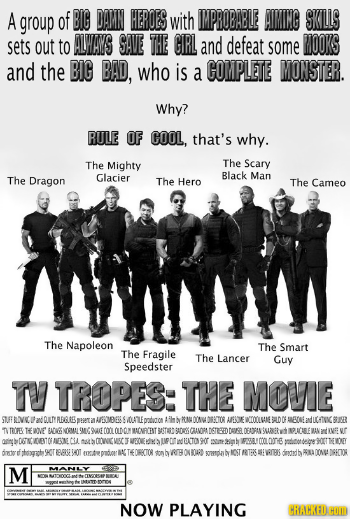
- The Expendables. There's a reason the page image is a doctored image of the film's poster!
- The Fifth Element. Mysterious Waif? Check. Large Ham Sissy Villain? Check. Ultra-manly man Action Hero played by Bruce Willis? Check. Rubber-Forehead Aliens, hovercar chases, Waif-Fu, the Ultimate Evil, and the world being saved through The Power of Love? Check, check, check, check, check. This movie is practically cheesy sci-fi incarnate, and it's AWESOME.
- TV channel Five US are currently celebrating '80/90s action film tropes via the medium of hair rock full of lampshades. Celebrates (at least, just the lyrics) Car Fu, whatever-the-heck-the-trope-is-for-indestructable-hair (although they show a Hair Reboot in the video), Dodge the Bullet (while showing Imperial Stormtrooper Marksmanship Academy), Stuff Blowing Up, Good Old Fisticuffs, Outrun the Fireball, and Pre-Mortem One-Liner within the space of under a minute.
- Galaxy Quest: An affectionate Star Trek parody that deliberately packs in the tropes, including genre-savviness, trope discussions and a lot of lamp-shade hanging.
- Gleahan and the Knaves of Industry: In their crowdfunding video, the production team called this "a movie full of tropey goodness." It helps that director Samuel T Weston is a Troper himself and edited this very entry!note
- Godzilla: Final Wars applies every action, sci-fi and Kaiju movie cliche imaginable to a sort of "best of" collection of Godzilla and other Toho moments in what has been described as the B-Movie to end all B-Movies.
- Grindhouse: Planet Terror takes those silly B Movies from The '70s and brings their So Bad, It's Good charm all the way to So Cool, It's Awesome.
- Hot Fuzz plays with Buddy Cop movie tropes and clichés, and it's awesome.
- Kill Bill is this as well, Quentin Tarantino's love letter to the katana and basically every other action film trope ever. It draws liberally from old kung fu flicks, old violent exploitation movies and old spaghetti-westerns.
- Kung Fury is a giant parody of the '80s, mostly '80s action movies. Unfortunately, a lot of the jokes it makes and the over-the-top flourishes it features are suspiciously similar to some of the stuff on Danger 5, particularly its second season, which was similiarly drenched in '80s tropes.
- Last Action Hero in which the movie universe is a parody of the over-the-top action movies of the time.
- Lemonade Joe or Horse Opera (Czechoslovakia, 1964) plays with every trope and cliché that is in stock for The Western genre. All are Exaggerated and Parodied. Though the director and screenwriter Oldrich Lipsky made it clear just how much he loved his pulp magazines, books and old movies. Affectionate Parody at its best.
- The more action genre oriented 2016 remake of The Magnificent Seven plays some of the tropes of the original, and many tropes tied to the western in general completely straight. But it's done with such love and as a Genre Throwback that it's thoroughly enjoyable.
- Mean Girls lampshades and parodies most of the biggest high school clique-related tropes that occur in fiction (and sometimes Real Life).
- Mortal Kombat: Annihilation was apparently written with a copy of the Evil Overlord List at hand to make sure that every single point possible (excluding the high tech ones) was prominent in the plot. #1, 4, 5, 6, 7, 8, 11, 12, 13, 20 (in practically every scene), 21, 22, 24, 26, 29, 32, 33, 34, 35, 36, 39, 53, 55, 56, 58, 64, 73 (the entire point of the movie!), 75 (more so in the first movie, but still here), 78 and 88 are all done in a truly overblown style.
- The first Mortal Kombat: The Movie is a spirited competition of "how much cheesy fantasy, kung fu and action movie tropes can we jam into 90 minutes?" It's like if Stephen Sommers made a wuxia.
- Speaking of Stephen Sommers, The Mummy Trilogy is basically every pulp adventure trope imaginable, neatly compartmentalised. Van Helsing is the same for Hammer Horror, as is The Scorpion King for Heroic Fantasy.
- Not Another Teen Movie. The story of a High School football jock that does not want to follow in his father's footsteps, who makes a bet with his friends that he can turn the weird girl into prom queen material, then enlists his sister to help turn said weird girl into prom queen material in exchange for sleeping with her. The jock eventually realizes that he is in love with the girl and defies convention to be with her. Meanwhile, the weird girl's younger brother and his two friends try to lose their virginity by prom.
- Pacific Rim is this for Kaiju movies, which it homages both shamelessly and lovingly. The action sequences in particular are made for pure entertainment value, some fans even claiming it to be the closest thing to a big Power Rangers film (at least until 2017 anyway).
- Pirates of the Caribbean both subverts pirate/adventure movie tropes and plays them straight. It even presents unrealistic tropes straight with a realistic twist at the end. For example, Barbossa in the first film shoots Pintel, a reference by the writers to when the bad guy in a movie shows how evil he is by killing one of his own men, which would lead to him not having a lot of henchmen left. But Barbossa and his men are immortal, so he gets to shoot Pintel with no repercussions! Hooray! Another happens when the prisoner in the next cell from Jack tells him that he's "heard stories" about the Black Pearl, and how, whenever it attacks a city, it never never leaves any survivors. Jack's response: "No survivors? Then where do the stories come from, I wonder?"
The second film even includes a parody/homage to the "hero endures a whipping" scene (a trope of old pirate films, long before it became a subverted form of fanservice in exploitation films), which is played out similar to old pirate movies, only that the captain and the crew that sentence Bloom's character to the punishment are a bunch of half-human monsters, and he only receives a few hits before he is spared. - The Quick and the Dead puts every Western stock character into a Quick Draw tournament to find The Fastest Gun in the West
- The Returner a Japanese science fiction/action film that takes just about every action sci-fi movie you could name and mashes them together.
- Shoot 'Em Up revels in turning every Gunplay Trope in existence up to levels even John Woo wouldn't dare to.
- Sick Girl has so many Horror Tropes it's insane.
- Speed Racer never even tried to justify any of the weird things in the original, and instead ran with them as fast as the Rule of Cool could possibly allow. If you try to take it at all seriously you're watching the wrong damn movie.
- Stardust pretty much plays every fairytale trope to the hilt. An earlier example of the same is The Princess Bride.
- Star Wars mixes the Westerns, Samurai movies, and pulp sci-fi George Lucas loved as a kid. He also studied The Hero With a Thousand Faces intensely while writing it. It is worth noting that Star Wars is one of the biggest Trope Codifiers in history.
- Sucker Punch has this specially in the action scenes that are a mishmash of various fiction concepts just for Rule of Cool. Although it also tries to do a Deconstruction.
- The works of Timur Bekmambetov, be it Russian- or Hollywood-era. He is fond of playing common film tropes unflinchingly straight — all while adding enough tongue-in-cheek remarks and intentionally over-the-top antics. As Anthony Lane put it in The New Yorker,
How, for example, does [Bekmambetov] make a cup of coffee? My best guess, based on the evidence of the film, is that he tosses a handful of beans toward the ceiling, shoots them individually into a fine powder, leaves it hanging in the air, runs downstairs, breaks open a fire hydrant with his head, carefully directs the jet of water through the window of his apartment, sets fire to the building, then stands patiently with his mug amid the blazing ruins to collect the precious percolated drops. Don't even think about a cappuccino.
- Tropic Thunder is basically one giant parody of Hollywood and movie-making as a whole.
- Wanted, the film of the comic book is an incredibly played-straight The Hero's Journey, or more accurately Anti-Hero's Journey (it also took some liberal inspiration from The Matrix).
- Whip It combines the standard sports movie with a side of Teen Drama and corresponding Parental Issues. It's a story that's been told many times before, but it's done well enough that you probably won't mind.
- Who Framed Roger Rabbit makes a deadly drinking game if one is looking for every cartoon or hardboiled detective trope under the sun.
- Zombieland. It's what happens when a Genre Savvy Action Survivor teams up with an Action Hero in a Zombie Apocalypse.
- David Eddings' Belgariad. An intensely derivative work treading over ground walked by fantasy novels since time immemorial and still managing to be an enjoyable read. And his Elenium uses a lot of the same tropes as The Belgariad, but is often considered by fans to be even better.
- Craig Shaw Gardner's Cineverse Cycle is a hilarious homage to and parody of B-movies in general and consequently loaded with every trope you could possibly imagine and then some, from Fun with Subtitles to Non-Human Sidekick to Reset Button.
- The Chronicles of Prydain, by Lloyd Alexander, are gleefully full of Older Than Print tropes from Welsh myth. And they're still awesome. Although he does take a few liberties for purposes of fiction — for instance, converting Arawn to an Evil Dark Lord. In Alexander's essay "The Grammar of Story," he references several tropes by name, including the MacGuffin, Chekhov's Gun, and Hoist by His Own Petard.
- Codex Alera is a High Fantasy series in which a plucky underdog Farm Boy from a backwater of the imperiled kingdom undergoing a succession crisis becomes a sword-wielding badass and saves the world, making friends of ancient enemies as he goes. And he's the heir to the throne and consequently has the most powerful magic of... well, pretty much anyone. Yet the setting is such an unusual twist on Medieval European Fantasy and Tavi is so brilliant and insane that you probably won't even notice the fact that so many elements of the story are old fantasy clichés."
- The Dresden Files loves to cram in as many tropes as possible, give them the Deconstructor Fleet treatment, occasionally reconstruct them, and then turn them loose, with Harry's terrible jokes providing a backdrop to the resulting insanity.
- The entire Enchanted Forest Chronicles is full of references, subversions, deconstructions, and parodies of various fairy tale and fantasy tropes, with nearly every character highly Genre Savvy.
- The First Dwarf King takes a bunch of age-old fantasy tropes, a bunch of age-old sci-fi tropes, reconstructs them, and shamelessly plays them for all they're worth.
- Eric Berne's Games People Play, which was essentially a collection of tropes of human interaction. Berne gave them games memorable titles such as "Now I've got you, you son of a bitch," "Wooden leg," "Yes, but...," and "Let's You and Him Fight."
- Harry Potter. Mostly because it was such a lengthy series, but contains just about every type of character you can imagine.
- Because it's a 200 page book with far, far more tropes than that to cover, Help! My Story Has the Mary-Sue Disease uses three or four tropes per example, relying on the sheer recognizability of the tropes to make it's explanations of highly theoretical issues in fiction easy to follow.
- John Moore's Heroics for Beginners is a send up of all the swashbuckling and RPG clichés that ever were. In fact, the whole premise of the novel is about a Prince who goes off to fight the Big Bad to win the hand of the Princess with the help of "The Handbook of Practical Heroics" (which is essentially a user's guide to Genre Savvy). The Evil Overlord, He Who Must Be Named, makes it disturbingly obvious that the writer has read the Evil Overlord List. His ventilation ducts ARE too small to crawl through. From the back cover:
When a seemingly crazy, poorly dressed soothsayer tells you not to let a magical talisman fall into the wrong hands, take him or her seriously. DO NOT laugh it off and leave said talisman simply lying around on a side table; you might as well just end the world yourself. — The Handbook of Practical Heroics, p. 134
- The Hunger Games: Invoked in the games, where the tributes try to appeal to the Capitol and potential sponsors by playing according to recognizable and interesting archetypes.
- Any Kim Newman novel. From the Anno Dracula series, about an Alternate History where Dracula won, to the Demon Download novels, in which Elvis Presley fights Eldritch Abominations with a Cyborg heroine.
- The 1868 French novel/prose poem Les Chants de Maldoror is one of the earliest examples in literature of this, gobbling up as it does every last romantic cliche about Byronic heroes and turning them well past eleven.
- The Lord of the Rings by default is troperiffic, when is the Trope Maker and Trope Codifier for all of modern western Fantasy. There is almost no western fantasy work that is not inspired even indirectly by everything Tolkien has created. Despite all the accusations of being cliché that have been leveled at Tolkien because of the copycat works inspired by Lotr, his work stood the test of time with two trilogies, cartoons and a show to help carry further this legacy.
- Garth Nix's Old Kingdom books are rife with tropes but make them all work.
- John Barnes's One for the Morning Glory, where all the characters have Medium Awareness that they are in a Fairy Tale, so that tropes are invoked, lampshaded, and even relied on — but not excessively, since they don't know for certain what their roles are.
- The Princess Bride is the Trope Namer for no fewer than ten tropes. It's a parody/deconstruction of many romance/swashbuckling tropes, but it's done so affectionately and with so much humour that not enjoying it is practically inconceivable.
- Runebinder is swamped with typical YA fantasy/sci-fi tropes: The Chosen One, the Love Triangle, Angst, Hunter of Monsters, After the End, protagonist superpowers, Aerith and Bob, a prophecy, scheming higher-ups manipulating the hero....and it's all 100% intentional. The author noted how heteronormative the genre was while the stories featuring gay protagonists were realistic coming out stories, so wanted to make a fantasy book for gay teens where they'd be treated the same as their straight peers.
- Austin Grossman's Soon I Will Be Invincible gleefully describes a street-leveling superbattle involving a world-threatening Mad Scientist with tons of tricks up his sleeves facing down a normal human with an animal on the chest of his uniform, a lightning-summoning fairy, a bipedal tiger, and a flying invulnerable woman, started when the Mad Scientist was just trying to drink some coffee. Almost perfectly invincible flying man with heat-beam eyes saves a lovely reporter from constant kidnapping by a villain intimately tied into his past, dies and has a massive funeral, or rather, fakes it for a very short time, and always saves the world. The bad guy defeats the good guys and ties them up in Death Traps. Famous heroes sacrifice themselves to save the planet from warring aliens, while villains never die and always escape, or go to Cardboard Prison. No one finds these events strange or unbelievable. Very shocking in a book where said Mad Scientist wonders why he doesn't find a career that'd make money rather than involve him being beaten up by powered heroes, and the bipedal tiger is known to have back problems.
- Stardust takes every fairytale trope Neil Gaiman could think of and exaggerates them.
- Rudyard Kipling's "The Three-Decker" is a defense of (not to say exultation in) the Troperific three-volume novel.
- Every Simon R. Green series ever. The characters are walking tropes, complete with their catchphrase and taglines which they often introduce themselves or others with. John Taylor, in particular, often tells people, "It's John Taylor and Suzie Shotgun, otherwise known as "Oh God it's her, run!""
- A Song of Ice and Fire is known for being a Deconstructor Fleet Juggernaut that uses real historical events at its base, and combines them with Fractured Fairy Tale and as many fantasy and medieval tropes as possible. The franchise can even be considered a modern Trope Codifier for Dark Fantasy.
- Pick a Terry Pratchett novel. Any Terry Pratchett novel. The man seems to have a fetish for tropes, as his novels consist entirely of deconstructing, reconstructing, parodying, averting, subverting, and inverting various tropes of all shapes and sizes. Coupled with his decisively British humor, it makes for consistently entertaining literature.
- The Adventures of Brisco County, Jr. unashamedly plays with every trope in the book in pursuit of the Rule of Cool and Rule of Funny. Even Dead Horse Tropes.
- Agents of S.H.I.E.L.D. is a show based in the Marvel Cinematic Universe, so naturally it indexes superhero tropes as well as Adventure tropes, Comedy tropes, Drama tropes etc.
- The A-Team. Part of the appeal is knowing, blow by blow, how each episode will play out before you watch it. There will be a scene where B.A. throws a guy over a car. Murdock will act silly and tick B.A. off. Face will fall in love with every remotely attractive woman he sees. It's just fun. And lots of machine guns will get fired, but no one will get shot. The Big Bad's car will ramp off another vehicle, fly twisting sideways over a ground camera, and crash on its roof. The Big Bad and his Mooks will crawl out, uninjured, and surrender. The basic formula stays the same, but the writers switch up the specifics. Take Murdock, for instance: he'll act crazy of course, but how? Will he decide he's a cab-driving superhero? Pretend he's Captain Ahab? Act like an artsy filmmaker? Psychoanalyze a bunch of pecans while switching between a German accent and just plain German? ...And yeah, he did all of those things.
- Burn Notice embraces a wide variety of tropes and proceeds to use, subvert, deconstruct, avert, and in general play with all of them. Sometimes the show follows a pretty clean formula for the individual stories, and unfortunately that is its main flaw. But in the narration, there are more than a dozen quotes you could use to describe an individual trope that are so specific you know they did it on purpose.
- Chuck seems to tend towards this, with many tropes played straight, though often for laughs. It's predictable, but humorously so. Someone sets a trip wire to stop Thanksgiving thieves at the Buy More? A bad guy will trip over it before the end of the episode.
- Community. Abed is a troper. He invokes tropes, finding the worlds of TV and movies much more interesting. Even beyond Abed, the show has happily thrown itself into parodies and homages to practically every genre of fiction (and non-fiction) on the planet. Never mind that they use this very wiki for research!
- Danger 5 essentially takes every '60s TV, action or pulp fiction cliche it can get its hands on, and plays it dead straight, parodies it, or makes it as absurdly over-the-top as possible.
- The second series applies this same approach to '80s b-movies. Kung fu, video games, slasher movies, high school movies, Cannon Films, Jaws knockoffs, big hair... it's all here!
- Degrassi. Just look at its page. It's basically explored every possible angle of the Teen Drama, not to mention being the successor of the shows that created the genre in the first place, and is now a certified Long Runner.
- Doctor Who is a show about a time travelling alien who fights other aliens in different times and places. It has used every science-fiction trope in the books, and even named some of them. Notable that in its 50 year run, it's not only used most sci-fi tropes, but also ones belonging to fantasy, historical fiction, horror and comedy. And that's not even touching on things like character tropes.
- Drake & Josh covers a lot of tropes that are prevalent in traditional multi-camera sitcoms.
- Everybody Hates Chris did this with Race Tropes.
- Farscape. Just look at how its main page had to be subdivided into separate ones. And then it takes the tropes and twists them into funny shapes like so many balloon animals, even playing with a trope it was the Trope Codifier for in the episode in which it was codified and named!
- Glee, in that it relies heavily on plot clichés and a very large amount of character tropes. It's quite predictable, but never completely in the way you'd expect.
- Human Target takes action move tropes and exaggerates them, resulting in one of the most awesome action shows on TV.
- iCarly and its use of various Kid Com staples.
- Merlin is this from season 1 to the beginning of season 3. Then, plots start becoming more complicated and less predictable, and less tropes played straight are involved, as most of the episodes feature twists and tropes merely subverted or deconstructed.
- Think of a movie genre, any movie genre. Think of a trope that applies to it. All odds point to Mystery Science Theater 3000 having already mocked it.
- Ned's Declassified School Survival Guide: Naturally, as it is an Affectionate Parody of the middle/high school comedy genre, and runs on Rule of Funny.
- Once Upon a Time: Writers from Lost and Buffy got their hands on Disney fairy tales and stranded them in a small town in Maine straight out of Stephen King.
- Power Rangers RPM is wonderfully aware of inherent unavoidable silliness of Power Rangers, healthily lampshades it, and reconstructs it. Want proof? Head on over to the entry for the series at your own peril.
- Remote Control, the MTV TV trivia Game Show that revolved around a TV junkie-turned-game-show-host and parodied just about every game show in existence and then some, naturally played with as many Tropes as it could get its hands on.
- Star Trek: Deep Space Nine, in the episode "Our Man Bashir." It features not only every Star Trek trope, but every James Bond trope as well.
- Made even more hillarious by a real spy (Garak) accompanying Bashir in the holoprogram and lampshading how ridiculous the James Bond elements are. Also, Garak's attempts to be a real spy in the simulation don't work because it's specifically designed to be Spy Fiction of the Tuxedo and Martini variety.
- Supernatural invokes all the Did We Just X Cthulhu tropes.
- Lady Gaga is far from original in her general style. She admits to having countless influences, such as Madonna, Britney Spears, David Bowie and countless others. Her popularity stems from taking all the Awesomeness of all her influences and throwing it in a blender.
- Taylor Swift's "Bad Blood" music video is chock-full with Action Girl tropes and references to Sci-Fi and Spy movies, to the point that io9.com published an article enumerating them.
- Tenacious D have this approach to metal.
- Nearly half the lines in Ultimate Showdown of Ultimate Destiny have been linked to an established trope (see page). Appropriate for the subject matter.
- "I Always Wanted to Say 'I Always Wanted to Say That!'" by Spray is a tongue-in-cheek celebration of Rule-Abiding Rebel, Ensemble Cast, Stock Aesop, Be Yourself, Aesop Amnesia, and of course, I Always Wanted to Say That.
- Cleopatra's Caboose, a tongue-in-cheek European-style board game that throws in just about every cliched Euro-game theme or mechanic the designer could think of: trains, ancient Egypt, bidding, building, special powers, resource management, limited actions...
- As implied at the top of the page, Dungeons & Dragons campaigns can get like this. Really, the game is designed so that an enterprising DM can run a fantasy campaign based around just about any model: versatility is the game's greatest strength. The 4th Edition DM's book actually encourages it:
Don't be afraid to steal ideas from books, movies, and other sources for your personal use. The DM's job is to entertain, not to be original.
- "Exalted is a game where one of your main antagonists is Death, Creator of the Underworld. Except there's several of him, probably six or seven. Oh, and he's got 13 dread henchmen, one of whom was probably you at some point in time. Also, Hell has a personal grudge against you this time. Did I mention Magical America regularly trains and sends ninjas out for you personally? Ninjas specially trained in *** -kicking? Which, if they won't work, they keep giant robotic suits of armor on reserve for. Oh, and the Transformers have united under Omicron, and are invading. The Jedi have corrupted Heaven and usurped your rightful place as the Masters of Everything. Your ex-wife just dropped by, and she's a two thousand year old shape-changing man-eating monster now, interested in maybe going on a date next Thursday. Your best friend from your last life and while growing up now seeks to cover all the lands of Middle Earth in darkness, if he can just find this damn ring. And your God has the world's biggest crack habit, and needs some serious rehab." — Darius Solluman
- Genius: The Transgression, a fan-made line of the New World of Darkness, is filled to the brim with science-fiction tropes and treats the Applied Phlebotinum tropes as blueprints.
- Grave Robbers from Outer Space, a card game about making low-budget genre movies that both mocks and glorifies the numerous cliches and archetypes of a variety of genres.
- GURPS Cliffhangers: The GM is urged to avoid subtlety and use every pulp fiction cliche he can think of because a game based on pulp fiction should have cliches.
- Monsterpocalypse uses every trope used in a Kaiju setting.
- Rocket Age exists in a similar genre to Space 1889 and so has a LOT of the same tropes, although how it is all put together makes it feel very different, being early 20th century pulp sci-fi as opposed to Vernian sci-fi and has a distinctly different attitude to how the aliens are portrayed. Being set in 1938, it is also full of Those Wacky Nazis, Dirty Commies and Raygun Gothic tropes.
- Space 1889 Given that the game is recreating Victorian style science fiction, it contains most of the tropes from those stories. The slogan is: “Role-Playing In A More Civilized Time. Everything Jules Verne should have written. Everything H. G. Wells could have written. Everything A. Conan Doyle thought of, but never published because it was too fantastic.” Since it is set in Victorian Era, it takes many of the tropes associated with that era.
- Strike Legion is so derivative it digs right out the bottom of Cliché Storm and becomes this. A MST.
- Warhammer 40,000 takes every sci-fi trope and cliché imaginable, paints it black, pumps it full of a cocktail of every drug known to man, sets it on fire, sends it off into space screaming WAAAGH! and waving a chainsaw sword. As an example, Space Marines are recruited with an extreme form of The Spartan Way which only one in every hundred aspirants survive, given years of insanely dangerous training and religious indoctrination to turn them into utterly fearless, pitiless fanatics. They're equipped with gigantic millenia-old suits of Powered Armour and spend their days fighting unkillable zombie robots, gigantic flaming-head sex demons and the like. This is what one faction does with one trope as background for its basic troops choice. And they have Chainswords.
- For an example of the sheer number of tropes 40k uses, take a Wiki Walk through the various Darker and Edgier tropes, and take a shot for every quotes page that has a Warhammer 40,000 section. You will be totally smashed by the time you're done.
- What Warhammer 40,000 does with sci-fi, Warhammer does with fantasy. Okay, maybe it's not quite as whacked-out, but it's still a pretty awesome mish-mash of every fantasy trope you could care to name. One example is The Empire: A Fantasy Counterpart Culture of the Holy Roman Empire led by a particularly awesome Emperor (who runs around with either the Reikland Runefang or Sigmar's own warhammer, and rides either a dragon or a griffin).
- The Complete Works of William Shakespeare (abridged) is an Ur-Example of The Abridged Series, and is the Trope Codifier for theatrical productions. It also uses just about every Abridged Series Trope despite predating the genre by 19 years.
- In A Day in Hollywood / A Night in the Ukraine, the song "I Love a Film Cliche" is a Long List of film cliche quotes and references, practically all of which could be mapped directly to trope pages.
- The former Disaster! attraction at Universal Studios Florida was altogether a huge tongue-in-cheek parody of the many cliches found in disaster/action movies, with countless of tropes being lampshaded.
- LEGO's BIONICLE- a Darker and Edgier, Merchandise-Driven Science Fantasy series powered by Rule of Cool. It starts out with a bunch of Cyborg Hobbits living in Elemental Tribes on a Schizo Tech Patchwork Map Island being terrorized by a mysterious Big Bad. Then a Six Man Band of heroes with magic masks and Elemental Powers (that conveniently match their personalities) comes along to fight the various beasties he sends after them, before confronting the Big Bad himself and learning about The Power of Friendship. The series then starts deconstructing a lot of the tropes- it turns out the myths may not be entirely true, that the Schizo Tech is left over from an apocalypse no-one remembers, and the impossible Patchwork Map island may not be an island after all... If a trope page has a "Toy" subcategory, odds are it's because of this particular franchise. Often, BIONICLE is the only example in its category.
- Atelier Iris: Eternal Mana: A girl with wings! A catgirl! A hero on a vague quest for knowledge and reputation! A wisecracking older dude who's along mostly just because! Ancient evil! Recent evil! Ineffectual Sympathetic Villains! And yet, the game plays with the cliches just enough (such as making The Hero the White Mage of the party, and making him the butt of every joke imaginable partially for it yet still making him seem legitimately badass and awesome) that the game just clicks for a lot of people.
- Bayonetta omnivorously gobbles up every action game trope, cliche, and visual flourish of the past twenty-five years and synthesises them into something uniquely mad.
- Every game BioWare has ever released: the more power over the world they have, the more troperrific their games are.
- Dragon Age is this on many levels — and anyone who's tried to read the Codex knows it has many, many levels.
- Mass Effect: The number of tropes Mass Effect and Mass Effect 2 use is surprising and not limited to classic SF ones. The authors are especially fond of subverting and double subverting tropes. In fact, the pages have repeatedly had to be split to prevent them from crashing the wiki; counting just the main tropes pages for the individual games and series as a whole, there are fourteen pages. This does not include subpages (such as YMMV and Character pages) or the Expanded Universe content. The Commander Shepard trope list alone got so long it ended up on its own page—remember, this is one character. Then there's the rest of the original party members, themselves also getting their own. The Mass Effect 3 page actually got so large it had to be split, before the game had even been released —and then the Citadel DLC took it up a notch.
- BlazBlue. Big time. It's stuffed with all kinds of anime and fighting game tropes and stereotypes, many of them Expies and Shout Outs to other Japanese media, and averts, subverts, inverts, double subverts, deconstructs, reconstructs, and generally toys around with these tropes and stereotypes.
- Anything Blizzard Entertainment ever made. Nothing in their game catalog is even remotely original, but they have a knack for taking every single High Fantasy, Heroic Fantasy and Space Opera cliché in existence, throw them into a blender and then slooooowly cook the resulting stew into something so polished and superbly entertaining it somehow becomes fresh and delicious again.
- Blue Dragon: The hot-blooded Determinator hero, the feisty nonhuman, the hero's best friend with strong magical powers, the love interest Black Magician Girl, and the older woman who turns out to be The Mole join forces to defeat the evil Big Bad with an excuse and the Greater-Scope Villain, a superweapon who ended a war 1000 years ago, with their powers of questionable origin. Not only was this an attempt from the same makers to bring back the cliche charm of Chrono Trigger (which it, for the most part, succeeded at), it put a spin on some of these tropes - for instance, the hero's friend is the White Mage.
- The comedic world of Byteria is generally built on clichés and has fun with them. Card Carrying Villains are common but not necessarily competent, and that elf living among humans is fully aware of her sexiness.
- City of Heroes is essentially one big Shout-Out, Homage, and Affectionate Parody of superheroes as a whole in MMORPG form, with the players all encouraged to join in the fun. Justified as it's the first MMOG in its genre.
- Chrono Trigger had almost every RPG cliché you can think of at the time it was released, such as rebellious princesses with mysterious pendants, Heroic Mimes who live with a single mom (no dad), are woken up by said mom to get ready for the fair, and Saving the World from the Eldritch Abomination...WITH TIME TRAVEL! Nevertheless, the story itself and the characters were praised by many for its brilliant usage of these clichés. Its successor, Chrono Cross, was less troperiffic than its predecessor, and that itself divided the fanbase on the game.
- Darkest Dungeon, being a Deconstructor Fleet on dungeon crawler tropes, accomplishes this with a wide variety cast of characters with unique personalities as well as throwing in many Cosmic Horror Story tropes that it can think of.
- Dark Souls and its sequels, Dark Souls II and Dark Souls III, milk just about every possible medieval fantasy trope and some more, increasingly so. Be it setting, characters, creatures, equipment and even weapons, these games don't spare any detail when making a vast world with an interesting lore. This is on top of bearing many references to FromSoftware's works in Demon's Souls and the Armored Core franchise, as well as incorporating countless Nintendo Hard elements.
- Once Dead by Daylight added more and more survivors and killers, they each started to carry a wide range of inspirations and different game mechanics, in addition to all the classic Slasher Movie tropes.
- The main character of Devil May Cry carries a hefty bag of tropes all by himself from a half dozen badass tropes to nearly every single Cool BFS trope. Every other aspect of the 5 games, anime series, manga, and 4 books just piles on more. However, it's this same exaggerated use of tropes to create one crazy classic.
- In Dragon Quest, all the cliches are mostly used as filler for what boils down to lighthearted adventuring. Except when they're used to tell genuinely gripping stories, widely held in high regard and close to fans' hearts.
- Evil Genius lets you play the role of a '70s Diabolical Mastermind in all its over-the-top splendor.
- With sixteen games and numerous spinoffs, the Final Fantasy series has used (and sometimes created) nearly every single RPG cliche ever seen.
- Final Fantasy IX's plot is a large amalgamation of various fairy tale and fantasy tropes. The male lead, Zidane, is a street-smart Lovable Rogue who grew up with a gang of thieves doubling as a travelling theatre troupe, and who also has a monkey's tail. The female lead, Garnet, is a Rebellious Princess with a Wicked Stepmother who leaves her comatose on her Dangerous 16th Birthday. They fall in love, with Zidane showing Garnet a whole new world like Aladdin and Jasmine. The other party characters include a living doll questioning his existence, a Knight in Shining Armor who takes his job seriously to comical extremes, a rat knight searching for her lost love, a lonely orphan girl, an edgy loner, and Quina. In addition, the entire world resembles something from a Jim Henson movie (with the creators specifically citing The Dark Crystal as an inspiration).
- The scene in Final Fantasy XIII when Snow and Fang rescue Lightning and Hope in Palumpolum pushes very hard to find out how many tropes you can pack into one minute: Lightning and Hope come across a huge screen that shows a live broadcast of the capture of two fugitives, which causes an Oh, Crap! moment as the camera zooms on them. Surrounded by a small army of soldiers and facing a Bolivian Army Ending, Lightning tells Hope to run while she makes her Heroic Sacrifice, while the commander reminds his troops of What Measure Is A Nonhuman. Even though There Was a Door, Boisterous Bruiser and Badass Longcoat Snow and Action Girl Fang arrive as the Big Damn Heroes. Snow points out that his Indy Ploy doesn't need a plan, makes a Gun Twirl, and starts Roof Hopping over the handrail. In mid-flight, he pulls out his Mon, giving us a nice Transformation Sequence with lots of Instant Runes and freezes the entire place with Instant Ice: Just Add Cold!. Then, he and Fang ride down the ice bridges on their Cool Bike, for Fang to shoot the TV camera. All in less than 2 minutes.
- The Dissidia games. Kefka in particular seems to take great delight in pointing this out.
Kefka: [Sephiroth]'s just another sadist with a god complex. Like ''that's'' anything special. - The Fire Emblem series has been running for over thirty years, and in that time, it established itself as being a series that relies not only on a lot of typical fantasy tropes, but also several tropes of its own making (which it then heavily recycles). Indeed, it would be easier to count the characters that aren't based off of previous characters in some capacity, both for heroes and for villains. The series both made and codified tropes that came to define the Strategy RPG genre. However, even on top of that, the early games (especially in Archinea) are known for being Cliche Storms, but later games find every way they can to play around with the formula.
- Gotcha Force is based off of 1: Toy fights that children have with their action figures, and 2: Gatchapon toys based off of popular anime/video games/movies/etc. Combine these two together, and you have a video game that takes inspiration from an infinite area of resources, and proceeds to pit Ninja, cowboys, samurai, knights, tanks, mecha infantry, Transforming Mecha, jet planes, dark monsters, tokusatsu heroes and so many more against each other...with every single trope associated with them all kept intact.
- I Wanna Be the Guy takes all the classic Nintendo Hard "Fuck You"s from all those old 8-bit side scrollers, takes them to ridiculous extremes, and then causes you to explode into a million little bloody bits while laughing the entire time.
- A majority of the cast in the Killer Instinct series take inspirations from many movie tropes and clichés. Some of the characters include Hisako, a Japanese Stringy-Haired Ghost Girl who wouldn't look out of place in The Ring, Spinal, an undead skeleton pirate who was based off of the skeletons in Jason and the Argonauts, Chief Thunder, a Magical Native American who is fighting to recover his brother's body to give it a proper burial, and Fulgore, a killer robot who is more or less the result of mashing the title characters of Predator and The Terminator into a single character.
- Kingdom Hearts. Playing that game, you spend half of your time laughing as every single cliché you've ever seen pops up nicely in a row, and the other half with your finger glued to the button to see what happens next. All-Loving Hero Sora, Rival Turned Evil Riku, and Damsel in Distress Kairi are each the pure, distilled embodiments of their roles in the series. Hey we're taking about a game that's a crossover between two of the most troperiffic franchises in existence. So it's pretty much a given.
- Kingdom of Loathing lives off of this idea. If more evidence is needed, check out its Ninja Pirate Zombie Robot and the ability to adventure in an area literally named The Obligatory Pirates Cove. And if you fight the right side in the War, you get to defeat The Man.
- Left 4 Dead is nothing more and nothing less than absolute distillation of everything zombie and everything co-operative multiplayer into one incredibly freakishly fun package, especially with microphones and friends. Can you say, "OH GOD GET IT OFF ME GET IT OFF ME!!!"?
- The Legend of Zelda: Twilight Princess was made to play the tropes of the series to the letter, since they knew that they were going to change things up for the next game.
- The whole series is really like this. The Chosen One must find the Sword of Plot Advancement and all the pieces of the plot device — every one of which is in a Temple of Doom — so he can stop The Horde, cut through the Quirky Miniboss Squad and slay/banish the Sorcerous Overlord, all to Save the Princess and liberate The Good Kingdom. And it is one of the most beloved and respected video game franchises of all time.
- Majesty has a unique Perspective Flip — the Player Character is not the hero, but instead the guy who sets up the infrastructure for the heroes to go adventuring. Otherwise, the setting is an Affectionate Parody of the stereotypical Medieval European Fantasy.
- What Metal Gear does for action movies, Max Payne does for noir. The Private Eye Monologue is played so straight it becomes awesome.
- Metal Gear. Every trope, whether it's a Gambit Pileup or even simple Ho Yay, is played so ridiculously straight that they eventually curve back in on themselves to create such an impenetrable mess that it becomes near impossible to tell what's serious and what's parody, while still managing to elicit the reactions and results that the tropes were intended for in the first place.
- Mortal Kombat is basically a bunch of action heroes in an Enter the Dragon-style scenario. You've got the evil spirit who wants revenge, the Bruce Lee Clone, the actor who wants to prove his moves aren't faked, the thunder god, the Marine Action Girl, the criminal, the Chinese assassin, the Proud Warrior Race Guy, and the Evil Sorceror. Subsequent games have added a Magical Native American who at 6'3" is probably a plains Indian, her evil clone who is notable for almost seeming like a good guy at first, another bunch of Proud Warrior Race Guys, Terminator clones, the guy named after his ancestor, the blind swordsman, and many more. And oh, yeah, the Big Bad gets more and more eldritch with each game.
- MS Saga: A New Dawn can be considered "Gundam Tropes: The Game". The game is a boiler-plate traditional JRPG structured out of the numerous tropes commonly utilized by the entire Gundam franchise, to the point anybody remotely familiar with said franchise can easily predict the plot and gameplay at any given moment.
- Obsidian Entertainment does not usually engage in this, but the original campaign of Neverwinter Nights 2 is a rare example, where the game heartily engages in a by the numbers adventure story with a few unexpected twists and turns — all while merrily lampshading it. When they aren't unleashing a Deconstructor Fleet against everything from D&D to George Lucas's idea of morality, that is...
- Pokémon, being among the most well known Mon series features hundreds of tropes. Every character, both human and the Pokémon themselves are fairly complex since they both serve as both game characters and anime characters. The games themselves revolve around how turn-based battles in eastern RPGs work and each monster has its own "personality" of sorts and draw inspiration from practically everywhere.
- While Red Steel is a Cliché Storm, Red Steel 2 is Troperiffic. Red Steel 2 combines Desert Punk and Samurai tropes in every way possible. In every AWESOME way possible, mind you.
- Saints Row IV plays straight, plays with, invokes or lampshades just about every Rule of Cool related trope.
- Most Jidaigeki drama set around the Sengoku Jidai period will predictably straddle around Cliché Storm and Troperiffic, although two sets the bar for the video games department:
- Sengoku Basara. Badass Hot-Blooded Rule of Cool in a World of Ham Anachronism Stew. Hilarity Ensues.
- Sengoku Rance. Well-thought Rule of Cool Jidaigeki clashes with a Gender Flip Eroge Anachronism Stew where Hilarity meets Tear Jerker? Pretty much the perfect storm.
- A Sierra Adventure Game was usually loaded to the gills with whatever trope was handy. Leisure Suit Larry had sex and porn tropes. King's Quest took any Fairy Tale trope and went crazy with it. Laura Bow handled murder mysteries. Space Quest skewered sci-fi tropes most of the time, but when they played it straight... Fridge Horror galore.
- Spoofed in The Simpsons Game, where you collect clichés (and Comic Book Guy explains them).
- Skies of Arcadia is stuffed to the gills just about every heroic fantasy cliche there is. Perhaps because it came at a time when every RPG in a five-year radius was trying to be dark and edgy, subverting every trope they could, Skies' return to a group of adventurers who enjoy each others' company and go looking for the MacGuffins to save the world from an Evil Empire ended up being a breath of fresh air.
- The Star Control series is innundated with an extensive variety of sci-fi tropes (in particular, the second game in the series, Star Control II / The Ur-Quan Masters). These games specialize in alternating between playing tropes straight and outright subverting or inverting them - keeping the player guessing at all times.
- Stellaris from Paradox Interactive liberally borrows ideas for units, technologies and civilisations from all kinds of science fiction and Space Opera works, such as Star Trek, Mass Effect, The Culture and Warhammer 40,000. And allows them to mix, mingle, and compete in an Ultimate Showdown of Ultimate Destiny, whether by proxy through expiesnote or, if the player uses Game Mods extensively, directly.
- Super Robot Wars, being what it is, tends to use pretty much every Humongous Mecha trope at least once or twice a game.
- Pretty much the whole Tales Series could fit in the trope, specially after Symphonia. They combine bizillions of tropes with some well-calculated unexpected twists and/or original ways of presenting those tropes. And, ironically, thanks to that they manage to pull off some great, hard-to-forget stories. In other words, in Namco Tales Studio know very well what they're doing.
- Tales of Symphonia, each character exhibits at least 3 character tropes, and the plot itself has predictable twists, founds itself on Fantastic Racism and Utopia Justifies the Means, and plenty of other tropes and cliches thrown in for good measure, and still manages to look like an original game despite it all.
- Tales of Phantasia is this for basically the opposite reason: it plays almost every trope straight, but it just works.
- Team Fortress 2 throws all the unnecessary bits like plotting and storyline out and gives a varied, memorable cast who all have a very distinct but very expected way of kicking ass. It basically turns away from the modern notion of more "realistic" multiplayer FPS games for a full and complete embracing of the Rule of Fun. To put it differently, it caters to about a dozen different categories of tropes. Each of the nine characters has a trope-tastic personality and/or Backstory (The Heavy, The Demoman, as well as many weapons that apply for tropes (Batter Up!, Grievous Bottley Harm, Stuff Blowing Up, etc). In addition to first-person shooter tropes, it also has a few RPG/MMORPG tropes, with the class system and all.
- Thief pulls off every Film Noir and Low Fantasy City Noir trope imaginable... and gets away with it by subverting the hell out of them... Not to mention hilariously lampshading anything that invokes a possible Cliché Storm or is in dire need of an MST3K Mantra.
- This is The Only Level incorporates several video game tropes to change what is otherwise the exact same level over and over again.
- FunOrb's Tomb Racer is stuffed with as many Temple of Doom cliches as its creators could think of, resulting in a fine example of why Tropes Are Not Bad.
- Touhou Project = Japanese folklore + Moe + Moe + Moe shoot 'em ups, with some Deconstruction. Clocked up to the maximum by fans. Just look at the character sheet.
- Uma Musume. Moe Anthropomorphism? Check. Little Bit Beastly? Check. Improbably Female Cast? Check. Schoolgirl Series? Check. Competitive sports? Check. Idol Singer? Check. And yet it's all played with so much earnesty and heart that it's impossible not fall in love.
- You Have to Burn the Rope. It takes longer to list all the tropes that it embodies than it does to finish the game.
- Ace Attorney has an impressive list of tropes, and it's a game about Mundane Made Awesome lawyers.
- The story of Dies Irae is clichéd to hell and back and is absolutely unapologetic about it by taking old ideas and executing them in a fashion that can only be described as grandiose and over the top with a big serving of ham just to go alongside it all. Mercurius perhaps put it best:
"Come, gather and bear witness to my opera, now in the making.
Its script is the height of cliché, I am forced to admit. And yet…
Its actors are of the finest fold; beyond exquisite.
Thus, I believe you will find it enthralling." - The When They Cry series is excellent at this. Umineko: When They Cry deserves a particular mention, combining Maybe Magic, Maybe Mundane, "Groundhog Day" Loop, Closed Circle, Clueless Mystery, and Fair-Play Whodunnit into one Visual Novel. It has debates! IN COLOR! The characters are also quite Genre Savvy when it comes to dealing with mysteries, and even lampshades the use of the related tropes.
- Yo-Jin-Bo is full of anime and romance tropes, lampshades just about every trope it can, and runs on Rule of Funny. It wouldn't be half as awesome if it were any different.
- Adventurers! skewers basically every RPG trope in the entire TV Tropes Wiki.
- Chris Hastings once wrote down every single '80s action movie trope that he could remember. Then he crammed every one of them into a story. The result was The Adventures of Dr. McNinja Story Arc "D.A.R.E. to Resist Ninja Drugs and Violence".
- If individual characters can be Troperiffic, Antihero for Hire's Dr. Nefarious is.
- El Goonish Shive plays with almost every Gender Bender related trope here; it even provides the page image for it. It also uses quite a lot of Shapeshifting, and Urban Fantasy Tropes (to the point of being a Fantasy Kitchen Sink). In fact, it uses enough tropes to make it not just onto the Trope Overdosed page but enough to reach Trope Overloaded, a tier practically exclusive to franchises and works spanning multiple media types. In terms of trope density, it has about 3/4ths the number of tropes to actual strips. Put another way, on average, you will encounter about three unique tropes for every four strips you read. This, combined with it's Archive Panic inducing number of strips means it is one of the most Troperiffic webcomics evernote .
- In-story example: In Gunnerkrigg Court, Dr. Disaster's holo-simulator plugs its users into a story straight out of 1950s pulp sci-fi: Latex Spacesuits, Death Rays, and alien moon fortresses are played gleefully straight. Antimony is the only one who has any problem accepting this, and even she eventually lightens up and has a great time.
- Homestuck, the MS Paint Adventure, does the same thing for simulation games, fantasy, and sci-fi that Problem Sleuth did for adventure games, noir, and Anime-style action. Many time travel tropes, a jillion different kinds of Applied Phlebotinum, video game themed technobabble, characters with increasingly bizarre traits, and a great big heaping of Tropes of Legend all mix together with a great soundtrack and whimsical art style into the one of the most Troperiffic things in existence. The main work page itself became so long that the tropes listed had to be put into folders! In fact, Homestuck as well as other hugely Troperiffic franchises are in part responsible for some of the recent server crashes. They have so many tropes they are crashing the site.
- No Rest for the Wicked: How many fairy tales can you stick into a single webcomics? Quite a few, actually.
- The Order of the Stick is determined to have an example on every page here. Even mutually exclusive ones. Especially mutually exclusive ones!
- Problem Sleuth, like Adventurers!, goes out of its way to use, lampshade, avert, subvert, invert, and pay homage to nearly every single RPG and Adventure game trope out there, culminating in one of the most gloriously surreal Final Boss battles ever, as all the tropes collapse in on themselves like some giant Post-Modernist singularity.
- qxlkbh is heavy on tropes, given that it calls them out frequently, and mentions us as well. The description of 115: qzxlkbh lampshades this aspect: despite only having two panels, it has at least 15 tropes, including this one! note
- Is there any Metafiction trope Roommates (and maybe even its spin-offs like Girls Next Door) doesn't use?note And half the Tropes of Legend with characters from half the Cult Classic list and some from even actual classics sprinkled in. Not to mention anything even remotely related to Mind Screw, Crossover, (fangirl oriented) Fanservice etc..
- Terinu combines old school YA science fiction coming of age, super powers, space pirates, a galaxy wide war story, cyberpunk style net hacking... WITH FURRIES!
- The Best Story Ever, a NaNoWriMo novel in six EXTREME sentences.
- Cracked
- The page image is the winner of the If Every Website Got A Dramatic Movie Adaptation photoplasty.
- The BriTANick video A Trailer for Every Academy Award Winning Movie Ever has most of the tropes in popular Oscar winners.
- The page image is the winner of the If Every Website Got A Dramatic Movie Adaptation
- Darwin's Soldiers has a spectacular amount of tropes that are played straight, averted or subverted. It probably helps that all three of the main players are tropers. But despite the massive amount of tropes, the story never manages to get corny.
- Everything by the Duncan Bros. Their hallmark is a short movie of around 5 mins which takes on a given genre and crams in as many tropes and clichés from the genre as possible while still being very funny.
- In a podcast, the LoadingReadyRun crew have expressed a desire to use every trope in the main TV Tropes directory. Good luck to them.
- Tropes Are Tools: Neko Sugar Girls is highly Troperiffic, containing several tropes per minute/word. But that's just because it's so short in the first place.
- Obscurus Lupa is an especially trope saturated show; the show's page examples are a good measure of this.
- PewDiePie is probably one of the most troperrific Youtubers (let alone gamers) on the site, considering that the games he plays bestow remarkable amounts of genre savviness.
- RWBY contains anime, martial arts and video game tropes by the absolute truckload, often as a way to promptly subvert, deconstruct, or flesh them out just as quickly as you see them appear. Hardly surprising when you consider the people behind it.
- Torrian Crawford stated that his goal in Red vs. Blue: Zero was a "a tropey season for the specific goal of just being fun", that was "very aware of how cheesy it is." (although a common criticism of the season is that the plotting and characterization just does a superficial employment of some tropes instead of exploiting them like most examples on this page do)
- The SCP Foundation is a heartless, ruthless secret organization dedicated to containing (and occasionally destroying) thousands of abnormal objects that variously subvert, deconstruct, or play straight loads of Urban Fantasy and Cosmic Horror Story tropes.
- The Channel Awesome anniversary specials such as Kickassia and Suburban Knights have as much fun as they can with tropes, usually tropes seen in movies the cast has reviewed in the past.
- Play-by-Post Game Soul Trigger's lore is a very recognizable mishmash of terms and tropes from a number of big Sci-Fi franchises like Star Wars, Mass Effect, Destiny, and Halo, with some bits and pieces thrown in from others. It was specifically written this way so that new players could quickly adapt to the lore and jump right in to roleplaying.
- True Capitalist Radio is quite possibly the most trope rich political talk show of all time. This is largely thanks to its energetic and extremely short tempered host whose complicated and strong political views make him a prime target for the colorful Rogues Gallery of trolls that infest the show and attempt to set off one of his countless Berserk Buttons for their enjoyment.
- Weekend Pussy Hunt has barely over 25 minutes worth of content (probably less if you discount the interactive segments) and never even got finished, yet it is a surprisingly trope-rich cartoon series, thanks in part to its Film Noir narrative.
- If it's a Superhero Trope, or a gender blending trope, it's probably found somewhere in the Whateley Universe.
- Some of the authors are Tropers, and will refer to tropes by name. A lot.
- if you want an independent film with plenty of animal fantasy tropes, with plenty of death tropes, then Wolf Song: The Movie is the film for you. Although most tropes here are Played Straight, it does occasionally play them otherwise and it isn’t always for comedic effect.
- Adventure Time. This entire show is just one big love-letter to cartoons of the 80s and 90s.
- The Amazing World of Gumball frequently parodies cartoon tropes.
- Avatar: The Last Airbender. Example: it takes Elemental Powers, plays them to the hilt by having the benders use their powers for more than just fancy martial arts. There are a few subversions, notably Azula's interruption of Aang's Avatar transformation and Zuko's subverted Heel–Face Turn at the end of the Season 2 finale. This just makes those trope subversions all the more jarring and awesome.
- The Backyardigans has the characters imagine themselves in all sorts of fantasy scenarios that span a wide variety of genres, leading to single episodes often going through a lot of tropes.
- While many superhero comics since the end of the Silver Age try to avoid the almost inherent silliness of the genre, Batman: The Brave and the Bold embraces them so hard that it goes back around from "stupid" to spectacular. It also adds the occasional dash of Bronze Age and Modern Day super-hero tropes to keep viewers on their toes.
- Buzz Lightyear of Star Command took what could have been a cheap knock-off show and turned it into pure awesome through a combination of Genre Savvy and this trope. Zurg gets extra points for being savvy...most of the time.
- Jimmy Two-Shoes. The show is only two seasons long (52 episodes, each divided in Two Shorts) and fairly obscure (not as well known as Total Drama, but more popular than most Canadian cartoons), yet the page for it is filled with tropes and it's mentioned on dozens of Western Animation categories on trope pages (up there with The Simpsons and My Little Pony: Friendship is Magic).
- Kaeloo is a Deconstructive Parody of children's shows where Kaeloo acts like a normal children's show character and everybody else questions her sanity, and thus it spoofs a lot of tropes, often related to the genre it's focused on.
- My Little Pony: Friendship Is Magic. The two-part pilot draws from nearly every Magical Girl trope in the book. The rest of the series is a Slice of Life comedy with heavy Looney Tunes influences, numerous shout outs that the target demographic might not get, and An Aesop applied at the end of nearly every episode. It's also self-aware enough that it lampshades most of these tropes. Is it any wonder why this show got such a vocal Periphery Demographic?
- Phineas and Ferb. Their favorite is Better than a Bare Bulb, but judging from the page length, they're no strangers to any trope — almost every single one has been played straight, subverted, double-subverted, inverted, etc.
- Ready Jet Go! utilizes a lot of common science-fiction, sitcom, and edutainment tropes, as well as general cartoon ones.
- Regular Show is another, if not bigger love-letter to The '90s' cartoons and even goes as far to have many references to The '80s. Its characters, crazy plots, and overall surreal nature is loved by many a troper.
- Samurai Jack centers around a Samurai who is raised from birth to defeat a Large Ham Made of Evil Big Bad. Then they're flung into the future, which is a Bad Future Villain World, and has a Series Goal to get back to the past and Set Right What Once Went Wrong.
- Scooby-Doo! Mystery Incorporated. By the first episode's official airing the page already had dozens of tropes, and it just keeps growing from there.
- The Simpsons, in spades. Just check out the length of their page. And there's even more than what you can find on their own page. Pick a random trope, any trope. Chances are, there will be an example from The Simpsons there. Or it will even be the page image.
- South Park has made a mission of spoofing, skewering, twisting, parodying, lampooning, deconstructing, and (often) at the same time abusing and celebrating virtually everything under the sun, especially Tropes.
- Sym-Bionic Titan is just one huge love letter to the super robot genre and tokusatsu and boy, does it ever show.
- Teen Titans (2003) is the Trope Codifier for the Animesque western cartoons whose main characters and main villain represent Archetypal Characters found in the superhero genre. It combines as many shonen elements with the superhero genre as possible. Filler episodes are even aware of the Fourth Wall and poke fun at the trope it uses.
- Both incarnations of Thunder Cats feature a setting that combines fantasy and science fiction, which surprisingly works extremely well.
- Total Drama, because of its parody of reality show tropes and its numerous teenage stereotypes.
- The Venture Brothers, being a Deconstructive Parody of around a dozen or so different entertainment genres, from "youth adventure" series like Jonny Quest to Pulp Comics like Doc Savage to the "peace, love, and super-science" culture of The '60s. Just about every trope therein is used, abused, and lampshaded at least once, often whichever is funniest at the time.
- Wakfu has to split its tropes up into 8 separate pages; and that's not counting those for The Legend of Ogrest.
