
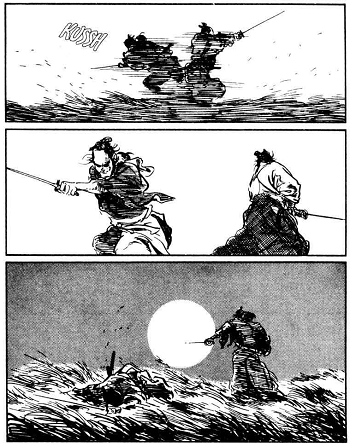
Two enemies of nearly equal skill meet, about twenty yards apart. They may be Ninja or samurai. They observe each other from a distance. The aspect ratio is widescreen, letterboxed if the show is shot in 4:3. They stand at opposite ends of a very wide, low-angle shot.
On cue – sometimes triggered by an outside event, such as a slowly falling flower petal touching the ground – they break into a sprint toward each other, leaning far forward, hands on weapons. Each character is shown in a frontal shot from the other's perspective.
Reaching critical distance, they leap. Each is shown leaping in a closeup, probably from the waist down, although the leap is simultaneous.
The characters move past each other in midair, weapons drawn, but no weapon strikes are shown. This happens in slow motion. They face forward and do not look back. Alternately there is the sound of steel on steel, but events pass too quickly for the audience to see what happened. If this is an anime, expect the screen to go black and the stroke to be painted by a white or blue streak across the screen.
Both characters land in a crouching position. They are shown in a shot from the front of one character, with the other in the background. This shot is usually shown for both characters.
A Beat goes by, with both characters completely still. Sometimes this moment can be dragged on for a very long time to build tension.
One character falls to the ground, defeated or dead. They may start bleeding at this point, or be entirely cut into pieces. Often this happens at the same time that the victorious character sheathes their weapon, or turns back to face their opponent.
One way to fake out the audience is to have one character (almost always the hero) fall to one knee looking as if they've been hit, or have them suffer a relatively minor wound, but then reveal that he's okay while the other character falls over dead instead. Another common subversion of expectations involves revealing both combatants to have been injured with one of them standing up despite their injuries (or killed). In Real Life, kendo kata #7 ends this way.
An increasingly favored method of ending the final fight in a movie already heavy on well-orchestrated brawls, since it plays on suspense rather than sheer action and implies higher stakes than the previous fights against mooks: both fighters are skilled enough that whoever makes one little miscalculation will immediately die, and although the outcome is determined by what technique or course of action each fighter decides on before they clash, neither the swordsmen nor the audience can know for sure what's going to happen until after the blows are struck.
Contains some Truth in Television, even if embellished. Real sword fights often take only a few seconds or even a fraction of a second, with one solid hit generally being enough to take a man out of the fight (contrast this with Flynning). On the other hand a single stroke battle is only one of many possible outcomes, since the initial clash will often be indecisive due to a successful void (dodge) or parry, and the reaction of any particular person to a given wound type is highly unpredictable. Historical examples show that some individuals collapsed or died instantly upon receiving seemingly superficial wounds, while others managed to keep attacking for several minutes before collapsing despite having a blade sticking all the way through their torso, and some of the latter even survived afterwards! While you should aim to make your strike decisive, you should also immediately face your opponent again and get ready to defend against an afterblow, because you cannot assume that they were instantly incapacitated by your first strike without first observing how they react.
In light of the above, the part of the fictional samurai duel where the winner slowly rises from a crouch, sheathes his sword, and walks away while having his back turned to his opponent the whole time is making him that much cooler than real life by implying he is so skilled that he doesn't even need to look in order to know that he felled his opponent with 100% certainty. This is especially true when the winner tells the loser You Are Already Dead and walks away with their guard down, because they have predicted the exact second when the loser will collapse or burst into blood, often just as they're about to strike in retaliation.
Sword Counterpart of Showdown at High Noon. One use of the Flash Step. Probably implies a One-Hit Kill. If the battle is one sided and the winner uses a flash step, then there is a good chance that the loser will perform a Snap to the Side before realizing that they've just been cut in two. This can also be a Curb-Stomp Battle if the victor defeats the loser so easily as to humiliate them. In a video game, a fight decided by Press X to Not Die may be a single stroke battle if there is only one button prompt.
Compare and contrast Begin with a Finisher, where a character opens a fight by deploying their strongest attack.
Examples
- In Attack on Titan, Titan killings are ideally supposed to be two cuts to the nape of their neck made simultaneously. More advanced Titans than the regular ones require a much different strategy.
- Valkyria Chronicles does this once in the battle between Selvaria and Alicia. Despite the fact that Selvaria was winning for most of the battle.
- Tenchi and Kagato's final clash in Tenchi Muyo!. Double subversion in that they actually both get hit. But Tenchi's sword somehow cancels Kagato's normal regenerative powers, while Tenchi's newfound powers allowed him to regenerate instantly. And the ship was cut in half also.
- The Tenchiverse was rife with this trope, taking it to absurd levels. It was practically the national pasttime. This trope could be renamed "The Tenchi Cross."
- Samurai Champloo played it straight in the fourth episode – Mugen and a yakuza clash in a single blow, with Mugen walking away – and subverted it in a later episode – as Mugen approaches two people who betrayed him, one reaches for his sword and Mugen cuts him down without even stopping. In the first case, Mugen and the yakuza respect each other, and both being Blood Knights they just had to fight a duel to the death to know for sure who's better. In the latter example, Mugen was out for revenge rather than for a challenge.
- In one of the last episodes, Jin and Master Swordsman Kariya Kagetoki charge each other dramatically on the docks. In a flashback later in the episode, Jin is seen plummeting to the waters below while Kariya nonchalantly sheathes his sword.
- Erza's final showdown with Ikaruga in Fairy Tail. After they pass each other, there's a Beat before one of Erza's blades shatters into pieces, just like all her other weapons and armor before this moment...and then another Beat as Ikaruga's sword shatters as well and she collapses in a heap.
- It happened again between the dragons Igneel and Acnologia in their final showdown. Acnologia tore away most of Igneel's torso before blowing him up with his Breath Weapon, but Igneel tore off one of Acnologia's arms in exchange.
- Done quite often at the climax of fights in One Piece:
- Zoro, being the most prominent swordsman in the series, is on the giving and receiving end of this trope several times. His battles with T-Bone and Mr. 1 end this way, and a fight ending this way provides Zoro with most of his character motivation for the series. The world's strongest swordsman Dracule Mihawk manages to not only give Zoro an absolutely huge slash across his torso, but shattered two of his three swords in the process.
- The finale in the fight between Sanji and Mr. 2 Bon Kurei was this — though they had no weapons save for their feet. It's also exaggerated like crazy. They do the usual jump, hit each other, and land thing. Sanji coughs and falls to his knees, while Bon Kurei remains standing... then suddenly Bon Kurei goes flying through the air and crashes through a building. Despite nothing having touched him since Sanji's attack.
- Happens to an even greater extreme in a match between Brook and Ryuuma - both characters are so adept at launching attacks faster than the eye can follow that they do so while appearing to walk casually past each other.
- Brook has an attack that prolongs how long the strike takes to be visible to the audience, allowing Brook to walk around as this trope is slowly killing his opponent.
- Slayers:
- Subverted in one of the theatrical films — what falls to pieces is not Lina's opponent, but Lina's opponent's cheap-ass wicker armor and wooden sword.
- Also parodied in the first TV series, when Zelgadis fights Dilgear. Both of them land a hit, but both escape unscathed because neither can be hurt by normal swords (Zelgadis' half-golem body is too tough to damage, and Dilgear's half-troll body heals within seconds).
- Also subverted in Seishoujo Senshi SaintValkyrie – Yuuki wins one of these in the first episode by stealing a pair of pink panties from the jacket pocket of the Monster of the Week.
- Considering that the non-leaping non-ninja version of this phenomena is essentially the most extreme form of Iai or Battoujutsu, it's rather surprising that Rurouni Kenshin doesn't make heavy use of the technique; whenever Kenshin (whose old nom de guerre Hitokiri Battousai means "Assassin who has mastered Battoujutsu") uses a battou attack, the location of the weapon in his opponent is clearly shown. That may have something to do with the fact that since Kenshin's sakabatou is a blunt weapon, he's not exactly capable of cleaving enemies to pieces with it.
- Except when using Amekakeru Ryu No Hirameki, in which case it was always a double lens flare. We saw the immediate after effects, but never the sword physically connecting. Given the nature of the attack, this is justified.
- Outlaw Star does this frequently, although usually after a long battle. Subverted in episode five when Aisha doesn't collapse as expected, shattering the blade instead, because it turns out she is Made of Iron.
- In Cyberpunk: Edgerunners, this appears to be the visual effect of David's Sandevistan implant to outside observers. In one prominent example, David uses the Sandevistant to close the distance on a Maelstrom brute, then when the brute uses his own reflex booster to try and crush him with a hammer, David slips behind him and blows his head off with his Arm Cannon. The same battle is shown twice: once through David's perspective in Bullet Time, then again where it appears David Flash Stepped behind his opponent and instantly splattered his brains against the wall.
- Pictured above: Shiki cutting through zombies in the fifth The Garden of Sinners movie like butter. And it was awesome!
- In Chainsaw Man, Katana Man's Speed Blitz ability allows him to do this repeatedly.
- Chrome Shelled Regios: An early fight between Haia and Layfon comes down to this, both waiting for the other to show an opening, since both are trained in the same techniques.
- Kagura's debut in Ga-Rei -Zero-. One strike against a monster which spent half an episode wiping out entire fire-teams of special forces.
- This is done at least twice in the original Dragon Ball, though with fists and feet instead of swords. First, Goku faces off barehanded against Yamcha's "Wolf Fang Fist." Later, capping off his match against Jackie Chun at the World Martial Arts Tournament (after a series of ridiculous events have already transpired such as blowing up the moon) Goku has a single stroke jump-kick faceoff with Chun. And loses to Chun, who is really Master Roshi in disguise, because Roshi's legs are longer.
- Parodied mercilessly earlier in the same Tenkaichi Budokai, during Jackie Chun and Krillin's match. They rush each other, there's a flash of action too fast for the eye to follow, and they land... and Krillin collapses. But since the audience (and the announcer) missed it, they pantomime the entire event all over again, for the audience's benefit, with running commentary on the dozens of techniques and attacks they used in that split-second rush.
- Actually played straight in one instance. Yajirobe defeats Cymbal with one stroke of his sword.
- Gohan and Garlic Jr. get into one with their fists. When they land, Gohan falls over in pain and Garlic Jr. gloats, but then gets shocked when a cut opens on his cheek.
- In Dragon Ball Z: Super Android 13!, Trunks and Vegeta's fights with the lesser androids both end this way (although Trunks was the only one with a sword). In both cases, the Saiyan stumbles and shows visible damage, while the android seems unharmed - and then boom.
- Bleach plays with this. Few battles are truly of this trope in their entirety but will end this way. After a few episodes of monologuing, taunts, releasing zanpakuto and explaining their abilities, flashbacks, Superpowered Evil Sides, random philosophy, and building up one's Battle Aura, both parties agree to end the fight in a single strike. At that point, this trope gets played straight.
- Ichigo's first encounter with Renji and Byakuya. Ichigo was about to finish off Renji when Byakuya decided to interfere by first breaking Ichigo's sword and then defeating him with two slashes across the shoulders. Two further stabs to vital organs while Ichigo was already falling down defeated ensured that even if he somehow didn't bleed out, he would no longer be able to generate spiritual power. Of course, all the attacks were also too fast for Ichigo to see.
- Ichigo versus Kenpachi. Ichigo is the first to fall (with an intact sword), believing he's lost. Then Kenpachi confirms Ichigo won and collapses next to him, his sword being revealed as shattered. Confirmed in the Official Bootleg and the final arc that Kenpachi did indeed lose the fight.
- Ichigo versus Byakuya. They agree that they have no strength left to prolong the fight so decide to end it in a single strike. Ichigo staggers, blood flowing everywhere as he desperately tries to prop himself up with his sword to avoid falling over. Then Byakuya staggers (but doesn't fall), blood spurts and he opens his hand, revealing his sword had shattered. He graciously concedes defeat to Ichigo on those grounds.
- Ichigo and Jin Kariya at the end of the anime Bount arc.
- Ichigo and Captain Amagai. Subverted. It looks like this but Ichigo's opponent isn't killed and goes on to attack someone else.
- Kenpachi versus Giriko. The latter powers up into a giant new form at the start of the fight, but Kenpachi kills him with a Diagonal Cut before he even finishes talking.
- In Demon Slayer: Kimetsu no Yaiba Zenitsu's fights against weaker demons go accordingly to the theme. More precisely, in one single stroke of his Thunder Breath Style -which invokes an Iaijutsu discipline- Zenitsu quickly dispatches the foe with a swift slash to the throat; on longer battles, however, Zenitsu tries to charge his speed to a ludicrous degree till he blitzes through the area, all to find that sweet spot to behead the enemy.
- In YuYu Hakusho, Hiei and Shigure fight to the death for Mukuro's edification. Both deal out lethal wounds too quickly to spot, and have a keel-over moment afterwards. Of course, Mukuro revives them both, and even ends up falling in love (sorta) with Hiei. Hiei also pulled this trope out much earlier, in the battle against Seiryuu of the Four Saint Beasts (in the manga, anyway; the anime extended the fight by a few minutes, though Seiryuu still went down faster than the other three beasts). Though it was actually 16 strokes. They just came so fast that Seiryuu didn't even know he'd been hit until he died.
- A non-sword version of this trope occurs in the Battle Frontier season of Pokémon: The Series: at the end of the battle between Charizard and Articuno, both Pokémon hit each other with one last attack. Charizard falls to the ground, while Articuno lands seemingly unharmed. The referee begins to declare Articuno the winner, but Charizard manages to struggle back to his feet. Then Articuno suddenly collapses.
- In an earlier episode, Team Rocket's Meowth has a Single Stroke Battle with a Persian involving an incredibly long and drawn out beat. Meowth actually won.
- Meowth tries to exploit this against Pikachu in a XY episode, issuing one as a rouse to trap the latter in a Pokeball. Pikachu dodges however, forcing him to quickly play it proper. Surprisingly, Meowth's Fury Swipes actually hurts Pikachu, but his Iron Tail knocks Meowth out flat.
- Parodied in a duel between an Electabuzz and Scyther. After a lengthy buildup, the two charge at each other, the action freezes at the point of contact... and both fall, having run headfirst into each other.
- A variation of this happens a lot in Pokémon, similar to the Charizard/Articuno example above. Both combatants score a final attack, they stand panting with their backs to each other, one feigns fainting, the other faints for real. Special mention goes to when Ash's Sirfetch'd (one of the few instances actually involving blades) does this against Cynthia's Garchomp and Died Standing Up.
- Hellsing did this in a scene decidedly not drawn from the manga during the battle between Alucard and Father Anderson. Subverted in that Alucard doesn't actually win the showdown, but that hardly matters.
- This tends to be a staple of the whole series. If it's not a serious battle or they're not toying with their prey, this is how most fights end for Alucard and Anderson. Due to their roles as the respective Juggernauts of Hellsing and Iscariot, they're just too powerful for most enemies to last more than a single shot or bayonet stroke against them.
- Their young protégés, Seras Victoria for Alucard and both Heinkel Wolfe and Yumie Takagi for Anderson, are just as likely to take down and destroy enormous swathes of opponents in a blood-soaked glory of single strokes, bullets, or cannon shots.
- Setsuna in Negima! Magister Negi Magi suggested she and Negi do this to finish their match in the Tournament Arc seeing as they only had 15 seconds left in the match.
- In Fate/stay night, Saber and Assassin end their fight with a Single Stroke Battle. (More precisely, it was Saber's Excalibur vs. Assassin's Tsubame Gaeshi, so technically it was three strokes on Assassin's part.)
- In Digimon Adventure (1999), WarGreymon has one of these with Mugendramon (Machinedramon). WarGreymon charges at Mugendramon who just makes a dismissing sound and raises his metal claw. They strike simultaneously, and end up standing back to back for a second, then WarGreymon reverts back to Koromon and a cut appears on his face. Mugendramon looks back and gloats, but Koromon says he won't lose because all his friends are backing him up. The camera cycles through all of said friends, and then Mugendramon falls to pieces while groaning in disbelief. Single-Stroke Battle powered by The Power of Friendship.
- Alternatively:
Koromon: "Uh, I think you forgot something when I was WarGreymon!" *Top third of Machinedramon slides off and disintegrates, then the middle, and then the bottom disappears*
- Or even more alternately:
Koromon: You missed what I did when I was WarGreymon. I sliced you like an onion! *Cue sliding and dissolving as stated above*
- Alternatively:
- Parodied in Ranma ½. Happosai wants Ranma to wear a one-piece Playboy Bunny outfit. Ranma wants to beat him up in righteous anger (and also because his mother is in the next room, waiting to meet him for the first time.) They lunge at each other, cross fists, land in a crouch... and Happosai collapses, knocked out. But Ranma's entire outfit has changed into a schoolgirl's sailor uniform, which Happosai dressed him in without Ranma even noticing.
- One of these occurs in the first episode of Real Bout High School between Ryoko and the last member of the Amateur Ninja Club. Ryoko wins.
- In Knight Hunters, the final confrontation between Ken and Kase turns out to be a single stroke battle, though Ken's armed with Wolverine Claws and Kase has a gun. Kase turns out to have missed. Ken more sort of doesn't.
- In Magical Girl Lyrical Nanoha StrikerS, this is how Fate defeated Sette (i.e. by running/flying around, and shattering her weapon and knocking her out with a single blow).
- In the 22nd episode of Macross Frontier, Alto and Ozma somehow manage to pull this off, even though both are flying Humongous Mecha that fire energy beams. They charge at each other in their respective space-planes, and fire at each other as they barely avoid collision, and follow this trope closely by only showing the results a few seconds afterwards. They both suffer damage, though only Alto is crippled.
- Zoids, of all things, does this between the Liger Zero and the Berserk Fury in their first fight. They jump at each other clash bright light we can't see... the Liger lands on its gut with a noticeable cut on its shoulder but quickly gets back up. The Fury lands on its feet with a cut across its chest, both turn around, ready for round two.
- Claymore's cast of Action Girls pull these off on a regular basis. Best example? When confronted by an execution squad of six Claymores, #1 ranked Teresa takes them all out at once this way.
- In the Soul Eater anime, the third and final showdown between Black☆Star and Mifune ends like this.
- Fullmetal Alchemist:
- Fuhrer King Bradley pulls off a pair of these in the first few episodes, apparently slicing up enemies too quickly to be seen by the viewer.
- Episode 15 has a variation in Scar's fight with the Silver Alchemist. The Silver Alchemist isn't killed by Scar's attack, but his prosthetic leg shatters, causing him to fall into the water and drown.
- This pretty much happens in the Cloud fight during the Ring Conflict arc of Reborn! (2004). Mosca flies at Hibari of the Absurdly Powerful Student Council, and it looks like he might be in trouble. But unsurprisingly for him, Hibari one-shots him and can't even walk away fast enough before he turns to attack Xanxus. Granted, Mosca was a Caped Mecha who ran on the power of a Nice Old Man who loves puppies, and is a Mafia Boss at the same time. And it was playing dead. All apart of Xanxus' Evil Plan.
- In Black Blood Brothers, when Jiro fights Auguste.
- The fight between Shirahime (Sai) & Suzuka (Hatoko) in Angelic Layer. Suzuka loses.
- Happens earlier when Hatoko fights with Suzuka and takes out one of her early round opponents in one hit. It's a mark of the skill of both opponents that both Shirahime and Suzuka pause before starting their battle as they both intend to one hit KO the other, and neither wants to move foolishly. They were basically equals in skill, as Hatoko comments her reach being slightly less than the tall Shirahime's cost her the match when they both struck one another at the same time and the damage calculator was initially unsure who had one, since Shirahime survived with a literal fraction of health.
- Happens at least a couple of times (with unarmed fighters, though) in the Saint Seiya anime; also, the first to fall to the ground is the one who actually survives.
- A non-lethal version of this occurs in Utawarerumono when Nawunga tests out Karula's skills in battle.
- Tsubasa -RESERVoir CHRoNiCLE- the anime was about to set up one of these between Kurogane and Seishiro when they are stopped at the last moment by Mokona. Just as well too because both characters had Plot Armor and neither could die, being that Kurogane is a main character in Tsubasa and Seishiro's last battle is destined to be against Subaru in X1999. However, Kurogane gets a real one when he kills/maims Fei Wong Reed - it's not entirely clear which, but it certainly fills the prerequisite for epic.
- Ginga: Nagareboshi Gin and all it's sequels are known to do this, in tune with the idea that ''The dogs are like Samurai.
- Ital wins most of his fights this way in Genesis Survivor Gaiarth.
- Tengen Toppa Gurren Lagann: Although This Is a Drill and not a sword, the way the Giga Drill Breaker goes off - Gurren Lagann passes through the victim, swings its right arm back while retracting the drill, followed by the victim exploding - is stylistically identical to the archetypal Diagonal Cut Single-Stroke Battle.
- The climax of the final battle between Heero and Zechs in Mobile Suit Gundam Wing is one of these… in giant robots with light sabers!!!
- * Earlier in the series, the in-person sword fight between Wufei and Treize is one of these.
- The fight between Afro Samurai's father and Justice ends with one of these coupled with a Diagonal Cut... with the winner using a revolver. It is not until the last episode that we learn Justice has a hidden third arm with a blade.
- The duel between Afro and Kuma aka Jinnosuke ends with one of these. Just before the clash, Afro switches to a thrust, allowing him to fully utilize the greater length of his sword as well as strike faster than even the cybernetically-enhanced Kuma.
- In Yu-Gi-Oh! 5Ds, Mizoguchi's Samurai Deck has a trap, Pause of the Certain Kill, that turns battle between monsters into this. It even has Miyamoto Musashi and Sasaki Kojiro in the illustration.
- Much of Goemon's battles from Lupin III are like this. One of the best examples is in the movie The Mystery of Mamo where he faces off against Mamo's lead henchman Flinch; when they land, Goemon has a deep cut on his arm and a broken sword-tip. Flinch laughs at him only for his head to separate into three pieces – the broken sword was still plenty sharp.
- Berserk:
- Guts' first encounter with Nosferatu Zodd in human form. Guts realizes his opponent is far stronger than him, and that the only reason he's even still alive is that his great sword is sturdy enough not to break under Zodd's blows. If the swords are equal, Guts reasons, then the only thing to do is gamble everything on one strike. Zodd sees what he's doing from the stance he adopts and accepts the challenge, boasting that Guts' brains will be on the floor before he can even touch him. When their swords meet, Guts sunders Zodd's weapon so that the tip goes spinning through the air, and on the follow-up he cuts deep into Zodd's shoulder. Far from defeated, Zodd is impressed that Guts is the first warrior in three hundred years to have wounded him so deeply, and transforms into his One-Winged Angel form to see how Guts will fare against his true power.
- Guts and Griffith's memorable duel in the snow in volume 8, "The Morning Departure". Griffith refuses to let Guts leave the Band of the Hawk, saying that his life belongs to him, and that just as he won Guts by the sword when they first met, Guts must now defeat him if he wants to be free. They face off at a distance as their comrades watch, with Pippin and Judeau having to restrain Casca to keep her from intervening. Griffith is a genius with his sabre, and in the past he was able to defeat Guts through superior technique, but everyone knows that Guts has increased his power and skill so much in the past three years that the distance between them has been closed. Guts is completely focused and calm as he stands on guard, while Griffith's fevered mind races through the possibilities. Because his sabre cannot parry more than two or three blows from Guts' BFS, and because of the snow on the ground hampering his movement, Griffith decides he has to win on the first strike. The timing needs to be so precise that he can't afford to pull his blow, and there's even a risk that he'll accidentally kill Guts, but he is willing to accept it. As soon as a clump of snow falls from an overladen branch, breaking the deadly stillness, they spring to attack. Griffith tries to execute the technique, but Guts' strike cleanly cuts Griffith's blade in half and stops just short of Griffith's shoulder, leaving him with no injury except to his wrist from having the weapon struck out of his hand, and proving beyond doubt that Guts has surpassed him as a swordsman. Griffith crouches in the snow experiencing a Heroic BSoD, while Guts bids him farewell and departs without looking back.
- Guts' first confrontation with Serpico in volume 17, when Farnese demands that Serpico kill Guts for kidnapping and humiliating her. Serpico first pretends to ignore Farnese's command and leave peacefully so that Guts will let his guard down, then turns about and cuts at Guts' head while leaping into the air to avoid Guts's simultaneous strike with the Dragon Slayer. Guts gets a shallow cut on the cheek, and Serpico gets his boot cut open by a strike that narrowly misses his toes. Having failed to kill Guts with the first strike and lost the element of surprise, Serpico decides to throw in the towel for real this time and live to fight another day.
- In the same volume, Zodd and Griffith's spirit lunge at each other and attack, and as the latter sails past him, Zodd realizes that his face is wounded and his left horn has been cut off. This causes Zodd to acknowledge him as his master.
- The climax of the final showdown between Spike and Vicious in the Cowboy Bebop finale "The Real Folk Blues (Part 2)" is one of these, with an additional Shout-Out to A Better Tomorrow II (Spike has Vicious' sword, Vicious has Spike's gun). After both weapons are returned to their original owners, and the final attacks are made, both men fall, but Vicious goes down first, with Spike living just long enough to deliver his final line to the Red Dragons gathered before him: "Bang."
- Done at the climax of the Halo Legends short The Duel between Fal and Haka. It results in a Mutual Kill. Something worth noting: that episode was heavily based on a samurai legend.
- Basilisk has an interesting variation: Yakushiji Tenzen gets to be on both the receiving and giving end of this trope... and in that order! First Jimushi Juubei pierces Tenzen's chest with his hidden blade, killing him. Then Tenzen comes back and cuts Juubei in half with his katana.
- Kamui Den: Any fight involving Kamui's "kasumi-giri" is likely this. Also of note is Matsubayashi Kenpu's fight with a marauding duelist. He severs both of the man's legs with a single draw and cut.
- Kenshiro from Fist of the North Star is known for his Rapid-Fire Fisticuffs, but he'll occasionally pull off a non-weapon-version of this trope: a single strike to a Pressure Point, usually either because time is of the essence or to humiliate someone a little more before they pop. Played with in the flash-back to when he and his adopted brothers were learning Hokuto Shinken: after a long bout, Kenshiro was left a bloody mess but was declared the winner, due to the fact that he had struck every single one of his brother's pressure points on the first pass.
- One episode of Kirby: Right Back at Ya! had one such fight featuring Meta Knight and Chilidog / WolfWrath. It gave Meta Knight a fang in his forehead that paralyzed him until Kirby destroyed Chilidog / WolfWrath.
- In the backstory of Chrono Crusade, Aion and Chrono clashed when Chrono refused to turn over Mary Magdelene to him. Aion furiously charged at Chrono while Chrono desperately tried to counter him. Aion tears off Chrono's horns in that brief exchange, and Chrono and Mary fall to the land below. Aion is unable to immediately pursue them since Chrono's strike nearly bisected him. Their final meeting (with Chrono having regained his horns while Aion having lost his) ends with a shot of them charging at each other in the lead-up for one of those. The epilogue suggests that Chrono won.
- The climactic battle of the first season of Chivalry of a Failed Knight boils down to this. Ikki Kurogane faces off in his final match against Touka Toudou in his final match, which he must win to graduate. He puts his all into a single strike, and she responds in kind and in the end he is victorious, earning himself a place in the next Seven Stars Tournament.
- Subverted when Darkness fights Beldia in KonoSuba. They both swing dramatically, only to realize after a brief pause that Darkness missed him.
- In MegaMan NT Warrior, Rockman's fight with Fireman in the N1 Grand Prix ends this way, with Rockman using Wide Sword and Fireman using Flame Sword. Rockman wins, naturally.
- In the awesome manga adaptation of Mega Man X2, X is challenged to a duel by Flame Stag, who previously lost a duel and is itching for revenge. Stag, having received an upgrade from the Big Bad, and X, who has been blinded, rush past each other in a dormant volcano. X is then shown bleeding (oil?), while Stag is completely unharmed. X then crumples to the ground. Of course, there's no way X is going to lose here, and Stag suddenly bursts into flames, due to some crazy close-range tampering by X earlier when passing by. The Irony is that had Stag not been upgraded, he might have been able to contain the damage.
- In Sword Art Online, Kirito does this to a wolf at the end of the first episode when he rushes off to the next village shortly after Kayaba tells the players they're stuck in the game. He also does this consecutively to two Salamanders right after he first arrives in ALfheim Online.
- In Shinkansen Henkei Robo Shinkalion, this is how the clash between the E5 Hayabusa and the first Monster of the Week ends. Happens again in the final episode.
- Usagi Yojimbo lives and breathes this trope... although considering how much it owes to Lone Wolf and Cub, along with the classic samurai films, that's hardly surprising. Any duel involving Usagi is pretty much guaranteed to leave Usagi the last one standing. But the most suspenseful of these duels took place in Duel at Kitanoji, where Usagi's mentor is called into an Honor Duel with the rival who lost to him twenty years ago and now seeks to regain his honor. Said opponent had already beaten Usagi in a duel once, and it was genuinely uncertain which of them would win. After the battle took place, the beat was held for several pages before one of them fell down dead. Usagi's mentor wins, but commented that it could easily have gone either way. Stan Sakai has said it even took him a while to decide how that one should end.
- This trope is so prominent that Blade of the Gods has a legitimately shocking subversion. During his battle against Jei, Usagi draws his sword, leaps forward, strikes...and Jei is wounded, but alive, which shocks Usagi since the blow should've been fatal.
- The last issue of Robin's solo title has Tim Drake being challenged to a duel to the death by his teacher, Lady Shiva. They meet, and have what looks like one of these, after which Tim is stumbling, with three broken ribs, while Shiva is standing triumphantly. Then, Shiva collapses, and Tim explains that he slipped her a paralytic poison, activated by a heightened heart beat, before she even made the challenge.
- The duel between Scott Pilgrim and Roxanne is a direct Shout-Out to Ninja Gaiden, ending with a Diagonal Cut.
- The final battle between Leonardo and the resurrected Shredder ends this way in the first volume of Teenage Mutant Ninja Turtles.
- The delightful "Batman vs Ninjas" story from 1989. After taking out a group of ninjas one-by-one, only their leader remains. What ensues is a single-stroke battle, with the ninja using a katana, and Batman his bare hands. After they pass each other, Batman has a bloody gash across his stomach and is in pain. The ninja, who up until now has been completely silent, has a hearty laugh and commends Batman on his technique - before collapsing due to a delayed nerve strike.
- In The Transformers: More than Meets the Eye, the first time Cyclonus fights Star Saber, it's a moderately long engagement where Cyclonus only wins by being a Combat Pragmatist and having prominent spikes on his head. The second time they fight, Cyclonus tricks Star Saber into switching into his plane-like vehicle mode, lures him into a narrow corridor, and cuts him in half with a single blow, then offers up a prayer to Primus, asking that he forgive Star Saber's sins.
- The Ultimates: Nerd Hulk beats Whistler in an old Iron Man suit in one punch.
- The guild called Chaldea
 : Archer EMIYA and Erza Scarlet end their duel with one of these. EMIYA gets slashed in the shoulder, but Erza's sword and clothes get destroyed, making her suffer a Naked Freak-Out. The judges rule their duel a draw.
- In Incarnation of Legends, Kojiro challenges the Radiance to one in a replication of their final duel on the Ryuudou Temple's steps, ending with his sword bent, his shoulder dislocated, and the Radiance's helmet cracked in two.
- In A New Hope (Danganronpa), this trope is used as the base for Peko's execution, placing her up against a samurai Monokuma. She takes it with her.
- In The Night Unfurls, this trope happens when Michelle faces off against Hugh, Kyril's apprentice, during his Trial by Combat at the end of Chapter 11 of the original. While the fight does end in one strike, it is not as showy and flashy as it sounds. Only one person lunges towards his opposite target while completely focused. The other person, garbed in ill-fitting armor, seems more concerned about crowing rather than preparing for the fight itself. Perhaps unsurprisingly, said other person ends up being stabbed mid-sentence, right in the unprotected belly. Oh, and the loser of the battle doesn't even get a clean death, or a cool one for that matter. Instead, he writhes on the grass, screaming all the while, and is ultimately silenced after the winner decides that enough is enough and beheads him. Take a guess which person is which.
- Assassins of Brotherhood has the battle between Wei and his second brother-in-arms, two of them in a field at dusk. The sun is setting, the audience only see their silhouettes as they dash at each other. A slashing noise is heard as the camera pans out, then pans in again, switching between Wei and his brother as they have a heartfelt, final chat on how they're destined to kill each other... then the brother collapses.
- Kill Bill:
- The showdown between the Bride and O-Ren Ishii concludes with one of these.
- The Bride's climactic battle with Bill is almost this, given the buildup. The fight itself lasts less than ten seconds, with neither the Bride nor Bill even getting out of their chairs before the Bride performs the Five Point Palm Exploding Heart Technique on Bill.
- Played for shock value in Equilibrium, where a confrontation between Preston and The Dragon Brandt is teased throughout the film. When the time finally comes for them to face off, Preston chops Brandt's face off without any effort at all and barely breaks stride. Though this is more of an example of a Curb-Stomp Battle and was made so short because the actor playing the Dragon did not have time to film a longer scene due to other projects. This scene is also the opposite of an earlier scene where the same characters have a very drawn out training fight.
- Ultraviolet (2006), which is also written and directed by Kurt Wimmer, features a similar scene. Several Curb Stomp Battles establish that Violet's hemophage superpowers prevent any mere human from challenging her. Then she's confronted by a whole room full of her fellow hemophage assassins. Prepare for an epic battle, right? Wrong. She cuts off all of their heads with a single swing. Yay.
- The final fight in the pulpy Underworld (2003) is this trope down to a tee, although somewhat more drawn out than usual.
- Underworld: Awakening:
- Selene is armed with a scalpel and is facing a corridor filled with armed Mooks. She sprints down the hall and slices all their throats in about a second.
- Subverted and played with later. Selene is fighting a huge Lycan, she flips over it and stabs it in the base of the skull with a silver blade. The blade snaps in half, the wound heals instantly, and the Lycan then knocks her out with one punch.
- The face-off between Kyuuzo and an anonymous opponent early in Akira Kurosawa's Seven Samurai is probably the West's first exposure to this. Kyuuzo and his opponent first fight with bamboo shoots. The opponent claims a draw, but Kyuuzo replies, "A real sword would have killed you" (and it would have). When the man presses the issue, Kyuuzo draws his sword, but not before insisting that the arrogant samurai not throw his life away. Kambei, observing the duel, mutters "This is preposterous... there's no contest." Kambei's words ring true when, instead of standing in place like he did during the bamboo spar, Kyuuzo pulls off a lightning-quick dodge at the last second to slice his opponent right down the front.
- The last fight in Kurosawa's Sanjuro. In fact many of the fights in Sanjuro and its predecessor Yojimbo, even if they aren't a single strike for the entire fight, only require the protagonist to make one or two strikes per opponent.
- Shogun's Samurai features a Cool Old Guy vs. Retired Badass SSB that dramatically uses a stylistic conjunction of Diagonal Cut.
- The final battle of Azumi: Azumi and Bijoumaru do this after a long swordfight. After the unseen swordstrike, both fighters are standing with their backs to each other, filmed from different angles. A small trail of blood starts to encircle Bijoumaru's neck, he tries to turn while jumping and he lands.....with his head pointing the wrong way. The decapitation takes full effect only as he collapses.
- The Matrix Reloaded has one... in the form of Morpheus vs. an SUV. As Trinity and the Keymaker make their getaway, the Twins try to run Morpheus down. He rolls to the side at the last minute, and uses his katana to slice through one of their tires as they pass him. The SUV starts to flip over, setting up Morpheus's next move — emptying his gun into the gas tank.
- While it was preceded by a long choreographed battle, that was just a long lead-up to one of these between Connor MacLeod and the Kurgan to end it all.
- In the beginning of Troy, Brad Pitt as Achilles does this to an enemy army's champion, who didn't even have time to react because Achilles strolled up to him so casually.
"Is there no one else? Is there no one else?"
- Zatoichi:
- In 1964's Adventures of Zatoichi, the final duel takes place at night in the snow and ends with them running at each other, swinging, continueing past one another and then pausing. Zatoichi's opponent starts to drip blood into the snow, concedes defeat, and falls dead.
- The duel on the beach between Ichi and Hattori Gennosuke in the 2003 Takeshi Kitano film probably counts for this, with bonus points for having the two duellists' badassery played up throughout the film, so it's clear that the fight between them will be epic. They even have a sequence of Hattori imagining how the fight will go, and altering his stance and grip to give himself a chance. It isn't enough.
- Maximus in Gladiator does this against a soldier on a horse. It even includes Maximus falling to his knees from the attack before the soldier falls off, dead.
- Occurs near the end of Bunraku when Yoshi faces off against a member of the Killers gang who is also a samurai.
- Nameless and Long Sky engage in this after first playing out a battle in their minds in Hero (2002).
- Hanzo, a Yakuza gangster, and one of the Predators do this in Predators. Both die, but the Predator falls first.
- In the opening scene of The Impostors, we are introduced to two con-artists who fake an altercation in an outdoor diner, culminating with a knife fight. At the climax of the fight, they both rush each other, simultaneously cry out, and then one of them falls "dead" and the other runs off without paying his bill. In the next scene we see them argue over the fact that the wrong man "died".
- At the very end of Legion, between the angels Michael, who was resurrected just moments ago, and Gabriel, though surprisingly, both of them survive.
- In John Carter, John kills Tal Hajus this way.
- In The Princess Bride Inigo does this to one of Count Rugen's guards without taking his eyes off Rugen. He then repeats it on the other 3.
- The fight between Perseus and Medusa in Clash of the Titans where he finishes her with a single Clean Cut.
- The final battle between Eggsy and Gazelle in Kingsman: The Secret Service concludes this way. Gazelle's first appearance has her effortlessly dispatching a Kingsman agent in this manner, as well.
- In WarCraft, the climatic fight between Lothar and Blackhand goes this way, with the former sliding low and striking under the latter's guard. He adds a second strike, but that's mostly a finishing touch - his opponent would've bled out of the first cut anyway.
- The Last Jedi:
- Holdo does this on an entire fleet using a suicidal hyperspeed jump. She uses the Raddus to cut the First Order's flagship in half, and as a side effect most of their Star Destroyers are destroyed as well. The shot is framed exactly like a normal single-stroke battle, with one frame where the fleet seems unaffected, and in the next destruction.
- Luke and Ben set up for one of these, but it gets subverted twice: First, Luke keeps dodging Ben's strikes without trying to fight back, and when Ben finally attempts to play the trope straight, Luke reveals that he was never there to begin with: He was projecting an image of himself from another planet to distract and delay Ben while the Resistance escaped.
- Some fights in Lone Wolf are close to this trope, usually when one or both opponents are on mounts and they have only one round to strike each other before the momentum bring them apart. Notably, a barbarian scout on skis while Lone Wolf pass him on a sled (Book 3), a Vassagonian horseman charging Lone Wolf (Book 4) or a Drakkar Kraan-rider while Lone Wolf is flying on an Itikar (Book 5). The one with the highest Endurance loss loses the fight, with varying results, up to a One-Hit Kill.
- In Volume 9 of The Beginning After the End, Arthur and Nico's rematch during the Victoriad ends up being this. Arthur nonchalantly knocks out Nico in a single blow with his newfound aether powers, causing Nico to be sent flying across the arena. To add insult to injury, the attack destroyed Nico's mana core, an instance of Laser-Guided Karma as the outcome of their last confrontation during the war had led to Arthur's own mana core being damaged beyond recovery.
- Codex Alera has one of these in the final clash between the Vord Queen and Tavi at the Princeps Memorial.
- Played seriously in the Honor Harrington novel Flag in Exile. Honor has to face a traitorous nobleman in a Trial By Combat. She takes a second stroke, swinging back the other way from her initial stroke, but the first would've been fatal by itself without the second one decapitating her opponent. It should be noted that the swords used in this case are derived from the samurai swords seen in Seven Samurai but longer and with the back edge partly sharpened, allowing it to be used for a reverse stroke.
- In Ewilan's Worlds, Edwin Til' Illan encounters his Worthy Opponent in Yalissan Fiyr, and they duel at the end of the book. It lasts less than a second. Edwin is gutted, while Yalissan Fiyr looks at him with an amused look before falling to the ground, beheaded. Edwin eventually survives.
- The final battle in Harry Potter and the Deathly Hallows is a magical variant of this trope. Harry and Voldemort circle each other. Harry explains that the horcruxes are gone, Voldemort is mortal, and he's doomed to lose the fight ahead. Harry's words lay out how hopeless the situation is and offer Voldemort a chance at salvation. Voldemort scoffs at the offer, the two each cast a single spell, Voldemort's wand flies from his hand, lands in Harry's, and Voldemort drops dead on the floor.
- The Iliad is an endless series of these - of the literally hundreds of duels, only a few take more than a stanza. And most of the longer ones are because the author felt the need to give a brief biography of the person who dies on the next page.
- Reign of the Seven Spellblades: Oliver Horn versus Darius Grenville. Oliver uses a Spellblade to sever Darius's sword hand on the first stroke by picking out the one possible future out of ten thousand where he struck faster than Darius.
- The fight between Willikins and Stratford near the end of Snuff. Willikins doesn't even bother to do the runup.
- In Son of the Black Sword by Larry Correia, Ashok is repeatedly challenged to duels from his jail cell by warriors who want his ancestor blade. The prison guards have started putting bets on how long various challengers will last; their commander witnesses one challenger start off by insulting Ashok, the Law, and the Protectors, and bets that it'll last ten seconds or less. There is then a Gilligan Cut to him collecting his winnings, and the later reveal that Ashok won by smiting out his opponent's tongue with a single blow.
- Vorkosigan Saga. Aral Vorkosigan's brilliant conquering of Komarr in his Back Story - too bad his political officer turned him into The Butcher with a single betrayal.
- Asuka / Abareblack and his brainwashed love interest Mahoro / Jannu do this in Bakuryuu Sentai Abaranger (after they'd already nearly killed each other more than once). The moment they run past each other becomes a plot point - Mahoro uses it to touch their cheek-markings, which lets them communicate mentally. She uses this moment to tell him she's no longer brainwashed, and is going to be helping them from inside the enemy base.
- Kaiketsu Lion Maru, Kamen no Ninja Akakage, and Henshin Ninja Arashi have all had battles like this at one time or another.
- Satirized in Kamen Rider Kabuto in a single-pass duel between makeup artists (both male). Whoever ends up prettiest (due to the opponent's makeup application) loses.
- Subverted in Legends of Tomorrow, in Sara's duel with a samurai. They run at each other, each strike a single blow, and then the samurai staggers and collapses... and then Sara reveals the bloody knife in her left hand with which she struck the actual fatal blow. After all, Sara isn't a samurai, she's an assassin.
- This is how the duel between Trent and his evil clone ended in Power Rangers: Dino Thunder. "I guess you wanted it more. Goodbye, White Ranger."
- Happens near the end of Power Rangers Operation Overdrive, between the Black Ranger (Will) and his primary antagonist Kamdor (as there were four enemy groups, each individual Ranger got one or more individual rivals). This was the alternate version, with the Black Ranger falling to one knee first, and the enemy going "Finally! Now, to find the—YEARGHH!" and violently exploding.
- Taylor and Zen-Aku have this in Power Rangers Wild Force. After they strike each other in passing, it is Taylor who falls and involuntarily demorphs, allowing ZA to snag two of her Animal Crystals (and thus control two more of the Rangers' Humongous Mecha. ZA was all about the Gundam Jacking.) However, the previously-untouchable Zen-Aku was made to bleed a little - red blood, proving he wasn't what he seemed.
- Doggie Kruger vs. his similarly armed and similarly trained old rival in Power Rangers S.P.D.. Victory goes to the big blue dog, but The Rival survives.
- SPD has another example. Sky Tate and his Evil Former Friend Dru Harrington. Sky repeats wisdom Dru had told him while they were training: "You don't make the same mistake twice."
- This happens in Power Rangers and Super Sentai a lot - not even always at the same times. (Kamdor vs. Will didn't have this in sentai, Jannu and Asuka didn't have this in PR, Zen-Aku and Taylor as well as Doggie and Ichthior were the same in both.) Also, it's seldom the entire battle. Oftentimes it's more, after fighting for the whole episode, they gather themselves for one more strike.
- Subverted one time in Power Rangers Lost Galaxy: Leo and the Monster charge each other and slash one another with their swords. They keep going and then pause for several seconds, sparks fly off the monster and it collapses... only for it to be revealed this was because the Magna Defender threw a knife into its back after it and Leo fought.
- Episode 37 of Kamen Rider Ex-Aid sees Hyper Muteki Ex-Aid finish his battle with the Kaiden Bugster in this manner. Afterwards, Kaiden says the blows from Ex-Aid's Hyper Critical Sparking didn't cut deep enough, only to take the full force of the attack seconds later.
Ex-Aid: "The game is already clear."
- Star Trek: Picard: In "Absolute Candor", Elnor requires only one swing of his sword to win a fight against Tenqem (who loses his head) and two other gang members.
- Ultra Series:
- Happens in a swordless manner in Ultraman Tiga during the final fight with Evil Tiga. After an evenly matched battle, the two run passed each other and jump with strikes. Tiga falls to his knees but as he's celebrating his victory, Evil Tiga collapses to the ground. Subverted slightly as this doesn't kill Evil Tiga, but merely allows Tiga to hit the finishing move.
- The backstory for Ultraman Mebius reveals that at the end of the war against Alien Empera in the distant past, Empera and the Father of Ultra ended their battle with this. While neither one was killed by their wounds, neither one was able to truly recover from it.
- The Theater Special for Ultraman Ginga sees a midair Beam-O-War variation in an intense battle between Ginga and Dark Zagi, as the fight culminates in a clash of the Ginga Cross Shoot and Lightning Zagi. The two pass each other and land on the ground, seemingly perfectly fine...and then Zagi's Energy Core shatters.
- Ultraman Taiga sees Ultraman Fuma's Trenchant-Star Light Wave Shuriken, used as a melee attack, clash with an Alien Babarou's sword. After the two pass each other, there's a Beat before Fuma declares his victory, followed by Babarou falling over and exploding.
Fuma: "You were too slow!"
- The Explorer in Age of Empires III is always given 2 or 3 special attacks that often end in a single stroke battle
- Case 02: Paranormal Evil: Mechanically speaking, all fights with individual normal enemies are resolved in one or two rolls. The dice rolls determine how much damage and money the player gets from the short encounter.
- Baiken's Instant Kill from Guilty Gear is a classic Single Stroke Battle, concealed by a paper screen. (After the beat, there's a splash of blood onto said screen as the blow takes effect.)
- Ky's "Rising Force" Instant Kill from the same game gets promoted to this trope in Guilty Gear Xrd -SIGN-.
- Kingdom Hearts:
- Sora in Kingdom Hearts II can initiate a reaction command when fighting a Samurai Nobody. When pressed, everything else on the screen freezes as Sora and the samurai take stance. There are even cherry blossoms fluttering over their heads. After about 2 or 3 seconds, the words "The End" appear in one of your (now empty) command boxes. You have to get to and click on "The End" in time to win the face-off. Regardless of who wins or loses, the two opponents suddenly strike each other, the screen goes white for a second, and the victor is shown behind the victim with their weapon drawn as the opponent recoils with pain.
- In the Final Mix+ version of the game, the same applies to their controller, Roxas (now a boss, instead of a cutscene). Initiating the Duel Stance reaction command shows a scene of the two charging at each, Keyblades at the ready and in slow-mo. If Sora selects the right command in time, he'll knock Roxas into the air and telekinetically steal his Oathkeeper and Oblivion Keyblades, using them in tandem with his regular combos for a short period of time until Roxas (now reduced to his light powers) steals them back. If Sora fails, let's just say he'll be feeling sore in the morning. Or not.
- After fighting Luxord in the World That Never Was, the battle ends when Luxord tries to put up a wall of cards around himself, but Sora just sprints right at him and slices through the cards (and Luxord) with one swing. Cue Sora's Ass Kicking Pose.
- Also in II, Superboss Sephiroth always opens up the battle with and afterwards periodically uses a move called "Flash", where the screen darkens, Sephiroth makes a short remark ("That's enough."), and he dashes past Sora with quick footwork. If Sora doesn't use the "Reflect" reaction command (or – with very good timing – use Reflect or even jump), Sora is struck by multiple invisible blows that usually bring Sora's health down to critical levels (if underleveled/unprepared, this almost certainly spells disaster).
- Terra in Birth by Sleep can meld together other commands to get Zantetsuken to use in normal combat. Much like its Final Fantasy origins, it can take out a normal enemy in one swing, if you're lucky. Otherwise, it just does regular damage. It's ineffective against bosses though.
- In Chain of Memories after Lexaeus knocks Riku after their boss battle, Ansem takes over Riku's body and slays him, combining this with a Flash Step.
- The II.5 HD ReMIX of coded's cutscenes had a lot of the boss fights end as soon as Sora got a good hit in. The classic 'jump, pass, someone dies' version is done with the true Shadow form of Sora's Heartless
- At the end of the "YMCA" level of Elite Beat Agents, a ship captain engages in this against a pirate skeleton. The level "La La" also uses it, as a white blood cell (portrayed as a nurse) fights a virus this way... several times. Yes, it's a weird game.
- Not to be outdone, the "Julia ni Shoushin" level of Osu! Tatakae! Ouendan 2 features a Single Stroke Battle between two rival barbers. The winner shaves the kanji for "loser" into his opponent's head.
- Naturally, this is also the ending to one of the multiplayer scenarios – the vampire and the yeti do this, and depending on which player played better (or maybe they tied, it's surprisingly common), one (or both) of them falls down in defeat.
- Not to be outdone, the "Julia ni Shoushin" level of Osu! Tatakae! Ouendan 2 features a Single Stroke Battle between two rival barbers. The winner shaves the kanji for "loser" into his opponent's head.
- The opening to the NES game Ninja Gaiden features such a scene. It plays out almost exactly as the scene described in the main article.
- Its arcade predecessor, featuring Ryu versus one of the hockey-mask Mooks. The Continue screen is just as dramatic.
- Capcom's cutesy arcade fighting game Super Gem Fighter Mini-Mix features the ninja Ibuki from Street Fighter III. One of her Supers in this game was to dash at the enemy (all kitted out for it, too!): contact results in a single stroke that slices the enemy into tiny cubes (it's all very cartoonish).
- Parodied in the Samurai Kirby minigame from Kirby Super Star, where Kirby and his opponent dress up as samurai and attack each other with silly weapons such as paper fans and frying pans.
- Except for Meta Knight, who you attack with your sword. He's damn near impossible to beat, as well.
- If you do manage to beat him, his mask gets cut in half.
- The previous iteration of this concept, Quick Draw from Kirby's Adventure, is a western gunslinger duel where the guns that Kirby fire get increasingly ridiculous.
- Except for Meta Knight, who you attack with your sword. He's damn near impossible to beat, as well.
- A version of this appears in Soulcalibur III, just before the penultimate battle in story mode (regardless of which character is played or the story path). Siegfried and Nightmare square off in the cutscene, swing their swords simultaneously, there's a one-second beat, then one of them falls over. Which one survives to fight the player depends on which character you are playing at the time: good characters fight Nightmare, evil ones fight Siegfried. If you have chosen either of those characters, you simply fight the other.
- This is also how Siegfried kills Nightmare in his ending in Soulcalibur IV.
- And Setsuka's Critical Finish, also in IV.
- As Setsuka's student, Alpha Patroklos uses this as his Critical Edge in V.
- Also, playing vs matches with health set to 0% can do this, handy for farming the vs match total count.
- This is also how Siegfried kills Nightmare in his ending in Soulcalibur IV.
- In Total War: Shogun 2, when a Ninja is ordered to assassinate an enemy general, the outcome will be represented by a short cutscene of the assassination attempt. One cutscene results in the assassin and target dueling with katanas. The battle ends when both attempt the same forward slash. They pause for a moment, and are three outcomes: The target general collapses and the assassin gets up to leave, the assassin collapses and the general gloats, or they successfully gutted the other at the same time and both drop dead.
- Try charging into a line of Katana Heroes with an army of Loan Sword Ashigaru and zoom in on the fighting. Loan Sword Ashigaru are essentially farmers with katanas, while Katana Heroes eat, sleep, drink, and talk pure swordsmanship. It's less of a Single-Stroke Battle so much as a single stroke blender.
- Shinobi (2002) carries this to its logical conclusion: upon defeating an opponent, a timer would start to count down at the bottom of the screen, and each time another opponent was defeated the timer would start over. Meanwhile, the protagonist's magical vampiric katana would glow, with the glow intensifying with each successive kill, and the damage inflicted by an attack also increasing. When all goes well, every enemy in an area is killed within the fairly limited time available, at which point the camera flashes to each defeated enemy in turn before returning to the protagonist (in a suitably cocky victory pose, sword sheathed), at which point every enemy would simultaneously slide apart. Also, several boss fights are effectively impossible without the extra damage potential that comes from killing six monsters in seven seconds.
- The Odin summon from various Final Fantasy games would randomly kill all on-screen enemies (or would simply deal a good chunk of damage to a single foe). The Final Fantasy VIII version follows the trope to a T (except for Odin being mounted). Appropriately, Odin's unexpected death in that game at the hands of Seifer came in the form of a one-stroke battle as well.
- To put that last part in perspective, Seifer counters Odin's Zantetsuken with a move (judging by the kanji shown afterward) called the "Zantetsuken Reverse". It only involves Seifer raising his free hand. That's right. The Law of Diminishing Defensive Effort was used to enact a Single Stroke Battle. Luckily for the player, this cutscene leads to a Big Damn Heroes moment from Gilgamesh, who shows up several turns later to one-shot Seifer with some Razor Wind and then joins the party as a semi-Guardian Force replacement for Odin.
- Odin and Raiden show up in Final Fantasy VI, but Cyan is capable of doing this by himself, and without magic. His top-level Swordtech/Bushido skill has him charge across the field of battle with his sword out, leap back to his original position, flourish his blade, and (hopefully) watch all the enemies on the field fall to pieces. He can even kill ghosts with that move.
- Final Fantasy VII has a "Flash" command obtainable by increasing the level of the "Slash-All" materia. Flash instantly kills all enemies...but only if "Death" attacks are allowed by them.
- The Yojimbo summon in Final Fantasy X has the special move zanmato, which follows the trope exactly and cleaves pretty much any in-game enemy in half, as a non-standard enemy death scene to boot.
- In Crisis Core: Final Fantasy VII, one of Zack's memories of Sephiroth triggered by the DMW involves him doing this to a monster. Of course, it's Cutscene Power to the Max.
- Final Fantasy Tactics has a variation. In an early cutscene, we are shown two knights fighting. One rushes at the other, sword raised for a downward strike, but the other merely steps out of the way before striking.
- The final ability of the Samurai in Final Fantasy V, Iainuki, attempts to kill off all enemies when used, after a long charge time. The catch? It doesn't always hit, and undead enemies get back up with full health.
- Similarly, in Breath of Fire 2, Jean's "Chop" wiped out all enemies.
- Devil May Cry:
- In the Special Editions where he's playable, Vergil has this as a special attack - his "Rapid Slash" move consists of charging straight ahead and drawing his katana. Half a second later, anything that was in his path gets cut to pieces. The effect is more evident in his Devil Trigger form; a powered-up Rapid Slash will also impale the enemies with a Summoned Sword that explodes after a short delay.
- Also used plot-wise in Devil May Cry 3: Dante's Awakening. Vergil and Dante end up finishing their last confrontation in demon world this way, providing an almost spot-on example of the trope. The "almost" resulting from the fact that you see the finishing blow.
- Near the end of Devil May Cry 5, Dante and Vergil get to do this again, in full Sin Devil Trigger, to close off their final confrontation. Except Nero is in no mood to let either of them kill each other.
- This shows up a lot in Samurai Warriors. Notable instances of the trope are the endings for Ranmaru Mori, Mitsuhide Akechi, and Oda Nobunaga. The closely related Dynasty Warriors series also has a few examples, such as Guan Yu's death in DW5.
- The Mortal Draw technique from The Legend of Zelda: Twilight Princess is an on-demand example. Link has to have his sword sheathed and not targeting his intended target to pull it off, but in most cases, as the instructor says, "the Mortal Draw deals death."
- The first trailer for No More Heroes features Travis and Helter Skelter in a Single Stroke Battle. Travis wins, and Helter either collapses, or has his head removed, depending on the trailer version. "Your shining armor and fine words won't get you anywhere!"
- Tekken:
- In Tekken 3, Yoshimitsu's move "Yoshimitsu Blade" is a nasty two-handed whack in the stomach with the hilt of his energy sword. However, if the target happens to be running at full pace towards you, Yoshi quickly turns the sword upwards at the end of the move and runs the poor sap through, dealing heavy damage.
- Tekken Tag Tournament: the ending cutscenes for Yoshimitsu and Kunimitsu begin the same way, with them engaging in this. Whoever the player used wins against the other.
- Also happens in the ending cutscenes of Tekken 5 for Anna and Nina, although in this case, it was for a movie shoot. If it's Anna's ending, she (the victor) fakes her defeat against the script (unlike Nina's ending). It does pay off for Anna, though, as the blow had the unintentional effect of causing a wardrobe malfunction for Nina, treating the film crew (and the player) a peak at an embarrassed Nina hastily trying to cover herself as a Sexophone plays in the background. Anna gets a chuckle out of her sister's predicament.
- In the Samurai Shodown games, the player has the ability to break their POW gauge in order to allow an Issen attack, which effectively describes this trope, but it's generally seen as a cheap attack. Issen will do more damage to the enemy the less damage your character has, and will do almost a 3/4 of the maximum health when only a sliver of health is left for your character. If both characters use Issen, the battle will usually end in a draw.
- One of the Samurai Shodown 64 games resolved draws using this trope. Also one of Ukyo Tachibana's desperation attacks from that era was an issen-like attack. Genjuro also can use it in one of the crossover games he appears in.
- The Bushido Blade series may do this trope the best for video games. Any attack can be fatal, so while some battles involve extensive parrying or countering, others end with a single, perfectly placed stroke.
- Jin and Hakumen from BlazBlue have the Yukikaze move,note which follows a counter. Yeah, they're the same person... sort of, why do you ask?
- The third mission of Vanguard Bandits features a duel between Kamorge and Faulkner that ends this way. There is also a move called the Wind Strike, which essentially allows players to do this to enemies.
- God Hand: The Daisy Cutter God Reel move looks like this. Gene blows the target into the air, slides past it, then punches his fists together, causing an explosion. Azel kills off the Three Evil Stooges this way.
- This can happen in Halo 2 if both players use the sword dash.
- Straw Hat Samurai is a game based on this trope.
- The first trailer for Assassin's Creed: Brotherhood shows Ezio slashing at a horseman who goes past and stays on his horse for a while before falling off.
- A sword in Team Fortress 2, called the Half-Zatoichi, allows the player to one-hit kill another player who is also wielding this sword.
- In Dragon Quest 9 the move 'Blind Man's Biff' has an animation which looks rather like this. Although, as it strikes a random opponent, it's not going to allow for a Single Stroke battle unless it's against a single opponent you're assured of OHKO-ing.
- Most Star Wars games that allow the player to have lightsabers can turn into this, assuming the saber deals the kind of damage a sword-shaped plasma beam should do. Especially prevalent in the later Jedi Knight games, where it was sometimes harder to find a multiplayer game whose rules weren't "Force Speed Only, Lightsaber Only, Minimum Health, 2 players maximum".
- In Prince of Persia: Warrior Within, this is how the Prince kills Kaileena, after a long fight. They run at each other from a distance, a sword clang is held when they meet and they continue running without pause for a short distance. After a beat, Kaileena slowly collapses while telling the Prince he lost anyway.
- In Fire Emblem: Awakening, a Swordmaster armed with a Killing Edge and activating the Lethality skill results in this.
- Likewise, in Fire Emblem Engage, the Swordmaster critical animation involves the character kneeling down in the foreground and quickly unsheathing and resheathing a sword, while the enemy explodes in the distance.
- In Starcraft II Legacy Of The Void, one happens between Zeratul and an Amon-possessed Artanis. The two strike, a second passes with a peal of Dramatic Thunder, and Zeratul collapses. Artanis then turns, revealing that Zeratul also hit his mark and severed Artanis' nerve cords, freeing him from the Khala and Amon's control.
- MapleStory has the samurai class Hayato and his Hitokiri Strike skill which follows the spirit of this trope to a T, complete with the enemies he passes through not taking damage until after he resheathes his sword.
- In The Legend of Heroes: Trails of Cold Steel IV, Rean engages in this against both Osborne and Ishmelga. He wins both times.
- Happens again in the sequel, The Legend of Heroes: Trails into Reverie where Rean squares off against his masked replica at the climax of his chapter 4. And in the final chapter, Rufus engages this with his replica self.
- Ghost of Tsushima has this as a gameplay mechanic known as "standoffs". Jin can challenge any enemy and the player has to hold down the heavy attack button until the enemy attacks. If the enemy lands a hit or Jin attacks before the enemy charges Jin's health bar will completely deplete, but a successful hit instakills the enemy. Certain upgrades can even allow Jin to coax subsequent enemies into trying to attack him, chaining multiple instakills together.
- Genshin Impact: Set up. The first battle against the Raiden Shogun is simply about surviving until she uses her Divine Judgment ability; she flashes across the field, and the Traveler falls. However, the Traveler doesn't die, and before the Shogun can deliver the finishing blow, Thoma manages to escape with them. The Shogun is unconcerned.
Raiden Shogun: Next time, I will strike twice.
- Jedi Knight: Dark Forces II: Kyle and Jerec end their duel with one — after Kyle gives Jerec his lightsaber back, the two charge at one another with blades ignited. Kyle's strike is the fatal one, and Jerec's body disintegrates into nothingness.
- Bunnykill just can't get enough of these. Part 3.2 has a grenade-vs-blade standoff. After a Curb-Stomp Battle as the result of heroic Unstoppable Rage because his new girlfriend and partner got killed, Part 4 ends with SnowBall delivering a Flash Step punch to the Big Bad. After a second, the Big Bad starts coughing up blood, then he stumbles forwards and expires on the floor.
- DEATH BATTLE!:
- Ryu Hayabusa and Strider Hiryu naturally ends with one as a reference to the intro of the original Ninja Gaiden. As Hiryu was faster, he won the clash, leaving Ryu wide-open for his Ragnarok Finishing Move.
- Happens again at the climax of the fight between Ragna the Bloodedge and Sol Badguy, both having entered their ultimate forms: Black Beast for Ragna and Dragon Install for Sol, and lunging at each other for the final clash. Unfortunately (or fortunately) for Rags, Sol has had experience destroying massive monsters like the Beast before.
- Happens at the climax of the battle between Roronoa Zoro and Erza Scarlet, which is quite fitting since both of them have used this trope themselves. Not only does Zoro's strike defeat Erza, but the mountain behind her.
- The finale of Samurai Jack and Afro Samurai uses this, fittingly enough, given their penchant ability to pull this off in their own canon. Jack loses his right arm in the clash, but Afro lost both of his, and thus is left vulnerable to being sliced apart by his armed opponent.
- The finale of Sasuke Uchiha and Hiei has the two charging each other with Sasuke using Susanoo and black Chidori to strengthen his sword while Hiei turns his broken blade into the Sword of Darkness Flame to meet it. Hiei comes out with a cut-open chest, but Sasuke gets Blood from the Mouth before exploding into Ludicrous Gibs.
- The finale of Obi-Wan Kenobi and Kakashi Hatake has the two charge each other with their lightsaber and Raikiri respectively. Mid-charge, Obi-Wan uses the Force to destroy Kakashi's eye, but he keeps coming. Obi-Wan comes out without a scratch, while Kakashi gets cut in half at the waist.
- Used in the Animutation "Holy Sh!t! Ninjas!"
- RWBY Volume 3 Episode 11; Yang sees Adam Taurus torturing Blake. She instantly shifts into Rage Mode, charges in... and Adam takes her right arm off at the elbow with one casual strike. Adam's Semblance allows him to store up energy from every strike that hits his saya and unleash it all in a single strike in true Iaijutsu Practitioner style.
- The Homestar Runner cartoon Under Construction parodies this trope, with the anime-inspired Stinkoman battling "Stickly Man", a shovel-wielding animated GIF, in a Single-Stroke Battle that's clearly an Homage to Ninja Gaiden.
- The Adventures of Dr. McNinja plays with this one. It's a single-stroke battle, all right... but only because the battle takes place on a small platform. The assailant falls over the edge into a deep crevasse below.
- In another instance, he slices past an enemy, and expects him to fall apart; but, instead, the enemy disappears while his back's turned. So, naturally, he decides he must have sliced the poor guy's atoms to bits, making him disintegrate. He also realizes that he must have missed.
- Kobayashi the Discount Ninja from Kid Radd tries to use this several times. All attempts end badly for him. It's also used in the Fourth Wall Week episode "SAMURAI", between Radd and Bogey, with the variation that both sides lose.
- Used seriously in the main storyline of No Need for Bushido in the duel between Yorikiro and Ryoku(It is notable that they agree to sheathe their swords during a battle to invoke this), but subverted in the second video of No Need for Bushido: Squeaky's Paper-Cutout Theater, where the camera perspective flashes back and forth repeatedly between Yorikiro and his opponent, seemingly to draw out the tension of the moment, only to have the camera pan out and show the two still far apart slowly ambling towards each other, meaning that they really have been taking that long to reach each other.
- This is indeed how Ninja Rick imagined his fight with Pat Lee went down in Shortpacked!, as noted in the page quote.
- Parodied in Questionable Content here.
- Also parodied in this Penny Arcade strip, just one of several examples. Basically, any sequence involving the Cardboard Tube Samurai will invoke this trope.
- Done in Dead of Summer, more literally than usual. Panther's evil clone doesn't even get a chance to react before being destroyed.
- Parodied in Sparkling Generation Valkyrie Yuuki:
Hermod: Repeat after me: Despite what magical girl anime has taught me, the monster does not go down with the first strike.
- Truck Bearing Kibble, with Potato Heads.
- Parodied in this Diesel Sweeties battle between a toaster and a coffee machine.
- Dan and Mab's Furry Adventures: How the fight between Daniel and Dark Pegasus was resolved in the "Warrior for Hire" arc.
- Appears in Girly, with fakeout Clothing Damage on the victor and a trace of Alas, Poor Villain.
- Played straight in The Water Phoenix King, "Temple of the Comet," when Gilgam's old comrade Momba Kawunei arrives at the inn, having been sent to the wilderness in hopes that the bandits will finish him off which doesn't encourage his subordinate's respect very much. It helps that one of them has a Magitek weapon.
- Played straight in Rusty and Co., if you ignore that it's fought between a gelatinous cube and a slaad.
- The fight between Akane and the mystery man in Marla.
- Saturday Morning Breakfast Cereal #2993 has single stroke battle ninja sex.
- Aurora: The unnamed paladin cleaves a charging Cave Crawler in two with one strike from his weapon as it runs past him.
- Outright abused in Ree v. Seth, parts two and three, when the trope starts as usual. All of Ree's demons fall off, and she congratulates her opponent. He informs her that she probably shouldn't be in the tournament, then tells her she won. Then he basically explodes blood. The artist even lampshades it in the description.
- Occurs twice in the second Teenage Mutant Ninja Turtles series, first during a duel between Leonardo and the Shredder in the show's first season, in an adaption of a similar battle in the first volume of the original comic, the second in a duel between Posthumous Character Hamato Yoshi and Rival Turned Evil Yukio Mashimi in the fourth.
- Used often in Samurai Jack, though one example stands out. A race of mountain-dwelling rock people drive their entire culture towards the creation of a sword of incredible power. It is frozen in a block of ice after being molded out of hard crystals and molten slag, tempered by dragon fire and hammered by dozens at once, sharpened on a grindstone powered by starving boars with meat hanging in front of them running on a treadmill, has runes written on it by a druid, who calls down lightning to strike it. It crackles with lightning as we see it cut through solid stone as if it were butter. A gladiatorial competition is held to find the mightiest of their warriors, who is sent to face Jack with the sword. Jack cuts the sword in half without even breaking his stride.
- Used by Asajj Ventress to take care of the last fighter in the battle that introduces her, and the nearest thing to an actual threat to her, in Star Wars: Clone Wars.
- Used without swords in the fourth season finale of Jackie Chan Adventures. Two of the best fighters in the show both charge Tarakudo at the same time, in mid-air...and both of them are knocked to the ground completely beaten a second later, with Tarakudo landing on his feet completely unharmed.
- G.I. Joe: Resolute has this with Snake-Eyes vs a random mook. The mook had an assault rifle. Guess what happened. (Hint: this.) Subverted later when he does the SSB with Storm Shadow and neither fall.
- Used in My Little Pony: Friendship Is Magic. Close to a shot-for-shot of the Ninja Gaiden scene. Featuring a geriatric mule baker ninja. Against an enemy cake. Really.
- In Star Wars: The Clone Wars Ahsoka Tano beheads four armored Mandalorian Deathwatch warriors with one manoeuvre using her two lightsabers.
- In Star Wars Rebels, the final duel between Obi-Wan and Maul is one of these. Maul tries to defeat Obi-Wan with the same move he used to kill Qui-Gon all those decades ago, but Obi-Wan cuts through Maul's saber and fatally wounds him.
- In Kulipari: An Army of Frogs, Arabanoo tries to take the Big Bad Marmoo by surprise with his axe, but he counters with his stinger, cutting Arabanoo's axe apart and fatally wounding him.
- In LoliRock, Talia and Auriana do this to Praxina. Later, Iris and Talia do it on a Monster. Both instances have the characters running past each other, but they don't aim for each other, just the person in the middle.
- Supposedly, this is how Miyamoto Musashi defeated Sasaki Kojiro. Historically Kojirō then proceeded to attack again from on the ground, until Musashi stoved in his ribcage with an oversized bokken. Said oversized bokken was carved from an oar Musashi picked up while traveling to the island where the duel took place. Musashi, beating the toughest swordsman he ever faced, and Kojirō, proving he could stand toe-to-toe with the greatest swordsman who ever lived. Interested tropers can read up on the whole thing here.
- The fleche, a fencing move, works like this. It's basically a way to make a running attack relatively gracefully. The point of the move is that the referee will halt the match and allow both fencers to reassume their stance if one fencer passes the other without scoring, solving the obvious problem that if you miss you're going to end up in a bad position. Sabre fencers especially became notorious for turning matches into jousting contests until the fleche was banned for that sword.
- Sabre was practically reduced to this trope until the ban - which was not on the fleche (though this was the primary cause for the ban), but specifically on crossing one's feet while advancing (which effectively rendered the technique impossible), through crossing on the retreat remains legal. Here's a breakdown of pre-ban sabre: "En garde! Ready! FENCE!" *both sabreurs meet in the middle* "Halt! Simultaneous action. En garde!" If this repeated three times (which it often did), the president would activate a "coin toss" function on the score box, which would randomly indicate one of the sabreurs, who would then have priority and thus be awarded the hit if the next action was simultaneous. The ban has improved the quality of sabre fencing beyond measure - not only is it more technical than it had previously been, it has become the fastest, most energetic weapon and now boasts the best footwork of any weapon as a result.
- Incidentally, a technique known as the "flying lunge", or "flunge", - essentially a lunge accompanied by a forward leap - has been incorporated to replace the fleche, which is more difficult to pull off and is more easily defended against. Cool though...
- There's also a rather well known (in fencing circles anyway) picture of two fencers attempting simultaneous fleches and running straight into each other.
- Sabre was practically reduced to this trope until the ban - which was not on the fleche (though this was the primary cause for the ban), but specifically on crossing one's feet while advancing (which effectively rendered the technique impossible), through crossing on the retreat remains legal. Here's a breakdown of pre-ban sabre: "En garde! Ready! FENCE!" *both sabreurs meet in the middle* "Halt! Simultaneous action. En garde!" If this repeated three times (which it often did), the president would activate a "coin toss" function on the score box, which would randomly indicate one of the sabreurs, who would then have priority and thus be awarded the hit if the next action was simultaneous. The ban has improved the quality of sabre fencing beyond measure - not only is it more technical than it had previously been, it has become the fastest, most energetic weapon and now boasts the best footwork of any weapon as a result.
- Iaido is an art that teaches cutting an enemy in the act of drawing your sword, among other skills, and most actual Japanese sword arts center around killing or maiming an opponent in a One-Hit Kill.
- High-level kendo (say, 7-dan and above) is made of this. It's common to see opponents barely move for most of the battle, trying to get the precious few degrees, seconds and centimeters that would give them an advantage. Then, before you've realized what happened, they've passed each other and the judges have awarded a point.
- Replace swords with lances, and this trope is how medieval jousts worked. Even the subversions are the same.
- In Judo and Brazilian Jiujitsu the flying armbar can end matches in a single move.
- During the Bakumatsu, Ishin Shishi assassin Gensai Kawakami famously cut down Shōzan Sakuma in broad daylight in a single stroke.
- A boxing match from the 90s between fringe heavyweight contender Jimmy Thunder and Crawford Grimsley. Grimsley made the mistake of trying to come right at the powerful Thunder, and Thunder's first punch was a smashing right hand that instantly knocked Grimsley out cold in what would have been record time if the referee hadn't insisted on doing a full 10 count. The bout was over so quickly that people watching the broadcast didn't see what happened at first, because the camera was zoomed in too closely on Grimsley to catch the action. Viewers would need to wait for a replay from another angle to actually see what had happened.
- PRIDE 10. Garry Goodridge vs. Gilbert Yvel. Two men, one well timed head kick, fight over.
- Robert the Bruce versus Henry de Bohun. At the Battle of Bannockburn, de Bohun caught sight of Bruce, lowered his lance and charged. Bruce stood his ground, and at the last moment spurred his horse aside, and split de Bohun's head and helm with one blow from his axe. He was admonished by his advisers for risking himself in such a manner, but Bruce said his only regret was that he broke his axe.
- Though few strict examples in military history exist (as in with respect to conventional battles and wars), a small number can be considered single stroke battles. For example at the Siege of the Sogdian Rock, the Persian defenders were so sure of the fortress's impregnability that they never counted on Alexander sending a small force to climb the sheer cliff on the blind side. The defenders were so shocked they surrendered almost immediately upon seeing the Macedonian soldiers who 'appeared as if they had flown' when Alexander pointed them out (thanks to a pre-arranged signal).
- Throughout the history of air warfare, this is how many dogfights worked out. If one pilot saw his opponent first and managed to avoid detection, the enemy pilot might never know he wasn't alone until his plane was riddled with bullets. The addition of long-ranged missiles capable of engaging from Beyond Visual Range meant that the advantage often landed squarely in the hands of the pilot with the better radar equipment. In more even matches, volleys of missiles might cross paths as the opponents closed with each other.
- American dogfighting tactics in the Pacific Theater actually emphasized the classic example of this (while Japanese tactics discouraged it in turn), due to the fact that Japanese planes were typically more maneuverable, and American planes were faster, more rugged, and much more heavily armed. In a Head-On attack, the American would win almost every time.
- Li Shuwen is famous for this. The sentence "I have yet to encounter an adversary of mine needing a second strike" is often attributed to him.
