

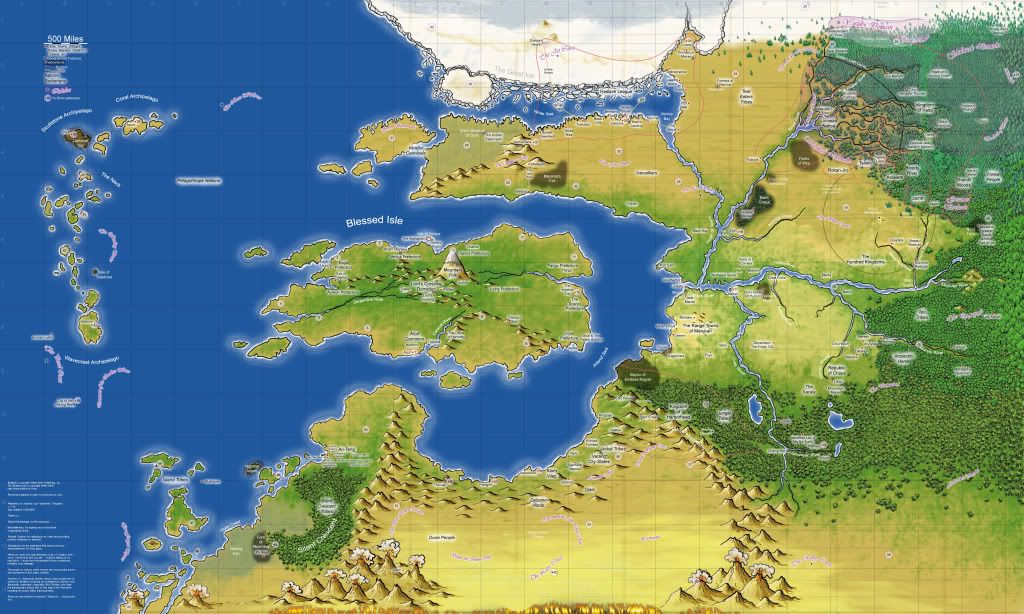
In the real world, the landscape is determined by a complex combination of climate and geography. Deserts, for instance, are usually created by cold ocean currents along their shoreline, with the cold preventing water from evaporating and forming rainclouds. Tundra has to be at the right temperature to remain frozen, which means being either at high altitude or high latitude. Rivers have to source their water from higher terrain (from rain running off mountain slopes and collecting in vast basins). Swamps are generally located in flat-lying areas where the water collects rather than rapidly draining away.
Not so in the world of fictional geography, where you can have a vast jungle next to a desert with nothing separating them and no reason why the two should have different geological features aside from an invisible line. You'll also have swamps on mountain tops and caves full of ice slightly below a sunny surface.
Particularly notable in video games, which often try to pack in a variety of environments in a relatively small space. In older games in particular, a simple Palette Swap will turn green grass into yellow sand, white snow, blue water, or red lava without a hitch. Also tends to happen to maps of Magical Lands. Which somewhat makes sense — everything's possible with enough magic, let alone divine intervention. May be excused by Gameplay and Story Segregation; a game with 12 levels that are all grasslands would be boring. In addition, may be Hand Waved by saying that the game is not to scale with the world it's depicting; that invisible line between the jungle and the desert in the game may be described as several miles of mixed terrain in the tie-in novel.
All that being said, climate can do some weird things in Real Life. As mentioned above, the factors influencing the climate of a particular place are highly complex. Something that should (or shouldn't) happen based on one factor may be cancelled out by one or more other factors which are also present - or even due to phenomena originating hundreds or even thousands of miles away! See the Real Life section below for details.
Something of an extreme opposite form of the Single-Biome Planet. See also Hailfire Peaks, where the different climates are smushed together into a single area. Also note that the sea is typically off to one side and the whole thing fits into a neat square (like any good quilt should). The colder regions are also often located north of the map, and the warmer regions to the south.
For when it's justified by some force randomly or deliberately slotting regions together to create one of these, see Patchwork World.
Example subpages:
Other examples:
- The Digital Worlds of the Digimon franchise are almost always portrayed as this (the big exception being that of Digimon Tamers, which had a very different structure). Thinking back, this is exactly what should be expected in a digital universe. After all it may very well have gotten its strange geography from video games.
- Kemono Friends: Japari Park's geography doesn't make a whole lot of sense, but it has the Sandstar keeping things working.
- One Piece: On Grand Line, there are four different kinds of islands — Spring, Summer, Autumn and Winter Islands. Obviously, that (partly) explains the ridiculously unpredictable weather changes. It also causes the Drum/Sakura Kingdom and Alabasta Kingdom to be neighbour countries. Played straight with Punk Hazard, that has ice on one side and lava on another. It was caused by the battle between Admirals Akainu and Aokiji.
- Similarly to the snow in South Park stopping at the Colorado border, at least one "The Jocks and the Geordies" strip in The Dandy showed it raining in Scotland, and the rain stopping dead at Hadrian's Wall.
- Madcap, nicknamed "the crazy moon", from the Firefly spin-off comic Float Out. Wash uses the wet-to-cold-to-hot environmental changes to take out a pursuing ship.
"Its weird spin and egg-yolk sun give it those turn-on-a-dime climate changes, one right on top of the other."
- The Green Lantern storyline Mosaic featured something similar when a renegade Guardian of the Universe stole parts of a bunch of different planets and pasted them to Oa. They eventually all got sent home.
- Grim Jack: The city of Cynosure consists of a more-or-less stable central region surrounded by areas — "dimensions" — that phase in and out of contact with the central dimension at irregular intervals, so that the composition, size and shape of the city is always changing. A map of the city was published in one issue, with instructions to cut it up along the "dimensional" boundaries shown, then toss the pieces into the air: at some point in their "flight", the dimensions would be in exact correspondence to what the city looked like at one instant in its history (which point and instant was not specified).
- Justified in Legion of Super-Heroes's Sorcerer's World. As seen in The Great Darkness Saga, its geography is constantly changing due to the wizards' love for showing off their magic. So you have a mountain range populated by rock monsters big enough to build cities on them next to an ocean where "cities built atop waves [are] frozen in motion".
- In Middlewest, the Winter Woods is located through a tree line on the other side of a dead Ethol field. It has a very... obvious border. It turns out this is because a human containing the power of a blizzard lives there.
- Battleworld, from the Marvel Comics crossover Secret Wars (1984). It was literally cobbled together by landmasses from different planets, including one from Earth.
- This is also how the Battleworld from the 2015 sequel is built, except it is made up of pieces of the different Earths from the then-destroyed multiverse.
- Nine Days Down: Tartarus is a living dimension that can rearrange its interior at will and operates through magic and story logic rather than mundane climate and natural systems. As such, its landscape is a patchwork maze of forest, prairie, tundra, rivers and wastelands, often bordering each other with extremely sharp and regular borders.
- With Strings Attached: A minor example is the Poison Swamp in Goblin Valley; John immediately pegs it as artificial, noting that the land should have been much too dry for a swamp.
- The Lion King (1994) features a tropical rainforest paradise right beside a large desert. It's made even more confusing in the sequel, where it's shown that the jungle is connected to the Pridelands through the barren, dusty gorge. However, there is a river with a waterfall running through that rain forest. Perhaps it never rains in that region, and so all the wildlife grows right by the river.
- Zootopia: The titular city has several extremely climate-controlled suburbs — a snowed-over polar zone is sandwiched between an extremely dry and windy desert and a wet equatorial jungle. Justified in that the city's infrastructure works to transfer atmospheric conditions from one area to another, creating extremes in both. For example, the air conditioners that freeze Tundra Town produce a lot of heat exhaust, which heats the adjacent Sahara Square.
- The Super Mario Bros. Movie: Princess Peach has a map in her castle that shows the different locations of kingdoms close to the Mushroom Kingdom. All of them have different biomes that aren't too far from each other, such as a desert and an (at this point in the film, destroyed) ice kingdom.
- 10,000 BC changed from (for example) freezing mountains to humid swamps with little transition.
- In the comedy Caveman, one character gets swept by a river that is situated in an arid prehistoric landscape and ends up in a "Nearby Ice Age".
- Return to Oz features the Deadly Desert being right smack-dab next to a thick lush forest. This is a carry-over from the original Oz books; see below under Literature. Also probably justified because of why the region is called "The Deadly Desert": Any living thing that makes contact with the ground there turns into more sand, which would tend to inhibit plantlife from developing no matter the other environmental conditions.
- Appears in Star Trek III: The Search for Spock. The planet in question had recently been created with unstable technology, which made for interesting climate patterns. In the novelisations, the scientists behind Genesis had apparently been competing to see just how improbable they could make the geography by hand-designing things Just So. Although that code was supposed to have been removed… The instability of such climatic adjacencies is shown in the film as well. When they follow their tricorder readings into a desert complete with large cacti, it's currently being covered with snow by the blizzard that blew in from the adjacent tundra region.
- The Belgariad: Lampshaded by David Eddings in The Rivan Codex, where he states that because he's not a geographer or climatologist, the map of his world is probably geologically impossible. At least it's not as blatant as some of the examples here. Somewhat justified in that the geography at the time the books are set was caused by an insane evil god trying to use a magical source of power to kill his enemies and ended up Breaking the World, a cataclysm that kills most of the human race, raises mountain ranges and splits the crust of the planet so a new sea is formed when the oceans flood the gap, cooling the magma rising up from beneath into new crust (which in turn appears to lower the sea level a great deal). If you look at the world map from before the Breaking of the World, found in Belgarath the Sorcerer, it's a lot more geologically plausible.
- The titular island of Dinotopia has grasslands, rainforests, snowy mountains, deserts, swamps, canyons and temperate forests, all crammed on a single island about 200 miles across.
- Referenced (and averted) in the notes to The Discworld Mapp, wherein Stephen Briggs quotes Pratchett as describing traditional fantasy novel mapmaking as "putting the wiggly river through the pointy mountains", before adding that when he showed Pratchett the first draft of the map (which was indeed drawn that way), he got the response "Do you know what a rain shadow is?" and a brief lecture on climatology.
- The Inferno in The Divine Comedy is made of this trope. A burning plain (to punish sodomites and usurers) is right next to a forest (to punish suicides). The center of hell is apparently a frozen lake. Sort of justified, since it is hell, after all.
- In Melanie Rawn's Dragon Prince trilogy, a major river has its source on one side of a group of mountains, flows up through them, and empties out in a bay on the other side. However, this can happen in real life, if the river is older than the mountains it flows through; it cuts through them as they rise, creating a water gap. It's also possible in stream capture, where two streams erode towards their sources and one captures the other.
- Lampshaded in Everworld — the titular Magical Land was created by the mythological gods of our world, with each pantheon having its own territory; however, they didn't bother keeping the geography the same, so the Vikings are about a two-day boat ride from the Aztecs' jungle, who are about a two-day walk from the British landscape where King Arthur's remaining knights live. At one point the protagonists are walking from Everworld-Greece to Everworld-Africa and notice the environment completely change within the course of a few feet.
- Implied Spaces takes place in a world where technology is advanced enough that every rich kid can design his own little world. Most of them try for patchwork maps. The main character is a scholar studying what happens on the borders between the patches, when the physical realities of these constructed worlds start to act. These borders are the titular implied spaces.
- Christopher Paolini's Inheritance Cycle has a desert right next to a dense forest in an otherwise medieval setting. Justified due to the forest being noted to have been grown with the elves' magic and the desert also being very close to a twelve mile high mountain range. The numerous large lakes that lack either tributary or distributary rivers, not emptying or overflowing, are a little harder to explain.
- Cranked up a notch in "Kubla Khan", where a range of climates are placed within a ten-mile circumference:
It was a miracle of rare device
A sunny pleasure-dome with caves of ice! - The Land of Oz:
- L. Frank Baum's series offers up perhaps both the original and definitive example of this trope: Oz is a more-or-less perfect rectangle
 ◊, filled cheek-and-jowl with every known and unknown variety of bizarre landscape and surrounded on all sides by wide expanses of desert. Baum should also be considered a patron saint of Continuity Drift, but in one of the books he established that a passing Wizard (or rather, Fairy Queen) Did It.
- Wicked gives Oz a far, far more realistic landscape, incredibly using only existing continuity to make it into an equivalent of 1930s Earth, right down to the general geographic locations of the regions/continents, which became counterparts. Gillikin is Europe, Munchkinland is (roughly) Asia, Quadling Country is Africa and the Vinkus is North America (specifically, the Native Americans of the Great Plains).
- Alternatively, one could view the Oz in Wicked as a counterpart to the United States, with urban, forest-filled Gillikin as the Northeast; agricultural Munchkinland as the Midwest; swampy Quadling Country as the South (more specifically, the Mississippi Delta and Florida Everglades regions); and the barren Vinkus as the Mountain West. Even Oz residents' opinions of certain regions mirror American regional stereotypes. Quadlings are seen as filthy and uneducated. Gillikin is where the best universities are and the Gillikinese come off as snobbish. The Vinkus is seen as wild and untamed, and something of a wasteland... etc.
- L. Frank Baum's series offers up perhaps both the original and definitive example of this trope: Oz is a more-or-less perfect rectangle
- In The Neverending Story, a desert reaches right up to a forest. It is revealed that a magic talking lion causes everywhere near him to be a desert, but it returns to normal when he's not nearby. At another point, it's explicitly mentioned that it's indeed possible in Fantasia that an icy area borders a hot desert. It's Fantasia, after all. In fact, drawing a map would be impossible even if the country weren't infinite — it's written that the borders between lands aren't always even determinable and are prone to shifting; the lands that a given traveler will encounter tends to have more to do with the nature of their journey than with regular geography and the direction they set off in.
- Lampshaded by the Nintendo Adventure Books, which describe Mario literally crossing an invisible line dividing the lush green grasslands of World 1 from the bone-dry desert of World 2.
- Old Kingdom: The series has a downplayed yet also unique version of this trope. The Old Kingdom has normal regions of mountains, swamps, rivers, forest, laid out perfectly plausibly. However, this ends at the Wall. On the south side of the Wall is the country of Ancelstierre, which, unlike the Kingdom, has no magic, although northern Ancelstierre seems to have a fairly similar climate. However, the Old Kingdom and Ancelstierre are strongly implied to actually be two different realities joined together at the Wall, as the season and time of day is different each side of the Wall. In addition to this, north of the Old Kingdom, the steppes inhabited by barbarian tribes end at the Great Rift, which is described as having either a forest or a dead world on the other side. In general, it is implied that the world is a mixture of multiple realities that happen to overlap.
- Puzzle Island by Paul Adshead: The titular island has lots of different environments, like a desert, a volcano, beaches, grasslands, bodies of water surrounded by lush vegetation, and a valley inhabited by dinosaurs.
- Aenir in The Seventh Tower works like this, with different biomes often being separated along straight lines.
- Mild example in A Song of Ice and Fire. The general pattern of colder in the north -> hotter in the south holds true from the Land of Always Winter down to Dorne. However, Essos doesn't seem nearly as badly affected. Word of God has it that the explanation is supernatural and not astronomical; Word of God also states that Essos isn't quite as badly affected because it's located at a more southern latitude. Westeros is long north to south, narrow east to west, while Essos is the reverse: the northern coast of Essos only reaches up to the mid-point or so of Westeros (where the Neck is), extends a bit further south than Dorne, and a considerable distance to the uncharted east. It doesn't snow in Dorne either, even in winter.
- In Arthur C. Clarke's A Time Odyssey trilogy, planets in pocket universe have mismatch of terrains brought from different times in history as a museum.
- Tamora Pierce's Tortall Universe seems to suffer from this. Roughly based on the outline of Western Europe, it nevertheless possesses a southern desert apparently similar to the Sahara, though smaller.
- Occurs in Suzanne Collins' The Underland Chronicles: in the Underland there are plains, jungles, maze-like tunnels, small seas, arable land and desolate areas all within one or two hundred miles of each other, and no transitions.
- Lampshaded by Brandon Sanderson in the annotations to Warbreaker, where he points out that the geography he needed for Hallendren (essentially a kind of rain forest valley in the middle of a more temperate region), is probably physically impossible... which is why he was vague about exact geographies and didn't include a map of anything bigger than Hallendren the city.
- In Clive Barker's Weaveworld, the odd bits and pieces of terrain incorporated into the Fugue were stuck together in a frantic rush, creating literal patchwork geography.
- In the Well World series, the surface of the Well World is divided into regular hexagons, each featuring its own environment, often startlingly different from its neighbors in climate, biome, atmosphere, gravity, or even achievable tech level, with no apparent separating mechanism other than force walls that just about anyone can shove through without noticing. Justified as the construction of Sufficiently Advanced Aliens.

- In Warehouse 13, the titular Warehouse is located in the South Dakota badlands/desert, but the nearby town of Univille — stated to be just eight miles away — is lush and green.
- Burgle Bros. is played on two or three grids of square tiles, each grid representing a floor of the building. Each tile depicting exactly one type of room (foyer, lavatory, stairs, walkway, etc.). The tiles are arranged randomly, often resulting in floor plans that don't make much sense architecturally.
- Dungeons & Dragons:
- You just gotta love those rivers in the Greyhawk setting. They start at the northern shore, and wind their way south to the bay.
- Eberron:
- The continent of Xendrik works like this explicitly, with such occurrences as sweltering deserts abutting arctic tundra. A Wizard Did It, in that it's all caused by a magical cataclysm in the continent's past.
- It happens in Khorvaire too. Consider Karnnath and The Mror Holds, who have weather like northern Europe or Canada, with lots of snow. Slightly East of them are Lazhaar Principalities, with a Caribbean-like weather and palm trees. Must be a really warm ocean. Regalport (the main Pirate town in a tropical weather) is further north than Frostmantle and Rekkenmark, both of whom are described as cold. So warm ocean indeed. Similarly, Breland is supposed to be a tropical, rainy country, but most of the neighboring lands are depicted as temperate. Khorvaire◊ also has rivers that start nowhere and occasionally go nowhere, and lakes alone in the middle of nowhere.
- Planescape has the ultimate example in Limbo, the Plane of Pure Chaos, where pieces of the plane randomly and seamlessly shift between being completely dominated by one element or another. But, well, justified; Plane of Pure Chaos, you know?
- The Forgotten Realms has the burning-hot Anauroch desert immediately next to the High Ice, Faerun's equivalent of the North Pole. A Wizard Did It.
- The trope is fully justified in the Ravenloft setting. The Land of Mists is composed of artificial landmasses created and sustained by mysterious Dark Powers. Each landmass is separate from the others and bordered by the Mists, in which they drift. The Core (the largest) has a truly patchwork appearance, because each subregion is a "domain" specifically formed to imprison an individual darklord, and its geography and climate has far more to do with that darklord's culture and personal issues than reality. For example, the domain of Lamordia has a far colder and more wintry climate than its neighbors, and the tropical island of Markovia is less than two hundred miles off the coast. The shape of rivers is even more bizarre, as some literally flow into or out of nowhere, apparently emanating from the Mists themselves. There is also a massive hole (the Shadow Rift) cut straight out of the middle of the Core where other domains used to be (they got relocated during a plane-wide cataclysm).
- Creation◊ in Exalted goes with having four major climate forms (desert and volcano, ocean, tundra and glaciers, plains and forests and jungles) and simply confining them to each of the cardinal directions (with the central island continent being largely mountainous). Justified by the fact that things like climate and geography are controlled entirely by gods, as well as by the fact that Creation was designed by beings with some pretty odd ideas about how a world should work.
- The GURPS fantasy setting of Yrth mostly tries to avoid getting too egregious, if only by sticking to the basic principle of "cold in the north, warm in the south" — though the center of the continent seems fairly lush, while the deserts are more coastal, which seems a little odd. (Some of the deserts were blasted into that status by a magical cataclysm, to be fair.) However, that leaves the peninsula of Sahud, north of some bleak mountains and on a similar latitude to the sub-arctic Nomad Lands, which is kind of temperate, being similar to Japan or coastal China. The updated version of the setting in Banestorm attempts to explain this by some handwaving involving a warm ocean current, but it's a pretty blatant kludge.
- Legend of the Five Rings is horrible about this trope. Rivers go any which way (including uphill), cities and whole geographic features are outright misplaced onto the wrong ends of the Empire because the mapmakers weren't paying attention, and to top it all off, it might be an execution-worthy offense to question the actual in-game mapmakers if the gamemaster feels like being strict over it. And it's not really justified by "the spirits", because unless specifically asked they don't do weird stuff like that (they're lazy).
- In one fan-created variant of Magic: The Gathering, you shuffle basic lands into a "board", start out with one creature, and the lands on boards where your creatures are can be tapped for mana. This results in Urza's Saga plains (in Serra's cloud world) being next to...anything. And islands being surrounded by land. It gets weirder if you add nonbasic lands.
- A normal game of Magic tends to eventually result in this, even with decks that only have basic lands. Unless every single land card has the same artwork, they might show the same kinds of formations in different biomes, in different time periods, or even on entirely different planes. Basic Islands are especially notorious for using this frequently, with whatever counts as an island ranging from an actual island, to a shallow pool of water in a field, to a building with water flowing off the side of it. And non-basic land cards cause this even worse, with tropical islands sitting next to glaciers and tourist destinations in major metropolises.
- The author of The Order of the Stick has also published an (unfinished) series or articles on his site about creating a tabletop campaign setting. One of the first things addressed is how to create a realistic map, especially needing to pay attention to things like rain shadows and how rivers behave in order to avoid this trope.
- Averted in Pathfinder, where the world of Golarion is fairly respectful of geographical science. Even areas that are explicitly magically influenced don't stray too far from what's plausible— the land of Irrisien is locked in an eternal winter due to Baba Yaga's magic, but it's far enough north that the winter isn't any worse than normal for the area, it just lasts year-round. Likewise, the enormous hurricane known as the Eye of Abednego is significantly larger and longer-lasting than any normal storm, but it is at least located in an appropriately tropical area of the world.
- Settlers of Catan is played on a map of a single island made of hexagonal tiles, each tile depicting exactly one biome (mountains, hills, forests, pastures, grainfields, and desert); the map is laid out randomly at the beginning of each game. Thus, it more or less runs on this trope.
- Warhammer Fantasy: The Chaos Wastes are a bit at odds with reality thanks to the Realms of Chaos bleeding through from the Polar Gate, so the Grim Up North is interspersed with regions of forest, desert, jungle, and even incongruous farmland.

- BIONICLE's islands of Mata Nui and Voya Nui suffer from this, as each has volcanic, icy, desert, and forest/jungle regions pushing up against each other. On Voya Nui, a couple characters actually note that the forested "green belt" doesn't make sense and they hazard a guess as to why it thrives (there's a Mask of Life nearby; they think it's leeching energy and promoting growth), but we're never given an official explanation for it.
- Mata Nui is ultimately justified when it's revealed that That's No Island.
- This is also lampshaded by Nuju in one of the novelizations, when he is at a loss to explain the ice mountain.
- Zigzagged in the reboot. Okoto's eastern half is part jungle, part marshy lagoon; across the central mountain range there's an abrupt change to volcanic regions, craggy canyons, and large deserts separated by small mountain ranges of their own. The whole thing is capped by an icy region that's separated from the desert by yet another mountain range and which overflows into the marshy lagoon land. On the whole, though, the division of regions is mostly realistic, and there's ancient ruins in the mountains themselves that might explain some of the stranger oddities...
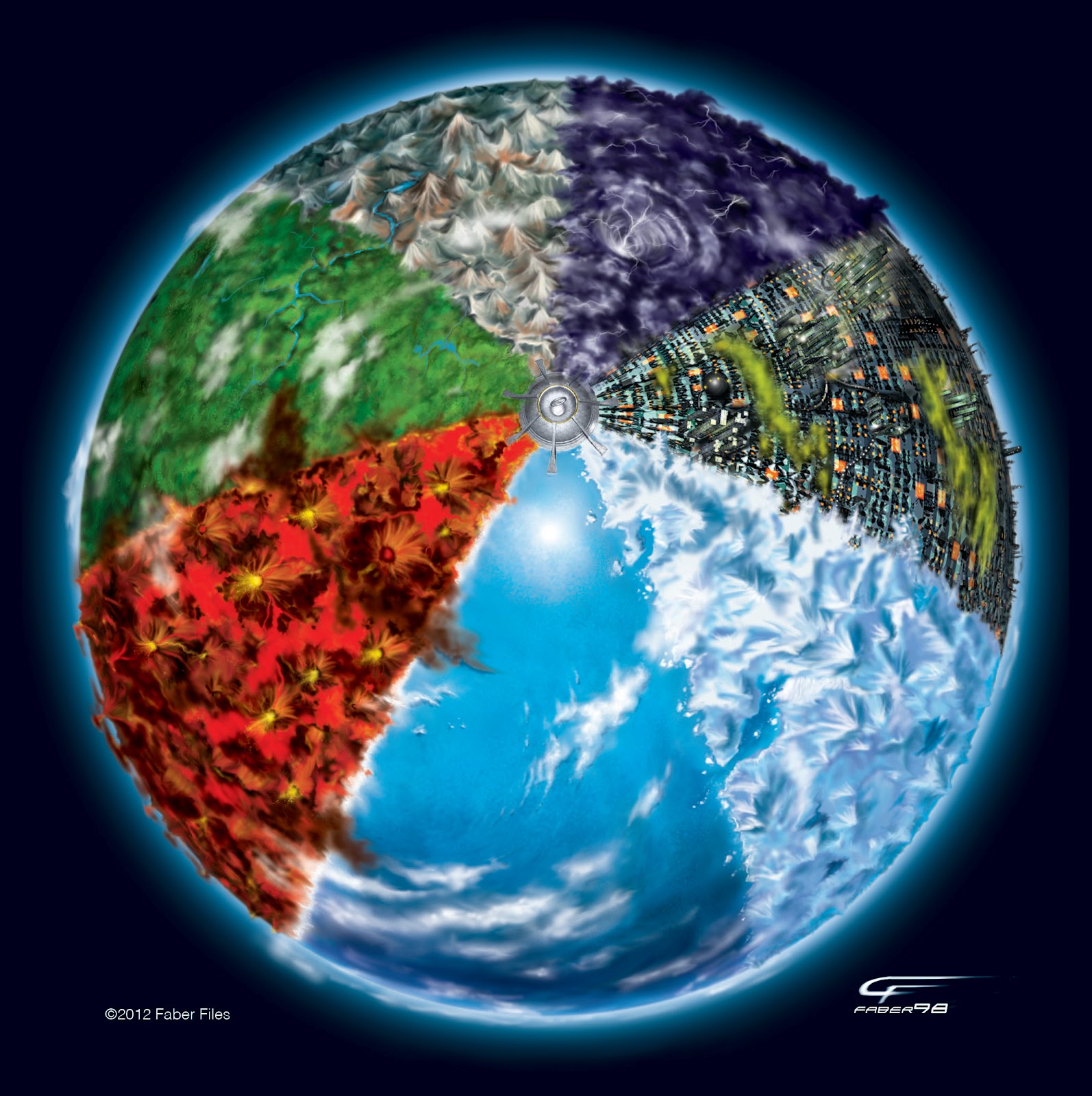
- It was even worse with the earlier Slizer line. Just look at the Slizer Planet◊: we've got a perpetual Swirly Energy Thingy, a Mega City, a frozen mountain range, an ocean, a Lethal Lava Land, a jungle, and a desert, all perfectly shaped to take up exactly one-seventh of the planet's surface.
- Parodied in Red vs. Blue: "The Burning Plains are next to the Freezing Plains? I bet there's some pretty wet plains in between." And it turns out there are some pretty wet plains in between, since after going through the burning plains, but before the freezing plains, they cross a swamp. OK, so it's not exactly a plain, but still, Caboose got something right!
- RWBY: The Ever After is divided into many distinct, hexagonal biomes, separated by a bottomless white void and connected by bridges that strongly delineate the change in environment. The specific sections are known as Acres.
- Dark Legacy Comics treats the subject with an eye to one of the potential ramifications.
- The Noob has the Crossroads, in which each way leads to a differently themed map.
- In Urban Underbrush, this is how you find the capital city -- it's surrounded by this, not the one on the major trade route.
- The author of xkcd says he'd like to live on one of these.
- The Adventures of Teddy Ruxpin: Grundo has a huge desert, a system of caves, a mountain range, rivers, beaches, cliffs, meadows, farmland, a bog, a volcano, a large lake, a jungle, temperate broadleaf forests, and a Fungus Humongous forest. Oh, and apparently a coniferous forest, but it only appears in the books.
- Adventure Time is set in a world where The Magic Came Back and really did a number of the landscape. In particular, the Ice Kingdom and the Fire Kingdom are right next to each other, with only a small temperate strip of land between them.
- A later arc has the protagonists travel to an island where surviving humans experimented with climate and weather control technology. This resulted in biomes right next to each other neatly sectioned off.
- The city of Ba Sing Se in Avatar: The Last Airbender has a large area of Ghibli Hills between its inner and outer walls, but it appears that just outside the wall is a barren dusty desert. Then again, there's a lake inside the area, so maybe they just have good irrigation, and the walls are higher than some of the clouds. (Not to mention a lot of Earthbenders to create channels, transport fertile soil, etc.)
- Similarly, there was a Bugs Bunny cartoon where the drab, unpleasant Northern U.S. was separated from the verdant, flowered South precisely at the Mason-Dixon Line.
- Bugs Bunny's 3rd Movie: 1,001 Rabbit Tales has a lush jungle near or in the middle of an Arabian desert.
- Camp Candy: The camp is located in a temperate forest, but one episode has the main characters getting lost while hiking and ending up in a tropical rainforest on the other side of the mountain.
- Daria: Blink and you'll miss it, but in "Speedtrapped" the countryside goes from the lush greens of Lawndale to the dry desert lands of Fremont in an instant when Daria pulls over to let Quinn drive.
- The Flintstones did it in one episode. Rain up until a border.
- Iggy Arbuckle is set in Kookamunga National Park which contains a swamp, a forest, a desert, a tropical beach, a volcano, a frozen tundra, glaciers, geysers, and a lake; all jammed up against one another. Played for Laughs, obviously.
- It was indicated in a few shots that The Marvelous Misadventures of Flapjack that their version of Earth is literally half land, half sea◊.
- In The Simpsons, Springfield apparently borders almost every type of terrain and climate, with the possible exception of tropical jungle (so far).
- The Smoggies: Coral Island has snow-capped mountains, iceberg-filled waters, warm beaches, farmland, forests, and more, all crammed into one tiny island.
- You know how there's always snow on the ground in South Park? When they went to Nebraska the snow gave way to green fields, with the boundary being exactly at the Colorado-Nebraska state line. Or was the state line being placed exactly on the snow-grass boundary?
- Justified in the Star Trek: The Animated Series episode "The Eye of the Beholder". On the planet Lactra VII the Enterprise crew finds deserts right next to forests, and Mr. Spock comments on how unnatural it is. It's eventually revealed that the alien Lactrans did it to make their planet a giant zoo.
- Transformers: Animated has a volcano on an island in the middle of Lake Erie.


- Can be truth in fiction when the reason for desert/not desert is not obvious. For example there are parts of the world where there is hardly any rain, but copious mist. This condenses on the trees and waters them. However, if all the trees are cut down, the saplings can't take advantage of this and nothing can grow. There are attempts to make artificial rain catchers (sails) to get the trees kick started again. Such an area could have a forest in one place and a bare desert next to it.
- One such example is the Pampa del Tamarugal, over 20,000 hectares of forest in the middle of the Atacama Desert in Northern Chile. Much larger in the past, it was cleared for firewood by the mining industry during the saltpeter fever, and it's being replanted since the '50s, and declared a National Reserve in 1987.
- Likewise rain forests may be self sustaining but can be destroyed. For example the rich soil is continuously used and replaced, thus once the trees are gone the soil is also gone in two or three years. Farming is abandoned, leaving bare ground that radiates far more heat than the forest ever did, preventing rain. I.e. forest and desert are the only two stable equilibria, and could theoretically be close to each other.
- This occurs in Colombia, where the arid scrub grass covered llanos abut directly against the lush rainforests.
- Another example occurs with the largely sheltered canyons of, for example, eastern Washington state, which allow you to have a large river running through bone-dry desert/xeric shrubland.
- The Eastern U.S. has a relatively continuous climate that gradually changes from cold in the north to hot in the south, and from wet in the east to dry in the west. The West is mostly desert, everywhere, except for Washington, Oregon, and Northern California, which are strongly defined by the complex boundaries between forest and desert. You can stand almost anywhere in Silicon Valley and see brown hills on one side and green ones on the other. If you park off I-84 in Oregon you can walk from forest to desert, along a big river flowing sideways through a mountain range. It does happen.
- This is especially true where the Mojave meets the Sierra Nevadas. The scorching desert will often give way to muddy wetlands, snowcapped mountains, and lush forests with little to no distinct gradient between them the more north one goes.
- The "rain shadow" phenomenon plays a big role in the patchwork nature of western North America. Basically, when rain clouds travel over a mountain range the pressure differential makes them dump all their precipitation on the windward face of the mountain. The land on the other side of the range is left virtually bone dry. Since the prevailing winds in the west are coming off the Pacific and the western half of North America is a patchwork of mountains and the spaces between them...
- What happens when you go from west to east in California also deserves a mention due to the contrast of the cold ocean temperatures and hot valley temperatures. Basically, the hot air in the valleys pulls the fog that condenses over the ocean onto the state. As a result, areas right on the coast are colder, foggier, and damper with the land being wetter and greener to reflect this. But drive just 10-20 miles inland and you'll find yourself in hotter and drier climates with the geography being more arid. The temperature between coast and inland can differ by as much as 30 degrees.
- Also true along the northern coast of Iran, where rain shadows play merry hell with the ecology of the Alborz Mountains. Moisture coming off the Caspian Sea causes their seaward slopes to be covered in lush forests, while their landward side is practically desert. In some cases, the two biomes can be on different sides of the same hill.
- New York City's Central Park◊ has a perfect transition with the cityscape. It's manmade though.
- New York State itself, in the terrain sense. It has lowland plains, two plateaus, three sets of mountains one of which is cut off from any other range, and some islands. Climate wise it does stay pretty regular.
- Israel. In a country smaller than New Jersey, there are snow-capped mountains, a desert, coral reefs, and the lowest point in the world.
- This is partially due to the immigrating Jews who made some changes in the scenery, like drying up some swamps to avoid certain diseases (notably malaria in Hadera) and planted trees native to their homelands due to being homesick. A notable example of both was planting eucalyptus trees to drink up the swamp water (though few Jews actually did come from Australia), an attempt that was mostly a failure, as the trees drank water from the ground and not the swamps themselves. (They eventually resorted to using other types of trees.)
- For that matter, Lebanon also counts, possibly even moreso considering that it's also smaller and less populous than Israel. Minus the Negev, Lebanon and Israel's geographies are actually quite similar, except that Lebanon has more mountains.
- In that same vein, Venezuela has snow-capped mountains, desert, gorgeous beaches, thick jungles, plains, snowless mountains, hills, and more!
- One of the most dramatic change in scenery and map patchwork is Western China, due to the little-known mountain range known as the Himalayas shielding the interior region from rainfall. You have lush farmland directly to the south of the mountains in India, then shifting abruptly to the highest mountain range on Earth, snow-capped all-year-round and having the largest and highest amount of glaciers on Earth (the Himalayas is the world's third-largest stock of untapped water, after the Antarctic and the Arctic). Directly to the north is the dry Tibetan Plateau, also known as the "Roof of the World". These combined heights created one of the driest, hottest, and, curiously, the coldest places on Earth: the Tarim Basin, which contains the Taklamakan Desert and its ever-changing temperature. Further north will take you to the the grassy steppes of Central Asia, which itself also contains a desert (Gurbantünggüt) containing the remotest point from the sea on Earth.
- The Himalayas itself also deserves a mention. It is actually located in the subtropics, on the same latitude as North Africa and the Southernmost United States including Texas and Louisiana. Yet it manages to not only be snow-capped all-year, but becomes the world center of glaciers on account of its sheer size, purely due to its great altitude.
- The Desert of Maine, 40 acres of, well, desert-like landscape surrounded by mixed forest with little brooks. TECHNICALLY it's not an actual desert as much as it is the product of over a century of utter agricultural mismanagement. And technically it's glacial silt, and not sand. It doesn't stop them from having a huge Fiberglas camel on site for photo opportunities.
- In Australia, parts of South-East Queensland have small pockets of sub-tropical rainforest in water catching hollows and along creek beds in what would be relatively dry eucalypt forests.
- On a larger scale the Great Dividing Range separates the relatively well watered eastern seaboard from the dry plains that gradually transition into the deserts of the interior. The transition as you go over the range can be fairly abrupt, especially as you go further north.
- Using the Indus river as a dividing line, Pakistan has lush farmland to the eastern banks (the Punjab), desolate wasteland on the western banks (Balochistan), the sea shore and the Mega City of Karachi in the south, and snowcapped mountains in the north (Khyber-Paktunkwha).
- One of the reasons so many production companies love New Zealand so much is its large diversity in a relatively small area. You have cities, mountains, beaches, forests, and pretty much everything except desert wedged into a couple of land masses roughly the size of Colorado. Watch a show like Power Rangers (post Ninja Storm) to see just how diverse New Zealand is. The Lord of the Rings trilogy, also shot entirely in the country, managed to convey the scope of an enormous and varied world much bigger than actual New Zealand with barely any reuse of the same location for more than one place.
- The island of Hawai'i (commonly called "The Big Island") packs a similar amount of diverse geography — lush rainforest, staggeringly deep valleys, barren swaths of land ravaged by recent lava flows, a volcanic desert, wide-open highlands suitable for ranching, and mountain peaks that look like the surface of the moon when they're not covered in snow — into a space slightly smaller than the state of Connecticut. It's possible — though not terribly practical — to ski or snowboard on Mauna Kea (the world's tallest, though not highest, mountain), and then go surfing an hour or two later. Climate-wise, the island has been described as a miniature continent.
- A bit less varied, but the island of Kauai is small enough to drive most of the way around in a single day, going from lush rainforest in the north and east to dry, Grand Canyon-like terrain in the south and west.
- Both the Susquehanna (in Pennsylvania, mostlynote ) and the Brahmaputra (in India) Rivers flow across mountain ranges, and it's thought that the rivers pre-date the mountains and eroded their beds faster than the land around them uplifted.
- The transition between the northernmost regions of Spain and the rest of the country is somewhat dramatic, when you go from the endless, almost flat, and with few trees Spain's plateau to the lush and mountainous Green Spain as is known after crossing the Cantabrian mountains, whose rain shadow produces such effect. Weather makes it even more sonote , especially in summer when you can have in the plateau cloudless skies and searing hot temperatures and in the other side cloudcast skies and (often) drizzle, as well as quite milder temperatures.
- Also in Spain, a milder example of above is caused by the rain shadow of the Sistema Central, a mountain range in the center of the Iberian peninsula. On its northwest slopes you have this vast pine forest, but on the southeastern slopes this granite range, less rich in vegetation.
- Also in Spain, a milder example of above is caused by the rain shadow of the Sistema Central
- Due to the Colorado Plateau, Arizona transitions pretty abruptly from ponderosa pine forests that regularly get snow (north, near Flagstaff) to desert (most of the rest). You can be traveling down from Flagstaff and see nothing but pine forests, and five minutes later be staring at the start of the desert and a rather large amount of saguaro cacti.
- Common for rivers flowing through deserts, with lush, fertile ground abruptly giving way to barren waste with little border. The Nile in Egypt and the Tigris and Euphrates in the Middle East are some of the better known examples. Modern irrigation techniques can have a similar effect on a smaller scale, making for interesting satellite pictures in some areas showing perfect green circles scattered across otherwise brown land.
- Gardening, landscaping, or even farming in general can be considered means of invoking this trope.
- Maryland has so many different landscapes that it's nicknamed "America in Miniature". It's not a very big state, but it features sandy beaches, rocky cliffs, marshes, islands, rivers and bays, beautiful caves, grassy plains, oak-covered hills, and pine-covered mountains. About the only thing it doesn't have is a desert.
- Textbooks showing pictures and names of different landforms will have this to illustrate them and name the features, using Acceptable Breaks from Reality to put deserts and rainforests next to each other.
- Vancouver Island, which is in British Columbia and near Washington State, has such a diverse climate that they host an annual event in April called Snow To Surf that includes skiing down a snowy mountain, running through the forest, mountain biking, kayaking down a river, biking down a road, and canoeing to the ocean. All on the same day. Because the island is so far south yet has high mountains in the center, it has the warmest climate in Canada yet has year-round snow on glaciers, has dry terrain on the east and wet terrain on the west, features dry almost desert terrain, rocky terrain, swamps, rainforests, and old growth forests. With all of this, and you can drive the entire length of the island and see it all in only seven hours.

