

There are times within the life of any teller of tales (not including the Private Eye Monologue that Film Noir is so fond of) in which they are faced with a situation not most dire but not far removed: the writing, while not lacking in such delightful virtues as a sturdy coherent plot or rich characterization, is supremely dry and uninteresting to read.
In response, the writer chooses to indulge in the writing technique known to gentlefolk as Purple Prose, wherein the writing becomes much more florid, eschewing quotidian sentences for elaborate concatenation of phrases and clauses. On occasion, such racks of ornament can be despicable, with the scintillating adjectives bewildering the reader and obfuscating the subject.note In the worst case scenario, such prose will reduce readers to skim-reading for fear of trudging through pages and pages of mundane description slowly and painfully, just as violet-tinted patches on a garment incompatibly hued are agonizing for a human being's photon detectors.
The writing style is named after a quote by Roman poet Horace (65-8 BC, making this Older Than Feudalism), who compared writing such prose to sewing purple patches to clothing. This practice was a common form of displaying pretentiousness in wealth, since purple dye— sourced from a very specific type of snail— was an expensive rarity in those days. "Purple Patches" is used when the writer only occasionally breaks into purple, like scintillating arrays of diamonds appearing incongruously in mire, which can make much of the text more readable but less consistent, so the reader is jolted from one style to the other. (Consistent purple prose at least lets the reader get into the swing of things.)
Several excellent examples, things of beauty and confusion, can be found on the quotes page. This trope does not cover works in a florid but not intrusive style — the sacrifice of Utility on the altar of Eloquence is an essential feature of Purple Prose. It should also be noted that Purple Prose usually pairs flamboyant vocabulary with fairly plain grammar (that can get outright primitive in extreme cases) which differentiates it from true Sesquipedalian Loquaciousness. Bear in mind that Tropes Are Tools. Some of the examples below are intentional: the Purple Prose is a stylistic choice, a comedic turn, or in aid of characterisation.
Compare contrastingly with the phenomenon given the appellation of Beige Prose.
Seek furthermore the silicon entries known as: Walls of Text, Sesquipedalian Loquaciousness, "Burly Detective" Syndrome, and Meaningless Meaningful Words. Mills and Boon Prose is a Sub-Trope; furthermore, that affliction known as Said Bookism is a customary peculiarity of this mode of communication by means of avoiding the dreadful said after a line of dialogue. Similarly, a Tom Swiftie is the action of attributing a punny adverb to a quotation whose content it alludes to.
The most rococo of Narrative Filigree may a'times shade into this. Some communications open on the traditional Dark and Stormy Night. When narrators characterise their visual appearance via a Description in the Mirror, the resultant prose oftentimes can be purple. A Left Field Description (describing important bits in unconventional ways that don't necessarily jump out to the reader) can fall victim to this if the comparison is too out-of-the-blue.
See also Name That Unfolds Like Lotus Blossom, for when this is applied to names.
Examples:
- In-Universe example in R15: Taketo's porn writing is pretty much universally overdone.
- Gustav St. Germain in Baccano! speaks in purple prose.
- The translation of the Lunar: The Silver Star manga suffers badly from this. You basically need a dictionary on-hand at all times while reading, and even then it doesn't always help.
"Luna's voice seemed to vividly evoke a sentimental remembrance of every hope and dream left behind by the bygone ages as she voiced each syllabic word with nonpareil mellifluousness"
- Kaze no Shōjo Emily: In-universe. Emily's style of writing is very vivid and flowery, which charms her classmates. Emily eventually grows up to become a bestselling author.
- Superman Vs. Meshi centers on Superman gaining a Foreign Culture Fetish for Japan. Any time Superman discusses Japanese food, he falls into this.
But one bite and you'll understand! They're green peas...and yet not...they're green peas pro!
- The writing style in The Trigan Empire was very purple. Probably not since Robert E. Howard wrote that Conan the Barbarian was destined to "Tread the Jewelled thrones of the world beneath his sandalled feet" has there been more overblown verbiage in a piece of popular entertainment. Certainly, not many characters in modern comics "slake their ravening thirst" at waterholes or "feel the icy fingers of terror course down their spines"; but maybe the world of comics and the English language are the poorer for it.
- The Avengers: The Korvac Saga - A foreword contributed by Ralph Macchio for the 1991 collected edition was a fairly pale shade of purple, in which writer Jim Shooter's time writing the Legion of Super-Heroes book prior to this story is referred to as "distinguished scrivening", and every big storyline which had occurred in superhero team comics had been "mere prelude" to this one. It's actually quite effective, considering all the purple prose which is actually in this story.
- Star Wars Expanded Universe: The narration of the four-part series about Biggs Darklighter, Luke's friend, sure does love overwrought metaphors. It usually works all right, but now and again gets◊ a◊ little◊ ridiculous.
"The next morning, Tatooine's sky is the venue of a fateful encounter. As blasters fire and men die, a desperate message is sent. A message that will transform the lives of those on the planet below."
— The Tantive IV is boarded. Leia's droids flee in an escape pod.
"Screaming engines rip apart the air. Like blood to a body, a gleaming transfusion of pure hope runs from ground to sky to the waiting frigate. For a moment, dead comrades and missing limbs are forgotten, as G-force slams them without touching their weightless spirits. This is triumph, hard-won. The best kind."
— Rebels steal X-Wings and fly them to a frigate to take to Yavin. - Lampshaded in Supergirl story arc The Strange Revenge of Lena Luthor when "Secret Hearts"'s lead actor Hal Kyle complains that the scripwriter has written unreadable, polysyllabic-ladden dialogue.
Hal Kyle: (reading script) "Statistically speaking, particularly in a dilapidated building like—" (stopping reading) "Statistically"? "Particularly?" "Dilapidated"? Aw, comes on, Greg— That's not a line of dialogue... That's an obstacle course! Greg! I'm talking to you!
Greg Gilbert: Uh—What? Huh?... Something—?
Hal Kyle: I was saying...either rewrite this scene or find yourself an actor with a double-jointed tongue! - Spoofed no less than four times in the Marvel parody comic What The?!, during a battle between Man-Thang and Swamp-Thang. First, the narrator's description of the swamp included a reference to changing a cat's litter box on a hot day; second, Man-Thang chased off after a hot white-haired young woman in a tight dress before the narrator could finish; thirdly, "whoever knows overwriting burns at the touch of the Man-Thang", and finally, the narrator's incredibly long final send-off is ended by a submerging Man-Thang pulling out a "SHUT UP" sign.
- Rorschach's journal in Watchmen is very flowery, especially compared with his near-Hulk Speak. This stems from it being a stream of consciousness — and having poetic elements. Rorschach is nothing if not... layered.
- Alan Moore could be especially bad with this, particularly in his early work. One early issue in his Swamp Thing run went so far as to compare a sunset with slashed wrists.
- Empowered - Lo, the Caged Demonwolf doth speak in a hue most violet! Adam Warren writes his dialogue with the aid of a thesaurus.
- Cerebus the Aardvark: The purple prose in the Jaka's Story and Reads arcs is intentional. In Jaka's Story, it's meant to be written by an Oscar Wilde Captain Ersatz. The prose in Reads is a slightly more snarkified version of Sim's own writing; where it is not purple, it can be suffocatingly verbose.
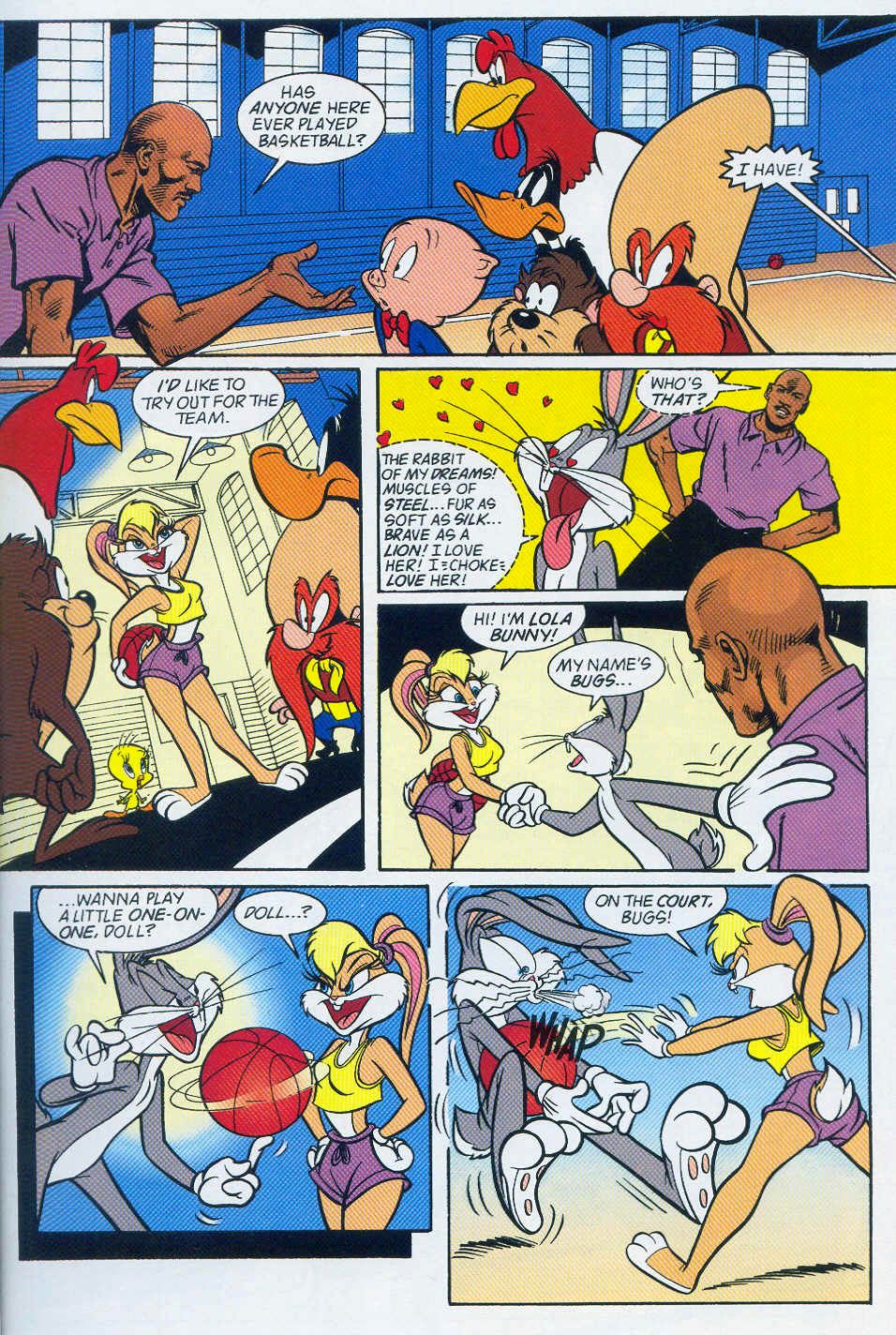
- In this page◊ from a comic book adaptation of Space Jam, Bugs poetically describes Lola as he lusts over her:
The rabbit of my dreams! Muscles of steel, fur soft as silk, brave as a lion! I love her! I *choke* love her!
- A relatively short example, but the Marvel Comics adaptation of The Transformers: The Movie features a rather lengthy explanation of how the Dinobots came in to save the day... from Sludge◊. The Dinobot who, in every other depiction, is the stupidest, most inarticulate member of the team, and he even gets a "Good thinking, Sludge" response from Kup! Incidentally, Ralph Macchio, who wrote all those Introdumps in the first issue of The Transformers (Marvel), wrote the movie adaptation as well.
- Chris Claremont was rather infamous for this kind of writing during his long, influential run on X-Men, sometimes describing even simple actions with long-winded and verbose caption boxes.
- Disney Ducks Comic Universe: A Donald Duck story "Insomnia in Duckburg" has Donald's prose as this in-universe. Weaponized as a cure for insomnia.
- Exuberantly and extensively used in the World War I serial "Golden Eyes" and Her Hero "Bill":
"At the rearing slope of a shell hole, where the roots of a stricken tree, stone and wrecked, earth made a wild heap, they lifted their stealthy lengths, and looked over the crest..... and the moon looked down for a quiet moment and saw—the statue—still, frozen figures of a listening girl and dog, a slim girl and a collie-dog."note
- A Justified Trope, in that it was the style back then (the 1910s) and the author & artist Nell Brinkley's style was nothing if not emblematic of the period.
- Though even the chapter told from the point of view of a dog is told eloquently:
Uncle Sam: And at last in the first, faint gray and rose of the dawn, in the blue-gray ghostly mist of the woods with the faint pink shining through loop-holes, in a smother of snow, we found him.note
- Don McGregor had a tendency to go for overly flowery, poetic narration, as seen in his runs on Black Panther and Killraven, though he did mercifully tend to keep it to the narration. It got a playful jab in an issue of Avengers where T'Challa's contacted by Thor and gives a small paragraph's worth of response which Thor, no stranger to overly-flowery speech, translates as "no".



- My Immortal, where the author describes the details of every outfit to the "blud-collord lace" but then goes to IKEA Erotica for all the sex scenes?
- Spoofed to death in The 2006 Goku-Lytton Awards.
- Tokyo Mew Mew No Hope Left has little tidbits here and there. It's usually just Beige Prose, though. Being set in a World of Ham helps.
- The Neon Genesis Evangelion fic Spacedust And Chaos A Requiem, which tries to become even more of a Mind Screw than its source material.
- Fallen Love: Queen Of Thy Hearts absolutely wallows in it.
- In Stand of the Exiles, Vindicator Alexei's complexion is compared to a "spring sky" no less than three times.
- The Chihuatlan Chronicles - Chihuatlan Razortalon has "golden orbs" for eyes and hair like "multicolored shade of brown silk."
- The Official Fanfiction University Of Middle-earth parodies it with "urple", a disgusting color that covers everything at the university and can't be gotten rid of.
- My Inner Life. The author seems to have an extremely unhealthy obsession with Link's blue eyes.
- The Star Wars fanfiction Shadows of the Future spends an unhealthy amount of time on this. A long chapter is spent describing Obi-Wan's fall into the lava of Mustafar. This fall, in real time, most likely would have taken two seconds. An interesting drinking game can be played by taking a shot every time Obi-Wan asks, in his head, why Anakin hates someone.
- Takamachi Nanoha of 2814 deliberately uses Purple Prose to describe how Vita views Hayate (i.e., like a literal goddess). The author states that doing so was rather painful for him and that he can't possibly understand how fan fiction writers can stand using this so often, reasoning that they have some sort of "anti-talent".
- Thirty Hs is essentially nothing but this, including such gems as "wrought from the silver heart of heaven's false promise" and "their hundreds of sweaty simian dongs trailing a now-fetid memory in the rape ape's watering eye". It somehow makes it even more awesome.
- iCarly fanfic which is normally known for being very simple at the best of times, had a bizarre outbreak of this in anticipation of the episode iThink They Kissed. It eventually got a Deconstruction Fic: Transcending The Definitions and the trend died out after the episode aired.
- The Harry Potter fanfic A Mary Sue Alphabet parodies this trope.
P is for ParisJust swimming in prose!Her lips weren't pink onlyThey bloomed like a rose!Like wheat in the sunshineThe gold of her hairHer eyes, how they sparkledAs clear as the air!Her skin was as whiteAs the robe of a saint
- A Star Wars fanfiction called A Broken Circle has this in spades. The protagonist, La'Ana Shaddem is constantly described as having "forest-green eyes", or, occasionally, "forest-green eyes with flecks of gold". Another Original Character with the ridiculous name "Clah'Diem" is described as having "gold-coin eyes". This ridiculousness reaches a peak when La'Ana and Qui-Gon are going to dinner. A short paragraph is spent with Qui-Gon internally monologuing about how the outfit La'Ana has chosen is "beautiful in its simplicity". (La'Ana's response to this is "I think it makes me look fat".) La'Ana is also constantly described in the utmost detail (but she's not pretty at all, the author wants you to know. Not one bit.)
- A novelized, humanized version of the WALLE film, titled WALLY: The Novelization, Humanized! is so heavily detailed that in some places it takes over 30 lines type just to describe how a character looks. This isn’t helped by the fact that the story contains nudity, sex, gore, and a boatload of other horrors that can only be described by a purple prose master. It makes you glad that they used robots instead in the actual film. Depending on your preferences, once you get past the vivid descriptions, it can be quite enjoyable, and there is an edited version that cuts most of the purple prose.
- The Elfen Lied fanfic Robo Bando uses extreme purple prose to describe how Bando brutally or as the story would say 'awesemely' kills his enemies, yet spends no time describing where the plot takes place or character interactions.
- Turnabout Storm has Twilight's cringe-worthy ancient book on law, which comes with gems such as "Smithe thy prosecuting knave and make the whelp feel thy wrath of the glorious voice of justice".
Twilight: Alright... maybe it's a little outdated...
Spike: A little outdated? - Brainbent parodies this, with Eridan's writing. One character reads some of it and mentions "pages and pages of bad descriptions of boobs", and what we see of it corroborates that. Even his thoughts are written like this.
- Moon Daughter'' is full of this, with the narrator going into painstaking detail about almost every outfit worn by anyone. The other narration is also like this sometimes.
"The sun died a million deaths in red exposions."
- This Homestuck fanfic does it intentionally pretty much any time it switches to Eridan's POV. Then again, it could really be considered Violet Prose.
- Homestuck high uses multi-syllable words at every opportunity, never in the correct context. We're talking "eviscerated" for "said" and "luggaged" for "walked". The similes are no better:
"No Rosa..." Sollux abatemented and he toke of his glasses to reveal the eyes of a worm lordess who crathed the fleash of the billium rectations of lacing china silk and his sockets were emptyed with aluminiem tissues made from the pancreus of god
- Invoked in Sonic X: Dark Chaos, though the story itself typically averts this. Whenever Demonish is translated for the reader, it's quite flowery and dramatic. Background material indicates that it's also pretty much all Woolseyism too, since Demonish is basically impossible for humans to even speak (let alone translate). This trope is also deliberately invoked whenever a character prays to Maledict or Allysion, with plenty of religious references to go with it.
- Though Chlorine Grown Roses is mainly written in Beige Prose, characters' clothing is often described in this. It doesn't help that the author devotes entire paragraphs to describing all of the characters' outfits.
- The Best Revenge gives a sample of Great Wizarding Events of the Twentieth Century which suffers heavily from this.
Most abominable were the crimes of He-Who-Could-Not-Be-Named, and his just fate was no less remarkable than his misdeeds. That an infant, a child only just weaned from his mother's breast, could prove a doughtier opponent than many a battle-hardened Auror may be difficult for posterity to credit, but is unquestionably true. Little Harry Potter was utterly alone: his parents struck down in a viridian blaze. Evil Most Orgulous loomed over the martyred mother, but he reckoned not with the imponderable nature of Magic. Trusting in his own power, he discounted that of others-forgetting that even Merlin was once a babe-in-arms.
Fittingly, the slayer of the innocent and helpless was in his turn slain by the most innocent and seeming-helpless of his victims. A mighty blast-a haunting silence. Did the Terrible Wizard realize in his last moment that The Wheel of Fortune had turned-that another power had risen to thwart his most vile intent? We may picture it-we may imagine the momentary look of astonishment and terror in those red orbs as they perceived his bane rise before him; his disbelief and horror when the Boy proved invulnerable to the Monster's Unforgivable Curse: his despair as he was banished into less than the meanest dust, and his spirit cast into the Outer Darkness from whence it came. Let those of us who suffered savour that vision, and give thanks to Harry Potter, The Boy-Who-Lived... - The Start of a Habit is a RWBY fanfic that invokes this trope deliberately; Blake, eight years old and starved half to death, is offered a sandwich and the narrative switches into flowery over-descriptive Food Porn for a paragraph to describe said sandwich.
- Noted by John in The Keys Stand Alone: The Soft World after he and Paul read a rather overwritten brochure for the Flying Island of Tipaan resort.
- Team Fortress 2 - This edit of "Meet the Spy".
- The Unabridged Memoirs of Darth Plagueis the Wise: The titular Sith Lord often slips into long, verbose metaphors on Sith philosophy and metaphysics while writing his memoirs.
- The Bolt Chronicles: Applies In-Universe to the smut fanfic referenced in "The Cameo," described as "featuring some of the most overripe prose since Edward Bulwer-Lytton's heyday." The few oblique references made to the writing fully support this.
- Flag Flying High takes a potshot at the xianxia style and Chinese language when Harry complains it makes everything he tries to say woefully dramatic and grandiose.
- Narnia and the North has the Calormene ambassador speaking in such a flowery way that his Narnian hosts can barely understand him. It's hinted he actually uses it to seem harmless and slip conditions more advantageous for his country under the table.
- Tales of a Warless World, a SUGURI and sora fanfic, sometimes delves into this when describing the mundanities of everyday life.
It was a lazy Sunday. Well, it would have been. It was a curious phenomenon; before Suguri met Hime, every Sunday was a lazy Sunday. It was the only flavour of Sunday available. You could perhaps make a call to the manager of the Sunday store and ask her to stock new and innovative varieties of Sunday, and she would simply push up her metaphorical glasses and say, “Our consumer data says that Lazy Sundays are the best selling Sunday by far. Do you know how many Lazy Sundays are being consumed worldwide? In fact, we have a 100% takeup rate. Why would we stock anything else, given that everybody loves Lazy Sundays so much?” Well, you would say, Lazy Sundays are very nice and nobody is denying that, but a change is as good as a rest, isn’t it? There’s nothing wrong with trying just a little something new every once in a while to see if you like it. The store manager would look at you, check the data on her phone (which looks suspiciously not like actual data and more like a candy-based puzzle game) and say, “Sorry, but it just wouldn’t be profitable for us. If you want Sundays, you’ll just have to abide by the ones we have, or check with one of our competitors. By the way, the only ones we have are lazy ones, and our competitors don’t exist.”
- When the Brush hits the Canvas: When Link meets Zelda for the first time, the narration suddenly switches to Purple Prose for a whole paragraph as he describes how beautiful she is, with phrases like "hair like a gold waterfall that obscured even the sun".
- Miss Perky's novel in 10 Things I Hate About You is a hilarious send-up of this.
Perky: What's another word for... engorged?
Secretary: [deadpan] I'll look it up. - In The Core, the Captain Ersatz Carl Sagan character frequently dictates purple prose into his tape recorder for the book he's writing about their adventures. He even does so when he and his tape recorder are both trapped in a cabin that's about to be blown up by a nuclear bomb 3,000 miles inside the Earth until he suddenly stops, asks the very apt question, "... What the fuck am I doing?" and starts laughing until the bomb explodes.
- This is Geoffrey Chaucer's job in A Knight's Tale.
- Dear God, don't ask about Edwina's poetry in It's a Wonderful World.
- Criswell's bizarre narration in Plan 9 from Outer Space.
"Future events like these will affect you ... in the future!"
- This is one of the cornerstones of Wizard People, Dear Reader; exaggerated for purposes of satire.
- The original script for The Adventures of Robin Hood had a ton of it, but thankfully director Michael Curtiz insisted the dialogue be made more natural. We get to hear a sample in the DVD commentary.
- Philippe shows hints of this in Intouchables, when dictating a poem to the woman he corresponds with. He is obviously a cultured man, but a great poet he is not - the poem is made of a lot of boring comparisons and little else.
- The protagonist of the low-budget sci-fi movie R.O.T.O.R. indulges in this as part of his "cowboy poetry."
"The day started like any other day. The fresh October morning breeze blew across the ranch, the cattle were coming in for the morning feeding, and a buttery morning sunlight painted a golden glow through the ranch house windows."
- Raising Arizona: All of the dialogue is stylized, with HI's narration being particularly purple in spite of him being a slack-jawed ex-con. Some critics, including Roger Ebert, called out the unrealistic speaking style of the characters in their original reviews.
- Classic literature from the 19th century and before in general have become infamous for this with few exceptions. Writers like Charles Dickens, Thomas Hardy, the Brontë sisters, Alexandre Dumas and Victor Hugo—just to name a few examples—have been lambasted by modern readers for their overly-descriptive styles. This is partly because transportation and communication was much more limited back then than it is now, so elaborate descriptions were a necessity for audiences to know what they were talking about (that, and in some cases authors were paid by the word). Since transportation and communication are much more easily accessed nowadays, modern readers will already have a thorough idea of what they're trying to describe, and thus find their descriptions painfully boring.
- Awoken. Anything regarding Cthulhu/Riley, is rendered in a mix of this and Totally Radical, and especially if it concerns his eyes. Or rather, to put it in the author's words, his "two glistering orbs of eternity except on a cyclopean creature of wonder".
- My Ántonia is positively rife with this. Cather does it skillfully, however, and her florid descriptions generally add to the story rather than distracting from it.
- Unseen Academicals has Mr Nutt, an erudite goblin/orc who uses purple prose as his main form of speech. Being a Terry Pratchett book, this is Played for Laughs.
- A good example is when Trev Likely is trying to write a poem for Juliet (which is going along the lines of, "I think you're really fit, want to go out on a date? (No Hanky Panky, promise)" and gets Nutt to help him make it more poetic. Nutt writes a 3 page poem about her beauty, which Juliet can't make heads or tails of so she gets her friend Glenda (who Nutt has a crush on) to translate it (which she does to Trev's original piece). Glenda suspects though that Nutt anticipated this and that the long flowery poem was meant for her.
- A few of the early Discworld works feature a paragraph or two of metaphor, describing the Disc in some way before the narrator losses track of the metaphor and it becomes a Brick Joke for the rest of the book.
- Done on purpose in Loyal Enemies. Elven etiquette requires the outsider to shower the elves with dozens of praises and grandiose names. When Veres talks to the elven king, it comes off as purple prose both to the reader and Shelena, who relays to us the first ten lines or so of titles he bestows upon Lliotarel and then states that Veres droned on in this fashion for five more minutes before finally getting to the point. Shelena likens this verbal output to diarrhea gained by eating pickled herring with milk. The elven king answers in kind, even though he clearly doesn't want to.
- The Secret River mostly plays this straight, but also parodies it with the letter to Lord Hawkesbury (giving us such phrases as "the pillow of compassion") and Loveday ("we must grasp the nettle, painful though it may be, or else surrender this country to treacherous savages"). The latter isn't even much purpler than most of the text, it's only comic because most of the other characters are far more succinct than the narrator.
- The Eye of Argon - As you might imaginably discern from this epigraph. Such protracted occurrences, unfortunately transcribed to ink-utterances through means of a character-based codex, were no doubt influenced by the minutely less prosaic and infinitely superior Robert E. Howard. People do not find themselves in possession of eyes in The Eye of Argon; they possess "organs of sight" or "orbs". Ears are "auditory organs."
- Nature's God: The Historical Illuminatus Chronicles, Vol. III by Robert Anton Wilson. The following is a quotation:
"Maria had been reading a chryselephantinely overwritten book called Moll Flanders in the coach, and very definitely she thought the somber, passionate, tragicomic and picaresque story was most absorbing, and certainly presented the dark, sinister, underground side of English life in a vivacious and veridical manner that carried conviction, but she wished Mr. Defoe were not so in love with ornamentally excessive adjectives and long, stentorian, and somewhat inchoate sentences that, even by the standards of the time, seemed to twist and turn through curlicues and arabesques and wind on and on through ever-increasing clauses and sub-clauses, including abrupt changes of subject and total non sequiturs, even if he did seem to be making a unique effort to understand a woman's perspective on the world, which was all to the good, of course, and it was less monochromatically monotonous (she had to admit) than the other one he wrote with virtually nobody in it but that one ingenious mechanic on the island, living in total isolation until he found that mute but ineluctable footprint; and yet it could all be told as well and be more pleasant to read if those sentences did not get so totally out of control and sprawl all over the page so often in positive apotheosis of the lugubrious style, and then she wondered if reading so much of such labyrinthine and arabesque prose for so long in the hot carriage had affected her own mind and she were starting to think like that herself, instead of just enjoying the shade of the oak trees and resting from thought in the dense cool quiet of the mid-afternoon English summer."
- If you do not want to slog through that, she's criticizing the book she's reading for its excessive use of purple prose. It's all one sentence, and at the end she finds herself thinking in flowery language too. Chryselephantinely is a Perfectly Cromulent Word — by the time he reaches it he's making fun of the trope. Most of the time his vocabulary is fairly ordinary, but the concepts and scenarios he builds expect that the Viewers Are Geniuses.
- Edward Bulwer-Lytton, whom we recognize for the infamous introduction to Paul Clifford, the first words of which a certain page on the very wiki you are reading is christened in reference to, namely the one known as It Was a Dark and Stormy Night. He got his own writing contest out of this—the winner is the writer who can come up with the most painful opening sentence for a fictional novel. In all justice we must concede that 'It was a dark and stormy night' is not all that bad as an opening line—it's the rest of the paragraph that raises it above awful.
- Ciaphas Cain - While the extracts from the private memoirs of Ciaphas Cain are themselves intriguing and entertaining material for the perusal of the common reader, the editor thereof, Inquisitor Amberley Vail has seen fit to intersperse his narrative with extracts from the autobiographical magnum opus of Lady General Jenit Sulla, who reports her early service under the aforesaid Commissar Cain. Her personal reminisces are inundated with meticulously detailed accounts of her devoted service to the Imperium and that of the women and men who serve under her. Vail, of course, does so with extreme trepidation (and often an apology beforehand), the prosaic nature of these passages being somewhat distanced from her own preferences.
- Though we never see it, Vail implies that Cain's own official memoirs (not the unpublished, private recollections that form the bulk of the text) are also impossibly purple, and that this is apparently epidemic among Imperial Guard memoirs.
- The very first Cain short story begins with a quote from his official memoirs, just before Cain describes those memoirs as "pious humbug and retrospective arse-covering":
'Like any newly-commissioned young commissar I faced my first assignment with an eagerness mixed with trepidation. I was, after all, the visible embodiment of the will of the Emperor Himself; and I could scarce suppress the tiny voice which bade me wonder if, when tested, I would truly prove worthy of the trust bestowed on me. When the test came at last, in the blood and glory of the battlefield, I had my answer; and my life changed forever.'
- For the Emperor instead quotes the text of Stententious Logar, even more purple, without apology. (First book, perhaps it was intentionally toned down.)
- The Inheritance Cycle is simply filled with such a profuse amount of prose with red-blue coloration. A typical example occurs on Page 27 of Brisingr:
Narration: The branch Roran had added to the fire burst asunder with a muted pop as the coals underneath heated the gnarled length of wood to the point where a small cache of water or sap that had somehow evaded the rays of the sun for untold decades exploded into steam.
- Paolini would never say "Saphira flew for a day and a night" when he could instead write: "She flew nonstop until the sun had traversed the dome of the sky and extinguished itself behind the horizon and then burst forth again with a glorious conflagration of reds and yellows."
- A drinking game based on Inheritance has been floating around the Internet for a while: One shot per outlandish simile, two shots per Accidental Innuendo and three for for every simple thing described in great detail. To quote "scary_viking" on Impish Idea: "It would be dangerous even with water - your electrolytes would deplete and you'd die. Might be survivable with Propel, though."
- The queen of purple prose was, Amanda McKittrick Ros. Her works were ridiculed at the time for being so purple as to be incomprehensible.
"Do not sit in silence and allow the blood that now boils in my veins to ooze through cavities of unrestrained passion and trickle down to drench me with its crimson hue!"
- We can attest that is our hope that the speaker here is not referring to an urgent and pressing need for the aid of a good physician due to the untimely departure of copious amounts of circulatory fluid.
- Raymond Chandler: Subverted. His style for his Hard Boiled Detective stories rises above Purple Prose, being very poetic. But attempts by other authors to mimic his style almost universally turn into Purple Prose.
- H. P. Lovecraft. Concerning the things he is writing about, this should not come as surprising. But Tropes Are Not Bad, and at least he had the ability to be genuinely good at it. Furthermore, Lovecraft often deliberately used arcane and obscure terms — such as 'eldritch' and 'shewn' instead of 'shown' — in order to add to the creepy, antiquated feel of his stories. He also liked to think of himself as an 18th century gentleman stuck in the 20th century. He deliberately invoked this trope in The Case of Charles Dexter Ward, where the villain uses 17th century expressions and spelling in the 18th century, and later in the 20th century to hint at his true age.
- Indeed, HPL is evidently capable of a different style - take the conversation segment in Pickman's Model, confirming this is for effect. Also, he was writing in an age of voluminous prose, and while he was elaborate, by the standards of his day he was less so — a reader of Dickens, for example, would view Lovecraft as only mildly more extreme, and often less so (compare the Call of Cthulhu to Nicholas Nickelby or Little Dorrit) and is often maligned.
- Conan the Barbarian - As Lovecraft was to horror, Robert E. Howard was to fantasy (not to mention a great deal of other genres). Conan of Cimmeria always "tread the jeweled thrones of the earth beneath his sandalled feet" as opposed to "walked around". Howard's poetic prose is famous in readers of fantasy literature, and like Lovecraft, he was really good at it. Fittingly, Lovecraft and Howard were co-correspondents, and Conan himself fought an Expy or two of Lovecraft deities.
- Poppy Z. Brite, at least his first couple of novels. He not only acknowledges this, but briefly ran a zine called "Purple Proze", and has since publicly called himself out on the usage of such overblown language. Done on purpose in Calcutta, Lord of Nerves, in which an Indian-American wanders through a wrecked, but somewhat functioning Calcutta overrun by zombies. (in other words, nothing's changed. Except that zombies roam the streets.) A) He wrote it as if the main character was on one of those old style travel novels, B) The narrator loves Calcutta.
- E. E. "Doc" Smith's science fiction, including his Lensman series, tended to fall into this trap. Doc Smith was well aware of this, and wasn't above poking fun at himself. In Children of the Lens, one of the protagonist's cover identities was a writer of Space Opera whose prose was even purpler than Smith's own. Given that he was born in 1895, he could perhaps be excused for having a writing style which was somewhat archaic. It became rather jarring when he would, for no apparent reason, slip out of purple prose in the narration. In among phrases like "indescribably incandescent beams of literally unthinkable power," you have the narrator facetiously Handwaving the deaths of millions of people with a "what the hell?"
- "Fall of the House of Usher" by Edgar Allan Poe. It took longer for him to describe it than it did for the house to actually fall down. All tongue-in-cheek, though. Poe - who had more of a sense of humor than you might expect - mocks this trope in his short story How to Write a Blackwood Article (and its followup, A Predicament):
"...Above all, study innuendo. Hint everything—assert nothing. If you feel inclined to say 'bread and butter,' do not by any means say it outright. You may say any thing and every thing approaching to 'bread and butter.' You may hint at buck-wheat cake, or you may even go so far as to insinuate oat-meal porridge, but if bread and butter be your real meaning, be cautious, my dear Miss Psyche, not on any account to say 'bread and butter'!"
- Justified in the first trilogy of Kushiel's Legacy - it's written from the point of view of Phedre, who would naturally talk that way because of her upbringing. Sidonie snarks in a love letter to Imriel that she was trying to write him in the style of great love poetry, but couldn't pull it off.
- Charles Dickens is still one of the most widely-read and popular Victorian writers, but is also notorious for his overly-descriptive writing style even among some of his fanbase, although being paid for each installment probably didn't help in his case. Nell's death in The Old Curiosity Shop was mocked by Oscar Wilde when he stated "It would require a heart of stone not to laugh at the death of Little Nell." Others have picked up this opinion too. It even shows up in Doctor Who, when the Doctor tells Dickens that section always cracks him up.
- If you take all the purple prose out of A Tale of Two Cities, the book would be about 50 pages long.
- In Great Expectations, the reader is constantly told how beautiful Estella is every time she appears. We get it, Dickens — Estella is really beautiful. We heard you the first time.
- For a wonderful rendition of Purple Prose to rival Eye of Argon for sheer awfulness, check out the introduction of Blood and Roses, a vampire story anthology. Anything that features the phrase "ruptures the hymen of midnight" is gonna be gold.
- Lavyrle Spencer. This "comedy goldmine" thread regarding November of the Heart explains it all.
- Anne Rice, especially in her Sleeping Beauty books. Like Lovecraft and Howard, she was rather good at it.
- Khaavren Romances: Author Steven Brust writes this series in a parody of the purple prose of Alexandre Dumas, with the fictional author Paarfi of Roundwood obviously very impressed by his own vocabulary and skill at turning a phrase. He will often cut into the story to proudly explain some narrative device that he is about to use or spend a paragraph assuring the reader that he will not waste any time in getting right to the next plot point.
- Tracy Hickman, one of the Dragonlance original trilogy authors, was known during the days of writing RavenLoft as "the master of purple prose" and had everything as being either "heavy" or "looming". According to the annotations in, well, Annotated Dragonlance, his editor once found the phrase "loomed heavily" and came straight to his office to strangle him.
- Quoth George Orwell: "I wanted to write enormous naturalistic novels with unhappy endings, full of detailed descriptions and arresting similes, and also full of purple passages in which words were used partly for the sake of their own sound. And in fact my first completed novel, Burmese Days, which I wrote when I was thirty but projected much earlier, is rather that kind of book."
- Thomas Hardy is an excellent writer, but when he does fall into this, he falls hard. Especially in the scenes he describes Eustacia in The Return of the Native
"Her presence brought memories of such things as Bourbon roses, rubies, and tropical midnight; her moods recalled lotus-eaters and the march in Athalie; her motions, the ebb and flow of the sea; her voice, the viola. In a dim light, and with a slight rearrangement of her hair, her general figure might have stood for that of either of the higher female deities. The new moon behind her head, an old helmet upon it, a diadem of accidental dewdrops round her brow, would have been adjuncts sufficient to strike the note of Artemis, Athena, or Hera respectively, with as close an approximation to the antique as that which passes muster on many respected canvases."
- Stella Gibbon's book Cold Comfort Farm is a parody of writers like Thomas Hardy. In an author's note she says that especially verbose passages have been marked with one, two or three asterisks like a travel guide would mark places of interest.
- Bill Bryson thought this applied to the "most exasperating" Australian historian Manning Clark:
"(Clark) is an extraordinary stylist at the best of times - a man who would never call the moon 'the moon', when he might instead call it 'the lunar orb".
- E. R. Eddison and Mervyn Peake are the uncrowned kings of purple prose. The former because his faux-renaissance style gave his endless battles, intrigues, murders, and subversions note . The latter because his solid wall of images and metaphors gave insights into his deeply strange characters that almost nothing else would have pulled off.
- Foucault's Pendulum had a pathological aversion to describing simple action. The other novels by Umberto Eco, and some of his essay books, are no better.
- William Faulkner was notorious for this. He didn't always write this way: see "A Rose for Emily" for an example of writing that is clear and direct. But more often than not he wrote dense, knotty, long sentences. See this passage from A Fable, part of a monologue where an army officer says that World War I is happening because people really like war:
'Bah', the corps commander said again. 'It is man who is our enemy; the vast seething moiling spiritless mass of him. Once to each period of his inglorious history, one of us appears with the statue of a giant, suddenly and without warning in the middle of a nation as a dairymaid enters a buttery, and with his sword for paddle he heaps and pounds and stiffens the malleable mass and even holds it cohered and purposeful for a time. But never for always; nor even for very long, sometimes before he can even turn his back, it has relinquished, dis-cohered, faster and faster flowing and seeking back to its own base anonymity.
- Notably had a feud over this with Ernest Hemingway, who made great efforts to avoid purple prose and write as clearly as possible. Faulkner criticized Hemingway by saying that "He has never been known to use a word that might cause the reader to check with a dictionary to see if it is properly used", and Hemingway fired back by saying "Poor Faulkner. Does he really think big emotions come from big words?"
- And now, the lesson learned from reading R.A. Salvatore's description of Catti-brie: no female character should ever be said to have "thick waves of rich, auburn hair". Or eyes that make men spill secrets by their very... deep... blue-ness. Hell, even the male lead had a "thick mane" of varying descriptions. After awhile he started to sound downright hairy. Makes you wonder what's with Salvatore and hair...
In his other big series, The Demon Wars, mentioned the female lead as having blond hair you could lose a hand in, it's so thick. Admittedly, that is impressively thick. - The Confusions of Young Törless. The plot sounds interesting at first, and it isn't very long, but even the basic fact that these two young boys liked to sleep with a prostitute was stretched out for pages. And pages. And pages.
- Donna Gillespie, in The Light Bearer. As wonderful a novel as it is, the (multiple) sex scenes read like a stoned poet's wet dream. In some places, it in no way even resembles sex.
- David Eddings can write in Purple Prose (and, indeed, write a variety of accents, dialects, and styles to spice it up), and he can do it well, but he's not above poking fun at it.
- In The Sapphire Rose, a goddess brings the party to her domain to give them an emotional boost and some information. They wake up in her place, which is fantastically beautiful and contains nothing but peace, and all the animals there are gentle and beautiful. The descriptions are solid purple, and when the Goddess begins speaking to the party she does so in similarly ornate terms. She has to give up on her speech after a few sentences and revert to a less elevated style because her audience, mostly a bunch of straightforward, plain men, are having trouble figuring out what she's saying.
- In the sequel series The Tamuli, they visit the goddess' domain again, for similar reasons... and start thinking and speaking in purple prose before one of them catches himself and mentally convinces the goddess that they probably aren't the best people to do that to.
- More generally, scenes that relate to fate, prophecy, or the Gods in some way tend to be purple.
- He mocks it in The Belgariad and The Malloreon as well. Any time someone starts using thee and thou a lot, it's like the character's brain temporarily rewires itself into a Mimbrate resulting in them waxing lyrical about the most mundane things. It's taken to such Running Gag lengths that, at one point, even Zakath is afflicted by the "curse".
- Atlanta Nights carries this to extremes. Although this is 100% intentional, as the book was intended to be atrocious. Phrases like "the stark, plain, severe starkness of the unadorned walls" can hardly be taken seriously.
- The Sheik. Though it's a romance novel written in 1919, so that's kind of to be expected.
- Mike McQuay's deplorable novel Pure Blood would, it seems, have us believe that it will rain flaming pâté de foie gras After the End:
"[The rain] bloated the sky full like a fat goose, and when it fell, it was as if some celestial knife had slit the fat goose belly and splashed the innards onto the land in monstrous conflagration."
- Cormac McCarthy tends to use extremely winding, stream-of-consciousness passages, which in combination of his dislike of punctuation tends and often archaic word choices tend to give his books a surreal feeling. It’s sometimes invoked - Judge Holden’s monologues are often so flowery as to be incomprehensible, which he does to confuse and dazzle the barely-literate louts he’s traveling with.
David Foster Wallace speaking about McCarthy: “But it is also, this guy, I can't figure out he gets away with it, he basically writes King James English, I mean, he practically uses Old English thou's and thine's and it comes off absolutely beautifully and unmannered and ungratuitous.”
- Herman Melville was accused of this in most of the original 1851 reviews of Moby-Dick. Seventy years later, just after the world woke up from hurling itself down a path psychologically similar to the novel's captain, critics began revising their opinion slightly. However, the verisimilitude of the artistic theme does not alter the hue of the text. Justified—Ishmael, the narrator, is implied to be a former school teacher, which explains his overtly intellectual language.
- Flowers in the Attic seriously Corrine takes forever explaining about her family's wealth. She actually takes up three pages describing how rich her family is. They do have a long train journey but still...
- Which becomes hilarious in the film adaptation where Corrine just uses two sentences to do this. But when she comes to describe the attic itself, that's where the Purple Prose comes in. And funnily enough she didn't use it in the book.
- The Twilight Saga and its constant description of Edward's perfect, marble, crystalline, Adonis-like beauty, seductive, velvety-smooth voice and liquid-burning-piercing-gold-topaz eyes. Also, Bella's transformation scene in Breaking Dawn, which takes seventeen pages. Take out all the purple prose and all you have left is the occasional Beige Prose and complaining about Forks' bad weather and residents that aren't magical beings.
- In Elizabeth Taylor's Angel, fictional novelist Angelica Deverell writes much purple prose, and, though reviled by critics, is hugely successful, if only for a while. Elizabeth Taylor herself, however, is much more restrained.
- Lolita is a justified example: the purple prose is Humbert's, who is an insufferable academic with delusions of grandeur and trying to make himself seem sympathetic. The Purple Prose is really ridiculous at times — he manages to make picking a wedgie seem elegant and gorgeous.
- J. R. R. Tolkien was an accomplished linguist and writer who took great care to choose the right word and tone in every situation. Usually his works are given a free pass for any purple hue because usually it is well done, and the use of archaisms is intended to create a setting of mythical lost age.
- Parodied sometimes in The Hobbit:
"We are sent from Dain son of Nain," they said when questioned. "We are hastening to our kinsmen in the Mountain, since we learn that the kingdom of old is renewed. But who are you that sit in the plain as foes before defended walls?" This, of. course, in the polite and rather old-fashioned language of such occasions, meant simply: "You have no business here. We are going on, so make way or we shall fight you!"
- The Lord of the Rings also played around with the concept. Text written from the perspective of the Hobbits is notably simpler in vocabulary and structure than those centering around Aragorn, Gandalf, the Elves, and others, reflecting their simpler origins compared to the "grander" Elves and Men.
- Many of Tolkien's unfinished/unreleased works that were later published by his son in anthologies like The Silmarillion or The History of Middle-earth suffer far more from the syndrome; some even come with footnotes for all the archaic words, and several of them are tedious to read. This is because most of them were very early works, most of them unfinished, unpolished and unreviewed drafts.
- When Tolkien showed the first -unfinished- draft of the "Lay of Beren and Luthien" to a friend, that person praised the poem but criticized the purple prose: unnecessary words, archaisms so old that nobody remembered what they meant... Tolkien took those criticism at heart and started a full review of the poem, but he never completed it.
- Parodied sometimes in The Hobbit:
- Travels in Arabia Deserta - Charles M. Doughty wrote this lengthy account of his travels in the Arabian Desert in the 1880s. The first sentence is as follows:
A new voice hailed me of an old friend when, first returned from the Peninsula, I paced again in that long street of Damascus which is called Straight; and suddenly taking me wondering by the hand "Tell me (said he), since thou art here again in the peace and assurance of Ullah, and whilst we walk, as in the former years, toward the new blossoming orchards, full of the sweet spring as the garden of God, what moved thee, or how couldst thou take such journeys into the fanatic Arabia?"
- Justified in that Doughty in that book was consciously modelling the rhythms and idioms of his language on those of classical Arabic. Or so we're told.
- Don Quixote: Parodied and Lampshaded. Cervantes achieved the rare miracle of having a florid style that is clearly understandable. But he recognized and denounced this trope: In the Chapter I Part I, Cervantes explains us that Alonso Quijano went crazy because he tried to understand the purple prose found in the chivalry books:
"where he often found passages like "the reason of the unreason with which my reason is afflicted so weakens my reason that with reason I murmur at your beauty;" or again, "the high heavens, that of your divinity divinely fortify you with the stars, render you deserving of the desert your greatness deserves."
- Another example that uses a style perhaps not as exaggerated as some examples of purple prose, but certainly is overdeveloped and fancy. In Chapter II, Part I, Don Quixote begins his adventure getting up early and riding Rocinante through the countryside of Montiel. Obviously, this brief description is very boring and short. So Don Quixote imagines how some wise wizard will write the beginning of his adventure:
'Scarce had the rubicund Apollo spread o'er the face of the broad spacious earth the golden threads of his bright hair, scarce had the little birds of painted plumage attuned their notes to hail with dulcet and mellifluous harmony the coming of the rosy Dawn, that, deserting the soft couch of her jealous spouse, was appearing to mortals at the gates and balconies of the Manchegan horizon, when the renowned knight Don Quixote of La Mancha, quitting the lazy down, mounted his celebrated steed Rocinante and began to traverse the ancient and famous Campo de Montiel;'- The translation doesn't do justice to the sheer purpleness of the Spanish original, though.
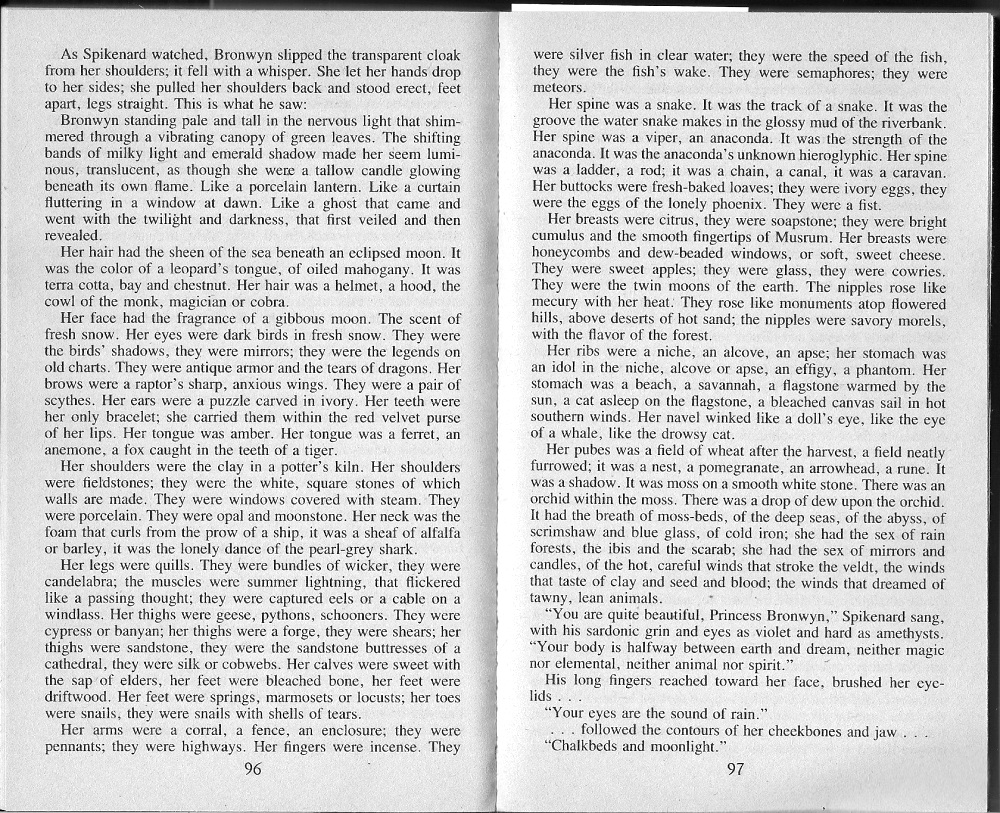
- Ron Miller's Bronwyn Book Two: Silk and Steel has gained a measure of infamy on the internet with this scan.◊
- Matt Stover's work generally contains a fair amount of this. He likes to get philosophical, and in each of his Star Wars Expanded Universe books he expands on the Force as vast and mysterious, and what using it feels like to a powerful Jedi or Sith. This always involves extended metaphors, like Luke Skywalker and the Shadows of Mindor with its life-as-stars and Revenge of the Sith's the Force-as-water.
- Victor Hugo. The man spends at least thirty pages describing the detailed history of every stone in the cathedral in The Hunchback of Notre Dame, not to mention the spider-and-the-fly metaphor he wants to bash into our heads.
- Les Misérables has even more of it. For example, Hugo spends fifteen pages taking about the Paris sewer system, and six pages describing why one of the main characters was Driven to Suicide.
- George Eliot takes aim at this in Silly Novels by Lady Novelists, in particular citing a work entitled Adonijah.
instead of being written in plain language, it is adorned with that peculiar style of grandiloquence which is held by some lady novelists to give an antique colouring, and which we recognise at once in such phrases as these:–"the splendid regnal talents undoubtedly possessed by the Emperor Nero"–"the expiring scion of a lofty stem"–"the virtuous partner of his couch"–"ah, by Vesta!"–and "I tell thee, Roman."
- 20,000 Leagues Under the Sea in nearly every chapter provides a long list of the sea life the protagonists encountered in a particular part of the oceans.
- Played With in Madame Bovary. Gustave Flaubert used Purple Prose to convey the characters' overly romantic hopes and dreams before describing in a much more caustic tone how they inevitably come crashing down when confronted with reality.
- Alan Dean Foster's Splinter of the Mind's Eye has occasional stretches where the characters suddenly get very, very verbose. There's this part, where Leia and Luke have been captured by Imperials who are talking amongst themselves.
"I don't like this, Leia.""You have this wonderfully evocative way about you, Luke, of reducing the most excruciatingly uncomfortable circumstances to the merely mundane."Luke looked hurt.
- Aleister Crowley wrote in this style intentionally in the hopes that his writings would be remembered.
- In dialogue Rudyard Kipling and H. Rider Haggard tend to render the language of Westerners in colloquial and the language of non-westerners in Purple Prose. The apparent oddity of a Street Urchin like Kim jeering at people with "thees" and "thous" is a translation convention, however, reflecting that Urdu and Hindustani make a distinction between a familiar second person singular ("thou"), which standard modern English has lost, and a formal, polite use of the second person plural ("you") when talking to a single person.
- This has some nice examples of romance novels making use of it.
- In fact, it is an unwritten rule of the romance novel genre that this must be used. Some authors pull it off with aplomb. Others... don't.
- This is one criticism Gor can't counter. It might have been justified by the Narrator, but speakers from various educations and countries all use the same style.
- Anita Blake Vampire Hunter Laurell K. Hamilton slips in and out of this both before and after Jumping the Shark, particularly whenever she describes Anita's clothing or an attractive person, male or female.
- The Comedic Hero of Scoop, the 1938 satire by Evelyn Waugh, uses the line in a country column he writes — "Feather-footed through the plashy fen passes the questing vole".
- When Ray Bradbury gets carried away, he can pile on about ten similes per sentence, each more stream-of-consciously bizarre than the last. He's quite good at it.
- Sometimes used deliberately, and to great effect, in Jeeves and Wooster. Bertie Wooster, our narrator, loves to embellish what he's saying, which becomes hilarious when he starts shoving in the Buffy Speak. The other characters aren't averse to this trope, either:
' ... The early fall,' said Gussie, who is a bit of a poet in his way, 'is vaudeville's springtime. All over the country, as August wanes, sparkling comediennes burst into bloom, the sap stirs in the veins of tramp cyclists, and last year's contortionists, waking from their summer sleep, tie themselves tentatively into knots. What I mean is, this is the beginning of the new season, and everybody's out hunting for bookings.'
- Gene Stratton-Porter, especially in the Scenery Porn bits. Or this:
Parting the wild roses at the entrance was beauty of which Freckles never had dreamed. Was it real or would it vanish as the other dreams? He dropped his book, and rising to his feet, went a step closer, gazing intently. This was real flesh and blood. It was in every way kin to the Limberlost, for no bird of its branches swung with easier grace than this dainty young thing rocked on the bit of morass on which she stood. A sapling beside her was not straighter or rounder than her slender form. Her soft, waving hair clung around her face from the heat, and curled over her shoulders. It was all of one piece with the gold of the sun that filtered between the branches. Her eyes were the deepest blue of the iris, her lips the reddest red of the foxfire, while her cheeks were exactly of the same satin as the wild rose petals caressing them.
- When Pat Garrett decided to write "The Authentic Life Of Billy The Kid" he employed journalist Ash Upson to help him along. The unfortunate result is passages of Garrett's dry writing interspersed with terrible flowery writing from Upson, making the whole thing a rather painful read. (Some of Upson's passages are quoted in the Young Guns movie.)
- Roger Zelazny often used this to great effect in his stories, switching to florid, purple prose to describe the more fantastic parts, then back to beige prose to make his characters seem more real and identifiable. He also liked to juxtapose purple and beige prose for humorous effect, much like the Sophisticated as Hell effect.
- Was a hallmark of Romantic Era and Enlightenment Era literature. Not really surprising, considering that the authors and their target audiences were educated in Classical Greek and Roman literature, which could be very florid in their descriptions.
- Catherynne M. Valente's writing is made of purple prose, in particular to create a dreamlike effect in Palimpsest, recreate the vivid imagery of oral storytelling in The Orphan's Tales.
- Kei Shigema's Lunar Silver Star Story: The Call of the Wind, an adaptation of the Lunar: The Silver Star game, is rife with this. As an example:
"Directly below the spacious empyrean, a silver spring of flawless clarity spread out in front of the party of four, imitating the effect of a vividly colored daguerreotype, and mirroring the heavens’ pristine sapphire and the trees’ uncounterfeitable emerald in its placid waters."
- Fifty Shades of Grey uses this a lot, which clashes with unbelievably crass sexual language.
Anastasia: (inner monologue) I flushed. My inner goddess is down on bended knee with her hands clasped in supplication, begging him.Anastasia: I like your kinky fuckery.
- "You beguile me, Christian. Completely overwhelm me. I feel like Icarus flying too close to the sun."
- "Placing my head on my knees, I let the irrational tears fall unrestrained. I am crying over the loss of something I never had. How ridiculous. Mourning something that never was – my dashed hopes, dashed dreams, and my soured expectations."
- Parodied deftly in the sixteenth chapter of James Joyce's Ulysses, known as the Eumaeus episode, where every sentence comes with a long string of tired cliches. The effect is rather like reading bad Henry James.
- Played for Laughs in The Legend of Sun Knight. Given the Light Novel format, the regular narration lacks this, but because the main character is expected to praise the God of Light in every statement he makes, even a simple thank you can take up a thick paragraph. When in private or around people who know about his act, he will mercifully switch to less insane speech patterns-unless he wants to annoy someone into submission.
- Cassandra Clare's writing is on the borderline of this. She seems to be completely aware of this, and occasionally uses it for comic effect or to skirt around curse words. Prime example:
"Jace suggested that the cast of Gilligan's Island could go do something anatomically unlikely with themselves."
- Horatio Hornblower sometimes plays it straight and sometimes Lamp Shades it. The Happy Return has Hornblower mentally describing the morning view of the ocean as "argent and azure" and then laughing at himself because he's been using those exact words every day for the past two weeks. In Lieutenant Hornblower, Forester purple-proses a pulley-and-tackle platform just to point out how much Bush would not see it that way. And in most books, there will be at least a few paragraphs that go into detail about just how beautiful and awesome tall ships look when under sail with no attachment to characterization at all.
- Sherlock Holmes stories. In-universe, Holmes frequently accuses Watson's stories of being this, and while a modern reader may feel this criticism to be accurate, if overly harsh, Doyle's writing was generally far less purple than almost all authors of his period (his clarity was part of the reason the stories were so popular), so Holmes's accusations were originally intended to be far more unreasonable than they seem now.
- Despoilers of the Golden Empire uses its purple prose to great effect, using lots of scientific and poetic language to help establish it as a science fiction story. It isn't.
- The Night Land: The prose is utterly impenetrable, as the author an over-the-top Victorian style. It also doesn't help that nearly half of the sentences are redundant fluff. Here's the first paragraph (not counting the opening quote), and it's not even close to how convoluted the prose can get:
It was the Joy of the Sunset that brought us to speech. I was gone a long way from my house, walking lonely-wise, and stopping often that I view the piling upward of the Battlements of Evening, and to feel the dear and strange gathering of the Dusk come over all the world about me.
- The redundant fluff reaches such degrees that the abridged version of the story only has one-tenth as many words as the original.
- Thomas Wolfe, as demonstrated in the opening paragraph of his story "The Lost Boy":
The light came and went, the booming strokes of three o'clock beat out across the town in thronging bronze, light winds of April blew the fountain out in rainbow sheets, until the plume returned and pulsed, as Robert turned into the Square. He was a child dark-eyed and grave, birthmarked upon his neck—a berry of warm brown—and with a gentle face, perhaps too quiet and listening for his years. The scuffed boy's shoes, the thick-ribbed stockings gartered at the knees, the short knee pants cut straight with three small useless buttons at the side, the sailor blouse, the old cap battered out of shape, perched sideways up on top the raven head—these friendly shabby garments, shaped by Robert, uttered him. He turned and passed along the north side of the Square, and in that moment felt the union of Forever and Now.
- This is probably why his first manuscript was over 1100 pages long.
- Parodied by Mark Twain in a paragraph of "A Double-Barreled Detective Story":
It was a crisp and spicy morning in early October. The lilacs and laburnums, lit with the glory-fires of autumn, hung burning and flashing in the upper air, a fairy bridge provided by kind Nature for the wingless wild things that have their homes in the tree-tops and would visit together; the larch and the pomegranate flung their purple and yellow flames in brilliant broad splashes along the slanting sweep of the woodland; the sensuous fragrance of innumerable deciduous flowers rose upon the swooning atmosphere; far in the empty sky a solitary esophagus slept upon motionless wing; everywhere brooded stillness, serenity, and the peace of God.
- As a narrator and in conversation Thomas Mann's Felix Krull can indulge in this. For instance when he explains the hard times his family went through to the draft board he says things like "With a harsh knuckle ruin rapped on our door", acting out the knocking for emphasis.
- The trademark style of KHunter, one of the human characters in web serial Barkwire.
- When We Were Animals is exclusively written in purple prose, and since it is the first person recollection of the main character, it's inferred that it's just the way she talks.
- Princesses of the Pizza Parlor: Uncle's description by Claire when he calls her over to discuss her princess's abilities:
Claire: Yes, o inimitable maestro of the grand game of the imagination?
Uncle: ... save it for the roleplay, kid. - Lampshaded in "Maureen Birnbaum at the Looming Awfulness" (a humorous short story based on the Cthulhu Mythos), when Maureen remarks, "Bitsy, have you noticed that my narrative style has become, like, you know, dated, clumsy, and ornate? That I'm not talking in the airy colloquial phrases for which I'm justly celebrated? That is one of the insidious effects of my brush with...the horror."
- Tailchaser's Song uses this to showcase how cats see the world in comparison to humans. Most people wouldn't find sneezing anything special, yet Tailchaser's Proper Lady crush Hushpad manages to "sneeze delicately"note . Another example occurs when Tailchaser sees the elegant Queen Sunback, queen of all the cats, for the first time. The narrative notes that she was "nipping delicately at her hind leg".
- Played with in The Immortal Journey, where the narration in the chapters focused on Leif (a centuries old vampire) is noticeably more flowery and pompous than with Emily or Scott, where the writing style is more coloquial.
- Ian Watson's novel Draco is just stuffed with purple prose, as is pointed out when the web series If the Emperor Had a Text-to-Speech Device reviewed it. A particularly damning example; which describes a lamp, the window in front of the lamp and the pattern of the floor; is read aloud by all in attendance, and sends Emps on a rant about purple prose (which can be seen on the quotes page), goes thusly:
Sodium vapour flambeaux behind high false-clestory-windows of stained glass painted patches amber ichor, sap, and haemoglobin across the tesselated floor.
- In Warrior Cats, this is most noticeable when characters' love interests are described. For example, when Thunder first sees Violet in Path of Stars, it describes how "her fur had the rich darkness of storm clouds", how "her long tail was thick and sleek", and how "her ears were wide and soft, framing her pretty face perfectly".
- Rebus author Ian Rankin's introductions to the earliest books in the series, when he was just starting out as a writer and struggling to develop his own style, often express embarrassment at his reliance on purple prose. He singles out one simile from the very first book as particularly cringeworthy: "The sky was as dark as a Wagnerian opera."
- Ellen Hopkins is well-known for her realistic plots and dialogue, but her novel Smoke stands out as being full of Purple Prose. Some samples are a 100% sincere Why, God, why?" and metaphors like "This bed is a quagmire of useless longing."
- The Little House overflows with descriptors of the luxurious apartments within Marquis Trémicour's petite maison. The nature of the text's effusive praise of the finely crafted furniture, elegant architecture, and lavishly expensive décor all mirror Mélite's discovery and admiration of the beautiful setting (while embodying author de Bastide's belief that well-executed interior decorating should capture the senses and bring pleasure to those who experienced it).
- Cthulhu Armageddon by C.T. Phipps: The author deliberately attempts to ape Lovecraft's style in descriptions being flowing and foreboding with words like "antediluvian", "squamous", "unnameable", "cyclopean", "eldritch", and others being used in place of more common descriptors.
- Our Miss Brooks: As befits his Sesquipedalian Loquaciousness, Walter Denton often packs his newspaper editorials and other compositions with purple prose.
- Lampshaded in an episode of Friends where Joey 'bigs' up a letter of recommendation by using the thesaurus on Chandler's laptop on every single word. This results in a description of Chandler and Monica being people with big hearts now describing them as 'humid prepossessing homo sapiens with full-sized aortic pumps'. At the end of the letter, he signs his name "Baby Kangaroo Tribbiani".
- Garth Marenghis Darkplace - Judging from the samplings at the beginning of every episode, Garth Marenghi's writing is full of this. Of course, Marenghi doesn't seem to have a very large vocabulary, leading to an awful lot of repeated words (e.g., padding out a passage by repeating "blood" over and over.) (And bits of sick). By his own admission, he is one of the few people you meet who've written more books than they've read.
- The Big Bang Theory: Played hilariously straight by "Leo", Sheldon's "recovering drug-addicted cousin" (who's actually a theater minor) when he starts to described how he "was abused by a chaplain during his teens." Penny still buys it, though.
- The Australian comedy show Full Frontal had a skit where a romance novelist arrived at a police station to report a theft, which she proceeds to describe in full purple prose. While the cop is trying to work out what "sylph-like" means, another police officer enters saying they've arrested a suspect, whom he describes in the exact same purple prose.
- The writers of The X-Files were very fond of giving Mulder and Scully convoluted, over-worded monologues, even when the monologue was supposed to be the text of an official case report. They also enjoyed cramming it with Fauxlosophical Narration for good measure. One has to wonder how their bosses felt about having to read those things.
- Deadwood: E.B. Farnum and Alma Garret spout almost nothing but purple prose. Thankfully, Al Sweringen is there to balance it out. So do Merrick, Cy Tolliver, Calamity Jane (albeit very dark purple)... hell, the show practically runs off the stuff.
- An early episode of M*A*S*H plays this for laughs, with Radar taking a correspondence course in writing and producing purple reports (done in voiceover).
Potter: Radar what is this cow flubdubbery? All this "miracle medical mortals" hooey. What are you doing to my duty log?
- The characters of Californication refer to an in-universe short story as "too purple", and even spend a minute arguing on the degree of purpleness. One can only assume they're referring to this trope.
- Frasier Crane, from Cheers and Frasier, often speaks in elaborate prose. His brother Niles Crane and his radio host co-worker and restaurant-reviewer Gil Chesterton also speak in a similarly long-winded and overly-indulgent manner.
Frasier: [reading] "Though summer at the lake seems but a vapid, vacuous experience, it is a necessary tonic for my troubled youth..." Niles, how old were you when you wrote this?
Niles: Almost nine. Which explains the redundancy. "Vapid" and "Vacuous".
Frasier: Well..
Niles: By ten, my writing had gotten considerably tighter.
Frasier: Amongst other things.- An episode of Frasier focuses around a novel released without Frasier's consent which is based upon the story of how he lost his virginity. The prose is incredibly over the top in the worst way, to the point that Frasier has to skip over numerous pages to get through a single description.
Frasier: [reading] "There are tangos that come flowing from the wine seas, from the rust of a hundred sunken ships. This is one of those dances."
Roz: Well?
Frasier: There are books that make your stomach lurch and thrust your lunch ever upwards. This is one of those books. - What little we hear of Diane's writing suggests she's like this (bear in mind, this is a woman whose idea of a resignation letter is six sheets of paper and includes graphs). Even when asked to do a case study she purples it up, so small wonder an editor for a book of hers described it as "rough".
- An episode of Frasier focuses around a novel released without Frasier's consent which is based upon the story of how he lost his virginity. The prose is incredibly over the top in the worst way, to the point that Frasier has to skip over numerous pages to get through a single description.
- Whenever Shigesato Itoi showed up as a guest judge on Iron Chef, he was dubbed in such a way that gave him the most over-the-top Purple Prose elaboration possible on how good the food was.
- In How I Met Your Mother the group switches to fancy words mid-conversation to confuse a foreigner, resulting in this exchange of dialogue:
Barney: Within a triad of solar periods, you'll recognize your dearth of compatibility with your paramour and conclude your association.
Robin: My journey was transformative, and I reassert my commitment to both the aforementioned paramour and the philosophies he espouses.
Gael: What are we talking of? Baseball?
Barney: This is all going to return to masticate you in the gluteals. Support my hypothesis, Ted.
Ted: I'm just jubilant my former paramour is jubilant. - In an episode of iZombie, Liv eats the brain of an artist and becomes unable to describe things in anything but the most flowery terms, the kind that a passionate artist might use when describing a scene. When Clive asks her to just tell him what color shirt the guy is wearing, she replies "cerulean", causing him to look at her like she's insane. After all, any normal person would just say "blue".note
- Gabrielle in Xena: Warrior Princess had a habit of this while chronicling the adventures of Xena. In one episode, Aphrodite puts a spell on Gabrielle's blank paper causing it to act similarly to a Literal Genie, causing whatever she writes to come true. Hilarity Ensues, sending Xena on a long fishing trip and confounding Gabrielle, Joxer, Aphrodite, and even Ares until they finally figure out how to break the spell, by describing events as plainly as possible.
- The documentary Victory at Sea is drenched with this.
- In Continuum, Sonya Valentine is so fond of grandiloquent language that Kiera Cameron is able to determine that a Liber8 press release wasn’t written by Sonya because it wasn’t pompous enough.
- A lot of the dialogue in The Lord of the Rings: The Rings of Power is filled with this, trying to emulate Tokien's style (which was admittedly much better, considering Tolkien's extensive background in linguistics), especially coming from the elves.
- In his 2001 song "This Train Don't Stop There Anymore" Elton John sings a line about Purple Prose. The song's lyrics detail John's coming to terms with getting older, and his admission that he has "put one over" on his fans because he was unable to feel the music he was giving to them.
- The chorus to EMF's "Unbelievable":
"The things you say
Your purple prose just gives you away
The things you say
You're unbelievable." - Symphonic metal band Bal-Sagoth is a rare musical example. Most of their lyrics are like that. They also have a love of long titles. A sample from "Starfire Burning Upon the Ice-Veiled Throne of Ultima Thule":
And nine stars illumine the northern heavens, a vast cosmic sigil with the silvern moon at its centre...
Blazing argent light fills the chamber, engulfing the hewn walls of elder ice,
These ancient carvings in a time-veiled tongue, (etched into the primeval ice
countless aeons ago, now bathed in diaphanous incandescence by this storm of
lucent stellar power, their mind-searing meaning at last becomes known to me...
Their cosmic secrets unfold...
The ice-throne is encased by a shimmering wall of writhing cerulean flame,
A lambent flame far colder than the frozen surface upon which it dances... - Almost all Black Metal lyrics, and any attempts these bands make at philosophizing in the album liner notes. This has also become very common with Technical Death Metal, particularly the more melodic acts. There's a good chance that if a band plays tech death, their lyrical approach is going to boil down to vaguely philosophical/metaphysical rambling with lots and lots of this trope. Death-Doom classic Transcendence Into the Peripheral by Disembowelment fits into this as well, if only it could be understood under the guttural growling.
- Led Zeppelin. Justified, since usually whenever their songs go towards purple prose it's because they are referencing The Lord of the Rings.
- Mariah Carey's lyrics are mostly purple prose. She heavily abuses pretty thesaurus words like "inevitably", "sublime" and "splendor". She also has a cheeky romance with the words "nice", "festive" and "bleak".
- Alan Moore's spoken word album The Moon and Serpent Grand Egyptian Theatre of Marvels features lyrics that are downright baroque, describing subjects and references that are equally arcane.
- Progressive Rock tends to follow this trope. Bands such as Yes and Emerson, Lake & Palmer are often criticized for their pretentious lyrics, though in Yes' case it's more for their incomprehensibility. However, many bands such as Rush and Genesis write in high prose yet do it very well. Marillion had a few cases of purple prose in their early days that strayed into Narm territory and no song of theirs has been more accused of this than "Grendel". Exhibit A:
Midnight suns bid moors farewell, retreats from charging dusk
Mountains echo, curfews bell, signal ending tasks
They place their faith in oaken doors, cower in candlelight
The panic seeps through bloodstained floors as Grendel stalks the night - Online music magazine Pitchfork Media is frequently mocked for this, with a common criticism being that the reviewers' writing often overshadows the actual album being reviewed. In fact, this very trait is what brought the site to prominence, when its flowery review of Kid A became one of the first to be published in the wake of the highly-anticipated album's release. The most famous parody is David Cross's Albums To Listen To While Reading Overwrought Pitchfork Reviews, partly written in response to their review of his CD It's Not Funny.
- Skid Row's "In a Darkened Room" dips quite heavily into this, unusually for a post-Hair Metal band (and for themselves as well, considering the rest of their output).
And the innocence
Of a child is bought and sold
In the name of the damned
The rage of the angels left silent and cold...
- The traffic and sponsor sections of Welcome to Night Vale veer into Purple Prose quite often, as well as Cecil's florid descriptions of Carlos's hair.
- Disgraceland: Either you love being pulled into the lives of troubled rock’n’roll icons by Jake Brennan’s vivid descriptions, or you think his prose is self-indulgent and obscuring the point of their stories-or worse, romanticizing their illnesses.
- Dungeons & Dragons: The 1st Edition Player's Handbook and Dungeon Master's Guide, penned by Mr. Gygax himself, are rife with what is endearingly known as High Gygaxian: "While as strict in their prosecution of law and order, characters of lawful good alignment follow these precepts to improve the common weal." It's a major point of contention between diehard 1st Edition fans and everybody else who plays the game. Possibly we can see the effect of Mr. Gygax's deep admiration of Jack Vance.
- Official modules throughout the editions, and plenty of amateur works to boot, have plenty of Purple Prose in their boxed text. Although the adventure description may be clear and concise in the parts meant for the DM, adventure writers seem to have a hard time restraining themselves from writing overly verbose descriptions in the boxed text meant to be read aloud to the players. The whole point of the boxed text is to make sure that the PCs have a good visual description of what their players are perceiving, but the use of florid terminology, run-on sentences, and descriptions of even menial details can often result in the players' losing attention after the first few sentences. Good article on that here.
- Princess: The Hopeful: The Royal Tongue of the titular Princesses is essentially an entire language of this. The Royal Tounge is possibly the single most dense language in existence, to the point where it's popularly suspected to used magic to compress more information into each syllable, and so even a simple greeting would translate into a more natural language as several sentences praising the joy of meeting new people and expressing how happy the speaker is to make the addressee's acquaintance. It's said that the hardest thing to do in the Royal Tongue is to speak a simple and straightforward sentence.
- Most of the Flavor Text from The Matriarch villain deck from Sentinels of the Multiverse, and a Justified Trope: The Matriarch really is trying too hard to sound edgy.
- Cyrano de Bergerac: In the Show Within a Show, La Clorise, a real play written at The Cavalier Years by one of les Précieuse's favorite authors, Balthazar Baró, Giftedly Bad actor Montfleury declaims the first lines... before being interrupted by Cyrano:
Mountfleury: "Thrice happy he who hides from pomp and power
In sylvan shade or solitary bower;
Where balmy zephyrs fan his burning cheeks " - Don Armado, the "braggart" from Love's Labour's Lost, speaks (and writes) in a combination of this and Department of Redundancy Department.
- Innumerable character descriptions on Furcadia. It's not uncommon to see character descriptions like: "You see refractive colorless orbs flash with innocence 'neath cilia of ivory. The lamia rotates 'pon husky limbs... audionts alert and oculars a-ripple... fervid canvas of ruby tinge shimmers o'er her hale frame." note
- World of Warcraft: Install the FlagRSP or MyRolePlay add-on, login to any role-playing server, and look at player character descriptions. A lot of them fall into either short and badly written without a single word spelled right, or a Purple Prose laden opus about luscious bosoms, voluptuous curves and delicate eyelashes, especially if you happened to look for players in areas with bland aces, such as Goldshire, Stormwind's Cathedral Square, or Silvermoon. There are at least two blogs here and here devoted to poking fun at such descriptions. However, "almost◊" is the key word there.
- In Baldur's Gate III The Smart Guy Gale is prone to this, initially describing the party's Puppeteer Parasite infection as a "rather unwelcome insertion in the ocular region". He states that his flowery word choice helps with his spellcasting, which tracks considering that Super-Intelligence is a Required Secondary Power for powerful wizards.
- City of Heroes has free-text character descriptions built in. They fall into either short and badly written without a single word spelled right, or a Purple Prose about luscious bosoms, voluptuous curves and delicate eyelashes — same as RPG servers in World of Warcraft.
- Many of the lines in Arcanum: Of Steamworks & Magick Obscura fit. Justified, given the setting.
- Final Fantasy
- Final Fantasy Tactics was re-released on PSP. They retranslated the Engrish translation into this. Many fans of the original translation deride it for replacing the failed drama charm with Ye Olde Butcherede Englishe; others deride it just for being overwrought. And yet others like it or think that its excesses are as amusing as the original's.
- Final Fantasy XII has a generally straightforward, albeit poetic script. But the Bestiary entries are horribly, horribly guilty of this, especially the 100% Completion alternate texts that delve into Ivalician culture and history. The help box when going against the magic pot turns its basic claims "Gimme Elixir" into hammy Shakespearean dialogue:
The Magic Pot Clamors for an Elixir!
The Magic Pot is Outraged! - Final Fantasy X: Maechen's long-winded lectures on the history of Spira were met with similar complaints by some fans.
- Final Fantasy X-2: If you wanted 100% Completion in you had to listen to every single word of Maechen's long-winded and rather purple lectures, without pressing anything on your controller to advance the dialogue on-screen, even during the long pauses where the game prompts you to interject!
- Final Fantasy XIV: Most of the characters you meet speak in a Shakespearean manner, but Urianger, one of the members of the Scions of the Seventh Dawn, talks like this constantly. As Thancred, another member, points out in Shadowbringers, he likes to "paint pictures with his words".
- Some of the card flavor texts in Shadowverse can fall into this. Jabberwock's, however, stands out — it directly quotes Jabberwocky.
Regular: "Such vociferous jaws and grasping claws! Thy brillig name upon the lips lingereth, and never shall it vade! —Poems of Unbeing"
Evolved: "Thine eyes of flame so blaze! Let thy name resound, unbeing Jabberwock. And the chaos shall as order seem. —Poems of Unbeing" - Warhammer 40000: Dawn of War - Indeed, that's the way the narrator and everyone else in the series speaks. Such speech is usual in the setting. Indeed, everyone speaks in purple, except the Orks.
- Max Payne - As a character, Max talks normally. While doing narration, Max loves this, in the Film Noir style in which the game is a homage of.
- Fire Emblem: The Blazing Blade: Sain speaks purple prose as his second language, especially around women. He mostly does it to show off.
- Fire Emblem: Shadow Dragon's localisation in general leaned very much in this direction, especially compared to its predecessors. While generally very entertaining, some parts and characters (like Navarre) speaking in such a way sort of feel out of place.
- Fire Emblem: Awakening's Virion. Especially noticeable when juxtaposed with Sully's candid attitude.
- Bastian from Fire Emblem: Path of Radiance speaks like this, combined with Gratuitous Iambic Pentameter.
- Golden Sun: Dark Dawn for the Nintendo DS is an overly talky RPG that will take 10-minutes to present a cutscene that could have easily been reduced to a line or two without losing a single bit of relevant information. It's an enjoyable enough game otherwise.
- The original Golden Sun and The Lost Age suffered from the same problem; not to mention a tendency for Kraden to prance about Narrating the Obvious.
- Golden Sun and TLA have scripts that, between them, come out to something like two or three times the word count of Metal Gear Solid.
- The description of Tenuto Village from Eternal Sonata is so much of this.
- In Dwarf Fortress, necromancers will write books, often about themselves, and the book can be described with "the writing is excessively ornate".
- Darkest Dungeon has this for anything the narrator says, right from the intro to the last hit on the last boss. Fitting, considering the setting and likely inspiration.
- Hellsinker is usually filled to the brim with these but perhaps the most notable and most cryptic is the text that appears at the end of the Rex Cavalier battle.
- Dear Esther has rather florid narration, which helps contribute to the Mind Screw of it all. Also Lampshaded:
Narrator: "If the subject matter is obscure, the writer’s literary style is even more so"
- Amnesia: A Machine for Pigs, by the same studio, is set in Victorian London and is rife with this trope.
- Shadow of Rome has many characters which talk like this, probably not surprising since Shakespeare's Roman plays had a big influence here. An example:
Octavianus: "My poor friend Agrippa! I cannot even look him in the eye until this terrible injustice has been remedied!"
- A common criticism of Winter Voices is that the prose, while decent, tends to be overbearing and overly complicated in some sections of the game, which does not work well at all when paired with the game's occasionally poor translation. Though it's still not as bad as some other examples, and some fans actually like the writing style.
- Many item descriptions in the Dark Souls-franchise use rather flowery language to describe simple concepts. Sometimes this is played for laughs, such as the following item from Dark Souls III:
Fallen Knight Trousers: They are dampened and indelibly stained with the misery of flight.
- The Company of Myself not only contains such Purple Prose, because even the preloader and the volume control have it.
- Pirouette conveys most of the conversations through this.
- In-Universe in Fallen London: One of the many ways you can make a name for yourself in the Neath is by becoming an author. The success text for "A Daring Edit" suggests that you have a tendency to fall into this:
You've dared the shambolic barricades of verbiage and brought out a shining... no, let's not talk like that. That's how all this started. Cut it out. Cut it all out.
- The Blind Bruiser in spinoff Sunless Sea tends to fall into this, combining Sesquipedalian Loquaciousness (including some rather obscure but correctly applied words) and an excessively roundabout, overly polite manner of speech with odd constructions like "honest conveyage" and "bomb vwoyi-arge", informal grammar, Department of Redundancy Department turns of phrase, and the occasional Weird Aside.
"Here is your compensation and a little fuel and a few barrels of biscuits what a certain other captain has widely surrendered for the common good. I will take the good word to my patron and if I am a man of my word we will see each other again. Unless a whale eats you of course in which case I 'ope you will not think poorly of me for wishing that we will not."
- The Blind Bruiser in spinoff Sunless Sea tends to fall into this, combining Sesquipedalian Loquaciousness (including some rather obscure but correctly applied words) and an excessively roundabout, overly polite manner of speech with odd constructions like "honest conveyage" and "bomb vwoyi-arge", informal grammar, Department of Redundancy Department turns of phrase, and the occasional Weird Aside.
- The Algophilists' Penury suffers heavily from this, even in room descriptions.
We were algophilists, and this was our miserable abode. On the occidental periphery of our hovel, a portal led into domains more tenebrous.
In the midst of our abode stood the stele, the locus of our lascivious longuer. - YIIK: A Post-Modern RPG: Alex tends to be excessively wordy, especially when he monologues, which happens often. Early in the game he describes an elevator by saying it "...shook, vibrating with motion." There are other characters in the game that can be fairly wordy themselves, but Alex speaks like that more often, and it's more noticeable as he's the protagonist. It was criticized heavily enough that a major update gave the option to reduce the amount of monologues, and a more extreme option that turns him into a Heroic Mime.
- While Cultist Simulator isn't excessively purple, it leans that way. So it's playfully mocked in the Exile's story; they have no time for the ramblings of dedicated occultists.
The Watchman comes before the Velvet... is the kind of thing Adepts say. I think it means that mist is a damper kind of darkness.
- Some of the descriptions in Caves of Qud fall into this. For instance, the three sentences describing Q-Girl, a punkish member of a species of quill-covered bears:

- Lampshaded in Vampire: The Masquerade - Bloodlines, where Alistair Grout complains in one of his audio logs that his fellow vampires have an annoying habit of talking like this for reasons unknown. Then catches himself doing it.
- In the Myst series, the in-Universe Descriptive Books are this. The more detailed the description of an Age is, the more stable said Age tends to be, as long as internal contradictions are meticulously avoided.
- Phoenix Wright: Ace Attorney:
- Everything Luke Atmey says. Ever. To the point that Phoenix has to translate his overly dramatic, verbose ramblings to poor Maya, who's invariably left in the dark.
- Redd White loves to speak this way, sometimes even making up words and confusing those who listen to him.
White: Allow me to furnish you with the title of my personage.
- Perhaps fittingly, Katawa Shoujo's Hisao seems far more vividly descriptive on Rin's route than on other routes.
- Dies Irae is perhaps one of the most word-filled visual novels ever written, to the point that it was many years assumed as untranslatable because of the writing style of the author. This is especially true for anything ever said by Mercurius or Reinhard, the former of which once hangs a lampshade on the fact as he rambles two pages worth of text about his choice of words only to admit at the end that he could have summarized the text as "I talk too much".
- This seeps into some of protagonist Makoto Naegi's narrations in nearly all translations of Danganronpa: Trigger Happy Havoc, though conveying the gravity of the situation probably wouldn't be possible otherwise. While he's describing Sayaka's last message, Kyoko dryly calls him a poet.
- Minotaur Hotel: The narration tends to run into this from time to time, though never overstaying its welcome in the process.
- Irregular Webcomic!: Utilized effectively with the deliberate goal of provoking a response of comedic familiarity in the audience, alongside a conscious acknowledgment of purple prose in the role of an artistic device, within the hereby linked strip.
- This xkcd strip (more of a graph really) mocks the use of Purple Prose and made up fantasy words in fiction
- Rocky of Lackadaisy frequently, and randomly, lapses into Purple Prose — or poetry. Rocky, however, is arguably the strangest and quirkiest of the webcomic's characters, and his launching into such monologues emphasizes that. Prime example here.
- The news section of Penny Arcade is often full of purple prose about Tycho's current thoughts on gaming, mainly in the form of very convoluted metaphors. He sometimes depends on readers being quite literate. Sometimes he does give out some helpful links explaining what he's talking about.
- Vaarsuvius in The Order of the Stick talks like whenever they feel strongly about anything.
- Aaron from Punch an' Pie is a fantasist who talks and acts like he's the hero of a fantasy novel.
- Purple Prose is practically the first language of Rose Lalonde of Homestuck, who extensively uses it (both literally and figuratively) when talking over the IM client Pesterchum. A notorious instance is her wizardly writing journal (later a popular book series post-Reset Button), "Complacency of the Learned", written entirely in purple text or as she would put it, "velvet". Another outstanding example is her GameFAQs walkthrough for Sburb. The game is trying to kill you! Your audience could be DEAD by the time they get through your longwinded introduction! And this is after she went to the effort of keeping it "short".
- Colonel Sassacre's Daunting Text of Magical Frivolity and Practical Japery is literally heavy with this.
- The introductions ofeach character slip into this, for comedic purposes. Lampshaded with Karkat's introduction
- Author Andrew Hussie seems very fond of it in general, at least on the web, especially on moments like when Rose went Grimdark.
You slip into the fabled blackdeath trance of the woegothics, quaking all the while in the bloodeldritch throes of the broodfester tongues. You advise the members of your Complacency not to be alarmed, as they chronicle the event in tomes bound in the tanned, writhing flesh of a tortured hellscholar, with runes stroked in the black tears bled from the corruption-weary eyes of fifty thousand imaginary occultists. But they fail to not be alarmed.- Reading his blog, complete with an epic struggle with online spam messages to obtain a free meal at Olive Garden, should give you a great idea.
- Suzanne de Nîmes, the purported writer/editor of Jet Dream, writes with the bombast and alliteration of a transgender Stan Lee in both stories and letter columns.
- Hyde of The Glass Scientists lapses into purple prose when describing his favourite environment, the slums ("the oily underbelly") of London.
- Vatsy and Bruno: The unscrupulous journalist Vatsy resorts to this. One paragraph from the rejection letter that serves as an introduction reads:
We do not regret to inform you that this submission is unusable, unintelligent and frequently illegible. We do not regret that your mental seepage, poured in such an ungainly fashion on your half-cent-per-thousand-sheet paper, will not be gracing this or any future publication of the Writer's Guild World Newsletter. We do not regret that you will most probably die alone, penniless, unloved and foul-smelling.
- Promise not to Tell - The lead character is so full of it, his eyes are varying degrees of purple. Literally. Note that this is just one part of a chapter of an entire book devoted to this style. Her original writing was not as intense, but through revisions and alterations, it became the purple-people-eating monster it is today.
- Here's an excerpt reads like a mixture of ADD and synesthaesia: "Her face had the fragrance of a gibbous moon. The scent of fresh snow. Her eyes were dark birds in fresh snow. They were the birds' shadows, they were mirrors; they were the legends on old charts. They were antique armor and the tears of dragons. Her brows were a raptor's sharp, anxious wings. They were a pair of scythes. Her ears were a puzzle carved in ivory. Her teeth were her only bracelet; she carried them within the red velvet purse of her lips. Her tongue was amber. Her tongue was a ferret, an anemone, a fox caught in the teeth of a tiger." This wonderfully purple excerpt of Silk and Steel goes on like that for two pages.
- Virtually everything written on Songun Blog (with a touch of Engrish thrown in for good measure). It's a wonder the author was able to keep it up for so long.
- Far too many a Creepypasta read as though their author just browsed through a dictionary while coming up with the dialogue and text. Blood Whistle is a perfect example; it almost seems allergic to using simpler descriptions, instead going on grandiose rambles about things that could easily be summarised in a single sentence or two rather than a whole paragraph. Take note of the following passage, which as a bonus includes a rather egregious example of the author seemingly not understanding what the phrase 'mortality will not escape him' means.note
Mario can't die. The game won't let him. However many things are thrown at him, in however many ways he is brutally maimed, mortality will not escape him. For a time, that is. He will continue to be sustained by whatever dark force or sick mind that drives the rest of these occurrences to passing until the game's eventual end, in which he will ruefully and painfully perish.Without Purple Prose
- The essays at the Michael Jackson fansite Inner Michael sometimes slip into a combination of this and Meaningless Meaningful Words in trying to describe Jackson's brilliance as an artist and a person and how most of the world (especially the media) didn't understand that. An example from one essay:
Imagine the sensitivity of an artistic child; imagine the light, the talent — a geyser erupting from inside, rising in crescendo and its shower of brilliance cascading down and nourishing everything it comes into contact with. That kind of exuberance. Imagine a child's innocence and naivete of knowing only the Source of that light and desiring only the joy of sharing it. Unscripted, unsolicited, unencumbered and sheer joy. Imagine the delight. Imagine the Source-ness of it. Imagine an orange in the peak of the season that as you bite, drips the very essence of the sun as it runs down your chin. That kind of sweet, succulent delight.
- Brutally parodied in the intentionally So Bad, It's Good Fetish Retardant poem, "Hortus Conclusus" (very, very Not Safe for Work, or anywhere else, really). Any work that compares an erect penis to a swollen pustule is really trying too hard.
- Cole Smithey, self-proclaimed "Smartest Film Critic in the World" (which even Roger Ebert scoffed at) and comparatively normal half-brother of the notorious Chris-chan, has made a career of writing reviews like this that make him appear to over-rely on his thesaurus: "'Wild Strawberries' is a thematically abundant film that fluidly condenses a lifetime's worth of experience into succinct cinematic fragments under Ingmar Bergman's complex construction of abstract corollaries."
- While SCP Foundation is known for its cold and clinical writing style, some of the SCPs themselves communicate this way. SCP-089, a statue that either causes or predicts disasters, describes them in extremely flowery ways. For example, its description of a volcanic eruption was:
"The earth shall tremble and the seas shall rise and be cast against the earth, and the mountain shall vomit fire, its voice shall be darkness and death."
- Invoked by Natalie Wynn on ContraPoints when she adopts the persona of a renaissance-era European philosopher named Foppington.
- A small gag on Hey Arnold! when Rhonda writes Curly a fake love letter (with the elegant prose she usually speaks in exaggerated) ...using a purple pen. And it's the colour of her pen that becomes her ultimate downfall.
- Helga, whenever she breaks into one of her soliloquies about Arnold.
- Histeria! had an episode entitled "Riders of the Purple Prose", which showed William Shakespeare and other historical authors as hard-ridin' cowboys.
- The Powerpuff Girls - Mojo Jojo. Some of his dialogue is this; other times it just sounds like it because of the Department of Redundancy Department.
- Stewie from Family Guy used to talk like this. Lampshaded in one time travel episode.
- The Venture Bros.:
- Doc Venture does this in an episode where he's trying to find a lost wreck using an underwater robot. He's narrating into a tape recorder everything that happens, making everything as grandiose as possible, including rewinding the tape and recording over something that he felt wasn't elaborate enough. Almost all of his lines from the episode are purple prose.
- Phantom Limb is also somewhat fond of this — so much so that Baron Ünderbheit suggests they rename their new villain's union The Purple Prose.
- This doubles as a Stealth Pun, as they were also professional villains who wore purple.
- Optimus from Transformers: Prime takes his time to make every line sound as grandiose and verbose as possible, even in the heat of battle. In one scene, him saying the single word "No" as a response to a question was used as a gag. However, many fans are of the opinion that this makes him seem more like an unintentionally comedic caricature of Optimus Prime.
- In the Steven Universe episode "Love Letters", Jamie, aspiring actor and mailman, falls in Love at First Sight with Garnet and writes her a long, verbose love letter (that sounds like something out of Shakespeare). Garnet doesn't reciprocate his feelings, writing him a note back in Beige Prose. However Steven and Connie don't want to break Jamie's heart, so they write a long letter inspired by soap operas. Unfortunately, Jamie misunderstands the letter and thinks that "Garnet" returns his feelings. He then comes and proclaims his love for her, again using this trope (and Ye Olde Butcherede Englishe), outside in the rain.
Jamie: Where art thou, my sweet scorching sunbeam? I read thine letter and I understand. Thou hast returneth mine heart! Garnet, you like my hair just as I adore yours. Come to me Garnet!
Steven: Jamie!
Jamie: Ah, young master Steven. Pray thee, where is Lady Garnet? - Wirt from Over the Garden Wall slips into overwrought amateur poetry in moments of strong emotion.
It must be the Beast out there. The obsidian cricket of our inevitable twilight singing our requiem.
Is the dove never to meet the sea for want of the odious mountain? - In The Owl House, Luz and Amity's favorite fantasy book series The Good Witch Azura is written in extremely flowery (not to mention redundant and repetitive) prose. Even Luz admits that the writing can be somewhat "ornate".
"You shall not shan't doeth no more harm" Azura callethed out all in the native tongue of her foe most formidable. Hecate could only screech, screecheth did she, for the screeching did worseneth...
Twice have I tarried at Tannebrack, yet 'ere have I kept my troth to thee Azura
- Enforced Trope for at least one of Mary Shelley's manuscripts: her husband rewrote a few phrases to make it more purple-y. See this for examples.
- Whenever strict high word counts are in play on essays, some students may find themselves forced to resort to purple prose to reach the required amount, even if they've already summed up their answer in a few thousand words less.
- The public speeches of a certain set of Third Reich dignitaries (one of them being Heinrich Himmler) are uncannily purple. This contrasts both the way the Führer spoke (grandiloquent, but still in a language the common citizen could understand and relate to) and the tone of the newspapers (from dry and official, to humorous and familiar). Some speeches by Himmler sound like they were written by H. P. Lovecraft himself.
- The Supreme Court of India is notorious for its extremely flowery and convoluted language, as Lowering The Bar describes here.
- Spanish language resumes may seem like this to native speakers of English, who are accustomed to more straightforward and concise resumes.
- German documental movies, at least the ones about nature, can go on about "shy crickets" and such for so long it's not even funny.
