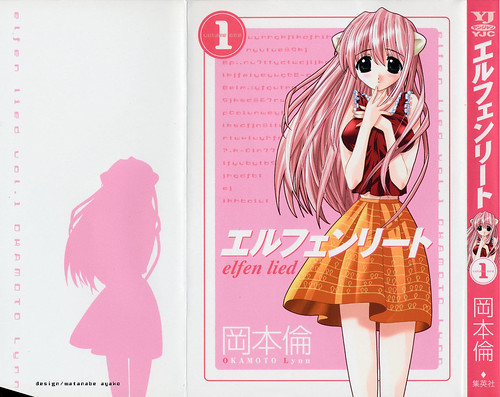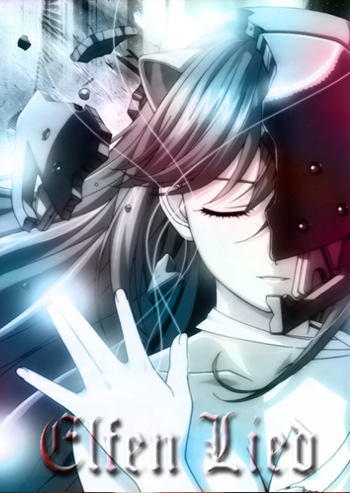
Elfen Lied (pronounced Elfen Leed, not Elfen “Lied”), written and drawn by Lynn Okamoto and serialized in Weekly Young Jump from 2002 to 2005, is a gornographic manga, which has been likened to a combination of X-Men, Carrie, Dr. Jekyll and Mr. Hyde, Friday the 13th, Love Hina, Devilman, Monster, Alien and Predator. In other words, it's a twisted mixture of mutant battles, Psychic Powers, split personalities, pseudo-harem antics, cute girls, the male lead who discovers that the person whom he interacted during that person's childhood is evil, and of course, bucketloads of Gorn — and it's more than happy to swing between comedy and horror at the drop of a hat. It has also been compared to I Dream of Jeannie as done by David Lynch and Wes Craven. There is also a 13-episode anime series of the same name that first aired in 2004, which follows the first couple of chapters but ends with an alternative ending before the real plot kicks off.
The series' title is German for "Elves' Song," or more formally “song of the elves,” and takes its name from the poem "Elfenlied," which is featured twice in the story.
Lucy, a beautiful but lethal Diclonius, escapes from a sinister research facility, brutally slaughtering anyone that gets in her way, whether they intended to or not. However, a glancing headshot from an anti-tank rifle leaves her injured, and she falls into the ocean, unconscious…
Later, university student Kouta and his female cousin Yuka are walking along the Yuigahama beach near Kamakura, when they find a naked young woman with horns on her head. They end up taking her home and calling her Nyu after the only sound she makes.
Between the sinister government agency running the facility, Yuka's jealousy, Nyu's dark and troubled alternate personality Lucy and a traumatic past he cannot remember, Kouta is in deep trouble. Caught between monsters, both human and not, where does his loyalty lie?
The series has become something of a Cult Classic: given the heavy amounts of bloody violence and nudity, not to mention the dark tone overall (which are even worse in the manga), even in Japan the series only aired on satellite TV, as a glorified commercial for the DVD release. In North America, ADV Films didn't seriously think the show would gain widespread popularity, if only for the pragmatic reason that it was limited to mature audiences and could only be marketed to such. There was actually supposed to be a second season, but the show had to end after only one season largely due to lack of exposure in Japan from its limited TV run. Then, purely by word of mouth, it became one of ADV's top-selling North American DVDs of 2005.
Compare and contrast AKIRA, Saikano, Deadman Wonderland, Monster, and F.E.A.R.. For series that deal with a superpowered species, compare and contrast Claymore and Hellsing. Not be confused with Okamoto's one-shot Elfenlied (often written as Elfen Lied), which has nothing to do with this series. Also not to be confused with the Hentai Elfen Laid (often stylized as EL).
Dark Horse Comics licensed the official English translation of the manga, releasing its twelve volumes in four 3-in-1 omnibuses, the first coming out in May 2019.
Provides examples of:
- Abuse Discretion Shot: In episode 5, when Mayu's perverted stepfather tells her to get naked and bend over, we don't get to see what he does next, but it is quite obvious what he will do.
- Adaptational Dumbass: In the anime Bando does some stupid things from attacking his own partner, getting up to Nana's range despite knowing better and trying to jump for his gun once Nana has knocked it away despite already having another one. (In the manga he barely had time to reach for it before Nana stopped him). This is a far cry from his manga counterpart who always played it smart. Even during his first battle with Lucy after she had taken him down, he attempted to find a way to beat her… even if such a thing didn't work out in the end.
- Adaptational Heroism: Both Lucy and Kurama come off as much less messed-up as individuals in the anime than they were in the original manga, with some of the more villainous actions getting cut from the story.
- Adaptational Personality Change: Overlaps with Adaptational Heroism. In the manga, Lucy is a Misanthrope Supreme prone to Badass Boasts, Evil Laughs, Psychotic Smirks or Slasher Smiles and other Evil Is Hammy moments, and her default personality is fairly cocky, actively malicious and spiteful, wantonly sadistic when fighting and torturing real or perceived enemies, and usually completely amoral unless Kouta is concerned. In the anime, while still misanthropic, cold-blooded often cruel and with no moral convictions except when it comes to Kouta, Lucy is more often The Stoic and is less openly contemptuous of others, less overtly malicious, and overall more sympathetic in her portrayal.
- Adaptation Dye-Job: Diclonii in the anime all have varying shades of pink hair. In the manga, Lucy's is a light pink, Nana has bluish-purple, and Mariko has blonde.
- Adopting the Abused: Mayu was sexually abused by her stepfather. And when she told her mother, she blamed Mayu for the abuse, claiming her husband showed no interest in her because Mayu was around. Mayu ran away from home, where she ran into Kohta and Yuka. A brief scene is shown where Mayu's mother is seen signing her parental rights over to Yuka.
- All of the Other Reindeer: A recurring theme. It's implied that every diclonius goes through the same thing Lucy does: bullied by humans for being different until they snap and kill them, proving the humans right.
- Ambiguous Situation: In the manga, the Diclonii's DNA voice is shown to be an alternate personality that takes control of Lucy, but in the anime, its exact nature is not clear. In the anime, Lucy doesn't mention the voice as the reason for her actions, and when the voice talks to her in the festival scene, one of the bystanders says that Lucy is talking aloud to herself, which implies that she's hallucinating.
- An Arm and a Leg: Happens very often. Diclonii are capable of ripping living things (mostly people) apart limb from limb. Lucy does most of it, though.
- And the Adventure Continues: The manga leaves off on a wild card: Anna, who is revealed to be (or regresses back into) an intact human, awakens to Nousou's Bifauxnen assistant/bodyguard, Nozomi's voice recovers, and Kouta begins his life married to (presumably) Yuka. The last page shows two twins (who are likely the reborn Lucy and Nyu) about a decade later arriving at the grave of Lucy's pet dog, to an older Kouta and his daughter.
- Anti Anti Christ: Villain Protagonist variant with Lucy. Though Kakuzawa expects her to lead the diclonius race and replace humanity (presumably with himself serving as The Man Behind the Queen), she's not particularly interested in the job. She later winds up killing him and (mostly inadvertently) plays a big role in saving humanity.
- Apocalypse Wow: The manga has some fun near the ending, including an impressive ten or so pages dedicated to Lucy destroying the world when she accidentally thinks Kouta is Killed Off for Real; he's not. There's also many treats to the eventual destruction of the research facility, which is ripped apart from below the ground up with
 Lucy's vectors after she kills Kakuzawa.
 - Art Evolution:
- Art Imitates Art: The opening credits are in Gustav Klimt's characteristic, Art Nouveau-like style.
- Artistic License – Law: In the manga finale, the World Health Organization issued a birth ban until the Diclonius birth vaccine could be distributed. The WHO has no authority to order UN member nations to do anything. At best, they can strongly recommend actions, but the rest is up to every single national government on Earth.
- Artistic License – Physics:
- When an enemy is out of reach of their vectors, a Diclonius will typically use her vectors to instead throw objects at them. These thrown objects invariably behave like a bullet or arrow, regardless of the actual aerodynamic properties of the object in question.
- Of course, we're talking about very small objects thrown at the speed of a bullet, like that pen that's thrown into a soldier's eye. Played straight for extremely large objects.
- Artistic Title: "Elfenlied" is German for "elf song", and is the title of a poem by Eduard Mörike
 (but it's not the Latin poem, "Lilium", sung during the anime's opening).
 - Attack of the Town Festival: The end of Lucy's Start of Darkness involves a bloody rampage in the middle of a town festival.
- Barbie Doll Anatomy: Common in the manga, and happens a handful of times in the anime as well. There are a number of full-frontal nude shots and while neither the anime nor the manga is shy about detailing nipples, the crotches are invariably left featureless. note Though in this case, it's justified in that most Diclonii encountered in the story are Silpelets which are likened to worker bees. As they're sterile, they may also physically lack any primary sexual characteristics as well. Lucy, on the other hand, is a "queen" and fully capable of sexual reproduction so she's presumably better equipped, so to speak.
- Big Bad: Director Kakuzawa runs the research facility and is responsible for all the horrific experiments the Diclonii suffer through. He plans to capture Lucy and use her to Kill All Humans then replace them with a new Diclonii race that he will rule over as a god. As such, he is essentially the living distillation of the cruelty of humans. Once he is killed, however, there's one more villain left to face: the Diclonius DNA voice. She was the one manipulating Lucy and the one implied to be behind the Diclonii's madness, and could be considered the true antagonist, especially when she nearly destroys the world.
- Bloody Horror: Lucy is frequently covered in blood after killing people with her psychic powers. When Kouta finally witnesses this in the anime it's extremely traumatic for him since he had been trying to protect her and befriended her throughout the series, and because he has PTSD from a traumatic past. Heck even her origin story as noted above involves her being covered in blood this way.
- Blood-Splattered Innocents: On numerous occasions, but most notable is Kanae during Lucy's rampage at the festival.
- Bloodier and Gorier: While the manga is still pretty gory, the anime exaggerates it. A good example is Kisaragi's death- in the manga her head is ripped clean in one swing, while in the anime it's gruesomely twisted off.
- Bloody Handprint: Which isn't shown anywhere in the manga.
- Bolivian Army Ending: In the anime… kind of. Later revealed to be a plain old Cliffhanger.
- Break the Cutie: Every single goddamn one.
- Breather Episode: Episode 10.5, the OVA, an extremely loose adaptation of Chapter 85-86, which explains how Lucy was captured in the beginning of the manga. A nice break if one is going through the series in one sitting.
- Brick Joke: In the manga, Nozomi's diaper.
- Bring It: Lucy gives one to Bando and Nana during their final showdown on the beach.
- Bullying a Dragon: Various people (Nana and Bando in particular) continue to trash talk Lucy even after they've seen exactly what she's capable of. This decision ends badly for them. Bando also tries this on Nana, and it ends almost as badly.
- Caught in the Rain: When Kouta and Yuka are looking for Nyu and it suddenly starts raining. By the time they find shelter at a nearby shrine, they're both drenched, so they huddle together for warmth. Yuka admits her feelings for him, kisses him unexpectedly, and tells him that she doesn't want to be separated from him again. Kouta wipes her tears away and returns the kiss. The rain stops just as suddenly as it started, and when Kouta comments on it, Yuka realizes what she did, panics a little, and falls off of Kouta's lap. Cue Panty Shot, Accidental Pervert, and Megaton Punch.
- Clash of Evolutionary Levels: Diclonius/Diclonii, or Homo Diclonius, are a newly mutated subspecies of human. Their appearance is similar to humans, but with several differences, namely horn-like protrusions on the forehead and the presence of telekinetic invisible arms called "vectors." Diclonii are hated and feared by the few people who know about them, as they seem to have an innate urge to kill humans (the entire reason why people became aware of them is because when they develop their vectors at age 3 they kill their families). Once this was known, it resulted in all known Diclonii being euthanized soon after birth or kidnapped and locked away in a government facility that performs painful experiments on them. It's revealed that Diclonii have a "DNA voice," or a genetic drive to kill humans and take their place as Earth's dominant species. However, there is some ambiguity as to just how much this can be averted by childhood circumstances; every Diclonius in the series has been abused by humans to the point where their biological survival instinct has fused with their psychosis, which insists that humans must be eradicated or they will eradicate the Diclonii. There are some hints that if Diclonii were treated better by humans they could learn to suppress their murderous urges.
- Combat Tentacles: Diclonius vectors might certainly count as these.
- Confidentiality Betrayal: Played for drama and horror. In a flashback, Lucy shows the one human who shows her any kindness a dog that she cares for and asks her to keep the dog a secret. When the boy who bully Lucy find out about the dog, they reveal Lucy's friend to be the one who told them about it just before beating the dog to death. This gets Lucy to absolutely lose it as she uses her powers to slaughter all of them in retaliation, her former friend included. This is also what causes Lucy to develop a huge hatred and distrust toward humanity.
- Contrived Coincidence: Once it's revealed that Lucy and Kouta met as children, it gets hard to believe that Lucy washing up on that beach would coincide perfectly with Kouta's return to that village for the first time in several years, and that both would have Laser-Guided Amnesia, and that Kouta's university teacher is the son of the Big Bad, and that Mayu happens to witness the fight between Lucy and Nana… Well, you can see where this is going.
- Covers Always Lie:
- Compared to the amount of blood and violence in this series, and how mentally scarred Lucy is, she sure does seem calm and serene on the DVD and manga covers.
- "Awww, look at that manga cover, with the incredibly moe pink-haired girl on the front.◊ This looks like a pretty innocent ser-WHY IS THERE SO MUCH BLOOD!?"
- Crapsaccharine World: The melodrama takes places in a nice little coastal city and a very pretty inn.
- Crapsack World: Besides the nice-looking coastal city the series takes place in, apathy and discrimination run rampant, where being a Diclonius means a lifetime of being broken repeatedly and being a human means living in fear of the child being born a silpelit, which will accidentally kill its parents by the age of 3 as a result of its vectors.
- Creator Thumbprint: The openings of Elfen Lied and Sora No Woto, both series directed by Mamoru Kanbe, feature recreations of Gustav Klimt's paintings, featuring the respective shows' characters.
- Creepy Child: At least two of the unnamed Diclonii.
- Cute Is Evil: As a general rule, if you see a cute thing (especially if it's a young girl with pink hair), it's generally a good idea to run screaming in the opposite direction. Most of the cute characters you see are superpowered psychopaths who would just as soon tear you in half as look at you. Mariko, for instance, is a little Diclonius in a wheelchair, and can tear apart opponents without lifting a finger. Special mention to Nousou, who is drawn in an effeminate, Bishōnen style and is fawned over by some of the other cute characters, suggesting that he may just be a nice guy after all. He is then promptly shown overseeing a messy process of stripping the spinal columns out of skeletal torsos of diclonii that were killed for that express purpose. But the shining example is the Diclonius DNA Voice, the Enemy Within to all Diclonii and the source of their evil, an entity which seeks to destroy all humanity… and takes a form resembling Kaede, Lucy's childhood self.
- Cyborg: The Vector Attack Craft, which are giant Diclonius brains with mechanical frames and around them and cockpits for human pilots, much like the mechs in a certain other anime franchise.
- Dead Guy Junior: In the manga ending, Kouta's daughter is named Nyu.
- Death of a Child: Many children die throughout the course of the story. Kouta's little sister died from an illness when he was younger. Actually she died when Lucy tore her in half right in front of him, shortly before beheading their father. Kouta repressed the memories of this for years.
- Death by Childbirth: This happens with any Diclonius that has slipped into Kill All Humans mode.
- Despair Event Horizon: Lucy seems to cross this during her final showdown with Bando and Nana. She is about to kill Mayu after Mayu asks her if she really is a bad person. Lucy can only give a sad smile.Lucy: I wonder why… No matter how much I endure… It looks like I still won't get to live happily…
- Disproportionate Retribution: Several examples.
- Double Standard: Abuse, Female on Male: Yuka slapping Kouta is often played for comedy. When Kouta hits a girl, it's portrayed seriously.
- Dysfunction Junction: When the most normal and cheerful person in the cast is the one with no arms or legs, expect some serious issues.
- Enigmatic Institute: The Diclonius Research Institute is an organization that studies and experiments on Diclonii and is also running the Lebensborn Project, an effort to replace humanity with Diclonii run by a family who are themselves Diclonii descendants.
- Establishing Series Moment:
- 14 seconds into the first episode, a nameless guard is beheaded by Lucy. That's right 14 seconds in. In this one, the clowns didn't even make it in the door, it was slammed in their face right after it was opened.
- The general feel of Elfen Lied is realized when the cute, clumsy secretary gets her head slowly twisted off in the first five-seven minutes of the first episode (and she had done nothing except walk in on Lucy's battle). And it doesn't help that Lucy uses her beheaded body as a human shield next.
- Expy: Not the series itself, but it
 has one. Wolfbreed. It's Elfen Lied… with werewolves.
 - The Extremist Was Right: Don't brush off your father's warnings about losing your voice due to a throat defect, even if he is abusive. Nozomi experienced this situation first-hand.
- The Fair Folk: The Diclonii seem to have been influenced by them in many aspects: children that are secretly given to human parents but turn out to be monsters, invulnerable to normal weapons and can only be killed with a special metal (in this case tungsten instead of Cold Iron). There's a reason the title refers to elves.
- Fanservice:
- The scene of Yuka sitting on Kouta's lap and kissing him is taken much further in the manga, and several chapters have still art of characters in revealing clothing or various stages of nudity.
- It'd be easier to list the characters who AREN'T played for Fanservice at least once. Really, if you're a non-extra female in the anime, there's roughly a 75% chance you'll be seen in your underwear and a 50% chance of getting a nude shot. If you're in the manga instead, those numbers are closer to 95%/80% respectively.
- Fan Disservice: Lucy walks around naked in the first episode while slaughtering people and splattering blood and limbs everywhere. Mayu in the scenes where she is molested by her stepfather. Also, many of the Diclonius are naked while they are tortured and the like. It's a given that if a character is nude or nearly so, something bad is either happening or about to happen, with few exceptions (see the previous trope). Erotic or traumatizing? You decide.
- Fantastic Racism:
- Played straight in the fact that humans believe Diclonii to be murderous monsters that will wipe out humanity and hunt them down without mercy. Though Diclonii do have a genetic drive to kill humans, there is some ambiguity as to just how much this can be averted by childhood circumstances. Nana is the most obvious example, but there are others in the manga. There is also, it's noted, a genetic drive in humans to kill humans, but those are normally suppressed by parents raising their children, not torturing them from their birth, chaining them up, and shooting rocks at them. See Informed Ability below.
- It's a complex (and tragic) problem. Diclonii begin to use vectors around age 3, when Kids Are Cruel as well as intractable and still without inhibitions, notwithstanding that they can't even properly understand death. It's pretty hard for a 3 year old child with the power to destroy anything nearby with minimal effort to NOT commit brutal murders and antagonize humanity, and set in motion the whole conflict. It takes an exceedingly gentle personality, in fact, which is not a survival advantage and therefore rare. Even Diclonii would have trouble raising Diclonius children, except if they kept them at vector's length all the time, which is impractical. Although the Institute completely screwed it up with the whole torture business, the best bet is probably raising such children in isolation and gradually socializing them and increasing human contact AFTER they know that, well, tearing people apart with vectors is, well, wrong.
- Final Solution: Every Diclonii in the series has been abused by humans to the point where their biological survival instinct has fused with their psychosis, which insists that humans must be eradicated or they will eradicate Diclonii. Turns out that this is absolutely correct. Once knowledge of Diclonii is widespread, all Diclonii babies are killed at birth until human scientists develop a vaccine capable of keeping them from being conceived at all.
- For Science!: All of the scientists want to observe Diclonii, even if it means risking another person's life. When questioning their motives, it usually involves a cool quote.Professor Kakuzawa (to Bando): The human race, full of idiots… is better off decreasing.note
- For Want Of A Nail: If Tomoo hadn't beaten Lucy's dog to death, her hatred of humanity and her powers would've never manifested.
- Four Is Death: The anime frequently uses a close-up shot of the broken clock, with the second hand stuck on 4. The character most associated with the clock is Nyu, who is likewise broken and whose alter-ego has the highest body count of the show.
- Four Lines, All Waiting: Past Chapter 75, the manga relies on taking on individual routes and expanding on multiple characters. In Chapter 87, there's at least six individual timelines happening at once, and each timeline takes up a page, resulting in a extreme Mood Whiplash. In no particular order:
- A is Nyu captured by Kakuzawa and learning of Lucy.
- B is Kohta recovering from a gunshot wound in Chapter 85.
- C is Nana finding Kurama borderline deranged after enduring through Chapter 65.
- D is Barbara and Nousou the former who gets promoted to central character after she kills Nousou.
- E is Professor Arakawa developing and finding the cure for the Diclonius.
- F is The Agent finding Nousou's headless body.
- Frankenstein's Monster: Manga only, but a young-looking scientist scavenges a dead body blown to bits by an explosion and is able to reanimate the dead within his "laboratory" with some Applied Phlebotinum (it's never clearly explained). Can you guess what happens next?
- Freak Out: A lot of characters. Some get them multiple times.
- Friendly Tickle Torture: One of the VERY few cute moments takes place in the OVA special when Nana, Lucy, and Yuka are all taking a bath together. At the very start of the scene, Lucy is seen tickling Nana.
- From Roommates to Romance: Kouta enters the story when his cousin Yuka's family gives him a closed-down restaurant, the Kaeda House, and he begins living there with Yuka while going to a university. Soon after moving in, Kouta and Yuka take in a mysterious girl with horns who they name Nyu. Both Nyu and Yuka feel attracted to Kouta, leading to lots of Unresolved Sexual Tension while they live together with him.
- Gecko Ending: Due to the anime being produced one year before the manga's conclusion, their endings are radically different.
- Genocide Dilemma: A major theme of the series is this, due to the nature of the Diclonii. Once a vaccine is developed, they're effectively wiped out as a species.
- Good Eyes, Evil Eyes: Used in a very prolific manner. In fact, a key characteristic of a Diclonius who's been pushed too far is a piercing, glazed-over look in their eyes, signifying their descent into murderous misanthropy.
- Gorn: Dear god, there is plenty of gore to be found in both the manga and the anime, almost bordering on Berserk and Invincible levels of violence.
- Gory Discretion Shot:
- Subverted, surprisingly enough: in episode 3, what looks like a Gory Discretion Shot implies that Lucy has done her usual job on Wanta that was barking at her. Soon after, it's revealed that she simply cut its leash.
- Subverted so often that after a decent percentage of the manga, if someone isn't dismembered or beheaded in-panel you know they're probably okay.
- Even being chopped in half might not kill you, especially if you're Bando.
- And another one in the eighth episode during Lucy's backstory, the animators were kind enough not to show the three bullies beating a puppy to death.
- Gratuitous German:
- The title of series is actually bad German. Correctly, it would be Elfenlied. Probably because to distinguish the title of series from the German song that also appears there twice.
- The Idiosyncratic Episode Naming which is in German.
- Nozomi's favorite song being "Elfenlied". Nyu/Lucy sings this song, too.
- Both the manga and anime end with "Das Ende", which means "The End".
- Gratuitous Rape:
- It certainly seems like this. There's Lucy who was on the receiving end of Attempted Rape, and Mayu who ran away from a sexually abusive stepfather. And in the manga, there's the Unknown Man. How do we know he's evil? Because of the atrocious rape he gleefully commits on Diclonii. Even when he's on a time frame to find Lucy, he still stops to try and rape Mayu.
- The most egregious example is — again, from the manga — the Director and Shirakawa. He finds out she's a spy: He graphically molests her and uses the "Not If They Enjoyed It" Rationalization to humiliate her. It comes out of nowhere, it could be removed and nothing would be lost (save some exposition after the fact) and after that, it's never brought up again as Lucy kills her soon after. At least Mayu had a character arc with her assault, this is just for shock value and more evidence to show that the Director is evil.
- Grey-and-Gray Morality: The diclonii are a race of superpowered psychotic killers, who bloodily dismember any human that crosses their path. The human scientists opposing them perform horrific experiments on them which are more or less torture in the name of science, and kill them off whenever they've outlived their usefulness. Hard to fault either of them for wanting the other guys dead.
- Grotesque Cute: You see almost everybody drawn in the cutest, most Sickeningly Sweet shoujo style, and next thing you know, you see torn limbs, heads and hearts, and blood sprayed everywhere.
- Hanging Our Clothes to Dry: Happens between Lucy and Kouta when both were younger after they get in a water fight in a stream.
- Harem Anime: Subverted. What could've been a major harem show is a high-handed drama instead. Also, only Lucy/Nyu and Yuka loves Kouta, who is just the Deuteragonist, and Nozomi has a minor crush but it doesn't amount to anything.
- Harmful to Minors: If you're a minor in this story, may God help you.
- Healing Factor: Diclonius in the manga are noted to have a small level of ability to heal their wounds. This is noticeable when Nana first appears covered in scars, cuts and gashes across her entire body but later appears only shortly after her fight with Lucy completely devoid of those specific wounds. This apparently is also what helps the :clone Diana survive having her own heart gouged out and Lucy is even capable of healing Kouta's own wounds with her vectors near the end of the manga.
- The Hero Dies: At the end of the manga, Lucy does a Heroic Sacrifice to save Kouta from certain death.
- Heroic BSoD:
- Kouta went through one when he was a child that lasted for a year, and caused him to repress some painful childhood memories.
- When Nyu is captured again, she thinks it was impossible that her actual side is the killer.
- Dr. Kurama falls into despair after shooting Mariko.
- In the manga, when her own "papa", Kurama, has Nyu captured and is about to kill her, Nana is so emotionally distraught that she goes nearly catatonic. She naturally snaps out of it once Nyu turns into Lucy and the tables are turned on Kurama.
- Heroic RRoD: Toward the end of the manga, Lucy runs herself to the ground by abusing telekinetic powers in the wake of Kouta's death and later using these powers to heal Kouta.
- Heroic Sacrifice: Lucy eventually heals Kouta when the latter gets shot at the risk of having her body melt permanently.
- High-Pressure Blood: Holy HELL is there High Pressure Blood. Some death scenes resemble a blood fountain!
- Humans Are Bastards: While there are some good humans, most humans portrayed in the series are either bullies, rapists, or just plain psychotic.
- Humans Are the Real Monsters:
- A huge part of the show, but Bandou really pushes the envelope, and the Unknown Man pushes it off a cliff. Sometimes it seems that the Diclonii are more human than the actual humans, but usually not for long.
- More or less every human or Diclonius is pretty unpleasant to its own kind, but especially nasty to the other. It may just be the humans we see that are nasty, but that's everyone except Kouta, Kanae, Yuka, Mayu and Nozomi.
- Human Subspecies: The Diclonii, or Homo Diclonius, are the result of mutant ovaries. They have neko ear-like bone horns and enlarged pituitary glands; besides that, they're a cross between humans (most of what they are), social insects (for Silpelits in how they age), viruses (how they reproduce, for the most part) and gods (the vectors).
- Hurricane of Puns: In Chapter 21, people passing by Bando use "nyu" sounding words in their conversations. Given that the man hates Lucy, also known as Nyu, who also frequently says "nyu", this only makes him even more angry than he usually is.
- Idiosyncratic Episode Naming: The episodes of the anime, as well as the title, are in German. And don't make much sense to German viewers either.
- I'll Kill You!: Bandou repeatedly claims this to Lucy, due to the fact he wants revenge for her impairing his vision and ripping off one of his arm during their first fight. Neither in the manga or anime does he succeed.
- Imperial Stormtrooper Marksmanship Academy: Justified. The vectors of the Diclonii make most guns completely ineffective against them. High caliber tungsten rounds seem to be the only thing they have trouble stopping.
- Info Drop: We only learn about Lucy's real name (Kaede) when Kouta reads the letter she wrote as a child.
- Informed Ability:
- The Diclonii 'drive to kill humans' is (almost) only ever seen in diclonii who have been horrifically, unforgivably abused by humans. There are very few times this seems to 'not' be the case, and all but one of those could be a situation of children with terrible power not knowing how to control it. Until the very, VERY end of the manga (as in the last chapter), we are only shown a single example of this not being the case, and even that one is questionable.
- Given the near total lack of evidence to support this, it's probably more likely that the "voice driving diclonii to kill all humans" is nothing more than the internal manifestation of Lucy and Barbara's psychotic break(s), and all other such examples are just kids being kids with horrifically dangerous powers.
- The Diclonii 'drive to kill humans' is (almost) only ever seen in diclonii who have been
- In Vino Veritas: A bonus chapter of the manga is devoted to this. Mayu is knocked out very soon, Nana gets mad over Kouta's treatment of her, Nyu and Yuka try to have sex with him. Then Lucy awakens.
- Karma Houdini: Kurama appears to be one anytime he confronts Lucy. While the latter would kill just about anyone without a second thought, she never attacks him and at one point even pats him on the back with a bloody handprint from one of her vectors. The reason for this is because when he had Lucy surrounded with a female friend she made after Kouta, one of his men accidentally shoots the girl. Kurama promises he would do everything in his power to make sure she survived if Lucy turned herself in. Since she didn't want to lose yet another friend, she agreed to it. But later Kurama tells her that the girl died from her wound. So Lucy promises to make him suffer the same way he made her suffer, hence why she doesn't kill him, but merely wants to destroy everything around him.
- Karma Houdini Warranty: After years of corruption and getting away with a lot of evil deeds like murdering Diclonii and torturing Lucy, Kakuzawa finally gets his comeuppance at the end of the manga.
- Karmic Death: After Nousou removing the mind-control device of Barbara, in hope that she really loves him as a father, she beheads him for all the experiments he did to her numerous failed sisters.
- Kick the Dog: Or in the case of the bullies in Lucy's orphanage, kick it, then beat it to death with a vase.
- Kids Are Cruel: Lucy's childhood, which culminated in her Start of Darkness when the children in the orphanage beat her puppy to death.
- Kill All Humans:
- Most Diclonii. Whether it's because Humans Are Bastards or because of a genetic drive is unclear. It's at least very heavily implied that it's a genetic drive. The fact that Humans Are Bastards just makes it easier for them to listen to their inner voice telling them to kill everyone.
- One interpretation is that the "genetic voice" of the Diclonii to be a simple case of egoism. It's mentioned often in the manga that human beings have a drive to expand and survive that is based primarily on egoism; it is only natural the Homo sapiens diclonius would have a similar drive. Since they are competing with humans for a place in the world, and since their vectors give them a huge advantage, it isn't difficult for them to associate their capabilities with manifest destiny and a sense of superiority, particularly after the abuse many of them receive at the hands of human beings. This serves as a particularly brutal aesop regarding both the consequences of mistreating fellow human beings and the objective insignificance of human life. Another interpretation is that the "genetic voice" is just regular insanity and the humans simply misinterpreted the Diclonii based on that.
- Kill on Sight: The series opens with Lucy having Escaped from the Lab, killing twenty three guards in the process. Since she is so dangerous, the search party is instructed to kill her on sight.
- Little Miss Badass: Almost all of the Diclonii are this during their preteen years.
- Lyrical Dissonance: First, the violent anime ends with a cheery upbeat song. Then, the lyrics turn out to be all about unrequited love, which is actually a subplot in the series.
- Meaningful Titles: The title is taken from a German song/poem of the same name (Nozomi just sings this already existing song) about an elf who gets hit on the head for so much as peering into human society (symbolising the exclusion of Diclonii from society) and is a reference to Lucy/Nyu more than any other character. The "Elfen" part is a reference to her horns which resembles sharp ears. The "Lied" part (though actually meaning "song" in German) is symbolic to the English term "lie," meaning deception, a fitting reference to the innocent persona Nyu and the sociopathic persona Lucy. In other words, a reference to her deception to everyone, but most importantly Kohta.
- Mood Whiplash: This should be obvious if you have read anything else on this page.
- Mugging the Monster:
- The kids who picked on Lucy and killed her dog didn't know just what they were messing with.
- Several characters do this to the Diclonii (usually Lucy). Most don't get a chance to learn from their mistake.
- Muggle and Magical Love Triangle: Kouta's two romantic options are Lucy/Nyu, a horned mutant with psychic Combat Tentacles and Yuka, his normal cousin.
- Naked on Arrival: Lucy is found on the shores of Yuigahama Beach completely nude.
- Nature Versus Nurture: A point is made about whether or not the Diclonii really are malicious, or if their cruelty is a byproduct of how they were raised. Nana seems to indicate that it is indeed nurture, not nature.
- Near-Miss Groin Attack: A female example. Nana is chopping lettuce, but as she's using too much force, her Artificial Limbs holding the cleaver pops off, and it barely misses Yuka, who has the front of her skirt cut.
- Nice Job Breaking It, Hero:
- Kouta lying about the gender of the cousin he was going to the festival with leads to Lucy slaughtering his sister and father in a fit of jealousy.
- Kurama shooting Kouta in Lucy's presence was what caused her to almost destroy the world in a callous combination of Revenge and Taking You with Me.
- Nice Job Fixing It, Villain: A subverted example occurs in the backstory. Lucy is by no means a hero, but nonetheless, Tomoo killing her puppy in front of her is what awakens Lucy's Diclonius powers, which she promptly uses to tear him apart.
- Nipple and Dimed: The nipples are generally shown uncensored, but the genitals not.
- Noble Savage: The Diclonii technically are this, given how it's near-impossible for regular people to civilize them without being killed by the former.
- No Full Name Given: The vast majority of the main cast have either only a given name or only a family name, except for Anna Kakuzawa.
- No Good Deed Goes Unpunished:
- When they meet as children, Kouta is genuinely kind to Lucy. Then, she kills his sister and father.
- Isobe tries to save Mariko from blowing up when he thinks she's had a change of heart. She plays with his emotions and after getting what she needs, callously beheads him.
- Dr. Nousou releasing Barbara from his control might have been the right thing to do, but it definitely wasn't the smart thing because she proceeds to kill him almost immediately now that she can feel the full extent of her hatred for his abuse towards the clones.
- No-Holds-Barred Beatdown: Although there are quite a few, Lucy fighting Nana probably takes the gold.
- No Name Given: Numerous examples, especially near the Manga's end. The Agent and the Unknown man are the most prominent. The Operatives in the Vector Craft, the Fleet Captain, and The Bakery Lady are also never named.
- Off with His Head!: The Diclonius' favored method of killing.
- Oh, Crap!:
- One of the only times Lucy is hit with this is in her battle with Mariko, who could control three times as many vectors as her at any given moment. That said, it still does nothing to break her will to fight.
- Just before Lucy kills him, Tomoo's look is one of pure shock and terror.
- Ominous Latin Chanting: "Lilium", the opening theme.
- One Cast Member per Cover: Volumes 1-9 have a different character on each cover, nearly all of them being a girl. From Volume 10 to the last, the covers have pairs instead.
- One-Gender Race:
- Subverted, as there are male diclonius but they are so incredibly rare that we only see one in the manga, Lucy's half brother. There are two other cases, but it's not clear whether they're descended from Diclonii whose ancestors bred with humans to the point that the only part of the Diclonius heritage remaining is the horns (there are two of them), or if they just have a birth defect that changes the shape of their skulls. The manga makes it clear on this front: the Kakuzawas are only Humans with a slight genetic mutation. Lucy could not sense them at all; Her Diclonius are a separate evolution altogether as a result of genetic manipulation as opposed to being descendants from demons.
- Only a Flesh Wound: Having your limbs ripped off or exploded is okay if you get a tourniquet, and usually if you don't as well.
- Overdrawn at the Blood Bank: Goes right along with the High-Pressure Blood. If someone is getting killed or seriously injured in this series, blood is going to be splattered everywhere.
- Person of Mass Destruction: Every Diclonius has the potential to become one of these, due to the strength of their vectors making it all too easy to tear people apart, combined with a supposed drive to kill humans.
- Pineal Weirdness: The Diclonius start as humans with large pineal glands.
- Plot-Based Voice Cancellation: The first episode has a brief flashback hinting that Kouta has met Lucy before. In the orignal version, Lucy can clearly be heard saying “liar…” over this scene. In the dub, the word is played very faintly and is overwhelmed by the background noise, so it's barely audible. This was likely to avoid giving away certain details too early.
- Power Degeneration: By the end of the series, Lucy's vectors are so strong, using them causes her body to melt as a result of entropic backlash, even though entropy doesn't work that way.
- The Power of Love: Not in the way it's usually thought of, and it doesn't show much in the anime, but the manga makes it pretty clear that love (primarily of the filial sort rather than romantic) is more powerful than anything else motivating a Diclonius, even their instinctive drive to Kill All Humans. It can even override the obedience devices in the lobotomised Mariko clones.
- Powered by a Forsaken Child: Much of Kakuzawa's scheming involves the use and abuse of Kurama's Diclonius daughter, Mariko. While at the Institute, she is a hostage to ensure Kurama's complete obedience. Her use as a weapon against Nana and Lucy distracts Kurama and prevents him from acting in time to stop the virus-carrying missile. Even when Mariko herself is gone, her many and varied clones provide both weaponry and, most nightmarishly of all, the organic material used to build the Vector Attack Craft which have a dubious track record against the masses of Clone Diclonii, and fail completely against Lucy making this trope literal and even more loathsome.
- Precious Puppies: There are a few puppies in this series, and they're all quite precious. Except when they're getting beaten to death with a vase/rock.
- Psycho Pink: In the anime, all diclonius have pink hair. In the manga, only Nyu has pink hair. Diclonius are a spinoff species of humans that, even as young children, have terrifying psychic abilities where they brutally murder all humans in sight. They can be neutral or even nice (as is the case with Nana and Nyu/Kaede) but most are considered a danger and killed at birth or early in life. It's left vague if they are born aggressive or if it's due to their highly abusive upbringings, though the series implies diclonius all have a destructive anti-human side waiting to be brought out.
- Raised in a Lab: Many of the Diclonius, including Mariko and Nana, were brought to the Diclonius Research Institute as infants or toddlers and raised as test subjects, having been deemed too dangerous to live in human society.
- Rasputinian Death: Manga-only Diclonius, Number 28 suffers an horrible one at the hands of another manga-only character, The Unknown Man.After suffering as a lab rat in the research facility all her life, she is raped by the Unknown Man, has everything below her torso amputated and her vocal chords removed, is trapped in a cramped container, which regularly injects a neurotoxic drug directly into her spine which keeps her in constant agony so that she can't use her vectors, and she only has 3 more days to live. All so that the Unknown Man could use her as a radar to find Lucy. When he finds Nana instead, he kicks over her container in anger, which finally kills the poor girl. Earlier, when Nana had sensed her presence, she kept hearing a voice crying out, begging for someone to kill her.
- R-Rated Opening: The series begins with a naked Lucy brutally killing a bunch of guards.
- Real-Place Background: The series takes place in the Japanese town of Kamakura. Most of the locations, such as the stone stairs, are well-known local landmarks.
- Red Eyes, Take Warning: Every Diclonius in the anime has red (or reddish pink) eyes and all of them (Nana being the sole exception) are dangerous serial killing monsters.
- Red Shirt: Played painfully straight. Almost every guard, soldier or cop seen in the series ends up slaughtered by a Diclonius, often Lucy, even if they're not aggressive or fleeing, which probably make us wonder What Measure Is a Mook?.
- Running Gag:
- Arakawa is constantly voicing her annoyance about being kept from her apparently frequent showers. Later, after having worked alone in a basement room without much outside contact for weeks, she's made her great breakthrough working in nothing but her sweaty underwear and dirty hair.
- Nana losing her concentration and dropping her arm or leg (often to the disbelief or horror of accidental witness).
- Nyu groping the other girls.
- Yuka getting wet down there and ruining her panties.
- Serial Escalation: How far can a Diclonius reach with their vectors? To a helicopter, to land from several thousand meters below, and to outer space.
- Serial Rapist: The Unknown Man is a sadistic rapist who was allowed to torture many Diclonii at the research facility, and he comes frighteningly close to raping Mayu as well.
- Shrines and Temples: It's set in Kamakura, so they're all over the place.
- Sliding Scale of Idealism Versus Cynicism: Heavily on the cynical side.
- Shameful Strip: When Mariko first faces off against Nana, her opening attack blasts Nana right out of her clothes. Mariko's follow-up comments suggest this was not unintentional.
- Shoot the Shaggy Dog: The Kakuzawas' plans are foiled, after so many people have pointlessly died (directly or indirectly) because of what they did. The world remains rotten, and nothing's been accomplished.
- Shout-Out:
- Lucy.
- Professor Kakuzawa wants to make Lucy his "Lebensborn".
- Barbara's escape from the hospital and subsequent flight above the streets looks very much like Neo's flight though the streets in one of the last Matrix movies.
- Kouta wore a Batman shirt at school with Yuka and Nyu.
- Lucy
- Shown Their Work: The manga actively avoids giving hard explanations of the more fantastical aspects like how the various Psychic Powers work, but at several points it's clear Okamoto did more than just token research to come up with plausible hand waves:
- The virus is accurately described as a retrovirus, the class which can embed themselves into the host's DNA and pass on to descendants as latent code until reactivated. Consistent with this, it's explicitly stated that there's no cure for the virus — the vaccine would at best be a suppression measure preventing transmission to new hosts and suppressing activation and progression in carriers.
- The family line's Super Breeding Program attempting to wake the heritage that spawned legends of Oni with the help of a magic spring saturated in radioactive minerals has spawned mostly generations of stillborn mutants. It's left ambiguous whether their beliefs about their family's lost powers were ever anything more than legend, as they're not Diclonii — just humans who happen to have a mutation causing them to have similar horns.
- Whatever bizarre physics the vectors operate on, the massive attack unleashed toward the end generates a burst of neutrinos similar those associated with high-energy events like nuclear reactions and cosmic ray collisions.
- Soundtrack Dissonance: The ending theme, Chieko Kawabe's "Be Your Girl" can be a jarring contrast to all that the viewer's seen for the previous 20 minutes or so, but if one pays attention the pairing of upbeat music and lyrics about a girl loving a man she can't have actually suit the series well.
- Spider Limbs: Vectors. Mariko uses hers to walk and float in the air while trying to kill people in the facility. Lucy and Nana use theirs to give themselves a boost.
- Start of Darkness: After Lucy suddenly comes down sick with a bad fever, she spends her time bedridden and remembering her childhood. It's not a nice story…
- Suicide by Sea: Nearly occurs in Mayu's backstory. She was forced to escape her sexually abusive stepfather and indifferent mother, and in the anime she almost walks into the ocean after realizing she has nowhere else to go.
- Super-Power Meltdown: Lucy has one that devastates half the city when she thinks that Kouta is dead.
- Survived the Beginning: Many an anonymous guard is violently killed in the opening sequence, but surprisingly enough, so is the clumsy but lovable secretary Kisaragi, who you would've thought was well on her way to being a developed character. Dr. Kurama and Director Kakuzawa —respectively, the Arch-Enemy and the Big Bad— do survive the massacre and don't meet their ends until near the ending.
- Tailor-Made Prison: The sinister Research Faciliy in which Diclonii are held and experimented on (more like tortured).
- Tears of Remorse: Lucy at the end of the story, after she regrets all she's done.
- Time Skip: In the manga, after Mariko's death, the story takes a jump to six months later.
- Title Drop: The manga has Nozomi sing the titular song at one point. Much later, Lucy, who learned the song from Nozomi, sings it to help herself heal Kouta's wounds.
- Traumatic Superpower Awakening: Lucy unleashed her killer diclonius side after watching her puppy get murdered. The same can be implied for any other diclonius who went through something like that.
- Tyke-Bomb: Every single diclonius in the facility. Apparently what's produced there. Lucy and Mariko could certainly be called nuclear tykebombs.
- Ultra Super Death Gore Fest Chainsawer 3000: What happens when this is applied to the anime and manga mediums.
- Unusual Ears: They're actually horns, but they look kind of like cat ears.
- Unwitting Instigator of Doom:
- The orphanage girl telling Tomoo and his friends about Lucy's dog caused disastrous long-term consequences even Lucy couldn't have foreseen. Not only did the kids kill Lucy's dog in front of her, but Lucy killed everyone in revenge and became a misanthropic Serial Killer for the rest of her life.
- Towards the end, Kurama tries killing Lucy in revenge and eventually shoots Kouta in her presence, thus causing her to go on a Suicidal Cosmic Temper Tantrum.
- What Measure Is a Non-Cute?: Zig-zagged, particularly in the manga. The trope at first appears to be played straight, with Mayu and the "cute" diclonii (Nyu and Nana) winding up on the good guys' side while evil diclonii are either given Dull Eyes of Unhappiness or are outright masked to make them appear less cute. However, as the series continues, even cute diclonii like Mariko and her clones, or Number 28 suffer gruesome deaths and the penultimate event of the entire manga is Lucy suffering a horrific and painful death where she melts herself with the entropy of her own powers. Oh, and while cuteness provides one with a measure of protection against sudden, messy deaths, it's no protection against maiming, torture, or psychological breakdown.
- What Measure Is a Non-Human?:
- When the survival of humanity is at stake, humans are willing to do lots of awful things.
- Inverted in the series. Where they would show horrible deaths for any human, but never showed onscreen Lucy's puppy's death.
- What the Hell, Hero?: Kouta deals one to Lucy once he realizes that the girl he knew as Nyuu is the same girl who murdered his family as a child. He takes the revelation about as well as any rational person would, and it's not until after the dust settles that he calms down enough for Lucy to explain herself.
- Where It All Began: In the final pages of the manga, Kouta visits the orphanage, specifically the grave of Lucy's pet dog, once a day due to a strange whim. He does this for at least a decade, until his daughter finds a Message in a Bottle and two familiar faces.
- World of Technicolor Hair: The Diclonii have hair in varying shades of pink (in the anime, at least; in the manga only Nyu does). Justified in that they are not entirely human. Also, their hair color, combined with the cat-ear-like horns on their head, single them out among crowds of humans. Quite unusual for a manga, all the regular humans actually have realistic hair colors, and only the Diclonii live up to this trope. Only stand-out among the regular humans is Yuka who has straw blond hair, but is Japanese. However, we never see her parents, so she might have some Caucasian blood running in her family.
- Xeno Nucleic Acid: Among the many other things the Vector Virus does, such as granting Psychic Powers and causing the development of large horns, it also causes the Diclonius to experience a “DNA Voice.” This is basically a natural force they all experience that compels them to Kill All Humans and replace them with their own species. It's left ambiguous whether this voice actually exists or it's actually the result of the constant abuse, neglect, and hatred the Dicloni experience from humans that causes it.
- Younger Than They Look: Silpelit Diclonii age faster than humans or Queen Diclonii like Lucy. Nana, for example, appears to be on the verge of her teen years but is in fact six or seven.
- Your Head A-Splode: The Diclonii commonly inflict this on their victims. Everyone who dies that isn't gorily chopped in half? Losing all your limbs at once is okay so long as you get a tourniquet though. The general rule seems to be that as long as your torso and head are still attached and intact, you're going to be fine. Unless you are a Red Shirt.
- Zombie Gait: The Diclonii sometimes do this. Much more common in the manga than the anime.