
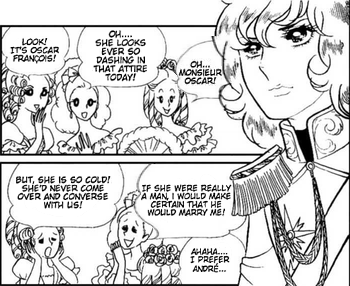
She's so good-looking but she looks like a man
Masculine female characters who resemble pretty, androgynous boys. They are faux Bishōnen. Swooned over by confused females as much as outright lesbians. Sometimes in the episode they're introduced, they're confused for men until the other characters recognize and treat them as girls. Occasionally, it's also a roundabout way of adding a stereotypically "male" role to a show that doesn't have (or want) one. Frequently subject to at least one Stupid Sexy Flanders gag, sometimes even after The Reveal of their sex.
Interestingly, most versions are Prince Charming types and overwhelmingly good characters. Bifauxnen are — from an artistic standpoint — everything that is positive about masculinity while not losing anything fundamentally female. Many characters, in fact, simply associate with traits typically praised in men; the appearance is just another path to that. Most of the time the bifauxnen is not a Butch Lesbian and is mostly oblivious to reactions they incite.
The major distinction between them and straight-up Tomboys is a direct and neat association with elegance and style, and they often appear older than they really are. Straight-up tomboys are often associated with playfulness and immaturity but are still clearly female. Bifauxnen have some sense of femininity most straight-up tomboys lack, though this isn't a requirement. While it is common to have both types of characters in a series, two bifauxnen are less common, and tend to become playful or sexy rivals.
This type of character in Japanese media often prompts speculation from Western fans that she's either a transgender man or a lesbian, particularly the latter, since in much of European and North American works in the nineteenth and twentieth centuries, having a female character wear men's clothing is a common way of implying that she's not heterosexual when open acknowledgment and depiction of her sexuality, even in a negative way, would have been forbidden by taste-and-decency standards. In reality, the ubiquity of the Bifauxnen archetype in Japanese media can likely be traced back to the influence of the Takarazuka Revue.
note
A Sub-Trope of Attractive Bent-Gender and Lady Looks Like a Dude.The male equivalent is Bishōnen. Not to be confused with Sweet Polly Oliver, who only dresses like a man to achieve a goal that requires her to seem male. Compare to Samus Is a Girl, where the gender simply isn't discernible until The Reveal. Can also be a case of Bifauxnen and Lad-ette if there's more than one in a particular work. See also The Lad-ette. May involve a Gender Reveal.
Example subpages:
Other examples:
- The Ur-Example is Torikaebaya Monogatari, a late Heian Period tale of a brother and sister who are naturally more alingned with roles assigned to the other gender. They switch places at the Heian court and drama ensues.
- Happens to Jubilee from X-Men a couple of times.
- In her very early appearances, she had short hair and a flat chest that she could be mistaken as an effeminate boy depending on the art.
- On at least two occasions she was required to go undercover as a delivery boy. Since the other two women on the team were undercover as hot women in slinky dresses, she found this rather annoying.
- In a side-story in Wolverine, she's fully mistaken for a boy by a tribe in the Savage Land and engaged to one of their princesses. In a slightly odd turn of events, the dinosaur-riding tribe who made the mistake actually had her half-way to the altar with a choice bride standing by before the misunderstanding could be cleared up.
- In Star Wars (Marvel 1977), there was a prince who went to Luke Skywalker for help; later in the arc it was revealed that this character
 was that prince's twin sister, as the prince himself had died. In order to keep her planet's morale up, she'd needed to keep his death a secret. At the end of the arc the princess also died, and the two of them met Yoda in the afterlife - the princess was clearly shorter and somewhat narrower-shouldered than her brother, but still fairly androgynous. Without looking at the word balloons, it's actually rather difficult to tell that she's female.
- Carrie Kelley, the successor to the Robin mantle in Batman: The Dark Knight Returns, is mistaken for a boy by the police. Somewhat of an inversion on how Robins on New Earth are either mistaken for or portrayed in other media as girls.
- Fey Truscott-Sade, an androgynous action hero companion from the Doctor Who Magazine comics. The writers describe her as "an androgyne"; she has a feminine body, presents with masculine clothing and hair, and uses feminine pronouns. And she's a badass bisexual 1930's spy.
- Sir Ystin, the Shining Knight, was mistaken for a boy in Seven Soldiers of Victory (2005) and mistaken for a girl in Demon Knights. In the latter case, the truth is a little more complicated...
- Luci (yes, that Luci) from The Wicked + The Divine, doing a damn fine impression of Bowie's Thin White Duke
- In Masqued Mayhem, one of the Adventure Time Graphic Novels, Marceline's fancy-dress costume is as a male Classical Movie Vampire.
- Wonder Woman (1987): Cassie and her best friend George are tomboys who could easily pass as boys, with George going out of her way to appear androgynous. They're also both conventionally attractive so far as teen boys go and are well liked at school.
- My Very First Vampire Blood Drive has Velvet, a gorgeous butch vampire girl whom Bunny describes as looking like a "prince from a fairy tale."
- And there's Zatanna, who wears a very masculine magician's tuxedo and top hat, and looks gorgeous in it!
- A standard design for lesbian characters in the later stories of Alan Ford, best seen with tertiary characters who, more often than not, hit on the heroine Minuette.
- Camellias: With her dress pants, button-up shirt, vest, and tailcoat, upon meeting Blake, Weiss didn't instantly know she was female.
- Kishimura the dragon-girl in the Monster Musume fanfic Daily Odd Life with Monster Girls, enabling her to pass as a prince without raising suspicion.
- Dee from D.J.I.N.N.: Way to Home is short-haired and fairly flat (she's only fourteen), so she looks a lot like a boy, albeit a cute one. One of her future teammates teases Will (the woman who plans to adopt her) about her much younger "boyfriend," even when said boyfriend is wearing a short skirt.
- Fate/Stay Night: Ultimate Master's version of Avenger is a female, but dress like a male in her civilian attire, and looks quite good in it if Ben's opinion is anything to go by. Not so surprising considering who she is implied to be.
- Negima! Magister Negi Magi fanfic writers like doing this to Setsuna (see above). Suit Up! (one big Shout-Out to How I Met Your Mother) has her invoke this to such an extent that all of the girls get hot and bothered around her, while Egg Belly has her don a tuxedo for her date with Konoka.
- Oblivion (Gabriel Seraph): Marley Flowers, who looks sufficiently male-like that she and her fiance are Mistaken for Gay at first.
- Below Her Mouth: Dallas is a very androgynous woman who looks more like a pretty boy than anything, with short hair, masculine clothing, a slim build and good-looking boyish facial structure. Her actress Erika Linder is well known for her androgyny when modeling.
- In Blue Is the Warmest Color, Emma at the second part of the film where she has blonde hair and wears more sophisticated clothing that is expected of a well-respected artist. She is very pretty, with short hair and masculine attire which can make her look like a handsome young man at a distance. It also symbolizes the passage of time between the two chapters and how much her character has other priorities aside from her domestic life.
- Missy plays the western, lesbian version of this trope to the hilt, ahead of its time in Colette.
- In Ferris Bueller's Day Off, Mr. Rooney finds who he believes is Ferris at the arcade but turns out to be a girl.
- The lead character in Frozen Days is this after her Traumatic Haircut.
- Judy Garland in the number "Get Happy" from Summer Stock performs the whole number dressed in a tuxedo, nylons and a fedora, into which is tucked her long hair, making her look like a boy◊ wearing the top half of a suit, plus tights. Alan Moore cited this as the inspiration for the look of the Butch Lesbian detective Jackie Kowalski in Top 10.
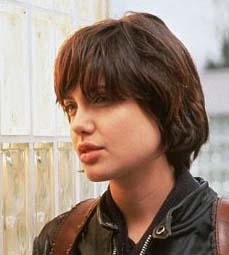
- Angelina Jolie in Girl, Interrupted was wonderfully Johnny Deppish. She was also androgynous in her role as Legs◊ in Foxfire (1996) and spends the last act of Salt with a short haircut, wearing men's clothes while she's in disguise as a man, complete with facial prosthetics which she removes, while keeping the hair and clothes.
- Noomi Rapace as Lisbeth Salander in The Millennium Trilogy's adaptation of The Girl with the Dragon Tattoo is another dark example.

- Cate Blanchett playing "Jude Quinn" (Bob Dylan) in I'm Not There. Fetish Fuel ensued. Suffice it to say that Cate makes a rather hot guy. The fact that her voice is very much on the huskier end of the scale helped.
- Chloë Sevigny from If These Walls Could Talk 2.
- Johnny (Jane Birkin) from Je T'aime Moi Non Plus. She ends up giving the gay protagonist Krassky (Joe Dallesandro) a major case of Stupid Sexy Flanders after subjecting him to an Unsettling Gender-Reveal.
- Morgan: Lee's style is basically this, she wears a suit and rocks the pixie cut, giving her a somewhat androgynous look while also being quite pretty.
- One of the earliest examples is Greta Garbo in Queen Christina. Her father King Gustavus Adolphus, lacking a male heir, essentially raised her as a boy, so she acts like a boy and dresses in men's clothes. But she still looks like Greta Garbo.
- Some Kind of Wonderful: Watts is just a raggedly dressed tomboy for most of the film but becomes this in the last act after donning a male chauffeur's outfit.
- The actress Tilda Swinton, who started her career by living this trope. She is attractive to both genders, while being androgynous enough to apply for Even the Girls Want Her and Even the Guys Want Him, depending on the character.
- She played the technically sexless Angel Gabriel for the movie Constantine (2005).
- Orlando from the film adaptation of Orlando, who begins as an androgynous man in the 16th century, becomes ageless, and later changes sex into an androgynous woman.
- The novel on which the film is based was written by Virginia Woolf, writing it as a fictionalised biography for the author-poet Vita Sackville-West, with whom she had an affair. Vita's son would later describe it as "the longest and most charming love-letter in literature".
- Also a feature in many of Tilda's glamour shots. There are several which try to make half of her look like a woman and half of her look like a man. It's strangely attractive.
- Conan O'Brien has said that Tilda should play him in a movie. She said she'd do it.
- Laure from Tomboy is androgynous looking. She's able to pass herself off as a boy, and normally she looks like a boy. It helps that she's only ten, so a haircut and boy's clothes is really all she needs to pass as male.
- Imogen Stubbs, as Viola/Cesario in the 1996 adaptation of Twelfth Night. Olivia's infatuation is completely understandable.
- Underwater: Norah (played by Kristen Stewart) has Boyish Short Hair, and when she helps pull Paul out of the rubble, he calls her "You beautiful flat-chested elven creature."
- In Victor/Victoria, the title character is played by Julie Andrews. Female both in real life and in the movie, she plays the eponymous Victor, an ostensibly male drag queen. Part of the plot is fueled by various women being very attracted to "Victor" (as a subplot, a few of the male characters have a Stupid Sexy Flanders reaction to "him.")
- ½ Prince has a variation. The main character is a girl who takes on the role of a male in a virtual reality MMORPG, very few people see through the disguise, and what few do only manage to do so after she gives herself away.
- Baccano!: Ennis is a partial case, being obviously female but prone to dressing and carrying herself like a man in a time period where that didn't often happen. The real Bifauxnen however is Ricard Russo, who's more often taken for a cute little boy than a teenage girl by characters and readers.
- In the world of A Brother's Price, whores service women. Many of them try to look as much like men as they can, and men in this world are seen as soft, beautiful, graceful creatures. These wear ivory strap-ons called bones at their groins to complete the look.
- By the Grace of the Gods: in vol 5, Eliaria Jamil meets Michelle, who quickly becomes part of her training squad and friend group. Michelle keeps her hair short, wears boy's pants with girl's shirts and in a later scene is mistaken as a boy by some jealous boys who think she's 'hogging all the girls'. Michelle tells Eliaria her hair and clothing is simply a matter of practicality (she's a magical researcher who spends lots of time doing physical things like crawling around on the ground and grinding up crystals). In fact, she actually lost all her initial friends in her first weeks at the academy when she revealed she wasn't a crossdresser.
- Kaoru Sayanomiya of Campione! is a powerful miko, head of the Tokyo branch of the History Compilation Committee, and heir to her powerful family. Her only flaw is her tendency to wear men's clothing, even at formal events where she's known to be a woman. Many of her female classmates have fallen in love with her and she makes no effort to correct them on her gender or discourage their attempts to win her over.
- Chronicles of the Kencyrath:
- Jame is mistaken for a boy on a regular basis, is declared to be officially a boy in a fair few contexts throughout the books and is mistaken constantly for her twin brother (in low-visibility situations). She's flat-chested and androgynous, though she has very long hair (which she tends to wear hidden under her cap).
- Subverted at one point in God Stalk: The courtesan Melissand is flirting with her, and Jame assumes Melissand thinks she's a boy. She doesn't—she knew Jame was a girl the whole time.note
- Jame, Rue, and Caldance — a fairly diverse group of people — all call Brier "handsome", and with her short hair and neat, military dress, she falls right in the bifauxnen aesthetic. She's Jame's Number Two, and they have a Bifauxnen and Lad-ette thing going on.
- Kirien is almost, but not quite, a Sweet Polly Oliver — she never actually claims to be male. But she looks (and dresses) like a handsome boy, and lets people go with their assumptions.
- Jame is mistaken for a boy on a regular basis, is declared to be officially a boy in a fair few contexts throughout the books and is mistaken constantly for her twin brother (in low-visibility situations). She's flat-chested and androgynous, though she has very long hair (which she tends to wear hidden under her cap).
- Kitai from Codex Alera, partly to do with the fact that she's an underage Marat with vaguely boyish features (until they come of age, Marat wear baggy tunics and aren't acknowledged to actually have any biological sex except in the academic sense). Tavi doesn't much care for her initially, because she was kind of hostile for little apparent reason, but once he realizes she's a girl, he starts to notice she's kind of pretty.
- Tzigone, one of the central protagonists of Counselors and Kings, is a very slender and flat-chested young woman, and as she's a Master of Disguise she's quite practiced at tricking people into thinking she's male. She does female disguises too, though.
- The Count of Monte Cristo: Eugénie Danglars is all but outright stated to be a lesbian, and dresses up convincingly enough as a man when eloping with her friend and music teacher Louise d'Armilly. She also obtains a passport in a man's name from the Count, explaining that he think it'd be a good way to avoid unwanted attention while abroad.
- Familia Chronicle: Episode Lyu: While undercover at Orario's largest casino, Lyu Lyon dresses up as a young male Elf noble with Syr as her escort and easily passes through without arousing suspicion. Bell and his companions only recognized her because the former is a regular at the Hostess of Fertility along with their prior adventure together in the Dungeon and the latter were once beaten by her.
- Forest Kingdom: In the Hawk & Fisher spinoff series' book 4 (Wolf in the Fold), the Little Lord is essentially a female Gentleman Thief; a tall, handsome woman who dresses in slightly old-fashioned upper-class male clothes, complete with short hair and monocle.
- Protagonist Ryougi Shiki of The Garden of Sinners is a subtle example, as there are few extraneous characters to comment on her handsomeness. In the first chapter, every phrase concerning her was written so that her actual gender was not mentioned until the second-to-last line. This probably has to do with her (originally) having two personalities, one male and one female. Though by episode 4 (chronologically 2) SHIKI (the male personality) sacrifices himself in the Void for Shiki (the female personality) to live on, wakes up from her coma, and gaining the Mystic Eyes of Death Perception.
- In Haganai, Yozora Mikazuki is introduced with very long hair, but she later cuts it much shorter after the ends are burned by fireworks. Afterwards, everyone else in the club mistakes her for a boy at first, and it's later pointed out that she looks very good in the boys' school uniform.
- Kino's Journey plays with this deliberately, as the title character's gender isn't made explicit to the audience for a while. Kino seems to be designed as an "everyman" (well, a woman) who everyone can identify with to some extent.
- Both Yayoi and Lin from Kure-nai. It's no wonder that they always end up fighting each other.
- Kaoru Daichi from Ladies versus Butlers! is both Akiharu's roommate and a girl crossdressing as a boy. Given what type of series this is, this makes for some awkward tension.
- Maria Watches Over Us: Rei Hasekura is a subversion. She happens to be a Kendo Team Captain, tall, and short-haired, but this is the extent of her boyish qualities; her short, delicate-looking petite soeur Yoshino is the actual tomboy of the pair. Rei also tends to wear male (or at least male type) clothes when out of uniform, though this could be due to having difficulty find clothes in her size.
- In Mona Lisa Overdrive, Kumiko muses that Molly greatly resembles the stereotype of the Japanese bishonen: "elegant, deadly and fey."
- Many female fans were extremely pissed off to discover that Maladict from Monstrous Regiment is, in fact, a girl. Others were delighted.
- Played with (and subverted) in Outlander. Secondary protagonist Bree is a six-foot-plus, strapping Scottish redhead who waltzes around in the 18th century in trousers — but she only passes for a man if you're really not looking, and is goggled at, flirted with (with cracks about stepladders), and horrifies her father.
- Leisl in the Ravenloft novel Vampire of the Mists is a thief who dresses as a boy to survive better on the streets.
- The Shadowhunter Chronicles: Anna Lightwood is a lesbian woman who loves to crossdress as a man. Although most of her partners are aware of her identity, she cheerfully admits to fooling a few girls into thinking that she is a pretty boy.
- Sherlock Holmes: In "A Scandal in Bohemia", Irene Adler admits to Holmes that she frequently dresses as a man to go out in public because of the freedom that male costume allows her. As shown in theatrical versions of the story, the result is apparently Bishonenesque.
- Strawberry Panic!: Amane Ohtori ("the Prince of Spica"), as well as her predatory Evil Counterpart Kaname, both have very androgynous designs in the novels' illustrations. In an amusing irony during the manga adaptation, Amane is almost railroaded into pairing up with Kaname for the Etoile contest, under the logic that her fangirls would be less upset about that kind of setup. The light novels add yet another bifauxnen, Makoto Kusanagi.
- Nan Astley and Kitty Butler, of Tipping the Velvet. Both are male impersonators in late Victorian England.
- The Vampire Chronicles: In The Vampire Lestat, the vampirized Gabrielle, Lestat's mom, usually adopts male clothing and hair style to be free to do as she wished. During the time (late 18th century) it was difficult for women to get away with living so independently, so she does this for practical reasons.
- In the 7th Heaven episode "Don't Take My Love Away", the youngest daughter Ruthie wants to wear a tux to her parents' vow renewal ceremony. In the same storyline she doesn't want her brother Simon to move out of their bedroom.
- Batwoman (2019): As an 'out' lesbian, Kate Kane normally adopts a butch biker look, but takes on this trope whenever She Cleans Up Nicely for formal events.
- Blackadder:
- In the first episode of Blackadder II, Bob, Lord Blackadder's page, (who is actually a young woman named Kate) is so attractive she manages to turn the head of the staunchly heterosexual Lord Blackadder even before The Reveal.
- Another incarnation of Bob appears in the Blackadder Goes Forth episode "Major Star", having lied to British Army recruiters and joined as a boy. This time Captain Blackadder isn't fooled for a minute, but lets it slide. The same episode features General Lord Melchett falling in Love at First Sight with George's drag act, and then thinking Reality Is Unrealistic when the unit fakes "Georgina's" death and substitutes Bob as the drag performer.
- Zigzagged wonderfully by Bellino in episode one of the 2005 Casanova miniseries. Introduced as an accomplished singer, she presents herself as a man, albeit a castrato. The decidedly heterosexual Casanova is convinced that Bellino is a woman - and an attractive one at that - so he confronts her. After some intense flirting, he's shocked to find out that she really is a man, and then surprised some more to realise that he's still attracted to Bellino and wants to pursue a relationship anyway. Finally, convinced that his affections are serious, she admits that he was right the first time: she faked the "evidence", and she really was a woman all along.
- Cold Case: "Best Friends" has Billie, who dresses in a lot of sharp men's suits, making her look like a handsome androgynous young man doing so.
- Doctor Who:
- Romana (in both her incarnations) is at times this, most notably in "The Stones of Blood"◊, "The Horns of Nimon"◊, and "State of Decay"◊.
- Ace gets in on the act in "Ghost Light"◊, not only wearing a Victorian tux, but convincing her new friend Gwendoline to wear one too.
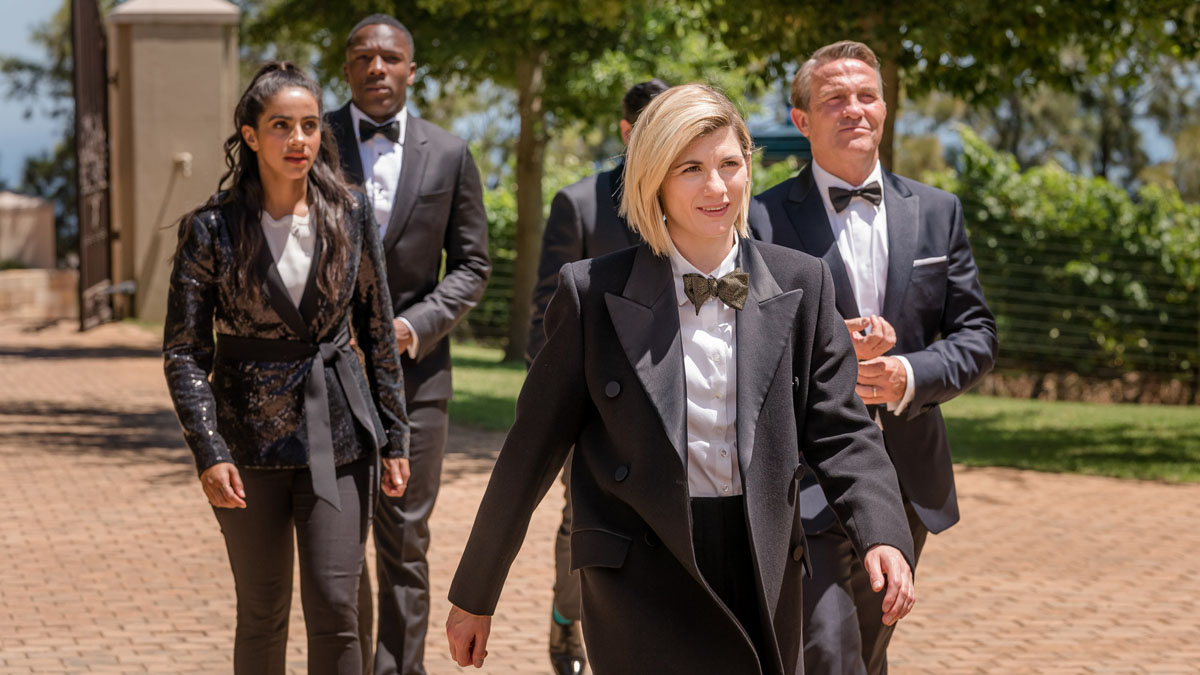
- "Spyfall" puts Jodie Whittaker's Thirteenth Doctor in a tuxedo, to brilliant results.
- Romana (in both her incarnations) is at times this, most notably in "The Stones of Blood"
- In the original pilot for the Get Smart TV show, this was done with Agent 99. When Maxwell Smart first meets Agent 99, she has a pageboy haircut and is dressed in a not-very-flattering chauffeur's outfit. While she actually still comes off as quite sexy and clearly female right from the start... this is Max we're talking about. It takes him most of the episode to realize that she's female.
- The L Word: Shane has very short, loose hair, wearing boyish clothes with a masculine attitude and husky tone of voice. When she worked as a prostitute, her clients were gay men (Shane didn't engage in anal sex or undress, so they wouldn't notice). Even in the present she's mistaken for male and seen as a hot young man by some gay guys while visiting a gay bar along with a friend (she has to correct them because they can't tell).
- Marcy from Married... with Children was often accused of being a boy. Ironically, in one of the final episodes of the series Amanda Bearse appeared as herself (a classic ladette). It was probably the most obviously female she'd appeared through the entire series.


- In Orphan Black, the (not usually very butch) lesbian Cosima turns up to a mock-Victorian dinner party dressed in Victorian male evening dress, in order to troll the conservative values of its villainous host.
- Batchi, in The Rich Man's Daughter has delicate looks and is masculine in appearance but is nonetheless good-looking and fashionable in an androgynous manner effortlessly looking sharp in sleeveless shirts, men's shirts, and is also acknowledged as "handsome" by her colleagues and her Lipstick Lesbian best friend.
- Anjali Jay as Djaq in Robin Hood; the most stunningly beautiful "boy" you've ever seen.
- In the 1986 adaptation of the Lord Peter Wimsey novel Strong Poison, the 'anti-man' Eiluned Price dresses in waistcoat, trousers and a bow tie, and cuts her hair short. Given the 1930s setting of the story, it's a strong implication that 'anti-man' is code for Butch Lesbian.
- Tipping the Velvet (2002): Nan can easily pass for a pretty young man-so easily that her first proper costume as Rackity Jack had to be altered so she'd be less convincing.
- Witchblade:
- "Diplopia": After castigating her younger partner Jake for homophobia while investigating the murder of a gay man, Sara shows up to investigate the victim's bar dressed as a man, just to mess with him a little more.
- "Palindrome": The champion at an all-male underground fight club turns out to be a disguised woman, specifically a Doppelgänger of Sara herself.
- Boy Of The Female Wolf features Eun-soo Cha, who passes as a very attractive and hilariously vain ("You dare hurt my beautiful face!?") boy and gets into fights — the difference is she does it 24/7 (going to school as a boy was one incentive to move in with her mom). Her reason is that she sees women as frivolous and weak — her mom effectively abandoned her when she married a guy from overseas; her grandma recovered from a serious illness only to die suddenly, yet another abandonment, and all those schoolgirls fawning over her doesn't help either.
- He's Dedicated to Roses features Choi Ida, who masquerades as Choi Yodah in order to vent the frustrations of being under the thumb of Manipulative Rich Bitch Mimi. As Choi Yodah she accidentally attracts a female bully after rescuing her and a Bishounen named Naru because she resembles his dead little brother. If Ida's so poor and her room so small, where did she get and stash all those flashy male clothes? And where did she get them to begin with, or is Asian fashion that androgynous?
- Love In The Mask: The heroine is a bodyguard to a wealthy girl and had to become a boy because "a female bodyguard wouldn't be taken seriously" (despite living with her charge there's no chance of Bodyguard Crush since they're Like Brother and Sister). Apparently it's not too successful since a character who only recently returned to Korea and never met her promptly addresses her with a female honorific and asks if everyone in the entire school is blind.
- Annie Lennox of Eurythmics deliberately plays up her androgyny. Some American audiences were shocked by the video Love Is a Stranger because they thought that Lennox was a man in drag.
- The dancers in the video for "Blame It on the Girls" by Mika are half-Bifauxnen: their costumes and wigs make their right half look like a girl in a dress with a bob, while the left half looks like a man in a tux with Beatles hair. See it here.
- Elly Jackson, singer of La Roux, often invokes this. Yes, she's not the only person involved.
- Shirley Manson of Garbage dresses this way in the video for "Androgyny." Seen here.
- Hitomi Yoshizawa got this treatment during her earlier years with Hello! Project. It's especially obvious in this video.
- Tenth-generation member Haruka Kudou is currently filling this role, to the point where she refers to herself as a boy in blog posts and interviews.
- Thai singer Zee Matanawee Keenan.
- Played with in girl group Mamamoos "Um Oh Ah Yeah" MV which features Moonbyul, Hwasa and Wheein all dressed up and made to look like men. Moonbyul just wears a suit and short wig, and pairing those up with her nice feminine features makes her out to be a typical pretty boy; the other two however wear prosthetic makeup and less flattering wigs, and dress like a 1950's greaser and nerd. Moonbyul's minimal changes actually make sense, as she is portraying a very androgynous woman, though her admirer Solar fails to notice that at first.
- Valshe, known for her roots as an utaite doing covers of songs featuring Len Kagamine, has a very masculine voice that's part of her Signature Style. Official artwork of her depicts her as a boyish-looking woman with short blonde hair, and this would extend to her real-world appearance◊ once her actual likeness started being used in media.
- Speaking of Vocaloid, the GYNOID vocal bank Flower is this in her V4 character design. The bank in general is stated to have an androgynous theme, so her more boyish appearance is better reflective of that.
- Akira from Visual Kei band Disacode tends to wear men's clothing in performances and music videos in addition to sporting slightly spiky long black hair with a blonde streak and eyeliner. This helped by the fact that she is also a fashion model, having modelled for Kera and Kera Boku magazines along with starring as Narase Kaoru in the Live-Action Adaptation of Ai Ore! Love Me! and in a Crosscast Role as Uesugi Kenshin in stage show adaptations of Sengoku Basara.
- Singer/songwriter/rapper Amber Liu of the Korean girl group f(x), whose androgynous image has resulted in lots of Even the Girls Want Her among the group's female fans, and a fair share of Viewer Gender Confusion for those unfamiliar with the group. This music video is just one example of many.
- Janelle Monáe, the genre-blurring Genki Girl singer, is rarely seen without her proper tux and a white starched shirt. It also helps her bifauxnen image that she has what can only be described as "epic hair."
- Taiwanese singer Zhang Yun Jing, known for her androgynous image. She has been described as both "handsome" and "beautiful". Even the Girls Want Her, as her a large part of her fandom is comprised of females who take great pleasure in squee-ing over her various attractive features, masculine or feminine.
- Omi, Mally and sometimes Jyou from exist†trace are considered this, which has caused some Viewer Gender Confusion like for example, someone who isn't familiar with Visual Kei will look at Jyou, Omi, and Mally and think "Wait, the guys in the suits are actually chicks?". Bassist Naoto can look quite masculine as well, but not in a bifauxnen-type way, while the odd one out in the band is Miko, who lacks of the bifauxnen aesthetics.
- In March 2017, Chinese Boy Band FFC-Acrush (now called FanxyRed) revealed that they were in fact female.
- Heloise Letissier, the sole proprietor of the French electropop act Christine and the Queens, AKA Chris,adopted this look with her third album.

- Older Than Steam: Viola in Twelfth Night and Rosalind from As You Like It, both by William Shakespeare. Interestingly, this means the trope is Zig-Zagged since, in Shakespeare's time, males played all the roles...including the female ones. Thus, when these plays were first performed, you had guys playing girls that were pretending to be guys.
- West Side Story has Anybody's, a short-haired tomboy (sometimes Butch Lesbian) who tags along with the Jets and eventually joins them as their sole female member.
- Fate/stay night:
- Saber aka Arturia Pendragon, having been stopped in her natural growth at around the age of fifteen, had posed as a man, although a very Bishōnen man. This is due to how she easily kept a cold and professional face, in addition to wearing men's clothing. However, she was under a genuine Gender Bender spell at one time in her backstory, which was how her "son" Mordred was conceived. She dresses in more contemporary menswear in Fate/Zero, a sharp, formal black suit with her hair in a short ponytail. Irisviel fixates on what a handsome protector Saber makes, and contemplates what a beautiful couple they make when she's escorted in public by her.
- From Zero as well, Kiritsugu's partner Maiya also dresses rather austere and masculine, and keeps her hair short.
- In Fate/Grand Order, one of the Memorial Craft Essences has Saber of "Red" dress up in brown suit that lets her look very much like a "bad boy" version of Saber, which is quite fitting since she's Mordred, Arturia's aforementioned "son".
- Chris in Princess Waltz. She not only dresses like a boy, and has the interest of all the girls; she was told she was supposed to be born a boy and plans to become one through magic. Even after she starts sleeping with the main character, her ultimate goal doesn't change. Somehow Chris' gender isn't obvious to Arata after the second chapter. No, not even after seeing her in the bath.
- Saori, the Player Character of Shall We Date?: Ninja Shadow, is one who uses her boyishly good looks to a Dead Person Impersonation after her brother Kaname's murder, so she can pursue her revenge and become a member of the all-male vigilante group that Kaname was supposed to join.
- Both Colonel Sebastian Moran and Henrietta Irving in Shikkoku no Sharnoth. In the beginning, Mary doesn't know the latter's true gender and has a bit of a crush.
- Kriska Stares from Sunrider.
- The Twin Switch plot of Ladykiller in a Bind hinges on the fact that Player Character the Beast, being the Half-Identical Twin of the Prince, is a dead ringer for her brother while wearing one of his suits.
- They Are My Noble Masters: Averted was Natose, who is a semi-bifauxnen, the only thing is she has boobies (huge ones in fact), and she wears panties under her clothes.
- Rei Ijuin, of Tokimeki Memorial 1, who has to pose as a boy in front of everybody due to a family custom, and this until her coming of age. It's a well-kept secret the Ijuin family zealously protects, to the point that even her little sister Mei doesn't know she's actually a girl!
- Yuina Himoo of 1 is also one as well, due to her clothing.
- Silver from The Angel with Black Wings looks like a handsome young man.
- Grantz from Girl Genius, Baron Wulfenbach's monster hunter. Especially considering Phil Foglio's art style...
- While her normal attire is more along the lines of a traditional Action Girl Zeetha's costume for the royal ball gives her a more Bifauxnen appearance. She even dances with one of the princesses (and opts to to take the lead when dancing with Tarvek).
- While her normal attire is more along the lines of a traditional Action Girl Zeetha's costume for the royal ball
- Building 12, by Chris Hazelton's: Alex. She was selected to an exclusive program to fill a diversity quota because her application was smudged and they thought she was a guy (it gets mostly female applicants), so now she's pretending to be male.
- Part of an Instant Cosplay Surprise (sort of) inflicted on Alex by Lita in Cheer! for their "date". Don't think she didn't have an agenda there.
- In this Drowtales Self-Parody, it's Played for Laughs:
Phani: Had she the look of a real woman, she sould have been more lucky in love.
Zala: Do not mock her so. It is not her fault if she looks like a man... a very pretty man. - Brooke Lynn of Eerie Cuties is one, complete with a scene with a character referring to her as 'that guy from summer camp.' Cue Cross-Popping Veins and possible Berserk Button.
- El Goonish Shive: A weird example, Tedd accidentally sets off his transformation gun and is turned into a girl. His friend doesn't notice until Tedd points out the twins. Then it overlaps into a weird mix of Real Life and Wrong Genre Savvy: he transforms in an off-continuity Q&A-style storyline. The next strip? 'A ridiculous number of viewers claim they didn't notice I was a girl in the last installment until they noticed Grace was a guy!'
- Tedd accidentally turned into a girl during a card tournament due to a magical spell and her friends again don't notice until she specifically pointed out her breasts and and her pink hair was it's natural purple again.
- Asha from Kubera. So much that Ran still thinks she's a guy even though she is wearing a dress. Yes, he thinks of her as some weird guy who dresses up in women's clothing.
- Some female readers of The Meek were shocked to learn that Soli was a girl...and more shocked when they realized how little they cared. And now she's surprised at least one person in-universe.
- Sister Denmark from Scandinavia and the World. In the comic entitled "Confusion", France (one of the only countries so far primarily personified as female) propositions Sister Denmark believing her to be an androgynous-looking man only to be disappointed and angry when the clothes come off and she discovers her mistake.
- In a few strips in Sinfest, Monique played around with dressing and styling her hair in a very androgynous way to mess with Seymour and have fun with Slick and Squig, but after being exposed to the Patriarchy, she adopted this look as her default appearance.
- Sparkling Generation Valkyrie Yuuki: Die-hard anime fan Yuuki seems to be deliberately aiming for this effect with her boy's uniform but can't quite pull it off due to the Most Common Superpower.
- Jihyeon Jung is easily one of the most handsome girls in the cast of Surviving Romance. Despite being in an all-girls class many readers initially confused her for a male.
- Pieta of The Watcher Of Yaathagggu due to her fairly androgynous figure, the clothing she wears and the lack of other characters addressing her for most of the first chapter.
- Pirates SMP: The Monster Slayer uses feminine pronouns, but looks like and has been mistaken for a Long-Haired Pretty Boy.
- Dacey Ashcroft of Survival of the Fittest version 3 is described as being very ambiguous in gender — especially since she is very tall for a girl and in general, just doesn't act 'girly'. That she deliberately perpetrates this charade doesn't help matters for the confused.
- Female crossplayers are a particular real-life version of this trope, as groups will often pick their most masculine-looking female friends to cosplay Bishōnen characters. This will often lead to bizarre situations occurring at anime conventions, though people have generally learned not to question the gender of those entering bathrooms.
- Inverted with Pete Burns, bisexual lead singer of Dead or Alive. He had been cosmetically changing his appearance to resemble a woman before he married his wife of nearly 30 years. So feminine was he in his appearance already that when they applied for a marriage license, the clerk snarkily asked which one was the bride. Burns was not amused, recalling it as a "feeble joke" and the only thing that ruined such a perfect memory for him. In general, he was known for passing off a feminine look very well, at least until his surgery money ran out and he encountered one botched operation after another — his hobby was going under the knife to change his style whenever he felt like it, but that all changed when he met the wrong doctor. Sadly, he was unable to repair the damage before he died.
- Julie d'Aubigny, more famously knows as La Maupin, was a real life example from 17th century France. The daughter of the secretary of Louis XIV's Master of Horse, she grew up learning to ride and swordfight, and dressed as a boy from an early age. Later on, she ran off with her swordfighting instructor and made a living as a cross dressing fencer. She later joined the Paris Opera where her singing voice and androgynous looks made her quite popular, especially with the ladies. This actually got her in trouble when she defeated three noblemen in an illegal duel when they challenged her after she kissed a lady they were courting, forcing her into exile in Belgium. Later in life, she had a relationship with Marie Louise Thérèse de Senneterre, la Marquise de Florensac, and was devastated when she died, retiring from the opera and entering into a convent, where she died at the age of 33.
- Adah Isaacs Menken, bisexual actress, equestrienne and poet in the Victorian era, was known for playing men's roles and was this when she did. Fittingly, she dated perhaps the most notable androgynous Long-Haired Pretty Boy of the era - fellow bisexual Algernon Charles Swinburne.
- Cara Delevingne is gorgeous but could pass for a feminine guy sometimes.
- Sophia Lillis, sometimes, but especially in this Magic: The Gathering Arena tráiler
