
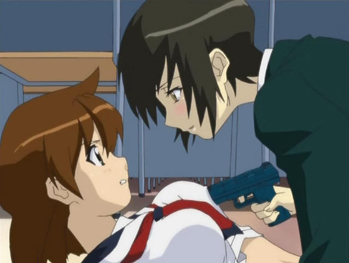
The Distaff Counterpart of the Depraved Homosexual and very much Exactly What It Says on the Tin: a lesbian woman who is portrayed as mentally unstable, villainous or otherwise dangerous because she's a lesbian. She will often be portrayed as covetous of other women and irrationally hateful towards the male gender, if only because they are taking away too many potential mates. Often a Child Hater too, unless All Lesbians Want Kids (uncommon for this character trope).
Very often motivated by an unrequited love for a straight woman that she wants to herself, which can result in assassinating the competition, sometimes even getting rid of her desired lover's kids. Such a character often doesn't check consent nor the feelings of the woman she's after, all that she wants is that woman to love and desire her back. The more benign versions might stop at stalking their beloved, but most examples are more a case of If I Can't Have You…. Extreme cases are downright predatory in their pursuits, but it's rare sub-type.
This trope carries uncomfortable subtext: go straight or go crazy. Or at least have the decency of being bisexual so the male audience can have something they can enjoy watching. For years, a cocktail of censorship and bigotry rendered all lesbian characters on screen exclusively "crazy" and villainous. The Hays Code-era requirements that "deviant" characters (and that included all gay characters of any gender) must not be made sympathetic or rewarded meant that such characters would almost inevitably be toast before the final credits rolled — and this convention has persisted long after the demise of the Code itself.
All that said, lesbian characters have as much right to be as messed up as anybody else.
The Psycho Lesbian will often be a villainess for a Hide Your Lesbians couple; two women who care for each other but don't actually say it out loud. See also its Sister Trope, the Lesbian Vampire with the added benefit of being inherently evil and irredeemable.
See also Evil Desires Innocence.
See Depraved Homosexual for the male equivalent, or Depraved Bisexual when they're like this toward men too. See Heteronormative Crusader for when another character considers a lesbian to be psycho simply for being lesbian. See also Love Makes You Evil, Love Makes You Crazy, and Yandere for more general tropes that are closely related. See Straw Feminist if she's simply a lesbian who hates men. Contrast Double Standard: Rape, Female on Female.
Examples:
- Nami in Aki Sora. She starts out with a Matchmaker Crush involving her best friend Kana and her brother Sora, but after the date she set them up on went far beyond her expectations, she confronts Sora that evening, shoves him down, stops just shy of cutting off his penis with some scissors ("Hey... can I have this?"), rapes him while fantasizing that she has a penis and is having sex with Kana, and threatens afterward to cut his penis off for real if he ever tells anyone.
- 'Cockroach' Oki of Arachnid is an interesting case - her psychotic crush on the main character, Alice, actually makes her less dangerous, and soon results in a Heel–Face Turn. Subsequently, she's still a Psycho Lesbian, but also one of Alice's only friends and most useful allies, thanks to her total lack of ulterior motives beyond getting into our heroine's pants.
- Miharu from Baka and Test: Summon the Beasts is crazily in love with Minami. Her solution to anyone who happens to get between her and Minami is to try to Murder the Hypotenuse.
- Double subverted with Suruga from Bakemonogatari, who is dangerously in love with Hitagi. She is actually a perfectly pleasant person, even to Koyomi, her crush's boyfriend. But she unconsciously wishes that Koyomi would disappear, and when the sun goes down her demonic hand takes control over her and tries to grant her wish, which means trying to beat Koyomi to death twice. There's also the fact that she starts stalking Koyomi after he hooks up with Hitagi. But then there are all the teasy moments with Koyomi and... well, nobody really knows anymore.
- Reimi from Bamboo Blade has stalked Miyako from the shadows ever since the latter had brutally rebuffed the advances of the former's crush in middle school (though the two attend different high schools). It soon emerges that, rather than wanting revenge on the boy's behalf, Reimi had become enamoured with how cool Miyako looked; she even has nosebleeds when she recalls the incident. However, she's not exactly the most subtle of stalkers; during a kendo sparring session between the two schools, Reimi walks right into the dojo, claiming to be in the photography club, and spends the whole time taking pictures of the weary Miyako.
- Ben-To: Ume Shiraume worships Oshiroi. She fantasizes about her, kidnaps her frequently, beats anyone who even thinks about taking a glance at her, and has even gone so far as to try to have her way with her, who's shown to clearly be uncomfortable.
- In Black Lagoon Revy threatens to become this to Jane when the latter shows attraction to Rock as Revy recalls her time in women's prison saying "I've won over some sex-starved dykes by playing the man's role. And after that, their fingers just weren't enough for them ever again." Jane was sufficiently freaked out.
- Kagari from Black★Rock Shooter. A pure example for the first two episodes of the series, with her possessive crush on Yomi Takanashi.
- Played for laughs with Chizuru Honshou of Bleach. Two words: "Karakura Raizer!" She is very disturbed in many ways which is best depicted when she asks what a little girl's cup size is.
- Soi-Fon also displays instances of this whenever Yorouichi is brought up. It's to the point where she's only seen being genuinely nice to Yorouichi or anyone related to her. The "psycho" is primarily directed at Urahara and Played for Laughs when he's not involved.
- Urushira from Bondage Fairies Extreme. There's more to her than that, though.
- Liang Qi in Canaan is psychotically devoted to her adoptive "nee-sama" Alphard, and those who try to get in the way of the two of them being together tend to meet with her full Ax-Crazy wrath.
- Shirai Kuroko from A Certain Magical Index and A Certain Scientific Railgun. However, unlike most examples, Kuroko is a heroic example of this character type; when she isn't stalking/fondling/trying to seduce "Mikoto-oneesama", she's otherwise the most serious and by-the-books member of the disciplinary committee.
- Ophelia from Claymore shows heavy signs of this thanks to her Combat Sadomasochist tendencies. Roxanne even more so, with her habit of crushing on more powerful Claymores, copying their appearances and special techniques, and then sadistically arranging their deaths.
- Nina Einstein of Code Geass, the cast's resident meganekko and racist who instantly falls head over heels in love with Eupehemia after her life is saved by the princess, so much so that she masturbates to pictures of Euphie using the edge of a table. After Euphemia's death, the girl really becomes unhinged, enough to try to destroy Tokyo with a Sakuradite-bomb to kill Euphemia's killer, Zero and let Prince Schneizel recruit and manipulate her into becoming a part of a research project that creates a nuclear weapon to wipe the Japanese race from existence. She gets over her madness and her racism, though. Not that the Unpleasable Fanbase (or at least a part of it) acknowledges it. And not before having another Freak Out as she saw what her bomb can do
 ... Part of the reason is she makes some of the most disturbing facial expressions ever...of all time◊
- Cross Ange: Zola literally had her own harem and she approaches Ange very forcibly, despite Ange making it perfectly clear that she doesn't want it.
- Subverted to a point in Cynthia the Mission. Big Bad Cybele Rou is a cruel, evil sociopath who has a tendency for cutesiness and being generally cheery and nice when she's not killing. She's also a lesbian, but there's nothing psycho about it.
- Also a subversion from the same manga; Takaya Kanae is a sweet, kind, gentle schoolgirl who has kissed more than a few girls in her day. Not psycho at all by any means... until you get to her alternate personality, Shii, who is a psychotic, evil man who will do anything to protect the innocent Takaya, while leaving her mostly unaware of his protection.
- The second season of Darker than Black has Mina Hazuki. She's a Contractor who Does Not Like Men and shows absolutely no respect for the personal space of her female teammates, who she constantly hits on. The "psycho" comes from a combination of the usual Contractor Lack of Empathy and a Stalker with a Crush attitude towards Kirihara.
- Chikane Himemiya in the Destiny of the Shrine Maiden manga. It later gets subverted when it's revealed to be an act to fool the Orochi so she can destroy his support from within and manipulate Himeko to kill her, so they can activate the sacrificial ritual to save the world without removing her beloved Himeko from existence. The 'Psycho' part was a deliberate act (even though many would think it was inherent in her), but she is a lesbian.
- Lan Asuka from Devilman Lady is an Anti-Hero version, who discovers and largely manipulates the lead character Jun Fudou, seems to be attracted to her, or at least her superpowers. She still tries to help Jun in her own way, nonetheless. In the anime, however, she is much more psycho, given that she wants to become a god and rapes Jun near the end.
- Fatora and Alielle of the original OAV version of El-Hazard: The Magnificent World are extremely promiscuous lesbians who are constantly attempting to seduce, or outright molest, other women they find attractive, and will not take no for an answer, even if the objects of their "affection" protest about being heterosexual. Fatora is particularly psychotic about it, especially in the sequel series El Hazard 2, where she outright tries to trick Shayla-Shayla into having sex with her by playing on the fact that Makoto, the boy Shayla-Shayla likes, resembles her so strongly.
- The Familiar of Zero: A Love Potion in season 3 episode 6 turns most of the girls into one of these. Also, Janette based on subtext. In the opening for the fourth season there's a part where Janette hugs a struggling Louise close and licks her face. And in episode 2 of the fourth season, Janette licks Louise on the face again and practically flirts with her calling her "cute and innocent" after slashing her with a poisoned knife.
- Chiffon Fairchild from Freezing, especially in the Spinoff Manga Freezing: First Chronicle. To wit, in the first half of the manga: she strips her roommate Ticy and playfully gropes her breasts. It's implied a little later that they went further. In the second half: She slaughters 50 of her classmates (no actual ''deaths'' but arms and legs fly left and right, nonetheless). The whole time she was muttering about wanting to 'destroy everything' and she is just a muscle reaction away from killing the 2nd ranked Pandora of her year before Ticy stops her with an "I Know You're In There Somewhere" Speech. All this with a smile on her face. Oh, and her nickname is The Monster of West Genetics.
- Yui Hongo from Fushigi Yuugi is speculated to be one of these for Miaka Yuuki.
"I couldn't find a place between you and Tamahome!"
- Mao Nonosaka from Future Diary. She helps Hinata in her scheme to kill Akise, despite the fact that Hinata was only doing it to gain her father's approval. After Hinata apologizes for taking advantage of Mao's feelings, she actually tries to kill Yukiteru. Hinata herself doesn't really snap until Yuno stabs Mao.
- Gaiking: Legend of Daiku Maryu has Proist, the Big Bad, and the only character in the show who could probably be called more evil than simply self-serving or misguided. She's only shown to have affection for her father and for Vestaanu. She is also completely unpredictable, casually executing thousands who don't live up to her standards, and can and will fly into a rage at the slightest provocation.
- Rio in Gamerz Heaven doesn't seem to have any sanity whatsoever when it comes to Kyouko.
- From GaoGaiGar FINAL we have one of the 11 Soul Masters, Pillnus. She takes a special...interest in Renais/Renee, loving beating her in combat and putting her into...compromising positions. It's even implied she raped her.
- Girls Bravo:
- Kosame's lust for Kirie is played up for fanservice and as comedy. Particularly during the "Girls Fight!" competition and a later episode where she chases Kiriei around the house, while calling her "big sister".
- The anime has Hijiri, the kids' teacher, who turns out to be working for the Big Bad Yukina and after fighting Kirie develops a similar attitude towards her. Before that, it's mentioned that Hijiri had been obsessed with Miharu since childhood.
- Goldie Musou from Gunsmith Cats. She's a drug-dealing Mafia boss whose Amazon Chaser fetishes leads her attempting to abduct and brainwash Rally Vincent, and then succeeding in doing so to Misty, with heavy hints that she raped Misty after brainwashing her into loving her. What irritates many fans is that Goldie ends up as a Karma Houdini; not only does Vetinari Job Security ensure she remains the local Mafia boss, but she also gets to keep an arguably still-brainwashed Misty as her lover in her own "happily ever after".
- The main character of Gushing Over Magical Girls, Hiiragi Utena is an odd case as she is normally a very nice if meek girl. But after becoming a Dark Magical Girl, she's unlocked a lot of desires toward the Magical Girl heroines she fights. Namely her desire to tie them up and administer an unhealthy amount of BDSM love.
- In The Disappearance of Haruhi Suzumiya, the Ryoko Asakura of the Alternate Universe seems to have somewhat Psycho Lesbian tendencies towards Yuki Nagato. Given to that she's a normal human, yet still ends up stabbing Kyon to protect Yuki. She even waits for her at the school at 4:00 AM.
- And in the movie adaptation she seems even worse, sprinkling Yuki with blood from her knife as she dances around in front of her...
- The Season 2 premiere episode of Hell Girl has a cute high school girl being harassed by an unknown person. By the end of the episode, it's revealed that the seemingly nice school nurse is a sadistic bully with a perverted obsession with the high school girl. She threatens to pour acid of her face if she doesn't give into her. The girl is able to send the nurse to hell.
- Hellsing: In the first anime, a Lesbian Vampire character named Boobanshee/Bubbancy (actually a corruption of a Baobhan sith, pronounced roughly the same way in Japanese) tricks the entire Hellsing organization, save Seras and Alucard, into thinking that she is Integra's sister, Laura (a reference to Carmilla). Later, she attempts to drink Integra's blood, and bites and licks her chest after partially undressing her, after which Integra realizes that she has no sister; shortly after Bubbancy is dispatched and Integra refers to her as Countess Karnstein (another Carmilla reference). She also licks Integra's blood from her hand after stabbing her.
- Hybrid × Heart Magias Academy Ataraxia: Averted with Aldea. While she's an absolutely sadistic Blood Knight, her deep feelings for Grabel are framed as one of her redeeming qualities and even serve as the first sign that the character isn't as evil as she first seems.
- Rin "Clone" Yatagai towards Nao in episode 11 of I Don’t Like You at All, Big Brother!! She ends up accidently kissing Iroha and falls in love with her instead, much to Iroha's horror.
- Ikki Tousen:
- Ryofu Housen skirts this trope, though she can also be seen as a female Depraved Bisexual. Not a straight example, as her girlfriend Chinkyuu is the one who brings up her Pet the Dog moments.
- Kan'u Unchou almost ended up as one of these, what with her devotion to Ryuubi being taken to extremes in the third series. She did not, fortunately, as it only happened because she was kind of Brainwashed and Crazy due to an amulet that goes to extract her deepest desire that thus far she managed to hide. After the hijinx, her relationship returned normal and got upgraded at the end of the series.
- Imaizumin-chi wa Douyara Gal no Tamariba ni Natteru Rashii: ~DEEP~: Mari Tsutsumi treats Ruri as her "Queen" and does whatever she asks for in exchange for undisclosed "rewards". She turns out helpful as she spots Keichiro spying on them and also assists in the basketball match after learning how to score.
- Kaguya Hime: Although a bondage-wearer perv, Maggey is nice enough to be mostly harmless (beyond groping of strangers), and Chun-Lan is funny more than anything... but Mayu can get seriously scary.
- In Kämpfer, Big Bad Kaede Sakura has the hots for the main character's female form and has an evil alter ego that gets off on sexually brainwashing women. While the rest of the female cast show some bisexual tendencies and have their crazy sides, the only 100% gay character is portrayed as the worst.
- Nui Harime from Kill la Kill flirts heavily with both Satsuki and Ryuko in her introduction episode. And then there's episode 21's illusory threesome with Ragyo and a brainwashed Ryuko. Later during that episode, she is shown to really enjoy a kiss from Ryuko, after which she mentions that Ryuko is a better kisser than Ragyo. Justified as the main authority figure/surrogate mother, Ragyo, liked to do... things to her so she may have gotten the psycho parts from her.
- From Komi Can't Communicate, we have Yamai Ren, who develops a crush over Komi, and can't bear to see her with someone else, specifically Tadano, that she stalks Komi like a typical Yandere. In fact, she even calls him trash and kidnaps him in her room along with threatening to kill him. However, Yamai later reforms herself after Komi finds out about what she has done to Tadano when she is invited to Yamai's house. She also mistook Komi's communication problems for hate and tries to kill herself at school in front of everybody when Komi still wouldn't use her voice to communicate, though she learns about it not long afterwards.
- Kasumi Kisaragi, the vice-president in the 2006 version of Kujibiki♡Unbalance, especially in the manga adaptation, where she tries to kill Chihiro when a love potion causes her to be attracted to him.
- In Love, Chunibyo & Other Delusions! episode 8 of second season Ren, a girl pretends to be Mori Summer so that she can molest Dekomori.
- Rimelda Jorg both wants to kill Madlax (admittedly, because of a misunderstanding) and shows attraction to her. Contrast with Madlax's other potential love interest, Vanessa, who is a Nice Girl overall.
- Magic Knight Rayearth II has the delightfully bipolar/dementedly schizo and certifiably psychotic Nova, whose switch every few moments from sweet and childish declarations of affection to a raving engine of powerful magical destruction can be a bit jarring. Although the circumstances of her consuming longing for Hikaru and the origin of both her and her madness (Nova is the physical embodiment of Hikaru's self-loathing after being forced to kill Princess Emeraude in the previous season) are rather unique and in her own case most likely constitute use of this trope as a justified one.
- Mnemosyne has Sayara and Laura, the former being a Mad Scientist who sexually tortures Rin and takes pleasure from it, and the latter being The Dragon to Apos who constantly chases Rin around (to kill her and/or do obscene things to her).
- Kuroko Koumori, the main character of Murciélago. Interestingly, her being psycho is the main focus, while her being a lesbian is treated as a side note.
- My-HiME:
- The results of My-HiME's Wham Episode altered many characterizations, including the kind and serene Shizuru who went a bit nuts near the end.
- My-Otome itself had one in local Alpha Bitch Tomoe. While most of the Coral Otomes loved Shizuru and looked up to her as a heroic figure, Tomoe was actually in love with her, and at one point attempted to kidnap and seduce her (in a decidedly creepy fashion). This included telling Shizuru that Natsuki was a prisoner, but that if Shizuru submitted to her, she would ensure Natsuki was well treated note . This, coupled with her mean-spirited attitude toward some of the other characters had turned fan support against her, though an attempt at a comedic makeover of her character in Zwei (similar to the one Shiho received in her transition from My-HiME) tried to soften the blow somewhat.
- Asami Hoshino from Myself ; Yourself, who was so in love with Shuri that she ended up causing the very object of her affection to leave. Though not before defending her from an Ax-Crazy old lady.
- From Negima! Magister Negi Magi, we have secondary villain Tsukuyomi. She starts as a mere Punch-Clock Villain with shades of Psychopathic Womanchild and a crush on her ex-sempai Setsuna Sakurazaki, but as time passes, she becomes really, *really*, creepily obsessed with Setsuna. And also seems to derive sexual pleasure from murder. And it gets more explicit. She's also probably the only villain in the series who's evil with no Anti-Villain tendencies or Freudian Excuse for her actions, which just makes her even creepier than most other bad guys. Other lesbians in the series (including Setsuna) are considerably more stable and likable, so it is clear that Tsukuyomi is a psycho who happens to be a lesbian, rather than being psycho because she is a lesbian.
- Chloe of Noir fits this, but only in her final appearance. She met the lesbian criteria the entire time, but she doesn't turn psycho until after Kirika rejects (or more accurately, fails to even notice) her advances, and then acts to protect Mireille from her, causing her to snap.
- Nyaruko: Crawling with Love! has Cuuko, who has an unrequited crush on Nyarko and has repeatedly expressed her desire to get married and have kids — not to mention beginning the series wanting to kill Nyarko's love interest Mahiro (at least until she warms up to him). Of course, the "Psycho" part comes almost entirely from her being Cthuugha the Living Flame, who was depicted in the Cthulhu Mythos as being legitimately insane.
- Implied with Charlotte Smoothie in One Piece; her Establishing Character Moment was using her Devil Fruit Power to drain an attractive woman of her body fluids and drinking it. Then, during the Tea Party, Smoothie grabbed Nami while licking her lips. Then later, during the same battle, Smoothie chose to grab Reiju while others restrained Luffy and Sanji.
- In Penguindrum it's implied that Tsubasa stabbed Tabuki out of jealousy once Yuri broke off their affair.
- The already bonkers Sakura from Penguin Musume Heart often shows extreme interest in intimate interactions with some of her female classmates and tries to force Kujira into marrying her in an alternate time line.
- Pretty Face: Nozomi would go to great lengths to get Rando (as Yuna) into her bed.
- Puella Magi Madoka Magica:
- Homura Akemi became this at the end of Puella Magi Madoka Magica The Movie: Rebellion. Maybe. It depends on which side of the Broken Base you are.
- Puella Magi Oriko Magica: Kirika Kure wished to be anything that Oriko, the girl she loved, needed. Her wish made her a Psychopathic Womanchild Yandere due to Oriko's very complicated plan to eventually kill Madoka before she could turn into Walpurgis Night requiring a magical girl Serial Killer. As an irregularity for the trope, Oriko falls in love with Kirika as well and Oriko feels immense guilt over how Kirika's been affected by her plans.
- Queen's Blade:
- Echidna uses this as part of her mercenary gig, though she is less of the former and more of the latter.
- The same series also gives us the sociopathically self-centered Elina Vance, who in the first episode goes off on a rant about how she'll torture the man who ends up marrying the woman she loves. Oh, and the woman she loves is her elder sister.
- Zigzagged with Menace. Yeah, she's a lesbian and a huge pervert, so much so that she basically caused the downfall of her country because she couldn't be bothered to drag herself away from her huge harem of female slaves. And yes, she's at least a nominal villain who is working for the series' Big Bad so she can rebuild her kingdom. But, she's also quite rational and controlled, if obsessive, and certainly not as outright crazy as is normal for this trope.
- A one shot yuri manga by the name of Rapunzel has not one, but two of them. One cuts off the hair of the other in a fit of jealous rage, and then the one who had her hair cut cuts out the eyes of the other as revenge. To top it off, the girl who did the cutting of the hair let her eyes be cut out while smiling. At the very end, they're both shown smiling and holding each other's hands in the conclusion. Love Makes You Crazy indeed.
- Semmerling from Riding Bean. Add to that the fact that she's a shameless pedophile and a Manipulative Bastard (and also displays elements of The Chessmaster), and she's well on her way to fitting every negative stereotype of the screen lesbian.
- Rosario + Vampire:
- Kokoa is utterly obsessed with the vampire side of her half-sister Moka.
- Akuha of manga season II is revealed to be one of these for Moka.
- Sabagebu!:
- Urara starts off as a possessive yandere towards her club president. After Momoka beats her up, she becomes the new target of desire, resulting in a lot of unwanted groping. The final joke of the series is her about to rape a Bound and Gagged Momoka.
- In episode 8 the club is challenged by a rival team... who turn out to only want to chase Maya and strip her naked.
- Saki: Touka has a rather unhealthy obsession with
NodokaNodocchi."I'm going to lick you all over and savor this delectable favor." - Uruka from Steel Angel Kurumi 2 for Nako. Uruka sees Kurumi as an obstacle to Nako and will try anything to remove Kurumi, even if it means asking her father to call upon the family's private army to take her down.
- Tactics: The yuki-onna in the first episode (When she's possessed by an aradama, anyway).
- Venus Versus Virus:
- Sumire, in Berserker mode. It's a little bit subtle as she is violent with the Viruses and more sexual (in a rape sort of way) with Lucia, as at one point she says they should "become one."
- In the anime version, Lucia appears to be this when she stakes Sumire's boyfriend in front of her. Of course, she thought he was dangerous but it's still a bit out there.
- Wagnaria!!: Yachiru Todoroki is obsessed with her boss and Childhood Friend, Kyoko. If she believes you are trying to steal Kyoko from her, she will go after you with the katana she wears on her hip. She gets better when the cook, Satou, confesses his love for her, and she decides to date him instead, showing just as much enthusiasm for him as she did for Kyoko.
- Shiori in Witchblade, although her Phlebotinum Breakdown may have helped. Then again, she was a bit messed up to begin with.
- W Juliet: Nomura Tsugumi, Ito's senpai by one year, doesn't make it a secret that she wants "Ito-kun" for herself and can sometimes behave as a Psycho Lesbian for comedy relief.
- Yuri Kuma Arashi:
- Mitsuko turns out to be a lot more predatory than she first appeared.
- Yurika ate Reia out of possessiveness, jealousy, misplaced anger, and heartbreak. Kureha being the focus and recipients of Reia's love since her birth, combined with her Strong Family Resemblance to Reia, also drove Yurika half-mad with lust when she attempted to eat her.
- Zombie Loan: The school nurse from the first two episodes and Koyomi's "other" personality Yomi has a definite fondness for groping Michiru's breasts and attempting to molest her. Though they Ass Pull-ed its way out of this one by saying that Yomi's spirit is actually that of a boy.

- The Lady Lemongrabs, from the Adventure Time Fionna and Cake comic book series. The "lesbian" part seems to be incidental, as they're the genderswapped versions of characters who were VERY Ambiguously Gay and happened to also be clinically insane.
- The version of Wonder Woman that appears in Frank Miller's All-Star Batman & Robin, the Boy Wonder is at least hinted to be this. Although considering the version of Batman that does the hinting, it could just be him being his usual charming self.
- Inverted in the case of Victoria Hand in Dark Reign. She is a lesbian (or perhaps bisexual) and easily the most sane of all of Norman Osborn's subordinates (Osborn himself included), but that might not be saying too much when everyone else is a Psycho for Hire at best and Eldritch Abomination at worst.
- Inverted with Harley Quinn and Poison Ivy in DC Comics. Their relationship with each other is probably the sanest and most humanizing thing either of them has.
- Not the point of the alt comic Hothead Paisan: Homicidal Lesbian Terrorist; although it may have addressed this trope at times, it's more a spoof of Straw Feminist fears.
- Nearly every major lesbian/bisexual female character in Marvel Comics continuity has been assigned some degree of mental instability. The bisexual Skein, for instance, married an older man and then killed him for his money; Man-Killer/Amazon used to be a man-hating militant feminist; Mulholland Black went so crazy that her own teammates put her down, Molly von Richthofen turned out to be a Yandere who would violently assault anyone who even looked at her openly bisexual partner, etc. Even the ones without criminal pasts have been portrayed as less than fully sane; The Loners miniseries portrayed bisexual Lightspeed as being the superhero equivalent of a Former Child Star, with all the attendant mental baggage, while the lesbian Karolina Dean is bipolar, according to the Marvel Handbooks.
- This is the subtext to Ursula Imada's obsession with Sundra Peale in Nexus. By the time of Ursula's death, it was only just barely subtext. Averted with Jil, who is a lesbian but not at all psycho, and Sundra, who is clearly bi and also not at all psycho.
- Purgatori, the lesbian vampire demon originally created by Brian Pulido as an antagonist for his main stripperiffic heroine, Lady Death. She may actually be a Depraved Bisexual, having once been Satan's concubine, but all of the (semi-)consensual relationships we've seen have had her with women.
- Wonder Woman:
- Wonder Woman (1942): Them! is made up of three very heavily queer coded women who chase down a teenager that escaped from them and try to order her to put on a collar and be their "pet", find Diana pretty and want to keep her in bondage too, and kidnapp and sell people.
- Wonder Woman (2006): Alkyone, who spent centuries as Hippolyta's bodyguard, was harboring a crush she did not intend to act on for her charge and queen the whole time. Her unrequited love turned poisonous to her, and when Hippolyta had a baby Alkyone lost it, decided the baby was a prophesied doom for the Amazons and tried to kill baby Diana in her crib to make everything back the way it had been as she "didn't want anything to change".
- Y: The Last Man: The Daughters of the Amazon are frequently branded psycho lesbians by other women (they certainly are psycho, and loathe men, believing they're the source of all societal ills). Subverted in that a) we never see any lesbian behavior among the Amazons and b) discreet lesbianism (especially with male impersonators) quickly becomes the norm in a world deprived of men. One of the comic's few openly lesbian characters simply describes the Amazons as "nutters who cut off their norks".note
- This is weaponized against Elsa in The Alphabet Story. Rumors spread that Elsa has a woman as a lover, who she seduced and "turned" lesbian. Elsa's ice powers scare enough people that they wonder just what their queen can actually do. The truth is that Elsa is in a relationship with a woman, but it's a consensual relationship and Elsa's powers are only ice-related.
- Commander Sullamander from A Brief History of Equestria; the lover of the previous commander (supposedly since she was a foal), Sullamander ruled the Celestine Junta with an iron hoof, executing anyone that spoke out against her and once attempting to ban or severely limit heterosexual unions. At the end of her life, she had gone full crazy and demanded that her soldiers worship her as a god, even as her enemies were already breaking through her forces and on their way to kill her. Of course, her lesbian tendencies were played up in sources by propaganda or less-learned scholars whose minds were too far in the gutter.
- Darkest Destiny: Cassandra, who is the main antagonist/Villain Protagonist, is portrayed as delusional, emotionally-repressed, on the verge on a mental breakdown nearly all the time, and abusive to her (forced-to-be) girlfriend, Rapunzel. She's also a murderous, tyrannical dictator who Does Not Like Men. She serves as a deconstruction as well due to the social stigma towards homosexuals during the time period playing a factor into Cassandra's Start of Darkness.
- Parodied in Ensign Sue Must Die: Empress Sue is portrayed as a stereotypical Card-Carrying Villain, and one of the ways she "proves" her evilness is by making out with Uhura.
- Infinity: Amaterasu seems to have focused her, ahem, intentions on Signum. During their battle in Chapter 22, she takes the battle seriously, almost decapitating Signum in her first attack; a few moments later, she tells Signum, "I won't rest until you acknowledge my feelings for you and agree to become my personal kitten!" Signum is not amused.
- Hearts Aflutter: Ayano Aishi is madly in love with Taylor Hebert and is actively killing off anyone who dares threaten her or tries to "steal" Taylor from her.
- Subverted in Kara of Rokyn. Jara threatens to beat the crap out of the main character during their upcoming wrestling match if Kara refuses to sleep with her. Kara does, so Jara does. However, it's made clear that Jara's jerkassery has nothing to do with her sexuality and everything to do with her crappy childhood, fear of solitude, and zero social skills. Kara herself doesn't think of her rival as evil but merely an asshole, and later she helps Jara out and makes peace with her when she finds out what kind of life her rival has led. The next time Jara makes an appearance, she's a far more pleasant person who unapologetically likes women.
- Pretty much all of the feminists in the MRA Trilogy, with special notes going to Elsa (who is in an incestuous relationship with her sister Anna, and is referred to as "queen of feminists and lesbo dykes") and Benezia, the whole purpose of the fanfic in which she debuts being the protagonist trying to seduce her in order to distract her. Ironically, the protagonist is arguably also this, since she has sex with other women (albeit "for the benefit of men") and has severe Villain Protagonist tendencies.
- Subverted with Ryuko Kiryuin in Natural Selection. Her sexuality doesn't have anything to do with the fact that she's The Caligula of Honnouji Academy. In addition, she's an Official Couple with Mako, and their relationship is depicted as one of her most humanizing qualities, as she will tone down her negative traits just to make Mako happy.
- Out of the Corner of the Eye has Asenath Waite, a homicidal sociopath in service of the Outer Gods, who just so happens to also be a lesbian on top of all that.
- Stress Relief: It is implied that Agent South Dakota is one. While the "psycho" part is clear as day since she's a sadistic Psychopathic Womanchild with a Hair-Trigger Temper, the "lesbian" part is not as clear. She has regularly raped Agent Connecticut for months, but it is still thrown into question whether she is a lesbian or if she just sees C.T. as an easy or convenient target to take out her rage. Once she is exposed for doing this, the characters seem to skew towards the latter interpretation.
- Roxy, Catherine Trammell's girlfriend in Basic Instinct. Paired with Clingy Jealous Girl, as she tries to kill Nick, Catherine's other lover, when he refuses to leave Catherine alone as Roxy has ordered him to, and is briefly viewed as one of the suspects in killing the man murdered in the film's opening.
- Nina Sayers from Black Swan (2010) seems to be a paranoid schizophrenic, and is as such psychotic, but definitely not psychopathic. She is clearly sexually attracted to Lily, although whether they actually ever have sex, or whether that was Nina's delusion, is difficult to know, as is whether she is violent toward anyone but herself, since the story is told from her perspective, making it impossible for the audience to know what is real and what are Nina's delusions. She is arguably, then, a notable deconstruction of this trope.
- In the Spanish horror film The Blood Spattered Bride (1972), a young bride, uneasy about sex with her husband, encounters Lesbian Vampire Carmilla and is seduced, and together they unleash murderous enmity toward men.
- Breaking the Girls: Alex and Nina. They are both manipulative and plot murder to get money. One means they use is seducing people while also being involved with each other.
- Eunice from Butterfly Kiss (1996) is very much this trope; the only twist is that the girl she's obsessed with reciprocates her feelings, and they turn into an Outlaw Couple that wreak havoc in their wake.
- Harris from Camp Blood (2000) went insane and became a serial killer after catching her girlfriend cheating on her with a man.
- The Celluloid Closet: It's shown that any women strongly implied to be or explicitly lesbians were almost invariably villains and bent on seducing/assaulting other female characters until the 1960s (not that it stopped then, but some more positive examples started to occur).
- Compulsion (2013): Saffron possibly, assuming she's genuinely attracted to Amy, not simply using her. They have sex, then she asks Amy to kill and eat her (off-screen). Amy agrees.
- Compulsion (2016): Francesca, who's never shown as attracted to anyone but Sadie, turns out to be involved with human sacrifices in a sinister cult. She tries to have Sadie kill her ex-boyfriend in one such sacrifice as a sign of her choosing Francesca over him for good. Then she kills him after Sadie refuses to. It's downplayed, however, as her sexuality isn't portrayed as evil, and Sadie's herself bisexual.
- The Con is On: One of the reasons Irina is so keen to find Harry and Peter is that she is love with Harry, and wants to kill Peter and force Harry to return to being her lover.
- Miss G from Cracks (2009) definitely fits this trope. From the start of the film is clear somethings not quite right with her and over the course of the film she shows many signs of having some sort of mental disorder. Later in the film, she becomes obsessed with a female student to the point of actually raping her.
- Parodied in D.E.B.S. (2003). The villainess Lucy Diamond is more than willing to sink the entire continent of Australia in frustration over not being able to form an emotionally satisfying lesbian relationship. Fortunately, she is redeemed by the love of an incredibly hot secret agent in a plaid skirt. Then there was Lucy's blind date Ninotchka, who was clearly not all there and completely lost it when Lucy tried to back out of their date.
- Desire: This 1993 erotic thriller starring Kate Hodge (reviewed by Allison Pregler) features the out-of-left-field reveal that the store clerk was the film's killer all along, who was apparently pushed over the edge because her boss Grace had broken up with her. The clerk, up to the finale, had no relevance to the story and appeared to only have been the murderer just to surprise viewers.
- End of Watch: La La, one of Big Evil's crew members. Aside from her threatening and flirting with female cop Orozzco, and making out with a dancer at a ghetto party, her depravity and sexuality are independent.
- Everything Everywhere All at Once: Thoroughly mocked. Evelyn seems to think that her daughter Joy only "thinks she's gay" because Joy is being possessed by Jobu Tupaki. Jobu reacts with utter exasperation that the main Evelyn is still hung up about it, and Jobu's evil has absolutely nothing to do with her sexuality. She implies that, if she's not gay in every universe, she definitely is in many of them, but it wasn't being gay that made Alpha Evelyn push her so hard that her mind splintered. Ultimately, Evelyn's paranoia about Jobu is just a symptom of her internalized homophobia, and after her Character Development, she realizes that Joy is just a lesbian after accepting she can't and shouldn't control Joy's life.
- The Evil That Men Do: Claire, who serves as her evil torturer brother's assistant, wholly approving of his work, is revealed as a lesbian when a female prostitute comes to her apartment (they have sex while Holland's hiding underneath the bed).
- There's a downright aggressive and vicious woman at the stereotypical lesbian bar in Foxy Brown (1974).
- Future World (2018): The Drug Lord, a ruthless and unhinged drug trafficker, is attracted to Ash, ordering she be reprogrammed to serve as her lover. Upon finding Ash and Lei together after having sex the previous night, she reacts in a jealous rage, ordering Ash's memory be wiped of this. She's no worse than the male Warlord though who also clearly wanted Ash. Given this and Ash's relationship too with Lei (who both are portrayed positively), it's downplayed.
- Little Suzie in Gang of Roses. When Left Eye mentions that Flat Ridge has two commodities in short supply in the west — gold and women — she is far more excited by the prospect of women than gold. Her first act after the gang takes over the town is to drag a dancer out of the saloon and attempt to rape her in the middle of the street.
- Guilt by Association: Ramona, a menacing lesbian inmate, hits on women aggressively whether or not they show any interest. Once she's been punished with solitary for using Susan's commissary card and blames her for it, her girlfriend June then attempts to stab Susan in revenge (of course, it's somewhat to be expected from criminals).
- The breakout picture of Peter Jackson, Heavenly Creatures, is based on a real-life case of the close friendship of two New Zealand girls that led to murder. Though in real life they denied ever having been in a romantic relationship, the movie explicitly portrays them as lesbians.
- In Hooded Angels, Ellie has an intense hatred of men after being raped, and is jealously possessive of her lover, trying to kill anyone who threatens to come between. By the end she is even trying to kill the gang's Team Mom for preventing her from killing a man they were robbing, and would rather both she and Hannah die than be split up.
- Caroline is strongly implied to be this in In Her Skin. Her obsession with Rachel is largely driven by jealousy of Rachel's beauty and popularity, but there's a strong undercurrent of unacknowledged attraction to Rachel as well. Caroline's sexuality is left ambiguous in the film, in life Caroline Reed Robertson is a lesbian.
- Jagged Mind: Downplayed with Alex, who is a manipulative, abusive, jealous lesbian who gets Billie to have a relationship with her through abusing her magic, and multiple times murders people in the way. However, none of the other lesbians are shown to be like this, only her.
- Kate's Addiction (1999) follows Kate's obsessive pursuit of former friend Sara up to and including killing anyone who gets in her way.
- The Killing of Sister George: June is pretty unstable and very possessive of her lover Alice. There's also her predatory boss Mercy Croft who has her own interest in Alice.
- As the Halfway Plot Switch reveals in Lake Bodom, all the deaths in the movie are caused by Nora's unrequited crush on Ida-Maria. Realizing that Ida-Maria liked Elias, Nora started a rumor that someone had taken pictures of Ida-Maria naked after she passed out during a party and showed them to the entire school, causing her to be ostracized and slut-shamed by everyone until Nora became her only friend. She then told Ida-Maria that Elias and his friend Atte had taken the pictures and thus deserved to die, starting the events of the movie. Her plan to Murder the Hypotenuse would have made her the Big Bad of the story if they didn't just happen to encounter a genuine slasher killer.
- In Left for Dead, several of Mary's all-female outlaw gang take a perverse interest in Clem after she is captured. In particular, the blind, crippled member shows a sadistic enthusiasm for ripping Clem's clothes off after Mary orders her raped as Revenge by Proxy against Blake.
- The titular lesbian vampires from Lesbian Vampire Killers. The psychotic-ness seems to be due to the vampire part of being lesbian vampires, since the women who are saved at the end of the movie seem to be quite agreeable lesbians.
- In Lost and Delirious (2001), the main character learns that her boarding school roommates are in love. One girl's family pitches a fit, and she goes to sleep with the first guy she sees, and the other girl goes completely insane, chasing eagles in the woods and she commits suicide at the end. It's even worse because the older teacher tries to save her by sharing her own forbidden love.
Paulie's much less palatable in the book: she not only dresses up as a guy but deceives the entire school population into thinking she has a brother, but she worships King Kong and she strings (the much less naive) Mouse along much further. Her own sexuality is never mentioned, although there's a brief scene with Tori, who professes a crush on "Lewis". The older teacher is still in a forbidden romance (here explicitly stated when Paulie and Mouse find letters from the teachers), but this is better justified by some deliberate Values Dissonance (the book's set in the '50s). - The Maids (1975) is all about this. Well, it has just three main characters: two are psycho lesbian sisters (the titular maids), and the third is their mistress who doesn't look very straight or very sane.
- Make a Wish (2002), an alternate title for which is even Lesbian Psycho. A group of lesbians goes camping in the woods. Is the killer one of the male red herrings? Nope.
- Syl and Madie from Maskhead (2009) are a sick lesbian couple who make fetish porn that always ends with the participants being slaughtered by their pet killer, the eponymous Maskhead.
- Diane from Mulholland Dr. (2001) is a lesbian, and definitely doesn't have both oars in the water. Interestingly, she's the main character. Assuming that part of the movie actually happened. It's worth noting though that she comes off as more of the genuinely unbalanced sort than the more Axe-Crazy psychos that can be found on this page.
- Mythica: Admiral Borlund Hess, a female character, collects young women whom she finds attractive to serve as zombified sex slaves for her.
- Ruby from The Neon Demon (2016) fits this to a T, obsessing over the female lead, leading to an Attempted Rape, as well as having an I Love the Dead moment with a female cadaver at her job in the morgue.
- Barbara Covett of Notes on a Scandal. Although the relationships we hear of and see her in (Jennifer and Sheba, respectively) are platonic, it's obvious she wants more. She is also a Clingy Jealous Girl, having sent Jennifer's fiance a funeral wreath, and refusing to understand why Sheba's family takes priority over her.
- Red Sonja: Queen Gedren propositioned Sonja in the backstory. Sonja had rejected her, slashing her face as Gedren tried to force things. In retaliation, Gedren orders Sonja gang-raped by her soldiers, and her family killed.
- Lady Sallyforth, Prince John's sister in The Ribald Tales of Robin Hood, takes a perverse sexual interest in Marian and imprisons her in her Torture Cellar.
- The sadistic Nazi Ingrid in Roberto Rossellini's seminal classic Rome, Open City (1945). Ingrid plies her targets with luxuries like narcotics and fine clothes in order to gather information on the Italian resistance in Rome; eventually disposing of them when they outlive their usefulness. The young woman she seduces doesn't come off too well either, but she's desperate, bitter, and impoverished in war-torn Rome and is somewhat easier to sympathize with.
- The Roommate: Rebecca is a possible example. At one point she hooks up with Irene, who's a lesbian, though it's unclear if they had sex or this was just for Rebecca to overpower her. It's quite possible however to view her obsession with Sara as more than simply wanting friendship since she acts very much like a jealous lover who can't stand Sara's having relationships with anyone else (sexual and otherwise). Rebecca's also never shown or mentioned to have relationships with men (of any kind), and she had a prior obsession with another woman.
- A possible example is Shirley Jackson in Shirley. Although she is married to a man, it's the 1940s, and they are shown to be extremely unhappy and never have sex, although she is shown to feel extremely gaslit and miserable about his other women. However, Shirley becomes obsessed with their female houseguest Rose, frequently fantasizes about seducing her, and also slowly goes mad while trapped in their house suffering from severe agoraphobia.
- The true villain of Snapshot (1979) is Madeline, who has a obsession with Angela and stalks and terrorisesher; ultimately murdering Daryl and driving off into the night with her in a Bad Humor Truck.
- Thelma: Deconstructed all over the place. Thelma has some terrifying powers and the ending possibly shows her embracing their Control Freak potential. Except...Thelma genuinely only wants to have friends and romantic connections, it's impossible not to sympathize with how lonely she is, and even if she did pull Anja towards her, she didn't do it knowingly. In fact, it's heavily implied that this is because of Thelma's sexual awakening - her lesbianism is just who she is.
- We Are the Night: Even apart from being a vampire who lacks any qualms about killing humans to feed, Louise is a huge yandere toward woman she's attracted by. She turns Lena without asking to have a companion.
- What Keeps You Alive features a sociopathic serial killer who has killed multiple wives, almost like a lesbian Bluebeard.
- In What's the Matter with Helen? the titular Helen is meant to be a repressed lesbian going slowly madder over the course of the film. A scene was filmed where Helen kisses Adelle on the lips after they've covered up a murder, but the censors ordered it removed. Nonetheless, the subtext is definitely there.
- When Evil Calls: Kirsty is extremely possessive of Molly, beating a boy to death just for kissing her. She likely would kill Molly too if she'd known the latter cheated on her.
- Andrea from Windows (1980) is so obsessed with neighbor Emily that she arranges for Emily to be raped by a man in hopes of "turning" her.
- Madga, Spyros' head of security in The Woman Hunt. She arranges the abduction of the women to be the prey in Spyros' Hunting the Most Dangerous Game party, and keeps propositioning Lori: telling her that she will make things easier for her if only coperates. Later she drugs Lori, intending to rape her, but is prevented from doing when the other captives escape. However, she later kisses Spyros, so she might be a Depraved Bisexual (or it might be a case of Single-Target Sexuality).
- Ruth Vigers in Affinity by Sarah Waters is a con artist who gets her jollies preying on young girls while dressed as a male spirit. It's implied she's something of a control freak with her girlfriend, femme moll Selina, who herself is an experienced con artist. Perhaps an attempt at deconstructing this trope, by putting it in a social context. The protagonist of the book, whose lesbian impulses are tightly repressed, is mentally disturbed in other ways.
- The Beebo Brinker Chronicles:
- The first book, Odd Girl Out, stars Laura, who transitions from a self-loathing neurotic mess into a full-blown Stalker with a Crush who manipulates the pseudo-butch Beth into continuing a borderline Masochism Tango romance.
- The third book has Beebo kill a dog in order to keep Laura. It doesn't work. She wakes up to herself in the fourth book, by which time Laura has married Jack — although both of them remain gay — and had a daughter. Fortunately, Beth is there for Beebo.
- Stardoc: Ktarka Zamlon Torin from Beyond Varallan is the first person in her planet's known history to have homosexual tendencies at all. The first lesbian in Jorenian history turns out to be a drug-fueled rapist and murderer with oddly vague reasoning for her infatuations...
- One of the more uncomfortable subplots of The Cardinal of the Kremlin features an American female rocket scientist who essentially hands her male co-worker over to the KGB in order to (clumsily) attempt to seduce the guy's wife.
- A classic literary example comes from Carmilla with the eponymous archetypal Lesbian Vampire, who is obsessed with protagonist Laura and drinks her while she sleeps in multiple occasions, even biting her breast.
- One of these features as a villainess in the Judge Dee novel The Chinese Maze Murders.
- Subverted in Ciaphas Cain with Corporal Mari Magot, whose most common description from the protagonist is 'cheerfully sociopathic' (a characteristic which is not particularly extraordinary for the setting). She deliberately avoids promotion so she can stay in the same squad as Sergeant Grifen, but their relationship is never portrayed as being abusive or anything but mutual and genuine. She reserves all of her murderous impulses for the enemies her squad faces.
- Parodied in Daemon in Lithuania (1973) when some characters put on a play containing half of all the old-fashioned clichés ever invented. Kinga is found to be pregnant, and: "Enter the Lady-in-Black. She nourished a tragic passion for Kinga, and heaped the most terrible reproaches on her head, striding up and down the stage and drawing on her long cigarette holder. Finally, she tossed it on to the ground, stamped on it, and flung herself on to her frivolous friend's couch, intending to strangle her..."
- Futuretrack Five has a mild parody; Dronfield Biological Warfare Research Centre is staffed entirely by female Techs. All of the male Techs believe them to be Psycho Lesbians.
- Invoked in the Millennium Series: Lisbeth Salander is portrayed as this by the Conspiracy attempting to discredit her in The Girl Who Played with Fire.
- Averted in Girls Don't Hit. Though Joss is a hitwoman who feels no remorse at all, there's no suggestion that this has any correlation with her being a lesbian; indeed, her only real feelings are toward her female lovers and her interactions with them are the most humanizing things about her.
- Lizzie Borden has inspired many writers to speculate about why she killed her parents, and psycho lesbian motivations are among the lot. Evan Hunter's novel Lizzie portrays her as driven to murder after having been seduced by an aristocratic lesbian in Europe, returning home in a state of sexual frustration and being surprised in a tryst with the maid by her parents. Lizzie Borden by Elizabeth Engstrom has the title character in an incestuous relation with her father and sharing a bisexual lover with him.
- In Mary Wilkins Freeman's story "The Long Arm" (probably inspired by the sensationalistic media coverage of the Mitchell/Ward murder case in 1892), Phoebe Dole is a terrifying, powerful, manipulative woman who has been maintaining another woman in subjection for years. When this woman finally takes steps to leave her for a man, Phoebe bloodily murders the hypotenuse, pinning the crime with diabolical cleverness on an innocent party. She attempts to justify her crime (in a Villainous Breakdown) by saying that she's defending her domestic happiness, but this "happiness" is presented as perverted. She's described as physically monstrous as well as morally — she's the one with the abnormally "long arm" of the title — as one critic put it, "a desperate figure of lesbian evil, a hypocritical, sick, self-absorbed carnivorous flower."
- Josephine Tey's Miss Pym Disposes is set in a women's college of physical culture, where Miss Pym, an amateur psychologist, is paying a visit. At the start of the book, she has a conversation with Desterro, another outsider, a sophisticated woman with many male lovers, who tells her that the college's stressed students are sexually undeveloped or maldeveloped since they have crushes on their female teachers and intense friendships with one another. The naïve Miss Pym thinks that she's never seen anything so normal and healthy as these students in her life. Sure enough, by the end of the book, not only is it clear that there is a lot of psychological mess at the college, but it turns out that Miss Nash has committed murder for Miss Innes's sake.
Desterro: Oh, Beau. She is a strong-minded creature, and so has suffered less, perhaps. But would you call her friendship for Innes quite normal? Nice, of course (she added hastily), quite irreproachable. But normal, no. That David and Jonathan relationship. It is a very happy one, no doubt, but it (she waved her arm to summon an appropriate word) — it excludes so much.
Pym: Do you suggest that Miss Nash is not normal? - One of these is the murderer in Nemesis. The lady couldn't accept her 'protege' leaving her for a man.
- Kathryn Hulme's The Nun's Story strongly implies that the Archangel Gabriel (an inmate in an insane asylum) is one of these, not least because her assault on Sister Luke appears to be an attempted rape.
- Madamede Chelles, the third mother superior in Denis Diderot's "The Nun" (1796), tries to seduce the protagonist, Suzanne, and goes insane after Suzanne starts shunning her, following the advice of her confessor.
- Subtextual in Nella Larsen's Passing. The egotistical, needy, manipulative Clare, a practiced seducer, uses her beauty and charm to fascinate Irene before setting out to take over Irene's life and husband. Irene eventually murders Clare while still attracted to her.
- In Junichiro Tanizaki's novel Quicksand, Sonoko Kakiuchi, a bored, wealthy housewife, is seduced by Mitsuko Tokumitsu, who proceeds to insinuate herself into Sonoko's life and utterly wreck it.
- Mrs. Danvers from Rebecca is deeply devoted to the titular Rebecca years after her death, tries to psychologically break the main character for daring to try to "replace" Rebecca, and ultimately burns down the Manderley mansion at the book's end.
- In That Hideous Strength, the Big Bad is an organization that employs, among other baddies, a sadistically fascistic head of security named Miss Hardcastle, who is strongly implied to be lesbian.
- DI Jan Shields in Val McDermid's ''The Torment of Others'' is a particularly nasty example who uses More than Mind Control on a succession of mentally challenged young men to force them to kidnap and torture prostitutes for her viewing pleasure.
- Mary Whitaker from the Lord Peter Wimsey mystery Unnatural Death; though Sayers also presents a lesbian couple in an earlier generation, Agatha Dawson and Clare Whitaker, as not psycho and as having a successful relationship.
- Discussed in Penance. It's common to assume that Joan was set alight because of Dolly's relationship with Jayde, and they are mocked often for being crazy schoolgirl lesbians. In fact, Dolly is bisexual, and the lesbian Jayde is the well-balanced and sane Token Good Teammate.
- The Wheel of Time has Galina Casban, leader of the Aes Sedai's markedly male-averse Red Ajah and secretly a high-ranking servant of the Dark One. She had a reputation for using her authority to pressure other Aes Sedai into relationships, has some highly questionable dealings with Accepted students under her authority, and takes a break from brutally torturing Rand to ogle a woman nearby. She later gets some vicious Sexual Karma from Therava, another Psycho Lesbian who enslaves and utterly dominates her.
- Sally Pringsheim, the Big Bad in Wilt, turns out to be one, as Eva Wilt finds out the hard way. She gropes Eva under the guise of 'Touch Therapy' and makes her dress in sexy outfits while on a barge holiday. Although she is married to a man, it's purely because he has a plastic fetish, and she doesn't hesitate to try and kill him after Eva escapes from their barge.
- Esme and Liza, the so-called Beard Killers, in Alex Grecian's The Yard, were Driven to Madness after Esme was brutally assaulted by Jack the Ripper.
- Andrea from The Zone series of World War III novels by James Rouch, is certainly psychopathic if not psychotic and is widely assumed to be a lesbian by the other soldiers because of her contempt for men. Eventually however she forms a sexual relationship with Major Revell.
- Subverted in Arrow with Nyssa Al-Ghul, who tries to force her ex-lover Sara Lance to return to the League of Assassins and specifically herself, threatening both Sara and members of her family. However in this case her love for Sara is presented as a humanizing/redeeming aspect rather than a perversion, as she's unable to carry out her threats. Sara also makes it clear that their love was genuine, and willingly returns to her later in the series.
- Avocado Toast: Omnira, the leader of a therapeutic cult, turns out to groom and have sex with her AFAB or female patients. She tries this with Elle, and has already got her hooks in Naran.
- Battlestar Galactica (2003): Ruthless Rear Admiral Helena Cain is revealed to have been in a relationship with Cylon infiltrator Gina Six during "Razor". She shot her own XO for disobedience, ordered civilians killed who resisted her taking their supplies and has Gina gang-raped after learning she's a Cylon.
- The Blacklist: The episode "The Harem" features a master thief, murderer, and typical villainous lesbian, Margo, who makes a pass at Elizabeth (the show's married, heterosexual lead) and then gets aggressive and sexually coercive when her advance is initially rejected.
- The Brokenwood Mysteries: Revealed to be the murderer in two different episodes, the second of which features the first psycho lesbian as a returning character.
- Creepshow: In "Lydia Lane's Better Half", Celia comes back from the dead to get revenge on her girlfriend Lydia, who killed her accidentally after they fought over Lydia's denying her a promotion.
- An early episode of Criminal Minds, "Somebody's Watching", has Maggie Low as the unsub, a college friend and longtime stalker of Lila Archer. She confronts Lila and Spencer at gunpoint in the end, furious because Lila and Spencer are attracted to each other.
- In Criminologist Himura and Mystery Writer Arisugawa, the culprit who murdered an idol in the "Waiting for Jack the Ripper" case is revealed to be the idol's producer, a woman who had become obsessed with the idol. When the idol tried to leave her group, the producer killed her so that no one else could have her, then framed her body in a "beautiful" way. This is notably contrasted by a fellow member of the idol group, a shy and kind-hearted lesbian who was also in love with the idol.
- CSI: NY: A season 1 Victim of the Week was one of these. The perpetrator was a young woman who had once worked for the victim as a personal assistant and was now working as a "table" in a sushi restaurant. The victim had fired the young woman and destroyed her career for refusing her sexual advances; once the victim learned of her former PA's new job, she would specifically request the young woman to be her "table" and continue to sexually harass her. Because refusing a customer request was likely to get herself fired, the former PA had poisoned her toenail polish to get her revenge (the victim liked to eat sushi off her former PA's toes).
- Several characters of Cutie Honey: THE LIVE. The title character, Honey, is lusted after by another female main character, Yuki. Yuki gets extremely jealous and possessive although they never develop a romance, her insanity builds up to the point where she becomes the main villain. Additionally, another main character, Miki, initially appears to be somewhat insane (introduced in a prison, then slaughters a bunch of men attacking the prisoners; proceeding to become a hero until her death, only to be brought back to life, only to be merged (in the midst of a lot of lesbian subtext) with Honey to help her defeat the Psycho Lesbian villain Yuki. That's not all, however; Mayumi, a sadist teacher who likes to perform an ambiguous lesbian sex act involving raw eggs on her students, develops a passionate attraction towards Miki, whilst fighting the heroes throughout the series. In the end, in Miki's last moments, she finally shares a kiss with her. For added wrong, a good deal of Mayumi's fights with Miki consist of one groping the other.
- Played with in Dare Me, where for most of the first season, Beth just looks psychotically jealous of Collette French because Collette has gained the attentions of Beth's best friend and crush Addy. It later turns out that Beth was right to suspect Collette, as she murdered her ex-boyfriend and is now manipulating Addy into taking the fall for it.
- A three-episode arc from the second season of Designated Survivor involved the murder of a female member of the British Parliament. While it was suspected that a notorious arms dealing couple was suspected, it turned out that the true killer was her female assistant, who she was having an affair with and became a Woman Scorned when the relationship ended.
- In the Father Brown episode "Lair of the Libertines", Madame Chania turns out to be a thrill-seeking Straw Nihilist who enjoys Hunting the Most Dangerous Game and who abuses her Extreme Doormat girlfriend to the point of using her as a Fall Guy.
- Played with in an early episode of GLOW (2017), where Sam's original version of the wrestling show was a sci-fi dystopia where Amazon women are ruled by Queen Kuntar and must battle her for the right to sex up a hunky spaceman.
- Subverted in Heroes The audience is led to believe that Gretchen Berg is perpetrating acts of violence against anyone who tries to get close to Claire, including her roommate Annie and members of a sorority. She also Facebook-stalks Claire, wears her clothes and has written obessively about her. However, though she did have a crush on Claire, it is revealed that the acts of violence were in fact perpetrated by someone working for the main villain, Samuel.
- Lydia Hart on Hollyoaks. After being dumped by Sarah, she sent dead flowers to herself pretending they were from her ex-girlfriend Charlotte, making Sarah get back together with her out of pity. Not long after that, she tried to murder her love rival Zoe during a skydiving holiday by sabotaging her parachute, but the parachutes were handed out in a random order and Sarah was killed instead.
- Rose Solano from Series/Jane The Virgin, a ruthless sociopathic assassin. Over the last five seasons, Rose has stolen Jane’s baby, shot her husband, later poisoned that same husband to fake his death, and has emotionally broken and manipulated Luisa more times than I can count.Rose’s grand plan is to guilt and threaten Luisa into staying by her side. What makes it terrifying is that in Rose’s mind, these manipulations are acts of love – not abuse. dating all the way back to the earliest episodes of the show, there’s been Rose and Luisa; the heiress stepmother turned serial assassin and her adult stepdaughter turned lover. Everything about them has felt wrong, and as Jane the Virgin progressed it became increasingly clear (if it wasn’t from the start) that their relationship had devolved into compulsion. They were toxic, but blinded by her own obsession for power, Rose never saw the difference. Before their final kiss, she looks Luisa in her eyes and declares, “Ours is the greatest love story ever told.”
- Villanelle from Killing Eve, a ruthless sociopathic assassin. Her backstory involves killing her girlfriend's husband to get rid of him too.
- An episode of Law & Order: Special Victims Unit had an "aggressive" note lesbian accused of killing her girlfriend, and the police become more suspicious when they learn that she stalked and harassed her ex-girlfriend before dating the murder victim. It wasn't her; she admits that she had major anger problems but states that her girlfriend encouraged her to attend anger management therapy and to become a better person overall. However, she still has a temper and attacks a man suspected of being the killer. Also featured is a lesbian Soapbox Sadie who, while not quite psychotic, is very loud and rude to every man she meets—which turns out to be a cover for the fact that she's secretly bisexual and dating a man.
- Legend of the Seeker has one in Dahlia, Cara's ex-girlfriend who betrays her, kidnaps her and tortures her into becoming one of the screwed up family again. When she kisses Cara (who is chained up, bruised and bleeding) and Cara head butts her, she does not respond to the rejection well, though fortunately all we get is her statement/threat that her previous torturer was 'being too gentle.'
- Discussed in Longmire by Tamar Smith, who gets very peeved at the (false) insinuation that she kidnapped Donna because she was infatuated with her.
- The ITV Marple adaptation of The Body in the Library actually changed the identity of the killer from Christie's original plot in order to cater to this trope.
- In The Remake of the Lifetime Movie of the Week Mother, May I Sleep With Danger, the protagonist's crazy ex who refuses to accept that their relationship is over is one of these, ironically resulting in the Accidental Aesop that Domestic Abuse occurs in same-sex relationships just as often as their heterosexual counterparts. Did we mention that the ex is a vampire?
- Murdoch Mysteries:
- Teased but ultimately averted in the episode "Double Life". It is first suggested that Dr Grace's girlfriend Lillian Moss killed her ex, Gladys, and Gladys's husband, then - once it turns out Gladys is Faking the Dead - that Gladys killed her husband and later shot Lillian for rejecting her. It eventually transpires that the only psycho in the case is Gladys's husband, who Gladys thought she'd killed to protect Lillian, and who later returned, killed Lillian, and tried to reclaim Gladys at gunpoint.
- Downplayed Trope with Dorothy Ernst, who is revealed to be a lesbian in "Sweet Amelia", having already been established as psycho, but is less psycho than her straight sister Amelia.
- Several in the first two seasons of NCIS. Since the second season ended, their problem with Psycho Lesbians seems to have disappeared:
- In "Conspiracy Theory", the killers turned out to be two women who had been committed to a mental hospital, where they now have sex with each other.
- In "Lt. Jane Doe", a lesbian petty officer killed and raped her lover and then implanted semen from an old cold case into her so they would think the rapist had struck again. It probably would have worked if they hadn’t figured out the original rapist's identity (in a bit of a Contrived Coincidence he had just gotten out of a Canadian prison a month before and moved back to Virginia). It turns out he had died a few weeks before the murder.
- Reagan finally breaks up with her girlfriend Camilla in New Girl after much contemplation. Camilla seems to be taking it perfectly, until she goes into Reagan's room and begins screaming her hatred at her and trashing the room. It is completely unexpected, considering she was pretty level-headed the entire episode.
Reagan: You stuck around, and you helped me lie to a psychotic woman who is now destroying all of my stuff.
- NYPD Blue:
- Initially averted with the introduction of Abby Sullivan. Partnered and pregnant, her lover is killed by Abby's psycho ex-girlfriend who can't bear the thought of her having a child with another woman.
- Lt. Susan Dalto is assigned to lead the squad when Arthur Fancy leaves. She's not around long enough to determine if she's truly a psycho but the squad's pet gay John thinks she's psycho enough from knowing her from the Gay Officers Action League that he convinces Fancy to pull strings to get her re-assigned.
- Orange Is the New Black:
- Suzanne "Crazy Eyes" Warren is gay, and also definitely has mental problems, as her nickname might suggest. She is also a deconstruction, in that she is not a bad person, per se, nor is she even a full-blown psychotic, although the prison does periodically have to confine her in the psychiatric ward.
- Suzanne gets intimate with one in a later season who is Not Good with Rejection and engages Suzanne in a fight because of it and from a guard's manipulations. She also causes the guard (Humps) to have a stroke by blowing into his IV tube for his sadism towards them in the previous season and his homophobia towards them.
- Mazall in season 2 is friendly towards Piper but in a very intense manner. Upon Piper's arrival, Mazall immediately asks her the details of her birth, as she is heavily into astrology. After Piper, following a signal from Hill, refuses to tell Mazall the time she was born, Mazall climbs into Piper's bunk during the night and licks her face until Piper gives away the information. The next morning, Mazall admits she has "manic rage" issues and once bit off her ex-girlfriend's tongue and swallowed it.
- Pandora: Sakira seems to be into Pilar, as she ogles her after using her hacked nanites to cause Pilar's nude walk in the bar, with her behavior generally coming off as that of an obsessed rapist/stalker, not only someone wanting revenge for getting shown up.
- Persons Unknown: Erika is a psychotic knife-wielding man hater who must have done something bad enough to land her getting the death penalty, and her methods of seduction are not unlike that of a wolverine circling its prey.
"Stay away from Janet. I got dibs."
- The trio of "killer lesbians" in the Police Woman episode "Flowers of Evil". Derided in the lesbian press as "The Bitch, The Butch and The Femme", they ran a nursing home where they robbed and occasionally murdered their elderly residents.
- The Pink and Yellow Psycho Rangers come off as this in an episode of Power Rangers in Space.
- Subverted in The Purge; before Lila Stanton first appears onscreen, Rick and Jenna talk about her as though she is a psycho ex-girlfriend, and given that Lila is a member of the Stanton family, whose patriarch literally worships serial killers, it would not be entirely unfair to assume that she is evil. In reality, though, Lila is a perfectly decent young woman who Rick and Jenna sexually exploited in order to spice up their failing marriage, and Rick invented the notion that she was "dangerous" because Jenna became tempted to leave him for Lila.
- In the episode "Good Night, Dear Heart" of Quantum Leap, Sam tries to determine the cause of death of a young woman who was apparently drowned. It turns out that the young woman was accidentally killed by her lesbian lover after the victim fell in love with a man. Averted in the comic book sequel. Sam leaps into the killer, Stephanie Heywood, in June 1969 as she is being released from prison. She has become a photographer in prison and she documents the events of the Stonewall riots. Writer Andy Mengels based the story on the series' central theme of setting right what once went wrong.
- The Shannara Chronicles: Zora, Eretria's old girlfriend who is now an obsessive and brutal Elf Hunter. She still clearly shows attraction to Eretria, which comes off as creepy under the circumstances because she's hunting her, but has zero hesitation at harming or capturing Eretria to sell her as a slave either.
- Smallville: Tina Greer, Lana's only lesbian Stalker with a Crush of the Week.
- Carmen on South of Nowhere is supposed to be portrayed as this but the worst thing she does is push Spencer into a wall by accident when fighting over the fact Spencer still has feelings for Ashley, and she immediately apologizes for it. She is popular in the fandom; instead of shipping her with Spencer, many people prefer her with Ashley's sister Kyla.
- An example from before the 1990s - in The Streets of San Francisco's "Once A Con," a convict on a day release programme is under suspicion of having murdered a student on campus. She was killed by the roommate of her friend - she thought the victim was planning to take her friend (who she loved) away from her. It was an accidental killing, with the goal being to "just" scar her.
- Tidelands (Netflix): Leandra, a Dark Action Girl who's introduced murdering a man, later has sex with a woman and she also shows attraction to Adrielle, kissing her.
- An episode of Torchwood had a psycho lesbian from space.
- Mickie James from WWE started out as Trish Stratus's psychotic lesbian stalker. Unlike many of the other examples, Mickie James was embraced by the fans. It helped that along with being a genuinely talented woman, she was funny in the role and likable.
- The video for Amanda Palmer's "What's the Use in Won'drin?" seems to be setting up a story of a battered wife who's secretly in love with a female friend until the last thirty seconds or so, when it makes a distinct turn for the darker.
- The unnamed narrator in Sound Horizon's "Baroque" seems to have been a fairly nice girl (if shy and socially awkward) until she fell in love with another girl and proceeded to push said girl down a flight of stairs for rejecting her.
- One possible interpretation of PJ Harvey's "Catherine" from Is This Desire?, where a woman is singing about her envy and anger towards the titular character, and plans to murder her current lover.
- Vocaloid:
- "The Madness of Lady Venomania" (NSFW song and video), the Luka cover of "Duke Venomania". The main character played by Luka pulls the same antics Duke Venomania does, which is using wicked powers to enchant and collect a harem of women to use as Sex Slaves. She even physically changes into a more demonic appearance near the end. However, the video has a very noticeable Black Comedy vibe to it, seeing as Lady Venomania's harem even includes a chibi, Sweet Ann, and Shiteyanyo.
- In the song Escape the Princess, Gumi tries to run away from Miku, who plays one of these. It doesn't work out.
- Akari Oborodzuka of the Fox's Story/Onibi Series song series by MASA Works Design is one.
- "The Madness of Lady Venomania"
- The narrator of Florence + the Machine's "Girl With One Eye" is so depraved that she cuts out the eye of a woman she preyed on, because said victim hurt her feelings. Interestingly, this song was actually Covered Up from an earlier version by a punk band called the Ludes, and if anything the male narrator in that version sounds even more psycho than Florence!
- The 1920 surrealist play Les Détraquées ("the deranged women") features lots of depravity in a girls' school, including two lesbians, the director and the dance teacher, who torture and murder a student.
- The Miracle Worker alludes to Psycho Lesbians existing in the asylum which Annie Sullivan grew up in: "The asylum? [...] There were [...] some of the kind that keep after other girls, especially the young ones."
- Inez in No Exit is a lesbian, and she's open about living for the pain of others, but her orientation seems fairly incidental to her character. She is a very well-made example since the other hetero characters are no less cruel than her and she is psycho because she takes the lesbian part along with the selfishness to their logical extremes. This means that she pathologically hates men and sees them as competition, so much so that she is willing to kill.
- 2Dark: Sylvia Scarlett lives on top of her tower with Elisa, who is all but outright stated to be her girlfriend. Their shared hobby is to buy kidnapped children from Antonio Petronelli, kill them, and turn their bodies into stuffed dolls.
- The Interactive Fiction game The Blind House has heavy subtextual hints at an attraction between its two main characters, Helena and Marissa, and both of them are clearly pretty unstable in different ways — but especially Helena, who has just killed a woman who is implied to have been her lover. What really takes it into this trope's territory, though, is The Reveal that Helena has been stalking Marissa and trying to trap her in her own house, and the fact that in one possible ending, Helena kills Marissa too, while lying on top of her on her bed, and then cuddles with the corpse.
- Selena in Damnation definitely fits this trope.
- Inverted in A Dance with Rogues, in which the lesbian characters tend to be nicer.
- Amongst the Ax-Crazy bosses of Dead Rising, Jo Slade stands out. A sadistic police officer who brutalizes young women, she was one of the creepiest enemies in the game.
- Paragon Branka of Dragon Age: Origins was so obsessed with obtaining the Anvil of the Void, the magical artifact used to create golems, that she allowed her female lover Hespith to be captured by the darkspawn and turned into a broodmother. On the other hand, she was married to Oghren, so it is possible that she is a Depraved Bisexual.
- Downplayed in Haunting Ground with Daniella, given the vibe of some of her scenes. She's insanely jealous of Fiona's Azoth and her ability to bear children, which implies the inverse of this trope, but she also gropes Fiona in her sleep before breaking a window with her own forehead to get a piece of glass to cut out Fiona's uterus.
- Horizon Forbidden West: Tilda van der Meer is a wealthy, powerful Zenith who was in a relationship with Project Zero Dawn's innovator Elisabet Sobeck a thousand years priot to the events of the game. She has spent those thousand years obsessing over the way the relationship ended, even going so far as to create Beta, a clone of Elisabet, in order to recapture what she thought she had had. When Beta disappoints her by not being exactly like Elisabet, she callously disowns her and turns her attention to the game's protagonist Aloy, also a clone of Elisabet, trying to force Aloy to join her - and when her demands fall on deaf ears, she climbs into a mech suit and tries to beat Aloy into submission.
- Mad Scientist Dr. Strangelove from Metal Gear Solid: Peace Walker is a downplayed example. She's a Butch Lesbian and Anti-Villain with (like all MGS antagonists) an obsession with The Boss, to the point of making a Replacement Goldfish AI of her after her death. She also has some rather predatory interactions with Cecilia and Paz that are Played for Laughs.
- The antagonist Wendy from Rule of Rose. It turns out that she was the mastermind behind all the tormenting and torture of Jennifer, including the execution of Brown, the loyal and loveable dog that Jennifer loved. All of this was apparently "punishment" for Jennifer "falling in love with Brown". Unfortunately, the last one was what brought Jennifer over the edge. However, it's hard to call foul when everyone in that orphanage is nuts.
- Scarlet Nexus: Yuta in the Kasane path. She has no regard for human life, talks about making Kasane into her "pet", licks her hand after touching her own sister, and is Too Kinky to Torture.
- Claudia Wolf of Silent Hill 3, possibly. She seems to be obsessed with Heather, or rather with Alessa, in more ways than one.
- Wind Child Black has Azura, an immortal witch obsessed with healing her wounded wife. Her initial reaction to meeting the protagonist is to throttle the girl. It's implied that she was relatively sane before she became immortal. Her wife, on the other hand, is a subversion, being much more rational and pleasant to be around.
- If Sempai is a girl, this perfectly describes Yandere-Chan from Yandere Simulator, but what did you expect from a game named Yandere Simulator? Yui Rio, Token Evil Teammate of the Rainbow 6, is also implied to be a lesbian, as some promo art shows her sexually harassing Yuna Hina by trying to grab her rear.
- Hirasaka Hatsune from Atlach=Nacha absorbs energy by having sexual intercourse with people or eating them. She prefers females for sex and males for eating. If you piss her off, she will tear you apart before devouring you... all with a smile, too.
- Sousou from Koihime†Musou is a borderline case. Sure, she gets presented relatively sympathetically as the series progresses, as it gets revealed she only acts like a bitch, but not before forcing one of her subordinates into sex with her and trying to do the same with Kannu. Never mind that her subordinate is more than happy to comply with the "forcing...", though Kan'u only accepts a Sousou's proposal under duress.
- Downplayed in Liar Liar 2. Miho and Yukari are a couple however them being violent is unrelated to it. Yukari is bisexual, however Miho's sexuality has never been hinted about besides her liking Yukari. They're both serial killer teenagers, but then again almost every character in the game kills someone in the Bad Ends. Miho started killing due to her Stalker with a Crush while Yukari has apparently been cruel her entire life (she's even killed everyone she's been with since elementary) but her boyfriend leaving her for her sister caused him to kill him in jealousy (and to protect her sister).
- Phantom Thief Silver Cat: Mineko basically wants Ginka as a sex slave. Whether or not men also interest her is unknown.
- Umineko: When They Cry offers a rare mutual example with Lambdadelta and Bernkastel. At first, it seems like it's Lamda's one-sided Mad Love that makes her want to keep Bern all for herself. In Episode 5 though, it turns out they have a genuine love for each other. Very violent and twisted, but genuine nonetheless.
- Wolf In Sheeps Clothing is about a mentally ill trans girl who has a family history of serious mental instability and is losing the war against her inner demons. Her only link to sanity is her best friend Colette, who she has disturbing thoughts about. Sadly, she can't overcome her violent urges and goes homicidally insane, and her last words are toxic and manipulative towards Colette.
- Yukari and Yuyuko from Touhou are like this in the 18+ version of the IOSYS fan video Border of Extacy. For general safe-for-work principles and sanity, a link shall not be provided. (A search on YouTube will not reveal this video but will reveal the other version of the video)
- Lunch Lady Belinda from The Most Popular Girls in School.
- In A Day of Lucy, It is likely from this strip that Natalie is one.
- Lemon and Lime from Evil Plan. The inseparable supervillainesses refer to each other as their "wives," and while they seem to be happy and perky, the right conditions are all that needed to let the unsettling mania show...
- Chi, Aku's daughter in Grim Tales from Down Below, specifically towards Mimi.
- Yuki, from Ménage à 3, plays with the trope. She not only has a psychological disorder that causes her to sees all male sex organs as "Naughty Tentacles" thanks a childhood incident where she saw her father's hentai manga, but she also tends to go into berserk fugue states in which she attacks said "tentacles" with the intent of utterly destroying them. As for the "lesbian" half of things, she played Stalker with a Crush to her bisexual ex-girlfriend Zii for several years, and constantly has hate sex with one of her bandmates. Played with in that she's actually bisexual, and once she accepts this about herself, starts actively working to cure her psychosis so she can enter a relationship with Gary. It doesn't work out, and she soon breaks up with him because she feels guilty that their sex life is All Take and No Give. She eventually ends the series happily dating Matt, who loves her precisely because her fear of male genitalia caters to his love for rough sex.
- One of Vanessa's exes in Something*Positive, whom she left for casting aspersions on her bisexuality once too often, apparently still calls her, begging to get back together while calling her "whore."
- Strange School: Well, two of them: Whitney Board and Brandi Aid are each others' girlfriends. And they're perfectly okay with Students being murdered. The latter cheers the former on, as she kills a Student in her own infirmary.
- White Angels Have No Wings:
- Baek Yeonwha is a sadistic lesbian who enjoys manipulating and controling people. She keeps her "friend" Hoo Yoonsoo under her thumb in a rather abusive relationship and enacts a Pay Evil unto Evil scheme against the school bully Yang Dahye. This mostly involves blackmailing her and sexually harassing and assaulting her to keep her under control. This is so she can gain the affection of her current crush, Song Ayeon, who has been the target of Dahye's bullying. And when Yoonsoo gets jealous, Yeonhwa abuses her into submission and manipulates her into not worrying about it. It is later revealed that she sexually and physically abused her sister Sohwa because she was in love with her. And when she finds a way to get her back, she hunts her down like a hungry predator. The sequel, shows that she went from woman to woman while being rather sadistic with them, to the point that she gained a reputation among other women for this in relationships. She seemed to mellow out, but Dahye's interference eventually brought those tendencies back out.
- White Angels Get No Rest: The Deputy Manager Lee Shi-ae who works at Dahye's company is a more restrained version compared to Yeonwha. She has an obsession with Dahye's sister, Minhye, but she is much more pragmatic in her ways of attaining her. Regardless, she displays excessive jealousy about Yoonsoo since she started living with Minhyenote and wants her out of the picture. When an alliance with Yeonhwa goes south and she sees no other options, Lee gives up on being subtle and eventually rapes Minhye to get what she wants.
- Gail Swanson, the Villain Protagonist of When She Was Bad.
- In YU+ME: dream Sadako is a pretty perfect example. That being said, other characters provide more positive depictions of homosexuality and bisexuality.
- Amy Dallon from Worm, doing a Mind Rape on her straight sister to force her to love her is enough to put her on the list, but she somehow only gets worse from there. She later turns her sister in a flesh monster for two years, is revealed to have physically raped her repeatedly over several days, and despite ending Worm blaming herself and accepting responsibility for her evil deeds, the sequel retcons this into her rejecting responsibility for her actions, keeps a patch of her sister's skin under her bra, mind controls another girl that reminds her of Victoria into being loyal to her (who eventually becomes an Eldritch Abomination in part because of what Amy did), and is so insane she believes people should thank her for not being even worse. By the end of Ward, she is probably the most universally hated character in a series of Black-and-Gray Morality.
- Fire Burial from Brennus. She'll burn off the genitals of any male who propositions her.
- Diamanda Hagan. Played for Laughs.
- Pinkie Pie from My Little Pony: The Mentally Advanced Series is easily the most cruel and violent of the Mane 6. She has, among other atrocities: almost sprayed fluttershy with Aqua Regia (known for its ability to dissolve gold), has enjoyed the suffering of Rarity, and asked Twilight to make Fluttershy cry for a vial of holy water. She has also hit on most of the main cast (all female), and has outright stated "Pinkie is lesbian".
- Lyn "Laeil" Burbank of Survival of the Fittest's third version. After confessing her love to a female friend, she gets bullied by her classmates for being a "dyke". Once she gets on the island, she kills her cousin (who was one of her major bullies) by stabbing him in the groin repeatedly. Afterwards, she decides that she was going to die anyway and that she was going to get revenge on everyone who ever bullied her. The last thing she sees before she dies is a hallucination of the aforementioned female friend forgiving her. Reiko Ishida of version 4 is an inversion: while she is a prominent player, one of her more sympathetic qualities is her relationship with Sarah Xu, and after Character Development she starts to be concerned about what Sarah thinks of her actions.
- The Veronica Exclusive gives us Jane. Serial Killer. Ax-Crazy. Yandere extraordinaire. Hopelessly in love with Veronica. Incidentally, Veronica is bisexual and (usually) sane.
- Pixiv has the "Crazy Psycho Lesbian" tag for works including this sort of character.
- Examined and deconstructed by name in "The Psycho Lesbian and You, or, Why This Trope Needs to Die." Including a reference to This Very Wiki!
