
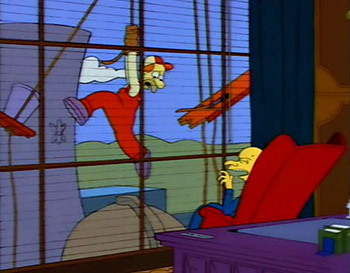
Hakudōshi: Oh, please. Is that what you're so upset about?
Empathy is the ability to share in another person's emotions. The capability to be happy because someone else is happy, sad because they are sad, and so on. It is closely linked to love and compassion. Furthermore, guilt to a large extent arises from the ability of a character to put themselves in the shoes of someone they've hurt.
A lack of empathy is a major character trait, one that drives many others. A villain will often have this trait, and will be denounced sometimes as a psychopath, or a sociopath. Real-world disorders with the same names inform this trope, but the relationship is very loose.
These characters may feel fear, but not the fear of others, regardless of the situation.
Note that a character who lacks empathy can still be perfectly capable of cognitive empathy; that is, the ability to recognise and identify an emotion — they might not be able to share in somebody's happiness or sadness, but they have learnt well enough what happiness or sadness looks like, and coupled with the lack of remorse, this tends to result in a ruthlessly effective Manipulative Bastard.
On the flip side, just because a character has empathy does not mean that they possess one ounce of compassion or sympathy, though the lack of either usually coincides with at least a diminished sense of empathy. For instance, someone with narcissistic or antisocial personality disorder order should not be confused with someone with Asperger's or another form of autism. Narcissists and sociopaths usually have perfect cognitive empathy, but utterly lack the affective empathy necessary for genuine compassion. Those with Asperger's or Autism sometimes have defective cognitive empathy, but normal or even hyper-effective emotional or compassionate empathy. In short: narcissists and sociopaths are generally superficially charming and polite, but their pretense of empathy is simply that, a mere ruse to attain a tangible end. Autistic people, on the other hand, more or less invert this: they're perfectly capable of feeling other people's triumphs and tribulations — often quite intensely — but you wouldn't necessarily know it from their face or tone of voice, and that's assuming they've learned to identify them in the first place.
Jerkasses, the Moral Myopic, Straw Nihilists, Empty Shells, and The Soulless tend to express this. When taken to its logical conclusion, it leads to It's All About Me. Often an integral part of Comedic Sociopathy. Sometimes characters with a Lack Of Empathy have a Freudian Excuse up their sleeve. Sometimes, they just laugh and say Virtue Is Weakness as their justification. These characters often shrug off charges of their actions with But for Me, It Was Tuesday.
Not to be confused with No Sympathy, which refers to characters who supposedly do have an ability to empathize, but completely fail to demonstrate it. Kids Are Cruel, Troubling Unchildlike Behavior, Teens Are Monsters, and Adults Are Useless often have this trope, though these can be (partially) excused by the cognitive faculties required for empathy having had insufficient time to develop (the former more so than the latter; anyone who's been around toddlers will tell you that they can be selfish little bastards/bitches). The person in question doesn't have to be human per-se, but if empathy is an entirely foreign concept to the character because they don't see things the way that we/the character do, it may be a form of Blue-and-Orange Morality instead where the goal-posts of "empathy" have shifted from what one would expect.
Contrast with The Empath, who is able to empathize with another due to feeling their emotions due to psychic powers, but may still be evil due to what that power can do.
No Real Life Examples, Please! General real-world notes are on the Useful Notes page.
Example subpages:
Other examples:
- From Batman, James Gordon Jr. sees empathy as a weakness. His main plan in Batman: The Black Mirror involves turning children into sociopathic murderers like him.
- A vast majority of supervillains from DC and Marvel comics have this trait. Norman Osborn a.k.a. the Green Goblin is a notable case. This trait is highlighted in "The Green Goblin's Last Stand", Spider-Man's (original) showdown with his arch-nemesis, where Spider-Man destroys Osborn's prized glider. Gobby fights with renewed anger, vowing to make Spider-Man pay for this travesty, while pointedly brushing off the fact that he just murdered Spidey's girlfriend an hour ago.
- The Indigo Tribe, a relatively new element in the Green Lantern mythos, represents the emotion of compassion. While on the side of the good guys, they're mysterious and kind of creepy. It's eventually revealed that the tribe is made up of those who lack compassion and need it forced on them.
- Captain America: Depending on the Writer, the Red Skull is either the second- or third-worst selfish bastard in all of Marvel comics, or a disturbingly unselfish and even more dangerous Nazi true believer who will run roughshod over millions to avenge Hitler's death and restore his idea of the perfect fascist utopia. Either way, he won't be stopped by any appeals to mercy or pity.
- Eight Billion Genies: As cheery, friendly, and helpful the genies are, they don't really care what happens as a result of people's wishes. A woman accidentally igniting all of downtown Detroit is met with a shrug. The fact that two billion people have died directly or indirectly as a result of the wishes the genies granted in a mere eight days doesn't register to them in the slightest.
- Several of the Endless from The Sandman (1989) have this trait. Despite being Anthropomorphic Personifications of concepts very much tied to emotions, only Death and Destruction seem to hold much appreciation for how others feel. In Dream's case, it's probably his most noticeable character flaw after his obsession with duty, although his second incarnation seems to be slightly better in that regard. Destruction notably is the only Endless who quit his job and wanders creation to try and be something besides Destruction incarnate. Death makes a point of becoming mortal for a day every now and then to avoid losing touch with her charges.
- Sonic the Hedgehog:
- Sonic the Hedgehog (Archie Comics): In the past, Breezie eagerly helped Eggman with a scheme that endangered Tails, blowing off Sonic's words by openly stating she cared more about her own life and well-being. During the Shattered World Crisis, her main concern is solely how to make a profit out of the fact that the planet is falling apart.
- Sonic the Hedgehog (IDW):
- Dr. Eggman himself. Best shown in Issue #25, when Silver shows up from his failed attempt to rescue the citizens of Ice Paradise from the Zombots and bemoans that his future may very well be doomed due to his failures in the present. Eggman flippantly asks if Silver is always so melodramatic, to which Amy appropriately tells him off.
- Dr. Starline, fittingly a Loony Fan of Eggman himself, isn't much better. When Eggman unleashes the Metal Virus on an innocent village, his only reaction is admiration for the doctor's cruelty, and when listening to Belle the Tinkerer's Dark and Troubled Past, the only thing he cares about is the data he's getting from Belle's emotions and advanced AI systems as she details what happened to her, and how he can apply it to his projects.
- The New 52 version of Superboy shows this trait, although in Issue #6, he suspects that he's starting to feel a spark of it, and he eventually evolves into an All-Loving Hero.
- Superman: During the New Krypton storyline, there is a scene where two Kryptonians take a walk down the street, discussing Superman and his bizarre desire to protect these Puny Earthlings. When a car crashes, the bystanders, recognizing them as Kryptonians, beg them to help — the duo doesn't even react to them and continue their talk, eventually flying away.
- Atrea from Ultimate Fantastic Four. Thanos' parenting style didn't lend itself well to considering the thoughts and feelings of others. She kills her own pet just for growling at Ben, then shrugs it off because it was old and "boring".
- The Ultimates:
- Not as bad as some of the others on the team, but as Tony Stark notes in The Ultimates 2, he can be spectacularly unpleasant when dumping women.
- Betty Ross/Ultimate She-Hulk works as the head of PR for S.H.I.E.L.D. and comes across as a Corrupt Corporate Executive rather than a government employee. She callously dumps Bruce before taking him back after he kills hundreds of civilians as the Hulk, and eagerly reports approval ratings following the Ultimates' fight with him to Nick Fury at the funeral for his victims.
Nick: What's the matter with you, Betty? You born without an off switch or something?
Betty: Oh, sure. Like you were in there praying for all the itty-bitty children, soldier-boy?
- Watchmen:
- Dr. Manhattan gets increasingly more and more of apathic to the world due to his powers and perception of reality being so omnipotent to the extent that he simply doesn’t react to a pregnant Vietnamese woman getting shot by the Comedian in front of him (see below) nor made any moves to stop it — something even the Comedian himself notes. The only exception is Silk Spectre II/Laurie who he does genuinely care for and is willingly to come back for Earth again for her sake.
- The Comedian is a horrible case of this for the most part, he belittles the rioters in a police strike and is just gleeful at the carnage that gives him the chance to kill indiscriminately and laughs at Nite Owl’s horror, he ignores Silk Spectre’s protests when coming onto her and just becomes violent when she scratches him and he shuns a pregnant Vietnamese woman asking him to the responsibility for their child and just shoots her when she cuts his face with a bottle. It speaks to the horror of Ozymandias‘ scheme that it’s the one thing that actually horrifies the Comedian and reduces him to a crying mess of remorse.
- Ozymandias despite pretending otherwise has this as his Fatal Flaw. In his Motive Rant to Rorschach and Nite Owl he admits that he ultimately found the usual superhero antics of saving innocent lives hollow since he only “fought symptoms, leaving the disease unchecked” and began to only think of the greater good rather the innocent masses cumulating in him killing three million people in New York as necessary sacrifices to prevent nuclear war and create world peace. Even on a smaller scale we see his cold disregard towards other people as he lets his own sectary get shot down in his sham assassination and poisons his Vietnamese workers when he no longer has any use for them. This sets Vedit apart from Rorschach who despite being horribly flawed himself still displays empathy towards innocent children and cries at failing to prevent colossal loss of life.
- Wonder Woman (2006): The ability to identify with others was not part of Genocide's programming, in fact she hates everyone and wants humanity to suffer and die.
- X-Men:
- Magneto cultivates a lack of empathy for lowly "flatscans" and teaches his followers to do the same. Though, Depending on the Writer, he can vacillate on this, but usually the vacillation is only in his own mind — for example, X-Men (vol. 2) #85 features Mags on the cusp of starting another bid at exterminating humanity and deciding to "test" whether or not humanity deserves extinction by finding a random man to serve as his "average specimen of humanity" and then testing his prejudices. But when this random man, Bill Jones, doesn't take his Fantastic Racism bait and proves to not be the slobbering racist that Mags subconsciously wants him to be, he can't accept it and pushes Bill harder, eventually getting him to confess to wanting him, Magneto, dead (by threatening his family), which Mags takes as the proof he's looking for that "even an everyman with a kind heart becomes a rabid beast at the sight of that which he does not understand." That, of course, was the conclusion Magneto had drawn from the start, and Bill was just the excuse he was looking for to justify his fundamental... well, Lack of Empathy.
- This is an inherent biological trait of the Brood race — unsuprisingly, given that their method of reproduction requires them to kill other species in a rather gruesome manner. All Brood are screened for compassion at birth, and those who "fail" are killed. However, with the recent mass extinction due to the Annihilation Wave this policy was dropped. It's also possible for Brood, such as No-Name, to learn compassion, but to gain it suddenly (such as by psychic projection), is such a shock that it is instantly fatal to the Brood in question.
- Calvin and Hobbes: Calvin expects everyone to bend over backward to accommodate his whims, yet refuses to do any work that doesn't have immediate benefits for himself. Moreover, he deliberately annoys people around him, yet is incensed when someone else deliberately slights him. This isn't just hypocrisy; Calvin genuinely believes that he is the most important person in the world, and that different standards of behavior apply to him. This is all pretty standard for a small child, the difference being that Calvin has the ability to cleverly articulate his worldview without ever seeing the inconsistencies within it.
- Everyone in Dilbert, except maybe Asok and Ratbert, who are portrayed as naïve. The most outstanding examples are Dogbert, Wally, the Pointy-Haired Boss and Catbert. Scott Adams has joked that he himself might be a sociopath.
- Balto: Steele starts out as a rude, arrogant and egotistical bully who abuses Balto for his part wolf-heritage and hanging out with Jenna. But when Balto takes his place as lead dog to deliver the medicine, Steele is so determined to stop him that he sabotages Balto's trail, clearly not caring about the poor sick children who'll die without the medicine. And he doesn't even shed even the slightest sign of guilt whatsoever.
- An Extremely Goofy Movie: Bradley doesn't care that Tank is trapped in a burning X structure potentially facing death. Tank keeps this in mind when he confronts Bradley after being saved by Max and Goofy.
- Frozen (2013): Prince Hans faked loving Anna just to get close to the Arendellian throne and even mocks her when he drops the act. It leaves her gloomy, but Anna eventually realizes that Elsa, Kristoff, and Olaf do care about her. Having been denied the respect and attention he felt he deserved in youth, he craves seizing power at all costs. The creators have confirmed Hans is a sociopath and a subversion of the Prince Charming trope. When Anna calls him out for being the only person with a "frozen heart," he's left perplexed.
- The Boov from Home (2015), embracing a Dirty Coward mentality for their whole society, have absolutely no regard for any of the natives they forcibly relocate as they conquer Earth. When Oh finally gets that perspective and the courage to stand up to Captain Smek about what they are doing to humanity, everything changes for them.
- The Incredibles:
- Syndrome cares for nobody except himself and is willing to murder a bunch of innocent superheroes to replace them in his image. When he mocks Mr. Incredible over the supposed death of his family, the latter grabs Mirage and threatens to kill her if Syndrome doesn't release him, only for Syndrome to tell him to "go ahead" and then call him weak when he doesn't go through with it. When Mirage calls him out for endangering her life, Syndrome is still confused about why she is upset.
- Gilbert Huph, Bob Parr's Mean Boss, is willing to scam people out of the insurance claims they're rightfully entitled to so he can earn more money. When Bob informs him a man is getting mugged across the street from his window, he coldly responds they shouldn't cover him, then threatens to fire Bob if he goes out to help.
- Sierra from The Land Before Time VII: The Stone of Cold Fire shows some traits of this. Namely, how he casually discusses feeding the children to the sharp teeth once they take over.
- The Lion King (1994): Scar. He is perfectly willing to murder his brother, and have his nephew (a cub) killed in order to take over the Pride Lands, then gorge himself at the expense of both the pride and the hyena clan, without even a shred of remorse.
- Megamind: Hal Stewart/Titan doesn't care who gets injured or killed during his rampage. Even before gaining powers, he was indifferent to Metro Man's alleged death and decided to use it as an opportunity to hook up with Roxanne — while she was grieving for Metro Man.
- ParaNorman: The whole plot happens in the first place because the seven Puritans being this trope very much. They took Agatha Prenderghast, a sweet little girl who shared Norman's gift of speaking to ghosts, away from her mother, and as Judge Hopkins told her how she was to be hanged by the neck until she dies, they were eerily calm when the little girl was sobbing out of fear. They later subvert this after they had a Heel Realization.
- Pinocchio: The Coachman never shows pity or compassion for his victims. When poor Alexander begs to be set free, the Coachman nonchalantly and very harshly throws him in the pen with the other donkeys who can still talk. Then the other donkeys beg him to be sent home, crying that they "don't want to be donkeys," but he viciously cracks his whip and shouts to be quiet.
- Puss in Boots: The Last Wish: Jack Horner cares nothing about others, including his men who were all killed by him accidentally. He is ungrateful towards his own parents and desires to have all the magic in the world. Even Perrito's cuteness stare fails to work on him, as he admits he's dead inside.
- Hannah-Marie's cousin Jimmy in Scary Godmother is over this for he conspired to leave her to frighten in the Spook House and abandon her to go trick-or-treating. While his friends gained remorse, he didn't care one bit of that he hurt his own cousin's feelings.
- The Secret of Kells: When the leader of the Northmen reads the Book of Iona (a.k.a the Book of Kells), the book that has touched everyone who's read it (even Cellach), his response was to tear out the pages, throw said pages in Aidan's and Brendan's faces and walk off with the gold cover. While it’s entirely possible that this is simply because he could not read Latin, the fact that he regularly leads destructive raids of abbeys and monasteries without any hint of remorse doesn’t give the impression of a compassionate individual.
- The Super Mario Bros. Movie: Bowser is unsympathetic to the lives of others, believing that Peach would enjoy seeing Luigi and Bowser's other prisoners being executed Mortal Kombat-style in a large volcanic fire pit. He also shows no remorse in trying to kill all who stand in his way of getting what he wants. He even shows no hesitation in trying to kill Peach after she rightfully rejects him at the altar, further showing that his so-called "love" for her is solely possessive and objectifying.
- Megatron from The Transformers: The Movie, as shown when he coldly executes a mortally-wounded Ironhide still trying to fight him even in his death throes.
Megatron: Such heroic nonsense. [blam]
- Wreck-It Ralph: Turbo just wants to be the center of attention, not caring about what it takes to get there. Attempted murder, crashing two games, including his own, and a prolonged campaign of ostracism to force those who would be in his spotlight out of the way are done just as easily as using shortcuts to get ahead in a race.
- While several of the characters in And Then There Were None fit this to some extent, Anthony Marston is a particularly good example: he's The Hedonist, devoted to his own pleasures but unable to consider the wishes of others. Interestingly, the murderer generally kills from "least guilty to most", and while Marston committed a pretty terrible crime (running over and killing two children), he's actually killed first on the logic that he's amoral and has no comprehension of right and wrong.
- Battle Royale: Kazuo Kiriyama. See Anime & Manga example above. Minor difference between the Manga and Literature version, Kiriyama's reason for not feeling empathy is due to a birth defect rather than an accident that left him damaged.
- Most of the villains in The Belgariad and The Malloreon, including Taur Urgas, Zandramas, Brill, and Ctuchik. Demons have a Lack Of empathy as a race trait, with both Nahaz and Mordja having nothing but contempt for one another, their fellow demons, and the entire human race. Nahaz makes it most clear when he grabs Urvon to take him to Hell with him: "I need this thing." To Nahaz, people are literally just things.
- The vampire subspecies' in Peter Watt's Blindsight most disturbing personality trait is a complete lack of empathy. Because they needed to eat fellow humans to acquire necessary proteins, they would have never evolved if they felt bad about doing it. Every last one of them is a sociopath. If you're still in one piece around one of them, it's just because you are being more useful this way at the moment.
- Clocks that Don't Tick has the immortal oligarchs known as the Bosses. They've no issue with allowing billions to die on account of their apathy. At one point, the protagonist guesses that they stay isolated in their mountain mansions in order to stave off what tiny, tiny amount of empathy they might have left.
- A Clockwork Orange: Alex, a dyed-in-the-wool sadist. Even in the final chapter of the British version, where Alex gives up being a delinquent, he never explicitly develops a sense of empathy. He simply gets bored with violence and desires to start a family.
- Alisa, the Villain Protagonist of the first part of Day Watch not only lacks empathy toward others, but is pretty casual about doing things like causing her mother to miscarry in an attempt to repair her parents' marriage. While the philosophy of Dark Others (celebrating individualism/selfishness) explains some of her behavior, it's also true that Others in general no longer think of themselves as being like Muggles, and so she can't really care about them. What makes her character interesting is despite all of the loathsome things she does, the reader gets the impression that she actually does have normal human feelings, but they are deeply suppressed, and she is in her late teens, and her behavior is what you'd expect when someone immature and with an unhappy home life is given massive amounts of power.
- In Delirium by Lauren Oliver, love is considered a disease. At age 18 everyone is required to get a surgery that removes the capability to love from their brain. As a result, most adults show and understand very little emotion, and in some cases get so emotionally detached that they will kill their children.
- The Diabolic: Diabolics are born without empathy, though they have to have that section of their brain strengthened when they are imprinted on their charge. Sidonia points out that you can't laser-focus empathy like that; "civilized" Diabolics are capable of general empathy, but constantly being told that they aren't keeps those instincts mashed down. Nemesis jumps down into a fighting pit to save a dog monster that is being forced to kill an innocent slave.
- Diary of a Wimpy Kid: Despite being treated badly by Rodrick and knowing how painful said treatment can be, Greg treats Rowley the exact same way, which causes Rowley to give him "The Reason You Suck" Speech. In addition, despite being an outcast, Greg feels no empathy for Fregley and looks down on him.
- Discworld Elves are explicitly described as lacking empathy. They would break the universe if they thought it would make a pretty noise.
- In Feet of Clay, the villain's response upon being told that his plan to poison the Patrician killed several innocents (including a child) is "Were they important?" Carrot is extremely disappointed to hear this.
- This is the defining trait of the replicants of Do Androids Dream of Electric Sheep?. They are artificial people and have no empathy. Testing a person's empathy is in fact how bounty hunters distinguish real humans from replicants. However, the story also shows that humanity is losing its own empathy and becoming more like machines. Deckard's wife, like many other people, uses a machine to give her artificial emotions. The replicants are a chilling indication of where humanity itself might be headed.
- From The Dresden Files, vampires have to a degree the ability to empathize with each other, but almost all lose the ability to empathize with humans — even the comparatively nice White Court see mortals as little more than walking snacks, and the other two Courts are if anything worse. Lack of empathy is also a requirement to join the Denarians, and if you do still have any after joining up, your brand-new Fallen Angel bond creature will fix that in no time...
- Family Skeleton Mysteries: Roxanne Beale is so obsessed with completing her mess of a dissertation she doesn't even really care that her sister committed suicide or that she framed an innocent woman, one who was actually helping her finish the work, just that her work kept getting delayed. In fact, the only reason Roxanne murders Kendall is because Kendall had the audacity to mess up her life by bullying her sister to death.
- Girls Don't Hit: Joss feels absolutely nothing toward most people, her targets especially, except for annoyance.
- Caine from Gone, almost to a humorous extent, especially when contrasted with his love interest, who, although a bit of a Manipulative Bitch, has her limits. He's honestly puzzled as to why she wouldn't want to watch coyotes feeding on young children when there was no good reason not to stop them, and a bit annoyed that she objects to crashing a helicopter with a toddler inside. And in Book 4, he thinks that, rather than being upset that he used her for sex, lied to her, and dragged her into plans of world domination, she'll be happy to be his queen. Yeah...
- Drake is an even worse example, being so psychopathic that even Caine is nervous around him.
- Gaia, too.
- Harry Potter
- Lord Voldemort, and almost all of his Death Eaters — but particularly Bellatrix, who seems to be a sadist as well as mentally unbalanced in general. When Narcissa (Bellatrix's sister) is reduced to a nervous wreck by Voldemort sending her son on a dangerous mission, Bellatrix insists she should be proud.
Bellatrix: If I had sons, I would be glad to give them up to the service of the Dark Lord.- Professor Umbridge, whose idea of detention involves students writing lines in their own skin.
- Snape is this way as well. He bullies Harry and Neville mercilessly even though the same happened to him as a kid. He’s also very condescending about Tonks’s relationship woes causing her Patronus to change when the same thing happened to him.
- Galbatorix in Inheritance Cycle definitely lacked empathy. Ironically, the first time he ever experiences empathy in any way, it gets him killed.
- Inkmistress: The king is utterly unsympathetic to Asra's concerns when she raises them to him. She's shocked by this, realizing that she has been wrong to support him as a result.
- Journey to Chaos: When Eric accuses Tasio of apathy towards victims of mana mutation the trickster replies, "My heart bleeds for every poor, tragic, hilarious victim". He's empathetic and compassionate in so far as fits his chaos god mentality. He's constantly helping mortal people and understands both their troubles and triumphs; just as often he's making a nuisance of himself.
- Most if not all the antagonists in any Dean Koontz novel.
- Seems to be a feature of immortals and cats in The Last Unicorn. In the case of unicorns at least it's not that they lack the capacity so much as they have a differing value system; as the unicorn states, both cruelty and kindness are concepts for mortals, that don't really apply to unicorns or their ilk (Schmendrick, cursed with immortality himself, reckons she's full of shit).
- In Jane Austen's Love and Freindship, the narrator has acquired this.
"Tho' indeed my own Misfortunes do not make less impression on me than they ever did, yet now I never feel for those of an other."
- Max Barry's Machine Man has Dr. Charles Neumann. He has virtually no empathy whatsoever at the start. This goes further as he starts replacing his body parts with Better Parts.
- Nevermoor: Very common in the villains.
- Inspector Flintlock is a xenophobic cop who hates all immigrants, especially "illegals." Never mind that the Free State is so isolationist that even if someone sincerely wanted to immigrate legally, they probably can't, and many people, including Morrigan, came because their lives were endangered back home. His hatred of "outsiders" is so extreme, he spends the entire first book trying to have Morrigan deported, even though he's been repeatedly informed that she'll probably die if she goes back, and she's a child.
- The Mole in the second book is revealed to be Henry Mildmay, meaning he spent a whole year with a group of children in his care, and was still able to sell them to the Ghastly Market without a care, all to line his own pockets.
- The Big Bad, Ezra Squall, outright admits he doesn't care about anyone else, and is very adamant that "Wundersmiths don't have friends." He's purely out for himself and his own self-interest. He does have some genuine Villain Respect for Morrigan, but it's mostly due to their similarities, and he repeatedly demonstrates he has no actual regard for her feelings or welfare. He also created the Hollowpox, an engineered disease specifically designed to target and kill Wunimals, as a means of extermination. This is already disturbing, but it gets creepier when he reveals that he was hired to do so by President Wintersea, and he has no moral objections... but he also didn't do it because he hates Wunimals like she does. He doesn't hate them so much as he is entirely apathetic to them; their entire population, like all living creatures, are so far out of his interest that he couldn't care less whether they live or die.
- Mr. Men:
- When Little Miss Trouble sees the result of her lies about Mr. Small (Him getting two black eyes courtesy of Mr. Uppity and Mr. Clever), she laughs at the result.
- Mr. Happy of all people displays this trope in Mr. Men: Adventure In China when Mr. Bump falls into the moat in the Forbidden City by smiling at what happens while Little Miss Brainy, Little Miss Lucky and Mr. Jelly all show concern.
- The narrator of spoof self-help book Oh, the Humanity definitely qualifies. The general impression is that he understands empathy in an abstract sense but has no ability to actually experience or apply it. During his Hilariously Abusive Childhood he considered "empathy" to involve a bully trampling his science fair project and saying "That must suck for you, dorkhole", so at least it's kind of understandable that he has trouble with it.
"That reminds me, I've been meaning to call you and tell you how much you have to live for. I'm sorry, I've just been doing so much gardening as of late."
- Paladin of Shadows: Katya. Jay says this is what prevents her from being a truly good spy.
- Happens to most humans on Earth in Perry Rhodan's "Aphilia" arc. It's a very gradual process caused by the new sun the planet is orbiting at the time, so society more or less adapts — the world resulting from it isn't a nice one at all, and people immune to the effect become essentially hunted outcasts, but self-interest and very strict law enforcement with robotic backup manage to hold things together more or less well.
- In L. Jagi Lamplighter's Prospero Lost, Miranda evinces a serious limited ability to empathize. Her siblings think their father used a spell on her to stifle it. Surprising moments of empathy appear, and shock her with the realization that her siblings might be right, and the spell is now breaking down. OTOH, at all times, she fully averted A Million Is a Statistic and is grieved and disappointed in herself when she is unable to prevent natural disasters and so the deaths of thousands.
- In Psy Changeling, as a result of the Silence Protocol, this is a defining trait of the Psy race.
- Count Olaf in A Series of Unfortunate Events, who relentlessly pursues the Baudelaire siblings around the world and causes them all manner of pain and suffering in pursuit of their inheritance, killing numerous innocent people along the way.
- Richard Lopez and Blue Eyes of Ship Breaker have no empathy for anybody. Richard more or less profiles as a sociopath while Blue Eyes is an emotionless monster.
- Mandos in The Silmarillion is a rare good example. As the judge and the overlord of the realm of the dead (dead elves anyway) empathy would get in the way of his job.
- The Hirogen alpha in Demons of Air and Darkness, who like most Hirogen relates to other sapient beings only as prey. At one point, he reflects on how one of his victims cried that she had a husband and children, "as if the family structure of prey was of any relevance".
- Sweet & Bitter Magic: Tamsin, as a result of a curse, no longer feels love (unless she's gotten this from other people). As a result, she is cold and callous to most people, which disturbs Wren greatly. Despite this, she's not really cruel, just indifferent most of the time. She gradually starts to care for Wren however. Over time, her love returns as she and Wren fall for each other.
- Mark from That Was Then... This Is Now is compared several times to a lion — attractive, charismatic, and utterly incapable of caring about the people he hurts. This seems to be innate rather than environmental, and the narrator observes that it's unlikely he could ever be treated or convinced not to harm others, only put in jail for who and what he is.
- In This Immortal, Evilutionary Biologist George exhibits a lack of sympathy both towards people and especially towards other living creatures, e.g. he dissects the last living dog on Earth just because he can and For Science!.
- In Wen Spencer's Tinker series, it is a distinct trait of the oni. Fortunately, their half-human children don't evince it; if they had, the elves would have had to kill them all, and actually done it.
- Victoria has numerous examples among its villains, but the eminent example is perhaps the Cascadian goddess. When she notices that one of her faithful attendants has been shot dead with an arrow, she is upset — because the feathers on the arrow come from a holy owl, and mortals have no right to harvest them.
- The Witch of Knightcharm is set at an evil Wizarding School where, perhaps unsurprisingly, many students have this. The protagonist finds herself in a class of fifty-two rookies, two of whom are killed just a few minutes after orientation starts, and yet several students in the group make it clear they couldn't care less about the two victims.
- World War Z implies this with Paul Redeker, an Amoral Afrikaner who devised a plan to save the already overrun South African nation from the zombie hordes by creating decoy safe zones to draw zombies away from the true safe zone set up to house the government and necessary laborers. At least one military officer charged with overseeing his nation's version of the plan was Driven to Suicide after giving an order to pull military support from one of the decoy zones. Interestingly, the interviewee retelling Redeker's story suggests that Redeker was actually an inversion of the trope, and that he forced himself to push aside his emotions in order to avoid a mental breakdown due to being over-empathetic. Because the interviewee is Paul Redeker, having literally forgotten his own identity and assumed another after a mental break, this may actually be the case.
- "Pretty Vacant" from the Sex Pistols' Never Mind the Bollocks, Here's the Sex Pistols.
- "I Don't Care" from The Ramones' Rocket to Russia.
- Daniel Amos' "It's Sick" (from Vox Humana) is about responding to foreign tragedies with complete apathy. The narrator at least has the self-awareness to feel bad that he doesn't feel bad:
"It's sick! And I got it on my TV
It's sick! When I don't feel a thing
It's sick! And I get a little queasy
When somebody tells me it's only a game, it's sick!" - In the audio play, The Grand Cyberpunk Gala of Gabriella Gadfly, the antagonists are a group of AI that had once been human, and are in the process of losing their emotions. This is bad because once they become completely detached from human sympathy, they'll attempt to Ascend to a Higher Plane of Existence in a way that will destroy a populated city.
- Taako of The Adventure Zone: Balance develops this in response to his time on the Starblaster, after encountering hundreds of worlds only to see them get consumed by The Hunger one after the other; he sees anyone but the Starblaster crew as "dust".
- Dawn of a New Age: Oldport Blues:
- Melissa lacks empathy to a sociopathic degree. When her boyfriend hesitates at the idea of siccing a bloodthirsty monster on an apartment full of poor people, she eggs him on. When said monster kills an innocent bystander and his dog, she's only concerned with how long it takes to finish him off. And when the chips are down, she doesn't hesitate to try and commit murder without any hesitation or remorse.
- To a much lesser degree than Melissa, Jacob has problems empathising with others. Specifically, he cares more about how people might inconvenience him than how they're feeling, which is a direct result of his mother forcing him to adhere to an overly strict regime. When Lenore finally manages to guilt him into helping her defuse a bomb, he's thoroughly confused at what he feels.
- The Fae in Changeling: The Lost. The fae's lack of empathy make them seem utterly alien to those they kidnap, enslave, and shape to their own twisted desires. The very few times a fae does develop real feelings for their unwilling playthings they actually lose most of their supernatural power and memories of their previous existence.
- Dungeons & Dragons:
- Acererak from the Tomb of Horrors quest. He decides to become immortal by becoming a lich and, when his body begins to fail after several centuries, he begins to plot ascending into becoming the ruler of all dead by building a tomb filled with hideous traps that can (and will) kill even the strongest of adventurers, all in his honor. Then, when it is finished, he kills all the ones who built it and his followers, kidnaps an innocent siren and places her in a cavern, shackled through magical means. Why? Just for his own amusement of seeing adventurers go paranoid over whether she is a trap or a monster. Finally, when adventurers do reach his chamber, he sucks their soul out, just like that.
- Mind flayers. They learn their emotions from specially enchanted crystals, not from each other. They don't learn how to feel based on others, they learn how to feel from rocks. Other creatures are no more than tools to them, and it's only their devotion to the elder brain that really allows them to have a society. The third edition sourcebook ''Lords of Madness" describes them as "cold" and "clinically detatched" and implies that all the major aberration races described in the book simply never even consider (nor care about) how their victims feel.
- Dracotaurs are described as being utterly incapable of experiencing compassion towards other beings.
- The yuan-ti are cold and emotionless Snake People who view other creatures as hunks of meat to be used and discarded as they see fit, and they consider the emotions of such creatures to be an exploitable weakness. They don't even feel empathy for their own kind: while the yuan-ti place a higher intrinsic value on their fellows than they do on everything else, that won't stop a starving yuan-ti from killing and eating its peers without hesitation or remorse.
- The Fair Folk of Exalted. Due to the nature of the Wyld, where they can summon up and dismiss whole countries full of people with but a thought, many of them have difficulty grasping the idea that people in Creation are independent and sentient beings.
- The Yozis, too. Malfeas genuinely doesn't understand that people even have opinions, let alone that they might act on them, and it took quite a while for the Ebon Dragon to convince him that the Infernal Exalted would need a source of motivation other than Malfeas shouting at them and slapping them around when they failed. The Dragon himself is a sociopath whose sole ability to relate to others is based upon figuring out how best to a) get what he wants, b) ruin their lives or c) do both at once (usually c). Kimbery cares deeply about others, but this doesn't extend to e.g. not destroying their lives "for their own good", and as soon as they object or fail to live up to her arbitrarily high expectations she hates them to death. Adorjan is very generous, but this is performed through such charming things as murdering her victims' loved ones to teach them the folly of attachment, or simply killing her target horribly to give them the greatest gift — silence — with no concern for whether or not they actually want this enlightenment. The closest She Who Lives In Her Name gets to empathy is a kind of icy and emotionless pity, Cecelyne exists solely to enforce her Social Darwinist views on the universe, Isidoros is willing to not trample people... if going to trample some other people would be more fun, and Metagaos is far too hungry to care whether what he's eating can feel or not.
- This is one of the drawbacks of blue magic in Magic: The Gathering: blue was already The Spock, but the more villainous blue mages go from disregard for emotions to disregard for everything except achieving their goals. Black can also be like this, although usually it does understand that others have internal lives; after all, that makes them easier to manipulate.
- Yawgmoth didn't care about the feelings of the victims of his schemes. He eventually extended this trait to the rest of Phyrexia, creating a society of unemphatic half-machine monsters.
- A common trait for Osirans in Promethean: The Created. As their humor is phlegm, which embodies logic and calm, they tend not to think in emotional terms. Strange Alchemies mentions how one Osiran encountered a dying homeless man whose last words were "Help me"; rather than assist him, the Promethean moved on, and spent a long time wondering why the man thought a stranger would aid him.
- Practically everyone in Warhammer 40,000, at least as far as their own kind goes.
- Da Orks don't even make that distinction: seeing other Orks get horribly butchered in droves is more likely to cause another Ork to laugh at how Bloody Hilarious it all is rather than evoke any kind of rage, horror or revulsion.
- Blanks in particular tend to be on the giving and receiving end of this trope. Being cut off from the Warp, which among other things embodies emotion itself, they are nearly incapable of forming emotional attachments to others and vice versa. Not surprising since they are the closest thing besides Necrons (the majority of which have lost their souls and individuality) to The Soulless that 40k has to offer. Some Blanks seem to be perfectly capable of empathy, which suggests that those who lack it may have turned out that way due to severe abuse or neglect as children, no doubt due to the sense of "wrongness" that normal humans tend to feel while in their presence. There are mentions of Blanks/Pariahs being hunted down and killed on more superstitious planets due to this creep factor, which would lend credence to the idea.
- Arguably, this was The God-Emperor of Mankind's Fatal Flaw (or at least among one of the more dangerous ones). For all that he did to ensure human supremacy and prosperity, he didn't seem capable of actually connecting with most humans on a personal level, even his own Primarchs. This ultimately brought ruin to everything and everyone around him, including himself, when said lack of empathy became one of the major reasons half his sons betrayed the Imperium to Chaos and set off the events that made the Imperium a theocratic hell-hole upon which the Emperor can only watch his dream burn and die by inches for millennia.
- Cyberpunk: Adam Smasher is an unusually literal example. Empathy is a stat in Cyberpunk, and usually given as a number between 1 and 10. Smasher's is Yeah, right.... In the fluff, Smasher is such a complete and perfect psychopath he managed to sidestep Cybernetics Eat Your Soul by not having one to begin with, and takes assignments only based on the anticipated kill count.
- Cabaret: This is Sally's problem. While she does mean well, and can certainly have sympathy for people, she has trouble fully realizing the very real problems people are dealing with during the rise of the Third Reich in Berlin. She instead insists that everyone follow her philosophy that if people just ignore their troubles, they'll be much happier for it. The entirety of her show stopping Title number is all about this.
- Quite a few of the villains in the Ace Attorney series are this.
- One of the earliest is Redd White, from Phoenix Wright: Ace Attorney. He blackmails everyone he possibly can, doesn't give a damn that he's driving countless people to suicide, happily murders Mia so she can't blow the horn on him, has Maya framed for the crime, and doesn't feel the least bit sorry that he just ruined the Fey family's lives in general. His own secretary believes that he'd murder her if she talks. He doesn't actually show concern for the events of his game until he's on the line.
- Another notable example is Manfred von Karma. All he cares about his his perfect trial record. He doesn't care who he hurts, or if he might be putting innocent people in prison for crimes they never committed. He also doesn't mind that he was playing Edgeworth, Hammond, and Yanni Yogi so he could get what he wanted, which was revenge for a slight against him. He shows no remorse over tazering Phoenix and Maya to steal their evidence. Oh, and he considered murdering Edgeworth's father to be totally justified, because the guy ruined his trial record and all.
- Among the many murderers in the series, Matt Engarde, Dahlia Hawthorne, Quercus Alba and the phantom probably demonstrate this trope the best. They all care for no one but themselves, and anyone else is just a tool to accomplish their goals. The latter is even a diagnosed sociopath.
- Frankly, the only villains for whom this trope does not apply are Yanni Yogi, Mimi Miney, Acro, Marlon Rimes and Godot if you count him as one, since they all acted out of revenge/desperation and did not want to hurt anyone except those who ruined their lives and the lives of their loved ones.
- Apollo Justice: Ace Attorney gives the particularly disturbing example of Kristoph Gavin. Over the course of the game, he completely ruins Phoenix's career as a lawyer, causes Trucy to be orphaned, murders Zak Enigma, tries to frame Phoenix for that crime as well, murders Drew Misham, tries to frame Drew's withdrawn daughter Vera for it, and is revealed to have been trying to poison Vera since she was a child, by way of giving her tainted nail polish while she has a habit of biting her nails. All of this comes from the simple fact that Zak Enigma hired Phoenix instead of him as a defense attorney, and everything he did was either to get twisted revenge on Phoenix or cover his own ass.
- Fate/stay night:
- This was part of Saber's Fatal Flaw when she was alive: she adhered to the belief that a perfect king must feel no emotion, allowing them to be impartial and perfectly just. While this allowed her to rule effectively it also alienated her people and contributed to the kingdom's collapse. Granted, she can feel empathy, but she "discarded her own humanity" by deeply suppressing any trace of compassion in order to become the "perfect king". When she actually reconnects with her humanity, she doesn't take it well. The fact that her reign ended so tragically made her come to the conclusion that she simply was not meant to be king, and someone else should've taken her place.
- Kirei Kotomine has a version of this as well. He only feels happiness from the suffering of others, and literally cannot feel satisfaction in altruism or even simply trying to enjoy himself. This is in contrast to Shirou Emiya, who can only feel satisfaction from making others happy.
- Female lead Rin Tohsaka is like this as a consequence of her Magus upbringing, though it's not nearly as severe as most examples. She admits to Sakura in the Heaven's Feel route that although she cares for her, she cannot feel the guilt over their father's actions, as well as her inability to save Sakura from her Fate Worse than Death that they both believe she should. She also tends to not really understand how Shirou, Archer, and Saber feel on occasion, though to be fair all three of them are also pretty messed up emotionally.
- On the other hand, Rin gradually turns out to be a subversion, as while she herself thinks and believes she doesn't have any empathy, in truth Rin has a fairly strong sense of empathy (especially for a Magus). While she can put on a good talk of her magus training stomping out her empathy, when push comes to shove her empathy tends to win out over reason. This is best shown in the prologue when she finds a mortally wounded Shirou and her thoughts immediately drift to her sister Sakura and how heartbroken she would be, prompting her to sacrifice her trump card in a desperate (but successful) attempt to save him.
- Gilgamesh takes this trope and runs with it, with everything that comes with it. Shirou even comments that it's more like he's staring through himself rather than Gilgamesh looking at him, as if he's not even recognizing him as a human being.
- The Fruit of Grisaia: Neither Irisu Kiyoka and Sakaki Michiaki is capable for feeling for the people whose lives they ruined or hurt. Neither of them cares for anything but furthering their goals. Michiaki is mostly empty and emotionless while Kiyoka is an otherwise petty human being.
- Higurashi: When They Cry: Satoko's Evil Uncle Teppei and her aunt Tamae, Rina, and ESPECIALLY Miyo Takano.
- The Big Bad in Nine Hours, Nine Persons, Nine Doors. Hongou suffered from prosopagnosia
 , a mental disorder disabling the ability of an individual to recognize faces, and as a result he felt completely disconnected from his fellow man, seeing other humans as nothing more than indistinguishable "monkeys in a zoo". He hated living like this, and became a Mad Scientist and Corrupt Corporate Executive of an evil pharmaceutical company willing to stop at nothing in the hopes of finding a cure.
- Without the ability to experience love, Kakuya from Spirit Hunter: NG forces people to play her games, tormenting and killing them without any remorse because she only cares to satisfy her own desire for fun.
- Most of the witches from Umineko: When They Cry. Beatrice seems like this at first but it's shown that despite the number of tortures/murders she commits, she likes Maria to the point where Maria is a Morality Pet of sorts to her. And then later, she's considered an imaginary friend to Natsuhi. Plus, despite how much time she spends fucking with Battler's mind and his life, in Episode 6, Battler and Beatrice end up married. Similarly, Lambdadelta seems heartless at first ( except for Bernkastel), but is shown to genuinely pity Battler when he is trapped in a logic error, knowing fully well how terrifying that situation is.
- Erika Furudo is not only unfazed, but actually excited by the murders occurring, partly because she "knows" that wherever a detective like her goes, a murder occurs. Needless to say, when questioning witnesses, she doesn't bother with delicacy.
Battler: You... do you even have a heart?
Erika: A heart? What is that?
- Erika Furudo is not only unfazed, but actually excited by the murders occurring, partly because she "knows" that wherever a detective like her goes, a murder occurs. Needless to say, when questioning witnesses, she doesn't bother with delicacy.
- The Annoying Orange: Orange shows very little concern whenever the other foods get brutally murdered, instead continuing his routine of comedy
- Wizard from DEATH BATTLE!: He's often incredulous at a fighter's Backstory, especially if they do something that avoids gaining power, like Pikachu's refusal to evolve via Thunder Stone.
- In the Dingo Doodles "Fool's Gold" campaign the entire race of Foreclaimers lacked both emotions and empathy. Foreclaimers who did develop them were considered "defective" and, unless they had status like Gothi, would be eliminated.
- Cloud has trouble when it comes to other people's tragedies in Final Fantasy VII: Machinabridged. Given that lack of empathy is a sign of Disassociation, which Cloud has a Mako-induced and drastically exaggerated case of, it makes a lot of sense it'd be one of his biggest flaws.
- RWBY:
- Salem clearly feels none of the pain she causes others. When Yang angrily calls her out for failing to handle one bad thing happening in her life as a comparison to how much Salem has taken away from her, Salem's response is to ask in a bored tone who she took from her. The minute Yang clarifies it was Summer Rose, Salem's demeanor changes to a sadistic smile.
- Cinder Fall has absolutely no compassion for anyone. If she even acknowledges people, they are merely tools pushing her plans further or obstacles that need to be crushed. She looks onto the carnage of Vale by the Grimm and calmly says it's "horrendous" as if it is something to be admired. Jaune even calls her out on it, demanding to know how she could be proud of all the suffering she's caused. The only acknowledgement she has for people's feeling is how she can use them to manipulate or hurt them.
- Jacques Schnee, Weiss' abusive father, is just as bad, if not worse. As stated by Qrow Branwen, all Jacques cares about is winning and is willing to use others to further his goals. He only hosts a fundraiser for Vale in order to attain good publicity, and goes so far as to flat-out tell Weiss to her face that her dreams and ambitions do not mean a thing to him.
- Zig-zagged for General Ironwood. Ironwood can act caring and considerate- but only for those who are or could be useful to him. If you aren't, then Ironwood won't hesitate to throw you aside without hesitation and No Sympathy. The members of Ozpin's Benevolent Conspiracy share a Land of Oz theme; Ironwood is the Tin Woodsman, who believed he had no heart.
- Deep Rise gives an example in The Nobles: They rarely if ever, feel or display empathy towards beings of other species, due to feeling that they are superior to all other life.
- Dragon Ball Multiverse: Frieza and the other villains, of course.
- Dr. Frost is an Insufferable Genius psychologist who claims that he has no empathy, which according to one of his old colleagues caused the death of one of his first patients and made him a pariah in the medical community. Unusually for a Sherlock House — style protagonist his lack of empathy doesn't translate into abuse towards his assistant (other than making her pretend to like a patient so he can break into his apartment) or his patients, although doing an unwanted Sherlock Scan or stopping a high school girl's anxiety attack by springing at her and clamping his hand over her mouth is unsettling. Frost's lack of empathy even has an organic, explained source: when he was a child he suffered a traumatic brain injury (he later acquires a similarly injured puppy, claiming he's only keeping him for study).
- In El Goonish Shive, the process of becoming an aberration, and thus a being that feeds off of humans in an attempt to cheat death, is explicitly said to destroy any capacity for empathy.
- Jan in Gifts of Wandering Ice. He has an antisocial personality disorder.
- My Deepest Secret: Elios. During a conversation with Emma, his girlfriend, he tries to explain his system of values, pointing out a stray dog has no value to him and thus doesn’t matter. He follows this with saying he loves her and his mom because they have value to him. This scares Emma, making her think that if she weren’t his girlfriend he wouldn’t care about her at all.
- Pretty Pink Ponytails in Angel of Death has absolutely no remorse for the acts of murder and torture she commits, in fact, she enjoys it quite a bit.
- In Hamster's Paradise, the harmsters instinctively prioritise survival of the fittest and see altruism as a waste of resources.
- In Worm, Regent fits this trope due to his upbringing-he notes that as a result of his father's powers, he barely feels anything any more, and even when he's taking vengeance on behalf of a teammate, he's incapable of empathizing with her situation, explaining to his victim that he's only doing it because "it's the sort of thing I'll do because it feels like I should. Dunno." Despite this, he still sacrifices himself to save Imp.
- Ask That Guy with the Glasses, although he cares enough about the narrator to shoot himself in the mouth because he can't live without him... after killing him, obviously.
- The CollegeHumor video "Livin' Mask-Free (Music Video)" is about a country singer who sings about his stubborn refusal to use a mask when out in public during the COVID-19 pandemic. Near the end of the song, he flat-out admits that he doesn't care about the fact that his decision will increase the risk of the virus spreading and will therefore cause more people to get infected and die.
Singer: Fuck you! I don't care about all the deaths
Don't care how much I kill with my stupid breath
'Cause I'm coughin' freedom out from sea to sea
But I'm not talkin' about your freedom to live
I mean your freedom to look at all the shits I give
'Cause the only guy I care about is me. - Critical Role: Taken to its Logical Extreme with Trent Ikithon, an Evil Sorcerer who indoctrinates children into his elite assassin corps, and who has no qualms about torturing or killing the loved ones of the people he's trying to hurt. When Caduceus casts a Command spell on him to force him to empathize with the pain he feels after Trent and his lackeys burned down his home and holy temple in the Blooming Grove, the spell does take hold, but has no effect, because Command can't force someone to do something if they are incapable of it.
- The Nostalgia Chick. Apart from a couple of Pet the Dog moments, she's not keen on showing that she cares.
This is the end of the page... but really, does anyone actually care if you've reached it or not?
