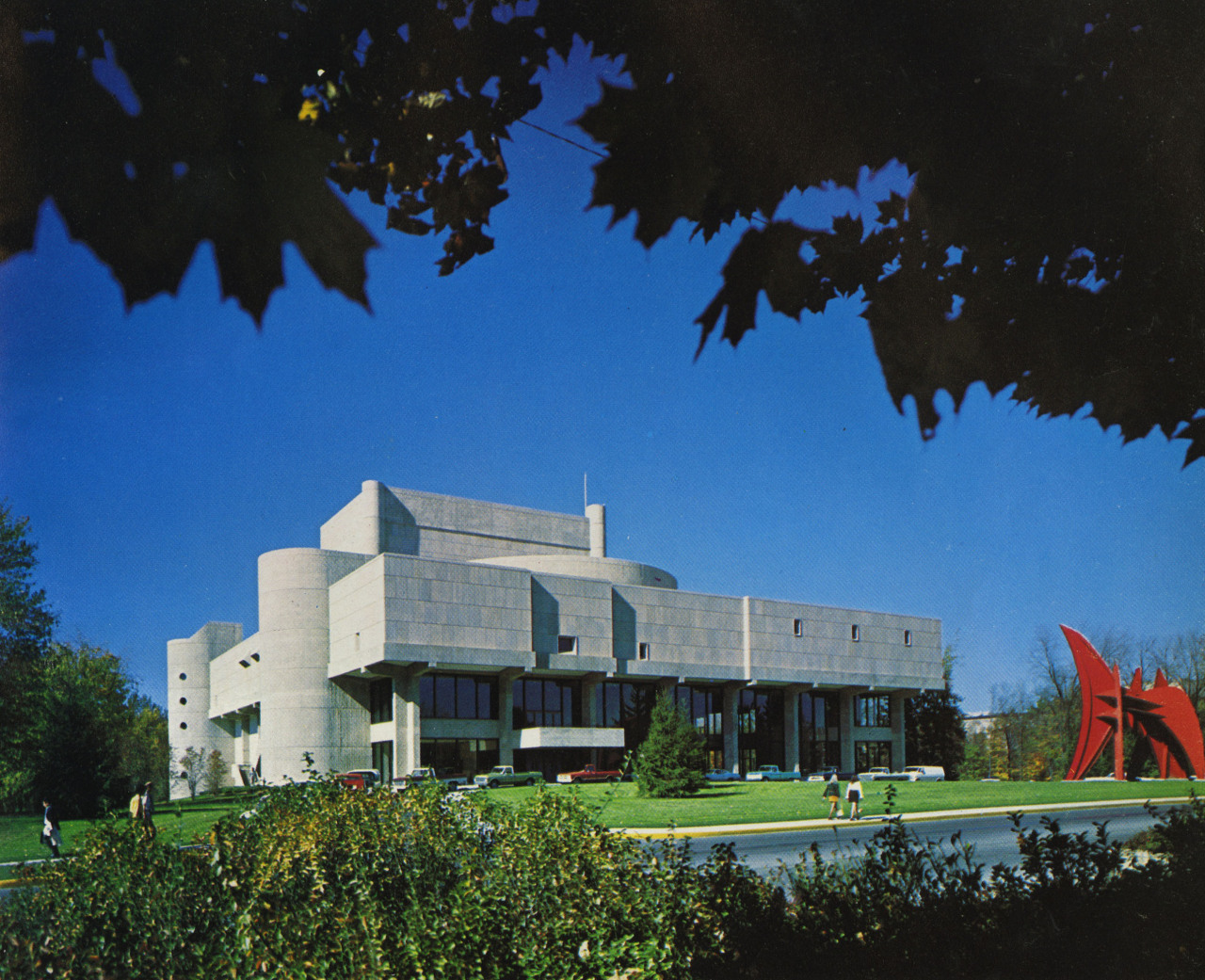
When a building is shown to have been built in a way that would either be impossible to build or is just plain ridiculous. Things like upside-down pyramids or buildings in the shape of something that is obviously not a building (for example, restaurants shaped like their signature food).
Can also apply to vehicles, too. Compare Alien Geometries, Not Drawn to Scale, Benevolent Architecture, Malevolent Architecture, and Unnaturally Looping Location. Taken to the extreme, this can result in a man-made Eldritch Location. If looking for M.C. Escher, head on down to True Art Is Incomprehensible by way of the stairwell which goes upward until it loops on itself. Also note Zeerust, as the decades around the middle 20th century contain several prominent real-life examples.
Common variations include:
- Alien Geometry: Buildings or structures may be made with geometry that doesn't make sense, usually resulting in a Mind Screw. Optical illusions are commonly used, such as the Penrose Triangle.

- Alphabet Architecture: Buildings shaped specifically like letters. Prevalent enough to get a subtrope.
- Bigger on the Inside: Buildings which contain more space than they occupy. The subtrope is probably bigger on the inside too.
- Faceship: A vehicle that resembles the face of its driver.
- Giant Objects: Buildings that look like giant versions of everyday items; most commonly a store that is Shaped Like What It Sells.
- The Dinnermobile applies the trope to vehicles rather than buildings.
- Jumbled Buildings: Jumbled assortments of walls, roofs, windows and doors.
- Strange Orientations: Normal buildings with odd orientations (Leaning Tower Of Pisa being a Real Life example).
- Unlikely Foundations: Regular buildings with unlikely foundations (such as stilts).
- Upside-Down Blueprints: The bizarrchitecture is the result of the builders looking at the blueprints the wrong way, and not realizing their error.
Examples:
- After God: Vollof's house is designed after his dreams and is more like a liminal museum, with half of the chapter being spent running through rooms filled with carpets, paintings, aquariums, houses, and some volcanoes.
- In Blame!, it's pretty much all you see, as most shots are primarily of the characters' surroundings and not the characters themselves. The scale of many shots is mind boggling, and the architectural style jumps all over the place, mainly because the place in question is a Dyson Sphere called the City with an inner surface at 1 AU and an exterior at about 8 AU. Therefore, if a building can be built, it probably has been built in The City.
- Bleach:
- Kuukaku Shiba's ever-moving house.
- Also from there, Las Noches is a palace the size of a country, and Szayel has the ability to mess with the corridors (at least in his section of the castle) with a central console in his room. It also has at least one room filled with pillars that do not reach up to the roof and serve no discernible purpose.
- Ichigo's inner world is a city that is completely sideways while the clouds drift down. Despite being his own inner world, it seems to bother Ichigo.
- Blue Exorcist: True Cross Academy, on top of being pretty weird, is in fact rigged with various anti-demon measures, requiring the use of magical keys to get from place to place. It's not uncommon for characters to enter an elaborate, vaulted chamber through the door of what looks like a storage shed.
- Cipher Academy: The main building of the titular academy is shaped like a colossal padlock. It is flanked by metal towers in the shape of keys and lockpicks (which serve to delimit different zones of danger in the forest surrounding the academy).
- Digimon:
- The upside-down pyramid from the first season. Several similar pyramids made an appearance in Fusion as ruins in the Sand Zone, though their ruined upper surfaces suggest that they may have been octahedra once.
- In Digimon Data Squad, there's a mansion situated upside down on the bottom of a cliff. Oddly enough, the inside of the mansion is right-side-up.
- Fairy Tail has the Sky Labyrinth from the Grand Magic Games Arc, as well as Pandemonium.
- The Medical Mechanica factory in FLCL looks like and works as a giant steam iron.
- In Ghost Hunt, they encounter a house very similar to the famous Winchester House, but with a much more sinister reason behind its construction.
- Sandman's castle in Gravion looks like someone took a fairytale castle, stuck an identical castle to the underside, then mounted them both on a giant pylon.
- IRIA: Zeiram the Animation has skyscrapers that look like giant parasols on one planet (which may be justified, as there is apparently some hazardous precipitation on that particular planet, although the specifics are glossed over). Two vehicles (at least) feature what look like parasols with the open sides sandwiched together. One is a 4-seat craft that appears to have this as the drive housing, and the other is a space liner that has this as most of the hull (which means it could also be needed for the drive to work).
- JoJo's Bizarre Adventure:
- Stardust Crusaders: Dio's mansion has a tropic island in the lower floors, and a MC Escher-esque main room. It turns out to be the work of the Stand user Kenny G. Once Iggy takes him out effortlessly, the interior turns back to normal.
- In the spin-off game; JoJo's Bizarre Escape: The Hotel, Dija's House of Holy turns the Hotel Haboob into a shifting maze.
- The Junji Ito Kyoufu Manga Collection story "The Town Without Streets" takes place in a town with buildings that grow together to the point that the streets are gone and people need to move through the buildings to get around. Any damage done to the buildings regenerates within a day.
- In Keep Your Hands Off Eizouken!, the town and especially the school have a bizarre, chaotic architecture of mismatched buildings, odd floors, and so on. Just as an example, the school's faculty office is in an empty indoor swimming pool, and the school's clock is where no one can really see it.
- Puella Magi Madoka Magica's witch barriers absolutely make no sense at all, which only adds to the weirdness.
- Homura's house in Puella Magi Madoka Magica is more abstract than other houses, with floating pictures and a stark white wall. Word of God confirms this was done to make it resemble a witch barrier.
- The dueling arena in Revolutionary Girl Utena is beneath a giant suspended upside-down castle.
- Ohtori Academy is this in the movie, in the flavor of Jumbled Architecture that moves.
- Ronin Warriors: Talpa's palace contains an Escherian room.
- Uzumaki has an Underground City where all of the buildings are spirals, interwoven and twisting over an area of several square miles. This enormous structure is an actively malevolent Genius Loci that seems to underlie the problems faced by the protagonists.
- In a ×××HOLiC Non-Serial Movie, Watanuki et al visit an eccentric's house that's more like a (very deadly) funhouse, with fun features like never-ending hallways, trap doors leading to other trap doors leading to other trap doors, and stairs that can't ever seem to decide which way is up.
- Seen in Yu-Gi-Oh! when inside the pharaoh's mind.
- YuYu Hakusho:
- It's mentioned that the person who built the House of Four Dimensions was paranoid, yet insanity wasn't mentioned.
- When encountering a lava pit in Maze Castle, this is lampshaded in Yu Yu Hakusho Abridged:
Yusuke: What freakin' architect designed this place? Who the hell thought this would be a good idea?
- Pleasant Goat and Big Big Wolf: Pleasant Goat Fun Class takes place in a building that has a spinning flower and a giant pencil.
- In Simple Samosa, Samosa's house is a giant saucepan while Dhokla's house is a giant cooking pot. For that matter, a lot of the buildings in the main characters' hometown of Chatpata Nagar are shaped like food-related containers such as pots and bottles.
- Batman:
- Silver Age comics used to have all sorts of giant object-shaped buildings, which was also reflected in the '60s TV show: the Batman: Black and White story "Urban Renewal" has a writer/photographer documenting the change of the city's architecture to the more Gothic style and attempting to start a preservation movement for the older buildings.
- In Arkham Asylum: Living Hell, it's established that Humpty Dumpty caused a huge accident involving all the novelty buildings, causing the Sprang Act to ban that sort of thing from the Gotham skyline.
- The Tower of Fate in the Earth 2 comics, shown here and up closer here. Even the wiki says that it "looks like something out of M C Escher's 'Infinity'".
- Titans Tower, or the "T-Building", from Teen Titans; brought over into the cartoon, as seen under Western Animation.
- Parodied in Captain Carrot and His Amazing Zoo Crew! with their "Z-Building".
- Also lampshaded in a crossover between the Titans and the Legion of Super-Heroes. Beast Boy mocks the Legion for their L-shaped headquarters... and a Legionnaire immediately asks what their headquarters looks like.


- Doctor Strange's Sanctum Sanctorum looks like an ordinary New York brownstone on the outside, but the inside is much bigger, and parts of it looks like M. C. Escher was the lead contractor.
- The "Future Future Foundation", an incarnation of the Future Foundation from the future, is based in the Baxter/Retxab, a space station that looks like an Escher impossible cube made out of Baxter Buildings. According to Captain Wakanda, it extends backwards and forwards in reality.
Other
- The Emperor's Tomb in ABC Warriors; one section is a direct homage of Escher's Relativity.
- Edifis the Architect's house in Asterix and Cleopatra.
- The Great Beings' tower fortress in the later BIONICLE comics is shaped like a LEGO Technic pin.◊
- The Changeling castle in My Little Pony: Friendship Is Magic (IDW) seems to have an interior inspired by an Escher painting.

- Bringing Me To Life being a fanfic of The Matrix: Path of Neo example below has the same jumbled building/bigger on the inside maze. Max even thinks that, "It's like something out of an M.C. Escher painting."
- In A.A. Pessimal's Discworld/The Big Bang Theory crossover fanfic the Many Worlds Interpretation, Sheldon Cooper unerringly pisses off Lord Vetinari and brings poetic retribution on his head. Vetinari, in as many words, concedes a science-based education has its advantages over an arts-based one. As proof of this, Sheldon is sent to do something useful for the city of Ankh-Morpork during his visit, which only a true scientific genius is capable of. He is placed in charge of Empirical Crescent (see literature, below) and invited to make sense of the place. As this has baffled the Discworld's finest intellects and carries overtures of actual hazard, it is possible Vetinari got very pissed off indeed. Most of the visiting Caltech crew, with the exception of Penny and Leonard, go over there with him and it becomes their apartment block whilst on the Disc. With interesting and strange results.
- Haunted Mansion and the Hatbox Ghost: The titular Haunted Mansion is a Big Labyrinthine Building with two examples:
- The rooms the guests are allowed to visit might appear to make sense on the surface, but the Mansion is really absurdly Bigger on the Inside with a maze of corridors in which even the ghosts sometimes get lost.
- The Endless Staircases are Escher-like stairs that throw sensibility out the window altogether. They exist in their own limbo-like dimension and connect all haunted locations in the world together. They're even worse than the Corridors, and only the Hatbox Ghost knows how to navigate them in the regular cast.
- Lampshaded in When the Brush hits the Canvas, where Link wonders just how the Bottomless Pits in the dungeons work and decides to stop thinking about it.
- Outcast is set in an Elaborate University High/Boarding School campus of St. Hetalia Academy for Boys, located in a huge lakefront mansion hidden away in the woods. The school building's design can best be described as a hodgepodge of architectural styles spanning the globe, reflecting the school's mission to bring together the best and brightest students from around the world. The result is said to be strangely beautiful:
"Big as a castle, it was built on a massive foundation of suitcase-sized stone bricks. But above that there was no unified style. Some parts were made of brick, others of wood, and others of what looked like concrete. Likewise, there were elements that seemed to originate from very disparate parts of the world, Greek columns alongside Chinese corbels and gothic buttresses. But oddly, it all flowed seamlessly and blended into what could have been mistaken for the architecture of some great fictional civilization."
- Maybe the Last Archie Story: Mad Doctor Doom's Limbo fortress is a floating spherical structure which combines manmade and alien architectural parts radiating out from its core. It's also dizzying to look at.
It was a castle.
But not the kind of castle anyone would have seen on Earth. Some of the architecture looked recognizable, other parts of it were clearly alien. The structure was spherical, like a planet. Towers, walls, and other edifices radiated out from a central point. It was incredible. Archie could barely stand to look at it for very long. - Misery Loves Company: Hecate's magic makes it so that the interior of her house makes no logical sense, with Gaz at one point going from a room on the top floor to the ground-floor kitchen after walking through a single doorway.
- Fairy Tale examples include the witch that lived in a giant Gingerbread House, and the old woman who lived in a giant shoe.
- Baba Yaga's house sits atop outwards facing chicken legs, often walking in circles...
- In Pixar's Cars, Sally Carera's Cozy Cone motel is a set of one-car garages that look like road cones. This was designed as an homage to a similar real-world roadside motel that is composed of plaster tepees. Flo's gas station looks like a giant cylinder head, but that's not so obvious.
- In Howl's Moving Castle, the castle looks like a giant heap of old machinery bits, doors and windows, roofs shaped like crabs' heads, and walks on giant mechanical "chicken legs" (Baba Yaga, anyone?). Hayao Miyazaki sure has a strange imagination.
- The city and palace in the French surrealist film The King and the Mockingbird is a complex bunch of vertiginous towers, endless staircases and incredibly spacious rooms. To top it all off, the building layout and practical placement of rooms (or anything for that matter) are utterly nonsensical. Sometimes cartoonishly (and situationally) so.
- The Nightmare Before Christmas: Lock, Shock and Barrel's treehouse might have looked like a real treehouse at some point, but Henry Selick kept telling the designer to push it further and further till it looked like it was about to fall off. Then someone had to build a model out of it.
- Disney's Pinocchio has a tavern shaped like an 8-ball.
- Word of God is that the folks at Pixar calculated that the roof of the Pizza Planet restaurant in Toy Story would collapse on itself if it was built in Real Life.
- Appropriately, every set in The 5,000 Fingers Of Dr. T (1953) is like this. Ladders to nowhere, stairs that close in on themselves or disappear into a hole in the ceiling, a tree made out of pipe and urinals etc. And of course, the 500-seat piano.
- The bad guys in The Adjustment Bureau could, among their many powers, turn ordinary buildings into messed up mazes. The Daily Show (yes, really) seemingly had a door into an in-escapable prison.
- The Adventures of Elmo in Grouchland features Grouchland, a city where all the buildings, cars, furniture and everything else are deliberately built at weird angles to conform with the Grouches' ideals of messiness.
- In the Angry Video Game Nerd: The Movie, a Properly Paranoid programmer designs his house to be a video game level, complete with moving platforms over lava. He reckons that only gamers would be able to get past it, keeping out the government agents he's afraid of.
- The office building in Being John Malkovich contains a 7 1/2th floor with a portal into the head of John Malkovich.
- Dracula's Castle in Bram Stoker's Dracula is essentially this, although on outside. Apparently distorted gravity doesn't help either. Portrayal of the castle during Jonathan's escape is nothing short of Escher's works.
- The Cabinet of Dr. Caligari: Holstenwall, probably the only fictitious town whose architecture alone is horror incarnate. All the buildings are crooked, and the shadows are painted on the ground.
- Casino Royale (1967) depicts East Berlin as something straight out of The Cabinet of Dr. Caligari.
- The house in The Cat in the Hat is bizarre enough on the inside during most of the film, being filled with big rooms and bright colors, but after the Cat's world merges with the house it truly takes a bizarre turn.
- Cube (1997) is set in a building made up of a three-dimensional moving matrix of cube-shaped cells, most equipped with various booby traps that will kill the prisoners inside.
- Cube 2: Hypercube (2002) takes the concept to a whole new level, adding strange gravitational and time effects, as well as much more. The matrix of cubes is, in this movie, a tesseract, which is made by extending a cube along a fourth spatial dimension. It's about as comprehensible as it sounds. There are also bizarre quantum effects, which combine with the temporal and spatial effects mean that once someone goes IN, they will never stop coming OUT, with every copy having had a different set of experiences inside. This turns out to be rather important to the closing explanation of what the hell's actually been going ON in this film that's got a plot almost as weird as the setting.
- Dark City looks reasonably normal, but when everyone is asleep, the whole city would transform.
- The villains' ice palace in Die Another Day was made of... ice. Handwaved because it was set in Iceland; it would be cold enough for that to work at least some of the time. The villain melts it to drown the NSA agent inside. Those kind of buildings actually exist. However, Iceland is actually not cold enough for such a building to exist for more than a couple of weeks. The winter weather is very erratic and fluctuating, with frequent freeze-thaw-cycles that would ruin an ice building very quickly. As the previous example shows, northern Scandinavia is much more amenable to ice buildings, because there they actually have a stable, cold winter climate.
- The Buddhist pagoda of the original Game of Death is meant to be a restaurant in the 1978 version. It is a very strange restaurant that has entire floors only for fighters to rest.
- The Jewish ghetto of Prague in The Golem, another German movie of the silent film era, designed as jumbled array of exaggeratedly crooked houses.
- Hill House, the house born bad in The Haunting of Hill House. There isn't a single right angle in the place.
- There is not one single straight object to be seen in How the Grinch Stole Christmas!, not even a teacher's yardstick.
- Inception runs on this trope, including a folding city and two instances of Escher's never-ending staircase.
- Jareth's Escherian castle in Labyrinth.
- The Lodgers: How does a vast, seemingly-bottomless body of water exist inches beneath the floors of an earthbound Victorian mansion? Also, why is there a trapdoor in the middle of the entryway that opens directly into it?
- A number of the locations in Metropolis fit this trope, especially the Eternal Gardens and the Catacombs, partially because they borrow from the Expressionist aesthetics of The Cabinet of Dr. Caligari (see above). Plus there's all those drawings of buildings shown when Freder talks to his father about the city, which were so ridiculous that even models couldn't be made of them.
- MirrorMask is a great example of just about every subcategory at some time in the movie.
- Murder by Death: Played for laughs when Sam Diamond decides to investigate the house while everyone else is waiting in the dining room, but the rooms keep shifting around to Sam's confusion.
- In Naboer, the sisters’ apartment is visibly bigger on the inside, fitting in at least a dozen rooms in a space that is no more than 10 meters long on the outside. It turns out that this second apartment didn't exist, and was Jon's flat all along, but he refused to see it because of his guilt.
- In Paperhouse, young Anna sketches a house which, in a dream shared with young Marc, appears solid, but retains the sketch's wonky angles. Similarly, Anna's sketched addition of a stack of books manifest as seamlessly fused into the house's inner wall.
- A pirate outpost in Pirates of the Caribbean: At World's End consists of dozens of ships piled on top of one another, with doors and windows cut into their hulls.
- The Rocketeer: The Bulldog Café is an example of a giant object building. No points for guessing what it's shaped like. Not as daft as it sounds, since diners shaped like animals used to be quite common in Los Angeles.
- The Overlook Hotel in Stanley Kubrick's adaptation of The Shining is loaded with this, most certainly deliberately. A few, but by no means the only examples: the window in Mr. Ullman's office could not exist because a hallway is shown to be behind the office, the interior of room 237 is impossibly spacious given how close together the doors to the rooms are in the outer hallway - plus the doors would have to open into flights of stairs or the walls of the Colorado Lounge in order to be consistent with how the hall is shown relative to the rest of the hotel in Danny's tricycle scenes. Irregularities exist in the location of the kitchen relative to the lobby, the layout of the hedge maze, the window of the bathroom in the Torrance's apartment and several sets - the games room, the river of blood hallway and the hallway where Danny sees the two girls, are not shown in relation to any other part of the hotel. Not to mention the fact that the interior clearly doesn't match the shape of the exterior. As if the Overlook wasn't scary enough already. See these two videos for a detailed breakdown.
- Dario Argento's Suspiria (1977) and Inferno (1980) run on this trope, but it makes (some) sense considering they take place in magical houses of the damned. Strangely averted in the third film in the series, Mother of Tears, which made its house run-down and dark.
- The Trial features many odd-looking buildings that don't fit together well. Josef K's office is in an oddly huge, cavernous building (in Real Life the Gare d'Orsay train station in Paris, which had been closed down). Most dramatic is the scene in which Josef opens a door in Titorelli the artist's dilapidated wooden shack, only to find that it opens directly to the file room of the law court, the shack apparently butting up right against the law court's wall.
- Zack Snyder's Justice League: Gotham Harbor has what appears to be a submarine base that looks exactly like the ones built by the Germans in occupied France during World War II such as that of La Rochelle (which can be seen in Das Boot and Raiders of the Lost Ark).
- The Andrews Family Townhouse in The Aether Cycle is semi-intelligent and can rearrange its rooms at will.
- The eponymous building in Anno Dracula 1999: Daikaiju is, as the name suggests, a skyscraper shaped like a kaiju. In keeping with the book's plundering of all 20th century Japanese media tropes, it inevtiably turns out to be a Humongous Mecha.
- Armada, from China Miéville's Bas-Lag novel The Scar, is an entire metropolis built atop lashed-together sea vessels of all sizes and designs.
- In The Belgariad, many buildings in Sthiss Tor, the capital and lone city of Nyissa, feature this. Buildings can include interesting features such as doors that open over sheer drops due to the architects being under the influence of multiple narcotics.
- Black House by Stephen King contains a house that has a lot of reality altering characteristics, as well as a gateway to another dimension. The house seems to be alive.
- The Cat Who... Series: To an extent, Qwill's summer home is this; it's a converted apple barn on the Klingenschoen property, which many characters compare with the Guggenheim Museum.
- Consider Willy Wonka's factory in Charlie and the Chocolate Factory. Within this Big Labyrinthine Building that is also an Elaborate Underground Base, there's the mostly-edible Chocolate Room and the chocolate river system for starters. Via the Great Glass Elevator, even more strange rooms are glimpsed or mentioned in passing: "The Rock-Candy Mine — 10,000 feet deep", a caramel lake, and a fudge mountain. In the sequel novel, there's also a room where chocolate gushes from the ground the way oil can, and the elevator can even go all the way down to a dreary Minus World.
- Chronicles of the Emerged World: The sanctuary of time appears as a gigantic cubical edifice whose top is crowded with a mess of disparate buildings and with a river doing an eternal, gravity- and entropy-defying circuit of its walls. Its inside, which starts as a chaotic tangle of intersecting stairs and only gets weirder from there, goes way beyond just bizarre.
- H. P. Lovecraft:
- R'lyeh from the Cthulhu Mythos. An architecture so bizarre humans go crazy even when seeing only a small part of it. Note that it's a pretty Flanderized description. In the original short story, "The Call of Cthulhu", the Norwegian sailors who entered the city were pretty freaked out, but no-one actually went insane before Cthulhu himself showed up.
- In "The Dreams in the Witch House", the witch house has a door that somehow leans both to the left and right at the same time.
- In "Cuckoo Song" The creations of the Architect are demonstrated to be examples of this trope. The most notable being the fact that the man (Using the term generously) has managed to build a small village on the "underside" of a bridge which subverts the laws of gravity, and that his studio is described as having "strange angles" like in painting with bad perspective. Even his plans for future building are described as "plans for impossible buildings made possible".
- The settlers' undersea houses in Dark Life are shaped like jellyfish and other invertebrates, because they deal with the pressure better.
- Deeplight: The church-turned-auction-house was designed to be "frecht", referring to the awe-inspiring strangeness of the gods. The building is strangely proprotioned, with a high ceilling creating a pitch-black void above.
- Terry Pratchett's Discworld:
- The jumbled buildings of Unseen University, where due to the extreme concentrations of magical energy the staircases go somewhere different depending on the time of day (later... ahem... inspiring Hogwarts from Harry Potter) and there are rooms with infinite floor space. Any map made of the university is only valid for a few days, and resembles an exploding chrysanthemum.
- The building we see the most is also the most bizarre: the Library. Noted for being connected to every other library and book store anywhere and anywhen through the physics of 'L-space', the geometry is so complex that search parties sometimes have to be mounted for lost students. There's also the bit where there isn't so much a ceiling, just another part of the floor with more books. It is also mentioned at least once that no matter where one goes in the Library, one always seems to be under the glass dome in the middle. Presumably, this includes when one is in those areas where one can look up and see another floor covered with bookcases (although it is never actually mentioned if those floors above you are places where you can also look up and also see the floor, or even if anyone other than the Librarian can actually REACH them, despite people being seen in them).
- The tower at Bugarup University in The Last Continent, which in a confusing inversion of Bigger on the Inside is taller at the top than at the bottom. From the ground and inside while climbing the ladder, it was about 20 feet high. At the top it was thousands of feet tall.
- Death's mansion, which also has the same "bigger on the inside" and "rooms with infinite floorspace" problems. Notably, only the middle 20 square feet or so of the rooms are carpeted, and normal humans walk straight from the door to the carpeted space without noticing the area in between.
- Empirical Crescent, Bergholt Stuttley "Bloody Stupid" Johnson's masterpiece of architecture where no-one stays very long as the front door of No.1 opens into the back bedroom of No.15 and so on. It has a low crime rate, though. Thieves generally prefer to break into one apartment at a time.
- On the subject of B.S. Johnson, he also brings us a semi-inversion: where a version of bizarrchitecture is that buildings are built to look like giant objects. Johnson actually designed a cruet set that was eventually used as a set of buildings: the pepper mill is used as a grain silo, and four families (somehow) live in the salt shaker.
- The original pair of books (The Colour of Magic and The Light Fantastic) had a few examples of bizarrchitecture, such as the Temple of Bel-Shamharoth, which was little-described but designed to have as many eights in the plan as possible, and the Wyrmberg, which was an upside-down mountain.
- The Temple of the Sender of Eight was particularly notable in that it was completely constructed of regular octagons that tessellated perfectly.
- The capital city of Krull, built mostly out of ships that were collected by the Circumfence.
- Doom: Knee-Deep in the Dead attempts to justify the game's secret doors by explaining them as motion sensor-operated automated portions of the facility. Then the aliens rework the place with demonic imagery, skulls, penis-levers, and flesh walls. Fly and Arlene are uncertain if the aliens are responsible for the computer bank laid out as a Nazi Swastika. At one point they release the area of "hell" they've entered was designed in the shape of a hand. Another time they find themselves in a literal Womb Level.
- In Dragon Bones, Ward is shown a way that leads from the caves under castle Hurog to his room in the castle. And he's sure he didn't walk upstairs as long as she should have needed to. As the person who shows him the way is the family ghost Oreg, and the castle is Powered by a Forsaken Child (Oreg), it is possible that this is a genuine case of bizarrchitecture. A Wizard Did It, (including the part of making Oreg a part of the castle) so the laws of physics don't apply.
- Teresa Edgerton examples:
- The Castle of the Silver Wheel: If you visit various portions of the complex in a specified order, pattern spells associated with them act as magical shortcuts (e.g., if you go through the double arch behind the South Tower after visiting various courtyards, buildings, and gardens in a certain order, you will find yourself on the opposite side of the castle rather than in the place just beyond the arch).
- Dame Ceinwen's house is sometimes in the Marshes-Between-Here-and-There (as in The Grail and the Ring) and sometimes in other places. It seems to be Bigger on the Inside, although it's hard to tell, since someone inside the house can never quite see all of the room he or she is standing in.
- In the Enchanted Forest Chronicles, one of King Mendanbar's ancestors was so fond of sweeping up and down staircases in his ermine robe that he had staircases installed wherever there was room, regardless of need. This resulted in a castle where getting anywhere involves a lot of climbing. The oddest case is cited to be a dungeon which requires a four-flight climb followed by a six-flight descent.
- The Eye of Argon features a royal palace which seemingly teleports from the middle of a city to some poorly-defined plains, under which is a dungeon from which Grignr follows a hallway to a storeroom. The storeroom contains a trap which protects a gap in the floor leading down to a mausoleum, and inside an occupied sarcophagus in the mausoleum is another secret trapdoor leading down to the secret sacrificial chamber of the cult of Argon, which doesn't seem to have any other doors or any stairs to reach the trapdoor.
- Forest Kingdom: The Forest Castle, which is believed to average about five thousand rooms. The entire south wing has been inaccessible for years, and when they finally found a way back they had to go through a Gravity Screw to get there. Inconvenient, since that's the wing that contains the treasury and armory. It's ultimately Brought Down to Normal in book 4 (Beyond the Blue Moon) when the source of the magical effect is removed.
- In The Girl Who Drank the Moon, the Tower is described as being so confusingly designed with passages that meet at odd angles and ascend or descend counter to expectations that without a guide any visitor would be lost for days.
- Goblins in the Castle: Nilbog's buildings. The place has no straight lines or corners, the buildings are all helter-skelter with one side taller than the other, and they're all rounded at the edges.
- Gormenghast frequently strays into this trope. And lingers.
- Which brings us to Hogwarts from Harry Potter. Staircases that move, walls pretending to be doors and vice versa, and the Room of Requirement that becomes whatever is needed by whomever's nearby. It is also implied that the entire castle has magically grown and changed over time, and it is known to have had renovations which handwaves the fact that a 1000-year-old castle wouldn't be anything like what Hogwarts is. The Burrow (house of the Weasleys) is this too, as described by Harry. It is mostly held together by magic.
- The Department of Mysteries is discovered to combine this with Mobile Maze in Harry Potter and the Order of the Phoenix for security and due to the nature of the magics studied there.
- The book The Haunting of Hill House has at least as much Bizarrchitecture as either movie version. "Angles which you assume are the right angles you are accustomed to, and have every right to expect are true, are actually a fraction of a degree off in one direction or another. I am sure, for instance, that you believe that the stairs you are sitting on are level..."
- Robert A. Heinlein:
- In his short story —And He Built a Crooked House—, the eponymous house is inspired by the idea of a heretofore undiscovered fourth dimension of space, producing a 4-dimensional house 'unfolded' in 3D. Which is fine until there's an earthquake and it 'folds' to become fully 4D.
- He plays around with dimensions again in The Number of the Beast, the ending of which features a giant party for characters from every possible literary continuity and alternate universe. To prevent guests from being pestered by them, the protagonists invite every possible literary critic and direct them to a buffet hall with topology best described as a cross between a Klein bottle and a lobster trap.
- In a setting with as-expected nonhuman alphabets (one in which many letters can become other letters when the lower half is covered), it's strange that the offices of The Hitchhiker's Guide to the Galaxy are in a building shaped like a giant letter H, according to how Ford navigates it, not just how an English person reads it with the Babelfish. This is probably one of that "whole string of pretty meaningless coincidences" mentioned in passing as a byproduct of creating an Infinite Improbability Drive way back in the first book. Or maybe the modern Roman alphabet got its letter H the same way the British got the game of cricket. Either of these explanations make at least as much sense as anything that happened on the page both times when a viewpoint character was in the vicinity of these buildings.
- Hobbit-holes from The Hobbit and The Lord of the Rings. Hobbits build underground houses by digging tunnels into the sides of hills, which seems straightforward enough. The bizarre part seems to happen with older homes, similar to regular human habitation, where a structure is expanded on over time to accommodate extended families. Additional tunnels are dug, stairwells are installed...note ; Hobbits tend to accumulate Stuff, so you need more cupboards and shelf space, and given hobbits' long lives and large families, these "holes" — especially for middle- to upper-class hobbits — can become more like good-sized underground/cave complexes, nicely paneled, fixed up and furnished. Brandy Hall is a perfect example. His neighbors' assumption that Bilbo Baggins, albeit a bachelor, had created some secret rooms or cellars to store supposed treasure is actually pretty reasonable.
- The house in Mark Z. Danielewski's House of Leaves is Bigger on the Inside, and that's the most normal thing about it. The house also appears to be non-Euclidean, and even changes size.
- It's theoretically buildable, but the eponymous House of Stairs is a rather impractical design, to say the least. The stairs go up and the stairs go down, supported by pillars, and at various places they reach small landings, but they never actually go to a floor or a ceiling. No walls can be seen from any of the stairs the protagonists can reach, though they can see other stairs, not connected to theirs. They can't even figure out how they got there, let alone how to get out.
- Howl's Moving Castle has...
- Unlikely foundations (although a wizard built it). It not only moves, but can bob in the air and hang partially over a cliff, as shown in House of Many Ways. The water pipes somehow bring in water from the hot springs out in the marshes (or the waste, if necessary).
- It also appears much bigger on the outside than on the inside, since it gives the appearance of a full-sized castle from the outside, but on the inside contains only the interior space of whatever 'real' house it corresponds to (e.g. Howl's place in Porthaven, which only has about four rooms). When Calcifer is moved to Market Chipping, the room around the main hearth changes shape a little, and while the actual building it corresponded to had extra rooms (and the windows still existed on the outside), they seemed unreachable from the inside.
- It's impossible to go all the way around the castle on the outside. The side that people can't get to seems to look out on our world; Howl's bedroom window looks out over his sister's house, and Calcifer says that the black-down version of the Cool Gate (which leads to Wales) goes to the side of the castle that no one can walk around.
- The eponymous house in House of Many Ways was built on a spot where space and time were naturally 'folded', as was discovered by the wizard who lives there. Therefore, not only is it Bigger on the Inside, but routes through the house can lead to different places and/or times.
- In Dan Simmons' Hyperion, the technology of the Farcster leads to this. The house of Martin Silenius had stairs which lead down to a tower on another world. The toilet was on a raft in the middle on an ocean on another planet as well. It is mentioned that albeit very expensive it is not uncommon to have such houses.
- The City of the Immortals in Jorge Luis Borges' "The Immortal" is made of this. It was built like that as suggested by an immortal Homer.
- Many of the cities in Invisible Cities, in different ways.
- The children's book Koziołek Matołek has a Chinese palace in the form of a giant teapot.
- The buildings of St. Custards skool in the molesworth stories are said to be the creation of a Victorian-era lunatic, and it shows.
- The Mortal Engines series by Philip Reeve is full of this trope. Much of the action takes place on a number of 'traction cities' - enormous industrial, ziggurat-shaped vehicles with whole cities piled on top of them, that move around the landscape on caterpillar tracks, or in one instance, sleds.
- Moonflowers: The Fair Folk have strange buildings: The Wild Hunt imprisons Ned and Lucy Song in a glass room that has no windows or doors, which is tough enough that a goddess has to break into it. Then there's the Hawthorn Fort—a castle built around a massive hawthorn maze, with bridges above it that the Wild Hunt use to toss people in. The underground throne-room is a cave covered with prehistoric paintings, with the throne itself carved high into the wall.
- In Betty MacDonald's Mrs. Piggle-Wiggle stories, Mrs. Piggle-Wiggle's house was built upside-down.
- In the Nursery Crime series, there was a brief trend for "surrealist architecture". The most famous example is Castle Sponng, whose highlights include a driveway with speedbumps that play Jeruselum, a room that rotates around an axis, making visitors feel that gravity has gone wrong, and a banquet hall with a large mirror at the far end which is actually a window to a mirror-image banquet hall, creating the impression that the visitor doesn't have a reflection.
- Some of the constructs in Otherland are truly odd. One being a rambling house the size of a large city, and another being a hacker-run virtual enclave called Treehouse, where they threw out the laws of physics altogether.
- The city of Oubliette on terraformed Mars featured in Hannu Rajaniemi's The Quantum Thief is built on the backs of titanic Atlas Quiets, uploaded human minds controlling gigantic robots. In result it's always on the move, and its layout is constantly changing as the Quiets move around each other. As far as bizarreness of architecture goes, it's actually one of the more normal locations in the novel's transhuman future.
- In The Red Tree, Sarah discovers that the cellar under the house has some properties that it simply just shouldn't - such as the fact that it randomly decides that it wants to be an impossibly large, featureless cavern. The area around the title tree also demonstrates some impossible geography - Sarah and Constance manage to spend an hour running in circles and getting lost even though they were heading in a straight line to a visible target less than a hundred yards away.
- Rendezvous with Rama: one of the greatest science fiction books ever written. It's about a presumed asteroid which turns out to be a cylinder. Inside the cylinder is a whole new world with buildings that look like ours and oceans and mountains. The problem? They're all built inside a giant cylinder so no matter where you are if you look above you see more buildings that are upside down. Or mountains, or — the most disturbing and nauseating to the explorers — the Cylindrical Sea. It's an ocean that sits above you. With waves and everything that hang in the air, poof there goes your sanity. This is known as an O'Neill cylinder.
- The Book of the Long Sun has the Whorl, which has similar properties.
- In Patricia A. McKillip's The Riddle Master Trilogy, the High One has a tower of finite height that's accessed via an external spiral staircase. The problem is that no matter how long one climbs the top always appears the same distance above. An exhausted Morgon eventually makes it to the top when space starts behaving again, only to discover that Raederle has arrived before him by transforming into a bird and flying in through a window. As she points out, however, neither of them would have succeeded if the High One had wanted to keep them out.
- On the outside alone, The Red Tower is a ruined factory whose brick walls have no doors or loading bays or other visible means of entry, nor any roads leading to it. The inside is stranger.
- In Robin McKinley's Rose Daughter, the palace of the Beast has a subtly changing floor plan, including changes to interior decoration. The room featuring a star design on the floor, for example, has a different number of corridors branching off from it at different times, and the star design's number of points changes to suit. It is very disorienting to climb stairs within the building, because it makes one more conscious of subtle shifts. Most notable is the room containing the staircase that leads to the roof; its interior cannot be seen, because no light will stay lit within it.
- A Series of Unfortunate Events:
- The Hotel Denouement from is built so that the actual building cannot be distinguished from its reflection at first glance. To achieve this effect, the building's architects wrote all of the hotel's signs backwards, constructed it at an angle so that the nearby lake reflected only the building and not the surrounding scenery, and grew moss and lilies on the bricks like those that you would find in a lake. This is all without mentioning the fact that the entirety of the hotel's interior is organized by the Dewey Decimal System.
- Doctor Orwell's eye-shaped building, the "thumb" shaped buildings at Prufrock Prep and to a certain extent, the Eye décor of Olaf's house. Aunt Josephine's house clinging to the edge of a cliff counts as well, though THAT one didn't last long...
- The planet Bundinal in Starfleet Corps of Engineers. Due to the natives' love of symmetry, houses on Bundinal have faux front doors at the back — not a back door, but a door identical to the one in front, and looking equally important, even though it isn't. This is but the first of their architecture's aesthetically significant but practically useless features.
- Star Wars: Red Harvest: The main building at one of the Sith Academies; the students and the staff would swear the tower curves in ways not supportable by everyday physics.
- The Stormlight Archive has the Advanced Ancient Acropolis of Urithiru, the former stronghold of the Knights Radiant. When the tower was functional, a lot of rooms were accessed by sliding parts of the wall back using Magitek, but with the tower running on emergency power, all these "doors" are stuck randomly open or shut, whichever they were when the city lost power. When the heroes find Urithiru millennia later, they have to deal with corridors randomly winding off to dead ends, with no visible doors or purpose for existing. There are also a lot of other parts of the tower that don't seem to make sense, because they are part of systems that no longer function.
- The Vorkosigan Saga gives us Lord Dono Vorrutyer (an ancestor of the current Count Dono Vorrutyer), Mad Emperor Yuri's Imperial architect: responsible for the two ugliest buildings in Vorbarra Sultana: ImpSec headquarters, and the municipal stadium. ImpSec headquarters has oversized steps leading up to its enormous front doors, guaranteed to give anyone leg cramps who tried to climb them. (People with genuine business with ImpSec know to go around to the side door.) After Yuri was deposed, Lord Dono retired to the country, where he lived off his daughter and son-in-law, and went stark mad. He built a bizarre set of towers there, that his descendants charge admission for people to see now.
- Greg Bear's The Way Series uses the O'Neill cylinder concept as well, only with such things as super tall skyscrapers supported by cables.
- The eponymous Wayside School is an elementary school that was accidentally built sideways. And without a nineteenth story — the eighteenth and twentieth are there, but not the nineteenth. The builder said he was very sorry.
- The castle of the Good Magician Humfrey in the Xanth series was constructed using several plans and layouts. At command, the castle can assume a different configuration meaning few visitors see the same castle twice.
- Atlanta: In "The Old Man And The Tree," Fernando's mansion is somehow located inside a modest London block house. While the house could just serve as a hidden entrance, it doesn't explain how the mansion has multiple levels, many rooms including a full service restaurant, a swimming pool, and a wide central courtyard open to the outside, yet still isn't visible from the street.
- The Brady Bunch: A client, Beebee Gallini, freaks Mike out when she asks him to design her makeup factory first in the shape of a powder puff, then a lipstick, and finally a compact, complete with hinged roof.
- Clarissa's father Marshall in Clarissa Explains It All frequently designs buildings of the giant objects variety, including a tooth for a dentist's office, to name one out of many examples.
- Doctor Who:
- The TARDIS in almost every Doctor Who episode every made (aside from parts of the Third Doctor's run), which is "Bigger on the Inside than the outside". It has miles of hallways, multi-level wardrobes with spiral staircases and balconies, a boot cupboard the size of a bedroom, laboratories and medical bays, and multiple swimming pools. Not to mention the giant room containing a star just to fuel the thing. The whole thing fits in a package the exact size and shape of a British police box from 1963.
- And, every time the TARDIS rebuilds itself, it gets a whole new floorplan. The swimming pool just might be in the library.
- Meanwhile, "Journey to the Centre of the TARDIS" shows what happens when you make the TARDIS angry.
- The serial "Castrovalva" is made of this trope, courtesy of the titular city.
- The TARDIS in almost every Doctor Who episode every made (aside from parts of the Third Doctor's run), which is "Bigger on the Inside than the outside". It has miles of hallways, multi-level wardrobes with spiral staircases and balconies, a boot cupboard the size of a bedroom, laboratories and medical bays, and multiple swimming pools. Not to mention the giant room containing a star just to fuel the thing. The whole thing fits in a package the exact size and shape of a British police box from 1963.
- Although almost certainly not intentional, Fawlty Towers was a very Jumbled House. Come in the main door, turn left, go straight ahead into the kitchen, turn left again out the back door. Return to the kitchen and leave the way you came in, turn right up the stairs. Halfway up, there's a 180-degree turn to the right, and at the top you have to turn right 90 degrees onto the first floor. There are plenty of rooms on either side of the wide landing, and if you go past the two on the right, there's a little passage that leads to the next flight of stairs up with another turn right, which means by now you're somewhere over the car park. From the outside it looks like a perfectly normal ex-stately homenote .
- While the eponymous Towers are a very extreme example, old manor houses repurposed as hotels often do have a rather confusing layout in real life, being subdivided and remodeled to cram in as many bedrooms as possible while staying within hailing distance of local fire codes. Especially if the original owners try and do it on the cheap, which Basil almost certainly would have.
- Sometimes shows up in house renovation shows as well. One episode of Fixer Upper featured a house pre-remodel that had two bathrooms separated by a door that could be opened to allow those on the toilets to hold hands.
- In How I Met Your Mother, Ted was once hired to design a restaurant shaped like a giant cowboy hat. In an earlier episode, his boss designed a building that (inadvertently) resembled an enormous penis.
- In LazyTown, just try to find a doorway, window, building, or any structure or object made of only basic straight lines.
- In Pretty Guardian Sailor Moon, the presence of a youma in a building causes this, leading to doors opening on the same hallway you came from, and stairs that you climb only to find yourself on the same floor.
- In Pushing Daisies, the "Pie Hole" has a roof shaped like pie crust.
- Rose Red, being a Genius Loci and rather malevolent, is full of rooms and corridors that don't care for the laws of physics and are generally out to kill anyone within its walls.
- Seinfeld: Jerry's apartment defies the laws of physics.
- Stargate SG-1: In the season 6 episode 6 "Abyss" , there is a jail cell where Jack O'Neill is trapped inside by a shifting gravity field that turns the wall into the floor.
- Star Trek:
- Star Trek: The Next Generation: In the episode "Where Silence Has Lease", the Enterprise ends up trapped in a seemingly endless void when the Enterprise's sister ship the Yamato appears. Riker and Worf beam over to investigate, only to find some impossibly bizarre architecture, including rooms they just came from changing right behind them and a bridge whose exits only loop around to the same bridge.
- Star Trek: Voyager. In "Twisted", a Negative Space Wedgie somehow rearranges all the compartments in the ship. The crew spend the entire episode walking around in circles, trying to work out what's happening. They don't succeed.
- The Stone Tape: The haunted room being studied by the scientists has a staircase leading up the wall to nowhere, apparently built as a folly. The maid whose ghost is haunting the house was killed falling off the stairs and the female member of the team notes it doesn't seem high enough to kill someone that way. She herself is pursued up the staircase by an ancient evil to an Eldritch Location from which she falls an infinite distance, being found in the room later dead of shock.
- The Twilight Zone (1985): In "Wong's Lost and Found Emporium", the emporium manifests itself in the form of a door that appears briefly sometimes in blank walls throughout the world. Go through the door and you are in a very very large lost-and-found shop, with everything that anybody has ever lost.
- Warehouse 13 has the Escher Vault, which is, uh, Exactly What It Says on the Tin.
- On Wings, Joe and Helen hire a famous architect to build their house for them...but are less than thrilled when the house he designs is shaped like a 7.
- Headshoots: The "Room Outside Space", a seemingly ordinary room that, due to some glitch, became unfindable unless you zoomed to a dwarf already occupying it.
- Anima: Beyond Fantasy has its share too. One notable example is Ascani, the main city of Bellafonte (sort of Fantasy Counterpart Culture of medieval Italy), built almost entirely over platforms sustained by massive rocky columns that are connected using a lot of footbridges and rams. Oh, as it's described as having a population of several hundred thousand.
- In Dungeons & Dragons:
- Githzerai monks make use of the fact that the Plane of Limbo has subjective gravity (i.e. "down" is whatever direction you want it to be) and make their monasteries Escheresque fortifications.
- Baba Yaga's house is an enormous hypercube inside a tiny house.
- Some of the Demon Lords like to do this (since they have godlike power and can reshape layers of the Abyss that they control however they see fit). Lolth, for instance, reshaped one layer known as the Demonweb into a large, twisting maze in which some paths go over some parts of other levels and under others. The paths are all level, there are no inclines or declines, they are perfectly level. Yet they go over and under each other anyway.
- The Hive Ward in Sigil started as a collection of normal buildings. Then some entrances got closed off, some walls got knocked down ... a few thousand years of this and it's almost an Eldritch Location. It doesn't help the magic of the city itself can turn any doorway into a portal to anywhere, and anyone with the proper key who walks through it will be whisked away. The most common way of discovering the key for a Hive portal is the hard way.
- Electric Bastionland has an entire city of this, where it changes so constantly that mapping it out with any degree of accuracy is impossible, and the city's underground transportation system itself defies the laws of physics to the point where it can lead anywhere.
- Exalted has, among other examples, Malfeas, the Demon City. He is both the city at the heart of the hell dimension and the hell dimension itself, surrounded by his co-conspirators who have taken on various elemental forms. His body is made up of various strata of buildings, statues, streets and monuments of varying utility and habitability — and he is frequently known to bring the strata crashing down upon one another without warning.
- Invisible Sun is set in a dimension of magic, and so if it can be imagined, it can be built. The city of Satyrine in particular boasts streets that shift, disappear, or mirror each other and buildings made of sentient creatures or strange materials such as paper, towers that can float in the air without visible support, or homes that should not be standing that nonetheless manage to remain upright. The rule of architecture in Satyrine is basically there are no rules.
- Magic: The Gathering uses this a lot on Rath. It's also used on Phyrexia, both old and new. Over time, the Eldrazi have used this too, creating superstructures from the hedrons designed to keep them in physical form (and thus unable to escape Zendikar).
- Over the Edge: The Al Amarjan airport terminal is shaped like a cone standing on its point. This is a trick, though — the actual terminal is underground and the cone is an empty shell. It was built with the assistance of coral-like extradimensional aliens, so the inside can get very weird in places.
- The Pathfinder version of Baba Yaga's hut is even stranger than the D&D version. The hut can travel to pretty much anywhere in the multiverse, and at each destination, the inside of the hut has a different layout. All layouts are Bigger on the Inside, and they frequently demonstrate Alien Geometries as well.
- Unintentional example from Shadowrun: published adventures have weird maps that look like they were designed by people who have never seen real buildings before, like a twelve-storey shopping complex with no clearly visible elevators, escalators, or service corridors.
- In The Phantom of the Opera, the Phantom's opera house is a crazy mass of passages.
- Spaceship Earth, the iconic building at the entrance to Walt Disney World's Epcot. It's spherical.
- Disney Theme Parks LOVES this trope. Also included are The Tree of Life, an oil rig platform dressed up to look like a giant tree with animals sculpted into the "bark", that houses a theater and can double as Large Objects. The Rainforest Café in Down Town Disney looks like a volcano, the Dino Café looks like a mountain, and the Circe du Solie building looks like a giant white circus tent. All Star Sports, Music, and Movies and Disney's Pop Century Hotel all boast a metric ton of giant objects related to their themes (it's a trope unto the hotels on the lower end of the price spectrum) and two pools that reflect a particular theme. Many of the hotels also feature pools with bizarre structures that house water slides (most are mountains, but a few break this norm such as French Quarter, which has a sea serpent). Disney also has a love affair with mountain-themed roller coasters, featuring no less than five different man-made mountains in four separate parks, and then there's the World Showcase. And as a special note, this only accounts for the Orlando based parks, not even covering the four other ones around the world.
- The Twilight Zone Tower of Terror: The fictitious Hollywood Tower Hotel that the ride is set in is full of numerous irregularities and paradoxes in the layout, which is to be expected in a ride themed after The Twilight Zone (1959).
- The giant neon sign in Florida is situated in front of the elevator doors, where the top hotel corridors are supposed to be. This was possibly meant to give riders, who would be facing the back of the sign when the elevators doors open, a bit of Surreal Horror.
- The orientation pre-show in the Florida version shows the elevator that carried the 5 people fell in front of the hotel sign. However, the elevator shaft is in the lobby located beside the building.
- The Paris version has its lobby elevator vaguely match with the ones in the pre-show, but the hallway scene just before the drop sequence, has the main elevators doors across the hall directly facing your ride elevator when it should be facing perpendicular as the doors in the lobby do.
- The Mirror Scene in the Parisian version suggests there's at least one floor of the hotel dedicated to having just a large mirror flanked by two windows on each side, that's it. No rooms, no hallway, literally just a mirror and windows.
Rod Serling: Wave goodbye to the real world.
- The same goes for the mirror in Tokyo DisneySea's Tower of Terror, as it's somewhat modeled off the Parisian version (absent the first two drops, and a shorter final drops).
- The placement of windows along the hotel facade for all versions, specifically where the drop shafts are located, suggest that they lead to other places of the building (rooms, hallways, etc.) when really there could only be enough space for the ride elevators.
- You enter the Library on what can be assumed to be "The First Floor", and then make your way to the boiler room. When you approach the elevator, the indicator shows that you are now at the basement. note
- In every version except the one in Florida, you line up in front of a set of elevator doors in the boiler room, complete with a needle to indicate the floor the elevator is on. But they open to a small nondescript hallway with another set of elevator doors across from it, which lead to the actual elevator.
- The Walt Disney World version of The Haunted Mansion had an MC Escher-esque staircase scene like the one pictured as the header image added in its 2007 refurbishment.
- ANNO: Mutationem: The Consortium's underground facility first appears as an industrial high-tech base filled with laboratories, the later layouts start to shift to becoming something out of a Lovecraft Lite with monuments appearing out from the ground and ominous red glow in the background.
- Antichamber: The levels are practically non-Euclidean. Rooms don't necessarily connect to other rooms based on relative spatial position. Rooms often also connect to rooms based on where the player is looking and at what angle the player is coming from, or on the player's previous series of actions. Some rooms even change after visiting other rooms. However, the more esoteric means of getting around have distinctive objects that you can associate with what you need to do.
- Banjo-Kazooie:
- Mumbo Jumbo's house is shaped like his skull mask and feathers.
- Gruntilda's Lair is a castle shaped like the game's Big Bad Gruntilda Winkybunion's head, with her hat acting as a tower on top of which the final battle is fought.
- Bloodborne: Yharnam is a giant maze of gothic architecture, ladders, and giant levers. It really makes you wonder how Yharnamites manage when it isn't the night of a hunt.
- The Caligula Effect takes place in a virtual world shaped by its inhabitants' thoughts, hopes, and memories. Having so many people causes things to get jumbled, as everything is based on people's ideas of how things should look like. As a result, the third and fourth floors of Kishimai High have some very strange, twisty hallway layouts. This is also used as a justification for the school's Blackout Basement.
- Castlevania:
- In the second half of Castlevania: Symphony of the Night, you fight in Dracula's Castle... which is now upside down. Even weirder, the pools of water in the underground areas now float upside down as well.
- Until Castlevania: Portrait of Ruin, all the save points were identical looking. So you could get Symphony's really nice red carpeted save points... in the underground caverns. And then there's the fact that half of the locations link to each other even if it makes no sense.
- Chains of Satinav has a place like this in Neirutvena. The spiraling walkway outside the Queen's throne room is styled in such a way that you become smaller as you walk up towards the pool at the top, which is fed into by an upwards-falling waterfall below. Dropping things off this waterfall, or letting them float up, will change the size of the object.
- Code Vein: The Cathedral Of The Sacred Blood can best be described as a convoluted maze in three dimensions: the entire building dangles precariously over a bottomless pit carved into the ground, comprised entirely of narrow walkways and winding towers that all look nearly identical to one another, so getting lost is easy if they didn't constantly double back on each other. Several paths end in abrupt dead ends that look like the bridge was broken, until you realise there's nothing on the other side for them to connect to as if they were simply unfinished. Others seem like dead-ends, until you look down and realise the only way forward is to jump to a platform below. You'll no doubts spend the entire level wondering what deranged lunatic built this place. It's a Justified Trope, however, in that it was created to hide the Successor of the Heart and the Successor of the Ribcage, and is deliberately hard to solve for that reason. Presumably there wouldn't be a way through at all if they weren't leaving it open for Jack and Eva.
- Surely the Tower of Gedden in Chrono Cross qualifies. The building itself is the remnant of a Time Crash, containing chunks of many a future - and one aborted present. It's just as screwed up as you'd expect it to be.
- The buildings in City of Heroes look normal, but they clearly aren't. Aside from the more mundane issues (Elevators only go up one floor, labyrinthine layouts that no sane office building would have), there are also some weirder things... (A door leading to an office building one visit can lead to a secret laboratory on a later one, sometimes within minutes of each other). There's also the one mission where an ordinary door in a Casino takes you to HELL.
- Very few of the buildings in Cruelty Squad have layouts that bear more than a passing resemblance to a real-life building. Paradise, a level that ostensibly takes place in a wealthy suburban area, includes things like a giant, neon castle that only has two rooms and a building that has two constantly-spinning towers on top of it. Even one of the more normal-looking houses still has a door that opens onto a five-foot drop for no apparent reason.
- Danganronpa:
- Danganronpa: Trigger Happy Havoc: The layout of Hope's Peak Academy is... odd when you examine it. Most of the floors are shaped in ways that don't line up with each other, there's a pool on the second floor that somehow occupies the same space as the gym on the first floor, and many rooms (such as every room in the dorms) have bolted up windows in places that couldn't possibly face the outside of the school. There's also the hatch in the Monokuma room's floor that apparently leads to the mastermind's bunker, even though a hatch in that location would lead directly into the hallway of the floor below.
- Danganronpa 2: Goodbye Despair: The fourth island has a funhouse split between two areas; Strawberry House and Grape House. Its key attraction is a strange tower which is determined to be the same building that can be accessed by both houses which it's right in the middle of, but a setup of sensors and lights changes the tower's appearance and can only be accessed by one house at a time and refuses to change if it's occupied by one side, both of which can only be travelled between by a strange elevator. When a murder breaks out in the tower, a majority of the mystery revolves around figuring out how the funhouse works.
- Dawn of Mana in general tries to justify the layout of its stages so that people could have conceivably used those places other than an obstacle course, but The Very Definitely Final Dungeon is full of twisting hallways, strangely oriented walls and floors, and warp zones to vaguely shaped structures floating in space.
- In Detention, the school starts out as a fairly normal building, but as the game progresses your travel through the levels make less and less sense and the school becomes filled with puzzles and references to Taiwanese mythology. Because you aren't playing in the real school, and haven't been since the prologue. The place you spend most of the game is actually Ray's personal Ironic Hell that she wound up in after betraying the forbidden book club and subsequently committing suicide out of guilt. You're only in the actual school during the segments where you are controlling Wei.
- In Devil May Cry, buildings and surroundings alike get really weird when you travel through the rifts in and out of the Underworld. If it's not Womb Level, it's this. Also happens in the second game to a lesser extent. In Devil May Cry 3: Dante's Awakening, there's the Temen-ni-gru tower and the Netherworld. In the latter area, the Lost Souls Nirvana is a pristine white version of M.C. Escher's Relativity stairways. You get to walk up, down and sideways to find gateways leading to the boss battles. There's also a rotating "room" with a giant hourglass.
- In Diablo II, act II, the Arcane Sanctuary consists of many paths and stairways with no foundations at all. It's basically an entire level designed by M.C. Escher. Go down stairs to a level which then passes over the one you were just on, etc. Surprisingly doesn't hurt your brain as much as you would think it ought to.
- The engine used in Duke Nukem 3D is quite capable of this, although it isn't used for this purpose in most of the official levels, the two exceptions being "Tier Drops" and "Lunatic Fringe." The engine is pretty much the last one that used sectors (discrete units of space) to define levels instead of solid objects (which was popularized by Quake and has been used in pretty much all engines since). To allow sectors over other sectors, which edges connect is defined in the level data, but there's nothing that says you need to, for instance, have the actual heights of ceilings and floors in overlapping sectors make them different floors of a building. This allows you to build environments where you can walk around a building and be in different places depending on how many times you've walked around the building.
- Dwarf Fortress can have its eponymous fortresses lain out however you like. There's nothing wrong with having the barracks and apartment complex sprinkled with random tombs and burial chambers. And then we can move onto the physics, which are hilariously bent. It starts off with upside-down pyramids and waterwheel perpetual motion machines. Then it goes to one tile wide corridors that are somehow wide enough that 100 dragons can slip by (as long as 99 of them are laying down), yet 2 dwarves can't go past each other if both are standing up. And finally, you get entire regions completely undermined and only held up by a handful of pillars, made from soap. Tallow soap. Bizarre constructions that exploit these broken physics (lovingly referred to as "dwarven physics"), along with pointless doomsday devices, are a rite of passage amongst DF players. Succession Games take this even further, as they will inevitably reach a point where even the original players are completely baffled by the design of the fortress. This is not helped by some players' fondness of outright Malevolent Architecture. If you want a good example of this — all of this —, look up Boatmurdered.
- EarthBound (1994) has Dungeon Man, a giant, sapient humanoid dungeon.
- The Elder Scrolls:
- In the series' lore, the island of Artaeum combines this with Alien Geometries and, to an extent, being an Eldritch Location. Artaeum is the home of the Psijic Order, a powerful Magical Society and the oldest monastic order in Tamriel. Artaeum shifts continuously either at random or by decree of the Psijiic Council. It can also be made to disappear entirely from Mundus.
- Morrowind:
- Daedric shrines are designed in some downright impossible ways.
- The House Redoran council district in Ald'Ruhn is situated in Under-Skar, the hollowed-out exoskeleton of a humongous sentient crab known as Skar.
- The wizards of House Telvanni don't care much for actually building structures. Instead, they grow them out of giant mushrooms whose growth is facilitated by the trapped souls of powerful Daedra.
- The Ministry of Truth is literally a hollowed-out giant rock that a certain Daedric Prince threw down from Oblivion onto the city of Vivec, stopped in its tracks by the Tribunal deity Vivec, several hundred feet over the largest and holiest temple in Vvardenfell.
- Oblivion uses this for the Oblivion Gates and the outdoor architecture in Oblivion (though less so indoors). The Shivering Isles expansion pack has architecture that is often just as sane. The parts of Arkved's Tower that aren't outright Pocket Dimensions have also been twisted into this by said wizard's nightmares under Vaermina's influence.
- The End Times: Vermintide has The Wizard's Tower, a convoluted labyrinth where the party must eventually walk on bookshelves and open chests on the ceiling.
- Fallout 4: Nuka-World has the Grandchester Mystery Mansion (see "Real Life" below) on the outskirts of the titular theme park, a bizarrely-designed pre-War home with stairs abutting solid walls and furniture attached to the ceiling. According to the automated tour guide, these were all deliberate design choices by its owner to confuse the evil spirits she thought were possessing her daughter, an ultimately unsuccessful attempt, since said daughter ended up brutally murdering her. When you visit it in-game, the Mansion's confusing layout is made worse by a series of booby traps set by the paranoid mercenary hiding out there, whose journal entries mention that he keeps hearing a little girl's giggling.
- Final Fantasy:
- Ibsen's Castle in Final Fantasy IX is mirror-imaged on the underside. And it's nothing compared to Memoria, a place made from peoples memories that mostly looks like a number of runs and cities jumbled together through Alien Geometries and Gravity Screws.
- Final Fantasy XII has the Pharos at Ridorana, which features floating stairs and walkways circling around a central hollow column that pulls seawater up to the top of the tower where the Sun-Cryst resides. Giruvegan is also pretty strange, with most of the playable area consisting of an enormous shaft centered on the Great Crystal with walkways made of crystal and Hard Light around the sides.
- Cocoon in Final Fantasy XIII is a floating world above the surface of Gran Pulse. It's a Dyson Sphere, so the people live inside Cocoon rather than outside like on normal planets.
- Houses in The Floor is Jelly are built on stilts, and violently bounces about back and forth when the jelly-like ground underneath them shifts about.
- Some of the desert tourist traps that lay abandoned in Grand Theft Auto: San Andreas are restaurants shaped like the animals they serve, in a representation of a real trend in now-dated 50's-60's architecture toward giant objects.
- Hello Neighbor: Even on the outside, the Neighbor's home is incredibly strange, apparently cobbled together from several houses, leading to such things as odd placements of windows, doors that open onto sheer drops, random holes in the floor leading outside, and the trolley car that goes through one side of it.
- In Heroine's Quest, the svartalf village Nidavellir has Escheresque architecture, with parts of the city being upside down, furniture on the walls, and decorations incorporating endless stairs and a blivet. The locals take it all in stride, but the narrator keeps getting confused about which way is up.
- As seen in Hitman 2, Providence's "meeting room" is a floating upside-down glass pyramid supported entirely by three cables hung onto some mountains in an undisclosed location. It looks super unsafe, but nobody's in danger since they hold their meetings via holograms anyway. One has to wonder why they even need a structure like this if that's the case, though.
- Illusions for the Colecovision has level designs inspired by Escher.
- Jak and Daxter: The Precursor Legacy: The Lost Precursor "City" doesn't resemble a city by any stretch of the imagination. Not only does it house open vats of Dark Eco, but most of it is lethal as mechanisms in the water turn it deadly and will harm Jak if he stays in it, shifting platforms in the walls and even being home to the Lurkers.
- Jet Island features giant towers, bridges that go nowhere, floating pillars, twisting rails, and various other bits of random architecture that exist just to give the player fun ways of getting around.
- Kingdom Hearts:
- Yen Sid's tower in Kingdom Hearts II. The tower is on an island floating in space, and the interior is a floating stairway with portals connecting to the rooms. The Castle that Never Was is even weirder. It's a mountain-sized floating castle full of impossibly long hallways, elevators that space manipulation to reach their distinations, suspended floors, Hard Light paths between platforms, and areas that can only be accessed by portals.
- Kingdom Hearts 3D [Dream Drop Distance]'s The World That Never Was (Sora's side) has the Contorted City, which combines aspects of the original World that Never Was with Xemnas's World of Nothing. It's so contorted, it's barely a city anymore. The version of the Castle that Never Was on Riku's side is just as twisted, requiring Reality Shifts to rearrange the architecture into a traversible state.
- The original and 3D (Riku's side) has Monstro (known as Prankster's Paradise in 3D) which is an example of this AND Womb Level. Having wood pilings actually makes sense considering Monstro is a giant whale that eats ships. However, they didn't try to lay it out like what the inside of a giant animal might actually be like until 3D. Even then, you can open a hole in the bottom of the Bowels and end up right in Monstro's mouth.
- Castle Oblivion, as seen from the outside in Kingdom Hearts: Chain of Memories has towers jutting out horizontally, sinking into the ground, and even sticking out from the bottom of the floating island the castle sits on. The rooms inside the castle are just as weird in their own right, being made of setpieces from Kingdom Hearts rearranged into rooms that are clearly not built for normal use and often contain multiple floors.
- In Kingdom Hearts 0.2: Birth by Sleep -A fragmentary passage-, the Evil Queen's castle has been twisted into this by the Realm of Darkness, with its separate areas separated into pocket dimensions by whatever malevolent force is possessing the Magic Mirror. One area is an expanse of pillars mirroring themselves into several equally real "layers" for Aqua to traverse while another consists of four ruined staircases that form a loop through mirrored walls on each landing. The central "hub" area is just a stone floor floating in the void with distorted edges and gazebos containing mirrors that lead to the other areas.
- The Legend of Zelda:
- The Legend of Zelda: Ocarina of Time: The Forest Temple, located in the frontier areas of The Lost Woods, looks like an ordinary mansion with some castle motifs, but as Link explores it he finds corridors that end up becoming "twisted" as he activates certain switches, really screwing with the player's mind upon realizing that Link walks normally while staying on the red carpet decorating the floor instead of walking onto the walls or ceiling midway; as a result, the hallways twist in such a way that the doors shouldn't even lead in the directions they do.
- The Legend of Zelda: Majora's Mask: Stone Tower Temple has many corridors in the floor as well as the ceiling, because the dungeon can be literally turned upside down to explore it while it's in that state, and avoiding to fall into the sky.
- The Legend of Zelda: Skyward Sword: Sky Keep, in addition to having a strange external design (think of a Roman-inspired building, only positioned upide-down), features rooms inside whose position can be moved via special tile panels, changing drastically the layout of the dungeon.
- Because the interiors of buildings in Lethal Company are randomly generated, they often lack coherence. For example, the fire exit is usually positioned far from the main entrance, but player might discover a fire exit in the room next to the main entrance. Additionally, there are numerous dead-ends and long, looping hallways. And because only the interiors are randomized while the outside remains the same for every location, the game will often end up creating a building with an interior that does not resemble its exterior shape.
- Little Nemo: The Dream Master has the level "Topsy-Turvy", set in an upside-down house.
- The Last Resort from Luigi's Mansion 3 is very eccentrically built. Alongside more typical amenities such as a shopping center and high-class restaurant are features such as a vertical botanical garden with overgrown hotel suites, a medieval jousting arena, multiple fully-equipped filming stages, a recreation of an Egyptian pyramid, a pirate-themed restaurant with an entire lagoon and pirate ship inside, and a swimming pool several stories above ground level—which is a very unsafe place to put it. Moreover, the entire hotel seems to be Bigger on the Inside since several "floors" are multiple stories in height and their floor plans seem to clash with the hotel's outer facade. Perhaps the most bizarre part, though, is that everyone has to use the elevator to get to every floor past the second—there is no stair access between floors aside from a flight connecting the basement to the lobby.
- Manifold Garden: To be expected in buildings built to accommodate six directions of gravity and world-wrapping. Especially so when portals are involved within the same world.
- The engine used in Marathon. One fan made map had an entire maze contained in a figure 8 shaped hallway, overlapping itself dozens of times.
- The Matrix: Path of Neo has a jumbled buildings/bigger on the inside maze of doors, rooms and floating platforms of a mostly French or medieval style. If you go through the wrong one, you're suddenly walking on the 'under-side' of the staircase/room that you were just on.
- Metroid has the most alien and isolating environments in the series, designed to make the player uncomfortable rather than for pacing or flow. A perfect example is the final ascent at the end; the platforms are incredibly small and awkwardly spaced, while in Super Metroid and Metroid: Zero Mission, the same platforms are much larger and less obstructive to the player.
- Minecraft allows players to build structures that fit into any category. Big objects are common as megaprojects, while unlikely foundations (or No Foundations At All) are made possible by the fact that only a few blocks are affected by gravity. Place one block on top of another, then knock out the bottom block, and the first block will remain suspended in midair where you placed it.
- The game play of Monument Valley is determining possible paths in M.C. Escher-like ruins.
- My House, a Doom Game Mod inspired by the aforementioned House of Leaves, makes heavy use of non-Euclidean geometry implemented via the GZDoom engine's lineportal feature.
- The Myst games adore this trope, with such Scenery Porn delights as rock-embedded shipwrecks (Myst), prisons or wasp-nestlike villages built into giant trees (Riven), a cross between a pagoda and a roller coaster (Myst III: Exile), elevators that travel horizontally underwater (Myst IV: Revelation), giant cubical tombs suspended over canyons (Uru), and Clockpunk-looking alien observatories (Myst V: End of Ages).
- Every building in The Neverhood... especially the giant piece of toast with the fries sticking out of the top. Which also has butter on the inside wall, apparently, so the sandwich is complete.
- Obsidian plays with this trope: 2/3 of the game environment is set in dream worlds, made real by nanobots generated from a satellite inspired by them. The first world is a cube-shaped office building where you're literally able to walk on the walls and ceiling, and the camera moves so that any face of the cube that you're standing on is upright.. As put by a Lets Player:
Doc Sigma: A world that looks like it was designed by M.C. Escher and Frank Lloyd Wright, after doing some terrible, terrible drugs.
- In Outcry, the Shimmering World greets you with plenty of outright impossible constructions.
- Grandma's house in indie horror game The Path.
- The Polyhedron in Pathologic. Lampshaded and then justified in that it has a massive spike through the centre that keeps the building up. This was the wound that became 'infected' and caused the plague.
- The Skedar Ruins from Perfect Dark. It's an ancient temple that's full of collapsed roofing, off-kilter walls, random chasms and dead ends, and doors that just won't frigging open. Apparently it was purpose-built as a shrine to war; it definitely looks like it's been bombed a few times.
- Some blocks of Tartarus in Persona 3 (and the Abyss of Time in FES) feature jumbled collections of floors and staircases floating in midair in the background. There's also the whole sprouting up out of the ground every night bit... during the day it's a perfectly normal high school.
- Many of the buildings in the Pokémon Mystery Dungeon series consist of a giant version of their owner's head, even the player character's team base in the first game.
- Prince of Persia (2008) has some bizarre angles and other unexplained weirdness, especially in The Concubine's levels.
- The tower of St. Mystere, in Professor Layton and the Curious Village, looks like nothing so much as a dozen or so differently-shaped buildings stacked on top of one another. It's a mystery as to how it defies gravity, much less is safe to inhabit.
- Psychonauts has very few levels outside the summer camp that don't have topography that would drive one insane. Justified in that many of the levels take place in the mental landscape of people who are questionably sane at best. Of special note is the Thorney Towers asylum, which starts looking like something out of the mind of Escher as you climb it but is set completely in the real world instead of someone's twisted imagination.
- Pushmo has giant objects in the shape of Mario, a strawberry, a duck, and more.
- Shows up several times in the Quest for Glory series:
- Yorick's room in Quest for Glory I is a maze of Scooby-Dooby Doors. There are stairs on the ceiling (that you don't use). Falling off the walkway into the bottomless pit sends the Hero tumbling out of ANOTHER door where he can recover and get back to his feet. The game even lampshades this by commenting how much M.C. Escher would love it. Justified because it was built by a Gnome.
- Baba Yaga's hut is a house on chicken legs. That can fly.
- Erasmus's house in Quest for Glory I is fairly normal, if eclectically furnished, however his home in Quest for Glory V is a literal Cloud Cuckoo Land. You actually access it by getting swallowed by a giant cloud after answering its challenge questions.
- W.I.T. consists of a fairly normal-looking entry chamber. And a narrow pathway in empty space with no walls, ceiling or floor, that just goes on and on and on. Justified since it was built by wizards. So yes, A Wizard Did It.
- The Cave of the Dark One in Quest for Glory IV doesn't just look like the interior of some giant creature carved from stone. You're actually inside the body of Avoozl that's been frozen in stone. Features that look like bones, hearts, sensory organs and alveoli actually are bones, hearts, sensory organs and alveoli.
- Realm Of Impossibility is a 2D adventure game from 1984 that features a number of floorplans that would be impossible in 3D.
- Rengoku:
- Each of the Rengoku Towers has the floors floating separated and misaligned from each other.
- The doors on the 8th floor in the second game act more like portals, as the "rooms" are floating platforms that are separated from each other.
- Resident Evil:
- The very first game averts this. Aside from the infamous Descending Ceiling room the mansion is aesthetically fairly clean and normal, and there's generally a good reason for the layout to be the way it is; for instance the caves may seem odd but they're the secret entrance to the laboratory. However the remake throws this out the window in favor of a much more standard Haunted House (the place looks like it's been abandoned for years, not a couple of months) look with some mind-boggling design choices. There are now not one but two graveyards, one of which conceals an inexplicable Silent Hill-esque dungeon with a boss monster (hidden in a coffin suspended from the ceiling) which must be released by putting four death masks on nearby statues. The caves are now a gigantic abandoned mine that lead to a cabin in the middle of nowhere for some reason, and the only way to the labs is through a crypt set over a Bottomless Pit. Though the remake does partly justify it by introducing George Trevor, a Mad Artist of an architect and designer of the Spencer Mansion who was hired for what was basically his dream project of having unlimited funding to design whatever bizarre traps and architecture he wanted.
- Raccoon City as seen in Resident Evil 2 and Resident Evil 3: Nemesis takes it to an extreme. What sort of insane architect designs police stations, houses, and cities riddled with mind-numbingly difficult puzzles and deadly traps, and no bathrooms? In the same vein, Resident Evil – Code: Veronica does it with Ashford Island and the Antarctic facility.
- Resident Evil 4 has the Salazar Castle, which is a mishmash of random settings and objects. It has everything: a room surrounded by water, a sewer system, a hedge maze, a furnace, an actual lava pit with fire-breathing dragon statues, a pit trap, ancient underground ruins, a mine cart ride, a giant clockwork mechanical statue of Salazar, and even a roller coaster. The remake adds a partial justification by stating that one of the former Castellans was a bit of a paranoid nutcase who spent a fortune filling the castle with bizarre traps and contraptions. It also makes the clockwork Salazar much smaller and removes the lava room entirely, which were likely the two most outlandish parts of the whole thing in the original.
- RiME: As the game progresses, the settings become more and more mind-bending. The "Bargaining" section in particular is filled with stretching hallways and rooms that invert high and low without explanation. This is perhaps symbolic of the father's grief at his boy's death — his ability to think rationally is severely compromised while he spins the story as a coping mechanism.
- SaGa Frontier: As befitting the master of Space Magic, Kylin's Paradise features strange geometries, gravity changing orientations randomly, and size shifting.
- Stauf's mansion in The 7th Guest goes all out with this trope, on top of the absurdity of his puzzles that he does not want you to solve. There's secret passages that not only lead a great distance from room to room (which can be a problem with the slow navigation system), but also make it look like you're shrinking to fit through them, and eject you in the most unlikely places.
- In The Sexy Brutale, the basement consists of a graveyard in the open air, a giant record player, and a bottomless room full of stacks upon stacks of playing cards. There's also a bottomless belfry in the same story as the guestrooms. This is justified by the mansion not actually being real.
- The castle where Shirone: The Dragon Girl takes place is weird, impractical, and barely makes sense spatially. Additionally, the layout of the castle changes each time someone walks through the "exit" door or destroys a big orb, creating new paths and removing some existing paths. Justified because the castle is an illusion created from the memories of the people who lived here.
- Silent Hill, being a town made of the stuff of nightmares, invokes this trope on purpose when you're wandering in the Dark World. Or in the (for lack of a better term) Light World, for that matter. Silent Hill Historical Society is one of the most famous examples, particularly being Bigger on the Inside, having numerous holes that James descends into but which eventually lead him back to ground level (with an absurdly long staircase and elevator ride along the way), and a corridor that's turned vertically MC Escher-style so that the prison gate acts like a trapdoor, leading James down one of said holes.
- The Darco, or deconstructed arcology, in SimCity 2000. Purposely built to be weird and twisty. All the arcologies in the Sim City series exhibit this trope to varying degrees.
- It's quite easy to create bizarre-looking buildings in The Sims (and its sequels), either on purpose or just through not knowing anything about architecture. Buildings that break topography are more or less impossible, but through either cheats or removing load-bearing elements after building on top of them, you can violate physics quite a bit. Specifically, you can build or edit any structure that has solid ground beneath it. Thus, you can build a 2 or 3-story house and then remove parts of the lower floor(s), so that the upper floor(s) is now partially/wholly unsupported. Taken to the extremes, the game will allow you to have a building that consists of only a 3rd floor+roof, accessible only by a ladder from a small block of land located in the middle of a swimming pool that takes up all of the property's land.
- The Purple Moon civilization of Glacia, from Skies of Arcadia is comprised of upside down buildings reminiscent of stalactites. The city itself is located on the bottom of the Purple Continent, which is the equivalent of one of the real world's poles... except floating in midair.
- The Great Silver Shrine takes it even further - a twisty three-dimensional maze where "down" is relative to the surface you're standing on.
- In Sonic Battle, Tails' house is shaped like his head.
- Happens quite often in The Stanley Parable. It's not uncommon to see corridors and staircases that lead to nowhere, or being able to turn 90 degrees right five times in a row before coming to the next part of the corridor. Later sections become even worse with corridors that look far shorter than they are before you traverse them, doorways that lead to the doorway you just came from, and chunks of the area deliberately failing to load with texture. It gets so bad at one point that the narrator has to employ the help of The Stanley Parable Adventure Line™. The Line™ subsequently decides that the best path is to twist around itself to where it wasn't before, until the narrator decides to ignore The Line™. You then later run into The Line™ randomly bursting through the ceiling and are advised to ignore It™.
- Star Trek Judgment Rites:
- The spaceship Compassion is specifically mentioned as having something weird about it when it is first scanned by the Enterprise. Once the team beams aboard, they discover that the ship's interiors are arranged in a way that makes absolutely no sense: you can keep walking in a straight line (no vertical loop involved) and still get back to where you started.
- Then later, you find a trapdoor in one of the rooms that leads directly into the ship's computer. Not into a room inside the ship's computer - space itself is warped and miniaturized. This is speculated by Spock to be a sort of engineering feature, allowing engineers easy access to the computer's innards.
- Both of the above are eventually revealed to be meaningless, since the whole thing turns out to have been a carefully-constructed illusion.
- Super Mario Galaxy 2:
- Flipsville Galaxy looks like a suburban house built by a completely stoned intergalactic architect.
- Bowser's Gravity Gauntlet is Bowser's Castle if it was designed by M.C. Escher.
- Team Fortress 2, in accordance with its cartoonish, over the top style, is made of this trope in its map layouts. 2Fort is the most obvious—the opposing sides' bases are placed within a stone's throw from one another, and the power lines in the intelligence rooms just run from one outlet to another. User-made maps (such as Orange Box or Mario Kart) can be even more deliberately bizarre.
- Constantine's Mansion in Thief: The Dark Project and Thief Gold contains giant objects (in the Gold version's Brobdignag section), much of the ground floor and the floor above it have interiors rotated either 90 or 180 degrees from normal, with furniture either fastened to the walls or ceilings, some of the rooms and corridors have oddly slanted walls, in one case forming a spiral pattern; some of the gardens also have this; one floor is a mixture of jungle-type tunnels, ordinary corridors and corridors with odd perspectives, and one room is entered through the roof of a greenhouse — you come up through a pool of water inside the room. This hints at Constantine's true identity as the chaotic demigod known as the Trickster.
- Many locations in TRI: Of Friendship and Madness showcase some strange buildings - some of which, like the Tower of Nowhere, move into Alien Geometries and Bigger on the Inside territory. In particular, Chapter 12 (Out of the Box), takes place inside several large buildings that are, in turn, within one giant room. There are pillars, gears, and even a way to rotate the entire layout of the area.
- Vagrant Story has Snowfly Forest and Iron Maiden B2, where trying to navigate in the traditional manner will just get you teleported to a completely different part of the area, sometimes nowhere near where you where a moment ago, and attempts to retrace your steps could result in you getting even more lost. The map isn't much help in these areas either.
- Vampire: The Masquerade - Bloodlines: Grout's Mansion looks like an Old, Dark House on the outside, but the interior is a disjointed nightmare of nonsensical staircases, secret passages, Booby Traps, meandering halls, secret labs, and truly unsettling decorations. Justified since it's the home of an insane elder vampire and the prison of his Mind Raped test subjects.
- Vermintide II: The Citadel of Eternity is both warped by Chaos and touched by the Gods, leaving it a nonsensical, sometimes-changing maze of staircases, platforms, bottomless pits, and odd rooms.
Victor: BY THE HAMMER! DESIST THIS ARCHITECTURAL MOCKERY!
- World of Warcraft:
- The Sunken Temple. Built by a snake cult, the building features twisting passages, enormous spiral stairs, and a deeply, deeply unintuitive layout (going up two floors to get to a stair that takes you down one is a mild example). And all four of its wings are like that.
- Blackrock Mountain is this. Why is there a dead end? Why are half of this city's walkways suspended over a lake of lava? No real reason.
- Karazhan is both this and Alien Geometries. The interior layout is demented, and the exterior and interior don't match up at all. Justified by being the home tower of one of the most powerful mages in history, whose sanity was questionable at best, but still.
- The CCC series features some pretty strange, but cool looking architecture, that clearly mixes a Mexican/Latin American style with a impossibly high towers, futuristic buildings and crazy colors.
- Doodle Toons gives us Bellybutton and Jellybean's houses, which are shaped like a banana and a teapot respectively.
- In the Happy Tree Friends episode "Home Is Where The Hurt Is, the characters work together to rebuild one character's house. Whether the original blueprints would have created a normal house is debatable, as while the house is being built, Lumpy folds the blueprints into an origami crane, inexplicably causing the building to be shaped like a giant origami crane that even moves. In any other series, this would be pretty awesome, but since it's this show, there are virtually no exits and dozens of death traps.
- In this Touhou Project MMD fanimation, Eientei is depicted as an enormous, intimidating and jumbled mess with myriads of windows and some sections that seem to be tilted on their side. On the inside, it is equally distorted, not to mention stuffed with traps. This is justified because the whole fight is actually a hallucination induced by Reisen, and when the real Eientei is shown at the very end of the animation, it is perfectly normal.
- A Beginner's Guide to the End of the Universe: The building complexes that the Everyman and his allies explore are less so actual buildings and more convoluted series of various types of rooms and passages that only tangentially relate to their immediate neighbors, all hanging in the infinite void. In his early explorations, for instance, the Everyman begins in a hallway connecting a number of apartments, finds a door leading into a palatial mansion, passes through its swimming pool to find a long stone tunnel with a single pantry at its far end, goes down a hatch into another tunnel further down, and follows the train tracks there to another agglomeration of office buildings and seaside docks. This is eventually explained as being a result of the story taking place in a Pocket Dimension created by the Everyman after the universe's heat death; the rooms were created as a manifestation of jumbled and disconnected memories of human civilization.
- City Under the Hill has the entire eponymous City of Bablyon based on this Trope. Buildings in Babylon aren't so much built as magicked into being, and in a pocket dimension they prove unstable. It's not uncommon for buildings, fences, or even walls on the outskirts of the City to simply phase out of existence.
- Exterminatus Now: After a Scooby-Dooby Doors scene, this page features a textbook example of Escher's room as seen in the trope image.
- In Girl Genius:
- Castle Heterodyne had a reputation of being able to reconfigure itself at will. The stories turn out to be true, and even though it's been seriously damaged at the time of the current story, it still can.
Tiktoffen: "The door we came through — It never led here before!"- Here, Agatha has an impossible fork as a work tool.
- Castle Heterodyne had a reputation of being able to reconfigure itself at will.
- All of the kids' houses (and trolls' hives) in Homestuck are built up to be impossibly tall by copy-pasting bits of the original house on top of each other. The results tend to be a little strange. Even before entering the Medium, the trolls' hives were bizarre constructs, since a troll designs and constructs his/her own hive (with the help of carpenter droids) right after exiting the caverns in their early youth. The design judgement of one-sweep olds is questionable, as Vriska laments at one point.
- In Knights of the Dinner Table, the Tic Tac Taco restaurant has a giant sombrero on the roof.
- The eponymous structure in The Mansion of E.
- Quantum Vibe has The Weapons Shop Of Escher.note Fortunately the firing range next door is more normal.
- In Sluggy Freelance, the Demon King lives in a house on top of a giant pile of bones. While suitably menacing, you gotta figure bones make for a pretty unreliable foundation. There are also weird things that look like wisps of fire or smoke built into the house itself.
- Voldemort's Children portrays Hogwarts this way.
- Zebra Girl: Sandra's house became quite an odd place after the timeskip, gaining several floors and having walls made of stairs.
- Chiasmata:
- The first Location. While not especially fancy, it's a (seemingly?) huge place with 'doors' that act akin to in-house portals, multiple secret passageways, plus weird (and sometimes sadistic) puzzles. Basically, like a disorienting not-quite-nightmare in Location form. If it weren't for the symbols on the walls, they would get lost every time they turn a corner. And it's still unknown what the walls are made of.
It can't burn the... concrete? Concrete-like substance? Pseudoconcrete? You're not sure. It looks a bit like concrete, but it's smoother and more evenly colored, and it doesn't seem to be painted.
- The second Location is even stranger, resembling a baby's "put the blocks in the slots" puzzle. (From this page on)
Daniel: Confusing. Strange. Something's wrong with how everything's arranged.
[...]
You can hear Daniel talking to... Jacqueline, you think. She's the third person on this floor, which apparently bends the rules of space and geometry into pretzels. Each room borders the other two on two sides? Maybe? Your head hurts.
- The first Location. While not especially fancy, it's a (seemingly?) huge place with 'doors' that act akin to in-house portals, multiple secret passageways, plus weird (and sometimes sadistic) puzzles. Basically, like a disorienting not-quite-nightmare in Location form. If it weren't for the symbols on the walls, they would get lost every time they turn a corner. And it's still unknown what the walls are made of.
- The Redacverse introduces a house shaped like a giant toilet in Chapter 9.
- Highcraft: Everything Cooper builds tends to fall under this, but especially the bridge he made entirely out of chains.
- The SMPLive server is practically a world of it, especially at Spawn City, where there are things like a giant skyscraper built entirely of melons and a giant cube that features a Doge meme on each side.
- In The Addams Family (1992), the intro has the house interior look just like the trope pic above. Plus it has plenty of rooms filled with monsters and death traps.
- In The Adventures of Jimmy Neutron, Boy Genius, the burger-shaped restaurant McSpanky's. Worse yet the drive-through window has a massive Scotirish man's head to serve as it. In "Men at Work" Jimmy upgrades the inside to be sleek and futuristic and then sends it into the sun to destroy it... only for the aliens Zix, Travoltron, and Tee to find it and turn it into a spaceship as it floats through the solar system.
- The Western Air Temples in Avatar: The Last Airbender are built upside down on the bottom face of a cliff. Perhaps not impossible, but certainly questionable. The DVD Commentary half-jokingly suggests they had to contract the construction to a bunch of Earthbenders. There are also examples of a temple built on the cracks of an active volcano, and a prison built of metal on a lake which somehow sits inside a volcano.
- Almost every building in CatDog is a giant object — Catdog's fish/bone house, the bowling alley shaped like a bowling ball, the local taco joint shaped like a giant taco...
- Castle Bodhran is this in the card game of Chaotic. Supposedly there are are doors below your feet, stairs ascend sideways and floors are seen where ceilings should be, but no matter where you stand, you’re always right side up. The card's flavor text even uses the trope name: This strange stronghold is built in a style that might be best called "bizzarechitecture".
- In the pilot of Code Monkeys, the office hallways were deadly video game levels and the characters treated it as a regular thing. Later episodes dropped this.
- The New '10s remake of Danger Mouse is set in a World of Funny Animals rather than the original series's Mouse World. So instead of having an HQ inside a pillar box, DM is based in a skyscraper ... which is shaped like a giant pillar box for no apparent reason. The opening episode also establishes London as the city of weird-shaped glass buildings (using a mix of real ones like the Gherkin and parodies like the Tennis Racquet) before DM's supersonic Flying Car shatters them all.
- In Dogstar, Bob Santino's private satellite is shaped like a giant Robog (the robot dog he made his fortune manufacturing).
- Beebe Bluff Middle School in Doug. The name wasn't chosen until the first day of school, yet it's shaped like Beebe's head when seen from above and has a purple roof. It's pretty bizarre inside too. Hallways lead to nowhere, there are windows right up against another wall, and the door to one of the men's rooms leads to the auditorium stage.
- Family Guy has one of their classic cutaways feature one of these, with Peter commenting "This is weirder than that music video by M.C. Escher":
- An episode of Futurama features Fry and Bender looking for a new apartment. One of the ones they visit and reject is an M. C. Escher painting brought to life, with the various doors and passages acting like Scooby-Dooby Doors. Bender trips and falls down the M.C. Escher stairs, then up a different flight of stairs, then across another different flight of stairs...
- One episode of The Grim Adventures of Billy & Mandy shows that Endsville Elementary is built on a cliff overlooking a desert. This was probably only there for a one-time gag, as later episodes show that the school has a football field, which are typically built behind the school.
- In the stop-motion animated short film Head over Heels, an old married couple lives in a house where each person's floor is the other one's ceiling.
- The House in the Woods in Hilda turns into this when Hilda and the Wood Man attempt to leave; it starts with the Wood Man falling down the chimney after trying to climb out of a window and rapidly gets weirder.
- Inhumanoids features a medieval castle inverted and attached to the ceiling of a cavern.
- The Bueno Nacho restaurants on Kim Possible have sombrero roofs, and look positively mundane next to some of the things on this list. Also of note, deep-fried snack food king Pop-Pop Porter maintained a fleet of blimps in the shape of various snacks of his line. His favorite was shaped like a giant popcorn shrimp, but the corndog was more aerodynamic. There's also the giant cheese wheel, which is an actual building made of cheese, not a cheese-covered building as many people believe.
- In Krypto the Superdog, the fire hydrant-shaped space station.
- In The Mouse That Jack Built, a Warner Brothers short featuring mouse expies of Jack Benny and Mary Livingstone, Benny receives a flyer for the "Kit Kat Club", which is actually the family cat with little tables and chairs in its mouth. Benny thinks it is just a gimmick until the mouth starts to close, with them in it.
- The Owl House: In "Knock, Knock, Knockin' on Hooty's Door", Hooty was able to construct a Tunnel of Love beneath the Owl House in under a single day, with the entrance being a trap door in the basement and the exit leading to the cellar... with the tunnel being larger than the Owl House is wide, raising the question of how he built it.
- Phineas and Ferb:
- Doofenshmirtz Evil Incorporated is shaped like a wrench. Or Ferb's head, sort of. The interior also often moves around, sometimes the lab is the only thing on the top floor, other times Doof's apartment is up there too. Sometimes the entire lab is under the retractable roof, sometimes it's a large empty room up there. Vanessa's room can be in the apartment or same floor as the lab, while Norm's seems to be up by the lab all the time. It doesn't help that the place blows up enough to justify being rebuilt in different ways multiple times and that Doofenshmirtz sometimes puts up fake windows to trick agents.
- The Flynn-Fletcher basement has a panic room accessed via ladder down a chute. Also Phineas and Ferb engineered the house to open up between floors like a hinge, surprising their father. They can also cause the entire garage to flip upside down, without affecting the rest of the house or the exterior walls.
- The myriad entrances into O.W.C.A. lairs. Some outright break the laws of physics and/or reality.
- The interiors of several of Phineas and Ferb's inventions also count, as do the exteriors in some cases. The boys have a habit of mixing building styles when they go big, which can lead to things like a simple wooden fort on top of a concert hall on top of a building with marble columns on top of a castle.
- In The Ren & Stimpy Show, some of the houses the titular duo live in are decidedly strange. In particular, one episode has them living in a hollowed-out, upside-down cow carcass.
- The Simpsons:
- Used in a one-off gag in the episode "Grift of the Magi". Mr. Burns watches a short play in his office put on by students looking for school funding. Unconvinced, Burns opens a trapdoor underneath the students, but a few seconds later they fall through another trapdoor in the ceiling and land back on the stage.
Mr. Burns: Oh, it's doing that thing again!
- In the earlier episode "Hurricane Neddy," the citizens of Springfield club together to build Ned Flanders a replacement house after his original one is destroyed in a hurricane. They have absolutely no idea what they're doing. The bathroom is in the kitchen, the ceiling is held up by a poster, and the upstairs hallway narrows like a funnel to a bedroom door the size of a breadbox.
- Used in a one-off gag in the episode "Grift of the Magi". Mr. Burns watches a short play in his office put on by students looking for school funding. Unconvinced, Burns opens a trapdoor underneath the students, but a few seconds later they fall through another trapdoor in the ceiling and land back on the stage.
- "Who lives in a pineapple under the sea? Spongebob Squarepants!" Some of the other characters live in giant objects too. Presumably, they were discarded or lost by humans and then used by resourceful sea creatures. Squidward lives in an Easter Island head, Mr. Krabs lives in an anchor, and Plankton lives in a bucket. The only home that's realistic for an aquatic invertebrate is Patrick's rock. Note that the objects are only "giant" in comparison to the little sea critters. Interestingly enough, Patrick's rock, despite being the most "normal-looking" on the outside, has some of the weirdest architecture on the inside. Sometimes, it's just a small flat space while Patrick clings to the underside of the rock (much like a real starfish). Other times, it's a shallow pit containing his furniture (bed, television, armchair, etc.). Sometimes, it's got all sorts of twisty passages leading away from it. And the rock itself? It always flips up on end, like it's on hinges.
- TaleSpin: "In Search of Ancient Blunders" involves a search for a lost pyramid—Which is discovered to have been built upside-down and embedded right in the ground, which resulted in a curse being placed on the builder of the pyramid.
- Teen Titans (2003): The Teen Titans live in a giant T-shaped tower on an island in the middle of a bay. It was modified into an H when the Hive took over.
- Sumdac Tower in Transformers: Animated is inexplicably shaped like a giant spark plug. How it remains standing is a mystery for the ages. Quite possibly because of the technology Sumdac reverse engineered from Megatron's head. No, really, that's why Earth has robots.
- Tuca & Bertie is rife with this. One example, a building with bouncing breasts, even appears in the intro.
- Wakfu:
- Nox's Giant Clock Mecha is a mindbending clockwork nightmare, as much from the outside than from the inside.
- The cursed castle of the ugly princesses is quite weird too.
- Many of the decrepit buildings in Rubilaxia qualify, as well.
- The eponymous Wayside Elementary School, like in its literary counterpart, is a thirty-story-tall school with only one class on each floor.
- Wishfart is set in a magical city, so it's everywhere. Skyscrapers are wrapped in enormous beanstalks or have giant toadstools growing on them; there's a building covered in eyeballs; a giant bird's nest on top of the airport; and the comic book shop grows chicken legs to run about when not tended to properly!
- Art Nouveau (Jugend) style. It was so radically different from both Classical and Modernist styles that it is used as the template for Elvish architecture in The Lord of the Rings.
- The Winchester Mystery House.
- Sarah Winchester, widow of gun magnate William Winchester, supposedly consulted a spirit medium after his death and was told that she needed to travel west and "continuously" build a house for both herself and the countless people killed by the products of the Winchester Repeating Arms Company. She bought a California farm house, got together a construction crew (but never consulted an architect), and did just that - and according to legend, the house was being worked on 24 hours a day, 7 days a week from Sarah's purchase of it in 1886 to her death on September 5, 1922. The mansion was originally seven stories tall, but the 1906 San Francisco earthquake wrecked the upper three floors, so Sarah had them demolished and expanded outward instead of upward. Some of the odder design choices, like the extremely long and shallow "easy riser" staircases, were made to accomodate Winchester's arthritis, but others were allegedly meant to confound any hostile ghosts or spirits. There's a section of the building where there are nails and screws only partially-embedded in surfaces, no paint or wall paper, and exposed wall spaces - as soon as the construction company found out that Mrs. Winchester had died, they immediately left the place without finishing what they were doing.
- The result of all this? A beautiful, luxurious, 24,000-square-foot Victorian mansion with Aesthetic decorations, state-of-the-art plumbing, heating, elevators, comunication systems... and several staircases that lead into the ceiling. Over ten thousand windows (more than in the Empire State Building!), many of them overlooking other interior rooms. A legion of hallways that crisscross themselves and go nowhere. Two thousand doors, some of them with solid walls behind them, some set in the floor, and one "door to nowhere" on a second-story exterior wall with nothing but a sheer drop behind it. There's a staircase that turns seven times and runs 150 feet to ascend a total of nine feet. One closet exactly one inch deep, another the size of a proper room. An otherwise finished upper-story room conspicuously missing a floor. At least 17 chimneys, but fully 47 fireplaces. 161 rooms total, with 40 bedrooms so Sarah Winchester could sleep in a different place each night to elude spirits. Originally it had just one working toilet, all the others were decoys. Naturally, the place is said to be haunted.
- The giant object buildings typical of American roadsides. Examples can be seen here, including the Donut Hole (a drive-through donut shop in the shape of a pair of giant donuts) and the famous Wigwam Motel.
- Tatlin Tower◊, a never-built monument to avant-garde modernism, a vast radio antenna / monument to the Russian Revolution.
- Horton Plaza in San Diego, which doesn't really have stories, as different bits of what ought to be the same floor are at different levels.
- Just by Frank Gehry:
- The ugliest building on the MIT campus (which is saying something), the Stata Center.
- The Walt Disney Concert Hall is less a building than a parabolic reflector dish aimed at the offices across the street, as well as some of the sidewalk, which it occasionally melts. It contains a pipe organ shaped like a logjam.
- The Experience Music Project in Seattle. Apparently it's supposed to be a smashed guitar, but obviously this is a cover-up for the crashed alien spacecraft that was aiming for the Space Needle.
- There's also the Ohr-O'Keefe Museum in Biloxi.◊ It's not finished yet, but what good can come out of four giant metal pods with cages on the top?
- Gehry's own California home: before Gehry, a nice looking traditional two-story home. Now? Imagine an accumulation of sheds designed by toddlers which have collapsed against each other during a massive earthquake.
- The ugliest building on the MIT campus (which is saying something), the Stata Center.
- The Dancing House in Prague, designed by Czech architect Vlado Milunić with a little help from Frank Gehry.
- "Wonderworks," an interactive kids' science museum/indoor amusement park found in several U.S. tourist attraction cities, is built to resemble a stately museum... lifted off its foundations and turned-upside-down.
- Lucy the Elephant, who makes her home in Margate, NJ
- The Guggenheim. The chase that introduces J in Men in Black goes through it specifically because it's so bizarre. The Bilbao branch of the Guggenheim is another example. Done by Frank Gehry.
- In Australia, the Sydney Opera House, and some of the Big Things, although not all of them are buildings.
- Comedian Ross Noble has been stopping at these in Ross Noble's Australian Trip, including pretending that a giant oyster shaped car showroom is his Supervillain Lair; "Welcome to my oyster domain!"
- Bill Bryson stopped at the Giant Lobster in his Australian travelogue, and has a conversation with an enthusiast about the others around the country, especially a giant anatomically correct bull; "Beware of Falling Bullock's Bollocks!"
- Sydney also has Frank Gehry's Brown Paper Bag.
- Vienna's Hundertwasserhaus
- Rejected Real Life example: The V&A Spiral. London had a narrow escape there.
- The (in)famous Happy RIZZI House◊ at the edge of the Magniviertel of the city of Brunswick (Braunschweig), Germany. The monstrosity was perpetrated by the American Pop-art commercial artist James Rizzi who designed it and the German architect who built the house, and somehow the officials were pressured or bribed to go along with it, despite everyone else hating it. The house's right at the edge of what was once the center of the medieval town, right next to some traditional timber-framed houses and the St. Magni church that survived World War II. It was supposed to look similar to the famous Hundertwasser House in Vienna, but where the Hundertwasser House is playful and colorful with gentle organic lines, the RIZZI House is just... just... stupid. Like a cartoon house in a kindergarten. It's neither functional nor aesthetic. Actually trying to work in there must be a nightmare. Worse, it's now right between the old church on one side and the newly reconstructed classicist facade of the Braunschweiger Residenzschloss,◊ first built in 1718, rebuilt in 1830 after a fire, heavily damaged in World War II, demolished and rebuilt as a shopping center in 2007.
- The Milwaukee Art Museum, with its brise soleil "wings", which have a 217 wingspan when fully open.
- Nearly all of the structures of Santiago Calatrava, the architect who designed the Milwaukee Art Museum, along with things like this broadcast tower in Barcelona◊, would be at home in this category.
- In fact, just about any art museum built within the past couple of decades, at least in the U.S., will be of a rather unusual design, ranging from fanciful to paint-eatingly insane. Especially if it's a museum of modern art. Ironically, the M.C. Escher Museum in the Netherlands is quite normal looking.
- Appropriately enough, the Ted Geisel Library◊ at the University of California San Diego. "Appropriately", because "Ted Geisel" is none other than Dr. Seuss—and it looks like a cross between something from one of Seuss' books, and the spaceship from Close Encounters of the Third Kind. It sits within a pit lined by jagged mirrors positioned at such an angle as to give the basements natural lighting.
- Toronto, Canada has the Ontario College of Art and Design◊ building, part of which looks like a floating black and white cube held up by skinny colorful poles —they had to built it that way because due to space limitations, the only direction the OCAD building can expand is upwards, however, the old building cannot support any additional weight because of problems with it's foundation; hence, the floating cube. The city also contains the new wing of the Royal Ontario Museum,◊ which looks like a Victorian building in the process of being overrun by Tiberium crystals. Oddly enough, both are additions on perfectly normal buildings. There's also Robarts Library at the University of Toronto, a building done in the 'brutalist' style of architecture... which also has the misfortune of looking like a very large concrete peacock or turkey◊ when viewed from the front. By comparison, the Art Gallery of Ontario,◊ designed by the above-mentioned Frank Gehry, looks downright mundane.
- The Catalan architect Antoni Gaudí built some very different but beautiful examples of gothic architecture, getting his inspiration from organic shapes. The best known is the Sagrada Familia, but one has to wonder about the people who lived at La Pedrera/Casa Milà or Casa Batlló. Barcelona Parc Güell (by Gaudí) is a surrealistic experience of Bizarrchitecture itself.
- The Fine Arts Center at UMass Amherst is supposed to look like a piano from above. From normal perspective, it's just a weird looking building. It says something when one internal classroom is so hard to find that it has to be approached from another part of the building, utilizing both up and down staircases to reach while touring the backstage area of the main theater.
- Several of the buildings on the Sussex University campus are built in deliberate shapes, visible from above. For example, the library looks like an open book and another building is said to look like a cat.
- Quite a few of the Ripley's Believe It or Not! museums are built with bizarre architecture. The one in Gatlinburg, TN looks like it's been hit by a hurricane, the one in Panama City beach, FL looks like a cruise ship that's run aground, and the one in Atlantic City, NJ looks like it was decorated by a giant globe that fell off its hook and cracked the awning over the entrance. See more information on the Other Wiki.
- The Denver Airport. It looks like a bunch of tents... very unusual. And it comes complete with a conspiracy theory that's just plausible enough to be entertaining, although it is complete nonsense.
- Colorado also has the Student Services building at Colorado State University. The legend around it is that the architect was insane, and intended to entomb himself inside the building. There's no confirmation on that, but even then, the hallways get narrow enough you can't get furniture in (unless it's through the windows) and it's extremely hard to get stuff into the higher floors due to the cramped stairways. Not to mention, people have said that you can walk down a hallway and wind up on the second floor without going to the stairs at all.
- The House on the Rock. Approaching it from the front, it looks similar to a traditional Japanese castle with one section of roof inexplicably upside down (slanting in instead of out). On the inside, though, the rooms are all distinctly designed, including the "infinity room" which is designed as an optical illusion to appear like it stretches on forever. In reality, it's "only" about 220 feet long with no physical supports underneath and has over 3000 windows. Yes, just the one room. After that, it gets weirder.
- The "Victor Hugo House" in Saint Peter Port, the capital of the island of Guernsey, where Victor Hugo spent the years of his exile from Napoléon Bonaparte's France. The house is tall, narrow, rambling, dark and oppressive, with secret passages and mirrors and optical illusions that the author of Les Misérables was so fond of. The view from the balcony/sun terrace on the roof is nice, though. Because it means you don't have to look at the house.
- The Oscar Mayer Wienermobile. And the Star-Ledger Munchmobile, albeit less so because the Big Dog is a van with a giant hot dog on top rather than a giant hot dog in its own right.
- The Longaberger Headquarters.
- The Big Apple in Cobourg, Ontario. There's not really much in it, just exhibits on apples and stairs to the top. The main building (which is not shaped like anything weird, unfortunately) has pictures of other giant object buildings.
- Tempe City Hall in Arizona. Interestingly, this is not the only building in the vicinity of Phoenix shaped like an upside-down pyramid.
- In the upside-down pyramid category: St. Petersburg, Florida's "Pier."
- Altgeld Hall at the University of Illinois. Home of the Mathematics department, a running joke on campus is that you need to be a math major to figure out where your class is. It started out fairly normal, but was later given four additions, none of which had floor levels aligning with each other. The official floor plan shows 14 actual levels on three nominal floors, not including the basement, bell tower, or library stacks, but including the classroom with its door built in the middle of a long ramp, and the post office.
- The Burrowes Building at Penn State is similar. Because of the way it's built into the sloping campus (there's a reason it's called "Happy Valley", after all), the first floor, which starts underground, rises into the second floor and then lowers again. Every story does the same. Thankfully it's mostly an administration building...
- The Cube Houses in Rotterdam. They look stranger than they sound.
- The Cornett building on the University of Victoria campus was supposed to house the psychology department and be modeled after the human brain. It has staircases that don't go anywhere and far too much basement than a building that size should.
- Sheffield Hallam University student's union. the former National Centre for Popular Music. Seemingly designed to look like four curling stones.
- The Giant Artichoke, a restaurant in Gilroy, California, artichoke-growing capital of the world. Looks just the way you'd expect.
- Some Hard Rock Café locations have unusual architecture.
- There have been two Cafes in Orlando, FL, next to Universal Studios. The original, opened in 1990, was not unusual in and of itself, but sat upon a platform that was designed to look like an electric guitar laying flat on the ground. The current Café building, located about a quarter of a mile away, is modeled in part after the Coliseum in Rome.
- The Hard Rock Café in Myrtle Beach, SC is a pyramid with an Egyptian theme inside and out.
- Before it went out of business in 1997, the Best Products catalog store chain was known for the ... odd ... architecture of several of its branches, born of a long relationship with an innovative architectural firm.
- Its Houston, TX store had a facade that looked it was crumbling in the wake of an earthquake or other destructive force.
- A store in Richmond, VA looked like its facade was peeling off.
- Another in Richmond looked like it had been abandoned and open to the elements for decades, and had a small forest growing in it.
- The store in Sacramento, CA looked like an earthquake had broken it diagonally and shifted part of it to the side.
- A New Jersey store was designed to look like two store buildings, one stacked on top of the other and twisted at a slight angle.
- Other stores included a giant terrarium, a store that looked it had been lifted by one corner and put back down crooked, another where the façade had been "broken" into several pieces and "pulled out" in front of the building proper, and one where an entire corner of the building would actually physically "break free" and roll away to reveal its entrance.
- A short documentary on the Best architecture can be found here.
- The Tianzi Hotel in Langfang, China is designed in the image of three Chinese gods. It goes without saying that the deities are fittingly huge, measuring 10 stories high.
- Speaking of China, Beijing has a few odd-looking landmarks itself, including the Bird's Nest stadium (designed for the 2008 Olympics) and the CCTV headquarters, which looks like it might collapse at any minute.
- Speaking of China, Beijing has a few odd-looking landmarks itself, including the Bird's Nest stadium
- Anything done by Brazilian architect Oscar Niemeyer, like the major landmarks of Brazil's capital. His most recognizable works (all in Brasília) are the Cathedral of Brasília,◊ the Planalto Palace◊ and the National Congress of Brazil.◊ He's also responsible for the street plan of Brasilia, which is probably the only city on Earth designed to look like a giant airplane when seen from the air.
- Neighboring Bolivia has the Neo-Andean or ''Cholet'' style pioneered by Freddy Mamani, which combines indigenous Aymara styles with modern customs and can be found all across El Alto, the country's highest city. Not only do the buildings convey indigenous artwork with their vast shapes and colors, they may remind comics fans of Jack Kirby's art.
- Neighboring Bolivia has the Neo-Andean or ''Cholet'' style
- Located in Espoo, Finland, Dipoli◊, a convention center owned by the Helsinki University Technology, is often jokingly referred as being non-euclidian. The building has a very irregular shape and extremely few right angles (even the roof is slightly tilted). It has proven to be too much style over substance and extremely difficult to use.
- In Ottawa, in Canada, the Museum of Civilization is built in a manner that has no right angles. It actually has more space than you'd expect. The same architect (or possibly a copycat) also designed the York Region Regional Government building in Newmarket, Ontario, Canada. It is apparently a real pain, as it functions as an office building, and none of the offices are regular.
- The National Conference Center in Virginia, built in the mid-70's by Xerox, has an odd terraced layout that's apparently even weirder on the inside. Legend has it that the complex was designed to be confusing on purpose to promote team-building among lost employees.
- Any time you repurpose a building, you face the possibility that rooms turned to new uses will be odd compared to what you'd normally expect for that kind of use. It gets worse when you significantly remodel to try and make rooms fit their intended use. Just outside uptown Charlotte is the Central High building. It was a high school built in the fifties, and it looks like it. It is now part of the community college, and it was remodeled, as the needs of a community college today differ greatly from a high school in the fifties. It has some classrooms, but needs significantly more office space. From a hallway, you can go into a cramped office with a door in the back corner. The door opens onto a narrow staircase made narrower by lots of shelving overflowing with... stuff. It gets more open at a landing, but that doesn't help as the staircase ends in a blank wall. The building has several staircases to nowhere, and odd dimensions in several areas.
- The Crazy House Hotel in Dalat, Vietnam. Designed by famously eccentric Vietnamese architect Hang Nga, it's a mishmash of fairy tale and surrealist elements, including giant animals coming out of the walls, ten foot tall mushrooms, and staircases that go nowhere - and a working hotel.
- The Inntel Hotel◊ in Zaandam, Netherlands, which is currently being built, looks like a bunch of Dutch houses piled up.
- Usen Castle at Brandeis University has stairways and hallways that lead nowhere. Supposedly this is because it was based on a European castle a beneficiary fell in love with and wished to recreate. Since he wasn't allowed inside, he drew pictures of the outside and then the inside had to be extrapolated.
- Ice hotels.
- This very unusually shaped Hilton hotel in Manchester.
- Evoluon: the conference center. Or something.
- Evoluon was originally built in the 60s to house a science exhibition. See this groovy contemporary film for more details.
- Evoluon was originally built in the 60s to house a science exhibition. See this groovy contemporary film for more details.
- Oddee has a couple of pages worth looking at, although some of the buildings have already been covered.
- Barcode building in Saint-Petersburg, Russia.
- Woodeon skyscraper in Arhangelsk◊. Unfortunately the building was destroyed in 2009.
- Sanatorium "Druzhba", Crimea.◊
- Casapueblo, in Uruguay. Built by the late artist Carlos Paez Vilaró, it began as a more or less normal house; then Vilaró added a tower to celebrate the return of his son Carlitos (one of the survivors of the Uruguayan Air Force Flight 571 disaster) and then kept adding more and more buildings...
- The main branch of the Seattle Public Library is rather unusual looking. The interior is equally strange, but grand. More or less conventional on the first four floors (aside from that massive lecture hall/auditorium taking up a large chunk of those floors), but the non-fiction section on floors 5-9 is set up as a spiral. You can use the escalators, stairs, or elevators to go to the part of the Dewey Decimal System you want, or just follow the path upward as your browse. The top floor is all for local history, a reading area, and a massive observation area that lets you look out over downtown.
- Körner's Folly, dubbed by some to be the "strangest home in the world", looks fairly normal from the outside. The inside almost defies description. Three stories are divided into seven different functioning levels, and rooms range from ones with grand high 25-foot ceilings to 5-foot rooms scaled down for a child. There are hallways that go nowhere, trap doors, murals, and a fully-operational performance theater in the attic. Jule Körner was a bit eccentric, indeed.
- Bishop Castle- built by one guy over the last 40 years or so, and he just keeps on adding to it.
- The Wexner Center for the Arts at Ohio State University. A "hubbed spine" between two older buildings with underground sections.
- The China Central Television headquarters building. Also known as the Big Pants or Big Boxer Shorts.
- Montreal's Habitat 67. Imagine piling up a bunch of cardboard boxes any which way until it forms a mound-like shape. Imagine someone decided this was the future of architecture and made it happen for real. It looks as strange as it sounds, but it's also one of the most sought-after residential complexes in the city.
- The Michigan League at the University of Michigan. It looks normal enough on the outside, but on the inside it's full of convoluted staircases and hallways that branch off in unusual directions.
- The universally loathed, over-budget and fuck ugly Scottish Parliament Building.◊ (The actual Scottish Parliament chamber does look◊ reasonably cool on the inside,◊ but that's about it.)
- Ramot Polin, a suburb of Jerusalem. The buildings there are universally weird: resembling honeycombs or egg cartons on their sides from the outside, the rooms inside are laid out in any shape but cubical. When you have a bedroom shaped like a dodecahedron, where do you put the bed?
- Urban supermarkets, by virtue of sometimes having to be crammed into rather small buildings, can often take on very strange shapes; an extremish case is the Whole Foods near Symphony Hall in Boston, which is wedged into the bottom floor of a parking garage and is more or less crescent-shaped. The aisles don't really track, so despite the fact that it's a relatively small store, it's very easy to get lost in.
- There's the City Hall.◊ Perhaps not quite as bizarre as some other buildings on this list, but you can't quite shake off the impression that they built it upside-down.
- The Gate Tower Building in Osaka, Japan, which has the Hanshin Expressway going right through it. It is sufficiently cushioned and soundproofed so the workers inside don't really notice the noise and vibrations from passing cars.
- Probably innumerable mundane examples. For example, a hotel in London (name unremembered) in what had been a series of row houses. They had bought out the houses on either side and incorporated them, but the floors did not line up, so to get to your room you might have to go right up a half flight of stairs, left down a hallway, then left again down 3 steps. And so on. Combined with the fact that all the hallways were narrow and short, so that there was very little line-of-sight, made traversing it a very disorienting proposal. Something similar occurs in the South Houses at Caltech, but they were made that way by the architect. There are many rooms on fractional floors, and navigating the place is rather disorienting for someone who hasn't lived there before.
- The new Selfridges store in Birmingham, UK's Bullring area has a unique design◊ that has to be seen to be believed.
- OK, so a lot of buildings end up having parts added later on. Some end up with a rather unusual plan, such as many UK houses which ended up shorter due to floors being eliminated (see the above Doctor Who example in Live-Action TV), bricked-up portals, blocked-off doors that open in midair (Australian houses can also suffer that one, due to verandahs being removed without removing the doors) and stairs and halls that just end at solid walls or ceilings, often cited as being due to repairs after the Second World War, caused by budget constraints preventing the buildings from being repaired as they originally were. Sometimes repairs end up in completely different styles, making it obvious when the extra parts were added. That said, compare these front and rear views of Saint James' Cathedral in Townsville, Queensland, Australia, and see if you can come up with a reason for that facade on that building. It's Victorian red brick Neo-Gothic, outside and inside - but what caused the decision on that facade?
- The Port House Building in Antwerp, Belgium, consists of a fairly unassuming refurbished fire station... that looks as if an alien spaceship has landed on top of it!
- Marina Bay Sands Hotel in Singapore. Incorporates three sets of twin towers with curving verticals,◊ all surmounted by a "sky park" that resembles a very shallow, curved ocean liner.◊ Astonishing.
- If the economical crisis had not scrapped that project,note Madrid, Spain's capital, would have had the Centro Internacional de Convenciones de Madrid, a 120 meters-tall round building described as a "rising Sun". However it did not take very long to find an alternate name for it◊ (Mmmmmm... cheese).
- One tourist attraction in Washington State is the "World Famous" Bob's Java Jive in Tacoma, a coffee shop-turned-karaoke bar shaped like (you guessed it) a giant coffee pot.
- Quinta da Regaleira in Sintra, Portugal, started as just a nice romantic palace, until it fell into the hands of wealthy student/philanthropist/occultist Carvalho Monteiro. He redesigned it as a deliberately confusing but beautiful complex of graceful carvings, spiral staircases, stained glass windows, lofty pinnacles, gargoyles and swirls, and decor related to ceremonial magic, Rosicrucianism, and Masonic rites. It has two underground shrines, commonly termed initiation wells, with Tarot symbolism, and a regular Roman Catholic chapel. The parkland around the palace has a A Midsummer Night's Dream ambience of wild woods, winding paths, statues of nymphs and animals, and many fountains.
- Le Palais Ideal in Hauterives in southeastern France is kind of France's Watts Towers. Like Simon Rodia, mailman Ferdinand Cheval collected stones on his route and built the palace on land that had been part of his wife's dowry. It has elements of Southeast Asian and Ancient Egyptian art, with carvings of animals and Biblical quotations, poems and aphorisms. He was recognized by artists in his own time including Andre Breton, Pablo Picasso, Anais Nin and many others.
- Bloomington's Indiana University has many attractive and interesting older buildings, but the Musical Arts Center◊ on Eagleson Avenue is not one of them. As a performance venue, it's fine, but on the outside it is a massive pile of Brutalist concrete with nothing to suggest musical arts.note To add insult to injury, there's an Alexander Calder sculpture out front, Peau Rouge, (Redskin), which is meant to suggest a Native American on horseback. Because it's in Indiana, get it...
- Nakagin Capsule Tower◊ in the Ginza district of Tokyo looks like a stack of washing machines which are made out of prefabricated micro apartment units. Designed and completed in 1972 following the metabolist architectural movement of how cities will become in the future. This may look good on paper, but due to high maintenance costs and broken promises, the structure is falling into disrepair and years of debates for demolition. The building has been slated for demolition in April, 2022 coinciding with the building's 50th anniversary.
- The Kowloon Walled City is an example almost by the necessity of its circumstances. The city occupied a tiny 6.4 acre enclave of territory under the official control of the mainland Chinese government, surrounded by British-occupied Hong Kong. The sheer jurisdictional nightmare this entailed meant both governments basically told the people of the Walled City they were on their own, resulting in a sprawling, densely-packed, loosely-regulated concrete jungle. Because there were no building codes enforced (beyond a height limit due to air traffic at the nearby Kai Tak Aiport), the buildings of the Walled City were very strangely designed and tightly packed in order to fit within its borders.
- 10 Downing Street has been compared to a TARDIS because the interior is much larger than the house's exterior suggests. This is because a second house hidden away to the rear of Number 10 was grafted onto the original to provide the Prime Minister with more office space. Plus, there are connecting doors to neighboring houses — such as Number 11, the workspace and home of the Chancellor of the Exchequer — as well as to the Cabinet Office, meaning those with the proper clearance can get lost in a maze of corridors and end up in a different building entirely.