Jack: What?
Danny: You wouldn't ever hurt Mommy or me, would you?
Jack: ...What do you mean?
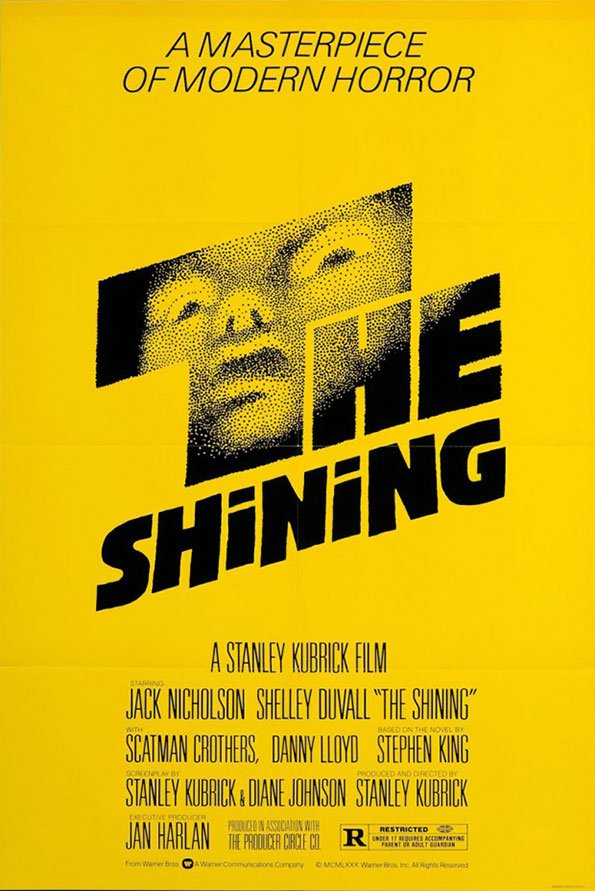
The Shining is a 1980 horror film loosely based on Stephen King's novel of the same name. It was directed by Stanley Kubrick and starred Jack Nicholson and Shelley Duvall. Kubrick's collaborator Wendy Carlos returned for the score after A Clockwork Orange, co-composing with Rachel Elkind, although most of their work wasn't retained by Kubrick in the end.
Jack Torrance (Nicholson) is a recovering alcoholic writer who takes a job as the winter caretaker for the old and luxurious Overlook Hotel, which every winter becomes completely snowed in. He brings along his wife Wendy (Duvall) and son Danny (Danny Lloyd), hoping to make amends with them after accidentally dislocating Danny's arm while drunk not too long ago.
As time passes, strange things start happening: Danny discovers he has psychic powers and starts receiving disturbing visions, and Jack shows signs of increasing instability. He had been warned that the previous caretaker snapped and killed his family, but that wouldn't happen again... right?
Compared to the novel, the film is much more minimalist in its storytelling approach. Most aspects carried over from the original book are stripped down to their bare essentials, not only resulting in a radically different kind of story than what King wrote, but creating a persistently unsettling atmosphere, as very little is explained.
Although it achieved decent commercial success at the box office, the film was seen as a critical disappointment at the time of its release, notably and infamously receiving two Razzie nominations for Worst Director (Kubrick) and Worst Actress (Duvall), as preposterous as it may be to believe now.note The film's most notable detractor was Stephen King himself, who hated it for the numerous alterations and creative liberties Kubrick took with the film compared to the events of the novel, to the point that he would choose to write and produce his own more faithful adaptation of the book as a TV miniseries in 1997.
However, these days, The Shining is near-universally regarded as a masterwork of horror cinema, and has become one of the most influential, widely discussed, and widely referenced films in the genre's history. Even King himself would eventually come around to regard Kubrick's film as good on its own merits, but would still consider it a poor adaptation of his book, a consensus generally shared by King fans and Kubrick fans alike.
In a serious case of either Tempting Fate or Paranoia Fuel, The Shining is screened every year at midwinter for those "wintering-over" at the Amundsen-Scott South Pole Station, alongside The Thing. The Stanley Hotel in Colorado — which inspired King's novel — has a channel on their cable TV that plays the film twenty-four hours a day.
Some interpretations of the film's themes are explored in the 2012 documentary Room 237.
After nearly 39 years, the film received a direct sequel in the form of Doctor Sleep.
Not to be confused with the Shining Series of video games.
All work and no tropes makes Jack a dull boy:
- Abusive Parents: Jack towards Danny. He accidentally dislocated Danny's shoulder while drunk before the events of the film. This could be backed up by Wendy accusing Jack of giving Danny the injuries he allegedly received in room 237.
- Adapted Out: In the novel, Danny (and the reader) can actually see Tony, though it's not until the end that he's described as looking like an older Danny. In the film, "Tony" is represented with Danny Lloyd wagging his finger and changing the inflection of his voice.
- Adaptation Distillation: The movie cuts most of the exposition and backstory, as well as the context for some scenes, such as the true nature of Danny's imaginary friend Tony (in the book he's Danny from the future), the woman in Room 237, and the two men in masquerade costumes Wendy sees while searching for Danny.
- Adaptation Dye-Job: In the novel, Wendy is blonde and Jack has brown-red hair, but both have dark hair in the movie.
- Adaptation Explanation Extrication:
- Many of the supernatural elements from the books (like the naked women in the tub and people having sex in animals costumes) are encountered but not given much context, making them even more bizarre.
- In addition to going into more detail about the actual supernatural elements, the book also does an excellent job explaining the classic horror story problem of, "Why don't the characters just leave?" In addition to the remoteness of the hotel during the winter, Jack and Wendy are estranged from their family, and Jack is on his very last chance for employment, having called in a few favors just to get this job. In addition, they have been at the hotel for about 4-5 months before the really bad stuff starts going down, so it becomes easier to understand their rationalization about just making it a few more months through creepiness so they can walk away from the job without burning their last bridge and ending up homeless on the streets. Unfortunately, the horror factor soon escalates up quite far from mere creepiness.
- Adaptational Attractiveness: Played with. Barry Dennen's Bill Watson is far younger and better looking than the gruff, older man with a cold he's described as in the book.
- Adaptational Nice Guy:
- In the book, Mr. Ullman is a condescending, overbearing, Smug Snake who epitomizes everything Jack hates about authority figures and makes it clear that he doesn't want Jack at the hotel. In the film, he is very friendly, polite, concerned for Jack's and his family's wellbeing, and he completely approves of Jack being the caretaker.
- Adaptational Ugliness:
- Wendy is described as being conventionally attractive in the book, whereas in the film she's portrayed by Shelley Duvall, who can be viewed as a pretty actress but is much more waif-like and fragile-looking.
- Jack, who is at least reasonably handsome in the books, is played by Jack Nicholson. Needless to say, he wasn't chosen for being the typical Hollywood stud.
- Adaptational Villainy: In the book, Jack is a loving husband and father, and the text shows his struggles with his inner demons (alcoholism and trouble with anger management) in a very sympathetic light, in turn making his descent into madness quite tragic. In the film, his seething resentment of his family is played up a hundredfold, and though he's still terrified of the effects the hotel is having on him and he's weighed down by his past abusive behavior, he's far more defensive of his actions and never takes any responsibility for them. It's also implied in the film that Jack may be racist, not hesitating to parrot Grady's use of the N-word and possibly even being convinced to attack his family specifically because Danny called upon the black Hallorann for aid. This severely dilutes the positive traits and the struggle against evil of his character, making him more of a Villain Protagonist.
- Adaptational Wimp: Wendy is much more of a weak-willed damsel compared to the more assertive and heroic character in the book. Apparently, even Shelley Duvall and Stephen King complained about this, but Kubrick wanted a traditional, scared character to add more horror to the film. He also believed that a more confident woman probably would have already left an alcoholic husband who had dislocated their four-year-old son's arm.
- Affably Evil: Lloyd. At first he seems like a friendly, if somewhat strange, bartender. As his conversations with Jack go on, however, he becomes more and more sinister, rarely blinking and always with a creepy smirk on his face.
- Delbert Grady. When he first bumps (literally) into Jack, he apologizes profusely and proves to have impeccable manners. However, again, as his conversation with Jack goes on, he proves to be a frighteningly evil man, unapologetically calling Hallorann a racial slur and saying that the violent murders of his family were his way of "correcting" their views of the Overlook.
- Age Lift: In the book, Jack is about thirty years old. Jack Nicholson was and looked 42 when filming the movie.
- Alien Geometries: The layout of the hotel makes no sense whatsoever. Stuart Ullman's office has a nice big window in the middle of the building; the Colorado Room has multiple floor to ceiling windows with a mystery hallway behind them. The hotel interiors have nice right angles while the outside doesn't. The freezer flips sides of the hallway between shots. There are doorways to rooms that would overlap other rooms, the hotel exterior, stairways, or elevators. The establishing shot of the hotel contains no trace of the hedge maze, which also changes layout between scenes. The Gold Room doesn't seem to connect to any other part of the hotel, and nowhere on the outside of the hotel do we see where the Overlook might be hiding that massive ballroom. Stanley Kubrick being Stanley Kubrick, it's extremely likely that this was all done on purpose for dramatic/disorienting/horror effect. And indeed, it's really freaky following the Torrances through the empty, labyrinthine hotel and feeling that something's not quite right and you're being misled...
- The Alcoholic: Jack. At one point he bemoans the fact that there is no alcohol to be had, and then Lloyd appears at the bar and serves him some whiskey...
- All There in the Manual: At the end, when Jack is lost in the maze, his words appear to be unintelligible roars. But the closed captions reveal that he is actually trying to call for help, in which case the Wham Shot of him frozen to death in the snow makes a lot more sense in context.
- Ambiguous Ending: Probably one of the most famous examples in horror film history, and one that still garners discussion and interpretation to this day. As if Danny exiting the maze, reuniting with Wendy, and escaping the hotel while Jack freezes to death in the maze wasn't enough, the film hits you with one last image: a picture of the July 4th hotel ball in 1921...that has Jack in it.
- Ironically, it's one of the few things that Kubrick confirmed about the film: it's meant to imply that Jack, like Delbert Grady, was a reincarnation of a former official at the Overlook and that the evil powers inside the hotel reclaim souls in order to sustain their own powers.
- Anachronism Stew: The ghostly scenes in the hotel ballroom seem to have occurred in the early 1920s. However, the song playing in the ballroom, "Midnight, the Stars and You" by Al Bowlly and Ray Noble, was produced in 1934. Justified in that the Overlook itself is a mishmash of different time periods.
- Angrish: An Ax-Crazy Jack Torrance falls into these near the end of the movie when he is reduced to only being able to moan like a wounded animal as he starts to freeze while looking for Danny and/or a way out.
- Animal Motifs: Tying in with the theme of implied sexual abuse, bears appear a bit throughout the film, usually regarding Danny. Early on we see Danny with a bear pillow right beside his head, and in his room in the hotel, there is a photo of two bears (one sitting, one standing) right above his bed. There's also the bear rug in Jack's big work room, and then of course towards the end there's the man in the bear suit who Wendy sees in one of the bedrooms.
- Answer Cut
- Danny asks his Imaginary Friend what's waiting for him at the Outlook Hotel. Cut to the Elevator of Blood scene.
- When Danny sees the previously locked door to Room 237 is open, he calls out, "Mum, are you in there?" Cut to Wendy in the boiler room.
- Arc Symbol: Mirrors. Mirrors appear in every scene where Jack is interacting with apparent ghosts (except when Jack talks to Grady through the store room door, but the floor is reflective) as well as on the wall outside the Gold Room and in room 237's bathroom. Also, when Wendy sees "redrum" written in lipstick on the bathroom door, she sees it in a mirror, where it reads "Murder".
- Arc Words:
- "All work and no play makes Jack a dull boy."
- "...forever and ever and ever."
- Artistic License – History: Despite being tied to a party of ghosts from 1921, "Midnight, the Stars and You" was first published in 1934 — 13 years after the Independence Day Ball whose photograph hangs in the hotel. All other dance band songs heard in the background similarly date from the early '30s. See Anachronism Stew above for justification.
- Aside Glance: Jack repeatedly makes offhanded glances at the camera throughout the film's runtime, a habit that Stanley Kubrick specifically instructed Jack Nicholson on throughout filming. Some of these passes are so quick and casual that they're only visible for a single frame each, while others are more drawn-out, such as during Jack's conversation with Grady and his attempt to convince Wendy to free him from the freezer. The exact meaning of the practice is never explained, but it adds onto the film's persistent sense of dread by implicitly muddying the boundaries between the viewer and the story.
- Asshole Victim: Jack and even Grady are both victims of the Overlook.
- Ate His Gun: This is how Grady died, according to Stuart Ullman's explanation to Jack at the beginning of the movie:Stuart Ullman: He put both barrels of a shotgun into his mouth.
- Ax-Crazy: Jack is perhaps the most iconic example of this trope in film toward the end, when he tries to murder his wife and son with an axe.
- Not to mention Grady before him, who unfortunately succeeded in carrying out his rampage.
- Axe Before Entering: One of the most famous examples, played straight but also turned up to eleven in that, while Jack is hacking his way through the door, the camera follows the motion of the axe, thereby briefly making the axe a POV character.
- Background Halo: Inverted with the black chandeliers, which gave Jack a "black halo" post-snap.
- Barrier-Busting Blow: Again, the axe scene.
- The Bartender: Lloyd.
- Batter Up!: A memorable scene in which Wendy whacks Jack over the head with a bat.
- Big Damn Heroes: Subverted. Hallorann spends some time traveling back to the Overlook, only to have his grand rescue cut short when he gets an axe to the chest courtesy of Jack, only a few minutes after he arrives. The fact that he's brought a vehicle allows Wendy and Danny to escape, however.
- Big "NO!": Wendy, several times, as Jack is breaking apart the bathroom door with the axe.
- Bittersweet Ending: Danny and Wendy survive and manage to escape the crazed Jack, but Hallorann is dead, Jack has frozen to death, it's likely that both Dan and Wendy will be forever traumatized by the events of the film, and the hotel will probably still be around and so it can mess up more families.
- Black Blood: Allegedly Kubrick told the MPAA that the torrent rushing out of the elevators was rusty water and not blood in order to get the movie's trailer shown. At the time the MPAA did not allow blood to be depicted in trailers.
- Black Comedy: "Little pigs... little pigs... let me come in! *Cut to Wendy grabbing a knife* "Not by the hair on your chinny-chin-chin? *beat* Then I'll huff, and I'll puff, and I'll BLOW YOUR HOUSE IN!" Followed by the famous "Here's Johnny!" line.
- Black Dude Dies First: While not the first character to die in the chronology of the story, Hallorann is the first and only on-screen death in the film when he gets abruptly axed by Jack, whose latent racism was manipulated by the Overlook to drive him into a murderous rage.
- Blatant Lies: When Wendy turns up in a panic saying that Danny was attacked by a strange woman in Room 237, Jack goes to investigate and gets attacked by a creepy zombie woman, then returns to tell his wife that the room was empty and their son's injuries were self inflicted.
- Bloody Horror:
- One of the iconic images from this film is an elevator full of blood pouring out and flooding a hallway.
- The vision of the two Grady girls, post-hacking, is pretty hemo-tacular itself. note
- Breakfast in Bed: Wendy serves Jack bacon and eggs in bed when he wakes up one morning. While eating he discusses his strange feeling of familiarity with the Overlook Hotel.
- Burning the Ships: Slowly being possessed, Jack disables the ham radio (the family's only means of calling for help) and their snowmobile (their only means to leave the hotel).
- Can't Live with Them, Can't Live Without Them: Lloyd says this of women in one of the scenes in the Gold Room.
- Central Theme: Kubrick included a lot of Native American imagery, as well as stories of the hotel having to fight off Native Americans for being built on an Indian Burial Ground. Jack throws his ball against the Native American tapestry as well. Danny even defeats Jack with an old Native American trick. See also Indian Burial Ground below.
- Chekhov's Gun: The store room in the kitchen. Hallorann shows it to Wendy and Danny early on, then after knocking out Jack with a baseball bat, Wendy locks him in there.
- The hedge maze. Wendy and Danny are seen walking through it soon after arriving at the hotel, then Jack chases Danny into it at the end. Danny tricks Jack by following his footsteps to escape, and Jack ends up freezing to death in the maze.
- Chekhov's Skill: Danny walks through the maze with his mother near the beginning of the film and reaches the center. It comes in handy later on when he is being chased through the maze by a deranged, axe-wielding Jack. Danny is able to make a false trail to throw Jack off and retrace his steps to escape the maze, knowing that Jack is following his footprints.
- Clue of Few Words: One recurring mystery is why Danny keeps repeating, "Redrum", at one point writing it on the wall. It later turns out to be because he has Psychic Powers and was predicting Jack becoming murderous (since "redrum" spells "murder" backwards).
- Color Motif: The Overlook is brimming with this. Primary palettes for the hotel itself include various shades of red/an almost brownish deep red, orange, yellow, green, and blue/steel-blue. Danny and Wendy are also dressed in almost identical bright blue- and red-patterned clothes.
- Coordinated Clothes: The creepy sisters wear the same light blue dresses with pink ribbons. The identical look multiplies the creep-out factor.
- Cornered Rattlesnake: Wendy, who is reduced to a screaming, teary-eyed, blubbering mess wielding first a baseball bat and then a knife after much psychological abuse from Jack.
- Coitus Interruptus: When walking up the stairs, Wendy stumbles upon the scene of a man in a bear-suit blowing another man in their hotel room with the door wide open. They stop when they hear Wendy and the look they give her for interrupting them is downright terrifying.
- Creepy Dollhouse: A common variant. The Overlook Hotel contains a model not of itself, but of the Hedge Maze that exists on its grounds. Jack obsessively watches over it as Wendy and their son Danny explore the actual real-life hedge maze. This is portrayed very creepily and is accompanied by a Scare Chord, as it represents Jack's growing allegiance with the hotel and regression from his family.
- Creepy Twins: Grady's daughters are one of the most famous examples, the Trope Codifier, and provide the trope's image. Actually, they are specifically described in both book and film as not twins (ages 8 and 10) but in the movie they were played by real-life twin actresses. However, one is a little taller than the other, so it can give the impression of an age difference.
- Dangerous Clifftop Road: The Torrances are shown driving around a cliff on their way to the Overlook Hotel for the winter. It shows that they're extremely isolated and vulnerable to the weather, and creates a very foreboding atmosphere.
- Dead Person Impersonation: Implied to be the case with the ghosts, with the Overlook merely assuming their forms. Grady, for instance, starts off kindly and incredibly cordial, but a few moments after Jack recognizes him and mentions the murder of his wife and children at his hands, his entire demeanor changes and starts radiating pure malevolence.
- Deadly Euphemism: Grady advises Jack that Wendy and Danny should be "corrected." You know...with an axe.
- Deal with the Devil: Hinted at in the bar scene. Jack says he'd give his soul for a drink; cue creepy bartender appearing with a full stock of booze.
- Death by Adaptation: Dick Hallorann survives the book but dies just a few minutes after he returns to the Overlook.
- Deathly Dies Irae: Stanley Kubrick hired Wendy Carlos to electronicize Hector Berlioz's "Dies irae" to set the grim mood of the film and foreshadow the doom to come.
- Digital Destruction: The Widescreen DVD, HD-DVD and Blu-Ray versions of the film contain an incorrect color timing that infamously turns the yellow tennis ball pink. The 2019 remaster of the film (included on both standard and UHD Blu-ray) finally amends this, yellow ball and all.
- Dissolve: Used extensively to transition between shots.
- Distinction Without a Difference: This line, as Jack has lost it and starts menacing his wife.Jack: I'm not gonna hurt ya. You didn't let me finish my sentence. I said I'm not gonna hurt ya. I'm just gonna bash your brains in. I'm gonna bash them right the fuck in!
- Doing In the Wizard: To a certain extent, downplaying the more overtly supernatural elements of the novel. Kubrick's version gives the impression that Jack was well on the way to Ax-Crazy before the Overlook got hold of him.
- Dreaming of Things to Come: Jack has a nightmare where he murders Wendy and Danny and laments that he thinks he's losing his mind. He does indeed lose his mind and tries to murder Wendy and Danny, but only manages to kill Hallorann.
- Duality Motif: The film uses a lot of this, with mirror reflections, opposites (renovated/modern vs. retained/original rooms) and symmetrical items such as double-doors, to reinforce the dual-nature of the hotel (which is practically a character itself) as well as Jack Torrance with his inner demons. When the Grady girls turn around they pivot in a very strange-looking way as if they were joined at the hip.
- Eldritch Abomination: One interpretation is that the hotel itself is one. When it sleeps, only those with "shining" (i.e. clairvoyance) can see its true nature. But when Jack enters it, it senses a ready-made victim, slowly coming awake and revealing itself to him, its presence becoming strong enough to take over Jack's mind completely, and begins to slowly destroy Danny's unprotected mind. When it fully awakens at the very end, powered by Jack's murderous insanity, even Wendy, neither clairvoyant nor insane, can see the horrors erupting all around her. She and Danny ultimately escape— but Jack is swallowed up by it at the end, as indicated by the 1921 photograph. Forever, and ever, and ever...
- Eldritch Location: The hotel itself. Judging by the film's Ambiguous Ending with the 1921 photograph featuring Jack, it seems that the hotel has made Jack's soul a part of it and has put him into a cycle of being reincarnated, going on a murderous rampage, dying, and being reborn again.
- Ends with a Smile: The final shot of the movie is of the photograph taken of the New Year's ball at the Overlook — which now features Jack, seemingly sucked back into time, smiling in the front of the crowd.
- Epic Tracking Shot: Several, thanks to the then-new Steadicam technology.
- Evil Brit: Delbert Grady.
- Evil Eyebrows: Even if you know nothing about Jack Nicholson before seeing this movie, you'd still be able to guess what's going to happen to him just by looking at his eyebrows alone, to the point where King objected to the casting of Nicholson and begged Kubrick to reconsider on the grounds of Nicholson having the natural appearance of already being unhinged, since King wrote Jack as a genuinely admirable family man who becomes corrupted by outside influences.
- Evil Laugh: Jack lets out several during the course of his breakdown, such as the little creepy chuckle he gives out after he says, "I'm gonna bash [your brains] right the fuck in!" to Wendy.
- Fan Disservice: The beautiful girl in room 237's bathroom. She appears fully naked and upfront, yet it still looks creepy rather than sexy.
 On top of that, she turns into a rotting, old corpse-woman who cackles and reaches out for Jack in the creepiest manner possible!
- The shots of her fully naked are inter cut with shots of Jack's smiling, psychotic face, which would be a real mood killer even if the scene wasn't already creepy.
- Faux Affably Evil:
- Jack after he snaps. His politeness to his wife and son (calling Wendy his "love" and the "light of [his] life" as well as telling Danny that he'd never hurt him) don't seem to help as his mental state gets worse.
- Grady acts very polite toward Jack, but he clearly becomes mad when Jack reminds him about the way he killed his family, causing him to calmly state that he "corrected" them before convincing Jack to kill his family as well.
- The Film of the Book: Both one of the most famous examples and one of the most infamous examples, being an effective microcosm of the double-edged nature of loose adaptations while still being a damn good film in its own right.
- Foregone Conclusion:
- The UK poster and Pop-Cultural Osmosis really don't leave much to the imagination as to what Jack ends up doing. The US poster◊ meanwhile is more abstract in design and doesn't give anything away regarding the plot.
- Stephen King himself considered Jack Nicholson's casting to be sort of a spoiler on its own in this regard, considering Nicholson's best-known film at the time was One Flew Over the Cuckoo's Nest—where he plays a "crazy" guy—and the fact that he has a natural look to him that seems vaguely unhinged.
- The UK poster and Pop-Cultural Osmosis really don't leave much to the imagination as to what Jack ends up doing. The US poster
- Foreshadowing: As Wendy and Danny find their way around the maze, Jack is seen getting lost in looking over a scale model of it inside the hotel. At the end of the film, he chases Danny into the maze and gets lost in it, freezing to death, while Danny is able to escape.
- Jack's description of his nightmare, where he killed Wendy and Danny, and laments that he thinks he's losing his mind.
- The tricycle scenes. Danny rides in circles around the Overlook hallways, including the Colorado Lounge and the room 237 hallway, giving the illusion of being followed as the camera tracks his route. He later does a loop upon himself in the maze while being chased by Jack, only to break the loop and find himself at the center of the maze.
- Hallorann specifically warns Danny to avoid room 237. This counts as Schmuck Bait too, as when he finds room 237 later while riding his tricycle, he finds the room locked. He later finds the room open and ventures in, only to reappear later with bruises and his jumper torn.
- Early on, Danny is watching a Wile E Coyote And The Roadrunner cartoon on TV. Fans of the cartoon series will recognize the distinctive musical cue, which was used in "Stop! Look! And Hasten!" when the Coyote was chasing the Road Runner through a maze of railroad tracks. The film itself ends with a chase through a maze.
- Mr. Ullman and Wendy talking about the Overlook Hotel.
Stuart Ullman: By five o'clock tonight, you'll never know anybody was ever here.
Wendy: Just like a ghost ship, huh? - Gainax Ending: The ambiguity of the final image presented by the film (a picture of a July 4th hotel ball in 1921 that has Jack among the crowd) has been the source of lots of interpretations.
- Gaslighting: The film does this to the viewer in a number of subtle ways, from disappearing/reappearing furniture to the Alien Geometries mentioned above. It adds to the mazelike quality of the Hotel, increasing the tension and disorientation.
- A God Am I: A very subtle visual cue when Jack is looking over the Hedge Maze model as Wendy and Danny play in the real one, emphasizing how much his existence dominates them.
- Hair of the Dog: While at the Overlook's bar, Jack asks Lloyd for the "hair of the dog that bit me;" the bartender complies by pouring him a glass of whiskey. This and Jack's acceptance of the drink is what finalizes the Overlook's hold over him, breaking his promise to Wendy that he wouldn't touch another drop of booze and thus burning the last of his already dilapidated bridges.
- Hate Sink: The Overlook Hotel drives its caretakers to murderous insanity ending with the deaths of both themselves and their families. It compels Jack Torrance into attempting to kill Danny and Wendy.
- Hedge Maze: The Overlook has an iconic one not present in the booknote , the perfect place for a scary chase scene. There is also a scale model inside the hotel.
- Hell Hotel: One of the most iconic examples of all time. The Overlook Hotel is an unexplainable Eldritch Location that drives its caretakers insane and (possibly?) absorbs their souls.
- Heroes Gone Fishing: Danny having ice cream with Hallorann, walking around the maze with Wendy, playing with his toys, and riding around the hallways on his tricycle.
- History Repeats: From the start of the film, during his interview for the winter caretaker job, Jack is warned that the last guy who took the job murdered his family and then himself. Take three guesses as to what happens to Jack over the course of the film...
- Taken up a notch with the iconic final image, a cryptic photograph dating back to 1921 which has Jack in the foreground. Interpretations have come to conclusions commonly fitting under the ideas that Jack has been absorbed into the hotel along with all the other ghostly "guests" in the picture, and that the Jack we see in the movie is a reincarnation.
- I Never Told You My Name: When Hallorann calls little Danny Torrance "Doc," Wendy asks how he knows that's what they call him. Hallorann makes excuses by saying things like Danny just looks like a Doc or maybe he heard his parents call him that, but the real reason is that Danny and Hallorann both share a psychic ability, "the shining".
- Indian Burial Ground: The Overlook is built on one. In 1987 San Francisco Chronicle columnist Bill Blakemore penned a rather intriguing essay arguing that the film is a hidden commentary on the genocide of the American Indian.
- Insanity Establishment Scene: Wendy finds out that Jack's lost his marbles when she reads his "novel," which is just the sentence, "All work and no play makes Jack a dull boy," over and over again with different formatting on each page.
- "Join Us" Drone: The famous Grady girls scene when they implore Danny to "play" with them. Doesn't help that when they say it, Danny sees a quick flash of their dead bodies after they were murdered by their father.Grady girls: Come play with us, Danny, forever and ever and ever.
- Jump Scare:
- When Danny rides his tricycle down a hallway and comes face to face with the Grady ghost girls, complete with a Scare Chord.
- When Hallorann walks down the empty lobby hallway, everything is silent...until Jack suddenly emerges from behind one of the pillars with a battle cry and buries his axe in Hallorann's chest.
- The famous image of Jack frozen to death appears out of nowhere accompanied by a Scare Chord after Jack slumps to the ground in the maze.
- Whenever the screen time-jumps from "Tuesday," "Wednesday," "Friday," and "Saturday," accompanied by a Scare Chord.
- Karma Houdini: The Overlook Hotel is Spared by the Adaptation after it drives Jack to homicidal madness, and will likely continue to do so to other winter caretakers for the foreseeable future.
- Kensington Gore: Enough to float sofas down the corridor.
 Executive Meddling almost cut it, but Kubrick told them it was just rusty water.
 - Kubrick Stare:
- Jack, naturally, as his sanity begins to wane.
- As shown in his introductory scene, Lloyd doesn't do a bad one, either.
- Danny gets a few while under Tony's influence.
- Large Ham: Jack Torrance, summed up by, "Jack Nicholson hardly does a subdued performance," + "Evil Is Hammy." (Steven Spielberg first stated to Kubrick that he felt Nicholson was too over-the-top. Kubrick replied by comparing him to James Cagney.)
- Legacy Character: Jack has always been the caretaker, according to Grady. It's quite a strange claim considering Grady himself was once the caretaker.
- Leitmotif: Dies Irae, whose title is a Genius Bonus: "Day of Wrath."
- Limp and Livid: After Jack suffers complete Sanity Slippage, he starts walking hunched over which makes his axe-wielding presence even more terrifying.
- Locked in the Bathroom: Wendy locks herself in the bathroom to hide from the now (literally!) Ax-Crazy Jack. The lock holds. The door doesn't.
- Madness Mantra:
- "All work and no play makes Jack a dull boy."
- "REDRUM! REDRUM! REDRUM! REDRUM! REDRUM!"
- The Maze: The Overlook Hedge Maze. Wendy and Danny are shown exploring it midway through the movie, giving Danny an advantage in the finale as he flees the insane Jack through it, trapping his father there until the possessed man freezes to death.
- Maybe Magic, Maybe Mundane: The film is more ambiguous towards the supernatural aspects of the story. However, the titular "shining" is equally effective in both the film and the book, warning clearly of danger seconds before the axe hits the bathroom door. In fact, besides the shining itself, there are only a few events in the film that directly imply supernatural intervention: the bruises around Danny's neck, Grady unlocking the pantry door, Wendy's vision of the tidal wave of blood coming out of the elevators, and, of course, the infamous final image of Jack in a picture from 1921. Even then, it is still possible, according to some critics, to interpret the supernatural elements as hallucinations of a family slowly going insane from cabin fever.
- Messy Hair: Over the course of the film, Jack's hair and appearance starts to look more disheveled which signifies his Sanity Slippage.
- Mickey Mousing: In the film's end credits, presented slideshow-style as in all of Kubrick's films, each card appears on screen for exactly four (or eight) beats of the song playing over them ("Midnight, the Stars and You").
- Mind Screw: Pick any moment of this movie. ANY. The entire concept of the hotel itself is this trope, as there are doors that lead to nowhere, room layouts that make no sense, and overall impossible building structure.
- Minimalistic Cover Art: The American theatrical poster◊, designed by acclaimed graphic designer Saul Bass, consisting solely of a pointillist, underlit, doll-like face inside an otherwise all-black logotype on a bright yellow background (Bass intended for the background to be red and later created an alternate version of the poster with this intended color choice).
- Mirror Scare:
- Used with the naked woman, crossed with The Mirror Shows Your True Self. As Jack is kissing the woman, he looks into the mirror and is horrified to find himself embracing a cackling, rotting, zombie-woman. In the moment when Jack realises the waiter he's talking to in the bathroom is the deceased Grady, you can see Jack glancing in the direction of the mirror, clearly with this incident on his mind.
- When Danny draws "REDRUM" on the door while Wendy is asleep, his repeated uttering of the word wakes her up, and as she hugs him she looks into the mirror and sees the word reversed ("MURDER").
- Most Writers Are Writers: The fact that Jack is a writer who is suffering severely from Writer's Block is the reason the family goes to the hotel in the first place.
- Mythology Gag: Kubrick dispenses with several of the novel's plot points but keeps references to them in the movie.
- The book explains just where Danny's imaginary friend "Tony" comes from, who the dead lady in the bathtub is, and who the person is in the dog/bear costume delivering a blowjob. The film keeps these elements but dispenses with their explanations.
- Kubrick does not use the novel's climax— exploding boiler destroys the hotel— but still shows the boiler in a couple of scenes.
- Jack wears a Stovington Prep shirt in a few scenes, which is the school he gets fired from in the book.
- Never Found the Body: In the original theatrical release, Wendy was informed that Jack's body is missing. It was removed a week after release at Kubrick's own request, and most reviewers agreed with the choice, as it accidentally opened up a large number of plot holes that its absence consequently disposes of.
- Never Trust a Trailer: The original trailer for the movie shows the credits overlaid over the elevator doors, and then a torrent of blood flooding the hallway and blanketing the camera. While this scene does appear in the movie, it hints at a much gorier, murder-heavy film than it actually is, particularly when you consider that only two characters die, and only one of those is murdered.
- Nightmare Sequence: As counts as Foreshadowing. Jack has a nightmare where he kills Wendy and Danny and laments that he is losing his mind.
- Nothing Is Scarier:
- The scenes of Danny riding his Big Wheel through the hotel have no sound other than its hard-plastic wheels running alternately over rugs and wood flooring. The camera is positioned behind Danny such that we see exactly what and when he does, and we have absolutely no idea what could be hiding around any given corner...
- The scene with Hallorann navigating the empty lobby, since we know Jack is coming for him but the place is empty and silent. Eventually, Jack emerges from behind one of the pillars and whacks him dead with an axe.
- Offing the Offspring: In the climax, crazed Jack goes after Danny outside in the heavily snowed-in hedge maze with the full intent of killing his own son. What makes this worse it that Wendy is inside the house desperately searching for Danny and has absolutely no idea where he is. It’s subverted because Danny manages to outwit Jack and escape; Grady, however, murdered his daughters, playing the trope straight.
- Oh, Crap!:
- Hallorann has a subtle one when Danny asks him if there's something about Room 237. He denies being afraid of the room and says there's nothing in it, but he warns Danny to stay out anyway.
- Wendy's reaction to finding Jack's manuscript and its repeated typings of, "All work and no play makes Jack a dull boy." Then again when he suddenly appears behind her.
- Jack has one in room 237 when he sees in the mirror that the naked woman he's embracing has become the bloated, rotting, cackling corpse of an old woman.
- Pretty much all of Wendy's reactions throughout the last part of the film during Jack's rampage.
- Ominous Latin Chanting: As Jack is chasing down Danny through the hedge maze and Wendy is in the Overlook Hotel desperately searching for Danny and starting to see the hotel's horrifying visions, you can hear ominous Old Church Slavonic chanting from Penderecki's Utrenja.
- One-Liner, Name... One-Liner: Jack does this a lot when speaking with Lloyd.
- Paint the Town Red: The elevator scene.
- Pater Familicide: Grady has done this, and Jack attempts it.
- Polar Madness: A long period of isolation and cabin fever in the snowed-in Overlook Hotel gradually begins to wear at Jack Torrance's sanity, and the fact that he's a recovering alcoholic doesn't help. When the hotel begins to influence him, this downward spiral ends with one murder and two attempted murders on the caretaker's conscience. For good measure, some reviewers have interpreted the film as a purely psychological thriller, claiming that the ghosts witnessed in the hotel are all imagined and the Torrances' descent into madness is due entirely to mundane polar madness.
- Politically Incorrect Villain: Grady refers to Hallorann as "a nigger cook." Doubles as Deliberate Values Dissonance, as Grady appears to be the ghost of a butler from the 20s.
- See Indian Burial Ground above for a more ambitious unpacking of this.
- Jack certainly counts, too. He makes the offhanded comment about the "white man's burden" and repeats Grady's phrase about a "nigger cook" with zero hesitation, in addition to making several misogynistic remarks about women.
- Pop-Cultural Osmosis: The "twins" in front of the elevator (in-universe) aren't twins at all, just sisters who dress and look the same. It still doesn't make them any less murdered by their crazy dad.
- Pragmatic Adaptation:
- While the movie departs from the book quite a bit, it can stand on its own. In fact, much of the film's deviations were for the sake of making something that could actually be pulled off in live-action, with the later miniseries demonstrating that even over a decade and a half later, it's still not a book that can easily be adapted straightforwardly in a visual medium.
- Room 217 from the book becomes 237, as the hotel the Overlook was based on asked them to use a room number that didn't actually exist. Depending on how you look at it, that could just make it more creepy...
- The replacement of the topiary animals with a hedge maze was done in part to avoid a potential Special Effects Failure, but the maze also fits in well with the labyrinthine nature of the hotel's interior.
- While the movie departs from the book quite a bit, it can stand on its own. In fact, much of the film's deviations were for the sake of making something that could actually be pulled off in live-action, with the later miniseries demonstrating that even over a decade and a half later, it's still
- Precision F-Strike: The first instance of overt abuse of Wendy by Jack is verbal, telling her quietly to "start [leaving him alone] right now and get the fuck out of here." As his sanity breaks, he starts using the word a little more liberally.
- Psychological Horror: It makes the supernatural elements much more ambiguous than in the book.
- "Psycho" Strings: Half the score sounds very much like Bernard Herrmann's work, but it's actually avant-garde modernist music by Béla Bartók, György Ligeti and Krzysztof Pendercki.
- Public Domain Soundtrack: "Dies Irae," the musical piece on which the film's main theme is based, is a notable Gregorian chant dirge for Roman Requiem Mass.
- The Radio Dies First: When Jack decides to kill Wendy and Danny, one of his first acts is to disable the radio so she cannot call for help.
- Randomly Reversed Letters: Danny, who's channeling the hotel's evil, writes his Madness Mantra, "REDRUM" ("MURDER" in reverse) in crayon on the bathroom door with the middle two letters backwards.
- Reality Warper: The hotel is hinted as having elements of this—see Alien Geometries above—but also the last shot may imply that the spirits of the people the Overlook absorbs now exist outside of time.
- Re-Cut:
- When the film premiered, it had a final scene in which Ullman visits Wendy and Danny at the hospital and explains that Jack's body could not be found. About three weeks into release, Kubrick ordered this scene excised from all prints.
- Kubrick then trimmed an additional 30 minutes of footagenote for the film's European theatrical release. This shorter cut, which was his preferred version of the film, is also used for PAL video releases (Japan got the US cut).
- When the film premiered, it had a final scene in which Ullman visits Wendy and Danny at the hospital and explains that Jack's body could not be found. About three weeks into release, Kubrick ordered this scene
- Red Is Violent: Jack wears a red jacket from his nightmare scene onward and becomes more violent and insane as the movie progresses.
- "The Reason You Suck" Speech: Jack loses his temper and yells at Wendy when she wants them to leave the Overlook hotel and take Danny to a hospital.Jack Torrance: Get him out of here? You mean just…leave the hotel? It is so fucking typical of you to create a problem like this when I finally have a chance to accomplish something...When I'm really into my work...I could really write my own ticket if I went back to Boulder now, couldn't I? Shoveling out driveways? Workin' in a carwash? Does that appeal to you...Wendy, I have let you fuck up my life so far, but I am not going to let you fuck this up!
- Rivers of Blood: Blood pours out of an elevator, flooding a hotel hallway.
- Room Full of Crazy: "All work and no play makes Jack a dull boy." It's particularly unsettling because of the sheer number of pages and the fact that each one features unique formatting, proving that each page has been uniquely hand-typed, with the tacit implication that Jack has been gradually losing his mind almost from the instant the family arrived in the hotel.
- Rule of Three: There are three scenes of Danny riding around the Overlook on his tricycle. The first time he does it, we see him riding around the Colorado Lounge and one of the adjoining hallways of the kitchen area. The second time, he rides a loop around the hallways by room 237, only noticing it after he goes back on himself and passes it a second time, then trying the door and finding it locked. The third time, he rides along a kitchen corridor and then an upstairs hallway where he encounters the Grady girls.
- Rule of Scary: Much of the score is modernist classical music that sounds terrifying in context. What makes it this trope is that much of the score wasn't actually written to be scary. For example, a piece that begins with a loud mechanical clattering sound, followed by indistinct murmuring and shouting, which first appears when Dick Halloran is murdered and Wendy starts to be able to see the ghosts in the Overlook too, is the opening of the second part of Krzysztof Penderecki's "Utrenja- Ewangelia", a piece of liturgical music. That ominously murmuring crowd of voices, which many viewers interpret as the voices of the indigenous people whose burial ground the hotel was built on, are actually rapturously declaring the resurrection of Jesus Christ and the salvation of the world! Another Penderecki piece used in the film in multiple scenes, "The Dream of Jacob", is only an audio picture of the idea of a staircase extending to heaven and angels climbing endlessly up and down. The pieces are simply so abstract that out of context they function to heighten the Surreal Horror of the film despite depicting benign holiness in their original settings.
- Sanity Slippage: The hotel causes every caretaker to lose his mind. Stephen King stated his book was about a normal man who goes crazy, and that Stanley Kubrick's film was about a crazy man who goes absolutely bonkers.
- Scenery Porn: The opening, which shows Jack's drive to the hotel alongside beautiful scenery shots of Saint Mary Lake. An outtake from this scene got re-used in the theatrical ending for Blade Runner two years later, and it still looks just as impressive.
- Shoot the Shaggy Dog: A major subplot is Dick Hallorann trying to contact and subsequently save the Torrances. As soon as he arrives at the Overlook, Jack axes him and he dies.
- Subverted Trope: His arrival with a Snowcat is what allows Wendy and Danny to escape the hotel, so Hallorann technically succeeded in saving them.
- Shout-Out:
- "Here's Johnny!". The scene itself homages one from the 1921 Swedish silent film Körkarlen (The Phantom Carriage).
- Wendy is introduced reading The Catcher in the Rye.
- Wendy watches Summer of '42 on TV, and later Danny watches Road Runner cartoons.
- Before breaking the bathroom door, Jack quotes the Big Bad Wolf from The Three Little Pigs, and says, "Honey, I'm home!" from I Love Lucy.
- "Here's Johnny!". The scene itself homages one
- Sinister Nudity: Jack Torrance is drawn to room 237, which Halloran specifically warned Danny to never enter due to it being a focal point for the Overlook's evil. Inside, he watches as a beautiful naked woman steps out of the bathtub, approaches him, and starts to kiss him. However, when he looks in a mirror, he sees that she's actually ancient, visibly rotted, and looks like she was drowned. He screams and stumbles away from her, and she approaches him again, smiling and with her arms outstretched, her nakedness now disgusting and terrifying instead of sultry.
- Slasher Movie: The movie was a much different take on the kind of slasher movies that were becoming popular at the time. It's much more psychological; it's what happens when Stanley Kubrick makes one. Notably, there are only two deaths in the film, and one of them is the villain (if you don't consider the hotel itself to be the true villain).
- Slasher Smile: Jack's maniacal smile as he says "Here's Johnny!" is one of the most iconic in film history. Of course, he is played by Jack Nicholson, so that sort of thing is expected.
- His unnerving grin as he sees the lady in room 237 is a close second.
- Both of those may be beaten out by the slasher smile Jack has on his face after killing Halloran. If there was any humanity left in him, it's gone now.
- Sliding Scale of Adaptation Modification: The film is interesting in that it starts out as a Type 4 (Near Identical Adaptation), but it gradually deviates further and further from the book until it becomes a Type 2 (Recognizable Adaptation).
- Sliding Scale of Idealism Versus Cynicism: The film is considerably more cynical than the book, which is in the middle if not slightly towards the idealistic side. Jack is presented as a morally bankrupt creep long before the Hotel got a hold of him as opposed to being a mentally troubled man driven to madness, Halloran dies despite his best efforts, and the idealistic epilogue of the surviving characters is removed and the hotel survives the events of the movie, left to continue terrorizing the world.
- Smash Cut: One of the last shots of the movie. After Jack has wandered around the hedge maze long enough, he starts succumbing to his frostbites and sits down. The shot holds on it from afar until it suddenly cuts to the still frame of the iconic shot of him frozen to death.
- Snow Means Death: Justified, with Jack freezing to death in the hedge maze.
- Snowed-In: The Overlook suffering from this every winter is the reason why caretakers are hired to, erm, look over it on an annual basis, and the inevitable isolation becomes a driving force in the film's plot.
- Soundtrack Dissonance:
- Al Bowlly's rendition of "Midnight, the Stars and You" appears twice in the film, both after particularly intense moments.
- "I love you, Danny. I love you more than anything else in the whole world. And I would never do anything to hurt ya, never. You know that, don't ya? Huh?" to Béla Bartók's somber and menacing Music for Percussion, Strings and Celesta.
- Also hearing the light-hearted Road Runner cartoons in the background of otherwise deadly serious scenes.
- Spared by the Adaptation: The Overlook itself in the film.
- Spooky Photographs: "Overlook Hotel - July 4th Ball - 1921"
- Staircase Tumble: After being hit in the head with a baseball bat by Wendy, Jack takes a nasty fall down a flight of stairs that renders him unconscious and hobbled once he reaches the bottom.
- Stepford Smiler: Wendy, although her smiles are rather strained even at the beginning when she is still in Denver and making excuses to the doctor about Jack's breaking Danny's arm.
- Stop Copying Me: In the bat scene, when Jack asks Wendy when Danny should be taken to a doctor, her response is a high-pitched "As soon as possible?" Jack then repeats her in an even shriller, more pathetic voice. It's a deranged, twisted sort of amusing.
- Surreal Horror: The movie doesn't explain many of the strange things that happen in the hotel. It is also left deliberately vague whether or not there are actually supernatural forces at work or if the strange goings-on are just figments of the characters' imaginations. Apparently, Kubrick screened Eraserhead for the crew to show them the kind of atmosphere he wanted to convey in the film.
- Tap on the Head: Wendy hits Jack on the head with a baseball bat and he falls down a flight of stairs. It's unclear which actually knocks him unconscious, but either way, he's awake less than an hour later with a headache and a small gash on his head, as well as a bum leg for his trouble.
- Tempting Fate:
- Jack tells Ullman that solitude and isolation will not become problems for him while looking after the hotel and that his family will love it.
- Freaked out about all the weird stuff that's happening, Jack enters the Gold Room, sits down at the empty bar and says he'd sell his soul for a beer. The Bartender Lloyd appears out of nowhere with a fully-stocked bar to tempt Jack off the wagon and under the hotel's influence.
- Through the Eyes of Madness: It's kept deliberately vague whether the strange goings-on at the Overlook are real or just a product of Jack's (or even Wendy's) deteriorating mental state.
- Toilet Horror: Jack discovers the ghost of one of the guests in the bathroom of her hotel room, and Jack speaks to the ghost of the caretaker in another bathroom.
- Trail of Bread Crumbs:
- Jack tracks Danny through the hedge maze by following Danny's footsteps in the snow. Danny quickly realizes what is going on and back-tracks through his own footsteps to throw Jack off the trail. He then follows Jack's footprints in reverse to quickly escape from the maze.
- Wendy jokes about having to leave a trail of bread crumbs to find her way around the hotel.
- The Unblinking: In the culmination of the bat scene, where Jack creeps after Wendy up the stairs, Jack doesn't blink, making his already frightening display of instability even scarier.
- Ugly All Along: Jack approaches a beautiful, naked woman in Room 237's bathroom and makes out with her. However, as they embrace, she reveals her true self as the ghost of a grotesque old woman and laughs at his disgust.
- Unreliable Narrator: Roger Ebert argued that what makes the film so disturbing is that all of the main characters might be examples of this — the audience is never given unambiguous evidence that any of Jack's, Wendy's, or Danny's perspectives are objective and accurate. Ebert did, however, note that this trope could only go so far, citing the film's original ending as bringing up too many unanswerable questions to the point of shattering the Willing Suspension of Disbelief. Kubrick excised this ending after the world premiere, a change that Ebert consequently felt was for the best.
- The Unreveal: Was the Overlook really haunted or was it just cabin fever? Just what exactly was Tony? Why did the "ghosts" want Jack to kill his family? All these questions and MANY more are never answered, but hey, that's Kubrick for you.
- Villainous Breakdown: As Jack chases Danny into the maze and begins to slowly freeze to death, his words become more slurred and begin to degenerate until he is just bellowing like an ox.
- Wham Line:
- Mr. Delbert Grady telling Jack as he cleans him up in the restroom that he was the hotel caretaker in the previous life.Delbert Grady: I'm sorry to differ with you, sir...but you are the caretaker. You've always been the caretaker. I should know, sir. I've always been here.
- The caption of the final image of the film. As if Jack in the foreground wasn't significant enough, the shot lowers to the description of the picture: "Overlook Hotel - July 4th Ball - 1921".
- Mr. Delbert Grady telling Jack as he cleans him up in the restroom that he was the hotel caretaker in the previous life.
- Wham Shot:
- Wendy reading Jack's "novel".
- The image of Jack frozen to death, overlapping with Jump Scare.
- The final shot, no less, which focuses on a picture from a July 4th ball at the hotel in 1921. The cross-dissolves slowly zoom in on a person in the picture until you realize that person is Jack.
- Wounded Gazelle Gambit: Jack's fake plea of "Wendy? Baby? I think you hurt my head real bad," when she locks him in the pantry. Luckily, she doesn't fall for it and leaves.
- Writers Cannot Do Math: Wendy tells the doctor that Danny's shoulder had been dislocated six months earlier. Later, while bitching to Lloyd the Bartender, Jack says that the dislocated shoulder incident had happened three years earlier. It's possible that Jack could be mis-remembering or exaggerating to make himself seem more sympathetic to Lloyd.
- Also, when talking to Lloyd, when taking his first drink, he says: "Here's to five months on the wagon, and all the irreparable harm it's done," calling to mind how Wendy said Jack had stopped drinking when he hurt Danny, yet just a moment later, he makes the "three years" comment. It may have been to show just how much Jack is losing it, that he can no longer correctly recall important things like that, and can only focus on his desire for alcohol.