A Clockwork Orange is a 1971 film by Stanley Kubrick based on the eponymous 1962 novella by Anthony Burgess.
In a dystopian alternate England where street crime is rampant and youths are uncontrollable, teenage delinquent Alex DeLarge (Malcolm McDowell) and his "Droogs" Dim, Georgie and Pete (Warren Clarke, James Marcus, Michael Tarn) prowl the night spreading terror and destruction wherever they go, just for kicks. By daybreak, Alex returns home to his vapid parents, who turn a blind eye to his activities, and enjoys his second favorite thing in the world: Classical Music, and that of Ludwig van Beethoven above all.
After committing a murder and being betrayed by his underlings, Alex ends up in prison for his crime. When he discovers that the government is planning to test an experimental aversion therapy treatment on a prisoner in exchange for freedom, Alex jumps at the opportunity — until the treatment turns out to be a nightmare and leaves him unable to defend himself. It gets worse when Alex, after being released from prison, keeps bumping into vengeful victims of his.
Among the elements that comprise the film's famously bleak tone is a soundtrack that incorporates a lot of classical music (a Kubrick habit), some of which was rearranged by Wendy Carlos on a Moog synthesizer.
Infamously, the film cuts out the epilogue that was present in the original version of the story due to it being removed from many editions of the book in its early international release. It involved major Character Development and something resembling a Happy Ending for Alex. Though Burgess apparently contacted Kubrick towards the end of production, the director preferred the ending that he had planned, claiming the original diluted the message in the story. Burgess remained unhappy about the film adaptation, and later re-released the novel with added commentary about its hermeneutics.
The film was accompanied by the pornographic animated short Kama Sutra Rides Again in theaters in the UK, on the personal selection of Kubrick himself. The film had a very troubled release in Spain, where it was banned by dictator Francisco Franco; a documentary on the subject, A Forbidden Orange, was released in 2021 on HBO Max, narrated by McDowell himself.
The Kubrick film adaptation ended up getting inducted into National Film Registry in 2020.
This film provides a bit of the old examples of:
- 20 Minutes into the Future: The film, like the book, is set in a near-future Britain with a heavily Zeerust aesthetic.
- Adaptational Angst Upgrade: The post-assault F. Alexander is quite a bit more unstable than he is in the book, even before he figures out who Alex is. The shooting script even openly describes him as insane.
- Adaptational Consent: In the book, Alex lures two ten-year-old girls to his flat and proceeds to drug and rape them, whereas in the film this is changed to Alex having consensual sex with two teenage girls around his age. This was probably because even Stanley Kubrick didn't think he could get away with depicting the scene as it appeared in the book on screen.
- Adaptational Villainy: Due to the ending being cut short from the last chapter, the final scene implies that Alex will go right back to his evil ways instead of undergoing Character Development and retiring from a life of crime.
- Adaptational Weapon Swap:
- Alex's weapon of choice in the book is a straight razor. In the film, he uses a knife concealed in his cane.
- In the novel, Alex kills the cat lady with a silver statue of a nude woman. In the film, he uses a phallic-shaped artwork, while the lady is wielding the bust against him.
- An Aesop: Human goodness must come from free will; as such it is intrinsically wrong to deny even the vilest of individuals their capacity for moral choice.
- Age-Inappropriate Dress: Alex's mother dresses like a Carnaby Street mod. Given that the film is set 20 Minutes in the Future, it may simply be a riff on how current hip fashions will eventually become associated with older people.
- Age Lift: Alex is 15 at the start of the book, while in the film, he's 17 and being played by a 27-year-old. The young female parts are also aged up from underage children to around Alex's age. An exception comes in the form of the Cat Lady, who is aged down from a frail old crone into a more athletic, middle-aged woman, as Kubrick thought it would be a more interesting conflict if Alex went up against a character that could actually hold her own in a fight against him, rather than someone he could easily physically overpower.
- Ain't Too Proud to Beg: Upon realizing what the treatment is doing to him, Alex yells and begs for the doctors to stop the therapy, to no avail.
- AM/FM Characterization: In addition to his love of Beethoven, Alex merrily sings "Singin' in the Rain" while committing a crime.
- Anti-Hero: A very complex example after his ability to make a choice is taken away from him. Alex would be a clear-cut villain protagonist in most stories, but here the real villain is the government.
- Anti-Villain: The Government. We can certainly sympathize with their desire to cut down crime by any means necessary - though it's more out of a desire to free up space from the prisons so they can imprison their political opponents instead - but by robbing people of moral choice and then covering their own ass from the fallout they turn themselves into the villain.
- Arch-Enemy: Alex DeLarge to Frank Alexander.
- Arc Number: Stanley Kubrick frequently inserted the serial number CRM114, or phonetic variations thereof (e.g. "Serum 114", in the movie).
- Arson, Murder, and Jaywalking: One of the film's taglines.Being the adventures of a young man whose principal interests are rape, ultra-violence and Beethoven.
- Art Imitates Art:
- The sculptures of women being used as furniture in the Korova milk bar were inspired by the Hatstand, Table and Chair
 sculptures by Allen Jones. Jones declined to make the furniture for the movie but consented to have his work imitated.
 - In the scene after Alex talks with the priest about Ludovico therapy, we see the prisoners marching in a circle around the exercise yard, recreating Vincent van Gogh's 1890 painting Prisoners Exercising (after Gustave Doré).
- The sculptures of women being used as furniture in the Korova milk bar were inspired by the Hatstand, Table and Chair
- Attempted Rape: Billy Boy and his gang are about to rape a woman when Alex and his gang confront them.
- Authority Equals Asskicking: There's a reason why Alex is in charge of the Droogs, as Georgie and Dim find out the hard way. Pete stays distant the whole time and never speaks, knowing better than the two others.
- Awesomeness by Analysis: The Cat Lady manages to get Alex arrested due to her calling the police when he attempts to swindle his way into her house, because she realizes that his choice of words are the exact same as what he said to the Alexanders when he broke into their house, as reported in the newspapers.
- Badass Bystander: The Cat Lady is the only civilian who doesn't take Alex and the Droogs' crimes sitting down, attempting to fight off Alex with a bust of Beethoven.
- Bad Boss: Alex to his Droogs. It eventually backfires.
- Bad Cop/Incompetent Cop: George and Dim are as violent and vicious as cops as they were in their respective gangs. Also, the only scene in which they're shown (as cops) has them being concerned with revenge, as Alex had previously attacked them both to keep control over the gang.
- The Bad Guys Are Cops: Alex's ex-droogs Dim and Georgie, who are just as brutal and sadistic as cops as they were as gang members, except now they get paid for it and they get to inflict their brutality behind the veneer of the law. And it's implied that this is becoming an increasing occurrence in the police force in general.
- Bad Guy Bar: Alex and his gang frequent the creepy Korova Milk Bar, which dispenses drug-laced milk that sharpens them up for some good ol' ultraviolence. However, there are apparently some normies in the crowd, as evidenced by the opera singer and her friends, who are intimidated by Alex's squabble with his gang.
- The Bad Guy Wins: Apparently, Alex is soon to released from the hospital, seems to be back to his old desires again, and has agreed to be a propaganda icon/martyr by the increasingly totalitarian government in a move to avoid or even reverse its downfall.
- Bad to the Bone:
- Gioachino Rossini's "Wilhelm Tell Overture" is always the sign of someone being extremely busy, or just moving comically fast. Used for ironic effect for a sex scene in this movie.
- Bait-and-Switch Accusation: After being carried into the writer's home by the bodyguard, and explaining to him what had happened, the writer suddenly exclaimed "I know you!" But it's because he recognized Alex's picture in the papers that morning, rather than recognizing him as the rapist of his wife.
- Be Careful What You Wish For: Alex jumps at the chance to receive the Ludovico Technique, seeing it as an easy route out of prison, but it conditions him to be defenseless when he's attacked and he's also conditioned against his lovely, lovely, Ludwig Van.
- Behavioral Conditioning: The Ludovico Technique involves forcing Alex to watch videos of violence while being injected with drugs that induce nausea. As a result, the thought of violence makes him sick to his stomach. The story explores the moral ramifications of this kind of conditioning, even when accepted voluntarily.
- Big "SHUT UP!": "SHUT YOUR BLEEDING HOLE!"
- Bilingual Bonus: Much of the characters' slang is actually of Slavic origin. Like the Korova Milk Bar—"korova" is the Russian word for "cow".
- Black Comedy: Kubrick's film, in comparison to the book, has an overt layer of black comedy, including a number of outright slapstick moments.
- Black-and-Grey Morality: On the one hand, we have Alex, a repulsive rapist and murderer who is completely unrepentant of his crimes. We also have a prison system and government whose main solution to the issue is to simply deprive him and those like him of their capacity for violence and free will rather than create an environment that instills genuine remorse and improvement and plan on using these techniques on political dissidents instead of restricting its use to the true worst of the worst. In the middle, we have Alex's fellow thugs who are similarly unrepentant and just as brutal and sadistic but found a way to act out their worst impulses with impunity and former victims like the writer whose justified hatred of Alex leads them to take advantage of his plight for revenge.
- Blatant Lies: Alex's parents lamely claim that Alex's pet snake Basil "had... like... an accident" and died while he was away. They clearly just got rid of it.
- Blipvert: The trailer.
- Bludgeoned to Death: Alex kills the cat lady this way. This is the crime that ultimately gets him arrested.
- Book Ends: The film begins with a slow zoom out from Alex's face. Its penultimate shot is a slow zoom in on his face.
- Boots of Toughness: Alex and his droogs wear black military boots when in uniform and use them to viciously kick their victims.
- Bound and Gagged: Alex and his droogs improvise ball gags out of rubber super balls and cellophane tape when they break into Frank Alexander's house. Works real horrorshow, too.
- Boys Like Creepy Critters: Alexander De Large own a pet snake in his bed's drawer. Since Alex was played by the very-much adult Malcolm McDowell, it tends to be lost on audiences that he is supposed to be a schoolboy.
- Brainwashed: Alex is strapped down and forced to watch violent scenes while a drug that induces nausea is pumped into him to make him feel repulsion for violence. And sex. And Beethoven's music (because the film included it in the background).
- Breaking the Fourth Wall: The opening shot shows Alex giving a Kubrick Stare directly into the camera, which is one of the film's most iconic images. Alex then raises his glass, saluting the camera. Malcolm McDowell came up with this on the spot and when Kubrick asked him about it, he said he wanted to let the audience know "they were in for one hell of a ride." A few scenes later, he whistles to the soundtrack music while walking home.
- Brown Note: Due to it being used as the background music to his treatment, Alex ends up associating his favorite song, Beethoven's 9th Symphony, with the violence of the procedure. This causes him to become severely ill and virtually paralyzed whenever he hears it, the same effect as if he had attempted violence.
- But for Me, It Was Tuesday: It’s strongly implied that the first night of the movie where they beat the writer and rape his wife was just another night for Alex and his Droogs. After his release it does seem that he knows where he is when he winds up at the Writer’s house, but he clearly doesn’t remember singing "Singin’ in the Rain" right in the writer’s face.
- Captain Smooth and Sergeant Rough: The amiable warden and the harsh, yelling-prone chief guard fulfill this role.
- Captive Audience: Alex's reeducation involves him being strapped into a chair and forced to watch scenes of violence that are set to classical music as part of his reeducation.
- Cassette Futurism: The film uses Brutalist architecture, which features stark, blocky and concrete shapes, to represent the alternate reality. Fashions are also very bizarre, with colorful wigs and bodysuits being fairly common. Alex plays music on a microcassette.
- Central Theme: The role of free will in making one human, even if one uses it to do evil.
- Chain Pain: Dim uses a chain as a weapon rather than the canes favored by the rest of the droogs.
- Character Signature Song: Despite being a Beethoven fan, Alex is seen singing "Singin' In The Rain" twice. It's this that causes him to be recognized by one of his former victims.
- Classical Music Is Cool: The Villain Protagonist Alex DeLarge, is a hip young hooligan who is outfitted in the height of fashion and attends all the most popular hangouts. He's also a fan of classical music, with his favorite composer being Beethoven. Classical music seems to be more popular in this future dystopia than it is today, though much of what we hear is synthesized versions, and evidenced by Dim's reaction to the singer at the milk bar, it's not universally admired by the youth.
- Classy Cane: Alex, Georgie, and Pete carry these as melee weapons, and Alex carries a concealed knife inside his.
- Collapsed Mid-Speech: Alex falls face-first into his pasta after being slipped a mickey by the writer whose wife he and the Droogs gang-raped in the beginning of the film.
- Comically Missing the Point: The prison chaplain believes Alex is finding religion. In narration, Alex confides how he likes the parts of The Bible where folks fight and murder each other before sleeping with their wives' handmaidens. He didn't like the whole "preachy" part of the book.
- Composite Character: George takes Billy Boy's place as the other cop who accosts Alex alongside Dim.
- Contrived Coincidence: In a single succession of events, the day Alex is released from treatment he's kicked out of his parents' house, is found and assaulted by a vagrant he and his gang had beaten up previously, the two policemen who are about to help him are his former cronies who then proceed to brutalize him more, and he finally limps and takes refuge in the house of the writer. It works well when viewed as compressed narrative setting up a Humiliation Conga.
- Cool and Unusual Punishment: Averted to a nightmarish degree; Alex is under the impression the Ludovico treatment will just be vidying a lot of films, and even with his eyes peeled open it doesn't seem to bother him. That's before the drug begins kicking in. Aversion therapy is used to make him sick at the sight of violence— and as a side-effect, the doctors administering the punishment used his beloved classical music to enhance the emotional effect, making him unable to enjoy the music either, and overall leaving him with psychological damage we spend the rest of the movie watching the horrifying effects of.
- Cool Car: The "Durango 95." In the film, they use a Probe-16, a real supercar built in 1969.
- Costume Porn: The Droogs wear white shirts and pants, combat boots, huge codpieces over padded briefs, suspenders, and somewhat effeminate makeup, and all but Dim wield heavy walking sticks as weapons. Dim's weapon is a chain wrapped around his waist. Everyone also has a different hat. Alex's cufflinks are styled as bloody eyeballs, and Dim's suspenders have a pattern of blood spatters worked into them. A rival gang with whom they brawl has a Nazi/military sartorial theme.
- Crapsack World: Great Britain is a crime-ridden violent country and is ruled only very inefficiently by an all too weak version of The Government.
- Creepy Blue Eyes: Alex has blue eyes of the "Grade-A psycho" variety◊.
- Cruel Mercy: What The Ludovico Technique is meant to do: it provides prisoners with a "Get Out Of Jail Free" card in exchange for being completely unable to stand up for themselves to a degree where death would be a mercy. Even if Alex is enough of an Asshole Victim, eventually someone catches wise and exposes the Technique as truly awful retribution regardless.
- Cult Soundtrack: Apart from genuine orchestral music the score also provides Electronic Music renditions of Classical Music, composed by Wendy Carlos.
- Curb-Stomp Battle:
- The droogs' fight with Billy Boy's gang goes soundly in their favor, the latter being hospitalized by the incident whilst the former walk away without so much as a scratch on them.
- Alex dishes one out on his underlings, Georgie and Dim, after they voice their disapproval of his leadership. This comes back to bite him hard as the droogs, fed up with his abuse, later decide to betray Alex and leave him for the police. Everything goes downhill for Alex from there.
- Dastardly Dapper Derby: Alex and Dim wear bowlers.
- Day of the Jackboot: Seems to be happening with the new government ushering in totalitarianism. The Minister muses that they're going to need prison space "for political offenders", the writer specifically mentions the government becoming totalitarian, and at the end, the writer has become a political prisoner.
- Death by Despair: Frank maintains that his wife died of this instead of pneumonia as a result of her gang rape at the hands of the Droogs.Frank: We were assaulted by a gang of vicious young hoodlums in this house, in this very room you are sitting in now. I was left a helpless cripple, but for her, the agony was too great. The doctors said it was pneumonia because it happened some months later during a flu epidemic. The doctors told me it was pneumonia but I knew what it was. A victim of the modern age — poor, poor girl.
- Deathly Dies Irae: At Kubrick's request, Wendy Carlos electronicized "Music for the Funeral of Queen Mary", and later Hector Berlioz's "Dies irae", to set the grim mood of the film and foreshadow the doom to come.
- Demoted to Extra: Pete. In the book, he shows up towards the end having moved on and having a normal life (he's even engaged). As the film cuts off the ending this is lost, so Pete's sole character moment was lost.
- Didn't Think This Through: Alex absolutely wants to undergo the Ludovico treatment so that he can be quickly released from prison. Then he finds out it's an extreme Behavioral Conditioning that sickens him to no end and leaves him defenseless.
- Dirty Cop: After being released from prison, Alex is horrified to discover that his treacherous gang members George and Dim are now bobbies. "A job for two who are now of job-age. The police!" Given Georgie's previous interest in earning money for their crimes, it's pretty clear that they're motivated purely to get paid for brutalizing people. When they cross paths with Alex again, he's being assaulted by a group of homeless people. They arrest him even though he didn't start the fight, take him into the countryside, and proceed to beat him bloody and nearly drown him.
- Disney Death: Alex throws himself out of a window of the house of Mr. Alexander and he seems to die, but he is only seriously injured.Alex: But I did not snuff it. If I had snuffed it, I would not be here to tell what I have told.
- Disposable Woman: Mrs. Alexander, the writer's wife who Alex and the droogs raped at the start, dies offscreen by plague or according to her husband, trauma from sexual assault. In either case, she exists to motivate Mr. Alexander's revenge.
- The Dog Bites Back:
- Alex gets betrayed by Georgie and Dim right as he tries to escape from the Crazy Cat Lady murder scene. He had "corrected" them earlier to reassert his authority on them, by hitting Georgie in the stomach and throwing him in a river, and then throwing Dim in the same river and slashing his hand.
- The last third of the film examines the complex moral footing of Alex's former enemies (and two of his former Droogs) brutalizing him while he is unable to defend himself due to the Ludovico Treatment. Alex deserves punishment, but is this really justice?
- Downer Ending: The film controversially removed the vital last chapter of the novel, altering the message of the entire work substantially. In the novel, Alex voluntarily relinquishes his former life of ultraviolence and rape after having the effects of the brainwashing "Ludovico technique" reversed, and hence having his ability to act as an autonomous moral agent restored. In the film, he is implied to have simply returned to his previous vicious and amoral state with the chilling final words, "I was cured, all right." This is because pre-1986 copies of the novel
 for the U.S. market, like the one that Kubrick bought, were missing the final chapter. Kubrick became aware of the omitted chapter in the middle of writing the screenplay, but he left it out because he preferred the book without it. Even in the film, however, it was clear that the reversal of the "Ludovico Technique" was not done to right some moral or ethical wrong or to show any true concern for Alex's state ... except as his value as poster boy for one government faction against the other, leaving him still no more than a pawn in the game of life.
 - Downfall by Sex: Alex's obsession with sex and violence (sometimes both at the same time) and his steadfast pursuit to inflict both gets the law on his tail, and leads to him getting punished by being jailed for two years and then reformed by torturous conditioning, which makes him feel physically sick whenever he tries to do anything sexual and violent. After his release he also is targeted by the victims he tormented since he can no longer fight back.
- Driven to Suicide: Attempted by Alex himself near the end, after a long period of suicidal feeling and the actions of some sick-minded former victims.
- Drives Like Crazy: On purpose, For the Evulz. Alex drives the stolen sports car down country roads, late at night in the pitch dark, on the wrong side of the road, so he can force other cars off the road. He also zooms under a stalled semi-truck that is obstructing the road.
- Driving a Desk: When Alex and his droogs are speeding in a stolen car, the background is obviously rear-projected.
- Drunk on Milk: Alex and his violent droogs are first seen with glasses of milk in their hands at their favorite hangout, the Korova Milk Bar. Alex's narration is quick to point out, however, that the milk is laced with various psychotropic drugs to "sharpen you up for a bit of the old ultraviolence."
- Dystopia: A proto-totalitarian Teenage Wasteland threatened by rampaging teens on one hand and brutal government enforcers on the other.
- Elderly Blue-Haired Lady: Alex's mother is shown with bluish-purplish hair. While audiences now might guess that she's a superannuated punk rocker, her color is an exaggerated blue rinse treatment. Likewise, the nurse that comes at the end with the slides.
- Erotic Eating: The two girls Alex met in a record store were sucking on popsicles. Not just any popsicles, either; they're actually ... um ... anatomically correct popsicles.
- Establishing Character Moment: The very first shot is Alex sneering into the camera while a synthetic funeral march blares on the soundtrack, establishing Alex's strong, hypnotic and thoroughly evil personality before the voice-over even mentions "the old ultraviolence."
- Establishing Character Music: Alex is introduced to a moog synthesiser version of Funeral Sentences and Music for the Funeral of Queen Mary.
- Even Evil Has Standards:
- Alex is a rapist and thoroughly unhinged character overall, but he's thoroughly disgusted when his beloved Beethoven music is used over clips of Nazi Germany.
- In the book, Alex has a particular hatred of Billyboy, because he has six members in his gang instead of just five, which is the standard. Sure, Alex is an unrepentant murderer and rapist, but we can't have people go around breaking the rules like that, it's simply not polite!
- Evil Versus Evil: On one side we have our "hero", Alex - a sadistic, capricious thug who robs, rapes, and brutalizes people for kicks - and on the other we have the government - an increasingly totalitarian party who employs unethical methods as a means of controlling its populace. Place your bets.
- Eye Scream:
- During the treatment, Alex is attached to an apparatus that holds his eyelids open while he is forced to watch the movies. This is actually performed without special effects in the film. The doctor administering eyedrops to Malcolm McDowell onscreen was a real doctor, yet the clamps on McDowell's eyes scratched one of his corneas and temporarily blinded him.
- Dim smashes a milk bottle in Alex's face, temporarily blinding him before they run off to leave the police to find him.
- Faceplanting into Food: The freshly-reformed Alex, eating with Mr. Alexander and unaware his food is drugged, ends up passing out with his face plonking into his spaghetti.
- Fake Food: Averted in the Korova Milkbar scenes. The dispensers were filled with real milk and had to be emptied and washed out every hour, since the milk curdled quickly under the hot studio lights.
- False Teeth Tomfoolery: Mr. Deltoid, Alex's "post-corrective adviser", drinks several sips of water from a glass, before realising they contain false dentures.
- Fan Disservice: There are several quite explicit rape or near-rape scenes. As a result, rape footage is among the many scenes of violence Alex is forced to watch as part of The Ludovico Technique meant to "cure" him. The film also does this in a more pleasant way to Alex's consensual three-way with a couple of girls pre-Technique, which is sped up and set to the William Tell Overture with hilarious results that underscore how little sex means to him.
- Fanservice Extra: Alex's fantasies tend to involve beautiful naked women. Then there's the very good-looking woman who's brought out onstage to demonstrate the effect of the Ludovico Treatment on Alex.
- Fantastic Drug: Substances like "synthemesc" (presumably mescaline or a close analogue), "drencrom" (presumably adrenochrome) and "vellocet" (given the resemblance to "velocity", probably "speed"-like amphetamines) are all mixed into milk (the resulting concoction is called "milk plus", as in milk plus whatever you put in it).
- Fashionable Asymmetry: One piece of Alex's attire is a set of fake lashes on one eye.
- Fast-Forward Gag: Used in the three-way sex scene.
- The Film of the Book: An interesting example. Anthony Burgess's novel included a closing chapter in which Alex matures and grows out of his violent ways. However, the American edition of the novel did not include that chapter, and that version is what Kubrick filmed. Most peculiar considering that Kubrick had already moved to England - where the novel was first printed - and lived there for more years than in his native America.
- Flowery Elizabethan English: Like the book, the movie frequently uses 'thou', 'thee' and 'thine' in addition to many invented terms inspired by Russian words.
- Forced to Watch: Alex's Droogs force Mr. Alexander to watch his wife being raped to "Singin' in the Rain".
- Four-Temperament Ensemble: Alex is melancholic, Georgie is choleric, Pete is phlegmatic, and Dim is Sanguine.
- Freeze-Frame Bonus: Close examination of one of the newspaper articles near the end of the film reveals that Alex's real last name is Burgess and not "DeLarge" (which is in keeping with the novella, in which Alex gives himself the title "Alexander the Large" as a joke, referencing his penis size).
- Freudian Threat:
- Mr. Deltoid, a truancy officer, grabs Alex's crotch while warning him of the dangers of his skipping school.
- However, his extremely creepy actions throughout this scene suggest he did this more because he's a pervert than because he was trying to frighten Alex.
- Future Slang: "Nadsat," a kind of future slang based largely on Russian (for example, one of Alex's favorite adjectives, "horrorshow," sounds a bit like Russian khorosho, "very good") ... but not as much as the book did. Burgess was a huge James Joyce nerd and wanted to follow his mentor in coming up with multilingual puns.
- Gang of Hats: Alex and his droogs wear identical outfits, including codpieces, bowlers, and canes. This is intended to be the current fashion of his lifestyle group, as evidenced by fellow patrons of the Korova Milk Bar. Billy Boy's gang wears Nazi regalia and ruffled silk dress shirts. In the films used for Alex's treatment, we see a number of other gangs wearing strange and identical uniforms.
- Gender Flip: The film portrays Dr. Branom as female, despite being described as male in the novel.
- Gone Horribly Right: The Ludovico Treatment succeeding in suppressing his violent tendencies. Unfortunately, it worked a little too well as it left Alex unable to defend himself when he encounters all his former victims who were looking for payback.
- Grapes of Luxury: In one of Alex's fantasies, he's being fed grapes by naked women.
- Gratuitous Russian: Sort of. A lot of the slang in the book is derived from Russian, but distorted. For example, "horrorshow" is derived from хорошо ("khorosho"), meaning "good."
- Grievous Bottley Harm: After the gang betrays Alex, George smashes a full milk bottle across his face. Played at least somewhat realistically, as Alex drops to the ground in agony.
- Groin Attack:
- Mr. Deltoid punches Alex in the groin in his first scene.
- Alex whacks Georgie in the groin with his cane as the droogs walk along the marina, then kicks him into the water.
- In the police station, Alex gets a good shot in to the cop harassing him.
- Guyliner: Each of the droogs wears some bit of makeup: false eyelashes on Alex's right eye, orange pencil on Georgie's left eyebrow, blue shadow on Pete's left eye, lipstick for Dim.
- Halfway Plot Switch: Like the book, the film was specifically divided into three parts. The first introduces Alex and shows us the dystopian world in which he lives as we see him and his droogs go out and do all kinds of nasty things. Then we get to the second plot centered around the experimental rehabilitation technique, and finally the third story where Alex must deal with the effects of the technique.
- Happily Ever Before: An example of the "cut the happier ending" variant. As noted, the book ended with Alex thinking about straightening himself out and settling down. The film strongly implies that he'll continue his criminal, vile ways.
- Hazy-Feel Turn: Dim and Georgie (Billyboy in the novel), who have grown up and joined the side of law and order during Alex time in prison, but since this is a Crapsack World, they've just embraced a more profitable and "respectable" kind of brutality. They're still just as cruel and sadistic as before. Played straight by Pete in the novel, and possibly Alex as well.
- Heel–Faith Turn: Subverted. The audience is set up to believe that Alex is experiencing a religious epiphany in prison, only to find that he is actually fantasizing about participating in the battles, tortures and sex described in parts of the Bible.
- Hell Is That Noise: "I'm singin' in the rain, just singin' in the rain..."
- He's Back!: Alex's smirk at the end, realizing that the Ludovico technique no longer affects him.
- He Who Fights Monsters: Frank Alexander really appears to take sadistic enjoyment out of torturing Alex.
- Hide Your Children: The film changes Alex's encounter at the record store from the rape of two young girls of ten or twelve years of age to consensual sex with late teenagers or full grown women.
- Hitler Cam:
- Seen in combination with P.O.V. Shot when Mr. Deltoid and the cops lean over Alex, who is cowering in the corner. Mr. Deltoid, who is only too glad to be rid of responsibility for Alex, leans in and tells him that the cat lady died from his bash on the head.
- It is used again during the demonstration of the Ludovico test with a pair of large breasts that Alex cannot bring himself to grasp, despite his internal monologue stating that what he really wanted to do was grab them and rape the woman.Alex: (narration) She came towards me with the light like it was the like light of heavenly grace, and the first thing that flashed into my gulliver was that I'd like to have her right down there on the floor with the old in-out, real savage. But as quick as a shot came the sickness, like a detective that had been watching around the corner and now followed to make his arrest.
- Hope Spot: Alex gets jumped by a group of hobos, one of which he attacked for no reason earlier, and a pair of cops appear to rescue him. Unluckily for Alex, the cops are two of his former Droogs, who both are looking for a little more payback.
- The Horseshoe Effect: The whole message of the satire was that extremes eventually resemble each other, criminals and victims become indistinguishable, and yesterday's rebels Sell-Out and become part of the establishment. The droogs become cops when it's their age to find a job and their methods don't change much when they shift outfits and Alex despite comporting himself as an outsider rebel is, in fact, a middle-class kid who finally becomes co-opted by the government as a Propaganda Hero.
- Hospital Gurney Scene: A famous tracking shot shows Alex getting wheeled in on a gurney down a long hospital hallway.
- Hufflepuff House: Pete becomes this in the film adaptation after having a slightly larger role in th literary source material. Dim is both, well, dim, and portrayed as resentful of Alex for whacking him in the nuts. Georgie delivers the ultimatum about the "new way" and winds up overthrowing Alex as leader and getting him arrested. Pete is just sort of there. Like in the book, though, it's pretty clear he’s a timid boy who has latched on to Alex’s droogs while being naive to the true extent of Alex’s insanity.
- Humiliation Conga: Alex goes through one when he gets released, though it might just have been karmic retribution. He did volunteer for the Ludovico experiment (failing to heed the warnings of the prison chaplain), although he had no idea what the experience would entail (namely, being conditioned to become violently ill whenever he feels horny, witnesses violence or tries to act violently, and worst of all when he hears his favorite piece of music, Beethoven's Ninth Symphony). But he certainly never intended to lose his pet snake, or for his parents to take in a boarder and allow the boarder to rent out Alex's room, and they even consider said boarder as their son. The homeless old Irishman gets a well-deserved Dog Bites Back moment at Alex's expense. He is then abused by two cops revealed to be Dim and George, whom Alex had previously assaulted when they showed a slightest bit of dissension.
- I Ate WHAT?!: P.R Deltoid is horrified to find the glass of water he's been sipping from has a pair of dentures in it.
- I Control My Minions Through...: Fear, Power and Sadism, by Alex (although it turns out his control doesn't last forever). Brainwashing and police brutality in the case of the government, and finally bribery.
- Iconic Outfit: Alex's boots, pajamas, jockstrap, bowler and fake eyelash on one eye.
- Idiot Ball: Alex, normally savvy enough to enter other people's homes while masked, decides the best course of action while bathing in the home of the man whom's wife he'd brutally raped two years prior - a man that doesn't recognize him, due to the mask - is to sing the exact same song he did while performing the act.
- I Kiss Your Foot: Lick, in Alex's case, to demonstrate just how tamed he is.
- Instant Convertible: Averted. They're already in a convertible, and it suffers no damage whatsoever when it goes under a truck.
- Interplay of Sex and Violence: The violence and rape is played out among images of nudity. You know the bit in the book where Alex beats the woman to death? He uses a plaster penis as the weapon in the movie.
- Ironic Nursery Rhyme: The film doesn't use a nursery rhyme, but it uses the next best thing: "Singin' in the Rain".. Alex sings this song while he and his droogs torture an old writer and rape his wife.
- Jerkass Has a Point:
- Joe, the lodger, was particularly mean and critical towards Alex, who was feeling the effects of his treatment. However, Joe was right in that Alex's crimes were sickening.
- The priest is portrayed as naive, preachy, and a possible molester based on his talk of 'urges' and how touchy he gets with Alex. However, he is also the only person at the Ludovico Technique demonstration who raises any kind of complaint or objection as to its morality.
- The shouty prison guard when he describes Alex as a "right brutal bastard" and sees through his cosying up to the prison chaplain by feigning interest in the Bible.
- Karma Houdini Warranty: Zig-zagged. Alex gets away with much of what he does in the first part of the film. Then, he is arrested and is 'rehabilitated' until he cannot defend himself, getting his ass kicked in the process. In the end, he becomes cured, leaving him free to commit more atrocities.
- Karmic Butt-Monkey:
- After the first act, Alex is on the receiving end of this trope for the rest of the film, being tortured, beaten, used, and/or humiliated by virtually everyone he comes into contact with. The Alex from the beginning is a tried and true bastard who one could understandably deem deserving every bit of punishment he endures, but it comes off a little more twisted in the state he's left in after the Ludovico treatment.
- Alex himself (along with his gang of droogs) dishes this trope out on a rival gang who are about to rape a woman, managing to best them in a fight before savagely beating them.
- Kick the Dog: The first act of the film is one sustained kick the dog moment for Alex. In the second and third acts, Alex is the dog.
- Knight Templar: The government when pushing the Ludovico treatment, being more concerned with reining in crime than the moral costs.
- Kubrick Stare:
- This film is one of the trope namers. The opening shot is a close-up of Alex's face, sneering at the camera from beneath his eyebrows while a synthesized funeral march blares in the soundtrack.
- Georgie does this when telling Alex about "the new way", in the scene where Alex's droogs are showing their discontent. This foreshadows their rebellion against Alex soon after, when he refuses to accept the "new way".
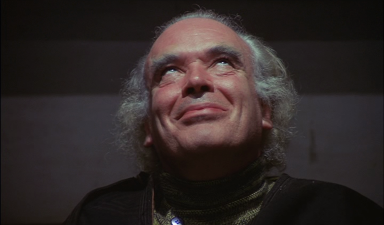
- An interesting inversion appears near the end, with Frank Alexander making a similar facial expression◊ while looking up at the room where Alex is being tortured. This was specifically done to seem reminiscent of portraits of Beethoven.
- Kung-Shui: The fight between the droogs and Billy Boy's gang is a long sequence of prop chairs, bottles and sheet glass breaking over people's heads. In a bit of meta-humor, they're fighting in a theater.
- Large Ham:
- The chief prison guard yells every single word.
- Patrick Magee as the writer, Mr. Alexander, seems to develop a cornucopia of nervous tics after being beaten half to death and watching his wife's rape/murder.
- Mr. Deltoid the social worker with his Verbal Tic and Ambiguously Gay behavior towards Alex.
- Laser-Guided Karma: Hoo boy. Everyone Alex wronged in the first half of the film get their revenge — including the vagrant.
- Leave the Camera Running: It's a Kubrick film, what did you expect? Notable instances include the opening shot of Alex and his droogs in the milk bar, the walk along the river when Alex attacks his mates, and the Undercranked sex scene, they all have the camera locked down for one long long shot. (Of course, Tropes Are Not Bad.)
- Left the Background Music On: A synthesized version of the Funeral of Queen Mary is heard in the Korova milk bar, first during the intro and in a later scene where Alex and his droogs make a second visit. In the latter, Alex mentions in his narration that said music is actually coming from the bar's sound system, and as he describes its disc coming to a halt, a woman there starts singing a piece from Beethoven's 9th, much to Alex's delight. Some other scenes show tapes and reels being played, serving as the background music; one of them plays a pivotal role during the Ludovico Treatment, making Alex paralyzed whenever he hears the 9th.
- Leitmotif:
- Alex's leitmotif is a synthetic cover of Henry Purcell's The Funeral of Queen Mary by Wendy Carlos.
- Whenever there's a fight, it's set to the overture of La gazza ladra by Gioachino Rossini.
- Scherzo from Beethoven's Ninth Symphony. Used in Alex's moments of bliss at first, then gets used by Frank Alexander to have him commit suicide since he's sick whenever he hears something from the Ninth Symphony.
- The Ode to Joy from the above Ninth Symphony is used twice. Once when Alex visits the vinyl records store, and once during the Ludovico Treatment with pictures from Nazi Germany, a combination that ends up making Alex sick.
- "Singin' in the Rain" too, first when Alex sings it as he rapes Frank Alexander's wife, then when he sings it while taking a bath at Alexander's house, blowing his cover. And then in the closing credits.
- Lighter and Softer: For all of its reputation for shocking violence, the film is actually lighter than the book. In the book, Alex is even younger and more violently depraved. Most notably, the sex scene in the film was originally Alex raping two 10-year-olds (whereas in the film they are clearly the same age as Alex and have consensual sex with him). The film also lightens things up with occasional slapstick humor. Likewise, in the book after he is free from the Ludovico treatment he fantasizes about rampaging around the world committing ultraviolence, whereas in the film he imagines having sex with one woman.
- Light Is Not Good: Alex and his droogs terrorize the town in distinctive white getups.
- Loud of War: Mr. Alexander tortures Alex by locking him in a room and playing Beethoven at him.
- The Ludovico Technique: The Trope Namer, Trope Maker and Trope Codifier is the scene where Alex is brainwashed into becoming non-violent, with a rig keeping his eyes open (and him being tied with a straightjacket) and needing someone to apply drops to his eyes (and interestingly, at one point during filming, the rig scratched McDowell's eye). Nowadays often given a Shout-Out as a method of brainwashing or torture.
- Male Frontal Nudity: Alex strips off when he is processed on his first day in prison.
- Male Gaze: As part of the Ludovico treatment, Alex is faced with a naked woman on stage. The camera lingers on her breasts from his POV.
- Matter of Life and Death: Alex's go-to line, verbatim, when the person he's trying to con into opening their door to him and his droogs starts resisting.Alex: Missus! It's a matter of life and death!
- Meaningful Name:
- The droogs are all named after Russian royalty (Alex, Dim(itri), George, and Peter).
- A-Lex means "without law".
- Mickey Mousing: Several instances of music punctuated action:
- "La Gazza Ladra" goes together with the tremendously violent action during the fight of Alex and his droogs against a rival gang in an abandoned theatre.
- During the "Singin In The Rain" scene, the line "I am ready for love" is ominously repeated several times and Alex does some Punctuated Pounding, kicking the writer in perfect sync with several beats of the song.
- Mind Rape: The Ludovico Treatment is nicely summed up by this trope; Alex is tortured mentally to the point where his ultra-violent penchants cause him pain, to achieve a form of brainwashing that will "reform" him.
- Misaimed Fandom: In-Universe. Alex only likes The Bible for its scenes with sex and violence and fantasizes about being one of the Romans whipping Jesus.
- Mistreatment-Induced Betrayal: The droogs to Alex himself.
- Monochrome Casting: Despite the fact that Britain had already become a multiracial society by the 1970s, and that this film is implied to be set in the future, only two black characters are seen: a gang member in the Korova Milk Bar and one of the inmates at the prison.
- Mood Dissonance: Horrible violence and classical music (the 9th Symphony of Beethoven in particular, which is about joy and brotherhood).
- Mood Whiplash:
- When the Chaplain is giving his sermon in prison, he announces very dramatically and ominously the reality of Hell, saying there’s proof: he saw it. In a dream.
- The story is ultimately a tremendous, social ordeal with plenty of heinous and/or pointless crimes committed by both Alex and the government, but it all ends in a chirpy note with Gene Kelly's original, uplifting version of "Singing in the Rain."
- Murder Simulators: A gang sang "Singin' in the Rain" during a rape, arguably as a result of the film's influence. Apparently, it also inspired a murder known as "The Clockwork Orange Murder", where a boy killed his best friend in his backyard. Indignant over the allegations, Kubrick had Warner Bros. withdraw the film from distribution in Britain until after his death.
- Mythology Gag: An LP for the soundtrack to 2001: A Space Odyssey is front and center in the record store.
- Nasal Trauma: Alex ends up earning a full milk bottle to the face courtesy of his long-abused droogs, leaving him with a nasty cut across his nose. After Alex gets arrested, a police interrogator jams his thumb into the bandaged wound.
- Naked Freak-Out: A young woman is stripped by Billy's gang, and was obviously about to be raped. She runs off naked when Alex and his crew arrive on the scene looking for a fight.
- Naked People Are Funny: Very much subverted thrice (two of them in the first 20 minutes). And played straight in a sped-up montage of a menage a trois.
- Named by the Adaptation: In the novel Alex has no surname given but at one point, he calls himself "Alexander the Large" in an allusion to his penis after he injected himself with an aphrodisiac. However the film makes DeLarge an actual surname, revealed while he's in custody being processed for prison. In a form of creator allusion, the newspapers report his name as Alex Burgess.
- No-Holds-Barred Beatdown: What Alex and his droogs do to the drunken homeless guy at the beginning of the film. After his treatment, Alex receives one from a group of bums as well as his former droogs.
- No Party Given: All we learn from the minister is that "our party promised to restore law and order."
- No Woman's Land: Dystopic Britain is a lawless world with Medieval-Victorian attitudes to women. Teenage boys rape women walking alone at night, attack those who live alone, and even those who are married (and commit suicide after being raped), while the government and legal institutes more or less tacitly accept women as objects and sex toys, with Alex at the end being "cured".
- Number of the Beast: During the scene where Alex is being dragged into the woods to be beaten by Dim and Georgie, we see that on either side of him, their Police collar numbers read #665 and #667, respectively.
- Oh, Crap!:
- Alex, when he bumps into Georgie and Dim, who are now police officers. Made worse for Alex when he's in no position to defend himself and Georgie and Dim want to enact their revenge on their former leader.
- The Cat Lady, right before Alex bashes her skull in with the phallic sculpture.
- Alex again when he finds that Beethoven is being played during the test. He was ok with having the violent and sexual imagery taken from him, but he flips out when that piece of music is used, knowing what will happen.
- After being carried into the writer's home by the bodyguard, and explaining to him what had happened, the writer suddenly exclaimed "I know you!" But it's because he recognized Alex's picture in the papers that morning, rather than recognizing him as the rapist of his wife.
- There's a very unsettling◊ low-angle shot of Frank Alexander's face contorting in horror when he realizes who Alex really is. This is no doubt part of his motivation for torturing Alex with Beethoven's Ninth. The actor, Patrick Magee, is said to have then told Kubrick "I feel like I just took a shit in front of everyone".
- The Oner:
- In one scene, Alex's head is forced into an (obviously full) water trough while he is brutally beaten (complete with zany 'bong' sound effects). Apparently there was actually a breathing apparatus under the water, but it failed to work properly and McDowell did, indeed, nearly drown.
- The film's opening shot is one of the most iconic oners in film history, showing Alex giving a menacing, unblinking Kubrick Stare to the viewer as the camera slowly pans out and he gives a voiceover monologue.
- Out-Gambitted:
- Frank Alexander drives Alex to suicide in hopes of using his death as a symbol of the government's corruption. Not only does Alex survive, but then the government decides to use him as their new poster boy and bundle Alexander away to prison as a dissident, presumably using his own manipulation of Alex to justify it.
- Alex's goal in getting himself chosen for the Ludovico treatment is to fool the doctors into thinking he's been reformed so that he can be released from prison. He doesn't count on the treatment being as effective as it is.
- Over-the-Shoulder Carry: Mrs. Alexander is slung over Dim's shoulder while Alex gags her and sings "Singin' in the Rain".
- Phallic Weapon: In this case, the weapon is literally a [sculpted] phallus.
- Photo Op with the Dog: The last scene with the press photo shoot at the hospital. The Minister arrives to have a well publicized chat with the now victimized Alex.
- Playing Sick:
- Alex easily avoids school and fools his parents by feigning a pain in the gulliver (head) so he can rest up for another night's activities.
- Inverted later in the middle of the treatment. Alex starts to put on his fake, harmless and meek façade and pretends to be sane and cured. The doctors are not fooled by the act.
- Police Brutality: Alex gets roughed up when he's arrested for murder. Much later Dim and Georgie get jobs as policemen so they can get paid to beat people up. It's implied this is being encouraged by a government that is hiring young roughs to tackle criminality.
- Police State: It's strongly implied that the government is devolving into one of these. The "cure" itself even comes about because they need to free up space for future political prisoners, and the government starts recruiting street thugs as police (including two of Alex's former "droogs").
- Poor Man's Porn: Alex is forced to take Bible classes as part of his rehabilitation. He mostly focuses on the passages describing bloody battles and royal concubines to imagine himself in either situation.
- Posthumous Narration: Kubrick makes fun of this trope and the problem it usually presents.Alex: But I did not snuff it, if I had snuffed it I would not be here to tell what I have told.
- Practically Joker: Possibly unintentional, but Alex's clown like make-up, jovial sadism, and habit of causing mayhem and murder For the Evulz is very reminiscent of the Clown Prince Of Crime.
- Pragmatic Villainy: The other droogs begin to get tired of their evil lifestyle and of Alex's leadership, but only because they want a more profitable return for their acts of ultra-violence.
- Pre Ass Kicking One Liner: "Ho ho ho! Well if it isn't fat, stinking, billygoat Billyboy in poison! How art thou, thou globby bottle of cheap, stinking chip oil? Come and get one in the yarbles — if ya have any yarbles, ya eunuch jelly, thou!"
- Psychotic Smirk:
- Alex does this frequently, most famously paring it with a Kubrick Stare during the opening scene at the Korova Milk Bar.
- Frank Alexander gets in on the action when he's torturing Alex with Beethoven's Ninth, hinting that in this moment, they're not so different.
- Public Domain Soundtrack: The entirety of the soundtrack comprises classical pieces (fittingly, since the protagonist is expressly stated to be a classical music buff, which even becomes a plot point), some of them arranged for a Moog synthesizer to lend them a surreal, nightmarish quality.
- Putting on the Reich:
- The cops at the prison dress vaguely like concentration camp guards, and one particularly sadistic guard, who despises Alex, sports a strikingly Hitler-like moustache.
- The biker gang who nearly rape the girl in the theater also favor Nazi paraphernalia.
- Rape and Revenge: Played for Laughs. A disabled writer discovers the identity of the man who disabled him and raped his wife (who later commits suicide) by hearing him singing "Singing in the Rain" in the bath, and decides to take revenge on him by forcing him to hear Beethoven's music that causes him pain out of pure conditioning.
- Real Men Wear Pink: Alex and his gang wear certain effeminate details of makeup; fake eyelashes on one eye (Alex), mascara (Georgie), rouge (Petey) and lipstick (Dim). As seen in the Korova Milk Bar, this is the reigning fashion of their set.
- Recruiting the Criminal: Alex is shocked to find the former members of his gang in police uniform. Apparently the government has been deliberately recruiting the thuggish element of British society to keep their fellow thugs in line. At the end of the film, a government official implies that Alex himself will come in useful in political repression.
- Reptiles Are Abhorrent: Alex has a pet snake, Basil. Of course a monster like Alex would not own something cute and cuddly. It's subverted when Alex returns home and is sympathetically upset to learn that his parents have killed Basil. Kubrick supposedly included the snake because McDowell was afraid of them, and when filming the scene where Alex takes Basil out of the drawer for some fresh air, Basil had somehow escaped, causing everyone to freak out.
- Retired Monster:
- Georgie and Dim more or less become respectable police officers... but it is clear they love causing others pain and misery, with it being implied that Alex isn't the only person they've mistreated.
- The movie implies Alex, while now getting a respectable government job, is still the ultraviolent maniac he's always been.
- Revised Ending: The book's ending had Alex a functioning adult after all of his misadventures with gang life and the government; the cure all along was to simply grow up. The film had Alex still Brainwashed and Crazy, and the pawn of a vaguely totalitarian government.
- Rooting for the Empire: In-universe, Alex aligns himself with the torturers and the sinners of The Bible.
- Same Content, Different Rating: SBS, which isn't legally allowed to air R18+ content on their main channel, was able to air this movie uncensored with an MA 15+ rating.
- Satire: The film is a satire of the battle against violence in society. Like in any satire, everything is exaggerated for effect and made grotesque. The cops are caricatures of authority, exceedingly pompous in rituals and obvious hypocrites, the doctor and nurse take a while to respond to the patient because they are having quickie sex behind a patient's curtain, and the writer Alexander is an obvious strawman hypocrite.
- Scenery Censor: Subverted. When Alex is brought into the prison, he has to turn in all his possessions and clothing. He ends up stark naked with a box in front of the camera at groin level... then they remove the box.
- Scenery Dissonance: Type 1. A lot of the ultraviolence in the film takes place in picturesque surroundings: the abandoned casino, the writer's modernist house, the cat-lady's art gallery...
- Science Is Bad: Played with, the new treatment attempts to eradicate the plague of criminality but does so by erasing moral choice and freedom. On the other hand, the doctors are just tools and eventually scapegoats used by the politicians.
- Shout-Out:
- The film's most (in)famous scene is a sort of wicked reenactment of Gene Kelly Singin' in the Rain.
- During one of his fantasies Alex imagines himself as Dracula, specifically like Christopher Lee's iconic image, from Horror of Dracula.
- Kubrick references a few of his own movies:
- At the music shop where Alex meets the two girls who who he later takes home, a poster for 2001: A Space Odyssey can be seen hanging from the table.
- In the same scene, Pink Floyd's Atom Heart Mother album can be seen. It's also a bit of an allusion to the scuffle between Stanley Kubrick and the band, since they wanted to create an album that sampled bits and pieces of sounds from ''2001'' and he wanted to sample bits of their music in his films, but they both refused each other's offers.
- The code numbers of the communications device from Dr. Strangelove are "CRM-114". In A Clockwork Orange, one of the vials containing drugs used to condition Alex for the Ludovico treatment is labelled "serum 114".
- The finale where Alex jumps out the window and we see a first-person view of Alex jumping out with the camera falling out the window simulating his fall is one for Max Ophuls' Le Plaisir, whose third story ends this way. Ophuls' film is even more elaborate since it's a single setup following a girl climbing up the stairs and jumping out the window with the camera hitting the ground. Ophuls was one of Kubrick's favorite film-makers.
- The film's most (in)famous scene
- Singing in the Shower: Used as a plot-point. After being beaten up by police, Alex takes refuge in the home of the man whom he crippled years before during a home invasion. Alex was wearing a mask at the time so the man doesn't recognise him, but he does recognise Alex's singing in the bath later on, as Alex sang "Singing in the Rain" while kicking him and raping his wife.
- Sinister Switchblade: Alex's rival Billy-boy flicks open a switchblade before their gang brawl.
- Slasher Smile: Alex whenever he gets deep into the old ultraviolence.
- Sleazy Politician: The minister of the Interior, outwardly tough on crime, allies with Alex -an unrepentant rapist and murderer- because he can spin his story in favour of the government. Additionally he's also a key figure of an implied Government that sends its political adversaries to prison.
- Sliding Scale of Idealism vs. Cynicism: EXTREMELY cynical.
- Smug Smiler: Alex sports a pretty arrogant smile of his own.
- The Sociopath: Alex robs, rapes, and assaults innocent random people for his own amusement, and who simply throws the spoils in a drawer under his bed.
- Something Only They Would Say: Alex inadvertently reveals himself to Mr. Alexander when he sings "Singin' in the Rain" (which he also did while torturing him and his wife) whilst taking a bath.
- Soundtrack Dissonance:
- Whenever Rossini's "Thieving Magpie" overture starts up on the soundtrack, you know some ultra-violence is coming.
- Also, the film's most infamous scene features the gang torturing a couple while Alex performs "Singin' in the Rain". While filming the scene, Kubrick decided on a whim to have Alex sing a song, and Malcolm McDowell chose the song simply because he knew all the lyrics.
- In-universe, Alex strongly objects to the use of Beethoven's Ninth, and specifically the "Ode to Joy", as the soundtrack to the horrifying scenes of rape and violence used in the Ludovico Treatment.
- Spared by the Adaptation: Georgie is killed while trying to rob someone in the book. Here, he's alive and well and working with Dim as a policeman.
- Spinning Paper: The backlash against the government and the Ludovico treatment is shown via headlines.
- Spiteful Spit: Alex's probation officer, Deltoid, spits on his face after he is arrested.
- Spoofing in the Rain: Alex hits the writer in the balls and rapes his wife while singing "Singin' in the Rain". Kubrick went above and beyond with the hoax in that despite promises, he went cheap and never actually bought the song, which annoyed Gene Kelly greatly.
- Stock Footage: Clips from Triumph of the Will and other Nazi newsreels and the like, shown to Alex during the Ludovico treatment. Includes scenes from the battle of Stalingrad, as shown by the sculpture of dancing schoolchildren in one clip.
- Strange-Syntax Speaker: The "Nadsat" language often involves unusual word order, conjugation and word choice in addition to a mix of Russian/German-based words, Cockney slang, and schoolboy talk. The film's version is less pronounced than the book's, since the viewer only has about 90 minutes to become accustomed to it.
- Sword Cane: Dagger cane, actually, as Alex yanks a scary knife out of his walking stick and uses it to slice Dim's hand.
- Sympathetic P.O.V.: Alex is an unhinged maniac, but seeing him robbed of his free will and being unable to defend himself feels very, very icky.
- Tap on the Head: Averted twice. Alex slamming the hollow ceramic phallus in the lady's face ultimately proves fatal. Then when Dim breaks a milk bottle across Alex's head it avoids the usual cliche of knocking a person out, but rather leaves him in excruciating pain, disoriented, and with a huge cut on the bridge of his nose afterward.
- Tempting Fate: Alex is being interviewed while being fed by Mr. Alexander. During the interview, he says, "I get the feeling something bad is going to happen." Two seconds later, he's out like a light.
- Tethercat Principle: The more heinous antics of Alex and his droogs are depicted in lengthy detail, and are abruptly cut away from mid progress. One example would be the droogs beating on the homeless man, with the lashings and the tramp's screams going along at a steady pace with no signs of stopping or slowing down.
- Theme Naming: The Droogs are all named after Russian kings: George, Dimitri, Peter and Alexander. This goes along with their Russian-themed slang.
- This Cannot Be!: Alex is understandably dumbfounded to encounter George and Dim as policemen.
- Three-Way Sex: Played at high speed, to the tune of Rossini's "William Tell Overture".
- Torture Always Works: Slightly ambiguous, but it seems to indicate that even if torture did work, would that really justify its use?
- Trademark Favorite Food: Alex with his Milk Plus, which he drinks in preparation for a bit of the old Ultraviolence.
- Tranquil Fury: After recognizing Alex as the rapist of his wife and the one who crippled him, Mr. Alexander displays this, mixed with Faux Affably Evil undertones. His fury does slip up a bit, such as when he serves Alex food and wine.
- Tuneless Song of Madness: The use of "Singin' In The Rain" to accentuate psychopathic Alex's violence and rape.
- Undercrank: During the three-way sex scene, with the William Tell Overture as a soundtrack.
- Unusual Pets for Unusual People: The sadistic thug Alex owns a pet snake. This detail was not in the novel and in fact Malcolm McDowell was frightened of snakes.
- Vague Age: Apparently done deliberately in casting Malcolm McDowell as Alex. The character is revealed to be fifteen in the book, while McDowell appears to be somewhere in the range of late teens to early twenties.note
- Vapor Wear: Unlike most of the other women in the film, Mr. Alexander's wife does not wear underwear. Tragically, this only makes it easier for Alex to rape her.
- Verbal Tic: Mr. Deltoid, yes? Poses every sentence as a question with the word "yes" at the end, yes?
- Villain Has a Point: While Georgie is a vicious, amoral hoodlum, he's perfectly correct that it's stupid for the gang to run the risks they run for chump change, when much more lucrative crimes are within their reach.
- Villain Protagonist: A complicated example, given that the viewer is inclined to view Alex as the villain of the film, and is certainly a remorseless psychopath, yet the film's real criticism is saved for the government's bungled handling of him.
- Villain Opening Scene: The (in)famous close-up of Alex at the Korova Milkbar.
- Villain Song: Alex sings "Singin' in the Rain".
- Villainous Rescue: The Droogs come across a rival gang about to rape a woman in an abandoned theater. They intervene just in time, so that they can fight. The woman escapes in the ensuing chaos, but only because the gangs were focused on each other. The Droogs were obviously motivated not by virtue, but by the opportunity to deny the rivals their pleasure and fight them as well.
- Villains Out Shopping: One scene has Alex going to a record store to pick up an album he ordered, dressed in a posh Edwardian-era suit. He also uses the opportunity to invite some girls for a threesome.
- Visual Innuendo: The popsicles being sucked by the two girls at the record store. Actually, this film is filled with examples of penis imagery that are in no way subtle.
- The Voiceless: Pete says nothing the entire time he's onscreen.
- Water Torture: Dim and Billy beat up Alex while forcibly dunking his head in a pig trough filled with water for a minute, nearly drowning him to death.
- Wham Shot: For both the audience and Alex when he's saved from a crowd of vengeful homeless people by two police officers, only to look up and realize his rescuers are Georgie and Dim. They're just as surprised at first.
- What Happened to the Mouse?: We never learn what became of Pete, Alex's other droog. Alex meets Pete in the final chapter of the novel; Pete has given up violence and now has a fiancee, which encourages Alex to give up his old ways too.
- What Is Evil?: When Alex's uncle speaks to him of right and wrong he says, "Come now, you know that's just a matter of words."
- Wicked Cultured: The Droogs travel throughout the city in what appears to be Victorian-era men's underwear, and they carry canes. In addition, Alex enjoys classical music and is known to employ gratuitously highbrow words in his vocabulary.
- With Friends Like These...: Alex maintains his position in the gang with violence, threatening and attacking his underlings when they annoy him. Georgie tries to stage a coup, but Alex beats up the whole gang singlehandedly.
- World of Technicolor Hair: Outlandish hair colors are fairly common in this verse. Most old women have purple hair, for instance.
- Wounded Gazelle Gambit: Alex pretends to be involved in a bloody car accident in order to break into people's houses. The cat lady is savvy about it because the newspapers aired the ruse.
- Xanatos Speed Chess: How the government salvages the political mess they land in in the wake of Alex's attempted suicide. While Alex is recuperating in the hospital, the Minister of the Interior pays him a visit to sway him into becoming the government's poster boy, bribing Alex with a cushy job and a promise to reverse the effects of the Ludovico Technique. It works.
- You Are Number 6: Alex is addressed by his number in prison: Six Double-Five Three Two One. This is a slight modification of his number from the book.
- Zeerust: A 1970s version of the future, with strange fashions, lots of ominous Brutalist architecture, a plastic-looking sports car, and music played from minicassettes. They only built one location for the film. That's how wacky the aesthetics of the 1970s were.