

Top: Jean Leone Gerome Ferris' The First Thanksgiving, 1621. Bottom: Ditto, but with Batman characters.
Certain works of art are so classic that they've become iconic. As such, they are frequently exploited for symbolic or comedic effect.
Many classic paintings and sculptures have found their way into popular media. So frequently are these images exploited that people who may have never seen the original works still recognize the images.
The broader trope is Stock Shout-Out, which covers similar items from pop culture rather than fine art.
Compare Truth in Television and Life Imitates Art, where this inspirational transition is made beyond the fourth wall. Not to be confused with the simple fact that artists imitate other artists. See also Referenced By.Other Media's art list.
open/close all folders
Specific subtropes include:
- American Gothic Couple (Grant Wood's American Gothic)
- The Burlesque of Venus (Sandro Botticelli's The Birth of Venus)
- Canines Gambling in a Card Game (Cassius Marcellus Coolidge's Dogs Playing Poker)
- "Last Supper" Steal (the tableau from Leonardo Da Vinci's The Last Supper)
- Mona Lisa Smile (Leonardo da Vinci's Mona Lisa)
- "Nighthawks" Shot (Edward Hopper's Nighthawks)
- Pietà Plagiarism (Michelangelo Buonarroti's Pietà)
- Reclining Venus (Giorgione's Sleeping Venus)
- "The Scream" Parody (Edvard Munch's The Scream)
- Sistine Steal (Michelangelo's ceiling of the Sistine Chapel, specifically the "Creation of Adam" image)
- Thinker Pose (Auguste Rodin's The Thinker)
- The Vitruvian Pose (Leonardo da Vinci's Vitruvian Man drawing)
Works of art that are often imitated without a subtrope existing for them include:
- Abaporu (by Tarsila do Amaral)
- Annunciation (by Leonardo da Vinci)
- The Arnolfini Portrait (by Jan van Eyck)
- The Bayeux Tapestry — See the Referenced By page.
- The Fallen Angel (by Alexandre Cabanel)
- Liberty Leading the People (by Eugène Delacroix)
- Nefertiti Bust
- The Night Watch (by Rembrandt van Rijn)
- L'Origine du monde (by Gustave Courbet)
- The Persistence of Memory (by Salvador Dalí)
- The Spirit of '76 / Yankee Doodle (by Archibald Willard)
- The Starry Night (by Vincent van Gogh)
- Statue of Liberty
- Venus de Milo
- Le Violon d'Ingres (by Man Ray)
- Wanderer above the Sea of Fog (by Caspar David Friedrich)
- Washington Crossing the Delaware (by Emanuel Leutze)
Examples:
Anime & Manga
- Manga artist Suehiro Maruo loves integrating elements of famous paintings into his compositions. Examples: The Garden of Earthly Delights by Hieronymus Bosch, Hope by George Frederic Watts, The Plague by Arnold Boeckin, and (NSFW)The Guitar Lesson by Balthus.
- The opening and closing credits for Elfen Lied take an immense cue from the works of Gustav Klimt, to the point of inserting the five mains into a Klimt-like painting.
- Sound of the Sky's opening credits also contain numerous allusions to Gustav Klimt's work.
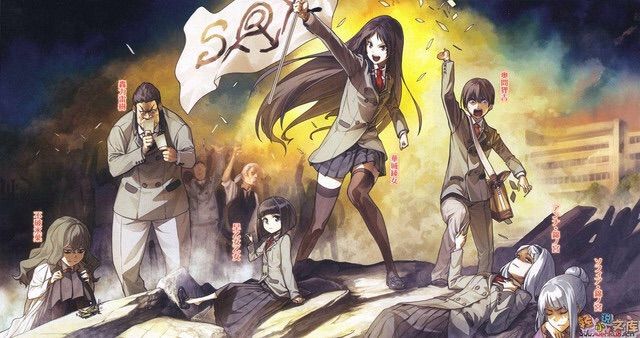
- This picture
 ◊ of Shimoneta references Eugène Delacroix's Liberty Leading the People.
- One episode of Panty & Stocking with Garterbelt featured Garterbelt being revived by God and forced to relive all of human history. References to famous paintings, photographs and film stills abound.
- Shisunki Renaissance David-kun is a series built off of this trope. All of the characters are based off of famous art pieces, and there are many panels that recreate some famous artwork, including gag reactions.
- During a montage in Berserk showing how the series' Layered World collapsed into a single plane of existence, one of the spread pages is full of monsters based on the demons shown in Hieronymus Bosch's The Garden of Earthly Delights.
- Garaku Utagawa of Ayakashi Triangle creates ink painting that come to life, several of which homage traditional Japanese art:
- His Zerg Rush of rabbits and frogs resemble those in the Chōjū-jinbutsu-giga picture scrolls.
- His giant octopus, which ends up grabbing Matsuri and Suzu, resembles the ones in the infamous woodblock print The Dream of the Fisherman’s Wife.
- His Zerg Rush of rabbits and frogs resemble those in the Chōjū-jinbutsu-giga
- In Nisekoi, Marika makes a gigantic chocolate statue of Raku for Valentines Day, with the same size and pose of David.
Arts
- One way to depict the Grecorroman Love Goddess is the "Venus Pudica", which was very popular during the Hellenistic period. It features her as self-conscious of her own nakedness and divine beauty, causing her to daintily try and cover her breasts and crotch. It contrasts with other common takes on her, in which she neither flaunts nor cares about her looks but is merely solemn. It draws from the goddess' early days when she was still a virgin. Several artworks featuring the goddess are modeled after it, the most influential one being the Capitoline Venus and its replica, the Aphrodite of Menophantos. Both sculptures share the positioning of the hands, the presence of a towel/sheet, and the fact that the goddess is fresh off a bath. Depictions in paintings include Sandro Botticelli's The Birth of Venus.
- Academicism was all about this trope — using a not-so-Small Reference Pool (the Classical Mythology and Christianity) following strict rules of proportion and composition, which greatly hindered creativity and caused artists to repeat the masters' artworks over and over. Alexandre Cabanel, despite disagreeing with it in his youth, won a contest by imitating Giorgione's Sleeping Venus. He later learned to give his own Original Flavor to such Neoclassicist paintings.
- The Birth of Venus (Cabanel): It's said to be one of the more famous works of art directly inspired by the Trope Codifier of the Reclining Venus Sleeping Venus.
- Medici Chapels:
- Sleeping Ariadne, an ancient Rome sculpture, loosely influences three of the allegorical statues. All of them are in resting positions. "Night", in particular, is also sleeping. "Dawn" has just woken up and "Dusk" is preparing to sleep. "Day", by contrast, has an energetic posture.
- The tomb portrait of Lorenzo has been known as "Il Pensiero" ("The Thinker"). The similarity between the poses is what gave Rodin's much later sculpture its name.
- Édouard Manet had a deep understanding of art history, having based Le Déjeuner sur l'herbe on the Judgement of Paris (ca. 1515) by Marcantonio Raimondi and Raphael, Pastoral Concert by Giorgione or Titian, The Tempest by Giorgione and La Partie Carrée by Antoine Watteau.
- Grande Odalisque: Much like various other historical examples of the Reclining Venus, Ingres admitted that his primary inspiration for Grande Odalisque was the Dresden Venus and the Venus Of Urbino.
- The figura serpentinata prevalent in the Mannerist movement was a big influence on the composition of Bernini's The Rape of Proserpina, Giambologna's The Rape of the Sabine Women being the most obvious in similarities.
- Henry Fuseli's 1781 painting The Nightmare -depicting a Sleep Paralysis Creature squatting on the chest of a dozing woman, while a Hellish Horse watches— has become a staple of this. Fuseli himself painted a few variations on the theme throughout the 1780s and '90s, and the Danish artist Nicolai Abildgaard painted his own Hotter and Sexier version in 1800. To a less overt extent, it was also likely an influence of Francisco de Goya's The Sleep Of Reason Produces Monsters, which shows a male sleeper being tormented by strange creatures — in this case, a swarm of bats and owls.
- Nue Couchée: The Reclining Venus pose that it emulates is interpreted as being from the back of the model not unlike Grande Odalisque.
- Most of the paintings and drawings on Aza Smith's Grindhouse and Watercolors are representational depictions of his ragdolls, which are considered artwork in it of themselves.
- Venus And Cupid Lotto: It's but one of many paintings that came out with the blockbusting popularity of the Dresden Venus, the subject matter and the Reclining Venus position being one of the larger signs of this.
- Salvador Dalí's "Venus de Milo with Drawers◊" is a replica of the Venus de Milo with certain segments cutoff to resemble drawers with fluffy balls as handlers.
- Young Hylas with the Water Nymphs:
- Like many of the other depictions of Hylas at the time, the painting was directly inspired by John William Waterhouse's Hylas and the Nymphs.
- The sepia coloring and poses of the nymphs are reminiscent of Rubens' "The Disembarkation at Marseilles" (from the Marie de' Medici Cycle).
- Olympia:
- The painting itself deliberately pays homage to Titian's Venus of Urbino.
- Olympia's fame would go on to inspire a number of homages, including Portrait (Futago) by Yasumasa Morimura and A Modern Olympia by Paul Cézanne.

Comic Books
- The last panel◊ of Valérian's adventure "On the False Earths" references Luncheon of the Boating Party, a painting by Pierre-Auguste Renoir.
- René Goscinny and Albert Uderzo have recreations of various famous paintings or sculptures scattered throughout the Asterix books.
- In Asterix the Legionary, for one iteration of the running gag of the pirates having their ship sunk by the Gauls, they wind up recreating The Raft of the Medusa by Theodore Géricault.
- In Asterix and the Laurel Wreath, on the same page a Roman slave takes poses of Auguste Rodin's Thinker, Laocoön and His Sons, and Myron's Discobolus.
- In Asterix and the Soothsayer, you can recognize The Anatomy Lesson of Dr. Nicolaes Tulp by Rembrandt van Rijn.
- In Asterix and the Great Crossing, Asterix himself poses like the Statue of Liberty when hailing the Viking longship from atop a cairn.
- The Peasant Wedding by Pieter Bruegel the Elder is recreated in Asterix in Belgium.
- In Asterix the Legionary, for one iteration of the running gag of the pirates having their ship sunk by the Gauls, they wind up recreating The Raft of the Medusa
- A page in 2012's Swamp Thing #4 references The Runaway by Norman Rockwell.
- Red Soul (third album of Blacksad) references "Connoisseur" by Norman Rockwell.
- "Happy Batsgiving", one of DC Comics' double-page deeply-symbolic-of-upcoming-stories art pieces, is based on "The First Thanksgiving◊" by Jean Leon Gerome Ferris.
- "Abandon All Hope", another of these, focusing on Justice League Dark and related characters, is based on the bottom right corner of "The Last Judgement◊" by Michelangelo.
- Pinky and Pepper Forever: Pepper's art tends to place her girlfriend Pinky in various art references. The one that gets her a nasty homophobic insult from a classmate is a Burlesque of Venus with Pinky as Venus in a grubby apartment standing on a mattress. Some of the paintings she does after Pinky's death reference The Scream, Satan Devouring His Son, and Ophelia by Sir John Millais.
- In Suske en Wiske:
- "Het Spaanse Spook" ("The Spanish Ghost"): Suske, Wiske and Lambik are zapped into Pieter Bruegel the Elder's "Peasant Wedding" where they have an adventure in the 16th century. They also meet Bruegel himself.
- "Het Rijmende Paard" ("The Rhyming Horse") the painting of St. Martin Dividing His Cloak by Anthony Van Dyck is brought alive to teach humanity about sharing. By accident it's just his horse that escapes from the painting and needs to be brought back.
- Happens a lot in De Kiekeboes too. In the story "Hotel O." all the rooms are named after famous painters and various references are made to these works. For instance a vase with sunflowers being brought to the Vincent van Gogh room.
- Coincidentally, the same week in 2015 saw the release of TPBs of Lumberjanes and Prez (2015) which both had covers featuring female protagonists in parodies of Emanuel Leutze's "Washington Crossing the Delaware".
- 2000 AD artists seem to love◊ putting◊ Judge Death in place of The Joker in homages◊ to◊ old Brian Bolland artworks (who has worked on both 2000AD and DC properties).
- DC Comics Bombshells: The Batgirls (Alysia Yeoh, Felicity Smoak, Harper Row, Kathleen Duquesne, Mary Kane, and Nell Little), Cullen Row and Tim Drake all eat lunch on a steel girder posed like the subjects of the famous depression era photo "Lunch atop a Skyscraper"—generally attributed to Charles C. Ebbets— of construction workers eating high above New York's streets while working on Rockefeller Center.
- The pose of Superboy cockily smirking over his shoulder at the viewer while pointing with his thumb over his other shoulder at the S symbol on the back of his jacket from The Adventures of Superman has been used on a couple of covers; Byron Stark is in a mirrored version of the pose on the cover of Superboy and the Ravers #3, and Kon himself uses it again on the cover of Convergence: Superboy #1.
- Legion of Super-Heroes:
- The cover of Adventure Comics #247: The Legion of Super-Heroes!, portraying the three founders of the team behind a desk with name tags judging Superboy as unworthy of their "super-hero club" gets homaged occasionally:
- The cover of Superman (1939) #147 revisits the theme with the Legion characters replaced by their evil counterparts.
- The cover of Legion of Super-Heroes Vol 4 #88 sees the trio—Lighting Lad replaced by his sister—trying to reject Impulse but finding their buttons aren't working while Imp holds sparking wires behind his back.
- The cover of Legion of Super-Heroes Vol 5 #48 depicts most of the Legion behind tiered desks with name tags watching tryouts for the club.
- The cover of The Overstreet Comic Book Price Guide #29 painted by Alex Ross features the same characters as the original but in a more realistic style with more dramatic lighting.
- The cover of Simpsons Comics #68 has the classic set up, poses and props with Homer being rejected by other Simpsons characters all dressed as superheroes.
- The cover of Dark Horse Presents #115 has odd characters dressed somewhat like the Legion trio rejecting Dr. Spin's application to their superhero club.
- One of the back-up strips in the LEGION Elseworlds Annual was a Retraux story featuring a Silver Age version of L.E.G.I.O.N. The opening panel showed them on an intergalactic quiz show where the host was wearing a Superman costume (without the Chest Insignia), and they relayed their answers with the same Yes/No buttons.
- The cover of "Legion of Super-Heroes/Bugs Bunny Special" is another homage to Adventure Comics #247, replacing Superboy and the Legion three founders with Bugs Bunny, Lightning Lass, Ultra Boy and Brainiac 5 (who states that "[they're] not THAT desperate!")
- "Those Emerald Eyes Are Shining": The cover of issue #301 is a homage to the cover of Adventure Comics #300, wherein the magazine became the Legion of Super-Heroe's official "home".
- The cover of Adventure Comics #247: The Legion of Super-Heroes!, portraying the three founders of the team behind a desk with name tags judging Superboy as unworthy of their "super-hero club" gets homaged occasionally:
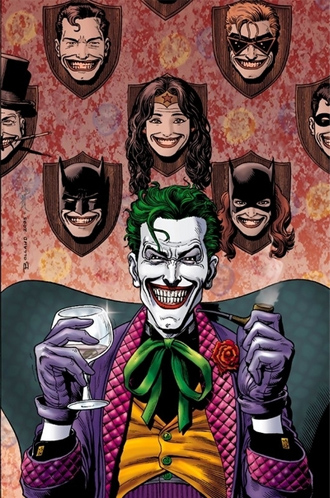
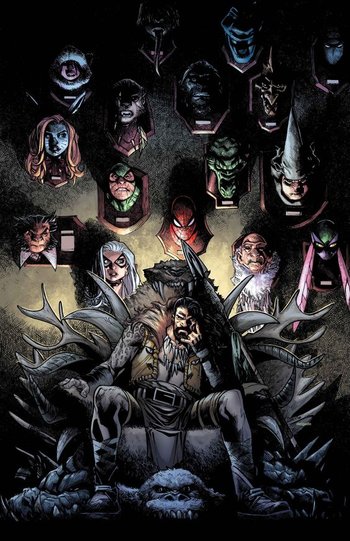
- The infamous Brian Bollard artwork◊ of The Joker lounging in front of a wall of superheroes' mounted heads has been homaged with other villains, such as this one◊ of Judge Death, this one◊ of Deathstroke and the Teen Titans, and this one◊ of Kraven the Hunter and various Spiderman characters.
- The covers of Action Comics #1 (with Superman lifting a car and smashing it against a rock), Superman #1 (with Superman leaping over the city in an oval panel with a fancy border) and Action Comics #252 (with Supergirl flying out of her rocketship before the shocked stare of Superman) are frequently homaged by both DC and other companies to introduce a Superman Substitute or a "new chapter" in Clark's life.
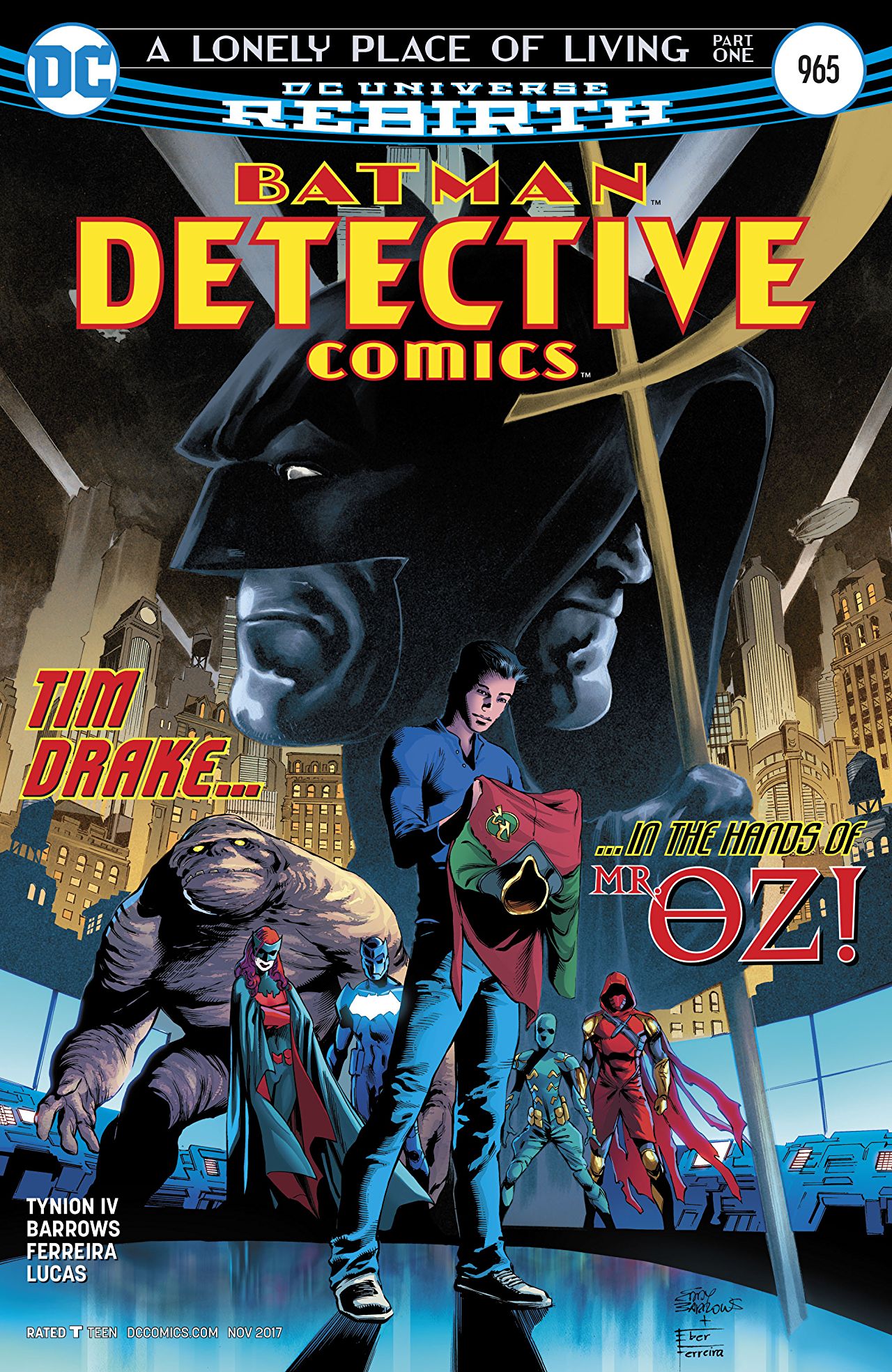
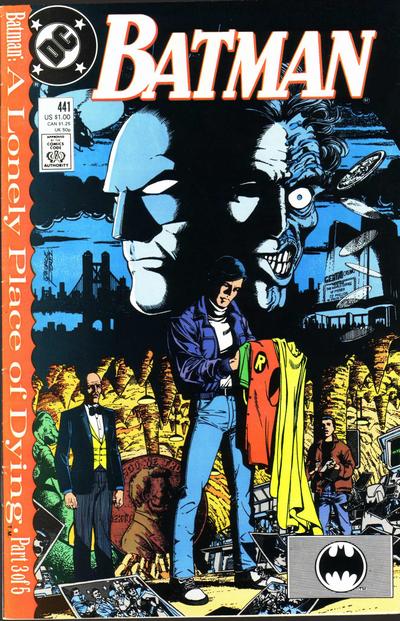
- Detective Comics (Rebirth) #965, part one of "A Lonely Place of Living", has a cover◊ based on that◊ of Batman #441, part three of "A Lonely Place of Dying". Both show Tim Drake holding a Robin costume and looking at it uncertainly, with the faces of Batman and the villain (Two-Face/Mr Oz) superimposed in the background, and the other main characters (Alfred and Dick/Batwoman, Clayface, Batwing, Orphan and Azrael) standing behind him.
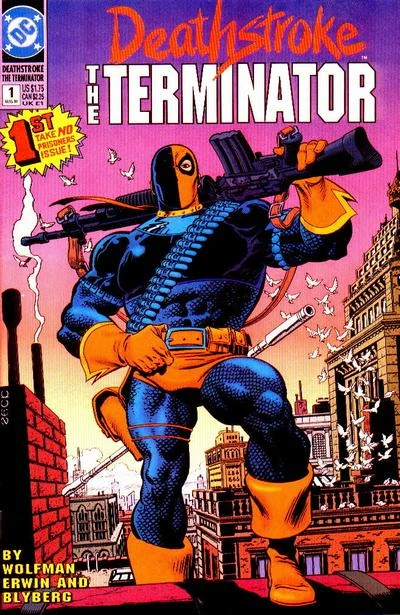
- A variant cover of Deathstroke Inc. #8, is an almost exact duplicate of the cover of Deathstroke the Terminator #1, complete with title design and the old DC Bullet logo, except that Slade is in his current outfit, is toting an even bigger gun, and the background shows the Washington Monument and Lincoln Memorial, rather than a generic cityscape.
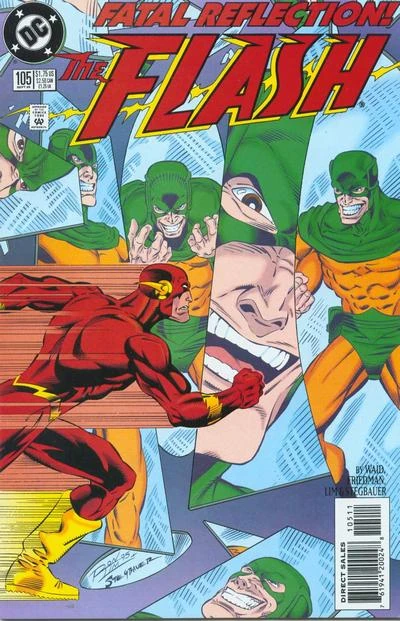
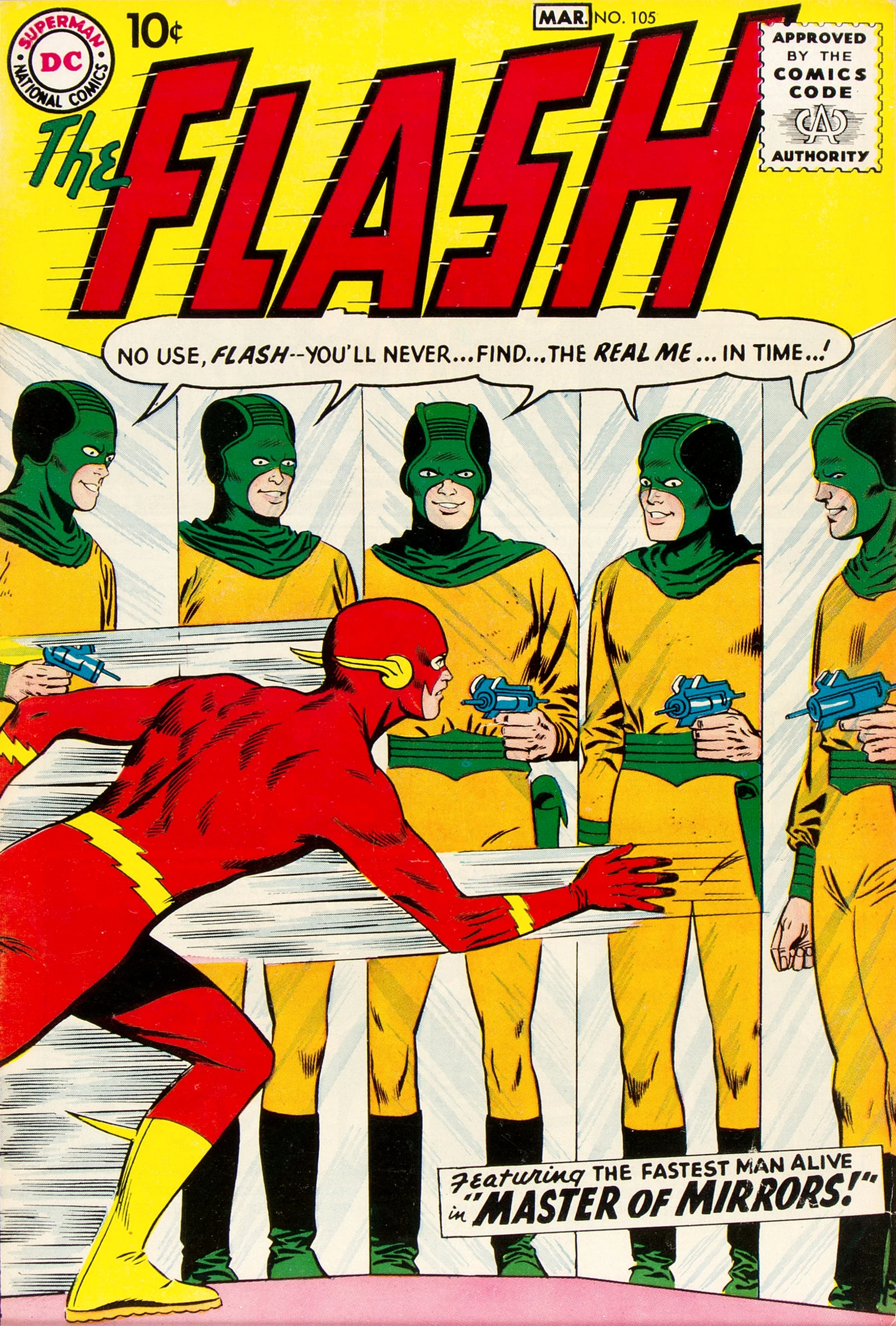
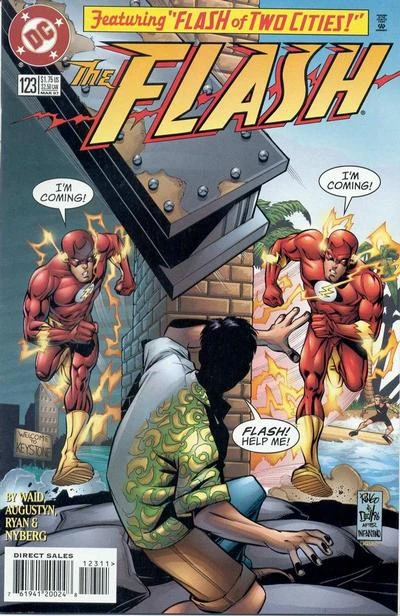
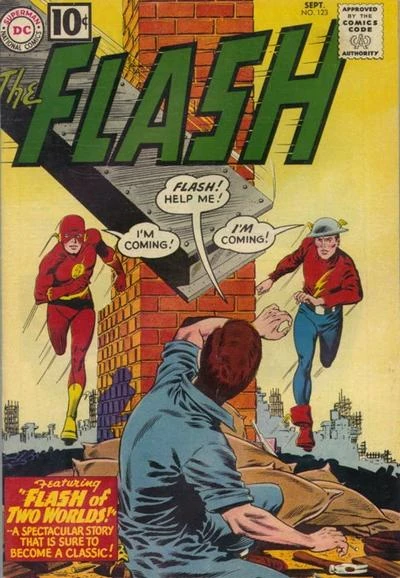
- The Flash vol 2 twice duplicated notable covers from the same number of vol 1:
- The cover of #105, which sees the return of the second Mirror Master is based on the vol. 1 cover which introduced the original. Except that while Barry was running towards a row of mirrors with identical reflections of Scudder, Wally is running through a crazy mirror dimension with McCulloch reflected in random shards from all angles.
- The cover of #123, in which Wally had become the official hero of Santa Marta, California, commuting from Keystone, duplicated the famous "The Flash of Two Worlds" cover, except that instead of Barry and Jay both rushing to rescue the same man, it showed two Wallys rushing to rescue different men in the same pose (one wearing a Hawaiian shirt and with palm trees in the background).
- The cover of #105
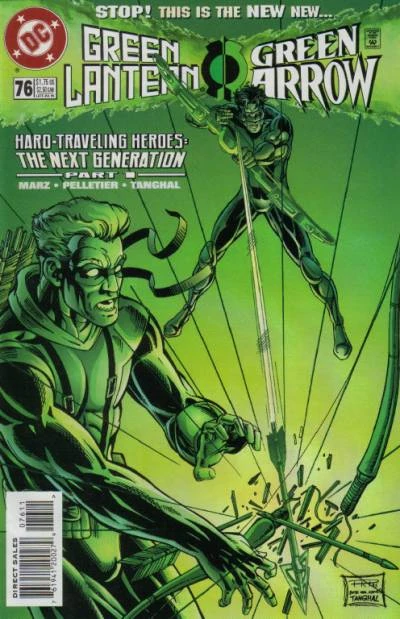
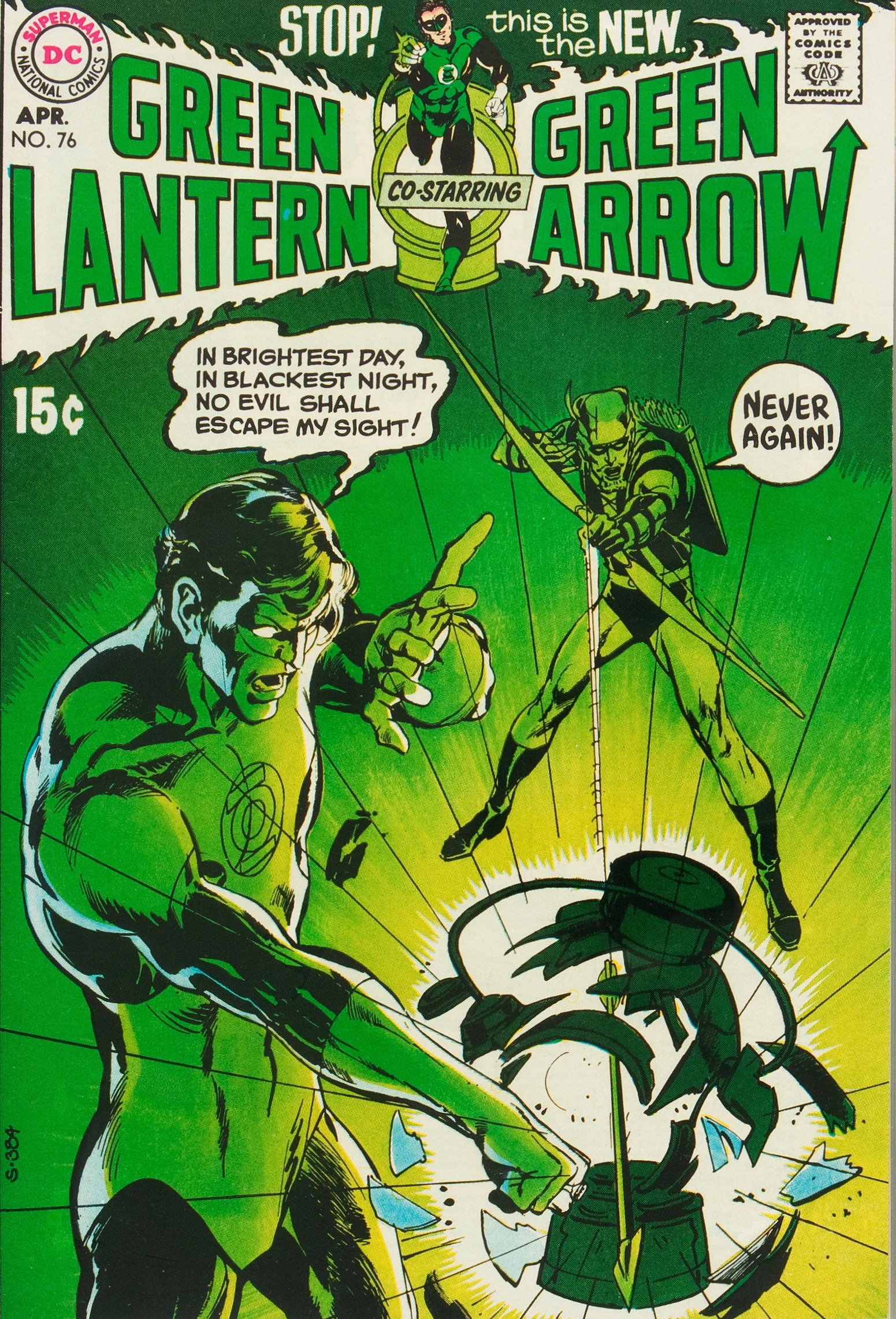
- Similarly, the cover of Green Lantern vol.3 #76, which began a crossover with Green Arrow under the title "Hard-Travelling Heroes: The Next Generation" shows Kyle using a ring-created arrow to destroy Conner's bow, in an identical composition to Ollie firing an arrow at Hal's power battery on the cover of vol.2 #76, which began the original "Hard-Travelling Heroes" storyline. It even uses a modernised version of the "Green Lantern co-starring Green Arrow" logo introduced in that issue, which continued for the rest of the crossover.
- The Quest for Kalevala: In one panel, the heroes and Magica in her bird form are in the same position as the people in the famous Finnish painting The Defense of the Sampo by Akseli Gallen-Kallela.





Comic Strips
- Given that one of the main characters of Safe Havens is a child, time traveling Leonardo da Vinci, it's surprising it doesn't happen more often. But in one notable instance, he shows that his painting "The Virgin and Child with Saint Anne" is actually a family portrait he paints of himself, his mother Maria, and his stepmother Bambi, to show his mother in the past that she would find love again. Another time, after he says he promises to someday paint his friend Candide's portrait, Candide is seen giving the Mona Lisa Smile, implying that she's the true identity of Mona Lisa.
Films — Animation
- The Venus de Milo is frequently used, usually in period pieces where the whole statue is shown and then the arms are "accidentally" broken off. This joke was used in The Twelve Tasks of Asterix (1976) for instance and later stolen for Disney's Hercules (1997) too.
- The end credits of Cinderella III: A Twist in Time feature depictions of the characters in parodies of famous paintings. Fox example, Gus appears as the Blue Boy, and the Grand Duke is in ''The Scream (Munch)".
- The end credits for Lilo & Stitch features a snapshot of a Thanksgiving dinner styled like Norman Rockwell's Freedom from Want.
- Mad God never recreates a specific painting, but the director has said that the goal was to capture the feel of a Hieronymous Bosch work, albeit with a somewhat more Diesel Punk aesthetic.
- Near the end of the Coraline, the titular character meets the released souls of the children the Other Mother ate in a heavenly place resembling Vincent van Gogh's The Starry Night.
- Loving Vincent takes a heavy influence from van Gogh's paintings for its visuals. In the closing credits images of the characters are put next to the original paintings that served as inspiration.
- In Joseph: King of Dreams, the first dream Joseph has are inspired by the van Gogh's wheatfield paintings, while the second is inspired by van Gogh's The Starry Night.
- The Hungarian animated film Ruben Brandt, Collector follows a psychotherapist tormented by nightmares inspired by famous works of art, including The Birth of Venus, Magritte's The Treachery of Images, Edward Hopper's Nighthawks and the Triple Elvis by Andy Warhol. The art style of the movie itself seems to be heavily influenced by Dali and Pablo Picasso's Cubism period.
Films — Live-Action
- Bible Times movies covering Jesus will often homage the Pietà pose with the actual people involved. For instance, Jesus of Nazareth has Mary wailing in her grief as she cradles her son, while The Passion of the Christ has her suffer in silence and stare at the viewer.
- Reenactments of the self-crowning of Emperor Napoléon Bonaparte and Empress Joséphine de Beauharnais often imitate Jacques-Louis David's rendition of it. The films reenacting it include:
- Désirée (1954), with Marlon Brando.
- Austerlitz (1960) with Pierre Mondy oddly features it... as a model recreation while it happens offscreen.
- Napoléon (1955) with Raymond Pellegrin.
- Napoleon (2023) with Joaquin Phoenix. From this one there's also Napoleon on his horse before The Sphinx in Giza, Egypt, like the Jean-Léon Gérôme painting from 1867-1886.
- Asterix & Obelix: Mission Cleopatra: When the pirates get shipwrecked and find themselves on a raft, we get a near perfect recreation of The Raft of the Medusa.
- Zack Snyder loves Renaissance/classical imagery, particularly religious art, and it shows in his films.
- The "Last Supper" Steal in the opening of Watchmen.
- Snow Steam Iron has a naked woman carrying (and even kissing) a bearded man's decapitated head in "Judith beheading Holofernes" fashion.
- DC Extended Universe:
- Batman v Superman: Dawn of Justice: Wonder Woman and Batman carrying Superman's dead body is reminiscent of depictions of the Christ being de-crucified.
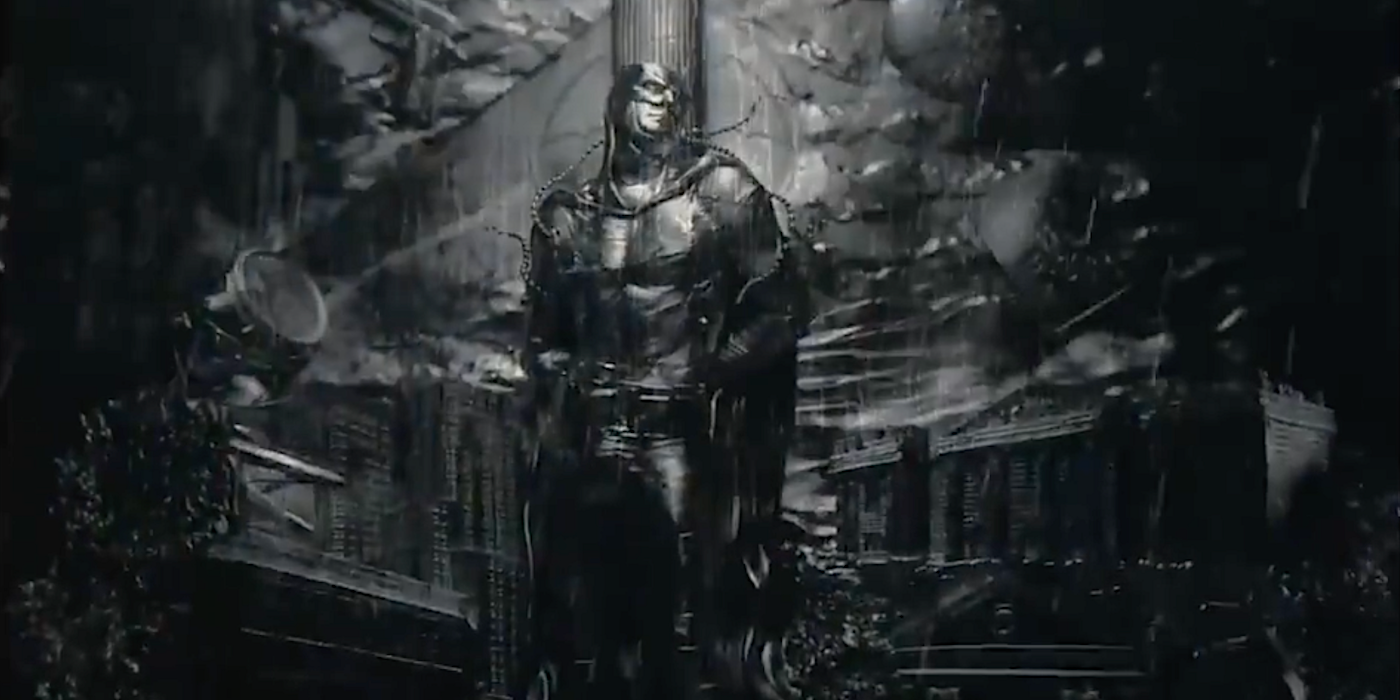
- Zack Snyder's Justice League: The preview that Snyder presented at the IGN Fan Fest in late February 2021 depicts all founding members of the Justice League in Kryptonian hologram-like reliefs. Batman◊ is seen in a pose that's reminiscent of a number of depictions of Christian martyr Saint Sebastian◊.
- The 1935 film version of David Copperfield has several scenes staged to resemble the original illustrations from the novel, most notably the early scene of David and family at church, which is an exact copy of the drawing from the book.
- In John Ford's Young Mr. Lincoln (1939), at the end of the trial scene, young Abe (Henry Fonda) is seen sitting in a chair, his head bowed in thought, in the exact posture of the Daniel Chester French statue in the Lincoln Memorial in Washington, D.C.
- The Adventures of Baron Munchausen features Venus herself, appearing like in the Botticelli painting.
- Barry Lyndon, directed by Stanley Kubrick, is visually modelled on rococo paintings, especially Thomas Gainsborough and Antoine Watteau. The effect is gorgeous.
- One scene in Italian horror movie The Church (La Chiesa, 1989, written by Dario Argento and directed by Michele Soavi) is taken directly from a Boris Vallejo painting "Vampire's Kiss". Also, the design for the lizard-demon-gargoyle creature is taken from an infamous 1600s wood-carving depicting a man selling his soul to the devil.
- When Charles Laughton is first seen in The Private Life of Henry VIII, he is standing in a doorway in the exact same pose◊ that Henry VIII struck for the famous Hans Holbein portait◊.
- Bram Stoker's Dracula: Dracula's castle is modeled after the painting "The Black Idol" (1903) by Frantisek Kupka.
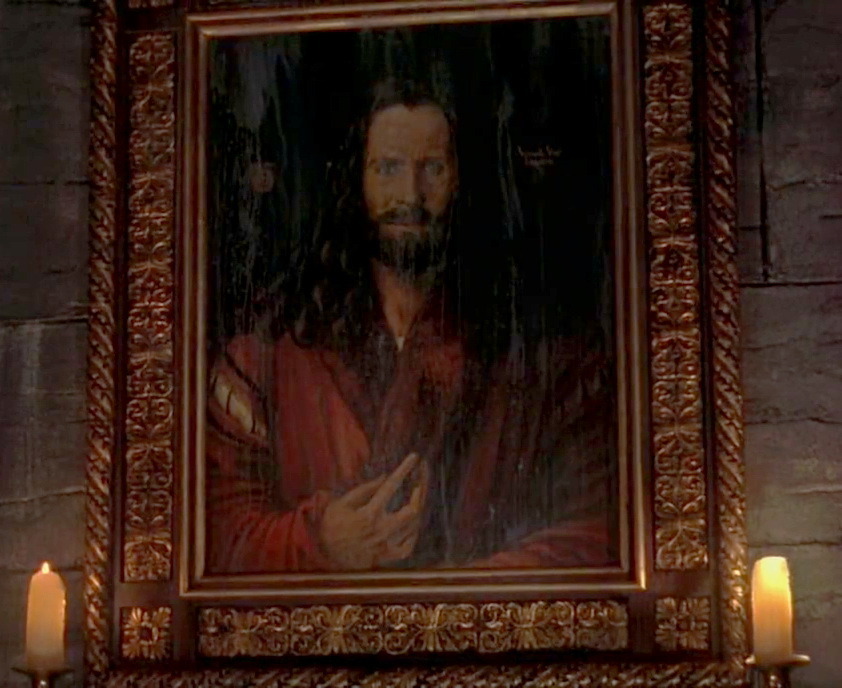
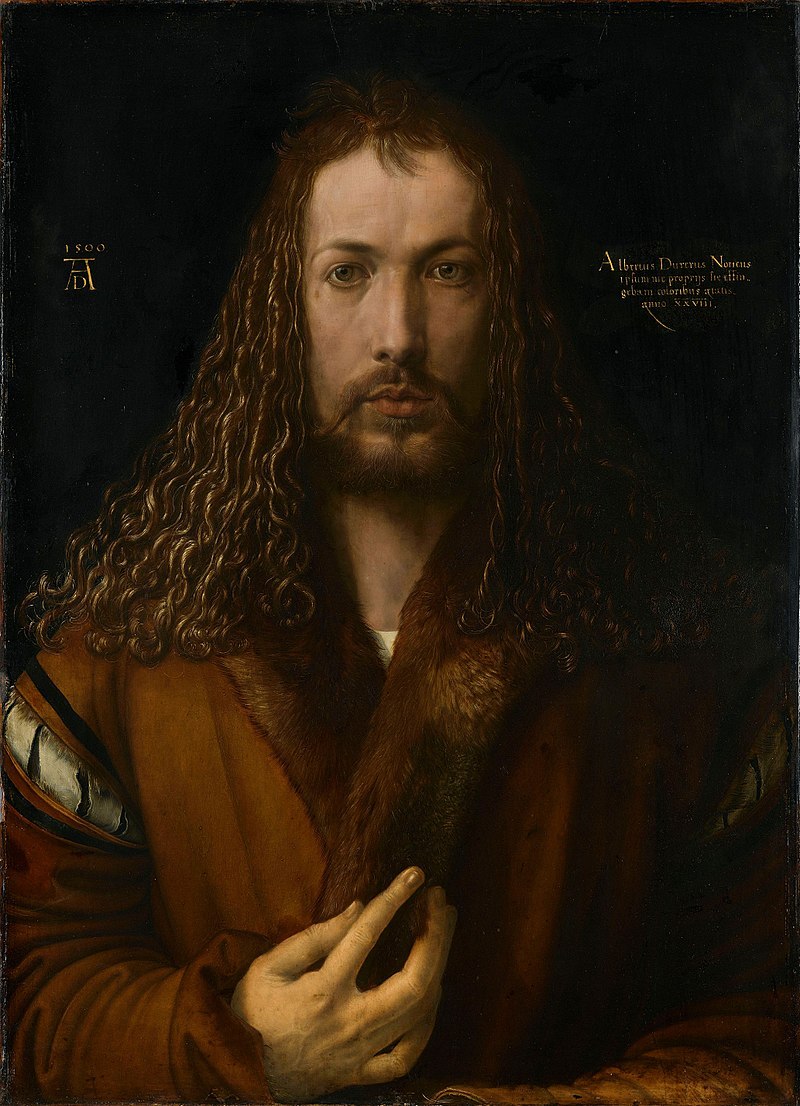
- Dracula's portrait◊ is based on Albrecht Dürer's self-portrait◊.
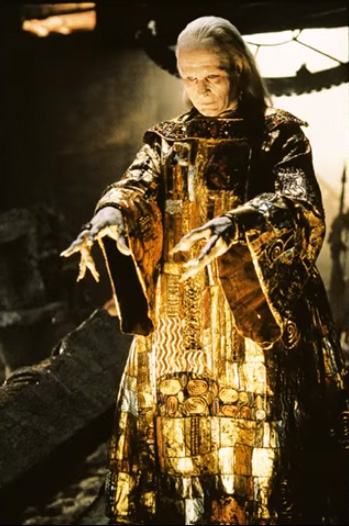
- The gold robe◊ Dracula wears at the end of the film is meant to evoke Gustav Klimt's The Kiss.
- Dracula's portrait
- In the documentary feature Faces Places, co-directors Agnès Varda and JR talk about a decades-old photo she took of photographer Guy Bourdin sitting against an old beach shack. Then JR sits against the same beach shack in the exact same pose.
- Ridley Scott's Gladiator has been described as a "dark Alma-Tadema"; indeed, the Anglo-Dutch painter's visions of Roman life served as a central inspiration for the film's production designers. His influence can be seen in the lavish sets and Janty Yates' costume designs, particularly for Lucilla.
- The 2015 Filipino Biopic Heneral Luna has the titular Historical Domain Character and his men die in a tableau deliberately shot to resemble the Spoliarium, a famous mural done by his artist older brother, Juan Luna, which shows dead gladiators being dragged away into the depths of the Roman Colosseum, as greedy onlookers wait for a chance at their possessions. (Needless to say this was unlikely how they died in Real Life.)
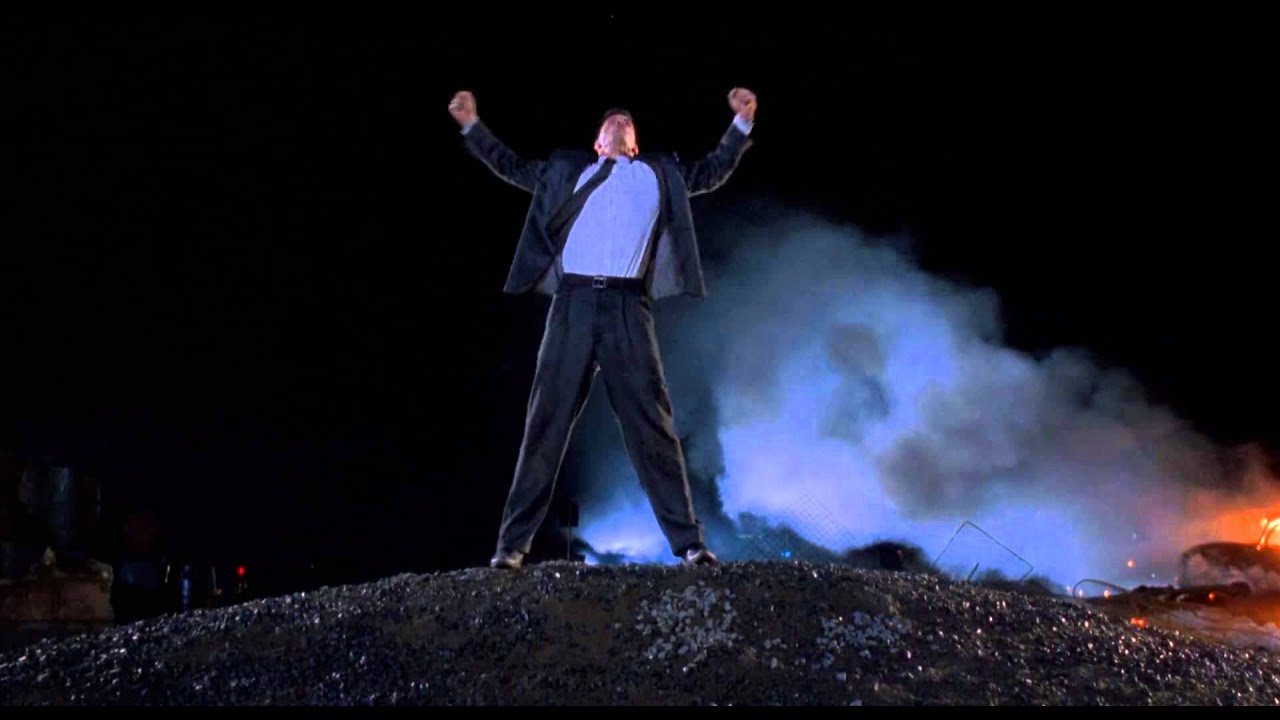
- Johnny Mnemonic: Johnny's clothing attire, exaggerated movements, and flailing arms◊ during his over-the-top character monologue (as well as during his occasional spastic seizures) are reminiscent of the various charcoal sketches◊ of sharply dressed men in motion◊, made and popularized by the movie's director, Robert Longo, in the 1980's.
- Juarez: One scene shows a Mexican patriot getting shot by French firing squad. Standing against a wall, wearing a white shirt, he throws out his arms and says "Viva Benito Juarez!" before the soldiers shoot him. The scene is staged to mirror Francisco de Goya's famous painting◊ The Third Of May 1808.
- One of Juliet's visions in Juliet of the Spirits is a shot of a nude woman in a clamshell a-la Botticelli's "Birth of Venus"◊.
- Lawrence Alma-Tadema's portrayal of Ancient Egypt heavily influenced the art design on The Ten Commandments (1956), The Finding of Moses. Director Cecil B. DeMille reportedly instructed set designers to study the paintings in order to achieve his artistic vision.
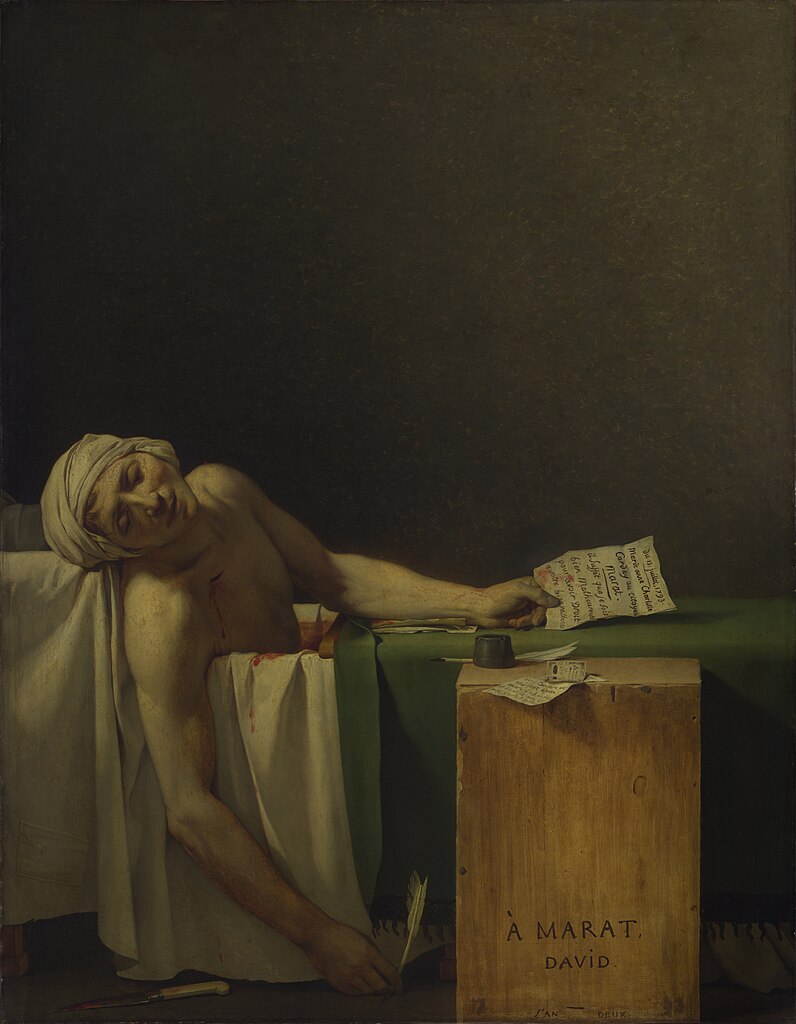
- "Trevor": Trevor the natural-born Large Ham recreates "The Death of Marat◊" in his bathtub, complete with fake blood and quill.
- The Rocky Horror Picture Show enough references to art that it has its own folder on the Shout Out page. Notable examples are the iconic lips in the movie's logo being inspired by Man Ray's painting A l'heure de l'observatoire, les Amoureux (Observatory Time, The Lovers) and the American Gothic Couple being referenced multiple times.
- Henry V: Much of the scenes with the French court are staged to resemble scenes from the "Très Riches Heures du Duc de Berry", a famous illustrated manuscript that was produced around the time of Agincourt. Towards the end the movie stages a copy of the famous February illustration◊ from that manuscript, with Pistol in the place of the man warming himself by the fire.
- Sin: When Michelangelo comes to see a Medici cardinal, there's a lady with an ermine in her arms in the room. This is of course a reference to the famous 1489-1490 painting of the same name by Leonardo da Vinci.
- Die Unbekannte was the film of a book which was inspired by the famous death mask "L'Inconnue de la Seine". The mask features a woman with a mysterious smile much like the Mona Lisa. As Madeline is drowning herself for the Downer Ending, she assumes a placid smile just like the mask's.
- The Cell: Some of the film's striking imagery is based on artwork. For example, the scene featuring the three women with their heads thrown back and mouths open is based on the painting Dawn by Odd Nedrum.
- Titanic (1997): Almost every long shot of the ship is a recreation of Ken Marschall's paintings, from Titanic docked in Cherbourg to Carpathia arriving to pick up the survivors.
- Ophelia takes quite a bit of inspiration from Pre-Raphaelite style art:
- The choice of scenery and particularly the way Ophelia is depicted appear to draw influence from John William Waterhouse's paintings of the◊ character◊.
- The opening scene of Ophelia drowning is reminiscent of John Everett Millais's famous painting of Ophelia.
- The choice of scenery and particularly the way Ophelia is depicted appear to draw influence from John William Waterhouse's paintings
- A lot of the ocean scenes in Pacific Rim feature CGI waves specifically modeled on Katsushika Hokusai's famous woodcut "The Great Wave off Kanagawa".
- The way the movie shows its kaiju was also directly modeled on the painting The Colossus, generally attributed to Francisco de Goya.
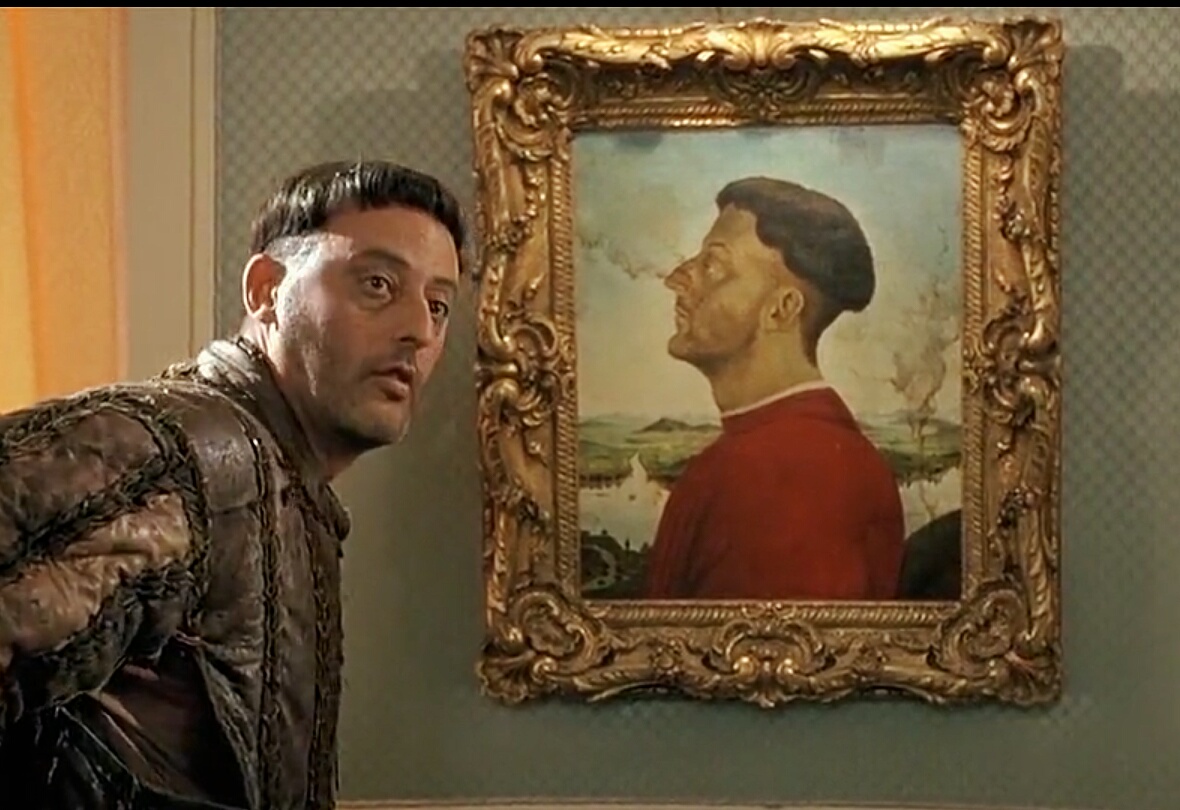
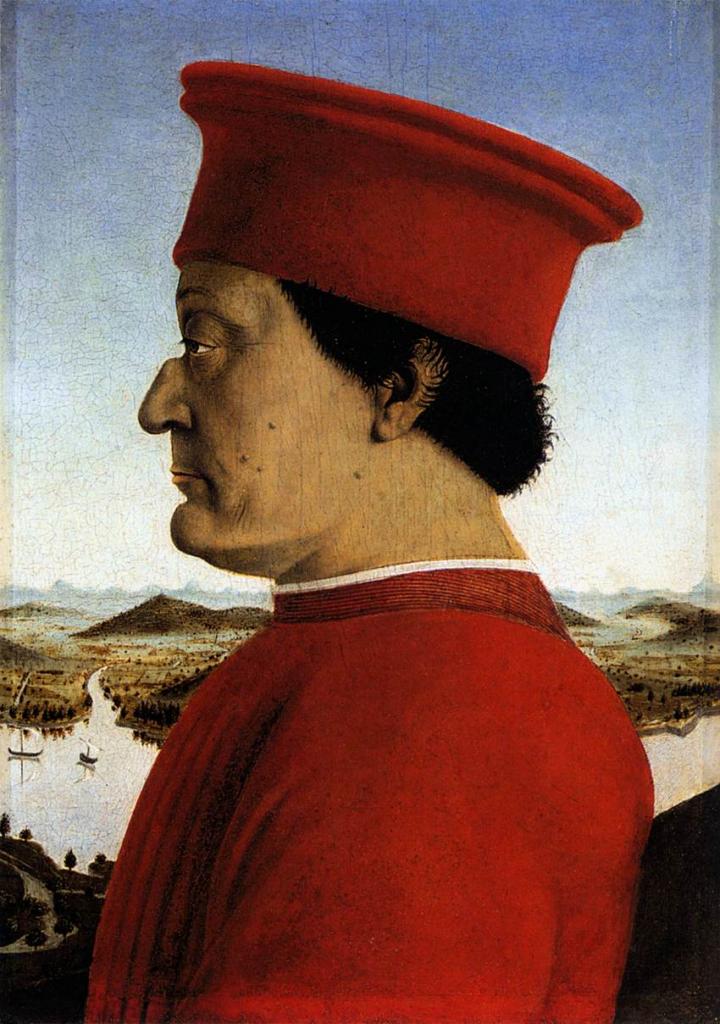
- Les Visiteurs: The portrait◊ of Godefroy de Montmirail is made in the same style as the Italian Renaissance portrait of Federico III da Montefeltro◊ by Piero della Francesca, including him wearing red clothes and the river being the exact same.






Literature
- Discworld
- Artist Paul Kidby loves these. So far he's done:
- Joseph Wright's Experiment With Air-Pump (The Science of Discworld cover);
- Rembrandt van Rijn's The Night Watch (er, Night Watch cover);
- Raising The Flag on Iwo Jima (Monstrous Regiment cover);
- Mona Lisa (Leonard of Quirm's "The Mona Ogg", Art of Discworld cover);
- The Thinker (Detritus as "Da Finker" in The Art of Discworld);
- Holman Hunt's The Hireling Shepherd (Leonard and Gytha again in The Art of Discworld);
- American Gothic (Death and Miss Flitworth in The Art of Discworld);
- Norman Rockwell's Triple Self-Portrait (Twoflower's iconograph imp in The Art of Discworld)
- Maxfield Parrish's The Pied Piper (Maurice and Keith for The Discworld Calendar 2003);
- The cover of Sergeant Pepper (The Band With Rocks In for The Discworld Calendar 2012)
- Frank Frazetta's Conan the Barbarian Leg Cling picture (Gender Flipped with Conina the Barbarian hairdresser and Rincewind for The Discworld Calendar 2012)
- The Last Hero alone includes the final scene of Conan the Barbarian (1982) (Cohen in the frontispiece); the Bayeaux Tapestry (the Silver Horde in the other frontispiece); Da Vinci's Vitruvian Man (Leonard's design for a NASA-style training centrifuge); Munch's The Scream (Rincewind's reaction to the elephants); Wright's Philosopher at the Orrery (the wizards plotting the route of the Kite); the Sistine Chapel (Cohen giving the finger to the gods) and probably more.
- In The Illustrated Wee Free Men Stephen Player does a couple of pictures based on Richard Dadd's The Fairy Feller's Master Stroke, since the scene in the book is specifically stated in the Author's Note to be based on that painting.
- Marc Simonetti's covers from the French translations of the books include:
- Either the poster for Gone with the Wind or the one for the 1977 biopic Valentino (Moving Pictures)
- The poster for MGM's The Wizard of Oz (Witches Abroad)
- The cover of Abbey Road (Soul Music)
- Franzetta's Leg Cling again (Interesting Times)
- Artist Paul Kidby loves these. So far he's done:
- One edition of Dave Barry Slept Here has the cover parodying Emanuel Gottlieb Leutze's "Washington Crossing the Delaware," with the river filled with ice cubes instead of water and a character resembling the author sleeping in the back of the rowboat. (The painting is not only referenced in the text but ruthlessly mocked.)
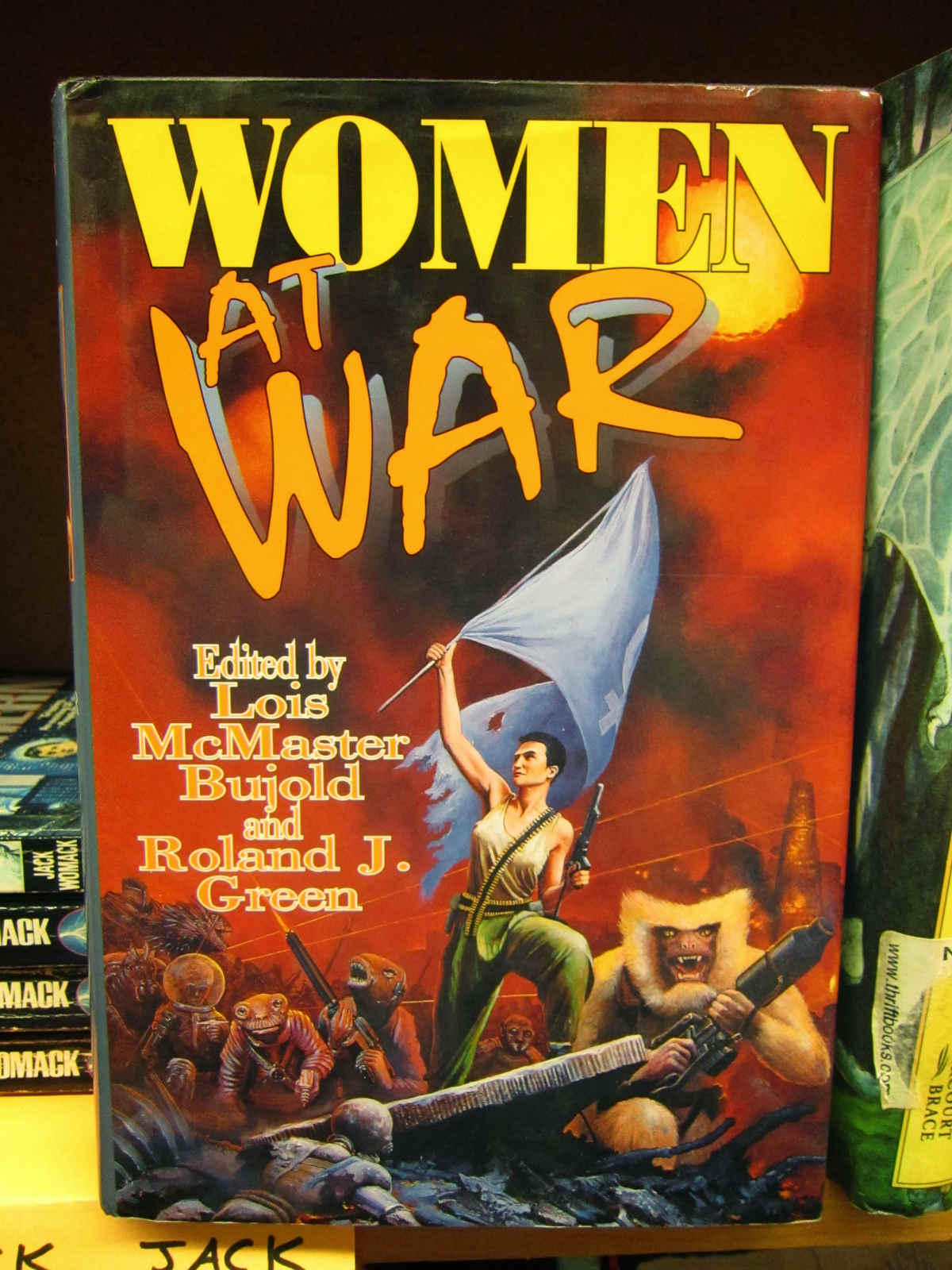
- The cover◊ of one cheap Sci-fi book homages Eugène Delacroix's Liberty Leading the People.
- In Pickman's Model, the narrator compares Pickman's ability to create an eerie mood in his paintings to that of the real-life painter Henri Fuseli. Later on in the story, when he is shown a gallery of Pickman's Spooky Paintings, he notes that a few of them feature ghouls "squatting on the chests of sleepers", suggesting Fuseli's most famous work, The Nightmare.
Live-Action TV
- In Cycle 5 of America's Next Top Model, when there were five contestants left, the challenge was to for each "recreate" a classic work of art, being The Mona Lisa, Whistler's Mother, The Vitruvian Man, The Birth of Venus, and Girl with a Pearl Earring.
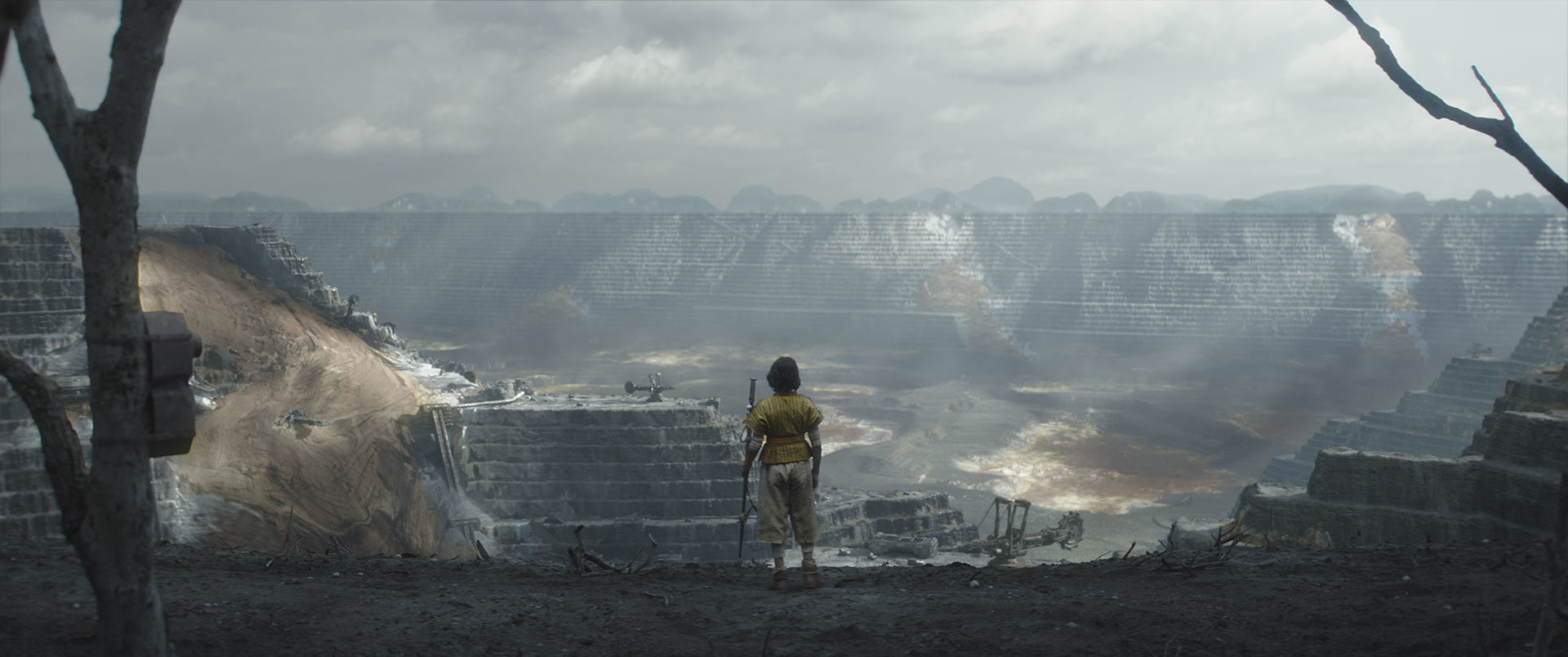
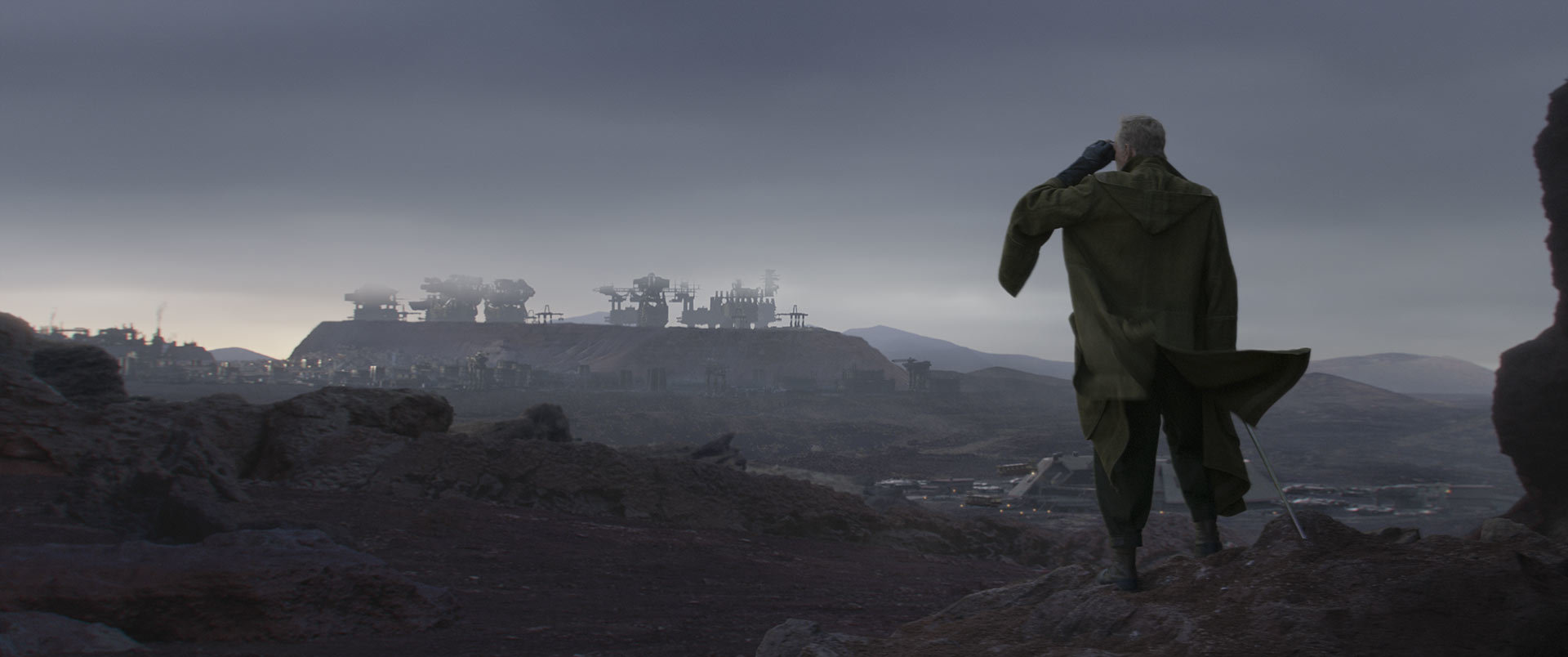
- The cinematography in the first season of Andor includes several allusions to Wanderer Above the Sea of Fog, for example these two◊.
- Bridgerton: The portrait of the Bridgerton brothers◊ in the family home is a send-up of a 1761-66 painting of Henry Fane, Inigo Jones, and Charles Blair by Sir Joshua Reynolds.
- The painting of 19th Century Tavern-Goers used in the opening of Cheers at least tried to match up imagery of the patrons with characters on the show as the actor credits flashed by.
- Doctor Who:
- In "Terror of the Autons", a Time Lord messenger appears as a man in a bowler hat and business suit, but floating in mid-air. This is a shout-out to Rene Magritte's painting "Golconda", which has similarly dressed men falling into a cityscape like raindrops.
- The Fourth Doctor's iconic silhouette with wide-brimmed hat, long scarf and overcoat was inspired by the stage garb of the late-nineteenth-century cabaret singer and comedian Aristide Bruant, as immortalised in famous posters for him by Toulouse-Lautrec.
- In "Warriors' Gate", the ruined Gate is copied from Caspar David Friedrich's painting Klosterfriedhof im Schnee (Monastery Graveyard in the Snow).
- The Silence look incredibly like The Scream (Munch); Word of God says the in-universe explanation for this is that they've been subconsciously influencing our art and culture for centuries.
- The Undergallery in The Day of the Doctor has some of these, including a version of The Raft of the Medusa with Cybermen.
- "The Woman Who Fell to Earth": The Stenza travel pod is visually reminiscent of the "Nancy style" of art nouveau glassware.
- In "Terror of the Autons", a Time Lord messenger appears as a man in a bowler hat and business suit, but floating in mid-air. This is a shout-out to Rene Magritte's painting "Golconda
- The Lord of the Rings: The Rings of Power:
- In the prologue, Galadriel sits beside a big pile of Elvish helmets in a desolated forest. The visuals of that scene resembles a work of the 19th-century Russian painter Vasily Vereshchagin — "The Apotheosis of War".
- Some costumes seem to be inspired by artworks too, like Galadriel wearing the golden dress in Lindon, and Queen Regent Miriel wearing a white dress with golden applications with a blue paledamentum over her shoulder, pay homage to Girl With A Golden Wreath by Leon Francois Comerre, and respectively, to Zenobia's last look on Palmyra by Herbert Gustave Schmalz.
- Galadriel's armors are both inspired by different paintings of Joan D'Arc, such as "Joan of Arc" by John Everett Millais and Charles-Amable Lenoir, and the 1854 "Joan of Arc at the Coronation of Charles VII" by Jean-Auguste-Dominique Ingres.
- Disa's dress and hairstyle are inspired by several works by Gustav Klimt.
- One of the Dwarven ladies witnessing the challenge between Elrond and Durin wears a headdress clearly inspired by the Iberian sculpture of the Lady of Elche.
- Elendil's white armour is very similar to the book cover made by Violet Oakley for the mythical hero Lohengrin, Knight of the Swan, in 1910.
- In the prologue, Galadriel sits beside a big pile of Elvish helmets in a desolated forest. The visuals of that scene resembles a work of the 19th-century Russian painter Vasily Vereshchagin — "The Apotheosis of War"
- Napoléon (2002) with Christian Clavier also recreates Jacques-Louis David's rendition of Napoléon Bonaparte's coronation as Emperor.
- In the ad campaign for Nip/Tuck, women getting plastic surgery are positioned to resemble classical works, including Venus de Milo.

Magazines
- In MAD's "20 Dumbest People, Events and Places of 1999", the illustration for #2 was a parody of Andrew Wyeth's "Christina's World" with Hillary Clinton looking across a field towards the U.S. Capitol.
Music
- Queen's "The Fairy Feller's Master Stroke" was written as an expression of Freddie Mercury's appreciation for the eponymous painting by Richard Dadd. Consequently, the lyrics center around the various characters depicted in the painting.
- Tom Waits' album "Nighthawks at the Diner", unsurprisingly enough, has a cover that is a clear tip of the hat to Edward Hopper's Nighthawks.
Puppet Shows
- The Kermitage Collection is a collection of famous paintings redone to star The Muppets, including The Mona Moi (Piggy), Whistler's Weirdo (Gonzo), The Birth of You-Know-Who (Piggy again), American Gothique (Piggy and Kermit), Jester at the Court of Henry VIII (Fozzie) and so on...
- An often-reprinted Sesame Street coloring book features Muppetized versions of a variety of famous paintings.
Theatre
- The final scene of 1776 is intended to be blocked so that the final positions of all the actors at the curtain calls to mind the Savage/Pine engraving of the Signing, although it's rarely exact.
- The first act of Sunday in the Park with George ends with a Tableau recreating Georges Seurat's famous painting A Sunday Afternoon on the Island of La Grande Jatte. The act also has scenes recreating Seurat's paintings Bathing Place, Asnières and Woman Powdering her Nose.
- In Marat/Sade, when Marat finally gets killed, he poses as in Jacques-Louis David's painting of his death.
Video Games
- Tales of Monkey Island
- In "Chapter 1: Launch of the Screaming Narwhal", there is a Desingeograph of the "Vitruvian Pirate", which Guybrush calls "Pirate Da Vinci", on the Illuminopictoscreen; this "Vitruvian Pirate" is definitely a spoof of Vitruvian Man by Leonardo da Vinci.
- In Chapter 4, the provocative painting of Chieftain Beluga hanging above W.P. Grindstump in Club 41 is most likely a parody of the 1636 painting Danaë by Rembrandt van Rijn.
- Mr. Goemon (the Arcade Game) has enemies surfing on the crest of Hokusai's The Great Wave off Kanagawa.
- Buried deep in the bizarre abandoned MMO/chat room Worlds is the "Escher Tribute" area, based on the ever-famous Relativity, with physics to match. Can be seen here at about 29 minutes in.
- Mystical Fighter has copies of Hokusai's The Great Wave off Kanagawa on fusuma midway through the first stage.
- The cover art for You Are Empty copies Dmitry Moor's famous Red Army recruitment poster, except the soldier's face and hands are skeletonized.
- In EarthBound (1994), the melting clock from Salvador Dalí's The Persistence of Memory is trying to kill you.
- The various paintings by Charles Chatenay in Red Dead Redemption II are based off of various real world paintings that were made during the Fauvist Movement, including Woman in a Chemise by André Derain, Reclining Nude in Blue with Straw Hat by Ernst Ludwig Kirchner, and Study of a Nude and Nude on a Yellow Sofa by Henri Matisse. Chatenay himself seems to be mainly an expy of Paul Gauguin.
- World of Warcraft: Gokk'lok's Shell is a novelty item that makes your character stand naked inside a large clam shell, à la the Birth of Venus.
Visual Novels
- In Katawa Shoujo, Rin's Act 3 ("Distance") has both Hisao posing like The Thinker and Rin posing like Venus de Milo, and a promotional montage incorporating all the girls' handicaps makes up a version of Vitruvian Man.
- Last Chance in Xollywood: A funny example with alien tycoon Garfield Sphynx Sr. (one of the possible film investors in the visual novel), whose previous husband bought Johannes Vermeer's Girl with a Pearl Earring and turned it into a portrait of Garfield◊.

Web Animation
- According to Joel Guerra, the design of ENA was inspired by the painting Girl Before a Mirror by Pablo Picasso.
Web Comics
- The second panel of an El Goonish Shive page contains an extra imitating Edvard Munch's The Scream.
- David Willis drew an elaborate poster print featuring the casts of both the Walkyverse and Dumbing of Age in a pastiche of Alex Ross's cover for the 35th-anniversary edition of Crisis on Infinite Earths.
Web Videos
- The Autobiography of Jane Eyre: Adele, coached by Jane, drew several pictures based on famous paintings and art styles in episode 5. They included Pablo Picasso, Gustav Klimt, and Vincent van Gogh (one picture reminded a bit of his The Starry Night). Adele's last picture was inspired by The Son Of Man by René Magritte (a face obscured by an apple).
- Rats SMP: El's art gallery displays many rat-ified pastiches of classic art pieces created with the Chisel and Bits mod, including the "Mona Rita", "The Squeak", a version of "Starry Night" where the moon is a piece of cheese, and "The Creation of Ratam".
Western Animation
- The Simpsons:
- In "The Crepes of Wrath" Bart and his chauffeur pass through landscapes which are all references to famous paintings made in France, including works by Claude Monet, Vincent van Gogh, Henri Rousseau and Édouard Manet.
- In "The Last Temptation of Homer" The Birth of Venus◊ by Sandro Botticelli was referenced when Homer is fantasizing about Mindy.
Cherub Lenny: Hey Homer, what’s the matter?
Cherub Carl: Ain't you never seen a naked chick riding a clam before? - In "Bart Gets Hit by a Car" Bart goes to Hell, where he sees Hieronymus Bosch's "The Garden Of Earthly Delights" recreated.
- In "Treehouse Of Horror IV", in a parody of Night Gallery several famous paintings by René Magritte, M.C. Escher, Salvador Dalí, Vincent van Gogh, Edvard Munch, Giorgione, Jacques-Louis David, and Pablo Picasso are parodied. Even "Dogs Playing Poker" by Cassius Marsellus Coolidge is featured.
- Homer's dream sequence in "Mom and Pop Art" is also a Shout-Out to several famous paintings (Henri Rousseau, Pablo Picasso, Andy Warhol, Leonardo da Vinci).
- Homer's drive-in movie visit, complete with passing steam locomotive, in "Dumbbell Indemnity" is based on the iconic 1950's O. Winston Link photograph "Hotshot Eastbound".
- In "Marge vs. Singles, Seniors, Childless Couples, Teens and Gays", Milhouse sports the same expression as the "weeping Frenchman" from the famous 1940 photograph taken during the Nazi occupation of France.
- In "The Man Who Came to Be Dinner", there is a poster in Diz-Nee Land for Song of the South Bronx, a mix between the movie poster for Song of the South and the 1964 photograph "Macombs Rd., Bronx".
- The Smurfs (1981) episode "Painter And Poet" has Painter creating Smurf versions of The Blue Boy, Whistler's Mother, Mona Lisa, and Henry VIII Of England.
- In the Steven Universe episode "So Many Birthdays", Steven finds an old painting in Amethyst's room that's a parody of Copley's "Watson and the Shark", with Steven's mom Rose Quartz and the Crystal Gems on the boat and Garnet punching out a shark.
Garnet: The hard part was getting the shark to pose.
.jpg)
