
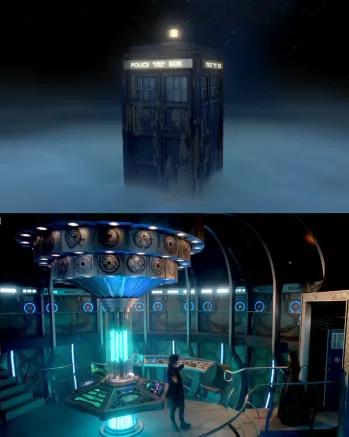
Sgt. Benton: Well, it's... pretty obvious, isn't it?
Technically referred to as dimensional transcendence, an unusual fact of some architecture in fiction is that no matter how small it is on the outside, on the inside it can be any size it darned well pleases. Finding such a place couldn't be simpler. All you have to do is walk into an ordinary 1960s London police call box and you're in a space that dwarfs most Gothic cathedrals.
This might be a sight gag, but equally it may be done for technical reasons, such as in early Video Games, where fixed-size background tiles may cause furnished interiors to become larger than the plain exterior suggests.
There may or may not be an in-universe explanation, typically involving some sort of Pocket Dimension relativisation of space-time, Applied Phlebotinum or simply magic.
Often, however, this is simply due to studio-budgeting, where the exterior establishing shot is simply a transition to the indoor-scene, and they will save money by having a smaller set of the exterior (or a shot of a small building to better visualize the location of the indoor space, etc).
Being bigger on the inside is not just limited to architecture such as buildings and other physical structures. Within media it can also apply to living creatures with incredibly spacious internal anatomy that characters who enter it eventually discover. Usually if terrestrial in origin, and not otherworldly or supernatural, then Artistic License – Biology has been employed. If extraterrestrial, then it's simply a case of Bizarre Alien Biology at work.
Closely related to Units Not to Scale, almost every game that has ever let you enter a building displays it being bigger on the inside. Controller and engine limitations require that building internals in the vast majority of games need to be scaled up to ludicrous proportions in order to make the game playable. Buildings that look about correct scale on the outside normally have to be three or four times larger on the inside. Among many developers this is a level design principle known as 'keep it wide' .
.
Compare with Clown Car, a common sight gag, and Clown-Car Base, which is when we never see the inside. Also compare Perspective Magic. Contrast Misleading Package Size. Often overlaps with Alien Geometries. A subtrope is Oh Look, More Rooms!, in which rooms keep opening up further and further in, rather than blowing you away with a giant hall on first glance. See also Hammerspace and Bag of Holding for the variant where there is more storage on the inside. The ultimate version is likely to be the Door in the Middle of Nowhere that unexplainably leads somewhere when opened. This strange piece of furniture is covered by The Lonely Door trope.
Curiously, it is exceedingly rare to invert this trope's literal phrasing, and exclaim "It's smaller on the outside!" You'd have thought it would take less than 49 years for this inversion to be applied to the TARDIS, but you'd be wrong. On the other hand, the usual phrase is the natural wording when you see the outside first, which people generally do. When you then see the inside, you comment on what you're looking at at the moment. If you saw the inside first and then stepped outside, "It's smaller on the outside!" would be more natural.
Examples:
- The TARDIS,note "up-and-downy stuff in a big blue box" from Doctor Who, is the Trope Codifier. It is such a recognisable example of this trope that the word "TARDIS" can actually be found in the dictionary, defined as 'something which appears to be much larger on the inside than on the outside'. Oh, and it's not just bigger, it's a whole lot bigger. The control room you see and that companions marvel at is just a small part. It has its own library, tennis court, swimming pool, at least seven squash courts, every companion bedroom, at least two extra console rooms, hell, it has an entire star held in suspended animation as a fuel source!
- The first invocation comes in the very first episode, with Ian's amazed skepticism as he tries to rationalize the evidence of his own eyes with what he knows to be true as a 1960s science teacher.
Ian: But it was a Police Telephone Box. I walked right round it. Barbara, you saw me!
- In "The Wheel in Space", the Doctor removes the component that allows the TARDIS to be dimensionally transcendental, so the inside reverts to a simple police box interior.
- The most thorough demonstration of just how big the TARDIS truly is dates back to the Fourth Doctor serial "The Invasion of Time", in which the last (half-hour) episode is spent almost entirely navigating the labyrinthine halls and corridors of the TARDIS. It's seen to contain indoor gardens, at least one swimming pool, an art gallery, and dozens of utility rooms and corridors.
- The interior of the TARDIS is a great deal bigger than a mall — in the NA Blood Heat, she actually materialises around an entire planet! On TV, it has never been indicated how big she is; at times it's implied she is finite in size, but really immense, while other times it's been implied that her interior is infinite in size. The closest example we've seen was in "The Name of the Doctor", in which the Doctor reveals that the massive TARDIS-shaped monument serving as his tomb is actually the corpse of the TARDIS. It turns out that dimensional leaking is common when TARDISes die, the outer shell expanding to reflect some of the enormous dimensions held within.
- During "Father's Day", the first clue the Ninth Doctor gets that something has gone horribly wrong is that the TARDIS is not bigger on the inside; its interior is that of the prop police call box, as it was for part of "The Wheel in Space". Then the Reapers show up...
- At the end of "The Doctor Dances", when Capt. Jack Harkness makes the remark, the Ninth Doctor turns it into a Double Entendre by responding, "You'd better be."
- The Doctor's dressing room, in which we see the Tenth Doctor choose his new attire in "The Christmas Invasion", resembles a very roomy clothes shop, covering a couple of floors of the TARDIS.
- Also used to dramatic effect in the episode "Doomsday": The Daleks mention that the Genesis Ark will establish their supremacy because of "Time Lord science". The Doctor wonders what that means, and near the climax, it's revealed that the Daleks meant this aspect of Time Lord science — the ark, though only about the size of a single Dalek, contains millions of them.
- In the Big Finish audio play "The Condemned", they play around a little with the companion's reaction to the interior of the TARDIS. Charley Pollard, who has traveled for some time with the Eighth Doctor, encounters his sixth incarnation. On entering the TARDIS, she comments how it's much smaller than she expected (compared to the huge, gothic cathedral look it has by the time of the Eighth Doctor). The Sixth Doctor is quite put out by this.
- In "Blink", Billy Shipton alludes to the improbability of the police box's design: "Well, it's a special kind of phone box for policemen. They used to have them all over. But this isn't a real one. The phone's just a dummy, and the windows are the wrong size. We can't even get in it. Ordinary Yale lock, but nothing fits."
- The UNIT command trailer seen in "The Sontaran Stratagem" is definitely bigger inside than out, and unlike with the TARDIS there is no in-show handwave. (Though maybe UNIT just copied the Doctor's tech.) Curiously, the set is actually bigger but this is only by a few feet; in the DVD extras, it is remarked that it nonetheless seems vastly larger on camera.
- Used as a Dark Reprise in the episode "The Waters of Mars". The Doctor has gone crazy, and decides that instead of following the rules of time, he will force the rules to obey him. As such, he saves three people who were supposed to die. After being saved, one of them runs out of the TARDIS and, in absolute terror, exclaims "It's bigger on the inside!" She then turns to the Doctor and asks "What the hell are you?" before running away.
- Eleven's TARDIS, according to Matt Smith, is apparently "bigger on the inside more than bigger on the inside previously". Furthermore, when he jettisons off rooms for fuel, he says goodbye to the swimming pool, the scullery, and Squash Court 7. The fact that there are seven squash courts — combined with the fact that it is supposed to be able to comfortably contain the egos of six Time Lord pilots simultaneously — implies that the TARDIS ranks in size somewhere between university campus and small neighborhood. Later, in "The Girl Who Waited", he mentioned that he might have to jettison the karaoke bar. That's right, the Doctor has a karaoke bar!
- "The Doctor's Wife" lets us see more of the TARDIS for the first time in the new series, but that's not why it's so notable for this particular trope. The TARDIS, upon taking a human body, feels that humans — and the Doctor — are bigger on the inside, and she's able to overcome the force which has taken control of her Police Box self because he's so much smaller on the inside. It's a wonderful twist which shows this trope might not just be about space.
- According to "Journey to the Centre of the TARDIS", the inside of a TARDIS is big, really big. You just won't believe how vastly, hugely, mind-bogglingly big it is. I mean, you may think it's a long way down the road to the chemist, but that's just peanuts to the TARDIS. Whether or not the Doctor was exaggerating at the time is up for debate. We also see much more of the interior than the usual few hallways, and you really get the idea of just what it's like in there. You could spend days and never see the same thing twice, each room more wondrous than the last. But you wouldn't, 'cause it's an Eldritch Location that can be as scary as all hell, especially if you make the mistake of pissing off the TARDIS, as the salvagers very quickly realise. Perhaps the most-accurate thing one can say about the TARDIS is that the main thing that limits her interior dimensions is the Doctor. Regardless of whether its size is truly infinite, at the very least it can safely encapsulate an entire star, which it uses as a power source. The star that exists inside the TARDIS is frozen in time at the instant it becomes a black hole. This means it must be a MASSIVE star, far larger than our sun. The absolute minimum size a star must be to form a black hole is 3 times the size of our sun (but they are typically much larger than that). This also has the side effect of making the TARDIS a Dyson Sphere. That little police box is actually a Dyson Sphere on the inside. Puts a little bit of perspective into how powerful a TARDIS is, doesn't it?
- The third tie-in Adventure Game, "TARDIS", has the Doctor send Amy to retrieve some items from his private study, which he mentions is about a mile or two away from the control room.
- Taken to more extremes in "Flatline". The outside has shrunk to the size of a toy, with the inside staying mostly the same. It fits comfortably in Clara's handbag later on in the episode. And the Doctor mentions that he needs to play tricks with gravity to prevent the TARDIS's weight from cracking the surface of the planet every time it lands. Lampshaded by the Doctor: Rigsy (seeing the now-tiny TARDIS for the first time, and the Doctor inside), exclaims "it's bigger on the inside!" The Doctor states "I don't think that statement has ever been truer."
- The Thirteenth Doctor's console room, first seen in "The Ghost Monument", has a design feature where the police box shell serves as a "foyer", with the spot where the back wall would be opening into the rest of the console room. The first time a TARDIS was seen to do this was with Clara and Ashildr's diner-TARDIS in "Hell Bent", where the diner section is perfectly normal-looking, and the rest of the ship accessed through the door that, in the original diner, led to the toilets.
- The page quote from "The Three Doctors" is actually a lampshading of the phrase that those who see the TARDIS for the first time usually exclaim, which gives us our page title: "It's bigger on the inside!" This was being mocked as early as the Third Doctor, although Benton thought it was just too obvious to be worth pointing out.
- Ten, to Martha in "Smith and Jones": "Is it? I never noticed!"
- In "The End of Time" Ten pre-empts this with Wilf, but Wilf (having never been in the TARDIS but still being used to weird stuff) just replies, "I was expecting it to be cleaner..." This is a reference to Bernard Cribbins having appeared in the spinoff movie Daleks' Invasion Earth: 2150 A.D. in 1966, and being considered for the role of the Fourth Doctor in 1974. Both the movie and the classic series, while having very different TARDIS interiors, were much neater and tider in appearance than the gloomy clapped-out organo-gothic look of the 10th Doctor's TARDIS.
- After first properly encountering the TARDIS in "The Vampires of Venice", Rory immediately deduces that the inside is in another dimension, disappointing Eleven: "I like the bit when someone says 'It's bigger on the inside!' I always look forward to that."
- In "The Snowmen", Clara ducks out and walks all the way around the police box, then comes back in and proclaims: "It's smaller on the outside!" This is how Eleven knows she's something special.
- In "Into the Dalek", the Doctor materializes the TARDIS around a pilot, Journey Blue, whose ship is about to explode, causing her to appear right inside the ship, and thus she sees the inside first. When she sees that on the outside it's just a phone box, Journey remarks, just like Clara, that it's "smaller on the outside". The Doctor remarks that it's more impressive when you see it the other way around like most do.
- in "The Husbands of River Song", River is stealing the TARDIS with the Doctor as her companion, since she doesn't recognize his new face (Twelve). She warns him that the inside of the TARDIS is "a shock." He just smirks and says "Finally... it's my go," and gives a truly epic speech.
The Doctor: Oh... my.... GOD! It's bigger!
River: Well, yes.
The Doctor: On the inside!
River: We need to concentrate.
The Doctor: Than it is!
River: Yeah, I know where you're going with this, but I need you to calm down.
The Doctor: On the outside!
River: You've certainly grasped the essentials.
The Doctor: My entire understanding of physical space has been transformed! Three-dimensional Euclidean geometry has been torn up, thrown in the air, and snogged to death! My grasp of the universal constants of physical reality has been changed... forever. [beat] Sorry. I've always wanted to see that done properly. - "The Pilot": Bill takes much longer than usual to even notice the difference (she stays facing the inside of the door at first), and once she does, keeps trying to find mundane explanations.
Bill: How is that possible? How do you do that?
Nardole: Well, first you have to imagine a very big box fitting inside a very small box.
Bill: Okay...
Nardole: Then you have to make one. It's the second part people normally get stuck on. - The Twelfth Doctor echoes Ten in "Twice Upon a Time":
- In "The Church on Ruby Road", Ruby Sunday walks in, ducks back out, and walks around the TARDIS' exterior in wordless disbelief.
- The recurring Expanded Universe character Iris Wildthyme is an in-universe parody of the Doctor, and as such, her TARDIS, which always takes the form of a double-decker bus, is "smaller on the inside".
- As is the phone-booth time machine of Inspector Spacetime, a Doctor Who parody.
- The Slitheen, introduced in "Aliens of London", are bigger than the humans they disguise themselves as, thanks to some form of compression technology. In The Sarah Jane Adventures, they've upgraded to even skinnier models. This technology was seen twice before in the Classic Series, first in "City of Death" when Scarlioni removes his human mask to reveal the alien Scaroth, whose head is bigger than Scarlioni's (since the Scaroth mask had to fit over Julian Glover's head), and again in "The Leisure Hive" when Brock's human mask is removed to reveal that he is really a Foamasi, whose heads are ridiculously bigger than human heads! In both cases, characters were shocked to see the alien under the mask, but don't seem to notice that the heads are bigger than the masks, so they really Failed a Spot Check. There wasn't even an in-show handwave!
- In the Eighth Doctor Adventures novels, the villain, Sabbath, turns up wearing a suit which is bigger on the inside. It functions surprisingly well as a disguise, proving that although he's maybe twice the Doctor's size, he also just might have twice the Doctor's brainpower. Not only is it slimming, it allows him to unexpectedly pull out a gun.
- In "The Runaway Bride", it's revealed that the Doctor's pockets are also "bigger on the inside". This had been hinted at and considered fanon from at least the Tom Baker era, thanks to scenes like the one in "Genesis of the Daleks" where he empties his pockets and produces piles of miscellaneous rubbish.
- It's revealed in "The Day of the Doctor" that Gallifreyan artwork makes use of this trope. The painting "Gallifrey Falls No More", which is a few metres across on the outside but big enough to contain the city of Arcadia ( actually the entirety of Gallifrey) on the inside, is a key factor in the story. It works by taking a slice of time, of reality, and sealing it in a pocket universe.
- An Adventure in Space and Time, a docudrama about the filming of the First Doctor's episodes, features a Mythology Gag with Waris Hussein half-jokingly lamenting that the run-down, shabby set on which they're forced to film the TARDIS scenes is "smaller on the inside".
- Subverted at first in Engines of War. The TARDIS is on its side, and the Doctor ushers Cinder in, and he expects her to say this— but instead she remarks that everything is "The right way up" (despite being on its side); it takes a bit for her to get to the size issue.
- Played for Drama in "The Night of the Doctor": Cass, the next person the Doctor tries to make his companion, knows what a TARDIS is, and when the Doctor tells Cass it's bigger on the inside, she realises he's a Time Lord— and, having seen the Time War, recoils in horror and disgust, saying that the Time Lords are as bad as the Daleks, and stays on the crashing ship, locking the door so that the Doctor can't save her.
- Subverted in "The Visitation": the Terileptil ship proves bigger than it looks from the outside— because the crash impact caused it to partially bury itself in the ground.
- In "Mawdryn Undead", the teleport capsule is bigger on the inside — a first clue that Mawdryn's people have knowledge of Time Lord technology.
- In "Last Christmas", it's invoked by Santa. When someone asks how he can possibly fit presents for the entire world in his sleigh, he enthusiastically says "it's bigger on the inside!"
- The final scene of "Heaven Sent" reveals that this trope also applies to the Doctor's Confession Dial, in which all previous scenes of that episode take place.
- "The Lie of the Land": The Vault that the Doctor's been guarding all season, which is serving as a prison for Missy, is revealed to be this. After all, it is Time Lord technology.
- A circa 1984 fan comic, "The Time Lordz", which featured caricatures of five members of a DW fan club as the first five Doctors, satirizes this heavily. Their TARDIS is a humongous skyscraper on the outside, while the interior is so cramped that it's a wonder anyone can reach the control panel and press the right button.
- As suggested by the numerous allusions to this example in the article even before the examples begin, while not the first example of this trope, the TARDIS is probably one of the most widely recognisable and iconic, to the point where describing something as being "like a TARDIS" has entered popular vernacular to mean "more spacious than expected" even among those who don't have any particular interest in the show itself. The word itself has made it into the Oxford English Dictionary with this very trope being one of the assigned definitions (the other, of course, is "time machine").
- Lampshaded in "Legend of the Cybermen" when Alice, one of the denizens of The Land of Fiction, enters the TARDIS. She says "It's bigger on the inside!" to which Jamie and Zoe, old hands at travel with The Doctor, can only reply with a jaded "we know..."
- Parodied in "The One Doctor". Bamto Zame, who was masquerading as The Doctor for a massive con game, travelled with his companion, Sally Anne, in his STARDIST, which looked like a porta-potty. When The (genuine) Doctor and his (genuine) companion Mel have to travel with Zame in the STARDIST, the first thing they notice it that it is... actually just as big on the inside as it is on the outside. The four actors do quite a bit of grunting to convey two husky gentlemen, one zaftig lady, and petite Mel Bush trying to cram themselves inside the confines of the device.
- The Jay Bush and Duke ads for Bush's Baked Beans depict Duke as having what appears to be fairly typical doghouse that would be just enough for him to lie down for a nap in or take shelter from rain. However, one of them depicts him as having a harem inside being pampered on a cushion by a group of poodles and with a golden fire hydrant in the background. Another shows him having a secret printing press in the basement.
- Nipper & Gramophone's Christmas Tales: As seen in the ad for The Dark Knight Rises, Gramophone's horn is capable of storing a whole flock of bats. This ad was part of a competition where viewers could win a copy of the film by counting the number of bats flying out at the end.
- Ah! My Goddess' Skuld created one of these to provide extra storage space for some of the motorcycle club's gear. Unfortunately, the control got accidentally reset — stranding Keiichi and Belldandy in the center of an infinitely large room. And Bell was temporarily without her powers... Keiichi finally realized the crawlspace under the building wasn't within the field, so they pulled up a portion of the floor and crawled out. Of particular interest is how it's expanded: it connects "borrowed" time-slices of the room from the future to the present room. How much time does a slice amount to is not explained, but Skuld does say that it will run out of batteries in less than a week's time; if the time slices were able to almost quadruple the room's size in less than a day's use, a week's time would round on the logarithmic.
- The Hyperbolic Time Chamber from Dragon Ball is a seemingly-infinite White Void Room that fits neatly inside Kami's Lookout.
- In Episode 26 of Excel♡Saga, Misaki is showering in a bathroom that is much larger than an economy Japanese apartment would have. She lampshades this, of course.
- Fullmetal Alchemist: Gluttony's stomach. It Makes Sense in Context. Father wanted to make a quick and cheap access to the Gate of Truth... and created a more or less bottomless Pocket Dimension instead.
- There was an arc in Ghost Hunt where the main characters were investigating a labyrinth-like mansion that seemed to be much smaller on the inside, and had become the source of many disappearances. It turned out that a separate section of the mansion expanded far underground.
- In Gugure! Kokkuri-san there's Inugami's dog house, thanks to his powers. On the outside it's a typical small shoddy dog house. On the inside it's a giant fancy bedroom, full of merchandise of his beloved Kohina.
- In Howl's Moving Castle, the castle's door links to buildings that are sometimes smaller than the castle's size.
- There are a couple of instances on Hunter × Hunter where this occurs:
- In general, all users of Nen can generate ephemeral items out of thin air including entire environments and containers and can alter the physical characteristics of everyday items for diverse purposes, mainly for combat.
- The Mafia's Shadow Beast Owl can fit all sorts of items of various sizes inside a small pouch of cloth without physical consequences; this applies to living beings too.
- Shizuku's vacuum cleaner Demechan can consume vast quantities of inert or otherwise organic dead matter. It has never been stated where does all this matter go, since it cannot consume living beings.
- Knov's portals lead to a twenty-one storied series of rooms called Four-Dimensional Mansions which serve as a base of operation for the extermination team. Initially, he uses the portals to lure unsuspecting Chimera Ants to their deaths at the hands of Chairman Netero; afterwards, he uses them as a place of rest before battle. The rooms are entirely artificial as created by Knov's Nen and are physically equivalent to the real world in all dimensions, though each room has its own size. Though the rooms are not bigger on the inside per se, they don't actually exist in reality and the Chimera ants are affected by the suddenness of the rooms' apparition and the room's lack of features.
- The Chimera Ant Ikalgo's Nen lets it infiltrate a dead person's body without it reflecting any change in volume, even though Ikalgo is roughly 3/4 of the size of an adult person's torso, though in order to use his own abilities (such as the flea sniper rifle) at least a couple of his tentacles have to breach through the corpse's body.
- Played with in the case of Kortopi, who can copy the physical appearance of things as big as entire blocks of buildings; the copies exist in the physical world, albeit temporarily.
- Subverted by the in-universe video game Greed Island. When it's noticed that it's way too vast and detailed to be a virtual environment, it turns out that it's actually a physical place.
- Subverted also by the ability of the Chimera Ant Cheetu, who in the rainy night time and out of thin air creates a seemingly vast grassland plain bathed in daylight in which he traps Morel; on close inspection, the room is spherical and it's contained by a wall, creating an optical illusion.
- Inverted by the world itself in the geopolitical sense. The "human" world as it's known is but a small group of islands in the middle of a saltwater lake "ocean" completely surrounded by the Dark Continent, a largely unexplored land of gigantic proportions in territory, flora and fauna altogether. The powers of the human world have always wanted to explore it because of the vastness of its exploitable resources, but the violence and carnage to which the human expeditions are subjected to have kept all efforts in bay, implying that humanity is simply "allowed" to live exactly where they are: isolated from the fringes of their titanic world. As such, the human world is actually smaller on the inside.
- In general, all users of Nen can generate ephemeral items out of thin air including entire environments and containers and can alter the physical characteristics of everyday items for diverse purposes, mainly for combat.
- The peach sennin's table-top garden box in Inuyasha, where all his "disciples" live and work. Also Yourei-Taisei's home is both a small shack under a bridge and a massive paradise. And of course, there's Naraku, who was bleeding gigantic voids after he first absorbed Moryoumaru and whose body was the second to last battleground. The actual last battleground also counts, as it was the inside of the Shikon no Tama itself.
- The heroes of JoJo's Bizarre Adventure Part 5 use a turtle. Yes, a turtle. Its Stand ability, Mr. President, allows people to enter a separate space within its shell. It's got a fridge and a couch in there, too, something which the characters comment on.
- In Magical Girl Lyrical Nanoha Reflection, the Yagami house has a training room on the second floor that is large enough to fit an entire city.
- In Episode 6 of the Lapis Re:LiGHTs α (Alpha) and her mistress Emilia find themselves in a Haunted House that's being magically distorted to be this. The former's solution is to just start wrecking the walls until she finds her way back to the entrance after the spell can't keep up.
- In Mini Moni The Movie: Okashi na Daibōken!, thanks to Queen Nakajalinu's magic the cake castle becomes as big as an actual castle on the inside, with multiple floors and a dungeon.
- At least some summoned toads in Naruto are this, via Stomach of Holding. Jiraiya, the primary toad summoner, makes extensive use of this trait.
- Negima! Magister Negi Magi
- Kaede has one of these inside her Invisibility Cloak. You put it over your head, it collapses onto the ground and vanishes, and you find yourself in a comfortably large house.
- The same holds true for Evangeline's Resort.
- As are the Gateports in Mundus Magicus.
- Somewhat parodied in Ouran High School Host Club, when they went over to Haruhi's house, or at least the dream before it. Haruhi in the dream was about to open a closet, and Tamaki tried to cheer up the rest of the group, and probably himself, by saying "Inside that closet must be an infinite space".
- The Ride-On King: Donatello's hideout on top of him is three times larger inside.
- The Death Room in Soul Eater, at least in the anime. It definitely has walls (which look like the sky complete with clouds, and can be broken) but the distance to them differs dramatically when Asura and Shinigami fight.
- Tenchi Muyo!
- Washuu's laboratory. It's accessed through a doorway under the stairs at Tenchi's house, but Word of God says the laboratory covers five planets.
- In the TV-series, Tenchi Universe, she gives the bathroom the same treatment. Apparently, they decided that the floating, bubbled, hot-springs island from the OVAnote was a tad too showy.
- Jurai's treeships generate pocket dimensions as living space for their crew. Which tend to include vast forests.
- Lala of To Love Ru seems to be able to do this, turning a closet into a mid-sized lab, expanding an already existing room to 5 times normal, while someone was in it, and later building a three bedroom flat on top of the main character's house.
- Yu-Gi-Oh! GO RUSH!! has Valvelgear, which can comfortably house 8.88 million Velgians and can shrink to the size of a small drone, or grow to the size of a jumbo jet.
- From YuYu Hakusho we have a class of demon known simply as a "Dark Soul," given the nickname of Uraotoko by Itsuki, the Yamanate that tamed the beast, which is really a shadowy vapor that can stretch across a small wall and swallow its victims whole, yet the interior is much, much larger - an empty void, perhaps infinite in size, where Hiei and Kurama remark that it's an old Apparition which lives beneath the surface of the Earth itself, devouring the debris of human civilization, for within the cavernous space is seen shattered buildings and even the skeletal wrecks of large passenger planes. Though given this beast was captured by the very same demon who was able to telekinetically open a portal between the human and demon worlds, this is justified.
- Superman:
- For a while the Fortress of Solitude was one of these, being a tesseract located inside a puzzle-globe small enough for a child to wrap their arms around.
- In Reign of Doomsday, Lex Luthor traps the Superman Family in a pocket dimension located inside a merely house-sized spaceship.
- Wonder Woman: Occasionally Paradise Island/Themyscira works this way, as a pocket dimension or something similar that has a magical barrier around it that hides and protects it that barrier is often much smaller on the outside than the space filled by the islands and portion of the sea within it.
- Shadowcrest, the mansion home of Zatanna Zatara looks big already on the outside, but as Mary Marvel notes is even larger on the inside due to the many spells woven into the place.
- In one Legion Of Superheroes story, it turns out that the bottom of the Legion's time bubbles (which are about large enough for a handful of Legionnaires to stand up in) contains a trapdoor which leads to a spacious hold. (This was a crossover with the parodic heroes of the Inferior Five, so may not be canon.)
Marvel
- In Captain Britain, Mad Jim Jaspers had a teapot-shaped helicopter that was bigger on the inside. (It was probably due to his reality warping powers, but he was also a technological genius.)
- Doctor Strange and his Sanctum Sanctorum. Of course, he's a wizard so...you know.
- Reed Richards of the Fantastic Four has often set up rooms like this. When the team was living in Pier 4, this was lampshaded with a comment about borrowing technology from his weird doctor friend. One run has his prove himself not so useless when the family move into an apartment on Yancy Street, where Reed employs the technology to his neighbour's homes so they wouldn't be evicted by the rise in rent caused by superheroes moving in next door.
- In Mighty Avengers, Hank Pym has been revealed to have one as well, using size-altering Pym Particles to hide an entire giant laboratory with multiple floors and huge rooms... all inside a single closet. Amadeus Cho immediately compares it to the TARDIS.
- Nextwave hung a lampshade on this with the Shockwave Rider, which is noted by the heroes that its interior is larger than its exterior. This is played with in the final issue, where "the thing that makes the ship bigger on the inside than it is on the outside" is destroyed and the heroes have to escape before they are crushed.
- In Runaways, the Steins do their mad science in a spacious laboratory that looks like a small shed on the outside. Nico suggests that it might be a hologram.
Other
- In Bill and Ted's Most Triumphant Return a teenager in the future mentions that a lot of aliens copied Rufus's idea to convert old phonebooths into time machines and that some with British accents had worked how to make them bigger on the inside.
- Blackbird: The paragon bar Clint takes Nina to after the gas station fight is, as she discovers when they leave, apparently hidden by magic inside of a taco truck.
- In Buck Godot: Zap Gun for Hire, the nearly omnipotent Prime Mover "lives in his own little world... He keeps it in his quarters." Actually, it doesn't look all that little. He's terraforming his own planet, by hand. With a shovel. And filling an ocean with a bucket that also fits this trope. "You just need the right bucket."
- Cubitus shows the eponymous dog passing through several chambers of an opulent palace... and eventually emerging from his ordinary doghouse.
- Fables:
- The business office of Fabletown is bigger on the inside than out: it's indicated that nobody knows the full extent of the complex, although this is because the actual office is somewhere unknown and the building acts as a portal. They recently lost the building, and those inside the office are still trapped.
- Fables also has the very important 'Witching Cloak' which can store much inside its folds, one of its many powers. (Careful; the weakness is it's still a cloak and can be yanked off like any other.)
- My Little Pony: Friendship Is Magic (IDW):
- This trope is parodied in main series comic #24 with Discord's time machine.
Scootaloo: This is your time machine? It's huge!
Discord: Don't worry. It's smaller on the inside. - Bonus points by Discord wearing a bow-tie and fez as he says this. Even more bonus points by Dr. Whooves showing up from inside the time machine on the next page.
Discord: There are far too may references in this bit already. There's no room for you!
- This trope is parodied in main series comic #24 with Discord's time machine.
- From PS238:
Veles: Here is my challenge: Five of you shall journey to the interior of this egg. Don't worry, it's a magical egg, so there's plenty of room.
- In Super Crooks, the chest containing The Bastard's fortune is small, but is a space-time container that's absolutely massive internally, allowing a convenient place to carry all the gold.
- The 1980's comic X-Thieves (short for "Aristocratic Extraterrestrial Time-Travelling Thieves") had the protagonists ride around in a "TARDIS-40 space yacht". Despite being able to use a standard New York City parking space, this was shown to have (among many other things) a planetary surface, or at least a significant chunk of one, inside it.
- Cardboard: The cardboard monsters somehow manage to build an entire world inside Marcus's house.
- S.C.I.-Spy: Fourth-dimensional tesseracts are a viable technology in the 31st century. Starchild's Orb, a floating robot the size of an 8-ball, is fitted with one that expands its inner dimensions by a factor of 10,000, allowing it to be filled with a warehouse's worth of supplies.
- Beetle Bailey: Boner's Ark takes place on a boat that from the outside looks like a rowing boat with a deep hull and one tiny cabin. Since it houses dozens, possibly hundreds of anthropomorphic animals (including one Tyrannosaurus rex), it's obviously much bigger than that.
- Peanuts: Snoopy's doghouse is probably one of the more "classic" examples. It looks standard on the outside, but contains several large, opulently decorated rooms (and the famous Van Gogh/Andrew Wyeth painting).
- Baba Yaga: The witch's tiny hut is magically, on the inside, like a great hall.
- One of the stories in A Thousand and one Nights has a tent like this.
- This features in Celtic Mythology, where anything remotely like a door can be a doorway into a much bigger place. So the door to a tiny hut can well open into a large hall.
- In Japanese folktales, Kitsune can create realms, turning a hole under a floorboard into a small estate, and turning a small field into a kingdom.
- Alexander Afanasyev's "The Soldier And Death": The soldier imprisons a legion of devils in his magic flour sack.
- In Children of Time, much is made of transcendental dimensions, thanks to the Doctor and his TARDIS.
- The Tenth Doctor rummages through his pockets in the first episode, looking for paper, and finds yo-yos, candy, CDs, and Sherlock Holmes for Dummies first. In front of Sherlock Holmes.
- A couple of the TARDISodes are written to allow the Companions to explore the TARDIS. Even after months of living there, Holmes still has a hard time wrapping his head around her size.
Beth: Ha, I bet the Doctor could spend his entire lifetime exploring. The TARDIS is like... I get the feeling that it's less like she's bigger on the inside, and more like she's her own self-contained universe.
- The TARDIS also holds a room that encapsulates a virtual Gallifrey. Holmes and Beth don't know just how real it is, or how far it goes...
- A Crown of Stars: In chapter 2 Daniel gives Asuka a pistol that does not need to be reloaded because "The magazine is a lot bigger on the inside than on the outside."
- Child of the Storm:
- Hogwarts is an example, with observations that most magical buildings end up like this after a while (with a side of Eldritch Location, and in some rare cases - like Hogwarts - Genius Loci), to one extent or another.
- Doctor Strange, the In-Universe inspiration for the Doctor, is a time-traveller and regular meddler, suggests that he could build a TARDIS if he wanted to. But he won't.
- By contrast, Julie a.k.a. the Lady Knight, actually did build her own TARDIS while on Sakaar, having successfully stolen a Wolf-Rayet star on the verge of a supernova. It usually takes the form of her nightclub, though, if she wishes, it can quite easily be turned into her clutch purse. Many minds are boggled by this.
- Hetalia: Axis Powers' fanfic Gankona, Unnachgiebig, Unità'': Parodied several times. From clothes to books to Death Notes to flowers, the characters' backs can store them all. Oh yeah, and their backs don't grow any bigger.
"It's alright Italia-kun. I always bring spare cosplays with me." He reached into some sort of secret compartment behind his back, pulling out an identical outfit to the one the brunet was currently wearing. Seriously, how do anime characters have such an ability?
Japan disappeared into a bathroom for a short amount of time before reappearing, now clad in a sharp black suit and tie with a white dress shirt and black pants, taking hexagonal glasses from his pocket — or wherever anime characters store all their stuff — before putting them on.
"Humph." The larger scoffed back. He then reached into the magical space all anime characters have, whipping out a book conveniently titled How to Catch a Runaway Italian.
Both reached into the magical space all anime characters have, extracting black notebooks — Japan's having unidentifiable symbols on its cover as Italy's had 'Death Note' clearly printed on it in gothic letters — before taking out pens and colored pencils as well, opening the pages before scrawling in them.
Giggling, the auburn reached into the magical space all anime characters have, an exquisite bouquet of utmost grandeur popping out from behind his back. "Tada!" - In Holo-Chronicles, Miko's realtively small-on-the-outside-shrine acts as a massive training facility, due to a combination of singularity and construct magic. Thank Ina for figuring that out.
- In The Happiest Place, the different pocket worlds cause the various Disneyland attractions to become this. Cinderella invokes this trope by name in the first chapter.
- Invader Zim: A Bad Thing Never Ends: Facilities belonging to Coathanger Electronics are all truly massive on the inside, much more so than what the buildings should be capable of. The Announcer speculates that Aldrich Coathanger has mastered dimensional manipulation technology. Aldrich later lends this technology to Lex during their Villain Team-Up, allowing him to turn his base into a Pocket Dimension to trap their enemies in when they attack.
- Shinji And Warhammer 40 K: The Boyz's operation room is a small broken house around their town's outskirts. It is bigger on the inside because its occupants had dug out a three-levels basement.
- Sunset's Isekai: Certainly applies to the Isekai’s refrigerator- at one point it’s even said to be literally impossible to organize.
- In Total Drama Genesis, crates containing the "obstacles" for a challenge are opened to reveal far more contents than the crates would be expected to hold.
- In Touhou Galaxy, The Odyssey winds up as this by the end of Odyssey due to Yukari using her powers to expand the ship's interior size whenever a particularly big group joins the heroes.
- The World of the Creatures, being part Doctor Who crossover fic, has the TARDIS. If you need any more information, check out the Doctor Who folder above.
- The passenger planes from Cars 2.
- The bedrooms of Casita in Encanto. And the walls.
- The LEGO Movie:
- The house that Emmet drives through on the freeway. The stairs are too small to accommodate the width of the motorcycle, there shouldn't be enough room on the staircase to let it turn 90 degrees, and the dimensions inside the house are way bigger than the exterior would allow. The movie gets away with it because it all happens in first-person POV.
- The underseat coolers of the double-decker couch can each fit a whole Master Builder.
- The LEGO Movie 2: The Second Part:
- The house Emmet builds has several rooms that are bigger than its exterior.
- General Mayhem's ship carries more weapons than are possible for its size.
- The Foxworth family's townhouse in Oliver & Company. The rooms in this place are freakin' huge, and couldn't all realisticly fit within the house based on the exterior shots we see of it.
- Played with in Pooh's Grand Adventure with the Skull. When the gang enter this place, it is incredibly expansive and large with deep caverns, gigantic crystal structures, perilous chasms and even winding paths. However, when they escape they see that it is a lot smaller and significantly less scary. Regardless, it's entirely possible that this place is still impressively large as a significant portion could be underground.
- The Beatles' Yellow Submarine has the band living in a place in Liverpool that's a grim little building outside, and bigger and more imposing than Versailles inside. The eponymous sub is similarly cavernous.
- 7 Faces of Dr. Lao features a circus tent which is rather modestly sized when viewed from without, but those who step inside find that it contains many large exhibit rooms as well as an arena with enough seating for the entire population of the town.
- The interior sets for the Discovery in 2001: A Space Odyssey are 50% too large to fit into its spherical command module. At first this is surprising considering Stanley Kubrick's reputation for perfectionism, however it may have been intentional as a reflection of the cosmic powers at play.
- In 2010: The Year We Make Contact, the Leonov's interior sets aren't even remotely the right shape to fit into its hull. Peter Hyams apparently wanted all of the rooms to be interconnected on the same level in order to film Walk and Talk shots.
- Alien:
- In Alien, the Derelict may be an example, since the egg chamber looks much wider than any part of the ship seen from the outside. The novelization says the egg chamber is in a part of the ship buried underground, which could reconcile the discrepancy.
- In Aliens, marines stand comfortably upright inside a transport vehicle but are taller inside than when standing next to the thing.
- Lampshaded in Click, where the back of the "Bed Bath & Beyond" store is larger than it appears on the outside.
- The movie Crossworlds, given that it's about parallel dimensions, takes full advantage of that. Many times somebody enters what seemed to be a small room or something similar, only to be greeted by a space reminiscing of a big warehouse.
- Dave Made a Maze: The titular maze fits entirely within the protagonists' living room in their apartment, but on the inside, it is an enormous labyrinth.
- In the (still animated) beginning of Enchanted, Giselle gets out of her coach in her wedding dress, and Nathaniel is run over by all the animals that were apparently in the coach with her (even though her dress is so big, it's hard to tell how she fit herself).
- The cabin in The Evil Dead (1981) might as well be a TARDIS. It's extremely tiny from the outside but has many large rooms inside.
- Parodied in Freaked, where Skuggs keeps his collection of "freekz" in an outhouse that is somehow positively enormous on the inside; even the moon carved into the door becomes huge.
- Played with in the Harold Lloyd short Get Out and Get Under, in which he crawls into the motor-compartment of his stalled car.
- Guardians of the Galaxy (2014): Peter Quill's ship, the Milano, doesn't look like it could have room inside of it for anything other than the cockpit, but several scenes show the characters walking around in some fairly spacious interior compartments of the ship.
- Halloweentown had Aggie's purse in the first film and Aggie's car with the students inside in the third film.
- In the Korean film Hansel and Gretel (2007), the attic of the house stretches on for miles.
- In the Harry Potter universe:
- Harry Potter and the Goblet of Fire (film): The tents that the Weasleys use during the Quidditch World Cup and the trunk in which Barty Crouch, Jr. kept the real Mad-Eye Moody, both thanks to an Undetectable Extension Charm. Interesting, considering the actor who plays Crouch.
- Fantastic Beasts and Where to Find Them: Newt Scamander carries a suitcase that contains habitats for various magical creatures.
- A variation is seen in the Beatles movie Help!. Each of the Fab Four enter into what appear to be four consecutive row houses. Turns out the four doors lead into the same huge bachelor pad.
- In Into the Woods, during "I Know Things Now", a flashback shows Little Red plunging into the Wolf's belly, which appears to be the size of a large pit. Since the song is portrayed as a story that she tells the Baker, this could be interpreted as being part of her imagination. On the other hand she and her grandmother were both alive and intact inside its stomach, and the wolf is only human size, so this has to be at least somewhat the case.
- In Jurassic Park (1993), from the outside, Grant and Sattler's trailer is simply a camper that looks like it barely has enough headroom. Once they enter, it's as big as a double-wide, and the ceiling extends a good 2-3 feet above their heads.
- Loaded Weapon 1 parodies and lampshades this with Colt's trailer. Looks rather tiny from the outside, but is big enough to contain multiple rooms and columns on the inside. He explains that he picked the colors to make it look bigger.
- Magical Mystery Tour ends with the entire cast filing into a little tent, inside which is a gigantic movie-musical set. This is referenced and re-created in Across the Universe (2007). In this case it's justified because the characters are tripping on acid during the scene.
- Parodied in The Man with Two Brains: Dr. Necessiter's place appears like a tiny apartment from outside and like a spacious medieval castle from inside.
- In Mary Poppins Returns, an enchanted bath turns an ordinary bathtub into the portal to an underwater fantasy wonderland. Can you imagine that?
- No One Gets Out Alive: The stone box that Red and Becker have contains a small but long hallway in which the Eldritch Abomination lives.
- RoboCop sees this happen with its title character twice. The make-up for the helmetless Murphy is actually bigger than the helmet. Additionally, the suit is too big to actually fit in a Ford Taurus, so shots of Murphy driving are usually done without the bottom section of the suit.
- The final scene of Safe (1995) starring Julianne Moore had the main character Carol enter an igloo type structure that appears to be substantially larger than it appeared only seconds earlier when viewed from the outside.
- The Martians' spaceship in Santa Claus Conquers the Martians is shown as a dinky little ship from the outside that could maybe fit two or three people. Inside it can house a bridge, full electronics room, brig, and more. When the film was screened on an episode of Mystery Science Theater 3000, Joel and the bots even compared it to the Trope Namer.
- In a lot of Hollywood Musicals, internal sets start off small but magically become bigger when there's an extended dance scene. One example is the cabin in Seven Brides for Seven Brothers which looks small and poky from the outside, much to Millie's dismay when she arrives with her new husband, Adam. Yet when she leads the brothers in the Goin' Courtin' dance, the main living room grows to barn-like proportions. This is subverted a little in the later external barn-raising dance scene when the barn in question only looks to be about 12ftx12ft.
- Mr. Mustard's van in Sgt. Pepper's Lonely Hearts Club Band has an interior that clearly defies its exterior. The inside is wide enough to fit around six people side by side.
- The titular aircraft in Soul Plane is impossibly large on the inside, with room for a nightclub even.
- Spice World featured a magically huge bus with room enough for all the Spice Girls to have their own personal living areas the size of a studio apartment.
- Star Wars:
- The Millennium Falcon's interior is significantly larger than the exterior, mostly in regards to headroom. Due to the "cramped" interior, this is seldom noticed by the fans, even when toy models blatantly reveal this discrepancy. Hence, it requires no actual explanation. The difference is most visible when you see the Falcon docked on the Death Star. Compare it to the nearby Stormtroopers. Then compare its size earlier when they are all gathered in the lounges, and then take into account all the other rooms in the Falcon that are seen only in The Empire Strikes Back. The trope is compounded when you consider that the ship is supposed to be a freighter, with a lot of cargo capacity.
- It worked out this way because the original plan for the Falcon's design was scrapped fairly late in production for looking too similar to the Eagle Transporters of Space: 1999. Thus, the set designers didn't really have time to make sure the Falcon's interior matched up properly with its exterior. Thus, the audience is supposed to just not pay attention to the size discrepancies.
- The special irony is in The Empire Strikes Back, where Han evades enemy ships by entering an asteroid-field, and escapes by his ship being being smaller than the one-man fighters pursuing it, while likewise the Falcon is small enough to hide on the enemy capship without being noticed; meanwhile later, Lando reveals there's an elevator inside the Falcon to get to the roof.
- The cave on Dagobah may be an example of this trope, depending on your point of view. Luke enters a hollow tree, and is suddenly seen in a large and foreboding cave. Some say this shows that his surroundings are as unreal as the phantom of Vader. Alternately, he may have climbed down through the small-looking hollow into a large cave, and we just didn't see it.
- In Sweet November, Nelson surprises Sara by climbing through her window bearing a bag which contains "The Twelve Gifts of Christmas", all the things she's ever told him she wanted or needed. Including a dishwasher. Best not to think about that too hard.
- In the Charlie Kaufman film Synecdoche, New York, a playwright creates a life-sized mockup of his home city inside a warehouse to use as the backdrop of his play. Naturally the set includes a life-sized mockup of the warehouse, which has another life-sized city inside.
- Tales of Halloween: In "Ding Dong", Bobbie's oven looks normal from the outside, but is large enough inside to take the body of a full grown man. (However, this may be a case of Through the Eyes of Madness.)
- The Three Stooges short "A Plumbing We Will Go" ends with the trio, one judge, and a dozen cops rushing out of a magician's prop booth.
- Flatspace technology in Ultraviolet (2006) can not only be used for disproportionate storage of materials, but can also make the inside of a trailer large enough to house a laboratory.
- Voyage of the Unicorn: The Unicorn has far more spacious rooms inside than should be possible. Alan says normal physics is obviously suspended here, and delighted to see it.
- The Alodi's cube in Warcraft (2016) is four-by-four-by-four metres on the outside, but potentially infinitely large inside. It's magic.
- In You Should Have Left, Theo and his daughter Ella noticed the angle between the wall and floor of the kitchen seem off, so they measure it and find that the kitchen is larger inside than outside.
Ella: How does that work?
Theo: It doesn't.
By Author:
- Robert A. Heinlein:
- "—And He Built a Crooked House—" features an eight-room house occupying the space of a single-room house. This is because the house was conceived and built as an unfolded tesseract projected onto 3D space, but an earthquake caused it to fold into a real tesseract.
- The foldboxes in Glory Road. Not very large or heavy when closed, they can be opened out (by unfolding several times, hence the name) to reveal a cavernous internal space and all the items that have been stored there. Handwaved in the story as being because when closed, the internal space (and its contents, and their mass) go off to another dimension.
- The Gay Deceiver in The Number of the Beast has more space inside, obtained as a gift in Oz.
By Work:
- Inside of the House of Silence, from Awake in the Night Land, is bigger than the planet Jupiter. This is explained by stating that the house occupies more than the usual three dimensions.
- Subverted in Callahan's Crosstime Saloon; the alien Squish's saucer is smaller on the inside than on the outside, since they haven't gotten the technology right.
- Celydonn: In The Grail and the Ring, Dame Ceinwen's cottage appears to be an ordinary one-room cottage from the outside, and even from the inside — except that you can never quite see the entire room from inside. When you explore the perimeter of the room, you find doors opening into other rooms, cupboards, and so on.
- Discworld:
- In the books that focus on Death, his mansion is described as having rooms of a mile or more in area, despite looking like a normal cottage from outside. Normal humans who visit Death's domain usually ignore the incredible hugeness and stand on small patches of carpeted normality in the sea of immeasurable blackness. Allegedly, it's an accidental example: Death simply forgot that houses weren't supposed to be this when he created it.
- The Tooth Fairy's residence in Hogfather looks like a small house from a child's drawing on the outside, but its interior is a multi-story tower large enough to house display cabinets for millions of teeth.
- The library of Unseen University also is much bigger on the inside - like a Black Hole that can read. In fact, the Library is connected to L-Space, which connects together all libraries, bookshops etc., so it's more than just bigger on the inside...
- In Sourcery the heroes transport themselves in a magic lamp which they are carrying at the same time (with the lamp also inside itself). The trick is in pulling this off before the laws of physics find out.
- When Rincewind first sees the inside of Death's cottage in The Light Fantastic, the narration comments that he's so used to this that "The way things were these days, he'd have laughed sarcastically if anyone had said you couldn't fit a quart into a pint pot."
- The Temple of Bel-Shamharoth in The Colour of Magic, and the Lancre Caves in Lords and Ladies. The space inside the Dancers in Lords and Ladies hangs a lampshade on this, "The circle was a few yards across, it shouldn't appear to contain so much distance."
- Unseen University, aside from the Library, is said to be expanding constantly, especially its maze-like corridors.
- In The Last Continent, Bugarup University has a tower that's Taller at the Top: from the bottom, and while climbing it, it only seems to be about twenty feet tall, but the view from the top appears to be half a mile up.
- The "gnarly ground" in Carpe Jugulum. It fits within the geographical borders of Lancre, but it stretches on for much further than that. Apparently this is caused by the magical equivalent of geological compression.
- Dora Wilk Series: The inside of Viola's cart is the size of a small pocket dimension, with Witkacy unable to see where it ends. He supposes that either the door is a portal somewhere else or it's just an illusion.
- The Fablehaven books have the transdimensional backpack with a storage room inside.
- Goblins in the Castle: Bwoonhiwda's wagon in Goblins on the Prowl, much to Fauna's surprise (and everyone's convenience). It turns out to be enchanted, and has as many rooms inside as they need. When asked how she got an enchanted wagon, all she'll say is "The queen knows a wot of wizahds."
- In the Manly Wade Wellman short story "The Golden Goblins", the spirit bundle contains at least fifteen figurines, and yet it's only large enough for one.
- In Halo: Ghosts of Onyx, we see an enormous Dyson Sphere hidden within a tiny slipspace bubble located in the core of an Earth-sized planet.
- Harry Potter:
- Several locations, mostly those which are Invisible to Normals, are hidden in small spaces: Grimmauld Place, Platform 9¾, the tents the Weasleys use at the Quidditch World Cup... but this is literally because A Wizard Did It.
- Hermione's tiny little beaded handbag in Deathly Hallows. It fits in her sock, but it contains clothes, books (many, many books), tents, and a framed portrait.
- Arthur Weasley expands the inside of his Ford Anglia so the entire Weasley family and then some can fit inside comfortably. The Ministry Cars from Prisoner of Azkaban work the same way.
- The ability to make a location "unplottable" (i.e., impossible to be included on a map) is an interesting case. The implication is that from a map-maker's point of view the world around the building contracts to fill the empty space and the building itself then resides on a plot of land with zero area. This is related to Grimmauld Place appearing out of nowhere in the films.
- The Room of Requirement appears as a door in the wall, and it can go from the size of a regular training studio to a gigantic storage room filled with various accumulated paraphernilia.
- Diagon Alley may very well be the ultimate version of this within Potterverse. For instance the entire alleyway fits inside of a brick wall behind a tavern and is thus squeezed between two Muggle buildings. However, when you enter the Alley, it is almost an entire city unto itself despite being inside of London. Arguably the entirety of Diagon Alley is unplottable, including the tavern behind which it is situated, because it is invisible to everyone who doesn't know it's there. Oh and, then you have Gringotts inside of Diagon Alley, which houses the sub-sub-sub levels of the entire London underground and which is unknown to the ground penetrating radar of the Muggles for some reason.
- Heretical Edge: Heretics make frequent use of magically created pocket dimensions to store weapons, supplies, and contain large rooms and buildings in smaller areas. They stole the knowledge necessary to do this from a race of Hephaesetical pixies.
- The Hitchhiker's Guide to the Galaxy Trilogy:
- The planet Magrathea. On the inside, it's the size of a solar system, and they build planets in it.
- The Restaurant at the End of the Universe takes this to its extreme when Zarniwoop has an entire universe in his (ordinary size) office. It's just like the real one, except that Frogstar Fighters are a different color ( and it exists entirely for Zaphod's benefit).
- And during the reveal of that spoiler, we also find that Zaphod has been carrying around the starship Heart of Gold in his pocket, without even knowing it.
- Is it really any wonder that Douglas Adams became a script editor for Doctor Who?
- Played for horror in House of Leaves, in which the Navidsons' house is precisely 1/4 of an inch larger on the inside. A later measurement then shows that it is off by 5/16 inch. Shortly after coming to this realization, the Navidsons also discover that the house's closet suddenly leads to a vast labyrinth of unknown purpose and origin. In many editions, the pages stick out about a quarter-inch past the edge of the cover, making the book "bigger on the inside".
- Solembum mentions he has seen rooms that are bigger on the inside in Inheritance.
- It: One of It's hiding places is a deserted house out by the trainyards. When the kids enter it, they find themselves getting separated as the rooms grow larger as they explore the house. Also, earlier in the novel, they follow a Native American ritual and subject themselves to smoke inhalation in their clubhouse so they can have a vision. Before the vision begins, the small clubhouse seems to have grown impossibly huge.
- In the Australian sci-fi story JAM Jars by Robert Hood, the protagonist is sold one of the eponymous jars, and the nanovirus inside tries to convert him into a brainwashed cyborg bent on world conquest. The transformation is only partially successful, so he returns to the shop and destroys it with a Ray Gun, but just when he's congratulating himself on having saved Earth from Alien Invasion, he looks out the back of the tiny shop (which is just a street stall on a footpath) and finds the tiny space between the shop and the wall behind somehow contains a huge Abandoned Warehouse full of opened empty crates of the jars...
- The xibits from the Kadingir series are a swarm of adorable bouncing balls of yellow fur the size of pomegranates who are never shown to be anything but friendly to everyone... unless you try to do them harm, in which case it only takes one single xibit stretching its jaws past the point of sanity and swallowing a man twenty times its size whole in a millisecond. Said man, general Raknud, was spit out a book later, quite noticeably undamaged and undigested, if only a bit insane.
- In Keys to the Kingdom, this applies to pretty much everything in the House. (Not to be confused with the house.) For example, suitcases and Matryoshka dolls.
- The "stable" in The Last Battle is tiny on the outside, yet when the characters enter, it contains the whole of "Aslan's Country". As they travel further through the land, the arrive at a walled garden on a hill, but again, once they enter, they find a whole country spread out before them; an even better version of the land they came through. It is implied that there might be an infinite number of such layers. The stable was unusual in this respect. Not everyone who entered found Aslan's Country — a party of dwarfs who entered it found only the very ordinary dark and grimy interior of a stable. Both alternatives coexist simultaneously, as the protagonists interact directly with the dwarfs despite perceiving a completely different world. This is perhaps more a case of Clap Your Hands If You Believe.
- In Little, Big: or, The Fairies' Parliament, this trope (and the title of the book) refers to both the Edgewood house and Faerie being 'bigger in the inside' (a kind of topography one of the characters of the novel refer to as an infundibulum).
- In The Magicians, many buildings are larger on the inside, such as the house that the Physical Kids hang out in. This is explained by A Magician Did It.
- The Marvellous Land of Snergs: On the outside, Meldrum's cottage looks like a weather-beaten, thatch-topped single-story, one-room shack. On the inside, narrow staircases and twisted hallways connect many rooms. Before entering, the main characters have the feeling it is larger than it looks.
- In The Master and Margarita, Woland's immense ballroom appeared behind the door of an ordinary Soviet apartment (which was previously shown to be perfectly normal); one of the characters says that this is easy to achieve when you are "familiar with the fifth dimension."
- A Master of Djinn:
- Downplayed; Siwa's apartment above a carpet store looks bigger on the inside the first time that Fatma and Haida visit — it has a luxurious courtyard with a fountain, tasteful library to house his books, and even a tea room decorated with tapestries and teapots bearing camels. The ministry agents realize they're under the effects of an illusion when the details of the room start changing before their very eyes. When they pay Siwa a second visit, they convince him to drop the illusion and they see the apartment for what it really is — crowded with books that spill out of their shelves, littered with receipts for Siwa's gambling debts, and decorated with cheap posters of camel races.
- Played Straight; the angelic council took over a human-built palace as their headquarters in Cairo, but they replaced the interior with a vast, extradimensional space to give themselves more room. Visitors have to be assigned guides so that they don't get lost in the maze-like architecture of the pocket dimension.
- Dr. Morgenes' home/lab/pub in Memory, Sorrow, and Thorn looks like a barracks from the outside, but inside seems just a little too big.
- Monday Begins on Saturday has the NIIChaVo building. Outside, it is two stories high with ten windows per story, inside it is over a kilometer wide and has twelve stories for the institute alone, and over a hundred other stories.
- The Mouse Who Carried a House on His Back is a picture book about who mouse did just that and is said who always knows exactly where he needs to be. In the book, a series of animals come to the mouse, Vincent, and each case he offers to allow them inside his house to rest. These include, among others, a frog, a cat, and a family of hedgehogs, and in every case they think that there's no way they could possibly fit inside Vincent's house, but turn out to be wrong.
- Myth Adventures:
- The protagonists lived for some time in what appears to be a small tent, but inside it's a spacious house. Because it really is the entrance to a house in another dimension. The trouble comes when they open the back door and discover where it was built...
- This is a common practice for Devan architecture, as it's hard for a haggling merchant at the Bazaar to plead poormouth when there's an obvious fifty-room mansion behind the shop.
- Real estate on Deva is at constant risk of collateral damage as well as theft. It's cheaper to construct your mansion in an uninhabited or otherwise untravelled dimension and then build a standing, continuous dimensional portal that leads onto Deva.
- Mythago Wood: Ryhope Wood. The protagonist says that he can run around it inside an hour, but when he tries to go through... time also runs differently inside it. Not content with Year Inside, Hour Outside, the further into the Wood you go, the further back in time you go, from the Iron Age to the Bronze Age to the Stone Age to the Ice Age, encountering earlier and earlier versions of legendary figures as you go.
- The Nekropolis Archives: The Great Library of the Nekropolis is much bigger on the inside than it appears from the outside.
- The Neverending Story: The Änderhaus (Changing House) is, for all intents and purposes, a TARDIS. The trope is name-checked word for word. And for added points, the woman who lives there undergoes a sort of regeneration upon death, becoming a new person, and having a succession of lives.
- Many buildings in the Nightside are like this, which is to be expected in a place where space is at a premium and so many people know magic.
- The internal space of Living Dungeons tends to be malleable, and No Need for a Core? is no exception, with the ability to warp their internal space increasing as the dungeon grows.
- In Nightwings by Robert Silverberg, one character has a device called an overpocket implanted in his leg, which contains a nearly unlimited number of useful items.
- Nyaruko: Crawling with Love!:
- In the first novel and second episode, Nyarko and Mahiro go to break up a black market auction; Mahiro quietly remarks that the auction house is a lot bigger on the inside. In the anime, Nyarko simply remarks that he has good tolerance for unusual situations. In the light novel, this is a Chekhov's Gun to indicate that Mahiro can notice distortions in space-time.
- In the second season, Nyarko mail-orders a device called the Anywhere Dial, a Shout-Out to the magical door in Howl's Moving Castle. The Dial is attached to a closet in Mahiro's house to give Nyarko, Cuuko, and Hasta their own bedrooms since, before then, they'd been crashing in his living room. Notably, while Cuuko and Hasta seem to only have bedrooms, Nyarko almost seems to have her own house in there, complete with a kitchen and bathroom (and since it's Nyarko, it looks halfway between a regular home and a Love Hotel).
- Once: A grimy glass jar, left for protagonist Thom Kindred by sinister witchcraft practitioner Nell Quick, when opened, unleashes a seemingly infinite horde of spiders. The jar, somewhat TARDIS-like, seem to bridge dimensions beyond its glass exterior.
- In the first Overlord (2012) Drama CD, Ainz Ooal Gown uses the base-building item "Green Secret House" to create a small cottage as a temporary shelter. Externally, it's nothing special, but on the inside, it contains several rooms that can fit a large number of people.
- Similarly, though not played for laughs, in Patricia Mc Killip's Harpist in the Wind (third in The Riddle Master Trilogy) there's a tower with an external spiral staircase that appears to be finite in size, but when you try to climb it you'll find that the top is always the same distance above you... unless the owner feels like letting you in.
- In Shaman Blues, the villain's house is much bigger than it looks on the outside, enough to get completely lost in. Witkacy wonders whether there's a way to make his tiny flat the same way.
- A Song of Ice and Fire: The Halls of the Undying are a lot bigger on the inside. The most obvious difference is a staircase leading upwards whereas the building doesn't have a tower.
- The Rhoades Mansion in Spectral Shadows is this, even while it appears as a multistory mansion. It's so much this that it's easy for even the people who live in it to get lost if they stray from where they normally go, and contains lots of secret and hidden passages. The fact that it's a shapeshifting Time Travelling ship does help explain a few things, though...
- In Ssalia and the Dragons of Avienot, the "cosmic" library inside the jade tower is stated to exist outside of normal physics, allowing it to expand perhaps indefinitely and possess its own sky instead of a ceiling.
- Tales of the Five Hundred Kingdoms: In The Fairy Godmother: Bella and Elena's cottage, explained by it being "one of the Palaces of the Great Fae":
She was living in a house that was bigger on the inside than the outside, waited on by Faerie Folk.
- There Is No Epic Loot Here, Only Puns: Dungeon space is malleable. The first time Delta creates a boss room, she's taken aback to realise that the internal space of the room has tripled, but its size on a map is unchanged.
Delta: I... broke space.
- Third Time Lucky And Other Stores Of The Most Powerful Wizard In The World: Magdelene's tower in "Third Time Lucky", as Joah discovers on going in.
- In Voyage of the Basset, the titular ship fits this description, much to the consternation of the "sensible" Miranda.
- The Way Series: In Eon, the fact that the seventh chamber aboard the Thistledown is this is proof that someone has finally understood the work of the female physicist protagonist.
- The Addams Family: The house appears to be this, as aside from the rooms we see, many other rooms are referenced such as the art gallery, the discotheque, and the wine cellars.
- The Adventures of Pete & Pete: This is another source of the show's quirky humor. Artie's residence looks like a normal Port-A-Potty, but apparently it is big enough to host a dinner party with a lot of people.
- While it's genuinely played for camp value, the Battletram in The Aquabats! Super Show! looks like a simple converted motorhome on the outside, but any scenes filmed inside give it a LOT more space than what should fit in it. It has enough space to comfortably fit a room full of partying kids, Jimmy's research lab, an expanded cockpit, a bedroom enough for the entire group, and a restroom much larger than what would normally be in a motorhome, and it STILL has enough hallway space to allow for chase scenes.
- Arrow. The Bait-and-Switch in the episode "Genesis" where John Diggle supposedly visits his wife Lyla in an ARGUS bunker, only for it to be revealed that she's riding around in the back of a trailer-truck, might have worked if the dimensions had been vaguely similar to that of the truck's freight container.
- The first hint that this trope is in effect in Beyond the Walls is the door into the labyrinth of the House: Lisa uses a hammer to break into a wall that can only be a few feet thick, but it accommodates a whole corridor and a full-sized door. Then, once in the House proper, all bets are off as to how big the thing really is.
- The Brady Bunch features a one storey house on the outside with two stories on the inside, along with an attic and a basement. In fact, the interior shots of the living room seem to be about the same length as the outside of the house.
- Buffy the Vampire Slayer: Sephrilian's realm is inside a small one-storey house, which contains an endless staircase, and Sephrilian himself.
- In Constantine, the titular character's hideout, an old mill house outside of Atlanta, is a lot bigger on the inside; it's justified since the mill house is enchanted.
- Galen's ship in Crusade looks no bigger than a standard shuttle. We are only shown a glimpse of the interior (when Gideon is rescued by Galen in a flashback), but it looks much roomier inside. Of course, given that this is a technomage ship, it makes sense (it's likely just an illusion).
- Eerie, Indiana: In "The Loyal Order of Corn", Ned's secret compartment in the Loyal Order of Corn Lodge is bigger on the inside than it is on the outside.
- In Engine Sentai Go-onger, the Ginjiro-go has a large-sized HQ within.
- The Egg (or Trans-Dimensional Navigation Module) in Galidor has several internal levels but certainly doesn't look like it from the outside. Seems to be played with. The Egg is barely bigger than a trailer and has two entrances. Each one, however, leads to completely different levels.
- The house layout in The Golden Girls changes depending on which episode you're watching, but each of the girls has a large bedroom, and at various points in the series it's either shown or stated that each has her own full bathroom (plus there must be at least a half bath somewhere for guests). The part of the living room that viewers regularly see is massive to begin with, but its fourth wall has been shown to be hiding a TV, an upright piano, and a long dining-room table.
- In Grimm, the trailer interior set is considerably bigger than the outside.
- Haven has The Barn. An ordinary barn on the outside, a seemingly endless maze-like White Void Room on the inside.
- The titular Hotel del Luna looks like a standard five-star hotel from the outside but it is actually massive on the inside, completed with its own beach, a spacious garden and gazebo, a sprawling bar that encompasses an entire floor by itself and an entire amusement park. And that is not even including the thousands of rooms that cater to the guests' every whim and need. One guest room was designed as a library filled to the brim with books while another has a long hallway leading into a large abandoned warehouse.
- I Dream of Jeannie: In the episode "Jeannie Fixes the House", Jeannie (a genie) decides on her own accord that her master Major Tony Nelson needs a better house and decides to help him sell his current modest one without asking his permission. Jennie poses as real estate broker when a couple comes to look at Tony's house to possibly buy it. To make the house more desirable to the couple, she use her powers and blinks a mansion-sized kitchen and dinning room and a giant backyard with pool and tennis courts, among other rooms, in place of the small kitchen, dinning room, and backyard of the house. The problem is that the exterior of the house however still looks like a normal modest house thus confounding the prospective buyers as to how such a modest looking house rooms like a mansion on the inside. As usual for a show the relies heavily on the Reset Button, by the end of the episode everything is set back to normal after she blink the house back to its original form.
- The Foundation's mobile command Semi in Knight Rider was shown to be barely wider than KITT, who was the size of a standard 1982 Trans Am, while the car was pulling into or out of it. However, once in, there was enough room for the car, quite a bit of equipment, and even a picnic in one episode. It was wide enough for both of the car's doors to be wide open with room to spare.
- Les Lives, a spin-off of Vic Reeves Big Night Out. Les lives in a striped workman's tent with a cavernous interior. It might actually be a TARDIS, given that, whenever Les exits it, it's never where it was when he went in, although Les never notices this.
- The spaceship Jupiter 2 from Lost in Space fits this trope. In the original unaired pilot, it had only a single deck, and the external scale clues (view ports & airlock door) were proportioned to match. By the first aired episode, however, the script had added a second living deck, which obviously could not fit inside the exterior. It got worse when you considered that they had to fit the Chariot (a van sized land vehicle) inside somehow – and became ridiculous when the Space Pod and its launch bay were retconned in during the second season. The heights of the ludicrous, however, waited for a third-season episode, in which a never-before-seen third deck was added (and then instantly forgotten). To make matters worse, the “Full Scale” crash-landing-mode mock-up was not only too small, it was obviously proportioned differently from the flight model.
- The myth of Baba Yaga is parodied in The Mighty Boosh with Babu Yagu, aka The Hitcher, whose travel chest contains an entire zoo.
- In the christmas episode of Mystery Hunters, Doubting Dave shows how to make an igloo. He notes that it looks small from the outside but seems like an ice hotel lobby on the inside (perhaps like the one he tried to get into earlier).
- Once Upon a Time in Wonderland: The Underland is inside a Mushroom.
- A late 90s/early 2000s Playhouse Disney show called Out of the Box took place in a house built out of several large cardboard boxes piled together, but inside it's a large room that could never be made out of a few boxes.
- Red Dwarf:
- The ship-to-planet shuttle Starbug gained an implausibly large set of interiors when it became the show's home base in Series 6. This was worked into the plot in Series 7, when a paradox caused by an exploding time machine expands the shuttle's innards even further (by merging it with its future self from a mooted timeline). Among other features, the paradox-enhanced 'Bug has two miles of spacious service ducts. This is explained in the first episode of Series 6, because the crew have been in stasis for a large period of time, while Kryten is working on renovating the ship. The production team were aware of this and reduced the size of the cockpit windows on the Starbug model when they switched from physical props to CGI to compensate.
- The Blue Midget shuttle's interior was always consistent with the outside until The Beginning introduced a supply room that's bigger than the rest of the ship.
- Seinfeld: Jerry's apartment is a good deal bigger on the inside than should be possible from the exterior shot of the hallway.
- Oscar's trash can from Sesame Street is also depicted as huge on the inside.
- Star Trek:
- The Shuttlecraft in Star Trek: The Original Series used a different model for the exterior than the interior. The interior set was big enough that the actors could walk around standing upright while in the exterior they could only stand hunched over, hence the reason they are always hunched over when they step out of the Shuttlecraft.
- The holodeck from Star Trek: The Next Generation is specifically engineered to create the illusion of this. The manual states that it uses force fields on the floor to create a treadmill-like effect, then adjusts the view around you to make you think you're actually moving. It also lenses the air in such a way as to make two people look distant if they "walk" away from one another, even though they're really close to each other.
- The time travel pod from the Star Trek: Enterprise episode "Future Tense". Originally, the plan was for this episode to be an actual crossover with Doctor Who, but copyright issues and thematic questions kept that from going past the "Hey, I've got an idea" stage.
- The Twilight Zone (1985): In "The Library", as soon as she sees all of the books in the titular building, Ellie Pendleton suspects that it must be some kind of trick as the building that she saw from the outside was nowhere near big enough. It soon becomes clear to her that the library is bigger on the inside and that it needs to be in order to house a book corresponding to every living person on Earth.
- The Warehouse in Warehouse 13 is huge on the outside, but once you're inside it becomes the Warehouse that never ends. It's built into the side of a mountain and designed by M.C. Escher.
- The X-Files: In "Sunshine Days", the Monster of the Week's house appears very small from the outside. From the inside, however, it's the house where they shot The Brady Bunch. The guy has super-strong psychokinetic powers.
- Hermione still has her clutch of holding from book seven in the Cool Kids Table Harry Potter-themed game Hogwarts: The New Class. Josh asks if he can make something similar using the Teenage Mutant Ninja Turtles fannypack he had as a child. Matt asks if he can do the same spell on a police box.
- Olmec of Shuffle Quest is a quasi-deity in the form of an enormous stone head who somehow manages to be even more massive on the inside. This includes a dining room, a rec room, a laboratory... but no sauna.
- In The Fallen Gods, the wizard Chandrathar's tower contains rooms larger than the building itself thanks to his magic. It also has stairs that can be moved, but woe betide a visitor who arrives to find he forgot to put them back.
- The WWE ring seems to be this way as seen in the 2009 "Little People's Court" episode of WWE Raw where Triple H and Shawn Michaels went underneath the ring, only to find a corridor and a courtroom full of dwarves. It might also explain the various times The Undertaker and Kane have crept their way through the ring, dragging their victims through the hole and into the fires of Hell.
- The Big Blue House of Bear in the Big Blue House, despite its name, really doesn't look on the outside like it could really fit a big ol' Bear, a lemur, a mouse, two otters and a bear cub; yet it does, quite cozily.
- Oscar the Grouch's trashcan on Sesame Street is apparently big enough on the inside to fit several elephants. He once held an elephant dance in there. The movie The Adventures of Elmo in Grouchland shows part of the interior, which includes a portal to a whole another world.
- According to Jewish tradition, one of the ten constant miracles of Holy Temple and Tabernacle was that the courtyard had enough room for every Jewish man to both enter and bow during festivals and other religious events.
- Nachmanides suggests that Noah's ark had a similar miracle to hold all the necessary animals.
- In the Mahayana Buddhist tradition, as read in the Vimilakirti Sutra, the house of Vimilakirti, while appearing as a small home is able to hold 32,000 thrones each being 5.25 times as tall as the diameter of the earth without obstructing the home or the city it is located in.
- Dungeons & Dragons
- This is the stated explanation for the Bag of Holding and the Portable Hole. In an attempt to prevent game exploits, sticking one inside the other tears open the portal that leads to the Hammerspace and sucks everything in. Though some more enterprising players have used this as weapons, to the chagrin of many DMs.
- Spells such as Mordenkainen's Magnificent Mansion allow their casters to invoke this trope.
- Baba Yaga's hut, justified by it being home to one of mythology's most formidable witches.
- In its original appearance in the 1st Edition Dungeon Master's Guide, it was said to be 15 feet wide and 10 feet high. Inside it was a small palace, with a garden, fountains and thirty rooms on three floors.
- The Dragon magazine #83 write-up extensively depicted the interior of the hut as per the DMG entry.
- The 2nd Edition module The Dancing Hut of Baba Yaga is yet another version that's much more extensive and completely different from the Dragon module.
- Basic D&D supplement The Book of Marvelous Magic. From the outside the Tent of Luxury appears to be 3 feet wide by 6 feet long. When someone goes inside it's an area of 120 feet square (14,400 square feet).
- Lankhmar: The New Adventures of Fafhrd and the Gray Mouser boxed set. Sheelba of the Eyeless Face has a hut that appears to be the size of a shack, but its inside is as large as a mansion.
- The interior of the Gravaenhollow Library constantly expands to fit any knowledge added to it, yet the exterior remains the same as it was carved eons ago. Navigation through it is more of an effort of will than of the body, and there's the whole "outside the normal flow of time" thing. It's an Eldritch Location, but a benign one — people who are in the library can see people who visit from hundreds of years in the past or the future, and visitors can even scry through time as well.
- Polyhedron magazine #126 artuicle ''Wayward Wizards: Tulrun of the Tent". The wizard Tulrun can cast the spell Tulrun's Tremendous Tent, which creates a small silken tent. Inside the tent, a person can wander for hours through its multiple rooms (bedrooms, armories, kitchens, laboratories, dining halls, etc.) without returning to a familiar location.
- The Delver's Guide to Beast World: Player Characters using tricked-out wagons as their bases of operations can upgrade them with cubes of extradimensional space salvaged from the Broken World, sold in 5 foot cubes. The Littfeld caravan leader's aptly-named "Big Wagon" is normally size on the outside, but the main hallway inside alone is 50 feet long.
- GURPS: Spaceships has a ship designed like this as a Shout-Out to Doctor Who.
- Mage: The Ascension gives us the Correspondence sphere. At level 4, plus Prime 2, you can create your own bigger-on-the-insideness. Make sure no sleepers walk in, though...
- The Numenera core rule book comes with a sample adventure "Three Sanctums" has a mysterious cube about 3.4 meters in height, which, if you manage to somehow enter it, turns out to be a sphere 260 billion km in diameter, with the star known in our time as Antares placed at its center by the Precursors.
- Warhammer 40,000:
- Most transport vehicles. No way 10 Space Marines fit in a Rhino.
- In-Universe examples include;
- Eldar Webway, which manages the neat trick of being both bigger on the inside — that is, you can go through a small portal and find yourself inside a kilometres long webway passageway — and Smaller on the Inside — because you can use that kilometres long passageway to cross interstellar distances. Alien Geometries apply.
- The Dark Eldar city of Commoragh goes one better, by being bigger on the inside within the Eldar webway, making this a recursive application of the trope.
- Some Necron constructs are either this or have extensive Portal Door networks.
- Anything related to the Warp plays this straight or completely inverts it, due to the immaterium taking the laws of physics and causality as suggestions at best. Gets even worse in any realms controlled by Tzeentch, who will invert and play this trope straight at the same time just to dick with whoever's looking.
- Pathfinder:
- The Dancing Hut of Baba Yaga is a fairly small cottage on the outside, but on the inside consists of extensive systems of rooms and hallways covering far more space than the external hut. The exact layout changes with each location it moves to, and the most extensive version — the one linked to Baba Yaga's native Russia — contains a vast system of pocket dimensions containing, among other things, an entire ravine system and a vast stretch of the Russian steppe.
- Ketesthiuses are wolf-headed Sea Serpents whose stomachs are linked to extradimensional spaces far larger than the ketesthius itself, which are easily capable of holding beasts as large as their owners' external size.
- A dwiergeth's gullet leads to a seemingly endless extradimensional labyrinth, and people eaten by one need to pass an Intelligence test when trying to cut their way free to make sure they're actually climbing to the outside world and not into another layer of the creature's digestive system. This gut-maze collapses upon the creature's death; a dissected dwiergeth appear to have a regular, if somewhat long, intestinal tract.
- Many a Disney theme park ride has a smaller exterior that couldn't possibly hold the entire attraction. The facades hide the fact that the actual ride takes place in a warehouse-style show building hidden from the park. Rides that do this include:
- At Universal Studios:
- The haunted castle in the Scooby-Doo scene from the former ride, The Funtastic World of Hanna-Barbera, features some extremely long halls despite its modest exterior.
- The house featured in The Cat in the Hat feels much more like a mansion throughout the ride, with even the closet being bigger than some apartments.
- In Blue Yonder, Jared thinks the building might be this -- he has some trouble accepting that it's just an apartment building.
- In Champions of Far'aus, the inside of a Deity’s avatar appears to be an endless void, with nothing but whatever the deity puts in/has fallen inside, and another avatar, who acts as an exit to the original.
- In Cobweb and Stripes, Betelgeuse uses his Reality Warper powers to make Lydia's luggage this way, so that she only needs to take one suitcase to college. She even invokes the trope when her father asks her why she's traveling so lightly.
- In The End, the Axca, and presumably other Fiah ships, use this to a remarkable degree. On the outside, it's about the size of a short bus. On the inside, it would take days to traverse on foot, and the engine alone is the size of a football field.
- In Finder's Keepers (2008), we have Morlock's store.◊ Among other things, it has a sign that reads: "Morlock: It's bigger on the inside."
- Hello With Cheese has a timeline for such objects — here and here.
- Girl Genius: The Hall of the Guild of Monsters in Mecanisburg was bigger on the outside than the inside!
- The true power of Biscuits' oven in Homestuck. The entire Felt gang can fit inside it (one of the members being the size of a small house) and then some. Several things in the comic seem to work like this: Every iteration of a universe fits inside one giant frog that is very large but smaller than a Baby Planet, and the Troll universes were inside of Snowman's heart instead of (or alongside?) a frog. Then there are the characters' inventories...
- In this Housepets! strip, even Zach, who's been in the temple in the back yard of Mr. Milton before, is absolutely stunned by how huge the place looks like from the inside, far in excess of the external dimensions.
- The Inexplicable Adventures of Bob!:
- Viceroy's Spire on the dragon planet Butane is bigger inside than out. Molly describes it as "All tesseracty and Whovian!"
- This becomes a plot point when the Spire is destroyed. Rather than collapsing in on itself, its pieces expand away from each other—giving Voluptua a chance to survive rather than be crushed.
- Keychain of Creation has a wagon that works like this, because Misho knows magic science.
- Kill Six Billion Demons: The Treasure Fortress of Yre, stronghold of the Demiurge Mammon, is described as a fractal with infinite space inside.
- The Law of Purple has Red's 'magic wardrobe', which has six floors; they include such things as a weight room, large, fun devices from various planets, a teleporter, and an Olympic-sized swimming pool. Red's renting the fifth floor out to a friend of his.
- In Mountain Time, it is implied that this is a trait of an ordinary human stomach.
- In Realmwalker Mimir's well is bigger on the inside. He also happens to live in space with a group of female companions, and has an incredibly deep voice...
- The hospital in Superego is heavily implied to be this, along with other unsettling location tropes.
- Talse Uzer / Tower of God:
- The ancient towers from the Talse Uzer Stories. They are already big on the outside, but on the inside, they are about six times as big as Earth's surface. Just how big it is. Tower of God shows the huge scale of things inside the towers pretty well.
- The "Lighthouses" in Tower of God are floating cubes that can change size and are used for a number of purposes, among others as a place for the Lighthouse Bearer to act as Mission Control — they sit inside the lighthouse and manipulate different screens. One kind of gets the impression that when they're big as a room like this one the inside, they're not nearly as big on the outside. The anime adaptation (episode 7) certainly makes it look this when a Lighthouse that someone is inside falls on the ground: it's just big enough to hold a person, but the inside view showed two people having a fair bit of room around them in there.
- The "Hell Train: Hidden Floor" story of Tower of God has the quarantine area/"Fruit of Good and Evil". Its bigger on the inside can be explained by the fact that it exists in the virtual world of the Hidden Floor, although, as the other examples show, that kind of justification may not be needed within the Tower.
- At one point in Turnsignals On A Land Raider, a pack of Space Wolves are lured inside Cpl. Cavendish's WWI tank and get lost.

In General:
- According to one fan theory, hobbits' stomachs. That's how they out-eat everyone else.
By Work:
- Barbie: Life in the Dreamhouse: Barbie's camper, house, and even her closet all exhibit this. In fact her closet is so much bigger on the inside that it's literally possible to get lost in it for days simply trying to find one particular pair of earrings.
- Codex Inversus: The Infinite Woods are so named because of a bizarre spatial property that causes them to be functionally infinite in internal area, despite having a finite perimeter. The wood of the oaks that grow within the forest can be used to fashion furniture that is also larger interiorly than it is exteriorly.
- Dragon Ball Z Abridged: In episode 40: Nail reveals that he somehow managed to put a pool table... inside Piccolo's head.note
- DSBT InsaniT: Sushi is no larger than the typical Threatening Shark, yet a group of people can stand inside his throat with no problem. Lampshaded by Amber when she, Koden, Frog, and Tide are eaten by him in 'Untamed and Uncut'.
Amber: Sushi's a lot bigger on the inside!
- In Final Fantasy In A Nutshell's parody of Final Fantasy X, Tidus finds that Lulu keeps the party's inventory in a Victoria's Secret Compartment considering she's able to pull out one of his swords. He jumps down her chest and finds himself in a shipping warehouse and the worker looks at him like "Oh, it's you." His stuff happens to be in Aisle DD.
- Homestar Runner: The King of Town's grill, where The Cheat lives, might be this. Or he just sleeps in a grill.
- Minilife TV: Chris and Ian's freezer is so internally massive that they have to climb inside and go on arctic expeditions just to get something from it.
- Apparently, the bag the user has in Neopets is this.
You carry with you, at all times, a bag. This bag holds all your items until you move them elsewhere. It's not a huge bag, but it seems to have more room on the inside.
- Nella must have infused The Nostalgia Chick's fridge with TARDIS powers before she turned evil, 'cos the inside of that thing is huge. Doctor Tease actually gets blamed for it.
- Orion's Arm: A Finity Box uses incredibly advanced spacial folding techniques to create a Pocket Dimension inside of itself, allowing it to be up to five times larger on the inside, and not get heavier when stuff is placed inside. Only 2048 have been discovered, and it's unknown who or what created them.
- Red vs. Blue. Sister's ship was deliberately this, as it resembled a Pelican drop ship on the outside, but the inside was from a level set on a space station. Caboose says the trope title, and on the DVD commentary, Word of God says it was Rule of Funny.
- SCP Foundation:
- Multiple SCP objects have this quality, such as SCP-004-14 ("The 12 Rusty Keys and the Door"), SCP-100 ("Jamaican Joe's Junkyard Jubilee"), SCP-167 ("Infinite Labyrinth"), SCP-416 ("Infinite Forest"), SCP-509 ("Men Are Pigs"), SCP-648 ("The Labyrinth"), SCP-883 ("Extradimensional Beehive"), SCP-947 ("Their Own Fault"), and SCP-1053 ("Overpopulation").
- SCP-084 ("Static Tower"). From the outside, SCP-084's active area is a hemispherical dome shape 200 meters in diameter. On the inside the area appears to be unlimited. It is impossible to reach the Static Tower at the center of the area no matter how long you travel, and the grass plain that makes up most of the area appears to be infinite in size.
- SCP-087 ("The Stairwell") is located in a building. During one exploration the staircase inside SCP-087 went much further down than the physical limits of the building and the geological structure underneath it.
- If SCP-184 ("The Architect") is placed inside a structure, its interior will slowly expand. At first the additional space will just be copies of and minor variations of the original structure, but as it continues the additional rooms and hallways become stranger and stranger. One tale even suggests that it has no upper limit and is responsible for the expansion of the universe.
- Some of the items dispensed by SCP-261 ("Pan-Dimensional Vending") have this quality.
- A straw contained more Dr. Pepper than was physically possible - as much as a full sized bottle.
- A tube contained an infinite amount of "Prangles" potato chips.
- A cardboard box with the dimensions 5 x 5 x 10 cm contained 50 cubic meters of sand and rough diamonds.
- A Foundation doctor noted that after SCP-343 ("God") renovated his cell, it seemed to be many times larger on the inside than when viewed from the outside.
- SCP-413 ("Endless Garage"). Foundation investigation has established that the interior of SCP-413 is larger than the building's external dimensions.
- SCP-432 ("Cabinet Maze") is a steel storage cabinet. When the door is opened it leads to a huge underground labyrinth of steel-lined corridors.
- The interior structures of SCP-455 ("Cargo Ship") are larger than the external dimensions of the ship; a hall inside the ship extends 600 feet beyond the hull, and the interior of the ship has 30 decks even though it should only have six.
- SCP-487 ("The Impossible House"). The basement area is larger than it should be according to the house's blueprints. It's a maze of doors, hallways and rooms with no apparent pattern.
- SCP-647 ("The Labyrinth") is an extradimensional maze that is larger than the real world maze that contains it.
- From the outside, SCP-716 ("The Train") appears to have a variable number of cars (from 8 to 20) at any given time. Upon being entered, it appears to have an unlimited number of cars.
- SCP-723 ("Aging Staircase"). An examination of the exterior of the tower in which SCP-723 is located indicates that SCP-723 extends further up than the exterior architecture should allow.
- SCP-850 ("School of Fish") appears to be a school of herring. Due to its Alien Geometries it contains an area of bent space inside of it which has a radius larger than 50 kilometers (and may be infinitely large).
- SCP-855 ("The Film Hall"). While the Hall was in Surrealism mode it turned into a room which "stretched on for miles".
- SCP-915 ("The Mechanotesseractic Computer") is a metal cube 1.3 meters on a side. Anyone passing inside finds it to be much larger, and can wander around for months.
- From the outside, SCP-967 ("Infinite Scrapyard") appears to be an scrapyard about 200 meters by 500 meters. On the inside it is much larger, being described as consisting of "trash as far as the eye can see".
- SCP-1284 ("The Moon's Child Bride"). When SCP-1284-2 feeds itself to SCP-1284-1, the interior size of SCP-1284-1's stomach increases enough to hold all it's being fed, but the exterior dimensions of SCP-1284-1 do not change.
- The dome in the center of SCP-1351 ("Moebius Cave") is 750 meters high, but based on its relationship to the surface above the cave it should only be 125 meters high.
- SCP-1406 ("An Old Entity"). When a person is in the SCP-1406 building they will perceive that the inside of the building is slightly larger than the outside. This is due to them being influenced by the mind of the entity.
- SCP-1555 ("Facility") is a series of underground tunnels inside a mountain. In one area there's a mile-wide lake which is much too big to fit inside the mountain.
- Inside SCP-1689 ("Bag of Holding Potatoes"), in addition to its huge number of potatoes, there's a wall, floor and ceiling. Beyond the wall there's ground covered with dead grass, a tree and a twisted bicycle, indicating that it was a normal world (with human beings) that was suddenly buried in potatoes for some unknown reason.
- SCP-1726 ("The Library and the Pillar"). The Library appears to be a small one story structure. Inside it is 14 square kilometers in area and a pillar inside it reaches up at least 12.8 kilometers.
- SCP-1734 ("The Hole in the Deck"). The interior of the spatial anomaly ship goes down at least 70 meters, much further than the height of a regular frigate.
- Inverted with SCP-1767 ("An Urban Slump"), which causes any affected building to be smaller on the inside.
- SCP-1807 ("Home Sweet Okapi") is a dead okapi about 1 meter high. Inside the corpse is an extremely cold place less than 2 square kilometers in area.
- SCP-1917 ("The Armour Maker") is an armored, mobile factory which is 55 meters x 35 meters x 25 meters in size. Inside it is an extradimensional space, a cube approximately 1 kilometer x 1 kilometer x 1 kilometer large filled with machinery.
- SCP-1992 ("Indecisive Mobile Home"). When a person enters and moves through SCP-1992, imperfect copies of the person are created and move through SCP-1992 as well. As they do so additional rooms are created inside SCP-1992, increasing its interior space.
- SCP-2249 ("The Failed Dreamland") is an extra-dimensional space that has a total area of about four square kilometers. It is found within a Russian hospital that is of considerably smaller size.
- Before SCP-2282 ("Goat.") was euthanized, its digestive tract had a volume of at least 17,000 cubic meters due to its non-Euclidean nature.
- SCP-2334 ("Every Possible Photograph") is a salt mine in Utah that may hold every possible photograph of a specific size. The mine appears to be larger than the surrounding geology should allow.
- SCP-2503 ("Estimated Distance: 9,216 Years") is a time-space anomaly associated with a master bedroom of a house in Canada. When someone enters the room through the door they end up in another place: a concrete path that stretches to the horizon under a dimly lit sky.
- When Alpha Squad followed SCP-2590 ("Trailer Trash") into an abandoned warehouse, it ended up going down a kilometer-long tunnel that doesn't exist in the real world.
- From the outside, SCP-3008 ("A Perfectly Normal, Regular Old IKEA") appears to be a standard IKEA store. On the inside it has an area of at least 10 square kilometers and may be infinite in size.
- Multiple SCP objects have this quality, such as SCP-004-14 ("The 12 Rusty Keys and the Door")
- On the outside, the Cabin in TANIS is exactly that, a normal log cabin. Inside however, the rooms are far larger than the outside could possibly suggest, and can even change from one moment to the next, going from a room bigger than it should be to a maze of long hallways.
- The Infinite Courtyard in Void Domain. A regular sized school building has an enclosed courtyard that is somewhere in the ballpark of ten square miles. There are a few full buildings built within, including a zoo and a greenhouse that are used for classes.
- Welcome to Night Vale's Night Vale Municipal Dog Park is described this way by Intern Dana. She tells Cecil "If you stand still, the dog park seems to take up a single city block", yet she was able to follow the wall in a straight line for about two weeks while inside.
- Whateley Universe Whateley Academy has a number of mutants who can create such spaces/items. Moebius sells Utility Belts with pockets that are larger on the inside, and it's Thuban's hidden power. Some students suspect Generator of being able to do this, but she's actually faking it with a variety of effects - despite owning a genuine TARDIS-purse that Thuban gave her.
- In "Razzle Dazzle", Mephisto the Mystic invokes this with his fake Flying Saucer scam (actually there's a perfectly ordinary elevator carrying people to a hollowed-out chamber he's dug underneath).
In General:
- Pick any Hanna-Barbera show. The houses, be it the pre-fab caves on The Flintstones or the elevated apartments on The Jetsons, will look much larger on the inside thanks to Wraparound Backgrounds.
By Work:
- In The Amazing World of Gumball episode "The Possession", when Nicole and Granny Jojo go inside the fridge to look for Richard, they find the inside is a huge, icy world that is much bigger than the fridge itself.
- Avengers Assemble: As a Doctor Who Shout-Out, The Falcon actually describes Thor's bedroom (which is a portal to Asgard) this way.
- Blue's Clues: The yellow house (Or "Blues Clues House") looks like a tiny cartoon house on the outside, but is much bigger on the inside, with a living room, kitchen, bedroom, and bathroom. Occasionally new rooms and doors appear in the house, which confuses the human hosts that have no idea of how the house works. Invoked by Miranda on "Shy", who says with all words that the house looks a lot bigger inside than outside.
- Dexter's Laboratory,
- The titular lab was big enough to house whatever science fiction plot device was needed for the episode. Hidden behind the bookcase in Dexter's bedroom, it was clearly larger than the entire house when seen from the outside. It was never seen to have an edge, it just went on forever in all directions. It even had "forgotten areas" resembling a jungle.
- Parodied in an episode where Dexter shrinks the house to observe it inside his lab, leaving Dexter's lab of normal size on the inside, but a disembodied door on the outside.
- Also parodied in an episode where Dexter draws a map of the house. Guess which is the smallest room.
- Averted with his rival Mandark's lab, which is actually visible behind his house, complete with an entire Death Star.
- In one of the Justice Friends segments, Major Glory and the Infraggable Krunk have to go into Valhallen's room. The three live in a standard size apartment, but Valhallen's room appears an entirely different dimension. When Krunk complained about how big it was compared to his room, Major Glory replied, "That's why he pays extra."
- Donald Duck's chalet (which for some reason resembled der Fuehrer's face) in "Der Fuehrer's Face". This is most noticeable during the scene where a Nazi marching band can be seen plowing into said chalet and immediately dragging to the weapons factory to perform hard labor.
- Earthworm Jim has an interesting example. In "Assault and Battery", it's revealed that the inside of his suit is somehow as big as the inside of a large spaceship.
- Sharky's doghouse from Eek! The Cat; on the outside it looks like a regular doghouse, but on the inside it's a mansion.
- In Ed, Edd n Eddy, the Kanker Sister's trailer looks like a normal trailer on the outside, but inside it's a full two-story house, with staircase, large bathroom, and ginormous living room to boot.
- The title building from Foster's Home for Imaginary Friends Possibly explained in the episode "Dinner is Swerved", as the house may or may not be, itself, an imaginary friend. Madame Foster is certainly 'creative' enough to imagine one.
- Futurama:
- In one episode, Dr. Farnsworth creates a box containing a perpendicular universe - which contains a perpendicular Farnsworth, who has created a box containing the first Farnsworth's universe. They end up swapping boxes, so they have a box that contains their own universe.
- The Planet Express ship and the building that houses it tend to have larger interiors if the plot demands.
- Bender's torso is often bigger on the inside, as the plot or gag requires.
- Bender also lives in a tiny locker, but the "closet" is actually one or more spacious rooms with sunlit windows. From the hallway, the apartment doors are close enough together to imply each is only large enough for the tiny front room. Only 1 in 10 would be able to fit the "closet" behind it, so if they all have this closet there's some truly bizarre geometry at work.
- Implied with Zoidberg's shell "house" in "The Deep South".
Zoidberg: Say, robot, old buddy? Could you help me move a couch?
Bender: Okay, but I'm not carrying it upstairs.
- The Mystery Shack in Gravity Falls. From the outside, it looks like an average house/tourist trap. But inside, it holds a gift shop, museum, living room, kitchen, two bedrooms, a bathroom, an attic, and at least two secret rooms. And this is just on the main floors. There is a secret set of steps behind the vending machine, which leads to an elevator that takes you to a private study (under the steps) or the control room for the Portal, which has a room of its own. And these are the rooms we know about.
- The title band in Hi Hi Puffy Amiyumi had a tour bus that was basically a large apartment.
- Disney's House of Mouse:
- The title nightclub. What actually gave this away was the fact that in the show's opening credits, one can easily tell that Willie the Giant is actually the same height as the building's exterior, but when we see the main dining area, one can tell that Willie can actually fit inside perfectly, and that the House of Mouse not only has a huge seating capacity — enough that (almost) every single animated Disney character can all fit inside the building at the same time — but also an extremely high ceiling just so even giant characters can fit inside as well.
- And that's not even going into the Prop Room, which is practically bigger than the house itself. In fact, one can easily get lost unless he gets Pluto to guide him.
- Infinity Train:
- In the pilot, Tulip is stuck on a seemingly endless train where each of the train cars have greater internal volume than their outside dimensions would imply.
- In the series itself, although the train cars are much larger, several still qualify for this. Although cars like the Grid Car and the Crossword Puzzle Car appear to be the same size on the inside, other cars like the Beach Car, Corginia, the Crystal Car and the snowy car Tulip wakes up in are clearly too large to fit in the exterior shells.
- In Jem, Starlight Mansion is big on the outside and colossal on the inside. Considering how many rooms there are and how spacious they are, the outside should be at least twice as large.
- The clubhouse in Julius Jr. looks like a typical cardboard box pretend playhouse on the outside, but is huge on the inside.
- The titular pet shop in Littlest Pet Shop (2012) looks a lot bigger on the inside than it does on the outside. The daycamp alone looks bigger than the shop's exterior.
- In an episode of The Magic School Bus, Ms. Frizzle turned the bus into a Suppose-O-Tron, but it seemed to retain its regular form. Then she led the class inside to reveal it now had a mammoth interior housing a gigantic laboratory.
- Bubbie from The Marvelous Misadventures of Flapjack. She's blue and bigger on the inside.
- The Clubhouse in Monster Buster Club. Decrepit childhood hangout on the outside, freakin' Area 51 on the inside.
- Though not actually pointed out at any point, plenty of houses in My Little Pony: Friendship Is Magic are roomier than their petite appearances would suggest◊. In general, the exterior shapes don't match the interiors of the houses and buildings shown in the cartoon. With very few exceptions, one could fit the exterior of a building inside one of the inner rooms and have room to spare.
- To name two examples: during the pilot, Pinkie Pie stuffed almost the entire population of Ponyville into a single room of Twilight's library, and the size of Sugarcube Corner doesn't match the inside (Pinkie Pie's room being the biggest offender).
- In "The Crystal Empire", this is actually something of a crucial plot point. Twilight and Spike, upon entering King Sombra's former Evil Tower of Ominousness, end up having to navigate through his leftover security system filled with — among other things — tricky Pocket Dimension effects.
- In Twilights Kingdom Part 2, the Round Table-like throne room in Twilight's new crystal tree-castle, and the corridor leading up to it, seem to be much too big to fit into the castle's exterior.
- Starlight lampshades this in "The Crystalling", when she thought that Twilight's castle is smaller from the outside.
- Oggy's house from Oggy and the Cockroaches looks like a normal house, but on the inside it resembles a colossal mansion, with rooms the size of halls, ridiculously long corridors and stairs, and a ginormous library. Although it became Downplayed as of season 4.
- Over the Garden Wall: The one-room schoolhouse in "Schooltown Follies" somehow also includes a small cafeteria and a lengthy bedroom.
- Phineas and Ferb:
- In one episode, the boys build a rocket in the backyard with a control center in a small shed. The shed comfortably seats a dozen girls acting as flight control. Phineas remarks that Ferb is just really good with the layout.
- A later episode crossover with the Marvel Universe, repeats this again, with a reference to this Trope Namer, as "Just a little British sci-fi technology".
- PJ Masks: The heroes' HQ is much bigger on the inside, which is particulary noticeable when they launch their vehicles. When seen outside, HQ seems just big enough to house the PJ Masks' vehicles, but nothing more. On the inside however, the vehicles only take up a fraction of the room in each compartment.
- In Planet Sheen, Boh-Rok the Destroyer's nostril: "It's a lot roomier in here than it looks from the outside. Some would even argue that it's impossible."
- In the Popeye cartoon Wolf in Sheik's Clothing Olive Oyl is kidnapped by a desert sheik and taken to his "humble abode", a tent. The tent is very small but when Olive looks inside she's shocked to find that it's a huge palace!
- Popples: In "Popples' Alley", Puffball, in disguise as a bowing ball, gives Bonnie and everyone else a peek inside of her pouch, which had everything, including a satellite and a couple of planets!
- In episode 6 of Rainbow Brite the characters go into a UFO stranded in Rainbow Land. Rainbow notes it's larger than it seemed while Violet believes it is likely an advanced form of compression. The alien is clueless to why it's bigger on the inside, and doesn't even know what an engine is.
- The Containment Unit in The Real Ghostbusters seem to be much, much, much bigger on the inside as is capable to have icebergs flouting around, thousands of ghosts (some of them gigantic), an atmosphere and enough space for humans to travel around.
- The Ashleys' clubhouse in Recess on the outside it just looks like some old tires fused together but on the inside it has a game room, a study room, a tea party room, a TV room, etc.
- Filbert's trailer in Rocko's Modern Life. In one episode he was able to fit a rather spacious photo studio, in another episode he had an absurdly large basement where he keeps aluminum cans to be recycled.
- The Samurai Jack episode "Jack and the Farting Dragon" has a living creature like this. Jack has to crawl inside the dragon's mouth to find out what's causing its horrible stomach pains, and finds out that the inside of its body is a fairly large cave, seemingly much bigger than the dragon suggested at first.
- Scooby-Doo: In what is probably a Peanuts reference, Scooby's doghouse in A Pup Named Scooby-Doo looks like Snoopy's doghouse on the outside, but is an opulent mansion on the inside.
- Shimmer and Shine: The pet house Leah wishes for her pet fox Parisa is the size of a typical dog house but it's way bigger on the inside.
- The Simpsons house remains fairly consistent on the inside (but the rooms do seem to move around as needed). It's the outside property that is 'bigger on the inside'. Bart's treehouse (which tends move around the yard) is as big as it needs to be on the inside. The backyard expands or contracts as the plot needs (such as when anti-crime cameras couldn't see it). Even the side yard expands when it needs to, such as when Bart and Lisa get into a confrontation with package delivery people.
- In "Treehouse Of Horror VII", the attic is shown to be gigantic, easily as high as a gymnasium and with a massive set of eerie gothic-style windows complete with billowing tattered curtains. This is in spite of the fact that the house clearly isn't high enough for such an attic and it being impossible to have windows on either of the side walls because of the chimney on one and the garage on the other.
- Played with in another episode when Homer orders a tape from Japan, opens it up and a flood of styrofoam chips falls out first.
- Mr. Slave's insides in South Park is apparently bigger than it appears to be; he can shove Paris Hilton's entire body up his ass and not have his own body change in anyway. Likewise for Cartman, who was once able to fit all of Disneyland inside his rear.
- SpongeBob SquarePants:
- Various residences, such as SpongeBob's and Squidward's. Justified with Patrick's house in that it is mostly underground.
- Exaggerated with Squilliam Fancyson's house. On the outside, his home looks like a tower around the same width as Squidward's house. On the inside, it is truly colossal, with dozens of floors and various huge rooms. The biggest of all is probably the rooftop garden which includes a giant statue of Squilliam's unibrow enirely made of gilded doorknobs.
- When SpongeBob dives into a mailbox, it is big enough to sit comfortably inside, yet later becomes small enough for his limps to stick out of.
- The storage locker in "Squidward in Clarinetland". Spongebob's additions left room for thousands of safety-deposit boxes, a backstage area, The Horned Forest, and a bunch of other wierd stuff... all in a locker about the size of a normal high-school locker. Subverted as it ends up being All Just a Dream... we think...
- Steven Universe:
- The temple which the Crystal Gems live in is significantly bigger on the inside than the outside, despite already being huge on the outside. Rose's room alone is able to contain the entire town of Beach City that the Temple is located in, including a copy of the Temple (although it really shouldn't). Garnet explains in "Beach Party" that the temple has magical extra-dimensional doors, and "Know Your Fusions" shows it can create new rooms, each in their own dimension.
- Rose somehow created a large space inside Lion where she keeps important things like her sword and a videotape she left for Steven.
- Several smaller gem ships (including the Ruby Squad's Roaming Eye, Aquamarine's ship, and the Sun Incinerator) aren't much bigger than cars, but have interiors of decent-size houses, sometimes having multiple decks. Steven points this out in "Back to the Moon", but if there's literal dimension-warping as with temple isn't specified.
- The Transformers: Astrotrain's interior seems to change size as the plot demands, being large enough to accommodate a fully combined Devastator with room to spare. Although Astrotrain himself changes size as the plot demands as well.
- Uncle Grandpa has the title character living in an RV. It has everything.
- Viva Piñata: A lot of buildings in the show have this going on, similar to the game it's based on. For example, Hudson Horstachio's house looks like an average and a rather small horse trailer on the outside, but on the inside, it has two floors and, besides the usual rooms like living room, kitchen, bathroom and a bedroom, it also has a trophy room, a personal gym and a room filled only with mirrors. In Bringing Up Cluckle, it is incredibly obvious that Carol's house is bigger on the inside. Hudson Horstashio goes into and out of a door that barely fits him in a house that's only slightly larger than him, when the inside can fit a a family of Cluckles and a whole baby Dragonache with much room to spare.
- Wander over Yonder: Lord Hater's Skullship, on the outside, looks about as big as a helicopter. Inside, it's so incredibly massive that one area has a map of the ship like a mall! Averted with Lord Dominator's ship, whose ship is just as massive on the outside as it is on the inside.
- Welcome to the Wayne: The Wayne is the size of a regular building on the outside, but has many supernatural phenomena that lets it include some secret rooms and other enormous places like the Stanza library, a factory-like postal service and a giant pinball machine stadium.
- Zak Storm: The Chaos looks to be no bigger than a galleon. However, on the inside, henote is an entire organism with multible rooms and corridors as well as his own attack robots acting like white blood cells.

- The Copenhagen Tivoli Amusement park in Denmark uses this effect wonderfully — it appears far larger inside than outside. It is as close as it gets to this trope in real life. It is a magnificent illusion of the park being far larger than the city block containing it.
- Likewise, the Pleasure Beach Blackpool. It's much smaller than most other amusement parks, but has just as many rides; at one point it had the second-greatest number of rollercoasters in the world (beaten only by the much larger Cedar Point, which had one more). The trick is that rollercoasters and such are layered over ground-based rides such as carousels.
- Many Disneyland rides, especially The Haunted Mansion. The parks get around this issue by use of back lots hidden from public view, or making the rides partially underground. It's actually a little-known fact that Walt Disney World's parks, at least, are built well above ground level, with quite a bit of theatrics going into disguising this. This elevation provides space for the dark rides like the Haunted Mansion, as well as the Utilidors that allow cast members to travel around the park without being seen by the guests. (In practice, though, it really is underground; they just made it that way by raising the ground level rather than digging down.)
- One of the most memorable parts of the Haunted Mansion is the "Stretching Portraits Room" pre-show. In the California and Paris versions, it's actually an elevator that moves the guests to a hallway that leads under the railroad tracks that run behind the manor. The Portraits are painted onto the elevator guide path and ceiling of the lift is removed so one only sees the ceiling of the shaft... the room goes further as the shaft ceiling is itself a canvas fabric that can be seen through if lighted from behind... If one looks up during the lightning portions of that sequences, one can see the fate of the man who was the Ghost Host. (Florida and Tokyo just have the ceiling raised to simulate the same effect)
- Most of Disney's dark ride attractions are placed on the edge of the park's boundaries to accommodate large hidden warehouses where most of the actual ride takes place. Splash Mountain has very little of its ride track in the actual facade building. Most of the track around it is devoted to moving you from the facade to the ride station and back.
- The Florida version of Space Mountain has not one, not two, not three, but four ride tracks contained inside of the dome: two roller coaster tracks, the Tomorrowland Transit Authority, the maintenance sheds for all three, and the Walt Disney World Railroad passing in between the dome and Tomorrowland. This is in addition to a very spacious arcade/gift store, enough of the ride line to accommodate an hour's worth of riders at peak hours, and a very large post show. It probably makes the most use of this trope as it is only achievable via the dome and utilidors.
- The Florida Cinderella Castle is an inversion. It looks like an impossibly tall castle with spires that rival some of the tallest skyscrapers. In truth, it's only 180 feet tall, because Florida law says that all buildings over 200 feet must have a flashing red light on the roof for aviation safety. The tallest spire (which Tinkerbell leaves from every night at the start of the fireworks show) may look like it can fit a modest sized room, whereas in fact it only has enough space for the actor to fit until he (yes, Tinkerbell is usually played by a male) is given the signal to fly.
- Number 10 Downing Street (the official residence of the British Prime Minister). From the front, it looks like an expensive but otherwise ordinary town house with maybe a dozen rooms total. It is actually three houses joined together (one of which was a substantial mansion in its own right) and has about 60 rooms. Andrew Marr on his Sunday morning show called it "the brick TARDIS".
- Similar to another London landmark, The Abbey Road Studios. From the front, it doesn't look like it could possibly hold three fully equipped recording studios that often host sessions for orchestras. The original 19th century townhouse is the facade, and the additions are all in back.
- This is the entire concept behind "compressed folder" formats such as .zip, .rar, and .7z— taking a file or collection of files and jamming it into a single file that takes up a fraction of the space of the uncompressed files. (This works because most files contain patterns for which abbreviations can be defined.)
- Microsoft Windows, in its current iterations, has an installer that can fit into a 4.7 gigabyte DVD. When fully unpacked and installed, it can take about 15-20 gigabytes of hard drive space.
- And taking things further, there are things like the infamous 42.zip, which is a 42,374 byte file that expands to 4,503,599,626,321,920 bytes (that's 4.5 petabytes, or about four and a half million gigabytes).
- This kind of software is called zip bomb or zip of death. It can be described as malware whose intention is to crash the target computer by filling up its available disk space.
- The experimental drone music band Bull of Heaven also made an 85 kb zip bomb that expands to 1.3 zetabytes (1.3 billion TB). The contained "song" is a series of duplicate files whose length adds up to over 10 billion years.
- Finally, to top even that, we have things like droste.zip, which could be considered as having an infinite size when expanded, since it contains itself.
- Pipe Organs. What you see in a church or chapel is merely the façade; behind it is a true forest of pipes, which can number to thousands of pipes.
- In General Relativity, due to the curvature of space-time, the radius and volume of massive objects are larger than one would expect given their circumference.note For the Sun, this means the radius of the sun is about 2km larger, and the volume of the sun is about 0.0006% larger than it would be if it were massless. That means a spherical shell built around the Sun would be very slightly bigger on the inside than an identical shell built in empty space would be (source). This effect also gets larger the more massive and compact the object is. Black holes are such an extreme example that they may be only a few miles across, but have almost infinite volume.
- The Hard Knocks "tactical laser tag" arena near the University of Central Florida is quite modest from the outside: a single polarized glass door with the logo and several posters advertising operating hours and special events, with the left and right taken up by generic office blocks. Upon entering, you find a full internet cafe (including a military firing range simulation) and a full warehouse and office space for combat. It's not until you enter the office arena that you realize that the "generic office blocks" were also bought out by Hard Knocks and made into the arenas.
- President Thomas Jefferson designed his home, Monticello, to appear smaller when approaching it, making it look like a modest, almost quaint country home while allowing Jefferson to live in one of the finest stately homes on the continent.
- Any regular theatregoer will tell you that most theatres play this very straight— only a few doors for entry before being revealed to host a massive auditorium, orchestra pit, stage, and unseen backstage area.
- Meow Wolf's House of Eternal Return is an interactive art/entertainment installation housed inside a former bowling alley. But the complecated and disorenting internal layout, and creative use of lighting, mirrors, and odd angles, makes it feel much, much larger. And means that someone could easily spend hours inside, and still miss finding entire rooms.
- Any interior space can be turned into an illusion of this trope by using objects to break up the space, in a way that limits vision. If you can't see what's on the other side of the shelf, you can't see how big the space is— so the room feels potentially bigger, even if you know the dimensions of the building. Thick forests work the same way. Covering a wall with mirrors can also create an illusion of space, especially for a large room with repetitive contents (clothing racks, restaurant tables, gym machines, etc.).
- Sports cars, especially supercars, are essentially a real-life inversion of this trope; they're usually big in exterior size, price, and performance, and look awesome, but they offer little to no interior room for even a kid, a pet, or a piece of luggage. Most can only sit two adults, and a few can bring in two more kids, but not adults. A cargo trunk full of items don't even work either.
- However, McLaren F1 plays this straight, as its driver seat is in the middle, with a passenger seat on either side. That's one more person you can carry in it when compared to other supercars. This was even lampshaded by Rowan Atkinson, who owned one, and crashed and repaired it twice before he sold it.
- Some microcars, especially Japan's kei cars (light cars), are straight examples of this trope. Due to stringent measurements, exterior dimensions can't exceed the imposed limits, and the designers find a way to maximize their interior space without exceeding the limits as well, so they adopted the not-so-dynamic "tall boy" designs which maximize the space by heightening the height. Thus, kei cars have shorter nose and taller body to maximize the interior space as well. Microvans (kei-sized vans) played this even straighter.
- The palace of Versailles and its grounds are unquestionably huge, but look even bigger when you are in them. Clever use of Potemkin forestsnote , and an optical illusion where the grounds gently slope upward and appear to stretch out to the horizon, give the grounds the impression that one is at a sprawling country estate rather than in the middle of an urban setting.
- Downplayed by the Romanian Palace of Parliament, which is designed to look less ostentatious in photographs by clever use of multistory windows giving the impression that the structure is smaller. However, it's pretty clear how enormous it is when viewed in person, or from angles that show adjacent buildings.
- Clothing made by the Scottevest company invoke the trope. What appears to be an ordinary vest or shirt can contain a dozen or more zippered pockets capable of carrying everything from a wallet to a medium sized tablet computer, with little to indicate that the garment is almost a real life Bag of Holding.
- The Alcubierre Drive could potentially be a literal example of this, as some proposals have it with an internal volume larger than its external dimensions. Considering that the Alcubierre drive by definition involves warping space-time, this isn't that surprising. However, the Alcubierre drive is also very much theoretical.
