
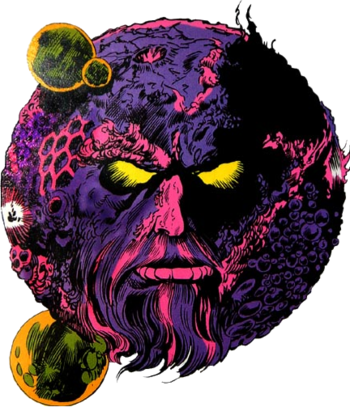
Some people are places. A Genius Loci is a location with a mind. A sentient planet, country, island, city, or street. Obviously, this is more common in Science Fiction and fantasy, though a certain amount of animism in otherwise realistic series isn't unknown, and it may be only suggested.
Usually, the Genius Loci has some control over its own form, and uses that control to communicate with the other characters. Alternately, it can trap them in Alien Geometries and torment them with Living Memories for shoots and giggles. It can be a Hive Mind formed from the various organic life-forms that inhabit a place, a nonphysical being possessing the area itself, a mythological spirit of a locale, or a computer system laced through the brick and stone. It can be helpful, neutral, or antagonistic.
The name comes from the Latin for "spirit of a place", originally a location's protective guardian spirit. To refer to "spirits of places", or multiple locations, each with their own guardian spirit, the correct pluralization is Genii Locorum. For "spirits of a place", or a place inhabited by a Mind Hive, the correct term is Genii Loci. For a "spirit of places", such as an omnipresent being inhabiting many disconnected lands, the term is Genius Locorum.
The Other Wiki has more details on Genii Locorum here.
Variants with their own trope pages include Sapient House, Sapient Ship and Intelligent Forest.
See Setting as a Character for when the location isn't actually alive, but is still treated as a character in the work.
Contrast with the non-tangible but often similar Sentient Cosmic Force. Compare That's No Moon, Anthropomorphic Personification, Fisher King, Fisher Kingdom, Living Structure Monster, Smart House, A Dungeon Is You and Giant Corpse World. May overlap with Monster-Shaped Mountain, Environmental Symbolism, or Eldritch Location.
Examples:
- The main characters' apartment complex in Acony that can bend space and time within itself. Sometimes to ward off intruders, sometimes it's just plain trollin'.
- In Angel Sanctuary, after Lucifer rebelled against God because God said so and retreated to Shioul, he and his follower fallen angels found out that it was a barren wasteland, so Lucifer had to merge with the plane itself in order to support any possible life, thus making Hell a Genius Loci. Except for the fact that Luci's soul was sealed into Alexiel's sword somewhere between that and Alexiel's own rebellion, so Hell isn't much sentient anymore.
- In Chrono Crusade, Pandaemonium is both the name of the demon's home which, in the manga, is apparently some sort of spaceship and the name of their Hive Queen, who has at least some control over their world and may even be the brain of it herself. Also in the manga, it's implied she serves not only as the ruler and mother of all demons, but some sort of organic, on-board computer as well. As you can probably tell, it's unfortunately not the most clearly written part of the series' backstory.
- Henry Legolant from Black Clover can use Recombination Magic to let him rearrange the Black Bulls' hideout however he chooses. He's able to do so thanks to absorbing a large amount of magic power from his squadmates thanks to his illness, and having lived in the hideout most of his life. He weaponizes it by turning the hideout into a Humongous Mecha.
- Heavily implied in CLANNAD, because of the story that Akio tells to Tomoya before Nagisa gives birth:When Nagisa was near death, he prayed that she would be saved. It seemed that since then, Nagisa's health would be linked to the town's. Ushio also inherits this link in the world where Nagisa, Ushio, and Tomoya all die.
- Laputa from Castle in the Sky. The castle itself responds to Laputian royalty who own the crystal and the garden / tree's roots keep the kids safe while Muska dies. Subtle example, but several characters comment on it.
- Cyborg 0012 in Cyborg 009. More exactly: she's a cyborg that has the brains of a rich and lonely woman who died some time ago waiting for her husband to come back home, who now controls the Big Fancy House where she used to live, with Everything Trying to Kill You inside it. In the 2001 anime, said brains/control are located in what seems to be a look-alike mannequin laying in the center of it.
- The Dark Myth: the true nature of the Shinto god Susano'o turns out to be the Horsehead Nebula itself.
- The Death Mage Who Doesn't Want a Fourth Time there's Knochen, a giant, mobile, sentient fort made of bones. Originally four separate skeletal creatures, they were combined into one being and assimilated countless bones from other creatures. Now it serves the protagonist as a moving base (since it can fly) and the only way to kill it would be by destroying each and every bone that makes up its structure.
- Digimon has Housemon, which is Exactly What It Says on the Tin: a giant house Digimon (Dub-only. In the original it was simply a giant puppet that Puppetmon made).
- One forest and one city have turned out to be giant turtle Digimon. (They're not the same turtle, either.)
- And there's an island that's actually a giant whale with a mechanical interior.
- Digimon Frontier has Sakkakumon, the "Beast Spirit" form of Mercurymon, one of the villains. It is a gigantic sephirot that traps the heroes in its spheres, each housing a whole pocket dimension that Mercurymon has control over.
- After losing his physical body, Zamasu from Dragon Ball Super has his essence merge itself with the very fabric of Future Trunks' timeline so he can achieve what he set out to do: create a multiverse free from the evils of mortals and the failures of gods by making himself its sole inhabitant. He even threatened to invade different timelines and the only way to stop it was by having Zeno erase both him and Future Trunks' timeline.
- Eureka Seven gives us the Scub Coral planet itself, a type of Starfish Aliens that communicates via assimilation, but seeks another way through the Coralian title character.
- In the Fairy Tail Drama CD, the Mirror Mansion is revealed to be one, having been granted a soul by the researchers that once lived there.
- Some Stands in JoJo's Bizarre Adventure act as something akin to this. Strength takes the form of a gigantic freighter that allows its user to telekinetically control every individual part of it, right down to the bolts holding it together, and Superfly is an autonomous stand bound to a transmission tower that traps one person inside it at all times and reflects any damage inflicted on it back at the attacker.
- Nagi from Kannagi: Crazy Shrine Maidens describes herself as one of these, since she spawned from a carving Jin made from the sacred tree that used to be outside his shrine.
- La Blue Girl: The Shikima realm is described as "self-regulating", and the parts of it are actually described corresponding to a body. The appendix is apparently a prison, the brain may just control the universe, and it has an anus. On the other hand, this self-regulating world that maybe controls the universe has also decided that it likes the local clan of demons with tentacles.
- The titular Mononokean of The Morose Mononokean is a demon that takes the form of a tearoom, and communicates its will to its inhabitants through a hanging scroll on the alcove.
- An episode of Mushishi has Ginko investigating a swamp that travels from place to place, and a girl who travels with it.
- Avantheim, the only known Phantasma (Exceed rank number two) so far in No Game No Life, is a being that resembles a gigantic rock that floats in the sky, and has the "right to infringe on others' sunlight and view" as noted by Sora. It is also the abode of the Flügel who reside on its back. It is revealed in Volume 5 that Avantheim maintains a mental connection to Azriel, the representative of the Flügel, and considers her its representative.
- In O-Parts Hunter, the Roc Bird City is part of Beelzebub.
- Certain Devil Fruits grant this power in One Piece:
- Pica of the Don Quixote Pirates ate the Stone-Stone Fruit, allowing him to assimilate with and control stone. And since Dressrosa is built on stone, this enables Pica to rearrange the landscape to his liking, or grow into a massive giant rock monster to attack people.
- Avalo Pizarro of the Blackbeard Pirates has the power of the Isle-Isle Fruit, which apparently gives him the power to merge with anything on an island, such as the wood in a dock, the stone in a mountain or the walls of a castle. Rather than attacking people (For fear of destroying the town), he uses this power to locate certain people missing on Pirate Island.
- The Forest in Origin: Spirits of the Past is both a place and a Hive Mind consciousness.
- It's downplayed in Restaurant to Another World but the restaurant itself seems to have a mind of its own. Every place that the door can be found is located near someone who'll appreciate food. And anybody who attempts to dash and dine or harm/kidnap the master will find themselves unable to open the door.
- The door often has a strange knack of appearing to people who actively need something good to happen to them, such as Aletta who was starving and without any work, Alphonse who was a shipwrecked admiral, Lionel who was sent to die in a gladiator ring and Kuro who was secluding herself for thousands of years on the moon due to her Walking Wasteland powers.
- In the Sailor Moon special manga stories, a series of comical Genii Locorum villains make life difficult for the Sailor Soldiers.
- Wiseman/Death Phantom in the manga proper also counts. His soul inhabits the planet Nemesis, while the "Wiseman" body is little more than a skeletal puppet.
- Earth itself in Shadow Star is Sheol, one of the few shadow dragons in existence that has more than one symbiote, in this case Mamiko and Shiina. After crossing the Despair Event Horizon following the deaths of her closest friends and her parents, Shiina agrees to cooperate with Mamiko and get Sheol to kill every other human on the planet in a flurry of giant hands, leaving their currently unborn children as the heralds of a new era of humanity.
- In Transformers: Cybertron, Primus, god of the Transformers, has a vehicle mode, and that vehicle mode is their homeworld of Cybertron. This is revealed when the planet transforms into a planet-sized robot towards the end of the series. This makes for a really awesome toy, complete with various canonical cities located on his body. According to the manual, this applies to every Cybertron in every Transformers medium across the multiverse; he doesn't wake up much to avoid squishing inhabitants and such. (He's free to transform in this series once enough of his power is restored because the planet has already been evacuated due to the threat of the universe-devouring black hole that is the threat that kicks off the series.)
- Tsukuyomi: Moon Phase has Vigo, who first appears as Hazuki's butler within her ancestral castle, but also appears to be part of it, as evinced during his battle against Kouhei.
- In Uzumaki, another book by the Junji Ito, the Underground City beneath Kurozu-cho appears to be conscious and capable of desiring attention.
- The☆Ultraman has a sentient asteroid called The Devil's Star as an Arc Villain in three episodes, with its appearance causing benign, usually-peaceful earth monsters to go berserk. The Star itself is aware of it's actions, and can even spawn a new monster using its fragments as a last resort to wipe out humanity.
- Urusei Yatsura in the fourth movie, Lum the Forever, similar to Clannad, the town has its own consciousness. It's considered one of the most confusing entries in the francise, though also the most deep.
- In Yaiba, the Moon People can Fusion Dance with anyone and anything they wish. Their leader Kaguya, in her battle against both Yaiba and Onimaru, actually fuses with the Earth itself.
- Big Finish Doctor Who: The Condemned ("For all intents and purposes, the building is him!") Notably, the Genius didn't even realize he was no longer human.
- 2000 AD:
- The series Ace Trucking Co. included a story about fast-breeding 'Bampots' attempting to colonize a living planet called Gordon.
- Another series of theirs, Zombo, heavily involves the existence and managements of deathworlds, uncolonized planets that are alive, sentient, and really hate humans.
- Shakara: A planet in the Hades system is supposedly used as a prison world by The Hierarchy. In fact it's a living Death World that fights off any intruders as if they were a disease.
- Anderson: Psi-Division: In the old town of Salem there's an apparent haunting or demonic possession going on in an Old, Dark House. It turns out that the house itself has become alive as a result of all the negative psychic energy accumulating in the area.
- ABC Warriors has Medusa, the consciousness of the planet Mars.
- In The Authority Jack Hawksmoor can talk to and command all cities, implying that they are all Genii Locorum, albeit fairly sedate ones who don't interfere in their own affairs very often. Apparently they all have wildly different personalities, and genders, though these are somehow strangely appropriate — the first time he fought using his city-powers, for example, Jack wore Tokyo like a Humongous Mecha suit.
- And a bizarre borderline example later on: Gaia Rothstein, a century baby. Her astral form looks like the 10-year-old girl she really is, but her physical form is an island...which looks like a walking, talking, two-mile high version of the Swamp Thing.
- The Books of Magic includes the dirty, cynical, slobbish spirit of London. Tim Hunter tells him, "I don't think I like you." The spirit replies, " 'Course you don't like me. Nobody likes me, but plenty are fascinated by me."
- Buffy the Vampire Slayer: Twilight is a sentient dimension.
- The DCU:
- Mogo, the planetary Green Lantern. His uniform is a ring of vegetation around his equator. In his introductory story, the Blood Knight hunting him down only realizes Mogo's true identity when he's finished mapping out his forests, thinking he had to be somewhere in them only to flee the planet screaming once he realized what the "meaningless cuts in the greenery" actually were. He is also responsible for reassigning the rings of deceased Lanterns. In the Legion of Super-Heroes story Legion of 3 Worlds, the Corps is gone in part because Mogo is dead and the rings cannot be sent out to new wielders.
- Ranx, the Sentient City, evil and prophesied to destroy Mogo one day. In the Sinestro Corps War, he tries and failed.
- Danny the Street (a pun on Irish drag-queen Danny LaRue), a sentient, transvestite boulevard (think gunshops and hardware stores with pink curtains and pastel-blue awnings) who moves around the world and acted as the Doom Patrol's headquarters for a time. He eventually grew up into Danny the World before being torn down by cosmic repo men. Now he's slowly regrowing from Danny the Bungalow. For a time, he was Danny the Brick.
- The 2005 The Question miniseries has him talking to "the spirit of Metropolis", who answers with seemingly coincidental snatches of conversation from the people in the street.
- Very common in The Sandman (1989) and other Vertigo Comics books. Neil Gaiman seems to be especially fond of this concept, even making it the subject of a piece of flavor text he wrote for SimCity.
- The Endless themselves are this. Dream of the Endless lives in the Dreaming, but he also IS the Dreaming.
- Fiddler's Green (or Gilbert, when he's in his Anthropomorphic Personification form) counts as this.
- The Sandman: Endless Nights features a story in which the stars themselves are portrayed as alive, and hypothesizes that the destruction of Krypton and the survival of one of its people was a deliberate set-up between Despair and Krypton's sun, Rao (The Sandman: Overture similarly features the stars as alive). In the main Sandman series, in the issue where the hero tells us each city has its own personality, he gets stuck in his city's dreams.
- Lucifer has one character converse with the Spirit of Las Vegas (summoned by deliberately losing one's life savings in a rigged game, appeared as a 1930's hipster in a zoot suit).
- A recurring character in Hellblazer is essentially the personification of London. He even refers to himself as this.
- Superman:
- Solaris, an evil sentient artificial sun, from the DC One Million event and All-Star Superman.
- The DCU also had a sentient galaxy that aligned a bunch of stars to give Superman a huge powerup. Also there were some smaller living (but not sentient) galaxies, artificially made by some uberpowerful race as bioweapons. Supes, again, kept one as a pet.
- When Brainiac 13 infects the city of Metropolis with nanites, it has the unforeseen effect of making the city itself sentient. Its personality is female, and she and Jimmy Olsen fall in love.
- Htrae, the Bizarro-copy of Earth that was home to the Bizarros, was sentient simply because regular Earth wasn't. (Though this was only so in Ambush Bug, which isn't really in continuity.) All Star Superman certainly seems to indicate Htrae has some semblance of intelligence and/or sentience.
- In The Girl with the X-Ray Mind, Supergirl mentions she and Superman once faced a strange and hostile living planet whose surface was covered with humongous, sharp throwable spikes. They named it "porcupine planet".
- Aquarius, a rogue living star responsible for the death of Golden Age Black Canary's husband.
- In Justice League International, during the Keith Giffen era, several important events revolved around the island of Kooey Kooey Koey, which was mobile and sentient.
- On a smaller scale, it is implied in some stories that Arkham Asylum, the Gotham City psychiatric institution which houses the various psychopaths and lunatics that Batman frequently battles, is in fact a living entity that causes and feeds on madness, thus partly explaining why Arkham's patients have a particularly tough time being cured, and why the asylum itself is a Cardboard Prison.
- The Post-Crisis Wonder Woman gave Themyscira a (very small) degree of sentience. The soil is partially made of the body of one of the most dangerous prisoners behind Dooms Doorway and is not permanently anchored in the physical realm, which allows it to slip away from the rest of the planet if the Door is breached.
- Wonder Woman (2011) changed the realm of Hades to being an extension of him that he can control at will and he forms his bodies out of its substance.
- The Centre, the sentient island full of dinosaurs from DC: The New Frontier.
- In Gotham City Garage, the Canyons of Clay. Batman villain Clayface is merged with the land, exerts complete control upon it, and kills all trespassers.
Big Barda: But the Dark Age had not just changed the world, they say. It had not only driven the seas to vapor and burned the cities of Man. No. It had also changed him. Stripped him of his famous face. Destroyed his home. And so, they say, he came to the crossroads here...and became a new one. Welcome to the Canyons of Clay.
Supergirl: Whoa! Youre' telling me this place is alive?
Silver Banshee: No. This place is death. - A Justice League of America limited series starring Zauriel and Martian Manhunter declares that the reason the forces of evil fail in the invasion of Heaven that happens in the end is that God IS Heaven, down to the chairs, walls, and floor. More than Heaven even, as Zauriel states:
Zauriel (to Asmodel, the rogue Bull-Angel): Do you really think The Presence just sits here on the Seventh Heaven watching everyone? [...] The Presence is nowhere and everywhere, the rock beneath your feet and the air in your lungs. He's Heaven and Earth, perhaps even Hell itself.- In The Other Side of Doomsday: Supergirl, Flash and Atom eventually deduce the whole planet where they have been trapped is a living world, entirely controlled by villain T.O. Morrow.
- The ultimate goal of Krona in Trinity (2008) was to learn from the worldsoul, the sentient soul of the planet Earth itself.
- There was a time when Cyborg was assimilated into a Hive Mind of alien AIs and then connected to the aliens' planet. While Vic (known as Cyberion during this phase) was cybernetic by this point, there was still a little human left inside that longed for companionship, causing him to go to Earth and kidnap his fellow Titans.
- In Eight Billion Genies, someone's wish has given the Earth a face, arms, and legs, while another wish has turned the moon into a ravenous being that devours Santa Claus and his reindeer.
- The Simpsons Futurama Crossover Crisis has Nerdanus XII, guardian of the Geek-E galaxy. He looks like a giant nerdy dude, with mountainous acne and an asteroid belt for glasses.
- Barbelith, in The Invisibles. Barbelith is a planetary-type body that helps "initiate" agents of the Invisibles into the higher mysteries. Its true nature, though, is pretty damn mixed; Dane isn't sure, yet Barbelith answers, "You made me" (it? they?) Whoa, more and more questions...better luck asking Grant Morrison, maybe?
- From the Marvel Universe:
- The first foe the X-Men fought in the Bronze Age Revival was Krakoa, the Living Island, whose life had been mutated into a single organism by a nuclear test. As of X-Men (2019), Krakoa is established as a nation exclusive to mutants.
- The aptly-named Ego the Living Planet, who tangled with such persons as The Mighty Thor and Galactus.
- A living planet known as Kathulos once appeared in a Doctor Strange story. He blew it up.
- Deadpool once destroyed a Genius Loci called Id, the Selfish Moon, which used to be a moon of Ego the Living Planet.
- Cloud, one-time member of The Defenders, was a sentient nebula, an immense cloud of gas, with the ability to assume human form.
- Another living location is Spragg the Living Hill — it was a hill controlling people's minds. She-Hulk fought him, then sent him to space...well, Mole Man sent him to space. On a geyser. He last appeared in a She-Hulk issue, being arrested by Cop Rocks in Space.
- In the Realm of Kings crossover, a fault in space opened the way to an alternate reality. In said reality it was revealed that not only is the other universe sentient, it's an Eldritch Abomination that wants to consume ours.
- In a comparably more mundane example, the Chrysler Building became one after the events of World War Hulk.
- Mephisto is sometimes treated as an extension of his own realm such that he has complete control over it, and if one is destroyed, both are destroyed. Other stories have him being overthrown and cut off from it. Other mystical entities like Agamotto and Chthon are often treated the same way in their home dimensions.
- Singularity, a character introduced in A-Force, is a living pocket universe.
- Moon Girl and Devil Dinosaur introduces Illa the Girl Moon, daughter of Ego.
- Nate Grey becomes this in Age of X-Man when he reveals in the Omega issue that he is the Age of X-Man, with damage to it being represented as scars in reality, and cracks in his skin. Considering how staggeringly powerful (like, 'the multiverse is my stepladder' powerful) he was to begin with, and the fact that he got a boost from the Life Seed — the counterpart of the Death Seed, which created Apocalypse (and Nate was stronger than Apocalypse to begin with) — making him exponentially more powerful, plus he had a long history of being an unconscious Reality Warper, this is not surprising.
- One of the most obscure examples from Marvel is the House of Shadows, an otherworldly spirit that can merge with architecture and twist its host into an Eldritch Location. It battled Doctor Strange and Rom: Spaceknight, then vanished for decades, finally returning in 2022 when it confronted Moon Knight, who charmed the entity into becoming his new base, the Midnight Mansion.
- In DIE, the titular parallel dimension is eventually revealed to be sentient and has been manipulating events by reaching through time in order to set in motion the events that lead to its own creation.
- In the third Druuna album, the crew of a spaceship runs into an asteroid covered by some sort of organic lifeform, which turns out to be sentient when it variously traps them or gives them free passage to different locations on the asteroid. It turns out to be the city-spaceship that Druuna's people used to live on, and the Virtual Ghost residing in the ship's computer, Captain Lewis, is controlling the organism to allow the visitors to rescue Druuna.
- The Galactus-infused zombies from Marvel Zombies EAT one of them.
- In Paperinik New Adventures, One is the Ducklair Tower,the headquarters of Paperinik. He can move walls as he likes, control every mechanism in it and be aware of everything that happens inside it. He only uses his Huge Holographic Head so Paperinik is more comfortable when talking to him. Two could-and briefly did-do the same.
- Sonic the Hedgehog (Archie Comics): Nicole. After taking over the nanite city in #176, she effectively becomes the city of New Mobotropolis, inhabiting its systems and driving the nanites that make up the city. She even uses the city itself to fight off attackers.
- Star Wars Legends: Mount Sorrow is a sapient, talking mountain whose tears have healing properties.
- Tom Strong has a beautiful birth of this — when the Modular Man comes to town, Tom reasons with him that the life he has, and will have, sporadically, isn't the life he wants; he'll get a couple months, maybe a year, before Tom and his crew hunt him down and destroy him and then he'll be dead for years before someone else builds the next module from plans on the internet. So, Tom offers, why not go elsewhere? He ends up on Venus. Scratch that — he ends up as Venus. Venus, in the Tom Strong universe, is the Modular Man. Which is how Venus can swat a spaceship out of the sky with a giant hand, give Tom a thumbs-up, and then go back to being what it was.
- The Transformers (Marvel):
- Omega Supreme, who transformed into a rocket base with its own death tank.
- On a larger scale than that, Fortress Maximus, Metroplex, and Trypticon all transformed into cities.
- Boltax, guardian of the Underbase who appeared as a regular robot. The robot was a puppet; Boltax himself is the Temple of Knowledge that housed the Underbase.
- Not only is there Unicron himself, a planet that devours other planets, but in most comic versions, Cybertron itself is Primus, Unicron's opposite number.
- In one video game, Tidal Wave, a massive Decepticon who becomes an aircraft carrier and two support boats, is this. You finally get out of the carrier the whole level has taken place on, believing it's all over...and then...
- In Zot!, a trip to the future results in the hero meeting a small girl in purple clothes who makes some enigmatic comments before vanishing. She is later said to be the living embodiment of the planet Sirius IV.
- Peanuts examples:
- Sally's school building, which is both resentful and defensive of its occupation and human inhabitants.
- Charlie Brown's pitcher's mound, that would rather be anywhere else than where it is.
- The kite-eating tree may count. Lucy once threw Schroeder's piano into it, and the tree immediately ate it.
- In Safe Havens. Mars. Jenny ends up negotiating with it in order to save Earth from destruction. Later, when the countries of Earth refuse to recognize its sentience and plan on exploiting it for real estate, the Fastrack One crew do the only thing it can to force them to recognize it: Samantha and Dave adopt Mars as their child.
- A later conversation reveals Theia was also one of these, and was close to Mars in the emotional sense. In fact, that was why Theia crashed into Earth: it was trying to jump Earth's orbit to join Mars's. Some of Theia's sentience still lives on in Earth, but only dogs are aware of it. The idea of spaceflight and traveling to Mars captured humans and dogs' imaginations so vividly because of Theia's influence.
- A later conversation reveals Theia
- Avantasia Protag AU: The magical world beyond imagination Avantasia has a bit of a mind of its own and for example may shift the location of the gates to its entrance to either make it easier or harder for someone to get in. It also may make food or water conveniently appear to lost souls.
- Child of the Storm:
- The mountain spirit that Harry and friends meet in Colorado, which ages them up so that they can defend it and Bobby Drake (who it's defending) from HYDRA.
- Hogwarts is also established to have its own spirit, which may or may not be dating JARVIS.
- It's also stated in several chapters that London has its own spirit, a result of just how old and magical the city is. This spirit often chooses a vessel to act as its Voice to communicate with its inhabitants when needed. And when the Voice goes into hiding, people in the know realize that this means shit is about to get real.
- It's argued in-universe that Zola, courtesy of his Brain Uploading and the resultant Technopathic abilities that come with it, is a Genius Loci of sorts. Best demonstrated when he seizes control of Avengers Tower.
- And there's the mentioned but so-far unseen island of Demonreach from The Dresden Files.
- Owl Castle, in the Contractually Obligated Chaos series, has shades of this. In particular, it acts on the wishes of its master and prevents Lydia from leaving.
- In Crowns of the Kingdom, it's hinted that Disneyland itself is alive.
- Dungeon Keeper Ami: This concept is featured in an interesting way. Dungeon hearts serve as a 'focal point' for negative/dark energies, specifically the power of the Dark Gods. As a result plants wither, water grows brown and scummy, and (if there is enough corruption or enough hearts) the weather might even grow stormy, and magma may rise to the surface. Within the Dungeon itself, the dungeon hearts tend to modify any additions to rooms- leaning towards the macabre and the eerie/creepy. Normally this would not qualify as a Genius Loci by itself, but Ami's research into dungeon hearts and their construction and effects, and her modified hearts, have had some odd effects. These include strange, organic elements in architecture. Following her consumption of a Lesser Aspect of Crowned Death it gains a highly ominous skull motif. Then, later, the dungeon itself grows ill...
- However, truthfully, this might actually be an inversion, since the dungeon hearts are technically part of the keeper (and might be part of the Dark Gods as well, the jury is still out).
- Forgotten Portrait: Weiss Guertena became] one with his own creation and turned into a genius loci.
- Harmony Theory: The Everstorm seems sentient and malevolent.
- In the Eye of the Beholder: The quartz valley appears to be alive, and actively malevolent as it seems to side with Sycophanta, though the Shadows still attack them all the same.
- Mass Effect: End of Days: Humanity developed a race of A.I, which they can communicate with through neural links. However, the increasing use of the links and its spread through civilization meant that the neural fluctuations created by both parties on what would pass as the internet has created a self-aware information network, albeit without a will, which the humans and A.I can tap into and direct at will. Their civilization and the individuals is effectively part of one giant, fluid mind.
- Nine Days Down: Tartarus. It's not alive, not exactly, but It has an awareness of Its own and can exercise a great deal of control over Its physical environment.
- The Palaververse: In The Tempest, Discord brings Castle Canterlot to life. It turns out to have the personality of a Grumpy Old Man, complaining about the good old days when castles were fortresses, and telling local kids to "Get off my lawns!"
- Pony POV Series:
- The four Elders — Fauna Luster, the Father of All Alicorns, Havoc, and Entropy — are not only each the Dimension Lord for their own realm (The Alicorn's Domain, Pony Heaven, Pony Hell, and Oblivion respectively), but each of their realms are described as being them. This also applies to all Concepts and their realms to a lesser extent.
- Discord's castle in the Dark World turns out to be alive, as proven when it gets up and runs away when the Elements of Harmony try to blast it. After this, Applejack is able to convince it to stand down and stay neutral in the coming fight.
- After Queen Libra ascends from Dark World!Rarity, the mortal world itself becomes this because Libra is the Anthropomorphic Personification of the Mortal World. As such, the entire universe is in a sense her.
- It's eventually revealed that not only do stars have a consciousness of some sort, but constellations and even galaxies have their own that are a Hive Mind consciousness of their component parts. The Ursa Major and Minor are the Anthropomorphic Personifications of their respective constellations' consciousnesses.
- Red Lightning: Percy the Pier used to be human, but he was absorbed into the pier and became one with it.
- In Something Always Remains, the weird occurrences at Freddy Fazbear's Pizza, such as the creepy children's drawings, electronics turning on and off, temporarily stepping back in time, and the building itself seeming to assist the protagonists at times are explained by one of the original owners, Freddy Wickes, being Buried Alive under the building's foundation.
- Stars Above: Jiovanni, the Sixth, takes the form of a twisted cathedral made out of volcanic rock.
- Sunset's Isekai: Very likely to apply to the Isekai itself- it has been referred to as feeling embarrassed on at least one occasion.
- T.R.O.T.T.E.R Shadow of Cheernobyl: There is the Zone of Desolation, which is both eldritch and completely malevolent.
- Twice Upon an Age: Skyhold is this. Solas explains that it "is pleased with its new master and mistress," and will not allow any harm to come to them; this is why they can fall from ridiculous heights and not be injured, and why the bitter cold and snow of the surrounding mountains has no effect on the castle grounds. Considering that Skyhold was the place where Solas, or rather as Fen'Harel, erected the Veil and it was his former stronghold, him mentioning it does make sense.
- Under the Northern Lights: Luna and Celestia's "auntie" isn't simply sleeping in the Everfrost Glacier — she is the Everfrost Glacier itself. As a being of living water, her body became a great mass of ice when it became still and at rest.
- Whispers of the Abyss: The Whispering Abyss is sentient, and wants to trap Pokémon inside itself. It speaks to Blot by taking the form of a Duskull.
- The entrance to the Cave of Wonders in Aladdin is alive, able to speak to anyone outside or within the Cave itself.
- In Kiara the Brave (a mockbuster of Pixar's Brave) the planets and sun are depicted as sentient beings.
- In Final Fantasy: The Spirits Within, Cid hypotheses that the planet is one. He's right.
- In the Green Lantern animated movie Green Lantern: Emerald Knights, one of the five stories that Hal Jordan tells to his new recruit is the tale of Bofunga the Unrelenting and the day he finally, er, relented. He was on a quest to become the mightiest warrior in the galaxy, and the only being left in the cosmos that he had yet to vanquish was a mysterious being known as "Mogo". This being was allegedly not only exponentially more powerful than Bofunga, but was also a Green Lantern to boot. Bofunga traveled to Mogo's last known coordinates and attempted to challenge him, but even after months of searching his quarry was nowhere to be found. Refusing to give up, Bofunga began setting explosive charges all around the planet in an attempt to force Mogo out of his hiding place and goad him into a duel, but after detonating all of the charges and doing NO DAMAGE WHATSOEVER, he realized — too late — that "Mogo" was THE PLANET ITSELF...and he had just made it VERY angry. The ensuing "battle" ended with predictable swiftness, as Mogo crushed his antagonist with a well-placed gravity well.
- The Hunchback of Notre Dame has the titular Notre Dame. Several people, including Clopin and the archbishop, reference Notre Dame like a living entity, and it's implied at the end that the cathedral passes judgement on Judge Frollo by turning the gargoyle to which he's clinging into the visage of an actual demon, causing Frollo to fall. There's also a scene at the start of the movie where, as the Archdeacon calls out Frollo for accidentally killing Quasimodo's mother on the steps of the cathedral and is about to drown the infant Quasimodo as well, the statues of the saints, apostles, and angels on the cathedral all give him disapproving glares, and this convinces him to spare Quasimodo.
- Like the above, Inside Out treats all human beings (and animals, during the credits) as Genii Locorum, though more in terms of the mind than the physical body. Riley is the Genii Loci who gets the film's primary focus.
- Moana:
- The Ocean qualifies to whatever degree "Everywhere but the scattered islands sticking out of it" counts as Genius Loci.
- The goddess Te Fiti also qualifies, as she's effectively an anthropomorphic island who becomes the Mother Island when she sleeps.
- The 2006 CGI movie Monster House's... monster house.
- The movie Osmosis Jones treats each human being as a Genii Loci, inhabited by trillions of sentient cells that lead human-like lives.
- Transformers: The Movie introduced Unicron, the evil robot planet who eats other planets. The comics added a good counterpart, Primus, the god of the Transformers who inhabits their planet, Cybertron. Also, Metroplex, the city-transformer, and his evil counterpart Trypticon, who were later joined by Fortress Maximus and Scorponok, respectively. Transformers: ★Headmasters also featured the living planet Daira.
- Wreck-It Ralph has the Surge Protector, an Anthropomorphic Personification of the surge protector. Inside said surge protector.
- As Samuel L. Jackson says in the film version of 1408, the room isn't haunted by any ghost — it's just "an evil fucking room".
- Pandora in Avatar is a case of a Genii Loci; the roots of Pandoran plant life have synapse-like connections with each other, forming a massive neural network with which Pandoran fauna can interface. The result is Eywa, a mass consciousness that, according to the Na'vi, takes up the spirits of the dead and keeps the balance of nature. Given a large enough threat — such as human forces making an assault on its hub, the Tree of Souls — it will react. Violently.
- The Borderlands: The church's anomalies initially appear to be the result of building a church on the site of an old spot for pagan human sacrifice. Then it turns out that the church serves the same purpose now as it did then...
- Henry Darger wrote one of these decades before King. It's called Crazy House and puts the heroic little Vivian Girls in 1940s Chicago, investigating a house that is speculated to be sentient and evil. The princesses find that evil ghosts are also involved.
- The Dark Crystal: In a curious subversion, Aughra is. She's the planet Thra's attempts to understand itself, the solar system it resides in, and all the living creatures who dwell upon it.
- The titular ship in Event Horizon is strongly implied to be either a conduit to or an actual part of a particularly unfriendly one of these. And/or an Eldritch Starship in its own right: it's rather complicated. At one point, a character refers to the ship as "she" with the heavy implication it was meant as more than just the standard anthropomorphism of vessels. This was not Han Solo's fond "girl". This is foreshadowed early on; a bioscan of the ship revealed there were many signs of life, but couldn't locate where any of them was from.
- Grave Encounters is about a group of individuals who seem to be trapped in a building that liberally changes its geometry with no warning. The sequel confirms that the ghosts are part of the haunting, the other part is the building itself which may be the result of various dark rituals performed there.
- In some stories featuring a Haunted House, the house itself will display attributes of a Genius Loci. One of the classic examples is in The Film of the Book of Shirley Jackson's The Haunting of Hill House.
- Hausu, an incredibly bizarre Japanese horror film (by Toho, no less!!!) is about a sentient man-eating house.
- One interpretation of Maybe Magic, Maybe Mundane events in Long Weekend is that Lunda Beach is somehow sentient and responds to the emtions of those visiting it. It is perhaps significant that the locals have never heard of the place.
- Marvel Cinematic Universe:
- Tony Stark's mansion in Iron Man is controlled by JARVIS, a sophisticated AI that takes diction, helps manage Stark's projects, suggests new color schemes, and is an unflappable Deadpan Snarker.
- Ego from Guardians of the Galaxy Vol. 2 is a planet the size of earth's moon constructed around a mind. He has a humanoid avatar that he uses to address visitors and go find girlfriends.
- The eponymous store in Mr. Magorium's Wonder Emporium is heavily implied to be this.
- The underground base from Resident Evil (2002) qualifies, since it's completely run by a highly intelligent AI named The Red Queen.
- The Overlook Hotel from The Shining which slowly drives Jack mad and torments Danny. At least, this is one of the theories about how it does these things.
- The titular planet Solaris (1972) or at least its ocean is assumed to be a massive intelligent organism.
- The most famous scene in A Trip to the Moon, where the space capsule crashes into the eye of the Man in the Moon.
- Benign, playful examples in Toontown from Who Framed Roger Rabbit where almost anything is a lively character including some of the buildings.
- In Alien in a Small Town, the breeding "matriarchs" of the silicon-based alien Jan will eventually "plant" themselves and slowly grow to the size of living mountains. The Jan are subterranean, and their warrens usually center themselves around a matriarch. Her children burrow into her body, meaning that that part of their warren is actually sapient.
- In Mary Gentle's Ash: A Secret History, the pyramids turn out to be this.
- Isaac Asimov:
- Foundation's Edge: While looking for evidence of Earth, Trevize and Pelorat find Gaia, a Genii Loci where every living and non-living part of the planet shares a single group consciousness and identity. The autonomy of each part varies, depending on how much freedom of will the part grants to Gaia, with humans having the most. Verbalizing its opinions to other characters can be confusing, but each person is supposedly capable of expressing a view separate from Gaia itself.
- "Green Patches": Every organism on Saybrook's Planet, from the lowest bacterium to the most advanced terrestrial animal, is merely a part of a single, amalgamated mind. (Referred to in the story as "unified life").
- Nemesis: "Nemesis" is the name of the red-dwarf star which is orbited by the gas giant Megas which in turn is orbited by the habitable world Erythro, and Erythro — or, more accurately, a form of life existing all over its surface — is the Genius Loci.
- There's a Babylon 5 short story by J. Michael Straczynski featuring a planet whose biosphere forms a collective hive mind. The name of the story? "Genius Loci".
- In A Bad Case of Stripes, Camilla morphs into her room when told to "become one with her room".
- Bazil Broketail: Every gate of Marneri is protected by a spirit against outside invaders, aided by spells cast annually which protect the walls.
- The Beast's castle in Beauty: A Retelling of Beauty and the Beast functions as one of these as a result of the Beast's curse. Lamps light themselves as Beauty approaches, and the rooms arrange themselves to keep her from getting too confused; if she gets lost, she turns a corner and there's her bedroom. She can also issue specific requests and the castle responds accordingly. It's eventually explained that this isn't actually the castle so much as it is the work of the unseen servants, but the effect is the same.
- The parallel world of Black Trip indifferently plays with its inhabitants, feeding them liquor and snacks. It also sends armed monsters to shoot at them.
- Ray Bradbury:
- "Here There be Tygers" has a planet as one of these. The planet is very friendly and wants to do anything to please the astronauts who landed there, from creating fish that cook themselves to perfect weather up to attractive female companions. When several of the astronauts leave, one decides to stay behind. Despite the planet appearing unfriendly with volcanoes appearing on it, the astronauts know the one who remained will be spoiled rotten by the planet. The astronauts decide to list the planet as unfriendly since it would be to those who would exploit it (rather than appreciate its gifts).
- The city in "The Lost City of Mars". After being rediscovered by Earthlings, it tries to trap them inside so that it has someone to entertain.
- "The City" involves a sentient Martian city ambushing the human explorers and changing them into cyborgs, so they'll launch a bioweapon attack on Earth and avenge its defeat in an ancient war with humanity's ancestors. And the story's narrated almost entirely by the city itself.
- The City and the Dungeon: Some delvers believe that the Dungeon is intelligent, and will spawn more monsters or treasure under certain circumstances. Very few people believe that the Dungeon is benevolent, even when they seem to be having an improbable amount of good luck. When the superparty discovers that lost heartstone shards are forged into incredibly powerful weapons and items — while the person is still alive — everyone silently agrees that the Dungeon is unquestionably evil.
- Codex Alera: Furies, spirits that represent earth, water, wood, fire, air, and metal, are usually small beings, but some are very old, very powerful, and not ones to mess with. These ones are called Great Furies, and frequently manifest as large portions of the landscape that, with luck, can stay asleep for a very long time.
- In Captain's Fury, the leader in a civil war against the Crown lives near an ancient Great Fury that has remained dormant for many hundreds of years. He seeks its power and deliberately pisses off a volcano's spirit to trigger an eruption upon his death. This means when his legions of soldiers fall back to his city, which will be packed with the normal population and thousands more refugees fleeing, and the Crown's forces closing in, his death will destroy hundreds of thousands if not millions of lives. The only solution First Lord Gaius Sextus can conceive to stop that horrible fate is to set the volcano off before his forces are close.
- Calderon Valley is set in the shadow of the mountain Garados with an eternal storm about its peak the locals call Thana, referred to as a married couple. Locals do not go on the mountain without using earth magic to shield their steps from Garados' notice, or things like rock slides will stop people from bothering the mountain. In First Lord's Fury Tavi pisses Garados off enough to make him fully awaken and manifest. From the peak emerges a being twice the size of the original mountain, whose mighty pine trees on his side are proportional to the hairs on a human's arm. This in turn angers Thana, who makes a storm strong enough to cut through the armor of the Big Bad, whose armor could deflect swords enhanced by metal magic.
- At the end of the penultimate book, it's revealed that Alera itself has a genius loci given a humanoid manifestation on accident when the founder of the united country used stones from all over the country to make a viewing mosaic, allowing him to see all that is within his domain. Alera, the fury, serves the First Lord so long as his requests affect both sides of an attack. She will not protect the Crown forces from her attacks and attack only his enemies.
- Done to horrifying effect in Richard Matheson's short story "The Creeping Terror," which was originally published as "A Touch of Grapefruit." The story, which is presented as a thesis for a Master's degree, describes strange occurrences throughout the Midwestern United States, including citrus trees growing in corn fields, increasingly balmy weather, and people looking for the ocean and talking about driving to different locations in California. As it turns out, the city of Los Angeles is alive...and it's spreading. At first, the populace at large takes this as a joke, but soon, people across the whole nation begin to completely lose their minds, destroying their homes and property, as the city moves from the Midwest to the rest of the nation. By the end, Los Angeles has taken over the whole country, with the population now brainwashed by it...and the final lines of the story imply that "Ellie" is beginning to spread to the countries surrounding the United States as well.
- Arthur C. Clarke's short story "Crusade" has a living rogue planet as its protagonist. Another story, "Dial F for Frankenstein", plays with the idea that the world's communication satellites network may become sapient, which in practice has the same effect as if all technology in the world became sapient. Both stories can be found in the collection The Wind from the Sun.
- In Terry Pratchett's The Dark Side of the Sun, the First Sirian Bank is a sentient planet (naturally occurring) who happens to be the godfather of one of the main characters. There's also a sentient ocean and a living sun. They're looking for an intelligent gas cloud to round out the elements. Maybe they could get that one from Star Trek: The Next Generation?
- Fred Hoyle's novel The Black Cloud features an intelligent cloud of interstellar dust. (When contacted by the protagonists, it expresses surprise that life could exist on a planetary surface.)
- In the backstory of The Death Gate Cycle, the Sartan created a world called the Labyrinth as a prison for their rivals, the Patryns, and they made it sentient so it could be both prison and warden in one. Then they vanished, and the Labyrinth decided that it really hated its creators' enemies and switched from warden to executioner. The result was a psychotic intelligence that could control any monster or geographical feature of the Labyrinth at will, bound only by the fact that it was compelled to give the Patryns a fighting chance. As a result, the Labyrinth became the very definition of a Death World, absolutely despised by its inhabitants, who knew full well that they suffered under the thumb of an extremely powerful intelligent being.
- Deathworld: The hero finds himself on a planet whose flora and fauna are in constant full-on attack against the human miners/settlers. Everything is deadly, poisonous, powerful, stabby, etc. It turns out that the planet itself has a mind (is a mind?) and has been psionically directing the attacks.
- DFZ: The Detroit Free Zone is ruled over by the Spirit of the DFZ herself. She is able to rearrange any part of herself, grow new buildings, and twist roads around like snakes. Government buildings are relatively stable and she always makes sure the Peacemaker's Consulate has clear skies, but other than that everything is fair game. You need a good GPS just to know where your destination is today, let alone how to get there.
- Aphrodite of The Dinosaur Lords eventually reveal themselves to be the spirit of the planet Paradise, capable of influencing its weather and, to some extent, geography, as well as able to perceive all going-ons on its surface.
- The titular location of Dis Acedia, a living universe composed of smaller worlds.
- Discworld
- It is revealed in Wyrd Sisters that the kingdom of Lancre is alive and aware. This is not a property of the land itself, but an emergent consciousness growing from everything that lives in the land put together: at one point it communicates with Granny Weatherwax through a horde of different wildlife, including animals that would normally prey on each other. It grows irate under the reign of a monarch who doesn't care for it, and it is also implied in Lords and Ladies that part of the reason the Elves can't remain in Lancre for very long is because the kingdom rejects them. Explicitly stated later — the Elf Queen gloats that marrying Verence, the king, will make her the queen, and then Lancre will have no choice but to accept her.
- The carnivorous shopping mall in Reaper Man. It's implied that this is how all shopping malls operate.
- Unseen University itself, which has a personality likened to that of a large, overenthusiastic shaggy dog. If it could get away with it, it'd roll over on its roof to have its foundations scratched.
- During the Journey to the Center of the Mind in A Hat Full of Sky, it turns out that the hillside on which the Feegles find themselves turns out to be...the Chalk. But Tiffany and the Chalk are one.
- Doctor Who Expanded Universe:
- Doctor Who New Adventures Transit features a futuristic version of The London Underground that extends through hyperspace and has stops on every planet in the solar system. Partway through the novel, the protagonists learn that the system has become so complex that it's developed sapience.
- Foreman's World in the Eighth Doctor duology Interference, Book One and Book Two, which was created when the unstable thirteenth regeneration of I.M. Foreman bonded with the planet Dust. It communicates with the Doctor in some sections by possessing, with consent, one of the planet's inhabitants. The good news is that Faction Paradox's attempt to infect it with The Virus fails. The bad news is that this is because it infects the Doctor instead.
- Chrys Cymri's Dragons Can Only Rust features a sentient city made of crystal, which enjoys a symbiotic relationship with its inhabitants who help its crystals grow by singing to them.
- The Dresden Files, set in Chicago, has this tiny island in the middle of Lake Michigan, named "Demonreach" by the protagonist, that is referred to by name as a Genius Loci. Demonreach is constantly doing it's best to keep people away from the island, to the point that the bad vibes it puts out cause people to subconsciously avoid it, and it isn't on any maps or records. In Turn Coat Dresden binds himself to the island, gaining access to the Genius Loci's knowledge of the island. The actual purpose of the island is revealed in Cold Days as a supernatural prison with things so horrible Harry can't even begin to imagine. And he has unknowingly made himself the warden.
- The titular entity in The Earth Brain by Edmond Hamilton. However, it is revealed that there are others like it. It does not mind the inhabitants settling on its surface, as long as none of them approach the entity itself.
- Inverted with Ardneh in Fred Saberhagen's Empire of the East. When Rolf finally arrives in Ardneh's cave, he asks Ardneh to show himself, only for Ardneh to explain that he has no body to reveal, that, to the extent he has a physical form at all, it is in the various cabinets throughout the caverns, since Ardneh is a giant supercomputer, its processors, memory chips, hard drives, and so forth all housed in the aforementioned cabinets. The inversion comes when Ardneh explains that within his cavern, he is weak and blind, (much as it is very difficult for a man to observe and manipulate what is going on inside his own body) and needs Rolf to conduct certain repairs. Played at least partially straight, however, in that Ardneh can turn lights on and off throughout the complex to guide Rolf to where he needs to go.
- In the Faction Paradox books, there's mention of the City of the Saved, a huge galaxy-sized colony in which every human being ever to exist lives again. And yes. It's sentient. Not so bad, and quite nice...until you find its "son" infested parts of its structure, transforming really nice places into industrial nightmares with specialized factories for the processing of human beings.
- In Fancy Apartments, Fancy Apartments itself is a living building, able to change its shape, know what's going on inside it, shield itself, repair itself...You know, the standard magic building package.
- In The Farthest-Away Mountain, the titular mountain is the only mountain in the world with a soul, which grants it some abilities, including some sort of telepathy.
- The eponymous anthology is centered around various loci.
- Using this trope's very name, the Clark Ashton Smith short story "Genius Loci" is the tale of a simple meadow with a pond, stream, and handful of trees. Something malign about the landcscape's composition and atmosphere, though, causes every living thing to shun it...and eventually claims the lives of those unwise enough not to.
- Ghost Roads:
- Rose and Mary encounter a haunted stretch of highway that kills anyone who tries to travel on it. They discover it's due to the ghost of a murdered hitchhiker who was buried beneath the road.
- The Ocean Lady is the semi-dormant ghost of the Old Atlantic Highway, whose power was broken by replacing her with dozens of smaller roads and cutting her off from the main highway network. She's still unbelievably powerful, and is the goddess of the routewitches.
- Explained in more depth in the related InCryptid series, the Crossroads is an Eldritch Abomination, a "dimensional parasite" that usurped the true Genius Loci of Earth, making its bargains much more malicious than before. It can show up wherever two roads cross, though old, established sites are the best for calling upon it.
- In The Girl from the Miracles District, it's implied that thanks to the spell put on it, the district is sentient to some extent, and capable of acting in its self-preservation.
- N. K. Jemisin's The Great Cities duology feature the genii locorum of various cities. The avatars of New York City are the primary characters.
- Ursula K. Le Guin's Hainish novella Vaster than Empires and More Slow. One planet, one forest, one mind.
- In the Halo novel Halo: Silentium there is the Flood Key Mind, the end result of a collection of Graveminds coming together after a planet's ecosystem has been devoured along with Forerunner tech being added onto it to increase its processing power. Each Key Mind increased the intelligence of the Flood with each planet infected, making it more and more dire for the Forerunners to combat.
- Harry Potter: staircases sometimes change direction and are said to be fond of doing it.
- Hill House, from Shirley Jackson's The Haunting of Hill House. "Hill House itself, not sane, stood alone against its hills, holding darkness within."
- The Forest of Sorrows from Heralds of Valdemar probably counts. Intelligent, self aware, flattens enemies of the kingdom who come under its shadow while helping innocent travelers survive, makes judgement calls about who counts as a threat. The awareness does come from the three ghosts inhabiting it, but if an AI mansion can count...
- The Heroes of Olympus, following its mythological roots, has several villains/gods who are their own location. Gaea, the Big Bad of the series, spends the series trying to fully wake up. The fourth book featured Tartarus, the lowest pit of the underworld, described in terms of biology with rivers being its blood and monsters being its cells. And when Percy, Annabeth, and Bob make their way to the Doors of Death in the climax, it takes physical form for the first time in its long existence.
- In Hoshi and the Red City Circuit, Red City has its own élan vital. Mai wants to summon and imprison it so she can have absolute power over the city. But Hoshi's love of the city gives her a resonance withe the élan vital that Mai doesn't have, so she's able to foil Mai's plan and free the élan vital.
- The titular house of Mark Z. Danielewski's House of Leaves, possibly.
- Castle Hurog did not originally have a genius loci, but the owner decided he wanted one and turned his own son into one. Oreg can materialize a body and usually does so when talking to the protagonist, but can feel any damage done to the castle, and see everything within its walls. Most of the inhabitants think he's just a normal ghost, as the only thing he changes on the architecture is to make doors lead somewhere they could not, realistically, lead.
- In Ann Leckie's Imperial Radch trilogy, the orbital stations that house vast numbers of Radchaai citizens are run by A.I.s, as are the starships. The net effect for residents is very much like a Genius Loci—especially since A.I.s are known to take an irrational liking/disliking to a resident or visitor.
- Stephen King liked to use this one.
- The Overlook hotel in The Shining.
- The Dark Tower:
- The house on Dutch Hill in Book 3: The Waste Lands.
- The Dark Tower itself is the ultimate example.
- The eponymous hotel room in the short story 1408.
- The Marsten House in 'Salem's Lot.
- The eponymous mansion in Rose Red.
- The eponymous villain of IT is often equated with Derry, the town It inhabits.
- The Micmac burial ground in Pet Sematary.
- The ship in Octavia Butler's Lilith's Brood is actually a living creature able responsive to chemical impulses.
- The Lord of the Rings:
- Word of God on the character of Tom Bombadil (aka Iarwain Ben-adar, Forn, Orald, the Eldest) is intentionally vague; but strongly implies that he is a kind of Genius Loci, an avatar of uncorrupted Middle-earth.
- In The Fellowship of the Ring, the main characters speak as if they sincerely believe that Mount Redhorn (aka Caradhras) is aware, able to control its environment, and trying to kill them. However, the book never says whether this truly is the case. The Film of the Book has Saruman as the one causing the storms and avalanches that hinder the party but, as Genius Bonus, the spell that Saruman speaks in Quenya consists of him goading Caradhras to wake up and raise his wrath, while Gandalf's counterspell tries to put him back to sleep.
- Treebeard and the Ents function like this, although they aren't truly born from Fangorn (Treebeard mentions having lived in Dorthonion, and it's obvious that he's either a Maia of Yavanna or that his parent was). But, Treebeard does have a similar degree of control over Fangorn as a typical Genius Loci would exhibit.
- Other various Maiar, especially those working for Yavanna or Ulmo, function this way. The River-spirit who is Goldberry's father is probably one such: although this is never explicitly stated, he can hardly be anything else. Ulmo's lieutenants Ossë and Uinen function like Genii Locorum: Ossë can pop up on any coastline, and Uinen seems able to inhabit any wave. Ulmo himself even seems to act like this, and shows himself to Tuor as an avatar of the Sea in The Silmarillion. Although as Maiar and Valar technically existed before the planet, this is not a true example of the trope.
- Terry Brooks also used this trope in his Magic Kingdom of Landover series, wherein the castle Sterling Silver is alive and aware, its purpose in life to shelter and protect the High King and his household. Later on, it is revealed that the royal library Libiris has similar properties, being descended, as it were, from Sterling Silver.
- In the Malazan Book of the Fallen, the goddess Burn is the world; sleeping, but otherwise sentinent and very much alive.
- Strongly implied in Malodrax — most, if not all main characters are confident that the eponymous planet is actively manipulating them and testing towards some sort of goal. Given that it's Planet Heck, it may just as well be intelligent.
- China Miéville:
- Kraken gives us the so-called angels of memory, who are the worldly avatars of Genius Loci — specifically, museums.
- Another example is found in the short story "Reports of Certain Events in London", which is about Viae Ferae, or 'wild streets'. These are streets which may appear perfectly normal, but are, in fact, alive and capable of moving about from place to place at will. Sometimes they even fight.
- In James Herbert's The Magic Cottage, the titular building stands on a point of the Earth's crust which strongly exudes the "ethereal vitality "innate to all. In response to new occupants or intruders, the cottage may repair itself; nurture creativity, or reassert the disrepair in which the corpse of its previous owner was found.
- Genii loci to make up most of the population of The Magic Map; over the course of the story, David talks to everything from the Pacific and Atlantic Oceans to the Gulf Stream to New York City to the Northern Temperate Zone to the Amazon River to Newfoundland to the entire Western Hemisphere.
- The Moomins: In Moominpappa at Sea, the island that the Moomins move to is constantly described as seeming to have an attitude, and by the end, they're hearing what appears to be its heartbeat. Parts of it also unambiguously move, although that seems to be more about those individual parts (trees, rocks) being afraid of the Groke. Moominpappa comes to think of the sea as being alive as well and comes to an agreement with it by the end, although that's even more Maybe Magic, Maybe Mundane ambiguous than with the island.
- In John C. Wright's Orphans of Chaos, Bran the Blessed appears as a gigantic decapitated head. He describes what he has done to shelter the British islands, and demands an oath not to harm them, under any condition.
- Anne McCaffrey's Petaybee series features the titular sentient planet that communicates via echoes and lightshows in caves, and changing the climate/topography of the land when it's so inclined to benefit its inhabitants or drive off bad guys.
- Peter Pan: Neverland is stated to be sentient, in a line that states the island was "looking for the Darlings" as well.
- The Red Tower is attributed traits like ambition, devotion, creative intent, and "an enigmatic passion for betrayal and perversity"; there is never more than the obliquest implication that anyone ever actually worked there. It shares a mutual hostility with the wasteland around it, which resents the Tower's disruption of its emptiness.
But such structures or creations have their own desires, their own destinies to fulfill, their own mysteries and mechanisms which they must follow at whatever risk.
- Rivers of London by Ben Aaronovitch : Spirits of places are pretty important in this series. The various river gods and goddesses are front and centre, but there is mention of other kinds of genii locorum; Lies Sleeping mentions a god of the Yellowstone and the spirit of a battleship killed when the ship was destroyed.
- Semiosis: The sapient bamboo-like Plant Alien Stevland's consciousness is distributed among acres of roots and stems, and he is aware of virtually everything happening in his domain.
- In The Ship Who... books, shellpeople become WetwareCPUs to starships, cities, and Space Stations. The ones put into larger and more stationary "bodies" don't have the depth of fine control that ships have over their interiors but they can still process quite a lot of information and have a lot of power and discretion. The City Who Fought, the only main character not to be a ship, is actually an ore-processing station with a large population comparable to a city. The book he stars in involves him pretending not to be there as invaders take over, helping and protecting his citizens until it's time for all of them to fight back.
- The aptly titled Shivers book "The Haunting House", about a family that moves into a new home which suddenly turns violent when the two kids are left alone. They discover that the house is not haunted; rather, the house itself is what's doing the haunting.
- The eponymous planet from Stanisław Lem's Solaris is covered with an ocean of plasma, which is one living, intelligent organism.
- In The Space Trilogy by C. S. Lewis, each planet is embodied by an Oyarsa, an extremely powerful eldil (or angel). Yes, that includes Earth, though in that case it's actually a prison, and he's not allowed past the orbit of the Moon (usually; an exception is made in Perelandra). Guess who the Oyarsa of Earth is.
- In Star Maker by Olaf Stapledon, stars turn out to be living organisms of a sort, as do the nebulae which preceded them.
- Star Wars Legends:
- Galaxy of Fear: D'vouran is a planet which is in fact a carnivorous bioweapon, and tries to devour anything that stays on its surface. It's rather less intelligent than the other examples, but isn't mindless.
- New Jedi Order: The rogue planet Zonama Sekot. Zonama refers to the world itself, while Sekot refers to its self-aware, Force-sensitive biosphere. It grows living matter around mechanical components to produce intelligent Living Ships, and has enormous hyperdrive engines built into its crust, transforming itself into a Planet Spaceship and earning the "Rogue Planet" appellation. It's eventually revealed to have begun life as a seed of another living planet, which it orbited like a moon before breaking off to chart its own course — this planet was Yuuzhan'tar, the homeworld of the Yuuzhan Vong aliens, whom they destroyed in a civil war.
- In Joe Hill's novella Aloft, from Strange Weather, the gigantic mass of cloud-like material that Aubrey lands on when he tries skydiving is eventually revealed to be a semi-sentient repository for an alien intelligence that has apparently been stranded in Earth's skies for hundreds of years. It responds to Aubrey's desires for shelter and companionship but resists his efforts to figure out exactly what it is.
- H. P. Lovecraft's The Street begins with the classic line: "There be those who say that things and places have souls, and there be those who say they have not; I dare not say, myself, but I will tell of the Street."
- The HOTEL in Suburban Senshi Rise Of The Magical Girl is a unique example: While already an alien structure, it is advanced enough to be functionally alive in the traditional sense. The character of Chateaux Concierge acts as rather grumpy avatar for its inhabitants.
- One of the houses that protagonists Molly and Neil of The Taking are led to by an Evil-Detecting Dog has been animated by a malevolent force and is able to creak and close its doors at will with the intent of trapping anyone inside. There's also a constant whispering noise coming from the walls. After they escape, Molly looks back and is surprised to see that it's not doing anything outwardly strange.
- In Bernard Werber's Third Humanity, planet Earth is sentient and is able to control natural catastrophes to protect itself against humans...unfortunately for us, Earth is incredibly incompetent with her powers and is also mind-numbingly stupid. She also appears to be carrying around a moon-sized idiot ball. Throughout the book, she's constantly hitting the good guys with various natural disasters (either because she misunderstands their actions, or because she tries to hit the bad polluters and misses).
- In Those That Wake, the tower and Man in Suit make each other up.
- John Varley's Titan bears the tagline: "The alien that is, itself, a world."
- Appears in the sci-fi trilogy Titan, Wizard, Demon. The rotating space habitat is sentient, all of its inhabitants designed for her entertainment. it turns out the current Gaia is not actually the several million old habitat but instead an inhabitant who merged with the central core, and is overthrown by the main character at the end of the third book.
- In the Towers Trilogy, Xhea realizes that the titular floating Mage Towers are alive when she hears the Heart of Eridian singing. Ahrent Altaigh later tells her that exposure to magic changes a thing; enough magic over enough time can give life to the inanimate. This leads Xhea to eventually realize that the Lower City is an enormous dark magic Genius Loci.
- The second book of The Trials of Apollo features the Waystation, a sentient train station used by the Hunters of Artemis when they're in the middle of the country and need refuge. The Waystation has a huge variety of rooms ranging from a fully-stocked medbay to an elephant pen that it can rearrange as needed.
- Void Trilogy: The city of Makkathran where the Void story line happens is early on revealed to be able to reshape itself, and later turns out to be a living starship.
- In The Vorrh trilogy by Brian Catling, the eponymous Eldritch Location, a massive rainforest in Darkest Africa that is said to contain the Garden of Eden at its center, is heavily implied to be at least partially sentient. The Vorrh's numerous defense mechanisms, such as its Alien Geometries, cannibalistic monsters, and Mind Screw effect that eventually turns those who stay too long in its borders into Empty Shells known as Limboia, are believed to be its efforts to keep humans from reaching the Garden again.
- The short story The Very Pulse Of The Machine by Michael Swanwick has a lone human astronaut on Io who begins hearing voices in her radio. She may be hallucinating but it's strongly suggested that they're real, and if they are, Io itself is alive and talking to her via electric currents in its crystallised-sulphur surface.
- The fortress on Mephetic from The Voyage of the Jerle Shannara, and possibly the jungle on Shatterstone as well.
- And the garden in the Chew Magna, although YMMV.
- Antrax, the Big Bad supercomputer of the eponymous second part of the trilogy, definitely counts as an artificial one, since he inhabits and controls most of Castledown.
- Warhammer 40,000:
- Horus Heresy: In Fulgrim, the Laer temple makes Julius think that it's alive.
- Space Wolf: In Grey Hunter, a temple is so permeated with evil that it is capable of possessing the minds of people who come there.
- In Rachel Caine's series Weather Wardens, the Earth herself, and several specific places all the more so, are genii loci. And they are not happy.
- In the Whateley Universe, the Grove is a sentient, very ancient grove of trees just off the Whateley Academy campus, and it doesn't permit visitors it doesn't like. The Whateley Universe also reveals that there are multiple such genii loci for New York City, ranging from 'Street Life' and 'The Thug' to 'Show Biz' and 'The Firefighter', all spirits representing important aspects of the city.
- Quite possibly, Shadar Logoth from The Wheel of Time. Unfortunately, the whole city is an Eldritch Location, and the resident spirit, Mashadar is an evil soul-sucking Eldritch Abomination.
- Earth itself in Sir Arthur Conan Doyle's short story "When the World Screamed", featuring Professor Challenger.
- Whipping Star: The Calebans are living stars which interact with human beings through constructs called Beachballs.
- In The Witchlands, the eponymous continent, as well as the adjacent land of Fareast, have their own minds in the forms of sleeping goddesses, whose dreaming keeps the lands afloat and shapes the form magic takes there.
- Young Wizards: In High Wizardry, Dairine visits a planet composed principally of silicon, in layers laid down by periodic volcanic activity. Thus, the planet had become a natural computer and, due to its size, was sufficiently complex to be sentient. Unfortunately, having no sensory apparatus, it hadn't had very much to think about up until then.
- In Andromeda, stars, black holes, and some planets and moons (and blue diamonds, and purple horseshoes) have embodied Avatars of varying power, including Trance Gemini. This was not part of the original conception of the character or the show, but after the original producer left, things changed.
- Actually, the original producer wrote the same thing.
- They're two twists on one basic idea. Just a shame it meant some of the foreshadowing came to nothing in the end.
- High Guard ships are also this trope. They’re all programmed with a Benevolent A.I. that sees the ship itself and all of its equipment as their body.
- Actually, the original producer wrote the same thing.
- In an episode of Are You Afraid of the Dark?, a region of the local forest, Watcher’s Woods, is said to move in search of prey. It does indeed seem to have some teleportation ability.
- The House in Beyond the Walls has a will of its own. It speaks through Rose, who is either a part of it or one of the inhabitants who has given up on finding their way out. Its main goal seems to be either assimilation or helping people with their various psychological problems in a very mind-screwy way.
- Crusade: In "The Memory of War" the crew arrives on a planet to find that the inhabitants had all violently murdered each other, only to have the same happen to them. Galen discovers the cause to be an AI controlling a nanoplague created by another Technomage that even acknowledges itself as "Genius Loci".
- Doctor Who:
- The TARDIS herself, who is technically a Sapient Ship containing her own Pocket Dimension.
- "Death to the Daleks": The City of the Exxilons, an evil artificially intelligent city that rebelled against its creators and threw them out.
- "42" has a living star, lashing out at those who had stolen part of it for fuel.
- During his appearance on The Sarah Jane Adventures, the Eleventh Doctor mentions leaving his companions Amy and Rory on a honeymoon planet, "which isn't what you'd think — it's not a planet for a honeymoon, it's a planet on a honeymoon. It married an asteroid."
- "The Doctor's Wife": The House is what happens when a Genius Loci goes bad.
- "The Rings of Akhaten": The titular planet Akhaten, who is also evil. The Sun-Singers are constantly trying to keep it asleep so it won't strike out across the universe eating souls.
- "It Takes You Away": The Solitract, a sentient Alternate Universe with its own self-awareness. It created a portal to the main universe because it was lonely.
- Eerie, Indiana: In "Tornado Days", the tornado chasing NOAA meteorologist Howard Raymer has determined that the tornado Old Bob is alive, sentient, malevolent and has a very big ego. It sees Marshall and Simon refusing to attend the Tornado Day festivities as a sign of disrespect and brings the full force of its wrath down on Eerie in an attempt to kill them.
- Eureka: Carter's smart house, S.A.R.A.H., is so smart it has opinions. And a Twitter account!
- Farscape had Moya the Living Ship, which had intelligence and personality, but could only communicate via the Pilot.
- From: Sara recalls at one point that her brother once speculated that if the people try to escape the town and its environs, the land itself would fight to stop them. When a harsh storm hits the town and the forest following several attempts to escape, the Boy in White tells Sara her brother was right.
- The Haven episode "Real Estate" had as its Monster of the Week Roland Holloway, a man who became one with his house. Late in Season 5, Laverne the police dispatcher becomes one with the police station, though she goes back to normal in the final episode.
- Kamen Rider:
- Kamen Rider Hibiki has the Kodama Forest, a sentient forest summoned by a demon who uses it to trap travelers in order eat them.
- Kamen Rider Kiva's Castle Dran, a sentient castle/dragon tank-like ancient haunted house. That's just the exterior. Side information says that it's a dragon bonded to the mold of a castle to serve as the home of the Fangire King.
- Kamen Rider Gaim's Helheim Forest turns out to be one of these, with DJ Sagara being its avatar.
- The final villain of Gaim's crossover movie with Kamen Rider Drive is Megahex, a robotic lifeform that takes the shape of a planet.
- The title character of Lexx is a sentient, insectiod ship. It also eats. Parts of planets.
- The Waverider Time Machine Cool Ship from Legends of Tomorrow has an AI running most of its operations, Gideon. She is actually treated as an official member of the team.
- Lost: The island. Its guardians simply channel the island's raw power. However, it can be argued that the guardians are themselves the sources of power. But afterJack succeeds Jacob as the guardian, even if he is appointed by Jacob for this role, it is clear that the power is not located to a specific person. It is located to, well, a location.
- Lost Girl has two examples of Fae who qualify.
- A shape-shifting plant Fae creates bountiful harvests that bring good fortune to those who eat of it. It is explicitly stated many times that she is inextricably tied to her land, and accepts that it is her nature to feed and care for those that feed and care for her. She just requires a little human sacrifice every now and then.
- The rite for taking over the Light Fae involves "marrying the land". The wedding may be metaphorical but the consummation is quite literal. "The land" is called forth in the form a young woman.
- Mr. Nobody, the disembodied intelligence inhabiting a cave system which Penny becomes friends with in the Lost in Space episode "My Friend, Mr. Nobody". His memories date back to the formation of the planet's molten core; he is telekinetic and has control over the planet's weather. At the end of the episode he Ascend to a Higher Plane of Existence and a new galaxy appears in the sky.
- The Outer Limits (1995): The episode "If These Walls Could Talk" has a mansion that eats unsuspecting people. Since the story is partially based on Who Goes There?, alcohol is like acid to it.
- Power Rangers Turbo had one episode where the local forest had a genius loci in the form of a child. (He claimed his name was "Erutan". Spell it backwards...)
- Series XI of Red Dwarf reveals that the universe is this. Kryten (who is undergoing a mid-life crisis) seeks guidance by asking the universe what meaning anything has when the universe itself will be gone in fourteen billion years. This gives the universe a mid-life crisis.
- Rose Red, a miniseries based on a screenplay by Stephen King and aired on ABC, features a house which is both alive and completely insane. It is implied in the miniseries that all locations are alive in some way, but that the eponymous mansion is the architectural equivalent of a Serial Killer. So, knowing this, a bunch of paranormal investigators decide to poke it with a stick.
- In Smallville, Jor-El is a ghost (well, a computer program that acts like a ghost) haunting, and controlling, the Fortress of Solitude.
- Destiny from Stargate Universe, maybe.
- Star Trek: The Next Generation:
- In the pilot episode "Encounter at Farpoint", the city on the alien world is really a starving and trapped, sentient space jellyfish, being used by the locals to produce whatever they want.
- In the episode "Tin Man" the Enterprise encountered an entity that Starfleet nicknamed "Tin Man" (real name Gomtuu) that was simultaneously a living sentient being and a starship.
- Super Sentai:
- Himitsu Sentai Gorenger: The Black Cross Fuhrer's true form is the Black Cross Castle. It was so huge that in the first Kaizoku Sentai Gokaiger movie, it dwarfs even regular Sentai Humongous Mecha.
- Dengeki Sentai Changeman: The Earth provides Super-Empowering to the Changemen so they can protect it from the Gozma Star League led by Star King Bazoo, who itself is revealed to be a sentient planet that rides the coattails of Halley's Comet to reach its target planets and devours them.
- Chikyuu Sentai Fiveman: The Zone Empire's flagship Vulgyre is revealed to have a life of its own, and is in fact the season's true villain.
- One early Monster of the Week in Choujin Sentai Jetman is a hotel building brought to life as a monstrous cannibal.
- The villains' goals in Seijuu Sentai Gingaman is to awaken the Eldritch Abomination that serves as their Supervillain Lair, Daitanix.
- The Tales from the Darkside episode "A New Lease on Life" featured a living apartment building; only food waste was allowed to be thrown down the trash chute, because that was its esophagus.
- In the Ultra Series, it's implied on more than one occasion that the Earth itself is sentient.
- In two installments it's explicit, the first one is in Ultraman: Towards the Future, in the last two episodes of the series UMA deals with a prophecy that foretells of three monsters which will wipeout the human race. identified in the prophecy as "the One Banished, the One Buried and the One Who Sleeps Below." When all attempts to Stop Kilazee (the One Banished) from arriving on Earth to rendezvous with Kodolar (the One Buried) are thwarted, Arthur realizes that the third monster, One That Sleeps Below, is the Earth itself.
- The second one is Ultraman Gaia, where in the titular Ultraman and his brother Ultraman Agul were created by the Earth to defend the planet and those who walk upon it from the evil Cosmic Entity that is the main villain of the series.
- The warehouse in Warehouse 13 is sentient. To what degree is uncertain, but it is alive.
- Yellowjackets: Many of the girls come to believe that "the wilderness" is a kind of deity, which chooses certain people for death, whom they then eat.
- The Decemberists' "Annan Water"; the river is apparently capable of understanding William's vow to let it drown him on the return journey if it will only let him across to save Margaret. Unfortunately for him, it takes him at his word.
- "Ego the Living Planet" by Monster Magnet is, sadly, not about a living planet.
- "Billy The Mountain" by Frank Zappa and the Mothers of Invention.
- "Bee Of The Bird Of The Moth" by They Might Be Giants features a reference to "Man-House", who "lives within himself with thoughtful human brains".
- The Creature Feature song "Mad House", which is about a house that absorbs all the anger from its inhabitant and begins terrorizing him.
- Native American Mythology: Many Native American religious systems are based on animism, the belief that every object has a spirit.
- Ditto for the Japanese Shinto. The spirits of the mountains are especially significant.
- The Trope Namer is ancient Roman religion. The original genii locorum had little in common with how fantasy and pop culture typically depict them. They were either spirits or known gods who frequented a specific location, or manifested there in the past. Their past or continued presence at the location might be marked by some type of miracle or unusual feature of the land. A more accurate example would be Lourdes, France, where there is a spring that is alleged to cure illnesses. According to Catholics this is due to Our Lady Of Lourdes, a manifestation of the Virgin Mary that is said to have appeared to a French peasant girl in the 1850s. Long before then, the cave in the rock where she was seen and the surrounding land were supposed to have been "haunted" and may have been a place of pre-Christian devotion.
- Classical Mythology: Many beings were personified locations; Gaea (the Earth), Ouranos (the sky), Tartarus (Hell) and Aether (the air that the Gods breathed) were notable examples.
- The Maori people of New Zealand have many legends surrounding the mountains that dominate the country, the most well-known of which concerns several personified mountains (though it's mainly Taranaki and Tongariro) fighting each other for the love of the female mountain Pihanga. In the end, Taranaki is defeated and forced into exile and ends up creating many of the surrounding features of his current location before settling down.
- As in The Hunchback of Notre Dame, it is a long standing belief that Notre Dame cathedral itself is alive, protecting and judging its citizens.
- Malevolent gives us The Moving Forest in the Dreamlands. You can't leave until it decides to let you leave. However, the intelligence here has no way of communicating; figuring out what it wants in exchange for passage isn't a straightforward process.
- 'Unwell Podcast'' has Fenwood House, which can communicate with its residents through its radiators. During season five, it also starts moving its rooms about.
- The Chaos Zone:
- The Roleplay's version of Meteor Grave is a sentient meteor, with Crimson Dragon as one of its forms instead of a sentient core like in Mega Man Star Force 3.
- The titular Chaos Zone also reveals itself to be this on Page 298 of the roleplay's first thread, having gained a mind of its own from the stories created within it. When story events unfold somewhere where not even most narrators (usually characters in their own right) can see, the Chaos Zone narrates the events instead, indicated by the text being formatted to be a pure black instead of the website's typical white.
- The Grave Academy, in the eponymous Forum/RPG is pretty explicitly alive, and apparently needs feeding once a month.
- We Are Our Avatars: Starchild is a human-shaped sentient planet and she's friends with most of the group. She uses an Avatar to interact with them.
- 13th Age:
- Living dungeons rise spontaneously from beneath the underworld, moving upward steadily toward the surface as they spiral across the map. If a living dungeon survives to break onto the surface of the world, it can become a permanent feature of the landscape until killed.
- Koru behemoths are enormous eight-legged creatures that are so large that they can support entire towns and semi-autonomous ecosystems on their backs and are considered world features rather than monsters. So long as their passengers don't practice too much annoying magic, the behemoths generally tolerate them.
- Carnivorous caves are slime patches that spread out over the walls, floor and ceiling and root themselves deeply in the cracks and hollows of their host caverns. Whenever suitable prey steps on a slime patch, out come the tentacles and teeth.
- Claim the Sky: Numinous Island is an intelligent Island of Mystery in the Pacific Ocean. It was created by Azari technology by Pacific islanders in ages past.
- Dungeons & Dragons has multiple examples:
- Fossergrims and oreads are to waterfalls and mountains (respectively) what dryads are to trees. Dryads can't really be called an example of this trope, unless you consider a tree a place. Granted, trees can count because 1) the Feywild be crazy like that, 2) living portals to demiplanes exist and 3) that crevice in the trunk or formed by the roots might just be way Bigger on the Inside. Have fun!
- Spirits of the Land are the spirits of particular geographical areas, such a valley, desert or river. They can transform in an elemental form to defend the terrain feature they're associated with.
- There's an actual creature called a Genius Loci. They form from places that are undisturbed for a long time. They're normally not intelligent, but can enslave a creature, which then gives them intelligence and the ability to speak. They're often, but not always malign.
- In the 3rd Edition Draconomicon, dragons (usually good-aligned ones) can opt to become a genius loci as an alternative to death from old age, lichdom or any of the other ways a dragon can live past its already substantial years. The dragon's spirit enters the chosen terrain (which often takes on a draconic feature like a hill shaped like a resting dragon). These spots are popular places for dragons to lay eggs and raise young because of the protective influences of the area's spirit. Dragons can even commune with the location to seek advice from the dragon that inhabits it.
- Sometimes, entire planes of existence are alive. The demiplane known as Neth is a world of living tissue. It's curious and sends out Children of Neth to learn about the multiverse. The Chaotic Evil Abyss, home to Demons, is thought to be sentient to some degree. Each layer has a dim awareness which bonds with the Demon Lords that rule those layers.
- Ravenloft: A Phantasmagoria is a particularly powerful sinkhole of evil that has spontaneously become self-aware.
- Dream Spheres in the Nightmare Lands are personalized versions of this trope, sculpting their environments in accordance with the resident dreamer's psyche.
- There is also a monster unique to Ravenloft called an animator that can possess objects and control them. Most animators can only control small objects, but the most powerful ones can possess buildings, and could thus qualify as Genius Loci.
- Also, the House of Lament. This is a small Domain, but it is a case where the Domain and the Lord are the same. It is a Haunted House that is possessed by the restless spirit of a girl who was tortured and murdered there, who can now control the place completely, and prevent anyone entering from escaping, usually refusing to do so until one member of a group dies. (Legends say the spirit can be laid to rest forever if a selfless hero volunteers himself, but thus far, no-one has been willing.)
- Atropus, the undead afterbirth of a long forgotten god, takes the form of a sapient, omnicidal planetoid.
- Nimicri is a floating trade city in the Chamada layer of Gehenna where all the citizens and the place itself secretly form a single organism with ambiguous intentions.
- The 92nd layer of the Abyss is a foul and disgusting place resembling the inside of an organic creature called Ulgurshek. Some people call it "the living layer" due to its apparent sentience. Only Lolth, the goddess of the drow, and some of her most powerful servants know the truth about it: It is very intelligent, and it's actually an ancient being, older than the Abyss itself, called a draedan. The Abyss grew around this creature at the beginning of time, trapping it here. It usually devours anything that enters it, but it has a bargain of sorts with Lolth, whose domain borders it: she searches for information about other members of its species, and in return, it shares the ancient and terrible secrets that its race was privy to.
- And in 4th edition, the Warlock spell "Vestige of Land's Soul"' allows the Warlock to wake up the spirit of the land around them and order it to kill one of their enemies.
- The land of Rashemen in Forgotten Realms is implied to be a living being.
- Module X4: ''Master of the Desert Nomads'', for original Dungeons & Dragons, features a swamp with a sentient area called the Malakaz: "It is not a monster, but an evil force. The hut was once the home of a particularly evil female wizard. When she died, the hut and the area around it became filled with the essence of all her evil."
- Commentary from the creator of the Eberron setting is that it's likely that Ashtakala, the city where the Lords of Dust meet, is in fact an unbound Overlord, embodying the concept of an evil citadel of demons - hence the reason it hasn't changed in a hundred thousand years, and the reason the dragons of the Chamber haven't blasted the citadel of their ancient enemies into ruin. Notably, in this model, while it is both alive and aware, it isn't active - it isn't interested in expanding its domains, being seemingly content to blight the Demon Wastes, and it doesn't view anything less significant than a dragon as worth paying attention to.
- Exalted has a few of these:
- The Primordials, the beings who created the gods, who typically take the form of immense living landscapes and geographic features, often large enough to contain vast nations within themselves.
- Malfeas is both the hell dimension that binds the Yozis (Primordials who were crippled, twisted, and imprisoned following their defeat) and a Yozi in his own right, the former king of the Primordials twisted into a blighted city of basalt and brass. Some of the other Yozis serve as similar parts of the landscape in Malfeas: such as Cecelyne, the Endless Desert; Szoreny, the Silver Forest; and Kimbery, the Sea That Marched Against the Flame.
- The Primordial Autochthon serves as a pocket dimension outside of Creation consisting of a world-sized system of gears, metal and machinery (he sided with the gods, so he escaped mostly unscathed). He serves as home to the Alchemical Exalted, beings created from the magical materials and animated by the souls of dead heroes. Only he's starting to wind down...
- Gaia, the other Primordial to survive her kin's fall unscathed — she also sided with the Exalted — has a world-body of her own, currently off exploring the depths of the Wyld.
- The Alchemicals eventually turn into cities when their essence score gets high enough. This involves vivisecting them and spreading their body out over miles and miles of Autochthon's world-body. They're used to it because all their big improvements require carving them up. Turning into a city is only different because they aren't cut up in a nice, sterile vat complex; instead, they are spread over a landscape.
- If you're a Devil-Tiger, you are a walking human-shaped Genius Loci who holds a world inside your Essence 6+ person. Paradoxically, you can go inside yourself and interact with the beings who inhabit you.
- Most landmasses in the Western Wyld are actually living islands, immense creatures that can shape and alter their surfaces at will. Most use this ability mimic forests, mountains and other natural landscapes, but if sufficiently angered they can mold their backs into smooth, featureless domes, forests of grasping tentacles, or immense gaping mouths.
- The Primordials, the beings who created the gods, who typically take the form of immense living landscapes and geographic features, often large enough to contain vast nations within themselves.
- Freedom City has Doctor Metropolis, the living spirit of Freedom City; think The Spectre with Jack Hawksmoor's powers and Doctor Manhattan's, um, sense of humor?
- Hunter: The Vigil: Elder Demons aim to be this trope. Possessing a living creature slowly destroys it, and possessing an object steeply restricts what they can do. If they possess a place, however, they have full use of all their abilities, letting them get to their real goals: convincing the locals to carry out their preferred sins.
- In Nomine: The Palazzo Furto, Valefor's demesne, the Prince of Theft, has an awareness of its own that it developed when it was still home to his predecessor Genubath. Its time spent serving the Prince of Rapine and then the Prince of Theft has left it with an abiding love for stealing, and it will attempt to steal items from any visitors not explictly protected by its master. Somehow or another, the stolen items always wind up among the fences of nearby Stygian towns.
- KULT: The cathedrals of Archons and Angels of Death are the true selves of their owners.
- Mage: The Ascension:
- Autocthonia also appears, made by the same folks who did Exalted (White Wolf). This time around it's a sentient machine world and "living" manifestation of Order hanging in the spirit realm, discovered and colonized by a transhumanist faction of superscientists/mages.
- There's also lots of smaller gods, of things like individual mountains, cities, forests and such. Some PCs can reasonably expect to beat them in a fight.
- And the first real enemy in the quick start scenario is a spirit of laziness and apathy that possesses an abandoned baseball stadium. And is actually capable of causing a Total Party Kill.
- Also, in the original Mage, there was a Merit-Flaw combination (Manifest Avatar/Phylactery) that could turn your soul into one of these. Meaning that you had to be standing in that place (and somehow make it obvious that it was important) to be able to cast, but it would act as a Genius Loci on its own. Since the soul has a semi-distinct personality from the mind, this might get interesting.
- Magic: The Gathering has "man-lands", lands that can turn into creatures. The most recent of these are the five dual-color man-lands and the "construct-land" from Worldwake.
- In the storyline, the Yavimaya Forest.
Kaysa speaks as the Elder Druid, but the Yavimaya recognizes only one voice: its own.
- The Yavimaya Forest is personified in Multani, as all of the great forests on Dominaria have a respective Maro-Sorcerer. Being essentially a collective dryad, they will die if their forests are destroyed, as happened to Titania at the end of The Brothers' War. These figures are all subservient to Gaea (see below).
- Each plane has a respective Soul, which acts as that world's personification. Dominaria has Gaea, Alara has Progenitus and Kamigawa has O-Kagachi until he was killed and replaced by his daughter in the Kami War. Yawgmoth may have become this to his plane of Phyrexia. A cycle of 6 Avatars printed in Magic 2015 represented the souls of Theros, Ravnica, Innistrad, Shandalar, Zendikar and New Phyrexianote .
- In the storyline, the Yavimaya Forest.
- Mechanical Dream: Some believe Naakinis, the world on which Kaïnas exist, to be a living and aware goddess in her own right.
- In Mindjammer the ecosystem of the planet Chembu was sentient long before homid colonists arrived, whom it assimilated.
- In Nomine:
- Occasionally, instead of being embodiments of mythical features or of cultural tropes, ethereals are born from mortal attachment to and personification of a place. Most are formed at least partly from elements of Cities or Nations; ones embodying smaller places, such as buildings, may have Home or Family instead. Genii locorum tend to be more attached to the Corporeal realm than most of other spirits, and are often very concerned with maintaining the health of their cities' cultures and physical structures. Some, such as Uncle Sam and Britannia, have developed considerable power.
- Yves' Library often seems to demonstrate some form of awareness in the way it shifts around visitors. It's often interpreted as the sum total of the Symphony's knowledge, which if true would make it an extension of God as much as Yves himself is. As such, GMs are advised to play it as an unusual NPC rather than simply a surreal location.
- Paranoia takes place in Alpha Complex, a massive domed/underground city ruled by Friend Computer.
- Rifts has quite a few. Millennium Trees are huge thousand-foot tall trees that form living cities, nurtured and protected by the Trees' own latent psychic field. And there's at least two living planets, one (Wormwood) is inhabited and in the middle of a demon invasion/dying of cancernote , and the other (Eylor) kept hidden by transdimensional slavers who have a monopoly on giant magical eyes harvested from its surface.
- Shadowrun
- The fact that the Earth has a presence on the astral plane is seen by some as evidence that the planet itself is alive.
- Shamans can also summon a Hearth Spirit, the Genius Loci of wherever they happen to be: in a nightclub you might get a spiritual bouncer or barman (depending on the kind of nightclub you are in), for instance.
- Shadowrun also has a phenomenon called "background count," in which the mana of a place can be warped by events that take place there. This doesn't exactly make the area alive, but it has an impact on anyone who visits.
- Strontium Dog: Queux is a living, intelligent planet that is billions of years old. It knows the secrets of the galaxy.
- Vampire: The Masquerade:
- A high-level use of Animalism allows a Gangrel (usually) character to do this, and it's implied that such is the origin of such phrases as "forbidding mountain" and "haunted forest".
- The Tzimisce can use their Vicissitude Domain to mold their ghouls together into living, breathing rooms for their homes. This concept appears in the computer game adaptation, Vampire: The Masquerade - Bloodlines, when the player character enters the lair of a Tzimisce, complete with walls that bleed when struck. It is easily the most atmospherically disturbing mission in the game.
- Warhammer 40,000: At least a couple of sentient cities and complexes have cropped up, usually due to the Adeptus Mechanicus or Chaos. Titans are so enormous they may also qualify.
- The Machine God of the Adeptus Mechanicus' Forge World of Mars is one of these. As of Mechanicum it's official that the Dragon is locked in a special prison on Mars. Rather, it is the prison (though other sources describe it differently). It is a room with Alien Geometries chained to itself through something that the Emperor built. There is considerable in-universe speculation that it may, in fact, be the C'Tan known as The Void Dragon.
- A particularly amusing example is the fan character Deffboss. Because Orks do not die of old age, continually growing until they die in battle, Deffboss, the sole survivor of the original batch of Orks bioengineered by the Old Ones to fight the Necrons around the time of Earth's Cretaceous period, is now the size of a planet. He has a civilization of normal-sized Orks living on him who operate the various weapon emplacements and hangars built into his armor.
- Eldar Exodite worlds, apparently. The planets have veins of psycho-reactive crystal running through them, and this means that they function as soul repositories for the Eldar dead. This is partly the reason why Exodite worlds are difficult to conquer — besides the Exodites being stupendously badass; any hostile forces set foot on the planet and the whole place goes utterly batshit and sends hordes of wild vicious beasts at the invaders.
- Warhammer Age Of Sigmar has two entire realms (essentially sub-dimensions) defined by this: Ghyran, the Realm of Life, and Ghur, the Realm of Beasts. Both contain such things as living landmasses, walking mountains, and even whole continents that are active and mobile. The main difference between the two is that in Ghyran, they're more interested in endlessly propagating and producing more life, while in Ghur, they're actively competing with each other in an endless fight for survival.
- Following the Animistic themes of Werewolf: The Apocalypse, the planet itself is the Earth Mother Gaia. More locally, every major city has a City Father/Mother, who represents the city's general culture and ideals. Chicago's City Father has been shown to be an old-school 30's gangster, while Atlanta's is a Southern Belle.
- Werewolf: The Forsaken inherited Apocalypse's animism; as in its predecessor, there are numerous spirits of place, with the most significant to the Forsaken being Luna, the spirit of the Moon.
- In Duke Bluebeard's Castle, the castle itself is treated as a character in the opera notes, and each facet of it reveals something about its master. Additionally, Judith mentions it sighs and cries green tears.
- BIONICLE has the Great Spirit Mata Nui, a planetoid-sized mecha revered as the deity of the Matoran Universe. The true purpose of the Matoran is to act as nanomachines (at least from Mata Nui's scale) which keep his body operational (which, according to the creators, is where the series' name — "Biological Chronicle" — came from). In fact, the island of Mata Nui (named for the Great Spirit and the setting of BIONICLE's first few years) was eventually revealed to be the Great Spirit's face — more specifically, the island is a camouflage created when he fell asleep before the story began, and was eventually shed when the Toa Nuva finally awakened him.
- The homeworld for the Tamagotchi is a giant, living planet. If the planet gets drunk or falls ill, the effects are felt all over the world. There's also has an anthropomorphic sun. Both are a specific kind of Tamagotchi called a Gaiatchi.
- Albion has Argim, a former Iskai. During one of his experiments to find the secret of true immortality, Argim lost his body, and his consciousness entered the living plants that made up his home, and the creatures that took up residence there. The only way to communicate with him is by finding his brain (well an extension to it), which is still intact and has grown to just the right size to block the path to the MacGuffin.
- This is the central theme of Kitty Horrorshow's Anatomy, with the object of the game being to collect cassette tapes that speculate which human body parts would match each room were a house to be alive. By the end, you learn that it very much is alive, and you've found yourself right in its mouth.
- In Battleborn, Mikollopria was once a planet-spanning fungal colony with a Hive Mind consciousness that gained sentience over a million years ago. It was a living world before the machinations of the star consuming Varelsi darkened its sky. The last remaining bud of this massive organism, Miko, now serves as a member of the Battleborn.
- In BlazBlue: Continuum Shift, Jin's gag reel is set in, and hosted by, a sentient island called the Isle of Ranking. Jin's Chronophantasma gag reel brings him back to it.
- In Bugsnax, Snaktooth Island is this. More specifically, it's a massive collective of Bugsnax that prey upon any who step foot on the island, converting such unfortunate souls into more Bugsnax to add to the collective. When they haven't assimilated anyone in a while, the entire island reacts, literally falling apart and sending out hordes of Bugsnax to shove themselves down your throat. And there's evidence to suggest that it's moving closer to civilization, presumably where it'll find all the unsuspecting victims it could ever want.
- In the Castlevania series, the eponymous castle is implied to be a living creature of chaos. It would certainly explain why its layout changes with every game.
- The narrator of The Cave is the eponymous Cave itself. It provides massive amounts of snark directed towards the player characters and the dreadful things they do while exploring the Cave in search of their hearts' desires.
- Child of Light has Magna, a massive Monster-Shaped Mountain on whose back reside the Bolmus Populi, a race of travelling merchants whose business thrives thanks to Magna's provision of transportation.
- Chzo Mythos; DeFoe Manor binds to the mind of John DeFoe, but not the house. The house is burned down. It's apparently the PLACE now. Which is a lot trickier to destroy and create the Bridge, requiring something on the order of a nuclear blast to annihilate.
- The titular Eldritch Abomination, Chzo itself, which is so big that Trilby even says it's as much a place as a creature.
- In Civilization: Beyond Earth, the 'Transcendence' victory condition ('Harmony' affinity) is based on its counterpart in Alpha Centauri. The player must discover that the planet is a living being, find a way to communicate with it, and assimilate their population into its consciousness.
- Creature Shock involves you investigating an asteroid, where another ship had went missing days ago. But the asteroid itself is actually alive, and had assimilated the missing ship using organic tentacles coming out it's surface; as you infiltrate the asteroid it then activates it's defenses leading to various alien monsters coming after you.
- In Dead Space 3, the Moon of Tau Volantis is revealed to be a "Brethren Moon"; a massive post-convergence Necromorph made up of the corpses from a race of beings. The Awakened DLC reveals that though Isaac and Carver managed to kill it, the Moon had managed to wake up its Brethren, who begin consuming humanity.
- One of Demigod's Heroes is a walking castle.
- Destiny:
- Every planet in our solar system is a Genius Loci. The Nine are revealed to be galaxy-spanning streams of dark matter that were pulled into loops by the gravity of the planets and subsequently developed cognition. This effectively makes each of them the "mind" of their respective planets, though their nature as dark matter creatures prevents them from directly affecting the world, forcing them to work through intermediaries and spurring a desire to become proper, physical beings. It's currently unclear if the Nine are a unique occurrence, or if all planets in the Destiny universe have "minds".
- Panoptes, a Vex mind and Big Bad of the Curse of Osiris expansion, is a more mundane example, having been built into the supercomputer comprising 99% of Mercury post-Vex conversion.
- The Shivers stat of Disco Elysium allows the detective to commune with the spirit of the city of Revachol. On one level, the stat provides Film Noir style descriptions of things happening throughout the city, getting hunches and clues from the detective's finely-honed instinctual understanding of the streets. On another, far more ambiguous level, the city itself speaks to the detective, crying out for help, and in one case giving exact, specific information as to the location of a fugitive, which the detective could not possibly have known through instinct alone.
- Dota 2: The Scilliant Waste and Blueheart Glacier partake in the War of the Ancients through emissaries/avatars. The former dons enchanted armor and becomes Sand King, the latter is known to the world as Lady Blueheart.
- The Fade in Dragon Age could count. The Fade is full of spirits with the ability to shape the world in whatever way they wish. However, because they have no creativity or imagination of their own, they simply attempt to mirror the physical world, based on the collective emotions, beliefs, and experiences of mortals. So a person who visits the Fade and expects to see a hellish nightmare full of demons is more likely to find this than someone who expects a peaceful glade with friendly spirits.
- EarthBound (1994) has Dungeon Man, a maze builder who opted to be turned into a giant walking dungeon.
- According to the flying future-dolphins, the ocean becomes this in the good future of Earth in Ecco the Dolphin: Tides of Time.
- The Elder Scrolls
- According to some interpretations, this is the case for the Daedric Princes. Their planes of Oblivion are the Princes, with the (mostly) humanoid forms they take when dealing with mortals being the personification of that realm of Oblivion. This is backed up by the events of Online's main quest, where the Vestige and their allies can invade Coldharbour, while Meridia works to keep Molag Bal from becoming aware of this in the same way a disease infiltrates and incubates inside of a living body.
- As explained under Alien Sky, A Form You Are Comfortable With, and You Cannot Grasp the True Form, this may be the case for the Aedra and Lorkhan as well. The eight planets from Nirn are theorized to be the physical forms of the original Eight Divines, while the twin moons are the rotting and sundered "flesh divinity" (body, essentially) of the "dead" god Lorkhan.
- Ar Ciel, the planet on which the EXA_PICO games take place, has multiple wills that form a single consensus for the planet with each will governing certain aspects. Horus for example was the will that governed all the others as well as the earth (as in the surface of the planet) until it was mortally wounded when the sea of death was created and when it dies completely so will the planet and all the other wills. There are many other wills, some who you actually meet during Ar tonelico Qoga: Knell of Ar Ciel such as Yurishca who governs the technological advancement of humanity and Soma who maintains balance through natural selection. The most recent will to come into existence is Ar ru whose role is to create planetary antibodies for the purpose of wiping out humanity which had delivered a quite possibly fatal wound to the planet. The end goal of the third game is to simultaneously heal the planet and communicate with Ar Ciel's consensus to convince it to forgive humanity.
- In Fairune 2, the Ashen World is thought to be an instance of this and The Virus. The Sunset Cage also qualifies, being both the top floor of the Overseer's Tower and the final form of the final boss.
- Progress far enough in Fallen London and you get the chance to go to Polythreme, the place where Clay Men are born. Everything on and around Polythreme has a soul and moves, to the point where clothes speak and fountains sympathize, because of the King with a Hundred Hearts — who is Polythreme. And he used to be human. He was dying, and his lover made a deal with the Masters of the Bazaar to save him. Unfortunately, they gave him so much vitality it sort of spilled over and caused the whole Polythreme issue.
- It's also made clear that the Bazaar itself is alive. It dearly covets love stories.
- And then there's the Creditor, which is a sapient absence of land, who has some beef with most of the power players. The Creditor used to be a large portion of Earth, but it begged the Sun (which is a goddess in the Fallen London universe) to become a miniature sun. The sun didn't get it right, and while the landmass was lifted and became the moon, the Creditor was horrified to discover it had been left behind and what had been created wasn't very magnificent compared to a true sun. It believes the Sun played a trick on it and thus hates all deceptions with a passion, which is a problem since the Bazaar and its Masters constantly make deceptively enslaving contracts.
- In Fallout 3, which takes place in the ruins of Washington D.C 200 years after a nuclear war, the landscape is very desolate and befitting of the title of Capital Wasteland. The one exception is in a forest area called Oasis which earns its name with healthy plants and trees all over the place and pristine lake water. The source of this forest comes from an old character from Fallout and Fallout 2 named Harold, who last time we saw him had a mutant tree growing out of his head. Apparently Bob, as Harold named it, mutated to the point that it enveloped Harold's body. Harold is now a living tree who has been rooted to the ground for 30 years and in the intervening period Bob (Harold treats the tree that has consumed his body as his friend and as a sentient being, either that or he treats the tree as a friend so he doesn't go insane from boredom) has been producing spores that have planted seeds all over the area which has sprouted the forest you now see. Even more amazing is that Harold claims that his mind is linked up to the forest, if he tries real hard he swears that his eyes can see through every leaf of every tree. The player has the option to apply medicine that could accelerate Harold's growth and in time his forest could envelop the United States making the continent a part of his living body. Yet Harold admits he's in a "And I Must Scream" scenario, and pleads to be put out of his misery. So whether you kill him but destroy the forest, or convince him his life is for the greater good of everyone else is all up to you and is one of many moral dilemmas the game puts you in.
- Rook Island in Far Cry 3 is not a normal place. While the island itself never does anything other than sit there, multiple characters insist that the island "calls" to people. Even those who don't believe it will admit that the island does a spectacular job of attracting a single type of person: unfettered, dangerous, vicious, and just a little bit unstable.
- Final Fantasy
- The planet in Final Fantasy VII. Cetra can hear the cries of the planet, Lifestream/Mako Energy is its blood (with materia its crystallized form), and it gives birth to WEAPONs when its existence is threatened. In the game's ending, when it appears Holy isn't powerful enough to repel Meteor, the planet sends out its Lifestream to supplement Holy and save the day. In Dirge of Cerberus, the bad guys take advantage of this — by dumping enough people directly into the Lifestream, they trick the planet into believing it's in danger again, causing it to summon two more WEAPONs — Chaos, who will return all remaining life on the planet to the Lifestream, and Omega, who will then take the Lifestream into itself and fly off into space to find another planet to restart the cycle of life on, leaving the previous planet a barren and lifeless rock.
- The Very Definitely Final Dungeon of Final Fantasy X is Inside Sin (what the "locale" is actually called) itself, an Eldritch Location that is accessed after piercing the massive beast's outer shell.
- In Genesis Rising, the Lifewave Galaxy is home to Mellagio, the homeworld and First Brother of the Lapis, the oldest sentient being in the universe, and an Absolute Xenophobe that sees life as a virus spread by God himself, who betrayed him and his desire to be the only living being in existence. In retribution, Mellagio created the Lapis as his tool of vengeance against all life. He's also the original owner of the Universal Heart, the reason the Human Kingdom invaded the galaxy in the first place.
- In Golden Sun:
- One of the earlier dungeons/bosses is a gigantic, hollow, sentient, Psynergy-capable tree.
- In Golden Sun: The Lost Age, the Kibombo tribe worship a statue with a Magitek-mechanical maze beneath and inside it, which is broken, frustrating the student priest trying to prove himself to it. Once mended by our heroes, it turns out to be sentient, and quite grateful for their help (to the ire of the new priest).
- The Pale Tree in Guild Wars 2 is a massive sentient tree that gave birth to the Sylvari race (and keeps giving birth to new Sylvari ocasionally) and holds their main city in its immense trunk. It can speak through an avatar in the form of a pale Sylvari lady in a white dress and can show prophetic visions to people in times of crisis (the awakening of the Dragons being a serious one).
- Halo 3: ODST features an interesting variation with New Mombasa, a city run by an artificial intelligence called the Superintendent, or "Virgil" (after one of its subroutines). Its influence is limited during the game itself, during which it sends you a map of the city through a videophone, unlocks supply caches marked with its "face," and sends audio files that tell the story of a girl trying to rescue her father, who works with the Superintendent; in the audio files, the Superintendent's full ability, ranging from controlling garbage trucks to stoplights, is shown.
- In Jables's Adventure, a hill in the Green Hill Zone has a face. Its eyes follow you as you walk by. No explanation is given.
- All worlds in the Kingdom Hearts series are this to an extent, as they have hearts just as people do; a world falling to darkness is the result of The Heartless managing to corrupt it. The Sleeping Worlds seen in Kingdom Hearts 3D [Dream Drop Distance] provide the clearest evidence of this, as what the heroes visit are in fact the dreams of the very worlds themselves, which retain memories of the events that took place upon them before they fell.
- In Klonoa: Moonlight Museum, the eponymous museum is sentient. It's also the Big Bad of the game, and plots to steal people's dreams to host as art exhibits.
- La-Mulana has the eponymous Temple of Doom, which is the body of the Mother.
- In League of Legends the champion Anivia is the spirit of the frozen, harsh land of the Freljord.
- The Legend of Zelda:
- In The Legend of Zelda: Ocarina of Time, two of the dungeons that Young Link must go through are the Great Deku Tree (a giant sapient tree that is the protector of the Kokiri Forest and its perpetually-childlike denizens) and Jabu-Jabu's Belly (the interior of a giant fish/whale that is the deity of the aquatic Zora race). In Oracle of Ages, Link must once again traverse the interior of Jabu-Jabu, except this time it's the god of a different group of Zoras, in the land of Labrynna.
- Facade from Link's Awakening appears as a face on the floor of the room you fight it in. It's implied that Facade is the room itself.
- In both Oracle of Ages and Oracle of Seasons, Link can enter the Maku Trees, which are also giant sapient guardian trees. However, there's only one room inside, and it only houses a character whose function is to transfer data between the two games, so the Genius Loci aspect doesn't really come into play. (Nintendo probably only put Farore inside the trees because they wanted her location to be the same in both games.)
- The Moon from Majora's Mask. It has an actual (rather intense-looking) face and sheds Moon's Tears, which an astronomer tells you it has been doing more frequently as of late.
- In The Legend of Zelda: Breath of the Wild, the Great Deku Tree can once again be entered by Link, though there are only a shop and a bed inside this time around.
- The planet in LocoRoco is very much alive, complete with facial expressions. It is a rare player-controlled example where through using gravity alterations, lightning and earthquakes, you can affect the life of the inhabitants of the planet. There are also a solar and lunar body with facial expressions who often react to sound waves of the inhabitants of the planet. It's more cheerful than it sounds though.
- Alpha (Proto in the original Japanese version) is the sentient, yet animalistic protoytype of the Internet in Mega Man Battle Network 3: White and Blue, imprisoned due to going out of control and nearly devouring all of the cyberworld. At the end of the game, MegaMan explores its inner bowels to destroy it once and for all.
- In Meteos, the eponymous 'evil planet' has no known inhabitants, suggesting that it's one of these.
- In Metro 2033, Artyom (the Player Character) and his then-companion Bourbon are forced to detour into a small room, at which point the mutants pursuing them stop following. It turns out the room is full of the corpses of other explorers, and as Bourbon attempts to pry open a grille door, he starts hallucinating that something is singing to him. As his hallucination gets worse and worse, you start seeing the room as a tall and narrow passageway, with one end increasingly shrouded in an ominous red and black atmosphere. Fortunately, you and your companion manage to escape before sharing the same fate as many of the others in that room.
- Little wonder the nosalises stopped chasing you.
- A similarly "alive" location is found in Last Light, which Khan calls the "River of Fate". Consisting of an underground river in a supposedly dead-end tunnel, it allows those who have regrets to swim in its waters and change their destiny. There are also several instances of skeletons within its borders moving as if alive, and a utility phone rings out of nowhere with Artyom's dead mother on the other end. Khan speaks of it with a level of reverence that suggests the River has some kind of intelligence, and explains that many who've gone searching for it in the past never returned.
- In Metroid Prime 3: Corruption, Phazon is implied at numerous points to be a sentient lifeform; in the first two games, it was assumed to be just a material. Phaaze, the planet that is the source of all the Phazon, is not only living, it spreads Phazon to other planets by giving birth. (Some Epileptic Trees differ, but the point is that Phazon is living and Phaaze is made of Phazon, ergo Phaaze is living.)
- In Mortal Kombat series: one of the stages is called "The Living Forest" which is a forest of grimacing growling trees, some of which have sharp teeth. In Mortal Kombat 9 the trees look a lot less freaky than in 2. Then, comes Mortal Kombat 1 (2023), which explains the forest is the resting place of Edenians' souls, and in its story mode shows how it becomes the iconic creepy forest of the second game.
- In the Neverwinter Nights 2 Expansion Pack Mask of the Betrayer, one of the bosses is a Genius Loci who even uses the name. The Genius Loci, in fact, is a Dungeons & Dragons monster, appearing in the Monster Manuals of the 2nd and 3rd editions of the game. Strictly speaking, there are two examples — the Genius Loci of the Ashenwood, a feral collective instinct (which is unfortunately quite vicious and not very bright), and the Wood Man, who is a kind of personification of the Ashenwood and capable of reason. When the Wood Man was attacked and badly injured, he couldn't protect the Ashenwood, causing the Genius Loci to arise in his place until the player character puts it down and restores the Wood Man.
- In Pathways into Darkness, the pyramid and the catacombs below it, where the game takes place, are the materialisation of Dreaming God's dreams.
- The keep of Caed Nua in Pillars of Eternity. It was just an ordinary, run-of-the-mill keep*, but its designer was so enamored of the place that she had her soul bonded to it and became its permanent Steward.
- In Planescape: Torment, one early quest involves helping a living street give birth. Another involves helping a haunted house. Oh, and a door that only opens when you aren't looking at it. And the Lady of Pain may be the Genius Loci of Sigil.
- Portal is the Spiritual Successor to a game called Narbacular Drop, which is set inside a sentient dungeon named Wally.
- Since GLaDOS controls much of the testing facility (possibly all, depending on your thoughts on her motives), she also functions as one.
- In the Perpetual Testing Initiative DLC for Portal 2, one iteration of Cave Johnson is in fact the planet.
- Psychosomnium: The final character enters the wizard's castle in hopes of finding and killing him. Turns out, the castle itself is the wizard, and announces this in huge letters as one of the rooms turns into a face.
- Rain World: In full effect for the Iterators - enormous semi-biological supercomputers. An Iterator can be big enough to comprise a whole region in-game (little beats having a personal loading screen), which is named after them - which IS them. To properly interact with one, the Slugcat needs to seek out a chamber with their puppet, who doesn't have such an extreme difference in size.
- Entering any area prompts its name to show up in the corner of the screen (eg. a path of Industrial Complex, Shaded Citadel, Shoreline, Looks To The Moon), so before getting to meet them "in person" a player will know their name before learning it is supposed to be someone's name.
- Articles about Iterators present in the game even have to put up disambiguation pages to differentiate between the spirit and the place.
- Rave Heart: Vismel and Aldebaran are planets that have their own consciousness. The latter planet guides Ser Herdinon and the Farseen to a hidden ancient city so they can hide from Tarkalia Village's intolerant church.
- In Robopon, Volco is a living island full of treasure.
- Whale Island in Rune Factory Frontier was given consciousness by the spirits of the Runes, allowing it both to float in the air and speak directly to Raguna. However, the influence of the Runes on the island is growing weak, and if it should fade completely, it could prove disastrous for the inhabitants of the town of Trampoli on the surface.
- In The 11th Hour, the sequel to The 7th Guest, the mansion has apparently become the physical incarnation of Stauf himself. For example, one scene in the backstory involves two girls being raped by the house, and one of them produces an Enfant Terrible as a result.
- In Sid Meier's Alpha Centauri all native life on Planet forms a single distributed neural network, and as the game progresses your faction leader starts to get incoherent telepathic messages from it. Every 100 million years or so it starts to become self-aware, but collapses before it reaches full sentience, and the presence of human colonists is accelerating the process. If you cause too much environmental damage it sends Mind Worms to ravage your units and bases, help build the environment enough, and it might allow you to train Mind Worms to attack your enemies.
- The colonists can avert the ecological collapse with the "Voice of Planet" secret project, which blasts the datalinks archives into the Planet mind. At which point it starts speaking in complete sentences and every faction unlocks the Ascent To Transcendence secret project, which causes their faction to merge with the Planet intelligence.
- The game also has a secret project, "The Self-Aware Colony", which reduces the costs of maintaining and controlling your cities by turning them into Genius Loci. The cinematic for the project shows a city trapping a pair of dissidents before incinerating them, and automatically cleaning both their ashes and the graffiti slogan they were writing from a wall. We Must Dissent...
- Silent Hill's eponymous town, though debatable as it may simply be haunted.
- This may require some elaboration: the whole town of Silent Hill is alive with a mystical force that takes your nightmares and fears and brings them to life, whether in monster form or in the form of a location (like a building or something). If Silent Hill wants you, you will end up in the town, either by being called to it or having an unfortunate accident in or near the town and ending up stuck in that Hell-hole. Later in the series, the power of the town grows to consume its neighbor, Shepherd's Glen. The only way the town will let someone go is if they solve whatever trauma/problem that attracted its attention. The town's hellish nature is also relative to whatever personal hell its visitors bring with them; one character in Silent Hill 2 is a young girl who carries no inner guilt or other negative emotional baggage, and as a result she only experiences a quiet, empty town to play around in while everyone else sees nightmarish visions, decaying structures and/or terrifying monsters.
- The comics, which may or may not be Canon, has the town portrayed as this, absorbing the memories and consciousness of those who come to it.
- In Soul Sacrifice Delta, Hansel and Gretel seem to be gigantic, candy-coated human-locust monsters, but their true form is the entire candy village.
- In Spooky's Jump Scare Mansion, it's revealed that this is the true nature of Specimen 12. During the encounter with it, we're led to believe that it's either an Ax-Crazy human or a Humanoid Abomination, but CAT-DOS explains that the mansion possesses people to make them kill intruders.
- Starbound:
- The Ruin itself is a planet-sized Eldritch Abomination that the player must dig to the core of to kill.
- Frackin' Universe, a megamod, adds Atropus worlds to the universe. With landmasses made of rotting flesh, bone and brains, and oceans of blood and pus, these planets are...alive, or possibly undead, sapient, and stark raving insane. Just setting down on the surface will drive you into temporary insanity unless you have certain protection. (Everything else about the planet, including the wildlife, is very very dangerous, and disturbingly visceral.)
- Stellaris: Via terraforming, this can be invoked as a Hive Mind. Hive Mind star empires can gain access to Hive Worlds as a terraforming option, which in flavor text is described as the planet itself being part of the gestalt consciousness that created it. In this way, the mind driving the hive is as much that planet as they are the drones living on it.
- Carnate Island and Baltimore in The Suffering, according to many theorists throughout the two games — human or otherwise.
- It's implied that any place that has enough evil in its past can become this sort of malevolent Genius Loci, and begin spawning Malefactors representing the sins that brought it to this state. It's further implied that everywhere actually has enough evil for this -- you just have to look to discover it.
- Super Mario Bros. games in general have faces on Hills...and boxes...and clouds...though none of them give any indication of sentience. The instruction manual for the first game explains that captured denizens of the Mushroom Kingdom were transformed into the various items you find throughout the game, for the rest of the series it's just seen as an unusual and unexplained feature of the world.
- World 5-F2: Living Palace in Super Mario Fusion Revival. The layout of the palace has bricks that can move around while hindering Mario in the process.
- System Shock's Citadel Station, being completely controlled by the crazy AI SHODAN, surely qualifies.
- In Tears to Tiara 2, there's Tartetos a floating city that has walls that can be raised above water or sunk below, cast its own magic, and communicate with words on a central pillar.
- Terraria: Official lore confirms that the Crimson, an infectious biome with a flesh/blood theme, is this. It's actually a single being that extends across all worlds of the game and wants to spread itself for the sake of its strange definition of "balance."
- The Shalebridge Cradle in Thief: Deadly Shadows housed an asylum and an orphanage. At the same time. Fueled by the sheer amount of brutal, institutional cruelty inflicted by the staff before a fire killed most of its inhabitants, It remembers things, likes to keep the things it remembers so it can play with them, and soon after you enter it...it remembers you.
- In the Transformers: Armada video game, one level is in a ship, and when you leave, it transforms. You were inside Tidal Wave the whole time.
- Gaia in Tsukihime. All the other planets are essentially alive as well, though nothing happens there. In Fate/stay night this is expanded on to include Akasha, which exists alongside Gaia in some form or another. People have tied their existences to such things and made themselves nearly indestructible.
- The titular house from The Ultimate Haunted House. It has a will of its own, and angering it by tormenting its inhabitants or destroying objects can have some dangerous side effects.
- ULTRAKILL: The Act II ARG revealed that Hell is not only alive, it's malicious. Strongly implied to be the cause of humanity's extinction, it teleports around the souls of the damned throughout itself, it gives them augmentations, locks doors throughout itself to set up the game's combat encounters, and generally makes the beings that inhabit it miserable all for its own twisted amusement.
- The city of Leá Monde in Vagrant Story. Every cobblestone, every wall in the city is inscribed with ancient Kildean runes, turning it into the Gran Grimoire — the ultimate focus of the power of the Dark. After centuries of this supernatural influence, the city itself acquired a will of its own, and any soul tainted by the Dark is doomed to wander its catacombs forever.
- Vanish: The tunnels are constantly rearranging, implying this is in effect. The description of the game even implies this to be the case, suggesting that the walls in the tunnel are alive and are trying to keep you from escaping.
- Warframe has the Unum, a massive tower located just offshore of the Plains of Eidolon (which appears to be on the shores of the Caspian Sea going by the mission selection map). A massive cybernetic construct, the Unum is filled with both Lost Technology and flesh, which the Ostrons harvest for sale and consumption, respectively. The Tower can also disable any technology that comes within a certain radius of it and, according to the Quills, is capable of communicating with the Ostrons and, based on the Quills' bizarre speech patterns and visions, examine alternate timelines and manipulate time. The New War reveals that the Unum really is alive and has it aid the Tenno by slowing down time so that they can board a rapidly departing Murex.
- In A Witch's Tale, the Demon's Mouth Inn is alive, and swallows Liddell to restore her health.
- During the climax of The Wonderful 101, the heroes arrive on a gigantic technological planet where the supreme leader of the GEATHJERK federation awaits. To their horror, it turns out the behemothic planet itself IS the supreme leader of the GEATHJERK federation, and after they defeat him inside of it, he transforms the planet into his final form.
- The World of Mana games have a variation on this; while the Mana Tree is purported to be the Mana Goddess transformed, and in some games actually displays evidence of sentience, it's actually a woman of a specific breed who sacrifices mobile life to fulfill the Tree's vital role to the functioning of the world.
- World of Warcraft:
- Nespirah and L'Ghorek, non-villainous gigantic crustacean-squids. Their insides could easily house several cities.
- Mists of Pandaria adds Shen-zin Su, the Wandering Isle, who is a giant turtle with villages, forests and mountains on his back.
- World of Warcraft: Chronicle reveals that the Titans are a race of this: they begin as slumbering "world-souls" within the heart of a world which mature into god-like beings. It also revealed that Azeroth, the setting in which most of the game took place was in fact the most powerful world soul that the Titans had ever found. She's also the last one...or at least she's the last one they could find before Sargeras decided to kill all the other Titans in his quest to purge the universe of life.
- Argus is revealed to have its own world-soul, which has suffered for millennia at the hands of the Legion.
- The Old Gods are this, even when they are dead. Y'Shaarj's heart contains enough of his intelligence to manifest Genii Locorum called the Sha in response to negative emotions felt by the inhabitants. Also when Garrosh Hellscream dumps his heart into the sacred fountain, he is able to wake up his Mantid minions. He also ends up possessing Garrosh during the final raid. Again, Y'Shaarj is technically dead...but you know what they say about Eldritch Abominations.
- Xenoblade Chronicles:
- Xenoblade Chronicles 1 takes place upon the decaying body of the Bionis, a gigantic god-like being that's a world unto itself with all the manner of different ecosystems and lifeforms to be found throughout its body. It was believed to have been mutually slain in a battle with a fellow god known as the Mechonis, but in time, it turns out that neither of the two are as dead as they seem.
- Xenoblade Chronicles 2 delivers a similar setting, with humanity confined to the bodies of gigantic beasts known as Titans (Arks in the Japanese version), who they believe were sent to them as a gesture of mercy from the world's creator, the Architect, after he cast them out of a mythical land known as Elysium for their folly. However, they're still mortal, and as they age, their ecosystems also begin to deteriorate, putting the inhabitants of dying Titans in a rough spot.
- XenoGears: When Deus joins with the Merkava, it transforms into a colossal flying ship that goes to collect all the people to absorb into it. Deus even holds a method to commit terraforming should sufficient damage be done to it.
- Alphabet Lore has Z, a huge stone letter that the others live on. He is able to control his crystal moons.
- In the third ASDF Movie, a guy named Jim commits suicide with the standard line "Goodbye world." The Earth says goodbye asking him where he's going only to be horrified when Jim kills himself.
- In asdfmovie5, a couple on a romantic getaway comment that it's "just you, me, and the Moon". The Moon comments that they should kiss.
- In asdfmovie7, Saturn calls the Sun 'fat'.
- The Haunted House in Mystery Skulls Animated is just an extension of Lewis's powers and it fades after Arthur, Vivi and Mystery flee and Lewis retreats into his locket.
- Object Shows
- Otherworldly Ravenous Beast takes place on an alternate version of Earth, who is a living being herself.
- Battle for Dream Island has 2 of these.
- Evil Leafy is the setting for BFDIA 5b after she swallows FreeSmart and Golf Ball, Tennis Ball, and Rocky.
- Four has the EXIT inside of him, where eliminated contestants are sent to in Pre-Split BFB. Loser and Spongy managed to escape the EXIT in BFB 16, joining post-split BFB.
- Inanimate Insanity Invitational introduces The Floor whose face is on the ground of the island everyone is standing on. He can move his face to different parts of the island's surfaces and cause minature earthquakes when sufficiently mad.
- The Flash-Gitz Animation "Furry: First Contact" has the Black Templar land on a planet overcome by a strange corruption known as the Lupus Mortem. It is later revealed that the planet is, in fact, a giant furry, much to the existential horror of the surviving Templar, who pleads with his chapter to "help it die".
- 8-Bit Theater:
- It has been suggested that the Temple of Fiends may be one of these (says Drizz'l, "Frankly, we'll be lucky if the architecture is only sentient. It could also be filled with rage. Or crazy").
- Also, played with in Black Mage. Nexus points are locations along the faultlines of reality which contain great raw energy and destructive force, but Black Mage is in the rather unique position of being the manifestation of a nexus point, so he's actually more like a Genius Loci unto himself. He's closer to an Eldritch Abomination than to human, and when he finally loses his physical form he gets exponentially more powerful. Unfortunately for the universe note .
- Aurora (2019): Gods typically emerge as patrons of specific places, and while they can incarnate in a physical form they true consciousness is spread throughout their domain. Even when incarnated, they have at least some awareness of everything happening elsewhere within their realm. In the case of place-gods especially, there isn't generally a very strong distinction made between them and their domain — a city god and a city are, on a fundamental level, the same thing, use the same name, and are treated as the same entity by the story and the characters.
- Awful Hospital: Everything is fully intelligent on some perception layer or other. And that means everything, from objects to locations to even a collective consciousness formed by a gathering of people. One character mentions having once had tea with a crowded theater, which proceeded to 'die' as the showing ended and the crowd dispersed.
- During one arc, the main character is considered to be one of these by the lifeforms that live inside the world derived from her corpse. The character mentioned above even refers to her as "Miss World" for the duration of the arc.
"Of course! It's not just every cycle that the whole world steps into your clinic!"
- During one arc, the main character is considered to be one of these by the lifeforms that live inside the world derived from her corpse. The character mentioned above even refers to her as "Miss World" for the duration of the arc.
- Dan and Mab's Furry Adventures: The Scary Librarian at the Wizarding School (but for Cubi) is bound body, mind and soul to the Library.
- In Demon Eater, the world of demons is actually the largest demon in existence.
- In Earthsong all of the planets have spirits, and can sometimes manifest in humanoid, ghostly forms. Many of the planets are said to be "asleep" and rarely venture in their spirit form, but the eponymous planet is an active part of the story.
- In Erfworld, the eponymous world is heavily implied to be one in the form of Fate, which effectively operates as an automated Railroading Game Master.
- After some experimentation, 3 spellcasters discover that Erfworld's cities actually have a primal form of sentience, and enjoy being owned and fought over. Using their combined magic, they then awaken a city into a sapient being loyal to their side, with the sentience being focused on the tower specifically. Later, the other cities catch up, with their own sentient towers. The RPG Mechanics 'Verse apparently wasn't ready for them, because while sentient, active and powerful they still act as structures in most manners; they technically don't belong to anyone and have no upkeep, and refuse all orders because you cannot command structures, only units. They obey polite requests and are very loyal to the sides that own their city, at least.
- Gene Catlow has ethereal entities tied to many locations. The most familiar is the Friendship Island Entity, who opposes a group of others known collectively as The Host.
- Castle Heterodyne in Girl Genius was originally a single, artificially-intelligent Genius Loci; after taking severe damage, it fractured into separate minds in separate areas that can't communicate with each other. There are three genii locorum that we've seen directly:
- A kitchen built specifically for a cook that went up the pole and started poisoning everything he cooked (but amused the Heterodynes) that may or may not recognize Agatha;
- In the crypt is the Throne of Faustus Heterodyne, by which the seneschal of Mechanicsburg can communicate directly with Castle Heterodyne (the central brain itself is in the library), that considers Agatha a possible heir; and
- The Chapel, where lies a system capable of authenticating a Heterodyne through blood and has acknowledged Agatha as its mistress. It's implied that the Chapel and the Library parts are both the same, or at least work together, since the Library sent her to the Chapel.
- The other genii locorum are secondary systems that have lost communication with the crypt and library, and are significantly less smart-exhibiting an obnoxious tendency to be in charge of sensitive areas, where they try (and often succeed) to kill workers sent by the library to repair those areas. Although the library/crypt and the chapel are relatively significantly saner than the rest of the Castle, they're quite kill-happy; when Agatha stops the crypt killing a man who believes the Heterodynes to be extinct, it poutingly cries (through Carson, the old seneschal), "Fine! Maybe I just won't kill anyone at all!" Oh, and when she asks the Chapel to have the Torchmen keep her enemies out of Mechanicsburg airspace, it gleefully interprets this as permission to hassle Castle Wulfenbach. Good times forever.
- And then, after several incidents involving shutdowns, destruction and a lightning-infused revival, it melded together again, and took control of the entire town. And thus we get to see just why nobody who has tried to invade Mechanicsburg succeeded.
- Calbain from GUE is the guardian entity of the island of Grace-Upon-Earth. If the island's forest dies, he dies, and he can't ever leave the island.
- Homestuck:
- Skaia is the closest thing to God, due to being a benevolent omniscient force that perpetuates the creation of new universes and shapes the players of any given session to become heroes. It however doesn't seem to be sentient in the traditional sense and isn't anywhere near omnipotent.
- A Genesis Frog is an entire living universe in his own right, containing within himself the totality of a single cosmos.
- Ignition Zero: Ivory is the spirit of the city of Glory.
- Jack (David Hopkins): The ground of Hell is the most Slothful person ever to have died to date, although communication is possible only at a particular tree.
- Kevin & Kell: A minor recurring character is a sentient tree. Fenton turns the tree (who assumes a maternal relationship to him) into a house, and Harelink later uses some spare space to set up their modem pool.
- Nebula: The solar system is alive and sentient, and the planets and the sun are the main characters.
- Magick Chicks had both Tiffany and Faith "draw mojo out of the school". So Melissa decided it's a good idea. Except she didn't remember the words of ritual and on the next page simply cussed and asked for power. If this looks a bit like signing a blank cheque in a Magically-Binding Contract, you have some idea of what ensued. There seems to be a sentient force behind it — mostly benevolent, but with a warped sense of humor. Which may be the same entity as the girl asking Melissa to help Cat Up a Tree first in dreams and then in reality, disrupted Faith's telepathic seduction attempt and on the very first page described Power Makeover awaiting her.
- In A Miracle of Science, the population of Mars is linked telepathically, being both individuals and parts of a single, giant mind. The identity of the Hive Mind is Mars itself, as in this strip:
Benjamin: That is the third person who gave me a flower today.
Caprice: Mars likes you.
Benjamin: That's like saying "Brazil has decided you're cute." - One of the main premises of Planetary Moe, with every celestial body in the Universe having its own personification.
- In one arc of Schlock Mercenary, the artificial intelligence LOTA gets itself elected king of a nation-sized space station. It then uploads its brain into the station's internet, inhabiting the place and taking personal control of all its systems.
- In Skin Horse their newest client is Cypress, a sentient swamp. And her daughter, Venus.
- Lady Un-Deux-Un Rapplestreet from Thief of Hearts. She's the physical manifestation of the residual emotions of the people who have previously lived at 121 Rapple Street, and she enjoys tormenting Erik.
Erik: Evil perverted bipolar old house...
- In Tower of God the eponymous tower "chooses" those who may enter and climb it. Recent events indicate that the Tower is not satisfied with how things are going inside.
- The Book of Stories OCT: Being somewhat of a location that other people can enter, the Book falls under this due to having a mind of its own.
- Bosun's Journal:
- The Bosun functions as the mind of the Nebukadnezar itself, and can use a network of surveillance system, computers and remote drones to observe and exercise some control over most of its bulk.
- Thinking buildings are artificially-grown human neural networks integrated into buildings, allowing them to perceive and control these as extensions of their immobile bodies.
- The Dionaea House is a semi-famous internet story featuring someone who goes and investigates the disappearance of his friend and finds what turns out to be a sentient (and hungry) house. Found here.
- The Empty City is a sentient city that is also a Mobile Maze — representing the fear of being lost, if you get trapped inside it, you be will wander its streets until you die — in The Fear Mythos.
- SCP Foundation: Several SCPs are buildings or particular locations that seem to have some degree of sentience. The building variety in particular is rather common.
- SCP-015 is a Pipe Maze which attacks anyone who acts hostile towards it or who carries any sort of tool.
- SCP-413 ("Endless Garage") is a sapient parking garage which can change its internal layout, and also change the painting on its insides to spell out words for communication. It uses its abilities to play pranks on people, and also to punish vandals by trapping them for months in an ever-shifting labyrinth.
- SCP-2018 ("Museum of You"). SCP-2018 says that it was once the protective spirit of the Australian Museum. It can manifest itself as an old man and talk to people who enter it.
- SCP-015
- Looming Gaia: Looming Gaia herself is a living planet. She created the different peoples and beasts that live on Her, and is hurt by pollution and industrialization. When the people living on Her launched their first nuclear bomb, She was furious and split Her giant continent into pieces, killing countless people, and the survivors had to start their whole civilization over. In the present day, Gaia has been resting for longer than anyone remembers, and many consider Her being alive a myth.
- Mortasheen:
- The creatures Ovulooge and Manglewood, while not exactly this, can become something very much like this in certain wetlands when they've grown to a sufficient size.
- A zombie (which, in Mortasheen, have a From a Single Cell-level Healing Factor) named Axabod has grown into a cave system, complete with a Wretched Hive in his core.
- The creatures Ovulooge
- Mystery Flesh Pit National Park: The titular Womb Level qualifies by virtue of being a living organism the size of geography. In addition to being a highly lucrative tourist attraction, also supports a vast internal ecosystem home to a wide variety of bizarre creatures. However, while the Mystery Flesh Pit is unambiguously alive, and includes massive quantities of neural tissue, it doesn’t seem to display any consciousness or intelligence.
- Orion's Arm:
- Any civilized habitat is alive. In fact the powerful Archailects have to be planet or star sized due to the (Real Life) Bremermann Limit.
- There are also Envomes, sapient or transapient ecosystems.
- Tales of MU has domesticated nymphs who are the spirits of cultivated fields, and the Emily Center for Fine Arts, which is a living building. The 3 Seas, by the same author, has the spirit of a ship named "Loki".
- The Tale Of Gaven Morren has The Tower of Miir, which manipulates the emotions of the population to feed itself, manifesting through The Shadows, a collection of living stories / demons / faeries / ghosts that represent the city's long and sordid history.
- One of Ursula Vernon's short stories (untitled and unfinished as of yet) features sentient trees who have fungus for brains. Once outsiders arrive and begin scooping out the fungus as a delicacy, the trees themselves go mad.
- The Wanderers Library is either one of these, or its the domain of The Omniscient Serpent.
- Critical Role: The neighborhood of Cognouza was shunted into the Astral Sea by its leaders, the Somnovem, to escape the city of Aeor's destruction. However, they arrived in the midst of a psychic storm that shattered the minds of every living being in the city, who then slowly merged with their city. As a result, Cognouza is a living, eternally hungry city made of flesh poorly imitating structures like houses and trees, its mind the amalgamation of thousands of eternally screaming soul fragments, with the Somnovem — completely insane after centuries of sustained Mind Rape — at the helm.
- The Iris, the main antagonist of Gemini Home Entertainment, is a gigantic sentient Rogue Planet that's conducting a full-scale assault and invasion of the Solar System. Decoding of its transmissions show that it's not unwilling to elaborate on just how screwed humanity is.
The Iris: THE STARS ARE MOVING NOW
DO YOU SEE THE HUNGRY EYE
HERE I AM - Geography Now has the countries moving and talking in the infographics.
- In the THE MONUMENT MYTHOS's Deanverse, Alcatraz Island is a sentient island that acts like a single-celled organism, with it growing and multiplying the more it eats. This also serves as a darkly amusing Visual Pun, since in behaving like a unicellular eukaryote, you could say that Alcatraz is a prison cell now!
- As of the end of To Boldly Flee, the Awesomeverse is part of the Plot Hole and The Nostalgia Critic is merged with the Plot Hole, effectively making the Critic the Awesomeverse.
- Zsdav Adventures: In episode 1 of Space Pig, Zsdav lands on a planet that can talk and it gets offended by him for creating a crater on it.
- Adventure Time has had a few of these show up.
- "Memories of Boom-Boom Mountain" features not one, but two, talking mountains.
- According to "His Hero", Billy once "slayed an evil ocean".
- In "The Party's Over, Isla de Señorita", the Ice King befriends a living island that was dating the Party God.
- In "Everything's Jake", Magic Man injects Jake with a potion that causes him to shape-shift into a miniature world populated by tiny versions of himself. One of them goes mad with despair and dissolves when he climbs to the "outside world" and sees Finn eating spaghetti.
- In The Amazing World of Gumball, everything is sentient, including the celestial bodies, and the universe itself!
- Avatar: The Last Airbender:
- The Foggy Swamp in the Earth Kingdom appears to be sentient. It deliberately draws in the Avatar with a large tornado in order to show him a vision about his new Earthbending teacher. It is also said to be able to see without the constraints of time. In Sequel Series The Legend of Korra the swamp is where the new Avatar, Korra, finds that same Earthbending teacher her previous incarnation befriended now living there as a hermit.
- Lion turtles are enormous creatures so large that their shells can fit an ecosystem. The one appearing in the finale appeared like a forest-covered island, while the ones appearing in Sequel Series The Legend of Korra carry cities on their backs.
- Captain Planet and the Planeteers has Gaia, the spirit of Earth, as a very important character. She's also strongly connected to Hope Island (the Planeteers' new home) — to the point that she can die if the island is destroyed.
- Dragon Tales: A character known as the "Talent Pool" is featured in the episode of the same name.
- On The Fairly OddParents! one foe of Timmy's favorite superhero the Crimson Chin is "Mike, the Evil Living Building".
- Futurama:
- In "Godfellas", Bender encounters what appears to be a sentient galaxy, which initially speaks in binary and may or may not be God. Bender himself is a sentient location earlier in the episode when he is colonized by aliens.
- "Parasites Lost" turns Fry into this when he's colonized by sapient worms. They have a statue of him labeled "The Known Universe".
- In The Beast with a Billion Backs, Yivo is eventually lived upon by every non-robotic being from the show's main universe. Shkler body actually inspired our popular conception of heaven.
- Generator Rex gives us Van Kleiss. Though he appears human (if creepy) at first glance, his nanites are spread all throughout his home turf of Abysus. This means that the grounds and vegetation surrounding his creepy castle are effectively a part of him, so even if his human body is destroyed he can simply reconstitute it.
- Ghostbusters:
- The Real Ghostbusters: In one episode, it's said that Egon's ancestor (a magician) tried to refill a well, and woke up its Genius Loki (the term is used) in the form of a horse sized dragon, which thought he was his dad. The magician put it back to sleep. After a few centuries, Egon wakes it, this time house sized.
- Extreme Ghostbusters: The team is trapped in a "house" by the aptly named Le Chateau.
- Gargoyles: While it's level of its sentience is ambiguous, the magical island of Avalon has a will of its own. Oberon claims that Avalon knows its master, and indeed it does attack people when Oberon tells it to. When a person leaves Avalon, Avalon sends them where they need to be. This includes sending Goliath back to Manhattan in time to stop Oberon from kidnapping Alexander, implying that the island knows to give its king what he needs, rather than what he wants.
- Green Lantern: The Animated Series The Green Lantern Mogo the Living Planet.
- The Marvelous Misadventures of Flapjack: One episode had Flapjack and Captain K'nuckles finding themselves on a sentient (but gullible) moon and convincing it to carry them to Candy Island. The moon's traveling causes so much gravitational havoc that the sea god Poseidon has to intervene.
- Megas XLR: Coop once fought a living planet that ate radio waves.
- My Little Pony 'n Friends: His Elevated Eminence in "Crunch the Rockdog", a living mountain peak who happens to be Crunch's master and the king of the Purple Mountains. He appears as a peak with a face, and control his internal environment such as by opening passages or making rocks fall.
- Ninjago: The Cursed Realm is revealed to in fact be its leader, the Preeminent, an Eldritch Abomination Oculothorax whose goal is to curse all sixteen realms.
- The Owl House
- The Owl House is bonded with a worm-like owl-faced demon named Hooty. Hooty is able to feel it when the house is damaged and controls several aspects of the house including the lights. The walls of the house even breathe. Hooty can separate himself from the house and bond instead with a portable miniature house, although by doing so he apparently leaves behind a bunch of his organs. In one episode the house grows legs and starts walking around as a result of a spell gone wrong which also puts Hooty in a trance.
- The Boiling Isles itself is the corpse of a massive demon called the Titan (and apparently it’s not the only one, as the Titan Trappers live on the corpse of another Titan on the other side of the world). In the Series Finale “Watching and Dreaming”, the Titan is revealed to be Only Mostly Dead until they grant the last of their life force to Luz to defeat Belos.
- In Ozzy & Drix, humans are this to the cells that inhabit them, the benevolent ones (like white blood cells) acting as a police force, criminals being viruses, bacteria, toxins, and other harmful foreign substances. The majority of the plot concerns Hector as the Genius Loci.
- In Pinky and the Brain, the closest Brain ever gets to conquering the world is when he and Pinky give the Earth itself the power of speech and befriend it. Thanks to their newfound ability to manipulate the Earth, Pinky and the Brain easily cow the nations of the world into submission. It's pretty hard to resist an Evil Overlord with the power to drag your country into the sea. Unfortunately for the Brain, he manages to make it angry at him, and...suffice to say, his plan falls apart after that. Though according to the ending, he may have better luck with the Moon.
- Pixar Shorts Lava features Uku, a lonely volcanic island who sings about finding love. What he doesn't know is that Lele, a dormant undersea volcano, has been listening for years...
- PJ Masks: Mystery Mountain, a magical mountain located in another dimension, is sentient. An Yu in particular frequently talks with the mountain through a dragon statue in the pagoda on top of the mountain, and several plots have the mountain get angry and needing to be calmed down.
- The Rick and Morty episode "Childrick of Mort" features a sentient planet named "Gaia".
- Roughnecks: Starship Troopers Chronicles: During the Zephyr Campaign, the Roughnecks are sent to an asteroid to find a compound that is highly toxic to Bugs. After a few episodes, the team realizes that the asteroid is in fact a giant living bug.
- The Simpsons: The first "Treehouse of Horror" episode on has a sequence where the Simpson family moves into a haunted house that turns out to be self-aware. The house tries to scare them off because it can't stand them, but eventually gives up and simply implodes rather than live with them. A later Treehouse of Horror has them install an AI with Pierce Brosnan's voice into their regular house, who desires Marge's bod.
- South Park:
- In "Something Wall-Mart This Way Comes", Wall-Mart isn't just a store; it's a living, breathing, Eldritch Abomination that has grown too strong for its original founders to control. And like most living things, it craps itself when it dies.
- "Lice Capades" tells the story of a group of, yes, lice living on the scalp of one of the boys. The story becomes a parody of natural disaster movies ("The planet is trying to tell us something!") when the kid starts using delousing shampoo.
- SpongeBob SquarePants: Squidward's house is, as it peers over Patrick's in "The Secret Box". It even speaks in "Growth Spout" after Mr. Krabs makes off with Squidward's food to feed his daughter Pearl: "Oh well, I needed to lose weight anyway."
- Shown in "Rock Bottom", even Rock Bottom's soil is different as it's capable of talking when SpongeBob picked up a handful of it.
Pile of Soil: Would you (raspberry) mind (raspberry) putting me down?
- Shown in "Rock Bottom", even Rock Bottom's soil is different as it's capable of talking when SpongeBob picked up a handful of it.
- Super Robot Monkey Team Hyperforce Go! gives us Planetoid Q, a Genius Loci complete with what are apparently internal organs and a brain. And it's a shapeshifter.
- Transformers: The animated canon has several examples, like Metroplex, Trypticon, Unicron, and Primus.
- In Transformers: Animated, the Autobots' ship is actually the ancient Autobot warrior Omega Supreme. Supplemental materials reveal that the Great War was fought because the Decepticons wanted to use the Allspark to make Cybertron one of these and continue to expand throughout the galaxy at the expense of other species.
- Torkulon, the planet where Cyclonus tried to get Galvatron's insanity cured in the original series, was enough of a Genius Loci to contract madness from Galvatron.
- On a much smaller scale, could Tidal Wave qualify? After all, he does dwarf every single Transformer, due to him being a giant frigging battleship. And two support boats. As mentioned elsewhere, at least one game places him as one: you fight your way through a level that turns out to be him.
- Transformers: Prime reveals that Earth itself is alive. Specifically it's Unicron. In the same series, the Decepticons' ship becomes one of these when the emergency use of a tainted power source brings it to life.
- Transformers: Cybertron: The Primus, who happens to be Cybertron itself.
- In Beast Machines, Megatron's endgame plan is to merge with the Sparks of every Cybertronian to make Cybertron itself his new body.
- Trollhunters: Gatto is a mountain-sized troll based in Argentina that keeps treasures important to trollkind in his keep (which is actually his stomach). The spinoff graphic novel Trollhunters: The Secret History of Trollkind reveals that there are other similar trolls in America, Craggen and his brothers being mistaken for a series of mountains.
- True and the Rainbow Kingdom has a character known as the "Living Sea", who is, well, a living sea.
- Ultimate Spider-Man had a seemingly deserted island...where all of the sand of the island was actually classic Spidey villain The Sandman. There was a serious threat that, if he ever made it to mainland, he could spread his sentience to the entire planet.
- Wander over Yonder: In "The Lonely Planet", Wander and Sylvia meet an extremely yandere planet named Janet who tries to murder Sylvia so she can have Wander to herself. She later falls in love with her moon, who has a mustache and a French accent.
