Giles: Uh, a castle?
Riley: A big honking castle.
The geography of a fictional location becomes extremely flexible as more and more is added to it.
The most common way this occurs is when the story is set in an ostensibly small town. Small towns have their advantages for fiction, but they may not have every location the plot requires. The plot calls for a dock, so the town has one. The plot calls for a university, and it's there. The plot calls for an industrial district, and it's there. None of this is inherently unreasonable, since many small towns do have those, or are even built around them. But having all of them? Suddenly the town's not looking so small anymore.
In egregious cases, the City of Adventure may gain or lose major geographic features like mountains, or may move to a different climate zone when no one's lookingnote .
Places whose location are never given are particularly prone to this. Compare Chaos Architecture, Traveling at the Speed of Plot.
Examples
- A Chevy Silverado commercial
 hung a lampshade on this when a little boy who keeps getting stuck in precarious situations finds himself in a volcano. Dad says, "I didn't even know this town had a volcano", then the camera zooms to a very out-of-place looking volcano.
- Riverdale from Archie Comics sometimes spawns a beach or a mountain, and occasionally gives a hint of where it could be located, just to be able to contradict it later. Its size also seems to fluctuate. Depending on the story, Riverdale's a hick town in the middle of nowhere, or is big enough to support an airport and an international stock exchange.
- Bloom County, from the comic strip of the same name, was first presented in 1980 as a small backwater with a general store and a few farms. Later on it gained a small urban setting that appeared whenever the plot required it; and by the strip's end, Milo's Meadow was drawn quite bizarrely, and the county had a full-fledged Wrong Side of the Tracks. The same thing happened in its spinoff strip, Outland, except in reverse. The Outland was originally supposed to be Another Dimension that featured wacky, Krazy Kat-inspired landscapes. It quietly shifted to feature more normal surroundings, and even became a segment of Bloom County itself in the final strip.
- Speaking of Krazy Kat, Coconino County even changes before your very eyes.
- Disney Ducks Comic Universe: Duckburg is surrounded by desert, prairie, mountains, forest and ocean. It has a spaceport, a cathedral, three castles, and several other unique buildings, most of which are only seen once.
- According to Doctor Strange in a 2017 issue, mystical locations in the past existed in multiple places at once. As time went by they settled on a static location, leading to an ancient temple ending up buried under Queens.
- In Judge Dredd and various spinoff series, the internal geography of Mega-City One, covering much of the Eastern American seaboard, has often been ignored or changed for the needs of any given story. The story "Bob's Law" in 2000 AD Prog 355 set out a specific numbering system for city sectors: The landlocked City Central, far from New York, was sectors 1 to 20, City East was sectors 21–108 "radiating in sequence" from Central, South and West followed a similar pattern, and North would do the same "on an east-west basis." This was then consistently ignored. For example, Sector 13 was given docks in The Simping Detective to better fit a noir style; Sector 1 generally seems to be in the former New York City, based on the Statue of Liberty being near the Grand Hall of Justice; and wherever a character enters the Undercity, they will almost always arrive in the ruins of Manhattan. Despite being built over other cities, "City Bottom" is level with the ground at the Cursed Earth and the sea. One of the more egregious clashes was in the story "Inferno," where the Statue of Judgement is destroyed and falls through the Western Wall, which is many miles away from the Eastern Coast/Black Atlantic in every other story.
- The unspecified region of Africa where Rulah, Jungle Goddess is set seems to contain whatever terrain is necessary for the story: jungle, savannah, coast, mountains, river plains...
- This is the reason the setting of Diabolik was retconned from France to the fictional State of Clerville, as in the pre-internet days the authors were having trouble documenting themselves. Eventually, however, they published the "Clerville's Tourist Guide", documenting all the known features of Clerville and making its geography clear, thus ending the trope... For the city of Clerville, as the rest of the State (that includes at least one other major city and several towns), plus the neighbouring countries of Benglait and Rennert, remains completely undocumented.
- The hills visible in the background of 20th-Century Hill Valley in Back to the Future are completely absent in The Wild West milieu of the third, which is ostensibly set in the same town some hundred-odd years in the past.
- Despite early Friday the 13th movies and supplemental materials largely suggesting that Crystal Lake is landlocked, Friday the 13th Part VIII: Jason Takes Manhattan suddenly implies there being some kind of water passageway connected to the lake that empties out into the Atlantic Ocean.
- The Mosasaur pen in Jurassic World: Fallen Kingdom is in a completely different location from where it was seen in Jurassic World in order to better explain its escape into the ocean, which it couldn't have done in the preceding movie.
- As the Harry Potter series went on under new directors and better technology, brand-new landmarks and locales were added to the Hogwarts grounds that were never seen or hinted at before.
- A Series of Unfortunate Events: The spatial as well as temporal milieu of the Series is best described as "everywhere and nowhere", as it's apparently far from most known continents, and the large city the Baudelaires lived in doesn't even have a name.
- Nancy Drew's small hometown of River Heights seems to have whatever experts, businesses, universities, or other resources that are needed for any particular book.
- Ditto for The Hardy Boys and their hometown of Bayport, they've done a little better in more recent stories, ever since they pinned down where the two towns actually are. Now, they've made the two towns suburbs within one day's driving distance from Chicago (River Heights) and New York (Bayport). Nowadays they just go visit, call, or e-mail when they need help.
- Dragonriders of Pern does this with an entire planet: The time to walk/ride-a-horse/fly-a-dragon/sail between locations varies as the plot demands — sometimes by what would be hundreds of miles. Amongst fans, it's called the "rubber ruler". Of course, an adult dragon can travel between any two points on the planet in eight seconds flat, so in many situations travel time is negligible.
- Stephen King does this often. A good many of his books are prefaced with the statement that parts of the city, state, or country that is featured are straight made up. Made very well explicit in The Dark Tower. The geography and distances are stated in-story to actually change. This is probably our first clue that something is seriously wrong with the world. Later, the series begins to explore parallel universes and rolls most of the rest of Stephen King's works, explicitly or implicitly, into its multiverse, setting up an elaborate justification / Handwave / lampshading for any inconsistencies between books: they take place in very similar but subtly different universes!
- Discworld:
- Ankh-Morpork is concisely plotted, but everywhere else can be pretty vague. Fortunately, any possible continuity errors were explained away in Thief of Time as alternate pasts from the badly-repaired fabric of history.
- Unseen University has this in spades, thanks to high levels of magic. Got worse when the Wizards started doing it deliberately. At one point the Archchancelor gets a map (from a wizard he had no idea worked there until that moment) and was informed it would probably be accurate for a few hours.
- The Land of Oz takes this trope up to eleven, to the point of being inconsistent about which direction is east versus west. It's inconsistent whether there's a large river running past the Emerald City to its east, or to its west.
- Fantasia in The Neverending Story is made of this trope, literally. It is acknowledged in-universe that distances and directions depend on the mental state of the traveler. This is not quite attributed to "the needs of the plot", but only by the very narrowest of margins. The Ivory Tower is also a part of this trope. Since it is always at the center of Fantasia, a land of no borders and presumably goes on forever, the ivory tower can be and usually is close to or far from anywhere.
- The Guns of the South has a scene where the Confederate army can see the Long Bridge burning from across Washington, D.C. while they're marching through the city; in the historical notes at the end of the book, Harry Turtledove admits that this isn't possible, but "Geography occasionally has to bend just a little to serve the novelist's needs."
- Parodied and lampshaded in Barry Trotter and the Dead Horse, which generally does not even try to be consistent. There's a whole volcano near the magic school which just, amazingly, never happened to come up until it's now mentioned.
- Averted to the point of excessive detail in the 1632 series, about the small Appalachian town of Grantville transported back to the times of the Thirty Years' War. You would think, that the townspeople will start summoning every conceivable future technology needed for themselves, but actually the series takes itself very seriously as a realistic thought experiment about such a town's chances, and consistently keeps track of every person, weapon, computer, book, machine shop, farm, and raw material that is likely to be present in a town of similar properties. In fact, even when it seems like the writers are doing this trope, by surprisingly revealing useful materials such as a formerly hidden library in a mansion's basement, or a huge yacht in some dude's backyard years after the time travel, it's because at a closer inspection they just discovered equivalent anomalies in the real life town of Mannington that they used as a template, so they allowed them in Grantville as well.
- This happens as a plot point within The Wheel of Time series. As the Last Battle looms and the Dark One's grip on the world grows stronger, reality itself becomes unstable. This can manifest as ghosts or "bubbles of evil" attacking people in strange ways, or as buildings and cities rearranging themselves, corridors or walls appearing where the other should be, empty villages appearing in previously barren lands, populated villages mysteriously vanishing...
- A feature (or bug?) of Roger Zelazny's The Chronicles of Amber as the series progresses. Possibly justified since the protagonist (and his rivals) are all perfectly capable of warping reality.
- One of the early The Dresden Files books mentions a parking lot at Wrigley Field that doesn't exist in reality. The licensed RPG specifically addresses both the trope itself and that specific errornote in a subheader named "Intentional Inaccuracies":
Text: One thing you might want to play with as a group is the idea of changing a piece of your city, making an intentional inaccuracy. This could be as simple as tossing in a convenient feature to make the city more manageable or make a location work out better (for example, perhaps your city’s baseball park suddenly acquires a huge parking lot where in reality it doesn’t have one)...
Margin Note from Harry: Oh, very funny. Twist that knife.
- Sunnydale in Buffy the Vampire Slayer was described in the pilot as a "one Starbucks town" and turned out to have everything a Californian could possibly want:
- For a "one Starbucks town", there're a lot of local hot spots, even though it was also stated in the pilot that the Bronze was the only hot spot in town; Buffy's mom moved to Sunnydale to work at an art gallery, and a zoo, an ice rink, and an indoor mall all appeared in the first two seasons. In Season 7, there were now several more nightclubs, once a Serial Killer starts stalking them. Oh, and there's also a warehouse district. Not just a couple of warehouses, but an entire district that the functions as a de facto community for the town's nonhuman population.
- It's a small town that's also an Atlanta-class transportation hub; It has a bus station, a train station, an airport, and not just a beach but an entire waterfront district. It also lost the entire beach/waterfront portions when the finale needed it to be landlocked.
- The Police Are Useless, of course, but most small towns don't have a police department, just a sheriff. Sunnydale not only has enough LEOs to have multiple detectives, but also a fire department. With multiple fire engines.
- The high school was described as typical of a small town, but turned out to have football and baseball fields, as well as an Olympic-size indoor swimming pool. It's also within walking distance of a community college and a campus of the University of California. Both with enough dormitories that one or two fell into disuse and became vampire dens.
- Just in passing, a reservoir and dam were shown, justifying how Buffy never complained about water shortages. This is a big one, as anyone who's ever lived in California will admit.
- It even has a military base. Y'know, for when the Scoobies need to steal a rocket launcher.
- Most obviously, the town has 43 churches and twelve Gothic cemeteries.
- Lampshaded as quoted in the Season 5 episode "Buffy vs Dracula" when Riley wondered how he'd never noticed Sunnydale had its own gothic castle. In that case it's presumed that either Dracula teleported his own castle to Sunnydale, assuming residents wouldn't notice or care, or that the entire episode was caused by reality alteration due to the retroactive creation of Buffy's sister Dawn.
- Pine Valley, PA, setting of All My Children, ostensibly a small town, has a university with every graduate program you may need, a television station where national network shows are shot, an international airport, a casino (which were illegal in Pennsylvania until much later), and the headquarters of several major corporations. It also has a beach. In Pennsylvania. An ad for the show on Soapnet parodied all this. And there are several uncharted islands off this beach. In Pennsylvania. Made even worse when you consider Llanview, PA - the setting of sister soap One Life to Live. Both shows establish that the towns are neighbors, located across the river from each other. Llanview also has an international airport, a major University, and several corporate headquarters. Pine Valley is supposed to be located near Philadelphia - itself a major city with all of these trappings. You can substitute nearly every American Soap Opera town: Salem on Days of Our Lives, Port Charles on General Hospital. Not only do these towns acquire new neighborhoods as the plot demands, they are also hotbeds of international crime and espionage.
- Craggy Island, in Father Ted parodies this trope. Usually it seems there are only a handful of people living on the island, but in one episode there's an entire Chinatown district Ted never knew about. Even weirder, a hugely disproportionate number of those inhabitants are priests. (For reference, the island of Inishbofin, which is in roughly the same place has about 200 inhabitants. No word on how many of those are priests). There is one constant: it has no west side. "It just broke loose during some bad weather and floated off."
- The size of Rutherford in 3rd Rock from the Sun seemed to change between episodes. Sometimes it was implied to be a tiny college town and other times it seemed to be a decent-sized city.
- Residents of Dog River, Saskatchewan on Corner Gas often refer to (and drive to) "the city" but it's unclear whether it's Saskatoon or Regina they're going to. In some cases Regina is implied, but in one case Moose Jaw is mentioned explicitly, i.e., "You went to Moose Jaw for a morning swim?" The show also subverts the trope, often having a character declare emphatically that Dog River doesn't have an item that many sitcom towns tend to have for story convenience. For example, the above-mentioned "morning swim" comment was the result of Brent pretending that his case of pink eye was the result of taking a dip in an over-chlorinated pool, but Hank and Wanda point out that there's not a swimming pool anywhere in Dog River.
- The island on Lost, while admittedly a Genius Loci with many mysterious and magical properties, features many locations that you'd think the survivors would have encountered during their first month or so, like an entire village surrounded by a big sonic fence, the various Dharma stations, the ruins of a giant statue, and a whole 'nother island right next to it! This could also be attributed to the fact that the losties were somewhat fearful of exploring the jungle because of the monster, the Others, and the various strange whispers and apparitions, but still.
- The Losties not finding these things is at least moderately plausible, but Rousseau had been on the Island for 16 years and claimed never to see a lot of the stuff she came across when with the Losties. Granted, she was mad, but hadn't she supposedly been obsessed with finding her daughter? And she never came across the death pylons set in the incredible obvious grassy plain area near the centre?
- Season six has the gigantic Temple be practically next to the barracks, judging by how quickly Kate and Sawyer can go from it to the latter.
- Lampshaded in season six when Jack wonders how they had never managed to discover a giant stone lighthouse before.
- Storybrooke from Once Upon a Time would be an in-universe example, as it popped up out of the blue thanks to the Dark Curse, with unsuspecting campers waking up to find the empty forest they were staying at becoming the outskirts of a town overnight. However, its dimensions remain fairly consistent for the duration of the show, with a realistic amount of amenities and shops for a town that size.
- The same cannot be said for its surrounding Storybrooke County, which gains and loses features as the plot demands. Apparently, it's large enough to host not only vast forests where characters can get lost, but also previously unseen arable fields where to grow magic beans, caves that tend to pop up according to convenience, railway tracks, several huge mansions, a large farmhouse, not to mention the untold miles of coal mine tunnels running deep underneath the city, not far from the shoreline. The worst offender would be the local river, prevously seen running in plain with a few meter banks, suddenly being in a deep chasm, very convenient for Regina to take Emma on a a rope bridge for magical training, or for Elsa to conjure her iconic ice bridge...
- Ultimately enforced when Regina casts the reverse Dark Curse to bring all the realms together: now Storybrooke exists alongside the castles from the Enchanted Forest, Arendelle, Agrabah, the Emerald City of Oz, Neverland, a fictional Victorian version of London... all within Storybrooke County.
- Angel Grove for the first six seasons of Power Rangers, largely due to the mix of varying Stock Footage from Super Sentai and on-location footage from LA. There's the city proper, the beach, the adjacent vast desert (where the Command Center/Power Chamber are), a large forested nature preserve, the park (which got bigger as time went on, eventually developing a massive lake that wasn't there before), snow-capped mountains not too far away (where the Zeo Zords are parked- and occasionally shot of a cannon) and, of course, innumerable suspiciously similar quarries scattered throughout all of the above for convenient fight-sceneing.
- Also the Abandoned Warehouse District.
- It also has historical flexibility, with matching scenery. It was settled by the British in the early 1700s (despite being in California), and was mostly grassy fields. In the late 1800s, it was full of prospectors, cowboys, and other Wild West stereotypes, and was mostly barren desert.
- This has led to an interesting (if wrong) assumption by fans that the town is Los Angeles. Power Rangers takes place in an alternate universe, and since the British found California before the Spanish, the town was given an English name instead of a Spanish one.
- In Robin Hood, a convenient orphanage pops up on the outskirts of Locksley right when the outlaws need to dispose of a group of kids. Did they even have orphanages in those days?
- They were mostly located in monasteries.
- The fictional Lanford, Illinois in Roseanne wasn't as bad as most. However, it started as a small rural backwater with one single factory supplying jobs for the majority of the town (the collapse of Wellman Plastics had a strong ripple during the show). As the series went on, it became large enough to support a mall that should have provided just as many jobs as the factory, and such niche stores such as a motorcycle shop (temporarily), a rare book store, a community theater, a sleazy massage parlor, and a Hooters-knockoff called "Bunz."
- In Scrubs, the hospital gains and loses aisles right as the plot demands.
- Smallville, Kansas, didn't do too badly; the titular town's geography remained stable, as did Metropolis. But it still cropped up from time to time; the Smallville Luthorcorp plant seemed to grow an entire research wing (on a waste treatment plant) and Metropolis was sometimes so close to Smallville you could see it from a not very tall windmill and sometimes far enough away even Super-Speed took a while to get you there. Also, Metropolis had a waterfront, even though Kansas is completely landlocked. Fandom wiki speculates that it's probably the Missouri River, which would basically make it Kansas City. note
- Midsomer Murders used this trope a lot, considering that it's one of the Long-Runners of British TV and is set in a small fictional English county with a predominantly rural, old-timey character.
- Hogan's Heroes was never too clear on exactly where in Germany Stalag 13 was located. Throughout the series the camp is always conveniently within walking or at least driving distance of whatever German city is important to the current plot. In fact there was at least one episode where it was within a short driving distance of Paris (they somehow managed to get there, get a copy of a painting made, and return in a single day). When they needed to refer to the nearby town, it was always Hammelburg, a real town in Germany where two POW camps with names similar to Stalag 13 were historically located. It's pretty close to the center of Germany, though, so driving to Paris and back in a day isn't going to happen. In one episode where a map showing the locations of a number of unresolved instances of sabotage was briefly shown, this seems to be the right vicinity.
- Averted in one episode of Glee. Some students plan to steal a tiger from Lima's zoo to use in a Katy Perry-themed performance, but there's a problem:
Unique: Plot twist! Lima doesn't have a zoo! I don't know why you'd think it did!
- Community episode "Basic Intergluteal Numismatics" is a serial-killer parody where it's suddenly revealed that the campus has stables. The place then serves as a an atmospheric setting for hunting down the baddie.
- Regarding the series as a whole, Greendale oscillates between a typical high school (lockers in the hallway, a PA system, etc.) and a typical 4-year college campus (multiple buildings with grassy commons in between, a large dining hall, etc.) depending on the needs of each particular episode.
- Simply because the sheer length of the Adventures in Odyssey (thirty years and they're still making new episodes), the town of Odyssey has gone from a small quaint Midwestern town to a place complete with a full scale downtown (with skyscrapers), its own suburb, an international airport, multiple malls, a community college, at least one full-scale amusement park, and a zoo. (And everything still seems to be within walking distance.)
- The Mushroom Kingdom in the Super Mario Bros. series. Yeah, totally different in layout, features and just about everything in literally every single game and adaption, has possibly a more flexible geography situation than even Springfield in The Simpsons, and more stuff than many series have in the entire universe. Heck, even the interiors totally change per game.
- The Legend of Zelda series has a significantly different Hyrule every game (going so far as to submerge it for The Legend of Zelda: The Wind Waker and build a new one by the time of The Legend of Zelda: Spirit Tracks), but it's justified as significant period of time and/or space separate most of the games.
- Super Metroid: Downplayed, where the parts of the game that were featured in the NES prequel remain the same, but much of the geography has since considerably changed. Also, while the entirety of the setting had an explosion in the first game, Metroid: Zero Mission lets you return and continue exploring long after this event, to which nothing has changed (you can even go back and visit the final area in its entirety, though the last few rooms of it are a charred, blown-out wasteland).
- Castlevania. This was eventually lampshaded and explained in Castlevania: Aria of Sorrow. Chaos, the true master of the castle (Bestiary be damned!), rebuilds the entirety of... whatever the castle is called at that particular time from scratch if for no other reason than aesthetics, like some otherworldly interior decorator run amok. In Castlevania: Symphony of the Night, Alucard says the castle is a creature of chaos itself, changing its shape every time it is rebuilt.
- Raccoon City from Resident Evil is supposed to be a relatively small mountain town in the middle of "The Arklay Mountains", but over the course of the games gains a subway system, a university, all the way up to Outbreak: File #2's sudden addition of the Raccoon City Zoo. Complete with only that which could become extremely dangerous when zombified or pissed off. If the ending of Resident Evil 2 is any indication, characters in the series travel far enough to reach an arid desert-like valley, among other places. At least with Code: Veronica, the game tells you that you're traveling to Antarctica. In Resident Evil 5, it seems to be indicated that Chris and Sheva travel from South Africa to Kenya, though they do travel by boat, jeep, and plane along the way.
- Backyard Sports has different stadiums every game, but is always assumed to be a small town (confirmed in Skateboarding), so it is an example of this trope.
- Gensoukyou, the setting of Touhou Project, has had many things added to it over the years that were apparently only discovered in the game in which they debut, including Misty Lake, the Garden of the Sun, Mayohiga, part of the Sanzu River, and both Koumakan and Eientei. More recent games have managed to avoid this though, with locations either mentioned before (Youkai Mountain) or explicitly stated to have recently arrived in Gensoukyou (a second lake, the Moriya Shrine, and even a nuclear fusion plant).
- This is a gameplay mechanic in Legend of Mana: you get to place regions on the World Map with the use of Artifacts, literally rebuilding the world from scratch. Each place emanates Mana of certain colors, which affects immediate previously placed places.
- Reality-On-The-Norm. It is a Shared Universe based around the eponymous city. The first game featured a handful of very basically drawn locations. With each new game, these same locations have been considerably expanded, with different versions of the same places used interchangably. It was only in the later years that any real attempt was made to bring some coherence to their respective locations.
- ACDC Town in Mega Man Battle Network got a radical overhaul starting with the fourth game, which led to a weird geographic example of Flashback with the Other Darrin in the fifth. (Where ACDC Town is seen decades in the past, with its BN4 layout)
- Invoked in The Simpsons: Tapped Out, even more so than in the show itself, where the player decides where buildings are located, and can move them around at any point for strategic, aesthetic, or boredom-fuelled purposes.
Homer: One time our house was built next to a prison so I could make a joke about how we lived next to a prison. Then five minutes later, no more prison. Weird, huh?
- Silent Hill. Pretty much every game after the first three had its own version of the town, up to and including Silent Hill: Downpour's inclusion of a Sinister Subway. Could be explained in-universe as the town itself being a semi-sentient Eldritch Abomination, shifting its geography to suit its whims.
- In Wild ARMs, the planet of Filgaia is explicitly the same place over all five games, but so long and so many catastrophes happen between them that it's almost a completely different place each time, including one version that lacks oceans.
- In Criminal Case: Grimsborough, it's never stated where exactly Grimsborough is supposed to be, but it's got all manner of elements that are just convenient for whatever the plot of a given case requires. For example, one case in the Maple Heights arc has a bridge as one of the scenes with hidden items to find; the bridge itself is a clear expy of the Golden Gate Bridge, which would mean Grimsborough is a stand-in for San Francisco, or is at least located somewhere in the state of California. On the other hand, Grimsborough has only one university to its name, whereas San Franciso proper has several such institutes of learning. As well, the design for Grimsborough's City Hall (seen only in cutscenes) is clearly based on the White House, which is located in Washington, DC, and Grimsborough has an Amish community that's introduced during Case 36, but California's not on the list of U.S. states with significant Amish populations.
- In World of Warcraft, Azeroth was established to have three primary continents, two of which were available on release. To add new zones, the developers added first islands and later small continents where the maps previously showed nothing but ocean.
- The American localization of Phoenix Wright: Ace Attorney apparently takes place in Los Angeles, California (Pacific time zone, near a movie studio). The sequel introduces the extremely Japanese Kurain Village, which is two hours away by train. The 3rd game introduces a snow covered mountain expanse with another extremely Japanese Kurain Temple located not much further beyond that. The reason, of course, is that it was an extremely Japanese game series before being localized. Fan Wank would indicate that there was simply a lot more cultural exchange between Japan and California in the series' Alternate Universe, which is why no one bats an eye at people in Japanese clothing walking around in LA.
- Melody mainly takes place in a small town that is close to the coast and an airport, and that has: a college, a bar where bands get noticed, a karaoke bar, an opera house, multiple fancy restaurants, a Japanese massage parlor, a museum for memorabilia of famous musical acts, and a record label.
- Free Country USA in Homestar Runner is whatever size and sophistication level it needs to be for the current cartoon.
- This is even parodied in Strong Bad's Cool Game for Attractive People, where Strong Bad can put other Free Country USA landmarks anywhere he wants on the map, and even rearrange them as he sees fit. His own house starts in the middle, but it's just as mobile. In the second game, he makes a new map by drawing on a Risk-like game map.
- Free Country USA usually appears to be about half a dozen buildings (three houses, the King of Town's castle, the Concession Stand, Coach Z's locker room) in the middle of nowhere, explicitly told not to have roads (or functioning cars), and yet the houses are decently sized, there's utilities, a postal service (and presumably a zip code), Internet access, a few in-story television shows and commercials filmed there, and so forth. Best not to think too hard about it.
- Welcome to Night Vale: Night Vale is explicitly described as "a small desert community" yet it's large enough to have a National Guard site, a community college, and airport, and also possesses a harbor and waterfront despite being landlocked. On the other hand, it's also an Eldritch Location so its city planning may have some Alien Geometries involved. Invoked in the episode "Subway", in which an entire subway system literally and inexplicably appears overnight.
- The main town of the Buildingverse is prone to this (it grew several restaurants, a university, a river that later couldn't be found, or a hill just to make a heroic Diving Save possible, amongst other things), as are magical kingdoms where Sudden Geography, for example a sea appearing from nowhere to slow down an attacking army, is totally normal. All this in universe is explained by... magic or flat out Narrative Convenience.
- Springfield of The Simpsons has a page of its own describing not only Springfield's location but also a big chunk of the things inconsistently found within the city's borders, including three mountains, two subway systems (one abandoned), a bridge that was once the only way out of Springfield, and "Area 51-A".
- Kim Possible: Middleton, apparently a fairly small midwestern town, grew and grew and grew. Lampshaded in the season 4 episode "Clothes Minded", when Kim chases Drakken and Shego through a series of increasingly obscure local technical labs that she didn't know Middleton had.
- Parodied in the first episode of Clerks: The Animated Series; when Leonardo Leonardo is opening his new convenience store-slash-shopping mall only a few doors down from the Quick Stop AND his new skyscraper, both Dante and Randal point out how unlikely it is that they wouldn't have noticed such large buildings constructed around them; especially as Leonardo's skyscraper is the only skyscraper in the entire town.
- Daria: Lawndale is a suburb of Baltimore according to Word of God, but is still perpetually green and within day-trip distance of both deserts lousy with cactus, cowboys, and redneck bars, and mountains subject to sudden blizzards.
- Dimmsdale of The Fairly OddParents! could be its own country for all that happens there, even without Timmy's interference. Although the show was usually unambiguous about Dimmsdale being out west, there was the episode that flashed back to the founder, "Dale Dimm," who lived in what appeared to be a knockoff of colonial Salem (or about as far away in America as you're going to get).
- South Park which is located in Park County Colorado (nearby Middle Park and North Park are rarely mentioned) and is nearby Fairplay, Fort Collins, Greeley, and seems to be a suburb of Denver. While we often hear it described as a "small redneck town" and the first few seasons stuck to a fairly limited, consistent set of in-town locations (Stan lived directly across the tracks from Kenny, for example, and Chef nearby) as the animation improved, the town's layout became increasingly inconsistent, with new locations often appearing for single episodes, familiar ones being shifted around for episodic convenience, and even locations originally implied to be outside town (Hell's Pass Hospital, the larger Park County Police Station) gradually appearing within it. Nowadays, it has malls, supermarkets, baseball parks, television studios, a "little future" time-travellers' district and several fast food chains, both fictional and real, not to mention a plastic surgeon (Tom's Rhinoplasty has been on Main Street since the Pilot) - all in addition to the more eccentric Stark's Pond, the Cattle Ranch, and Dr. Mephesto's Genetic Engineering Ranch from the beginning, which are rarely seen today.
- A specific in-universe example is 'Main Street', containing buildings like Tom's Rhinoplasty and Photo Dojo, which are often seen in the background outside but rarely used in the show anymore. Distance shots often show only a single strip of familiar buildings, but modern scenes often show buildings on both sides of the street and cross-sections, and incidental locations are often suggested to be on the same strip of buildings.
- Perhaps the strangest example is that the first three seasons portrayed Officer Barbrady as the town's lone police officer, working out of a small station, but around the fourth season, he began to appear alongside other officers, and by the seventh season, we were introduced to a new, larger County Police Station shown among larger buildings and implied to be outside of town, while other episodes continued to feature Barbrady and his smaller local station. By the tenth season, Barbrady was sidelined almost completely, with Detective Yates and the Park County Station being increasingly shown as the town's main police force. By the sixteenth season, the Park County Police Station was now located in the middle of South Park itself, without larger buildings, and Barbrady was fired in season 19's "Naughty Ninjas". Although both stations co-existed for a few seasons, the game uses Barbrady's station as a Jail Room, suggesting it was built over.
- Some things like the Wall-Mart are shown to be new additions - it could be thought that the town is expanding as time goes on in the show (while the kids have only advanced one grade in a decade, of course) As another strange example, Wall-Mart was indicated to have been built over familiar Stark's Pond, but was destroyed, and the Pond returned... but Wall-Mart appeared in another episode in-tact without comment. Fanon also states that the South Park Docks were built hastily over Stark's Pond for the Halloween party in season 3's "Korn's Groovy Pirate Ghost Mystery"
- The release of South Park: The Stick of Truth lead to an official layout featuring most of the show's more recurring locations (with a few exceptions) and even Matt and Trey admitted it was difficult to finally map everything out. All that said, the show has continued to alter its geography as sees fit, and even some iconic locations remained missing, and Main Street reduced to one strip of buildings by design, so it's likely more of an approximation.
- Danville, and even more the Tri-State Area of Phineas and Ferb could be anywhere, but is shown as having mountains, a desert (literally right next to each other), at least three different museums, two malls, a lake, two separate rivers, and docks on the ocean. Not to mention the easy access to landmarks across the country.
- Family Guy: Quahog, Rhode Island is seemingly a suburb of Providence (with its skyline in the background), which has a modest metropolitan population of 1.6 million in real life, and a city proper of less than 200,000. Despite this, Quahog has an international airport, a subway system, and other "big city" features that even Providence lacks. Sometimes the small skyline resembles Providence well, other times it looks like a huge sprawling metropolis. Earlier episodes resembled the real-life area more (Peter Griffin even jumps off a skyscraper resembling one in Providence), whereas later episodes drifted apart from the real-life counterpart, where Quahog has a split personality between small town and bustling metropolis depending on the nature of the plot.
- Ponyville in My Little Pony: Friendship Is Magic, despite being a small hamlet bordering an expansive forest, seems to acquire a system of gem-loaded caves, a really big mountain, a large cliff, and who knows how much other stuff when the episode calls for it.
- The most egregious example would have to be the sudden hydroelectric dam, skyscraper construction site and deadly unguarded cliffs in "The Mysterious Mare-Do-Well".
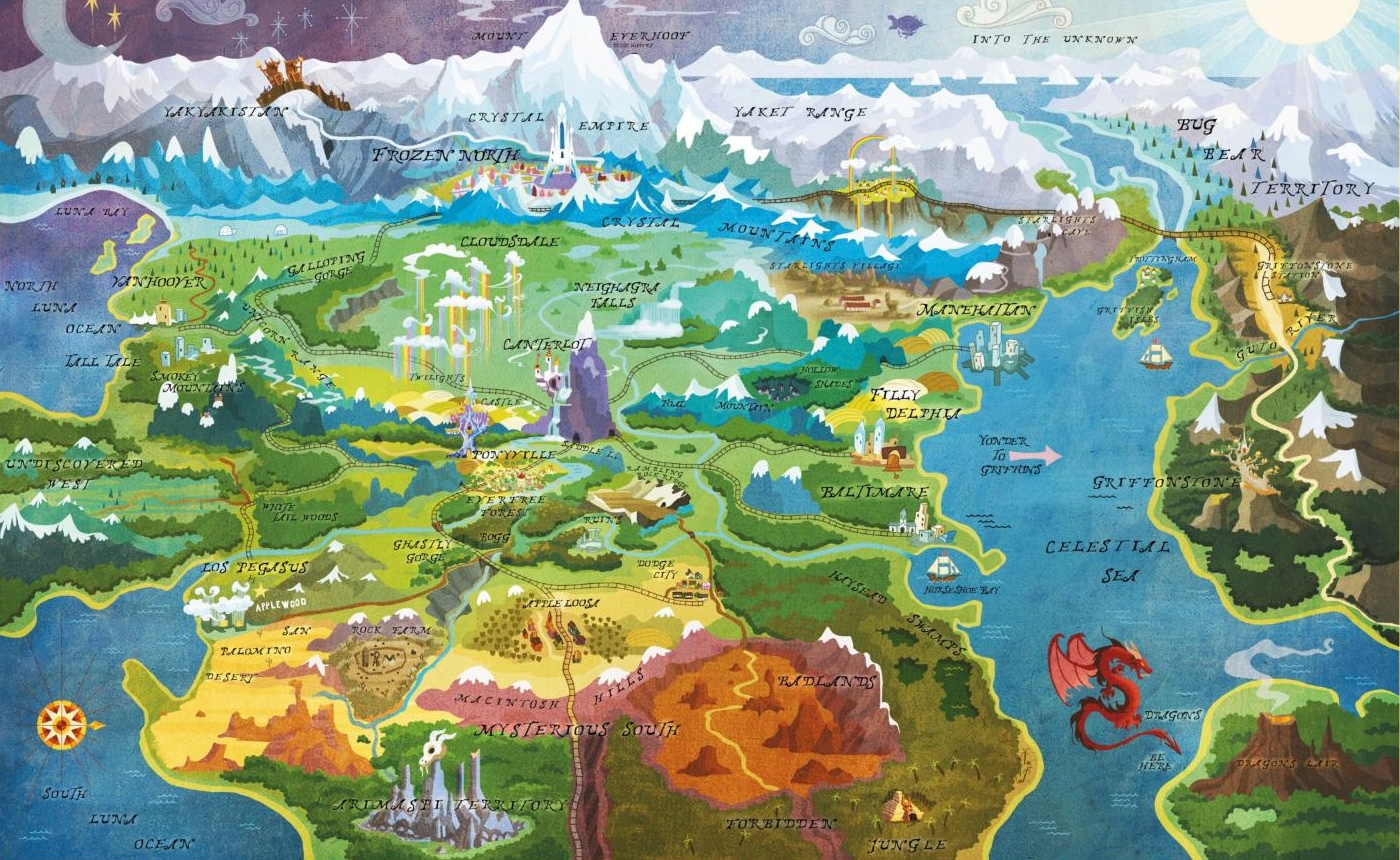
- Actually, the official map of Equestria has now been leaked, view it here.◊
- In both that map and "One Bad Apple", it is established that Ponyville is to the west of Manehattan. However, oddly, in "The Cutie Mark Chronicles", young Applejack sees the sun rising over Ponyville from Manehattan. Either the sun rises in the west in this universe, or Celestia was just messing with her.
- Ponyville and the city of Canterlot have been shown to be anywhere from a five minute walk to an overnight train ride apart, depending on the episode.
- Bikini Bottom from SpongeBob SquarePants is shown in most episodes as a typical small town (small towns are usually underwater, right?), but other episodes have shown that it contains a mall, a racetrack, and an Olympic stadium, among other things.
- When not setting the entire episode in a fanciful setting (such as space, the prehistoric age, or Wonderland), Mindy and Buttons of Animaniacs live close to whatever the episode's gags require: racetracks, airports, rainforest, cliffs, etc.
- The Candy Kingdom in the first episode of Adventure Time was contained entirely within its city walls, and had a population small enough to be protected by Finn and Jake and fit inside the castle's main hall. At the end of season five, there are subway trains with ads in multiple languages, a police force complete with helicopters and a jail, and has expanded outside the walls to the extent that the government collects taxes from Finn and Jake themselves, who live out in the plains.
- Gravity Falls starts out as a small town, but by Season 2 it's big enough to hold a music festival and have a full-sized shopping mall.