
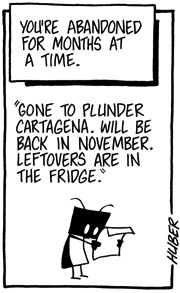
"No, you know what, Uncle Phil? I'll get through college without him, I'll get a great job without him, I'll marry me a beautiful honey and I'm having a whole bunch of kids. I'll be a better father than he ever was. And I sure as hell don't need him for that, 'cause THERE AIN'T A DAMN THING HE CAN TEACH ME ABOUT HOW TO LOVE MY KIDS!! [long pause] How come he don't want me, man?"
A stunningly large number of heroes and their coteries are lacking in the parent department, either through death or in that they just aren't talked about. Even if both parents are alive, they may well be emotionally or physically distant. Everyone is, for the sake of the plot, Conveniently an Orphan, whether they actually are or not.
This is a very convenient way for characters to be able to run off in the middle of the night to fight Evil, get sucked into another world, etc. without having anyone responsible for them making a fuss. In fact, one of the first things a creator of stories about children or teens having adventures needs to do is explain a lack of parental involvement.
It also allows for the Ordinary High School Student to be revealed as a super-powered demon fighter, or intergalactic being without the need for a messy Retcon answering the question an alert viewer would ask about why the parents didn't know about this. It's simply a case of the child following in their parent's Secret Legacy.
Of course, if you go back far enough, you'll reach a time when most young adults in Real Life actually were orphaned or abandoned. Adults died younger than than they do now, and people with chronic illnesses like schizophrenia or tuberculosis were often sent away from the family to recover or die. It was also easier to abandon a family, given the poor communications of the times and the lack of a police force. Because of all this, it's quite common for a fictional character from the 19th century or earlier to mention being orphaned with no more emotional reaction than a shrug, since the experience was considered a normal part of real life. A good example is Jane Austen's Emma, where the title character's mother died years earlier, but is barely mentioned.
Note that the parents in question don't actually have to die for this Trope to be in effect. Note also that in a few cases listed below, parents are hardly even mentioned — which makes things incredibly awkward.
If only one parent is missing or dead, then it's a case of Missing Mom or Disappeared Dad. When several siblings lack their original parents, the first born will receive a Promotion To Parent. Parental Abandonment is also a leading cause of Dark Magical Girls. One standard method for achieving it is to make your characters Blitz Evacuees.
In families with servants, this can lead to the Old Retainer acting as a Parental Substitute. If they were traveling abroad when both parents died, the child may be Raised by Natives. If the parents die in the wilds, their surviving child may be Raised by Wolves. It is also possible the parents left them out there to die, expecting them to be a meal, not a adoptee.
When the parents had to separate from the child in order to protect it, this results in Moses in the Bullrushes. When the parents had to leave the child in order to give it "a better life", then it leads to Give Him A Normal Life.
In animation, cases of parentis abscentia can be caused by budgeting; it's cheaper to animate one character (usually Dad) than to have two characters basically doing the same thing.
Parental Abandonment is a common feature of a Dark and Troubled Past (though children lucky enough to find a Parental Substitute generally avoid such a fate). It is a common feature of a Tear Jerker.
May entail Tell Me About My Father. Or rarely, mother. For reasons of economy, the child is seldom interested in both parents. See also Parental Neglect, Hands Off Parenting. Parental Abandonment en masse may create a Teenage Wasteland.
Popular in earlier Code Lyoko works and Epileptic Trees in some form or another due to the sheer number of unseen or unmentioned parents. Now that all of the parents (that are minor characters,anyway) have been proven to be alive and well ((except for Sissi's mother, who is never seen or mentioned) this has fallen into disuse.
Elizabeth Quatermain's mother died at her birth, and her Great White Hunter father didn't think he had the chops to raise a baby girl on his own, so she grew up in the care of her mother's spinster sister. She wasn't totally isolated from her father and older half-brother, but it was mostly limited to holidays.
In 'Nexus' Jack is understandably pissed when his mother tells him that his father left them for power.
Music
"Mother" by John Lennon, where he addresses the pain, sadness, and anger caused by losing both his parents. (His father left him as an infant, and his mother was killed by a drunk driver when he was 17.) He wrote two other songs about his mother: "Julia" and "My Mummy's Dead".
Tyler, the Creator from OFWGKTA made a whole album called Bastard about being a literal bastard because his father abandoned him.
Myths & Religion
This trope is very common in legends and stories dating back thousands of years.
Having the option to ditch offspring when conditions are too harsh to sustain them is one of the survival advantages of being a marsupial, rather than a placental, mammal. A starving mother kangaroo can leave a joey behind, save herself, and live to breed again when conditions improve.
Even today, some parents may willingly give up custody of their children if they cannot afford to raise them. Many countries have "safe haven laws" where a parent can leave a child (up to a certain age) at a hospital, clinic, police station, or firehouse and not be charged with child endangerment.
Tabletop Games
In general, many players will take on this trope also as a means to avoid the cliché plotline of having the villain kidnap the player's parents as hostages. For many other players, this is just an easy character development device to justify their character's attitude towards the world.
In The World Of Darkness, Vampire: the Masquerade and Mage core rulebooks specifically advise players not to play orphans or people who are estranged from their parents specifically because this trope is used so often and there are lucrative storytelling possibilities involved in having mortal/Muggle friends and family.
Of course, only in Mage is continued contact with muggle friends and family common or wise. Vampires and Werewolves are obvious, and [Changeling The Lost Changelings]] (humans kidnapped by Fae) are actually replaced by 'fetches' which mean that most families don't even know they were gone, making re-integration rather difficult. But given the mood of WoD, there is indeed a lot of plot potential in how a character deals with the family and relations that he is now fundamentally different from them. As so often is the case, Mages have it easy.
Present in Warhammer 40000: the Emperor's twenty clone sons were lost in a warp storm due to the Chaos gods and scattered across the galaxy to be raised by whoever-or whatever-found them. Wolves, on one occasion.
General Stanley from The Pirates of Penzance is in fact not an orphan. "More than that, he never was one."
Georg Büchner's play Woyzeck involves the titular Anti-Hero killing his girlfriend and their child being abandoned by the neighbours. There's also a scene of an old woman telling the following story to her grandchildren:
"Once there was a poor child with no father and no mother. Everything was dead and there wasn't a soul left on Earth. Everything was dead and the child went out and searched day and night. But since there was no one left on Earth he wanted to go up to Heaven, and indeed the Moon looked down kindly at him, but when he got up to the moon it was just a piece of rotten wood. So he set off for the Sun, and when he got there it was only a withered sunflower, and when he got to the stars they were only golden gnats that a shrike had stuck to the blackthorn bush, and when the child wanted to go back down to Earth, it was just an upside-down chamber pot and the child was all alone. Then he sat down and cried and he's still sitting there to this day, all alone."
Seymour Krelborn from Little Shop of Horrors was adopted by Mr. Mushnik, and he just makes the poor guy sweep the flower shop and sleep in the basement.
The musical Wicked. Elphaba's mother dies while giving birth to Elphaba's sister. Her dad loves her sister, but is cold and distant towards her because of her looks. He dies later as well. However, Dad is not her biological dad at all, which Dad may have known and may be part of the reason he didn't like her. Her biological dad is the Wizard. She doesn't find this out and he doesn't find out until after her presumed death.
The Baker from Into the Woods was abandoned by his father, the Mysterious Man, after his mother's death. He in turn almost abandons his child.
Brooklyn. The titular character's parents are split up before she's born when her father is called away to war; her mother commits suicide a few years later, and Brooklyn is raised in a convent. After she grows up, she travels from France, where she's lived her whole life, to America, in search of her father. Who doesn't want to be found, and gets really upset when she shows up.
In West Side Story, near the beginning it is revealed Riff lives with Tony and his parents for unknown reasons.
Visual Novels
All three of Fate/stay night's key human characters have parent issues. Shirou is an orphan, and the man who adopted him is also dead. Rin is living alone, her father having died in the previous Grail War; the man who's been her guardian since then is in fact the Big Bad, and her father's killer. Worst off by far is Sakura: her parents gave her to a foster family years ago, and she's been suffering horrific abuse at their hands ever since.
Inverted in the prequel, Fate/Zero — Kiritsugu (Shirou's adoptive father, and protagonist) left Illya, his daughter, knowing that he can't be reunited with her, which is the reason for her strange relationship with Shirou in Fate/stay night.
It's also applicable to Tsukihime. Shiki's biological parents are dead. His foster father died before the start of the story and is the plot catalyst. Only passing mention of the mother, it's assumed she died. Arihiko has no family left except his sister. Ciel's parents are dead because she killed them. Hisui and Kohaku don't even know their surnames let alone their parents. Most of the rest of the cast aren't people who actually would have families of any sort. An exception is made for Satsuki, who apparently has a healthy home life. Maybe that's why her route was removed?
The parents of Kotomi in CLANNAD don't seem to be very present in her life despite being famous scholars. We later find out why when it's revealed that they died in a plane crash. And they loved her. A lot. Until the very end. But Kotomi herself was so traumatised by their deaths that she convinced herself they were in permanent travels and dedicated herself only to her studies. There is also Tomoya, who is estranged from his father; given the fact that said father was responsible for injuring his arm in a drunken fit and thus preventing Tomoya from ever fulfilling his dream of becoming a basketball player, it is not surprising that it should be so. At one point Tomoya even leaves home to live with Nagisa and her family because of issues with his father; however, it is hinted that they are on their way to healthier relationship in the last episode of the anime, and in fact Tomoya's dad did try to raise him well at first but succumbed to depression at some point and became an alcoholic..
The trope is heavily subverted with Nagisa's parents, who shower her and each other with affection, but then again, they did not pay much attention to her when she was a child due to their work and because of that Nagisa nearly died; one could say that it is a rare case of the trope evolving into a normal family situation.
And of course Tomoya's relationship with Ushio. Not only does Tomoya end up mirroring the relationship with his own father, but by becoming a doting parent when Ushio is 5 years old, mirrors the relationship with Nagisa and her parents.
Web Animation
Broken Saints: Raimi's dad left he and his mother in his childhood. And that's just the tame one... Shandala's biological father abandoned her on a Fijian Island as part of a magnificent Xanatos Gambit/ Gambit Roulette to further his evil plans.
Bitey of Brackenwood was taken in by a family of Morrugs, after the event that wiped the other Dashkin out. When they have their own child however, they abandon him, helping further his future as a bitter Jerkass.
Web Comics
In Route 148 now elderly Frank tries to make sense of the situation in which he was taken in by the Reed family. Also his grandson Linton, one of the comic's main protagonists, is noticeably lacking in the parental department.
In El Goonish Shive, two main characters have divorced parents, one is technically an orphan and one hates her overbearing, borderline-oppressive Education Mama so much we might as well throw her in too. Two have had their fathers show up, though not on-screen (one in a one-sided phone conversation, the other from outside a room). Oh, and of the remaining main characters, one is an Opposite Sex Clone of the other, and was hence adopted by the same Open Minded Parents, who seem a quite a bit less concerned about the weirdness going on than they should be.
Antimony Carver from Gunnerkrigg Court: Her mother, Surma, dies just before the start of the story from an unspecified ailment that had hospitalized her since about the time of Annie's birth. And Annie's father, Anthony, is one of the most mysterious characters in the comic. Only seen in flashbacks and even then greatly obscured, he disappeared soon after his daughter started at the Court. He's easily the biggest speculation-bait in a series filled with Epileptic Trees, his current situation, personality and feelings towards his daughter as mysterious as when the comic started.
In Fans!, when it is learned that Alisin has an unknown blood disease which appears to be slowly killing her, the Worthingtons decide to give her whatever she wished for, including, when she rebelled against their over-protection, her freedom. While it seems that they continued to give her any money she asked for and poured vast sums of money into finding a cure, they otherwise had no part in her life afterwards. This is entirely in Alisin's Back Story; the only appearance which Senator Worthington makes at the time of the main story is on television, and Mrs. Worthington is seen only in flashbacks.
Five-year-old prodigy Gin in Jackie's Fridge is for all intents and purposes being raised by Melissa and Ada. Generally played for laughs, this takes a mildly tragic turn: when she gets injured on the playground and has to go to the hospital for stitches, her parents' only reaction is that Melissa interrupted their game of disc golf[1]. It's also then that Melissa learns that they had never given her any gifts — ever[2].
Gordito from The Adventures of Dr. McNinja was raised by his single father after his mother's death. After his father's death, he was raised by his paleontologist uncle. Now, he's the Robin to Dr. McNinja's Batman.
The title character of "Little Dee" has become lost or separated from her parents. The forest animals who stand in for her family make periodic (and increasingly more half-hearted) attempts to find them.
In the first "season" of The Wotch, the families of the characters are quite absent. The second starts bringing them into scenes, though.
Mostly subverted in Dominic Deegan. The title character's family is pretty solid; the only estranged child is Jacob, the oldest of the three, and that's because he used the youngest, Gregory, as part of a necromantic experiment which almost killed Greg and got him thrown out. Mr. and Mrs. Deegan are in their sixties and still very much in love with one another. The only borderline case is the Travoria family. They started out as a whole family, but Mr. Travoria was killed by Mrs. Travoria, Mrs. Travoria was killed by a royal knight she picked a fight with (as she tried to drive Luna to suicide), and the oldest sister, Amelia, was killed by a thief who tried to use his friend/partner as a pawn in a scheme to kill her husband and claim his vast riches.
In The Order of the Stick, Roy's father died of old age a few years before the story starts, and it seems that his mother must have died at some point since he meets her in the afterlife. Haley's father is a famous thief who is currently imprisoned in a faraway country, and her mother died when Haley was very young. Elan's mother was a Chaotic Good barmaid who divorced from her husband, a Lawful Evil Overlord, over alignment difference, and she raised Elan while he raised his twin brother Nale. Durkon's parents are unknown, although he seems to have had an uncle who he visited periodically; however, Durkon was banished from the dwarven lands and hasn't seen his uncle since. Vaarsuvius' parents are unknown, and when V hit puberty, V was adopted by a wizard who taught V magic, and then threw V out some time later to see the world. Belkar's parents are unknown, though there IS an aunt mentioned who may be as evil as Belkar.
Recloak's entire family but for one of his younger siblings were killed in front of him. As for Xykon, well, he is a Self-Made Orphan.
Elan's father has been recently introduced; on meeting his father for the first time, Elan comments: "Growing up without a father was totally worth it just for that reveal. "
Megatokyo's Miho has no known relatives, and — in fact — lives in the back room of a dance club. Theories as to why this is range from: they died from whatever mysterious disease she currently suffers from to she ate them. Fred Gallagher has been less then helpful.
Most of the main characters in Errant Story suffer from Parental Abandonment. Jon and Sara's father was killed by assassins before their mother died of an illness, Meji's Elven father had a fling with her mother on a diplomatic visit and later tried to have her killed upon learning he had fathered a Half-Elf, and Ian's mother was apathetic and neglectful towards her children until she killed herself and Evelyn in a fire.
Another The Wotch-related example is Alex King from Cheer!. Her wealthy parents are still alive, they just don't seem to care. Early on it's revealed that she even receives her allowance by direct deposit, and a Christmas comic depicting the cheerleaders with their families shows her strumming her guitar by herself.
In No Rest for the Wicked, Clare bleakly speaks of how her parents treated her — and how she now knows she is no better. (She no longer has her baby with her.)
Also, in the same episode, one parent deliberately abandoned his children in the woods, and others appear to have at least neglected to protect their children from the Wicked Witch.
The web comic Cwen's Quest starts off with the main character's father throwing them off a cliff so they won't eventually fight with their new sibling. The main character's mother is never mentioned in the series.
Something Positive manages to mostly avert this except in the case of Jason's dad. The exact story of what happened is never explained but apparently at some point he ran off and left Mrs. Pratchett to care for Jason and his sister alone.
The Noob parodies this role-playing cliche, when every role-player in the guild has the same tragic past, of having their family raped and murdered by the evil hordes. Cue a cutaway to said evil hordes, who are holding a list of other farms they still have to do today. One of them is so exhausted, he asks if they can at least skip the raping.
Guttersnipe is a comic about an orphan girl that basically parodies "Little Rascal" style films.
Inverted somewhat in Misfile. Before the misfile, though he lived with his father, Ash didn't have much of a relationship with him, and had no contact at all with his mother. After the misfile, Ash is shocked to find her father now dotes on his daughter, and that she had reestablished a relationship with her mother.
Flik's mother in Para-Ten seems to make a habit of this.
Captain Broadband has an unnamed sidekick whose parents seem to have no trouble leaving him home alone for long periods of time to go on holiday. They pay a rather unnecessary price when they get home to find an eight foot, three hundred pound man having moved himself in without permission.
Alexander Hamilton in The Dreamer. His dad left his family when he was ten or eight years old, and two years later his mom died of yellow fever.
Oddly rare to be played straight in Jack, which deals mainly on death and the afterlife. When present, it's often played with.
The main character Jack never had parents due to having been created in a scientific experiment; same goes for his love interest Jill.
Little Megan in a late 2010 arc is stopped in time, thus inable to grow any older, yet lived with her parents until a family friend in the same situation took her away to protect her.
Zigzagged with Fnar, an innocent unborn, who has two dead parents - who both reside in Hell like he does. He is mainly kept away from them, since Mama's stuck in a dangerous place, and Papa is just dagerous. Later on the trope gets twisted further in the same direction as Fnar is given another chance at life.
In The Inexplicable Adventures of Bob!, Galatea grew up in a completely unloving environment, the closest thing she had to a father being a scientist who treated her as a lab animal. When she later spawned another creature like herself, she ended up abandoning her. When they are reunited, Galatea shows deep remorse at having been just as rotten a parent as as her "father."
In Virtual Pet Planet, Benny, the rabbit, is asked about his owner, but avoids the subject entirely.
In Endstone, after Jon tricks their daughter into helping him, Kyri rescues her and hands her off to her friends so that she can go fight Jon. When they are trapped in time, the daughter grows up without either of them.
All of the Baker Street Irregulars in Mayonaka Densha seem to be missing at least one parent. Tom's mother gave him up at a very young age, Hatsune's dad disappeared when she was five without so much as a goodbye, leaving her alone with a very cold and emotionless mother, and the whereabouts of Jack and Morris's parents are completely unknown.
Jessica Queen's father is also absent, explainable though as her mother is a three time divorcee.
Im A Marvel And Im ADC lampshades the frequency of this with comic book characters in its Father's Day special. While recording Father's Day messages, Spider-Man asks if any of the superheroes gathered have parents who are actually alive and gets met with nothing but blank stares.
In Captain Gamer: Digital Defender, main character Kate Gaines has only had her father mentioned — and that, only as an offhand notice in one paragraph of Back Story!
More than half the protagonists in lonelygirl15 have parents who are either dead, missing, members of an evil cult, uncaring, or some combination of the above.
Trevor James Goodkind (who becomes Phase) starts off in the Whateley Universe as a spoiled rich kid, heir to billions, and second in line to take over all of Goodkind International. But the Goodkinds hate and fear mutants (and his mother is clinically mutophobic). When he manifests as a mutant, he is kicked out of the family, disinherited, and then experimented on by a Mad Scientist in a Goodkind Research lab, some of which activities his parents witness. This may be worse than having your parents die.
There are other examples at the Super Hero School Whateley Academy. Generator has a deceased mother and a child-abuser criminal father. Carmilla's mother is dead and her father is a demon who can't visit this plane of existence under normal conditions. Bladedancer's parents are both dead, her father having been killed by the demon who is pursuing her to this day. There's also Heyoka, Timeless...
Used excessively and in a variety of ways in Avatar The Last Airbender: Aang, like all Airbender children, was raised communally by monks. However his father-like mentor, his unknown parents and the rest of his nation were entirely wiped out while Aang was frozen in an iceberg. Hence the subtitle of the show. Katara and Sokka's mother was killed when they were young and as of the beginning of the show their father has left to fight in the war. They live with their grandmother who rather blithely sends them off to travel the world with Aang (though it is later revealed that she ran away from home herself, which perhaps explains her attitude). Toph deliberately runs away from her overprotective parents. This trope even applies to Appa.
The villains have it no better. Zuko and Azula's mother Princess Ursa is absent (to say the least) and their father, definitely notthe overprotective type, seems to have no problem with sending the kid he actually likes halfway across the known world to hunt his enemies. Zuko of course was banished on a Snipe Hunt (after being publicly disfigured and humiliated) for speaking out of turn when he was no older than fourteen. Mai's parents are seen briefly but seemingly have no interest or no say in her actions (possibly due to Azula's influence, though in "The Beach" Mai says that her mom repressed her a lot to not ruin Dad's high-profile political career) and Ty Lee's apparently did not notice when she ran away to join the circus, due to the six identical daughters.
Even the minor and one-shot characters suffer from this in spades — nearly every young person encountered by the main characters during their travels has lost at least one parent thanks to the ongoing war and its subsidiary disasters.
In Beavis and Butthead, their parents are sometimes mentioned but never seen, and they seem to take no real interest in the sometimes outrageous lives of their children. (In fact, the only who's ever mentioned with any regularity is Beavis' mother, who is said to be a slut; we find out in the film Beavis and Butt-Head Do America that the boys are the bastard sons of two heavy-metal roadies, and possibly half-brothers (Mike Judge refers to the two as their "dads", however).
Could be the dads are brothers, or half-brothers, making the guys cousins.
In Birdman, in the debut episode of Birdboy, Birdman's on-and-off sidekick, the lad is found separated from his father after an encounter with a supervillain. Birdman promises to help him find his father, but nothing ever comes of it. (His mother is never mentioned.)
Captain Planet and the Planeteers: Free room and board on Hope Island is part of the Benefits Package of being a Planeteer, so even the few parents who are still alive are mostly out of the picture.
Gadget from Chip N Dale Rescue Rangers lost her father a year before the team was formed. Due to lack of information, many fan theories exist about what actually happened. Her mother is never mentioned.
Parents in Dragon Booster are suspiciously absent, considering that their offspring are competing in dangerous sports with giant reptiles. Parm has a mother, mentioned once and never again, and Kitt has apparently left home or is an orphan (nothing is ever said about her parents). Only Artha (the protagonist) and Moordryd (his rival) have onscreen parents: Moordryd's dad is the Big Bad, while his mother, Zulay, is implied to be dead (the ambiguity of the line spawned numerous fanfics), while Artha has quite possibly the worst case of Parental Abandonment ever: his mother is never mentioned, while his dad, Connor, disappears in the first episode and is presumably dead... right up until the second season finale, when it is revealed that Mortis, who's been helping the heroes the whole time, is Connor in disguise. The reason for abandoning his children and letting them believe he was dead? They wouldn't have become independent.
In Ed, Edd 'n' Eddy, we never see anyone at all in the show except for the children that live in the neighborhood. Sometimes parents and older siblings are alluded to, but they are never actually shown.
In The Oblongs episode, "Milo, Interrupted", it is revealed that Helga's parents left on vacation a year earlier and never came back... until the end of the episode, where it is revealed that they survived by eating the other passengers on the plane they took after it crashed.
Gargoyles: Tom, along with Princess Katherine, The Magus, Tom's mother, Mary, & Finella, fled from the castle of King Kenneth II when he was slain by Constantine, who later usurped his throne. After using the Grimorum to find a way into Avalon, The Magus is forced to give up the magical book because it can't be taken into Avalon. To keep it away from Constantine, so he won't be able to find them, Finella volunteers to protect the book and basically go into hiding from the King of Scotland. Mary volunteers to go with, pretty much deciding that protecting this magic book is more important than raising her only child, who at this point in the story wasn't even ten years old.
Dib and Gaz of Invader Zim have a father that is more concerned with his latest invention and his television show than whatever his children are doing, and a mother who is never mentioned (naturally, Epileptic Trees abound). Zim himself is a borderline example, as while technically he has no parents (Irkens are grown, not bred), his entire motivation is pleasing the parental figures of the entire species, the Tallest, who hate him and exile him to the far end of the known universe.
Jade from Jackie Chan Adventures is left by her parents in the first episode, and although they are alive, they are only referred to twice during the rest of the series. Jackie as well, it is implied, was sent to America to train with Uncle when he was a kid. His parents are never mentioned.
Paco's parents are never mentioned and it's possible they don't exist at all. El Toro, who is probably not his father serves as a father-like figure to the boy.
Subversion: The teen hero team The Ultimen in Justice League Unlimited is initially presented with a variety of Parental Abandonment issues; by the end of their first appearance, it's revealed that this is actually because they are clones with Fake Memories implanted.
In Storm Hawks, the entire main cast is made up of 14-year-olds, and the show is one of the awkward cases in which nobody even mentions their parents. The closest we ever get is an aunt. And considering how many times they brush death, it's amazing they're allowed out of the house at all. (In fact, the only brothers we see freely admit to hatching out of eggs, leading to much speculation about how exactly the cast are born.)
In "Origins", Aerrow mentions that his, Finn's, and Piper's families and home terras were destroyed by Cyclonians. Stork mentioned an attack on his own terra, but nothing about his parents; Junko is similarly vague.
It is also heavily implied that Lightning Strike, the last leader of the original Storm Hawks, was Aerrow's father. Sure, Aerrow's only ever referred to as a "descendant", but considering Lightning Strike died in his twenties or thirties 10 years before the start of the series and Aerrow is 14...
In the cartoon Super Robot Monkey Team Hyperforce Go!, Chiro's parents have never even really been mentioned. If he had different caregivers than his parents, they aren't mentioned either. The kid just walks into a Super Robot, befriends some robot monkeys, and no parent/guardian seems to even care where he is. (Aside from the fan theory that Skeleton King may be Chiro's father.)
In the animated Teen Titans, the Titans are conspicuously independent, lacking even mentorsuperheroes (* cough* Batman * cough* ). However, many of their parents are actually accounted for: Robin's origin, although it is never covered in any detail, is hinted at in one episode and would dictate that his parents are dead. It also comes up a couple times in season four: Raven's mother appears briefly in one episode, and her father is a demonic overlord named Trigon (also evidently dead by the end of the season). It is also implied that Cyborg's parents and Beast Boy's parents have passed on, as well.
There's no excuse for Starfire though. In one episode they go back to her home planet, and are greeted by her "nanny". The rest of the episode involves Starfire's evil sister Blackfire usurping the throne and trying to marry Starfire off to stop a war. The fate of the original king and queen? Never mentioned.
The Scooby-Doo gang members either have no parents or just very hands-off parents who don't seem to care that their teenagers go all around the world, hunting down villains in Halloween costumes.
Supremely subverted in the 'Mystery Inc.' series.
X-Men Evolution is worthy of mention for its almost complete aversion of this trope. Despite living away from home, all the teens except Scott and Rogue have a loving family or foster-family to go home to in the obligatory Christmas episode. Kurt suffers from combined Parental Betrayal, but still notes that his foster parents are great to him. The Brotherhood, on the other hand, have not fared as well — their parents are all absent for no apparent reason, Jerkasses, or the Big Bad (Quicksilver does seem to be treated pretty well, though, all things considered).
The titular bunnies from Yin Yang Yo have Master Yo the panda as their sensei and father figure, but so far their parents have not been mentioned... though some of their friends (and enemies) have parents ("CAAAAAAARL!").
It Was Later Revealed That Master Yo IS Yin and Yang's Father.
Inspector Gadget's niece Penny. He seems to be her only relative, although the backstory is pretty non-existent for her.
Implied in Ni Hao, Kai-Lan; Kai-lan's parents are never mentioned or addressed, even when other family members are featured.
The Boondocks: Huey and Riley's parents are never seen or mentioned, and it is not known how they came to live with Granddad. It's pretty heavily implied that they're dead.
Partially a case of All There in the Manual, or at least in the Comics. Their parents are dead, and in the first episode Granddad mentions spending their inheritance on that house (explaining in part why they were able to move to suburbia, hence, the boondocks).
Lance from Sym-Bionic Titan. His father supposedly died when he was very young, and he presumably had a Missing Mom, because custody was more or less given to the king and Modula, who sent him off to a military boarding school.
As a side-note, some fans have noted that throughout the whole first two seasons, Vanessa seems to be the only child/teen character with two biological parents; everyone else seems to have a mom but no dad (or in Django's case, a dad but no mom). This recently changed when we finally saw Jeremy's father.
Doofenshmirz's parents couldn't even be bothered turning up for his birth.