

It is tough being a kid in Fiction Land. Bad enough when you're an only child, but if you're among a pack of siblings, this particular trope is nearly guaranteed to raise its head at some point in order to make life even more difficult.
Parental Favoritism is just what it sounds like — one child is given preference over their siblings. In order to qualify, this has to be consistent. One child being asked to do the other's chores because their sibling is sick is not favoritism, although that won't stop the kid lumbered with the extra work from grumbling. But one child having to do all the chores on a daily basis, while their sibling sits and plays video games, is definitely favoritism.
It may show itself in a variety of ways. If there is an argument or fight, the parent(s) (or parent(s) of parent(s)) will always take the side of one particular sibling, and the other(s) will be the ones being scolded/punished. The parents may brag about one child in particular and be admonishing or dismissive of the others for their faults, regardless of the achievements of the brothers and sisters. A regular line that may be entailed with this is a variant of, "Honestly, (insert name), why can't you be more like (insert favorite's name)?" There may always be one particular kid who gets out of doing their chores, even if the other kids get pulled up for forgetting to tidy their room.
Sometimes, there may be more than one "favorite", or the mother and father will have different "favorites", making life even more of a headache for their siblings.
There are a few different versions of the trope and a few different "explanations" as to why one child is preferred over the other. These divisions can be by:
- Birth Order:
- The oldest child is favored because they are the firstborn/family heir. Tends to apply more to sons than daughters, since old inheritance laws favor boys over girls. This is found more often in fantasy or historical literature, where these laws have a real impact on how the family is run. Sometimes, the oldest child may have a huge set of standards thrown on them, but other times, an overachiever will set other standards for the younger ones.
- The youngest child is favored because they are the "baby" of the family, and the parents will protect them from being bullied by their older siblings even when they are big enough to defend themselves and/or started the trouble in the first place. This is popular in more modern literature, especially in teen novels and children's TV.
- Middle children can often get a rough deal; very rarely are they the family favorite, unless they do something really outstanding to explain it. Middle Child Syndrome, as it's known, is a real-life phenomenon that some psychologists are studying today.
- Occasionally, the parent(s) will favor a child who shares their own place in the birth order over the other children, due to their own childhood experiences with their siblings. For example, a parent who was the middle child themselves might sympathize with that one, at the risk of leaving one of the others out in the cold.
- When the parents split favoritism, it will usually be the father favoring the firstborn and the mother favoring the baby.
- Gender:
- Preference by gender often relies on the boys:girls ratio within the family. If there are several of one sex and only one of the other, the sibling with a different gender from the others will be "the favorite". This can backfire though — they may instead be the "ugly duckling" of the family if the parents prefer one gender over the other, a preference that often hinges on the culture the story is set in (i.e, the solitary sister who's expected to clean up after, and cook for, her brothers).
- If there is one son and several daughters, the son will acquire the title of "heir to the family". His parents may believe him to be "more important" than his sisters, and they might be expected to obey him or take care of him. If the father is not in the picture, he'll be the "man" of the house.
- If there is one daughter and several sons, she will be the "baby girl" of the family regardless of birth order (possible exception if she is the oldest sibling, in which case she'll be the de facto babysitter). Strangely, brothers are seldom shown as resenting their sister — in fact, they'll defend her honor more ferociously than their parents will. Any potential boyfriends are in for a hard time.
- Sometimes, parents have a preference for their child's gender to match their own because they feel like they'll "connect" with them better. Their expectations often rely on prejudices and expectations rather than what the child actually is or wants to be but sometimes it ends up working if the child matches the parent's expectations or pretends to do so. A similar case are parents who get disappointed when the baby's sex turns out to be the opposite of what they expected and mentally prepared for and never get over it, such as a father who wanted a son but is "stuck" with a daughter or only daughters.
- Personality:
- Sometimes, one child is funnier, more gregarious, or more talented than the others, making them "the favorite" almost automatically. In some cases (such as Megan Parker on Drake & Josh), this sibling will be sweetness and light to everyone else, but the Devil in Plain Sight to their brothers and sisters. Although in other cases, the other child could have a negative personality, so the fault could partly fall on them. A child may have different interests than a parent, such as a child of a jock parent who is uninterested in sports. Alternatively, somebody (one of the parents) may die. In this case, one child will be favored because of their resemblance to a particular person. Particularly narcissistic parents, however, tend to favor the child that most looks/acts like themself (although that can happen in a more benign way, with a parent simply having more in common with a child who's also athletic, musical, artistic, etc.).
- Looks:
- Some parents take Beauty Equals Goodness seriously and favor the more conventionally attractive child simply for their looks, sometimes the parent will favor the child that physically resembles them and look down on the one that looks like their spouse.
- Disability:
- If one of the children has a learning disability or neurological condition (like autism or ADHD), favoritism can go in either direction. The disabled child will be either completely ignored, left in the care of therapists, and/or institutionalised while the "normal" child will get their parents' undivided attention (as the disabled child is a "lost cause" while the "normal" child "still has hope"). Or the "normal" child will be completely ignored while the disabled child is waited on hand and foot because the parents feel the child needs their help more. This can also apply to physical disabilities and/or health conditions.
- Sexual Orientation and/or Gender Identity:
- If parents find out one of their children is LGBT, expect the burden of continuing the family line to go to their straight siblings, and thus, for the queer child to be written off as "a waste" for being less likely to reproduce. Grandkids aside, the queer child will often be seen as the Black Sheep of the family, especially if they're very open about it.
- This can also go the other way in more progressive stories. If the kids are all one gender, the queer one might have a special bond with the opposite-gender parent. A mom with several boys might see her Camp Gay son as the "daughter" she never had, doing all sorts of girly things with him while his brothers are out playing football.
- Biological vs. Adoption:
- It hardly needs mentioning that dozens of fairy tales (notably Cinderella) involve stepchildren mistreated by their parents in favor of their biological children. This is a Discredited Trope today; more commonly, you have an adopted child who suffers some perceived slight from their stepparent and must be reassured that they are loved just as much as the parent's natural children.
- This is also commonly inverted — the adopted child will be well behaved, the biological child will be spoiled and jealous, and when the inheritance or the call to adventure is passed down to the adopted child instead of the "true" inheritor, expect the biological child to start a Cain and Abel situation rapidly. Often the two can mix, with the biological child still being favored by the parents but the adopted child being given the call to adventure from outside the family. Harry Potter is a good example of this.
- Inherited Ability:
- If the parent has a specific talent, skill, career path, or what have you, any kid who shows promise in that field will instantly be doted upon by that parent for following in their footsteps. Say, if the dad is a police officer, he might share a bond with a daughter who also wants to be a cop.
- In fantasy/sci-fi stories, this can also involve superpowers if they're passed down genetically. If one child inherited mom's psychic abilities while the other kids are muggles, she'll spend a considerable amount of time with that one to teach them how to use their powers...at the cost of neglecting her other children.
Any of these criteria can backfire. For example, one child might be the favorite because they look and act just like their saintly, deceased mother. Another might be just the opposite — The Un-Favourite — because of their resemblance to the mother that walked out on the father — or even because they remind the father of the saintly mother. If the saintly mother died in childbirth, then the poor kid who was birthed this way usually has a hell of a lot of resentment to get over, no matter what the physical similarities, often due to the father, consciously or unconsciously, blaming them for the mother's death.
Occasionally, parents have a child that naturally requires more care and attention than the others, because they're very young, disabled, or psychologically damaged. This will still seem unfair to the other kids who get less of their parents' time, but it's a necessity rather than favoritism... usually. This is a favorite plot for children's books and television, where the lead character is jealous of a new baby sister or brother only to be reassured that "we love you just as much". On the other hand, if the favorite is Too Good for This Sinful Earth, the parents may never learn to appreciate their living children.
Sometimes, the parents are reasonably handing out the privileges and responsibilities with age. When the older child looks only at the responsibilities and the younger at the privileges, both can come to the view that they are The Un-Favourite. Or they may responsibly differentiate, but the musically untalented child may resent the lessons as favoritism, and the talented one, the other's free time as favoritism; or the child who must do all the chores resents the sickly child's confinement to his bedroom and inability to play. Cue Sibling Rivalry.
Of course, it is common that the parents are not aware of their favoritism and may be appalled at themselves upon realizing it. Very few parents would actually pursue favoritism with the knowledge of the other children's hurt feelings.
In fact, the obligatory "talk with the parents" is normally part of a Parental Favoritism plot...but that does not guarantee it will solve anything. If the writer is trying to Hand Wave the glaring bias of the parents, there will be a scene where mum and dad will give a long speech on how they value all their kids equally and will tell The Un-Favourite child that making them live in the basement and forcing them to bow whenever their sibling enters a room is really a mark of their esteem. The words "you're the responsible one" will be mentioned in some form. A more realistic version is where the big talk is honest, and the parent doesn't bother trying to justify their actions but do realise they were wrong and attempt to make amends. This is regularly done to "humanise" the hitherto parents — but it's too late. By the time of the talk, most of the audience will already be set against the parents, and it'll take a hell of a lot of good writing to redeem them. If the parents have clearly realized their foolishness and have shown to be really sorry, then this may take a lot of weight off them.
Parental Favoritism can have a huge impact on characters even when they become adults. The Favorite will either be spoiled and throw a tantrum if they don't get their own way, feel that they were a sort of "experimental" child and develop insecurities, or be a Nervous Wreck who permanently fears that they won't meet their parents' expectations; kids at the bottom of the pecking order will usually be bitter and cynical about relationships and family life (and often blame the favorite children alongside the parents), or have serious self-esteem issues, leading to self-deprecation or clinginess as ways to compensate.
This is all too often Truth in Television. The friendship version of this trope is Friendship Favoritism. Compare Grandparent Favoritism, which refers to when grandparents prefer their grandchildren in general over their own children (their grandchildren's parents); if they specifically favor one grandchild over their other grandchildren, that still falls under this trope, but the two are not mutually exclusive.
Examples:
- Implied in an ad for Invisalign Teen. Twin teenagers both need braces; however, their parents get Invisalign for one daughter and regular braces for the other. The Un-Favourite spends the commercial complaining about all the limitations of her headgear, while the favored daughter gloats and rubs her face in how she doesn't have to deal with all those issues. Someone then takes a picture of the twins and makes a smart remark about finally being able to tell them apart.
- The 2011 Mackenzie Foy - AT&T commercial television commercial. In this commercial, the son and daughter are sitting in front of a TV and only one more show can be recorded. They decide which child is going to get it, and they pick why they choose, the father then asks to say which child they favor the most, and both pick the daughter, of course, neither child actually cares, but then the father says to give it to the son instead, because that is all he going to get.
- Another commercial for Guinness uses the same premise; two parents tell their adult son he's their least favorite child, to the point that he's not only under his siblings but also the dog and their fine china. But they buy him a case of Guinness to make up for it.
- One pizza chain had an ad where the children ask their father about his preference for dinner, and he protests that trying to choose would be like trying to decide which of them was his favorite child. They persist, wanting to know what he wants for dinner, and he finally relents and declares, "Bobby."
- In Blue Reflection Ray, Miyako Shirakaba is largely overlooked in favor of her older brother, whom is quite accomplished having several awards that line the shelves of her family's entryhall. The only thing of her's that was displayed was a family photo in a picture frame that she custom bedazzled. When her mother throws away th frame, it causes her emotions to start going rampant, leaving her open to attack by Uta and Niina.
- Downplayed in Bokurano, as Jun and Kana Ushiro's father unintentionally favors the latter, his biological daughter, over the former, his adoptive son. He does love both his children, but he stays relatively distant from Jun, afraid that if he tries to get close and Jun rejects him, their relationship will never be the same. Mr. Ushiro is portrayed somewhat sympathetically for this trope, though, because he doesn't realize he's doing this until it's too late- namely, when he realizes that he took the news that Kana would have to pilot(which would end with her death even if she won), much worse than the news of the same thing happening with Jun, being devastated by the news and horrified by his own reaction. When Jun apologizes for being such "a bad son" all this time in his final conversation with his father, Mr. Ushiro replies that he's sorry for being a bad father.
- Claudine: Auguste favored his youngest son among his three children because Claude was the one most similar to himself. Claude is said to be pretty much the "second coming" of Auguste.
- Code Geass: Lelouch perceives himself and Nunnally as The Unfavourites to their father, The Emperor Charles zi Brittania, because their mother was a commoner. In reality, they're actually his favorite children because Marianne was the only woman he ever truly loved. He sent the kids to Japan to protect them from Marianne's "killer", their uncle V.V., and intended to have them be a part of the Assimilation Plot he, Marianne, and C.C. had devised. When Lelouch finds out about all this, he lets them have it.
- This befalls Azuma Yunoki in La Corda d'Oro. He is forced to give up playing piano by his grandmother because he's better at it than his two older brothers; as he says, "My place is always below my brothers." Most a result of Japanese cultural values, and seems wildly unfair to Western readers. Azuma develops a bit of a psychological problem as a result (which means it's supposed to seem unfair to the original audience, as well).
- In Crayon Shin-chan, 5-year-old Shinnosuke's brother is The Un-Favourite and he knows it.
- The emperor and empress of the Misurugi Empire really set their eyes on their middle daughter, the titular character of Cross Ange. Which bites them in the ass in the very first episode.
- Death Note: A minor example, but still there. Light's father Soichiro doesn't completely dismiss the possibility that Light could be Kira (which he is, but Soichiro goes to his grave without ever finding this out), but is adamantly certain that Light's little sister Sayu couldn't possibly be the killer.
- Why Ken partially resented his older brother in Digimon Adventure 02. Not only was he the younger sibling, and thus overlooked for the firstborn, Osamu was also a child prodigy and a media darling. This ensured that Ken never got the kind of attention he desperately wanted from his parents. It didn't help matters much when Osamu died in an accident, and his parents were too caught up in their grief to notice Ken even after that. After he's manipulated into more or less selling his soul in the Digital World, he gains the prodigy aspect his brother had, and his parents apparently begin to love him... but only as a shadow of what they once had with Osamu. It took him vanishing into the Digital World with the intent to stay there permanently, then returning in the midst of a complete mental breakdown, for them to finally begin loving him as Ken.
- Dragon Ball:
- In all media where Frieza's elder brother Cooler appears, it's made clear that King Cold favors Frieza over him. Cold never once mentions Cooler, even in passing, and in Cooler's Revenge, Cooler bitterly reflects that Frieza was a "little brat" and that Cold always spoiled him rotten.
- It's heavily implied that Bardock and Gine, Goku's parents, favored Goku over his older brother Raditz. In his debut special, Bardock never once thinks of Raditz, even in his dying moments, and in Minus and Broly, when they realize Frieza's plan to wipe out the Saiyans, their sole concern is ensuring Goku's escape and survival. The closest they show to any concern or regard for Raditz is Bardock asking where Raditz is when he arrived back on Vegeta on Frieza's orders, telling Goku that he'd also tell Raditz not to look at the moon, and lamenting that Raditz has to put up with "The Prince". Word of God reveals Gine at least was proud of Raditz being assigned to invade planets alongside Vegeta. Dragon Ball Xenoverse 2 sadly confirms Bardock’s preference to Goku over Raditz as upon reuniting in a special event, Bardock is very cold towards his eldest son even telling him to shut up and Raditz being upset that his father didn’t even let him know that he was alive. Although Bardock does say he respects Raditz’s stubbornness.
- Part of the backstory of Big Bad King of Gallia in The Familiar of Zero; his elder brother was the favorite for being better at everything. Then, in the old King's last moments, he named the younger his successor, due to the old king's insanity. Ecstatic, even knowing the true reason he was chosen, he went to rub it in his older brother's face. Unfortunately, the elder was honestly happy for his younger brother's success. This drove Joseph mad, and he ended up killing his older brother. So begins the tale of the mad king.
- Fruits Basket:
- Played with in regards to Yuki and Ayame's mother. She openly favors Yuki over Ayame, but that's only because as the Rat of the Zodiac, Yuki is the closest to God and worth a lot of money and prestige whereas Ayame, the Snake, is much lower on the scale; she cares nothing for Yuki as a person and openly admits she only sees him as a Meal Ticket she can use to boost her wealth and social status. A rare case where being The Unfavorite works in one's favor, as Ayame can enjoy far more freedom than Yuki.
- Even though Momiji's father had promised to love him even more to compensate for his mother forgetting him, he apparently changed his mind after Momiji's little sister Momo was born and seems to ignore Momiji in favor of his wife and daughter. Momo even got into the violin lessons she wanted at the cost of Momiji being forced to quit by their father, even though Momo wants to learn violin to play with Momiji.
- Machi was constantly pressured to be perfect by her mother, who largely viewed her as a Trophy Child who could inherit her husband's fortune... only to cast Machi out of the house once her younger son was born. Mrs. Kuragi openly tells a friend that Machi is "dull" and that she prefers her new baby boy because a male heir has better chances at getting the fortune.
- Very messed-up example with the Homunculi of Fullmetal Alchemist, where Pride has that name in part, being the oldest, and the one whose personality represents Father in his purest form. Continuing the metaphor, the Anti-Villain Greed has a sort of "Well Done, Son" Guy relationship to Father and turned Defector from Decadence because he couldn't stand being second to anyone (being the least evil of the bunch also helped).
- In Fullmetal Alchemist (2003), this is the reason for Envy's hatred of the Elric brothers; he is the homunculus created by their father in an attempt to revive his firstborn son, and he was cast aside when he came back as a "monster".
- In the manga, a side story reveals that this existed between the Elric brothers themselves when they were quite small, as Edward was very jealous of his mother Trisha's love for the baby Alphonse. A neatly-delivered lesson from father Hohenheim changed his mind, however, and by the time of the main story they are absolutely devoted to one another.
- Inverted in Gakuen Babysitters where it is the toddlers who prefer one parent over the other. Kirin prefers her mother as her father is often away on business trips (she calls him Papa-san, something she does not do with her mother). Kazuma and Takuma prefer their mother as they tend to get scared of their father's acting roles on television as they cannot tell the difference between reality and fiction. Taka exclusively interacts with his mother and doesn't even know he has a father (who left shortly after Taka was born).
- In Girls und Panzer, Shiho Nishizumi favors Maho, her elder daughter and heir, over Miho, her younger daughter and the main character. A good example of this is when, in Little Army, she arrives after Miho and Maho's training battle and offhandedly says, "So Miho's here as well," before congratulating Maho on her tournament victory. Shiho disapproves of Miho so much that after hearing of her going to the semifinals against Pravda, she considers disowning her. However, once Miho defeats Maho in the finals, Shiho sighs, then smiles and starts clapping, which could indicate that her attitude is shifting.
- Shui Long from Haou Airen is the most talented member of a very famous family of doctors, but his father passed him up in the family hierarchy despite his talent. He ended up allied with The Triads and the Tongs and as one of Hakuron's True Companions.
- Hello Sandybelle: Honor hates Sandybelle because she never wanted to take care of someone else's child, but her husband made a promise to his best friend Leslie (Sandybelle's father). She favours her daughter Eva, and both team up to torment Sandybell knowing she has no one, being an orphan.
- Played with in Hetalia: Axis Powers:
- At first, it looks like Grandpa Rome likes only his youngest grandson Veneziano and completely neglects older grandson Romano due to Veneziano having more talent than his brother, but it later turns out that he does visit Romano from the afterlife too. In fact, a Himaruya sketch shows Romano crying Tears of Joy... and then hiding because he doesn't want his Grandpa to see him cry.
- America also seems to be England's favorite ex-colony, especially compared to America's brother Canada. Though on the other hand, Canada is seen as The Reliable One and England asks him for advice rather than America.
- Despite being the White Sheep of the Zoldyck family, Killua from Hunter × Hunter is the most beloved child of the family. His mother and his eldest brother love him too much, his relationship with his father is the best father-son-relationship in the whole family that is known, his younger sister and younger brother admire him, and the servants love him because Killua is nice to them. The only one who doesn't like him is the second eldest son, Milluki, who is a Fat Bastard, but even he admits that Killua is the best candidate to be the next heir of the family.
- Imaizumin-chi wa Douyara Gal no Tamariba ni Natteru Rashii: ~DEEP~: Imaizumi's father has little hopes for him, compared to his brother Keichiro, because Keita needs to learn to be a man.
- Inuyasha: The chip on Sesshoumaru's shoulder stems from the belief that he was The Un-Favourite to Inuyasha, to the extent where he actually believes his father was grooming Inuyasha to kill him. The situation between the brothers is eventually resolved when it becomes clear that their father understood the vulnerabilities of being half-human and just how powerful Sesshoumaru would one day become. His real desire was for Sesshoumaru to become a source of support and guidance for Inuyasha.
- JoJo's Bizarre Adventure: Phantom Blood: When Dio Brando comes to live with him, George Joestar I falls into this, punishing Jonathan harshly for every little mistake while essentially letting Dio do as he pleased. At the end of his life, he acknowledges that this was a mistake- in fact, he was stricter on Jonathan due to having higher standards for his biological son- and had he been tougher on Dio, perhaps he wouldn't have turned out as bad as he did.
- Ren Gyokuen in Magi: Labyrinth of Magic openly said that first prince Kouen (in actuality her nephew/stepson) was her "most loved son" while flirtatiously embracing him in front of the rest of her children, including her two biological children. Kouha disgustedly remarked how she used to fawn over Kouen and now wanted him to "replace" her recently dead husband.
- Lady!!: Grandparent example: Duke Woburn prefers Sarah and lets her live at his castle because unlike Lynn (half-Japanese), she's fully white. Lynn instead has to live with her distant aunt, Isabelle Montgomery.
- Maid-Sama!: Takumi Usui's half-brother, Gerald Walker, resents him because he thought that their deceased mother favored the former over the latter. Gerald was born to Patricia's arranged marriage with a British guy, while Takumi was born to an affair she had with her Japanese butler. However, the flashbacks made it clear that she loved both sons, even if she didn't love her husband. Also, Patricia's father very clearly favored Gerald over Takumi, seeing as how he refused to even recognize the latter as his grandson (he was conceived by adultery, after all).
- March Comes in Like a Lion provides a rather interesting case. Rei's adoptive father, Kouda, leads a very shogi-centered life that extends even to his home. As such, his children's skill in shogi more-or-less determines the kind of attention he gives them. Unfortunately for Rei, he ends up as the most skilled, creating strained relationships between him and the biological children of the household, who became something of The Unfavourites.
- In Monster, it is something that plagues Johan very intently. Which one of them was the unwanted one?
- My Girlfriend Gives Me Goosebumps!: Downplayed. Kisaki and Airi's parents loved both of them equally, but unconsciously judged them as "number two" and "number one" respectively, since Airi was better than her sister in everyway. This is what caused Kisaki's obssession with being number one.
- In the case of My Hero Academia's Shoto Todoroki, being the Favorite wasn't a good thing, as it led to Training from Hell by his father. Meanwhile, his older siblings were more or less discarded for not turning out how he wanted, but it also means they missed out on the horrible "training".
- My Little Sister Stole My Fiance: For whatever reason, Eliana's younger sister, Luna, was always favored by their parents. She never had to undertake training like Eliana did, and after Luna throws a fit for not getting to marry the prince, her father eventually swaps fiancées.
- In Naruto:
- We see in the flashbacks that Fugaku Uchiha preferred his older, genius son Itachi to the younger Sasuke, saying several times to Sasuke that he wanted Sasuke to become a shinobi like Itachi.
- The situation eventually turns around completely after Itachi is suspected of murdering Shisui which he did (except that he really didn't; Shisui really did commit suicide, albeit it, with Itachi's help). After Sasuke masters the fireball technique, Fugaku tells him not to follow Itachi's footsteps.
- Turned around even earlier when Sasuke's mother Mikoto, who was rather close to Sasuke, told him that in public Itachi was the shining star, and Fugaku, in his capacity as head of the clan, was naturally concerned about him, due to his importance to the clan. In private, the only thing Fugaku talked about was Sasuke.
- It's revealed in Chapter 590 that despite all this, they loved both their children. When Itachi came to kill them the night of the massacre, Mikoto assured him that his parents still loved him and that they fully understood his decision, while Fugaku asked Itachi to take care of Sasuke, and that regardless of their differences in beliefs and the paths they both took, he was still proud of him.
- Hiashi Hyuga preferred his younger daughter Hanabi, as he believed Hinata lacked any real talent, especially when compared to her genius cousin Neji (the son of Hiashi's twin brother). After Neji loses his fight against Naruto, Hiashi's attitude starts to change and he softens up to both Hinata and Neji.
- We see in the flashbacks that Fugaku Uchiha preferred his older, genius son Itachi to the younger Sasuke, saying several times to Sasuke that he wanted Sasuke to become a shinobi like Itachi.
- Neon Genesis Evangelion: Gendo shows no love or affection to Shinji, but is almost uncharacteristically fond of Rei, who he treats as an adoptive daughter. The reason he's fond of Rei, however, is because she is a clone of his dead wife, and in the end, both the children are little more than pawns to him toward resurrecting her. Before his death, however, Gendo admits that he secretly held great love for Shinji in his heart but was simply too afraid to face it, and in his last words he says that he's sorry.
- One Piece:
- Charlotte "Big Mom" Linlin's favorite child is one of her youngest daughters, the teenage Charlotte Pudding. Though Big Mom seems to only do so because of Pudding's Third Eye note since she thinks that, once it opens, it'll lead her to Raftel and be her key to becoming the Pirate King. While Pudding enjoys the perks of being spoiled rotten by her Evil Matriarch, she is annoyed of Big Mom constantly asking about if the third eye has opened yet. Plus a flashback shows that Big Mom was psychologically abusive to Pudding when she was a little girl, also for the Third Eye which she found disgusting.
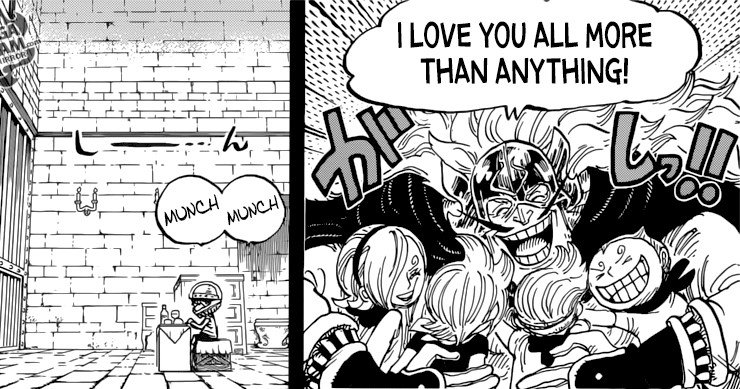
- Squard accuses Whitebeard of this in the Marineford Arc. Due to his hatred of Gol D. Roger for killing his old crew, he was susceptible to Admiral Akainu's lie that Whitebeard was planning to sell out his allies in exchange for Ace's life. When Squard stabbed Whitebeard, he did so because he believed Whitebeard was willing to betray the rest of his "family" just to save his "precious" Ace. Squard is wrong, however, and Whitebeard proves that he loves all of his family to the point of hugging and forgiving Squard for stabbing him in the chest.
- Vinsmoke Judge is an exceptionally cruel example as he heavily favors his daughter Reiju and 3/4 of his sons Ichiji, Niji and Yonji over his third son Sanji. This mainly due to Bio Augmantion failing to turn Sanji into a Supersoldier due his mother's Sora interference as she wished for her sons to keep their humanity instead being ruthless killing machines. After Sora dies over keeping Sanji's humanity, Judge treats Sanji like absolute shit and doesn't lift a finger to protect him from his brothers. Judge even imprisons Sanji and acts like he doesn't exist while adoring his other children
 ◊. He doesn't care in the slightest when Sanji escapes to East Blue. Thankfully this all comes back to bite Judge in the ass as when Big Mom is about to have Judge along with his super children assassinated he breaks down in blubbering tears and sees Ichiji, Niji, and Yonji unable to share his sorrow at their imminent demise all because of him. Ironically Sanji is the only child Judge can connect to, as they're both normal human beings (Sanji being albeit a Badass Normal) though this just makes Judge despise his third son more.
- On the flip side Sora favors Sanji over her other sons (due to the reasons above), even when Reiju her daughter whom Sora clearly also cares about comes to her on her sickbed, Sora just talks to Reiju about how much she loves Sanji.
- Imposed by the premise of Ōoku: The Inner Chambers, in which 17th-century Japan is ravaged by a plague that only targets men, leaving only one man for every four women. Thus sons can expect better treatment than daughters since the plague only stops hitting men who reach forty, and die very frequently. And in the more unhinged families, can result in Parental Incest as well.
- Ouran High School Host Club:
- Ootori Kyouya is a victim of a subtle version. As the youngest of three sons in a rich family, he is expected by his father to perform at respectable standards, but never to do anything to one-up his brothers, who will inherit the Ootori business empire.
- Kyouya's sister, Fuyumi, seems to get this treatment to some extent. She's admonished for returning home when she is happily married and has no real business to be there. This has the Ootori family fulfill two of the criteria. She, however, seems to ignore it and act cheery nonetheless, going out with Tamaki on occasion to explore the world of commoner cuisine.
- In +Anima, the Royal Family of Sailand is a perfect example of Favoritism. In fact, it's most likely why Husky was named Crown Prince out of birth order.
- Ranma ½: Kasumi is clearly Soun Tendo's favourite child. This is because she helped him raise her little sisters, and the image song Otousan (Father) performed by Soun and Kasumi's seiyuu states that he feels rather guilty about it.
- Rosario + Vampire:
- Akasha and Gyokuro love their own respective blood-related daughters more than the other daughters. While Akasha loves her stepdaughters, too, Gyokuro loves only Kahlua; she distrusts Akua because Akua is adopted and only keeps her around because Akua is useful to her plans, and hates both Moka and Kokoa, the latter being her other blood-related daughter, to the extent that she tried to murder them.
- Among the Shuzen sisters, Moka is the most beloved one. Akua is a Yandere for her, Kahlua loves all of her sisters, and Kokoa loves her because Moka is the only one in the family who treats her with respect.
- Taken to extremes in Saiyuki. Gojyo is a 'child of taboo,' raised by his stepmother and half-brother. She eventually attempted to kill him, but her biological son killed her first.
- Sakura Discord has a strange and pretty disturbing example with Mebuki Sakura. Being a Child Prodigy for piano, her parents put way too much pressure on her, which resulted in her hating piano and said parents feeling incredibly guilty for it. So they started to unreasonably spoil her and forgive all of her mistakes and whims, but their introduction scene shows that this is not a healthy relationship by any means. She considers herself dead inside. To make it worse, her big brother Shin'ya tries to isolate her even more so that they will finally give up on her and focus their attention on him.
- In Yu-Gi-Oh! Duel Monsters, Gozaburo favored his biological son Noah than his adoptive son Seto, at first. But Noah, whose body is dead and his mind is copied in a virtual world, was later ignored by his father, and Gozaburo furthered Seto who had more natural talent than Noah ever had. And of course, Noah's childish personality made it impossible to become an heir of Gozaburo. Well, after being betrayed by Seto, he doesn't give a crap for any of his sons. The other adoptive son Mokuba was always ignored by Gozaburo.
- The Morgue Files: Evelyn Adams never made it ambiguous which of her two children she loved the most, doting on her oldest child Millie to the point where she nearly neglects Tobias. It gets worse after she marries Frank.
- Batman:
- Dick Grayson (Robin I/Nightwing) has been noted to be Batman's favored son, being the first Robin, the easiest to get along with, and, as Batman himself notes, possessed the qualities none of the other Robins will ever have. He understands Bruce's teachings the most, came into his own as a hero, and while as skilled as Bruce, can still make friends and keep them, something Bruce can't do. It's to the point that Bruce has shown an absolute willingness to kill for him multiple times, something he doesn't show for anyone else. After Bruce "died" in Final Crisis, Dick became Batman against his wishes. When he returned, he reacted pretty well to it, to the point that it's just common knowledge among the Batfamily that Dick will take over when Bruce is unable to be Batman. There have been several times that Batman has shut out members of the Batfamily for one reason or another, however, he only rarely does this to Dick, who he trusts the most. A big part of Batman (Tom King) is that Bruce is embittered after Catwoman leaves him at the altar, and it's only Dick who he'll open up to about it... right before Dick is almost killed and then suffers amnesia; Dick's absence results in Bruce lashing out even more to the point of hitting Tim Drake in anger. Although Bruce tries to hide it, everyone in not only the Batfamily but the entire DCU knows that Dick is Bruce's favorite son, partner, and colleague.
- Bruce also treats his sometimes adopted daughter, Cassandra Cain, with some favoritism. He gives her own Batcave, expects her to eventually take his place as Gotham's protector, and generally showers her with praise. The favoritism gets to a point that when Damian, Bruce's biological son, meets her, he is immediately hostile (despite the fact that, having been raised as a League of Assassins member, he knows that she's supposed to be their chosen one) because Bruce chose her over him. It's heavily implied that this treatment is because he is projecting onto Cassandra, treating her more like a miniature version of himself rather than her own person, which Barbara Gordon (the first Batgirl) calls him out on several times.
- Black Panther has T'Chaka clearly display favoritism for T'Challa, his heir and a biological son. He didn't seem to really care about Shuri and began to ignore Hunter (his adopted, white son) as soon as T'Challa was born.
- Darkseid treats all his children terribly, but the one he actually respects and "likes'' is Orion. While he is on the side of good and serving Highfather, putting in opposition to Darkseid, Orion is the strongest and most competent out of his offspring. Because of this, Darkseid respects him as a Worthy Opponent.
- The Flash: Barry Allen (the second Flash) became the adoptive father of Wally West (the first Kid Flash and third Flash). He essentially raised Wally alongside Iris West, after Wally's parents divorced. After Barry marries Iris, they have two twins, the Tornado Twins, who they raise in the future. The twins have a tense relationship with Wally because they feel like Barry always considered Wally his "real" son. They're actually not far off — Wally is Barry's Berserk Button and he's gone to great lengths for Wally whenever he felt Wally needed him. Knowing that he was going to die and his mantle would pass on to Wally, Barry found three days in Wally's life when he would need Barry, and time-travelled to those times to help his protégé before his own death. When Wally was forgotten by the world and returned, Barry outright threatens Aquaman when he doubts Wally's sincerity. When Barry thinks Wally may have been killed by Booster Gold, he mercilessly beats the shit out of Booster, then runs across time and into the Speed Force to try to find Wally. Finally, when Barry finds out that Wally's heinous actions at the superhero therapy centre Sanctuary were the result of Eobard Thawne hypnotising Wally into doing these things — and Thawne had corrupted the Tornado Twins in the same story without this reaction from Barry — he chases Thawne across the timeline, screaming that he'll murder him.
- In The Kingdom, Wally West has two kids: Barry and Iris West. Both inherited his superspeed, but are vastly different in how they use them. Barry is a slacker who uses them for petty reasons, though not anything illegal. Meanwhile, Iris took up Wally's old identity of Kid Flash and is actively a superhero. However, Wally clearly favours Barry and constantly drives him to be the next Flash. It takes its toll on Iris, and Barry knows it. It may have something to do with his name even, since Barry Allen, the second Flash and Wally's mentor is someone Wally has never stopped looking up to.
- In Lucky Luke, Ma Dalton constantly dotes on her youngest son, Averell, while just as constantly giving her oldest, Joe, a hard time. She later admits that Joe is actually her favorite; he's the smartest and reminds her so much of their father, and Ma is only hard on him because she expects so very much of him. Averell, however, will always be her baby.
- The Mighty Thor: Thor is clearly his father's Odin's favorite, to the point that in Fear Itself, he is willing to destroy the entire Earth for Thor's sake. He never goes that far for Loki, Tyr or even Baldur. His wife Freyja consistently seems to ignore most of their (from her perspective mostly adopted) children not named Thor, save for Aldrif/Angela (her long believed dead biological daughter), and in the 2010s she becomes emotionally abusive towards Loki in his books (though she does come to regret it). It's worth noting, however, that being Odin's favourite is a considerable burden on Thor as he also bears the weight of a) his father's expectations, b) his emotional constipation and Generational Trauma, and the two have tried quite hard to kill each other in the past.
- Robin (1993): Mary Quintas eventually decided the best way to win her deranged family's serial killer competition was to kill her brothers and their families since her mom continued to favor them even after they'd been caught and incarcerated while she continued to get away with her murders.
- Rogue Sun has one from a serial absentee father. Marcus Bell, the superhero Rogue Sun, was married to a woman named Gwen Siegel and had a son with her, Dylan. He abandoned them when Dylan was 2-years-old, just long enough for Dylan to remember having Marcus in his life, the result being that, when Dylan is 17 when Marcus dies, he still severely resents him. Marcus married another woman, Juliette, and had two children with her: Aurie and Brock, who he didn't parent very much, either, but was still in their lives. In his will, he leaves his powers and mantle to Dylan specifically because he doesn't care about his safety compared to Aurie and Brock. Marcus' spirit also tells Dylan that he believes Brock could've played a hand in his death, and tells Dylan that Brock always unsettled him a bit. With Aurie, when she stopped talking to him for weeks because he missed one of her birthdays, Marcus revealed his identity to her and explained why he was so absent, and even let her help him with his work. This makes Aurie Marcus' favourite by default, but his favourite nonetheless, since he didn't completely ignore her like the others and did care about her feelings.
- Harry Osborn from the Spider-Man Trilogy films, Ultimate Spider-Man and The Spectacular Spider-Man, which is an interesting case since he is an only child. His father Norman Osborn sees Harry's friend Peter as being more gifted, intelligent and hard-working, often chiding Harry for not being as sucessful as Peter. This dynamic wasn't present in the original comics, but was put in afterwards after the success of the other iterations. It gets even worse for Harry, as not only does Norman favor his Arch-Enemy over him, but he also cares more about his grandson Normie. Norman even chooses to infect Normie with the Carnage symbiote and tries to get him to kill his own parents before Harry and Peter stop them. The reason why Norman prefers others over his own son is likely due to Norman's own twisted Might Makes Right philosophy that is at odds with Harry, who is all-around meek Nice Guy with no super powers or gifted intellect, so naturally he doesn't fit Norman's evil values.
- In The Technopriests, Panepha openly favors Almagro over his siblings Albino and Onyx, mainly because Albino is, as his name suggests, an albino and Onxy has red skin and four arms.
- Wonder Woman Vol 1: Out of her one surviving biological son and three adopted daughters "Grandma" Heyday clearly favors Tillie, as she is the most practical and kind of her children, and is even leaving everything to her in her will though she expects Tillie to look after her irresponsible sisters with the money. When her son, who lost his mother's favor due to his criminal behavior, learns of this he decides to kidnap Tillie and force her to sign over her inheritance at gunpoint before trying to kill all three of his sister/nieces.
- X-Men:
- Usually averted with Charles Xavier and his students, with him displaying equal affection to all of them, even the rebellious ones. However, it is clear that he has some favorites. The foremost being Jean Grey, who is a telepath like himself and the one who he particularly dotes on and helps with her psychic powers. Cyclops is his second favorite student and his favorite male X-Man, given he chose Scott to be The Leader of the team, sometimes such as in Secret Wars (1984) the professor will elect Scott to lead the X-Men even though Storm was technically the leader at that point, causing Storm to accuse him of favoritism. Overall Xavier seems to partially prefer his original five X-Men (Cyclops, Jean, Beast, Iceman, and Angel) over his other students, though this did come back to bite him as 3/5 of his favorite five have turned evil: Jean and Scott due to being driven mad by trauma and the burden of the Phoenix Force and Angel due to Apocalypse, made even worse by the fact that Scott killed him.
- It's also worth noting that between Deadly Genesis (which revealed the truth about Vulcan) and the Krakoa era, Cyclops wanted nothing to do with Xavier, hating him as much as he loved him thanks to his years of manipulations. Furthermore, Xavier tends towards being a Control Freak, expressing that the most towards those he loves the most, meaning that Scott and Jean in particular tend to be micromanaged and even forced into line (which both resent).
- Magneto cares more about Scarlet Witch than Quicksilver as he never truly gives Pietro praise and considers him foolish and arrogant. While he sets a high standard for his son, he is more affectionate with Wanda and blames Pietro if they go against him, even if it was her choice. However, Magneto may actually equally favour his biological daughter Lorna Dane aka Polaris, due to Lorna inheriting his magnetism powers. Magneto even displays outright physical affection to Lorna (including forehead kissing), something Pietro and Wanda rarely get from him. Still, X-Men Red (2022) suggests neither Wanda or Lorna are actually his favourite daughter an honour that goes to Anya, Magneto's deceased first child, despite her being completely human. However, the emphasis on her may be because of the reveal just beforehand via the creation of the Waiting Room by Wanda at the end of The Trial Of Magneto that she was human and therefore can't be resurrected.
- Mystique zigzags this trope with her children, on the surface it seems she cares for her adoptive daughter Rogue more than her biological son Nightcrawler, often going to great lengths to get Rogue back on her side when she defects from the Brotherhood to the X-Men and later on willing to kill a baby (Hope Summers) so long as it revives Rogue. However, at other times Mystique treats Rogue the worst out of her children, having slapped, stabbed, and shot her adoptive daughter on multiple occasions. While neglecting Nightcrawler, having abandoned him to be raised by other people, and apart from dropping him as a baby, she rarely physically hurts Nightcrawler, especially in modern comics, and was happy to see him alive after his resurrection. In AXIS where Mystique, thanks to Red Skull and Professor X, is completely good, she does everything in her power to protect Nightcrawler, which is interesting considering she does the exact opposite normally. Overall she tries harder to be affectionate to Rogue but appears to respect Kurt as an individual more while treating Rogue in comparison like personal property alongside her other mother Destiny. It is it’s safe to say she prefers both her mutant children over her other human son, Graydon Creed, who was born a normal human and whom she ruthlessly killed without regret when he became an Anti-Mutant activist. Even Sabretooth was appalled at Mystique's treatment of their son.
- An odd case is Thomas Logan, the biological father of Wolverine. When he was alive, he didn't care about James (it's unclear if he knew Wolverine was his child) or Dog, but when Wolverine ends up in Hell, he meets Thomas for the first time. Thomas gives him, of all things, a "Well Done, Son" Guy moment, because Logan has become a violent bastard who's killed thousands, and Thomas can respect that. He makes zero mention of Dog.
- Jean Grey loves all three of her children dearly (Stryfe was neither raised by her nor, technically, biologically her child, since he's a clone of Cable who was the son of her clone). She's affectionate, motherly, supportive, and where necessary, violently protective of them. However, she has a consistently stronger rapport with Cable and Nate Grey than Rachel Summers. This is partially justified, since she actually raised Cable, and Rachel first turned up when she was dead - once she came back, the two had complicated feelings for each other. note They eventually reconciled, though by that point, Rachel generally needed less mothering. Nate, by contrast, turned up when she was alive and was actively (albeit subconsciously) seeking out his mother, and more open to developing a relationship with her, but also more than willing to give her space. Plus, her experience with Rachel had probably done a great deal to help her adjust to the appearance of unexpected children.
- Usually averted with Charles Xavier and his students, with him displaying equal affection to all of them, even the rebellious ones. However, it is clear that he has some favorites. The foremost being Jean Grey, who is a telepath like himself and the one who he particularly dotes on and helps with her psychic powers. Cyclops is his second favorite student and his favorite male X-Man, given he chose Scott to be The Leader of the team, sometimes such as in Secret Wars (1984) the professor will elect Scott to lead the X-Men even though Storm was technically the leader at that point, causing Storm to accuse him of favoritism. Overall Xavier seems to partially prefer his original five X-Men (Cyclops, Jean, Beast, Iceman, and Angel) over his other students, though this did come back to bite him as 3/5 of his favorite five have turned evil: Jean and Scott due to being driven mad by trauma and the burden of the Phoenix Force and Angel due to Apocalypse, made even worse by the fact that Scott killed him.
- In Y: The Last Man, Yorick and his sister Hero both think their father preferred the other sibling. It's unclear whether either of them is right.
- "Cinderella": The stepmother's ill-treatment stems from her desire to elevate her daughters above Cinderella.
- Franz Xaver von Schönwerth's "Follow Me, Jodel!": The old farmer has two sons, Michael and Jodel. He is fonder of Jodel because he has a good heart, even though he is less bright than his brother, to the point he hopes to leave his farm to Jodel, even though he is the younger son. Michael is understandably not happy about it.
- In "Mother Holle", the widow favors her lazy daughter over the hard-working one because the former is her own offspring.
- In "Morozko", the old woman pampers her biological daughter and mistreats her stepdaughter.
- In "The Three Little Men in the Wood", the stepmother has her birth daughter completely pampered and spoiled whereas she hates her stepsister to death.
- Advice and Trust: Subverted. Rei is Gendo's favorite. However, Asuka realizes that it does not stop him from treating her like crap. Finding out what Rei's life is like helps Asuka to get over her jealousy.
Asuka didn't say anything for a minute. "She's the Commander's pet, his favorite," she said in a low voice. "Not you, his own son. Not me, the top scorer. Her. She's the one he likes. And they've got her taking so many tranquilizers and dissociatives I'm amazed she was even able to get angry enough to slap you. That amount of drugs has to be making her nearly a robot. That's the kind of cocktail you give to someone you want to keep totally pliable, un-argumentative, too doped up to care about anything... someone you want to make into a doll." Asuka shuddered. "If they can do that to the Pilot they like, what do they think of us?"
- Better Bones AU:
- Tigerstar favors his children by Goldenflower over his younger litter, as shown when he intervenes to spare the life of Flametail, his grandson through Tawnypelt, despite him knowing about the Dark Forest's plans and threatening to take the knowledge with him to StarClan. Hawkfrost realizes he would never do this with Mothwing, a realization that helps trigger his Heel–Face Turn.
- Graystripe favors his older litter Feathertail and Stormfur over his kits with Millie despite the former two being respectively dead and living far away, alienating his younger children with how he is always comparing them to his older kits.
- Child of the Storm:
- Carol's father favours his youngest child, Joe junior, over his quiet and artistic middle child, Stevie, and Carol, his tomboyish daughter, because Joe is the All American Boy and thus fits his heavily gendered expectations for how his children should behave. Stevie wilts under this treatment, while Carol straight up hates him. However, neither has any real issues with Joe junior.
- After Hermione figures out that she's Wanda's biological daughter in the sequel, she strongly suspects that Harry - her best friend and Wanda's godson - is her mother's favourite. She's got good reasons for believing this: Wanda avoids her as much as possible, treats her with distant politeness, and has to be visibly arm-twisted by Strange into teaching Hermione how to master chaos magic, while showering attention and affection on Harry. However, the situation is a bit more complicated than it seems.
- In a nutshell: Hermione was Happily Adopted and Wanda avoided her for the same reason she gave her up, to stop her from becoming a target. Harry needed a Parental Substitute, and when his dad turned out to be an incarnation of Thor, was such a target that her involvement made no difference.
- However, there is indicated to be some truth to it; a few characters muse that while Wanda probably loves both equally, Hermione's startling resemblance to her mother and shared powers remind Wanda of two extremely painful periods in her life (when her powers came through and nearly drove her mad, and when she had to give up Hermione). This plus her relatively uncomplicated relationship with Harry makes him easier to love. To Wanda's credit, she comes to acknowledge and is ashamed of her unintentional Double Standard, apologizing to Hermione for letting her fears get in the way of doing right by her daughter.
- Doing It Right This Time: Subverted. Gendo loves Rei more than Shinji... However, Gendo being Gendo, it only means he treats her in a slightly less crappy fashion.
- Gaz Dreams of Genie: Professor Membrane thinks Dib is insane, but he still favors him over Gaz. While Dib is obsessed with the paranormal, he's also intelligent, driven, and well-intentioned, which are all traits Gaz lacks. When Gaz wishes to a genie that Dib was never born, only having Gaz as a child caused Membrane to lose faith in humanity entirely and sell Earth out to Zim.
- Ghosts of Evangelion: Misato took Shinji and Asuka in. Shinji was Misato's favorite and she favored him blatantly. Asuka is quite resentful about it. After Third Impact Misato admits that she made a mistake.
- The King Nobody Wanted: Garth Tyrell is more fond of his Otherys daughters in Braavos than his Flowers sons in Highgarden, and makes no particular effort to hide this fact.
Garth: [in front of his son Garse] Daughters are such a treasure, I find, even if sons are so often a burden and a disappointment.
- The Palaververse: When talking about Zebrican religion:
Mother Neighle['s] three children[:] The spirits of Sun, Sand, and Sweet Water. [...] Sweet Water, Mother Neighle’s favoured child and only daughter.
- Shigeko Kageyama AKA Mob Ritsu is the obvious favorite in the family. He resents his status as the favorite because it means that he has expectations his sister, (genderswapped) Mob, will never have to live up to and he isn't free to make a single choice for himself.
- Star Trek: Phoenix: Discussed and deconstructed. One of the root issues for Twilight's conflict with Sunset in the second season is that Twilight believes that their adoptive mothers favored Sunset over her.
- Tokyo Mew Mew No Hope Left has this trope in spades at the beginning. The protagonist's parents are described as preening her older sister and sending her to a fancy school while forgetting that our heroine exists.
- When She Smiles (Fresh C): Deconstructed. When Misato tries to stop Shinji from looking for a missing Asuka, Shinji calls her out on always favoring him over her...which, as far as he is concerned, means she did not really care for any of them.
- Subverted in X-Men: The Early Years. Scott is convinced that Jean is Xavier's favorite student. In fact, when Jean's father expresses his concerns as to the presence of a kid with a criminal record in the school, Xavier replies if he had to choose between keeping Scott and taking Jean in... Well, he is the only father figure Scott has left.
- Played with in Empath: The Luckiest Smurf. The other Smurfs think Papa Smurf treats Empath as the favorite son. It helps that Empath is Papa Smurf's only biological son. Empath, however, feels that he is more The Un-Favourite, as Papa Smurf does nothing to get him out of living a life away from his fellow Smurfs in Psychelia.
- In a Harry Potter fanfic where Sirius Black has two children, a boy and a girl to be more precise, their mother favors the girl over the boy because he looks like Sirius and she thinks Sirius is guilty.
- In Imaginary Seas, this is weaponized in the form of Percy's Noble Phantasm: Poseidon Asphalios: An Ocean of Blessings for the Most Beloved. As Poseidon's favorite son, he has his full blessings on top of the skills of all of the other sons of Poseidon but better. This is why he has an A+ Rank in Stout Arm of Brutality, his father's armor, Divine Core, and trident, and the same invulnerability as Caenis.
- In the Soul Eater fanfic Oblivion, Medusa claims that when she and her sisters were children, she was their mother's favorite, Arachne was their father's favorite, and Shaula was The Un-Favourite. Based on their mother's behavior in Shaula's flashback (where she treated Shaula kindly and intended to punish Medusa for bullying her), this is likely not true. That doesn't stop the claim from being Shaula's Berserk Button.
- Subverted in The Second Try. Asuka used to believe that Shinji was their caretaker Misato's favorite, but during a heart-to-heart talk she admits that maybe she misunderstood Misato's behavior.
- In How the Light Gets In, Laurel knows that her parents do love her, but between her mother's actions (see Arrow below) and her father's drunken rants making it clear he wishes she died instead of Sara, realizes that they both love Sara more. Her mother, Dinah, takes it to extremes. Laurel recalls Dinah has only come to one of Mary's (Laurel's daughter, and her granddaughter) birthdays... and it was only because she thought Sara would be there. To the point that Laurel is hesitant to have more than one child because she's terrified she'll do this too. Notably, this doesn't affect her relationship with Sara (whom she still loves dearly), and Sara herself seems to be unaware of it.
- In the Drake & Josh fanfic Into the Darkness, Drake and Meghan's biological father shows this to extreme levels. He clearly has adored Meghan since she was born and uses pet names like "sweetie" or "angel" whenever he talks about her. Drake on the other hand he hates for being born, among other nonsensical reasons such as "got me sent to jail for killing my boss" and "looking like me", and wants him dead, even being willing to take matters into his own hands, spending nearly a week torturing Drake until he breaks emotionally and comes within an inch of death.
- Misty suffered a lot of this in Pokémon Reset Bloodlines. Her parents constantly pampered her older sisters, while they treated her as little more than a servant, as she had been an unplanned child and had no interest in the performing arts like the rest of her family. Things just got worse for her after she was revealed as a bloodliner, and the only reason they didn't get rid of her was to avoid bad press.
- SAO: Mother's Reconciliation: Asuna ends up believing her mother favors Kouichirou over her, especially after Kyouko makes the mistake of comparing the siblings' accomplishments. This ends up spurring on her decision to run away from home.
Asuna: You already have your perfect son who's the very definition of success himself! So why don't you stop wasting your time on a failure like me and focus all your attention on him?!
- In RWBY Alternate, Taiyang began favoring Ruby over Yang after Summer died due to Ruby's Strong Family Resemblance to her mother. As a result, Yang and Ruby have a distant relationship (mainly on Yang's side).
- In Blackbird (Arrow):
- Even before the Gambit sank, Laurel was aware that both of her parents favored Sara, even if she (Laurel) was the one they were proud of. Quentin because she was the baby of the family, Dinah because Sara reminded her of herself when she was younger.
- Her mother however, takes it to extremes. She goes as far as to blame Laurel for what happened to Sara just because she was the one who was dating Oliver and brought him into their lives, and uses it to justify trading Laurel for Sara to the League of Assassins. Dinah refuses to admit that Sara's choices were her own and she only has herself (and unbeknownst to everyone, Malcolm Merlyn) to blame for what happened. She's also a deconstruction of this trope, because it becomes clear that Dinah is a terrible parent in general and Sara being her favorite does not exclude her from her mother's emotional abuse, no matter how unintentional it is.
- Nyssa tries to comfort Laurel by commenting that she also knows what it is like to be the unfavorite child. Presumably, she has too much of a soul to be a "good" heir.
- The Bloods of Bolton:
- It could not be more clear that Roose heavily favors Drucilla over her other siblings. He dotes on her, encourages her sadistic tendencies, and refuses to punish her for her actions. He also treats her with more fairness than most fathers in Westeros society would by letting her attend his council meetings.
- Bethany tends to have more favor for Domeric. Granted, she's tried being a loving mother to her daughter, but Drucilla's growing hatred for her mother and her psychotic tendencies put a lid on all her attempts.
- In Junior Officers, Deborah's father favours her brother David over her and her sister Margaret because of his gender.
- One step backwards and Three forwards: Gabriel prefers Felix over Adrien, treating the elder brother as his heir apparent while largely ignoring his second son. What's particularly twisted about this is that Felix is Adrien, in a sense — reality was rewritten by the villains' Wishes, and Adrien's memories ended up in Felix while the 'new' Adrien remained as Lila's trophy boyfriend. It's implied that part of the reason he favors Felix is because he's written his other son off as nothing more than an Unwitting Pawn to keep Lila happy.
- In Three Can Keep a Secret, it turns out that the Pines parents tended to prioritize Mabel's feelings and were largely dismissive of Dipper's throughout the twins' childhood, and this had a significant negative effect on both children's development, contributing to both Mabel's obliviously self-centered perspective and Dipper's deep insecurities.
- In Njal Gets Burned, Njal openly favours his foster-son Hoskuld over any of his biological sons, even going so far as to state this out loud in court. Obviously, his sons resent this.
- moral of the story (Nyame): Both Quentin and Dinah heavily favor Sara over Laurel, to the point of using Sara's fate to actively abuse and neglect her. After the poor handling of Sara's return helps drive Laurel to suicide, a drunken Quentin guiltily switches his favoritism to Laurel and begins disparaging Sara instead. That does absolutely nothing to improve their relationship as Laurel still loves Sara, and she instead takes it as a sign that she needs to cut ties with him.
- Cinderella:
- Lady Tremaine favors her biological daughters far more than Cinderella, to the point of treating Cinderella like a lowly servant.
- Between her biological daughters, she seems to favor Anastasia more than Drizella, but at the end of the day, they're both just tools to her.
- Encanto: A grandparent example. Matriarch Alma enforces this trope over two generations, both with her own children and grandchildren. In both cases, her favoritism is based on the gifts they received from the Encanto which quickly made her granddaughter Mirabel into The Unfavorite since she's the only one who didn't get one. Averted with Mirabel's parents who don't play favorites with their children and love Mirabel just as much as her sisters.
- The Lion King:
- In The Lion King II: Simba's Pride, Nuka is neglected by his mother, Zira, in favor of the younger son, Kovu, whom Scar chose as his heir. Nuka is also implied to be Scar's son, but this isn't confirmed in the movie.
- In the semi-canon sequel book series The Lion King: Six New Adventures, Scar was originally named "Taka" by his parents, which means "to want", but can also translate roughly as "trash". His father, Ahadi, always preferred Mufasa due to his dependability.
- The Little Mermaid:
- In The Little Mermaid II: Return to the Sea, Morgana revealed that her older sister Ursula was favored over her and that she was always compared to Ursula, and in the climax of the movie, it's shown that Morgana had Mommy Issues over it.
- Word of God states that Ariel has always been Triton's favorite daughter. He sees much of himself in her; she has red hair like him when he was younger and she is strong-willed and independent personality-wise. Her almost uncanny resemblance to her late mother may also play a role in this favoritism.
- Played for Laughs in Disney's Robin Hood (1973) by the childish Prince John.
Prince John: Mother always did like Richard best...
- This is believed to have been Truth in Television; it's been suggested by many historians that Richard was the favorite child of their mother, Eleanor Of Aquitaine, while John was the favorite of their father, Henry the Second.
- Ratatouille: Implied. Django seems to slightly prefer Émile a bit over Rémy due to his agreeable, non-rebellious nature and more rat-like behavior. Nonetheless, he dearly loves both of his sons.
- Unicorn Wars: Downplayed. When Bluey and Tubby unit stop by a town to see their family and friends before leaving to go to war, their father expresses pride in them, saying that their mother would be proud of them, and gives each of his sons a pie that was made from their mother's recipe. Bluey received almost the whole pie while Tubby just received a slice, and he was shown not to be happy about this. However, Bluey and Tubby's father was showing love to both of his sons and aside from that moment, doesn't seem to particularly favor either of them. It's possible he just gave Tubby the smaller piece because he was concerned with his weight problems, as others pointed out that Tubby is overweight.
- A.I.: Artificial Intelligence: The robot child a couple uses to replace their comatose son becomes The Un-Favourite when their real child wakes up from his coma.
- This is the Red Queen's Freudian Excuse in Alice in Wonderland (2010), as she claims (with some accuracy) that her parents and the rest of the kingdom favored her little sister, the White Queen, more than her.
- In Beast (2017), Hilary clearly favors Polly over Moll, as Polly was a well-behaved girl who is now married to a successful man and expecting children, and generally fits into the family a lot better than Moll, who is often at odds with how Hilary wants her to live her life and brought a scandal upon them as a teen by getting expelled for violent behavior. Interestingly, Hilary tends to pay more attention to Moll, though it's because she feels the need to closely monitor Moll's every move so she won't screw up again and constantly criticize her, while Hilary usually has nothing but praise for Polly.
- In Boyz n the Hood, Darrin "Doughboy" Baker is obviously The Un-Favourite of his single mother, Brenda, compared to his brother Ricky, who has a different father. This may partially explain why Doughboy is a gangbanger and Ricky is a college-bound high school football player. The favoritism is implied throughout the movie and is outright stated by Doughboy after Ricky's death in a drive-by shooting. In fact, the first question their mother asks after Doughboy and Tre bring Ricky's body to the house is, "What did you do to him?"
- An interesting example in Cool Hand Luke. Luke's mother tells him that she's leaving everything to his brother, because she'd always loved Luke more, and wanted to make up for it. She's not proud of her favoritism but sees it as beyond her control.
"Way it is, sometimes, you just have a feelin' for a child or you don't, and with John, I just didn't."
- Zach from the Quebecois film C.R.A.Z.Y is the fourth son of five and manages to be a case of both Parental Favoritism AND The Un-Favourite — his religious mother believes he has the power of healing and defends him from his father's scorn. Meanwhile, his dad, having suspected him of being gay from an early age, lavishes most of his praise on the three older brothers, who are respectively a genius, a jock, and a macho lady's man. Meanwhile, the youngest just seems to get ignored.
- Cries and Whispers: By Agnes' account, the younger sister Maria was their mother's favorite child. This made Agnes jealous as she was terribly fond of their mother, who in turn tended to be distant towards Agnes. The screenplay also indicates the eldest sister, Karin, was The Un-Favourite.
- In Dead Poets Society, Todd receives a birthday present from his parents — a replica of what they sent him the previous year. It comes out that his brother's birthdays are a big deal, but his own are clearly an afterthought. One of his friends helps him throw the present off a balcony and jokingly tells him to cheer up: he'll get another one next year.
- In Deewaar, Sumitra admits to her son Ravi that she always loved his brother Vijay more.
- Ramsey Hogan in Desert Heat clearly favors one child over the other two.
Matt: Why are you ridin' me and Jesse so much and never Petey?Ramsey: I love Petey 'cause I loved his mother. She died giving him birth. He's our love child.Matt: What about me and Jess?Ramsey: You two are the unfortunate results of some recreational fucking back when fucking was fun.Matt: ... geez.Ramsey: Get over it.
- In Ever After, Rodmilla de Ghent favors her eldest daughter Marguerite, who is beautiful and behaves the same way as her mother, compared to her stepdaughter Danielle and her younger daughter Jacqueline, who has a much sweeter, kinder personality.
- Played painfully straight in The Feast of All Saints, where Cecile overtly favors her son Marcel and barely tolerates her daughter Marie, largely because she is jealous of Marie's beauty. This culminates with Cecile attacking Marie when the latter comes home after being gang raped. Near the end of the movie, Cecile even says she wishes Marie was dead and asks Marcel to pass along the message.
- Ferris Bueller's Day Off: Ferris's sister complains that her brother can get away with anything, and their parents will believe him. Since her brother is Ferris Bueller, she's right. On the other hand, Ferris wanted a car, which she got.
- In The Godfather, Vito shows favoritism towards Michael, his youngest son, wanting him to have a better life. The expression on his face when he's told that Michael killed Sollozzo and McCluskey and thus becoming involved with the mafia business is one of heartbreak.
- In the novels, Fredo accuses his father of showing favoritism to Tom, his unofficial adopted son. While nothing comes of it, Vito does compare Sonny unfavorably to Tom in terms of responsibility to an extent that Sonny cannot help but feel a little resentful.
- In Hobo with a Shotgun, the villain Drake clearly favors his son Slick over his other son Ivan. When Slick dies, Ivan tries to assume his place in his father's eyes, without much success. Ultimately, Drake tells him that he'll never measure up and shoots him.
- Kapoor & Sons: Between their two sons, Harsh and especially Sunita like Rahul more because he found success in his writing career (unlike Arjun). Somewhat deconstructed, as he's reluctant to come out as gay to them, since they think so highly of him but it wears on him throughout the film.
- In Knives Out, Linda appears to be her father Harlan's favourite out of all his descendants and extended family. He speaks to her more respectfully and does not single her out for a telling-off like all the others. She is also the closest to becoming a Self-Made Woman in the way Harlan values. They had a secret way of communication and Linda is the only one openly grieving his death. It's strongly implied that during the will reading, Linda simply wanted to inherit the house for sentimental reason as she isn't shown getting excited over the money or publishing house like the rest of her family is.
- The Lord of the Rings: Denethor clearly favors his eldest son Boromir over his youngest son Faramir, to the point of telling the latter You Should Have Died Instead. Of course, when it looks like Faramir has actually died (he wasn't), Denethor loses what sanity he had left and tries to burn himself alive and his son's (apparent) corpse with him out of despair.
Faramir: (Trying Not to Cry) You wish now that our places had been exchanged. That I had died and Boromir had lived.
Denethor: (hesitates a moment) Yes. I wish that.- A scene entitled "Sons of the Steward" from the Extended Edition of The Lord of the Rings: The Two Towers further elaborates on Denethor's preference for Boromir and his emotional abuse of Faramir. It's noticeable that Boromir clearly hates being the favorite and doesn't hesitate to call out his father on such abuse; it's also made very clear that the brothers love each other dearly, and Faramir doesn't resent Boromir for the favoritism.
- A scene entitled "Sons of the Steward"
- In Madea's Family Reunion, Victoria Breaux favors and pampers her younger daughter, Lisa, and despises her older daughter, Vanessa. This is because Vanessa's father was a musician who dumped her and left her broke, while Lisa's father was a rich man who gave her a luxurious lifestyle. She even allowed her second husband to rape Vanessa to stop him from leaving her. However, the film makes it clear that Victoria's favoritism didn't do Lisa any favors; while Victoria favors her, she also controls her entire life, which has left her unable to fight for herself, and has been stealing from her trust fund for years, leaving it virtually empty. She also pushed Lisa to marry Carlos, the very banker who's been helping her steal from the trust fund, because he's rich and he'd be able to keep them in luxury, despite the fact that he's horribly abusive. By the end of the movie, Lisa has broken free from her mother's control and her abusive fiancé while Victoria and Vanessa appear to be on the path of mending their relationship.
- Marvel Cinematic Universe:
- Thor: Odin paid more attention to Thor as he was heir to the throne (as well as Odin's true-born son), while Loki (whom Odin adopted) was more of a tool to unify the Asgardians and Ice Giants. Odin's preference for Thor initially made him blind to the latter's faults and ended up setting Loki on his path to villainy.
- Subverted by the time of Thor: Ragnarok as Odin says he loves both his sons and gives a Loki So Proud of You moment. Both Thor and Loki have gone against his wishes and become better people for it. Odin still holds his sons in greater regard than Hela, his first child, and strove to make both of them better rulers.
- Played with in regards to Frigga. Loki, being In Touch with His Feminine Side, shares a lot more in common with her than Thor does (though Thor resembles his mother more than Loki). Thor: The Dark World reveals that Frigga was Loki's instructor in magic, so they once had a mentor-pupil relationship in addition to a mother-son one; she would've naturally grown close to him after spending so much time together. Meanwhile, Thor's fighting style was much more similar to Odin's. Tom Hiddleston confirms this in this interview (as quoted below). However, Avengers: Endgame makes it clear that Frigga nonetheless loved Thor just as much as she did Loki and even accepts her future son's presence without question. Thor is overjoyed to see her again and is more emotionally open with her than he was with Odin.
Hiddleston: Rene Russo and I, always, from the very first film, part of the backstory we created was that Frigga was really the most attentive to Loki when he was a child. And Odin didn't really know how to connect. He connected much more with Thor. They were sort of cut from the same cloth. And Frigga and Loki had this kind of beautiful, sensitive, more artistic relationship. And it was actually her who taught him all his magic.
- Yondu from Guardians of the Galaxy (2014) as a Father to His Men, in particular, cared for Peter aka Star-Lord more than other Ravagers, though Yondo had trouble admitting it to him. First Mate Kraglin Obfonteri in Vol. 2 is not fooled and calls out the favoritism Yondu shows Peter when the Ravagers were hunting the Guardians down on behalf of Ayesha.
- Thanos doesn’t try to deny that he considers Gamora the best of his adoptive children and says as much in front of his other kids. She gets preferential treatment from him and is the one he relates to the most. He continues to feel this way even after she does a Heel–Face Turn and disowns him. This comes back to bite both of them in Avengers: Infinity War; to get the Soul Stone, Thanos must sacrifice what he loves most... which he quickly realizes means killing his favorite daughter. He reluctantly does and is inconsolable afterward.
- Thor: Odin paid more attention to Thor as he was heir to the throne (as well as Odin's true-born son), while Loki (whom Odin adopted) was more of a tool to unify the Asgardians and Ice Giants. Odin's preference for Thor initially made him blind to the latter's faults and ended up setting Loki on his path to villainy.
- Meet Joe Black: William favors Susan over Allison and strangely enough, Allison is okay with it.
- Nope: Otis Haywood Senior groomed OJ as his successor, completely shutting out Emerald from the business and taking her horse away from her for a movie he was working on. Emerald still holds a grudge even after his passing and her relationship with OJ is tense at the start of the film. OJ suggests that this was because she and their father were too similar, causing them to butt heads.
- Rags: Arthur plays favorites quite a bit. In addition to Charlie suffering from forced servitude as the stepson, he also plays favorites among his own sons, treating Andrew with far more respect than he does Lloyd.
- Smooth Talk: June, Connie’s older sister, appears to be the favorite daughter. Connie’s mother, who frequently clashes with Connie, emphasizes June is an angel to a friend right in front of Connie.
- Gordie is most definitely The Un-Favourite in Stand by Me, and believes his father would rather he have died than his charming, athletic older brother. The only thing keeping Gordie from feeling worse than he does is the fact that he and his brother had a great relationship, and his brother used to praise and encourage him in his writing.
- This is in contrast to the book, where the age difference between them means that their relationship wasn't as close and the favoritism hurt Gordie a lot more. It's explained in the narrative that Denny was a miracle baby, born after several years of infertility, whereas Gordie was born when his parents were old enough to be grandparents and didn't really want to be raising another child.
- Walk Hard: The Dewey Cox Story: The fact that Dewey Cox's father is fond of reminding Dewey that "the wrong kid died" when discussing Dewey's deceased older brother is a pretty good indication of where Dewey stands on the pecking order.
- Welcome to the Dollhouse: The mother obviously favors the cute youngest daughter Missy over the plain middle daughter Dawn, to the point where Mom and Missy cuddle on the couch while watching television and Dawn has to sit on the floor.
- X-Men Film Series: Downplayed with Professor X, since he never neglects any of his students whether as a teacher or as a Parental Substitute, but he is closer to those who are Birds of a Feather, like Hank McCoy in X-Men: First Class and Jean Grey in X-Men: Apocalypse. Hank and Jean do receive a bit more of Xavier's time and care.
- Sid Sawyer in The Adventures of Tom Sawyer. All the adults adore Tom's little brother and wish Tom were more like him... when in reality he's a manipulative, mean-spirited brat, but only Tom, Huck, and Becky ever notice.
- In Diana Wynne Jones's Archer's Goon, the youngest of the seven magical siblings is the most powerful and favored of the group. His elder brothers and sisters are bound magically to protect him.
- As I Lay Dying and The Sound and the Fury both feature a mother having a favorite son out of all her other children, despite the fact that the son is a Jerkass.
- In Beyond the Western Sea, Lord Kirkle favors Laurence, while Lady Kirkle favors Albert, leading to a Cain and Abel situation.
- Brother Cadfael: One story has the two sons of a landowner, Nigel the elder being obviously favored. Meriet the younger is sent to the abbey as a novice despite being obviously unfitted for the life, but both he and his father insist on it. It turns out the son was sent to atone for a crime he committed... except he was actually covering for Nigel, whom Meriet thought had committed murder, but was actually guilty of treason and hiring an Overzealous Underling to waylay a messenger. The father makes amends when he realizes what an ass he's been.
Therefore my grievous sin against my son Meriet is not only this doubt of him, this easy credence of his crime and his banishment into the cloister, but stretches back to his birth in lifelong misprizing.
- In Dorothy L. Sayers' Lord Peter Wimsey novel Busman's Honeymoon, the Dowager Duchess explicitly tells Harriet that Peter is her favorite child.
- Paula Danziger is another teen writer who was fond of this, although in Can You Sue Your Parents for Malpractice?? she turns the trope on its head — big sister Melissa is the family favorite until she defies her draconian father by moving in with her boyfriend. Rather than choosing a "new" favorite, her father takes his annoyance out on his two younger daughters.
- The Camp Half-Blood Series:
- The gods are guilty of this. In fact, Poseidon openly admitted that Percy was his favorite son.
- This is Annabeth Chase's main issue with her father and stepmother that led her to run away from home at the age of seven. She felt that her father neglected her after he started a family with an actual human being, and she felt that her stepmother outright considered her a danger to her own children. The Titan's Curse makes it clear that this is only Annabeth's projection, seeing as how Mrs. Chase is more than willing to welcome her home if she wants to.
- In The Last Olympian, Hades tells Nico point-blank that Bianca should have lived instead of him.
- Played for Laughs in The Heroes of Olympus. According to Medusa's sisters, Stheno and Euryale, their mother liked Medusa the most due to her unique ability to turn people to stone and criticized them for not being able to do the same.
- The Change Room: Corrine, Andrew's mother, thinks his brother Martin hangs the moon and gushes about him constantly.
- In The Chronicles of Narnia, it's a case of brotherly favoritism. Peter loves all of his siblings but he is especially close with the youngest, Lucy.
- In the Chinese Cinderella story Bound by Donna Jo Napoli, at first the stepmother cared for neither main character Xing Xing or her biological daughter, as during her time, sons were more favored. However, as Xing Xing's father grew closer to Xing Xing after the death of his wife, the stepmother grew closer to her own daughter, while simultaneously despising and envying her stepdaughter.
- Goes both ways in the Conqueror books. Temuge is the youngest of five brothers, and his mother dotes on him as a result. This leads to him becoming a rather soft and chubby child who never learns to use a bow or sword effectively, making him the least favorite in his father's eyes.
- In the Cyteen novel Regenesis, part of the backstory of Giraud and Denys Nye is that their mother wanted to raise a genius, and pressured Giraud, the eldest, to perform as a child; although he was bright, he wasn't up to that level, and was The Un-Favourite. Denys, on the other hand, was a genius and was coddled. Denys grew up introverted and antisocial, depending utterly on Giraud to handle interaction with other people.
- In Gene Stratton-Porter's A Daughter of the Land, Mary. With Kate singled out as The Un-Favourite.
"I am not! But it wasn't a 'fool thing' when Mary and Nancy Ellen, and the older girls wanted to go. You even let Mary go to college for two years."
"Mary had exceptional ability," said Mrs. Bates.
"I wonder how she convinced you of it. None of the rest of us can discover it," said Kate. - Manny Heffley, the baby of the Heffley family from Diary of a Wimpy Kid. (Manny is three years old, Greg is around eleven to thirteen, and Rodrick is implied to be between fifteen and seventeen.) Manny is allowed to do all sorts of stuff like bring toys to church, call his brothers names, throw fits to get his way, and crawl out of bed at night and stay up. Greg states that when he was Manny's age, he had none of that, as his family was in a weaker financial state at the time. The Parental Favoritism also spreads to the extended family. (Manny is given far more presents for Christmas and more stuff that he wants, while Greg is given stuff like books of Algebra or deodorant.) The only in-focus grandmother is particularly bad, as she claims to like all of her grandchildren equally but her fridge is practically wallpapered in pictures of Manny. Also, Manny hardly ever receives punishment for his actions, even when he steals supplies and leaves his family for dead during a blizzard.
- The only onscreen grandfather meanwhile actually subverts this. It's also why he is Gregory's favorite grandparent, for obvious reasons...
"Gregory's my favorite!"
- The only onscreen grandfather meanwhile actually subverts this. It's also why he is Gregory's favorite grandparent, for obvious reasons...
- Murphy in Jim Butcher's The Dresden Files suffers from this. In Blood Rites, she asks that Harry time an assault on a vampire lair so that she can skip her family reunion. The timing is off, however; she attends part of the reunion and learns that her younger sister — whom their mother explicitly says is allowed more freedom as the youngest than Murphy had as a youngster — is marrying Murphy's ex-husband. The sister got involved with the ex when he failed to arrest her for underage drinking when she was spending an unsupervised vacation in New Orleans. Their mother is A-OK with this and criticizes Murphy for her reaction.
- Of course, only part of this is because Murphy's sister is the favorite sister. The other part is that Mrs. Murphy absolutely loves her son-in-law. She's thrilled that she's getting him back in the family again.
- A Drowned Maiden's Hair: Victoria Hawthorne laments that she was always unloved no matter how hard she tried to be good, while her charming sister Hyacinth was adored by everyone despite her lack of positive qualities. The family house at Hawthorne Grove was passed down to Hyacinth, even though she was the youngest, just because their father liked her better.
- A major theme in East of Eden, due to the running Cain and Abel parallel. It happens first with Cyrus Trask, his unfavorite eldest son Charles, and the favorite, Adam. Thanks to Generation Xerox, things go the same way with Adam's twin sons, Cal and Aaron.
- Eleanor & Park: Out of all the kids, Richie seems to hate Maisie the least, letting her watch television with him, and giving her a keyboard “Because she likes to sing.” Until Eleanor realizes that he may be grooming her for sexual abuse.
- In Stephen King's novel The Eyes of The Dragon, Peter is King Roland's favorite son, largely because he reminds him so much of Queen Sasha. Thomas, meanwhile, takes after his father, which means that Roland sees his own flaws reflected back at him. (In fact, many of the eavesdropped statements that led to Thomas's resentment ended with a "like something I would have produced at his age" that Thomas missed.) The Big Bad, Flagg, is able to use Thomas' resentment as part of his plot to destroy the kingdom.
- All over Flowers in the Attic. Cathy was her father's favorite. Chris is his mother's favorite. Corrine was her father's favorite before he disowned her for marrying his much younger half-brother.
- In the later books in the series, there's a massive sense of this between Cathy's three children, as she sometimes appears much fonder of eldest child Jory and adopted daughter Cindy than of her troubled middle child Bart. She does love Bart, however, and the sense of favoritism has a lot to do with his view of things, not necessarily how they actually are.
- In A Frozen Heart, a Tie-In Novel to Frozen, some of Hans' brothers resent him for being their mother's favorite and taunt him for being a Momma's Boy. They also resent Caleb, the oldest of 13 sons, for being their father's favorite.
- Fudge, in Judy Blume's series of young adult novels beginning with Tales of a Fourth Grade Nothing, is the family favorite, getting away with murder while big brother Peter got repeatedly whacked over the head with An Aesop about loving his brother. The fact that Peter Can't Get Away with Nuthin' doesn't help.
- In fact, this is one of those odd instances where it's not clear whether Fudge is the parents' favorite, or the author's. Peter's parents seem as if they're supposed to be the wise, sensible, benevolent type, and they do make up for some of Fudge's excesses, but the fact that Fudge never gets called on his bad behaviour suggests that either he was given serious preference by his parents... or Blume didn't want to let such things as "discipline" get in the way of Fudge's antics.
- In Double Fudge, Fudge's latest "phase" is that he's obsessed with money. His parents are actually somewhat worried about this, and Anne, the mother, is positively mortified when Fudge's excessive greed results in him getting evaluated by a counselor, who tells Anne that maybe she should try to stress that "the best things in life are free," etc. The problem is never solved, per se, in order to allow for hijinks and because Warren and Anne really have no idea what to do about it, but it does seem to lessen. Slightly.
- His parents do get fed up with Fudge and punish him when warranted. In Tales of a Fourth Grade Nothing, Fudge is throwing a tantrum and not eating his cornflakes and his dad makes him stand in the bathtub while he dumps the bowl of cereal on his head, and in Superfudge he's occasionally scolded (and spanked once) by his mother over his misdeeds and at the end is punished by his parents for riding his bike to town without telling anyone.
- In Gone with the Wind, Scarlett is Gerald O'Hara's favored child. He has come to realize that he will never have any sons and speaks to Scarlett in a sort of man-to-man way that Scarlett enjoys very much. Scarlett carries this out much further with her own children; her youngest daughter, Bonnie, is her favored child.
- Grandmaster of Demonic Cultivation: Mo Dao Zu Shi:
- Jin Guangshan doesn't particularly care about any of his children, but his legitimate-born son Jin Zixuan certainly fares better than bastards Meng Yao/Jin Guangyao and Mo Xuanyu. Even after the latter two are brought into the sect, they're frequently browbeaten, insulted, neglected, and coerced into performing immoral acts trying to win his non-existent approval.
- The Yunmeng Jiang sect's inner family has a complicated version. Jiang Fengmian favors the-not-even-formally-adopted Wei Wuxian over both of his biological children, and while Yu Ziyuan frequently calls him on it, her hatred of the boy doesn't mean she favors Jiang Cheng so much as she's constantly castigating him for not doing better at getting his father to notice him.
- J. K. Rowling's Harry Potter:
- Harry endures some pretty extreme abuse at the hands of his aunt Petunia and uncle Vernon, while his cousin Dudley is extremely pampered. This is owed at least in part to a long-held jealousy Petunia held of his mother. In the sixth book, Dumbledore notes that Dudley arguably got the worse end of the deal, being unprepared for the real world.
- The Weasleys:
- Ron certainly feels for a long time like this is the case, although readers generally see no evidence of it; his parents clearly love him. Among his many insecurities, he frets about being the sixth boy in a family that always wanted a girl. Being the best friend of an actual celebrity, who is treated by his parents as an extra son, doesn't exactly help. The fact that he got plenty of hand-me-downs from his older brothers (due to his family being poor) might also play a part in this perception.
- While she loves all of her children dearly, there are hints that Molly regards Percy as her favourite, seeing as she how continuously tries to reach out to him even after the rest of the family consider him a lost cause for siding with the Ministry. A theory is that Molly seems aware that the family see Percy as a pushover, hence why she overcompensates so he'll feel loved.
- Regulus was the favorite over older brother Sirius (mostly because the former was just as much a bigot as his parents), to the point that even the family house-elf preferred him, partially for sharing the same bigoted views and partially because he was kind to him and cared enough about him to order Kreacher to leave him behind and allow him to be the one to die when he betrayed Voldemort. In Order of the Phoenix, Kreacher's dislike and animosity towards Sirius for his "betrayal" of the House of Black culminates in Kreacher betraying him to his death.
- Dumbledore's sister Ariana required constant supervision, leaving Albus rather aloof - much to their brother's annoyance.
- Marvolo Gaunt favored his son Morfin greatly over his daughter Merope, and eventually was arrested when his abuse of her was seen by an Auror.
- Petunia certainly felt that her parents liked Lily better after discovering she was a witch and it is heavily implied she already felt like The Un-Favourite before Lily ever received her Hogwarts letter.
- Helen and Troy's Epic Road Quest: Invoked and ultimately subverted. Troy's parents originally tried pitting him and his sister Imogen against each other for their approval, only for Imogen to make herself the Black Sheep when she realized that it wasn't worth it. While Troy and Imogen are on good terms, their parents have taken to boasting about Troy's achievements while Imogen left for Europe to find herself.
- In Heralds Of Rhimn, Gildhe is the golden child of the Frostbitten Court. Courtfather Snow assumes the best when they’ve done something wrong, remarks that they might set a good example for Meparik, is easily manipulated into turning his fury against Fealah when Gildhe plays up the injury she gave them, and apparently turned a blind eye to Gildhe’s past conflicts with Mep. At one point, Gildhe got away with pinning the blame for a broken vase on him.
- The House on the Lagoon: Straight with Rebecca, who spoils Ignacio and her daughters in comparison to Quintín. Deliberately averted with Isabel, who treats both her biological son and her adopted son equally.
- In Andre Norton's Ice Crown, Uncle Offlas has charge of Roane, but blatantly favors his own son.
- In Stuart Hill's The Icemark Chronicles, the youngest son Sharley has a crippled leg, so his parents overprotect him and love him more than their other offspring. His sister Medea grows more and more hatred towards him throughout the second book, until she eventually tries to kill him.
Here he was, the reason and root of her inability to embrace the cause of the Icemark, her family, humanity, the mortal world... everything! She wasn't responsible for her actions. Sharley was.
- Present across the Julio-Claudian family in I, Claudius.
- Forced to play up his idiocy and disability, Claudius always disgusted his mother, especially when compared to his noble and valiant brother Germanicus. There was no resentment of Germanicus on Claudius's side.
- Livia justified her actions by pointing out how disastrous Augustus's Parental Favoritism was: by favoring Marcellus over Agrippa, and Lucius, Gaius and later Germanicus against Tiberius, he risked civil war in Rome after his death.
- Claudius later used this to protect his own son, Britannicus, from his adopted son Nero, hoping to divert Agrippinilla's attention from him. He fails.
- Stephen King's It plays with this to horrific effect with Patrick Hockstetter, one of the minor antagonists in the novel. Patrick suspects that his parents love his newborn brother more than him (which the narration confirms to the reader), but doesn't care one iota about that, because Patrick is solipsistic (he believes that he is the only real mind that exists) and a psychopath. What he can't stand is the idea that the newborn infant might not only exist just like him, but will also disrupt his carefully planned schedules, and promptly smothers the infant to death, disguising it as crib death.
- It's Not the End of the World: Karen is shocked when she learns that her parents have been having marital problems more or less since six-year-old Amy was born, causing her to theorize that the root of the discord was that her father made Amy his favorite and her mother retaliated by making oldest child Jeff her favorite. Karen remarks she's glad to be no one's favorite.
- A major part of the plot of Jacob Have I Loved: Sarah Louise's younger twin, Caroline, received all the attention as a baby because she was always weak and sickly. She grew up beautiful, popular, talented at singing and the piano, sweet, and perfect, while Sarah Louise became a hard-working tomboy who "never gave her parents a moment's worry." Sarah Louise's mission in the novel is to find a life outside her sister's shadow.
- In Jane Eyre, Jane is treated only like another mouth to feed for her spiteful aunt (whose husband treated Jane more kindly before he died) and her cousins, especially John, take delight in bullying her, even in front of their mother who does nothing to stop them.
- A very important part of L. M. Montgomery's Jane of Lantern Hill: Grandmother only loves one of her children, Robin, Jane's mother. She's also insanely jealous, so this love doesn't extend to Jane.
- Joe Pickett: In Endangered, Brenda Cates dotes on her youngest son Dallas; treating him as a hero and constantly insulting and belittling his older brothers, Bull and Timber.
- Cara from Julia's Kitchen always felt that her mother preferred her, and her father preferred her younger sister Janie. It was all fair until her mother and Janie died in a House Fire. Now she struggles to connect with her father.
- Kim Jiyoung, Born 1982: Jiyoung's parents and relatives prefer her little brother over Jiyoung and her sister because he is male.
- Mercilessly deconstructed in Leaving Poppy by Kate Cann. The heroine, Amber, has a younger sister that is so favored by her mother it reaches ridiculous levels. At the start of the story, the heroine is due to go on holiday to celebrate her exam success. But Poppy — who her mother describes as "fragile" — suddenly becomes "ill," crying all the time and throwing tantrums. Their mother guilt-trips Amber into staying... and Poppy "miraculously" gets better. In later chapters, it is revealed that Poppy is not sick — she's psychotic, partly as a result of being spoiled, but it's also suggested that she was "born bad." Even as a child, she slashed another kid with scissors — and planned the whole thing meticulously.
- In The Legend of Rah and the Muggles, Rah is the favorite of virtually the entire Muggle community, because he's a good boy who doesn't ever deviate from the norm and builds them a mill. This is taken to ridiculous levels in one chapter when he wins a croquet game and everyone acts like he won the Olympics, complete with giving him an old and valuable medal. Rah also seems to be the author's favorite as well, given that she made his entry in the character glossary easily the most detailed, while most everyone else (including Zyn) got two or three sentences tops.
- In the Maximum Ride series, Jeb clearly favors his foster children (the Flock) over his six-year-old biological son Ari, to the point at which he leaves Ari in an underground lab filled with unethical scientists who unsurprisingly have no problem experimenting on the poor kid. Because of this, Ari understandably resents the Flock for this (especially Max) and tries constantly to gain his father's favor. Then the parental favoritism becomes literal when it turns out that Max and Ari are half siblings. Of course, it's a bit blurry as to whether he genuinely loved them or was just another in a long line of people trying to use the Flock to their advantage. The fact that he doesn't shut up about how they have to save the world might be an indicator.
- In Lynda Robinson's Lord Meren mysteries, it is revealed in Murder at the Feast of Rejoicing that Meren, the eldest son, was put under great pressure to excel by his Abusive Father, while his younger brother Ra was indulged and spoiled.
- In Outbound Flight, Jedi Lorana Jinzler is confronted, to her shock, by the brother she never knew, who told her angrily that their parents, whom she also never knew, loved her for being a Jedi, loved her more than their other children, held her up as a shining example of what they should be. She's confused and disturbed and both of them come away from that confrontation worse off; at the end of the book, Lorana tells someone to find her brother and tell him that she was thinking of him, and hoping that he could find a way to let go of his anger — at her, at their parents, at himself.
- Played with in Judy Blume's The Pain And The Great One, a kids book told in two parts. The first, an older sister describes how her little brother "The Pain" gets away with murder and is clearly the parents' favorite, in the second the brother describes the sister "The Great One" in the same way, also concluding that she must be the favorite.
- Jodi Picoult favors the Delicate and Sickly variation on this trope:
- In My Sister's Keeper, youngest daughter Anna was conceived specifically to be a donor for cancer-struck big sister, Kate. While she is pregnant with Anna, her mother, Sara, admits that she hasn't really considered her new daughter's personality, only the genetics that ensures she will make a good donor. Even when Anna is born, Sara's main concern is that the doctors don't damage the umbilical cord (which can be used to save Kate) — she pays very little attention to the newborn baby. Anna's dad is more concerned with her, but even he neglects his oldest child, Jesse. Late in the book, he admits that he hasn't really paid much attention to Jesse's development, and can't fill in the gap between being told that Jesse wasn't a suitable donor for Kate, and being confronted with a seriously troubled 18-year-old. Jesse and Anna are only seen in terms of what they can do for Kate — who, to her credit, notices this and doesn't like it one bit.
- In Handle with Care, Willow suffers from severe brittle bone disease, which understandably necessitates a lot of care and caution. However, her mother, Charlotte, takes it to an extreme, ignoring older daughter Amelia and systematically destroying the girl's life as she campaigns to improve Willow's. When Amelia develops bulimia and starts self-harming, Charlotte genuinely can't see why Amelia has such problems. Unlike Willow, who is cared for by her family, Amelia is promptly shuffled off to a clinic in Boston when her problems are revealed, to be someone else's problem for a while. What makes this particularly sad is that before Willow's birth, Charlotte admits that she would hesitate to take a bullet for her husband because Amelia would need her, but she's protecting Amelia no matter what. By the end of the book, it's doubtful that Charlotte would give the same answer.
- Robert Caro's The Power Broker: Robert Moses' mother Bella favors him more and more over his brother Paul (who is more willing to contradict her), culminating in Robert getting most of her estate when she dies.
- The Bennet sisters, in Jane Austen's Pride and Prejudice. Tearaway Lydia is Mrs. Bennet's favorite daughter; sensible and witty Elizabeth is Mr. Bennet's. Oldest sister Jane is loved by everyone thanks to her sweet nature, but bookish Mary and second-to-youngest Kitty get the short end of the stick. (Kitty doesn't even get a character trait; she's just 'second-to-youngest'. That's favoritism for you.)
- In the Realm of the Elderlings trilogy:
- Althea is clearly the favourite of Ephron, who treats her like the son he never had and indulged her tomboy nature by taking her on sailing trips with him and spoiling her quite a bit. This drove quite a wedge between the sisters, since Keffria notes that despite being the older, obedient, dutiful daughter who married and had children as expected of her, she never got the attention her younger, more charismatic sister did. Ronica is more neutral, able to see both her daughter's strengths and weaknesses, but she spends far more time overall with Keffria since Althea runs away in the first book.
- Kyle, Keffria's husband, treats his oldest son Wintrow with nothing but disdain, to the point of disowning him entirely on their voyage and ignores his youngest son, but he positively dotes on his only daughter, Malta, giving her everything she wants and intervening when anybody tries to discipline her. Ironically the person who clashes with Malta most is Althea, who is just as much as a spoiled Daddy's Girl as Malta is - according to Keffria, Althea was even worse at Malta's age.
- Jane Rizzoli of the Rizzoli & Isles series is blatantly ignored in favor of her brothers, especially brother Frankie. One book tries to Hand Wave this with the explanation that her mother always knew that Jane was the strong one while her brother needed help, but a later novel has her finally admit her mistake.
- Mrs. Dashwood does a bit of this in Sense and Sensibility. She is kind and affectionate to all three of her daughters, and a Good Stepmother to her husband's son from his first marriage; but she has a particularly close relationship with Marianne, who strikingly resembles her and is constantly referred to as being her darling child, doted upon, or something of the sort. Meanwhile, she generally finds Elinor incomprehensible and fails to take her feelings into account, possibly because she often doesn't realise they exist. When the sisters have similar love problems, Mrs. Dashwood leaves Elinor to shift for herself while giving Marianne her unlimited support. While some of this could be explained by Elinor's and Marianne's respective attitudes, Mrs. Dashwood continues to be inconsiderate to Elinor even when it is revealed that her love interest is engaged to another woman. Completely inverts the Middle Child Syndrome. To her credit, near the end she gets a clue and fears that "she had been unjust, inattentive, nay, almost unkind to her Elinor."
- For bonus points, Elinor and Marianne have a younger sister, Margaret. Margaret exists. That is all.
- The Shadows Between Us:
- Alessandra's father favors her older Chrysantha over her because she acts like the girls' late, gentle mother. This only furthers Alessandra's resentment of him, to the point that she has no intention of helping him save his dying estate.
- Kallias's father favored Kallias over his older brother Xanthos, because he inherited the family's shadow powers. So much so that he decided to murder Xanthos just to ensure Kallias inherited the throne, setting off the events of the novel.
- In Shaman Blues, the wraith's mother clearly favored her older son, eventually putting the Curse of Cain — which makes all bad befall the then-would-be wraith and all good fall to the boy — on the two of them. The wraith's mocking way of telling the story suggests that this was just the cherry on top of other signs pointing at whom mother loved more.
- Sherlock Holmes has a case (The Priory School) where the favored son isn't given preferential treatment because he's illegitimate, and while the father doesn't disdain or even mislove his younger son, the elder was the child of a woman he truly loved and so the father gives in to his whims. When the Bastard Bastard's machinations to disinherit the legitimate heir result in the death of a man, however, he immediately confesses to his father and flees the country.
- George R.R. Martin's A Song of Ice and Fire has a few:
- Tywin Lannister's blatant playing favorites with his children Jaime, Cersei and Tyrion is one of many things that make him a bad parent. Most glaringly, he favors his oldest son Jaime, who's tall, handsome, a ferocious knight and generally regarded as the golden son. His second son Tyrion is a malformed dwarf whose mother (Tywin's beloved wife) died while giving birth to him. Since Jaime and Cersei are prevented from inheriting (Jaime is a member of the Kingsguard, who can't hold lands or father children, while Cersei is a woman), Tyrion is the heir, which is Tywin's Berserk Button. Tywin's daughter, Cersei, is between her brothers in terms of value in their father's eyes: she and Tywin got along when she was younger, even with hints of Cersei being Daddy's Girl (she was one of two people in the house at whom he smiled), but she was "just" a daughter in his eyes, even if Tywin he saw her as a good one. That said, Tywin's treatment of all his children is abusive, just to different degrees, and Jaime, the favored sibling, is also the only one loving and loved by the other two.
- Warrior-like Randyll Tarly (said to be the finest soldier in the realm) bypasses his heir, the cowardly, compassionate, bookish and weight-challenged Samwell, for his younger son Dickon (and by "bypasses" we mean "chains him up for three days, threatens to kill him, then has him forfeit his birthright and be exiled to the Night's Watch rather than let him become a *gasp* academic"). He explicitly tells him he'll enjoy hunting him down like an animal if he doesn't join the Watch while skinning a dead deer. He rips its heart out in front of him for emphasis.
- Queen Cersei lavishes shamelessly preferential treatment on her sociopathic eldest Joffrey while publicly berating the sweet, gentle Tommen as a weakling. She also frequently ignores her only daughter in favor of both boys, not noticing that she repeats the pattern her father had set.
- While Catelyn dearly and deeply loves all of her children, she has mentioned that Bran is her favorite as he is her special boy. There is also a mild version between Arya and Sansa specifically, as Catelyn often finds herself wishing that Arya could be more like her ladylike sister. (While Catelyn loves all of her own children, she resents her husband Ned's illegitimate son Jon for being Ned's son by another woman, and disdains the Starks' ward Theon Greyjoy.)
- Theon gets the short end of the stick again when, feeling unwelcome in Winterfell, he tries to go back home to Pyke. After Balon's oldest boys were killed and the youngest — Theon — was taken hostage as punishment for his attempted rebellion, Balon was left with his daughter Asha. Balon doesn't welcome his remaining son Theon, who was raised by his enemies the Starks, and he absolutely dotes on Asha.
- In the backstory, Aerys II Targaryen grew apart from his firstborn son, Rhaegar, over the years, and started doting on his younger son, Viserys, more. Rhaegar's last words to Jaime implied that he might have wanted to stage a coup against his father, and Aerys might have groomed Viserys to become a backup heir in case Rhaegar did so. It's worth noting that while Rhaegar is described as a heroic knight by pretty much everyone except Robert Baratheon, Viserys is very clearly his father's son.
- King Aegon IV favored his dashing bastard son Daemon over his sole legitimate son, Daeron, who was scholarly and humble. He gifted Daemon the ancestral Targaryen sword Blackfyre, and legitimized all of his bastard children on his deathbed to screw up Daeron's succession. Some Westerosi scholars believe that he was the one who drummed up the rumor that Daeron was actually fathered by Aegon's brother, Aemon, a rumor used by Daemon to justify launching the Blackfyre Rebellion.
- In Gene Stratton-Porter's The Song of the Cardinal, the cardinal got this. His father stuffed him with food in the nest, and his mother, more equitable, gave him only half of what she gathered.
The king came to see him and at once acknowledged subjugation. He was the father of many promising cardinals, yet he never had seen one like this. He set the Limberlost echoes rolling with his jubilant rejoicing. He unceasingly hunted for the ripest berries and seed. He stuffed that baby from morning until night, and never came with food that he did not find him standing atop the others calling for more. The queen was just as proud of him and quite as foolish in her idolatry, but she kept tally and gave the remainder every other worm in turn. They were unusually fine babies, but what chance has merely a fine baby in a family that possesses a prodigy? The Cardinal was as large as any two of the other nestlings, and so red the very down on him seemed tinged with crimson; his skin and even his feet were red.
- In The Stormlight Archive, Shallan was the favorite child of an extremely abusive father, being his only daughter and the potential savior of the family (as she can marry higher up the social ladder and restore their prestige). However, she gains no advantage from this at all. She's forced to grow up with the enormous expectations of the family and also feels responsible for the suffering of her brothers, to the extent that she takes on all their ever-increasing problems. When her father dies, it's Shallan who steps up to the plate as leader of the family, despite being the youngest. And being the favorite didn't stop her from copping more than her fair share of emotional and verbal abuse from him, either. At the end of the second book, The Reveal that Shallan is the one who killed her mother (which her father took the blame for) casts their relationship in a different light. On a reread, it's implied several times that her father is terrified of her.
- In The Story of Valentine and His Brother, Richard can't bring himself to love Val because he takes after his mother, who abandoned both of them. He wishes she had left Dick, who looks more like Richard.
- Fifty years later, in Survivor's Quest, that person Lorana talked to finally stops neglecting the promise and arranges for Dean Jinzler to go to the ruins of Outbound Flight, where his sister died. Time has muddled up his anger, and although he still believes that she was unduly favored, he wants to put things to rest and say his goodbyes. During the events of the novel, he realizes, that he'd been lying to himself for years. Their parents had loved the absent Lorana, but they had loved the children they had just as much. All those years when Dean had been pushing himself to excel in his father's fields, they had been proud. He just hadn't seen it.
"I'm an electronics technician. Like my father before me."
- In the Sweet Valley High series, Ned and Alice Wakefield consistently blast Jessica for her bad behavior — promiscuity, bad grades, etc. Similar behavior from Elizabeth is glossed over or rationalized. One scene illustrates this perfectly; when Jessica tries to fix her brother Steven up with one of her friends, she's screamed at by everyone. But when Elizabeth steps in to defend Jessica and explain that it was her idea, suddenly it's a great idea and everyone's falling all over themselves to praise her for it. Only when Jessica ran away from home (twice, in two separate books) did it finally dawn on her family how troubled she was.
- Laurence in the Temeraire books. He's the unnecessary third son of a minor aristocratic family, and his father, who'd never paid him any attention, expected him to go into the priesthood, but instead, he ran away and joined the Navy. And just when he thought he might have been in a position to make his way back into his father's good graces with his accumulated military honors, he experiences the local equivalent of Falling into the Cockpit and finds himself recruited to the socially unacceptable Aerial Corps instead, and his father almost disowns him. Their relationship only gets worse from there.
- The Thorn Birds: Fiona favors her oldest son Frank. This is because Frank is the son of the man she really loves, who seduced and abandoned her. Meanwhile, she has several other children with Paddy, the man kind enough to marry her when no one else would because of her illegitimate child, but to a large extent, she ignores them. Only daughter Meggie actually thinks she's dying when she starts her period because her mother never bothered to tell her anything about it. Twenty-something years later, Meggie repeats this mistake with her own children, favoring her son Dane (her illegitimate child with the priest she has loved since childhood) over her daughter Justine (her child by her neglectful husband Luke).
- To a lesser extent, it seems that Meggie is Paddy's favorite child, possibly because she's the only daughter in a large family of sons. Meanwhile, Frank is The Unfavorite, due to not being Paddy's real son.
- J. R. R. Tolkien's Legendarium:
- The Lord of the Rings: Boromir (the elder son) is heavily preferred to Faramir by their father, Denethor. It's especially emphasized in The Movies, where Denethor is shown as blatantly unfair; in the book, Gandalf at least believes that it is partly that Denethor is still grief-stricken over the death. In the book, it's also heavily implied that a lot of his favoritism comes from Boromir's loyalty — Boromir always puts Gondor's interests first, as Denethor does, while Faramir seems more interested in Gandalf's plan to take care of Middle-Earth as a whole (even if that means causing some serious trouble for Gondor). Case in point: both brothers are faced with an opportunity to take the Ring by force and use it to defend Gondor. Boromir goes for it; Faramir just gives the hobbits some supplies and lets them go. It should be noted though, that Boromir and Faramir love each other dearly, and Boromir protects Faramir as much as possible and is thoroughly sick of the way their father treats him.
- In The Silmarillion, Fëanor and Fingolfin, who are half-brothers, fight for the love of their father Finwë, who shows no signs of favoritism. Then the eldest son, Fëanor, publicly threatens to kill Fingolfin, setting the point of his sword to his brother's chest. He is exiled... and his father Finwë goes with him. Poor Fingolfin. (Though arguably this might have been necessary to keep the slightly unhinged Fëanor from going batshit crazy... which he did anyway, mind, but only later.) Even so, Finwë declares that as long as his son is exiled, "I hold myself unkinged," and refuses to see or talk to his people, even during the holiest festivals.
- Katie Nolan of A Tree Grows in Brooklyn knows when she gives birth to her son Neeley that she'll love him more than her daughter Francie, but promises she won't show it (she fails). She rationalizes much of her favoritism by saying that Neeley needs more encouragement, while Francie is strong like her and will get what she wants somehow. For example, when she can only afford to send one of the kids to high school, she says it should be Neeley because he won't go unless she makes him, but Francie will get an education because she wants it.
- King Dedelin kicks off the plot of Warbreaker with this: rather than send his oldest daughter, Vivenna, to an Arranged Marriage with an Evil Overlord, as per their treaty, he sends the seventeen-year-old Siri (the treaty never specified which daughter, though it was assumed it would be Vivenna). He tries to justify this as the kingdom needing Vivenna more, but admits privately that he simply couldn't bear to send Vivenna to be raped and sacrificed — but he could bear to send Siri to the same fate. Luckily, said Overlord turns out to be far nicer than described, and he and Siri wind up being perfect for each other.
- Warrior Cats:
- Crookedstar was this to Rainflower, to the dismay of him, his brother Oakheart, and their father Shellheart all because he broke his jaw, thus "ruining his good looks." But he eventually tells her that she would never make him ashamed of who he was.
- Breezepelt feels like this at first, because his dad never pays attention to him (but not knowing he had more than one kit). So he starts working with the Dark Forest not only to destroy the Clans but also to get revenge on Crowfeather.
- It's strongly hinted that Brambleclaw is Tigerstar's favorite kit, despite them being on opposite sides.
- Even though she may not have made it obvious, Scourge (back then Tiny) believed his mother Quince liked Socks and Ruby more than him. Though it's hinted that she favors him over the others.
- Brokenstar was this to his foster mother, Lizardstripe. Justified, as she didn't want kits in the first place, and accepted Brokenstar extremely reluctantly.
- In Terry Pratchett's The Wee Free Men, Tiffany Aching, the next-to-youngest child in a family of girls, is somewhat overlooked because the youngest child is the only boy.
- The Westing Game: Grace Wexler doesn't even bother to hide how much she prefers her older, angelic daughter Angela over younger daughter Turtle. While angry at Turtle, she confides to her husband that she has always harbored a suspicion that the hospital had gotten the babies mixed up when Turtle was born and Grace explicitly states (while both girls are present) that she intends to leave everything she owns to Angela. The older girl is generally regarded as the perfect daughter much to Angela's resentment, due to her mother micromanaging her life.
- Whateley Universe: Multiple instances:
- Discussed in The Final Trump (Part 5): One of the de Maugris siblings talking:
Melusine, [...] used to be Papa’s glowing favorite. Then, of the lot of us, it’s Mara who finally has a kid.
- From Written in Blood (Part 1): Paige St. Claire is the favorite of her mother:
Paige was twelve years old, and where I took after Dad, she definitely took after Mom. It was no wonder that she was Mom’s pride and joy. I’d long since accepted the fact that Paige was my mom’s favorite, and I’d even come to appreciate the benefits. While Paige received our mom’s full parental attention, I usually received far less scrutiny.
Mom would never listen to anything that might be considered as criticism of Paige, not when Paige was her pride and joy, and especially not from me.
- Discussed in The Final Trump (Part 5)
- Nessarose is Frexspar's favorite child in Wicked. Her elder sister Elphaba thinks it's because Nessa is disabled, but it's more complicated than that. Frexspar was in a poly relationship with his wife Melena and another man named Turtle Heart. Melena didn't know who was Nessa's father, but Frex decided that she was all of theirs.
- Jacqueline Wilson has used this a few times:
- The Diamond Girls involves a mother who is desperate for her fifth child to be a boy, after having four daughters. She obsesses over it to the point of planning her new life around her son — demeaning the value of her daughters as she does so. This is one of the few cases where Parental Favoritism has started before the kid is born. It doesn't work out so well for the fifth Diamond child when "he" turns out to be a she,...
- Girls In Love has one character, Nadine, with a younger sister who is the favorite of their superficial and snobbish mother. Natasha is a Devil in Plain Sight, but she looks cute, and later starts a career as a child model, so of course, she's "Mummy's favorite."
- In The Illustrated Mum, Star is clearly Marigold's favourite child because she's the daughter of The One That Got Away. Dolphin finds this incredibly unfair, as Star shows Marigold constant disdain and leaves to live with her newfound father, while Dolphin chooses to stay with Marigold. Later, when Dolphin finds her own father, she's upset to learn he already has two daughters and seems to want her friend Oliver as a son, lamenting, "I'm not anybody's favourite."
- Love Lessons deconstructs this somewhat, as Pru is the favourite of her father, who belittles her younger sister for being fat and slow, but being the favourite doesn't stop his verbal abuse of her and her mother is an Extreme Doormat who expects Pru to try and contain her father's rages.
- In Wuthering Heights, Mr. Earnshaw favors his foster son Heathcliff (who may or may not be his illegitimate son) over his own two children Hindley and Catherine. Cathy overlooks this as she and Heathcliff become soul mates, but for Hindley, the Sibling Rivalry reaches Cain and Abel proportions, to the point that he reduces Heathcliff to servitude after his father's death.
- In Andre Norton's The Zero Stone, the family split in two: Jern and his father, and his mother with the other two siblings.
- In Garden of Shadows, Malcolm blatantly favors his daughter, Corrine, over both of his sons, giving her everything she wants while being overly critical and harsh towards Mal and Joel. When Olivia calls him out on it, he either claims Olivia is jealous that she didn't have the same opportunities growing up or that girls have to brought up diferently than boys.
- Damien Adare in My Sweey Audrina openly favors and adores his second daughter, Audrina, over his eldest daughter, Vera, who he refuses to even acknowledge as his child, whihc in turn causes Vera to hate and mistreat Audrina. Later, in Whitefern, Damien starts to favor Sylvia, his third daughter, over Audrina, mainly because she fawns over him in a way that Audrina doesn't, though unlike Vera, Audrina doesn't hold it against her.
- American Housewife: From the outset, Katie Otto is very clear that her youngest, Anna-Kat, is also her favorite. She does a terrible job hiding this from her other two kids (mostly because she doesn't even bother hiding it from them). Her only son, Oliver, is also The Unfavorite, though this is mostly because of his materialistic and self-centered personality.
- Arrested Development:
- Of the four Bluth children, Michael is portrayed as their father George's favoritenote and Buster as their mother Lucille's. Of the two grandchildren, George Michael is generally given preferential treatment to Maeby (and certainly he is treated much better by his father than she is by her parents).
- Lucille, of course, denies anything like this.
Lucille: I love all my children equally.
[flashback to earlier in the day]
Lucille: I don't care much for GOB. - She also uses gaslighting and confusing wording to try to get her children to fight over her affections. It works perfectly on Buster and pretty well on Lindsay, but Michael and GOB rarely bother with her.
Lucille: You're my third least favorite child.
Michael: I can live with that.
- Arrow: It is never directly stated or confirmed, but Dinah Lance seems to favor Sara over Laurel. It's revealed she saw Sara packing to join Oliver on the boat, and after briefly trying to talk her out of it, let her go despite it being a betrayal of Laurel. Tellingly, after admitting this, she breaks down weeping and apologizes to Quentin and Laurel for killing Sara; but doesn't apologize to Laurel over the betrayal or for keeping it a secret this long. She also ran away shortly after the boat sank, abandoning Laurel, and made little effort to stay in touch until that point.
- Bates Motel: Norma Bates obviously prefers her son Norman over her other son Dylan. While she only shows some affection to Dylan when he does her a favor or is useful to her or Norman in some way, she's obsessed with Norman and her feelings for him go beyond motherly love.
- In Battlestar Galactica (2003), Ellen Tigh, one of the creators of the humanoid Cylons, apparently considered artistic Daniel as her favorite. As Model Number Seven, Daniel is essentially the second youngest of eight. The eldest of her children, John, was quite resentful of this relationship and eventually murdered his brother out of jealousy and reprogrammed his siblings to forget about him and their parents.
- The Big Bang Theory
- Leonard's mother frequently brings up how much more successful and impressive Leonard's siblings are. Interestingly, she doesn't express much affection for them either, treating all of her children with the same detached, clinical manner.
- Sheldon is clearly Mary Cooper's favorite child. Mary dotes on Sheldon even in his adulthood and doesn't speak very highly of George Jr. or Missy, referring to them as "dumb as soup". The prequel Young Sheldon shows that this was always the case. George even laments to Leonard that despite all the financial support he provided to his family after his father's death and working hard to become a successful businessman, Sheldon is still Mary's favorite.
- The unfamiliar viewer could see this in Bones. At first glance, Brennan and Booth may seem to prefer their daughter Christine to Parker, Booth's son, since they spend much more time with her than they do with him. However, it must be noted that Booth shares custody with Parker and Parker spends a lot of time in England with his mother. And it's worth mentioning, that when we do see Parker with Brennan and Booth, they are both shown giving just as much affection to him as they do to Christine; it's also indicated that Brennan cares for Parker like her own as well. Similarly, Parker also loves Christine deeply..
- The Borgias: Although Rodrigo Borgia is plainly very fond of all his children, his daughter Lucrezia is obviously his favorite, to the point where it becomes a little creepy. And of his three sons, he indulges Juan the most by far and remains completely oblivious to his glaring faults, to the clear resentment of The Dutiful Son Cesare. Meanwhile, little Gioffre gets rather overlooked but doesn't seem to mind too much. Being overlooked is a blessing in the Borgia family.
- The Brady Bunch: Mike and Carol are far too perfect to ever play favorites with their children (to the point that they don't even express a preference for their respective biological children over their adoptive children), but their housekeeper Alice, effectively a second mother to the Brady kids, does have a favorite: Jan, who is a middle child just like she was.
- Played for Laughs with Amy's family in Brooklyn Nine-Nine: her parents very openly play favorites with their eight children, with Amy's mother even shamelessly arranging their photos on the mantle in the order of who makes her proudest. Amy's brother David has always been the favorite, much to Amy's chagrin.
- On Caroline in the City, Caroline's parents clearly unconsciously favor her brother, who really is highly accomplished and successful and of whom Caroline has always been a little resentful and jealous. During a visit home, Caroline's employee, friend, and eventual lover Richard comforts her by comparing her brother to an alien, and saying that if it wasn't so cold, he'd be 'out looking for his pod'. Later, he gently teases Caroline by saying she has to get elected President, 'so her brother can become the Pope'.
- Criminal Minds: It doesn't really come up within the BAU (Morgan seems to get some favoritism in his family due to being the youngest, the only boy, and living the furthest away, but his sisters take it in stride), but the ugly side of this shows up in some of the unsubs the team faces:
- The mother in "The Inspiration"/"The Inspired" gave birth to twins and couldn't manage as a single mother, so she had to choose a favorite and give the other up for adoption. When she had to choose, Wallace said "I love you, Mommy," while Jessie said nothing, so she kept Wallace. However, Wallace inherited their father's mental illness and became a serial killer, whereas Jessie became a sucessful lawyer, so when Jessie made contact, she switched her preference and plotted to have Jessie Kill and Replace Wallace so she could have the better son. Jessie initially resents Wallace for being kept (even though, as far as we can tell, Jessie had loving and supportive adoptive parents), but when they actually meet, he sees how much they have in common and recognizes their birth mother as the guilty party. For what it's worth, their birth father, who is barely in touch with reality and hasn't seen them since they were todlers, seems to prefer Wallace because Wallace inherited a nervous tic (a shaky middle finger) from his father.
- The unsub's mother in "Safe Haven" initially seems to have abandoned her teenage son out of desperation after he broke his sister's arm. He eventually gets her to admit that she's seen him as The Unfavorite since before he was born due to seeing him as a Fetus Terrible because she'd been pregnant with twins until she suddenly wasn't, which made her believe he'd killed his sibling.
- The unsub's father in Backdoor Pilot "Beyond Borders" favored his new American wife and stepchildren over his biological son, causing the unsub to lash out at American families.
- It only gets a brief mention in "'Til Death Do Us Part," but the unsub's mother left her florist business to only one of her daughters, despite both of them running it. It might have something to do with Dana obsessing over her sister's boyfriend and deluding herself into believing he was actually in love with Dana the whole time.
- Discussed in The Crown. Elizabeth is appalled that Margaret Thatcher openly favors her son, while Philip argues that every parent has favorites, and admitting it is only honest.
Elizabeth: What about you, who's your favorite?Philip: Anne.Elizabeth: You said that alarmingly quickly!Philip: Because it didn't require any thought.
- Seen in full flow in Dallas. Youngest son Bobby is the family favorite, much to the disappointment of eldest son JR, who has spent years honing his skills, cunning and ruthlessness in the hopes of winning over Jock. (Middle child Gary became an alcoholic and even after recovering moved away from the family.) Strikingly, when Jock dies, it hits JR by far the hardest.
- This actually turns out to benefit the family in ways no one expected. Being the family favorite, receiving unconditional love and support, ended up shaping Bobby’s altruistic nature, turning him into a man of deep principals who was committed to being the good guy. Jock even states point blank in the pilot “I spoiled Bobby rotten and he turned out to be the best thing that ever happened to me.”
- In The Dark Crystal: Age of Resistance, Brea's mother definitely spoiled her more than her other sisters, which Seladon never hesitates to call out on.
- Deb from Dexter feels this way about her father toward her brother. The truth is that Harry just wanted to protect his children and loved them both. Dexter was just a little more high-maintenance due to being, well, a budding Serial Killer.
- Doctor Who: In "Demons of the Punjab", Yaz's grandmother Umbreen says that Yaz is her favourite granddaughter, prompting annoyance from Yaz's younger sister Sonya and a warning from Yaz's mum Najia not to say things like that. It's hinted that Umbreen's reason for this might be because she knows of Yaz's presence at her first wedding in 1947.
- Sometimes, this occurs in ER. When two brothers come into a hospital after an accident, the father chewed the adopted one out, accusing him of doing stupid things that would hurt his son. However, we find out that he is just as strict with his biological son, which was why said son preferred his stepbrother over his father. Even when the stepbrother went into critical condition, the father was more concerned with his real son. Ray angrily called him out on it.
- Everybody Loves Raymond. Even the show title suggests so. Robert always gets the short end of the stick from their parents.
- Inverted on The Expanse, Holden is the sole child of eight biological parents, but the one he loves the most is the mother that actually gave birth to him, as he addresses all his letters home solely to her (though he claims it's understood the letter is meant for everyone).
- From what is seen in Firefly, Simon seems to be the favorite of the family. While River never comes across as The Un-Favourite, we still see that the Tam parents pump vast amounts of energy and money into Simon's social standing and career, but are shown to make no such efforts towards River (despite her being even more gifted than him) and seem more bothered by Simon's attempt to contact his sister than the fact that River has vanished after being sent to an institute.
- Subverted in many ways on Frasier:
- Brothers Frasier and Niles were each convinced that the other was their parents' favorite, which resulted in the intense and petty sibling rivalry that they each suffer from in adulthood. It's often made clear, however, that their parents didn't play favorites (and in fact their father Martin in many ways considered both of them his least favorite, as they were so completely different from and diametrically opposed to him) and that all this was just their own insecurities acting.
- The female 'baby' of the family is also subverted in Daphne's relationship with her mother — despite Daphne's endless, thankless sacrifices over the years, her mother is nothing less than hyper-critical and demanding of her, whilst doting upon her boorish, obnoxious, feckless and ungrateful older brother.
- In the Doyle family, it seems that Roz was favored by her father, while Roz's mother favored her other daughter, Denise.
- Friends: This trope is Played for Laughs a few times:
- Ross and Monica's mother Judy dotes on Ross endlessly, while giving Monica nothing but grief. Their father Jack favors Ross as well but isn't as critical of Monica as Judy is. They explained their favoritism of Ross in one episode — they had thought Judy was barren until Ross was born, so Ross was a "medical marvel!" ...But by the time Monica was born, the "marvel" was gone. Eventually, Ross calls their dad out on their favoritism after he used Monica's childhood possessions to protect his Mid Life Crisis Car from a flood, and he is honestly repentant, giving Monica the Porsche to 'start to make amends'. His behavior improves a lot, although Judy is still as disapproving of Monica as ever.
Monica I know they say you can't choose your parents but boy if you could (points to Ross) I'd want yours!
- In a later episode of the series, we see Rachel's spoiled little sister Jill. Her father cut off after she bought a boat for a friend with his money, and told her to go learn how to be responsible from "the one daughter he's proud of" (Rachel), who has become an independent career woman instead of the shallow spoiled princess she was early in the series. Of course, Dr. Green doesn't seem to notice his parenting might be why all his daughters turned out that way.
- Ross and Monica's mother Judy dotes on Ross endlessly, while giving Monica nothing but grief. Their father Jack favors Ross as well but isn't as critical of Monica as Judy is. They explained their favoritism of Ross in one episode — they had thought Judy was barren until Ross was born, so Ross was a "medical marvel!" ...But by the time Monica was born, the "marvel" was gone. Eventually, Ross calls their dad out on their favoritism after he used Monica's childhood possessions to protect his Mid Life Crisis Car from a flood, and he is honestly repentant, giving Monica the Porsche to 'start to make amends'. His behavior improves a lot, although Judy is still as disapproving of Monica as ever.
- Game of Thrones:
- Tywin Lannister favors Jaime (by manipulating him to do what Tywin wants), while generally ignoring Cersei (because she's just a woman) and openly despising Tyrion (who is a dwarf). He trusts Jaime with half of his army, praises him on occasion and considers him his heir, even though by law Jaime cannot inherit it, as he is a member of the Kingsguard. Cersei and Tyrion, who both love Jaime, are still resentful of this blatant favoritism. Tyrion in particular points out that he will never be recognized for all his accomplishments, even though he's by far Tywin's most capable descendant, while Jaime is still Tywin's designated heir even after forfeiting his inheritance, murdering a king, losing his sword hand, and screwing his own sister, which caused a countrywide scandal and a Succession Crisis that almost destroyed the Lannister bid for the Iron Throne.
Tyrion: You're the golden son. You could kill a king, lose a hand, fuck your own sister, you'll always be the golden son.- Catelyn Stark loves all her children but has a special affection for her daughter Sansa (whose hair she brushes personally) and her son Bran (whose injury causes her a Heroic BSoD).
- Balon Greyjoy favors Yara over Theon because Theon spent half his life as a hostage of the Starks. She's the only person he seems to show any affection for. Most of Theon's poor decisions are motivated by a desire to earn his father's respect.
- Samwell Tarly's father forced him to join the Night's Watch so his younger son could become his heir.
- Joffrey is clearly Cersei's favourite child, with Myrcella second and Tommen running a very distant third. Considering the effects, the younger children have probably benefited from that.
- Daenerys says her dragons are the only children she will ever have and loves them greatly, but it's very clear that Drogon is her favourite.
- Margaery is her grandmother's favourite, as Olenna has groomed her to be her successor and largely dismisses Loras as a "silly boy on a horse." She isn't cruel about it like Tywin, though, and it's clear she does care for him too.
- It's implied that Catelyn was Hoster's favourite child, calling her "Little Cat".
- According to Sandor, Gregor was their father's favorite. Their father hoped he would become a knight and also gave a cover for his scarring of little Sandor so as to protect him from justice. The same father Gregor later murdered (probably).
- On The Good Place, Tahani's parents adore her sister and vaguely tolerate her, to the point that they misspelled her name as "Tahini" in their will.
- During a special "test" in Season 2, Tahani meets her parents and realizes at last that nothing she did was ever going to be good enough in their eyes to be as good as her sister was.
- Miley's grandmother in Hannah Montana feels that her brother Jackson gets the short end of the stick being the normal brother of a world-famous pop star, and so she tries to make up for it by openly admitting that he's her favorite. For instance, she blows off Miley's visit with the Queen of England to see Jackson's volleyball game. Miley hates this until she learns of her grandmother's reasoning and agrees with her. In the same episode, we're shown that Jackson thinks Miley's the world's favorite (including their father's), as she gets all the attention, being an international pop star.
- Robbie Ray also tends to prefer Miley over Jackson, forcing Jackson to learn harsh lessons while he just tells Miley what she did wrong.
- The grandparent variation occurs in The Hardy Boys (2020). Gloria does care for both her grandchildren and has genuine concern for Joe when he was briefly taken hostage and when he went missing, but overall she shows more attention to Frank and actively tries to bond with him a lot more than with Joe. Most likely because Frank is older and getting to the point where she can start grooming him for leadership for the Circle, whereas Joe is still just a kid.
- Much drama is wrung out of this question in Heroes: Just who is Angela Petrelli's favorite son? Arthur says it's Peter, much to Sylar's disappointment.
- Played with in Home Improvement. Tim Taylor is a good and loving father to all his sons. But it's often mentioned that he favors Brad over Randy and Mark because he and Brad have more common interests. This leads to Tim spending more time with Brad and allowing him special treatment, like standing in for Al on Tool Time. Somewhat subverted in that Tim is aware that he favors Brad and feels genuinely bad about it. Enter Wilson...
- Viserys I Targaryen of House of the Dragon favors his eldest child, Rhaenyra, so much it literally lays the groundwork for a civil war. Despite wanting a male heir so badly he forced his first wife to carry so many unsuccessful pregnancies it ended up killing her, he keeps Rhaenyra as his heir even after his second wife gives him several healthy sons. He more or less ignores all of his younger children, whereas Rhaenyra (and her own children) can pretty much do no wrong in his eyes. At one point, as his mental health declines due to age and sickness, he even calls Rhaenyra "his only child." Of course, much of the Realm at large and his second wife's family don't take kindly to a son being passed over for a daughter, leading to disaster.
- Pam Puckett on iCarly. It's obvious to everyone that of the twins, she prefers Melanie over Sam. She even outright asks Sam once why she can't be more like Melanie.
- Nermin of the miniseries Innocent blatantly favors older son Taner over his younger brother Tarık, to the point of dismissing the latter's mental health struggles. Her husband Cevdet, who cares for his sons equally, calls her out for her disproportionate concern.
- Played to extremes on It's Always Sunny in Philadelphia, by Dennis and Dee's mother. She was horribly emotionally abusive to Dee while insisting that Dennis could do no wrong. This clearly didn't work out very well for either of them. At least Frank is more or less equally bad as a parent to both of them.
- Kirby Buckets' parents have both consistently showed favoritism towards him over Dawn.
- Downplayed version in Last Man Standing. While Mike and Vanessa clearly love all three of their daughters, it's no secret that Mike likes the youngest daughter Eve, the Tomboy who enjoys sports, hunting, etc. as much as he does, the best. Similarly, Vanessa prefers spending time with the oldest daughters Kristin and Mandy because they are more girly and interested in the feminine activities Eve does not like.
- "Three Sisters" makes this a plot-point when Mike won't take money out of a college fund so Eve can buy some recording equipment, but Kristen does. When Mike objects to this as circumventing his authority, it leads to a big argument over who the favorite actually is, with each sister thinking it's someone else and pointing to various acts of perceived favoritism. Mike and Vanessa argue that while it might look like one child is getting constant favoritism and attention, it's actually parsed out. As unfair as it sounds, they say raising multiple kids over the years sometimes required deciding which one of them needed special attention and help, even if it was at the expense of the other daughters.
- An episode of Law & Order: Criminal Intent called "Saving Face" featured a young doctor who could never escape her brother's shadow, despite the fact that he had died many years ago ("He was the lucky one!"). It was blatant to the point where they were more worried about his portrait being damaged than her being hauled off to jail. She even did the math and discovered she was conceived almost immediately after his death, making her nothing more than a replacement for him.
- Det. Goren is aware that he's The Un-Favourite in spite of the fact that his brother is a homeless drug addict.
- In another later episode, Rip Torn plays a parent with adult children. He dotes on one child and undercuts the other very consistently. The dynamic causes one child to kill the other. The father is then given custody of his two surviving grandchildren. From the first meeting, he selects one child to favor over another, setting the scene for a repeat of the current tragedy.
- One of the most baffling things of The League is that Kevin and Taco's mother clearly believes the pot-smoking moron Taco who has no idea where he is half the time and no career or goals is far more successful a person than Kevin, a happily married lawyer and father.
- Comes up during an honesty game in Life in Pieces.
Sophia: Who's your favourite child?
Heather: [looking for a way out] Tim?
Tim: Pretty sure it's Tyler. - Lucifer (2016): Eve, the First Woman, loved her son Abel and was upset at Cain killing him, to the point that she doesn't particularly care that Cain was cursed to walk the Earth for all eternity only to finally get killed over a mortal woman. "He probably got about what he deserved." This despite the fact that Abel was at least as bad as Cain; according to Cain, they tried to kill each other all the time, and the only difference between them was that Cain won their final fight. In fact, Abel was the first human soul in Hell.
- Subverted in Malcolm in the Middle. Hal and Lois start favoring Malcolm after he is revealed to be highly gifted, but it's out of the ordinary because a) they only express their favoritism by bluntly telling Malcolm he's the one person in the family who has a chance of succeeding in life, they never let him off the hook or treat him better than his brothers, b) they are harder on Malcolm as a result, and c) all Malcolm's brothers are also in on the plan to favor Malcolm above the rest of the family to help him fulfill his potential. After that, the laborious work he had to do in order to attend Harvard is as much paying his family back for their support of him as pursuing his own dreams.
- This is all spelled out in the series finale when Malcolm graduates from high school. His mom turns down a six-figure salary job he was being offered instead of college and the family explains (jeez, they thought he knew this already) that he's going to work his ass off to get through Harvard and claw his way up becoming President one day (not just President, the best President) and do some amazing good in the world for people like their family who have to struggle to get by everyday.
- Over time, it becomes pretty obvious on Married... with Children that Al and Peg prefer their ditzy, slutty daughter Kelly over their smart, perverted son, Bud. At one point in the same season, they screwed him out of going into space and meeting the President because she was going to be a spokesmodel for a nationwide company (Weenie Tots, a food product which they also happen to love) and she was dating an alderman and that was deemed more "worthy" of their time and money. Plus, the family is more likely to come together just to mock him than they are to mock her.
- Interestingly though, in something of an inversion, as far as the superior parent, Bud and Kelly actually prefer Peg over Al, in spite of her virtually doing nothing for them, be it starving them, ignoring them or just plain mocking them.
- This was also the case of Marcy, who was forced to go to work hauling slabs of meat in supermarkets to pay off her sister's college education because their mother decided the sister was too pretty and too delicate to work.
- Marvel Cinematic Universe:
- Luke Cage (2016): Willis "Diamondback" Stryker has harbored a lifelong grudge against his half-brother Luke Cage because of perceived parental favoritism, like Isaac and Ishmael in the Bible. The key word is "perceived", as Luke explains to Claire Temple that their father James Lucas didn't really like Luke either. Much of it has to do with the fact that Willis was a bastard, sired as a result of an affair that the Reverend Lucas had with his secretary Dana Stryker.
- Iron Fist (2017): When it comes to Harold Meachum's bond with his kids, his son Ward gets the short end of the straw. He dotes heavily on his daughter Joy but despises and denigrates Ward every chance he gets.
- The Mick:
- Mickey feels a special bond with Ben, because he is much younger and thus much more akin to listen to her than the teenagers are. That does also mean, however, that he is the only child young enough to spank, which she does to him when he does act defiant.
- The Middle:
- Deconstructed in "Last Whiff of Summer", the two-part fourth season premiere. Early in the episode, the kids debate among themselves which of them are their parents' favorites, then ask them, and their answers and non-answers (Frankie denies that parents can favor any child above another) set up the episode's plot threads. The parents also find themselves asking the same question, and Brick later reveals he's been keeping score.
- Subverted in another episode. Frankie tries to get Sue to quit her cross country team run so they could go cheer for Axel at his football game, leading Sue to believe she favors Axel. However, the run had finished for everybody else hours ago, while Sue'd gotten lost and was too stubborn to quit. Frankie 'does' admit she cares more about Axel's event than her daughter's, but not because she likes Axel better. It's because Sue is always so loving towards her family and always shows her parents affection, while Axel has turned from a 'Momma's boy' kid into a hormonal teenager who wants nothing to do with his parents. Frankie wants to go to her eldest son's game because it's one of the few chances she'll have were he has to let her be his mother again.
- Midsomer Murders: A particularly sad example is the Lancaster family in "Habeas Corpus", where mother Hermione clearly favours her son Felix over her daughter Rose...to the point that she let Rose blame herself for her father's life-changing climbing accident when he scaled a rope to rescue her after she froze up, despite knowing that Felix had deliberately greased the rope to sabotage his sister in a climbing race they often ran. She wails that he couldn't possibly have known the consequences of his actions, and didn't want him to live with that guilt, or for his sister to hate him. Instead, she lets her daughter live with the self-loathing and give up her beloved climbing hobby as a result. Everyone present at this confession is thoroughly disgusted with her.
- In Modern Family, the favoritism varies:
- In the Dunphy family, Luke is definitely Phil's favourite, due to him being the only boy and them having very similar senses of humor. Haley is most like Claire, and so while Claire relates to her the most, she's mostly worried about Haley making the same mistakes that she did. Both Phil and Claire will blatantly admit that Alex (who is an Insufferable Genius) gives them the most to be proud of, but because she's so different from her parents, she largely gets ignored whenever she isn't winning some kind of award.
- In the Pritchett family, Jay has made no secret of how he couldn't relate at all to Mitchell when he was a kid, and he still isn't 100% comfortable with Mitchell's sexuality. Claire, however, was a total daddy's girl and was a tomboy, so she was essentially the son that Mitchell wasn't.
- Gibbs of NCIS is the Team Dad of the main cast, and makes no secret that The Lab Rat Abby is his favorite out of his team of Bunny-Ears Lawyer investigators. The other team members seem to accept this with good grace, partly because they also dote on her and partly because it's recognized that she's something of a substitution for Gibbs' real daughter, Kelly, who was murdered as a child and would have been around the same age as Abby.
- In Season 7 of Once Upon a Time, Starter Villain Lady Tremaine favored Anastasia over Drizella. In this continuity Lady Tremaine was Rapunzel, who already had her two daughters when Mother Gothel kidnapped her; when she escapes and gets back to her family she feels that Drizella doesn't remember her and is an Emotionless Girl, so doesn't show her any love either. Then, Anastasia falls through thin ice, and believing You Should Have Died Instead, Lady Tremaine only uses Drizella (and half-sister Ella) as a tool in her plan to revive the favorite sister.
- On Passions, the eldest son of Julius and Ivy Crane, Ethan, is considered the shining star of the family: a handsome, intelligent, well-educated lawyer and the proper one to carry on the family name, even over Julius himself. This in turn led to younger brother Fox to become the troublemaking Black Sheep of the family while younger sisters Fancy and Pretty to have little aspirations besides being vacuous socialites (evidenced by the fact that they were named "Fancy" and "Pretty".) Turns out, Ivy had another reason to shower her firstborn with more love and attention than her other children: he was actually the product of a one-night stand between her and her first and true love, Sam Bennett, after she ran out the night before her wedding day upon learning that Julius and his father Alistair had planned to have them marry due to a lucrative merger with her own wealthy father's company instead of out of love.
- A niece version comes from Sam's wife Grace apparently preferring her deceased twin sister's daughter, Charity, over her own elder daughter, Kay. Even though it may or may not be just a perceived slight on Grace's part, Kay isn't exactly always deserving of her mother's blind love and undivided attention...
- Played for irony in Power Rangers Megaforce. In the episode "All Hail Prince Vekar", Vekar openly states that his younger brother Vrak was always favored more by their father, even though Vrak wasn't the heir. This seemingly unfair favoritism plays off as Vekar's own Freudian Excuse: He believes that destroying the Power Rangers and conquering Earth will prove his superiority over Vrak.
- In Roseanne, it's pretty clear that Jackie and Roseanne's parents have each chosen a favorite. Jackie's close relationship with their father leads her to excuse a lot of the abuse they suffered and look to excuse his affair. Bev is ridiculously hard on Jackie and dotes on Roseanne. One episode, where their mother's favoritism is glaring, Roseanne worries that she and Dan may act this way to their own girls. She spends the rest of the episode trying to bond with Darlene, who is a Daddy's girl, while forcing Dan to do things with Becky (including an excruciating day at the mall). After things mostly backfire, Dan and Roseanne agree to go back to doting on their respective favorite and decide to toss a coin on who gets to ruin DJ's life when he's old enough.
- One episode revealed that Jackie is actually Bev's favorite, but in a different way. Bev decided when the girls were young that Jackie had a spark and she would be destined to do great things, while Roseanne was plainer and going to wind up being a housewife and mother. Bev only dotes on Roseanne because she took "the right path" and nags Jackie endlessly because she feels she screwed up her life by not becoming a doctor. Both sisters, particularly Roseanne, are understandably upset by this, and Roseanne again reconsiders how she treats Becky and Darlene.
- Roseanne also has an interesting case of inverting this, with Roseanne and Jackie each having a favorite parent. Early on, the girls seem to be equally irritated by both of them, but later on, they've each picked sides. Roseanne favored their mother slightly, seeing their father as abusive, neglectful, and a cheater. Jackie, on the other hand, one time criticized Roseanne for being so hard on their father and making him unwelcome in her home, believing that he was a troubled man doing the best he could, while at the same time, absolutely despising her shrill, judgmental, controlling mother, telling her husband not to refer to her as "Mom," only "Bev" or "Sea Hag," and more than one time genuinely seeming excited about the prospect of her death (when she walked into an asbestos-filled basement, Jackie said "Breathe deep, old woman," and genuinely hoped that dropping the news she was unmarried and pregnant might kill her.)
- Once David Healy moved in with the Conners, he became the favorite in Roseanne's eyes. Even when she found out he was staying with Darlene alone, she still wanted him to move back to the Conner household. There are hints that the reason why is because David came from an abusive home just like herself and she sympathizes with him, especially after she meets his mother and realizes just how screwed up his upbringing was.
Roseanne: (describing the situation to Dan) I grew up in a house like that.Dan: That bad, huh?
- Sharp Objects: Camille's mother always favored her two half-sisters over her. She ultimately admits that Camille reminds her too much of Camille's wayward father, and she never could bring herself to love her. This was actually a blessing in disguise for Camille, since being her mother's least favourite means she was never subjected to the poisoning Marion and later Amma were because Camille found her too "difficult" to easily subdue - Marion eventually died from this.
- Smallville: Lionel Luthor only cares about his male line. Granted, he doesn't seem to care much about them either, but Earth-2 Lionel certainly cares more about his Earth-1 counterpart's son Lex than his daughter Tess, since he declares that her only purpose as a Luthor is to die so that Lionel can take her heart and use it to bring Lex back to life.
- As the series progresses, he comes to view Clark as not only a surrogate, but indeed the favorite. This is not lost on Lex, who outright says to him “After years of pleading with my father for some compassion, he turned to you with open arms.”
- The Smothers Brothers, Tom and Dick, have made this a part of their act for decades. Specifically, how younger brother Dick was always adored, whereas older brother Tom got the short end of the stick. In fact, Tom's catchphrase was "Mom liked you best!" One of their bits talks about how, when Dick got a pet dog and a bicycle, Tom got a pet chicken and a wagon with only one wheel.
- Supernatural:
- Played with in the case of the Winchesters. Throughout Season 1, Sam thinks that John hates him (when he left for college, he told him to never come back) while Dean is the one who obsessively follows his Dad's orders and can't seem to comprehend not following an order. But it's slowly revealed that Sam is the one who John cares the most about (although this could just be through the eyes of Dean) while Dean is the one who had to grow up too fast and was treated, well, more like a soldier than a son. Although John did try to make it up by doing a deal to save Dean's life, Dean's Daddy Issues (the fact that he still thinks he wasn't good enough for him and that he still thinks he's the one who should have died) continue to this very day. And the Yellow-Eyed Demon knows this. He even taunts Dean by saying that John arguing with Sam was 'more concern than he's ever shown you.'
- Also exists among the angels, as Gabriel points out that they all know that 'Dad loved you best. More than Michael, more than me', discrediting Lucifer's claim that he hates humans because God loved them more. Gabriel reveals that Lucifer hates humans because he thought that God preferred them over him.
- In That '70s Show, Red favors Laurie over Eric, as he's oblivious to the fact that she's the town slut. OTOH, Kitty's love for Eric goes into My Beloved Smother territory.
- At one point, after Eric has missed an opportunity to get Laurie in trouble with Red for making out with her professor, this exchange happens:
Eric: Oh, Mom! I had her right in my sights. I mean, she was right there in the cross-hairs.
Kitty: Well, Eric, you know that I love you and your sister equally. But the next time you get an opportunity like that, for God's sake pull the trigger!- That opportunity comes later that season, though Eric really had nothing to do with it, other than helping bust Laurie for living with a guy. From that point on, Red realizes that Laurie isn't exactly as good of a person as she appears to be, but doesn't soften up on Eric at all.
- Red also favors Hyde, his pseudo-adopted son, over Eric.
- At one point, after Eric has missed an opportunity to get Laurie in trouble with Red for making out with her professor, this exchange happens:
- The Thorn Birds: As noted in the Literature folder, mother Fiona dotes on her oldest son Frank and completely ignores her other children. Her daughter Meggie angrily vows she will never do that to her own children... but twenty-odd years later she does, favoring her son Dane over her daughter Justine.
- Till the End of the Moon: Ye Xiwu, the original owner of the body the protagonist ends up in, is shown to have been ludicrously spoiled and indulged by her father and grandmother while her virtuous older sister was largely ignored.
- The Twilight Zone (1985): In "Shelter Skelter", Harry Dobbs openly favors his son Jason over his daughter Deidre. While he spends a great deal of time with Jason in his attempts to turn him into a man, he barely even acknowledges Deidre's existence. When he thinks that a nuclear war is about to break out, he calls his wife Sally and demands that she send Jason home so that he can survive in his new fallout shelter. He makes no mention of Deidre.
- The Vampire Diaries: Stefan was strongly favored over his brother Damon by their father Giuseppe. The Originals are even more extreme. Scary patriarch Mikael blatantly favors his dutiful eldest son Elijah, while the sensitive Finn is apparently their mother's favorite. Klaus is everybody's unfavorite — partly for inadvertently causing the death of his younger brother, partly for not being Mikael's biological son, or possibly just for being Klaus — while the other siblings Rebekah and Kol seem rather less important.
- All over the place in Veronica Mars:
- "Lilly always said her parents adored Duncan and tolerated her. If she couldn't please them, she'd go out of her way to piss them off."
- Aaron Echolls, who dotes on his daughter and beats his son. Made even worse by the fact that Trina refuses to believe Logan's claims of abuse and accuses him of lying in order to make their father look bad—despite witnessing him cheerfully whipping her boyfriend with a belt. This also inverts the standard "adopted vs. biological" relationship, as Aaron adopted Trina with his first wife, while Logan is his biological son.
- Dick Casablancas Sr. is pretty blatant about favoring his eldest — which ends badly.
- The West Wing presents something of the parent's point of view; President Bartlet clearly has a much more difficult relationship with his middle daughter Ellie as opposed to his eldest Elizabeth and particularly his youngest daughter Zoe, but when accused of this trope, Bartlet angrily denies that he loves any of his children less than the others. In fact, he clearly believes that he's the subject of Parental Favouritism from the other direction, in that he claims that Ellie loves her mother more than him.
- The White Queen:
- Duchess Cecily loves her son George of Clarence the most, and King Edward IV remarks that "George is her darling." She even implies in front of Richard of Gloucester (her youngest) that she would rather see all of her other children dead than lose George. She also begs Edward (her eldest) in the most desperate and pathetic manner possible to spare George's life after the latter is found guilty of high treason.
Cecily: Oh please, not George, not George, of all of you.
Richard: (aghast) Why him of all of us? Would you rather it was me? Would you rather it was Edward who died and his sons, too? Just so your precious little George could have every last thing he ever wanted. - Lord Warwick is slightly more affectionate towards his youngest daughter Anne Neville, and her mother lampshades that Anne is his favourite.
Countess Warwick: Your father rests his hopes on you. Think of him, how proud he'll be calling his favourite Princess Anne.
- Lady Beauchamp's son Richard Welles is her "pride and joy," and she has a strained relationship with her daughter Margaret Beaufort. It's no wonder when she is on her deathbed, Margaret refuses to forgive her and lets her die alone when she leaves her bedside.
- Duchess Cecily loves her son George of Clarence the most, and King Edward IV remarks that "George is her darling." She even implies in front of Richard of Gloucester (her youngest) that she would rather see all of her other children dead than lose George. She also begs Edward (her eldest) in the most desperate and pathetic manner possible to spare George's life after the latter is found guilty of high treason.
- Some episodes of Wife Swap have a family in which one or both of the parents have obvious favorite children. Normally the wife of the other family points this out to the father and adds rules pampering The Un-Favourite during the rules change. Generally, the family learns their lesson in the end and is shown treating their children more equally in the "where are they now?" ending.
- Wizards of Waverly Place: The Russos favorite varies over the series. Jerry's favorite is Alex (due to being Daddy's Girl) for general purposes. Theresa's favorite is generally Justin. Jerry favors Justin for things involving Magic. But above all, they realize Harper (Alex's best friend) is most likely to take care of them in their old age and to bring home athletic trophies. The only one to never get a moment of favoritism is Max.
- Mostly averted in Wonderfalls, where they do treat all three of their children well. Nevertheless, there was this:
Diana: Sharon, go talk to your father, you're his favorite.
Aaron: I thought I was his favorite.
Diana: We don't have favorites. - The X-Files:
- Scully is her father's favorite. They share a love of the book Moby-Dick; he calls her "Starbuck", and she calls him "Ahab". Following that tradition, she eventually ends up naming her dog "Queequeg".
- Mulder's situation is a bit trickier. While both his parents hold some resentment over his sister's abduction, the favoritism of his parents is a little blurrier. At one point, it seems that his mother was given a choice of which child she would rather give up, and Samantha was that child. Though she later states that she couldn't choose, and Mulder's father chose instead.
- Yellowstone: Of all the Dutton children, patriarch John makes no secret of the fact that younger son Kayce is his favorite and heir apparent. He talks openly about how he’s going to leave Yellowstone to Kayce when he dies. What makes this example unique is that, unlike most of the examples on this page, that fact actually doesn’t lead to resentment among his other two siblings. Part of this is because of Kayce’s role as The Kirk of the family (he is tough as nails, but has a good heart and is very compassionate), but also because he balances out his two other siblings and they both get along with him. Kayce is not only the only Dutton who gets along with all the other Duttons, but the only Dutton all the other Duttons like. In fact, the fact that they both love Kayce is the ONLY THING Beth and Jamie can agree on.
- The Bible:
- The story of Joseph and his brothers. Jacob had twelve sons by four wives; his favorite, Joseph, was the elder of his two sons by his deceased favorite wife, Rachel. Not only did Jacob give Joseph a special gift (traditionally a colorful coat, though translations vary), Joseph had prophetic dreams that the others would one day bow to him. In anger, the ten older brothers sold Joseph into slavery and faked his death; Jacob mourned for the next twenty-two years, while Rachel's other son, Benjamin, got promoted to favorite. Ultimately, the repentant brothers get into trouble with the Vizier of Egypt, and when he wants Benjamin as a slave, they come to his defense. It's at that point that the Vizier reveals that he's actually Joseph, and his attempt to get Benjamin was a Secret Test of Character.
- Jacob himself had been his mother's favorite, though that was a case of Jacob and Esau.
- Then there's Isaac, who was born to Abraham and Sarah very late, and after Sarah (in despair at a total lack of children) had told Abraham to have a child by her maid Hagar. Once Isaac was born, Ishmael did something that made Sarah upset, and she (with God's backing) told Abraham to send Ishmael and Hagar away.
- However, Deuteronomy 21:15-17 prevents this in the case of a man having two wives, that, if he has sons of those two wives, and his first is from that of his unloved wife, then he cannot allow the firstborn of his loved wife to have the firstborn rights of inheritance in preference over his actual firstborn from his unloved wife, since that firstborn is considered "the first fruit of his vigor".
- Classical Mythology: Zeus infamously left a lot of spawn all over the map, not all of which he was really all that involved with, but Athena was certainly his favorite, to the point of getting to borrow his trademark attributes and weapons whenever she pleased, closely followed by Heracles, Hermes, and Dionysus. None of these are children of his legitimate wife, which infuriated her to no end. Closer to the bottom of that list, we find Ares. Also Hephaestus, who actually got thrown off Olympus for a while—in one version, by Zeus for siding with Hera in a fight, and in another by Hera because he was born ugly.
- Wooden Overcoats: Antigone says that her late father favored her twin brother Rudyard, and scarcely even remembered her name. Given that Rudyard himself never disputes this, and their father left him and only him in charge of the Family Business, even though Antigone has also worked there her whole life and is in general the more competent of the two, these claims probably do have some merit.
- The News Quiz, Season 83, Episode 1:
Susan Calman: It's absolutely untrue to say you love all your children equally. I have no children, but I am a child of someone, and if you have children you do love one of them more than the others. Now if you're a child thinking "It's not me", you're right. Because you know if you're the favorite. It's usually the youngest, the cutest, the one that's on Radio 4. Hi, Mum and Dad!Sandi Toksvig: No, that's not true. I have three children and I say to all of them "You're my favorite, don't tell the others."
- Discussed and parodied by Greg Giraldo in his stand-up special, Midlife Vices, when talking about how much he enjoyed being a father to his three little boys, then explaining that he has his "main son" and his "other sons".
- Dungeons & Dragons: On a species-wide scale, the draconic god Bahamut has made it abundantly clear that the silver dragons are his favored creation.
- Fighting Fantasy: The wealthy ruler of the city of Fang blatantly favors his elder son Sukumvit over his younger son Carnuss, making Carnuss develop a searing hatred for his brother. When Sukumvit becomes ruler of Fang on his father's death, he constructs the deadly Deathtrap Dungeon as a private hobby, challenging adventurers to try and survive going through it for a 10,000 gold piece prize. An embittered Carnuss sees a chance at getting revenge on his hated brother and begins kidnapping people to test them until he can find someone tough enough to send as his champion to penetrate the dungeon and humiliate his brother. He eventually succeeds in the book Trial of Champions (where the dungeon had been remade after someone had beaten it once), only for his hated brother to turn the tables on him, offering the champion anything he wished on top of the gold, correctly guessing that what the champion wanted was revenge against Carnuss, and promptly killed him.
- Warhammer 40,000 backstory has Horus being the first son found by the Emperor, who was later made Warmaster above his nineteen brothers and generally treated as the Emperor's eldest son. Ironically, he went on to betray the Emperor and lead The Unfavourites in what would become the bloodiest war in human history.
- In Death of a Salesman, Willy favors Biff over Happy.
- In King Lear, Lear favors Cordelia over his other daughters, until she refuses to praise him as lavishly as her sisters. Given Goneril and Regan's behavior, he had good reason to like Cordelia best.
- The Lion in Winter:
- John feels like this:
John: Who says poor John? Don't everybody sob at once! My God, if I went up in flames there's not a living soul who'd pee on me to put the fire out!Richard: Let's strike a flint and see!
- Geoffrey, in turn, has a bad case of Middle Child Syndrome:
Geoffrey: It's not the power I feel deprived of... it's the mention I miss. There's no affection for me here: You wouldn't think I'd want that, would you?
- John feels like this:
- In Next to Normal, Diane shows favoritism toward Gabe over Natalie. This is an especially sore point, as Gabe has been dead since before Natalie was born. Natalie brings this up in her song "Superboy and the Invisible Girl."
- In Wicked, Elphaba's father or at least, the father who raised her clearly prefers her sister Nessarose. It's heavily implied to be because she was born green, and that that is the only reason. This indirectly led to the death of Elphaba and Nessarose's mother after their father made her drink poppy milk (or some liquid like that) to keep from having another green child. This led to Nessa's legs being crippled and their mother dying in childbirth.
- The book suggests he might just blame Elphaba for that just a bit. And the fact that she can't bathe in water is a real pain in the twees too. Oh! And the sharp teeth. The deck's just kind of stacked against Elphaba here.
- In the book, there's another reason. Nessa shares his religious zeal, more than Elphaba or their brother, Shell. That may be a chicken and egg situation.
- The book also provides a third reason; Frex didn't know for certain whether Nessarose was his biological daughter (the third book reveals she was, but he had no way of knowing) or if she had really been fathered by the glassblower Turtle Heart, his and his wife Melena's mutual lover. As such, he saw her as all of their daughter and so he loves her more because she is the symbol of the love the three of them shared or perhaps to overcompensate for her possibly not being his child.
- Subverted in Devil May Cry. Vergil believed that Eva abandoned him and left him behind to prioritize Dante's safety over his, which is the catalyst for his Start of Darkness and resentment towards Dante. However, Devil May Cry 5 reveals that Eva's last words were calling out for Vergil, trying to find him after she secured Dante's safety.
- Dragon Age:
- In Dragon Age: Origins, both the Human Noble Warden and the Dwarven Noble Warden are implied (or outright stated) to be the favorite child of their respective fathers.
- Dragon Age II: It's implied that this was the case with Hawke's deceased father Malcolm. Since he was a mage, he spent a lot of time with Hawke's sister Bethany to teach her to control her magic. If Hawke is a mage as well, then Malcolm will spend time with both of them for the same reason. Regardless to both cases, this makes the Muggle Carver feel like The Un-Favorite. Similar to a family with a disabled child, this was due to necessity rather than malice. Power Incontinence and Demonic Possession are very real dangers for untrained mages, and the only alternative to training his children directly was to lose them to the Circle of Magi, which Malcom himself had run away from shortly before Hawke was born. The irony of the situation was that Malcom resented his own magic and hoped that none of them would be mages which will make Carver, the only non-mage child of the family, being his most ideal child, who takes this particular revelation with considerable surprise. On the flipside, Bethany (who is clearly sensitive of her status as a mage unlike mage Hawke) wonders if her father secretly resents her for being born as a mage. Her oldest sibling is quick to shut down that line of thought; Malcom adored Bethany and only resented that she carried a burden the rest of their family couldn't comprehend.
- In the backstory of the family, Hawke's mother Leandra was vastly preferred by both of her parents over her younger brother Gamlen. Gamlen mostly took this in stride growing up because he and his sister were extremely close; as an adult, however, he has issues with having been The Unfavorite, not least because he was the one who took care of his parents as they died from cholera and they still preferred Leandra, even though they had formally disowned her for eloping with an apostate mage. At least part of this is implied to be guilt over rejecting Leandra and concern over Gamlen's financial ineptitude.
- The DS version of Dragon Quest V has this with the Briscolettis. Elder daughter Debora is a self-absorbed Rich Bitch, while her sister Nera is sweet and adored by everyone. While Debora is still able to get all the material goods she wants from her parents, Rodrigo clearly favors Nera and appears to have simply given up on trying to rein her sister in. Should the player choose to marry Debora, the father reacts with surprise, but throws his full support behind the wedding, and afterward confesses that you've made him very happy as he'd given up hope of Debora getting married a long time ago.
- This is a game mechanic in F.E.A.R. 3's cooperative campaign. Whichever brother has the highest score at the end of the campaign is deemed Alma's favorite, and will kill/consume the other.
- A huge plot point in Fire Emblem: The Blazing Blade. King Desmond favors his daughter Guinevere and hates his son Zephiel because Guinevere is the child of his beloved old girlfriend while Zephiel is born from an unhappy marriage to Queen Helene. To make things worse, Zephiel is The Ace and insists on pleasing his father out of love, while Guinevere loves her brother but is condemned to be in Zephiel's shadow since, well, she's a girl and a bastard. This becomes so bad that Desmond hires the Black Fang to murder Zephiel right before his coming of age ceremony so Guinevere can become the heir apparent instead. This ends up backfiring horribly. If anything, Desmond would be glad to know that Guinevere became queen of Bern in the end, nevermind the reign of terror the kingdom was forced to endure because of how he treated Zephiel.
- Also plays a part in Fire Emblem Fates:
- With the maid twins, Flora and Felicia. Flora mentions in her supports with her sister that growing up, Felicia was naturally adept at handling weapons and so their father, Kilma, only praised her during training sessions, leading Flora to become very jealous of her sister and train excessively to make up for her own lack of talent. Ironically, Felicia envies Flora because Flora is a much more competent maid than she is. Thanks to Kilma's treatment, Flora has some massive insecurities and is obsessed with her duties towards the Ice Clan and the events of the games do not help - in Birthright Flora is so torn over her decision to betray the Avatar to protect the Ice Tribe that she sets herself on fire due to shame and guilt.
- Xander is clearly Garon's favourite child in Conquest, as he is the only one of his children he fathered with the late Queen - Camilla, Leo and Elise were all the result of trysts with Garon's various concubines and Xander is the only one capable of reasoning with Garon without immediately attracting his ire, but even this goes out the window when it turns out Garon died years ago and he's been possessed by Anankos, who is hellbent on the destruction of both Hoshido and Nohr and doesn't really give a damn about any of Garon's heirs.
- This comes up a few times in Fire Emblem: Three Houses:
- With Ingrid and Sylvain, who are both the favourite of their respective families because they have Crests. However, this is shown to be a case of Cursed with Awesome, as Ingrid is repeatedly put into Arranged Marriages by her well-meaning father, as her family are Impoverished Patricians who need Ingrid to marry well to improve the family's finances, since she is the only one of her siblings to have a Crest, yet she longs to become a knight. Meanwhile because Sylvain was born with a Crest, his older brother Miklan lost the position of heir of House Gautier and became pathologically jealous of Sylvain, bullying him throughout his entire childhood and even once shoving him down a well and leaving him there before he was eventually disinherited and kicked out. Sylvain's relationship with his parents is left ambiguous, as he comments he was given a lot of freedom to do as he pleased as a child, but he developed some serious psychological issues because of his ingrained belief that people only want him for his Crest, leading him to become a cynical Handsome Lech.
- Mercedes reveals in her backstory that her younger brother Emile was the favourite to her stepfather, as he was born with a Crest, to the point where her mother and Mercedes herself were treated like they didn't exist once her brother was born and they eventually fled House Bartels when it turned out her stepfather was planning on marrying Mercedes to try and produce more Crest-bearing children once her mother became past the age she could conceive.
- It is strongly implied that Edelgard is the favourite child of the sickly Emperor Ionius IX, though being his sole surviving heir makes it impossible to verify it one way or the other.
- Caspar is the younger son of Count Bergliez and he outright states his older brother got all the attention because he was born with a Crest and is the successor to House Bergliez. Though he is remarkably better adjusted than some of the other students thanks to his simplistic outlook on life and without the pressure of living up to his family name, he does admit to being intimidated by his father and his extremely competitive nature might be due to compensating for being ignored so much at home.
- Somewhat zigzagged in Hilda's case - her older brother Holst is The Ace of the Leicester Alliance and heir to House Goneril, with Hilda remarking he's strong, kind and honorable. However, it is also strongly implied that Holst is so dedicated as a warrior because of the harsh expectations set for him by his parents, which terrified Hilda that she'd never be able to meet the same, so she downplays her own abilities so nobody expects anything of her. However, far from being neglected, Hilda is very much doted on and spoiled by her father and older brother (especially since her mother is never mentioned), so who exactly is the favourite child is up in the air.
- It's all but stated Glenn was Lord Rodrigue's favourite child and Felix confirms he was never able to beat his brother when they would spar together, though Felix adored his big brother as well and it is Glenn's death that was Felix's Cynicism Catalyst and caused an enormous rift between father and son, to the point where Rodrigue seems to prefer Dimitri to Felix.
- Also plays a part in Fire Emblem Fates:
- Goodbye Volcano High: After Fang came out as nonbinary and chose to pursue a career in music instead of a more "respectable" profession, their parents began to show favoritism towards Naser, Fang's younger brother, in hopes that he'll grow up to be the "normal" one. In chapter 7, Naser admits to Fang that he's chafing under the pressure, made worse by him watching Fang live their life freely, without caring what their parents think.
- In the backstory of Kameo: Elements of Power, Queen Theena spent more time with Kameo than with Kalus as they grew up. This is because Kalus' Strong Family Resemblance to her deceased father was too painful a reminder for Theena of her loss. Kalus grew up neglected and resentful of both Theena and Kameo as a result, and clung to her birthright of the Element of Power for validation. So when Theena decided to pass on the Element of Power to Kameo instead, Kalus snapped at this final apparent snub by her mother.
- An interesting case occurs in Kana: Little Sister. At the beginning of the story, Taka (the main character) is resentful towards Kana because their parents tend to favor her (due to her terminal illness). This position is reversed towards the end of the game (which takes place almost a decade later). When Taka offers to donate one of his kidneys to Kana, his parents are opposed to it, because they don't want Taka (their true son) to take risks for Kana's sake (because Kana is adopted)
- Kings Quest (2015) plays around with this in regards to King Graham's twin children. His son Alexander was kidnapped as a baby and Graham spent the next 18 years trying to find him, apparently neglecting his daughter Rosella to an extent. However, it doesn't play out as one would expect because Graham and Rosella get along quite well thanks to their similar personalities, but he had a hard time connecting with Alexander at first because of how dissimilar they are; in effect, each child is half of what Graham wanted (a son who shares his love of adventure and puzzles). Eventually, he realizes that he has been wrongly blaming Alexander for not being the "perfect son" he wanted, and accepts him for who he is. However, the favoritism is played much straighter with Graham's grandchildren: he blatantly favors Alexander's daughter Gwendolyn over Rosella's son Gart, doting on her and telling her stories from his youth and rewriting Daventry's laws so she could inherit the throne after his death.
- Odin Sphere: Early in the game, it becomes painfully obvious that Odin shows more love to Velvet (who resents him for very good reasons) than to his other children (who absolutely revere him or, in the case of Ingway, despise him). This still doesn't stop him from allowing her to be executed to save face in front of his vassals. Odin's not exactly Father of the Year. He eventually admits this and starts to regret it.
- In Red Dead Redemption II, it's noted that John is Dutch's favorite over Arthur and several other members. Arthur outright states this is the reason why Dutch allowed John to rejoin the gang after a year's absence, stating no one else would be let back in as easily. In a drunken conversation, Bill even tells John how everyone thinks John is "Dutch's pet". However once John starts taking his role as husband and father seriously, Dutch starts treating John with hostility, hinting he thinks John is having Conflicting Loyalty and it's threatening Dutch's power over John. It's worth noting that Dutch and John's relationship deteriorates the more John becomes a better husband and father. Eventually, for all his favoritism, Dutch would abandon John more than once and John no longer stays loyal to Dutch.
- In Pokémon Scarlet and Violet, Nemora's parents prefer to raise her older sister to become the new heir of their Rotom Phone company rather than even trying to see how Nemona is doing. She's not really bothered by their actions, though, because that means she's free to be a trainer, which she obviously loves being with all her soul.
- Silent Hill: Homecoming: Alex Shepherd's parents blatantly favored his younger brother, Josh, over him. It's revealed that his parents had designated Alex, their firstborn, to be sacrificed to the Order, and deliberately distanced themselves from him so the loss would be less painful. But then Alex accidentally killed Josh, and, not wanting to lose their remaining son, they broke the pact by sending him away. The Order then invaded the town, setting off the events of the game.
- The Sims 2 has a couple of examples:
- The meaningfully named Pleasant Twins of Pleasantview. Angela Pleasant, who's a straight-A student and implied to be a dutiful daughter, is favored by her parents over her twin sister, the Gothic D-student Lilith. Their family bio pictures imply that this goes back to their childhood, as we see Angela celebrating their birthday with a cake and party, while Lilith sits in the other room alone. Lilith has such a terrible relationship with her family that she and Angela will autonomously pick fights with each other, and the same will happen with her parents when she ages up if their relationship is not fixed. Ironically, Angela is going steady with Dustin Broke, a budding criminal from a poor family whom her father hates, while Lilith dates good student Dirk Dreamer.
- The Grunt Family in Strangetown is a perfect demonstration of the Golden Child/Problem Child/Lost Child dynamic. Eldest son Tank is favored by his father, General Buzz, due to having a similar personality and interests and sharing his love for the military and hatred for the Smith family. Middle son Ripp has a bad relationship with both his father, implied to be because of his lack of interest in the military and laziness. Similar to Lilith Pleasant, he and Tank autonomously pick fights and the same will happen with his father if their relationship is not fixed before he ages up. He also is close to Johnny Smith, whose father is an enemy of General Buzz. Meanwhile, youngest son Buck is implied by his bio to be ignored by his father. Ironically, General Buzz actually has a higher lifetime relationship with his enemy, Pollination Tech#9 Smith than his does with any of his sons.
- Sonic Frontiers: Applied to a whole family in this case; one of Dr. Eggman's Egg Memos delves a bit into his backstory and has him admit that he was always had a seething jealousy of his cousin Maria Robotnik (who died when he was a kid). Between her kindhearted nature and illness, Maria was the family favorite and tended to suck up all their attention without really meaning to, even after she died, leaving Ivo feeling like he spent his childhood competing with a ghost for his family's affections.
- In Spiritfarer, Alice favors one granddaughter over the others, but will never tell which one.
- In Stardew Valley, Demetrius dotes on Maru, who is a scientist just like her dad and they bond over their nerdy hobbies, while he ignores his stepson Sebastian so much that he never even mentions him in conversation.
- In the Super Mario Bros. series, once Bowser Jr. appeared on the scene, it appeared that Bowser Jr. was Bowser's favorite child, preferring him over his other seven children, the Koopalings. However, it became clear that this wasn't the case as Junior was Bowser's only child, with the Koopalings being relegated to high ranking members of the Koopa Troop instead.
- In To the Moon it is revealed that Johnny's mother always favored his twin brother, Joey, over him; which is the reason why, after Joey was accidentally run over and killed by his mother, she made Johnny take the beta-blockers which made him forget everything up to the accident, in order to mold Johnny into Joey's Replacement Goldfish in her mind.
- In Wild AR Ms 1 Mother clearly favours Ziekfried, to the point he's the only Quarter Knight she addresses in the Photosphere. Unfortunately for him, this is one parent you don't want favouring you as she uses his body as the next vessel for her existence for when she moves onto the next world to destroy.
- Epithet Erased: It becomes clear in Epithet Erased: Prison of Plastic that whenever Lorelai and Molly have a dispute, Martin will take Lorelai's side, even though Molly is usually in the right. With more detail, however, it turns out that this is purely superficial, presumably a result of their similar personalities; ultimately, Martin doesn't seem to care that much about either of his children, with his favouritism for Lorelai not preventing him from carelessly breaking things in her dream bubbles while exploiting her ideas for creative inspiration.
- Hazbin Hotel according to Word of God, Angel Dust is The Unfavorite to his father, who preferred his older brother over him.
- In If the Emperor Had a Text-to-Speech Device, the Emperor spends entire one episode badmouthing all of his sons... except for Sanguinus, who, in canon, is described as most similar to him. When Custodian lampshades it, the Emperor gets angry at him.
Don't you talk shit about my fabulous fucking hawk-boy. He died for me, so be grateful.
- Discussed in the Overly Sarcastic Productions episode "Ares' Abduction:"
Red: Zeus is definitely the kind of parent who like, conspicuously brags about only some of his children. Like at the family reunion he'll be all like "Hey Athena! How's my favorite War God doing?" and Ares is just like, one chair over.
- RWBY: Weiss's father, Jacques, is heavily implied to prefer her little brother Whitley over her and her sister. During a shot showing his work desk, Whitley's is the only picture that he keeps there. Halfway through Season 4, Weiss causes a scene and Jacques takes her off his will and reveals that Whitley is the only one that will inherit his company and fortune. It's implied he has taken Winter out of the will when she joined the military against his will and Whitley is the only one to never have challenged him.
- In Batman and Sons, Batman obviously favors Terry over Dick, Jason, or Tim. Most likely due to him being Batman's only biological son (and thus, another Batman). This might not be biological favoritism so much as Terry (being a baby) not having the ability to backtalk yet like the older boys. The kids can be very blunt about how messed up Batman is (much to his annoyance) but Terry's the only one who can't say it yet.
- This trope initiates The Cloud Maker's plot. The creator-god tells his three children-gods to maintain the Earth while he leaves to do vague plot things. When he comes back, the sky-goddess and sea-god have done well, but the land-god has neglected parts of his territory and left it to wither. So the creator-god rewards the sea-god by giving the ocean life, as in animals. (The sky-goddess would have been given the same, but she was "too young and inexperienced" for it.) Then the creator-god leaves again, and the land-god starts getting very resentful of his siblings...
- Crimson Knights: Nevio was perfectly aware that his elder brother was their father's favorite and the primary heir, and as a result left Natish at the first opportunity to find his own life.
- In Dumbing of Age Sal and Walky's mother blatantly favors Walky, to the point of not even acknowledging that Sal's in the room when she visits. Walky thinks it's because of Sal robbing a convenience store in her youth, but Sal argues it's because Walky is lighter skinned than she is. When Walky remembers that he was in a Christian children's show as a child-and Sal wasn't-he starts realizing she may have a point.
- Played for Laughs via Unreliable Narrator in Least I Could Do. Ryan is describing how he was kept in a cage and fed older newspapers by his family while his big brother got extravagant meals. In reality, his parents were loving to both of their kids.
John: You know he's making this up right?
Mick: I know but his stories amuse me. - An unusual case in Misfile, Ash Upton manages to be on both sides of the Parental Favoritism divide thanks to Rumisiel's little filing mishap. As a boy, she had no contact with her mother and her relationship with her father was distant at best (his plans for Ash's summer vacation apparently involved re-roofing the house). As a girl, she has a close relationship with both parents who are much more involved in her life. For some reason she feels this sucks. Also a subversion, as the change was due completely to Ash's actions. In Ash's past (s)he wrote a letter to his/her mom. As a boy, masculine pride made him throw it away. As a girl, the letter was sent.
- In the Nuzlocke Comics, Norman shows favoritism to "Good-Ruby", a Vigoroth that he dresses in a hat similar to Ruby's, over Ruby.
- The Order of the Stick:
- Eugene Greenhilt favored his daughter Julia over his son Roy, because Julia became a wizard like him, while Roy became a fighter. ("I can tell because you almost never use the phrase, 'crushing depression' when talking about her.")
- In a later example, Elan's father Tarquin favors Elan over his other son Nale, even though Elan is a hero. But at least he's good at being a hero (...kind of) while Nale is too short-sighted and egotistical to be an effective villain.
- A humorous variant is found in Something*Positive. Fred MacIntire has two (living) biological children, Davan and Dahlia, and an adopted daughter, Monette. His fourth "child" is Davan's friend PeeJee, who lives with them for a long time; one strip has him admitting that she's his favorite. It's Played for Laughs, of course, as it's made remarkably clear through all the Deadpan Snarker dialogue that Fred's actually a damn good father.
- SrGrafo: Comic #24 has the main character's sister ask their mother who her favorite child is between them. She assures them that she loves them both equally, but after the sister leaves, the mother tells her son that "it's [him]... and by A LOT."
- Sticky Dilly Buns invokes the trope a couple of times:
- Ruby claims that Amber is their parents' favourite. However, Amber denies this, and it's possible that Ruby exaggerates the problem, because she knows about Amber's porn career but this is a secret from their parents, making the contrast between what their parents say and the truth as Ruby knows it glaring and painful.
- Jacob's mother won't allow her stepson Richie to fire Jacob from his job in the pet shop, without even asking about Richie's side of the story. Of course, favoring a biological child over a stepchild may not be that unusual, but she's still in a more or less maternal position with regard to both of them, and playing favorites.
- Ruby claims that Amber is their parents' favourite.
- In Awesome Video Games, Dad obviously prefers Chet over Ace. Whether this has any lasting effects is yet to be seen.
- In Dragon Ball Z Abridged, King Cold clearly favored Freeza over Cooler, something that the latter seemed to develop a complex over and Freeza was all too willing to hold over his head.
- 50/50 Heroes: Mo believes Sam to be their mother's favorite when he finds two tickets to a show he wants to watch. It turns out a client of hers gave her the tickets and she later bought a third one so she can take both Mo and Sam. She has no favorites.
- The Amazing World of Gumball: In "The Goons", Richard states that Darwin is his favorite child. Nicole, Anais, and Gumball shoot him an angry glare, causing him to hastily add that Darwin is his favorite fish.
- One episode of American Dad! had Stan trying to insist that Francine's (adoptive) parents did not love her as much as they loved their biological daughter Gwen. Francine starts to believe it when Stan finds her parents' will leaving all their stuff to Gwen. But later, the father reveals that they only left everything to Gwen because she's apparently a moron and needed all the help she could get, while they knew Francine was already well taken care of because she married a good man.
- For the Smiths themselves, they by far treat Steve better than their adult daughter Hayley. It's more straightforward with Francine, doting on Steve since he is technically still a child and thus "her baby". Stan doesn't really care for Steve, but because Hayley opposes him in every ideological way, Steve is his favorite by default.
- Arthur's parents tend to heavily favor his sister DW over him. However, they favor baby Kate over DW.
- Avatar: The Last Airbender:
- A major part of Zuko and Azula's Backstory. Azula was daddy's little girl, while Zuko (the eldest son and heir) was hated by his father just for being alive (and possibly compassionate). The finale makes it clear that this was not due to Ozai loving Azula more; Azula's cruelty against Zuko's kindheartedness meant that she was simply a more useful tool for him, one that he cruelly tosses aside the instant he can't think of more uses for her. Azula's realization of this leads to an utterly spectacular meltdown.
- In The Search, we finally get more insight into the Royal Family's Dynamic.
- Also, Azula, due to her upbringing by Ozai (whose favoritism toward Azula means he hates Zuko), mistakenly believes that her mother favored Zuko and that she didn't love her. From what we see, both in the show and the comics, Ursa does love Azula, worries about her constantly, and often attempted to discourage Azula's bad behavior and discipline her for things like burning the flowers in the royal garden or hoping that her uncle would die and her father would inherit the throne instead.
- Fire Lord Azulon wasn't much better. He seemed to greatly favor Iroh over Ozai and was greatly angered when the latter suggested that Iroh's birthright be revoked. This favoritism extends to his grandchildren as well, as shown by his sympathy over the death of Iroh's son (and lack of anger toward Iroh for abandoning the siege as a result of it), and by his disinterest in Azula's impressive firebending display and his sentencing Zuko to death in order to punish Ozai.
- Aang didn't technically have parents (given that Airbending Air Nomad children were sent off to live with the monks) but it was fairly obvious that he was Monk Gyatso's favorite.
- The rough counterpart to the Fire Nation royals, Hakoda's family, doesn't seem to have this problem. Hakoda doesn't show any favoritism for his son or daughter. And while Ozai and favored child Azula came to share certain traits, Hakoda and Sokka are similar without this affecting Katara negatively.
- The Legend of Korra:
- The trend continues with Noatok being favored by his father over Tarrlok. However, Noatok hates his father for this just as much or more than Tarrlok does.
- In Season 2, it is revealed that Aang himself favored Tenzin over his two other children, Kya and Bumi. Mostly due to Tenzin being the only airbender among them and thus, the only one able to carry on the burden of restoring an almost wiped out culture, forcing Aang to invest a lot of time in Tenzin's training and teaching. Which is sad but at least a little understandable, but then Aang would take Tenzin to places just to goof off but still left Kya and Bumi behind. This favoritism even extended to the Air Acolytes, who seem to almost worship Tenzin and his Air bending children while having no idea that Kya and Bumi even existed. This favoritism had some negative consequences for Tenzin as he felt he needed to live up to his father's legacy and viewed himself as "The son of Avatar Aang and the hope for future airbenders" rather than just as "Tenzin".
- In Bob's Burgers, we have an inverted example with the Belcher kids—while Tina is more indifferent, Gene prefers Linda and Louise prefers Bob.
- Gayle claims she's the favourite between her and Linda, but she is an enormously Unreliable Narrator. We don’t see Gayle interacting with their parents until Season 10 while they regularly visited Linda and Bob in early seasons. Just about the only hint that Gayle is right is that Gloria and Al are generally not good to Linda.
- For the Belcher parents, this trope is Zigzagged and oddly reflective of complex real-life family dynamics. Bob readily admits that Tina is his most docile and supportive child, Linda calls Tina her BFF, and the entire family goes to great lengths to please her. However, Bob also has trouble keeping up with her more atypical interests and actually gets along best with Louise (the two spend time alone bonding over old movies and TV), while his relationship with Gene isn't as strong. In contrast, Linda dotes on Gene the most since he is her most affectionate child and fellow showman, though she's desperate to have a better relationship with Louise and is hurt when Tina wants to spend time with a new friend instead of her mom. In general, Bob and Linda love their kids equally, but if it came down to it Bob would choose Louise and Linda would choose Gene.
- In Bojack Horseman:
- Beatrice's flashbacks show that her parents vastly preferred her older brother Crackerjack to her, since it was the 1940s and Crackerjack was a boy though she didn't mind too much because she adored her big brother as well. It ends very badly.
- Diane was mocked, bullied and ignored by her family while her mother dotes on and coddles her four brothers.
- In The Buzz on Maggie first Maggie and then Pupert becomes their uncle's favorite. Aldrin, who has been The Un-Favourite for years, takes this in stride until Maggie suggests a scheme that could benefit both of them. She doesn't hesitate to throw Aldrin under the bus later in the episode, wanting the glory all to herself even though Aldrin had helped her.
- In Codename: Kids Next Door — Operation: Z.E.R.O., it was stated by Grandfather himself that he favored Monty Uno over Benedict, who became Father and came to idolize Grandfather. Even after being revived by Benedict, Grandfather wished that Monty was on his side because he saw more potential in him and, unlike Benedict, Monty actually had the spine to stand up to him, becoming Numbuh Zero and founder of the current generation of the KND. When he realizes that Monty remembers the past and is ready to fight him, he actually takes a moment to sincerely offer him a place by his side, though he doesn't hesitate to get ready and try and zombify him after he refuses.
- Daria has two cases that begin with this trope and then become more nuanced as Characterization Marches On:
- In early episodes Daria's parents (especially Helen) were pretty open about wanting her to be like Quinn, which fit the theme of her and Jane as standouts among the conformists around them. As time goes on Daria's own anti-social tendencies get Deconstructed it becomes more a case of Helen knowing both of her daughter's faults and wanting them to learn from each other's strengths.
- Helen's own family. "I Don't" paints the dynamic of Rita as their unseen mother's favorite, with Helen constantly bitter about this and Amy just done with them all. "Aunt Nauseam" muddled the issue a bit: Rita always saw Helen as the favorite growing up and claims that the others' strained relationship with their mother is self-inflicted. Ultimately it's left up to the audience to determine who's right and to what extent.
- In the DC Animated Universe, Darkseid shows rather blatant partental favoritism towards his younger son Orion... Who is also his Arch-Enemy and wants him dead. Not only is his other son, Kalibak, incompetent (despite being a devoted servant to Darkseid), but Orion absolutely hates having Darkseid's approval.
- The Dragon Prince:
- Subverted with King Harrow and his two sons. Older brother Callum is his stepson, while younger brother Ezran is his biological son. While the relationship is somewhat strained, Harrow reveals posthumously that he simply didn't know how to react to having a stepson and felt that Callum needed his space, which resulted in a distance between them. This resulted in Callum's own reluctance to refer to Harrow as his father, calling him 'your majesty' or 'my king', and not helped by the likes of Viren and Soren who seem to feel that Callum has no right to be where he is. In reality, Harrow loved Callum every bit as much as Ezran and is very proud of him, something he makes clear in the letter he writes to Callum in preparation for his death.
- Played straight with Viren who clearly favors his daughter Claudia over his son Soren, because Claudia is more intelligent and shares her father's talent for dark magic.
- Sarah is blatantly the favourite child in Ed, Edd n Eddy, being spoiled rotten by her parents while they ignore and neglect Ed, who, ironically, is much nicer than his little sister. It's implied that their mother wanted to have a firstborn daughter, not a firstborn son, as it's made clear through Ed's statments that his mom favors girls over boys to the point where his mom forbids him to fight girls, such as the Kanker Sisters during a wrestling match.
- Pete on Goof Troop habitually forces his son PJ into servitude. Tellingly, in one episode one of the chores he had to do was "play with Pistol," his younger sister. Generally speaking, Pete puts PJ through all manner of psychological torment and holds him to ridiculous standards while letting Pistol do as she pleases and giving her everything she wants. Resultantly, Pistol is a Spoiled Brat and a Daddy's Girl, while PJ is an Extreme Doormat, a Shrinking Violet, and a Nervous Wreck who has some issues with his dad. Weirdly, though, there are some episodes where Pete treats them equally but in those episodes, PJ and Pistol are played as Satellite Characters. But for Peg, it's reversed, where she would talk nice to PJ and act like a mother should, (and like a mother to his friend Max, as well) but will yell and fuss at Pistol for every little thing.
- That being said, a lot of why Pistol is given free reign compared to PJ is likely due to Pete's apathy towards her in comparison as opposed to doting on her, and the fact that he gives the majority of his attention to PJ in his attempts to improve him may mean that the roles are actually reversed— see the show's Analysis page for more details.
- In Hercules: The Animated Series, Phil and Hercules go visit Phil's mother, where she openly calls Phil's brother her favorite, going on about how he's a successful salesman, which Phil resents. However, when the brother comes to visit, he bemoans to Phil that their mother goes on about Phil's accomplishments to him. The mother admits that she did this to make sure neither would grow a big head and then proceeds to gab to both about their sister's accomplishments.
- In Hey Arnold!:
- Favoritism seems strong in the Pataki family; Olga is praised for her accomplishments and is given more attention than Helga, which causes a one-sided strain between the two. However, Olga actually wishes she could be treated like Helga, without all the fussing and attention.
Olga: You must think I'm lucky, all the attention I get from them. I have to perform for them all the time like some kind of wind-up doll. I get really sick of it. You're lucky they don't even notice you.- Averted with Gerald's family, as his parents don't show any particular preference for any of their children, it's just Gerald tends to think so since Jamie O is the oldest while Timberly is the baby, leaving him with some mild Middle Child Syndrome.
- In Invader Zim, Professor Membrane seems to favor his daughter Gaz to his "poor, insane son" Dib. The comics and the movie make him into a better parent, though.
- Kaeloo: Mr. Cat was apparently his mother's favorite child, to the chagrin of his two older brothers.
- Kick Buttowski plays this for comedy. Kick, Brad, and Harold all know Brianna is number one in the house, so they all compete for number 2.
- A later episode revealed that Kick was actually Honey's favorite, Not Brianna due to being so much like her (secretly being a water sports daredevil herself). This drives her other kids crazy.
- On King of the Hill, Hank's father Cotton has another son in his old age and tries to name him Hank, saying he "always wanted a boy named Hank" and telling the original Hank to get a new name because his old one belongs to the baby now. Hank protests that you can't just take a grown man's name away from him, so Cotton names the baby Good Hank instead (or "GH" for short).
Hank: Dad, this isn't right. You call him Good Hank, it's gonna make it sound like I'm Bad Hank.
Cotton: Well, ya burnt my burger, didn't ya, BH?! - The Loud House:
- In "Home of the Fave", it's revealed when Lynn Sr. was a kid, his dad, Leonard, apparently played favorites and gave him the short end of the stick. This drives him to give all eleven of his kids equal attention, fearing he himself may be playing favorites.
- In "Appetite for Destruction", Rita is implied to favor Lily (the youngest Loud kid) the most, considering her "the sweet one". The other kids aren't pleased when they find out.
- Any time Pickles' parents get any screen time in Metalocalypse, it's made abundantly clear that Seth, Pickles' older brother, is the favorite child. To put it into perspective: Seth is an ex-con who lives with his wife (of questionable virtue) in an attic above their garage in Wisconsin. Pickles is the drummer for the most successful band in the world.
- To further emphasize: whose annual income is so huge that it makes them the seventh largest economy on the planet.
- Moral Orel: Bloberta's mother clearly prefers her older sister and younger brother over her, as they're much better singers than she is and are able to perform in a choir. Although not the best father, Clay prefers Orel over Shapey, as he suspects the latter might not actually be his son. He's right.
- In Ninjago, Lord Garmadon points out to his brother, Sensei Wu, that the latter was always their father's favorite before escaping the Underworld.
- Dr. Doofenshmirtz on Phineas and Ferb grew up resenting his "goody-two-shoes brother, the favorite of my mother" Roger. Even worse, his father preferred the dog, naming it "Only Son", and the only reason his mother liked his brother more was that said brother was better at kickball.
- The Proud Family: Suga Mama prefers her eldest son Bobby over Oscar. However, it's a deconstruction since Suga Mama's doting resulted in Bobby not doing anything with his life, being unemployed (though trying and failing to become a singer), unmarried, and still living with his mama while Oscar at least has a job, his own house, a wife and children.
- Ready Jet Go!: In "A Kid's Guide to Mars", Face 9001 tries to invoke this. He convinces his brother Face 9000 that 9001 is their mom's favorite child. He even "quotes" their mother as saying "[Face 9001] knows everything".
- On Robot and Monster, Robot and Gart's mother prefers the latter because he's successful at life and not an embarrassment to the family name.
- In the Rocket Power movie "Race Across New Zealand," Ray suffers an episode of this when memories of his defeat in the same competition that his kids are competing in resurface at the sight of his former rival, whose son is also competing. When the phrase "Like father, like son" comes up, Ray then focuses all of his attention on Otto to make sure he beats his rival's son for revenge, leaving Reggie out in the cold.
- Rugrats (1991): In "The Unfair Pair", Angelica convinced Phil and Lil that every family had one favorite, and that their sibling was it, making both of them The Un-Favourite.
- She-Ra and the Princesses of Power: Shadow Weaver raised both Adora and Catra from when they were babies. She heaped physical abuse on Catra while giving Adora more subtle psychological abuse. When Adora defects, Shadow Weaver spends an absurd amount of time and effort trying to get her back and keeps blaming Catra for her own failures. In fact, it's implied that she saw Catra as Adora's pet rather than a daughter in her own right. Ironically, Shadow Weaver proudly claims that Adora is an "ambitious, cutthroat, ruthless warrior," when that actually describes Catra far more than Adora.
Shadow Weaver: Catra has been nothing but a disappointment to me!
- The Simpsons:
- Separate episodes have confirmed that Lisa is Homer's Daddy's Girl of a favorite kid and Maggie is Marge's, leaving Bart as The Un-Favourite. Ironically, despite this, Lisa suffers from massive Middle Child Syndrome anyway, due to Bart requiring so much energy to deal with.
Marge: Bart's such a handful, and Maggie needs attention. But all the while, our little Lisa's becoming a young woman.
- She also feels like The Un-Favourite because Bart gets far more attention the few times he actually does something right instead of his usual bratty hijinks, which she ascribes to him being both the oldest child and the only boy.
Lisa: Bart gets everything because he's the oldest and he's a boy. And Maggie gets whatever's left over because she's the youngest and she's a baby.
- Homer’s relationships with Bart and Lisa are an interesting example of this because, while Homer clearly prefers Lisa to Bart, he spends more time with Bart because he is the child with whom he has the most in common and is the most willing to go along with whatever ill-advised thing he's doing that week. It's probably also worth noting that his favoritism is subject to change depending on his mood at the moment, with "Lisa on Ice" being an extreme example as he flipped back and forth from Bart to Lisa depending on who was giving the best performance from second to second of a hockey game.
- On the flip side, all three children unanimously prefer their mother Marge over their short-tempered Bumbling Dad.
Bart: I'm afraid that we don't want to be with anyone but Mom and whoever she chooses to be with.
- Separate episodes have confirmed that Lisa is Homer's Daddy's Girl of a favorite kid and Maggie is Marge's, leaving Bart as The Un-Favourite. Ironically, despite this, Lisa suffers from massive Middle Child Syndrome anyway, due to Bart requiring so much energy to deal with.
- The Year Without a Santa Claus: Even though both of the Miser Brothers are petty bickerers with each other, it's stated by Heat Miser that their Mother liked Snow Miser more than him.
