
This trope is under discussion in the Trope Repair Shop.
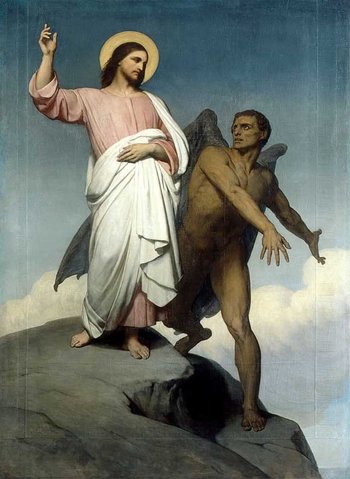
This is about purely good character(s). They are completely and utterly incorruptible. The natural bane of The Corrupter, and immune to The Corruption.
While the people around them can be tempted by power, fame, sex, money, or love, this character is immune to succumbing to temptations. More rounded characters may feel the temptation and still resist. They will always do the right thing for the greater good, if not necessarily the nice thing, at times even if violence is necessary.
They'll never lose their moral compass or idealism. Even having to engage in morally ambiguous acts, such as deceiving someone for a good cause, appears as Dirty Business to them. They greet fame with Think Nothing of It and often tell people to Keep the Reward; working for the Glory Hound causes, at most, mild annoyance. What You Are in the Dark poses no difficulties to them. If they are tortured, they will endure. They will even — reluctantly — step aside and let others be More Hero than Thou, for good cause. If the character can manage to succeed in spite of everything, they will likely have earned their happy ending.
Moral conflict in such a character, or between two such characters, is possible but is driven by a conflict between two moral principles. One argues for mercy — or that justice, in this case, will harm innocents; another may attempt to enforce justice, arguing that in the long run, knowing justice will be done to prevent harm to more innocents. While they are unlikely to slander in any circumstance, some will let a lie or half-truth stand to prevent harm; others will tell the truth and damn the consequences.
Often, this is a key element of Ideal Hero, All-Loving Hero, Badass Pacifist, The Cape, The Pollyanna, Martial Pacifist, The Redeemer and the Token Good Cop. Heroes like these are often sneered at as being unrealistic, old-fashioned or naive when compared to Anti Heroes - and regardless of whether they actually are. They are likely to respond that it's better than giving up.
A flaw in this mindset is they might not partake in the daily ethical compromises others make, find it difficult to interact with the rest of society, and thus be a Socially Awkward Hero. They may also use their belief (if they hold one) in the fundamental goodness of humanity as a basis to offer second chances to people who would abuse it or reach out to help people who they should really be running away from.
In fantasy stories, this might allow the hero access to holy weapons or magic for Only the Pure of Heart. Might lead to a 100% Heroism Rating or becoming a Universally Beloved Leader. Be wary that they might be Too Good for This Sinful Earth. Also very likely to be a Celibate Hero.
This character is basically the polar opposite of Complete Monster, a purely evil character; and Hate Sink, a character deliberately designed to be hated while Incorruptible Pure Pureness commonly invokes positive feelings in the audience. Of course, these characters are their most common enemies for obvious reasons.
Contrast Pure Is Not Good and The Corruptible. This is the trope the Wide-Eyed Idealist aims for and falls short of reaching.
Examples:
- Ah! My Goddess: Belldandy defines the concept of a pure-hearted person. In the Season 1 finale against the Lord of Terror, when Keiichi is infected by the Lord of Terror and possessed, she offers to take his place as the host. Seeing the opportunity to get rid of the human body he was using, the Lord of Terror separated himself from Keiichi to infect Belldandy, but couldn't. She is simply too pure. But because he had to move into something else, having detached himself, he moves into a nearby Floppy disk, leading to his defeat... at the hands of Skuld, armed with a small magnetic bar. Her pureness also shows when, in the OVA, her angel is ripped out and replaced by a demon. Two minutes later, the demon radiates happiness and sparkles.
- Battle Royale:
- The main character Shuuya, who despite the horrible things going on never gives up hope and faith in humanity. The novel and manga (but not film) also have Yuichirou Takiguchi, though his purity actually leads to deadly results such as becoming a terrorist and leading an army of youths in the sequel to the film, making him a downplayed example.
- You could also count Noriko Nakagawa, the most archetypal self-insert in manga history. She's similar in the movie and novel, but nowhere near so blatantly.
- Berserk:
- Rickert is the only character who may play it this straight in the Crapsack World of Midland. In the Band of Hawk, where almost every member had some emotional baggage, Rickert's characterization, in contrast, came from his innocence despite being a mercenary. This comes to a head when Rickert meets Griffith, who offers him a chance to join him in his new kingdom, unaware that Griffith sacrificed the whole Band of Hawk so he could achieve godhood and sadistically raped his Number Two Casca while Guts, his dearest friend and Casca's lover, was Forced to Watch with his arm hacked off. Despite stopping Guts from attacking Griffith, as soon Rickert learned the truth he was horrified and, when Griffith offered a second time, Rickert gave him a glorious Bitch Slap showing he is indeed incorruptible. Prior to the slap, Guts states correctly Rickert simply cannot hate Griffith like Guts does, as it's just not in Rickert's nature. While he did defy Griffith's wishes, it was out of love and respect for the old Band of Hawk rather than revenge.
- Judeau is one of the original members of the Band of Hawk, and after being betrayed by Griffith during the Eclipse, he sacrifices himself there to save Casca from the Apostles. He lacks the corrupting factors had by several other characters, as it was only as last resort that he killed several soldiers with throwing knives. Casca is not the only whom he dearly protects, as he's also helped other characters like Guts; Judeau gives the two a big of elf dust to treat their wounds, for example.
- Death Note: Soichiro Yagami is a particularly heroic example; in spite of being surrounded by Death Gods and being manipulated by his own son, he's one of the only specks of white in a show that's otherwise Black-and-Gray Morality. The author himself claims that he sees Soichiro as the only character who truly embodies "justice" in the series. Even when making a deal with Ryuk and getting his hands on the titular Death Note, he never uses it and dies with a clear conscience. Ryuk points out that since the Death Note brings misery and fear to whoever uses it, Soichiro refusing to be corrupted is probably what let him die happy, not knowing his own son was the mass-murderer, Kira.
- Demon Slayer: Kimetsu no Yaiba:
- Nezuko never gives in to the demon blood flowing through her body, which is a testament to how much she can battle her demonic instincts. Tanjiro reminisces how before she was turned, she was The Heart of the family, even above his efforts, as she was able to comfort all her siblings and mother after the closely timed deaths of their grandmother and father.
- Tanjiro himself definitely qualifies, as he's both The Leader and The Heart of the group and an All-Loving Hero who's even willing to show Sympathy for the Devil (before cutting them down). In the Mugen Train Arc, an assassin sent to kill him during a Journey to the Center of the Mind couldn't bring himself to go through with it after witnessing firsthand how pure his soul was.
- Kyojuro has at first disagreed with Kagaya's order to not kill Nezuko for being a demon, but he starts acknowledging her after she refuses to eat Sanemi. Him having fulfilled his duties and his death in the fight with Akaza have led to a big impact for the main characters to continue forward and defeat Muzan; he, with Hashira and other people in the afterlife, even manage to save Tanjiro from Muzan's corruption, ending Muzan's legacy for good.
- Mitsuri has first joined the Demon Slayer Corps to find a strong man for her to be Happily Married to, but she feels regret for joining the slayers for that reason after realizing her strength and her past insecurities, but she does accept herself for who she is and later seeing how much in love she is with Obanai; thanks to some help from Shinobu and Obanai, at least. She has also been the only Hashira to oppose beheading Tanjiro. Along with other people in the afterlife, she contributes to saving Tanjiro from Muzan's corruption.
- Gyomei has started out as a temple priest raising and taking in orphans. But after Kaigaku disobeys the rules and lets a demon in, and after confusion of Sayo witnessing the following crime, people have fought Gyomei killed everyone while he has just been killing the demon, the actual offender of the crime, to protect Sayo. He has also saved Shinobu and Kanae Kocho from a demon after their parents are killed, as he has inspired them and allowed them to become Slayers after first being reluctant to take them in. He also contributes to saving Tanjiro from Muzan's corruption.
- Dragon Ball:
- Son Goku is the most famous example. Apart from being able to ride the Nimbus, he also once survived an attack that worked by exploding one's heart with evil by the merit of not having a single shred of evil in him. His friends attributed this to him being really, really dumb. When he shook hands with Shin, the latter commented that his soul was indeed completely pure.
- Blue-haired Launch is this foremost female example of this, being the second person shown capable of riding the Nimbus. Unlike her, bad blonde side, blue-haired Launch is selfless, affectionate, and endearing even if her innocence makes her a little airheaded. The best example comes from Launch’s appearance in the Buu saga where she freely gave her energy to Goku’s spirit bomb not because the Fake Ultimate Hero demanded she do it, Launch just liked Goku’s nicer sounding voice when he pleaded for energy.
- Goku's sons Gohan and Goten are also this. Which is what allows them to ride the Nimbus cloud before learning how to fly. Gohan, in particular, hated fighting and offered mercy to some of the evilest villains. Android 16 who has a similar mindset to Gohan consoled him saying peace was worth fighting for. This becomes poignant as Cell viciously destroys 16 in response and Gohan is driven over the edge and brutalizes Cell to a sadistic degree, Gohan never been this vindictive again and remains one of the most steadfast characters even purer than Goku at times. It helps Gohan lacks a lot of the Blood Knight tendencies that plague Goku.
- Android 16 is one of the few characters who may just make Goku look bad by comparison, being a selfless nature loving Gentle Giant. Ironically 16 is by design a Killer Robot created to destroy Goku but harbours no real malice and doesn’t hurt Goku in the slightest when he meets him, meaning 16 is incorruptible to his own programming. Though it’s 16 good nature that meant he was the only one who reaches Gohan emotionally and inspires him to kill Cell, 16 states (before getting his head crushed) that Gohan cannot love all life without also wanting to protect it from that which will destroy it.
- Kami has expelled his inner selfish desires to become Guardian of Earth while hating himself for accidentally creating his Evil Counterpart King Piccolo. He has also created the Dragon Balls to grant wishes to humanity and give them hope, being indirectly responsible for all of the innocents being revived by Shenron throughout the series. He also reluctantly fuses with Piccolo to fight Cell showing up to threaten Earth, and that makes Piccolo complete his transition from an anti-hero to a hero; Piccolo will still be aided by Kami for the rest of the series.
- Elfen Lied: Nana adheres to this entirely, never mind the fact that she is near-genetically predispositioned towards genocide or the fact that she is always being made to suffer horribly. She's so good you could probably consider it a psychological disorder for her. It has been stated that her personality was crafted as a mental defense to avoid going mad due to the horrific conditions of her life.
- Fist of the North Star: Kenshiro does not do anything evil, will not tolerate any evil around him and trying to tempt him out of the righteous path will not end well for the offending party. Not only will Kenshiro never backs down from doing the right thing, offering him rewards for doing so is to get on the wrong side of a one-sided ass-beating. Kenshiro also has a lot messianic aspects from his Healing Hands and desert wandering, though it helps Kenshiro had his brother Toki (who's literally designed after Jesus) to morally guide him.
- Yuria and Mamyia are characterized by their goodness, beauty, willingness to self-sacrifice, and power to inspire others Yuria, in particular, was dubbed Too Good for This Sinful Earth at various points.
- Lin was the shining example of Children Are Innocent especially in contrast to the more bratty and selfish Bat.
- Ginga Densetsu Weed: Weed definitely counts. Unlike his father Gin, who would only kill if a villain would not redeem themselves, Weed won't kill anyone ever. Even if Hougen killed many dogs to climb his way up to power. He even stopped Gin from killing Hougen (although Gin was really just giving Weed a Secret Test of Character).
- Great Teacher Onizuka: Tomoko is probably the most unambiguously good person in the series. Even when she becomes a popular actress, she never treats her classmates badly for their bullying of her before, and still believes that deep down what Miyabi needs is a friend (even though Miyabi was a terrible friend to her). The only others who come close are Noboru and Fuyutsuki, but even they have their moments of selfishness.
- Gundam:
- Mobile Suit Gundam 00: Marina Ismail is an Actual Pacifist who refuses to kill anyone by any means and wishes to change the world by peaceful means if possible. She is notable for raising a group of orphans (a trait that defines her as an expy of Frau Bow) and composing a song that heals whoever hears it, including the emotionally wounded Setsuna, who undergoes a Character Development into a Messianic Archetype for the rest of the second season. At one point Marina even prevents one of her children from firing a pistol even at the cost of her own life, although her bodyguards later shoot down the villains trying to kill them, allowing them to escape.
- Mobile Suit Gundam SEED: Lacus Clyne. First, she appears to be a very naive innocent girl. Later, it is obvious she's way smarter than she acts, but she's still an Actual Pacifist (aware that sometimes you need to use weapons to bring everyone to peace negotiations), and she can forgive everything once you join her fight for peace. Actually, everyone who sides with her is so much under her influence that they welcome former enemies with open arms. Athrun implied in Mobile Suit Gundam Seed Destiny that she has little interest in sex, and with Kira, she acts as if she doesn't even kiss on the mouth before marriage.
- Happy Sugar Life: In a cast of characters who either suffer some form of mental illness, have been deeply traumatized, or are simply downright evil, Shouko Hida is the one character who manages to be none of the above.
- High School D×D: Asia Argento, kind, sweet and selfless to a fault. Even after being reincarnated as a Devil, she continues to follow God's teachings, like praying and reading the Bible despite the pain it causes her.
- I'm Gonna Be an Angel!: Noelle is pretty much goodness and pureness incarnated — unfortunately with the side-effect of having the brain capacity of a 3-year-old (while technically age 15).
- Ikki Tousen: Hakufu Tousen never holds grudges, always comes to her friends and family's aid, and is against the idea of violence and killing against her opponents. This could be attributed due to her being a ditz.
- The half-demon Jinenji from Inuyasha is also one of them. He has a loveable and meek character, even if he does not look like that at all. The villagers have treated him badly all his life, simply because he is a half-demon, and he has never resisted, though he could easily have destroyed the whole village. He even rescues his village from a man-eating youkai, even though they treated him so badly.
- Bell Cranel from Is It Wrong to Try to Pick Up Girls in a Dungeon? qualifies. A lot of girls are interested in him because he is such a nice boy.
- I Somehow Got Strong By Raising Skills Related To Farming: Protagonist Aru Wayne just wants to work his farm. That is his deepest desire. Even when he amasses an incredible jump in strength after inadvertently maxing out his skills to the highest pointnote he just wants to be a farmer. When the evil dragon Uroboros tries possessing him his simple desire for farming inhibited the dragon from even gaining a foothold within him.
- JoJo's Bizarre Adventure:
- Phantom Blood: Raised as a gentleman during the Victorian Era of England, Jonathan Joestar is an all-around Nice Guy that takes chivalry very seriously. Cue Dio Brando, who makes his life miserable. Initially, he suffered in silence and didn't retaliate, until Dio forcefully kissed his girlfriend Erina. Jonathan fights for her honor, but living in Dio's shadow was also no longer an option. Improving his fighting prowess, he later became a Martial Pacifist that showed courtesy to many, even going so far as to speak politely to his enemies. Instead of celebrating his third victory against Dio, Jonathan sheds tears for him as he seemingly dies. Later on, Dio returns and fatally injures him. Several other people's final words for a monster like Dio would be hateful, but not Jonathan's. He mentions how they had such a bizarre friendship, accepting his fate. He tells his wife Erina to live happily and dies with a smile. Although Jonathan's descendants that were also nicknamed "JoJo" inherited his heroic will, they definitely didn't inherit his pureness.
- Robert E. O. Speedwagon appeared not only in the above chapter, but also in Battle Tendency: he has a sense of honor and has only robbed scumbags as a thug, but he is deeply moved upon hearing Jonathan's reasons while the latter is attacked by thugs, and that makes him a better person as he stops attacking Jonathan. He even makes up for it by helping him and his family, losing any corrupting qualities he may have, as his life and actions as a thug are offscreen villainy.
- Stardust Crusaders: Jonathan's great-granddaughter Holly Kujo is just as pure as he is, if not more so. She is very gentle, child-like, and isn't a fighter by any means. Not long along her son Jotaro awakens Star Platinum, she also develops a Stand. Her peaceful nature, along with her lack of mental strength to control her Stand, caused her to catch an illness that would kill her in 50 days. This is why Jotaro and her father Joseph go on their journey to save her life.
- Diamond is Unbreakable: Tonio Trussardi is also this. Admittedly, the presentation of his Stand Pearl Jam looked incredibly graphic and gory, making Josuke assume he was up to something nefarious, but it's only a temporary side effect that results about 5 seconds later of the person ingesting Pearl Jam being healed of any ailments they previously had. Really, so long as you don't make a mess of his kitchen, Tonio is a sweet, honest man who just wants to make quality food for people and cure their ailments. The (non-canon) light novel Purple Haze Feedback also implies that he moved to Morioh because his family disowned him for not appreciating his line of work.
- Another character from aforementioned chapter is Koichi Hirose: He feels immense guilt for accidentally running over a "kitten", despite said thing being a trick by Tamami to activate his stand, leading to Koichi saving his sister and mother from Tamami and sparing the latter's life after defeating him. He also chooses to honor Giorno's respect and leaves in peace after hearing of his dreams and seeing his honorable nature.
- Kyo Kara Maoh!: Shibuya Yuuri starts out pretty decent, kind of dumb, and nearly flat useless. Once Serious Business in fantasyland shakes a few layers of normality off him, he starts to be determined to save everyone and prevent war no matter what, and before long becomes so shiningly all-fired good that people can come around to his way of thinking within five minutes of exposure, and he's making a fair bid to forever overset politics as fantasyland has known them. In the Season 2 climax the Big Bad reveals that he was expressly designed to be utterly pure and so average he's not good for anything, to make good possession fodder. Then he turns out to be the Messiah. That was the other plan.
- In The Legend of Zelda: A Link to the Past (2005), Link is pure-hearted enough to resist being transformed into a beast by the Dark World. However, it's eventually subverted. He is pure of heart, but he can be corrupted, a trait Agahnim used to his advantage to try and get rid of him.
- Protagonist Nao Kanzaki in the manga series Liar Game not only acts as the moral compass for the other characters but she also never lies. Later, she has learned to lie, but still only for "the greater good."
- Lycoris Recoil's protagonist Chisato Nishikigi is a Nice Girl and All Loving hero who constantly remains selfless, kind, honest, idealistic and without malice, and strives to do the right thing no matter what. If Takina has become a much kinder person and has grown out of her Unscrupulous Hero tendencies, it's all thanks to Chisato.
- Magical Girl Site: Despite all the suffering she has endured, unlike many other girls, Aya Asagiri never used her power for selfish reasons or vengeance and is even forgiving toward the people who made her life miserable. She is also ready to do anything to save and protect her friends like Yatsumura.
- Maiden Rose: As an aristocrat and a leader of his country's military, Taki Reizen is expected to be this. Naturally, his relationship with Klaus conflicts with this expectation, causing lots of angst.
- Monster: Dr. Kenzo Tenma. No matter how complicated things get, he retains his idealistic views on humanity. He is one part of the morality triangle in which Johan has given in to completely evil, and Nina dives into Grey-and-Gray Morality for all that it's worth.
- Catarina in My Next Life as a Villainess: All Routes Lead to Doom! is so pure-hearted that the emotional manipulation powers of dark magic have no effect on her. Dark magic can only heighten negative emotions one already has and can't make someone feel what they don't want to. Because Catarina literally has no negative emotions in her, attempts to use those powers on her are doomed to fail.
- One Piece:
- Monkey D. Luffy is possibly a deconstruction. He doesn’t see himself as a hero (and adamantly states he isn’t one), and yet, despite often being self-serving and reckless, Luffy is still innocent and carefree, with no ill intentions at all. He never actually does anything out of malice either because of his moral values or his naïveté. He is also unable to feel temptation or lust as Hancock's beauty has no effect on him; also in Cross Epoch Luffy is shown being able to ride the Flying Nimbus meaning he is truly pure of heart.
- Chopper may be the sole other Straw Hat besides Luffy who is a candidate for this trope, mainly thanks to his innocence. Having been rejected and hated his whole early life, Chopper was overjoyed to find people who could care about him and put faith in humanity in him, causing him to want to become a doctor to help people. However, Chopper's blind trust in people is cruelly subverted as Hogback, the doctor he idealises, turns out to be a Jerkass and Chopper needs to remember that humans can still be complete monsters.
- Other examples of this include: Coby, Vivi, Kaya, Conis, Gan Fall, Rebecca, Shirahoshi, Sabo, Tom, Queen Otohime, and Vinsmoke Sora.
- Puella Magi Madoka Magica: On the several occasions she could wish for anything to herself, Madoka Kaname usually asked something for the sake of others, like saving a dead cat, saving the city from destruction, or saving all Magical Girls from past and future from a tragic fate.
- Ranma ½:
- In one Ranma ½ OVA, Kasumi Tendou is possessed by a demon, which gives her horns. She's so pure hearted the demon can't make her do anything truly evil. Pins in someone's bedding is the worse it can push her to do.
- In the manga arc of Kasumi being possessed by a demon, the meanest thing she does is put mild paralysis powder in the dinner she cooks. It doesn't even last ten minutes; Ranma's experienced far worse from what his foes and harem accidentally have done.
- Good Is Not Nice poster boy Saitou from Rurouni Kenshin constantly works for the good of Japan without seeking any credit and lives for Aku Soku Zan — "swift death to evil."
- As he says when one of his targets tries to buy his mercy: "you can tame a dog with food and a man with money, but you can never tame a Wolf of Mibu."
- Sailor Moon: Usagi Tsukino is the embodiment of unconditional love and forgiveness. She manages to resist getting turned evil and maintains her cheery personality despite having a bigger Trauma Conga Line than most magical girls from Deconstruction animes.
- This is actually deconstructed by Shonen Note: Boy Soprano: when Machiya sees protagonist Yutaka singing in public in response to the sounds of morning, she actually compares him to an angel because of how "pure and unashamed" he is. However, when she witnesses Yutaka having a meltdown during an argument over whether or not he can be in an opera troupe and the choir club at the same time, Machiya begins to wonder is the only reason Yutaka seems so pure is that it's the only way he can live without constantly being completely overwhelmed. Yutaka's unusual, unabashed sensitivity to sounds and the emotions they invoke is part of what makes him such a good singer, but it also means negative emotions can be completely devastating to the young boy, and he does his best to suppress them.
Machiya: Those darker emotions... Yutaka is afraid of them, so he just stuffs them into a glass box people call "being pure."
- In Symphogear AXZ, Hibiki is able to channel divine power, to the shock of Adam, who says that humans are tainted by Original Sin and thus unable to. It turns out that Getting hit by the power of the Shen Shou Jing in Season 2 ended up purifying her soul of the original sin and thus allowing her to channel divine power. And Genjuro notes that Miku was also exposed to the Shen Shou Jing.
- Vash from Trigun takes this to ridiculous levels. He's so pure it's utterly contagious.
- Rem Saverem, the good nurturing person Vash adored and whom he based his entire pacifistic philosophy around, is very deserving of recognition of this. Unlike her fellow humans, Rem cared for the Plants and protected two baby Plants (Vash and Knives) from being executed and when Vash and Knives learned about the atrocities humans had done to the Plants like them, Rem ending up trying to apologise on behalf of the human race. It comes to the point where Vash accidentally stabs Rem, and this causes Vash to forgo his hatred and remember how much he cares for her and gives her first aid. If that wasn’t enough, Rem does a Heroic Sacrifice to ensure the human race survives on planet Gunsmoke. Calling her Too Good for This Sinful Earth isn’t a stretch.
- Milly Thompson is one of the very few people who can keep Vash in check when it comes to morals, even giving him a punch to the face in the anime when she thought he had just killed two people. Though you could argue Milly’s goodness mainly comes from her naive Cloudcuckoolander nature.
- In Umi Monogatari, the Elder Turtle thinks Marin is this and strives to protect her from the darkness. Instead, she falls into it.
- Unico, from the Osamu Tezuka manga series of the same name, is a pure-hearted, compassionate, and innocent young unicorn whose kindness is unlimited. The protagonist has the ability to spread happiness, encourage kindness, and craves love. Unico's compassionate nature even extends to villains (mainly after learning their backstories), causing him to become very empathic towards them. In general, Unico doesn't like seeing anyone in pain and/or suffering (either physical and mental) whether they're good or evil, which causes him to show visible concern for them. This is most notable in Unico in the Island of Magic, which shows him forgiving Kuruku for turning everybody into puppets and wishing to become his first friend so he won't be lonely anymore.
- Yu-Gi-Oh!:
- Yugi Mutou has this vibe going on, with the saving and forgiving everybody all the time and big sweet eyes and not letting people get killed. And apparently purifying the spirit who possessed him, through soul contact alone, because Dark Yugi stopped coming up with creative Shadow Games and turned into a normal human being who happened to have a high school kid's body on timeshare. He has more overt flaws in the manga but is generally a pure-hearted, genuinely nice person.
- Ryo Bakura:
- After only knowing Yugi and the others for a day, he was willing to die to protect them from his dark side. In addition, his mom and beloved little sister died in a car accident, he was possessed by Yami Bakura, who would send any friends he made into comas by trapping them into RPG figures, he was bullied by the teachers for his creepy reputation, his dad was always gone and he more or less always was alone, and, by the time he met Yugi and his friends, he thought that there was something wrong inside of him.
- Yu-Gi-Oh! The Dark Side of Dimensions only strengthens this trope. He's been suffering from PTSD due to what Yami Bakura put him through but seems to finally be living a happy, normal life. Then the antagonist shows up and wants to kill him for something he doesn't remember doing and it's revealed that his father was killed by the Millennium Ring when he tried to acquire it in Egypt. After running to his father, Bakura, who was only four years old, was possessed by Yami Bakura for the first time. Yami Bakura proceeded to use Bakura to slaughter Shadi and a bunch of young children. Even so, after being Mind Raped and nearly killed, he is somehow still able to function normally and smile.
- Asterix: Asterix and druid Getafix (Panoramix), who are always the only ones in the village who remain calm, wise, and above all moral panic and fights.
- Black Panther: At his absolute best, T’Challa is this. Yes, he has faltered e.g being an isolationist and divorcing his wife Storm over the actions of other mutants who hurt Wakanda and T’Challa is fully aware of his faults, but he’s still a man who will do anything for his beloved people and will extend his hand to others outside his country when he can. This is epitomized when he’s the one to wield the Infinity Gauntlet in Secret Wars (2015) with Namor himself admitting compared to T’Challa he is definitely not worthy of wielding such power. Or the time he punched Mephisto in the face.
- Blue Beetle: The third Blue Beetle, Jaime Reyes, is often shown to be the most pure of heart hero of his entire generation. A future Lex Luthor managed to corrupt most of the Teen Sidekicks and Legacy Heroes and came back in time to kill him because Jaime was one of the few heroes Lex couldn't corrupt, no matter what he did to the timeline. Also, Eclipso once tried to manifest Jaime's dark side by turning him into his darkest fantasies of power. Jaime turned into... a dentist. It helps that, unlike many of the other heroes of his generation, he's always had a loving and supportive family and network of friends.
"Hey! A dentist makes six figures a year! You can pay off your parents' mortgage, pay for Milagro's college. Sweet office. Nice car. Maybe even a vacation place down near grandma's in Mexico City—"
- Captain America: Captain America, who stands out as one of the few truly idealistic heroes in the Marvel Universe. Indeed while most Marvel heroes have stories in which they need to fix themselves to find their place in the world, Cap comics on the flip side concern him seeing the world as broken and putting it upon himself to fix it no matter what. He’s also one of the few mortals capable of wielding Mjölnir. While no, Cap hasn’t technically been as flawless as most claim (thanks to Depending on the Writer) e.g arresting and antagonising Hope Summers and other mutants as well as doggedly refusing to listen to the other side in Civil War (2006), he’s still ultimately a good and humble man.
- Daredevil: One of the major themes of Daredevil is invoking, subverting and playing with this trope. Matt Murdock created the Daredevil persona in order to rectify his Catholic faith with the fact that he saw evil to be fought against, distancing the actions from his "real" self. Every writer of the character since Frank Miller likes to put Murdock through hell just to show that while someone pure of heart may bend when confronted with the evils of the world, he won't break.
- Doctor Who (Titan): In the Third Doctor miniseries, the Doctor telepathically enters Jo Grant's mind to help her fight off a nanobot swarm attempting to take her over, and is surprised to discover that she has no inner darkness whatsoever.
- Fantastic Four: Reed Richards aka Mr Fantastic is this at the end of the day. Although much like his fellow scientist Tony Stark he’s definitely had his rough patches along the way. What really shows why Reed is the true pure Big Good of the Marvel universe, is that for all his arrogant and morally questionable moments, Reed will do anything for his family, his planet and his universe. His goodness and forgiveness is most apparent in in Secret Wars (2015) as a Physical God Doctor Doom finally concedes Reed in mighty a Villainous Breakdown that Reed is a good person who would be better suited with the Beyonder’s powers. This is confirmed (when despised the enmity between them, the fact Victor took Susan and Valerie from him), Reed when having god-like power repairs Victor's face, proving that he is not only is a better god than Victor, he's a better man.
- The Flash: The second and current Flash, Barry Allen is legitimately one of the nicest heroes in the whole DC universe and serves as a beacon of hope to you, his successors, and his city. He has a museum, for God’s sake. Wally West, his successor was also this, but due to Nice Guy Barry being brought back DC remixed Wally as a mentally troubled hero instead.
- Hawk and Dove: Both the original Dove and the legacy hero are so pure that in Blackest Night they are the only heroes who cannot be corrupted by the Black Lantern Rings. When some try to resurrect Don Hall, they fail as he is at peace, and Dove 2 is able to outright destroy the rings that try to corrupt her.
- Irredeemable: The premise of Incorruptible is that the supervillain Max Damage has decided to become an example of this after seeing the Plutonian become a monster. He realizes that the world will fall apart without a Big Good like the Plutonian (before he went evil), and Max figured he might as well step up and fill the void.
- Judge Dredd: Played for laughs in a story, where the titular Judge is kidnapped by a fiend-worshipping cult who need to sacrifice a pure soul. An incredulous Dredd asks why they would target him for the role, as he's well aware that he's a brutal enforcer for a neo-fascist authoritarian regime and an all-around asshole besides. They reply that his absolute dedication to enforcing the law fairly and aversion to corruption marks him as "an acceptable substitute", given the Crapsack World they live in.
- Lumberjanes: Ripley of all people falls under this. When she's granted the power of the Greek gods, she uses it to give Bubbles the raccoon a funny hat, free the Scouting Lads from Apollo's mind control, give everybody a kitten, and make sure that nobody will ever have the power again.
- Martian Manhunter: The Martian Manhunter, despite his stoic and often aloof attitude, has a warm and caring soul. He is naturally empathetic, due to his telepathic abilities. Considering how powerful he is, he shows a large amount of restraint. His real name, J'onn J'onzz, means "Light to The Light" in Martian.
- The Mighty Thor: Thor Odinson although Hot-Blooded is often shown in this light as well, in one comic he actually visits and comforts a man on Death Row just because he wanted to. In Thor: God of Thunder (2012), Thor actively defies the God Is Inept trope by happily visiting the countless species that have prayed to him. Only the purest and bravest of heart are able to wield his hammer. The list of people able to do so is “relatively” small so far: Beta Ray Bill, Storm, Captain America, Jane Foster, Adam Aziz, Iron Man [although Mjölnir was having issues when Tony and Adam lifted it], Wonder Woman, Superman [the latter only sometimes] and a random paramedic who handed it to Thor before vanishing into the crowd. Dan Slott has claimed that, in the future, Eddie Brock will wind up bearing the mantle as a What-If?-type story). In King in Black Eddie is able to wield Mjölnir to finish off God of Evil Knull.
- Sadly, Beta Ray Bill's hatred of Galactus (Bill's homeworld was consumed by Galactus) drives him to commit terrible deeds all in the name of destroying the planet eater. Bill only realizes how far he's fallen when he can no longer wield his own enchanted hammer Stormbreaker. He redeems himself later and can lift it again.
- She-Hulk: She-Hulk is traditionally an amazingly kind, moral, altrustic, idealistic, and philanthropic individual, including systematically helping even dangerous criminals to be treated decently via her legal work, creating her own disaster relief organisation, and being as good as impossible to corrupt, even after weeks of systematic torture and brainwashing at the hand of the Winter Guard. She is usually up there with Captain America as the most purely heroic Marvel Comics character, and is always very kind, friendly, helpful, and inspirational to regular people, rather than considering herself above them.
- My Little Pony: Friendship Is Magic (IDW): In the second story-arc Spike is unaffected by the Nightmares period and quickly breaks free of the Lotus-Eater Machine Nightmare Rarity traps him in.
- Nightwing: Richard "Dick" Grayson is a compassionate idealist to the degree that even Superman admires him. During Infinite Crisis, Earth-Two's Kal-L claims that New Earth is a corruption of his world and that none of its heroes is worth protecting. But when Batman asks if that's true of Dick Grayson, Kal-L says no. Even the person wanting to merge the worlds together has to admit that Dick Grayson is just as wonderful in the "corrupted world".
- Rom Spaceknight: Rom is portrayed this way. Although most humans fear him upon first seeing him, anyone who gets to know him at all will end up marveling at his nobility and self-sacrifice. Even Namor, who tends to dislike everyone he encounters, thought Rom was the most honorable man he'd ever met. Galactus claimed Rom was the only being he'd ever encountered who was as pure of heart as the Silver Surfer.
- Shazam!: Captain Marvel from Fawcett/DC Comics.
- One of the common comparisons that happens since the Fawcett characters were added to the DCU is that even Superman fantasizes about just killing Lex Luthor and taking over the Earth for its own good from time to time. Captain Marvel is beyond that. It helps that he's still a kid.
- This depends on the writer, however, and sometimes Superman and Wonder Woman are shown possessing these traits as well. However if anyone is shown to be more pure than the Ur-Example of The Cape, it's Captain Marvel.
- The mega-crossover Underworld Unleashed had Neron, a Satan-Expy, going after the soul of Captain Marvel, because he was the most pure of the heroes. However, his soul was so pure a demon couldn't touch it.
- Captain Marvel's traditional pureness is heavily averted in the New 52 reboot, though. Billy's a troubled kid who cynically argues to the wizard that pure goodness doesn't exist, but the wizard sees ''enough'' good in him to give him superpowers anyway.
- Silver Surfer: Oddly enough, of all people Norrin Radd, aka the Silver Surfer, often has this trait. Despite being the herald of a world-eating Eldritch Abomination. One of the reasons they call him Space Surfer Jesus.
Silver Surfer: I will not kill.
Galactus: Yet you serve Galactus once more.
Silver Surfer: I will not kill.- "What if the Silver Surfer had not escaped Earth?", in What If? v2 #22, predating the DC "Underworld" storyline above, but with a similar premise; arch-demon Mephisto finally gets his wish and wins the soul of the Silver Surfer, and drags him into Hell, only to find that the Surfer's soul is so pure that its goodness burns him — and since the Surfer agreed to be there forever, that light will always be burning Mephisto.
- Speaking of which, you know you're pure if the devil himself is obsessed with having your soul, treasuring it above all others. Mephisto was introduced in this otherwise mostly sci-fi comic, seeking to make the most pure soul in the universe fall. It's to the point where when it seems that the Surfer has finally snapped, given into his anger, and gone on a rampage, Mephisto, instead of saying "Hah! He's mine!" or "I knew nobody was that good!" he just rolls his eyes at the Surfer thinking he's gone dark, figuring he's going to scare some people, feel bad about it in short order, and undo the damage. Which is, of course, exactly what happens.
- "What if the Silver Surfer had not escaped Earth?", in What If? v2 #22, predating the DC "Underworld" storyline above, but with a similar premise; arch-demon Mephisto finally gets his wish and wins the soul of the Silver Surfer, and drags him into Hell, only to find that the Surfer's soul is so pure that its goodness burns him — and since the Surfer agreed to be there forever, that light will always be burning Mephisto.
- Spider-Man: Spider-Man is the main example of this in all of Marvel. He almost always does the morally upright thing — for example he constantly saves his attackers from deadly situations, and in the event of a villain vs. villain fight he'll side with the losing party to prevent one from killing the other. He once defeated a villain that wanted to absorb and become him by the sheer force of his character — after defeating Spider-Man and having him at his mercy, the villain realized that he couldn't kill him and take his place since Spider-Man had never killed anyone, even in his decade long career as a crimefighter. He promptly gave up and left. One of the driving forces of the character is that he is so strongly compelled to do what he sees as the right thing that he can't give up being a superhero, even with all the misery and ruined relationships that it brings to his life.
- In Spider-Man/Deadpool, when the titular duo are trapped in Mephisto's Limbo, Deadpool notes that Parker's soul hardly has a stain on it.
- Being (mostly) this trope is the reason why it was Spider-Man who mentored the Living MacGuffin aka Chosen One Hope Summers in Avengers vs. X-Men teaching her about responsibility better than anyone else.
- In The Amazing Spider-Man (Dan Slott) #800, Peter ends up Taking the Bullet for Norman Osborn (his Arch-Enemy who killed his love Gwen Stacy and just killed his friend Flash Thompson) when J. Jonah Jameson tries to shoot him.
Jameson: Why... why would you...?
Spider-Man: Because I could. That meant I had to. Because with great power there also must come great responsibility. To everyone. Even the worst of us.
- Steelgrip Starkey and the All-Purpose Power Tool: Steelgrip Starkey, who was selected for the All-Purpose Power Tool specifically for his "purity of energy and intent."
- Superman:
- In the comics Superman tends to be a lot closer to this trope than his animated counterpart, mainly because he consciously tries to be this due to fear about the amount of damage he could do with just one act of bad judgement.
- The list of people that Eclipso can't take over is absurdly small. However, Eclipso was genuinely surprised at how little evil there was in Superman.
- Manchester Black was shocked when Superman refused to kill him even after Manchester apparently murdered Lois Lane. Manchester finally admits that Superman is a true hero, and that means Manchester isn't.
- In one issue of Justice League, the renegade king angel Asmodel clashes with Superman, yet is unable to defeat him. As a last straw, Asmodel blasts Superman with heavenly light which then has no effect. He then remarks "How can you stand the scouring light of heaven!? Only the purest souls can gaze upon this flame and not be driven mad!". So... yeah... Superman fought a renegade angel to a standstill and withstood the light of Heaven.
- Supergirl is generally this, though like Wonder Woman (as well as her cousin) she’s been given Darker and Edgier behaviour in later continuities such as The New 52 but other than that she’s decidedly Hair of Gold, Heart of Gold, being someone who wants to do right thing in any given situation. In Supergirl (Rebirth), when the public demands to know why Kara is trying to redeem the mass-murderer Cyborg Superman, she simply replies that she refuses to give up on anybody.
- Tintin: Tintin, after the first two altered and unpopular books, becomes this, with a side of Screw the Money, I Have Rules!. In the rest of the books, Tintin is characterized by his selfless and kind nature, even coming to the defense of multiple minorities hurt by racism. Which considering the time in which he was written makes Tintin very progressive.
- Wonder Woman:
- Similar to Superman, Wonder Woman is usually written as this (especially during the Golden Age), being the chosen Amazon to lead humanity to a better place, since (Post-Crisis) she’s only one of her people who saw good in mankind. Diana is also a friend and protector of all children and frequently frees women from oppression even literally breaking them free from chains. This characterization started to slip when she killed Max Lord, and was tossed out entirely for the New 52, but Wonder Woman (Rebirth) brought Diana back to her roots as an idealized pure hero.
- In The Legend of Wonder Woman (2016), Steve Trevor being purely kind and good is why he crashed on Themyscira at all, he was drawn there by a ritual designed to bring in and kill an innocent outsider to ruin the magical protections cutting the place off from the rest of the world. This is also the foundation of his relationship with Diana and part of, in addition to his good looks, the reason for his Chick Magnet status.
- X-Men: With most of the X-Men being a lineup of Anti Heroes, one exception stands out in the form of Colossus, a genuine Nice Guy and all 'round hero. His spirit is so pure that it (and the steel in his body) actually cause harm to most evil supernatural forces the X-Men fight. Just... don't tick him off. Seriously, don't. His goodness is so strong that he's still a pretty nice guy even after becoming the new Juggernaut.
- Same with his good friend Nightcrawler, a deeply religious and good mutant who looks like a demon, who actually attempted to become a priest, and when faced with a Deal with the Devil punched said devil in the face. He even makes friends with the incredibly anti-heroic Wolverine.
- Nightcrawler's Spiritual Successor in this department is the young X-Woman Pixie, Megan Gwynn. Introduced as an upbeat girl with the power to make people high (well, not quite, but that's the best way to explain it), since created she's been to hell itself and had portions of her SOUL ripped out and replaced with darkness, three times, and yet now she's still a happy, upbeat and friendly girl, 'cept now she can do magic.
- It’s ridiculous to talk about good morally upright X-Men without mentioning the good goddess of nature Storm. Storm in first appearance actually willingly sacrificed being worshiped as a living goddess by her tribe in Kenya, in favor of living in a society that actively hates people like her, simply for the sake of protecting mutantkind. Ororo has even managed to bring someone like Wolverine to heel and made him agree to forswear lethal force as much as possible when she was leader of the X-men. The weather witch is truly one pure woman. Naturally Ororo can use Mjölnir (having used it to summon lightning to Thor’s shock), being the only mutant in 616 universe so far to wield it.
- Rogue, although a villain originally has become The Cape since she joined the X-Men and refused ever to go back despite Mystique’s best efforts. She has frequently fought for both mutantkind and humanity and while still having messed up on occasion, in Uncanny Avengers Rogue is the one actively saving Earth from getting destroyed by Exitar the Celestial. Rogue’s Internal Monologue during said event affirms that since Charles Xavier gave her a second chance to be a better person, she won’t ever let that sentiment down. Given she’s adoptive sister of the aforementioned Nightcrawler, this is to be expected.
- Jean Grey is this ultimately, to the point of being a Messianic Archetype. While she hasn’t always been perfect (as much the love-blinded Cyclops, Wolverine, and others like to claim she has), Jean ever since she was little and holding her dying friend Annie in her arms has been an All-Loving Hero who doesn’t bare any of the understandable anti-human hang-ups of the rest of her kind. She’s consistently one of the X-Men who strive always to do the right thing and is capable of forgiving even those who hurt her race the most. Being one of the few mutants going out to bat for Scarlet Witch, despite the near genocide Wanda committed in House of M.
- Professor X is mostly this, Xavier’s cause and belief in Mutant-Human corporation inspires and continues to guide the X-Men to this day. True, the Professor wasn’t spotless, pulling Good Is Not Nice more than once and he kept many other issues repressed... but regardless it’s telling that when Heaven in Marvel is shown Xavier was up there. Played With in X-Men (2019) Xavier is still Big Good for mutantkind, but has developed Beware the Superman practices and taking a page of Black Panther’s book isolated mutants from the rest of the world with the strong implication he intends his species to outlast humanity. Although in issue #4 Charles states to the UN (who have just tried to kill him) of course he hasn’t entirely given up on his sweet naive dream, no matter how times he’s explicitly shown it just can’t happen.
Professor X: (taking off his soulless Cerebro helmet) Do you think I’ve completely given up my dream of mutants and humans coexisting peacefully? Do you think I don’t love you? Because I do. I do... I want you to always remember that. Someone once told me I’ve been spent my whole life believing the wrong dream... and I’ll admit the last few months — have been something of an education — but there’s a small part of me that will never stop believing in that dream. There’s a part of me that will never stop believing in you.
- Same with his good friend Nightcrawler, a deeply religious and good mutant who looks like a demon, who actually attempted to become a priest, and when faced with a Deal with the Devil punched said devil in the face. He even makes friends with the incredibly anti-heroic Wolverine.
- Calvin and Hobbes has a good clone of Calvin who just barely subverts this. The guy vanishes into thin air upon having an evil thought.
- Hans Christian Andersen:
- "The Little Mermaid," in the older versions of the story, represented purity. She gave up her underwater kingdom, her wealth, and her fins all for love. At the end of the story, she is unable to kill the Prince, even though he has fallen in love with another woman. Refusing to murder him out of revenge she instead commits suicide, jumping into the sea and becoming sea foam. Later versions give her a slightly happier ending by having her rescued from becoming sea foam by air spirits, who bring her to dwell as one of them. These versions try to invoke a morality in their readers by explaining that the air spirits can eventually become angels if children are good, but that they are kept from their goal whenever children misbehave.
- Also from Hans Christian Andersen, Eliza in "The Wild Swans." When her stepmother uses cursed toads on her:
Had not the creatures been venomous or been kissed by the witch, they would have been changed into red roses. At all events they became flowers, because they had rested on Eliza's head, and on her heart. She was too good and too innocent for witchcraft to have any power over her.
- Most straight-on depictions of Snow White have her as this. She's characterized by her innocence, her kindness, and her pure beauty, and nearly everyone is charmed by her. Of course that makes her a prime target for Deconstruction.
- The Hottest Dog Special Strike Series Chica is a highly optimistic amnesiac who after being re-activated through the collaborative efforts of the resistance, proves herself to be by far the nicest of the bunch, being kindhearted and welcoming towards the other animatronics and doesn't even seem to hold anything against the General despite his antagonistic behavior towards her. By the end of the Special Strike Rebellion her selflessness and determination manages to cause the Observer to turn over a new leaf, leading her to being the true reason for every other animatronic being revived and being able to live in peace.
- In the Sonic the Hedgehog fanfic Prison Island Break, the prison doctor Amy Rose Blossom is intended to be this. Her Sympathy for the Devil, a flaw which has her sympathising with the convicts around whom the story actually revolves, keeps her down, since she is clearly not The Protagonist, instead playing a supporting role.
- In Diaries of a Madman, Shining Armor is pretty much the only unambiguously good character, and dedicated to making sure everyone receives justice regardless of their rank.
- In Nosflutteratu, not even being turned into a bloodsucking creature of the night can stop Fluttershy from being Fluttershy.
- In Pony POV Series, while Rarity can be brainwashed, like when Discord turned her into Rarigreed, it is revealed that in every timeline and alternate universe, she is the only one out of the Mane Six who will never give in and turn into a Nightmare.
- In Celestia Takes a Vacation, a casual conversation between Celestia and Siesta has Louise burrowing into her blankets to "get away from the sunbeams of innocence and purity". Afterwards, she cries to Princess Henrietta that the two of them are demons of pure evil compared to Siesta. This is especially noteworthy given that Louise normally sees peasants as being Beneath Notice.
- Inquisitor Bethany Hawke gains a reputation for this in Beyond Heroes: Of Sunshine and Red Lyrium. Bethany in canon is a morally upright character; in Dragon Age II, she's at the lightest end of the game's Grey-and-Gray Morality scale. But as the Inquisitor, her kindness and selfless nature take on something of a legendary status because Varric is the narrator of her story. He actually sees her as being this trope, so he encourages other people to see her that way too.
- SAPR: Literally the case of Ruby Rose. She is explicitly described as being so pure of heart that telepathic communication with her wipes away negative feelings in people. Sunset herself describes the inside of Ruby's soul like a vast warm white light.
- In The Chronicles of the Fellowship, at one point Lucy takes the Ring herself because she worries that Gollum will lead Frodo and Sam into a trap and hopes that she has had enough of an impact on him that he wouldn’t do the same to her, Lucy showing no sign of being corrupted by the Ring despite carrying it for a few hours.
- Ash is this in Pokemon: Shadow of Time;
Lucario: You have been touched by evil, young one. But... it hasn't corrupted you. It CAN't corrupt you. You hold much anger, much guilt, but... you desire to help others. I haven't seen that since… well, before the Shadow War. You are too much for those you love that you won't let yourself hurt them.
- In the works of Khaos Omega, the titular Amethyst Angel herself. Her natural aura has an insanely strong purifier.
- During the early part of Operation Phaaze she's hit from a direction she wasn't looking by a huge Phazon blast. Phazon, as in canon, is shown to corrupt anyone it comes into contact with (though Samus still fought against it). Anise? A readily-usable rainbow-colored strain with selective targeting (as in it won't affect her allies whatsoever).
- A dying Metroid Prime steals all but the arm cannon of her original Power Suit before she can fully escape Tallon IV's collapsing Impact Crater? Enter Anisha, a blue-haired lookalike with all of the original's insane beauty — AND the purifier, which by the events of Aether have fully turned the original Dark Samus to Anise's side. A random X Parasite that happened to leave its home planet also taps into the purifier to become an allied SA-X.
- Black Shadow's cloning spell from F-Zero GX? The clone immediately banishes Black Shadow to where Deathborn canonically sent him (this attempt was not her first time running THAT particular game's story mode for on her first time, her third-ever official XQ mission, she had the first try literally phase through her via a defensive ability and copied the binding spell the cloning one was hidden within on the second try).
- Collecting the World Rings? A combination of resurgent traumatic memories via the way Shahra was killed, a convenient collector identity transfer related to a copied Flame of Judgment curse, and her natural arua's purifier results in a new power dubbed 'Chrono EX', the World Rings themselves equipping to her like ordinary jewelry.
- Blessed with a Hero's Heart: Izuku Midoriya. He's so pure that the succubi from the Cream Café are shocked by how intense it is, to the point they are forced to use magic and induce an Erotic Dream on him just to find what kind of person he finds attractive.
- Disney Animated Canon
- Jiminy Cricket agrees to the Blue Fairy to be Pinocchio's conscience for said puppet to learn right from wrong, such as keeping him from joining Stromboli's show. He is even devastated when believing that Pinocchio has drowned after escaping Monstro.
- Cinderella is sweet to her animal friends, such as caring for a family of mice and protecting them from the stepmother's cat Lucifer. She also makes the story lighthearted (despite being a generally serious person) such as being very forgiving, kind and cautious like forgiving Anastasia, which lets the two turn the Fairy Godmother back to normal.
- Prince Philip stands out as the only hero among heroes like Princess Aurora and the Three Good Fairies, by being incorruptible and passing the admirable standard thanks to him being very forgiving and cautious such as when he first meets Aurora, under the name "Briar Rose". Him breaking the curse means more than saving Aurora from her death-like sleep, it also means freeing the entire kingdom from an indefinite slumber.
- Pixar
- Flik from A Bug's Life is an example of this, and you can always count on him to act selflessly and do the right thing. His nemesis Hopper contrasts this by being extremely vile, though he's decent enough to honor a promise that he made with his mother.
- Barnyard has Ben, a cow who has protected the barn for years and raised his adoptive child Otis. He warns the animals of the coyotes and tells them to be careful, especially to Otis whom the former told to cut down on being a goof and to be a strongly responsible protector and successor. Despite that, he still covers Otis's shift and lets him hang out with his friends despite what he feels about it, even if it means that after he lets Dag go after the former scares him and his pack off the farm, Ben still sacrifices himself to save the chickens from the coyotes. He is why Otis has become who he is today.
- Manolo from The Book of Life verges on this, given his All-Loving Hero attitude and being a Badass Pacifist. Plus, La Muerte (in disguise as an old woman) blesses him by "always keeping his heart pure and courageous".
- Robots has two heroes, with the latter being the Big Good, against two vile villains.
- Rodney Copperbottom retains his optimistic and hopeful demeanor in spite of being told he'll never be something special, and that motivates his will to be an inventor helping others like his idol. He builds Wonderbot to help his father, Herb with the dishes, he fixes Fender's neck even after the latter tried to steal his foot, calling him a "friend"; furthermore, he helps the outmodes by fixing them instead of letting them steal parts from other outmodes. When he finds Bigweld in his time of despair, he makes him get his hope back and assist in fighting Ratchet and Gasket. At the end of the film, he tells Bigweld to fix Herb, whom he thanks for believing in him and his dreams, even going as far as to help Herb achieve his dream: to be a musician. He also loves Cappy for who she is, unlike Ratchet.
- Bigweld uses his company Bigweld Industries to inspire others to make a change with inventions, to make them believe in themselves, and preaches positive messages throughout the Bigweld Show. Even though said company has his name on it, he never expresses arrogance or egotism. He tells Rodney that he wants to grow up to be just like him after being jaded and telling him to give up on his dreams after retiring from his company when Ratchet made it more profitable, and his regain of optimism is a sign of him ending his heating-up period and helping Rodney take a stand against Ratchet for his plans against outmodes. In the end, not only does he help Herb, he also gives Diesel a voice box, finally letting him speak.
- In Spider-Man: Into the Spider-Verse, Peter Parker from Miles Morales’s universe is certainly this which is why all of New York mourns his death.
- Miles Morales is the successor to Spider-Man and becomes this by the film’s end. When Spider-Man gives him the task to deactivate the Super-Collider with the override key, Miles accepts the task and he begins training in order to master his powers and finish the mission given to him by Spider-Man after his death. He refuses to let any of the other Spider-People to stay trapped in his dimension, declaring he's going to get all of them back home.
- Gwen Stacy is the spider-Lady of her dimension who saved her father from dying, and constantly battle villains in her dimension to protect her New York. She was very important to Miles personal growth, making her vital to stop Kingpin.
- Shirley Temple's characters are usually the ones who make the villains have a change of heart, because she is so innocent and well-meaning. See: the ode to Shirley in Curly Top:
You're just so full of sunshine
Folks agree
You could supply the world
With Vitamin D!
Two eyes that make
The heavens proud to be blue
Angel cake
It's just a copy of you! - In Angels with Dirty Faces, the Good Shepherd character adamantly refuses to support the corruption going on in his neighborhood, even if it means losings thousands of dollars, turning his back on his oldest friend, and abandoning his dearest plans for the future.
- Barbarella cannot be consumed by the Mathmos because of her innocence.
- Captain America: The First Avenger: This is the reason why Steve Rogers became the ideal Super-Soldier in the form of Captain America. The serum which enhanced him was explicitly stated to amplify everything about the subject. Steve, a genuinely nice guy who lives by an innate and nigh-infallible moral compass, was chosen specifically because that compass would never allow the power he was about to gain to go to his head.
- You would think this trope would apply to Cap’s appearances across the MCU; however, you’d be mistaken, sadly, as it becomes a Downplayed Trope with Steve’s moral compass constantly put to test in a world that no longer operates on Black-and-White Morality. Despite his goodness, this becomes an outright Defied Trope with Cap in Captain America: Civil War as Steve makes some bad choices (e.g. keeping Howard and Maria’s murder secret) which result in the splitting of the Avengers. Steve also drops his iconic shield knowing he’s no longer worthy of carrying it.
- This was intentional on the part of the Russo Brothers, with Joseph Russo stating they didn’t “gravitate” towards the idealistic Captain America and wanted to show a relatable, complex, and even flawed Steve Rogers.
- This is ultimately played straight as in Avengers: Endgame, Steve is worthy enough to wield Mjölnir.
- In The Falcon and the Winter Soldier, someone managed to recreate the Super-Soldier serum. Zemo states that anyone who will be enhanced by it will eventually become a supremacist, to which he gets a counter-argument answer with a mention of Steve.
- You would think this trope would apply to Cap’s appearances across the MCU; however, you’d be mistaken, sadly, as it becomes a Downplayed Trope with Steve’s moral compass constantly put to test in a world that no longer operates on Black-and-White Morality. Despite his goodness, this becomes an outright Defied Trope with Cap in Captain America: Civil War as Steve makes some bad choices (e.g. keeping Howard and Maria’s murder secret) which result in the splitting of the Avengers. Steve also drops his iconic shield knowing he’s no longer worthy of carrying it.
- Eric Liddell in Chariots of Fire. Interestingly, it is well done enough to make him more likable because of this instead of making him "sue-ish."
- Batman in The Dark Knight is called "incorruptible" by the Joker. Granted, Batman is the epitome of Good Is Not Nice, but Bats in the Nolanverse absolutely Will. Not. Kill.
- He might let you die, though.
- Joe Friday in the 1987 movie version of Dragnet is incorruptible. His only vice is cigarettes, which he warns others against taking up. Although as for pureness, at the very end of the movie he does start de-flowering The Virgin Connie Swail (consensually and respectfully).
- The Golden Child is such a character. As a Buddhist monk with mystical powers, his mere existence serves to prevent the forces of evil from taking over the world. The only way they can kill him is if he becomes corrupted by committing an evil act; but despite starvation and isolation, he holds firm for The Chosen One to rescue him, and manages to convert a mook to the side of good in the process.
- Gremlins has Gizmo described as an "Eternal Mogwai" who refuses to become a Gremlin in contrast to his Antagonistic Offspring. When his pre-Gremlin clones cut the wire on Billy's clock to trick him into feeding them after midnight, Gizmo refuses to eat the food they were given.
- How innocent and pure is the Girl in Hearts of the World? She kneels at her bed and prays, "Please make me so nice and good that Boy will love me forever and ever."
- The Hunger Games: Catching Fire: The other tributes see Katniss Everdeen as being this in the second Games. Cue Finnick, Johanna, and Chaff trolling her and trying to 'corrupt' her.
- It's a Wonderful Life has George Bailey's wife Mary Hatch who manages to be just as pure-hearted as George himself, and even outshine him in certain areas. She has a chance to hang out with the wealthy Sam Wainwright, but she chose George Bailey due to his hopes and dreams, and his selflessness. She not only allows but encourages George to give up their honeymoon to save the Bailey Building and Loan, and personally showed up to use their honeymoon money. While raising four children, she also worked with George in the Building & Loan Company, ran a branch of the USO during the war, and completely remodeled a dilapidated house. Plus she loves her job even more than her husband, and she gets an Offscreen Moment of Awesome where she rallies the people of Bedford Falls to help George pay his due $8000 after his uncle misplaced the others.
- Aurora has this in Maleficent, thanks to being magically gifted with beauty and happiness by the Three Good Fairies. As a result, she sees nothing but the good in everyone, allowing her to be friends with both animals and The Fair Folk... and ultimately, Maleficent herself.
- Jefferson Smith, in Mr. Smith Goes to Washington, who single-handedly put out a giant forest fire, has been stated to collect stray boys and cats, keeps his principles in the face of Washington corruption serving as its Token Good Teammate, is a Nature Lover, Friend to All Children and an adult The All-American Boy wants to build a national boys camp in hopes that they'd learn about nature and American ideals, because in his words, "boys forget what their country means by just reading 'the land of the free' in history books. He even inspires Saunders and Joseph Paine to change their ways.
- Ophelia and her baby brother from the movie Pan's Labyrinth both represent purity.
- Peekay from The Power of One. He is distinguished by the traits of extreme generosity and a love for people of all types of races, but he rarely passes judgment on others.
- Implied to be the case with Princess Tamina and her ancestresses in Prince of Persia: The Sands of Time. According to the backstory she tells to Prince Dastan, she is descended from a girl who managed to prevent the gods from destroying all of mankind through the wish of her pure heart that humanity would be spared.
- The Quiet Duel has Dr. Kyoji Fujisaki, a man so incorruptibly pure that he is even able to overcome the emotional challenges of contracting syphilis from another patient and does not give in to the corruption.
- Astronaut John Glenn from The Right Stuff. "Mr. Clean the Marine" lived on the straight and narrow; he was devoted to his shy, stuttering wife, and when he was approached by a couple of prostitutes who were working their way through the entire flight crew, he drove them away. (Even in the straitlaced 1950s, he was considered remarkable.)
- Scooby-Doo, according to the live-action movie. It is for this specific reason the daemons go after him. While he's a dog, he has the sentience of a human, and the same ability to make good and bad choices — but the worst choice he makes is being a bit of a glutton (getting snarly when his friends are threatened doesn't count).
- Spider-Man, just like in the comics, tends to get associated with this in his films, including being a Messianic Archetype in Spider-Man 2 as well as refusing the temptation of Green Goblin and The Symbiote. The Amazing Spider-Man downplays if not outright averts this trope by making Peter Parker more of a Jerk with a Heart of Gold.
- The Marvel Cinematic Universe version of Spider-Man, on the other hand, unabashedly plays this straight thanks to Tom Holland’s Peter Parker being young and naive but also completely innocent. Seriously, this kid makes MCU Cap look like The Punisher by comparison. In Civil War, Spidey doesn’t fight because he wants to stop the other side or achieve some goal; he just wants to do right thing out of responsibility. In Spider-Man: Homecoming Peter gives up chances of being happy three times in favour of being a hero. Even Big Bad The Vulture after Spidey forgoes dancing with his daughter at homecoming says he admires Peter’s guts and determination.
- Star Wars has Bail Organa, Leia's adoptive father and Senator of the Republic. An unwavering supporter of the rights of the people and of the Jedi Order, Bail puts himself in danger multiple times during the rise of the Empire by either criticizing Palpatine's policies or aiding the Jedi. When Order 66 began, the safe thing to do was to stay as far away from the Jedi as possible. What Bail did was head straight for the spaceport and embark on a mission to the Coruscant temple to find any Jedi who had survived, and then to help them however he could. It was because of his incorruptible moral fiber that he became an enemy of the Empire and it eventually led to all of Alderaan being destroyed.
- Obi-Wan Kenobi fits the bill as well. He is unwavering in his loyalty to the Jedi code. Even after all of his former allies either get killed or fall to the dark side, he refuses to allow vengeance to consume him and continues to fight for what is right.
- And Luke Skywalker. The closest he comes to The Dark Side is when Vader (who happens to be his father) threatens to go after Leia, sending Luke into a brief bout of Unstoppable Rage, but even that doesn't do it; in fact, Luke ends up saving Vader from his own evil and restoring the good Anakin Skywalker that Vader used to be.
- Stroker Ace has Pembrook Feeney, Torkle's advertisement organizer. She is a Sunday school teacher who will not drink, smoke, or swear to save her life, always has a bright and cheerful disposition, and is only shaken when Torkle attempts to jump her. Stroker has to work at getting her drunk, and, even after she passes out, she never faults Stroker for it and instead cries tears of joy that he did not take advantage of her. Unfortunately, she never gets the chance to explain this to Lugs before he goes to slug Stroker.
- St. Therese of Lisieux would appear to most viewers to exemplify this trope in the 2004 Leonardo Defilippis film Therese. The two relatively tame sins that vex young Therese's conscience (picking a slightly larger piece of cake for herself, and continuing to read a novel when her sister had asked her to clean up) are about as scandalous as this movie gets. Once she enters the convent, Therese's entire existence is consumed with spending every moment serving others and living in humility.
- The A.D Chronicles series, being a Biblical historic fiction series about people affected by Jesus during his time on earth, has more than a few examples.
- Jesus himself, obviously, although this series shows exactly how pure and how remarkable it is even better than the Bible at some points. The series is set during one of the most violent periods of Roman occupation; most of the Roman rulers (and quite a few of the Jewish ones) are evil, most of the religious leaders are corrupt, self-serving, or stubborn, and quite a few of the main point-of-view characters aren't exactly saints.
- The most pure human character in all the books is definitely Peniel, the blind beggar that Jesus healed on the Sabbath. He has been abused, horribly mistreated, and called a mistake ever since he was born, even by his own family. The only person who ever loved him, his older brother, drowned when he was a child after jumping into the water to save him. His mother still blames him over ten years later and flat out says that he is an abomination who should have died instead. The series continues to Kick the Dog in various ways. He loses his last gift from his brother — a bowl — when his tormentors smash it; his parents kick him out of their home and shun him, and even some fellow outcasts hate him. Despite it all, he is one of the sweetest, most cheerful, and most hopeful people in the series. When he gets a good amount of money begging, he often shares it with his fellow beggars who are worse off (despite many of them being ungrateful) and, when given the first flower from a sacred bush, he gives it to a woman who recently lost two young children during riots. He also has an extremely strong faith; at one point, he humbly states that he has no right to be called knowledgeable about scripture, and honestly asserts that his only ambition is for the Messiah to come and relieve him of his suffering. Despite not being a priest, who were believed the only ones capable of such a thing, he is often visited in his dreams by the spirits of important Jewish patriarchs; the visits started as a child when he prayed to God for someone to talk to about scripture because he was lonely.
- Actually, the extent of Peniel's kind and innocent nature is a major point of confusion for other characters in the series, and also for characters from the follow-up Jerusalem Chronicles series. In Biblical times, being born blind or otherwise handicapped was a sign that either your parents had sinned, or that you were inherently completely sinful and irredeemable. Either way, it was believed that you were destined for hell and that your disability was God's punishment on you in this world. Despite being jerks and not very good people, Peniel's parents are fairly well-respected, so most people in the series generally believe that he's responsible for his own condition. However, his kind heart and cheerful nature confuse many of the other characters because it completely turns the popular belief on its head. His healing actually came about because a Jewish teacher told Jesus that he didn't understand; if disabled people were sinners, how could a blind beggar be such a good-natured and honest person? Jesus replied that Peniel wasn't a sinner; he was born so that Jesus could show His true power, and that Peniel himself would bring people to God with his faith. It is both indirectly implied and more or less stated in the books that he is the living embodiment of "Blessed be the pure in heart, for they shall see God."
- ALiCE (2014): Surprising given the Sanity Slippage, but Christopher. Even after Morgan attempted to rape him, he still feels bad when he kills himself and for the suffering he went through, and still very much loves Michael/Mickey even though he admits to doing horrible things on purpose and that pretty much the goal of his dream world is torturing Christopher.
- Cassie from Animorphs, like the other five main characters in the fifty-four book series, experiences significant Character Development as she goes from an animals-obsessed daydreamer to a strongly moral person who through significant strain always tries to understand the enemy not as inherently Always Chaotic Evil but as people, who may be persuaded. She's not moved by anger or thoughts of revenge. By series' end things are much darker and her friends become increasingly critical of her tendency to try to weigh what's right over what's expedient, but she still often does so even if it means going against them. This culminates in her taking a serious, dangerous risk quite spontaneously, which shatters their trust in her even if it winds up being a call that ends the war. In the aftermath of the war, while the other survivors are variously depressed or occupied with shallow fame and eagerly move on to the next war, Cassie manages to move on to alien diplomacy and environmentalism instead - maintaining her old, pre-war intention to do good for the planet, but in a broader and more real form.
- Artemis Fowl: Orion is thought to be a manifestation of this as he has a compulsive need to save everyone around him.
- Bazil Broketail:
- Relkin shows a surprisingly great resistance to brainwashing — be it by magic or indoctrination — no-selling attempts made by Heruta and even Waakzaam. It is eventually revealed that it's because he is actually a reincarnated Sinni, who was remade anew as a living weapon against Dominator.
- Bazil, and dragons in general, are also this. Unlike humans — who are often motivated by greed and thus easily swayed to the side of evil with promises of hefty reward — dragons have a simplistic worldview and feel absolutely no need to accumulate wealth and power for themselves. They also hate Padmasa with a passion for previous atrocities against their race, making them loyal allies of Argonath, easily conforming to its ideals of freedom and equality. To put the cherry on top, their resistance to magic makes them immune to spells like mind control that would easily corrupt any ordinary human. In the final book, the Sinni outright call dragons a role model for humans in a world full of Waakzaam's betrayal.
- In Beauty: A Retelling of Beauty and the Beast, the Beast explains that his ancestors claimed to have this, and were so obnoxiously Holier Than Thou about it that a local wizard decided to curse them in order to teach them some humility. But it didn't stick, because they actually were every bit as pure and good as they claimed to be. So the wizard settled down and waited, figuring that sooner or later someone in the family was bound to step out of line enough for the curse to stick.
- Number Ten Ox from Bridge of Birds. Master Li says that he suffers from "an incurable case of purity of heart". It's also the reason for him subconsciously recognizing and worshiping Lotus Cloud as a goddess in disguise, whereas Master Li, the one with a "slight flaw in his character", did not for a long time.
- The Camp Half-Blood Series: Percy Jackson, relentless sarcasm aside, is this in spades.
- He doesn't care about power, money, fame, or any other temptation that Kronos throws his way. At one point he had both Zeus's Master Bolt and Hades' Helm of Darkness in his possession and didn't even think of the immense power this would give him.
- Throughout the entire series, he's never tempted to make the choice to turn against the Olympians, even when they were being Jerkass Gods to him; the closest he ever gets is when he thinks about how releasing Hope from Pandora's Pithos would stop the war and bloodshed Kronos was causing.
- In Demigods & Magicians, he beats Setne, who likes to draw parallels of understanding between himself and the others to turn their power against them, by virtue of the fact that Percy's mindset is so utterly opposed to Setne, he cannot find anything to relate to. Especially Setne's desire for godhood, as opposed to Percy's complete disinterest in any such ambitions.
- He has a tendency to make peace with the people he loses and move on, which is something that many demigods are incapable of doing. In The Demigod Files, Percy, Thalia and Nico encounter Melinoe, the goddess of ghosts. While Thalia and Nico are swayed by her power, Melinoe is shocked by how Percy has literally no one whose death he is haunted by.
- The Canterbury Tales:
- The narration does us a favor by introducing the characters in order of how pure and noble they are. The first character is a knight who is the epitome of perfection. He is spiritually perfect and wears shabby clothes because he has transcended his desire for material possessions. Compare him to the next few pilgrims, such as his son who is perfect but for his lust, and a nun who is devout but loves fine clothes.
- The Parson is probably the best example, out of the pilgrims. In the tales themselves, there's Custance in the Man of Law's Tale, St. Cecilia in the Second Nun's Tale, Griselda in the Clerk's Tale, the little singing boy in the Prioress' Tale, and Virginia in the Physician's Tale.
- A Court of Thorns and Roses: Elain is basically so sweet and pure that the Cauldron is in awe of it and wants to give her a gift in honor, unlike Nesta who steals from it.
- Ally from The Crew of the Copper-Colored Cupids is generally characterized as The Pollyanna to begin with — but as shown in The End of the World, Ally is so completely incapable of harbouring negative feelings about anyone that he caused a Yin-Yang Bomb effect when a demon that fed on hatred tried to feed off him.
- Die Alchimistin: Sylvette is a sweet, adorable, all-loving 5-year-old (with Hair of Gold, Heart of Gold to complete the list). Later, over the course of seven years, she is: kidnapped, put into enchanted sleep for two years, forced to have sex with her own father (against his will as well), forced to live in the sewers and tunnels under the city of Vienna, a mother at the age of eight, separated from her daughter, and finally forced to live with her dying father in a dark castle on a remote island watched over by the Big Bad's minions. When her elder sister finds her, Sylvette is just as kind, sweet, and gentle as before.
- Discworld;
- Carrot Ironfoundersson in Discworld, who has become less naive and more savvy but has retained all of his purity since coming to Ankh-Morpork. (Apart from his ability to become so terrifying people fall down to get out of his way when he flips his lid over his girlfriend leaving him... but he doesn't seem to know he's doing that.)
- Additionally, Carrot's cynical boss Sam Vimes is renowned the world over for being completely incorruptible. (In The Truth, after a couple of out of town criminals suggest bribing Vimes, the zombie lawyer Mr. Slant responds, "The last person who tried to bribe Commander Vimes is yet to regain full use of his fingers.") This is not out of a higher purity, but rather the development of a construct in his own mind to keep watch over his actions, created by his own willpower. Who watches the watchmen, indeed.note
- A short list of things Vimes has resisted: The Gonne (which corrupted everyone else who held it except its creator and Carrot), The Summoning Dark (a quasi-demonic entity of pure revenge which managed some control before being kicked out by the aforementioned construct), and, several times, the urge to ignore the law, including one time when his boss was secretly standing behind him.
- Even criminals know him as incorruptible, and consider him to be so even if he's not the sharpest knife in the drawer. Vimes privately suspects himself of being a spoon.
- Brutha from Small Gods as well. He is pious, devout, and honest, and it's all just who he is, no affectation at all. He is also essentially the Jesus-equivalent of his religion — except he manages to avoid the impending martyrdom, and hence the impending bloody crusades. Perhaps unique in that he challenges his god to uphold the principles for which he claims to stand. He also spends a long time with High Quisitor Vorbis, a man who is noted for making other people a little more like himself if they hang with him too long, and the only imprint Vorbis left was some of his virtues.
- Also Leonard da Quirm, who has been described as having "priceless, enquiring amber of Leonard's massive mind, underneath all that bright investigative genius was a kind of willful innocence that might in lesser men be called stupidity. It was the seat and soul of that force which, down the millennia, had caused mankind to stick its fingers in the electric light socket of the Universe and play with the switch to see what happened and then be very surprised when it did." He has also been shown to create designs of war machines in great detail but trust absolutely that no one would be evil enough to use them. Instead, he treats the design of such things as an intellectual exercise.
- Fyodor Dostoevsky loves this trope. It fits characters from no less than three of his major books: Sofia Marmaledova from Crime and Punishment, Prince Myshkin from The Idiot, and Alyosha Karamazov from The Brothers Karamazov. Such a character tends to be paired alongside a Nietzsche Wannabe. The outcome for such a character tends to vary highly.
- Sofia Marmaledova is also unusual for being the rare overlap between Incorruptible Pure Pureness and Hooker with a Heart of Gold.
- The Dresden Files
- Michael Carpenter, along with his fellow Knights of the Cross. Before agreeing to work with Harry, he insisted on a soulgaze (which is exactly what it sounds like — two people looking into each other's souls). Apparently Michael's soul was so beautiful it drove Harry to tears. Throughout the series, Michael maintains his faith in God and keeps being an honest, loving man despite all the horrors and evils he faces. However, as he is still a flawed man, there do exist things that would tempt him. The most prevalent is harming his children. When a priest went rogue and tried to steal two holy swords Harry had in his possession, the man kidnapped Michael's daughter and put a bomb on her. So enraged, after beating the man with his old blade and a baseball bat, Michael was tempted to smite him in vengeance. He likely would have if Harry hadn't pleaded with him to not do it, or if it had to be done let Harry be the smiter. The words are enough for Michael to step back.
- Harry himself seems like he would qualify. He spends three to four years being tempted by the shadow of a fallen angel. During that time, she was slowly putting pressure on his temper to make it even more hair trigger. And while he did enjoy some of the perks the shadow gave him, like being able to speak dead languages, he never gave into the darker aspects of this. Eventually he converts the shadow angel to good, or at least good enough to sacrifice herself to save him. Though he hypothesizes that the actual angel would be as impossible to change as she claims, but as the shadow is imprinted in his mind, it's as malleable as that medium. For this action and his resistance, he was rewarded with Soulfire, Hellfire's opposite and called repeatedly "the fires of Creation."
- Later, Morgan, who unrelentingly harassed him when he feared Harry to be a warlock, comes to him for help. Lara even knows he is sheltering Morgan because people in trouble go to Harry, and Harry helps them. Though the White Council is bent on executing Morgan even if he might be innocent — politics demands — Harry sticks through thick and thin trying to exonerate him. After Morgan's Heroic Sacrifice, he does not try to argue with the Malicious Slander that portrays Morgan as a traitor, but he clearly regards it as Dirty Business.
- Alas, Dresden no longer qualifies. After his daughter is kidnapped, and he is physically incapacitated, he calls on Mab, and accepts the position of Winter Knight. And he points out to Mab that she's the LEAST EVIL of his choices. He's willing to take up Lasciel, or even use the Darkhallow, if that's what he has to do to get his daughter back. However, as stated by the Archangel Uriel, if he made his choice out of love, he will not wander so far from the path that he can't make it back.
- Morgan also easily qualifies. Yes, he is a Jerkass, but Good Is Not Nice; he really, truly believes in the Laws of Magic, and follows them without fear and without fail to whatever end they bring him.
- Kendra, of Fablehaven. Because of her pure heart, she is not turned into dandelion fluff for entering the Fairy Queen's shrine. It comes in really handy when the end of the world as we know it is imminent (in all the following books).
- The Paraiko in The Fionavar Tapestry are Gentle Giants who refuse to commit violence even in self-defense and sing hymns of lamentation and forgiveness even to people who harm them. This is a singularly useless virtue to have in a Final Battle, so Kim strips them of it and recruits them into the army.
- In Gene Stratton-Porter's Freckles, Angel. (Also Freckles himself, as Angel urges later.)
He lifted his eyes with a shadowy pain in them to hers, and found them of serene, unconscious purity. What she had said was straight from a kind, untainted, young heart. She meant every word of it.
- This German book has a Christian called Christian, who gets on the nerves of a hooker by giving informative leaflets about the evils of prostitution to her customers. As she can't seduce him, she concludes that he must be into something else, and asks a colleague, who is a boy of fifteen, to try and seduce the guy. It doesn't work; in fact, Christian convinces the boy that he should get treatment for his drug addiction and arranges for him to be properly cared for. The hooker gives up. Hilariously enough, when the hooker is revealed to be a man who dresses up as woman only for prostitution, the Christian falls in love with him. But it's not portrayed as corruption, it's True Love.
- Lizzie in Goblin Market. When her sister, Laura, succumbs to Food Chains, Lizzie wants to bring her some more goblin fruit to ease her suffering. The goblins refuse to sell any more fruit, but try to force Lizzie to eat it. By successfully resisting them, she manages to return home unharmed — with her face covered in pulp for her sister to eat. Since this permanently cures Laura, the poem can be interpreted as being about Lizzie's incorruptibility making up for Laura's corruptibility, Paradise Regained-style.
- Aziraphale from Good Omens is supposed to be like this (well, he's an angel, after all) but Crowley manages to tempt him slightly away from the path of righteousness with classical composers and decent films (the only movie you can watch in Heaven, apparently, is The Sound of Music).
- Raamo from the Green-Sky Trilogy is a naive dreamer who hadn't any aspiration higher than to be a weaver, didn't understand the "why" behind all the ritual in his society, and thought his psychic gift was merely "average." He's shocked to discover he's been chosen to become one of the elite and secretive cabal of society leaders. A year's worth of indoctrination, rituals, and honors follow, but it only confuses him more. At the ceremony that "elevates" him to be permanently above and apart from other Kindar, he panics, telepathically shouts to everyone that he doesn't want to be "above" anyone, and sends an "I love you" to his family. Neric, the closest thing this society has to Agent Mulder, hears Raamo's mental pleas and is delighted that Raamo hadn't succumbed as so many others had. The whole reason for choosing him in the first place? A Batman Gambit on the part of High Priestess D'ol Falla to find someone who could not only handle the truth but could help her remedy the things she had done during her career that she had come to regret.
- Seemingly played straight in Harry Potter with Dumbledore... until the final book. Dumbledore, the personification of everything that's Wise and Good, turns out to have been just as bad as Voldemort during his youth, as he was willing to enslave the Muggles with his friend Grindelwald. A fight on this matter with his brother resulted in the death of their sister, and was the defining event in his entire life, which led him to become the man we see in the books.
- On the other hand, Dumbledore considers Harry this, and repeatedly explains that this is his greatest power over Voldemort.
- On the other other hand, Harry's successful use of the Cruciatus Curse in Deathly Hallows implies he's not so pure and incorruptible, as the spell requires real, cruel malice in one's heart to be able to perform it. Sure it was done against one of the more despicable Death Eaters, but given he previously failed to use it when an even more despicable one (Bellatrix), killed Sirius, it's clear that while Harry will never stoop anywhere near Voldemort's level, he's not completely incorruptible.
- Minerva McGonagall may be a straighter example, as she is arguably the most morally upright character in the series — though she isn't above bending or breaking rules when it's the right thing to do.
- Luna Lovegood, despite seemingly being Hogwarts' resident Cloud Cuckoolander, is very pleasant, kind, and optimistic.
- On the other hand, Dumbledore considers Harry this, and repeatedly explains that this is his greatest power over Voldemort.
- This is a trait shared by all Heralds in the eponymous Heralds of Valdemar series; they're famous for it. One cannot be Chosen as a Herald without it, or at least the potential for it, and the Companions make sure it stays intact. However, the Heralds are not plaster saints. They frequently suffer the downsides of Samaritan Syndrome (for some, like Vanyel, it goes all the way into Chronic Hero Syndrome), have interpersonal conflicts and moral crises like anyone else, and are anything but chaste. Further, they are first in the line of fire when Valdemar needs defending. While their Companions help them keep a moral compass, they also counsel against falling into the Lawful Stupid trap, and many a Herald is recruited from a shady or morally questionable background, including a con artist, a thief, an outland mercenary leader, an enemy officer, and more than one individual on their way to the gallows for murder. Quite a few of them are sour, cynical, or otherwise externally rough but can be relied on absolutely.
This trait is the reason the Heralds were created in the first place. The first King of Valdemar wanted a way to ensure that his descendants would always put the good of the kingdom ahead of their own interests, and wove a magic spell to this effect, then bound it up in a prayer to every god he'd ever heard of. The gods did him one better, providing Companions not only for the King and his heirs but enough to establish a force of completely trustworthy agents and advisers. The highest, most inviolate law in Valdemar is that the Monarch must be a Herald; any royal not worthy of being Chosen is passed over in the line of succession.- The one Herald-in-training to fail this trope, Tylendel, put his ties to his brother on par with his duty as a Herald - Heralds are expected to still care about and value family, but also be able to be objective about them and place the public good first. After Stavan was murdered, Tylendel forwent ethical standards and went behind the backs of other Heralds and his Companion to use the magic he'd been learning to take Revenge on the entire family of the ones responsible, even harming Vanyel to do so. This caused his Companion to repudiate him. Subsequent Companions are less concerned with Mind over Manners and monitor their Chosen more closely to avoid repeating this fate; just twelve years later Yfandes tells Vanyel that if he doesn't stop manipulating maidservants while disguised as a minstrel, she'll kick him, which gets him to realize he's been enjoying having power over them and he stops.
- Herland: Van presents this as the reason why Ellador cannot wrap her mind around the concept of non-reproductive sex. Terry takes a similar, albeit dimmer, view.
- The titular heroine of the Honor Harrington universe is this. Many characters in-universe have commented on her parents' apparent precognition at having named her Honor.
- In How I Live Now by Meg Rosoff, the American teenage heroine is sent to live with her English cousins on the eve of World War Three. Nearly all her newfound relatives are full of Incorruptible Pure Pureness, especially 9-year-old Piper, and 14-year-old Edmond, with whom the heroine falls in love.
If anyone feels like arresting me for corrupting an innocent kid then all I can say is Edmond was not corruptible. Some people are just like that and if you don't believe me it just means you've never met one of them for yourself. Which is your loss.
- Prim from The Hunger Games, which unfortunately leads to her being Too Good for This Sinful Earth.
- Henry Darger's seven little Vivian Girls in In the Realms of the Unreal are explicitly this and are compared to little Eva many times, as are other valiant girls in the tale.
- John Hemry's Paul Sinclair. In A Just Determination, he testifies on behalf of a captain whom he neither liked nor respected, did not think a good officer, and never wanted to serve under again, because while the man had done wrong, he was being hammered. By the fourth book, Against All Enemies, another character explains to him that his superior finds it a little intimidating to have a subordinate with such a reputation for always doing the right thing.
- Arthur, from Keys to the Kingdom, spends a great deal of time trying to be this, both physically & mentally. He does have some moments where he fails — big time. To be fair, it's not easy when magical forces that run the universe are trying to assert their dominance over you. As far as personal will goes, he never chooses to do anything malevolent or be dissuaded from his course of action.
- Atticus Finch in To Kill a Mockingbird willingly defends a black man against false charges in an place and era where racism is the norm.
- There are a lot of individual moments that would make one question this, including outright mental health troubles, but, seriously, Drizzt Do'Urden. He was raised in an Always Chaotic Evil city, escaped it, and lived for years as shunned and in harsh conditions before being accepted by anyone at all, and after that has lived a life that has constantly involved violence by necessity. And yet, just listen to him. Most people couldn't sound like a more exaggerated saintly hero if they tried, and he's entirely sincere.
- While most of the knights in Thomas Malory's Le Morte d'Arthur are not exactly corrupt, when the Grail quest arrives, it finds that they are proud, violent, and unchaste. The honor of actually finding the Grail is reserved for Galahad, Percival, and Bors. (Even Bors was not perfect, but was allowed because of the perfection of his repentance.)
- Galahad is an extreme example. The Siege Perilous was reserved by Merlin for the knight who would find the Grail. Since the Grail could only be found by the pure of heart, this essentially means that only people who were truly pure could sit upon it. As soon as he is knighted, he sits down upon the Siege Perilous, before the others can warn him. He doesn't die. Instead, his name is carved by magic onto the back of the seat.
- Absolute incorruptibility is one of the qualifying traits for Lensman. It is one of the hardest to find among human candidates, with only one hundred Earth Lensman graduating per year, though some other species have trouble even understanding the concept of corruptibility. (Though most of those races have troubles with other traits.)
- Enjolras, the Rebel Leader from Les Misérables.
- Jean Valjean himself, at the end of his Character Development. He is essentially purified during his time in the monastery. He is still tempted, though, but resists the temptations with a will to sacrifice his own needs. His time as mayor on Montreuil seems to be a subversion because he acts righteous but still has his flaws. The narrator states that his righteousness in his Mayor incarnation still had a weak spot — pride, which would have led him to The Dark Side, if he had not jumped off in time. Thus, the pledge to Fantine serves a kind of divine intervention to him. At the end of the storyline, even Javert bows down to him — to his own surprise. The acknowledgement of Valjean´s inner pureness is part of his Sanity Slippage and eventual suicide.
- In The Lord of the Rings, several people are able to overcome the temptation of claiming the One Ring for themselves or simply are not tempted at all. In the movies, the One Ring's powers of seduction are dialed up to be almost active rather than passive and the characters' reactions are adjusted accordingly.
- Faramir, despite what some might claim, is tempted by the Ring in the original. When he finds out Frodo has it, he smiles strangely, slowly thinks out loud that the Ring is in his hands and the hobbits at his mercy, his eyes gleam, and he draws up to his full height. This alarms the hobbits who reach for their swords. However, Faramir rejects the Ring, because he understands the temptation and danger of the rings, partially thanks to tutelage from Gandalf.
- Gandalf and Galadriel are tempted at Bag End and Lothlorien, but they are able to resist because they, like Faramir, are Wise with a capital W. Galadriel also doesn't go radioactive.
- Aragorn never explicitly voices desire for the Ring either, though much like Faramir his eyes gleam and he stands up straight when he says he could get it for himself if he wanted to, alarming the hobbits. In light of the Faramir sequence above, he could also have resisted temptation at that moment. At the Council of Elrond, he denies that the Ring is his by right when Frodo suggests it.
- Barring a few exceptions, this seems to be a racial trait of the hobbits:
- At one point Sam has the Ring all to himself, and the Ring gives him visions of becoming a mighty lord, overthrowing Sauron, and transforming Mordor from a wasteland to a gigantic garden. But Sam rejects this because he only wants to tend a garden on his own, not to lord it over others (and have them do the gardening), and when tempted to simply have a ginormous garden to himself, he simply shrugs it off under the reasoning that he wouldn't be able to tend a garden that big. Heck, the mere fact that the Ring resorted to those tricks shows it was that desperate.
- Frodo is given the task of delivering the Ring to Mount Doom specifically because of this trait, but he actually turns out to be a deconstruction. Not only is the constant process of resisting the Ring's influence an enormous psychological and even physical burden on him, he eventually succumbs to its lure after lugging it all the way across Middle-earth to Mount Doom. No one, not even Frodo, is that pure. In Frodo's defense, he finally gave in to the temptations of the Ring only after bringing it to the single-most evil place in all of Middle-earth, which was so evil that even the Phial of Galadriel (which explicitly has the ability to shine where all other lights go out) stopped working.
- Bilbo himself was tempted by the Ring for a short time when Frodo arrived at Rivendell, but like the others, he was able to shrug it off quickly, though he did ask that Frodo never show him the ring again. This is more significant than the other examples on this page, as Bilbo was in possession of the Ring for sixty years and was still able to resist it as readily as the others. Bilbo also remains the only person aside from Sam known to have possessed the Ring and willingly given it up.
- And Tom Bombadil is not tempted by the ring at all and is probably the truest example of Incorruptible Pure Pureness in the book, but it's unclear as to exactly why or how that is. Maybe he was significantly older than the Ring. Or maybe he was in a whole other ballpark power-wise (he's Inexplicably Awesome — see the WMG for Lord of the Rings).
- The main protagonist of The Mark of the Lion trilogy is Hadassah, a young Jewish-Christian slave girl in Ancient Rome. Her studiously pious ethical standards cause quite a few snags in her romance arc.
- In Gene Stratton-Porter's Michael O'Halloran, Mickey.
I heard a little lad saying the things that are in the blood and bone of the men money can't buy and corruption can't break.
- This is interestingly the quality about women that Ambrosio lusts after in The Monk. When it turns out that purity can indeed be corrupted, he turns petulant and spiteful. And violent.
- Simon Lewis from The Mortal Instruments also qualifies for this. In Tales of the Shadowhunter Academy, he is even the moral hero of most stories.
- John Milton's Paradise Lost featured, in Satan's legions, one Rebellious Rebel who revolted against the notion of revolting:
So spake the Seraph Abdiel, faithful found
Among the faithless, faithful only he;
Among innumerable false, unmoved,
Unshaken, unseduced, unterrified,
His loyalty he kept, his love, his zeal; - Marina from Pericles, Prince of Tyre. First off, she's so beautiful, sweet, and talented that another character tries to have her killed for being too perfect. She mentions having cried after accidentally stepping on a worm. When she ends up in a brothel, she keeps her virginity by convincing every man who tries to bed her that he should follow the path of virtue instead. The brothel's owners let her go in disgust because she's driving them out of business.
- Jane from Pride and Prejudice is, throughout the entire story, the most incorruptible character, constantly believing in the good of everyone (yes, everyone). Her sister Elizabeth, the heroine, adores Jane but sometimes admits that this particular trait drives her a bit nuts. It creates problems for Jane and her Love Interest, unfortunately, when someone persuades the gentleman that because Jane is so sweet and kind to everyone, the way she treats him isn't anything special.
- Keladry of Mindelan in Protector of the Small spends her quartet struggling against the ingrained sexism of the era, including a training master who doesn't want her becoming a knight and keeps Moving the Goalposts. She sees at the start of the first book that she's in for a difficult time and some incredibly unfair treatment if she enters training, but after Kel attacks a monster with rocks to try and save some kittens, she decides that if she can make it it will be worth it. Consistently Kel sees those with less power as still being important and worth protecting and raising up, and her dedication to those who depend on and look to her is absolute. In the second book her enemies try to exploit this, kidnapping her maid before an important appointment with the intent that if Kel goes to the appointment they'll reveal her as a Hypocrite, and if she searches for her maid she'll suffer the consequences of truancy. Kel does search for and rescue her maid and accepts the consequences, but the training master, struck and impressed by her conviction in doing what's right, makes an exception for her. Kel is so dutiful that she wants to object to that exception.
- In Rascal Does Not Dream of Bunny Girl Senpai you see how Sakuta, Mai and Shoko are made of goodness and extremely selfless. No matter what happens, they're always compassionate and will always do the right thing and help others (even at the cost of life, with Mai being the concrete demonstration of it in the Big Damn Movie).
- Don't mistake Sakuta for being a mischievous rascal, his actual personality is immensely kind-hearted and selfless, with him constantly helping others in the best way he can; you definitely can count on him to always do the right thing.
- Mai is just as kind-hearted and selfless as Sakuta, always well-intentioned and kind to others, with strong morals and sense of justice. After all, she hadn't been corrupted by her mother, and left her job; then, she's also shown to be ready to talk to her mother again and forgive her, despite the awful way she was treated by her. Then, what does she do in the movie when she hears about Sakuta who will die in a car accident, with Shoko earning his heart due to her terminal illness? She doesn't think twice and saves Sakuta from the accident and Shoko from the illness by having her heart transplanted into her. Even when she throws pills in Sakuta's glass in the beginning, when she used to be invisible, she does it out of pure altruism, as she doesn't want him to lose his sleep for her, saying she's ultimately always been a loner.
- Shoko is practically kindness and pureness personified, even teaching Sakuta to try to be as gentle as possible, every day a little bit more. In the movie, in her older form from the future, she serves to set what's going wrong and tell Sakuta and Mai what they should do to save their lives and live a happy life.
- Guan Yu from Romance of the Three Kingdoms is an incorruptible and extremely honorable character. When he manages to fight his way up to Cao Cao from the opposing army, Cao Cao, being unarmed, does not fear him, since he knows Guan Yu would never attack someone who was not prepared to defend himself.
- Furthermore, he later captures Guan Yu and recruits him as an officer. However, Guan Yu states that he will return to the other side as soon as he finds his leader Liu Bei, despite Cao Cao constantly trying to tempt him to stay with elaborate gifts and promises of high status.
- Shadow of the Conqueror:
- One obtains Lightbringing by being a sufficiently good person, but if one commits any immoral act, even telling a single lie, then one loses those powers.
- Lightbinding is thought to have a similar requirement, with those who die during the Vigil being assumed to not be pure in their commitment, but it can actually be obtained by anyone and for any reason.
- A Song of Ice and Fire: Tommen Baratheon, despite his parents being brother and sister, turns out to be one of the most benevolent characters in the series. Unlike his brother, he becomes upset about the possibility of Robb Stark dying despite them being enemies. Notably, he is on good terms with his entire family except for his aforementioned brother Joffrey, including his uncle Tyrion, who is considered to be the White Sheep of their family. His only flaw in question is the simple fact that he can be manipulated easily, and this can be excused since he's still just a child. He also quickly realizes that a king needs to be wise.
- Barbara Everette, the main hero of the Special Circumstances series, regularly faces and defeats temptations great and small even when fighting Evil that would destroy your average person, aided by the unbreakable faith in God that makes her such an effective force of Good.
- Unless you count her brief foray into normality (or, at least, her own brand of normality), Jerry Spinelli's Stargirl could be considered incorruptible.
- A couple of these are featured in Charles Dickens' A Tale of Two Cities, namely Lucie Manette and Charles Darnay.
- William Laurence from the Temeraire series (Napoleonic wars fought with the addition of dragon-powered air forces). He's also brave, clean-living, thrifty, and very astute — astute enough to understand the tension between Fair and Expedient. Oh, and his country is on the line. Angel walking through hell, anyone?
- Tom and Eva from Harriet Beecher Stowe's Uncle Tom's Cabin. This type of character was common when the book was written but has fallen out of favor since.
- The amazing frequency with which it is found in otherwise absurdly Grimdark world of Warhammer 40,000 is one of the few reasons why the Imperium still stands. Unsurprisingly, novels set in this universe feature it quite often:
- Ibram Gaunt from the Gaunt's Ghosts series. In one book, Major Rawne is urged to get himself out of Gaunt's regiment because Gaunt will get him killed, pointlessly, on a matter of honor, and that the Warmaster is amused by his old-fashioned honor.
- While the reputation of Ciaphas Cain, HERO OF THE IMPERIUM, that states he can thwart all attempts at diminishing his loyalty to the Imperium is mostly an elaborate series of manipulations and half-truths (and his aide Jurgen, a psychic "blank" that cancels all Warp abilities), his faith in the God-Emperor is absolute, and his faith in self-preservation is even stronger. Not only is he incredibly resilient to the mental manipulations of Chaos for an untrained and un-augmented human (although often their sheer level of power overwhelms him), he is also immune to the brutal and ruthless mentalities so prevalent in the Imperium, and genuinely A Father to His Men (though he doesn't seem to realise it himself, claiming it to be part of the image he creates).
- This is the whole schtick of Grey Knights Space Marine chapter. Their self-titled novel even has their commander (to bolster their Heroic Resolve) specifically invoking the fact that for the whole millennia-long history of their chapter not a single Grey Knight has ever fallen to Chaos. Which is no small stuff, given that all Grey Knights are psykers, and as such are much more prone to corruption, but still no other chapter can put a similar achievement under its belt.
- In the third book, Alaric outwits a Daemon of Tzeentch by destroying every last facet of his mind and soul except the Grey Knight oath, then picking the pieces up again. His sheer strength of will defeated the machinations of an embodiment of the god of lies and trickery. Although said god was playing along to punish said embodiment for being lazy.
- Medicae are particularly prone to this, such as Dorden and Curth in the Gaunt's Ghosts novels, and Arriott in the Ciaphas Cain novel Death or Glory. (Not invariably: a Jantine Patrician doctor in First & Only disdains treating a non-aristocratic soldier.) And Ravenor Returned features Belknap, who was unlicensed for serious malpractice because he defrauded the system to get medical help to those he should have rejected, such as children without registered parents. Believing Ravenor and his retinue to be criminals, he asks that they pay him by cutting loose the Street Urchin and giving him a little money to get out of criminal life. When Ravenor asks whether Belknap can be trusted:
Patience: I reckon if you cut the doctor right through the middle, you would find the word "trust" written right through him.
- Eisenhorn, the trilogy from which Ravenor originally spun off, subverts this trope. It features Godwyn Fischig, a member of the Arbites, as one of Eisenhorn's team. Fischig was so "straight up and down", as Eisenhorn said, that he betrays Eisenhorn to more puritanical members of the Inquisition when he realises — or thinks he realises — the full extent of Eisenhorn's radicalism. Although even there, he was clearly motivated by his desire to save Eisenhorn.
- In the Horus Heresy novel Horus Rising, Loken's distaste for lodges and the Conflicting Loyalties and secrecy they bring is so pure that even a lodge member admires it, even as he is amused by it. In False Gods, when Loken is distressed by going up against rebels, their own people, rather than outsiders and worries about other rebellions, his friends intimidate they might report him for treason, and laugh at his reactions because he's so straight up and down.
- In The Flight of the Eisenstein, Tarvitz's honor is what brings the great shock at The Reveal — and the willingness of the characters to believe him.
"Saul Tarvitz", whispered Sendek. "First Captain of the Emperor's Children. Impossible! He's a man of honour! If he's turned traitor, then the galaxy has gone insane!"
Decius found he couldn't look away from Garro's shocked expression. "Perhaps it has." It was a long moment before Decius realized that the words has been his. - Nathaniel 'Straight Arrow' Garro fits well, too. There's a pattern to the protagonists of the Horus Heresy novels — unsurprisingly, considering the fact that the heresy was a tale of the corruption of the Imperium.
- In the novel Fulgrim, the daemon who is corrupting the Emperor's Children finds out that this trop applies to Lord Commander Vespasian. Since this makes him worthless to the daemon, Fulgrim promptly executes him.
- In The Flight of the Eisenstein, Tarvitz's honor is what brings the great shock at The Reveal — and the willingness of the characters to believe him.
- In the Ultramarines novel The Killing Ground, Uriel and Pasanius fall into the hands of the Grey Knights, who find it hard to believe that they escaped from the Eye of Terror untainted by Chaos, and test them with ordeals. They pass. Indeed, before the first, a mind probe, Leodegarius, the Grey Knight testing them, disbelieves protests of innocence and is even willing to torture to secure compliance, but after, he obviously wants them to pass the next two. After the second, when their wounds have healed as those of the innocent do, Leodegarius comments that he has never seen it happen so quickly. After the third, Leodegarius explains it was a Secret Test of Character — by defeating them he proved that they had no warp-based powers — and he had been confident that they could pass.
- In the novel Deus Sanguinius, when Rafen emerges from his brother Arkio's schismatic forces and demands that Mephiston let him fight Arkio in single combat, Mephiston probes his mind and finds him made of duty and honour, having long outgrown a youthful arrogance. He steps aside for the much junior Blood Angel because no better champion could be found.
- In the short story "The Returned", many Doom Eagles are unwilling to even consider that Tarikus might be untainted, thinking he should be just executed for safety's sake. His old squad insists that he is pure even after being tormented for every waking moment for years by the foulest traitor-genius Chaos ever spawned, and their new sergeant points out they feel guilty about abandoning him. He passes all the tests and is declared pure.
- In the White Scars novel Hunt for Voldorius, Voldorius taunts Malya with this: her incorruptible soul will remain intact, and she can therefore be used for his spell.
- Deconstructed by Galad in The Wheel of Time after he inadvertently sparks a city-destroying riot (with a side helping of war) to help his sister. Apparently this is a recurring theme with him, and that was just the most dramatic example. Elayne introduces him as being perfect and good ... no matter the cost to himself (or others).
- Who Censored Roger Rabbit?. Eddie Valiant is an utter Jerkass with a Heart of Gold, but apparently, he's incorruptible since only one with the purest of hearts can resist the genie's magic. He does so, despite thinking that maybe he'd luck out and that the "pure heart" requirement won't be needed that one time. However, when he defeats the genie and it offers him any wish with no skullduggery, all Eddie wants is evidence to prove that his client and his promiscious wife were innocent, just like Roger asked. No wealth, no youth, no women, no immortality. He only wants to finish his case.
- X-Wing Series: Tycho Celchu was suspected of being brainwashed and made into a Manchurian Agent, and his personality does seem to be different before and after capture. Still, Wedge trusts him above anyone else as his old comrade.
Lusankya conversion records: RI: Resistant in primary phase. Notes: Though the subject's initial response to Imperial icons was positive, this appeared to be an artifact of his years spent at the Imperial Academy. It did not last long. Subject aggressively attacked Imperial icons. When those icons were overlaid with Alliance datastreams, the contradiction caused the subject to become catatonic. Subject is unsuitable for conversion.
- This is proved beyond a doubt with the way he handles the trial.
- Darryl McAllister from Diane Duane's Young Wizards series. As an Abdal, an avatar of the One, he directly channels the One's energy for pure good.
- "Reality might hit him, might, indeed, have hit him hard already — but it might be what shattered."
- Oliver Twist: Oliver has this in spades: he just cannot be corrupted, no matter how badly he is treated or how manipulative the adults around him are. There is a class element to this: at the end, it is revealed that Oliver is of noble parentage, with the implication that this is what prevented him from being corrupted. This is notably not extended to the other lower class children, who are punished for being corrupted by the adult ring leaders of the crimimal group.
- Kenneth the page in 30 Rock retains his sunny optimism despite being surrounded by unscrupulous businessmen and jaded industry types.
- Probably the best example is the Season 4 finale, in which he is unjustly fired. He crashes a party and announces that he's finally going to tell everyone present how he really feels about them and the way they have treated him over the years... he loved every minute of it and will see them all in heaven.
- In another episode, Jack, who is actively trying to corrupt Kenneth and test his virtue, traps him in an elevator with eight other people and informs him that since there is only enough oxygen for eight to survive long enough to be rescued, one person has to die (via the conveniently placed pistol in the phone box). Kenneth immediately grabs the pistol and tries to blow his own brains out, and when it turns out to be unloaded (duh), tries to strangle himself with his belt. This causes Jack to flee from the elevator, completely unnerved and spluttering, "What is wrong with you??"
- Though the episode does end with a subversion. After Jack gives Kenneth an expensive TV as an apology gift, Kenneth succumbs to the temptation of stealing cable.
- Leo Fitz from Agents of S.H.I.E.L.D. seems to be gearing up to this trope, having inherited the role of The Heart from Coulson. Increasingly, Fitz shows himself to be willing to sacrifice his own life, his relationship with the person he loves, the trust of his friends — basically, anything that doesn't compromise another person's safety — in order to stick to his own moral code, which basically boils down to the idea that everyone is capable of good and therefore no one can acceptably be written off as collateral damage. Notably, he only ever wields a lethal weapon against an enemy mook when another person's life is in immediate danger; actively helps out his romantic rivals even when no he one would ever know it if he screwed them over; and, perhaps most significantly, he is the first and most vocal supporter of the rights of Inhumans who isn't an Inhuman himself.
- Edith Bunker in All in the Family is sweet and nice to everyone and completely honest, providing a contrast to her bigoted, Jerkass husband, Archie, whom she tolerates with endless patience. In the episode "Archie and Edith Alone", Archie even calls out her for it: "Good thing, that's you all over! Always doing good! Edith the Good! You never get mad at nobody, you never holler at nobody, you never swear, no, nothing! You're like a saint, Edith! You think it's fun living with a saint? It ain't!" He challenges her to "do something rotten"; she tries to insult him, then crash a bowl of flowers, but she can't do either.
- Captain Sheridan in Babylon 5, so much so that in the show's universe he becomes a mythical figure himself after Earth is bombed back to the middle ages.
- Bakuryuu Sentai Abaranger has Hakuya Ryouga, whose character is defined by his inability to hate anyone, no matter what. A monster-of-the-week weapon that showed Yukito visions of his emotionally abusive father didn't affect Ryouga at all. His opposite number is Abarekiller, who terrorizes people because he thinks it's more exciting than being a good guy...but this just means Ryouga can prove his All-Loving Hero cred beyond doubt.
- Starlight in The Boys gradually becomes this. She starts off as a Wide-Eyed Idealist aspiring to become The Cape who goes through a Trauma Conga Line between learning of Vought's true nature and her Stage Mom's betrayal, but grows stronger thanks to the aid of Butcher and Hughie, even rediscovering her faith in the process. Which is precisely the reason she butts heads with the two in Season 3 as they slide further into Anti-Hero territory, arguing that being a Well-Intentioned Extremist is "bullshit" and even goes so far as to become the one to lift the curtain on Homelander and Vought.
- Buffy the Vampire Slayer: Dawn had this when she was the Key.
- Tara is a better example. Even in Season 5, Dawn was stealing and playing hooky. Word of Saint Paul has it that one of the reasons Tara never appears as a shade to tempt Willow is that she herself was never tempted by evil, making her basically unique among the characters on the show, and meaning that evil entities can't usurp her appearance to corrupt others.
- The half-demon Groosalugg, the demon Lorne, the werewolf Oz, and the young woman Fred also qualify for it.
- Ximena Fernandez, the teacher from Carrusel. She never does anything objectionable and is always kind and follows her good morals. Also, Daniel Zapata and Carmen Carrillo never seem to get into trouble, are kind to everyone, and do well in school.
- Alexis, Castle's daughter in Castle. In one episode, Castle gets paranoid about his teenage daughter having done something illegal, like drugs. Alexis assures him that she's not and hasn't been in any kind of trouble. The next morning, Alexis wakes him up, tearful and guilt-ridden about having lied to him in their earlier heart-to-heart, and painfully forces herself to confess the truth... she jumped a subway turnstile without paying when she had a desperate need to catch the train. (The next day she swiped her card twice and didn't ride to make up for it.) He punishes her... with mandatory ice cream for breakfast. She has to punish herself with being grounded for a week. In another episode, she admits to her dad that she'd gone back to a store and secretly paid after some of her friends used a Five-Finger Discount, despite the fact that she hadn't stolen anything herself.
- Dead Man's Gun: Leo Sunshine in "The Imposter" is notable for never abusing his power and being perfectly nice to the people around him after assuming the role of town marshal. He just wants to talk to Soiled Dove Angela instead of getting her to sleep with him. He takes good care of Marshal Hays' horse. He shuts down his deputy's protection racket, saying that the salary the town pays them is what they agreed to and they shouldn't take more. He refuses to let a saloon owner run another peddler out of town (the way he used to) and buys something from the man while encouraging others to do so. When he hears that Angela is leaving town to open a dress shop he doesn't get jealous or upset, but is instead happy for her, despite thinking that he'll miss her. And at the end of the episode once he decides to leave he initially contemplates leaving his horse behind due to feeling the town will be able to feed it better than he will.
- Game of Thrones: The Tyrells, as part of their evil plans for power, work to appear this way to the smallfolk in King's Landing.
- Martha M. Masters from House.
- Willow Jenks from House of Anubis is so pure that, no matter what they tried, Miss Denby and Robert Frobisher-Smythe couldn't get her to sin and turn into a Sinner.
- The titular Justice Bao was renowned in China for his stern and uncompromising morals. The series itself shows how often the corrupt and wicked would try to seduce, bribe, or undermine Bao Zheng, only to fail because he could not be bought or intimidated. In an era where bureaucratic corruption was rampant, Justice Bao earned a reputation for both unflinching honesty and his constant battles against corruption, to the point that he left a stern warning to every future generation of his family on his deathbed, explicitly blocking any corrupt family members from rejoining their kin in death:
"Any of my descendants who commits bribery as an official shall not be allowed back home nor buried in the family burial site. He who shares not my values is not my descendant."
- Kamen Rider:
- Kamen Rider Kuuga: Godai Yusuke was so pure of heart that he was the only person who could use Kuuga's Ultimate Form without being corrupted by it. His alternate reality counterpart in Kamen Rider Decade, Onodera Yusuke, was explicitly not this, and thus the form took him over and he became The Berserker.
- Kamen Rider Ryuki: Shinji Kido is the only participant in the Rider War unwilling to take a human life, and sticks to this conviction all the way to the end even as the pressure mounts for him to abandon his principles in the name of self-defense. It's through this that he ultimately succeeds in Talking the Monster to Death and stopping the War, albeit posthumously.
- Kamen Rider OOO: Eiji Hino presents an unusual case in that his morals can be flexible if need be, but his pureness is in his utter lack of Greed. Since being OOO feeds on and amplifies even the smallest amount of worldly desire in the user's heart, Eiji is the only person who can safely wield its power.
- Kamen Rider Fourze: Gentaro Kisaragi declares his intent at the start of the series to make friends with every single person at his high school, and he does. Even the cynical smart kid. Even the punk. Even the Jerk Jock. Even the Alpha Bitch. Even the Big Bad.
- Kamen Rider Ex-Aid: Emu Hojo is an All-Loving Hero doctor surrounded by a team otherwise composed entirely of varying flavors of Dr. Jerk. Between a combination of a deceptive talent for the Batman Gambit, and genuinely never giving up on his ideals, he manages to gradually turn them into a group of True Companions and genuinely heroic doctors.
- Kamen Rider Revice: Daiji Igarashi shows why you can't force this trope when he resolves his Jekyll & Hyde situation by murdering his Hyde. With his evil half forcefully stripped out of him, he becomes nothing but pure good, leading him to become a Knight Templar whose actions are far worse than any of the petty acts of villainy that his evil side got up to.
- Kevin (Probably) Saves the World: According to Yvette, the righteous souls are not some larger than life figures, just extremely goodhearted people that can come from any walk of life.
- The Librarians 2014: Ezekiel Jones is a Jerk with a Heart of Gold who steals money and gives it to those in need, and as confirmed by a magical artifact that transforms everyone into the worst possible version of themselves, this is literally as bad as he is capable of being. By contrast two of his teammates under its influence started fighting over which of them was going to use the Library's artifacts to Take Over the World, and another tried to destroy a substantial percentage of Europe as an experiment.
- The Merlin (1998) series repeatedly subverts this, as Vortigern, Uther, Lancelot, and Guinevere do not turn out to be the saintly people they were originally thought to be. Played straight with Arthur, however, and implied with Galahad.
- Mister Rogers' Neighborhood: Fred Rogers might very well have been a real-life version of this trope. Let's face it, the man was just GOOD. Pure and simple. (But the man never did put his street shoes back on when he left for the day. Go ahead, check.)
- While exemplifying this particular trope with his lifestyle, he did subvert Black-and-White Morality in his show with his insistence that there are no such thing as good people who are good all the time, and no such thing as bad people who are bad all the time.
- Our Miss Brooks:
- Harriet Conklin. Her motives are always displayed as unselfish or honest, in spite of her father Mr. Conklin being oft unprincipled and her boyfriend Walter Denton being an inveterate schemer and practical joker.
- Phillip Boynton, Miss Brooks' Love Interest. He's considered by everybody to be the "soul of honesty". In "Trial by Jury", it's revealed that trying to lie makes Mr. Boynton break into the hiccups.
- Samson En Gert: All the other cast members will lie, cheat and fight with each other, but Samson always remains the voice of reason and feels himself to be above all this quarreling and dishonesty.
- Smallville:
- Clark Kent, being Superman and all. The related acts are too numerous to list, but here are a few: First of all, there's the fact that he's the most powerful being on Earth, and yet he never tries to take over or dominate the world or other people in any way. His main worries are: A. how to best help people, and B. how to protect his secret for the sake of his loved ones. Darkseid realizes that Clark is the single greatest threat to his power on Earth, as Clark is so good that he inspires the rest of Earth's population, and can potentially get them to rise up and reject the darkness being emanated from Apokolips and Clark succeeds at this. A desperate and frustrated Darkseid bellows in the Grand Finale to Clark that "Eons have passed since I came face-to-face with a force that could possibly tip the balance to the light. You are the light! You cast out the darkness from Oliver Queen, and you will obliterate my darkness from the rest of the world if you are not stopped!"
- Jonathan and Martha Kent, naturally. They are the canonical reason why Clark himself becomes so incorruptible. Jonathan, as Clark's adoptive father, serves as a moral compass for Clark and serves as an example of what a man should be. He's not perfect, but he overcomes his very human flaws and serves as a guiding light in Clark's life. Martha is also a moral compass for Clark, and in "Beacon" Clark is in awe of her as she single-handedly rallies support for heroes all over the country. Lionel tried to tempt Martha to the dark side, but his attempts failed and Martha remained a hero. It really says something that while the rest of the world reveres Clark (or rather, The Blur) as their hero, Clark himself reveres his parents as his heroes.
- Lois Lane for some is seen as this trope as well. During Season 6, she is mingling at a political gathering, and rather than play nice with a corrupt tycoon (like she was asked to do for the sake of not making a scene), she bluntly calls him out for his unscrupulous dealings. In another episode, Lois gets the ultimate power: she absorbs Clark's abilities. But rather than be corrupted by it like Lana was in another episode, Lois is eager to be a hero. She's so fiercely loyal to her loved ones and doing the right thing that even Darkseid failed to corrupt her, much to his frustration. She also never resents Clark for hiding his powers from her, and when she finds out about them, she actively tries to help him in his missions and notes that she completely understands his reasons for keeping them a secret. Lois even helps him brainstorm ways to preserve his identity going forward.
- Kara Zor-El, aka the future Supergirl, is also seen by some as this trope sometimes. When Darkseid attempts to mind-control her early in Season 10, she — like Lois Lane in the same episode — has a heart pure enough to resist it.
- Even the "evil" versions of Clark (usually due to Green Rocks of varying actual color) cause him to, at worst, be a little more willing to entertain himself and slack off than normal, but still basically never at anyone else's expense. Sort of Poke the Poodle personified, as red-k Clark and brainwashed Kal-el are still noticeably better people than average.
- Rick from The Walking Dead refuses to betray his ideals or leave a man — even a jerk like Merle — behind.
- Subverted beginning mid-way through Season 2, where Rick is a lot more willing to get his hands dirty and thrown out the window by the season's end, where Rick is effectively done being the nice guy.
- Glenn is the only member of Rick's group who has never killed a living person. This is despite the fact that he lives in a world where Humans Are the Real Monsters.
- WandaVision: Vision is such an example that even being a facsimile in an artificial reality created by Wanda's grief doesn't stop him from doing what's right even against her wishes. As such, he finds it impossible to shrug off Wanda's chokehold over Westview once he realizes what's happening in the town. When he manages to escape the Hex, and is slowly being destroyed, he calls out for help, not for himself, but for the others trapped inside. Yet when he's told what has happened to Wanda in a very short amount of time, as frustrated as he is with her, he goes off to be by her side. Realizing that his life and the mental health of the people of Westview are incompatible, he has no hesitation in expecting Wanda to choose the latter.
- The song "Next To Me" by Emeli Sandeseems to characterize a man who fits this trope. The lyrics list all the virtues he possesses, all the vices he doesn't, and speaks of his undying loyalty and devotion. In fact, many Christian listeners have picked up on this and interpreted this song to be about God himself.
- Stronger Than You - Frisk Response Has Sans, who after watching Frisk commit genocide on monster kind is forced to step in himself in order to stop her. Being forced to use violence in order to figuratively and literally beat her into resetting the world, something of which he takes no sadism in, after many failed attempts, Frisk finally relents, giving up and resetting the world, returning every monster who had once died by her hand.
- Kyle Allen Music has two characters who fit this trope.
- White is the last remaining crewmate on the Skeld after Red's rampage. Making it his goal to notify his fellow crewmates about the upcoming imposter epidemic. He broadcasts a message to Mira HQ, Polus, as well as the Earth itself, telling them about the beasts that were approaching from the shadows, in the end, he ultimately perishes like the rest, but not before leaving an undeniable impact on the rest of the series.
- Green is the leader of a group of crewmates in Polus. Having seen the message broadcasted by White, he gathers his fellow crewmates together and notifies them of the situation. Eventually, he manages to catch the imposter in the act through his skills in observation and exposes him to the rest of the crew, after chasing him to the edge of a lava pit, he takes it upon himself to punch him inside, temporarily defeating him. Even if he did fall like the rest, his determination and the fact that he was the closest to putting an end to the imposter's rampage that prove him to be a valiant individual who deserved his rule of leader.
- El Santo is usually remembered this way. In truth, the Santo gimmick was conceived as a rudo, but fans were more intrigued by him than anything, so EMLL officially turned Santo tecnico to reflect reactions he got. Santo did have a bit of competitive pride that lead him to continuously challenge The Blue Demon, even after Blue Demon also became a tecnico specifically to avoid facing Santo in a mask vs mask match because he never got a win over Blue Demon that truly satisfied him, but was otherwise a Humble Hero through and through. Santo's grandsons Axxel and Santo Jr seem to be similar in this regard, but his son, El Hijo del Santo, did become a rudo in CMLL. Even then Hijo del Santo was only bought as a rudo in CMLL and cheered at all of his independent appearances.
- Mil Mascaras, who was originally conceived as a Captain Ersatz for Santo and is considered one of the big three of lucha libre second only to Santo and The Blue Demon, perhaps qualifies even more than his inspiration since there wasn't even an attempt to make him a rudo. This also applied to the rest of his family, until his brothers El Sicoledico and Dos Caras, as well as his nephews, proved to be effective rudos in the neighboring fifty states and Puerto Rico, especially Dos Caras Jr, although attempting to bring Dos Caras Jr's rudo routine back to Mexico fell flat every time.
- Ricky "The Dragon" Steamboat wrestled in many countries and spent his entire career as a babyface, from his debut in the mid-1970s all the way through his retirement in 1994. Even in his recent appearances on WWE TV, he has never been the heel. Apparently, he wanted to turn heel but was told that even if he went out there and shaved off All-American Face Hulk Hogan's arms off with a chainsaw, the fans still wouldn't buy it.
- Tito Santana is another wrestler with a long and distinguished career who never went heel.
- Mountain Fiji, The Face of GLOW in more ways than one. This in fact worked against her, as she was practically unbeatable in the ring but would not stoop to the more underhanded tactics of her rivals, who often went to ridiculous extremes to keep Fiji from winning. Thus she was never a champion of anything.
- Sting. He has been a heel a few times, but he always came across as a Designated Villain and fans still cheered him anyway. And when he would turn face again, he would be revealed to have been Good All Along.
- Rey Mysterio Jr.. has been a babyface for his entire WWE career and hardly ever cheats in matches (and when he does, it's couched as justified). Kids love him.
- AJ Styles, for almost all of his TNA career. The fans outright refused to go against him the few times he was heel because he was such a nice guy. AJ never managed to become a real heel until he quit TNA and went to Japan to join the Bullet Club.
- John Cena is commonly portrayed as this, and for the most part, he really is. However, he's still a thug at heart, and will occasionally Pay Evil unto Evil if you get him angry enough. His feud with Kane hinged on the big monster attempting to get Cena to "embrace the hate", in order to corrupt him, as it were.
- Kelly Kelly. Despite debuting alongside a heel in Mike Knox, being the focal point of WWECW's most hated group and getting quieter pops than some other baby face women, has never ever been a heel. note She did manage to play with this somewhat, eventually adopting a Beware the Nice Ones persona in the ring, and some of her offence was a little heelish.
- Bayley is a notable example in The New '10s. Her gimmick is of a starstruck fangirl who legitimately wants to be friends with everyone and hug them. While initially bullied and mocked by the other women, she Took a Level in Badass to become Women's Champion — all the while holding onto her goodness. She has never been a heel and has acted as a Morality Pet for other women on the roster. Though she did eventually turn heel in 2019.
- In an odd way, Becky Lynch became this in WWE. On the independents, she had usually played an obnoxious arrogant heel. In WWE any attempts to make her heel didn't work and she has been held up as one of the most likable Faces of the New Era. She finally turned heel at SummerSlam 2018, but like Sting (to whom she's often compared by fans), the turn comes across as half-hearted and most fans are on her side since she turned on Charlotte Flair, who is considered by fans to be both a Designated Hero and a Creator's Pet, for hogging the spotlight away from other women and coasting on her father's name. Once it became clear the fans weren't going to turn against her for Charlotte, and later Ronda Rousey, her character was quickly reworked into a anti-heroic Stone Cold-esque face.
- Naomi is another woman who has rarely been a heel. She started as one in FCW and reverted a couple of times, but fans just loved her too much — and her natural likability and impressive athleticism made her a perfect face. WWE tried to turn her heel in 2015 but she came across as a Designated Villain and eventually turned back face. Word of God is that she knew the heel turn wouldn't work but went along with it for the sake of a title opportunity. Total Divas portrayed her as the Only Sane Man among the other women.
- Jeff Hardy has been a face for almost the entirety of his career, and is regarded as one of the greatest babyfaces of all time. While he's never had any sort of exceptional promo ability to sell himself as a face, he has a rare, intangible charisma that makes him likable to fans across the entire spectrum. In fact, he excels so much as a face that TNA was openly ridiculed for trying to turn him heel during the infamous Immortal storyline; while Jeff tried to make the most out of the situation with his oddly compelling "Anti-Christ of Professional Wrestling" character, whatever potential it might have had was cut short thanks to Victory Road. Nobody has entertained the idea of turning Jeff heel since.
- In Riders Radio Theater, Ranger Doug (Idol of American Youth) has the whitest metaphorical hat of any white hat cowboy you could ever meet.
- The Bible:
- Jesus himself. Of course as God in Human Form he would be free from sin, but some Christian theologians believe that he also resisted temptations without using any of his divine powers, simply praying, fasting, and so on, in order to model what godly behavior could be for us mere humans.
- God Himself also qualifies, He never lies and He never tolerates injustice and sins, but He still forgives and loves those who faithfully follow His path. And it never changes.
- Job is introduced as a righteous man, and in spite of the inexplicable suffering he is forced to undergo, he refuses to sin by cursing God.
- Ecclesiastes 7:20 refutes this in regard to humans:
For there is not one good man on earth who does what is best and doesn't err. - The Catholic doctrine of the Immaculate Conception states that Mary was free from Original Sin from the moment of her conception so that she would be fit to be the Mother of Jesus. Mary embodies this trope especially in Catholicism and (to a lesser extent) in other churches.
- Out of many examples in Mormon literature, Alma the Younger stands out. He began as an outspoken enemy of Christianity, but after a miraculous conversion that parallels that of St. Paul, he becomes Christianity's greatest advocate. He eventually becomes so righteous that he is transformed into an angel and never dies.
- In Buddhism, beings that have achieved nirvana are said to be free from desires.
- In the 1st through 3rd Editions of Dungeons & Dragons, members of the Paladin class were required to maintain their Incorruptible Pure Pureness or lose their class abilities. Unfortunately, many problems arose when people played them as merciless, smite-happy, Lawful Stupid Knight Templars and GMs didn't call them on it, or when GMs interpreted even the slightest bit of grey morality as an excuse to strip the paladin of their powers and players didn't call them on it. 4th Edition abolished this restriction, but they are expected to stay in line with the ideals of their patron god (so if your patron god expects you to be a bastion of Incorruptible Pure Pureness, then think twice about putting the orc kids to death. If your patron god is a slaughter-happy maniac, then think twice about petting those puppies unless you intend to snap their necks while doing so)
- 3.5 has a series of feats that grant absurd bonuses if they follow incredibly strict disciplines like taking a Vow of Peace (a feat requiring you to never deal lethal injury to a living thing, in exchange for tremendous numerical bonuses). The feat Vow of Poverty is the most extreme one, which grants the character a few bonuses in exchange for them never owning any material possessions save for the very basic essentials. Enforcing "fluff" rules (like non-mechanical penalties for starvation) is the only thing that limits them (other than the whole "can't lethally injure something" or "can't own shinies" things). In addition, a character must remain Exalted on top of the additional restrictions for the Vow itself (i.e. Exalted characters are to Good characters what regular Good characters are to Neutral ones).
- The end of 3.5 gave us Heroes of Horror and the near-definitive ruleset for the taint of evil, which treated evil that was vile enough as a physical thing that could corrupt the bodies and minds of characters. Characters with the Pure Soul feat were incorruptible and immune to taint.
- Ravenloft has a class of characters called "Innocents" who share this trait. They get a certain amount of protection from the horrors of the Demiplane of Dread, but they lose it if they do evil or even get exposed to it in certain circumstances. The goal of the PCs is usually to keep that from happening. There's also a "True Innocent" Prestige Class that jacks this up. Paladins are brought back closer to this trope as well in said campaign setting: Paladins are such beacons of goodness that they slightly dissolve the fabric of Ravenloft itself enough to make the various Darklords able to sense their general location...
- This is the schtick of the Kender, the Hobbits of the Dragonlance setting. Their entire racial fluff is about how they are eternal children, full of hope, innocence, wonder, and optimism, and so they never fall into evil behavior or mannerisms.
- Deconstructed by the Unconquered Sun in Exalted. He's pure in four different ways that don't interact well and deals with the stress by hanging out playing the Games of Divinity for, oh... about the last two thousand years.
- This tale has its protagonist, a kind (if rather dim-witted) ex-fisherman in a cruel world whose kindness was taken advantage of all the time, and yet he never minded. His heart was too good to really be tarnished by it. The Crapsack World the party lived in was about to get worse, the Big Bad had acquired a Power Crystal that gave godlike power, but multiplied "corruption points" by 100. The party was supposed to have stopped him before he got the crystal, so they were pretty much screwed. After managing to beat the Big Bad through luck and good use of an evil-vanquishing special power, the fisherman acquired the crystal and used it. The DM declared the fisherman the new Big Bad, however, there was one problem: The fisherman had no corruption points at all, and 100 times 0 is still 0. As a result, the world got the God of Good it desperately needed, and became a better place because of it.
- Pathfinder features the god Kurgess, a once mortal man who gained great acclaim through his many feats of athleticism and might. This inspired jealousy and his rivals set a deadly trap for him during a race. Kurgess sacrificed himself to save the other participants, and after his death was elevated to godhood by Cayden Cailean and Desna, making him the rare mortal to achieve divinity simply through acts of morality, rather than supernatural means. As a god, he preaches fair play to all.
- Shelyn seems to be this as well. It seems par for the course for a god of love, art, and beauty, but her brother Dou-Bral was one too. After leaving to explore the far reaches of the cosmos, Dou-Bral returned twisted and evil as the sadistic god of pain and darkness Zon-Kuthon. He and Shelyn battled, and during the fight, she realized that his glaive was whispering to him. Wresting it away from him did not undo his corruption, but he did cease his attack and has refused to harm his sister ever since. Shelyn kept the glaive, and has endured its maddening whispers for countless centuries, but remains as pure-hearted as ever.
- The Knight character in the board game Talisman represents this trope by starting the game with the Good alignment, and this cannot be changed throughout the game by any spell or effect that would normally change the alignment of a character. In practice, this means that the Knight can never use objects or followers that Good-aligned characters are prohibited from, they always take damage when encountering the Graveyard board space, and they are not affected by any board space, creature, stranger, event, or place card that specifically benefits or hinders characters of neutral or evil alignment.
- While Warhammer tends to subvert these kinds of characters whenever they can, the High Elf Everqueen seems relatively immune. Helps being Friend to All Living Things, and she's so pure her very presence dissolves daemons and dark magics. The powers of the Everqueen come directly from the elven Mother Goddess Isha, so in a very real sense, the Everqueen is the living avatar of a fragment of a divinity.
- Outside of Warhammer 40,000 literature mentioned above, there were the Sensei, descendants of the Emperor who can't even have negative feelings like hate and envy, and the Star Child, the incorruptible innocence of the Emperor that he had to discard in order to kill his favourite son after purging him of all the evils that led to the fighting.
- The Grey Knights Chapter subjects its recruits to the equivalent of 666 Mind Rapes as part of their training, then erases their personalities at the end of it, on top of the nightmarish training regimes of a Space Marine, ensuring their complete incorruptibility. For the whole millennia-long history of their chapter, not a single Grey Knight has ever fallen to Chaos, despite this being a setting where reading the wrong book or talking to the wrong person leaves one open to Chaos taint. Supposedly their purity and piety is so extreme that demons find it physically painful to even get near them (apart from the physical pain caused by the boltguns and flamethrowers, that is).
- The 5th edition codex adds another layer of pureness, the Purifiers, who are considered even more incorruptible than their fellow brethren. And then there's their champion, Castellan Crowe, who's so pure that he carries around a daemon sword with no ill effect.
- The Exorcists chapter of Space Marines are an unusual take: Each member is subjected to possession (by as weak a Warp denizen as they can find, with as much security as possible) then exorcized, after which the Exorcist is immune to possession (apparently becoming invisible to daemons).
- The Sisters of Battle have had only a single Sister fall willingly after many thousands of years of constantly battling Chaos.
- Darnath Lysander, Captain of the Imperial Fists 1st Company, was lost in the Warp for a millennium. When he finally got spat out again, he was captured by the Chapter's arch-enemies and tortured. He broke out of his prison, unarmed, and returned to his Chapter. The Chaplains and Apothecaries tested him for six months for any sign of taint. He passed and was given command of his old company. He then proceeded to hand the asses of his captors to them on a silver platter.
- The thirteenth company of the Space Wolves have been fighting in the Eye of Terror, uncorrupted, for approximately ten thousand years. Though that has a lot to do with them being already corrupted in a different way.
- Tau as well. Epileptic Trees about Commander Farsight aside, their unshakeable belief in the "Greater Good", their resistant neurology, and limited contact with Chaos in the short time they've been a spacefaring species mean they cannot be corrupted by its effects. This is used to underscore their naïveté in the setting, as such in one short story where they believed they had slain "Slaanesh", when they had really just mistaken the patron Chaos god of some cultists for the name of their leader. Were it not for their anti-Chaos physiology and Greater Good philosophy protecting them, the Tau would be Too Dumb to Live.
- The Grey Knights Chapter subjects its recruits to the equivalent of 666 Mind Rapes as part of their training, then erases their personalities at the end of it, on top of the nightmarish training regimes of a Space Marine, ensuring their complete incorruptibility. For the whole millennia-long history of their chapter, not a single Grey Knight has ever fallen to Chaos, despite this being a setting where reading the wrong book or talking to the wrong person leaves one open to Chaos taint. Supposedly their purity and piety is so extreme that demons find it physically painful to even get near them (apart from the physical pain caused by the boltguns and flamethrowers, that is).
- Sarah Brown from Guys and Dolls is an example of this, and this trope is parodied by her mission band's inability to "save" any souls until Sky makes the other gamblers come to the testimonial.
- The protagonist Violaine, in the play L'Annonce faite à Marie (The Tidings Brought to Mary) by Paul Claudel, is moved by pity to kiss a leper and gives him her engagement ring to help finance the church. This does not sit well with her fiancé Jacques — especially now that she has contracted leprosy herself. Jacques marries Violaine's sister instead, but when their child dies, the saintly Violaine, blind and forsaken in the lepers' colony, brings the kid back to life.
- Marina from William Shakespeare's Pericles, Prince of Tyre is so pure that after being sold to a brothel, she is able to maintain her virginity by convincing every customer to go and live a more virtuous life. It's so effective that it borders on a Jedi Mind Trick or straight up Heel–Face Brainwashing.
- Desdemona from Othello is the embodiment of rational virtue, making it all the more tragically ironic when she is Mistaken for Cheating.
- In Sweeney Todd, several characters view Johanna as this. However, whether this trope actually fits her or not is open to interpretation, and almost all adaptations end up subverting it.
- Ace Attorney:
- Maya Fey refuses to be corrupted by any of the suffering she goes through, staying polite towards everyone continuously and constantly helping Phoenix with his cases no matter how dangerous they become.
- Apollo Justice refuses to compromise his morals in any way, shape, or form in his pursuit of justice.
- Ryunosuke Naruhodo is always willing to put his own life in danger if it means that he can help others, along with being willing to forgive others even when they make his job harder or accuse him of murder.
- Susato Mikotoba believes that following the law is the right thing to do, but also believes that it has to be broken at times in order to help others in need, along with being capable of sympathising with her enemies, even when they are criminals.
- Dhurke Sahdmadhi is the leader of the Defiant Dragons, whose goal is to put an end to the Defense Culpability Act by Ga'ran. He has also proven to be the main reason why Apollo was able to put down Ga'ran and bring her to justice, saving the entire country even after his death.
- Imoen from Baldur's Gate does take a turn for the morbid at times, but her genuine cheer and goodness was, apparently, enough to keep the piece of the God of Murder inside her at bay.
- Battle for Wesnoth: In The Legend of Wesmere, Crelanu's book is said to bring out lust for power in people who used it, but Cleodil is never tempted by it during her time as the book guardian. Kalenz explicitly says that Cleodil is pure when suggesting her to Crelanu.
- Blue Archive:
- Tendou Aris was an A.I. created for evil, but she has one of the purest personalities within the Millennium Science School and is a warrior who wants to protect the world. She is optimistic and hopeful, and has forgiven Rio for trying to destroy her and Kei/Key for brainwashing her, and used the Sword of Light during the capture of the Ark of Atrahasis: Supernova, destroying the multidimensional barrier created by the false Ark of Atrahasis, thus saving Kivotos.
- Sorasaki Hina is the one student at Gehenna Academy who isn't completely corrupt, she's the most conscientious and responsible student in all of Kivotos, she tries to clean up all the messes that happen at Gehenna Academy, and she tries to stop Trinity and Gehenna from fighting anymore by forming an alliance with Treaty of Eden.
- Ajitani Hifumi, aka Faust, was one of the purest students in Trinity, along with Misono Mika and Shimoe Koharu, and she helped them when she became involved with the Abydos Task Force, and her work in the remedial classes department helped the rest of the failing students pass their exams so they wouldn't be expelled from Trinity, which was successful, preventing Azusa from becoming a murderer and preventing Trinity, Gehanna, from being slaughtered by Arius.
- Once a villain, now a hero to all, the head of the Tea Party Pater Sect, Misono Mika, is an optimistic angel who has genuinely tried to reconcile their hostile relationship with the Arius, though she once harbored a hatred of Gehenna students due to the Pater Sect's brainwashing, She subverted her hatred after realizing how wrong she was when she realized that her hatred almost got her friends Nagisa and Seia killed, and she saved Kivotos from Beatrice's malicious plans.
- Danganronpa:
- Danganronpa: Trigger Happy Havoc: This is one of Makoto Naegi's most defining traits, being infinitely approachable and friendly, and willing to give many a second chance. Though he never succumbs to despair, he did get brainwashed into nearly taking his own life during Danganronpa 3.
- Danganronpa 2: Goodbye Despair: Chiaki Nanami is completely immune to any of Monokuma's motives since she refuses to be driven to kill any of them. Granted that she's an AI based on the real Chiaki who died prior to the events of the game and tries to help the Ultimate Despair student's rehabilitation process.
- Danganronpa V3: Killing Harmony: Shuichi Saihara is the ultimate detective, who sought to find the truth after Kaede's death. He has saved his friend's life many times during class trials. He has taken down team Danganronpa after witnessing many of his friends die and change the outside world by putting an end to the killing game.
- Dark Parables:
- This is a defining characteristic of a Cinderella. As explained in the fifth game, The Final Cinderella, "Cinderella" is not actually a name but a title conferred upon young women of exceptional goodness and purity of heart. There have been multiple Cinderellas over the centuries; this is a nod to the fact that the Cinderella story has been retold in dozens of different ways.
- The Fairytale Detective may have this, judging by something stated in the tenth game. The Detective actually interacts directly with the Sun and Moon Goddesses, and the Moon Goddess tells her she doesn't have anything to fear from following their directives "because your heart is pure and your cause is just."
- Felicia from Darkstalkers is a kind-hearted Cat Girl who only wishes for Darkstalkers and humanity to coexist peacefully. The other "good" Darkstalkers are Anti-Hero at best.
- The eight potential player characters in Darkstone are known as the Pure of Heart, a group of special fighters whose souls cannot be tainted by evil.
- In the Dark Tales installment Ligeia, the title character's father is indicated to have this in the bonus chapter. The bad guy has compiled blackmail material on several important locals, who have committed various crimes and indiscretions; but he has nothing on Judge Phoenix, and grumpily notes that the man is incorruptible.
- Disgaea:
- Adell from Disgaea 2, at least by the standards of this universe.
- Artina from Disgaea 4 was a nurse who risked her life to save enemy soldiers during a war, unwilling to let anyone suffer if she could help it. She's noted as being so selfless she starved herself in order to buy medicine for those who couldn't afford it. Upon encountering the vampire Valvatorez, she offered him her blood willingly rather than see him feed on someone else. When she was eventually accused of being an enemy spy and executed, she was reborn as an angel in Celestia (implied to be an extremely rare occurrence in this Crapsack World).
- In a weird way, Valvatorez becomes this, thanks to Artina. He was a bloody tyrant, and so offended when Artina expressed no fear that he swore he would drink no blood until he showed her true terror. His failure to take this promise seriously led to her death (he was supposed to protect her because he needed her alive to scare her). Remorseful, he keeps his promise and abstains from blood for 400 years. In the process, he lost all his power and is now a lowly Prinny instructor. He is now completely determined to keep any promises he makes at all costs. He also cares for the Prinnies (who are the butt monkeys of the universe) and enacts a Netherworld-wide campaign of reform to protect them.
- Flonne from Hour of Darkness may be a ditzy otaku, but she was personally selected by the Seraph to "assassinate" the Overlord because he knew she would be the one angel who utterly refused to believe that demons are incapable of love, befriend her target to prove it, and by doing so forge peace in the endless conflict between Celestia and the Netherworld.
- Raspberyl from Disgaea 3: Absence of Justice might be this, at least according to her DLC. She's a demon "delinquent", so she always attends class, obeys a self-inflicted curfew, and does volunteer work. This is delinquency because Bad Is Good and Good Is Bad in the Netherworld, and it's initially implied that this is merely a way to show how badass she and her friends are. But Raspberyl Mode reveals that it's more than that; she and Mao have been rivals since childhood, and it's this rivalry that keeps him motivated. When he drops into a funk after the events of the game, she strives to be even more delinquent by charging into Celestia and demanding to know how she can have the "heart of an angel". When Flonne gets her to admit that the reason she works so hard to be good is that she cares about Mao that much, she reveals that Raspberyl already has the heart of an angel.
- An incredibly dark version in Doom (2016). The Doom Slayer is no idealist; he is a walking apocalypse, single-handedly responsible for spilling entire oceans' worth of demonic blood. Yet in spite of his breathtaking capacity of violence and an exhaustive history of carnage, he is still on the side of Good, as he knows full well that Hell's influence is evil and literally fights it at every turn. Even with untold eons spent in Hell and absorbing Hellish energies to sustain himself, his unflinching willpower and unending hatred of demons means that he will never be corrupted by them, no matter how long he is exposed to the forces of Hell or how they might try to fight, coerce, or tempt him. He does not harm the innocent, but by God does he brutalize the wicked.
- Dragon Age:
- It depends on player choices; but the Warden, Hawke, and the Inquisitor can all be played this way in the games.
- The prevailing religion of the game world features Andraste, a Gender Flipped Crystal Dragon Jesus whose purity and sweetness were so strong that they induced a god to take her as his bride.
- Dragon Quest V: Even as a member of evil Order of Zugzwang, Maria remained kind and virtuous, which is because she rebelled against the Order and was made a slave.
- Ensemble Stars!: Discussed and defied with Souma. Though he is a member of Akatsuki, a group which was established to carry out the student council's Dirty Business, Souma was innocent to all of that when he joined up and his goodness ultimately helped his seniors to change for the better. Keito even explicitly describes Souma this way after he returns to Akatsuki anyway despite Keito's incredibly cruel attempts to push him away for his own protection, claiming that a curse that brings out the darkness in men could still never corrupt Souma, because he has no darkness in him. However, Souma refutes this, saying that he is still human and does still feel sadness and anger and hate. And into his final year at school, he becomes increasingly discomfited by his seniors' attempts to keep him from getting involved in any questionable business, as he feels more like a coddled child and ends up worrying even more for their sake. In the end, Souma would rather be actively involved in what they're doing, even if that means he can't be a faultless victim anymore.
- Fate Series:
- In Fate/stay night, Gilgamesh is this. Yes, the pinnacle of arrogance and selfishness himself, is a pure being. Gilgamesh reveals he managed to stop '''all the evils of the world''' corrupting him when he was hit by the Holy Grail's curse via his willpower and purity. By contrast, while Shirou (who is at his most idealistic in this route) managed to break free from its mental effects, he still nearly succumbed to its physical effects.
- In Fate/Grand Order, a rather extreme example of this is Jeanne D'Arc from Fate/Apocrypha. It is said that she's so holy, any attempt to copy her is fated to fail because the copy is notably a downgrade to her true martyr spirit. Jeanne Alter is the result of such an attempt, and her personality is so horribly mangled compared to the real Jeanne that many of her allies feel compelled to comment on it during the Orleans chapter. Dantes later attempts to provoke her the old fashioned way, and that too fails because Jeanne is just too nice to be angered. In her NP rank-up interlude, Mephistopheles tries to corrupt her through a test. It doesn't work either. Her third interlude reveals all past three interludes have been Jeanne Alter's attempts to find any darkness in Jeanne, and the best she found is Jeanne would rather not be burned at the stake (a rather mundane thing most anyone would want to avoid). Only in Fate/Samurai Remnant does Jeanne become an Alter, and that was because she willingly accepted her spiritual corruption in order to answer the summoning of Chiemon, who she's determined to save from his damnation no matter what she herself suffers in return.
- Final Fantasy:
- Final Fantasy VI:
- Terra Branford. While she was mentally enslaved by the Empire and forced to do horrible things while being controlled, when she is freed she later becomes a pure-hearted protector. She ends up caring for a group of orphans in Mobliz whose parents were murdered by Kefka after the Apocalypse. Once she finds out who she is, she becomes a protector, who fights not to kill, but to protect and to ensure hope. Completely driven by love, she never has hatred in her heart.
- Celes Chere is described as having a spirit as pure as snow, but she plays more of The Atoner as she has done past evil actions under free will due to being a general for the Empire. It can be said that she does fall under this trope later in the game, as the Empire tries to bring her back to their side on the Floating Island, but she refuses.
- Aerith Gainsborough of Final Fantasy VII and its remake is possibly the most selfless, altruistic person in the entire party, and one of only two characters who don't possess Anti-Hero traits (the other being Tifa). She's a beacon of kindness and compassion despite the harsh, cruel experiences she's had to endure throughout her formative years, readily braving danger to help those in need without expecting recompense even to the point of self-sacrifice. This exceptional trait is particularly highlighted in the scene where Tseng and a few Shinra grunts corner her and Marlene minutes before the Sector 7 plate's collapse. Given limited options between resisting capture and potentially saving herself from a guaranteed Fate Worse than Death versus willingly surrendering to secure Marlene's safety, she picks the latter choice without hesitation.
- Tifa also qualifies. She is always kind and forgiving without a mean bone in her body and is a selfless young woman with a maternal and sweet personality. No matter how many hardships she experienced and tragedies she has to endure, she'd always put others before herself, regardless of who they are, and goes out of her way to help them as best as she can even to her own detriment without asking for anything in return, not wanting anyone to suffer like she did. Even when she has a lot of rage and grief towards Shinra, it never fully consumes her, thus she doesn't let Avalanche's cause meant to take down Shinra blind her towards actual human tragedy around her, either caused by Shinra or Avalanche, even when it affects the Shinra employees.
- Firion in his Dissidia Final Fantasy: Opera Omnia appearance. He feels no embarrassment in openly admiring the more experienced warriors of the group, is part of La Résistance and eagerly offers to help the party, and immediately insists that they help every princess who comes through a Torsion because they remind him of Hilda. He also declares that he trusts everyone in the party. Wakka outright calls him "pure" in one cutscene.
- Final Fantasy VI:
- Marth and his love interest Caeda were portrayed like this in Fire Emblem: Shadow Dragon & the Blade of Light and especially Fire Emblem: Mystery of the Emblem. He was fair to everybody and was always innocent minded despite the evil things that happened to and around them. Reduced just slightly in Shadow Dragon but brought back in New Mystery of the Emblem.
- Kingdom Hearts has quite a few examples, due to being about the nature of the heart:
- The Princesses of Heart (Alice, Jasmine, Snow White, Belle, Cinderella, Aurora, and Kairi) are, by definition, seven maidens of Incorruptible Pure Pureness. There is no darkness in their hearts whatsoever, which gives them strange powers and makes them a Cosmic Keystone when assembled. In later games, the new Organization XIII considers using Rapunzel, Elsa, and Anna as new Princesses of Heart.
- In Birth by Sleep, several characters observe that Ventus's heart is similar to theirs — because his corruptible impurity was removed and molded into Vanitas a few years earlier.
- By 3D, Riku has gone from being The Corruptible to a strange example of this. He may not have a heart of pure light, but he is in complete control of his darkness. Not even Master Xehanort can turn him into a vessel, he can dive into the very deepest and darkest abyss without anything happening to him, and he can freely use its power now without any detrimental effects to him.
- Sora and Mickey are the "regular" version of this — though their hearts may not be pure light, they have pure and incorruptible spirits though constant physical and mental battles against Darkness eventually eroded the former's enough that in 3D Master Xehanort chose him in place of Riku as his 13th vessel, and nearly fell completely to Darkness if not for Ventus's heart interfering, but even that isn't able to keep him down for long, and he bounces back to his normal, happy-go-lucky self once Riku frees his heart. Same goes for Aqua, being the only keybearer of the BBS Power Trio to achieve the rank of Keyblade Master. Her purity isn't quite as much a part of her character as it is with Ventus or Sora, but it was still sufficient to allow her to survive for more than a decade in the Realm of Darkness without her armor or her normal keyblade. Not the case anymore in Kingdom Hearts III, since she has fallen to darkness.
- In addition, Vanitas considered her a possible "backup" for Ventus, should the latter not become strong enough to join with him. This means that her heart is, or can become, pure enough to be considered "pure light"
- Aerith Gainsborough from Final Fantasy VII is turned into a much more straight example than she was in her home game, and from the same home game, in Kingdom Hearts II, her only appearance in the series so far, assuming her last name is a Meaningful Name, it is also hinted that Tifa Lockhart may also in fact be this, if her last name implies that her heart is in fact "locked", meaning that the heartless cannot get it, which in turn means that she would also have to develop an extremely strong resistance against the corrupting forces of darkness. As it is implied that Tifa (and possibly Aerith as well) represents Cloud Strife's light to oppose Sephiroth, who represents Cloud's darkness, it could very well be the case that both Aerith and Tifa either have hearts of pure light or have developed extremely strong resistance against darkness.
- Kirby: While he does tend to be quite an Idiot Hero of a Cloud Cuckoo Lander, Kirby is revealed to be this in Kirby Mass Attack. Reason? He has the Heroic Heart, which resembles a star, that got separated from his main body when Kirby was split into ten and almost wiped out of existence by Necrodeus. Even after he was split, his heroic heart remains, and offers for itself and the ten Kirbys to fight Necrodeus together.
- It's notable that even in a mirror world where every good character has their morality flipped, Kirby's counterpart is still on the side of good and only attacks you because he thinks you're an evil invader.
- Kirby's purity is further demonstrated in Kirby Star Allies, where he's able to damage Void Termina with Friend Hearts, and eventually manages to redeem Void Termina and allow it to reincarnate as a force for positivity.
- Krut: The Mythic Wings have the protagonist, Veera the Krut (a race of eagle-headed Bird People humanoids) who is noble at heart and desires power only to save his race and the entirety of Himmaphan - which is why he's The Chosen One to wear the Mythic Wings and lead the Krut and Garuda army in battling the stone ogres. In fact, even after his victory, Veera instead decides to go in hiding with his new powers, choosing to return only when evil threatens the lands.
- The Legend of Heroes: Trails in the Sky: Discussed (and dismissed) as an explanation for why the eponymous Ring of Judgment had no effect on Estelle. She has guilt just like everyone and the ring could feed off that, it was her ability to turn even her deepest sorrows into hope that protected her.
- The Legend of Zelda:
- The Links are described as having pure hearts. Combined with the Triforce of Courage, it's why only he/they can wield the Master Sword. His true form / inner animal in A Link to the Past is a pink bunny, in a world where humans are usually distorted as monsters or crippled abominations. In Twilight Princess he is forcibly transformed into a wolf. Even in this bestial form, various characters note that it hasn't diminished his nobility one bit. Interestingly enough, those characters who don't freak out when they see Wolf Link are usually innocent characters themselves (Agitha the wide-eyed bug collector and the innocent simpleton lantern salesman at Faron, among others).
- Princess Zelda also qualifies. In the linked games of Oracle of Ages/Seasons, she is specifically sought by the villain to be a living sacrifice for this precise reason.
- Amberle in the Elder Wars of Lusternia. Sadly, she didn't realize she was in a Cosmic Horror Story — while attempting to reach out to a Soulless God, she was murdered and devoured whole, providing Elder War protagonist Meridian with a dead little sister.
- Mega Man X spent decades in extensive morality testing and thus he's the only reploid who is fully immune to the Sigma Virus in addition to being one of the nicest people around. However, also because of his morality testing, he constantly doubts himself when it comes to having to fight as Reluctant Warrior, but still manages to pull through and save the day.
- Paz from Metal Gear Solid: Peace Walker is a subversion, since she's really a nihilistic mole for The Patriots and was just using the Incorruptible Pure Pureness personality as a cover.
- Octopath Traveler has Ophilia the Cleric. The villain of her story's original plan hinges on her sister Lianna being the one who goes on the pilgrimage and then corrupting her. Ophilia replacing Lianna puts a stop to that, requiring the villain to change their plans since they knew Ophilia would be impossible to corrupt.
- Octopath Traveler II:
- Ochette. In the Crossed Path with her and Castti, a mysterious being tried to break Castti by reminding her of all the patients she failed to save. It's Ochette who saved her from being's grip. The being itself is annoyed that Ochette has no darkness it can manipulate.
- Castti herself is this. In the final chapter, it's revealed both she and the her story's villain was shown the Book of Night at the same time. This book managed to turn the latter into an insane mass murderer. Castti, on the other hand, was completely unaffected.
- Downplayed with Hikari. He suffers from a curse in the form of a Superpowered Evil Side that constantly urges him to kill and shed blood. While he never gives in to the curse, he's shown to be struggling to resist it everytime it comes out.
- Persona:
- Maya from Persona 2 is regarded as a Cool Big Sis by the rest of team and is always brimming with such positivity, the others find it nostalgic being near hear.
- Nanako Dojima of Persona 4, perhaps by virtue of being seven years old, loves everyone unconditionally and sincerely.
- A species of Incorruptible Pure Pureness: the Pokémon Absol. They watch humanity from their mountain dwellings only to warn us of disasters both natural and man-made. And what do we do to repay them? The human villagers falsely and mistakenly accuse them of causing these disasters then persecute and abuse them. Yet they still warn us in hope that one day we'll finally pay attention and heed their warnings. And even then, as revealed in Pokémon Sun and Moon, younger generations have started to listen
- Even if she was manipulated by Iris and later ends up being Right for the Wrong Reasons and gets her own Heroic BSoD upon being attacked and badly wounded by Iris, Tia of RosenkreuzStilette is shown to be this, seeing how she not only refuses to take part in RKS's rebellion but also condemns it, and is willing to protect the people of RKS as much as she's willing to protect the people from RKS, that without letting anybody be sacrificed. She seems not to have a slight inch of hatred in her heart, despite refusing to forgive Iris for using everybody to attack one another for her own amusement. It's later revealed that Tia was reincarnated from another form of Incorruptible Pure Pureness in the form of Rosenkreuz, born with his greatest ability of all; the ability to tap into the strength of others'. It's no wonder Iris recognizes her as his other incarnation besides herself, the "Blade of Rosenkreuz".
- Shantae, despite the way she dresses, as such, the Oubliette of Suffering refuses to take her in, because she smells "sweet and lovely".
- The player character of Story of Seasons (2014) seems to have this going on, at least as implied by one of the male love interests; at one stage of his romance arc, Klaus will comment that the protagonist is too innocent to understand the meaning of his words.
- Super Mario Bros.:
- Princess Peach, especially in the RPG games. In the first Paper Mario game, her love for her kingdom is enough to counter Bowser's defensive spell, and in the second one her purity is what makes her the chosen vessel for the Shadow Queen.
- Mario's brother Luigi, though easily scared, is perfectly willing to face his fears in order to save his brother. In Partners in Time, after the Star Gate gives Mario, Luigi, and the babies a Secret Test of Character, he lets Luigi hit the Aurora Block, which can measure someone's heart. Luigi hits the Aurora Block, and it immediately grows gigantic and squishes him. Of course, this being Amusing Injuries, he survives. However, his paper counterpart is shown to be arrogant and a liar during Paper Mario: The Thousand Year Door, though it's played for laughs.
- Colette Brunel from Tales of Symphonia combines this with Love Freak and The Ditz.
- Jun Kazama from the Tekken series. It may be such an incredible level of purity that even becoming Unknown hasn't eliminated it. When she returns in Tekken 8, she still radiates with purity that she still sees the potential to redeem her lover, Kazuya Mishima, who in the meantime has racked up even more atrocities that most people would just see him as Beyond Redemption; such thought does not ruin her pure intention to save.
- Touhou Project:
- Byakuren Hijiri is probably a Deconstruction of this trope. Sure, she's like Mahatma Gandhi and Martin Luther King Jr. combined, but even ZUN questions whether her equality paradigm makes a lick of sense in Gensoukyou, where humans are at the mercy of the youkai that both outnumber and outpower them. Byakuren's desire for everyone to live in peace and harmony is also called into question on account of the fact that youkai are, by definition, forces that oppose humanity, and peace between humans and youkai could cause them to disappear in a Puff of Logic.
- Definitely Deconstructed with Hinanawi Tenshi. She's a celestial, and as a celestial she is supposed to be this trope; it's even a requirement to be a celestial to begin with. However, her family made a Bargain with Heaven and she was allowed into Bhava-agra without needing to go through the mental and emotional training typically required for this, meaning she sure doesn't live up to celestial standards... Word of God insists that Tenshi is a case of Children Are Innocent coupled with the lack of Character Development a world of instant gratifications would enforce. Ergo, Pure Is Not Good.
- Kasen Ibara strives to be this trope, with mixed results. One hand missing notwithstanding...
- Hermits must follow the training of Shuugyou (abandoning worldly desires to pursue enlightenment) in order to preserve their existence. It is far more difficult than being a celestial, as they must be diligent in their training lest an assassin from Hell comes every century to kill them as their powers weaken when they stray or they will even turn to ash. The Touhou universe is more lenient with them.
- Papyrus of Undertale is always cheerful, upstanding, and refuses to give in to bitterness or despair. Even being killed on a No Mercy run doesn't stop him from believing the idea that even the worst people might still have a bit of goodness inside them somewhere.
- The Fallen Human Child (Frisk)is also heavily implied to embody this troupe if the player chooses to complete the True Pacifist Route not only by not killing a single monster but also by going above and beyond to help their new monster friends in various ways.
- World of Warcraft has Tirion Fordring. He's a paladin, predictably. He's willing to lose his life, family, power, and everything he's ever known to save someone who saved him. Even after another rather pure paladin "strips" his powers and cuts off his connection to the Light (basically God in Warcraft), Tirion is STILL able to use his powers. The Light knows how pure Tirion is and won't stop supporting him just because of human laws. He's also able to purify a sword that was corrupted for years by pure evil just by touching it, and he shatters the demonic sword Frostmourne with a single touch from that sword he purified. He also (barely) survives destroying something that is basically the Evil Overlord's Soul Jar. Finally, he is willing to become the next Lich King to keep the Scourge in check (despite the fact that the Lich King is considered to be as vile as they come) before his brother persuades him to let him take the title instead.
- Most streamers in hololive have left behind the "virtual idol" image the company started with and many will gleefully swear, murder NPCs or talk about pornography. Except for Tokino Sora; she keeps to the clean image of an idol though she has branched out in other ways. It doesn't look mandated upon her, since her colleagues are free to go their own way; it doesn't look naive, since she knows well what they are doing; and it doesn't feel sanctimonious because she never expresses any disapproval of it. The fans call her a goddess, and even streamers such as Matsuri Natsuiro and Marine Houshou who are (in)famously lewd can be held in check by Sora's mere presence.
- Hololive's main rival Nijisanji is considered a bit less stringent on purity to begin with as they never claimed to be an idol group, and Western streamers tend to be a bit raunchier to begin with, so it's no surprise that their EN branch is considered to have some of the lewdest corporate VTubers this side of VShojo...and then there's Rosemi Lovelock, who lewd remarks just bounce right off of. The other girls have occasionally attempted to corrupt her, but these attempts have failed and for the most part they consider her innocence to be a treasure to be protected.
- RWBY: In "Huntsman", Professor Ozpin explains that Huntsmen are expected to be "noble warriors" who protect the people without ever being corrupted, but ominously implies that this is difficult to uphold in practice. Blake's Volume 8 confession that Ruby symbolises purity and restored her faith in the world reiterates Ozpin's Volume 5 warning to Oscar that, while Ruby possesses an "indefinable quality" that inspires others even in the darkest times, it's a terrible burden for her to shoulder. Salem's Volume 3 speech reveals her path to victory lies in tearing down Ruby to crush Ozpin's will and faith in humanity; he reflects in Volume 7 on fear's power to corrupt even the best, something Maria admits in Volume 6 had ended her Huntress career after an assassin blinded her. The Atlas Arc (Volumes 7-9) explores the burden of being Huntsmen on the characters and how failure impacts their lives and mental health.
- The Bikini Bottom Horror has three, and they are all Adaptational Nice Guys:
- Squidward Tentacles is portrayed as being genuinely remorseful for his harsh treatment of SpongeBob and ultimately deciding to shed himself of his jerkish behavior, even dropping his arrogance after a Patrick clone points out that he's boring, making the former admit his subpar skills. He saves Sandy from being torn to shreds by the Patrick clones, tells her to leave Bikini Bottom for her own safety, and blows a bubble with his clarinet to save her when her helmet leaks due to not wanting to lose another friend. While he's still sarcastic, he usually doesn't intend to insult anyone except for the destructive Patrick. When Bikini Bottom is at peace once more, he swears himself to stop future threats from attacking the town.
- Plankton is the previously evil arch-nemesis to Mr. Krabs. Upon finding out that his rival had been using the flesh of a Patrick Clone in order to make his Krabby Patties, he expresses his disgust in it and wishes he never found out the truth. After selling Sandy out to the Patrick Clone and watching the destruction the Tortured One caused from the sidelines, his guilt coupled with his dissatisfaction leads him to rebelling against the Tortured One, and despite his short run, managed to fulfill his goal by posthumously assisting in the Tortured One's defeat via revealing his weak spot. Proving himself to be everything his main counterpart is not, Plankton truly was the better one between him and Mr. Krabs.
- Karen is a redeemed villain, being very caring, genuinely loving Plankton and supporting him in all of his goals, even if she disagrees sometimes. She helps him fight The Tortured One as his mech and, when a piece of The Tortured One is about to regrow into another monster, she sacrifices herself, happy to be reunited with Plankton, saying "I’ll see you soon my love."
- Tony the Tiger in Breakfast of the Gods. Sadly, Trix Rabbit is not an example.
- The entire citizenry of the eponymous City of Reality is like this.
- After his Magic World adventure, the citizens of Reality have declared Todo this, calling him "The Soul of Reality."
- Faen'arae Val'Sullisin'rune from Drowtales probably qualifies. This poor girl has been to hell in a hand basket and she is still the nicest character in that entire series. Adding to her problems is that when she actually has to fight to defend herself and her allies, because of her lack of control over her Empathy she tends to end up hurting her friends as much as her enemies.
- In El Goonish Shive, Pandora grants many characters superpowers based on their desires so that they will use them publicly and help to expose the existence of magic. Around Halloween, she decides to give out a transformation-based power and determines that the person with the most desire for it is Ashley — except that Ashley is so inherently good that she could never be given a power that could be used selfishly, and is only eligible for spells based around healing or empathy.
- Just to drive the point home, Ashley thereafter once has an emotion breakdown all because she had a vivid daydream about forcibly turning misogynistic business men into flirty girls against their will, convinced she's secretly a terrible person for even having a fantasy like that. Her best friend pretty much tells her she's being ridiculous.
- Elliot is also not on the government's (or most immortals') radar, for much the same reason. As Mr. Verres puts it, the guy was practically born wearing a scout uniform.
- Piffany the cleric in Nodwick is so full of incorruptibly pure pureness that her worst entry in the universal Book of Misdeeds was squishing a bug, which she did a month's penance for.
- She's so pure, in fact, that she's been known to motivate those with terminally tarnished souls just by the threat of making her cry. She can make Artax and Yeager, the archetypical amoral adventurers, do good. When she was young, the clerics found that her first kiss would be an event of great power — rewrite the world levels of power.
- From her official bio: Piffany is the epitome of goodness, sweetness, and light. Her birth was said to be heralded by rainbows, songbirds singing in three-part harmony, and her entire village having a "nice day." She was given to her clerical order by her parents, who reportedly were sleep-deprived due to Piffany's 300-watt halo of purity keeping them (and most surrounding farm animals) awake at night.
- Piffany was upstaged by a paladin, whom she referred to as too pure when he was killed in a fight with an anti-paladin; essentially, the anti-paladin was anti-matter to him, and they both blew up
- The Order of the Stick:
- Despite never having been referred to as being Incorruptibly Pure, Elan is pretty clearly this, especially after growing a beard. He's too naive/innocent/adorably ditzy to even dream of committing evil acts. To the point where he's a little morally torn by the fact that he had to steal new clothes after escaping from prison. Haley (the rogue)'s reaction to this is... enthusiastic.
- O-Chul. Even after being imprisoned and tortured for months, he sticks to the Paladin code and is ultimately rescued with his honor intact. Per Word of God, Miko represents the Lawful Stupid paladin stereotype, while O-Chul is The Paladin played right.
- Subverted with Durkon; he's dogmatically faithful to the Northern Gods and the forces of good, but he deeply resents the priesthood for exiling him without a trial or an explanation. This is just enough evil to get him possessed by a vampire spirit.
- Madeline Goodlaw, the paladin from Rusty and Co. is so pure that a spell designed to give the evil inside her physical form results in an "Anti-Madeline" that is two inches tall.
- Inverted in Saturday Morning Breakfast Cereal, "Politics 3", where aliens find humans to be politically incorruptible because they're already so corrupted.
"Your politics is incorruptible because you're at maximum gullibility already! We usually conquer planets by breaking down their institutions, but in your case, it's like stomping on broken glass!"
- Claire of Sister Claire has but one vice in all the world; she loves cats, and can't help stopping to play with them should she meet any outside the walls of the convent (which is actually more serious than you might think, since the nun who is her mentor and mother-figure is flagrantly allergic to cats and a little bit of fur on Claire's clothes will cause her to swell up like something funny that swells up really big). She's vaguely aware of the existence of evil but has difficulty conceiving of it in others (with the possible exception of Sister Marguerite, with whom an antagonistic relationship would be an improvement for poor Claire). Her chipper innocence almost gets her in serious trouble when Gabrielle takes her to a supernatural nightclub.
- Kiki from Sluggy Freelance has never intentionally caused anyone any harm and seems to love everyone. Unfortunately, she's also a colossal idiot and Genki Girl, so the amount of harm she causes unintentionally can be quite staggering.
- Her counterpart Good Bun-Bun from the Dimension of Lame has a similar purity, although he's smarter than she is. Actually, all of the people in that dimension are completely non-violent, kindhearted and incorruptible, which turns out not to be a good thing. When he's about to leave that world, Torg said to Good Bun-Bun, "You're the only one who's been straight with me in this entire world."
- Tower of God: Khun Maria Jahad. That's what her brother Aguero thinks, at least.
- Somewhat subverted or parodied with Joyce from the Walkyverse. She was so innocent that she was the only one immune to the Aliens' torture of choice: being forced to watch The Sound of Music. So they showed her pornography instead. Despite being a college student, she had no idea of how human sexuality worked, and this messed her up so badly that she used an alien memory erasure device to delete all her memories, and it takes her years to get them back. Although she has since matured to the point where "pre-marital hanky-panky" no longer bothers her (and she frequently engages in such with her fiancé Walky), she is still the nicest, sweetest, most innocent person you are likely to ever meet.
- Kayla from Zoophobia. Compassionate and kind to a fault, she goes out of her way to make others feel accepted.
- The 2013 YTP, Mr. Krabs' Unquenchable Blood Lust, has SpongeBob Squarepants deeply regret having poisoned a con-artist imposing as a health inspector, and helping Mr. Krabs hide the victim's body, to the point of bursting into tears. He and Squidward call the police on the now completely insane Mr. Krabs, getting him arrested. After Squidward is killed by Mr. Krabs, he not only moves out of Bikini Bottom with Patrick due to how unsafe it is, SpongeBob also sacrifices himself by blowing him and Mr. Krabs up after the latter breaks the power to the former's house, ending the rampage once and for all.
- Apparently a racial trait of the illiops in The Adventures of Teddy Ruxpin. When MAVO succeeded in acquiring all of the crystals and ushering in their much-prophecized Age of Darkness, Teddy and Burl were the only good-aligned characters unaffected by the magic. In point of fact, illiops are such founts of goodness and purity, they constitute Nightmare Fuel and The Dreaded for the predominately Always Chaotic Evil denizens of the Land of Ying.
- Adventure Time: It's eventually revealed that Finn Mertens is pure good since he is the Reincarnation of the Blue Catalyst Comet, which incarnated as a butterfly, a symbol of rebirth. His goodness extends to the point that he tries to beat his purity into others. This is noticeable in the episode "Goliad": when the golem that Princess Bubblegum created turns evil, what does she do to stop it? Make a new one with Finn's DNA instead of her own. The original tries to invoke We Can Rule Together, but because of the pureness, it refuses and sacrifices itself to stop the other. On another occasion, the Lich uses Finn's innocence against him to open up a portal to the multiverse by a means Finn thought would prevent it. Throughout the series, he also has helped countless characters. Despite his Blood Knight tendencies and Hot-Blooded moments, Finn is still a purely good person deep down.
- All Dogs Go to Heaven 2: Charlie Barkin's best friend, Itchy Itchiford the dachshund, displays this trope in the sequel to Don Bluth's classic All Dogs Go To Heaven. It begins in Heaven, with Annabelle, the whippet angel, telling Charlie to retrieve Gabriel's horn (which has been stolen by Carface). The horn has landed in San Francisco, and gives off a heavenly tone that is audible only to angels. Knowing that Charlie is apt to make mischief, Annabelle sends Itchy with him. Itchy reminds his friend that they have to find Gabriel's horn, "and then it's straight back to Heaven". Charlie, however, has his heart set on Sasha La Fleur, an attractive Irish setter. She can't sense the presence of him or of Itchy, because they're angels, but Carface offers a "solution" to this; he introduces them to his friend Red (who appears to them as an elderly fortune teller bloodhound, but is actually a human-sized cat demon who seeks to steal Gabriel's horn for himself), who provides each of them with a collar that will render them flesh and blood, but only until sunset the next day. Red has also given such a collar to Carface (in exchange for his soul, it is later revealed; Carface misinterprets this as "sole", the bottom of a shoe). Itchy constantly reminds Charlie about retrieving Gabriel's horn, but Charlie constantly tries to impress Sasha. He and she help convince David, an 8-year-old runaway boy, to return home. David explains to them that he's having problems with his stepmom ("She wants me to call her 'Mom', but she's not"). She and David's father are going to have a baby soon. David agrees that he will return home if Charlie goes with him, and Charlie promises. Charlie succeeds in winning Sasha's love—but just as this happens, the collars vanish, and he and Itchy are once again "insubstantial", as Red put it. Charlie then goes back to Red for a new collar. Red agrees to this—after Charlie has offered him Gabriel's horn in exchange. Red then reveals his fiendish feline form to Charlie and Itchy. Charlie then brings Red the horn, and Red plays it and all of the angel dogs are drawn out of Heaven into the island prison Alcatraz. As Charlie, Itchy, and Sasha are about to take David home by rowboat, they see what Red is doing, and Itchy says that they have to do something. Charlie realizes that it's his own fault, and that he's the one who has to do something. Red then turns himself into a 40-foot-tall giant cat demon, and just as he's about to destroy Charlie, Red is stopped by Itchy, Sasha, and David, who have chained him by his tail to a water pipe. Red soon breaks free, and as he's caught Charlie, Sasha, and David, Itchy lunges at him and takes the horn (which Red has been wearing as a ring). Even though Itchy could easily play the horn himself, he distracts Red and manages to give Charlie the horn. Later, Charlie plays it, and all of the angel dogs are released from Alcatraz back into Heaven, and Red and Carface are drawn back into "the other place". The situation would have been resolved much more quickly if Annabelle had sent Itchy to San Francisco alone. Charlie admits that he couldn't have done it without Itchy.
- Amphibia: Anne Boonchuy as an interesting example, as she's not this trope at the beginning of the series, but gradually grows into this trope. Although she used to be a bit self-centered, she's very loyal to those around her and will do anything to protect those she loves (i.e.: both her biological and adoptive families... especially Sprig), even putting herself in danger several times for the sake of others. She's connected to the Calamity Gem of Heart and she has aided Wartwood and Amphibia numerous times, and forgave Sasha and Marcy for their actions, telling Sasha not to be afraid of her old self, saying that it matters who they are now, understanding Marcy's plight. In the finale, she saves Earth be defeating Andrias in a duel, and plays a large role in saving Amphibia by using the Calamity Stones to destroy The Core, even dying in the process. She'd even turn down a god position.
- Avatar: The Last Airbender:
- General Iroh is living proof that even evil nations can have their silver linings. He has no desire for power and chooses to go along with Zuko when he was banished and stayed with him for three years to give him his guidance and teach him firebending. Despite initially being power-hungry and wanting the throne, being an accomplished general who appeared eager to take over Ba Sing Se, Lu Ten's death had a profound impact on him, changing him for the better and causing him to abandon his previous hunger for power. Furthermore, when retelling of his life prior to Zuko's banishment, he was fully remorseful of his attempt to annex Ba Sing Se, stating he was a "different man" back then.
- Avatar Wan made his mark in history as the first Avatar in existence, but also one of the most benevolent. Prior to being the Avatar, he stole food so he can help both his friends and other people who were starving to death and protected the spirits from being hunted by humans. When he accidentally frees Vaatu (not knowing of his evil nature) he shows great remorse and masters all four elements to fight Vaatu, seal him away, and atone for his errors. He'd then stop various conflicts among the four Nations for most of his lifetime, which would inspire Raava to continue his legacy and give birth to the Avatar cycle.
- Dora the Explorer is so kind and nice to everyone that she even forgives villains (particularly Swiper, who attempts to rob her on a regular basis) for stealing.
- Cassie from Dragon Tales is basically the 2000s version of Fluttershy. She's incredibly kind to everyone and is always the first to help someone out or talk to them if they're feeling down. In fact, a big part of her character is about her inability to speak up or voice her opinion, and sometimes this is caused because she doesn't want to speak up, as she's afraid she'll hurt someone's feelings.
- Similarly, the titular weapon in Galtar and the Golden Lance literally cannot be used for evil. The very last episode of the series showed Galtar developing a potential rage problem toward the villain, Tormak, that made the Lance act unusually, but since there was no second season we don't know how this might have progressed.
- Justice League:
- The Flash. Word of God said that they had to kill him off in the Justice Lord timeline because they couldn't think of anything that would make him willingly Face–Heel Turn. In-universe, Wally's absence is what lets the normally incorruptible League fall off the path.
- The Justice League Unlimited episode "Clash" revolves around Captain Marvel as a new member of the League. He's portrayed as so innocent (and naïve) that he makes Superman look rather paranoid and reactionary. He ends up leaving after (rather justly given the events of the episode) upbraiding the founding League members for not living up to their own standards.
Superman: I thought I was the Boy Scout.
Batman: So did I... until I met Captain Marvel.
- The Legend of Vox Machina: As a cleric of the Everlight, a goddess of redemption, healing, and temperance, Pike thinks that she must be pure and holy in order to stay connected to her. She is wrong. After an agonizing period where she is cut off from the Everlight, she finally manages to reach her goddess, only to learn that the Everlight did not sever their connection, Pike did. Pike's guilt about liking the depravity, violence, and vices that Vox Machina brings her is the thing that blocked her connection. The Everlight accepts her as she is, telling her that her friends share her passion and her temple shares her faith.
- Masters of the Universe:
- A stated benefit of being a vessel for the Power of Grayskull in both He-Man and the Masters of the Universe and its sister series She-Ra: Princess of Power. The Horde had to straight-up brainwash Adora to keep her on their side and still had to hide their evil nature from her. It apparently extends to their animal companions as well, as Beastman's mind control powers had no effect on Cringer when he tried to use them.
- In one of the Horde's plans to defeat She-Ra, they created a female golem that copied the heroine's powers. It backfired because the golem copied She-Ra a bit too well, including her pure heart.
- In the Season 2 premiere of My Little Pony: Friendship Is Magic, Discord goes out to corrupt the mane six. He easily brainwashes four of them into becoming the opposite of their respective Elements of Harmony (Applejack, the Element of Honesty, becomes a compulsive liar, Pinkie, the Element of Laughter, becomes a cynical grouch, and Rarity, the Element of Generosity, becomes a greedy hoarder). Fluttershy, however, is so pure and nice that he has to brainwash her with brute force in order to turn her, the Element of Kindness, into a heartless bully. Though she is "corrupted" into a Jerkass in "Putting Your Hoof Down," proving that even Fluttershy has her limits. This also extends to her being able to befriend Discord and allow the latter to perform a Heel–Face Turn.
- Princess Celestia. We've only seen her get even slightly angry five times, and all were rather extreme circumstances: the return of a reality-warping, Anthropomorphic Personification of chaos who wanted to make existence a living hell for all her subjects; her favorite student driving herself insane and inadvertently brainwashing the whole town into a brawl simply so she could complete a school assignment; Twilight's failure — from Celestia's perspective — to apply her friendship lessons when the former drives Princess Cadance (really an impostor) to tears by accusing her of being evil; said shapeshifting imposter having attempted the murder of her niece and favorite student, and currently menacing the rest of Celestia's beloved subjects with the threat of a kingdom-wide invasion; and Twilight admitting she spent the greater part of an episode lying to Celestia's face about her lack of acting talent to preserve her feelings. All other times, Celestia has shown the patience and virtue of a saint, been presented as infallible in her wisdom, and demonstrated a great capacity for forgiveness whenever Twilight was concerned. My Little Pony: Friendship Is Magic S7 E10 "A Royal Problem" shows that Luna at least is able to get under her skin. Celestia acts uncharacteristically petty and mean-spirited when she perceives Luna to be ungrateful and unappreciative of how easy she (thinks) Luna has it.
- Shows up via one-shot character Johnny Lovely in The Proud Family episode appropriately named "The Ballad of Johnny Lovely." Forced to take cotillion by their well-meaning parents, the neighborhood children wind up meeting the titular teen as he attempts to explain to them the value of manners and politeness, even stating he finds it so easy because that's how he was raised. Surprisingly, for a Disney show, the normal cast doesn't instantly like him and proceeds to mock and harass him. Undaunted, he takes it in stride and tries to teach them how the cotillion lessons can make them better people, even managing to slightly impress Penny Proud. Ultimately, tired of being shown up by the new guy, the boys frame Johnny for a prank that gets him expelled from the class. This too he takes in stride, opting to instead leave a copy of "The Lovely Guide to Being Lovely" in each of their mailboxes. Finally getting the point, Penny attempts to find the mystery boy and apologize for their behavior, only to discover the spot they met him in was at the corner of Johnny Avenue and Lovely Street.
- Ready Jet Go!: While Jet is by no means perfect, he is still an optimistic, kind-hearted kid who sees the good in everyone, and wants to help in any way he can. He's even able to put up with Mitchell's constant spying on him, and (to an extent) Zerk's over-the-top antics.
- Samurai Jack isn't pure; several times it's shown he has a serious rage problem, lashing out at his surroundings when things get exceptionally bad. His sword, though, was forged by the gods out of pure righteousness and cannot harm the innocent when in the hands of evil. It's so aligned with good that it abandons Jack for fifty years when he gives in to his rage and doesn't return until he's mastered his anger and regained his good side.
- Skeleton Warriors has this trope as a rule regarding Baron Dark's magic: he can't skeletonize and control someone who is good at heart. This is downplayed in that absolute pureness isn't required to resist his spell - just being more good than evil, as even the ghoulified Grimskull is able to resist and eventually overcome Dark's manipulations. Dark eventually finds a way around this limitation by uniting the Lightstar Crystal, allowing him to turn anyone into a Skeleton Warrior regardless of their morality.
- In Steven Universe, the main protagonist Steven Quartz Universe is a happy-go-lucky boy who just wants to help and befriend everybody he meets, he even shows some concern for enemies. Though Steven has his own flaws and insecurities about himself, he is genuinely kind-hearted, compassionate, and innocent.
- Zig-Zagged with his mother, Rose Quartz/ Pink Diamond. She is certainly a very compassionate gem, and whenever she does something bad, it's never out of malice. However, she has also made some pretty callous decisions and is representative of a fallen angel.
- Transformers: Optimus Prime. There's a reason no other leader of the Autobots has gone uncontested. The one time that someone tried to force him to commit evil, he overcame the brainwashing and saved the day as well as all of the Autobots.
- Wakfu's main character Yugo is this in spades. In fact, the episode "Remington Smisse" shows that he's literally incorruptible, as in he's so pure that the Shushu Shadowfang is incapable of stealing his shadow and turning him into a ghoul.
- Wander over Yonder: Wander. As an eternal optimist who sees the good in everyone, Wander will stop at nothing to help even the cruelest of villains find their way onto the path of good. However, he is unable to reform Lord Hater, and by a bigger expense, Lord Dominator.
- The Zeta Project gives us Zeta, who in essence becomes this after his moral epiphany during the pilot. Though he did immoral things beforehand, once he obtains sentience he becomes a soft-spoken, loving, gentle, compassionate person who is innocent to the ways of the world. He seems to have a self-imposed moral code of never killing anyone and doing his best not to hurt anybody, and his sincerest wish is to live his life peacefully.
