
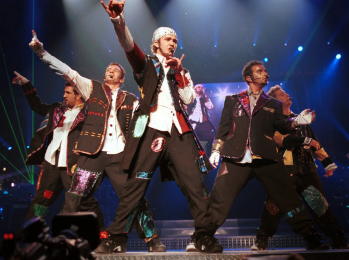
A very specific kind of five-man vocal group. Typically, you're in a Boy Band if you began recording while still in your teens; if you and your bandmates are all extremely pretty; if few, if any of you, play instruments; if your boss is a large and often intimidating man; if you can't get any respect from the Serious Music Critics; if you have a hard time crossing over to an adult audience; and especially if the girls can't get enough of you. Can generate a Periphery Hatedom when a boy band is popular enough.
You definitely were in a Boy Band if, years and years after the fact, your fandom looks back on your early albums as an embarrassing phase, Guilty Pleasure, So Bad, It's Good, or (if it's old enough) Camp. Songs from said groups often qualify as Silly Love Songs, many of them trying to convey warm and fuzzy feelings.
The term "boy-band" is generally reserved for groups which are assembled by a record company or other entity, whereas most bands form organically (although there are exceptions, in both directions). Some of the tropes and musical stylings typical to Boy Bands started with The Monkees and several other groups of The '60s era. note When most people hear "Boy Band" they tend to think of the late-80's — late-90's bands listed below.
Most Boy Bands follow a particular Five-Man Band archetype, established by New Edition and New Kids on the Block, that differs from the traditional one used on this wiki. It is as follows:
- The Heartthrob / Sweet One: The unofficial face of the band, and the one who was put there to draw the Squee of millions of adoring teenage girls (at least, the most Squee). Most likely a former model and the Mr. Fanservice of the group, often appearing shirtless in posters and photo shoots. He is also the one most likely to have a successful solo career once the group disbands. If the band gets a movie, count on him to be The Hero. In the most extreme case, he might be far more popular than the rests of the band.
- The Bad Boy / Rebel: Usually The Big Guy of the band. He's the one with a rougher edge who wearing the black shirt and jeans or leather jacket in those videos where they're not all wearing matching clothes. If he's really edgy, he may also have a tattoo. Put in to cater to those girls who want bad boys.
- The Cute One: A second heartthrob. Less sexually threatening than the Sweet One, and often meant as a Foil to the Bad Boy. Often stereotyped as gay, or comes out later in life.
- The Older Brother: A cool, reassuring figure that the girls can relate to. He might be The Smart Guy or The Lancer but can be an official leader of some bands too.
- The Shy One: Nerdier than the rest of the band, usually The Quiet One or The Smart Guy. He's cast because Nerds Are Sexy. May come off as wondering what the hell he's doing in the band in the first place.
In the examples below, you'll notice very few black R&B groups are included such as Jodeci or Blackstreetnote , despite having similar appeal. This is because they generally don't fit the mold of a boy band: they're more likely to form among themselves, less likely to follow the Five Man Band archetype as explained above, and are more likely to have rougher edges (Parental Advisory stickers are not unheard of), making them slightly more appealing to males.
Although they are not very famous outside Asia, Japan has been creating boy bands since The '70s. The most notable boy band factory is Johnny's Jimusho, which currently manages about fifteen boy bands. Today Johnny's bands dominate the charts, with SMAP and Arashi topping pretty much constantly. Dramas that famous boyband members star in pretty much always do well, and you will see members of popular boybands on TV variety shows quite a lot. The boyband machine is so well-oiled in Japan that many of the tropes applied in the West don't function — boybands have large adult followings (usually middle-aged women) and men seem to be able to handle it, if not love it — you WILL sing A-RA-SHI many times in karaoke in mixed company, just because everybody knows it.
Lately, Korea has been getting on the action too with bands like DBSK, 2PM, SHINee, B2ST, U-KISS, Super Junior, etc. This goes hand in and with the general k-pop explosion of the late 00s and the past few years. They're significantly more popular in the Western world than the Japanese boy bands. By far the biggest of them all, though, is BTS, who has been been considered the biggest boy band in the world ever since One Direction went on hiatus. Still, there are other K-pop boy bands that have growing fanbases all over the world. In fact, Korea has fully embraced this trope the last few years, with tens of boy bands being active at the same time, many of which have fandoms both in and outside Korea. There are new ones debuting constantly, and some already have followings before they officially have their debut.
The boy band scenes are noticeably different in the US and the UK:
- In Britain, the boy band scene is much larger and it's relatively easy to get a hit. Regardless of how popular the biggest boy band at a given time was, most groups had no problem hitting the charts. Likewise, the most popular groups were able to remain successful well into their adulthood.
- In America, boy bands are not as ubiquitous and have a much shorter lifespan, usually falling into oblivion once their fans grow older. More notably, the most popular boy bands usually monopolized the market and their competition struggled very badly in their shadows. This was especially prevalent in the 2010s, when the "phenomenon" group turned out to be a British export whereas all the American groups were misfires.
Boy bands are a major source of Real-Person Fic (a subgenre called bandslash), where you basically have one of two types: Female OC woos band member, or the band members woo each other. In Japan, the majority of RPF Doujinshi are bandslash.
Most boy bands tend to last around five years before members are released from their contracts (or they simply expire) because something else has come along or because they simply got too old to meet the "boyish" requirements. Depending on the success of their subsequent individual projects, many re-form 15-30 years after their heyday to cash in on their now-nostalgic original fandom — this phase can last decades. Expect at least one Replacement Goldfish for a member who's become a successful solo artist/died young/has a non-entertainment career they don't want to walk away from for the time necessary to record an album and go on tour.
To some extent, boybands were preceded in the late 50s and early 60s by 4-man bands singing harmonic and a capella/Doo-wop tunes like The Four Freshmen, the Drifters, or Jay and the Americans
The Girl Group is the Distaff Counterpart, although girl groups are usually built with a different structure, usually a primary lead and two or three glorified back-up singers. Oddly enough, girl groups notably preceded boy bands by years, examples being the wildly successful 60s artists The Crystals (of "He's a Rebel" and "Then He Kissed Me") and The Shangri-Las (of "Leader of the Pack" and "Remember (Walkin' in the Sand)").
Sub-trope to Teen Pop.
- The Monkees: Possibly the Ur-Example. Better than they had to be, but still the result of a calculated marketing effort aimed squarely at Beatles fans' younger siblings. On the other hand, they were definitely the opposite of this trope in several ways:
- First, almost from the very first they were rebelling against their puppetmasters, ultimately achieving a degree of creative autonomy typically not seen in the boy bands of today.
- Second, they couldn't be neatly slotted into the five-man roles — there was overlap in all directions (Davy fit the Heartthrob and Cute slots, Mike had shades of both Older Brother and Bad Boy, Peter would be the Shy One except he was quite extroverted, and Micky was a wildcard who was probably closer to "wacky guy next door" than anything else).
- Third, they were all accomplished musicians and/or singers (and in the case of Micky and Davy, actors, as well); and on their later work they often did their own songwriting (with tunes such as "Mary, Mary", "For Pete's Sake", and "The Girl I Knew Somewhere")
- Fourth, their critical reputation has actually grown with the passing years, including and especially for their then-disastrous film, Head.
- Fifth, there were four of them, not five.
- The Osmonds: A 1970s Boy Band from Provo, Utah, composed of six brothers and on occasion one sister, who were collectively renowned for their super-excellent gleaming dentition and for their open and positive representation of their Church of Jesus Christ of Latter-day Saints (Mormon) faith. Posterity also grants them a couple of not-bad tunes (including the incongruously Hard Rock "Crazy Horses").
- The Bay City Rollers: a Scottish boy band of 1970s, they were one of the last of the proto-boy bands to play their own instruments, but they were not involved in the songwriting process like The Monkees were. Were a sensation in Europe during the early 1970s, helping put Edinburgh on the musical map and popularising Royal Stuart tartan as a fashion fad among girls. Didn't become popular in the United States until 1976, when their popularity back home was undergoing a bit of a wane, and are best known there for their #1 smash hit "Saturday Night" (which, curiously enough, wasn't issued at all in the UK). Still on stage, playing "Yesterday's Hero". Unspeakable things will happen to the first one saying "Oh, the Irony".
- New Edition: Remembered mostly nowadays for being Bobby Brown's old band, but they established the typical R&B-lite musical style used by boy bands ever since. They were all teenagers, all cute and wholesome (despite being from gritty Roxbury, MA), and had the all-important Large Intimidating Boss (Maurice Starr). One of the first boy bands to have one of their lead members leave for a solo career: The other members fired Brown at the end of 1985, and he went on to have a very successful solo career. The group lasted four more years without him before going on a "hiatus" in 1990; Three members subsequently formed the New Jack Swing group Bell Biv DeVoe and had a huge pair of hits with "Poison" and "Do Me!". New Edition reunited in 1996 with all six members - both Brown and his replacement Johnny Gill were on board - and still tour and record from time to time.
- Menudo: A Puerto Rican group best known to non-Latino people as "Ricky Martin's Old Band" (it was much more popular in Latin America and it was the Trope Maker / Trope Codifier there). Notable because they combined this with a rotating cast; when you turned sixteennote , grew facial hair, or underwent a voice change, you were fired. The group lasted from 1977 to 1997, and about 30 singers passed through the band in that time. The Menudo name was retired in 1997, and their management kept the final lineup together under the new name MDO, which continued until 2008. There's also another successor group, El Reencuentro, which formed in 1998 and features a lineup of former members, including a few from the original lineup.
- The Boys: A successful four brother act (Khiry, Hakeem, Taji, and Bilal Abdulsamad), consisting of bubblegum R&B-Pop in the late eighties and early 90s. Older Than They Look and favored after The Jackson 5, their baby faces, smooth moves, and sweet voices top both the R&B and Pop charts with "Dial My Heart", "Lucky Charm", "Happy", and "Crazy". By their second album, they produced and sang their own music, while producing for other musicians. Prior to making music, they acted in several t.v. shows, like A Different World and TwoTwoSeven. They even appeared in Michael Jackson's movie, Moonwalker, in the kid's version of his hit video, "Bad", titled "Badder". Now, they write and produce their own music, as well as other acts, in Gambia, West Africa, Los Angeles, and Atlanta.
- New Kids on the Block: Enormously successful in the late 80s and early 90s, NKotB is the best candidate for Trope Codifier: they're the group that many people will think of when asked "Who was the first boy band?" They became bigger than New Edition by appealing to a wider audience, while New Edition mostly attracted the African-American demographic. However, they're mostly derided by their lack of actual vocals in comparison to New Edition. It should be noted that New Kids on the Block and the Backstreet Boys got along real well together for years and, due to that goodwill, eventually even combined into the supergroup NKOTBSB.
- Hikaru Genji was the biggest boyband managed by Johnny's from the mid eighties to mid nineties, and still have a bit of a retro fandom inside Japan.
- SMAP (Sports Music Assemble People) is often touted as Japan's national idol group and is quite possibly the longest running boy band of all time. Formed in 1988 and made up of members of the Skateboys troupe that acted as background dancers for Hikaru Genji, SMAP was considered a commercial flop after their debut single failed to top the Oricon charts. Despite these early difficulties, the group made a name for themselves through their appearances on variety shows and later became the first idol group to host their own. With their successful segue into hosting and acting gigs, SMAP remain the gold standard for idol groups today. Though Arashi has eclipsed SMAP in popularity, they are still considered an institution in Japan if the ruckus caused after the group broke up in early 2016 is any indication.
- Take That (Band): Not the trope, but Robbie Williams' old band. Massive in the UK for most of the nineties, they split in 1996 at the height of their fame and just as they were about to cross-over into the United States. They have since reformed as a "man band" with a demographic of "their existing fans, now older". Notable for having almost all of their material written by a member of the band, Gary Barlow, instead of outside songwriters. They were the most successful U.K. boy band of all time for two decades before being dethroned by One Direction.
- East 17 were marketed as "The Rolling Stones to Take That's The Beatles", with a tougher sound influenced by hip-hop. However, they were outlasted by Take That and are best known today for their biggest hit (and first ballad) "Stay Another Day".
- Boyz II Men: Took NKOTB's place in the early-to-mid 90's, but had a more traditional R&B sound and were marketed more towards the adult/general market instead of directly at teenagers like many of the bands they would inspire. Were one of the most successful groups of any genre in the 1990s, scoring four #1 hits and several more that made the Top 5. Their 1992 single "End of the Road" remains the best selling single in Motown Records history. They directly influenced many of the bands listed below, particularly the ones that strayed more towards R&B.
- Color Me Badd: Similar to the aforementioned Take That/East 17 example, this group was more or less the "edgier" alternative to Boyz II Men. While they were less successful, they still had two #1 singles and performed a similar-sounding New Jack Swing style that their rivals had early on and incorporating some rapped interludes.
- Immature: Another early '90s group whose music had a New Jack Swing and hip-hop elements. Were something of a Spear Counterpart to TLC early in their career, and they often appeared in teen movies and were regular musical guests on early seasons of All That. Changed their name to IMX in 1999 in order to reflect the more mature sound they had at that point, but they didn't last much longer after that.
- 3T: Formed by three of Michael Jackson's nephews (they are his brother Tito's sons) and were signed to his MJJ label. 3T only had one hit in the US, "Anything" in 1995, and a couple more top ten hits in the UK. They had completed a second album in the late 90s, but it was never released due to Michael Jackson's strained relationship with Sony.
- The Backstreet Boys: Notable for being the first of the 90's Boy Bands to throw off previously mentioned large, intimidating boss (their manager was infamous con man Lou Pearlman, who ended up dying in prison for fraud). They're also the record holder for the most successful boy band ever.
- *NSYNC: Originally derided for riding the coattails of the Backstreet Boys, they nonetheless proved themselves immensely popular. Their albums No Strings Attached and Celebrity hold the second and third spots for highest first week album sales in the US. Where Justin Timberlake got his start, if you don't count The Mickey Mouse Club (which also gave us band mate JC Chasez). They were also famous for their self-deprecating sense of humor and self-awareness regarding their image. They embraced parodies, be it of themselves or boy bands and teen idols in general. As noted multiple times below, they were the Trope Codifier for many of the below parodies and even participated and crafted some of their own.
- Boyzone: Irish boy band who took over from Take That (Band) after their split and were hugely successful in the UK (Despite several attempts at the market, they never cracked America). The band lasted for three albums, most of the tracks on which were written or co-written by the members themselves (though their most well known song, "No Matter What", was written by, of all people , Jim Steinman and Andrew Lloyd Webber for their musical adaptation of Whistle Down the Wind), and broke up in 2000. Ronan Keating was the only member to have a successful solo career, and the band eventually reunited in 2007. Stephen Gately of the group was the first member of a really successful boy band to come out as gay, but sadly died at 33 in 2009. Boyzone released four new albums with a more mature sound after his death, and called it quits for good in 2019.
- Westlife: Irish group founded by the same manager as Boyzone, Louis Walsh. Also co-managed by Simon Cowell. Took over from Boyzone as top UK boy band as they started to decline, scoring 13 #1 hits throughout their career. Credited by non-fans with helping to end the 1990s UK boy band boom by being so sentimental and lacking in musical or lyrical edge or sexuality that they seemed to be designed more for the over-sixty demographic than the under-sixteen. Which made their win at MTV's Boy Band Battle even more baffling and earned Death Glares from all the losing fandoms, especially since the big ones like the Jackson 5, NKOTB, Backstreet, and *NSYNC were all wiped out in the first stages. The group disbanded in 2012, but reunited in 2018.
- 5ive: Another late 90s boy band, but British. Known for being slightly edgier than a standard boy band with funk, rap and rock influences in their music. Mostly remembered by being considered the most successful British boy band in the United States until 2012 note and for releasing a cover of Queen's "We will Rock You" which was successful in the charts but draws very polarizing opinions to this day. Attempted to reunite twice, once in 2006 which failed, and again in 2014 with far more success. Two members have left the band, one in 2012 and another in 2014. The band has performed as a trio since.
- 98 Degrees: Notable for having four members rather than the more typical five, for being Nick Lachey's old band, and for being discovered by their label instead of assembled by it. They originally had a pure R&B sound before Executive Meddling re-purposed them as a boy band (which was quite ironic, considering they were signed to Motown), although most of their big hits were R&B style ballads and midtempo fare.
- Son by Four: a Puerto Rican group that formed in the late 1990s. Originally a quartet, they had their biggest hit with "A Puro Dolor", which reached gold and topped the Billboard Latin charts for weeks. The English version, "Purest of Pain" also did well and the group performed alongside *NSYNC at the inagural Latin Grammys. Personnel changes saw the lineup become a trio (later a duo) while a change in focus saw the group move away from secular pop music and become a contemporary Catholic liturgical music group.
- Plus One was Christian music's answer to the trend. Due to the perceived need for "wholesome alternatives" to the then-insanely popular Backstreet Boys and NSYNC, the group had amassed a large number of fans before their debut album was even released. They had the expected five-man configuration for two albums, then two members departed and the remaining three attempted to re-brand themselves as more of a pop/rock band who wrote their own songs and played their own instruments, which only lasted for one more album before they disbanded.
- Blue: early 2000s British boy band with stronger than usual R&B influences and a multi-racial line-up. Particularly notorious for member Lee Ryan being misquoted when asked about 9/11 ("What about whales? They are ignoring more important animals. Animals need saving and that's more important"), resulting in an Animal Wrongs Group accusation. Their chances of breaking into the US market ended there.
- This was tried a few times even in Country Music:
- South 65 made it to two albums but never had a hit. Lance Leslie later joined the Red Dirt band Rio Grand, but soon left it.
- Marshall Dyllon (which was formed by Backstreet Boys/*NSYNC manager Lou Pearlman in cooperation with Kenny Rogers) broke up after one album, although Jessie Littleton later recorded two solo pop albums as Gran Bel Fisher.
- Rascal Flatts was more successful in the "country boy band" motif: their debut album had them singing light, breezy up-tempos that were obviously influenced by the boy band sound. From the second album onward, two of the members began playing instruments (lead singer Gary LeVox doesn't play anything) and abandoning their boy band influences for more mainstream country-pop.
- Busted were a British trio from the early 2000s that tried to fit in with the pop-punk fad of the time by playing (or "playing") instruments on stage and having the odd noisy guitar riff, but were still essentially a boy band. Shortly before the band broke up, their leading member Charlie Simpson formed Fightstar, a post-hardcore band. That band actually became quite successful and acclaimed, and as a result, Simpson tended to downplay his involvement with Busted for some time, before saying "you know what? I had great fun in that band and I don't care who knows it" and joining the original lineup reunion in 2016.
- McFly: (named after the character from Back to the Future), an early 2000 band, largely fitted the mold. They were considered a "brother"-group to Busted that also played instruments on stage and were inspired by pop rock/power pop music. That the band members played their own instruments, did their own songwriting, and mentioned having contemporary rock n roll influences has brought many fans to strongly insist that they're not quite a 'boy band' (many fans just don't care either way). In the 2010s, the members of McFly and the two members of Busted who weren't Charlie Simpson reformed jointly as a five-piece called McBusted.
- LFO — A Power Trio who acquired the all-important Joey McIntyre Elder Boy Band Statesman Seal of Approval; he had them as openers for some of his solo shows. LFO stood for "Lyte Funkee Ones", and they had to use that full name in the UK due to the existence of a popular pre-existing techno group also called LFO. Unlike most other American boy bands, LFO wrote almost all of their songs themselves, but they are mostly well-known today for their debut hit "Summer Girls", which has some of the most random lyrics in music history. Tragically, they would remain a Two-Hit Wonder ("Girl On TV" was their second most known song) as lead singer Rich Cronin died of leukemia at the age of 36 in 2010, and Devin Lima passed from adrenal cancer in 2018 at age 41.
- BBMak was a British Power Trio that broke a few of the boy band rules: Not only were they a trio, but they didn't dance, played their own instruments and wrote most of their own songs. As a result, they were able to cater to a slightly older demographic than most boy bands, and scored a couple American adult contemporary hits before they dissolved in 2003.
- Dream Street was a very short-lived band that consisted of five ex-Broadway child stars who were young even by Boy Band standards (11-14 years old). For about a year they were hyped up on Nickelodeon as the "next big thing" in television infomercials that promoted their debut album Dream Street and their only hit "It Happens Everytime". Near the end of the completion of their second album (which was made to promote a Dream Street documentary and consisted mostly of remixed songs from the first album) the boys parents took the band's managers to court, and the resulting trial ended with a judge breaking up the band for good. Dream Street's lead singer Jesse McCartney ended up becoming a teen idol in the mid-2000s, while the others either went back to Broadway or joined different, non-Boy Band bands.
- O-Town might be seen as the beginning of the end of the U.S. Boy Band craze. While they did have two hit songs to their name, they were put together on the reality show Making the Band, which shined a light on all the criticism of Boy Bands, especially the cry of being "generic." It was hard to argue that they were formulaic since you literally saw the group being put together by a group of record executives. (Hell, one of the members was an old friend of Lance from *NSYNC who had tried out on a whim and made the cut.)
- Dong Bang Shin Ki is a Korean boyband that was vastly popular in Asia. They're especially popular in Japan, and have recorded four albums in Japanese. They even did one of the openings for One Piece! Recently they split up over money and contract issues, though three of the members that split off from their parent company are still going strong.
- The World Apart◊.
- Arashi is what Johhny's Entertainment came up with when they realized SMAP would one day grow old, and are generally positioned at number 2 on the charts after SMAP. They are everywhere in Japan and cannot be avoided.
- B5 started out as a boy band featuring five brothers. They began in the 1990s with four of the brothers but hit the mainstream in the mid-2000s thanks to Disney. The group is best know for their Jackson 5 cover "All I Do". B5 was more R&B-geared than pop-geared. By their second album the boys had outgrown their "boy band" image and were a straight up R&B group. They lasted a few more years but the brothers split up either to go solo, focus on their kids, or do something else.
- The Jonas Brothers.
- Leave it to The Onion to take this one on.
- While it's pretty clear why some people would classify them as a boy band, they don't really fit the above criteria considering they are brothers (not formed by a label) and play several instruments, plus they are more like a boy-band-ish version of a typical pop rock band anyway. They also tend to write or co-write a lot of their songs.
- Now that Nick Jonas has established himself as a successful solo artist with Darker and Edgier songs like "Jealous" and "Chains," and as an actor after appearing in Scream Queens, he at least is breaking away from the group. Joe has also had success with his Funk Rock band DNCE. Kevin, however, has largely stayed out of the spotlight since.
- And as of 2019, the band reunited and have scored a huge comeback with a #1 album and several hit singles.
- Leave it to The Onion to take this one on.
- Celtic Thunder is essentially Public Television's answer to the Boy Band — too bad they're about a decade too late. Basically, they took five incredibly attractive Irish guys who could sing and range in age from about 15 to 40 in order to attract as many women as possible. Though not as well-known or well-merchandised as some of the examples above, they have a big international following.
- Big Time Rush: Known as a current day version of the Monkees and Sony Music and Nickelodeon's answer to the Jonas Brothers (and later, to Allstar Weekend). They are often credited for reviving the boy band for The New '10s and for making One Direction possible, for better and for worse.
- SHINee is a Korean band that debuted in 2008, sliding into the R&B/pop genre. They've started something of a fashion trend with their style of tight pants, boots, and colourful jackets.
- Super Junior, from Korea, is known for having a grand total of fifteen members (it depends on whether you ask the purists or those who are willing to accept the Chinese sub-members). Since debuting in 2005, they have broken records and pioneered a unit system for K-pop groups, in which members of the band were put together in smaller sub-groups catering to different fanbases.
- Mindless Behavior is a boy band. Fairly different from most on the list, in that they are all black, sing R&B / Hip-Hop, and there's only 4 of them. They started out opening for acts like Janet Jackson before releasing "Mrs. Right" in 2011.
- One Direction (1D), the biggest sensation of The New '10s. One of many boy bands to have come out of England, they are the most globally successful, and the only one to have ever become legitimately popular in the United States. In fact, they're considered the most globally successful boy band of all time! They were 5 separate boys auditioning for The X Factor until Simon Cowell put them together in a band. Though they finished third, they became the show's most successful act by far, actually becoming a bigger brand name than "The X-Factor". They now have a very successful album that, when it debuted in the States, went straight to #1 (they were the first British band to ever have their first album debut at number 1 in the US; and later the first band of any nationality to have their first three (and later four) albums accomplish the feat) and massive amounts of fangirls on both sides of The Pond. Their greatest accomplishment, however, was dethroning Justin Bieber as the hottest teen sensation on the planet. While they trail the Backstreet Boys and NSYNC in record sales, they're possibly bigger than they were in every other area. Unfortunately for them, they weren't able to beat the short lifespan curse their contemporaries faced (though that time on top was nevertheless a couple years longer than their predecessors). With the departure of one member, they announced a hiatus at the end of 2015 where all the members will focus on solo careers (very likely meaning a breakup).
- British-Irish group The Wanted have been around for the few years; after initial success in their native UK, they're starting to enjoy Stateside success as well, thanks in part to their hit "Glad You Came" and new management in the form of Scooter Braun. Despite (or perhaps because of) marketing to a generally older audience, they were completely outperformed by One Direction, and their international popularity quickly plummeted.
- JLS, from England; like One Direction, they rose to popularity after their season of The X Factor. Much like 98 Degrees, though, they formed independently and initially auditioned for X Factor together. They never made any impact in the United States (or in Europe).
- Triple 8, described as "Britain's answer to *NSYNC" though they formed in 2003 when the Boy Band craze was fading away. They had two successful singles "Knockout" and "Give Me A Reason" before abruptly parting ways with the label and leaving their album unreleased. Member, Iain James, however, would become a major British songwriter who would write fantastic UK number 1 songs "Read All About It" by Professor Green featuring Emeli Sande and "Wings" by heroic Girl Group Little Mix, and... erm, Azerbijani Eurovision winner Running Scared by Ell and Nikki? Yes he wrote all those!
- D☆DATE, a Japanese Boy Band formed from members of the D-Boys acting troupe, is quite possibly the only place where you can find a Kamen Rider and an Ultraman singing with a Super Sentai villain. (And a couple of other guys.)
- Auryn, Spanish boyband established in 2009. They didn't really take off until a failed Eurovision bid in 2011, and still their first album was financed by themselves and their manager before landing a deal with Warner.
- 5 Seconds of Summer (5SOS) technically doesn't fit the definition of a boy band. The band was formed out of interest between friends, not by a label. Not only that, but they write their own songs and play their own instruments, something that most boy bands don't do. Nonetheless, they still warrant being an example here, due to being marketed as a boy band and being very strongly associated with One Direction (they opened for their 2013 and 2014 tours). Also, since they target the same young/teenage girl demographic that other boy bands do, have photogenic appearances, put emphasis on each member as "equals", and have heavy merchandising, they seem to be straddling a line between "boy band" and "authentic musician". 5SOS are also notable for being the only Australian "boy band" (and only the second international boy band, period) to achieve popularity in the United States, and although not nearly as popular as 1D, they are easily the second-biggest boy band of their generation — and with 1D going on a very likely breakup at the end of 2015, they'll be the only ones left.
- The Vocaloid producer Pantans C & D made "Gensou Airly", sort of Boy Band consisting of four male Vocaloids—Kaito, Len Kagamine, Gakupo Camui and Kiyoteru Hiyama.
- 5quad was formed in 2015 by the five most popular broadcasters on the social media app YouNow. All are attractive boys between the ages of 15-22. Initially just a group of friends, their popularity grew to where they began producing music both as a group and as solo artists, morphing them into a true boy band.
- Stolen City are an Irish band whose members correspond quite well to the archetypes - Dave as the Heartthrob, Ian as the Bad Boy and Sean filling the dual roles of Cute One and Older Brother. They do however play their own instruments and write their own songs.
- BTS, years after their debut in 2013, has become the most successful Korean boy band in the world, being the first Korean group to get into the Top 10 in Billboard Hot 100 and #1 in Billboard 200 and achieving records worldwide, and rivalling only One Direction in global popularity. With heavy influences mainly from Hip-Hop, a wide range of musical genres, members with backgrounds in the underground rap scene and heavy involvement in the creative process, and music with an underdog coming-of-age narrative heavy on social and political messages, the group managed to gradually build a diverse audience (both in cultural backgrounds and ages) on a global scale. The group is also notable for their huge presence in social media, their unusually close relationship with fans with an emphasis on genuineness, and their use of multimedia storytelling through what's known as the BTS Universe.
- PRETTYMUCH, Simon Cowell's newest boyband. Performed at the 2018 MTV Video Music Awards.
- Why Dont We, notable for the singles "Something Different", & "Trust Fund Baby".
- Voices In Public : One of few notable Canadian "boy bands," VIP was also a quartet. According to The Other Wiki, the group began as a trio consisting of Marty Beecroft, Glenn Coulson, and Joe Heslip, high school friends from Barrie, Ontario. They later added Peter Luciano. They performed live around the province, primarily at universities, while attending school themselves, and completed two cross-country tours before they disbanded. Their best known single, "Just My Luck" received heavy airplay on Much Music. They received a Genie Award for "One Thing To Say," which appeared on the soundtrack to Jacob Two Two Meets The Hooded Fang. Glenn was "the cute one."
- Self-Insert is an experimental group consisting of three singers that functions as a sort of boy band with extremely exaggerated and mechanical singing and voice modifications, strange choreographed live dances, a lack of any played instruments, and surreal love songs that bring in bursts of violence and inanimate machines.
- Premyer-Ministr is a Russian boy band that represented Russia at Eurovision Song Contest 2002 with a Five-Token Band line-up (Moldovan Vyacheslav Bodolika, Romani Jean Milimerov, African-Russian Peter Jason and Tatar Marat Chanyshev). They are a Revolving Door Band - Chanyshev has replaced another member, and current lineup that performs under the name Premyer-Ministr has no original members left. At one point, the original members parted ways with producer Evgeniy Fridlyand and began touring as Group PM, though they since reconciled with him. They're a bit of a Zig-Zagged Trope when it comes to the usual boy band standards, as they weren't marketed exclusively to usual audience of such bands, and their first big hit was actually a cover of a 1968 song written by acclaimed composer David Tukhmanov.

Boy Band Parodies
- Early in 2021, Del Taco introduced the Crys P Boys, who were used to promote the company’s Honey Mango Crispy Chicken Tacos and Jumbo Shrimp Tacos in commercials filmed to resemble music videos. The fictional band was a style shift for advertising character Crys P, who had previously been the lead singer of the also-fictional hair metal band Crys P Tiger. The Crys P Boys disbanded by the spring of that year, with Crys P going solo and “going country” for another Del Taco ad campaign.
- Jack in the Box once featured the Meaty Cheesy Boys, made up of five performers known only by their initials (EJ, TJ, RJ, JT, and the other EJ), singing the praises of Jack's Ultimate Cheeseburger. It's a campaign-within-a-campaign in which Jack is exasperated with the clueless advertising executive who presents the MCB's ad for Jack's approval.
[Meaty Cheesy Boys commercial plays on TV screen]Clueless ad exec: [dancing awkwardly] Girls love this stuff!Jack Box: [annoyed] Our target is men!Clueless ad exec: [still dancing] What's a target?
- Osomatsu-san turned the Matsuno brothers into this for the first episode, complete with Otome Game-styled visual Art Shift. The shift didn't stick for long, though, as the brothers had trouble maintaining their cool appearances while keeping their outdated comedy origins under wraps.
- Parodied in Shirokuma Cafe with the Yama Arashi, which is a mockery of Arashi. Except they're porcupines.
- Howard the Duck tackled boybands in the first issue of the MAX miniseries, when Howard's girlfriend Beverly gets a job marketing a boyband called, imaginatively, the "Backdoor Boys." She finds it suspicious that the songs (with names like "U R 4 Me," "I M 4 U (remix) and "Love Puppy") are all recorded and the bios for the band members before the actual members have been cast, but Howard mentions Milli Vanilli and The Monkees as examples of similar "packaging a band name for a demographic segment, Bev, it has nothing to do with actual music or atual people." Turns out that there is something more sinister going on, as the band members (A.J, B.J, T.J, J.T. and Justin) are actually clones being grown in a vat, and if one band member doesn't perform well he's killed off and replaced with an identical clone.
- FoxTrot: Bratty Teenage Daughter Paige is naturally a fan of several different boy bands. While the strip usually has her fawn over real ones, one arc centered around her getting mailed an autographed photo from the "Backsync Boys" and the ensuing fallout when it gets eaten by her brother's pet iguana.
- In Turning Red (which takes place in 2002, when boy bands were still popular in North America), Mei and her friends are huge fans of a boy band called 4*Town, and a major conflict is how Mei's mother Ming won't allow her to go to their upcoming concert. While the film plays the boy band angle completely straight with almost no irony, supplementary materials state that Jesse is a bit too old to be in the band (despite his youthful looks, he's a former art student and has two kids) and Robaire is likely the only one who will have a successful solo career when the band dissolves.
- The Australian comedy film BoyTown is about a boy band of the same name from the 80s who, in the 2000s, decide to reform as middle-aged men. Their songs are geared towards the demographic who were teenage girls in the 80s, so their new album has titles like "Picking The Kids Up From School", "Cellulite Lady" and "Dishpan Hands".
- Josie and the Pussycats (2001) features a boy band called Du Jour. To make fun of the effeminate nature of many boy bands, their hit single was called "Backdoor Lover". When they find out that their record label is putting Subliminal Advertising into their music, their manager (who isn't a big burly dude, but is instead an evil Alan Cumming) tries to have them killed by causing their plane to crash. They survive, having managed to safely land the plane on their own... only to find that they had landed in the parking lot of an arena hosting a Metallica concert and subsequently get the ever-loving crap beaten out of them (sans Les, who only comments "I thank god every day I know the lyrics to 'Enter Sandman'!").
- Rock of Ages has the Z-Guyeezz ("Double the E, double the Z, double the flava!"), an early (Rock of Ages takes place in 1987) parody on boygroups, complete with ridiculously colorful and oversized clothes, and yes, complete with lip-syncing at what's supposed to be a live concert. Their manager even reminds them of shutting off their headset microphones.
- Sons of Provo, a mockumentary of a fake boy-band trio called Everclean. The group is a parody of the Osmonds, from their origins (Provo, Utah) to their religious affiliations (Latter-day Saints) — one of the members even asks "What Would Donny and Marie Do?" when confronted with a moral dilemma.
- Big Time Rush: While the titular band would go on to be a real life example (as mentioned above), the boys' In-Universe manager has managed multiple cookie cutter boy bands in the past, all of whom had the word "boy" in their names and had hit songs about girls and nothing else. He tries to force BTR into the same mold in the pilot, but they manage to convince him to let them do their own thing.
- During the 1990s British boy band boom, there was a short-lived TV sitcom called Boyz Unlimited, about a parody boy band. It's chiefly notable because the writers went on to create another series called Little Britain.
- Philippine gag show Bubble Gang has come up with two. The first is the Sex Balls (a parody of the Sex Bomb Girls), who made parodies of novelty songs and theme songs from TV shows. The second is D'Wonder Boys, a parody of K-pop boy bands, fawned over by fangirls who squeal at the smallest things and completely repetitive lyrics.
- The crew of The Chaser's War On Everything dressed up as a parody of boy band and did a live song. The song started out normally with dancing and
singinglipsyncing at a nice and steady pace. Then the music skips on a few words and starts to rewind and start over, then proceeding to speed up and slow down randomly. Forcing the "boy band" to improvise quickly and beautifully.
- In Crazy Ex-Girlfriend, the main character as a child wanted to watch a Pay-Per-View concert of the boy band "Room Temperature." She never got to, but later on, she imagines her crush Josh Chan in a boy band. A boy band made up of four Joshes (each one with a different outfit).
- Galavant has the Monks of Valenzia, who have taken a "vow of singing" and are portrayed as a boyband. They're led by "Weird Al" Yankovic, and the other four monks introduce themselves as "the smart one," "the cute one," "the shy one" and "the bad boy (but not so bad 'cause I'm a monk)."
- Less a parody, more an affectionate homage: Season 3 of Glee, specifically the Valentine's Day episode "Heart", saw Mario's "Let Me Love You" performed as a classic boyband routine performed in the choir room. Interestingly, the sequence involved some revision of the typical boyband tropes; though the lineup included a Heartthrob (Sam), a Bad Boy (Puck), an Older Brother (Mike), a Cute One (Kurt) and a Shy One (Artie), the leader of the group was definitely Artie — partly because the song was a step in his courtship of Sugar Motta, and partly as a reference to Kevin McHale's stint in the boyband NLT.
- Also, in the third episode of the first season, "Acafellas", Will's all male a cappella group has boy band elements
- In the season 2 episode "Comeback", Sam, in order to get Quinn's attention, forms a Justin Bieber one-man cover band called The Justin Bieber Experience, that expands into a full-on boyband when Artie, Mike and Puck decide tag along in order to impress their respective love interests at the time.
- Two of Horrible Histories' trademark music videos full-on parody this genre: 'The Four Georges', who sit under moody spotlights to sing "Born 2 Rule" (and identify themselves as the sad one, the bad one, the mad one, and the fat one), and 'The Few', a group of slickly-choreographed WWII RAF pilots who specifically spoof Take That (Band).
- Inside Amy Schumer features a skit with a boy band that magically appears in Amy's apartment to sing a song about how she doesn't need makeup to be beautiful. They change their minds after seeing her without makeup on.
- Kamen Rider Den-O created one out of the series People in Rubber Suits to sing the "Do It Yourself" Theme Tune. No, seriously.
- Kirby Buckets features a boy band called Ume4ever, which Dawn and Belinda are huge fans of. In the episode "The Year of Fridays", Dawn mentioned that Kirby vandalizing the band's poster in her room was the most "unforgivable" thing he had ever done to her, and their parents banned Kirby from hanging out with Fish and Eli that Friday night right when they were about to hit the one-year anniversary of their tradition. Dawn and Belinda's plot in that episode involved them going to stay in the band's hotel, only for them to get locked outside that night and never getting a chance to meet them. She has better luck in the episode "Get a Grip", when a lot of good things suddenly begin happening to her after Kirby breaks his hand and is unable to draw. She wins a date with Chadwin, who sings a Silly Love Song about sandwiches to her. Unfortunately, the date quickly goes downhill after Belinda (who felt Dawn was ignoring her) taught Kirby to draw with his left hand, and Dawn subsequently throws up on Chadwin.
- Law & Order: UK: DS Brooks' corrupt ex-partner cites the numerous favors that he did to cover him during his drinking days, apparently feeling that all this should have warranted Brooks turning a blind eye to his involvement in criminal activities, given that he then blasts him for "letting your boy-band partner come after me", (a derisive reference to the youth and good looks of DS Matt Devlin)
- The Middleman has an episode in which a boy band turns out to consist of aliens trying to get back to their home galaxy. The Middleman has apparently read this page, because he identifies all of them by role.
- Odd Squad has Soundcheck, which is a direct parody of One Direction. They're extremely popular across the globe, with songs that are hilariously corny and rife with Word Salad Lyrics, and are even a hit with the employees of Odd Squad — all except Olive, who can't understand their appeal (at least for a time before she too is eventually swayed by them in "Disorder in the Court").
- Saturday Night Live did a number of sketches featuring a boy band called "Seven Degrees Celsius", in an obvious parody of 98 Degrees, *NSYNC, and the Backstreet Boys. The members of Seven Degrees Celsius usually included a Heartthrob/Sweet One, one with a crazy hairdo (a nod to Chris Kirkpatrick's box braids), and an Older Brother type that was a lot older than he claimed. In one episode, the Backstreet Boys' famous folding chairs were replaced with inflatable hippity-hops, giving a not-so-subtle impression of the band having massive testicles.
- One notable "Seven Degrees Celsius" sketch featured a boy band called No Refund, who sang in nothing but food innuendos... and were portrayed by that night's musical guests, *NSYNC. They were pretty fond of the sketch, having once made a video shout out as the fictional boy band during one of their visits to TRL.
- One notable "Seven Degrees Celsius" sketch featured a boy band called No Refund, who sang in nothing but food innuendos... and were portrayed by that night's musical guests, *NSYNC. They were pretty fond of the sketch, having once made a video shout out as the fictional boy band
- The UK series Star Stories contains an episode wherein boy-band West Life appear and identify as "the fat one", "the thin one", "the one losing his hair", "the cute one", and "the secretly gay one".
- In the Star Trek: Strange New Worlds Musical Episode "Subspace Rhapsody", the Big Finale Crowd Song features the arrival of a Klingon battlecruiser whose bridge crew is briefly turned into a K-Pop band. The captain's gruff voice even shoots up to a tenor.
- The Korean Drama You Are Beautiful, while not a parody, is basically about a made-up boyband.
- Becoming was made during the height of the boy band craze, and many were imitated on the show. Both the Backstreet Boys and *NSYNC were done twice, as well as O-Town.
- The Japanese comedy sketch show Warau Inu no Bōken (Adventures of a Laughing Dog), has the song "Yatta!", with the ficticious boy band Happa-tai (Green Leaves) dancing and singing in underwear with a fig leaf attached, singing about optimism in hard times.
- Lance Bass of *NSYNC pulled a truly Andy Kaufman-esque stunt in 2011 when he appeared to unleash an absurd boy band called Heart2Heart. A single music video called Facebook Official was released to utter bewilderment. A quick search of the member's real names (they went by such stage names as Chad Future and Pretty Boy Pete) reveals they were in fact a cast of film and television actors. Bass later admitted it was a parody that he co-authored with singer David Lehre.
- Hilariously mocked by Blink182 in the video for "All The Small Things". It's well worth noting that many established Boy Band fans missed the point entirely. The guys were vocally alarmed to see a surge in attendance by squealing teenaged girls at their concerts. They didn't mind, of course. They just hoped the fangirls were at least aware that they were also responsible for songs like this (Not Safe for Work).
- MTV's Made-for-TV Movie 2ge+ her was an Affectionate Parody of Boy Bands and their formation. It later spawned a TV show and album, and several of their songs got played on TRL. The main clue-in that the group was a joke (aside from their goofy lyrics) was that one of the members was Chris Farley's brother Kevin, who was over 30, fat and balding. Sadly, the show was quickly canceled after the death of member Michael Cuccione at the age of 16 from lymphoma, which caused many a Harsher in Hindsight as his disease was written into the story — as a gag.
- Amusingly, *NSYNC loved the parody and joked about wanting to collaborate with the group.
- David Letterman had a parody of boy bands on with the fictitious act Fresh Step (which is actually a brand of cat litter).
- Conan O'Brien also had a fake parody band, Dudez-A-Plenti.
- Mitch Benn's Boy Band song: Twenty minutes have gone by/since I met these other guys/and we've already had a hit/and you're listening to it/and I'm sure you think it sh-/ould be number one already
- Internet parodist David Lehre's fictitious boy band Heat Street, featuring songs such as "Girl, Touch My Weiner."
- The Midnight Beast, the heavily Auto Tuned UK comedy Power Trio, are in their own words "Just Another Boy Band"
- In Hot Chip's video for "I Feel Better", directed by Peter Serafinowicz, a bunch ofpretty boys called Kyng, Mar'Vaine, Octavian and Popeye are attacked by a floating man as well as a Scary Black Man with Eye Beams.
- In Jon Lajoie's "Pop Song" he sort of parodies this (though it's mostly a parody of Justin Bieber).
- Amongst their mockery of pop culture in the late 90's and early 2000's, Jack In The Box had a fake boy band called "The Meaty Cheesy Boys" sing the praises of their Ultimate Cheeseburger. If you're curious (and goodness knows, why wouldn't you be), you can find the OFFICIAL SITE!!! here.
- Friendship is Witchcraft has BBBFF, a band which Francis Sparkle is a member of. It's a pretty obvious parody of *NSYNC, like how the band's name is an acronym of the members' own names (Ben, Ben, Ben, Francis, and Francis).
- The 2000 Teen Choice Awards opened with a parody of Making the Band, starring the geriatric and aptly named Old-Town. Despite the name, they were more a parody of *NSYNC, performing a mash up of the group's songs and one member rocking Chris Kirkpatrick's infamous braids. The members of *NSYNC present for the awards loved it.
- The Arrogant Worms song "Boy Band" is a parody of this.
- Howard Stern's "Backside Boys" have the songs "Every Homo (Backside's Back)" and "The Gay Way" which are parodies of "Everybody (Backstreet's Back)" and "I Want It That Way" by the Backstreet Boys.
- In a rare combination of making fun of boybands and a defense of what society does to boy band members, Barenaked Ladies did a song called "New Kid (On The Block)" that included stanzas like this:
I didn't ask to be famous, but I'm not sadYou see, I've got everything that I always wished I'd hadI thank my manager and I thank the screaming girlsI thank my hairdresser for giving me such beautiful curls
- And then, this:
Now I'm a New Kid on the BlockWell I'm twenty-three and they won't let me grow upI went down to register for the draftWell I got up to the counter, and the lady there just laughed- The end of the song is downright disturbing.
I'm a New Kid On The BlockAnd I may not be Johann Sebastian BachThere's no need to be afraid of usBut it just might be your daughter on our bus - Parody artist Jon Cozart, aka Paint, sings about the crass marketing and eventual obsolescence of several popular boy bands in his "Boy Brand" video.
- An actual musical example, Big Bad Bosses is one for video game villains.
- Tennis stars Roger Federer, Tommy Haas and Grigor Dimitrov created their own "boyband" called The Backhand Boys and two videos of them butchering "Hard to Say I'm Sorry" (with Haas' in-law and the producer of the song David Foster providing the piano accompaniment) were uploaded to Federer's social media. The first time was done with hilarious 'so bad it's good' singing. The second one had harmonies, a lot of not-so-subtle autotune... and a videobomb of Novak Djokovic joining in right before the chorus.
Roger Federer: (caption for the second video) No seriously, we're actually starting a boyband.
- According to British actor and comedian James Corden, he was in a boyband as a teenager. Their name was "Insatiable" and he wrote the songs. He included the lyrics to one 'Girl Are You Ready' in his autobiography, claiming he wrote it in the hopes of being as good as "Ready to Rumble."
- Starting from The Marshall Mathers LP, Eminem loved mocking boybands in order to poke fun at the fact that he'd started out as a Hardcore Hip-Hop artist but had ended up developing a Periphery Demographic of Teen Pop fans who swooned over his Pretty Boy appearance. The beef also covered for what seems to have been some genuine fondness for their work - and provided the opportunity to satirically work elements of their sound into his work, cementing his appeal to the boyband fandom.
- Eminem's satirical beef with *NSYNC was mostly intended to differentiate himself from them, because people were calling him a 'pop rapper'. He performed garish stunts (like throwing a bucket of pig's blood over them on TRL) and dissed them in interviews, but would also sing silly anal-sex themed parodies of their songs as part of his stage show and copy their dancing. When Slim dissed Chris Kirkpatrick ("you can git-yer-ass-kicked!") in "Without Me", music critics noted that it was impressive that Eminem could name a specific member of the group (and one who wasn't Justin Timberlake or Lance Bass). (Chris Kirkpatrick was apparently delighted to be referenced by his favourite rapper.)
- In the music video for "The Real Slim Shady", Slim dresses up as a Tom Green-style superhero character and antagonises a bunch of boyband-like men, forcing them to kiss his ass.
- A lot of the production on The Marshall Mathers LP, fitting its concept of Eminem dealing with becoming a pop star, satirises the boyband style Teen Pop of the day, particularly the Max Martin-esque panting and boombap on "I'm Back", the panned-out vocal harmonies and Latin guitar in "Marshall Mathers" (which even has Slim singing an offensive Song Parody of "Summer Girls" by LFO in the middle-8), and the campy, stompy pianos in "Criminal". Of course, while they might sound like something by a boyband, the impression vanishes as soon as you listen to the lyrics. (Assuming Eminem's shortcomings as a singer didn't destroy the illusion for you already.)
- In the song and music video for "My Band", Eminem sends himself up by imagining Slim Shady as the douchey lead singer of a boyband, resented by the rest of D12 for hogging the spotlight from them. In the song's middle 8, it goes into a stereotypical, glittery boyband-pop vamp with Slim singing in a harmonised, vocal style, "girl, why can't you see, you're the only one for me..." with himself and the rest of the band dressed in cheesy white Backstreet Boys-esque suits.
- Eminem's satirical beef with *NSYNC was mostly intended to differentiate himself from them, because people were calling him a 'pop rapper'. He performed garish stunts (like throwing a bucket of pig's blood over them on TRL) and dissed them in interviews, but would also sing silly anal-sex themed parodies of their songs
- One episode of Mission to Zyxx mentions that AJ used to be in a boy band named CLINT-SYNC. He claims to have been the Bad Boy.
- Unsurprisingly, Professional Wrestling got in on the act. WCW faction Three Count, consisting of Shannon Moore, Shane Helms and Evan Karagias, were a parody boy band. They even had a variation of the large, intimidating boss in enforcer/#1 fan Tank Abbot. And just like several real boy bands, they had a Breakup Breakout. After WWE bought WCW in 2001, they picked up Helms' and Moore's contracts, though Moore was sent to the developmental promotion Heartland Wrestling Association in Ohio. Helms was repackaged as the wrestling Superhero The Hurricane.
- Japanese Professional Wrestling promotion Toryumon X tried this. They cast Taiji Ishimori as a pop idol and identical twin brothers Shu and Kei Sato as his backup singers. Then they pushed the trio as the top faces of the promotion, even going so far as to have them actually release an album. Fans didn't take to them. The funny part? Their rivals were "Los Salseros Japoneses" — a salsa band. And they DID become popular, with the Salseros gimmick outlasting the promotion itself, going into Michinoku Pro Wrestling and Dragon Gate.
- AAA had "Los Spice Boys" Jimmy Boy, Billy Boy and Vangelis, though they later dropped the boy band gimmick when Vangelis left the group and was replaced by Decnis in what became Los Warriors (The now Nazi's Vangelis's group) vs. Los Barrio Boys (Decnis's group) feud.
- The musical Altar Boyz! is an Affectionate Parody of boy bands and Christian Rock.
- Xbox snowboard game Amped 3 had an Excuse Plot that included one snowboarder joining a French-themed boy band called Mengae a Brahs. Their hit, Bling 4 U, has a Subliminal Seduction twist.
- Brütal Legend starts off with Eddie Riggs as a roadie for Kabbage Boy, a Second Wave of American Tween Melodic Rap Metalcore band that sounds like Linkin Park mixed with The Jonas Brothers. Needless to say, Eddie is far from pleased with this gig.
"I can fix anything. Except THAT."
- Grand Theft Auto III and its prequel, Grand Theft Auto: Liberty City Stories feature fictional boy bands on the Lips 106 radio station with hilarious names.
- One of the Megastar groups for No Straight Roads are 1010 (pronounced Ten-Ten). Five androids that act as The Dividual. 1010 satirizes over-produced boy bands as identical, synchronized, autotuned androids only superficially distinguished by color and hairstyle. Their manager, Neon J., can also replace any of the band members that fall in combat instantly with a portable manufacturing machine, making them a literal manufactured band. They are, in-universe, quite effective, as main character Mayday gets weak-kneed at the sight of them. She shows more remorse fighting 1010 then when she fought a literal child.
- Hammerhead's ending in Twisted Metal: Small Brawl has him wishing to become a rock star. Because Calypso is a Jackass Genie, he puts the young metalhead in a flamboyantly-dressed Y2K-era boy band called the Silky Boys. Cue the Big "NO!" as the kid, looking around at his costume and his bandmates on stage in front an audience of screaming girls, realizes what's happened to him.
- Angel Moxie has N'Tune, part of Candi Shugari's (a powerful demon who mixes cute with evil) plot to eliminate Alex, Riley and Tristan.
- The Paul Reveres gives us the American Revolutionary War hero Ethan Allen, and his lengedary Green Mountain Boys. Some historians might call it disrespectful, others want it thaaaaat way.
- Early in Schlock Mercenary, Tagon's Toughs are hired to guard the "New Sync Boys" — who turn out to be the holographic creation of a single AI owned by the record company, who ends up "defecting" to the mercenary company. "Ennesby" is still a main cast member.
- The Merkins heavily parodies this with the 'Slashstreet Boys' videos and songs, which star Freddy Krueger, Leatherface, Ghostface, Michael Myers, and Jason Voorhees as a boy band. Naturally all their songs tend towards far more gruesome territory than is typical for this trope.
- Youtuber boyinaband made his own parody called "Metal Boy Band", where they have the aesthetics with a metal sound.
- Brian David Gilbert is playing his own twin...squared as 2winz in their real-time, autobiographical expulsion of the band's Only Sane Man in "Just One Day".
- "Delete This Tweet, by Kevin Temmer, featuring a group of five living trashcans singing about why someone should delete a tweet. It's Better Than It Sounds.
- As part of Achievement Hunter: The Musical, Achievement Hunter has The Dusk Boys performing "Hard 2 Breathe". Upon closer inspection though, Gavin is actually reading off definitions of breathing and oxygen and choking while Trevor and Alfredo mug it up.
- The Adventures of Jimmy Neutron, Boy Genius has an in universe band called "outta Sync" and another band called Graystar.
- All Grown Up! had an in-universe boy band called The Sulky Boys. You know they're meant to be a parody when all the members' names are two initials (JT, TJ etc.), they dress Totally Radical and the one song we hear is a Silly Love Song about math.
- In spite of only having three members, Alvin and the Chipmunks parodied the Unbuilt Trope as far back as 1959, but especially in their 1980s and 2000s versions. The genuinely aim for the same "tween" audience.
- The American Dad! episode "Can I Be Frank (With You)" thoroughly explores this through a twelve-person boyband named Boys-12; specifically, they show how similar they can be through covering every imaginable boyband characteristic:
B1: "Fat boy!"; B2: "Bad boy!"; B3: "Japanese!"; B4: "My sister died."; B5: "I'm sweet!"; B6: "I can sing!"; B7 "Gorgeous!"; B8: "I'm B8, I've got the penis of a man!"; B9: "My parents got divorced."; B10: "Hypoglycemic!"; B11: "I'm grumpy."; B12: "I'm sleepy!"
- In (of all things) Arthur, boy band Binky is not real... sort of. In concerts, holograms are used in concerts, somehow, without anyone noticing at all. Which kind of leads to the question — who does the singing? (Though, by the sound of the only example of their music in the show, which consists of "wheeowheoowheeo" repeated over and over, it could be Yoko Ono.)
- Bob's Burgers brought us Boyz4Now, a group whose concert Tina dragged the entirely uninterested Louise to only for Louise to entirely fall for the Cute member of the group, Boo-Boo.
- Central Park: In Season 3 "Money Candy", Money Candy is a fictional band based on popular K-Pop groups. Members consist of Min-Jun (the best singer), B (the second-best singer), Ki-Moon (the best rapper), Bugs (the best dancer), and QT (the best looking).
- Gravity Falls features Sev'ral Timez, a boy band who came a decade too late. (The show even got Lance Bass himself voice them.) It turns out that they're actually a group of clones who their manager keeps in a giant hamster cage, and they know absolutely nothing about the outside world as a result. Mabel and her friends rescue them, leading to a Batman in My Basement plot.
- Note that the show didn't just "get Lance Bass" to voice the band. Alex Hirsch's Real Life sister (whom Mabel is based on) was such a huge fan of Bass when they were kids that Hirsch made this episode specifically so that he could hire Bass, then invite his sister to the studio to meet him.
- Kim Possible has the ''Oh Boyz' in the episode of the same title. A four-man boyband, they'd outlived their popularity (which lasted about a week) with only Ron and Rufus liking them by then. Señor Senior Snr. kidnapped them on Señor Senior Jnr.'s birthday (the plan was their safe return for Junior to be made a pop star). The kidnapping brought back their sales up and they fired their weasel of a manager once the thing blows over. (Two of the band's members were actually voiced by Lance and Joey from *NSYNC.)
- An episode of King of the Hill has Bobby becoming a fan of a boy band, which Hank supports after hearing their supposedly clean, Christian act. Then he accompanies Bobby to a concert and is horrified to discover it's actually Lyrical Dissonance as their act is highly sexualized.
- Boyz Will Be Boyz from The Loud House from "For Bros About To Rock". They also made a cameo on TV in "The Green House".
- The Mighty B!! brings us "The Sugar Boyz" A fake parody of several boy bands although they only use one repetitive hook no matter what lyrics they sing. Their career is comically ended when all four of them hit puberty onstage. This lowers their voices, fills their faces with acne and gives them crooked teeth, not to mention lots of facial hair.
- In Milo Murphy's Law, Zack is revealed to have once been The Face of a regionally-famous boy band called the Lumberzacks. He's not proud of it. This actually sets up a storyline where he, Milo, Melissa and Mort form their own band, which winds up going up against the Lumberzacks (now signed with a major music company and renamed the Lumbermaxes after their new leader) in the local Battle of the Bands.
- Phineas and Ferb has the Paisley Sideburn Brothers, a pretty obvious nod to fellow Disney Channel-associates The Jonas Brothers.
- Blossom, Bubbles, and Bubblecup from 'The Powerpuff Girls (2016)'' are fans of the boy band "The Sensitive Thugz". The first episode revolves around Bubbles winning two tickets for their concert and having to figure out which of her sisters to take.
- The Replacements had Todd, Sheldon and the rest of the Boy's Choir become "Boy's Rock" when he replaced his choirmaster with a Large Intimidating Boss in an episode fairly similar to the South Park and The Simpsons examples.
- The Simpsons: The Party Posse featured the well-known heart-throbs Bart Simpson, Millhouse Van Houten, Nelson Muntz, and Ralph Wiggum. The band was in fact a front for the US Navy to recruit people via subliminal messaging (their manager, Lt. L.T. Smash, explains it's "part of a three-pronged attack — subliminal, liminal, and superliminal", which basically amount to him leaning out a window and yelling at people to join the Navy).
- And *NSYNC appeared in a cameo to parody themselves.
NSYNC: Thrust, Spin, Turn; Pivot, Pout, Jiggy; Jiggy, Robot, Do-Si-Do...
Lance: And close with a Matrix.
(band members jump as the camera makes a Bullet Time sweep)
- And *NSYNC appeared in a cameo to parody themselves.
- In the Sonic Boom episode, "Battle of the Boy Bands", after Justin Beaver's manager brainwashes all of the village's girls into becoming Fan Girls of Beaver, Sonic, Tails, and Knuckles form a boy band called "Dreamboat Express" (later renamed "Dude-itude") to stop the brainwashing.
- South Park:
- The gang form the band FingerBang in the episode "Something You Can Do With Your Finger". Lampshades the Five-Man Band aspect (they hold auditions for their 5th member with Wendy being selected and later Randy after Kenny's usual episodic death and archetypes).
- "The Ring" was also focused on The Jonas Brothers, if one considers them a boy band. They were characterized as Clueless Chick Magnets who really were as wholesome as they seemed, but with the Disney Company (portrayed by a violent, very unwholesome Mickey Mouse) as the evil manager forcing them into doing things they didn't like.
- SpongeBob SquarePants has Boys Who Cry, a three-man boy band that Pearl and Squidward are fans of (the latter even claims that he knows all of their songs by heart). All of them are identical, save for their hair and skin color. Apparently, it charges a million dollars just to hire them for a performance.
- "It's My Party" from Summer Camp Island has a boy band of tiny magical Pretty Boy creatures (voiced by little kids) called "Boy Band". Hedgehog and Alice are huge fans of them.
- In Star vs. the Forces of Evil, Star, Marco and Tom are fans of the boy band Love Sentence. The lead singer Justin Towers is voiced by former 98 Degrees singer Nick Lachey.
- In the Total Drama "Celebrity Manhunt" special bridging Season 2 and Season 3, Justin, Trent, Cody, and Harold make up a boy-band called The Drama Brothers. Many tropes are played, such as the band spiraling out of control, breaking up, and reuniting, most of which is revealed in a Where Are They Now segment. The Drama Boys perform in the first Total Drama World Tour Aftermath segment at Blaineley's behest.
- Totally Spies! had an episode where a washed up boy band kidnapped a "hip" boy band and stole their faces.
- T.U.F.F. Puppy: The episode "Monkey Business" introduces a boy band made of three Surfer Dude monkeys — Bingo, Bango, and Robespierre. Their main song consists of saying the words "dude" and "girl," and lampshading that they don't know many other words. They're very popular (especially with girls... and the Chief), but Dudley doesn't like them for most of the episode. Bird Brain attempts to use their melodious voices to open a portal to a world of other blue-footed boobies. At the end of the episode, after foiling Bird Brain's plans, Dudley realizes he loves the band's music, and it's another band, the Hunky Donkies, who he hated.
- One episode of What's New, Scooby-Doo? features a three-man band called Fate's Fools. They want to replace female singer Lindsay Pagano as the opening act, making them suspects.
- Parodied in one Steven Universe episode, where Steven attempts to use a time machine to form a boy band using only versions of himself for Beachapalooza. A number of boy-band roles are namechecked, although none of the different versions of Steven can remember which one they were actually supposed to be, and the whole thing dissolves into chaos before too long.
