

The Shoveller: Don't start that again. Lance Hunt wears glasses. Captain Amazing doesn't wear glasses.
Mr. Furious: He takes them off when he transforms.
The Shoveller: That doesn't make any sense. He wouldn't be able to see!
Clark Kenting is the process by which a Secret Identity (public or private) is maintained through what appears to be a Paper-Thin Disguise, but is instead surprisingly effective and may persist with little trouble for a long time. This becomes a question of the other characters in the story who cannot see through it with no excuses, basically asking everyone to “just go with it.” For the most part, it’s a way to make it clear to the audience that the two identities are the same person, but people in-story can’t tell them apart. It's often explained or justified through a combination of additional quirks beyond cosmetic appearance including body language, vocal pitch and overall demeanor making them Beneath Notice.
The trope is named after Clark Kent, the human persona of Superman, who basically looks like Superman in a suit and glasses. However, Superman can actually pull it off to great effect, leading to the idea that sometimes the best way to maintain a Secret Identity is to hide it in plain sight. After all, if you're not wearing a mask, you have nothing to hide, right? Still, the trope generally makes a lot more sense if both identities don't hang out with the same people, aren't famous in different ways or even have a Loves My Alter Ego scenario going on with them (like, you know, Superman). Seeing someone flying in the sky and later seeing someone with technically the same face in a crowded street is a bit different from routinely looking someone in the eyes with and without glasses. The original concept came to Superman's creators from silent comedian Harold Lloyd who if wanting to avoid being mobbed by his fans would simply take off his trademark glasses and straw boater hat and no one would ever recognise him (Groucho Marx and Charlie Chaplin used a similar conceit).
Compare Paper-Thin Disguise. See also Cassandra Truth, Clark Kent Outfit, Cover-Blowing Superpower, Master of Delusion, Secret Identity Vocal Shift and Sarcastic Confession.
Example subpages:
Other examples:
- Ah... and Mm... Are All She Says: Tanaka name-drops this trope to describe Toda wearing glasses when they visit her hometown of Nagoya in the hope no one will recognize her. It doesn't work.
- Spoofed in Sekirei. Homura's mouth cover would be moderately effective to hide his identity from people he only meets in the middle of battle once or twice, can’t really get a close look at him and have little or no chance to encounter him in his Kagari persona. He’s nevertheless absolutely baffled by the fact that Tsukiumi and Musubi, both of whom he lives with and have seen him very close-up in and out of disguise, can’t seem to figure it out. Musubi briefly wonders if she has seen Homura somewhere else, but being… well, a moron, she dismisses the thought because "Kagari doesn’t wear a mask".
- Buso Renkin: Subverted during the attack to the school when Kazuki tries to disguise himself with a scarf covering his face but it doesn't work as his friends have known him so long they can recognize him from afar just by the way he walks and don't even need to see his face. Tokiko's disguise during the same attack is a straighter, if justified example. She's just wearing Kazuki's uniform jacket over her usual look, but being a very recent transfer student her unusual uniform is her most distinguishing feature anyway and covering it up does a good job hiding her identity alongside the artificial fog that's blanketing the school.
- Code Geass: Kallen Kozuki does this due to secretly opposing the Brittanian government. At school, where she goes by Kallen Stadtfeld, she wears her hair down and pretends to be soft-spoken and sickly; as a member of the Black Knights, she spikes her hair up and acts like her true Hot-Blooded self.
- Crazy Food Truck: Gordon "disguises" himself by wearing glasses and a bandana on his head. He doesn't even use a false name, which makes it easy for the military to discover who he is once he gets on their radar.
- Kuma Kuma Kuma Bear has a unique case of this, when Yuna dresses in a school uniform, with her regular appearance, to attend a school festival with some of her friends. Absolutely no one, including her friends and close allies recognises her at first sight, since she's seen almost constantly with her bear hood up and in a shape-concealing bear costume, meaning she self-disguises herself constantly.
- My Hero Academia plays with, subverts, and justifies this two different times in two very unusual ways. The first is with All Might, a titanic and muscular powerhouse whose punches can alter weather patterns; however, it's revealed that his muscular form comes from his power and, as he puts it, "flexing". When he stops "flexing" he returns to his true form: a completely unassuming guy who is skin-and-bones, thanks to an old wound that limits how much he can use his powers continuously. Early in the story, All Might chooses the Quirkless Izuku Midoriya to inherit his powers, but they have to keep it a secret lest villains realize that the "Symbol of Peace" is weakening. A few people like Endeavor along with some of Midoriya's classmates have noticed and commented that his Quirk is very similar to All Might's, but due to Midoriya's initial usage always injuring him, most of them dismiss it as similar but very different.
- In Harlem Beat, Shu of Three Men is the alter ego of Sakurai Shuuji. Their only differences are the shades and attitude.
- Pretty Sammy:
- Spoofed at the end of the TV series, where the entire class reveals that they knew that Sasami was Sammy, but figured they weren't supposed to talk about it.
- Played straight in the OVA series - this was one of the main reasons why Sasami didn't want to be Pretty Sammy (the other was that the costume is ridiculous). However, when she goes on her first fight, no one recognizes her, so she takes it as a good sign. However, there were only three OVAs made, so it's not known if they would have gone the TV route.
- Black Butler often has Sebastian go undercover at certain locations. His disguise? A pair of oval glasses, his hair slightly brushed back, and different clothes. Particularly noticeable during the Weston College arc, where he easily is not recognized by most characters that know him. Pointed out on one page, with Marquise Midford and Elizabeth recognizing him instantly. Yet Edward, who has not only seen Sebastian being Ciel's butler but is also a student at the school, never recognized him until it's spelled out to him.
- In fact, most Magical Girls look similar to their civilian counterparts, and before the 2000s, they usually looked exactly the same. Modern series like Tokyo Mew Mew, Mermaid Melody Pichi Pichi Pitch and Futari wa Pretty Cure tend to change the characters' hair colour, eye colour, and hairstyle to something extravagant enough that it would certainly distract any onlooker enough not to notice the magical girl's identical face. Maybe it wouldn't matter much if they did, anyway.
- Tokyo Mew Mew is a downplaying, particularly odd case, considering that, in their Mew Mew forms, the Mew Mews only add a "Mew" to their first name (e.g. Mew Ichigo) and somehow that prevents people from figuring it out — granted, in the manga (the original Japanese version anyway), the names aren't written the same, but this doesn't matter when it's shouted across the street. Though, in both versions, Ichigo's crush Masaya nearly recognizes her in her transformed form, and later figures out her identity. Another exception is that Minto was able to recognize the mysterious Mew Mew as her idol/crush Zakuro. And at least in the anime it doesn't even need the half of the show to let the enemy aliens know, who the Tokyo Mew Mew really are. So the disguises are mostly useless later on.
- Futari wa Pretty Cure subverts the trope because regardless of their hair changes in color and style the enemy quickly figure out who the Pretty Cure are. As early as episode 3 Pisard simply follows some girls he sees wearing the same school uniforms as the cures and picks them out in a crowd. From then on they are attacked personally whether in civilian form or not. This continues up through Heartcatch with the only people unaware of who the Pretty Cures are are their family and friends. The enemy knows who they are from the start.
- And Smile PreCure! averts this big time - everyone who's snapped out of the Bad End spell easily recognizes the Cures. It doesn't help that Miyuki can't keep her big mouth shut.
- The Pretty Cure All Stars movies also avert this through different means. The first movie have the girls figure out who was who after realizing they were going to places the others usually hung out at in their series. The second through fourth movies, their secrets are blown by their fairy companions, particularly DX 3 and New Stage, where Hummy's actions lead to them putting two and two together.
- It was pointed out, though, in Yes! Pretty Cure 5, that their costumes did absolutely nothing to hide who they were, and panicked when they spotted the school reporter around. However, Natts usually steps in and uses his charm to woo her and get her to forget about capturing the girls on film.
- HeartCatch Pretty Cure! has this with the fairies: whenever they need to be around the girls and not raise suspicions, they tend to just go limp and act like dolls and no one really questions why three teenage girls are toting around strange dolls (though Itsuki does get a pass somewhat - around that time, she was starting to really loosen up). The only time the fairies don't act like this is around little kids.
- In Suite Pretty Cure ♪, they are three people who try Clark Kenting. The first one is Ako Shirabe/Cure Muse/Princess of Major Land would make Clark Kent green with envy — switch her personality to a Deadpan Snarker. It works like a charm.
- As long as her airheadedness doesn't get in the way, the second one — Hammy, the Cat-Fairy — can Clark Kenting as an originally Earth cat.
- Averted with the third one — Ellen/Siren — in the first episode.
- HappinessCharge Pretty Cure! manages to break the land speed record here, with Megumi and Hime having their identities uncovered by a civilian within the first three episodes.
- This trope applies mostly to Magical Girl Warriors, though. Non-Sentai Magical Girls of the transforming variety such as Creamy Mami, Magical Emi and Minky Momo look radically different in their transformed state.
- justified in Cute High Earth Defense Club LOVE!, an Affectionate Parody of Magical Girls (with boys): the alien technology that makes them Magical Boys also makes it so that people see their faces blurred out and their voices altered. Their villainous counterparts have similar abilities.
- Symphogear averts this trope entirely. The titular Symphogears are entirely recognizable, and their identities are mostly protected by a combination of mandatory evacuation of civilians and the NDAs handed out to witnesses after every battle.
- Pokémon: The Series:
- Every disguise put on by Team Rocket for the main characters, ever. In fact, the only "disguise" the main characters didn't fall for was "invisible suits" consisting of black suits with veils over their faces, and those managed to fool James's parents (the joke is somewhat Lost in Translation, as said "invisible suits" are actually outfits worn by bunraku puppeteers, who by tradition are ignored by the audience as they perform). Except when they're using a disguise for something wholly nonthreatening, like Pokémon contests. During contests, Ash and Brock occasionally speculate that Jessilina is actually Jessie, then hand wave it (mostly because Jessie only ever has two useful Pokémon at a time, and the heroes recognize them when used).
- In-universe celebrities Diantha and Aria of Pokémon the Series: XY don low-key outfits in public. One of the openings has a scene where a disguised Diantha passes the group looking at one of her movie posters unnoticed.
 ◊
◊
- Himouto! Umaru-chan multiple times:
- When it looks like Kirie has discovered her double life, Umaru is able to fool her into thinking that her home self is actually her little sister "Komaru".
- Umaru hides her identity for a game tournament by pulling on a domino mask and tucking her long hair into a cap, becoming "U.M.R." It convinces Sylphin, who recruits her to... help her beat Umaru.
- Kirie fools her own brother during a trip to an aquarium by wearing a straw hat.
- Spoofed in My-HiME. Akira tries Clark Kenting as the "Secret Ninja of the School", but is immediately recognized by Takumi and proceeds to deny her true identity.
- In Case Closed, after being shrunk to a grade-school kid, the title character does the same thing as Clark Kent: wears a pair of glasses to hide his identity. It usually works well, until he slips up and says information he shouldn't have known unless he was really Shinichi Kudo, who was supposed to be a distant relative. This leads to his girlfriend, Ran, becoming suspicious of him several times, but she always ends up discrediting her own finds because the evidence doesn't quite match up, due to some outside interference (usually planned by the protagonist himself). In one scene, when the character Ai Haibara returns to her original age, Conan offers her his glasses as disguise, saying that they work well enough for Clark Kent. The response from Ai is, "So are you saying you're Superman now?"
- Parodied in Dragon Half: A giant, winged demon tries to disguise himself by putting on a pair of glasses. Nobody is fooled for a moment.
- Subverted in Dragon Ball Z. Gohan does act like a Large Ham when he's fighting crime as the Great Saiyaman, but his future girlfriend/wife Videl figures out his identity in about 2 minutes (slightly longer in the anime version). She also figures out that he's the "Golden Fighter" who appeared shortly before Saiyaman (Gohan didn't have the costume yet) and the son of Goku, who won the World Martial Arts Tournament before her father Mister Satan came along. Gohan's classmates discover that he's the Saiyaman at the Tournament when he walks out in public without his head covering (having accidentally lost it when he went Super Saiyan backstage).
- Strangely, everyone seems to have forgotten that the Great Saiyaman unmasked at the Tournamentnote , since an arc of Dragon Ball Super sees Gohan getting cast as a stuntman in a Great Saiyaman movie and absolutely nobody makes the connection. People do get suspicious when the Saiyaman stops some robbers on a day when Gohan took the filming costume home with him, but thankfully Bulma covers for him by claiming that someone broke into her lab and stole a spare Saiyaman costume from her.
- Played straight with Master Roshi as Jackie Chun, though — he removes his usual shades and puts on a wig. The disguise is completed by his demeanor: Roshi walks with a hunch and usually has a goofy grin on his face, whereas Chun is serious and straight-backed, with a Reverse Arm-Fold most of the time. He also has much narrower eyes than would befit a comedic character.
- However, Yamcha figures that one out easily enough, though he can't convince anyone because Roshi superglued the wig to his head and called in a favor to have someone stand in the audience dressed as him, and Goku, who is not noted for his ability to read people, figures out that Jackie Chun is related to Master Roshi.
- Gintama's Katsura Kotaro does this frequently. He most often dresses up in a pirate costume and calls himself "Space Captain Katsura" (yes, he actually uses his real name), though he has also used "Katsuo" on an occasion (as in, Mario from Super Mario Bros.) with his pet/companion Elizabeth taking on the role of Luigi. With the exception of the three main characters, no one else ever recognizes him. He even spoils his own disguises sometimes, whenever other characters call him by whatever name the disguise is supposed to represent, he reacts with his catchphrase "It's not X, it's Katsura."
- Exception: When he briefly disguises himself as Elizabeth in order to infiltrate Takasugi's ship and actually succeeds in hiding his true identity during the Benizakura Arc. Ironically enough, Elizabeth also briefly dresses up as Katsura during this Story Arc by putting on a wig.
- In Moetan (a parody of magical girl anime featuring a protagonist who tutors students in English), the magical girl of the show almost blows her own cover. One of her first lessons to her classmate/crush is, in Japanese and English, "Don't you think that magical girls look the same even after they transform?"
- Exception: In Magical Girl Lyrical Nanoha, the only reason the characters aren't recognized on sight is the fact they tend to fight slightly out of phase with reality — on the one occasion a non-mage saw them, they proceeded to spend the remaining two episodes of the season raving about how nothing made any sense anymore. The Wolkenritter also had to avoid being with Hayate whenever Nanoha and Fate came to visit her lest they figure out that Hayate was the master of the Book of Darkness (Shamal even noted that they probably should have used disguise magic).
- Ranma ½: Ranma is able to trick Ryōga into thinking that female Ranma is his sister, just by putting on fake fangs and a headband (and despite the fact that Ryōga has no sister). This is neither the first nor the last time Ryōga falls for such a disguise. However, it only works on Ryōga. Akane can still tell she's Ranma (and on one occasion she doesn't even realize he's supposed to be disguised), though in the above case, she is temporarily confused by Ryōga introducing "Yoiko" as his sister, not having realized how thick the Lost Boy could be until Ranma reveals himself.
- Negima! Magister Negi Magi:
- Subverted during the badge collection game, Yuna tries to trick Nodoka and Yue out of their badges, disguising herself with a mask during a festival. However, the two quickly realize who it is, as her distinctive side ponytail is quite clearly visible.
- Later on, several people (Jack, Asuna, and Nodoka) disguise themselves in a busy place by putting on Clark Kent glasses... which are specifically labeled in author's notes as being a magical item with the effect of making the wearer blend into the background. Unfortunately, direct contact with other people tends to break the effect.
- Justified in Powerpuff Girls Z, as anyone wearing the clothes one of the girls gets during her Transformation Sequence will appear to be that girl implying that the clothes have some kind of disguising power.
- However, only six girls in the entire series wear that style of belt buckle.
- Subverted in Moldiver, when, once he has a hint of it, Professor Akagi only needs a few minutes to match the body shape of Hiroshi and the full-body-costumed Moldiver to confirm that they're the same person. Hilariously, due to his sister being Moldiver, Hiroshi and Moldiver can be seen together.
- Puni Puni☆Poemi and Poemi Wantanabe look different enough for this to possibly work, except that they sound the same, have the same way of talking, both refer to themselves by the name of their voice actress, and the first time Poemi transforms into Puni Puni Poemi, she does it right in front of the Aasu sisters. Oh yeah, and they have the same name! And yet the Aasus are still surprised that Poemi is a Magical Girl.
- Minami-ke has Makoto dressing up as a girl so that he can keep visiting Haruka. His entire (very convincing) disguise consists of a hairclip and skirt.
- After the successful hijacking of a plane with Yutaka Takenouchi headed towards the US, one of the hijackers tries to avoid arrest by going to Cromartie High School and disguising as Takenouchi himself. The hijacker's disguise is actually his own mask with the kanji for 'Take' in 'Takenouchi' imprinted on it, but it somehow fools everybody in Cromartie into thinking he is Takenouchi. His disguise is a setup for some crazy situations, one in which Masked Takenouchi tells a story that gives the impression that Takenouchi has changed his character for the better, as if he had a rough life and a big criminal record. (The imposter is in his 30's.) Hayashida finally figures out at the beginning of Cromartie Volume 4 that there are TWO Takenouchis, as the real one has finally come back to the US... on a bullet train with Cromartie's students on it. It doesn't help at all, then, that Masked Takenouchi suffers from motion sickness as well.
- Princess Tutu is another Magical Girl anime that uses this trope.
- Ahiru doesn't really look all that different from Princess Tutu at first glance — even her Idiot Hair is still there, although the rest of her hairstyle seems to be cut shorter. However, Fakir is actively looking for Tutu and never notices the resemblance until Ahiru behaves so suspiciously (while wearing the necklace that Fakir knows Tutu needs to transform) that Fakir CAN'T deny it anymore. However, the trope is justified similarly to Christopher Reeve's Superman — while Ahiru is klutzy, an awkward dancer and scatterbrained, Princess Tutu is graceful, poised, and expresses herself easily. Also, Tutu looks like an older version of Ahiru, including gaining a few inches of height and a more womanly figure. Plus, to most people, Princess Tutu appears to be an enormous swan.
- This trope applies to Dark Magical Girl Princess Kraehe as well. The only difference between her and Rue is a different hairstyle, slightly narrower eyes, and heavy makeup, yet none of the characters seem to make the connection until Rue reveals herself.
- Not only doesn't anyone deduce any main character's secret identity in Sailor Moon (despite them using no disguise at all, with the exception of Tuxedo Mask and Sailor V), but most of the time the villains don't even bother to try.
- Notable exceptions are Nephrite and Zoisite: The former tried to find Sailor Moon by sending fake love letters from Tuxedo Mask, but eventually followed a false trail in the form of Naru; the latter discovered Tuxedo Mask's identity by pulling off his mask, proving that Clark Kenting seems to work on everyone but him. Most other adaptations don't seem to use the trope explicitly, although there they tend not to meet people they know while in costume anyway.
- Usagi herself is the worst, surpassing even Superman. Her costume is identical to her school uniform, just cut a bit differently. She does not act differently in and out of suit (for want of a better way to refer to it, because again, it's a very very very minimal costume change.) Yet people who see both of them repeatedly never connect them, and yes, villains trying to find her identity did believe it was Naru (who looks, talks, and acts nothing like her) and not Usagi. Nothing less than directly witnessing her transforming can make someone connect the two.
- The manga dodged this trope completely — many people do recognize the Senshi out of costume, most notably Mamoru when he meets Usagi again after having seen her as Sailor Moon, Haruka and Michiru, who deliberately keep their distance, and numerous villains that target the Senshi one by one outside of battle without ever having met them before. A few minor characters also recognized the girls if they knew them as civilians and then later saw them as Senshi. Yet oddly Zoicite even notices that Usagi has the same hairstyle as Sailor Moon, yet shrugs it off as the current fad. Also, most of the later villains could sense the Senshi by their energy, rendering the whole secret identity thing pointless.
- The manga scene referenced above has both Mamoru and Usagi recognizing each other as Tuxedo Mask and Sailor Moon while in civilian clothes — or at least noticing the similarity. The key difference is that Usagi denies the possibility of Mamoru being her Mysterious Protector, while Mamoru actually takes the fact into account, suggesting that the ability to recognize the characters in disguise really depends on the person. (In contrast to the anime version, where Mamoru seemingly fails to draw a parallel between the Moon Princess, Usagi and Sailor Moon almost until she actually transformed in front of him.)
- In the Live-Action Adaptation Pretty Guardian Sailor Moon, the Sailor Senshi have black or brown hair and more or less plausible hairstyles in civilian forms, but the Transformation Sequence changes their hair to resemble the styles and colors seen in the anime. It never explains why, but it's a lot more plausible as a disguise. And with such a radical change in appearance, Ami still recognizes Usagi at first glance. Then again, she is a genius. And the best part? Even when they're transformed, they address each other by their civilian names. In front of everyone. Go figure. This was possibly carried over from the original edition of the manga, where they do call each other by their real names, although with some of the manga villains being able to recognize them anyway, this was at least excusable. Additionally, Minako recognises Rei as Sailor Mars instantly when the two accidentally bump into each other in their civvies.
- This goes both ways, as many recurring villains are never recognised from one flimsy disguise to the next. In fact, most of the villains' "diguises" are just a change of clothes and nothing else. Jadeite was probably one of the worst, frequently appearing in public without even so much as a mask or glasses. The DiC English dub created an even more hilarious example - his name had been changed to "Jedite" and he was disguising himself as a priest named "Jed." Serena, who knows his name and his face, doesn't recognize him simply because he's changed his clothes.
- The Abridged Series points this out:
Jadeite: This plan will surely work this time because my glasses to disguise myself are much better than last episode's.
- Also in the anime the Senshi themselves can't even see through each other's Clark Kenting without being clued in. They only recognized civilian!Minako because Artemis was with her despite meeting her as Venus in the previous episode. The first few appearances of Haruka and Michiru had them appear as shadows while in civilian form, then once their civilian form was introduced this stopped and it still took a number episodes for Moon and the Guardian Senshi to discover they were the same people (As well as the reverse) even though it's blatantly clear to the viewers. Setsuna also has to tell Usagi who she is though she seemed to have guessed at it.
- An interesting occurrence in the S season - Usagi and co. defeat Kaolinite and assume her to be dead. Some ten episodes later, Usagi visits Dr. Tomoe and sees Kaolinite there; and yes, she does go all "OMG the villain is alive!". But then Tomoe says it's just his assistant, Kaori, so Usagi assumes it's just two people with the exact same face and almost the same name. The dub (in which Kaolinite is called Kaori Night) takes it one step further - the "Kaori" alias was changed to... Kaori Night. So now, Serena assumes that they're just two people with the exact same face and the exact same name. Usagi was also thrown off by the fact that Kaolinite was actually being nice and seemed normal. And she probably had to wonder why Kaolinite would be in a seemingly nice house and have stopped trying to extract pure hearts. But still, you'd think she'd keep a close eye on her (especially with Hotaru's behavior toward "Kaori") and have told the others about it.
- The behavior difference is also likely what keeps Usagi and co. from recognizing Uranus and Neptune as Haruka and Michiru. When in their civilian forms, the two are very nice to them, in contrast to their Senshi identities. But, you'd think that the more experienced Haruka and Michiru could figure out that Usagi is Sailor Moon — unless you support the theory that no one in their sane mind would suspect a clumsy crybaby of being a "soldier of love and justice" (as Lampshaded once by a badly disguised Sailor Venus trying -and succeeding- to convince them and Kaolinite that Usagi wasn't Sailor Moon. In fact, Uranus seemed rather surprised when Kaolinite said that Usagi was Sailor Moon...).
- The Abridged Series, as such series like to do, points out the many flaws in their disguises
Serena: Look, Luna, I got a letter from Tuxedo Mask!
Luna: How the hell did he find you?
Serena: His love led him to me!
Luna: It was probably that your hair is pretty... unique. And you don't wear a mask. - In one manga chapter of the first dramatic arc, Usagi tells her father that she is Sailor Moon, despite the fact that clear photos of her senshi form has appeared all over the news, he doesn't believe her.
- Fanon often explains that◊ the Senshi's transformations incorporate a "disguise field" preventing anyone from recognizing them unless that person sees them transform or is close to their civilian identity and has a reason to put two and two together. It's as good an explanation as any.
- justified in one occasion in the anime for Sailor Moon: Kaolinite had guessed that Usagi was Sailor Moon, but as soon as she shouted it Sailor Venus (whose job description in the manga and live-action includes being Sailor Moon's Body Double) showed up in disguise and fooled everyone. It wasn't really a good disguise, but Sailor Venus hammed it up enough that Kaolinite and the Outers fell for it anyway. There is also a season 1 episode where Zoicite is disguised as a fake Sailor Moon - and saves an innocent. Usagi is among the crowd of people that sees this, which could throw Naru off the scent... At least until R, when she all but admits to Usagi she guessed it.
- Also justified in an incident in Codename: Sailor V: police inspector Wakagi sees Minako and does associate her to Sailor V, but immediately chastise himself for it because lately he's grown so obsessed with Sailor V he mistakes for her every single girl who wears a ribbon in her hair.
- Another justification in the manga is that most people don't want to believe that ditzy Usagi, crazy Minako, shy Ami, stoic and cynical Rei, and (alleged) bully Makoto are a group of hammy superheroes. The only one who could be discovered is Minako, who is incredibly hammy even as a civilian... Except the one time her childhood friend Hikaru met Sailor V, she acted meeker than usual, throwing her off course.
- In the manga Minako's disguise is also helped by the fact everyone knows that Sailor V works with the police (actually false for most of her career, a youma simply assumed and sent her challenge letter for V to the police and the public fell for it), thus she couldn't be known cop-hater Minako Aino.
- The Samurai Pizza Cats. People don't recognize them, even though they're fired out of a cannon built into the pizza parlor, they have the same names as their alter-egos, and their combat forms are largely their civilian forms with some extra armor and weapons bolted on. In one episode, the narrator remarks "No one recognizes our samurai heroes in their secret identities! Don't ask why, just one of the quirks of the show."
- Seishoujo Senshi Saint Valkyrie skewers this — everyone recognizes that Ai Hayama is Valkyrie Ai, despite her frantic protestations to the contrary.
- In Wedding Peach, The Power of Friendship acts as a shield to keep the devils from seeing who the Love Angels are, and there is implied to be some kind of magical interference. Nevertheless, Yousuke still manages to identify Peach as Momoko at one point simply because he knows her too well.
- In Mobile Suit Zeta Gundam, Char Aznable adopts the pseudonym "Quattro Bajeena", but his true identity is something of an open secret. The fact that he still uses a mobile suit in his signature color of bright red doesn't help.
- This is more of a subversion - since most of the AEUG had never actually seen the infamous Red Comet, they wouldn't have known that this shade-wearing man was actually a Zeon Ace Pilot. It isn't until the heroes from Mobile Suit Gundam step in that Char's identity is revealed. It's later shown that the founder of the AEUG knew all along, and unsuccessfully attempted to get Char to reveal himself publicly and become the new leader.
- ∀ Gundam:
- Loran disguises himself as "Laura Rolla" because he's a former Moonrace scout who's now piloting a rather powerful mobile suit with the Earth militia. He fully dresses for the part, complete with stays, a dress, makeup, and lessons in deportment from Kihel, so that he appears as an elegant young lady who also happens to be the militia's Ace Pilot. It works for quite a long time—only Harry Ord manages to see through it.
- Harry himself goes incognito at the Willgem excavation site by putting on civilian clothes and a pair of normal glasses. Although he employs his usual tacky fashion sense (bright yellow-black argyle sweater vest and a pink shirt) and makes no effort to disguise his voice, it's sufficient to fool not only Loran but Queen Dianna.
- In Mobile Suit Gundam SEED Destiny, Athrun Zala pulls the same stunt Char did, disguising himself as "Alex Dino", Cagalli Yula Atha's bodyguard. People see through his disguise rather easily.
- Kenshiro Kasumi in Fist of the Blue Sky disguises his true identity as "Yan-Wang" in public by giving himself a nerdy hairstyle and glasses.
- One Piece: Usopp when disguised as Sogeking. The mask still reveals his long nose and he still wears his everyday clothes under his cape. The only two people fooled by this are Chopper and Luffy. Usopp eventually develops a split personality that talks and acts differently when wearing the mask.
- In Urusei Yatsura, the Kunoichi character Kaede uses a pair of glasses to disguise herself. Everyone sees through it except the ninjas chasing after her, whose disguises are just as minimalistic. (One is wearing a surgical mask, the other just painted two stripes on her eyepatch, and the ancient clan leader is also wearing glasses.)
- In Eyeshield 21, Sena is the eponymous Eyeshield 21, a running back with unbeatable speed. Sena is the only one with a build and height even remotely close to his "secret" identity. Most of the time he doesn't even bother coming up with a good excuse for not being there when Eyeshield 21 is. Mamori, his childhood friend and the team's manager, really takes a while to figure things out, given the clues she has on hand.
- In Persona 4: The Animation, Rise Kujikawa tries this, but it doesn't work.
- In Reborn! (2004), the title character often uses a variety of different disguises that can be easily seen through by the audience, but Tsuna is the only in-universe character that shares this view.
- Subverted in Bamboo Blade. When Kojiro asks Tamaki to dress up as a new freshman named "Bureiba" in order to fulfill his kendo team's five-member quota, his old mentor (who coaches Machido High School's all-girls team) isn't fooled, and notices during a friendly match with Kojiro's team that Tamaki's and "Bureiba"'s fighting styles are similar. After challenging "Bureiba" to an impromptu match (and losing handily), he states that he knew all along, but lets it slide because it was just for practice
- At first glance, Lelouch from Code Geass doesn't clark-kent, the full face mask and all. But on the other hand, if you remember that Nunnally is blind and tells people apart by their voices... Yes, he does.
- There's a voice changer installed in his helmet. It doesn't make a lot of difference, but...
- Lelouch also changes the demeanor considerably; as himself, he's a soft-spoken, kindly big brother as far as Nunnally is concerned, while as Zero he is a megalomaniac Large Ham.
- A straighter example would be Euphemia li Britannia, who disguises herself amidst hostages under a pair of Clark Kent glasses. Nobody, not even the perpetrators know it's her until she takes them off and says who she is.
- It helps that nobody knew that there would be a Britannian princess present at all, so they weren't looking for her. Also, at this point, Euphemia is not very important, as far as the Britannian royalty goes, and not that many people know how she looks.
- Lelouch and Nunnally are also exiled Britannian royalty, and they hide in plain sight under their real first names but using the made-up last name Lamperouge. Granted, they were somewhat obscure, were only kids when they were exiled, and the world at large thinks they died when they were kids, though one wonders what would have happened if one of their siblings looked at a phone book or an Ashford yearbook. It's likely that since the Ashfords are hiding the siblings means they likely have a setup to avoid that possibility. Of course, they are officially dead and who will look in a "commoner" school for royalty?
- There's a voice changer installed in his helmet. It doesn't make a lot of difference, but...
- Subverted in Ryuusei no Rockman and Ryuusei no Rockman Tribe. Subaru Hoshikawa saves Luna Shirogane's life (several times!), but she does not know it is him. She has a crush on Rockman, and ironically, he is the same kid who goes to school with her and at whose house she tries to bake food for Rockman. Kizamaro Saishoin was one of the first to suspect that Subaru's real identity was Rockman, and by Ryuusei no Rockman Tribe, it's common knowledge to both him and Gonta Ushijima. Paradoxically, Luna refuses to admit this, and for the most part, no one (even Subaru!) points out any of the many flaws in her logic. Eventually, however, as the series moves on, she seems to start like Subaru as well as Rockman, and in a touching moment before Rockman enters the Denpa-wave zone, she calls him 'Subaru' and tells him she is supporting him.
- Subverted in Hayate the Combat Butler, when Hayate instantly sees through Nagi's disguise as "Mask the Money." But then played hilariously straight when Maria puts on sunglasses and claims to be a superhero maid — Nagi, her employer, fails to recognize her and wants to get her autograph.
- Could be considered a Running Gag in the anime, whenever Maria tries to make herself incognito, she always chooses a pair of spectacles that has the effect of attracting gazes/confessions from guys AND being identified almost immediately from those she's trying to disguise from.
- Averted in Phantom Thief Jeanne: Jeanne has a completely different hair color and eye color from Maron, but they look similar enough that people at school start suspecting them to be the same person, resulting in Miyako deciding to catch Jeanne so she can clear Maron's name. The manga also has Chiaki watch Maron during her gymnastics performance and note that they have similar movement habits, and it later turns out that even Miyako could tell Jeanne was actually Maron, with her joining the police chase so she could "accidentally" release Jeanne if she actually got captured.
- Used in an episode of Full Metal Panic? Fumoffu where Kaname disguises herself by putting on a kimono and makeup and putting her hair up. Between this and her very different behavior, nobody - not even Kaname's devoted bodyguard Sosuke - connects the attractive blue-haired teenage girl who'd left previously to the attractive blue-haired woman who's just arrived.
- In Doctor Slump, Suppaman (an inept Superman parody) disguises himself as a reporter named Kuraaku Kenta. Naturally, Penguin Village being a Cloud Cuckoo Land, nobody ever recognizes him.
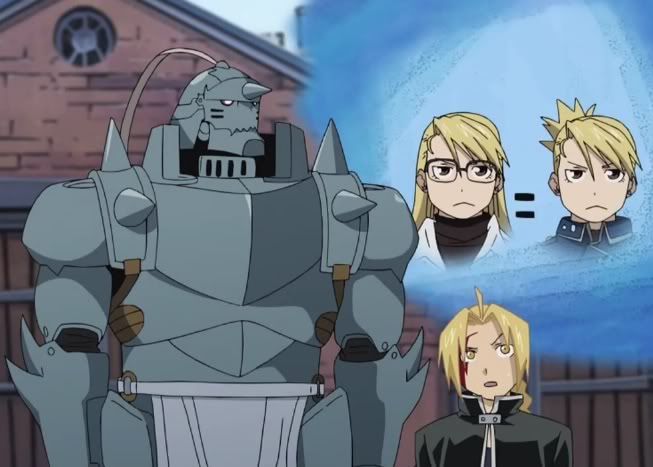
- Fullmetal Alchemist has Lieutenant Hawkeye disguise herself by putting on glasses and letting down her hair. Ed and Al are dumbfounded upon the (rather quick) realisation that the young, blonde, gun-wielding woman who has rushed to their aid is young, blonde, gun-wielding Hawkeye.◊ This does not fool Fuhrer Bradley for a second, with his Perfect Eye and all.
- Zorro's usual costume plays this trope already quite straight, but in Kaiketsu Zorro, all Diego does is put on a cape, a hat, and a less covering than usual mask that doesn't hide his friggin' hair!
- If anything, Kotetsu T. Kaburagi (AKA Wild Tiger) of Tiger & Bunny is an even more over-the-top example of Clark Kenting than Superman, possibly in reference to him-his design has a lot of nods to Western superheroes, anyway. As it'd be cumbersome for him to wear his costume in public at company-sponsored parties, especially now that it's Powered Armor, Kotetsu has to act as his Wild Tiger superhero identity outside of his Powered Armor. It might have worked in his traditional costume, which looked a little like Batman's costume, as it made it harder to compare his alter ego's face to his actual face in the same way that Clark and Superman have the same face-but now that he's wearing Powered Armor, a skilled observer could easily tell that Wild Tiger and Kotetsu are one and the same. How obvious is the Clark Kenting, you ask? He goes about doing this by dressing exactly as he always does - same waistcoat, same nice hat, and same goatee - but with a Domino Mask. On public television.
- At one point, Kotetsu tries to prove to an Apollon Media security guard that he's Wild Tiger after he's been Unpersoned by putting on his mask in front of him. The guard points out that most people (including him) don't really pay attention to what Wild Tiger actually looks like beyond a few easily replicated Distinguishing Marks, and that he could easily be a reasonably convincing cosplayer trying to sneak in — something the guard deals with all the time.
- Somehow, it even manages to fool his own daughter.
- Karina Lyle (Blue Rose), Huang Pao-Lin (Dragon Kid), and Lara Tchaikoskaya (Magical Cat) are also examples as they go unmasked all the time, using only colored wigs and, in Karina's case, makeup, colored contact lenses, and breast padding, to disguise their identities.
- In Penguin Revolution, actor Ayaori Mashiba conceals his identity from the public by using the stage name "Makoto Ayaori," and by wearing Nerd Glasses and leaving his hair in a disordered mess when he's not on the job. The only person shown to ever see through this is the heroine, Yukari, who recognizes him only thanks to her unique ability to perceive star talent in the form of visible wings. The trope is justified in that Ayaori is an incredibly talented actor (although you'd think someone would at least notice the name).
- The Idolmaster - Haruka puts on glasses (and a hat) to avoid being recognized in public.
- Generally averted in the Phantom Thief/Magical Girl series Kaitou Saint Tail: while the only differences in look between Meimi and Saint Tail are the clothes and the ponytail, Meimi takes great care to not show off her magic tricks as Meimi and goes to extreme lengths to not show her face as Saint Tail. Eventually, Asuka Jr., the Sympathetic Inspector Antagonist chasing her, accidentally sees Meimi's face in her reflection and instantly recognizes her, and the fact he can't get Saint Tail to show her face to confirm if it really is Meimi or not drives him nuts. By the time he's picked up on multiple other signs of them having the same physical features, Saint Tail has been unconsciously influenced into acting inhumanly unrecognizable to the point he can't easily mentally reconcile them as the same person despite being fairly certain that they are. Ultimately, it's another close-up view of her face without her ponytail that finally confirms her identity to him for good.
- Played straight and subverted in Samurai Flamenco. Masayoshi is initially the prime suspect when rumors about the title vigilante's identity begin forming, and he's only acquitted because an impostor steps in and claims to be the real Samumenco. Played straight with the Flamenco Girls, who are all popular Idol Singers in their civilian identities, and yet somehow effectively disguise themselves with little more than wigs and Domino Masks.
- In Rolling Girls, Masami moonlights as a costumed Super Sentai-like hero known as Maccha Green. Nobody but the protagonist, Nozomi, is actually fooled by this, and it later turns out that everyone just humors Masami because they don't want her to be embarrassed.
- Don't Meddle with My Daughter!: Clara's superhero costume doesn't even come with a mask, and she's constantly seen on news broadcasts everywhere. So you'd think all of Tokyo would know Clara Haruko is the Eighth Wonder. Nope. The only ones who do are her mom, Clara's secret crush Mei, and her friends at N.U.D.E. HQ.
- In one of the Sonic the Hedgehog manga, no one can tell that Nicky is Sonic. The only difference between the two is that Nikki is timid, he wears clothes, and he wears glasses.
- The titular character from Misappropriation Investigator Nakabo Rintaro often appears in his civilian persona, 'Hayashi Taro', who is considerably more well-combed and always smiles. Press his Berserk Button though, and he'll ditch the disguise in an instant.
- Fate/Zero: Berserker's distinct armor is unrecognizable to other characters thanks to his Noble Phantasm "For Someone's Glory". For Someone's Glory is normally an ability that allows the user to disguise themselves as another person, but Berserker's Mad Enhancement makes him unable to use the skill's full potential without the use of Command Seals. Thus, For Someone's Glory manifests itself as a black, foggy Battle Aura, which still obscures his appearance to other people and hides his status and parameters. While the audience are able to see his appearance, the characters only see a "black thing" and they cannot grasp his shape. Once For Someone's Glory is deactivated, characters who knew him in life are instantly able to recognize his armor and identity.
- Take Black from Blood Blockade Battlefront, remove his glasses, slick back his hair, and give him a snappy blue coat, and you've got The King of Despair, his Enemy Within and the Big Bad of the first season! They even appear one after the other in the first season's opening, but it's entirely possible to not realize they're the same character until The Reveal later in the show.
- Tamagotchi:
- Lovelitchi works as an Idol Singer named Lovelin, and she works to keep this a secret from her friends at Tamagotchi School. Literally the only separating Lovelitchi from Lovelin is that she has a little blue heart printed on her cheek as the latter, and almost nobody notices this and connects the two until Lovelitchi tells them all personally.
- In Yume Kira Dream, Yumemitchi and Kiraritchi use their Yume Kira bags to transform into and gain the skills of a specific occupation. While transformed, they look enough like their normal selves that you'd think people would recognize them, but it's implied the bags may somehow change their appearances to others more than they think and nobody notices until Nandetchi realizes it.
- Played with in Excel♡Saga. Matsuya undoes her ponytail and puts on a pair of glasses when she sneaks into an ILL Electronics store to look at the merchandise. Sumiyoshi spots her immediately. Her "Eeeeek!" at being discovered was uncharacteristic and quite charming.
- In Monthly Girls' Nozaki-kun, Seo's "competition-ready" look consists of just letting her hair down, and actually wearing socks. It manages to fool some Romance Academy students into thinking she was a new student, which she lampshades. In another bit of irony, the only person who manages to recognize her is Wakamatsu — who still doesn't know that she's Lorelei.
- Justified in GEAR Fighter Dendoh: the Galfa have seen the pilots of Dendoh from day one, but, being a race of robots that have great differences between each other, the general characteristics their agents have to identify them at home are height (around 1.41 m), primary constitutive elements (water and proteins), and optical devices (two lenses. Also known as eyes), like hundreds of grade school student (they gave up on the 143rd one). The agents later meet the pilots and stay around them for a while, but can't recognize them.
- The Quintessential Quintuplets: When Ichika starts gaining fame as an actress, she takes to wearing a pair of thick glasses while in public to avoid drawing attention.
- Lupin III: Even as a Master of Disguise who regularly employs Latex Perfection, the titular thief often relies on a pair of glasses and/or a change of clothes for a disguise. Sometimes justified in that most people don't know what he looks like.
- Yui Kamio Lets Loose: Yui switching with another girl who looks exactly the same aside the color scheme doesn't clue anyone in who doesn't already know that they are the same person, and she doesn't even hide her name.


- Parodied in the Bizarro strip for April 19th, 2013. Batman wears glasses in an attempt to hide his secret identity but fails because he forgets to take off his Batman costume.
- Garfield parodies the trope. As an excuse not to chase a mouse, Garfield claimed he "didn't recognize him in those glasses".
- The Boys: Real Justice: The Trope Namer does this to both Billy Butcher and Homelander, with none of them being the wiser. Justified since Clark makes his posture as clumsy as possible. Butcher, due to his prejudices against superpowered beings, instead thinks Superman is having an affair with Lois Lane behind Clark's back. Whereas, Homelander would never believe Superman has a civilian life.
- In the My Little Pony: Friendship Is Magic fanfic Progress, Princess Luna wants to learn more about modern life, having spent a millennium as Sealed Evil in a Can, so she disguises herself as the mortal pony Miss Selene. To avoid being recognized, she uses a magic amulet that causes onlookers to not register the fact she is who she is. The shape of the amulet? A pair of glasses.
- Child of the Storm: Alison Carter is a borderline example when she appears in the sequel, Ghosts of the Past - she didn't have a dual identity, and her status as the first Agent 13 and later, Deputy Director of SHIELD (Retired until after Forever Red), wasn't hidden, but SHIELD itself was. Her son-in-law (among others) thought she was just an ordinary government official who travelled a fair bit. However, she does carefully disguise the fact that she's the daughter of Captain America and Peggy Carter, is a Super-Soldier as a result, and hasn't aged since her mid-twenties with careful application of specialised make-up and loose, long clothing that helps conceal her build. It works pretty well, but it's heavily implied that the main reason it works is because, like many examples of this trope, no one knows to look.
- The Gunslinger Hero: Flintlock: Mount Lady, also known as Yu, does this in order for her old childhood friend, Izumi, to recognize her, as Izumi was unable to recognize her without her wearing her glasses.
- Last Child of Krypton: In this story Shinji is ''Superman' so the trope is expected. Semi-justified, as it is mentioned that Shinji vibrates at a high rate in order to blur his facial features.
- Inverted in Risk It All. Ren is by his own admission a nobody, but he goes the extra mile to disguise himself as a vigilante, hiding his hair In the Hood, wearing a face mask, and putting on contacts to change the color of his eyes. He also wears baggy clothes to avoid drawing attention to his rapid recovery from his six-month coma. Despite all this, his uncle, a man he's never met, deduces his identity fairly easily.
- Superwomen of Eva 2: Lone Heir of Krypton: Subverted. Asuka takes an effort into masking her Supergirl identity, including using a blonde wig and a mask when she's in her superhero persona. However, most of her face remains visible. And Misato and Rei may have figured things out, though.
- Subverted in the Tangled fanfic Super: a pair of glasses doesn't stop Rapunzel from immediately recognizing Eugene as the Gentleman Thief Flynn Rider she's been pursuing/flirting with in her superheroine guise as Blondie. Furthermore, Rapunzel is genuinely baffled by how Eugene doesn't seem to recognize her in turn because they've interacted with each other in costume frequently enough that he should be able to notice the similarities between her and Blondie even with her shorter brunette hair and meeker disposition out of costume. It turns out that Eugene did know who she was all along, but kept quiet about it because he had fallen in love with her and wanted to pursue a real relationship with her.
- Parodied for all its worth in Hiding in Plain Sight. After Harry defeated Voldemort, he ended up having lasik surgery performed. And since then, every pureblood that looks at him without the lensless glasses he carries around mistakes him for someone completely different. Deciding to play with it, he introduces himself as Clark Kent, even explaining "Clark is another bloke who no one recognizes when he takes his glasses off. I'm guessing he won't mind if I borrow his name." But he isn't the only one in on the action. After mistaking 21 Jump Street for a documentary, Amelia Bones (head of the aurors) decides to try it herself by sending, among others, Alastor Moody in disguise. And to make things even worse, their disguises work on the purebloods as well, so none of them can figure out why they have a bunch of six-foot-tall first-year students.
- In the Dead or Alive fic Kunoichis Like Us, Kasumi disguises herself as an Ordinary High-School Student named Sakura Misaka by wearing glasses and braiding her hair. Though Kasumi and the other DOA fighters are Famed In-Story by the tournaments, the closest the public gets to any connection between Kasumi and Sakura is that Sakura looks like Kasumi. Then her school friends have "Sakura" cosplay as Kasumi and remain none the wiser.
- In Suzumiya Haruhi No Index, Haruhi can disguise herself with a pair of sunglasses. Kyon comments that she still looks the same, but since Haruhi genuinely believes it will work, her unknowing Reality Warper powers cause the public to not recognize her.
- In Past Lives a spell which makes you relive previous incarnations gives Harry and Hermione the personalities of Godric Gryffindor and Helga Hufflepuff. After they exit and came back again Harry, now sporting a goatee, claims to be "Salazar Slytherin" while Hermione, in glasses, announces herself as "Rowena Ravenclaw." When a Muggleborn first year is the only one to recognize them, "Rowena" and "Salazar" comment that they needed four teachers for the school and that "Wizards and witches may have a lot of power, but they don't have a lot of common sense."
- All over the place in Justice Society of Japan.
- Shinji's costume might be cheap, but at least it hides his face.
- Shirley's costume barely obscures her face at all. In fact, she actually has to wear a hat in her civilian identity, since otherwise people would notice her "Robot Ears". Yet somehow not even Hatsune Miku (who in this continuity is Shirley's robotic "sister") recognizes her unless explicitly told so.
- Sayaka's costume also makes it pretty obvious who she is, yet Hitomi is fooled completely. Kyosuke, on the other hand, is not fooled.
- Invoked in Unity, as Susan Murphy doesn't wear a mask whether she's out as Ginormica or using Doctor Cockroach's shrinking equipment to return to a human height; since people expect Ginormica to be ten times larger than them, Susan passes relatively unnoticed when brought down to human form despite her distinctive white hair.
- Played straight in The Institute Saga where Clark Kent is a part-time teacher at Bayville High until someone outs him to the world as part of a political attack that backfires spectacularly.
- Toward the end of Origin Story, after Alex Harris decides to act as a superhero under the name Superwoman, her partner Louise insists that she keep a Secret Identity. To do that, she starts wearing a pair of glasses and a dark-colored wig as Alex Harris. Even she admits, though, that she mostly relies on the fact that people are too busy staring at her Cleavage Window to notice her face when she's in costume.
- Lampshaded at one point in Spider-Ninja. When Petra and Casey go to investigate the Daily Bugle, Mikey insists that she disguise herself further, and offers her a pair of fake glasses.
Mikey: Every comic book I've ever read says that superheroes need to protect their identity in public. And the best way to do that is with fake glasses.
- In Pony POV Series, Prince Blueblood is able to disguise himself by removing his trademark suit and messing up his mane. It works mostly because hardly anyone is aware he's no longer a vain, self-centered jerk, so they would never associate a dirty, unregal-looking pony with him.
- In Batmare Beyond, Rarity realises she runs the risk of being identified as the new "Batman" if she lets herself be seen, as she's the only known unicorn on Earth, and plans to avert this using magical illusions. However, when she does get photographed in costume and printed in the newspaper, no one makes the connection despite Rarity being in another photo (from a Wayne-funded charity auction) on the same page, in more or less the same pose and with the same facial expression. This leads her to declare that, "The entire population of Earth are morons!"
- Ironically Bruce gives a surprisingly sound explanation for why this is possible, quoted below (part of the omitted portion of the text referencing the Trope Namer).
"Magic...several ancient cultures had beliefs, rituals, and ceremonies surrounding masks. The idea of the use of the masks was that, in donning it, you became the entity the mask represented, leaving your normal identity behind. My own experience has since revealed that those ancient cultures had a great deal of powerful magic at their disposal. It could very well be that there's some sort of magic behind that concept of masks suppressing your true self, bound in the very weft of Earth's magical field...one that protects those who don masks - metaphorical or otherwise - to protect people." - Subverted in The Last Daughter. In addition to changing her outfit and lowering her voice, Taylor vibrates her face fast enough that it just looks like a blur. Once the PRT and Protectorate get a picture with a good enough camera, they have no trouble figuring out who she is.
- In The Dark Side of the Mirror Verse, the Mirror Universe version of Discord is a superhero called Captain Goodguy, just like in the IDW Comics. His secret identity consists of wearing a trench coat and glasses, without making any attempt to hide the fact he's a Draconequus. This at least works on some ponies, including Mirror Fluttershy. In part because she assumes Sir Discord is Blind Without Them, so taking his glasses off to fight crime makes no sense. That and she can't imagine a Reality Warper would purposefully masquerade as a powerless person.
- It's also shown earlier that Mirror!Ahuizotl/Bravery Blue pulls the same trick as prime Daring Do. Except while her disguise is more complete and she's a pony, Ahuizotl is still an...well, Ahuizotl.
- In The Senshi Files: Silver Warden, the Senshi transformation explicitly comes with a disguise effect that magically prevents people from linking the two identities despite obvious likenesses and all, similar to how veils and compulsions already work in the Dresdenverse. It's good enough to leave even the Japanese Wardens looking for them on behalf of the White Council clueless, and the main reason Harry himself manages to make any more progress than they when he arrives in Japan is that the orphaned girl he adopted in the prequel turns out to be the missing Sailor Jupiter.
- Parodied in a CollegeHumor skit of a meeting between Superman and Batman.
Gordon: Um, news flash, it takes a little more than a hat and/or glasses to fool people.
Superman: Really?
Gordon: Check this out. [removes glasses] Hey look, I'm someone else! Are you fooled? I'm not Commissioner Gordon, he's gone and...
Batman: [looks over at Gordon] Who are you?! Where's Commissioner Gordon?! [Gordon puts on glasses] Oh, you're back. - In Miraculous Ladybug fanfics, the Miraculous bearers are typically protected by some sort of identity protection magic keeping people from noticing the obvious clues. This was the case prior to the show itself establishing that the Miraculous come with Perception Filter abilities in-universe.
- In Nino Has Done Nothing To Deserve This, the magical identity protection stops working on Nino and Alya. Two seconds later they've figured out their identities because holy crap, those idiots are bad at this.
Nino: I watched her duck behind a glass door to transform, Alya.
- In the Marvel Cinematic Universe crossover What the Cat Dragged In, Natasha explains that despite there being countless pictures of the heroes, even a statue, people are utterly incapable of making any actual connection between them and specific people. Image recognition software is likewise stimmied. Tony can't even put a guess on Ladybug's age when he is normally famous for knowing ages at a glance because it helps him avoid literal Jailbait traps.
- Lila Rossi is often depicted as able to see that Marinette is Ladybug (something that should be easy, see below for more), and sometimes the others too... And frustrated that nobody else notices. Then we have the Lila and Anger Management series, where Lila has noticed they look like each other... And is scared of her, as she doesn't even suspect they're the same.
- In Nino Has Done Nothing To Deserve This,
- In Charlie Does the Foxtrot - A New Take Sirius' "genius" plan for disguising himself and Remus is to don glasses.
Sirius: I read somewhere that you can fool anyone with a pair of glasses on your face. The world is full of gullible morons that will look past you as long as you look like one of the worker drones. Just look at Clark Kent...
- In Life is a Roller Coaster, two of the students write a Story Within a Story as an anniversary gift for Cullen Rutherford and his wife. They turn Cullen into a superhero who hides his Secret Identity - a history teacher - with messy hair and a pair of reading glasses. And it works.
- In "The First Halfa", Ray Stanz suggests that the Ghost-Boy of Amity Park is one of a few rare ghosts that can cause "supernaturally-induced temporary face-blindness" to justify why nobody has realised that the ghost in question is actually half-human.
- In The Secret Return of Alex Mack, Alex goes to a lot of effort to physically distinguish herself from her new superhero identity of Terawatt. Terawatt wears high-heeled boots, and usually floats a bit off the ground to appear taller, while Alex always wears flats. Terawatt wears a long blond wig, while Alex has cut her hair short. The Terawatt costume includes a padded bra…
- In Neither a Bird nor a Plane, it's Deku!, the Eri of Earth 2014.05 forges an identity as "Ringo Raiku", a six-year-old reporter at a local radio station who is attending Jaguchi City Elementary School to hide from the Eight Precepts of Death. To do this, she dyes her naturally white hair red and puts on a pair of Beebo blue glasses.
- In Life Ore Death this trope is variously subverted, averted, justified, and reconstructed at different times, even by the Trope Namer himself. In one arc, Superman disguises himself as "Carl Keanes," a legally blind man with a Seeing Eye dog, and mentions that Batman gave him lessons. That said, he still is Clark Kent in daily life, and there are two explanations for how he gets away with it. 1) Kryptonians have a different arrangement of facial muscles, so by making faces he can drastically change his looks. 2) Earth-16 humans are suggested to have decreased facial recognition abilities, as Ferris and Miss Martian both recognize faces in ways their teammates repeatedly fail to.
- Other than the Trope Namer though, this is mostly averted on the Team's covert missions. Ferris in particular will add several decades onto her age, and Zatanna will glamour other Team members.
- A Possible Encounter for a Phantom: In his series, Danny Fenton was able to hide his identity as Danny Phantom thanks to his eye and hair color being different and having a tan in ghost form. However, Kim Possible's villains, some of who actually encountered him, vaguely recognized him, something that he's surprised by.
- Heroic Myth: Played for Laughs when Archer EMIYA decides to put on glasses to look more professional at a meeting. Tiona, who has a crush on him, doesn't recognize him until he identifies himself. He comments he wasn't even trying to disguise himself.
- Fate/Harem Antics: When Shirou meets Shielder in her civilian clothes and glasses, he doesn't recognize her until she speaks.
- Infinity Crisis:
- A running theme is that whenever someone from another Earth visits Earth-38, they wonder how no one can look past the glasses to realize Kara Danvers is Supergirl.
- In Distant Cousins, after making a big media splash as Captain Marvel, Carol Danvers shows up at Cat Grant's office in civilian clothes and thrown no one recognizes her despite the fact she doesn't wear any disguise in her superhero persona.
- In Women of Wonder, when the Earth-1992 Wonder Woman sees the mousey Yeoman Diana Prince do her spin transformation, she thinks "I am never mocking Clark for the glasses again." The Earth-1992 Diana then puts on a blonde wig to pass herself off as her counterpart's "cousin."
- Parodied in In Hand and Foot as Doreen Green wonders how Jessica Jones discovered her secret identity as Squirrel Girl. An incredulous Jessica relates Doreen doesn't wear a mask, doesn't disguise herself, and, oh, yes, has a giant squirrel tail sticking out behind her.
- Entirely Out of Spite has the incredulous Ajax wondering why Zhongli wasn't immediately outed as the Geo Archon since he walks around with his very distinctive Supernatural Golden Eyes and a giant geo symbol stamped on the back of his coat. However, it might be justified by Rex Lapis ostentatiously appearing once a year for the Rite of Descension — attended mainly by tourists, so Liyue's residents have nothing but rumors — as a giant floating dragon, and when he dons a more humanoid disguise for interacting with the Adepti, he's wearing a hood to obscure most of his face and has several unusual features such as a tail. Compared to that, Zhongli appears fully human, if rather quirky in his tastes, so flies under the radar.
- Much like in Splatoon 2, the fic Snapshots has Marina pass for an Inkling without actually disguising herself. Inkopolis's unfamiliarity with Octolings helps, although Callie and Marie notice her immediately. When Pearl learns the truth, she feels like an idiot for not picking up on the clear differences between Marina's appearance and the average Inkling.
- Fate Kaleid Prisma Taylor: Averted. When Taylor transforms into the magical girl Princess, she doesn't have a mask and asks for one, but Opal refuses because, to her, magical girls DO NOT wear masks. Though the public mostly doesn't know her, anybody who knows her as Taylor and gets a good look at her face can recognize her.
- In the My Hero Academia fic The Best Part of Waking Up is Pranking Your Kids Present Mic’s hero costume needs repairs so Aizawa uses this sort of thing as a test for class I-A. Mic pretends to be a substitute teacher in his civilian clothes and some of the students start to suspect he’s actually Present Mic but by the time someone actually starts to ask if he’s Present Mic, the bell cuts them off. His face looks the same but his hair is down, his tattoos and piercings are more visible and he has red contacts (a nod to the manga vs anime eye color difference). Aizawa was illustrating how heroes could take advantage of civilian outfits making them harder to identify.
- Hours 'Verse: Akechi at first doesn't believe that Akira could be Joker, due to his quiet demeanor and glasses. He stops believing this after seeing Akira give Joker's sinister smirk.
- Both Jafar and Jasmine fail to recognize "Prince Ali" as Aladdin, in spite of the fact that he's done nothing to alter his appearance or voice (other than clean up). Both catch on, though Jafar only when he sees that Aladdin has the lamp and Jasmine when she remembers his catchphrase. In the latter's defense, she did think he was dead and did sense something familiar about him when she got a good look at him.
- In Barbie in Princess Power, as Super Sparkle, Kara wears a domino mask to hide her identity.
- Nobody recognizes Cinderella at the ball as the stepdaughter/servant of the Tremaines. It might be justified by having been kept in her Wicked Stepmother's house since she was a young girl. But neither her stepsisters nor stepmother recognizes her, though Lady Tremaine is shown to observe that there's something familiar about her, but is prevented from getting a closer look.
- In The Incredibles, the Supers conceal their identities via simple domino masks, that leave their unique body shapes, hair shape/color, and eye color fully exposed, yet no one seems any the wiser.
- Lilo & Stitch. Have you ever seen a blue dog or a tourist with four eyes? Stitch, however, does get questioned by Nani and the pet store owner. Myrtle also doesn't seem to quite buy the "dog" story, either. It's Jumba and Pleakly who follow this trope.
- In Rio 2, Pedro and Nico don't seem to realize the very talented cockatoo with the leaf over his face is Nigel, the antagonist from the first film. Rafael is at the very least suspicious.
- In Scooby-Doo! and Krypto, Too!, a major Running Gag is Lois Lane and Jimmy Olsen both taking this trope to comedic levels. When Lois and Jimmy first meet Mystery Inc, Lois is busy talking before Velma removes her glasses to clean them, making both people to wonder who this new girl is. When she puts them back on, Lois automatically recognizes her... then can't find her again once Scooby steals her glasses for a small prank.
- In Town Musicians of Bremen, the musicians seem to become unrecognizable for the rest of the characters the moment they alter their appearance even slightly:
- In the first cartoon, they pretend to be a robber gang for Engineered Heroics, with hardly any disguise. Both the King and his guards are completely fooled. Though it can be justified since the guards quickly flee the scene and the King is scared senseless.
- In the sequel, the musicians (except for the Troubadour) dress up as a foreign rock group, and again nobody figures them out for quite a while. Even though they are watched by the Princess (who has actually traveled with them), the King and a huge townsfolk crowd (who have seen them performing before), and a supposedly genius detective.
- In Trolls, Bridget is frequently in the presence of Gristle or Chef, but neither of them recognizes her when she puts on some new clothes and a wig (and a more confident attitude). Granted, they probably don't pay much attention to the servants.
- Disney's live-action remakes of animated films managed to provide justifications for two of the cases in the "Animated" section:
- In the live-action 2015 remake of Cinderella, her family not recognizing her is justified; the Fairy Godmother casts a spell on her that keeps her identity secret from them, though not on the Prince, who does recognize her as the woman he met earlier in the forest. And after the ball, Lady Tremaine manages to put the clues together.
- Similarly, In Aladdin (2019), the Genie's magic prevents everyone from initially recognizing Aladdin in his Prince Ali disguise. However, this does not stop Jasmine and Jafar from separately putting the clues they found together and realize the truth. As Genie puts it, his magic is less of a cover and more of a mask that everyone eventually sees througth.
- In the Mike Mitchell adventure film Sky High (2005):
- Parodied with Mr. and Mrs. Stronghold, who both wear thick glasses. While Mr. Stronghold accessories with vaguely 50s-style clothing, Mrs. Stronghold just dresses like a normal mom, but she too wears glasses.
- The character Royal Pain serves as a meta-example. Her yearbook picture is Mary Elizabeth Winstead—who plays Gwen—in glasses and poorly done hair. Given that Gwen being Royal Pain is meant to be The Reveal, the movie seems to assume that the audience will not recognize Winstead in this picture.
- Subverted in the classic Richard Donner Superman films, whose take on this trope has migrated to canon in at least some comic continuities. Christopher Reeve's vastly differing portrayals of Clark Kent and Superman really made you feel that he could get away with the disguise. To play the role of Clark Kent, he wore the glasses and slicked his hair back, sure, but he also slouched, stammered, and raised his voice by an octave so that there was a tangible difference between Christopher Reeve as Clark Kent and Christopher Reeve as Superman. This is most obvious in this scene from Superman: The Movie where he's about to tell Lois the truth (but doesn't), and in Superman II where she figures it out on her own. All Reeve does is stand up straight and speak in his normal voice and suddenly he's another person. Superman II, 3, and 4 also throw in a form of Obfuscating Stupidity to the mix by making Clark The Klutz to add to the disguise.
- According to legend, Reeve told most of the crew on the film that he was only playing Clark Kent while Superman was played by a stuntman, and a few of them bought it.
- In an interview given after Reeve's death, Margot Kidder (Lois) says that Reeve was adamant that Clark Kent behave nothing like Superman. To paraphrase Kidder, "Clark moves differently, his shoulders are held differently... he's a completely different person."
- A similar good example comes in Superman Returns, where Lois explains Superman's height to Richard. Richard then says: "How tall would you say Clark is?" The two then go on to note other physical similarities between Superman and Clark. Clark draws their attention by clumsily knocking something over, then waves at them with a goofy silly/embarrassed grin on his face, looking for all the world like a complete ditz, and Lois and Richard both burst out laughing.
- The scene also demonstrates a particular advantage Superman has in employing this trope: he could hear them talking about him with his super-hearing, starting to make the connection, and was able to perfectly time a "Clark Kent moment" to make the suspicion seem ludicrous.
- Ditto for the Supergirl (1984) film as well. Kara's civilian identity involves giving herself a completely different hairstyle (brown, shorter, and curlier). A few minor differences in Helen Slater's performance also help make it believable that they are two different people. It probably also helps that nobody has any idea who Supergirl is for the first half of the movie.
- Parodied in Mystery Men, as one of the characters realizes that Captain Amazing looks identical to his "benefactor", but without glasses. (He disguises himself the exact same way Superman does.) The theory gets shouted down, as without glasses, he couldn't see anything.
- Semi-Film, Semi-Real Life Example: Albert Walker of The Agony Booth has twice admitted that he was fooled by the disguises of characters in some of the bad movies he's reviewed, which is shameful given the otherwise low quality of everything else in the given films. Specifically: Gene Simmons in Never Too Young To Die, who dresses up as a friendly agent despite his character being a flagrantly over-the-top transvestite, and Paul Freeman in Shanghai Surprise, supposedly dead and disguised, again, as an ally.
- Count Olaf (played by Jim Carrey) in the film version of Lemony Snicket's A Series of Unfortunate Events disguises himself as a scientist named Stephano (false mustache and a shaved eyebrow) and a sea captain called Captain Sham (wooden leg, and a beard). Although in the books Olaf can easily be recognised when in disguise because he has a tattoo of an eye on his ankle, his disguises are still comically inept.
- Lampshaded in the Bill Murray movie Quick Change where even the police were unable to give a good description of the robbers, as they were distracted by the unusual nature of the crime ( bank robbery by a clown).
- Lampshaded in the movie Rab Ne Bana Di Jodi: total nerd Suri disguises himself as fashion victim Raj by shaving his mustache, changing haircut and putting other clothes on. He later explains to a friend that if he managed to fool his wife with the disguise, it's only because God decided to help him. The trope is also slightly subverted because, like in Donner's Superman movies, it's not just the clothes that change but the character's whole behaviour. Suri and Raj talk, move and behave differently, which later leads Suri to become jealous of Raj because he wonders if people prefer him (why hello there, Split Personality!).
- In The Adventures of Sherlock Holmes (1939), Sherlock Holmes (Basil Rathbone) disguises himself as a singer at a party. His disguise is so good that he feels audacious enough to get on stage in front of everyone and sing a tune. His disguise? Nothing more than a fake mustache. It's all in his facial contortions and mannerisms, and it comes across as plausible that nobody would recognize him.
- In It Happened One Night, Peter and Ellie fool the detectives who are sent by Ellie's father by acting like a low-class married couple.
- In The Phantom (1943), Geoffrey Prescott resigns from Professor Davidson's archeological team to take up the heroic mantle of the Phantom, in which role he is called upon to assist Professor Davidson's team. His body language is not much difference when he's being the Phantom, and his mask leaves most of his face clearly visible, but with one exception nobody on the team shows any sign of recognizing him. Diana remarks after her first meeting with the Phantom that he "reminds me of someone we all know, but I just can't place him"; after she's met him a few more times, they have a conversation in which she clearly suspects who he is and offers him several openings to admit it, but he dodges the question and the subject is not raised again.
- In The Phantom (1996), the Phantom's body language hardly changes when he's being Kit Walker, and his voice not at all; despite this, nobody seems to realise that they're the same person even after encountering both of them in quick succession, though Diana does eventually admit to having figured it out. Diana figuring out the Phantom's secret identity is foreshadowed in the scene at the newspaper office where Kit talks and poses exactly like the Phantom did just a few scenes earlier, before realizing what he's doing and breaking the pose.
- Mocked by MAD in their spoof of the Teenage Mutant Ninja Turtles movie. April: "Why do you wear a mask?" Raphael: "So no one knows I'm a turtle, of course!" The turtles' masks are doubly silly because they don't have a secret civilian identity: if anything, their masks exist to reveal their identity, not to conceal it.
- Cillian Murphy's character in Peacock is a quiet wage-slave who keeps to himself. Cillian Murphy's other character in Peacock is a woman who lives in the same house, looks curiously similar, and often appears right after Cillian has gone upstairs (you know, plus the time it would take to put a wig and some eyeliner on). Nobody ever gives any sign of knowing, the only possible rationalization being that maybe in small-town 1950s Nebraska, maybe it just didn't occur to them that Cillian Murphy would probably wear a dress given half a chance.
- In Sugar & Spice, the cheerleading squad robs the supermarket bank branch, dressed as... cheerleaders. In Betty doll masks. Arguably Fridge Brilliance because: 1) Who would suspect actual cheerleaders of robbing banks, and: 2) The number of cheerleading groups in a general area.
- Subverted hilariously in Green Lantern (2011). Hal Jordan tries to disguise his voice while speaking to Carol Ferris. It works for about a minute, but as soon as she gets a good look at him she knows who he is. This is made even funnier by the fact that the scene is a direct homage (location, camera angles, entrance, music, etc) to the famous balcony scene from Superman: The Movie.
Carol: I've known you my whole life! I've seen you NAKED! You don't think I would recognize you because I can't see your cheekbones?!
- Jason puts on a fake mustache to imitate his father to fool the principal in Mystery Team. It doesn't work.
- Played with in Steel where the armor covers almost all the protagonist's body. Unfortunately, the title character is 7 feet tall, so it's completely obvious to anyone who sees him in both identities. The cop witness recognizes him, not the least because John has a scar in the exact same spot where Steel had a bleeding wound. The cop feigns ignorance because Steel saved his life earlier. Lampshaded by the Big Bad:
Burke: [upon seeing Steel for the first time] Now I wonder who that is.
- Briefly used in The Room (2003):
Johnny: [removing his sunglasses] Hi, can I have a dozen red roses, please?
Shop Clerk: Ohai Johnny, I didn't know it was you. - Played with in The Prestige. Borden (Christian Bale) and Angier (Hugh Jackman) often adopt disguises to sneak into each other’s shows, but they tend to just be false beards that don't fool anyone who knows them. Then at the end of the movie, it turns out Borden's identical twin (also played by Christian Bale) had been disguising himself as the assistant Fallon the whole movie, and concealed it by wearing big glasses, a hat, a false beard, not speaking, and makeup to make his face look chubbier. In fact, they'd been swapping off; a Rewatch Bonus is detecting the subtle differences in Borden.
- The Rebel Set, a 1950s B-movie crime caper, had ringleader Ed Platt disguising himself to evade detection from his own gang by wearing a clergyman's collar - this was called out mercilessly on Mystery Science Theater 3000. The episode guidebook notes that on their first viewing of the film, it took everyone quite a while to realize he was even supposed to be in disguise.
- Marvel Cinematic Universe:
- Several times in Captain America: The Winter Soldier
- At the Smithsonian, Steve hides his identity by wearing a big jacket and a baseball cap. Only one awestruck kid recognizes him, but is convinced to keep it secret. May help that Captain America hasn't been in the public eye much for over 70 years in-universe, and his costume usually covered half his face and deliberately drew attention to his chest (no, not for that reason).
- Steve uses this again when he's on the run, wearing a hoodie and thick-rimmed glasses with thick lenses. An Apple employee gives him a querying stare, but it turns out he just recognized that they own the same kind of glasses.
- Natasha just relies on a hoodie. She shows her experience with this trope by giving advice to Steve on how to remain nondescript, including not running and pretending to be conversing (and kissing).
- In the second end-credits stringer, Winter Soldier/Bucky visits the Smithsonian disguised, wearing a jacket to cover his metal arm. Of course 99% of those who have seen the Winter Soldier's face are likely dead, so it's just some random person to the general public... at least until they walk right up to the display about his life complete with giant portrait headshot. At the least, the portrait has him clean-shaven and in a military buzzcut not his Winter Soldier Perma-Stubble and long hair. Also, he's officially dead.
- In Iron Man 3, Tony goes on the run and runs into a fan of his who recognizes him instantly. He also happens to have copied Tony's hair and beard. This also kinda explains why few people seem to recognize Tony undercover. It's clearly not Tony Stark because he's not driving around in sports cars and being flamboyant and wearing expensive clothes. He's just some random dude who copied Tony's look. This may also explain Cap at the museum; people probably think he's some Cap admirer.
- The Winter Soldier is at it again in Captain America: Civil War, living anonymously in Europe, speaking all the local languages fluently and wearing two or three layers of sleeves and a left glove at all times of year. Even when he's framed for bombing the UN and(a very blurry photo of) his face is all over the news, exactly two people seem to notice (the magazine-stand owner and whoever called in the tip).
- In Thor: Ragnarok, both Thor and Banner decide to disguise themselves on Sakaar. Bruce goes through the traditional route for this trope by putting on Tony Stark's sunglasses, but Thor points out that he's already in disguise because nobody on the planet knows who he is, because they've only seen the Hulk. Thor himself is called out for his Paper-Thin Disguise when Valkyrie points out that the blanket Thor haphazardly threw over his head doesn't even conceal his face.
- Lampshaded in Ascended Meme form in Ant-Man and the Wasp, which amusingly enough has its example of this subverted since the heroes are recognized.
Scott Lang: We look like ourselves at a baseball game!
- Several times in Captain America: The Winter Soldier
- Zig zagged in Catwoman (2004). It takes quite a while for the male lead to figure out that Patience is Catwoman. The first thing that tips him off is that they both have similar handwriting - he gets both samples analysed and the expert says that it's obviously two very different people. For the record, Patience's mask really doesn't hide that much of her face.
- In the Melissa McCarthy vehicle Spy her character wears several different disguises that are all Paper Thin (wearing various wigs and ugly touristy clothing, or wearing very stylish outfits like ball gowns and leather). Several times she is seen by a few of the same people but they don't realize that she is the same person each time. But parts of that may be her quick-thinking nature.
- Discussed in Kill Bill: When the Bride finally confronts Bill, he monologues about the nature of secret identities in superhero comics. Bill says most heroes have to put on the costume to become their alter egos, but Superman was born as the alien Kal-L, so his alter ego is in fact Clark Kent. Bill thinks Clark Kent is Superman's critique of humanity, comparing him to the Bride trying to blend, in when she was really born to be a killer. Ironically, this analogy makes Bill Lex Luthor, who fundamentally can't understand his nemesis' mindset.
- In The Blackbird, Dan the criminal and thief disguises himself as his fictional twin brother, "the Bishop", supposedly the operator of a charity mission in the Limehouse slums. All he does is put a pillow on his back to make himself look like a hunchback, and draw his leg up to his hip as if it is withered. Everyone buys this disguise—his criminal associates, Scotland Yard, and his ex-wife.
- Averted in Judge Dredd, where the titular Judge is almost immediately recognized by his chin. All someone has to do is cover up the top half of his face. Anyone who has seen Dredd up close in his helmet knows that chin.
- Hydrozagadka, being an Affectionate Parody of superhero movies, naturally features this trope. The Paragon of all virtue does not even wear a domino mask - and yet even his Love Interest has no idea of his civilian identity.
- The villains in A Series of Unfortunate Events seem to be quite good at this, possibly because most of them are identified by a few distinguishing features — such as a unibrow, baldness, Hook Hands, or just very pale faces. A frequent occurrence is that the Baudelaires are very quick to see through Count Olaf's terrible disguises, but often miss seeing through those of his accomplices. (This element is dropped from both the film adaptation and Netflix series; the accomplices' disguises tend to be just as bad.)
- Lord Peter Wimsey: When working in Pym's advertising agency in Murder Must Advertise, Wimsey wears glasses and combs his hair with a side parting. It changes his appearance enough that when the Pym's typists see him in his normal evening dress and monocle, they aren't sure if he's the same person, particularly when he behaves as if he doesn't recognise them.
- Cleverly averted in The Shadow, as readers are first led to believe that the Shadow's secret identity is Lamont Cranston (as he is in the radio show), but the very next novel has the real Lamont Cranston wake up to the Shadow in his room, quite perfectly borrowing his face. The Shadow also commonly goes by five other identities, some borrowed, some invented, as well as single-use identities in many stories. Readers had to wait seven years to find out his real Backstory in "The Shadow Unmasks", which involved Faking the Dead twelve years beforehand and arranging to be miraculously "found" when he needed a new primary identity.
- Ripliad: Tom Ripley pulls this off very successfully in the first novel: blonde hair and a big smile, and he's Dickie Greenleaf. Slightly darker hair, a meek slouch, and non-prescription horn-rimmed glasses, and he's Tom Ripley. Subverted twice because (a) the novel goes into extreme detail about Tom's preparations and his fear of being caught, and (b) Tom is so completely batshit insane, he almost believes he's two different people.
- In the Millennium Series, Lisbeth Salander has insisted on her punk rocker girl appearance so heavily, even comically exaggerated it during her trial, that she can adopt any other persona and nobody would recognize her, as they would not be expecting that. She disguises herself as a blonde and carries a fake passport by the name 'Irene Nesser' and nobody — policeman, border guard, or airport security man — cares to look closer.
- In The Belgariad, Zakath takes advantage of this after he's more or less shanghaied into joining the companions on their quest. Despite being the Emperor of nearly half the world, all he has to do is grow a beard and change clothes to go unrecognized; he explains that most of his subjects have only ever "seen" the Emperor as an image on coins, and of the minority that have seen him in person, most saw only the guards, attendants, and trappings around him. No one would expect to see the Emperor riding through the backcountry unattended, unshaven, and in ordinary clothes.
- In Tales of an Mazing Girl, Sarah wears glasses. She admits that it works simply because it's very awkward to go up to someone and ask them if they are "'Mazing Girl". If they deny it, that's not much of a conversation starter.
- Star Wars Legends:
- Corran Horn hides as one "Kieran Halcyon", with some dye to make himself a blonde. Everywhere. He also grows a beard. Given that he's an X-wing fighter pilot, it's actually a fair disguise, since his name may be famous but images of him are going to be fairly rare.
- A justified example appears in Darth Bane: Rule of Two. Darth Zannah infiltrates the Jedi temple on Coruscant by disguising herself as Jedi Padawan Nalia Adollu. Her only alteration to her appearance is dying her blond hair black. Justified because it's established that Zannah and Nalia look very similar, it's been five years since anyone on Coruscant has seen Nalia, and Zannah uses the Force to mask her connection to the Dark Side.
- Hallis Saper, for the first half of Starfighters of Adumar, wears a pair of eye-concealing goggles over her eyes and a 3PO droid head ("Whitecap", which houses her recording equipment) on her shoulder. This outfit turns out to have been created for just this purpose: when she wants to be more circumspect, she simply removes the goggles and tucks Whitecap under her cloak. After Whitecap malfunctions, she's forced to abandon this outfit, to the point that it becomes a minor Running Gag that people don't recognize her (since, after all, they're expecting the two-headed lady).
- Discworld:
- Moist Von Lipwig of Going Postal and Making Money turns Clark Kenting into a lifestyle and an artform. He has very in-distinctive looks normally, so he adds accessories like beards and moustaches, a spot of makeup, a Verbal Tic in order to give any eyewitness report something to latch on. In his official duties, he wears very distinctive clothing to distract from his face, and when the newly formed newspaper reporters come to interview him, he fights tooth and nail to avoid being clearly photographed.
- Subverted in Maskerade when two "undercover" Watchmen (Nobby and Detritus) do a terrible job of disguising themselves...but that's intentional, as Vimes sent the two most distinctive officers available so that the real undercover cop would go unnoticed.
- Forest Kingdom: In book 4 (Beyond the Blue Moon), when Rupert and Julia return to the Forest Kingdom as Hawk and Fisher, they count on their both having aged to conceal their real identities. With the masses, it seems to work, mostly because their official portraits are so idealized as to look nothing like they had even when they were younger; at the end, it's subverted, as everyone who'd actually known them admits that they'd recognized them both immediately, but kept quiet about it for reasons of politics and/or to respect their wish for anonymity.
- In the earliest version of Beauty and the Beast, Beauty is visited in her dreams by a prince who begs her to save him and she fails to realize that he and the Beast are one and the same until his transformation. This normally wouldn't qualify as an example of this trope due to the handsome prince and the hideous Beast looking nothing like each other, except that the prince wants Beauty to realize his real-life identity and does everything short of telling her outright, including telling her that she's made him unhappy right after she refuses to marry the Beast and changing places repeatedly with an image of the Beast when she asks how she can help him. This makes Beauty look like an even bigger dumbass than Lois Lane; at least Superman actively tries to throw Lois off his scent, whereas the prince constantly tells Beauty to look past appearances and find him "no matter how I may be disguised"! This may be the reason why later adaptations of the story drop that particular detail.
- In Les Misérables Jean Valjean has many disguises, which are not picked up on by anyone. Visual adaptations emphasize that going from rags to well-dressed makes even Javert, specifically searching for Valjean, doubt himself.
- Played With in The Scarlet Pimpernel, possibly the Ur-Example, where no one connects the foppish Sir Percy Blakeney with the Scarlet Pimpernel. This is justified partially because no one knows what the Pimpernel actually looks like, as well as thanks to Sir Percy's Obfuscating Stupidity.
- In the Father Brown mystery "The Queer Feet", the thief Flambeau employs this to pull off a heist—exploiting the fact that, at an expensive restaurant, the rich patrons and the wait staff both wear nearly identical dress coats. In the dining room, he walks and carries himself like one of the waiters, so he's ignored by the rich men. Outside the dining room, he affects the manner of a diner who'd gotten lost, so he's dismissed by the other waiters. He moves in and out of the dining room, and once the meal is over, he clears the table before the real wait staff can do it. He would have gotten away with the silverware if Father Brown hadn't heard Flambeau switching from one gait to another (hence the title) and put the pieces together.
- In The Reunion With Twelve Fascinating Goddesses, Tooi is summoned to another world twice. The first time he becomes a famous hero, and the second time he claims that he's his own successor. He doesn't bother disguising himself the second time around, and even uses the same cover story (being Laila's freeloader) and demonstrates the same power. The disguise works because of a case of Year Inside, Hour Outside: while Tooi has aged one year from his previous visit, everyone in the other world has aged ten years (so most expect Tooi to be 26 instead of 17, not knowing that he's from Earth).
- In Shadow of the Conqueror, a world where miracles to raise the dead and restore youth are a known fact, Daylen Namaran has the same name as the Conqueror, looks like the Conqueror, sounds like the Conqueror, talks like the Conqueror, smells like the Conqueror, acts like the Conqueror, wears the Conqueror's jacket, wields the sword magically linked to the Conqueror, and has all the skills of the Conqueror ... but he is most definitely not Dayless the Conqueror.
Daylen: "Piss off, and stop trying to cause a riot with your stupid conspiracies."
- The Supervillainy Saga has the phenomenon explained in Tales of Supervillainy: Cindy's Seven: This phenomenon is justified by the existence of disguise spells which make it so no matter how obvious the disguise is, people will be unable to connect the dots between a superhero and their secret identity. Cindy even reflects that some heroes have multiple identities while being utterly unable to recognize that Revolutionary Girl is clearly Ultra Goddess with a ponytail. Tellingly the disguise also completely works on Gabrielle's own daughter.
- In Villains' Code, Lodestar barely looks different from her civilian persona Helen. She's also terrible at playing a civilian, constantly catching herself and allowing too much to slip out. And yet no one ever catches on. It turns out to be a side effect of her power. Unless she tells someone or transforms right in front of them, people's brains will refuse to connect the obvious dots. Something will nag at the back of their minds, but that will be it. If Helen runs behind a tree, and Lodestar flies out moments later, everyone will just idly wonder where Helen went off to.
- Usually averted in Worm, but Lisa as Tattletale explicitly does this, wearing only a domino mask as a disguise and deliberately modifying her body language in-costume to throw off suspicion.
- Yureka: It's illegal to alter one's appearance on the Net, so characters who want to exploit the G.I.F.T have to disguise themselves entirely with clothes and attitude. It's a recurrent theme, but is played with realism and isn't infallible: those actively invoking this get delayed recognition at best.
- Done for laughs on the third-rate variety show ("Second-rate variety show!") The Muppet Show by Mark Hamill. He first appears in full Skywalker costume and gets pegged as Hamill right off the bat — only to run out the door to get his "cousin" and reappear seconds later dressed casually as Mark Hamill. At the end of the episode, both appear onscreen just to mess with Kermit's mind.
- Mocked in the French satiric show Les Guignols de l'Info with Super Menteur ("Super Liar"), the "superheroic" alter-ego of Jacques Chirac. Even Only Sane Man PPDA keeps wondering "Who could be Super Menteur?" On the other hand, his "superpower" is to make everybody believe his Blatant Lies, including "Jacques Chirac isn't Super Menteur!"
- The Adventures of Slim Goodbody: In this continuity, Slim Goodbody is a superhero, and both he and his alter-ego work for the same organization, Body Control. In fact, his alter-ego is Captain Halen Hearty, the head of Body Control! One of the tricks Slim uses to disguise the fact that he and Halen are the same person: while in his Captain Halen Hearty persona, he wears glasses. He doesn't as Slim Goodbody.
- Sesame Street: Parodied by Super-Grover, whose bespectacled alter-ego is "Grover Kent, ace doorknob salesman for ACME Inc."; which leaves the fact that they both just happen to be furry blue monsters wholly unexplained.
- Justified in Princess: The Hopeful; Princesses have a power known as Dual Identity, which causes people to perceive their mundane and transformed forms as two separate people, even if they have exactly the same face with no mask whatsoever. And even if someone somehow gets enough clues to suspect the truth, the Princess can influence their mind to cause them to shrug it off as a coincidence.
- The supplement Hunter: The Vigil – Dark and Light plays this ability for Paranoia Fuel by showing how it's perceived by Hunters; aside from the fact it means anyone around Hunters might secretly be a Princess without them even realizing it, it makes it near-impossible for them to pursue them: all a Princess has to do is get out of sight, and when they finally catch up, all they find is an apparently regular civilian who they cannot recognize as the Noble and who will immediately direct them to the wrong direction before disappearing in the crowd.
- Mutants & Masterminds features maskless superhero Princess, whose powers include the fact that no one realizes who she is.
- This is Older Than Steam: in William Shakespeare's play King Lear, the Earl of Kent(!) returns from banishment in a fairly flimsy disguise to help the king. Even before he goes mad, Lear fails to recognize him along with everyone else, despite having known him for years. Later in the play, after Edgar is accused of plotting against his father the Earl of Gloucester, he tears at his clothes and covers himself with mud to disguise himself as a "Bedlam beggar". The disguise is good enough to fool his father, his godfather King Lear, the Earl of Kent (who is also in disguise and who Edgar fails to recognize), and the King's fool (easily the smartest person in the whole cast). In the final scene of the play, Edgar dons another disguise that fools his half-brother Edmund, though the stage directions imply that he may be masked.
- In fact, many of Shakespeare's plays use this, including most of the comedies. In Measure for Measure, the Duke, who rules the city, wanders around speaking to all the main characters with no attempt at disguise other than a priest's robe. In Twelfth Night and As You Like It women dress as men with little effort other than wearing men's clothing. Rosalind (the protagonist of As You Like It) remarks, in short, that no one will pay attention so long as she wears breeches and carries a sword. Orlando, the man in love with her, doesn't recognize her, even when she "pretends" to be Rosalind so he can practice courting. Most scholars agree these disguises would have been useless and flimsy, so the audience could easily see through them. This, mostly, is the joke, because women were not allowed to act in Shakespearean times; you would have a man who was playing a woman who pretended to be a man imitating a woman and so on. Also, until roughly the 1950s, clothing was how you told who was a man and who was a woman. People just went with the gender suggested by the clothing.
- Misaki and her "Michelle" identity, in BanG Dream! Girls Band Party!. Even though she actively tries to get the other members of Hello, Happy World! to understand that she's Michelle, everyone besides Kanon is enough of a Cloudcuckoolander to continue to think that she's just Michelle's friend and that Michelle is an actual humanoid, talking, DJ bear. This includes her actively taking her Michelle costume off in front of them, at which point Kaoru, Kokoro, and Hagumi all assume that Michelle warped into the shape of a girl and that Michelle herself somehow ran away while they weren't looking.
- Played with in Super Robot Wars Original Generation 2, where Elzam's disguise as Rätsel Feinschmecker is utterly transparent, and he knows it. But because it gives the rest of the group Plausible Deniability about the fact that an ex-Dragon is working with them, everybody goes along with it. This mostly consists of substituting "Rätsel" for "Elzam", even when talking about something that was officially done by Elzam.
- He even gets away with just ditching the disguise when he has to go to a funeral. It would be tacky to wear the disguise to the funeral, after all.
- A minor one in the original Valkyrie Profile: This happens during a chance encounter with the princess Jelanda and the mercenary Arngrim (the first two party members Lenneth picks up); Jelanda is able to hide her prim and girlish appearance with thick glasses and a babushka; both effectively make her look like an older woman.
- In the video intro to Rayman: Raving Rabbids 2, Rayman infiltrates the Rabbids' ranks by donning a disguise consisting of a pair of Rabbid-style googly eyes on a headband, a sink-plunger loaded into his gun, and a lungful of helium. One of the senior Rabbids is on the lookout for Rayman, carrying the CD slip-case for the previous game as a reference image, and comes close to rumbling him — until Rayman lets loose a Rabbid-like manic "BWAAAHHH!", which dispels the Rabbids' remaining doubts.
- In Mega Man Star Force, nobody seems to figure out that Geo Stelar is Mega Man unless he's explicitly transformed (Or changed back) in front of them. Combine the hairstyle, the voice, the eyes, and the fact that Geo is close to the scene every time before and/or after something goes wrong would kinda make people think. In the anime, Bob Copper actually puts two and two together... and, in a moment of unbelievable stupidity, actually asks if Geo is one of Mega Man's groupies (Much to Geo's own surprise). In the same anime, when Luna finds out, she goes into a state of complete denial, despite the insistence of Bud and Zack and Omega-Xis showing up in front of them at times. Granted, her denial faded in the final episode of Tribe, but still.
- City of Heroes features a mission in which your character has to infiltrate a Freakshow base. In order to facilitate this mission, you're given a disguise. What is the disguise? A rusty, spiky chestpiece (worn over your regular costume) and a bright red mohawk (ditto).
- Early on in Final Fantasy VII, the characters disguise themselves as enemy troops to steal passage aboard a boat. For the most part, this works quite well, as Shinra troops are covered in head to toe with armor and baggy combat jumpsuits, but there are two major exceptions: Barret, the big black dude with a gun for an arm dressed as a sailor, and Red XIII, a cat/wolf-like creature who can't walk very well on two legs and whose tail sticks out of his uniform!
- They actually play with it some in this case. Upon Arrival, one conversation option results in Mr. Gun Arm being described as looking like 'a bear wearing a marshmallow suit', and he ends up hogging up the bathroom looking at himself in the mirror, wearing said sailor suit, if he's not in your party. As for Red XIII... he dances back and forth from foot to foot, obviously having issues standing on two legs, but comments that he 'makes a pretty good human being' when you talk to him... after which he turns to the side, allowing you to see the tail (flaming tip and all) sticking out of his pants.
- Played with in Mana Khemia: Alchemists of Al-Revis. The resident superhero, "The Flay", fights crime in the school, alongside his sidekick, who is The Hero in the main story. Their costume? It's a mask that covers only their eyes, while still wearing their Custom Uniform. And everyone is fooled...
- Done both ways in Team Fortress 2, depending on the team. Spies wear a mask that consists of the face of the class they're disguised as. If you're on their team, you can see them as a spy. If not, well, it's a perfect disguise (until the shooting starts).
- Or even before it starts, if you're alone with one and they happen to be standing right behind you...
- Maria in Silent Hill 2. Although more intricate than "standard" Clark Kenting (clothes, hair, cosmetics, vastly different personality) James once mentions that she looks a lot like Mary then never mentions the resemblance again. Heavily justified though in that not only is James completely batshit insane but it isn't really Mary at all, merely a construct James has invented due to among other things his refusal to accept her death. Yes, it is a very strange game.
- Yeager in Tales of Vesperia does this when he disguises himself as Regaey. Granted, the name was a dead giveaway, but his demeanor as Regaey was very meek compared to his actual personality.
- The trope is an essential part of the Hitman series of games. Walk calm, wear the right uniform, and carry the right gun in the right way (ie. out-of-sight or in off-hand), and no one will notice you're a six-foot-tall, pale, hairless man with a bar code tattooed on the back of your head.
- Silent Assassin actually subverts the trope: disguises consist of a simple uniform and sometimes (Russian levels) a hat. It doesn't matter if someone sees your face, getting out of sight and changing uniform will fool that guy, even though your face is clearly visible. There's one exception: the Japanese levels. Guard uniforms here include a balaclava and NV goggles but despite these and the fact that it's night, the snipers scattered around the level WILL recognize you.
- Zigzagged in Absolution: disguises will fool regular people but if you run into anyone who is wearing the same clothes as you, they will immediately notice you're not one of them, even at distances large enough to stretch disbelief. The only way to avoid this is to use an "instinct" draining special move that causes 47 to... keep his head down.
- In Alundra 2, it is obvious to the player that the Pirate Queen's bodyguard is Flint's father, but Flint and everyone else can't see it. His outfit and hairstyle are unchanged from the last time Flint saw him, the only difference being the addition of a mask.
- Raphael aka Phantom R of Rhythm Thief & the Emperor's Treasure. His disguise is wearing a suit and a fedora. Bonus points for wearing glasses in civilian mode.
- In True Love Junai Monogatari, the famous Idol Singer Sonoko Takahashi, who has her face plastered all over posters and CDs around town, is able to pass herself off as an ordinary New Transfer Student to the PC's high school by simply putting her hair up, wearing glasses, and going by the alias of "Ryoko Shimazaki"...which happens to be her actual birth name. She comes under no suspicion by any of the students she interacts with other than the PC, and the PC only begins putting two and two together when he sees her without her glasses on.
- In Phoenix Wright: Ace Attorney - Trials and Tribulations, Elise Deauxnim is (as you can probably guess from the name) another, previously mentioned character in disguise. Said disguise consisted of changing her name, wardrobe, and hairstyle. She does nothing to conceal her face, and she hasn't aged very much since she was last seen. What makes this curious is that her own daughter, Maya was able to recognize her face from a photo earlier in the series, but doesn't do so now.
- Freddy Pharkas: Frontier Pharmacist: To hide his true identity, Freddy makes a false ear for himself (his real ear having been shot off in the prologue). No one seems to recognize him until Penelope removes his ear and is shocked to discover that it's Freddy!
- Shantae and the Pirate's Curse: Parodied with He-Man Expy Bran-Son. Not only does Shantae point out that his magical disguise was just his alter-ego Brandon with a jazzy halter-top, but he also transforms in front of an audience who already knew about his secret identity beforehand due to his In-Universe popularity. Despite all this, based on his dramatic speech, his identity still manages to be a secret to most of his allies and enemies.
- Metal Gear Solid 3: Snake Eater has shameless Badass Biker Femme Fatale EVA and her "Tatyana" persona which is achieved with a pair of glasses and a change of clothes (a Soviet military uniform). The whole disguise is reliant on changes to her body language, and she does it so effectively that not only does it work on the other characters, but quite a few players were fooled into thinking they were two different women.
- Subverted in The Legend of Heroes: Trails of Cold Steel III where Rean dons a pair of glasses on his first day at work because he's too popular as the Ashen Chevalier and his future students see through his disguise immediately. Played straight for when he travels to different parts of the country where no one recognizes him if he starts wearing his glasses.
- In the second game in the series, Machias disguises himself in rebel-held territory by taking his glasses off. It appears to work, possibly because the only people he actually needs to keep his identity (as the son of a key official in the overthrown government) from is the highly unpopular local guard detachment. Everyone else appeared to know who he was and was willing to keep his secret.
- Fate/Grand Order: During the Summer 2018 event, Lancelot buys a bunch of doujinshi from Mash's group. He's only tanned and wears a pair of glasses, yet Mash is unable to recognize him. It's possible that he used For Someone's Glory to cause this effect, since For Someone's Glory is a Noble Phantasm that allows him to make him unrecognizable to other people.
- Splatoon 2: The Octo Expansion DLC gives players the option of playing as the Octolings, a race of human-like octopuses, in Inkopolis Square. The Octolings, however, are the sworn enemies of the Inklings, a race of human-like squids who make up the majority of Inkopolis Square's population. So how do the Octolings are able to intermingle with the Inklings without causing animosity? They pretend to be Inklings and treat their physical differences (especially with the hair and eyes) as just an exotic trend. The Inklings all seem to buy this explanation. It's later revealed that while older generations of Inklings have held a grudge against the Octolings ever since the Great Turf War, the current generation has no animosity towards the Octolings since that war was ancient history. Pearl, for example, still sticks with her friend Marina despite learning that she's an Octoling from Cap'n Cuttlefish.
- It's all but outright stated in Professor Layton and the Azran Legacy that Professor Sycamore is not just Jean Descole's latest disguise, but rather his real identity that he spent most of his life as before becoming Descole. Unlike his more elaborate Latex Perfection disguises, Sycamore looks like Descole with the hat, coat, and mask removed.
- The King of Fighters XV: Most of the cast are unaware that Krohnen is blatantly, obviously K9999. The player however, knowing that Krohnen is essentially K9999 with longer hair, goggles, a biker jacket (that is still yellow), a scarf, and more cybernetics, is far less likely to be fooled.
- Pokémon Scarlet and Violet introduces Palafin, who actually uses this as a gameplay mechanic. Most of the time, it looks just like an ordinary Finizen, its pre-evolution, just with a pink marking on its chest. When it's first sent into battle, it takes on its Finizen-like "Zero" form, which has mediocre stats. However, if it is switched out, it will turn into its "Hero" form, which has stats on par with Legendary Pokemon. According to the Pokédex, it never transforms while others are looking.
- Dishonored 2 plays this straight with Emily Kaldwin, Empress of the Isles, who is on the lam in the city of Karnaca following a coup. Unlike Dishonored 1 protagonist Corvo Attano, whose disguise features a full face mask, Emily's disguise consists of nothing but a bandana covering the lower part of her face. Her eyes, hair, and entire outfit from the neck down remain unhidden and unchanged from her canonically very well-publicized appearance (in-game dialogue states that her face appears minted on coins within the empire, and she appears on wanted posters all over Karnaca). Despite this, only a few major characters among the countless characters that can be interacted with throughout the game ever seem to recognize her.
- Homestar Runner:
- Coach Z actually tries to convince everyone that he is both Damp Towel Man and his creatively-named secret identity, Dan Towelman. As usual, nobody cares.
- Played straight with the Thnikkaman. No one (with the exception of Homestar Runner, of all people) seems to realize he's actually just Bubs in sunglasses and a piece of paper with a "TH" on it taped to his shirt. Coach Z even tried to "unmask" him, but failed hilariously.
- Splendid from Happy Tree Friends is a Superman parody, so naturally he indulges in this in one episode. His disguise consists solely of a tie and a pair of glasses. He doesn't even remove his mask.
- Princess Natasha: Taken to extremes with the titular character. While she at least has dark shades covering her face in her spy identity, the only significant difference between her princess and exchange student personas is that she wears her hair in a ponytail instead of a bun. Even wearing her signature princess gown to play a princess in a school play doesn't harm the masquerade; the closest anyone comes is noting they have the same name.
- Bronze Skin Inc.: The giantess Helena is the only giantess with blue hair. The giantess superheroine Titan Tits also has blue hair. Yet somehow Dante is the only one to put the two and two together.
- In SwordCat Princess, Kathryn "disguises" herself as Artemis by wearing symmetrical stylized streaks of red paint over each eye. Despite the fact that her recently "deceased" alter ego Kathryn Kennedy looks exactly like Artemis without war paint, no one seems to notice that they are, in fact, the same person — until Erica finally notices and steals a red marker to draw the "disguise" over a newspaper photo of Kennedy. (The "paint" is actually the blood of her deceased first lover, Etienne.)
- Played mostly straight in Sidekicks. Most superheroes and sidekicks make no attempt to conceal their face, merely changing into their costume, yet their secret identities are never compromised. Lampshaded in season 2 by an employee from Lamia's workplace when she walks into the office late after having defeating a villain as Nightmare.
- Parodied in the "Punyverse" arc of Sluggy Freelance. As a Running Gag, characters keep noting, "Who would have thought that Princess Princess-Princess is the secret identity of Secret Angel Princess Princess-Princess? Boy, that sounds stupid when I say it out loud." Outfit-wise, she and the rest of the GOFORTON team just wear a uniform and a helmet with a transparent visor in their hero identities.
- Lampshaded in Smithson. Micki has met both the local superhero and his alter ego, Chuck, but hasn't figured it out yet, despite having seen Chuck without his glasses. Chuck is astonished at that.
- Happens in El Goonish Shive, to the point where Tedd can fool Will and Gill without even meaning it — they call him an impostor when they see him without his glasses.
- Also massively parodied with an incredibly lame (but apparently successful) government campaign to hide the presence of aliens on earth by such methods as having them wear T-shirts that say "Homo Sapiens".
- More recently, Rhoda used this to hide from people harassing her following her appearance on the TV News the day Pandora appeared. It worked, both on fellow students and on at least a few readers.
- Parodied in the "superhero fantasy" arc of Boy Meets Boy: one character points out that Foxman's roommate Collin looks identical to his nemesis His Mind Kills, but wholeheartedly accepts Foxman's explanation that they can't be the same because His Mind Kills wears goggles.
- Parodied and lampshaded in Polish webcomic "KOPS". During his cameo, Superman is disguised by wearing glasses... AND his superhero costume. Resident snarker notes that "Superman is weird", whereas resident idiot completely fails to see through the disguise.
- Played straight in Girl Genius when Agatha, Wooster, Zeetha, and Krosp ride right in through the gate of Mechanicsburg just after a giant hologram of Agatha has been seen and discussed from as far away as China with Agatha wearing no disguise of any kind, instead relying on the cover story they came up with. Only von Mekkan figures it out and because the Castle rather blatantly points her out, even the fake Hetereodyne doesn't notice. In Mechanicsburg's defense, there's a big difference between "discussed" and "discussed accurately". And Agatha wasn't wearing that dress...
- In Lost in Space, a (fat, smoking) cherub tries to infiltrate a group of Super Soldiers loyal to the Chaos God of Disease and Decay, which he succeeds in by coughing.
- Bad Guy High has SuperDan, whose costume is him putting on a cape.
- Parodied and subverted in Fans! when one of the main characters notices the obvious similarity between new superhero Hyperman and up-and-coming reporter Lance Clarkson. When she confronts Clarkson about it, it turns out that they aren't the same person, and that Clarkson has been playing it up to make people think that they are.
- Parodied and subverted in PvP. Two characters are speculating on the identity of LOLBAT, when one suggests it's Rex Roffle and another says that's obviously silly. Besides the obvious Meaningful Name, he looks and acts just like LOLBAT, complete with the mask. Then, the next day, we find out that LOLBAT is actually Butler, so unless he's keeping up three identities, Rex Roffle is just a random Identical Stranger.
- Everyday Heroes has Uma and her father (aliens stranded on Earth) disguise themselves by wearing glasses and doing their best to blend in with humans... despite the fact that they resemble cows. Justified in that the glasses are heavily implied (and later clearly demonstrated) to be some kind of Applied Phlebotinum.
- Parodied in Captain Excelsior, where everybody except superheroes and supervillains can see through the disguises. And we're not even talking about Paper-Thin Disguise here: even a hint of a mustache on a superhero who usually doesn't have one makes him invisible to other supers.
- Parodied in The Adventures of Dr. McNinja, where the Doctor attempts to disguise himself as a different doctor by... pinning his name tag on his coat. While still wearing his ninja mask. Nobody is fooled.
- Captain Broadband keeps a Secret Identity Costume on him at all times (plus a Sidekick Gimp costume for his sidekick). He's yet to use it though.
- Shortpacked! examples:
- Robin cannot for the life of her figure out that Amber is Amazi-Girl, in spite of the fact that it's not even a secret. She is, instead, convinced that Ultra-Car — who is exactly what they sound like — is Amazi-Girl. The insane lack of sense this makes is lampshaded regularly.
- She also thinks that Spider-Car (a family minivan wearing a Spider-Man costume) might be Amber, but definitely not Ultra-Car (who at that time was a artificially intelligent minivan)
- Meanwhile, in the Alternate Universe of Dumbing of Age, Amber does keep her identity a secret, with Danny in the Lois Lane position. She begins to ruffle her hair and lower her voice as Amazi-Girl to maintain the secret. This isn't an issue for the other characters, though — those actively pursuing Amazi-Girl's secret identity have no idea who Amber is, and Amber's closest friends don't seem to be aware of the masked vigilante on campus. It works out pretty well, as it turns out, as photos of Amazi-Girl show up in the student newspaper and the idea that she is Amber is discarded because people can't imagine Amber being able to do what Amazi-Girl does. Also, personality-wise, Amber seems to actually dissociate about it.
- Kiwi Blitz. Averted. The media quickly begins to theorize that Steffi is Blitz, pointing out they physically resemble each other and that Kiwibot is similar to other mechs built by her father.
- In Evil Plan, Kinesis states, "A change of clothing and hair, and anyone can be a new person."
- Invoked in one Saturday Morning Breakfast Cereal strip: "What would you say your greatest weakness is?"
- In Rhapsodies Kate tries to keep her "literary career" mostly secret by wearing fashionable glasses in public hoping she'll be mistaken for "some generic blonde" the rest of the time. "Dedicated to fighting for truth and justice.''
- Subverted in Princess Chroma. The main character's magical girl costume is a poor disguise and absolutely nobody is fooled by it no matter how much she insists she and "Princess Chroma" aren't the same person.
- Rip Haywire manages to be unidentifiable to his long-time girlfriend Cobra simply by wearing an eyepatch... acceptable as it's an Affectionate Parody of action-adventure comics.
- Parodied and exaggerated in Kong Tower, in which coworkers are introduced to a new employee named Greg T. Notaroach, who is very clearly a giant cockroach wearing business casual, Groucho glasses, and a toupee. They notice the toupee. Also played straight with a few other characters.
- Mike in Something*Positive tries to make up for years as a huge Jerkass by becoming a costumed hero (a Good Samaritan dressed up to bring attention to problems, not an actual vigilante). Mike is very distinctive with a giant schnoz and bug-out eyes. It's Zig-Zagged as there's a long arc about a local blogger trying and failing to unmask him despite Mike's obvious Muppet-like appearance, and even Davan completely fails to see through the costume, but then other people Mike's known for a while can still tell without too much trouble.
- MegaTokyo has a variation on this with former pop star Erika hiding out in a Soul-Sucking Retail Job, though not actually bothering to change her name or appearance. Despite being a fan, Piro completely fails to make the connection until he is hit over the head with it, demonstrating how lack of context plays a big role in this trope being successful.
- Last Res0rt: Lampshaded on the page "But she has totally different glasses" in which the media gets hold of evidence that Daisy was the "renegade" Galaxy Girl Scout Arael.
Newsreader: "Personally? I never would've guessed."
- Dumbing of Age: Thanks to an abused childhood, Amber has another personality, Amazi-Girl, who patrols the local university campus at night, righting wrongs. Her abusive father, Blaine, resents paying for Amber's college education and seeks to kidnap her. During a fight with Amazi-Girl — who he fails to recognise as wearing Amber's body — he masks up and reveals his body armor, going full super-villain. Later, he succeeds in kidnapping Amber and several members of the cast but is now seeking revenge on Amazi-Girl. When he confronts the kidnapees in his mask and armor, demanding to know her whereabouts, not only does Amber fail to recognise her father, but when Amber claims to be Amazi-Girl, Blaine laughs the idea off.
- Parodied in Housepets!, with Peanut's strip within a strip in which Spot (Superdog) has a secret identity as Professor Spot. In one identity he wears a cape, and in the other he wears glasses. That's it. His reporter girlfriend Stripe doesn't figure it out until a pair of glasses literally fall from the sky on to Spot (Superdog)'s face. So he uses his super-hypnosis, which is definitely a real superpower he had all along, to make her forget again.
- It doesn't come up a lot in The Non-Adventures of Wonderella, but Wonderella has a Secret Identity in spite of neither her civilian nor superhero costumes having any kind of concealment for the face. She even wears her crown thing in civilian clothing. The same applies to at least some of the other superheroes and/or villains. To be fair, her other identity might just not be on the radar of anyone outside the superhero community (where they do know each others' identities) — at some point, she complains that she's only famous as Wonderella and not as Dana Price. However, it's definitely an example when, in "Date and Switch", Wonderita — who has the same sort of costume — advices her to show up in her costume first to check out a blind date so that she won't be recognised, saying she does that all the time.
- Justified in Sailor Nothing — one of the Magical Girl powers they possess is an inability to be recognized unless someone thinks about it really hard.
- Played straight and subverted with Dr. Horrible's Sing-Along Blog, in which, while Penny apparently does not recognize Villain Protagonist Dr. Horrible as her laundromat buddy Billy, his Arch-Nemesis Captain Hammer does, likely from having seen his video blog, and uses this opportunity to ruin Billy's life even further by trying to steal Penny, the girl that he loves. Penny finally "mistakes" Dr Horrible for Billy at the end when she is delirious and near-death, leading her to reassure him with the painfully ironic line, "Captain Hammer will save us".
- Shadow Hawk of Epic Tales may have a full body costume, but he uses his birth name as his superhero identity. His logic is that it's such an obvious connection, that people will think it's too obvious. So far everyone who has met both of his identities has been able to figure it out, as well as a few who have only met one of his identities but know of the other.
- Subverted in the Whateley Universe stories. In the beginning of the third Phase book, on the first day of school at the Whateley Academy, the headmistress Mrs. Carson gives a speech to the new students. Before the end of the talk, Phase has figured out that the headmistress is also the superheroine Lady Astarte. By the end of the book, Phase has figured out that Mrs. Carson is also a former superheroine of the '80s, Ms. Might. By the end of the fourth book, Phase has figured out that the early-thirties-looking Mrs. Carson is actually in her mid-seventies and has had at least two other superhero identities over the decades.
- Channel Awesome:
- Linkara can't figure out Doctor Insano's true identity...even when he has a photograph of Spoony in hand when confronting Insano. His first guess is That Chick with the Goggles, who's both the wrong gender AND ethnicity.
- Kickassia treats this differently, having Insano as Spoony's Superpowered Evil Side of which everybody is aware (even Linkara, though he isn't happy since Spoony's his friend and Insano's his arch-rival). A deleted scene offered an inversion, where Insano "disguises" himself as Spoony simply by acting more normal. Of course, Noah Antwiller (Spoony's actor) has said that he loves making up wildly contradictory origin stories for Insano just to play with the fans.
- Nobody can seem to recognize The Nostalgia Chick when she has her hair down and wears messy clothes, either.
- Mara Wilson goes unrecognised in the Chick's review of Matilda, with her hair in a bun and wearing glasses. Even when taking off the disguise, she isn't recognised as the former Matilda until she arranges her bangs in the same way.
- In Leviathan!, Troy never seems to realize that the "supervillain" he constantly fights/helps and the man he's in love with are one and the same in spite of 1) their names being Leviathan and Levi respectively, 2) him coming this close to putting two and two together early on, and 3) him repeatedly commenting on how much Leviathan reminds him of Levi to the point of flirting with Leviathan in his superhero guise as Triton when Levi rebukes his advances as Troy. Even when he learns that Levi can't be human due to the Man of Steel, Man of Kleenex problem, he still doesn't connect the dots. Then again, Leviathan! is an Affectionate Parody of superhero tropes and Troy is exactly the kind of hero who'd be too lovestruck to notice the obvious.
- We Are Our Avatars: During a trip to Silver City, Marcia became Magi Magi Magician Gal, a magical girl with "magic". Some of the astute members of the group figured out the relation between the two, but some of the others were stumped.
- In Noob, Tenshirock eventually turns out to have been a player before becoming The Cracker he is in the main timeframe. His reason for the change relies on someone who has seen his gamer avatar not knowing that the hacker is him. Differences between his player and hacker avatar: clothing style, moving from a mask covering his lower face to Cool Shades, and getting rid of the cursor that floats on top of legitimate player avatars. Identical features: physical appearance, Online Alias, and possibly voice, which would all be quite easy to change in the MMORPG setting. His own son is shown to have completely fallen for it in the finale.
- In Arrow and Ace, The Peacock, one of the most popular vigilantes in San Francisco, has bright blue hair. Interestingly, Andrew, the head of The Peacock Fanclub has the same blue hair, not to mention the same height and build. A number of characters theorize that there is some connection between Andrew and The Peacock, but due to the different mannerisms and tics Andrew uses while The Peacock, no one has guessed that they're the same person.
- Parodied in the CollegeHumor video where Batman meets Superman. Commissioner Gordon and Batman mock Superman for thinking putting on glasses fools anyone, and Gordon says it's as stupid as saying that by just taking off his glasses he'd be unrecognizable. And when he takes them off...
Batman: Who are you?! Where's Commissioner Gordon?! (Gordon looks confused, puts glasses back on) Oh, there you are. There was some other guy who was just here...
- How to Hero discusses this concept in their guide to maintaining a secret identity.
- On NoPixel, all Davey Doherty had to do to hide is remove his trademark Cool Helmet and speak in a different voice, and no one knew it's him.
- Tom Cruise prepared for his role in Collateral by taking a job as a FedEx courier, which he worked for weeks while secretly filming himself. The video shows Cruise interacting with customers, walking around in broad daylight and even having protracted conversations with people on his lunch break, and going totally unrecognised because he was wearing sunglasses and a hat.
- Comedian Groucho Marx painted on his famous mustache with grease paint for most of his career. He was surprised to find a large crowd of fans who had gathered to see him at a train station completely ignored him when he got off the train. Realizing what had happened, he ducked into his car and smeared on a grease paint mustache, and was instantly recognized.
- Reportedly, Marilyn Monroe would employ this with a curly black wig, a pair of sunglasses, and some loose-fitting clothes. She was also apparently very good at changing her body language in public, to the point where she was able to walk completely ignored in a crowd — until she fluffed up her hair and struck a pose, and was instantly swarmed.
"Do you want to see her?"
- Shakira went unnoticed in public for a couple of months by wearing modest clothing, going by her middle name, and wearing a baseball cap.
- Eric Morecambe, at one time half of the most famous comedy double act in Britain, used to get by in public by taking his trademark glasses off and affecting a limp. His son has stated that this worked so well he wouldn't even get recognized by people sitting next to him on trains or planes.
- Jewel went onstage at a Karaoke bar as 'Karen', wearing a wig, glasses, and false nose, and was unrecognized. (A few people even called her 'homely'.) She sang a few of her own songs, to acclaim from the crowd. She then stripped off the disguise and went back in as herself and sang a few. No one made the connection. Admittedly, it was dimly lit.
- The MythBusters crew:
- They were asked to test this out at their San Diego Comic Con 2012 panel, which they actually did. While Tory failed with glasses, Kari found that wearing a cap was sufficient enough to fool everyone (she even fooled Grant and other friends when she walked the floor wearing one).
- Adam Savage stated on the show that he is more recognized on the street when he is together with Jamie, because while people can recognize his features, it's Jamie's trademark dressing style that takes the spotlight.
"I might be that guy from that show, but he is definitely that guy from that show."
- They were asked to test this out at their San Diego Comic Con 2012 panel
- Tyra Banks once did this live and in-person on an episode of The Today Show. Without makeup or hair styling, while walking with a slump and wearing a pair of glasses, she went into the crowd outside the Today set's window as a "production assistant" to ask people about their opinions about supermodels and Tyra Banks in particular. After a couple of minutes of absolutely no one realizing it was her, Banks pulled her hair back, straightened her posture, took the glasses off, and suddenly ''became" Tyra Banks, Supermodel. The crowd loved it.
- While filming House of Wax in Australia, Paris Hilton had to wear a brunette wig if she went out in public to do her exercises. She wasn't recognized, if the "making of" TV spin-off is to be believed.
- Hayley Atwell has twice been in places where movies with her in them are playing. She wasn't recognized either time, and all it took was a pair of glasses.
- Henry Cavill wandered around Times Square and wasn't recognized, even though there were large ads for Batman v Superman: Dawn of Justice in the area and he was wearing a Superman shirt.
- Daenerys Targaryen's actor, brunette Emilia Clarke, has told an anecdote about an adoring fan once recognizing Kit Harington and pressing his companion into taking pictures of them, never realizing that it was Clarke.
- Antony Starr said in Inside The Boys that people hardly recognized him as Homelander once he returned to his natural brown hair and wore glasses - and appropriate to a character who's a Corrupted Character Copy of Superman, the others noted it was basically Clark Kent in real life. The comments of an excerpt of the show downright have people shocked at how just putting glasses makes Starr a totally different person!
- Dolly Parton's famous blonde hair is a wig. In her day-to-day life, especially when she goes out with her fame-averse husband, she wears her natural brown hair, minimal makeup, and modest clothing, at which point she simply looks like an average woman her age. She also has several tattoos on her arms, hence why she always wears long sleeves as part of her public persona. She is never photographed out of "costume" precisely to maintain a level of anonymity.
- In recent years, it's become a Memetic Mutation that famous skateboarder Tony Hawk is seemingly capable of doing this everywhere, with people thinking he only looks like Tony Hawk or otherwise dismissing him.
- Sasha Banks opts for brightly coloured wigs and makeup when wrestling, and never posts pictures of her natural hair or without makeup, to allow herself to go unrecognised in public.
- Renée Zellweger worked undercover at a British publishing house for months to prepare for her role in Bridget Jones. She wasn't recognised, even when she kept a framed picture of then-fiancé Jim Carrey on her desk. Her co-workers merely thought it was odd but didn't say anything out of fear of upsetting her.
