
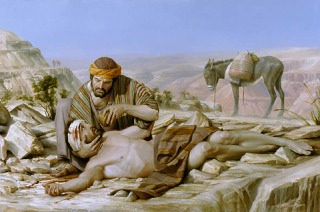
The Good Samaritan is a character who, despite owing nothing to the hero, helps them when they're at their weakest, often at risk or cost to themselves. There are many variations, but they generally follow this form: a wounded hero wanders in, and while others pass him by (or even further harm the hero), the Samaritan takes him in, tends his wounds and extends as much hospitality as he/she is able. This has the bonus of roping the hero into owing him/her a debt and giving him a reason to stick around the Adventure Town and fight off the Corrupt Corporate Executive threatening the Samaritan. Also, in a pinch, they make an excellent Love Interest by having proven he/she has got a heart of gold. (Good Samaritans who do not complicate the hero's life like that may come across as a Deus ex Machina.) If the Good Samaritan is much older than The Hero, they might become their Mentor.
Not coincidentally, the Samaritan is almost always a part of the blue collar or underclass of society. There's almost no such thing as rich Samaritans in fiction. Some have argued that the Samaritan from the original parable (see below) actually was fairly wealthy (since he brought the traveler to an inn and promised to pay the bill), but it's not really clear. And anyway, it could create Unfortunate Implications if someone in a privileged position sees others as helpless without them; see Condescending Compassion and White Man's Burden.
If the Samaritan follows the protagonist into the mêlée, expect him/her to be an Action Survivor to his Action Hero. Often overlaps with Innocent Bystander, Determined Homesteader, and Heroic Bystander.
A nasty subversion is that the Samaritan hasn't taken in a Hero, but a Viper intent on doing him harm. If the villain the Samaritan helps is instead confused and curious at their generosity, it may lead to the Samaritan becoming their Morality Pet prior to a Heel–Face Turn.
A lot of Superheroes are considered to be Good Samaritans.
The Trope Namer is one of Jesus' parables from The Four Gospels, in which a Jewish man is mugged and left for dead and naked by the roadside. Two of his own people, a priest and a Levite (an entire clan of assistants to priests), simply walk past, and the only person who helps him is a Samaritan, who not only tends to his wounds but brings him to an inn where he can recuperate, going so far as to shoulder his medical expenses. In a historical context, Jews and Samaritans are both Israelite ethnoreligious groups which back in Jesus' day distrusted each other at best, and were at war with each-other at worst (not unlike modern-day Jews and Arabs, both Semitic groups; nowadays Jews and Samaritans have more tranquil relations), each side claiming to adhere to a "pure," unadulterated form of the Israelite religion passed down from Abraham to Moses. Thus, in its day Jesus' story was pretty shocking to his Jewish audience in its emphasis on humanizing the "enemy". Indeed, in context Jesus is reciting this parable to a lawyer who asks him what the word of God means by "to love thy neighbor" in order to enter into Heaven, emphasizing that one's "enemy" is still one's "neighbor". The closest trope to the above moral is probably I Was Just Passing Through. To further complicate the story, there are religious rules that prohibit contact with corpses, and the first two passersby may have assumed that the traveler was dead (though actually there are some exceptions to those rules, which may have applied here). The story shows that, when forced to choose To Be Lawful or Good, it is almost always preferable to be the latter. In many modern uses of this trope, the Samaritan will protect and heal the hero even if the hero is explicitly a hunted fugitive.
This Trope is often combined with No Good Deed Goes Unpunished (when a Good Samaritan is treated negatively or unfairly) or with Androcles' Lion and/or Character Witness (when what he does is rewarded).
Sub-Trope of A Friend in Need. See also Samaritan Syndrome. Compare with Bad Samaritan, this character's moral opposite.
Examples
- In Fullmetal Alchemist:
- Winry's parents were doctors who treated people on both sides of the Ishvalan War. This didn't end well for them. They were the first victims of Scar's Roaring Rampage of Revenge after he woke up surrounded by Amestrians and assumed, incorrectly, that he had been taken prisoner.
- Their fate is altered in Fullmetal Alchemist (2003). Roy Mustang was ordered to execute them for aiding the enemy, nearly driving him to suicide in the process.
- Inuyasha: Rin stopped to help Sesshoumaru when he was wounded after a fight with the titular character. He later repaid the favor when his sword, Tenseiga, demanded that he bring her back to life. She became his Morality Pet and he went from full-on villain to Aloof Big Brother.
- In JoJo's Bizarre Adventure: Diamond is Unbreakable, this is a major part of Josuke Higashikata's backstory. When he was four years old, he became extremely sick due to his Stand awakening. His mother tried to take him to the hospital, but the car stalled in the snow. They were rescued by a random delinquent helping push their car out of the snow, influencing Josuke to grow his hair into a pompadour similar to the delinquent's.
- Pokémon: The Series: Nurse Joy's services are free to anyone who needs them, and the only time she's ever had to turn someone away from a Pokémon Center is because it was overcrowded. (Exactly where she gets her funding is a mystery, but then, her family does seem very large...)
- Saiyuki: This is the backstory of Hakkai and Gojyo in . Coming home from the bar one night, Gojyo tripped over a very badly injured Hakkai; Gojyo took him home, got him a doctor, and spent a month nursing him back to health. Unsurprisingly they're good friends now.
- Sket Dance: The story follows a school club whose stated goal is to improve campus life by taking in any requests for help, no matter what their nature might be and without demanding any rewards.
- Tokyo Ghoul: Ikuma Momochi is a pacifist Ghoul that was adopted by humans and strives to live peacefully with them. The territory assigned to him by Anteiku is a suicide hot spot, allowing him to scavenge corpses to satisfy his Horror Hunger. In spite of this, he routinely saves people preparing to commit suicide — choosing to go hungry rather than stand by and watch someone end their life.
- In Tsubasa -RESERVoir CHRoNiCLE-, Clone Syaoran was found on the street, taken in and raised by Fujimoto when the former was a kid. In the flashback explaining this, we see dozens of people walk by the kid without stopping to see if he needs help.
- The Twelve Kingdoms: Rakushun found Yoko almost dead, and after he helped her they ended up hanging together.
- You're Under Arrest!: As an officer of Bokuto's Traffic Division, it's been repeatedly shown that Yoriko will drop whatever she's doing to help those in need, regardless if she's off-duty. She's helped kids and senior citizens cross busy crosswalks, made classroom visits to promote public safety, and has cleaned litter off the street. As a result, she's been awarded commendations for her commitment to public service.
- Blue Beetle: Jaime Reyes encountered one of these just after the events of Infinite Crisis when his mystical armor dumped him naked in the desert.
- In Judge Dredd, "The Samaritan" is a nickname given by the judges to a psychic criminal: she uses her powers to detect dormant medical emergencies and anomalies on random passers-by, then luring them on an alley, knocking them out to perform the medical action needed, and calling for further help before skedaddling. The setting being what it is, this seems to be the only way she's found she can help people at all. And, true to the trope, she ends up saving the life of Judge Dredd himself.
- The origin of the superhero Plastic Man involved a gangster named "Eel" O'Brien who got shot during a robbery and was abandoned by his gang- but was found by a monk who helped him recover in his monastery. By the time he was healthy, O'Brien had changed into a good person who used his newfound powers to fight crime.
- Treasure Planet: Jim goes to help Bones after he crash-lands.
- In Adventures in Babysitting, "Handsome" John Pruitt offers to tow Chris's car to his garage and even pays to replace her tire. Unfortunately, what should have been A Simple Plan is derailed when his partner radios him to tell him his wife is cheating on him again, and he gets angry enough to drive home with his gun (shattering Chris's windshield in the process.) Still, he makes partial amends for it later in the movie, managing to get the car to the garage and replace the shattered window, even though the police are after him.
- The Blind Side: Leigh Anne helps Michael Oher, a homeless black student at her children's school, by giving him a home, tutoring, and general emotional and vocational support to enter the football team.
- By Hook or By Crook: Broke, homeless, and down on his luck just after reaching San Francisco, the protagonist Shy witnesses Val being beaten up. Shy attacks Val's assailant, getting knocked down but eventually chasing him off. This moment is the start of Shy and Val's friendship.
- Cellular: The leading male helps the female lead simply because he's the only one who can. She randomly dialed out on a broken phone and the odds of her being able to get an actual number again without being caught are slim to none. He then runs around all day, stealing cars, shooting guns, fighting with the Dirty Cop squad, and generally getting "in deep shit!" And he never quits.
- Deewaar: Ravi gets offered a job because the man they were going to offer it to didn't turn up on time. When the man arrives, he says that he was late because he couldn't afford the bus fare and had to walk all the way. Ravi takes pity on him and turns down the job so he can get it. When the other man thanks him, Ravi compares the situation to a jam-packed train:
"If I'd have sat, you'd have stood."
- Die Hard with a Vengeance: Zeus Carver doesn't know anything about John McClane other than he's a white man in Harlem wearing nothing but a racist sandwich board sign. Despite being a rather unrepentantly bitter and biased man when it comes to white people, he saves him from a gang. It wasn't that he necessarily wanted him to live, but he was afraid of what would happen if a white guy was killed on his block. Throughout the film, Simon Gruber calls him "The Samaritan."
- In Groundhog Day, once Phil is resigned to the fact that he can't escape the loop and has grown to accept it, he starts doing good deeds, doing them over and over, and adding new ones as he finds new opportunities each day. He saves a boy from falling, saves a man in a restaurant from choking, buys enough insurance from Phil to help Phil meet his quota (which becomes even more amazing when you realize that this is February 2nd), and so on. Eventually, the whole town loves him, and when he finally becomes such a selfless person that Rita truly falls in love with him, he escapes the loop.
- Kong: Skull Island: Mason Weaver is safely behind the wall protecting the natives' village when she hears a giant Sker Buffalo is in distress, pinned by the wreckage of a helicopter just outside the wall. She risks venturing outside the wall to try and help the creature push the helicopter off of itself, before Kong approaches and lifts it away with no problem. Seeing Mason's act of selfless compassion might have earned her some brownie points with Kong when he saves her life from the mother Skullcrawler at the climax.
- Lion: How five-year-old Saroo is eventually placed into an orphanage and later Happily Adopted, after spending months wandering the streets by himself. While he sits alone on a curb, a young man notices him and comes outside to share some of his lunch with him, and asks where his parents are. When Saroo says he's lost, the man takes him to a police station and helps translate for him.
- A Patch of Blue: Often cited as a Cinderella story, the film is a better example of a Good Samaritan story, with Gordon, a black man, breaking taboo by helping a blind white girl escape from her abusive mother.
- In Rape of Love, protagonist Nicole is gang-raped and dumped on the side of a road by the rapists. She's found by a gentle couple who immediately take her to a doctor with their car and comfort her on the way as she can't do anything but cry.
- In Run Sweetheart Run, Cherie encounters a few as she tries to escape the Big Bad. A convenience store clerk lets her have tampons for free when she admits she has no money. At a club, Cherie is being harassed by a group of men when a woman pretends to know her and gets her away from them.
- Training Day: The hero stops to rescue a little girl, and gets a Laser-Guided Karma reward for it later. The twist? The hero is an on-duty police officer, and only in the Crapsack World he's just stumbled into could the rescue be considered a noteworthy act.
- Michael in Underworld (2003) is a very good Samaritan. In the opening firefight, he risks leaving safe cover to help a woman who got shot. Later, when Selene basically kidnaps him, holds him at gunpoint, and crashes the car they're in into a river, he pulls her up, swims to shore, gives her CPR, and bandages her wound. Is it any wonder they develop an awkward relationship afterwards?
- X-Men: First Class: Charles Xavier as a kid generously offers food and a place to stay to a hungry and homeless young Raven Darkholme.
- In A Brother's Price the plot starts with Jerin helping an injured stranger. The law actually compels him to do so, but as Jerin is alone at home with his younger sisters (who aren't strong enough to carry her), some of them suggest just ignoring the injured soldier and pretending to haven't known about it if asked later. He still risks his safety by going outside to carry her to safety. Later, Queen Eldest remarks that this was something they want to encourage, which is why the Queens generously rewarded the family. It helps that the wounded soldier is Princess Odelia.
- The Calf of the November Cloud: When young Masai Konyek is wounded by cattle raiders while he is leading his herd, he is abandoned by his cowardly cousin Parmet who expects to bleed to death on the ground. However, Konyek is found by a hunter of the Dorobo tribe, who builds a shelter for both, dresses his spear wound with medicinal herbs, and stays for his side until Konyek regains consciousness.
- The Hunchback of Notre Dame. After Quasimodo gets arrested by soldiers for trying to kidnap Esmeralda, after being ordered to do so by Frollo, he gets publicly whipped as punishment. He then begs the watching crowd for some water, which no one will give him. Someone even throws a bottle after him to mock him. Esmeralda then steps up on the stocks and lets him drink from her own bottle. This causes Quasimodo to fall in love with her.
- In Neverwhere, Richard Mayhew chose to help the badly wounded Door, who was to all the world above a bleeding bum, despite his shrewish girlfriend insisting he leave her so he could meet her boss. This act of kindness backfired rather badly on him, as it made him fall out of perception. Still, it did get him a far more satisfying life (and a Magical Girlfriend!)
- The Son Of The Ironworker: Chased by his wicked grandfather's soldiers and having nobody and nowhere to turn, Martín Sánchez wanders in the wilderness. After spending some time fleeing and hiding, Martín finds himself dying from hunger, thirst, exhaustion and cold, and considering lying down on the snow and letting himself die, when he finds a cottage. Martín forces the door open, and is greeted by a very kind hermit who readily offers him meat, bread, a nice fire, a soft bed and using his cottage as a shelter for a while, since he is always willing to help whoever knocks on his door.
- In The Stainless Steel Rat Gets Drafted, the hero, Jim diGriz, encounters an entire planet full of Samaritans. He wasn't lucky to find a safehouse by randomly knocking; any door would have done.
- "The Quest For Saint Aquin", a 1951 short story by Anthony Boucher, takes place in a future where religion is forbidden. A Catholic priest traveling incognito blows his cover and gets beaten up, stripped naked, and dumped in a ditch. Two people walk by; he can tell by various clues that they are also Catholic. He is helped by a Jew — who observes a little tartly that he is not a Samaritan.
- Conqueror: Old Horghuz and several other tribeless wanderers help out Temujin and his family in Wolf of the Plains when they are exiled from their own clan. Hence the following passage when Tolui kills some of them:
[Temujin] knew in a moment of revelation that they had been his tribe, his family. Not by blood, but by friendship and a wider bond of survival in a hard time. He accepted their revenge as his own.
- In Jim Butcher's The Dresden Files novel Dead Beat, Kumori stops to revive a random dying stranger. What makes this so peculiar is that performing Necromancy rots the mind such that she should not have been performing good deeds if she could perform so powerful a spell.
- In Les Misérables, the act that righted Jean Valjean back into heroism was a parish priest he had just robbed from covering for him to the cops who had caught him, and giving him more. The dumbfounding degree of kindness shown gave him a good Heroic BSoD and helped him avoid truly becoming a criminal. Following the example set by the priest, Valjean later becomes a Good Samaritan to several of the other characters, including Fantine, Cosette, Marius, and even Javert.
- In Rafael Sabatini's Captain Blood: His Odyssey, Dr. Peter Blood is arrested for giving medical aid to rebels, even though he wants no part in the actual rebellion.
- In Edgar Rice Burroughs's The Monster Men, early in the book Sing returns back late from an afternoon expedition and then leaves after the meal. It turns out he helped a shipwrecked man in that interval.
- For the titular character of Beachwalker, acting as a Good Samaritan is her entire identity and reason to live.
- In Devon Monk's Dead Iron, Cedar looks for a missing boy from a town that treats him like dirt.
- In Michael Flynn's In the Lion's Mouth, a Good Samaritan gives Dominic Tight "booster" after the ambush injured him. Only when he reads the directions does he realize that the man is not a Confederal agent, but from their foes, the League.
- Aunt Dimity: Lori and her family play the Good Samaritan to the man they find collapsed in their driveway at the beginning of Aunt Dimity's Christmas; Willis Sr. even calls out an RAF helicopter to airlift the man to hospital when the roads are blocked by snow.
- Isaac Asimov's Three Laws of Robotics: The second part of the First Law says that a robot may not, through inaction, allow a human to come to harm. In other words, all robots are programmed to be Good Samaritans. This idea is frequently played with in his stories.
- One of Asimov's Black Widowers stories is called "The Good Samaritan", and focuses on a victim trying to locate her Good Samaritan helper to repay him.
- One of Asimov's science essays points out that, to a modern audience unfamiliar with the hostility between Jews and Samaritans in Jesus' time, much of the point of the story is lost. He suggests substituting the name of some currently-disliked group to give the story its intended impact.
- In Warrior Cats, the "guardian cats" group in Tigerheart's Shadow are essentially this; they take in injured and weak cats from the city and care for them, not asking for anything in return. Tigerheart and Dovewing stay with them for moons and help them out with some of their problems.
- Gentleman Bastard: The Bastards use this to their advantage as part of their Batman Gambit against Don Lorenzo Salvara, a wealthy nobleman. One of their members pretends to mug another member within view of Don Lorenzo, who immediately moves to intervene, thereby falling into the Bastards' con.
- In Better Call Saul, Mike robs a cartel member and leaves the driver alive by the side of the road in the hopes of getting the police involved without anyone having to die. However, a Good Samaritan finds him and saves him, and before he can alert the police, is killed by the cartel to Leave No Witnesses. Mike is very regretful when he hears, and this, along with the fact the cartel killed the driver afterwards anyway because they thought he was in on the robbery, ultimately serves as another lesson to him that 'half-measures' won't work - that if he wants something to happen, he should do it himself.
- Breaking Bad: In the episode "Dead Freight", Walt and his associates are attempting a train robbery of its shipment of methylamine by having Kuby park a dump truck on the tracks (under the guise of engine trouble) and siphoning the methylamine while the conductors are distracted trying to find a way to move the truck. Unfortunately, the plan's time frame is massively shortened when a Good Samaritan comes along and offers to push the dump truck out of the way with his vehicle.
- In the Doctor Who serial Frontios, the Doctor is trying to obey the rules about non-intervention when he sees there are wounded.
- In The Invasion Of Time, the wild Gallifreyans take in the exiled ones.
- Firefly: "Shepherd Book always said, if you can't do something smart, do something right."
- Forever: In the flashbacks for "New York Kids," Henry tries to help a man who's been shot, only to be shot himself because he's now a witness.
- In the Flesh played this almost Biblically straight with Dean and Ken. Dean is put into a zombie pen because he was bitten, even though by then he and his friends in the HVF knew bites weren't contagious. Being a diabetic, he needed something to eat to keep his blood sugar up. He asks a boy and an old woman for help; the boy tells him off and the old woman spits in his face. When Ken walks by, he's the only one to actually help him, filling Dean with shame in light of the fact that Dean stood by while his fellow zombie hunters killed Ken's (sentient and non-aggressive) undead wife.
- Star Trek: The Original Series: In "The City on the Edge of Forever", Edith Keeler runs a soup kitchen for the homeless and downtrodden in Depression-era New York and truly believes in the inherent goodness of man. So of course, she's fated to die.
- In the Supernatural episode "I Think I'm Gonna Like It Here" (S09, Ep01), a pickup truck driver believes Castiel is dehydrated or mentally ill and gives him a lift to a service station as well as some cash to make a phone call and buy a sandwich.
- Neverwhere: This is what led to Dick Mayhew's disappearance from normal society and fall to the magical underworld. On the way to a gala with his upper class girlfriend, he stopped to help a bleeding homeless girl, despite his girlfriend yelling at him to ignore the [epithet].
- In Poets of the Fall's "Nothing Stays the Same
 ," the singer describes the listener as being his metaphorical Good Samaritan, finding him when he's feeling lost amidst all the gambles he's taken on life.
- Christmas With The Tabernacle Choir: In her appearance, Kristin Chenoweth tells a story about how when she took a shortcut home from school one day she got lost until a kind old woman took her by the hand and led her right to her door. This serves as an introduction to "Angels Among Us".
- The Cordials of Kindness segment in Were You Raised by Wolves? is about appreciating good or kind acts of strangers, making this trope often discussed.
- New World of Darkness: This is how a character with the Charity Virtue regains Virtue - by stepping forward to help somebody who needs it at significant risk or cost to the self. Examples might include an untrained man running into a gunfight to pull a child to safety, a woman who gives her last twenty to a homeless man even though she needs to buy supplies for an upcoming fight, or similar.
- Dungeons & Dragons:
- In some editions, this is mandatory for Paladins, who are required to give a percentage of their wealth and earnings to charity. (How much they fit the classic image of the Good Samaritan depends on how well the character role-plays. note )
- The Book of Exalted Deeds for the Dungeons & Dragons setting has rules for playing ascetic characters, who are supposed to act like this; by taking the Vow of Poverty Feat and never violating it (which means voluntary poverty) and giving everything valuable to charity, these characters gain potent Exalted abilities.
- In the Planescape campaign, there's a small group (well, rather large for any group not big enough to be a full-fledged Faction) called the Ring-Givers who believe that everything that you give to others will eventually come back to you and that you only get as good as you give. Members of this group provide charity to others and live by accepting it from others. (No easy feat in this setting, where most folks believe that Every Man Has His Price.). Most members are, indeed, Good Samaritans, but unfortunately, there are plenty of Bad Samaritans in the group too. It works because the setting works on Clap Your Hands If You Believe.
- At the end of The Phantom of the Opera. Christine Daaè kisses The Phantom, who is holding her fiance in a noose and threatens to kill him, if Christine doesn't marry him. After kissing him, The Phantom is so overwhelmed by her kindness that he let both of them go.
- An entire clan of these exists in Elite Dangerous. The Fuel Rats are, as their name implies, an emergency group you can call out to if you find yourself stranded without fuel. They'll bring you enough gas to get you to a fuel star or outpost, circumstances permitting. They don't expect any compensation for helping stranded commanders—the satisfaction of helping is all they need. There have been some people who call for Fuel Rat assistance then shoot down the responding Rats either for free salvage or simple dickery, but the Rats still answer any call made regardless. Not that the griefers, known as 'cats,' always get away with it scot-free; there's the other kind of Good Samaritan who, upon seeing a Fuel Rat being fired upon, chases down the offender and saws them in half with a barrage of cannon fire. This includes unofficial 'cat killer' teams flying without squadron markings (so the cats don't know who's reporting their position and who's just another Space Trucker moving ore), such as CATBAG.
- At the beginning of Red Dead Redemption, Marston is shot and left for dead in front of a bandit hideout. Bonnie risks her life to rescue him and then takes him back to her ranch to treat his wounds. Even though she isn't seeking any sort of payment, a grateful Marston spends much of the game repaying her kindness by helping her keep her ranch safe.
- Litchi Faye-Ling in BlazBlue tends to help those who are mostly ignored, such as Linhua when she first arrived to Orient Town and is ignored by the majority, or for the Kaka clan who are doomed to extinction with nobody to care about, and especially on Arakune, whom everyone else considers a 'lost cause'. She ends up getting tangled with a Bad Samaritan (Hazama) and was Forced into Evil, but at that point, when she met a distraught Carl, who is supposed to be none of her business at best, enemy at worst, she willingly lets him cry on her hug until he calms down and calls out Relius's parenting skills when he appears, even though he's supposed to be her boss.
- Disgaea 4 - This trope resulted in Artina being executed by her own countrymen because she dared to be nice to Judge Nemo, who was a prisoner of war at the time.
- Pokémon:
- This is sort of a staple of the series. While the games have lots of merchants and guys who trade you stuff, there's also plenty of NPCs who give you things for free, if you simply talk to them, everything from Technical Machines, Hold Items, and Evolution Stones. In Pokémon X and Y, you can get a Lapras and a Lucario (two powerful Pokémon) as gifts with no strings attached.
- A Pokémon that fits the Trope is Delibird. Most of its PokéDex entries claim that it shares the food it stores in its tail to travelers that are lost and hungry in snowy mountains.
- Dark Souls: "Benevolent Invasions" are a rare but documented phenomenon among the player base. Usually, an Invader attacks whoever he invades for the purpose of killing them and gaining humanity from them. Thus, players who are already weak and struggling are easy targets. But some Invaders, upon entering a struggling player's game, will not attack and will instead drop useful items before banishing themselves away. There is absolutely no reward for doing this in-game; the only reason to do so would be out of the goodness of one's heart.
- Advanced V.G.: While Yuka is noted for being the series' heroine, Yuuki is its unsung hero. Her character endings show she does volunteer work at hospitals and homeless shelters. Supplemental material also states that she protects other women from potential muggers and rapists, by using herself as bait to lure them out, then beats them senseless.
- In Coming Up Violet the titular character defends and helps her former friend Racquel at a party when Racquel's plan to embarrass her backfires. Everyone else at the party just stands and laughs, and when Racquel asks Violet while they're waiting for their pickup why she's helping her Violet simply says, "Because I WANT to. Let's just leave it at that." A few days later Violet goes one step further and attempts to rekindle their friendship. Racquel was not amused.
- In Monsieur Charlatan, Magda descends on Isidore to stop his depressive behavior.
- In Avatar: The Last Airbender, two feuding tribes have conflicting stories of an event that happened over a hundred years ago. One tribe alleges the other tribe’s forefather Wei Jin attacked their leader Jin Wei and stole a sacred relic used in a tribal ritual. However, the other tribe claims Wei Jin tried to help Jin Wei and was unjustly punished for a crime he didn’t commit.
- In Family Guy, in a flashback, Peter was driving down the road when he stopped and a stray dog/bum came up and did his windows. Peter wasn't happy. After talking with the dog, Peter offered to take him home for some dinner. And that is how Brian and Peter met.
- Phineas and Ferb not only often help their friends, but also complete strangers they've only just met.
- The Simpsons:
- Ned Flanders may have fallen victim to the Trope named for him, but he and his family have honestly acted like this several times, such as in "Brother, Can You Spare Two Dimes?" when they help Homer's homeless brother Herb when he shows up at their house by mistake.
- Moe Szylak, oddly enough. He volunteers at the church and homeless shelter to read to children. (And when Ned recognizes him as the guy who does so, Moe threatens him to keep quiet about it.)
- In the very poignant episode of Batman: The Animated Series "It's Never Too Late", there was Father Michael, the brother of aging crime boss Arnold Stromwell. Michael saved Arnold from being run over by a train when they were kids and lost his leg in the process, and in the present day, still tries to help his brother see reason and agree to Batman's terms after the new crime boss Rupert Thorne is set on killing him. (Stromwell asks Michael why he even bothers helping him, reminding him that he lost his leg the first time, implying that he blames himself for it.)
- In Static Shock, the entire Hawkins family fits this. Virgil's father and sister both volunteer for the community and provide guidance to troubled youth, understanding that seemingly "bad" kids have issues that they need help with. Virgil's mother was a paramedic who died because she was on the streets caring for the injured while a riot was going on around her (and in one episode, Virgil's attempt to save her by going back in time and asking her to hide for the rest of the night fails because there was simply no way she would save herself when others needed her help). Virgil himself chose to become a superhero immediately after learning about his powers, which is even more impressive considering how a majority of the bang babies chose to turn to villainy right off the bat. He also, over the course of the series, helps out bang babies who are more confused or scared than dangerous, brings a homeless girl to be taken in by a pastor so she can be given help, and voluntarily has his power drained in a painful-looking procedure so Edward Alva's son can be changed back from his Taken for Granite state.
- The parable the trope is based on is featured in the VeggieTales episode "Are You My Neighbor?" and told through the style of Dr. Seuss. In it, the Jews and Samaritans are portrayed by the shoe-wearing Flibber-O-Loo and the pot-wearing Jibber-De-Lot and constantly fight over which of their preferred headgear is better. One day, a man from Flibber-O-Loo (played by Larry) is minding his business when three bandits ambush him, steal his milk money, and stuff him in a hole, and the town's mayor and doctor are far too busy with their work to help him out. He's saved by a civilian from Jibber-De-Lot (played by Junior), who helps him in spite of the towns' feud. This humbles both towns into dropping their feud.
- The Red Cross. If you put your field hospital or even field medics under the protection of the Red Cross sign, you are obliged to help anyone.
- Any doctor who is deserving of his or her degree is supposed to be a Good Samaritan. That's the whole point of the Hippocratic Oath.
- During World War II's North African Campaign, field hospitals on both sides would treat wounded without distinction by uniform.
- Most Western military forces will treat enemy wounded. Compassion aside, this also has the practical benefits of good publicity to encourage enemy troops to surrender and keeping enemy prisoners alive to interrogate.
- Many countries try to encourage this behavior by implementing Good Samaritan Laws. In the United States and Canada, civilians helping people in need are protected from liability if they acted rationally and with good intentions, while in parts of Europe (and in Quebec) it is a crime to ignore a person in danger if you can help without endangering yourself.
- In China, you can buy Good Samaritan insurance that will protect you in case you've accidentally helped a viper. There are apparently enough of them in China, both vipers and Good Samaritans, that Good Samaritan insurance is a viable business.
- In China, you can buy Good Samaritan insurance
- Not Always Hopeless has this ill-named but heartwarming story of a door-to-door solicitor dropping everything to help a miserable alcoholic at one house, keeping them company for three days straight until they're off the booze and the worst of the withdrawal has passed.
- This pizza delivery driver, upon learning a woman's abusive ex-husband has been driving her into bankruptcy with false fast food orders, pays for the order out of pocket, advises her how best to preserve and reheat the leftovers, and offers to pay for any future orders she needs to feed her children.
- This stranger sees a depressed college student preparing to jump onto a train track in the middle of the night, offers to hear out their problems, stays with them until morning, gives them his coat against the cold, and calls an ambulance so they can get professional help. The submitter mentions at the end that they never got his name, but still have his coat.
- Another pizza shop receives a call from a distressed young woman, whose boyfriend took the last money in their house to buy pizza when she still needed to buy supplies for their two-week-old. After confirming the boyfriend's order, the pizza workers throw him out, then bring the pizza, the money he'd paid, some baby supplies bought out-of-pocket, and a few days' worth of reheatable pasta meals to the girl, along with a letter from the manager offering her a job and/or free pizza if/when she needs it.
- This pizza delivery driver
