In novels, things tend to flow in a way that makes sense according to how the story is meant to work. Important things are described in great detail, while less important things are just glossed over. Any "jump out at you" details are usually meant to mean something. If someone is described as having lips like cherry and eyes like chocolate, that person is probably beautiful (within the context of the story, or at least in the perception of the author). Little details bring a story to life, and they are usually given to the parts of the story the author considers important.
Same is true with aspects of a character's everyday life. If someone's daily routine is described in great detail, then it's usually to demonstrate some character quirk (such as being a Creature of Habit, having Obsessive Compulsive Disorder, being Obsessively Organized, or having odd interests or behaviors), or show how that character feels at that point in time (if they've just been through something you'd expect to fundamentally affect them but aren't thinking about it, it could suggest a Heroic BSoD).
Some authors either don't understand this, or choose to deliberately subvert it. They may describe every little unimportant thing in tremendous detail, which is known as Purple Prose. Or they may describe the important elements of a story in ways that you wouldn't normally think of, using bizarre metaphors or describing things unconventionally in their attempt to make a detail illustrate something of importance.
Consider the following example:
Brooke shook her head. "No. Not really," she explained, carelessly running her bare foot along the corner of a rug. Her toenails were painted and decorated with glittering flowers.
In this scene, Max (age 11) is talking to a girl with whom he has a crush about something of great importance, in the girl's house. While they talk, she runs her foot along the rug, and wow, what a beautiful foot. You can tell Brooke is a classy girl with those glittering flowers.
Anyway, that's a description straight out of left field. It does highlight that Brooke is attractive to Max, but not in the way you'd expect.
If done well, it's punchy and interesting and allows the reader to see what might be a somewhat tired or over-familiar concept from a refreshing new angle. If done poorly, then it can be clumsy and nonsensical and may lead to a case of Metaphorgotten.
This is one of the Lemony Narrator's preferred tools.
Compare Narrative Filigree, when the narration is full of details that are interesting, but not necessary for the plot. Sub-Trope of The Law of Conservation of Detail, the general trope about every mentioned detail being important.
Examples should contain at least one passage from the book if possible.
Examples:
Fan Works
- Paradoxus: In the prologue, Altalune's Nightmare Sequence ends with her bolting upright in her bed, panting. Her heartbeats are compared to a jazz musician playing the piano —an everchanging rhythm and a drumming of keys.
"los latidos al estilo de un pianista de jazz, estrellando los dedos sobre las teclas"
- The Winx Club Play Dugeons and Dragons: When picking the appearance and abilities of her player character, Layla chooses a Genasi monk whose dreadlocks sport an ombre look in the same tones as the ocean (the deeper, the darkest the blue). This implies that her Genasi character has water elemental powers and also highlights that Layla's home world is oceanic. Her exact wording is "ombre dreadlocks like the ocean."
- Douglas Adams: This trope is part of his Signature Style.
The ships hung in the sky in much the same way that bricks don't.
- Anansi Boys: Neil Gaiman does this particularly well here. "If on seeing Graham Coats you immediately thought of an albino ferret in an expensive suit, you wouldn't be the first."
- Discworld:
- There are a couple of instances of items "flying through the air, like a partridge".
- Hogfather: "Long ago, someone had made [the carpet] by carefully knotting long bits of brightly colored rag into a sacking base, giving it the look of a deflated Rastafarian hedgehog."
- The Fight of the Good Ship Clarissa: Ray Bradbury put a few of these.
They had been throwing the same party so long the party looked like a worn out first edition of a trapeze artist.
- Grey Griffins: The series has some strange writing flaws, but only a handful of stuff that really jumps out like this. For example, "The dawnless morning". How can there be a morning without a dawn? Figurately speaking, it can be read as meaning that it's so cloudy that the sunrays are barely visible. Or that it's such an utterly hopeless day —dawn is a common symbol of new beginnings.
- Inheritance Cycle: The narration is filled with this sort of thing. Examples include "Movement flickered through it, like the swish of a bird across a clouded moon" and "Slippers flashing beneath her dress, like mice darting from a hole."
- The Last Unicorn (Peter S. Beagle): Unusual comparisons are part of the style of the book. The unicorn remembers a "chocolate stable smell," for example, or the late-morning sun melts "into a lion-colored puddle." The unicorn is also called "sea white" long before there's any reason to believe that the unicorns and the ocean are connected.
- Lullaby (Chuck Palahniuk): The protagonist is a journalist who is always noting details.
Her suit is light blue, but it's not a regular robin's-egg blue. It's the blue of a robin's egg you might find and then worry that it won't hatch because it's dead inside.
- Neuromancer: The opening line is "The sky above the port was the color of television, tuned to a dead channel". Several examples like these are very much part of the course of Sprawl Trilogy in general.
- Nineteen Eighty-Four: George Orwell's iconic dystopia starts off letting you know that something's not right with this quote "It was a bright cold day in April, and the clocks were striking thirteen".
- Sephro: Multiple characters are described through random details to show they’re not human, as well as multiple things that play no actual part in the story are described.
- A Series of Unfortunate Events: The Lemony Narrator will sprinkle details about someone or something's appearance throughout a scene (possibly meant to imply that the Baudelaires are just noticing them).
- Special Topics In Calamity Physics (Marisha Pessl): Blue van Meer, the narrator and protagonist, gives intense visual descriptions of her surroundings and other characters, frequently referring to movies and books, complete with author name and year of release/publication.
- Wake: Robert J. Sawyer borrows the first line of Neuromancer —"The sky above the port was the color of television, tuned to a dead channel"— with a Technology Marches On twist: "The sky above the island was the colour of television, tuned to a dead channel — which is to say it was a bright, cheery blue." Some fans take it further: "The sky over the port was the color of a television set tuned to PBS"
 .
.
- P. G. Wodehouse loves doing this. One character has the look of "a pterodactyl with a secret sorrow".
Live-Action TV
- How I Met Your Mother: In "Last Cigarette Ever", Ted's kids —and the audience— are flummoxed to learn that some of the adults used to smoke. The reason is that said characters had rarely been shown smoking up until this episode. Unless you count "eating sandwiches and cigars").
Music
- MC Frontalot: In "You Got Asperger's", this trope is used very deliberately to try to illustrate the difficulties of Asperger syndrome. The POV character is painfully aware of how easily he is distracted by details that are irrelevant to the situation at hand, and he struggles to stay focused enough to have a proper conversation with a girl he likes, rather than fixating on her hair ribbons or the tick of a malfunctioning clock.
Radio
- Stray Ami: Blank, the narrator, has a gift for doing this kind of description. For instance, he notes that Ms. Lafeit, an unpleasant old lady, smells like when you bite into a chocolate chip cookie and find it full of raisins.
- Writing Excuses: Discussed in the sixth season's eleventh episode "Making Your Descriptions Do More Than One Thing".
Video Games
- Crash Tag Team Racing: Stew, a sports reporter, describes a gruesome, previous accident at the theme park by comparing the carnage it caused to putting a baked ham in a wood chipper. He knows it because he's done it.
- Max Blaster and Doris de Lightning Against the Parrot Creatures of Venus: The narration is fond of making somewhat bizarre and definitely humorous comparisons. Especially in footnotes. One example is the Affectionate Parody-flavored description of old pulp serials Purple Prose tendencies:
Making your way through the Venusian jungle is a bit like working security in the front rows of a rock concert mobbed by giant broccoli.
Websites
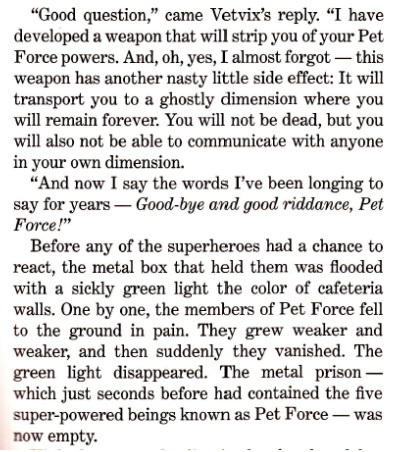
- Cracked: Pointed out in Any Franchise Left To Its Own Devices Will Go Off The Rails, which features an excerpt of a Garfield's Pet Force story in which Vetvix banishes the heroes◊ to a Phantom Zone-like dimension. The image caption draws attention to the passage, "Before any of the superheroes had a chance to react, the metal box that held them was flooded with a sickly green light the color of cafeteria walls," prompting the comment, "... What cafeterias has Jim Davis been eating in?"