
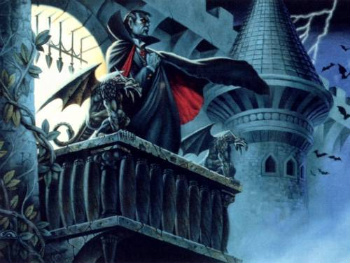
Gothic Horror is one of the oldest of the horror genres. Darker, edgier and on the Romanticism end of Romanticism Versus Enlightenment (in fact, it quite literally emerged alongside the Romantic movement in the late 18th century as a reaction against the values of the Enlightenment), it tends to play on both the thrill and the fear of the unknown and places a great importance on atmosphere. It's usually heavily symbolic, sometimes even dreamlike. In addition to being important to the horror genre, the first Science Fiction, Mystery Fiction, Fantasy, Romance, Thriller, and Adventure authors drew inspiration from Gothic horror, so it's sometimes considered the parent of all modern genre fiction.
Gothic fiction is usually used as a synonym or is the name given to Gothic horror stories that are saturated with the above mentioned scifi, fantasy, romance, mystery, or adventure elements.
The name "Gothic" comes from a style of architecture from The Middle Ages (christened as such by those who considered it barbaric in comparison to classical architecture, the name coming from the barbarian tribe of the Goths). There were a lot of Gothic ruins lying around Britain, and people in the 18th and 19th centuries developed an interest in them because (a) ruins are always kind of mysterious and melancholy and creepy and (b) they evoked the time period they were built in, which was thought of as a barbaric time where people believed in (and did) all kinds of weird stuff. For this reason, most early Gothic horror novels were set in that era. They were usually also set in Catholic countries, because the Brits who wrote them considered Catholicism sinister (yet also kinda cool).
The renewed interest in Gothic stuff also led to the Gothic Revival movement in architecture, but for the purposes of this article we're not so interested in that.
Horace Walpole's The Castle of Otranto, written in 1764, is considered the first Gothic horror novel. Walpole was a big fan of William Shakespeare and proudly declared that he borrowed most of the tropes from his idol's plays, particularly Hamlet, Macbeth, and Romeo and Juliet. Ann Radcliffe helped popularize the genre, and authors such as Matthew Lewis, Clara Reeve, Eliza Parsons, Eleanor Sleath, and Francis Lathom finished out the eighteenth century Gothic horror writers in Britain. (Other parts of Europe, most notably Germany, saw parallel movements arising around this time as well, with authors such as E. T. A. Hoffmann and Johann Wolfgang von Goethe putting out works which are often considered at least Gothic-adjacent.) The beginning of the nineteenth century saw Gothic horror being parodied by authors like Jane Austen, but there were still straight examples provided by authors such as Lord Byron and Mary Shelley. By the time the Victorian era rolled around Gothic horror was beginning to run out of steam, but there were still quite a few people writing it — in fact, most of the Gothic horror authors and works you've heard of probably come from this era, such as Edgar Allan Poe, Bram Stoker, and the Brontë sisters. A distinct American offshoot of the genre also came into its own in this period, exemplified by writers like Poe and Nathaniel Hawthorne.
There were a few more notable Gothic authors in the early 20th century (Daphne du Maurier, for example), but by the 1950s or so, the genre had given way to modern Horror and Psychological Thrillers, or — in the U.S. — the Southern Gothic subgenre. Spearheaded by writers such as William Faulkner and Eudora Welty and later picked up by the likes of Flannery O’Connor and Harper Lee, Southern Gothic literature transposes Gothic gloom and terror to the post-Civil War Deep South. In Canada, some authors transposed Southern Gothic themes to Toronto and its surrounding region, creating Southern Ontario Gothic.
The Cosmic Horror Story is something of a Spiritual Successor to Gothic Horror, with the genre's codifier H. P. Lovecraft explicitly listing several masters of Gothic Horror as major influences. Where Gothic Horror drew upon classical mythology and legend to provide its nightmares, however, Cosmic Horror looked to the modern world itself, and pondered what would happen as man shone a light upon the last refuges of the creatures who once haunted the empty countryside now becoming suburbs, and reached beyond the limits of what he was meant to know. Perhaps Here There Be Dragons, after all?
The influence of the Gothic can also be found in the Film Noir tradition, which carries on the Gothic's themes of secrets coming to light, simmering sexual tension, middle-class distrust for the rich, and a general tone of unease and paranoia, though in a much more cynical and modern environment, and typically eschewing the fantastical elements of the Gothic in favour of the more psychological aspects (although it's not impossible to put those fantastic elements back in).
Universal and Hammer Films are responsible for successfully adapting this genre onto the big screen. For modern takes on the genre see Gaslamp Fantasy, New Weird, and Supernatural Fiction. Compare/contrast also Gothic Punk.
For an in-depth look go to Violet Books (unfortunately deceased, but resurrected — appropriately enough) and the still-active Gaslight Reading & Discussion Site. See also Lovecraft's essay Supernatural Horror in Literature.
For a list of tropes used in the Gothic horror genre see Index of Gothic Horror Tropes. For advice on writing in this genre, see our Write a Gothic Story guide.
Authors who wrote partially or entirely in the Gothic fiction genre include:
- Horace Walpole (1717–1797). His novel The Castle of Otranto (1764) makes him the Trope Maker. Also gave us Haunted Castle.
- Clara Reeve (1729–1807), who wrote The Old English Baron (1778) in direct response to Walpole's Otranto.
- Eliza Parsons (1739–1811). Better known for her novel The Castle Of Wolfenbach (1793).
- William Godwin (1756–1836). His novel St. Leon (1799) introduced the Rosicrucians and the idea of forbidden knowledge granting eternal life to the Gothic genre. He was also the father of Mary Shelley, and his St. Leon was a major inspiration for her Frankenstein.
- William Beckford (1760–1844). Author of Vathek (1786) and started the subgenre of Orientalist Gothic, set in a mythical Orient inspired by The Arabian Nights.
- Ann Radcliffe (1764–1823). Author of, among others, The Mysteries of Udolpho (1794) and The Italian (1797). Notably replaced real supernatural events with the "Scooby-Doo" Hoax.
- Regina Maria Roche (1764–1845). Her novel The Children Of The Abbey (1796) was a best-seller of its time. But she is best remembered for the moodier Clermont (1798).
- Carl Friedrich Kahlert (1765–1813), alias Ludwig Flammenberg. He is better known for the novel The Necromancer (1794), also known as The Tale of the Black Forest. The work was written in German and translated into English. The translator Peter Teuthold considerably revised the text and even added a chapter of his own. The Teuthold version is still the best known form of the work.
- Carl Grosse (1768–1847) alias Marquis de Grosse. Better known for Horrid Mysteries (1796), the English translation of his novel Der Genius (The Guiding Spirit, 1791-1795).
- Eleanor Sleath (1770–1847). Married name of Eleanor Carter. Better known for her novel The Orphan of the Rhine(1798).
- Charles Brockden Brown (1771–1810): The first important American Gothic writer, best known for Wieland (1798).
- Francis Lathom (1774–1832). His better known work in the genre was The Midnight Bell (1798). He is also known for The Mysterious Freebooter (1806), an early work of Historical Fiction Literature.
- Matthew Gregory Lewis (1775–1818). His novel The Monk (1796) gave us the Sinister Minister, who, among other sins, enters into a Deal with the Devil, as well as introducing the Wandering Jew archetype to the genre.
- James Hogg (1770–1835). Best known for The Private Memoirs and Confessions of a Justified Sinner (1824), which gave us the Doppelgänger. The eponymous Sinner supposedly makes a Deal with the Devil, but it is never clear if this is true or all in his head. Also makes chilling use of Psychological Horror and "Rashomon"-Style.
- E. T. A. Hoffmann (1776–1822). The most important German author of Gothic fiction. His novel The Devil's Elixirs (1815) is a classic of the genre. His best known work, however, is the short story "The Nutcracker and the Mouse King" (1816).
- Charles Robert Maturin (1782–1824). Author of Melmoth the Wanderer (1820), a notable use of the Nested Story style to tell a complex tale.
- Washington Irving (1783–1859): Author of numerous classic tales of terror. Some, like "The Legend of Sleepy Hollow" (1820), have rational explanations a la Radcliffe. Others, like The Devil And Tom Walker (1824), are purely supernatural.
- Eaton Stannard Barrett (1786–1820). Wrote The Heroine (1813), a notable parody of the genre. Particularly of the Changeling Fantasy plots which had been used by several gothic novels. In these novels, characters of seemingly modest backgrounds often found themselves secret progeny of noble and/or affluent families. Barrett's "heroine", Cherry Wilkinson, is a farmer's daughter and an avid reader of gothic novels. She convinces herself that she is heiress Cherubina de Willoughby and embarks on a series of quixotic misadventures.
- Lord Byron (1788–1824). His Byronic Hero was a major contribution to Gothic fiction. The type was introduced in the narrative poem Childe Harold's Pilgrimage (1812-1818). His poem The Giaour (1813) is one of the earliest depictions of vampires in fiction. The satiric poem Don Juan (1818-1824) is not part of the genre, however.
- John William Polidori (1795–1821). He wrote the first vampire novel, The Vampyre (1819). Trope Maker of Vampires Are Rich and Genre Popularizer of Vampire Fiction.
- Mary Shelley (1797–1851). Her novel Frankenstein (1818) gave us Frankenstein's Monster. She is also considered the first Science Fiction writer.
- Nikolai Gogol (1809–1852). Russian horror writer of Viy, The Nose, and Nevsky Prospekt.
- Edward Bulwer-Lytton (1803–1873) of It Was a Dark and Stormy Night fame. He had an actual interest in the occult and the paranormal. He incorporated elements of his study in various tales, most notably Zanoni (1842). His most enduring work is probably The Coming Race (1871), combining elements of occultism, gothic horror, and science fiction.
- Marie Corelli (1855–1924) had this in some of her novels, notably Wormwood and Vendetta.
- Nathaniel Hawthorne (1804–1864): Intertwined Gothic Horror with the history of New England in such stories and novels as Young Goodman Brown (1835), The House of the Seven Gables (1851), etc.
- Edgar Allan Poe (1809–1849). One of the most important writers of Gothic fiction; wrote the first Great Detective Mystery. He revisited classic gothic themes in the short stories "The Fall of the House of Usher" (1839), and "The Pit and the Pendulum" (1842), among many other classics of the genre. His best known Gothic poem is probably The Raven (1845).
- Charles Dickens (1812–1870). He gave us Victorian London or at least the Hollywood version of it. He tended to use old Gothic tropes in new ways. Such as secret heirs to prominent families ("Oliver Twist", 1837-1839), and wicked uncles plotting or performing murder (The Mystery of Edwin Drood, 1870). All in an urban environment and graphically depicting the life of the low classes.
- Joseph Sheridan Le Fanu (1814–1873). Better known as the author of Carmilla (1872). Gave us the Occult Detective and Lesbian Vampires.
- Paul Féval (1816–1887). Penned The Vampire Countess (1856), Knightshade (1860), and Vampire City (1875), all of which are classic examples of Our Vampires Are Different.
- George W.M. Reynolds (1814–1879). He wrote the serial novels The Mysteries Of London (c. 1844-1848), and The Mysteries Of The Court Of London (1848-1856). He was a pioneer of the "urban mysteries" style of gothic horror. Tales changing the story setting from the haunted castles of the past to the great metropolis of the Industrial Revolution. He luridly depicted the poverty, crime, and violence of London life. Reynolds also wrote three other gothic novels: Faust: a Romance of the Secret Tribunals (1847), Wagner the Wehr-Wolf (1846-7), and The Necromancer (1851-2).
- James Malcolm Rymer (1814–1884). Helped pave the way for the Friendly Neighborhood Vampire with the title character of Varney the Vampire (1847), which is also the Trope Codifier for many commonly used vampire tropes such as fangs, two-hole puncture wounds, and Super-Strength, among others.
- Charlotte Brontë (1816–1855). Gave us the Madwoman in the Attic in Jane Eyre (1847).
- Emily Brontë (1818–1848). Author of Wuthering Heights (1847).
- Wilkie Collins (1824–1889). Author of The Woman in White (1859-1860).
- Mary E Braddon (1835–1915). Writer of sensation novels, which took on Gothic tropes like secret marriages and madwomen but generally left out supernatural elements. Author of Lady Audley's Secret (1862), one of the first mystery novels, and a possible forerunner to the Film Noir genre.
- Louisa May Alcott (1832–1888). While best known for Little Women (1868-1869), She Also Did reasonably successful "sensational" Gothic romances such as A Modern Mephistopheles (1877) under the pen name of A. M. Barnard, and one called A Long Fatal Love Chase that everyone in her own lifetime found too scandalous to publish. The latter was written in 1866 and first published in 1995.
- George Du Maurier (1834–1896). Author of the novel Trilby (1894), which was the Trope Namer and possibly the Trope Maker for The Svengali. Also the grandfather of Daphne du Maurier, author of Rebecca.
- Ouida (1839–1908) had Gothic elements in many of her stories. She even had some tales with zombies.
- Ambrose Bierce (1842–1913?). Another precursor to the Cosmic Horror Story. His short story An Occurrence at Owl Creek Bridge (1890) is a classic case of Dying Dream. The lesser known An Inhabitant Of Carcosa (1886) is an influential use of the Eldritch Location. The mysterious disappearance of this author has also inspired younger storytellers.
- Henry James (1843–1916). Author of The Turn of the Screw (1898).
- Bram Stoker (1847–1912). Gave us Dracula (1897) and Überwald.
- Isidore Ducasse (1847–1870), aka Le Comte de Lautréamont, although it was only a pseudonym. Author of the self-consciously outrageous Les Chants de Maldoror (1868), later a canonical text for the Surrealist movement in France and Belgium.
- Robert Louis Stevenson (1850–1894) dabbled in this trope. Gave us the Jekyll & Hyde trope through The Strange Case of Dr. Jekyll and Mr. Hyde (1886). Most of his other work, however, is swashbuckling adventure fiction, and his other most famous book, Treasure Island, is probably the definitive work of pirate fiction.
- Mary Eleanor Wilkins Freeman (1852–1930): Author of regional Gothic tales like "A Symphony in Lavender" (1883), "The Twelfth Guest" (1893), "Luella Miller" (1902), and "The Shadows on the Wall" (1903, adapted as an episode of Night Gallery).
- Oscar Wilde (1854–1900). Author of The Picture of Dorian Gray (1890).
- Arthur Conan Doyle (1859–1930). Creator of Sherlock Holmes. His novel The Hound of the Baskervilles (1901-1902) uses classic gothic horror elements, but of course more in the Ann Radcliffe, "Scooby-Doo" Hoax style. (On the other hand, he also wrote "Lot No. 249", an early Mummy tale, in an era when fascination with Ancient Egypt was gaining ground.)
- Arthur Machen (1863–1947). Author of The Great God Pan (1894).
- Robert W. Chambers (1865–1933). Paved the way for the emergence of the Cosmic Horror Story with The King in Yellow (1895).
- Montague Rhodes James (1862–1936). Credited with updating the ghost story for the 20th century. His works often used Sealed Evil in a Can. His short stories were collected in volumes such as Ghost Stories Of An Antiquary (1904), and its sequel More Ghost Stories (1911).
- Gaston Leroux (1868–1927): author of The Phantom of the Opera (1909).
- Edith Wharton (1862–1937): Disciple of Henry James. Wrote classic ghost stories, collected in volumes like Tales Of Men And Ghosts (1910).
- Algernon Blackwood (1869–1951). Influential writer of ghost stories. His better known works are The Willows (1907) and The Wendigo(1910). Both are influential works in the Cosmic Horror Story genre.
- William Hope Hodgson (1877–1918). Author of The House on the Borderland (1908), The Night Land (1912), and Carnacki the Ghost-Finder (1913).
- Hugh Walpole (1884–1941). Author in several genres. His better known gothic horror tale is Portrait of a Man With Red Hair (1925) …and yes, he is the descendant of Horace Walpole, the Trope Maker and author of The Castle of Otranto as earlier mentioned.
- Marjorie Bowen (1885–1952). Prolific author of gothic novels, horror tales, and historical novels. Several of her stories were collected posthumously in the collection Kecksies And Other Twilight Tales (1976). Her own life story was pretty horrific as well.
- Dennis Wheatley (1890–1977), author of The Devil Rides Out.
- Guy Endore (1900–1970): Author of the classic werewolf novel, The Werewolf Of Paris (1933).
- William Sloane (1906–1974). Author of two classic horror novels, To Walk The Night (1937) and The Edge Of Running Water (1939, filmed as The Devil Commands in 1941 with Boris Karloff).
- Daphne du Maurier (1908–1989). Granddaughter of the above-mentioned George du Maurier; wrote Rebecca (1938), Jamaica Inn (1936) and the original short story on which The Birds was based.
- Agatha Christie (1890–1976)
- H. P. Lovecraft (1890–1937)
- William Faulkner (1897–1962)
- Shirley Jackson (1916–1965)
- Robert Bloch (1917–1994)
- Ray Bradbury (1920–2012)
- V. C. Andrews (1923–1986)
- Flannery O’Connor (1925–1964)
- Toni Morrison (1931–2019)
- Anne Rice (1941–2021)
- Margaret Atwood (1939–)
- Peter Straub (1943–2022)
- Dean Koontz (1945–)
- Stephen King (1947–)
- Barbara Gowdy (1950–)
- Clive Barker (1952–)
- Amy Tan (1952–)
- Kim Newman (1959–)
- Neil Gaiman (1960–)
- Joss Whedon (1964–)
- J. K. Rowling (1965–)
- Sarah Waters (1966–). Her novels Affinity and The Little Stranger are homages to the genre; the latter, in particular, is heavily reminiscent of The Turn of the Screw.
- Billy Martin (1967–)
- Claudia Gray (1970–)note
Non-literary works of (and inspired by) Gothic Horror
- Berserk certainly has the archetypal atmosphere in the Black Swordsman Arc, the Retribution Arc, and in The Prototype. Traces of the genre are found throughout the series, though, since it tends to overlap with Dark Fantasy.
- Death Parade has a gloomy and dark aesthetic, haunting sound design, and plenty of visual and thematic symbolism with elements of psychological and cosmic horror as well. It features a Celestial Bureaucracy who judge unsuspecting humans, and maintains an overall air of mystery and suspense throughout its short runtime, and it plays on the fear of the unknown with plenty of intentionally vague dialogue and constant secrecy. Given the setting, the show has plenty of Death and Afterlife Tropes that are fairly customary for the genre as well, and the overall themes slowly slide down the scale from enlightenment to romanticism.
- Fullmetal Alchemist (2003) has gothic horror themes, with heavy emphasis on symbolism, despair and Tragic Villains. In contrast, the original manga (and its Truer to the Text adaptation Fullmetal Alchemist: Brotherhood) is more of a Gaslamp Fantasy Thriller.
- PandoraHearts has a good many tropes representative of the genre, including old castles and mansions, crazy ladies in towers (Lacie and later Alice/the Intention of the Abyss initially appear to play this straight before subverting it, as none of them are actually crazy and are only locked up because of their connection with the Abyss), confinement and imprisonment, Evil Twins and doubles (Alice and the Will and Jack and Oz, respectively, play with these concepts), mutilation and torture of multiple varieties, otherworldly places (the Abyss) and creatures (chains), and insanity, among others.
- Shadows House has many hallmarks of the genre, having a dark, mysterious atmosphere and taking place in a shadowy European mansion where mysterious beings made of soot are served by children they refer to as "Living Dolls". Main character Emilico and her assigned mistress Kate soon realize that things are not what they seem, and they gradually uncover several dark secrets hidden by the inhabitants of the mansion.
- Shiki is a pretty blatant contemporary homage to the genre, taking place in a secluded location with vampires and having some serious moral dilemmas and in general questioning the morality of man. In addition, it is also a clear homage to Stephen King's 'Salem's Lot.
- Batman: The comic series and its multiple adaptations are heavily associated with the genre (when they're not indulging in camp, at least), but this is actually a more recent development, only really starting in the 1970s at the earliest. Before that, the primary influences were the pulp and noir from the era it originated. Nevertheless, the Batman franchise is now indelibly influenced by Gothic horror, not least in its themes of corruption and madness.
- Many of Marvel Comics' horror series in the 60s to 80s were strongly influenced by gothic horror and carried many of the genre's hallmarks, from themes of corruption and madness to usage of folklore and mythology for inspiration to the eerie atmosphere of mounting dread mixed with romanticism. Amongst their more notable outputs of this variety include The Tomb of Dracula, Werewolf by Night, and The Frankenstein Monster.
- Beauty and the Beast is heavily inspired by the genre in both aesthetic and theme, and can be seen as a Lighter and Softer, "family-friendly" take on it. Not only does much of the story take place in a dark, gloomy castle, but its story features heavy elements of transgression (in the Beast's refusal to give Sacred Hospitality for petty reasons), doubling (in his similarities to and differences from Gaston) and liminality (him being a mixture of animal and man).
- Blackford Manor is an animated short about Josette Gray, a maid who comes to work for the mysterious Lord Montague, who may be a werewolf.
- Guillermo del Toro's films The Devil's Backbone and Crimson Peak are both gothic ghost tales, set in a remote orphanage in 1930s Spain and a decaying mansion in Edwardian England, respectively. His other films consistently draw influence from classic gothic fiction as well even if they occupy various other genres themselves.
- The Black Room (1935) is not typically labeled as Gothic (probably due to its dearth of supernatural elements), but actually contains a lot of Gothic elements, starting with a dark prophecy-slash-family curse of fratricide and a classical Gothic villain in Baron Gregor (Boris Karloff), who is driven by his sexual desires to transgress against human and divine laws. Vis-a-vis the Tyrant, we also have the pure and innocent Maiden Thea, whom he abducts and manipulates into marriage; the "doubling" motif with Gregor's Good Twin Anton, whom he murders to steal his identity; and even a revenge-from-beyond-the-grave plot, when Gregor falls onto a knife still clutched in Anton's dead hands, fulfilling the prophecy of the younger brother killing the older.
- Black Sunday's style, cinematography and story all hearken back to older Gothic horror films of the 1930s.
- The Brood is David Cronenberg's take on Gothic Horror, updated to a late 1970s institutional setting, with a dangerous psychiatric method unearthing deadly secrets and emotional trauma being physically expressed as Body Horror, and a remote patients' retreat location standing in for the requisite haunted castle. A good example of the Southern Ontario Gothic subcategory described above.
- A Cure for Wellness is a modern take on the genre, particularly drawing influence on Dracula with a young urban professional traveling to an imposing, Germanic castle where he encounters a monstrous immortal aristocrat who engages in a form of vampirism.
- The Fearless Vampire Killers is an Affectionate Parody of Gothic Horror and vampire movies, particularly those in the Hammer Horror tradition.
- Gaslight is more of a thriller than a horror movie, but it involves a woman being driven mad while in a spacious London manor.
- Giorgino (1994) features a town with a dark secret, a gloomy mansion, a haunted forest, an old creepy asylum and lots of other things in a similar vein.
- The Hammer Horror canon is a series of Gothic horror movies made by the British company Hammer Film Productions between the 1950s and the early '70s. They were influential enough for "Hammer horror" to become a distinct subgenre label that was also applied to entirely unrelated, but similar productions.
- In Fabric is an homage to 1970s Gothic Horror. The witch-like staff of the mysterious department store enhance this aesthetic.
- The Innocents — an adaptation of The Turn of the Screw — is set entirely in an elegant country mansion (aside from a brief interview scene at the start). Although it is a ghost story, there is enough ambiguity to suggest that Miss Giddens could be driven mad by the vastness of the house. She often only sees the ghost at a distance, reaffirming that anything could be hidden in such a large house.
- The Invitation (2022) is a 2020s take on the genre. The film revolves around a young woman (American) travelling to a foreign land (England) where the people around her behave in strange and sinister ways. It takes place primarily in an old, spooky castle-like mansion with dark secrets and past tragedy. The heroine develops romantic feelings for a Tall, Dark, and Handsome stranger who may not be all he seems. There are supernatural occurrences, such as the heroine having ghostly visions and the revelation her love interest and several members of her extended family are vampires. The climax even features the heroine running for her life in an old-fashioned white gown, invoking some classic Gothic imagery.
- Of all the possible films, Jurassic World: Fallen Kingdom goes in this route in the climax. The third act is set in an opulent Edwardian English estate on a dark and stormy night, with the characters being stalked by a bloodthirsty creature which is a product of freakish genetic mad science and slinks around on all fours in the shadows like a nightmarish werewolf or vampire.
- Kill, Baby, Kill! revolves around a vengeful ghost of a little girl, who torments the small, desolate village of Karmingam. Additionally, we have a haunted manor, an evil aristocrat, a village witch, and a whole bunch of corpses.
- 2020's Let Him Go plays on this, by having a plot set in the mid-1960's where a couple journeys into the hills and valleys of North Dakota to confront a family living in an off-grid, dilapidated residence, with a mother and her child (the couple's grandson) being held against their will after her new husband moved them there. The climax of the film takes place during the middle of the night in the mansion, as one of the characters to rescue the mother and her child.
- The Man with Two Brains is a modern-day take on and an Affectionate Parody of Gothic Horror.
- Nosferatu (1922) is often listed as the Ur-Example of the Gothic horror film genre, being a (loose) adaptation of Bram Stoker's Dracula. In some ways, Nosferatu is more gothic than Dracula, since it drops the book's themes of Victorian modernity (steam-powered travel, blood transfusion) in favour of an earlier 19th Century, almost fairytale atmosphere.
- The Others is about a haunted castle and has many gothic themes.
- Phantasm IV: Oblivion has many scenes with gothic imagery like a cemetery, a mortuary, a dry and crooked desert tree, lots of abandoned places and buildings. There is also the main character who likes to chill in dark places with a lit candelabra by his side and there is a Dr. Jekyll-like scientist with a bunch of secrets.
- The Reflecting Skin puts a midwestern spin on gothic fiction by setting a tale of serial killers, lust, and madness amongst amber waves of grain and rotting barns.
- The Universal Horror movies of the early 20th century did not all belong to the Gothic subgenre, but their most prominent early specimen, namely the 1931 Dracula and Frankenstein laid the foundations of the then- and now-contemporary Gothic film expression. The ur-trifecta of 1931 Gothic horror films is rounded off by Dr. Jekyll and Mr. Hyde, which was produced by Paramount and therefore isn't part of the Universal Monsters franchise.
- What Ever Happened to Baby Jane? uses a Hollywood mansion to this effect. It houses two White Dwarf Starlets — one is confined to a wheelchair and the other is a recluse, and the horror comes from how the latter can torture her sister emotionally. The film was going to be shot in colour, but the lead actress Bette Davis pushed for it to be done in black and white to help with the Gothic image.
- American Horror Story: Asylum: Deeply flawed characters in an insane asylum run by people abusing both religion and science to their most inhumane extremes with occasional visits by enigmatic beings beyond human comprehension pretty much fits the bill.
- Dark Shadows, the Trope Maker for the Supernatural Soap Opera, is famous for using every Gothic trope in the book. It had everything from witches, vampires, a werewolf, a Frankenstein's Monster, ghosts, Captain Ersatzes of Dorian Gray and Jekyll and Hyde, and even an Eldritch Abomination.
- One of the more popular and influential eras of Doctor Who — specifically, Seasons 12, 13 and 14, featuring Philip Hinchcliffe as producer, Robert Holmes as script editor and Tom Baker as the lead.
- The Fall of the House of Usher (2023) is a modernized amalgamation of several Edgar Allan Poe stories and tells of a corrupt and wealthy family which is targeted by a supernatural killer.
- Hannibal is a strange cross between this and a Police Procedural.
- The Haunting of Bly Manor, which is a retelling of The Turn of the Screw, as well as being an adaptation of another Henry James story, The Romance of Certain Old Clothes. An American au pair with a Dark and Troubled Past takes a job at an old English country manor, caring for two young children who have experienced their fair share of trauma and exhibit disturbing behaviors. The house is definitely haunted in this adaptation (in The Turn of the Screw things are kept more ambiguous), although the story also places a lot of emphasis on romantic drama and family tragedy; one character actually states in-universe that the series is more a love story than a ghost story, and Gothic fiction frequently blends the two.
- The Haunting of Hill House (2018), a reimagining of Shirley Jackson's novel, about a family who moved to a haunted Gothic-style mansion and subsequently had their lives torn apart by the horrifying events that transpired there. The series places as much emphasis on family drama as it does ghosts.
- Interview with the Vampire (2022) is a Gothic romance which centers around the twisted love story between two vampires.
- Penny Dreadful is set in 1891 Victorian Britain and weaves together various Public Domain Characters from classic horror literature in a story about the supernatural.
- The song "Go Away" by Strawberry Switchblade is a short story in the form of a song with a couple of gothic twists and brooding sound.
- The song "Pale Spectre" performed by Blouse is a cover of a song by The Wake, the latter being more upbeat while having a gothic theme. Blouse made it all-gothic.
- The music video for "Telefone (Long Distance Love Affair)" by Sheena Easton features a Frankenstein's Monster pretty clearly based off Boris Karloff, a Dracula recalling Bela Lugosi, a floating hand and a Igor.
- The Big Eyes, Small Mouth supplement Cold Hands, Dark Hearts adds the Gothic setting to the game... except it's all Animesque, resulting in a mix of Japanese bakemono and oni with Western vampires and sorcerers.
- Blades in the Dark has classic Gothic horror as one of its inspirations, being set in a haunted Victorian-era city where it's Always Night, ghosts, vampires, and demons roam free, and technological progress causes more harm than good.
- Pacesetter's game Chill.
- Chuubo's Marvelous Wish-Granting Engine: Much of the atmosphere of Horizon is based on this, what with vampires, ghosts and undead horrors being very common, as well as Gothic ruins, cemeteries and the like. Due to this the region is the preferred location of Gothic-genre games. And then there's the Halloween World in the Halloween Special.
- While Gothic themes had been baked into Dungeons & Dragons from the very beginningnote , Ravenloft (1983) was the first outright Gothic horror adventure module. It saw the Player Party trapped in a haunted castle smack in the middle of Überwald, which is lorded over by an ancient Tragic Villain vampire named Count Strahd von Zarovitch. The module was so popular, it was eventually expanded into an entire setting, consisting of mostly independent dark realms surrounding equally larger-than-life romanticized villains. The original module has since been rebooted as Curse of Strahd.
- Gloom is an Affectionate Parody of Victorian literature, but especially of Gothic horror.
- Magic: The Gathering has the plane of Innistrad which is heavily influenced by many Gothic horror tropes with vampires, werewolves, zombies, and a host of other monsters preying on the humans unfortunate enough to live there. The only thing keeping them at bay is the magic of the Church of Avacyn... which has been slowly getting weaker thanks to Avacyn's disappearance.
- My Life with Master puts the players in the shoes of the eponymous Master's minions as they struggle to preserve the slivers of rationality and humanity — or jump head-first off the slippery slope. The nature and character of the "Master" are entirely up to the players, but s/he naturally gravitates towards an unholy fusion of Dracula and Dr. Frankenstein.
- Orbis Aerden: Reign of the Accursed is set in the fictional world of Aerden. The players take the role of Godspawn: monstrous descendants of a fallen god who operate a secret society very similar to Vampire: The Masquerade. The setting has many gothic tones and despite being at about the 19th century — steam power and electricity are still unknown, most people live in the large gothic cities, and the wilderness around them is still largely unexplored.
- A Touch of Evil is an Adventure Board Game set in a secluded village of Shadowbrook in the early 19th century, where player-controlled heroes battle classic Gothic villains like vampires, ghosts, and reanimated monsters.
- In Warhammer, the entire faction of Vampire Counts is very much based on this trope.
- Amnesia: The Dark Descent features a dark, decaying, and (kinda) haunted castle, a Haunted Hero, a mysterious, morally ambiguous, (kinda) vampiric Baron, as well as lots of madness and curses.
- Bloodborne starts off as a Reconstruction of Gothic horror, with the player character being thrown into the blood-obsessed Victorian city of Yharnam to fight Beasts, which are Yharnamites claimed by a plague outbreak of lycanthropy that turns them into what werewolves would look like if they got a healthy dose of Chernobyl radiation. All of this is pretty effective at making those moldy old Victorian horror tropes suddenly scary again. Midway through the game, though, you dive head-first into outright Lovecraft Lite territory. And while it is often said that the Gothic is merely a Red Herring to distract from the game's Lovecraftian nature, it is ultimately more of creative blend of these two — and many others — flavors of horror (cf. this video examining the essential Gothic themes in Bloodborne).
- Bloodstained: Ritual of the Night, a Spiritual Successor to Castlevania below, inherits most of its Gothic trappings, but is rooted in medieval demonology instead of vampire lore.
- Bloody Hell Hotel has players take control of a vampire turning their dilapidated estate in to a hotel catering to 19th-century humans while battling the monsters in the crypt below.
- The Castlevania series is saturated with Gothic imagery, from having Count Dracula himself as the recurring Big Bad, to being set in giant castles haunted by classic Gothic monsters like skeletons, vampires, and Animated Armor.
- Clive Barker's Undying is set in a creepy house on the moors, inhabited by a cursed family.
- Darkest Dungeon takes place entirely on old estate grounds, ruins, and woodlands that evoke the classic Gothic horror environment, coupling it with aspects of Cosmic Horror: the player's heroes do battle with zombie and undead, as well as corrupted wildlife, twisted plant life and fungi, demonic pig-men, and monstrous humanoid fish-people, as well as facing the deformed and twisted cultists of the titular Darkest Dungeon. The Crimson Court expansion takes it even further into the realms of Gothic horror, with vampires being the main enemy, although these vampires are akin to blood-sucking insects who wear the trappings and thin demeanor of nobility to cover up their depraved cruelty and ravenous hunger.
- Diablo has a very Gothic atmosphere, set in a remote town whose Creepy Cathedral has become a literal Hellgate, through which a lone hero must enter the underground dungeons to defeat the outpouring demons and undead. Diablo II and Diablo III continue the trend, although also expanding it to other environments as well.
- El Paso, Elsewhere stars an Occult Detective who is preventing a ritual by his ex-girlfriend, Draculae, the lord of the vampires. He also battles various other gothic horror staples such as werewolves, Animated Armor, and Wight in a Wedding Dress. Some of the levels take place in a graveyard or haunted mansion.
- Harvest is a mod for Amnesia above, likewise set in a dark, decaying, and haunted castle, albeit without any vampires.
- Haunting Ground is essentially a Gothic horror game — a young, delicate heroine ventures/flees through an incredibly elaborate castle inhabited only by Frankensteinian servants and sexually abusive vampires whose motivations are vague but clearly malicious. Keeping her fear to manageable levels is actually a game mechanic.
- Max Payne is not itself a Gothic horror, but the eponymous protagonist's Private Eye Monologue is saturated with Gothic imagery.
- Hideo Kojima's love of Hammer Horror movies caused him to incorporate prominent gothic elements in Metal Gear, despite it being largely Real Robot Genre. Both Psycho Mantis and Gray Fox's storylines in Metal Gear Solid are gothic horror (Mantis is mutilated, masked, was traumatised by the destruction of his Russian village, and possesses women; Gray Fox is a technologically revived corpse likened to a "ghost"), and Metal Gear Solid 2: Sons of Liberty and Metal Gear Solid 3: Snake Eater feature a vampire and a ghost, respectively.
- Mythos is a love letter to the Gothic horror films of the early 20th century, revolving around the mysteries of London's dreaded Harborough Asylum — a place rumored to be full of ghosts, zombies and other nasties.
- Quake is the Trope Codifier of this for the FPS genre. Featuring Lovecraftian dungeons and castles set within haunted dimensions, and has unique weapons such as fully automatic guns that fire nails instead of bullets.
- Quest for Glory: Shadows of Darkness took the Quest for Glory series to the Gothic setting, albeit mixing it with Lovecraftian elements. While the ultimate evil in this installment is an unknowable Eldritch Abomination from beyond, its narrative focus is much more on the families of Mordavia living in isolation and fear of dark magic unleashed by their ancestors' transgressions in pursuit of immortality. The greatest heroes of Mordavia (at least until the Player Character arrives) are trapped between life and death, unable to help their people or to move on. The main "villain" is a tragic and sympathetic figure who combines traits of both the Tyrantnote and the Maidennote ... and that's just scratching the surface of the treasure trove of Gothic themes and motifs found in this game.
- Resident Evil Village, in a stark contrast to the Resident Evil series' usual Zombie Survival genre, takes place in a desolate Romanian village surrounded by four ancient castles, and the enemies fought are mostly Lycans and ancient husks walking around wielding medieval weapons. While the five main bosses are all empowered by the same pseudo-scientific mold that was the source of the zombies in Resident Evil 7: Biohazard, it was spread to them by someone with more advanced knowledge of it than the creators of Evelyn, resulting in them sharing traits with classical Gothic monsters.
- Lady Dimitrescu and her daughters are, most obviously, vampires. While the daughters are out for just your flesh, Dimitrescu specifically drinks blood because she was hemophiliac before the mold turned her into what she is, and has a special taste for the blood of virgins. Her castle is also the most gothic environment in the game (as in the architectural style, not the genre), and her boss fight even contains a stealth shout-out to Dracula. Dracula, in case you didn't know, means Son of the Dragon.
- Angie and Beneviento parallels both the creepy, possessed dolls, and ghosts in general. The main gimmick of her area are evil dolls, while she herself is a noblewoman clad in a black shawl that covers her face and is a Master of Illusion.
- Moreau is the hardest to place, since he seems to draw inspiration from multiple different sources. Aesthetically, he's based on the malformed hunchback, but the fairy tale in the beginning associates him with the Fish King, and the watery area he's found in seems to draw parallels with Merfolk. He also has more ghouls under his command than the rest.
- The Slavic utopiec (plural form: utopce) would be the closest classification for Salvatore - utopce are Slavic water demons of human origin that were once humans unlucky enough to drown. Utopce, according to the folk tales, were either Chaotic Evil or Chaotic Neutral, depending on the region. Seeing one or a small group of these demons leaving their habitat was considered to be a lucky omen.
- Heisenberg, while not being one himself, is in command of the Lycans. He combines this with Frankenstein-influences, considering his experiments with reanimating the dead through mechanics, and visually he seems inspired by the popular image of Dr. Van Helsing, though he shares little else in common with the good doctor.
- The final boss, Lady Miranda, mainly draws her design from ravens and Creepy Crows, but her six wings also makes her resemble the biblical Seraphim, which would make her a Fallen Angel, a.k.a. a demon. Fitting, considering that she originated the four others.
- Shade: Wrath of Angels have you playing as a soldier investigating the netherworlds in order to locate your missing brother, starting in a small town in the European outskirts. Much of the setting is based off this genre, with zombie-infested castles and monster-filled moors abound.
- Vampyr (2018) is set in 1918 London during the Spanish flu pandemic, and the protagonist is a genius doctor who is involuntarily transformed into a vampire.
- A Vampyre Story is a parody/deconstruction of the feminine Gothic fiction (exemplified by The Mysteries of Udolpho and Jane Eyre): the protagonist Mona is a 19 years-old opera starlet who is seduced by an ancient vampire, locked up in his castle, and turned undead herself. However, the vampire is nowhere close to a brooding Byronic Hero but is actually rather pathetic and gets killed off early in the story, returning as a ghost, while Mona is largely uninterested in romance and just wants to resume her opera career, refusing to accept that she has been turned into an immortal bloodsucker and to generally be terrified of anything.
- Blood Stain is a comedy masquerading as Gothic horror. The tropes common to the genre are playfully subverted. In a review of the work, L.J. Phillips remarks how Elliot, while being Damsel in Distress and Unreliable Narrator common to works of the genre, confronts not fantastic monsters but instead from the burdens of maintaining a job.
- Starcrossed (Ravenloft) takes place in the eponymous D&D setting, carrying over most of its key tropes.
- Unwanted Houseguest has all the trappings of this.
