
It's a crook in a suit.
The ghost is here,
He's protecting some loot.
The ghost is here,
Oh, give him the boot—
He's fake!"
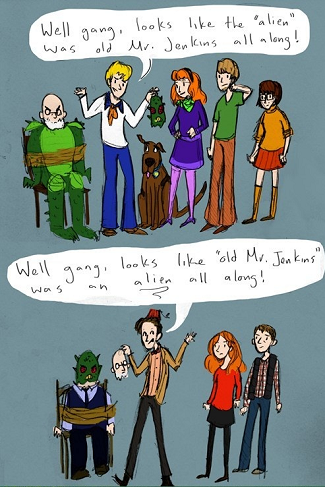
The characters investigate a site with reported paranormal or other activity. By the end of the episode, they discover that the supposed supernatural activity or monster activity is nothing but an elaborate hoax taking advantage of local lore to frighten off the curious from discovering and interfering with their main criminal activity. Or just to mess with people. Locals are typically too scared to take a closer look, and if the police aren't fooled themselves, they've already written off the whole thing as a juvenile prank not worth their time. Thus, it's up to those intrepid meddling kids to uncover the truth.
In the old days, this apparently really worked. Smugglers and other criminals could scare away intruders by dressing as ghosts. Nowadays, however, this would be a really stupid ploy, as many alleged real life haunted houses and areas of "paranormal activity" are tourist attractions. The criminals wouldn't be able to move for New Agers, UFOlogists, people from shows like Ghost Hunters, James Randi fans, and other rubberneckers. Plus, those local cops would probably be far more attentive about "strange goings-on at the old lumbermill" (though they're probably thinking 'meth lab' over 'costumed jewel thieves'). On the other hand, the inversion — pretending that a place is haunted to attract public attention & make money on "haunted" fame — tends to work really well (not to mention it's significantly less illegal).
This trope crops up a lot in works aimed at children, especially ones from the mid-20th Century. It allows the creator to play with some mild horror tropes in children's entertainment without irritating the Moral Guardians or introducing the supernatural to a real-life setting. Sometimes the Hoax revolves around the application of one scientific fact or theatrical technique, for a valuable educational lesson.
The most common subversion is for all — or some — of it to prove Real After All or at least of uncertain origin. Indeed, the investigators may discover the truth and haul the instigators off to jail, and the audience alone gets to see the unambiguous and real apparition. Or they may get to see the real thing along with the characters. Then again, it may be double-subverted with a Shock-and-Switch Ending.
This can be a real source of frustration to fans of Speculative Fiction, who tend to be drawn to certain works specifically because of the paranormal elements.
A subtrope of Sham Supernatural; if the storyline also imitates Scooby-Doo in other aspects, see Spoofy-Doo. One of the major exceptions to Skepticism Failure. See also Monster Protection Racket, where the monsters are real but they're being set up, and Monster Façade, where the monster is real, but it fakes the malevolence. The Inversion of a "Scooby-Doo" Hoax is Mistaken for an Imposter. For the good counterpart, see its sister trope Scarecrow Solution.
Related to Fake Mystery, when a crime plot turns out to be staged for a prank or other purposes.
Because the existence of a "Scooby-Doo" Hoax tends to remain secret from the audience until the ending and belie earlier assumptions, mere presence on this list can be considered a spoiler.
Examples:
- This
 October commercial for Butterfinger chocolate bars has a swiftly-debunked example.
- In the Scooby-Doo-themed episode of Attack on Titan: Junior High, the 1st years participated in the 57th Test of Courage to search for the "Wonders of Titan Junior High", only to realize that the ghosts that haunt the school are actually the 2nd and 3rd years pulling the strings.
- Black Butler has a huge one in that the entire life of Sieglinde is constructed. She is first introduced as the leader of an obscure village in the heart of the German forest, where time seems to have stopped. Strange werewolves plague the area, and their breath causes illness and eventually, death. Sieglinde is put in the role of the 'Green Witch' to perform spells and heal them. In reality, every werewolf and villagers are military, or former military, and the 'Green Witch' is a constructed identity specifically for Sieglinde to continue the Sarin gas project.
- Case Closed:
- The protagonists receive a letter from a dead man and investigate a series of murders framed on his ghost. In the end, it turned out to be his son who was supposedly killed along with him, posing as a woman, seeking revenge for the death of his father.
- There are multiple 'supernatural monster' episodes, too. Since the series is set in its version of a strictly rational world, any invocation of the supernatural can be assumed to be a Scooby Doo Hoax. (That doesn't stop normally-stalwart Action Girl Ran from cowering whenever she suspects she may be up against ghosts, however.)
- Detective School Q does this repeatedly, most notably in Kamikakushi Village. The arc with the seances takes a rather unusual angle on the trope.
- The Doraemon OVA, What Am I for Momotaro, have the gang traveling back in time to investigate the Momotarō myth after finding evidence that Momotaro allegedly exists. It was there they discover the Oni from the legend is actually a huge Dutch sailor stranded in Japan, who's feared by the superstitious locals due to language issues and his foreign appearance, causing the sailor to disguise himself as a terrifying monster (using a self-made mask and dyeing his skin red) in order to scare the locals away, lest if they end up killing him in self-defense.
- In one episode of Full Metal Panic? Fumoffu, the gang investigates an allegedly haunted Abandoned Hospital, gradually dismantling its various scares and discovering that they were perpetrated by a group of local kids, who thus tried to protect a meek homeless man who made an abandoned ward his home. But when they meet him, he reveals them that there is one real ghost there, that of an old lady who died in a fire years ago (whom Kaname has actually glimpsed before), sending the whole group, including the kids, running for their lives. And then it is revealed, that the "ghost" is actually the guy's elderly mother, whose presence he hid even from the kids who were helping him.
- Early on in Gosick, it's established that the school has an abandoned storehouse, which Avril claims is haunted by the ghost of a former student. It later turns out "Avril" is actually a Phantom Thief named Kuiaran the Second, who has been posing as a student as part of a heist. The "ghost" that was making strange thumping and moaning noises? That was the real Avril, who had been left Bound and Gagged inside the storehouse after Kuiaran stole her identity.
- The Kindaichi Case Files: Most of Kindachi's cases involve murderers who disguise themselves as a feared monster from local folklore, and kill their victims in ways relating to the legends surrounding that figure (e.g. a killer disguised as a legendary headless samurai ghost decapitates all his victims, a killer who makes vampire teeth marks on their victims' neck and draining their blood to make it seem like they were attacked by a vampire). Kindaichi gathers clues leading up to a dramatic unmasking of the "monster" at the end of the story. Different from your standard Scooby hoax in that most characters understand from the get-go that this isn't a real monster, just a psycho in a disguise.
- Kirby: Right Back at Ya!:
- When this trope is played out, the real surprise was that in the end, in addition to the kids playing pranks, there was an actual ghost. It was a mostly harmless one, though.
- Another episode features a different variation. An irreverent chef comes to judge Chef Kawasaki's cooking skills, but it turns out he was in a costume and working for N.M.E. What's under the costume was worse.
- Mazinger Z:
- In one anime episode, the heroes got reports of a huge, aquatic monster living on a chain of lakes near from Mount Fuji. When Kouji went to investigate to the site, a witch appeared all of sudden and warned him the lake monster would curse him if he did not leave. That woman had been scaring away whoever came to investigate the monster sightings. It did not take long for Kouji to discover that witch was Baron Ashura, Dr. Hell’s second-in-command, in disguise and the monster was a Mechanical Beast. Baron Ashura was using the curse hoax to hide their activities (mining the lakebed for uranium to fabricate nuclear bombs).
- In one manga chapter, Kouji and his friends go to a hot springs resort. However, the area is apparently being haunted by ghosts. Boss is terrified but Kouji does not believe one word of it, so he and Sayaka set to investigate what is happening. Quickly they discover the ghosts in reality are androids commanded by Count Brocken, one of the Co-Dragons of Dr. Hell.
- Mazinger Angels reimagines the chapter described above. This time, Count Broken used the hoax to drive the other hot spring resorts out of business in order to make tourists flock to his Third Reich Hotel where they would be subsequently enslaved and forced to mine for gold in the caves located under the building.
- Mobile Police Patlabor: The Early Days: After yet another PR incident caused by Ohta being trigger-happy, Commander Gotoh sends SV2 to a training camp where they hear a Ghost Story about a civilian being killed in a negligent discharge of a Patlabor's cannon; the shooter then walked the Labor into the lake and drowned himself. There are then several haunting incidents around the camp, including sightings of both the ghost of the dead civilian and an apparently pilotless Labor covered in mud and weeds. Kanuka exposes the hoax: the "dead" civilian is actually Gotoh's very-much-alive niece and the whole thing was orchestrated by Gotoh in an attempt to Scare 'Em Straight.
- During the Thriller Bark arc of One Piece, the supernatural things like cerberii, ghosts and zombies are later revealed to be the work of Gekko Moria and his crew, all of them Devil Fruit users. A single panel at the end hints that there might have been something spooky haunting the place before Moria showed up, but it's left ambiguous.
- Rather confusingly subverted in the Pokémon: The Original Series episode, "The Ghost of Maiden's Peak", The heroes and Team Rocket encounter a festival at which the ghost of a heartbroken maiden is believed to possess young men. After James and Brock are affected, they discover that the true culprit is a Gastly (a Ghost Pokémon, which apparently doesn't count). However, towards the end of the episode it is revealed to the viewers that there is indeed a true ghost of the maiden, and the Gastly is keeping the legend alive out of respect for her (and to make a few bucks).
- Asterix: Inverted Trope in Asterix and the Griffin, where it's the good guys doing it: Ever since the Greek's discovery of their lands, the Sarmatians invented the legend of the griffin to scare off greedy invaders to prevent them coming to take their gold. However, they didn't count on people actually coming for the "griffin" itself, or being numerous enough to have the necessary forces to invade.
- The Antarctic Press comic Bad Kids Go to Hell reveals all the supposed supernatural scares were nothing more than illusions to off the detention kids and make money from their deaths.
- An interesting example happens in a Barbie comic from '91 — the little old lady who owned a large crumbling mansion pretended it was haunted, not to scare anyone away, but to attract tourists!
- Batman:
- Despite stereotypes to the contrary, a large number of the aliens that Batman fought during the Silver Age (especially in his own books) were actually ordinary crooks dressed up like aliens. In one case, a gang of crooks actually made up a planet, built fake alien technology, and pretended to be invading Earth simply to cover up their scheme. Though he really did fight and kill some real vampires in the Golden Age.
- The Scarecrow is a variation. He doesn't pretend to be supernatural, but dresses as a demonic scarecrow and uses hallucinogenic gases to create illusionary horrors.
- In the Batman: Urban Legends story "Hooked", Alfred finds himself caught between an Ancient Conspiracy of whalers searching for the Temple of Dagon to loot it, and what appear to be actual Fish People straight out of The Shadow Over Innsmouth. In the final confrontation, they turn out to be human Dagon cultists in masks, although they would probably object to the idea this was a Scooby-Doo Hoax, rather than a significant aspect of their religion.
- Black Dynamite: A rather elaborate version in Issue #3. The Tibetan monks believe the monsters attacking their monastery are ancient demons foretold to kill them all as part of the cycle of death and rebirth, but they're actually Genetic Abominations created by the Illuminati to convince the monks that the legend is true and to keep them from fighting back.
- The Golden Age Captain America, strangely enough, was written (at least in most stories available in reprints) as a non-supernatural horror comic. It was thus full of this sort of hoax (sometimes with fake supernatural creatures that are real murderers) as well as monsters created by science, ordinary killers with horror themes, etc.
- Donald Duck:
- In the comic "The Old Castle's Secret", the ghost of Sir Quackly McDuck turns out to be a jewel thief using "invisibility spray". Carl Barks commented that he wanted to do a "Haunted Castle" story but at that time including "real" supernatural events such as ghosts in a Disney comic was strictly taboo.
- Another Carl Barks example comes from the story "Terror of the River", where Donald and his nephews investigate a giant serpent-monster terrorizing a waterway. The "monster" turns out a realistic inflatable model controlled by a guy in a submarine. As opposed to some of the other examples on this page, the perp has no ulterior motive — he is just a Jerkass who likes scaring people for the heck of it.
- A third Barks-example playig into the trope is the Uncle Scrooge-story Hound Of The Whislervilles. In it Scrooge and his nephews travel to Scotland to find the family tartan and have to face the titular monster - which turns out to be a hoax by an artist who does it in tradition to his family who used the monster to scare their rivals, the McDucks away. The same fake-monster is later used by Don Rosa in his Scrooge-biography The Life and Times of Scrooge McDuck.
- Less notable Donald Duck and Mickey Mouse stories have done this over and over again in various forms. An inverted version where the heroes scare away the villains from something being protected is about as common. The twist where some of it is shown to be real after all appears frequently in both versions. One story-within-a-story, written by Goofy, was a parody; in the end, the answer to how the villain was able to create the appearance of all those supernatural monsters is explained by saying that, well, he was a magician, and magicians do all kinds of tricks we can't explain, so why should the story do that?
- The original purpose of the comic-book character Dr. Thirteen in DC Comics was to debunk supernatural sightings. When he was integrated with the rest of the characters in a shared universe, this naturally led to some problems as the supernatural does exist in The DCU. This was largely "solved" by making Dr. Thirteen a Flat-Earth Atheist Butt-Monkey, but it's not all bad news for him. Apparently, his skepticism means he's somewhat resistant to magical effects (in the DCU, you have to genuinely believe in the supernatural before it will work for you) and he can and does provide alternate scientific theories that sometimes turn out to be right. Anyway, writers love to put poor Terry in situations where he ends up delivering a full-on rant about the supernatural not existing to, say, The Spectre or The Phantom Stranger.
- In The Further Adventures of Indiana Jones #31, a group of collaborators on the Washington coast stage a series of Bigfoot sightings (and deaths) to keep locals away from the cliffs where a Japanese submarine is landing.
- Hellboy: In one Lobster Johnson story, a mobster dresses up a bunch of murderous goons in Native American costumes and phosphorous paint to scare people out a neighborhood so he can buy up the property cheap and build a highway. After Lobster Johnson kills the goons the mobster's assistant gets a real ghost to burn everything down.
- One Hoppy the Marvel Bunny story (reprinted in 75 Years of Shazam!) has Hoppy, Millie and Woody Woodchuck scared by a Bedsheet Ghost, and Hoppy returns as Captain Marvel Bunny and discovers it's two beavers pulling a prank. He decides this is basically harmless, but later learns a gang of criminals have copied the idea to scare people away from their hideout.
- In Kid Colt, Outlaw #39, Colt encounters three outlaws taking advantage of the reputation Midnight Mountain has for being haunted by pretending to be the Ghost of Midnight Mountain to scare people away from their hideout.
- In Lady Mechanika: La Dama de la Muerta, a gang of outlaws disguise themselves as demons to demand tithes from a group of isolated villages in rural Mexico.
- In Rivers of London: Night Witch, the supposed kidnapping of a Mafiya boss's daughter by a leshy is naturally assumed to be a "falcon" case, i.e. one requiring the attention of the wizard cops at the Folly. However, it turns out she was just taken by her mother to get away from him, and she (unaware that London had wizard cops) made up the bit about the leshy to confuse everything. As Peter puts it "Question: When is a falcon case not a falcon case? Answer: When there's no bloody falcon."
- Scooby-Doo! Team-Up:
- In one of the Batman issues, the multiple Man-Bats running around turn out to be normal criminals who were disguising themselves to take advantage of the fear caused by the real Man-Bat, who was also at large.
- In The Flintstones issue, a billionaire named Flint Pumice pretends to be the Phantom of the Operock to force the opera house's owners to sell it because he needs the land for a new mall. He's implied to be the first crooked real estate developer ever since Wilma comments she never heard of anything like this before.
- A developer in the Top Cat issue says dressing up as a ghost is the first thing they teach at realtor school. Ironically, neither of the two developers in that story pull the trick. The first two ghosts are Top Cat's gang trying to keep Officer Dibble to catch Top Cat gambling and the other ghost is Officer Dibble using a Scarecrow Solution to prevent the developers from destroying a suburb.
- What Inspector Bradstreet believes the whole business to be in Sherlock Holmes and the Horror of Frankenstein. Holmes is insulted that Bradstreet thinks he could be taken in by people in theatrical costumes.
- Superman:
- Variation: In Camelot Falls, Superman and the Iranian superhero Sirocco once took down an apparent terrorist squad, only for Sirocco to reveal that they are just people who pretend to be terrorists. By scaring people into evacuating places with phony bomb-threats and such, they can rob places at their leisure. The criminals do carry real guns and do not hesitate to shoot people who don't get the memo, necessitating the heroes' intervention.
Sirocco: They are common thieves. Seeking to profit from people's fears.
- Zigzgged in Adventure Comics #395 and 396: Supergirl spends the night at a haunted house to find out why everyone who stays overnight is driven insane. It turns out that the supposedly missing mansion's owner, an eccentric inventor, had built a TV set that could “tune in” to the Phantom Zone, allowing the inmates to use their telepathic ability to cause terrifying hallucinations. In the next issue, the inventor himself claims to have supernatural powers and to have jinxed Supergirl; the jinx was only trickery, but the inventor also claims to possess true power gained from studying under Cagliostro, Merlin, the Comte de St-Germain and others, and performs feats of metamorphosis difficult to explain with trickery alone.
- In Starfire's Revenge, Supergirl investigates an allegedly haunted theater and comes upon some kind of ghoulish creature while checking the place out. Said "ghoul" is actually the theater's owner dressing up like a monster as part of a Supergirl's enemy's scheme to lure the Girl of Steel into a trap.
- Variation: In Camelot Falls, Superman and the Iranian superhero Sirocco once took down an apparent terrorist squad, only for Sirocco to reveal that they are just people who pretend to be terrorists. By scaring people into evacuating places with phony bomb-threats and such, they can rob places at their leisure. The criminals do carry real guns and do not hesitate to shoot people who don't get the memo, necessitating the heroes' intervention.
- Happens rather often in Tex Willer-explaining why Tex is always skeptic whenever he stumbles on a real supernatural phenomenon.
- Spider-Man villain Mysterio, being a former special effects genius and Master of Illusion, often uses this as his M.O. Some of his tricks include haunting Spider-Man with the "ghost" of a man he failed to save, faking his death to appear a ghost, and generally conjuring various giant monsters. The Spectacular Spiderman even has him claiming to be a sorcerer from another dimension, and Spidey actually believes him for a bit before catching onto his tricks.
- In Tomahawk #106, the Royalist forces take advantage of Tomahawk's supposed death to create a 'ghost' Tomahawk which they use to attempt to lure the Rangers into an ambush. Another issue had a community of Quakers or Amish in Pennsylvania who used a giant man-powered stone robot to scare both sides of the Revolutionary War away.
- In Usagi Yojimbo, the hero comes to a tavern that borders a haunted woods. Once there, Usagi is forced to take a dare to explore the woods for an item there. In the woods, Usagi has a terrifying experience facing many of the monsters he has faced before and slashes out wildly before discovering that they are all elaborate puppets and he catches the puppeteers in this hoax. However, when he learns that the hoax, which is basically harmless, is helping their poor village prosper, he agrees to play along while allowed to get the quest object to win his wager.
- Poked fun at in Emilka Sza. When Justyna attempts to prove to Emilka that ghosts are real and finally encounters what appears to be a "real" ghost, a group strongly resembling the Scooby-Doo gang suddenly emerges from nowhere and unmasks the ghost. Justyna even yells "Meddling kids!" at them.
- Shortly after 9/11, Dick Tracy encountered a villain who was masquerading as a terrorist just to force people to evacuate an area so he and his buddies could come in and rob the deserted places blind. He even wore a latex mask when he made his video threats.
- Done by the bad guys in the Modesty Blaise storyline "The Vampire of Malvescu".
- Another story involves a millionaire who believe he's contacted a "woman from the future" who wants some gold (which she claims is used for fuel in her time) to help humanity. It turns out the millionaire's supposedly loyal aide has been hypnotizing him into seeing the "time machine" taking the woman "back" to the future and then returning and making him open to giving up the gold. After she busts them, Modesty sarcastically congratulates the con artists for coming up with a scheme so crazy that it would have made alien abduction the more believable explanation.
- Sometimes this would show up in The Phantom — the eponymous hero would stumble upon a mystery, get the native's crude and inaccurate view of the situation (e.g. a mighty bird dropping food), and eventually figure out it was just criminals using modern technology (the bird turns out to be a plane dropping supplies). Usually he'd follow this up with a Scarecrow Solution, convincing the criminals he's a ghost.
- In "The Search for Pappy" arc of Thimble Theater, Popeye buys a ship that he's told is haunted. Sure enough, there's a ghost lurking about, with a detachable head to boot. It later transpires that the 'head' is actually a very short man who hides the rest of his body behind his long beard, pulling a combination Bedsheet Ghost Totem Pole Trench with normal sized partner- Popeye's father! Also, they have a full-grown gorilla hiding under the sheet with them, which leads Popeye to assume that there's "Gorilla-riding ghosts".
- Prince Valiant: In one early story arc Val encounters a castle that has been taken over by bandits with their leader disguised as an ogre. He disguises himself as a demon to scare them out.
- In the third Halloween Episode of A Game of Cat and Cat, Nanashi terrorizes Mikado Castle by letting himself be executed, coming back to life, and then attacking key targets under cover of night. His goal is to scare Mikado out of attacking Tokyo; he convinces them that the dead of Tokyo rise from their graves to take vengeance on those who wrong them.
- The New Adventures of Invader Zim: In Season 2 Episode 5, Dib and his friends investigate an allegedly haunted house, which is actually an animatronic fake made by Dib's Unknown Rival Arnold Quis, who plans to make it seem that Dib set the whole thing up, in order to get him kicked out of the Swollen Eyeball Network for fraud. Thanks to inadvertent help from Zim, Dib and the others discover the fakery, and Quis is the one kicked out of the SEN when his involvement is uncovered.
- Pokémon Reset Bloodlines: The third segment of the "Halloween Tales" sidestory is about a group of nobles who decide to set up one of these, namely selling houses to poor people and then scaring them away. They hire a raggedy man to set it up for them and he does, but then they refuse to pay him for his services. In true "Pay the Piper" fashion, he turns the tables on them by giving them the scare of their lives and taking their mansion for himself.
- The Hogan's Heroes fanfic The POW who cried Werwolf has Hogan using psychological warfare to convince Klink and the guards that The gestapo have created an army of werewolves lurking outside of the camp causing all of the guards to spend the rest of the night hiding under their beds while a group of Allied paratroopers land near the camp.
- In NUMB3RS story Twas a Dark and Stormy Night, The Duckett Sisters, art thieves that Don and his team are after, in addition to one of them, Marybel, faking being paralyzed due to an accident, also disguise themselves as a bigfoot-like creature to scare off anyone curious about the place, where they are hiding stolen art.
- In Arrow a sequel story to The Victors Project, features a short-term version of this (over with in perhaps ten minutes). Just as the peacekeepers of District 7 are about to wipe out the cornered core of the District Rebellion, the District children charge out of the mist on stallions, made up to look like the ghosts of the dead victors and tributes of the past decades, and thoroughly demoralizing the peacekeepers they then start cutting down.
- In the MLP Fan Fic We Rent The Night, a cult worshiping The God of Destruction on a small island, turns out to be an elaborate Scam Religion. The real purpose is to brainwash innocent ponies into aiding a local smuggling operation.
- In Turning a New Leaf, Izuku's pranks have culminated in the student body believing that Aldera is haunted.
- Played with in My Little Pony: Equestria Girls – Legend of Everfree. Timber Spruce's legend about Gaea Everfree looks like the typical setup for an hoax, and he is indeed discovered trying to further it by leaving trails of jewel dust whenever something weird happens at camp. However, he's doing it not to hide mundane shenanigans under a pretense of supernatural mystery, but to hide a different supernatural phenomenon. And unlike what Sunset came to believe, it wasn't aimed at scaring off the campers, but to protect Gloriosa Daisy from suspicion after her attempts at making this summer unforgettable for the campers.
- In Ask a Policeman, the smugglers use the local legend of the Headless Horseman and the Phantom Hearse to allow them to transport their smuggled goods from the beach to the garage while scaring away the locals.
- Bates Motel (1987) has Tom Fuller, a Morally Bankrupt Banker, try to scare Alex West, the new owner of the Bates Motel, away by dressing up as the mother of the now-deceased Norman Bates, therefore allowing Fuller to foreclose on the motel and sell the land to a developer. Why Fuller needed to pull this little scam considering that he'd have been able to foreclose on Alex anyway due to the latter's complete lack of business acumen is a mystery. And then, Alex's friend Willie also dresses up like Mrs. Bates in order to intimidate Fuller into confessing to his scheme on tape.
- At the end of The Beast with Five Fingers, it appears that Hilary has staged the supernatural events to cover up his crimes, but his slipping sanity has led to him believing his own lies. But there is enough doubt for the viewer to decide for themselves.
- Behind the Mask: The Rise of Leslie Vernon has a double example. It’s made clear very early on that aspiring slasher Leslie Vernon does not have supernatural powers but is just a Crazy-Prepared Serial Killer. However, it is later revealed that he’s not even Leslie Vernon, a local boy who murdered his family and was killed by the townsfolk. He’s actually a mental patient named Leslie Mancuso who is using the legend of Leslie Vernon to increase the terror of his killing spree. Apparently other supposedly supernatural slashers like Freddy Krueger and Jason Voorhees are also just normal men who have assumed the identities of local boogeymen.
- Captain Clegg is about a circle of rum-runners, led by Peter Cushing, who use this to try to scare away or distract the law.
- In the original Clash of the Titans, Ammon the poet first appears dressed up in a creepy mask and robe. He claims to use this get-up to scare trespassers away from the amphitheater.
- In the 1961 horror-comedy Creature From The Haunted Sea, some American gangsters are hired to smuggle a Cuban general into exile, but plot to double-cross him and steal the Batista-regime gold he's carrying. They fake a sea monster attack on one of the general's entourage as an excuse to redirect their vessel, only to have a real sea monster start picking off Cubans and Americans, alike.
- The Crime Doctor's Courage: Jeff is deliberately creating the impression that the Braggas are 300 year old vampires as a publicity stunt. The killer tries to take advantage of this; planning on murdering Miguel by driving a Wooden Stake through his heart and making it look like Jeff had done so under the belief that Miguel really was a vampire.
- In Curse of the Headless Horseman, the Headless Horseman is revealed to be Mark, attempting to drive everyone off the land so no one discovers the gold deposit. But, at the very end of the film, the Horseman turns out to be Real After All.
- The 1993 Drew Barrymore movie Doppelganger 1993 is, for most of the film, presented as a supernatural suspense film in which a woman is stalked by her doppelganger. Then at the end it's revealed that the whole thing was her psychologist using a series of Latex Perfection masks and disguises to gaslight her and frame her for murder. Then, out of nowhere, the movie turns genuinely supernatural when the woman's split personality physically manifests as a monster and kills the bad guy.
- In Francis in the Haunted House, a gang of art forgers set up operations in a spooky old mansion on the edge of town, and use its reputation as being haunted to scare away anyone who might get too close.
- Friday the 13th Part V: A New Beginning is a semi example. The killer turns out not to really be Jason, but a copycat. Although it is one serial killer imitating another, he is pretending to have come back from the dead, even though the genuine Jason wasn't supernatural by this point and was in fact genuinely deceased (he would become the indestructible zombie we all know in the next film).
- In the 1941 horror-comedy The Ghost Train, fifth-columnist Nazi sympathizers revive a local legend about a Ghost Train to conceal their late-night railway gun-smuggling scheme.
- Gonjiam: Haunted Asylum: Ha-Joon, Sung-Hoon, and Seung-Wook brought the others in the group (Je-Yoon, Ji-Hyun, Charlotte, and Ah-Yeon) to their ghost hunt at Gonjiam Psychiatric Hospital so they could have people to react to their fake haunting of the asylum as part of their bid to bring one million viewers to their livestream. This is revealed after the group is spooked by all the bells on the cords in the Director's Office ringing after the ghost summoning ritual has been completed. Unfortunately for them, the ghosts are real, and not pleased to have mortals mucking about their home.
- HEX uses this trope in a mind-bogglingly complicated and borderline confusing way; the villain, a Domestic Abuser of a husband, fakes his own death and comes back pretending to be a demonic entity in order to scare his wife, who is suffering from chronic tuberculosis, until she's scared to death. Gleefully claiming the wife's inheritance for himself (so he's a Domestic Abuser and a Gold Digger, both at once), he's oblivious to the fact that the wife has a secret twin sister, who then pretends to be the wife's ghost to haunt him until he's Driven to Suicide.
- In the 1963 mystery House Of The Damned, an old mansion is the scene of some disturbing events that might be a haunting, or might indicate that a killer is on the loose. It turns out that some sideshow freaks have been living in the mansion in secret, at first as off-the-books guests of the original owner of both house and sideshow, and later, as squatters after their employer's death (of natural causes) left them without legal claim to remain there. When they admit they'd meant only to scare people away, the visitors who discovered them allow the performers to move out in peace and find another carnival to work for.
- House on Haunted Hill (1959): To be fair, the house very well could still be haunted, but the elaborate scary tricks (piano playing on its own, a ghost appearing out of nowhere, hands grabbing people), were a part of an elaborate hoax to kill the host, played by Vincent Price, by his wife and her lover. Price has other plans though, and his wife's encounter with a skeleton (supposed to be his) that forces her to fall into a vat of acid, was also a hoax. Price was controlling a life-sized skeleton puppet.
- James Bond:
- In Dr. No, Bond is told that the eponymous villain manages to keep his private island "private" by the presence of a dangerous fire-breathing dragon that kills any locals who trespass on his property. It turns out to be a tank painted to look like a dragon, and armed with a flamethrower. Partly justified in that the tank doesn't show up until it gets dark, so it's harder to figure out its true nature.
- In Live and Let Die, as in the novel, the villain uses Voodoo, as his mistress/servant Solitaire, who has "the power of the Obeah" (which supposedly lets her see the future), to maintain an iron grip over his island nation and drug empire. He even has someone pretending to be Baron Samedi on his side, plus a host of traps and tricks. Subverted in that Solitaire seems like she really does have the power to see the future, and the ending has Samedi (who was apparently killed by snakebite earlier) riding the front of a train, laughing, implying he was Real After All. Most of the other stuff really is just an elaborate hoax, like scarecrows promising death to anyone who trespasses on the poppy fields (and hidden cameras and guns in case you don't take the hint).
- The Bollywood film Joker 2012 has an isolated village fake the landing of aliens to attract attention to their Dying Town. At the end, a genuine alien appears.
- One infamous hoax is shown in Jules Verne's Mystery on Monster Island when at the end we discover that all the monsters are fake and are just a test from the main character's father to see if he is worthy of inheritance.
- A really brutal example in the old kung-fu film, The Lady Hermit. The villains, a group of renegade martial artists called the Black Devil Gang, would pose themselves as sellers of amulets which protect the inhabitants of a small village from vengeful, murderous ghosts of slain martial artists from years ago. The clan member who sells the charms will make a tally of the households who didn't buy their charms, and by nightfall, rogue martial artists posing as ghosts (with their faces painted white and red) will infiltrate those houses, and kill their occupants. The film in fact opens with a family being massacred for NOT buying these charms.
- Invoked in Magic in the Water. The villains who dump toxic waste into the lake build a submarine that looks just like Orky the lake monster and bribe Joe, who sells Orky merch, to drive the submarine up to his dock and "confess" to faking the sightings for money. If no one thinks Orky lives in the lake, they'll face less opposition for harming the environment.
- In Rimfire, the killer makes it appear as if the Vengeful Ghost of The Abilene Kid is responsible for the murder of those who sentenced him to death.
- During the climax of Satan's Cheerleaders, the Sheriff is revealed to not really be a High Priest of Satanism, but actually conning the people of Nether for reasons that are never made clear: using trickery and a tape recorder to fake demonic responses to their ceremonies. He gets his comeuppance when he discovers that Satanic magic is Real After All. Which shouldn't have come as a surprise to him given some of his followers have been performing actual magic throughout the movie.
- The twist ending of until this point average and predictable horror film Scream of the Wolf reveals that, after having set up itself as a werewolf film, there is no werewolf, and that the killings were perpetrated by a resourceful Serial Killer and an attack dog.
- Secrets In The Hot Spring: While staying at his family's hotel, Qie and his friends become convinced it's haunted, but Qie's grandparents don't believe him. That's because they're behind the hauntings. When Qie was a kid, he suggested they try having the hotel be a ghost house to bring in more tourists, which his grandparents have recently decided to try out. They decided to use his friends as guinea pigs for the hauntings.
- Sherlock Holmes (2009) uses this, with apparent Big Bad Lord Blackwood deliberately cultivating a reputation as a fearsome Evil Sorcerer, culminating in rising from his grave following a hanging, all as part of his Evil Plan to seize control of England. He's really "just" a Magnificent Bastard with good connections and an eye for the theatrical, and Holmes figures this out and explains it at the climax before exposing Blackwood for a fraud. Holmes does mention, though, that Blackwood performed all his spells and rituals perfectly and therefore he'd better hope it was all fake, or else Satan's due a soul...
- Famously subverted in Sleepy Hollow (1999). In the original story by Washington Irving, the Headless Horseman was an elaborate prank to scare an aloof schoolteacher. In the film, it really exists. In a nod to the original story though, the first run-in Ichabod has with the Horseman is a fraud — a jealous Brom Bones is disguised as the being as a prank. He also initially believes the Horseman really is a fraud, and sets out to "expose" him.
- Spider-Man: Far From Home ostensibly features a group of extradimensional monsters called the Elementals as the Big Bad, with Mysterio as a soldier from their world and their sworn enemy. In reality, they're elaborate illusions created by Mysterio, a former Stark employee trying to take his old boss's place as Earth's mightiest hero (and kill Nick Fury before he finds out the truth about him).
- Tickle Me: The apparent haunts spooking Lonnie, Pam and Stanley at the abandoned hotel where they stay the night are actually normal human men in masks trying to get the fortune that Pam's grandfather left her.
- Trick 'r Treat: As part of a Deadly Prank, a group of kids pretend to be undead children. Then the real undead kids come and kill them. There's also the vampire, who isn't really a vampire at all, but just a regular Serial Killer.
- Played with in Vidocq: powerful men die one after another from a lightning strike, bursting into flames in the process. It turns out that they were narcissistic perverts with a desire for young virgins. A sophisticated lightning rod mechanism along with a piece of gold in each of the men's hats, and gunpowder dust on their coats resolves that somebody simply wants to make a demonstration of divine retribution on these horrible people. Then it turns out that the killer is a supernatural creature, and used this method to hide his true nature and the true motivation for the murders.
- In The Village (2004), the creatures lurking in the forest were originally a hoax concocted by the Elders to prevent the younger residents from venturing outside and learning that they're not actually living in pioneer times. One of the young villagers co-opts this hoax to cover up his own psychopathic misdeeds.
- The movie Volver: The whole population of a superstitious village is convinced that the spirit of a woman who died in a fire has come back to take care of her sister in her old age. When the sister dies, the ghost moves in with her daughter. It turns out that she never died in the first place; she burned the house where her husband and his lover were sleeping to the ground, and the lover's charred body was thought to be hers. She pretended to be a ghost to escape a murder investigation.
- In Wild Horse Phantom, cantankerous old prospector Ed Garnet attempts to scare people away from his mine by pretending to be a ghost.
- Accidental Detectives:
- "The Phantom Outlaw of Wolf Creek" has someone appearing dressed up as Delilah Abercombie (a bank robber presumed dead for decades) believed to be searching for her treasure. It's actually Delilah herself, using a wig to look young again.
- The last quarter of "The Mystery Tribe of Camp Blackeagle" has someone fake Indian spirits haunting the camp site. The culprits are local Native American boys who feel that the campers don't respect the land.
- "Terror on Kamikazie Run" has a ghost supposedly appear in the woods as a way of signaling a coming disaster. It's a hologram being done in order to provide an explanation for the accidents and temporarily drive the resorts price down for estate tax purposes.
- The Agent Pendergast novels usually start with a murder that has some supernatural element surrounding it. Often, there is something distinctly unnatural going on, but the villain is almost always human. The two straightest examples are Brimstone and Cemetery Dance.
- Brimstone starts with a man found burnt to death in a way that makes it look like the devil himself did it. After some investigation, it turns out the man was involved in an occult ritual many years ago. When another participant of the ritual dies, one of the survivors figures that he can buy off the devil by "sacrificing" a precious violin. The ritual was originally a prank performed by the completely human killer. When he learned that one of the people he pranked had a rare violin, he killed the others in order to scare the last guy into giving the violin up.
- Cemetery Dance begins with a journalist killed by someone found dead ten days previously, with the body having vanished from the morgue. A bit of investigation finds that the journalist was researching a secretive Voodoo cult. When the journalist himself reappears and kills someone, everyone begins thinking that the Voodoo cult is making people into zombies. Eventually, an angry mob storms the cult's temple giving the real villain the distraction he needed to steal some very valuable documents from the cult's mausoleum. The mastermind, a movie director, used makeup and an actor accomplice to create convincing fake zombies that he framed the cult with. In a twist, the cult actually does have a zombie, but it's just a still-living lobotomized cultist.
- In Alan Mendelsohn, the Boy from Mars, the Wozzle is an Invisible Monster employed by the Nafsulian bandits Manny, Moe and Jack to terrorize the citizens of Waka-Waka. However, it's not so invisible when seen in the proper light, and is thus revealed to be nothing other than the three villains themselves.
- In Joanna Chmielewska's satirical novel "Aliens in Garwolin", set in Communist-era Poland, the alien-obsessed chief editor of local newspaper persuaded his staff to stage an "alien landing" in small town Garwolin, with the help of camouflaged helicopter and inflatable monster suits. Interestingly, his intentions are purely non-profitable: he did not wish to raise his newspaper sales or something, he just wanted to see how peoples would react on alien visit.
- Hilariously subverted, when — after the whole hoax was disclosed to public — real aliens came to land in the same Garwolin.
- All the Wrong Questions: One of the mysteries in File Under 13 Suspicious Incidents turns out to be a stagehand trying to convince a woman that her mansion is haunted using theater tricks so she'll move away.
- Ben Snow:
- n "The Phantom Stallion", the murderer attempts to make the murder look like an attack by a ghost horse.
- In "The Headless Horseman of Buffalo Creek", a local rancher has his foreman pose as a Headless Horseman to scare away travellers to conceal the secret goldmine he is operating on his ranch.
- The Berenstain Bears has used this trope quite a bit, both in books and in the two animated series...
- In The Ghost from the Forest (adapted into the 80s TV series as "Bust a Ghost"), Papa Bear, Scout Leader Jane, and Mama Bear set these up. Subverted in that none of them had malicious intent; it was just a prank by Papa Bear to scare the cubs during a camping trip, and by Scout Leader Jane and Mama Bear to get back at Papa Bear.
- In the 80s TV episode "The Great Grizzly Comet," Bear Country is abuzz with the news of the Great Grizzly Comet, which only passes by Earth's atmosphere once every hundred years, will be visible one night. Papa Bear believes it will be a Comet of Doom, and then Little Green Bear aliens land in a flying saucer to warn them that the Great Grizzly Comet will collide with Bear Country, and as this news spreads around town, Raffish Ralph offers to buy the area everyone will evacuate. Brother and Sister Bear are suspicious about this (especially since Actual Factual had stated a few times there is no danger from the comet), and so they investigate and find out that the "Little Green Bears" are actually Weasel McGreed and three other henchweasels disguised in full-body alien suits (albeit with their true hands visible) flying in an inflatable saucer, in a scheme Ralph had cooked up to take advantage of the comet hype. Luckily Bigpaw is able to help Brother and Sister in foiling Ralph and the weasels' plan.
- In The Galloping Ghost, the Bogg Brothers, a family of criminal brothers, pull one of these at Ms. Mamie's Horseriding Academy by sabotaging the place in a bid to get it shut down so Ms. Mamie can't make her mortgage payment. When Brother Bear, Sister Bear, and their friends form a group to raise money for Ms. Mamie, one of the Bogg Brothers dresses up as the ghost of Billy Beechtree in a last ditch effort to scare them away, but he and his brothers get caught. The ending reveals that they were hired by a real estate development company so they could take over the academy, tear it down, and build a shopping mall.
- In The Haunted Lighthouse (a chapter book that was also adapted into an episode of the 2003 series), the Bear family goes on vacation to an old defunct lighthouse that's rumored to be haunted, because Papa is very interested in old service buildings. Brother and Sister notice strange things going on, including seeing what looks like the ghost of the old lighthouse keeper Captain Salt, rumored to have disappeared after the lighthouse was taken out of service due to modern technology rendering it obsolete. Their investigation takes them to the hideout of Captain Salt himself, who had been pretending to be a ghost to scare everyone away from the old lighthouse, but once he realizes Brother and Sister Bear find all of his nautical stuff cool, he is more welcoming of the Bear family and tells them his great experiences of being a lighthouse keeper, and is then given the idea to turn the lighthouse into a nautical museum so everyone can see his stuff on display and hear his stories.
- In the Big Chapter Book In Maniac Mansion, a pack of thieves disguise themselves as the ghosts of Bad Bart Grizzly and his men (who, according to family legend, are supposed to be haunting Grizzly Mansion) in order to fool anyone who saw them in the act of carrying out their crimes.
- In the "Bear Scouts" book Ghost Versus Ghost, there's three of them. First, Ralph Ripoff makes a bet with the Scouts and plans to win it by cheating, dressing up as a ghost to scare them out of the supposedly haunted woods where they're camping. Second, Professor Actual Factual figures out what Ralph is up to and decides to scare him with a ghost costume of his own. And third, the villains of the book (the Bogg Brothers) dress as a ghost to try and scare them all away from their illegal logging operation.
- In The Berenstain Bear Scouts Scream Their Heads Off, the Bear Scouts have to go into Widow Bearkin's old house on Spook Hill on the night of the new moon. While there, they find it's been rigged up to simulate a haunting, including a sheet made to look like a ghost, a boom box with ghostly noises and a large number of rubber rats. It turns out the place is being used as a headquarters by a band of thieves, members of the Bogg Brothers Gang, who are using the house to stash stolen loot and set up the scares to keep the cubs away long enough for them to pick up their ill-gotten gains and move them to another location. Fortunately, the Big Bear City cops managed to get there and capture the thieves while the Scouts and their Scout Leader were away informing the Beartown police of what they'd found, and are still on the site when the cubs and Jane return with Chief Bruno.
- The novel A Betrayal in Blood is essentially one of these, as Sherlock Holmes investigates the death of Count Dracula. Starting with the premise that vampires aren’t real, Holmes determines that Van Helsing faked the entire situation to create the illusion that Dracula was a vampire to convince the other characters to help him kill the count, as Van Helsing had a long-standing vendetta against the Count because Dracula had an affair with Van Helsing’s wife that led to the birth of a son who was subsequently adopted to become Arthur Holmwood. Part of Van Helsing’s scheme included stealing Lucy Westenra’s body and hiring an actress resembling her to create the illusion that she had become the undead, subsequently returning her body to the mausoleum the next day and rigging her coffin to help him the create the illusion that Lucy ‘moved’ when she was staked.
- Carnacki the Ghost-Finder has at least one case like this, with smugglers faking a haunting so they can use an abandoned building.
- In the Chance And Choices Adventures book Torn Hearts, much ado is made of a "cursed swamp" that the heroes must pass through. It turns out the "evil spirits" that attack people here are a Bandit Clan who strike under cover of night and using poisons and stealth so their victims don't know what hit them. The goal of this is to keep the authorities off their trail, and victims off their guard. The heroes survive through their own good planning and divine intervention.
- Constance Verity has busted a few of these, including the Lake Lake Monster monster and a case of submarine-operating smugglers dressed as ghosts (as opposed to submarine-operating-smugglers' ghosts, which she has also faced).
- Diary of a Wimpy Kid: Downplayed. While there is no disguise involved, the Urban Legend of deranged murderer Silas Scratch was invented by Frank Heffley to frighten his fellow campers away from the maintenance shed so he wouldn't have to share its running water and electricity.
- The Dirk Pitt novel Night Probe! has a couple set up a fake ghost train to attract tourists. It's one of the few examples here without malicious intentions and the couple readily admit to it when Pitt figures it out. On top of that, this discovery leads Pitt to figure out what actually happened to the train.
- Terry Pratchett's Discworld:
- Maskerade, being a parody of The Phantom of the Opera, has one member of Ankh-Morpork's Opera House dressing as "The Ghost", terrorizing and even killing members of the cast in order to hide his embezzlement. At the same time, there is an actual "Ghost" roaming the opera house who gives nighttime lessons to promising singers and leaves rose stems scented with rose oil to reward exceptional performances. Who also is a member of the opera house. Note that the Opera Ghost almost never pretends to be actually a ghost. He's perfectly happy to be a guy in a mask... Although those scented rose stems actually do bloom into ghostly roses when in darkness. At the end, Agnes laments that she'll probably never know how the "Ghost" managed that. But Discworld runs on Clap Your Hands If You Believe, so it might have been enough that people thought the Ghost was supernatural.
- In A Hat Full of Sky, Jeannie tells the Feegles about how another clan of pictsies drove off a rival clan's raiding party by climbing inside a scarecrow and moving it around, fooling their enemies into thinking it was a human ("bigjob") by whom they didn't want to be seen.
- The Dragon Business: The second half of the second book has Dalbry and his friends pretend a castle is haunted to scare away the orcs who have just taken the residents prisoner.
- In The Dreamside Road, the Liberty Corps have some members studying Shaping, but the Sight-Stealers are entirely fictional. They adopt the Sight-Stealer story to scare the festival tourists and help their ally Tucker’s plan.
- The Encyclopedia Brown story "The Case of the Lady Ghost" features a criminal who eludes the police by posing as a legendary Idaville ghost named Jennifer MacIntosh, who supposedly wanders the town's beach in her wedding dress, looking for her true love who was lost at sea. Encyclopedia is (naturally) skeptical of the people who claim that the beach is haunted—until he actually sees someone walking along the beach in a wedding dress, and notices that the mysterious figure never leaves footprints. It turns out that the perp actually hid a wooden board in the hem of his dress to sweep away his footprints; Encyclopedia sees through the illusion after noticing that the ghost's veil moves in the wind, but its dress doesn't.
- The 1975 "Disney's Wonderful World of Reading" book The Haunted House plays this straight; in a very Scooby-Doo-esque plot, Mickey Mouse, Donald Duck and Pluto run out of gas near what appears to be a Haunted House and go inside to find someone to help them, complete with Portrait Painting Peephole, Bookcase Passage, Bedsheet Ghosts, Bat Scare, and a living skeleton. Of course, it's all set up by three bank robbers hiding out in the house with their loot, using tricks, disguises and special effects to scare people away, and then when Mickey and Donald figure it out and unmask the "skeleton" and "ghosts" to reveal the bank robbers, they get tied up, but Pluto escapes with a bag of money and is able to summon a sheriff to arrest the bank robbers and free Mickey and Donald.
- In The Face of the Abbot, Helen Sherwood is left a fortune On One Condition: that she live in the haunted castle where her father died. She, her uncle, and the first-person narrator take up residence in the building, and are smart enough to make sure that the old caretaker isn't responsible by sending him to stay with friends. The night after they move in, the spectre begins to appear at the windows. This doesn't last long, because on its second appearance Helen determines that it's a person rather than a ghost by shooting it.
- Alan Dean Foster had a series of Weird West stories about Mad Amos Malone, a Mountain Man who investigated supernatural strangeness. In one such story, a young couple was being driven off their land by headless Native American ghosts that turned out to be a greedy cattle baron and his cronies who wanted the land. Though it turns out that there really were some Native American ghosts on the land. And they were very angry at the white men who'd been impersonating them...
- Garfield and the Teacher Creature is about Garfield, Odie, and a kid and his hamster being stalked through an abandoned school building by the titular monster. In reality, the teacher creature is actually the owner of an also-shut-down costume shop.
- Garrett, P.I.:
- In Bitter Gold Hearts, Garrett recalls investigating one of these cases, in which a murder was rigged to look like a werewolf attack.
- In a non-criminal variant, before Garrett moved in, the Dead Man used his powers to make people think the house on Macunado street was haunted, purely so everyone in the neighborhood would leave him alone. Of course considering a sentient corpse was using his psychic powers to chase people away, by a certain definition the house WAS haunted.
- Ghost In the Noonday Sun: The pirates kidnap Oliver because they superstitiously believe he can see ghosts. However, the only ghost sightings in the book turn out to be faked by the ship's mates, John Ringrose and Jack o' Lantern, as part of their efforts to depose Captain Scratch and keep Oliver safe.
- The Great Brain:
- More Adventures of the Great Brain has the town hearing of a ghost haunting some mines where a kid got lost and died a year earlier. Tom is determined to find the truth, either to prove it's a fake or be the first person to catch a ghost. It turns out to be a local miner who was worried more kids could get lost in the caves and so used some fancy paint to create the "ghost." In a twist, the boys' sheriff uncle agrees with the guy and instructs Tom and brother JD to spread the most terrifying story they can of barely escaping this specter to ensure no other kid comes near the place. It's hinted their newspaper publisher father also agrees with the "ghost story" and while not happy about keeping the truth quiet, Tom and JD do get a kick being part of a local legend.
- The same book has Tom scaring a bragging classmate by creating fake footprints of a giant monster near the area. To Tom and JD's shock, their own father and uncle fall for it to the point they're ready to call in the Army to deal with this "monster." When Tom confesses that "I never thought smart adults would believe this like kids", his own mother laughs at the men "he's got you there." They come up with the solution of dynamiting a local cave and letting everyone think the "creature" was sealed inside.
- A later book has Tom hired to make sure Herbie Sties sticks to his diet. He has JD wear a demonic mask to scare Herbie off sweets. It works...to the point Herbie refuses to eat for days. Incredibly, after confessing, Tom still thinks he's owed money for the weight Herbie lost.
- Harry Potter and the Prisoner of Azkaban:
- Draco and his cronies disguise themselves as Dementors in an ill-advised attempt to make Harry fall off his broom. They themselves fall over and get tangled in their robes when Harry casts a Patronus at them. Professor Lupin is amused with Draco's struggle, while McGonagall is furious with him and the other Slytherins for their attempt to sabotage Harry.
- The Shrieking Shack is revealed to be not haunted, as legend would have it, but was used as a safe place to hide Remus Lupin in werewolf form, when he was a student at Hogwarts. His wolf-like howls were believed to be the shrieks of ghosts, and the Whomping Willow was planted over the entrance to the passage leading to the Shack, to deter anybody from entering.
- The Hound of the Baskervilles, a 1901 Sherlock Holmes novel by Sir Arthur Conan Doyle, includes a similar plot twist. The titular hound is a legend about a demon hound haunting the moors. The villain (incidentally, the Russian Trope Namer) uses a real dog (painted with phosphorus to glow in the dark) to scare a person to death.
- In the 1838 penny dreadful Hugues, the Wer-Wolf, a poor villager whose parents had starved to death, unjustly ostracized by their uncharitable neighbors, dresses up as a werewolf to intimidate those same neighbors into paying off the "monster" with food. lest it eat them instead.
- In the James Bond novel Live and Let Die, Mr. Big cultivates an air of voodoo around himself to deter investigation into his operations. Take a look at the entry in Films.
- Washington Irving's 1819 short story The Legend of Sleepy Hollow strongly implies that Brom Bones eliminates Ichabod Crane as a rival for his lover's hand by dressing up as the Headless Horseman and scaring him out of town.
- The Mad Scientists' Club: The first story has the gang making up a fake sea monster as a lark (and taking advantage of the tourists it attracts and also using this to back up Pinky's excuse to his parents that he was late for dinner because he saw a sea monster) while another has them fake some flying saucers and in a third they fake a house haunting (largely just to prank Harmon). In still a fourth using dummy and a radio transmitter they have a flying man hoax. For the most part, their plans start out just as them trying to see if they could make the required gadgets. During the haunted house incident Chief Putney and Billy Dar try a hoax of there own by planning to scare Mayor Scragg out of the house to win a bet they made for a steak dinner.
- Actually used successfully by the heroes to see off the villain in Matilda. Matilda uses her telekinesis to convince Trunchbull that the vengeful ghost of her brother is haunting the Big Fancy House she usurped from his daughter, and he tells her to run away and never come back. Miss Honey has the place to herself at last.
- A Memoir by Lady Trent: In the first book, the spectre Zhagrit Mat terrorizing the protagonists turns out to be some of the locals pouring acid on the ground and making spooky noises at night to try and scare them off.
- In Mistborn: Secret History, the main character Kelsier needs to steal an object from a group called the Ire. So he pretends to be the god Ruin, whispering ominously in the night and mocking them, causing a string of accidents and slowly eroding their trust. They never do discover what he really is: a ghost.
- Much Ado About Grubstake: Arley and her friends eventually try to scare the villainous Lockwood out of town with legends about Native American spirits. Surprisingly, it fails miserably, as Lockwood isn't scared at all and points out how suspicious it is that Native American spirits are leaving behind letters in poorly-spelled English. Arley's attempts to pose as a spirit in the dark also don't phase him, and she has to threaten to blow up the mine so no one can have it to make him leave.
- In Larry Niven's "Night on Mispec Moor", a mercenary assumes the zombie-like creatures chasing him must be this trope. They're The Virus instead.
- In The Pale Horse by Agatha Christie, three self-proclaimed witches perform arcane rituals that appear to cause their targets to sicken and die. They are part of a murder for hire ring, but their victims die from thallium poisoning.
- In the Penny Parker book Hoofbeats on the Turnpike, Joe Quigley dresses up as the Headless Horseman of Sleepy Hollow to spite Matilda Burmaster.
- The Phantom of the Opera. The entire book is about the investigation of the "ghost" who forces the opera house management to bow to his whims; eventually, it is discovered that he is in fact a deformed genius hiding out in an elaborate lair beneath the building.
- Frequently in the Point Horror series. As a general observation, many of the stories where murders/injuries are believed to be the work of a ghost or other paranormal entity turn out to be caused by jealous/crazy living people.
- In the Redwall novel, "Marlfox", Lantur uses a hatch, ventriloquism, and a marked-up bedsheet to create an illusionary "White Ghost" that only her mother, Queen Silth, sees. This serves the dual purpose of making the already aging and irrational Silth appear totally senile so the "rational" Lantur looks like an attractive successor, and making the Queen so paranoid that she falls for another gambit when it's time for that to happen.
- Rick Brant: The Blue Ghost Mystery features an apparent ghost from The American Civil War as part of a real estate scam.
- In The Saint short story "The Convenient Monster", a murderer tries to make his killing look like the work of the Loch Ness Monster.
- In WW Jacobs' Sam's Ghost, the Twist Ending reveals Sam Bullet was attempting to pull one of these off to get his watch back from the Watchmen who was holding it until he paid him back. Sam had faked his own death and was planning to skip town but wanted his property back first.
- An example of a series that used this as a standard device even before the trope namer was born: The Simon Ark mysteries involve a wanna-be Occult Detective who claims to be the Wandering Jew, and whose goal is to fight Satan—but the evil he uncovers invariably turns out to have a mundane explanation.
- Solar Pons: In "The Adventure of Buffington Old Grange", the villains fake a haunting in an attempt to drive a family out of their home.
- An inversion in the Temps short story "Leaks" by David Langford, in which the main character is a low-level paranorm investigating an "entropy ray" aimed at government vehicles. Firstly he realises this is a hoax, it's just someone swapping out engine parts for profit. Secondly, he realizes that the reason for the hoax (when otherwise no-one would have noticed) is because someone wanted the DPR to send a low-level paranorm to investigate, for sinister reasons of their own.
- The Thinking Machine: In "The Flaming Phantom", a criminal masquerades as a ghost to give himself time to search a house that is due to be renovated for hidden jewels.
- This appears regularly in The Three Investigators, who generally deal with spooky cases. The Coughing Dragon has a sea-living dragon that is actually an antique submarine, used to rob a bank; The Dancing Devil has an ancient Mongolian spirit which literally is a guy in a suit trying to stop an old artifact being returned to Mongolia from a rich American collector.
- In Village of the Vampire Cat, a gang covers up their activities by making the village they are robbing think there is a demon on the loose. This includes a ninja using a grappling hook (painted black to make it almost invisible at night) to tear people's throats out at a distance. They also sell people odorless charcoal. The people pass out from carbon monoxide poisoning (since they don't smell smoke and don't think to ventilate the room) and think the demon is draining their lifeforce.
- 1000 Ways to Die:
- A grumpy man living in the woods dresses up as Bigfoot to scare hikers away from his territory. This backfires when a park ranger sees him and, thinking he really is Bigfoot, shoots him with a tranquilizer dart meant for bears or moose. He is poisoned to death.
- Two perverts try to sneak into an old building that used to be a brothel, only for the building's owner to dress up as a monster and scare them away. In their panic to escape, one of them falls and gets run over by a car.
- In The Adventures of Superman:
- "The Evil Three", the villains tell Perry and Jimmy that their hotel is haunted to scare them off.
- "The Haunted Lighthouse" is a front for a smuggler's ring.
- The Andy Griffith Show: "The Haunted House" had Opie try retrieving his baseball from inside an abandoned house with a bad history. A series of eerie occurences scared him out, then scared Barney out when he tried to help. It turned out a local man was operating an illegal moonshine still in the basement, and had rigged the house up with a number of traps to scare anyone away who got too close.
- A variation appeared in the Babylon 5 episode "Grail", where a crook managed to obtain a Na'ka'leen Feeder (a semi-sentient monster that feeds on memories) and, to scare into submission other crooks and the security, dressed it like Kosh to appear under Vorlon protection. Sadly for his scheme, the Security identified the Feeder even before seeing it and a run-in with a witness made them realize the 'Vorlon' was a hoax. When informed of the hoax, Kosh seems to like the idea that humans regard him as scary enough to pull this stunt.
- The Beverly Hillbillies: "The Ghost of Clampett Castle" had Mr. Drysdale try to scare Granny away from the Clampett's English castle and back to California. He imitates the "Ghost of Lady Clampett" in the attempt. It backfires when Granny goes after the ghost, shooting the "ghost" in the backside with rock salt and bacon rind. However, Mr. Drysdale disguised as a ghost (moaning from his injury!) manages to scare Jethro Bodine so much that the Clampetts leave for his sake.
- The Boy Meets World episode "And Then There Was Shawn", which serves as an homage to Slasher Movies. Everything from the bloody message on the chalkboard to the haunting music on the PA system all the way down to the killer being unmasked and revealed to be an evil double of Shawn.
- With the exception of Martians, most of the monsters and supernatural creatures in El Chapulín Colorado are always criminals in disguise.
- Midway through Choujuu Sentai Liveman, the Armed Brain Army Volt are joined by two aliens hoping to study under Great Professor Bias. It's revealed later on that both aliens are really robots built by Bias to inspire his other students to try harder by giving them tougher rivals.
- Downplayed in an episode of CSI, "Check In And Check Out", where a series of unconnected deaths all in the same motel room toss up the concept of the room being haunted only to find that the murders were fueled by a powerful hallucinogen, set up by the motel owner and the man living in the next room.
- Doctor Who:
- "The Rescue": The "alien monster" terrorizing the shipwrecked colonists turns out to be one of the colonists in disguise.
- Zig-zagged with the origin of the Yeti. Their introductory story, "The Abominable Snowmen", establishes that there are real (timid) Yeti, but the ones encountered by the Doctor and friends are robots created by the Great Intelligence to scare people away from his attempts to become corporeal. The zig-zag is that here the Scooby-Doo Hoax is committed by an entity that is a genuine Eldritch Abomination.
- "Colony in Space": The "alien monster" terrorizing the colony of the title is being faked by a mining company that wants the colonists off the land so it can stake a claim.
- A slightly different version of this is used in "Invasion of the Dinosaurs". In an interesting subversion, the eponymous monsters are indeed real, brought forward in time from their own prehistoric period, but they are merely there to scare people away in order for the real evil plan to be enacted.
- "The Monster of Peladon": A hologram monster is employed by Federation renegades to scare off the Peladonese miners so they can smuggle out the mine's mineral wealth.
- Inverted in much of New Who: see "School Reunion" and episodes with the Slitheen, as well as many others. See this comic◊, which directly addresses this trope.
- Inverted in "The Curse of the Black Spot". The "siren" isn't a siren, or a ghost, or a green singing shark in an evening gown, but neither was she pretending to be. This was merely the terrified assumptions of the crew of a pirate ship who had no way of comprehending that she was an emergency medical hologram trying to heal their injuries. Her scarier moments are merely because she's a bit overprotective when it concerns her patients.
- "It Takes You Away": The roaring monster in the woods that Hanne (who is blind) is afraid of because it took her father away is actually just a recording played on hidden speakers, which her father set up to keep her inside the cabin.
- Inverted to solve a crime on The Dukes of Hazzard in "The Ghost of General Lee": when Bo and Luke are mistakenly believed to have drowned, Boss Hogg blames them for stealing his gold watch so he can fraudulently collect the insurance. The Duke boys and Cooter repaint the General Lee with phosphorescent paint, and use it to "haunt" Boss Hogg until he confesses that the watch was never stolen.
- Father Brown: A fake UFO is used to create a diversion for a jail break in "Fire in the Sky".
- In the Father Ted episode "Chirpy Burpy Cheap Sheep", a man comes to the parochial house with the sheep he'd planned to enter in Craggy Island's sheep contest, distraught that his sheep has been scared by the mysterious sheep-eating beast, and will therefore be unable to win. Turns out that the "beast" is a BBC sound effects record being played from a stereo in a tree, which was put there by the owner of the sheep in an effort to drive up its odds in the contest.
- In one episode of Friends, Joey does not want Monica and Chandler to buy a new house. He meets a young girl, played by Dakota Fanning, and suggests that she tell Chandler a ghost lives in the house so that they will be scared away. Fanning replies, "What are you, like, eight?" When Joey confesses his plan to them, Chandler and Monica turn it around and tell him that the only little girl who lived in the house died twenty years ago. This scares Joey until they tell him that they're just messing with his head. Joey replies, "That's not funny! You know I'm afraid of little girl ghosts!"
- One episode of Gilligan's Island had a "ghost" who was haunting the island. He was actually a man trying to either scare them off the island or kill them because he and his cohorts were trying to secure "off-shore oil rights." When he thought the castaways were dead and came back as ghosts to haunt him, he fled the island. Incidentally, the "ghost" was played by Richard Kiel, who played "Jaws" in the James Bond movies The Spy Who Loved Me and Moonraker.
- An episode of iCarly has the group searching for Bigfoot and seemingly trapping him, only to discover it's a fake and that it's the Bigfoot expert they had on their webshow earlier in the episode creating hype for his new book. Freddie lampshades this by stating this is a "Scooby Doo Moment".
- Subverted, in that something (which is strongly implied to be the real Bigfoot) steals their RV at the end of the episode.
- Bizarrely, I Dream of Jeannie has "My Master, The Ghost Breaker". Major Nelson inherits an English manor. Unfortunately, Nelson's crooked English solicitor tries to scare Nelson off so he could sell the manor and keep the proceeds. Features a shocking bit of Arbitrary Skepticism on Major Nelson's part, when this master of a genie repeatedly denies that ghosts can't possibly exist! There's also the fact that Jeannie herself contradicts Nelson and says they do! The trope is subverted at the very end, when a real ghost shows up and frightens everybody away.
- The Invisible Man had the heroes pulling off one of these: The Agency is ordered by government higher-ups to have Fawkes pose as a ghost in order to convince the superstitious dictator of a Banana Republic to get rid of a biological missile system that could potentially be used against American targets. However, it turns out that Chrysalis is also running a hoax of their own to convince the guy to keep the missiles. Hilarity Ensues.
- One of the stories in the Halloween episode of The Latest Buzz has Mr Shepard staging one so he can eat his lunch in peace.
- Leverage: Redemption: In "The Paranormal Hacktivity Job", the Herberts do these for a living; Parker and Breanna install cameras throughout Leverage HQ to show one of their victims exactly how they do it. Later, they turn this technique on the Herberts and The Wraith themselves, making the crew's base seem like it's haunted by The Wraith's previous victims, which terrifies him so much that he turns himself in to the police and confesses all his crimes.
- Midsomer Murders: In "Talking to the Dead", a dealer in stolen goods takes advantage of the reputation of the local woods for being haunted by playing eerie noises to keep the locals away on the nights when his deals go down.
- Some episodes of Monk had variants of this trope:
- The novel Mr. Monk on Patrol has Monk and Natalie initially bunked at a hotel that is supposedly haunted. And during their first night in Summit, New Jersey, the ghost tries to attack Natalie, but Natalie fights back and the person playing the ghost manages to escape, then is caught by police. It turns out Monk had found some details while unpacking in his room that he thought were suspicious, and this led him to more clues that told him how the "ghost" story was fabricated.
- "Mr. Monk and the UFO" had a variant: Monk and Natalie are driving in the country when their car breaks down in a small Nevada town. While Monk is trying to get a cell phone signal, he sees a small UFO fly overhead. It hovers for a few seconds over them, then flies away. The next day, Monk files a report with the sheriff. The next night, Monk, Natalie and a hotel manager see the UFO. Turns out the UFO was operated by a murderer who wanted someone else to find the victim so he could inherit her property.
- "Mr. Monk and the Voodoo Curse" is probably one of the top examples. Two random people are killed in freak accidents (an elderly power walker who gets hit by a baseball knocked over a fence, and a guy killed by lightning while golfing in a thunderstorm), and when people go to their apartments to pack their stuff up, they find voodoo dolls that are dated a few days before the recipient's death. Monk is brought in to investigate, due to the case being considered weird right away by Stottlemeyer and Disher, but even he is baffled by the circumstances. Shortly after he takes the case, a third doll victim occurs — the wealthy founder of an electronics company — and it is the first one to have a body; who died of an apparent heart attack. Then Natalie, who is afraid of voodoo, receives a doll in the mail that warns her she will be decapitated. Monk eventually finds that Angeline Dilworth, a paramedic and niece of the third victim, was responible for sending the dolls and was trying to cover up the death of her uncle, the only one of the three victims to actually be a murder. The other two victims were the freak accidents they were supposed to be, and Angeline had been the EMT who responded to both calls. She had stolen each accident victim's house key and used that to break into the respective victim's house to plant a customized voodoo doll.
- Murder, She Wrote:
- In "Nan's Ghost", the killer fakes a haunting around an old castle to keep the locals away while he searches for a lost treasure.
- "Murder Digs Deep" features an inversion where the Indian Burial Ground curse is faked, but instead to attract archaeologists, so that they could find planted artifacts and actually inflate the selling price of the land they're supposedly excavated from.
- Mystery Diners is predicated on an investigation team running sting operations to root out fraud, bad behaviour and theft among restaurant employees. That is, until they took on a job in an allegedly haunted eating place.note Inevitably, a TV show which investigates fraud and dishonesty among restaurant staff turned up more "hard evidence" for the building being haunted, than an entire series run of those haunted house shows shot in murky green light.note They even have a far more plausible and telegenic spiritual medium on MD's own staff, which is convenient. It turned out that employees were exploiting the fact their building is allegedly haunted, in order to run unofficial and profitable after-hours ghost tours (and also to take advantage of their employer being superstitious and believing it. He's too terrified to investigate properly, which allows them even more scope for taking the piss.).
- Our Miss Brooks: In "Space, Who Needs It?", Walter Denton fakes an invasion by miniature space aliens to prank Mr. Conklin.
- Probe:
- "Black Cats Don't Walk Under Ladders (Do They?)": Austin, along with several other scientists, have been invited to be on the Show Within a Show, The Marty Corrigan Show while local witch, Sabrina Stillwater, tries to hex the host. They're supposed to be debunking her "magic", but when the host actually dies after she casts the hex, Austin and Mickey being to look for evidence to prove who really killed Corrigan.
- "Plan 10 from Outer Space": Austin has been called to a mansion in the desert of New Mexico. The mansion's owner, Truman, claims that an alien is trying to kill him. Unfortunately, Truman dies before Austin can prove him wrong (because someone else killed him). Austin has to explain who killed Truman and what Rexel 14 really is.
- In The Outer Limits (1995) episode "Awakening", a rival company uses fake alien abductions to traumatize clients of a company and discredit their brain implants.
- Either inverted or subverted in an episode of Psych. The monster is attempting to attract people to his "haunted" camp.
- The titular investigation team of the show fits the trope, in that Shawn feigns Psychic Powers to solve crimes.
- There's also an episode where Shawn and Gus are investigating a supposedly haunted house and the perpetrator of the Scooby Doo Hoax turns out to be Shawn himself.
- There was yet another episode when a local legend about a suicidal sorority girl was played with for revenge.
- And now yet another where Shawn and Gus are looking into a UFO sighting, becoming more and more convinced it's real, until they find out it was all a cover-up for an actually real corporate conspiracy and are almost Killed to Uphold the Masquerade. Not an exact fit because they were trying to attract attention to the person who thought he saw the UFO rather than get rid of attention to a place or thing. Could be an inversion of sorts? Or just playing with it.
- This show obviously loves this trope since the 2010 Halloween episode involved murders of amusement park employees that first appeared to have been committed by the ghost of a boy who died in a Ferris Wheel accident a decade earlier. It turned out to be the dead guy's girlfriend dressing as him in order to get revenge.
- Ultimately, this trope was used roughly once or twice a season until the show ended, with hoaxes of vampires, mummies, werewolves, aliens, Bigfoot, and several ghosts turning up.
- The Pushing Daisies episode "Girth" does this rather more violently, with people being killed, apparently by a ghost. It turns out to be someone who is very much alive. Played with in the sense that the murderer is disguising herself as someone who isn't really dead either.
- Quantum Leap had an episode where one member of an archeological dig tries to fake a mummy's curse to scare off the workers and other archaeologists so that he could loot the place himself. After his villain rant in the burial chamber itself (at which point he's essentially won) the mummy stands up and strangles him.
- The Real Wolfman, a 2009 show on the History Channel, proposed that the Beast of Gevaudan was actually staged by Jean Chastel, the man credited with killing the Beast. It alleges that the animal involved was actually a trained striped hyena, and the reason Chastel staged the attacks was to get back into the good graces of the Church. This ignores, however, that striped hyenas are not particularly aggressive creatures and that the records of the attacks do not fit their hunting style.
- Star Trek: The Next Generation presented a variation of this trope in "Devil's Due", in which a woman named Ardra claimed to be an alien civilization's version of the Devil in order to scare the populace into submission. Picard refused to believe her, observing that all of her "demonstrations of power" could be performed with readily available 24th century technology. The crew manages to expose the hoax by uncovering and taking control of the cloaked ship that was controlling the effects.
- In "Rightful Heir", the Klingon messiah fulfills an ancient prophecy by returning from the dead. It is eventually revealed that he did not magically return from the afterlife, the Klingon religious leaders cloned him and programmed the clone with memories based on the stories in their religious texts.
- On Take Two, Eddie and Samantha are investigating a woman who vanished with her son claiming she was taken by a UFO. Others were seemingly taken as well going back to the 1970s. When the woman appears, she's suddenly able to walk after a few years in a wheelchair. The detectives are thrown by sights of lights and what looks like a hazmat team digging up a place. Eventually, the truth is even wilder: All the abductees had done work at the vineyard of a local millionaire, unaware they were being exposed to an illegal pesticide that made them sick. He'd buried the evidence on land that was about to be developed. The man knew that once folks figured out what happened, he'd be facing a monster of a lawsuit. So, he used the old UFO stories to fake the abductions to cover them being treated by a doctor for the "miracle cures." After he's arrested, the sheriff sums up how the guy figured it was "better spending a million dollars on this hoax then pay out hundreds of millions in settlements."
- Truth Seekers: "The Ghost of the Beast of Bodmin."
- The Twilight Zone (1959): In "The Fear", tiny aliens use a balloon of a 500 foot alien, magnetism and fabricated giant footprints to fool Charlotte Scott and Robert Franklin into believing that Earth is being invaded by giants. Their ultimate goal is to trick humanity into surrendering.
- On The Wild Wild West, in the episode "The Night of the Colonel's Ghost", a series of murders in Gibsonville, supposedly the work of the eponymous ghostly colonel, are actually the work of the colonel himself, who faked his own death and is now trying to drive everyone else out of town so he can search for his father's fabled treasure.
- Wonder Woman (1975): The villain of "The Starships Are Here" is a rich, powerful Right-Wing Militia Fanatic who wants to ensure American supremacy by tricking the US into nuking China. He attempts this by using Phony Newscasts to create the illusion of an Alien Invasion.
- Usually reversed in The X-Files, in which it's almost always really a supernatural occurrence, but it also has criminals playing dress-up to distract people from their actual crimes. Sometimes it's both.
- For example, in "3", Mulder is on the trail of murderers whose killings look like vampire attacks. The "vampire" angle is so obvious and unhidden that Mulder assumes that it's actually an example of this and that there are no vampires involved. Then he finds the killers, who seem pretty much human. Then he finds out that they actually are vampires, but that they play up the movie vampire act when they kill, so that anyone who arrests them will be laughed out of court.
- Also, in "Quagmire", the loch-ness-monster-like monster Big Blue turns out to be an alligator. However, when Scully and Mulder are gone, the audience does see Big Blue.

- The Old Master Q extended story, "Haunted House Adventure", has Master Q and his friends, Chin and Big Potato, visiting Master Q's grand-auntie in a rural village, only to find out said village is haunted. But a curious Master Q managed to drag Chin and Potato out to investigate, and they soon discover the haunting to be the work of a pair of thugs taking advantage of the superstitious villagers. It helps that the haunting originated from an old, abandoned temple where a woman had committed suicide in there a few years earlier.
- "The Beast of Pirate's Bay" by Voltaire starts with the singer telling travellers at a tavern about a fearsome sea monster. It ends with his confessing privately that he made up the story when he was little to protect a wounded whale he found in Pirate's Bay by keeping people away.
- Adventures in Odyssey: "Blackbeard's Treasure", a reclusive old man dresses up as a pirate ghost to scare the local kids off his land. There was hidden pirate gold on his land, but in a slight twist, the old man didn't know about the gold and didn't care about who got to keep it, he just wanted to be left alone.
- In the episode "Resurrectionists of Lethe" of the late 1970s sci-fi radio show Alien Worlds, the villain Simon Toddmaster appears to be able to resurrect the loved ones of the bereaved so they can have closure by talking to their deceased loved ones one last time, but is actually a front so he can manipulate them into divulging secret information. It is eventually revealed that he is using android replicas of the deceased and that he's drugged his clients to make it easier to maintain the illusion that they are back from the dead.
- In one episode of John Finnemore's Souvenir Programme, the Storyteller tells the tale of how he inherited a mansion with a haunted wine cellar. The "ghosts" are very obviously the mansion's servants and their friends wearing dustsheets and drinking their way through the contents, but Finnemore is completely fooled.
- One of The Whistler's stock plots was for someone to complain of ghosts in their bedroom and/or Prophetic Dreams. This could go one of two ways, both of which fit this trope. Another character might be Gaslighting the dreamer as a means to an end, as in "Shrunken Head" (the goal was to have the heroine declared legally insane so she couldn't marry and claim her inheritance). In other cases, the so-called dreamer was actually lying, as in "Death Comes at Midnight" (the goal was to disguise a planned suicide as a foretold murder).
- Call of Cthulhu supplement The Asylum and Other Tales, adventure "Westchester House". The Investigator PCs will hear stories of several unnatural events that indicate that the house is haunted, but they're all fake, mostly done by people trying to make it appear that way to cover up their own schemes.
- In the White Wolf RPG Changeling: The Lost, there is an odd case of this. The genuinely supernatural Changelings of the Scarecrow Ministry have a tendency to create elaborate Scooby Doo Hoaxes to keep people away from truly dangerous beings such as True Fae, werewolves and Spirits (either through fear of the hoax or through being attracted to it rather than the real monsters). Of course, sometimes they go a bit too far, and become the sort of danger they're trying to keep people safe from.
- Dungeons & Dragons:
- 1st Edition module U1 The Sinister Secret of Saltmarsh. A group of smugglers tries to make the house they're operating out of appear to be haunted to keep the townsfolk of Saltmarsh from investigating. Complicating matters is the fact that in D&D, undead really do exist and it could quite plausibly actually be haunted. For this reason, the module works best as an introductory adventure for players new to the game, since it's hard to convince savvy PCs (who know that any undead besides the very lowest tiers — skeletons and maybe zombies, neither of whom could easily be mistaken for ghosts — would make mincemeat of a party at the suggested levels for the adventure) to go anywhere near the place.
- Another band of smugglers from Dungeon magazine got their hands on a magical boat that could travel underwater, so used seaweed and ghoul costumes to perpetuate an "undead sailors from the deep" hoax.
- Pathfinder: 2e's Book of the Dead includes this in its list of archetypal ghost stories, noting the fairly common subversion to have it be so the place really is haunted by a ghost that exists seperately to the fake haunting, with the spirit objecting to the people squatting in their domain just as much as the player characters do.
- Weird World News is a Fate Core setting dedicated to this. 'Groups of teens roaming the world in a van solving weird mysteries' has now become its own sub-culture and several tabloids now compete with each other to print their stories. Most of the time it is just some conman or criminal in a mask, but occasionally they encounter a genuine cryptid or monster.
- In The Cat and the Canary (and its subsequent film adaptations), the "Cat", a crazy maniac running loose in the Old, Dark House, ended up being one of the heirs, whose purpose was to drive the girl given the fortune insane so that he (the next heir in line) could inherit it.
- Older Than Feudalism: The Ur-Example might by the Mostellaria (The Haunted house) by Plautus, where the slave Tranio dissuades a returning father from entering his house trashed by a Wild Teen Party by pretending it is haunted.
- The Boogie Man: The seemingly-normal tour at Livingstone Castle is quickly hijacked by the titular Boogie Man, the creature from myth himself, who traps the tourists and their guide in a Deadly Game, challenging Detective Keith Baring to venture through the castle and save them from his many death traps. He also shows off intimate knowledge of the characters and claims that he has been watching humans through the closet for ages, and thus knows everything about their lives. He also appears to have teleportation abilities. But Keith himself is convinced the Boogie Man does not exist and this guy is simply a man in a costume playing tricks. He's half-right; although the Boogie Man does exist, this one is a human imposter- the owner of the castle, Brendon Dumont. He was able to gather knowledge about the characters through simple-but-extensive research. His supposed teleportation was really him going through secret passages thanks to his extensive knowledge of the castle. It's still darker than most examples, since the perpetrator may not be a supernatural monster, but he is a sadistic mass-murderer who desires Fame Through Infamy, rather than simply frightening locals.
- Criminal Case
- In Criminal Case: Grimsborough, a Running Gag during the Historical Center district is that at least half of the murders seem to be linked to the supernatural or the occultism at first, only to be revealed at the end of the case that they were executed by regular people trying to pass them as such. These include a supposed ghost who kills anyone who paints their portrait, a satanic Ritual Magic linked to a Tome of Eldritch Lore, a lake-inhabiting monster that drowns people, a Haunted House angry with its inhabitants, and a Mad Scientist trying to create a Frankenstein's Monster dog.
- In Criminal Case: Pacific Bay, the main plot of the White Peaks district is unmasking The Night Walker, a supposed Boogeyman-esque monster who lives in the forest and kidnaps people away. In the district's finale, it's promptly revealed that this creature is nothing more than a human wearing a mask.
- A portion of the Grim Chapel district in Criminal Case: Mysteries of the Past focuses on the squad trying to find "The Devil", a mysterious consultant who provides ideas and artifacts for a price so people can commit murder and make it appear like it was of supernatural occurrence (e.g. a blood-draining machine that makes the victim look like they were killed by a vampire)
- Even Criminal Case: Supernatural Investigations isn't safe from this. While most murders indeed have supernatural elements (which may include the killing weapon having a supernatural origin, or the victim/killer being non-human creatures), a couple of them end up being completely mundane, such as someone trying to blame their murder onto a Candyman Expy or linking it to some Ritual Magic shenanigans.
- Double Switch: Roughly around the middle of the game, an Egyptian mummy runs around trying to trap and/or kill people. It's Eddie in disguise, and he dressed up like one so that he could get an Egyptian statue without anyone figuring out it was him.
- In The Elder Scrolls V: Skyrim, on your pilgrimage to visit the Greybeards (part of the main quest), you come to the town of Ivarstead, which is right next to a barrow. The innkeeper warns you to stay away from the place, since it's haunted by some sort of guardian spirit. He also tells you about a guy who went into the place about half a year ago and never came out. Turns out that the "ghost" is actually that guy, who invented a potion to make him look like a ghost to scare everyone away while he loots the place. However, he didn't get very far before running into a locked door. After spending half a year scouring every inch of the place trying to find the key, he goes insane and starts thinking he really is the guardian spirit of the barrow. The innkeeper had the key, and gives it to you as a reward for taking care of the "ghost". The rest of the barrow is full of undead draugr, but all barrows are full of draugr, so nobody cares about that.
- Fallout 76 had the Imposter Sheepsquatch, a Pre-War Assaultron in a Paper-Thin Disguise designed to take advantage of local cryptid legends to scare people and drive down property values so the Bysshe Company could buy up land. Due to a mistake by its Mad Scientist creator Aries, it ended up Becoming the Mask, mauled him, and escaped shortly before the nukes fell.
- Played with in Hidden City. The game is set in a world where monsters, magic and the supernatural are an acceptable part of the norm, but monsters have been banished from the Upper City region by the Defenders. The re-appearance of various monsters in the Upper City causes a huge uproar, especially since the Defenders have been disbanded at that point and most of them have disappeared in the fog. Then it is revealed that the monsters are merely projections made by a couple of filmmakers but someone other than the filmmakers replaced the original film planned for a movie premiere with the one with monsters in it, taking advantage of the fact that the movie projector was affected by the fog.
- The mysterious creature in JumpStart Adventures 4th Grade: Sapphire Falls turns out to be a costumed thief going after the lost treasure of Sapphire Mines. The identity of the culprit is randomized so that it's different for each playthrough.
- In the main story LEGO Dimensions, the heroes' last destination before the endgame is the world of Scooby-Doo. Throughout the level, a suspicious mummy terrorizes the heroes and tries to impede their progress, finally unleashing a barrage of supernatural attacks as a last-ditch attempt to stop them. Once the mummy is defeated, Batman deduces that the seemingly supernatural feats were special effects from the fair, and the mummy is actually the funfair owner. He isn't. He's actually Lord Vortech, the game's Big Bad, who is perfectly capable of performing very real supernatural feats on his own.
- In Mega Man 2 (NES), the 3rd and final phase of the Wily Battle is against an "Alien" in a starry dark room, who is vulnerable only to the Bubble Lead weapon. After defeating the "Alien", the lights turn on, and Dr. Wily is revealed to be behind a control booth, controlling a drone which was previously said "Alien". In the Archie Comics interpretation of the events of Mega Man 2, when this deception was exposed, Dr. Wily even said, "P-Pay no attention to that man behind the hologram...!"
- In MySims Agents, the 5th and 6th main missions involve the player investigating a missing person that many residents believe that got kidnapped by a yeti in the snowy mountain. Preston, the "missing person" and a rich Spoiled Brat, turned out to have faked his disappearance and vandalized the ski lodge in a yeti costume in order to force it to shut down and build a factory on top of it. The real yeti is a chill guy who Was Once a Man before being transformed as a result of the Big Bad's experiments.
- Murder in the Alps: In Exiled Dead, something called "The Night of the Dead" (which actually consists of two successive nights) occurs in Porto Ceso at the end of every month. The deceased supposedly walk out of their craves and carry some of the recently buried people across the town. Anna Myers decides to find out what's really going on about this. Porto Ceso is actually used by smugglers to transport heroin from Genoa to Germany. They keep the locals inside their homes by using their superstitions regarding the "walking dead", hide the goods in the emptied graves, and refill the graves until they can collect the crates the next night and transport them away on boat. After Anna and Luigi Affini see a "flying ghost" during the first night, she proves the point of this trope by creating her own makeshift ghost to convince everyone that there might not be actual supernaturalness involved.
- Nancy Drew
- The 24th game, The Captive Curse zigzags this. The monster sightings are variously suggested to be a "Scooby-Doo" Hoax, a reverse "Scooby-Doo" Hoax intended to draw in tourists, a kid's prank, or a genuine supernatural event. Eventually, it turns out to be a hoax OF a reverse "Scooby-Doo" Hoax, intended to discredit the castle's owner by making him look like he got Nancy killed with an insane publicity stunt.
- Shadow at the Water's Edge concerns a supposedly-haunted Ryokan, a traditional Japanese inn. Sightings are so intense that soon after Nancy arrives, she's the only guest remaining who can tolerate the encounters. She discovers that Rentaro, a friend of the owning family, has been engineering the sightings using puppetry and mirror tricks in an effort to get the Ryokan closed down so his girlfriend will stop trying to inherit it and move to Kyoto with him instead.
- Midnight in Salem uses the trope as a Red Herring: the deed of the historical Hawthorne house has gone missing since the building was damaged in a fire, with Nancy brought in to investigate. Rumors that the house is haunted are initially dismissed out of hand, until Nancy starts having ghost sightings that can't be explained by normal trickery. They turn out to be hallucinations caused by ergot poisoning, which was targetted at the would-be inheritor of the house to make her seem insane and discredit her. No one was specifically trying to fake a haunting.
- The Neverwinter Nights 2 mod The Maimed God's Saga looks like it is setting up as one of these, then the actual nature of the villain's plot is revealed (a Malarite experiment to breed invincible werewolves, as a matter of fact).
- The Hidden Object Game, Off The Record: Linden Shades has you exploring the mysteries of a closed down orphanage about why it shut down, with rumors of a red ghost scaring the residents off. It turns out to be a farmer and his brother who are trying to dig out gold from an old gold mine that was on the orphanage's property.
- The Professor Layton games use this a lot. Most of the seemingly paranormal things Layton and Luke encounter turn out to be incredibly elaborate hoaxes. For examples, all of the tricks performed by the Masked Gentleman were fake, done with the help of various accomplices and techniques. It is implied Descole helped him in doing that, as there is no way he could perform such large scale hoaxes alone.
- Box that kills people who open it? Hallucinogenic gas. Time travel? Massive underground cavern and a house that's really an elevator downnote . Specter terrorizing a town? Excavation robot and a giant prehistoric manatee fighting. No, seriously.
- The crossover Professor Layton vs. Phoenix Wright: Ace Attorney gets into the act as well. The witchcraft that drives the game's plot was faked with mass hypnosis and specialised machines.
- Sryth plays with his in the Beast of Ironfang adventure. After killing the weakened legendary beast the mage turns a lesser monster into it to scare people away from dangerous magical experiments. It backfire by forcing the village to hire a hero for whom big scary monsters are a lore.
- A lot of "supernatural" events in Until Dawn turn out to be engineered by Josh, as part of an elaborate revenge prank. Ironically, the mountain turns out to be infested with actual supernatural creatures that are considerably less harmless than Josh's fake ghosts.
- Ace Attorney:
- Played With in the second case of Phoenix Wright: Ace Attorney – Justice For All where it appears that the killer is a ghost that possessed the defendant — said defendant IS a legitimate spirit medium and both the player and Phoenix know that the supernatural explanation is totally plausible (and perhaps even likely), even if the court is a little skeptical. However, the ghost is, in fact, a fake; the events were orchestrated by another spirit medium to ruin the defendant's reputation.
- In case 2 of Phoenix Wright: Ace Attorney – Dual Destinies, it seems like the real killer is using the legend of a demon named Tenma Taro to obfuscate a murder. Then it turns out the "Tenma Taro" spotted at the crime scene was actually petty crook Phineas Filch in disguise. Then it turns out the original Tenma Taro legend was invented to cover up a treasure, a massive gold nugget that inspired the locals to greedily fight for its possession... which, unfortunately for the real killer, was long gone by the time he'd committed murder and fraud to get his hands on it.
- Misericorde: Hedwig is warned that Linbarrow Abbey is "probably haunted", and at the end of her first proper night among the congregation, she is menaced by a hooded apparition wielding a Flaming Sword. The apparition reappears several nights later to publicly threaten Hedwig while she and the other nuns are relaxing in the misericord, but as it leaves it trips over its own robes. The other nuns quickly disarm and unmask the not-so-ghostly apparition, revealing it to be Eustace, who is playing a cruel prank on Hedwig. However, the situation is more complicated than it appears. Eustace is trying to scare Hedwig into giving up her investigation into Catherine's murder, and there are other, more sinister apparitions lurking about the abbey which might be real supernatural entities.
- Umineko: When They Cry: This is the hypothesis of every character who doesn't believe in the legend of the Witch, including Battler and most of the adult Ushiromiyas — that someone is simply impersonating the fictional "Beatrice" for their own reasons, although since whoever it is really is murdering people, their motivations for doing so are tragically considered a secondary concern.
- The Quartermaster of Camp Camp warns the campers to stay away from Spooky Island by telling them that it's haunted by demons, ghosts, and aliens. He's holding weird sex parties and wants the kids to stay away, but doesn't realize that the mystery only attracts children. Ironically enough, the real ghost on the island just wants people to stop having sex on his island.
- DEATH BATTLE!: Scooby-Doo vs. Courage the Cowardly Dog has a monster with Eustace Bagge's monster mask for its face chase both Scooby and Courage, which leads to a chain of events that cause the two dogs to fight each other. At the end of the fight where both dogs survive, the Chest of Demons is used on the monster... pulling the mask off to reveal Eustace Bagge, right before he's torn apart and his soul dragged into the Chest.
- Homestar Runner: The 2020 Halloween toon "Halloween Hijinks" features an episode of "The Homestar Runner Misfit-steries" (based on the teenage versions of Homestar, Strong Bad, Marzipan, and Strong Mad from the Strong Bad Email "highschool"). As befitting a Scooby Doo parody, they investigate when it looks like "Large Bean" has murdered Councilman Zonepermit, but it turns out the killer is just the "Stave-It-Off" Guy from "for kids" in an elaborate disguise.
- The Scooby-Doo parody short in Reverse Jurassic Park has an unusual twist: at the end the Phreaky Phanto is revealed to be a hoax... meant to keep people from investigating the house and discovering the real ghost haunting it. Apparently they affect property value.
- Bloody Urban Zig-Zags this trope rather confusingly by having one type of monster dressing up as another type of monster. Specifically, Shaun (a Vegetarian Vampire who feeds on livestock) dresses up as a Chupacabra in order to get free food and not get caught.
- Not a plot within the comic itself, but an early Dork Tower, Carson the Muskrat points out, with increasing agitation, the inverse relationship between Scooby Doo and The X-Files mentioned in their own sections.
- In El Goonish Shive Ellen and Nanase decide to investigate a jewelry store theft at the mall and end up chasing "The Mall Goblin" who appears to be perpetrating this type of hoax. Since then, their Noodle Incident exploits as a mystery-solving team has become a Running Gag.
- Kate Beaton's Hark! A Vagrant comics have, in a couple of strips, featured some "Mystery Solving Teens" which parody the entire trope. Having been enlightened to a mystery in the area, they go off and smoke for a while, then Ass Pull a name or group who was pulling the "Scooby-Doo" Hoax for the benefit of the person begging their help.
- In Impure Blood, Dara checks, but the circus's Ancients are fakes.
- Saturday Morning Breakfast Cereal
- One strip in which a "bank-ghost" hoax is perpetrated by the chair of the Federal Reserve, in an attempt to lower interest rates.
- Subverted in another where the hoaxer was trying to lower property prices so local people could continue affording to live there, but instead only intensified the gentrification as it turns out rich people are into mystic stuff.
Old Man Richards: Property prices are through the roof! The old folks can't live here anymore! It's all gone! All the love! All the memories! - One strip
- Played with in Everyman HYBRID. It starts out as a Follow the Leader Slender Man video series, with Slendy almost hilariously close and often ridiculously obvious. Then, in "Healthy Eating," the real one shows up, and he doesn't seem too happy at being impersonated.
- One person tried to subvert this by gluing their Creeper Mask on in 50 Ways to Die in Minecraft. It led to his death.
- The Scooby Doo ending to Hamlet.
- The Metamor City special "Rafak Aliri and the Ghostly Bride" has a nobleman who believes his deceased fiance is haunting him so he hires a PI. In the end it is proven she didn't become a ghost instead, she's a vampire.
- The Microsoft Edge Unmasking meme, which shows the Mystery Inc. kids unmasking Microsoft Edge to reveal that it's really Internet Explorer.
- solidjj: Parodied in "Fred's Last Mystery", where it turns out the guy dressing up as a ghost did it for no reason other than that he likes doing it, as opposed to all the lues the Mystery Gang had for it being someone having a motive and thus doing this trope.
- "Felix the Ghost Breaker" (1923), an early Felix the Cat cartoon. In a direct anticipation of one version of the later Scooby formula, the crook of the moment disguises himself as a ghost to scare an old farmer off of his land. Ironically, the cartoon didn't explain how the crook's disguise enabled him to do real ghostly things like fly, disappear, and walk through walls. Movie reviewers of the time complained about the cartoon's lack of logic.
- Virtually every episode of Scooby-Doo, naming and codifying the trope. In all later installments of the franchise, this would be subverted, averted, lampshaded, and just all-around played with as often as it was played straight. In roughly chronological order:
- Scooby-Doo, Where Are You!: Played straight through most of the entire run.
- The sole exception is the episode "Foul Play in Funland", where the out-of-control robot terrorizing an elderly couple's amusement park... turned out to actually be an out-of-control robot, originally built by the elderly man as an assistant.
- Also zig-zagged in the episode "Haunted House Hang-Up". The heroes spend the episode chasing (and being chased by) one monster, who turns out to just be a man who dressed up to protect his own property from would-be thieves while he searched for a treasure on his property- a treasure that he has a legitimate claim to by birthright. The real criminal, who is indeed after the treasure the owner is protecting, is unmasked at the end.
- In Scooby-Doo Meets the Boo Brothers, the only real ghosts are the ones Scooby, Shaggy, and Scrappy hired to take care of the ghosts haunting the Beauregard Plantation, the titular brothers.
- A Pup Named Scooby-Doo is one of the earliest examples to play with this in "Ghost Who's Coming to Dinner": there actually is a real ghost, but he's a nice guy and being framed by another ghost, who is an ordinary criminal in disguise and attempting to scare the people who own the house he lives in away because their land was valuable property.
- Scooby-Doo on Zombie Island: Lampshaded, then Subverted later on — as quoted above, the movie boasted a musical montage of Mystery Inc. getting bored with solving "Scooby-Doo" Hoaxes. Then they investigate an island populated by zombies, ghosts, and monsters, who all turn out to be real. Still considered one of the franchise's highest points, it's notable for being the first real subversion of the trope in the series, with "This time, the monsters are real" being its tagline.
- Ironically this film's musical montage has lyrics that sums up "Scoody-Doo" Hoaxes the gang deal with in general.
It doesn't matter where we go, we know
a ghost is gonna show and so
we look for the bogus
we look for the scam
and every time the ghost is a sham.
- Ironically this film's musical montage has lyrics that sums up "Scoody-Doo" Hoaxes the gang deal with in general.
- Scooby-Doo! and the Witch's Ghost: Subversion — the entire town pulls a "Scooby-Doo" Hoax for the opposite reason: to attract tourists. The real supernatural threat is actually working with the gang to investigate the fake one!
- The Scooby-Doo Project: Initially seems to be played straight, as they catch the 'monster', who turns out to be a guy in a mask just scaring them for Halloween. However, he's genuinely confused when they ask why he scared them at the cemetary, because he never went there. Then the real monster shows up. The last scene shown is a missing poster of the gang.
- Scooby-Doo and the Alien Invaders: Subversion — there are both fake aliens and real aliens, but the real ones are good.
- Scooby-Doo and the Cyber Chase: Subversion, with Justification: In the final level, the gang encounters five monsters from earlier seasons. But because the cast were in a video game of their own adventures, the monsters weren't people in costumes. Cue Not a Mask scare when Scooby Doo tried to unmask one of them after Lampshading the trope. Not to mention that the Phantom Virus is a very real threat both in and out of the game.
- The Live-Action Scooby-Doo (2002): Subversion: Had real demon-monsters and a mystic talisman that gave the villain the power to turn into a mutated, ginormous version of himself to enslave the Earth. The group had become savvy enough to realize that there were no real monsters and that the culprits were just ordinary people in costumes, but turn out to be Wrong Genre Savvy.
- Scooby-Doo: Monsters Unleashed: Zig-Zagged: Has the costumes used by the original criminals... being ANIMATED BY SUPERNATURAL FORCES. The Big Bad that is behind it all has two masks pulled off him by the end.
- Scooby-Doo in Where’s My Mummy?: Subversion, then Inverted. It looks like it's set up to all be real, but by the end the gang learns it was Velma who was pretending to be the monster (after faking turning herself into stone) to protect an Egyptian dig and scare away exploiters, doing exactly what almost everyone the Scooby Gang had unmasked did. Although for more noble purposes.
- Scooby Doo! Pirates Ahoy!: Lampshaded and Discussed: The gang handily debunk every one of the dinner-theater monster mysteries which the cruise director had planned for a multi-week cruise on the first day of the voyage, believing them to be actual Scooby-Doo Hoaxes. They then remark on how they kind of do this thing all the time, even dismissing a character who angrily asks them "if you're so good with mysteries, where's my watch!?"
- Scooby-Doo! and the Goblin King: Averted: All supernatural elements in the story are real.
- What's New, Scooby-Doo?: Used in every episode, but subverted in "Reef Grief!". It had a coral monster that was believed to be pulling people under the beach, but it was actually a hippie digging a tunnel to New Zealand using hypnotized slaves. The monster was real, but it was harmless and saved Scooby from drowning.
- Scooby-Doo! Mystery Incorporated plays with it in multiple ways:
- One episode has a similar idea to Witch's Ghost of using the fake monster attacks as part of the tourism by pretending they're real. They even arrest Mystery Inc for trying to stop the criminal.
- One episode averted the trope by having the villain as an insane Trap Master, who never tried to hide the fact that he was just an ordinary man. However, in a subversion, his insanity is strongly implied to have been caused by an Artifact of Doom.
- Inverted in the episode "Wrath of the Krampus", when it's revealed that Mystery Inc. created the monster to distract the real villains and acquire their stolen segments of the season's MacGuffin.
- The supernatural is very real in this version of Scooby-Doo, however, as evidenced by the mysterious mind-control properties of the Planispheric Disc and the two real ghosts so far seen in the show.
- In the episode "The Horrible Herd", there isn't even a mystery, it's the gang having to save the town and its residents from being torn apart by real mutant cow/piranha/bee creatures.
- It eventually reveals a strange inversion to the trope: Scooby, despite seeming normal (and nobody questioning why he can talk), is a supernatural creature of sorts. There is an other-dimensional race known as the Anunnaki who can possess animals and leave those animals and their descendants, including Scooby, with the ability to talk.
- Scooby-Doo films today are still doing this.
- Scooby-Doo: Camp Scare plays it straight and then subverts it: While the first two monsters were the same criminal in disguise, the third turns out to have really existed, and it's heavily implied that it was the real deal that attacked Scooby, Shaggy, Velma, and the campers they were looking after earlier.
- In Scooby-Doo! Frankencreepy, we got four villains in this movie who were teaming up for a revenge plot against Mystery Inc.: a solider who turns out to Mr. Crawls, Mr. Creeps's partner; a mayor that turns out to be C.L. Magus, the shipping CEO that disguised himself as the Ghost of Redbeard, a Romanina girl who turns out to a Lila, the traitorous singer of Alex Super Experience and one of Mamba Wamba's zombies, and a spooky housekeeper who turns out to be Mamma Miome, cook, leading of a prisoner smuggling ring and the Ghost of Old Iron Face.
- The crossover episode of Supernatural plays with and inverts it. Sam, Dean and Castiel (the three principals from that show) are plopped into the cartoon world, namely the Scooby episode "A Night of Fright Is No Delight." The two phantoms from that episode are pared to one and it's quite real. But the guys can't let Scooby and the gang get involved in real ectoplasmic phenomena. The three discover the phantom to be the spirit of a little boy who was made to do evil things. In exchange for his ticket to his final reward, the boy helps Sam, Dean and Castiel stage the unmasking as the Scooby-Doo hoax as it was intended to be.
- Scooby-Doo and Guess Who? features hoaxes as usual, but the episode "The Scooby of a Thousand Faces!" features a possible consequence of trying to pull one. The villain of the episode disguises himself as a minotaur to try to scare people away and claim a treasure, but the guest star Wonder Woman shows up, thinking it's a real minotaur, and straight up tries to slay it with her sword. It doesn't help that the criminal is actually willing to physically assault people. Scooby and the gang, knowing it's just a man in a costume, have to save the criminal's life by repeatedly impeding Wonder Woman and plead with her to work with them to capture and unmask the criminal while she doesn't believe them. When they finally manage to catch and unmask him, Wonder Woman thanks them for stopping her from taking a human life.
- Scooby-Doo, Where Are You!: Played straight through most of the entire run.
- Other You Meddling Kids series by Hanna-Barbera and Ruby-Spears had their own ways. There is considerable examples of Cowboy BeBop at His Computer regarding this given non-fans attempts to label all such shows Scooby Doo clones has made people think they all featured Scooby Doo Hoax criminals every episode which simply was never true.
- Goober and the Ghost Chasers had plenty of Scooby Doo Hoax ghosts but sometimes they had the actual ghosts confront the fake ghosts. And in one case the "hoax" ends up being fairies hired by a human.
- The Funky Phantom originally played this trope straight in every episode with the added Mudsy and Boo who were real ghosts as a part of the mystery solving team. However the show added non Scooby Doo Hoax criminals along the way too.
- Captain Caveman and the Teen Angels is similar to Funky Phantom. Originally most episodes featured a Scooby Doo Hoax criminal however some the bad guy is merely in shadow so the episode plays out the same way, though there is no monster disguise.
- Clue Club featured plenty of fake monsters as well though we never get to see them unmasked as much as Larry had the Sheriff round up the suspects so he can Sherlock deduce the culprit.
- The Amazing Chan and the Chan Clan is one of the oddest examples given a lot of their episodes didn't feature fake ghosts but sometimes the various groups of kids would end up being chased by some monster. In some of these cases it can be assumed the villian is the one behind this, other times it appears these monsters have nothing to do with the actual villain of the week.
- Butch Cassidy and the Sundance Kids used a "Scooby-Doo" Hoax in one episode. Normally they faced off against spy villians but it is subverted where Butch discovers who is behind the hoax by the middle of the episode and there is no unmasking at the end of the episode.
- Likewise shows such as Josie and the Pussycats and Jabberjaw would feature these rarely in favor of Mad Scientist type villians. In the cases they use them, they are discovered to be Mad Scientist type criminals in the midway point of the episode.
- Fangface, a show from the same creators as Scooby-Doo and following a similiar Monster of the Week format, generally averted this in favour of real monsters. One episode, "A Hungry Shark Is No Lark!" actually inverts it, with a human villain who turns out to be a Fish Person in disguise.
- Jonny Quest TOS episodes
- "The Mystery of the Lizard Men". The title characters are agents of a villain planning to destroy a U.S. space shot with a laser. They wear wetsuits and appear to be reptilian.
- "Werewolf of the Timberland". One member of a gang of gold smugglers masquerades as a werewolf to frighten off investigators.
- "Monster in the Monastery". A group of Chinese agents wear yeti costumes in order to frighten villagers. They're eventually killed by a real yeti.
- Played (painfully) straight in the first aired episode of Jonny Quest: The Real Adventures, "The Darkest Fathoms", featuring a pirate's "ghost" crew rampaging in the Bermuda area. Unlike most instances of this trope, however, the perpetrators are shown to be willing to kill people and take out a ship's crew in Bloodless Carnage.
- Max Steel, "Sphinxes": The heroes investigate a pyramid and after discovering the hoax, Genre Savvy Ascended Fanboy Max reports that it's a "Scooby-Doo" and explains what he means to his Stuffy British partner.
Max: Since when do ancient Egyptian death gods have jaws that clank when you hit them? It's all classic Scooby-Doo.
Rachel: [puzzled] Scooby-what?
Max: [groan] Your ignorance is frightening. When the bad guys are up to no good, they use local lore to scare away the curious. That's the Scooby Way.
Rachel: I'll study his teachings later. - One episode of Teamo Supremo doesn't just feature a "Scooby-Doo" Hoax; the foiled villain in that ep even uses the "You Meddling Kids" line at the end.
- Jem: The episode "Trick or Techrat" had Techrat, Eric Raymond, and a corrupt real-estate agent named Terrance Landau attempting to make an old opera house appear to be haunted and unsafe so that Terrance could have it torn down to build new condominiums.
- Parodied in the South Park episode "Korn's Groovy Pirate Ghost Mystery". It turns out that all the paranormal occurrences were the result of Priest Maxi trying to stop the Halloween Haunt- but the "logical explanations" include such ridiculousness as Maxi using a flashlight to create a giant ghost ship and a dog apparently swallowing an entire corpse whole.
- The Magic School Bus episode "Ups And Downs" has a talk show reporter creating a fake lake monster to bolster her ratings. The kids manage to discover the truth and expose the hoax.
- The later "Gets a Bright Idea" features Janet using lights and mirrors (and Arnold) to simulate a theater ghost. Once the kids figure her out, they quickly turn the tables.
- Johnny Test has one episode spoofing Scooby-Doo, wherein all the suspects are responsible. For extra bonus points, the main character has a talking dog and the resident Dumb Blonde Generic Guy wears an ascot for no real reason.
- The Venture Bros. has a small band of oddly anachronistic pirates who actually use this trope fairly successfully to raid ships (unfortunately, mostly cargo ships, and since they were stuck in the Sargasso Sea, they have little value) — at least, until the Ventures show up and Brock kicks their asses and destroys their ship when the pirates try to pull the same stunt on them.
- DuckTales (1987) played with this sometimes (despite the presence of real supernatural elements in the show's setting).
- In one episode, Scrooge inherited an ancestor's manor in Scotland, only to find it was "haunted" — by modern druids trying to scare away interlopers from their ancestral ritual site.
- In another, Scrooge opens a hotel but is plagued by two ghosts: a thief using invisible paint to steal jewels and the paint's inventor trying to get it back. These plots were adapted from Carl Barks' Hound of the Whiskervilles and The Old Castle's Secret (see above).
- "Much Ado About Scrooge": Descendents of William Drakespear's actors imitate supernatural characters from Drakespear's plays.
- An episode of Invader Zim featured Dib actually unveiling a hoax about a man who thought he was part chicken, when he was just an insane man in a chicken costume. At the end, he says that paranormal investigators can also debunk hoaxes like this, but the reports misinterpret his message and think that all supernatural claims are hoaxes.
- Robot Chicken:
- One skit had a Darker and Edgier version of this premise: A Scooby Friday.
- "Mystery Not Incorporated" has the gang investigate a haunted amusement park, but with Lisbeth Salander filling in for an injured Velma. Salander is able to solve the mystery in about five seconds by hacking the amusement park owner's personal records, finding definite proof of a hoax. The rest of the gang are nonplussed, and insist on doing it the usual way. In the end, Salander naturally turns out to have been right. Then the actual ghost of Stieg Larsson shows up for the "Everybody Laughs" Ending.
- One skit had a Darker and Edgier version of this premise: A Scooby Friday
- Bummer fakes a haunting of a unused luxury suite so he can keep it for his own personal use in an episode of Stōked!.
- The Thing: "The Thing and the Captain's Ghost" is based around this, with Spike of the Yancy Street Gang pretending to be the ghost of the title to scare Ronald. They themselves then get scared off by the heroes pretending to be ghosts or, more specifically, by Betty, with her hair in curlers and her face in a mudpack.
- Avatar: The Last Airbender:
- Double Subverted when the gang meets a man who masquerades as a swamp monster to protect his home. The thing is, the man maintains the disguise through genuine magical powers: bending the water within the vines to make strong, self-healing plant armor. But in this setting, that's not too unusual and people are more concerned by the fact he doesn't wear pants.
- The gang actually use one of these in "The Painted Lady" to scare off a bunch of Fire Nation soldiers and save a small town. Subverted again as there really is a Painted Lady who thanks them for their work.
- Of course, the Spirit World is a very real place in the Avatar-verse, so... yeah.
- Foxy Love in Drawn Together would use this trope often after "solving" a crime. However, in one instance, she mistook the man's actual face for a mask and ripped his head off.
- Phineas and Ferb features this in the episode "Ladies and Gentlemen, Meet Max Modem". Dr. Doofenshmirtz's evil plot of the day was to use a holographic projector to stage an alien invasion and scare the citizens of the Tri-State Area into accepting him as their ruler.
- Yogi's Great Escape plays with the concept; When Yogi, Boo-Boo and the three cubs run into Mumbo-Jumbo Swamp while fleeing their pursuers, they find an old steamboat in which to hide out. At first, it looks like it's haunted with spooky effects and a ghost chasing them around. When they hide in a boat and the ghost finds them, however, the 'ghost' recognizes Yogi and Boo-Boo and reveals himself to be Wally Gator. He'd been haunting the boat whenever his self-made alarm rang in order to scare away any zookeepers that wanted to catch him. It's later subverted when Yogi tries to repeat the trick a little later and manages to mess it up himself, but it turns out that there'd been a real ghost on the steamboat all that time, who chases everyone off it.
- Futurama:
- Occurs in the episode "Fry and the Eggman" when Fry's new pet (a bone vampire) gets framed by a man in a costume.
Amy: Jinkies! He Scooby-Dooed us.
- A later episode with a Three Shorts format directly parodied the show Scooby-Doo! Where Are You!. Thinking Zoidberg as the Butler was the culprit, they try to pull off his mask, but accidentally rip off his head. When they actually catch the monster at the end, they wipe off make-up despite him clearly wearing a mask to reveal George Takei.
- Occurs in the episode "Fry and the Eggman" when Fry's new pet (a bone vampire) gets framed by a man in a costume.
- My Little Pony 'n Friends: In "The Ghost of Paradise Estate, Part 1", a ghost terrorizes the ponies and drives them out of their home... and then turns out to be "merely" a shapeshifting, talking bird who needed them out of her way so she could take an Artifact of Doom.
- Kim Possible villain Dr. Drakken has a few "KEEP OUT — HAUNTED" signs around his main island lair, but doesn't bother to back it up with fake ghosts or anything. Kim is not impressed.
- Sherlock Holmes in the 22nd Century: In "The Hounds of the Baskervilles", Moriarty stages one of these on the moon. He uses holographic and robotic wolves to force an evacuation of Galileo City so he can put his evil scheme into operation.
- Gravity Falls plays with the trope in "The Legend of the Gobblewonker". The end of the episode shows that Old Man McGucket was behind the robotic version of the titular monster. The last shot of the episode however shows the real Gobblewonker lurking beneath the lake. Old Man McGucket even lampshades the Contrived Coincidence of The Reveal. Of course, the majority of other supernatural events in Gravity Falls are quite real.
- In the episode of The Batman titled "Grundy's Night", an old Urban Legend of Gotham claims that Solomon Grundy was a zombie created with an unholy ritual by the working class in the 19th century to enact revenge against the rich landowners that polluted the local lake with industrial waste that converted it into Gotham Swamp. In the modern era, it seems the legend is true, as a creature resembling Grundy attacks the elderly members of Gotham's upper class, leaving their homes and belongings in ruins. When Batman pursues, however, it turns out that "Grundy" is actually Clayface in disguise, not after vengeance, but after money. (No-one would ever pursue Solomon Grundy to get his victims' belongings back if it had been the real one, as Batman reasons; they'd have to drain the entire swamp). However, the ominous final scene of the episode suggests that Grundy might be real.
- Ivanhoe: The King's Knight features two both involving one of the two Co-Dragons, Reginald Front-de-Boeuf. The first is as the ghostly guardian of the Holy Grail, the second as a werewolf due to Ivanhoe taking in a wild man that the peasants of Rotherwood believe to be a werewolf.
- In The Little Rascals episode "Grin and Bear It", after Porky's friends go into a cave to rescue him from the Phantom Lumberjack, a grizzly bear eats the food Porky dropped, thereby following the other Rascals into the same cave. After Porky dumps honey on the villain's head, the bear chomps his mask off, revealing him to be a common bank robber.
- The Care Bears: Welcome to Care-a-Lot episode Sleuth of Bears pulled off this trope wholesale, complete with unmasking scene. Scare Bear is Beastly with his minions.
- In the Corn & Peg episode "Galloping Ghost" Ferdy is trying to get cookies in the night and trying to scare his brother Ferris away in the night by disgusting himself as the Galloping Ghost. Corn, Peg, and Ferris finally revealed his plan.
- In the Time Squad episode "White House Weirdness", President William Howard Taft is trying to scare any potential candidate from running against him in the 1912 presidential election by turning the White House into a haunted mansion. The Time Squad tries to get to the bottom of these strange hauntings, but not before being chased by Taft and his staff while wearing rubber masks!
- Wild West C.O.W.-Boys of Moo Mesa has this happen in the episode "Night of the Cowgoyle", where the titular monster turns out to be a crook disguising himself so he could smuggle gold.
- Boo Boom! The Long Way Home: Episode 18 resolves around an old mill that, according to the local villagers, is haunted. However, this is just a rumor made up by the mill owner and the villagers to keep the German soldiers away from the mill, since members of the Italian resistance and their families are using it as a hideout. When the Germans threaten to investigate the mill anyway, Boo-Boom and his friends go the extra mile and fully make it this trope by disguising themselves as ghosts to chase the Germans away.
- The Owl House: In "Through the Looking Glass Ruins", "The Guardian" that protects the titular Looking Glass Ruins, which as first looks like as a terryfing monster, is in fact an elderly illusionist witch using his power to protect the ruins from people trying to steal the Galdorstones.
- The Raccoons was a fan of this trope. Every episode with monsters, cryptids or haunted houses is guaranteed to end with a rational explanation behind or a hoax.
- Played with every which way in the Adventure Time episode "The Creeps", in which various characters are invited to a spooky old house and apparently murdered by a malevolent ghost. First Finn persuaded everyone else to fake their deaths to prank Jake. Then Jake worked out what was going on and persuaded everyone else to fake their deaths in different ways to frighten Finn. Then when Finn thought that he was the only survivor he was attacked by a real ghost.
- The Pound Puppies (1980s) episode "Ghost Hounder" had the Pound Puppies menaced by a large ghost dog known as the Terrible Terrier. It is eventually revealed that the ghost was actually Katrina Stoneheart's cat Catgut in disguise as part of a ploy to drive them out of the Puppy Pound.
- The New Adventures of Superman: In "The Ghost of Castle Kilbane", two brothers pretend to be ghosts in order to drive Jimmy and Lois away from the castle. In doing so, they accidentally summon up a real ghost.
- The Loud House: In "Scales of Justice", Lana, with help of her animal friends, disguises herself as a swamp monster to stop the construction of a new mall in the pond where her 2 fish friends live. She succeeds in scaring off the construction worker, but ends up attracting lots of other people who hope to catch a glimpse of the monster.
- Pixie, Dixie and Mr. Jinks: In "Ghost With The Most," Mr. Jinks thinks he's killed Dixie, which traumatizes him. Dixie, who played possum, plays his own ghost to scare Jinks into subservience to Pixie. But later after Jinks gets wise, he leaves a fake suicide note to the mice and returns as his own ghost to scare Pixie and Dixie.
- A Miss Mallard Mystery: A number of cases Miss Mallard takes up involve the perpetrator dressing up as some kind of monster.
- The Fairly OddParents!: Parodied at the end of one episode. When Crocker stumbles on stage covered in flour, he gets accused of all of Timmy's Invisible Jerkass antics, believed to be a scheme to convince everyone ghosts and fairies were real.
- The Adventures of Jimmy Neutron, Boy Genius: Played with in "The Phantom of Retroland." Jimmy doesn't believe in Nick's history project about the titular The Grim Reaper-esque phantom, thinking it's all a myth, and he recruits Carl and Sheen to accompany him to Retroland after dark to prove Nick false. Sure enough, the phantom shows up when midnight arrives, and Jimmy and his friends manage to unmask him to reveal Nick, who was obviously there to scare the others away. After this, Sheen says they should "beat it before the real phantom shows up," but just as Jimmy tells Sheen there is no real phantom, another Phantom of Retroland shows up rasping "I beg to differ!" But Goddard ends up pulling off the phantom's cloak, revealing Cindy and Libby in a Totem Pole Trench disguise, to get back at Jimmy for ruining Nick's report. But then as they are all leaving, a third phantom shows up, seeming to be the real one with a glowing skull face, and Jimmy confronts said "phantom" saying the joke's over, and pulls off his cloak to reveal a glowing bony body! This is when all the kids run and scream out of the park, and once they are out of sight this third phantom unmasks to reveal Judy Neutron, teaching Jimmy a lesson for sneaking out after bedtime. But just as she and Hugh leave, the real phantom shows up, sending the two parents running and screaming (and ending with zooming into Hugh's screaming mouth.)
- DuckTales (2017): Played with in the Halloween Episode "The Trickening!". The triplets and Webby enter a haunted house that supposedly hides an infinite supply of candy guarded by monsters, only to find out that it's all a hoax to steal candy from trick-or-treaters. With a twist in that the perpetraters who dress up as the monsters being actual monsters! When Huey questions this, the monsters explain it's because people are no longer scared of them so they now have to dress up as what's considered "modern fears".
- Bozo: The World's Most Famous Clown: The episode "Go Go Ghosts." Butchy Boy (Bozo's kid sidekick) inherits a broken down old mansion which seems to be haunted. Two thugs using bedsheets as ghost get-ups try to scare off Butch and Bozo as the mansion is sitting on an oil field and the thugs want to stake their claim on it before Butch and Bozo find out about it.
- Mighty Mouse: The New Adventures spoofs and inverts this in the episode "Don't Touch That Dial." Mighty Mouse gets zapped into other cartoon shows and winds up in a Scooby-Doo pastiche called "Ring-a-Ding, Where Are You?" where the mystery solvers think he's the "Rat Monster of Gruesome Gulch." When they pull on Mighty Mouse trying to "unmask" him, it cuts to the child watching it on his TV followed by an ungodly rip.
Scuzzy: Hey, there nothing in here... just a neck and some tendons.
- Super Friends: In "The Marsh Monster", Dr. Jules reveals plans for his new invention, an engine that runs on the Earth's magnetic field and thus needs no fuel. A monster, resembling one from an old legend, emerges from the swamp and attacks him, trying to steal the plans. Superman, Batman, and Robin eventually capture the monster and unmask her to reveal Jules' friend Magda, who wanted the plans for profit and used the legend to cover her tracks.
- Mike Tyson Mysteries, in the spirit of being an Affectionate Parody of Scooby Doo, regularly inverts this trope; the gang will be called in to banal situations and non-mysteries only for it to somehow turn out that something supernatural is involved.
- The Smurfs (1981): In the episode, "Lumbering Smurfs", a group of tree cutters are chopping down King Gerard's trees. The Smurfs begin to sabotage their work by releasing the wood they collected and hiding their tools. Unable to see who is ruining their efforts, the tree cutters believe ghosts are responsible. Hearing this gives the Smurfs an idea. They proceed to make puppets of ghosts and pose as tree spirits to scare the tree cutters away.
- According to Parisian legend, during the thirteenth century, there was a derelict castle south of the city at a place called Vauvert, near the modern Luxembourg Gardens, which was said to be haunted by sinister lights and sounds. King Louis IX offered the property to a group of Carthusian monks if they were willing to exorcise it. When the monks moved in to the castle, however, they discovered evidence that it had been used as a hideout by a gang of criminals, who had faked the haunting to scare people away. (The king let them keep it anyway.)
- Paranormal investigators and parapsychics are, after long experience, open to the possibility that in some cases they might be manipulated for financial ends. One British ghost-hunter, called to investigate an alleged haunting at a country hotel, spent a month looking and mounting vigil, on and off over the course of a year. When he finally said to the owner that he was almost absolutely certain nothing was there, the hotel owner begged him to make something up and fabricate a ghost, as it would be so good for business to be able to advertise his business as a haunted hotel. The same ghost hunter noted, some time later, the hotel was advertising itself as "having repeatedly been investigated by psychic detectives and ghost-hunters"... Fortean Times finds the Scooby-Doo Hoax to be a whole interesting Fortean area of its own.
- After his death, the family of Ray Wallace — the boss of the logging crew which found the first "Bigfoot" footprints in 1958 — claimed that Wallace had faked the footprints to scare away vandals who had been messing with their work vehicles.
- Likewise, after the death of Teddy May, the superintendant of New York City's sewer system during the 1930s, his family claimed he had created the "alligators in the sewers" myth to scare away miscreants.
- Investigator Ivan T. Sanderson claimed to have uncovered evidence that the 1909 Jersey Devil scare was orchestrated by real estate developers to trick scared locals into selling their rural properties for a cheap price.
- It has long been rumored that the US Government uses the UFO craze as a cover for secret test flights of high-tech aircraft. A sighting of an unusual flying craft is likely to be characterized as a UFO and dismissed as crackpottery. It has also been suggested that foreign powers take advantage of UFO belief to infiltrate American airspace with spy drones.
- It has been reported that the British Navy used Loch Ness to conduct secret submersible tests, knowing that a sighting of something unusual in the lake would likely be attributed to the monster. At least one "Nessie" film from the 1960s has been suggested by skeptics to actually show a periscope rising and submerging from the water.
- It has been suggested that the legendary "Snallygaster" of Maryland was invented by bootleggers to scare away trespassers.
- Many folkloric monsters are believed to have been invented as tales to scare children away from wandering into the woods or swimming in lakes unsupervised. There are obviously many very real dangers to children in these natural environments, but children are more likely to be afraid of monsters than mundane dangers, so their parents would circulate fearful stories of scary beasts to keep them away from these places.
- In a criminal-vs-criminal example, there's a possibly-apocryphal account of a body snatcher from Victorian Edinburgh using this trope on some rival "resurrection men". Dressed up in a winding cloth, he sneaked up on them as they were hauling a fresh corpse from its grave, then moaned eerily and waved his arms. The "apparition" scared his competitors so badly that they fled into the night, leaving their equipment and gruesome prize behind. The "ghost" laughed for a while, then swiped their shovels and hauled the body away himself to sell to a medical school.
- Some cattle rustlers have been found attaching lights and speakers to their trucks to imitate UFOs to scare away ranchers who come snooping around.
- The Scooby-Doo type hoax was successfully weaponized by CIA operative Edward Lansdale against Huk insurgency in the Philippines. Utilizing the local population's superstitious fear of vampires,note government troopers quietly abducted a rebel trooper at night, drain his blood and left a bloodless corpse with "fang marks" to be found. Since the "vampire" activity was strictly limited to rebel areas of operation, this action seriously decreased the local population's support for insurgents, and in some cases forced the rebels to flee in fear. Though, some have suggested that no one was actually fooled by the deception and instead were simply intimidated by the Americans' sheer viciousness.
- A similar exercise was conducted by the US military during The Vietnam War, known as Operation Wandering Soul. The plan was to take advantage of the Vietnamese culture's belief in Unfinished Business using recordings of eerie sounds, animal noises, and altered voices to weaken their morale. It had mixed success, as sometimes it would get the enemy to abandon their position while other times they would realize it was a recording and open fire, giving away their own.
- A similar exercise was conducted by the US military during The Vietnam War, known as Operation Wandering Soul
"*gasp!* Old Man Jenkins!"
"Yeah, it was me, and I would have gotten away with it too, if it wasn't for you meddling tropers!"
