
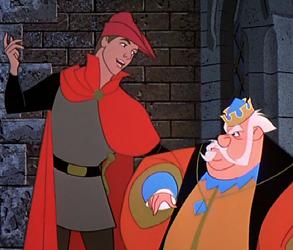
Era of the crusades, Robin Hood, and fat, wine-loving, and lecherous (but good-hearted) friars. Also home to dragons, wizards, knights in shining armour, Courtly Love, beautiful princesses with big headdresses, and tall, spirally gothic architecture. Expect to see a Corrupt Churchman or two wandering the landscape burning witches, heretics, and pretty much anyone who doesn't agree with them. Also expect to see people comically dropping left and right from the Black Death. ("Bring out your deeeeaaaaa——" *Fall* *Splut!*). Hear the Ominous Latin Chanting of monks singing Mass.
If the story does not take place in some unspecified kingdom, the setting is likely to be a mythologized Britain or France, though Jerusalem, which had pretty much been ignored since Bible Times will now also be used as the stage for all sorts of flashy battles involving cutlass-wielding Turks and ruggedly handsome Knights Templar.
The Middle Ages lasted for about a thousand years, and fell into five periods: the ugly Sub-Roman period (the fall of Rome, the barbarian invasions, the rise of Islam, and so on), the pleasant Carolingian Renaissance, the ugly Viking/Hungarian invasions, the pleasant High Middle Ages, and the ugly period of the Black Death and its aftermath. The classic medieval tropes above are exclusively drawn from the High Middle Ages: the period which stretches, approximately, from 1066 to 1348.
The Trope Codifier for the High Middle Ages was the 19th century, when the Middle Ages were celebrated as the embodiment of Romanticism in the Romanticism Versus Enlightenment debate. Ancient Greece, meanwhile, had been cast as the embodiment of Enlightenment in the 18th century. In reality, Ancient Greece and the High Middle Ages were very similar societies: both valued philosophy, science, and engineering, but feared and used magic and loved to fight. Both also had slaves, and a de facto caste system; both had a mix of slave/serf and free farmers as the basis of society. The Greeks valued city living more, though, and were a mix of petty kingdoms, democracies ("democracy" meant "mob rule" for a very long time thanks to their example), and lawless autocracies; but Persia was feudal (and most of medieval material culture — knights, castles, tunics, pointy shoes, roses, rhyming poetry, princesses in towers wearing conical hats with veils, wizards with robes covered in holy symbols — is originally Persian). It's fair to say that the High Middle Ages and classical Greece would've understood each other well, if they'd interacted — while contemporary Romantics and Enlightenment-ists would both have reasons to dislike both societies.
For a version of medieval tropes that casts a wider and more accurate net, check out the constituent periods:
(Although even here, the three initial periods of the Middle Ages are sort of a blur.)
See also Ye Goode Olde Days for the excessively positive version and The Dung Ages for the excessively negative. When history has been abandoned altogether, you have probably made the epic voyage to The Time of Myths.
It became a Cyclic National Fascination during the Romanticism, when people grew disillusioned with technological advances and yearned for "simpler" times.
Popular tropes associated with this time period are:
- Aristocrats Are Evil
- Black Knight
- Christianity is Catholic: Though it would eventually be throughout most of Central and Western Europe, in Eastern Europe and the Near East, Orthodoxy was more prevalent; yet is much less common in fictional works. (And officially, the final split came in 1054, and reunification was seen as a viable possibility until 1204.)
- Courtly Love
- The Dung Ages
- Ermine Cape Effect
- Feudal Overlord
- Gratuitous Princess: There weren't really many more then than now. Except a lot of small kingdoms have been eaten up since then and a number of states have changed from kingdoms to republics, so there were a lot more reigning princesses. There may be girls today who, if you assumed the continuance of feudal law, would in fact qualify as princesses, but who work as waitresses and don't know they are titular princesses. (To be pedantic, many of the smaller states (especially the ones in the Holy Roman Empire) were neither kingdoms nor principalities, so their "princesses" would technically have been "duchesses," "palatine countesses", "electresses" and possibly "marchionesses." Still, it's close enough for government work.)
- Gorgeous Period Dress: Except for (ugh!) Ye Peasants and one or two of the more self-denying Churchmen. Look for puffy, slashed sleeves and trunk-hose among the men, though these were really Renaissance fashions.
- Historical Domain Character: Even when they happen to be talking lions.
- Horny Vikings
- Knight in Shining Armor
- Medieval Ballads
- Medieval Morons
- No Woman's Land: When the setting is The Dung Ages.
- Pimped-Out Dress: Lots of fur, silk, and velvet for the nobility (though the last was not actually invented until very late in the period).
- The Plague
- Renaissance Fair: The Theme Park Version of the Middle Ages in modern times
- Stock Medieval Meal
- Swashbuckler: One of the two classic periods for the setting.
- Vestigial Empire: The Roman Empire was still around, based in Constantinople. In fact, historians often define the Middle Ages as the period from the fall of the Roman Empire in the west (476) to the fall of the Roman Empire in the east (1453). Restoring The Empire is a popular scenario, especially in Strategy Games.
- It also should be noted that it took several centuries after the fall of the Roman Empire for the general population to accept that the Empire was really gone. This applies to both the eastern and western empires.
- The Wild Hunt: Deriving from legends of this period.
- Ye Goode Olde Days
- Ye Olde Butcherede Englishe: Though actually rarer than one might expect in most serious modern works, 'tis more common in older ones. ("'˜By the light of Heaven!' said Prince John to Hubert, 'an thou suffer that runagate knave to overcome thee, thou art worthy of the gallows!'")
Works set in this time period include:
Arts
- Dante and Virgil in Hell, by Renaissance painter William-Adolphe Bouguereau
Comic Books
- Demon Knights
- Johan and Peewit, as well as its More Popular Spin-Off The Smurfs
- Prince Valiant
- Viking Prince
Films — Animation
- Disney Animated Canon:
- Sleeping Beauty: "After all, this is the fourteenth century."
- The Sword in the Stone
- The Hunchback of Notre Dame
- Beowulf (2007)
- DreamWorks Animation:
- The Shrek films, though they give an Anachronism Stew compared to the others
- The How to Train Your Dragon movie series.
- The Secret of Kells
- Brave
- Quest for Camelot
- King Dick
Films — Live-Action
- Any Film about Joan of Arc
- All permutations of the Arthurian Legend.
- All permutations of the Robin Hood mythos.
- Alexander Nevsky
- Army of Darkness
- Becket
- Braveheart
- The Court Jester (Stated to be in the reign of King Roderick I. of England.)
- Dragonheart
- Jabberwocky
- Kingdom of Heaven
- Knights of the Cross based on the novel of the same name.
- A Knight's Tale
- The Knight Before Christmas (the parts set in 1334)
- Ladyhawke
- The Last Duel
- Monty Python and the Holy Grail
- The Name of the Rose
- The Northman
- The Seventh Seal
- The Virgin Spring
- Les Visiteurs (the parts set in 1123)
Literature
- Doomsday Book
- Michel Pagel Le roi d'août (The King of August), a novelized version of the life of Philip II Augustus with fantastical elements (dryads especially). Quite historically accurate (except for the obvious Fantasy).
- Wolfbreed takes place during this time period and deals with The Teutonic Knights' conquest of Prussia...and werewolves.
- Catherine, Called Birdy and The Midwife's Apprentice, both by Karen Cushman.
- The Knights of the Cross by Henryk Sienkiewicz.
- Cantar del mio Cid
- The Sunne in Splendour
Live-Action TV
- The first Black Adder series.
- Beverly Hills 902 A.D.
- Most TV and movie adaptations of Arthurian Legend, despite the "correct" setting being immediately post-Roman Britain. This is because the earliest written versions of the legend were written in the Middle Ages and given a "contemporary" makeover.
- The opening of the Ghosts (UK) episode “About Last Night” takes place during the outbreak of The Black Death
- The Mystic Knights of Tir Na Nóg
- Most TV and movie incarnations of Robin Hood.
- The Pillars of the Earth Mini Series adaptation.
- World Without End Mini Series adaptation.
Tabletop Games
- Dungeons & Dragons in most of its incarnations.
- Warhammer Fantasy is set in a particularly grim version that's rather disparate:
- Bretonnia is the shining example of The Dung Ages, with peasants crushed under a bewildering variety of taxes while their overlords are Arthurian knights bravely fighting against horrible monsters (and are deliberately kept in Medieval Stasis by the wood elves hiding on their land who form Bretonnia's religion).
- The Empire is the most advanced human civilization with a Renaissance-ish level of technology and even early Industrial Revolution in places, though progress is limited to cities, the countryside is mostly forest and farmland filled with illiterate, superstitious peasants.
- Viking raids by Norscans are a constant menace to coastal settlements (and inland as well), and are able to continue even in the age of gunpowder thanks to being empowered by evil gods.
- Hobgoblins, Ogres and certain human tribes fill the role of Hordes from the East.
Theatre
Video Games
- Assassin's Creed
- Assassins Creed Bloodlines
- Assassin's Creed II (since the game takes place in The Late Middle Ages Italy, it overlaps with The Renaissance)
- Assassin's Creed: Valhalla
- Castlevania: Lords of Shadow
- Chivalry: Medieval Warfare
- Crusader Kings
- Dante's Inferno
- The First Templar
- Medieval: Total War and Medieval II : Total War.
- Kingdom Come: Deliverance
- Knights of Honor
- Knights of the Round
- Knights of the Temple: Infernal Crusade
- Miitopia
- A Plague Tale: Innocence
- Rune
- Stronghold
Web Comics
Western Animation
- Disney's Adventures of the Gummi Bears
- Castlevania
- Mr. Benn would travel to this particular era at least thrice, as a knight, wizard and cook in one story each.
Real Life
- The Society for Creative Anachronism is a non-profit organization dedicated to recreating the skills and knowledge of pre-17th century Europe.
