
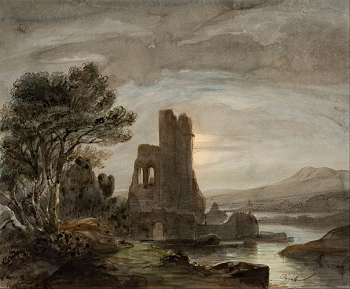
A time of anarchy and chaos (roughly 500 - 1000 AD), when people were disease-ridden and covered with filth, unless one happened to be king... at least, if you believe what ''Hollywood'' says about them — according to real modern historians this is a load of cobblers based primarily on the fact that we don't have many documents from (approximately) the first half of that time, and Renaissance figures were eager to dismiss everything between them and Ancient Grome (which they claimed they were heirs to) as pure garbage and not worth discussing.
In Hollywood Land, however, this was a time of muck and more muck. The cleanest—and most well-known—figure of this period generally ends up being Arthur, King (...ish) of the Britons, who had a round table, around which sat his band of noble and chivalrous knights blokes with big swords who fell in love with fair princesses and romanced them platonically from afar. Many of these knights proved not so noble and chivalrous once left to their own devices.note Since most accounts of Arthur were written centuries after he supposedly lived, and featured fashion and architecture from the time they were written, many Hollywood 'historians' lump him in with The High Middle Ages (but hey, since when have they been sticklers for accuracy?).
This period heralded the fall and division of the Western Roman Empire (the Eastern half was able to survive as the Byzantine Empire... which was never called 'Byzantine' until a century after it fell, by Renaissance figures wanting to paint themselves as heirs to Ancient Grome. Starting to see a pattern yet?), and the rise of monasticism in Europe.
Hollywood monks are pious men, clad in long brown robes, with rosaries and tonsure haircuts. They spend their days chanting and dipping feathered quills into inkwells and scribbling strange script into large books by candlelight. That is, when they're not out chasing lusty, busty tavern wenches. Hollywood monks don't take that whole "celibacy" thing all that seriously. Neither, in fact, did the regular clergy; celibacy did not become a requirement of the priesthood until very late in the Middle Ages. It was, however, mandated in nearly every set of monastic rules, including those of Benedict.
It was also a time of interesting contrasts: during this period, Christian and Pagan folklore and traditions were syncretized in the minds of the public, which gave rise to some of the most famous mythologies and legends of the Middle Ages, such as Beowulf, Siegfried, and the aforementioned King Arthur.
The term "Dark Ages" is typically credited to Petrarch in the 14th century, who used the term to refer to what he perceived to be the ignorance, superstition, barbarism and backwardness between the fall of Rome and the rise of the Renaissance. It was, out-and-out, a disparaging term used by historians right up until the 20th century.
In the 20th century, historians wanted to present themselves as more objective with fewer value judgements about the past, but at the same time they didn't want to retire the term "Dark Ages." So, they attempted to redefine it. This was done in two ways. Firstly, rather than applying the term to the entire medieval period (as was done originally), it would be restricted to the early medieval period - the first 500 years or so after the fall of Rome. Secondly, it would be claimed the ages were "dark" because of a collapse of literary tradition and a scarcity of historical records. Even today, some people claim the term "Dark Ages" refers to a lack of medieval written records, and that they are "dark" because we can't see what was going on. By this definition, depending on the area, this could narrow the timeframe of the "Dark Ages" to as short as 200 years or even fewer.
This is more charitable, but not only is it distinctly not what Petrarch had in mind when he used the term, even this updated definition is still mistaken. There was plenty of literary tradition in the early, high, and late Medieval period. Word for word, significantly more written material has survived from 500-1000 AD (the supposed depths of the "Dark Ages") than from the entire Roman imperial period. More writings survive from Pope Gregory the Great alone than from basically the entire classical corpus.
So it's not about written records. Furthermore, the negative connotations the term was originally meant to convey never entirely went away. Historians eventually realized that attempting to salvage the term as a professional one was a losing battle. Only in the 21st century has the term been definitively retired by professional historians.
It used to be claimed (and continues to be claimed by some today) that there was a wholesale and deliberate destruction of "pagan" Roman works by Christians, who threw the entire classical tradition in the trash because they considered it "demonic" and only cared about Jesus, and that's why the ages were "dark." This is also not true, but it does starkly reveal the inherent anti-Christian and anti-Catholic prejudice behind the term, most famously by historians like Edward Gibbon, who believed that the Roman Empire was a period of prosperity, enlightenment, tolerance, and stability until Christianity came along and ruined everything. This view persisted in the Anglosphere right up until the late 20th century, and has only fallen out of fashion in recent decades. Historians today conclude that the term has way too much baggage to be used in an objective way.
Popular tropes for works set in this time period are:
- After the End: The period is set after the fall of the Western Roman Empire in 476 AD. Additionally, characters will occasionally mention the legacy of the Romans.
- Ancestral Weapon: Often Truth in Television, as the difficulties of making steel and pattern welding made high-quality blades expensive, not to mention the shortage of metals, and they tended to get passed down, some eventually receiving a name and a legendary Back Story.
- Anachronism Stew: It's fairly common to see things that were invented in the High and Late Middle Ages such plate armor to pop up in fiction during this period. Arthurian Legend is a particularly bad offender in this.
- Barbarian Hero: More romanticized portrayals of the Vikings depict them as such.
- Carry a Big Stick
- Droit du Seigneur: Sort of a Dead Unicorn Trope since there are very few instances of this supposed right being practiced by feudal lords. Some historians even consider it an outright myth but that hasn't stopped some works set during or after Dark Age from using it most notably Braveheart.
- The Dung Ages: Although this trope is a vastly exaggerated version of reality, many larger cities and towns in this period did indeed have plenty of dirt and waste on their streets (although people still had a basic understanding of hygiene, bathing and cleaning their teeth regularly).
- Feudal Overlord: The feudal system developed around this time, though it had roots in Roman era patron-client relationships.
- Golden Age:
- A localized one in Ireland which saw a huge cultural, religious and artistic flowering thanks to the arrival of monasticism (this is where the 'Saints' from an 'Island of Saints and Scholars' comes in).
- The Carolingian dynasty of Mayors of the Palace, Kings, and finally Emperors helped another one explode on the mainland towards the end of this period, capping off with Charlemagne reconstructing the largest empire in continental Europe since Rome. This was just the first of three different such renaissance periods in Europe prior to the Italian Renaissance that is generally known by that name.
- This period of time is also when the birth of Islam occurred in the Arabian peninsula and was spread all the way from the Indus Valley to Iberia by the Umayyad Caliphate. This directly led to the Islamic Golden Age, which began around the latter half of this period.
- The Great Exterminator: Saint Patrick lived during the fifth century and helped spread Christianity to Ireland. However, his most famous act is that he allegedly drove all of the snakes from the island, a legend introduced about three centuries after his death. However, paleontological evidence suggests that Ireland hasn't had snakes at any point since before the last ice age, meaning there were none to drive out during his time. Nonetheless, he remains the Trope Codifier.
- Here There Were Dragons: In some of the more fantastical stories set around this period, probably due to the creative freedom enabled by the lack of surviving records in Europe.
- Heroes Prefer Swords:
- The history behind this is: after the fall of Rome (which had made swords standard for its soldiers), later swords would be expensive, prestigious weapons in many parts of Europe at least and legendary heroes were usually those rich enough to own swords, or alternatively those honored to be given them by their chief or liege.
- Additionally, the western Roman Empire wasn't quite dead during the dark ages, and the feudal states hadn't actually developed their own war-craft to a competitive degree yet. So swords were a characteristic weapon of the only people who were fully trained in the craft of the professional soldier, with formal training in tactics etc. If a band of mercenaries showed up and they were mostly equipped with swords, chances were that it was a legion remnant and you were about to have your own untrained peasant levies shoved up your arse sideways.
- Heroic Fantasy: When Arthurian Legend is the primary focus.
- Horny Vikings: The Scandinavian tribes of the period would slowly evolve into the Vikings and conduct raids across Europe.
- Rising Empire: The Carolingian Empire and the Umayyad Caliphate.
- The Time of Myths: As mentioned above, it can overlap in more fantastical or whimsical works as a natural consequence of the more sparse surviving primary sources, and also the fact that many famous mythical canons such as the Arthurian mythos originated around this time.
- This was also essentially the view many scholars held from after the Early Modern Period up until the 19th century, when most records were lost and archeological sciences were not sufficiently developed yet.
- Vestigial Empire: The Roman Empire collapsed in the fifth century, leaving crumbling roads and aqueducts to lace Europe-but only the Western half. The Eastern Roman Empire continued on until the fifteenth century: advanced infrastructure, a literate culture, and a higher standard of living, and remained a major power well into the early 13th century. In terms of actual territory, it waxed and waned in size, such as under Justinian I note , and Heraclius note , and Basil II note . However, they suffered some permanent losses (Syria and Egypt from 661, Rome from about 754), before entering a permanent decline after the 4th Crusade took Constantinople and balkanized the Empire in 1204: while Constantinople was retaken and the Eastern Empire re-established in 1261, large chunks had wandered off to do their own thing and the Turks had exploited the divisions to eat up a lot of territory.
Public Domain Characters & Public Domain Artifacts of this era:
- Arthurian Legend
- Excalibur, his sword.
- Excalibur in the Stone, the confusion of Excalibur and the original Sword in the Stone.
- Excalibur, his sword.
Related pages:
Works set in this time period are:
- Hägar the Horrible
- Prince Valiant is one of the few Arthurian works explicitly set in this time period (specifically the 5th century) in spite of its anachronistic elements, and many important historical figures of the time like Gaiseric and Attila the Hun make appearances.
- How to Train Your Dragon, both the book series and the 2010 movie.
- The Secret of Kells
- Beowulf (2007)
- All movie and literary versions of Arthurian Legend... although their aesthetic is almost certainly that of The High Middle Ages or even The Late Middle Ages, with only a few recent works aiming to avoid or tone this down.
- Monty Python and the Holy Grail. The Pythons admit that Anachronism Stew is at work: it is said to be set in Dark Ages Britain – the early 9th century – but the costumes are based on fashions from the 1300s. Yet it is still one of the most accurate depictions of the era ever put on film, due largely to the influence of Terry Jones (himself something of a medieval scholar).
- Jabberwocky
- The 13th Warrior
- The Last Legion: This one is set right after the fall of the Western Roman Empire and ties Caesar's lost sword to Excalibur, no less.
- Beowulf & Grendel (2005)
- Outlander (2008), i.e. Beowulf; The Sci-Fi Remix.
- Valhalla Rising
- Beowulf, the original epic poem.
- The Cattle Raid of Cooley
- Crossover Series, the second book takes place in the early phase of the High Middle Age, dealing with the tribes of Ireland.
- Eurico the Presbyter
- Here Lies Arthur
- Lest Darkness Fall
- Mabinogion
- The Nibelungenlied
- The Ring of the Nibelung: The opera tetralogy by Richard Wagner.
- The Sevenwaters Trilogy is set in 9th century Ireland, where Vikings and Britons (implied to be the Anglo-Saxons) are occasionally at war with the Irish.
- The Song of Roland
- The Warlord Chronicles
- Two works of Italian historian Valerio Massimo Manfredi:
- The Last Legion: Being set at the final death of the Roman Empire, the novel does a good job in depicting how culture was steadily shifting towards proto-medieval ways:
- Latin language is starting to fragment in vulgar dialects, as the characters note traveling from Southern to Northern Italy;
- Breeches wore by the Barbarians are actually more comfortable for horse-riding, and the pattern would keep going in the following centuries;
- Barbarians are not one-sided characters (save for Wulfila, maybe) but some like Odoacer are willing to adapt to Roman customs and do understand that they need to compromise with the Church and the Roman institution if they want to rule in the long run.
- The novella Limes is set two centuries later, when the Lombards have conquered most of Italy. The protagonist is a Roman patrician who laments the decay of Rome and its institution under the Lombards, but has managed to survive the troubled times with his properties and lifestyle unchallenged. That ends when a young Lombard warrior (who doesn't speak Latin neither does he understand the Roman concept of private property) settles in the estate next to his and starts to invade his property.
- The Last Legion: Being set at the final death of the Roman Empire, the novel does a good job in depicting how culture was steadily shifting towards proto-medieval ways:
- Kaamelott (and The Movie, Kaamelott: Premier Volet) is theoretically set in the 5th century, but deliberately and gleefully uses Anachronism Stew such as Renaissance-era full plate armor coexisting with Roman iorica segmenta, the Roman Empire is on its last legs but Gladiator Games are still going strong (they'd been banned by Christian emperors), the Egyptians still have architects capable of building pyramids while the Pope is sending Inquisitors around to sniff out heresy and witchcraft (the Medieval Inquisition only began in the 13th century), etc.
- Roar
- Merlin
- Vikings
- The Last Kingdom
- Miracle Workers: The second season's setting, and it's also a very stereotypical example. Even their higher education is comically sparse and ignorant. Most people live in a harsh, filthy environment with constant war and brutal punishment for even trivial offenses.
- Assassin's Creed: Valhalla is primarily set in 9th Century England, shortly before the establishment of the Danelaw.
- Crusader Kings: A series of Strategy Games set from 1066-1453 (with Downloadable Content for the sequel pushing the start date back to 769 and the rise of Charlemagne) where the player controls a dynasty of nobility.
- Total War: Attila: The expansion pack The Last Roman is about the Eastern Roman Empire's attempts to retake the lost territories of the West from the Barbarian Kingdoms.
