
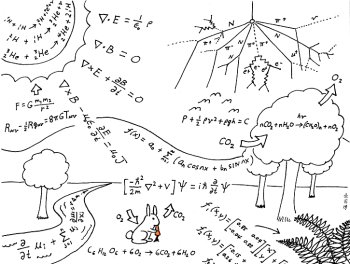
Measuring the Marigolds,
You and your arithmetic,
Will certainly go far.
Inchworm, Inchworm,
Measuring the Marigolds,
Seems to me you'd stop and see,
How beautiful they are."
This is the attitude that trying too hard to understand something prevents one from appreciating its beauty. It implies that appreciation is a feeling, not a number, and that reducing the divinely incomprehensible to the mundanely complex isn't just tedious and hard, it's fundamentally wrong.
This trope is, at heart, a reaction against hyper-intellectualism; fear and frustration with assigning a number or a scientific name to everything from rainbows to emotions. It could be summed up as "put away your calculator and enjoy the beautiful sunrise". It can appear anti-intellectual because it can imply that only people that don't know anything about a subject can appreciate it.
Naturally, experts in the given subject are repulsed by the False Dichotomy this attitude presents. Their understanding is never questioned, just their ability to appreciate it. Nobody has ever, for instance, advocated fielding Generals who know absolutely nothing about planning, logistics, strategy, or tactics but feel like they have deep psycho-spiritual connections with warfare. Experts that fully understand their field are actually very attuned to its beauty. You rarely, after all, spend a big chunk of time becoming an expert in something you don't appreciate. You can marvel at the visual beauty of a rainbow and be awed by the complex and delicate interplay of factors that allow it to exist.
Related tropes: This is a major gripe that Romanticism has against Enlightenment, and is the reason Doing In the Wizard isn't kindly looked upon; Doing in the Scientist is more its style. See Straw Vulcan, Hollywood Atheist, and Mother Nature, Father Science. One manifestation of this is Don't Explain the Joke. Compare Centipede's Dilemma, and Don't Think, Feel.
Compare/contrast The Anti-Nihilist, Awesomeness by Analysis, Enlightenment Superpowers, Emotion Suppression, Formula for the Unformulable, Geeky Turn-On, and especially The World Is Just Awesome for all the beauty missed by those who cannot see the pretty numbers in the page image.
Has nothing to do with the Otaku Surrogate character from Questionable Content, or with the play The Effect of Gamma Rays on Man-in-the-Moon Marigolds.
Examples:
- Fullmetal Alchemist Edward Elric is usually a straight example but his stance is ultimately complicated.
- He used it to justify his anti-god stance in the first story arc. "Alchemists are scientists, so we don't believe in vague things like God. He hates me, incidentally."
- It's taken to one extreme in the final chapter/episode, where Ed turns a marriage proposal into a discussion about the properties of alchemy, which Winry lampshades by calling him out on.
- Immediately after a baby is born, his reaction is to scream "That's awesome! LIFE IS AWESOME!!!" Instead of talking about chemicals or instincts or anything like that.
- In one of the omakes.
Mei Chan: Birds are so lucky...they can fly wherever they want, I wish I could be a bird.
Edward: A bird? That's lame. If you were a bird, you'd have flimsy hollow bones, and your brain would be the size of a pea. Not to mention the fact that you would be constantly crapping in mid-air to keep your weight down. Why would you want to be an animal like that?
Mei Chan: Mr. Edward, you're not very popular with girls, are you?
Edward: That's ridiculous! How could an intellectual like me not be popular!
- This trope is the entire premise of Science Fell in Love, So I Tried to Prove it. Yukimura and Himuro are obsessed with quantifying everything they can, most importantly the things that make up romantic love.
- In Yotsuba&!, Asagi shows Yotsuba that the tsukitsukiboushi making the onomatopoetic chirps heard in late-summer are cicadas, and not summer-ending fairies as she believed. However, Yotsuba is excited to learn something new and eagerly spreads the word that cicadas are cicadas!
- Hajime in I Can't Understand What My Husband Is Saying lists off the tired plot and clichés in a movie he just saw, while his wife stands there, saying she enjoyed it and is bewildered that someone would even think about stuff like that. It's semi-justified since he was going to post a review on his blog later.
- The Steins;Gate 0 theme "Fatima" alternately says that God Is Evil or that there is no God, implying that both possibilities are equally depressing. It underlines the protagonist's disillusionment from his failure to save Kurisu; morality may be on his side, but causality is not.
A mundane universe
Is overwriting all the values I know
- One Fantastic Four story had a villain steal not the intelligence, but the creativity of Reed Richards, who is regarded as one of the most intelligent men in the Marvel Universe. He found himself shocked to discover that he couldn't even stare at a flower without being hit by the sheer sense of wonder Richards feels at the existence of all things!
- Watchmen:
- Dr. Manhattan finds wonder in such miracles as the bonding of atoms and the formation of mountains and continents but doesn't hold any regard for life itself (mostly because he thinks he knows everything life has to offer). In fact, he only starts to love life again when he analyzes just how completely and utterly improbable (to the point of it almost being a statistical impossibility) daily life is.
- Dan Dreiburg, AKA Nite Owl II, mentions this effect in passing in one of the supplemental pieces. He found he was losing his awe for owls in studying them until a chance encounter with a hunting owl brought his fascination back.
- Sonic the Hedgehog (Archie Comics): At one point, Sally and Nicole, the later a computer program, enter a vast cave filled with crystals. After taking a chaos emerald from the cave, the reason they came in the first place, Sally then tries to convince Nicole that the cave's beauty must be protected from Eggman's forces. At first, Nicole, though able to analyse the crystals thoroughly, cannot comprehend why this is important, as it makes no sense tactically, but Sally eventually gets Nicole to manifest as a hologram an actually "see" the cave, convincing her that the cave is worth defending.
- Green Lantern: Krona's stories often involve this trope. Coupled with his trademark impatience, it has led him to stumble on disaster after disaster because, he insists on quantifying and qualifying everything, and is especially devoted to having a meaningful conversation with the sentience of the universe. The few times he's granted his wish, he is chided for his simplistic approach and rebuffed for his ignorance.
- Played with during a Spider-Man arc where Spider-Man, having temporarily lost his spider-senses, agreed to let Shang-Chi train him in martial arts to compensate. Spider-Man was able to grasp the scientific aspects of Shang Chi's teaching but struggled a bit with the philosophical aspects.
Spider-Man: I think I've got this. It's mass, acceleration, leverage and a knowledge of human biology. That's science, and I'm great at science.
Shang Chi: No, Spider-Man, it is so much more. This is no mere application of brute force. It is an art, and an expression of the self.
Spider-Man: What if most of myself is science?- Played for drama in the short story Flowers for Rhino, when Rhino, who had went through a successful experimental surgical procedure to boost his intelligence, gradually started to become detached from life and human relationships. When his girlfriend called him a monster, he realised to his horror that all he could start to think about was the definition and etymology of the word.
- The Transformers: More than Meets the Eye: The Functionist Council are a disturbed version. They and Six-of-Twelve, in particular, are of the belief that every living thing must serve a purpose, including animals and even moons, and are utterly obsessed with finding that purpose. Things that don't serve a purpose get removed or altered until they do serve a purpose.
- One B.C. character (probably Thor) neatly torpedoed his own chances of getting lucky by responding to a comment on the beauty of the moon rising by saying it's an illusion caused by the Earth's rotation. Cue him shouting at the retreating Cute Chick, "BUT IT IS STILL ROMANTIC, OH SOOOO ROMANTIC!" in a futile effort to recover the magic.
- Referenced in the FoxTrot arc where Andy becomes obsessed with the film Titanic (1997), to the point that Roger worries about her. Jason begins describing production trivia to her ("Did you know the scenes with everyone drowning was filmed in a heated indoor pool, and their foggy breath was added by computers?" and so on). Andy accuses Jason of trying to ruin her enjoyment of the film. The final panel has Jason telling Roger, "She's onto us. Do I still get paid?"
- Parodied in an early Garfield strip. After hearing Jon's farmer brother Doc Boy explain how potato chips are made, Garfield complains that knowing where food comes from means all the magic is gone.
- In the fanfic The Conflicts of Haruhi Suzumiya
 there is a scene where Ryoko is watching the rain, explaining all the ways she can analyse it. She ends with, "It's beautiful. The more I find out, the more I feel I can appreciate how special everything really is."
- In Genius: The Transgression, a fan-made RPG about playing Mad Scientists in the New World of Darkness, this sort of behavior is associated with plummeting down the Karma Meter. It becomes quite horrific due to its being combined with an increasing disinterest in humans as anything other than spare parts or test subjects. One of the given examples of a low-Obligation Genius has him trapping someone in a restraining machine and peeling off their face to watch the way their muscles work more easily, hooking them up to a machine that keeps them alive through this only while he's interested in his study.
- In Return to the Past, NOW!, Cassidy turns a day of Brynja being around the Lyoko Warriors into a big math mess.
- Oversaturated World: In Oversaturation - Contrast, the idea is countered:
The sun rose, and Mr. Discord stood on his lawn to greet it. He loved moments like this, when the sky and shadows changed, when the crispness in the air made it feel like it would crinkle if he moved too quickly, where the beauty of the natural world was fully manifest. Understanding the optics, the fluid dynamics, and all the other myriad secrets behind moments like this didn't lessen their beauty, it enhanced them. To watch the rising sun was to gaze into the inner workings of the universe.
- Inverted in A Spark of Ice and Fire. As Willas Tyrell studies biology under the tutelege of a certain Agatha Clay, he comes to marvel at the craftsmanship that the gods put into everything (a bird's wing is specifically mentioned).
- In The Nightmare Before Christmas, Jack Skellington borrows scientific equipment from Dr. Finklestein in an attempt to uncover the magic of Christmas: he examines a holly berry under the microscope and accidentally squishes it, dissolves the stripes off a candy cane, attempts to make a snowflake by cutting paper (and ends up with a paper spider), cuts open a teddy bear to analyze its plush stuffing, and crushes a glass ornament into tiny pieces and puts them into a beaker, and they emit a green glow. After perplexing research, he has a "Eureka!" Moment when he realizes he's been overthinking the magic of Christmas and decides to spread his own brand of Christmas cheer, presenting his findings to the citizens of Halloween Town, which leads the Mayor to endorse Jack's plan to bring a Halloween themed Christmas to the world.
- In the Sherlock Holmes films starring Robert Downey Jr., he's shown to be doing the Sherlock Scan at all times instinctively, not even trying. He's also shown to be enraptured by the sciences (especially forensics) and CAN see and enjoy the beauty in the world around him. He just likes reducing it to the bare facts to tweak those around him, especially Watson.
- Played with in Short Circuit. Toward the end of the film, Newton is trying to figure out if Number 5 has really "come alive." He makes a Rorschach blot with paper and tomato soup, trying to see if Number 5 sees past the scientific to see the marigolds. It is foreshadowed earlier in the film that Number 5 has this capacity: though he regurgitates scientific information at the drop of a hat, he is also able to see abstract shapes in clouds, rather than just dismissing them as pockets of water vapor.
Newton Crosby: Number 5, What do you make of this?
Number 5: Hmmm... Wood pulp, plant — vegetable — tomato, water, salt, monosodium glutamate...
Newton Crosby: [disappointed] Okay, thank you. Now you're talking like a robot.
[Beat]
Number 5: ...and resemble - look like - butterfly, bird, maple leaf! - The plot of Dead Poets Society revolves around a prep school English teacher's efforts to teach his students simply to enjoy poetry, rather than learn it via textbook. Notably, the introduction to their textbook features the author instructing readers on how to determine the quality of a poem by creating a line graph. Keating considers it ridiculous because a poem's greatness and impact are subjective to the reader and can't be measured.
- The Trope Namer is Hans Christian Andersen (1952). The song "The Inch Worm" (quoted above) is about how the inchworm is too busy measuring the marigolds to notice their beauty.
- The Sun Is Also a Star: Discussed when Natasha tells Daniel if something isn't scientifically shown it can't be a fact, and thus she doesn't believe in things like fate. She admits this is something that turns lots of people off (Daniel included) since they feel it saps life of meaning, but to her that isn't the case.
- Sherlock Holmes is a Playing with a Trope. He was always complaining about how Watson kept writing the adventures in a dramatic fashion rather than focusing on the meaningful facts, but he has his own flair for the dramatic. He claims he only has useful and practical information in his head (which is why he once failed to remember that the Earth orbits the Sun) and yet he is fascinated by those fields he deems practical.
- The first time Watson met Holmes in A Study in Scarlet, he was in the middle of an ecstatic nerdgasm as he'd just invented (the ancestor of) luminol.
- In "The Valley of Fear" he laid a trap for the villain and kept his associates in the dark about what he was doing specifically because it was more dramatic that way.
- In "The Lion's Mane", Holmes admits that Watson's storytelling is needed to fully engage the reader's interest rather than a straightforward depiction of cold facts.
- The character Dee Dee Six in the Philip Ridley book Mighty Fizz Chilla is like this. At one point she says things like food don't matter to her beyond nutritional value - she could eat a banquet or take some vitamin pills and it would be the same to her.
- Mark Twain:
- The man wrote an essay "Two Ways of Seeing a River" devoted to this very trope. Read it here.
- He also famously put in the preface to Huckleberry Finn:
"Persons attempting to find a motive in this narrative will be prosecuted; persons attempting to find a moral in it will be banished; persons attempting to find a plot in it will be shot.
BY ORDER OF THE AUTHOR
per G.G., CHIEF OF ORDNANCE"
- The man wrote an essay "Two Ways of Seeing a River" devoted to this very trope. Read it here
- Homo Faber, the well-known novel by Max Frisch, has exactly this type of guy as the protagonist-narrator.
- The Walt Whitman poem "When I Heard the Learn'd Astronomer" is about the narrator becoming bored at an astronomer's facts and figures and going outside to look at the stars.
- Edgar Allan Poe takes what's implicit in the poem and makes it explicit in To Science.
- A scientist's rebuttal to Walt Whitman's poem is called "When I Heard the Learn'd Poet."
- Edgar Allan Poe takes what's implicit in the poem and makes it explicit in To Science.
- E. E. Cummings:
- "since feeling is first" includes lines like "who pays attention to the syntax of things will never wholly kiss you" and "kisses are a better fate than wisdom".
- "o sweet spontaneous" is more obviously and scathingly against this.
- "since feeling is first"
- Discworld:
- The Auditors fall into this whenever they're not trying to destroy things because they can't be measured using numbers. At one point they attempted to understand art by reducing a painting to powder and sifting through to find the bit of it that was the art.
- Hogfather Death says you could grind the universe to a powder and not find one atom of "truth" or "justice", and in The Science of Discworld it's noted that you could do the same and not find one atom of "science".
- In Small Gods, Brutha is shown some color illustrations of plant life at the Library of Ephebe, in a book about the useful qualities of plants. Deeply moved by the images, he remarks "they're beautiful...", and the fellow who's showing him the book replies that that's one use the book's author had entirely overlooked.
- Twoflower has shades of this; Rincewind once described him as the sort of person who, upon seeing a daffodil, would run off to get a botany book and not realize he'd trodden on the daffodil.
- In The Science of Discworld, Stewart and Cohen use the example in the trope description; pointing out that understanding how rainbows work doesn't stop them being beautiful; it means you know why they're beautiful. In fact, Ian Stewart, like most mathematicians, uses the word "beautiful" a lot and a particularly well-executed proof is often referred to as "elegant".
- There's a subtle aversion in The Wee Free Men. Tiffany muses that you can spend all day studying the many intricate parts and complexities of a simple flower—rather than thinking that this takes away the beauty in any way, she concludes that it's not practical to become utterly fascinated by the beauty when you have butter to churn.
- John Keats, Lamia:
...Do not all charms fly
At the mere touch of cold philosophy?
There was an awful rainbow once in heaven:
We know her woof, her texture; she is given
In the dull catalogue of common things.
Philosophy will clip an Angel's wings,
Conquer all mysteries by rule and line,
Empty the haunted air, and gnomed mine—
Unweave a rainbow... - Henrik Wergeland played with this all the time:
Look closely, are you to view the greatness in the small, see divine thoughts heighten from the pale grass...
- Wergeland believed in the cause of enlightenment and science, but that never hindered him from gasping in wonder over the smallest objects and creatures of creation.
- In The Lord of the Rings, Gandalf calls out Saruman over this. Specifically, it's a big part of what reveals to Gandalf that Saruman has betrayed them.
Gandalf: He that breaks a thing to find out what it is has left the path of wisdom.
- The short story Democritus's Violin is about this trope. An academic windbag gets angry at the main character for using science in an essay on Bach and she gets back at him by pulling a prank which (supposedly) proves that the world is strictly reductionist and any belief in the power of art is the product of a dim mind.
- In Breakfast of Champions, there's a scene where the author is attacked by a dog. Kurt Vonnegut spends two full pages on a ridiculously detailed and brilliantly dramatic explanation of what happens biochemically in his nervous system, body, and brain from the time he sees the dog until he jumps over a car.
- In the novelization of The Adventures of Buckaroo Banzai Across the 8th Dimension by Earl Mac Rauch, Dr. Banzai is clearly a man who finds beauty in science and learning. An early passage states that his guiding principles in life are "The Five Stresses, The Four Beauties, and the Three Loves". The Five Stresses (things which are to be stressed in life) are decorum, courtesy, public health, discipline and morals. The Four Beauties are Mind, Language, Behavior, and Environment. The Three Loves are Love of Others, Love of Justice and Love of Freedom.
- Richard Dawkins wrote "Unweaving the Rainbow" about this idea and went to great lengths to show how understanding the underlying rules and processes behind everyday objects adds layers of fascination and beauty rather than taking them away.
- In Xanthippic Dialogues Xanthippe discusses reductionism and why it's wrong.
- C. S. Lewis:
- In several of his apologetics writings, he makes the distinction between "explaining" (to understand how a thing works) vs. "explaining away" (to debunk it) and he believes modern philosophy has become too obsessed with the latter when it comes to paradigms of thought different from itself and yet believes itself to be immune from the same debunking.
- In The Abolition Of Man he warns about reducing humanity to "mere nature" so that it, like the rest of our environment, can be shaped to our will (as he believes that this will eventually also render our very wills open to such manipulation), and in his closing wonders if the analytical sciences are a (metaphorical) basilisk that kills what it sees and can only see by killing, that when we move something into the laboratory we stop treating it as anything except an object to be studied and/or exploited.
- He also discusses this trope in the context of theology rather than science in Mere Christianity—personal experiences that result in religious wonder are fine for when you want to do the philosophical equivalent of wading at the beach, but if you'd like to sail the oceans you'd better have a map and sextant.
- Peter Nilson: The Swedes were lucky to have Nilson, an author and astronomer who wrote beautifully about such things as the heat death of the universe, and didn't let his knowledge of acoustics spoil his love of music or of ecohistory spoil his love of the Swedish countryside - he wrote books on both, as well as science fiction novels.
- The Belgariad: Inverted in the prequel Belgarath the Sorcerer. Belgarath's Patron God Aldur instructs him to learn everything he can from examining a single unimportant flower, to Belgarath's great irritation. After twenty years of study, Aldur suggests that he burn the flower and study the ashes, and Belgarath hesitates. Belgarath admits that he's come to love the flower, and Aldur deems his lesson complete.
- The Big Bang Theory: The nerds - even Sheldon on occasion - are amazed at the beauty and wonder that exists around them and quickly point out that there are amazing things that you wouldn't even know existed without the aid of science - Astronomy appears to be their poison of choice.
- Bones: Temperance Brennan has a unique means of appraising Seely Booth's appearance;
Brennan: Booth has a bigger mandible and a more prominent zygomatic than Fisher, as well as a more pronounced ratio between the width of his clavicles and his ilia.
Angela: So, it's because Booth is hot? Now we're getting somewhere. - Jacob Bronowski's The Ascent Of Man is described by Charlie Brooker as being like "taking a warm bath in University juice."
- Cosmos: Carl Sagan's Cosmos: A Personal Voyage: The documentary series is, in its entirety, a repudiation of this Trope. In fact, it might be seen as espousing the opposite — seeing as you are made of trillions of highly evolved cells equipped with ludicrously complex molecular machinery, the components of which, as well as nearly everything else, were made from the ashes of long-dead stars, that we can transcend time and death by reading... The most mundane events are suddenly much more profound and wonderful. As Carl Sagan once said, it takes away nothing of the romance of a sunset if you know a bit about how it works.
- Neil deGrasse Tyson's Cosmos: A Spacetime Odyssey: This 2014 reboot carries on repudiating this trope, especially in the final episode, which takes notes from Sagan's book The Demon Haunted World in urging the public to become scientifically literate as a means to improve their lives. At one point, he explains how examining growth layers in manganese nodules from the sea floor provides evidence of the earth being scoured by a supernova explosion two million years ago. "The difference between seeing just a pebble, and being able to read the history of the cosmos inscribed within... is science."
- Criminal Minds: Reid has a habit of doing this. While he is excited about his scientific and statistical information he can bring to the current conversation, he usually sucks all the awe and emotion out of it for everyone else involved. It's something of an inversion, since to him the details are as wondrous as the initial impression but everyone else sees it as dry and boring.
- CSI: has an episode where Catherine chides Gil Grissom for wanting to know how magic tricks work.
- Doctor Who:
- In some eras, this trope is part of the reason that the Doctor takes human companions with him; they can experience awe in his place because they don't understand the wonders of the universe. In other eras, the Doctor displays a boundless, childlike fascination with everything precisely because of his capacity to understand it, and excitedly tries to explain to his companions because he wants them to share in the wonder he sees. Much of the Nightmare Fetishist behaviour of the Tenth stems from his appreciation of how the horrible monster goes about doing whatever horrible thing it does, and the Fourth Doctor teaches science to Leela because, as she doesn't understand it, everything is just scary and pointless to her; but the Eleventh Doctor claims that he takes companions because, due to his understanding of everything, the universe is now just 'a backyard' unless there are uncomprehending eyes to look at it too. A lot of this is to do with the fact that the Doctor mostly plays off old Victorian intellectual tropes, an age when science and art were considered to be the same essential pursuit instead of separate to how they are today, and so the Doctor's fascination with art and philosophy is just another part of his interest in physics and chemistry - but by the Revival series, which has a more psychological bent and is divorced more from Victorian literature, he's playing off tropes associated with the Classic Doctors and playing them For Drama, meaning they're often played as emotional problems and insecurities.
- A Big Finish Doctor Who Companion Chronicle reveals that the First Doctor had submitted a pretentious and childish paper to the Academy proving that love did not exist and was just a series of chemicals. His tutor yelled at him for missing the point.
- In "The Time Monster", the Third Doctor gives Jo a speech about "the daisy-est daisy I ever saw", in which he describes an epiphany he had on a dark day of his life of how desperately beautiful simple flowers are just by virtue of being there.
- Zoe Heriot in "The Wheel in Space" is a human raised to think like a computer and so knows everything about everything, if only in a statistical manner. Her coworkers on board the Wheel treat her with suspicion and mock her for being robot-like, a state of affairs she clearly feels miserable about. She eventually decides she'll travel with the Doctor, even though it is dangerous, in the hope of experiencing true joy, wonder, and spontaneity.
- "Daleks in Manhattan": The Doctor distracts the Daleks with a brief bit of music, which confuses them since they don't get the purpose of it. The Doctor expounds.
Doctor: Oh, you can dance to it, cry to it, fall in love to it. Unless you're a Dalek. Then it's all just noise (blasts the Dalek with amplified music)
- Then there's this quote showing The Doctor's fatigue.
The Doctor: I can't see it any more. I'm 907. After a while, you just can't see it. Everything. I look at a star, and it's just a big ball of burning gas, and I know how it began, and I know how it ends, and I was probably there both times. Now, after a while, everything is just stuff. That's the problem, you make all of space and time your backyard and what do you have? A backyard. But you, you can see it, and when you see it, I see it.
- Everybody Loves Raymond: Doubling as The Cast Show Off, Brad Garret (Robert) sings "Inchworm" to calm down the twins when the adults are arguing, the song was chosen deliberately as it relates to that episode's plot.
- From the Earth to the Moon: In the final episode, Gene Cernan complains that Jack Schmidt spent much of his time on humanity's last moonwalk (to date) just staring at the ground, while he was entranced by the sight of the Earth. Schmidt then says that staring at the ground was just as entrancing—as a geologist by training, he could perceive the billions of years in those rocks.
- Fringe: Variant. Alistair Peck finds the idea of a scientist believing in God to be ridiculous, but he has a great deal of faith in the miracles science can produce.
Alistair: Walter, God is science. God is polio and flu vaccines and M.R.I. machines, and artificial hearts. If you are a man of science, then that's the only faith we need.
- Stephen Hawking's Into The Universe With Stephen Hawking is a show on space and time that's framed as a peek into the titular physicist's mind. It is gorgeous there.
- House:
- Being essentially a Sherlock Holmes expy, House is frequently dismissive of human emotions and relationships. On the other hand, he rides a motorcycle, takes a sadistic pleasure in artistic pranks, and does all sorts of other things just for fun. He doesn't look any happier, but they presumably do something for him.
- House also said, in a season 4 episode, "If the wonder's gone when the truth is known, there never was any wonder to begin with."
- He also enjoys explaining absolutely everything, from medical mysteries to personal motivations. He frequently wraps them in metaphors, even though the people to whom he's explaining them are often doctors and don't need a metaphor to understand them. He just enjoys the parallels. And he gets visibly frustrated when people aren't interested in his explanations.
- Masters of Sex: The scientific study about human sexual response gets regularly accused of removing the magic from relationships, to which Bill masterfully replies why love is out of any "equation" with a poetical analogy about Newtonian dynamics and Einstein's. "Love is the very fabric of it all, the curvature of our desire."
- Inverted on Northern Exposure: Ed Chigliak, Magical Native American, artist, and Bishōnen, hates computers until he realizes that ones and zeros are just like his people's view that the universe is made up of two things: Nothing, and everything.
- NUMB3RS : Charlie Eppes is a math genius who sees incredible and fascinating beauty in how mathematics helps describe the world. Indeed, he gets very emotional and passionate when talking about math but he does not enjoy stage magic because he so easily comprehends how the tricks are done. His girlfriend, on the other hand (who is also a mathematician), loves magic, and lampshades this very Trope in pointing out that understanding how it's done doesn't have to detract from the enjoyment.
- Our Miss Brooks: In "The Magic Tree", when Miss Brooks points out the mistletoe, Mr. Boynton takes it as a cue to begin a lecture on characteristics of the plant.
- Penn & Teller: Fool Us: Penn Jillette frequently says that he and Teller enjoyed a trick more than the audience because they knew how it was done and could fully appreciate the skill with which a piece of sleight of hand was done. They can show how they do the cup and balls trick with see-through cups and a base, and you will still be amazed at how they did it. They move so fast it might as well be magic.
- Probe's "Computer Logic": Mickey challenges Austin on his tendency to reduce everything he experiences to numbers, rather than caring about it. He responds by pointing out what he's done to help people and concludes that they have different definitions for "love" since they disagree on how it can be expressed.
- A running theme on Scrubs involves the characters gradually becoming more and more jaded to the practice of medicine. For instance, when Turk is sued by a patient, Dr. Cox takes it upon himself to "crush his spirit," a process that culminates with Cox explaining to Turk and a roomful of sick children how a magician's "rabbit in the hat" trick works.
- In Sherlock, after the titular detective rants about all of the useless information in the world, and how he only keeps important things on his "hard drive" (i.e. his brain), John more or less accuses him of taking this approach to life. Later Sherlock comments on the beauty of the night sky, and John is shocked.
Sherlock: [looking at the stars] Beautiful, isn't it?
John: I thought you didn't care about—
Sherlock: Doesn't mean I can't appreciate it. - Sliders: An android explained to Wade why the sky is blue, and she found it romantic.
- Star Trek:
- Star Trek: The Original Series's "This Side of Paradise": Mr. Spock has been affected by spores that release his emotional side. He and his love interest Leila Kalomi are looking at clouds.
Spock: That one looks like a dragon. You see the tail and the dorsal spines?
Leila: I've never seen a dragon.
Spock: I have. On Berengaria 7. But I've never stopped to look at clouds before. Or rainbows. I can tell you exactly why one appears in the sky, but considering its beauty has always been out of the question. - Star Trek: Enterprise: In one episode, the Vulcan officer (T'Pol) is told to let the instruments record the data and simply enjoy the beauty of the brand new spacey thing they've discovered.
- Star Trek: The Original Series's "This Side of Paradise": Mr. Spock has been affected by spores that release his emotional side. He and his love interest Leila Kalomi are looking at clouds.
- TV Tropes itself.
- We have a page called TV Tropes Will Ruin Your Life because, after a long Wiki Walk, you'll start seeing Tropes every time you watch a film that might distract you from enjoying the plot. Proposing that you may become jaded and unable to appreciate work in any medium by automatically dissecting and analyzing it.
- We have a page called TV Tropes Will Enhance Your Life because spotting tropes and admiring how an author built a story is part of your enjoyment of the story. Better yet, it gives you the tools to analyze and explain to others why you liked or did not like a piece rather than relying on "Eh, I just didn't like it."
- Research complaints: Pointing out research failures is usually a demand for accuracy over intrinsic entertainment. Artistic License, Rule of Cool/Rule of Fun/whatever, will often be dismissed as 'the easy way out', neglecting the fact that good fiction uses these tropes just as often as bad fiction. It's fictional - there are no prizes for getting every detail correct. They don't seem to get that Tropes Are Not Bad, and that we're here to celebrate popular fiction (a good example of this can be found on the page for the movie Sunshine, in the Hollywood Science entry - scientist Brian Cox would tell them how things would really work, and the filmmakers would use what they could, and go with something "wrong" if it fit the story better. Cox, a well-known science communicator and promoter, considered this the correct way to do it). Indeed, half of the Wiki is now a Moment of Awesome, Funny Moments, Heartwarming Moments and their kin, which is basically the internet's repository of stuff people like just because they like it.
- This blog entry — the last paragraph directly accuses TV Tropes of ruining fiction:
But the heart of the problem is that TV Tropes takes good, challenging fiction and removes its identity as an individual piece of work. ... Nothing more quickly removes the fun and charm of something born from human emotion and creativity than to strip it down into cold and clinical statistics presented out of context.
- This is basically what people who study literature, music, art, etc. do for a living, and just like the science examples, just try going up to a literature professor and telling them that their understanding of the mechanics of plot, characterization, themes, and wordplay means they do not feel the same spark of wonder. A good example is Shakespearean comedies - before studying them and their context, you'll get about a tenth of the jokes. Some people think that the guy laughing on his own in the theatre is showing off, because as Don't Explain the Joke suggests, you can't genuinely enjoy a joke that's been explained to you.
- The author of And You Call Yourself A Scientist, picking apart movie pseudoscience, says something about this in her examination of Jurassic Park.
You know, whenever I post one of these dissectory reviews, the first consequence is always, always, that someone will send me an e-mail demanding, "Why do you have to think so much about the films you watch? Why can't you just enjoy them? Why do you get so upset?" Given the implication that "thinking" and "enjoying yourself" are necessarily mutually exclusive, it is perhaps not surprising that they rarely believe me when I say that such an exercise gives me a great deal of pleasure; that the process of putting a film under the microscope (ha, ha) adds considerably to my whole experience of it – and that's true whether I ultimately endorse or criticize its science.
- The creators of Extra Credits say they frequently receive comments saying that by analyzing games they are sucking the fun out of them. Their response can be found here.
- The song Miracles angrily renounces anything scientific, instead referring to natural processes as "miracles", such as feeding pelicans and the workings of magnets.
- Magnets - Mormons have got you covered
- The SNL parody "Magical Mysteries" takes things even further, featuring lines like "What is Alaska? Who is Brazil? Isn't a volcano just an angry hill?"
- LoadingReadyRun made a full rebuttal.
- Magnets - Mormons have got you covered
- Coldplay's song "The Scientist":
I was just guessing at numbers and figures
Pulling the puzzles apart
Questions of science, science and progress
Do not speak as loud as my heart - Many a music teacher has suggested to his or her pupils that they dedicate time to learn basic music theory, as it will help them write music. Nearly as many music teachers have been saddened to hear their students claim that they "don't want to learn a bunch of rules that [they] have to follow." This assumes that music theory is a set of rules that must be followed. When told that music theory is more a way to analyze the writing and composition of music, these pupils are usually dismissive, citing, to some degree or another, this trope. If you haven't heard of the rules, you've also never asked yourself questions such as: "Am I already following these rules? Should I be? What is each rule trying to prevent? How do people get away with breaking each rule?" Music theory is to writing music as a map is to wandering; you can still put it away and enjoy the scenery. Having one just helps you know if you're going in circles, and lets you reach places far enough away from your home that you wouldn't have stumbled upon them otherwise. What's sad is that this perception might have held back the musical talents of many many budding musicians.
- Tom Glazer wrote "Why Does The Sun Shine? (The Sun Is a Mass of Incandescent Gas)" in 1959. The long-forgotten song was later covered by They Might Be Giants, and their children's educational CD "Here Comes Science" includes an updated version, "Why Does the Sun Really Shine? (The Sun is a Miasma of Incandescent Plasma)". Justified in that these songs are meant to both educate and entertain(, and do both splendidly).
- As a judge on The Sing-Off, Ben Folds is enjoying the show on more levels than the rest of us as he elaborates the exact technical merits of each performance. He looks giddy as he explains how the three-part harmony comes together or points out the arrangement of events every four to eight bars.
- Rilo Kiley's song "Science Vs. Romance" possibly references this: "I used to think, if I could realize I'd die, then I would be a lot nicer," and "Used to believe, in a lot more. Now I just see straight ahead". However, it's about a scientist trying to regain his feelings again, evidenced by the line "Facts vs. romance, you go and call yourself the boss, but we're not robots inside a grid."''
- Flaming Lips songs from the "Clouds Taste Metalic" and "The Soft Bulletin" era, are often occupied with demonstrating the beauty that lies between emotions and chemistry. Most notably are When You Smile: "Every single molecule is right, when /All of the subatomic pieces come together/ and unfold themselves in a second" and the title of the song "What Is the Light?" ("An Untested Hypothesis Suggesting That the Chemical [In Our Brains] by Which We Are Able to Experience the Sensation of Being in Love Is the Same Chemical That Caused the "Big Bang" That Was the Birth of the Accelerating Universe").
- The Angel and Robot Show/Phenomenaut's It's Only Chemical flipflops between being played straight (You might think this song is special with the way it makes you feel, but it's not/It's only chemical) and being a subversion, as it also applies to the bad emotions you go through in life - and that emotions just being chemicals is a good thing (It's better that way).
- Played for laughs in the last verse of the EarthBound-inspired song Da Black Market by Crazy Crakaz. There, a character (presumably a stand-in for Jeff?) who has never heard of video games finds an original SNES copy of the game, and measures the dimensions of the cartridge. His conclusion?
A chemical analysis proves nothing of hypothesis,
Of which I thought up in the shower while I read Nintendo Power.
What?! ...Eh, so I lied, but the fact remains that the game is made of grey plastic.
...Or so I think!
- Overuse of this theme was one of the many criticisms leveled at the Old World of Darkness games.
- Mage: The Ascension had the Technocracy, who started out as an evil conspiracy combining the worst features of Nineteen Eighty-Four, the Agents from The Matrix, every Government Conspiracy ever, and an especially boring math class. (They received a lot of Character Development as the game-line went on.)
- Changeling: The Dreaming characters were vulnerable to "Banality", which in practice meant that inhaling while too close to an accountant could harm or even destroy their souls. It was also inconsistent on this point, as for every book that treated a slide rule as just as bad as cold iron, there was a sourcebook where the nockers pointed out it was the moon landing that resulted in the biggest rush of Glamour most changelings had seen in their lifetimes, or a sample boggan accountant who resisted Banality through his profession because he took joy in numbers.
- The 20th anniversary edition cleared this this up, along with a lot of the other strange tonal dissonances in the original. In C20, exploring the wonders of the natural world through science and marveling at every new discovery are considered a perfectly valid source of Glamour, and Banality's creativity-stifling is a limiting force on science because it hampers technological innovation.
- Averted in the following quote from the Second Edition of Mage: The Ascension to sum up the attitude of the Sons of Ether:
"The beauty of science is not that it answers all the questions, but that with every answer, more questions arise."- Then there's the Weaver in Werewolf: The Apocalypse, a cosmic force which is associated with both technological progress and stasis. While it tends to be perceived as a lesser threat than the obvious Big Bad that is the Wyrm, many of the non-Glass Walker Garou continue to look down on things like cities or computers. Then it's further suggested that the origin of the entire Crapsack World can be traced back to the Weaver, since its imprisonment of the Wyrm was what drove it insane to begin with.
- Princess: The Hopeful: Defied by the Court of Diamonds. They are the Court who specifically value knowledge, reason, and science, but their signature emotions are curiosity and wonder, and a core part of their philosophy is that to understand the complex intricacy of the mechanisms that create a rainbow or the night sky only makes them more amazing.
- Dungeons & Dragons: Early editions had comparatively fewer rules than later editions for character actions other than combat and spellcasting. Back then if, say, you wanted to throw your drink in a villain's face to blind him, jump from a balcony, swing on a chandelier, somersault through the air, land on your feet, and run out of the room, your DM would have to figure out exactly how that would work - probably an attack roll with a small penalty, some Dexterity rolls, and a decision about whether you've generally played your character as a guy who would do that kind of thing. Now, your GM has extensive rules for how far you can jump, how far you can move, how much damage you take when you fall, what difficulty the Acrobatics check should be based on your level and if you don't have an attack power that blinds (or at least stuns or dazes) you can forget the drink-throwing having any useful effect. The new version makes everything much more standardized, predictable, easy to run, and fair, but many old-timers argue that the "rules instead of rulings" style of modern editions take all the heroism and excitement out of the game.
- 4th Edition included a SPECIFIC list and a table, devoted to 'actions the rules don't cover'...So the GM can EASILY get a ruling for you doing cool shit. (Especially "I want to swing from a chandelier and hit them!") Unfortunately, this same table makes sure that "cool shit" will always be less effective than your default attacks, thus punishing people trying to be creative. The original DMG spelled out that players with original ideas should be "rewarded" for that with a lower chance of success.
- 5th Edition appears to be heading back into the realm of simplicity over simulationism. If you want to try a cool stunt that's not explicitly outlined in the handbook, all the DM has to do is make up his/her mind on what sort of check is necessary, how difficult it ought to be given the circumstances, and then ask you to roll it. The designers of the edition even outright advocate "rulings over rules" in social media, an inversion of the phrase grognards use to describe the newer editions that preceded it.
- Played for all the horror possible in Genius: The Transgression. A Genius who bottoms out on the Karma Meter or who loses all control of their Science-Related Memetic Disorder becomes what is known as an Illuminated, only able to relate to other people in terms of their specific scientific theories... and since they have zero Obligation, they are willing to do anything to anyone to answer whatever petty questions draw their interest. An Illuminated would gladly chain you to a table and surgically remove your face just to see how the muscles underneath it twitch, or render entire species of animals extinct to learn just how important they were to the food chain.
- In defiance of this trope, Penn & Teller have turned exposing the inner workings of stage magic into an art.
- Their version of the Saw a Woman in Half trick, "Blast Off/Lift Off of Love" where Teller would climb into a complex contraption of interconnected boxes and poke his head and limbs out in various impossible-seeming configurations while Penn manipulated and rearranged the boxes, all set to music in a sort of magic-trick-cum-dance-routine. It was impressive but not so different from anything you'd see at a magic show. Then they turn the entire contraption around to show that its backside is transparent and do the entire routine again so that the audience can see just exactly how much skill and dexterity the trick required, particularly from Teller. It is amazing.
- There's also their version of the cups and balls trick, where it's first shown conventionally, and again, showing all of the setup, with clear plastic cups, and explaining all of the intermediary steps.
- Their expose on pretty much of all the tricks of the trade, Sleight of Hand.
- The musical adaptation of The Snow Queen has Kai, the boy taken by the queen, only find mathematical equations and numbers purer than his dirty city, rejecting the time he and Gerta (the protagonist) spent together as "childish" and dismissing her as "too stupid to understand". He's used by the Queen to solve mathematical equations: the biggest one of them all is solving eternity. Gerta brings him back from cold rationality with love, and love is the answer to eternity.
- Mass Effect 2: Multiple:
- Mordin Solus, the very model of a scientist Salarian. He shows extreme passion for his beliefs and work and has a deep appreciation of the arts. He sees the Collectors as a mockery of the Protheans, as the heart and soul of their race have long since been lost.
Mordin: Protheans already dead. Collectors just final insult. No organs; replaced by tech. No culture; replaced by tech! No soul; replaced by tech!
- He admits that after working on the Genophage, which at the time he logically saw as the correct choice, the guilt drove him to seek spiritual answers. He didn't find any that satisfied his guilt, but he does retain a spiritual side by the time you meet him.
- The trope was invoked for laughs in the third game when he said he'd like to retire to a beach somewhere and collect seashells, only to admit he'd probably run tests on them out of boredom.
- In Mass Effect: Andromeda an audio log by a quarian historian states that this concept is the actual reason why synthetics can never truly have “souls”. He states that the Geth would therefore have “no meaningful understanding of experiences we take for granted”.
- Mordin Solus, the very model of a scientist Salarian. He shows extreme passion for his beliefs and work and has a deep appreciation of the arts. He sees the Collectors as a mockery of the Protheans, as the heart and soul of their race have long since been lost.
- Pokémon Black and White: N accuses Professor Juniper of "arbitrarily measuring and categorizing Pokémon without appreciating them". If you were reading Juniper's intro speech in the game's prologue, you'd know this isn't the case. It's a mite hypocritical of N when he seems to view everything in terms of equations and formulas himself, even as it's clear that he has a deep appreciation for Pokémon.
- Riviera: The Promised Land: Ledah gave up his emotions to become a Grim Angel so he sounds like he's a straight example. The truth is the opposite; he's very passionate about his religion.
- Kingdom Hearts:
- The villain of the series - Xehanort and his various incarnations - are in a sense a perfect example of this trope. He's not out to seek power and control like any other villain would, rather he considers himself a seeker of knowledge and is willing to do anything and everything to understand the true nature of the Heart, even if it means many people suffer in the process. Sora puts it best in Dream Drop Distance.
Sora: Just stop it! You treat people's hearts like bottles on a shelf, but they're not!- Ansem The Wise also strove to research and understand how the heart worked, but unlike Xehanort, he eventually came to understand how foolish this was and worked to atone for the trouble that his efforts caused.
- Subverted and averted by Curie in Fallout 4. As a Miss Nanny robot, she is constrained by her analytical programming and wants the creative spark that a human mind can give her. Once she's given the opportunity by being uploaded into a synth body, Curie finds that her preinstalled knowledge base doesn't help her to deal with the emotions she can now feel, but she's so enthralled by experiencing them that she doesn't feel the need to fully understand the How and Why.
- Deconstructed in Persona 5 Strikers with Kuon Ichinose, who designed a computer program - Sophia - essentially to tell her what emotions were. The reason she did this is because Ichinose does not naturally emote properly; everyone being creeped out and avoiding her eventually convinced her that she was incapable of feeling emotions on her own, seeking to use Sophia as a substitute. When Sophia became confused by her directives, literally unable to describe what a "heart" was because she just came online, Ichinose plummeted past the Despair Event Horizon and decided emotions were unneeded anyway. This led to her creating Sophia's successor, EMMA, as a helper of humans unconstrained by any emotions at all.
- In Cosmic Star Heroine, when the party reaches the waterfalls of Nuluup, this conversation occurs between Orson Bolibar and Psybe:
Orson: You won't find a prettier place than the Nuluupian waterfall cliffs in all of Zevanii!
Psybe: H₂O leves seem adequate. Atmospheric pressure is appropriate.
Orson: You're unimpressed?
Psybe: The scenery here is not unpleasant. The flowrates could be improved with auto-turbines. The flowers could emit greater light with minor cybernetic implementation. And the vines...
Orson: I think you're missing the point, sir.
Psybe: Perhaps.
- Gunnerkrigg Court:
- The animals of Gillitie Wood think the Court scientists' study of magic makes it less beautiful.
- Conversely, many Court scientists feel that refusing to even attempt to explain how things work is a disservice to the beauty of their complexity.
- xkcd is an inversion of this. It often talks of math and science with an infectious sense of awe and giddiness, demonstrated here.
- Questionable Content: Clinton inverts it, arguing that you can't truly appreciate the marigolds until you've measured them.
- An Oglaf page has a man telling a forest spirit that she's as mysterious as she is beautiful, and then showing her a graph of how closely her levels of mystery and beauty track over time. Needless to say, he doesn't get into her pants like he was hoping.
- Mr. Deity accused Lucifer of this when she explained to him that Penn & Teller don't really have magic powers.
- Inverted by Symphony of Science which is nothing but various scientists gushing about how awesome the world and its mechanics are, Auto-Tuned and set to music.
- Eliezer Yudkowsky argues against it under the title, "Explaining vs. Explaining Away, with some follow up notes on taking Joy in the "Merely" Real.
- Sign up for a few skeptical and science podcasts, such as Skeptoid, The Skeptics Guide To The Universe, or indeed any other. Sure, there may be the occasional attack on pseudoscience and alternative medicine, but most of the content is very bright people waxing lyrical about how cool a new discovery, newly realized aspect of the natural world, or just learning something you never knew is. Generally, but not always, attacks on "believers" are reserved for those who try to use the law to mandate their view or who sell a product with no proven benefits, especially in the fields of medicine and nutrition.
- Both of Hank Green's YouTube science shows avert this, with SciShow focusing on science news and ideas Hank Green finds cool, while Crash Course Biology, Ecology, and Chemistry taking a more targeted approach at various scientific disciplines. Part of what makes it work is Green's obvious enthusiasm
- The Brain Scoop makes biology and taxidermy fascinating through Emily Graslie's obvious love for discovering new things.
- Amazo in Justice League. He started out as a blank-slate nanotechnology android capable of analyzing people to internally reproduce aspects of them. Lex Luthor manipulated him into doing his dirty work, and Amazo proved to be a serious threat because he could copy the powers of every superhero he encountered, then further evolve to become immune to their vulnerabilities. Eventually, he discovered Lex's manipulations, grew disillusioned, and left Earth, calling it insignificant. Sometime later, after essentially evolving into a Physical God, he returned to Earth, creating massive panic among the Justice League, until it turned out he was struggling through an existential crisis, having obtained unimaginable power but not knowing what to do with it. Doctor Fate took him in, hoping to teach the android how to appreciate life and find a purpose for himself.
- The Adventures of Jimmy Neutron, Boy Genius does this occasionally. Jimmy is a 10-year-old kid who can explain making a baby with no more awe or disgust than he would a math problem.
- On The Simpsons,
- The citizens of Springfield once rioted against science, saying it was like someone who spoils the end of a movie.
Moe: *fossil falls on him while he hits it* I hope medical science can cure me!
- Played for Laughs when Professor Frink is the substitute teacher for a kindergarten class. He lectures the kindergarteners on how a toy makes use of the laws of physics in order to work, but when one of them asks if they can play with it, Frink responds, "No, you can't play with it. You won't enjoy it on as many levels as I do."
- The citizens of Springfield once rioted against science, saying it was like someone who spoils the end of a movie.
- Dexter's Laboratory spent a whole episode on this ("Way of the Dee Dee") where Dee Dee showed Dexter the beauties and mysteries of life (in a humorous way) after she pointed out that Dexter was deprived of life in his laboratory: "Spoiled away, alone in the dark, searching the answers to questions nobody asks... locked away from the world, never to explore the true mysteries of life". The episode ends with Dee Dee apologizing for trying to make Dexter live life her way and admitting she shouldn't have tried to change him.
- Velma in Scooby-Doo never believes the "Scooby-Doo" Hoax. In the second live-action movie, she even stated that she only trusted the facts and that finding out logical answers to problems was her true calling in life.
- The '90s Spider-Man: The Animated Series made Peter a subversion of this Trope - for instance, when he's on a Ferris wheel, Mary Jane asks how fireworks work, at which point he goes into a talk on the fuses and the gunpowder and the doping with trace metals and so on. When Mary-Jane comments that he's taken the romance out of them by analyzing them, Peter points out that knowing how they work doesn't make them any less beautiful. She would later use the knowledge to create a makeshift distress signal.
- The Disney cartoon Donald in Mathmagic Land is an attempt to avert this. Despite Donald's insistence that advanced mathematics is for "eggheads", a disembodied "Spirit of Adventure" manages to convince him otherwise by showing how math influences things like parlor games and music theory.
- 'Twas the Night Before Christmas: This is the message of the "Give Your Heart a Try" number, though the latter song "Hope and Hurry" does a lot to balance it out.
- My Little Pony: Friendship Is Magic:
- Twilight is essentially a scholar of magic (and is fairly interested in history). She is repeatedly enthusiastic about her studies and is regularly disappointed and occasionally shocked, when others don't show the same level of interest in these things as she does.
- Feeling Pinkie Keen. It is the first to feature The Pinkie Sense and Twilight tries to figure out how it works. She questions Pinkie about its mechanics, hooks her up to a machine, and then observes her to collect empirical data. The problem was she didn't want to study this new and fascinating magic but rather disprove it because she believed it to be closer to superstition than magic. In the end, she decides to give up and stop trying to figure out how it works. Pinkie herself already had it "down to a science", so to speak, she just didn't know what triggered it.
- In Young Justice this is how Kid Flash is portrayed in the episode "Denial", constantly explaining away everything done with magic, with science. In the DCU, this is stupid because magic is common in this verse and several members of the Justice League use magic, such as Zatanna and her father. His perception is likely owed to the fact that the Flash family doesn't really have any magical villains, including Abra Kadabra who uses technological tricks to perform his seeming magic and was probably who Kid Flash had in mind when going through one of his diatribes (Klarion the Witch Boy, who is spying on the group, even asks Abra, "Isn't that how you perform your tricks?")
- Experts in real life frequently invert this trope. These people chose these fields in the first place because they feel intensely about them. You don't get rich researching science. It is, almost by necessity, a labor of love.
- Ask any scientist about their field of specialty, and the last thing you'll get is a robotically dull answer.
- Try asking a botanist about flowers, or an astronomer about galaxies.
- Ask a philosopher some questions and grab a seat. There are philosophers who debate with all the zeal of the most devoted Fan Wanker. Philosophy, (systematic) theology and other exercises of raw reason are often enlightening once you've grappled with a particular problem and, as it were, solved the riddle, or at least contributed towards understanding it more.
- Ask a mathematician about their work, aka "the dullest thing in existence", and you're likely to get a whole lot of enthusiasm and excitement.
Bertrand Russell, Study of Mathematics: Mathematics, rightly viewed, possesses not only truth, but supreme beauty, a beauty cold and austere, like that of sculpture, without appeal to any part of our weaker nature, without the gorgeous trappings of painting or music, yet sublimely pure, and capable of a stern perfection such as only the greatest art can show. The true spirit of delight, the exaltation, the sense of being more than Man, which is the touchstone of the highest excellence, is to be found in mathematics as surely as in poetry.Galileo Galilei: Philosophy is written in that great book which ever lies before our eyes – I mean the universe – but we cannot understand it if we do not first learn the language and grasp the symbols, in which it is written. This book is written in the mathematical language... without which one wanders in vain through a dark labyrinth.
- Mathematics, pure mathematics, is as much an art as it is a science. Theorems are astoundingly beautiful if looked at the right way. The way high-school math is taught does not foster this perspective.
- The very concept of "mathematical beauty" not only defies this trope, but turns it on its head. People who aren't mathematically minded miss out on the beauty of something like Euler's identity, eiπ+1=0.note
- Physicians can be particularly passionate about their field, sitting where it does at the intersection of cutting edge technology, the frontier of science, and a deep humanitarian mission. Dr. Atul Gawande's Complications is an excellent introduction to just how emotional the field is.
- Computer programmers love how they take thousands of simple commands and build them into something grand. Doubly so if they work on artistic-based programming, like game design, music, or graphics/animation.
- On a meta level, measuring the measuring of marigolds, a 2022 empirical study of the role of beauty in science formally found that beauty tends to be important in science.
- You needn't be an expert to get the feel for the inversion, either.
- Take trees: If you know next to nothing about them, you'll probably be able to distinguish two general types (evergreens and deciduous, roughly those that don't go bald in winter and those that do), and maybe pick out a couple of specific types like maple and willow. Staring at the top of a forest is just a mass of green, nothing exciting or interesting about it. But start to study trees, to recognize the distinctions, to tell them apart from up close and then from farther away, and you start to pick out the fuzzy look of the longer needles on a pine, the bendy top and airy branches of a hemlock, the color of a Colorado blue spruce, the way the branches hang on a false cedar, the way the ground is littered with distinctive cones under a Douglas fir. And that's just the conifers/evergreens. When you have that much in your head, take a look at a forest again: still just a mass of indistinguishable green?
- Ditto if someone who's an amateur astronomer shows you a galaxy: sure, that faint smudge of light that looks as if were going to vanish in one moment or in another does not look very impressive... until they tell you it's an ensemble of stars so big that light needs tens of thousands of years to transverse it and its light had needed tens (if not hundreds) of millions of years through intergalactic space to finally reach your eye.
- Same for an amateur geologist at something as simple as a roadcut. That small slice of Earth tells anyone who knows how to read it an incredible story in the formation of each layer, intrusion, fault, and unconformity, dealing with forces that move mountains and take place over stretches of time far longer than humans could ever comprehend.
- Brian Cox (the physicist, not the actor) has made a career of defying this trope, in much the same vein as Professor Sagan.
- Learning a language usually changes the way you perceive it. Some don't like how it sounds after their lessons and some come to like even more.
- Ever see a cool magic trick?
- Some people find they are not that amusing when you figure out how they work. If you're the kind of person who legitimately enjoys magic shows, better hope you don't find yourself sitting next to that one asshole in the audience who feels the need to explain how every trick is done to you, or if they don't know, decide to grumble and complain about how juvenile it is.
- On the other hand, some people find far more fascination in the intricacies of how the tricks are executed.
- Simple kiddie tricks may lose their awesomeness, yes, but more advanced tricks of master magicians can become even more amazing when you start to understand how much brilliance, hard work, and showmanship skill go into them.
- Penn & Teller had a show in the UK called "Fool Us." It was a competition. P&T would sit in the audience and see a trick one time from the audience's point of view. They got no help. No special camera angles, no tapes to watch, and only one performance of the trick. If they could not figure out how your trick was done on a single viewing, you won a trip to Vegas and the right to open for them. The acts were all top notch, and yet maybe only one in six got past them. That did not stop them from taking almost childish joy in each performer's tricks.
- Performer Michael Vincent, in particular — he was on the show twice, both times doing card tricks. Penn & Teller figured out how he did them easily, but they still not only raved about his performances, but you can tell that they're trying (without giving away how the trick is done) to explain to the audience just how amazingly talented the man is — he may be "only" doing the real basics of magic, but he is doing them so phenomenally well that these two lifelong professionals are utterly in awe of his ability, since they know just how hard it is to do what he's doing and to make it look easy. At one point, Penn even knows exactly when and where he moves the cards to secretly get them somewhere else, and he still can't see him doing the move.
- A playful "warning" given to new students of various design fields (interior design, graphic design, web design, etc.) is that "you will never be able to look at this field the same way again." But ask those same people about a design they genuinely like, or something that they're just stopping to stare at, and you can get several minutes of gushing.
- Paul "Hungrybear9562" Vasquez's "Double Rainbow" viral video has been subject to this, especially after it was autotuned by Songify This. As the man himself explained in multiple interviews (as well as a video response to his own video), his asking "What does it mean?" in the video was actually him seeking spiritual meaning in the rainbow sighting. Despite this, several science-related YouTube channels (and dozens of people commenting on his original video as well as the autotuned version) decided to answer his question with a detached, academic, and dry explanation on how rainbows occur.
- Riot Games — which has several employees holding doctorates in the sciences — even got in on the marigold-measuring act with one of the "joke" lines Lux (a magician who specializes in spells involving light) says in League of Legends. Much to Paul Vasquez's dismay, the number of people trying to explain to him how rainbows occur has gotten even more obnoxious than before.
- Animators spend all day sitting at a desk, studying how a body moves, how things move, making them move, drawing hundreds of drawings. Learning how it works systematically. It doesn't make it any less enjoyable to watch cartoons being able to spot where other animators went the extra mile or made mistakes, or knowing what needs to be done to accomplish what happened.
- Also, analyzing people's movements makes you realize just how different each person moves and how it reflects their personality, mood etc. Whereas most people would have the default assumption that "a walk is a walk," a walk in animation tells you EVERYTHING.
- The same applies to acting, whether it's a live action role, or a voice role. How does your character walk? Does he slump forward? Does he swagger? Is he pigeon toed? Does he have a particular accent? How strong is it? Is he trying to lose it? Does he have a soft voice, or a gravelly rasp? All of these little things change who he is, and how he's perceived. It's why the school of method acting still exists. People spend months getting into, and building their idea of who the character is, because it matters to them.
- Film students often claim to be unable to enjoy films to a full degree because they're too busy analyzing them. Joaquin Phoenix commented on this shortly before the Oscars, saying that he rarely watches film anymore, due to knowing every trick and method that drives actors forward.
- Nathaniel Wyeth came from a very artistically inclined family (son of N.C., brother of Andrew and Henriette), but as an engineer he was probably the family black sheep. Nonetheless, he was pretty good at it, eventually becoming the chief engineer of the DuPont company. (Among his inventions was PET, the plastic used in soda bottles.) True to his genes, he would speak eloquently about using equations the way Andrew uses brushes.
- Emile Cioran, one of the bleakest nihilistic writers of all time, once said: "Lucidity is the only vice which makes us free — free in a desert."
- Richard Feynman also was a major advocate of this style of thinking. In What Do You Care What Other People Think?, he advocates this position with an argument he had with an artist:
Feynman: I have a friend who's an artist, and he sometimes takes a view which I don't agree with. He'll hold up a flower and say, "Look how beautiful it is," and I'll agree. But then he'll say, "I, as an artist, can see how beautiful a flower is. But you, as a scientist, take it all apart and it becomes dull." I think he's kind of nutty. [...] There are all kinds of interesting questions that come from a knowledge of science, which only adds to the excitement and mystery and awe of a flower. It only adds. I don't understand how it subtracts.
- After he received stories of people disillusioned by his book The Selfish Gene, Richard Dawkins wrote a counter to this viewpoint in the form of Unweaving The Rainbow. It helped that not only did most people criticize The Selfish Gene purely from title alone, but those that did actually read it thought that he was endorsing a bleak dog-eat-dog philosophy of the worldnote , despite the fact that he explicitly said he wasn't doing this in the first chapter of the book. He also added a preface with that message when he found out the executives behind the ENRON scandal had cited the book as an excuse for their behavior.
- David Kushner's book Masters of Doom has this to say about id software's John Carmack and his programming knowledge: "... after so many years immersed in the science of graphics, he had achieved an almost Zen-like understanding of his craft... Rather than detaching him from the natural world, this viewpoint only made him appreciate it more deeply. "These are things I find enchanting and miraculous," he said. "I don't have to be at the Grand Canyon to appreciate the way the world works, I can see that in reflections of light in my bathroom."
- This can happen to many a game developer as their careers progress. Entering the industry with a fan appreciation, learning how it all works and forgetting how to enjoy games, and then later, learning to appreciate even more what it takes to make a game. Some of the simplest and most successful games have come from people with years of experience in the industry.
- Stephen Hawking complained about this once: with the discovery of the "God Particle", he complained that, with lots of questions in physics revealed, it took away all the mystery.
- The Discovery Channel is dedicated to measuring marigolds (some might say it used to be), but that didn't keep them from celebrating how awesome the world can be.
- This is one of the crux points of the Casual-Competitive Conflict on the Casual side. If you're counting all the frame data and complaining about glitches being taken out instead of watching Mario beat up Sonic, how can you really be enjoying the game? Competitive players will be glad to retort that their deeper understanding of the game creates a more exciting scene not just to play, but to watch as well, and can greatly increase the shelf life of a game which would otherwise stagnate.
- It is a common complaint among new film or literature students that after they've become versed in the structure and common tropes of storytelling, they can't simply enjoy movies or books anymore because they automatically start dissecting them. As with the magic show example given above, they feel that their Suspension of Disbelief has been crippled by the knowledge of how the illusions of fiction work. In fact, this phenomenon is a major part of why TV Tropes Will Ruin Your Life. Also with the magic show example given above, discovering how much skill and creativity goes into creating film and literature can make the dissection part of the joy of the work. Then using that knowledge to create one's own can be an even greater joy. In fact, this phenomenon is a major part of why TV Tropes Will Enhance Your Life.
- Some people feel like watching behind the scenes features and director's commentary on movies dismantles the magic and ruins the scenes that blew them away by showing how exactly they were achieved. Others delight in learning the stories behind the stories and the sheer craftsmanship (especially in the age of realistically achieved practical effects) involved in weaving the illusions.
- When you were a child and understood relatively little of the world around you, did you experience the emotion of wonder more often than you do now?
- Cuteness being explained as a biological reaction to baby-like proportions kind of takes away the appeal, but does it make them any less cute?
- Philosophy of dialogue distinguishes between two approaches to people (and some sorts of things, including nature and artworks): using and entering dialogue with. You use a thing for your own purposes, which include learning about the thing scientifically (satiating your curiosity), and you enter dialogue with it when you open yourself to what it is in itself and allow it to act on you. Both approaches are valid and necessary — the problem begins when you only use things.
- To experts in a field things that might be beautiful to the lay person might be sad or frightening. What may look like a pretty tree to the average Joe a botanist might recognize as an unhealthy specimen without much hope for recovery. A cluster of clouds and light might look breath taking to the passengers of a cruise ship but an ominous sign of an approaching storm to the crew. The inverse can also happen, where a bunch of green stems poking out of ground may be a wonderful sign to a botanist but not the layperson.
- Science has expectations of objectivity that serve to ensure the integrity of the scientists and their findings but also put emotional distance from their subjects. Especially in the realm of public policy, an appearance of dispassionate neutrality is necessary to avoid accusations of bias. For example, Spitfire, a popular wolf among visitors to Yellowstone, was merely referred to as 926F and reactions to her death among the scientists that built their careers observing wolves were considerably more muted than that of the general public. However, those that were retired were more candid.
- Averted with actual inchworms, they're not actually measuring anything, it's just their form of locomotion! Not to be confused with locomotives, which are trains.
- On the other hand, in contrast to the above example, railfans often embody this, learning everything there is to know about trains to the point that to non-railfans, some overzealous rail enthusiasts may make trains suddenly seem boring.
